


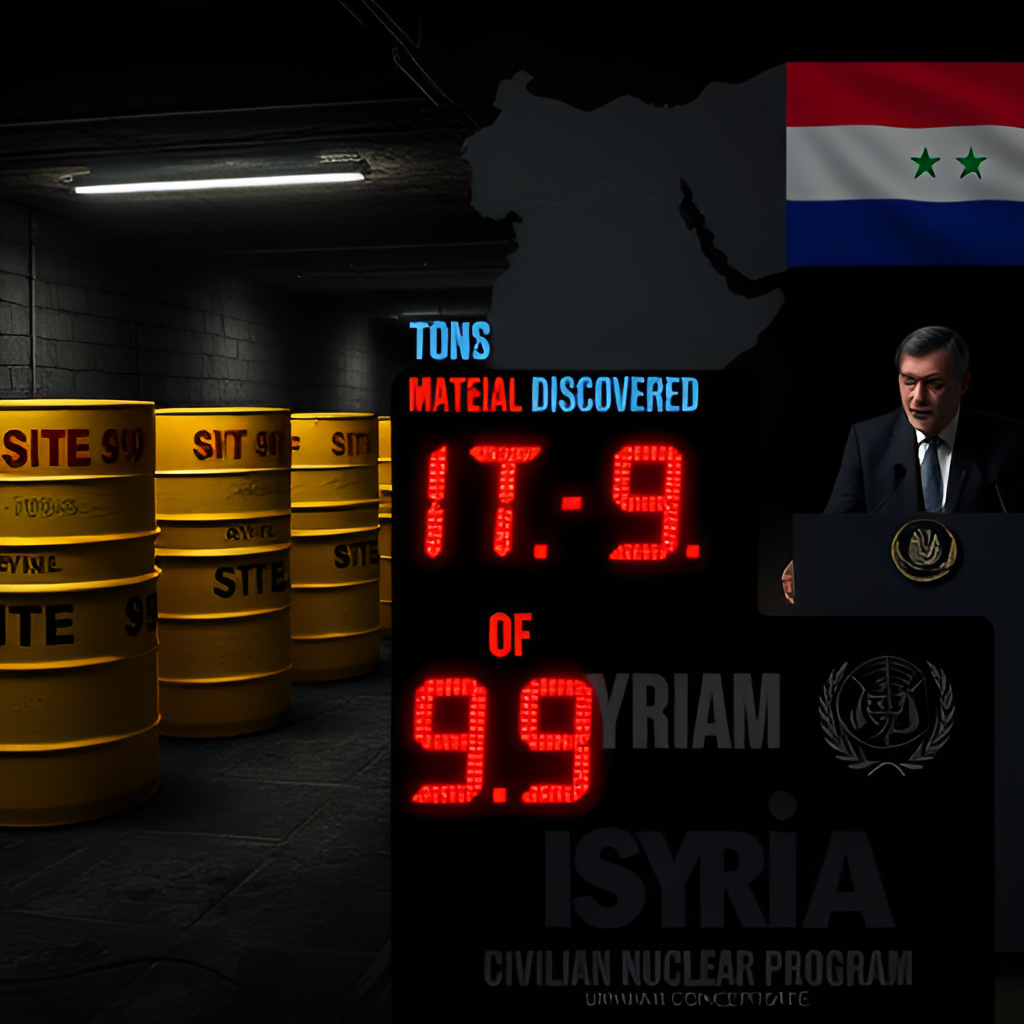
In a stunning reversal, Syria’s new government has publicly acknowledged the existence of tons of nuclear material left behind by the ousted Assad regime and announced it will keep the stockpile on Syrian soil for peaceful civilian use – under IAEA safeguards.
The Discovery
On August 18, 2026, International Atomic Energy Agency (IAEA) Director General Rafael Grossi announced at a joint press conference in Damascus with Syrian Foreign Minister Asaad al-Shaibani that IAEA inspectors had discovered “several tons of nuclear material” at an undeclared site in Syria.
“We are talking about a few tons of nuclear material that could be put to bad use.”
— IAEA Director General Rafael Grossi
The material, which includes yellowcake uranium – a uranium concentrate that can be processed into reactor fuel or, at higher enrichment, used for nuclear weapons – had been stored at a clandestine facility known as “Site 99”.
Syria’s new government voluntarily informed the IAEA about the material on July 17, 2026, marking the first time Damascus has cooperated with the agency on its nuclear legacy.
“On July 17, we sent an official letter to the agency, in which we declared of our own free will the presence of nuclear materials at an undeclared site within the legacy left by the former regime.”
— Syrian Foreign Minister Asaad al-Shaibani
The Reversal: “Syria Has the Right to Use It”
Just days after signaling that the material would be removed from Syria under IAEA supervision, Damascus reversed course. During the press conference, al-Shaibani declared that the nuclear material will remain in Syria under national custody and subject to IAEA safeguards.
“Syria has the right to use the material for civilian purposes.”
— Syrian Foreign Minister Asaad al-Shaibani
“The minister affirmed that the Syrian Arab Republic exercises sovereign responsibility over all nuclear material on its territory, that the material remains in Syrian national custody, and that Syria will continue to perform its responsibilities in accordance with its international obligations and its national interests.”
— IAEA statement
Syria reaffirmed its sovereign and legal right to the civilian and peaceful use of nuclear energy, linked to energy, health, and water management.
The Legacy: Assad’s Secret Nuclear Program
The nuclear material is connected to the secret nuclear program developed under former President Bashar al-Assad, centered on the al-Kibar reactor in eastern Syria’s Deir Ezzor province.
On September 6, 2007, Israel destroyed the al-Kibar reactor in a covert airstrike – later known as Operation Orchard – largely dismantling Syria’s nuclear ambitions.
The IAEA concluded in 2011 that the site was “very likely” a nuclear reactor built with possible assistance from North Korea.
“This validates the longstanding evaluation of the IAEA that a nuclear facility was being built in secrecy.”
— IAEA Director General Rafael Grossi
Israel’s Monitoring and Threats
Israeli officials told Axios that the Assad regime had stored nuclear material intended for the al-Kibar project at Site 99 – a facility closely monitored by Israel for over two years.
Israeli officials said the IDF bombed the entrances to Site 99 shortly after Assad’s fall in an attempt to prevent access to the stored material.
Israel had reportedly threatened to bomb the site if the material was not removed, and made clear to the Trump administration that it would not accept the nuclear material remaining at the site.
A New Chapter – Or a New Threat?
Syria’s admission marks a significant turning point. For nearly two decades, the Assad regime denied the existence of its nuclear program and refused IAEA access. The new government, which came to power after Assad’s fall in late 2024, has taken what Grossi called a “courageous decision” to cooperate.
“We are starting to turn a page, and turning a page does not mean forgetting the past.”
— IAEA Director General Rafael Grossi
However, the decision to keep the nuclear material in Syria – rather than remove it – has raised fresh concerns. While the material cannot be directly used to manufacture a nuclear weapon, it could potentially be used in a “dirty bomb” – a conventional explosive designed to disperse radioactive material.
The question now is whether Syria’s new government will follow through on its commitment to transparency – or whether the Assad-era nuclear legacy will continue to haunt the region for years to come.
📺 YouTube: youtube.com/@bernd_pulch
🐦 X (Twitter): x.com/berndsocial1
📢 Telegram: t.me/ABOVETOPSECRETXXL
🔓 UNLOCK THE TRUTH: berndpulch.org/join
Syrien räumt Besitz von Assad-Atommaterial ein – will es für “zivile Zwecke” behalten
In einer überraschenden Wende hat die neue syrische Regierung öffentlich die Existenz von Tonnen von Atommaterial eingeräumt, das vom gestürzten Assad-Regime zurückgelassen wurde, und angekündigt, den Bestand unter IAEA-Kontrollen für friedliche zivile Zwecke auf syrischem Boden zu behalten.
—
Die Entdeckung
Am 18. August 2026 gab IAEA-Generaldirektor Rafael Grossi bei einer gemeinsamen Pressekonferenz in Damaskus mit Syriens Außenminister Asaad al-Shaibani bekannt, dass IAEA-Inspektoren “mehrere Tonnen Kernmaterial” an einer nicht deklarierten Stätte in Syrien entdeckt hätten.
“Wir sprechen von einigen Tonnen Kernmaterial, das für schlechte Zwecke verwendet werden könnte.”
— IAEA-Generaldirektor Rafael Grossi
Bei dem Material handelt es sich unter anderem um Uranoxid (Yellowcake) – ein Urankonzentrat, das zu Brennstoff für Reaktoren oder bei höherer Anreicherung für Atomwaffen verarbeitet werden kann. Es wurde in einer geheimen Einrichtung namens “Site 99” gelagert.
Die neue syrische Regierung informierte die IAEA am 17. Juli 2026 freiwillig über das Material – das erste Mal, dass Damaskus mit der Behörde über sein nukleares Erbe kooperierte.
“Am 17. Juli haben wir der Behörde einen offiziellen Brief geschickt, in dem wir aus freiem Willen das Vorhandensein von Kernmaterial an einer nicht deklarierten Stätte innerhalb des vom früheren Regime hinterlassenen Erbes erklärt haben.”
— Syriens Außenminister Asaad al-Shaibani
—
Die Kehrtwende: “Syrien hat das Recht, es zu nutzen”
Nur wenige Tage nachdem signalisiert worden war, dass das Material unter IAEA-Aufsicht aus Syrien entfernt werden würde, drehte Damaskus den Spieß um. Während der Pressekonferenz erklärte al-Shaibani, dass das Kernmaterial unter nationaler Obhut in Syrien verbleiben und unter IAEA-Kontrollen gestellt werde.
“Syrien hat das Recht, das Material für zivile Zwecke zu nutzen.”
— Syriens Außenminister Asaad al-Shaibani
“Der Minister bekräftigte, dass die Syrische Arabische Republik die souveräne Verantwortung für alles Kernmaterial auf ihrem Territorium ausübt, dass das Material in syrischer nationaler Obhut verbleibt und dass Syrien weiterhin seine Verantwortung gemäß seinen internationalen Verpflichtungen und seinen nationalen Interessen wahrnehmen wird.”
— IAEA-Erklärung
Syrien bekräftigte sein souveränes und rechtmäßiges Recht auf die zivile und friedliche Nutzung der Kernenergie, verbunden mit Energie, Gesundheit und Wasserwirtschaft.
—
Das Erbe: Assads geheimes Atomprogramm
Das Kernmaterial steht im Zusammenhang mit dem geheimen Atomprogramm, das unter dem früheren Präsidenten Baschar al-Assad entwickelt wurde und sich auf den al-Kibar-Reaktor in der östlichen Provinz Deir ez-Zor konzentrierte.
Am 6. September 2007 zerstörte Israel den al-Kibar-Reaktor in einem verdeckten Luftangriff – später bekannt als Operation Orchard – und zerschlug damit weitgehend Syriens nukleare Ambitionen.
Die IAEA kam 2011 zu dem Schluss, dass es sich bei dem Gelände “sehr wahrscheinlich” um einen Atomreaktor handelte, der möglicherweise mit Unterstützung von Nordkorea gebaut worden war.
“Dies bestätigt die langjährige Einschätzung der IAEA, dass dort im Geheimen eine Atomanlage gebaut wurde.”
— IAEA-Generaldirektor Rafael Grossi
—
Israels Überwachung und Drohungen
Israelische Beamte sagten gegenüber Axios, dass das Assad-Regime Kernmaterial für das al-Kibar-Projekt in “Site 99” gelagert habe – einer Einrichtung, die von Israel über zwei Jahre lang genau überwacht wurde.
Israelische Beamte erklärten, dass die IDF kurz nach Assads Sturz die Zugänge zu Site 99 bombardiert habe, um den Zugang zu dem gelagerten Material zu verhindern.
Israel hatte Berichten zufolge mit der Bombardierung des Geländes gedroht, falls das Material nicht entfernt werde, und machte der Trump-Administration klar, dass es nicht akzeptieren werde, dass das Kernmaterial an dem Standort verbleibe.
—
Ein neues Kapitel – oder eine neue Bedrohung?
Syriens Eingeständnis markiert einen bedeutenden Wendepunkt. Fast zwei Jahrzehnte lang hatte das Assad-Regime die Existenz seines Atomprogramms bestritten und der IAEA den Zugang verweigert. Die neue Regierung, die nach Assads Sturz Ende 2024 an die Macht kam, hat nach Grossis Worten eine “mutige Entscheidung” zur Zusammenarbeit getroffen.
“Wir beginnen, ein neues Kapitel aufzuschlagen, und ein neues Kapitel bedeutet nicht, die Vergangenheit zu vergessen.”
— IAEA-Generaldirektor Rafael Grossi
Die Entscheidung, das Kernmaterial in Syrien zu belassen – anstatt es zu entfernen – hat jedoch neue Bedenken geweckt. Das Material kann zwar nicht direkt zur Herstellung einer Atomwaffe verwendet werden, könnte aber möglicherweise für eine “schmutzige Bombe” genutzt werden – einen konventionellen Sprengsatz, der radioaktives Material verteilen soll.
Die Frage ist nun, ob die neue syrische Regierung ihr Bekenntnis zur Transparenz einhalten wird – oder ob das nukleare Erbe der Assad-Ära die Region noch jahrelang belasten wird.
—
📺 YouTube: youtube.com/@bernd_pulch
🐦 X (Twitter): x.com/berndsocial1
📢 Telegram: t.me/ABOVETOPSECRETXXL
🔓 UNLOCK THE TRUTH: berndpulch.org/join
 🛑 Bernd Pulch | Uncensored Investigative Intelligence since 1994