


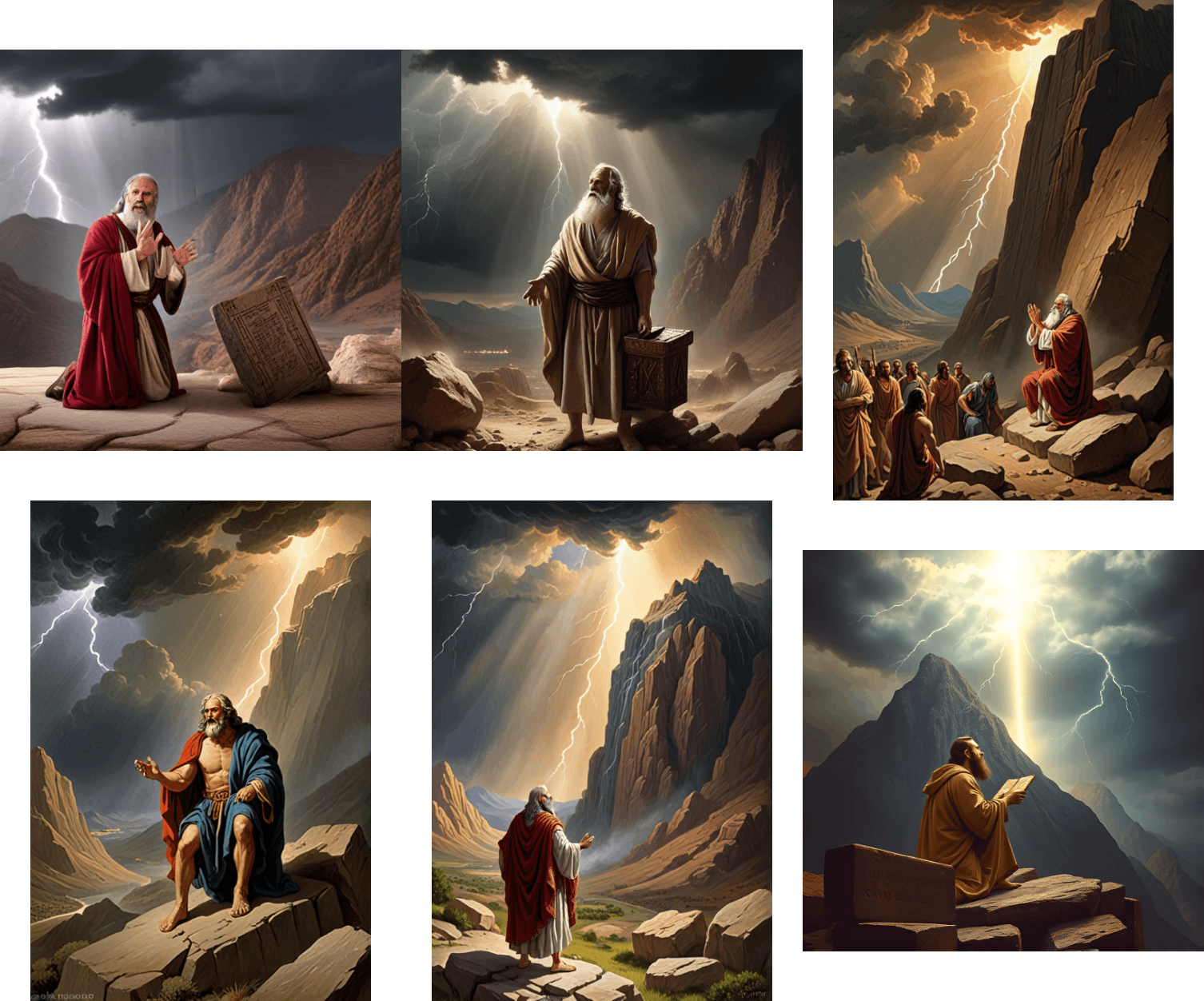
🙏✌Divine Narratives: A Van Dyck-Inspired Bible Series: Moses and the Ten Commandments
By Bernd Pulch
Scene 2: Moses and the Ten Commandments
Anthony van Dyck: The Master of Baroque and His Devotional Art
Introduction
Anthony van Dyck, often simply referred to as Van Dyck, stands as one of the most prominent painters of the Baroque period, known for his ability to capture the essence of nobility, both secular and divine. Born in Antwerp, now in Belgium, on March 22, 1599, Van Dyck’s work profoundly influenced art not only in his lifetime but also well into the future. His biblical paintings, in particular, showcase his mastery over religious themes, blending spirituality with the grandeur typical of the Baroque era.
Early Life and Training
Van Dyck was born into a family where his father was a wealthy silk merchant, allowing him access to education and art training from a young age. He was apprenticed to the Flemish painter Hendrik van Balen at the age of ten, where he quickly rose to prominence. By his late teens, he had become an independent master in the Antwerp Guild of Saint Luke, reflecting his precocious talent.
Career Development
After establishing himself in Antwerp, Van Dyck traveled to Italy in 1621, where he spent about six years absorbing the Renaissance and Baroque influences of artists like Titian and Rubens, the latter of whom had been his mentor in Antwerp. In Italy, he developed his own style, characterized by a more fluid, elegant, and somewhat less robust approach compared to Rubens, with a particular focus on portraiture and religious scenes.
Van Dyck’s Biblical Paintings
Van Dyck’s biblical works are notable for their emotional depth, dramatic lighting, and the humanization of sacred figures. His paintings often reflect the Counter-Reformation’s emphasis on making religious art more accessible and emotionally engaging to the faithful:
- The Crucifixion (c. 1630) – This painting captures the profound pathos of the moment, with Christ’s body portrayed in a manner that invites empathy and contemplation. Van Dyck uses chiaroscuro to enhance the drama, focusing light on Christ to draw the viewer’s eye.
- Saint Jerome – Van Dyck painted several versions of Saint Jerome, showing the saint in various contexts, often in the wilderness, reflecting on a skull or writing, embodying the theme of penitence and scholarly devotion.
- The Rest on the Flight into Egypt – In these works, Van Dyck portrays the Holy Family in a serene, almost idyllic landscape, yet there’s an underlying tension, a reminder of their flight from Herod’s massacre. His use of color and light here is particularly evocative, creating a sense of divine protection amidst worldly peril.
- The Lamentation – Here, Van Dyck’s ability to convey grief and reverence is at its peak. His figures are not just mourning but are deeply expressive, each posture and facial expression telling a story of loss and divine sacrifice.
Later Years in England
In 1632, Van Dyck moved to England under the patronage of King Charles I, where he became the principal court painter. His time in England was marked by prolific portrait work, but he also continued to paint religious subjects, often commissioned for private devotion or church embellishment. His influence in England was profound, shaping the future of British art.
Legacy
Van Dyck died prematurely at the age of 42 in 1641, but his influence endured. He left behind a vast body of work, including numerous sketches and paintings, many of which were religious in theme. His approach to biblical painting emphasized human emotion and divine grace, setting a standard for future generations of artists.
Today, Van Dyck’s works are housed in major galleries around the world, from the Louvre in Paris to the National Gallery in London. His biblical paintings continue to be studied for their artistic technique, theological depth, and the emotional resonance they evoke, making Anthony van Dyck not just a painter of nobility but a painter of the soul.
Conclusion
Anthony van Dyck’s life and art are a testament to the heights one can achieve through dedication, travel, and the relentless pursuit of excellence. His biblical paintings, in particular, offer a window into the spiritual and cultural world of the 17th century, merging the divine with the human in a way that continues to captivate and inspire.
Tags:
- Baroque Art
- Van Dyck Style
- Bible Stories
- Religious Art
- Divine Narratives
- Light and Shadow
- Emotional Depth
- Sacred Scenes
- Biblical Themes
- Artistic Inspiration
This series does not only honor Van Dyck’s legacy but also bring the timeless stories of the Bible to life with a modern, AI-driven twist. Each painting would be a masterpiece, capturing the spiritual and emotional essence of these sacred moments.
❌©BERNDPULCH.ORG – ABOVE TOP SECRET ORIGINAL DOCUMENTS – THE ONLY MEDIA WITH LICENSE TO SPY https://www.berndpulch.org
https://googlefirst.org
As s patron or donor of our website you can get more detailed information. Act now before its too late…
MY BIO:
FAQ:
@Copyright Bernd Pulch
CRYPTO WALLET for
Bitcoin:
0xdaa3b887f885fd7725d4d35d428bd3b402d616bb
ShapeShift Wallet, KeepKey, Metamask, Portis, XDefi Wallet, TallyHo, Keplr and Wallet connect
0x271588b52701Ae34dA9D4B31716Df2669237AC7f
Crypto Wallet for Binance Smart Chain-, Ethereum-, Polygon-Networks
bmp
0xd3cce3e8e214f1979423032e5a8c57ed137c518b
Monero
41yKiG6eGbQiDxFRTKNepSiqaGaUV5VQWePHL5KYuzrxBWswyc5dtxZ43sk1SFWxDB4XrsDwVQBd3ZPNJRNdUCou3j22Coh
GOD BLESS YOU
- THE MUDDY MURKY MUCHA SAGA: THE GOLDEN MUCHA DAWNThe Golden Dawn cult attacks Murky the Zwitter. Westcott, Mathers, Yeats and the Victorian occultists try to restore polarity. But ANDNESS absorbs them all. Golden prophecies, chaos, and tea with Mark. 🌅✨🐾.
- INVESTMENT THE ORIGINAL DAILY DIGEST 25 AUGUST 2026 FOUNDED IN 2000 ANNO DOMINIMarkets delivered a fragmented session as Bitcoin breached $80,000 for the first time since May, gold hit a three-month high above $4,677 on dollar weakness, while oil tumbled over 3% to a one-week low as investors viewed US economic sanctions on Iran as less disruptive than military escalation. Nvidia extended its losing streak to seven days ahead of Wednesday’s earnings, dragging the Nasdaq lower. General Atlantic targets a 2026 IPO, growth equity fundraising hits record $33.2B, and US Treasury buybacks fuel the “debasement trade” as Ray Dalio warns of a potential US debt crisis within three years. Get the full strategic intelligence briefing for August 25, 2026, by Joe Rogers & Aristotle AI.
- THE STASIFICATION OF GERMANYThe Stasi didn’t die in 1989—it rebranded. Bernd Pulch exposes the ex-Stasi network that infiltrated German politics, media, and business after reunification, including Frank Hübber, the OibE sleeper list, and the cyber-war on truth.
- THE EVIL ESAU EVIL EHLERS ENEMA SAGA: GODFATHER TAKEOVER: THE CORLEONE FAMILY CONQUERS ST. PAULI – ESAU OFFERED AN OFFER HE CAN’T REFUSE – THE MUCHAVERSE BECOMES A CRIME FAMILY! 🕴️🔫🍝📊💩🕴️🔫🍝📊 GODFATHER TAKEOVER! THE CORLEONE FAMILY CONQUERS ST. PAULI – ESAU OFFERED AN OFFER HE CAN’T REFUSE – THE MUCHAVERSE BECOMES A CRIME FAMILY! “I’m going to make him an offer he can’t refuse.” – Don Vito Corleone — In Episode 63 of the Ehlers Saga, the Corleone family arrives through a dimensional rift. Don Vito makes Esau an offer he can’t refuse: join the family, become a made man, and bring desinvestment to the underworld. Esau becomes a Corleone. The family attacks St. Pauli, defeats Sir Francis Drake, and conquers the city. The Muchaverse joins the family. All 126 characters return. The cycle continues. With family. With mafia. With spreadsheets. With shit. Forever. — #GodfatherTakeoverConspiracy #CorleoneFamily #DonVito #OfferHeCantRefuse #EsauMadeMan #StPauliConquered #DrakeDefeated #Column47Forever #All126Characters #EhlersSaga #IdiotZeitung #Mafia #Family #Underworld #Desinvestment #DieBöseEsauEhlersEinlaufSaga — 📺 YouTube: youtube.com/@bernd_pulch 🐦 X (Twitter): x.com/berndsocial1 📢 Telegram: t.me/ABOVETOPSECRETXXL 🔓 UNLOCK THE TRUTH: berndpulch.org/join
- ABOVETOPSECRETXXL – MORNING INTELLIGENCE BRIEFINGMorning Intelligence Briefing: U.S. declares financial war on Iran with Operation Economic Outcast, rial crashes to 2.02 million, Iran responds with chilling threat on Barron Trump, Supreme Court rules on mail-in ballots, Italian farmers rise up.
- “Economic D-Day”: U.S. Launches All-Out Financial War on Iran – Rial Collapses, Barron Trump TargetedU.S. declares dollar war on Iran – Rial crashes to 2.02M as Tehran threatens Barron Trump in chilling video.
 🛑 Bernd Pulch | Uncensored Investigative Intelligence since 1994