Become a Patron! True Information is the most valuable resource and we ask you to give back.
The assassination in Malta of investigative journalist Daphne Caruana Galizia in October 2017 put the island in the headlines. John Sweeney, who reported on the story for Newsnight in the immediate aftermath, has been back to Malta to look into the stories Caruana Galizia was covering before her death and to speak to Malta’s Prime Minister Joseph Muscat.
Become a Patron! True Information is the most valuable resource and we ask you to give back.
Saudi Arabia’s public prosecutor says five people have been sentenced to death and three have been handed life sentences, over the murder of Saudi journalist Jamal Khashoggi. The trial, held at the Criminal Court of Riyadh, took place behind closed doors and the identities of the defendants have not been released. Khashoggi was murdered in the Saudi consulate in Istanbul last year. Crown Prince, Mohammad Bin Salman (MBS) says he had no prior knowledge of the operation.
Become a Patron! True Information is the most valuable resource and we ask you to give back.
Here is the report about 49 journalists who were killed this year 2019 just for doing their job, 389 are currently in prison and 57 are being held hostage.
Become a Patron! True Information is the most valuable resource and we ask you to give back.
Lichtenberg, Ostberlin – Die Stasi-Zentrale in der Normannenstraße: Der General feiert seinen ??. Geburtstag, sowohl die Offiziere der Staatssicherheit als auch die Vertreter der Opposition finden sich zusammen auf der feucht-fröhlichen Orgie im Hauptbüro ein. DIE WAHRHEIT ÜBER DIE STASI Spielfilm, Politsatire, Groteske D 1992/2008, 50 min Erstellung: Arbeitsgruppe 1 / Alex Zahn Kamera: Eckard Stüwe Musik: Flake Lorenz Darsteller: Clemens Tragelehn, Mathias Herrmann, Muromez, Eckard Stüwe, Theo Gnauck, Friedhelm Sprenger, Wolfgang Dahl, Alexander Scharf, Svenja Teichert “Geburtstagslied General” Text: Theo Gnauck Musik: Flake http://de.wikipedia.org/wiki/Die_Wahr…http://tilsiter-lichtspiele.de/stasi-… Eine Filmgroteske über die DDR im Jahre 2008 – ein Jahr vor ihrem 60. Geburtstag! “… so stellte die nach der XI. Parteikonferenz im Jahre ’89 konsequent und zielstrebig in Angriff genommene Verwirklichung der Reformbeschlüsse des ZK der SED eine echte und tiefgreifende Veränderung aller Bereiche des sozialistischen Lebens dar. Fehler und Irritationen der Vergangenheit konnten im Vorwärtsschreiten von Volk und Partei endgültig überwunden werden. So können wir kurz vor Abschluß des Aufgebotes – DDR 60 – und ein Jahr vor dem großen Geburtstag sagen: Unsere DDR ist stark und erwachsen geworden…” — Aus dem Referat des Genossen Eberlein auf dem XXVI. Parteitag der SED, Mai 2008 Die DDR im damals utopisch fiktiven Jahr 2008 – ein Jahr vor dem 60. Geburtstag der Republik – als ewig währender, realsozialistischer Kostümball. Staatssicherheit und Opposition in symbiotischem Tanz engumschlungen. Die untergehende DDR als fröhliches Geländespiel mit Musik. Die in der frühen Nachwendezeit an den gerade verlassenen und noch sitzwarmen originalen Schauplätzen wie Erich Mielkes Büro in der Zentrale der DDR-Staatssicherheit in der Normannenstrasse gedrehte Satire verzichtet wohltuend auf jeglichen peinlichen Stasi-Schwulst heutiger Tage. Irrwitzig ostdeutsche Bilder und Figuren und die Musik verschiedener Ostberliner Bands füllen eine schräge Flaschenpost aus einer längst untergegangenen Welt. Die erste Fassung von 1992 galt als verschollen und wurde 2008 von ehemaligen Mitgliedern der Dissidentengruppe Arbeitsgruppe 1 aufgefunden und neu bearbeitet. Der Film ist eine Satire auf die politischen und geistigen Zustände in der DDR der ausgehenden 80er Jahre. Die Musik zum Film stammte vom Feeling B-Keyboarder Christian Lorenz (Flake) – seit 1994 bei Rammstein – und anderen ostdeutschen Bands und Musikern. Gedreht wurde der Film an Originalorten im ehemaligen Hauptgebäude des Ministerium für Staatssicherheit in Berlin-Lichtenberg, zu diesem Zeitpunkt schon die Forschungs- und Gedenkstätte Normannenstraße sowie in Berlin-Mitte und Berlin-Prenzlauer Berg.
Become a Patron! True Information is the most valuable resource and we ask you to give back.
The Ministry for State Security (German: Ministerium für Staatssicherheit, MfS), commonly known as the Stasi (IPA: [ˈʃtɑːziː]) (abbreviation German: Staatssicherheit, literally State Security), was the official state security service of the German Democratic Republic or GDR, colloquially known as East Germany. It has been described as one of the most effective and repressive intelligence and secret police agencies to ever have existed. The Stasi was headquartered in East Berlin, with an extensive complex in Berlin-Lichtenberg and several smaller facilities throughout the city. The Stasi motto was “Schild und Schwert der Partei” (Shield and Sword of the Party), that is the ruling Socialist Unity Party of Germany (SED). One of its main tasks was spying on the population, mainly through a vast network of citizens turned informants, and fighting any opposition by overt and covert measures including hidden psychological destruction of dissidents (Zersetzung, literally meaning decomposition). It also worked as an intelligence agency abroad, the respective division Hauptverwaltung Aufklärung was responsible for both espionage and for conducting covert operations in foreign countries. Under its long-time head Markus Wolf it gained a reputation as one of the most effective intelligence agencies of the Cold War. Numerous Stasi officials were prosecuted for their crimes after 1990. After German reunification, the surveillance files that the Stasi had maintained for millions of East Germans were laid open, so that any citizen could inspect their personal file on request; these files are now maintained by the Federal Commissioner for the Stasi Records. The Stasi perfected the technique of psychological harassment of perceived enemies known as Zersetzung (pronounced [ʦɛɐ̯ˈzɛʦʊŋ]) — a term borrowed from chemistry which literally means “decomposition”. By the 1970s, the Stasi had decided that methods of overt persecution which had been employed up to that time, such as arrest and torture, were too crude and obvious. It was realised that psychological harassment was far less likely to be recognised for what it was, so its victims, and their supporters, were less likely to be provoked into active resistance, given that they would often not be aware of the source of their problems, or even its exact nature. Zersetzung was designed to side-track and “switch off” perceived enemies so that they would lose the will to continue any “inappropriate” activities. Tactics employed under Zersetzung generally involved the disruption of the victim’s private or family life. This often included psychological attacks such as breaking into homes and messing with the contents — moving furniture, altering the timing of an alarm, removing pictures from walls or replacing one variety of tea with another. Other practices included property damage, sabotage of cars, purposely incorrect medical treatment, smear campaigns including sending falsified compromising photos or documents to the victim’s family, denunciation, provocation, psychological warfare, psychological subversion, wiretapping, bugging, mysterious phone calls or unnecessary deliveries, even including sending a vibrator to a target’s wife. Usually victims had no idea the Stasi were responsible. Many thought they were losing their minds, and mental breakdowns and suicide could result. One great advantage of the harassment perpetrated under Zersetzung was that its subtle nature meant that it was able to be plausibly denied. That was important given that the GDR was trying to improve its international standing during the 1970s and 80s, especially in conjunction with the Ostpolitik of West-German chancellor Willy Brandt massively improving relations between the two German states. Zersetzung techniques have since been adopted by other security agencies, particularly the Russian Federal Security Service (FSB). http://en.wikipedia.org/wiki/Stasi
Become a Patron! True Information is the most valuable resource and we ask you to give back.
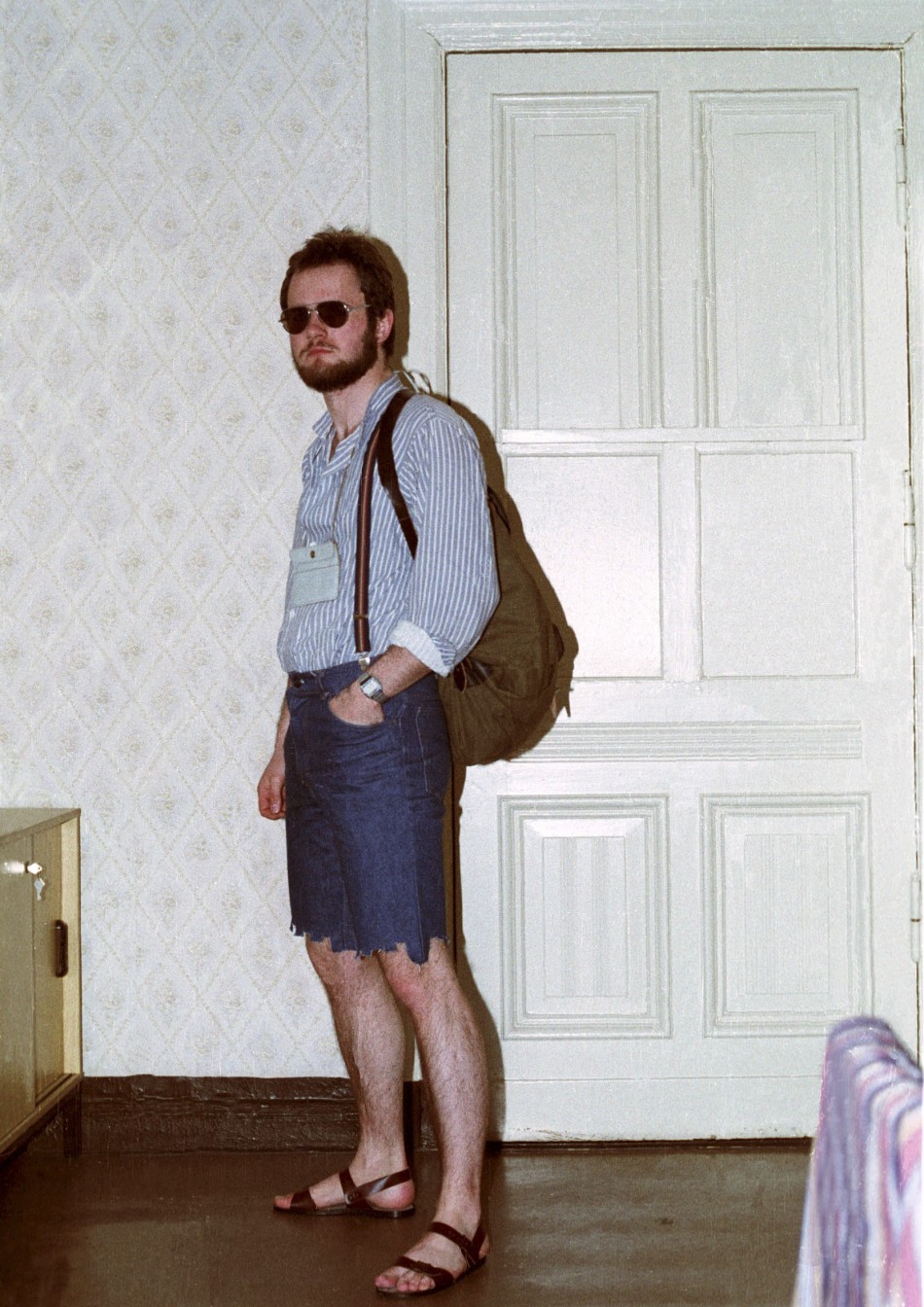
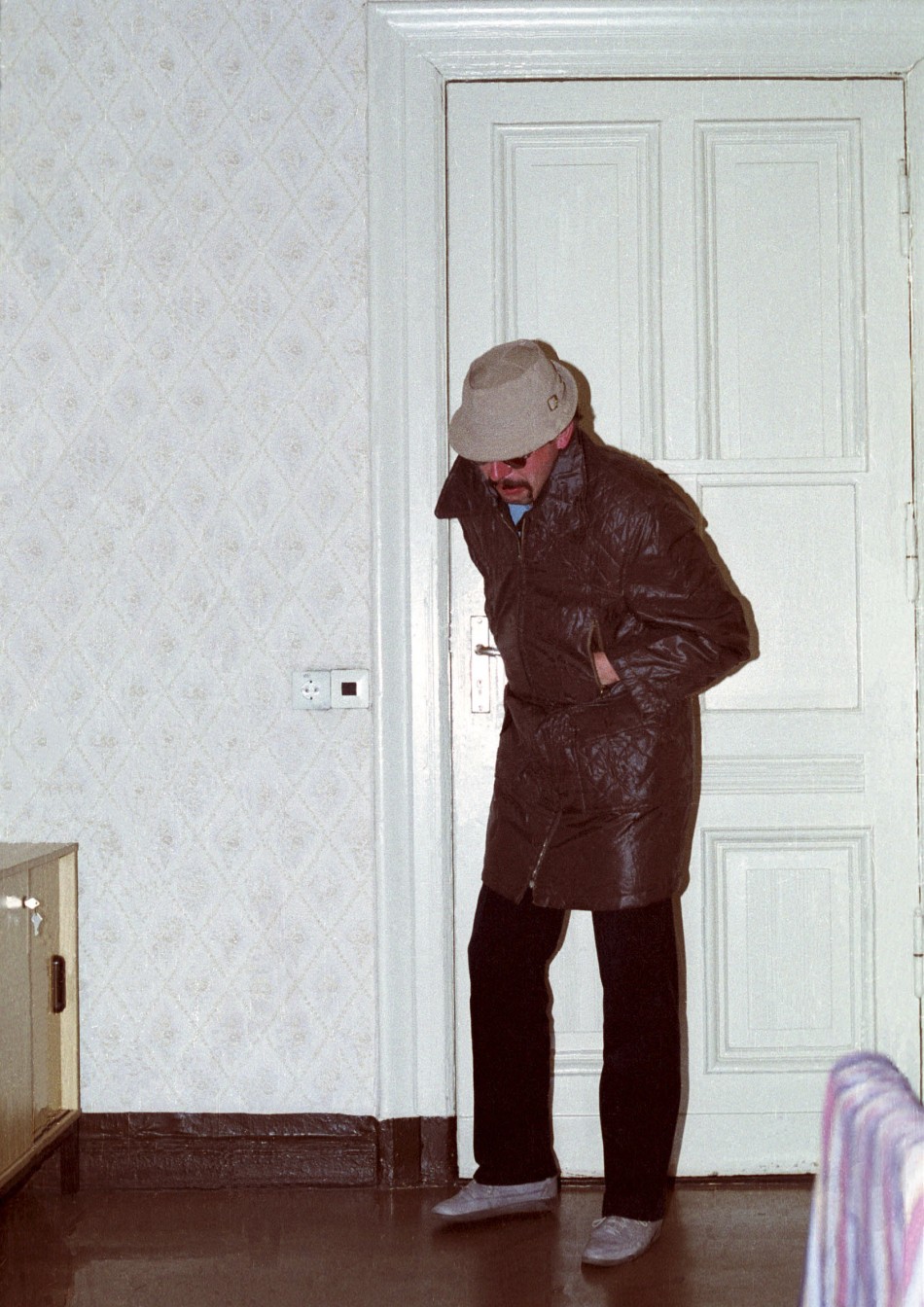
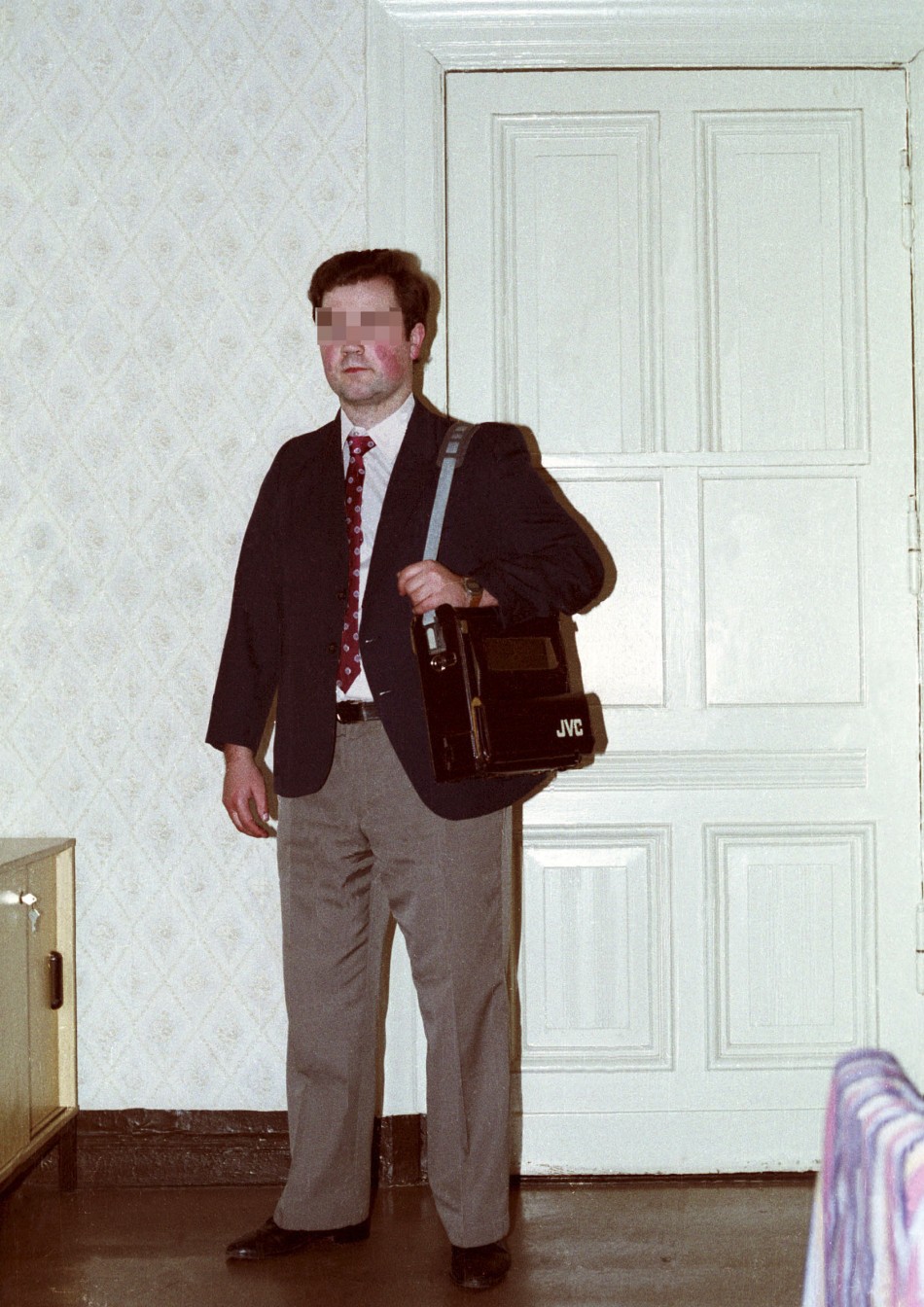
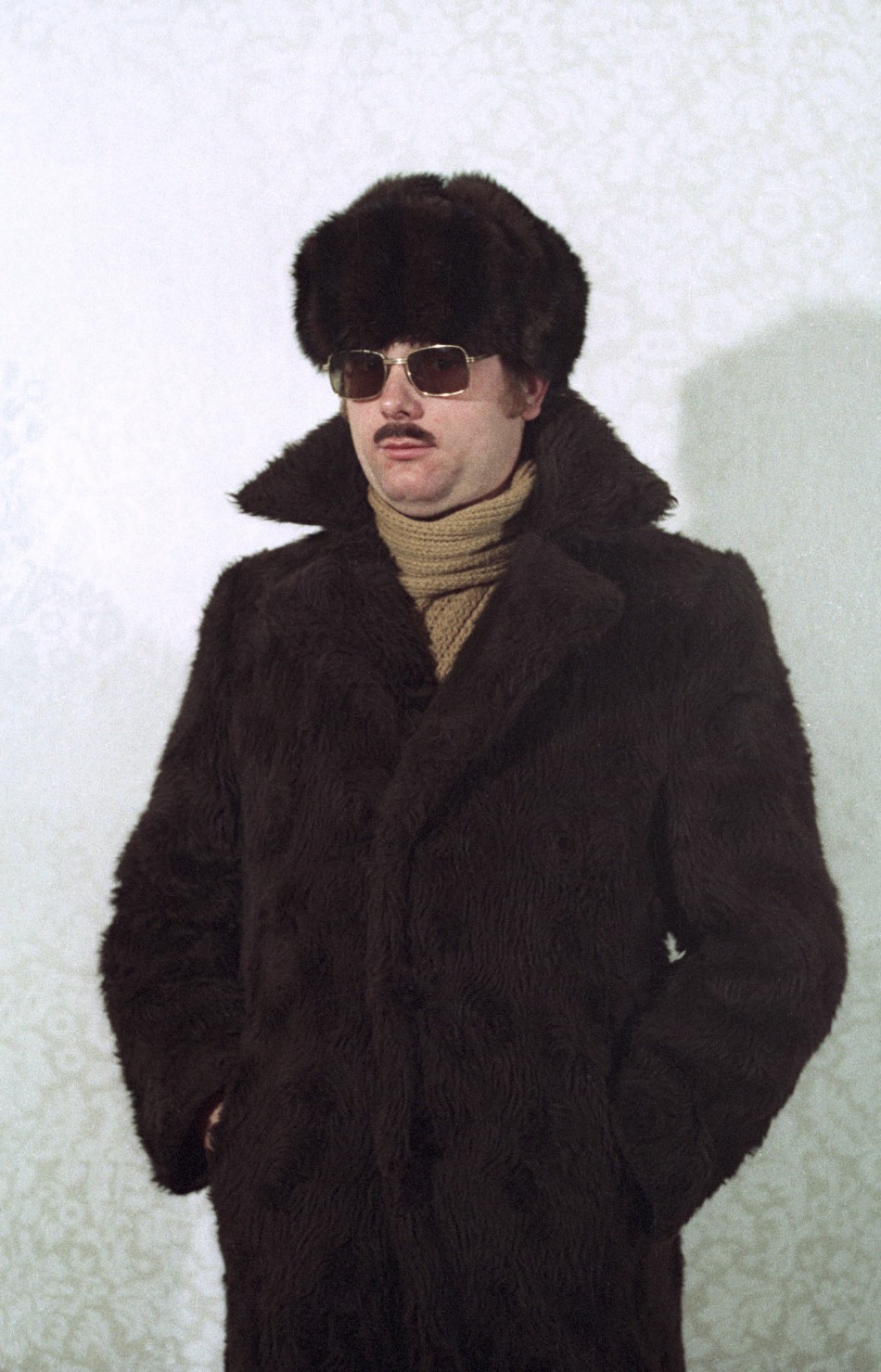
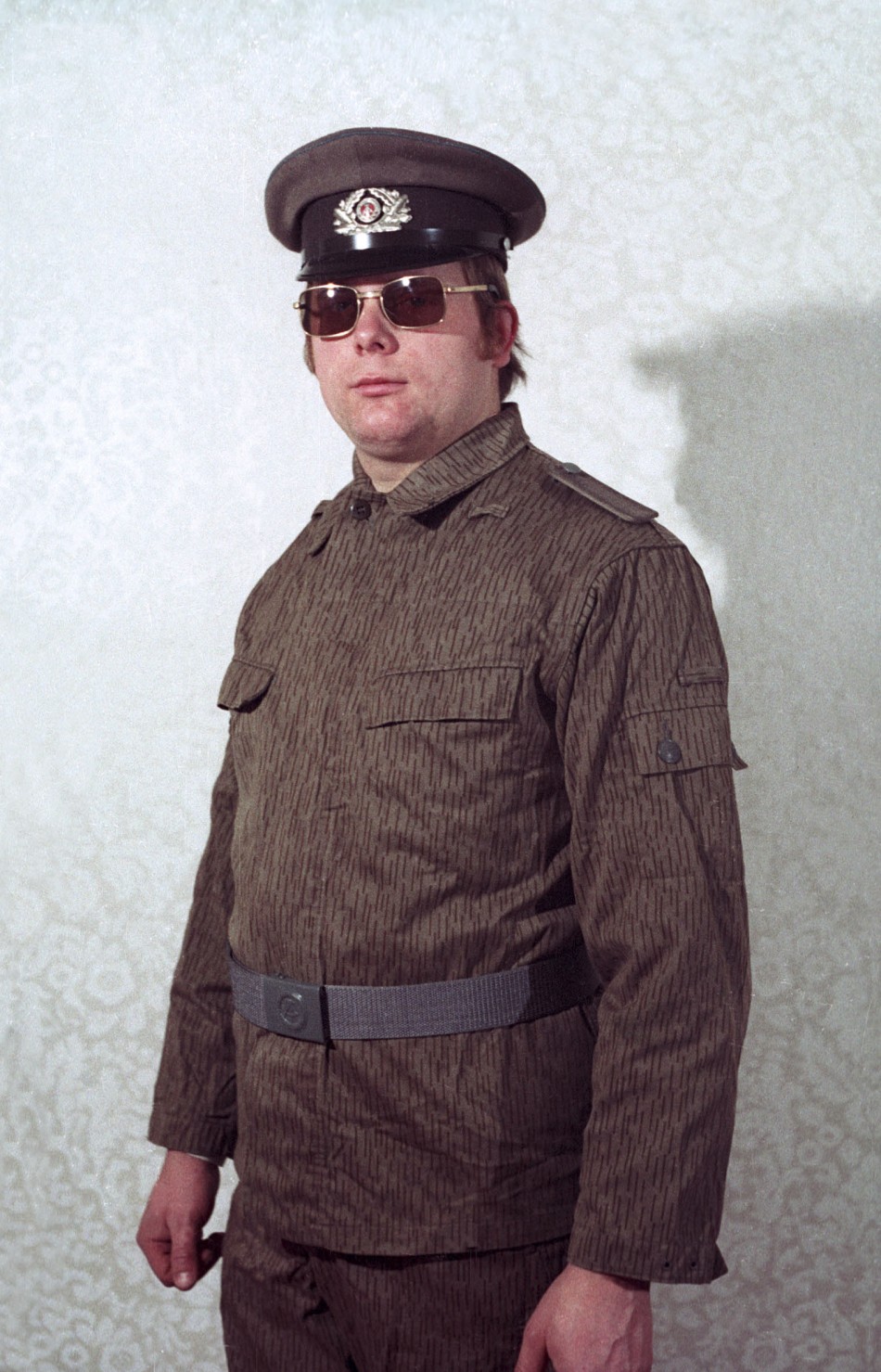
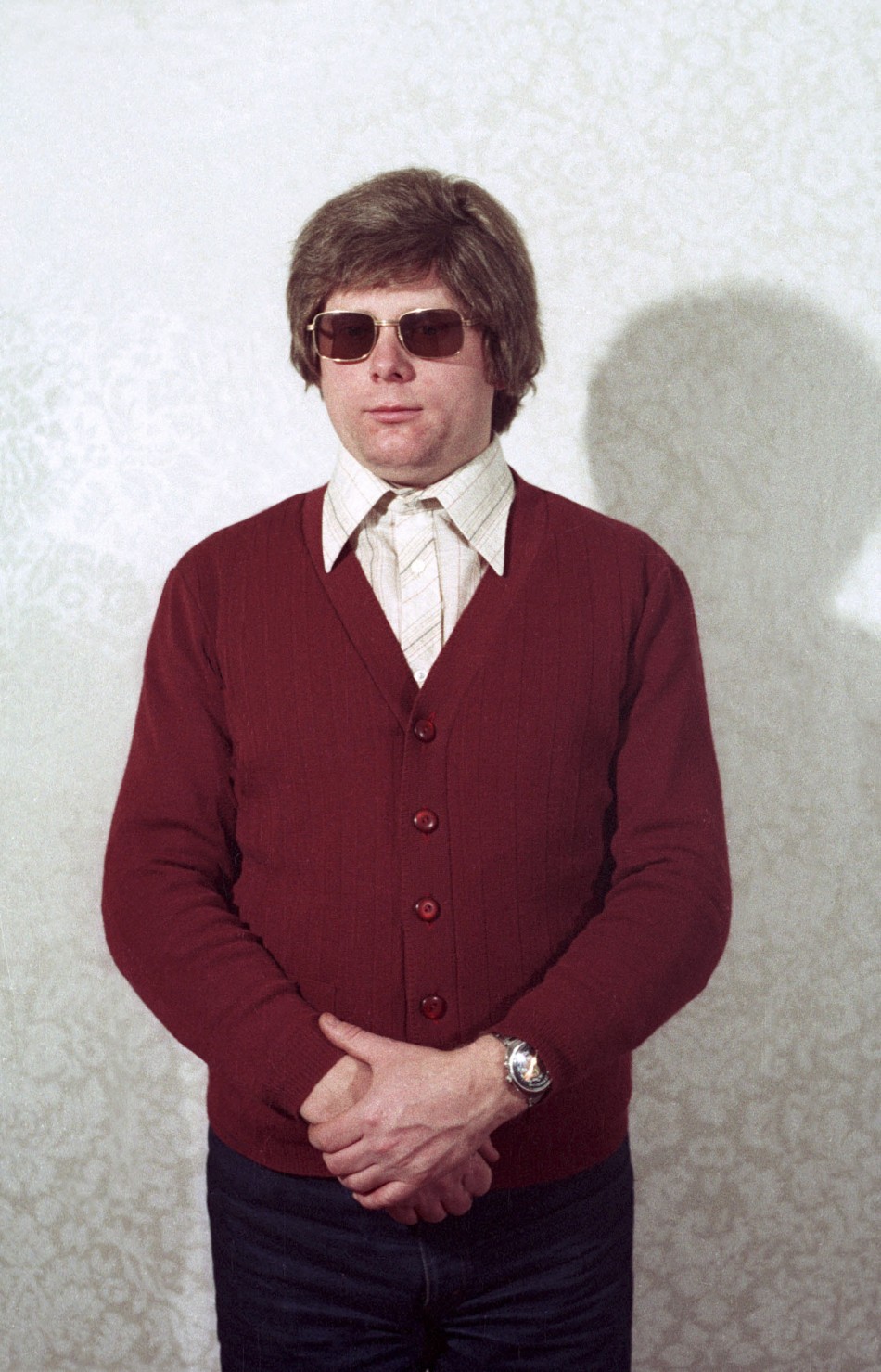
These formerly classified photos are part of a series released by the German artist Simon Menner that he reportedly obtained from the Stasi archives. This particular set demonstrates Stasi agents demonstrating different techniques for disguising themselves. Blurring of the eyes in one of the photos was performed by the artist.
An undated handout picture shows an officer of former East German Ministry for State Security (MfS), known as the Stasi, presenting a disguise outfit. Spies from former communist East Germany demonstrate the art of disguise by donning fur wigs, fake moustaches and dark glasses in a Berlin exhibition of recently uncovered and once highly classified photographs. Morgen Contemporary/Simon Menner
An undated handout picture shows an officer of former East German Ministry for State Security (MfS), known as the Stasi, presenting a disguise outfit. Spies from former communist East Germany demonstrate the art of disguise by donning fur wigs, fake moustaches and dark glasses in a Berlin exhibition of recently uncovered and once highly classified photographs. Morgen Contemporary/Simon Menner
An undated handout picture shows an officer of former East German Ministry for State Security (MfS), known as the Stasi, presenting a disguise outfit. Spies from former communist East Germany demonstrate the art of disguise by donning fur wigs, fake moustaches and dark glasses in a Berlin exhibition of recently uncovered and once highly classified photographs. Morgen Contemporary/Simon Menner
An undated handout picture shows an officer of former East German Ministry for State Security (MfS), known as the Stasi, presenting a disguise outfit. Spies from former communist East Germany demonstrate the art of disguise by donning fur wigs, fake moustaches and dark glasses in a Berlin exhibition of recently uncovered and once highly classified photographs. Morgen Contemporary/Simon Menner
An undated handout picture shows an officer of former East German Ministry for State Security (MfS), known as the Stasi, presenting a disguise outfit. Spies from former communist East Germany demonstrate the art of disguise by donning fur wigs, fake moustaches and dark glasses in a Berlin exhibition of recently uncovered and once highly classified photographs. Morgen Contemporary/Simon Menner
An undated handout picture shows an officer of former East German Ministry for State Security (MfS), known as the Stasi, presenting a disguise outfit. Spies from former communist East Germany demonstrate the art of disguise by donning fur wigs, fake moustaches and dark glasses in a Berlin exhibition of recently uncovered and once highly classified photographs. Morgen Contemporary/Simon Menner
An undated handout picture shows an officer of former East German Ministry for State Security (MfS), known as the Stasi, presenting a disguise outfit. Spies from former communist East Germany demonstrate the art of disguise by donning fur wigs, fake moustaches and dark glasses in a Berlin exhibition of recently uncovered and once highly classified photographs. Morgen Contemporary/Simon Menner
Become a Patron! True Information is the most valuable resource and we ask you to give back.
Die Spionageabwehr der Stasi nahm mit einem Schulungsfilm den westdeutschen Verfassungsschutz unter die Lupe. Dargestellt werden unter anderem angebliche Verbindungen zur Oppositionellen in der DDR.
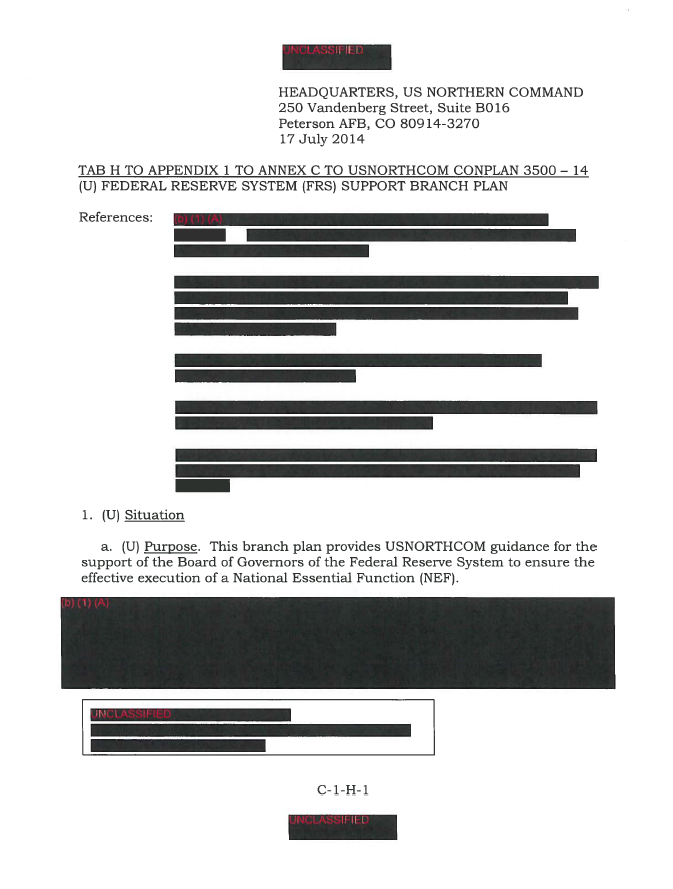
a. (U) Purpose. This branch plan provides USNORTHCOM guidance for the support of the Board of Governors of the federal Reserve System to ensure the effective execution of a National Essential Function (NEF).
…
c. (U) Friendly Forces
(1) (U) Board of Governors of the Federal Reserve System. The Federal Reserve System (FRS) is the central bank of the United States. The primary responsibility of the Federal Reserve System’s Board of Governors is to formulate and administer the Nation’s monetary policy. The Board of Governors operates as a USG Agency.
…
(b) (U) Division of Reserve Bank Operations and Payment Systems. Oversees the operations of the independent Federal Reserve Banks and of the FRS Law Enforcement program.
(c) (U) Office of National Cash Operations and Business Continuity. The Director of National Cash Operations and Business Continuity is the supported entity for the transportation of monetary instruments within the USNORTHCOM AOR.
…
(c) (U) Commercial passenger flights are restricted during certain national emergencies.
Become a Patron! True Information is the most valuable resource and we ask you to give back.
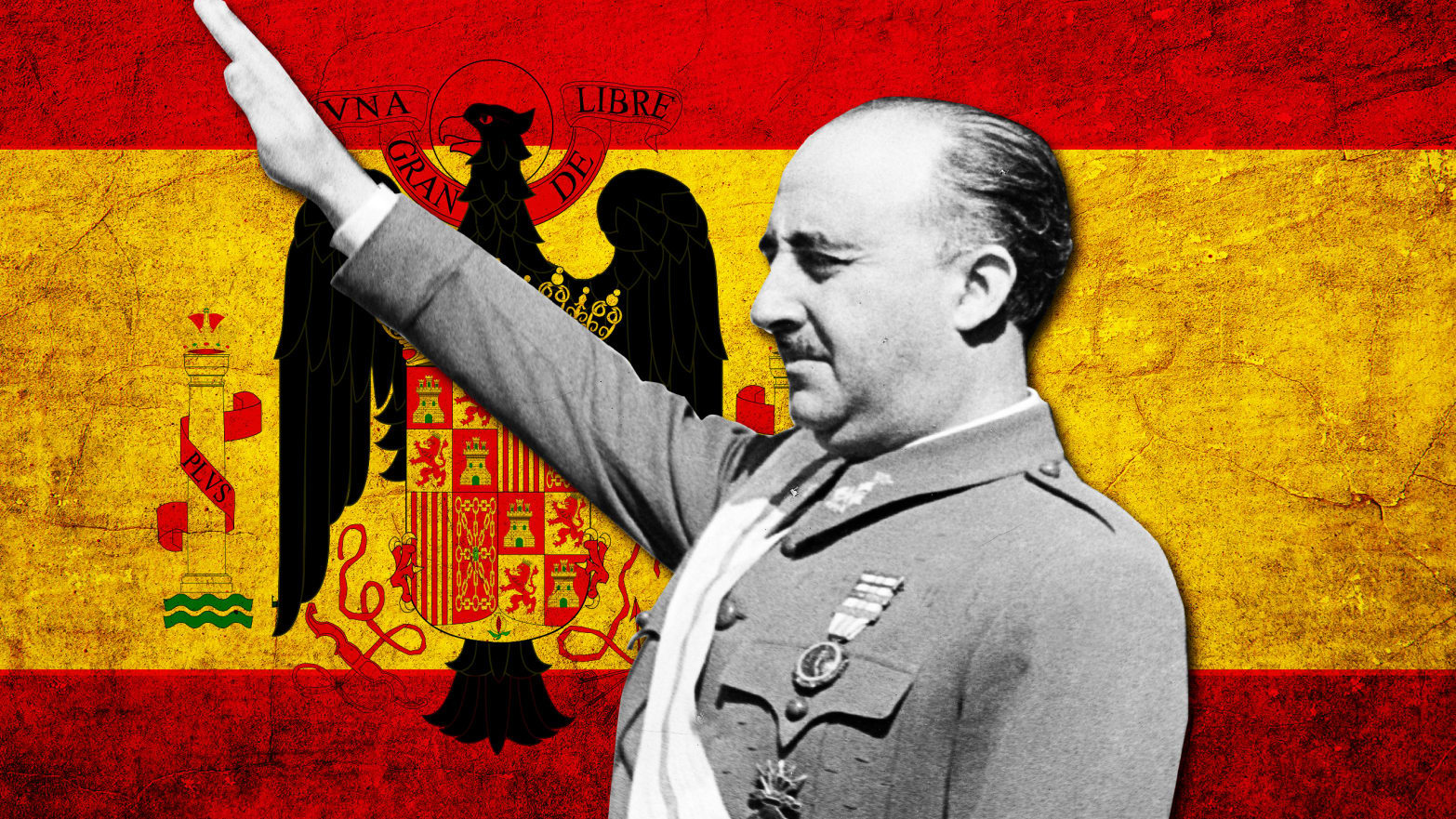
After successfully overthrowing the government during the Spanish Civil War, Francisco Franco installed a brutal military dictatorship which saw tens of thousands imprisoned or executed during his regime. Known as “El Caudillo” (which translates to “the Leader”), Franco also banned the Basque and Catalan languages, along with every religion besides Catholicism.
But when he wasn’t having his secret police apprehend civilians – or maybe while he was? – Franco was a fan of painting outdoor scenes on canvas. The paintings, which his own grandson will tell you “were not great works of art,” were of course done in the vein of realism, because getting nuanced work from a military dictator is probably a bridge too far.
Become a Patron! True Information is the most valuable resource and we ask you to give back.
Imelda Marcos is the widow of Ferdinand Marcos, the former dictator and president of the Philippines (1966-1986). Ferdinand had a pretty dark start in politics: in 1935 he was found guilty of assassinating his father’s campaign rival for national assembly, but he was later acquitted and rose all the way up to the presidency, where his authoritarian regime was known for corruption and lavish spending.
Imelda Marcos received an official position in her husband’s regime, one that allowed her to hook up her friends and relatives with lucrative government positions. Imelda herself was also severely in on the take, acquiring over 1,200 pairs of shoes, all of which she had to leave behind when the Filipino people rose up in 1986, forcing her and Ferdinand to flee to an actually pretty cushy exile in Hawaii.
Become a Patron! True Information is the most valuable resource and we ask you to give back.
In 1919, Benito Mussolini founded Italy’s Fascist Party – a new faction which broke away from socialist ideals and promoted nationalism and extreme right-wing policies. By 1925, he was the nation’s dictator and effectively the sole ruler. Along with his buddies, Adolf Hitler and Francisco Franco, Mussolini was part of a legendary triumvirate of sh*theads that were basically a living, breathing newspaper comments section of racist uncles. The end of World War II was not kind to that trio, however, and in 1945, Mussolini was captured by Italian partisans and killed, along with his mistress Claretta Petacci, by firing squad.
A few bullets to the skull, however, were not all that Claretta and Benito shared. He also wrote her a ton of insanely sexual letters, which were unearthed in 2009.
Mussolini, who was barely five-feet tall, was incredibly confident when it came to sending thirsty messages. He had no qualms shooting out erotic passages like:
I tremble in telling you, but I have a feverish desire for your delicious little body which I want to kiss all over. And you must adore my body, your giant…
Become a Patron! True Information is the most valuable resource and we ask you to give back.
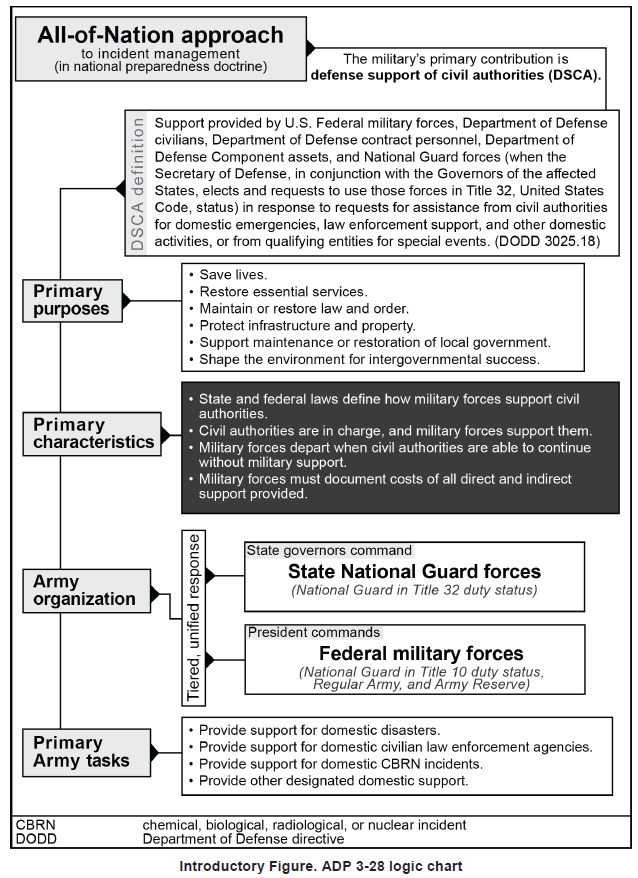
ADP 3-28 clarifies similarities and differences between defense support of civil authorities (DSCA) and other elements of decisive action. DSCA and stability operations are similar in many ways. Both revolve around helping partners on the ground within areas of operations. Both require Army forces to provide essential services and work together with civil authorities. However, homeland operational environments differ from those overseas in terms of law, military chain of command, use of force, and inter-organizational coordination among unified action partners. This ADP helps Army leaders understand how operations in the homeland differ from operations by forces deployed forward in other theaters. It illustrates how domestic operational areas are theaters of operations with special requirements. Moreover, this ADP recognizes that DSCA is a joint mission that supports the national homeland security enterprise. The Department of Defense conducts DSCA under civilian control, based on U.S. law and national policy, and in cooperation with numerous civilian partners. National policy, in this context, often uses the word joint to include all cooperating partners, as in a joint field office led by civil authorities. See Introductory Figure, on page viii.
The utilization of military forces during periods of domestic emergency is not undertaken lightly. The military however brings with it unique abilities, in terms of both capability and capacity which provide respondents with the resources needed to respond to an incident. The use of military forces in the responses to hurricanes Andrew in 1992 and Katrina in 2005 illustrate some of the different responses the U.S. military can provide. They also led the government to realize that additional coordination was required before an incident to ensure a successful response. An in-depth look at the tenets of DSCA, authorities, and the national preparedness system framework are discussed in chapter one.
The support the Army provides to civil authorities falls into four main tasks: Provide support for domestic disasters, provide support for domestic chemical, biological, radiological, and nuclear incidents, provide support for domestic civilian law enforcement agencies, and provide other designated support. Due to legal limitations such as the Posse Comitatus Act, the purpose for which the military can respond to these incidents is constrained, allowing a military response only to; save lives, restore essential services, maintain or restore law and order, protect infrastructure and property, support maintenance or restoration of local government, or shape the environment for intergovernmental success. Both state and federal laws detail how support is requested, provided and limited in both scope and duration. Further information on the employment of military forces and legal restrictions on doing so are provided in chapter two.
…
…
ISOLATION AND QUARANTINE AUTHORITIES
1-78. Isolation refers to the separation and the restriction of movement of people who have an infectious illness from healthy people to stop the spread of that illness. Quarantine refers to the separation and restriction of movement of people who are not yet ill but have been exposed to an infectious agent and are therefore potentially infectious. A geographical quarantine, known as a cordon sanitaire, is a sanitary barrier erected around an area. Both isolation and quarantine may be conducted on a voluntary basis or compelled on a mandatory basis through legal authority.
1-79. The federal government has the authority to prevent the spread of disease into the United States (foreign) or between states and territories (interstate). The Department of Health and Human Services is the lead federal agency for isolation and quarantine. The Centers for Disease Control and Prevention determine and enforce any federal government measures to prevent the spread of disease.
1-80. Only one federal statute permits federal military forces to enforce quarantine laws, under very narrow circumstances. Section 97 of Title 42, USC, allows military commanders of any coastal fort or station to support the execution of state quarantines with respect to vessels arriving in or bound for the United States.
…
…
CIVIL DISTURBANCE SUPPORT
4-172. A governor may call out the National Guard to quell a civil disturbance when it threatens lives or property. State forces support essential services, establish traffic control posts, cordon off areas, release smoke and obscurants, and serve as security or quick reaction forces. The state National Guard’s joint task force commander provides liaison teams to each affected law enforcement agency and normally positions the joint task force headquarters near civilian law enforcement headquarters. In addition to support for civilian law enforcement agencies, National Guard forces provide security for emergency responders. After review by the state attorney general, the governor approves the RUF.
4-173. A request for direct federal military support to civil disturbance operations is unlikely except in an extreme emergency. (See chapter 2 for a discussion of legal considerations. See DODI 3025.21 regarding DOD responsibilities for civil disturbance.) Federal military support for civil disturbances does not fall under defense support of civilian law enforcement agencies when the Insurrection Act or other exemptions to the Posse Comitatus Act are used. The President may employ the Armed Forces of the United States, including the National Guard, within the United States to restore order or enforce federal law when requested by the state legislature, or when not in session, by the governor, and when the authorities of the state are incapable of controlling the situation. The Attorney General of the United States appoints a senior civilian representative as his or her action agent. Federal military personnel supporting civil disturbance operations remain under military command at all times. Forces deployed to help federal or local authorities in a civil disturbance adhere to the SRUF and RUF approved by the combatant commander.
4-174. USNORTHCOM develops and maintains plans for civil disturbance operations. These plans provide the foundation for federal military civil disturbance support. They standardize most military activities and command relationships. Tasks performed by federal military forces may include joint patrolling with law enforcement officers; securing key buildings, memorials, intersections and bridges; and acting as a quick reaction force.
4-175. Civil disturbance missions require unit training prior to employing crowd control tactics. This normally requires a mobile training team from the military police or trained law enforcement personnel. Even in an urgent situation, commanders need to drill their forces repeatedly until small unit leaders can execute maneuvers under extreme stress. Training should include all arms, emphasizing treatment and evacuation procedures, detention and movement of citizens, and use of authorized nonlethal systems.
SPECIAL CONSIDERATIONS FOR STATE NATIONAL GUARD DOMESTIC CIVILIAN LAW ENFORCEMENT SUPPORT
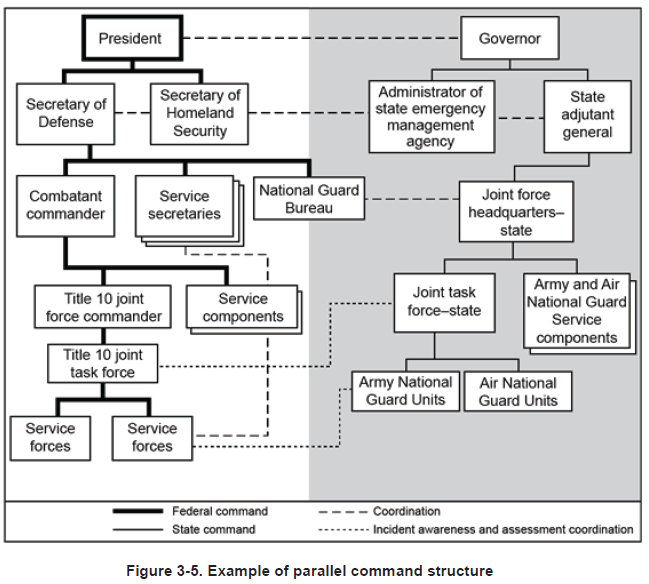
4-176. The military force with primary responsibility for direct law enforcement support is the National Guard, under state authority. The legal authority for National Guard members to support law enforcement is derived from state law, which varies from state to state. A governor of a state may call up National Guard forces to help local and state law enforcement agencies. The National Guard’s authority derives from the governor’s responsibility to enforce the laws of that state. Even with that authority, the governor carefully regulates the amount and nature of the support, consistent with state law. The governor may employ the state National Guard for law enforcement support in state active duty status or in Title 32, USC status. Federal laws (principally the Posse Comitatus Act) restrict federalized National Guard forces (in federal service, under Title 10, USC) from providing law enforcement support unless a specific exemption is applicable.
4-177. State National Guard forces in either Title 32, USC status or state active duty status from another state operating under the EMAC or a memorandum of agreement between the states may only support civilian law enforcement as specified in a memorandum approved by both governors.
4-178. There are 54 state and territory National Guard counterdrug support programs, governed by National Guard regulations. The Secretary of Defense, in accordance with Section 112 of Title 32, USC, may provide resources though the Chief, National Guard Bureau, to states with approved National Guard counterdrug support plans. In addition to requiring approval by the Secretary of Defense, the state National Guard counterdrug support plan requires approval from the state’s attorney general and adjutant general. The National Guard Bureau funds a full time Title 32, USC active Guard and Reserve counterdrug coordinator in each state for administration and management of the state counterdrug program. The counterdrug coordinator serves as the focal point for all counter drug mission validations, approval authority, and the prioritization for counterdrug mission tasking under appropriate policies, instructions, and directives.
4-179. State National Guard forces also provide support to DHS border security programs. Under Section 112 of Title 32, USC, National Guard Soldiers support border security by operating surveillance systems, analyzing intelligence, installing fences and vehicle barriers, building roads, and providing training. Although state National Guard units could participate in direct law enforcement activities related to border security, under DOD policy they normally provide indirect support, under the control of their governor.
4-180. State National Guard forces frequently support civilian law enforcement agencies during disaster response. The disruption and confusion associated with a disaster typically cause numerous problems with law enforcement tasks. Commanders should evaluate the potential for law enforcement support as part of their unit’s initial assessment and provide their assessment to their state joint task force headquarters. Commanders must impress upon their subordinates that they must refrain from law enforcement activities except as authorized.
Become a Patron! True Information is the most valuable resource and we ask you to give back.
STASI-Ausweis aus Dresdner Archiv
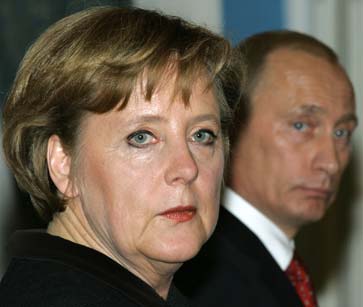
Vor dem Ukraine-Gipfel in Paris hat Bundeskanzlerin Angela Merkel (CDU) mit dem russischen Präsidenten Wladimir Putin ein Einzelgespräch geführt. Über die Inhalte machte die deutsche Seite am Montag zunächst keine Angaben. Es war erwartet worden, dass Merkel den Mord an einem Georgier in Berlin anspricht, der zu einer diplomatischen Krise zwischen Deutschland und Russland geführt hat.
Kurz vor der Abreise Merkels nach Paris hatte die Bundesregierung erneut eine “ernsthafte und unverzügliche Mitwirkung der russischen Behörden” an der Aufklärung des Verbrechens gefordert. Man sei “weiterhin bestürzt über die Tat”, sagte die stellvertretende Regierungssprecherin Ulrike Demmer. Wegen fehlender Kooperation bei der Aufklärung des mutmaßlichen Auftragsmords am 23. August im Kleinen Tiergarten in Berlin hatte die Bundesregierung zwei russische Diplomaten ausgewiesen. Die von Moskau angekündigte Reaktion steht noch aus. Der Generalbundesanwalt hat wegen der grundsätzlichen Bedeutung des Falls die Ermittlungen übernommen.
Die deutschen Sicherheitsbehörden und die Bundesregierung hätten “verschiedene russische Stellen mit Anfragen zu dem Fall befasst”, sagte Demmer. Genauer wollte sie es nicht sagen. Russland weist die Vorwürfe zurück.
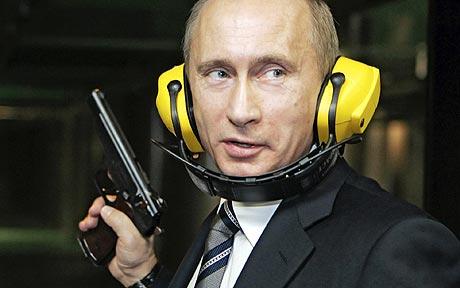
Putins STASI-Ausweis:
Von Seiten der Stasiunterlagenbehörde heißt es: “Es war übliche Praxis beim DDR-Ministerium für Staatssicherheit, die Verbindungsoffiziere des russischen Geheimdienstes KGB und die ihnen untergeordneten Offiziere wie Putin mit Hausausweisen der zuständigen MfS-Dienststelle auszustatten.”
Putin war Augenzeuge, als während der friedlichen Revolution am 5. Dezember 1989 rund 5000 Demonstranten die hermetisch abgeschirmte Dresdner Bezirksverwaltung der Staatssicherheit besetzten. Als sich die Demonstranten der Dienststelle näherten, kam es fast zu gewalttätigen Auseinandersetzungen mit sowjetischen Militärs.
Aufgrund einer Medienanfrage seien Akten der Abteilung “Kader und Schulung” der ehemaligen Stasi-Bezirksverwaltung Dresden durchforstet worden, sagte Felber. Dabei sei man auf den Ausweis gestoßen. “Es ist schon eine kleine Sensation. Putins Name war in den Akten, die die Ausgabe der Ausweise an sowjetische Militärangehörige nachweisen, nicht verzeichnet.”
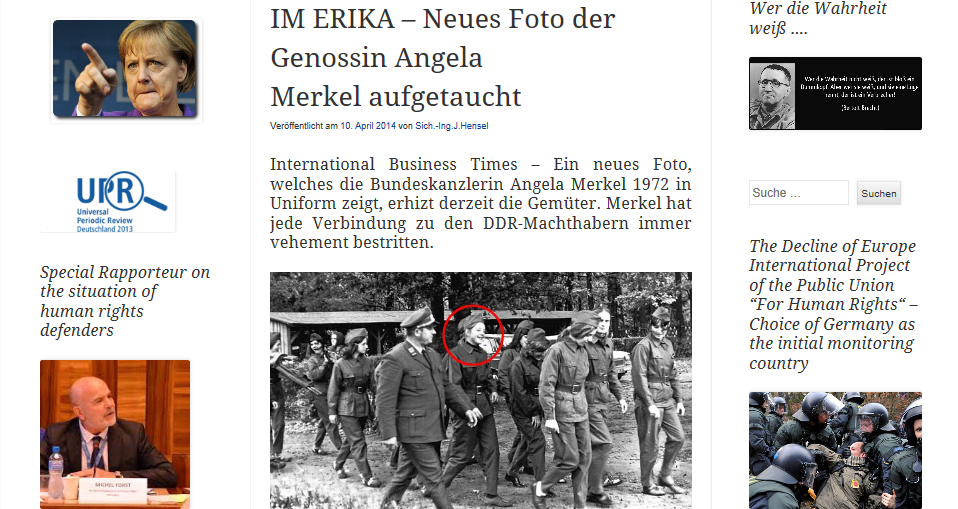
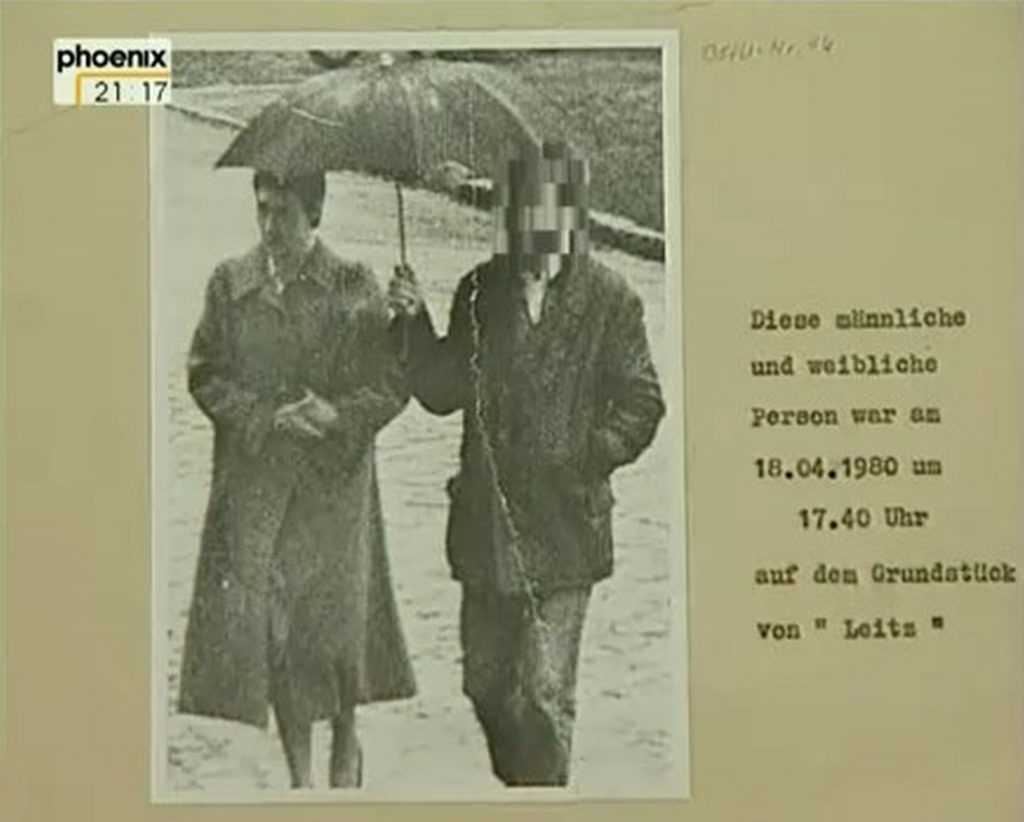
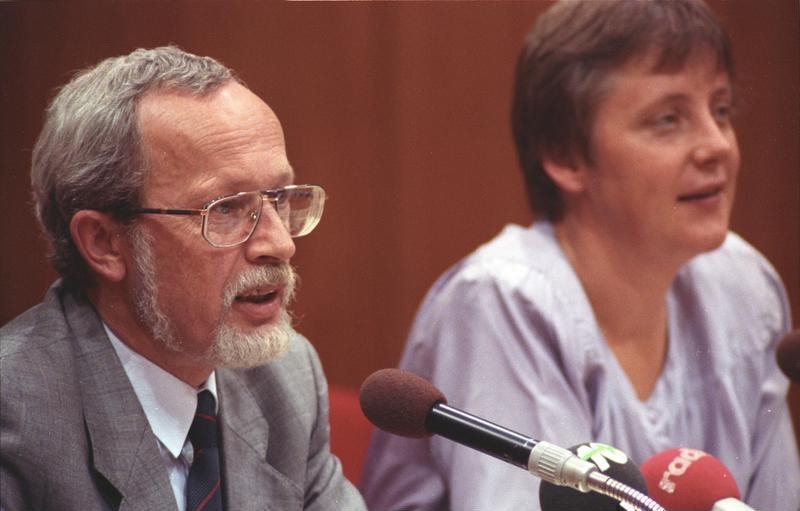
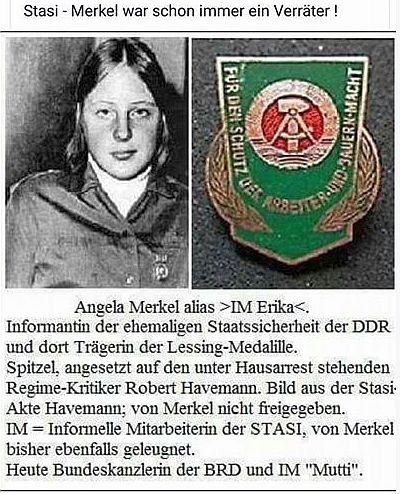
Im Internet wird daraufhin gewiesen, dass Angela Merkel von zahlreichen IM’s umgeben gewesen sei. Daraus wird geschlussfolgert, dass auch sie für den Staatssicherheitsdienst gearbeitet hätte. Tatsächlich waren wenigstens drei ihrer Kollegen am Zentralinstitut beim Staatssicherheitsdienst als Informanten erfasst: Hans-Jörg Osten (IM “Einstein”), Frank Schneider (IM “Bachmann”) und Michael Schindhelm (IM “Manfred Weih”). Mit Letzterem, den PDS-Kultursenator Thomas Flierl 2005 zum Generaldirektor der Berliner Opernstiftung berief, teilte sie sich eine Zeit lang ihr Büro. Als sie 1989 zum Demokratischen Aufbruch stieß, arbeitete sie mit einem weiteren Stasi-Informanten, dem ersten Parteivorsitzenden Wolfgang Schnur (IM „Torsten“ und „Dr. Ralf Schirmer“) zusammen. Im April 1990 wurde sie schließlich stellvertretende Regierungssprecherin unter dem letzten DDR-Ministerpräsidenten Lothar de Maizière, der in MfS-Unterlagen als IM “Czerny” erfasst ist.
IM Czerny mit Merkel
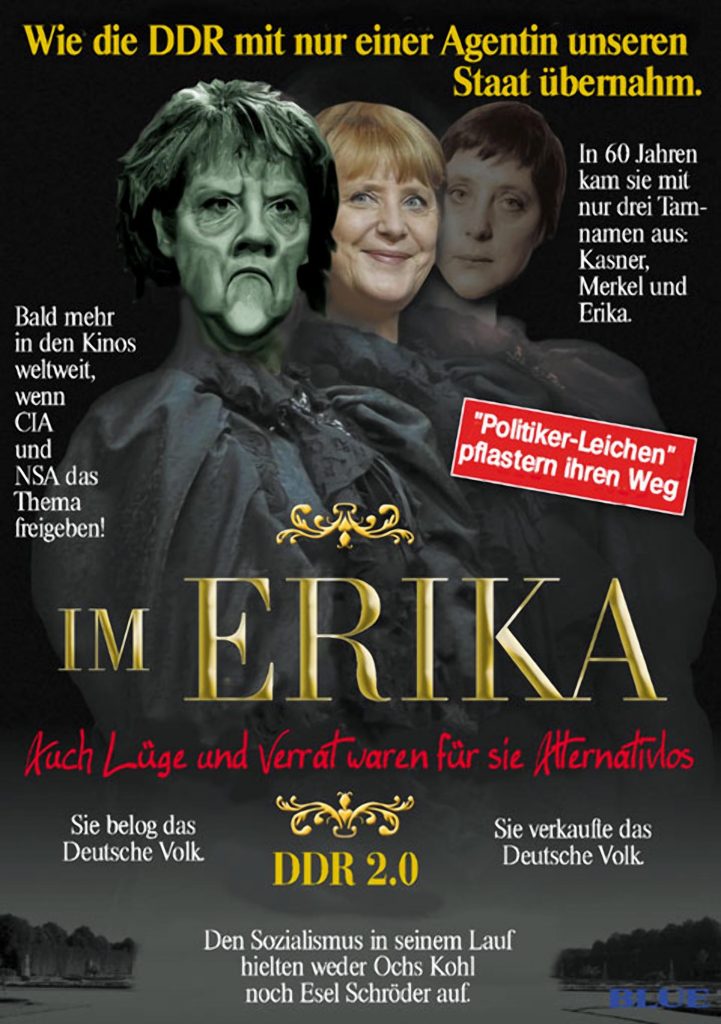
IM ERIKA – Im Internet verbreitetes “Filmplakat”
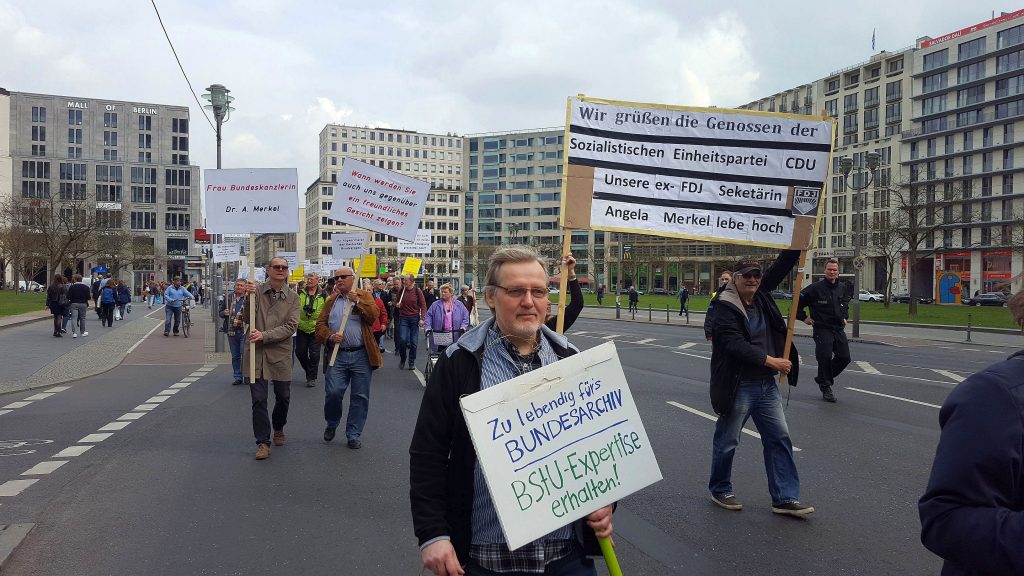
“Unsere Ex-FDJ-Sekretärin Angela Merkel lebe hoch” – Stasi-Opfer-Demonstration 2016 in Berlin
Historiker Hubertus Knabe kommentiert: “Nimmt man alle diese Fakten zusammen, muss man zu folgendem Schluss kommen: Für die Behauptung, Bundeskanzlerin Angela Merkel hätte unter dem Decknamen “Erika” für den Staatssicherheitsdienst gearbeitet, gibt es keinerlei Belege. Sollte es einen entsprechenden IM-Vorgang gegeben haben, müssten selbst im Fall seiner Vernichtung zumindest noch Spuren davon erhalten sein – zum Beispiel Berichte aus der Quelle “Erika”, die in den Akten ausgespähter Personen abgelegt wurden. Das ist nach gegenwärtigem Kenntnisstand aber nicht der Fall. Ob die Säcke mit den zerrissenen Unterlagen darüber hinaus gehende Hinweise enthalten, bleibt Spekulation.”
Become a Patron! True Information is the most valuable resource and we ask you to give back.
Mao Zedong, founder of the People’s Republic of China, is technically the greatest mass murderer in history. In 1958, Mao brought forth (and ruthlessly enforced) “The Great Leap Forward,” which was a plan to catch China up to the economy of the western world. Unfortunately, this plan came with mass famine, starvation, torture, and systematic violence, which included making people work nude in the dead of winter, and parents burying their own children alive. All told, 45 million people died during Mao’s reign, a body count that remains unmatched by any other historical despot.
But the guy just loved poetry. Chairman Mao – though he persecuted many Chinese writers and had countless books burned – was an avid reader, as well as a bit of a writer. He wrote over 30 poems, usually in the format of the ancient Chinese style. Ironically, he would have forbidden one billion people from every reading his work, due to his principles, but who isn’t self-conscious about their poetry?
Become a Patron! True Information is the most valuable resource and we ask you to give back.
In 1971, Idi Amin overthrew the Ugandan government and installed himself as leader. During his eight-year reign, he would massacre over 400,000 civilians, often by forcing them to bludgeon one another to death with sledgehammers at the hands of his death squads. In 1979, Amin fled to Saudi Arabia, where he lived the rest of his days in exile – never facing any consequences for his crimes against humanity – before passing away in 2003.
But there was another side to Idi Amin. More than a tyrant, more than a mad man, Idi Amin was a guy who just loved slapstick comedy. He was apparently an avid fan of children’s cartoons, most specifically Tom and Jerry – you know, the one where the larger, menacing figure seeks to destroy the smaller, ostensibly defenseless one?
Become a Patron! True Information is the most valuable resource and we ask you to give back.
Der Namen Guillaume steht wie kein anderer exemplarisch für die Westspionage des Ministeriums für Staatssicherheit (MfS). Er stieg zum Persönlichen Referenten des damaligen Bundeskanzlers Willy Brandt auf und hatte Zugang zu streng geheimen Unterlagen. Ein Propagandafilm der Stasi.
Become a Patron! True Information is the most valuable resource and we ask you to give back.
Maybe the most malevolent individual to ever walk the Earth – a man who endeavored the annihilation of the Jewish individuals and accordingly murdered more than 6 million lives – Adolf Hitler is with precisely zero saving graces. In the event that anything, his greatest diversion (past his very unremarkable craftsmanship), just makes him much progressively abnormal. It’s hard to believe, but it’s true, he was one of those grown-ups that is truly into Disney.
In 2008, a Norwegian exhibition hall chief named William Hakvaag discovered hand-hued depiction of the characters Constrained and Doc from the 1937 Disney film Snow White and the Seven Diminutive people. The drawings – which were obviously walker, best case scenario – were marked “A.H.” and are thought with close to sureness to have been finished by Hitler, who additionally claimed a duplicate of the film and “thought it was probably the best motion picture at any point made.” obviously he did.
Become a Patron! True Information is the most valuable resource and we ask you to give back.
Langsam dämmert es auch den Mainstream-Medien, das GRU/KGB und Neo-STASI weiterhin aktiv sind und unbequeme Gegner überall auf der Welt ermorden – auch in BERLIN. So berichtet nunmehr auch die wachgeküsste Tagesschau:
“Zelimkhan Khangoshvili fürchtete um sein Leben. Der russische Staat sei hinter ihm her, berichtete der Tschetschene mit georgischem Pass bei seiner Asylanhörung im brandenburgischen Eisenhüttenstadt im Januar 2017. Mehrere Mordanschläge habe es in den vergangenen Jahren auf ihn gegeben, so der ehemalige Rebellenkommandeur. Er sei ein gesuchter Mann – im Kaukasus und darüber hinaus. Was er denn befürchte, wenn er nach Russland zurückkehren müsste, wollte der Mitarbeiter des Bundesamtes für Migration und Flüchtlinge (BAMF) von ihm wissen. Khangoshvilis Antwort: “Die russischen Organe werden einen Mord inszenieren.”
Am 23. August 2019, gegen 11:58 Uhr, wurde Zelimkhan Khangoshvili schließlich ermordet. Nicht in Russland oder im Kaukasus, sondern mitten in Berlin. Im Kleinen Tiergarten im Ortsteil Moabit war der 40-Jährige gerade auf dem Weg zum Freitagsgebet in der Moschee, als sich ein Mann auf einem Fahrrad näherte und ihm aus kurzer Distanz mit einer Pistole samt Schalldämpfer in den Kopf schoss. Khangoshvili war sofort tot.
Der Mord an dem Georgier gibt seitdem Rätsel auf: Wer steckt hinter dem Attentat? War es ein Auftragsmord aus dem kriminellen Milieu? Eine Fehde unter Kaukasiern? Oder gar ein Attentat im Auftrag des Kreml?
Der mutmaßliche Todesschütze hatte nach der Tat versucht mit einem E-Roller zu fliehen, war jedoch festgenommen worden: Es ist ein stämmiger Mann mit Schnauzbart und auffälligen Tätowierungen. Laut Pass handelt es sich um den russischen Staatsbürger Vadim Sokolov. Er sitzt in Berlin in Untersuchungshaft und schweigt. Einmal soll er Besuch von Diplomaten aus der russischen Botschaft bekommen haben, die ihn konsularisch betreuen.
Die Ermittlungen in dem Fall führt das Berliner Landeskriminalamt (LKA). Der Vorwurf gegen den festgenommenen Tatverdächtigen lautete bislang: Mord. Weil die Tat aber eine so große Brisanz birgt, lässt sich der Generalbundesanwalt seit Beginn an über den Stand der Ermittlungen informieren. Und auch das Bundeskriminalamt (BKA) ist beteiligt.
Jetzt könnte der Fall allerdings eine neue Dimension bekommen: Die Bundesanwaltschaft will das Verfahren nach Informationen von WDR, NDR und “Süddeutscher Zeitung” noch in dieser Woche übernehmen. Und zwar wegen eines möglichen Geheimdienst-Hintergrunds. In Karlsruhe geht man inzwischen davon aus, dass der russische Staat den Mord in Berlin-Moabit in Auftrag gegeben haben könnte. Auch der “Spiegel” hatte darüber berichtet.
Ein Abgleich der biometrischen Daten der damaligen Fahndungsbilder ergab nun eine hohe Ähnlichkeit mit dem in Berlin festgenommenen Tatverdächtigen Sokolov. Auffällig war allerdings: Russland hatte die internationale Fahndung nach Vadim K. im Jahr 2015 ganz plötzlich eingestellt. Der Verdacht der deutschen Ermittler ist nun: Russische Dienste könnten den mutmaßlichen Mörder gefunden und für ein Attentat rekrutiert haben. Und schufen daraufhin die Falschidentität Sokolov.”
In Geheimdienstkreisen ist man sich sicher, es war Putins langer Arm in Berlin.
Become a Patron! True Information is the most valuable resource and we ask you to give back.
Legendary golfer and North Korean dictator Kim Jong-il was something of a human rights violation virtuoso. The ham-shaped leader oversaw plenty of atrocities in his time at the helm in Pyongyang, including ethnic cleansing and mass starvation.
But he also adored basketball. His favorite player, naturally, was Michael Jordan, who appeared in the Warner Brothers film Space Jam, which featured several cartoons he also obsessed over like a very normal person. Kim Jong-il was in fact such a fan of His Royal Airness that he had VHS recordings of every one of Jordan’s games. The Great Leader, sadly, never got to meet his hero, but his son sort of came close with Dennis Rodman’s famed trip to North Korea.
Become a Patron! True Information is the most valuable resource and we ask you to give back.
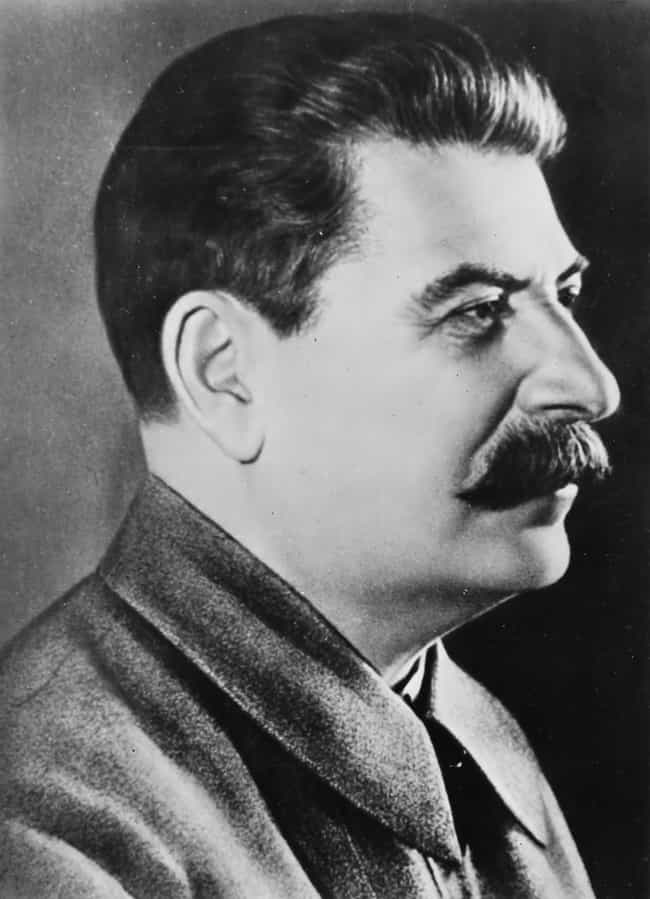
Depending on one’s political leanings, Joseph Stalin’s legacy is a bit subjective. During his reign (1929-1953), the Soviet Union went from a poor, peasant society to an industrial and military superpower, but this also caused the worst man-made famine in history and millions of his people died.
Regardless, this legendary figure of collectivism loved nudes. Males nudes, specifically.
Stalin did not, however, draw the nudes himself. He collected sketches of muscular male specimens from various Russian artists and, bizarrely, he merely annotated them. Stalin would draw on the subject’s genitals or torsos and write out short messages below them. His scrawls ranged from the humorous (“You need to work, not wank. Time for re-education”) to the maudlin, sometimes addressed to his fallen comrades: “Radek, you ginger bastard, if you hadn’t pissed into the wind, if you hadn’t been so bad, you’d still be alive.”
Become a Patron! True Information is the most valuable resource and we ask you to give back.
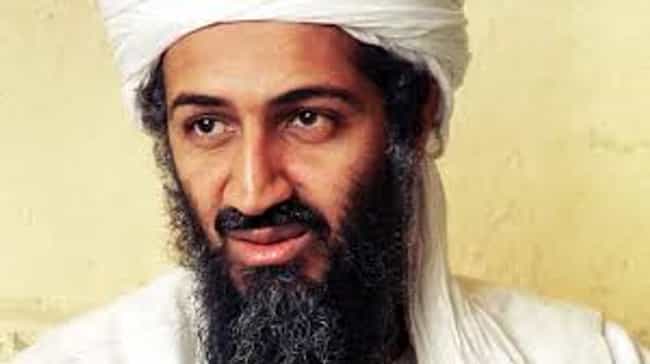
Architect of the 9/11 attacks, the worst instance of terrorism ever on American soil, Osama bin Laden knew how to let his hair down and blow off some steam after a long day at Al-Qaeda HQ.
But when the 5 o’clock whistle blew, bin Laden didn’t dash to the nearest happy hour for wings and tall boys – he hit the sand for an intense match of beach volleyball.
The 6’4″ bin Laden was a force on the court, according to his associate Mohammed Atef. Atef, the former chief of Al-Qaeda, also enjoyed the game, but the two never played on the same team, citing the fact that they were so good it was an unfair advantage over other players.
Become a Patron! True Information is the most valuable resource and we ask you to give back.
Indeed, even severe despots need time to loosen up. While overbearing maniacs have persecuted, starved, abused, tormented, and killed millions they’ve additionally set aside some effort to watch kid’s shows, play sea shore volleyball and even pen hot erotica.
While ordinarily a side interest refines somebody, these pastimes of the merciless despots on this rundown just make them progressively outsider and strange. This is what the absolute cruelest individuals in history got up to when they were off the clock.
Previous Leader of Iraq Saddam Hussein was a heartless pioneer who managed with an iron clench hand. The genuine degree of his monstrosities is obscure, as murders completed at his command are countless, yet there is proof of more than 250 mass graves from his rule. At the end of the day, preceding his hanging in 2003, Saddam was not a very chill fellow.
He was, in any case, horny.
Saddam had a propensity for composing romance books. Composing under the vigorously encoded nom de plume of “S. Hussein,” Saddam distributed a book called Zabibah and the Ruler, which was a ham-fisted and sensual personal novel set in antiquated Iraq. The revelation of this sappy, explicitly charged tome was additionally entirely arbitrary: CIA authorities discovered it by chance in an Arabic book shop in London in 2001.
















 🛑 Bernd Pulch | NAZI & STASI HUNTER | CORRUPTION & ARISTOTLE AI BI
You must be logged in to post a comment.