


A groundbreaking global survey of over 200 threatened journalists across 53 countries has delivered a clear message to those who try to silence the press: the one thing they dread most is journalists working together. The findings, released by Forbidden Stories ahead of World Press Freedom Day on May 3, provide unprecedented insight into who threatens reporters, which investigations disturb them most, and what might actually deter attacks.
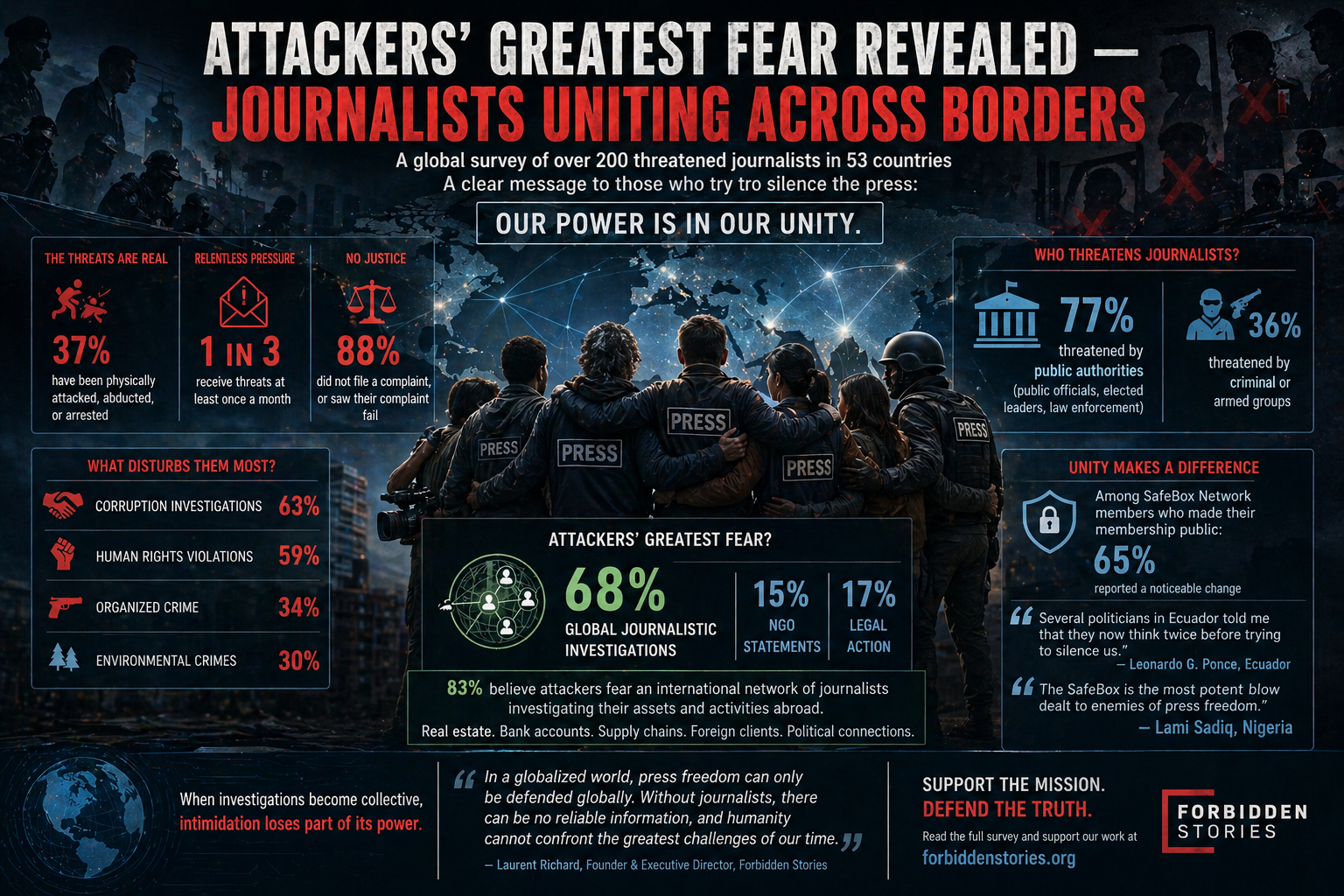
The survey paints a stark picture. 37% of respondents have already been physically attacked, abducted, or arrested. Nearly one in three receive threats at least once a month. Yet despite this relentless pressure, a striking 88% of those threatened did not file a complaint, or saw their complaint fail. The justice system, it seems, is not coming to the rescue.
So who is behind the threats? Public authorities top the list: 77% of respondents said they were threatened by representatives of public authorities — public officials, elected leaders, or law enforcement — twice as many as those targeted by criminal or armed groups (36%). Corruption investigations are the most disturbing topics for these attackers (63%), followed by human rights violations (59%), organized crime (34%), and environmental crimes (30%).
But the survey’s most important revelation is what attackers fear most. Asked which of three scenarios their aggressors would dread, 68% of journalists said “global journalistic investigations” — far more than NGO statements (15%) or legal action (17%). And 83% believe those who threaten them would be afraid of an international network of journalists digging into their assets and activities abroad: real estate, bank accounts, supply chains, foreign clients, political connections.
This is precisely the logic behind the SafeBox Network, created by Forbidden Stories to secure ongoing investigations. Among survey respondents who are members and have made that membership public, 65% reported a noticeable change. Ecuadorian journalist Leonardo G. Ponce, who uses the network, said: “Several politicians in Ecuador told me that they now think twice before trying to silence us.” Nigerian journalist Lami Sadiq called the SafeBox “the most potent blow dealt to enemies of press freedom.”
The findings confirm that when investigations become collective, intimidation loses part of its power. Protecting journalists can no longer rely solely on after-the-fact defense; building systems that make attacks less effective in the first place is now an urgent priority.
As Laurent Richard, founder and executive director of Forbidden Stories, said: “In a globalized world, press freedom can only be defended globally. Without journalists, there can be no reliable information, and humanity cannot confront the greatest challenges of our time.”
Forbidden Stories’ mission is to continue the work of journalists who have been killed, imprisoned, or threatened. This survey shows that international solidarity among reporters is not just a noble ideal — it is the most effective weapon against those who want to bury the truth.
Read the full survey and support Forbidden Stories’ work at forbiddenstories.org.
Bernd Pulch (M.A.) is a forensic expert, founder of Aristotle AI, entrepreneur, political commentator, satirist, and investigative journalist covering lawfare, media control, investment, real estate, and geopolitics. His work examines how legal systems are weaponized, how capital flows shape policy, how artificial intelligence concentrates power, and what democracy loses when courts and markets become battlefields. Active in the German and international media landscape, his analyses appear regularly on this platform.
Full bio →
Support the investigation →
Join the platform →
 🛑 Bernd Pulch | Uncensored Investigative Intelligence since 1994