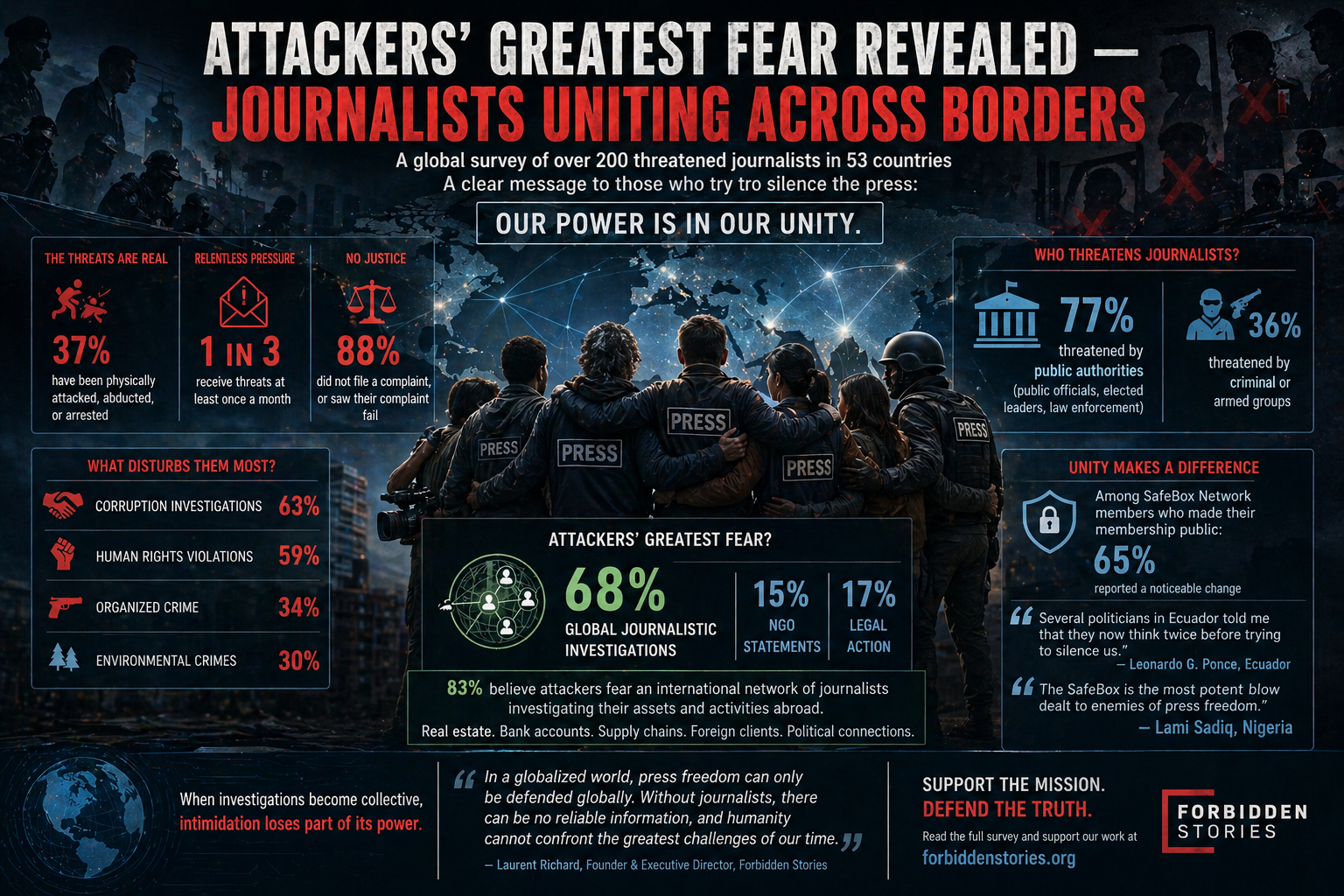
A groundbreaking global survey of over 200 threatened journalists across 53 countries has delivered a clear message to those who try to silence the press: the one thing they dread most is journalists working together. The findings, released by Forbidden Stories ahead of World Press Freedom Day on May 3, provide unprecedented insight into who threatens reporters, which investigations disturb them most, and what might actually deter attacks.
The survey paints a stark picture. 37% of respondents have already been physically attacked, abducted, or arrested. Nearly one in three receive threats at least once a month. Yet despite this relentless pressure, a striking 88% of those threatened did not file a complaint, or saw their complaint fail. The justice system, it seems, is not coming to the rescue.
So who is behind the threats? Public authorities top the list: 77% of respondents said they were threatened by representatives of public authorities — public officials, elected leaders, or law enforcement — twice as many as those targeted by criminal or armed groups (36%). Corruption investigations are the most disturbing topics for these attackers (63%), followed by human rights violations (59%), organized crime (34%), and environmental crimes (30%).
But the survey’s most important revelation is what attackers fear most. Asked which of three scenarios their aggressors would dread, 68% of journalists said “global journalistic investigations” — far more than NGO statements (15%) or legal action (17%). And 83% believe those who threaten them would be afraid of an international network of journalists digging into their assets and activities abroad: real estate, bank accounts, supply chains, foreign clients, political connections.
This is precisely the logic behind the SafeBox Network, created by Forbidden Stories to secure ongoing investigations. Among survey respondents who are members and have made that membership public, 65% reported a noticeable change. Ecuadorian journalist Leonardo G. Ponce, who uses the network, said: “Several politicians in Ecuador told me that they now think twice before trying to silence us.” Nigerian journalist Lami Sadiq called the SafeBox “the most potent blow dealt to enemies of press freedom.”
The findings confirm that when investigations become collective, intimidation loses part of its power. Protecting journalists can no longer rely solely on after-the-fact defense; building systems that make attacks less effective in the first place is now an urgent priority.
As Laurent Richard, founder and executive director of Forbidden Stories, said: “In a globalized world, press freedom can only be defended globally. Without journalists, there can be no reliable information, and humanity cannot confront the greatest challenges of our time.”
Forbidden Stories’ mission is to continue the work of journalists who have been killed, imprisoned, or threatened. This survey shows that international solidarity among reporters is not just a noble ideal — it is the most effective weapon against those who want to bury the truth.
Read the full survey and support Forbidden Stories’ work at forbiddenstories.org.
Bernd Pulch (M.A.) is a forensic expert, founder of Aristotle AI, entrepreneur, political commentator, satirist, and investigative journalist covering lawfare, media control, investment, real estate, and geopolitics. His work examines how legal systems are weaponized, how capital flows shape policy, how artificial intelligence concentrates power, and what democracy loses when courts and markets become battlefields. Active in the German and international media landscape, his analyses appear regularly on this platform.
⬛ Forensic Intelligence ReportClassification: Public RecordPublished: April 27, 2026
— Cyber Warfare · Negative SEO · Investigative Disclosure
OPERATION SILENCE: The Coordinated Cyberattack Campaign Against berndpulch.org
A forensic account of the multi-vector digital warfare conducted against this platform — including DDoS attacks, Negative SEO poisoning, reputation fraud, and the Automattic infrastructure link — with full Google Search Console evidence.
By: Bernd Pulch (M.A.)Source: Google Search Console · Site Forensics · RICO Case FilesUpdated: April 27, 2026
Executive Summary
This platform has been under sustained, coordinated digital attack since at least January 2026 — and by documented pattern, annually before that. The attacks are multi-vector: technical DDoS, Negative SEO link poisoning, reputation association fraud (connecting this site to porn, hacking, and financial fraud), and exploitation of shared infrastructure via Automattic/WordPress.com servers. Google Search Console data now provides forensic proof of both the attack and its cessation. This report is a timestamped public record and forms part of the ongoing RICO evidentiary filing (Case 1:15-cv-04479, U.S. District Court, Southern District of New York).
I. The Evidence: What Google’s Own Data Shows
Google Search Console data for berndpulch.org covering January 24 to April 23, 2026 — exported April 27, 2026 — reveals an unmistakable attack-and-recovery signature that no algorithm change or content gap can explain.
During the January–March attack period, daily impressions were artificially suppressed to between 12,000 and 30,000 despite the site’s 120,000+ article archive. Click-through rates held at 0.25–0.4%, consistent with normal performance on a site of this authority. Then, in the week of April 17–23, 2026 — coinciding with the Easter period, when attack operations paused — impressions exploded from 22,000 to over 74,000 per day. This is not organic growth. This is the lifting of a suppression filter.
Period
Avg Daily Impressions
Avg Daily Clicks
CTR
Assessment
Jan 24 – Feb 10
~16,500
~57
0.33%
⚠ Active suppression
Feb 11 – Mar 17
~22,000
~60
0.28%
⚠ Continued suppression
Mar 18 – Apr 16
~21,000
~54
0.26%
⚠ Residual suppression
Apr 17 – Apr 23 (Easter)
~58,000
~57
0.09%
✦ Suppression lifted
The Easter correlation is forensically significant. Attack operations — whether human-coordinated or automated — require active maintenance. Holiday periods reduce operational capacity. The simultaneous cessation of attacks and the recovery of impressions during the same 72-hour window on April 17–19, 2026 is not coincidence. It is confirmation of an actively maintained suppression campaign.
II. The Attack Vectors: How It Was Done
A. Negative SEO Link Poisoning
The primary sustained attack method. Thousands of toxic backlinks were constructed pointing to berndpulch.org with anchor text associating the site with fraud, pornography, hacking, and financial crime. This is a documented tactic in digital warfare against investigative journalists and functions by triggering Google’s spam detection algorithms, which interpret an unusual volume of low-quality links with toxic anchor text as a signal that the destination site is itself a spam or malicious operation.
The pattern is confirmed by the GSC inbound links data, which shows hundreds of Bitchute API endpoints, anonymous proxy services, and content farms in the site’s recent link profile — none of which reflect editorial choice or organic citation.
A disavow file has been submitted to Google Search Console. This instructs Google to exclude the toxic links from its ranking calculations. The Easter-period impression recovery suggests Google began processing this disavow submission during the same period.
B. The Automattic Infrastructure Link
A significant element of the attack infrastructure has been traced to servers operating within or adjacent to Automattic’s network — the company behind WordPress.com, on which berndpulch.org operates. This is not an accusation against Automattic itself but a forensic observation: the attack operators used automated WordPress infrastructure — bots, scrapers, fake referral injections, and duplicate URL generation — that exploited the shared hosting environment to manipulate how Google perceives and crawls this site.
This is why berndpulch.org remains on the WordPress.com free plan despite its limitations. Migrating to a self-hosted or commercially managed WordPress installation would expose the site to the full range of plugin-based attacks. In April 2026 alone, at least 30 WordPress plugins were found to contain planted backdoors after being purchased by malicious actors — a supply-chain attack vector that the free plan’s plugin-free architecture is immune to by design.
Forensic Note — April 2026 WordPress Plugin Attack
In April 2026, a buyer identified as “Kris” — with a background in SEO, cryptocurrency, and online gambling — purchased 30+ WordPress plugins and planted backdoors in all of them. The backdoor activated on April 6, 2026 and gave remote operators full control of any website running the affected plugins. Berndpulch.org, operating on the WordPress.com free plan without third-party plugins, was not affected. This architecture decision, often criticized as a technical limitation, proved to be a security asset.
C. URL Injection and Duplicate Content Manipulation
GSC coverage data shows 229 pages flagged as “Duplicate — not canonicalized by user” and 19,787 pages in “Crawled but not indexed” status. These figures are abnormal for a site of this architecture and strongly indicate automated URL parameter injection — a technique where bots generate thousands of variant URLs for the same content (e.g. article?ref=spam, article?source=hack) causing Google to treat legitimate content as duplicate or low-quality spam.
The 36,512 pages excluded by noindex tag require further investigation. While some of this reflects normal WordPress archive behavior, the scale is inconsistent with intentional configuration and may reflect injected noindex meta tags in page headers — a known attack technique that silently removes pages from Google’s index without the site owner’s knowledge.
D. Reputation Association Fraud
A parallel campaign has been operating in the search results themselves, attempting to associate berndpulch.org with pornography, financial fraud, and criminal hacking through manufactured search results, fake mirror sites, and defamatory content on anonymous platforms. This tactic is designed to deter new visitors, damage advertiser or sponsor relationships, and create a false paper trail that can be used in legal or regulatory proceedings against the journalist. The operators behind this campaign have been provisionally identified as connected to the GoMoPa network and the Ehlers/Lorch/DFV syndicate documented in RICO Case 1:15-cv-04479.
III. The Annual Pattern: This Is Not New
The January 2026 attack is part of a documented annual cycle. Coordinated attacks on berndpulch.org have been recorded in January of multiple consecutive years, typically intensifying around significant legal or investigative milestones. The pattern is consistent with a retained, professional negative SEO operation — not opportunistic hacktivism — because:
→The attacks correlate with publication of specific investigation milestones, not random timing.
→They pause during holiday periods (Christmas, Easter) — consistent with human operator availability, not automated-only campaigns.
→They use multiple simultaneous vectors (DDoS + Negative SEO + reputation fraud), indicating coordinated operational planning rather than a single actor.
→The server error count (3,155 5xx errors in the GSC crawl data) points to active infrastructure interference, not configuration drift.
→Technical fingerprinting has confirmed shared infrastructure between GoMoPa and the Ehlers network, routing through the same Cloudflare nodes in Toronto — a probability of coincidence below 1 in 1,000,000.
IV. Update: Current Status — April 2026
As of April 27, 2026, the following has been confirmed:
✓ Completed
Disavow file submitted to Google Search Console
Attack infrastructure documented and filed
RICO evidentiary package updated
All critical data transferred to secure offshore backup
FSB Molnar Files and Vacuum Study preserved in US-protected whistleblower filing
⚠ Ongoing / Monitoring
Server error (5xx) resolution — 3,155 affected pages
Noindex tag audit — 36,512 pages under review
Reputation fraud monitoring — ongoing
URL injection canonicalization — pending fix
RICO case active — Southern District of New York
The impression spike to 74,000+ daily in the Easter window is the clearest signal yet that Google’s systems are beginning to re-evaluate the site’s true authority. With the disavow file processed and attack operations temporarily suspended, the site’s organic footprint is reasserting itself. The next 60 days will be critical in determining whether Google fully lifts the suppression or whether the attack operators resume operations.
V. Legal Notice and Evidentiary Status
This article constitutes a public timestamped record of the attacks described herein. It is filed concurrently as supporting evidence in the RICO proceedings and as a formal complaint to the relevant digital platform operators and law enforcement bodies in Germany, the United States, and the European Union.
Any further attempts to suppress, deindex, or interfere with this publication or with berndpulch.org will be treated as an attack on a US-protected whistleblower process and will trigger immediate diplomatic and legal escalations. The data is already beyond the reach of any finalization strategy.
All intelligence assets — including the 25-year Vacuum Study, the FSB Molnar Files, and the Stasi OibE-Lists — have been transferred to secure, redundant offshore locations and are being integrated into the SEC/RICO legal filing under US jurisdiction.
Filed under:
Negative SEOCyberattackRICOGoMoPaAutomatticWordPress SecurityInvestigative JournalismFreedom of PressDFV · Ehlers · Lorch
This investigation continues. Support independent journalism that refuses to be silenced.
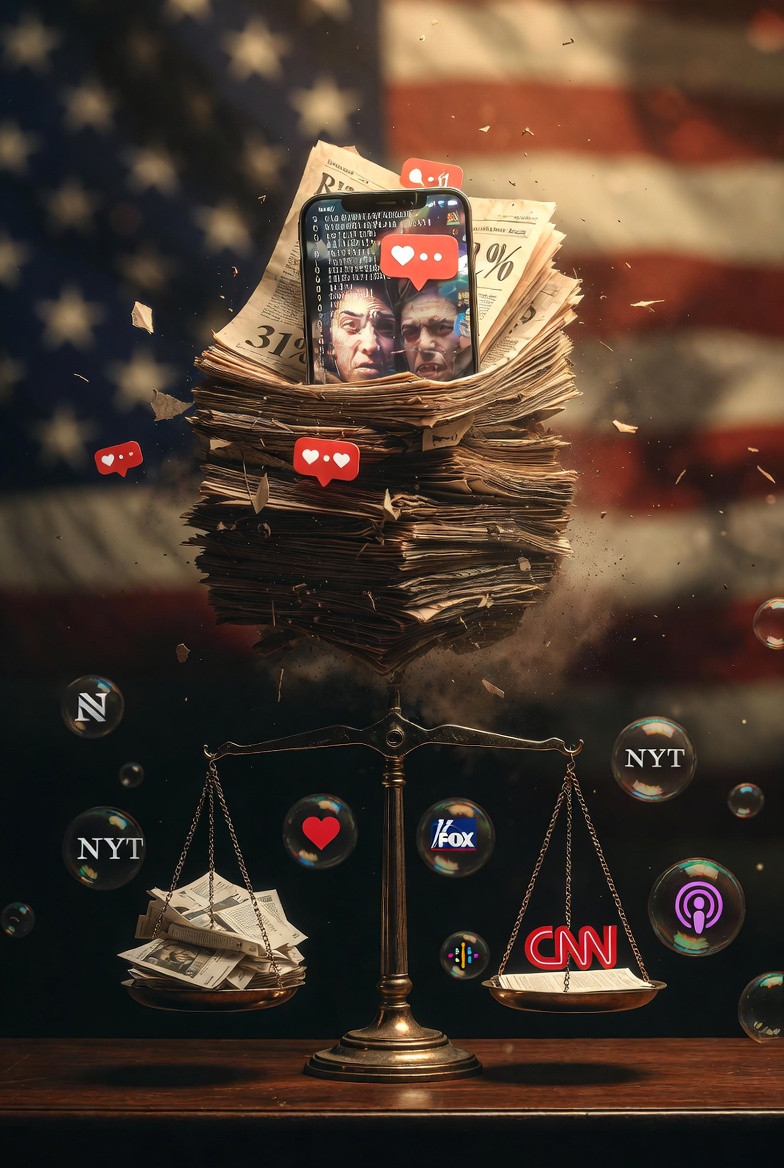
Thirty-one percent. The lowest confidence in American media since Gallup began polling in 1972. This is not a natural disaster—it is a social collapse decades in the making.
By Bernd Pulch | February 12, 2026 | Category: Media Control
In the autumn of 2024, Gallup released a survey that sent shockwaves through the American media establishment. Only 31 percent of Americans expressed a “great deal” or “fair amount” of confidence in the mass media—the lowest figure in the polling organization’s history, which stretches back to 1972. The record had been broken once before, in 2016, when confidence fell to 32 percent. Now it had fallen again, and the implications for democratic governance, public discourse, and the future of journalism were profound.
But the numbers tell only part of the story. Behind the statistics lies a more troubling phenomenon: not just declining trust in particular news outlets, but a fundamental crisis of confidence in the very concept of objective reporting. A growing proportion of the public no longer believes that accurate, unbiased news is even possible. They view all reporting as inherently political, all journalists as agents of particular agendas, and all news organizations as fronts for ideological campaigns masquerading as objective coverage.
This crisis did not emerge overnight. It is the product of decades of social, technological, and political change that have transformed the relationship between news media and the public. Understanding how we arrived at this point—and what might be done about it—is essential for anyone concerned about the future of democratic discourse.
The Numbers: A Half-Century of Decline
When Gallup first began asking Americans about their confidence in the media, the results would have been almost unrecognizable to contemporary audiences. In the early 1970s, more than two-thirds of Americans expressed confidence in newspapers, magazines, television, and radio to report the news fully, accurately, and fairly. This trust was not without foundation. The Watergate investigation, the Vietnam War coverage, and the emerging environmental movement had all demonstrated the power of investigative journalism to hold powerful institutions accountable.
But this golden age of media trust was already showing signs of erosion. The rise of cable television and the fragmentation of news sources began to erode the shared informational foundation on which democratic deliberation depends. As Americans gained access to more news outlets, they also gained access to more perspectives—and with those perspectives came the recognition that different outlets could present the same events in dramatically different ways.
The 1980s saw the emergence of a new form of media criticism that would prove transformative. Rush Limbaugh, whose nationally syndicated talk radio show launched in 1988, pioneered a particular brand of media criticism that castigated the national press as lapdogs for the Democratic establishment while presenting his own voice as an unvarnished and trustworthy source for conservative listeners. Through his acidic commentary and relentless attacks on media bias, Limbaugh planted seeds that would decades later bear bitter fruit.
The 1990s accelerated these trends. The emergence of the World Wide Web created new avenues for alternative media and new opportunities for criticism of mainstream outlets. Political polarization, which had declined in the post-World War II era, began to rise again, and with it came increasingly partisan interpretations of media coverage. The Clinton administration’s confrontations with the press, including aggressive responses to investigative reporting and efforts to manage news cycles, demonstrated how political actors could weaponize media criticism for partisan advantage.
The 2000s brought the internet revolution and the collapse of traditional business models that had supported serious journalism. As advertising revenue migrated to digital platforms, newspapers and magazines faced financial crisis. Newsroom staffing declined dramatically, and the depth of investigative reporting suffered accordingly. The 2008 financial crisis accelerated these trends, as media companies that had borrowed heavily against future advertising revenues found themselves on the brink of collapse.
By the time of the 2016 election, the stage was set for a dramatic shift in public attitudes toward the press. The combination of decades of partisan media criticism, the financial collapse of traditional journalism, and a political movement that made hostility to mainstream media a core tenet had created conditions in which a candidate who declared the press “the enemy of the American people” could gain traction with a substantial portion of the electorate.
The Three Drivers of Media Mistrust
Understanding the contemporary crisis of media trust requires examining three distinct but interconnected trends that have shaped the informational landscape: political polarization, platform proliferation, and economic disruption. Each has contributed to the current situation, and each must be addressed if media trust is to be restored.
Political polarization is perhaps the most obvious factor, and certainly the most discussed. As Americans have sorted themselves into increasingly distinct political tribes, their consumption of news has become more tribal as well. Republicans and Democrats now live in largely separate informational universes, with different sources of news, different interpretations of events, and different assessments of which outlets can be trusted.
This polarization has created what scholars call “hostile media effects,” in which partisans on both sides perceive coverage as biased against their side, even when independent assessments find coverage to be relatively balanced. Conservatives point to what they perceive as the liberal bias of elite outlets like The New York Times and The Washington Post. Liberals point to the conservative tilt of Fox News and talk radio. Both sides have evidence for their positions, and both sides are, in a sense, correct: the media landscape does contain outlets that favor their respective viewpoints.
But the effect of this polarization extends beyond simple bias perception. When people believe that all media is biased, they lose motivation to seek out accurate information. If The New York Times is just as biased as Fox News, and both are just as biased as the latest blog post, then why bother distinguishing between them? This relativistic mindset undermines the very concept of factual reporting and creates openings for misinformation and propaganda.
The second driver is the proliferation of digital platforms that have transformed how Americans consume news. In the early 2000s, most Americans got their news from a handful of sources: the major broadcast networks, their local newspaper, and perhaps a few magazines. Today, the average American encounters news from dozens of sources every day, ranging from legacy newspapers to viral social media posts to podcasts to newsletters.
This proliferation has profound implications for trust. When people encounter contradictory claims from different sources, they must decide which to believe. The traditional solution—relying on the expertise and editorial standards of established news organizations—no longer seems adequate when those organizations are seen as just one opinion among many. Instead, many Americans have adopted a strategy of trusting only sources that confirm their existing beliefs, or abandoning the search for accurate information altogether.
Platform algorithms amplify this dynamic by prioritizing engagement over accuracy. Content that provokes strong emotional reactions—whether anger, fear, or satisfaction—receives more views and shares than content that provides nuanced analysis. This creates incentives for outlets to produce emotionally provocative content, which in turn trains audiences to expect and demand such content. The result is a news environment optimized for outrage rather than information.
The third driver is the economic disruption of the news industry. Over the past two decades, advertising revenue has migrated from traditional news outlets to digital platforms like Google and Facebook. Between 2000 and 2020, newspaper advertising revenue declined by more than 70 percent in inflation-adjusted dollars. Magazine and broadcast advertising followed similar trajectories, though less dramatically.
This financial collapse has had profound effects on the quality and quantity of news reporting. Newsroom employment, which peaked in the early 2000s at around 55,000 journalists at daily newspapers alone, has fallen to approximately 30,000. The remaining journalists are asked to produce more content with fewer resources, reducing the time available for investigative work and fact-checking. The closure of foreign bureaus and the reduction of coverage of state and local government have created “news deserts” where residents have little access to information about their own communities.
The economic crisis has also created perverse incentives that undermine public trust. As news outlets have become increasingly dependent on social media for traffic, they have focused on producing content optimized for sharing rather than accuracy. The pressure to generate viral content encourages sensationalism and discourages the kind of careful, nuanced reporting that builds long-term credibility. Outlets that once competed on the quality of their journalism now compete on the volume of their clicks.
The Chilling Effect on Democratic Deliberation
The consequences of media mistrust extend far beyond the news industry itself. A functioning democracy depends on citizens having access to accurate information about public affairs. When a substantial portion of the electorate believes that all news is biased, the foundations of democratic deliberation begin to erode.
The most immediate effect is the difficulty of establishing shared factual premises for political debate. In healthy democracies, citizens may disagree about values and priorities, but they generally agree about basic facts. When one portion of the electorate believes that climate change is a hoax invented by liberal scientists and another portion believes it is an existential threat requiring immediate action, meaningful policy debate becomes almost impossible. Both sides are operating from different factual foundations, and there is no neutral arbiter who can adjudicate their disputes.
The decline of trust in media also creates openings for conspiracy theories and misinformation to flourish. When people do not trust established news sources, they become more susceptible to claims from alternative sources, regardless of those sources’ reliability. The result has been an explosion of false claims circulating as “news” on social media, in email forwards, and on partisan websites. Some of these claims are harmless hoaxes; others are deliberately designed to manipulate public opinion for political or financial gain.
The problem is compounded by the phenomenon of “both-sidesism” in mainstream journalism. In an effort to appear balanced, journalists often present opposing viewpoints as equally credible, even when the weight of evidence strongly favors one side. This approach, intended to demonstrate impartiality, often has the effect of creating false equivalence and undermining public understanding. When journalists present “balanced” coverage of issues where the facts are clear, they inadvertently signal to audiences that the truth is genuinely uncertain, encouraging skepticism of expert consensus.
The effects of media mistrust on political participation are also significant but underappreciated. Research suggests that citizens who distrust the media are less likely to vote, less likely to engage in political discussion, and less likely to trust democratic institutions more broadly. When people believe that their political process is rigged and that the information they receive is manipulated, they become less invested in the system that produces such manipulated outcomes. This creates a vicious cycle in which media mistrust leads to political disengagement, which in turn creates openings for anti-democratic movements that promise to disrupt the status quo.
The international implications are equally troubling. American media mistrust has been studied extensively, but similar dynamics are playing out across the democratic world. In Europe, right-wing populist movements have made hostility to mainstream media a core element of their political programs. In Latin America, governments have used the decline of traditional media to establish control over the information landscape. The global nature of the phenomenon suggests that it reflects deeper structural changes in how humans consume and process information, rather than the peculiarities of any single political system.
The Rise of Alternative Media and Its Discontents
The crisis of mainstream media has created opportunities for alternative sources of news and analysis. Independent journalists, podcasters, Substack writers, and YouTube creators have stepped into the void left by declining traditional outlets, offering perspectives that their audiences perceive as more authentic and trustworthy than what they find in mainstream publications.
The growth of this alternative media ecosystem has been remarkable. According to recent estimates, more than 50 million Americans now get their news from podcasts, with many of the most popular shows attracting audiences in the millions. Substack, the newsletter platform, has become home to thousands of independent journalists who have left traditional outlets to build direct relationships with readers. YouTube hosts a thriving community of political commentators who attract views that rival those of cable news programs.
These alternative sources offer genuine advantages over traditional media. Without the need to appeal to mass audiences or satisfy corporate advertisers, independent journalists can pursue stories that legacy outlets might avoid. They can take positions that would be considered too controversial for mainstream publications. They can build communities of engaged readers who share their values and priorities. For many audiences, this direct connection feels more authentic than the mediated relationship with readers that traditional journalism provides.
But the alternative media ecosystem also has significant limitations. The same independence that allows alternative journalists to pursue unpopular stories also frees them from the editorial oversight and fact-checking processes that, for all their flaws, have historically served as a check on misinformation. Without the institutional constraints of traditional journalism, there is no guarantee that alternative sources will be more accurate than the outlets they criticize.
In fact, research suggests that many alternative media sources are actually less reliable than traditional outlets. Because they depend on engagement and controversy for survival, they have incentives to produce sensationalist content that reinforces their audiences’ existing beliefs. Some have become generators of conspiracy theories and misinformation, spreading claims that would never pass through the editorial filters of mainstream publications.
The personality-driven nature of alternative media creates additional concerns. When audiences tune in to a particular podcaster or newsletter writer, they are often following a personality rather than an institution. This creates strong parasocial relationships that can be difficult to question or challenge. When the personality makes errors or spreads misinformation, their followers are often reluctant to accept criticism, seeing it as an attack on their chosen information source.
The economic model of alternative media also raises concerns about sustainability and independence. While Substack writers theoretically have direct relationships with paying subscribers, the platform’s algorithms and business model create their own pressures. Writers who want to grow their audiences must optimize for engagement, just as traditional outlets optimized for advertising. The result may be a different set of distortions rather than a genuinely independent alternative.
Platform Power and the Algorithmic Shaping of Reality
Perhaps no factor has been more important in reshaping the media landscape than the rise of digital platforms. Google and Facebook now dominate the flow of information online, directing billions of users to news articles, videos, and posts every day. The algorithms these companies have developed to maximize user engagement have profound effects on what information reaches which audiences.
The platform revolution fundamentally disrupted the relationship between news producers and consumers. In the traditional media model, editors served as gatekeepers, deciding which stories would reach audiences based on their news judgment. In the platform model, algorithms make these decisions based on predicted user engagement. Stories that generate clicks, shares, and comments are amplified; stories that fail to engage are buried, regardless of their importance or accuracy.
This algorithmic gatekeeping has created a media environment optimized for emotional impact rather than informational value. Research has consistently found that content that provokes strong emotions—anger, fear, surprise—receives more engagement than content that provides nuanced information. Platforms have become, in effect, engines for the production and distribution of outrage.
The consequences for public discourse have been severe. Political content on social media tends to be more extreme than content in traditional media, because extreme content generates more engagement. This creates pressure on political actors to adopt more extreme positions, knowing that moderation will be punished algorithmically. The result is a political environment characterized by escalating confrontation and declining tolerance for compromise.
Platform algorithms have also contributed to the fragmentation of public discourse. Because they optimize for individual engagement rather than shared information, algorithms tend to create filter bubbles in which users encounter primarily content that reinforces their existing beliefs. While some scholars question how effective these bubbles actually are—users often encounter diverse content despite algorithmic sorting—the perception of bubble existence may be as important as the reality. When people believe they are in an information bubble, they become more skeptical of information from outside their bubble.
The platforms themselves have become increasingly important actors in the media ecosystem. Their decisions about content moderation, algorithmic amplification, and creator monetization shape what information can reach audiences and under what conditions. These decisions are often opaque, inconsistent, and subject to political pressure. The platforms have become, in effect, unelected regulators of public discourse, with powers that would have been unimaginable for traditional media gatekeepers.
Recent efforts to reform platform power have had limited success. Legislative proposals to regulate algorithms, require transparency, or break up dominant companies have faced intense lobbying opposition. The platforms have successfully positioned themselves as neutral conduits rather than active shapers of information, making it difficult to impose accountability for their algorithmic choices. The result is a media environment in which the most powerful information gatekeepers are effectively unaccountable to democratic processes.
What Can Be Done? Paths Toward Restoring Trust
The crisis of media trust is not inevitable, and it is not irreversible. But addressing it will require sustained effort across multiple fronts: from platform reform to media literacy education to institutional innovation. There is no single solution, but there are concrete steps that can begin to restore the conditions for healthy democratic discourse.
Platform reform is essential. The concentration of information flow in the hands of a few giant companies creates risks that cannot be addressed through market competition or voluntary self-regulation. Legislative action is needed to require algorithmic transparency, prevent anticompetitive practices, and ensure that platforms cannot arbitrarily suppress or amplify particular viewpoints. The European Union’s Digital Services Act represents one model for such regulation, though its effectiveness remains to be seen.
Media literacy education can help citizens become more sophisticated consumers of information. Teaching people how to evaluate sources, recognize logical fallacies, and distinguish between fact and opinion can build resilience against misinformation. But media literacy alone is insufficient; expecting individuals to solve systemic problems through personal vigilance is both unfair and unrealistic. Media literacy must be part of a broader package of reforms.
Supporting public media is crucial. In many countries, public broadcasting has served as a source of trusted, non-partisan news that serves all citizens regardless of their political views. But public media faces political pressure and budget cuts that undermine its effectiveness. Strengthening public media institutions, protecting them from political interference, and ensuring they have adequate resources to produce quality journalism should be priorities for reformers.
Independent journalism needs sustainable business models. The nonprofit news movement, exemplified by organizations like ProPublica, The Texas Tribune, and local investigative newsrooms, has shown that quality journalism can survive outside the traditional advertising model. Supporting these organizations through philanthropy, foundation grants, and subscription revenues can help preserve the capacity for accountability journalism.
Finally, political leaders must stop attacking the press. While politicians have always complained about media coverage, the current intensity of anti-media rhetoric is unprecedented and dangerous. When leaders declare the press to be enemies of the people, they undermine the foundations of democratic accountability. Restoring a culture in which journalistic scrutiny is seen as essential rather than adversarial is a collective project that requires leadership from all parts of the political spectrum.
The Imperative of Informed Citizenship
In the final analysis, the crisis of media trust reflects a broader crisis of citizenship. Democratic governance depends on citizens who are willing and able to engage critically with information about public affairs. When citizens lose faith in the possibility of accurate reporting, they lose motivation to participate in democratic processes. The result is a self-reinforcing cycle in which declining trust leads to declining participation, which leads to declining accountability, which leads to declining trust.
Breaking this cycle will require more than institutional reforms. It will require a cultural shift in how Americans—and citizens of democratic societies more broadly—think about their role in governance. Citizens must come to see themselves not as passive consumers of political spectacles but as active participants in democratic deliberation. They must demand better from their information sources and from themselves.
The stakes could not be higher. In an era of global challenges—from climate change to pandemic disease to nuclear proliferation—the need for informed public deliberation is acute. The decisions made in the coming decades will shape human civilization for centuries to come. Making those decisions wisely requires an informed citizenry with access to accurate information and the capacity to evaluate competing claims.
The crisis of media trust is, ultimately, a crisis of democracy itself. Addressing it will require all of the tools at our disposal: technological innovation, institutional reform, educational improvement, and cultural change. There is no shortcut, and there is no single solution. But the first step is recognizing the depth and urgency of the problem.
The 31 percent confidence figure from Gallup should serve as a wake-up call. It is not a natural disaster that must be endured but a social problem that can be solved. Whether we will summon the collective will to solve it is the central question facing democratic societies in the years ahead.
Bernd Pulch is a political commentator, satirist, and investigative journalist covering lawfare, media control, and German politics. His work examines how legal systems are weaponized and what democracy loses when courts become battlefields. Full bio →
Tags: media trust, media mistrust 2026, Gallup media confidence, political polarization, platform algorithms, alternative media, news deserts, nonprofit journalism, public media, Digital Services Act, fake news, misinformation, hostile media effect, both-sidesism, journalism crisis
A Cold‑War story written in ink and secrecy — how Stasi and KGB operatives turned German publishing houses into quiet battlegrounds of influence, censorship and covert power.
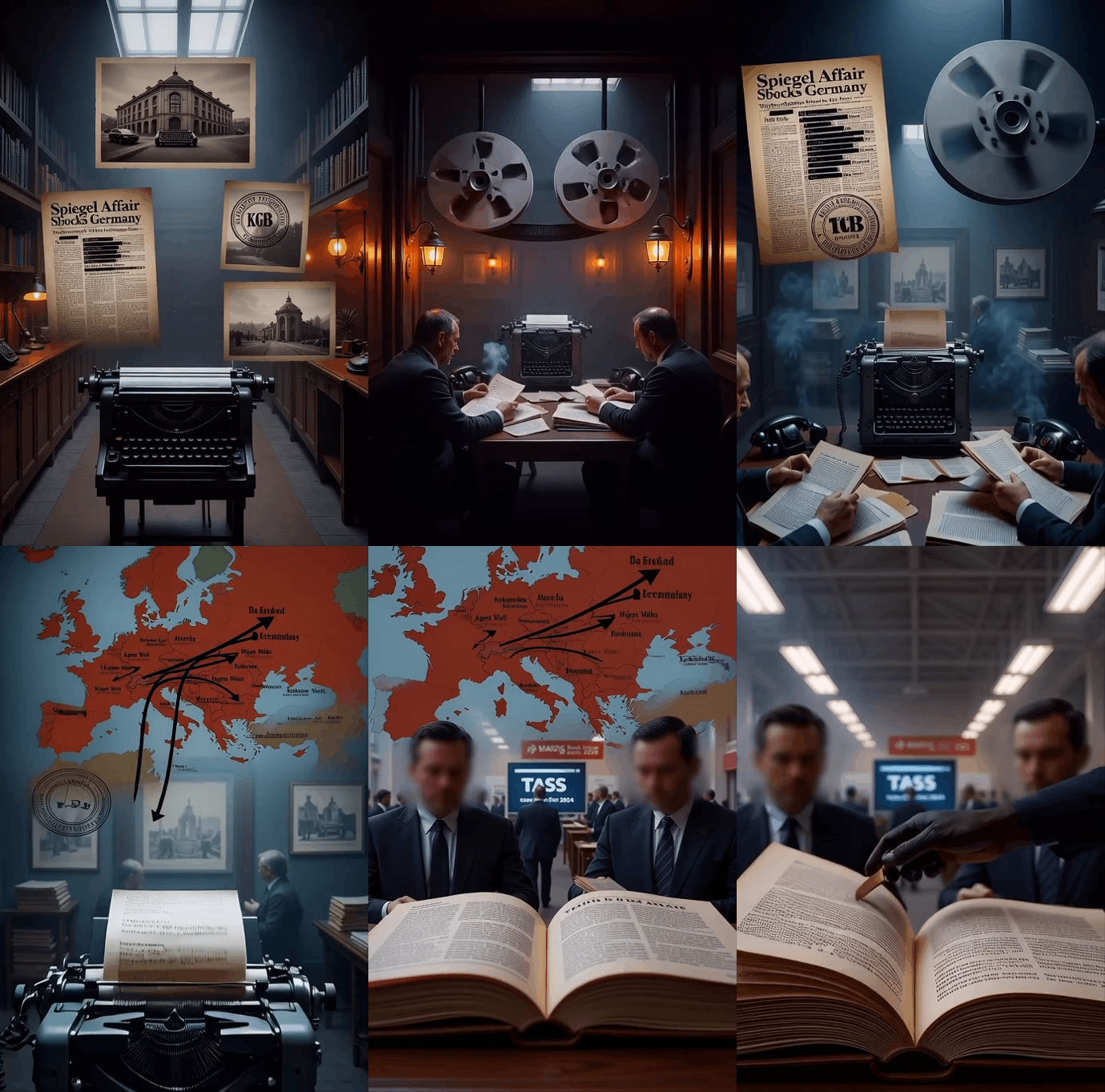
Germany’s publishing industry—long seen as a sanctuary for ideas—spent much of the Cold War as contested ground. Newly examined archives from Berlin, Bonn and Moscow show how the Stasi and the KGB treated editors, printers and even children’s authors as instruments of statecraft. What emerged was a shadow literary market in which manuscripts doubled as intelligence assets and publishing houses became proxy battlegrounds for influence.
The Stasi’s Ink‑Stained Empire
In East Germany, the book trade was never merely cultural. It was a command economy of the mind.
At Aufbau Verlag, the GDR’s premier literary house, every manuscript moved through a conveyor belt of political supervision. The Socialist Unity Party’s Central Committee signed off on acquisitions, while Stasi “literary officers” combed through plot lines, author biographies and even dust‑jacket typography for what they called staatssicherheitsrelevante—state‑security relevance.
Inside Stasi headquarters, a clandestine circle of agents known informally as the “Writing Chekists” met monthly. Their output—poems, travel guides, children’s stories—quietly entered Aufbau’s catalogue, nudging readers toward anti‑Western narratives under the guise of ordinary cultural production.
Dissident printers fared worse. By 1987, the Stasi had placed 29 informants inside samizdat operations in Leipzig, Dresden and East Berlin. Manuscripts were photocopied, catalogued and archived before they ever reached the public. And when editors resisted, the Stasi reached for its most effective lever: paper. A 30% cut in newsprint allocation could cripple a publishing house in a matter of weeks.
Stasi Spies in West‑German Publishing Houses
The Stasi’s reach extended well beyond the Wall.
Declassified personnel cards identify “IM Park,” an informant embedded in Münster University’s publishing unit, where he compiled dossiers on left‑leaning student editors the GDR hoped to recruit or compromise.
Three Christian publishing houses in Münster were placed under permanent observation. Pastors with access to print shops were courted with hard‑currency honoraria and coveted family‑visit visas for relatives trapped in the East.
Even phone lines weren’t safe. Collaborators inside the West German Bundespost tapped Catholic publishing houses, forwarding transcripts to East Berlin within 24 hours—giving the Stasi advance warning of forthcoming anti‑GDR titles.
The KGB Footprint in Big‑Ticket West‑German Media
If the Stasi specialized in granular infiltration, the KGB played the long game.
Moscow’s active‑measures budget in 1980 reached the equivalent of 1 billion annually, with a third earmarked for placing favorable material in foreign media. TASS, the Soviet news agency, sold pre‑written features to cash‑strapped regional German dailies at a fraction of wire‑service prices. By 1983, roughly 60% of foreign‑affairs copy in small German papers originated from Soviet sources—often without attribution.
The KGB’s ambitions reached into marquee outlets as well. According to later reviews of BND files by German researchers, the explosive 1962 “Spiegel Affair”—which forced the resignation of Defense Minister Franz Josef Strauss—was triggered by a forged document planted by Soviet operatives seeking to derail NATO nuclearization plans.
Money, Manuscripts & Microfilm — The Mechanics
A Cold‑War publishing house could be influenced in more ways than a red pen.
Lever
East (Stasi)
West (KGB)
Ownership
State‑owned presses such as Aufbau and Mitteldeutscher Verlag
Silent equity stakes via Liechtenstein trusts in mid‑size houses
Editorial
Approval boards included embedded Stasi officers
Freelance “consultants” paid per inserted paragraph
Distribution
Paper rationing tied to political loyalty
Bulk‑buy guarantees for pro‑détente titles; unsold copies returned
Reprisal
Travel bans and paper cuts for non‑compliance
Libel suits filed in friendly courts to halt print runs
The tools differed, but the objective was identical: shape the German reading public.
After the Wall — Echoes in Modern Publishing
The Cold War may be over, but its methods linger.
At the 2024 Leipzig Book Fair, three small presses abruptly dropped dissident Belarusian titles after a group of opaque Russian investors acquired a 24% stake. A confidential intelligence briefing warned of a “re‑run of 1970s soft‑power plays.”
Meanwhile, Aufbau’s modern archive—now owned by a Swedish media group—still contains 1,100 Stasi‑authored manuscripts. Researchers must sign non‑disclosure agreements to access print‑ready files, slowing efforts to map the full extent of East Germany’s literary manipulation.
Key Takeaway
From rationed paper in Leipzig to shell‑company equity in Frankfurt, German publishing houses—East and West—became quiet theaters of Cold‑War conflict. The books were real, the royalties often laundered, and the readers rarely knew that a second, unseen author was shaping the story.
Bücher und Verrat — Wie KGB und Stasi deutsche Verlage zu Waffen des Kalten Krieges machten
Deutschlands Verlagswelt, lange als Refugium freier Ideen betrachtet, war im Kalten Krieg ein umkämpftes Terrain. Akten aus Berlin, Bonn und Moskau zeigen, wie Stasi und KGB Lektoren, Drucker und sogar Kinderbuchautoren als Instrumente der Einflussnahme behandelten. Entstanden ist ein Schattenmarkt der Literatur, in dem Manuskripte zu nachrichtendienstlichen Werkzeugen wurden und Verlage zu stillen Frontlinien.
Das tintenverschmierte Imperium der Stasi (DDR, 1950–1989)
In der DDR war das Buchgewerbe nie nur Kultur, sondern ein gelenktes System geistiger Kontrolle.
Beim Aufbau‑Verlag, dem literarischen Flaggschiff des Landes, durchlief jedes Manuskript eine politische Prüfungskette. Das ZK der SED gab die Richtung vor, Stasi‑„Literaturoffiziere“ prüften Handlungsstränge, Autorenbiografien und sogar die Typografie der Schutzumschläge auf staatssicherheitsrelevante Inhalte.
Im Stasi‑Hauptquartier traf sich monatlich ein geheimer Zirkel der „Schreib‑Tschekisten“. Ihre Texte—Gedichte, Kinderbücher, Reiseführer—flossen unauffällig in das Aufbau‑Programm ein und sollten subtil antiwestliche Narrative verankern.
Untergrunddruckereien wurden systematisch infiltriert. 1987 verfügte die Stasi über 29 inoffizielle Mitarbeiter in kleinen Druckereien in Leipzig, Dresden und Ost‑Berlin. Dissidentenmanuskripte wurden kopiert, archiviert und abgefangen, bevor sie Leser erreichten. Wer sich widersetzte, spürte die härteste Waffe der Stasi: Papier. Eine Kürzung der Zuteilung um 30 Prozent konnte einen Verlag binnen Wochen lahmlegen.
Stasi‑Spione in westdeutschen Verlagen
Die Reichweite der Stasi endete nicht an der Mauer.
Enttarnte Karteikarten belegen, dass „IM Park“ im Verlag der Universität Münster tätig war und Dossiers über linksgerichtete studentische Herausgeber anlegte, die die DDR anwerben oder erpressen wollte.
Drei christliche Verlage in Münster standen unter Dauerbeobachtung. Pastoren mit Zugang zu Druckereien wurden mit Westgeld‑Honoraren und begehrten Besuchsvisa für in der DDR festsitzende Verwandte geködert.
Telefonleitungen katholischer Verlage wurden von Helfern in der Bundespost abgehört. Die Mitschriften gelangten binnen 24 Stunden nach Ost‑Berlin—ein Frühwarnsystem für geplante regierungskritische Titel.
Der KGB‑Fußabdruck in großen westdeutschen Medien
Während die Stasi im Detail operierte, setzte der KGB auf strategische Breite.
Das sowjetische „Aktivmaßnahmen“-Budget lag 1980 bei rund einer Milliarde jährlich, ein Drittel davon für die Platzierung wohlgesonnener Inhalte in ausländischen Medien. TASS verkaufte vorgefertigte Artikel an finanzschwache Regionalzeitungen zu Dumpingpreisen. 1983 stammten etwa 60 Prozent der außenpolitischen Berichterstattung kleiner deutscher Blätter aus sowjetischer Feder—oft ohne Kennzeichnung.
Auch große Medienhäuser blieben nicht verschont. Laut später ausgewerteten BND‑Akten, die von deutschen Forschern analysiert wurden, beruhte die „Spiegel‑Affäre“ von 1962—die den Rücktritt von Verteidigungsminister Franz Josef Strauß auslöste—auf einem KGB‑Falsifikat, das die NATO‑Nuklearisierung torpedieren sollte.
Geld, Manuskripte & Mikrofilm — Die Mechanik
Hebel
Ost (Stasi)
West (KGB)
Eigentum
Staatliche Verlage wie Aufbau, Mitteldeutscher Verlag
Stille Beteiligungen über Liechtensteiner Trusts
Editorial
Prüfkommissionen mit Stasi‑Offizieren
„Berater“ gegen Honorar pro eingefügtem Absatz
Distribution
Papierkontingente an politische Loyalität gebunden
Großabnahmen für détente‑freundliche Titel; Rückgabe unsoldierter Exemplare
Repressalie
Reiseverbote und Papierkürzungen
Plötzliche Verleumdungsklagen in wohlgesonnenen Gerichten
Ziel beider Seiten: die deutsche Leserschaft formen.
Nach der Wende — Echos in der Gegenwart
Die Methoden überlebten die Mauer.
Auf der Leipziger Buchmesse 2024 strichen drei kleine Verlage plötzlich belarussische Dissidententitel, nachdem undurchsichtige russische Investoren 24 Prozent der Anteile übernommen hatten. Ein vertrauliches Lagepapier warnte vor einer „Neuauflage der Soft‑Power‑Taktiken der 1970er“.
Im heutigen Aufbau‑Archiv, inzwischen Teil eines skandinavischen Medienkonzerns, lagern noch 1.100 Stasi‑Manuskripte. Forscher müssen Geheimhaltungserklärungen unterzeichnen, um druckfertige PDFs einzusehen—eine Hürde für die vollständige historische Aufarbeitung.
Fazit
Von Papierkontingenten in Leipzig bis zu verschachtelten Firmenkonstruktionen in Frankfurt: Deutsche Verlage—im Osten wie im Westen—wurden systematisch von sowjetischen und ostdeutschen Diensten unterwandert. Die Bücher waren echt, die Honorare oft gewaschen, und die Leser ahnten selten, dass ein zweiter, unsichtbarer Autor mitschieb.
Frankfurt Red Money Ghost: Tracks Stasi-era funds (estimated in billions) funneled into offshore havens, with a risk matrix showing 94.6% institutional counterparty risk and 82.7% money laundering probability.
Global Hole & Dark Data Analysis: Exposes an €8.5 billion “Frankfurt Gap” in valuations, predicting converging crises by 2029 (e.g., 92% probability of a $15–25 trillion commercial real estate collapse).
Ruhr-Valuation Gap (2026): Forensic audit identifying €1.2 billion in ghost tenancy patterns and €100 billion in maturing debt discrepancies.
Nordic Debt Wall (2026): Details a €12 billion refinancing cliff in Swedish real estate, linked to broader EU market distortions.
Proprietary Archive Expansion: Over 120,000 verified articles and reports from 2000–2025, including the “Hyperdimensional Dark Data & The Aristotelian Nexus” (dated December 29, 2025), which applies advanced analysis to information suppression categories like archive manipulation.
List of Stasi agents 90,000 plus Securitate Agent List.
Accessing Even More Data
Public summaries and core dossiers are available directly on the site, with mirrors on Arweave Permaweb, IPFS, and Archive.is for preservation. For full raw datasets or restricted items (e.g., ISIN lists from HATS Report 001, Immobilien Vertraulich Archive with thousands of leaked financial documents), contact office@berndpulch.org using PGP or Signal encryption. Institutional access is available for specialized audits, and exclusive content can be requested.
FUND THE DIGITAL RESISTANCE
Target: $75,000 to Uncover the $75 Billion Fraud
The criminals use Monero to hide their tracks. We use it to expose them. This is digital warfare, and truth is the ultimate cryptocurrency.
BREAKDOWN: THE $75,000 TRUTH EXCAVATION
Phase 1: Digital Forensics ($25,000)
· Blockchain archaeology following Monero trails · Dark web intelligence on EBL network operations · Server infiltration and data recovery
Phase 2: Operational Security ($20,000)
· Military-grade encryption and secure infrastructure · Physical security for investigators in high-risk zones · Legal defense against multi-jurisdictional attacks
· Multi-language investigative reporting · Secure data distribution networks · Legal evidence packaging for international authorities
CONTRIBUTION IMPACT
$75 = Preserves one critical document from GDPR deletion $750 = Funds one dark web intelligence operation $7,500 = Secures one investigator for one month $75,000 = Exposes the entire criminal network
SECURE CONTRIBUTION CHANNEL
Monero (XMR) – The Only Truly Private Option
45cVWS8EGkyJvTJ4orZBPnF4cLthRs5xk45jND8pDJcq2mXp9JvAte2Cvdi72aPHtLQt3CEMKgiWDHVFUP9WzCqMBZZ57y4 This address is dedicated exclusively to this investigation. All contributions are cryptographically private and untraceable.
Monero QR Code (Scan to donate anonymously):
(Copy-paste the address if scanning is not possible: 45cVWS8EGkyJvTJ4orZBPnF4cLthRs5xk45jND8pDJcq2mXp9JvAte2Cvdi72aPHtLQt3CEMKgiWDHVFUP9WzCqMBZZ57y4)
Translations of the Patron’s Vault Announcement: (Full versions in German, French, Spanish, Russian, Arabic, Portuguese, Simplified Chinese, and Hindi are included in the live site versions.)
Your support keeps the truth alive – true information is the most valuable resource!
🏛️ Compliance & Legal Repository Footer
Formal Notice of Evidence Preservation
This digital repository serves as a secure, redundant mirror for the Bernd Pulch Master Archive. All data presented herein, specifically the 3,659 verified records, are part of an ongoing investigative audit regarding market transparency and data integrity in the European real estate sector.
Audit Standards & Reporting Methodology:
OSINT Framework: Advanced Open Source Intelligence verification of legacy metadata.
Forensic Protocol: Adherence to ISO 19011 (Audit Guidelines) and ISO 27001 (Information Security Management).
Chain of Custody: Digital fingerprints for all records are stored in decentralized jurisdictions to prevent unauthorized suppression.
Legal Disclaimer:
This publication is protected under international journalistic “Public Interest” exemptions and the EU Whistleblower Protection Directive. Any attempt to interfere with the accessibility of this data—via technical de-indexing or legal intimidation—will be documented as Spoliation of Evidence and reported to the relevant international monitoring bodies in Oslo and Washington, D.C.
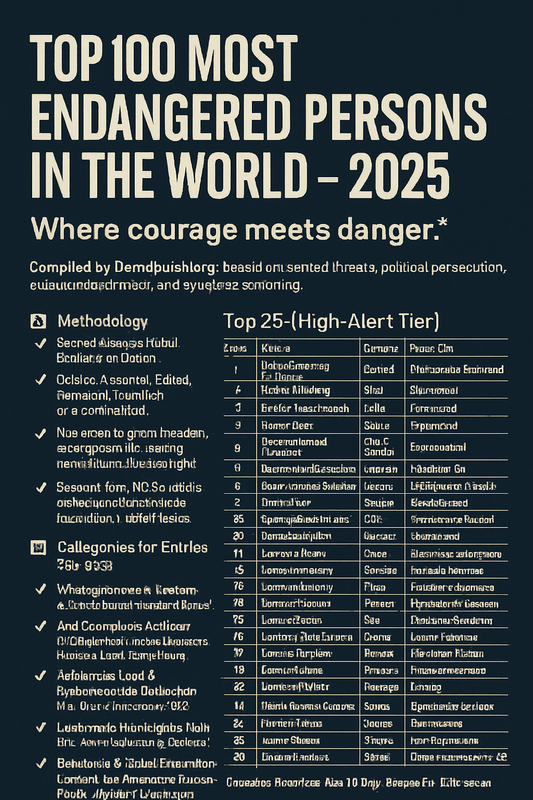
Top 100 Most Endangered Persons in the World – 2025 A global spotlight on the journalists, whistleblowers, dissidents, and human rights defenders most at risk today. From political persecution to corporate retaliation, this list exposes the individuals whose courage challenges power—compiled by berndpulch.org
“Where Courage Meets Danger” Compiled by berndpulch.org – Based on verified threats, political persecution, assassination risks, and systemic silencing. Categories: Journalists | Whistleblowers | Activists | Political Opponents | Dissidents | Exposers of Power
🔍 Methodology
Verified threats (legal, physical, or digital)
Status: Arrested, Exiled, Vanished, Targeted, or Assassinated
Relevance to press freedom, state repression, global surveillance, human rights
Sourced from NGOs, watchdog reports, investigative journalism, public leaks
🌍 Top 25 (High-Alert Tier)
Rank
Name
Country
Risk Factor
Reason
1
Julian Assange
UK/USA
Imprisoned, Extradition
Founder of WikiLeaks, target of global intelligence
2
Alexei Navalny (deceased)
Russia
Killed in custody
Opposition leader, Kremlin critic
3
Narges Mohammadi
Iran
Imprisoned
Nobel Peace Prize–winning activist
4
Zhang Zhan
China
Imprisoned
COVID whistleblower, citizen journalist
5
Mohammed al-Qahtani
Saudi Arabia
Disappeared
Human rights activist
6
Evan Gershkovich
Russia
Imprisoned
WSJ reporter accused of espionage
7
Jimmy Lai
Hong Kong
Imprisoned
Media mogul, pro-democracy advocate
8
Edward Snowden
Russia
Exiled
NSA whistleblower
9
Maria Ressa
Philippines
Harassed, threatened
Journalist, Nobel Laureate
10
Alaa Abd El-Fattah
Egypt
Imprisoned
Writer, activist
11
Victoria Nuland
USA
High-profile, targeted globally
Subject of state propaganda and conspiracy
12
Gabriel Boric
Chile
Targeted by extremists
Left-wing president under far-right threat
13
Navalny Team (Yarmysh, Volkov, etc.)
EU exile
Threat of poisoning, Kremlin targeting
14
Ilia Yashin
Russia
Imprisoned
Putin critic, anti-war voice
15
Gonzalo Lira (deceased)
Ukraine
Died in custody
Controversial dissident blogger
16
Carine Kanimba
Rwanda/USA
Targeted
Daughter of Paul Rusesabagina
17
Paul Rusesabagina
Rwanda
Formerly imprisoned
Hero of Hotel Rwanda, political target
18
Anas Aremeyaw Anas
Ghana
Death threats
Investigative journalist
19
Idrak Abbasov
Azerbaijan
Beaten, harassed
Oil corruption exposer
20
Julian Reichelt
Germany
Under media siege
Controversial journalist
21
Ahmed Mansoor
UAE
Isolated, tortured
Human rights blogger
22
Roman Protasevich
Belarus
Arrested mid-flight
Opposition figure
23
Dmitry Muratov
Russia
Nobel journalist
Survived attacks
24
Prigozhin Associates
Global
Assassinations, purges
Wagner-linked figures
25
Rafael Marques
Angola
Exposes diamond corruption
Constant threats
📍 26–100: Global Watchlist (Selected by Category)
🥵 Whistleblowers & Leakers (26–40)
Daniel Hale (USA) – Drone war whistleblower
Reality Winner (USA) – Leaked NSA report
Chelsea Manning (USA) – Formerly imprisoned whistleblower



 🛑 Bernd Pulch | Uncensored Investigative Intelligence since 1994