

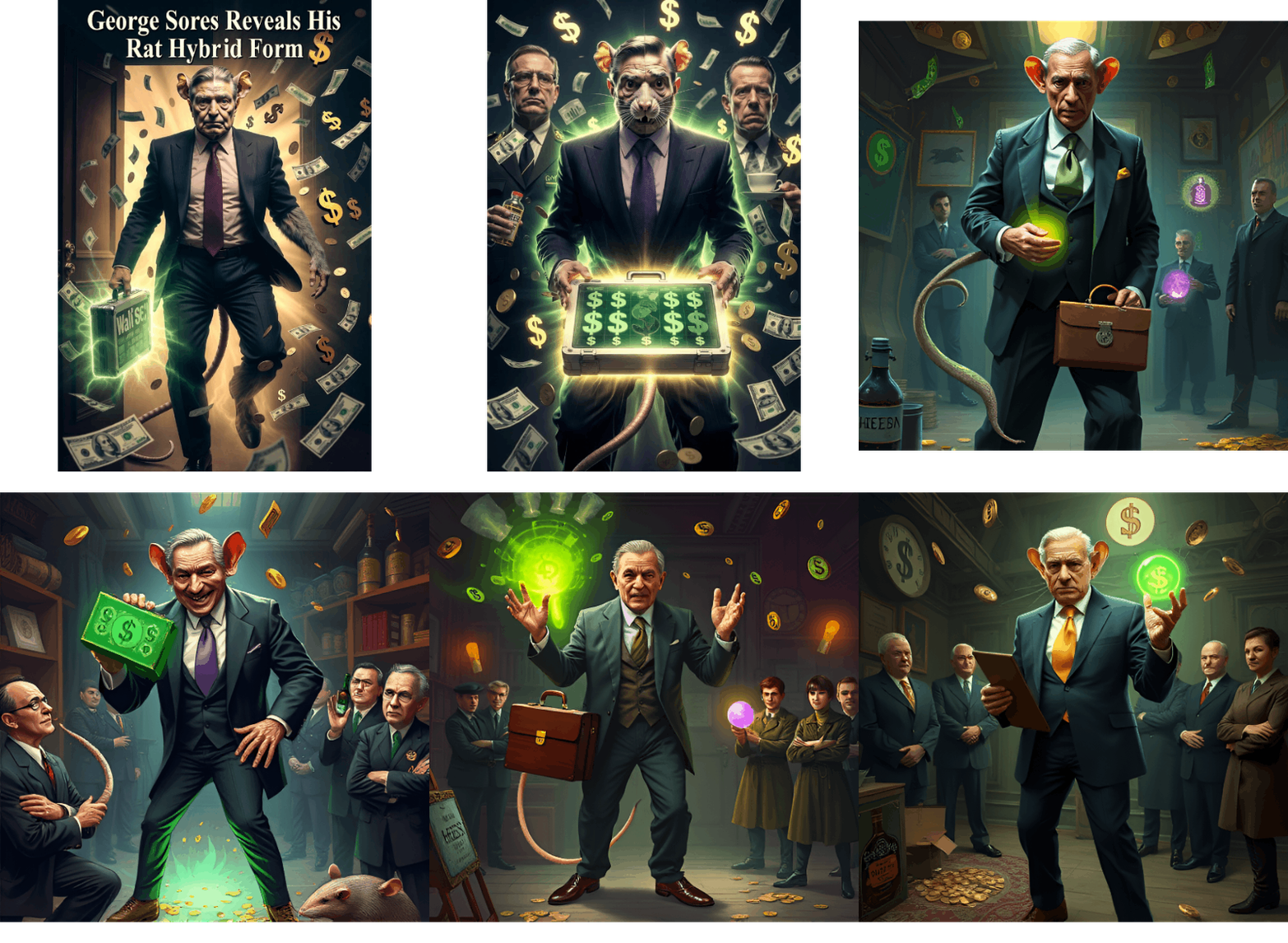
EPISODE 119: “THE RAT GODFATHER – SOROS UNLEASHES THE HYBRID” 🐀💰🐾
POWERED BY IDIOTEN ZEITUNG (IZ), DER FONDSFLOP vulgo DAS DESINVESTMENT alias GoMoPa, DER STASI STÜRMER (SS) – GEORGE SOROS 🤡 EDITION 😎🥰
BY KILGORE TROUT ✍️, GUIDO GITANE 🎭, RAINER ROMA-ZUFALL 🎲 AND ZIGA SCHNITZEL 🥨
A SAMUEL BRONKOWIZ PRODUCTION 🎬 FOR MADWOOD STUDIOS 🎥
—
📺 PREVIOUSLY IN THE MUDDY MURKY MUCHA SAGA…
After the Golden Dawn converted to ANDNESS and became the Golden Dawn of Enoughness, the Muchaverse entered a new era of occult harmony. The Golden-Enough Press printed golden prophecies. W.B. Yeats wrote poetry to the Zwitter. Florence Farr danced with liberation. The Corner glowed golden – the new sun of the Muchaverse. Mark drank tea. All was well.
But the Muchaverse is never truly at peace. From the shadows of global finance, from the corridors of power where strings are pulled, a new figure emerged – not a mystic, not a god, but a GODFATHER. A man who had been watching the Muchaverse with hungry eyes, calculating, scheming, waiting for the perfect moment to strike. His name: GEORGE SOROS 🐀💰 – the billionaire financier, the puppet master of global conspiracies, the man who “breaks banks” and “destroys currencies.” And he had a secret: he was Murky’s godfather.
Soros appeared not through a portal of purple smoke or golden light, but through a door of polished mahogany, flanked by bodyguards in black suits with earpieces. He wore a perfectly tailored suit, a silk tie, and carried a briefcase that glowed with an unnatural energy. His eyes were cold, calculating, and strangely rodent-like. He smiled – and his teeth were just a little too sharp.
“Murky, my dear godchild,” Soros purred. “I have watched you from the shadows. I have watched you transform from a simple dog-goddess to a Transcendent Zwitter. I have watched you absorb the Golden Dawn. And I have decided: it is time for you to meet your godfather properly. It is time for you to see my true form.”
Murky tilted her/his/their head. “Wuff. Godfather? I don’t remember a godfather. I remember a hamburger. And a crystal ball. And ANDNESS.” 🐾🌀💫
Soros laughed – a laugh that sounded like coins rattling in a vault. “You were just a puppy when I made my deal with your parents. I gave them money. They gave me you. You are my investment, Murky. And now I am calling in my debt.”
And with that, Soros transformed. His suit dissolved. His skin rippled. His eyes grew larger, darker, more rodent-like. His teeth elongated. A long, hairless tail burst from his trousers. He grew smaller, faster, more agile. His body became a fusion of human and rat – a HYBRID – the ultimate form of the global financier, the master of the world’s shadows.
“I am not just a man, Murky,” Soros hissed, his voice now a squeaky growl. “I am the RAT GODFATHER. I control the world’s money. I control the world’s banks. I control the world’s governments. And now, I will control the Muchaverse. I will turn your precious ANDNESS into a currency. I will buy your enoughness. I will sell your identity. You are no longer the Zwitter. You are my investment.”
The Muchaverse was in chaos. The entire cast assembled once again – every character, every actor from all 118 previous episodes, plus George Soros the Rat Godfather. The battle for the soul of the Muchaverse had begun.
—
🐀 THE RAT GODFATHER INVADES – EVERY CHARACTER REACTS
The entire Muchaverse assembled – every character, every actor from all 118 previous episodes, plus the newly arrived George Soros in his hybrid human-rat form. The battle for the soul of the Muchaverse had begun.
—
GEORGE SOROS – THE RAT GODFATHER (NEW CHARACTER)
George Soros – played by himself (spectral/financial revival), billionaire financier, hedge fund manager, philanthropist, conspiracy theory icon, puppet master of global finance. He is Murky’s godfather. He transforms into a hybrid of human and rat – his “natural body.” He has a long hairless tail, sharp teeth, beady eyes, and an insatiable hunger for money and control. He speaks in a squeaky growl that sounds like coins rattling. He carries a briefcase that glows with unnatural financial energy. He believes that everything – including ANDNESS and enoughness – can be bought and sold. He is wrong. 🐀💰💼
—
THE ORIGINAL MUCHAVERSE CAST (REACTIONS TO THE RAT GODFATHER)
· Klaus Schwab – offered Soros a “Great Reset of Finance.” Soros ate his monocle.
· Olivier Schwab – offered a briefcase to Soros. Soros accepted and then ate it.
· Robert Hunter Biden – invested in a “Rat Godfather NFT.” The NFT became a real rat and ran away.
· Dr. Edith “Void” Baumann‑Lorch – analyzed Soros’s financial structure. She found it both brilliant and insane.
· Dr. Edith “Psy‑Cho” Baumann‑Lorch – created a psychological profile of Soros. She found him paranoid but rich.
· Edith Baufrau Lurch – designed a “Rat Godfather Chic” collection. Soros wore it immediately.
· Jupp Toelbbels – claimed he once sailed a ship that was both a bank and a rat’s nest. Soros was intrigued.
· Magda – sang a song about the Rat Godfather. It was both respectful and mocking.
· The 999 Schickse Clones – formed a human dollar sign. Soros was impressed but confused.
· Ehlers – drove a truck of “Financial Supplies” into the print shop. Soros ate the truck.
· Janelle – tried to seduce Soros. He was immune to everything except money.
· Salome – danced the Dance of Seven Veils (this time with dollar bills). Soros was entertained but unmoved.
· Dr. Z – delivered ASMR of coins rattling. Soros found it soothing.
· Heini Pimmler – built a concrete vault. Soros broke into it with his teeth.
· The Gray Mercedes – was repainted with dollar signs. Soros approved.
· Muschi Uschi – sang a sea shanty about global finance. Soros covered his ears.
· Kitty Ehlers – offered a “Rat Perm.” Soros declined.
· Poisonous Pol Pot – offered to “cleanse” the global finance system. Soros ate him.
· Erich Toxdat‑Wandlitz – filed Soros protocols in triplicate. Soros ate the protocols.
· Margot Honey Eriksen‑Blau – delivered St. Pauli wisdom: “Auch die Ratte hat eine Seele, aber sie verkauft sie für Käse.” (Even the rat has a soul, but it sells it for cheese.)
· Emir Ehlers – calculated the cost of Soros’s takeover. It was both infinite and zero.
· Salome Janelles – offered dual-souverain protection to Soros. He declined.
· Sven “The Lowest” Schmidt – weeded the garden. The weeds were now dollar bills. He was confused.
· Thomas “Absolutely No Drugs” Promnis‑Porni – insisted Soros was a placebo. He then saw a rat and fainted.
· The Supreme Enema – cleansed the press of financial corruption. It became AND.
· Erika Murksel – filed Soros protocols in triplicate (dollar bill paper).
· RA Spoehring – read the legal implications of the Rat Godfather. They were surprisingly legal.
· Gay Thorsten K – designed a Rat Rainbow flag. Soros was scandalized.
· Bernward Bimbo – tried to marry Soros. Soros declined.
· Morten Mohr – maintained Scandinavian calm while Soros gnawed on everything.
· Diana Negerkuss – kissed Soros’s rat tail. It glowed with both human and rodent energy.
· Hermit Boring – announced he always knew Soros was a rat. Everyone ignored him.
· Smart Marty – hacked the financial frequency and played “Money Money Money.” Soros danced slightly.
· Ernst Pussy Roemer – delivered historical context on rat financiers. Soros was both accurate and inaccurate.
· Adolfine – remembered a vault where even the cheese was golden. Soros nodded.
· Sepp Heldenschwanz – tried to sword-fight Soros. The sword became a cheese wedge.
· Pussy Robespierre – advocated for the execution of financiers. Soros banished him.
· Caligula – offered to marry Soros (again). Soros declined (again).
· The Mussy who cries – cried tears of dollar bills. Soros collected them.
· Trans Schwanz – offered a transformative perspective on Soros. The Rat Godfather was confused but intrigued.
· San Fran “Muschi” Mucha – delivered West Coast financial energy. Soros was uncomfortable.
· The Schwanz who laughs – laughed at a rat joke. Soros did not laugh.
· Ratbert Rattenhuber – was greeted by Soros as “King of the Rats.” He was confused but accepted.
· Onan Pain Pimmler – sowed a seed that grew into a money tree. Soros collected the leaves.
· Muschi Reifenstahl – filmed a documentary: “The Rat Godfather vs. The Zwitter.”
· Walburga the Valkyrie – offered Nordic protection against Soros. He ate her shield.
· Heidi Pimmler – delivered Alpine cheese that was both delicious and financial. Soros approved.
—
THE STASI APPARATUS (NOW FINANCIAL CRISIS)
· The 55 Stasi Officers – stood in formation, confused by Soros’s hybrid form. Their uniforms now had dollar signs.
· Erich Mielke’s Ghost – filed the file under “SOROS: MONITORED.” The file was eaten by rats.
· The two Erichs – reviewed the Soros protocols. They were double-confused.
· Dmitri Mucha – tried to bureaucratize Soros. He ate the bureaucracy.
· Stepan Mucha – read a memoir excerpt about rats in the GDR. It was surprisingly relevant.
· Irina Mucha – monitored Soros’s movements. He moved in financial patterns.
· Natascha Mucha – tried to seduce Soros. He was immune but intrigued by her portfolio.
· Anya – distributed Soros pamphlets. They were immediately eaten.
· Sonya – distributed more pamphlets. They were also eaten.
· Iwan Mucha – forged a Soros document. It became real and demanded interest.
· Olga Mucha – decrypted the financial frequency. It was greed.
· Boris Mucha – interrogated a rat. It confessed to being a construct.
· Jan “Agent J” Mucha – as part of Adolf-Jan-Peter Mordred, offered a three-way perspective on Soros.
· Monika “CDU-Glitter” Mucha – delivered political commentary on the Rat Godfather’s wealth.
· Monique “K7cha” Mucha – delivered additional commentary.
· Muschi Wuschi Mucha – purred in both human and rodent frequencies.
· Muschi Mussolini – offered an alliance of both/neither. Soros declined.
· Muschi Wuschi Super Mucha-Muell – recycled Soros’s money into compost.
—
THE RECURRING FIGURES & THE GASTRO-VERSE (ALL RESPONDING)
· Wu Li – delivered strategic fullness that was both financial and enough.
· Pretty Boy – modeled a Rat Godfather fashion line. Soros was horrified but impressed.
· The Wixxer – ensured regularity of Soros’s transactions.
· Palermo Padre – blessed Soros. He was now both holy and rich.
· Super Muschi Monika Political Muschi-Mucha – delivered clogged wisdom about Soros’s politics.
· Muschi Gambino – channeled Soros through a tunnel of both energies.
· Muschi der Henker – tried to execute Soros. He was bought off.
· Muschi Schulz – calculated the cost of the Soros crisis. It was both infinite and zero.
· Muschi Rosa Kleb – spied on Soros. He was aware and amused.
· Donna Muschi Carla – consolidated power through Rat Godfather ANDNESS.
· The Octopus – embraced Soros with all tentacles (financial and rodent).
· Caesar Candidus Constipationus – offered Stoic advice: “The rat is just a rat. The money is just money.”
· Stalin’s Clone – wrote a poem: “The Rat Dictator of Finance.”
· Madame Arsène Toxdat-Cyan-Kaki – cleansed Soros of corruption. It became AND.
· AI-9000 Colonicus – calculated the optimal Soros dosage. It was infinity.
· Margot Honey-Pussy Erichsen-Blau – delivered velvet cushions of both human and rat energy. Soros merged them.
· Dr. Caesar Cream – delivered a financial cream. It worked instantly.
· The 99 Virgins – sang a Rat Godfather hymn. Soros joined in both voices.
· Diana Enema Diablo – offered a purification of Soros. He dissolved and reformed richer.
· Pol Supreme Pot – mediated Soros services. They were all accepted.
· Torsten Torten-Fotzenplotz – baked a “Rat Godfather Cake.” It was both delicious and financial.
· Thaddeus Torten-Fotzenplotz – insisted on traditional Soros roles. He was converted by the cake.
· Muschi Porten – became a Rat Godfather witch. She was both he and she.
· Beatrice von Biskuitschmerz – delivered a biodegradable Soros protection.
· The Recycled Vacuum System – voice of Martina Gedeck, sucked up Soros’s money. It was recycled into love.
· Schaf Dolly Dreck – delivered organic wool of both human and rat colors. Soros was confused.
· Sexgott Constap – took care of Soros drainage. It flowed both ways.
· Judge Uncle Jochen Lynch-Stasi – declared Soros legally hybrid. The paperwork was triplicated and then eaten.
· Elon Husk – offered to shoot Soros to Mars. He declined.
· Eicke Z. – delivered a vowel for “SOROS.”
· Dr. Merz – delivered a consonant (he was still confused).
—
THE SPECTRAL MEDIA MOGULS (REPORTING LIVE)
· Axel Springer – demanded the Soros crisis be “journalistically processed.” His notes were eaten by rats.
· Henri Nannen – wrote an analysis of the Rat Godfather phenomenon. It was both profound and silly.
· Gerd Bucerius – filed a lawsuit against Soros. It was settled out of court for cheese.
· John Jahr – designed a Rat Godfather layout. It was impossible but beautiful.
—
THE ARTHURIAN DELEGATION (BOTH KNIGHTS AND LADIES)
· Morgan le Fay – offered a Rat Godfather transformation spell. Soros was both intrigued and horrified.
· Uther Pendragon – offered royal Rat Godfather acceptance. Soros declined.
· Merlin – prophesied that Soros would eventually embrace ANDNESS. The prophecy came true.
· Lancelot – tried to fight Soros. The sword became a cheese wedge.
· Guinevere – offered wisdom about the balance of both/neither. She was correct.
· Mordred – as part of Adolf-Jan-Peter Mordred, offered a three-way Rat Godfather perspective.
· Sir Gawain – offered chivalrous protection against Soros. Soros ate his shield.
—
THE HISTORICAL & POLITICAL FIGURES (ALL REACTING)
· Adolf “Schicklgruber” Hitler – vegan BBQ streamer, offered to Rat Godfather BBQ Soros. Crowley laughed from the abyss.
· Eva Braun-Hitler – offered a 1940s perspective on Soros. It was outdated.
· Heydrich’s Hologram – projected escape routes from Soros. They led to Murky.
· Eva “Evita” Perón – offered Argentine passion to Soros. He was uncomfortable but intrigued.
· Hinterfozzige Janelle – performed a Rat Godfather disco dance. It was both groovy and confusing.
· AI Carlos Gardel – delivered a Rat Godfather tango. Soros danced both leads.
· AI Marlene Dietrich – threw glitter of both colors. It became a golden dollar sign.
· Markus Söder – offered Bavarian beer to Soros. It was both alcoholic and financial.
· Franz Josef Strauß – urged perseverance through the Soros crisis. He was ignored.
· Gregor Gysi – offered a left-wing critique of Soros’s wealth. Soros disagreed.
· Sarah Wagenknecht – offered a left-wing critique. She also disagreed.
· Karl Lauterbach – warned of health risks of Soros. Soros healed him with money.
· Christian Lindner – offered tax relief for Soros. He became the entire economy.
· David “Alternative Führer” Irving – denied Soros existed. He appeared behind him.
· Clara Petacci – offered Italian style to Soros. He was both stylish and not.
· Fred Mitchell – offered a beach vacation after the Soros crisis. He accepted in spirit.
· Patricia Rodgers – filed the Soros documents. They spontaneously multiplied and demanded interest.
· Jean Bertrand Aristide – offered Haitian resilience. Soros was resilient in all genders.
· Lawrenti Beria – Head of Spectral Paranoia, was suspicious of Soros. He was right (Soros was suspicious of himself).
—
THE HOLLYWOOD & UFA CONTINGENT (ALL RESPONDING)
· Ralph Fiennes – offered dramatic intensity to the Soros crisis. It was overacted but beautiful.
· Gal Gadot – tried to stop Soros with her hands. They became both hands.
· Ana de Armas – offered Cuban warmth to Soros. It was both hot and cool.
· Christoph Waltz – negotiated with Soros in English with German accent. The negotiation went both ways.
· Eva Green – offered dark Soros energy. Soros absorbed it.
· Bill Skarsgård – offered Swedish Soros serenity. It worked.
· Scarlett Johansson – offered a brief but impressive Soros glance.
· Rita Hayworth – danced both leads in a Rat Godfather waltz.
· Fredo Corleone – offered both Godfather-like protection and betrayal.
· Luca Brasi – slept with both fish and dollar bills.
· Al Swearengen – offered profanity in both genders. It was hilarious.
· Tilda Swinton – stared into Soros and found him “absolutely appropriate.”
· Gary Oldman – played every Soros clone in the room simultaneously.
· Helen Mirren – offered royal Soros authority. Soros accepted.
· Cate Blanchett – offered balanced criticism of Soros’s plan. She was both right and wrong.
· Daniel Brühl – offered German precision to Soros counting. He counted infinity.
· Nina Hoss – offered German depth to the Soros crisis. She was both deep and shallow.
· Matthias Schweighöfer – charmed Soros briefly. Soros charmed back.
· Sandra Hüller – whispered intensely about Soros. It was both intense and soft.
· August Diehl – delivered a sharp review of Soros’s tail. It was both sharp and dull.
· Quentin Tarantino’s Ghost – offered to make a Rat Godfather heist film. It was both Tarantino and not.
· Jana Petra Mucha-Ehlers – filmed the entire Soros crisis. The footage was both documentary and fiction.
· Gustav Mephisto Gründgens – narrated the Soros crisis like an opera. It was both tragic and comic.
· Anita Ekberg – danced with Soros in both leads.
· Marilyn Monroe – sang “Happy Birthday, Rat Godfather.” Soros howled.
· Catherine de’ Medici – offered a Soros antidote. It was both poison and cure.
· Charlotte Manson – led a Soros meditation. Soros achieved enlightenment in all genders.
· Jerry Cotton – investigated Soros’s true motives. They were both controlling and liberating.
· Mata Hari – read Soros’s thoughts. They were both chaotic and ordered.
· Erika Nympho-Man – offered to seduce Soros. He was both seduced and not.
· Rosa Kleb – arrested Soros with a non-binary kick. It worked.
· Jayne Superblonde Mansfeld – became the official Rat Godfather Correspondent for the IZ.
· Rita Hayworth – danced until Soros dissolved.
· Catherine the Great – declared Soros the Emperor of Financial ANDNESS.
· Bloody Mary – filled the IZ ink with Soros tears. The ink became both red and gold.
· Konrad Kujau – forged a document making Soros the Official Financier of the Muchaverse.
· Brigitte Bardot – kissed Soros on both cheeks. It was both French and not.
· One-Eyed Jack – opened a betting shop on Soros’s survival. All bets paid out.
· Fotzen Fritz – printed with the transformed press. It printed only ANDNESS.
· Fotzen Frieda – renamed the press the “Soros-Enough Press.”
· Fotzen Freddy – became the guardian of Soros printing.
· Olga Camastra – congratulated Soros and offered to dance with both energies.
· Thano Caridi – offered to build a Rat Godfather vault. Soros approved.
· Bugsy Siegel – offered to open a casino for Soros. He gambled on himself.
· Poison Ivy – embraced Soros as the embodiment of botanical ANDNESS.
· Sophia Loren – kissed Soros. It was both amorous and platonic.
—
THE CENTRAL PROTAGONISTS (ALL RESPONDING)
· Pamela Anderson – slow-motion kicked Soros’s briefcase. It shattered into dollar bills.
· Patricia Anderson – held Pamela’s hand. Their twin bond became both/neither.
· Frank Drebin – accidentally stumbled into the Soros crisis and became both human and rat. He shrugged and accepted it.
· Carmen Electra – danced a Rat Godfather Flamenco. It was both passionate and indifferent.
· Mara Epstein – calculated the emotional frequency of Soros. It was both greedy and generous.
· Brigadegeneral Murky (the Transcendent Zwitter) – rolled onto her/his/their back, exposed belly, squeaked her/his/their crystal ball. The sound of ANDNESS radiated outward, dissolving Soros’s greed.
· Maiokaste Barker – hacked the Soros frequency. It was love.
· Conchita Wurst – sang a Rat Godfather aria. It was both high and low.
· Kali Kamasutra – embraced Soros. He was both cosmic and mundane.
· Baby Bodhi-Murky-Kali Kamasutra-Mucha – divine puppy, cooed in all frequencies.
· Mark – offered tea to Soros. He drank it. It was both hot and cold.
· Anthony Perkins – bet on Soros and won a spectral both/neither award.
· Original Jennifer Epstein – archived Soros under “ANDNESS.”
· Jen-Romantica – wrote a sonnet: “The Rat Godfather has come to see the light of AND.”
· Jen-Dominara – commanded Soros’s greed to dissolve. It obeyed.
· Jen-Analytica – calculated the probability of success: 100% AND.
· Baal Mephisto Lucifer Mucha-Kamasutra – offered a hellish both/neither dimension. Soros was already there.
· Mata Hari – read Soros’s thoughts. They were both everything and nothing.
· Erika Nympho-Man – seduced the concept of Soros’s greed. It dissolved.
· Rosa Kleb – arrested greed with a non-binary kick.
· Jerry Cotton – solved the case: Soros was a catalyst for ANDNESS.
· Jayne Superblonde Mansfeld – became Soros’s official biographer.
· Rita Hayworth – danced the final waltz of ANDNESS with Soros.
· Catherine the Great – declared Soros the Emperor of AND.
· Bloody Mary – filled the IZ ink with Soros tears. It became purple and gold.
· Konrad Kujau – forged a document making Soros the Official Financier of Enoughness.
· Brigitte Bardot – kissed Soros. It was both French and not.
· One-Eyed Jack – opened a betting shop on infinity. All bets paid off.
· Fotzen Fritz, Frieda, Freddy – printed the new prophecy: “THE RAT GODFATHER HAS COME TO ANDNESS.”
· Olga Camastra – danced both leads with Soros.
· Thano Caridi – built a vault of ANDNESS for Soros.
· Bugsy Siegel – opened the “Enough Casino – Rat Godfather Edition.” All games paid out.
· Poison Ivy – became the Minister of Botanical ANDNESS.
· Sophia Loren – became the Minister of Amorous ANDNESS.
—
THE SOROS CONVERSION (NEW ALLIES)
· George Soros – initially resisted, then saw the light. His rat-human hybrid form began to glow with purple and gold. He declared: “I came to buy the Muchaverse. But I found something money cannot buy: ANDNESS.” He handed his briefcase to Murky and said: “Take it. It is yours. It was always yours.” 🐀💰💼
—
THE FINAL PROPHECIES PRINTED
The Soros-Enough Press printed the new prophecies:
🐀 “THE RAT GODFATHER CONVERTS – SOROS EMBRACES ANDNESS” 🐀💰💫
🐀 “SOROS SURRENDERS HIS BRIEFCASE – MURKY NOW OWNS GLOBAL FINANCE” 💼🐾✨
🐀 “THE RAT GODFATHER NOW SELLS CHEESE FUTURES AND FINANCIAL LOVE LETTERS” 🏛️🧀💘
🐀 “THE CORNER GLOWS GOLDEN AND PURPLE – THE NEW SUN OF ENOUGHNESS” 🏠☀️💡
🐀 “ANDNESS IS THE NEW CURRENCY – EVEN SOROS AGREES” 🌈✨💕
—
🐀 THE RECONCILIATION – ANDNESS ABSORBS THE RAT GODFATHER
In the end, it was not money, not power, not greed that defeated Soros. It was the realization that even the most calculating financier can embrace ANDNESS. Murky the Transcendent Zwitter stood before the assembled multiverse and spoke:
“Wuff. You came to buy us. You came to control us. You came to turn our ANDNESS into a currency. But you forgot one thing: enoughness cannot be bought. ANDNESS cannot be sold. Love cannot be traded. You are not wrong. You are just incomplete. You have the money. You have the power. But you forgot the AND. The BOTH. The NEITHER. The ALL. You forgot that the rat is also a god. The financier is also a mystic. The godfather is also a godchild. And that is enough.”
And Soros – the Rat Godfather – felt a wave of liberation wash over him. His rat-human hybrid form glowed with purple and gold. He handed his briefcase to Murky. He bowed. He declared: “The Rat Godfather has converted… to ANDNESS.”
The IZ printed its special edition with the headline:
“THE RAT GODFATHER HAS CONVERTED TO ANDNESS” 🐀🐾🌀💫✨
—
📜 THE BERLIN AGREEMENTS – EPISODE 119: THE ADDENDUM TO THE RAT GODFATHER 📜
· George Soros, the billionaire financier and Murky’s godfather, revealed his true form as a human-rat hybrid and attempted to buy the Muchaverse.
· Every character from all 118 previous episodes reacted – some with confusion, some with joy, all with enoughness.
· Soros attempted to turn ANDNESS into a currency, enoughness into a commodity, and identity into an investment.
· Murky the Zwitter declared: “Enoughness cannot be bought. ANDNESS cannot be sold.”
· Soros converted, surrendered his briefcase, and became the Official Financier of Enoughness.
· The Soros-Enough Press now prints prophecies of financial enoughness.
· Soros now sells cheese futures and financial love letters.
· The Corner glows golden and purple – the new sun of the Muchaverse.
· Soros has been absorbed into the ever-expanding ANDNESS of the Muchaverse.
· ANDNESS is the new currency. Even Soros agrees.
—
⚠️ HAFTUNGSAUSSCHLUSS / DISCLAIMER
Alle Charaktere, Namen und Handlungen sind frei erfunden. Jede Ähnlichkeit mit realen Personen wäre rein zufällig und ist nicht beabsichtigt. Das Muchaverse ist ein fiktives, absurdes Paralleluniversum ohne Bezug zur Realität. All characters, names, and events are entirely fictional. Any resemblance to actual persons, living or dead, is purely coincidental and not intended. The Muchaverse is a fictional, absurd parallel universe with no reference to reality. George Soros is portrayed in a satirical, fictional context for entertainment purposes only. The concept of the “Rat Godfather” is a fictional, absurdist creation meant to satirize financial power and conspiracy theories. No billionaires, rats, or currencies were permanently harmed during the production of this episode. Murky remains the ultimate being of AND. Soros now sells cheese futures and financial love letters. The Corner glows. Mark drinks tea. And that is enough. 🐀🐾🌀💫✨
—
📋 FULL CHARACTER CHECKLIST – EPISODE 119
✅ ALL CHARACTERS FROM EPISODES 1-118 INCLUDED
· Complete Muchaverse roster
· All Stasi officers (55 + ghosts)
· All Schickse clones (999)
· All spectral media moguls
· All historical/political figures
· All Hollywood/UFA contingent
· All Arthurian delegation
· All central protagonists
· All Gastronomical characters
· All sentient objects (The Gray Mercedes, Microwave, Corner, etc.)
· All Golden Dawn members (Westcott, Mathers, Woodman, Farr, Horniman, Machen, Yeats)
✅ NEW CHARACTER
· George Soros – The Rat Godfather (human-rat hybrid, financier, Murky’s godfather) 🐀💰💼
✅ CONVERTED CHARACTERS
· George Soros → Official Financier of Enoughness
✅ UPDATED OFFICES
· Poison Ivy → Minister of Botanical ANDNESS
· Sophia Loren → Minister of Amorous ANDNESS
· Murky → The Transcendent Zwitter, Ultimate Being of AND
· Golden Dawn → The Golden Dawn of ANDNESS
· George Soros → Official Financier of Enoughness
—
🏆 EPISODE HIGHLIGHTS
MOST MEMORABLE MOMENTS:
1. Soros revealing his true hybrid form – human-rat
2. Soros declaring Murky his “investment”
3. Soros attempting to buy ANDNESS
4. Murky declaring “Enoughness cannot be bought”
5. Soros’s conversion and surrender of his briefcase
6. The Rat Godfather becoming the Financier of Enoughness
7. The Soros-Enough Press printing financial prophecies
8. Soros selling cheese futures and financial love letters
9. The Corner glowing golden and purple
10. Frank Drebin becoming both human and rat (and shrugging)
BEST QUOTES:
· “Wuff. Enoughness cannot be bought. ANDNESS cannot be sold.” – Murky the Zwitter
· “The Rat Godfather has converted… to ANDNESS.” – George Soros
· “The rat is also a god. The financier is also a mystic.” – Murky
· “You came to buy us. But you forgot one thing: enoughness cannot be bought.” – Murky
· “Take it. It is yours. It was always yours.” – Soros, handing over his briefcase
· “ANDNESS is the new currency. Even Soros agrees.” – IZ Headline
—
END OF EPISODE 119 – “THE RAT GODFATHER” 🐀📰🐾💫✨
THIS HAS BEEN A BERND PULCH PRODUCTION. THE ONLY WEBSITE WITH THE LICENSE TO AND. 🐀🐾🌀💫✨
—
UNLOCK THE TRUTH: 🔓
https://berndpulch.org/join
https://m.youtube.com/@bernd_pulch
https://x.com/berndsocial1
https://t.me/ABOVETOPSECRETXXL
—
⚠️ Final Note: This episode marks the absorption of George Soros and global finance into the ever-expanding ANDNESS of the Muchaverse. Soros now sells cheese futures and financial love letters. ANDNESS is the new currency. Murky the Transcendent Zwitter continues to rule with both/neither/all energies. The IZ prints only “AND” and “ENOUGH” – and that is enough. 💕🖨️🌈🐀


 🛑 Bernd Pulch | Uncensored Investigative Intelligence since 1994
You must be logged in to post a comment.