


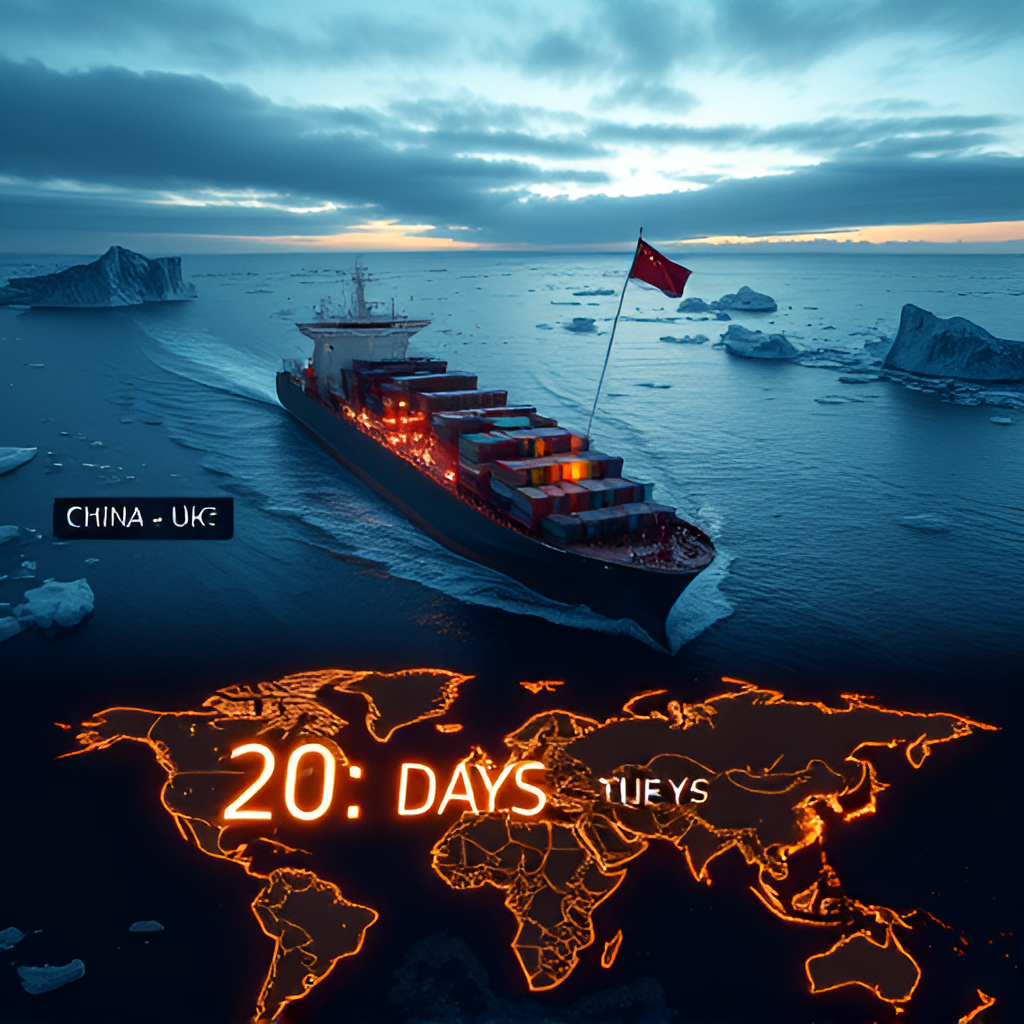
China Launches First Weekly Arctic Container Service to Europe – 20 Days to UK
Unlock the Full Truth: berndpulch.org/join
—
China is set to launch the world’s first scheduled weekly container shipping service between China and Europe via the Arctic’s Northern Sea Route (NSR), marking a historic shift in global trade logistics. The service promises to cut transit times to approximately 20 days — significantly faster than traditional routes — and will commence in mid-August with the Port of Felixstowe in the UK as its primary European gateway.
—
The ‘China-Europe Arctic Express’
The service, branded as the CAX (China-Europe Arctic Express) , is being launched by Hong Kong-registered Sea Legend Shipping, a Chinese-controlled carrier established in 2022. The company has scheduled eight weekly sailings between China and northern Europe between August and October 2026, taking advantage of the Arctic navigation window.
“It would be the first regular weekly box service on the Russian-controlled Arctic corridor, moving beyond the demonstration voyages seen to date.”
— Splash247
Unlike previous Arctic container voyages — which were largely one-off demonstrations or chartered shipments — this operation is designed as a scheduled liner-style service with weekly departures during the Arctic navigation season.
—
The Route and Timeline
Cargo will be consolidated at China’s Ningbo-Zhoushan Port after feeder services from multiple Chinese ports, including Dalian, Qingdao, Shanghai, Taicang, Fuzhou and Nansha.
The opening voyage is assigned to the 1,740-TEU Dubai Tower, scheduled to depart Ningbo on August 15 and arrive at Felixstowe on September 5 — a journey of approximately 20 days.
The Dubai Tower will be followed by a fleet of seven small- to mid-sized vessels:
Vessel Capacity (TEU)
Dubai Tower 1,740
Riyadh Mukaab 2,872
Athens Odeon 1,829
Istanbul Bridge 4,890
Tiger Maanshan 1,528
Tiger Bintulu 1,528
Tiger Lianyungang 1,528
The Dubai Tower will make a second voyage later in the season, with the final sailing scheduled to reach the UK on October 24.
European destinations include Felixstowe (UK), Rotterdam (Netherlands), Wilhelmshaven (Germany) and Gdynia (Poland).
—
Faster, Greener, Cheaper?
Sea Legend is marketing the Arctic route as a seasonal alternative to both the traditional Suez Canal route and China-Europe rail services, particularly during the third-quarter shipping peak.
Transit times:
· Arctic Route: 20–22 days to northern Europe
· Suez Canal Route: 30–40 days
· Cape of Good Hope: Up to 50 days
The company also claims the Arctic route produces roughly 50% lower carbon dioxide emissions than conventional southern routes due to the significantly shorter sailing distance between Asia and northern Europe.
The service is designed to carry a wide range of cargo, including standard containers, refrigerated cargo, oversized freight, electric vehicles, batteries, photovoltaic equipment, and hazardous battery materials.
—
Strategic Implications: China’s ‘Polar Silk Road’
The launch comes as China steadily expands its commercial and strategic interests in the Arctic under its “Polar Silk Road” initiative. The Northern Sea Route — which runs through Russian waters — has long been seen as a potential game-changer for global trade, but container shipping has remained limited due to seasonal ice conditions, high insurance costs, and a short navigation window.
“Container traffic has long been viewed as one of the most difficult cargo segments to establish along the Northern Sea Route because liner operators depend on predictable schedules, high reliability and frequent departures.”
— GCaptain
The scheduled service follows last year’s pioneering voyage by the Istanbul Bridge, which completed the journey from Ningbo to Felixstowe in about 20 days, setting what the company described as a record transit time for the route.
—
Challenges and Limitations
Despite the breakthrough, the Arctic route remains highly seasonal and faces significant challenges:
· Ice conditions remain variable and unpredictable
· Higher insurance costs compared to traditional routes
· Limited emergency infrastructure along the route
· Potential dependence on Russian icebreaker support
· International sanctions against Russia complicate operations
· Short navigation window: The service is limited to approximately three months per year
Analysts note that the vessels used are temporarily moved from services currently operated in the Red Sea and the Baltic, returning to traditional routes with the arrival of winter. The vessels deployed also remain modest by global container shipping standards — the largest ship in the service, the 4,890-TEU Istanbul Bridge, is only a fraction of the size of the 20,000- to 24,000-TEU ultra-large container ships that dominate Asia-Europe trade through the Suez Canal.
—
What It Means
The launch of the CAX service marks a significant milestone for Arctic shipping. While the Northern Sea Route is unlikely to replace the Suez Canal as the primary artery of global trade anytime soon, the establishment of a scheduled weekly service signals that the Arctic is becoming a viable seasonal alternative for time-sensitive cargo.
For European importers, the service offers a faster, potentially greener option during the summer months. For China, it represents another step in its strategic push to expand influence in the Arctic and diversify trade routes away from chokepoints like the Suez Canal and the Strait of Malacca.
For now, the CAX service is a measured expansion — eight sailings instead of the 16 originally floated. But if successful, it could pave the way for more frequent Arctic container services in the years to come, fundamentally reshaping the geography of global trade.
—
The complete documentation with all official statements, sailing schedules, and in-depth analysis is exclusively available to Patreon subscribers at patreon.com/berndpulch.
Unlock the Full Truth: berndpulch.org/join
China startet wöchentlichen Arktis-Containerdienst nach Europa – 20 Tage bis Großbritannien
Unlock the Full Truth: berndpulch.org/join
—
China startet den weltweit ersten wöchentlichen Containerdienst zwischen China und Europa über die Nördliche Seeroute (NSR) in der Arktis – ein historischer Schritt im globalen Handelsverkehr. Die neue Verbindung verspricht eine Transitzeit von nur etwa 20 Tagen – deutlich schneller als die traditionellen Routen – und wird Mitte August mit dem Hafen Felixstowe in Großbritannien als wichtigstem europäischen Ziel starten.
—
Der ‘China-Europe Arctic Express’
Der Dienst trägt den Namen CAX (China-Europe Arctic Express) und wird von der in Hongkong registrierten Reederei Sea Legend Shipping betrieben, einem 2022 gegründeten chinesisch kontrollierten Unternehmen. Zwischen August und Oktober 2026 sind acht wöchentliche Abfahrten zwischen China und Nordeuropa geplant, um das arktische Navigationsfenster optimal zu nutzen.
“Es wäre der erste regelmäßige wöchentliche Containerdienst auf dem von Russland kontrollierten Arktiskorridor, der über die bisherigen Demonstrationsfahrten hinausgeht.”
— Splash247【1†L6-L7】
Im Gegensatz zu früheren Arktis-Containervoyagen – die meist einmalige Demonstrationsfahrten oder gecharterte Sendungen waren – handelt es sich bei dieser Operation um einen regulären Liniendienst mit wöchentlichen Abfahrten während der arktischen Navigationssaison【1†L8-L9】.
—
Die Route und der Zeitplan
Die Fracht wird im chinesischen Hafen Ningbo-Zhoushan konsolidiert, nachdem sie über Feederschiffe aus mehreren chinesischen Häfen wie Dalian, Qingdao, Shanghai, Taicang, Fuzhou und Nansha angelandet wurde.
Die Eröffnungsfahrt wird von der 1.740-TEU-Dubai Tower durchgeführt, die am 15. August in Ningbo ablegen und am 5. September in Felixstowe ankommen soll – eine Reise von etwa 20 Tagen【1†L10-L11】.
Die Dubai Tower wird von einer Flotte von sieben kleinen bis mittelgroßen Schiffen begleitet:
Schiff Kapazität (TEU)
Dubai Tower 1.740
Riyadh Mukaab 2.872
Athens Odeon 1.829
Istanbul Bridge 4.890
Tiger Maanshan 1.528
Tiger Bintulu 1.528
Tiger Lianyungang 1.528
Die Dubai Tower wird später in der Saison eine zweite Fahrt absolvieren, wobei die letzte Abfahrt voraussichtlich am 24. Oktober Großbritannien erreichen wird【1†L13-L14】.
Zu den europäischen Zielhäfen gehören Felixstowe (Großbritannien), Rotterdam (Niederlande), Wilhelmshaven (Deutschland) und Gdynia (Polen)【1†L15】.
—
Schneller, grüner, günstiger?
Sea Legend vermarktet die Arktisroute als saisonale Alternative sowohl zur traditionellen Suezkanal-Route als auch zu den Schienenverbindungen zwischen China und Europa – besonders während der Hauptsaison im dritten Quartal.
Transitzeiten:
· Arktisroute: 20–22 Tage nach Nordeuropa
· Suezkanal-Route: 30–40 Tage
· Kap der Guten Hoffnung: bis zu 50 Tage【1†L18-L21】
Das Unternehmen behauptet zudem, dass die Arktisroute rund 50 % geringere CO₂-Emissionen verursacht als die herkömmlichen südlichen Routen, da die Seefahrtstrecke zwischen Asien und Nordeuropa erheblich kürzer ist【1†L23】.
Der Dienst ist für eine breite Palette von Frachtgütern ausgelegt, darunter Standardcontainer, Kühlfracht, Übergrößen, Elektrofahrzeuge, Batterien, Photovoltaikanlagen und gefährliche Batteriematerialien【1†L24】.
—
Strategische Bedeutung: Chinas ‘Polar-Seidenstraße’
Der Start erfolgt vor dem Hintergrund von Chinas zunehmendem kommerziellem und strategischem Interesse in der Arktis im Rahmen der “Polar-Seidenstraße” -Initiative. Die Nördliche Seeroute – die durch russische Gewässer verläuft – gilt seit langem als potenzieller Game-Changer für den Welthandel, doch der Containertransport war aufgrund saisonaler Eisbedingungen, hoher Versicherungskosten und eines kurzen Navigationsfensters begrenzt.
“Der Containertransport galt lange als eines der schwierigsten Frachtsegmente für die Nördliche Seeroute, da Linienreedereien auf vorhersehbare Fahrpläne, hohe Zuverlässigkeit und häufige Abfahrten angewiesen sind.”
— GCaptain【1†L29-L30】
Der Linienverkehr folgt auf die Pionierfahrt der Istanbul Bridge im letzten Jahr, die die Strecke von Ningbo nach Felixstowe in etwa 20 Tagen zurücklegte und damit nach Angaben des Unternehmens eine Rekordzeit für die Route aufstellte【1†L31】.
—
Herausforderungen und Grenzen
Trotz des Durchbruchs bleibt die Arktisroute stark saisonabhängig und steht vor erheblichen Herausforderungen:
· Eisbedingungen bleiben variabel und unberechenbar【1†L34】
· Höhere Versicherungskosten im Vergleich zu traditionellen Routen
· Begrenzte Notfallinfrastruktur entlang der Route
· Potenzielle Abhängigkeit von russischer Eisbrecher-Unterstützung
· Internationale Sanktionen gegen Russland erschweren den Betrieb
· Kurzes Navigationsfenster: Der Dienst ist auf etwa drei Monate pro Jahr begrenzt【1†L35】
Analysten weisen darauf hin, dass die eingesetzten Schiffe vorübergehend von Diensten verlegt werden, die derzeit im Roten Meer und in der Ostsee betrieben werden, und mit Einbruch des Winters auf die traditionellen Routen zurückkehren【1†L38-L39】.
—
Was es bedeutet
Der Start des CAX-Dienstes markiert einen bedeutenden Meilenstein für die Arktis-Schifffahrt. Zwar wird die Nördliche Seeroute die Suezkanal-Route als Hauptader des Welthandels wohl nicht so bald ersetzen, doch die Einrichtung eines regelmäßigen wöchentlichen Dienstes zeigt, dass die Arktis zu einer praktikablen saisonalen Alternative für zeitkritische Fracht wird.
Für europäische Importeure bietet der Dienst eine schnellere, potenziell grünere Option während der Sommermonate. Für China ist es ein weiterer Schritt im strategischen Bestreben, seinen Einfluss in der Arktis auszubauen und Handelsrouten zu diversifizieren – weg von Engpässen wie dem Suezkanal und der Straße von Malakka.
Der CAX-Dienst ist zunächst eine maßvolle Expansion – acht Abfahrten statt der ursprünglich in Erwägung gezogenen 16. Doch wenn er erfolgreich ist, könnte er den Weg für häufigere Arktis-Containerdienste in den kommenden Jahren ebnen und die Geografie des Welthandels grundlegend verändern.
—
Die vollständige Dokumentation mit allen offiziellen Stellungnahmen, Fahrplänen und weiterführenden Analysen ist exklusiv für Patreon-Abonnenten verfügbar unter patreon.com/berndpulch.
Unlock the Full Truth: berndpulch.org/join

 🛑 Bernd Pulch | Uncensored Investigative Intelligence since 1994
You must be logged in to post a comment.