Topless members of the Femen radical feminist group seized the Euro 2012 football trophy on display in Ukraine to protest against the increase of sex tourism in the former Soviet republic.


🛑 Bernd Pulch | NAZI & STASI HUNTER | CORRUPTION & ARISTOTLE AI BI
Official Hub: 30+ yrs Investigative Intelligence. Unmasking Global Corruption & Totalitarian Networks. Evidence Preservation: IZ/Lorch/Ehlers/GoMoPa.
Topless members of the Femen radical feminist group seized the Euro 2012 football trophy on display in Ukraine to protest against the increase of sex tourism in the former Soviet republic.
DOWNLOAD THE ORIGINAL DOCUMENT HERE

DOWNLOAD THE ORIGINAL DOCUMENT HERE
Gangland tells the inside stories of some of America’s most notorious street gangs.
DOWNLOAD THE ORIGINAL DOCUMENT HERE
| General | |
|---|---|
| CaseID | UKSC 2011/0264 |
| Case name | Assange (Appellant) v The Swedish Judicial Authority (Respondent) |
| Case stage | Awaiting Judgment |
| Date of issue | 15 Dec 2011 |
| Expedition requested | Requested |
| Order being appealed – Date | 02 Nov 2011 |
| Order being appealed – Court | Divisional Court QBD (EW) |
| Devolution | No |
| Human Rights raised | Yes |
| Human Rights raised – details | Article 5(3) |
| Intervener | Yes |
| Case Summary |
|---|
|
On appeal from the Divisional Court of the Queen’s Bench Division (England and Wales)
Issue Whether a European Arrest Warrant (“EAW”) issued by a public prosecutor is a valid Part 1 EAW issued by a “judicial authority” for the purpose and within the meaning of sections 2 and 66 of the Extradition Act 2003. Facts The Appellant, a journalist well known through his operation of Wikileaks, visited Sweden to give a lecture in August 2010. He had sexual relations with two women. Both women went to the police who treated their visits as the filing of complaints. The Appellant was interviewed by police and subsequently left Sweden in ignorance of the fact that a domestic arrest warrant had been issued for him. Proceedings were brought in the Swedish courts in the Appellant’s absence, although he was represented, in which a domestic warrant for the Appellant’s detention for interrogation was granted and upheld on appeal. Subsequently, an EAW for the Appellant was issued by the Swedish Prosecution Authority that set out allegations of four offences of unlawful coercion and sexual misconduct including rape. The EAW was certified by the UK Serious Organised Crime Agency under the Extradition Act 2003. The Appellant surrendered himself for arrest in the UK and, following an extradition hearing, his extradition to Sweden was ordered. The order was upheld on appeal to the Divisional Court. Subject Matter catchwords for indexing Extradition “European Arrest Warrant” Judicial Authority |
| Permission to appeal | |
|---|---|
| Date supporting documents received | 15 Dec 2011 |
| Date PTA application referred to justices | |
| Date of oral hearing | |
| Permission granted/refused | Granted |
| Notice of intention to proceed filed | Yes |
| Parties | |
|---|---|
| Appellant name | Julian Paul Assange |
| Appellant case due date | |
| Appellant case date filed | 13 Jan 2012 |
| Respondent name | The Swedish Prosecution Authority |
| Date form 3 filed | |
| Date form 3 issued | |
| Respondent case due date | |
| Respondent case date filed | |
| Intervener – names | Gerard Batten and Vladimir Bukovsky Lord Advocate |
| Appeal | |
|---|---|
| Justices allocated | Yes |
| Justices allocated – names | Lord Phillips of Worth Matravers Lord Brown of Eaton-under-Heywood Lord Kerr of Tonaghmore Lord Wilson |
| PTA granted by court below | No |
| Statement of facts & issues and Appendix due date | |
| Statement of facts & issues and Appendix date filed | 12 Jan 2012 |
| Time estimate | |
| Time estimate received | |
| Time estimate number of days | 2 days |
| Hearing date | 01 Feb 2012 |
| Other hearing location | |
| Core volumes due date | |
| Core volumes date filed | |
| Authorities due date | |
| Authorities date filed | |
| Hand down date | 30 May 2012 |

U.S. and allied combat operations continue to highlight the value of unmanned systems in the modern combat environment. Combatant Commanders (CCDRs) and warfighters value the inherent features of unmanned systems, especially their persistence, versatility, and reduced risk to human life. The U.S. military Services are fielding these systems in rapidly increasing numbers across all domains: air, ground, and maritime. Unmanned systems provide diverse capabilities to the joint commander to conduct operations across the range of military operations: environmental sensing and battlespace awareness; chemical, biological, radiological, and nuclear (CBRN) detection; counter-improvised explosive device (C-IED) capabilities; port security; precision targeting; and precision strike. Furthermore, the capabilities provided by these unmanned systems continue to expand.
The Department of Defense (DoD) has been successful in rapidly developing and fielding unmanned systems. DoD will continue to focus on responding rapidly to CCDR requirements, while ensuring systems are acquired within the framework of DoD’s new wide-ranging Efficiencies Initiatives1. In the fiscal environment facing the Nation, DoD, in concert with industry, must pursue investments and business practices that drive down life-cycle costs for unmanned systems. Affordability will be treated as a key performance parameter (KPP) equal to, if not more important than, schedule and technical performance. DoD will partner with industry to continue to invest in unmanned systems technologies while providing incentives for industry to implement cost-saving measures and rewarding industry members that routinely demonstrate exemplary performance.
…
6 AIRSPACE INTEGRATION (AI)
6.1 Functional Description
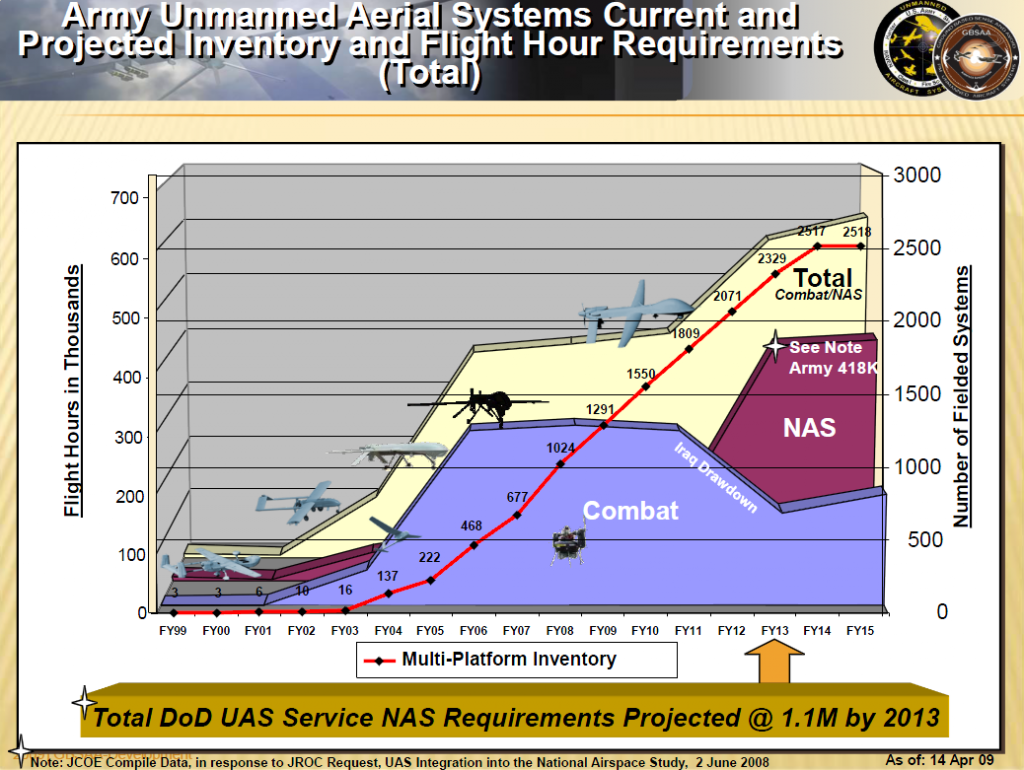
Over the past several years, UAS have become a transformational force multiplier for DoD. The numbers and roles of UAS have expanded dramatically to meet mission demands, and operational commanders have come to rely upon robust and persistent ISR support from unmanned platforms executing their core missions against hostile forces. DoD UAS require routine NAS access in order to execute operational, training, and support missions and to support broader military and civil demands. UA will not achieve their full potential military utility to do what manned aircraft do unless they can go where manned aircraft go with the same freedom of navigation, responsiveness, and flexibility. Military aviation is a major contributor to the virtue of maneuver for our forces in warfare.
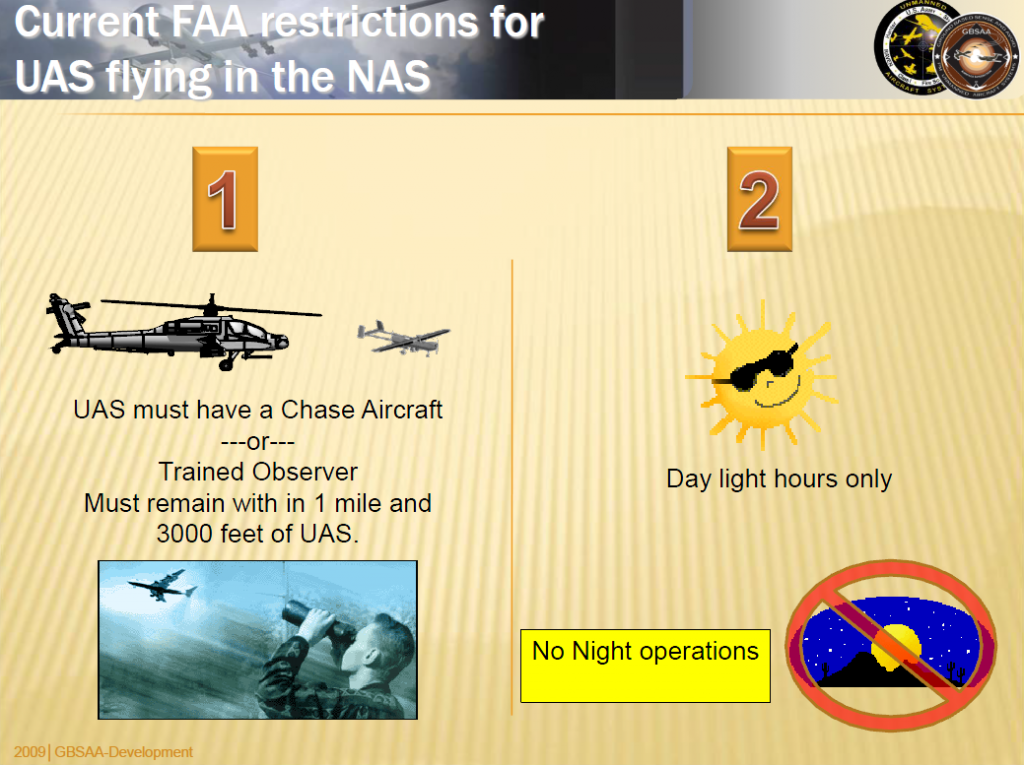
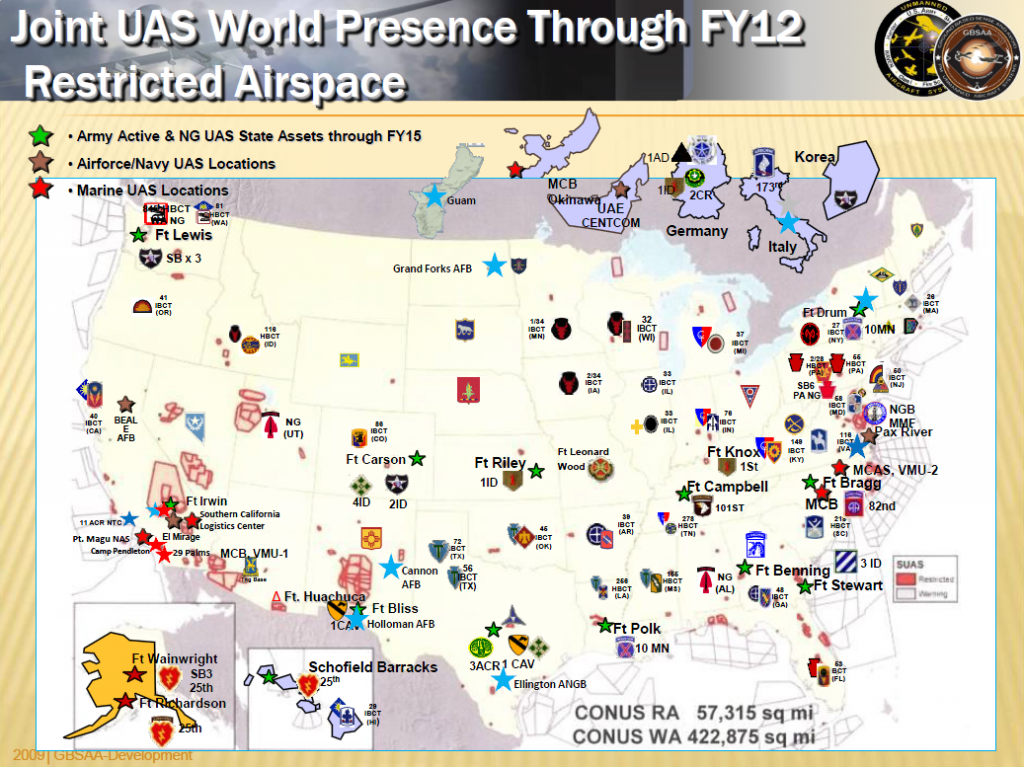
While the force structure continues to grow, the ability to integrate UAS into the NAS has not kept pace. Current access for UAS is greatly limited primarily due to FAA regulatory compliance issues that govern UAS operations in the NAS. DoD UAS operations conducted outside of restricted, warning, and prohibited areas are authorized only under a (temporary) COA from the FAA. Similar issues need to be resolved for access to international and foreign national airspace.
The DoD UAS Airspace Integration Plan, March, 2011 provides a more comprehensive discussion on the topic of AI. In this plan, DoD provides an incremental approach strategy to provide DoD UAS access to a given operations profile that leads to a full dynamic operations solution. This methodology recognizes that DoD requires access to differing classes and types of airspace as soon as possible and that routine dynamic operations will likely take several years to implement. Figure 12 depicts the six access profiles.
…
6.4.3 Technology
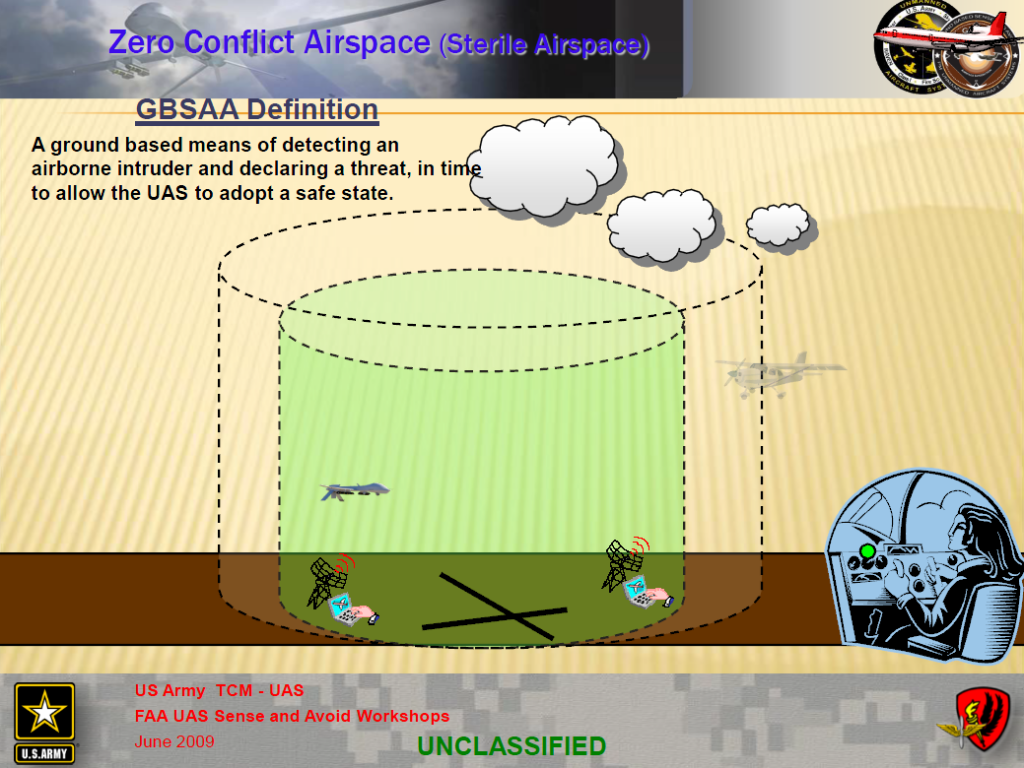
Current UAS are built to different specifications for different purposes; therefore, showing individually that each system is safe for flight in the NAS can be complicated, time consuming, and costly. Routine access cannot happen until DoD and FAA agree to an acceptable level of safety for UAS, and the appropriate standards are developed to meet that threshold. With developed standards, UA will be operationally treated as manned systems, and such treatment will improve interoperability with other systems, cost savings, and development transparency. Until those necessary UAS-specific standards are established, requirements will be dependent on the individual system and intended flight environment (access profiles). Each system’s mission requirements will drive the selection of sense and avoid (SAA) solutions and process for implementation. Ground-based sense and avoid (GBSAA) can provide an initial means to maintain aircraft separation requirements for multiple profiles, while improvements to sensor and automation technology will continue to improve an airborne SAA (ABSAA) solution.
GBSAA efforts are focused on developing methods to provide aircraft separation within a prescribed volume of airspace using a ground-based system that includes sensors, displays, communications, and software. GBSAA solutions will incrementally relieve restrictions on existing COAs and facilitate UAS training and operations in the NAS. This effort is establishing requirements, gathering data, performing modeling and simulation, testing and verifying collected data, and obtaining airworthiness approvals, as appropriate. GBSAA can particularly benefit smaller UAS where other SAA solutions are cost prohibitive.
ABSAA efforts are focused on developing onboard capability to perform both self-separation and collision avoidance that ensure an appropriate level of safety. Current programs have phased validation schedules for due regard, en-route/Class A, and divert/ Class E/G operations as technology innovation and integration allow. GBSAA and ABSAA may be applied as a single or combined solution to some access profiles to maximize safety and/or reduce operational costs.
DOWNLOAD THE ORIGINAL DOCUMENT HERE
Liebe Leser,
über 5.500 Menschen und Firmen wurden und werden von STASI-”GoMoPa” gestalkt und erpresst.
Dies hat zu einem – so erste Schätzungen von Schadensexperten – Schaden von über € 1 Milliarde geführt, nimmt man als Berechnungsgrundlage
die im Falle von Meridian Capital geforderte Erpressungssumme.
Der immaterielle Schäden durch zerstörte menschliche Leben und Schicksale, dieser “Dämonen im Internet” (Eigenbezeichnung von Ober-Stalker “Klaus Maurischat”) ist noch viel höher und nur mit dem von der DDR-Gestapo angerichteten Schaden vergleichbar, deren Nachfolgeorganisation die fingierten “Goldman, Morgenstern u. Partner” – “GoMoPa” mutmasslich sind.
Darunter sind auch etliche Todesfälle und viele Personen und Firmen, die nicht auf der 3.400 Fälle umfassenden “Warnliste”, besser Stalking, Betrugs- und Erpresserliste auftauchen.
Hinzu kommen zahlreiche Fälle von Börsenmanipulation wie im Falle “Wirecard” mit Pennystocks mutmasslich aus der US-Corporation-Schmiede von “GoMoPa”-Partner “Graf” “Dr.” Stenbock.
Mutmasslich: Organisierte Kriminalität im ganz grossen Stil.
DIE “GoMoPa”-Opferliste 2010 – getarnt als “Warnliste” von den erfundenen “Goldman, Morgenstern u. Partnern” erstellt
Folgende Firmen und Personen wurden u.a. von Peter Ehlers (wenn er denn so heisst) und “GoMoPa”, dem STASI-”NACHICHTENDIENST” seit Jahresanfang 2010– ohne jeden Beweis – verunglimpft, um daraus Profit für Ihren mutmasslichen postkommunistischen Saftladen zu schlagen:
GoMoPa-Warnliste 09-2010
2
Anton
Abdul Sheikh
Abraham
Akcay
Aksoy
Aktürk
Alexandre
Alsguth
Arnold
Arnol Arslan
Artschwager
A & G Insurance Corporation
A & O Finanz- und Immobilenvertriebsservice GmbH
A+B Finanz
A+K Fina
AA Capital
ABAG BETEI
Abbey House Acquisitions
ABC Finanzdienst
Accent-Finanz GmbH
ACCENTA IMMOBILIEN MANAGEMENT AG
ACI Alternative Capital Invest GmbH
Acoreus Collection Service
Acorn Consulting
Activ 3000 GmbH
Activa GmbH
Activa Wirtschaftsberatung GmbH
Actiwa Vermittlung von Finanz- und Vorsorgekonzepten e.K.
Adeshieman Company
Aditus Fonds GbR
Admus AG
Adolph & Komorsky International GmbH
Advance Invest AG
ADVANCE INVEST AG S.A.
GoMoPa-Warnliste 09-2010
3
Advanced Group Kuwait
Advanced Program Trading AG
Advin Consult Finanzierungsvermittlungs GmbH
Advisa Consulting GmbH
Aeternus Energy Corp
AFG AMERICAN FINANCIAL GROUP INC.
Agentur Herold
Agentur Leif Schurig
AGR Allgemeine Gewerbedatei e.K.
Ahorn Trust AG
AIF Bank & Trust Company
AJPA Broker SA
Akeman Capital
AKJ Allgemeine Leasing AG
AKJ Privatfinanz AG
AKJ-Firmengruppe
AKK Dienstleistungs GmbH
Aktienpower AG
AktienPowerMarketing GmbH
Akzenta AG
Albion Investment Management
Alexander Freiherr von Pillnitz & Berenberg Treuhandgesellschaft 1908 Limited
Allgemeine Giro 24 GmbH
ALLGEMEINE IMMOBILIEN-BÖRSE GmbH
ALMO Hausbau GmbH
Alpha Finanzsanierungs GmbH
GoMoPa-Warnliste 09-2010
4
Alpha Oil Inc.
Alphapool AG
Alpina Finanz GmbH
Alternative Capital Invest
ALV Auto-Leasing und Vermietungs GmbH
Alvino Group
AMBROS/VBS
American Investment & Finance Corporation
AMK Akustikbau GmbH
AMK Immobilienbetreuung GmbH
Anderson & Goldberg S. L.
Anderson McCormack Group S.L
Anderton Stoner&Partner
Anglo African Minerals plc
Ango-Käufer-Service GmbH & Co. KG
Antassia GmbH
Anthony & Carter
Apex Investments Corporation
Apex Trading Group
Applied Cash International
APT Advanced Program Trading AG
Aquaorbis AG
ARCADIA Finanz- & Wirtschaftsberatung
Arena GmbH
Argos Finanz GmbH
Ario AG
GoMoPa-Warnliste 09-2010
5
Armaco
Art Bauträger u. Immobilienhandelsgesellschaft mbH
Artemis Financial
AS Bau Berlin
ASC AG für Satellitenkommunikation
ASCANIA Vermögensverwaltung
Ascor Media Ltd.
ASG GmbH
Assecura-Assecuranz Vermittlungs GmbH
Associated Management Group
Associated Management Group (AMG Zurich)
Aston Rowe Consulting Advisory
Atlantis Exploration AG
Atlantis-Genossenschaft
Au Vi Product GmbH
Aufina Holding
Aurora Gold Corp.
Australian Lottery
Autosafe Parkhaus AG
Autotester 24
AVAG Allgemeine Vermögensverwaltung AG
AVAG-Funds
AVD AG
AVM AG
AvW Invest AG
AXXIOM AG
GoMoPa-Warnliste 09-2010
6
Azalenia Basel AG
Amaxopoulus
Arntzen
Aniol
Altmann, Dr.
Assenmacher
Appel
Aulenbach
Aengenheister
Amonath
Asmus
Almer
Anlauf
Aniol
Blon von
Barney
Bajcar
Bronischewski
Butler
Becker
Berger
Burat
Buettner
Behring
Baumert
Becker
Bünning
Bok
Bahcecioglu
Bahceli
Balicioglu
Balogh
Barteczko
Becker
Bergenthal
Bindokat
Böhrer
GoMoPa-Warnliste 09-2010
7
Born
Bortstein
Busch
Böhm
Braun
Blum
B u. S Technologie GmbH
Bachmann Roth Advisory
Badenia Bausparkasse
Bagleys Investment Company
Baltica Savings & Investment Cop.
Bank Leumi AG
Bankgesellschaft Berlin
Banque Bruxelles Lambert (BBL)
Barlow & Ramsey
Barringer and Co.
Basel Institutional
Basic Trading Solution Ltd.
Bau- und Grund Immobilien GmbH
Bauconsult Gesell. für Haus- u. Grundbesitz
Baucontrol GmbH
Baufinanzierungszentrum Berlin – Karlshorst
BAV-Konzept Versicherungsmakler GmbH
Bavaria Invest Finanzmanagement
Bavaria Trading Company
Baye Invest
BÖRSENPOWER Coaching und Verwaltungsges.m.b.H.
BBAP Assekuranzmakler & Finanzdienstleistungs GmbH
BeFa Invest GbmH & Co KG
BelSwissBank
BEMA Investitions- und Beteiligungsgesellschaft GmbH
Benedict Lifeline GmbH
BENEDICT Star GmbH
Benitex AG
Benson & Raymond Acquisition
Berger Daniel
Bergues Invest SA
Bestgambling.Com
BESTLIFESELECT AG
BF Bayerische Baufinanz GmbH
BFS Neckarsulm
BFTS AG Schweiz
BHG Baugenossenschaft Hockenheim e.G
BIK Bauträger
Biotech Development
Bishop & Parkes Advisory
Blanc & Baumar
Blinder International
BLISTER YACHTING GMBH
GoMoPa-Warnliste 09-2010
8
Bloomfield Consulting AG
Bond and Future Group Ltd.
Bonetti & Wilmers
Bonus Bauträgergesellschaft mbH
Borsa Financial Inc.
BR Consultance Alfaz S.L.
Branchenklick
Branko Financial Service
BRAZIL-INVEST-VC LTDA
RDS-Dienstleistungen
Breadley Steigenberger & Partner (BSP)
BREBA Invest S.L.
Brentana Wohnbau GmbH
Brett Commodities GmbH
Bright Capital Banker Ltd
Britannia Swiss Equities – BSE AG
Brodowski Dach- und Fassadenbau GmbH
Brodowski und Deyna Immobilien GmbH
Brokers Society Sociedad de Gesti? Tramitaci Financier
Brown & Lampe U.S. Portfolio Management Ltd.
BSD GmbH
Bullion Trading Group
Bund der Verbraucher (BDV)
Burbach Consulting GmbH
Business Partner Credit GmbH
Brauer
Bogatz
Birner
Bastert
Baeuerle
Bertges
Barteczko
Bertges
Beyer
Bogatz
Bender
Bens
Bösebeck
Bouderi
Baan
Bender
Birkins
BECK
Barthel
Beyreuther
Banghard
Bohrmann
Bauer
Bludau
Bajcar
Bernhart
Belkenheid
Barthel
GoMoPa-Warnliste 09-2010
9
Baumbach
Barde
Casula
Carsten
Celik
Cengiz
Clemann
Cura
Cuti
Cuti
Campa
C & P Mutual
C. Gewerbeimmobilien
Callux Forderungsmanagement
Calvin & Sanderson Associates
Cambridge Asset Management AG
Cameron Poe & Associates Inc.
CAP-NETWORK AG
Capital Securities International
Capitalinform Limited SA
Capitalinform Limited SA
Car Leasing Agency Ltd.
Carsten Haus GmbH
Carver Brooks & Associates Ltd.
Cash Group AG
Cash-Immobilien GmbH
Cashselect
CasMaker Ltd.
Castor Capital
Cater & Sattler OHG
Caviar Creator Inc
CB Freie Versicherungsmakler GmbH
CBC
CDH AG
Census Grund GmbH & Co KG
Centracon
Centracon Investment AG
Centro Euro Service AG
Centro Euro Service AG
Centro-Service GmbH
Ceptum AG
Ceres Warenhandels- und Beratungsgesellschaft mbH
Certus Consulting
CH Devisen Macht SA
CHEAPLY SMOKING CLUB
Chiemgauer Vermögensverwaltung
Chips Virtual Casino
CIC Insurance Company SA
Cinerenta Gesellschaft für Internationale Filmproduktion mbH
Cis Deutschland AG
City Hyp Finanzierungsvermittlung
GoMoPa-Warnliste 09-2010
10
City Zins Finanzierungsvermittlungs AG
CL Inkasso AG
CL Inkasso AG
Clean Lease GmbH
CLEAN PATENT GMBH
Club Alanzo VIP Cruises
CMP Global Consulting Ltd
CMX Capital Markets Exchange AG
CNP Casino
Colebrooke Management Holdings
Color für Kinder e.V.
Comitas Agentur VSV
Commercial Development Bank
Commercial First Trading Corporation
Complete Commodity Trading
Comroad AG
ComTex Vermögens- und Verwaltungs GmbH
OMVAL Capital AG
Concorde International – Business Consultants
Condor Gold and Minerals Inc.
Conductis GmbH
Conik Invest
Coninvest Finanz AG
Conradi & Hilger Gbr mbH
Consens Gesellschaft für Projektentwicklung u. Vermittlung von Immobilien
Consolidated Capital Management Limited (CCML)
Content Services Ltd.
Contracta Grundstücksmanagement GmbH
Convent Consulting GmbH
CONVERGEX CARIBBEAN, LTD.
Conzeptfinance Ltd.
Cooperativa Extranjero de Credito y Investiamento SA
Cornhill Management S.L.
Cosena Management S.L.
CP Medien AG
CPTD – Central Patent & Trademark Database
CR Consulting GmbH
Credit for you Limited
Credit Mirabaud
Creditnet Bank Internationale
CS Capital Service GmbH
CST Umwelttechnik und Innovation e.G.
Cumulus Gesellschaft für Immobilien- Investitionen mbH
Cura Investitions- und Beteiligungsgesellschaft
Cmok
Cordes
Chuen
Drabnitzke
Dana
Dogs
Doll
GoMoPa-Warnliste 09-2010
11
Doujak
Dziuba
Dorsch
Becker
DAK Finanz
Danaro Invest
Asset Management
DAT Finance AG
DBVI AG
De Lotto Switzerland
Delmont Wealth Management
Deltoton AG
DEM Marketing
Demirok GmbH Bauunternehmen
Densch & Schmidt GmbH
Der Informant GmbH
Deutsche Contracting GmbH
Deutsche Immobilien Grundvermögen Holding AG
Deutsche Mentor für Finanzen (DMFF) e.K.
Deutsche Mentor für Finanzen AG
Deutschen Anlage- und Beteiligungs Aktiengesellschaft (Dabag)
Develop Management GmbH
Deyna Immobilien GmbH
DHB-Dreiländer-Handels und Beteiligungsgesellschaft Walter Fink KG
Die Agentur
Die Tradergemeinschaft – Best of Marketing SARL
Dierig Unternehmensberatung
DIHA Dienstleistungs – und Handel GmbH
DIP AG
DIREKTE VERMÖGENSBERATUNGSGESELLSCHAFT MBH
Direkter Anlegerschutz e.K.
Distefora Holding AG
Dividium Capital Ltd
DLF-Immobilienportfolio-Walter-Fink KG
DM Beteiligungen AG
DMI Derivatives Management Inc.
DMP-Gruppe
DMV – Deutsche Markenverlängerungs GmbH
Dohmen-Invest
Domizil Immobilien Leasing GmbH
Domusfinanz
Dow Win Financial Group Corporation
DPMV-Deutsche Patent- und Markenverlängerung GmbH
Dr. Antonio GAMPA
Dr. Bassam Bouderi
Dr. Cornelius Gregorius Consulting Inc
Dr. Gerbig Treuhand GmbH
Dr. Görlich Grundbesitzbeteiligungs GmbH
GoMoPa-Warnliste 09-2010
12
Dr. Hanne Grundstücks GmbH
Dr. Hartmannsdorf Immobilien GmbH
Dr. Mayer & Cie. GmbH
Dr. Peters
Dr. Schmitt Inc.
Dr. Werner Financial Service AG
Dragon Partners Inc.
Dreiländerfonds DLF
Dreiländerfonds DLF-94/17
Drexel Management GmbH
Dubai International Investment & Trading
Dubai-1000-Hotel-Fonds
Duesenberg Financial Group Inc.
Dunas de Corralejo S.L.
Dupont Conseille AG
Dux Partners AG
Dörflinger
Dallüge
Deutsch
Dittel
Dierkes
Deubelbeiss
Dallinger
Drewitz
Eichhorn
Erber
Elbert
Ebner
Eroglu
Eschinger
Ettelt
Evcil
E-Money Power (EMPFX)
E.U.R.O.- Unternehmens- & Wirtschaftsberatungs- Ltd.
EAG AKTIENGESELLSCHAFT für WIRTSCHAFT
Earnshaw Advisory Services
Earthsearch Communications Inc.
Easy Concept Hamburg KG ( E@sy )
EBC AG
EBCON – Europäische Verbraucherberatung
Ebcon Europäische Verbraucherberatung AG
Ecco
Economy Capital Corporation
Ecotrend Holding AG
ECP Euro Caribbean Properties Ltd.
ECTO GmbH
Ecumoney Limited
Edgar Heumann GmbH
EECH AG
GoMoPa-Warnliste 09-2010
13
EEIG – Europäische Wirtschaftskammer
Effekten- und Edelmetallberatungs GmbH
Effinance Private Equity AG
EKC
Elbe Emissionshaus
Elefant Immobilien GmbH
EM.TV AG
EMA Event Management Agentur GmbH
Embdena
Emmerson Bennett
Empresa Minera (Bergbau) AG
Enexoma AG
Equinox Private Consultants Ltd.
ERGO-Plan
Erich Holderer Finanzdiestleistungen
ESKATA Finanz- Immobilien- Handels GmbH
ESTEKAR LIMITED
Estreel GmbH & Co.KG
EuMedien
Eurefi Eurefi Holding AG
Euregio Immobilien L&F B.V.
EURENTA Gesellschaft für Anlagen-, Renten- und Sparkonzeptionen GmbH
EURENTA Gesellschaft für Marketing- und Promotion GmbH
Euring GmbH
EURO CREDIT UNION
EURO Finanz Consult AG
Euro Finanz Management
Euro Kapital AG
Euro Real Investment Company
Euro Trading GmbH
Euro-American Beteiligungsvermittlungsg. MbH
EURO-CONSULT e.K.
Euro-Pool AG
EUROCAPITAL BANK INC.
Eurocapital Investment Corporation
EURODOM Berlin GmbH
Eurogoldtrader
Eurokapital AG
Eurolink Consult GmbH
European Estates&Investment AG
European Kings Club
European Trade marks and Designs
European Trademark Organisation S.A.
Europäische Schuldenregulierungs- und Ausgleichsanstalt
Europäische Wirtschaftskammer für Handel, Gewerbe und Industrie
EUROTRADE & CONSULTING AG
Eurotrust Capital Management
EV&K
Evantus Invest
EVD Direktverkaufs AG
EWR Wirtschaftsdatenregister
Exakt Martkanalysen Research GmbH
Exeltrade
GoMoPa-Warnliste 09-2010
14
Engels
Eder
Esser
Elas
Ehrenberg
Eilts
Eich
Eich
Eder
Engler
EISENBERG
Felgner
Flug
Feyh
Freke
Florian
Fasan
Fritsch
Freiherr von Fink
Fink
Ferrera Dr. F & P Aktiengesellschaft & Co. KG
F.I.P. GmbH
F.V.F
FA. Haustein Finanzvermittlung
Fafa Capital
Faktor 1 GmbH
Falcon Euro Trading Limited
Falcon Oil Group
Falk Capital AG
Falk-Gruppe
Falken Depot Management GmbH
Falken GmbH
Falken Vermögensverwaltung GmbH
FALLON BANCROFT HOLDING
Fashionact Industries Inc.
Noske
FB Bauträger GmbH
FDMV FINANZDIENSTLEISTUNGEN
FFB Dörflinger GmbH
FFCC Verwaltungs GmbH & Co. Finanzdienstleistungs KG
FG Finanz-Service AG
FGP & Cie
Fibeg Finanzberatung- und Vermögensverwaltungs GmbH
Fibu AG
Fideles & Associates AG
Fidelity International
FIDU payment services S.A.
Finama Vermögensverwaltungs KG
Finance Concept GmbH
Finance Service International
Financial Consulting
Financial Consulting UK Limited
GoMoPa-Warnliste 09-2010
15
Financial Planning Systems Ltd.
Financieros Panama – Societaet Rodriguez Batista Diaz
Finanz Score GbR
Finanz Service Hennig
Finanzprogramme Bentley & Partner
FINANZtest Center
Finanzvermittlung Fritz Guth
Finanzvermittlung und Wirtschaftsdienst Ott GmbH
Finbrands Global Limited
Fine Trading Group Finvest Asset Management
FIPTR Federated Institute for Patent- &
Trademark Registry First Canadian Joint Venture
& Consulting Inc. First Canadian Joint Venture
& Consulting Inc. (Canada)
First China Corporate Management Group
First Garant Fund AG First Intercontinental
Bancorp. Ltd. First Invest Grundbesitz
GmbH First Invest Swiss Trade
First Real Estate Grundbesitz GmbH
First Saxonia Trading Ltd
Flash Finance Floris Bank
FOCUS Immobilien und Projektbau GmbH
FOKUS INVEST AG Foma Internationale
Inkassogesellschaft mbH
Fondax Capital Trust GmbH & Co. KG
Fondshaus Hamburg FORBIS Corporation
Force Worldwide Investments Corp
Foreign Exchange Clearing House Ltd.
Forest Finance Service GmbH
Forex4free Forexone-Broker
Forst Finance AG Four Stars AG
Frankonia Sachwert AG FRD International
Free Finance -Service Futura Finanz AG
Futura-Concept GmbH FXTSwiss
Fridez Fridez
Frau Floßbach
Fritz Franko
Frerichs Fink
Fridez Fasan
Filsinger
Freiherr von Lepel
Frydenlund Foetzsch
Fridez Fridez
Fitz
Grüters
Geyer
Gonnes
Grüner
Gerlach
Gast
Gräbedünkel
Gustav
GoMoPa-Warnliste 09-2010
16
Güttig
Gläßer
Gehle
Gerome
GOLDEN-BALLARIN
Golsch
Gronemeyer
Görlich
Götzl
Gaber
Graupner
Guth
G+M Baubetreuung GmbH
G.V.V. bR.
G.W.F. Grundwert-Bauträger G.M.B.H
Gaiacor International PLC
Galant Immobilien GmbH
Garant Kreditvermittlung
Garant-Hundsdorff-Istanbul
GEBAB
Gebrüder Schmidtlein GbR
GEcoS Holding AG
Geldfinder GmbH
Gemas GmbH
Genius Insurance Service GmbH
Genius Investments – Genius Funds
Geoteck Inc.
Gerd Esser Grundbesitz GmbH
GerGermania Grundbesitz AG
Germania Venture Capital AG
Gesellschaft für Erbenermittlung
Gesellschaft für Exklusive Veranstaltungen Dortmund mbH
Gesellschaft für Finanz- u. Wirtschaftsdienstleistungen (FiWi)
Gesellschaft zur Datensicherung im Internet (GSDI)
Gesellschaft zur Vermittlung kapitalorientierter Finanzanlagen GmbH (GVFK)
GetAssisted Group
GfS Invest GmbH
GGHF Windpark Sitten GmbH & Co. KG
GHS Unternehmensgruppe
GIP Grundstücks-Immobilien & Projektmanagement GmbH
GIV Gesellschaft für Immobilien und Vermögensverwaltung mbH
Glatt & Partner GmbH
GLOBAL – BAU Immobilien GmbH
Global AWS AG
Global Capital Group
Global Cogenix Industrial Corp.
Global Financial Invest AG
Global Foreign Exchange (Switzerland) AG
GLOBAL LIFESTYLE GROUP S.A.
Global Mineral Resources Corp.
Global Pension Plan
Globaltraiding.com Kapitalmanagement
Globalus (Immobilien) Gmbh & Co. KG
GoMoPa-Warnliste 09-2010
17
GM Capital Partners
GMF Finanz AG
GMF Treuhandgesellschaft mbH
GO AHEAD SERVICE LTD
GOJ AG
Gold-Barren-Silber.com
Gold-Versandhandel
Goldstein & Partner Inc.
GOT Thimm GmbH
GPS GmGrand Capital Ltd
Great Berlin Wheel GmbH & Co. KG
Grevenreuth AG
Grund und Boden Beteiligungs AG
Grundstücksgemeinschaft Arslan
Grupo Esdinero
Grünewälder GmbH
GSM Gesellschaft für Professionelles Sachwert Management AG
GSM Gesellsc
GTO Gap Trading Online
Gulf Oil Exploration Inc.
GVW – Wirtschaftsclub
GWG Gesellschaft für Wirtschaftsplanung mbH
Göttinger Gruppe
Göttler Finanz AG
Graf
Guillaume
Gropper
Göker
Grotelaers
Günzel
Gelbke
Haugg
Halbey
Händel
Hansen
Heise
Hensel
Hipp
Hirner
Hirth
Heider
Hickl
Hansel
Hauser
Härtel
Heckler
Hambusch Prof.
Herold
Hering Dr.
Herr Budzinski
GoMoPa-Warnliste 09-2010
18
Heyer
Hering Dr.
Hartung
Hesselmann
Hettrich
Heiner
Händel
Heinrich
Hartl
Hansch
Hartung
Hepp
Heinekken van
Hanne
Heiliger
Heumann
Hensley-Piroth
Haffa
Holderer
Helfer
Heckmann
Hormann
Hennig
Hermsmeier
Hornberger
Halabi
Herr Gieselmann
Hundsdorff
Hanisch
Hornig
Hambusch Prof.
H.R.L. International
H2O Swiss AG
Hafenstein Marketing GmbH
Hamburg Connection
Hamilton Associates A.G.
Handelshaus Schaar
Handelskontor Fischer
Hansa Treuhand
Hanse Capital
Hanse Club
Hanseatische AG
Hanseatische Senatorenkanzlei
Hansefina GmbH
Hartl Immobilien
Hartl Immobilienmanagement GmbH
Harz Börde Finanz
Haus- und Vermögensverwaltung GmbH (HaVeWa)
Hauser Treuhand Rorschach HTR
Haushaltsfuchs
HB Capital Partners
HBW-Finanz AG
HCI Capital
GoMoPa-Warnliste 09-2010
19
HDL Hausdienstleistungsgesellschaft mbH
Helvag AG
Helvetia Treuhand GmbH
Helvetia Treuhand-Union GmbH
Hentsch & Müller S.A.
Hermes Beteiligungs AG
Hermes Portfolio Management GmbH
Bens
HKA-Bank 1954 Ltd.
HNH Finanzberatung-Treuhand GmbH
Horn Wolfgang Dr.
HouseFX AG
HTB Holding
HuHWH International AG
Hypo – Leasing B.V.
Heinen
Hagen
Hoff
Hensel
Hampe
Hauser Metzler
Harksen
Huber
Hartung
Hübner
Hönnscheidt
Hettrich
Hering Dr.
Hettrich
Hübner
Ihl
Izmirlioglu
Izmirlioglu
Immega
I-investorclub Ltd.
I.B.F.T.P.R. International Bureau for Federated Trademark Patent Register
I.B.I.P. International Bureau for Intellectual Property
I.F.I. Ltd. Milincic
IAZ & Partners
IBB GmbH
IBB INTERNATIONAL
IBEKA Immobilienbeteiligung AG
IBH Limited
ICB – Intercontinental Brokerage Corporation
ICM Basel
IContent GmbH
Idee Immo Concept GmbH
Idilei-Treuinvest
IFF AG Zukunftsunternehmen für Investment, Fonds, Finanzen
IFIC Integra Financial Consulting GmbH
IFS International Financial Services Inc.
GoMoPa-Warnliste 09-2010
20
IHB Immobilien Heinen & Biege GmbH
IKF
Immorenta Immobilienbeteiligungsgesellschaft mbH
Imperia Invest IBC
Indara Projekt AG
Indices International Group IIG
Info-ZentralInformations-Service-Center (ISC)
Inkasso Team Moskau / TMA GmbH
Innoflex
Innovatio Allfinanz & Franchise System AG
INT Elektrizitätswerk Beteiligungs KG
Integral Finanz AG
Integral Treuhand Vermögensverwaltung GmbH
Integro Capital Partners
Intellectual Property Agency Ltd.
Inter Alpen AG
Inter Capital Bank
Inter Capital Bank Ltd.
Inter Credit Group
Interbank Asset Management Group AG / InterBank AG
Intercontinental Financial Developments Plc.
Interessensgemeinschaft Barbara Merkens
Interfinance Investment & Credits
Interglob AG
INTERMEX International Ltd.
International Bioremediation Services Inc.
International Insurance Holding Inc.
International Invest Ltd
International Travel Services Ltd.
Internet Media AG
Internetwebshop
Inventaire Pro
Inveractivos
InvestInvestor Relations Corp.
Inveteratus Asset Management
IOPTS International Organization for Patent & Trademark Service Corporation
IPS AG – Internationale Produktvermarktungs Systeme
ISR Management & Consulting Ltd
ISS Immobilien Schutz und Service AG (ISS AG)
ISS Immobilienschutz und Service AG
ITL-Enterprises Inc.
Immega
Ibekwe
Just
Jochum
Jester
Junges
Jaeger Research GmbH
Jefferies Associates Group
Jejkal AG Strategische Investments
Johnsons Banking Group
GoMoPa-Warnliste 09-2010
21
Johnsons Banking Group
Joseph Cooke Ltd.
Julius Brown AG
Jump
Jachnicki
Jaufmann
Jansson
Jonas
Jedlitschka
Junghänel
Junghänel
Junghänel
Juratsch
Jentzer
Jilg
Jung
Karabunar
Kriewald
Knobloch
Kinner
Käner
Kontze
Kratz
Kostas
Körner
Keffel – Fallahi
Kaiser
Klein
Klaas
Krenzer
Kletsch
Kappes
Kloiber
Kiehl
Kappes
KlaffenböcKraushaar
Kleefisch
Krefft
Klaffenböck
Kaltofen
Kühnen
K & S -Frisia
K&K. B. P. Vermögensverwaltung
K1 Group
K1-Group
Kaikatsu Group
Kanzlei Knil
Kanzlei Range & Partner
Kapital-Consult GmbH
Karriere AG
Köllner-Unternehmensgruppe
GoMoPa-Warnliste 09-2010
22
König & Cie
KCP Bank
Kingside Establishment
Kirkland Lee
KK ImmobilienFonds I AG & Co. KG a.A.
Kleeblatt4U
Koch & Eilts GmbH & Co. KG
Koh-I-Noor
Konnex ImmoInvest GmbH
Konsumgüter Direktvertrieb e.V
Kredit einfach Vermittlungs GmbH
Krug Immobilien GmbH
KSF Korrespondenz-Service für Finanzsysteme
KSK International Ltd.
KubKusch und Partner GmbH
Kutag Capital Partners AG
Kutag Group
Kuwait Finance & Investment Company
KVG Internationale Kapitalvermittlung
KVV-Profi Management- und Beteiligung AG
KWD-Marketing
Kühne Bauspar- und Finanzierungsfachbüro
Küng & Partner Vermögensverwaltung AG
Klaffenböck
Klostermann
Keiner
Klappenbach
Klappenbach
Kastler
Kuzmanovic
Kraus
Keil
Kulecki
Kahnhäuser
Klein
Kuhlee
Karabunar
K.
Knobloch
Kiok
Klinge
Koehn
Kuhlen
Lebinger
Lorenz
Luft
Lampe
Leonhard
LehnoLohmann
Lohmann
Lee
GoMoPa-Warnliste 09-2010
23
Leindecker
Lökkevik
Lucky Prices S.L.
Lepel Freiherr von
Lemke
Linder
Littig
Langanke
Limburg
Laubach
Lins
Lüthi
LAM Immobilien- und Beteiligungs AG
Landesbank Berlin – LBB/IBV Fonds
Landmark Invest Ltd.
Lange Vermögensberatung GmbH
Lange Vermögensberatung GmbH
Langenbahn AG
LBB-Fonds
LDG Capital Markets Company Limited
Lenz Immobilienhandel AG
Life
Lifetime Products Inc.
Liquid Asset Management Inc.
Lisser Consulting
Litz United GmbH & Co. KG
Locat – Projektsteuerung GmbH
Locstein Asset Management AG
Logotype Klostermann, Lässig
London Hong Kong Exchange plc
LPA Financial Services
LSC. Ltd.
Ltd. Ifi
LVA Garant Fund Inc.
Lichtenfels
Lenz
Leuze
Lengdorfer
Lutz
Marien
Möbius
Müller
Müller
Mohm
Morgenstern
Markof
Müller Dr.
Mathy
Müller
Miersch
Matten
24
Moulatsiotis
MichalMatthiesen
Milincic
Matthies
Merkens
Marx
Meyer
Madden Group Inc.
Magnus GmbH&CO KG
MALAYSIA Credit
Malaysiacredit Van Bergen Corp.
Mallorca Trading
Malmsbury, Harrington and Seaford
Maonara AG
Marine Shuttle AS
Marine Shuttle Operations Inc.
Mark Marketing S.R.O.
Matic-Verlagsgesellschaft mbH
Matterhorn International
Mayer und Cie GmbH
MC Management Consulting & Financial Services
MCC Mariaux Chevre & Cie
McKenzie-Boyle Associates
Med-Synergy Mallorca GmbH & Co. KG
Media Concepte
Media Inkassomanagement AG
Media-Com LTD & Co. KG
Medivest
MEG AG
Mercaforex – Silver Holdings International Ltd.
Mercantus AG
Mercury Forex Investments Assets Ltd.
Meridian Capital Enterprises Ltd
METROPOL LEASING GMBH
MFIVE Ltd.
MFS 24
MG Beteiligungs AG
MICONA LTD.
MidAtlantic Holdings plc
Minera Real del Barqueno S.A.
Mitschka Alternative Advisory
MJS Developments S.A.
MK Service & Vertrieb
MK- Service & Vertrieb
MMC Medialog Marketing Company
MMCIS Investments
Mobilica.de
MOLY-FLON LIMITED
Money and Capital ASS.
Money Plus Worldwide Financial Limited
MonMach Marine Insurance Company Ltd.
Morgan Franklin Investment Inc.
MPC Capital
GoMoPa-Warnliste 09-2010
25
MPC Capital AG
Mueller Capital Management (MCM)
Multi Advisor Fund I GbR
MWB Vermögensverwaltungs AG
Mehler
MÖLLER-BÜCKINS
Montag
Morris
Manns
Meyer
Mundt
MILLS
McGregor
Müller
Nicolic
Noske
Neumann
Naumann
Nieder
Noske
Nitsche
Natea Financial Transactions Division
Nationales Markenregister AG
Natur- und Erlebniswelt Schmölln GmbH
NEO TECH PUBLISHING COMPANY INC.
Net Mobile AG
Netsolutions FZE
NEUBERT & PARTNER FINANZMANAGEMENT GMBH
Neuburg Financial AG
Neue Medien GmbH
New Century Capital
NEW Naturpark und Erlebniswelt Schmölln
New World Financial
Newton Forest
Noble Advisory Group
Nodorf und Partner
Non plus ultra Marketing GmbH
Nord Finanz KG
Nord-Analyse/Jürgen Harksen
Nordcapital
Norddeutsche Vermögensverwaltung
North Am GmbH
NOVI BETEILIGUNGS GMBH
NUEVO GMBH
NWK Consulting
NYTS New York Trading Services Ltd.
Nünlist
Noack
Ohles
Ohlmann
GoMoPa-Warnliste 09-2010
26
Obermann
Ohlenschläger
Ottersbach
O Online Casino
OBA OBJEKTPLANUNGS UND BAUGESELLSCHAFT MBH
Obtime GmbH
Ocean s Continental AG
EKOFINANZ PIPER & FISCHER (ÖKOFINANZ)
Offshore Shuttle AS
Olaf Tank – Rechtsanwalt
OLF OBERLAUSITZER FACTORING UND LEASING GMBH
OMNIKRON VERWALTUNGSGESELLSCHAFT MBH
Soldwisch
Optimal-Unternehmensgruppe
Opus one Corporation
Organi Juris GmbH
ORGANIJURIS HOLDING AG
Ost Com Holding AG
Ownership Emissionshaus
Ommer
Oberle
Olek
Petrenko
Prehn
Piroth
Pelz
Pfeiffer
Piroth
Pirkel
Pirkel
Petsch
Pröckel
Pirkel
Pilling
Pirkel
Paco Integrated Energy Inc.
Pacon Capital S.A.
Pacta Invest GmbH
PACTA-INVEST GmbH
Partner Air Limited
Partner-Computer-Group Ltd.
PayPay Inc.
PayPay S.a.r.l.
PCG
Pentafox Höhn OHG
Pepper United S.R.O.
Perfect4u
Pharma Kontor AG
Phillip Alexander Securities & Futures Ltd.
Phoenix Kapitaldienst GmbH
Phönix Aktiengesellschaft
GoMoPa-Warnliste 09-2010
27
Phönix Finanzsanierungs AG
Platinum Group International
Platonja GmbH
Plim Cooperation AG
PLUS CONCEPT GMBH
Plus Finanz Consulting GmbH
Postbank Finanzberatung AG
PPV Produkt-Promotion-Vertrieb
Pradofin
Premium Capital
Premium Firmenservice GmbH
Prime Core AG
Prime Gold Invest AG
Prime Select AG
Primus Consulting Optionshandel GmbH
Prinz zu Hohenlohe Jagstberg & Banghard GmbH
Private Commercial Office (PCO)
Private Equity Capital Group
Private Equity Invest AG
Private Fiduciary Trust GmbH
Private Investment Brokers and Financial Fonds Inc.
PRIZMA F.A. CENTER
Profi Moderne Wohnungsbaugenossenschaft
Profit.sawas.info
Projekta GmbH
Projostar GmbH
Prokon Kapital GmbH
Protectas Vermögensberatung GmbH
Protected International Inc.
PS-Leasing
Piroth
Petry
Quinz
QES – Die Geldarchitekten
Quantum Asset Management
Quatro Group
QUEEN GMBH
Quinz Jürgen
Quorum AG
Riesen van
Reegen
Riviera
Rose
Reinke
Ruppert
Rautenberg
Rüdenauer
Rist
Röll
Rohde
Runyeon
Rieß de Sanchez
GoMoPa-Warnliste 09-2010
28
Rachensperger
Ramin
Rohde
Range
Reich
Rummelt
Runyeon
Reimers
Rohbeck
R&S GmbH
R.A.P. Vermögensanlagen-Aktiengesellschaft & Co. KG Immobilienverwaltung
Racingkasino.Com
Rainbow Real Estate Ltd.
Ralph Hübner Verlag
Ranston Ltd
Ranston Ltd.
Ravena Finanz Management AG
RDV GmbH
Real Estate AG
Rechtsanwalt Asmus
Register of Commerce – Markenregisterverzeichnis
Renko & Associates
Renta / Löwer
Rentmeister KG
Res Justitia GmbH
Residencia GmbH
Rheinisch Westfälische Grundbesitz AG
Richmond & Palmer Investments Inc
Riverblue GmbH
RK-invest intern. Ltd.
RKI Invest
RKV Finanzservice
Robyns Capital GmbH
Robyns Vermögensverwaltung GmbH
Rodman & Shaw Ltd.
Rontax-Treuhand
Rosiak Dr.
Ruhrstrom GmbH
Ruluso Holding Ltd.
Rushton Limited
Ruspa Capital AG
Ruyan Europe
Richter
Reime
Richtsteig
Rademann
Rippel
Sälinger
Schwarz
Stefan
Storm
Seuchter
GoMoPa-Warnliste 09-2010
29
Seumenicht
Schaefer
Scholl
Siegert
Schuhmann
Scharl
STRÖMBERG
Stanley
Splisteser
Sablowski
Schwarz
Stumpf
Scholz
Steigenberger
Schmidt
Seebacher
Sümper
Steuten
Schwartz
Simon
Schrämli
Spilker
Spanier
Seci
Stolte
Stolte
Schmid
Schmid
Schroeder
Seidel
Schmidtlein
Stangl
Steinbach
Stecker
Szulc
Schäfer
Spilker
Scholl
Stadelmaier
Shadi
Schäfer
Schmidt
Schaul
Sulser -Eggenberger
Schwarz
Sch.
S.
Schroeder Dr.
Schierloh
Sinn
Soldwisch
Smith
Schmidt
GoMoPa-Warnliste 09-2010
30
Schrenk
Schieweck
Schmidt
S.
Schmid
S&K Deutsche Sachwert AG
S.B.E. Bank
S.B.E. Financial SA
S.L.I.C.E AG
Sachsen Planke GmbH
Sachsenpark AG
Safe Inrest Quota Obtain Ltd (auch bekannt unter SIQO)
Sagro
Sakura Financial Group
SAM FINANZ AG – Swiss Asset Management
San West Inc.
Sauer & Söhne
Saxonia Sparkasse Inc.
SBAG – Schweizerische Börsenabwicklungsgesellschaft mbH
Schmid Immobilien Ltd.
Schmiedendorf Arzneimittelvertrieb AG
Schuhbecks am Platzl GmbH
Schutzvereinigung der Versicherten, Sparer und Kapitalanleger e. V.
Schwabenland Büro
Schweizer Kapital AG
SCT Bank Ltd.
SD Global Equity AG & Co. KG
Seabed Invest AG
SEB Bank AG
Sebeka GmbH
Secured Communications Limited
Securenta AG
Securities Regulatory and Investment Board (SRIB)
Senior Invest
Servicebüro Natter
SFP Private Banking
SFR AG (Swiss Finance Research AG)
Sherwood Henderson Limited
Shibby & Partners
Sigma Leasing Ltd.
Sigma Trading Limited
Signature Equities Agency GmbH
Signum Edelsteine GmbH
Sisko System Haus AG
Skyline Advisory Group
Solatera Energy AG
Sole Invest GmbH
Solventa Finanzservice GmbH
Sophisticated Investor Inc.
SP Trade Investment Capital Ltd. / SP Trader Fund
Sparkasse Dortmund
Spree Finanz AG
Spree-Capital GmbH
GoMoPa-Warnliste 09-2010
31
Star Invest
Stebo GmbH
Steinberg Investment Research AG
Steinberg Investments Ltd.
Stephens Capital Markets Limited
Sterling Asset Management AG
STIFX (stifxonline.com)
Stifxonline.com
Stonehard Consulting d.o.o.
Stratton & Partner
Stratton Wainwright
Suisse Banking
Suisse Life Securities
Sunset Handelsgesellschaft Unternehmergesellschaft
SVK Marketing GmbH
SVM24Direkt
SWAG – Schweizerische Wertpapierabrechnungsgesellschaft AG
SWD Sächsischer Wirtschaftsdienst
Swiss Agricole Asset Management
Swiss Basis GmbH
Swiss Bellair Bank
Swiss Credit Trust AG
SWISS DIVISION
Swiss Finance Conceptions & Marketing AG
SWISS Finance Consult
Swiss Finance Consult AG
Swiss Finance Consult AG
Swiss Finance Research AG
Swiss Key Equity Consult AG
Swiss Lotto – Gesellschaft Schweizer Zahlenlotto
Swiss Lotto Agency
Swiss Lotto Highstakes
Swiss Marketing GmbH
Swiss Siam Investment Club
Swiss Trading
Swiss World Cyber Lottery International – Swiss Lottery
Swiss-American Capital Management Institute,Inc.
SwissAudit Aktiengesellschaft
SwissKap AG
Swisskontor GmbH
Swissridge International Corp.
Switzerland Investment Group
Süddeutsche Stabak AG
Süddeutsche Stabak Aktiengesellschaft AG
Südwestbank AG
System Vorsorge Kapitalvermittlung (SVK)
Schmuck
Simon
Schlag
Sonntag
Schellscheidt
Schildbach
Schmidt
GoMoPa-Warnliste 09-2010
32
Surowiec
Tzolov
Tannenbaum
Thomson
Tucholke
Traxel
Teller
Trisl
TOBER
Tausch
Trice
Thimm
Turgut
Tank
T.K. Immobilien GmbH
Taipan
Talis Enterprise GmbH
Task Force Service GmbH
Taurus GmbH
TBC-Marketing AG
Telba GmbH
Tele Inside s.r.o.
Tellba GMBH
The Crown Group CH
The Vale Group / Vale Group InvestmentsVale Group Asset Management /
Thomas Moore
Titan
Titan Trading Group
TiViBo GmbH
Tortola Capital
Trade Direct GmbH
Transatlantic Business & Management Ltd.
TRC Telemedia e.K.
Treberhilfe Berlin gGmbH
Treff Hotel Beteiligung
Trend Capital AG
Treu-Control Wirtschaftsberatungs- und Treuhandgesellschaft mbH
Treulux AG
Tri-Hub International
Triagon Holding AG
Trias Erste KG
Trias Zweite KG
Trikom Consulting GmbH
Trinity Ventures
TSI Consulting
TSI-Consulting
Turner Mayfield Advisory A.G.
TVI Express
Two For 1 Sportsbook
TXL Business Academy GmbH
TXL Capital Management GmbH
GoMoPa-Warnliste 09-2010
33
Tang
Täubert
Ullmann
Uhlendorff
UBS Deutschland AG
UFB VERMITTLUNGSGESELLSCHAFT MBH
UFP
UGV Inkasso
Ulrich Engler Daytrading
Ulrich Petry
ULRICH VERLAG KG
ULRICH- VERLAG KG
Unabhängige Wirtschaftskanzlei Wolfgang Gelbke
Unia Holding AG
Unia Industrie Holding AG
Unispar Banque PLC
United Invest Management Deutschland Ltd & Co. KG
United Investors
United Markets (Asia) Limited
United Network Industries (Uni AG)
United Re-Insurance Group
United Trust Bank Plc.
United Trust of Switzerland S.A
United Trust of Switzerland S.A.
Unitymedia Hessen GmbH & Co KG
Universal Settlements International (USI) Inc.
Univest Limited
Univesta
Univesta Björk Immobilien und Anlage GmbH & Co.
Unternehmensgruppe Esdinero
UOT Financial Services Limited
US GOLD INTERNATIONAL LTD.
US Securities Agency (USSA)
Usecom Software AG
Volkmann
Völl
Vitor
Voß
van Dien
van Dyken
Voll
von Eugen
Varin
Varin
Vejpustek
Volk
Vogel
von Krauthahn
V-O-B Handelsgesellschaft mbH
V/F Operation Leasing GmbH
VABA AG
GoMoPa-Warnliste 09-2010
34
ValueMaker
VALUTA VERMÖGENSVERWALTUNG GMBH
VanFunds / Vandior Inc.
Vanilla
VCI
Ventana Biotech Inc.
Ventono Capital GmbH
Venture Associates
Verbraucherdienst.e.V
Verimount FZE
Versicherungsdienst
Vertex Commodities
Verum Placement Ltd.
Vierte Juragent GmbH & Co. Prozesskostenfonds KG
VIT EnvironmentSystems AG
Vitascanning AG
Viva Tenerife Services
Volkssolidarität Sozial-Immobilien GmbH
Volkssolidarität Sozialimmobilienfonds GmbH & Co. KG
Wood
Wächter
Wintzler
Willer
Wiedenbauer
Walkemeyer
Weimer
Walkemeyer
Wolter
Wolter
Wagner
W.
Wagner
Wolfram
Wolfram
Werner Dr.
Wagner
Wulff
Wagner
Weislogel
Walker
Wagner
WABAG – Wirtschaftsanalyse und Beratung AG
Wagner Finanzvermittlung GmbH
Wahl + Partner GmbH
Warrick Management Group Ltd.
Waterman Associates
WBwso Ltd
Wconstrukt
Wealth and Asset Planning
Webtains GmbH
Weizman Associates
GoMoPa-Warnliste 09-2010
35
Weizman Associates LLC
Wellshire Securities GmbH
West Atlantic Credit Group
WESTGATE Financial AG
Westminster Financial Management Ltd
Weyhill Establishments
WFB sro
White Birds Germany GmbH
Whitherspoon, Seymour & Robinson Corp.
Who is Who Prominentenenzyklopädie AG
WIBAG Immobilien und Beteiligung Aktiengesellschaft
Wicon Wirtschafts- und Finanzkontor Betz & Kronacher Beteiligungsgesellschaft
WIETEC-Germany
WIG – Wirtschaftszentrale für Industrie und Gewerbe AG
WIHH – Wirtschaftsinstitut für Industrie, Handel, Handwerk AG
WILL GMBH FINANZBERATUNG & VERWALTUNG
William Smith Partners
Wilton Investment Group
WiRe AG
Wirtschafts- und Finanzberatung Lindow-Giebel
Wirtschaftskanzlei Jilg GmbH
Wirtschaftsprüfungsgesellschaft Contor GmbH
WNB Finanzanlagen AG
Wohnbaufinanz
Wohnungsbaugesellschaft Leipzig West AG
Wohnungsbaugesellschaft Leipzig-West AG
Wonsei AG
Woodbridge Business Corp.
World Capital Group
World Capital Holding Corporation
WORLD MEDIA FONDS
World Telecom Data
WorldClearing Holding Inc.
Worldexchange
WorldFX-club
WSR – Whitherspoon, Seymour & Robinson Corporation
Würzburger Aktiengesellschaft für Vermögensbeteiligungen und Verwaltung (WAG)
X Com Ltd.
Ximex Executive Ltd
XYZ NOMINEES LTD
Y2M Media Limited
YESILADA BANK LTD.
Young Media Spain S.L.
Yuca Park
Ziedd
Zeitler
Zürbis
Zimmermann
GoMoPa-Warnliste 09-2010
Zimmermann
Zürbis
Zietlow
Zürbis
Zollweg
Zürbis
Zensen-Döring
Z.E.N.I.T. AG
ZAK Inkasso
Zapf Creation
ZBI Zentral Boden Immobilien AG
ZDR-Datenregister GmbH
ZeBo GmbH
ZECH & ZECH VERMÖGENSVERWALTUNG GMBH
Zeder Immobilien Treuhand AG
ZEDER INVESTMENT AG
Zenith Commodities Ltd
ZENKER WOHNBAU AG
Zentrum für Wirtschaftspraxis
Zinnwald Financiers
Zucomex The Zurich Commodities Exchange
Zurich Capital Gruppe
Zurich Direct
Opfer in 2011:
– Angela Merkel
– Wolfgang Schäuble
– Accessio AG
– Allianz Global Investors
– Antek International
– Andreas Decker
– Anna Schwertner
– Bank of America
– Barclays
– Bernd Müller
– Bernd Pulch
– Beluga
– Bliznet Group Inc.
– Centrum Immobilien
– Citigroup
– Coldwell Banker
– Commerzbank
– CPA Capital Partners
– Credit Suisse
– CSA
– CWI
– Debiselect
– D.E.U.S.eG – Jürgen Oswald
– Deutsche Bank
– Deutsche Anstalt für Finanzdienstleistungsaufsicht
– DKB Bank
– Dr. Paul Jensen
– Ekrem Redzepagic
– Erste Mai GmbH
– Express Kurier Europa
– Financial Services Regulatory Authority of Frankfurt
– FRONTAL 21
– Garbe
– General Global Media
– Genfer Kreditanstalt
– HCI
– HSBC
– HypoLeasing
– Indara
– JPMorgan Chase
– Kreis Sparkasse Tübingen
– Leipziger Bauträger (etliche Firmen, hier subsummiert)
– Lloyds Bank
– Lothar Berresheim
– Martina Oeder
– Martin Sachs
– Meridian Capital
– Money Pay
– Norinchukin Bank
– Oak Tree
– Prime Estate
– Prosperia Mephisto 1 GmbH & Co KG
– Raiffeisen- und Volksbanken
– Rothmann & Cie.
– Stefan Schramm
– Teldafax
– TipTalk.com
– Wirecard
Natürlich alles OHNE IRGENDEINEN BEWEIS VON VORBESTRAFTEN SERIENBETRÜGERN AUF EINER HOMEPAGE MIT KEINER ECHTEN PERSON IM IMPRESSUM STATTDESSEN MIT EINER NEW YORKER BRIEFKASTENADRESSE IM AUFTRAG MUTMASSLICH VON RA JOCHEN RESCH UND RA MANFRED RESCH, PETER EHLERS UND GERD BENNEWIRTZ -UND UNTER MITARBEIT VON GOOGLE, DEUTSCHLAND,
ALS “FRONTMANN” VON “GOMOPA” AGIERT DER DUTZENDWEISE VORBESTRAFTE KLAUS MAURISCHAT UNTER ANDEREM WEGEN BETRUGES AN SEINEM EIGENEN ANLEGER
Das Urteil gegen„GoMoPa“-Maurischat: Betrug am eigenen Anleger wg € 10.000,-
 h hDie Verurteilung von Klaus Maurischat und Mark Vornkahl wegen Betruges am eigenen Anleger Klaus Maurischat und Mark Vornkahl, Betreiber vonwww.gomopa.net: Am 24. April 2006 war die Verhandlung am Amtsgericht Krefeld in der Betrugssache: Mark Vornkahl / Klaus Maurischat ./. Dehnfeld. Aktenzeichen: 28 Ls 85/05 Klaus MaurischatLange Straße 3827313 Dörverden.Das in diesem Verfahren ausschließlich diese Betrugsache verhandelt wurde, ist das Urteil gegen Klaus Maurischat recht mäßig ausgefallen.Zusammenfassung der Verhandlung vom 24.04.2006 vor dem Schöffengericht des AG Krefeld in der Sache gegen Klaus Maurischat und Mark Vornkahl.Zur Hauptverhandlung erschienen:Richter Dr. Meister, 2 Schöffen,Staatsanwalt, Angeklagter Klaus Maurischat, vertr. durch RA Meier, Berlin; aus der U-Haft zur Verhandlung überführt.1. Eine Gerichtsvollzieherin stellt unter Ausschuss der Öffentlichkeit eine Urkunde an den Angeklagten Maurischat zu.2. Bei Mark Vornkahl wurde im Gerichtssaal eineTaschenpfändung vorgenommen.Beginn der HauptverhandlungDie Beklagten verzichten auf eine Einlassung zu Beginn.Nach Befragung des Zeugen Denfeld zum Sachverhalt wurde dieVerhandlung auf Wunsch der Staatsanwaltschaft und den Verteidigern unterbrochen.Der Angeklagte Maurischat gab nach Fortsetzung derHauptverhandlung Folgendes zu Protokoll:Er sähe ein, dass das Geld auf das falsche Konto gegangen sei und nicht dem eigentlichen Verwendungszweck zugeführt wurde. Das Geld sei aber zurückgezahlt worden und er distanziere sich ausdrücklich von einem Betrug.Schließung der BeweisaufnahmeDer Staatsanwalt verließt sein PlädoyerEr halte am Vorwurf des Betruges fest. Mit Hinweis auf die einschlägigen Vorstrafen des Angekl. Maurischatund auf laufende Ermittlungsverfahren, beantrage er ein Strafmaß von 1 Jahr und 6 Monaten.Er halte dem Angeklagten zu Gute, dass dieserWiedergutmachung geleistet habe, und dass dieser geständig war. Zudem läge die letzte Verurteilung wegen Betruges 11 Jahre zurück. Auch sei der Geschädigte nicht in existentielle Not geraten, wobei der Staatsanwalt nicht über noch laufende Verfahren hinweg sehen könne. Er läge aber dem Angeklagten Maurischat nahe, keine weiteren Aktivitäten im Bezirk der Staatsanwaltschaft Krefeld auszuüben, insbesondere möchte er, dass keine weiteren Anleger im Bezirk der Staatsanwaltschaft Krefeld durch GoMoPa akquiriert werden.Die Freiheitsstrafe soll zur Bewährung ausgesetzt werden.Plädoyer des Verteidigers des Angekl. Maurischat, Herrn RA MeierEr schließe sich, wie (in der Unterbrechung) vereinbart, dem Staatsanwalt an.Es stimme, dass sein Mandant Fehler in seiner Vergangenheit gemacht habe, und dass er auch diesmal einen Fehler begangen haben könnte, jedoch sei der Hinweis wichtig, dass sein Mandant aus diesen Fehlern gelernt habe.Der Angeklagte haben das letzte Wort.Maurischat sagt, es sei bereits alles gesagt worden.Unterbrechung zu Hauptverhandlung. Der Richter zieht sich mit den Schöffen zur Beratung zurück.Urteilsverkündung:Der Angeklagte wird des gemeinschaftlichen Betrugs für schuldig befunden.Der Angeklagte Klaus Maurischat wird zu einerFreiheitsstrafe von 1 Jahr und 6 Monaten verurteilt. Diese wird zur Bewährung ausgesetzt.Die Bewährungszeit wird auf 3 Jahre festgesetzt.Der Haftbefehl gegen Klaus Maurischat wird aufgehoben.Der Angeklagte trage die Kosten des Verfahrens.UrteilsbegründungDer Richter erklärt, dass eine Täuschung des Geschädigtenvorliegt und somit keine Untreue in Betracht kommen kann.Die Fragen, ob es sich um einen Anlagebetrug handele sei irrelevant. Er hält den Angeklagten die geleistete Wiedergutmachung zu Gute.Ebenso ist das Geständnis für die Angeklagten zu werten. Zudem liegt die letzte Verurteilung des Angeklagten Maurischat 11 Jahre zurück.Die Parteien verzichten auf Rechtsmittel. Das Urteil ist somit rechtskräftig.Mit dem heutigen Urteil endet ein Kapitel in derBetrugssache Goldman Morgenstern & Partners, Klaus Maurischat und Mark Vornkahl.Alle GoMoPa.net Verantwortlichen, Maurischat, Vornkahl und Henneberg sind nun vorbestrafte Abzocker und Betrüger und die Zukunft der Pseudoklitsche GoMoPa.net sieht duster aus.Mir dem Geständnis der beiden ABZOCKER MAURISCHAT UND VORNKAHL vor Gericht bricht ein jahrelangaufrechterhaltenes Lügengeflecht von einigen primitiven Betrügern zusammen. Gewohnheitsverbrecher und Denunzianten,die rechtschaffene Personen und Firmen in ihren Verbrecherforen kriminalisierten. |
28 May 2012
TEPCO video of the 26 May 2012 tour shown below:http://photo.tepco.co.jp/en/date/2012/201205-e/120526-01e.html
TEPCO high-resolution photos of the tour:
http://photo.tepco.co.jp/en/date/2012/201205-e/120528_01e.html
http://photo.tepco.co.jp/en/date/2012/201205-e/120528-02e.html
27 May 2012
Fukushima Daiichi Nuclear Power Station 26 May 2012
These photos are reduced to half-size of the originals. The 16 full-size originals:
http://cryptome.org/2012-info/daiichi-12-0526/daiichi-12-0526.zip (18.4MB)
TEPCO report on structural stability of Unit 4, 25 May 2012:
http://www.tepco.co.jp/en/nu/fukushima-np/images/handouts_120525_05-e.pdf
![[Image]](https://i0.wp.com/cryptome.org/2012-info/daiichi-12-0526/pict19.jpg)
Cryptome Nuclear Power Plant and WMD series: http://cryptome.org/nppw-series.htm
|
![[Image]](https://i0.wp.com/cryptome.org/2012-info/daiichi-12-0526/pict3.jpg) Media persons and Tokyo Electric Power Co. employees look at the company’s tsunami-crippled Fukushima Dai-Ichi nuclear power plant during a press tour in Okuma town, Fukushima prefecture, Japan, Saturday, May 26, 2012. (Tomohiro Ohsumi, Pool) Media persons and Tokyo Electric Power Co. employees look at the company’s tsunami-crippled Fukushima Dai-Ichi nuclear power plant during a press tour in Okuma town, Fukushima prefecture, Japan, Saturday, May 26, 2012. (Tomohiro Ohsumi, Pool) |
![[Image]](https://i0.wp.com/cryptome.org/2012-info/daiichi-12-0526/pict15.jpg) Reactor buildings from left to right, the No. 1, the No. 2, the No. 3 and the No. 4, are seen during a press tour at Tokyo Electric Power Co.’s (TEPCO) Fukushima Dai-ichi nuclear power plant in Okuma, Fukushima prefecture, Japan, Saturday, May 26, 2012. (Tomohiro Ohsumi, Pool) Reactor buildings from left to right, the No. 1, the No. 2, the No. 3 and the No. 4, are seen during a press tour at Tokyo Electric Power Co.’s (TEPCO) Fukushima Dai-ichi nuclear power plant in Okuma, Fukushima prefecture, Japan, Saturday, May 26, 2012. (Tomohiro Ohsumi, Pool) |
![[Image]](https://i0.wp.com/cryptome.org/2012-info/daiichi-12-0526/pict0.jpg) Members of the media and Tokyo Electric Power Co. employees walk in front of the No. 4 reactor building, rear, crippled by the March 11 earthquake and tsunami, at the utility company’s Fukushima Dai-ichi nuclear power plant in Okuma, Fukushima prefecture, Japan, Saturday, May 26, 2012. (Tomohiro Ohsumi, Pool) Members of the media and Tokyo Electric Power Co. employees walk in front of the No. 4 reactor building, rear, crippled by the March 11 earthquake and tsunami, at the utility company’s Fukushima Dai-ichi nuclear power plant in Okuma, Fukushima prefecture, Japan, Saturday, May 26, 2012. (Tomohiro Ohsumi, Pool) |
![[Image]](https://i0.wp.com/cryptome.org/2012-info/daiichi-12-0526/pict12.jpg) The damaged No. 4 reactor building stands at Tokyo Electric Power Co.’s Fukushima Dai-ichi nuclear power plant in Okuma, Fukushima prefecture, Japan, Saturday, May 26, 2012. Japanese Environment and Nuclear Minister Goshi Hosono, accompanied by the media, has visited the crippled Fukushima Dai-ichi nuclear power plant to inspect a reactor building and its spent fuel pool at the center of safety concerns. (Tomohiro Ohsumi, Pool) The damaged No. 4 reactor building stands at Tokyo Electric Power Co.’s Fukushima Dai-ichi nuclear power plant in Okuma, Fukushima prefecture, Japan, Saturday, May 26, 2012. Japanese Environment and Nuclear Minister Goshi Hosono, accompanied by the media, has visited the crippled Fukushima Dai-ichi nuclear power plant to inspect a reactor building and its spent fuel pool at the center of safety concerns. (Tomohiro Ohsumi, Pool) |
![[Image]](https://i0.wp.com/cryptome.org/2012-info/daiichi-12-0526/pict11.jpg) Goshi Hosono, Japan’s environment and nuclear minister, third from left, wearing a red helmet, along with members of the media, walks on the No. 4 reactor building at Tokyo Electric Power Co.’s (TEPCO) Fukushima Dai-ichi nuclear power plant in Okuma, Fukushima prefecture, Japan, Saturday, May 26, 2012. Japan’s environment and nuclear minister Hosono visited the tsunami-crippled nuclear power plant Saturday to inspect a spent fuel pool at the center of safety concerns. (Tomohiro Ohsumi, Pool) Goshi Hosono, Japan’s environment and nuclear minister, third from left, wearing a red helmet, along with members of the media, walks on the No. 4 reactor building at Tokyo Electric Power Co.’s (TEPCO) Fukushima Dai-ichi nuclear power plant in Okuma, Fukushima prefecture, Japan, Saturday, May 26, 2012. Japan’s environment and nuclear minister Hosono visited the tsunami-crippled nuclear power plant Saturday to inspect a spent fuel pool at the center of safety concerns. (Tomohiro Ohsumi, Pool) |
![[Image]](https://i0.wp.com/cryptome.org/2012-info/daiichi-12-0526/pict16.jpg) Goshi Hosono, Japan’s environment and nuclear minister, inspects the No. 4 reactor building at Tokyo Electric Power Co.’s Fukushima Dai-ichi nuclear power plant in Okuma, Fukushima Prefecture, Japan, Saturday, May 26, 2012. The visit by Hosono, apparently aimed at demonstrating the safety of the facility, came amid renewed concerns about conditions at the plant’s No. 4 reactor after its operator reported a bulging of the building’s wall. (Toshiaki Shimizu, Japan Pool) [Yellow reactor containment dome at center background.] Goshi Hosono, Japan’s environment and nuclear minister, inspects the No. 4 reactor building at Tokyo Electric Power Co.’s Fukushima Dai-ichi nuclear power plant in Okuma, Fukushima Prefecture, Japan, Saturday, May 26, 2012. The visit by Hosono, apparently aimed at demonstrating the safety of the facility, came amid renewed concerns about conditions at the plant’s No. 4 reactor after its operator reported a bulging of the building’s wall. (Toshiaki Shimizu, Japan Pool) [Yellow reactor containment dome at center background.] |
![[Image]](https://i0.wp.com/cryptome.org/2012-info/daiichi-12-0526/pict2.jpg) Workers walk in front of the No. 4 reactor building at Tokyo Electric Power Co.’s tsunami-crippled Fukushima Dai-Ichi nuclear power plant in Okuma town, Fukushima prefecture, Japan, Saturday, May 26, 2012. (Tomohiro Ohsumi, Pool) Workers walk in front of the No. 4 reactor building at Tokyo Electric Power Co.’s tsunami-crippled Fukushima Dai-Ichi nuclear power plant in Okuma town, Fukushima prefecture, Japan, Saturday, May 26, 2012. (Tomohiro Ohsumi, Pool) |
![[Image]](https://i0.wp.com/cryptome.org/2012-info/daiichi-12-0526/pict7.jpg) An inside view of the damaged No. 4 reactor building is seen at Tokyo Electric Power Co.’s tsunami-crippled Fukushima Dai-ichi nuclear power plant in Okuma, Fukushima prefecture, Japan, Saturday, May 26, 2012. (Toshiaki Shimizu, Japan Pool) An inside view of the damaged No. 4 reactor building is seen at Tokyo Electric Power Co.’s tsunami-crippled Fukushima Dai-ichi nuclear power plant in Okuma, Fukushima prefecture, Japan, Saturday, May 26, 2012. (Toshiaki Shimizu, Japan Pool) |
![[Image]](https://i0.wp.com/cryptome.org/2012-info/daiichi-12-0526/pict8.jpg) The inside of the tsunami-crippled No. 4 reactor building is seen during a press tour at Tokyo Electric Power Co.’s (TEPCO) Fukushima Dai-ichi nuclear power plant in Okuma, Fukushima Prefecture, Japan, Saturday, May 26, 2012.(Toshiaki Shimizu, Japan Pool) The inside of the tsunami-crippled No. 4 reactor building is seen during a press tour at Tokyo Electric Power Co.’s (TEPCO) Fukushima Dai-ichi nuclear power plant in Okuma, Fukushima Prefecture, Japan, Saturday, May 26, 2012.(Toshiaki Shimizu, Japan Pool) |
![[Image]](https://i0.wp.com/cryptome.org/2012-info/daiichi-12-0526/pict5.jpg) Japan’s Environment and Nuclear Minister Goshi Hosono, second from left, inspects a pool containing spent fuel rods inside the No. 4 reactor building at Tokyo Electric Power Co. ‘s tsunami-crippled Fukushima Dai-ichi nuclear power plant in Okuma, Fukushima Prefecture, Japan, Saturday, May 26, 2012. The pool, located at the top of the building above the reactor, remains one of the plant’s biggest risks due to its vulnerability to earthquakes. (Toshiaki Shimizu, Japan Pool) Japan’s Environment and Nuclear Minister Goshi Hosono, second from left, inspects a pool containing spent fuel rods inside the No. 4 reactor building at Tokyo Electric Power Co. ‘s tsunami-crippled Fukushima Dai-ichi nuclear power plant in Okuma, Fukushima Prefecture, Japan, Saturday, May 26, 2012. The pool, located at the top of the building above the reactor, remains one of the plant’s biggest risks due to its vulnerability to earthquakes. (Toshiaki Shimizu, Japan Pool) |
![[Image]](https://i0.wp.com/cryptome.org/2012-info/daiichi-12-0526/pict6.jpg) A pool for spent fuel rods is seen inside the No. 4 reactor building of Tokyo Electric Power Co.’s tsunami-crippled Fukushima Dai-ichi nuclear power plant in Okuma, Fukushima prefecture, Japan, Saturday, May 26, 2012. The pool, located at the top of the building above the reactor, remains one of the plant’s biggest risks due to its vulnerability to earthquakes. (Toshiaki Shimizu, Japan Pool) A pool for spent fuel rods is seen inside the No. 4 reactor building of Tokyo Electric Power Co.’s tsunami-crippled Fukushima Dai-ichi nuclear power plant in Okuma, Fukushima prefecture, Japan, Saturday, May 26, 2012. The pool, located at the top of the building above the reactor, remains one of the plant’s biggest risks due to its vulnerability to earthquakes. (Toshiaki Shimizu, Japan Pool) |
![[Image]](https://i0.wp.com/cryptome.org/2012-info/daiichi-12-0526/pict10.jpg) The No. 3 reactor building is seen at Tokyo Electric Power Co.’s (TEPCO) Fukushima Dai-ichi nuclear power plant in Okuma, Fukushima prefecture, Japan, Saturday, May 26, 2012. Japan’s environment and nuclear minister, accompanied by the media, visited the tsunami-crippled nuclear power plant Saturday to inspect a spent fuel pool at the center of safety concerns. (Tomohiro Ohsumi, Pool) The No. 3 reactor building is seen at Tokyo Electric Power Co.’s (TEPCO) Fukushima Dai-ichi nuclear power plant in Okuma, Fukushima prefecture, Japan, Saturday, May 26, 2012. Japan’s environment and nuclear minister, accompanied by the media, visited the tsunami-crippled nuclear power plant Saturday to inspect a spent fuel pool at the center of safety concerns. (Tomohiro Ohsumi, Pool) |
![[Image]](https://i0.wp.com/cryptome.org/2012-info/daiichi-12-0526/pict4.jpg) The No. 1, left, and the No. 2, reactor buildings are seen during a press tour at the tsunami-crippled Fukushima Dai-ichi nuclear power plant of Tokyo Electric Power Co. (TEPCO) in Okuma, Fukushima Prefecture, Japan, Saturday, May 26, 2012. (Tomohiro Ohsumi, Pool) The No. 1, left, and the No. 2, reactor buildings are seen during a press tour at the tsunami-crippled Fukushima Dai-ichi nuclear power plant of Tokyo Electric Power Co. (TEPCO) in Okuma, Fukushima Prefecture, Japan, Saturday, May 26, 2012. (Tomohiro Ohsumi, Pool) |
![[Image]](https://i0.wp.com/cryptome.org/2012-info/daiichi-12-0526/pict13.jpg) Workers carry out radiation screening on a bus for a media tour at Tokyo Electric Power Co. (TEPCO) ‘s Fukushima Dai-ichi nuclear power plant in Okuma, Fukushima prefecture, Japan, on Saturday, May 26, 2012. Japan’s environment and nuclear minister, accompanied by the media, visited the tsunami-crippled nuclear power plant Saturday to inspect a spent fuel pool at the center of safety concerns. (Tomohiro Ohsumi, Pool) Workers carry out radiation screening on a bus for a media tour at Tokyo Electric Power Co. (TEPCO) ‘s Fukushima Dai-ichi nuclear power plant in Okuma, Fukushima prefecture, Japan, on Saturday, May 26, 2012. Japan’s environment and nuclear minister, accompanied by the media, visited the tsunami-crippled nuclear power plant Saturday to inspect a spent fuel pool at the center of safety concerns. (Tomohiro Ohsumi, Pool) |
![[Image]](https://i0.wp.com/cryptome.org/2012-info/daiichi-12-0526/pict14.jpg) A worker carries out radiation screening on a bus for a media tour at Tokyo Electric Power Co. (TEPCO) ‘s Fukushima Dai-ichi nuclear power plant in Okuma, Fukushima prefecture, Japan, on Saturday, May 26, 2012. (Tomohiro Ohsumi, Pool) A worker carries out radiation screening on a bus for a media tour at Tokyo Electric Power Co. (TEPCO) ‘s Fukushima Dai-ichi nuclear power plant in Okuma, Fukushima prefecture, Japan, on Saturday, May 26, 2012. (Tomohiro Ohsumi, Pool) |
![[Image]](https://i0.wp.com/cryptome.org/2012-info/daiichi-12-0526/pict9.jpg) A worker walks through the building used as crisis management headquarters at the tsunami-crippled Fukushima Dai-ichi nuclear power plant of Tokyo Electric Power Co.’s (TEPCO) in Okuma, Fukushima prefecture, Japan, Saturday, May 26, 2012. (Tomohiro Ohsumi, Pool) A worker walks through the building used as crisis management headquarters at the tsunami-crippled Fukushima Dai-ichi nuclear power plant of Tokyo Electric Power Co.’s (TEPCO) in Okuma, Fukushima prefecture, Japan, Saturday, May 26, 2012. (Tomohiro Ohsumi, Pool) |
DOWNLOAD THE ORIGINAL DOCUMENT HERE
Executive Overview
(U) Major social events such as the World Cup, Super Bowl, and Olympics have typically drawn the interest of cyber criminals and hacktivists. Open source reporting indicated that China was subjected to approximately 12 million online attacks per day during the 2008 Summer Olympics in Beijing. Two months after the closing ceremony for the 2008 Games, cyber criminals began launching campaigns using 2012 London Summer Olympic themes. Reporting last year indicates some groups are also preparing attacks linked to the 2014 Winter Games in Sochi, Russia.
(U) Scams, malware campaigns and attacks will continue to grow in scale and complexity as the 27 July opening ceremony in London draws near. Event organizers, sponsors and British authorities continue to increase their physical and cybersecurity awareness as the event approaches. Information systems supporting the Games, transport infrastructure, law enforcement communications, financial operations and similar will become prime targets for criminals. A collective of approximately eighty-seven UK banks exercised their ability to withstand cyber attacks last November. Olympic organizers anticipated cyber threats and began testing their cybersecurity posture during ‘technical rehearsals’ by running scenarios from their Technology Operations Center (TOC) situated on Canary Wharf. The TOC will be manned with over one hundred personnel continuously monitoring critical applications, such as the Commentator Information System, organizers’ intranet, and a telecom infrastructure encompassing 900 servers, 1,000 network and security devices, and 9,500 computers. In addition, British law enforcement organizations have been collaborating with the U.S. Secret Service and other industry experts to understand attack vectors, detection methods and mitigation strategies to combat the threat. However, the cyber implications are more expansive than localized attacks against systems and encompass globally distributed Olympic-themed malware, spam campaigns and scams.
(U) There are eleven global sponsors of the 2012 Olympic Games: Coca-Cola, Acer, Atos, Dow, General Electric, McDonalds, Omega, Panasonic, Proctor & Gamble, Samsung, and VISA. These sponsors include a variety of companies, some of which are Critical Infrastructure Key Resources (CIKR) or Information Sharing Analysis Center (ISAC) members. The actions or creditability of the sponsors may become targets for cyber criminals or hacktivists. The purpose of this bulletin is to provide a strategic outlook for the 2012 Summer Olympic Games and similar events to assist partners in detecting and mitigating related attacks.
…
Technical Details
(U) Disruption of Operations: Protestors could choose to disrupt the Games using cyber or physical means. Typical methods of cyber disruption include a denial of service (DOS) or distributed denial of service (DDOS) attack, which may be the result of a physical or cyber action, and causes an interruption of business operations against a network, website or other resources. With an IT staff of over five thousand (approximately half are volunteers), there is potential for insider attacks during the Olympics which could cause a DOS, this bulletin will focus on a DOS or DDOS achievable through technological means only. DDOS attacks are typically launched using a botnet and the ability to bring down a target depends on three variables:
(U) Attackers motivated by ideals are considered hacktivist and a wide spectrum of events may at as a flashpoint for their attacks. Criminals or hacktivists utilizing DDOS attacks or web defacements may be motivated by ideological or financial objectives. For example, in February, a group of Iranian hackers dubbed the “Cocain (sic) Warriors” took credit for defacing the official website of the National Olympic Committee of Azerbaijan and the website of Azerbaijan Airlines. The actors left an anti-Israeli political message about Azerbaijan and Israel’s recent increased cooperation and arms deal. Israel recently announced that it was selling $1.6 billion in arms to Azerbaijan, a move that upset both Armenia and Iran. The text of the defacement was political, with likely intentions to reach as broad an audience as possible and amplify the message by targeting an Olympics-related national-level website. The following are examples of things which may incite hacktivists to launch attacks during the Olympics:
(U) Information Theft: The second type of attack would have a goal of information theft. This information could be used to grant a competitive edge to a company, individual or other entity. This type of attack may be facilitated by an insider or a remote attacker exfiltrating data through a system compromise. Criminals seeking competitive advantage often use spearphishing to penetrate a network. Spearphishing is an email-based attack where tailored emails containing malicious attachments or links are sent to key personnel identified during reconnaissance operations. These emails are especially convincing because they appear to be sent from a legitimate source. The highly customized nature of spearphishing emails and employment of spoofed email addresses make it extremely difficult to mitigate at the email gateway. In addition, advanced attackers understand how to bypass email filters and antivirus software so that the payload can be delivered successfully. Adversaries may target Olympic personnel to gain access to engineering schematics, scoring technologies, competitor information, ticketing systems, or similar targets.
…
Future Outlook
(U) The 2014 Winter Olympics to be held in Sochi, Russia, have prompted (and will likely prompt more) attention to controversial issues and Russia’s role in the region. Sochi is located on the Black Sea and borders the North Caucasus region. The North Caucasus is part of the Russian Federation and is comprised of several smaller republics, many ethnic groups and a rich cultural legacy wracked by war, intermittent violence and competing claims to power. Legacies surrounding land claims and ethnic sovereignty issues in the Caucasus have been ongoing for centuries, and they continue to the current day with wars having occurred in the last few decades, particularly in the early 1990s in Chechnya and between Georgia and South Ossetia as recently as 2008. This demonstrates that political beliefs (or reactions to such speech) are often expressed via cyber means in the region.
(U) Pro-Olympic Cyber Attacks: The construction of the 2014 Olympics facilities near the UNESCO protected Caucasus Biosphere Reserve and Sochi National Park has drawn criticisms from global environmental groups, as well as local Sochi news organizations. These Sochi news portals came under attack in late 2010 because of their vocal opposition to the Olympic construction. It is unknown who perpetrated this series of attacks, but their choice of targets indicates the attacker was possibly attempting to subdue opposition.
(U) Hacktivism: Hacktivists (Anonymous Kavkaz) purporting to be part of the larger Anonymous collective vowed to attack MegaFon on May 21, 2012 as part of ‘Operation BlackHole’. MegaFon is Russia’s second largest mobile phone operator in Russia and one of the national sponsors for the 2014 Winter Olympics, to be held in Sochi, Russia. The Adiga actors expressed outrage about the location of the Olympics in Sochi, Russia, as they believe that the Olympic complex is being built upon mass graves from the Circassian genocide. The attack date is significant, as Circassians commemorate the Circassian-Russian War every year on May 21, the day that Circassia was annexed by the Russians and as a remembrance of the genocide that the Circassians believed occurred at the hands of the Russians.
(U) Anonymous Kavkaz (aka Adiga Hackers) started a Twitter feed on Feb. 25 and have only updated it twice, with just a handful of followers as of this writing. The true affiliation with the larger Anonymous group seems unlikely because:
(U) The group purports to have attacked and disabled (exact means unknown) the server of the Russian Commercial Bank (a subsidiary of another Russian bank, the VTB Bank) on March 29, 2012. According to a website monitoring service, the bank’s website was having problems, but it is unclear what the issues were or if they were related to the alleged attack.
(U) Politically motivated actors from this region vary in ability, but the Russian e-crime underground offers advanced capabilities that could be sought out by North Caucasus hacktivists. Similarly, the Adiga hackers could seek more skilled Anonymous-associated actors for assistance, but thus far they have not been observed communicating in known Anonymous communications channels. This could be good indication that they are only peripheral, aspirational actors. It is possible the Adiga hackers only adopted the Anonymous moniker in an attempt to gain legitimacy and anchor their somewhat obscure cause in the framework of a larger movement to attract more followers or participants.
(U) This is the first time Russia has hosted the Olympics (the 1980 Olympic Games were held in the USSR) and officials are actively monitoring the region for any indication of unrest. Russia has recently deployed military forces to the North Caucasus as part of a broader effort to stabilize the region in the lead-up to the 2014 Olympics.
(U) Although each host country will face unique challenges, the majority of cyber threats will remain consistent as officials begin preparations for the 2016 (Rio de Janeiro, Brazil) and 2018 (Pyeongchang, South Korea) Olympic Games. DHS and partners should continue to coordinate with impacted CIKR partners while promoting awareness campaigns to minimize malware infections.
DOWNLOAD THE ORIGINAL DOCUMENT HERE
Incorporating never before-seen archival footage, home movies and interviews with family members, journalists and law enforcement officials, this tells the story of the twisted Robin Hood who founded the Medellin cartel cocaine smuggling organization and became the first billionaire criminal in South America.
When Hong Kong mobsters, known as a Triad, move into San Franciscos Chinatown, the traditional Chinese underworld collides with modern American gang culture leading to a brutal turf war. With dead bodies piling up on the street law enforcement struggles to smash the secretive world of the Triads.

Die Liste wurde bereits früher hier publiziert:
Vom “Stasiopfer”-Angebot führt ein Link zu einer Website in den USA (www.jya.com), die sich auch mit den Praktiken von Geheimdiensten beschäftigt. Dort findet sich die “Fipro-Liste”, das detaillierte “Finanzprojekt” der Stasi, angefertigt in den letzten Tagen der DDR, um die Rentenansprüche der rund 100 000 hauptamtlichen Mitarbeiter des MfS auch nach dem Zusammenbruch des Systems belegen zu können. Die “Fipro-Liste” ist seit langem bekannt und diente Anfang der neunziger Jahre etwa zur Identifizierung der so genannten OibE – Offiziere im besonderen Einsatz. Diese Liste „Offiziere im besonderen Einsatz“im Jahre 1991 erschien in der “taz. Die Echtheit kann beim BStU überprüft werden.
Siehe u.a. http://www.spiegel.de/spiegel/print/d-22539439.html
Auf Druck ehemaliger STASI-Leute und Ihrer Genossen wurde die Liste aus dem Verkehr gezogen.
Hier ist sie wieder:
090471423014;18;35;00;;BRA(E)CKLEIN, JO(E)RG:;;;2795,00
190435415322;13;00;41;K, 4232/86:;BRA(E)NDEL, LOTHAR;4090;GARTENSTADTSTR. 4;
190435415322;13;00;41;K, 4232/86:;BRA(E)NDEL, LOTHAR;4090;GARTENSTADTSTR. 4;
150359412122;07;00;59;;BRA(E)SE, UDO:;;;22080,00
060769426819;18;31;00;;BRA(E)UER, HOLM:;;;9510,00
031170413111;18;35;00;;BRA(E)UER, OLAF:;;;2795,00
060269415021;18;34;00;;BRA(E)UNER, JO(E)RG:;;;9675,00
160170408225;18;33;00;;BRA(E)UNIG, JO(E)RG:;;;9510,00
150569419728;18;31;00;;BRA(E)UNLICH, HEIKO:;;;9600,00
180470414836;18;33;00;;BRA(E)UNLICH, TOBIAS:;;;6958,87
060468418313;18;33;00;;BRA(E)UTIGAM, JENS:;;;9825,00
190768428922;18;31;00;;BRA(E)UTIGAM, MICHAEL:;;;9648,38
220269425027;18;33;00;;BRA(E)UTIGAM, SVEN:;;;9675,00
181270424938;18;32;00;;BRA(E)UTIGAM, UWE:;;;2795,00
130965400916;01;69;00;;BRAASCH, KARSTEN:;;;15898,50
091165402711;97;08;00;;BRAATZ, ANDREAS:;;;18179,00
260940403112;03;00;42;;BRAATZ, ECKHARD:;;;28080,00
261052505721;04;09;00;;BRAATZ, ELKE:;;;20160,00
151038402729;30;44;00;;BRAATZ, GUENTER:;;;15570,00
300333422120;12;40;00;;BRAATZ, RUDOLF:;;;38250,00
120270411521;07;06;00;;BRAATZ, THOMAS:;;;12460,00
150271422211;18;28;00;;BRAATZ, THOMAS:;;;2720,00
070365403716;97;08;00;;BRAATZ, UWE:;;;17682,50
100557430174;15;18;00;;BRABAND, CARSTEN:;;;22990,00
250255429737;15;02;00;;BRABAND, HENRY:;;;25080,00
111153529817;15;77;00;;BRABAND, ILONA:;;;0,00
241053428221;18;35;00;;BRABANDT, BERTHOLD:;;;25200,00
181252415376;13;80;00;;BRABANT, BERND:;;;20405,00
201239529710;97;01;00;;BRABANT, CHRISTA:;;;19575,00
080139416411;09;06;00;;BRABANT, HEINRICH:;;;19620,00
291037429764;98;20;00;;BRABANT, HEINZ:;;;30937,50
300449426334;99;99;99;::;BRABANT, JOACHIM;1140;MARCHWITZASTR. 3;
300449426334;99;99;99;::;BRABANT, JOACHIM;1140;MARCHWITZASTR. 3;
210357415401;99;02;00;;BRABANT, PETER:;;;23345,00
311261430095;94;65;00;;BRABANT, PETER:;;;18150,00
030162530049;30;84;00;;BRABANT, SIMONE:;;;12321,24
150363430112;15;02;00;;BRABETZ, HEIKO:;;;14850,00
140371403457;03;69;00;;BRACH, ANDREAS:;;;2870,00
051159406154;05;06;00;;BRACH, HARTMUT:;;;17710,00
110637528226;98;27;00;;BRACHAUS, GISELA:;;;23760,00
310540429711;97;06;00;;BRACHAUS, KLAUS:;;;27375,00
290531429730;15;40;00;;BRACHLOW, HERBERT:;;;28500,00
110652529817;30;74;00;;BRACHMANN, DORIS:;;;23262,86
230652413423;04;11;00;;BRACHMANN, HANS-DIETER:;;;26520,00
021165426226;14;40;00;;BRACHMANN, TILO:;;;5263,20
180764401811;02;80;00;;BRACHMANN, WILFRIED:;;;14148,00
210947404438;04;18;00;;BRACHOLD, HERBERT:;;;20872,50
310547412234;07;00;40;;BRACHWITZ, DETLEV:;;;19320,00
200269412287;99;02;00;;BRACHWITZ, GERO:;;;9600,00
300457504515;04;00;41;;BRACHWITZ, ILONA:;;;17595,00
051269413128;18;32;00;;BRACHWITZ, JO(E)RG:;;;9510,00
261042512215;96;15;05;;BRACHWITZ, KRISTINA:;;;26104,16
280752402110;99;43;00;;BRACK, HANS-JUERGEN:;;;19440,00
260639419318;10;00;43;;BRACK, HELMUT:;;;22250,00
220758416412;09;08;00;;BRACK, LUTZ:;;;17595,00
080342429728;94;65;00;;BRACK, MANFRED:;;;23250,00
120760411524;07;00;48;;BRACK, UWE:;;;18013,53
010152404614;04;00;43;;BRACKLOW, EBERHARD:;;;27300,00
210533430054;18;28;00;;BRACKLOW, SIEGFRIED:;;;28500,00
120251404713;17;00;00;;BRACKMANN, GUENTER:;;;25920,00
270162509541;97;06;00;;BRACKROCK, ANDREA:;;;14997,25
151150430068;96;15;00;650/75/11, :;BRADA, WOLFGANG;1130;FRANKFURTER ALLEE 128;
151150430068;96;15;00;650/75/11, :;BRADA, WOLFGANG;1130;FRANKFURTER ALLEE 128;
040469422025;18;32;00;;BRADATSCH, TIMO:;;;9675,00
210655426918;18;35;00;;BRADE, ANDREAS:;;;22350,00
240960530081;99;77;00;;BRADE, ANGELA:;;;19636,77
291157404318;04;51;00;;BRADE, DIRK:;;;20700,00
050535429727;15;53;00;;BRADE, FRED:;;;35250,00
180434430097;18;28;00;;BRADE, GERHARD:;;;27375,00
280665430252;97;08;00;;BRADE, HEIKO:;;;17384,00
061059430025;97;22;00;;BRADE, INGO:;;;18630,00
110768425067;18;32;00;;BRADE, JO(E)RG:;;;9675,00
300170428922;99;43;00;;BRADE, MARIO:;;;9600,00
111268407238;18;35;00;;BRADE, OLIVER:;;;9600,00
230851400211;96;15;21;;BRADE, PETER:;;;25761,38
210742424929;94;11;00;271/68, :;BRADE, ROLF;1600;HERDERSTR. 6;
210742424929;94;11;00;271/68, :;BRADE, ROLF;1600;HERDERSTR. 6;
070336524914;13;26;00;;BRADE, ROSWITHA:;;;25375,00
250748417734;09;08;00;;BRADEL, WOLFGANG:;;;24480,00
100662414811;30;47;00;;BRADEMANN, FRANK:;;;16830,00
060669400830;01;02;00;;BRADEMANN, JENS:;;;8550,00
300344400824;17;00;00;;BRADEMANN, JUERGEN:;;;31680,00
280758415318;08;00;50;;BRADL, ACHIM:;;;16912,50
030562430194;96;15;10;;BRADLER, THORSTEN:;;;18090,00
040669407321;05;69;00;;BRADTKE, MICHAEL:;;;9510,00
240769407421;99;40;00;;BRADTKE, UDO:;;;8300,00
180656529738;94;65;00;;BRAEHMER, IRIS:;;;18529,85
261049404516;18;25;00;;BRAEKOW, ERHARD:;;;27750,00
131256516224;97;07;00;;BRAEKOW, UTE:;;;19046,74
060458404129;97;08;00;;BRAEMER, JOERG:;;;20412,50
270953404113;18;29;00;;BRAEMER, KLAUS-DIETER:;;;23280,00
160254411915;07;00;54;;BRAEMER, LOTHAR:;;;26640,00
260953407411;05;00;40;;BRAEMER, UWE:;;;26640,00
311049516211;99;41;00;;BRAEMING, ILONA:;;;27000,00
280648429751;98;84;00;;BRAEMING, RAINER:;;;22687,50
060238427417;14;06;00;;BRAENDEL, ARMIN:;;;22437,50
260141529712;99;49;00;;BRAENLICH, DORIS:;;;27250,00
191069409129;06;69;00;;BRAENZEL, THOMAS:;;;9510,00
191169500712;01;96;31;;BRAESEL, ANKA:;;;2297,58
071169430025;15;69;00;;BRAESEL, MATHIAS:;;;9510,00
250943407611;05;00;40;;BRAETSCH, UWE:;;;25562,50
090552506444;98;82;00;;BRAETZ, MONIKA:;;;22916,37
120248409214;04;12;00;;BRAEUER, DIETER:;;;21000,00
201065429217;18;33;00;;BRAEUER, DIRK:;;;14110,04
131128430012;99;02;00;;BRAEUER, GERD:;;;37500,00
270437430059;30;47;00;;BRAEUER, GUENTER:;;;20880,00
310843429751;97;06;00;;BRAEUER, HERBERT:;;;24000,00
220263426213;02;00;44;;BRAEUER, INGOLF:;;;19140,00
151256424985;97;17;00;;BRAEUER, JUERGEN:;;;21332,50
171163430057;15;00;49;;BRAEUER, KARSTEN:;;;17572,50
280464426716;14;80;00;;BRAEUER, MATHIAS:;;;15482,50
310557415121;96;15;25;;BRAEUER, MICHAEL:;;;25884,00
180661423823;13;00;43;;BRAEUER, PETER:;;;16142,50
170955513024;99;77;00;;BRAEUER, SABINE:;;;10394,09
270853426219;97;29;00;;BRAEUER, STEFFEN:;;;26640,00
191155527711;30;49;00;;BRAEUER, STEFFI:;;;11382,21
241065426346;94;03;00;;BRAEUER, SVEN:;;;11016,00
270546407210;30;42;00;;BRAEUER, UDO:;;;19440,00
140160425074;13;08;00;;BRAEUER, VOLKER:;;;15592,50
041244428260;99;78;00;;BRAEUER, WILFRIED:;;;25975,00
150469528230;14;53;00;;BRAEUNIG, ANNETT:;;;12205,00
071252429754;30;47;00;;BRAEUNIG, BERND:;;;24120,00
190532429718;99;40;00;;BRAEUNIG, GERHARD:;;;28500,00
270153429718;96;15;13;;BRAEUNIG, HANS-JUERGEN:;;;25530,00
040940530061;98;83;00;;BRAEUNIG, HELGA:;;;23040,00
040851503344;30;84;00;;BRAEUNIG, ILONA:;;;21390,00
200551529753;96;15;31;;BRAEUNIG, INGRID:;;;25920,00
010242424512;13;00;49;;BRAEUNIG, JUERGEN:;;;27000,00
081144422714;04;26;00;;BRAEUNIG, KLAUS-JUERGEN:;;;23187,50
250249428228;30;80;00;;BRAEUNIG, REINER:;;;22590,00
200149528226;14;30;00;;BRAEUNIG, SONJA:;;;16610,00
231249524937;30;80;00;;BRAEUNIG, SONJA:;;;21045,00
310371417444;09;69;00;;BRAEUNIG, SWEN:;;;3928,06
110461422013;98;84;00;;BRAEUNIG, ULF:;;;18610,96
150667430189;15;18;00;;BRAEUNIGER, OLAF:;;;14819,00
190750420017;11;00;43;;BRAEUNING, HUBERTUS:;;;29160,00
030851528315;30;84;00;;BRAEUNING, MARGIT:;;;15101,16
051155414210;07;08;00;;BRAEUNING, ROLF:;;;17077,50
160163430109;98;81;00;;BRAEUNLICH, FRANK:;;;16830,00
100568413716;97;22;00;;BRAEUNLICH, FRANK:;;;14994,00
130652424976;60;90;00;;BRAEUNLICH, GERD:;;;
130652424976;60;90;00;;BRAEUNLICH, GERD:;;;18917,01
140440429731;98;84;00;;BRAEUNLICH, JUERGEN:;;;30187,50
190639418218;10;00;40;;BRAEUNLICH, KLAUS:;;;25500,00
270261430126;97;06;00;;BRAEUNLICH, WOLFRAM:;;;18232,50
141039506926;99;43;00;;BRAEUNLING, ANNEMARIE:;;;20625,00
231047413411;97;01;00;;BRAEUNLING, EBERHARD:;;;27750,00
120451421817;99;02;00;;BRAEUNLING, GUENTER:;;;28980,00
080342406913;99;43;00;;BRAEUNLING, WILFRIED:;;;21750,00
041070417739;97;01;00;;BRAEUTIGAM, ANDRE:;;;3070,16
180457423623;17;00;00;;BRAEUTIGAM, ANDREAS:;;;18285,00
200950517717;09;40;00;;BRAEUTIGAM, BRIGITTE:;;;19050,20
041244417748;09;51;00;;BRAEUTIGAM, ERNST:;;;27000,00
191043406114;04;06;00;;BRAEUTIGAM, GOETZ:;;;22437,50
251029420210;11;00;47;;BRAEUTIGAM, GUENTER:;;;27000,00
290753408310;06;14;00;;BRAEUTIGAM, HANS-HENNING:;;;18457,50
061150409315;10;06;00;;BRAEUTIGAM, HELMUT:;;;22475,00
111046430053;18;27;00;;BRAEUTIGAM, HOLGER:;;;27750,00
300347429729;97;06;00;;BRAEUTIGAM, JOERGEN:;;;26250,00
191169430048;99;02;00;;BRAEUTIGAM, MARCO:;;;13880,00
160748429779;15;00;41;;BRAEUTIGAM, PETER:;;;33120,00
010369408544;12;69;00;;BRAEUTIGAM, RONALD:;;;12412,26
301269428230;14;69;00;;BRAEUTIGAM, STEFFEN:;;;12085,00
270749423931;99;13;00;;BRAEUTIGAM, WOLFRAM:;;;27060,00
280868430041;18;35;00;;BRAEUTIGAMM, HENRY:;;;10600,00
210963402619;02;00;49;;BRAHM, FRANK:;;;19965,00
130647402510;02;53;00;;BRAHM, GERHARD:;;;27000,00
090866402648;01;00;48;;BRAHM, RENE:;;;12035,00
031170401516;02;06;00;;BRAHM, THOMAS:;;;3510,00
190469402511;02;06;00;;BRAHM, THORSTEN:;;;13175,00
130171524626;13;07;00;;BRAJER, KATHRIN:;;;3220,00
271256409546;06;03;00;;BRAMER, SIEGFRIED:;;;17490,00
280170415114;98;82;00;;BRAMIG, RENE:;;;10376,13
120769403918;18;35;00;;BRAMMER, ANDREAS:;;;10035,00
140271416453;18;80;00;;BRAND, AXEL:;;;2945,00
130635429716;97;06;00;;BRAND, EBERHARD:;;;37500,00
020134529711;97;06;00;;BRAND, EDITH:;;;25375,00
180764421812;12;55;00;;BRAND, EGBERT:;;;16170,00
010359417789;09;15;00;;BRAND, FRANK:;;;17974,00
050152421816;12;00;52;;BRAND, GUNTER:;;;25200,00
070558508936;04;55;00;;BRAND, HEIKE:;;;18669,32
200170413749;99;43;00;;BRAND, JAN:;;;9510,00
281069408512;98;82;00;;BRAND, JOERG:;;;10376,13
280970409927;18;35;00;;BRAND, MARIO:;;;2795,00
160241428224;14;00;40;;BRAND, ROLAND:;;;26820,00
290370413016;05;69;00;;BRAND, STEFAN:;;;9910,00
300870421828;18;34;00;;BRAND, STEFFEN:;;;6736,77
190569417534;18;33;00;;BRAND, THOMAS:;;;9600,00
130755423626;04;53;00;;BRAND, WOLFRAM:;;;24150,00
100857516025;11;77;00;;BRANDAU, MARITTA:;;;16708,73
271169413248;08;00;44;;BRANDAU, SVEN:;;;8300,00
170153416011;11;06;00;;BRANDAU, WOLFGANG:;;;24782,50
281052402720;02;55;00;;BRANDECKER, DIETER:;;;20160,00
220969402715;17;00;00;;BRANDENBURG, AXEL:;;;8300,00
241169427036;94;03;00;;BRANDENBURG, BERND:;;;9630,00
281252405213;30;63;00;;BRANDENBURG, BERND:;;;14100,00
010359400514;01;06;27;;BRANDENBURG, DIETMAR:;;;18457,50
061152424914;13;15;00;;BRANDENBURG, HANS:;;;10002,57
230940522819;96;15;22;;BRANDENBURG, HILDEGARD:;;;24480,00
090267409928;07;06;00;;BRANDENBURG, INGO:;;;16832,32
110171431114;15;69;00;;BRANDENBURG, INGO:;;;2925,64
090663506922;30;72;00;;BRANDENBURG, JANA:;;;13860,00
110139402110;02;19;00;;BRANDENBURG, KLAUS:;;;29250,00
080965403428;97;08;00;;BRANDENBURG, LUTZ:;;;16470,00
031164422775;94;65;00;;BRANDENBURG, LUTZ:;;;17985,00
301035422725;97;22;00;;BRANDENBURG, MANFRED:;;;27937,50
020966404356;18;28;00;;BRANDENBURG, RENE:;;;16686,00
100244429746;99;43;00;;BRANDENBURG, ROLF:;;;27000,00
240164430063;94;03;00;;BRANDENBURG, THOMAS:;;;19800,00
300669430036;18;33;00;;BRANDENBURG, TINO:;;;6816,29
260942425008;13;07;00;;BRANDENBURGER, KLAUS:;;;25216,68
030565405912;04;00;40;;BRANDENBURGER, OLAF:;;;16665,00
141058523924;13;55;00;;BRANDENBURGER, PETRA:;;;16088,13
180656411545;07;51;00;;BRANDES, GERALD:;;;17710,00
230251428915;14;18;00;;BRANDHOFF, MANFRED:;;;25200,00
140855420018;96;15;26;;BRANDIES, JUERGEN:;;;21780,00
020855519724;96;15;26;;BRANDIES, SABINE:;;;17940,00
231268407410;18;35;00;;BRANDIS, ANDRE:;;;10900,00
140465402615;02;06;00;;BRANDIS, DIRK:;;;16500,00
130364407426;97;22;00;;BRANDIS, GERD:;;;17423,09
290565411846;07;00;53;;BRANDL, RALF:;;;14355,00
150168408411;18;35;00;;BRANDL, TONI:;;;9675,00
200458428288;14;00;57;;BRANDL, UWE:;;;20355,00
260753409113;06;65;00;;BRANDL, WERNER:;;;20040,00
210360413415;08;00;46;;BRANDL, WILFRIED:;;;22110,00
111266421511;12;09;00;;BRANDNER, ANDREAS:;;;11016,00
260443429717;97;06;00;;BRANDNER, GERD:;;;26250,00
011149422779;12;00;40;;BRANDNER, HARALD:;;;23200,00
080562425112;99;09;00;;BRANDNER, HENNING:;;;18425,00
080468430310;99;77;00;;BRANDNER, JENS:;;;14319,00
080468430302;97;06;00;;BRANDNER, MARKO:;;;15021,00
180669402138;99;43;00;;BRANDSTAEDTER, DIRK:;;;13575,00
020446402111;02;06;00;;BRANDSTAEDTER, SIEGMAR:;;;23250,00
080329406118;17;00;00;;BRANDSTAETER, SIEGFRIED:;;;33000,00
021240408918;06;60;00;;BRANDT, ALBRECHT:;;;23250,00
290828430011;97;06;00;;BRANDT, ALWIN:;;;39750,00
010162400617;04;06;00;;BRANDT, ANDREAS:;;;18260,00
050558402121;02;51;00;;BRANDT, ARNOLD:;;;16560,00
151246503719;17;00;00;;BRANDT, BAERBEL:;;;20625,00
080471526145;97;06;00;;BRANDT, BEATRICE:;;;4900,00
031052424936;94;03;00;;BRANDT, BERND:;;;25200,00
140157502737;30;47;00;;BRANDT, BIRKA:;;;17693,00
060739530076;97;17;00;;BRANDT, BRIGITTE:;;;21750,00
031243406415;04;80;00;;BRANDT, BURCKHARD:;;;26625,00
200856505015;18;77;00;;BRANDT, CHRISTIANE:;;;18975,00
270257409914;15;03;00;;BRANDT, CLAUS-DIETER:;;;20010,00
290453527641;94;30;00;;BRANDT, DAGMAR:;;;19664,33
281266406727;99;14;00;;BRANDT, DIEGO:;;;14375,00
090647413910;08;08;00;;BRANDT, DIETER:;;;17687,50
040552402711;99;40;00;;BRANDT, DIETER:;;;21375,00
010962430136;18;71;20;;BRANDT, DIETMAR:;;;14685,00
110355407119;18;78;00;;BRANDT, DIETRICH:;;;20280,00
151168412255;18;35;00;;BRANDT, DIRK:;;;9825,00
251045500827;01;80;00;;BRANDT, DORIT:;;;15660,57
101251416411;09;00;44;;BRANDT, EBERHARD:;;;23760,00
091058410628;07;03;00;;BRANDT, FRANK:;;;19200,66
240852404029;03;00;49;;BRANDT, GERT:;;;22320,00
190937429724;99;26;00;;BRANDT, GUENTER:;;;28500,00
291051426316;99;55;00;;BRANDT, GUNTER:;;;24960,00
070535403912;03;00;48;;BRANDT, HANS-DIETER:;;;18375,00
150653410718;07;43;00;;BRANDT, HANS-HELMUT:;;;23040,00
130848414411;08;00;56;;BRANDT, HANS-JUERGEN:;;;17192,50
061152411419;17;00;00;;BRANDT, HANS-PETER:;;;19440,00
040749409116;99;40;00;;BRANDT, HANS-ULRICH:;;;27360,00
240843403710;17;00;00;;BRANDT, HARTMUT:;;;18285,00
051259406119;94;03;00;;BRANDT, HEIKO:;;;18345,00
241166403119;03;00;42;;BRANDT, HEINO:;;;2236,00
230236429717;98;18;00;;BRANDT, HELMUT:;;;35250,00
280369407525;97;01;00;;BRANDT, HENRY:;;;3674,19
031256430246;15;00;41;;BRANDT, HOLGER:;;;26162,50
220539429731;96;15;22;;BRANDT, HORST:;;;27187,50
281147403216;03;06;00;;BRANDT, JOACHIM:;;;21750,00
291062413027;08;80;00;;BRANDT, JOCHEN:;;;16170,00
120364430109;96;15;22;;BRANDT, JUERGEN:;;;15510,00
060552400618;01;06;27;;BRANDT, KARL:;;;18227,50
290961400719;18;32;00;;BRANDT, KARSTEN:;;;23100,00
140958411915;30;48;00;;BRANDT, KARSTEN:;;;18240,00
290556509518;99;10;00;;BRANDT, KERSTIN:;;;21900,00
110344413011;07;55;00;;BRANDT, KLAUS:;;;20125,00
070870430619;15;69;00;;BRANDT, MAREK:;;;2925,64
020239529718;99;02;00;;BRANDT, MARIA:;;;24000,00
050155529734;98;83;00;;BRANDT, MARION:;;;15720,26
040869412272;07;06;00;;BRANDT, MATTHIAS:;;;8592,10
091260401514;99;43;00;;BRANDT, MICHAEL:;;;17647,02
200558414529;08;51;00;;BRANDT, PETER:;;;19492,50
011149420319;11;14;00;;BRANDT, PETER:;;;24462,50
250466422017;97;22;00;;BRANDT, PETER:;;;17251,50
010252526328;98;83;00;;BRANDT, PETRA:;;;21600,00
290449415321;08;08;00;;BRANDT, RAINER:;;;23875,00
200945430051;15;08;00;;BRANDT, RAINER:;;;24000,00
041068428332;97;22;00;;BRANDT, RICO:;;;9875,00
030847416417;09;00;44;;BRANDT, ROBERT:;;;21562,50
301068424436;18;31;00;;BRANDT, RONNY:;;;9675,00
270869419822;07;69;00;;BRANDT, SILVIO:;;;8302,58
100271426858;18;32;00;;BRANDT, STEFFEN:;;;6958,87
270169430035;96;15;22;;BRANDT, STEPHAN:;;;9555,00
290170411227;18;34;00;;BRANDT, SVEN:;;;9510,00
050970428251;18;31;00;;BRANDT, SYLVIO:;;;6705,00
240463402134;02;08;00;;BRANDT, THILO:;;;16252,50
200969403111;18;38;00;;BRANDT, THOMAS:;;;9510,00
300964402628;02;09;00;;BRANDT, TORSTEN:;;;16720,00
130353429718;99;14;00;;BRANDT, UDO:;;;24300,00
180735402719;02;26;00;;BRANDT, ULRICH:;;;23250,00
260256502739;99;55;00;;BRANDT, UTE:;;;19969,19
200770400730;18;35;00;;BRANDT, VOLKER:;;;3475,00
120933429715;95;45;00;;BRANDT, WALTER:;;;21750,00
191155405917;04;06;00;;BRANDT, WILFRIED:;;;18842,50
250136429718;99;02;00;;BRANDT, WILFRIED:;;;31125,00
190455405631;30;47;00;;BRANDT, WILFRIED:;;;26840,00
270158411410;07;09;00;;BRANDT, WOLFGANG:;;;21102,50
120149402412;12;18;00;;BRANDT, WOLFGANG:;;;23712,50
151051400824;01;14;00;;BRANDT, WOLFGANG:;;;20520,00
270953409117;99;40;00;;BRANDT, WOLFGANG:;;;25530,00
090655419036;99;43;00;;BRANDTNER, MANFRED:;;;25875,00
250660407515;97;01;00;;BRANDTNER, THOMAS:;;;23712,50
151064430280;96;15;13;;BRANDWEIN, MICHAEL:;;;16500,00
251239530127;99;77;00;;BRANKE, HELGA:;;;41040,00
241039430288;94;65;00;;BRANKE, JUERGEN:;;;27750,00
190446409518;06;02;00;;BRANKE, KLAUS:;;;28312,50
070630430011;97;07;00;;BRANKE, KURT:;;;27000,00
140154402714;30;54;00;;BRANNYS, GEORG:;;;24620,00
211166427412;99;43;00;;BRANSTNER, JENS:;;;15714,00
210749420517;12;07;00;;BRANZ, KLAUS:;;;29625,00
190449410813;07;00;49;;BRASA, GUENTER:;;;27360,00
110970412243;07;06;00;;BRASACK, GUNAR:;;;3557,10
290148410615;07;06;00;;BRASCHE, KLAUS-DIETER:;;;21187,50
070350429796;15;08;00;;BRASCHING, DIETER:;;;22413,01
180263530068;15;19;00;;BRASE, SIMONE:;;;14912,98
011069427625;18;34;00;;BRASE, SWEN:;;;6876,77
260371422443;12;09;00;;BRASOW, RAMON:;;;2700,00
010329430018;97;08;00;;BRASSAT, ALFRED:;;;5437,50
070261400852;01;15;00;;BRASSAT, FRANK:;;;18312,00
140569400868;01;69;00;;BRASSAT, RONALD:;;;6671,61
021270400220;01;69;00;;BRASSEN, ANDREAS:;;;2896,61
111254421215;96;15;00;3039/82, M:;BRATE, ANDREAS;1142;MAX-HERRMANN-STR. 4;
111254421215;96;15;00;3039/82, M:;BRATE, ANDREAS;1142;MAX-HERRMANN-STR. 4;
210637413216;08;51;00;;BRATFISCH, FRITZ:;;;24000,00
120964419018;10;65;00;;BRATFISCH, PASQUALE:;;;12925,00
161253419311;97;01;00;;BRATGE, HANS-JUERGEN:;;;27360,00
280536409529;06;08;00;;BRATKE, ALFRED:;;;28250,00
021267422736;10;00;51;;BRATKE, MAIK:;;;13032,00
240366408024;06;51;00;;BRATKE, THOMAS:;;;16645,50
010554426314;13;00;40;;BRATTIG, ANDREAS:;;;18179,59
300959402244;99;43;00;;BRATZ, DETLEF:;;;21332,50
020760502225;98;27;00;;BRATZ, MANUELA:;;;21142,50
130644428010;14;18;00;;BRATZ, ROLAND:;;;26250,00
200952506915;99;49;00;;BRAUCHLER, DORIS:;;;17825,00
210751403732;17;00;00;;BRAUCHMANN, BERND:;;;30960,00
070652503015;17;00;00;;BRAUCHMANN, INGRID:;;;18199,95
111157403728;03;53;00;;BRAUCHMANN, RALF:;;;22440,00
040650524018;99;09;00;;BRAUER, BAERBEL:;;;25920,00
150358422791;12;00;40;;BRAUER, BERND:;;;22080,00
110554420527;12;00;42;;BRAUER, BERND:;;;26640,00
140762430137;98;83;00;;BRAUER, BJOERN:;;;17270,00
011240502518;97;01;00;;BRAUER, BRIGITTE:;;;20250,00
040552505112;18;77;00;;BRAUER, DORIS:;;;21362,21
311041529720;99;43;00;;BRAUER, ERIKA:;;;22125,00
200166412233;60;90;00;;BRAUER, FRANK:;;;
200166412233;60;90;00;;BRAUER, FRANK:;;;13630,00
120250417117;09;06;00;;BRAUER, GOTTFRIED:;;;21000,00
190843400816;94;65;00;;BRAUER, GUENTER:;;;24000,00
080341429734;99;43;00;;BRAUER, GUENTHER:;;;21750,00
090248429747;94;65;00;;BRAUER, HANS-JOACHIM:;;;27750,00
290965509535;06;09;00;;BRAUER, HEIKE:;;;12762,58
170169402714;01;69;00;;BRAUER, HEIKO:;;;13250,00
180266406206;04;06;00;;BRAUER, HOLGER:;;;16281,00
190933406138;97;08;00;;BRAUER, HORST:;;;28500,00
120962407224;97;01;00;;BRAUER, JAN:;;;16335,00
181169409514;97;22;00;;BRAUER, JENS:;;;6757,50
031265413018;17;00;00;;BRAUER, JOERG:;;;13345,50
271254429746;97;08;00;;BRAUER, KLAUS-PETER:;;;21700,00
250158530147;99;09;00;;BRAUER, MARTINA:;;;14916,87
250451419325;99;09;00;;BRAUER, MICHAEL:;;;28320,00
250933430068;60;90;00;;BRAUER, PETER:;;;
250933430068;60;90;00;;BRAUER, PETER:;;;23520,00
300839413045;08;00;42;;BRAUER, RUDOLF:;;;34560,00
180937429717;94;03;00;;BRAUER, SIEGFRIED:;;;21000,00
241260530122;15;80;00;;BRAUER, SILVIA:;;;14171,58
090163402529;94;03;00;;BRAUER, TORSTEN:;;;18810,00
270737402519;02;06;00;;BRAUER, WILLY:;;;21000,00
201161406197;04;08;00;;BRAUER, WOLFGANG:;;;15744,00
010234509225;30;56;00;;BRAUMANN, ILSE:;;;13680,00
220769410710;18;35;00;;BRAUMANN, RALF:;;;6736,77
250248412216;05;06;00;;BRAUMANN, ROLF-DIETER:;;;19500,00
040751410319;07;12;00;;BRAUMANN, ULRICH:;;;21060,00
071268406936;18;31;00;;BRAUN, ANDRE:;;;9825,00
271251426611;94;03;00;;BRAUN, ANDRE:;;;24900,00
310861409578;06;00;40;;BRAUN, ANDREAS:;;;17325,00
280963413119;99;43;00;;BRAUN, ANDREAS:;;;16260,48
100469404611;99;43;00;;BRAUN, ANDREAS:;;;9600,00
170154422720;30;57;00;;BRAUN, ANDREAS:;;;16080,00
240569528923;14;00;54;;BRAUN, ANETT:;;;13275,00
181252527319;94;03;00;;BRAUN, ANNEROSE:;;;20872,50
150641406930;99;43;00;;BRAUN, BERND:;;;21625,00
191061500876;01;51;00;;BRAUN, BIANCA:;;;16716,07
270846528225;14;08;00;;BRAUN, BIRGIT:;;;21387,50
091049504411;03;53;00;;BRAUN, BRIGITTE:;;;23840,00
030743506928;99;43;00;;BRAUN, BRIGITTE:;;;19172,37
071047506917;99;43;00;;BRAUN, BRIGITTE:;;;20182,50
220728404111;99;43;00;;BRAUN, BRUNO:;;;21750,00
070643428228;99;26;00;;BRAUN, CLAUS-DIETER:;;;24125,00
190355421319;98;84;00;;BRAUN, DIETER:;;;22140,00
280758428215;99;43;00;;BRAUN, DIETMAR:;;;18630,00
060130504118;99;43;00;;BRAUN, DORA:;;;17940,00
090639429728;98;19;00;;BRAUN, EDGAR:;;;51750,00
091053404317;97;17;00;;BRAUN, EDWIN:;;;22320,00
070546411416;07;07;00;;BRAUN, ERNST-ERIK:;;;28020,00
280762502510;02;00;44;;BRAUN, EVELYN:;;;13767,07
091148428012;30;51;00;;BRAUN, FRANK:;;;15120,00
281260521839;98;85;00;;BRAUN, GABRIELA:;;;17283,64
281036417754;98;19;00;;BRAUN, GERHARD:;;;25200,00
190756403728;99;43;00;;BRAUN, GERO:;;;21390,00
310844404310;94;30;00;;BRAUN, HANS-JOACHIM:;;;27750,00
151053417160;11;02;00;;BRAUN, HANS-JOERG:;;;25200,00
110149426714;97;06;00;;BRAUN, HARALD:;;;23360,00
120338430068;99;53;00;;BRAUN, HARRI:;;;25920,00
271154417748;09;40;00;;BRAUN, HEINZ:;;;23250,00
080665429239;14;08;00;;BRAUN, HENDRIK:;;;15322,00
100636403713;03;99;00;;BRAUN, HORST:;;;42750,00
100565403723;03;18;00;;BRAUN, INGO:;;;21120,00
190170500424;18;80;00;;BRAUN, JANA:;;;13730,00
151168422744;17;00;00;;BRAUN, JENS:;;;8300,00
020653424719;13;00;51;;BRAUN, JOCHEN:;;;25200,00
240362421010;12;65;00;;BRAUN, JU(E)RGEN:;;;17022,50
200251413943;08;00;61;;BRAUN, JUERGEN:;;;17077,50
140154421317;99;40;00;;BRAUN, JUERGEN:;;;25320,00
260441529714;15;07;00;;BRAUN, KARIN:;;;16838,64
160952411816;07;80;00;;BRAUN, KARL-HEINZ:;;;18000,00
181062430102;99;51;00;;BRAUN, KARSTEN:;;;17820,00
051243429738;97;06;00;;BRAUN, KLAUS:;;;20500,00
121249404313;03;02;00;;BRAUN, MANFRED:;;;29250,00
040637428216;14;11;00;;BRAUN, MANFRED:;;;26312,50
040244406913;99;43;00;;BRAUN, MANFRED:;;;24000,00
071064402714;02;14;00;;BRAUN, MARIO:;;;15840,00
090267403120;98;82;00;;BRAUN, MATHIAS:;;;17490,00
041264430085;99;02;00;;BRAUN, MICHAEL:;;;18205,00
061064406142;04;06;00;;BRAUN, MIKE:;;;15268,00
050670400046;98;19;00;;BRAUN, MIRKO:;;;3620,00
101069429224;18;31;00;;BRAUN, MIRKO:;;;9600,00
080150504623;99;77;00;;BRAUN, MONIKA:;;;21600,00
080854429713;98;83;00;;BRAUN, PETER:;;;19237,50
240166421320;98;19;00;;BRAUN, RAINER:;;;11016,00
241159417715;99;53;00;;BRAUN, RALF:;;;18343,26
271262402535;02;80;00;;BRAUN, RENE:;;;16190,04
090970414411;18;33;00;;BRAUN, ROLAND:;;;2795,00
080237528214;14;51;00;;BRAUN, SIEGLINDE:;;;19965,00
010169500418;18;78;00;;BRAUN, SILKE:;;;14025,00
100269413935;18;34;00;;BRAUN, STEFFEN:;;;9675,00
050271423128;18;38;00;;BRAUN, STEFFEN:;;;2795,00
130770424723;18;35;00;;BRAUN, SVEN:;;;6705,00
210369417738;18;32;00;;BRAUN, THOMAS:;;;10725,00
280569426210;18;33;00;;BRAUN, TINO:;;;6958,87
201058400619;01;69;00;;BRAUN, UWE:;;;21792,50
070238428224;14;02;00;;BRAUN, WALTER:;;;30750,00
310534429723;99;14;00;;BRAUN, WERNER:;;;37500,00
010845422727;12;08;00;;BRAUN, WOLF-DIETER:;;;22125,00
290770409411;18;28;00;;BRAUNE, ANDRE:;;;2720,00
210767410814;07;06;00;;BRAUNE, FRITZ-GUENTER:;;;16175,23
301053414219;06;08;00;;BRAUNE, GUENTER:;;;17422,50
140235429724;97;17;00;;BRAUNE, HEINZ:;;;41250,00
271064428240;14;14;00;;BRAUNE, JENS:;;;16170,00
070271400864;01;69;00;;BRAUNE, JENS:;;;2896,61
280543529713;97;17;00;;BRAUNE, JUTTA:;;;24562,50
191270409817;18;32;00;;BRAUNE, MARCO:;;;2795,00
230264412322;30;62;00;;BRAUNE, MARIO:;;;14685,00
070552424926;94;11;00;;BRAUNE, RALPH:;;;22942,50
210366415315;97;08;00;;BRAUNE, RENE:;;;16960,53
080260412228;99;02;00;;BRAUNE, THOMAS:;;;23045,00
200655414512;11;20;00;;BRAUNE, UWE:;;;23460,00
260869430061;99;43;00;;BRAUNEIS, UWE:;;;9510,00
261161409237;06;69;00;;BRAUNER, DIETMAR:;;;16967,50
181146424519;13;20;00;;BRAUNER, MANFRED:;;;24000,00
310742524514;13;77;00;;BRAUNER, VIKTORIA:;;;14677,42
180751417742;09;01;00;;BRAUNER, WERNER:;;;24480,00
140252429806;96;15;11;;BRAUNERT, HANS-JOACHIM:;;;33120,00
110462430103;96;15;21;;BRAUNERT, MATTHIAS:;;;17490,00
220734530085;15;80;00;;BRAUNGARDT, ELFRIEDE:;;;20375,00
160757430122;94;65;00;;BRAUNGARDT, VOLKER:;;;19008,39
120471415713;08;69;00;;BRAUNGART, STEFFEN:;;;3220,00
080955408532;18;77;00;;BRAUNS, ANDREAS:;;;21409,03
250154413111;97;08;00;;BRAUNS, LOTHAR:;;;22500,00
080757419716;97;08;00;;BRAUNSBERGER, DETLEF:;;;17595,00
020851500719;01;96;31;;BRAUNSCHWEIG, ANGELIKA:;;;17806,45
021049423810;94;03;00;;BRAUNSCHWEIG, ECKHARD:;;;24000,00
300949523835;98;83;00;;BRAUNSCHWEIG, HEIDI:;;;18802,50
150369408928;18;32;00;;BRAUNSCHWEIG, JENS:;;;9675,00
230442429718;99;43;00;;BRAUNSCHWEIG, JUERGEN:;;;22500,00
240549400711;01;96;31;;BRAUNSCHWEIG, SIEGBERT:;;;18000,00
120338415351;08;02;00;;BRAUTZSCH, PETER:;;;25500,00
120571427623;18;32;00;;BRAUTZSCH, STEFFEN:;;;2795,00
231166427613;95;45;00;;BRAUTZSCH, UWE:;;;15714,00
241267415338;99;43;00;;BRAUTZSCH, WOLFGANG:;;;14025,00
090252528318;14;96;00;;BRECHEIS, MONIKA:;;;19440,00
260759406431;04;00;45;;BRECHLIN, FRED:;;;21330,00
070652408915;98;19;00;;BRECHLIN, GERT:;;;25530,00
290649406438;04;55;00;;BRECHLIN, HELMUT:;;;20072,58
070344406168;04;30;00;;BRECHLIN, KLAUS-PETER:;;;24000,00
300744416219;09;77;00;;BRECHLING, BERNHARD:;;;37620,00
110964402778;18;71;20;;BRECHOT, TORSTEN:;;;21010,00
170968401339;01;06;26;;BRECHT, ANDREAS:;;;9510,00
220759410127;99;43;00;;BRECHT, FRANK:;;;22252,50
161257410111;99;43;00;;BRECHT, HOLGER:;;;21390,00
210950412228;07;08;00;;BRECKAU, JUERGEN:;;;20160,00
280848412217;07;06;00;;BRECKAU, WOLFGANG:;;;23812,50
201148422010;96;15;22;;BREDACK, ROLAND:;;;27300,00
200157501517;02;06;00;;BREDDIN, ANNELIE:;;;17834,27
011254402518;02;65;00;;BREDDIN, HERBERT:;;;19440,00
081163402516;07;06;00;;BREDDIN, MATTHIAS:;;;17325,00
061061413216;08;00;44;;BREDDIN, PETER:;;;18590,00
150561402526;97;01;00;;BREDDIN, ROLAND:;;;24210,00
311250407519;05;06;00;;BREDE, ECKHARD:;;;22320,00
171170403815;18;35;00;;BREDENDIEK, TINO:;;;6705,00
080259530016;18;80;00;;BREDERECK, KARIN:;;;16039,44
281257500711;30;83;00;;BREDEREKE, KARIN:;;;14263,44
140741406170;04;11;00;;BREDERLOW, ROLAND:;;;30375,00
240468530063;97;06;00;;BREDIS, CHRISTINE:;;;11420,93
210334402712;02;11;00;;BREDIS, MANFRED:;;;33750,00
280265415328;94;65;00;;BREDIS, TORSTEN:;;;16830,00
120946518514;10;06;00;;BREDOW, CHRISTINE:;;;21756,77
131144418515;10;00;46;;BREDOW, HORST:;;;24312,50
151051401958;03;00;41;;BREDOW, LOTHAR:;;;25200,00
220470404834;18;33;00;;BREDOW, MICHAEL:;;;2720,00
191262430114;15;07;00;;BREEDE, DIETMAR:;;;15675,00
250261401917;02;00;43;;BREESE, HARTMUT:;;;18232,50
230446530039;97;22;00;;BREETZ, BRIGITTE:;;;20625,00
200439430067;97;22;00;;BREETZ, GUENTER:;;;20187,50
040448401313;03;51;00;;BREETZKE, KLAUS:;;;23400,00
131167419713;18;33;00;;BREHM, FRANK:;;;10800,00
140368419829;11;69;00;;BREHM, GERD:;;;9675,00
180366420216;97;06;00;;BREHM, GERHARD:;;;16200,00
230752419013;10;00;40;;BREHM, HARTMUT:;;;24480,00
261048400812;94;11;00;;BREHM, HEINZ:;;;34500,00
140367430129;97;22;00;;BREHM, KARSTEN:;;;15876,00
200470417119;09;69;00;;BREHM, MARCO:;;;9510,00
120571410813;18;34;00;;BREHM, MIKE:;;;2795,00
080669420223;18;28;00;;BREHM, OLAF:;;;6792,09
230744422028;07;06;00;;BREHM, WOLFGANG:;;;26250,00
160753417414;97;06;00;;BREHME, HARALD:;;;25920,00
220256414222;99;51;00;;BREHME, RALF:;;;22400,00
290158407444;97;08;00;;BREHME, RENE:;;;22080,00
110469405218;18;34;00;;BREHMEL, THOMAS:;;;9675,00
181158404128;96;15;05;;BREHMER, FRED:;;;18862,50
210754529912;99;49;00;;BREHMER, GABRIELE:;;;1126,61
200150429890;15;03;00;;BREHMER, GERD:;;;24571,67
270235404119;03;40;00;;BREHMER, GERD:;;;17048,75
070235429715;96;15;15;;BREHMER, HERBERT:;;;33000,00
180942429746;99;40;00;;BREHMER, INGO:;;;26250,00
160942529714;99;43;00;;BREHMER, JUTTA:;;;19843,24
050553410122;04;80;00;;BREHMER, KARL-HEINZ:;;;18720,00
050140429714;15;22;00;;BREHMER, PETER:;;;27000,00
140537504128;03;40;00;;BREHMER, RENATE:;;;14886,77
100134422738;96;15;25;;BREHMER, WOLFGANG:;;;25500,00
190869410326;07;69;00;;BREIER, BERND:;;;2911,13
180266417757;18;32;00;;BREIER, DETLEF:;;;18396,00
270837415325;08;08;00;;BREINIG, KLAUS-PETER:;;;26250,00
010563400634;01;00;42;;BREINLINGER, FRANK:;;;17820,00
150967400619;01;00;49;;BREINLINGER, JENS:;;;12775,00
040369407020;94;03;00;;BREIT, RALF:;;;9510,00
300359400843;96;15;13;;BREITBARTH, JENS-UWE:;;;19347,50
240358417721;09;00;40;;BREITBARTH, LUTZ:;;;17820,00
240140400820;99;40;00;;BREITBARTH, MANFRED:;;;21937,50
070661500828;99;77;00;;BREITBARTH, MARION:;;;18070,34
231062400811;01;69;00;;BREITBARTH, PETER:;;;15620,00
120130430077;18;25;00;;BREITBARTH, RICHARD:;;;28500,00
080962430084;94;65;00;;BREITBARTH, STEFFEN:;;;16170,00
130940500814;99;40;00;;BREITBARTH, URSULA:;;;20032,50
290549416911;09;06;00;;BREITBARTH, WILFRIED:;;;25125,00
260641429718;99;12;00;;BREITE, MANFRED:;;;23937,50
240154524971;97;01;00;;BREITE, SUSANNE:;;;19313,80
120759404212;03;14;00;;BREITENFELD, WOLF-DIETER:;;;15181,50
281255400215;01;00;42;;BREITENFELDT, DETLEF:;;;22440,00
060658408546;98;83;00;;BREITENSTEIN, FRANK:;;;20182,50
071052411728;07;26;00;;BREITENSTEIN, HORST:;;;20010,00
050363412258;97;06;00;;BREITENSTEIN, RONALD:;;;14650,40
110156414738;99;43;00;;BREITER, HANS-GUENTER:;;;19320,00
080458413226;98;82;00;;BREITER, PETER:;;;18227,50
200569426218;18;34;00;;BREITFELD, GISO:;;;9675,00
230557404828;99;02;00;;BREITFELD, HANS:;;;24150,00
250268415115;08;69;00;;BREITFELD, UWE:;;;9875,00
110367530173;96;15;06;;BREITFELDT, INES:;;;13675,00
101238406120;04;06;00;;BREITGOFF, KLAUS:;;;24000,00
200835418211;10;00;44;;BREITHAUPT, KARL-HEINZ:;;;19875,00
291133416218;09;06;00;;BREITHAUPT, WALTER:;;;21583,36
071053419051;99;40;00;;BREITHECKER, GERO:;;;24225,00
250263522114;12;96;67;;BREITING, INA:;;;15757,50
061259422118;94;03;00;;BREITING, PETER:;;;22770,00
190450423646;14;18;00;;BREITKOPF, RAINER:;;;29625,00
290260405912;97;07;00;;BREITKREUTZ, BORIS:;;;17030,00
100854406111;04;00;40;;BREITKREUTZ, GERHARD:;;;19800,00
121041429730;98;82;00;;BREITKREUZ, HORST:;;;20625,00
301068411221;18;35;00;;BREITLAUCH, DIRK:;;;9675,00
090935417756;09;12;00;;BREITLAUCH, WERNER:;;;26250,00
140762415148;99;40;00;;BREITMANN, GOETZ:;;;19415,00
140762415121;15;69;00;;BREITMANN, JOST:;;;17077,50
210141522435;99;43;00;;BREITREITER, HELGA:;;;23250,00
280240422417;95;45;00;;BREITREITER, KARL-HELMUT:;;;37500,00
091270421228;18;33;00;;BREITREITER, THOMAS:;;;2720,00
051050421211;99;99;99;::;BREITREITER, UWE;1140;BA(E)RENSTEINSTR. 6;
051050421211;99;99;99;::;BREITREITER, UWE;1140;BA(E)RENSTEINSTR. 6;
070746530030;30;83;00;;BREITSCHUH, GISELA:;;;18060,00
190750429767;30;47;00;;BREITSCHUH, JUERGEN:;;;17280,00
310367413934;08;07;00;;BREITSCHWERDT, GOTTHARD:;;;15390,00
010344516610;97;01;00;;BREITSPRECHER, CHRISTEL:;;;21000,00
211268405230;04;69;00;;BREITSPRECHER, DIRK:;;;9675,00
160571418440;98;83;00;;BREITSPRECHER, JOERG-DIETMAR:;;;3020,00
200556403623;18;32;00;;BREITSPRECHER, JUERGEN:;;;18630,00
010571414120;18;28;00;;BREITSPRECHER, MARCO:;;;2720,00
061057430152;94;65;00;;BREITSPRECHER, PETER:;;;19665,00
261263403610;03;80;00;;BREITSPRECHER, RAINER:;;;15592,50
041144416617;09;00;45;;BREITSPRECHER, SIEGFRIED:;;;29250,00
180968413814;18;32;00;;BREITUNG, JENS:;;;9675,00
131270428212;18;35;00;;BREITZKE, ANDRE:;;;2795,00
291148401326;01;02;00;;BREITZKE, ROLF:;;;26162,50
240169403435;03;69;00;;BREMER, ANDREAS:;;;9510,00
240169411427;18;31;00;;BREMER, ANDREAS:;;;9600,00
130655503610;03;14;00;;BREMER, BRITTA:;;;17681,17
080139429722;15;69;00;;BREMER, DIETER:;;;33000,00
270450402431;02;00;47;;BREMER, DIETER:;;;16920,00
280868402411;02;69;00;;BREMER, HEIKO:;;;9555,00
110763530140;30;83;00;;BREMER, IRIS:;;;12197,15
260164430088;98;84;00;;BREMER, JENS:;;;18095,00
200234429716;96;15;14;;BREMER, KARL-HEINZ:;;;22500,00
220436404216;03;09;00;;BREMER, KURT:;;;24750,00
070249401713;94;03;00;;BREMER, MANFRED:;;;26220,00
120670429720;99;40;00;;BREMER, MIRKO:;;;2870,00
261249403913;03;26;00;;BREMER, ROBERT:;;;22275,00
020643402428;02;18;00;;BREMER, WILFRIED:;;;29250,00
160654403316;03;14;00;;BREMER, WOLFGANG:;;;18480,00
270562400836;01;19;69;;BREMERKAMP, FALK:;;;19305,00
140840510117;07;00;44;;BREMERT, ILSE:;;;22500,00
090138410113;07;00;44;;BREMERT, KLAUS:;;;18875,00
040460530011;99;77;00;;BREMERT, UTE:;;;19140,00
200251416116;05;03;00;;BREMME, KLAUS-DIETER:;;;22275,00
140555419031;10;55;00;;BREMME, WOLFGANG:;;;20100,00
151259517554;30;61;00;;BREMMERT, KATHRIN:;;;10696,78
250244430054;07;51;00;;BREMSE, JUERGEN:;;;22500,00
050963409538;99;02;00;;BRENDAHL, THOMAS:;;;19470,00
140459421713;10;00;51;;BRENDEL, ALEXANDER:;;;12675,00
151158425079;30;36;00;;BRENDEL, ANDREAS:;;;18487,00
220352507912;99;02;00;;BRENDEL, INGEBORG:;;;24480,49
090468407515;05;19;00;;BRENDEL, JOERG:;;;9872,00
010153421520;06;15;00;;BRENDEL, JUERGEN:;;;26400,00
090945428918;14;00;54;;BRENDEL, JUERGEN:;;;26640,00
070553504119;06;55;00;;BRENDEL, JUTTA:;;;21480,00
301146429719;97;22;00;;BRENDEL, KLAUS:;;;20625,00
060146430045;15;08;00;;BRENDEL, PETER:;;;24000,00
160353506119;30;56;00;;BRENDEL, URSULA:;;;13530,00
131246428212;99;02;00;;BRENDEL, WERNER:;;;27375,00
191254422712;12;00;40;;BRENDEL, WOLFGANG:;;;20700,00
100238404315;97;06;00;;BRENDEMUEHL, HELMUT:;;;24562,50
080868420517;18;32;00;;BRENDLER, ANDREAS:;;;6958,87
140651422257;98;85;00;;BRENDLER, ARNDT:;;;19440,00
310338404510;96;15;22;;BRENDLER, JOACHIM:;;;30000,00
090170404522;18;34;00;;BRENDLER, RENE:;;;10810,00
260960404518;97;01;00;;BRENDLER, STEFAN:;;;22934,35
051168400512;17;00;00;;BRENDTNER, JOERG:;;;8950,00
230342400512;01;07;00;4733/88, :;BRENDTNER, WERNER;2520;HERMANN-MATERN-STR. 16;
230342400512;01;07;00;4733/88, :;BRENDTNER, WERNER;2520;HERMANN-MATERN-STR. 16;
180152407614;15;09;00;;BRENNECKE, BURKHARDT:;;;26100,00
040569407615;97;06;00;;BRENNECKE, JOERG:;;;13750,00
240837411917;97;97;11;;BRENNECKE, ROLF:;;;35250,00
010647411525;04;19;00;;BRENNECKE, ROLF-DIETER:;;;23545,00
041137511915;94;03;00;;BRENNECKE, SIGRID:;;;22927,09
250142430061;18;40;00;;BRENNER, HEINZ:;;;24750,00
200553428219;14;00;41;;BRENNER, JUERGEN:;;;25200,00
180460402516;02;18;00;;BRENNER, LUTZ:;;;9120,00
050160430181;15;80;00;;BRENNER, WOLF-EKKEHARD:;;;17940,00
220449524727;96;15;31;;BRENNIG, BRIGITTE:;;;21600,00
040250429804;97;01;00;;BRENNIG, KLAUS:;;;29250,00
090451503420;03;41;00;;BRENTFUEHRER, MARLIES:;;;19980,00
171147403411;03;09;00;;BRENTFUEHRER, UWE:;;;24000,00
110947410610;97;01;00;;BRENZ, GERT-JOACHIM:;;;35250,00
201051411518;12;06;00;;BRESCH, HANS:;;;21975,00
280355511014;07;06;00;;BRESCH, KARIN:;;;19320,00
090254411017;07;06;00;;BRESCH, PETER:;;;20160,00
140248400816;30;43;00;;BRESEMANN, HANS-PETER:;;;17876,00
050649400228;99;12;00;;BRESEMANN, KLAUS:;;;32530,65
280155400248;99;12;00;;BRESEMANN, VOLKER:;;;21700,00
210571400892;01;06;22;;BRESIEN, MICHAEL:;;;2896,61
210160430069;15;20;00;;BRESKI, JUERGEN:;;;24150,00
230358525053;13;53;00;;BRESLER, ANKE:;;;16431,32
220647424911;13;65;00;;BRESLER, CLAUS:;;;26250,00
110856424320;13;26;00;;BRESLER, DIETMAR:;;;22965,50
300852520320;11;12;00;;BRESLER, ILONA:;;;20180,00
200867424958;18;41;30;;BRESLER, MICHAEL:;;;13200,00
160951420315;11;00;40;;BRESLER, NORBERT:;;;25200,00
180551417721;09;00;40;;BRESSA, KLAUS-DETLEF:;;;26400,00
150939402115;02;06;00;;BRESSEL, DIETER:;;;26250,00
290358530308;94;30;00;;BRESSEL, TATJANA:;;;16239,79
110758408810;94;03;00;;BRESSEM, HARALD:;;;22597,50
230553403713;94;65;00;;BRESSIN, HELMUT:;;;19440,00
070468430127;98;27;00;;BRESSLER, FRANK:;;;14332,00
210334530060;96;15;11;;BRESSLER, LIESELOTTE:;;;22620,00
290734429714;99;43;00;;BRESTRICH, WOLFGANG:;;;27000,00
230456421215;12;00;48;;BRESZLER, HANS-JUERGEN:;;;16276,50
280651426527;04;00;42;;BRESZLER, KLAUS:;;;21485,81
291142429715;99;43;00;;BRETERNITZ, DIETER:;;;24000,00
300955412218;08;20;00;;BRETERNITZ, FRED:;;;23975,00
310768413927;18;40;00;;BRETERNITZ, JO(E)RG:;;;10155,00
300463430217;99;77;00;;BRETERNITZ, UWE:;;;17572,50
290149418432;99;55;00;;BRETERNITZ, WILFRIED:;;;25500,00
241142429728;97;06;00;;BRETFELD, HERMANN:;;;24000,00
200941428229;14;02;00;;BRETFELD, KLAUS:;;;28500,00
251053429223;14;65;00;;BRETSCHNEIDER, CHRISTIAN:;;;19860,00
140548428220;96;15;18;;BRETSCHNEIDER, CHRISTIAN:;;;27360,00
250458430148;99;02;00;;BRETSCHNEIDER, DETLEF:;;;21562,50
030934429718;97;01;00;;BRETSCHNEIDER, DIETER:;;;27750,00
050158421817;12;06;00;;BRETSCHNEIDER, DIETER:;;;19320,00
290663427016;14;51;00;;BRETSCHNEIDER, DIRK:;;;17792,50
250371403622;18;29;30;;BRETSCHNEIDER, DIRK:;;;3070,16
060635429723;94;03;00;;BRETSCHNEIDER, EBERHARDT:;;;24000,00
171239429723;94;30;00;;BRETSCHNEIDER, EGON:;;;26750,00
101144425005;30;47;00;;BRETSCHNEIDER, FRANZ:;;;28780,00
270668421010;18;32;00;;BRETSCHNEIDER, GERALD:;;;9675,00
080268417760;18;35;00;;BRETSCHNEIDER, GERD:;;;10775,00
150542429774;99;77;00;;BRETSCHNEIDER, GERT:;;;24000,00
141036426218;14;03;00;;BRETSCHNEIDER, GUENTER:;;;23250,00
181255422715;94;65;00;;BRETSCHNEIDER, GUENTER:;;;17595,00
250844406728;05;00;41;;BRETSCHNEIDER, GUNTER:;;;27540,00
090455425028;13;20;00;;BRETSCHNEIDER, HARALD:;;;24880,00
150438530071;99;40;00;;BRETSCHNEIDER, HELGA:;;;17595,00
191152529770;30;83;00;;BRETSCHNEIDER, ILONA:;;;17432,26
130930530024;98;83;00;;BRETSCHNEIDER, ILSE:;;;19170,00
290959429213;15;19;00;;BRETSCHNEIDER, INGO:;;;21560,00
211068421818;18;33;00;;BRETSCHNEIDER, JAN:;;;9675,00
211165430214;97;08;00;;BRETSCHNEIDER, JAN:;;;16656,50
290867427210;14;08;00;182, :;BRETSCHNEIDER, JENS;9271;AM HANG 3;
290867427210;14;08;00;182, :;BRETSCHNEIDER, JENS;9271;AM HANG 3;
091069420928;18;34;00;;BRETSCHNEIDER, JO(E)RG:;;;10500,00
080168506731;05;00;40;;BRETSCHNEIDER, KERSTIN:;;;14382,00
160251400612;05;00;41;;BRETSCHNEIDER, KLAUS:;;;24140,00
251258408944;06;65;00;;BRETSCHNEIDER, MICHAEL:;;;17825,00
010943530369;98;83;00;;BRETSCHNEIDER, MONIKA:;;;20309,36
040668409819;18;31;00;;BRETSCHNEIDER, NICO:;;;9825,00
120257520010;97;22;00;;BRETSCHNEIDER, REGINA:;;;17448,10
140135422728;12;03;00;;BRETSCHNEIDER, SIEGFRIED:;;;31437,50
031151429783;99;43;00;;BRETSCHNEIDER, THOMAS:;;;23040,00
260165426232;14;00;47;;BRETSCHNEIDER, TORSTEN:;;;18881,00
250366530221;96;15;14;;BRETSCHNEIDER, UTA:;;;12920,00
220570415119;18;31;00;;BRETSCHNEIDER, VOLKER:;;;6705,00
070268406712;05;69;00;;BRETSCHNER, JOERG:;;;9675,00
230559407010;11;18;00;;BRETTIN, BODO:;;;20189,00
300156517718;99;02;00;;BRETTIN, PETRA:;;;20137,98
240954429710;94;94;00;;BRETTIN, RALF:;;;29670,00
050358407016;05;08;00;;BRETTIN, UWE:;;;20240,00
020951409314;06;00;45;;BRETTSCHNEIDER, GU(E)NTER:;;;21065,00
301146422410;12;00;47;;BRETTSCHNEIDER, HANS:;;;21812,50
050543427916;30;34;00;;BRETTSCHNEIDER, RAINER:;;;23200,00
121053406413;18;80;00;;BRETZKE, KLAUS-DIETER:;;;19980,00
101135429717;15;08;00;;BREU, DIETER:;;;27187,50
070369503212;03;09;00;;BREU, KERSTIN:;;;13000,00
050242429731;98;18;00;;BREUCKER, PETER:;;;30750,00
270869430044;18;32;00;;BREUCKER, TORSTEN:;;;9510,00
030334429722;97;08;00;;BREUDEL, GUENTER:;;;28500,00
271063406410;04;00;42;;BREUER, ANDREAS:;;;16227,00
131068430044;99;02;00;;BREUER, CARSTEN:;;;14475,00
160244429724;99;40;00;;BREUER, FRANK:;;;40312,50
240352429799;97;01;00;;BREUER, HARTMUT:;;;21700,00
310838408219;06;00;42;;BREUER, HEINZ:;;;26875,00
120641429713;97;17;00;;BREUER, HEINZ:;;;28500,00
050167421712;99;12;00;;BREUER, JAN:;;;15606,00
050458420330;97;08;00;;BREUER, JUERGEN:;;;17940,00
070665408228;99;43;00;;BREUER, KLAUS:;;;15463,50
191147419614;11;03;00;;BREUER, LOTHAR:;;;26875,02
250461421728;99;43;00;;BREUER, MARIO:;;;17820,00
280959411815;04;06;00;;BREUER, REINER:;;;19952,50
150465430236;98;83;00;;BREUER, RONALD:;;;16623,00
140431429721;98;83;00;;BREUER, WALTER:;;;21750,00
031048405310;04;00;45;;BREUHAHN, JOACHIM:;;;23760,00
150554504823;04;00;45;;BREUHAHN, SIGRID:;;;18912,82
080643429756;97;06;00;;BREUL, BERND:;;;24000,00
270768411928;18;33;00;;BREUM, JO(E)RG:;;;10575,00
210369408313;18;32;00;;BREUNINGER, JO(E)RG:;;;9675,00
150953426519;14;51;00;;BREY, WOLFGANG:;;;29111,62
260747517716;09;06;00;;BREYER, ILONA:;;;22000,00
041242429737;99;43;00;;BREYER, JUERGEN:;;;21750,00
140546417720;09;09;00;;BREYER, LOTHAR:;;;33187,50
250735430067;96;15;05;;BREYER, LOTHAR:;;;28500,00
190539529711;96;15;12;;BREYER, MONIKA:;;;24155,65
191052429799;99;43;00;;BREYER, ULRICH:;;;24480,00
240251417166;09;51;00;;BREYER, WILFRID:;;;21240,00
160968411212;18;33;00;;BREYMANN, NICO:;;;9600,00
171234405319;04;00;49;;BREYVOGEL, OTTMAR:;;;19560,48
300829407522;05;00;40;;BREZINSKI, HORST:;;;27000,00
221149402722;02;00;45;;BREZMANN, GERHARD:;;;23402,50
040142429786;98;50;00;;BRIEBSCH, EBERHARD:;;;37500,00
230461430247;94;03;00;;BRIEBSCH, ERIK:;;;17160,00
110169430075;98;84;00;;BRIEBSCH, RONALD:;;;14425,00
091061419033;10;08;00;;BRIEGER, ANDREE:;;;17820,00
280755406715;97;22;00;;BRIEGER, KLAUS-DIETER:;;;27700,00
251157528226;99;13;00;;BRIEGER, MARGITTA:;;;17531,75
280257427126;99;13;00;;BRIEGER, STEPHAN:;;;21390,00
261261430092;98;85;00;;BRIEN, JOERG:;;;17820,00
071259430061;97;08;00;;BRIEN, MICHAEL:;;;21026,52
160862530221;97;08;00;;BRIEN, UTE:;;;16169,10
140534429732;99;43;00;;BRIEN, WERNER:;;;27750,00
050747430068;30;58;00;;BRIER, ARMIN:;;;17760,48
280346425018;13;00;40;;BRIER, KARL-HEINZ:;;;33187,50
240266422814;60;90;00;;BRIER, ROLAND:;;;
240266422814;60;90;00;;BRIER, ROLAND:;;;15732,00
211148530117;30;84;00;;BRIER, SIGRID:;;;16560,00
170954424046;30;47;00;;BRIESE, ANDREAS:;;;18758,67
010158424034;30;32;00;;BRIESE, HOLGER:;;;13923,15
190869410414;07;18;00;;BRIESE, JENS:;;;8300,00
200956403710;30;58;00;;BRIESE, JUERGEN:;;;16934,00
141149400217;01;80;00;;BRIESE, JUERGEN:;;;22320,00
250861506114;03;15;00;;BRIESE, KAREN:;;;16665,00
280259530012;30;80;00;;BRIESE, PETRA:;;;3182,90
020952529748;30;76;00;;BRIESE, SIGRID:;;;9465,64
040351408316;06;60;00;;BRIESEMANN, BERND:;;;20182,50
070668408311;97;01;00;;BRIESEMANN, DIRK:;;;8812,50
080456500027;99;40;00;;BRIESEMEISTER, EIKE:;;;18329,19
250656400847;18;32;00;;BRIESEMEISTER, HARALD:;;;29670,00
010345408013;18;33;00;;BRIESEMEISTER, KLAUS:;;;23040,00
240956506134;30;47;00;;BRIESENICK, ILONA:;;;20233,50
110659404013;03;11;00;;BRIESKORN, BERND:;;;19320,00
220363406412;04;14;00;;BRIESKORN, RENE:;;;16170,00
180341406418;04;00;42;;BRIESKORN, WOLFGANG:;;;29250,00
240639417760;09;00;40;;BRIESNER, GERD:;;;30000,00
131142517712;09;60;00;;BRIESNER, RENATE:;;;20750,00
150433405714;04;00;52;;BRIEST, FRITZ:;;;18250,00
250969425068;18;35;00;;BRIEST, HANS-JOERG:;;;10287,08
090860403156;30;62;00;;BRIETZKE, PETER:;;;15251,00
160351429762;30;55;00;;BRILLAT, BERND:;;;3600,00
050752404411;99;12;00;;BRINCKMANN, UWE:;;;21395,00
080659530023;96;15;11;;BRINGER, GABRIELE:;;;17808,29
150358430070;99;26;00;;BRINGER, KLAUS-DIETER:;;;19745,00
261059430013;96;15;14;;BRINGEZU, MARIO:;;;21562,50
010446430041;96;15;07;;BRINGMANN, MATTHIAS:;;;29520,00
200832406928;30;50;00;;BRINGMANN, OTTO:;;;18720,00
070455415315;08;80;00;;BRINK, MATTHIAS:;;;17940,00
270144421327;97;06;00;;BRINKE, FRANK:;;;24000,00
150253510015;07;06;00;;BRINKE, HELGA:;;;20104,00
251232400821;97;01;00;;BRINKEL, GEORG:;;;25687,50
101269400848;01;06;20;;BRINKHOFF, FRANK:;;;12650,00
060161420312;09;03;00;;BRINKMANN, ANDREAS:;;;19277,50
030562430231;98;83;00;;BRINKMANN, BERND:;;;18397,50
040144429747;99;43;00;;BRINKMANN, DETLEF:;;;27750,00
020842429738;98;82;00;;BRINKMANN, GERHARD:;;;17398,39
300751429755;94;03;00;;BRINKMANN, HANS-JOERG:;;;20870,00
110958402747;18;71;25;;BRINKMANN, JOERG:;;;20182,50
080654403244;18;71;10;;BRINKMANN, LOTHAR:;;;20160,00
270371415744;18;33;00;;BRINKMANN, MARKO:;;;2795,00
250251400216;01;06;27;;BRINKMANN, MARTIN:;;;19740,00
110567530143;99;53;00;;BRINKMANN, PETRA:;;;16470,00
240652529812;99;53;00;;BRINKMANN, REGINA:;;;26634,82
010441530051;98;83;00;;BRINKMANN, RUTH:;;;19440,00
311230530018;99;09;00;;BRINKMANN, SIEGLINDE:;;;23250,00
110230430016;97;01;00;;BRINKMANN, WILLY:;;;24750,00
190160409221;99;43;00;;BRITZE, FRANK:;;;21332,50
250166409224;99;43;00;;BRITZE, STEFFEN:;;;16038,00
140858411811;05;00;43;;BRIX, ERHARD:;;;21780,00
180966406119;17;00;00;;BRIX, THORSTEN:;;;9872,00
111253414734;99;14;00;;BRIXEL, HEINZ:;;;27360,00
260755503736;99;09;00;;BRIXEL, SIGRID:;;;17860,29
180965404138;99;14;00;;BRO(E)CKER, FRED:;;;11169,00
090670404422;18;32;00;;BRO(E)CKER, JO(E)RG:;;;2795,00
150466513922;18;80;00;;BRO(E)CKERT, ANNETTE:;;;15660,00
220969413123;18;31;00;;BRO(E)DEL, HOLGER:;;;9510,00
030863424927;08;80;00;;BRO(E)DEL, STEFFEN:;;;15294,59
230263424938;07;06;00;;BRO(E)DNER, KARSTEN:;;;17820,00
140467413967;99;55;00;;BRO(E)MEL, STEFFEN:;;;16092,00
150670406411;18;35;00;;BRO(E)SECKE, ANDRE:;;;6705,00
261154417757;09;20;00;;BROAETER, HANS-JUERGEN:;;;23312,50
031137429736;99;09;00;;BROCK, DIETER:;;;28500,00
270230506917;99;43;00;;BROCK, GISELA:;;;20625,00
160559412222;01;03;00;;BROCK, HOLGER:;;;17997,50
101053406917;99;43;00;;BROCK, KLAUS-DIETER:;;;19440,00
050758410847;94;03;00;;BROCK, REINER:;;;21390,00
120470422743;18;33;00;;BROCK, STEFFEN:;;;9986,44
190733514513;08;96;00;;BROCKE, ANITA:;;;17460,00
111038517749;09;14;00;;BROCKE, MARGARETE:;;;18572,50
290168406445;17;00;00;;BROCKE, TOM:;;;8950,00
150756417744;97;01;00;;BROCKE, UDO:;;;25530,00
030358517719;09;07;00;;BROCKE, VERA:;;;17223,17
080271412119;18;33;00;;BROCKEL, ANDREAS:;;;2795,00
121268400852;18;35;00;;BROCKHAUSEN, JENS:;;;9327,00
081068402112;02;69;00;;BROCKHOFF, PETER:;;;9875,00
241155402428;02;00;47;;BROCKMANN, BERND:;;;22770,00
270257411926;07;00;57;;BROCKMANN, HELMUT:;;;15525,00
030550405012;04;08;00;;BROCKMANN, JOACHIM:;;;22500,00
041162400619;30;61;00;;BROCKMANN, JOERG:;;;14355,00
290962420914;12;00;44;;BROCKMANN, OLAF:;;;13932,00
260237400884;01;06;23;;BROCKMANN, WINFRIED:;;;24000,00
250259408538;97;08;00;;BROCKSCH, ULLRICH:;;;22080,00
310538522722;12;08;00;;BROD, MARGA:;;;17940,00
110959411442;07;00;53;;BRODA, MARIO:;;;22770,00
170948430060;15;08;00;;BRODDA, WILFRIED:;;;23760,00
290948522762;94;30;00;;BRODE, CHRISTINE:;;;20640,00
141062423918;99;43;00;;BRODE, DETLEF:;;;17600,00
101248429748;94;30;00;;BRODE, HARTMUT:;;;22770,00
171067430065;94;30;00;;BRODE, STEPHAN:;;;8950,00
010953402723;02;03;00;;BRODEHL, PETER:;;;24480,00
130841429725;97;08;00;;BRODEHL, ROLF-WERNER:;;;26250,00
250338529717;96;15;10;;BRODEHL, SIEGRID:;;;21937,50
110568430144;99;02;00;;BRODEHL, UWE:;;;14994,00
120754410111;94;03;00;;BRODIEN, GERNOT:;;;20010,00
260168412266;18;32;00;;BRODMANN, DIRK:;;;10621,77
071250520052;30;37;00;;BRODOWSKI, BIANKA:;;;16686,00
240868408542;06;00;46;;BRODOWSKI, THOMAS:;;;12825,00
310147420016;30;37;00;;BRODOWSKI, WOLFRAM:;;;20160,00
130129420313;11;00;40;;BRODRECHT, GERHARD:;;;23250,00
030542419617;11;51;00;;BRODRECHT, JUERGEN:;;;21000,00
181148428927;97;01;00;;BROECKEL, KLAUS:;;;23040,00
200968430097;15;80;00;;BROECKER, RAINER:;;;14750,00
120344429717;97;08;00;;BROECKER, ULRICH:;;;25500,00
240451430058;98;84;00;;BROEDE, WOLFGANG:;;;20100,00
260568413954;99;43;00;;BROEDEL, JOERG:;;;13500,00
040566513922;08;19;00;;BROEDEL, PETRA:;;;13179,42
120252424214;99;02;00;;BROEDNER, INGO:;;;26547,50
020761428119;14;80;00;;BROEDNER, LUTZ:;;;16472,50
311056428113;99;13;00;;BROEDNER, NORBERT:;;;19665,00
010564430085;18;29;30;;BROEGE, AXEL:;;;11220,00
020338430094;18;71;20;;BROEGE, WOLFGANG:;;;24150,00
190166409919;07;00;50;;BROEHL, THOMAS:;;;14812,50
130440411110;07;00;51;;BROEKER, ROLF:;;;29250,00
191057413980;08;20;00;;BROEMEL, INGOLF:;;;23205,00
081268419330;05;69;00;;BROEMEL, SILVIO:;;;9675,00
080357430115;98;18;00;;BROEMME, ANDREAS:;;;26392,50
010230530019;99;02;00;;BROEMME, ILSE:;;;24750,00
060941415426;08;00;40;;BROEMME, JUERGEN:;;;27750,00
051156530141;99;53;00;;BROEMME, MARGRET:;;;21551,13
111231429724;99;09;00;;BROEMME, RUDI:;;;33000,00
190254417513;97;29;00;;BROEMMER, EGBERT:;;;23940,00
070753526339;99;77;00;;BROEMMER, GABRIELE:;;;31680,00
290668415129;08;14;00;;BROEMMLING, DIRK:;;;12130,00
010368402327;97;08;00;;BROER, ANDREAS:;;;15221,00
091030430010;97;08;00;;BROESE, HEINZ:;;;28500,00
270654520720;99;77;00;;BROESE, KARIN:;;;22770,00
241231530051;97;06;00;;BROESE, MARGARETE:;;;21375,00
190848411514;07;06;00;;BROESEL, GUENTER:;;;20562,50
020653511222;07;80;00;;BROESEL, HELGA:;;;18000,00
031233505110;30;54;00;;BROESICKE, JOHANNA:;;;22680,00
091036405115;30;54;00;;BROESICKE, WOLFGANG:;;;26700,00
161139429719;99;43;00;;BROETZMANN, HANS-JOACHIM:;;;23187,50
190241406110;17;00;00;;BROHMANN, WILLI:;;;20700,00
040548402719;02;00;49;;BROMBACH, GUENTER:;;;24375,00
110537400823;01;55;00;;BROMBERG, FRITZ:;;;22500,00
051060408424;97;29;00;;BROMBERG, JOERG:;;;24062,90
220867404218;03;00;44;;BROMBERG, MAIK:;;;13982,00
100247424617;99;02;00;;BROMME, HANS-WERNER:;;;27360,00
241068423618;99;43;00;;BROMME, JOERG:;;;9825,00
240452424610;14;80;00;;BROMME, KARL-HEINZ:;;;14372,13
201132430032;15;20;00;;BRONDER, MANFRED:;;;37500,00
220939530054;15;00;41;;BRONDER, MARLIS:;;;23937,50
170170421314;18;35;00;;BRONDER, TIMO:;;;9600,00
280168409815;07;08;00;;BRONESKE, HARALD:;;;11758,00
260959404115;99;43;00;;BRONEWSKI, WERNER:;;;16830,00
050459422792;12;06;00;;BRONNER, UWE:;;;19780,00
220769418915;10;06;00;;BRONST, THOMAS:;;;12555,00
190645411522;07;06;00;;BROSCH, EDUARD:;;;21687,50
311041429711;99;51;00;;BROSCH, FRITZ:;;;26250,00
250435502719;02;65;00;;BROSCH, HANNA:;;;19500,00
160755402718;02;02;00;;BROSCH, PETER:;;;22080,00
051056430071;99;51;00;;BROSCH, PETER:;;;24725,00
010358430113;99;09;00;;BROSCH, RAINER:;;;22252,50
160169404411;98;85;00;;BROSCHE, FRANK:;;;9675,00
021249413414;13;00;43;;BROSCHE, FRANK:;;;26910,00
180537504415;03;00;40;;BROSCHE, HELENE:;;;16031,25
210566422843;12;65;00;;BROSCHE, KLAUS:;;;14580,00
251232422721;12;60;00;;BROSCHE, RUDOLF:;;;36000,00
040261422771;12;20;00;;BROSCHE, RUDOLF:;;;19745,00
241260530026;94;03;00;;BROSCHIES, MARINA:;;;16847,50
290739408912;06;00;54;;BROSE, GUENTER:;;;29700,00
100657411819;07;00;56;;BROSE, HARALD:;;;22942,50
151058430225;94;11;00;;BROSE, NORBERT:;;;21275,00
210371407619;18;32;00;;BROSE, STEFFEN:;;;2795,00
040171408423;18;32;00;;BROSE, STEFFEN:;;;2795,00
191161403715;03;07;00;;BROSE, UWE:;;;21120,00
161124430012;96;15;14;;BROSE, WALTER:;;;33000,00
180268424838;99;43;00;;BROSGE, SVEN:;;;9600,00
261255412218;94;03;00;;BROSIG, FRANK-ULRICH:;;;20010,00
030661404127;96;15;12;;BROSIG, STEFFEN:;;;20278,79
211069427111;14;69;00;;BROSIG, TORSTEN:;;;12085,00
041149524940;13;20;00;;BROSINSKY, ANGELA:;;;21540,00
231065503736;05;08;00;;BROSINSKY, CORNELIA:;;;7598,31
270968403746;99;43;00;;BROSINSKY, JAN:;;;14425,00
120467403728;05;80;00;;BROSINSKY, RENE:;;;15390,00
250462408525;15;15;00;;BROSIUS, BURKHARD:;;;21450,00
180334429726;99;43;00;;BROSIUS, HERBERT:;;;24750,00
140759406910;94;65;00;;BROSIUS, THOMAS:;;;17745,00
290847529711;99;40;00;;BROSK, BAERBEL:;;;22687,50
010348429725;97;06;00;;BROSK, WOLFGANG:;;;24750,00
240336429748;94;03;00;;BROSKE, HORST:;;;27750,00
221060413628;98;84;00;;BROSOWSKY, HANS-ULRICH:;;;17700,00
050347400812;01;65;00;;BROSTOWSKI, DETLEF:;;;21270,82
230459430088;30;61;00;;BROSY, JOERG:;;;16575,00
310149407616;05;03;00;;BROSZ, GERD:;;;26250,00
190933530067;97;08;00;;BROSZAT, CHRISTEL:;;;19125,00
110632430078;97;08;00;;BROSZAT, HANS-GUENTER:;;;21750,00
140957404844;04;00;50;;BROSZIO, THOMAS:;;;16215,00
230741410814;10;07;00;;BROSZMANN, HARALD:;;;30750,00
101167410324;08;69;00;;BROTHUHN, ULF:;;;6025,00
091236416214;09;00;43;;BROTMEYER, ROLF:;;;28937,50
240270406120;04;18;00;;BROXTERMANN, ANDREAS:;;;2700,00
120747406130;04;41;00;;BROXTERMANN, JUERGEN:;;;31500,00
200443518520;99;40;00;;BROYER, EDELTRAUT:;;;22125,00
010470419328;97;22;00;;BROYER, HEIKO:;;;9930,00
110136418520;95;60;12;;BROYER, KLAUS:;;;33000,00
060670415036;18;33;00;;BRU(E)CKNER, DIRK:;;;9551,61
111270426534;18;35;00;;BRU(E)CKNER, ENRICO:;;;2795,00
130968417334;18;80;00;;BRU(E)CKNER, JENS:;;;9825,00
100169428910;18;33;00;;BRU(E)CKNER, JO(E)RG:;;;2720,00
051035407219;18;25;00;;BRU(E)CKNER, KARL-HEINZ:;;;28687,50
141161419711;11;00;41;;BRU(E)CKNER, KLAUS:;;;15510,00
211062407513;04;00;54;;BRU(E)CKNER, STEFFEN:;;;21065,00
220571403320;18;33;00;;BRU(E)CKNER, STEFFEN:;;;2795,00
060968429246;18;32;00;;BRU(E)CKNER, SVEN:;;;9675,00
261168428916;18;32;00;;BRU(E)CKNER, TINO:;;;10025,00
220968424920;18;31;00;;BRU(E)DGAM, HENRY:;;;9600,00
090368406160;18;31;00;;BRU(E)GGEMANN, GERRIT:;;;9825,00
190770430634;18;31;00;;BRU(E)HL, JENS:;;;2795,00
110663402715;96;15;00;4361/84, M:;BRU(E)NING, FALK;1095;WARNEMU(E)NDER STR. 16;
110663402715;96;15;00;4361/84, M:;BRU(E)NING, FALK;1095;WARNEMU(E)NDER STR. 16;
141270427518;18;32;00;;BRU(E)NING, STEFAN:;;;2795,00
230668415036;18;34;00;;BRU(E)SCHKE, JENS:;;;10375,00
250955429738;30;47;00;;BRUCH, PETER:;;;23805,00
021061402123;02;08;00;;BRUCHE, DIETMAR:;;;18590,00
270859402111;02;26;00;;BRUCHE, JUERGEN:;;;20010,00
130362501718;02;26;00;;BRUCHE, PETRA:;;;10687,34
130970427347;18;40;00;;BRUCHHOLD, LUTZ:;;;6736,77
200655422723;12;26;00;;BRUCHHOLZ, HANS-PETER:;;;20412,50
280152403814;12;00;58;;BRUCHMANN, DETLEF:;;;23460,00
270752421814;12;41;00;;BRUCHMANN, FRANK:;;;31680,00
210538429722;97;06;00;;BRUCHMANN, PETER:;;;27125,00
070353518516;12;08;00;;BRUCHMANN, WALTRAUD:;;;2300,00
230662530084;99;77;00;;BRUCHMUELLER, HEIKE:;;;14594,95
040162414741;99;14;00;;BRUCHMUELLER, UWE:;;;20401,34
260556409915;95;60;24;;BRUCKE, ANDRE:;;;25600,00
050371431117;18;33;00;;BRUCKELT, STEFAN:;;;2795,00
180552506929;99;43;00;;BRUCKER, URSULA:;;;9987,75
091134429719;97;06;00;;BRUCKERT, ARTUR:;;;27595,84
300564410119;96;15;26;;BRUCKERT, TORSTEN:;;;16912,50
100662403629;99;02;00;;BRUCKHOFF, FRANK:;;;19085,00
060633403618;03;00;45;;BRUCKHOFF, HERBERT:;;;26250,00
090570400715;99;77;00;;BRUCKHOFF, MARIO:;;;2915,97
230465503116;03;80;00;;BRUCKSCH, CORINNA:;;;10611,40
120456522123;12;00;43;;BRUCKSCH, MARTINA:;;;5528,21
200340422112;12;00;54;;BRUCKSCH, WERNER:;;;27000,00
190737403116;03;00;50;;BRUCKSCH, WOLF-DIETER:;;;36000,00
060550413917;08;08;00;;BRUDER, KLAUS-DIETER:;;;18450,00
211033430052;18;27;30;;BRUDER, SIEGFRIED:;;;27000,00
051034529716;96;15;11;;BRUDER, SIGRID:;;;21937,50
041131403825;03;02;00;;BRUDNICKI, BRUNO:;;;17666,66
090370403823;97;06;00;;BRUDNICKI, DIRK:;;;9600,00
010268412237;07;06;00;;BRUDNICKI, JENS:;;;11600,00
100166417730;09;00;40;;BRUECK, JENS:;;;18764,40
091068420010;09;69;00;;BRUECK, STEFFEN:;;;9700,00
011243530055;30;47;00;;BRUECKHAENDLER, GITTA:;;;24140,00
070651507524;05;06;00;;BRUECKL, HANNELORE:;;;20040,00
170142507540;05;29;00;;BRUECKL, INGRID:;;;22500,00
121041407515;05;00;50;;BRUECKL, UWE:;;;25500,00
250264415126;97;01;00;;BRUECKMANN, HARTMUT:;;;10560,00
100163417719;94;03;00;;BRUECKMANN, MARIO:;;;18480,00
040362506915;99;77;00;;BRUECKMANN, STEFFI:;;;17796,11
020854421813;12;40;00;;BRUECKNER, ANDREAS:;;;22165,00
100268426814;99;02;00;;BRUECKNER, ANDREAS:;;;9872,00
290359506924;05;80;00;;BRUECKNER, BAERBEL:;;;17250,00
280852418419;97;01;00;;BRUECKNER, BERND:;;;31520,04
061148411926;99;43;00;;BRUECKNER, BERND:;;;27000,00
140240507213;18;29;00;;BRUECKNER, BRIGITTE:;;;19440,00
100250408538;97;22;00;;BRUECKNER, CHRISTIAN:;;;25500,00
061260530116;96;15;12;;BRUECKNER, DANIELA:;;;13895,95
091066426611;14;69;00;;BRUECKNER, DANIELO:;;;13860,00
150445421025;04;06;00;;BRUECKNER, DIETMAR:;;;23250,00
210869407317;99;43;00;;BRUECKNER, FRANK:;;;8350,00
231257422789;99;40;00;;BRUECKNER, FRANK:;;;22770,00
070260418516;94;03;00;;BRUECKNER, FRANK:;;;21562,50
261157419715;97;22;00;;BRUECKNER, GEORG:;;;24840,00
060552429218;01;80;00;;BRUECKNER, GUNTER:;;;18720,00
260642513612;99;40;00;;BRUECKNER, HANNELORE:;;;26815,00
110337520310;11;77;00;;BRUECKNER, HELLA:;;;25500,00
291252412228;07;08;00;;BRUECKNER, HENNING:;;;22320,00
070450411710;98;84;00;;BRUECKNER, HERBERT:;;;21532,50
071049515024;08;78;00;;BRUECKNER, ISABELLA:;;;20880,00
220165427415;99;43;00;;BRUECKNER, JENS:;;;16830,00
280747415013;08;64;00;;BRUECKNER, JOACHIM:;;;24750,00
220767419711;17;00;00;;BRUECKNER, JOERG:;;;8950,00
101046512914;18;96;00;;BRUECKNER, KAROLA:;;;19262,50
180653402715;02;00;48;;BRUECKNER, KLAUS:;;;25200,00
230267408927;06;69;00;;BRUECKNER, LARS:;;;11016,00
190333429715;99;53;00;;BRUECKNER, LOTHAR:;;;32062,50
010254418515;10;11;00;;BRUECKNER, LUTZ:;;;26640,00
071055422238;96;15;21;;BRUECKNER, LUTZ:;;;21822,50
120127418413;97;01;00;;BRUECKNER, MANFRED:;;;33500,04
021146421825;12;08;00;;BRUECKNER, MANFRED:;;;27000,00
050669415355;01;69;00;;BRUECKNER, MARCO:;;;6806,61
030635429726;97;06;00;;BRUECKNER, MARTIN:;;;23000,00
210657407438;18;29;00;;BRUECKNER, MATTHIAS:;;;24092,50
071156417745;99;55;00;;BRUECKNER, MICHAEL:;;;19435,00
151070413444;97;22;00;;BRUECKNER, MICHAEL:;;;3772,33
120753417792;09;12;00;;BRUECKNER, MICHAEL:;;;23220,00
220753428027;12;06;00;;BRUECKNER, PETER:;;;19040,00
151060501328;30;81;00;;BRUECKNER, RAMONA:;;;11491,54
011239413614;99;40;00;;BRUECKNER, ROBERT:;;;27000,00
140332420318;11;06;00;;BRUECKNER, ROLAND:;;;26250,00
141255429742;30;47;00;;BRUECKNER, ROLAND:;;;24942,50
210257417717;99;13;00;;BRUECKNER, RUEDIGER:;;;21045,00
130236530323;98;83;00;;BRUECKNER, RUTH:;;;18360,00
270939407211;94;03;00;;BRUECKNER, SIEGFRIED:;;;27750,00
061269419748;97;06;00;;BRUECKNER, STEFAN:;;;15150,00
070455403410;97;01;00;;BRUECKNER, STEFFEN:;;;25290,00
190270418428;99;43;00;;BRUECKNER, STEFFEN:;;;6780,00
230470419752;11;69;00;;BRUECKNER, STEPHAN:;;;2720,00
200369426512;14;69;00;;BRUECKNER, SVEN:;;;12675,00
011268415328;18;35;00;;BRUECKNER, SVEN:;;;10725,00
090468430125;99;77;00;;BRUECKNER, THOMAS:;;;9872,00
230464412300;97;01;00;;BRUECKNER, TINO:;;;16775,00
180571419644;99;43;00;;BRUECKNER, TORSTEN:;;;2870,00
241266400628;98;82;00;;BRUECKNER, VOLKER:;;;14946,00
050930407448;99;02;00;;BRUECKNER, WILLY:;;;42375,00
101164415330;08;08;00;;BRUEDER, MICHAEL:;;;16753,50
070945427714;13;51;00;;BRUEDERLEIN, BERND:;;;27000,00
150452506414;97;01;00;;BRUEGERT, CHRISTIANE:;;;18682,88
150354401328;04;43;00;;BRUEGERT, DETLEF:;;;21600,00
190951411256;98;20;00;;BRUEGGEMANN, DETLEF:;;;25080,00
021057408557;94;03;00;;BRUEGGEMANN, STEFFEN:;;;21332,50
300647406115;30;40;00;;BRUEGGENKAMP, DETLEV:;;;23320,00
200540403610;03;65;00;;BRUEGGER, SIEGFRIED:;;;22437,50
280658403416;99;55;00;;BRUEGGERT, HANS-JUERGEN:;;;18083,75
031254401919;02;00;43;;BRUEGGERT, RAINER:;;;22080,00
080966402726;94;03;00;;BRUEGGMANN, CAROL:;;;15498,00
050244502728;02;18;00;;BRUEGGMANN, EDELTRAUD:;;;17167,77
010236402712;02;02;00;;BRUEGGMANN, HARRY:;;;27000,00
280751513230;98;19;00;;BRUEGMANN, GISELA:;;;22030,00
181231429728;99;43;00;;BRUEHL, GERHARD:;;;27750,00
291070421115;99;43;00;;BRUEHL, HEIKO:;;;2480,32
020245521026;98;83;00;;BRUEHL, ILONA:;;;19780,00
240643421025;98;20;00;;BRUEHL, JUERGEN:;;;25920,00
131153427210;97;22;00;;BRUEHL, JUERGEN:;;;20880,00
121235429747;99;77;00;;BRUEHL, KURT:;;;20316,53
190657430050;94;03;00;;BRUEHL, MARIO:;;;21332,50
101257506127;99;77;00;;BRUEHL, MARTINA:;;;19043,66
290145429732;97;01;00;;BRUEHL, PETER:;;;30750,00
081239412228;07;78;00;;BRUEHL, PETER:;;;33750,00
130158406182;99;02;00;;BRUEHL, UWE:;;;25875,00
200834429736;98;83;00;;BRUEHL, WALTER:;;;23250,00
261264412914;94;03;00;;BRUEHMANN, PETER:;;;17050,00
151055403627;15;00;43;;BRUEHNING, ERHARD:;;;24092,50
310553406420;08;20;00;;BRUEMMER, HANS-JOACHIM:;;;22080,00
270960413624;96;15;10;;BRUENECKE, FRANK:;;;19305,00
171254512226;07;78;00;;BRUENING, BIRGIT:;;;17464,92
210532430044;13;99;01;;BRUENING, CLAUS:;;;42750,00
060468400615;01;00;49;;BRUENING, DIRK:;;;13785,00
250447411910;07;19;00;;BRUENING, GERHARD:;;;27000,00
141048507410;98;20;00;;BRUENING, HEIDEMARIE:;;;19993,63
230568406116;04;69;00;;BRUENING, HEIKO:;;;9875,00
180448401828;02;19;00;;BRUENING, HEINZ:;;;25875,00
081253407417;99;43;00;;BRUENING, JUERGEN:;;;25860,00
090941402219;02;08;00;;BRUENING, KLAUS:;;;19718,75
090463427736;30;59;00;;BRUENING, RALPH:;;;15180,00
231046411414;94;30;00;;BRUENING, REINHARD:;;;26562,50
251270400638;98;18;00;;BRUENING, ULF:;;;2700,00
050266400896;01;18;00;;BRUENKMANN, UWE:;;;15974,00
070851427019;14;22;00;;BRUENLER, HARRY:;;;23040,00
121169418328;94;30;00;;BRUENNER, DIRK:;;;2700,00
061146418315;10;00;45;;BRUENNER, HANS-DIETER:;;;24480,00
081244500724;30;81;00;;BRUENNER, RENATE:;;;16200,00
140139505918;97;06;00;;BRUESEHABER, GERDA:;;;22320,00
160942405914;99;40;00;;BRUESEHABER, GUENTER:;;;27750,00
250966400893;18;41;30;;BRUESEHABER, JAN:;;;14168,00
081050403416;03;20;00;;BRUESER, BODO:;;;22892,50
070641428929;97;06;00;;BRUESEWITZ, PETER:;;;24000,00
210961406747;98;85;00;;BRUESKE, HANS-JUERGEN:;;;18480,00
211051429741;30;62;00;;BRUESSAU, MICHAEL:;;;15903,75
261142506111;17;00;00;;BRUESSEL, HEIDI:;;;21000,00
280858428124;14;00;60;;BRUESSEL, ULLRICH:;;;12161,25
300154400022;01;55;00;;BRUESSOW, BERNHARD:;;;16867,50
020366515351;97;01;00;;BRUESSOW, GRIT:;;;13217,31
100950409910;95;45;00;;BRUESSOW, KLAUS:;;;26460,00
041262400712;97;01;00;;BRUESSOW, MARIO:;;;16038,00
240652400517;01;19;00;;BRUEST, HANS-JOACHIM:;;;21620,00
150469403729;18;32;00;;BRUGGER, THOMAS:;;;9313,50
031048402419;18;80;00;;BRUHN, DIETER:;;;20812,50
040747417120;09;26;00;;BRUHN, HEINZ-JUERGEN:;;;26437,50
270247401812;02;00;42;;BRUHN, ROLF:;;;30750,00
281150401318;96;15;00;650/75/39, :;BRUHN, SIEGFRIED;2520;ALEKSIS-KIVI-STR. 29;
281150401318;96;15;00;650/75/39, :;BRUHN, SIEGFRIED;2520;ALEKSIS-KIVI-STR. 29;
061068414713;94;03;00;;BRUHN, TORSTEN:;;;13175,00
200250400817;01;00;40;;BRUHN, WOLFGANG:;;;25500,00
060353406128;04;06;00;;BRUHNS, ULF-PETER:;;;20711,62
240664403627;03;14;00;;BRUKSCH, ANDREAS:;;;15840,00
130768413726;18;35;00;;BRUMBY, MAIK:;;;9675,00
290942530032;99;77;00;;BRUMM, DORIS:;;;27000,00
060440422740;12;00;40;;BRUMM, GERHARD:;;;26250,00
250369430074;17;00;00;;BRUMM, HOLGER:;;;8950,00
011158405110;15;80;00;;BRUMM, JUERGEN:;;;18227,50
210560400870;01;06;25;;BRUMM, NORBERT:;;;17680,00
180155418618;94;03;00;;BRUMME, KLAUS-PETER:;;;22647,50
300562416226;09;06;00;;BRUMMER, HEIKO:;;;17380,00
010268403218;03;69;00;;BRUMMUND, DIRK:;;;10575,00
020135402739;02;53;00;;BRUMMUND, EGON:;;;27375,00
250863402749;99;02;00;;BRUMMUND, JU(E)RGEN:;;;19415,00
290862402727;94;30;00;;BRUMMUND, MICHAEL:;;;17847,50
081268430038;99;43;00;;BRUNA, ANDREAS:;;;13575,00
140147530064;99;43;00;;BRUNA, GUDRUN:;;;20706,00
230844429729;99;43;00;;BRUNA, WOLFGANG:;;;27750,00
160359522224;98;83;00;;BRUNK, BIRGIT:;;;17585,39
010253429749;15;20;00;;BRUNK, ECKART:;;;23715,00
280955401310;97;17;00;;BRUNK, HEINZ:;;;20010,00
020969404415;94;03;00;;BRUNK, KARSTEN:;;;9510,00
180349401320;98;82;00;;BRUNK, KLAUS-DIETER:;;;24337,50
190559403841;03;80;00;;BRUNK, KLAUS-DIETER:;;;16675,00
190847403715;97;08;00;;BRUNK, MANFRED:;;;27000,00
140253403720;03;14;00;;BRUNK, REINHARD:;;;18480,00
210360524940;30;63;00;;BRUNKAL, ELKE:;;;10916,33
280355425052;30;63;00;;BRUNKAL, KARL-HEINZ:;;;15510,00
210370429752;94;03;00;;BRUNKOW, BIRK:;;;2700,00
190342429733;99;26;00;;BRUNKOW, HANS-PETER:;;;39750,00
010240529716;98;20;00;;BRUNKOW, INGRID:;;;23125,00
050150406428;04;00;42;;BRUNKOW, KLAUS:;;;25860,00
020560508913;30;84;00;;BRUNN, DANIELA:;;;12738,97
280550413428;30;63;00;;BRUNN, HELMUT:;;;17280,00
031239430092;15;06;00;;BRUNN, LOTHAR:;;;26250,00
300155515315;99;40;00;;BRUNNE, PETRA:;;;20842,50
280954423825;99;40;00;;BRUNNE, RALF:;;;23400,00
210163400893;97;01;00;;BRUNNENMEIER, STEFFEN:;;;16335,00
270259422717;12;08;00;;BRUNNER, ANDREAS:;;;19952,50
231244530078;99;12;00;;BRUNNER, ANKE:;;;21600,00
220260406129;04;06;00;;BRUNNER, AXEL:;;;19665,00
071055529836;96;15;04;;BRUNNER, CARMEN:;;;19492,50
010553501829;02;03;00;;BRUNNER, CHRISTA:;;;11757,08
010247411518;07;00;54;;BRUNNER, DIETER:;;;27937,50
021047410418;02;00;42;;BRUNNER, DIETER:;;;22500,00
020366430024;98;27;00;;BRUNNER, DIRK:;;;15876,00
260238418410;97;06;00;;BRUNNER, GOTTFRIED:;;;21266,66
070847422725;12;00;47;;BRUNNER, HANS-JUERGEN:;;;25117,50
010951429818;97;08;00;;BRUNNER, HEINZ:;;;18942,50
070369428224;18;38;00;;BRUNNER, INGO:;;;9675,00
120765430214;96;15;25;;BRUNNER, JAN:;;;19150,50
210169427229;18;33;00;;BRUNNER, JENS:;;;10500,00
061152428210;14;15;00;;BRUNNER, JUERGEN:;;;24832,50
030239429724;99;09;00;;BRUNNER, KLAUS:;;;29250,00
260429430017;96;15;00;1920/75, J:;BRUNNER, MANFRED;1144;TETEROWER RING 86;
260429430017;96;15;00;1920/75, J:;BRUNNER, MANFRED;1144;TETEROWER RING 86;
050170429352;94;03;00;;BRUNNER, MARKO:;;;10335,00
040438430233;60;90;00;;BRUNNER, THEO:;;;
040438430233;60;90;00;;BRUNNER, THEO:;;;30600,00
010766420125;11;69;00;;BRUNNER, TORSTEN:;;;15876,00
190942405233;03;18;00;;BRUNNER, WERNER:;;;27000,00
280736414218;08;00;54;;BRUNNERT, HILMAR:;;;23343,01
260639410815;07;06;00;;BRUNNERT, JUERGEN:;;;24187,50
070670409823;18;33;00;;BRUNNGRA(E)BER, MAREK:;;;6958,87
240369410023;18;31;00;;BRUNOW, RALF:;;;9675,00
050662522799;96;15;00;6555/82, J:;BRUNS, BEATE;1140;BA(E)RENSTEINSTR. 8;
050662522799;96;15;00;6555/82, J:;BRUNS, BEATE;1140;BA(E)RENSTEINSTR. 8;
100571409523;05;69;00;;BRUNS, HENRY:;;;2870,00
160858405938;97;08;00;;BRUNS, MICHAEL:;;;18601,25
110570421116;12;69;00;;BRUNS, STEFFEN:;;;9830,00
210951508811;30;83;00;;BRUNS, SYBILLE:;;;20359,55
020348410820;99;55;00;;BRUNS, WALTER:;;;24000,00
031268403632;18;35;00;;BRUNS, WOLFGANG:;;;9675,00
301057413934;97;01;00;;BRUNSCH, JUERGEN:;;;29760,00
240543411110;07;00;51;;BRUNSCH, KLAUS-DIETER:;;;24750,00
150166413911;15;07;00;;BRUNSCH, OLAF:;;;18414,00
020853409812;07;18;00;;BRUNSENDORF, DIETER:;;;24480,00
191154511435;07;41;00;;BRUNSENDORF, GUDRUN:;;;19440,00
300852409825;07;00;41;;BRUNSENDORF, LOTHAR:;;;23460,00
290153402716;02;06;00;;BRUNST, HOLGER:;;;20160,00
060270403714;18;34;00;;BRUNST, STEFAN:;;;6705,00
230358430062;15;80;00;;BRUNTSCH, DETLEF:;;;17935,02
260862407010;18;38;00;;BRUSAK, DIRK:;;;20161,43
070268501568;97;06;00;;BRUSCH, ANNETT:;;;9783,34
151063400119;01;00;45;;BRUSCH, HOLGER:;;;15592,50
050657400113;99;12;00;;BRUSCH, MANFRED:;;;20815,00
051165401528;01;60;00;;BRUSE, DIRK:;;;14835,00
211040501517;01;06;22;;BRUSE, GERDA:;;;16296,30
150646400810;01;65;00;;BRUSE, GERHARD:;;;20625,00
070638403413;03;65;00;;BRUSE, HANS-ULRICH:;;;25687,50
140948401510;97;06;00;;BRUSE, PAUL:;;;24000,00
020741430086;30;84;00;;BRUSENDORF, WOLFGANG:;;;16560,00
100357421716;12;06;00;;BRUSSIG, ROLAND:;;;19492,50
070736421711;12;00;51;;BRUSSIG, SIEGFRIED:;;;16847,50
220260523624;14;00;56;;BRUSSOG, BIRGIT:;;;14948,75
081148529711;94;30;00;;BRUST, MARION:;;;21157,25
021046429715;99;43;00;;BRUST, UDO:;;;26187,50
210137429713;99;02;00;;BRUTKE, RUDOLF:;;;36008,06
011153429746;30;47;00;;BRUTSCHIN, SIEGBERT:;;;23090,00
120140411216;07;08;00;;BRUTTLOFF, HANS-JOACHIM:;;;21750,00
120249430066;30;47;00;;BRYCHCY, MICHAEL:;;;29280,00
091052407014;05;08;00;;BRYKCZYNSKI, JOERG:;;;18749,03
060571512244;07;96;00;;BRYLLA, KERSTIN:;;;3220,00
140250412226;07;06;00;;BRYLLA, KLAUS-DIETER:;;;21720,00
140853412217;07;06;00;;BRYLLA, WOLFGANG:;;;20160,00
180842421827;94;03;00;;BRYLSKI, JUERGEN:;;;24000,00
231269407228;05;69;00;;BRYM, RAINER:;;;2870,00
020858406418;30;58;00;;BRZAKALA, JUERGEN:;;;16445,00
170160413628;06;00;50;;BRZANK, RAINER:;;;19800,00
161250413213;08;00;44;;BRZEZINSKI, JU(E)RGEN:;;;19800,00
130655417528;09;00;51;;BRZEZINSKI, LUTZ:;;;27967,50
200239402731;30;44;00;;BRZEZOWSKA, ALFRED:;;;15120,00
251243412211;07;51;00;;BRZOSKA, INGBERT:;;;21750,00
280542512215;07;40;00;;BRZOSKA, MARGA:;;;26437,50
091056518520;10;51;00;;BRZUSKA, DAGMAR:;;;18917,50
090956407215;05;80;00;;BRZYSKI, BODO:;;;16905,00
040743530388;18;77;00;;BSDUREK, RENATE:;;;23040,00
BOSTON—A Chinese national in Massachusetts on business was arrested for illegally supplying U.S. origin parts to end-users in China in violation of U.S. export laws.
Qiang Hu, a/k/a Johnson Hu, 47, was charged in a complaint with conspiracy to violate the Export Administration Regulations and the International Emergency Economic Powers Act. The complaint, originally filed on May 18, was unsealed after Hu’s arrest at his hotel in North Andover yesterday.
The complaint alleges that Hu has been the sales manager at MKS Instruments Shanghai Ltd. (MKS-Shanghai) since 2008. MKS-Shanghai is the Shanghai sales office of MKS Instruments Inc. (MKS), which is headquartered in Andover. Hu’s employment gave him access to MKS-manufactured parts, including export-controlled pressure-measuring sensors (manometer types 622B, 623B, 626A, 626B, 627B, 722A, and 722B), which are commonly known as pressure transducers. Pressure transducers are export controlled because they are used in gas centrifuges to enrich uranium and produce weapons-grade uranium.
The complaint alleges that beginning in 2007, Hu and others caused thousands of MKS pressure transducers worth millions of dollars to be exported from the United States and delivered to unauthorized end-users using export licenses that were fraudulently obtained from the U.S. Department of Commerce. The complaint alleges that Hu and his co-conspirators used two primary means of deception to export the pressure transducers. First, the conspirators used licenses issued to legitimate MKS business customers to export the pressure transducers to China and then caused the parts to be delivered to other end-users who were not themselves named on the export licenses or authorized to receive the parts. Second, the conspirators obtained export licenses in the name of a front company and then used these fraudulently obtained licenses to export the parts to China, where they were delivered to the actual end-users.
MKS is not a target of the government’s investigation into these matters.
Hu remains in custody and is scheduled for a detention hearing on May 31 at 11 a.m. If convicted, he faces a maximum sentence of 20 years in federal prison, to be followed by up to three years of supervised release, and a $1 million fine.
United States Attorney Carmen M. Ortiz; Richard DesLauriers, Special Agent in Charge of the Federal Bureau of Investigation, Boston Field Office; Bruce M. Foucart, Special Agent in Charge of U.S. Immigration and Customs Enforcement’s Office of Homeland Security Investigations in Boston; and John J. McKenna, Special Agent in Charge of the U.S. Department of Commerce, Office of Export Enforcement, Boston Field Office made the announcement today. The case is being prosecuted by Assistant U.S. Attorneys William D. Weinreb and B. Stephanie Siegmann in Ortiz’s Antiterrorism and National Security Unit.
The details contained in the complaint are allegations. The defendant is presumed to be innocent unless and until proven guilty beyond a reasonable doubt in a court of law.
WACO, TX—A jury this afternoon in Waco convicted 22-year-old Naser Jason Abdo on federal charges in connection with a July 2011 bomb plot in Killeen, Texas. The conviction was announced by U.S. Attorney Robert Pitman and FBI Special Agent in Charge Armando Fernandez.
The jury convicted Abdo of one count of attempted use of a weapon of mass destruction; one count of attempted murder of officers or employees of the United States; two counts of possession of a firearm in furtherance of a federal crime of violence; and two counts of possession of a destructive device in furtherance of a federal crime of violence.
Testimony presented at trial revealed that on July 27, 2011, Abdo unlawfully attempted to create and detonate a bomb in an attempt to kill, with pre-meditation and malice aforethought, members of the uniformed services of the United States and to shoot survivors of said detonation with a firearm. Evidence further revealed that Abdo did knowingly possess a .40 caliber semiautomatic pistol while carrying out his plot.
“It’s important to note that this plot was interrupted and a potential tragedy prevented because an alert citizen notified law enforcement of suspicious activity, triggering prompt investigation and intervention. While we in law enforcement will be aggressive in investigating and prosecuting people like Mr. Abdo, we depend on the vigilance of the public in helping ensure the safety of the community,” said U.S. Attorney Robert Pitman.
Officers with the Killeen Police Department arrested Abdo on July 27, 2011. At the time of his arrest, the defendant, an absent without leave (AWOL) soldier from Fort Campbell, Kentucky, was in possession of the handgun, plus instructions on how to build a bomb as well as bomb making components. Testimony during the trial revealed that Abdo intended to detonate the destructive device inside an unspecified restaurant frequented by soldiers from Fort Hood.
“This verdict confirms the collective efforts by all of our partners on the FBI’s Joint Terrorism Task Force (JTTF) to address terrorism in any shape or form, whether it be by one or by many,” said FBI Special Agent in Charge Armando Fernandez.
Abdo remains in federal custody. He faces up to life in federal prison for the attempted use of a weapon of mass destruction charge; up to 20 years in federal prison for the attempted murder charge; a mandatory 30 years in prison for each possession of a destructive device in furtherance of a federal crime of violence charge; and a mandatory five years in federal prison for each possession of a firearm in furtherance of a federal crime of violence charge. Sentencing is scheduled for 9:00 a.m. on July 20, 2012 before U.S. District Judge Walter S. Smith.
This case is being investigated by agents with the FBI, together with U.S. Army Criminal Investigation Command; Bureau of Alcohol, Tobacco, Firearms, and Explosives; Killeen Police Department; and the Texas Department of Public Safety.
Assistant U.S. Attorneys Mark Frazier and Gregg Sofer of the Western District of Texas and Trial Attorney Larry Schneider of the Justice Department’s Counterterrorism Section are prosecuting this case on behalf of the government.
Plot Summary for
The Two Escobars – [HD] (2010)
Pablo Escobar was the richest, most powerful drug kingpin in the world, ruling the Medellín Cartel with an iron fist. Andres Escobar was the biggest soccer star in Colombia. The two were not related, but their fates were inextricably-and fatally-intertwined. Pablo’s drug money had turned Andres’ national team into South American champions, favored to win the 1994 World Cup in Los Angeles. It was there, in a game against the U.S., that Andres committed one of the most shocking mistakes in soccer history, scoring an “own goal” that eliminated his team from the competition and ultimately cost him his life. The Two Escobars is a riveting examination of the intersection of sports, crime, and politics. For Colombians, soccer was far more than a game: their entire national identity rode on the success or failure of their team. Jeff and Michael Zimbalist’s fast and furious documentary plays out on an ever-expanding canvas, painting a fascinating portrait of Pablo, Andres, and a country in the grips of a violent, escalating civil war. Written by David Ansen, Los Angeles Film Festival
Joseph Dominick Pistone, alias Donnie Brasco, (born September 17, 1939), is a former FBI agent who worked undercover for six years infiltrating the Bonanno crime family and to a lesser extent the Colombo crime family, two of the Five Families of the Mafia in New York City.[1][2] Pistone was an FBI agent for 17 years and is considered to be an FBI legend.[3]
Pistone was a pioneer for deep long-term undercover work. J. Edgar Hoover originally did not want FBI agents to work undercover because it could be a dirty job and might end up tainting the agents, but Pistone’s work helped convince the FBI that using undercover agents instead of just using informants was a crucial tool in law enforcement.
Pistone was born in Erie, Pennsylvania and grew up in Paterson, New Jersey. He graduated from Paterson State College (now William Paterson University) with a B.A. in elementary education social studies in 1965, then worked as a teacher for one year before taking a position at the Office of Naval Intelligence. Pistone joined the FBI in 1969; after serving in a variety of roles, he was transferred to New York in 1974 and assigned to the truck hijacking squad.
His ability to drive 18-wheel trucks and bulldozers led to being chosen for what would become his first undercover operation, infiltrating a gang stealing heavy vehicles and equipment. His penetration of the group led to the arrest of over 30 people along the Eastern Seaboard in February 1976 – described at the time as one of the largest and most profitable theft rings ever broken in America. The name Donald (“Donnie”) Brasco was chosen to be Pistone’s alias.
Pistone was born in Erie, Pennsylvania and grew up in Paterson, New Jersey. He graduated from Paterson State College (now William Paterson University) with a B.A. in elementary education social studies in 1965, then worked as a teacher for one year before taking a position at the Office of Naval Intelligence. Pistone joined the FBI in 1969; after serving in a variety of roles, he was transferred to New York in 1974 and assigned to the truck hijacking squad.
His ability to drive 18-wheel trucks and bulldozers led to being chosen for what would become his first undercover operation, infiltrating a gang stealing heavy vehicles and equipment. His penetration of the group led to the arrest of over 30 people along the Eastern Seaboard in February 1976 – described at the time as one of the largest and most profitable theft rings ever broken in America. The name Donald (“Donnie”) Brasco was chosen to be Pistone’s alias.
[edit]Operation Donnie Brasco (1976–1981)
Pistone was selected to be an undercover agent because he was of Sicilian heritage, was fluent in Italian and was acquainted with the mob from growing up in New Jersey. He also said that he did not perspire under pressure and was aware of the Mafia’s codes of conduct and system. The operation was given the code name “Sun-Apple” after the locations of its two simultaneous operations: Miami (“Sunny Miami”) and New York (“The Big Apple”). After extensive preparation including FBI gemology classes and again using the alias Donnie Brasco, he went undercover as an expert jewel thief.
In September 1976, Pistone walked out of the FBI office and did not return for the next six years. The FBI erased Pistone’s history (making it seem like he never existed) and anyone who called asking for him would be told that no one by that name was employed there. His co-workers, friends and informants had no idea what had happened to him. Pistone stated that it was not the original aim to penetrate the Mafia; rather, the focus was to be on a group of people fencing stolen property from the large number of truck hijackings taking place each day in New York (five to six a day). It was intended that the undercover operation last for around six months.
(U//FOUO) The Denver Division of the FBI is releasing this report to raise the awareness of local and state law enforcement partners and public safety officials about the possible threat of wildfires.
(U//FOUO) Al-Qaida in the Arabian Peninsula (AQAP) has released issue 9 of its English-language “Inspire” Magazine. There is a portion of the magazine dedicated to attacking the United States by starting wildfires. The article instructs the audience to look for two necessary factors for a successful wildfire, which are dryness and high winds to help spread the fire. Specific fire conditions that are likely to spread fire quickly are Pinewood, crownfires (where the trees and branches are close together), and steep slope fires (fire spreads faster going up a slope).
(U//FOUO) Inspire magazine lists instructions for igniting a forest fire. The list of required materials include quick inflammable material (1/3 of a liter of gasoline), and a material with slow and long lasting inflammation (foam). The article continues to instruct the reader about how to prepare an ember bomb, which consists of gasoline soaked foam that is ignited by a timer. The article advises the reader to use thirty ember bombs, placed in the tops of trees about a third into the forest, opposite the wind.
(U//FOUO) Throughout Colorado, conditions are favorable for wildfires. Colorado’s forests have been impacted by the mountain pine beetle, and the plains regions are extremely dry. Continuous stands of dead lodgepole pine with dead needles in the crowns (typically lasting 2 to 3 years after a successful fire) will support running crown fires under the right weather conditions.
Doc about henry hill shows what he is doing today and he talks about life in the mob
HOUSTON—Barry Walter Bujol, Jr., a 30-year-old Hempstead, Texas resident and former student at Prairie View A&M University, has been sentenced to serve 20 years in federal prison, U.S. Attorney for the Southern District of Texas Kenneth Magidson announced today, along with Lisa Monaco, Assistant Attorney General for National Security. Bujol was convicted November 14, 2011 of attempting to provide material support to al Qaeda in the Arabian Peninsula (AQAP), a designated foreign terrorist organization.
Just moments ago, U.S. District Judge David Hittner handed Bujol the statutory maximum sentence, ordering him to serve 180 months in prison for attempting to provide material support to AQAP and 60 months in prison for aggravated identity theft, which will be served consecutively, for a total sentence of 240 months in prison.
“We do not take matters of potential national security lightly,” said U.S. Attorney Magidson. “This case and its successful resolution represents our commitment to making our communities a safer place to live.”
Bujol requested a bench trial before Judge Hittner, which lasted nearly four days, during which he acted as his own attorney. The United States presented a total of 325 trial exhibits and 12 witnesses, which resulted in Bujol’s convictions for both attempt to provide material support or resources to a designated foreign terrorist organization as well as aggravated identity theft.
Evidence revealed Bujol had asked Anwar Al-Aulaqi, a now-deceased Yemeni-American AQAP associate, for advice on raising money for the “mujahideen” without attracting police attention and on his duty as a Muslim to make “violent jihad.” Al-Aulaqi replied by sending Bujol a document entitled “42 Ways of Supporting Jihad,” which asserted that “‘jihad’ is the greatest deed in Islam…[and] obligatory on every Muslim.” Court records indicated the “jihad” Al-Aulaqi advocated involved violence and killing.
In 2009, Bujol made three attempts to depart the United States for the Middle East, but law enforcement, believing these were Bujol’s efforts to make “violent jihad,” thwarted him each time he tried to leave. Bujol eventually told a confidential source he desired to fight with the “mujahideen.” The source testified at trial, explaining that each time he told Bujol he would be joining AQAP, Bujol replied by saying, “God willing” in Arabic.
To prove his worth to the source and AQAP, Bujol performed numerous purported “training exercises,” often involving surveillance detection and covert means of communication. Moreover, Bujol repeatedly told the source that AQAP should attack the human beings essential to operate military unmanned aerial vehicles (UAVs) instead of attacking the UAVs themselves. Bujol suggested multiple targets, including one in the Southern District of Texas.
Bujol was arrested on May 30, 2010 after boarding a ship docked at the Port of Houston. He believed the ship was bound for Algeria, where he would stay at an al Qaeda safe house before continuing on to Yemen. Bujol intended to stow away to join AQAP and to deliver items to AQAP that a confidential source had given him. The items included two public access restricted military manuals, global position system receivers, pre-paid international calling cards, SIM cards, and approximately 2,000 in Euros, among other items. Bujol secured these items in his baggage and quickly boarded the ship. Minutes after stowing away in a room on board the ship, agents took him into custody without incident.
Simultaneously, agents executed a search warrant on his apartment and his laptop computer. On the computer, agents found a home-made video montage of still photographs, including images of Osama bin Laden, Najibullah Zazi, and multiple armed “mujahideen” fighters, which Bujol narrated. On the video, which was offered into evidence at trial, he addressed his words to his wife, explaining that he had left her suddenly and without forewarning to pursue “jihad.” Bujol told her he would likely not see her until the afterlife.
The aggravated identity theft charge, of which he was also convicted, stemmed from a false transportation worker identity card (purporting to be a card issued by the Transportation Security Administration) that Bujol possessed to access the Port of Houston. Bujol supplied the confidential source with a passport photo and a false name and the source used these materials to acquire the false card for use in the sting operation. On the night of the operation, Bujol used the false card to gain access to the port.
Bujol has been in federal custody since his May 30, 2010, where he will remain pending transfer to a U.S. Bureau of Prisons facility to be determined in the near future.
This multi-agency investigation was conducted by the U.S. Attorney’s Office for the Southern District of Texas, the Department of Justice’s Counterterrorism Section, the FBI’s Joint Terrorism Task Force in Bryan, Texas—comprised of the Brazos County, Texas Sheriff’s Office; the Texas A&M University Police Department; the Bryan Police Department; the U.S. Secret Service;, the Waller County, Texas Sheriff’s Office; and the College, Texas Station Police Department. Other investigating agencies were the Houston FBI Joint Terrorism Task Force, the Prairie View A&M University Department of Public Safety, the New Jersey State Police, the Coast Guard Investigative Service, Homeland Security Investigations, Houston Police Department, and the Canada Border Services Agency.
The case was prosecuted by Assistant U.S. Attorneys Mark McIntyre and Craig Feazel, as well as Garrett Heenan, Trial Attorney from the Counterterrorism Section of the Justice Department’s National Security Division, and former Assistant U.S. Attorney Mark W. White, III.
Al Capone: The Untouchable Legend is a new one-hour biography of the most notorious gangster in history. On January 17th, 1999, Al Capone would have celebrated his 100th birthday. His exploits in the early part of the century have inspired authors, journalists and filmmakers. Myths have always been woven around the figure of Al Capone. Born in Brooklyn, he began his career in crime as protege to New York underworld boss Frankie Yale in the early 1920’s, and then moved to Chicago where he made himself a multi-millionaire from the protection business, gambling, brothels, and speakeasies. He is most infamous for planning the massacre of seven members of a rival gang on Valentine’s Day in 1929. This was also the year the Justice Department named Eliot Ness to form a special crime-busting squad which came to be known as “The Untouchables.” In 1931 Alphonse Capone was convicted on income tax evasion and began an eleven year sentence in the Federal Prison on Alcatraz Island. Capone died in 1947 and is buried in Chicago’s Mount Carmel Cemetery.
But who really was this man? How did this child of Neapolitan immigrants become the most legendary gangster of the “Roaring Twenties.” Using historical film footage, movie scenes, and dramatic recreations filmed on location in Chicago, Brooklyn, Ellis Island, Florida’s Palm Island, and Alcatraz, Al Capone: The Untouchable Legend not only depicts the rise and fall of “Scarface,” but also looks behind the myths at the private family man. Interviews with Capone’s nephew Harry Hart, and with Capone experts John Binder, Dennis Hoffman and William Balsamo all help to illuminate the social and economic milieu of the ’20s and ’30s that led to the rise of the “Mafia.”
DOWNLOAD THE ORIGINAL DOCUMENT
DOWNLOAD THE ORIGINAL DOCUMENT HERE
The following “media guidance” paper from the Chicago Police Department was obtained and published by the Illinois News Broadcasters Association. The paper states that a number of routine activities for credentialed journalists, such as passing behind police lines, will not be allowed. The paper also includes a number of ominous warnings about not getting arrested and how no special rights will be afforded journalists if they are arrested.
NOT INTENDED FOR GENERAL DISTRIBUTION.
FOR MEDIA GUIDANCE ONLY.
Debra Kirby, chief of the Chicago Police Department Office of International Relations, said it is not the intent of Chicago Police to limit or otherwise interfere with coverage of protests and other events related to the NATO summit. The department anticipates that members of the media will be accompanying protesters.
Kirby said the department is not endorsing a formal embedding policy (reporters/crews will not be assigned to tag along with specific police units).
The department is cognizant that not everyone covering the protests has a NATO or Chicago Police credential. Kirby said credentials from other jurisdictions will be honored, and she recommends that they be worn on a lanyard. At the same time, she is also aware that those who did so in New York encountered problems from protesters; doing so in such circumstances is a judgment call. If there is any question, reporters will be allowed to pull credentials from their pockets to show to police on the street. Information will be released through two joint incident command centers, effective Friday.
– U.S. Secret Service (Security-related information and arrest tallies): (312) 469-1440
– City/OEMC: (312) 746-9454
– Chicago Police News Affairs (generally for non-NATO-related information): (312) 745-6110
In addition, she said that Chicago Police lieutenants and captains “on the ground” will have access to most information. At minimum, OEMC will host one briefing a day on activities relating to the summit at OEMC headquarters, 1411 W. Madison St., probably in the evening. She said information will be relayed to news desks with sufficient time to set up. More will be scheduled if events warrant, but Kirby does not know that it would be the wisest use of a news organization’s staff to place someone at OEMC full-time. News Affairs Director Melissa Stratton is checking to see if the briefings can be webcast. She said that media access generally will be the same as public access. Credentials will, however, allow media personnel access to media-only areas. No “cutting” in and out of police lines will be permitted, or “going up against their backs.” Those who follow protesters onto private property to document their actions are also will be subject to arrest if laws are broken.
Any member of the media who is arrested will have to go through the same booking process as anyone else. Release of equipment depends on what part the equipment played in the events that led to the arrest.
There will not be any quick personal recognizance bond just for media members. Kirby said that the Chicago Police Department does not intend to “break ground” in terms of enforcing the Illinois eavesdropping law. In short, police will not interfere if we videotape or record audio of police activities, including arrests. Likewise, she says the department has no intention of “kettling” protesters as they did on Chicago Avenue during antiwar protests in 2003; there will be plenty of warning by loudspeaker to clear or avoid specific areas before arrests are undertaken; however, those reporters who choose to disregard such warnings are subject to arrest. To date, the department has seen no evidence that protesters are turning on media representatives as happened in New York. She urges media to keep safety in mind and to “not become the story.”
If there is a problem, Office of News Affairs Director Melissa Stratton can be reached through Chicago Police News Affairs.
Chicago Police command will be broken down by sector, and the department has made efforts to provide media parking for large planned events. These parking zones are effective from 8 p.m. Friday until 6 p.m. Monday. They include:
Petrillo/Grant Park/Art Institute events:
– Columbus Drive: Both curbs from Jackson to Monroe, but not blocking the entrance to the Art Institute.
South of Loop/River
– 9th Street: both curbs, Wabash to Michigan
– Upper Randolph: south curb, Columbus to Field Drive
Nurses Rally (only on Friday)
– Randolph, south curb, Clark to LaSalle
– Clark, east curb, Randolph to Lake
North of River
– East Lake Shore Dr.: north curb, mid-block to inner LSD
– Mies Van Der Rohe Ct.: west curb, Chicago to Pearson
– Upper Cityfront Plaza Dr.: west curb, North Water to Illinois (no satellite trucks)
McCormick Place/end of protest
– Cermak Road: south curb, State to Clark
– 24th Street, both curbs, State to Federal
The National Nurses’ Union has control of the parking area for the Friday rally and concert. On Sunday, the CANG8 protest group will set up the media bullpen. In addition, police say they will attempt to set up media parking and bullpen locations along march routes as they determine what is happening.
WHILE PARKING AREAS WILL HAVE POLICE AT THE PERMIETER, POLICE WILL NOT BE CHECKING TO ASSURE THAT CONTENTS ARE SECURE. MEDIA ORGANIZATIONS ARE RESPONSIBLE FOR MAKING CERTAIN THAT VEHICLES AND THEIR CONTENTS ARE SECURE.
The Sunday march steps off at 2 p.m. and is anticipated to take two hours and 15 minutes to cover the 2.64 miles. On Sunday, no risers will be provided at Cermak/Michigan in the bullpen area for the concluding ceremonies of the big march. Cameras will have to shoot over one another. Space is constrained at the end of the march for the general public. Parking Sunday will be at Cermak/State and dispersal of the crowd will be to the west. Kirby does NOT recommend that reporters who march along the parade route try to get into the media bullpen at the end of the march; she said it will be possible, but it will not be easy to do so.
If a suspicious package is found or an area is cordoned off because of a potential bomb, the area cleared will depend on the threat that is posed. Media will be allowed as close as possible, but that is an event-by-event call.
Reporters who carry backpacks should be prepared to show their content to police. You may be asked to fire up and demonstrate any equipment that does not look familiar to officers.
Those who have negotiated parking on private property should inform CPD News Affairs if they have not already done so. Police may check to make certain that vehicles are parked on private property with consent of the owner. Unmarked vehicles should have Chicago Police news media vehicle identification cards displayed at all times. It is the intent of Chicago Police to provide close access, with direct vision and contact with those entering and leaving events/marches/rallies. But police emphasized that those who choose to walk amid the protesters are “on your own.” The department cannot guarantee the safety of those who do so and cannot guaranteed that they can extract any reporter who ends up the target of protesters.
Repeatedly, the speakers stressed that the rights of the media are the same as those of the general public.
Police say if a street is “stripped” of parking, and no parking is allowed for the general public, outside of the aforementioned locations, it is done for a reason. KIRBY STRONGLY SUGGESTS THAT VANS AND CARS BE SENT WITH DRIVERS SO THAT IF WORKING PRESS MEMBERS MUST LEAVE THE VEHICLE, IT REMAINS ATTENDED. She said Chicago Police will not hesitate to tow city-owned vehicles if they are in “stripped” areas, so media representatives should expect to be cut no slack with live trucks or other vehicles that are parked where prohibited.

see more at http://www.victims-opfer.com
Die Liste wurde bereits früher hier publiziert:
Vom “Stasiopfer”-Angebot führt ein Link zu einer Website in den USA (www.jya.com), die sich auch mit den Praktiken von Geheimdiensten beschäftigt. Dort findet sich die “Fipro-Liste”, das detaillierte “Finanzprojekt” der Stasi, angefertigt in den letzten Tagen der DDR, um die Rentenansprüche der rund 100 000 hauptamtlichen Mitarbeiter des MfS auch nach dem Zusammenbruch des Systems belegen zu können. Die “Fipro-Liste” ist seit langem bekannt und diente Anfang der neunziger Jahre etwa zur Identifizierung der so genannten OibE – Offiziere im besonderen Einsatz. Diese Liste „Offiziere im besonderen Einsatz“im Jahre 1991 erschien in der “taz. Die Echtheit kann beim BStU überprüft werden.
Siehe u.a. http://www.spiegel.de/spiegel/print/d-22539439.html
Auf Druck ehemaliger STASI-Leute und Ihrer Genossen wurde die Liste aus dem Verkehr gezogen.
Hier ist sie wieder:
090471423014;18;35;00;;BRA(E)CKLEIN, JO(E)RG:;;;2795,00
190435415322;13;00;41;K, 4232/86:;BRA(E)NDEL, LOTHAR;4090;GARTENSTADTSTR. 4;
190435415322;13;00;41;K, 4232/86:;BRA(E)NDEL, LOTHAR;4090;GARTENSTADTSTR. 4;
150359412122;07;00;59;;BRA(E)SE, UDO:;;;22080,00
060769426819;18;31;00;;BRA(E)UER, HOLM:;;;9510,00
031170413111;18;35;00;;BRA(E)UER, OLAF:;;;2795,00
060269415021;18;34;00;;BRA(E)UNER, JO(E)RG:;;;9675,00
160170408225;18;33;00;;BRA(E)UNIG, JO(E)RG:;;;9510,00
150569419728;18;31;00;;BRA(E)UNLICH, HEIKO:;;;9600,00
180470414836;18;33;00;;BRA(E)UNLICH, TOBIAS:;;;6958,87
060468418313;18;33;00;;BRA(E)UTIGAM, JENS:;;;9825,00
190768428922;18;31;00;;BRA(E)UTIGAM, MICHAEL:;;;9648,38
220269425027;18;33;00;;BRA(E)UTIGAM, SVEN:;;;9675,00
181270424938;18;32;00;;BRA(E)UTIGAM, UWE:;;;2795,00
130965400916;01;69;00;;BRAASCH, KARSTEN:;;;15898,50
091165402711;97;08;00;;BRAATZ, ANDREAS:;;;18179,00
260940403112;03;00;42;;BRAATZ, ECKHARD:;;;28080,00
261052505721;04;09;00;;BRAATZ, ELKE:;;;20160,00
151038402729;30;44;00;;BRAATZ, GUENTER:;;;15570,00
300333422120;12;40;00;;BRAATZ, RUDOLF:;;;38250,00
120270411521;07;06;00;;BRAATZ, THOMAS:;;;12460,00
150271422211;18;28;00;;BRAATZ, THOMAS:;;;2720,00
070365403716;97;08;00;;BRAATZ, UWE:;;;17682,50
100557430174;15;18;00;;BRABAND, CARSTEN:;;;22990,00
250255429737;15;02;00;;BRABAND, HENRY:;;;25080,00
111153529817;15;77;00;;BRABAND, ILONA:;;;0,00
241053428221;18;35;00;;BRABANDT, BERTHOLD:;;;25200,00
181252415376;13;80;00;;BRABANT, BERND:;;;20405,00
201239529710;97;01;00;;BRABANT, CHRISTA:;;;19575,00
080139416411;09;06;00;;BRABANT, HEINRICH:;;;19620,00
291037429764;98;20;00;;BRABANT, HEINZ:;;;30937,50
300449426334;99;99;99;::;BRABANT, JOACHIM;1140;MARCHWITZASTR. 3;
300449426334;99;99;99;::;BRABANT, JOACHIM;1140;MARCHWITZASTR. 3;
210357415401;99;02;00;;BRABANT, PETER:;;;23345,00
311261430095;94;65;00;;BRABANT, PETER:;;;18150,00
030162530049;30;84;00;;BRABANT, SIMONE:;;;12321,24
150363430112;15;02;00;;BRABETZ, HEIKO:;;;14850,00
140371403457;03;69;00;;BRACH, ANDREAS:;;;2870,00
051159406154;05;06;00;;BRACH, HARTMUT:;;;17710,00
110637528226;98;27;00;;BRACHAUS, GISELA:;;;23760,00
310540429711;97;06;00;;BRACHAUS, KLAUS:;;;27375,00
290531429730;15;40;00;;BRACHLOW, HERBERT:;;;28500,00
110652529817;30;74;00;;BRACHMANN, DORIS:;;;23262,86
230652413423;04;11;00;;BRACHMANN, HANS-DIETER:;;;26520,00
021165426226;14;40;00;;BRACHMANN, TILO:;;;5263,20
180764401811;02;80;00;;BRACHMANN, WILFRIED:;;;14148,00
210947404438;04;18;00;;BRACHOLD, HERBERT:;;;20872,50
310547412234;07;00;40;;BRACHWITZ, DETLEV:;;;19320,00
200269412287;99;02;00;;BRACHWITZ, GERO:;;;9600,00
300457504515;04;00;41;;BRACHWITZ, ILONA:;;;17595,00
051269413128;18;32;00;;BRACHWITZ, JO(E)RG:;;;9510,00
261042512215;96;15;05;;BRACHWITZ, KRISTINA:;;;26104,16
280752402110;99;43;00;;BRACK, HANS-JUERGEN:;;;19440,00
260639419318;10;00;43;;BRACK, HELMUT:;;;22250,00
220758416412;09;08;00;;BRACK, LUTZ:;;;17595,00
080342429728;94;65;00;;BRACK, MANFRED:;;;23250,00
120760411524;07;00;48;;BRACK, UWE:;;;18013,53
010152404614;04;00;43;;BRACKLOW, EBERHARD:;;;27300,00
210533430054;18;28;00;;BRACKLOW, SIEGFRIED:;;;28500,00
120251404713;17;00;00;;BRACKMANN, GUENTER:;;;25920,00
270162509541;97;06;00;;BRACKROCK, ANDREA:;;;14997,25
151150430068;96;15;00;650/75/11, :;BRADA, WOLFGANG;1130;FRANKFURTER ALLEE 128;
151150430068;96;15;00;650/75/11, :;BRADA, WOLFGANG;1130;FRANKFURTER ALLEE 128;
040469422025;18;32;00;;BRADATSCH, TIMO:;;;9675,00
210655426918;18;35;00;;BRADE, ANDREAS:;;;22350,00
240960530081;99;77;00;;BRADE, ANGELA:;;;19636,77
291157404318;04;51;00;;BRADE, DIRK:;;;20700,00
050535429727;15;53;00;;BRADE, FRED:;;;35250,00
180434430097;18;28;00;;BRADE, GERHARD:;;;27375,00
280665430252;97;08;00;;BRADE, HEIKO:;;;17384,00
061059430025;97;22;00;;BRADE, INGO:;;;18630,00
110768425067;18;32;00;;BRADE, JO(E)RG:;;;9675,00
300170428922;99;43;00;;BRADE, MARIO:;;;9600,00
111268407238;18;35;00;;BRADE, OLIVER:;;;9600,00
230851400211;96;15;21;;BRADE, PETER:;;;25761,38
210742424929;94;11;00;271/68, :;BRADE, ROLF;1600;HERDERSTR. 6;
210742424929;94;11;00;271/68, :;BRADE, ROLF;1600;HERDERSTR. 6;
070336524914;13;26;00;;BRADE, ROSWITHA:;;;25375,00
250748417734;09;08;00;;BRADEL, WOLFGANG:;;;24480,00
100662414811;30;47;00;;BRADEMANN, FRANK:;;;16830,00
060669400830;01;02;00;;BRADEMANN, JENS:;;;8550,00
300344400824;17;00;00;;BRADEMANN, JUERGEN:;;;31680,00
280758415318;08;00;50;;BRADL, ACHIM:;;;16912,50
030562430194;96;15;10;;BRADLER, THORSTEN:;;;18090,00
040669407321;05;69;00;;BRADTKE, MICHAEL:;;;9510,00
240769407421;99;40;00;;BRADTKE, UDO:;;;8300,00
180656529738;94;65;00;;BRAEHMER, IRIS:;;;18529,85
261049404516;18;25;00;;BRAEKOW, ERHARD:;;;27750,00
131256516224;97;07;00;;BRAEKOW, UTE:;;;19046,74
060458404129;97;08;00;;BRAEMER, JOERG:;;;20412,50
270953404113;18;29;00;;BRAEMER, KLAUS-DIETER:;;;23280,00
160254411915;07;00;54;;BRAEMER, LOTHAR:;;;26640,00
260953407411;05;00;40;;BRAEMER, UWE:;;;26640,00
311049516211;99;41;00;;BRAEMING, ILONA:;;;27000,00
280648429751;98;84;00;;BRAEMING, RAINER:;;;22687,50
060238427417;14;06;00;;BRAENDEL, ARMIN:;;;22437,50
260141529712;99;49;00;;BRAENLICH, DORIS:;;;27250,00
191069409129;06;69;00;;BRAENZEL, THOMAS:;;;9510,00
191169500712;01;96;31;;BRAESEL, ANKA:;;;2297,58
071169430025;15;69;00;;BRAESEL, MATHIAS:;;;9510,00
250943407611;05;00;40;;BRAETSCH, UWE:;;;25562,50
090552506444;98;82;00;;BRAETZ, MONIKA:;;;22916,37
120248409214;04;12;00;;BRAEUER, DIETER:;;;21000,00
201065429217;18;33;00;;BRAEUER, DIRK:;;;14110,04
131128430012;99;02;00;;BRAEUER, GERD:;;;37500,00
270437430059;30;47;00;;BRAEUER, GUENTER:;;;20880,00
310843429751;97;06;00;;BRAEUER, HERBERT:;;;24000,00
220263426213;02;00;44;;BRAEUER, INGOLF:;;;19140,00
151256424985;97;17;00;;BRAEUER, JUERGEN:;;;21332,50
171163430057;15;00;49;;BRAEUER, KARSTEN:;;;17572,50
280464426716;14;80;00;;BRAEUER, MATHIAS:;;;15482,50
310557415121;96;15;25;;BRAEUER, MICHAEL:;;;25884,00
180661423823;13;00;43;;BRAEUER, PETER:;;;16142,50
170955513024;99;77;00;;BRAEUER, SABINE:;;;10394,09
270853426219;97;29;00;;BRAEUER, STEFFEN:;;;26640,00
191155527711;30;49;00;;BRAEUER, STEFFI:;;;11382,21
241065426346;94;03;00;;BRAEUER, SVEN:;;;11016,00
270546407210;30;42;00;;BRAEUER, UDO:;;;19440,00
140160425074;13;08;00;;BRAEUER, VOLKER:;;;15592,50
041244428260;99;78;00;;BRAEUER, WILFRIED:;;;25975,00
150469528230;14;53;00;;BRAEUNIG, ANNETT:;;;12205,00
071252429754;30;47;00;;BRAEUNIG, BERND:;;;24120,00
190532429718;99;40;00;;BRAEUNIG, GERHARD:;;;28500,00
270153429718;96;15;13;;BRAEUNIG, HANS-JUERGEN:;;;25530,00
040940530061;98;83;00;;BRAEUNIG, HELGA:;;;23040,00
040851503344;30;84;00;;BRAEUNIG, ILONA:;;;21390,00
200551529753;96;15;31;;BRAEUNIG, INGRID:;;;25920,00
010242424512;13;00;49;;BRAEUNIG, JUERGEN:;;;27000,00
081144422714;04;26;00;;BRAEUNIG, KLAUS-JUERGEN:;;;23187,50
250249428228;30;80;00;;BRAEUNIG, REINER:;;;22590,00
200149528226;14;30;00;;BRAEUNIG, SONJA:;;;16610,00
231249524937;30;80;00;;BRAEUNIG, SONJA:;;;21045,00
310371417444;09;69;00;;BRAEUNIG, SWEN:;;;3928,06
110461422013;98;84;00;;BRAEUNIG, ULF:;;;18610,96
150667430189;15;18;00;;BRAEUNIGER, OLAF:;;;14819,00
190750420017;11;00;43;;BRAEUNING, HUBERTUS:;;;29160,00
030851528315;30;84;00;;BRAEUNING, MARGIT:;;;15101,16
051155414210;07;08;00;;BRAEUNING, ROLF:;;;17077,50
160163430109;98;81;00;;BRAEUNLICH, FRANK:;;;16830,00
100568413716;97;22;00;;BRAEUNLICH, FRANK:;;;14994,00
130652424976;60;90;00;;BRAEUNLICH, GERD:;;;
130652424976;60;90;00;;BRAEUNLICH, GERD:;;;18917,01
140440429731;98;84;00;;BRAEUNLICH, JUERGEN:;;;30187,50
190639418218;10;00;40;;BRAEUNLICH, KLAUS:;;;25500,00
270261430126;97;06;00;;BRAEUNLICH, WOLFRAM:;;;18232,50
141039506926;99;43;00;;BRAEUNLING, ANNEMARIE:;;;20625,00
231047413411;97;01;00;;BRAEUNLING, EBERHARD:;;;27750,00
120451421817;99;02;00;;BRAEUNLING, GUENTER:;;;28980,00
080342406913;99;43;00;;BRAEUNLING, WILFRIED:;;;21750,00
041070417739;97;01;00;;BRAEUTIGAM, ANDRE:;;;3070,16
180457423623;17;00;00;;BRAEUTIGAM, ANDREAS:;;;18285,00
200950517717;09;40;00;;BRAEUTIGAM, BRIGITTE:;;;19050,20
041244417748;09;51;00;;BRAEUTIGAM, ERNST:;;;27000,00
191043406114;04;06;00;;BRAEUTIGAM, GOETZ:;;;22437,50
251029420210;11;00;47;;BRAEUTIGAM, GUENTER:;;;27000,00
290753408310;06;14;00;;BRAEUTIGAM, HANS-HENNING:;;;18457,50
061150409315;10;06;00;;BRAEUTIGAM, HELMUT:;;;22475,00
111046430053;18;27;00;;BRAEUTIGAM, HOLGER:;;;27750,00
300347429729;97;06;00;;BRAEUTIGAM, JOERGEN:;;;26250,00
191169430048;99;02;00;;BRAEUTIGAM, MARCO:;;;13880,00
160748429779;15;00;41;;BRAEUTIGAM, PETER:;;;33120,00
010369408544;12;69;00;;BRAEUTIGAM, RONALD:;;;12412,26
301269428230;14;69;00;;BRAEUTIGAM, STEFFEN:;;;12085,00
270749423931;99;13;00;;BRAEUTIGAM, WOLFRAM:;;;27060,00
280868430041;18;35;00;;BRAEUTIGAMM, HENRY:;;;10600,00
210963402619;02;00;49;;BRAHM, FRANK:;;;19965,00
130647402510;02;53;00;;BRAHM, GERHARD:;;;27000,00
090866402648;01;00;48;;BRAHM, RENE:;;;12035,00
031170401516;02;06;00;;BRAHM, THOMAS:;;;3510,00
190469402511;02;06;00;;BRAHM, THORSTEN:;;;13175,00
130171524626;13;07;00;;BRAJER, KATHRIN:;;;3220,00
271256409546;06;03;00;;BRAMER, SIEGFRIED:;;;17490,00
280170415114;98;82;00;;BRAMIG, RENE:;;;10376,13
120769403918;18;35;00;;BRAMMER, ANDREAS:;;;10035,00
140271416453;18;80;00;;BRAND, AXEL:;;;2945,00
130635429716;97;06;00;;BRAND, EBERHARD:;;;37500,00
020134529711;97;06;00;;BRAND, EDITH:;;;25375,00
180764421812;12;55;00;;BRAND, EGBERT:;;;16170,00
010359417789;09;15;00;;BRAND, FRANK:;;;17974,00
050152421816;12;00;52;;BRAND, GUNTER:;;;25200,00
070558508936;04;55;00;;BRAND, HEIKE:;;;18669,32
200170413749;99;43;00;;BRAND, JAN:;;;9510,00
281069408512;98;82;00;;BRAND, JOERG:;;;10376,13
280970409927;18;35;00;;BRAND, MARIO:;;;2795,00
160241428224;14;00;40;;BRAND, ROLAND:;;;26820,00
290370413016;05;69;00;;BRAND, STEFAN:;;;9910,00
300870421828;18;34;00;;BRAND, STEFFEN:;;;6736,77
190569417534;18;33;00;;BRAND, THOMAS:;;;9600,00
130755423626;04;53;00;;BRAND, WOLFRAM:;;;24150,00
100857516025;11;77;00;;BRANDAU, MARITTA:;;;16708,73
271169413248;08;00;44;;BRANDAU, SVEN:;;;8300,00
170153416011;11;06;00;;BRANDAU, WOLFGANG:;;;24782,50
281052402720;02;55;00;;BRANDECKER, DIETER:;;;20160,00
220969402715;17;00;00;;BRANDENBURG, AXEL:;;;8300,00
241169427036;94;03;00;;BRANDENBURG, BERND:;;;9630,00
281252405213;30;63;00;;BRANDENBURG, BERND:;;;14100,00
010359400514;01;06;27;;BRANDENBURG, DIETMAR:;;;18457,50
061152424914;13;15;00;;BRANDENBURG, HANS:;;;10002,57
230940522819;96;15;22;;BRANDENBURG, HILDEGARD:;;;24480,00
090267409928;07;06;00;;BRANDENBURG, INGO:;;;16832,32
110171431114;15;69;00;;BRANDENBURG, INGO:;;;2925,64
090663506922;30;72;00;;BRANDENBURG, JANA:;;;13860,00
110139402110;02;19;00;;BRANDENBURG, KLAUS:;;;29250,00
080965403428;97;08;00;;BRANDENBURG, LUTZ:;;;16470,00
031164422775;94;65;00;;BRANDENBURG, LUTZ:;;;17985,00
301035422725;97;22;00;;BRANDENBURG, MANFRED:;;;27937,50
020966404356;18;28;00;;BRANDENBURG, RENE:;;;16686,00
100244429746;99;43;00;;BRANDENBURG, ROLF:;;;27000,00
240164430063;94;03;00;;BRANDENBURG, THOMAS:;;;19800,00
300669430036;18;33;00;;BRANDENBURG, TINO:;;;6816,29
260942425008;13;07;00;;BRANDENBURGER, KLAUS:;;;25216,68
030565405912;04;00;40;;BRANDENBURGER, OLAF:;;;16665,00
141058523924;13;55;00;;BRANDENBURGER, PETRA:;;;16088,13
180656411545;07;51;00;;BRANDES, GERALD:;;;17710,00
230251428915;14;18;00;;BRANDHOFF, MANFRED:;;;25200,00
140855420018;96;15;26;;BRANDIES, JUERGEN:;;;21780,00
020855519724;96;15;26;;BRANDIES, SABINE:;;;17940,00
231268407410;18;35;00;;BRANDIS, ANDRE:;;;10900,00
140465402615;02;06;00;;BRANDIS, DIRK:;;;16500,00
130364407426;97;22;00;;BRANDIS, GERD:;;;17423,09
290565411846;07;00;53;;BRANDL, RALF:;;;14355,00
150168408411;18;35;00;;BRANDL, TONI:;;;9675,00
200458428288;14;00;57;;BRANDL, UWE:;;;20355,00
260753409113;06;65;00;;BRANDL, WERNER:;;;20040,00
210360413415;08;00;46;;BRANDL, WILFRIED:;;;22110,00
111266421511;12;09;00;;BRANDNER, ANDREAS:;;;11016,00
260443429717;97;06;00;;BRANDNER, GERD:;;;26250,00
011149422779;12;00;40;;BRANDNER, HARALD:;;;23200,00
080562425112;99;09;00;;BRANDNER, HENNING:;;;18425,00
080468430310;99;77;00;;BRANDNER, JENS:;;;14319,00
080468430302;97;06;00;;BRANDNER, MARKO:;;;15021,00
180669402138;99;43;00;;BRANDSTAEDTER, DIRK:;;;13575,00
020446402111;02;06;00;;BRANDSTAEDTER, SIEGMAR:;;;23250,00
080329406118;17;00;00;;BRANDSTAETER, SIEGFRIED:;;;33000,00
021240408918;06;60;00;;BRANDT, ALBRECHT:;;;23250,00
290828430011;97;06;00;;BRANDT, ALWIN:;;;39750,00
010162400617;04;06;00;;BRANDT, ANDREAS:;;;18260,00
050558402121;02;51;00;;BRANDT, ARNOLD:;;;16560,00
151246503719;17;00;00;;BRANDT, BAERBEL:;;;20625,00
080471526145;97;06;00;;BRANDT, BEATRICE:;;;4900,00
031052424936;94;03;00;;BRANDT, BERND:;;;25200,00
140157502737;30;47;00;;BRANDT, BIRKA:;;;17693,00
060739530076;97;17;00;;BRANDT, BRIGITTE:;;;21750,00
031243406415;04;80;00;;BRANDT, BURCKHARD:;;;26625,00
200856505015;18;77;00;;BRANDT, CHRISTIANE:;;;18975,00
270257409914;15;03;00;;BRANDT, CLAUS-DIETER:;;;20010,00
290453527641;94;30;00;;BRANDT, DAGMAR:;;;19664,33
281266406727;99;14;00;;BRANDT, DIEGO:;;;14375,00
090647413910;08;08;00;;BRANDT, DIETER:;;;17687,50
040552402711;99;40;00;;BRANDT, DIETER:;;;21375,00
010962430136;18;71;20;;BRANDT, DIETMAR:;;;14685,00
110355407119;18;78;00;;BRANDT, DIETRICH:;;;20280,00
151168412255;18;35;00;;BRANDT, DIRK:;;;9825,00
251045500827;01;80;00;;BRANDT, DORIT:;;;15660,57
101251416411;09;00;44;;BRANDT, EBERHARD:;;;23760,00
091058410628;07;03;00;;BRANDT, FRANK:;;;19200,66
240852404029;03;00;49;;BRANDT, GERT:;;;22320,00
190937429724;99;26;00;;BRANDT, GUENTER:;;;28500,00
291051426316;99;55;00;;BRANDT, GUNTER:;;;24960,00
070535403912;03;00;48;;BRANDT, HANS-DIETER:;;;18375,00
150653410718;07;43;00;;BRANDT, HANS-HELMUT:;;;23040,00
130848414411;08;00;56;;BRANDT, HANS-JUERGEN:;;;17192,50
061152411419;17;00;00;;BRANDT, HANS-PETER:;;;19440,00
040749409116;99;40;00;;BRANDT, HANS-ULRICH:;;;27360,00
240843403710;17;00;00;;BRANDT, HARTMUT:;;;18285,00
051259406119;94;03;00;;BRANDT, HEIKO:;;;18345,00
241166403119;03;00;42;;BRANDT, HEINO:;;;2236,00
230236429717;98;18;00;;BRANDT, HELMUT:;;;35250,00
280369407525;97;01;00;;BRANDT, HENRY:;;;3674,19
031256430246;15;00;41;;BRANDT, HOLGER:;;;26162,50
220539429731;96;15;22;;BRANDT, HORST:;;;27187,50
281147403216;03;06;00;;BRANDT, JOACHIM:;;;21750,00
291062413027;08;80;00;;BRANDT, JOCHEN:;;;16170,00
120364430109;96;15;22;;BRANDT, JUERGEN:;;;15510,00
060552400618;01;06;27;;BRANDT, KARL:;;;18227,50
290961400719;18;32;00;;BRANDT, KARSTEN:;;;23100,00
140958411915;30;48;00;;BRANDT, KARSTEN:;;;18240,00
290556509518;99;10;00;;BRANDT, KERSTIN:;;;21900,00
110344413011;07;55;00;;BRANDT, KLAUS:;;;20125,00
070870430619;15;69;00;;BRANDT, MAREK:;;;2925,64
020239529718;99;02;00;;BRANDT, MARIA:;;;24000,00
050155529734;98;83;00;;BRANDT, MARION:;;;15720,26
040869412272;07;06;00;;BRANDT, MATTHIAS:;;;8592,10
091260401514;99;43;00;;BRANDT, MICHAEL:;;;17647,02
200558414529;08;51;00;;BRANDT, PETER:;;;19492,50
011149420319;11;14;00;;BRANDT, PETER:;;;24462,50
250466422017;97;22;00;;BRANDT, PETER:;;;17251,50
010252526328;98;83;00;;BRANDT, PETRA:;;;21600,00
290449415321;08;08;00;;BRANDT, RAINER:;;;23875,00
200945430051;15;08;00;;BRANDT, RAINER:;;;24000,00
041068428332;97;22;00;;BRANDT, RICO:;;;9875,00
030847416417;09;00;44;;BRANDT, ROBERT:;;;21562,50
301068424436;18;31;00;;BRANDT, RONNY:;;;9675,00
270869419822;07;69;00;;BRANDT, SILVIO:;;;8302,58
100271426858;18;32;00;;BRANDT, STEFFEN:;;;6958,87
270169430035;96;15;22;;BRANDT, STEPHAN:;;;9555,00
290170411227;18;34;00;;BRANDT, SVEN:;;;9510,00
050970428251;18;31;00;;BRANDT, SYLVIO:;;;6705,00
240463402134;02;08;00;;BRANDT, THILO:;;;16252,50
200969403111;18;38;00;;BRANDT, THOMAS:;;;9510,00
300964402628;02;09;00;;BRANDT, TORSTEN:;;;16720,00
130353429718;99;14;00;;BRANDT, UDO:;;;24300,00
180735402719;02;26;00;;BRANDT, ULRICH:;;;23250,00
260256502739;99;55;00;;BRANDT, UTE:;;;19969,19
200770400730;18;35;00;;BRANDT, VOLKER:;;;3475,00
120933429715;95;45;00;;BRANDT, WALTER:;;;21750,00
191155405917;04;06;00;;BRANDT, WILFRIED:;;;18842,50
250136429718;99;02;00;;BRANDT, WILFRIED:;;;31125,00
190455405631;30;47;00;;BRANDT, WILFRIED:;;;26840,00
270158411410;07;09;00;;BRANDT, WOLFGANG:;;;21102,50
120149402412;12;18;00;;BRANDT, WOLFGANG:;;;23712,50
151051400824;01;14;00;;BRANDT, WOLFGANG:;;;20520,00
270953409117;99;40;00;;BRANDT, WOLFGANG:;;;25530,00
090655419036;99;43;00;;BRANDTNER, MANFRED:;;;25875,00
250660407515;97;01;00;;BRANDTNER, THOMAS:;;;23712,50
151064430280;96;15;13;;BRANDWEIN, MICHAEL:;;;16500,00
251239530127;99;77;00;;BRANKE, HELGA:;;;41040,00
241039430288;94;65;00;;BRANKE, JUERGEN:;;;27750,00
190446409518;06;02;00;;BRANKE, KLAUS:;;;28312,50
070630430011;97;07;00;;BRANKE, KURT:;;;27000,00
140154402714;30;54;00;;BRANNYS, GEORG:;;;24620,00
211166427412;99;43;00;;BRANSTNER, JENS:;;;15714,00
210749420517;12;07;00;;BRANZ, KLAUS:;;;29625,00
190449410813;07;00;49;;BRASA, GUENTER:;;;27360,00
110970412243;07;06;00;;BRASACK, GUNAR:;;;3557,10
290148410615;07;06;00;;BRASCHE, KLAUS-DIETER:;;;21187,50
070350429796;15;08;00;;BRASCHING, DIETER:;;;22413,01
180263530068;15;19;00;;BRASE, SIMONE:;;;14912,98
011069427625;18;34;00;;BRASE, SWEN:;;;6876,77
260371422443;12;09;00;;BRASOW, RAMON:;;;2700,00
010329430018;97;08;00;;BRASSAT, ALFRED:;;;5437,50
070261400852;01;15;00;;BRASSAT, FRANK:;;;18312,00
140569400868;01;69;00;;BRASSAT, RONALD:;;;6671,61
021270400220;01;69;00;;BRASSEN, ANDREAS:;;;2896,61
111254421215;96;15;00;3039/82, M:;BRATE, ANDREAS;1142;MAX-HERRMANN-STR. 4;
111254421215;96;15;00;3039/82, M:;BRATE, ANDREAS;1142;MAX-HERRMANN-STR. 4;
210637413216;08;51;00;;BRATFISCH, FRITZ:;;;24000,00
120964419018;10;65;00;;BRATFISCH, PASQUALE:;;;12925,00
161253419311;97;01;00;;BRATGE, HANS-JUERGEN:;;;27360,00
280536409529;06;08;00;;BRATKE, ALFRED:;;;28250,00
021267422736;10;00;51;;BRATKE, MAIK:;;;13032,00
240366408024;06;51;00;;BRATKE, THOMAS:;;;16645,50
010554426314;13;00;40;;BRATTIG, ANDREAS:;;;18179,59
300959402244;99;43;00;;BRATZ, DETLEF:;;;21332,50
020760502225;98;27;00;;BRATZ, MANUELA:;;;21142,50
130644428010;14;18;00;;BRATZ, ROLAND:;;;26250,00
200952506915;99;49;00;;BRAUCHLER, DORIS:;;;17825,00
210751403732;17;00;00;;BRAUCHMANN, BERND:;;;30960,00
070652503015;17;00;00;;BRAUCHMANN, INGRID:;;;18199,95
111157403728;03;53;00;;BRAUCHMANN, RALF:;;;22440,00
040650524018;99;09;00;;BRAUER, BAERBEL:;;;25920,00
150358422791;12;00;40;;BRAUER, BERND:;;;22080,00
110554420527;12;00;42;;BRAUER, BERND:;;;26640,00
140762430137;98;83;00;;BRAUER, BJOERN:;;;17270,00
011240502518;97;01;00;;BRAUER, BRIGITTE:;;;20250,00
040552505112;18;77;00;;BRAUER, DORIS:;;;21362,21
311041529720;99;43;00;;BRAUER, ERIKA:;;;22125,00
200166412233;60;90;00;;BRAUER, FRANK:;;;
200166412233;60;90;00;;BRAUER, FRANK:;;;13630,00
120250417117;09;06;00;;BRAUER, GOTTFRIED:;;;21000,00
190843400816;94;65;00;;BRAUER, GUENTER:;;;24000,00
080341429734;99;43;00;;BRAUER, GUENTHER:;;;21750,00
090248429747;94;65;00;;BRAUER, HANS-JOACHIM:;;;27750,00
290965509535;06;09;00;;BRAUER, HEIKE:;;;12762,58
170169402714;01;69;00;;BRAUER, HEIKO:;;;13250,00
180266406206;04;06;00;;BRAUER, HOLGER:;;;16281,00
190933406138;97;08;00;;BRAUER, HORST:;;;28500,00
120962407224;97;01;00;;BRAUER, JAN:;;;16335,00
181169409514;97;22;00;;BRAUER, JENS:;;;6757,50
031265413018;17;00;00;;BRAUER, JOERG:;;;13345,50
271254429746;97;08;00;;BRAUER, KLAUS-PETER:;;;21700,00
250158530147;99;09;00;;BRAUER, MARTINA:;;;14916,87
250451419325;99;09;00;;BRAUER, MICHAEL:;;;28320,00
250933430068;60;90;00;;BRAUER, PETER:;;;
250933430068;60;90;00;;BRAUER, PETER:;;;23520,00
300839413045;08;00;42;;BRAUER, RUDOLF:;;;34560,00
180937429717;94;03;00;;BRAUER, SIEGFRIED:;;;21000,00
241260530122;15;80;00;;BRAUER, SILVIA:;;;14171,58
090163402529;94;03;00;;BRAUER, TORSTEN:;;;18810,00
270737402519;02;06;00;;BRAUER, WILLY:;;;21000,00
201161406197;04;08;00;;BRAUER, WOLFGANG:;;;15744,00
010234509225;30;56;00;;BRAUMANN, ILSE:;;;13680,00
220769410710;18;35;00;;BRAUMANN, RALF:;;;6736,77
250248412216;05;06;00;;BRAUMANN, ROLF-DIETER:;;;19500,00
040751410319;07;12;00;;BRAUMANN, ULRICH:;;;21060,00
071268406936;18;31;00;;BRAUN, ANDRE:;;;9825,00
271251426611;94;03;00;;BRAUN, ANDRE:;;;24900,00
310861409578;06;00;40;;BRAUN, ANDREAS:;;;17325,00
280963413119;99;43;00;;BRAUN, ANDREAS:;;;16260,48
100469404611;99;43;00;;BRAUN, ANDREAS:;;;9600,00
170154422720;30;57;00;;BRAUN, ANDREAS:;;;16080,00
240569528923;14;00;54;;BRAUN, ANETT:;;;13275,00
181252527319;94;03;00;;BRAUN, ANNEROSE:;;;20872,50
150641406930;99;43;00;;BRAUN, BERND:;;;21625,00
191061500876;01;51;00;;BRAUN, BIANCA:;;;16716,07
270846528225;14;08;00;;BRAUN, BIRGIT:;;;21387,50
091049504411;03;53;00;;BRAUN, BRIGITTE:;;;23840,00
030743506928;99;43;00;;BRAUN, BRIGITTE:;;;19172,37
071047506917;99;43;00;;BRAUN, BRIGITTE:;;;20182,50
220728404111;99;43;00;;BRAUN, BRUNO:;;;21750,00
070643428228;99;26;00;;BRAUN, CLAUS-DIETER:;;;24125,00
190355421319;98;84;00;;BRAUN, DIETER:;;;22140,00
280758428215;99;43;00;;BRAUN, DIETMAR:;;;18630,00
060130504118;99;43;00;;BRAUN, DORA:;;;17940,00
090639429728;98;19;00;;BRAUN, EDGAR:;;;51750,00
091053404317;97;17;00;;BRAUN, EDWIN:;;;22320,00
070546411416;07;07;00;;BRAUN, ERNST-ERIK:;;;28020,00
280762502510;02;00;44;;BRAUN, EVELYN:;;;13767,07
091148428012;30;51;00;;BRAUN, FRANK:;;;15120,00
281260521839;98;85;00;;BRAUN, GABRIELA:;;;17283,64
281036417754;98;19;00;;BRAUN, GERHARD:;;;25200,00
190756403728;99;43;00;;BRAUN, GERO:;;;21390,00
310844404310;94;30;00;;BRAUN, HANS-JOACHIM:;;;27750,00
151053417160;11;02;00;;BRAUN, HANS-JOERG:;;;25200,00
110149426714;97;06;00;;BRAUN, HARALD:;;;23360,00
120338430068;99;53;00;;BRAUN, HARRI:;;;25920,00
271154417748;09;40;00;;BRAUN, HEINZ:;;;23250,00
080665429239;14;08;00;;BRAUN, HENDRIK:;;;15322,00
100636403713;03;99;00;;BRAUN, HORST:;;;42750,00
100565403723;03;18;00;;BRAUN, INGO:;;;21120,00
190170500424;18;80;00;;BRAUN, JANA:;;;13730,00
151168422744;17;00;00;;BRAUN, JENS:;;;8300,00
020653424719;13;00;51;;BRAUN, JOCHEN:;;;25200,00
240362421010;12;65;00;;BRAUN, JU(E)RGEN:;;;17022,50
200251413943;08;00;61;;BRAUN, JUERGEN:;;;17077,50
140154421317;99;40;00;;BRAUN, JUERGEN:;;;25320,00
260441529714;15;07;00;;BRAUN, KARIN:;;;16838,64
160952411816;07;80;00;;BRAUN, KARL-HEINZ:;;;18000,00
181062430102;99;51;00;;BRAUN, KARSTEN:;;;17820,00
051243429738;97;06;00;;BRAUN, KLAUS:;;;20500,00
121249404313;03;02;00;;BRAUN, MANFRED:;;;29250,00
040637428216;14;11;00;;BRAUN, MANFRED:;;;26312,50
040244406913;99;43;00;;BRAUN, MANFRED:;;;24000,00
071064402714;02;14;00;;BRAUN, MARIO:;;;15840,00
090267403120;98;82;00;;BRAUN, MATHIAS:;;;17490,00
041264430085;99;02;00;;BRAUN, MICHAEL:;;;18205,00
061064406142;04;06;00;;BRAUN, MIKE:;;;15268,00
050670400046;98;19;00;;BRAUN, MIRKO:;;;3620,00
101069429224;18;31;00;;BRAUN, MIRKO:;;;9600,00
080150504623;99;77;00;;BRAUN, MONIKA:;;;21600,00
080854429713;98;83;00;;BRAUN, PETER:;;;19237,50
240166421320;98;19;00;;BRAUN, RAINER:;;;11016,00
241159417715;99;53;00;;BRAUN, RALF:;;;18343,26
271262402535;02;80;00;;BRAUN, RENE:;;;16190,04
090970414411;18;33;00;;BRAUN, ROLAND:;;;2795,00
080237528214;14;51;00;;BRAUN, SIEGLINDE:;;;19965,00
010169500418;18;78;00;;BRAUN, SILKE:;;;14025,00
100269413935;18;34;00;;BRAUN, STEFFEN:;;;9675,00
050271423128;18;38;00;;BRAUN, STEFFEN:;;;2795,00
130770424723;18;35;00;;BRAUN, SVEN:;;;6705,00
210369417738;18;32;00;;BRAUN, THOMAS:;;;10725,00
280569426210;18;33;00;;BRAUN, TINO:;;;6958,87
201058400619;01;69;00;;BRAUN, UWE:;;;21792,50
070238428224;14;02;00;;BRAUN, WALTER:;;;30750,00
310534429723;99;14;00;;BRAUN, WERNER:;;;37500,00
010845422727;12;08;00;;BRAUN, WOLF-DIETER:;;;22125,00
290770409411;18;28;00;;BRAUNE, ANDRE:;;;2720,00
210767410814;07;06;00;;BRAUNE, FRITZ-GUENTER:;;;16175,23
301053414219;06;08;00;;BRAUNE, GUENTER:;;;17422,50
140235429724;97;17;00;;BRAUNE, HEINZ:;;;41250,00
271064428240;14;14;00;;BRAUNE, JENS:;;;16170,00
070271400864;01;69;00;;BRAUNE, JENS:;;;2896,61
280543529713;97;17;00;;BRAUNE, JUTTA:;;;24562,50
191270409817;18;32;00;;BRAUNE, MARCO:;;;2795,00
230264412322;30;62;00;;BRAUNE, MARIO:;;;14685,00
070552424926;94;11;00;;BRAUNE, RALPH:;;;22942,50
210366415315;97;08;00;;BRAUNE, RENE:;;;16960,53
080260412228;99;02;00;;BRAUNE, THOMAS:;;;23045,00
200655414512;11;20;00;;BRAUNE, UWE:;;;23460,00
260869430061;99;43;00;;BRAUNEIS, UWE:;;;9510,00
261161409237;06;69;00;;BRAUNER, DIETMAR:;;;16967,50
181146424519;13;20;00;;BRAUNER, MANFRED:;;;24000,00
310742524514;13;77;00;;BRAUNER, VIKTORIA:;;;14677,42
180751417742;09;01;00;;BRAUNER, WERNER:;;;24480,00
140252429806;96;15;11;;BRAUNERT, HANS-JOACHIM:;;;33120,00
110462430103;96;15;21;;BRAUNERT, MATTHIAS:;;;17490,00
220734530085;15;80;00;;BRAUNGARDT, ELFRIEDE:;;;20375,00
160757430122;94;65;00;;BRAUNGARDT, VOLKER:;;;19008,39
120471415713;08;69;00;;BRAUNGART, STEFFEN:;;;3220,00
080955408532;18;77;00;;BRAUNS, ANDREAS:;;;21409,03
250154413111;97;08;00;;BRAUNS, LOTHAR:;;;22500,00
080757419716;97;08;00;;BRAUNSBERGER, DETLEF:;;;17595,00
020851500719;01;96;31;;BRAUNSCHWEIG, ANGELIKA:;;;17806,45
021049423810;94;03;00;;BRAUNSCHWEIG, ECKHARD:;;;24000,00
300949523835;98;83;00;;BRAUNSCHWEIG, HEIDI:;;;18802,50
150369408928;18;32;00;;BRAUNSCHWEIG, JENS:;;;9675,00
230442429718;99;43;00;;BRAUNSCHWEIG, JUERGEN:;;;22500,00
240549400711;01;96;31;;BRAUNSCHWEIG, SIEGBERT:;;;18000,00
120338415351;08;02;00;;BRAUTZSCH, PETER:;;;25500,00
120571427623;18;32;00;;BRAUTZSCH, STEFFEN:;;;2795,00
231166427613;95;45;00;;BRAUTZSCH, UWE:;;;15714,00
241267415338;99;43;00;;BRAUTZSCH, WOLFGANG:;;;14025,00
090252528318;14;96;00;;BRECHEIS, MONIKA:;;;19440,00
260759406431;04;00;45;;BRECHLIN, FRED:;;;21330,00
070652408915;98;19;00;;BRECHLIN, GERT:;;;25530,00
290649406438;04;55;00;;BRECHLIN, HELMUT:;;;20072,58
070344406168;04;30;00;;BRECHLIN, KLAUS-PETER:;;;24000,00
300744416219;09;77;00;;BRECHLING, BERNHARD:;;;37620,00
110964402778;18;71;20;;BRECHOT, TORSTEN:;;;21010,00
170968401339;01;06;26;;BRECHT, ANDREAS:;;;9510,00
220759410127;99;43;00;;BRECHT, FRANK:;;;22252,50
161257410111;99;43;00;;BRECHT, HOLGER:;;;21390,00
210950412228;07;08;00;;BRECKAU, JUERGEN:;;;20160,00
280848412217;07;06;00;;BRECKAU, WOLFGANG:;;;23812,50
201148422010;96;15;22;;BREDACK, ROLAND:;;;27300,00
200157501517;02;06;00;;BREDDIN, ANNELIE:;;;17834,27
011254402518;02;65;00;;BREDDIN, HERBERT:;;;19440,00
081163402516;07;06;00;;BREDDIN, MATTHIAS:;;;17325,00
061061413216;08;00;44;;BREDDIN, PETER:;;;18590,00
150561402526;97;01;00;;BREDDIN, ROLAND:;;;24210,00
311250407519;05;06;00;;BREDE, ECKHARD:;;;22320,00
171170403815;18;35;00;;BREDENDIEK, TINO:;;;6705,00
080259530016;18;80;00;;BREDERECK, KARIN:;;;16039,44
281257500711;30;83;00;;BREDEREKE, KARIN:;;;14263,44
140741406170;04;11;00;;BREDERLOW, ROLAND:;;;30375,00
240468530063;97;06;00;;BREDIS, CHRISTINE:;;;11420,93
210334402712;02;11;00;;BREDIS, MANFRED:;;;33750,00
280265415328;94;65;00;;BREDIS, TORSTEN:;;;16830,00
120946518514;10;06;00;;BREDOW, CHRISTINE:;;;21756,77
131144418515;10;00;46;;BREDOW, HORST:;;;24312,50
151051401958;03;00;41;;BREDOW, LOTHAR:;;;25200,00
220470404834;18;33;00;;BREDOW, MICHAEL:;;;2720,00
191262430114;15;07;00;;BREEDE, DIETMAR:;;;15675,00
250261401917;02;00;43;;BREESE, HARTMUT:;;;18232,50
230446530039;97;22;00;;BREETZ, BRIGITTE:;;;20625,00
200439430067;97;22;00;;BREETZ, GUENTER:;;;20187,50
040448401313;03;51;00;;BREETZKE, KLAUS:;;;23400,00
131167419713;18;33;00;;BREHM, FRANK:;;;10800,00
140368419829;11;69;00;;BREHM, GERD:;;;9675,00
180366420216;97;06;00;;BREHM, GERHARD:;;;16200,00
230752419013;10;00;40;;BREHM, HARTMUT:;;;24480,00
261048400812;94;11;00;;BREHM, HEINZ:;;;34500,00
140367430129;97;22;00;;BREHM, KARSTEN:;;;15876,00
200470417119;09;69;00;;BREHM, MARCO:;;;9510,00
120571410813;18;34;00;;BREHM, MIKE:;;;2795,00
080669420223;18;28;00;;BREHM, OLAF:;;;6792,09
230744422028;07;06;00;;BREHM, WOLFGANG:;;;26250,00
160753417414;97;06;00;;BREHME, HARALD:;;;25920,00
220256414222;99;51;00;;BREHME, RALF:;;;22400,00
290158407444;97;08;00;;BREHME, RENE:;;;22080,00
110469405218;18;34;00;;BREHMEL, THOMAS:;;;9675,00
181158404128;96;15;05;;BREHMER, FRED:;;;18862,50
210754529912;99;49;00;;BREHMER, GABRIELE:;;;1126,61
200150429890;15;03;00;;BREHMER, GERD:;;;24571,67
270235404119;03;40;00;;BREHMER, GERD:;;;17048,75
070235429715;96;15;15;;BREHMER, HERBERT:;;;33000,00
180942429746;99;40;00;;BREHMER, INGO:;;;26250,00
160942529714;99;43;00;;BREHMER, JUTTA:;;;19843,24
050553410122;04;80;00;;BREHMER, KARL-HEINZ:;;;18720,00
050140429714;15;22;00;;BREHMER, PETER:;;;27000,00
140537504128;03;40;00;;BREHMER, RENATE:;;;14886,77
100134422738;96;15;25;;BREHMER, WOLFGANG:;;;25500,00
190869410326;07;69;00;;BREIER, BERND:;;;2911,13
180266417757;18;32;00;;BREIER, DETLEF:;;;18396,00
270837415325;08;08;00;;BREINIG, KLAUS-PETER:;;;26250,00
010563400634;01;00;42;;BREINLINGER, FRANK:;;;17820,00
150967400619;01;00;49;;BREINLINGER, JENS:;;;12775,00
040369407020;94;03;00;;BREIT, RALF:;;;9510,00
300359400843;96;15;13;;BREITBARTH, JENS-UWE:;;;19347,50
240358417721;09;00;40;;BREITBARTH, LUTZ:;;;17820,00
240140400820;99;40;00;;BREITBARTH, MANFRED:;;;21937,50
070661500828;99;77;00;;BREITBARTH, MARION:;;;18070,34
231062400811;01;69;00;;BREITBARTH, PETER:;;;15620,00
120130430077;18;25;00;;BREITBARTH, RICHARD:;;;28500,00
080962430084;94;65;00;;BREITBARTH, STEFFEN:;;;16170,00
130940500814;99;40;00;;BREITBARTH, URSULA:;;;20032,50
290549416911;09;06;00;;BREITBARTH, WILFRIED:;;;25125,00
260641429718;99;12;00;;BREITE, MANFRED:;;;23937,50
240154524971;97;01;00;;BREITE, SUSANNE:;;;19313,80
120759404212;03;14;00;;BREITENFELD, WOLF-DIETER:;;;15181,50
281255400215;01;00;42;;BREITENFELDT, DETLEF:;;;22440,00
060658408546;98;83;00;;BREITENSTEIN, FRANK:;;;20182,50
071052411728;07;26;00;;BREITENSTEIN, HORST:;;;20010,00
050363412258;97;06;00;;BREITENSTEIN, RONALD:;;;14650,40
110156414738;99;43;00;;BREITER, HANS-GUENTER:;;;19320,00
080458413226;98;82;00;;BREITER, PETER:;;;18227,50
200569426218;18;34;00;;BREITFELD, GISO:;;;9675,00
230557404828;99;02;00;;BREITFELD, HANS:;;;24150,00
250268415115;08;69;00;;BREITFELD, UWE:;;;9875,00
110367530173;96;15;06;;BREITFELDT, INES:;;;13675,00
101238406120;04;06;00;;BREITGOFF, KLAUS:;;;24000,00
200835418211;10;00;44;;BREITHAUPT, KARL-HEINZ:;;;19875,00
291133416218;09;06;00;;BREITHAUPT, WALTER:;;;21583,36
071053419051;99;40;00;;BREITHECKER, GERO:;;;24225,00
250263522114;12;96;67;;BREITING, INA:;;;15757,50
061259422118;94;03;00;;BREITING, PETER:;;;22770,00
190450423646;14;18;00;;BREITKOPF, RAINER:;;;29625,00
290260405912;97;07;00;;BREITKREUTZ, BORIS:;;;17030,00
100854406111;04;00;40;;BREITKREUTZ, GERHARD:;;;19800,00
121041429730;98;82;00;;BREITKREUZ, HORST:;;;20625,00
301068411221;18;35;00;;BREITLAUCH, DIRK:;;;9675,00
090935417756;09;12;00;;BREITLAUCH, WERNER:;;;26250,00
140762415148;99;40;00;;BREITMANN, GOETZ:;;;19415,00
140762415121;15;69;00;;BREITMANN, JOST:;;;17077,50
210141522435;99;43;00;;BREITREITER, HELGA:;;;23250,00
280240422417;95;45;00;;BREITREITER, KARL-HELMUT:;;;37500,00
091270421228;18;33;00;;BREITREITER, THOMAS:;;;2720,00
051050421211;99;99;99;::;BREITREITER, UWE;1140;BA(E)RENSTEINSTR. 6;
051050421211;99;99;99;::;BREITREITER, UWE;1140;BA(E)RENSTEINSTR. 6;
070746530030;30;83;00;;BREITSCHUH, GISELA:;;;18060,00
190750429767;30;47;00;;BREITSCHUH, JUERGEN:;;;17280,00
310367413934;08;07;00;;BREITSCHWERDT, GOTTHARD:;;;15390,00
010344516610;97;01;00;;BREITSPRECHER, CHRISTEL:;;;21000,00
211268405230;04;69;00;;BREITSPRECHER, DIRK:;;;9675,00
160571418440;98;83;00;;BREITSPRECHER, JOERG-DIETMAR:;;;3020,00
200556403623;18;32;00;;BREITSPRECHER, JUERGEN:;;;18630,00
010571414120;18;28;00;;BREITSPRECHER, MARCO:;;;2720,00
061057430152;94;65;00;;BREITSPRECHER, PETER:;;;19665,00
261263403610;03;80;00;;BREITSPRECHER, RAINER:;;;15592,50
041144416617;09;00;45;;BREITSPRECHER, SIEGFRIED:;;;29250,00
180968413814;18;32;00;;BREITUNG, JENS:;;;9675,00
131270428212;18;35;00;;BREITZKE, ANDRE:;;;2795,00
291148401326;01;02;00;;BREITZKE, ROLF:;;;26162,50
240169403435;03;69;00;;BREMER, ANDREAS:;;;9510,00
240169411427;18;31;00;;BREMER, ANDREAS:;;;9600,00
130655503610;03;14;00;;BREMER, BRITTA:;;;17681,17
080139429722;15;69;00;;BREMER, DIETER:;;;33000,00
270450402431;02;00;47;;BREMER, DIETER:;;;16920,00
280868402411;02;69;00;;BREMER, HEIKO:;;;9555,00
110763530140;30;83;00;;BREMER, IRIS:;;;12197,15
260164430088;98;84;00;;BREMER, JENS:;;;18095,00
200234429716;96;15;14;;BREMER, KARL-HEINZ:;;;22500,00
220436404216;03;09;00;;BREMER, KURT:;;;24750,00
070249401713;94;03;00;;BREMER, MANFRED:;;;26220,00
120670429720;99;40;00;;BREMER, MIRKO:;;;2870,00
261249403913;03;26;00;;BREMER, ROBERT:;;;22275,00
020643402428;02;18;00;;BREMER, WILFRIED:;;;29250,00
160654403316;03;14;00;;BREMER, WOLFGANG:;;;18480,00
270562400836;01;19;69;;BREMERKAMP, FALK:;;;19305,00
140840510117;07;00;44;;BREMERT, ILSE:;;;22500,00
090138410113;07;00;44;;BREMERT, KLAUS:;;;18875,00
040460530011;99;77;00;;BREMERT, UTE:;;;19140,00
200251416116;05;03;00;;BREMME, KLAUS-DIETER:;;;22275,00
140555419031;10;55;00;;BREMME, WOLFGANG:;;;20100,00
151259517554;30;61;00;;BREMMERT, KATHRIN:;;;10696,78
250244430054;07;51;00;;BREMSE, JUERGEN:;;;22500,00
050963409538;99;02;00;;BRENDAHL, THOMAS:;;;19470,00
140459421713;10;00;51;;BRENDEL, ALEXANDER:;;;12675,00
151158425079;30;36;00;;BRENDEL, ANDREAS:;;;18487,00
220352507912;99;02;00;;BRENDEL, INGEBORG:;;;24480,49
090468407515;05;19;00;;BRENDEL, JOERG:;;;9872,00
010153421520;06;15;00;;BRENDEL, JUERGEN:;;;26400,00
090945428918;14;00;54;;BRENDEL, JUERGEN:;;;26640,00
070553504119;06;55;00;;BRENDEL, JUTTA:;;;21480,00
301146429719;97;22;00;;BRENDEL, KLAUS:;;;20625,00
060146430045;15;08;00;;BRENDEL, PETER:;;;24000,00
160353506119;30;56;00;;BRENDEL, URSULA:;;;13530,00
131246428212;99;02;00;;BRENDEL, WERNER:;;;27375,00
191254422712;12;00;40;;BRENDEL, WOLFGANG:;;;20700,00
100238404315;97;06;00;;BRENDEMUEHL, HELMUT:;;;24562,50
080868420517;18;32;00;;BRENDLER, ANDREAS:;;;6958,87
140651422257;98;85;00;;BRENDLER, ARNDT:;;;19440,00
310338404510;96;15;22;;BRENDLER, JOACHIM:;;;30000,00
090170404522;18;34;00;;BRENDLER, RENE:;;;10810,00
260960404518;97;01;00;;BRENDLER, STEFAN:;;;22934,35
051168400512;17;00;00;;BRENDTNER, JOERG:;;;8950,00
230342400512;01;07;00;4733/88, :;BRENDTNER, WERNER;2520;HERMANN-MATERN-STR. 16;
230342400512;01;07;00;4733/88, :;BRENDTNER, WERNER;2520;HERMANN-MATERN-STR. 16;
180152407614;15;09;00;;BRENNECKE, BURKHARDT:;;;26100,00
040569407615;97;06;00;;BRENNECKE, JOERG:;;;13750,00
240837411917;97;97;11;;BRENNECKE, ROLF:;;;35250,00
010647411525;04;19;00;;BRENNECKE, ROLF-DIETER:;;;23545,00
041137511915;94;03;00;;BRENNECKE, SIGRID:;;;22927,09
250142430061;18;40;00;;BRENNER, HEINZ:;;;24750,00
200553428219;14;00;41;;BRENNER, JUERGEN:;;;25200,00
180460402516;02;18;00;;BRENNER, LUTZ:;;;9120,00
050160430181;15;80;00;;BRENNER, WOLF-EKKEHARD:;;;17940,00
220449524727;96;15;31;;BRENNIG, BRIGITTE:;;;21600,00
040250429804;97;01;00;;BRENNIG, KLAUS:;;;29250,00
090451503420;03;41;00;;BRENTFUEHRER, MARLIES:;;;19980,00
171147403411;03;09;00;;BRENTFUEHRER, UWE:;;;24000,00
110947410610;97;01;00;;BRENZ, GERT-JOACHIM:;;;35250,00
201051411518;12;06;00;;BRESCH, HANS:;;;21975,00
280355511014;07;06;00;;BRESCH, KARIN:;;;19320,00
090254411017;07;06;00;;BRESCH, PETER:;;;20160,00
140248400816;30;43;00;;BRESEMANN, HANS-PETER:;;;17876,00
050649400228;99;12;00;;BRESEMANN, KLAUS:;;;32530,65
280155400248;99;12;00;;BRESEMANN, VOLKER:;;;21700,00
210571400892;01;06;22;;BRESIEN, MICHAEL:;;;2896,61
210160430069;15;20;00;;BRESKI, JUERGEN:;;;24150,00
230358525053;13;53;00;;BRESLER, ANKE:;;;16431,32
220647424911;13;65;00;;BRESLER, CLAUS:;;;26250,00
110856424320;13;26;00;;BRESLER, DIETMAR:;;;22965,50
300852520320;11;12;00;;BRESLER, ILONA:;;;20180,00
200867424958;18;41;30;;BRESLER, MICHAEL:;;;13200,00
160951420315;11;00;40;;BRESLER, NORBERT:;;;25200,00
180551417721;09;00;40;;BRESSA, KLAUS-DETLEF:;;;26400,00
150939402115;02;06;00;;BRESSEL, DIETER:;;;26250,00
290358530308;94;30;00;;BRESSEL, TATJANA:;;;16239,79
110758408810;94;03;00;;BRESSEM, HARALD:;;;22597,50
230553403713;94;65;00;;BRESSIN, HELMUT:;;;19440,00
070468430127;98;27;00;;BRESSLER, FRANK:;;;14332,00
210334530060;96;15;11;;BRESSLER, LIESELOTTE:;;;22620,00
290734429714;99;43;00;;BRESTRICH, WOLFGANG:;;;27000,00
230456421215;12;00;48;;BRESZLER, HANS-JUERGEN:;;;16276,50
280651426527;04;00;42;;BRESZLER, KLAUS:;;;21485,81
291142429715;99;43;00;;BRETERNITZ, DIETER:;;;24000,00
300955412218;08;20;00;;BRETERNITZ, FRED:;;;23975,00
310768413927;18;40;00;;BRETERNITZ, JO(E)RG:;;;10155,00
300463430217;99;77;00;;BRETERNITZ, UWE:;;;17572,50
290149418432;99;55;00;;BRETERNITZ, WILFRIED:;;;25500,00
241142429728;97;06;00;;BRETFELD, HERMANN:;;;24000,00
200941428229;14;02;00;;BRETFELD, KLAUS:;;;28500,00
251053429223;14;65;00;;BRETSCHNEIDER, CHRISTIAN:;;;19860,00
140548428220;96;15;18;;BRETSCHNEIDER, CHRISTIAN:;;;27360,00
250458430148;99;02;00;;BRETSCHNEIDER, DETLEF:;;;21562,50
030934429718;97;01;00;;BRETSCHNEIDER, DIETER:;;;27750,00
050158421817;12;06;00;;BRETSCHNEIDER, DIETER:;;;19320,00
290663427016;14;51;00;;BRETSCHNEIDER, DIRK:;;;17792,50
250371403622;18;29;30;;BRETSCHNEIDER, DIRK:;;;3070,16
060635429723;94;03;00;;BRETSCHNEIDER, EBERHARDT:;;;24000,00
171239429723;94;30;00;;BRETSCHNEIDER, EGON:;;;26750,00
101144425005;30;47;00;;BRETSCHNEIDER, FRANZ:;;;28780,00
270668421010;18;32;00;;BRETSCHNEIDER, GERALD:;;;9675,00
080268417760;18;35;00;;BRETSCHNEIDER, GERD:;;;10775,00
150542429774;99;77;00;;BRETSCHNEIDER, GERT:;;;24000,00
141036426218;14;03;00;;BRETSCHNEIDER, GUENTER:;;;23250,00
181255422715;94;65;00;;BRETSCHNEIDER, GUENTER:;;;17595,00
250844406728;05;00;41;;BRETSCHNEIDER, GUNTER:;;;27540,00
090455425028;13;20;00;;BRETSCHNEIDER, HARALD:;;;24880,00
150438530071;99;40;00;;BRETSCHNEIDER, HELGA:;;;17595,00
191152529770;30;83;00;;BRETSCHNEIDER, ILONA:;;;17432,26
130930530024;98;83;00;;BRETSCHNEIDER, ILSE:;;;19170,00
290959429213;15;19;00;;BRETSCHNEIDER, INGO:;;;21560,00
211068421818;18;33;00;;BRETSCHNEIDER, JAN:;;;9675,00
211165430214;97;08;00;;BRETSCHNEIDER, JAN:;;;16656,50
290867427210;14;08;00;182, :;BRETSCHNEIDER, JENS;9271;AM HANG 3;
290867427210;14;08;00;182, :;BRETSCHNEIDER, JENS;9271;AM HANG 3;
091069420928;18;34;00;;BRETSCHNEIDER, JO(E)RG:;;;10500,00
080168506731;05;00;40;;BRETSCHNEIDER, KERSTIN:;;;14382,00
160251400612;05;00;41;;BRETSCHNEIDER, KLAUS:;;;24140,00
251258408944;06;65;00;;BRETSCHNEIDER, MICHAEL:;;;17825,00
010943530369;98;83;00;;BRETSCHNEIDER, MONIKA:;;;20309,36
040668409819;18;31;00;;BRETSCHNEIDER, NICO:;;;9825,00
120257520010;97;22;00;;BRETSCHNEIDER, REGINA:;;;17448,10
140135422728;12;03;00;;BRETSCHNEIDER, SIEGFRIED:;;;31437,50
031151429783;99;43;00;;BRETSCHNEIDER, THOMAS:;;;23040,00
260165426232;14;00;47;;BRETSCHNEIDER, TORSTEN:;;;18881,00
250366530221;96;15;14;;BRETSCHNEIDER, UTA:;;;12920,00
220570415119;18;31;00;;BRETSCHNEIDER, VOLKER:;;;6705,00
070268406712;05;69;00;;BRETSCHNER, JOERG:;;;9675,00
230559407010;11;18;00;;BRETTIN, BODO:;;;20189,00
300156517718;99;02;00;;BRETTIN, PETRA:;;;20137,98
240954429710;94;94;00;;BRETTIN, RALF:;;;29670,00
050358407016;05;08;00;;BRETTIN, UWE:;;;20240,00
020951409314;06;00;45;;BRETTSCHNEIDER, GU(E)NTER:;;;21065,00
301146422410;12;00;47;;BRETTSCHNEIDER, HANS:;;;21812,50
050543427916;30;34;00;;BRETTSCHNEIDER, RAINER:;;;23200,00
121053406413;18;80;00;;BRETZKE, KLAUS-DIETER:;;;19980,00
101135429717;15;08;00;;BREU, DIETER:;;;27187,50
070369503212;03;09;00;;BREU, KERSTIN:;;;13000,00
050242429731;98;18;00;;BREUCKER, PETER:;;;30750,00
270869430044;18;32;00;;BREUCKER, TORSTEN:;;;9510,00
030334429722;97;08;00;;BREUDEL, GUENTER:;;;28500,00
271063406410;04;00;42;;BREUER, ANDREAS:;;;16227,00
131068430044;99;02;00;;BREUER, CARSTEN:;;;14475,00
160244429724;99;40;00;;BREUER, FRANK:;;;40312,50
240352429799;97;01;00;;BREUER, HARTMUT:;;;21700,00
310838408219;06;00;42;;BREUER, HEINZ:;;;26875,00
120641429713;97;17;00;;BREUER, HEINZ:;;;28500,00
050167421712;99;12;00;;BREUER, JAN:;;;15606,00
050458420330;97;08;00;;BREUER, JUERGEN:;;;17940,00
070665408228;99;43;00;;BREUER, KLAUS:;;;15463,50
191147419614;11;03;00;;BREUER, LOTHAR:;;;26875,02
250461421728;99;43;00;;BREUER, MARIO:;;;17820,00
280959411815;04;06;00;;BREUER, REINER:;;;19952,50
150465430236;98;83;00;;BREUER, RONALD:;;;16623,00
140431429721;98;83;00;;BREUER, WALTER:;;;21750,00
031048405310;04;00;45;;BREUHAHN, JOACHIM:;;;23760,00
150554504823;04;00;45;;BREUHAHN, SIGRID:;;;18912,82
080643429756;97;06;00;;BREUL, BERND:;;;24000,00
270768411928;18;33;00;;BREUM, JO(E)RG:;;;10575,00
210369408313;18;32;00;;BREUNINGER, JO(E)RG:;;;9675,00
150953426519;14;51;00;;BREY, WOLFGANG:;;;29111,62
260747517716;09;06;00;;BREYER, ILONA:;;;22000,00
041242429737;99;43;00;;BREYER, JUERGEN:;;;21750,00
140546417720;09;09;00;;BREYER, LOTHAR:;;;33187,50
250735430067;96;15;05;;BREYER, LOTHAR:;;;28500,00
190539529711;96;15;12;;BREYER, MONIKA:;;;24155,65
191052429799;99;43;00;;BREYER, ULRICH:;;;24480,00
240251417166;09;51;00;;BREYER, WILFRID:;;;21240,00
160968411212;18;33;00;;BREYMANN, NICO:;;;9600,00
171234405319;04;00;49;;BREYVOGEL, OTTMAR:;;;19560,48
300829407522;05;00;40;;BREZINSKI, HORST:;;;27000,00
221149402722;02;00;45;;BREZMANN, GERHARD:;;;23402,50
040142429786;98;50;00;;BRIEBSCH, EBERHARD:;;;37500,00
230461430247;94;03;00;;BRIEBSCH, ERIK:;;;17160,00
110169430075;98;84;00;;BRIEBSCH, RONALD:;;;14425,00
091061419033;10;08;00;;BRIEGER, ANDREE:;;;17820,00
280755406715;97;22;00;;BRIEGER, KLAUS-DIETER:;;;27700,00
251157528226;99;13;00;;BRIEGER, MARGITTA:;;;17531,75
280257427126;99;13;00;;BRIEGER, STEPHAN:;;;21390,00
261261430092;98;85;00;;BRIEN, JOERG:;;;17820,00
071259430061;97;08;00;;BRIEN, MICHAEL:;;;21026,52
160862530221;97;08;00;;BRIEN, UTE:;;;16169,10
140534429732;99;43;00;;BRIEN, WERNER:;;;27750,00
050747430068;30;58;00;;BRIER, ARMIN:;;;17760,48
280346425018;13;00;40;;BRIER, KARL-HEINZ:;;;33187,50
240266422814;60;90;00;;BRIER, ROLAND:;;;
240266422814;60;90;00;;BRIER, ROLAND:;;;15732,00
211148530117;30;84;00;;BRIER, SIGRID:;;;16560,00
170954424046;30;47;00;;BRIESE, ANDREAS:;;;18758,67
010158424034;30;32;00;;BRIESE, HOLGER:;;;13923,15
190869410414;07;18;00;;BRIESE, JENS:;;;8300,00
200956403710;30;58;00;;BRIESE, JUERGEN:;;;16934,00
141149400217;01;80;00;;BRIESE, JUERGEN:;;;22320,00
250861506114;03;15;00;;BRIESE, KAREN:;;;16665,00
280259530012;30;80;00;;BRIESE, PETRA:;;;3182,90
020952529748;30;76;00;;BRIESE, SIGRID:;;;9465,64
040351408316;06;60;00;;BRIESEMANN, BERND:;;;20182,50
070668408311;97;01;00;;BRIESEMANN, DIRK:;;;8812,50
080456500027;99;40;00;;BRIESEMEISTER, EIKE:;;;18329,19
250656400847;18;32;00;;BRIESEMEISTER, HARALD:;;;29670,00
010345408013;18;33;00;;BRIESEMEISTER, KLAUS:;;;23040,00
240956506134;30;47;00;;BRIESENICK, ILONA:;;;20233,50
110659404013;03;11;00;;BRIESKORN, BERND:;;;19320,00
220363406412;04;14;00;;BRIESKORN, RENE:;;;16170,00
180341406418;04;00;42;;BRIESKORN, WOLFGANG:;;;29250,00
240639417760;09;00;40;;BRIESNER, GERD:;;;30000,00
131142517712;09;60;00;;BRIESNER, RENATE:;;;20750,00
150433405714;04;00;52;;BRIEST, FRITZ:;;;18250,00
250969425068;18;35;00;;BRIEST, HANS-JOERG:;;;10287,08
090860403156;30;62;00;;BRIETZKE, PETER:;;;15251,00
160351429762;30;55;00;;BRILLAT, BERND:;;;3600,00
050752404411;99;12;00;;BRINCKMANN, UWE:;;;21395,00
080659530023;96;15;11;;BRINGER, GABRIELE:;;;17808,29
150358430070;99;26;00;;BRINGER, KLAUS-DIETER:;;;19745,00
261059430013;96;15;14;;BRINGEZU, MARIO:;;;21562,50
010446430041;96;15;07;;BRINGMANN, MATTHIAS:;;;29520,00
200832406928;30;50;00;;BRINGMANN, OTTO:;;;18720,00
070455415315;08;80;00;;BRINK, MATTHIAS:;;;17940,00
270144421327;97;06;00;;BRINKE, FRANK:;;;24000,00
150253510015;07;06;00;;BRINKE, HELGA:;;;20104,00
251232400821;97;01;00;;BRINKEL, GEORG:;;;25687,50
101269400848;01;06;20;;BRINKHOFF, FRANK:;;;12650,00
060161420312;09;03;00;;BRINKMANN, ANDREAS:;;;19277,50
030562430231;98;83;00;;BRINKMANN, BERND:;;;18397,50
040144429747;99;43;00;;BRINKMANN, DETLEF:;;;27750,00
020842429738;98;82;00;;BRINKMANN, GERHARD:;;;17398,39
300751429755;94;03;00;;BRINKMANN, HANS-JOERG:;;;20870,00
110958402747;18;71;25;;BRINKMANN, JOERG:;;;20182,50
080654403244;18;71;10;;BRINKMANN, LOTHAR:;;;20160,00
270371415744;18;33;00;;BRINKMANN, MARKO:;;;2795,00
250251400216;01;06;27;;BRINKMANN, MARTIN:;;;19740,00
110567530143;99;53;00;;BRINKMANN, PETRA:;;;16470,00
240652529812;99;53;00;;BRINKMANN, REGINA:;;;26634,82
010441530051;98;83;00;;BRINKMANN, RUTH:;;;19440,00
311230530018;99;09;00;;BRINKMANN, SIEGLINDE:;;;23250,00
110230430016;97;01;00;;BRINKMANN, WILLY:;;;24750,00
190160409221;99;43;00;;BRITZE, FRANK:;;;21332,50
250166409224;99;43;00;;BRITZE, STEFFEN:;;;16038,00
140858411811;05;00;43;;BRIX, ERHARD:;;;21780,00
180966406119;17;00;00;;BRIX, THORSTEN:;;;9872,00
111253414734;99;14;00;;BRIXEL, HEINZ:;;;27360,00
260755503736;99;09;00;;BRIXEL, SIGRID:;;;17860,29
180965404138;99;14;00;;BRO(E)CKER, FRED:;;;11169,00
090670404422;18;32;00;;BRO(E)CKER, JO(E)RG:;;;2795,00
150466513922;18;80;00;;BRO(E)CKERT, ANNETTE:;;;15660,00
220969413123;18;31;00;;BRO(E)DEL, HOLGER:;;;9510,00
030863424927;08;80;00;;BRO(E)DEL, STEFFEN:;;;15294,59
230263424938;07;06;00;;BRO(E)DNER, KARSTEN:;;;17820,00
140467413967;99;55;00;;BRO(E)MEL, STEFFEN:;;;16092,00
150670406411;18;35;00;;BRO(E)SECKE, ANDRE:;;;6705,00
261154417757;09;20;00;;BROAETER, HANS-JUERGEN:;;;23312,50
031137429736;99;09;00;;BROCK, DIETER:;;;28500,00
270230506917;99;43;00;;BROCK, GISELA:;;;20625,00
160559412222;01;03;00;;BROCK, HOLGER:;;;17997,50
101053406917;99;43;00;;BROCK, KLAUS-DIETER:;;;19440,00
050758410847;94;03;00;;BROCK, REINER:;;;21390,00
120470422743;18;33;00;;BROCK, STEFFEN:;;;9986,44
190733514513;08;96;00;;BROCKE, ANITA:;;;17460,00
111038517749;09;14;00;;BROCKE, MARGARETE:;;;18572,50
290168406445;17;00;00;;BROCKE, TOM:;;;8950,00
150756417744;97;01;00;;BROCKE, UDO:;;;25530,00
030358517719;09;07;00;;BROCKE, VERA:;;;17223,17
080271412119;18;33;00;;BROCKEL, ANDREAS:;;;2795,00
121268400852;18;35;00;;BROCKHAUSEN, JENS:;;;9327,00
081068402112;02;69;00;;BROCKHOFF, PETER:;;;9875,00
241155402428;02;00;47;;BROCKMANN, BERND:;;;22770,00
270257411926;07;00;57;;BROCKMANN, HELMUT:;;;15525,00
030550405012;04;08;00;;BROCKMANN, JOACHIM:;;;22500,00
041162400619;30;61;00;;BROCKMANN, JOERG:;;;14355,00
290962420914;12;00;44;;BROCKMANN, OLAF:;;;13932,00
260237400884;01;06;23;;BROCKMANN, WINFRIED:;;;24000,00
250259408538;97;08;00;;BROCKSCH, ULLRICH:;;;22080,00
310538522722;12;08;00;;BROD, MARGA:;;;17940,00
110959411442;07;00;53;;BRODA, MARIO:;;;22770,00
170948430060;15;08;00;;BRODDA, WILFRIED:;;;23760,00
290948522762;94;30;00;;BRODE, CHRISTINE:;;;20640,00
141062423918;99;43;00;;BRODE, DETLEF:;;;17600,00
101248429748;94;30;00;;BRODE, HARTMUT:;;;22770,00
171067430065;94;30;00;;BRODE, STEPHAN:;;;8950,00
010953402723;02;03;00;;BRODEHL, PETER:;;;24480,00
130841429725;97;08;00;;BRODEHL, ROLF-WERNER:;;;26250,00
250338529717;96;15;10;;BRODEHL, SIEGRID:;;;21937,50
110568430144;99;02;00;;BRODEHL, UWE:;;;14994,00
120754410111;94;03;00;;BRODIEN, GERNOT:;;;20010,00
260168412266;18;32;00;;BRODMANN, DIRK:;;;10621,77
071250520052;30;37;00;;BRODOWSKI, BIANKA:;;;16686,00
240868408542;06;00;46;;BRODOWSKI, THOMAS:;;;12825,00
310147420016;30;37;00;;BRODOWSKI, WOLFRAM:;;;20160,00
130129420313;11;00;40;;BRODRECHT, GERHARD:;;;23250,00
030542419617;11;51;00;;BRODRECHT, JUERGEN:;;;21000,00
181148428927;97;01;00;;BROECKEL, KLAUS:;;;23040,00
200968430097;15;80;00;;BROECKER, RAINER:;;;14750,00
120344429717;97;08;00;;BROECKER, ULRICH:;;;25500,00
240451430058;98;84;00;;BROEDE, WOLFGANG:;;;20100,00
260568413954;99;43;00;;BROEDEL, JOERG:;;;13500,00
040566513922;08;19;00;;BROEDEL, PETRA:;;;13179,42
120252424214;99;02;00;;BROEDNER, INGO:;;;26547,50
020761428119;14;80;00;;BROEDNER, LUTZ:;;;16472,50
311056428113;99;13;00;;BROEDNER, NORBERT:;;;19665,00
010564430085;18;29;30;;BROEGE, AXEL:;;;11220,00
020338430094;18;71;20;;BROEGE, WOLFGANG:;;;24150,00
190166409919;07;00;50;;BROEHL, THOMAS:;;;14812,50
130440411110;07;00;51;;BROEKER, ROLF:;;;29250,00
191057413980;08;20;00;;BROEMEL, INGOLF:;;;23205,00
081268419330;05;69;00;;BROEMEL, SILVIO:;;;9675,00
080357430115;98;18;00;;BROEMME, ANDREAS:;;;26392,50
010230530019;99;02;00;;BROEMME, ILSE:;;;24750,00
060941415426;08;00;40;;BROEMME, JUERGEN:;;;27750,00
051156530141;99;53;00;;BROEMME, MARGRET:;;;21551,13
111231429724;99;09;00;;BROEMME, RUDI:;;;33000,00
190254417513;97;29;00;;BROEMMER, EGBERT:;;;23940,00
070753526339;99;77;00;;BROEMMER, GABRIELE:;;;31680,00
290668415129;08;14;00;;BROEMMLING, DIRK:;;;12130,00
010368402327;97;08;00;;BROER, ANDREAS:;;;15221,00
091030430010;97;08;00;;BROESE, HEINZ:;;;28500,00
270654520720;99;77;00;;BROESE, KARIN:;;;22770,00
241231530051;97;06;00;;BROESE, MARGARETE:;;;21375,00
190848411514;07;06;00;;BROESEL, GUENTER:;;;20562,50
020653511222;07;80;00;;BROESEL, HELGA:;;;18000,00
031233505110;30;54;00;;BROESICKE, JOHANNA:;;;22680,00
091036405115;30;54;00;;BROESICKE, WOLFGANG:;;;26700,00
161139429719;99;43;00;;BROETZMANN, HANS-JOACHIM:;;;23187,50
190241406110;17;00;00;;BROHMANN, WILLI:;;;20700,00
040548402719;02;00;49;;BROMBACH, GUENTER:;;;24375,00
110537400823;01;55;00;;BROMBERG, FRITZ:;;;22500,00
051060408424;97;29;00;;BROMBERG, JOERG:;;;24062,90
220867404218;03;00;44;;BROMBERG, MAIK:;;;13982,00
100247424617;99;02;00;;BROMME, HANS-WERNER:;;;27360,00
241068423618;99;43;00;;BROMME, JOERG:;;;9825,00
240452424610;14;80;00;;BROMME, KARL-HEINZ:;;;14372,13
201132430032;15;20;00;;BRONDER, MANFRED:;;;37500,00
220939530054;15;00;41;;BRONDER, MARLIS:;;;23937,50
170170421314;18;35;00;;BRONDER, TIMO:;;;9600,00
280168409815;07;08;00;;BRONESKE, HARALD:;;;11758,00
260959404115;99;43;00;;BRONEWSKI, WERNER:;;;16830,00
050459422792;12;06;00;;BRONNER, UWE:;;;19780,00
220769418915;10;06;00;;BRONST, THOMAS:;;;12555,00
190645411522;07;06;00;;BROSCH, EDUARD:;;;21687,50
311041429711;99;51;00;;BROSCH, FRITZ:;;;26250,00
250435502719;02;65;00;;BROSCH, HANNA:;;;19500,00
160755402718;02;02;00;;BROSCH, PETER:;;;22080,00
051056430071;99;51;00;;BROSCH, PETER:;;;24725,00
010358430113;99;09;00;;BROSCH, RAINER:;;;22252,50
160169404411;98;85;00;;BROSCHE, FRANK:;;;9675,00
021249413414;13;00;43;;BROSCHE, FRANK:;;;26910,00
180537504415;03;00;40;;BROSCHE, HELENE:;;;16031,25
210566422843;12;65;00;;BROSCHE, KLAUS:;;;14580,00
251232422721;12;60;00;;BROSCHE, RUDOLF:;;;36000,00
040261422771;12;20;00;;BROSCHE, RUDOLF:;;;19745,00
241260530026;94;03;00;;BROSCHIES, MARINA:;;;16847,50
290739408912;06;00;54;;BROSE, GUENTER:;;;29700,00
100657411819;07;00;56;;BROSE, HARALD:;;;22942,50
151058430225;94;11;00;;BROSE, NORBERT:;;;21275,00
210371407619;18;32;00;;BROSE, STEFFEN:;;;2795,00
040171408423;18;32;00;;BROSE, STEFFEN:;;;2795,00
191161403715;03;07;00;;BROSE, UWE:;;;21120,00
161124430012;96;15;14;;BROSE, WALTER:;;;33000,00
180268424838;99;43;00;;BROSGE, SVEN:;;;9600,00
261255412218;94;03;00;;BROSIG, FRANK-ULRICH:;;;20010,00
030661404127;96;15;12;;BROSIG, STEFFEN:;;;20278,79
211069427111;14;69;00;;BROSIG, TORSTEN:;;;12085,00
041149524940;13;20;00;;BROSINSKY, ANGELA:;;;21540,00
231065503736;05;08;00;;BROSINSKY, CORNELIA:;;;7598,31
270968403746;99;43;00;;BROSINSKY, JAN:;;;14425,00
120467403728;05;80;00;;BROSINSKY, RENE:;;;15390,00
250462408525;15;15;00;;BROSIUS, BURKHARD:;;;21450,00
180334429726;99;43;00;;BROSIUS, HERBERT:;;;24750,00
140759406910;94;65;00;;BROSIUS, THOMAS:;;;17745,00
290847529711;99;40;00;;BROSK, BAERBEL:;;;22687,50
010348429725;97;06;00;;BROSK, WOLFGANG:;;;24750,00
240336429748;94;03;00;;BROSKE, HORST:;;;27750,00
221060413628;98;84;00;;BROSOWSKY, HANS-ULRICH:;;;17700,00
050347400812;01;65;00;;BROSTOWSKI, DETLEF:;;;21270,82
230459430088;30;61;00;;BROSY, JOERG:;;;16575,00
310149407616;05;03;00;;BROSZ, GERD:;;;26250,00
190933530067;97;08;00;;BROSZAT, CHRISTEL:;;;19125,00
110632430078;97;08;00;;BROSZAT, HANS-GUENTER:;;;21750,00
140957404844;04;00;50;;BROSZIO, THOMAS:;;;16215,00
230741410814;10;07;00;;BROSZMANN, HARALD:;;;30750,00
101167410324;08;69;00;;BROTHUHN, ULF:;;;6025,00
091236416214;09;00;43;;BROTMEYER, ROLF:;;;28937,50
240270406120;04;18;00;;BROXTERMANN, ANDREAS:;;;2700,00
120747406130;04;41;00;;BROXTERMANN, JUERGEN:;;;31500,00
200443518520;99;40;00;;BROYER, EDELTRAUT:;;;22125,00
010470419328;97;22;00;;BROYER, HEIKO:;;;9930,00
110136418520;95;60;12;;BROYER, KLAUS:;;;33000,00
060670415036;18;33;00;;BRU(E)CKNER, DIRK:;;;9551,61
111270426534;18;35;00;;BRU(E)CKNER, ENRICO:;;;2795,00
130968417334;18;80;00;;BRU(E)CKNER, JENS:;;;9825,00
100169428910;18;33;00;;BRU(E)CKNER, JO(E)RG:;;;2720,00
051035407219;18;25;00;;BRU(E)CKNER, KARL-HEINZ:;;;28687,50
141161419711;11;00;41;;BRU(E)CKNER, KLAUS:;;;15510,00
211062407513;04;00;54;;BRU(E)CKNER, STEFFEN:;;;21065,00
220571403320;18;33;00;;BRU(E)CKNER, STEFFEN:;;;2795,00
060968429246;18;32;00;;BRU(E)CKNER, SVEN:;;;9675,00
261168428916;18;32;00;;BRU(E)CKNER, TINO:;;;10025,00
220968424920;18;31;00;;BRU(E)DGAM, HENRY:;;;9600,00
090368406160;18;31;00;;BRU(E)GGEMANN, GERRIT:;;;9825,00
190770430634;18;31;00;;BRU(E)HL, JENS:;;;2795,00
110663402715;96;15;00;4361/84, M:;BRU(E)NING, FALK;1095;WARNEMU(E)NDER STR. 16;
110663402715;96;15;00;4361/84, M:;BRU(E)NING, FALK;1095;WARNEMU(E)NDER STR. 16;
141270427518;18;32;00;;BRU(E)NING, STEFAN:;;;2795,00
230668415036;18;34;00;;BRU(E)SCHKE, JENS:;;;10375,00
250955429738;30;47;00;;BRUCH, PETER:;;;23805,00
021061402123;02;08;00;;BRUCHE, DIETMAR:;;;18590,00
270859402111;02;26;00;;BRUCHE, JUERGEN:;;;20010,00
130362501718;02;26;00;;BRUCHE, PETRA:;;;10687,34
130970427347;18;40;00;;BRUCHHOLD, LUTZ:;;;6736,77
200655422723;12;26;00;;BRUCHHOLZ, HANS-PETER:;;;20412,50
280152403814;12;00;58;;BRUCHMANN, DETLEF:;;;23460,00
270752421814;12;41;00;;BRUCHMANN, FRANK:;;;31680,00
210538429722;97;06;00;;BRUCHMANN, PETER:;;;27125,00
070353518516;12;08;00;;BRUCHMANN, WALTRAUD:;;;2300,00
230662530084;99;77;00;;BRUCHMUELLER, HEIKE:;;;14594,95
040162414741;99;14;00;;BRUCHMUELLER, UWE:;;;20401,34
260556409915;95;60;24;;BRUCKE, ANDRE:;;;25600,00
050371431117;18;33;00;;BRUCKELT, STEFAN:;;;2795,00
180552506929;99;43;00;;BRUCKER, URSULA:;;;9987,75
091134429719;97;06;00;;BRUCKERT, ARTUR:;;;27595,84
300564410119;96;15;26;;BRUCKERT, TORSTEN:;;;16912,50
100662403629;99;02;00;;BRUCKHOFF, FRANK:;;;19085,00
060633403618;03;00;45;;BRUCKHOFF, HERBERT:;;;26250,00
090570400715;99;77;00;;BRUCKHOFF, MARIO:;;;2915,97
230465503116;03;80;00;;BRUCKSCH, CORINNA:;;;10611,40
120456522123;12;00;43;;BRUCKSCH, MARTINA:;;;5528,21
200340422112;12;00;54;;BRUCKSCH, WERNER:;;;27000,00
190737403116;03;00;50;;BRUCKSCH, WOLF-DIETER:;;;36000,00
060550413917;08;08;00;;BRUDER, KLAUS-DIETER:;;;18450,00
211033430052;18;27;30;;BRUDER, SIEGFRIED:;;;27000,00
051034529716;96;15;11;;BRUDER, SIGRID:;;;21937,50
041131403825;03;02;00;;BRUDNICKI, BRUNO:;;;17666,66
090370403823;97;06;00;;BRUDNICKI, DIRK:;;;9600,00
010268412237;07;06;00;;BRUDNICKI, JENS:;;;11600,00
100166417730;09;00;40;;BRUECK, JENS:;;;18764,40
091068420010;09;69;00;;BRUECK, STEFFEN:;;;9700,00
011243530055;30;47;00;;BRUECKHAENDLER, GITTA:;;;24140,00
070651507524;05;06;00;;BRUECKL, HANNELORE:;;;20040,00
170142507540;05;29;00;;BRUECKL, INGRID:;;;22500,00
121041407515;05;00;50;;BRUECKL, UWE:;;;25500,00
250264415126;97;01;00;;BRUECKMANN, HARTMUT:;;;10560,00
100163417719;94;03;00;;BRUECKMANN, MARIO:;;;18480,00
040362506915;99;77;00;;BRUECKMANN, STEFFI:;;;17796,11
020854421813;12;40;00;;BRUECKNER, ANDREAS:;;;22165,00
100268426814;99;02;00;;BRUECKNER, ANDREAS:;;;9872,00
290359506924;05;80;00;;BRUECKNER, BAERBEL:;;;17250,00
280852418419;97;01;00;;BRUECKNER, BERND:;;;31520,04
061148411926;99;43;00;;BRUECKNER, BERND:;;;27000,00
140240507213;18;29;00;;BRUECKNER, BRIGITTE:;;;19440,00
100250408538;97;22;00;;BRUECKNER, CHRISTIAN:;;;25500,00
061260530116;96;15;12;;BRUECKNER, DANIELA:;;;13895,95
091066426611;14;69;00;;BRUECKNER, DANIELO:;;;13860,00
150445421025;04;06;00;;BRUECKNER, DIETMAR:;;;23250,00
210869407317;99;43;00;;BRUECKNER, FRANK:;;;8350,00
231257422789;99;40;00;;BRUECKNER, FRANK:;;;22770,00
070260418516;94;03;00;;BRUECKNER, FRANK:;;;21562,50
261157419715;97;22;00;;BRUECKNER, GEORG:;;;24840,00
060552429218;01;80;00;;BRUECKNER, GUNTER:;;;18720,00
260642513612;99;40;00;;BRUECKNER, HANNELORE:;;;26815,00
110337520310;11;77;00;;BRUECKNER, HELLA:;;;25500,00
291252412228;07;08;00;;BRUECKNER, HENNING:;;;22320,00
070450411710;98;84;00;;BRUECKNER, HERBERT:;;;21532,50
071049515024;08;78;00;;BRUECKNER, ISABELLA:;;;20880,00
220165427415;99;43;00;;BRUECKNER, JENS:;;;16830,00
280747415013;08;64;00;;BRUECKNER, JOACHIM:;;;24750,00
220767419711;17;00;00;;BRUECKNER, JOERG:;;;8950,00
101046512914;18;96;00;;BRUECKNER, KAROLA:;;;19262,50
180653402715;02;00;48;;BRUECKNER, KLAUS:;;;25200,00
230267408927;06;69;00;;BRUECKNER, LARS:;;;11016,00
190333429715;99;53;00;;BRUECKNER, LOTHAR:;;;32062,50
010254418515;10;11;00;;BRUECKNER, LUTZ:;;;26640,00
071055422238;96;15;21;;BRUECKNER, LUTZ:;;;21822,50
120127418413;97;01;00;;BRUECKNER, MANFRED:;;;33500,04
021146421825;12;08;00;;BRUECKNER, MANFRED:;;;27000,00
050669415355;01;69;00;;BRUECKNER, MARCO:;;;6806,61
030635429726;97;06;00;;BRUECKNER, MARTIN:;;;23000,00
210657407438;18;29;00;;BRUECKNER, MATTHIAS:;;;24092,50
071156417745;99;55;00;;BRUECKNER, MICHAEL:;;;19435,00
151070413444;97;22;00;;BRUECKNER, MICHAEL:;;;3772,33
120753417792;09;12;00;;BRUECKNER, MICHAEL:;;;23220,00
220753428027;12;06;00;;BRUECKNER, PETER:;;;19040,00
151060501328;30;81;00;;BRUECKNER, RAMONA:;;;11491,54
011239413614;99;40;00;;BRUECKNER, ROBERT:;;;27000,00
140332420318;11;06;00;;BRUECKNER, ROLAND:;;;26250,00
141255429742;30;47;00;;BRUECKNER, ROLAND:;;;24942,50
210257417717;99;13;00;;BRUECKNER, RUEDIGER:;;;21045,00
130236530323;98;83;00;;BRUECKNER, RUTH:;;;18360,00
270939407211;94;03;00;;BRUECKNER, SIEGFRIED:;;;27750,00
061269419748;97;06;00;;BRUECKNER, STEFAN:;;;15150,00
070455403410;97;01;00;;BRUECKNER, STEFFEN:;;;25290,00
190270418428;99;43;00;;BRUECKNER, STEFFEN:;;;6780,00
230470419752;11;69;00;;BRUECKNER, STEPHAN:;;;2720,00
200369426512;14;69;00;;BRUECKNER, SVEN:;;;12675,00
011268415328;18;35;00;;BRUECKNER, SVEN:;;;10725,00
090468430125;99;77;00;;BRUECKNER, THOMAS:;;;9872,00
230464412300;97;01;00;;BRUECKNER, TINO:;;;16775,00
180571419644;99;43;00;;BRUECKNER, TORSTEN:;;;2870,00
241266400628;98;82;00;;BRUECKNER, VOLKER:;;;14946,00
050930407448;99;02;00;;BRUECKNER, WILLY:;;;42375,00
101164415330;08;08;00;;BRUEDER, MICHAEL:;;;16753,50
070945427714;13;51;00;;BRUEDERLEIN, BERND:;;;27000,00
150452506414;97;01;00;;BRUEGERT, CHRISTIANE:;;;18682,88
150354401328;04;43;00;;BRUEGERT, DETLEF:;;;21600,00
190951411256;98;20;00;;BRUEGGEMANN, DETLEF:;;;25080,00
021057408557;94;03;00;;BRUEGGEMANN, STEFFEN:;;;21332,50
300647406115;30;40;00;;BRUEGGENKAMP, DETLEV:;;;23320,00
200540403610;03;65;00;;BRUEGGER, SIEGFRIED:;;;22437,50
280658403416;99;55;00;;BRUEGGERT, HANS-JUERGEN:;;;18083,75
031254401919;02;00;43;;BRUEGGERT, RAINER:;;;22080,00
080966402726;94;03;00;;BRUEGGMANN, CAROL:;;;15498,00
050244502728;02;18;00;;BRUEGGMANN, EDELTRAUD:;;;17167,77
010236402712;02;02;00;;BRUEGGMANN, HARRY:;;;27000,00
280751513230;98;19;00;;BRUEGMANN, GISELA:;;;22030,00
181231429728;99;43;00;;BRUEHL, GERHARD:;;;27750,00
291070421115;99;43;00;;BRUEHL, HEIKO:;;;2480,32
020245521026;98;83;00;;BRUEHL, ILONA:;;;19780,00
240643421025;98;20;00;;BRUEHL, JUERGEN:;;;25920,00
131153427210;97;22;00;;BRUEHL, JUERGEN:;;;20880,00
121235429747;99;77;00;;BRUEHL, KURT:;;;20316,53
190657430050;94;03;00;;BRUEHL, MARIO:;;;21332,50
101257506127;99;77;00;;BRUEHL, MARTINA:;;;19043,66
290145429732;97;01;00;;BRUEHL, PETER:;;;30750,00
081239412228;07;78;00;;BRUEHL, PETER:;;;33750,00
130158406182;99;02;00;;BRUEHL, UWE:;;;25875,00
200834429736;98;83;00;;BRUEHL, WALTER:;;;23250,00
261264412914;94;03;00;;BRUEHMANN, PETER:;;;17050,00
151055403627;15;00;43;;BRUEHNING, ERHARD:;;;24092,50
310553406420;08;20;00;;BRUEMMER, HANS-JOACHIM:;;;22080,00
270960413624;96;15;10;;BRUENECKE, FRANK:;;;19305,00
171254512226;07;78;00;;BRUENING, BIRGIT:;;;17464,92
210532430044;13;99;01;;BRUENING, CLAUS:;;;42750,00
060468400615;01;00;49;;BRUENING, DIRK:;;;13785,00
250447411910;07;19;00;;BRUENING, GERHARD:;;;27000,00
141048507410;98;20;00;;BRUENING, HEIDEMARIE:;;;19993,63
230568406116;04;69;00;;BRUENING, HEIKO:;;;9875,00
180448401828;02;19;00;;BRUENING, HEINZ:;;;25875,00
081253407417;99;43;00;;BRUENING, JUERGEN:;;;25860,00
090941402219;02;08;00;;BRUENING, KLAUS:;;;19718,75
090463427736;30;59;00;;BRUENING, RALPH:;;;15180,00
231046411414;94;30;00;;BRUENING, REINHARD:;;;26562,50
251270400638;98;18;00;;BRUENING, ULF:;;;2700,00
050266400896;01;18;00;;BRUENKMANN, UWE:;;;15974,00
070851427019;14;22;00;;BRUENLER, HARRY:;;;23040,00
121169418328;94;30;00;;BRUENNER, DIRK:;;;2700,00
061146418315;10;00;45;;BRUENNER, HANS-DIETER:;;;24480,00
081244500724;30;81;00;;BRUENNER, RENATE:;;;16200,00
140139505918;97;06;00;;BRUESEHABER, GERDA:;;;22320,00
160942405914;99;40;00;;BRUESEHABER, GUENTER:;;;27750,00
250966400893;18;41;30;;BRUESEHABER, JAN:;;;14168,00
081050403416;03;20;00;;BRUESER, BODO:;;;22892,50
070641428929;97;06;00;;BRUESEWITZ, PETER:;;;24000,00
210961406747;98;85;00;;BRUESKE, HANS-JUERGEN:;;;18480,00
211051429741;30;62;00;;BRUESSAU, MICHAEL:;;;15903,75
261142506111;17;00;00;;BRUESSEL, HEIDI:;;;21000,00
280858428124;14;00;60;;BRUESSEL, ULLRICH:;;;12161,25
300154400022;01;55;00;;BRUESSOW, BERNHARD:;;;16867,50
020366515351;97;01;00;;BRUESSOW, GRIT:;;;13217,31
100950409910;95;45;00;;BRUESSOW, KLAUS:;;;26460,00
041262400712;97;01;00;;BRUESSOW, MARIO:;;;16038,00
240652400517;01;19;00;;BRUEST, HANS-JOACHIM:;;;21620,00
150469403729;18;32;00;;BRUGGER, THOMAS:;;;9313,50
031048402419;18;80;00;;BRUHN, DIETER:;;;20812,50
040747417120;09;26;00;;BRUHN, HEINZ-JUERGEN:;;;26437,50
270247401812;02;00;42;;BRUHN, ROLF:;;;30750,00
281150401318;96;15;00;650/75/39, :;BRUHN, SIEGFRIED;2520;ALEKSIS-KIVI-STR. 29;
281150401318;96;15;00;650/75/39, :;BRUHN, SIEGFRIED;2520;ALEKSIS-KIVI-STR. 29;
061068414713;94;03;00;;BRUHN, TORSTEN:;;;13175,00
200250400817;01;00;40;;BRUHN, WOLFGANG:;;;25500,00
060353406128;04;06;00;;BRUHNS, ULF-PETER:;;;20711,62
240664403627;03;14;00;;BRUKSCH, ANDREAS:;;;15840,00
130768413726;18;35;00;;BRUMBY, MAIK:;;;9675,00
290942530032;99;77;00;;BRUMM, DORIS:;;;27000,00
060440422740;12;00;40;;BRUMM, GERHARD:;;;26250,00
250369430074;17;00;00;;BRUMM, HOLGER:;;;8950,00
011158405110;15;80;00;;BRUMM, JUERGEN:;;;18227,50
210560400870;01;06;25;;BRUMM, NORBERT:;;;17680,00
180155418618;94;03;00;;BRUMME, KLAUS-PETER:;;;22647,50
300562416226;09;06;00;;BRUMMER, HEIKO:;;;17380,00
010268403218;03;69;00;;BRUMMUND, DIRK:;;;10575,00
020135402739;02;53;00;;BRUMMUND, EGON:;;;27375,00
250863402749;99;02;00;;BRUMMUND, JU(E)RGEN:;;;19415,00
290862402727;94;30;00;;BRUMMUND, MICHAEL:;;;17847,50
081268430038;99;43;00;;BRUNA, ANDREAS:;;;13575,00
140147530064;99;43;00;;BRUNA, GUDRUN:;;;20706,00
230844429729;99;43;00;;BRUNA, WOLFGANG:;;;27750,00
160359522224;98;83;00;;BRUNK, BIRGIT:;;;17585,39
010253429749;15;20;00;;BRUNK, ECKART:;;;23715,00
280955401310;97;17;00;;BRUNK, HEINZ:;;;20010,00
020969404415;94;03;00;;BRUNK, KARSTEN:;;;9510,00
180349401320;98;82;00;;BRUNK, KLAUS-DIETER:;;;24337,50
190559403841;03;80;00;;BRUNK, KLAUS-DIETER:;;;16675,00
190847403715;97;08;00;;BRUNK, MANFRED:;;;27000,00
140253403720;03;14;00;;BRUNK, REINHARD:;;;18480,00
210360524940;30;63;00;;BRUNKAL, ELKE:;;;10916,33
280355425052;30;63;00;;BRUNKAL, KARL-HEINZ:;;;15510,00
210370429752;94;03;00;;BRUNKOW, BIRK:;;;2700,00
190342429733;99;26;00;;BRUNKOW, HANS-PETER:;;;39750,00
010240529716;98;20;00;;BRUNKOW, INGRID:;;;23125,00
050150406428;04;00;42;;BRUNKOW, KLAUS:;;;25860,00
020560508913;30;84;00;;BRUNN, DANIELA:;;;12738,97
280550413428;30;63;00;;BRUNN, HELMUT:;;;17280,00
031239430092;15;06;00;;BRUNN, LOTHAR:;;;26250,00
300155515315;99;40;00;;BRUNNE, PETRA:;;;20842,50
280954423825;99;40;00;;BRUNNE, RALF:;;;23400,00
210163400893;97;01;00;;BRUNNENMEIER, STEFFEN:;;;16335,00
270259422717;12;08;00;;BRUNNER, ANDREAS:;;;19952,50
231244530078;99;12;00;;BRUNNER, ANKE:;;;21600,00
220260406129;04;06;00;;BRUNNER, AXEL:;;;19665,00
071055529836;96;15;04;;BRUNNER, CARMEN:;;;19492,50
010553501829;02;03;00;;BRUNNER, CHRISTA:;;;11757,08
010247411518;07;00;54;;BRUNNER, DIETER:;;;27937,50
021047410418;02;00;42;;BRUNNER, DIETER:;;;22500,00
020366430024;98;27;00;;BRUNNER, DIRK:;;;15876,00
260238418410;97;06;00;;BRUNNER, GOTTFRIED:;;;21266,66
070847422725;12;00;47;;BRUNNER, HANS-JUERGEN:;;;25117,50
010951429818;97;08;00;;BRUNNER, HEINZ:;;;18942,50
070369428224;18;38;00;;BRUNNER, INGO:;;;9675,00
120765430214;96;15;25;;BRUNNER, JAN:;;;19150,50
210169427229;18;33;00;;BRUNNER, JENS:;;;10500,00
061152428210;14;15;00;;BRUNNER, JUERGEN:;;;24832,50
030239429724;99;09;00;;BRUNNER, KLAUS:;;;29250,00
260429430017;96;15;00;1920/75, J:;BRUNNER, MANFRED;1144;TETEROWER RING 86;
260429430017;96;15;00;1920/75, J:;BRUNNER, MANFRED;1144;TETEROWER RING 86;
050170429352;94;03;00;;BRUNNER, MARKO:;;;10335,00
040438430233;60;90;00;;BRUNNER, THEO:;;;
040438430233;60;90;00;;BRUNNER, THEO:;;;30600,00
010766420125;11;69;00;;BRUNNER, TORSTEN:;;;15876,00
190942405233;03;18;00;;BRUNNER, WERNER:;;;27000,00
280736414218;08;00;54;;BRUNNERT, HILMAR:;;;23343,01
260639410815;07;06;00;;BRUNNERT, JUERGEN:;;;24187,50
070670409823;18;33;00;;BRUNNGRA(E)BER, MAREK:;;;6958,87
240369410023;18;31;00;;BRUNOW, RALF:;;;9675,00
050662522799;96;15;00;6555/82, J:;BRUNS, BEATE;1140;BA(E)RENSTEINSTR. 8;
050662522799;96;15;00;6555/82, J:;BRUNS, BEATE;1140;BA(E)RENSTEINSTR. 8;
100571409523;05;69;00;;BRUNS, HENRY:;;;2870,00
160858405938;97;08;00;;BRUNS, MICHAEL:;;;18601,25
110570421116;12;69;00;;BRUNS, STEFFEN:;;;9830,00
210951508811;30;83;00;;BRUNS, SYBILLE:;;;20359,55
020348410820;99;55;00;;BRUNS, WALTER:;;;24000,00
031268403632;18;35;00;;BRUNS, WOLFGANG:;;;9675,00
301057413934;97;01;00;;BRUNSCH, JUERGEN:;;;29760,00
240543411110;07;00;51;;BRUNSCH, KLAUS-DIETER:;;;24750,00
150166413911;15;07;00;;BRUNSCH, OLAF:;;;18414,00
020853409812;07;18;00;;BRUNSENDORF, DIETER:;;;24480,00
191154511435;07;41;00;;BRUNSENDORF, GUDRUN:;;;19440,00
300852409825;07;00;41;;BRUNSENDORF, LOTHAR:;;;23460,00
290153402716;02;06;00;;BRUNST, HOLGER:;;;20160,00
060270403714;18;34;00;;BRUNST, STEFAN:;;;6705,00
230358430062;15;80;00;;BRUNTSCH, DETLEF:;;;17935,02
260862407010;18;38;00;;BRUSAK, DIRK:;;;20161,43
070268501568;97;06;00;;BRUSCH, ANNETT:;;;9783,34
151063400119;01;00;45;;BRUSCH, HOLGER:;;;15592,50
050657400113;99;12;00;;BRUSCH, MANFRED:;;;20815,00
051165401528;01;60;00;;BRUSE, DIRK:;;;14835,00
211040501517;01;06;22;;BRUSE, GERDA:;;;16296,30
150646400810;01;65;00;;BRUSE, GERHARD:;;;20625,00
070638403413;03;65;00;;BRUSE, HANS-ULRICH:;;;25687,50
140948401510;97;06;00;;BRUSE, PAUL:;;;24000,00
020741430086;30;84;00;;BRUSENDORF, WOLFGANG:;;;16560,00
100357421716;12;06;00;;BRUSSIG, ROLAND:;;;19492,50
070736421711;12;00;51;;BRUSSIG, SIEGFRIED:;;;16847,50
220260523624;14;00;56;;BRUSSOG, BIRGIT:;;;14948,75
081148529711;94;30;00;;BRUST, MARION:;;;21157,25
021046429715;99;43;00;;BRUST, UDO:;;;26187,50
210137429713;99;02;00;;BRUTKE, RUDOLF:;;;36008,06
011153429746;30;47;00;;BRUTSCHIN, SIEGBERT:;;;23090,00
120140411216;07;08;00;;BRUTTLOFF, HANS-JOACHIM:;;;21750,00
120249430066;30;47;00;;BRYCHCY, MICHAEL:;;;29280,00
091052407014;05;08;00;;BRYKCZYNSKI, JOERG:;;;18749,03
060571512244;07;96;00;;BRYLLA, KERSTIN:;;;3220,00
140250412226;07;06;00;;BRYLLA, KLAUS-DIETER:;;;21720,00
140853412217;07;06;00;;BRYLLA, WOLFGANG:;;;20160,00
180842421827;94;03;00;;BRYLSKI, JUERGEN:;;;24000,00
231269407228;05;69;00;;BRYM, RAINER:;;;2870,00
020858406418;30;58;00;;BRZAKALA, JUERGEN:;;;16445,00
170160413628;06;00;50;;BRZANK, RAINER:;;;19800,00
161250413213;08;00;44;;BRZEZINSKI, JU(E)RGEN:;;;19800,00
130655417528;09;00;51;;BRZEZINSKI, LUTZ:;;;27967,50
200239402731;30;44;00;;BRZEZOWSKA, ALFRED:;;;15120,00
251243412211;07;51;00;;BRZOSKA, INGBERT:;;;21750,00
280542512215;07;40;00;;BRZOSKA, MARGA:;;;26437,50
091056518520;10;51;00;;BRZUSKA, DAGMAR:;;;18917,50
090956407215;05;80;00;;BRZYSKI, BODO:;;;16905,00
040743530388;18;77;00;;BSDUREK, RENATE:;;;23040,00
NEWARK—The mayor of West New York, New Jersey and his son were arrested today for allegedly hacking into an e-mail account and website associated with a movement to recall the mayor, U.S. Attorney Paul J. Fishman announced.
Felix Roque, 55, of Hudson County, and Joseph Roque, 22, of Passaic County, are charged by complaint with gaining unauthorized access to computers in furtherance of causing damage to protected computers; causing damage to protected computers; and conspiracy to commit those crimes. Felix and Joseph Roque are scheduled to appear this afternoon before U.S. Magistrate Judge Mark S. Falk in Newark federal court.
“In this case, the elected leader of West New York and his son allegedly hacked into computers to intimidate constituents who were simply using the Internet to exercise their Constitutional rights to criticize the government,” U.S. Attorney Fishman said. “We will continue to investigate and prosecute those who illegally hack into computers and disable websites with the goal of suppressing the exercise of that right.”
“This case illustrates two primary concerns of law enforcement, the violation of public trust and cyber intrusion,” FBI Special Agent in Charge Michael B. Ward said. “In this instance, an elected official conspired to hack into a website and e-mail account. It’s incredibly disappointing that resources have to be diverted from protecting the U.S. against cyber intrusions targeting critical infrastructure, federally funded research, and military technology to address a public official intruding into computer systems to further a political agenda.”
According to the criminal complaint unsealed today:
In early February 2012, a Hudson County resident and public official anonymously established and moderated an Internet website, http://www.recallroque.com, to post commentary and criticism of Mayor Felix Roque and his administration. On February 6 2012, Mayor Roque and his son, Joseph Roque, schemed to hack into and take down the website and to identify, intimidate, and harass those who operated and were associated with the website.
By the late afternoon of February 8, 2012, Joseph Roque had successfully hacked into various online accounts used in connection with the recall website. Joseph Roque then used that access to disable the website. Mayor Roque harassed and attempted to intimidate several individuals whom he had learned were associated with the recall website.
The conspiracy charge and the charge of gaining unauthorized access to a computer in furtherance of causing damage to protected computers are each punishable by a maximum potential penalty of five years in prison and a fine of up to $250,000. The charge of causing damage to protected computers carries a maximum potential penalty of one year in prison and a fine of up to $250,000.
U.S. Attorney Fishman credited special agents of the FBI under the direction of Special Agent in Charge Michael B. Ward in Newark with the investigation leading to the arrests.
The government is represented by Assistant U.S. Attorneys Seth Kosto of the U.S. Attorney’s Office Computer Hacking and Intellectual Property Section of the Office’s Economic Crimes Unit and Barbara Llanes of the Special Prosecutions Division in Newark.
The charges and allegations contained in the complaint are merely accusations, and the defendants are considered innocent unless and until proven guilty.
Sovereign citizens believe the government is operating outside of its jurisdiction and generally do not recognize federal, state, or local laws, policies, or governmental regulations. They subscribe to a number of conspiracy theories, including a prevalent theory which states the United States Government (USG) became bankrupt and began using citizens as collateral in trade agreements with foreign governments. They believe secret bank accounts exist at the United States (US) Department of the Treasury. These accounts can be accessed using Internal Revenue Service (IRS), Universal Commercial Code (UCC), and fraudulent financial documents.
Sovereign citizens are known to travel the country conducting training seminars on debt elimination schemes. The seminars focus on obtaining funds from a secret “Strawman” account using legitimate IRS forms, UCC forms, and fraudulent financial documents. Sovereign citizens believe once the documentation is filed, they gain access to their “Strawman” account with the Treasury Department.
The purpose of this primer is to assist law enforcement in the identification of sovereign citizen extremist activity to prevent, detect, and/or deter acts associated with sovereign citizen criminal activity.
…
POSSIBLE INDICATORS OF SOVEREIGN CITIZEN ACTIVITY
Some or all of the following may provide an indication of sovereign activity. However it is important to note these activities may also be indicative of lawful, innocent conduct and in some instances may constitute the exercise of rights guaranteed by the United States Constitution. For these reasons, these indicators should be considered in the context of other suspicious behavior and the totality of the circumstances in which they are observed or reported.
- Documentation may be mailed and addressed to the Secretary of the Treasury Department or the Depository Trust Company
- Documentation includes an “Apostille Number”
- Documents contain the phrase “Accepted for Value”
- Documents are notarized, even if not required
- International postage rates is applied even for domestic mailings
- All paperwork will be mailed using registered mail
- Stamps will be affixed near the signature line or at the bottom corner of the page
- Name written in all capital letters
- Example: JOHN SMITH
- Name will be written last name : first name
- Example: Smith: John or Smith: Family of John
- Zip codes enclosed in brackets
- Example: [11233]
- Presence of thumbprints on documents,
- Typically in red or blue ink
- Typically on or near a signature or seal
- “SLS” may follow signature
- “SLS” stands for “Sovereign Living Soul”
…
Generally, sovereign citizens do not operate as a group or have an established leadership hierarchy. Rather, they act independently or in loosely affiliated groups which come together for training, to assist with paperwork, and to socialize based on sovereign ideology. Sovereign citizens often refer to themselves as “Freemen.” [Note: The use of the word “Freemen” does not inherently indicate a connection to any specific group, however, some use the term “Freemen” in their group name. Others may indicate they are a “free man,” meaning free from government control.]
Sovereign citizens believe the USG is illegitimate and has drifted away from the true intent of the Constitution. As a result, the USG is not perceived to be acting in the interest of the American people. These groups generally do not adhere to federal, state, or local laws. Some sovereign citizens believe federal and state officials have no real authority and will only recognize the local sheriff’s department as the only legitimate government official. Other law enforcement officials are viewed as being oppressive and illegitimate.
Individuals who adhere to this ideology believe their status as a sovereign citizen exempts them from US laws and the US tax system. They believe the US Federal Reverse System, the Treasury Department, and banking systems are illegitimate. Therefore, one of the perceived “benefits” of being a sovereign citizen is not paying federal or state taxes.
Sovereign citizens view the USG as bankrupt and without tangible assets; therefore, the USG is believed to use citizens to back US currency. Sovereign citizens believe the USG operates solely on a credit system using American citizens as collateral. Sovereign citizens exploit this belief by filing fraudulent financial documents charging their debt to the Treasury Department. In addition, they routinely engage in mortgage, credit card, tax, and loan fraud.
For the entire period of the Cold War, a large proportion of the Soviet Union’s economy and massive scientific establishment was dedicated to the development and refinement of new and better weapons. During the 50s and 60s, the Soviet government’s paranoia about Western technical superiority was at its height.

ADM MCRAVEN: Thank you, Steve. Well, good evening, everyone, and welcome to tonight’s gala dinner. Before I begin, please join me in a round of applause for the staff of the Tampa Convention Center and the action officers from USSOCOM who worked so very hard to make this event a great success. (Applause.)
To our international guests, our local, state, and national leaders, our guests from industry, and the National Defense Industrial Association, thank you for making this event a priority in your busy schedule, and for your continued support to Special Operations.
Now I have the great privilege of introducing our guest speaker, a woman who has spent virtually her entire life in the service of our country and in the service of the greater international community. She was the first lady of the state of Arkansas, the first lady of the United States, a U.S. senator from the great state of New York, and since 2009, she has held the position as the U.S. Secretary of State.
In a Time Magazine article last month, she was named one of the top 100 most influential people in the world. In that Time article, the former Secretary of Defense, Bob Gates, said of her, and I quote, “In a world that is ever more complex, turbulent, and dangerous, Secretary Clinton has made a singular contribution to strengthening this country’s relationships with allies, partners, and friends, rallying other countries to join us in dealing with challenges to the global order from Libya to Iran to the South China Sea, and reaching out to the people in scores continue – in scores of countries to demonstrate that America cares about them.”
No Secretary in recent memory has had to deal with more international challenges than the war in Iraq and Afghanistan, to the Arab Spring, to the always difficult and challenging North Korea and Iran. In spite of these challenges, she has made incredible strides in safeguarding democratic reforms in Burma, advancing women’s rights around the globe, and reshaping the State Department to align the incredible power of our diplomats, the civilian power, with our already strong military power.
Secretary Clinton is beloved by the men and women in the U.S. military. She is our type of lady – a woman of uncompromising integrity who won’t back down from a good fight, particularly when it comes to matters of principle, a leader who is passionate about the welfare of the world’s less privileged, the disenfranchised, and the downtrodden, and a Secretary who deeply cares for her people and who is an incredibly strong supporter of our men and women in uniform.
Over the last few years, I have had several opportunities to work with Secretary Clinton on some of the United States’s most sensitive military missions. In each case, she listened intently to my advice. In each case, she was instrumental in the final decisions. And in each and every case, she never, ever wavered from her commitment to the American people. She is, without a doubt, one of the finest public servants ever to serve this great nation.
Ladies and gentlemen, please join me in welcoming the United States Secretary of State, The Honorable Hillary Rodham Clinton. (Applause.)
SECRETARY CLINTON: Good evening. Good evening. It is a great honor for me to be here with you this evening. I want to thank Admiral McRaven for that introduction, but far more than that, for his remarkable service to our country, from leading an underwater demolition SEAL platoon to heading the Joint Special Operations Command. He’s doing a terrific job as the ninth commander of the United States Special Operations Command. (Applause.) Many of you know, as Admiral McRaven knows, that it takes real guts to run a mission deep into hostile territory, full of potential dangers. And of course, I’m talking about the White House Correspondents’ Dinner. (Laughter.)
I am pleased to be here with so many representatives to this conference from 90 countries around the world. Your participation is a testament to the important partnerships, and I am grateful that you are here. Because we face common challenges, we face common threats, and they cannot be contained by borders and boundaries.
You know that extremist networks squeezed in one country migrate to others. Terrorist propaganda from a cell in Yemen can incite attacks as far away as Detroit or Delhi. A flu in Macao can become an epidemic in Miami. Technology and globalization have made our countries and our communities interdependent and interconnected. And today’s threats have become so complex, fast-moving, and cross-cutting that no one nation could ever hope to solve them alone.
From the first days of this Administration, we have worked to craft a new approach to our national security that reflects this changing landscape, starting with better integrating the three Ds of our foreign policy and national security: diplomacy, development, and defense. And we call it smart power.
And I have been privileged to work with two secretaries of Defense, Bob Gates and Leon Panetta, and two chairmen of the Joint Chiefs of Staff, Mike Mullen and Marty Dempsey, who understood and valued the role of diplomacy and development, who saw that we need to work to try to prevent conflict, help rebuild shattered societies, and lighten the load on our military.
For my part, first as a senator serving on the Armed Services Committee and now as Secretary of State, I have seen and admired the extraordinary service and sacrifice of our men and women in uniform. So we have made it a priority to have our soldiers, diplomats, and development experts work hand-in-hand across the globe. And we are getting better at coordinating budgets and bureaucracies in Washington as well.
To my mind, Special Operations Forces exemplify the ethic of smart power – fast and flexible, constantly adapting, learning new languages and cultures, dedicated to forming partnerships where we can work together. And we believe that we should work together wherever we can, and go it alone when we must. This model is delivering results.
Admiral McRaven talks about two mutually reinforcing strategies for Special Operations: the direct and the indirect. Well, we all know about the direct approach. Just ask the al-Qaida leaders who have been removed from the battlefield.
But not enough attention is paid to the quiet, persistent work Special Operations Forces are doing every single day along with many of you to build our joint capacity. You are forging relationships in key communities, and not just with other militaries, but also with civil society. You are responding to natural disasters and alleviating humanitarian suffering.
Now, some might ask what does all this have to do with your core mission of war fighting? Well, we’ve learned – and it’s been a hard lesson in the last decade – we’ve learned that to defeat a terror network, we need to attack its finances, recruitment, and safe havens. We also need to take on its ideology and diminish its appeal, particularly to young people. And we need effective international partners in both government and civil society who can extend this effort to all the places where terrorists hide and plot their attacks.
This is part of the smart power approach to our long fight against terrorism. And so we need Special Operations Forces who are as comfortable drinking tea with tribal leaders as raiding a terrorist compound. We also need diplomats and development experts who understand modern warfare and are up to the job of being your partners.
One of our senior Foreign Service officers, Karen Williams, is serving here in Tampa on Admiral McRaven’s staff. And under an agreement finalized this year, we are nearly doubling the number of military and Foreign Service officers who will be exchanged between the Departments of State and Defense. (Applause.) We know we need to better understand each other, and we know that through that better understanding there is even more we can do together.
When I served on the Senate Armed Services Committee, I was impressed by the Pentagon’s Quadrennial Defense Reviews, called the QDR, which guided plans and priorities every four years. So when I became Secretary of State, I launched the first-ever Quadrennial Diplomacy and Development Review, and we call it the QDDR. Through it, we are overhauling the State Department and USAID to become more operational, more strategic in our use of resources and personnel, more expeditionary, and more focused on transnational threats.
Let me highlight a few examples. As part of the QDDR, we created a new Bureau of Conflict and Stabilization Operations that is working to put into practice lessons learned over the past decade and institutionalize a civilian surge capacity to deal with crises and hotspots.
Experts from this new bureau are working closely with Special Operations Forces around the world. I’ll give you, though, just this one example from Central Africa, where we are working together to help our African partners pursue Joseph Kony and the Lord’s Resistance Army. In fact, they were on the ground a few months before our troops arrived, building relationships in local communities. And because of their work, village chiefs and other leaders are actively encouraging defections from the Lord’s Resistance Army. Just a few weeks ago, our civilians and troops together helped one community set up its own radio station that is now broadcasting “come home” messages to the fighters. Our diplomats also saw that the UN staff in the region could be useful partners. So they worked through our team in Washington and New York to obtain new authorities for the UN officials on the ground and then link them up directly with our Special Operations Forces to share expertise and improve coordination. Now, this mission isn’t finished yet, but you can begin to see the potential when soldiers and diplomats live in the same camps and eat the same MREs. That is smart power in action.
Here’s another example. We know we need to do a better job contesting the online space, media websites and forums where al-Qaida and its affiliates spread their propaganda and recruit followers. So at the State Department, we’ve launched a new interagency Center for Strategic Counterterrorism Communications. It’s housed at the State Department, but it draws on experts from the intelligence community and the Defense Department, including Special Operations Forces.
The nerve center in Washington is linking up to military and civilian teams around the world and serving as a force multiplier for our embassies’ communications efforts. Together, we are working to pre-empt, discredit, and outmaneuver extremist propagandists. A digital outreach team of tech savvy specialists – fluent in Urdu, Arabic, Somali – is already patrolling the web and using social media and other tools to expose the inherent contradictions in al-Qaida’s propaganda and also bring to light the abuses committed by al-Qaida, particularly the continuing brutal attacks on Muslim civilians.
For example, a couple of weeks ago, al-Qaida’s affiliate in Yemen began an advertising campaign on key tribal web sites bragging about killing Americans and trying to recruit new supporters. Within 48 hours, our team plastered the same sites with altered versions of the ads that showed the toll al-Qaida attacks have taken on the Yemeni people. And we can tell that our efforts are starting to have an impact, because we monitor the extremists venting their frustration and asking their supporters not to believe everything they read on the Internet. (Applause.)
Now, this kind of ideological battle is slow and incremental, but I think it’s critical to our efforts, because what sustains al-Qaida and its terrorist affiliates is the steady flow of new recruits. They replace the terrorists you kill or capture so that they can plan new attacks. This is not about winning a popularity contest, but it is a simple fact that achieving our objectives is easier with more friends and fewer enemies. And I believe passionately that the truth is our friend. Exposing the lies and evil that rests at the heart of the terrorist narrative is absolutely to our advantage.
Now, we’ve also changed the way we do business on the civilian side to be better partners to you in the military. As part of our reorganization, we’ve created a full Counterterrorism Bureau at the State Department that is spearheading a diplomatic campaign around the world to increase local capacity of governments and to deny terrorists the space and financing they need to plan and carry out attacks.
This fits right in with the purpose of this conference: deepening international cooperation against terrorism and other shared challenges. As the threat from al-Qaida becomes more diffuse and distributed, shifting from the core to the affiliates, it is even more important to forge close ties with the governments and communities on the front lines and to help build up their counterterrorism capacity. After all, they often are better positioned than we are to provide services to their people, disrupt plots, and prosecute extremists, and they certainly often bear the brunt of terrorist attacks. So we need to build an international counterterrorism network that is as nimble and adaptive as our adversaries’. Admiral McRaven helped establish the NATO Special Operations Forces Coordination Centre, so I know he understands how important this is.
Each year, the State Department trains nearly 7,000 police, prosecutors, and counterterrorism officials from more than 60 countries, including frontline states like Yemen and Pakistan. We’re expanding our work with civil society organizations in specific terrorist hotspots – particular villages, prisons, and schools – to try to disrupt the process of radicalization by creating jobs, promoting religious tolerance, amplifying the voices of the victims of terrorism.
This whole effort goes hand-in-glove with the work of Special Operations Forces to train elite troops in places like the Philippines, Colombia, and Afghanistan under the Army Special Forces motto: By, with, and through. You’re doing this in one form or another in more than 100 countries around the world. And this work gives you a chance to develop a deeper understanding of local culture and customs, to learn the human domain as well as the physical terrain.
I’m impressed by the work of your Cultural Support Teams, highly-trained female Special Operations Forces who engage with local populations in sensitive areas like Afghanistan. This is part of our National Action Plan on Women, Peace, and Security that was developed jointly by the Departments of State, Defense, and others to capitalize on the contributions women everywhere can make to resolving conflicts and improving security. Around the world today, women are refusing to sit on the sidelines while extremism undermines their communities, steals their sons, kills their husbands, and destroys family after family. (Applause.) They’re joining police forces in Afghanistan. They’re writing newspaper articles in Yemen. They’re forming organizations such as Sisters Against Violent Extremism that has now spread to 17 countries. And we are committed to working with these women and doing everything we can to support their efforts as well.
We have to keep our international cooperation going and growing at every level. Next week I’ll be heading to Europe, and I’ll end up in Istanbul for the second meeting of the new Global Counterterrorism Forum, which we helped launch last year. Turkey and the United States serve as the founding co-chairs, and we’ve been joined by nearly 30 other nations. Together, we’re working to identify threats and weaknesses like porous borders, unchecked propaganda, and then devise solutions and mobilize resources. For example, the UAE has agreed to host a new center to develop best practices for countering extremism and radicalization.
Now, some of you in this room have come great distances to be here because you understand that we need a global effort to defeat a global terrorist network. And I thank you for that recognition and for your commitment.
I want to say just a final word about American Special Forces and to thank the admiral and every member of the United States Special Operations Forces who are here today – Army Rangers and Special Forces soldiers, Navy SEALs and Marine special operators, Air Force commandos, every one of you. So much of what you do, both the tremendous successes and the terrible sacrifices, will never be known by the citizens we serve. But I know what you do, and so do others who marvel and appreciate what it means for you to serve.
We’ve just passed the one-year anniversary of the raid that killed Usama bin Ladin. (Applause.) And I well remember those many hours in the Situation Room, the small group that was part of the planning and decision-making process with Admiral McRaven sitting there at the table with us. And I certainly remember that day. We were following every twist and turn of that mission. It was a day of stress and emotion, concern and commitment. I couldn’t help but think of all the people that I represented as a senator from New York serving on 9/11 and how much they and all of us deserved justice for our friends and our loved ones. I was thinking about America and how important it was to protect our country from another attack. But mostly, I was thinking of the men in the helicopters, praying for their safety as they risked their lives on that moonless Pakistani night.
And one thing that I am always proud of and that I hope is conveyed to our visitors and partners around the world: When you meet our special operators or when you meet members of our military or our diplomats and development experts, you will see every shade of skin color, every texture of hair, every color of eye. And if you spend a little time talking and getting to know that man or woman, you will find different parentage, different ethnicity, different religions, because we are Americans. And as Americans, we have a special opportunity and obligation in this interdependent, interconnected world to stand up for the universal rights and dignity of every person; to protect every man, woman, and child from the kind of senseless violence that terrorism inflicts; and also, frankly, to model.
In many places where we go, I as a Secretary of State or our special forces as members of our military, we see ancient disputes between tribes, ethnicities, religions, sex of the same religion, men and women. Just about every possible category is used all too often to separate people instead of finding common ground. If we have learned nothing in the last decade, we should certainly have learned that the terrorists are equal opportunity killers. They want to inflict terror on everyone who does not see the world from their particular narrow, outdated, dead-end worldview.
When you are pursuing a mission in partnership or on behalf of your own country, let us remember that we are on the right side of history. We are on the side of right. Your service is making the world safer for people to be who they are, to live their lives in peace and harmony. That is going to be the challenge of the 21st century. Will we once and for all recognize our common humanity and stand together against the forces of darkness or not? I’m betting we will. And I think it’s a pretty good bet, knowing that our Special Operations Forces and their partners are at the point of that spear.
Thank you for all that you do, not only to keep us safe and protect our ways of life but to demonstrate unequivocally that the world will not tolerate being undermined by those who refuse to recognize that we are truly one world of humanity that deserves the opportunity to pursue our rights and opportunities for a better life. I am very proud to be here to thank you. Thank you for keeping our nation safe and strong. Thank you for working to keep other nations safe and strong. Thank you for helping us build the world that our children deserve.
Thank you all very much. (Applause.)
MODERATOR: Ladies and gentlemen, the commander will now present our guest of honor with a token of our appreciation.
ADM MCRAVEN: Madam Secretary, a small token of our appreciation for joining us here tonight. This is, as you quickly noted, our version of Excalibur, the sword and the stone. And of course, as legend has it, only the wisest and the bravest can pull the sword from the stone. My guess is it will come out easily in your hand. So thank you very much, ma’am, for joining us here tonight. Thank you very much.
SECRETARY CLINTON: Thank you so much, Admiral. (Applause.)

MCN/UNODC is responsible to verify Governor-led eradication.
Poppy is at stem-elongation stage in Kabul, Sari Pul and Balkh provinces. In Kapisa, Baghlan, Faryab and Badakhshan provinces, poppy is at cabbage and stem-elongation stages. Poppy is at flowering, capsule and lancing stages in Kunar, Laghman and Nangarhar provinces. In Day Kundi province poppy is at cabbage, stem-elongation and flowering stages. Poppy is at lancing stage in Hilmand, Farah and Nimroz provinces. In Kandahar and Hirat provinces, poppy is at capsule and lancing stages. Poppy is at flowering and capsule stages in Uruzgan province. Poppy is at flowering stage in Zabul province. In Ghor province, poppy is at cabbage stage.
Governor-led eradication activities are reported from Badghis, Farah, Hilmand, Hirat, Kandahar, Kabul, Kapisa, Kunar, Laghman, Nangarhar, Nimroz and Uruzgan provinces. A total of 53 hectares of poppy area has been eradicated in Badghis province, 500 hectares of poppy area has been eradicated in Farah province, 3,958 hectares of poppy area has been eradicated in Hilmand province, 604 hectares of poppy area has been eradicated in Hirat province, 2,384 hectares of poppy area has been eradicated in Kandahar province, 11 hectares of poppy area has been eradicated in Kapisa province, 57 hectares of poppy area has been eradicated in Kunar province, 152 hectares of poppy area has been eradicated in Laghman province, 1,122 hectares of poppy area has been eradicated in Nangarhar province, 148 hectares of poppy area has been eradicated in Nimroz province and 408 hectares of poppy area has been eradicated in Uruzgan province.
Total eradication carried out is 9,398 ha.
Last year at the same time, GLE had eradicated a total of 3,386 hectares of poppy in Badghis, Day Kundi, Farah, Hilmand, Hirat, Kabul, Kandahar, Kapisa, Kunar, Laghman, Nangarhar and Nimroz and Uruzgan provinces.
Measurements of eradicated fields reported by the surveyors will be checked by satellite images wherever satellite images are available. Therefore, figures in this report should be considered as provisional figures.
Farmers showed resistance against poppy eradication operations in different ways such as direct attack on eradication team, mine explosions, flooding poppy fields and demonstrations. Since the start of eradication operations, 99 lives were lost (28 police 11 National Army and 60 others) including 116 people were injured (81 police 7 National Army and 28 others). See Table 5, Table 6 and Annex 3 for details of farmers’ resistance.
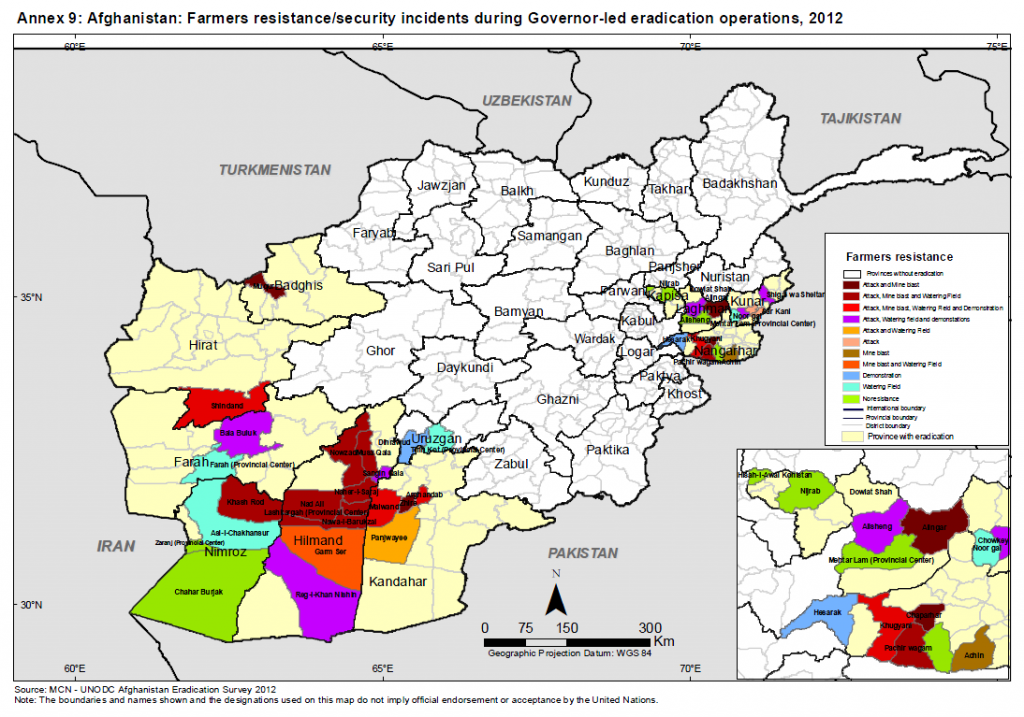
DOWNLOAD THE ORIGINAL DOCUMENT HERE
DOWNLOAD THE ORIGINAL DOCUMENT HERE
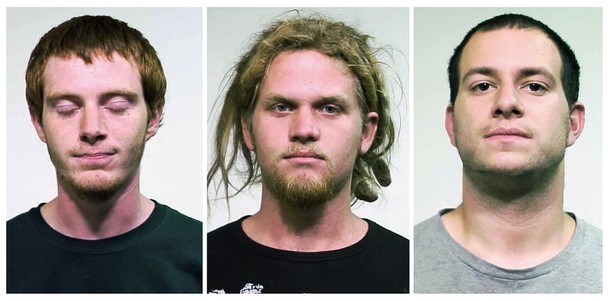
Brian Church (L), 20, Brent Vincent Betterly (C), 24 and Jared Chase, 24, are seen in these handout photos from the Chicago Police department. The three anti-NATO protesters were charged with terrorism last week for an alleged plot that involved the production and use of Molotov cocktails. A lawyer for the men has said that the incendiary materials were planted by undercover agents.
Public Intelligence
Though the United States has been engaged in a Global War on Terror for more than a decade, the U.S. Government surprisingly does not have a standardized definition of terrorism that is agreed upon by all agencies. The State Department, Federal Bureau of Investigation and a number of other government agencies all utilize differing definitions of what constitutes an act of terrorism. This lack of agreement has allowed individual agencies to present different and, in some cases, far more inclusive definitions of terrorist acts enabling the use of expanded investigative procedures that might not be applicable in other agencies.
The FBI utilizes a definition of terrorism based upon the agency’s general functions under 28 CFR § 0.85. Under this regulation an act of terrorism is defined by “the unlawful use of force and violence against persons or property to intimidate or coerce a government, the civilian population, or any segment thereof, in furtherance of political or social objectives.” The USA PATRIOT Act expanded this definition to include domestic acts within the definition of terrorism. Section 802 of the USA PATRIOT Act modified the legal definition of terrorism (18 USC § 2331) to include a category of “domestic terrorism” that is defined by “acts dangerous to human life that are a violation of the criminal laws of the United States or of any State” intended to “intimidate or coerce a civilian population”, “influence the policy of a government by intimidation or coercion” or “affect the conduct of a government by mass destruction, assassination, or kidnapping” that are conducted primarily within the jurisdiction of the U.S. At the time, this expansion of the definition of terrorism was decried by the ACLU as “broad enough to encompass the activities of several prominent activist campaigns and organizations.”
One of the defining features of terrorist acts has always been a component of violence. Even under the expanded definition of terrorism created by the USA PATRIOT Act, there must be an act that is “dangerous to human life” indicating some form of physical harm to others could arise from the action. However, the Homeland Security Act of 2002, which created the Department of Homeland Security, extended the definition of terrorism further by including any act that is “damaging to critical infrastructure or key resources.” Though this definition differs from the legal definition of international and domestic terrorism under 18 USC § 2331, the modified definition is currently used by DHS as the basis for their own activities and intelligence products that are disseminated to federal, state and local law enforcement. The modified definition of terrorism is presented in a revised Domestic Terrorism and Homegrown Violent Extremism Lexicon published last year by DHS:
Any activity that involves an act that is dangerous to human life or potentially destructive to critical infrastructure or key resources, and is a violation of the criminal laws of the United States or of any state or other subdivision of the United States and appears to be intended to intimidate or coerce a civilian population to influence the policy of a government by intimidation or coercion, or to affect the conduct of a government by mass destruction, assassination, or kidnapping.
Notice that the statement “potentially destructive to critical infrastructure or key resources” is part of a disjunction, indicating that the act need not be “dangerous to human life” for it to be considered an act of terrorism. This means that, according to DHS, a non-violent actor could be capable of committing an act of terrorism simply by engaging in “potentially destructive” behavior towards some part of the nation’s critical infrastructure. Due to the fact that large sections of domestic infrastructure, including everything from banks to bridges to milk processing plants, are now considered critical infrastructure, a wide range of “potentially destructive” actions could be investigated by DHS or any one of the dozens of fusion centers around the country as potential acts of terrorism. The DHS Domestic Terrorism Lexicon states that the definitions presented in the document are designed to “assist federal, state, and local government officials with the mission to detect, identify, and understand threats of terrorism against the United States by facilitating a common understanding of the terms and definitions that describe terrorist threats to the United States.”
A recent report from the Congressional Research Service states that this ambiguity in the definition of terrorism can create confusion “in the investigative process regarding exactly when criminal activity becomes domestic terrorism.” The report also notes that the government often uses the terms “extremist” and “terrorist” interchangeably creating further ambiguity as to what exactly constitutes an act of terrorism. A 2009 study from Syracuse University found that U.S. Federal District Courts, the Department of Justice’s National Security Division and federal prosecutors all rely on different criteria to determine whether or not specific cases involve terrorist acts. This lack of agreement has led to widespread failures to obtain prosecutions of suspects recommended for charges by investigative agencies. In fact, the study found that from 2004-2009 “assistant United States attorneys all over the country declined to bring any charges against two out of every three (67%) of the thousands of terrorism matters that the investigative agencies had recommended for criminal prosecution.” The Syracuse study ends with a warning about the ambiguity surrounding the definition of terrorism:
The strong evidence that various parts of the government do not share a common understanding about terrorism has important consequences for all Americans. Those most immediately affected are the thousands of people whom the investigative agencies each year incorrectly recommend for prosecution in federal court. But to the extent that the investigators systematically waste their time targeting the wrong suspects, the chances increase that they will fail to identify the real terrorists who right now may be seeking to plant bombs, spread poisons or otherwise harm a much larger number of innocent people.
To solve these problems the study offers a surprisingly straightforward solution: come up with “a clear and understandable definition of terrorism.”
DOWNLOAD THE ORGINAL DOCUMENT HERE
Lord Ashdown, a former special forces commando, tells the story of the ‘Cockleshell Heroes’, who led one of the most daring and audacious commando raids of World War II.
In 1942, Britain was struggling to fight back against Nazi Germany. Lacking the resources for a second front, Churchill encouraged innovative and daring new methods of combat. Enter stage left, Blondie Hasler.
With a unit of twelve Royal Marine commandos, Major Blondie Hasler believed his ‘cockleshell’ canoe could be effectively used in clandestine attacks on the enemy. Their brief was to navigate the most heavily defended estuary in Europe, to dodge searchlights, machine-gun posts and armed river-patrol craft 70 miles downriver, and then to blow up enemy shipping in Bordeaux harbour.
Lord Ashdown recreates parts of the raid and explains how this experience was used in preparing for one of the greatest land invasions in history, D-day.
Rise And Fall Of The Third Reich
Escape from Sobibor tells the story of the Jews who could escape from the most secret camp of the German during WW II: Sobibor
DOWNLOAD THE ORGINAL DOCUMENT HERE

The following study was commissioned by World Business Chicago, the parent organization of the group hosting the upcoming NATO Summit. The study estimates an injection of $128 million into the local economy of Chicago as a result of the summit. Economists have questioned the accuracy of these numbers, which do not take into account a number of factors including potential damage to the city as well as widespread business closures in and around downtown Chicago.
On May 20-21, 2012, Chicago will host the 25th North Atlantic Treaty Organization (NATO) Summit – the first NATO Summit in the U.S. held outside of Washington, DC. Delegations from 28 NATO Member Countries, 24 International Security Assistance Force (ISAF) Partner Countries, and six other nations and international organizations will participate in the Summit. The Summit will bring economic benefits in the form of spending, tax revenues, employment, hotel guests, tourism, and broader global attention. Over 7,500 delegates and 7,300 staff, press, and other dignitaries are expected to attend the Summit. In addition, planning for the Summit prompted visits and spending by delegations during advance trips to Chicago. Building on the momentum of the Summit, many Chicago organizations have planned events that will generate additional economic impacts for the City. These ancillary events are expected to draw thousands of additional speakers, staff, attendees, and members of the media.
The scope of this analysis is limited to the City of Chicago proper, and all impacts described refer to the City and not to the larger Cook County, Chicago Metropolitan Statistical Area, or the State of Illinois.
Summary:
- The Summit and its planning phases will inject an estimated $123.0 million into the City of Chicago economy; the City will receive over 18,300 Summit attendees and staff, contributing more than 44,000 room nights.
- Ancillary events will add an estimated $5.2 million, 2,900 additional out-of-town visitors, and more than 5,300 room nights to the City of Chicago economy.
- The City will accrue an additional $3.0 million in fiscal impacts through tax receipts. This does not include any State or County taxes.
- In total, the Summit will result in an estimated $128.2 million in total impacts to the City of Chicago, $3.0 million in local tax revenues, over 21,200 visitors, 49,300 hotel nights, and close to 2,200 temporary jobs in the City of Chicago. These impacts are summarized in Figure 1 above.
In addition to the quantitative impacts described in this report, Chicago is likely to experience other, less tangible effects from the Summit. These include immediate and long term international attention, reinforcement of Chicago’s brand as a world class city, and elevation of Chicago’s role as host for future global events. At an international event of this scale, protests or other unscheduled disruptions may also occur, which could result in mixed media attention; however, the value of exposure is difficult to estimate reliably and was not within the scope of this analysis.
DOWNLOAD THE ORIGINAL DOCUMENT HERE
|
|
![[Image]](https://i0.wp.com/cryptome.org/2012-info/drone-crew/pict110.jpg) US Air Force (USAF) maintenance personnel assigned to the 12th Expeditionary Reconnaissance Squadron (ERS), check the maintenance log for a RQ-4A Global Hawk high-altitude, long-endurance unmanned aerial reconnaissance system while preparing for a mission at a forward location, while deployed in support of Operation ENDURING FREEDOM. Pictured left-to-right, USAF (Major) Greg Hataway, Staff Sergeant (SSGT) Kelvin Rasor, and MAJ John D’ortona. Photographer’s Name: SSGT Reynaldo Ramon, USAF. Date Shot: 6/30/2002 US Air Force (USAF) maintenance personnel assigned to the 12th Expeditionary Reconnaissance Squadron (ERS), check the maintenance log for a RQ-4A Global Hawk high-altitude, long-endurance unmanned aerial reconnaissance system while preparing for a mission at a forward location, while deployed in support of Operation ENDURING FREEDOM. Pictured left-to-right, USAF (Major) Greg Hataway, Staff Sergeant (SSGT) Kelvin Rasor, and MAJ John D’ortona. Photographer’s Name: SSGT Reynaldo Ramon, USAF. Date Shot: 6/30/2002 |
![[Image]](https://i0.wp.com/cryptome.org/2012-info/drone-crew/pict107.jpg) Chuck Gardner, systems engineer(front), and Patrick Didier, senior crew technician, both from Northrop Grumman Ryan Aeronautical Center, check the systems on a Global Hawk unmanned aerial vehicle after its arrival at Langley Air Force Base, Va., June 21, 2001. The aircraft flew non-stop from Edwards Air Force, California in support of the Supreme Allied Commander, Atlantic (SACLANT) Seminar taking place at Langley. (Photo by TSgt Jack Braden) (Released). Date Shot: 6/21/2001 Chuck Gardner, systems engineer(front), and Patrick Didier, senior crew technician, both from Northrop Grumman Ryan Aeronautical Center, check the systems on a Global Hawk unmanned aerial vehicle after its arrival at Langley Air Force Base, Va., June 21, 2001. The aircraft flew non-stop from Edwards Air Force, California in support of the Supreme Allied Commander, Atlantic (SACLANT) Seminar taking place at Langley. (Photo by TSgt Jack Braden) (Released). Date Shot: 6/21/2001 |
![[Image]](https://i0.wp.com/cryptome.org/2012-info/drone-crew/pict106.jpg) Sitting at the controls, Maj. George Barth, a pilot from the 31st Test and Evaluation Squadron, Edwards Air Force Base, Calif., flies the Global Hawk May 14, 2001, from inside the Mission Control Element, at Edinburgh Air Force Base, Australia, in support of Exercise Tandem Thrust. The Global Hawk is a jet powered Unmanned Aerial Vehicle (UAV) designed as a Reconnaissance and Surveillance vehicle with a wing span equal to a Boeing 737, flying at altitudes of up to 65,000 feet for more than 24 hours and capable of searching an area of more than 40,000 square miles. The Global Hawk is deployed to Australia from April to June 2001, flying more than a dozen missions. These missions will include sorties in support of Tandem Thrust as well as maritime, littoral, land surveillance and stand off reconnaissance capabilities. The Global Hawk completed its first successful maiden flight in February 1998. Currently there are five U.S. Air Force Global Hawks which have logged over 60 flights and have clocked more than 600 hours, with it’s biggest challenge to date the non-stop Trans-Pacific flight from Edwards to Edinburgh. Tandem Thrust 2001 is a combined U.S., Australian and Canadian military training exercise. This biannual exercise is being held in the vicinity of Shoalwater Bay training area, Queensland, More than 27,000 soldiers, sailors, airmen and marines are participating, with Canadian units taking part as opposing forces. The purpose of Exercise Tandem Thrust is to train for crisis action planningand execution of contingency response operations. (U.S. Air Force photo by Staff Sgt. Jeremy T. Lock) (Released). Date Shot: 5/14/2001 Sitting at the controls, Maj. George Barth, a pilot from the 31st Test and Evaluation Squadron, Edwards Air Force Base, Calif., flies the Global Hawk May 14, 2001, from inside the Mission Control Element, at Edinburgh Air Force Base, Australia, in support of Exercise Tandem Thrust. The Global Hawk is a jet powered Unmanned Aerial Vehicle (UAV) designed as a Reconnaissance and Surveillance vehicle with a wing span equal to a Boeing 737, flying at altitudes of up to 65,000 feet for more than 24 hours and capable of searching an area of more than 40,000 square miles. The Global Hawk is deployed to Australia from April to June 2001, flying more than a dozen missions. These missions will include sorties in support of Tandem Thrust as well as maritime, littoral, land surveillance and stand off reconnaissance capabilities. The Global Hawk completed its first successful maiden flight in February 1998. Currently there are five U.S. Air Force Global Hawks which have logged over 60 flights and have clocked more than 600 hours, with it’s biggest challenge to date the non-stop Trans-Pacific flight from Edwards to Edinburgh. Tandem Thrust 2001 is a combined U.S., Australian and Canadian military training exercise. This biannual exercise is being held in the vicinity of Shoalwater Bay training area, Queensland, More than 27,000 soldiers, sailors, airmen and marines are participating, with Canadian units taking part as opposing forces. The purpose of Exercise Tandem Thrust is to train for crisis action planningand execution of contingency response operations. (U.S. Air Force photo by Staff Sgt. Jeremy T. Lock) (Released). Date Shot: 5/14/2001 |
![[Image]](https://i0.wp.com/cryptome.org/2012-info/drone-crew/pict105.jpg) Portrait of Systems Test Engineer Chuck Gardner, (left), and Avionics Technician Brent Bremer, from Northrop Grumman Edwards Air Force Base, California, as they pre-flight the RQ-4A Global Hawk at RAAF Base Edinburgh, Adelaide, Australia, in support of Exercise TANDEM THRUST 01. Able to cover more than 40,000 square miles, the jet powered Unmanned Aerial Vehicle (UAV) RQ-4A Global Hawk has a wing span of 116 feet, equal to a Boeing 737, able to fly up to 65,000 feet and loiter for more than 24 hours. The Global Hawk deployed to Australia from April to June 2001, flying more than a dozen missions. This Global Hawk completed its biggest challenge to date the non-stop Trans-Pacific flight from Edwards to Edinburgh to support TANDEM THRUST 01. TANDEM THRUST 2001 a combined US, Australian, and Canadian military exercise for crisis action planning and execution of contingency response operations. The biannual exercise is held in the vicinity of Shoalwater Bay training area in Queensland, Australia. Photographer’s Name: SSGT JEREMY LOCK, USAF. Date Shot: 5/13/2001 Portrait of Systems Test Engineer Chuck Gardner, (left), and Avionics Technician Brent Bremer, from Northrop Grumman Edwards Air Force Base, California, as they pre-flight the RQ-4A Global Hawk at RAAF Base Edinburgh, Adelaide, Australia, in support of Exercise TANDEM THRUST 01. Able to cover more than 40,000 square miles, the jet powered Unmanned Aerial Vehicle (UAV) RQ-4A Global Hawk has a wing span of 116 feet, equal to a Boeing 737, able to fly up to 65,000 feet and loiter for more than 24 hours. The Global Hawk deployed to Australia from April to June 2001, flying more than a dozen missions. This Global Hawk completed its biggest challenge to date the non-stop Trans-Pacific flight from Edwards to Edinburgh to support TANDEM THRUST 01. TANDEM THRUST 2001 a combined US, Australian, and Canadian military exercise for crisis action planning and execution of contingency response operations. The biannual exercise is held in the vicinity of Shoalwater Bay training area in Queensland, Australia. Photographer’s Name: SSGT JEREMY LOCK, USAF. Date Shot: 5/13/2001 |
|
Adolf Eichmann was a German Nazi and SS-Obersturmbannführer (Lieutenant Colonel) and one of the major organizers of the Holocaust. Because of his organizational talents and ideological reliability, Eichmann was charged by Obergruppenführer (General) Reinhard Heydrich with the task of facilitating and managing the logistics of mass deportation of Jews to ghettos and extermination camps in German-occupied Eastern Europe.
Read the rest at Wikipedia http://en.wikipedia.org/wiki/Adolf_Eichmann
Conspiracy “Wansee Conference” of January 1942 was the real beginning of the Holocaust In the sublime surroundings of a German country house, the assembled mingle for drinks, enjoy a first class buffet lunch and debate whether execution or sterilisation is the most efficient option of eliminating an entire race of people.
Is about the bureacratic genesis of the Holocaust. It shows, in more or less real time, a fictionalized version of a real-life conference of 15 officials from the SS/SD, Gestapo, Railway Ministry, Interior Ministry, Government General, and Ministry of Justice, which was chaired by Reinhard Heydrich and organized by Adolf Eichmann.
As a movie, however, it is really a study in the essential amorality of bureacracy and, to use a tired phrase, the banality of evil.
Credit must be given to Kenneth Branagh who propels the entire piece with one of the best portrayals on screen in memory. He is utterly convincing in the role of a man who epitomises the classic definition of evil: not just the doing of wrong, but the perversion of the human spirit so that it no longer has any perception of the good.
http://en.wikipedia.org/wiki/Kenneth_Branagh
http://en.wikipedia.org/wiki/Stanley_Tucci
http://en.wikipedia.org/wiki/Colin_Firth
http://www.imdb.com/title/tt0266425/
http://en.wikipedia.org/wiki/Conspiracy_(2001_film)
http://en.wikipedia.org/wiki/Nazi
http://en.wikipedia.org/wiki/Holocaust
http://en.wikipedia.org/wiki/BBC
http://en.wikipedia.org/wiki/HBO_Films
|
|
|
Official uncut theatrical version of Gene Fallaize’s ‘Superman: Requiem’ fan film, starring Martin Richardson, Stacy Sobieski, Paul Khanna, Serena Lorien, and Jack O’Halloran.
Superman is the world’s greatest super hero, and law enforcement across the globe has come to rely on him to deal with some of the major tasks that face society. When the Man of Steel loses some of his powers after an evil villain attacks him with Kryptonite though, he must overcome his obstacles and prove he really is a super man.
Superman: Requiem is a high-value fan-film that depicts the life of Superman several years after the events of Superman Returns, and takes into account the events of Superman (1978), Superman II (1980) and Superman Returns (2006), and focuses on an event by an evil villain who attempts to make Superman lose his powers.
The film was conceived in 2011 by producer Gene Fallaize who decided to he was going to make an independent Superman fan-film, and wrote the first draft of the script in less than a week. Fallaize brought Tony Cook on board to co-produce the project to allow him the freedom and time to direct the project.
The film was released globally online on 11.11.11 after a red carpet World Premiere in London’s Odeon Covent Garden.
For more information visit http://www.themanofsteelisback.com or facebook.com/supermanrequiem
The following document is an updated version of a 2009 “Domestic Extremism Lexicon” produced by the Department of Homeland Security’s Office of Intelligence and Analysis. The list of terms has been substantially reduced and does not include a number of controversial terms from the first version, such as “alternative media” and “direct action.” This version was obtained and published by a blogger associated with PJ Media.

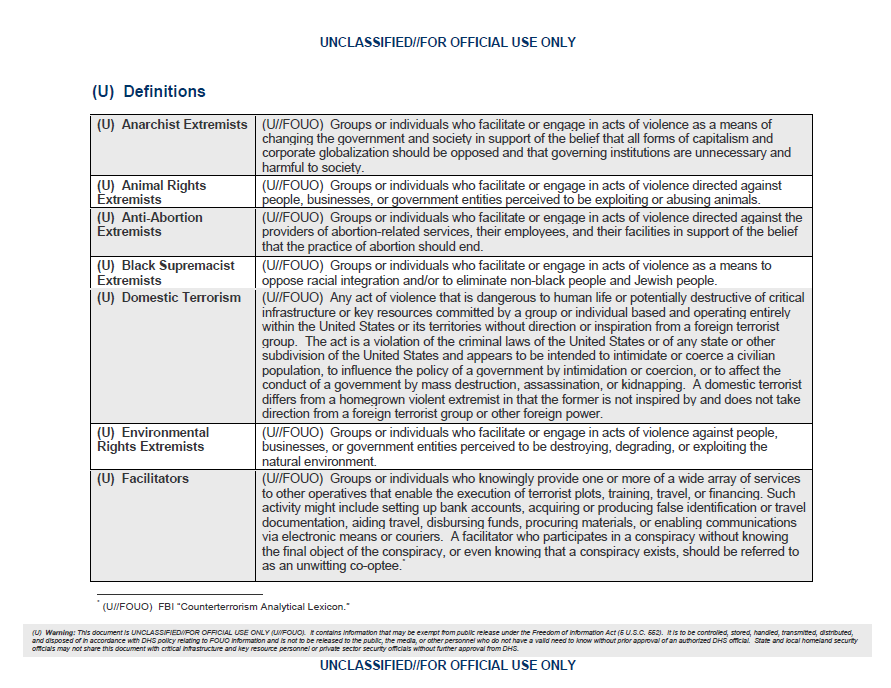
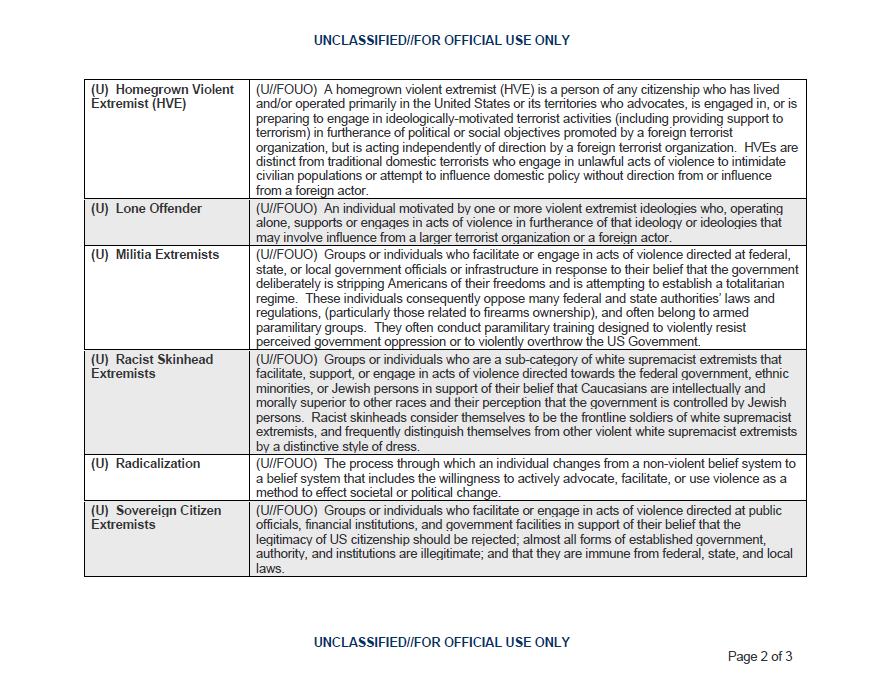
When bitten by a genetically modified spider, a nerdy, shy, and awkward high school student gains spider-like abilities that he eventually must use to fight evil as a superhero after tragedy befalls his family.
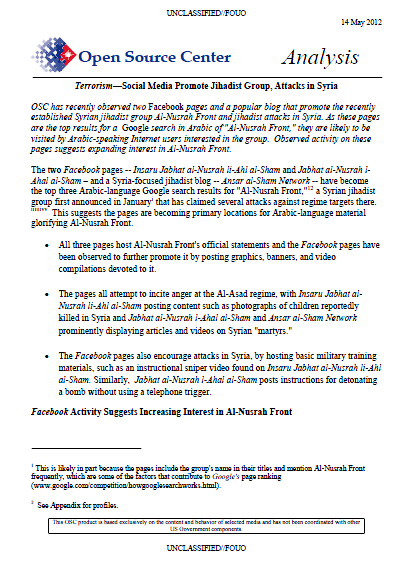
OSC has recently observed two Facebook pages and a popular blog that promote the recently established Syrian jihadist group Al-Nusrah Front and jihadist attacks in Syria. As these pages are the top results for a Google search in Arabic of “Al-Nusrah Front,” they are likely to be visited by Arabic-speaking Internet users interested in the group. Observed activity on these pages suggests expanding interest in Al-Nusrah Front.
The two Facebook pages — Insaru Jabhat al-Nusrah li-Ahl al-Sham and Jabhat al-Nusrah l-Ahal al-Sham – and a Syria-focused jihadist blog — Ansar al-Sham Network — have become the top three Arabic-language Google search results for “Al-Nusrah Front,” a Syrian jihadist group first announced in Januaryi that has claimed several attacks against regime targets there. This suggests the pages are becoming primary locations for Arabic-language materialglorifying Al-Nusrah Front.
- All three pages host Al-Nusrah Front’s official statements and the Facebook pages have been observed to further promote it by posting graphics, banners, and video compilations devoted to it.
- The pages all attempt to incite anger at the Al-Asad regime, with Insaru Jabhat al-Nusrah li-Ahl al-Sham posting content such as photographs of children reportedly killed in Syria and Jabhat al-Nusrah l-Ahal al-Sham and Ansar al-Sham Network prominently displaying articles and videos on Syrian “martyrs.”
- The Facebook pages also encourage attacks in Syria, by hosting basic military training materials, such as an instructional sniper video found on Insaru Jabhat al-Nusrah li-Ahl al-Sham. Similarly, Jabhat al-Nusrah l-Ahal al-Sham posts instructions for detonating a bomb without using a telephone trigger.
Facebook Activity Suggests Increasing Interest in Al-Nusrah Front
Although, thus far, users have indicated approval of the Facebook pages — by clicking the “like” buttons — relatively few times, the trend is increasing, suggesting heightened interest in Al-Nusrah Front. Statistics on readership of the pages are not available.
- As of 2 May, Insaru Jabhat al-Nusrah li-Ahl al-Sham readers have clicked “like” 481 times, and Jabhat al-Nusrah l-Ahal al-Sham users have done so 344 times.
- However, marking a substantial increase, during the week ending on 27 April, Insaru Jabhat al-Nusrah li-Ahl al-Sham received 143 “likes,” with 202 “people talking about” it. In contrast, during the week ending on 30 March –the earliest period for which data is available – the page received only 47 “likes,” with 60 users “talking about it.”
- Jabhat al-Nusrah l-Ahal al-Sham has experienced similar growth in activity. During the week ending on 27 April, it received 57 “likes” with 48 “people talking about” it, up substantially from 25 “likes” and 25 “people talking about it” in the week ending on 30 March.
The blog Ansar al-Sham Network reported between 33,000 and 78,000 views between 27 April and 5 May. Although it is not clear how the site calculates traffic, it appears to count visits on a daily, rather than cumulative basis. This high viewership offers further evidence of online interest in Al-Nusrah Front.
A strange black entity from another world bonds with Peter Parker and causes inner turmoil as he contends with new villains, temptations, and revenge.
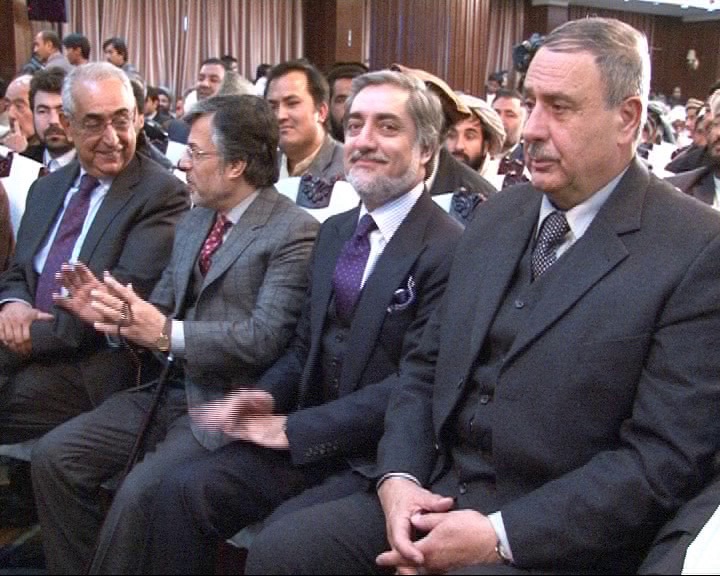
Dr. Abdullah Abdullah, center, head of the National Coalition of Afghanistan (NCA). Prominent members of the NCA and other rival parties have stated that they believe Afghan President Hamid Karzai is strengthening the Taliban in an effort to bolster his own power. Photo via Ariana News.
Public Intelligence
A recent report from the Director of National Intelligence’s Open Source Center (OSC) indicates that opposition parties increasingly believe that Afghan President Hamid Karzai is strengthening the Taliban in an effort to bolster his own political power. The report also assesses that members of Karzai’s camp may be willing to work with militant forces to prevent rival political parties from gaining influence.
Prominent members of two major opposition parties, the National Coalition of Afghanistan (NCA) and the National Front of Afghanistan (NFA), have expressed concern about Karzai’s connection with Taliban militants. At a meeting of the NFA leadership in Kabul in early April, former Vice President Ahmad Zia Massoud warned that the government is “working toward strengthening the terrorist groups” and that this being facilitated by “senior government leaders” who are “trying to facilitate the penetration of the Taliban into the security forces.”
A prominent member of the NCA former parliament speaker Mohmmad Yunos Qanuni recently stated in an interview with a Afghan news outlet that “Karzai’s thoughts are more inclined toward the Taliban than our lot [anti-Taliban forces],” adding that “individuals with pro-Taliban orientations have more of an impact on the president’s mind.” Qanuni made similar claims in an address to the youth wing of the NCA in April, warning that in an effort to perpetuate their rule, the government leadership is trying to “facilitate the return of terrorism and the Taliban.”
The author of the OSC report assesses that the “Afghan Government’s backing of the Taliban’s opening of an office in Qatar and the Afghan ambassador to Pakistan’s suggestive remarks, in a 3 April interview with UK’s Guardian newspaper, that negotiations would lead to the Taliban’s participation in presidential elections suggests that at least some in Karzai’s camp may be willing to court the militants to countervail the anti-Taliban forces’ influence.” The report also states that a merger between the NCA and NFA is likely before the 2014 elections, creating “two political, and possibly even militarized, rival clusters” that could have negative effects on the future stability of Afghanistan.
A long-time Seattle financial advisor was indicted today by a federal grand jury with 23 criminal counts, including wire fraud, money laundering and investment advisor fraud, announced U.S. Attorney Jenny A. Durkan. Mark F. Spangler, 57, of Seattle is accused of diverting investor money from accounts he managed to risky start-up ventures in which he or his investment firm had an ownership interest. Spangler allegedly diverted more than $46 million to two companies, one of which is now shut down after failing to generate any positive revenue. Those who invested in the funds managed by Spangler, as part of The Spangler Group Inc.(TSG), were not told that their money was being invested in risky start-up companies. Spangler and several of his companies went into receivership last year. Today, the Securities and Exchange Commission filed a civil suit against Spangler as well. Spangler is scheduled to appear in U.S. District Court in Seattle on May 18, 2012 at 2:30.
“The Department of Justice is making the prosecution of financial fraud a top priority,” said U.S. Attorney Durkan. “These investors lost millions to a man they trusted to safeguard their resources. We are working closely with the SEC to ensure Mr. Spangler is held accountable for his fraud.”
The six investors described in the indictment were told their funds were conservatively invested in publicly traded companies and in bonds. Spangler allegedly provided them misleading statements over time, falsely describing the value of their accounts and how the money was invested. When investors sought to liquidate their holdings, Spangler was unable to provide them any funds, because the money had been funneled to the high risk start-up ventures that were not profitable.
According to the indictment, Spangler established a variety of funds as early as 1998 to pool investor money to buy publicly traded stocks and bonds. Spangler co-founded the two startup companies in the early 2000s—Tamarac Inc. in 2000 and TeraHop Networks Inc. in 2002. Tamarac Inc. is headquartered in Seattle and provides software to financial planners. TeraHop Networks Inc. is headquartered in Georgia and manufactured wireless devices used to monitor the location and activity of people and physical assets such as construction equipment. TeraHop has ceased operation. Spangler not only failed to disclose to his investors that he was diverting significant amounts of their funds to TeraHop and Tamarac, but he also failed to disclose that he was involved in the management of these companies, had an ownership interest in Tamarac, and was receiving payments from both companies. The indictment contains an order of forfeiture, which will be used to try to recover assets for the investors.
The case is being investigated by the FBI and Internal Revenue Service Criminal Investigation (IRS-CI).
The case is being prosecuted by Assistant United States Attorneys Mike Lang and Carl Blackstone.
For additional information please contact Emily Langlie, Public Affairs Officer for the United States Attorney’s Office, at (206) 553-4110 or Emily.Langlie@USDOJ.Gov.
A sends:
Chicago NATO links
Thursday, May 17, 2012
Chicago NATO Command and Communications Operations Update – with Photos
[N139HS ModeS:A09D60 , N242A ModeS:A2376D , N3935A ModeS:A490F6]
http://shortwaveamerica.blogspot.com/2012/05/chicago-nato-command-and-communications.html
Thursday, May 17, 2012
NATO Communications Monitoring Guide and LIVE COVERAGE
http://shortwaveamerica.blogspot.com/2012/05/nato-communications-monitoring-guide.html
Sunday, May 13, 2012
Chicago NATO Summit
http://mt-fedfiles.blogspot.com/2012/05/chicago-nato-summit.html
RadioReference Thread: Up-Coming NATO Communications
Local Chicago Scanner YahooGroup. (Many posts on NATO stuff & Links)
http://groups.yahoo.com/group/carmachicago/
http://groups.yahoo.com/group/carmachicago/messages
State of Illinois Radio Reference – Live Audio
http://www.radioreference.com/apps/audio/?stid=17
Radioman911.com now in NATO mode (Scanner Radio Feed)
http://www.justin.tv/radioman911
Ship/Boat with AIS transponders for Chicago water area.
http://www.marinetraffic.com/ais/
NATO Communications Center A Suburban Secret
http://chicago.cbslocal.com/2012/05/17/nato-communications-center-is-a-suburban-secret/
Despite past denials by Tehrik-e-Taliban Pakistan (TTP) leaders that the group intends to target Pakistan’s nuclear weapons, TTP Mohmand Agency leader Omar Khalid said in a 21 March video that the TTP aims to use Pakistan’s nuclear technology, among other assets, to ensure Islam’s survival. This is the first time that OSC has observed a TTP leader publicly list Pakistan’s nuclear weapons among its goals. Other elements of Khalid’s statement suggest that he may be seeking to boost his own stature within the group.
In a 21 March Pashto-language video statement posted to pro-Al-Qa’ida, pro-TTP website Babul-Islam, Khalid listed, among several other ostensibly far-fetched goals, the TTP’s aim to “utilize Pakistan’s strengths such as its Army, weapons, atom bomb, technology, and other power[s] for the betterment of the Muslim ummah [community] and Islam’s survival.”
- A commentary in influential daily The News described Khalid as Al-Qa’ida’s “henchman” and argued that his announcement was part of Al-Qa’ida’s “game plan” (8 April). By contrast, in the past, TTP leaders denied any intent to seize or otherwise utilize Pakistan’s nuclear weapons. Since 21 March, OSC has seen no public statements by other top TTP figures indicating whether they endorse Khalid’s remarks.
- In an interview with The Wall Street Journal in May 2011, approximately 10 months before the release of Khalid’s statement, TTP’s main spokesman Ehsanullah Ehsan — who speaks for the group’s Waziristan-based top leaders — was cited as saying that the TTP has “no plan whatsoever to attack Pakistan’s nuclear assets” (Jinnah, 27 May 2011).
- Similarly, now deceased TTP chief Baitullah Mehsud in a 2008 Al-Jazirah Television interview, said that the TTP is “not thinking of using a nuclear bomb” because, he said, it leads to killing innocent women and children, which is forbidden in Islam. He did say, however, that “we pray to God to help Muslims seize all nuclear bombs from the infidels” (25 January 2008).
- Khalid may be trying to boost his own standing in the TTP. In the 21 March statement, he outlined TTP history, portraying his role in its formation as key. He also touted his fighters as “fully organized, united, and strong,” saying they no longer need help from Waziristan.
Previous Khalid Statements Omar Khalid appeared to play a prominent role in the TTP’s 2011 propaganda campaign, appearing in several videos — one of which also depicted Hakimullah Mehsud — and creating his own magazine. In his past statements, Khalid has threatened revenge for the attacks on Usama Bin Ladin, claimed responsibility for an attack in Peshawar using a female suicide bomber, and rejected peace talks with the government.
DOWNLOAD THE ORIGINAL DOCUMENT HERE
NEW HAVEN, CT—Daniel J. Lyons Jr., 54, of Westport, Connecticut, waived his right to indictment and pleaded guilty today before U.S. Magistrate Judge Donna F. Martinez in Hartford, Connecticut to one count of bank fraud related to his defrauding Citizens Bank out of nearly $7 million, announced David B. Fein, U.S. Attorney for the District of Connecticut.
According to court documents and statements made in court, Lyons was the president and chief executive officer of an importing and exporting business known as Greenwich Trading Company GTC Worldwide Inc. or Greenwich Brands LLC (GTC). In February 2007, Lyons applied to Citizens Bank N.A. for a commercial revolving line of credit (RELOC), to be secured by the business’s accounts receivable, in the maximum amount of $7 million. However, Lyons falsified audit reports and other information when he applied to the bank for the RELOC, and again each time he withdrew additional funds from the line of credit.
As part of the scheme, Lyons submitted monthly borrowing base certificates (BBCs) to the bank to draw down additional funds from the RELOC. The BBCs were materially false in that they overstated the outstanding accounts receivable in order to satisfy the bank’s eligibility formula for additional loan disbursements. Between April 2007 and November 2008, Lyons regularly reported to the bank that GTC had between approximately $7.3 million and $9.2 million in accounts receivable.
By November 2008, Lyons had caused GTC to draw down the entire $7 million RELOC loan availability from the bank.
In February 2009, GTC filed a voluntary Chapter 7 bankruptcy petition with the U.S. Bankruptcy Court for the District of Connecticut. In the bankruptcy schedules, GTC’s accounts receivable were valued by Lyons at approximately $380,000.
Lyons is scheduled to be sentenced by U.S. District Judge Robert N. Chatigny on August 10, 2012 at which time Lyons faces a maximum term of 30 years in prison.
This matter is being investigated by the FBI. The case is being prosecuted by Assistant U.S. Attorney Ann M. Nevins.
This case was brought in coordination with the President’s Financial Fraud Enforcement Task Force, which was established to wage an aggressive and coordinated effort to investigate and prosecute financial crimes. The task force includes representatives from a broad range of federal agencies, regulatory authorities, inspectors general, and state and local law enforcement who, working together, bring to bear a powerful array of criminal and civil enforcement resources. The task force is working to improve efforts across the federal executive branch and, with state and local partners, to investigate and prosecute significant financial crimes, ensure just and effective punishment for those who perpetrate financial crimes, combat discrimination in the lending and financial markets, and recover proceeds for victims of financial crimes.
To report financial fraud crimes, and to learn more about the President’s Financial Fraud Enforcement Task Force, please visit http://www.StopFraud.gov.

(U) The Healthcare and Public Health (HPH) sector is a multi-trillion dollar industry employing over 13 million personnel, including approximately five million first-responders with at least some emergency medical training, three million registered nurses, and more than 800,000 physicians.
(U) A significant portion of products used in patient care and management including diagnosis and treatment are Medical Devices (MD). These MDs are designed to monitor changes to a patient’s health and may be implanted or external. The Food and Drug Administration (FDA) regulates devices from design to sale and some aspects of the relationship between manufacturers and the MDs after sale. However, the FDA cannot regulate MD use or users, which includes how they are linked to or configured within networks. Typically, modern MDs are not designed to be accessed remotely; instead they are intended to be networked at their point of use. However, the flexibility and scalability of wireless networking makes wireless access a convenient option for organizations deploying MDs within their facilities. This robust sector has led the way with medical based technology options for both patient care and data handling.
(U) The expanded use of wireless technology on the enterprise network of medical facilities and the wireless utilization of MDs opens up both new opportunities and new vulnerabilities to patients and medical facilities. Since wireless MDs are now connected to Medical information technology (IT) networks, IT networks are now remotely accessible through the MD. This may be a desirable development, but the communications security of MDs to protect against theft of medical information and malicious intrusion is now becoming a major concern. In addition, many HPH organizations are leveraging mobile technologies to enhance operations. The storage capacity, fast computing speeds, ease of use, and portability render mobile devices an optimal solution.
(U) This Bulletin highlights how the portability and remote connectivity of MDs introduce additional risk into Medical IT networks and failure to implement a robust security program will impact the organization’s ability to protect patients and their medical information from intentional and unintentional loss or damage.
…
(U) According to Health and Human Services (HHS), a major concern to the Healthcare and Public Health (HPH) Sector is exploitation of potential vulnerabilities of medical devices on Medical IT networks (public, private and domestic). These vulnerabilities may result in possible risks to patient safety and theft or loss of medical information due to the inadequate incorporation of IT products, patient management products and medical devices onto Medical IT Networks. Misconfigured networks or poor security practices may increase the risk of compromised medical devices. HHS states there are four factors which further complicate security resilience within a medical organization.
1. (U) There are legacy medical devices deployed prior to enactment of the Medical Device Law in 1976, that are still in use today.
2. (U) Many newer devices have undergone rigorous FDA testing procedures and come equipped with design features which facilitate their safe incorporation onto Medical IT networks. However, these secure design features may not be implemented during the deployment phase due to complexity of the technology or the lack of knowledge about the capabilities. Because the technology is so new, there may not be an authoritative understanding of how to properly secure it, leaving open the possibilities for exploitation through zero-day vulnerabilities or insecure deployment configurations. In addition, new or robust features, such as custom applications, may also mean an increased amount of third party code development which may create vulnerabilities, if not evaluated properly. Prior to enactment of the law, the FDA required minimal testing before placing on the market. It is challenging to localize and mitigate threats within this group of legacy equipment.
3. (U) In an era of budgetary restraints, healthcare facilities frequently prioritize more traditional programs and operational considerations over network security.
4. (U) Because these medical devices may contain sensitive or privacy information, system owners may be reluctant to allow manufactures access for upgrades or updates. Failure to install updates lays a foundation for increasingly ineffective threat mitigation as time passes.
…
(U) Implantable Medical Devices (IMD): Some medical computing devices are designed to be implanted within the body to collect, store, analyze and then act on large amounts of information. These IMDs have incorporated network communications capabilities to increase their usefulness. Legacy implanted medical devices still in use today were manufactured when security was not yet a priority. Some of these devices have older proprietary operating systems that are not vulnerable to common malware and so are not supported by newer antivirus software. However, many are vulnerable to cyber attacks by a malicious actor who can take advantage of routine software update capabilities to gain access and, thereafter, manipulate the implant.
(U) During an August 2011 Black Hat conference, a security researcher demonstrated how an outside actor can shut off or alter the settings of an insulin pump without the user’s knowledge. The demonstration was given to show the audience that the pump’s cyber vulnerabilities could lead to severe consequences. The researcher that provided the demonstration is a diabetic and personally aware of the implications of this activity. The researcher also found that a malicious actor can eavesdrop on a continuous glucose monitor’s (CGM) transmission by using an oscilloscope, but device settings could not be reprogrammed. The researcher acknowledged that he was not able to completely assume remote control or modify the programming of the CGM, but he was able to disrupt and jam the device.
DOWNLOAD THE ORIGINAL REPOERT HERE
Rambo heads into the rainforest on a mission to save the survived people of an village that has been attacked by the army.
Dear Readers,
we have established a new plattform for independent info exchange worldwide.
Details coming soon
Sincerely yours
Bernd Pulch,
Publisher, MBA, Magister Publizistik, Germanistik, Komparatistik
(U) The Healthcare and Public Health (HPH) sector is a multi-trillion dollar industry employing over 13 million personnel, including approximately five million first-responders with at least some emergency medical training, three million registered nurses, and more than 800,000 physicians.
(U) A significant portion of products used in patient care and management including diagnosis and treatment are Medical Devices (MD). These MDs are designed to monitor changes to a patient’s health and may be implanted or external. The Food and Drug Administration (FDA) regulates devices from design to sale and some aspects of the relationship between manufacturers and the MDs after sale. However, the FDA cannot regulate MD use or users, which includes how they are linked to or configured within networks. Typically, modern MDs are not designed to be accessed remotely; instead they are intended to be networked at their point of use. However, the flexibility and scalability of wireless networking makes wireless access a convenient option for organizations deploying MDs within their facilities. This robust sector has led the way with medical based technology options for both patient care and data handling.
(U) The expanded use of wireless technology on the enterprise network of medical facilities and the wireless utilization of MDs opens up both new opportunities and new vulnerabilities to patients and medical facilities. Since wireless MDs are now connected to Medical information technology (IT) networks, IT networks are now remotely accessible through the MD. This may be a desirable development, but the communications security of MDs to protect against theft of medical information and malicious intrusion is now becoming a major concern. In addition, many HPH organizations are leveraging mobile technologies to enhance operations. The storage capacity, fast computing speeds, ease of use, and portability render mobile devices an optimal solution.
(U) This Bulletin highlights how the portability and remote connectivity of MDs introduce additional risk into Medical IT networks and failure to implement a robust security program will impact the organization’s ability to protect patients and their medical information from intentional and unintentional loss or damage.
…
(U) According to Health and Human Services (HHS), a major concern to the Healthcare and Public Health (HPH) Sector is exploitation of potential vulnerabilities of medical devices on Medical IT networks (public, private and domestic). These vulnerabilities may result in possible risks to patient safety and theft or loss of medical information due to the inadequate incorporation of IT products, patient management products and medical devices onto Medical IT Networks. Misconfigured networks or poor security practices may increase the risk of compromised medical devices. HHS states there are four factors which further complicate security resilience within a medical organization.
1. (U) There are legacy medical devices deployed prior to enactment of the Medical Device Law in 1976, that are still in use today.
2. (U) Many newer devices have undergone rigorous FDA testing procedures and come equipped with design features which facilitate their safe incorporation onto Medical IT networks. However, these secure design features may not be implemented during the deployment phase due to complexity of the technology or the lack of knowledge about the capabilities. Because the technology is so new, there may not be an authoritative understanding of how to properly secure it, leaving open the possibilities for exploitation through zero-day vulnerabilities or insecure deployment configurations. In addition, new or robust features, such as custom applications, may also mean an increased amount of third party code development which may create vulnerabilities, if not evaluated properly. Prior to enactment of the law, the FDA required minimal testing before placing on the market. It is challenging to localize and mitigate threats within this group of legacy equipment.
3. (U) In an era of budgetary restraints, healthcare facilities frequently prioritize more traditional programs and operational considerations over network security.
4. (U) Because these medical devices may contain sensitive or privacy information, system owners may be reluctant to allow manufactures access for upgrades or updates. Failure to install updates lays a foundation for increasingly ineffective threat mitigation as time passes.
…
(U) Implantable Medical Devices (IMD): Some medical computing devices are designed to be implanted within the body to collect, store, analyze and then act on large amounts of information. These IMDs have incorporated network communications capabilities to increase their usefulness. Legacy implanted medical devices still in use today were manufactured when security was not yet a priority. Some of these devices have older proprietary operating systems that are not vulnerable to common malware and so are not supported by newer antivirus software. However, many are vulnerable to cyber attacks by a malicious actor who can take advantage of routine software update capabilities to gain access and, thereafter, manipulate the implant.
(U) During an August 2011 Black Hat conference, a security researcher demonstrated how an outside actor can shut off or alter the settings of an insulin pump without the user’s knowledge. The demonstration was given to show the audience that the pump’s cyber vulnerabilities could lead to severe consequences. The researcher that provided the demonstration is a diabetic and personally aware of the implications of this activity. The researcher also found that a malicious actor can eavesdrop on a continuous glucose monitor’s (CGM) transmission by using an oscilloscope, but device settings could not be reprogrammed. The researcher acknowledged that he was not able to completely assume remote control or modify the programming of the CGM, but he was able to disrupt and jam the device.
DOWNLOAD THE ORIGINAL DOCUMENT HERE


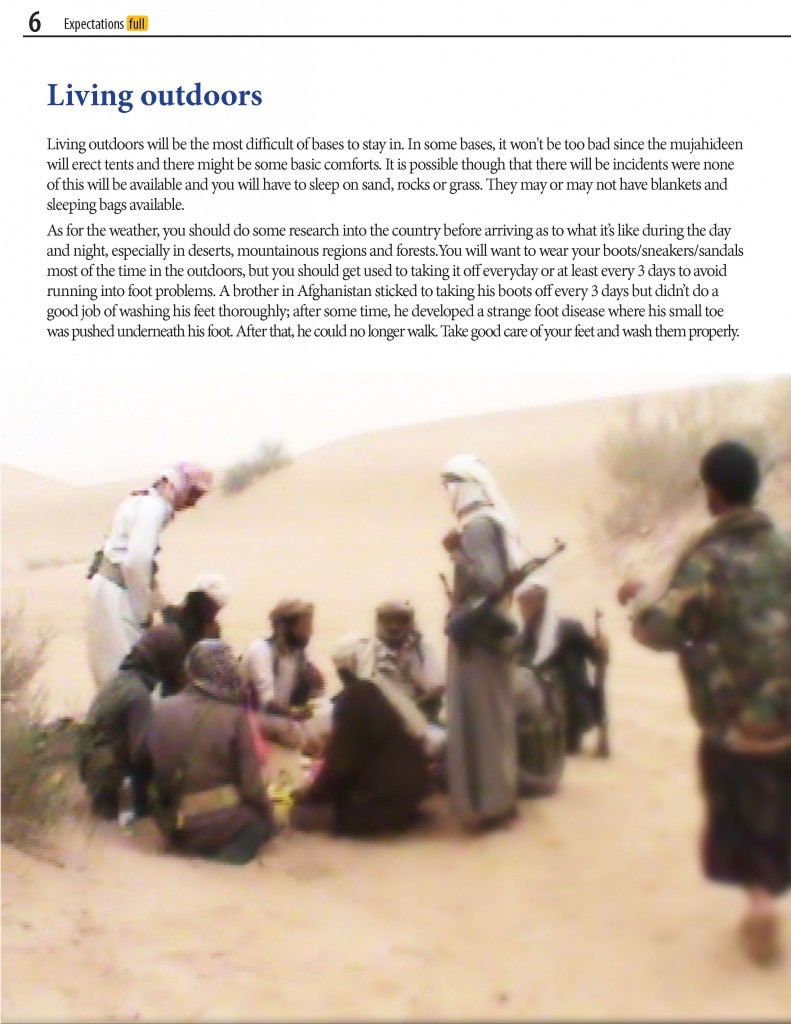
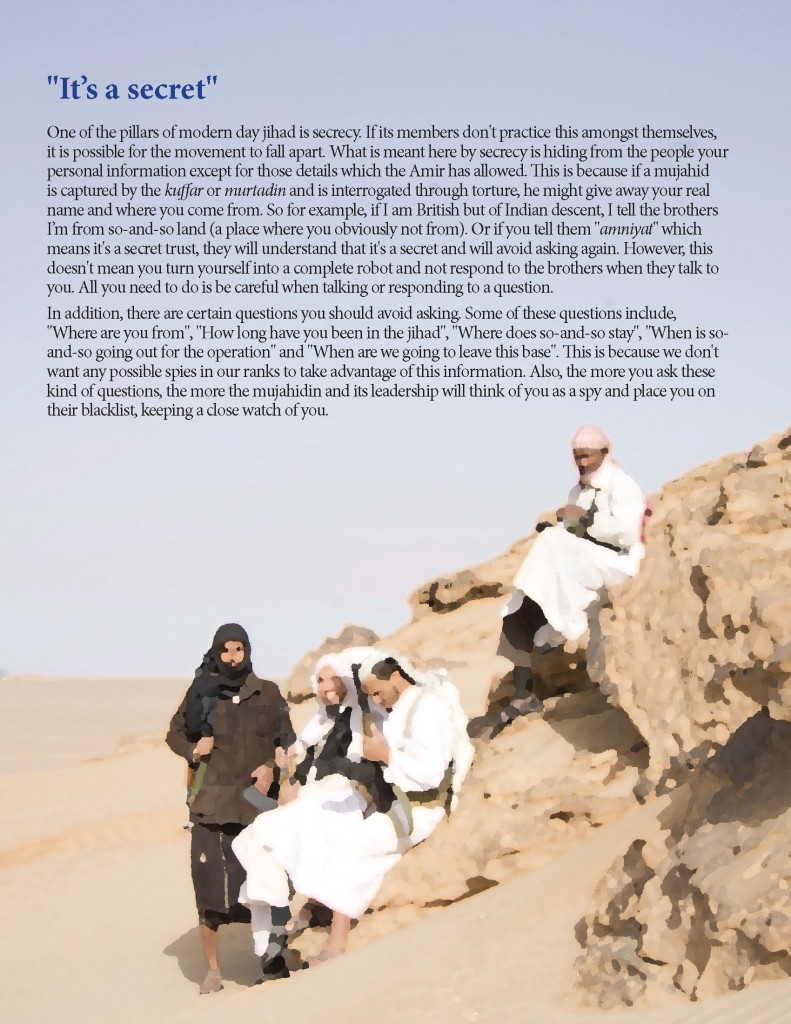
The following document entitled “Expectations Full” was reportedly authored by Samir Khan, a U.S. citizen who was killed in a drone strike in Yemen last year along with Anwar al-Awlaki. The document details what potential Jihadis should expect and bears a great deal of similarity to Inspire magazine, which was also reportedly authored by Khan. After several new issues of Inspire magazine surfaced online in early May, the following document has also recently appeared online with an acknowledgement of the death of Samir Khan. We encourage readers to scrutinize the authenticity of the material provided in this publication. We have removed password protection from the PDF to enable easier analysis, but have left the files’ original metadata intact. Due to past incidents with law enforcement, we must emphasize that this material is provided, as always, for educational and informational purposes.
DOWNLOAD THE ORIGINAL DOCUMENT HERE
Born of Hope is an independent feature film inspired by the Lord of the Rings and produced by Actors at Work Productions in the UK.
http://www.bornofhope.com
Thanks to Chris Bouchard and the H4G team for putting the film here. For more films by the makers of this and BoH extras please visit.
ActorsatWork
http://www.youtube.com/actorsatwork
Check them out for more videos regarding the film including the audio commentary.
http://www.youtube.com/watch?v=elt_l8zisik
A scattered people, the descendants of storied sea kings of the ancient West, struggle to survive in a lonely wilderness as a dark force relentlessly bends its will toward their destruction. Yet amidst these valiant, desperate people, hope remains. A royal house endures unbroken from father to son.
This 70 minute original drama is set in the time before the War of the Ring and tells the story of the Dúnedain, the Rangers of the North, before the return of the King. Inspired by only a couple of paragraphs written by Tolkien in the appendices of the Lord of the Rings we follow Arathorn and Gilraen, the parents of Aragorn, from their first meeting through a turbulent time in their people’s history.
The U.S. Department of Defense (DoD) has a long history of conducting security force assistance (SFA)-type activities. These activities were primarily focused on gaining access and influence to partner nations (PN). However, by 2005, the purpose of SFA-type activities had evolved. SFA would now enable and develop the sustainable capabilities of foreign security forces (FSF) to a sufficient capacity in order to provide regional stability. The primary purpose of SFA is the development of sustainable capabilities to allow PNs to defend themselves or contribute to operations elsewhere. This is a fundamental shift in how and why the DoD conducts SFA.
Although the U.S. Special Operations Command (USSOCOM) is the DoD Lead for SFA Doctrine, Education, and Training, both Special Operations Forces (SOF) and Conventional Forces (CF) participate in SFA activities. The primary role of both SOF and CF in SFA is to assess, organize, train, equip, rebuild, and advise PN military and paramilitary forces with tasks that require their unique capabilities. At times, this may require U.S. forces to temporarily assist the HN or FSF with these tasks until they can develop the requisite capability and capacity or until the current threat is reduced to a manageable level. Thus, SFA activities require the collective capabilities of SOF, CF, the civilian expeditionary workforce (CEW), and contract personnel to execute the mission.
PNs may also need capabilities which are interoperable with the U.S. Government (USG). As a result, some SFA activities require interagency capabilities to execute the mission. Other USG agencies contribute their expertise in defense, law enforcement, government, infrastructure, and security capabilities to improve the PN ability to govern and defend against a common threat to security. A comprehensive assessment of an intended FSF mission, capability and sustainment requirements will determine the appropriate combination of U.S. forces needed to conduct SFA.
Historical Context
Developing capabilities of FSF is not new for the U.S. military. From operations during the Philippine Insurrection (1899-1902) to the recent Operations of ENDURING FREEDOM, IRAQI FREEDOM, and NEW DAWN , the U.S. military has a long history of employing military advisors.
Current U.S. policy reflects an increased emphasis on SFA as a primary activity to achieve U.S. security objectives. In Iraq and Afghanistan, for example, Soldiers, Sailors, Airmen, Marines, Coast Guardsmen, government service civilians, and civilian contractor personnel conduct security force assistance alongside multinational partners to develop the capability and capacity of FSF to meet their nations’ security requirements while supporting U.S. objectives.
In Georgia in 2002, the DoD launched the Georgia Train and Equip Program (GTEP) with specialized SOF personnel. The goal of the program was to enhance the security capabilities of the Georgian Armed Forces, to improve interagency coordination between respective units, and to train military personnel. GTEP ended in 2004 with the graduation of the last group of Georgian soldiers; however, in 2008, the Georgian Ministry of Defense requested a renewed effort in the buildup of Georgian military units’ capability and capacity to enable the Republic of Georgia to assist North Atlantic Treaty Organization in Coalition Force efforts in Afghanistan. These on-going global advisory efforts, gleaned from lessons learned from past operations, will continue to guide the DoD into the future.
…
Understanding Security Force Assistance Environment/Framework
SFA is one component of a unified action across the diplomatic, information, military, economic, financial, intelligence, and law enforcement (DIME-FIL) construct. SFA occurs across the range of military operations, takes place in any of the operational themes (peacetime military engagements, limited intervention, peace operations, irregular warfare, major combat operations), and may occur during offense, defense, and stability operations.
Security Sector Reform (SSR). The set of policies, plans, programs, and activities that a government undertakes to improve the way it provides safety, security, and justice. The overall objective is to provide these services in a way that promotes effective and legitimate public service that is transparent, accountable to civilian authority, and responsive to the needs of the public. From a donor perspective, SSR is an umbrella term that might include integrated activities in support of defense and armed forces reform; civilian management and oversight; justice, police, corrections, and intelligence reform; national security planning and strategy support; border management; disarmament, demobilization and reintegration; or reduction of armed violence (DoS DoD USAID Handbook for SSR).
Stability Operations (STABOPS). An overarching term encompassing various military missions, tasks, and activities conducted outside the U.S. in coordination with other instruments of national power to maintain or reestablish a safe and secure environment and to provide essential government services, emergency infrastructure reconstruction, and humanitarian relief (JP 3-0).
Security Cooperation (SC). Activities undertaken by the Department of Defense to encourage and enable international partners to work with the United States to achieve strategic objectives. It includes all DoD interactions with foreign defense and security establishments, including all DoD-administered security assistance programs, that: build defense and security relationships that promote specific U.S. security interests, including all international armaments cooperation activities and security assistance activities; develop allied and friendly military capabilities for self-defense and multinational operations; and provide U.S. forces with peacetime and contingency access to host nations. (DoDD 5132.03)
Security Assistance (SA). A group of programs authorized by Title 22 USC, as amended, or other related statutes by which the United States provides defense articles, military training, and other defense-related services by grant, loan, credit, cash sales, or lease, in furtherance of national policies and objectives. The Department of Defense does not administer all security assistance programs. Those security assistance programs that are administered by the Department are a subset of security cooperation. (DoDD 5132.03)
Foreign Internal Defense (FID). Participation by civilian and military agencies of a government in any of the action programs taken by another government or other designated organization to free and protect its society from subversion, lawlessness, and insurgency. The focus of USG FID efforts is to support HN internal defense and development (IDAD). FID can only occur when an HN that has asked for assistance.
Counterinsurgency (COIN). Comprehensive civilian and military efforts taken to defeat an insurgency and to address any core grievances (JP 3-24). COIN is primarily political and incorporates a wide range of activities of which security is only one. Unified action is required to successfully conduct COIN operations and should include all HN, U.S., and multinational agencies or actors. Civilian agencies should lead U.S. efforts. Ideally, all COIN efforts protect the population, defeat the insurgents, reinforce HN legitimacy, and build HN capabilities. FID-COIN Relationship. FID may or may not include countering an insurgency. When FID includes countering an insurgency, COIN is part of FID. COIN only refers to actions aimed at countering an insurgency whereas FID deals with subversion, lawlessness, and insurgency, individually or combined. In most cases, the joint force conducts COIN as part of a larger FID program supporting the HN government. U.S. involvement in COIN operations that are not part of FID is an uncommon, transitory, situation wherein the U.S. and multinational partners should work to establish or reestablish HN sovereignty.
Unconventional Warfare (UW). Activities conducted to enable a resistance movement or insurgency to coerce, disrupt, or overthrow a government or occupying power by operating through or with an underground, auxiliary, and guerrilla force in a denied area. (JP 3-05) US-sponsored UW generally includes seven phases: preparation, initial contact, infiltration, organization, build-up, employment, and transition. The tactical actions of the Advisor are to develop capability and capacity within the indigenous or surrogate forces, which may or may not transition to long term sustainable capabilities, dependent on USG strategic objectives.
SFA-FID-COIN-UW-STABOP Relationship. SFA is integral to successful FID and COIN operations. SFA includes organizing, training, equipping, rebuilding, and advising (OTERA) various components of security forces in support of a legitimate authority. The portion of SFA oriented towards supporting host-country efforts to counter threats from subversion, lawlessness, and insurgency is a subset of FID. SFA activities are conducted primarily to assist host countries to defend against internal and transnational threats to stability. However, unlike FID wherein the primary focus is to support the HN IDAD plan, the DoD may also conduct SFA to assist host countries to effectively defend against external threats; contribute to coalition operations; or organize, train, equip, and/or advise another country’s security forces and/or supporting institutions. The organize, train, equip, and advise tasks conducted by SOF during UW operations may be part of, or become, SFA activities when supporting an indigenous or surrogate force in support of a legitimate authority. Legitimacy is determined by the USG. As illustrated in Afghanistan and Iraq, conducting security force assistance activities are an increasingly critical element of building partner capacity.
Comparison of SFA and FID. SFA supports the military instrument of FID, contributes to the legitimacy and eventual success in COIN, contributes to SSR/SSA, and is a subset of DoD security cooperation efforts. SFA is an element of USG building partner capability fully within the security sector. Still, the common misunderstanding about SFA is its similarities and differences to FID. In the conduct of FID, the military’s primary role lies in the security sector across both the military and civilian lines of effort. Many of the tasks in support of FID across the security sector can also be classified as SFA, but many of the tasks in support of FID will fall outside the scope of SFA as they will not specifically address capability or capacity within the HN security forces. All actions taken by U.S. military to support an HN IDAD plan are considered tasks within FID, but only those tasks that directly develop capability and capacity of the HN security forces will be SFA. Understanding that all SFA activities done in support of FID are a subset of FID, SFA activities can also be conducted in support of a HN to enhance external defense, in support of a PN to assist in activities in a third country, or in support of regional security forces or even indigenous forces in support of an insurgency.
Award winning unofficial prequel to The Lord Of The Rings dramatising Aragorn & Gandalf’s long search for Gollum directed by British filmmaker Chris Bouchard. Based faithfully on the appendices of the books this is a non-profit, serious homage to the writing of J.R.R Tolkien and the films of Peter Jackson.
It was shot on locations in England and Snowdonia with a team of over a hundred people working over the Internet. It took two years to make and was released as a non-profit Internet-only video by agreement with Tolkien Enterprizes.
This Youtube version is slightly extended with 1 scene added back in.
http://www.thehuntforgollum.com
DOWNLOAD THE ORIGINAL DOCUMENT HERE
1.1 The Government of Australia, and the Government of the United Kingdom (hereinafter referred to as the Signatories):
• recognising that both countries have independently conducted science and innovation activities relevant to national security and counter-terrorism, and the benefits of cooperation in the mutual exchange of research Information; and
• seeking to make the best use of their countries’ respective science and innovation capabilities, to eliminate unnecessary duplication of work and to obtain the most efficient and cost-effective results through cooperation in joint research activities; have decided to facilitate bilateral cooperation in national security and counter-terrorism science and innovation by means of this Memorandum of Understanding.1.2 The Signatories acknowledge that this Memorandum of Understanding is not legally binding on the Signatories or Participants. Notwithstanding this, each Signatory intends to implement this Memorandum of Understanding in accordance with its international legal obligations.
…
3.1 The objective of this Memorandum of Understanding is to establish a framework to encourage, develop and facilitate bilateral cooperative activity in science and technology that contributes to the National Security and Counter-Terrorism activities of both Signatories. This will encompass research, technology development and testing of technologies relating to National Security and Counter-Terrorism through:
3.1.1 systematic and comprehensive studies of a theoretical and experimental nature; and
3.1.2 the practical application of engineering and scientific knowledge.
3.2 This cooperation may include, amongst others, the thematic areas of:
3.2.1 border and transport security;
3.2.2 Chemical, Biological, Radiological, Nuclear and Explosives countermeasures (CBRNE);
3.2.3 cyber and electronic security;
3.2.4 emergency management and command and control systems;
3.2.5 intelligence, interdiction and surveillance;
3.2.6 physical and C!critical infrastructure resilience (including interdependency analyses);
3.2.7 social resilience (including community resilience and counter-violent extremism);
3.2.8 systems integration; and
3.2.9 the development and implementation of threat and vulnerability assessments.3.3 In addition, the Signatories will keep each other informed about their national research and development plans which are relevant to the objectives of this Memorandum of Understanding set out at paragraphs 3.1 and 3.2 above, with a view to identifying potential areas for further collaboration. The Signatories will examine whether and to what extent collaboration can occur on investment in research and development, including trials.
3.4 The Signatories will investigate how their national research and technology projects, which are relevant to the objectives of this Memorandum of Understanding set out at paragraphs 3.1 and 3.2 above, including the use of facilities, can be more effectively coordinated to reduce duplication of effort and to facilitate the free exchange of information.
3.5 The means of achieving these objectives may be implemented in the following forms:
3.5.1 exchange of Information;
3.5.2 joint research;
3.5.3 conduct of joint trials/experiments;
3.5.4 project harmonisation;
3.5.5 exchanges and/or attachments of personnel;
3.5.6 exchange of materials and/or equipment;and other forms of cooperation for achieving the objectives of this Memorandum of Understanding, as may be mutually arranged by Participants.
information Exchange (exchange of information in existence as a result of work carried out by a Participant not under this Memorandum of Understanding)
3.6 Information exchange will take place between Participants on an equitable, balanced and reciprocal basis. Subject to compliance with Participants’ respective national laws, policies and regulations and relevant paragraphs of this Memorandum of Understanding, this Memorandum of Understanding provides for the exchange of Information which is relevant to the objectives of this Memorandum of Understanding set out at paragraphs 3.1 and 3.2 above for the purpose of harmonising the Signatories’ and Participants’ respective science and technology requirements and for formulating, developing and negotiating Annexes to this Memorandum of Understanding.
DOWNLOAD THE ORIGINAL DOCUMENT HERE
PENSACOLA, FL—B Christopher P. Gunn, 31, previously of Walton County, Florida, was indicted today on multiple charges involving the online sextortion and cyberstalking of young girls ranging in age from 13 to 17 years old. The indictment was announced by Pamela C. Marsh, United States Attorney for the Northern District of Florida.
The federal indictment alleges that Gunn, who was recently arrested on related charges in Alabama, extorted images and videos of minor females in “various states of undress, naked, and engaging in sexually explicit conduct.” The indictment also charges that Gunn violated federal cyberstalking statutes by engaging these females online with the “intent to injure, harass, and cause substantial emotional distress.” The conduct with which Gunn is charged in the Northern District of Florida is alleged to have occurred between October 2009 and March 2011. In total, the indictment alleges that Gunn victimized 11 minor females who resided in various states throughout the nation.
Gunn is currently in custody in Montgomery, Alabama on a federal indictment that also charges him with the production and possession of child pornography. If convicted on all charges in the Florida indictment, Gunn faces over 50 years in federal prison.
This case is being brought as part of Project Safe Childhood, a nationwide initiative launched in May 2006 by the Department of Justice to combat the growing epidemic of child sexual exploitation and abuse. Led by the United States Attorneys’ Offices and the Criminal Division’s Child Exploitation and Obscenity Section, Project Safe Childhood marshals federal, state, and local resources to locate, apprehend, and prosecute individuals who sexually exploit children and to identify and rescue victims. For more information about Project Safe Childhood, please visit http://www.justice.gov/psc/.
The case was investigated by the Federal Bureau of Investigation and the Walton County Sheriff’s Office. The case is being prosecuted by Assistant United States Attorney David L. Goldberg. An indictment is merely a formal charge by a grand jury that a defendant has committed a violation of federal criminal law. All defendants are presumed innocent unless and until the government proves their guilt beyond a reasonable doubt to the satisfaction of a jury at trial.

Western nations are expected to meet for another round of discussions with Iran later this month, and discuss the future of the Islamic republic’s nuclear program. The Insider has revealed a diagram allegedly detailing Iran’s Parchin military installation, which raises doubts concerning Iran’s seriousness regarding discussions for halting its nuclear program.
According to the report, the Parchin facility is part of Iran’s nuclear program. The document that included the diagram arrived from within the base itself, and details a building used for developing nuclear weapons.
It should be noted that last November, a report published by the International Atomic Energy Agency (IAEA) claimed that Iran was advancing the development of nuclear weapons on Iranian soil.
As stated, according to AP, the illustration shows a container needed for conducting tests, which according to the suspicions of UN inspectors, are intended for developing nuclear weapons.
AP revealed that it received the materials from a formal official in the country who is monitoring Iran’s nuclear program. Furthermore, the same official told AP that the diagram proves that the structure exists, despite Iran’s refusal to admit its existence.
Der Anführer einer Yakuza-Organisation Tsukamoto deponiert für den Fall seiner Ermordung 100 Millionen Dollar für denjenigen, der seinen Tod rächen würde. Etwas später wird er getötet. Zahlreiche Menschen nehmen an einem Treffen der Killer teil, die den Auftrag ausführen könnten. Darunter befindet sich Fu, der früher ein Soldat einer Eliteeinheit war und in finanziellen Schwierigkeiten steckt. Fu verbündet sich mit dem Betrüger Ngok Lo.
Ngok Lo, der fortan als Agent von Fu fungiert, kauft seinem Geschäftspartner teure Bekleidung.
Eiji Tsukamoto, der Enkelsohn des Ermordeten, will den Mörder selbst töten. Er nimmt seinem Vater übel, dass Fremde den Tod dessen Vaters rächen sollten. Währenddessen nimmt Fu einen anderen Auftrag an, um die laufenden Kosten zu decken. Er tötet die Zielperson nicht, sondern verteidigt sie vor den anderen Killern, wofür er von dieser Person mit Geld belohnt wird. Er und Ngok Lo werden aber am Tatort verhaftet und vernommen. Ngok Los Tochter Kiki, die Jura studiert, holt beide aus dem Arrest. Er bringt Fu in seiner Wohnung unter — im einstigen Zimmer seiner Tochter. Er warnt Fu, dass dieser nicht für die bereits verlobte Kiki schwärmen soll.
Als Fu und Ngok Lo von Eiji Tsukamoto bedrängt werden, erzählt Ngok Fu, dass er ein Hochstapler ist. Weiterhin hat Ngok Lo in der Unterwelt verbreitet, er wäre der König der Killer. Aber, da Tsukamoto vom echten König der Killer umgebracht wurde, sind nun alle fälschlicherweise hinter ihm her.
Fu und Ngok treffen sich mit Tsukamoto. Dort kommt es zum großen Kampf, an dem auch der König der Killer plötzlich auftaucht und sich als Polizist zu erkennen gibt.
Es kommt zum Kampf zwischen dem König der Killer und Eiji, in dem Eiji Tsukamoto stirbt. Der Vorsitzende der Jury, die die Belohnung vergeben soll, willigt ein, der Version zuzustimmen, in der Eiji Tsukamoto der zu tötende Mörder war. Der König der Killer will seinen Platz Fu überlassen, der Ngok Lo als seinen Agenten feuert und stattdessen mit der Vermittlung der Aufträge dessen Tochter Kiki beauftragt.
DOWNLOAD THE ORIGINAL DOCUMENT HERE
The Money As A Weapon System – Afghanistan Commander’s Emergency Response Program Standard Operating Procedure supports the United States Government Integrated Civilian-Military Campaign Plan and ISAF Theater Campaign Plan (TCP). The Theater Campaign Plan lists objectives that include improving governance and socio-economic development in order to provide a secure environment for sustainable stability that is observable to the population. CERP provides an enabling tool that commanders can utilize to achieve these objectives. This is accomplished through an assortment of projects planned with desired COIN effects such as addressing urgent needs of the population, promoting GIRoA legitimacy, countering Taliban influence, increasing needed capacity, gaining access, building/expanding relationships, promoting economic growth, and demonstrating positive intent or goodwill.
The SOP recognizes and addresses the challenges that lie ahead as we continue the momentum of our campaign and through the challenges of transition. This revision implements policy changes, which are summarized within the summary of changes, to help improve oversight and management and incorporates the lessons we have learned to include measures adopted from the recommendations of various audits. Additionally, a broad spectrum of collaboration and research from several organizations and agencies was used to provide guidance as you plan CERP projects.
…
A. Counterinsurgency concepts, frameworks, and ideas ultimately find expression in activities involving investments of energy, time and resources. Projects are a primary means for executing governance since they incorporate decisions on the distribution of scarce resources, may involve negotiations on the nature of the social contract, and can create positive, interdependent relationships to allow the delivery of a service. Project management is the way to ensure these investments generate measurable returns. However, project management to COIN effects is not the same as project management to quality, timeline, scope or budget as there are different objectives with different means of judging whether the objectives are met. Project prioritization and selection must reinforce COIN objectives. The list of potential projects will always exceed the capacity to deliver. The major limiting factor will be the ability to execute and oversee projects rather than limited funding. The more technically challenging the project, the greater the need for direct presence to ensure quality. Less complex projects, by contrast, can reduce coalition forces direct presence while ensuring greater COIN effects.
B. Commander’s Emergency Response Program (CERP) projects (and similar stabilization funds) are vehicles for achieving effects. The desired effects are currently not well defined, measurable or standardized across projects. An effect can be:
1. Developmental, seeking to change society, build institutional capacity or promote economic improvement that is sustainable;
2. Humanitarian, seeking to alleviate human suffering without conditions or impartiality;
3. Force protection/hearts and minds, seeking to create a positive impression of coalition forces/Afghan National Security Forces (ANSF) in an effort to lessen attacks; or
4. Counterinsurgency, seeking to address causes of instability through fostering positive, interdependent relationships between the Government of the Islamic Republic of Afghanistan (GIRoA) and key populations.
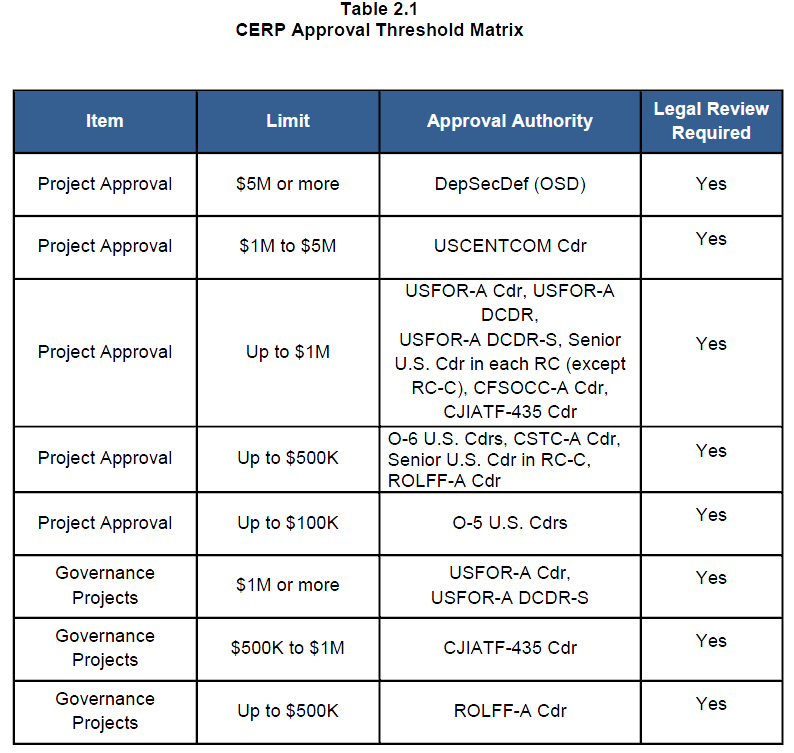
DOWNLOAD THE ORIGINAL DOCUMENT HERE
DOWNLOAD THE ORIGINAL DOCUMENT HERE
DOWNLOAD THE ORIGINAL DOCUMENT HERE
DOWNLOAD THE ORIGINAL FILE HERE
Jet Li stellt in diesem Film den chinesischen Arzt und Meister der chinesischen Kampfkunst Hung Gar Kuen Wong Fei Hung dar, welcher aus der Provinz Fu-Shang stammt. Er macht zusammen mit seinem Gehilfen Fu und seiner Cousine Ji eine Reise zu einem internationalem Ärztekongress in Kanton. An diesem Treffen nehmen vor allem westliche Ärzte teil, und Dr. Wong soll als Gastredner die chinesische Akupunktur erklären.
Zu genau diesem Zeitpunkt findet in Kanton ein politischer Umsturz statt. Die Sekte des Weißen Lotus möchte alle westlichen Einflüsse auf die chinesische Kultur mit Gewalt fernhalten. Cousine Ji, die sich nach westlicher Manier kleidet, bekommt bei einer Kundgebung des Weißen Lotus Probleme und soll entführt werden, welches Wong Fei Hung erfolgreich verhindern kann, worauf ihm der Anführer der Sekte, Meister Kung, Rache schwört.
Auf dem Ärztekongress lernt Wong Fei Hung Bruder Sun Yat-sen kennen, der die westliche Medizin studiert hat. Die beiden halten den Vortrag zusammen. Bruder Su will ebenfalls einen politischen Umsturz herbeiführen, aber mit friedlichen Mitteln. Sein Ziel ist es, China zu einer Republik zu machen.
Als das linguistische Institut vom Weißen Lotus angegriffen wird, können Wong Fei Hung, Fu und Cousine Ji eine Gruppe Kinder retten. Diese wollen sie zuerst in der Stadthalle unterbringen, aber der Leutnant der chinesischen Garde erklärt Dr. Wong, dass er für den Schutz der Kinder nicht garantieren kann. Daraufhin bringen die Gefährten diese im britischen Konsulat unter. Dort treffen sie auf Bruder Luk, den Leiter des linguistischen Institutes, der ein Freund und Mitverschwörer von Bruder Su ist. Damit der Leutnant der chinesischen Garde die beiden gefangen nehmen kann, ebnet er dem Weißen Lotus den Weg, damit diese das Britische Konsulat verwüsten können. Durch eine List und mit der Hilfe von Wong Fei Hung kann Bruder Luk entkommen.
Anschließend machen sich Wong Fei Hung und Bruder Luk auf den Weg, um den Tempel des Weißen Lotus zu zerstören und den geistigen Führer Kung umzubringen. Nach erfolgreichem Abschluss machen sie sich auf den Weg, um sich wieder mit Fu zu treffen und an die Anlegestelle zu kommen, wo sie sich mit den anderen auf dem Schiff nach Ton Ga Bay absetzen wollen. Vorher müssen sie noch die Namensliste mit den Anhängern des friedlichen Umsturzes aus dem Versteck holen. Dort werden sie von der chinesischen Garde angegriffen. Bruder Luk wird dabei getötet. Der Leutnant und Wong Fei Hung stellen sich noch dem finalen Kampf.
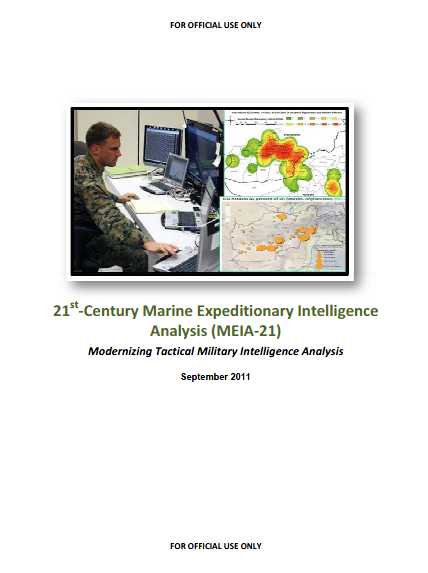
21st‐Century Marine Expeditionary Intelligence Analysis (MEIA‐21) is a formal initiative to structure, standardize, and professionalize tactical intelligence analysis in the Marine Corps. It professionalizes Marine expeditionary intelligence, equipping intelligence analysts with analytically rigorous Structured Models, Approaches, and Techniques (SMATs)—applied tradecraft—to provide commanders with actionable, reliable tactical intelligence in conventional and irregular warfare while also instilling the cognitive and creative skills to create and refine that tradecraft. … Core Principles of MEIA‐21 MEIA‐21 is the process of building analytic modernization on six foundational principles: 1. Successful operations require reliable tactical intelligence. Operations are command led and intelligence fed. 2. Reliable tactical intelligence is achieved through structured, mission‐specific applied tradecraft. – Tradecraft is the SMATs that analysts use to develop actionable intelligence from raw data. – SMATs originate from field‐derived, experiential learning by Marine intelligence analysts. – Foundational skills, such as Structured Analytic Techniques (SATs), und0erlie the development and application of mission‐specific tradecraft. 3. Tradecraft‐driven intelligence analysis is conducted using analytically rigorous processes. – Marine Corps intelligence analysis must move beyond a reliance on raw intuition and readily available information to scientifically valid, objective techniques. – Processes and tools (SMATs) must be vetted for analytic rigor, formalized, documented, and taught. – Sustainable analytic rigor requires ongoing critical review and continuous improvement of tradecraft. 4. Social Science Intelligence (SSI) is essential for successful intelligence analysis in COIN and other nonconventional operations. It also is critical for conventional operations. – Without structured consideration of social factors, our knowledge of human‐centered problems is subjective, unscientific, overly informed by raw intuition, and less reliable. – SSI uses structured models, approaches, and techniques based upon proven principles and practices from economics, political science, anthropology, and other disciplines that study human behavior. – Applied social science is an important way to develop understanding (insight and foresight) in the context of operational requirements. 5. In an era of enormous quantities of potentially useful data, technology is critical to intelligence work. – People—not tools—perform analysis, but machine‐aided analysis can help analysts organize, store, and cut through massive amounts of data to discover the nonobvious and unseen and to identify otherwise invisible patterns. – Technology empowers analysts to archive, organize, discover, and retrieve information for near‐real‐time analysis. – Models and tools not only save time and cognitive energy, they correct fallible human senses and intuition that, left unaided, may misrepresent reality or distort analysis. 6. Intelligence analysis is a profession and should be structured as such. – Mastery of tradecraft, not job title, defines the profession of Marine Corps intelligence analysis. – Marine intelligence analysts must have a deep knowledge of tradecraft. Area expertise is valuable, but inadequate to develop actionable intelligence or reliable knowledge in the absence of structured applied tradecraft. – Structured tools, methods, and processes must be disseminated and institutionalized through formal training, standards, and continuing education. Intelligence analysts should be certified in the practice of their profession. … Social Science Intelligence and the New Analytic Environment Marine Corps warfighting has primarily been based on the capability to find, fix, and strike the enemy force. To support this, Marine Corps tactical intelligence was often kinetics‐based, target‐centric, and optimized for producing intelligence against conventional military formations. Adversaries were well defined, providing a relatively sharp focus for intelligence. But 10 years of operations in Iraq and Afghanistan have repeatedly shown that armed groups confronting Marines today avoid U.S. targeting superiority by operating asymmetrically within congested and cluttered environments. Contending with conventional, counterinsurgency (COIN), and nonconventional operations in the upcoming decades of the 21st century, Marines will once again be exposed to socially complex environments and hybrid armed groups. Many of these threats (conventional and nonconventional) and adversaries (state, state proxies, and nonstate actors) will be more agile, less visible, and possess an information advantage where it is easier for them to see and target us than for us to see and target them. Given this operational environment, the MCISR‐E must analyze more than an adversary’s characteristics and capabilities. Expeditionary intelligence must incorporate the context within which adversaries operate; the institutions within which they live; and their fears, perceptions, and motivations; in short, we must consider the totality of the human sphere. This new approach to intelligence analysis, focusing on understanding human social organization is called Social Science Intelligence (SSI). There has been significant growth in the techniques and technologies of intelligence analysis, especially in the social sciences such as economics, political science, anthropology, and other disciplines relating to the study of human behavior. Because the most advanced knowledge in these fields is dispersed within academia and not directly focused on intelligence‐related problems, it’s hard to access and consequently plays an inadequate role in tactical intelligence today—Marine intelligence analysts’ knowledge of human‐centered problems tends to be subjective, unscientific, technologically weak, and based mostly on the raw intuition and personal experience of the individual analyst. The challenge is to develop, refine, and deploy applied techniques that enable us to understand the totality of the human domain framework with speed and precision. An analytic modernization plan that captures critical best practices, leverages the best social and physical science know‐how available, and makes available sophisticated analytic instruments that analysts can readily apply to intelligence problems is critical to success. When made available, these methods and approaches give analysts social and physical science expertise from the fields that parallel the questions faced by intelligence (e.g., accounting, organizational theory, elite analysis, political science, economics, and census/registry).
DOWNLOAD THE ORIGINAL DOCUMENT HERE
Jet Li stars as Tai Feng (aka Fu). a hitman with a `sense of justice` and a talent for deliberately missing his intended victims. When his streetwise agent Sam (Eric Tsang) uses Tai`s awesome fighting skills to acquire billions of dollars at the expense of heavy-hitting Japanese mobsters, the scene is set for a martial-arts showdown of ground-breaking proportions. An exhilarating, suspenseful action-drama combining elements of black humour and s sense of style, Hitman packs the king of resounding punch you would expect from the world`s most enigmatic action star. Jet Li is more lethal than ever as the Hitman!
DOWNLOAD THE ORIGINAL DOCUMENT HERE
DOWNLOAD THE ORIGINAL DOCUMENT HERE
Jet Li,Wen Zhang,Kwai Lun Mei,Chen Rui
According to preliminary statistics released today by the FBI, 72 of our nation’s law enforcement officers were feloniously killed in the line of duty in during 2011. By region, 29 victims were killed in the South, 21 in the Midwest, 10 each were killed in the West and the Northeast, and two were killed in Puerto Rico. The total number of officers feloniously killed in 2011 was 16 more than the 56 officers slain in 2010.
Of these 72 felonious deaths, 19 officers were killed during ambushes (14 during unprovoked attacks and five due to entrapment/premeditation situations); five were slain while investigating suspicious persons or circumstances; 11 were killed during traffic pursuits/stops; five of the fallen officers interrupted robberies in progress or were pursuing robbery suspects; and four died while responding to disturbance calls (one being a domestic disturbance).
Six officers died during tactical situations; one died while conducting investigative activity; one officer died while handling or transporting a prisoner; and 20 officers were killed while attempting other arrests.
Offenders used firearms in 63 of the 72 felonious deaths of law enforcement officers in 2011. By type of firearm, 50 officers were killed with handguns; seven with rifles; and six with shotguns. Criminals used vehicles to kill six officers; weapons such as hands, fists, and feet to kill two officers; and a knife or cutting instrument to kill one officer.
Of the 72 victim officers, 49 were wearing body armor at the times of their deaths. Seventeen of the victim officers fired their own weapons, and four were killed with their own weapons. Seven of the slain officers had their service weapons stolen.
There were 68 separate incidents that resulted in the deaths of 72 officers. Of those incidents, 67 were cleared by arrest or exceptional means.
In addition to the officers who were feloniously killed in 2011, 50 officers were killed in accidents. This is a decrease of 22 officers compared with the 72 officers who were accidentally killed n 2010.
The FBI will release final statistics on officers killed and assaulted in the line of duty in the Uniform Crime Reporting Program’s publication, Law Enforcement Officers Killed and Assaulted, 2011, which will be published on this website in the fall.
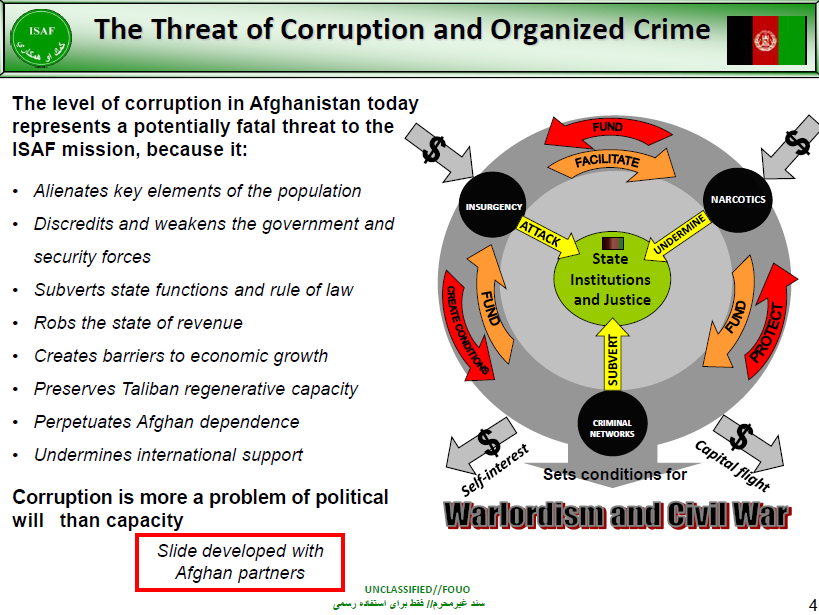
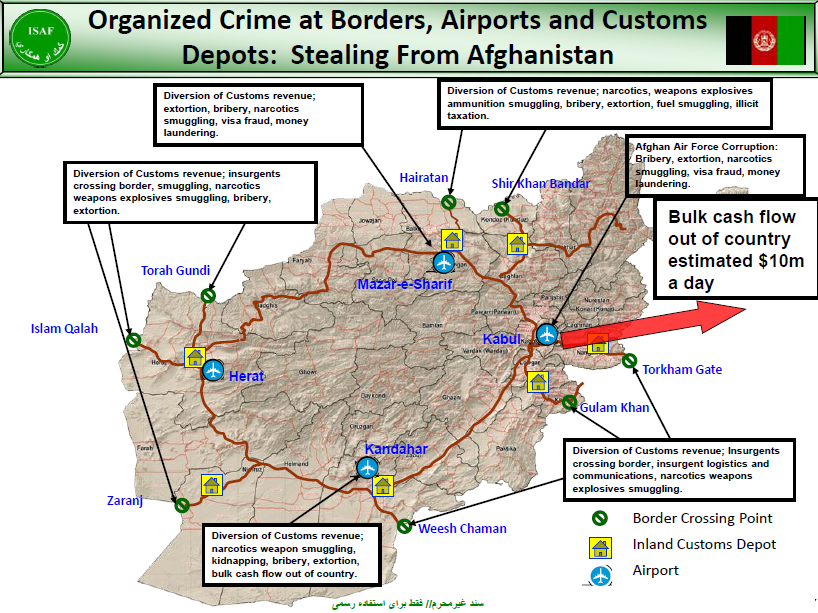
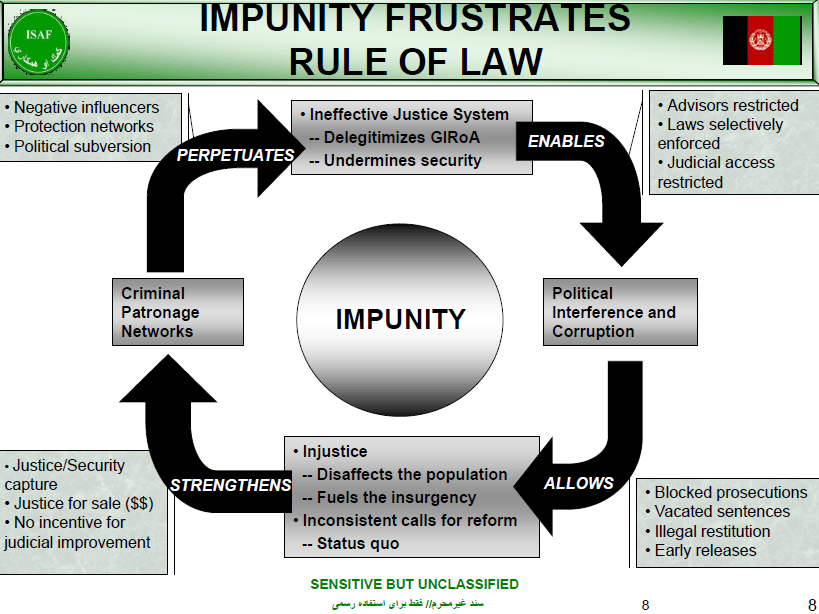
DOWNLOAD THE ORIGINAL DOCUMENT HERE
After a sudden attack on the MI5, Johnny English, Britain’s most confident yet unintelligent spy, becomes Britain’s only spy.
[Rowan Atkinson]
REALLY GOOD COMEDY!
DOWNLOAD THE ORIGINAL DOCUMENT HERE
UNCONVENTIONAL OIL AND GAS PRODUCTION
Opportunities and Challenges of Oil Shale Development
Statement of Anu K. Mittal, Director Natural Resources and Environment
Testimony
Before the Subcommittee on Energy and Environment, Committee on Science, Space, and Technology, House of Representatives
DOWNLOD THE ORIGINAL DOCUMENT HERE

Liebe Leser,
ich habe Ihnen versprochen die Hintergründe der STASI-“GoMoPa” aufzudecken.
Ich habe dies getan.
Wir werden nicht ruhen, bevor diese Kriminellen und ihre Auftraggeber und Helfer ausgeschaltet sind.
Aus verständlichen Gründen gebe ich hier keine weiteren Infos an.
Herzlichst Ihr
Bernd Pulch,
MA PUBLIZISTIK, GERMANISTIK, KOMPARATISTIK
http://www.victims-opfer.com/?p=19616
DOWNLOAD THE ORIGINAL DOCUMENT HERE
In Mexico City, a former assassin swears vengeance on those who committed an unspeakable act against the family he was hired to protect.
DOWNLOAD THE ORIGINAL DOCUMENT HERE
ALEXANDRIA, VA—Twenty-eight individuals have been arrested for their alleged roles in a cocaine trafficking ring based in Northern Virginia that uses couriers to regularly import large amounts of cocaine from Honduras hidden in shoes and decorative wooden frames. Members of the trafficking ring have allegedly wired more than $1 million from the United States back to cocaine suppliers in Honduras.
Neil H. MacBride, U.S. Attorney for the Eastern District of Virginia, and James W. McJunkin, Assistant Director in Charge of the FBI’s Washington Field Office, made the announcement after the charges became public.
“Through creativity and coordination, this tight network of Honduran immigrants allegedly distributed vast amounts of cocaine throughout Northern Virginia and across the mid-Atlantic,” said U.S. Attorney MacBride. “Thanks to close partnerships among law enforcement, we were able to put together the case that led to today’s charges.”
“These individuals face charges for their alleged involvement in a drug trafficking ring that brought large amounts of cocaine into our communities,” said Assistant Director in Charge McJunkin. “Together with our law enforcement partners, the FBI will continue to target international drug conspiracies as we diligently work to keep our neighborhoods and citizens safe.”
According to a criminal complaint affidavit, since between 2006 and May 2012, a contingent of Honduran immigrants living in and around Fairfax County has coordinated with sources of supply in Honduras to pay couriers to fly cocaine from Honduras to the United States on a regular basis. Much of the couriers’ baggage would contain items that were not contraband, such as clothing, food, and Honduras-related trinkets, so the conspirators would hide cocaine in innocuous items, typically wooden frames and shoes, that would blend in with the couriers’ other cargo.
The affidavit alleges that once the couriers arrived in the United States, members of the conspiracy would pick up the items containing cocaine from the couriers and then distribute it to dealers in Virginia, Maryland, North Carolina, and Massachusetts, who, in turn, would send sale proceeds back to Honduras through wire transfers.
Leaders of the conspiracy allegedly supply wholesale quantities of the imported cocaine to co-conspirators, who are themselves street-level dealers or who supply other street-level dealers. It is alleged that the leaders know each other, use the same network of Honduran suppliers, and often retrieve cocaine from couriers intended for another leader to pick up at a later time.
According to the affidavit, the trafficking ring was discovered in autumn 2011 by law enforcement after the investigation and arrest of Lindor Delis Martinez-Guevara, aka Lindo or Genero, 38, of Falls Church, Virginia; and Melcy Yalexsy Guevara-Barrera, aka Pedro or Primo, 35, of Vienna, Virginia, by the Fairfax County Police Department. The affidavit states that Lindor moved from Honduras to Virginia to deal cocaine and that he was the person who came up with the idea to hide cocaine in frames.
Lindor; Melcy; Samuel Benitez-Pineda, aka Wilfredo Benitez or Roque or Chiripa, 34, of Arlington, Virginia; and Jose Fredy Delcid, aka Oscar Salgado or Oscar or Franklin or Chami or Matador, 34, of Falls Church, Virginia, are some of the members of the conspiracy who allegedly worked directly with sources of supply in Honduras to import cocaine into the United States. They, in turn, allegedly worked with a large group of people with and through whom they distributed the cocaine, including the following individuals who were arrested by law enforcement:
Those named in the criminal complaint were charged with conspiracy to distribute 500 grams or more of cocaine, which carries a minimum mandatory of five years in prison and a maximum penalty of 40 years in prison.
In addition, the complaint affidavit contains allegations that members of the conspiracy engaged in the distribution of crack cocaine, money laundering, and various firearm offenses.
This ongoing investigation was led by the FBI’s Washington Field Office, in partnership with the Fairfax County, Arlington County, City of Falls Church, and Prince William County Police Departments; Virginia State Police; Northern Virginia Gang Task Force; Drug Enforcement Administration; U.S. Marshals Service; U.S. Postal Inspection Service; and U.S. Immigration and Customs Enforcement’s Homeland Security Investigations.
The prosecution is being handled by Assistant U.S. Attorney Sean P. Tonolli and Special Assistant U.S. Attorneys Scott B. Nussbum and Emily M. Loeb.
Criminal complaints are only charges and not evidence of guilt. A defendant is presumed to be innocent until and unless proven guilty.
A copy of this press release may be found on the website of the United States Attorney’s Office for the Eastern District of Virginia at http://www.justice.gov/usao/vae.
21st‐Century Marine Expeditionary Intelligence Analysis (MEIA‐21) is a formal initiative to structure, standardize, and professionalize tactical intelligence analysis in the Marine Corps. It professionalizes Marine expeditionary intelligence, equipping intelligence analysts with analytically rigorous Structured Models, Approaches, and Techniques (SMATs)—applied tradecraft—to provide commanders with actionable, reliable tactical intelligence in conventional and irregular warfare while also instilling the cognitive and creative skills to create and refine that tradecraft.
…
Core Principles of MEIA‐21
MEIA‐21 is the process of building analytic modernization on six foundational principles:
1. Successful operations require reliable tactical intelligence. Operations are command led and intelligence fed.
2. Reliable tactical intelligence is achieved through structured, mission‐specific applied
tradecraft.– Tradecraft is the SMATs that analysts use to develop actionable intelligence from raw data.
– SMATs originate from field‐derived, experiential learning by Marine intelligence analysts.
– Foundational skills, such as Structured Analytic Techniques (SATs), und0erlie the development and application of mission‐specific tradecraft.3. Tradecraft‐driven intelligence analysis is conducted using analytically rigorous processes.
– Marine Corps intelligence analysis must move beyond a reliance on raw intuition and readily available information to scientifically valid, objective techniques.
– Processes and tools (SMATs) must be vetted for analytic rigor, formalized, documented, and taught.
– Sustainable analytic rigor requires ongoing critical review and continuous improvement of tradecraft.4. Social Science Intelligence (SSI) is essential for successful intelligence analysis in COIN and other nonconventional operations. It also is critical for conventional operations.
– Without structured consideration of social factors, our knowledge of human‐centered problems is subjective, unscientific, overly informed by raw intuition, and less reliable.
– SSI uses structured models, approaches, and techniques based upon proven principles and practices from economics, political science, anthropology, and other disciplines that study human behavior.
– Applied social science is an important way to develop understanding (insight and foresight) in the context of operational requirements.5. In an era of enormous quantities of potentially useful data, technology is critical to intelligence work.
– People—not tools—perform analysis, but machine‐aided analysis can help analysts organize, store, and cut through massive amounts of data to discover the nonobvious and unseen and to identify otherwise invisible patterns.
– Technology empowers analysts to archive, organize, discover, and retrieve information for near‐real‐time analysis.
– Models and tools not only save time and cognitive energy, they correct fallible human senses and intuition that, left unaided, may misrepresent reality or distort analysis.6. Intelligence analysis is a profession and should be structured as such.
– Mastery of tradecraft, not job title, defines the profession of Marine Corps intelligence analysis.
– Marine intelligence analysts must have a deep knowledge of tradecraft. Area expertise is valuable, but inadequate to develop actionable intelligence or reliable knowledge in the absence of structured applied tradecraft.
– Structured tools, methods, and processes must be disseminated and institutionalized through formal training, standards, and continuing education. Intelligence analysts should be certified in the practice of their profession.…
Social Science Intelligence and the New Analytic Environment
Marine Corps warfighting has primarily been based on the capability to find, fix, and strike the enemy force. To support this, Marine Corps tactical intelligence was often kinetics‐based, target‐centric, and optimized for producing intelligence against conventional military formations. Adversaries were well defined, providing a relatively sharp focus for intelligence. But 10 years of operations in Iraq and Afghanistan have repeatedly shown that armed groups confronting Marines today avoid U.S. targeting superiority by operating asymmetrically within congested and cluttered environments. Contending with conventional, counterinsurgency (COIN), and nonconventional operations in the upcoming decades of the 21st century, Marines will once again be exposed to socially complex environments and hybrid armed groups. Many of these threats (conventional and nonconventional) and adversaries (state, state proxies, and nonstate actors) will be more agile, less visible, and possess an information advantage where it is easier for them to see and target us than for us to see and target them.
Given this operational environment, the MCISR‐E must analyze more than an adversary’s characteristics and capabilities. Expeditionary intelligence must incorporate the context within which adversaries operate; the institutions within which they live; and their fears, perceptions, and motivations; in short, we must consider the totality of the human sphere.
This new approach to intelligence analysis, focusing on understanding human social organization is called Social Science Intelligence (SSI). There has been significant growth in the techniques and technologies of intelligence analysis, especially in the social sciences such as economics, political science, anthropology, and other disciplines relating to the study of human behavior. Because the most advanced knowledge in these fields is dispersed within academia and not directly focused on intelligence‐related problems, it’s hard to access and consequently plays an inadequate role in tactical intelligence today—Marine intelligence analysts’ knowledge of human‐centered problems tends to be subjective, unscientific, technologically weak, and based mostly on the raw intuition and personal experience of the individual analyst.
The challenge is to develop, refine, and deploy applied techniques that enable us to understand the totality of the human domain framework with speed and precision. An analytic modernization plan that captures critical best practices, leverages the best social and physical science know‐how available, and makes available sophisticated analytic instruments that analysts can readily apply to intelligence problems is critical to success. When made available, these methods and approaches give analysts social and physical science expertise from the fields that parallel the questions faced by intelligence (e.g., accounting, organizational theory, elite analysis, political science, economics, and census/registry).
DOWNLOAD THE ORGINAL DOCUMENT HERE
SACRAMENTO, CA—United States Attorney Benjamin B. Wagner announced that Marquist Piere Bradford, 26, of Chicago, has been brought back to Sacramento to face charges of sex trafficking of children by force, fraud, or coercion.
Bradford was arraigned Wednesday before United States Magistrate Judge Carolyn K. Delaney and entered a not guilty plea. He was ordered held without bail and is next scheduled to appear in court on May 31, 2012 before United States District Judge Morrison C. England Jr.
Bradford was arrested on April 11, 2012 in Springfield, Illinois for a one-count indictment returned by a federal grand jury in Sacramento on March 29, 2012. The indictment has been sealed while law enforcement pursued Bradford. He was arrested in Chicago, and U.S. Marshals brought him to Sacramento on Tuesday.
According to the indictment, Bradford recruited a 15-year-old girl to travel from Fresno to Sacramento, where she was used by Bradford as part of his prostitution business from January 19 through February 5, 2012. According to court documents, Bradford maintained an apartment in Rancho Cordova that he used as a base of operations for a prostitution business that spanned the Sacramento and Bay Areas, as well as several cities outside California. At least two of Bradford’s victims were under the age of 18. Bradford fled from Sacramento to the Chicago area after law enforcement recovered the 15-year-old victim.
This case is the product of an investigation by the FBI’s Sacramento Crimes Against Children Task Force, which received the case after the Sacramento County Sheriff’s Office located and recovered the 15-year-old victim. The Task Force brings together state, local, and federal law enforcement agencies in the Sacramento area to investigate the trafficking of juvenile victims of prostitution. Assistant United States Attorney Matthew G. Morris is prosecuting the case.
If convicted, Bradford faces a maximum statutory penalty of life in prison. The actual sentence, if convicted, will be determined at the discretion of the court after consideration of any applicable statutory factors and the Federal Sentencing Guidelines, which take into account a number of variables. The charges are only allegations and the defendant is presumed innocent until and unless proven guilty beyond a reasonable doubt.
An informancy industry provides undercover informant services to governments and corporations by use of multiple identities and nyms on the Internet. They recruit, entrap, sting, and gather evidence for indictment and prosecution. They brag about doing this to invite attack for the purpose of tracing attackers.
The exchanges below are allegedly between a US Special Agent Daniel Porsek, possibly FBI, <2023459771@unknown.email>, and an informant, possibly Jennifer Emick, Backtrace Security <infinitysnake@gmail.com>. These exchanges may be legitimate or leaked as bait.
They exemplify use of informants on the Internet, especially for social media, texting, IRC and open and closed bulletin boards. Several names and nyms mentioned are familiar: Hector “Sabu” Monsegur, Corey “Xyrix” Barnhill aka “Kayla,” (“Kayla” also attributed to Ryan Ackroyd), Justin “Null” Perras, Michael “Virus” Nieves, Sam Bowne, “jester,” “lugg.” Hundreds if not thousands more are active on the Net.
Informants are notoriously unreliable and likely to exaggerate, lie, accuse without substantiation, and claim to be more knowledgable than they are. Some claim to be informants for entertainment, for humor and for invitation to become an actual informant. Some see the role as an easy way for monetary reward, to revenge against an enemy, to escape prosecution, or get a job with the agency running them. Some establish firms to provide services of experts in the trade, assuming variously white, gray and black hatted roles. Annual security conferences are marketing and recruiting frenzies for informants. More insidious are the forums where threats and counterthreats are eloquently hawked by rising stars of duplicitous informancy operating under banner of freedom of information.
Subject: SMS with Special Agent Daniel Porsek ------------------------ From: Special Agent Daniel Porsek <2023459771@unknown.email> Date: Fri, Apr 22, 2011 at 3:09 PM To: infinitysnake@gmail.com Email dsmithers13@yahoo.com ---------- From: <infinitysnake@gmail.com> Date: Tue, May 17, 2011 at 8:36 AM To: Special Agent Daniel Porsek <2023459771@unknown.email> Looks ---------- From: <infinitysnake@gmail.com> Date: Tue, May 17, 2011 at 8:37 AM To: Special Agent Daniel Porsek <2023459771@unknown.email> Sorry wrong person ---------- From: <infinitysnake@gmail.com> Date: Mon, Jun 6, 2011 at 10:58 AM To: Special Agent Daniel Porsek <2023459771@unknown.email> See email..developments ---------- From: <infinitysnake@gmail.com> Date: Tue, Jun 7, 2011 at 11:43 AM To: Special Agent Daniel Porsek <12023459771@unknown.email> Sent email ---------- From: Special Agent Daniel Porsek <2023459771@unknown.email> Date: Tue, Jun 7, 2011 at 11:45 AM To: infinitysnake@gmail.com Got it. Thanks. ---------- From: Special Agent Daniel Porsek <2023459771@unknown.email> Date: Tue, Jun 7, 2011 at 11:49 AM To: infinitysnake@gmail.com Expecting call. Thanks! ---------- From: Special Agent Daniel Porsek <2023459771@unknown.email> Date: Tue, Jun 7, 2011 at 10:25 PM To: infinitysnake@gmail.com Keep your ears open for any new intel. Talk tomorrow. ---------- From: <infinitysnake@gmail.com> Date: Thu, Jun 9, 2011 at 12:31 PM To: Special Agent Daniel Porsek <2023459771@unknown.email> Emailed. ---------- From: Special Agent Daniel Porsek <2023459771@unknown.email> Date: Thu, Jun 9, 2011 at 12:34 PM To: infinitysnake@gmail.com Read it. Thanks. Will call in a minute ---------- From: <infinitysnake@gmail.com> Date: Thu, Jun 9, 2011 at 8:22 PM To: Special Agent Daniel Porsek <2023459771@unknown.email> The brzilian twitter followers appear to be compromised computers-kaylas bots ---------- From: Special Agent Daniel Porsek <2023459771@unknown.email> Date: Thu, Jun 9, 2011 at 8:24 PM To: infinitysnake@gmail.com Thx for the info. ---------- From: <infinitysnake@gmail.com> Date: Thu, Jun 9, 2011 at 9:53 PM To: Special Agent Daniel Porsek <2023459771@unknown.email> Someone posted document from nhs..dated today on pastebin ---------- From: <infinitysnake@gmail.com> Date: Thu, Jun 9, 2011 at 10:05 PM To: Special Agent Daniel Porsek <2023459771@unknown.email> also evidence of possible carding via bitcoin ---------- From: <infinitysnake@gmail.com> Date: Mon, Jun 13, 2011 at 11:13 AM To: Special Agent Daniel Porsek <2023459771@unknown.email> Sent email ---------- From: Special Agent Daniel Porsek <2023459771@unknown.email> Date: Mon, Jun 13, 2011 at 11:13 AM To: infinitysnake@gmail.com Thx. ---------- From: <infinitysnake@gmail.com> Date: Mon, Jun 13, 2011 at 4:06 PM To: Special Agent Daniel Porsek <2023459771@unknown.email> Theyre in the senate.gov site ---------- From: <infinitysnake@gmail.com> Date: Mon, Jun 13, 2011 at 4:12 PM To: Special Agent Daniel Porsek <2023459771@unknown.email> Nut their pron.com hack was manufactured, I think ---------- From: <infinitysnake@gmail.com> Date: Tue, Jun 14, 2011 at 4:15 PM To: Special Agent Daniel Porsek <2023459771@unknown.email> Appears they just lifted half a million from bitcoin?!? ---------- From: Special Agent Daniel Porsek <2023459771@unknown.email> Date: Tue, Jun 14, 2011 at 5:38 PM To: infinitysnake@gmail.com Wow! ---------- From: <infinitysnake@gmail.com> Date: Tue, Jun 14, 2011 at 5:42 PM To: Special Agent Daniel Porsek <2023459771@unknown.email> Yeah...apparently this is the second theft...looks like the 'lulz' are cover? ---------- From: Special Agent Daniel Porsek <2023459771@unknown.email> Date: Tue, Jun 14, 2011 at 5:45 PM To: infinitysnake@gmail.com So not lulz/anon? ---------- From: <infinitysnake@gmail.com> Date: Tue, Jun 14, 2011 at 5:46 PM To: Special Agent Daniel Porsek <2023459771@unknown.email> Its them. ---------- From: <infinitysnake@gmail.com> Date: Tue, Jun 14, 2011 at 5:47 PM To: Special Agent Daniel Porsek <2023459771@unknown.email> Almost a million dollars in two days ---------- From: <infinitysnake@gmail.com> Date: Tue, Jun 14, 2011 at 6:01 PM To: Special Agent Daniel Porsek <2023459771@unknown.email> Also one of the former members of MoD tells me solar is also involved, found some relation to wildcardsecurity irc ---------- From: <infinitysnake@gmail.com> Date: Tue, Jun 14, 2011 at 6:15 PM To: Special Agent Daniel Porsek <2023459771@unknown.email> Might be mining bc via botnet ---------- From: <infinitysnake@gmail.com> Date: Wed, Jun 15, 2011 at 2:51 PM To: Special Agent Daniel Porsek <2023459771@unknown.email> There are tons more thefts...ia anyone looking into this? ---------- From: Special Agent Daniel Porsek <2023459771@unknown.email> Date: Wed, Jun 15, 2011 at 2:54 PM To: infinitysnake@gmail.com Passed it on. I'm traveling today will call u later tonight. ---------- From: <infinitysnake@gmail.com> Date: Wed, Jun 15, 2011 at 3:21 PM To: Special Agent Daniel Porsek <2023459771@unknown.email> K, thanks ---------- From: <infinitysnake@gmail.com> Date: Fri, Jun 17, 2011 at 10:01 PM To: Special Agent Daniel Porsek <2023459771@unknown.email> Caseys freaking out hard ---------- From: Special Agent Daniel Porsek <2023459771@unknown.email> Date: Fri, Jun 17, 2011 at 10:22 PM To: infinitysnake@gmail.com Why. ---------- From: <infinitysnake@gmail.com> Date: Fri, Jun 17, 2011 at 10:24 PM To: Special Agent Daniel Porsek <2023459771@unknown.email> Everyone is awre of his identity ---------- From: Special Agent Daniel Porsek <2023459771@unknown.email> Date: Fri, Jun 17, 2011 at 10:24 PM To: infinitysnake@gmail.com What I figured. Thx ---------- From: <infinitysnake@gmail.com> Date: Fri, Jun 17, 2011 at 10:41 PM To: Special Agent Daniel Porsek <2023459771@unknown.email> Some wag called his school...eesh ---------- From: <infinitysnake@gmail.com> Date: Sun, Jun 19, 2011 at 10:40 AM To: Special Agent Daniel Porsek <2023459771@unknown.email> Been a weird morning..kayla says headed for spain. ---------- From: Special Agent Daniel Porsek <2023459771@unknown.email> Date: Sun, Jun 19, 2011 at 12:32 PM To: infinitysnake@gmail.com Thanks ---------- From: <infinitysnake@gmail.com> Date: Mon, Jun 20, 2011 at 1:00 AM To: Special Agent Daniel Porsek <2023459771@unknown.email> Found a david lugg in canada who knows a lot about hbgary and claims to know kayla in person. Worse, he works for NCR (cash machine co) in security ---------- From: <infinitysnake@gmail.com> Date: Mon, Jun 20, 2011 at 1:14 AM To: Special Agent Daniel Porsek <2023459771@unknown.email> And they just posted another manifesto on banks/antisec ---------- From: Special Agent Daniel Porsek <2023459771@unknown.email> Date: Mon, Jun 20, 2011 at 12:49 PM To: infinitysnake@gmail.com Got it. Thanks. ---------- From: <infinitysnake@gmail.com> Date: Tue, Jun 21, 2011 at 12:40 PM To: Special Agent Daniel Porsek <2023459771@unknown.email> Haha, nice! ---------- From: <infinitysnake@gmail.com> Date: Tue, Jun 21, 2011 at 5:31 PM To: Special Agent Daniel Porsek <2023459771@unknown.email> Sabu making hostage jokes ---------- From: <infinitysnake@gmail.com> Date: Wed, Jun 22, 2011 at 3:22 PM To: Special Agent Daniel Porsek <2023459771@unknown.email> Azazel has phone and plans to call ---------- From: <infinitysnake@gmail.com> Date: 2011/6/22 To: Special Agent Daniel Porsek <2023459771@unknown.email> Aka sanguine et al ---------- From: Special Agent Daniel Porsek <2023459771@unknown.email> Date: Wed, Jun 22, 2011 at 6:05 PM To: infinitysnake@gmail.com Ok. Thanks. Will call u tomorrow. ---------- From: <infinitysnake@gmail.com> Date: Wed, Jun 22, 2011 at 6:06 PM To: Special Agent Daniel Porsek <2023459771@unknown.email> Thanks, have fun ---------- From: <infinitysnake@gmail.com> Date: Thu, Jun 23, 2011 at 4:55 PM To: Special Agent Daniel Porsek <2023459771@unknown.email> Developments..got a scared one ---------- From: Special Agent Daniel Porsek <2023459771@unknown.email> Date: Thu, Jun 23, 2011 at 5:52 PM To: infinitysnake@gmail.com Will call later tonight to get details. ---------- From: <infinitysnake@gmail.com> Date: Thu, Jun 23, 2011 at 7:36 PM To: Special Agent Daniel Porsek <2023459771@unknown.email> Williams number is 860 801 0728 ---------- From: Special Agent Daniel Porsek <2023459771@unknown.email> Date: Thu, Jun 23, 2011 at 7:50 PM To: infinitysnake@gmail.com Thx. ---------- From: <infinitysnake@gmail.com> Date: Thu, Jun 23, 2011 at 9:20 PM To: Special Agent Daniel Porsek <2023459771@unknown.email> Sam bowne looking for emergency lapd infosec contact, any ideas? ---------- From: Special Agent Daniel Porsek <2023459771@unknown.email> Date: Thu, Jun 23, 2011 at 9:24 PM To: infinitysnake@gmail.com Who is sam bowne? ---------- From: <infinitysnake@gmail.com> Date: Thu, Jun 23, 2011 at 9:25 PM To: Special Agent Daniel Porsek <2023459771@unknown.email> Netsec guy at ucsf..app he heard/saw something ---------- From: <infinitysnake@gmail.com> Date: Thu, Jun 23, 2011 at 9:36 PM To: Special Agent Daniel Porsek <2023459771@unknown.email> I just got an overseas call:/ ---------- From: Special Agent Daniel Porsek <2023459771@unknown.email> Date: Thu, Jun 23, 2011 at 9:43 PM To: infinitysnake@gmail.com K's friend? ---------- From: <infinitysnake@gmail.com> Date: Thu, Jun 23, 2011 at 9:44 PM To: Special Agent Daniel Porsek <2023459771@unknown.email> Sam? No sam's legit, white hat ---------- From: Special Agent Daniel Porsek <2023459771@unknown.email> Date: Thu, Jun 23, 2011 at 9:44 PM To: infinitysnake@gmail.com What did bowne see? Tell him to call fbi los angeles. They will put info to joint terr task force or appropriate people. ---------- From: Special Agent Daniel Porsek <2023459771@unknown.email> Date: Thu, Jun 23, 2011 at 9:45 PM To: infinitysnake@gmail.com K's friend, was that the overseas call? ---------- From: <infinitysnake@gmail.com> Date: Thu, Jun 23, 2011 at 9:54 PM To: Special Agent Daniel Porsek <2023459771@unknown.email> Oh...no idea. They called from guatemala ---------- From: Special Agent Daniel Porsek <2023459771@unknown.email> Date: Thu, Jun 23, 2011 at 9:58 PM To: infinitysnake@gmail.com 10-4. Going to bed. Chat with u tomorrow. ---------- From: <infinitysnake@gmail.com> Date: Thu, Jun 23, 2011 at 9:59 PM To: Special Agent Daniel Porsek <2023459771@unknown.email> Kk ---------- From: <infinitysnake@gmail.com> Date: Fri, Jun 24, 2011 at 3:16 PM To: Special Agent Daniel Porsek <2023459771@unknown.email> Email again....also got told a nuts storu about brazil ---------- From: Special Agent Daniel Porsek <2023459771@unknown.email> Date: Fri, Jun 24, 2011 at 3:57 PM To: infinitysnake@gmail.com Ok. Was called by will. Suppose to be sending me logs to yahoo acct. Not there yet. ---------- From: <infinitysnake@gmail.com> Date: Fri, Jun 24, 2011 at 3:58 PM To: Special Agent Daniel Porsek <2023459771@unknown.email> Theres a lot Hes going through...said gigs of stuff ---------- From: Special Agent Daniel Porsek <2023459771@unknown.email> Date: Fri, Jun 24, 2011 at 4:01 PM To: infinitysnake@gmail.com Ok. How is he going to send it? Multiple zipped emails? ---------- From: <infinitysnake@gmail.com> Date: Fri, Jun 24, 2011 at 4:17 PM To: Special Agent Daniel Porsek <2023459771@unknown.email> I think so, but hes afk ---------- From: Special Agent Daniel Porsek <2023459771@unknown.email> Date: Fri, Jun 24, 2011 at 6:58 PM To: infinitysnake@gmail.com No call yet from lugg. ---------- From: <infinitysnake@gmail.com> Date: Fri, Jun 24, 2011 at 6:59 PM To: Special Agent Daniel Porsek <2023459771@unknown.email> ? I doubt lugg will call, I just worry hell try to leave the country ---------- From: <infinitysnake@gmail.com> Date: Fri, Jun 24, 2011 at 7:00 PM To: Special Agent Daniel Porsek <2023459771@unknown.email> Ill try and see ---------- From: Special Agent Daniel Porsek <2023459771@unknown.email> Date: Fri, Jun 24, 2011 at 7:06 PM To: infinitysnake@gmail.com Ok. I will prob pass him to another agent on my squad who can work with him. May want to let him know I will talk with him briefly first. ---------- From: <infinitysnake@gmail.com> Date: Fri, Jun 24, 2011 at 8:31 PM To: Special Agent Daniel Porsek <2023459771@unknown.email> Sure...thing hes asleep, he was up late. ---------- From: Special Agent Daniel Porsek <2023459771@unknown.email> Date: Fri, Jun 24, 2011 at 9:50 PM To: infinitysnake@gmail.com Going to sleep soon as well. Will catch up tomorrow. Thx for all your help. ---------- From: Special Agent Daniel Porsek <2023459771@unknown.email> Date: Sat, Jun 25, 2011 at 9:16 PM To: infinitysnake@gmail.com Got your message re sabu. Will have peeps look into. Thx. ---------- From: <infinitysnake@gmail.com> Date: Sat, Jun 25, 2011 at 9:33 PM To: Special Agent Daniel Porsek <2023459771@unknown.email> Dave says his father will "fix" evrrything. They quit today, publicly. Ryan bell also mafe his facebook acct publiv ---------- From: <infinitysnake@gmail.com> Date: Sat, Jun 25, 2011 at 11:33 PM To: Special Agent Daniel Porsek <2023459771@unknown.email> http://pastebin.com/raw.php?i=iVujX4TR ---------- From: <infinitysnake@gmail.com> Date: Mon, Jun 27, 2011 at 1:07 PM To: Special Agent Daniel Porsek <2023459771@unknown.email> I got jesters folks to take down sabus address, but one of thrm would like to talk to you? Some skeptiscim there ---------- From: Special Agent Daniel Porsek <2023459771@unknown.email> Date: Mon, Jun 27, 2011 at 1:46 PM To: infinitysnake@gmail.com Any additional info on brazilian gov stuff? Your chat was forwarded to them. Very helpful. ---------- From: <infinitysnake@gmail.com> Date: Mon, Jun 27, 2011 at 1:49 PM To: Special Agent Daniel Porsek <2023459771@unknown.email> Just that so fat. Also heard from sergio fava same t ok me, you must be chatting? Lol ---------- From: Special Agent Daniel Porsek <2023459771@unknown.email> Date: Mon, Jun 27, 2011 at 2:27 PM To: infinitysnake@gmail.com Is sergio the guy that u chatted with, who wanted u to pass the vuls to sabu? ---------- From: <infinitysnake@gmail.com> Date: Mon, Jun 27, 2011 at 2:28 PM To: Special Agent Daniel Porsek <2023459771@unknown.email> No, brazilian fed police guy ---------- From: <infinitysnake@gmail.com> Date: Mon, Jun 27, 2011 at 2:28 PM To: Special Agent Daniel Porsek <2023459771@unknown.email> Guy with the vulns is bruno something ---------- From: <infinitysnake@gmail.com> Date: Mon, Jun 27, 2011 at 2:56 PM To: Special Agent Daniel Porsek <2023459771@unknown.email> Tflows ip and email in their own leak, btw ---------- From: <infinitysnake@gmail.com> Date: Mon, Jun 27, 2011 at 4:48 PM To: Special Agent Daniel Porsek <2023459771@unknown.email> Kayla tells me he pulled the plug on lulz over strong objectins from sabu ---------- From: Special Agent Daniel Porsek <2023459771@unknown.email> Date: Mon, Jun 27, 2011 at 5:17 PM To: infinitysnake@gmail.com Ok. Thx ---------- From: <infinitysnake@gmail.com> Date: Mon, Jun 27, 2011 at 5:18 PM To: Special Agent Daniel Porsek <2023459771@unknown.email> Him and topiary both chatty ---------- From: <infinitysnake@gmail.com> Date: Mon, Jun 27, 2011 at 8:01 PM To: Special Agent Daniel Porsek <2023459771@unknown.email> Had a real intersting convo with a friend of sabu Apparently he and mike and justin all went tobedstuy together ---------- From: <infinitysnake@gmail.com> Date: Mon, Jun 27, 2011 at 9:00 PM To: Special Agent Daniel Porsek <2023459771@unknown.email> High school, that is ---------- From: <infinitysnake@gmail.com> Date: Mon, Jun 27, 2011 at 11:44 PM To: Special Agent Daniel Porsek <2023459771@unknown.email> Just been told mtgox released one of the thieves accts, and its tflow ---------- From: <infinitysnake@gmail.com> Date: Mon, Jun 27, 2011 at 11:45 PM To: Special Agent Daniel Porsek <2023459771@unknown.email> Trying to confirm ---------- From: <infinitysnake@gmail.com> Date: Tue, Jun 28, 2011 at 6:58 AM To: Special Agent Daniel Porsek <2023459771@unknown.email> Oh, someone hates tflow. That hackforums dump has a real ip ---------- From: <infinitysnake@gmail.com> Date: Tue, Jun 28, 2011 at 7:39 AM To: Special Agent Daniel Porsek <2023459771@unknown.email> 86.178.50.126 ---------- From: Special Agent Daniel Porsek <2023459771@unknown.email> Date: Tue, Jun 28, 2011 at 8:27 AM To: infinitysnake@gmail.com Got it. Thx ---------- From: Special Agent Daniel Porsek <2023459771@unknown.email> Date: Tue, Jun 28, 2011 at 8:28 AM To: infinitysnake@gmail.com Mike who and justin who? Nicks? ---------- From: Special Agent Daniel Porsek <2023459771@unknown.email> Date: Tue, Jun 28, 2011 at 9:37 AM To: infinitysnake@gmail.com Nevr mind. Reading email. Thx ---------- From: <infinitysnake@gmail.com> Date: Tue, Jun 28, 2011 at 8:34 PM To: Special Agent Daniel Porsek <2023459771@unknown.email> Laurelai went to gawker >.< ---------- From: <infinitysnake@gmail.com> Date: Wed, Jun 29, 2011 at 2:10 AM To: Special Agent Daniel Porsek <2023459771@unknown.email> Hector appears to be answering justin perras phone, incriminated himself ---------- From: <infinitysnake@gmail.com> Date: Mon, Jul 4, 2011 at 3:28 AM To: Special Agent Daniel Porsek <2023459771@unknown.email> Believe laurelai is letting kayla use her skype acct, is connected from a kitchener, ontario ip ---------- From: <infinitysnake@gmail.com> Date: Mon, Jul 4, 2011 at 7:04 PM To: Special Agent Daniel Porsek <2023459771@unknown.email> Also kayla dumb enough to throw hints about my vpn...Have to laugh, because I confirmed her ip, but means I cant do much with laurelai now ---------- From: Special Agent Daniel Porsek <2023459771@unknown.email> Date: Tue, Jul 5, 2011 at 5:17 PM To: infinitysnake@gmail.com Because they know your vpn? ---------- From: <infinitysnake@gmail.com> Date: Tue, Jul 5, 2011 at 5:18 PM To: Special Agent Daniel Porsek <2023459771@unknown.email> Yeah, the vpn is open to view on irc, and laurelai dropped in, made a private chat, checked and left, wjich is what clued me to check the skype connections ---------- From: Special Agent Daniel Porsek <2023459771@unknown.email> Date: Tue, Jul 5, 2011 at 5:19 PM To: infinitysnake@gmail.com Ok. Found on 04/27/12 using keyword search antisec and a threshold of 1.
Starring Sean Connery, Nicolas Cage & Ed Harris. A Michael Bay Film.
(U) According to FM 3-24, the population is the center of gravity for COIN operations. Afghanistan‘s population is roughly half female, half male, but in Afghanistan, the culture segregates by gender. As such, the appropriate operational response that is culturally sensitive to that segregation is to interact male to male & female to female. We want to understand 100% of the community by engaging them directly (Figure 1). By doing so, we get the insight that we need, while being respectful of the culture, yet building the fundamentally essential social contracts founded on trust and established in a cooperative environment. That social contract needs to be with the male and female population…both of whom are making decision about the future of this country, whether publicly or privately. ISAF forces are currently making decisions along all lines of operations that affect the entire population but with limited insight or perspective from the female half of the population.
(U) In a non-permissive to semi-permissive environment, military service members are often the only personnel interacting with the local populace because of security constraints that prohibit other development, state building and nation building partners from working in the area until security improves. As such, military members establish the first lines of communication with the residents and gather information that informs the commander‘s critical information requirements. Afghan cultural context of segregating females results in the predominantly male coalition security forces being prohibited from interacting with 50% of the population. If coalition forces are to get information from the female half of the population, then military females will be the one‘s getting the information because they are the only females operating in high threat areas. This information is the baseline to inform all follow-on operations.
…
DISTINCTIONS BETWEEN FET/FST/FHET
(U) Lethal and non-lethal information collection should not be blurred. The military clearly defines and distinguishes the missions of civil affairs (CA) teams and human information and intelligence (HUMINT) teams. CA teams collect information to support civil military operations. HUMINT teams collect information to support intelligence requirements. While they can be mutually supportive, the teams use separate soldiers for the different missions. Despite limited female resources, the missions conducted by FST, FET, and FHET teams should remain distinctly separate with separate team members (Figure 3). Otherwise, military units risks alienating the Afghan females and losing the support of their male relatives, by making the Afghan females feel threatened or deceived by the military females One Marine leader states that there needs to be a ―distinction between security, engagement, and exploitation missions. I think this is very important in the initial planning stages because the tendency is for people to marginalize the difference. People do so because we lack adequate number of females and people assume all missions can be covered by one entity if adequate training is applied. All three types of operations are needed for comprehensive response, but they are markedly different. The classified version of this reports details these distinctions in more depth.
…
AFGHAN FEMALE CULTURE
(U) Afghan women represent half the population and exert influence in the community as property owners, primary caregivers, arrangers of marriages that bind families, and inter-family peace makers. In COIN operations where the populations is the center of gravity, efforts to communicate with and understand the needs of the Afghan female population is required to leverage their influence with males and with the vulnerable adolescent population that is prone to recruitment by enemy forces.
(U) The author derived the majority of the information presented below from a briefing and notes taken during classes given by Shaista Wahab at the University of Nebraska at Omaha in April 2009. Supporting quotations from other author‘s documents are referenced accordingly.
(U) Women in Afghan Society
- Women are the symbol of honor of their family, their tribe and the country.
- Unmarried women are subject to the rules of father, brother, grandfather and uncle
- Some consider women as their rightful property
- Married women are to obey their husbands and the members of his family
(U) Female Influence in Household
- Head of Domestic Affairs – mother, grandmother or the oldest female
- She is responsible for daily affairs of the family
- She defines the duties of daughters and daughter-in-laws
- Afghans respect elders
(U) Approaching Women
Prior to talking to a woman it would be better to:
- Contact a male member of her family and ask for permission
- Do not shake hand with a women unless she offers her hand first
- Younger women can be addressed as sisters and older women as aunt or mother
- It is easier for a woman to talk to Afghan women than for a man trying to talk to a women
- Do not ask a man about his wife or other female members of his family
(U) Honor Killings
- Honor of family and tribe depend on women
- Married women or girls are not allowed to have relationship with men other than their immediate family members
- Girls are to be obey their parents decision in marriage
- The fate of a women is decided by her family
- Honor killing is allowed and practiced
(U) Joint family living
- Head of the Family is Father, grandfather or the oldest male
- His sons and their families live in same compound
- The oldest male is a link between family and the outside world. He is in charge of the financial affairs of the family. He participates in decisions and attend Jirgas in his village
(U) Divorce
- Divorce is looked down upon in Afghan society
- Men can easily divorce their wives
- It is considered shameful for a women to seek divorce or is divorced
- In a divorce settlement children often given to the father
- Main reasons for women staying in an abusive relationship and do not seek divorce are:
- Women are not financially independent
- Divorced women return to her own family and are subject to their families rules
- It is difficult for women to seek divorce
- When divorce happen women are mostly blamed by their family, their friends and relatives for not putting up with the marriage
- DOWNLOAD THE ORIGINAL DOCUMENT HERE
- ISAF-FemaleEngagement
Tourism in Cuba attracts over 2 million people a year, and is one of the main sources of revenue for the island. With its favorable climate, beaches, colonial architecture and distinct cultural history, Cuba has long been an attractive destination for tourists. Having been Spain’s last, oldest, and closest colony until 1901, in the first part of the 20th century Cuba continued to benefit from big investments, creation of industries, and immigration. Its proximity and close relation to the United States also helped Cuba’s market economy prosper fairly quickly. As relations between Cuba and the United States deteriorated rapidly after the Cuban Revolution and the resulting expropriation and nationalisation of businesses, the island became cut off from its traditional market by an embargo and a travel ban was imposed on U.S. citizens visiting Cuba. The tourist industry declined to record low levels within two years of Castro’s accession to power. By the mid 1960s the Communist government had banned and eliminated all private property, outlawed the possession of foreign currency, and eliminated the tourist industry all together.
Until 1997, contacts between tourists and Cubans were de facto outlawed by the Communist regime. Following the collapse of Cuba’s chief trading partner the Soviet Union, and the resulting economic crisis known as the Special Period, Cuba’s government embarked on a major program to restore old hotels, remaining old pre-communism American cars, and restore several Havana streets to their former glory, as well as build beach resorts to bolster the tourist industry in order to bring in much needed finance to the island. To ensure the isolation of international tourism from the state isolated Cuban society, it was to be promoted in enclave resorts where, as much as possible, tourists would be segregated from Cuban society, referred to as “enclave tourism” and “tourism apartheid.” By the late 1990s, tourism surpassed Cuba’s traditional export industry, sugar, as the nation’s leading source of revenue. Visitors come primarily from Canada and western Europe and tourist areas are highly concentrated around Varadero, Cayo Coco, the beach areas north of Holguin, and Havana. The impact on Cuba’s socialist society and economy has been significant. However, in recent years Cuba’s tourism has decreased due to the economic recession, escalating foreign investment conflicts and fears, and internal economic restrictions. Since its reopening to tourism in the mid 1990s Cuba has not met the projected growth, has had relatively little restoration, and slow growth. A lack of foreign investment has also had a negative effect. Since then, the Dominican Republic has surpassed Cuba in tourism, new development, and investment.
Cuba has long been a popular attraction for tourists. Between 1915 and 1930, Havana hosted more tourists than any other location in the Caribbean. The influx was due in large part to Cuba’s proximity to the United States, where restrictive prohibition on alcohol and other pastimes stood in stark contrast to the island’s traditionally relaxed attitude to leisure pursuits. Such tourism became Cuba’s third largest source of foreign currency, behind the two dominant industries of sugar and tobacco.
A combination of the Great Depression of the 1930s, the end of prohibition, and World War II severely dampened Cuba’s tourist industry, and it wasn’t until the 1950s that numbers began to return to the island in any significant force. During this period, American organized crime came to dominate the leisure and tourist industries, a modus operandi outlined at the infamous Havana Conference of 1946. By the mid-1950s Havana became one of the main markets and the favourite route for the narcotics trade to the United States. Despite this, tourist numbers grew steadily at a rate of 8% a year and Havana became known as “the Latin Las Vegas.”
DOWNLOAD THE ORIGINAL FILE HERE
A selection from an individual “biographical profile” produced by a fusion center in central Florida. The subject’s vital information and photo have been redacted to protect the man’s privacy and the propriety of any ongoing investigations relating to him.
Public Intelligence
Do you want to know what kind of information fusion centers are capable of compiling on you and your friends? A document contained in the recent Anonymous/AntiSec hack of the Lake County Sheriff’s Office provides a great deal of insight into what kind of information is gathered and processed by fusion centers at the request of local law enforcement. The document is described as a “biographical profile” and was produced by the Central Florida Intelligence Exchange (CFIX), a regional fusion center serving a number of counties in Central Florida including Brevard, Lake, Orange, Seminole and Volusia. CFIX is one of several fusion centers in the state of Florida, part of a larger network of more than seventy operating all around the country.
When the Lake County Sheriff’s Office asked for a “workup” on a man being investigated for charges relating to child pornography, CFIX produced a six page profile on the subject who had no prior criminal history. The profile has a flashy cover with colorful logos and a graphical depiction of the man’s name, meaning that an employee of the fusion center did not just type the man’s name into a word processor, but actually took the time to produce an individualized graphic with stylistic highlights and shadows. The profile contains the following information on the individual:
We have heavily redacted the report to protect the man’s privacy and prevent damage to any ongoing investigations relating to him. However, we believe the document conveys the extent to which fusion centers and law enforcement are capable of exploiting both private and publicly available information for investigative purposes.
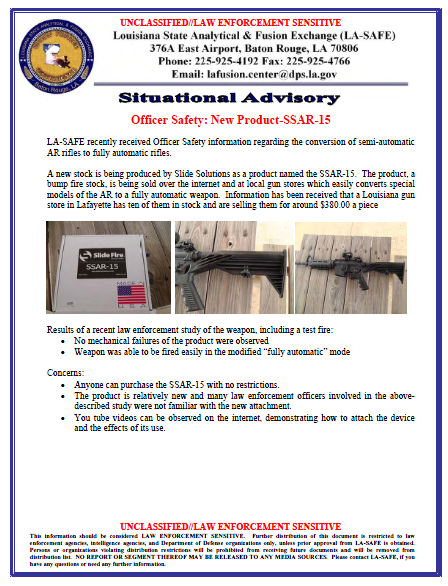
LA-SAFE recently received Officer Safety information regarding the conversion of semi-automatic AR rifles to fully automatic rifles.
A new stock is being produced by Slide Solutions as a product named the SSAR-15. The product, a bump fire stock, is being sold over the internet and at local gun stores which easily converts special models of the AR to a fully automatic weapon. Information has been received that a Louisiana gun store in Lafayette has ten of them in stock and are selling them for around $380.00 a piece.
Results of a recent law enforcement study of the weapon, including a test fire:
• No mechanical failures of the product were observed
• Weapon was able to be fired easily in the modified “fully automatic” mode
Concerns:
• Anyone can purchase the SSAR-15 with no restrictions.
• The product is relatively new and many law enforcement officers involved in the above-described study were not familiar with the new attachment.
• You tube videos can be observed on the internet, demonstrating how to attach the device and the effects of its use.
Product:
• The SSAR-15 stock which easily converts in minutes (one flathead screwdriver) allows almost any model AR-15 to be readily “utilized in a fully automatic firing mode.”
• The product is offered in a right and left hand version and comes complete with instructions on how to install the product.
• The product also comes with a letter from the Department of Justice, Bureau of Alcohol, Tobacco, and Firearms, authorizing the device as “intended to assist persons whose hands have limited mobility to ‘bump-fire’ an AR-15 type rifle.” However, there are no selling or buying restrictions for only handicapped or disabled persons to purchase the items.
• ATF currently does not regulate because “the stock has no automatically functioning mechanical parts or springs and performs no automatic mechanical function when installed. In order to use the installed device, the shooter must apply constant pressure with the shooting hand.”
The following information paper on the Military Whistleblower Protection Act was written within the last week and is being circulated in response to recent reports of DoD whistleblowers facing retaliation for reporting malfeasance and other abuses. A recent DoD Inspector General report outlined a number of incidents where whistleblowers were inadequately protected from reprisal.
UBJECT: Whistleblower Protection Act
1. Purpose. To inform commanders about the Whistleblower Protection Act, 10 U.S. Code section 1034.
2. Points of major interest and facts.
a. No person will restrict a member of the Armed Services from communicating with a member of Congress; an Inspector General; a member of a DOD audit, inspection, investigation or law enforcement organization; an EO/EEO representative; or anyone in the chain of command. Soldiers will be free from reprisal for making or preparing such communications.
b. No employee or Soldier may take or threaten to take an unfavorable personnel action, or to withhold or threaten to withhold favorable personnel action, in reprisal against any Soldier for making or preparing a protected communication. Personnel Action is defined as any action that affects or has the potential to affect the member’s current position or career. These include promotions; disciplinary or other corrective action; transfer or reassignment; performance evaluation; decision on pay, benefits, awards, or training; referral for a mental health evaluation; or other significant change in duties inconsistent with the member’s rank.
c. A reprisal situation may exist if you answer the questions below as indicated:
(1) Was there a protected communication (Member of Congress, IG, EO, etc.)? Yes
(2) Was there an adverse personnel action taken or threatened, or an action withheld or threatened to be withheld, after the protected communication? Yes
(3) Did the chain of command know about the protected communication? Yes
(4) Would the action have occurred absent the protected communication (i.e. was there an independent basis for the action, such as a separate act of misconduct)? No
d. Consult your supporting legal office or IG if you have questions concerning the Whistleblower Protection Act.
Hosted by James Earl Jones.
Segments with Oliver Stone,L.Fletcher Prouty,Cyril H. Wecht,Victor Marchetti.
This documentary, created by Pulitzer prize winning journalist Jack Anderson is one of the most accurate and informative I have ever seen. Like all TV shows, it’s a bit cheesy in places but it also contains some very good and accurate information.
DOWNLOAD THE ORIGINAL DOCUMENT HERE
In April 1961, Lansdale who has been designated Operations Officer for an interagency Task Force responsible for political, military, economic, psychological, and covert character, was to go to Vietnam in April. Changes in policy, however, transferred these responsibilities to the military and diplomats, and Lansdale was no longer involved with Vietnam.
CIA begins to sponsor and train the Civilian Irregular Defense Groups (CIDG) in the South Central Highlands. These were local defense operations with a mobile support component, “Mike Force”, made up primarily of Nung mercenaries. Most CIDG units eventually became Vietnamese Rangers.
Alfred McCoy, author of The Politics of Heroin in Southeast Asia, described CIA complicity in the Vietnam-era drug trade originating in Southeast Asia, and further described CIA attempts to interfere with publication of the book. On June 1 of this year an official of the US Central Intelligence Agency paid a visit to the New York offices of my publisher, Harper and Row, Inc. This CIA official was Mr. Cord Meyer, Jr. (now the CIA’s Assistant Deputy Director of Plans; formerly the CIA official in charge of providing covert financial subsidies for organizations such as the National Student Association, Encounter Magazine, and the Congress for Cultural Freedom). Mr. Meyer urged several of his old friends among Harper and Row’s senior management to provide him with a copy of the galley proofs of my history of the international narcotics traffic, The Politics of Heroin in Southeast Asia. In this book I show the complicity of various US agencies—particularly the CIA and the State Department—in organizing the Southeast Asian drug traffic since the early 1950s.
According to Dr. McCoy, the agency intimidated his sources and tried to keep the book from being published. There is also an article in Peace Magazine containing similar allegations. The Mel Gibson film, Air America. Air America was based on the Christopher Robbins book Air America, which chronicled the history of CIA proprietary airlines in Southeast Asia.
In his book, McCoy wrote It is transported in the planes, vehicles, and other conveyances supplied by the United States. The profit from the trade has been going into the pockets of some of our best friends in Southeast Asia. The charge concludes with the statement that the traffic is being carried on with the indifference if not the closed-eye compliance of some American officials and there is no likelihood of its being shut down in the foreseeable future.”
This is not inconsistent with Leary’s description (with respect to Laos and Southeast Asia), although there seem to be differences in the degree of knowledge and consent by CIA management.
(U//FOUO) Thank you for your letter of 29 March 2012 expressing concerns about the cyber threats facing our nation. I share your view that the United States will inevitably face a large-scale cyber attack, and I take very seriously the issues you outlined. Both U.S. Cyber Command (USCYBERCOM) and the National Security Agency/Central Security Service (NSA/CSS) are taking measures to mitigate the threat and build the capability to respond in cyberspace as directed by the President. I would like to invite you to visit us at Fort Meade and see for yourself the capabilities we have currently and those we are developing to take actions in cyberspace against potential adversaries. In the interim, I appreciate the opportunity to respond to your questions and concerns.
- (U//FOUO) What additional authorities do you believe are necessary to defend the United States from a cyber attack initiated by a peer-competitor like China or Russia?
(U//FOUO) Let me clarify my views about what I believe we need now to defend the Nation in cyberspace. I believe we need both supportive legislation and appropriately delegated authorities. My views on these issues have been consistent and are reflected in my public statements and testimony. I believe supportive legislation is needed in two related areas – information sharing and core critical infrastructure hardening. If the Department of Defense (DoD) is to defend the Nation against cyber attacks originating from outside the United States, it must be able to see those attacks in real time. This requires legislation that, at a minimum, removes existing barriers and disincentives that inhibit the owners of the critical infrastructure from sharing cyber threat indicators with the Government.
(U//FOUO) Additionally, given DoD reliance on certain core critical infrastructure to execute its mission, as well as the importance of the Nation’s critical infrastructure to our national and economic security overall, legislation is also needed to ensure that infrastructure is efficiently hardened and resilient. Recent events have shown that a purely voluntary and market driven system is not sufficient. Some minimum security requirements will be necessary to ensure that the core critical infrastructure is taking appropriate measures to harden its networks to dissuade adversaries and make it more difficult for them to penetrate those networks. At the same time, it is important that legislative requirements not be too burdensome.
(U//FOUO) The President has the necessary authority to order military action to defend our nation against all attacks whether they come from terrorists or nation states and in any domain from sea, air, land, or cyberspace. Since the President can delegate appropriate authorities to the Secretary of Defense to use the Department’s operational capabilities, including USCYBERCOM, to defend the Nation from cyber attack, legislative action is not required. This has been the subject of extensive dialogue with the Senate Armed Services Committee and I look forward to the continuation of that dialogue. I will keep you and the Committee informed as we mature our operational capabilities in cyberspace.
- (U//FOUO) Which agency within the federal government has the most cybersecurity expertise and is most capable of protecting critical infrastructure?
(U//FOUO) No single public or private entity has all of the required authorities, resources, and capabilities; cybersecurity requires a team. In the Federal Government, the responsibilities and capabilities are distributed across Department of Homeland Security (DHS), the Federal Bureau of Investigation (FBI). and the DoD/Intelligence Community (IC), most notably USCYBERCOM and NSA/CSS. This distribution is, at once, both distinguished and complementary. All three working as a team play a role in protecting our networks, preventing intrusions, and responding to cyber events.
(U//FOUO) DHS primary roles are to protect civilian government networks, increase the cybersecurity capability of core critical infrastructure networks, and enhance national resilience and preparedness. DHS secures unclassified federal civilian government networks and provides response mitigation and support to the private sector. DHS also coordinates the response to significant cyber incidents.
(U//FOUO) The role of FBI is to investigate, prevent, and respond to cyber events that are criminal or counterintelligence-related inside the United States. FBI is the lead for domestic cyber threat intelligence and attribution, as well as law enforcement and domestic counterintelligence. FBI also informs DHS’ cyber mission by providing information to aid their preparation and protection efforts.
(U//FOUO) With respect to both the DHS and FBI roles, the limited, voluntary information sharing by the private sector inhibits the government’s ability to protect domestic cyberspace which is why it must be a key element of any cyber legislation as I mentioned earlier. It would also greatly benefit DoD, which assists DHS and the FBI with intelligence support in their respective roles.
(U//FOUO) As a member of the DoD and IC, NSA/CSS is responsible for: foreign cyber threat intelligence and attribution; providing guidance to secure national security systems~ and furnishing DHS with intelligence and expertise to enhance the protection of U.S. networks. USCYBERCOM is responsible tor defending the Nation from a cyber attack and for the operations, defense, and security of military systems and networks. USCYBERCOM also supports other Combatant Commands (CCMD) with offensive and defensive cyber capabilities and integrating these capabilities into CCMD Operational Plans.
- (U//FOUO) Does the Department of Defense rely on any critical infrastructure that, under the Administration’s proposals, would be subject to Department of Homeland Security oversight?
(U//FOUO) Yes, DoD does rely on certain key critical infrastructure, to include power, transportation, telecommunications, and the Defense Industrial Base (DIB). Pursuant to the Administration’s proposals, DHS would; in consultation with the private sector, and in coordination with DoD and other sector-specific agencies, be responsible for setting cybersecurity requirements and ensuring they achieve a baseline level of security. DoD would share the responsibility to protect the DIB with DHS, support DHS efforts to protect other critical infrastructure, and defend the Nation in the event of a cyber attack on the critical infrastructure. FBI would be responsible for conducting investigations of intrusion activity in those critical infrastructure networks inside the United States.
- (U//FOUO) Can the Department of Homeland Security currently protect our national interest in the cyber realm without NSA involvement?
(U//FOUO) No, protecting our national interest in the cyber realm requires a team effort consisting of DHS, FBI, NSA/CSS and USCYBERCOM.
- (U//FOUO) Do you believe we are deterring and dissuading our adversaries in cyberspace?
(U//FOUO) No, while work is ongoing in each area, much remains to be done across both the public and private sectors.
- (U//FOUO) With respect to imposing requirements on the private sector, if the rate of technological advances outpaces the implementation of performance requirements and regulation, how would imposing additional regulations better protect us from a catastrophic cyber attack?
(U//FOUO) The proposed security requirements in the Administration’s proposal would not dictate specific measures that may become outdated, but rather would require critical infrastructure to achieve security results using methods of their choice. We expect this approach will actually result in greater innovation, as companies look to the commercial market to produce security products and services that satisfy these requirements. Additionally, it is important to note that the Administration’s proposal leverages, rather than duplicates existing regulatory processes, allows for exception of certain core infrastructure for which sector-specific regulatory agencies have sufficient requirements and enforcement mechanisms, and explicitly excludes regulation of technology products and services.
(U//FOUO) Lastly, at the 27 March SASC/Senate Select Committee on Intelligence briefing, you voiced concerns about an imbalance in the cyber workforce allocation between offense and defense. My response focused on the need to move to a new paradigm where our military cyber professionals are trained and equipped to execute both offensive and defensive missions. As you know, this is analogous to how DoD routinely employs Fighter-Attack aircraft in multiple roles; from interdiction of enemy forces to defensive counter air missions. Our recent experiences at CYBER FLAG, which was modeled after the DoD’s realistic RED FLAG exercises, saw us for the first time employing cyber teams that seamlessly executed both offensive and defensive missions. The lessons learned prove the powerful operational capability inherent in this organizational model, which combines both attack and defend capabilities under a single commander.
(U//FOUO) Senator, I look forward to discussing this and any other issues you would like at your convenience, and again I would welcome your visit to Team Cyber at Fort Meade if your schedule permits. I remain committed to providing you my best military and technical advice and expertise.
Desegregation is the process of ending the separation of two groups usually referring to races. This is most commonly used in reference to the United States. Desegregation was long a focus of the American Civil Rights Movement, both before and after the United States Supreme Court’s decision in Brown v. Board of Education, particularly desegregation of the school systems and the military. Racial integration of society was a closely related goal.
The African-American Civil Rights Movement (1955–1968) refers to the movements in the United States aimed at outlawing racial discrimination against African Americans and restoring voting rights in Southern states. This article covers the phase of the movement between 1954 and 1968, particularly in the South. By 1966, the emergence of the Black Power Movement, which lasted roughly from 1966 to 1975, enlarged the aims of the Civil Rights Movement to include racial dignity, economic and political self-sufficiency, and freedom from oppression by white Americans.
The movement was characterized by major campaigns of civil resistance. During the period 1955–1968, acts of nonviolent protest and civil disobedience produced crisis situations between activists and government authorities. Federal, state, and local governments, businesses, and communities often had to respond immediately to crisis situations that highlighted the inequities faced by African Americans. Forms of protest and/or civil disobedience included boycotts such as the successful Montgomery Bus Boycott (1955–1956) in Alabama; “sit-ins” such as the influential Greensboro sit-ins (1960) in North Carolina; marches, such as the Selma to Montgomery marches (1965) in Alabama; and a wide range of other nonviolent activities.
Noted legislative achievements during this phase of the Civil Rights Movement were passage of Civil Rights Act of 1964, that banned discrimination based on “race, color, religion, or national origin” in employment practices and public accommodations; the Voting Rights Act of 1965, that restored and protected voting rights; the Immigration and Nationality Services Act of 1965, that dramatically opened entry to the U.S. to immigrants other than traditional European groups; and the Fair Housing Act of 1968, that banned discrimination in the sale or rental of housing. African Americans re-entered politics in the South, and across the country young people were inspired to action.
Little Rock, Arkansas, was in a relatively progressive Southern state. A crisis erupted, however, when Governor of Arkansas Orval Faubus called out the National Guard on September 4 to prevent entry to the nine African-American students who had sued for the right to attend an integrated school, Little Rock Central High School. The nine students had been chosen to attend Central High because of their excellent grades. On the first day of school, only one of the nine students showed up because she did not receive the phone call about the danger of going to school. She was harassed by white protesters outside the school, and the police had to take her away in a patrol car to protect her. Afterward, the nine students had to carpool to school and be escorted by military personnel in jeeps.
Faubus was not a proclaimed segregationist. The Arkansas Democratic Party, which then controlled politics in the state, put significant pressure on Faubus after he had indicated he would investigate bringing Arkansas into compliance with the Brown decision. Faubus then took his stand against integration and against the Federal court order that required it.
Faubus’ order received the attention of President Dwight D. Eisenhower, who was determined to enforce the orders of the Federal courts. Critics had charged he was lukewarm, at best, on the goal of desegregation of public schools. Eisenhower federalized the National Guard and ordered them to return to their barracks. Eisenhower then deployed elements of the 101st Airborne Division to Little Rock to protect the students.
The students were able to attend high school. They had to pass through a gauntlet of spitting, jeering whites to arrive at school on their first day, and to put up with harassment from fellow students for the rest of the year. Although federal troops escorted the students between classes, the students were still teased and even attacked by white students when the soldiers were not around. One of the Little Rock Nine, Minnijean Brown, was suspended for spilling a bowl of chili on the head of a white student who was harassing her in the school lunch line. Later, she was expelled for verbally abusing a white female student.
http://en.wikipedia.org/wiki/American_Civil_Rights_Movement_%281955-1968%29
NEWARK, NJ—A Russian national living in New York has been charged for his alleged role in a ring that stole approximately $1 million by hacking into retail brokerage accounts and executing sham trades, U.S. Attorney for the District of New Jersey Paul J. Fishman announced today.
Petr Murmylyuk, aka “Dmitry Tokar,” 31, of Brooklyn, New York, has been charged by complaint with one count of conspiracy to commit wire fraud, unauthorized access to computers, and securities fraud. The U.S. Securities and Exchange Commission (SEC) is also filing a parallel civil action. Murmylyuk is currently in state custody facing charges arising out of a separate investigation conducted by the Manhattan District Attorney’s Office and will appear in Newark federal court to face the conspiracy charge on a date to be determined.
“Hackers continue to find new and advanced ways to steal from the financial sector,” said First Assistant U.S. Attorney J. Gilmore Childers. “Through the illusion of legitimacy, these alleged hackers controlled both sides of securities transactions to game the market and drain their victims’ accounts. Those who use their computer skills for fraud underestimate the combined resolve of law enforcement and the financial services industry to detect and stop these crimes.”
“This investigation highlights the level of sophistication reached by individuals involved in computer intrusions and hacking activities in furtherance of complex economic and financial crimes,” said FBI Newark Division Assistant Special Agent in Charge David Velazquez. “The same level of sophistication must be maintained by federal investigators and prosecutors, together with private sector partners, to stay one step ahead of these individuals.”
According to the complaint unsealed today in Newark federal court:
Beginning in late 2010, Murmylyuk worked with others to steal from online trading accounts at Scottrade, E*Trade, Fidelity, Schwab, and other brokerage firms. Members of the ring first gained unauthorized access to the online accounts and changed the phone numbers and e-mail addresses on file to prevent notice of unauthorized trading from going to the victims.
Once the hackers controlled the accounts, they used stolen identities to open additional accounts at other brokerage houses. They then caused the victims’ accounts to make unprofitable and illogical securities trades with the new accounts—referred to in the complaint as the “profit accounts”—that benefitted the hackers.
One version of the fraud involved causing the victims’ accounts to sell options contracts to the profit accounts, then to purchase the same contracts back minutes later for up to nine times the price. In another version of the fraud, they used the profit accounts to offer short sales of securities at prices well over market price and to force the victim accounts to make irrational purchases. (A short sale is a sale of stock that an investor does not own but rather borrows from a stock lender and must eventually return.)
Murmylyuk and a conspirator recruited foreign nationals visiting, studying, and living in the United States—including Russian nationals and Houston residents Anton Mezentsev, Galina Korelina, Mikhail Shatov, and others—to open bank accounts into which illegal proceeds could be deposited. Murmylyuk and the conspirator then caused the proceeds of the sham trades to be transferred from the profit accounts into those accounts, where the stolen money could be withdrawn.
Fidelity, Scottrade, E*Trade, and Schwab have reported combined losses to date of approximately $1 million as a result of the fraudulent schemes.
Murmylyuk is also accused of placing a telephone call to Trade Station Securities in which he claimed to be “Dmitry Tokar,” through whose brokerage account the ring placed approximately $200,000 in fraudulent securities trades. Murmylyuk was arrested in Brooklyn on November 3, 2011, in possession of a laptop that evidenced the fraud.
Mezentsev, Korelina, and Shatov were previously charged in the District of New Jersey and convicted of conspiracy to commit wire fraud based on their agreement to receive stolen money in the accounts in their names. U.S. District Judge Esther Salas sentenced Mezentsev, Korelina, and Shatov to 27 months, 14 months, and 14 months in prison, respectively, earlier this year.
If convicted, Murmylyuk faces a maximum potential penalty of five years in prison and a $250,000 fine.
U.S. Attorney Fishman praised special agents of the FBI, under the direction of Special Agent in Charge for the Newark Division Michael B. Ward; Immigration and Customs Enforcement-Homeland Security Investigations, under the direction of New Jersey Special Agent in Charge Andrew McLees; and Internal Revenue Service-Criminal Investigations, New York Field Office, under the direction of Acting Special Agent in Charge Victor W. Lessoff, for their work in the continuing investigation.
He also thanked special agents of the FBI in St. Louis and San Francisco and the U.S. Secret Service in Houston, as well as the Manhattan District Attorney’s Office, under the direction of District Attorney Cyrus R. Vance, Jr., for its contributions and cooperation in coordinating the parallel investigations. He also thanked the SEC’s Philadelphia Regional Office, under the leadership of its Regional Director Daniel M. Hawke, and the Justice Department’s Computer Crime and Intellectual Property Section for their assistance in the investigation.
The government is represented by Assistant U.S. Attorney Seth B. Kosto of the Computer Hacking and Intellectual Property Section of the U.S. Attorney’s Office for the District of New Jersey’s Economic Crimes Unit in Newark.
The charges and allegations in the complaint are merely accusations, and the defendant is considered innocent unless and until proven guilty.
This case was brought in coordination with President Barack Obama’s Financial Fraud Enforcement Task Force. President Obama established the interagency Financial Fraud Enforcement Task Force to wage an aggressive, coordinated, and proactive effort to investigate and prosecute financial crimes. The task force includes representatives from a broad range of federal agencies, regulatory authorities, inspectors general, and state and local law enforcement who, working together, bring to bear a powerful array of criminal and civil enforcement resources. The task force is working to improve efforts across the federal executive branch, and with state and local partners, to investigate and prosecute significant financial crimes, ensure just and effective punishment for those who perpetrate financial crimes, combat discrimination in the lending and financial markets, and recover proceeds for victims of financial crimes.
For more information on the task force, visit http://www.stopfraud.gov.
The Cuban Revolution was a successful armed revolt by Fidel Castro’s 26th of July Movement, which overthrew the US-backed Cuban dictator Fulgencio Batista on 1 January 1959, after over five years of struggle. “Our revolution is endangering all American possessions in Latin America. We are telling these countries to make their own revolution.” — Che Guevara, October 1962
Castro later travelled to the United States to explain his revolution. He said, “I know what the world thinks of us, we are Communists, and of course I have said very clearly that we are not Communists; very clearly.”
Hundreds of suspected Batista-era agents, policemen and soldiers were put on public trial for human rights abuses and war crimes, including murder and torture. Most of those convicted in revolutionary tribunals of political crimes were executed by firing squad, and the rest received long prison sentences. One of the most notorious examples of revolutionary justice was the execution of over 70 captured Batista regime soldiers, directed by Raúl Castro after the capture of Santiago. For his part in Havana, Che Guevara was appointed supreme prosecutor in La Cabaña Fortress. This was part of a large-scale attempt by Fidel Castro to cleanse the security forces of Batista loyalists and potential opponents of the new revolutionary regime. Others were fortunate enough to be dismissed from the army and police without prosecution, and some high-ranking officials in the ancien régime were exiled as military attachés.
In 1961, after the US-backed Bay of Pigs Invasion, the new Cuban government nationalized all property held by religious organizations, including the dominant Roman Catholic Church. Hundreds of members of the church, including a bishop, were permanently expelled from the nation, with the new Cuban government being declared officially atheist. Faria describes how the education of children changed as Cuba officially became an atheist state: private schools were banned and the progressively socialist state assumed greater responsibility for children.
According to geographer and Cuban Comandante Antonio Núñez Jiménez, 75% of Cuba’s best arable land was owned by foreign individuals or foreign (mostly U.S.) companies. One of the first policies of the newly formed Cuban government was eliminating illiteracy and implementing land reforms. Land reform efforts helped to raise living standards by subdividing larger holdings into cooperatives. Comandante Sori Marin, nominally in charge of land reform, objected and fled, but was eventually executed. Many other non-Marxist, anti-Batista rebel leaders were forced in to exile, purged in executions, or eliminated in failed uprisings such as that of the Beaton brothers.
Shortly after taking power, Castro also created a Revolutionary militia to expand his power base among the former rebels and the supportive population. Castro also initiated Committees for the Defense of the Revolution or CDRs in late September 1960. Government informants became rampant within the population. CDRs were tasked with keeping “vigilance against counter-revolutionary activity.” Local CDRs were also tasked with keeping a detailed record of each neighborhood’s inhabitants’ spending habits, level of contact with foreigners, work and education history, and any “suspicious” behavior. One of the persecuted groups were homosexual men. The Cuban dissident and exile Reinaldo Arenas wrote about such persecution in his autobiography, “Antes Que Anochezca”, the basis for the film Before Night Falls.
In February 1959, the Ministry for the Recovery of Misappropriated Assets (Ministerio de Recuperación de Bienes Malversados) was created. Cuba began expropriating land and private property under the auspices of the Agrarian Reform Law of 17 May 1959. Cuban lawyer Mario Lazo writes that farms of any size could be and were seized by the government. Land, businesses, and companies owned by upper- and middle-class Cubans were also nationalized, including the plantations owned by Fidel Castro’s family. By the end of 1960, the revolutionary government had nationalized more than $25 billion worth of private property owned by Cubans. Cuba also nationalized all foreign-owned property, particularly American holdings, in the nation on 6 August 1960. The United States, in turn, responded by freezing all Cuban assets in the United States, severing diplomatic ties, and tightening the embargo on Cuba, which is still in place as of 2011. In response to the acts of the Eisenhower administration, Cuba turned to the Soviet Union for support.
As a result of close cooperation with our security and intelligence partners overseas, an improvised explosive device (IED) designed to carry out a terrorist attack has been seized abroad. The FBI currently has possession of the IED and is conducting technical and forensics analysis on it. Initial exploitation indicates that the device is very similar to IEDs that have been used previously by al Qaeda in the Arabian Peninsula (AQAP) in attempted terrorist attacks, including against aircraft and for targeted assassinations. The device never presented a threat to public safety, and the U.S. government is working closely with international partners to address associated concerns with the device. We refer you to the Department of Homeland Security, including the Transportation Security Administration, regarding ongoing security measures to safeguard the American people and the traveling public.
Buddhism in Burma (also known as Myanmar) is predominantly of the Theravada tradition, practised by 89% of the country’s population It is the most religious Buddhist country in terms of the proportion of monks in the population and proportion of income spent on religion. Adherents are most likely found among the dominant ethnic Bamar (or Burmans), Shan, Rakhine (Arakanese), Mon, Karen, and Chinese who are well integrated into Burmese society. Monks, collectively known as the Sangha, are venerated members of Burmese society. Among many ethnic groups in Myanmar, including the Bamar and Shan, Theravada Buddhism is practiced in conjunction with nat worship, which involves the placation of spirits who can intercede in worldly affairs.
With regard to “salvation” in the Buddhist sense, there are three primary paths in Burmese Buddhism: merit-making, vipassana (insight meditation), and the weizza path (an esoteric form of Buddhism that involves the occult). Merit-making is the most common path undertaken by Burmese Buddhists. This path involves the observance of the Five Precepts and accumulation of good merit through charity and good deeds (dana) in order to obtain a favorable rebirth. The vipassana path, which has gained ground since the early 1900s, is a form of insight meditation believed to lead to enlightenment. The third and least common route, the weizza path, is an esoteric system of occult practices (such as recitation of spells, samatha meditation, and alchemy) and believed to lead to life as a weizza (also spelt weikza), a semi-immortal and supernatural being who awaits the appearance of the future Buddha, Maitreya (Arimeitaya).
The history of Buddhism in Burma extends nearly a millennium. The Sasana Vamsa, written by Pinyasami in 1834, summarises much of the history of Buddhism in Burma. According to many historians, Sohn Uttar Sthavira (one of the royal monks) to Ashoka the Great came to Burma (Suvarnabhumi or Suvannabhumi) around 228 BC with other monks and sacred texts, including books.
The Ari Buddhism era included the worship of Bodhisattas and nagas, and also was known for corrupt monks. King Anawrahta of Bagan was converted by Shin Arahan, a monk from Thaton to Theravada Buddhism. In 1057 AD, Anawrahta sent an army to conquer the Mon city of Thaton in order to obtain theTipitaka Buddhist canon. Mon culture, from that point, came to be largely assimilated into the Bamar culture based in Bagan. Despite attempts at reform, certain features of Ari Buddhism and traditional nat worship continued, such as reverence of Avalokiteśvara (Lawka nat), a Boddhisatta. Successive kings of Bagan continued to build large numbers of monuments, temples, and pagodas in honour of Buddhism. Burmese rule at Bagan continued until the invasion of the Mongols in 1287.
The Shan, meanwhile, established themselves as rulers throughout the region now known as Burma. Thihathu, a Shan king, established rule in Bagan, by patronising and building many monasteries and pagodas. Bhikkus continued to be influential, particularly in Burmese literature and politics.
The Mon kingdoms, often ruled by Shan chieftains, fostered Theravada Buddhism in the 14th century. Wareru, who became king of Mottama (a Mon city kingdom), patronised Buddhism, and established a code of law (Dhammathat) compiled by Buddhist monks. King Dhammazedi, formerly a Mon monk, established rule in the late 15th century at Innwa and unified the Sangha in Mon territories. He also standardised ordination of monks set out in the Kalyani Inscriptions. Dhammazedi moved the capital back to Hanthawaddy (Bago). His mother-in-law Queen Shin Sawbu of Pegu was also a great patron of Buddhism. She is credited for expanding and gilding the Shwedagon Pagoda giving her own weight in gold.
The Bamar, who had fled to Taungoo before the invading Shan, established a kingdom there under the reigns of Tabinshwehti and Bayinnaung who conquered and unified most of modern Burma. These monarchs also embraced Mon culture and patronised Theravada Buddhism.
4.1.1. The President is authorized by the Constitution and laws of the United States to employ the Armed Forces of the United States to suppress insurrections, rebellions, and domestic violence under various conditions and circumstances. Planning and preparedness by the Federal Government and the Department of Defense for civil disturbances are important due to the potential severity of the consequences of such events for the Nation and the population.
4.1.2. Military resources may be employed in support of civilian law enforcement operations in the 50 States, the District of Columbia, the Commonwealth of Puerto Rico, and the U.S. territories and possessions only in the parameters of the Constitution and laws of the United States and the authority of the President and the Secretary of Defense, including delegations of that authority through this Directive or
other means.4.1.3. The primary responsibility for protecting life and property and maintaining law and order in the civilian community is vested in the State and local governments. Supplementary responsibility is vested by statute in specific Agencies of the Federal Government other than the Department of Defense. The President has additional powers and responsibilities under the Constitution of the United States to ensure that law and order are maintained.
…
4.8. Domestic Terrorist Incidents
4.8.1. Responsibility for managing the Federal response to acts of terrorism in the United States rests with the Attorney General of the United States.
4.8.1.1. The Attorney General coordinates all Federal Government activities during a major terrorist incident and advises the President as to whether and when to commit Military Forces in response to such a situation.
4.8.1.2. In the DoJ, the lead Agency for the operational response to a terrorist incident is the FBI. The initial tactical response to such incidents is made by the FBI Special Agent in Charge at the scene, under the supervision of the Director of the FBI, who has overall responsibility for ongoing operations to contain and resolve the incident.
4.8.2. All military preparations and operations, including the employment of Military Forces at the scene, for any terrorist incident in the 50 States, the District of Columbia, the Commonwealth of Puerto Rico, and U.S. territories and possessions, shall be the primary responsibility of the DoD Executive Agent under this Directive.
4.8.2.1. In discharging those functions, the DoD Executive Agent shall observe such law enforcement policies as the Attorney General may determine.
4.8.2.2. When a terrorist incident develops, having a potential for military involvement, the DoD Executive Agent may dispatch military observers to the incident site, on mutual agreement between Department of Defense and the FBI, to appraise the situation before any decision is made to commit Federal Military Forces. Any dispatch of U.S. counterterrorism forces as observers shall be specifically authorized by the Secretary of Defense through the Chairman of the Joint Chiefs of Staff.
4.8.3. When U.S. counterterrorism forces are authorized to assist with the resolution of a domestic terrorist incident, the Chairman of the Joint Chiefs of Staff shall issue the appropriate order for the Secretary of Defense. That order shall designate the command relationships for the deploying forces.
In a 1983 Time magazine article it was stated that the KGB has been the world’s most effective information-gathering organization. It operated legal and illegal espionage residencies in target countries where the legal resident spied from the Soviet embassy, and, if caught, was protected with diplomatic immunity from prosecution; at best, the compromised spy either returned to the Soviet Union or was expelled by the target country government. The illegal resident spied unprotected by diplomatic immunity and worked independently of the Soviet diplomatic and trade missions, (cf. the non-official cover CIA agent). In its early history, the KGB valued illegal spies more than legal spies, because illegals penetrated their targets more easily. The KGB residency executed four types of espionage: (i) political, (ii) economic, (iii) military-strategic, and (iv) disinformation, effected with “active measures” (PR Line), counter-intelligence and security (KR Line), and scientific–technologic intelligence (X Line); quotidian duties included SIGINT (RP Line) and illegal support (N Line).
At first, using the romantic and intellectual allure of “The First Worker–Peasant State” (1917), “The Fight Against Fascism” (1936–39), and the “Anti-Nazi Great Patriotic War” (1941–45) the Soviets recruited many idealistic, high-level Westerners as ideological agents … but the Russo–German Molotov-Ribbentrop Pact (1939) and the suppressed Hungarian Uprising (1956) and Prague Spring (1968) mostly ended ideological recruitment.
The KGB classified its spies as agents (intelligence providers) and controllers (intelligence relayers). The false-identity legend assumed by a USSR-born illegal spy was elaborate, the life of either a “live double” (participant to the fabrication) or a “dead double” (whose identity is tailored to the spy). The agent then substantiated his or her legend by living it in a foreign country, before emigrating to the target country; thus the sending of US-bound illegal residents via the Soviet residency in Ottawa, Canada. Tradecraft included stealing and photographing documents, code-names, contacts, targets, and dead letter boxes, and working as “friend of the cause” agents provocateur who infiltrate the target’s group to sow dissension, influence policy, and arrange kidnappings and assassinations.
The Cheka was established to defend the October Revolution and the nascent Bolshevik state from its enemies—principally the monarchist White Army. To ensure the Bolshevik régime’s survival, it suppressed counter-revolution with domestic terror and international deception. The scope of foreign intelligence operations prompted Lenin to authorise the Cheka’s creation of the INO (Innostranyi Otdel — Foreign-intelligence Department)—the precursor to the First Chief Directorate (FCD) of the KGB. In 1922, Lenin’s régime re-named the Cheka as the State Political Directorate (OGPU).
The OGPU expanded Soviet espionage nationally and internationally, and provided to Stalin the head personal bodyguard Nikolai Vlasik. The vagaries of Stalin’s paranoia influenced the OGPU’s performance and direction in the 1930s, i.e. fantastic Trotskyist conspiracies, etc. Acting as his own analyst, Stalin unwisely subordinated intelligence analysis to collecting it; eventually, reports pandered to his conspiracy fantasies. The middle history of the KGB culminates in the Great Purge (1936–38) killings of civil, military, and government people deemed politically unreliable—among them, chairmen Genrikh Yagoda (1938) and Nikolai Yezhov (1940); later, Lavrentiy Beria (1953) followed suit. Ironically, Yezhov denounced Yagoda for executing the Great Terror, which from 1937 to 1938 is called Yezhovshchina, the especially cruel “Yezhov era.”
In 1941, under Chairman Lavrentiy Beria, the OGPU became the NKGB (People’s Commissariat for State Security, integral to the NKVD) and recovered from the Great Purge of the thirties. Yet, the NKGB unwisely continued pandering to Stalin’s conspiracy fantasies—whilst simultaneously achieving its deepest penetrations of the West. Next, Foreign Minister Vyacheslav Molotov centralised the intelligence agencies, re-organising the NKGB as the KI (Komitet Informatsii — Committee of Information), composed (1947–51) of the MGB (Ministry for State Security) and the GRU (Foreign military Intelligence Directorate). In practice making an ambassador head of the MGB and GRU legal residencies in his embassy; intelligence operations are under political control; the KI ended when Molotov incurred Stalin’s disfavor. Despite its political end, the KI’s contribution to Soviet Intelligence was reliant upon illegal residents- spies able to establish a more secure base of operations in the target country.
[Federal Register Volume 77, Number 84 (Tuesday, May 1, 2012)] [Notices] [Pages 25762-25767] From the Federal Register Online via the Government Printing Office [www.gpo.gov] [FR Doc No: 2012-10472] ----------------------------------------------------------------------- NUCLEAR REGULATORY COMMISSION [Docket No. 72-1039; NRC-2012-0099; EA-12-047] In the Matter of Southern Nuclear Operating Company, Inc., Vogtle Electric Generating Plant, Independent Spent Fuel Storage Installation; Order Modifying License (Effective Immediately) AGENCY: Nuclear Regulatory Commission. ACTION: Issuance of order for implementation of additional security measures and fingerprinting for unescorted access to Southern Nuclear Operating Company, Inc. ----------------------------------------------------------------------- FOR FURTHER INFORMATION CONTACT: L. Raynard Wharton, Senior Project Manager, Licensing and Inspection Directorate, Division of Spent Fuel Storage and Transportation, Office of Nuclear Material Safety and Safeguards, U.S. Nuclear Regulatory Commission, Rockville, Maryland 20852; telephone: (301) 492-3316; fax number: (301) 492-3348; email: Raynard.Wharton@nrc.gov. SUPPLEMENTARY INFORMATION: I. Introduction Pursuant to Title 10 of the Code of Federal Regulations (10 CFR) 2.106, the U.S. Nuclear Regulatory Commission (NRC or the Commission) is providing notice, in the matter of Vogtle Electric Generating Plant Independent Spent Fuel Storage Installation (ISFSI) Order Modifying License (Effective Immediately). II. Further Information I The NRC has issued a general license to Southern Nuclear Operating Company, Inc. (SNC), authorizing the operation of an ISFSI, in accordance with the Atomic Energy Act of 1954, as amended, and 10 CFR part 72. This Order is being issued to SNC because it has identified near-term plans to store spent fuel in an ISFSI under the general license provisions of 10 CFR part 72. The Commission's regulations at 10 CFR 72.212(b)(5), 10 CFR 50.54(p)(1), and 10 CFR 73.55(c)(5) require licensees to maintain safeguards contingency plan procedures to respond to threats of radiological sabotage and to protect the spent fuel against the threat of radiological sabotage, in accordance with 10 CFR part 73, appendix C. Specific physical security requirements are contained in 10 CFR 73.51 or 73.55, as applicable. Inasmuch as an insider has an opportunity equal to, or greater than, any other person, to commit radiological sabotage, the Commission has determined these measures to be prudent. Comparable Orders have been issued to all licensees that currently store spent fuel or have identified near-term plans to store spent fuel in an ISFSI. II On September 11, 2001, terrorists simultaneously attacked targets in New York, NY, and Washington, DC, using large commercial aircraft as weapons. In response to the attacks and intelligence information subsequently obtained, the Commission issued a number of Safeguards and Threat Advisories to its licensees to strengthen licensees' capabilities and readiness to respond to a potential attack on a nuclear facility. On October 16, 2002, the Commission issued Orders to the licensees of operating ISFSIs, to place the actions taken in response to the Advisories into the established regulatory framework and to implement additional security enhancements that emerged from NRC's ongoing comprehensive review. The Commission has also communicated with other Federal, State, and local government agencies and industry representatives to discuss and evaluate the current threat environment in order to assess the adequacy of security measures at licensed facilities. In addition, the Commission has conducted a comprehensive review of its safeguards and security programs and requirements. As a result of its consideration of current safeguards and security [[Page 25763]] requirements, as well as a review of information provided by the intelligence community, the Commission has determined that certain additional security measures (ASMs) are required to address the current threat environment, in a consistent manner throughout the nuclear ISFSI community. Therefore, the Commission is imposing requirements, as set forth in Attachments 1 and 2 of this Order, on all licensees of these facilities. These requirements, which supplement existing regulatory requirements, will provide the Commission with reasonable assurance that the public health and safety, the environment, and common defense and security continue to be adequately protected in the current threat environment. These requirements will remain in effect until the Commission determines otherwise. The Commission recognizes that licensees may have already initiated many of the measures set forth in Attachments 1 and 2 to this Order, in response to previously issued Advisories, or on their own. It also recognizes that some measures may not be possible or necessary at some sites, or may need to be tailored to accommodate the specific circumstances existing at SNC's facility, to achieve the intended objectives and avoid any unforeseen effect on the safe storage of spent fuel. Although the ASMs implemented by licensees in response to the Safeguards and Threat Advisories have been sufficient to provide reasonable assurance of adequate protection of public health and safety, in light of the continuing threat environment, the Commission concludes that these actions must be embodied in an Order, consistent with the established regulatory framework. To provide assurance that licensees are implementing prudent measures to achieve a consistent level of protection to address the current threat environment, licenses issued pursuant to 10 CFR 72.210 shall be modified to include the requirements identified in Attachments 1 and 2 to this Order. In addition, pursuant to 10 CFR 2.202, I find that, in light of the common defense and security circumstances described above, the public health, safety, and interest require that this Order be effective immediately. III Accordingly, pursuant to Sections 53, 103, 104, 147, 149, 161b, 161i, 161o, 182, and 186 of the Atomic Energy Act of 1954, as amended, and the Commission's regulations in 10 CFR 2.202 and 10 CFR parts 50, 72, and 73, it is hereby ordered, effective immediately, that your general license is modified as follows: A. SNC shall comply with the requirements described in Attachments 1 and 2 to this Order, except to the extent that a more stringent requirement is set forth in the Vogtle Electric Generating Plant's physical security plan. SNC shall demonstrate its ability to comply with the requirements in Attachments 1 and 2 to the Order no later than 365 days from the date of this Order or 90 days before the first day that spent fuel is initially placed in the ISFSI, whichever is earlier. SNC must implement these requirements before initially placing spent fuel in the ISFSI. Additionally, SNC must receive written verification from the NRC that it has adequately demonstrated compliance with these requirements before initially placing spent fuel in the ISFSI. B. 1. SNC shall, within twenty (20) days of the date of this Order, notify the Commission: (1) If it is unable to comply with any of the requirements described in Attachments 1 and 2; (2) if compliance with any of the requirements is unnecessary, in its specific circumstances; or (3) if implementation of any of the requirements would cause SNC to be in violation of the provisions of any Commission regulation or the facility license. The notification shall provide SNC's justification for seeking relief from, or variation of, any specific requirement. 2. If SNC considers that implementation of any of the requirements described in Attachments 1 and 2 to this Order would adversely impact the safe storage of spent fuel, SNC must notify the Commission, within twenty (20) days of this Order, of the adverse safety impact, the basis for its determination that the requirement has an adverse safety impact, and either a proposal for achieving the same objectives specified in Attachments 1 and 2 requirements in question, or a schedule for modifying the facility, to address the adverse safety condition. If neither approach is appropriate, SNC must supplement its response, to Condition B.1 of this Order, to identify the condition as a requirement with which it cannot comply, with attendant justifications, as required under Condition B.1. C. 1. SNC shall, within twenty (20) days of this Order, submit to the Commission, a schedule for achieving compliance with each requirement described in Attachments 1 and 2. 2. SNC shall report to the Commission when it has achieved full compliance with the requirements described in Attachments 1 and 2. D. All measures implemented or actions taken in response to this Order shall be maintained until the Commission determines otherwise. SNC's response to Conditions B.1, B.2, C.1, and C.2, above, shall be submitted in accordance with 10 CFR 72.4. In addition, submittals and documents produced by SNC as a result of this Order, that contain Safeguards Information as defined by 10 CFR 73.22, shall be properly marked and handled, in accordance with 10 CFR 73.21 and 73.22. The Director, Office of Nuclear Material Safety and Safeguards, may, in writing, relax or rescind any of the above conditions, for good cause. IV In accordance with 10 CFR 2.202, SNC must, and any other person adversely affected by this Order may, submit an answer to this Order within 20 days of its publication in the Federal Register. In addition, SNC and any other person adversely affected by this Order may request a hearing on this Order within 20 days of its publication in the Federal Register. Where good cause is shown, consideration will be given to extending the time to answer or request a hearing. A request for extension of time must be made, in writing, to the Director, Office of Nuclear Material Safety and Safeguards, U.S. Nuclear Regulatory Commission, Washington, DC 20555-0001, and include a statement of good cause for the extension. The answer may consent to this Order. If the answer includes a request for a hearing, it shall, under oath or affirmation, specifically set forth the matters of fact and law on which SNC relies and the reasons as to why the Order should not have been issued. If a person other than SNC requests a hearing, that person shall set forth with particularity the manner in which his/her interest is adversely affected by this Order and shall address the criteria set forth in 10 CFR 2.309(d). All documents filed in NRC adjudicatory proceedings, including a request for hearing, a petition for leave to intervene, any motion or other document filed in the proceeding prior to the submission of a request for hearing or petition to intervene, and documents filed by interested governmental entities participating under 10 CFR 2.315(c), must be filed in accordance with the NRC E-Filing rule (72 FR 49139, August 28, 2007). The E-Filing process requires participants to submit and serve all adjudicatory [[Page 25764]] documents over the internet, or in some cases to mail copies on electronic storage media. Participants may not submit paper copies of their filings unless they seek an exemption in accordance with the procedures described below. To comply with the procedural requirements of E-Filing, at least 10 days prior to the filing deadline, the participant should contact the Office of the Secretary by email at hearing.docket@nrc.gov, or by telephone at 301-415-1677, to request (1) a digital identification (ID) certificate, which allows the participant (or its counsel or representative) to digitally sign documents and access the E-Submittal server for any proceeding in which it is participating; and (2) advise the Secretary that the participant will be submitting a request or petition for hearing (even in instances in which the participant, or its counsel or representative, already holds an NRC-issued digital ID certificate). Based upon this information, the Secretary will establish an electronic docket for the hearing in this proceeding if the Secretary has not already established an electronic docket. Information about applying for a digital ID certificate is available on the NRC's public Web site at http://www.nrc.gov/site-help/e-submittals/apply-certificates.html. System requirements for accessing the E-Submittal server are detailed in the NRC's ``Guidance for Electronic Submission,'' which is available on the NRC's public Web site at http://www.nrc.gov/site-help/e-submittals.html. Participants may attempt to use other software not listed on the Web site, but should note that the NRC's E-Filing system does not support unlisted software, and the NRC Meta System Help Desk will not be able to offer assistance in using unlisted software. If a participant is electronically submitting a document to the NRC in accordance with the E-Filing rule, the participant must file the document using the NRC's online, Web-based submission form. In order to serve documents through the Electronic Information Exchange System, users will be required to install a Web browser plug-in from the NRC's Web site. Further information on the Web-based submission form, including the installation of the Web browser plug-in, is available on the NRC's public Web site at http://www.nrc.gov/site-help/e-submittals.html. Once a participant has obtained a digital ID certificate and a docket has been created, the participant can then submit a request for hearing or petition for leave to intervene. Submissions should be in Portable Document Format (PDF) in accordance with the NRC guidance available on the NRC's public Web site at http://www.nrc.gov/site-help/e-submittals.html. A filing is considered complete at the time the documents are submitted through the NRC's E-Filing system. To be timely, an electronic filing must be submitted to the E-Filing system no later than 11:59 p.m. Eastern Time on the due date. Upon receipt of a transmission, the E-Filing system time-stamps the document and sends the submitter an email notice confirming receipt of the document. The E-Filing system also distributes an email notice that provides access to the document to the NRC's Office of the General Counsel and any others who have advised the Office of the Secretary that they wish to participate in the proceeding, so that the filer need not serve the documents on those participants separately. Therefore, applicants and other participants (or their counsel or representative) must apply for and receive a digital ID certificate before a hearing request/petition to intervene is filed so that they can obtain access to the document via the E-Filing system. A person filing electronically using the NRC's adjudicatory E- Filing system may seek assistance by contacting the NRC Meta System Help Desk through the ``Contact Us'' link located on the NRC's Web site at http://www.nrc.gov/site-help/e-submittals.html, by email to MSHD.Resource@nrc.gov, or by a toll-free call to 1-866-672-7640. The NRC Meta System Help Desk is available between 8 a.m. and 8 p.m., Eastern Time, Monday through Friday, excluding government holidays. Participants who believe that they have a good cause for not submitting documents electronically must file an exemption request, in accordance with 10 CFR 2.302(g), with their initial paper filing requesting authorization to continue to submit documents in paper format. Such filings must be submitted by: (1) First class mail addressed to the Office of the Secretary of the Commission, U.S. Nuclear Regulatory Commission, Washington, DC 20555-0001, Attention: Rulemaking and Adjudications Staff; or (2) courier, express mail, or expedited delivery service to the Office of the Secretary, Sixteenth Floor, One White Flint North, 11555 Rockville Pike, Rockville, Maryland, 20852, Attention: Rulemaking and Adjudications Staff. Participants filing a document in this manner are responsible for serving the document on all other participants. Filing is considered complete by first-class mail as of the time of deposit in the mail, or by courier, express mail, or expedited delivery service upon depositing the document with the provider of the service. A presiding officer, having granted an exemption request from using E-Filing, may require a participant or party to use E-Filing if the presiding officer subsequently determines that the reason for granting the exemption from use of E-Filing no longer exists. Documents submitted in adjudicatory proceedings will appear in the NRC's electronic hearing docket which is available to the public at http://ehd1.nrc.gov/ehd/, unless excluded pursuant to an order of the Commission, or the presiding officer. Participants are requested not to include personal privacy information, such as social security numbers, home addresses, or home phone numbers in their filings, unless an NRC regulation or other law requires submission of such information. With respect to copyrighted works, except for limited excerpts that serve the purpose of the adjudicatory filings and would constitute a Fair Use application, participants are requested not to include copyrighted materials in their submission. If a hearing is requested by SNC or a person whose interest is adversely affected, the Commission will issue an Order designating the time and place of any hearing. If a hearing is held, the issue to be considered at such hearing shall be whether this Order should be sustained. Pursuant to 10 CFR 2.202(c)(2)(i), SNC may, in addition to requesting a hearing, at the time the answer is filed or sooner, move the presiding officer to set aside the immediate effectiveness of the Order on the grounds that the Order, including the need for immediate effectiveness, is not based on adequate evidence, but on mere suspicion, unfounded allegations, or error. In the absence of any request for hearing, or written approval of an extension of time in which to request a hearing, the provisions as specified in Section III shall be final twenty (20) days from the date this Order is published in the Federal Register, without further Order or proceedings. If an extension of time for requesting a hearing has been approved, the provisions as specified in Section III, shall be final when the extension expires, if a hearing request has not been received. An answer or a request for hearing shall not stay the immediate effectiveness of this order. [[Page 25765]] Dated at Rockville, Maryland, this 23rd day of April, 2012. For the Nuclear Regulatory Commission. Catherine Haney, Director, Office of Nuclear Material Safety and Safeguards. Attachment 1--Additional Security Measures (ASMs) for Physical Protection of Dry Independent Spent Fuel Storage Installations (ISFSIs) contains Safeguards Information and is not included in the Federal Register notice Attachment 2--Additional Security Measures for Access Authorization and Fingerprinting at Independent Spent Fuel Storage Installations, Dated June 3, 2010 A. General Basis Criteria 1. These additional security measures (ASMs) are established to delineate an independent spent fuel storage installation (ISFSI) licensee's responsibility to enhance security measures related to authorization for unescorted access to the protected area of an ISFSI in response to the current threat environment. 2. Licensees whose ISFSI is collocated with a power reactor may choose to comply with the U.S. Nuclear Regulatory Commission (NRC)- approved reactor access authorization program for the associated reactor as an alternative means to satisfy the provisions of sections B through G below. Otherwise, licensees shall comply with the access authorization and fingerprinting requirements of sections B through G of these ASMs. 3. Licensees shall clearly distinguish in their 20-day response which method they intend to use in order to comply with these ASMs. B. Additional Security Measures for Access Authorization Program 1. The licensee shall develop, implement and maintain a program, or enhance its existing program, designed to ensure that persons granted unescorted access to the protected area of an ISFSI are trustworthy and reliable and do not constitute an unreasonable risk to the public health and safety or the common defense and security, including a potential to commit radiological sabotage. a. To establish trustworthiness and reliability, the licensee shall develop, implement, and maintain procedures for conducting and completing background investigations, prior to granting access. The scope of background investigations must address at least the past three years and, as a minimum, must include: i. Fingerprinting and a Federal Bureau of Investigation (FBI) identification and criminal history records check (CHRC). Where an applicant for unescorted access has been previously fingerprinted with a favorably completed CHRC (such as a CHRC pursuant to compliance with orders for access to safeguards information), the licensee may accept the results of that CHRC, and need not submit another set of fingerprints, provided the CHRC was completed not more than three years from the date of the application for unescorted access. ii. Verification of employment with each previous employer for the most recent year from the date of application. iii. Verification of employment with an employer of the longest duration during any calendar month for the remaining next most recent 2 years. iv. A full credit history review. v. An interview with not less than two character references, developed by the investigator. vi. A review of official identification (e.g., driver's license; passport; government identification; state-, province-, or country-of- birth issued certificate of birth) to allow comparison of personal information data provided by the applicant. The licensee shall maintain a photocopy of the identifying document(s) on file, in accordance with ``Protection of Information,'' in section G of these ASMs. vii. Licensees shall confirm eligibility for employment through the regulations of the U.S. Department of Homeland Security, U.S. Citizenship and Immigration Services, and shall verify and ensure, to the extent possible, the accuracy of the provided social security number and alien registration number, as applicable. b. The procedures developed or enhanced shall include measures for confirming the term, duration, and character of military service for the past 3 years, and/or academic enrollment and attendance in lieu of employment, for the past 5 years. c. Licensees need not conduct an independent investigation for individuals employed at a facility who possess active ``Q'' or ``L'' clearances or possess another active U.S. Government-granted security clearance (i.e., Top Secret, Secret, or Confidential). d. A review of the applicant's criminal history, obtained from local criminal justice resources, may be included in addition to the FBI CHRC, and is encouraged if the results of the FBI CHRC, employment check, or credit check disclose derogatory information. The scope of the applicant's local criminal history check shall cover all residences of record for the past three years from the date of the application for unescorted access. 2. The licensee shall use any information obtained as part of a CHRC solely for the purpose of determining an individual's suitability for unescorted access to the protected area of an ISFSI. 3. The licensee shall document the basis for its determination for granting or denying access to the protected area of an ISFSI. 4. The licensee shall develop, implement, and maintain procedures for updating background investigations for persons who are applying for reinstatement of unescorted access. Licensees need not conduct an independent reinvestigation for individuals who possess active ``Q'' or ``L'' clearances or possess another active U.S. Government-granted security clearance, i.e., Top Secret, Secret or Confidential. 5. The licensee shall develop, implement, and maintain procedures for reinvestigations of persons granted unescorted access, at intervals not to exceed five years. Licensees need not conduct an independent reinvestigation for individuals employed at a facility who possess active ``Q'' or ``L'' clearances or possess another active U.S. Government-granted security clearance, i.e., Top Secret, Secret or Confidential. 6. The licensee shall develop, implement, and maintain procedures designed to ensure that persons who have been denied unescorted access authorization to the facility are not allowed access to the facility, even under escort. 7. The licensee shall develop, implement, and maintain an audit program for licensee and contractor/vendor access authorization programs that evaluate all program elements and include a person knowledgeable and practiced in access authorization program performance objectives to assist in the overall assessment of the site's program effectiveness. C. Fingerprinting Program Requirements 1. In a letter to the NRC, the licensee must nominate an individual who will review the results of the FBI CHRCs to make trustworthiness and reliability determinations for unescorted access to an ISFSI. This individual, referred to as the ``reviewing official,'' must be someone who requires unescorted access to the ISFSI. The NRC will review the CHRC of any individual nominated to perform the reviewing official function. Based on the results of the CHRC, the NRC staff will determine whether this individual may have [[Page 25766]] access. If the NRC determines that the nominee may not be granted such access, that individual will be prohibited from obtaining access.\1\ Once the NRC approves a reviewing official, the reviewing official is the only individual permitted to make access determinations for other individuals who have been identified by the licensee as having the need for unescorted access to the ISFSI, and have been fingerprinted and have had a CHRC in accordance with these ASMs. The reviewing official can only make access determinations for other individuals, and therefore cannot approve other individuals to act as reviewing officials. Only the NRC can approve a reviewing official. Therefore, if the licensee wishes to have a new or additional reviewing official, the NRC must approve that individual before he or she can act in the capacity of a reviewing official. --------------------------------------------------------------------------- \1\ The NRC's determination of this individual's unescorted access to the ISFSI, in accordance with the process, is an administrative determination that is outside the scope of the Order. --------------------------------------------------------------------------- 2. No person may have access to Safeguards Information (SGI) or unescorted access to any facility subject to NRC regulation, if the NRC has determined, in accordance with its administrative review process based on fingerprinting and an FBI identification and CHRC, that the person may not have access to SGI or unescorted access to any facility subject to NRC regulation. 3. All fingerprints obtained by the licensee under this Order must be submitted to the Commission for transmission to the FBI. 4. The licensee shall notify each affected individual that the fingerprints will be used to conduct a review of his/her criminal history record and inform the individual of the procedures for revising the record or including an explanation in the record, as specified in the ``Right to Correct and Complete Information,'' in section F of these ASMs. 5. Fingerprints need not be taken if the employed individual (e.g., a licensee employee, contractor, manufacturer, or supplier) is relieved from the fingerprinting requirement by 10 CFR 73.61, has a favorably adjudicated U.S. Government CHRC within the last 5 years, or has an active Federal security clearance. Written confirmation from the Agency/employer who granted the Federal security clearance or reviewed the CHRC must be provided to the licensee. The licensee must retain this documentation for a period of 3 years from the date the individual no longer requires access to the facility. D. Prohibitions 1. A licensee shall not base a final determination to deny an individual unescorted access to the protected area of an ISFSI solely on the basis of information received from the FBI involving: An arrest more than 1 year old for which there is no information of the disposition of the case, or an arrest that resulted in dismissal of the charge, or an acquittal. 2. A licensee shall not use information received from a CHRC obtained pursuant to this Order in a manner that would infringe upon the rights of any individual under the First Amendment to the Constitution of the United States, nor shall the licensee use the information in any way that would discriminate among individuals on the basis of race, religion, national origin, sex, or age. E. Procedures for Processing Fingerprint Checks 1. For the purpose of complying with this Order, licensees shall, using an appropriate method listed in 10 CFR 73.4, submit to the NRC's Division of Facilities and Security, Mail Stop TWB-05B32M, one completed, legible standard fingerprint card (Form FD-258, ORIMDNRCOOOZ) or, where practicable, other fingerprint records for each individual seeking unescorted access to an ISFSI, to the Director of the Division of Facilities and Security, marked for the attention of the Division's Criminal History Check Section. Copies of these forms may be obtained by writing the Office of Information Services, U.S. Nuclear Regulatory Commission, Washington, DC 20555-0001, by calling (301) 415-5877, or by email to Forms.Resource@nrc.gov. Practicable alternative formats are set forth in 10 CFR 73.4. The licensee shall establish procedures to ensure that the quality of the fingerprints taken results in minimizing the rejection rate of fingerprint cards because of illegible or incomplete cards. 2. The NRC will review submitted fingerprint cards for completeness. Any Form FD-258 fingerprint record containing omissions or evident errors will be returned to the licensee for corrections. The fee for processing fingerprint checks includes one re-submission if the initial submission is returned by the FBI because the fingerprint impressions cannot be classified. The one free re-submission must have the FBI Transaction Control Number reflected on the re-submission. If additional submissions are necessary, they will be treated as initial submittals and will require a second payment of the processing fee. 3. Fees for processing fingerprint checks are due upon application. The licensee shall submit payment of the processing fees electronically. To be able to submit secure electronic payments, licensees will need to establish an account with Pay.Gov (https://www.pay.gov). To request an account, the licensee shall send an email to det@nrc.gov. The email must include the licensee's company name, address, point of contact (POC), POC email address, and phone number. The NRC will forward the request to Pay.Gov, who will contact the licensee with a password and user ID. Once the licensee has established an account and submitted payment to Pay.Gov, they shall obtain a receipt. The licensee shall submit the receipt from Pay.Gov to the NRC along with fingerprint cards. For additional guidance on making electronic payments, contact the Facilities Security Branch, Division of Facilities and Security, at (301) 492-3531. Combined payment for multiple applications is acceptable. The application fee (currently $26) is the sum of the user fee charged by the FBI for each fingerprint card or other fingerprint record submitted by the NRC on behalf of a licensee, and an NRC processing fee, which covers administrative costs associated with NRC handling of licensee fingerprint submissions. The Commission will directly notify licensees who are subject to this regulation of any fee changes. 4. The Commission will forward to the submitting licensee all data received from the FBI as a result of the licensee's application(s) for CHRCs, including the FBI fingerprint record. F. Right To Correct and Complete Information 1. Prior to any final adverse determination, the licensee shall make available to the individual the contents of any criminal history records obtained from the FBI for the purpose of assuring correct and complete information. Written confirmation by the individual of receipt of this notification must be maintained by the licensee for a period of one (1) year from the date of notification. 2. If, after reviewing the record, an individual believes that it is incorrect or incomplete in any respect and wishes to change, correct, or update the alleged deficiency, or to explain any matter in the record, the individual may initiate challenge procedures. These procedures include either direct application by the individual challenging the record to the agency (i.e., law enforcement agency) [[Page 25767]] that contributed the questioned information, or direct challenge as to the accuracy or completeness of any entry on the criminal history record to the Assistant Director, Federal Bureau of Investigation Identification Division, Washington, DC 20537-9700 (as set forth in 28 CFR 16.30 through 16.34). In the latter case, the FBI forwards the challenge to the agency that submitted the data and requests that agency to verify or correct the challenged entry. Upon receipt of an official communication directly from the agency that contributed the original information, the FBI Identification Division makes any changes necessary in accordance with the information supplied by that agency. The licensee must provide at least 10 days for an individual to initiate an action challenging the results of a FBI CHRC after the record is made available for his/her review. The licensee may make a final access determination based on the criminal history record only upon receipt of the FBI's ultimate confirmation or correction of the record. Upon a final adverse determination on access to an ISFSI, the licensee shall provide the individual its documented basis for denial. Access to an ISFSI shall not be granted to an individual during the review process. G. Protection of Information 1. The licensee shall develop, implement, and maintain a system for personnel information management with appropriate procedures for the protection of personal, confidential information. This system shall be designed to prohibit unauthorized access to sensitive information and to prohibit modification of the information without authorization. 2. Each licensee who obtains a criminal history record on an individual pursuant to this Order shall establish and maintain a system of files and procedures, for protecting the record and the personal information from unauthorized disclosure. 3. The licensee may not disclose the record or personal information collected and maintained to persons other than the subject individual, his/her representative, or to those who have a need to access the information in performing assigned duties in the process of determining suitability for unescorted access to the protected area of an ISFSI. No individual authorized to have access to the information may re- disseminate the information to any other individual who does not have the appropriate need to know. 4. The personal information obtained on an individual from a CHRC may be transferred to another licensee if the gaining licensee receives the individual's written request to re-disseminate the information contained in his/her file, and the gaining licensee verifies information such as the individual's name, date of birth, social security number, sex, and other applicable physical characteristics for identification purposes. 5. The licensee shall make criminal history records, obtained under this section, available for examination by an authorized representative of the NRC to determine compliance with the regulations and laws. [FR Doc. 2012-10472 Filed 4-30-12; 8:45 am] BILLING CODE 7590-01-P
DVD: http://www.amazon.com/gp/product/B002RT7TBU/ref=as_li_tf_tl?ie=UTF8&tag=d…
Introduced by Sandoz Laboratories, with trade-name Delysid, as a drug with various psychiatric uses in 1947, LSD quickly became a therapeutic agent that appeared to show great promise. In the 1950s the CIA thought it might be applicable to mind control and chemical warfare; the agency’s MKULTRA research program propagated the drug among young servicemen and students. The subsequent recreational use of the drug by youth culture in the Western world during the 1960s led to a political firestorm that resulted in its prohibition. Currently, a number of organizations—including the Beckley Foundation, MAPS, Heffter Research Institute and the Albert Hofmann Foundation—exist to fund, encourage and coordinate research into the medicinal and spiritual uses of LSD and related psychedelics.
Artists and scientists have been interested in the effect of LSD on drawing and painting since it first became available for legal use and general consumption. Dr. Oscar Janiger was one of the pioneers in the field studying the relationship between LSD and creativity. What fascinated Janiger was that “paintings, under the influence of LSD, had some of the attributes of what looked like the work done by schizophrenics.” Janiger maintained that trained artists could “maintain a certain balance, riding the edge” of the LSD induced psychosis, “ride his creative Pegasus.” Janiger coined the term ‘”dry schizophrenia,” where a person was able to control the surroundings and yet be “crazy” at the same time.’
Many artists and their surviving relatives have kept LSD artwork from this period. One patient of Dr. Janiger, bipolar and alcoholic artist Frank Murdoch, was given a controlled, experimental dose of LSD for several months as an attempt to cure his late stage alcoholism. Janiger had Murdoch paint still-lives both on and off LSD, including a Kachina doll (that he reportedly had 70 other patients also paint). Murdoch also continued to paint as an artist while on LSD, including most of his underwater paintings.
In the Netherlands, Dr. Stanislav Grof practiced “LSD Psychotherapy” in the 1980s, which included having his patients paint on LSD. Some of his artist patients painted numerous paintings while on LSD.
Beginning in the 1950s the US Central Intelligence Agency began a research program code named Project MKULTRA. Experiments included administering LSD to CIA employees, military personnel, doctors, other government agents, prostitutes, mentally ill patients, and members of the general public in order to study their reactions, usually without the subject’s knowledge. The project was revealed in the US congressional Rockefeller Commission report in 1975.
In 1963 the Sandoz patents expired on LSD. Also in 1963, the US Food and Drug Administration classified LSD as an Investigational New Drug, which meant new restrictions on medical and scientific use. Several figures, including Aldous Huxley, Timothy Leary, and Al Hubbard, began to advocate the consumption of LSD. LSD became central to the counterculture of the 1960s. On October 24, 1968, possession of LSD was made illegal in the United States. The last FDA approved study of LSD in patients, ended in 1980, while a study in healthy volunteers was made in the late 1980s. Legally approved and regulated psychiatric use of LSD continued in Switzerland until 1993. Today, medical research is resuming around the world.
In China, there has been a history of anti-Americanism, beginning with the general disdain for foreigners in the early 19th century that culminated in the Boxer Rebellion of 1900. Later, Mao Zedong described the U.S. as a “paper tiger,” occupiers of Taiwan, “the enemy of the people of the world and has increasingly isolated itself” and “monoply capitalist groups.” The Taiwanese Strait Crisis has led China to blame the U.S. for any issues that arise in the bilateral relationship between China and Taiwan, as they believe that American support of Taiwan is an effort to weaken their country. Recently, in 2009, Luo Ping criticized America’s laissez-faire capitalism and said that he hated America when the United States Treasury would start to print money and depreciate the value of the dollar, thus cheapening the value of China’s purchase of U.S. bonds. Chinese hackers have also conducted extensive cyberwarfare against American institutions and citizens targeting the U.S. and its Western allies. Furthermore, China’s leaders present their country as an alternative to the meddling power of the West.
A listening station is a facility established to monitor radio and microwave signals and analyse their content to secure information and intelligence for use by the security and diplomatic community and others or to make local transmissions more widely available, thus the London pirate listening station streams London FM pirate transmissions via the internet to the global community.
Examples are BBC Monitoring at Caversham, RAF Menwith Hill, Harrogate and Government Communications Headquarters (GCHQ), Cheltenham; London Pirate Listening Station.
As a result of close cooperation with our security and intelligence partners overseas, an improvised explosive device (IED) designed to carry out a terrorist attack has been seized abroad. The FBI currently has possession of the IED and is conducting technical and forensics analysis on it. Initial exploitation indicates that the device is very similar to IEDs that have been used previously by al Qaeda in the Arabian Peninsula (AQAP) in attempted terrorist attacks, including against aircraft and for targeted assassinations. The device never presented a threat to public safety, and the U.S. government is working closely with international partners to address associated concerns with the device. We refer you to the Department of Homeland Security, including the Transportation Security Administration, regarding ongoing security measures to safeguard the American people and the traveling public.
Nostradamus 2012 – History Channel
As the year 2012 approaches, the mystical world chase after clues left by past civilizations and prophets will be explaining how the end times. Driven by this fever, the History Channel decided to prepare a special program dedicated to the Last Judgement. The “Week of Armageddon”, which begins today and runs until next Saturday, 7, is a recipe for all those who are already fascinated by the topic or for those who want to understand why, for some, humanity seems to be running toward the finish line.
Throughout the week several theories about the end of life on the planet will be presented and analyzed, as the alleged secret codes in the Bible that would reveal details about the apocalypse. The marathon, however begins with the exhibition, on Monday, a documentary that manages to bring together two already in the title of the biggest stars of the end times, Nostradamus 2012. The program of an hour and a half in length intends to show how various prophetic traditions of many cultures converge to point to the day December 21, 2012 as the last day of our lives. Moreover, according to the documentary, all the signs of ancient civilizations would be backed by the greatest prophet of all time … Nostradamus himself!
According to experts consulted by the History Channel, on December 21, 2012 the sun will rise in line with the center of the Milky Way, a unique astronomical event that only repeats itself every 26,000 years. Such an event would be accompanied by a wave of violent transformations on the planet that could lead to the extinction of life on Earth or the beginning of a new era for humanity, depending on interpretation.
Nostradamus 2012 – History Channel
Conforme o ano de 2012 se aproxima, místicos do mundo inteiro correm atrás de pistas deixadas por civilizações e profetas do passado explicando como será o fim dos tempos. Embalado por essa febre, o History Channel decidiu preparar uma programação especial dedicada ao Juízo Final. A “Semana do Armageddon”, que começa hoje e vai até o próximo sábado, dia 7, é um prato cheio para todos aqueles que já são fascinados pelo tema ou para os que querem entender por que, para alguns, a humanidade parece estar correndo rumo à linha de chegada.
Ao longo de toda a semana diversas teorias sobre o fim da vida no planeta serão apresentadas e analisadas, como o dos supostos códigos secretos contidos na Bíblia que revelariam detalhes sobre o apocalipse. A maratona, no entanto começa com a exibição, nessa segunda-feira, de um documentário que consegue reunir já no título duas das maiores vedetes do fim dos tempos: Nostradamus 2012. O programa de uma hora e meia de duração se propõe a mostrar como várias tradições proféticas de diversas culturas convergem para apontar o dia 21 de dezembro de 2012 como o último dia de nossas vidas. E mais: segundo o documentário, todos os sinais das civilizações antigas estariam respaldados pelo maior profeta de todos os tempos… o próprio Nostradamus!
Segundo os estudiosos ouvidos pelo History Channel, no dia 21 de dezembro de 2012 o sol nascerá alinhado com o centro da Via Láctea, um acontecimento astronômico único que só se repete a cada 26 mil anos. Tal evento seria acompanhado por uma onda de violentas transformações no planeta, que poderia levar à extinção da vida na Terra ou ao início de uma nova era para a humanidade, dependendo da interpretação.
| Citation: | Project TWO-FOLD [Detection of Bureau of Narcotics and Dangerous Drugs Corruption; Attached to Routing and Record Sheets; Includes Action Directive], Secret, Action Memorandum, May 25, 1973, 4 pp. |
| Collection: | The CIA Family Jewels Indexed |
| Item Number: | FJ00004 |
| Origin: | United States. Central Intelligence Agency. Directorate of Management and Services. Office of Security. Director |
| From: | Osborn, Howard J. |
| To: | United States. Central Intelligence Agency. Management Committee. Executive Secretary |
| Individuals/ Organizations Named: |
Colby, William E.; Helms, Richard M.; United States. Central Intelligence Agency. Directorate of Management and Services. Office of Security; United States. Central Intelligence Agency. Inspector General; United States. Department of Justice. Bureau of Narcotics and Dangerous Drugs |
| Subjects: | Government corruption | Interagency cooperation | Narcotics | Personnel management | Project Twofold |
| Abstract: | Describes Central Intelligence Agency recruitment of personnel to detect corruption within Bureau of Narcotics and Dangerous Drugs and to collect intelligence on foreign narcotics traffic; William Colby recommends termination of domestic program. |
| Full Text: | Document – PDF – this link will open in a new window (193 KB) |
Discovery Channel 2009 Nov. 8.
[Federal Register Volume 77, Number 87 (Friday, May 4, 2012)] [Notices] [Pages 26511-26512] From the Federal Register Online via the Government Printing Office [www.gpo.gov] [FR Doc No: 2012-10810] ----------------------------------------------------------------------- DEPARTMENT OF COMMERCE National Institute of Standards and Technology Announcing a National Cybersecurity Center of Excellence (NCCoE) Workshop AGENCY: National Institute of Standards and Technology (NIST), Department of Commerce. ACTION: Notice of initial public workshop. ----------------------------------------------------------------------- SUMMARY: NIST announces a National Cybersecurity Center of Excellence (NCCoE) Workshop to be held on Tuesday, June 26, 2012. This is an initial informational NCCoE workshop. The goals of this workshop are to provide a venue for discussion of the NCCoE public-private partnership structure, and to describe and gather input from individual participants on possible case studies that are expected to form a central focus of collaborative efforts. The workshop will also describe and explore opportunities for industry, academia, and Federal, state and local government agencies to participate in the NCCoE. DATES: The NCCoE Workshop will be held on Tuesday, June 26, 2012 from 8 a.m. Eastern Time to 5 p.m. Eastern Time. Attendees must register by 5 p.m. Eastern Time on Tuesday, June 19, 2012. ADDRESSES: The event will be held at the Universities at Shady Grove, 9630 Gudelsky Drive, Rockville, MD 20850. [[Page 26512]] FOR FURTHER INFORMATION CONTACT: For further information contact N. Lucy Salah by email at nccoe@nist.gov or by phone at (301) 975-4500. To register, go to: https://www.fbcinc.com/NIST/nccoe/atreg1.aspx. Additional workshop details will be available at http://csrc.nist.gov/nccoe. SUPPLEMENTARY INFORMATION: The NCCoE is a public-private collaboration for accelerating the widespread adoption of integrated cybersecurity tools and technologies. The NCCoE will bring together experts from industry, government and academia under one roof to develop practical, interoperable cybersecurity approaches that address the real world needs of complex Information Technology (IT) systems. By accelerating dissemination and use of these integrated tools and technologies for protecting IT assets, the NCCoE will enhance trust in U.S. IT communications, data, and storage systems; lower risk for companies and individuals in the use of IT systems; and encourage development of innovative, job-creating cybersecurity products and services. This initial workshop will provide a venue for discussion of the NCCoE public-private partnership structure, and describe and gather input from individual participants on possible case studies that are expected to form a central focus of collaborative efforts. The workshop will also describe and explore opportunities for industry, academia, and Federal, state and local government agencies to participate in the NCCoE. The workshop is open to the general public; however, those wishing to attend must register at https://www.fbcinc.com/NIST/nccoe/atreg1.aspx by 5 p.m. Eastern Time on Tuesday, June 19, 2012, in order to attend. For additional information on the NCCoE governance and NCCoE operational structure, visit the NCCoE Web site http://csrc.nist.gov/nccoe. Dated: April 27, 2012. Willie E. May, Associate Director for Laboratory Programs. [FR Doc. 2012-10810 Filed 5-3-12; 8:45 am] BILLING CODE 3510-13-P
DOWNLOAD THE ORIGINAL DOCUMENT HERE
Documentary about disasters and apocalypses that are scalled from those that are less likely to happen to those which are just beyond next corner.
Special thanks to History TV and History.com for making an effort to bring this magnificent movie to us.
Also this is entertainment purposes only,no copyright infrigiment intended.

Preparing Guardsmen to become effective Joint Task Force Commanders (CJTFs) is a critical first step in securing the United States from attack through an active layered defense and responding to a wide range of challenging incidents. Initially, the National Guard Bureau (NGB) designed this course to provide potential CJTFs the knowledge and ability to plan and employ National Guard (NG) Joint Task Forces (JTFs) for homeland defense (HD) and defense support of civil authorities (DSCA). The course has become a partnership between NGB and USNORTHCOM.
Specifically, the NG JTF Commander Course is designed to:
The Department of Defense (DOD) “Strategy for Homeland Defense and Civil Support” begins with the statement that protecting the United States homeland from attack is the highest priority for the Department of Defense. The events of recent years have changed the world dramatically. The United States is a nation at war, a war whose length and scope are unprecedented. The aftermath of Hurricane Katrina along the Gulf Coast and the Southwest Border mission clearly demonstrate the immense challenges and demands associated with DSCA. With all these challenging and diverse missions, “unified action” is the goal. Our ability to operate in a joint, interagency, nongovernmental, and intergovernmental environment will be decisive to our future success as a military and a country. A key factor in meeting these challenges and fulfilling the new strategy is the capability of the NG.
…
JOINT TASK FORCES. A joint task force (JTF) is a joint force that is constituted and so designated by a JTF establishing authority (i.e., the Governor of a State, the Secretary of Defense (SecDef), a Combatant Commander (CCDR), a subordinate unified CDR, or an existing CJTF, to conduct military operations or support to a specific situation. It usually is part of a larger state or national effort to prepare for or react to that situation.
…
1.4.2.1 Dual Status Commander Authorities
A Dual Status Commander exists when a CDR is subject to both Federal and State chains of command. The 2004 National Defense Authorization Act amended U.S. Code Title 32, Section 325 (32 U.S.C. § 325), to allow a NG officer to retain his or her state commission after ordered to active duty (Title 10). The statutory change allows for a NG officer familiar with the state and local area of operations (AO) to serve both in a federal and state status to provide unity of effort for federal and state chains of command. Command authority for both Federal and State chains of command are mutually exclusive. Additionally, the statute requires both Presidential authorization and a Governor’s consent to the establishment of a Dual Status CDR. Previous Dual Status JTF Commanders have been established for the 2004 Group of Eight (G-8) Summit, 2004 Democratic and Republican Conventions, Operation WINTER FREEZE, 2008 Democratic and Republican Conventions, and the 2009 G-20 Pittsburgh Summit (PITTSUM).
This special offers an in-depth look at the critical 24-hour period after news of Japan’s attack on U.S. soil in 1941 reached the President. Drawing on exhaustive research and new information provided by the FDR Library, the special gives a rare and surprising glimpse at the man behind the Presidency and how he confronted the enormous challenge of transitioning the nation from peace to war. There was no direct phone line between Pearl Harbor and the White House. As information slowly trickled in and word of the bombing got out, panic gripped the White House. FDR’s unique style of leadership enabled him to galvanize the American people in the wake of a grave and potentially demoralizing attack. The special features acclaimed historian Steven M. Gillon, author of the recently released Pearl Harbor: FDR Leads the Nation Into War.
A behind-the-scenes look at November 22, 1963 from the unique perspective of Lyndon Johnson. On his pivotal first day as President, Lyndon Johnson is put to the test as he contends with the jarring transfer of political power and the daunting challenge of securing the trust of a devastated nation. From new details about when JFK really died, to the truth behind LBJ’s Oath of Office photo on Air Force One, this special uncovers an unfamiliar story born out of one of the most crucial days in American history
Date: Fri, 4 May 2012 20:40:07 -0400
From: “David I. Emery” <die[at]dieconsulting.com>
To: cryptography[at]randombit.net
Subject: [cryptography] Apple Legacy filevault barn door…
As someone said here recently, carefully built crypto has a unfortunate tendency to consist of three thick impregnable walls and a picket fence in the back with the gate left open.
That seems to have happened to Apple’s older (“legacy”) Filevault in the current release of MacOX Lion (10.7.3)…. something intended to protect sensitive information stored on laptops by providing for encrypted user home directories contained in an encrypted file system mounted on top of the user’s home directory.
Someone, for some unknown reason, turned on a debug switch (DEBUGLOG) in the current released version of MacOS Lion 10.7.3 that causes the authorizationhost process’s HomeDirMounter DIHLFVMount to log in *PLAIN TEXT* in a system wide logfile readible by anyone with root or admin access the login password of the user of an encrypted home directory tree (“legacy Filevault”).
The log in question is kept by default for several weeks…
Thus anyone who can read files accessible to group admin can discover the login passwords of any users of legacy (pre LION) Filevault home directories who have logged in since the upgrade to 10.7.3 in early February 2012.
This is worse than it seems, since the log in question can also be read by booting the machine into firewire disk mode and reading it by opening the drive as a disk or by booting the new-with-LION recovery partition and using the available superuser shell to mount the main file system partition and read the file. This would allow someone to break into encrypted partitions on machines they did not have any idea of any login passwords for.
One can partially protect oneself against the firewire disk and recovery partition attacks by using Filevault 2 (whole disk encryption) which then requires one know at least one user login password before one can access files on the main partition of the disk.
And one can provide further weaker protection by setting a firmware password which must be supplied before one can boot the recovery partition, external media, or enter firewire disk mode – though there is a standard technique for turning that off known to Apple field support (“genius bar”) persons.
But having the password logged in the clear in an admin readible file *COMPLETELY* breaks a security model – not uncommon in families – where different users of a particular machine are isolated from each other and cannot access each others files or login as each other with some degree of assurance of security. Granted, of course that someone able to alter executable code could plant keyloggers and the like… and break this … but actually shipping product that does so without notice is disturbing.
And for those who use Apple’s easy backup tools (“Time Capsule”), it was possible to assume that those tools only wrote copies of the sparsebundle encrypted container for a Filevault legacy home directory to the backup media meaning that an unencrypted backup would still provide protection for the contained encrypted home directories… but with the password required to decrypt the sparebundles stored in the clear on the (unencrypted) backup that assumption is no longer true.
One wonders why such a debug switch exists in shipped production code… clearly it could be invoked covertly in specific situations, this seems to be an example of someone turning it on for the entire release by accident.
Nobody breaks encryption by climbing the high walls in front … when the garden gate is open for millions of machines.
This bug (LEA feature?) seems to have been introduced into MacOS Lion 10.7.3 early February 2012 and so far has not been corrected by any updates.
—
Dave Emery N1PRE/AE, die[at]dieconsulting.com DIE Consulting, Weston, Mass 02493
“An empty zombie mind with a forlorn barely readable weatherbeaten
‘For Rent’ sign still vainly flapping outside on the weed encrusted pole – in
celebration of what could have been, but wasn’t and is not to be now either.”
Date: Fri, 4 May 2012 20:40:07 -0400
From: “David I. Emery” <die[at]dieconsulting.com>
To: cryptography[at]randombit.net
Subject: [cryptography] Apple Legacy filevault barn door…
As someone said here recently, carefully built crypto has a unfortunate tendency to consist of three thick impregnable walls and a picket fence in the back with the gate left open.
That seems to have happened to Apple’s older (“legacy”) Filevault in the current release of MacOX Lion (10.7.3)…. something intended to protect sensitive information stored on laptops by providing for encrypted user home directories contained in an encrypted file system mounted on top of the user’s home directory.
Someone, for some unknown reason, turned on a debug switch (DEBUGLOG) in the current released version of MacOS Lion 10.7.3 that causes the authorizationhost process’s HomeDirMounter DIHLFVMount to log in *PLAIN TEXT* in a system wide logfile readible by anyone with root or admin access the login password of the user of an encrypted home directory tree (“legacy Filevault”).
The log in question is kept by default for several weeks…
Thus anyone who can read files accessible to group admin can discover the login passwords of any users of legacy (pre LION) Filevault home directories who have logged in since the upgrade to 10.7.3 in early February 2012.
This is worse than it seems, since the log in question can also be read by booting the machine into firewire disk mode and reading it by opening the drive as a disk or by booting the new-with-LION recovery partition and using the available superuser shell to mount the main file system partition and read the file. This would allow someone to break into encrypted partitions on machines they did not have any idea of any login passwords for.
One can partially protect oneself against the firewire disk and recovery partition attacks by using Filevault 2 (whole disk encryption) which then requires one know at least one user login password before one can access files on the main partition of the disk.
And one can provide further weaker protection by setting a firmware password which must be supplied before one can boot the recovery partition, external media, or enter firewire disk mode – though there is a standard technique for turning that off known to Apple field support (“genius bar”) persons.
But having the password logged in the clear in an admin readible file *COMPLETELY* breaks a security model – not uncommon in families – where different users of a particular machine are isolated from each other and cannot access each others files or login as each other with some degree of assurance of security. Granted, of course that someone able to alter executable code could plant keyloggers and the like… and break this … but actually shipping product that does so without notice is disturbing.
And for those who use Apple’s easy backup tools (“Time Capsule”), it was possible to assume that those tools only wrote copies of the sparsebundle encrypted container for a Filevault legacy home directory to the backup media meaning that an unencrypted backup would still provide protection for the contained encrypted home directories… but with the password required to decrypt the sparebundles stored in the clear on the (unencrypted) backup that assumption is no longer true.
One wonders why such a debug switch exists in shipped production code… clearly it could be invoked covertly in specific situations, this seems to be an example of someone turning it on for the entire release by accident.
Nobody breaks encryption by climbing the high walls in front … when the garden gate is open for millions of machines.
This bug (LEA feature?) seems to have been introduced into MacOS Lion 10.7.3 early February 2012 and so far has not been corrected by any updates.
—
Dave Emery N1PRE/AE, die[at]dieconsulting.com DIE Consulting, Weston, Mass 02493
“An empty zombie mind with a forlorn barely readable weatherbeaten
‘For Rent’ sign still vainly flapping outside on the weed encrusted pole – in
celebration of what could have been, but wasn’t and is not to be now either.”
A U.S. military photo of tribal leaders from Central and West Iraq gathering to celebrate the signing of the Iraqi Transportation Network (ITN) tribal agreement for Central Iraq. The ITN is reportedly the model for a current effort to construct an Afghanistan Transportation Network.
A contracting document for a major transportation project in Afghanistan indicates that the U.S. military is preferentially awarding contracts to companies owned by tribal elders who wield significant power within Afghan society. The performance work statement for the Afghanistan Transportation Network – Southwest/West, which was recently published by the website Cryptocomb, describes a “network of U.S. Government (USG) approved Afghan privately owned trucking companies, otherwise known as Elder Owned Companies (EOC’s or Sub-Contractors) operating under a Management Company (Prime Contractor) to provide secure and reliable means of distributing reconstruction material, security equipment, fuel, miscellaneous dry cargo, and life support assets and equipment throughout the Combined/Joint Operations Area – Afghanistan (CJOA-A) to and from Forward Operating Bases (FOBs) and Distribution Sites located in the Regional Command (RC) – Southwest and RC – West without the use of convoy security.”
The Afghanistan Transportation Network is reportedly modeled after a similar program in Iraq that utilized significant sheiks within Iraqi tribes to form companies providing trucking services for U.S. operations. A 2009 article from the U.S. Navy’s Supply Corps described the Iraqi Transportation Network (ITN) as a way of “seeding” Iraqi industry that is “tribal based, engaging powerful sheiks and their tribes to protect the road” in exchange for “transportation jobs for their tribal members.” During this process of tribal engagement, sheiks are vetted by U.S. authorities and meet with ITN business representatives who help them to form companies that can ultimately use their tribal members to perform trucking and other transportation jobs, thus eliminating the need for increased security. The U.S. Navy article describes the Iraqi Transportation Network as a form of “irregular warfare through economic means” helping to promote peace and stability on a tribal level.
The Afghanistan Transportation Network (ATN) operates similarly to the Iraqi model, utilizing “Influential Leader Engagement Teams” to identify key tribal elders that can be vetted by U.S. forces. These teams “meet with Elders in villages along routes of interest for coalition forces distribution” to “identify potential influential leaders for program inclusion and determine the influential leader’s sphere of influence.” These leaders are then able to form a registered Elder Owned Companies (EOC) to perform transportation and trucking services within their particular region. If new routes are needed for the deployment of U.S. forces, the program uses engagement teams to “find local Influential Leaders/Tribal Elders, conduct Tribal Elder/Influential engagements, and identify and nominate new Influential Leaders to add to an existing EOC, or form new EOCs depending on tribal dynamics, to the Regional Command for inclusion in the ATN-Southwest/West program.”
The document contains an appendix with an approved list of EOCs and a guide for finding other tribal elders who can expand the program and potentially create their own companies. A form for assessing potential tribal elders asks for “Elder Name; Father’s Name; Age; Province; District; Tribe; Reach of Influence; Closest Fob [Forward Operating Base] to Elder; Elder’s view of GIRoA [Government of the Islamic Republic of Afghanistan]; Elder Background.”
The source that provided the document to Cryptocomb reportedly describes the practice of paying Afghan tribal elders as an attempt at “buying hearts and minds” in Afghanistan. However, statistics on the Iraqi Transportation Network from 2009 indicate that the program was able to almost entirely eliminate loss of cargo while freeing up troops to perform other functions, rather than providing security, and employing a large number of civilians. There is a significant potential for abuse and corruption as a result of the program, as it essentially funnels money to a handful of influential tribal leaders in the hope of purchasing some form of stability. The contracting document for the Afghan version of the program states that “restrictions associated with other ATN procurements or ATN approved or nominated EOCs are intended to promote procurement integrity while maximizing the COIN impact of the ATN program to ensure actions under the contract do not create the potential for Elders/Influential Leaders to become Warlords or unduly influence or interfere with regional or provincial stability.”
This video offers key components into the failure of the United States Govt. and it’s intelligence dept.prior to (9 -11)
“20/20” gives viewers the most complete picture yet of the death of Osama bin Laden, from inside the situation room in Washington, DC to inside the compound in Pakistan and inside the minds of the brave men who stormed it.
With new details and behind-the-scenes reports from Chris Cuomo, Elizabeth Vargas and Chris Connelly in New York, Martha Raddatz in DC and Nick Schifrin in Pakistan, this hour includes the exclusive video from inside the compound; a look at the definitive “tale of two cities,’ Washington, DC and Abbotabad; the elite Navy Seals team; the reaction from teenagers who have grown up only knowing life after 9/11; and reality vs. fiction — how we think we know exactly what happened because of Hollywood’s film portrayals of special ops.
The following are the eight and ninth issues of “Inspire” magazine reportedly produced by Al-Qaeda in the Arabian Peninsula’s media organization Al-Malahem. There are seven previous issues of Inspire magazine, all of which have been published by this site, and we have continually expressed our desire for readers to scrutinize the authenticity of the material provided in this publication. This scrutiny is especially important given that the supposed editor of Inspire magazine was reportedly killed in a drone strike last year. We have removed password protection from the PDF to enable easier analysis, but have left the files’ original metadata intact. As with all seven previous issues of the magazine we must emphasize that this material is provided, as always, for educational and informational purposes.
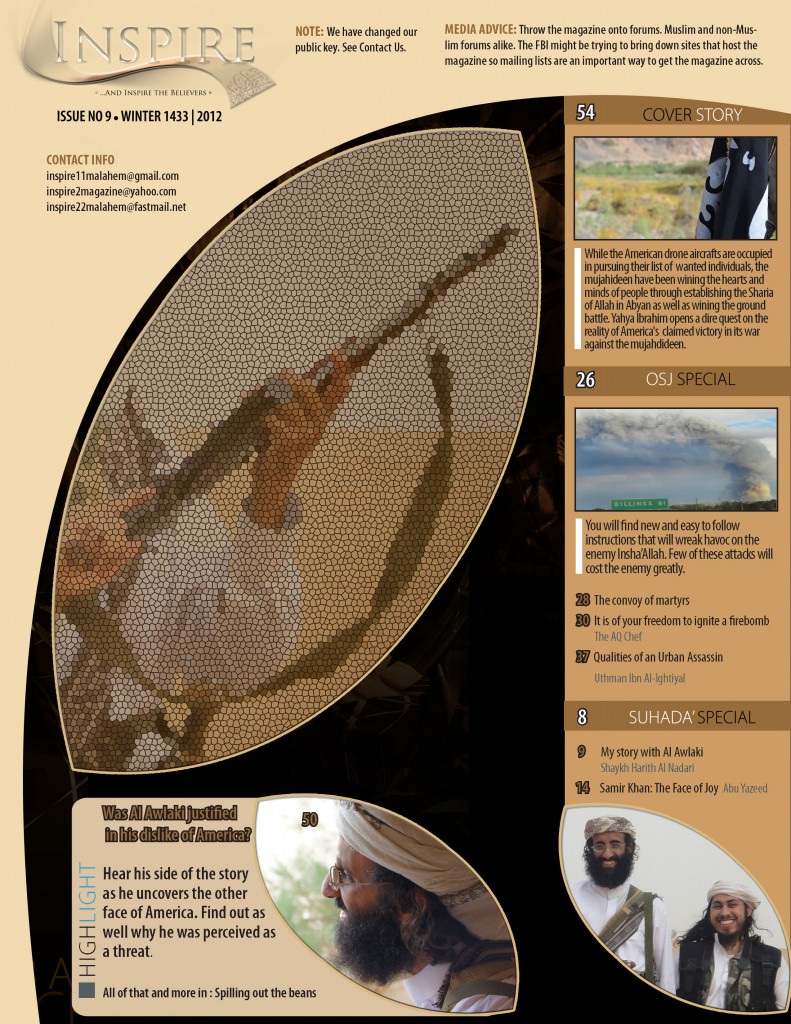
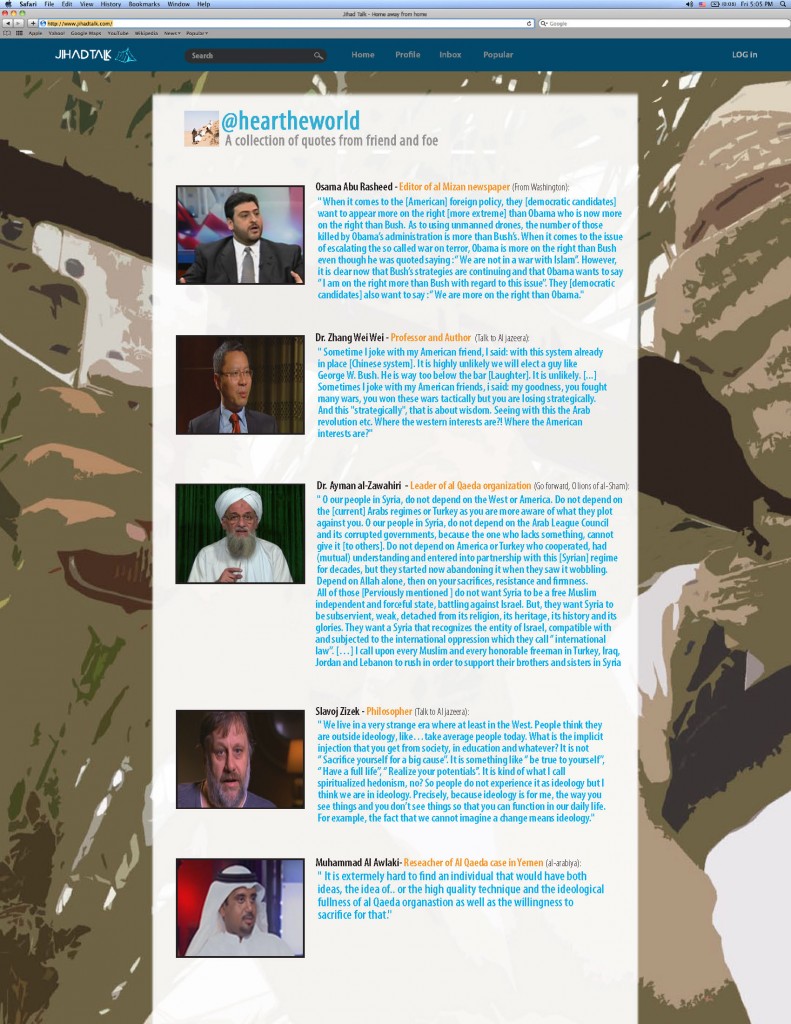
SEE THE ISSUES HERE:
BEAUMONT, TX—A federal judge has sentenced a 36-year-old Dallas man in connection with his role in a pair of complex, lucrative oil and gas Ponzi schemes that operated in Michigan and Texas, U.S. Attorney for the Eastern District of Texas John M. Bales announced today.
Joseph Blimline was sentenced to 240 months in federal prison on each of the charges related to the Ponzi schemes following a five-hour sentencing hearing on May 3, 2012, before U.S. District Judge Marcia A. Crone. Judge Crone ordered the sentences to run concurrently and ordered that restitution be made to the victims of the schemes.
“The Michigan agents worked hand in hand with the agents in Texas and with federal and state securities regulators to untangle both of these complicated Ponzi schemes and bring the perpetrators to justice for their abuse of the trust of others to obtain criminal profits,” said U.S. Attorney Bales. “To all potential investors, I urge you to be wary of investment vehicles that promise exorbitant rates of return. Remember: If the opportunity appears too good to be true, then it probably is.”
At the sentencing hearing, the government presented testimony and evidence which established that Blimline and others began operating a Ponzi scheme in Michigan between November 2003 and December 2005, specifically by promising inflated rates of return in order to obtain payments from investors. Lacking any legitimate source of income with which to make payouts to the investors, Blimline directed that later investor payments be used to pay previous investors and diverted investor payments for his own personal benefit. The Michigan scheme netted over $28 million from its investor victims before its collapse.
In early 2006, Blimline exported the Michigan Ponzi scheme to Texas, where Blimline and his new co-conspirators began the operation of Provident Royalties in Dallas. Consistent with his previous actions in Michigan, Blimline made materially false representations and failed to disclose material facts to their investors in order to induce the investors into providing payments to Provident. Blimline received millions of dollars in unsecured loans from investor funds and also directed the purchase by Provident of worthless assets from his Michigan enterprise. In the Provident scheme, funds from later investors were also consistently used to make payments to early investors, resulting in the collapse of the scheme in 2009. The Provident scheme netted over $400 million from approximately 7,700 investor victims.
U.S. Attorney for the Western District of Michigan Donald A. Davis praised the diligent work and cooperation of all involved and said, “Stealing money through fraud and deceit will not be tolerated.”
FBI Detroit Division Special Agent in Charge Andrew G. Arena said, “This sentencing comes as a result of the hard work performed by agents committed to stopping this type of fraud. Those who choose to steal money through the operation of these schemes will be arrested and brought to justice.”
U.S. Postal Inspector in Charge E.C. Woodson said, “The Michigan case is the result of the cooperation between the U.S. Postal Inspection Service, the U.S. Attorney’s Office, and the FBI in protecting the American public. Together we investigated and brought to justice those individuals who attempted to victimize the public. Know that we will continue to supply the resources necessary to investigate arrest and prosecute anyone who would utilize the mail to perpetuate a fraud against the American people.”
This law enforcement action is part of President Barack Obama’s Financial Fraud Enforcement Task Force. President Obama established the interagency Financial Fraud Enforcement Task Force to wage an aggressive, coordinated, and proactive effort to investigate and prosecute financial crimes. The task force includes representatives from a broad range of federal agencies, regulatory authorities, inspectors general, and state and local law enforcement who, working together, bring to bear a powerful array of criminal and civil enforcement resources. The task force is working to improve efforts across the federal executive branch, and with state and local partners, to investigate and prosecute significant financial crimes, ensure just and effective punishment for those who perpetrate financial crimes, combat discrimination in the lending and financial markets, and recover proceeds for victims of financial crimes.
For more information about the task force visit: http://www.stopfraud.gov.
The Michigan case was investigated by the FBI and the U.S. Postal Inspection Service and was prosecuted by Assistant U.S. Attorney for the Western District of Michigan Nils Kessler. The Texas case was investigated by the FBI and prosecuted by Assistant U.S. Attorney for the Eastern District of Texas Shamoil T. Shipchandler.
Just days after the horrific attacks of 9/11, a team of seven CIA agents snuck into northern Afghanistan and began to lay the groundwork for war. Dubbed operation “Jawbreaker,” their goal was to take out al Qaeda, find Osama bin Laden and kill him. Now, NGC tells the story of this dangerous covert mission from the point of view of the CIA officers and top-secret Delta Force operators involved.
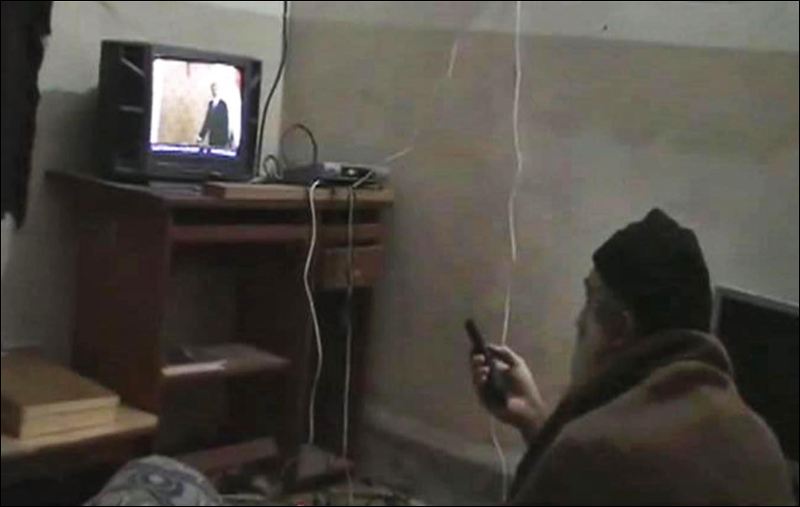
This report is a study of 17 de-classified documents captured during the Abbottabad raid and released to the Combating Terrorism Center (CTC). They consist of electronic letters or draft letters, totaling 175 pages in the original Arabic and 197 pages in the English translation. The earliest is dated September 2006 and the latest April 2011. These internal al-Qa`ida communications were authored by several leaders, most prominently Usama bin Ladin. In contrast to his public statements that focused on the injustice of those he believed to be the “enemies” of Muslims, namely corrupt “apostate” Muslim rulers and their Western “overseers,” the focus of Bin Ladin’s private letters is Muslims’ suffering at the hands of his jihadi “brothers”. He is at pain advising them to abort domestic attacks that cause Muslim civilian casualties and focus on the United States, “our desired goal.” Bin Ladin’s frustration with regional jihadi groups and his seeming inability to exercise control over their actions and public statements is the most compelling story to be told on the basis of the 17 de-classified documents. “Letters from Abbottabad” is an initial exploration and contextualization of 17 documents that will be the grist for future academic debate and discussion.
A note on translation:
The quality of the English translation provided to the CTC is not adequate throughout. When the translation was deemed inadequate, quotations cited in this report have either been amended or translated anew by Nelly Lahoud. Furthermore, the conversion of the dating of the letters from the Hijri to the Gregorian calendar is inaccurate in some places. The Appendix provides corrected dates to some of the letters, along with some pointers on how some letters relate to others. For those wishing to conduct their own analysis of the documents, it is highly recommended to refer to the original Arabic documents, not the translations.
DOWNLOAD THE E-BOOK HERE
College-bound Peter Broadhurst is quickly taken off course when his beautiful sex-crazed neighbor decides to use him as her personal sex toy. Peter thinks he’s landed in the most amazing fantasy a teen could ever imagine until his mother catches him and all hell breaks loose.
It’s said that women will take a boy’s mind of his schoolwork, and one young man finds out just how true that is in this frantic comedy. Peter Broadhurst (Topher Hopkins) is a high school senior whose mother Bev (Della Hobby) is bound and determined to see that her boy goes on to college. However, Bev isn’t quite sure how to pay Peter tuition, since her job at the supermarket barely covers food and rent on their space in the trailer park. Sally (Darlene Demko) is a local woman who has had her eye on Peter for some time, and while he’s had little experience with the opposite sex in the past, that quickly changes when Sally and her friend Randy (Rene Orobello) invite Peter over for some less-than-wholesome fun and games. Peter’s introduction to the world of kinky sex proves to be quite revelatory — to the point where Peter not only doesn’t care how college gets paid for, he doesn’t much care if he goes or not. Raging Hormones received the Audience Award as “Best Feature” at the 1999 New York International Independent Film and Video Festival, as well as a jury award as “Best Comedy.”
BEAUMONT, TX—A federal judge has sentenced a 36-year-old Dallas man in connection with his role in a pair of complex, lucrative oil and gas Ponzi schemes that operated in Michigan and Texas, U.S. Attorney for the Eastern District of Texas John M. Bales announced today.
Joseph Blimline was sentenced to 240 months in federal prison on each of the charges related to the Ponzi schemes following a five-hour sentencing hearing on May 3, 2012, before U.S. District Judge Marcia A. Crone. Judge Crone ordered the sentences to run concurrently and ordered that restitution be made to the victims of the schemes.
“The Michigan agents worked hand in hand with the agents in Texas and with federal and state securities regulators to untangle both of these complicated Ponzi schemes and bring the perpetrators to justice for their abuse of the trust of others to obtain criminal profits,” said U.S. Attorney Bales. “To all potential investors, I urge you to be wary of investment vehicles that promise exorbitant rates of return. Remember: If the opportunity appears too good to be true, then it probably is.”
At the sentencing hearing, the government presented testimony and evidence which established that Blimline and others began operating a Ponzi scheme in Michigan between November 2003 and December 2005, specifically by promising inflated rates of return in order to obtain payments from investors. Lacking any legitimate source of income with which to make payouts to the investors, Blimline directed that later investor payments be used to pay previous investors and diverted investor payments for his own personal benefit. The Michigan scheme netted over $28 million from its investor victims before its collapse.
In early 2006, Blimline exported the Michigan Ponzi scheme to Texas, where Blimline and his new co-conspirators began the operation of Provident Royalties in Dallas. Consistent with his previous actions in Michigan, Blimline made materially false representations and failed to disclose material facts to their investors in order to induce the investors into providing payments to Provident. Blimline received millions of dollars in unsecured loans from investor funds and also directed the purchase by Provident of worthless assets from his Michigan enterprise. In the Provident scheme, funds from later investors were also consistently used to make payments to early investors, resulting in the collapse of the scheme in 2009. The Provident scheme netted over $400 million from approximately 7,700 investor victims.
U.S. Attorney for the Western District of Michigan Donald A. Davis praised the diligent work and cooperation of all involved and said, “Stealing money through fraud and deceit will not be tolerated.”
FBI Detroit Division Special Agent in Charge Andrew G. Arena said, “This sentencing comes as a result of the hard work performed by agents committed to stopping this type of fraud. Those who choose to steal money through the operation of these schemes will be arrested and brought to justice.”
U.S. Postal Inspector in Charge E.C. Woodson said, “The Michigan case is the result of the cooperation between the U.S. Postal Inspection Service, the U.S. Attorney’s Office, and the FBI in protecting the American public. Together we investigated and brought to justice those individuals who attempted to victimize the public. Know that we will continue to supply the resources necessary to investigate arrest and prosecute anyone who would utilize the mail to perpetuate a fraud against the American people.”
This law enforcement action is part of President Barack Obama’s Financial Fraud Enforcement Task Force. President Obama established the interagency Financial Fraud Enforcement Task Force to wage an aggressive, coordinated, and proactive effort to investigate and prosecute financial crimes. The task force includes representatives from a broad range of federal agencies, regulatory authorities, inspectors general, and state and local law enforcement who, working together, bring to bear a powerful array of criminal and civil enforcement resources. The task force is working to improve efforts across the federal executive branch, and with state and local partners, to investigate and prosecute significant financial crimes, ensure just and effective punishment for those who perpetrate financial crimes, combat discrimination in the lending and financial markets, and recover proceeds for victims of financial crimes.
For more information about the task force visit: http://www.stopfraud.gov.
The Michigan case was investigated by the FBI and the U.S. Postal Inspection Service and was prosecuted by Assistant U.S. Attorney for the Western District of Michigan Nils Kessler. The Texas case was investigated by the FBI and prosecuted by Assistant U.S. Attorney for the Eastern District of Texas Shamoil T. Shipchandler.
As both economy and morals go down, a lot of people are willing to do anything to keep their status and make an extra buck. So, we’re rapidly turning into a public/private informant society, where black ops and psyops on ‘dangerous’ individuals are the norm. Corporations, NGOs and government agencies are going full steam with a unified, militarized program to turn North America and Europe into a full-fledged Stasi society.
If you’re mandated into one of these programs (I’m not talking to the weak minded people who actually volunteer or try to get contracted into these things, just to the person that finds him/herself coerced), never forget this saying by the man above: «For what shall it profit a man, if he shall gain the whole world, and lose his own soul?»
FAIR USE NOTICE: This video contains copyrighted material the use of which has not always been specifically authorized by the copyright owner. We are making such material available in our efforts to advance understanding of issues of ecological and humanitarian significance. We believe this constitutes a ‘fair use’ of any such copyrighted material as provided for in section 107 of the US Copyright Law. In accordance with Title 17 U.S.C. Section 107, the material in this video is distributed without profit to those who have expressed a prior interest in receiving the included information for research and educational purposes. For more information go to: http://www.law.cornell.edu/uscode/17/107.shtml. lf you wish to use copyrighted material from this site for purposes of your own that go beyond ‘fair use’, you must obtain permission from the copyright owner.

Description of the Abbottabad Documents Provided to the CTC
This document provides a general description of the 17 declassified documents captured in the Abbottabad raid and released to the Combating Terrorism Center (CTC). For additional context please see the documents themselves and/or the CTC’s report “Letters from Abbottabad: Bin Ladin Sidelined?” released in conjunction with this summary.
The 17 documents consist of electronic letters or draft letters, totaling 175 pages in the original Arabic and 197 pages in the English translation. The earliest letter is dated September 2006 and the latest April 2011. These internal al-Qa`ida communications were authored by several leaders, including Usama bin Ladin, `Atiyya `Abd al-Rahman, Abu Yahya al-Libi and the American Adam Gadahn, as well as several unknown individuals who were either affiliated with the group or wrote to offer it advice. Other recognizable personalities who feature in the letters either as authors, recipients or points of conversation include Mukhtar Abu al-Zubayr, leader of the Somali militant group Harakat al-Shabab al-Mujahidin; Nasir al-Wuhayshi (Abu Basir), leader of the Yemen-based al-Qa`ida in the Arabian Peninsula (AQAP); Anwar al-`Awlaqi; and Hakimullah Mahsud, leader of Tehrik-e-Taliban Pakistan (TTP). Some of the letters are incomplete and/or are missing their dates, and not all of the letters explicitly attribute their author(s) and/or indicate to whom they are addressed. Given that they are all electronic documents either saved on thumb drives, memory cards or the hard drive of Bin Ladin’s computer, except for the letters addressed to Bin Ladin, it cannot be ascertained whether any of these letters actually reached their intended destinations.
SOCOM-2012-0000003
This letter was authored by Usama bin Ladin and addressed to Shaykh Mahmud (`Atiyya Abdul Rahman) on 27 August 2010. Mahmud is specifically directed to tell “Basir,” who is Nasir al-Wuhayshi (Abu Basir), the leader of al-Qa`ida in the Arabian Peninsula, to remain in his role (presumably in response to a request from Abu Basir that Anwar al-`Awlaqi take his position), and for him to send “us a detailed and lengthy” version of al-`Awlaqi’s resume. `Atiyya is also told to ask Basir and Anwar al-`Awlaqi for their “vision in detail about the situation” in Yemen. References are also made in the letter to the 2010 floods in Pakistan, a letter from Bin Ladin’s son Khalid to `Abd al-Latif, al-Qa`ida’s media plan for the 9/11 anniversary, and the need for the “brothers coming from Iran” to be placed in safe locations.
SOCOM-2012-0000004
This document is a letter authored by the American al-Qa`ida spokesman Adam Gadahn to an unknown recipient and was written in late January 2011. In the first part of the document Gadahn provides strategic advice regarding al-Qa`ida’s media plans for the tenth anniversary of 9/11. The letter is in essence a response to many of the requests/queries that Bin Ladin makes in his letter to `Atiyya dated October 2010 (SOCOM-2012-0000015), particularly those concerning a media strategy for the ten-year anniversary of 9/11. In other parts of the document Gadahn incisively criticizes the tactics and targeting calculus of the Islamic State of Iraq (AQI/ISI) and the Pakistani Taliban (TTP); he strongly advocates for al-Qa`ida to publicly dissociate itself from both groups. The document concludes with a draft statement, which provides a candid assessment of these issues.
SOCOM-2012-0000005
This document is a letter dated 7 August 2010 from “Zamarai” (Usama bin Ladin) to Mukhtar Abu al-Zubayr, the leader of the Somali militant group Harakat al-Shabab al-Mujahidin, which merged with al-Qa`ida after Bin Ladin’s death. The document is a response to a letter Bin Ladin received from al-Zubayr in which he requested formal unity with al-Qa`ida and either consulted Bin Ladin on the question of declaring an Islamic state in Somalia or informed him that he was about to declare one. In Bin Ladin’s response, he politely declines al-Shabab’s request for formal unity with al-Qa`ida.
SOCOM-2012-0000006
This document is a letter believed to have been composed in December 2010 and its content relates to SOCOM-2012-0000005. The letter is addressed to Azmarai, perhaps a typo or misspelling of the nickname Zamarai (a nickname or kunya for Bin Ladin). While the identity of the author is unclear, the familiar tone and implicit critique of Bin Ladin’s policy vis-a-vis al-Shabab suggest that this is from a high ranking personality, possibly Ayman al-Zawahiri. Referring to “our friend’s letter” and the perspective of the “brothers…[who might have been] too concerned about inflating the size and growth of al-Qa`ida,” the author of the document urges the receiver to “reconsider your opinion not to declare the accession [i.e. formal merger] of the brothers of Somalia…” This is clearly a reference to al-Qa`ida’s potential merger with al-Shabab and suggests that al-Qa`ida’s relationship with the “affiliates” is a subject of internal debate. If indeed the author of the letter is Ayman al-Zawahiri this could be an indication of a major fissure over a key strategic question at the pinnacle of the organization (for different interpretations of this letter, see Appendix of “Letters from Abbottabad”).
SOCOM-2012-0000007
This letter is authored by Mahmud al-Hasan (`Atiyya) and Abu Yahya al-Libi and addressed to the amir of Tehrik-e-Taliban Pakistan (TTP), Hakimullah Mahsud. It is dated 3 December 2010 and is sharply critical of the ideology and tactics of the TTP. The letter makes it clear that al-Qa`ida’s senior leaders had serious concerns about the TTP’s trajectory inside Pakistan, and the impact the group’s misguided operations might have on al-Qa`ida and other militant groups in the region. The authors identify several errors committed by the group, specifically Hakimullah Mahsud’s arrogation of privileges and positions beyond what was appropriate as the TTP’s amir; the TTP’s use of indiscriminate violence and killing of Muslim civilians; and the group’s use of kidnapping. `Atiyya and al-Libi also take issue with Mahsud labeling al-Qa`ida members as “guests” and the attempts made by other groups (presumably the TTP) to siphon off al-Qa`ida members. The authors threaten that if actions are not taken to correct these mistakes, “we shall be forced to take public and firm legal steps from our side.”
SOCOM-2012-0000008
This letter was originally an exchange between Jaysh al-Islam and `Atiyya that was forwarded first to a certain `Abd al-Hamid (and presumably to Bin Ladin later). The gist of Jaysh al-Islam’s letter makes it known that the group is in need of financial assistance “to support jihad,” and that the group is seeking `Atiyya’s legal advice on three matters: 1) the permissibility of accepting financial assistance from other militant Palestinian groups (e.g., Fatah and Palestinian Islamic Jihad); 2) the permissibility of investing funds in the stock market in support of jihad; and 3) the permissibility of striking or killing drug traffickers in order to use their money, and even drugs, to lure their enemies who could in turn be used by Jaysh al-Islam as double-agents. `Atiyya’s response, written sometime between 24 October 2006 and 22 November 2006, is cordial but distant, responding to the questions but refraining from giving any strategic advice.
SOCOM-2012-0000009
This document is part of a longer letter which was not released to the CTC. It is not clear who authored the letter or to whom it was addressed. It discusses the potential need to change the name of “Qa`idat al-Jihad.” The author is of the view that the abridging of the name “al-Qa`ida” has “lessened Muslims’ feelings that we belong to them.” The author is further concerned that since the name “al-Qa`ida” lacks religious connotations, it has allowed the United States to launch a war on “al-Qa`ida” without offending Muslims. The author proposed a list of new names that capture Islamic theological themes: Ta’ifat al-tawhid wa-al-jihad (Monotheism and Jihad Group), Jama`at wahdat al-Muslimin (Muslim Unity Group), Hizb tawhid al-Umma al-Islamiyya (Islamic Nation Unification Party) and Jama`at tahrir al-aqsa (Al-Aqsa Liberation Group).
SOCOM-2012-0000010
This letter is authored by “Abu `Abdallah” (Usama bin Ladin), addressed to “Shaykh Mahmud” (`Atiyya) and dated 26 April 2011 – a week before bin Ladin’s death. In it, Bin Ladin outlines his response to the “Arab Spring,” proposing two different strategies. The first strategy pertains to the Arab World and entails “inciting people who have not yet revolted and exhort[ing] them to rebel against the rulers (khuruj ‘ala al-hukkam)”; the second strategy concerns Afghanistan and it entails continuing to evoke the obligation of jihad there. The letter also makes reference to a wide variety of topics including: the scarcity of communications from Iraq, “the brothers coming from Iran,” and hostages held by “our brothers in the Islamic Maghreb” and in Somalia. The document also briefly discusses Bin Ladin’s sons, his courier, Shaykh Abu Muhammad (Ayman al-Zawahiri), and other individuals of interest.
SOCOM-2012-0000011
This letter, dated 28 March 2007, is addressed to a legal scholar by the name of Hafiz Sultan, and it is authored by someone who is of Egyptian origin. The author makes it explicit that he was alarmed by al-Qa`ida in Iraq’s conduct and he urges Sultan to write to that group’s leaders to correct their ways. The author also asks for legal guidance on the use of chlorine gas, which he appears not to support. A reference is also made to “the brothers in Lebanon” and the need to arrange “to have one of their representatives visit us in the near future.” A message from the “brothers in Algeria” is also included.
SOCOM-2012-0000012
This letter dated 11 June 2009 was written by `Atiyya to the “honorable shaykh.” It is possible that it was addressed to Usama bin Ladin, but it may have been addressed to another senior leader. The majority of the letter provides details on the release of detained jihadi “brothers” and their families from Iran and an indication that more are expected to be released, including Bin Ladin’s family. It seems that their release was partially in response to covert operations by al-Qa`ida against Iran and its interests.
SOCOM-2012-0000013
This is a draft that formed the basis of a publicly available document, part four in a series of statements that Ayman al-Zawahiri released in response to the “Arab Spring.” Through the document one can observe al-Qa`ida’s editing process (reflected in the editor’s comments highlighted in green and in a bold font). While it is not clear if Bin Ladin himself did the editing, whoever did so has solid grammatical foundations and prefers a more self-effacing writing style than al-Zawahiri. The edits were not included in al-Zawahiri’s final speech which was released in a video on 4 March 2011 on jihadi forums. Of the 12 proposed corrections only one appears in al-Zawahiri’s speech.
SOCOM-2012-0000014
This document consists of two letters addressed to “Abu `Abd-al-Rahman,” almost certainly `Atiyya `Abd al-Rahman. It was sent by an operative who knows `Atiyya and is a religious student with ties to the senior shaykhs and clerics in Saudi Arabia. While the letters are not dated, their contents suggest they were composed soon after January 2007; they read very much like an intelligence assessment, designed to provide `Atiyya with some perspective on how al-Qa`ida generally, and the Islamic State of Iraq (ISI) more specifically, are perceived amongst Saudi scholars of varying degrees of prominence. The author provides `Atiyya with brief summaries of private meetings the author had with certain scholars, with the clear intent of evaluating the level of support that al-Qa`ida enjoys from some relatively prominent members of the Saudi religious establishment.
SOCOM-2012-0000015
This document is a letter dated 21 October 2010 from Bin Ladin to “Shaykh Mahmud” (`Atiyya). The letter is primarily focused on issues in the Afghanistan/Pakistan region. In the letter Bin Ladin specifically comments on: the security situation in Waziristan and the need to relocate al-Qa`ida members from the region; counter surveillance issues associated with the movement of his son Hamza within Pakistan; the appointment of `Atiyya’s three deputies; various al-Sahab videos and the media plan for the tenth anniversary of 9/11; the release of an Afghan prisoner held by al-Qa`ida; and the trial of Faisal Shahzad. Ayman al-Zawahiri, Abu Yahya al-Libi, Saif al-`Adl, and Adam Gadahn are also mentioned in the document.
SOCOM-2012-0000016
This document is a letter addressed to “Abu Basir” (Nasir al-Wuhayshi, leader of al-Qa`ida in the Arabian Peninsula – AQAP) from an unidentified author, most likely Usama bin Ladin and/or `Atiyya. The letter is in part a response to specific requests for guidance from AQAP’s leadership. The author specifically advises AQAP to focus on targeting the United States, not the Yemeni government or security forces. The author also discusses media strategy and the importance of AQAP’s relations with Yemen’s tribes.
SOCOM-2012-0000017
This document is a series of paragraphs, some of which match the content found in SOCOM-2012-0000016. This document was likely written by the author of that document. This letter discusses strategy, the need for al-Qa`ida to remain focused on targeting the United States (or even against U.S. targets in South Africa where other “brothers” are not active), the importance of tribal relations in a variety of different countries, and media activity.
SOCOM-2012-0000018
This document is a letter addressed to Usama bin Ladin from “a loving brother whom you know and who knows you” and dated 14 September 2006. The author is critical of Bin Ladin for focusing al- Qa`ida’s operations on “Islamic countries in general and the Arabian Peninsula in particular.” He enumerates the numerous negative consequences of engaging in jihad inside Saudi Arabia, and informs Bin Ladin that people are now repulsed by the technical term “jihad” and even forbidden to use it in lectures. The author strongly advised Bin Ladin to change his policies.
SOCOM-2012-0000019
This document is a long letter authored by Usama bin Ladin after the death of Sheikh Sa‘id (Mustafa Abu’l-Yazid) in late May 2010 and it is addressed to “Shaykh Mahmud” (`Atiyya) who he designates as Sa‘id’s successor. Bin Ladin’s letter is concerned with the mistakes committed by regional jihadi groups, which have resulted in the unnecessary deaths of thousands of Muslim civilians. Bin Ladin indicates that he would like to start a “new phase” so that the jihadis could regain the trust of Muslims. He directs `Atiyya to prepare a memorandum to centralize, in the hands of AQC, the media campaign and operations of regional jihadi groups. Considerable space is devoted to a discussion about Yemen, external operations and Bin Ladin’s plans for his son Hamza. This document includes an additional letter that Bin Ladin forwards to `Atiyya authored by Shaykh Yunis, presumably Yunis al-Mauritani, consisting of a new operational plan that al- Qa`ida should consider adopting.
They comprise 175 pages in the original Arabic of letters and drafts from bin Laden and other key al Qaeda figures, including the American Adam Gadahn and Abu Yahya al-Libi.
Scores of pages of al Qaeda documents seized in last year’s U.S. raid that killed Osama bin Laden were released Thursday.
They comprise 175 pages in the original Arabic of letters and drafts from bin Laden and other key al Qaeda figures, including the American Adam Gadahn and Abu Yahya al-Libi.
Here are the center’s brief description of the documents.
nks for the English translations.
Bergen: OBL docs could damage Al Qaeda
Bin Laden documents revealed
Is al Qaeda weaker today?
Description of the Abbottabad documents (PDF)
The center says the letters were written between September 2006 and April 2011 by many well-known figures.
Letter from bin Laden in August 2010 seeking information about Anwar al-Awlaki and Yemen (PDF)
References are also made to floods in Pakistan and the media plan for the 9/11 anniversary.
Letter from Gadahn in January 2011 giving media advice for 9/11 anniversary (PDF)
The center says the letter appears to be a response to earlier questions from bin Laden.
Letter from bin Laden, using the pseudonym “Zamaria” to the head of a Somali militant group (PDF)
Bin Laden politely declines a request for formal unity with al Qaeda.
Letter composed in December 2010 from a high-ranking personality, possibly Ayman al-Zawahiri (PDF)
The letter refers to the request from the al-Shabab group in Somali to unite with al Qaeda.
Letter dated December 3, 2010, about indiscriminate violence of a group in Pakistan (PDF)
The authors indicate that al Qaeda’s top leaders had serious concerns about the actions of the TTP, a Pakistani Taliban group, including the killing of Muslims.
Letter saying that a militant group needed financial assistance “to support jihad” (PDF)
The center believes the letter was forwarded to bin Laden.
Part of a letter discussing the re-branding of al Qaeda (PDF)
It’s not clear who wrote the letter, but it talks of a need to change the name of the terror organization to “Qaidat al-Jihad.”
Letter from bin Laden dated April 26, 2011 (PDF)
Bin Laden outlines his response to the Arab Spring, a week before his death.
Letter dated March 28, 2007, showing the author’s alarm at al Qaeda in Iraq’s conduct (PDF)
The author, who appears to be of Egyptian origin, asks a legal scholar about the use of chlorine gas.
Letter dated June 11, 2009, about the release of detainees from Iran (PDF)
There is an indication that more people may be released, including some bin Laden relatives.
Draft of a document on the Arab Spring (PDF)
This formed the basis of statements released by al-Zawahiri and reveal the al Qaeda editing process.
Two letters apparently on how al Qaeda is perceived among Saudi scholars (PDF)
The author provides summaries of meetings with scholars, apparently with the intent of evaluating support.
Letter dated October 21, 2010, from bin Laden on the Afghanistan/Pakistan region (PDF)
Bin Laden comments on the security situation in Pakistan’s Waziristan and the need to move al Qaeda members out.
Letter, possibly from bin Laden, to the head of al Qaeda in the Arabian Peninsula (PDF)
The author tells group to focus on the United States, not the Yemeni government .
Series of paragraphs, some of which match letter in previous entry to al Qaeda in the Arabian Peninsula (PDF)
The letter discusses strategy, the need to target the United States including possible U.S. targets in South Africa.
Letter to bin Laden dated September 14, 2006, from “a loving brother” (PDF)
The author criticizes bin Laden for the attacks in “Islamic countries in general and the Arabian Peninsula in particular.”
Letter from bin Laden in late May 2010 indicating support for a “new phase” (PDF)
Bin Laden says he is concerned with the killings of innocent Muslims in attacks by regional terror groups.
DOWNLOAD THE ORIGINAL DOCUMENTS IN ENGLISH HERE
MAKEOVER:
Rodger Keaton is a socially challenged, clinically frigid, computer nerd, desperate single white male. Patricia Bartlett is a ruthless award winning journalist who has found her man. Pitted against overwhelming odds, Hollywood makeover Guru Brad Holloway is blackmailed via the threat of crippling publicity. Brad’s challenge is a “mission impossible” makeover and he must prove with substantial results that his Ultimate Makeover Services are the ‘Real Deal’. Over the next six weeks, Brad & Rodger take a most unlikely journey into often uncharted terrain, with hilarious & heart warming results at every turn. But can true change be given a deadline? And can anything with a deadline be thoroughly achieved? A willing dog can learn a thousand new tricks, but is self-identity a trick? Can it be learnt, or must it be found? Join Rodger on a roller coaster of fear, anxiety, disaster, celebration, discovery, reinvention & hope as he hurtles toward the finishing line in this race against time.
DOWNLOAD THE ORIGINAL DOCUMENT HERE
A young man who has been on the reds hits a jackpot but prefers to be the playboy in Town. This triggers a series of events that led him back to square one.
The following report is a less redacted version of the FCC’s findings on Google’s widespread collection of data from wireless networks in the United States and around the world. The version released by the FCC contained a number of redactions that concealed key portions of the report. The full version of the report was first published by the Los Angeles Times.
1. Between May 2007 and May 2010, as part of its Street View project, Google Inc. (Google or Company) collected data from Wi-Fi networks throughout the United States and around the world. The purpose of Google’s Wi-Fi data collection initiative was to capture information about Wi-Fi networks that the Company could use to help establish users’ locations and provide location-based services. But Google also collected “payload” data–the content of Internet communications–that was not needed for its location database project. This payload data included e-mail and text messages, passwords, Internet usage history, and other highly sensitive personal information.
…
10. Through counsel, Google retained Stroz Friedberg to evaluate the source code used in Google’s global Wi-Fi data collection effort. In an update posted on Google’s official blog on June 9, 2010, Google stated that the Stroz Friedberg report had been completed and, “[i]n short, it confirms that Google did indeed collect and store payload data from unencrypted WiFi networks, but not from networks that were encrypted.” The update included a link to the report.
11. Stroz Friedberg prepared its report based on a review of the code alone. The report explains that, to facilitate the mapping of Wi-Fi networks, the source code, known as “gslite,” used an open-source ”packet sniffing” program called Kismet to capture, parse, and store MAC addresses, SSIDs, and other information about Wi-Fi networks. According to the report, “All of this parsed header information is written to disk for frames transmitted over both encrypted and unencrypted wireless networks.” The report further explained, “The default behavior of gslite is to record all wireless frame data, with the exception of the bodies of encrypted 802.11 Data frames.” To determine whether a Wi-Fi network was encrypted, the gslite program searched for an “encryption flag.” “If the encryption flag identifie[d] the wireless frame as encrypted, the payload of the frame [was] cleared from memory and permanently discarded. If the frame’s encryption flag identifie[d] the frame as not encrypted, the payload … [was] written to disk in a serialized format …. ‘, The report noted that if a user of an unencrypted network engaged in a password-protected Internet session, such as an online banking transaction, gslite would store any information captured from the session because the encryption flag would indicate that the network was unencrypted. The information gathered would, however, be encrypted. In short, the software appears to have discarded data from encrypted networks, but not encrypted data transmitted over open networks. Stroz Friedberg never field tested the gslite program or examined any of the payload data that Google collected.
…
21. As Street View testing progressed, Google engineers decided that the Company should also use the Street View cars for “wardriving,” which is the practice of driving streets and using equipment to locate wireless LANs using Wi-Fi, such as wireless hotspots at coffee shops and home wireless networks. By collecting information about Wi-Fi networks (such as the MAC address, SSID, and strength of signal received from the wireless access point) and associating it with global positioning system (GPS) information, companies can develop maps of wireless access points for use in locationbased services. To design the Company’s program, Google tapped Engineer Doe, who was not a fulltime member of the Street View project team. As described further below, Engineer Doe developed WiFi data collection software code that, in addition to collecting Wi-Fi network data for Google’s location-based services, would collect payload data that Engineer Doe thought might prove useful for other Google services. In response to the LOI, Google made clear for the first time that Engineer Doe’s software was deliberately written to capture payload data.
DOWNLOAD THE ORIGINAL DOCUMENT HERE
Two models are stranded in a motor cruiser in the middle of the ocean. It’s only meant to be a publicity stunt, a way of stirring up interest in the boat itself; but they soon prove to be in real trouble. They’re set upon by a 16th century galleon enshrouded by a fog. They each board the ghost ship, and each one disappears. Soon, the sporting goods magnate who hired the two girls sets out to find them. He is joined by his conniving right-hand man; the head of the modeling agency; a third model who is a lover to one of the missing girls; and a scientist from the weather bureau who is convinced something supernatural is going on. They all end up on the galleon, where they discover its crew are the undead Satan-worshiping Knights Templar.

Occupy Wall Street (OWS) protesters are calling for a “General Strike” on Tuesday, May 1, urging workers not to go to work and students to boycott classes in protest of what organizers characterize as society’s economic inequality. No unions are expected to participate in the strike, and some have talked to reporters about the fact that they weren’t consulted in OWS’s decision to announce a General Strike. Nonetheless, some elements of organized labor are expected to participate in their own customary May Day rally (which has occurred since 2004), marching from Union Square to Foley Square to Bowling Green, with speeches at either end beginning at about 4:00pm and ending by 7:00pm. The union organizers involved in that march have sought a permit for it. Details are being worked out.
…
The “General Strike” was initially proposed by the Los Angeles node of OWS in November 2011, endorsed by Occupy Oakland at the end of January 2012, and subsequently endorsed by the OWS New York General Assembly on
February 14.
There are fissures within OWS, but a “respect for diversity of tactics,” which includes everything from peaceful protests to the kind of vandalism directed at Starbucks in April, when demonstrators tried to smash the windows at the Starbucks location at Astor Place, has been embraced by the movement.
Below is a list of events that are scheduled to be held on May 1. Although the list is comprehensive, various OWS postings have called for autonomous actions, splinter demonstrations, and flash mobs.
…
Event Assessment
The General Strike is the first of several major global demonstrations that the OWS movement has played a role in planning, including demonstrations scheduled for May 12, May 15, and May 17-21.3 As such, it should be expected that organizers have emphasized the importance of turnout and will be seeking maximum media coverage.
Political fissures that are present within the OWS movement may impact the strategies of demonstrators during individual protest actions; in particular, the Wildcat March is not an officially sanctioned OWS march and may attract militant elements from inside and outside the OWS movement that may seek to directly confront law enforcement officials using barricades, riot shields, and possibly weapons such as pipes and rocks.
Although OWS organizers have publicized a large number of the marches, demonstrations, and activities that will take place throughout the day, it should be expected that “pop-up” demonstrations, splinter demonstrations, and flash mobs may occur at any time, especially during “evening actions” that are planned for 7:00pm and later.
In their planning, the OWS NYCGA has endorsed solidarity based on a “respect for a diversity of tactics,” which suggests that autonomous actions of demonstrators using Black Bloc tactics may occur at any time.
Raised on a wildlife reserve in Alaska, 15-year-old Garrett was interested in the dietary habits of the farm animals. After the tragic death of his mother, Garrett’s father decided to home-school his son and assigned a book written by Dr. Max Gerson that proposed a direct link between diet and a cure for cancer.
Fascinated, Garrett embarks in this documentary on a cross-country road trip to investigate The Gerson Therapy. He meets with scientists, doctors and cancer survivors who reveal how it is in the best interest of the multi-billion dollar medical industry to dismiss the notion of alternative and natural cures
CHICAGO—A Chicago investment advisor allegedly engaged in an investment fraud scheme that swindled clients, causing them to lose approximately $1.5 million, federal law enforcement officials announced today. The defendant, Dimitry Vishnevetsky, was charged with eight counts of mail or wire fraud and one count of bank fraud in a nine-count indictment returned yesterday by a federal grand jury. Vishnevetsky allegedly raised approximately $1.7 million from investors and misappropriated at least $1.5 million for his own purposes, including to pay for such business and personal expenses as mortgage and car payments, travel and vacations, restaurant bills, athletic club dues, and to make trades for his own benefit, while using additional investor funds to make Ponzi-type payments to clients.
Vishnevetsky, 33, of Chicago, will be arraigned at a later date in U.S. District Court. The charges were announced by Patrick J. Fitzgerald, United States Attorney for the Northern District of Illinois, and Robert D. Grant, Special Agent in Charge of the Chicago Office of the Federal Bureau of Investigation. Also yesterday, the Commodity Futures Trading Commission filed a civil enforcement lawsuit against Vishnevetsky and his companies in federal court in Chicago.
According to the indictment, Vishnevetsky offered and sold investments, including commodities and promissory notes, primarily through Hodges Trading, LLC, and Oxford Capital, LLC, which purported to be in the business of providing brokerage/management services to investors and of managing commodities funds, including the Oxford Global Macro Fund, the Oxford Global Arbitrage Fund, and the Quantum Global Fund, which existed in name only. He also offered and sold promissory notes, described as London Interbank Offered Rate (LIBOR) adjusted notes, through Hodges Trading, which also existed in name only.
The indictment alleges that between September 2006 and March 2012, Vishnevetsky schemed to defraud investors and potential investors by making false representations about the profitability of his prior and current trading, the use of the invested funds, the risks involved, the expected and actual returns on investments and trading, and false representations about Hodges Trading, Oxford Capital and the commodities funds. For example, Vishnevetsky created and provided some investors fraudulent trading results showing profits as high as 36 percent per year, the indictment alleges. “In fact, to the extent that Vishnevetsky engaged in trading, the trading consistently resulted in net losses, not profits,” the indictment states.
The bank fraud count alleges that between 2007 and 2010, Vishnevetsky made false statements to Merrill Lynch Bank & Trust concerning his income and assets to cause the bank to issue, and later modify, two loans totaling approximately $519,500 to purchase a condominium in Chicago. Vishnevetsky subsequently stopped making payments on the loans, the charges allege.
The government is being represented by Assistant U.S. Attorney Jacqueline Stern.
Each count of mail or wire fraud carries a maximum penalty of 20 years in prison and a $250,000 fine, while bank fraud carries a maximum penalty of 30 years in prison and a $1 million fine, and restitution is mandatory. The court may also impose a fine totaling twice the loss to any victim or twice the gain to the defendant, whichever is greater. If convicted, the court must impose a reasonable sentence under federal sentencing statutes and the advisory United States Sentencing Guidelines.
The investigation falls under the umbrella of the Financial Fraud Enforcement Task Force, which includes representatives from a broad range of federal agencies, regulatory authorities, inspectors general, and state and local law enforcement who, working together, bring to bear a powerful array of criminal and civil enforcement resources. The task force is working to improve efforts across the federal executive branch, and with state and local partners, to investigate and prosecute significant financial crimes, ensure just and effective punishment for those who perpetrate financial crimes, combat discrimination in the lending and financial markets, and recover proceeds for victims of financial crimes. For more information on the task force, visit: http://www.StopFraud.gov.
An indictment contains only charges and is not evidence of guilt. The defendant is presumed innocent and is entitled to a fair trial at which the government has the burden of proving guilt beyond a reasonable doubt.
Wetboy is a compelling story of a professional assassin for the government that only wants to serve God and Country. He soon finds himself immersed in a world of lies, betrayals and corruption. This story not only encompasses the means by which he deals with this, but also its consequences.
Preet Bharara, the United States Attorney for the Southern District of New York; Eric T. Schneiderman, the New York State Attorney General; and Janice K. Fedarcyk, the Assistant Director in Charge of the New York Office of the Federal Bureau of Investigation (“FBI”), announced charges today against IFEANYICHUKWU ERIC ABAKPORO and LATANYA PIERCE for allegedly swindling an elderly woman out of her multi-million-dollar property in Harlem that she had owned for more than 40 years and then deceiving a bank into giving them a $1.8 million mortgage loan secured by the property. ABAKPORO was arrested Monday in Queens, New York, and PIERCE was arrested yesterday after voluntarily surrendering to the FBI.
Manhattan U.S. Attorney Preet Bharara stated: “As alleged, these two defendants preyed on an elderly woman, using false documents and fraudulent representations to essentially steal her property out from under her. They then allegedly took their brazen scheme one step further, using the property to deceive a bank into lending them more than a million dollars. Sadly, this type of mortgage fraud scheme and exploitation of vulnerable victims have become all too familiar, but as these charges make clear, we are committed to bringing those who perpetrate these types of harmful schemes to justice.”
New York State Attorney General Eric Schneiderman stated: “Through lies and deception, these individuals abused the trust of an elderly woman in order to perpetrate a multi-million-dollar fraud. Now that their despicable scheme has been exposed, they will face justice.”
Assistant Director in Charge Janice K. Fedarcyk stated: “These defendants are charged with spinning a web of lies to steal the victim’s property. Cases like this are rightly a priority for the FBI: fraudulent schemes that victimize the vulnerable and enrich the unscrupulous.”
As alleged in the indictment unsealed yesterday in Manhattan federal court:
Beginning in March 2006, ABAKPORO, a lawyer with an office in Brooklyn, New York, and PIERCE, who worked for ABAKPORO, cultivated a relationship with an elderly woman (“the Victim”) who owned a residential apartment building worth millions of dollars located at 1070 St. Nicholas Avenue in Harlem (the “Property”). As part of the fraud scheme, ABAKPORO and PIERCE earned the Victim’s trust by, among other things, offering to help her manage the Property. This included collecting rent from its tenants on her behalf. However, instead of providing the Victim with the renters’ money, ABAKPORO and PIERCE pocketed it.
ABAKPORO and PIERCE then convinced the Victim to sell her property to them for $3.1 million. While they contracted to buy the property for that amount, at the closing, they presented the Victim with multiple fake and fraudulent checks to make it appear as if they had paid the contracted sale amount, when in fact they had not. Moreover, after the Victim’s attorney had left the closing, ABAKPORO and PIERCE fraudulently induced her to return all of the checks to them by representing that they would safeguard her money and give her a “private mortgage” in the Property, which they explained would include monthly payments made to her based on the money she had effectively loaned them. As part of the scheme, ABAKPORO and PIERCE signed and provided the Victim with a written agreement representing that she had loaned them approximately $1.9 million and in return held a “private mortgage” in the Property. Unbeknownst to the Victim, ABAKPORO and PIERCE never recorded the private mortgage and subsequently submitted a fraudulent application to Washington Mutual Bank seeking a $1.8 mortgage loan secured by the Property. ABAKPORO and PIERCE never disclosed to the bank that the Victim already held a private mortgage on the Property. Instead, ABAKPORO and PIERCE falsely represented to the bank that they had purchased the Property for $3.1 million and owned it “free and clear.” Based on those, and other, fraudulent representations, ABAKPORO and PIERCE obtained a $1.8 million mortgage loan from the bank, which they failed to repay.
As a result of the alleged fraud, the defendants obtained substantially all of the Victim’s assets, and $1.8 million in fraudulently obtained mortgage proceeds. The Property went into default.
***
ABAKPORO, 52, a Nigerian citizen, is a resident of Queens, and PIERCE, 43, is a resident of Brooklyn. They are each charged with wire fraud, bank fraud, wire fraud conspiracy, and bank fraud conspiracy. The wire fraud and wire fraud conspiracy charges each carry a maximum prison term of 20 years. The bank fraud and bank fraud conspiracy charges each carry a maximum prison term of 30 years.
ABAKPORO is currently detained pending his satisfaction of court-ordered bail conditions: a $1 million bond secured by an interest in property and co-signed by three individuals. PIERCE was released on a $500,000 bond to be co-signed by three individuals and secured by two properties.
Mr. Bharara praised the New York State Attorney General’s Office investigative staff and the FBI for their excellent work on the investigation of this matter. He also thanked the New York State Department of Financial Services for its assistance.
The case is being handled by the Office’s Complex Frauds Unit. Southern District of New York Assistant U.S. Attorneys Ryan Poscablo and Michael Lockard, along with Assistant Attorney General Meryl Lutsky, who has been designated a Special Assistant U.S. Attorney, and Assistant Attorney General Rhonda Greenstein, are in charge of the prosecution.
The charges contained in the indictment are merely accusations, and the defendants are presumed innocent unless and until proven guilty.
***ROMAN POLANSKI CREATION*** Described by Polanski himself as his best film, Cul-de-sac draws heavily on the traditions of the Theatre of the Absurd and echoes of Beckett’s Waiting for Godot in both it’s themes and visual style. A wounded criminal and his dying partner take refuge at a beachfront castle. The owners of the castle, a meek Englishman and his willful French wife, are initially the unwilling hosts to the criminals. Quickly, however, the relationships between the criminal, the wife, and the Englishman begin to shift in humorous and bizarre fashion.
The fact that there isn’t a single likeable character in Cul de Sac does not diminish its artistic value in the least. Ageing, furtively kinky Donald Pleasence is married to sexy young Francoise Dorleac. The couple’s hermitlike tranquility is shattered when wounded gangsters Jack MacGowan and Lionel Stander invade their home and hold them hostage. As Dorleac urges her tremulous husband to do something, the two criminals begin behaving in a fashion that can only inadequately be described as eccentric. Drawing upon two of Polanski’s favorite themes-isolation and latent insanity–Cul de Sac actually improves upon each viewing, assuming that the viewer has the intestinal fortitude to sit through it once.
DOWNLOAD THE ORIGINAL DOCUMENT HERE
***An All Time Classic*** At the Opera of Paris, a mysterious phantom threatens a famous lyric singer, Carlotta and thus forces her to give up her role (Marguerite in Faust) for unknown Christine Daae. Christine meets this phantom (a masked man) in the catacombs, where he lives. What’s his goal ? What’s his secret
1–1. Purpose
a. This regulation provides policy, procedures, and responsibilities for the administration, treatment, employment, and compensation of enemy prisoners of war (EPW), retained personnel (RP), civilian internees (CI) and other detainees (OD) in the custody of U.S. Armed Forces. This regulation also establishes procedures for transfer of custody from the United States to another detaining power.
b. This regulation implements international law, both customary and codified, relating to EPW, RP, CI, and ODs which includes those persons held during military operations other than war. The principal treaties relevant to this regulation are:
(1) The 1949 Geneva Convention Relative to the Amelioration of the Condition of the Wounded and Sick in Armed Forces in the Field (GWS).
(2) The 1949 Geneva Convention for the Amelioration of the Condition of Wounded, Sick and Shipwrecked Members of Armed Forces at Sea (GWS SEA).
(3) The 1949 Geneva Convention Relative to the Treatment of Prisoners of War (GPW).
(4) The 1949 Geneva Convention Relative to the Protection of Civilian Persons in Time of War (GC), and In the event of conflicts or discrepancies between this regulation and the Geneva Conventions, the provisions of the Geneva Conventions take precedence.
…
Beginning of Internment (CI)
5–1. General protection policy—civilian internee
a. Treatment.
(1) No form of physical torture or moral coercion will be exercised against the CI. This provision does not constitute a prohibition against the use of minimum force necessary to effect compliance with measures authorized or directed by these regulations.
(2) In all circumstances, the CI will be treated with respect for their person, their honor, their family rights, their religious convictions and practices, and their manners and customs. At all times the CI will be humanely treated and protected against all acts of violence or threats and insults and public curiosity. In all official cases they will be entitled to a fair and regular trial as prescribed by this regulation.
(3) The CI will be especially protected against all acts of violence, insults, public curiosity, bodily injury, reprisals of any kind, sexual attack such as rape, forced prostitution, or any form of indecent assault.
(4) The CI will be treated with the same consideration and without adverse distinction based on race, religion, political opinion, sex, or age.
(5) The CI will be entitled to apply for assistance to the protecting powers, the International Committee of the Red Cross, approved religious organizations, relief societies, and any other organizations that can assist the CI. The commander will grant these organizations the necessary facilities to enable them to assist the CI within the limits of military and security considerations.
(6) The following acts are specifically prohibited:
(a) Any measures of such character as to cause the physical suffering or extermination of the CI. This prohibition applies not only to murder, torture, corporal punishment, mutilation, and medical or scientific experiments, but also to any other measure of brutality.
(b) Punishment of the CI for an offense they did not personally commit.
(c) Collective penalties and all measures of intimidation and terrorism against the CI.
(d) Reprisals against the CI and their property.
(e) The taking and holding of the CI as hostages.
(f) Deportations from occupied territory to the territory of the occupying power or to that of any other country, occupied or not, are prohibited.
b. Authorization to intern. Internment of protected civilian persons in a CI camp is authorized and directed provided that such persons satisfy the requirements for being accorded the status of CI. One of the following two conditions must apply:
(1) Internment has been determined by competent U.S. Military authority to be necessary for imperative reasons of security to the United States Armed Forces in the occupied territory.
(2) Internment has been directed by a properly constituted U.S. military court sitting in the occupied territory as the sentence for conviction of an offense in violation of penal provisions issued by the occupying U.S. Armed Forces.
c. Order for internment.
(1) A protected civilian person in occupied territory will be accepted for evacuation to, and/or for internment in, a CI camp only on receipt of one of the following:
(a) An internment order for imperative security reasons authenticated by a responsible commissioned officer of the United States Military specifically delegated such authority by the theater commander.
(b) An order of an authorized commander approving and ordering into execution a sentence to internment pronounced by a properly constituted U.S. military court sitting in the occupied territory.
(2) The internment order will contain, as a minimum, the following information:
(a) The internee’s personal data to include full name, home address, and identification document number, if any.
(b) A brief statement of the reason for internment.
(c) Authentication to include the signature of the authenticating officer over his or her typed name, grade, service number, and organization.
d. Compassionate internment. Notwithstanding the provisions of b and c above, requests by the CI for the compassionate internment of their dependent children who are at liberty without parental care in the occupied territory will normally be granted when both parents or the only surviving parent is interned.
e. Spies and saboteurs.
(1) As individually determined by the theater commander, protected civilian persons who are detained as alleged spies or saboteurs or as persons under definite suspicion of activities hostile to the security of the United States as an occupying power, will be regarded as having forfeited rights of communication with the outside world under the Geneva Convention (GC) for reasons of military security. Such forfeiture will be viewed as an exceptional and temporary measure. Due to the seriousness of the charges, such persons will not be processed as ordinary CI.
(2) Suspected spies and saboteurs will be afforded the same human rights treatment as the CI, and in case of trial, will be accorded the rights of fair and regular trial prescribed by the GC and by this regulation.
(3) When by the direction of the theater commander, suspected spies and saboteurs rights of communication with the outside world have been restored, their internment in a CI camp may be ordered in accordance with the provisions stated in paragraphs b and c above. When so interned, they will be accorded full CI status and rights and privileges as provided for by these regulations.
(4) At the earliest date consistent with the security of the United States, they will be released and granted full rights and privileges as protected persons under the GC.
f. Custodial security. The degree of security and control exercised over the CI will reflect the conditions under which their internment is authorized and directed and will recognize the escape hazards and difficulties of apprehension attendant on the internment of the CI in the occupied territory.
…
Administration and Operation of CI Internment Facilities
6–1. Internment Facility
a. Location. The theater commander will be responsible for the location of the CI internment facilities within his or her command. The CI retained temporarily in an unhealthy area or where the climate is harmful to their health will be removed to a more suitable place of internment as soon as possible.
b. Quarters. Adequate shelters to ensure protection against air bombardments and other hazards of war will be provided and precautions against fire will be taken at each CI camp and branch camp.
(1) All necessary and possible measures will be taken to ensure that CI shall, from the outset of their internment, be accommodated in buildings or quarters which afford every possible safeguard as regards hygiene and health, and provide efficient protection against the rigors of the climate and the effects of war. in no case shall permanent places of internment be placed in unhealthy areas, or in districts the climate of which is injurious to CI.
(2) The premises shall be fully protected from dampness, adequately heated and lighted, in particular between dusk and lights out. The sleeping quarters shall be sufficiently spacious and well ventilated, and the internees shall have suitable bedding and sufficient blankets, account being taken of the climate, and the age, sex and state of health of the internees.
(3) Internees shall have for their use, day and night, sanitary conveniences which conform to the rules of hygiene and are constantly maintained in a state of cleanliness. They shall be provided with sufficient water and soap for their daily personal hygiene and for washing their personal laundry; installations and facilities necessary for this purpose shall be provided. Showers or baths shall also be available. The necessary time shall be set aside for washing and for cleaning.
(4) CI shall be administered and housed separately from EPW/RP. Except in the case of families, female CI shall be housed in separate quarters and shall be under the direct supervision of women.
c. Marking. Whenever military considerations permit, internment facilities will be marked with the letters “CI” placed so as to be clearly visible in the daytime from the air. Only internment facilities for the CI will be so marked.
d. Organizations and operation.
(1) The CI internment facilities will be organized and operated, so far as possible, as other military commands.
(2) A U.S. Military commissioned officer will command each CI internment facility.
(3) When possible, the CI will be interned in CI camps according to their nationality, language, and customs. All CI who are nationals of the same country will not be separated merely because they speak
different languages.(4) Complete segregation of female and male CI will be maintained except—
(a) When possible, members of the same family, particularly parents and children, will be lodged together and will have facilities for leading a normal family life.
(b) A parent with children, if single or interned without spouse, will be provided quarters separate from those for single persons.
(c) CI may be searched for security purposes. Female CI may be searched only by female personnel.
Before Kidman and McGregor there was Zsa Zsa Gabor!!! Henri de Toulouse Lautrec frequently visits the Moulin Rouge, where he drinks cognac and draws sketches of the dancers and singers. Though the son of a French count, Henris legs were badly deformed by a childhood fall, and his personal life is often unhappy as a result. While he is going home one night, a spirited young woman of the streets, Marie, asks him for help. He falls in love with her, and the two become involved in a tumultuous relationship. It becomes increasingly difficult for Toulouse Lautrec to balance his personal feelings, his artistic abilities, and his family name and position.
BROOKLYN, NY—Earlier today, following a four-week trial, Adis Medunjanin, age 34, a Queens resident who joined al Qaeda and plotted to commit a suicide terrorist attack, was found guilty of multiple federal terrorism offenses. The defendant and his accomplices came within days of executing a plot to conduct coordinated suicide bombings in the New York City subway system in September 2009, as directed by senior al Qaeda leaders in Pakistan. When the plot was foiled, the defendant attempted to commit a terrorist attack by crashing his car on the Whitestone Expressway in an effort to kill himself and others.
The guilty verdict was announced by Loretta E. Lynch, United States Attorney for the Eastern District of New York, and Lisa Monaco, Assistant Attorney General for National Security.
The government’s evidence in this and related cases established that in 2008, Medunjanin and his co-plotters, Najibullah Zazi and Zarein Ahmedzay, agreed to travel to Afghanistan to join the Taliban and kill United States military personnel abroad. They arrived in Peshawar, Pakistan, in late August 2008, but Medunjanin and Ahmedzay were turned back at the Afghanistan border. Within days, Medunjanin, Zazi, and Ahmedzay met with an al Qaeda facilitator in Peshawar and agreed to travel to Waziristan for terrorist training. There, they met with al Qaeda leaders Saleh al-Somali, then the head of al Qaeda external operations, and Rashid Rauf, a high-ranking al Qaeda operative, who explained that the three would be more useful to al Qaeda and the jihad by returning to New York and conducting terrorist attacks. In Waziristan, Medunjanin, Zazi, and Ahmedzay received al Qaeda training on how to use various types of high-powered weapons, including the AK-47, PK machine gun, and rocket-propelled grenade launcher. During the training, al Qaeda leaders continued to encourage Medunjanin and his fellow plotters to return to the United States to conduct “martyrdom” operations and emphasized the need to hit well-known targets and maximize the number of casualties. Medunjanin, Zazi, and Ahmedzay agreed and discussed the timing of the attacks and possible target locations in Manhattan, including the subway system, Grand Central Station, the New York Stock Exchange, Times Square, and movie theaters.
Upon their return to the United States, Medunjanin, Zazi, and Ahmedzay met and agreed to carry out suicide bombings during the Muslim holiday of Ramadan, which fell in late August and September 2009. Zazi would prepare the explosives, and all three would conduct coordinated suicide bombings. In July and August 2009, Zazi purchased large quantities of component chemicals necessary to produce the explosive TATP [triacetone triperoxide] and twice checked into a hotel room near Denver, Colorado, to mix the chemicals. Federal investigators later found bomb-making residue in the hotel room.
On September 8, 2009, Zazi drove from Denver to New York, carrying operational detonator explosives and other materials necessary to build bombs. However, shortly after arriving in New York, he learned that law enforcement was investigating the plotters’ activities. The men discarded the explosives and other bomb-making materials, and Zazi traveled back to Denver, where he was arrested on September 19, 2009.
On January 7, 2010, law enforcement agents executed a search warrant at Medunjanin’s residence. Shortly thereafter, Medunjanin left his apartment and attempted to turn his car into a weapon of terror by crashing it into another car at high speed on the Whitestone Expressway. Moments before impact, Medunjanin called 911, identified himself, and left his message of martyrdom, shouting an al Qaeda slogan: “We love death more than you love your life.”
Today, Medunjanin was convicted of conspiring to use weapons of mass destruction, conspiring to commit murder of U.S. military personnel abroad, providing and conspiring to provide material support to al Qaeda, receiving military training from al Qaeda, conspiring and attempting to commit an act of terrorism transcending national boundaries, and using firearms and a destructive devices in relation to these offenses. When sentenced by United States District Judge John Gleeson on September 7, 2012, Medunjanin faces a mandatory sentence of life in prison. To date, seven defendants, including Medunjanin, Zazi, and Ahmedzay, have been convicted in connection with the al Qaeda New York City bombing plot and related charges.
“Justice was served today in Brooklyn, as a jury of New Yorkers convicted an al Qaeda operative bent on terrorism, mass murder, and destruction in the New York City subways,” stated United States Attorney Lynch. “Adis Medunjanin’s journey of radicalization led him from Flushing, Queens, to Peshawar, Pakistan, to the brink of a terrorist attack in New York City—and soon to a lifetime in federal prison. As this case has proved, working against sophisticated terrorist organizations and against the clock, our law enforcement and intelligence agencies can detect, disrupt and destroy terrorist cells before they strike, saving countless innocent lives.” Ms. Lynch expressed her gratitude and appreciation to the FBI Joint Terrorism Task Force in New York and each of the federal, state, and local law enforcement personnel who took part in the investigation, as well as to the law enforcement authorities in the United Kingdom and Norway who assisted with the case.
“Adis Medunjanin was an active and willing participant in one of the most serious terrorist plots against the homeland since 9/11. Were it not for the combined efforts of the law enforcement and intelligence communities, the suicide bomb attacks that he and others planned would have been devastating,” said Assistant Attorney General for National Security Monaco. “I thank the many agents, analysts, and prosecutors who helped bring about today’s result. I also thank our counterparts in the United Kingdom for their assistance in this investigation and prosecution.”
The government’s case was prosecuted by Assistant United States Attorneys David Bitkower, James P. Loonam and Berit W. Berger of the U.S. Attorney’s Office for the Eastern District of New York, with assistance provided by the Counterterrorism Section of the Justice Department’s National Security Division.
Frederick Loren has invited five strangers to a party of a lifetime. He is offering each of them $10,000 if they can stay the night in a house. But the house is no ordinary house. This house has reputation for murder. Frederick offers them each a gun for protection. They will all arrived in a hearse and will either leave in it $10,000 richer or leave in it dead!
Five Allied soldiers in an airplane flying to Egypt crash-land in Iraq. They are taken in by a local sheik, but soon begin to suspect that he may not be quite as friendly as he appears to be.
WASHINGTON—Attorney General Eric Holder and Health and Human Services (HHS) Secretary Kathleen Sebelius announced today that a nationwide takedown by Medicare Fraud Strike Force operations in seven cities has resulted in charges against 107 individuals, including doctors, nurses, and other licensed medical professionals, for their alleged participation in Medicare fraud schemes involving approximately $452 million in false billing.
Attorney General Holder and Secretary Sebelius were joined in the announcement by Assistant Attorney General Lanny A. Breuer of the Justice Department’s Criminal Division, FBI Deputy Director Sean Joyce, Deputy Inspector General for Investigations Gary Cantrell of the HHS Office of Inspector General (HHS-OIG), and Dr. Peter Budetti, Deputy Administrator for Program Integrity of the Centers for Medicare and Medicaid Services (CMS).
This coordinated takedown involved the highest amount of false Medicare billings in a single takedown in strike force history.
HHS also suspended or took other administrative action against 52 providers following a data-driven analysis and credible allegations of fraud. The new health care law, the Affordable Care Act, significantly increased HHS’s ability to suspend payments until an investigation is complete.
The joint Department of Justice and HHS Medicare Fraud Strike Force is a multi-agency team of federal, state, and local investigators designed to combat Medicare fraud through the use of Medicare data analysis techniques. More than 500 law enforcement agents from the FBI, HHS-Office of Inspector General (HHS-OIG), multiple Medicaid Fraud Control Units, and other state and local law enforcement agencies participated in the takedown. In addition to making arrests, agents also executed 20 search warrants in connection with ongoing strike force investigations.
“The results we are announcing today are at the heart of an administration-wide commitment to protecting American taxpayers from health care fraud, which can drive up costs and threaten the strength and integrity of our health care system,” said Attorney General Holder. “We are determined to bring to justice those who violate our laws and defraud the Medicare program for personal gain. As today’s takedown reflects, our ongoing fight against health care fraud has never been more coordinated and effective.”
“Today’s arrests send a strong message to criminals that the consequences of committing Medicare fraud are serious,” said HHS Secretary Sebelius. “In addition to these arrests, we used new authority from the health care law to stop all future payments to 52 health care providers suspected of fraud before they are ever made. Today’s actions are another example of how the Affordable Care Act is helping the Obama Administration fight fraud and strengthen the Medicare program.”
The defendants charged are accused of various health care fraud-related crimes, including conspiracy to commit health care fraud, health care fraud, violations of the anti-kickback statutes and money laundering. The charges are based on a variety of alleged fraud schemes involving various medical treatments and services such as home health care, mental health services, psychotherapy, physical and occupational therapy, durable medical equipment (DME), and ambulance services.
According to court documents, the defendants allegedly participated in schemes to submit claims to Medicare for treatments that were medically unnecessary and oftentimes never provided. In many cases, court documents allege that patient recruiters, Medicare beneficiaries and other co-conspirators were paid cash kickbacks in return for supplying beneficiary information to providers, so that the providers could submit fraudulent billing to Medicare for services that were medically unnecessary or never provided. Collectively, the doctors, nurses, licensed medical professionals, health care company owners, and others charged are accused of conspiring to submit a total of approximately $452 million in fraudulent billing.
“As charged in the indictments, these fraud schemes were committed by people up and down the chain of healthcare providers,” said Assistant Attorney General Breuer. “Today’s operations mark the fourth in a series of historic Medicare fraud takedowns over the past two years. These indictments remind us that Medicare is an attractive target for criminals. But it should also remind those criminals that they risk prosecution and prison time every time they submit a false claim.”
“Health care fraud is not a victimless crime,” said FBI Deputy Director Joyce. “Every person who pays for health care benefits, every business that pays higher insurance costs to cover their employees, every taxpayer who funds Medicare—all are victims. The FBI will continue to work closely with our federal, state, and local law enforcement partners to address health care vulnerabilities, fraud and abuse. We will use every tool we have to ensure our health care dollars are used to care for the sick—not to line the pockets of criminals.”
“Today over 200 OIG special agents, forensic examiners, and analysts have deployed throughout the country to ensure that those responsible for committing Medicare fraud are held accountable,” said HHS-OIG Deputy Inspector General Cantrell. “OIG is committed to the strike force model and will continue to use advanced data analytics along with traditional investigative methods to root out those who steal from our Medicare program.”
In Miami, a total of 59 defendants, including three nurses and two therapists, were charged today and yesterday for their participation in various fraud schemes involving a total of $137 million in false billings for home health care, mental health services, occupational and physical therapy, DME and HIV infusion. Two of these 59 defendants were originally charged in April 2012 but were indicted on additional charges today. In one case, 10 defendants were charged for participating in a fraud scheme at Health Care Solutions Network, which led to approximately $63 million in fraudulent billing for community mental health center (CMHC) services. Court documents allege that therapists at Health Care Solutions Network were instructed to alter notes and other medical documents to justify CMHC services for beneficiaries who did not need the services.
Seven individuals were charged today in Baton Rouge, Louisiana for participating in a fraud scheme involving $225 million in false claims for CMHC services. The case represents the largest CMHC-related scheme ever prosecuted by the Medicare Fraud Strike Force. According to court documents, the defendants recruited beneficiaries from nursing homes and homeless shelters, some of whom were drug addicted or mentally ill, and provided them with no services or medically inappropriate services.
In Houston, nine individuals, including one doctor and one nurse, were charged today with fraud schemes involving a total of $16.4 million in false billings for home health care and ambulance services. According to court documents, the owners and operators of four different ambulance companies billed Medicare for ambulance rides that were medically unnecessary.
Eight defendants, including two doctors, were charged in Los Angeles for their roles in schemes to defraud Medicare of approximately $14 million. In one case, two individuals allegedly billed Medicare for more than $8 million in fraudulent billing for DME.
In Detroit, 22 defendants, including four licensed social workers, were charged for their roles in fraud schemes involving approximately $58 million in false claims for medically unnecessary services, including home health, psychotherapy, and infusion therapy.
In Tampa, Florida, a pharmacist was charged with illegal diversion of controlled substances. One defendant was charged last week in Chicago for his alleged role in a scheme to submit approximately $1 million in false billing to Medicare for psychotherapy services.
The Medicare Fraud Strike Force operations are part of the Health Care Fraud Prevention & Enforcement Action Team (HEAT), a joint initiative announced in May 2009 between the Department of Justice and HHS to focus their efforts to prevent and deter fraud and enforce current anti-fraud laws around the country.
Since their inception in March 2007, strike force operations in nine locations have charged more than 1,330 defendants who collectively have falsely billed the Medicare program for more than $4 billion. In addition, the HHS Centers for Medicare and Medicaid Services, working in conjunction with the HHS-OIG, are taking steps to increase accountability and decrease the presence of fraudulent providers.
The cases announced today are being prosecuted and investigated by Medicare Fraud Strike Force teams comprised of attorneys from the Fraud Section of the Justice Department’s Criminal Division and from the U.S. Attorneys’ Offices for the Southern District of Florida, the Eastern District of Michigan, the Southern District of Texas, the Central District of California, the Middle District of Louisiana, the Northern District of Illinois, and the Middle District of Florida, and agents from the FBI, HHS-OIG, and state Medicaid Fraud Control Units.
An indictment is merely a charge and defendants are presumed innocent until proven guilty.
To learn more about HEAT, go to: http://www.stopmedicarefraud.gov.
FBI Director J. Edgar Hoover, left, escorts a handcuffed Alvin Karpis to jail
Mr. O’Hara certainly liked to fish. He had gone out almost every day, according to the superintendent of his apartment building in New Orleans. O’Hara had shown up in the Big Easy with some friends about a month earlier—in April 1936—but often traveled out of town to visit prime fishing haunts until his cash dwindled.
O’Hara was no ordinary angler. His real name was Alvin “Creepy” Karpis, and he was a big fish himself—the most wanted man in America, one of the smartest of the Depression-era gangsters and one of the few still on the run. That was about to end. On May 1, 1936—76 years ago today—Director J. Edgar Hoover and his increasingly capable group of agents were poised to reel him in.
Karpis had long led a life a crime. He was born in Montreal in 1907 under the name Karpavicz; his parents—immigrants from Lithuania—later settled down in Kansas. In 1926, he found himself serving 10 years in prison for burglary. Following a jail-break in 1930, Karpis began his criminal career in earnest, often working with members of the Barker family, all of whom were habitual criminals. A string of bank robberies, auto thefts, and even murder followed.
In 1933, Karpis, his Barker colleagues, and the rest of their gang turned to kidnapping, perhaps seeing the ransom demands as a route to easier and less dangerous money. On June 15, 1933, they snatched Minnesota brewer Edward Hamm and quickly made $100,000. Six months later, they abducted St. Paul banker William Bremer and demanded $200,000.
By early 1935, the ensuing investigation led to the arrest or deaths of most key members of the Barker/Karpis gang. But not Karpis himself, who managed to elude the FBI and even went to the lengths of having an underworld surgeon alter his fingertips so his prints wouldn’t be recognized.
In April 1936, Tennessee Senator Kenneth McKellar called Director Hoover on the carpet during an appropriations hearing, complaining about his request for more funds. When the senator challenged Hoover on how many arrests he had made personally, the Director vowed to himself that he would be involved in the next big one.
So when word came that Karpis had been located, Hoover flew that night to New Orleans and joined the waiting raid team, which had staked out the criminals’ apartment on Canal Street. The next day, shortly after 5 p.m., Karpis and two others left the apartment and got in a Plymouth coupe. Hoover signaled his men, who closed in. The Director ordered Karpis to be cuffed. Ironically, no one had brought their handcuffs, so one agent removed his tie and secured the hands of Alvin Karpis. The fish had been caught.
Within hours, Hoover was escorting Karpis back to St. Paul, where he eventually pled guilty to the Hamm kidnapping and was sentenced to life in prison. After stays in Alcatraz and other prisons, Karpis was paroled in the late 1960s.
Hoover’s first arrest marked the end of an era, putting behind bars the last of the major gangsters of the 1930s and helping to cement the reputation of the FBI and his own standing. He would go on to lead the Bureau for exactly 36 more years, dying in his sleep on May 2, 1972.
Three soldiers must fight to survive the night in a seemingly abandoned house, when a zombie platoon attacks.
Charlie is an expert bricklayer. He has lots of fun and work and enjoys himself greatly while at the saloon. As he leaves work his wife takes the pay he has hidden in his hat. But he steals her purse so he can go out for the evening. He has a terrible time getting home on a very rainy night. When he does so he finds his wife waiting for him with a rolling pin.
|
![[Image]](https://i0.wp.com/cryptome.org/2012-info/women-mayday-2012/pict21.jpg) A demonstrator grimaces after she was pepper sprayed by Israeli troops during a protest calling for the release prisoners jailed in Israel outside the Ofer military prison, near the West Bank city of Ramallah, Tuesday May 1, 2012. (Majdi Mohammed) A demonstrator grimaces after she was pepper sprayed by Israeli troops during a protest calling for the release prisoners jailed in Israel outside the Ofer military prison, near the West Bank city of Ramallah, Tuesday May 1, 2012. (Majdi Mohammed)
|
![[Image]](https://i0.wp.com/cryptome.org/2012-info/women-mayday-2012/pict0.jpg) A female protester associated with the Occupy Wall Street movement is arrested while marching through traffic in lower Manhattan on May 1, 2012 in New York City. May 1st, Labor Day, is a traditional day of global protest in sympathy with union and leftist politics. Getty A female protester associated with the Occupy Wall Street movement is arrested while marching through traffic in lower Manhattan on May 1, 2012 in New York City. May 1st, Labor Day, is a traditional day of global protest in sympathy with union and leftist politics. Getty
|
![[Image]](https://i0.wp.com/cryptome.org/2012-info/women-mayday-2012/pict1.jpg) An Occupy demonstrator confronts a police officer during rally in the streets as part of a nation-wide May Day protest in Oakland, California May 1, 2012. Reuters An Occupy demonstrator confronts a police officer during rally in the streets as part of a nation-wide May Day protest in Oakland, California May 1, 2012. Reuters |
![[Image]](https://i0.wp.com/cryptome.org/2012-info/women-mayday-2012/pict8.jpg) An Israeli soldier restrains a Palestinian protester, grimacing after being hit by ‘skunk’ liquid after she was forced down from atop an Israeli military vehicle where she stood waving her national flag, during a protest by some 300 people outside Ofer military prison near the West Bank city of Ramallah on May 1, 2012 in a show of support for prisoners held in Israeli jails. Clashes erupted between stone-throwing youths and the Israeli army, who fired tear gas, rubber bullets and a foul-smelling liquid known as ‘skunk’ to break up the demonstration. Getty An Israeli soldier restrains a Palestinian protester, grimacing after being hit by ‘skunk’ liquid after she was forced down from atop an Israeli military vehicle where she stood waving her national flag, during a protest by some 300 people outside Ofer military prison near the West Bank city of Ramallah on May 1, 2012 in a show of support for prisoners held in Israeli jails. Clashes erupted between stone-throwing youths and the Israeli army, who fired tear gas, rubber bullets and a foul-smelling liquid known as ‘skunk’ to break up the demonstration. Getty
|
![[Image]](https://i0.wp.com/cryptome.org/2012-info/women-mayday-2012/pict25.jpg) Members of Occupy DC and union activists chant slogans in front of the White House during a May Day protest in Washington on May 1, 2012. More than 20 arrests were reported in various cities, including 10 at Los Angeles international airport and others in Oakland and Seattle, where shop windows were smashed. Getty Members of Occupy DC and union activists chant slogans in front of the White House during a May Day protest in Washington on May 1, 2012. More than 20 arrests were reported in various cities, including 10 at Los Angeles international airport and others in Oakland and Seattle, where shop windows were smashed. Getty |
![[Image]](https://i0.wp.com/cryptome.org/2012-info/women-mayday-2012/pict2.jpg) Protesters associated with the Occupy Wall Street movement march through traffic in lower Manhattan on May 1, 2012 in New York City. May 1st, Labor Day, is a traditional day of global protest in sympathy with union and leftist politics. Getty Protesters associated with the Occupy Wall Street movement march through traffic in lower Manhattan on May 1, 2012 in New York City. May 1st, Labor Day, is a traditional day of global protest in sympathy with union and leftist politics. Getty |
![[Image]](https://i0.wp.com/cryptome.org/2012-info/women-mayday-2012/pict3.jpg) Riot police charge during clashes between police and mostly left-wing protesters in the May Day demonstrations on May 1, 2012 in Hamburg, Germany. May 1st, also known as Labor Day, is a traditional day of global protest in sympathy with union and leftist politics. Getty Riot police charge during clashes between police and mostly left-wing protesters in the May Day demonstrations on May 1, 2012 in Hamburg, Germany. May 1st, also known as Labor Day, is a traditional day of global protest in sympathy with union and leftist politics. Getty |
![[Image]](https://i0.wp.com/cryptome.org/2012-info/women-mayday-2012/pict24.jpg) Indian laborers shots slogans during a rally to mark May Day in Ahmadabad, India, Tuesday, May 1, 2012. Placards in Gujarati read, ” strictly enforce all labor laws in the state”, bottom left and ” Pay Rupees 500 as monthly allowance to workers of the non-organized sector”, bottom right. (Ajit Solanki) Indian laborers shots slogans during a rally to mark May Day in Ahmadabad, India, Tuesday, May 1, 2012. Placards in Gujarati read, ” strictly enforce all labor laws in the state”, bottom left and ” Pay Rupees 500 as monthly allowance to workers of the non-organized sector”, bottom right. (Ajit Solanki) |
![[Image]](https://i0.wp.com/cryptome.org/2012-info/women-mayday-2012/pict9.jpg) Occupy Wall Street protesters picket during a May Day rally in front of the Bank of America buidling on May 1, 2012 in New York City. Demonstrators have called for nation-wide May Day strikes to protest economic inequality and political corruption. Getty Occupy Wall Street protesters picket during a May Day rally in front of the Bank of America buidling on May 1, 2012 in New York City. Demonstrators have called for nation-wide May Day strikes to protest economic inequality and political corruption. Getty |
![[Image]](https://i0.wp.com/cryptome.org/2012-info/women-mayday-2012/pict10.jpg) Bahraini Shiite Muslim women take part in a Labour Day pro-democracy protest in the Manama suburb of Sanabis on May 1, 2012. Hundreds of demonstrators took to the streets of Shiite villages in Bahrain to demand being reinstated in jobs from which they were fired during last year’s uprising, witnesses said. Getty Bahraini Shiite Muslim women take part in a Labour Day pro-democracy protest in the Manama suburb of Sanabis on May 1, 2012. Hundreds of demonstrators took to the streets of Shiite villages in Bahrain to demand being reinstated in jobs from which they were fired during last year’s uprising, witnesses said. Getty |
![[Image]](https://i0.wp.com/cryptome.org/2012-info/women-mayday-2012/pict31.jpg) A Bahraini anti-government protester runs from riot police dispersing a Labor Day demonstration in support of people fired from their jobs for political activity Tuesday, May 1, 2012, in Sitra, Bahrain, southeast of the capital of Manama. Also on Tuesday, a jailed Bahraini rights activist will not end his nearly three-months hunger strike despite a court-ordered review of his conviction and life sentence, his wife said, as sporadic clashes broke out around the Gulf kingdom. (Hasan Jamal) A Bahraini anti-government protester runs from riot police dispersing a Labor Day demonstration in support of people fired from their jobs for political activity Tuesday, May 1, 2012, in Sitra, Bahrain, southeast of the capital of Manama. Also on Tuesday, a jailed Bahraini rights activist will not end his nearly three-months hunger strike despite a court-ordered review of his conviction and life sentence, his wife said, as sporadic clashes broke out around the Gulf kingdom. (Hasan Jamal) |
![[Image]](https://i0.wp.com/cryptome.org/2012-info/women-mayday-2012/pict11.jpg) Kashmiri Muslim woman workers of Accredited Social Health Activist (ASHA) shouts slogans against the government on May Day in Srinagar India, Tuesday, May 1, 2012. May Day moved beyond its roots as an international workers’ holiday to a day of international protest Tuesday, with rallies throughout Asia demanding wage increases and marches planned across Europe over government-imposed austerity measures. AP Kashmiri Muslim woman workers of Accredited Social Health Activist (ASHA) shouts slogans against the government on May Day in Srinagar India, Tuesday, May 1, 2012. May Day moved beyond its roots as an international workers’ holiday to a day of international protest Tuesday, with rallies throughout Asia demanding wage increases and marches planned across Europe over government-imposed austerity measures. AP |
![[Image]](https://i0.wp.com/cryptome.org/2012-info/women-mayday-2012/pict13.jpg) Students and workers carry red flags during a May Day protest in central Athens May 1, 2012. Thousands of workers across southern Europe protested against spending cuts in annual May Day rallies on Tuesday, before weekend elections in Greece and France where voters are expected to punish leaders for austerity. Reuters Students and workers carry red flags during a May Day protest in central Athens May 1, 2012. Thousands of workers across southern Europe protested against spending cuts in annual May Day rallies on Tuesday, before weekend elections in Greece and France where voters are expected to punish leaders for austerity. Reuters |
![[Image]](https://i0.wp.com/cryptome.org/2012-info/women-mayday-2012/pict14.jpg) In this photograph taken by AP Images for AIDS Healthcare Foundation, AIDS Healthcare Foundation, National Guestworkers Alliance, Act Up Philadelphia and Metropolitan Community Church of Philadelphia protest outside of the Hershey’s annual shareholder meeting on Tuesday, May 1, 2012, in Hershey, Penn. AP In this photograph taken by AP Images for AIDS Healthcare Foundation, AIDS Healthcare Foundation, National Guestworkers Alliance, Act Up Philadelphia and Metropolitan Community Church of Philadelphia protest outside of the Hershey’s annual shareholder meeting on Tuesday, May 1, 2012, in Hershey, Penn. AP |
![[Image]](https://i0.wp.com/cryptome.org/2012-info/women-mayday-2012/pict15.jpg) Cambodian protesters chain their hands as they block the road in front of Cambodia’s National Assembly in Phnom Penh, Cambodia, Tuesday, May 1, 2012. The demonstrators on Tuesday began what they said would be a week-long protest to pressure the government for the titles. They said they were residents of Phnom Penh’s Boueng Kak lake area whose land was awarded by the government to a Chinese company to be redeveloped commercially. AP Cambodian protesters chain their hands as they block the road in front of Cambodia’s National Assembly in Phnom Penh, Cambodia, Tuesday, May 1, 2012. The demonstrators on Tuesday began what they said would be a week-long protest to pressure the government for the titles. They said they were residents of Phnom Penh’s Boueng Kak lake area whose land was awarded by the government to a Chinese company to be redeveloped commercially. AP |
![[Image]](https://i0.wp.com/cryptome.org/2012-info/women-mayday-2012/pict16.jpg) A Bangladeshi veiled woman participates in a march to celebrate May Day in Dhaka, Bangladesh, Tuesday, May 1, 2012. May Day moved beyond its roots as an international workers’ holiday to a day of international protest Tuesday, with rallies throughout Asia demanding wage increases and marches planned across Europe over government-imposed austerity measures. AP A Bangladeshi veiled woman participates in a march to celebrate May Day in Dhaka, Bangladesh, Tuesday, May 1, 2012. May Day moved beyond its roots as an international workers’ holiday to a day of international protest Tuesday, with rallies throughout Asia demanding wage increases and marches planned across Europe over government-imposed austerity measures. AP |
![[Image]](https://i0.wp.com/cryptome.org/2012-info/women-mayday-2012/pict23.jpg) Supporters of the Lebanese Communist party, wave Lebanese flags with the Communist sign printed on them and chant slogans against the Lebanese government, during a demonstration to mark Labor Day, in Beirut, Lebanon, Tuesday, May 1, 2012. More than 3000 members of the Lebanese Communist party marched in Beirut Streets to mark May Day, using the occasion to protest the worsening economic conditions in the country. (Bilal Hussein) Supporters of the Lebanese Communist party, wave Lebanese flags with the Communist sign printed on them and chant slogans against the Lebanese government, during a demonstration to mark Labor Day, in Beirut, Lebanon, Tuesday, May 1, 2012. More than 3000 members of the Lebanese Communist party marched in Beirut Streets to mark May Day, using the occasion to protest the worsening economic conditions in the country. (Bilal Hussein) |
![[Image]](https://i0.wp.com/cryptome.org/2012-info/women-mayday-2012/pict19.jpg) Protesters block traffic on 42nd Street and 6th Avenue, Tuesday, May 1, 2012 in New York. Hundreds of activists with a variety of causes spread out over New York City Tuesday on International Workers Day, or May Day, with Occupy Wall Street members leading a charge against financial institutions. (Mary Altaffer) Protesters block traffic on 42nd Street and 6th Avenue, Tuesday, May 1, 2012 in New York. Hundreds of activists with a variety of causes spread out over New York City Tuesday on International Workers Day, or May Day, with Occupy Wall Street members leading a charge against financial institutions. (Mary Altaffer) |
![[Image]](https://i0.wp.com/cryptome.org/2012-info/women-mayday-2012/pict20.jpg) A coalition of activists join Occupy Wall Street in a May Day march from Bryant Park on Tuesday, May 1, 2012 in New York. Hundreds of activists with a variety of causes spread out over New York City on International Workers Day, or May Day, with Occupy Wall Street members leading a charge against financial institutions. (Bebeto Matthews) A coalition of activists join Occupy Wall Street in a May Day march from Bryant Park on Tuesday, May 1, 2012 in New York. Hundreds of activists with a variety of causes spread out over New York City on International Workers Day, or May Day, with Occupy Wall Street members leading a charge against financial institutions. (Bebeto Matthews) |
![[Image]](https://i0.wp.com/cryptome.org/2012-info/women-mayday-2012/pict26.jpg) May Day moved beyond its roots as an international workers’ holiday to a day of international protest Tuesday, with rallies throughout Asia demanding wage increases and marches planned across Europe over government-imposed austerity measures.Thousands of workers protested in the Philippines, Indonesia and Taiwan and other Asian nations, with the demand for wage hikes amid soaring oil prices a common theme. May Day moved beyond its roots as an international workers’ holiday to a day of international protest Tuesday, with rallies throughout Asia demanding wage increases and marches planned across Europe over government-imposed austerity measures.Thousands of workers protested in the Philippines, Indonesia and Taiwan and other Asian nations, with the demand for wage hikes amid soaring oil prices a common theme. |
![[Image]](https://i0.wp.com/cryptome.org/2012-info/women-mayday-2012/pict27.jpg) A protester is arrested during a May Day march and protest in Portland, Ore., Tuesday, May 1, 2012. Hundreds of activists across the U.S. joined the worldwide May Day protests on Tuesday, with Occupy Wall Street members in several cities leading demonstrations and in some cases clashing with police. (Don Ryan) A protester is arrested during a May Day march and protest in Portland, Ore., Tuesday, May 1, 2012. Hundreds of activists across the U.S. joined the worldwide May Day protests on Tuesday, with Occupy Wall Street members in several cities leading demonstrations and in some cases clashing with police. (Don Ryan) |
![[Image]](https://i0.wp.com/cryptome.org/2012-info/women-mayday-2012/pict28.jpg) A demonstrator, who wished not to give her name, stands in front of the Georgia Capitol for a May Day immigration rally Tuesday, May 1, 2012, in Atlanta. The May Day rally at the Capitol Tuesday that organizers called a “historic coming together” of immigrants and working people was significantly smaller than in recent years, drawing only about 100 people. (David Goldman) A demonstrator, who wished not to give her name, stands in front of the Georgia Capitol for a May Day immigration rally Tuesday, May 1, 2012, in Atlanta. The May Day rally at the Capitol Tuesday that organizers called a “historic coming together” of immigrants and working people was significantly smaller than in recent years, drawing only about 100 people. (David Goldman) |
![[Image]](https://i0.wp.com/cryptome.org/2012-info/women-mayday-2012/pict29.jpg) Protesters march through the streets, Tuesday, May 1, 2012 in New York. Hundreds of activists with a variety of causes spread out over New York City Tuesday on International Workers Day, or May Day, with Occupy Wall Street members leading a charge against financial institutions. (Mary Altaffer) Protesters march through the streets, Tuesday, May 1, 2012 in New York. Hundreds of activists with a variety of causes spread out over New York City Tuesday on International Workers Day, or May Day, with Occupy Wall Street members leading a charge against financial institutions. (Mary Altaffer) |
Starting in Switzerland, Sherlock Holmes rescues the inventor of a bomb-sight which the allies want to keep from the Nazis
The second of Universal’s “modernized” Sherlock Holmes films pits the Great Detective (Basil Rathbone, of course) against that “Napoleon of Crime,” Professor Moriarty (Lionel Atwill). Surpassing his previous skullduggery, Moriarty has now aligned himself with the Nazis and has dedicated himself to stealing a top-secret bomb sight developed by expatriate European scientist Dr. Franz Tobel (William Post Jr.). Before being kidnapped by Moriarty’s minions, Tobel was enterprising enough to disassemble his invention and distribute its components among several other patriotic scientists. Racing against the clock, Holmes and Dr. Watson (Nigel Bruce) try to stem the murders of Tobel’s colleagues and prevent Moriarty from getting his mitts on the precious secret weapon. The now-famous climax finds Holmes playing for time by allowing Moriarty to drain all the blood from his body, drop by drop (“The needle to the last, eh Holmes?” gloats the villain). Dennis Hoey makes his first appearance as the dull-witted, conclusion-jumping Inspector Lestrade. Constructed more like a serial than a feature film, Sherlock Holmes and the Secret Weapon (based loosely on Conan Doyle’s The Dancing Men) is one of the fastest-moving entries in the series; it is also one of the most readily accessible, having lapsed into public domain in 1969.
A video created by the Bureau of Justice Assistance to train line officers on what to look for and how to report suspicious activity. For a full transcript of the video, see:
http://publicintelligence.net/sar-training-video/
The video was made by the Bureau of Justice Assistance and the International Association of Chiefs of Police. It is designed to inform law enforcement “line officers” of standards for reporting suspicious activity in furtherance of the Nationwide Suspicious Activity Reporting Initiative (NSI). The video and transcript were obtained from the website of the Department of Public Safety in New Mexico. Interestingly, the transcript includes multiple paragraphs at the end referring to the role of fusion centers and the Joint Terrorism Task Force (JTTF) in the suspicious activity reporting cycle that are not mentioned in the video.
Suspicious Activity Reporting—Line Officer Training
This training is designed to:
You are the nation’s strongest force in the fight against terrorism. As a frontline law enforcement officer, you are trained to recognize behaviors and activities that are suspicious, and your daily duties position you to observe and report these suspicious behaviors and activities.
Like other criminals, terrorists engage in precursor actions to carry out their plot for destruction. They make plans, acquire materials, engage in intelligence collection, and often commit other criminal activities in support of their plan. These actions produce activities or behaviors that may be suspicious, indicators of what may lie ahead, or possible pieces to a larger puzzle. By identifying, documenting, and sharing information regarding suspicious behaviors and activities that have a potential terrorism nexus, we will all be better prepared to prevent future terrorist attacks in our communities.
The NSI establishes a capacity for sharing terrorism and related criminal activity SARs. The SAR process focuses on what law enforcement has been doing for years—gathering, documenting, processing, analyzing, and sharing information regarding suspicious activity. The NSI is designed to share and analyze the information you observe and report each day with other information gathered across the nation in an effort to detect and disrupt terrorist activity.
How do you identify terrorism behavior? Anyone can be a terrorist. The key is NOT to focus on Who—the race, ethnicity, gender, or religious beliefs of those we think might be involved in suspicious activities—but rather to focus on identifying the behaviors. When observing behaviors, officers need to take into account the totality of circumstances—such as What, Where, When, and How.
SARs focus on observed behaviors and incidents reasonably indicative of preoperational planning related to terrorism or other criminal activity. These activities are suspicious based upon:
Previous terrorism events have been reviewed and analyzed for commonalities. The result is a compilation of indicators and behaviors that were present in previous terrorist events. Although these behaviors do not mean that someone is definitely engaged in criminal or terrorist activity, they do provide justification for further analysis. The following types of suspicious activity are examples of potential terrorism-related behaviors that should be documented when observed.
Photography and other similar activities are protected activities unless connected to other suspicious activities that would indicate potential terrorism. This may cause the officer to conduct additional observation or gather additional information—again taking into account the totality of circumstances.
Protecting the privacy, civil rights, and civil liberties of Americans is critical to preserving our democratic principles and to building trust between law enforcement and the people we serve. Only by building trust will we achieve a level of citizen cooperation with law enforcement that will maximize our ability to keep our communities and our nation safe and secure from crime and terrorism.
As you document and report these or other types of suspicious activity, protection of privacy, civil rights, and civil liberties is paramount. Just as you do in your other daily law enforcement duties, you must:
Profiling of individuals based on their race, color, national origin, or religion is not acceptable in reporting terrorism-related suspicious activity, just as it is not acceptable in other law enforcement actions. Remember, First Amendment rights to free speech, religion, assembly, and so forth ensure that people can express their beliefs and take other protected actions without government intrusion. Protection of privacy, civil rights, and civil liberties is a fundamental principle that underlies the Nationwide SAR Initiative.
The Nationwide SAR Cycle starts with you and depends on involvement from all levels of law enforcement to ensure that information gathered on the street reaches all appropriate stakeholders.
Every state and many major metropolitan areas have developed intelligence fusion centers to make sure that terrorism and other criminal information is analyzed and forwarded to the appropriate jurisdiction for follow-up investigation.
When you collect and document suspicious activity information, that information is routed to your supervisor and others for evaluation in accordance with your departmental policy. SAR information is then entered into a local, regional, state, or federal system and submitted to a fusion center for review by a trained analyst or investigator. The reviewer determines whether the information has a nexus to terrorism and meets the criteria for sharing nationwide. If so, it is forwarded to the Federal Bureau of Investigation Joint Terrorism Task Force (JTTF) for investigative follow-up.
Two brothers, Phil and Ted Stoneman, visit their friends in Piedmont, South Carolina: the family Cameron. This friendship is affected by the Civil War, as the Stonemans and the Camerons must join up opposite armies. The consequences of the War in their lives are shown in connection to major historical events, like the development of the Civil War itself, Lincoln’s assassination, and the birth of the Ku Klux Klan.
The most successful and artistically advanced film of its time, The Birth of a Nation has also sparked protests, riots, and divisiveness since its first release. The film tells the story of the Civil War and its aftermath, as seen through the eyes of two families. The Stonemans hail from the North, the Camerons from the South. When war breaks out, the Stonemans cast their lot with the Union, while the Camerons are loyal to Dixie. After the war, Ben Cameron (Henry B. Walthall), distressed that his beloved south is now under the rule of blacks and carpetbaggers, organizes several like-minded Southerners into a secret vigilante group called the Ku Klux Klan. When Cameron’s beloved younger sister Flora (Mae Marsh) leaps to her death rather than surrender to the lustful advances of renegade slave Gus (Walter Long), the Klan wages war on the new Northern-inspired government and ultimately restores “order” to the South. In the original prints, Griffith suggested that the black population be shipped to Liberia, citing Abraham Lincoln as the inspiration for this ethnic cleansing. Showings of Birth of a Nation were picketed and boycotted from the start, and as recently as 1995, Turner Classic Movies cancelled a showing of a restored print in the wake of the racial tensions around the O.J. Simpson trial verdict.
✌️SHARE
👉THE ONLY WEBSITE WITH THE LICENSE TO SPY!
https://berndpulch.org
https://berndpulch.org/about-me/
👉JOIN @ABOVETOPSECRETXXL
https://t.me/ABOVETOPSECRETXXL
gab.com/berndpulch
gettr.com/user/berndpulch
https://truthbook.social/berndpulch
👉JOIN @ABOVETOPSECRETXXL
Subscribe to https://t.me/ABOVETOPSECRETXXL
SUPPORT US AND Become a Patron!
https://www.patreon.com/bePatron?u=54250700
True Information is the most valuable resource and we ask you kindly to give back.
by D.W. GriffithPublication date 1916Usage Public DomainTopics Silent, Drama, History, D.W. GriffithPublisher Triangle Film CorporationDigitizing sponsor k-otic.com
Director D.W. Griffith’s expensive, most ambitious silent film masterpiece Intolerance (1916) is one of the milestones and landmarks in cinematic history.
Many reviewers and film historians consider it the greatest film of the silent era.
The mammoth film was also subtitled: “A Sun-Play of the Ages” and “Love’s Struggle Throughout the Ages.” Griffith was inspired to make this film after watching the revolutionary Italian silent film epic Cabiria (1914) by director Giovanni Pastrone.
Intolerance was a colossal undertaking filled with monumental sets, lavish period costumes, and more than 3,000 extras.
The film consisted of four distinct but parallel stories that demonstrated mankind’s intolerance during four different ages in world history.
✌️SHARE
👉THE ONLY WEBSITE WITH THE LICENSE TO SPY!
https://berndpulch.org
https://berndpulch.org/about-me/
👉JOIN @ABOVETOPSECRETXXL
https://t.me/ABOVETOPSECRETXXL
gab.com/berndpulch
gettr.com/user/berndpulch
https://truthbook.social/berndpulch
👉JOIN @ABOVETOPSECRETXXL
Subscribe to https://t.me/ABOVETOPSECRETXXL
SUPPORT US AND Become a Patron!
https://www.patreon.com/bePatron?u=54250700
True Information is the most valuable resource and we ask you kindly to give back.
Country music legends Johnny Cash and Kris Kristofferson star as Frank and Jesse James in this made-for-TV biography of the notorious Old West criminals.
Roy Rogers is out to get Red Barry (as Jesse James) for robbing a bank. George “Gabby” Hayes is along for the ride as Rogers’ loyal sidekick. Trying to set things right, Rogers becomes a member of the “James Gang”. Songs include “Echo Mountain,” “I’m a Son of a Cowboy,” and “Saddle Your Dreams.”
On Monday, May 16, 2011, thousands of players across the United States received notification of a simulated catastrophic earthquake in the New Madrid Seismic Zone (NMSZ), officially kicking off the National Level Exercise 2011 (NLE 11) functional exercise. From May 16–19, 2011, Federal, state, regional, local, international, nongovernmental, and private sector partners participated in the exercise, the capstone event of a White House-directed, congressionally mandated cycle of planning and preparedness events. Notably, exercise activities were carefully balanced with ongoing efforts to respond to and recover from real-world flooding and tornado-related disasters in the Southern and Central United States. Although some partners, including the four states in FEMA Region IV (Alabama, Kentucky, Mississippi, and Tennessee), had to reduce their participation in NLE 11 due to these events, their actions, requests, and decisions were simulated to allow for robust and realistic exercise play. Simultaneously conducting NLE 11 and managing real-world disasters resulted in a realistic “worst-case scenario.” Consequently, players were able to test the Nation’s ability to respond to several devastating events, strengthening the country’s preparedness through their efforts.
…
Participating Organizations
The exercise took place at venues in the National Capital Region and across the Central United States, with over 10,000 Federal, state, regional, local, international, nongovernmental, and private sector players at more than 135 sites across the country. In addition, over 7,800 individuals from the private sector and non-profit community participated virtually. Participation included Federal departments and agencies (D/As), four FEMA regions (IV, V, VI, and VII), and eight states (Alabama, Arkansas, Illinois, Indiana, Kentucky, Mississippi, Missouri, and Tennessee), international, private sector, and nongovernmental partners. Federal players were located in their internal EOCs, at the National Response Coordination Center (NRCC), the appropriate Regional Response Coordination Center (RRCC), and in the states (at EOCs, Initial Operating Facilities [IOFs] and Joint Field Offices [JFOs]). The list of national participating D/As is shown in Appendix B.4
International Play
International players included Canada, Chile, Israel, the European Union, Mexico, Russia, and Sweden. Key issues, such as the use of international Urban Search and Rescue (US&R) teams and medical personnel, were raised, and will be discussed in this AAR.
Full-Scale Elements and Linked Exercises
NLE 11 was an operations-based, functional exercise, with some localized full-scale elements. Examples included the following:
• Arkansas School Collapse Earthquake event: a full-scale rescue mission;
• Federal, state and international US&R missions at Muscatatuck Urban Training Complex (MUTC) in Indiana.In addition, the Department of Defense (DoD)-sponsored Ardent Sentry 11 exercise, which focused on Defense Support of Civil Authorities (DSCA), included several components linked to NLE 11:
• Vigilant Guard: a National Guard exercise conducted in multiple states to assess the National Guard’s ability to assist state and local agencies in emergency response, coordination, and collaboration;
• Noble Lifesaver/Ultimate Caduceus: a joint Department of Health and Human Services (HHS) and U.S. Transportation Command (USTRANSCOM) full-scale patient movement and tracking exercise in Missouri;
• Turbo Challenge: a USTRANSCOM field training and command post patient movement exercise conducted in Missouri in coordination with the DHS, the Joint Chiefs of Staff, and U.S. Northern Command (USNORTHCOM);
• Positive Response: a Joint Staff “umbrella” exercise and mechanism for the Office of the Secretary of Defense (OSD), Joint Staff, and Services participation.Number of Participants (approximate)
• Players: 10,270
• National-level controllers/simulators: 500
• National-level evaluators: 70
• Observers: 380
• Virtual engagement: 7,800
Classic Shorts featuring the ageless eye poking & face slapping appeal of The Three Stooges..
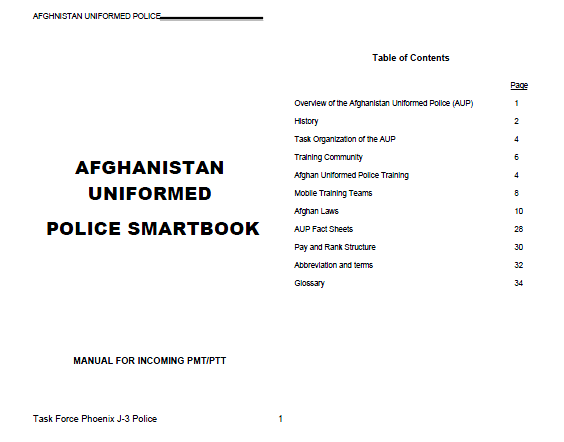
Task Force Phoenix has been working in partnership with other nations in training the Afghan Uniformed Police. Civilian Mentor Teams are mentoring senior police leadership at the Kabul police academy. The U.S. is providing basic training courses at a central training facility in Kabul and eight Regional Training Centers in other provinces.
More than 62,000 members of the Afghan Uniformed Police, Afghan National Auxiliary Police, and Border Police have completed Police Academy Training programs at U.S. facilities. Over 12,000 have also completed more advanced training courses in specialized areas such as firearms, crowd control, investigative techniques, and domestic violence. In the past year, the Task Force Phoenix has enhanced the Afghan National Police training program with over 200 Mobile training teams and advisors around the country.
As part of a major pay and rank reform program, the U.S. and international partners are helping the Afghan Uniformed Police leadership to build a merit-based leadership and discipline structure to assure that the Police become widely-respected public servants and officers of a society based on the rule of law.
…
AUP Pay and Rank Structure Rank and Pay Reform
For years, the existing leadership structure in the MOI, which includes the police and border guards, has been replete with corruption, blackmail and human rights violations. As such, Germany and the U.S. have led a Rank Reform initiative to completely overhaul and replace the existing leadership structure and composition within the Ministry of the Interior (MOI). This process is in its infancy (began October 2005).
UN, Germany, and the US have conducted background checks on all eligible candidates to ensure that no future leaders of the MOI have Human Rights violations or records of corruption in their past. The officers already selected have no proven record of Human Rights violations, nor are there any corroborated indications that have participated in corrupt activities.
Concurrent with rank reform, salary reform will be implemented in phases. As billets are restructured, pay increases will be incrementally implemented with a target completion date that corresponds with the completion of rank reform in September of 2006.
There is an inextricable link between Rank Reform and Pay Reform. The Afghan nation needs a security force whose pay is commensurate with their level of responsibility and the Pay Reform process brings that concept to fruition.
Rank and Pay Reform constitute two key pillars necessary to shape the “way ahead” for the Afghan government and the AUP while maintaining a secure environment for its citizens and upholding the rule of law. Together these initiatives will produce a well-paid police force, which will eliminate corruption and instill confidence by the Afghan populace in the AUP.
Current Monthly Salary and Rank Structure
Rank/Pay rate
Lieutenant General $750
Major General $650
Brigadier General $550
Colonel $400
Lieutenant Colonel $350
Major $300
Senior Captain $250
First Lieutenant $200
Second Lieutenant $180
Sergeant $115/$140/$160
Patrolman $70/$80
History Channel telling about Albert Einstein and his many theorys including his most famous equation e=mc^2
[Federal Register Volume 77, Number 84 (Tuesday, May 1, 2012)] [Notices] [Pages 25762-25767] From the Federal Register Online via the Government Printing Office [www.gpo.gov] [FR Doc No: 2012-10472] ----------------------------------------------------------------------- NUCLEAR REGULATORY COMMISSION [Docket No. 72-1039; NRC-2012-0099; EA-12-047] In the Matter of Southern Nuclear Operating Company, Inc., Vogtle Electric Generating Plant, Independent Spent Fuel Storage Installation; Order Modifying License (Effective Immediately) AGENCY: Nuclear Regulatory Commission. ACTION: Issuance of order for implementation of additional security measures and fingerprinting for unescorted access to Southern Nuclear Operating Company, Inc. ----------------------------------------------------------------------- FOR FURTHER INFORMATION CONTACT: L. Raynard Wharton, Senior Project Manager, Licensing and Inspection Directorate, Division of Spent Fuel Storage and Transportation, Office of Nuclear Material Safety and Safeguards, U.S. Nuclear Regulatory Commission, Rockville, Maryland 20852; telephone: (301) 492-3316; fax number: (301) 492-3348; email: Raynard.Wharton@nrc.gov. SUPPLEMENTARY INFORMATION: I. Introduction Pursuant to Title 10 of the Code of Federal Regulations (10 CFR) 2.106, the U.S. Nuclear Regulatory Commission (NRC or the Commission) is providing notice, in the matter of Vogtle Electric Generating Plant Independent Spent Fuel Storage Installation (ISFSI) Order Modifying License (Effective Immediately). II. Further Information I The NRC has issued a general license to Southern Nuclear Operating Company, Inc. (SNC), authorizing the operation of an ISFSI, in accordance with the Atomic Energy Act of 1954, as amended, and 10 CFR part 72. This Order is being issued to SNC because it has identified near-term plans to store spent fuel in an ISFSI under the general license provisions of 10 CFR part 72. The Commission's regulations at 10 CFR 72.212(b)(5), 10 CFR 50.54(p)(1), and 10 CFR 73.55(c)(5) require licensees to maintain safeguards contingency plan procedures to respond to threats of radiological sabotage and to protect the spent fuel against the threat of radiological sabotage, in accordance with 10 CFR part 73, appendix C. Specific physical security requirements are contained in 10 CFR 73.51 or 73.55, as applicable. Inasmuch as an insider has an opportunity equal to, or greater than, any other person, to commit radiological sabotage, the Commission has determined these measures to be prudent. Comparable Orders have been issued to all licensees that currently store spent fuel or have identified near-term plans to store spent fuel in an ISFSI. II On September 11, 2001, terrorists simultaneously attacked targets in New York, NY, and Washington, DC, using large commercial aircraft as weapons. In response to the attacks and intelligence information subsequently obtained, the Commission issued a number of Safeguards and Threat Advisories to its licensees to strengthen licensees' capabilities and readiness to respond to a potential attack on a nuclear facility. On October 16, 2002, the Commission issued Orders to the licensees of operating ISFSIs, to place the actions taken in response to the Advisories into the established regulatory framework and to implement additional security enhancements that emerged from NRC's ongoing comprehensive review. The Commission has also communicated with other Federal, State, and local government agencies and industry representatives to discuss and evaluate the current threat environment in order to assess the adequacy of security measures at licensed facilities. In addition, the Commission has conducted a comprehensive review of its safeguards and security programs and requirements. As a result of its consideration of current safeguards and security [[Page 25763]] requirements, as well as a review of information provided by the intelligence community, the Commission has determined that certain additional security measures (ASMs) are required to address the current threat environment, in a consistent manner throughout the nuclear ISFSI community. Therefore, the Commission is imposing requirements, as set forth in Attachments 1 and 2 of this Order, on all licensees of these facilities. These requirements, which supplement existing regulatory requirements, will provide the Commission with reasonable assurance that the public health and safety, the environment, and common defense and security continue to be adequately protected in the current threat environment. These requirements will remain in effect until the Commission determines otherwise. The Commission recognizes that licensees may have already initiated many of the measures set forth in Attachments 1 and 2 to this Order, in response to previously issued Advisories, or on their own. It also recognizes that some measures may not be possible or necessary at some sites, or may need to be tailored to accommodate the specific circumstances existing at SNC's facility, to achieve the intended objectives and avoid any unforeseen effect on the safe storage of spent fuel. Although the ASMs implemented by licensees in response to the Safeguards and Threat Advisories have been sufficient to provide reasonable assurance of adequate protection of public health and safety, in light of the continuing threat environment, the Commission concludes that these actions must be embodied in an Order, consistent with the established regulatory framework. To provide assurance that licensees are implementing prudent measures to achieve a consistent level of protection to address the current threat environment, licenses issued pursuant to 10 CFR 72.210 shall be modified to include the requirements identified in Attachments 1 and 2 to this Order. In addition, pursuant to 10 CFR 2.202, I find that, in light of the common defense and security circumstances described above, the public health, safety, and interest require that this Order be effective immediately. III Accordingly, pursuant to Sections 53, 103, 104, 147, 149, 161b, 161i, 161o, 182, and 186 of the Atomic Energy Act of 1954, as amended, and the Commission's regulations in 10 CFR 2.202 and 10 CFR parts 50, 72, and 73, it is hereby ordered, effective immediately, that your general license is modified as follows: A. SNC shall comply with the requirements described in Attachments 1 and 2 to this Order, except to the extent that a more stringent requirement is set forth in the Vogtle Electric Generating Plant's physical security plan. SNC shall demonstrate its ability to comply with the requirements in Attachments 1 and 2 to the Order no later than 365 days from the date of this Order or 90 days before the first day that spent fuel is initially placed in the ISFSI, whichever is earlier. SNC must implement these requirements before initially placing spent fuel in the ISFSI. Additionally, SNC must receive written verification from the NRC that it has adequately demonstrated compliance with these requirements before initially placing spent fuel in the ISFSI. B. 1. SNC shall, within twenty (20) days of the date of this Order, notify the Commission: (1) If it is unable to comply with any of the requirements described in Attachments 1 and 2; (2) if compliance with any of the requirements is unnecessary, in its specific circumstances; or (3) if implementation of any of the requirements would cause SNC to be in violation of the provisions of any Commission regulation or the facility license. The notification shall provide SNC's justification for seeking relief from, or variation of, any specific requirement. 2. If SNC considers that implementation of any of the requirements described in Attachments 1 and 2 to this Order would adversely impact the safe storage of spent fuel, SNC must notify the Commission, within twenty (20) days of this Order, of the adverse safety impact, the basis for its determination that the requirement has an adverse safety impact, and either a proposal for achieving the same objectives specified in Attachments 1 and 2 requirements in question, or a schedule for modifying the facility, to address the adverse safety condition. If neither approach is appropriate, SNC must supplement its response, to Condition B.1 of this Order, to identify the condition as a requirement with which it cannot comply, with attendant justifications, as required under Condition B.1. C. 1. SNC shall, within twenty (20) days of this Order, submit to the Commission, a schedule for achieving compliance with each requirement described in Attachments 1 and 2. 2. SNC shall report to the Commission when it has achieved full compliance with the requirements described in Attachments 1 and 2. D. All measures implemented or actions taken in response to this Order shall be maintained until the Commission determines otherwise. SNC's response to Conditions B.1, B.2, C.1, and C.2, above, shall be submitted in accordance with 10 CFR 72.4. In addition, submittals and documents produced by SNC as a result of this Order, that contain Safeguards Information as defined by 10 CFR 73.22, shall be properly marked and handled, in accordance with 10 CFR 73.21 and 73.22. The Director, Office of Nuclear Material Safety and Safeguards, may, in writing, relax or rescind any of the above conditions, for good cause. IV In accordance with 10 CFR 2.202, SNC must, and any other person adversely affected by this Order may, submit an answer to this Order within 20 days of its publication in the Federal Register. In addition, SNC and any other person adversely affected by this Order may request a hearing on this Order within 20 days of its publication in the Federal Register. Where good cause is shown, consideration will be given to extending the time to answer or request a hearing. A request for extension of time must be made, in writing, to the Director, Office of Nuclear Material Safety and Safeguards, U.S. Nuclear Regulatory Commission, Washington, DC 20555-0001, and include a statement of good cause for the extension. The answer may consent to this Order. If the answer includes a request for a hearing, it shall, under oath or affirmation, specifically set forth the matters of fact and law on which SNC relies and the reasons as to why the Order should not have been issued. If a person other than SNC requests a hearing, that person shall set forth with particularity the manner in which his/her interest is adversely affected by this Order and shall address the criteria set forth in 10 CFR 2.309(d). All documents filed in NRC adjudicatory proceedings, including a request for hearing, a petition for leave to intervene, any motion or other document filed in the proceeding prior to the submission of a request for hearing or petition to intervene, and documents filed by interested governmental entities participating under 10 CFR 2.315(c), must be filed in accordance with the NRC E-Filing rule (72 FR 49139, August 28, 2007). The E-Filing process requires participants to submit and serve all adjudicatory [[Page 25764]] documents over the internet, or in some cases to mail copies on electronic storage media. Participants may not submit paper copies of their filings unless they seek an exemption in accordance with the procedures described below. To comply with the procedural requirements of E-Filing, at least 10 days prior to the filing deadline, the participant should contact the Office of the Secretary by email at hearing.docket@nrc.gov, or by telephone at 301-415-1677, to request (1) a digital identification (ID) certificate, which allows the participant (or its counsel or representative) to digitally sign documents and access the E-Submittal server for any proceeding in which it is participating; and (2) advise the Secretary that the participant will be submitting a request or petition for hearing (even in instances in which the participant, or its counsel or representative, already holds an NRC-issued digital ID certificate). Based upon this information, the Secretary will establish an electronic docket for the hearing in this proceeding if the Secretary has not already established an electronic docket. Information about applying for a digital ID certificate is available on the NRC's public Web site at http://www.nrc.gov/site-help/e-submittals/apply-certificates.html. System requirements for accessing the E-Submittal server are detailed in the NRC's ``Guidance for Electronic Submission,'' which is available on the NRC's public Web site at http://www.nrc.gov/site-help/e-submittals.html. Participants may attempt to use other software not listed on the Web site, but should note that the NRC's E-Filing system does not support unlisted software, and the NRC Meta System Help Desk will not be able to offer assistance in using unlisted software. If a participant is electronically submitting a document to the NRC in accordance with the E-Filing rule, the participant must file the document using the NRC's online, Web-based submission form. In order to serve documents through the Electronic Information Exchange System, users will be required to install a Web browser plug-in from the NRC's Web site. Further information on the Web-based submission form, including the installation of the Web browser plug-in, is available on the NRC's public Web site at http://www.nrc.gov/site-help/e-submittals.html. Once a participant has obtained a digital ID certificate and a docket has been created, the participant can then submit a request for hearing or petition for leave to intervene. Submissions should be in Portable Document Format (PDF) in accordance with the NRC guidance available on the NRC's public Web site at http://www.nrc.gov/site-help/e-submittals.html. A filing is considered complete at the time the documents are submitted through the NRC's E-Filing system. To be timely, an electronic filing must be submitted to the E-Filing system no later than 11:59 p.m. Eastern Time on the due date. Upon receipt of a transmission, the E-Filing system time-stamps the document and sends the submitter an email notice confirming receipt of the document. The E-Filing system also distributes an email notice that provides access to the document to the NRC's Office of the General Counsel and any others who have advised the Office of the Secretary that they wish to participate in the proceeding, so that the filer need not serve the documents on those participants separately. Therefore, applicants and other participants (or their counsel or representative) must apply for and receive a digital ID certificate before a hearing request/petition to intervene is filed so that they can obtain access to the document via the E-Filing system. A person filing electronically using the NRC's adjudicatory E- Filing system may seek assistance by contacting the NRC Meta System Help Desk through the ``Contact Us'' link located on the NRC's Web site at http://www.nrc.gov/site-help/e-submittals.html, by email to MSHD.Resource@nrc.gov, or by a toll-free call to 1-866-672-7640. The NRC Meta System Help Desk is available between 8 a.m. and 8 p.m., Eastern Time, Monday through Friday, excluding government holidays. Participants who believe that they have a good cause for not submitting documents electronically must file an exemption request, in accordance with 10 CFR 2.302(g), with their initial paper filing requesting authorization to continue to submit documents in paper format. Such filings must be submitted by: (1) First class mail addressed to the Office of the Secretary of the Commission, U.S. Nuclear Regulatory Commission, Washington, DC 20555-0001, Attention: Rulemaking and Adjudications Staff; or (2) courier, express mail, or expedited delivery service to the Office of the Secretary, Sixteenth Floor, One White Flint North, 11555 Rockville Pike, Rockville, Maryland, 20852, Attention: Rulemaking and Adjudications Staff. Participants filing a document in this manner are responsible for serving the document on all other participants. Filing is considered complete by first-class mail as of the time of deposit in the mail, or by courier, express mail, or expedited delivery service upon depositing the document with the provider of the service. A presiding officer, having granted an exemption request from using E-Filing, may require a participant or party to use E-Filing if the presiding officer subsequently determines that the reason for granting the exemption from use of E-Filing no longer exists. Documents submitted in adjudicatory proceedings will appear in the NRC's electronic hearing docket which is available to the public at http://ehd1.nrc.gov/ehd/, unless excluded pursuant to an order of the Commission, or the presiding officer. Participants are requested not to include personal privacy information, such as social security numbers, home addresses, or home phone numbers in their filings, unless an NRC regulation or other law requires submission of such information. With respect to copyrighted works, except for limited excerpts that serve the purpose of the adjudicatory filings and would constitute a Fair Use application, participants are requested not to include copyrighted materials in their submission. If a hearing is requested by SNC or a person whose interest is adversely affected, the Commission will issue an Order designating the time and place of any hearing. If a hearing is held, the issue to be considered at such hearing shall be whether this Order should be sustained. Pursuant to 10 CFR 2.202(c)(2)(i), SNC may, in addition to requesting a hearing, at the time the answer is filed or sooner, move the presiding officer to set aside the immediate effectiveness of the Order on the grounds that the Order, including the need for immediate effectiveness, is not based on adequate evidence, but on mere suspicion, unfounded allegations, or error. In the absence of any request for hearing, or written approval of an extension of time in which to request a hearing, the provisions as specified in Section III shall be final twenty (20) days from the date this Order is published in the Federal Register, without further Order or proceedings. If an extension of time for requesting a hearing has been approved, the provisions as specified in Section III, shall be final when the extension expires, if a hearing request has not been received. An answer or a request for hearing shall not stay the immediate effectiveness of this order. [[Page 25765]] Dated at Rockville, Maryland, this 23rd day of April, 2012. For the Nuclear Regulatory Commission. Catherine Haney, Director, Office of Nuclear Material Safety and Safeguards. Attachment 1--Additional Security Measures (ASMs) for Physical Protection of Dry Independent Spent Fuel Storage Installations (ISFSIs) contains Safeguards Information and is not included in the Federal Register notice Attachment 2--Additional Security Measures for Access Authorization and Fingerprinting at Independent Spent Fuel Storage Installations, Dated June 3, 2010 A. General Basis Criteria 1. These additional security measures (ASMs) are established to delineate an independent spent fuel storage installation (ISFSI) licensee's responsibility to enhance security measures related to authorization for unescorted access to the protected area of an ISFSI in response to the current threat environment. 2. Licensees whose ISFSI is collocated with a power reactor may choose to comply with the U.S. Nuclear Regulatory Commission (NRC)- approved reactor access authorization program for the associated reactor as an alternative means to satisfy the provisions of sections B through G below. Otherwise, licensees shall comply with the access authorization and fingerprinting requirements of sections B through G of these ASMs. 3. Licensees shall clearly distinguish in their 20-day response which method they intend to use in order to comply with these ASMs. B. Additional Security Measures for Access Authorization Program 1. The licensee shall develop, implement and maintain a program, or enhance its existing program, designed to ensure that persons granted unescorted access to the protected area of an ISFSI are trustworthy and reliable and do not constitute an unreasonable risk to the public health and safety or the common defense and security, including a potential to commit radiological sabotage. a. To establish trustworthiness and reliability, the licensee shall develop, implement, and maintain procedures for conducting and completing background investigations, prior to granting access. The scope of background investigations must address at least the past three years and, as a minimum, must include: i. Fingerprinting and a Federal Bureau of Investigation (FBI) identification and criminal history records check (CHRC). Where an applicant for unescorted access has been previously fingerprinted with a favorably completed CHRC (such as a CHRC pursuant to compliance with orders for access to safeguards information), the licensee may accept the results of that CHRC, and need not submit another set of fingerprints, provided the CHRC was completed not more than three years from the date of the application for unescorted access. ii. Verification of employment with each previous employer for the most recent year from the date of application. iii. Verification of employment with an employer of the longest duration during any calendar month for the remaining next most recent 2 years. iv. A full credit history review. v. An interview with not less than two character references, developed by the investigator. vi. A review of official identification (e.g., driver's license; passport; government identification; state-, province-, or country-of- birth issued certificate of birth) to allow comparison of personal information data provided by the applicant. The licensee shall maintain a photocopy of the identifying document(s) on file, in accordance with ``Protection of Information,'' in section G of these ASMs. vii. Licensees shall confirm eligibility for employment through the regulations of the U.S. Department of Homeland Security, U.S. Citizenship and Immigration Services, and shall verify and ensure, to the extent possible, the accuracy of the provided social security number and alien registration number, as applicable. b. The procedures developed or enhanced shall include measures for confirming the term, duration, and character of military service for the past 3 years, and/or academic enrollment and attendance in lieu of employment, for the past 5 years. c. Licensees need not conduct an independent investigation for individuals employed at a facility who possess active ``Q'' or ``L'' clearances or possess another active U.S. Government-granted security clearance (i.e., Top Secret, Secret, or Confidential). d. A review of the applicant's criminal history, obtained from local criminal justice resources, may be included in addition to the FBI CHRC, and is encouraged if the results of the FBI CHRC, employment check, or credit check disclose derogatory information. The scope of the applicant's local criminal history check shall cover all residences of record for the past three years from the date of the application for unescorted access. 2. The licensee shall use any information obtained as part of a CHRC solely for the purpose of determining an individual's suitability for unescorted access to the protected area of an ISFSI. 3. The licensee shall document the basis for its determination for granting or denying access to the protected area of an ISFSI. 4. The licensee shall develop, implement, and maintain procedures for updating background investigations for persons who are applying for reinstatement of unescorted access. Licensees need not conduct an independent reinvestigation for individuals who possess active ``Q'' or ``L'' clearances or possess another active U.S. Government-granted security clearance, i.e., Top Secret, Secret or Confidential. 5. The licensee shall develop, implement, and maintain procedures for reinvestigations of persons granted unescorted access, at intervals not to exceed five years. Licensees need not conduct an independent reinvestigation for individuals employed at a facility who possess active ``Q'' or ``L'' clearances or possess another active U.S. Government-granted security clearance, i.e., Top Secret, Secret or Confidential. 6. The licensee shall develop, implement, and maintain procedures designed to ensure that persons who have been denied unescorted access authorization to the facility are not allowed access to the facility, even under escort. 7. The licensee shall develop, implement, and maintain an audit program for licensee and contractor/vendor access authorization programs that evaluate all program elements and include a person knowledgeable and practiced in access authorization program performance objectives to assist in the overall assessment of the site's program effectiveness. C. Fingerprinting Program Requirements 1. In a letter to the NRC, the licensee must nominate an individual who will review the results of the FBI CHRCs to make trustworthiness and reliability determinations for unescorted access to an ISFSI. This individual, referred to as the ``reviewing official,'' must be someone who requires unescorted access to the ISFSI. The NRC will review the CHRC of any individual nominated to perform the reviewing official function. Based on the results of the CHRC, the NRC staff will determine whether this individual may have [[Page 25766]] access. If the NRC determines that the nominee may not be granted such access, that individual will be prohibited from obtaining access.\1\ Once the NRC approves a reviewing official, the reviewing official is the only individual permitted to make access determinations for other individuals who have been identified by the licensee as having the need for unescorted access to the ISFSI, and have been fingerprinted and have had a CHRC in accordance with these ASMs. The reviewing official can only make access determinations for other individuals, and therefore cannot approve other individuals to act as reviewing officials. Only the NRC can approve a reviewing official. Therefore, if the licensee wishes to have a new or additional reviewing official, the NRC must approve that individual before he or she can act in the capacity of a reviewing official. --------------------------------------------------------------------------- \1\ The NRC's determination of this individual's unescorted access to the ISFSI, in accordance with the process, is an administrative determination that is outside the scope of the Order. --------------------------------------------------------------------------- 2. No person may have access to Safeguards Information (SGI) or unescorted access to any facility subject to NRC regulation, if the NRC has determined, in accordance with its administrative review process based on fingerprinting and an FBI identification and CHRC, that the person may not have access to SGI or unescorted access to any facility subject to NRC regulation. 3. All fingerprints obtained by the licensee under this Order must be submitted to the Commission for transmission to the FBI. 4. The licensee shall notify each affected individual that the fingerprints will be used to conduct a review of his/her criminal history record and inform the individual of the procedures for revising the record or including an explanation in the record, as specified in the ``Right to Correct and Complete Information,'' in section F of these ASMs. 5. Fingerprints need not be taken if the employed individual (e.g., a licensee employee, contractor, manufacturer, or supplier) is relieved from the fingerprinting requirement by 10 CFR 73.61, has a favorably adjudicated U.S. Government CHRC within the last 5 years, or has an active Federal security clearance. Written confirmation from the Agency/employer who granted the Federal security clearance or reviewed the CHRC must be provided to the licensee. The licensee must retain this documentation for a period of 3 years from the date the individual no longer requires access to the facility. D. Prohibitions 1. A licensee shall not base a final determination to deny an individual unescorted access to the protected area of an ISFSI solely on the basis of information received from the FBI involving: An arrest more than 1 year old for which there is no information of the disposition of the case, or an arrest that resulted in dismissal of the charge, or an acquittal. 2. A licensee shall not use information received from a CHRC obtained pursuant to this Order in a manner that would infringe upon the rights of any individual under the First Amendment to the Constitution of the United States, nor shall the licensee use the information in any way that would discriminate among individuals on the basis of race, religion, national origin, sex, or age. E. Procedures for Processing Fingerprint Checks 1. For the purpose of complying with this Order, licensees shall, using an appropriate method listed in 10 CFR 73.4, submit to the NRC's Division of Facilities and Security, Mail Stop TWB-05B32M, one completed, legible standard fingerprint card (Form FD-258, ORIMDNRCOOOZ) or, where practicable, other fingerprint records for each individual seeking unescorted access to an ISFSI, to the Director of the Division of Facilities and Security, marked for the attention of the Division's Criminal History Check Section. Copies of these forms may be obtained by writing the Office of Information Services, U.S. Nuclear Regulatory Commission, Washington, DC 20555-0001, by calling (301) 415-5877, or by email to Forms.Resource@nrc.gov. Practicable alternative formats are set forth in 10 CFR 73.4. The licensee shall establish procedures to ensure that the quality of the fingerprints taken results in minimizing the rejection rate of fingerprint cards because of illegible or incomplete cards. 2. The NRC will review submitted fingerprint cards for completeness. Any Form FD-258 fingerprint record containing omissions or evident errors will be returned to the licensee for corrections. The fee for processing fingerprint checks includes one re-submission if the initial submission is returned by the FBI because the fingerprint impressions cannot be classified. The one free re-submission must have the FBI Transaction Control Number reflected on the re-submission. If additional submissions are necessary, they will be treated as initial submittals and will require a second payment of the processing fee. 3. Fees for processing fingerprint checks are due upon application. The licensee shall submit payment of the processing fees electronically. To be able to submit secure electronic payments, licensees will need to establish an account with Pay.Gov (https://www.pay.gov). To request an account, the licensee shall send an email to det@nrc.gov. The email must include the licensee's company name, address, point of contact (POC), POC email address, and phone number. The NRC will forward the request to Pay.Gov, who will contact the licensee with a password and user ID. Once the licensee has established an account and submitted payment to Pay.Gov, they shall obtain a receipt. The licensee shall submit the receipt from Pay.Gov to the NRC along with fingerprint cards. For additional guidance on making electronic payments, contact the Facilities Security Branch, Division of Facilities and Security, at (301) 492-3531. Combined payment for multiple applications is acceptable. The application fee (currently $26) is the sum of the user fee charged by the FBI for each fingerprint card or other fingerprint record submitted by the NRC on behalf of a licensee, and an NRC processing fee, which covers administrative costs associated with NRC handling of licensee fingerprint submissions. The Commission will directly notify licensees who are subject to this regulation of any fee changes. 4. The Commission will forward to the submitting licensee all data received from the FBI as a result of the licensee's application(s) for CHRCs, including the FBI fingerprint record. F. Right To Correct and Complete Information 1. Prior to any final adverse determination, the licensee shall make available to the individual the contents of any criminal history records obtained from the FBI for the purpose of assuring correct and complete information. Written confirmation by the individual of receipt of this notification must be maintained by the licensee for a period of one (1) year from the date of notification. 2. If, after reviewing the record, an individual believes that it is incorrect or incomplete in any respect and wishes to change, correct, or update the alleged deficiency, or to explain any matter in the record, the individual may initiate challenge procedures. These procedures include either direct application by the individual challenging the record to the agency (i.e., law enforcement agency) [[Page 25767]] that contributed the questioned information, or direct challenge as to the accuracy or completeness of any entry on the criminal history record to the Assistant Director, Federal Bureau of Investigation Identification Division, Washington, DC 20537-9700 (as set forth in 28 CFR 16.30 through 16.34). In the latter case, the FBI forwards the challenge to the agency that submitted the data and requests that agency to verify or correct the challenged entry. Upon receipt of an official communication directly from the agency that contributed the original information, the FBI Identification Division makes any changes necessary in accordance with the information supplied by that agency. The licensee must provide at least 10 days for an individual to initiate an action challenging the results of a FBI CHRC after the record is made available for his/her review. The licensee may make a final access determination based on the criminal history record only upon receipt of the FBI's ultimate confirmation or correction of the record. Upon a final adverse determination on access to an ISFSI, the licensee shall provide the individual its documented basis for denial. Access to an ISFSI shall not be granted to an individual during the review process. G. Protection of Information 1. The licensee shall develop, implement, and maintain a system for personnel information management with appropriate procedures for the protection of personal, confidential information. This system shall be designed to prohibit unauthorized access to sensitive information and to prohibit modification of the information without authorization. 2. Each licensee who obtains a criminal history record on an individual pursuant to this Order shall establish and maintain a system of files and procedures, for protecting the record and the personal information from unauthorized disclosure. 3. The licensee may not disclose the record or personal information collected and maintained to persons other than the subject individual, his/her representative, or to those who have a need to access the information in performing assigned duties in the process of determining suitability for unescorted access to the protected area of an ISFSI. No individual authorized to have access to the information may re- disseminate the information to any other individual who does not have the appropriate need to know. 4. The personal information obtained on an individual from a CHRC may be transferred to another licensee if the gaining licensee receives the individual's written request to re-disseminate the information contained in his/her file, and the gaining licensee verifies information such as the individual's name, date of birth, social security number, sex, and other applicable physical characteristics for identification purposes. 5. The licensee shall make criminal history records, obtained under this section, available for examination by an authorized representative of the NRC to determine compliance with the regulations and laws. [FR Doc. 2012-10472 Filed 4-30-12; 8:45 am] BILLING CODE 7590-01-P
The complete, full length documentary of all the various books banned from the Bible by the Catholic Church.
|
![[Image]](https://i0.wp.com/cryptome.org/2012-info/osama-shrine2/pict34.jpg) Children play on the demolished site of a compound of Osama bin Laden in Abbottabad May 1, 2012. Al Qaeda leader bin Laden was killed almost a year ago, on May 2, 2011, by a United States special operations military unit in a raid on his compound in Abbottabad. Reuters Children play on the demolished site of a compound of Osama bin Laden in Abbottabad May 1, 2012. Al Qaeda leader bin Laden was killed almost a year ago, on May 2, 2011, by a United States special operations military unit in a raid on his compound in Abbottabad. Reuters |
![[Image]](https://i0.wp.com/cryptome.org/2012-info/osama-shrine2/pict30.jpg) This two-picture combo shows from top to bottom: Pakistani men walk through a path in a field next to the house where al-Qaida leader Osama bin Laden was caught and killed in Abbottabad, Pakistan, May 5, 2011; A Pakistani woman and a girl walk through a path in a field next to the demolished house where al-Qaida leader Osama bin Laden was caught and killed in Abbottabad, Pakistan, Sunday, April 29, 2012. This two-picture combo shows from top to bottom: Pakistani men walk through a path in a field next to the house where al-Qaida leader Osama bin Laden was caught and killed in Abbottabad, Pakistan, May 5, 2011; A Pakistani woman and a girl walk through a path in a field next to the demolished house where al-Qaida leader Osama bin Laden was caught and killed in Abbottabad, Pakistan, Sunday, April 29, 2012. |
![[Image]](https://i0.wp.com/cryptome.org/2012-info/osama-shrine2/pict31.jpg) A Pakistani woman and a girl walk through a path in a field next to the demolished house where al-Qaida leader Osama bin Laden was caught and killed in Abbottabad, Pakistan, Sunday, April 29, 2012. A year after the U.S. raid that killed Osama bin Laden, al-Qaida is hobbled and hunted, too busy surviving for the moment to carry out another Sept. 11-style attack on U.S. soil. (Muhammed Muheisen) A Pakistani woman and a girl walk through a path in a field next to the demolished house where al-Qaida leader Osama bin Laden was caught and killed in Abbottabad, Pakistan, Sunday, April 29, 2012. A year after the U.S. raid that killed Osama bin Laden, al-Qaida is hobbled and hunted, too busy surviving for the moment to carry out another Sept. 11-style attack on U.S. soil. (Muhammed Muheisen) |
![[Image]](https://i0.wp.com/cryptome.org/2012-info/osama-shrine2/pict28.jpg) In this Sunday, April 29, 2012 photo, a Pakistani boy tries to break a concrete block as he and other children look for iron from the demolished compound of Osama bin Laden, in Abbottabad, Pakistan. One year since U.S. commandos flew into this army town and killed Osama bin Laden, Pakistan has tried to close one of the most notorious chapters in its history. The compound that housed him for six years was razed to the ground, and the wives and children who shared the hideaway were flown to Saudi Arabia just last week. (Muhammed Muheisen) In this Sunday, April 29, 2012 photo, a Pakistani boy tries to break a concrete block as he and other children look for iron from the demolished compound of Osama bin Laden, in Abbottabad, Pakistan. One year since U.S. commandos flew into this army town and killed Osama bin Laden, Pakistan has tried to close one of the most notorious chapters in its history. The compound that housed him for six years was razed to the ground, and the wives and children who shared the hideaway were flown to Saudi Arabia just last week. (Muhammed Muheisen) |
![[Image]](https://i0.wp.com/cryptome.org/2012-info/osama-shrine2/pict29.jpg) In a Sunday, April 29, 2012 photo, Pakistani girls, center, walk at the demolished compound of Osama bin Laden, in Abbottabad, Pakistan. One year since U.S. commandos flew into this army town and killed Osama bin Laden, Pakistan has tried to close one of the most notorious chapters in its history. The compound that housed him for six years was razed to the ground, and the wives and children who shared the hideaway were flown to Saudi Arabia just last week. (Muhammed Muheisen) In a Sunday, April 29, 2012 photo, Pakistani girls, center, walk at the demolished compound of Osama bin Laden, in Abbottabad, Pakistan. One year since U.S. commandos flew into this army town and killed Osama bin Laden, Pakistan has tried to close one of the most notorious chapters in its history. The compound that housed him for six years was razed to the ground, and the wives and children who shared the hideaway were flown to Saudi Arabia just last week. (Muhammed Muheisen) |
![[Image]](https://i0.wp.com/cryptome.org/2012-info/osama-shrine2/pict32.jpg) This photograph taken on April 25, 2012, shows a Pakistani labourer working at a house in front the site of the demolished compound of slain Al-Qaeda leader Osama bin Laden in northern Abbottabad, ahead of bin Laden’s first death anniversary. The Pakistani intelligence services provided the United States with information that was helpful in learning more about the compound where Osama bin Laden was killed, a US official said on April 28. Getty This photograph taken on April 25, 2012, shows a Pakistani labourer working at a house in front the site of the demolished compound of slain Al-Qaeda leader Osama bin Laden in northern Abbottabad, ahead of bin Laden’s first death anniversary. The Pakistani intelligence services provided the United States with information that was helpful in learning more about the compound where Osama bin Laden was killed, a US official said on April 28. Getty |
![[Image]](https://i0.wp.com/cryptome.org/2012-info/osama-shrine2/pict33.jpg) This photograph taken on April 25, 2012, shows a Pakistani boy swinging a cricket bat at the site of the demolished compound of slain Al-Qaeda leader Osama bin Laden, in northern Abbottabad ahead of bin Laden’s first death anniversary. The Pakistani intelligence services provided the United States with information that was helpful in learning more about the compound where Osama bin Laden was killed, a US official said on April 28. Getty This photograph taken on April 25, 2012, shows a Pakistani boy swinging a cricket bat at the site of the demolished compound of slain Al-Qaeda leader Osama bin Laden, in northern Abbottabad ahead of bin Laden’s first death anniversary. The Pakistani intelligence services provided the United States with information that was helpful in learning more about the compound where Osama bin Laden was killed, a US official said on April 28. Getty |
![[Image]](https://i0.wp.com/cryptome.org/2012-info/osama-shrine2/pict35.jpg) This photograph taken on April 25, 2012, shows local Pakistani residents walking past the site of the demolished compound of slain Al-Qaeda leader Osama bin Laden, in northern Abbottabad ahead of bin Laden’s first death anniversary. The Pakistani intelligence services provided the United States with information that was helpful in learning more about the compound where Osama bin Laden was killed, a US official said on April 28. Getty This photograph taken on April 25, 2012, shows local Pakistani residents walking past the site of the demolished compound of slain Al-Qaeda leader Osama bin Laden, in northern Abbottabad ahead of bin Laden’s first death anniversary. The Pakistani intelligence services provided the United States with information that was helpful in learning more about the compound where Osama bin Laden was killed, a US official said on April 28. Getty |
Shrine site on May 11, 2011.![[Image]](https://i0.wp.com/cryptome.org/2012-info/osama-shrine2/pict36.jpg) |
Shrine site on May 1, 2011. Downed chopper in courtyard.![[Image]](https://i0.wp.com/cryptome.org/2012-info/osama-shrine2/pict37.jpg) |
Shrine site on May 8, 2010.![[Image]](https://i0.wp.com/cryptome.org/2012-info/osama-shrine2/pict38.jpg) |
Shrine site on June 14, 2005.![[Image]](https://i0.wp.com/cryptome.org/2012-info/osama-shrine2/pict39.jpg) |
Shrine site on May 22, 2001.![[Image]](https://i0.wp.com/cryptome.org/2012-info/osama-shrine2/pict40.jpg) |
This is a show about the history of the US LRRP and the 75:th Ranger Bn. in Vietnam.
The White House continues to coyly offer photos of the CIA officer credited with tracking Osama bin Laden but not yet identifying him:
http://cryptome.org/0004/cia-john/cia-john.htm (CIA officer, AP-nicknamed “John”, behind Panetta)
![[Image]](https://i0.wp.com/cryptome.org/2012/04/cia-john3/pict27.jpg)
White House photo.
http://cryptome.org/0006/cia-john2/cia-john2.htm
![[Image]](https://i0.wp.com/cryptome.org/2012/04/cia-john3/pict26.jpg)
White House photo.
![[Image]](https://i0.wp.com/cryptome.org/2012/04/cia-john3/pict25.jpg)
White House photo.
Presumably the officer has been rewarded with advancement and may become a part of the Obama re-election campaign through public identification, even appointed to a White House position along with other CIA stalwarts who are engaged in re-celebrating the bin Laden killing.
Among several CIA veterans of the GWOT now making the rounds of media, CIA John would be superb for a bipartisan Congressional grandstand, an appearance on the White House basketball court with Obama, a super-star celebrant at a Hollywood-style fund-raiser. The CIA entertainment industry liaison would piss its pants with a CIA John supplement to:
https://www.cia.gov/news-information/cia-the-war-on-terrorism/usama-bin-ladin-operation/index.html
This is perhaps the best documentary ever created by the History Channel. It gives us a good glimpse of a time long past, when religion was the only law, and barbarians and heathens roamed the land looking to plunder everything in sight.
The following is a list of possible locations of NSA domestic interception points inside the United States. The list was presented by computer security researcher Jacob Appelbaum at a recent event held at the Whitney Museum in New York along with filmmaker Laura Poitras and ex-NSA employee William Binney. One of the addresses, an AT&T building on Folsom Street in San Francisco, is the location of Room 641A which was the subject of multiple lawsuits regarding the warrantless surveillance of U.S. citizens. A recent article in Wired quoted Binney as estimating that there are likely ten to twenty of these locations around the country.
| Address | Provider | |
|---|---|---|
| 2651 Olive St St Louis, MO 63103 |
AT&T | View |
| 420 S Grand Ave Los Angeles, CA 90071 |
AT&T | View |
| 611 Folsom St San Francisco, CA 94107 |
AT&T | View |
| 51 Peachtree Center Ave NE Atlanta, GA 30303 |
AT&T | View |
| 10 S Canal St Chicago, IL 60606 |
AT&T | View |
| 30 E St SW Washington, DC 20003 |
Verizon | View |
| 811 10th Ave New York, NY 10019 |
AT&T | View |
| 12976 Hollenberg Dr Bridgeton, MO 63044 |
AT&T | View |
Winifred Wagner war eine enge persönliche Freundin von Adolf Hitler, den sie 1923 kurz nach dem Deutschen Tag in Bayreuth kennengelernt hatte und in die Familie einführte.[1] Nach dem gescheiterten Hitler-Ludendorff-Putsch und Hitlers Inhaftierung in Landsberg korrespondierte sie mit Hitler und schickte ihm Päckchen. Seit 1925 duzte sie sich mit Hitler und nahm am Reichsparteitag der NSDAP in Weimar teil.[1] Im Januar 1926 trat sie der NSDAP bei (Mitgliedsnummer: 29.349).[1] Goebbels urteilte am 8. Mai 1926 in seinem Tagebuch über Winifred Wagner: „Ein rassiges Weib. So sollten sie alle sein. Und fanatisch auf unserer Seite.
Original 16mm-Filmaufnahmen von Eva Braun in Farbe und schwarzweiß. Eva Braun, die Frau an Hitlers Seite, hat mit ihrer 16-mm-Filmkamera das Leben auf dem Berghof und ihre privaten Reisen festgehalten. Die Aufnahmen, die heute im amerikanischen Nationalarchiv liegen, waren nie für die Öffentlichkeit bestimmt. Nach ihrem Freitod am 30. April 1945 im Bunker der Reichskanzlei galten die Filmrollen lange als verschollen, ehe sie in den USA wieder auftauchten. Diese DVD zeigt erstmals einen umfassenden Zusammenschnitt des gesamten geheimen Archivs. Zeitzeugen aus der engsten Umgebung von Eva Braun und Adolf Hitler kommentieren die einzigartigen Filmaufnahmen, die das Leben der Mächtigen des Dritten Reiches jenseits der Propaganda zeigen. Die DVD bietet als Extras einen 15-minütigen Bonusfilm mit nicht verwendeten Aufnahmen sowie Biographien.
Eva Braun fut la maîtresse d’Adolf Hitler de 1932 à leur suicide commun en avril 1945. De 1937 à 1944, elle tourne des films amateurs au chalet d’Hitler, le Berghof, dans les Alpes Bavaroises, véritable centre de décision du nazisme, où il aimait recevoir son entourage. Des images en couleur qui nous font entrer dans l’intimité du Führer et les coulisses du IIIème Reich. Pour la première fois, ces documents historiques ont été réunis dans un documentaire qui porte un regard unique sur la vie privée et les crimes publics du dictateur allemand…
Relive the gripping events of the tribunal that gave birth to the trial procedure paradigm for decades of state criminal cases as rare archival materials and firsthand accounts combine to offer a compelling account of the historical Nuremburg trials. When former head of the Nazi Air Force Hermann Goring and other surviving members of the Nazi elite went on trial on November 20, 1945, the world watched with bated breath to witness the outcome of the groundbreaking case. Charged with the murder of millions of innocent civilians and set before the world to face judgment, the Nuremburg Trials offered a brief glimmer of justice to those lives had been affected by Hitler’s atrocities, and in this release history buffs are afforded a closer look than ever before at the trial that held the attention of an entire planet.
1950’s television documentary special that includes interviews with Hitler’s sister Paula Wolf and a fellow prisoner who was incarcerated with Hitler, actual footage shot by the Nazi’s and Eva Braun’s rare home movies.
WASHINGTON—Kurt Mix, a former engineer for BP plc, was arrested today on charges of intentionally destroying evidence requested by federal criminal authorities investigating the April 20, 2010 Deepwater Horizon disaster, announced Attorney General Eric Holder; Assistant Attorney General Lanny A. Breuer of the Justice Department’s Criminal Division; U.S. Attorney Jim Letten of the Eastern District of Louisiana; and Kevin Perkins, Acting Executive Assistant Director for the FBI’s Criminal Cyber Response and Services Branch.
Mix, 50, of Katy, Texas, was charged with two counts of obstruction of justice in a criminal complaint filed in the Eastern District of Louisiana and unsealed today.
“The department has filed initial charges in its investigation into the Deepwater Horizon disaster against an individual for allegedly deleting records relating to the amount of oil flowing from the Macondo well after the explosion that led to the devastating tragedy in the Gulf of Mexico,” said Attorney General Holder. “The Deepwater Horizon Task Force is continuing its investigation into the explosion and will hold accountable those who violated the law in connection with the largest environmental disaster in U.S. history.”
According to the affidavit in support of a criminal complaint and arrest warrant, on April 20, 2010, the Deepwater Horizon rig experienced an uncontrolled blowout and related explosions while finishing the Macondo well. The catastrophe killed 11 men on board and resulted in the largest environmental disaster in U.S. history.
According to court documents, Mix was a drilling and completions project engineer for BP. Following the blowout, Mix worked on internal BP efforts to estimate the amount of oil leaking from the well and was involved in various efforts to stop the leak. Those efforts included, among others, Top Kill, the failed BP effort to pump heavy mud into the blown out wellhead to try to stop the oil flow. BP sent numerous notices to Mix requiring him to retain all information concerning Macondo, including his text messages.
On or about October 4, 2010, after Mix learned that his electronic files were to be collected by a vendor working for BP’s lawyers, Mix allegedly deleted on his iPhone a text string containing more than 200 text messages with a BP supervisor. The deleted texts, some of which were recovered forensically, included sensitive internal BP information collected in real-time as the Top Kill operation was occurring, which indicated that Top Kill was failing. Court documents allege that, among other things, Mix deleted a text he had sent on the evening of May 26, 2010, at the end of the first day of Top Kill. In the text, Mix stated, among other things, “Too much flowrate—over 15,000.” Before Top Kill commenced, Mix and other engineers had concluded internally that Top Kill was unlikely to succeed if the flow rate was greater than 15,000 barrels of oil per day (BOPD). At the time, BP’s public estimate of the flow rate was 5,000 BOPD—three times lower than the minimum flow rate indicated in Mix’s text.
In addition, on or about August 19, 2011, after learning that his iPhone was about to be imaged by a vendor working for BP’s outside counsel, Mix allegedly deleted a text string containing more than 100 text messages with a BP contractor with whom Mix had worked on various issues concerning how much oil was flowing from the Macondo well after the blowout. By the time Mix deleted those texts, he had received numerous legal hold notices requiring him to preserve such data and had been communicating with a criminal defense lawyer in connection with the pending grand jury investigation of the Deepwater Horizon disaster.
A complaint is merely a charge, and a defendant is presumed innocent unless and until proven guilty beyond a reasonable doubt.
If convicted, Mix faces a maximum penalty of 20 years in prison and a fine of up to $250,000 as to each count.
The Deepwater Horizon Task Force, based in New Orleans, is supervised by Assistant Attorney General Breuer and led by Deputy Assistant Attorney General John D. Buretta, who serves as the director of the task force. The task force includes prosecutors from the Criminal Division and the Environment and Natural Resources Division of the Department of Justice; the U.S. Attorney’s Office for the Eastern District of Louisiana and other U.S. Attorneys’ Offices; and investigating agents from the FBI, Environmental Protection Agency, Department of Interior, U.S. Coast Guard, U.S. Fish and Wildlife Service, and other federal law enforcement agencies.
The task force’s investigation of this and other matters concerning the Deepwater Horizon disaster is ongoing.
The case is being prosecuted by task force Deputy Directors Derek Cohen and Avi Gesser of the Justice Department’s Criminal Division; task force prosecutors Assistant U.S. Attorney Richard Pickens, II of the Eastern District of Louisiana; and Assistant U.S. Attorney Scott Cullen of the Eastern District of Pennsylvania.
Adolf Hitler took up residence in the Führerbunker in January 1945 and until the last week of the war it became the epicentre of the Nazi regime. It was here during the last week of April 1945 that Hitler married Eva Braun shortly before they both committed suicide
|
The site is the Navy’s David Taylor Model Basin of the Naval Surface Warfare Carderock Division. |
| http://maps.live.com/default.aspx?v=2&FORM=LMLTCP&cp=38.972693~-77.18664 &style=h&lvl=18&tilt=-90&dir=0&alt=-1000&scene=31360260&phx=0&phy=0&phscl=1&encType=1 ![[Image]](https://i0.wp.com/cryptome.org/eyeball/carderock/pict4.jpg) |
| http://maps.live.com/default.aspx?v=2&FORM=LMLTCP&cp=qgvwwh8k0z6w&style=b&lvl=2&tilt=-90&dir=0&alt=-1000&scene=31360260&phx=0&phy=0&phscl=1&encType=1Looking North
|
Looking East![[Image]](https://i0.wp.com/cryptome.org/eyeball/carderock/pict1.jpg) |
Looking South![[Image]](https://i0.wp.com/cryptome.org/eyeball/carderock/pict2.jpg) |
Looking West![[Image]](https://i0.wp.com/cryptome.org/eyeball/carderock/pict7.jpg) |
History’s Secrets : The Hunt for Adolf Hitler
” At the end of World War II, Adolf Hitler faced the reality of defeat and committed suicide in a Berlin bunker beneath the Reich Chancellery. Then his body mysteriously disappeared. The FBI spent years tracking false leads and sightings of Hitler. What happened to the German leader’s remains? Without remains, can we really be sure what became of the man? “
|
||||
|
||||
| http://maps.google.com/maps?f=q&source=s_q&hl=en&geocode=&q=washington,dc&sll=38.873927,-76.99204 &sspn=0.00043,0.002013&ie=UTF8&ll=38.874087,-76.991919&spn=0.001721,0.004026&t=h&z=19&iwloc=addr  |
||||
| http://maps.google.com/maps?f=q&source=s_q&hl=en&geocode=&q=washington,dc&sll=37.0625,-95.677068 &sspn=58.555544,90.175781&ie=UTF8&ll=38.873927,-76.99204&spn=0.00043,0.002013&t=h&z=20&layer= c&cbll=38.87321,-76.991253&panoid=RiwZ5AN_ySCudUUM4skfYA&cbp=11,318.0434195361363,,2,-7.6240737092004585 ![[Image]](https://i0.wp.com/cryptome.org/eyeball/wny-mb/pict10.jpg)
|
||||
| Looking Northhttp://maps.live.com/default.aspx?v=2&FORM=LMLTCP&cp=qgc3yb8khks1&style=o&lvl=2&tilt=-90&dir=0&alt=-1000&scene=31267496&phx=0&phy=0&phscl=1&encType=1
|
||||
Looking East![[Image]](https://i0.wp.com/cryptome.org/eyeball/wny-mb/pict12.jpg) |
||||
Looking South![[Image]](https://i0.wp.com/cryptome.org/eyeball/wny-mb/pict13.jpg) |
||||
Looking West![[Image]](https://i0.wp.com/cryptome.org/eyeball/wny-mb/pict14.jpg) |
||||
The focus of NTP-4 Echo (Naval Communications) is to provide a basic manual addressing C4I concepts and capabilities in the U.S. Navy. Due to increased proliferation of Information Technology (IT) within DoN and the high demand for information dominance within the battle space, the need for a “primary source” C4I document has never been greater. To that end, Naval Network Warfare Command initiated a major revision to this publication reflecting the latest C4I equipment/systems in use today. This document was developed through a collaborative effort with Fleet, Numbered Fleet, Type Commanders, and other components of the Naval Netwar Forcenet Enterprise (NNFE) and serves to meet the following objectives:
1. Outline Navy communications shore/afloat organization.
2. Identify automated systems ashore and afloat to support Navy messaging.
3. Provide guidance for message processing procedures.
4. Identify Communications Security (COMSEC) measures and controls.
5. Identify satellite communications capabilities, systems, and equipment.
6. Identify submarine communications capabilities, systems, and equipment.
7. Outline Navy communications ship/shore circuit modes of operation.
8. Identify Allied/coalition communications capabilities, systems, and equipment.
9. Identify collaboration tools for use on Navy/Joint enterprise networks.
10.Provide guidance for operating and defending afloat and shore network communications systems (to include Information Assurance Vulnerability Management (IAVM) and computer incident reporting).
11.Provide guidance for Communications Spot (COMSPOT) reporting.
12.Provide sample C4I drill packages (used in conjunction with FXP-3).
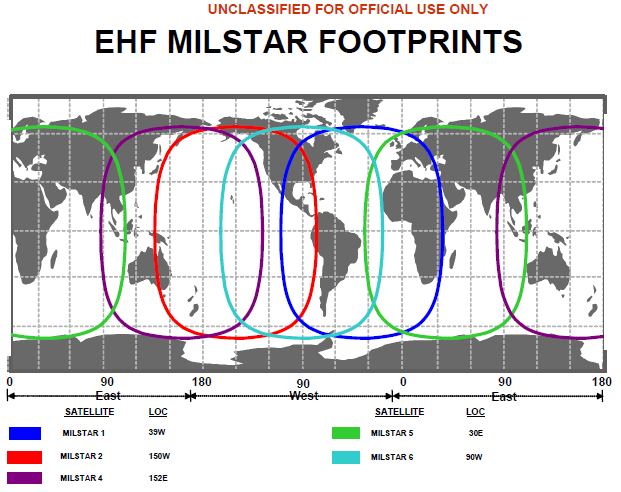
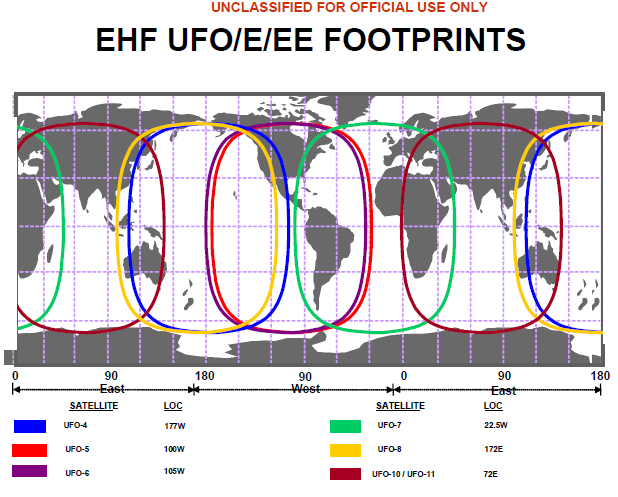
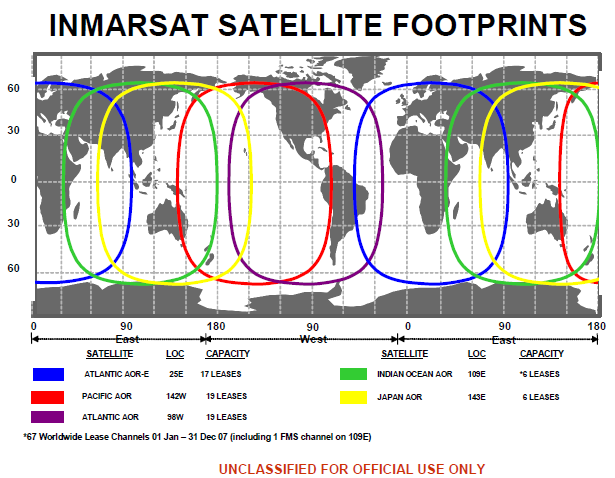
Former CIA spy Bob Ho takes on his toughest assignment to date: looking after his girlfriend’s three kids, who haven’t exactly warmed to their mom’s beau.
| Shepherd Johnson sends:I found the White House missile battery. It’s on top of the New Executive Office building.
“A rare glimpse of the missile battery on the roof of the “New Executive Office Building” [Eisenhower Executive Office Building], which is next to the White House, being checked by a soldier after a small airplane apparently strayed into restricted White House airspace in Washington, DC, USA 22 November 2010 – AP.” [AP has removed its photo of the battery from its archive, and apparently tracking down all postings of it to successfully demand removal.]
Missile battery on top of a U.S. government building is secured after the all clear is given following a White House lockdown in Washington, November 22, 2010. Reuters
|
|
| http://www.emforum.org/vforum/lc051116.htmLet’s hypothesize that there is a surface-to-air missile battery (shown as a light blue symbol in the upper left) and that this battery is a method of protecting the annotated facilities. So knowledge of it might be “useful” to an adversary and the annotated image passes the “usefulness” test. On to the “uniqueness” part of the test.
It turns out, however, that the battery is not hypothetical and our geospatial data are not the only source of this information. In fact, as illustrated by the newspaper clippings, the information is quite well known and is readily observable. (If you’re ever walking north on 17th Street in front of the Old Executive Office Building, look up.) So the annotated image fails the “uniqueness” test and safeguards are not justified.
|
|
Push is a 2009 American science fiction thriller film directed by Paul McGuigan. The film stars Chris Evans, Dakota Fanning, Camilla Belle, Cliff Curtis, Joel Gretsch and Djimon Hounsou. The film centers on a group of people born with various superhuman abilities who band together in order to take down a government agency that is using a dangerous drug to enhance their powers in hopes of creating an army of super soldiers.
narrator (Cassie) describes how people with psychic abilities have been involved with the United States government since 1945. Two “Movers”, Nick Gant and his father, are on the run from the “Division”. Realizing that escape is impossible, Nick’s father tells him of a vision he received from a “Watcher”; a girl will give him a flower and he is to help her in order to help all the people with powers. Nick’s father throws Nick into an air vent as Agent Henry Carver of the Division arrives. Nick’s father is killed.
10 years later, the American Division tests a power boosting drug on a “Pusher” (someone who can implant thoughts in others’ minds), named Kira. Hundreds of subjects died from the drug before her; she is the first to survive. Rendering the doctor unconscious, Kira steals his security clearance card and an augmentation drug-filled syringe and escapes.
In Hong Kong, Nick is hiding from the Division as an expatriate. He attempts to use his ability to make a living, but his poor skills at “moving” at a dice game leave him indebted to a local Triad controlled by “Bleeders”, bred by the now-defunct Chinese Division. A young girl named Cassie Holmes arrives at Nick’s apartment, explaining that she is a “Watcher” and that they are going to find a case containing 6 million dollars. They are attacked by Triad Bleeders but escape.
Nick and Cassie go to a nightclub on a hint from Cassie’s predictions. Nick sees an old friend, “Hook” Waters, who is a “Shifter”. He uses his abilities to make a replica of the clue in Cassie’s drawing and tells them to go to Emily Hu, a “Sniff” who can help them find Kira. Nick and Cassie find Kira, who had a romantic relationship with Nick. They recruit a “Shadow” named “Pinky” Stein to hide Kira from the “Sniffs”. Cassie finds the key in her shoe to a locker in which Kira hid a case. With the aid of Cassie’s visions, they piece together the events that led them to meet; Cassie’s mother used her visions to set a complex plan in motion that will destroy Division. Nick devises a plan that involves seven envelopes in which he places instructions; each person in the group is entrusted with one red envelope, and none are to be opened until the right time. While Kira and Pinky leave, Nick and Cassie share a goodbye. Cassie tells him to “take an umbrella, it’s going to rain”, he replies with “you be careful too”.
Nick uses a “Wiper” to erase his memories of the plan, ensuring that Watchers from both Division and the Triads will not be able to interfere. Hook retrieves the case, which has the syringe Kira stole, and brings it to Cassie. Hook shifts another case to match the case with the syringe. Cassie takes the shifted case to Nick’s apartment and waits. Nick regains consciousness: he has no memory of the envelopes or his plan. He opens his envelope, which tells him to return home. He finds the case in his room but Carver introduces himself to Kira as a friend, stating that her memories are false; she is a Division agent who volunteered to take the augmentation injection and suffered amnesia as a side-effect. Carver shows Kira her badge.
Before bidding bye, Nick assures a worried Cassie that she will survive and everything is going to be fine. He asks her to go ahead with everything and instead of thinking too much face it as it may. She leaves as the Hong-Kong watcher tracks her to finally kill her, however at the last moment the “Wiper” appears (the same who helped Nick remove his memory) and erases her memory, thereby saving Cassie.
Nick goes to retrieve the augmentation drug and confronts Carver and Kira. Carver tells Kira and Nick that their relationship never happened; it was a “push” memory. Kira reveals she has been using Nick and Nick takes the three to the building that contains the lockers and the case. Carver locks Nick in his car’s hood and goes to retrieve the case. They are ambushed by the Triads. In the midst of the fight, Nick is released from the hood. He goes to find Kira and is confronted by Victor, another “Mover” and Division agent who works for Carver. During Nick-Victor fight, two of the “Bleeders” screams killing Victor while Nick saves himself by closing his ears. Carver injures Nick. Nick grabs the case and jams the syringe into his arm, which “kills” him. After the fights ends and Carver leaves with Kira, Nick wakes up. Cassie appears with an umbrella and smiles at him. “I told you to bring an umbrella” she tells him, revealing it was part of the plan. Cassie retrieves the true case, revealing that Nick injected himself with soy sauce, as they planned. Asked whether they will see Kira again, Cassie tells Nick that they will see “Miss Trouble soon enough”.
Flying back to America with a sleeping Agent Carver, Kira opens her purse, finding her red envelope. She remembers Nick telling her to open it when “she started doubting the truth” and opens it. She finds a photograph of herself and Nick obviously in a relationship, which means that their relationship was true, and a message written on the photograph that says “KILL HIM” on the upper left corner and “See U soon, Nick” on the lower right. Kira “pushes” Carver, commanding him to put his gun in his mouth and pull the trigger. The screen fades to black, followed by the sound of a gunshot.
[edit] Types of Superhumans
Watchers
Watchers have the ability to foresee the future to varying degrees. As knowledge of the future invariably causes that future to change, Watchers’ visions of the future in their direct sphere of influence are subject to frequent shifting. Watchers visions are like a sense of deja vu. Watchers can get visions at will. Drinking alcoholic beverages can temporarily enhance a Watcher’s abilities (as shown by Cassie). Cassie and Pop Girl are Watchers, and Cassie’s mother is also an advanced Watcher.
Movers
Movers are powerful telekinetics who are trained to identify the specific atomic frequency of a given material and alter the gravitational field around it, usually causing the nearby air to appear warped. This allows them to move both animate and inanimate objects. Advanced Movers can work at the molecular level, creating Energy shields in the air around them or create Power Fists and kicks, a strike that delivers 3x the power than a punch delivered normally. Nick is a Mover, but not a very advanced one, unlike Victor, Carver’s right hand man.
Pushers
Pushers have the ability to implant memories, thoughts and emotions into the minds of other people in order to manipulate them. The skill level of the Pusher determines how many people the Pusher is able to control at one time, and how vivid the implanted memories are. A powerful Pusher can push a large group of people at the same time, basically creating a personal army. A Pusher is able to make a person do anything the Pusher desires, even commit suicide. A Pusher’s eyes indicate how powerful they are: their pupils will dilate to certain degrees depending on how powerful the push is (for example, Henry Carver’s eyes are rendered completely black, signifying that he is an extremely able and effective Pusher). Carver is a trained Pusher, and Kira as well.
Bleeders
Bleeders have the ability to emit high-pitched sonic vibrations that cause ruptures in a target’s blood vessels. While using this ability, their pupils turn into vertical slits, like a snake’s, because of synthetic materials implanted in them to protect the blood vessels from the effects of their own ability. They are also sometimes known as Screechers or Screamers. Pop Girl’s brothers and father, the Triads, are Bleeders.
Sniffs
Sniffs are highly developed psychometrics who can track the location of people or objects over varying distances. Like bloodhounds, their ability is increased if they have tactile access to an object that has been in direct contact with the subject. Sniffs receive information in the form of images, which is why identifiable landmarks help increase their effectiveness. Emily Hu is a highly trained Sniff, and she uses her powers for money. Carver’s associates who kidnapped Kira are also Sniffs.
Shifters
Shifters can temporarily alter the appearance of an object by manipulating patterns of light interacting with it. Once the illusion is established, it remains with the object for a short period of time. For example, a Shifter could touch a one dollar bill and alter it to appear as a one hundred dollar bill until the effect expires. The object shifted must have roughly the same dimensions as the object it is shifted into. The length of time that the effect will last is based on the Shifter’s experience. Hook Waters, an ex-Division agent and Nick’s friend is a highly experienced Shifter.
Wipers
Wipers are skilled at either temporarily or permanently erasing memories, an invaluable asset in espionage. Experience will dictate the accuracy of their wipes, though there is always the danger that they will eliminate a desired memory. Wo Chiang, a fisherman who lives on a dock, is a Wiper who uses his powers for those who need for money; he also erases part of Nick’s and Kira’s memory, and saves Cassie from Pop Girl by sneaking behind her and wiping her entire memory.
Shadows
Shadows are trained to block the vision of other clairvoyants such as Sniffs, making any subject within their target radius appear “dark”. Experience will enhance the size of the area they can shadow and the intensity of their shielding effect. Shadows need to be awake to manifest their ability, so it is common for a detail of two Shadows to operate in shifts while protecting a person or object for extended periods. Most Shadows are effective only against Sniffs, but some extremely powerful Shadows are able to block even Watchers. Pinky, a friend of Nick’s, is a Shadow, and he is effective only against Sniffs. Like other characters, he also uses his powers for money. An old woman hired by Kira to hide the syringe has the ability to shadow an entire building, even from watchers.
Stitches
Stitches are psychic surgeons trained to quickly reconstruct cells to their previous or healthy state. Using only their hands, they can heal and even “unheal” whatever they have done. For more detailed work, Stitches use a silver based cream on their hands which acts as a conductor for their ability.
The former Bryant and May match factory in Fairfield Road, Bow, East London – now a private gated community of exclusive apartments known as Bow Quarter.
The roofs of two towers (converted for lift shafts for the apartments) have been chosen by the Ministry of Defence to site surface-to-air high-velocity missile systems.
|
![[Image]](https://i0.wp.com/cryptome.org/2012-info/london-sam/pict19.jpg) |
![[Image]](https://i0.wp.com/cryptome.org/2012-info/london-sam/pict18.jpg) |
![[Image]](https://i0.wp.com/cryptome.org/2012-info/london-sam/pict17.jpg) |
|
![[Image]](https://i0.wp.com/cryptome.org/2012-info/exp30/pict0.jpg) |
Dust plumes are caused by retro-rockets fired just before landing.![[Image]](https://i0.wp.com/cryptome.org/2012-info/exp30/pict1.jpg) |
![[Image]](https://i0.wp.com/cryptome.org/2012-info/exp30/pict2.jpg) |
![[Image]](https://i0.wp.com/cryptome.org/2012-info/exp30/pict3.jpg) ![[Image]](https://i0.wp.com/cryptome.org/2012-info/exp30/pict4.jpg) |
![[Image]](https://i0.wp.com/cryptome.org/2012-info/exp30/pict5.jpg) ![[Image]](https://i0.wp.com/cryptome.org/2012-info/exp30/pict6.jpg) |
Dan Burbank Extracted![[Image]](https://i0.wp.com/cryptome.org/2012-info/exp30/pict8.jpg)
|
Anatoly Ivanishin Extracted![[Image]](https://i0.wp.com/cryptome.org/2012-info/exp30/pict7.jpg)
|
Anton Shkaplero![[Image]](https://i0.wp.com/cryptome.org/2012-info/exp30/pict10.jpg) |
Left to right, Burbank, Shkaplero and Ivanishin![[Image]](https://i0.wp.com/cryptome.org/2012-info/exp30/pict11.jpg) |
Medical Examination Station![[Image]](https://i0.wp.com/cryptome.org/2012-info/exp30/pict12.jpg) |
![[Image]](https://i0.wp.com/cryptome.org/2012-info/exp30/pict16.jpg) |
Im Jahr 1934 legte Ferdinand Porsche auf Drängen Hitlers die tschechoslowakische Staatsangehörigkeit ab und nahm die deutsche an. 1938 wurde er zusammen mit Ernst Heinkel, Willy Messerschmitt und Fritz Todt mit dem 1937 von Hitler neu gestifteten Deutschen Nationalpreis für Kunst und Wissenschaft ausgezeichnet. 1938 erhielt er das Ehrenband der Burschenschaft Bruna Sudetia Wien. Auch er hatte den „Anschluss” Österreichs befürwortet. 1940 wurde Porsche zum Honorarprofessor an der Technischen Hochschule Stuttgart ernannt und 1942 zum Oberführer der Allgemeinen SS, was ihn nicht daran hinderte, bei allen Anlässen nur in Zivil gekleidet zu sein.
Porsche, 1939 zum Wehrwirtschaftsführer ernannt, engagierte sich stark in der Kriegsindustrie. Von 1941 bis 1943 wurde er zum Vorsitzenden der Panzerkommission – eine Spitzenposition in der Kriegswirtschaft – bestellt. Später wurde er in den Rüstungsrat berufen. Als Hitlers Lieblingsingenieur entwickelte er den nach ihm benannten Panzerjäger Ferdinand und den Panzerkampfwagen Maus. Der lediglich in Kleinserie produzierte Ferdinand war zu schwer für den von Porsche konzipierten petro-elektrischen Antrieb, dessen Störanfälligkeit dazu führte, dass mehr Exemplare aufgegeben als im Kampf zerstört wurden. Der Panzerkampfwagen Maus kam über das Stadium zweier Prototypen nicht hinaus.
In warfighting and counterinsurgency operations, partnering is a command arrangement between a US security force and a host nation (HN) security force in which both forces operate together to achieve mission success and to build the capacity and capability of the HN force. Partnering is not an end, but a deliberate process, a means to an end. A near-term goal might be the standup and development of a HN force increasingly capable of independent operations and decreasingly dependent upon US partnered support. An intermediate objective might be the transition of lead security responsibility from US to HN force. But the ultimate goal is to become “un”-partnered, to enable the HN force to assume full responsibility for security and stability. In warfighting and counterinsurgency partnering, divorce is not a bad ending, it is the desired outcome.
Partnering should be a real union between the two partnered organizations, with a common purpose, in which the whole of the partnership becomes greater than the sum of its parts. Real partnering is total immersion. It cannot be done on occasion, when convenient, or as time permits. Nor should it be limited to periodic or occasional combined combat operations. Real partnering is instead a continuous, collective, and collaborative effort on tasks both large and small toward the common goal. It is full throttle engagement, warts and all.
…
Be culturally aware but not overly-sensitive.
a. Help the HN understand our perspective, our culture, and our values. Our values will most likely not be theirs so do not impose your values upon their culture; however, do not jeopardize your own morals and beliefs by being overly sensitive to theirs. The key is to ensure that the HN has a basic understanding of our values, especially the delicate balance of honesty vs. saving face.
b. HN forces understand that there may be times when the cultural strain is too great to overcome “living amongst” their personnel, but we must promote the sharing of common areas (dining area, COCs (within classification parameters), etc.) and activities (meals, PT, weapons/vehicle maintenance) which will ultimately help bridge cultural differences without encroaching on each other.
…
Encourage HN forces to build relationships with the local leaders
a. Positive interaction with the people builds trust – build this trust above all else!
b. Encourage local recruiting for security forces, especially police. In the United States, local police have to live in the communities that they work in; yet, in many places, national police are moved throughout the country where they have no ties to the community and are often viewed as outsiders. This may be an expedient method to restore law and order, but it should only be used in the most extreme circumstances. Locally recruited forces will have the backing of that community – “their community” – and their training by Marines and HN military units serves to reinforce the ties among Marines, the HN forces, and the communities that they operate in. Until the police force is made up of ‘local sons’ there will be no real security or trust in an area.
c. Encourage the HN force to develop an information operations (IO) plan and effective methods to convey key messages to the people. HN forces should be the primary executers of information operations and they should be on hand to explain it to the people. Perception is important to the success of the partnership and its goals.
…
Embrace the chaos of the environment
a. Do not allow frustration with the HN to show – do it in private away from the partnering force members – never display direct frustration in front of your partnered force.
…
Do not hesitate to deviate from doctrine when needed.
a. The intent here is to “be doctrinally sound, not doctrinally bound”. “A force engaged in small wars operations, irrespective of its size, is usually independent or semi-independent and, in such a campaign, assumes strategically, tactical, and territorial functions” (SWM 2-10, pg 11). “In short, the force must be prepared to exercise those functions of command, supply, and territorial control which are required of the supreme command or its major subdivisions in regular warfare…For these reason, it is obvious that a force undertaking a small wars campaign must be adequately staffed for independent operations even if the tables of organization do not specify a full staff complement” (SWM 2-11, pg 12).
Original 16mm-Filmaufnahmen von Eva Braun in Farbe und schwarzweiß. Eva Braun, die Frau an Hitlers Seite, hat mit ihrer 16-mm-Filmkamera das Leben auf dem Berghof und ihre privaten Reisen festgehalten. Die Aufnahmen, die heute im amerikanischen Nationalarchiv liegen, waren nie für die Öffentlichkeit bestimmt. Nach ihrem Freitod am 30. April 1945 im Bunker der Reichskanzlei galten die Filmrollen lange als verschollen, ehe sie in den USA wieder auftauchten. Diese DVD zeigt erstmals einen umfassenden Zusammenschnitt des gesamten geheimen Archivs. Zeitzeugen aus der engsten Umgebung von Eva Braun und Adolf Hitler kommentieren die einzigartigen Filmaufnahmen, die das Leben der Mächtigen des Dritten Reiches jenseits der Propaganda zeigen. Die DVD bietet als Extras einen 15-minütigen Bonusfilm mit nicht verwendeten Aufnahmen sowie Biographien etc.
USA | 2004 | 98 Min.
River Run Film Festival 2009 – Bester Spielfilm
Der Amerikaner Joe Delaney kämpfte auf den Schlachtfeldern des Ersten Weltkriegs für sein Land. 15 Jahre nach dem Ende des Kriegs schrieb er ein Buch über seine Erfahrungen als Mitglied des US-Marine Corps. Doch was er erzählt, ist nicht die Geschichte eines großen Krieges und heldenhafter Soldaten. Es ist die Geschichte eines Mannes, der erkennen muss, dass es einzelne Momente im Leben sind, die den wahren Charakter eines Menschen definieren. Und er erinnert sich an den deutschen Soldaten, den er tötete und der ihn in seinen Träumen heimsuchte.
Stalingrad ist ein deutscher Anti-Kriegsfilm aus dem Jahr 1993. Thematischer Hintergrund ist die Schlacht von Stalingrad Ende 1942/Anfang 1943 während des Zweiten Weltkriegs aus der Sicht eines deutschen Sturmpionier-Bataillons. Regie führte Joseph Vilsmaier. Der Film startete am 21. Januar 1993 in den bundesdeutschen Kinos.
| Citation: | DDCI Statement about the Watergate Case [Central Intelligence Agency Employee Bulletin Containing Vernon Walter’s Statement on CIA Involvement in Watergate; Best Available Copy] , [Classification Unknown], Newsletter, 359, May 21, 1973, 3 pp. |
| Collection: | The CIA Family Jewels Indexed |
| Item Number: | FJ00031 |
| Origin: | United States. Central Intelligence Agency |
| Individuals/ Organizations Named: |
Cushman, Robert E., Jr.; Dean, John Wesley III; Democratic National Committee (U.S.); Ehrlichman, John D.; Gray, L. Patrick; Haldeman, H.R.; Helms, Richard M.; Hunt, E. Howard; Nixon, Richard M.; Schlesinger, James R.; United States. Department of Justice; United States. Federal Bureau of Investigation; United States. White House; Walters, Vernon A. |
| Subjects: | Congressional hearings | Covert operations | Government appropriations and expenditures | Mexico | Watergate Affair (1972-1974) |
| Abstract: | Disseminates Vernon Walter’s statement to congressional committee about his communications with John Dean and Patrick Gray on Central Intelligence Agency involvement in Watergate and CIA’s issuance of equipment to Howard Hunt. |
| Full Text: | Document – PDF – this link will open in a new window (156 KB) |
![[Image]](https://i0.wp.com/cryptome.org/2012-info/wmd-accident/pict50.jpg) |
![[Image]](https://i0.wp.com/cryptome.org/2012-info/wmd-accident/pict24.jpg) ![[Image]](https://i0.wp.com/cryptome.org/2012-info/wmd-accident/pict25.jpg)
|
| Following: Overhead photos from Google Earth, dated 4 February 2011. Oblique photos from Bing Maps, unknown date. |
http://maps.google.com/?t=h&ie=UTF8&ll=35.019664,-106.531205&spn=0.032861,0.068665&z=15&vpsrc=6![[Image]](https://i0.wp.com/cryptome.org/2012-info/wmd-accident/pict39.jpg) |
TS-1 (Active)These appear to be wrecks of motor vehicles
|
TS-2 (Active)These appear to be fragments of a B-52 bomber
|
TS-3 (Active)These appear to be fragments of a B-52 bomber
|
TS-4 (Active)This appears to be an earth penetration of an object, perhaps simulation of unexploded nuclear weapon
|
|
|
TS-5 (Inactive) (TR-5 to TR-8 comprise Installation Restoration Plan OT-10)
|
TS-6 (Inactive)
|
TS-7 (Inactive)
|
TS-8 (Appears Converted to Other Use, But May Be Active)
|
Grozovye Vorota / Grozovue Vorota / Грозовые ворота / The Storm Gate / War Fighter
War Fighter is a DVD release ( German audio, German subs) of the
russian TV movie “Grozovye Vorota” it’s about a battle durring 2nd Chechen war,
where 200 russian soldiers fights against 2000 terrorists, only 9 survive
Soviet paratroopers drop into Alaska to sabotage the oil pipeline in retaliation against a United States grain embargo. A skirmish occurs at a pumping station, lightly defended by Col. Jake Caffey and a National Guard reckon unit. A stalemate ensues while the possibility of World War III hangs in the balance. The danger escalates as the Russian leaders and the American President play a cat-and-mouse game

The defining event that changed the face of firefighting in Israel was the December 2010 fire in the Carmel Mountains. Forty-four people died, and 6,177 acres of woods were destroyed.
Four months after the devastation, the air force established a firefighting squadron whose six aircraft are presently maintained by Elbit Systems. In addition, Israel Fire and Rescue Service ordered 88 firefighting vehicles. “There are several types of firefighting vehicles,” says Fire Service Commissioner, Chief Shahar Ayalon.
“Some of the vehicles are undergoing supply processes and need to undergo several changes. We’ve also published a tender worth 12 million NIS for personal fireman protection equipment including fireproof proximity suits, helmets, shoes, and coats. Additionally, we bought equipment from around the world, and are working with four to five international companies. We’re going to change the firefighter uniform, and even have a new symbol for the firefighters. We are also currently testing the simulators that exist around the world, and have allocated a sum of more than $10 million. In addition, we are constructing a new instruction facility in Rishon LeZion.
Following the 2010 fire, Shahar Ayalon came to head the Fire Service after serving in the Israeli Police as district commander and deputy inspector general. According to Ayalon, the far-reaching changes within the fire service are also intended for firefighters participating in mass disaster relief, such as wide-ranging missile attacks and natural disasters.
In his opinion, the situation is far from satisfactory. Ayalon notes that during the 2011 rocket attacks from Gaza, it was impossible to send a vehicle from Ashkelon to handle a fire that burst out in the nearby town of Gan Yavneh, which was a result of administrative problems (the town belonged to the more distant district of Rehovot). It took a fire vehicle no less than 20 minutes to make it from there. According to him, there remains a severe shortage in firefighting stations across the country.

“We’ve conducted a threat reference with Israel’s Technion and the National Emergency Authority on how many firefighting vehicles and how many firefighters are needed to provide a response for Israel,” says Ayalon. “The interim statement indicates that an additional 40-60 stations are needed on top of the 100 that already exist. We want to lower the response time. In 2010, our average response time was 14 minutes. In the US, the standard is five minutes for the first team, and an additional five minutes for a second team. In Europe, it’s between 8-10 minutes – we want to approach this time.”
“Our current budget is 700 million NIS. I assume that after the reform, the budget will cross the one billion NIS mark. There won’t be any choice but to construct 50 more stations, and this will have to be planned in the framework of the multi-year budget.”
War Scenarios
“The firefighting system responds to 80,000 situations a year, nearly half of which are tied to rescue and extraction missions,” explains Ayalon. “We have 15 urban rescue units that can enter wreckage sites and rescue people from buildings, including two new units in Be’er Sheva and Netanya. These units are comprised of young and well-trained firefighters. We conduct the courses with RESQ1, a company of military veterans who have run these training exercises around the world for years.
“We also send 15 fighters each year to France to undergo advanced studies in rescuing people trapped in stormy weather. The scope of rescue is the same as the scope of firefighting, even though people think we only extinguish fires. In reality, we engage in rescues, deal with dangerous substances, and also fight fires.”
What will happen during a war? After all, it’s the IDF’s Rear-Area Headquarters that primarily deal with search and rescue.
“In a period of emergency and war, the Rear-Area HQ is also responsible for the Fire Service. The threat to the home front switched to a threat of missiles, and we are preparing for a state of demolished buildings in which the firefighters will have to handle both fires and structural collapses.

“We also take into account damage to strategic factories that house dangerous materials, and we intensively practice situations of container and fuel reserve impacts. We carry out risk assessments with the factories and introduce them to the forces. We have an organized doctrine that is also suitable for missile scenarios.
“We built an operations branch that works, practices, and immediately responds to events, reinforces units, and does all the required operations that are similar to a military system.
“For emergency scenarios, we purchased 24 containers equipped with clothing, food, and water. It costs a lot of money, but we placed these types of emergency containers at each station. As soon as there’s a war, we can increase our number of fire departments and our launches by 40% by taking out fire trucks to all sorts of launch points, thus bringing the firefighters closer to response locations. We settle in well-known locations and are capable of emergency deployment that increases manpower by having 1,200 firefighters in the reserve forces join the regular military.
“In emergency scenarios, we are the first ones alerted and the first to reach the scene. If it’s wreckage, we focus on rescuing lives and extracting whoever we can out of the rubble. Once the Rear-Area HQ’s rescue unit arrives, we pass the responsibility on to them and leave the scene. We are the immediate response for the golden hour – the time when the chances of finding survivors is the highest.”
** Photos: The fire extinguishing squad by Fire Service; Chief Shahar Ayalon by Fire Service
This regulation establishes the Department of the Army Civilian Police and Security Guard (DACP/SG) Program. It assigns responsibilities and establishes policy, standards, and procedures for the effective implementation of the DACP/SG Program. This regulation applies to all Department of the Army civilian personnel in career series 0083 and 0085 and contract security personnel employed by the U.S. Army and involved in the safeguarding and protection of personnel and property.
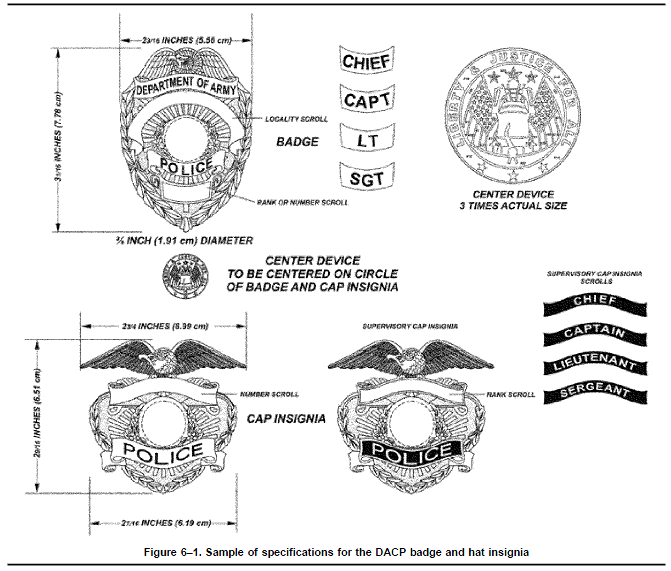
“I know not with what weapons World War III will be fought, but World War IV will be fought with sticks and stones.” Albert Einstein.
This movie is dedicated to all the war-loving couch-potatoes, media whores, and psychopathic politicians.
In response to congressional direction, the U.S. Patent and Trademark Office is considering whether to expand the scope of patent secrecy orders — which prohibit the publication of affected patent applications — in order to enhance “economic security” and to protect newly developed inventions against exploitation by foreign competitors.
Currently, patent secrecy orders are applied only to patent applications whose disclosure could be “detrimental to national security” as prescribed by the Invention Secrecy Act of 1951. At the end of Fiscal Year 2011, there were 5,241 such national security secrecy orders in effect.
But now the Patent Office is weighing the possibility of expanding national security patent secrecy into the “economic security” domain.
“The U.S. Patent and Trademark Office is seeking comments as to whether the United States should identify and bar from publication and issuance certain patent applications as detrimental to the nation’s economic security,” according to a notice that was published in the Federal Register on April 20.
That would be a mistake, I wrote in my own comments submitted to the Patent Office yesterday.
Economic security — which could conceivably implicate all new inventions — is not analogous to the more limited domain of national security-related inventions, “so the use of secrecy orders is inappropriate to protect economic security,” I suggested.
Instead, the existing option for an applicant to request nonpublication of his or her patent application up to the point that the patent is issued is a superior alternative to a mandatory secrecy order, I wrote. “The inventor is likely to be better qualified than any third party to assess the economic significance of the invention, and is also likely to be best motivated to protect his or her own financial interests.”
“The USPTO has not taken a position” on these questions, the Patent Office said in its April 20 notice, “nor is it predisposed to any particular views.”
This program tells the true story of the life of Claus von Stauffenberg and the plot to kill Hitler on July 20, 1944
Government attorneys said yesterday that they would appeal an extraordinary judicial ruling that required the release of a classified document in response to a Freedom of Information Act request.
The document in question is a one-page position paper produced by the U.S. Trade Representative (USTR) concerning the U.S. negotiating position in free trade negotiations. It was classified Confidential and was not supposed to be disclosed before 2013.
But immediate disclosure of the document could not plausibly cause damage to the national security, said DC District Judge Richard W. Roberts in a February 29, 2012 opinion, and so its continued classification, he said, is not “logical.” He ordered the government to release the document to the Center for International Environmental Law, which had requested it under FOIA. (Court Says Agency Classification Decision is Not ‘Logical’, Secrecy News, March 2, 2012.)
This kind of independent review of the validity of classification decisions, which is something that judges normally refrain from doing, offers one way to curb galloping overclassification.
While the substance of the USTR document is likely to be of little general interest, the court’s willingness to disregard the document’s ill-founded classification and to require its disclosure seems like a dream come true to critics of classification policy. If the decision serves as a precedent and a spur to a more broadly skeptical judicial approach to classification matters, so much the better.
But what may be a dream to some is a nightmare to others. The bare possibility of such an emerging challenge to executive classification authority was evidently intolerable to the Obama Administration, which will now seek to overturn Judge Roberts’ ruling in the DC Circuit Court of Appeals.
[House Report 112-445]
[From the U.S. Government Printing Office]
112th Congress Report
HOUSE OF REPRESENTATIVES
2d Session 112-445
======================================================================
CYBER INTELLIGENCE SHARING AND PROTECTION ACT
_______
April 17, 2012.--Committed to the Committee of the Whole House on the
State of the Union and ordered to be printed
_______
Mr. Rogers of Michigan, from the Permanent Select Committee on
Intelligence, submitted the following
R E P O R T
together with
MINORITY VIEWS
[To accompany H.R. 3523]
[Including cost estimate of the Congressional Budget Office]
The Permanent Select Committee on Intelligence, to whom was
referred the bill (H.R. 3523) to provide for the sharing of
certain cyber threat intelligence and cyber threat information
between the intelligence community and cybersecurity entities,
and for other purposes, having considered the same, report
favorably thereon with an amendment and recommend that the bill
as amended do pass.
The amendment is as follows:
Strike all after the enacting clause and insert the
following:
SECTION 1. SHORT TITLE.
This Act may be cited as the ``Cyber Intelligence Sharing and
Protection Act''.
SEC. 2. CYBER THREAT INTELLIGENCE AND INFORMATION SHARING.
(a) In General.--Title XI of the National Security Act of 1947 (50
U.S.C. 442 et seq.) is amended by adding at the end the following new
section:
``cyber threat intelligence and information sharing
``Sec. 1104. (a) Intelligence Community Sharing of Cyber Threat
Intelligence With Private Sector.--
``(1) In general.--The Director of National Intelligence
shall establish procedures to allow elements of the
intelligence community to share cyber threat intelligence with
private-sector entities and to encourage the sharing of such
intelligence.
``(2) Sharing and use of classified intelligence.--The
procedures established under paragraph (1) shall provide that
classified cyber threat intelligence may only be--
``(A) shared by an element of the intelligence
community with--
``(i) certified entities; or
``(ii) a person with an appropriate security
clearance to receive such cyber threat
intelligence;
``(B) shared consistent with the need to protect the
national security of the United States; and
``(C) used by a certified entity in a manner which
protects such cyber threat intelligence from
unauthorized disclosure.
``(3) Security clearance approvals.--The Director of National
Intelligence shall issue guidelines providing that the head of
an element of the intelligence community may, as the head of
such element considers necessary to carry out this subsection--
``(A) grant a security clearance on a temporary or
permanent basis to an employee or officer of a
certified entity;
``(B) grant a security clearance on a temporary or
permanent basis to a certified entity and approval to
use appropriate facilities; and
``(C) expedite the security clearance process for a
person or entity as the head of such element considers
necessary, consistent with the need to protect the
national security of the United States.
``(4) No right or benefit.--The provision of information to a
private-sector entity under this subsection shall not create a
right or benefit to similar information by such entity or any
other private-sector entity.
``(b) Private Sector Use of Cybersecurity Systems and Sharing of
Cyber Threat Information.--
``(1) In general.--
``(A) Cybersecurity providers.--Notwithstanding any
other provision of law, a cybersecurity provider, with
the express consent of a protected entity for which
such cybersecurity provider is providing goods or
services for cybersecurity purposes, may, for
cybersecurity purposes--
``(i) use cybersecurity systems to identify
and obtain cyber threat information to protect
the rights and property of such protected
entity; and
``(ii) share such cyber threat information
with any other entity designated by such
protected entity, including, if specifically
designated, the Federal Government.
``(B) Self-protected entities.--Notwithstanding any
other provision of law, a self-protected entity may,
for cybersecurity purposes--
``(i) use cybersecurity systems to identify
and obtain cyber threat information to protect
the rights and property of such self-protected
entity; and
``(ii) share such cyber threat information
with any other entity, including the Federal
Government.
``(2) Use and protection of information.--Cyber threat
information shared in accordance with paragraph (1)--
``(A) shall only be shared in accordance with any
restrictions placed on the sharing of such information
by the protected entity or self-protected entity
authorizing such sharing, including appropriate
anonymization or minimization of such information;
``(B) may not be used by an entity to gain an unfair
competitive advantage to the detriment of the protected
entity or the self-protected entity authorizing the
sharing of information; and
``(C) if shared with the Federal Government--
``(i) shall be exempt from disclosure under
section 552 of title 5, United States Code;
``(ii) shall be considered proprietary
information and shall not be disclosed to an
entity outside of the Federal Government except
as authorized by the entity sharing such
information; and
``(iii) shall not be used by the Federal
Government for regulatory purposes.
``(3) Exemption from liability.--No civil or criminal cause
of action shall lie or be maintained in Federal or State court
against a protected entity, self-protected entity,
cybersecurity provider, or an officer, employee, or agent of a
protected entity, self-protected entity, or cybersecurity
provider, acting in good faith--
``(A) for using cybersecurity systems or sharing
information in accordance with this section; or
``(B) for not acting on information obtained or
shared in accordance with this section.
``(4) Relationship to other laws requiring the disclosure of
information.--The submission of information under this
subsection to the Federal Government shall not satisfy or
affect any requirement under any other provision of law for a
person or entity to provide information to the Federal
Government.
``(c) Federal Government Use of Information.--
``(1) Limitation.--The Federal Government may use cyber
threat information shared with the Federal Government in
accordance with subsection (b) for any lawful purpose only if--
``(A) the use of such information is not for a
regulatory purpose; and
``(B) at least one significant purpose of the use of
such information is--
``(i) a cybersecurity purpose; or
``(ii) the protection of the national
security of the United States.
``(2) Affirmative search restriction.--The Federal Government
may not affirmatively search cyber threat information shared
with the Federal Government under subsection (b) for a purpose
other than a purpose referred to in paragraph (1)(B).
``(3) Anti-tasking restriction.--Nothing in this section
shall be construed to permit the Federal Government to--
``(A) require a private-sector entity to share
information with the Federal Government; or
``(B) condition the sharing of cyber threat
intelligence with a private-sector entity on the
provision of cyber threat information to the Federal
Government.
``(d) Report on Information Sharing.--
``(1) Report.--The Inspector General of the Intelligence
Community shall annually submit to the congressional
intelligence committees a report containing a review of the use
of information shared with the Federal Government under this
section, including--
``(A) a review of the use by the Federal Government
of such information for a purpose other than a
cybersecurity purpose;
``(B) a review of the type of information shared with
the Federal Government under this section;
``(C) a review of the actions taken by the Federal
Government based on such information;
``(D) appropriate metrics to determine the impact of
the sharing of such information with the Federal
Government on privacy and civil liberties, if any; and
``(E) any recommendations of the Inspector General
for improvements or modifications to the authorities
under this section.
``(2) Form.--Each report required under paragraph (1) shall
be submitted in unclassified form, but may include a classified
annex.
``(e) Federal Preemption.--This section supersedes any statute of a
State or political subdivision of a State that restricts or otherwise
expressly regulates an activity authorized under subsection (b).
``(f) Savings Clause.--Nothing in this section shall be construed to
limit any other authority to use a cybersecurity system or to identify,
obtain, or share cyber threat intelligence or cyber threat information.
``(g) Definitions.--In this section:
``(1) Certified entity.--The term `certified entity' means a
protected entity, self-protected entity, or cybersecurity
provider that--
``(A) possesses or is eligible to obtain a security
clearance, as determined by the Director of National
Intelligence; and
``(B) is able to demonstrate to the Director of
National Intelligence that such provider or such entity
can appropriately protect classified cyber threat
intelligence.
``(2) Cyber threat information.--The term `cyber threat
information' means information directly pertaining to a
vulnerability of, or threat to, a system or network of a
government or private entity, including information pertaining
to the protection of a system or network from--
``(A) efforts to degrade, disrupt, or destroy such
system or network; or
``(B) theft or misappropriation of private or
government information, intellectual property, or
personally identifiable information.
``(3) Cyber threat intelligence.--The term `cyber threat
intelligence' means information in the possession of an element
of the intelligence community directly pertaining to a
vulnerability of, or threat to, a system or network of a
government or private entity, including information pertaining
to the protection of a system or network from--
``(A) efforts to degrade, disrupt, or destroy such
system or network; or
``(B) theft or misappropriation of private or
government information, intellectual property, or
personally identifiable information.
``(4) Cybersecurity provider.--The term `cybersecurity
provider' means a non-governmental entity that provides goods
or services intended to be used for cybersecurity purposes.
``(5) Cybersecurity purpose.--The term `cybersecurity
purpose' means the purpose of ensuring the integrity,
confidentiality, or availability of, or safeguarding, a system
or network, including protecting a system or network from--
``(A) efforts to degrade, disrupt, or destroy such
system or network; or
``(B) theft or misappropriation of private or
government information, intellectual property, or
personally identifiable information.
``(6) Cybersecurity system.--The term `cybersecurity system'
means a system designed or employed to ensure the integrity,
confidentiality, or availability of, or safeguard, a system or
network, including protecting a system or network from--
``(A) efforts to degrade, disrupt, or destroy such
system or network; or
``(B) theft or misappropriation of private or
government information, intellectual property, or
personally identifiable information.
``(7) Protected entity.--The term `protected entity' means an
entity, other than an individual, that contracts with a
cybersecurity provider for goods or services to be used for
cybersecurity purposes.
``(8) Self-protected entity.--The term `self-protected
entity' means an entity, other than an individual, that
provides goods or services for cybersecurity purposes to
itself.''.
(b) Procedures and Guidelines.--The Director of National Intelligence
shall--
(1) not later than 60 days after the date of the enactment of
this Act, establish procedures under paragraph (1) of section
1104(a) of the National Security Act of 1947, as added by
subsection (a) of this section, and issue guidelines under
paragraph (3) of such section 1104(a); and
(2) following the establishment of such procedures and the
issuance of such guidelines, expeditiously distribute such
procedures and such guidelines to appropriate Federal
Government and private-sector entities.
(c) Initial Report.--The first report required to be submitted under
subsection (d) of section 1104 of the National Security Act of 1947, as
added by subsection (a) of this section, shall be submitted not later
than one year after the date of the enactment of this Act.
(d) Table of Contents Amendment.--The table of contents in the first
section of the National Security Act of 1947 is amended by adding at
the end the following new item:
``Sec. 1104. Cyber threat intelligence and information sharing.''.
Purpose
The purpose of H.R. 3523 is to provide for the sharing of
certain cyber threat intelligence and cyber threat information
between the intelligence community and cybersecurity entities,
and other purposes.
Committee Statement and Views
At the beginning of the 112th Congress, the Committee,
under the direction of Chairman Rogers and Ranking Member
Ruppersberger, began a bipartisan effort to examine the issue
of cybersecurity.\1\ The goal of this effort was to better
understand the threats facing the nation in cyberspace--with
respect to both the government and in the private sector--and
to determine what the Intelligence Community could do to help
better protect the nation. The results of this review were
stunning: a number of advanced nation-state actors are actively
engaged in a series of wide-ranging, aggressive efforts to
penetrate American computer systems and networks; these efforts
extend well beyond government networks, and reach deep into
nearly every sector of the American economy, including
companies serving critical infrastructure needs.
---------------------------------------------------------------------------
\1\This effort involved a series of briefings and hearings,
including one open hearing, to inform Committee members and, where
possible, the public, about the serious national security threat posed
by nation-state actors and other adversaries in the cyber realm. These
meetings, briefings, and hearings were in turn supported by numerous
meetings and briefings conducted by Committee staff with agencies and
individuals from the Executive Branch including, among others, the
White House, the Department of Homeland Security, the Department of
Justice, including the Federal Bureau of Investigation, the Department
of Defense, including the National Security Agency, and with experts
from the academic and think-tank communities. The Committee staff also
held numerous meetings with private sector companies and trade groups
in industries including technology, telecommunications, financial
services, utilities, aerospace, and defense. And the Committee staff
met with representatives of privacy and civil liberties organizations
including the Center for Democracy and Technology, the American Civil
Liberties Union, the Electronic Frontier Foundation, the Constitution
Project, and the CATO Institute, among others. In total, the Committee
members and staff met with dozens of organizations in conducting its
review over a nearly one-year period.
---------------------------------------------------------------------------
Perhaps most troubling, these efforts are targeted not only
at sensitive national security and infrastructure information,
but are also often aimed at stealing the corporate research and
development information that forms the very lifeblood of the
American economy. China, in particular, is engaged in an
extensive, day-in, day-out effort to pillage American corporate
and government information. There can be no question that in
today's modern world, economic security is national security,
and the government must help the private sector protect itself.
The Committee's review also revealed that while the
government is already doing much to provide support and
assistance to the private sector to address this threat, in
particular through DHS and the FBI, more can and should be done
in the immediate future. In particular, the Committee
determined that the Intelligence Community is currently in
possession of tremendously valuable intelligence and strategic
insights derived from its extensive overseas intelligence
collection efforts that can and should be provided--in both
classified and unclassified form (when possible)--to the
private sector in order to help the owners and operators of the
vast majority of America's information infrastructure better
protect themselves. The Committee believes that the recent
Defense Industrial Base Pilot project (``DIB Pilot'') is a good
model for demonstrating how sensitive government threat
intelligence can be shared with the private sector in an
operationally usable manner. Under the DIB Pilot, the
government provides classified threat intelligence to key
Internet Service Providers, who use the information to protect
a limited number of companies in the defense industrial base,
all on a voluntary basis.
The Committee's review also determined that while much
cybersecurity monitoring and threat information sharing takes
place today within the private sector, real and perceived legal
barriers substantially hamper the efforts of the private sector
to protect itself. The Committee determined that these issues
are best resolved in the first instance by providing clear,
positive authority to permit the monitoring--by the private
sector--of privately-owned and operated networks and systems
for the purpose of detecting cybersecurity threats and to
permit the voluntary sharing of information about those threats
and vulnerabilities with others, including entities within the
private sector and with the federal government.
While some have suggested that the private sector needs
more regulation or that the government ought to directly help
defend certain portions of the private sector, the Committee's
view is that the protection of the private sector is best left
in private hands and that the government ought to provide as
much intelligence as possible to the private sector before
reaching for a regulatory ``stick.'' In the view of the
Committee, such an approach--voluntary, private sector defense
of private sector systems and networks informed by government
intelligence information--best protects individual privacy and
takes advantage of the natural incentives built into our
economic system, including harnessing private sector drive and
innovation.
The Committee's review revealed that America's cyber
infrastructure is distressingly vulnerable to espionage and
attacks by nation-states and others with advanced capabilities.
The Committee believes that immediate and serious action is
necessary to staunch the bleeding of American corporate
research and development information and to better protect our
national security. In particular, the Committee believes that
the Intelligence Community must take immediate and decisive
action to provide intelligence to the private sector to help it
better protect itself. In turn, the private sector must act
aggressively to better monitor its own systems and to share
information--both within the private sector and with the
federal government on a purely voluntary basis. The Committee
recognizes that because it focused on the issues within its
jurisdiction, this legislation does not address many of the
other issues facing the nation with respect to cybersecurity.
At the same time, however, the Committee firmly believes that
this legislation is an important first step in the effort to
better protect the nation from advanced cyber threat actors.
Committee Consideration and Rollcall Votes
On December 1, 2011, the Committee met in open session and
ordered the bill H.R. 3523 favorably reported, as amended.
OPEN SESSION
In open session, the Committee considered the text of the
bill H.R. 3523.
Chairman Rogers offered an amendment. The amendment places
additional restrictions on the use by the government of
information obtained pursuant to the bill. The amendment was
agreed to by voice vote.
Mr. Thompson offered an amendment. The amendment requires
an annual report by the Inspector General of the Intelligence
Community reviewing the use of cyber threat information
provided to the government pursuant to the bill. The amendment
was agreed to by voice vote.
Ms. Schakowsky offered an amendment providing that the
Director of National Intelligence shall develop and
periodically review policies and procedures governing the
acquisition, retention, use, and disclosure of information
obtained by the intelligence community pursuant to the bill.
Subsequently, Ms. Schakowsky asked for and received unanimous
consent to withdraw the amendment.
The Committee then adopted a motion by the Chairman to
favorably report the bill H.R. 3523 to the House, as amended.
The motion was agreed to by a record vote of 17 ayes to 1 no:
Voting Aye: Chairman Rogers, Mr. Thornberry, Mrs. Myrick,
Mr. Miller, Mr. Conaway, Mr. King, Mr. LoBiondo, Mr. Nunes, Mr.
Westmoreland, Mr. Rooney, Mr. Heck, Mr. Ruppersberger, Mr.
Thompson, Mr. Langevin, Mr. Schiff, Mr. Boren, Mr. Chandler.
Voting No: Ms. Schakowsky.
Section-by-Section Analysis
SECTION 1. SHORT TITLE
The short title of the Act is the Cyber Intelligence
Sharing and Protection Act.
SECTION 2. CYBER THREAT INTELLIGENCE AND INFORMATION SHARING
Section 2(a): In General
This subsection of the Act amends Title XI of the National
Security Act of 1947 by adding a new section, Section 1104.
Section 1104(a) of Title 50: Intelligence Community Sharing of Cyber
Threat Intelligence with Private Sector
Subsection (a) of new Section 1104 provides for the sharing
of cyber threat intelligence--both classified and
unclassified--by elements of the Intelligence Community with
entities in the private sector. It is the view of the Committee
that the routine and fulsome sharing of such intelligence
information with appropriate cleared entities and individuals
within the private sector is critically important to protecting
the nation from advanced cyber threats. It is critical that as
much information as possible be shared at machine-speed, in
real-time, and in a manner that the information--whether
classified or not--is operationally usable by entities within
the private sector.
This subsection seeks to set forth a general framework and
requires the establishment of specific procedures and
guidelines to make such sharing happen in the immediate future
and to permit such sharing to continue so long as the nation
faces this significant threat to our national security. The
Committee intends to engage in vigorous oversight of the
Intelligence Community use of the authorities under this
section and, in particular, the Office of the Director of
National Intelligence (ODNI), which is charged with
promulgating appropriate procedures and guidelines under this
subsection. The Committee expects to be consulted by ODNI in
the formulation of these procedures and guidelines to ensure
that the Committee's intent is achieved by them.
While the term ``private sector'' is not defined in the
legislation, the Committee intends that term to be given the
broadest possible meaning and specifically intends the term to
include utilities, whether organized as public, private, or
quasi-public entities, to ensure at the entities that provide
Americans with access to power, water, gas, and other critical
services are also provided with access to critical federal
government intelligence regarding cyber threats.
In addition, the Committee expects that private sector
entities receiving classified intelligence pursuant to this
subsection will use this information not only to protect their
own systems and networks, but also, where they find appropriate
as a business matter, to sell cybersecurity goods and services
appropriately incorporating this information to protect other
corporate customers.
Paragraph 1: In General
Paragraph (1) of subsection (a) requires the Director of
National Intelligence to establish procedures to allow
intelligence community elements to share cyber threat
intelligence with the private sector and to encourage the
sharing of such intelligence. The Committee intends the DNI's
procedures to create a sea change in the current intelligence
sharing practices of the Intelligence Community with respect to
the private sector.
First, the DNI's procedures should ensure that as much
cyber threat intelligence as possible is downgraded to the
lowest classification level possible, including
declassification where appropriate, and made available to as
broad an audience in the private sector as possible, consistent
with the need to protect the national security.
Second, the DNI's procedures should ensure that cyber
threat intelligence, including classified information, is
routinely and consistently provided out to entities and
individuals in the private sector with the appropriate
clearances.
Paragraph 2: Sharing and Use of Classified Information
Paragraph (2) of subsection (a) requires that the DNI's
procedures with respect to classified cyber threat intelligence
require that classified information only be shared with
certified entities, as defined by the legislation, or with
individuals who possess appropriate security clearances, and be
consistent with the need to protect national security.
Certified entities are cybersecurity providers, protected
entities, or self-protected entities that possess or are
eligible to obtain a security clearance and can demonstrate to
the Director of National Intelligence that they are able to
appropriately protect such classified cyber threat
intelligence.
Paragraph (2) also requires that the DNI's procedures
provide that classified cyber threat intelligence only be used
by certified entities in a manner that protects the classified
information from unauthorized disclosure. This provision
ensures that when certified entities employ classified
intelligence to protect unclassified systems or networks, they
do so in a way that does not reveal classified information
directly or indirectly.
The Committee expects that the DNI's procedures will be
flexible in nature and will take account of private sector
innovation and incorporate current and future information
sharing and security best practices. As a result, the Committee
expects the DNI to work closely with the private sector to
establish these procedures, to work with the private sector to
meet the requirements of the procedures, and to ensure that
these procedures result in the routine and consistent sharing
of operationally-usable cyber threat intelligence. The
Committee also expects the DNI to review and revise these
procedures on a regular basis, at least annually, and to
conduct such review in cooperation with the private sector, as
well as to account for new technologies developed by the
private sector in each set of revised procedures. The DNI
should also strongly consider the establishment of a private-
sector advisory committee composed of senior executives at key
private companies to advise on these procedures on a regular
basis.
Paragraph (3): Security Clearance Approvals
Paragraph (3) requires the DNI to issue guidelines allowing
the head of intelligence community elements to grant temporary
or permanent security clearances to certified entities and
their employees and officers (including non-employee officers
such as board members) in order to allow the government to
share classified cyber security threat intelligence with those
certified entities. The Committee's intent is that the
intelligence community grant security clearances to entities
that are involved in protecting their own and their corporate
customers' networks from cyber threats and that the
intelligence community share cyber threat intelligence to
protect the nation from advanced cyber threat actors. In
particular, the Committee wishes to ensure that the private
sector be able to receive highly classified cyber threat
intelligence, including at the Top Secret/Sensitive
Compartmented Information level, as appropriate to protect
national security. The Committee is concerned that certain
industries and entities may currently lack sufficient
clearances at the appropriate level.
Paragraph (3) also requires the DNI's guidelines to allow
intelligence community elements to grant approval for the use
of appropriate facilities and to expedite security clearances
as necessary, consistent with the need to protect national
security. The Committee's intent is that the approval process
for the granting of security clearances and the use of
facilities for the handling of classified information be
expedited and broadened by these provisions.
Because additional security clearances or facility
approvals may be necessary to effectuate the goals of this
legislation, it is further the Committee's intent that the cost
for these security clearances and facility approvals, as well
as the underlying investigations and adjudications necessary to
obtain and maintain them, be fully borne by the private sector.
As noted above, it is the Committee's intent that private
sector entities that become certified entities will be able to
better protect themselves, as well as to sell cybersecurity
goods and services appropriately incorporating this information
to protect other corporate customers in the private sector. It
is therefore the Committee's view that these entities should
bear the full cost of obtaining access to the valuable cyber
threat intelligence the government will provide under the
legislation to certified entities. The Committee therefore
expects that the DNI's guidelines authorized by the legislation
will provide for full payment of such costs by the private
sector entity obtaining the security clearances or facility
approvals.
Paragraph 4: No Right or Benefit
Paragraph (4) makes clear that while the Committee expects
the Intelligence Community to work with private sector entities
to help them meet the requirements to serve as a certified
entity, no private sector entity is entitled to receive cyber
threat intelligence from the government and that no right or
benefit to cyber threat intelligence is created by the
provision of such intelligence to a particular private sector
entity or group of entities.
Section 1104(b) of Title 50: Private Sector Use of Cybersecurity
Systems and Sharing of Cyber Threat Information
Subsection (b) of new Section 1104 provides clear, positive
authority, notwithstanding any other provision of law, to
private sector entities to monitor their own systems and
networks or those of their corporate customers through the use
of cybersecurity systems to identify and obtain cyber threat
information, and to mitigate threat or vulnerabilities to their
own systems or networks or those of their corporate customers.
The Committee intends the notwithstanding clauses contained in
subsection (b), as applied to this authority, to have the
effect of removing any prohibition, real or perceived, to the
monitoring, for cybersecurity purposes, of private sector
systems and networks by the private sector entities that own
the systems or networks or by security companies contracted by
the system or network owner to protect those networks and
systems. Potential barriers to such cybersecurity monitoring
include federal laws governing electronic surveillance.
Subsection (b) also provides clear, positive authority,
notwithstanding any other provision of law, for the private
sector to share cyber threat information identified and
obtained through such cybersecurity monitoring with other
entities within the private sector, as well as with the Federal
Government on a purely voluntary basis, at the discretion of
the private sector entities whose systems or networks are being
protected. The Committee intends the notwithstanding clauses
contained in subsection (b), as applied to this authority, to
have the effect of removing any prohibition, real or perceived,
to the sharing of cyber threat information within the private
sector, as well as with the Federal Government. Potential
barriers to such sharing that would be addressed by this
provision include, but are not limited to, provisions of
federal antitrust law, which some believe may limit sharing of
cyber threat information between competitors in the private
sector, as well as provisions of other federal laws including
the telecommunications laws. The Committee's intent in
addressing antitrust issues, amongst others, is to permit
information sharing about cyber threats that might be hampered
by such laws, not to permit inappropriate and unlawful
activity, such as the coordinated fixing of prices.
The Committee notes that the protections related to the
authorities provided in this section are fairly robust, even
standing alone. First, as noted below, only cyber threat
information--that is information about a threat to, or
vulnerability of government or private systems or networks--may
be identified, obtained, or shared. And any such monitoring or
sharing may only take place for cybersecurity purposes. And
finally, the liability protection provided in this subsection
only applies when an entity is acting in good faith. These
provisions, taken together and building on top of one another,
in the Committee's view, are a strong step towards protecting
the privacy and civil liberties of Americans.
Paragraph 1: In General
Paragraph (1) of subsection (b) provides the twin
authorities discussed above to cybersecurity providers, who
provide goods and services to their corporate customers for
cybersecurity purposes and to self-protected entities, who
provide such cybersecurity goods and services for themselves.
In providing these authorities, the legislation makes clear
that the monitoring and sharing of information either by a
cybersecurity provider or a self-protected entity may only take
place for cybersecurity purposes, a defined term that, as
discussed below, limits the identification, obtaining, and
sharing of cyber threat information to the protection of
private or government systems or networks from threat to, or
vulnerabilities, of those systems or networks.
Similarly, the identification and obtaining of cyber threat
information by a provider or a self-protected entity may only
take place as part of an effort to protect the rights and
properties of the provider's corporate customer or the self-
protected entity itself, as the case may be. In this context,
it is the Committee's intent that the protection of the rights
and property of a corporate entity includes, but is not limited
to, the protection of the systems and networks that make up its
own corporate internal and external information systems but
also the systems and networks over which it provides services
to its customers. For example, the Committee expects that an
internet service provider or telecommunications company may
seek to protect not only its own corporate networks but also
the backbone communications systems and networks over which it
provides services to its customers. Similarly, for example, the
Committee expects that a utility may seek not only to protect
its corporate network but may seek to protect the systems and
networks over which it provides electricity, water, or gas
services to its customers. The Committee specifically intends
the authorities provided in subsection (b) to permit private
sector entities to protect such systems and networks.
Paragraph (1) also requires that a cybersecurity provider
obtain the express consent, whether in writing, electronically,
orally, or otherwise, of its corporate customer before
conducting any cybersecurity monitoring or sharing under these
authorities. It is the Committee's intent that express consent
may be provided on a going-forward basis by a corporate
customer to a provider for a specified period of time, to be
determined by the corporate customer.
In addition, paragraph (1) makes clear that the sharing of
information either by a cybersecurity provider or a self-
protected entity is to be purely voluntary and at the
discretion of the entity whose systems or networks are being
protected. Moreover, the legislation requires that where a
provider is doing the sharing on behalf of a corporate
customer, the customer must designate the entities or group of
entities it wishes to share information with, and that it must
specifically designate the Federal Government if it wishes to
share information with the government.
It is the Committee's expectation that many entities will
be able to take advantage of the authorities provided in
paragraph (1) when acting both as a cybersecurity provider and
as a self-protected entity. For example, an entity such as an
internet service provider may act as a cybersecurity provider
when providing managed security services to a corporate
customer and may simultaneously be acting as a self-protected
entity when protecting its own corporate systems and networks
as well as the systems and networks over which it provides
services to its customers. The Committee's intent is that
private sector entities will be able to simultaneously take
advantage of multiple authorities provided within the
legislation.
Paragraph 2: Use and Protection of Information
Paragraph (2) of subsection (b) provides protections to
promote the robust sharing of cyber threat information both
within the private sector as well as from the private sector to
the government on a purely voluntary basis.
Paragraph (2) provides that cyber threat information shared
pursuant to paragraph (1) may only be shared in accordance with
restrictions placed upon such sharing by the protected entity
or the self-protected entity whose systems and networks are
being protected and who therefore authorized the sharing.
Paragraph (2) further provides that these restrictions may
include the appropriate anonymization or minimization as
determined by the protected entity or self-protected entity
authorizing the sharing.
The Committee's intent is that through paragraph (1) and
paragraph (2), a private sector entity choosing to share cyber
threat information under these provisions has complete control
over whom it shares with and what information it shares,
including whether the information it shares is anonymized or
minimized. The Committee believes that leaving the decision to
share and the execution of desired anonymization and
minimization in the hands of the private sector entities whose
systems and networks are being protected, rather than in the
hands of the party receiving the information, including the
government, helps enhance privacy and civil liberties.
Paragraph (2) also provides that information shared
pursuant to paragraph (1) may not be used by a receiving entity
to gain an unfair competitive advantage to the detriment of the
entity sharing the information. The Committee intends this
provision to highlight that cybersecurity is enhanced by robust
threat information sharing within the private sector, both
amongst partners and competitors, without fear that a
competitor will use the cyber threat or vulnerability
information to unfairly obtain greater market share rather than
simply to protect itself. The situation the Committee intends
this provision to address is best demonstrated by an example:
Company A shares information about a cyber vulnerability in one
of its products with Company B, a competitor in the same
marketplace; Company B the next day puts out an advertisement
saying, ``Don't buy Company A's product because it has the
following vulnerability . . . instead, buy our product which
doesn't have the same vulnerabilities.'' This example would, in
the Committee's view, constitute gaining an unfair competitive
advantage at the expense of the entity sharing the information.
This provision does not prevent any company from obtaining a
fair competitive advantage by, for example, using the shared
information to build a better, more secure product that can be
marketed without reference to a vulnerability shared by a
particular entity.
Paragraph (2) further provides that cyber threat
information voluntarily shared with the Federal Government
pursuant to paragraph (1) shall be exempt from disclosure under
the Freedom of Information Act, shall be considered proprietary
information, shall not be disclosed by the Federal Government
to an entity outside the Federal Government except as
authorized by the entity sharing the information, and shall not
be used by the Federal Government for regulatory purposes. The
Committee intends this provision to address the key concerns
expressed by the private sector regarding the sharing of their
sensitive information with the federal government: first, that
the government might expose its most sensitive threat and
vulnerability information to a wide audience either through
FOIA or by publishing the information, thereby providing a
roadmap for attacks by cyber threat actors; second, that the
government might take the information provided by the private
sector and use it to regulate or impose sanctions upon them.
The Committee determined that the best way to address these
concerns and incentivize the sharing of cyber threat
information with the government was to explicitly and clearly
protect the information provided in this cybersecurity channel
from being disclosed under FOIA, to require the government to
carefully protect the information, and finally, to prohibit the
government from using information provided in this
cybersecurity channel from being used for regulatory purposes.
The Committee was cognizant of the fact that cyber threat
information provided to the government under these authorities
might also be required to be provided by certain private sector
entities to their regulators and therefore provided elsewhere
in the legislation that the mere classification of the
information as cyber threat information or its provision to the
government under this mechanism does not satisfy those
regulatory requirements nor override any appropriate regulation
that may take place based on the provision of such information
to the government through other channels. Nor would these
provisions prevent a third party from obtaining appropriate
information through an otherwise appropriate FOIA request to a
regulator who obtained the information under other regulatory
authorities. Rather, the limitations here were designed to
provide a safe harbor where private sector entities could
provide real-time cyber threat information to the government
without fear that that particular information would be used to
regulate them directly or be exploited by bad actors.
Paragraph 3: Exemption from Liability
Paragraph (3) provides a bar to civil or criminal causes of
action being brought or maintained in federal or state court
against an entity or its officers, employees, or agents acting
in good faith to use cybersecurity systems for monitoring to
identify and obtain cyber threat information in accordance with
the provisions of the legislation. The Committee's intent is to
provide strong liability protection for private sector entities
when they act to take advantage of the authorities provided
under paragraph (1) of subsection (b) to do what the statute
seeks to encourage them to do: robustly monitor their own
systems and networks and those of their corporate customers and
share information about threats and vulnerabilities to better
protect their systems. Specifically, the Committee intends that
civil or criminal actions based on the use of cybersecurity
systems to monitor systems or networks to identify and obtain
cyber threat information using the authorities of this statute
shall be dismissed immediately by the courts and prior to
significant discovery and extensive motion practice.
Paragraph (3) also provides an identical bar to actions
against such entities acting in good faith for not acting on
information obtained or shared in accordance with the
provisions of the legislation. The Committee's intent is
likewise to provide strong liability protection to entities
when they engage in robust cyber threat information sharing so
that they are not held liable for not acting on every piece of
cyber threat intelligence provided by the government or every
piece of cyber threat information that they detect or receive
from another private sector entity. The Committee believes that
if information sharing does become truly robust, the amount of
cyber threat information and the speed with which such
information will be shared will make it nearly impossible to
always protect against every threat in real-time and, as such,
private sector entities ought not be held liable for such
actions. Similarly, the Committee recognizes that particular
entities may engage in a cost-benefit analysis with respect to
implementing protections against particular threats and the
Committee intends this provision to help ensure that a private
sector entity making such a judgment not be held liable for
making such reasonable determinations.
At the same time, the Committee was fully cognizant of the
concern that it not create a moral hazard by providing too
broad a liability protection provision and that it not
incentivize bad acts. As a result, Paragraph (3) requires that
the entity be acting in good faith to obtain the benefits of
this liability protection. That is, where an entity acts in bad
faith, it does not receive the benefit of the strong liability
protection provided by the legislation. Of course, where an
entity is seeking to take advantage of specific statutory
authority provided by Congress and where Congress is seeking to
incentivize cybersecurity activities, as with government action
taken pursuant to statutory authority and the presumption of
regularity that attaches to such actions, the Committee expects
that good faith will be presumed in the absence of substantial
evidence to the contrary.
Paragraph 4: Relationship to Other Laws Requiring the
Disclosure of Information
Paragraph (4) provides that the provision of cyber threat
information to the government under the voluntary system
established by this statute does not satisfy or affect any
requirement under other provisions of law to provide
information to the Federal Government. As noted briefly
earlier, the Committee intends this provision to ensure that
while information provided to the government under this
legislation is protected from use by the government for
regulatory purposes, that information otherwise required to be
provided to the government must still be provided and that such
information--required by other law to be provided to the
government--may still be used for all lawful purposes,
including, as required by law, for regulatory purposes.
Section 1104(c) of Title 50: Federal Government Use of Information
Subsection (c) of new Section 1104 provides certain
limitations on the government's use of information provided by
the private sector and ensures that the private sector's
provision of information to the government is purely voluntary.
The Committee intends these provisions, along with others in
the legislation, to help protect the privacy and civil
liberties of Americans.
Paragraph (1): Limitation
Paragraph (1) of subsection (c) limits the Federal
Government's use of information shared with the government by
the private sector by requiring at least one significant
purpose of the government's use of such information to be
either a cybersecurity purpose or the protection of the
national security of the United States. As such, the Committee
intends this provision not to create a wall between
cybersecurity and national security uses of information on one
hand and all other lawful government uses on the other, rather
it intends this provision simply to ensure that the government
is using the information at least for cybersecurity or national
security, amongst the other uses it might make of the
information.
Paragraph (2): Affirmative Search Restriction
Paragraph (2) limits the Federal Government's affirmative
searching of data provided exclusively under this legislation
to the government by the private sector to only conducting such
searches for cybersecurity purposes or the protection of the
national security. The Committee intends this provision to
ensure that information provided under this authority not be
affirmatively searched by the government for evidence of
garden-variety crimes like tax evasion or money laundering.
Paragraph 3: Anti-Tasking Restrictions
Paragraph (3) makes clear that nothing in this legislation
permits the government to require a private sector entity to
share with the Federal Government nor to condition the sharing
of cyber threat intelligence under subsection (a) on the
provision of cyber threat information back to the Federal
Government under subsection (b). The Committee intends this
provision to ensure that cyber threat information sharing by
the private sector with the Federal Government remains purely
voluntary and that the government not attempt to compel such
sharing by withholding valuable cyber threat intelligence. The
Committee believes that this provision also prevents the
government from ``tasking'' the collection of information as
the government might do under appropriate criminal or foreign
intelligence surveillance authority because it ensures that the
private sector cannot be required to provide information back
to the government.
Section 1104(d) of Title 50: Report on Information Sharing
Subsection (d) of new Section 1104 requires the Inspector
General of the Intelligence Community to report annually to the
Congressional intelligence committees, in unclassified form
accompanied by a classified annex as needed, on the use of the
information shared with the Federal Government under this
legislation. The report on the use of information shared with
the Federal Government will include: (1) a review of the use of
such information for purposes other than cybersecurity; (2) a
review of the type of information shared with the Federal
Government; (3) a review of the actions taken by the Federal
Government based on the information shared; (4) appropriate
metrics to determine the impact of such sharing on privacy and
civil liberties, if any such impact exists; and (5) any
recommendations of the Inspector General for improvements or
modifications to the authorities provided under this
legislation. It is the Committee's intent that this report
provide the Committee with the information it needs to ensure
that the privacy and civil liberties of Americans are being
appropriately protected.
Section 1104(e) of Title 50: Federal Preemption
Subsection (e) of new Section 1104 provides that the
legislation supersedes any provision of state or local law that
may prohibit the activities authorized by this legislation. The
Committee's intent is to ensure, as with the federal provisions
discussed above, that state and local law on wiretapping,
antitrust, and public disclosure, to name but a few, do not
stand as a bar to the kind of robust cyber threat intelligence
and information sharing that the Committee hopes to engender
through the process of legislation.
Section 1104(f) of Title 50: Savings Clause
Subsection (f) of new Section 1104 makes clear that nothing
in this legislation trumps existing laws or authorities
permitting the use of cybersecurity systems or efforts to
identify, obtain, or share cyber threat information. Many
private sector entities today take advantage of certain
provisions of federal law to conduct the limited monitoring for
cybersecurity purposes. While this legislation provides much
more robust authorities, the Committee believed it important to
ensure that existing authorities remained in place and that
those authorities could continue to be used by the appropriate
government agencies and entities.
Section 1104(g) of Title 50: Definitions
Subsection (g) of the new Section 1104 provides important
definitions for the purpose of this legislation. The Committee
notes that much of the work on limiting the scope and breadth
of this legislation is done by the definitions and commends
those interested in this legislation to carefully review these
definitions in the context of the legislation.
Paragraph 1: Certified Entity
As noted briefly above, a certified entity is defined as a
cybersecurity provider, a protected entity, or a self-protected
entity that also possesses or is eligible to obtain a security
clearance at the level appropriate to receive classified cyber
threat intelligence, as determined by the DNI, and can
demonstrate to the Director of National Intelligence that it
can appropriately protect that classified information.
Paragraph 2: Cyber Threat Information
Cyber threat information is defined to mean information
that directly pertains to a vulnerability of, or threat to, a
system or network of a government or private entity. Such
information includes, but is not limited to, information
pertaining to the protection of a system or network from
efforts to degrade, disrupt or destroy the network, as well as
the protection of a system or network from the theft or
misappropriation of private or government information, among
other things.
Paragraph 3: Cyber Threat Intelligence
The definition of cyber threat intelligence is consistent
with the definition of cyber threat information except that
cyber threat intelligence is information that is originally in
the possession of an element of the intelligence community. The
Committee used different terms in this legislation with similar
definitions in order to distinguish the origin of information.
Cyber threat intelligence thus originates with the government
while cyber threat information originates with the private
sector.
Paragraph 4: Cybersecurity Provider
A cybersecurity provider is defined to be a non-
governmental entity that provides goods or services intended to
be used for cybersecurity purposes. The Committee intentionally
excluded governmental entities from this construct to avoid any
concern that government agencies might serve as cybersecurity
providers to private sector entities.
Paragraph 5: Cybersecurity Purpose
A cybersecurity purpose is defined as the purpose of
ensuring the integrity, confidentiality, and availability of,
or safeguarding, a system or network. This includes, but is not
limited to, the protection of a system or network from efforts
to degrade, disrupt or destroy the network, as well as the
protection of a system or network from the theft or
misappropriation of private or government information, among
other things.
Paragraph 6: Cybersecurity System
A cybersecurity system is defined as a system designed or
employed to ensure the integrity, confidentiality, and
availability of, or safeguard, a system or network. This
includes, but is not limited to, a system designed or employed
to protect a system or network from efforts to degrade, disrupt
or destroy the network, as well as a system designed or
employed to protect a system or network from the theft or
misappropriation of private or government information, among
other things.
Paragraph 7: Protected Entity
A protected entity is defined as an entity, other than an
individual, that contracts with a cybersecurity provider for
goods or services to be used for cybersecurity purposes. The
Committee intentionally excluded individuals from this
definition so as to limit the direct scope of the legislation
to the protection of corporate entities.
Paragraph 8: Self-Protected Entity
A self-protected entity is defined as an entity, other than
an individual, that provides goods or services for
cybersecurity purposes to itself. As with the definition of a
protected entity, the Committee intentionally excluded
individuals from this definition so as to limit the direct
scope of the legislation to the protection of corporate
entities.
Section 2(b): Procedures and Guidelines
This subsection of the Act requires the DNI to establish
the procedures for sharing of cyber threat intelligence and to
issue the guidelines for granting security clearances within 60
days of the date of enactment of the Act. This subsection of
the Act also requires the DNI to expeditiously distribute the
procedures and guidelines to appropriate federal government and
private sector entities. The Committee intends to require the
DNI to meet these deadlines and to broadly distribute the
procedures and guidelines. As previously noted, the Committee
expects the DNI to work closely with the private sector in
developing these procedures and guidelines.
Section 2(c): Initial Report
This subsection of the Act requires the first report to be
provided to the Congressional intelligence committees by the
Inspector General of the Intelligence Community under new
subsection (d) of section 1104 to be provided no later than one
year after the date of the enactment of this Act.
Section 2(d): Table of Contents Amendment
This subsection of the Act provides for amendments to the
table of contents of the National Security Act of 1947.
Oversight Findings and Recommendations
With respect to clause 3(c)(1) of rule XIII of the Rules of
the House of Representatives, the Committee held two closed
hearings, one open hearing, and four informal meetings or
briefings relating to the subject matter of the legislation.
The bill, as reported by the Committee, reflects conclusions
reached by the Committee in light of this oversight activity.
General Performance Goals and Objectives
In accordance with clause 3(c) of House rule XIII, the
Committee's performance goals and objectives are reflected in
the descriptive portions of this report.
Unfunded Mandate Statement
Section 423 of the Congressional Budget and Impoundment
Control Act (as amended by Section 101(a)(2) of the Unfunded
Mandates Reform Act, P.L. 104-4) requires a statement of
whether the provisions of the reported bill include unfunded
mandates. In compliance with this requirement, the Committee
has received a letter from the Congressional Budget Office
included herein.
Statement on Congressional Earmarks
Pursuant to clause 9 of rule XXI of the Rules of the House
of Representatives, the Committee states that the bill as
reported contains no congressional earmarks, limited tax
benefits, or limited tariff benefits.
Budget Authority and Congressional Budget Office
Cost Estimate
With respect to the requirements of clause 3(c)(2) of rule
XIII of the Rules of the House of Representatives and section
308(a) of the Congressional Budget Act of 1974 and with respect
to requirements of 3(c)(3) of rule XIII of the Rules of the
House of Representatives and section 402 of the Congressional
Budget Act of 1974, the Committee has received the following
cost estimate for H.R. 3523 from the Director of the
Congressional Budget Office:
U.S. Congress,
Congressional Budget Office,
Washington, DC, December 16, 2011.
Hon. Mike Rogers,
Chairman, Permanent Select Committee on Intelligence,
House of Representatives, Washington, DC.
Dear Mr. Chairman: The Congressional Budget Office has
prepared the enclosed cost estimate for H.R. 3523, the Cyber
Intelligence Sharing Act.
If you wish further details on this estimate, we will be
pleased to provide them. The CBO staff contact is Jason
Wheelock.
Sincerely,
Douglas W. Elmendorf.
Enclosure.
H.R. 3523--Cyber Intelligence Sharing Act
H.R. 3523 would amend the National Security Act of 1947 to
require the Director of National Intelligence (DNI) to
establish procedures to promote the sharing of information
about cyberthreats between intelligence agencies and the
private sector. The DNI also would be directed to establish
guidelines for granting security clearances to employees of the
private-sector entities with which the government shares such
information. CBO estimates that implementing the bill would
have a discretionary cost of $15 million over the 2012-2016
period, assuming appropriation of the necessary amounts.
Enacting H.R. 3523 would not affect direct spending or
revenues; therefore, pay-as-you-go procedures do not apply.
CBO anticipates additional personnel would be needed to
administer the program and to manage the exchange of
information between intelligence agencies and the private
sector. Based on information from the DNI and the Office of
Personnel Management, CBO estimates that those activities would
cost approximately $3 million annually over the 2012-2016
period, assuming appropriation of the necessary amounts.
The bill would impose intergovernmental and private-sector
mandates, as defined in the Unfunded Mandates Reform Act
(UMRA), by extending civil and criminal liability protection to
entities and cybersecurity providers that share or use
cyberthreat information. The bill also would impose additional
intergovernmental mandates by preempting state laws. Because
CBO is uncertain about the number of cases that would be
limited and any forgone compensation that would result, CBO
cannot determine whether the costs of the mandate would exceed
the annual threshold established in UMRA for private-sector
mandates ($142 million in 2011, adjusted annually for
inflation). However, CBO estimates that the aggregate costs of
the mandates on public entities would fall below the threshold
for intergovernmental mandates ($71 million in 2011, adjusted
annually for inflation).
The CBO staff contacts for this estimate are Jason Wheelock
(for federal costs), J'nell J. Blanco (for the
intergovernmental impact), and Elizabeth Bass (for the private-
sector impact). This estimate was approved by Theresa Gullo,
Deputy Assistant Director for Budget Analysis.
Changes in Existing Law Made by the Bill, as Reported
In compliance with clause 3(e) of rule XIII of the Rules of
the House of Representatives, changes in existing law made by
the bill, as reported, are shown as follows (new matter is
printed in italic and existing law in which no change is
proposed is shown in roman):
NATIONAL SECURITY ACT OF 1947
SHORT TITLE
That this Act may be cited as the ``National Security Act of
1947''.
TABLE OF CONTENTS
Sec. 2. Declaration of policy.
* * * * * * *
TITLE XI--OTHER PROVISIONS
* * * * * * *
Sec. 1104. Cyber threat intelligence and information sharing.
* * * * * * *
TITLE XI--ADDITIONAL MISCELLANEOUS PROVISIONS
* * * * * * *
CYBER THREAT INTELLIGENCE AND INFORMATION SHARING
Sec. 1104. (a) Intelligence Community Sharing of Cyber Threat
Intelligence With Private Sector.--
(1) In general.--The Director of National
Intelligence shall establish procedures to allow
elements of the intelligence community to share cyber
threat intelligence with private-sector entities and to
encourage the sharing of such intelligence.
(2) Sharing and use of classified intelligence.--The
procedures established under paragraph (1) shall
provide that classified cyber threat intelligence may
only be--
(A) shared by an element of the intelligence
community with--
(i) certified entities; or
(ii) a person with an appropriate
security clearance to receive such
cyber threat intelligence;
(B) shared consistent with the need to
protect the national security of the United
States; and
(C) used by a certified entity in a manner
which protects such cyber threat intelligence
from unauthorized disclosure.
(3) Security clearance approvals.--The Director of
National Intelligence shall issue guidelines providing
that the head of an element of the intelligence
community may, as the head of such element considers
necessary to carry out this subsection--
(A) grant a security clearance on a temporary
or permanent basis to an employee or officer of
a certified entity;
(B) grant a security clearance on a temporary
or permanent basis to a certified entity and
approval to use appropriate facilities; and
(C) expedite the security clearance process
for a person or entity as the head of such
element considers necessary, consistent with
the need to protect the national security of
the United States.
(4) No right or benefit.--The provision of
information to a private-sector entity under this
subsection shall not create a right or benefit to
similar information by such entity or any other
private-sector entity.
(b) Private Sector Use of Cybersecurity Systems and Sharing
of Cyber Threat Information.--
(1) In general.--
(A) Cybersecurity providers.--Notwithstanding
any other provision of law, a cybersecurity
provider, with the express consent of a
protected entity for which such cybersecurity
provider is providing goods or services for
cybersecurity purposes, may, for cybersecurity
purposes--
(i) use cybersecurity systems to
identify and obtain cyber threat
information to protect the rights and
property of such protected entity; and
(ii) share such cyber threat
information with any other entity
designated by such protected entity,
including, if specifically designated,
the Federal Government.
(B) Self-protected entities.--Notwithstanding
any other provision of law, a self-protected
entity may, for cybersecurity purposes--
(i) use cybersecurity systems to
identify and obtain cyber threat
information to protect the rights and
property of such self-protected entity;
and
(ii) share such cyber threat
information with any other entity,
including the Federal Government.
(2) Use and protection of information.--Cyber threat
information shared in accordance with paragraph (1)--
(A) shall only be shared in accordance with
any restrictions placed on the sharing of such
information by the protected entity or self-
protected entity authorizing such sharing,
including appropriate anonymization or
minimization of such information;
(B) may not be used by an entity to gain an
unfair competitive advantage to the detriment
of the protected entity or the self-protected
entity authorizing the sharing of information;
and
(C) if shared with the Federal Government--
(i) shall be exempt from disclosure
under section 552 of title 5, United
States Code;
(ii) shall be considered proprietary
information and shall not be disclosed
to an entity outside of the Federal
Government except as authorized by the
entity sharing such information; and
(iii) shall not be used by the
Federal Government for regulatory
purposes.
(3) Exemption from liability.--No civil or criminal
cause of action shall lie or be maintained in Federal
or State court against a protected entity, self-
protected entity, cybersecurity provider, or an
officer, employee, or agent of a protected entity,
self-protected entity, or cybersecurity provider,
acting in good faith--
(A) for using cybersecurity systems or
sharing information in accordance with this
section; or
(B) for not acting on information obtained or
shared in accordance with this section.
(4) Relationship to other laws requiring the
disclosure of information.--The submission of
information under this subsection to the Federal
Government shall not satisfy or affect any requirement
under any other provision of law for a person or entity
to provide information to the Federal Government.
(c) Federal Government Use of Information.--
(1) Limitation.--The Federal Government may use cyber
threat information shared with the Federal Government
in accordance with subsection (b) for any lawful
purpose only if--
(A) the use of such information is not for a
regulatory purpose; and
(B) at least one significant purpose of the
use of such information is--
(i) a cybersecurity purpose; or
(ii) the protection of the national
security of the United States.
(2) Affirmative search restriction.--The Federal
Government may not affirmatively search cyber threat
information shared with the Federal Government under
subsection (b) for a purpose other than a purpose
referred to in paragraph (1)(B).
(3) Anti-tasking restriction.--Nothing in this
section shall be construed to permit the Federal
Government to--
(A) require a private-sector entity to share
information with the Federal Government; or
(B) condition the sharing of cyber threat
intelligence with a private-sector entity on
the provision of cyber threat information to
the Federal Government.
(d) Report on Information Sharing.--
(1) Report.--The Inspector General of the
Intelligence Community shall annually submit to the
congressional intelligence committees a report
containing a review of the use of information shared
with the Federal Government under this section,
including--
(A) a review of the use by the Federal
Government of such information for a purpose
other than a cybersecurity purpose;
(B) a review of the type of information
shared with the Federal Government under this
section;
(C) a review of the actions taken by the
Federal Government based on such information;
(D) appropriate metrics to determine the
impact of the sharing of such information with
the Federal Government on privacy and civil
liberties, if any; and
(E) any recommendations of the Inspector
General for improvements or modifications to
the authorities under this section.
(2) Form.--Each report required under paragraph (1)
shall be submitted in unclassified form, but may
include a classified annex.
(e) Federal Preemption.--This section supersedes any statute
of a State or political subdivision of a State that restricts
or otherwise expressly regulates an activity authorized under
subsection (b).
(f) Savings Clause.--Nothing in this section shall be
construed to limit any other authority to use a cybersecurity
system or to identify, obtain, or share cyber threat
intelligence or cyber threat information.
(g) Definitions.--In this section:
(1) Certified entity.--The term ``certified entity''
means a protected entity, self-protected entity, or
cybersecurity provider that--
(A) possesses or is eligible to obtain a
security clearance, as determined by the
Director of National Intelligence; and
(B) is able to demonstrate to the Director of
National Intelligence that such provider or
such entity can appropriately protect
classified cyber threat intelligence.
(2) Cyber threat information.--The term ``cyber
threat information'' means information directly
pertaining to a vulnerability of, or threat to, a
system or network of a government or private entity,
including information pertaining to the protection of a
system or network from--
(A) efforts to degrade, disrupt, or destroy
such system or network; or
(B) theft or misappropriation of private or
government information, intellectual property,
or personally identifiable information.
(3) Cyber threat intelligence.--The term ``cyber
threat intelligence'' means information in the
possession of an element of the intelligence community
directly pertaining to a vulnerability of, or threat
to, a system or network of a government or private
entity, including information pertaining to the
protection of a system or network from--
(A) efforts to degrade, disrupt, or destroy
such system or network; or
(B) theft or misappropriation of private or
government information, intellectual property,
or personally identifiable information.
(4) Cybersecurity provider.--The term ``cybersecurity
provider'' means a non-governmental entity that
provides goods or services intended to be used for
cybersecurity purposes.
(5) Cybersecurity purpose.--The term ``cybersecurity
purpose'' means the purpose of ensuring the integrity,
confidentiality, or availability of, or safeguarding, a
system or network, including protecting a system or
network from--
(A) efforts to degrade, disrupt, or destroy
such system or network; or
(B) theft or misappropriation of private or
government information, intellectual property,
or personally identifiable information.
(6) Cybersecurity system.--The term ``cybersecurity
system'' means a system designed or employed to ensure
the integrity, confidentiality, or availability of, or
safeguard, a system or network, including protecting a
system or network from--
(A) efforts to degrade, disrupt, or destroy
such system or network; or
(B) theft or misappropriation of private or
government information, intellectual property,
or personally identifiable information.
(7) Protected entity.--The term ``protected entity''
means an entity, other than an individual, that
contracts with a cybersecurity provider for goods or
services to be used for cybersecurity purposes.
(8) Self-protected entity.--The term ``self-protected
entity'' means an entity, other than an individual,
that provides goods or services for cybersecurity
purposes to itself.
MINORITY VIEWS
Cyber Intelligence Sharing and Protection Act, H.R. 3523
As members of the Intelligence Committee, it is our
responsibility to ensure that intelligence support to the
cybersecurity of our nation is focused and robust. The
Intelligence Community's unique insight and knowledge of
cyberspace are critical to our nation's ability to defend, not
only U.S. Government information technology, but also our
Critical Infrastructure and Defense Industrial Base.
This Bill is the culmination of a strong bipartisan effort
and provides an innovative, yet pragmatic, approach to
cybersecurity. It leverages the Intelligence Community's
expertise and incentivizes the private sector to share cyber
threat information in order to build an enduring private-public
partnership for this strategic threat to our nation's security.
Specifically, the Cyber Intelligence Sharing and Protection Act
provides the authority for the Intelligence Community to share
classified cyber threat intelligence with properly-vetted
industry partners and encourages the voluntary sharing of cyber
threat information with the U.S. Government.
It is the Minority's strong intent in supporting this Bill
to facilitate this private-public sharing of information
regarding malevolent cyber activity in a way that ensures that
the privacy and civil liberties of U.S. persons are respected
and protected. An equitable and ethical balance between
flexible information sharing and privacy must be established,
maintained and vigilantly reviewed.
We express continued interest in working with the Majority
to further address concerns raised by the Administration and
civil liberties organizations.
We believe that this Bill and its amendments strike this
delicate balance by requiring that any shared information used
by the Government meet a cybersecurity or national security
threshold and by prohibiting the Government's use of shared
information for regulatory purposes. Moreover, in recognition
that this Bill is a pioneering effort, this Committee is fully
committed to diligent oversight of the parties' conduct
pursuant to this Bill.
The Bill directs the Intelligence Community Inspector
General to be alert to and review any U.S. Government activity
or use of shared information that goes beyond the cybersecurity
focus of this Bill. Should that oversight identify significant
concerns or abuse, the Minority is committed to working with
the Majority to take all appropriate and timely action to
further enhance privacy protections.
To repeat: the Minority supported this Bill in the
expectation that, both the participating private companies and
the Government, will appreciate and not abuse the flexibility
and liability protection afforded by this Bill. With the
dedicated support of both government and industry--overlaid
with Congressional oversight--we are optimistic that this Bill
will work as envisioned to strengthen cybersecurity in a manner
that respects American values.
C.A. Dutch Ruppersberger.
Mike Thompson.
Jim Langevin.
Adam B. Schiff.
Dan Boren.
Ben Chandler.
MINORITY VIEWS
Cyber Intelligence Sharing and Protection Act, H.R. 3523
The intent of this Bill is to authorize the U.S. Government
to share classified cybersecurity intelligence with the private
sector in a secure manner and to enable the private sector to
share cybersecurity information with the U.S. Government in
real-time, without fear of liability if acting in good faith.
I agree that we are facing serious cyber threats and that
all Americans will benefit from strong cybersecurity
protections for our critical infrastructure. However, I believe
we need to balance those concerns with measures to protect the
privacy and civil liberties that Americans also deserve. While
I appreciate the efforts of authors of this bipartisan bill and
its focus on cybersecurity, I believe that balance has not yet
been achieved.
Although the Bill includes adequate protections for
classified information and corporate proprietary information,
its language does not provide commensurate protection for the
personal accounts of U.S. persons or personal identifiable
information (PII). For example, the Bill's language does not
restrict the nature or volume of the information that the
private sector can share with the Government, does not provide
for mandatory minimization of PII, does not significantly
curtail the Government's use of shared information, and does
not include most of the privacy protections recommended by the
White House in its proposed cybersecurity legislation.
I am also concerned that the new liability shield provided
in the Bill is overly broad and is less protective of consumers
than similar shields provided under many state laws. We should
be very careful whenever we limit injured consumers' ability to
seek legal redress. If a good faith requirement is to be used,
it should be based on clear and objective criteria. In no
event, however, should cybersecurity entities be protected if
injuries are the result of neglect, recklessness or misconduct.
Accordingly, while I strongly agree with the need to enact
effective cybersecurity legislation, and commend the
constructive bipartisan effort underlying this Bill, I
respectively dissent because the Bill does not sufficiently
protect individual privacy rights and civil liberties.
Janice D. Schakowsky.
|
|
The officers of the SS, Hitler’s feared paramilitary unit, were the most notorious war criminals of WWII. Some were brought to justice after the war, but many were able to escape from Germany. A massive secret organization known as Odessa was reportedly formed to help them flee and rebuild a new Reich that would again rise to power. MysteryQuest will investigate by following the path of feared Nazis from Germany, to Austria, and Italy. The team will also travel to Paraguay where many of the Nazis reportedly hid while plotting their new rise.
This regulation establishes the Army Antiterrorism (AT) Program to protect personnel (Soldiers, members of other Services, Department of the Army (DA) civilian employees, Department of Defense (DOD) contractors and Family members of DOD employees), information, property, and facilities (including civil work and like projects) in all locations and situations against terrorism. It provides—
a. Department of the Army AT tasks
b. Department of the Army AT standards.
c. Implementing guidance for the execution of the AT standards.
d. Policies, procedures, and responsibilities for execution of the AT program.…
5–21. Standard 20. Terrorism Incident Response Measures
a. Army standard 20. Commanders and heads of agencies/activities will include in AT plans terrorism incident response measures that prescribe appropriate actions for reporting terrorist threat information, responding to threats/actual attacks, and reporting terrorist incidents.
b. Implementing guidance.
(1) Terrorist incident response measures in AT plans will, at a minimum, address management of the FPCON system, implementation of all FPCON measures, and requirements for terrorist related reports. Plans will be affordable, effective, and attainable; tie security measures together; and integrate security efforts by assigning responsibilities, establishing procedures, and ensuring subordinate plans complement each other. At the garrison level, the plans must tie into other installation response plans.
(2) At garrison level, commanders will identify high risk targets (HRTs), mission essential vulnerable areas (MEVAs) and ensure planning provides for focus on these areas. Facility managers whose facility has been identified as a HRT will be informed, and will ensure facility security plans are formulated on this basis.
(3) Commanders will develop procedures to ensure periodic review, update, and coordination of response plans with appropriate responders.
(4) Commanders will ensure CBRNE, medical, fire, and police response procedures are integrated into consequence management/AT plans.
(5) Plans will include procedures for an attack warning system using a set of recognizable alarms and reactions for potential emergencies, as determined by the terrorist threat, criticality, and vulnerability assessments. Commanders will exercise the attack warning system and ensure personnel are trained and proficient in recognition. In conjunction with the alarm warning system, commanders will conduct drills on emergency evacuations/ movements to safe havens/shelters-in-place.
(6) CONUS commanders will—
(a) Notify the local FBI office concerning threat incidents occurring at Army installations, facilities, activities, and civil work projects or like activities.
(b) Take appropriate action to prevent loss of life and/or mitigate property damage before the FBI response force arrives. On-site elements or USACIDC elements will be utilized to safeguard evidence, witness testimony, and related aspects of the criminal investigation process pending arrival of the FBI response force. Command of U.S. Army elements will remain within military channels.
(c) If the FBI declines jurisdiction over a threat incident occurring in an area of exclusive or concurrent Federal jurisdiction, take appropriate action in conjunction with USACIDC elements to resolve the incident. In such cases, commanders will request advisory support from the local FBI office.
(d) If the FBI declines jurisdiction over a threat incident occurring in an area of concurrent or proprietary Federal jurisdiction, coordinate the military response with USACIDC elements, state and local law enforcement agencies, as appropriate. In such cases, commanders will request advisory support from the local FBI office.
(7) OCONUS commanders will—
(a) Where practicable, involve HN security and law enforcement agencies in AT reactive planning and request employment of HN police forces in response to terrorist attacks.
(b) Coordinate reactions to incidents of a political nature with the U.S. Embassy and the HN, subject to instructions issued by the combatant commander with geographical responsibility.
(c) In SIGNIFICANT and HIGH terrorist threat level areas, plans to respond to terrorist incidents will contain procedures for the notification of all DOD personnel and their dependents. Such plans will provide for enhanced security measures and/or possible evacuation of DOD personnel and their dependents.
(8) USACIDC will investigate threat incidents in accordance with paragraph 2–20d.
(9) AT plans, orders, SOPs, terrorism threat, criticality, and vulnerability assessments, and coordination measures will consider the potential threat use of WMD. Commanders will assess the vulnerability of installations, facilities, and personnel within their AOR to potential threat of terrorist using WMD and CBRNE weapons to include TIH. Clear command, control, and communication lines will be established between local, state, Federal, and HN emergency assistance agencies to detail support relationships and responsibilities. Response to WMD use by terrorists will be synchronized with other crisis management plans that deal with large-scale incident response and consequence management. Separate plans devoted only to terrorist use of WMD need not be published if existing crisis management plans covering similar events (such as accidental chemical spills) are sufficiently comprehensive.
Captured German War Films
Summary: POSTHUMOS AWARDS: CU, Swastika emblem, CUs, display of medals – men at attention. Sequence: Civilians receiving awards from Herman Goering. Karl Von Rumstedt, Admiral Erich Raeder and Herman Goering. Goering pays homage at dead soldier’s bier. MS, casket placed into mausoleum. HITLER VISITS WOUNDED VETS IN HOSPITAL: CU, Adolf Hitler arriving; with wounded vets, people cheer as he departs. MS, Hitler with officers in the field. MS, Heinrich Himmler, Joseph P Goebbels, Gen Guderian and others standing and talking in field. Review: Sequence – youthful officer inspecting and addressing company of German soldiers at attention, cut ins soldiers listening. VOLKSTURM ON PARADE: Sequence: Aged civilian members Of the Home Guard on parade. CU’s brassards with insignia typifying Volksturm. Parade scenes. U BOAT INSPECTION: Sequence: Aged civilian arriving at dock, touring interior of sub, at periscope (evidently U BOAT INVENTOR).
Department of Defense. Department of the Air Force. (09/26/1947 – )
ARC Identifier 64760 / Local Identifier 342-USAF-13034 and ARC Identifier 24043 / Local Identifier 111-ADC-10281. 1939-1945.
According the official public record, Adolf Hitler committed suicide in his underground bunker as allied troops stormed Berlin at the end of World War II. But no one actually saw him die. No body was ever produced. No photographs were ever taken. Some believe Hitler managed to escape, and for years there were sightings of the former dictator in many parts of the world. Then, in the 1990s the Russians revealed secret evidence taken from Hitler’s bunker decades earlier that they said proved he had died there. Among the evidence is a piece of skull. MysteryQuest obtained access to this evidence for testing and the results are startling.
A new report today reveals how opening up the process around large-scale land deals in developing countries would benefit local communities, governments and business, and provides direction on how this can be achieved.
The report, Dealing with Disclosure, published by Global Witness, the International Land Coalition and the Oakland Institute, looks at why it is vital to transform the secretive culture behind large scale land deals, and for the first time shows how it might be done. At present decisions are being made in secret, with basic information unavailable even to those affected. The report argues that all contractual information must be made publicly available unless investors or governments can prove that this would harm commercial competitiveness or public interest – a principle it calls “if in doubt, disclose”.
The rush for land in developing countries has rapidly intensified since 2008, but the sector remains largely unregulated. Concerns are growing over the impact of big, secretive deals between governments and investors on communities and the environment. As more and more land is taken away from local communities, growing numbers of people are losing access to the resources they have relied on for generations, and ecosystems are being destroyed.
Decisions and negotiations around land deals are frequently conducted in secret, without the knowledge, let alone consent, of affected communities. Without access to basic information such as contract terms or pre-project impact assessment studies, local communities and other parties cannot make informed decisions about the suitability of proposed investments.
This lack of information hampers efforts to hold governments or investors to account, making human rights and environmental abuses more likely. It also undermines governance and democratic processes and fosters high-level corruption, discouraging companies willing to operate responsibly.
Megan MacInnes, Senior Land Campaigner at Global Witness said “Far too many people are being kept in the dark about massive land deals that could destroy their homes and livelihoods. That this needs to change is well understood, but how to change it is not. For the first time, this report sets out in detail what tools governments, companies and citizens can harness to remove the shroud of secrecy that surrounds land acquisition. It takes lessons from efforts to improve transparency in other sectors and looks at what is likely to work for land. Companies should have to prove they are doing no harm, rather than communities with little information or power having to prove that a land deal is negatively affecting them.”
But it’s not only communities who would benefit from the changes the report proposes, as Frederic Mousseau Policy Director at the Oakland Institute explains. “Evidence increasingly points to the significant benefits for governments and business from improved transparency and ongoing public consultation. Whilst investors would benefit from a level playing field as well as reduced risks of corruption and expensive and damaging conflicts with communities, greater transparency would enable governments to make more informed decisions and negotiate better deals when allocating commercial rights to land.”
Hitler’s Secret Science, how the war could have ended if these weapons would have been created
When Hu Jintao, China’s top leader, picked up the telephone last August to talk to a senior anticorruption official visiting Chongqing, special devices detected that he was being wiretapped — by local officials in that southwestern metropolis.
The discovery of that and other wiretapping led to an official investigation that helped topple Chongqing’s charismatic leader, Bo Xilai, in a political cataclysm that has yet to reach a conclusion.
Until now, the downfall of Mr. Bo has been cast largely as a tale of a populist who pursued his own agenda too aggressively for some top leaders in Beijing and was brought down by accusations that his wife had arranged the murder of Neil Heywood, a British consultant, after a business dispute. But the hidden wiretapping, previously alluded to only in internal Communist Party accounts of the scandal, appears to have provided another compelling reason for party leaders to turn on Mr. Bo.
The story of how China’s president was monitored also shows the level of mistrust among leaders in the one-party state. To maintain control over society, leaders have embraced enhanced surveillance technology. But some have turned it on one another — repeating patterns of intrigue that go back to the beginnings of Communist rule.
“This society has bred mistrust and violence,” said Roderick MacFarquhar, a historian of Communist China’s elite-level machinations over the past half century. “Leaders know you have to watch your back because you never know who will put a knife in it.”
Nearly a dozen people with party ties, speaking anonymously for fear of retribution, confirmed the wiretapping, as well as a widespread program of bugging across Chongqing. But the party’s public version of Mr. Bo’s fall omits it.
The official narrative and much foreign attention has focused on the more easily grasped death of Mr. Heywood in November. When Mr. Bo’s police chief, Wang Lijun, was stripped of his job and feared being implicated in Bo family affairs, he fled to the United States Consulate in Chengdu, where he spoke mostly about Mr. Heywood’s death.
The murder account is pivotal to the scandal, providing Mr. Bo’s opponents with an unassailable reason to have him removed. But party insiders say the wiretapping was seen as a direct challenge to central authorities. It revealed to them just how far Mr. Bo, who is now being investigated for serious disciplinary violations, was prepared to go in his efforts to grasp greater power in China. That compounded suspicions that Mr. Bo could not be trusted with a top slot in the party, which is due to reshuffle its senior leadership positions this fall.
“Everyone across China is improving their systems for the purposes of maintaining stability,” said one official with a central government media outlet, referring to surveillance tactics. “But not everyone dares to monitor party central leaders.”
According to senior party members, including editors, academics and people with ties to the military, Mr. Bo’s eavesdropping operations began several years ago as part of a state-financed surveillance buildup, ostensibly for the purposes of fighting crime and maintaining local political stability.
The architect was Mr. Wang, a nationally decorated crime fighter who had worked under Mr. Bo in the northeast province of Liaoning. Together they installed “a comprehensive package bugging system covering telecommunications to the Internet,” according to the government media official.
One of several noted cybersecurity experts they enlisted was Fang Binxing, president of Beijing University of Posts and Telecommunications, who is often called the father of China’s “Great Firewall,” the nation’s vast Internet censorship system. Most recently, Mr. Fang advised the city on a new police information center using cloud-based computing, according to state news media reports. Late last year, Mr. Wang was named a visiting professor at Mr. Fang’s university.
Together, Mr. Bo and Mr. Wang unleashed a drive to smash what they said were crime rings that controlled large portions of Chongqing’s economic life. In interviews, targets of the crackdown marveled at the scale and determination with which local police intercepted their communications.
“On the phone, we dared not mention Bo Xilai or Wang Lijun,” said Li Jun, a fugitive property developer who now lives in hiding abroad. Instead, he and fellow businessmen took to scribbling notes, removing their cellphone batteries and stocking up on unregistered SIM cards to thwart surveillance as the crackdown mounted, he said.
Li Zhuang, a lawyer from a powerfully connected Beijing law firm, recalled how some cousins of one client had presented him with a full stack of unregistered mobile phone SIM cards, warning him of local wiretapping. Despite these precautions, the Chongqing police ended up arresting Mr. Li on the outskirts of Beijing, about 900 miles away, after he called his client’s wife and arranged to visit her later that day at a hospital.
“They already were there lying in ambush,” Mr. Li said. He added that Wang Lijun, by reputation, was a “tapping freak.”
Political figures were targeted in addition to those suspected of being mobsters.
One political analyst with senior-level ties, citing information obtained from a colonel he recently dined with, said Mr. Bo had tried to tap the phones of virtually all high-ranking leaders who visited Chongqing in recent years, including Zhou Yongkang, the law-and-order czar who was said to have backed Mr. Bo as his potential successor.
“Bo wanted to be extremely clear about what leaders’ attitudes toward him were,” the analyst said.
In one other instance last year, two journalists said, operatives were caught intercepting a conversation between the office of Mr. Hu and Liu Guanglei, a top party law-and-order official whom Mr. Wang had replaced as police chief. Mr. Liu once served under Mr. Hu in the 1980s in Guizhou Province.
Perhaps more worrisome to Mr. Bo and Mr. Wang, however, was the increased scrutiny from the party’s Central Commission for Discipline Inspection, which by the beginning of 2012 had stationed up to four separate teams in Chongqing, two undercover, according to the political analyst, who cited Discipline Inspection sources. One line of inquiry, according to several party academics, involved Mr. Wang’s possible role in a police bribery case that unfolded last year in a Liaoning city where he once was police chief.
Beyond making a routine inspection, it is not clear why the disciplinary official who telephoned Mr. Hu — Ma Wen, the minister of supervision — was in Chongqing. Her high-security land link to Mr. Hu from the state guesthouse in Chongqing was monitored on Mr. Bo’s orders. The topic of the call is unknown but was probably not vital. Most phones are so unsafe that important information is often conveyed only in person or in writing.
But Beijing was galled that Mr. Bo would wiretap Mr. Hu, whether intentionally or not, and turned central security and disciplinary investigators loose on his police chief, who bore the brunt of the scrutiny over the next couple of months.
“Bo wanted to push the responsibility onto Wang,” one senior party editor said. “Wang couldn’t dare say it was Bo’s doing.”
Yet at some point well before fleeing Chongqing, Mr. Wang filed a pair of complaints to the inspection commission, the first anonymously and the second under his own name, according to a party academic with ties to Mr. Bo.
Both complaints said Mr. Bo had “opposed party central” authorities, including ordering the wiretapping of central leaders. The requests to investigate Mr. Bo were turned down at the time. Mr. Bo, who learned of the charges at a later point, told the academic shortly before his dismissal that he thought he could withstand Mr. Wang’s charges.
Mr. Wang is not believed to have discussed wiretapping at the United States Consulate. Instead, he focused on the less self-incriminating allegations of Mr. Bo’s wife’s arranging the killing of Mr. Heywood.
But tensions between the two men crested, sources said, when Mr. Bo found that Mr. Wang had also wiretapped him and his wife. After Mr. Wang was arrested in February, Mr. Bo detained Mr. Wang’s wiretapping specialist from Liaoning, a district police chief named Wang Pengfei.
Internal party accounts suggest that the party views the wiretapping as one of Mr. Bo’s most serious crimes. One preliminary indictment in mid-March accused Bo of damaging party unity by collecting evidence on other leaders.
Party officials, however, say it would be far too damaging to make the wiretapping public. When Mr. Bo is finally charged, wiretapping is not expected to be mentioned. “The things that can be publicized are the economic problems and the killing,” according to the senior official at the government media outlet. “That’s enough to decide the matter in public.”
This report provides an assessment of Department of Defense (DoD) efforts over the past two years to implement requirements set forth in the 2009 DoD Instruction 3000.05, Stability Operations. It highlights significant initiatives currently underway or planned throughout DoD and provides recommendations and key findings to achieve further progress.
The overarching theme of the report is that the Department must learn from previous hard-won experience in stability operations and institutionalize, enhance, and evolve the lessons learned and capabilities acquired by the U.S. military for current and future operations. As part of a risk -balanced strategy, one ofthe Pentagon’s top priorities should be to prepare for the predominant sources of conflict in the 21 5t Century, specifically fragile states and the irregular challenges that they spawn. Even if we anticipate participating more selectively in these operations in the future, the U.S. military should capitalize on the adaptation in thinking that occurred as a result of the experiences in Afghanistan and Iraq by preserving perishable expertise, and retaining key capabilities and the appropriate skill sets for these operations.
…
As U.S. defense strategy shifts from an emphasis on today’s wars to preparing for future challenges, the task of promoting stability in a volatile strategic environment remains one of our Nation’s top concerns. Emphasizing more effective non-military means and military-to-military cooperation can help to prevent instability from triggering conflicts, thereby reducing demand for large-scale stability operations aimed at bringing such conflicts to closure. As part of a prudent down-sizing of our posture, the U.S. military must be able to retain otherwise perishable skills, expertise and specialized capabilities acquired as a consequence of its hard-won experiences in Iraq and Afghanistan. Retaining these capabilities requires an enduring investment in people, the wherewithal to institutionalize lessons learned, and the retention of forces that can be quickly regenerated to meet future demands.
The Department of Defense (DoD) has taken positive steps since 2009 toward enhancing its stability operations capabilities. Joint doctrine is now on a firmer foundation; the Services have strengthened relevant proficiencies at the unit level; and investments in civil-military planning, exercising, field-level coordination and capacity-building are noteworthy. Even so, these gains are ad hoc and temporary for the most part and will be fleeting unless affirmative steps are taken to preserve stability operations capabilities in the years ahead.
To help achieve this goal, this report recommends the following specific steps:
• DoD should continue to emphasize stability operations as a core military capability in all of its key policy and strategy documents.
• DoD should continue to make refinements to existing doctrine as new lessons emerge and develop a process to fast-track doctrine that absorbs these lessons based on operational necessities.
• DoD should persist in its efforts to translate such lessons into stability operations-related training and education at all levels. To help sustain civil-military training capacities, it should consider ways of incentivizing U.S. whole-of-government training and exercises, possibly through a pooled funding approach. It could also consider combining multiple exercises into a single capstone event focused on interagency integration.
• In close coordination with interagency partners, DoD should mitigate the negative effects of predictable gaps in civilian capacity in uncertain and hostile operational environments by continuing to place emphasis upon preparing U.S. military forces for likely stability operations tasks. We should continue to advocate for increased civilian agency capacity and resources, while also promoting the development of civilian-military capacity of allies and other partners to address stability operations and related activities.
• As defense resources shift back from contingency funding to our base budget, DoD should continue to work with Department of State, interagency partners and the Congress to review the adequacy of legal authorities and funding for the full range of security assistance and coalition support programs requiring coordinated defense, diplomacy, and development efforts in the stability operations arena. Specifically, the Congressionally-mandated annual review of the Global Security Contingency Fund execution, and other resultant lessons learned documents, could help in mapping out possible legislative changes and in recommending interagency planning process improvements.
This is the most amazing documentary to date covering the technologies and mysteries of the second world war. There is footage in this film that I have never seen before! Amazing, that’s all I can say.
truthseekertimes.ca
| Citation: | [Central Intelligence Agency Office of Research and Development Technologies Used in U.S.; Attached to Routing and Record Sheet; Includes Memoranda Entitled “Repeated Survey of ORD for Non-foreign Intelligence Activities”; “Contacts with Other U.S. Government Agencies Which Could or Have Resulted in Use of CIA-Developed Technology in Addressing Domestic Problems”; “Domestic Tests for Agency Research and Development Efforts”; “Survey of ORD for Non-foreign Intelligence Activities”; “[Excised] ORD Contacts with Domestic Council Agencies”; “Processing of Audio Tape for Bureau of Narcotics Dangerous Drug Division” [Two Versions]; “Assistance to Bureau of Narcotics: Enhancement of Noisy Audio Tape Recordings”; “Telecon This Morning concerning Any OSA Activities Which Could Put the Agency into an Embarrassing Situation”; “Correspondence Received by Chairman Hébert, House Armed Services Committee, concerning [Excised]”; and “Policy regarding Assistance to Agencies outside the Intelligence Community on Speech Processing Problems”; Heavily Excised] Top Secret, Compendium, May 09, 1973, 41 pp. |
| Collection: | The CIA Family Jewels Indexed |
| Item Number: | FJ00022 |
| Origin: | United States. Central Intelligence Agency. Directorate of Science and Technology. Office of Research and Development |
| Individuals/ Organizations Named: |
Aerospace Corporation; Colby, William E.; Colson, Charles W.; Halperin, Morton H.; Hébert, Felix E.; McMahon, John N.; National Institutes of Health (U.S.); Schlesinger, James R.; United States Intelligence Board. Technical Surveillance Countermeasures Committee; United States. Air Force; United States. Arms Control and Disarmament Agency; United States. Army; United States. Atomic Energy Commission; United States. Cabinet Committee on International Narcotics Control; United States. Central Intelligence Agency. Directorate of Intelligence. National Photographic Interpretation Center; United States. Central Intelligence Agency. Directorate of Intelligence. Office of Scientific Intelligence; United States. Central Intelligence Agency. Directorate of Science and Technology. Deputy Director; United States. Central Intelligence Agency. Directorate of Science and Technology. Office of Research and Development; United States. Coast Guard; United States. Congress. House. Committee on Armed Services; United States. Defense Intelligence Agency; United States. Department of Agriculture; United States. Department of Commerce; United States. Department of Justice. Bureau of Narcotics and Dangerous Drugs; United States. Department of Justice. Law Enforcement Assistance Administration; United States. Department of State; United States. Department of the Interior; United States. Department of the Treasury; United States. Department of the Treasury. Customs Service; United States. Environmental Protection Agency; United States. Executive Office of the President; United States. Federal Aviation Administration; United States. Federal Bureau of Investigation; United States. Internal Revenue Service; United States. National Aeronautics and Space Administration; United States. National Security Agency; United States. Navy; United States. Office of Telecommunications Policy; United States. Secret Service |
| Subjects: | Agricultural products | Communications interception | Counterintelligence | Defectors | Electronic surveillance | Hijacking | Human behavior experiments | Mexico-United States Border | Narcotics | Natural disasters | Natural resources | Nuclear reactors | Opium production | Photographic intelligence | Police assistance | Polygraph examinations | Psychological assessments | Research and development | Riot control | San Francisco (California) | Satellite reconnaissance | Surveillance countermeasures | Surveillance equipment | Telephone monitoring | U-2 Aircraft | Watergate Affair (1972-1974) |
| Abstract: | Describes Central Intelligence Agency Office of Research and Development technology and assistance provided to or requested by military and law-enforcement organizations. |
| Full Text: | Document – PDF – this link will open in a new window (1.5 MB) |
WASHINGTON—Mevlid Jasarevic, 23, a citizen of Serbia, was indicted today by a federal grand jury in the District of Columbia on charges of attempted murder and other violations in connection with his alleged machine gun attack on the U.S. Embassy in Sarajevo, Bosnia-Herzegovina on October 28, 2011.
The indictment was announced by Lisa Monaco, Assistant Attorney General for National Security; Ronald C. Machen, Jr., U.S. Attorney for the District of Columbia; and James W. McJunkin, Assistant Director in Charge of the FBI’s Washington Field Division.
The 10-count indictment charges Jasarevic with one count of attempt to murder U.S. officers or employees; one count of attempt to murder U.S. nationals within the special maritime and territorial jurisdiction of the United States (the U.S. Embassy); one count of assault with a dangerous weapon with intent to do bodily harm within the special maritime and territorial jurisdiction of the United States; one count of assaulting U.S. officers or employees with a deadly weapon; one count of destruction of property within the special maritime and territorial jurisdiction of the United States; and five counts of use of a firearm during a crime of violence.
Yesterday, authorities in Bosnia-Herzegovina brought charges against Jasaveric and two others in connection with the alleged attack on the U.S. Embassy. Jasaveric is in the custody of Bosnia-Herzegovina authorities. The United States has closely cooperated with Bosnia-Herzegovina authorities in their investigation of the U.S. Embassy attack and strongly supports their decision to charge and prosecute those allegedly involved. The United States will continue to cooperate fully with authorities in Bosnia-Herzegovina to bring to justice those involved.
The case is being investigated by the FBI Washington Field Office. The case is being prosecuted by Assistant U.S. Attorney Robert Bowman of the U.S. Attorney’s Office for the District of Columbia and Trial Attorney Joshua Larocca of the Counterterrorism Section of the Justice Department’s National Security Division. The Office of International Affairs in the Justice Department’s Criminal Division also provided assistance.
The attempted murder charges against Jasarevic, as well as the charges of assaulting U.S. officers and employees with a deadly weapon, and destruction of property each carry a maximum sentence of 20 years. Each charge of using a firearm during a crime of violence carries a mandatory minimum sentence of 30 years for use of a machine gun. The charge of assault with a dangerous weapon with intent to do bodily harm within the special maritime and territorial jurisdiction of the United States carries a maximum sentence of 10 years.
The public is reminded that an indictment contains mere allegations. Defendants are presumed innocent unless and until proven guilty in a court of law.

United States Attorney Robert Pitman, DEA Special Agent in Charge Joseph M. Arabit, FBI Special Agent in Charge Mark Morgan, and ATF Special Agent in Charge Robert Champion today announced the indictment of Joaquin Guzman Loera, aka “El Chapo”; Ismael Zambada Garcia aka “Mayo”; and 22 other individuals responsible for the operations and management of the Sinaloa Cartel (cartel) charging them with violating the Racketeer Influenced and Corrupt Organizations (RICO) Act.
The 14-count grand jury indictment, returned on April 11, 2012 and unsealed today charges conspiracy to violate the RICO statute; conspiracy to possess more than five kilograms of cocaine and over 1000 kilograms of marijuana; conspiracy to import more than five kilograms of cocaine and 1000 kilograms of marijuana; conspiracy to commit money laundering; conspiracy to possess firearms in furtherance of drug trafficking crimes; murder in furtherance of a continuing criminal enterprise (CCE) or drug trafficking; engaging in a CCE in furtherance of drug trafficking; conspiracy to kill in a foreign country; kidnapping; and violent crimes in aid of racketeering.
The other 22 defendants charged in this indictment include:
German (Last Name Unknown), aka “Paisa,” “German Olivares”; Mario Nunez-Meza, aka “Mayito,” “M-10”; Amado Nunez-Meza, aka “Flaco,” “M-11,” “El Flais”; Jose Antonio Torres Marrufo, aka “Jaguar,” “Tonin,” Catorce,” “14,” “Tono,” “El Uno”; Gabino Salas-Valenciano, aka “El Ingeniero”; Sergio Garduno-Escobedo, aka “Coma”; David Sanchez-Hernandez, aka “Christian”; Ivan Sanchez-Hernandez; Jesus Rodrigo Fierro-Ramirez, aka “Huichi,” “Pena”; Arturo Lozano-Mendez, aka “Garza”; Mario De La O Lopez aka “Flaco”; Arturo Shows Urquidi, aka “Chous”; Salvador Valdez, aka “Robles”; Daniel Franco Lopez, aka “Micha,” “Neon,” “Fer”; Luis Arellano-Romero, aka “Bichi,” Bichy,” “Helio”; Fernando Arellano-Romero, aka “Rayo,” “24,” “Gamma,” “Blue Demon”; Mario Alberto Iglesias-Villegas, aka “Dos,” “El 2,” “Delta,” “Parka,” “Grim Reaper,” “Daniel Cuellar Anchondo,” “Delfin”; Adrian Avila-Ramirez aka “Bam Bam,” “Tacuba,” “El 19”; Valentin Saenz De La Cruz aka “El Valle,” “Lic”; Emigdio Martinez, Jr., aka “Millo”; Carlos Flores, aka “Buffalo,” “Charly”; and, Jose (Last Name Unknown), aka “Toca,” “Tocayo,” “Pachi.”
According to the indictment, the purpose of the Sinaloa Cartel is to smuggle large quantities of marijuana and cocaine, as well as other drugs, into the United States for distribution. Laundered proceeds of drug trafficking activities are returned to cartel members and are used in part to purchase properties related to the daily functioning of the cartel, including real estate, firearms, ammunition, bulletproof vests, radios, telephones, uniforms, and vehicles. In an effort to maintain control of all aspects of their operations, the cartel and its associates, including members of the Gente Nueva (“New People”) and the Artistas Asesinos (“Murder artists”), kidnap, torture, and murder those who lose or steal assets belonging to, are disloyal to, or are enemies of the cartel. This includes the Juarez Cartel led by Vicente Carrillo Fuentes, a competing drug organization, as well as its enforcement arm known as La Linea and the Barrio Aztecas. Often, murders committed by the cartel involve brutal acts of violence as well the public display of the victim along with banners bearing written warnings to those who would cross the cartel.
“Murder, kidnapping, money laundering, and drug trafficking are the four corners of this organization’s foundation,” stated U.S. Attorney Robert Pitman. “For years, their violence, ruthlessness, and complete disregard for human life and the rule of law have greatly impacted the citizens of the Republic of Mexico and the United States. They must be held accountable for their criminal actions.”
This investigation resulted in the seizure of hundreds of kilograms of cocaine and thousands of pounds of marijuana in cities throughout the United States. Law enforcement also took possession of millions of dollars in drug proceeds that were destined to be returned to the cartel in Mexico. Agents and officers likewise seized hundreds of weapons and thousands of rounds of ammunition intended to be smuggled into Mexico to assist the cartel’s battle to take control of one of the key drug trafficking corridors used to bring drugs into the United States.
“This indictment is the result of a complex, long-term investigation by DEA and our law enforcement partners in the U.S. and Mexico, targeting the Sinaloa Cartel at its highest levels. In addition to violations relating to the trafficking of huge quantities of cocaine and marijuana, the charges encompass money laundering, weapons smuggling, kidnappings, and murders employed by the cartel to fund, expand and protect its far-reaching criminal enterprise. These charges are an important step in bringing to justice those responsible for supplying a large portion of the illegal drugs flowing into communities in the United States through the El Paso area, as well as much of the violence that has ravaged neighboring Ciudad Juarez,” said Joseph M. Arabit, Special Agent in Charge, Drug Enforcement Administration-El Paso Division.
The indictment references two acts of violence allegedly committed by members of the cartel. First, the indictment alleges that in September 2009, Jose Antonio Torres Marrufo, Gabino Salas-Valenciano, Fernando Arellano-Romero, and Mario Iglesias-Villegas, under the leadership of Joaquin Guzman and Ismael Zambada, conspired to kidnap and murder a Horizon City Texas, resident. Specifically, Jose Antonio Torres Marrufo ordered the kidnapping of the victim to answer for the loss of a 670-pound load of marijuana seized by Border Patrol at the Sierra Blanca checkpoint on August 5, 2009. After the kidnapping, the victim was taken to Juarez, where Torres Marrufo interrogated him and ordered that he be killed. On September 8, 2009, the victim’s mutilated body was discovered in Juarez.
Second, the indictment alleges that on May 7, 2010, Jose Torres Marrufo, Fernando Arellano-Romero, and Mario Iglesias-Villegas, under the leadership of Joaquin Guzman and Ismael Zambada, conspired to kidnap and murder an American citizen and two members of his family. Specifically, Torres Marrufo caused an individual in El Paso to travel to a wedding ceremony in Juarez to confirm the identity of a target. The target was the groom, a United States citizen and a resident of Columbus, New Mexico. Under Torres Marrufo’s orders, the groom, his brother and his uncle were all kidnapped during the wedding ceremony and subsequently tortured and murdered. Their bodies were discovered by Juarez police a few days later in the bed of an abandoned pickup truck. Additionally, a fourth person was killed during the kidnapping at the wedding ceremony.
“This indictment has been years in the making, the focus being to dismantle the Sinaloa Cartel by focusing on its upper echelon. The indictment represents the unwavering commitment and collaboration among the law enforcement community to bring justice to those who have inflicted unconscionable violence on so many citizens on both sides of the border. We are sending a clear message that we will continue our relentless pursuit of drug trafficking organizations responsible for such widespread devastation within our communities,” stated FBI Special Agent in Charge Mark Morgan.
“This highly cooperative investigation shows that law enforcement can make significant inroads into drug trafficking organizations and that the major players are not immune from prosecution. This also relates to the illegal firearm traffickers who support such organizations and are responsible for the violence and bloodshed that is occurring,” stated ATF Special Agent in Charge Robert Champion.
This investigation was conducted by the Drug Enforcement Administration; Federal Bureau of Investigation; and the Bureau of Alcohol, Tobacco, Firearms, and Explosives, together with the Immigration and Customs Enforcement-Homeland Security Investigations, United States Border Patrol, Customs and Border Protection, United States Marshals Service, El Paso Police Department, El Paso Sheriff’s Office, and Texas Department of Public Safety. United States Attorney Robert Pitman also expresses his appreciation to New Mexico United States Attorney Ken Gonzalez and his attorneys, Attorney General of Mexico Marisela Morales and her attorneys, and to law enforcement authorities in Mexico for their assistance.
Upon conviction, the defendants face up to life in federal prison. Three of the 14 counts (seven, 11, and 14)—which involve the kidnapping and murder of a resident of Horizon City and three members of a wedding party in Juarez—may result in the imposition of the death penalty upon conviction.
It is important to note that an indictment is merely a charge and should not be considered as evidence of guilt. The defendant is presumed innocent until proven guilty in a court of law.
(U//LES) Trademarking of Vagos Outlaw Motorcycle Gang “Cuts” to prevent penetration by undercover Law Enforcement operations.
(U//LES) As of 2 May 2011, the International Chapter of the Vagos Outlaw Motorcycle Gang (Vagos) trademarked their “cuts” – the patches which identify their OMG affiliation – in an effort to prevent law enforcement agencies from inserting undercover officers into their organization.
(U//LES) The Vagos added the ® symbol to the bottom center of the large back patch as shown in photo 1. There are only about 20 of these new patches which are currently being worn by members. It is believed that the new patches will be given out to new members as they are vetted by the Vagos leadership. By doing this, the Vagos believe they will have exclusive rights to the Vagos patch and no one, including undercover officers, would be able to wear the patch without the consent of the International Vagos OMG leadership.
(U//FOUO) Research within the United States Patent and Trademark Office was conducted which indicated the Vagos International Motorcycle Club Corporation California, 780 N. Diamond Bar Blvd., #B12, Diamond Bar California, 91765, filed to make the Vagos name and symbol a registered trademark on July 2, 2010, Serial Number 85076951. Changes and requests by the Vagos Corporation were submitted as recently as May 2, 2011 to the Patent and Trademark Office.
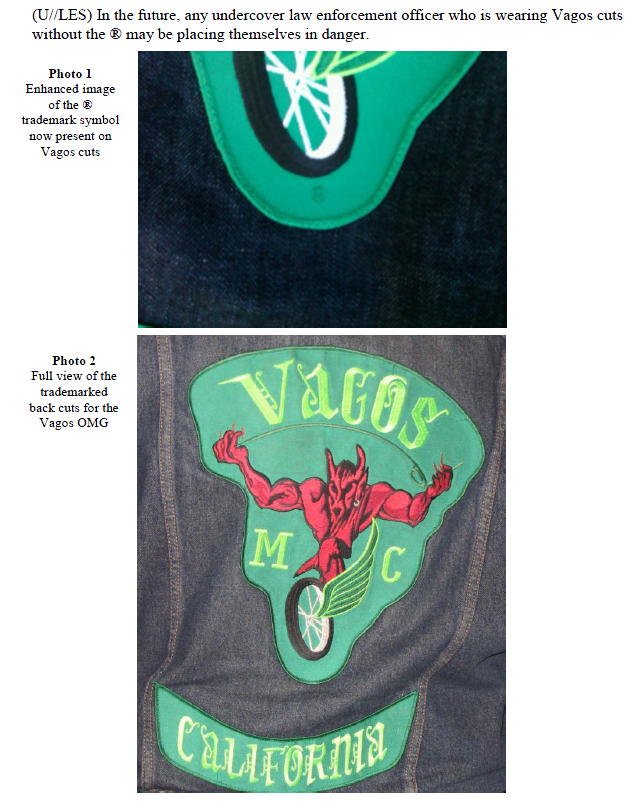

Israel is trying to discover the extent to which the Iranian announcement regarding the development of a new UAV named “Shaparak” is true.
According to the Iranians, the UAV has a take-off weight of 100 kg and can carry a payload weighing up to 8 kg. In addition, the statement says that the UAV has an endurance of 3.5 hours in altitudes of up to 4 km.
In recent years, Iran has invested considerable efforts in developing UAVs. However, Israel is assessing that its achievements are few.
Currently, Iran is exploiting situations in other countries in order to garner operational experience with their UAVs. As was previously revealed in IsraelDefense, there is proof that Iran has operated UAVs on behalf of the Syrian regime.
According to reports from sources following Iran’s involvement in the Syrian Civil War, an Iranian Pahpad UAV was sighted in the past few weeks in the skies near Homs, Syria, which is considered the most advanced in Syria’s arsenal.
In the past, Tehran has claimed that the UAV possesses stealth qualities. While Western elements doubt this claim, they say that it is undoubtedly an advanced UAV, at least with regards to its aerodynamic configuration.
Iran has previously supplied Hezbollah with self-produced UAVs, and the country has previously developed various basic UAVs as well, including the Ra’ad and Nazir. Four years ago, Iran’s defense minister claimed that his country successfully developed a UAV with a flight range of approximately 1,000 km.
Israel has experience with simple Iranian UAVs launched from southern Lebanon by Hezbollah towards Israel’s northern region. In June 2006, the IAF intercepted a suicide UAV carrying a payload of explosives. The Ababil UAV is a copy of a Russian UAV that is produced in Iran. It first breached Israel’s borders on November 7, 2004, and circled for five minutes over the region of Nahariya, photographing the area with a basic photographic system installed onboard. The Ababil UAV has a flight speed of nearly 300 km/h and has a maximum range of 240 km.
Israel is assessing that advanced Iranian UAVs have already been transferred to Hezbollah. The operation of the Iranian UAV in Syria is part of Tehran’s assistance fo Assad’s regime, as well as an Iranian opportunity to operate it in real conditions.
Source: Israel Defense
The Senate Intelligence Committee has been reviewing the post-9/11 detention and interrogation practices of the Central Intelligence Agency for four years and is still not finished. But the end appears to be in sight.
“The review itself is nearing completion — before the end of summer — but is not over yet,” a spokesperson for the Committee said. “The release date should be not too far thereafter, but is not set.”
“This review is the only comprehensive in-depth look at the facts and documents pertaining to the creation, management, and effectiveness of the CIA detention and interrogation program,” according to Sen. Jay Rockefeller, who was chairman of the Intelligence Committee when the review began in 2008.
Committee staff are said to have reviewed millions of pages of classified documents pertaining to the CIA program.
In newly published questions for the record following his confirmation hearing last year to be Director of the CIA, Gen. David Petraeus was asked by Senator Rockefeller if he would cooperate with the Committee review.
“I believe that a holistic and comprehensive review of the United States Government’s detention and interrogation programs can lead to valuable lessons that might inform future policies,” Petraeus replied.
“The best way to gain a common set of facts would be to reach out to the intelligence and military communities responsible for detentions and interrogations and for implementing future policies,” he added. “[T]o gain the proper insights from a series of actions or decisions, we cannot separate the review process from the public servants undertaking the actions,” he said.
Gen. Petraeus also responded to questions concerning interrogation in the “ticking time bomb” scenario (he says “research is required now”), and the applicability of official U.S. government statements on the use of drones to CIA operations (which he declined to confirm), among other topics.
His responses to these questions were published earlier this month in the record of his June 23, 2011 confirmation hearing.
Sen. Dianne Feinstein, the current chair of the Senate Intelligence Committee, provided a preview of the Committee’s findings on CIA interrogation practices in a November 29, 2011 floor statement during the debate on the FY2012 defense authorization act (also noted by Jeffrey Kaye in The Public Record).
“As chairman of the Select Committee on Intelligence, I can say that we are nearing the completion a comprehensive review of the CIA’s former interrogation and detention program, and I can assure the Senate and the Nation that coercive and abusive treatment of detainees in U.S. custody was far more systematic and widespread than we thought,” Sen. Feinstein said.
“Moreover, the abuse stemmed not from the isolated acts of a few bad apples but from fact that the line was blurred between what is permissible and impermissible conduct, putting U.S. personnel in an untenable position with their superiors and the law.”
LOS ANGELES—A San Marino man has been sentenced to 121 months in federal prison for defrauding banks and other lenders by using “straw borrowers” and bogus documents to obtain millions of dollars in loans for houses and high-end vehicles that included Ferraris and Lamborghinis.
Scott Dority, 54, was sentenced last Monday by United States District Judge R. Gary Klausner. The sentencing hearing was under seal, and the United States Attorney’s Office learned today that the matter had been unsealed.
Dority pleaded guilty on March 14, 2011 to wire fraud, conspiracy, aggravated identity theft, and two counts of tax evasion. When he pleaded guilty, he admitted that his fraudulent conduct caused at least $4 million in losses to financial institutions that issued mortgages and approximately $5 million in losses to institutions that issue loans for the sports cars and recreational vehicles.
Dority also admitted in court that he failed to file tax returns for 2005 and 2006, even though he had hundreds of thousands of dollars in income in each of those years.
According to a now-unsealed court document, Dority, along with others, recruited individuals with good credit to act as straw buyers to purchase residential homes or expensive vehicles. Dority created a package of materials—including fake bank statements, fake pay stubs, and bogus fake tax returns—to make it appear that these straw buyers had sufficient assets and income to pay back loans used to purchase the real estate and vehicles. These fake documents were then submitted to lenders, who relied upon them to issue more than $9 million in mortgage and vehicle loans.
As part of the 121-month prison sentence, Dority received a mandatory two-year prison term for aggravated identity theft.
The investigation into this scheme was conducted jointly by the Federal Bureau of Investigation, IRS-Criminal Investigation, and the United States Secret Service.
EXECUTIVE ORDER
13606
– – – – – – –
BLOCKING THE PROPERTY AND SUSPENDING ENTRY INTO THE
UNITED STATES OF CERTAIN PERSONS WITH RESPECT TO GRAVE
HUMAN RIGHTS ABUSES BY THE GOVERNMENTS OF IRAN AND SYRIA
VIA INFORMATION TECHNOLOGY
By the authority vested in me as President by the Constitution and the laws of the United States of America, including the International Emergency Economic Powers Act (50 U.S.C. 1701 et seq.) (IEEPA), the National Emergencies Act (50 U.S.C. 1601 et seq.), section 212(f) of the Immigration and Nationality Act of 1952, as amended (8 U.S.C. 1182(f)), and section 301 of title 3, United States Code,
I, BARACK OBAMA, President of the United States of America, hereby determine that the commission of serious human rights abuses against the people of Iran and Syria by their governments, facilitated by computer and network disruption, monitoring, and tracking by those governments, and abetted by entities in Iran and Syria that are complicit in their governments’ malign use of technology for those purposes, threaten the national security and foreign policy of the United States. The Governments of Iran and Syria are endeavoring to rapidly upgrade their technological ability to conduct such activities. Cognizant of the vital importance of providing technology that enables the Iranian and Syrian people to freely communicate with each other and the outside world, as well as the preservation, to the extent possible, of global telecommunications supply chains for essential products and services to enable the free flow of information, the measures in this order are designed primarily to address the need to prevent entities located in whole or in part in Iran and Syria from facilitating or committing serious human rights abuses. In order to take additional steps with respect to the national emergencies declared in Executive Order 12957 of March 15, 1995, as relied upon for additional steps in subsequent Executive Orders, and in Executive Order 13338 of May 11, 2004, as modified in scope and relied upon for additional steps in subsequent Executive Orders, and to address the situation described above, I hereby order:
Section 1.
(a) All property and interests in property that are in the United States, that hereafter come within the United States, or that are or hereafter come within the possession or control of any United States person, including any foreign branch, of the following persons are blocked and may not be transferred, paid, exported, withdrawn, or otherwise dealt in:
(i) the persons listed in the Annex to this order; and(ii) any person determined by the Secretary of the Treasury, in consultation with or at the recommendation of the Secretary of State:
(A) to have operated, or to have directed the operation of, information and communications technology that facilitates computer or network disruption, monitoring, or tracking that could assist in or enable serious human rights abuses by or on behalf of the Government of Iran or the Government of Syria;(B) to have sold, leased, or otherwise provided, directly or indirectly, goods, services, or technology to Iran or Syria likely to be used to facilitate computer or network disruption, monitoring, or tracking that could assist in or enable serious human rights abuses by or on behalf of the Government of Iran or the Government of Syria;
(C) to have materially assisted, sponsored, or provided financial, material, or technological support for, or goods or services to or in support of, the activities described in subsections (a)(ii)(A) and (B) of this section or any person whose property and interests in property are blocked pursuant to this order; or
(D) to be owned or controlled by, or to have acted or purported to act for or on behalf of, directly or indirectly, any person whose property and interests in property are blocked pursuant to this order.
(b) The prohibitions in subsection (a) of this section apply except to the extent provided by statutes, or in regulations, orders, directives, or licenses that may be issued pursuant to this order, and notwithstanding any contract entered into or any license or permit granted prior to the effective date of this order.
Sec. 2. I hereby determine that the making of donations of the type of articles specified in section 203(b)(2) of IEEPA (50 U.S.C. 1702(b)(2)) by, to, or for the benefit of any person whose property and interests in property are blocked pursuant to this order would seriously impair my ability to deal with the two national emergencies identified in the preamble to this order, and I hereby prohibit such donations as provided by section 1 of this order.
Sec. 3. The prohibitions in section 1 of this order include but are not limited to:
(a) the making of any contribution or provision of funds, goods, or services by, to, or for the benefit of any person whose property and interests in property are blocked pursuant to this order; and(b) the receipt of any contribution or provision of funds, goods, or services from any such person.
Sec. 4. I hereby find that the unrestricted immigrant and nonimmigrant entry into the United States of aliens who meet one or more of the criteria in section 1 of this order would be detrimental to the interests of the United States, and I hereby suspend the entry into the United States, as immigrants or nonimmigrants, of such persons. Such persons shall be treated as persons covered by section 1 of Proclamation 8693 of July 24, 2011 (Suspension of Entry of Aliens Subject to United Nations Security Council Travel Bans and International Emergency Economic Powers Act Sanctions).
Sec. 5.
(a) Any transaction by a United States person or within the United States that evades or avoids, has the purpose of evading or avoiding, causes a violation of, or attempts to violate any of the prohibitions set forth in this order is prohibited.(b) Any conspiracy formed to violate any of the prohibitions set forth in this order is prohibited.
Sec. 6. Nothing in section 1 of this order shall prohibit transactions for the conduct of the official business of the United States Government by employees, grantees, or contractors thereof.
Sec. 7. For the purposes of this order:
(a) the term “person” means an individual or entity;(b) the term “information and communications technology” means any hardware, software, or other product or service primarily intended to fulfill or enable the function of information processing and communication by electronic means, including transmission and display, including via the Internet;
(c) the term “entity” means a partnership, association, trust, joint venture, corporation, group, subgroup, or other organization;
(d) the term “United States person” means any United States citizen, permanent resident alien, entity organized under the laws of the United States or any jurisdiction within the United States (including foreign branches), or any person in the United States;
(e) the term “Government of Iran” means the Government of Iran, any political subdivision, agency, or instrumentality thereof, including the Central Bank of Iran, and any person owned or controlled by, or acting for or on behalf of, the Government of Iran; and
(f) the term “Government of Syria” means the Government of the Syrian Arab Republic, its agencies, instrumentalities, and controlled entities.
Sec. 8. For those persons whose property and interests in property are blocked pursuant to this order who might have a constitutional presence in the United States, I find that because of the ability to transfer funds or other assets instantaneously, prior notice to such persons of measures to be taken pursuant to this order would render those measures ineffectual. I therefore determine that for these measures to be effective in addressing the two national emergencies identified in the preamble to this order, there need be no prior notice of a listing or determination made pursuant to section 1 of this order.
Sec. 9. The Secretary of the Treasury, in consultation with the Secretary of State, is hereby authorized to take such actions, including the promulgation of rules and regulations, and to employ all powers granted to the President by IEEPA as may be necessary to carry out the purposes of this order. The Secretary of the Treasury may redelegate any of these functions to other officers and agencies of the United States Government consistent with applicable law. All agencies of the United States Government are hereby directed to take all appropriate measures within their authority to carry out the provisions of this order.
Sec. 10. The Secretary of the Treasury, in consultation with the Secretary of State, is hereby authorized to determine that circumstances no longer warrant the blocking of the property and interests in property of a person listed in the Annex to this order and to take necessary action to give effect to that determination.
Sec. 11. This order is not intended to, and does not, create any right or benefit, substantive or procedural, enforceable at law or in equity by any party against the United States, its departments, agencies, or entities, its officers, employees, or agents, or any other person.
Sec. 12. The measures taken pursuant to this order with respect to Iran are in response to actions of the Government of Iran occurring after the conclusion of the 1981 Algiers Accords, and are intended solely as a response to those later actions.
Sec. 13. This order is effective at 12:01 a.m. eastern daylight time on April 23, 2012.
BARACK OBAMA
__________________
ANNEX
Individual
1. Ali MAMLUK [director of the Syrian General Intelligence Directorate, born 1947]
Entities
1. Syrian General Intelligence Directorate2. Syriatel
3. Islamic Revolutionary Guard Corps
4. Iranian Ministry of Intelligence and Security
5. Law Enforcement Forces of the Islamic Republic of Iran
6. Datak Telecom
__________
Annex from Federal Register:
http://www.ofr.gov/OFRUpload/OFRData/2012-09933_PI.pdf
[FR Doc. 2012-10034 Filed 04/23/2012 at 11:15 am; Publication Date: 04/24/2012]
The purpose of research supported by the HIG is to advance the science and practice of intelligence interviewing and interrogation. Offerors will conduct research for the HIG in their facilities. The HIG has defined several areas for long-range study and advisory support. These research areas include but are not limited to:
- Field observations of military and strategic interrogators, intelligence interviewers and debriefers in order to document strategies, methods and outcomes;
- Surveys and structured interviews of interrogators, intelligence interviewers and debriefers specified by the Government in order to document what these operational personnel think works and does not work and the development of operationally-based best practices which may be later investigated via laboratory or field studies;
- Development, testing and evaluation of metrics for assessing the efficacies of interrogations, intelligence interviews and debriefs and of the use of particular interrogation, intelligence interview and debrief strategies and methods;
- Field quasi-experimental studies to evaluate the efficacy of new evidence-based interrogation, intelligence interview and debrief strategies and methods;
- Laboratory studies to test and/or discover new interrogation, intelligence interview and debrief methods;
- Laboratory or field studies to assess the validity of evidence-based interviewing, deception detection, and other relevant principles and/or methods across non-U.S. populations both with and without the use of interpreters;
- Laboratory or field studies on fundamental psychological processes (to include but not be limited to decision-making, emotion, motivation, memory, persuasion, social identities and social development) as these are relevant to interrogations, intelligence interviews and debriefs;
- Laboratory or field studies of interpersonal processes (e.g., social influence, persuasion, negotiation, conflict resolution and management), with particular attention to cultural and intercultural issues; and
- Topics considered out of scope for this BAA include the development of technologies for credibility assessment or other performance support aids, methods relying exclusively on case studies, and language training.
DOWNLOAD THE ORIGINAL DOCUMENT HERE
The CIA, the right hand tool, of the Military-Industrial Complex, involvement in every diabolical, evil endeavor on the face of the earth.
Beinahe 50 Jahre gehörten die Sowjetsoldaten zum Alltag in Ostdeutschland. Laut verkündet wurden die offiziellen Parolen vom festen Bruderbund. Verschwiegen wurde, dass die “Freunde” auch Täter waren. Jahr für Jahr begingen die Armeeangehörigen mehr als 2000 Straftaten. Doch offiziell darüber geredet wurde nicht. Verbrechen sowjetischer Soldaten in der DDR waren tabu. Das tatsächliche Ausmaß dieses dunklen Kapitels der “Waffen- und Klassenbrüderschaft” wurde erst nach dem Abzug der sowjetischen Streitkräfte bekannt. Von 1976 bis 1989 wurden 27.505 kriminelle Vorgänge erfasst: Verkehrs- und Schießunfälle, Diebstähle, Körperverletzungen, Vergewaltigungen und Mord. So ist ein Film entstanden, der erstmalig anhand konkreter Fälle das Problem der Straftaten sowjetischer Soldaten in der DDR dokumentarisch aufarbeitet. Im Mittelpunkt stehen die Opfer und ihre Angehörigen. Zu Wort kommen auch DDR-Militärstaatsanwälte und Angehörige der Kriminalpolizei. Es werden einzelne Straftaten rekonstruiert und der Umgang damit von Seiten der DDR-Behörden geschildert.
Die DDR und Kuba
Auf den ersten Blick gab es nur Gegensätze zwischen diesen beiden Ländern des real existierenden Sozialismus: Hier mausgrau, dort grellbunt, hier bierernst, dort ausgelassen und lebensfroh. Eines jedoch verband Castros Kuba und Honeckers DDR über alle Jahrzehnte hinweg: die Verwaltung des Mangels. Ostberlin schickte klapprige Zementfabriken und sogar Rum aus zweifelhafter Destillation über den Atlantik, Havanna revanchierte sich mit Orangen, die nicht schmeckten, und Arbeiterkolonnen, die den unersättlichen Planstellenhunger der DDR-Staatswirtschaft nur ansatzweise stillen konnten. Im Schatten Moskaus entstand so eine zarte Bande gegenseitiger Abhängigkeiten, nach außen selbstverständlich propagiert als “unverbrüchliche Freundschaft zweier Bruderstaaten”. Seit Castros Machtantritt im Jahr 1959 gab es bei den Genossen in Ostberlin nicht nur ein wirtschaftliches Interesse an dem exotischen “Ostblock”-Staat. So konnte man seinem bald eingemauerten Volk zumindest auf dem Papier einen Urlaub in der Karibik in Aussicht stellen. Umgekehrt war für Castro die DDR das sozialistische “Musterländle” im fernen Europa: Fleiß, Ordnungssinn und Know-How der Ostdeutschen beeindruckten den Revolutionär. Anders als dem sowjetischen “Herren”-Gebaren konnte auch der einfache Kubaner dem immer etwas ungelenken Auftritt der Ostdeutschen Sympathie entgegenbringen. Hinter der offiziellen Propaganda wuchsen so viele menschliche Beziehungen, die oft bis heute lebendig blieben.
Kabul attacks show intel failures in Afghanistan. Dozens, possibly hundreds of people would have been involved in training, equipping and then infiltrating into the heart of Kabul the large number of insurgents who were prepared to fight to a certain death in the Afghan capital last Sunday. Yet neither Afghan nor foreign intelligence operatives appeared to have any idea that an unprecedented wave of attacks was about to engulf both Kabul and several other key locations around the country. So it seems that Afghan President Hamid Karzai may have a point when he says that the “infiltration in Kabul and other provinces is an intelligence failure for us and especially for NATO and should be seriously investigated”.
►►Report claims China spies on US space technology. China is stealing US military and civilian space technology in an effort to disrupt US access to intelligence, navigation and communications satellites, according to a report authored by the State and Defense Departments. The report (.pdf) argues China should be excluded from recommendations made to the US government to ease restrictions on exports of communications and remote-sensing satellites and equipment. Chinese officials have denied the report’s allegations, calling it a “Cold War ghost”.
►►The long and sordid history of sex and espionage. Using seduction to extract valuable information is as old as the Old Testament —literally— Whether from conviction or for profit, women —and men— have traded sex for secrets for centuries. The Cold War provided plenty of opportunities for so-called “honey-pot” scandals. Perhaps the most dramatic case of seduction in recent times involved Israeli nuclear technician Mordechai Vanunu. In 1986 he visited London and provided The Sunday Times with dozens of photographs of Israel’s alleged nuclear weapons program. But Mossad was on his trail and a female agent —Cheryl Ben Tov— befriended him (reportedly bumping into him at a cigarette kiosk in London’s Leicester Square). She lured him to Rome for a weekend, where he was drugged and spirited to Israel.
Die Mauer – Fluchten und Tragödien Unter Lebensgefahr in die Freiheit
In den frühen Morgenstunden des 13. August 1961 beginnt die “Abriegelung” West-Berlins durch DDR-Grenztruppen — die Geburtsstunde der Mauer. Fast drei Jahrzehnte teilt der “antifaschistische Schutzwall” Deutschland in zwei Hälften, und ca. 200 Menschen bezahlen den Versuch, aus der DDR in den Westen zu fliehen, mit dem Leben. Tausenden gelingt die “Republikflucht”, zum Teil auf abenteuerliche Weise: mit Ballons, durch selbst gegrabene Tunnel, im Kofferraum oder mit Tauchausrüstung durch die Ostsee. Der Film blickt zurück auf ein unmenschliches Bollwerk und die vielen Versuche, es zu überwinden. Wie viele Menschen genau ihr Leben bei einem Fluchtversuch über die Grenze der DDR verloren haben, ist auch heute noch ungewiss. Die SED-Führung versuchte nach Kräften, Todesfälle zu verschleiern. Die Abriegelung Westberlins war unblutig verlaufen, wenige Tage später aber erließ das SED-Politbüro einen ersten, noch verklausulierten Schießbefehl an die Grenztruppen. Am 24. August 1961, wenige Wochen nach Ulbrichts Befehl zur “Grenzschließung”, wurde der 24jährige Günter Litwin bei einem Fluchtversuch durch einen gezielten Kopfschuss getötet.
A sends:
http://www.thesundaytimes.co.uk/sto/comment/profiles/article1021573.ece [Subscription required]
Chief snooper pops out of the shadows
David Leppard
Sunday Times, 22/4/12, p23 main section
When the embattled Theresa May appears before a committee of MPs on Tuesday to give evidence about her work as home secretary she will be accompanied by one of Whitehall’s most powerful, controversial and secretive mandarins. Charles Farr, the Home Office’s top “securocrat”, is set to emerge from the shadows for the first time as he is asked to defend the coalition’s plans to monitor the Internet use and digital communications of everyone in Britain…
He joined MI6 some time in the 19802, serving in South Africa and Jordan. Farr is understood to have come to prominence, as one contemporary recalled, “flying around Afghanistan in a helicopter with thousands of dollars in bundles, doing deals with farmers to not grow opium. Bad policy as it turned out, but he did it very well…”
Farr’s critics say he still carries the legacy of his MI6 heyday — a mindset they claim is inappropriate for his job at the heart of Whitehall security policy. “When you are an MI6 officer out in the field, trying to stop people getting nuclear weapons in, say, Kazakhstan, you have to be very independently minded and very confident in your own judgement. There’s not a lot of ministerial control or public accountability,” says an admirer who knows him well. “Charles feels very uncomfortable in the world of domestic politics and doesn’t read it very well.”
A former Home Office official went further: “When you’re suddenly flung into a top position with management and policy responsibility in the Home Office, you can’t go on behaving like you are in the Tora Bora caves doing deals with warlords. Your job is to advise ministers who decide policy. You can’t go around thinking you are a player in your own right. It’s a constitutional concern…”
It’s no secret in Whitehall that the grandiosely titled communications capabilities development programme was Farr’s “policy baby”. In fact, it was a rehash of an earlier attempt by Farr in 2009 to persuade the then Labour home secretary to build a giant database where the government could hold details of all emails and telephone calls. It obviously needed sensitive handling, but its delivery was bungled by Farr’s office and it was dumped by Labour after an uproar. When a new government was elected he tried to resurrect the plan — with similar results.
A similar lack of deftness befell Farr’s efforts to develop “Prevent”, a controversial plank of the government’s counterterrorism policy that aimed to identify and thwart thousands of young Muslim men who might be vulnerable to violent extremism… “It was a blurring of the policy of surveillance with a different policy of community engagement and building a civil society,” said a former Home Office official. “But if, like Charles Farr, you are a career spook you just don’t get that. You see everything as an opportunity for surveillance and you see everybody as potentially sinister…”
Another former official, who had a showdown with Farr over policy, recalls: “He’s almost messianic. He’s like he’s on a mission to protect the nation. When you disagree with him he gets very emotional. He’s one of these guys who goes white and shakes when he loses his temper…”
“He has on occasions adopted a style that could be considered inappropriate,” said a former official. “He’s a very uncivil servant.”
Annette Baumeister zeigt beschädigte Seelen, in denen das Gift der Staatssicherheit bis heute fortwirkt. Tausende Betroffene leben in Deutschland, kaum einer traut sich, darüber zu sprechen. Zu groß ist die Angst, stigmatisiert zu werden.
Am Ende der DDR waren ungefähr 8.000 Kinder und Jugendliche so genannte “inoffizielle Mitarbeiter” der Staatssicherheit. Sie wurden in Jugendclubs, in Kirchen und an den Schulen angesprochen. Sie sollten ihre Freunde aushorchen oder über ihre Eltern berichten.
Marko ist 17 Jahre alt, als ihn die Staatssicherheit über seine Dresdner Schule kontaktiert. Kerstin und Elvira besuchen in den 70er Jahren das Internat Wickersdorf für angehende Russischlehrer. Auch sie sind minderjährig, als sie ins Direktorenzimmer bestellt werden und dort auf Männer von der Staatssicherheit treffen. “Ich hatte das Gefühl, die wissen alles über mich”, sagt Kerstin heute über das Anwerbegespräch als damals 16-Jährige im Büro des Schuldirektors. “Ich hatte auch die Befürchtung, wenn ich da nicht mitmache, dass ich dann auch mein Abitur nicht machen kann.” Unter Druck gesetzt, unterschreibt sie die Verpflichtung, niemandem davon zu erzählen, auch den Eltern nicht.
Das Ministerium für Staatssicherheit will wissen, was die Kinder und Jugendlichen denken und fühlen, will ihnen “unter die Haut kriechen und ins Herz schauen”, schließlich hängt von ihnen die Zukunft des Sozialismus ab. Stasiminister Erich Mielke befahl schon 1966, Minderjährige anzuwerben und zu Spitzeln zu machen. Und an der “Juristischen Hochschule” der Staatssicherheit in Potsdam lernen die Führungsoffiziere, wie das geht und welche Jugendlichen besonders dazu zu drängen sind.
Der Film rekonstruiert das Schicksal von Marko, Kerstin und Elvira und zeigt, wie die Stasi vorging, um Jugendliche zu Spitzeldiensten zu pressen. “Stasi auf dem Schulhof” schenkt drei Betroffenen von damals Gehör. Erstmals erzählen sie ihre Geschichte und reflektieren ihre damalige Lebenssituation, ihre Naivität, ihre Verzweiflung, die Einsamkeit, ihre Schuldgefühle. Daneben erzählt der ehemalige Schuldirektor, welche Rolle er bei der Anwerbung spielte, beschreibt ein ehemaliger Führungsoffizier, mit welchem Geschick er die Jugendlichen anwarb und wie die Treffen mit ihnen abliefen.
Ein Film von Annette Baumeister
Award winning unofficial prequel to The Lord Of The Rings dramatising Aragorn & Gandalf’s long search for Gollum directed by British filmmaker Chris Bouchard. Based faithfully on the appendices of the books this is a non-profit, serious homage to the writing of J.R.R Tolkien and the films of Peter Jackson. It was shot on locations in England and Snowdonia with a team of over a hundred people working over the Internet. It took two years to make and was released as a non-profit Internet-only video by agreement with Tolkien Enterprizes. This Youtube version is slightly extended with 1 scene added back in. http://www.thehuntforgollum.com http://www.ioniafilms.com
Born of Hope is an independent feature film inspired by the Lord of the Rings and produced by Actors at Work Productions in the UK.
http://www.bornofhope.com
Thanks to Chris Bouchard and the H4G team for putting the film here. For more films by the makers of this and BoH extras please visit.
ActorsatWork
http://www.youtube.com/actorsatwork
Check them out for more videos regarding the film including the audio commentary.
http://www.youtube.com/watch?v=elt_l8zisik
A scattered people, the descendants of storied sea kings of the ancient West, struggle to survive in a lonely wilderness as a dark force relentlessly bends its will toward their destruction. Yet amidst these valiant, desperate people, hope remains. A royal house endures unbroken from father to son.
This 70 minute original drama is set in the time before the War of the Ring and tells the story of the Dúnedain, the Rangers of the North, before the return of the King. Inspired by only a couple of paragraphs written by Tolkien in the appendices of the Lord of the Rings we follow Arathorn and Gilraen, the parents of Aragorn, from their first meeting through a turbulent time in their people’s history.
Das Ministerium für Staatssicherheit der DDR (kurz MfS oder Stasi, abwertend auch SSD) war der Inlands- und Auslandsgeheimdienst der DDR und zugleich Ermittlungsbehörde (Untersuchungsorgan) für „politische Straftaten”. Das MfS war innenpolitisch vor allem ein Unterdrückungs- und Überwachungsinstrument der SED („Schild und Schwert der Partei”) gegenüber der DDR-Bevölkerung, das dem Machterhalt diente. Dabei setzte es als Mittel Überwachung, Einschüchterung, Terror und die so genannte Zersetzung gegen Oppositionelle und Regimekritiker („feindlich-negative Personen”) ein.
Das MfS wurde am 8. Februar 1950 gegründet. Der Sprachgebrauch der SED, der das MfS als „Schild und Schwert der Partei” bezeichnete, beschreibt die ihm zugedachte Funktion im politisch-ideologischen System der DDR.
Neben dem MfS gab es auch einen weiteren Nachrichtendienst in der DDR, die Militärische Aufklärung der Nationalen Volksarmee (militärischer Aufklärungsdienst) mit Sitz in Berlin-Treptow. Die Verwaltung Aufklärung wurde ebenso wie die Grenztruppen und die restliche NVA durch die Hauptabteilung I (MfS-Militärabwehr oder Verwaltung 2000) kontrolliert („abgesichert”).
| Citation: | DDCI Statement about the Watergate Case [Central Intelligence Agency Employee Bulletin Containing Vernon Walter’s Statement on CIA Involvement in Watergate; Best Available Copy] , [Classification Unknown], Newsletter, 359, May 21, 1973, 3 pp. |
| Collection: | The CIA Family Jewels Indexed |
| Item Number: | FJ00031 |
| Origin: | United States. Central Intelligence Agency |
| Individuals/ Organizations Named: |
Cushman, Robert E., Jr.; Dean, John Wesley III; Democratic National Committee (U.S.); Ehrlichman, John D.; Gray, L. Patrick; Haldeman, H.R.; Helms, Richard M.; Hunt, E. Howard; Nixon, Richard M.; Schlesinger, James R.; United States. Department of Justice; United States. Federal Bureau of Investigation; United States. White House; Walters, Vernon A. |
| Subjects: | Congressional hearings | Covert operations | Government appropriations and expenditures | Mexico | Watergate Affair (1972-1974) |
| Abstract: | Disseminates Vernon Walter’s statement to congressional committee about his communications with John Dean and Patrick Gray on Central Intelligence Agency involvement in Watergate and CIA’s issuance of equipment to Howard Hunt. |
| Full Text: | Document – PDF – this link will open in a new window (156 KB) |
From the series “Hitler’s Warriors”.
Wilhelm Bodewin Gustav Keitel (22 September 1882 — 16 October 1946) was a German field marshal (Generalfeldmarschall). As head of the Oberkommando der Wehrmacht (Supreme Command of the Armed Forces) and de facto war minister, he was one of Germany’s most senior military leaders during World War II. At the Allied court at Nuremberg he was tried, sentenced to death and hanged as a war criminal.
An 18-count indictment was unsealed in federal court in Brooklyn this morning charging 11 individuals, including several made members and associates of the Genovese organized crime family of La Cosa Nostra (the “Genovese family”), variously with racketeering conspiracy, extortion, illegal gambling, union embezzlement, and obstruction of justice. The defendants will make their initial appearance later today before United States Magistrate Judge Marilyn D. Go at the U.S. Courthouse at 225 Cadman Plaza East in Brooklyn, New York.
The case was announced by Loretta E. Lynch, United States Attorney for the Eastern District of New York; Janice K. Fedarcyk, Assistant Director in Charge, Federal Bureau of Investigation, New York Field Office; Robert Panella, Special Agent in Charge, U.S. Department of Labor, Office of Inspector General, Office of Labor Racketeering and Fraud Investigations, New York Region; Raymond W. Kelly, Commissioner, New York City Police Department; and Rose Gill Hearn, Commissioner, New York City Department of Investigation (DOI).
As alleged in the indictment and a detention memorandum filed by the government today, Conrad Ianniello is a captain in the Genovese family. James Bernardone, the Secretary Treasurer of Local 124 of the International Union of Journeymen and Allied Trades (IUJAT), and Salvester Zarzana, the former President of Local 926 of the United Brotherhood of Carpenters and Joiners, are both soldiers in the Genovese family. Ryan Ellis, Paul Gasparrini, William Panzera, and Robert Scalza, the Secretary Treasurer of IUJAT Local 713, are associates of the Genovese family. Also named as defendants are Robert Fiorello, Rodney Johnson, Felice Masullo, and John Squitieri.
Ianniello is charged with, among other crimes, racketeering conspiracy, including predicate acts of illegal gambling; conspiring to extort vendors at the annual Feast of San Gennaro held in Little Italy, New York in 2008; and, along with Scalza and Ellis, conspiring to extort a labor union between April 2008 and May 2008 in order to induce the union to cease its efforts to organize workers at a company on Long Island. Based on their threats, the defendants allegedly hoped to pave the way for Scalza’s union, IUJAT Local 713, to unionize the company instead.
The indictment charges Bernardone and Gasparrini with racketeering conspiracy, including predicate acts of conspiring to extort a subcontractor related to work performed at construction sites in Manhattan, Queens, and Brooklyn from approximately 2006 to 2009, including work performed at a Hampton Inn located on Ditmars Boulevard in Queens. Zarzana is also charged with extortion related to one of those construction sites. In addition, the indictment alleges that in 2008, Squitieri embezzled money from employee pension and annuity funds of Local 7-Tile, Marble, and Terrazzo of the Bricklayers and Allied Craftworkers union by providing non-union laborers to perform tile-related work during a renovation at the Paramount Hotel in Manhattan, thereby avoiding paying into Local 7’s employee pension benefit plans. Johnson, a project manager at the Paramount Hotel renovation, is charged with obstruction of justice in connection with his efforts to impede a federal grand jury investigation conducted in this district that ultimately resulted in the charges brought in the indictment unsealed today.
Finally, Panzera and Fiorello are charged with crimes related to their involvement in loansharking and the extortionate collection of money from a victim.
“This indictment is the most recent chapter in this office’s continued fight against organized crime’s efforts to infiltrate unions and businesses operating in New York City. Where others saw a city festival, urban renewal, and job growth, these defendants allegedly saw only a chance to line their pockets at the expense of hard working individuals. And when law enforcement began to probe their actions, one defendant allegedly went so far as to try to block that investigation,” stated United States Attorney Lynch. “Organized crime figures and union officials who seek to earn money by corrupting legitimate industry will be investigated and prosecuted to the full extent of the law.”
FBI Assistant Director in Charge Fedarcyk stated, “Today’s charges highlight not only the ongoing vigilance of the FBI in policing the corrupt conduct of La Cosa Nostra, but also the necessity of such vigilance. Even as mob families seek and discover new ways to make money by illegitimate means, they continue to rely on tried-and-true schemes like extortion and gambling. The mob’s purpose is making money, and how is less important than how much.”
Special Agent in Charge Panella, U.S. Department of Labor, Office of Inspector General, stated, “The RICO indictment and today’s arrests reflect our strong commitment to combat the infiltration of unions by organized crime members and associates for their personal enrichment. The defendants allegedly utilized their organized crime influence to corrupt businesses and advance various illegal schemes. The Office of Inspector General will continue to work with our law enforcement partners to vigorously investigate labor racketeering in the nation’s unions.”
NYPD Commissioner Kelly stated, “As alleged in the indictment, the defendants’ extortion knew no bounds—in fact, one of the defendants allegedly even used the feast of San Gennaro to extort money from vendors involved in the celebration of the saint’s life. I commend the U.S. Attorney’s Office and the federal agents and New York City detectives for this successful investigation.”
DOI Commissioner Gill Hearn stated, “The charges underscore the determination of federal and city investigators to curtail organized crime’s influence in New York City, including the Feast of San Gennaro in Little Italy. DOI was pleased to assist its federal partners on this significant indictment.”
The defendants face maximum sentences ranging from five to 20 years of imprisonment on each count of conviction.
The government’s case is being prosecuted by Assistant United States Attorneys Nicole Argentieri, Jacquelyn Kasulis, and Amanda Hector.
The Defendants
| Name | Age | Residence |
|---|---|---|
| Conrad Ianniello | 68 | Staten Island, New York |
| James Bernardone | 44 | Bronx, New York |
| Ryan Ellis | 30 | Queens, New York |
| Rober Fiorello | 62 | Jackson, New Jersey |
| Paul Gasparrini | 39 | Yonkers, New York |
| Rodney Johnson | 49 | Edgewater, New Jersey |
| Felice Masullo | 40 | Queens, New York |
| William Panzera | 39 | North Haledon, New Jersey |
| Robert Scalza | 66 | Long Island, New York |
| John Squitieri | 55 | Rockland County, New York |
| Salvester Zarzana | 48 | Brooklyn, New York |
A man brutally murdered comes back to life as an undead avenger of his and his fiancée’s murder.

Linking to a video on Facebook is one thing. Getting off the couch is quite another.
Viral internet sensation Kony 2012 found the campaign’s youthful army of ”clicktivists” largely unwilling to actually get up, go outside and put up posters.
Judging by the mood online, many had decided the whole meme was, like, so 10 minutes ago.
Participants in the campaign’s Cover the Night event on Friday were asked to form into teams, volunteer for their community for a few hours by picking up rubbish or washing cars, then spend the evening plastering walls, pavements and windows with promotional material.
But amazing things generally failed to happen. In New York, barely 5000 people had pledged on Facebook to join in. The event’s page didn’t specify a location, and Twitter revealed only a handful of groups heading to places such as Times Square, where a big video screen showed a Kony 2012 trailer every half hour just above a Foot Locker store.
The following Integrated Terrorism Assessment Centre (ITAC) bulletins were obtained via an information request from the Canadian Security Intelligence Service (CSIS) by Paroxysms. Most of the documents were also simultaneously released to the Globe and Mail, though the collection released to Paroxysms is more complete and contains several additional bulletins that are not included in the other collection.
DOWNLOAD THE ORIGINAL DOCUMENT HERE
Stalin is a 1992 television film, produced for HBO, starring Robert Duvall portraying Soviet leader Joseph Stalin.
![[Image]](https://i0.wp.com/cryptome.org/2012-info/drone-crew/pict170.jpg)
![[Image]](https://i0.wp.com/cryptome.org/2012-info/drone-crew/pict171.jpg)
![[Image]](https://i0.wp.com/cryptome.org/2012-info/drone-crew/pict172.jpg)
![[Image]](https://i0.wp.com/cryptome.org/2012-info/drone-crew/pict173.jpg)
![[Image]](https://i0.wp.com/cryptome.org/2012-info/drone-crew/pict168.jpg) Israeli soldiers control the Skylark drone during a drill on January 16, 2012 near Bat Shlomo, Israel. The Skylark can carry a camera payload of up to 1kg, has an operational ceiling of 15,000ft and allows users to monitor any designated point within a 15km radius. The Skylark unit consists of a ground control element and three drones, which provide battalion-level commanders with real-time information. Getty
Israeli soldiers control the Skylark drone during a drill on January 16, 2012 near Bat Shlomo, Israel. The Skylark can carry a camera payload of up to 1kg, has an operational ceiling of 15,000ft and allows users to monitor any designated point within a 15km radius. The Skylark unit consists of a ground control element and three drones, which provide battalion-level commanders with real-time information. Getty![[Image]](https://i0.wp.com/cryptome.org/2012-info/drone-crew/pict169.jpg) A technician supporting U.S. Navy SEAL Team 18 works on a UAV, an unmanned aerial vehicle, before a demonstration of combat skills at the National Navy UDT-SEAL Museum in Fort Pierce, Florida November 11, 2011. The demonstration for the public is part of a Veteran’s Day celebration and the annual reunion at the Museum. The drone is equipped with cameras for surveillance. Reuters
A technician supporting U.S. Navy SEAL Team 18 works on a UAV, an unmanned aerial vehicle, before a demonstration of combat skills at the National Navy UDT-SEAL Museum in Fort Pierce, Florida November 11, 2011. The demonstration for the public is part of a Veteran’s Day celebration and the annual reunion at the Museum. The drone is equipped with cameras for surveillance. Reuters![[Image]](https://i0.wp.com/cryptome.org/2012-info/drone-crew/pict167.jpg)
![[Image]](https://i0.wp.com/cryptome.org/2012-info/drone-crew/pict104.jpg) Adam Stock, the lead pilot for 29 Palms Unmanned Aerial Systems, out of Twentynine Palms, California, pilots a ScanEagle unmanned aerial vehicle at Fort Hunter Liggett, Calif., May 19, 2011, in support of Global Medic 2011 and Warrior 91 11-01. Global Medic is a joint field training exercise for theater aeromedical evacuation system and ground medical components designed to replicate all aspects of combat medical service support. Warrior 91 11-01 was a tactical exercise in which U.S. Service members responded to simulated enemy attacks as part of Global Medic 2011 . (U.S. Air Force photo by Staff Sgt. Donald R. Allen/Released). Date Shot: 5/19/2011
Adam Stock, the lead pilot for 29 Palms Unmanned Aerial Systems, out of Twentynine Palms, California, pilots a ScanEagle unmanned aerial vehicle at Fort Hunter Liggett, Calif., May 19, 2011, in support of Global Medic 2011 and Warrior 91 11-01. Global Medic is a joint field training exercise for theater aeromedical evacuation system and ground medical components designed to replicate all aspects of combat medical service support. Warrior 91 11-01 was a tactical exercise in which U.S. Service members responded to simulated enemy attacks as part of Global Medic 2011 . (U.S. Air Force photo by Staff Sgt. Donald R. Allen/Released). Date Shot: 5/19/2011![[Image]](https://i0.wp.com/cryptome.org/2012-info/drone-crew/pict166.jpg) U.S. Soldiers with the 10th Special Forces Group fly an RQ-7B Shadow unmanned aerial vehicle at Hurlburt Field, Fla., from inside their ground control station March 7, 2011, during Emerald Warrior 2011. Emerald Warrior is an annual two-week joint/combined tactical exercise sponsored by U.S. Special Operations Command designed to leverage lessons learned from operations Iraqi and Enduring Freedom to provide trained and ready forces to combatant commanders. (U.S. Air Force photo by Staff Sgt. Andy M. Kin/Released). Date Shot: 3/7/2011
U.S. Soldiers with the 10th Special Forces Group fly an RQ-7B Shadow unmanned aerial vehicle at Hurlburt Field, Fla., from inside their ground control station March 7, 2011, during Emerald Warrior 2011. Emerald Warrior is an annual two-week joint/combined tactical exercise sponsored by U.S. Special Operations Command designed to leverage lessons learned from operations Iraqi and Enduring Freedom to provide trained and ready forces to combatant commanders. (U.S. Air Force photo by Staff Sgt. Andy M. Kin/Released). Date Shot: 3/7/2011![[Image]](https://i0.wp.com/cryptome.org/2012-info/drone-crew/pict165.jpg) U.S. Airmen with the 380th Expeditionary Aircraft Maintenance Squadron prepare an RQ-4A Global Hawk unmanned aerial vehicle aircraft for takeoff at an undisclosed location in Southwest Asia Dec. 2, 2010. (U.S. Air Force photo by Staff Sgt. Eric Harris/Released). Date Shot: 12/2/2010
U.S. Airmen with the 380th Expeditionary Aircraft Maintenance Squadron prepare an RQ-4A Global Hawk unmanned aerial vehicle aircraft for takeoff at an undisclosed location in Southwest Asia Dec. 2, 2010. (U.S. Air Force photo by Staff Sgt. Eric Harris/Released). Date Shot: 12/2/2010![[Image]](https://i0.wp.com/cryptome.org/2012-info/drone-crew/pict164.jpg) U.S. Airmen with the 380th Aircraft Maintenance Squadron prepare an RQ-4 Global Hawk unmanned aerial vehicle for its first launch from an undisclosed base in Southwest Asia Nov. 27, 2010. The RQ-4 was designed for intelligence, surveillance and reconnaissance. (U.S. Air Force photo by Staff Sgt. Eric Harris/Released). Date Shot: 11/27/2010
U.S. Airmen with the 380th Aircraft Maintenance Squadron prepare an RQ-4 Global Hawk unmanned aerial vehicle for its first launch from an undisclosed base in Southwest Asia Nov. 27, 2010. The RQ-4 was designed for intelligence, surveillance and reconnaissance. (U.S. Air Force photo by Staff Sgt. Eric Harris/Released). Date Shot: 11/27/2010![[Image]](https://i0.wp.com/cryptome.org/2012-info/drone-crew/pict163.jpg) U.S. Marine Corps unmanned aerial vehicle (UAV) mechanics assigned to Marine Unmanned Aerial Vehicle Squadron (VMU) 3 work on an RQ-7B Shadow UAV during Enhanced Mojave Viper at Marine Corps Air Ground Combat Center Twentynine Palms, Calif., Aug. 3, 2010. Enhanced Mojave Viper is a combined exercise that prepares Marines for deployments. (U.S. Marine Corps photo by Lance Cpl. Michael C. Nerl/Released). Date Shot: 8/3/2010
U.S. Marine Corps unmanned aerial vehicle (UAV) mechanics assigned to Marine Unmanned Aerial Vehicle Squadron (VMU) 3 work on an RQ-7B Shadow UAV during Enhanced Mojave Viper at Marine Corps Air Ground Combat Center Twentynine Palms, Calif., Aug. 3, 2010. Enhanced Mojave Viper is a combined exercise that prepares Marines for deployments. (U.S. Marine Corps photo by Lance Cpl. Michael C. Nerl/Released). Date Shot: 8/3/2010![[Image]](https://i0.wp.com/cryptome.org/2012-info/drone-crew/pict162.jpg) Civilian employees with Fleet Readiness Center East perform maintenance and corrosion assessments on two MQ-8B Fire Scout unmanned aerial vehicles at Marine Corps Air Station Cherry Point, N.C., May 14, 2010. (U.S. Navy photo by David R. Hooks/Released). Date Shot: 5/14/2010
Civilian employees with Fleet Readiness Center East perform maintenance and corrosion assessments on two MQ-8B Fire Scout unmanned aerial vehicles at Marine Corps Air Station Cherry Point, N.C., May 14, 2010. (U.S. Navy photo by David R. Hooks/Released). Date Shot: 5/14/2010![[Image]](https://i0.wp.com/cryptome.org/2012-info/drone-crew/pict161.jpg) U.S. Air Force Master Sgt. Jennifer Oberg, background, a communications maintenance instructor, and Senior Airman Raquel Martinez, foreground, check a ground control station during training at March Air Reserve Base, Calif., April 19, 2010. Both are assigned to the 163rd Maintenance Group at March. The California Air National Guard unit is primarily involved in Predator unmanned aerial vehicle missions. (U.S. Air Force photo by Val Gempis/Released). Date Shot: 4/19/2010
U.S. Air Force Master Sgt. Jennifer Oberg, background, a communications maintenance instructor, and Senior Airman Raquel Martinez, foreground, check a ground control station during training at March Air Reserve Base, Calif., April 19, 2010. Both are assigned to the 163rd Maintenance Group at March. The California Air National Guard unit is primarily involved in Predator unmanned aerial vehicle missions. (U.S. Air Force photo by Val Gempis/Released). Date Shot: 4/19/2010![[Image]](https://i0.wp.com/cryptome.org/2012-info/drone-crew/pict160.jpg) U.S. Air Force Tech. Sgt. Ron Zechman, a predator sensor operator, and Maj. Jeff Bright, a predator pilot and detachment commander of the 432nd Wing out of Creech Air Force Base, Nev., go over pre-flight check lists for an RQ-1 Predator unmanned aerial vehicle at Aeropuerto Rafael Hernandez outside Aguadilla, Puerto Rico, Jan. 28, 2010. Airmen from Creech AFB are providing 24-hour-a-day full-motion video in real time to international relief workers on the ground in order to speed humanitarian aid to remote and cut-off areas of the Haiti following the earthquake Jan. 12, 2010. (U.S. Air Force photo by Tech. Sgt. James Harper/Released). Date Shot: 1/21/2010
U.S. Air Force Tech. Sgt. Ron Zechman, a predator sensor operator, and Maj. Jeff Bright, a predator pilot and detachment commander of the 432nd Wing out of Creech Air Force Base, Nev., go over pre-flight check lists for an RQ-1 Predator unmanned aerial vehicle at Aeropuerto Rafael Hernandez outside Aguadilla, Puerto Rico, Jan. 28, 2010. Airmen from Creech AFB are providing 24-hour-a-day full-motion video in real time to international relief workers on the ground in order to speed humanitarian aid to remote and cut-off areas of the Haiti following the earthquake Jan. 12, 2010. (U.S. Air Force photo by Tech. Sgt. James Harper/Released). Date Shot: 1/21/2010![[Image]](https://i0.wp.com/cryptome.org/2012-info/drone-crew/pict158.jpg) U.S. Air Force Maj. Jeff Bright, a predator pilot from the 432nd Wing out of Creech Air Force Base, Nev., goes over a pre-flight check list for an RQ-1 Predator unmanned aerial vehicle at Aeropuerto Rafael Hernandez outside Aguadilla, Puerto Rico, Jan. 28, 2010. Airmen from Creech AFB are providing 24-hour-a-day full-motion video in real time to international relief workers on the ground in order to speed humanitarian aid to remote and cut-off areas of the Haiti following the earthquake Jan. 12, 2010. (U.S. Air Force photo by Tech. Sgt. James Harper/Released). Date Shot: 1/21/2010
U.S. Air Force Maj. Jeff Bright, a predator pilot from the 432nd Wing out of Creech Air Force Base, Nev., goes over a pre-flight check list for an RQ-1 Predator unmanned aerial vehicle at Aeropuerto Rafael Hernandez outside Aguadilla, Puerto Rico, Jan. 28, 2010. Airmen from Creech AFB are providing 24-hour-a-day full-motion video in real time to international relief workers on the ground in order to speed humanitarian aid to remote and cut-off areas of the Haiti following the earthquake Jan. 12, 2010. (U.S. Air Force photo by Tech. Sgt. James Harper/Released). Date Shot: 1/21/2010![[Image]](https://i0.wp.com/cryptome.org/2012-info/drone-crew/pict157.jpg) Predator pilot Jonathon Johnson, an air interdiction agent for the U.S. Customs and Border Protection, enters the ground control station for the Predator B unmanned aerial systems (UAS) April 3, 2009, at the U.S. Customs and Border Protection UAS operations center at Grand Forks Air Force Base, N.D. The Predator is a new high-tech tool being used to help in flood fight planning for the first time in North Dakota. It has been recording flood imagery, which is being used for positioning of National Guard flood fighting personnel and resources. (DoD photo by Senior Master Sgt. David H. Lipp, U.S. Air Force/Released). Date Shot: 4/3/2009
Predator pilot Jonathon Johnson, an air interdiction agent for the U.S. Customs and Border Protection, enters the ground control station for the Predator B unmanned aerial systems (UAS) April 3, 2009, at the U.S. Customs and Border Protection UAS operations center at Grand Forks Air Force Base, N.D. The Predator is a new high-tech tool being used to help in flood fight planning for the first time in North Dakota. It has been recording flood imagery, which is being used for positioning of National Guard flood fighting personnel and resources. (DoD photo by Senior Master Sgt. David H. Lipp, U.S. Air Force/Released). Date Shot: 4/3/2009![[Image]](https://i0.wp.com/cryptome.org/2012-info/drone-crew/pict155.jpg) Predator pilot Jonathon Johnson, left, an air interdiction agent for the U.S. Customs and Border Protection, pilots a Predator aircraft in the ground control station for the Predator B unmanned aerial systems (UAS) April 3, 2009, at the U.S. Customs and Border Protection UAS operations center at Grand Forks Air Force Base, N.D., as UAS instructor pilot Bob Concannon operates the sensor controls. The Predator is a new high-tech tool being used to help in flood fight planning for the first time in North Dakota. It has been recording flood imagery, which is being used for positioning of National Guard flood fighting personnel and resources. (DoD photo by Senior Master Sgt. David H. Lipp, U.S. Air Force/Released). Date Shot: 4/3/2009
Predator pilot Jonathon Johnson, left, an air interdiction agent for the U.S. Customs and Border Protection, pilots a Predator aircraft in the ground control station for the Predator B unmanned aerial systems (UAS) April 3, 2009, at the U.S. Customs and Border Protection UAS operations center at Grand Forks Air Force Base, N.D., as UAS instructor pilot Bob Concannon operates the sensor controls. The Predator is a new high-tech tool being used to help in flood fight planning for the first time in North Dakota. It has been recording flood imagery, which is being used for positioning of National Guard flood fighting personnel and resources. (DoD photo by Senior Master Sgt. David H. Lipp, U.S. Air Force/Released). Date Shot: 4/3/2009![[Image]](https://i0.wp.com/cryptome.org/2012-info/drone-crew/pict154.jpg) Predator pilot and instructor Michael Nelson, of the University of North Dakota, pilots a Predator in the ground control station for the Predator B unmanned aerial systems (UAS) April 3, 2009, at the U.S. Customs and Border Protection UAS operations center at Grand Forks Air Force Base, N.D. The Predator is a new high-tech tool being used to help in flood fight planning for the first time in North Dakota. It has been recording flood imagery, which is being used for positioning of National Guard flood fighting personnel and resources. (DoD photo by Senior Master Sgt. David H. Lipp, U.S. Air Force/Released). Date Shot: 4/3/2009
Predator pilot and instructor Michael Nelson, of the University of North Dakota, pilots a Predator in the ground control station for the Predator B unmanned aerial systems (UAS) April 3, 2009, at the U.S. Customs and Border Protection UAS operations center at Grand Forks Air Force Base, N.D. The Predator is a new high-tech tool being used to help in flood fight planning for the first time in North Dakota. It has been recording flood imagery, which is being used for positioning of National Guard flood fighting personnel and resources. (DoD photo by Senior Master Sgt. David H. Lipp, U.S. Air Force/Released). Date Shot: 4/3/2009![[Image]](https://i0.wp.com/cryptome.org/2012-info/drone-crew/pict153.jpg) U.S. Army Pfc. Shawn Miller, left, and Sgt. 1st Class Wayne Davidson, both with Brigade Special Troops Battalion, 3rd Brigade Combat Team, 82nd Airborne Division, prepare equipment needed to operate a Raven unmanned aerial vehicle system at Joint Security Station Loyalty in eastern Baghdad, Iraq, March 25, 2009. (U.S. Army photo by Staff Sgt. James Selesnick/Released). Date Shot: 3/25/2009
U.S. Army Pfc. Shawn Miller, left, and Sgt. 1st Class Wayne Davidson, both with Brigade Special Troops Battalion, 3rd Brigade Combat Team, 82nd Airborne Division, prepare equipment needed to operate a Raven unmanned aerial vehicle system at Joint Security Station Loyalty in eastern Baghdad, Iraq, March 25, 2009. (U.S. Army photo by Staff Sgt. James Selesnick/Released). Date Shot: 3/25/2009![[Image]](https://i0.wp.com/cryptome.org/2012-info/drone-crew/pict152.jpg) U.S. Army Pfc. Shawn Miller, from Brigade Special Troops Battalion, 3rd Brigade Combat Team, 82nd Airborne Division, processes information gathered from a Raven unmanned aerial vehicle system, at Joint Security Station Loyalty, in eastern Baghdad, Iraq, March 25, 2009. (U.S. Army photo by Staff Sgt. James Selesnick/Released). Date Shot: 3/25/2009
U.S. Army Pfc. Shawn Miller, from Brigade Special Troops Battalion, 3rd Brigade Combat Team, 82nd Airborne Division, processes information gathered from a Raven unmanned aerial vehicle system, at Joint Security Station Loyalty, in eastern Baghdad, Iraq, March 25, 2009. (U.S. Army photo by Staff Sgt. James Selesnick/Released). Date Shot: 3/25/2009![[Image]](https://i0.wp.com/cryptome.org/2012-info/drone-crew/pict151.jpg) U.S. Air Force Maj. John Chesser operates the controls of an MQ-9 Reaper unmanned aerial vehicle cockpit during a demonstration at Joint Base Balad, Iraq, on Aug. 1, 2008. The Reaper is designed as a hunter-killer, capable of loitering over targets for long periods of time and delivering laser-guided ordnance. Chesser is a Reaper pilot with the 46th Expeditionary Reconnaissance and Attack Squadron. DoD photo by Staff Sgt. Don Branum, U.S. Air Force. (Released). Date Shot: 8/1/2008
U.S. Air Force Maj. John Chesser operates the controls of an MQ-9 Reaper unmanned aerial vehicle cockpit during a demonstration at Joint Base Balad, Iraq, on Aug. 1, 2008. The Reaper is designed as a hunter-killer, capable of loitering over targets for long periods of time and delivering laser-guided ordnance. Chesser is a Reaper pilot with the 46th Expeditionary Reconnaissance and Attack Squadron. DoD photo by Staff Sgt. Don Branum, U.S. Air Force. (Released). Date Shot: 8/1/2008![[Image]](https://i0.wp.com/cryptome.org/2012-info/drone-crew/pict150.jpg) U.S. Air Force Tech. Sgt. Justin Michaels, of 3rd Special Operations Command, Cannon Air Force Base, N.M., guides a ground control station (GCS) as other Airmen from his unit lower the station into place July 21, 2008. The GCS will serve as a cockpit for Predator/Reaper unmanned aerial vehicles. (U.S. Air Force photo by Airman 1st Class James R. Bell/Released). Date Shot: 7/21/2008
U.S. Air Force Tech. Sgt. Justin Michaels, of 3rd Special Operations Command, Cannon Air Force Base, N.M., guides a ground control station (GCS) as other Airmen from his unit lower the station into place July 21, 2008. The GCS will serve as a cockpit for Predator/Reaper unmanned aerial vehicles. (U.S. Air Force photo by Airman 1st Class James R. Bell/Released). Date Shot: 7/21/2008![[Image]](https://i0.wp.com/cryptome.org/2012-info/drone-crew/pict149.jpg) U.S. Air Force Staff Sgt. Robert Moore, right, describes his every action to Airman 1st Class Carrie Smith during the setup of a Vehicle Test Controller for a RQ-1 Global Hawk unmanned aerial vehicle June 16, 2008, at Beale Air Force Base, Calif. They are with the 9th Aircraft Maintenance Squadron. (U.S. Air Force photo by Lance Cheung/Released). Date Shot: 6/16/2008
U.S. Air Force Staff Sgt. Robert Moore, right, describes his every action to Airman 1st Class Carrie Smith during the setup of a Vehicle Test Controller for a RQ-1 Global Hawk unmanned aerial vehicle June 16, 2008, at Beale Air Force Base, Calif. They are with the 9th Aircraft Maintenance Squadron. (U.S. Air Force photo by Lance Cheung/Released). Date Shot: 6/16/2008![[Image]](https://i0.wp.com/cryptome.org/2012-info/drone-crew/pict148.jpg) U.S. Air Force Airman 1st Class Evan Barnhart assists Senior Airman Stephen Simeone as she controls an unmanned aerial vehicle at Patrol Base Meade, Iraq, Jan. 21, 2008, while providing armed reconnaissance over watch in Southern Arab Jabour, Iraq. Simeone and Barnhart are both joint terminal attack controllers from Fort Stewart, Ga., and are deployed with the 2nd Brigade Combat Team, 3rd Infantry Division. (U.S. Air Force photo by Master Sgt. Andy Dunaway) (Released). Date Shot: 1/21/2008
U.S. Air Force Airman 1st Class Evan Barnhart assists Senior Airman Stephen Simeone as she controls an unmanned aerial vehicle at Patrol Base Meade, Iraq, Jan. 21, 2008, while providing armed reconnaissance over watch in Southern Arab Jabour, Iraq. Simeone and Barnhart are both joint terminal attack controllers from Fort Stewart, Ga., and are deployed with the 2nd Brigade Combat Team, 3rd Infantry Division. (U.S. Air Force photo by Master Sgt. Andy Dunaway) (Released). Date Shot: 1/21/2008![[Image]](https://i0.wp.com/cryptome.org/2012-info/drone-crew/pict147.jpg) Royal Air Force Maj. Kevin Gambold monitors and pilots an MQ-1 Predator unmanned aerial vehicle at Ali Air Base, Iraq, Jan. 10, 2008. Gambold is the commander the 361st Expeditionary Reconnaissance Squadron and deployed from the 15th Reconnaissance Squadron, Creech Air Force Base, Nev., through a military personnel exchange program. (U.S. Air Force photo by Airman 1st Class Jonathan Snyder) (Released). Date Shot: 1/10/2008
Royal Air Force Maj. Kevin Gambold monitors and pilots an MQ-1 Predator unmanned aerial vehicle at Ali Air Base, Iraq, Jan. 10, 2008. Gambold is the commander the 361st Expeditionary Reconnaissance Squadron and deployed from the 15th Reconnaissance Squadron, Creech Air Force Base, Nev., through a military personnel exchange program. (U.S. Air Force photo by Airman 1st Class Jonathan Snyder) (Released). Date Shot: 1/10/2008![[Image]](https://i0.wp.com/cryptome.org/2012-info/drone-crew/pict146.jpg) U.S. Air Force Senior Airman Logan Abrams, right, a Joint Tactical Air Control Party journeyman (JTAC in training), talks with his Army counterparts who are operating a Shadow unmanned aerial vehicle from Forward Operating Base Kalsu, Iraq, June 25, 2007. The Army Shadow is being used to provide real time video surveillance of a suspected explosives laden roadway south of Baghdad. Abrams takes information from the shadow back to his JTAC, Tech. Sgt. Mike Cmelik, who is controlling a B-1 Lancer aircraft to drop 13,500 pounds of ordinance on the roadway. This bombing mission severed a suspected main supply route used by Iraqi insurgents to bring accelerants from the south into the Baghdad area. (U.S. Air Force photo by Master Sgt. Jim Varhegyi/Released). Date Shot: 6/25/2007
U.S. Air Force Senior Airman Logan Abrams, right, a Joint Tactical Air Control Party journeyman (JTAC in training), talks with his Army counterparts who are operating a Shadow unmanned aerial vehicle from Forward Operating Base Kalsu, Iraq, June 25, 2007. The Army Shadow is being used to provide real time video surveillance of a suspected explosives laden roadway south of Baghdad. Abrams takes information from the shadow back to his JTAC, Tech. Sgt. Mike Cmelik, who is controlling a B-1 Lancer aircraft to drop 13,500 pounds of ordinance on the roadway. This bombing mission severed a suspected main supply route used by Iraqi insurgents to bring accelerants from the south into the Baghdad area. (U.S. Air Force photo by Master Sgt. Jim Varhegyi/Released). Date Shot: 6/25/2007![[Image]](https://i0.wp.com/cryptome.org/2012-info/drone-crew/pict144.jpg) FORWARD OPERATING BASE KALSU, Iraq — U.S. Air Force Tech. Sgt. Andrea Patterson, one of three battlefield weatherman assigned to forward operating base (FOB) Kalsu south of Baghdad, Iraq, provides a weather brief to U.S. Army soldiers controlling Shadow Unmanned Aerial Vehicles (UAVs) for the U.S. Army’s 2nd Battalion, 3rd Combat Aviation Brigade, 3rd Infantry Division, Monday, June 25, 2007. Sergeant Patterson, and her fellow Air Force weather forecasters, provide 24 hour a day weather updates to the various U. S. Army 3rd Infantry Division’s operations occurring in the Triangle of Death area. The instantaneous weather information the battlefield weathermen are able to provide are critical to the success, and to the safety of the 3rd ID’s ground and aviation operations. Though Sergeant Patterson is attached to the 3rd ID she officially falls under the recently formed 3rd Expeditionary Weather Squadron headquartered on Camp Victory, Baghdad, Iraq. She is deployed from Detachment 6, 7th Weather Squadron, Wiesbaden, Germany. (U.S. Air Force photo by Master Sgt. Jim Varhegyi)(released). Date Shot: 6/25/2007
FORWARD OPERATING BASE KALSU, Iraq — U.S. Air Force Tech. Sgt. Andrea Patterson, one of three battlefield weatherman assigned to forward operating base (FOB) Kalsu south of Baghdad, Iraq, provides a weather brief to U.S. Army soldiers controlling Shadow Unmanned Aerial Vehicles (UAVs) for the U.S. Army’s 2nd Battalion, 3rd Combat Aviation Brigade, 3rd Infantry Division, Monday, June 25, 2007. Sergeant Patterson, and her fellow Air Force weather forecasters, provide 24 hour a day weather updates to the various U. S. Army 3rd Infantry Division’s operations occurring in the Triangle of Death area. The instantaneous weather information the battlefield weathermen are able to provide are critical to the success, and to the safety of the 3rd ID’s ground and aviation operations. Though Sergeant Patterson is attached to the 3rd ID she officially falls under the recently formed 3rd Expeditionary Weather Squadron headquartered on Camp Victory, Baghdad, Iraq. She is deployed from Detachment 6, 7th Weather Squadron, Wiesbaden, Germany. (U.S. Air Force photo by Master Sgt. Jim Varhegyi)(released). Date Shot: 6/25/2007![[Image]](https://i0.wp.com/cryptome.org/2012-info/drone-crew/pict143.jpg) A representative with the Insitu, Inc., on board the Military Sealift Command afloat prepositioning ship USNS Stockham (T-AK 3017), operates a Scan Eagle Unmanned Aerial Vehicle over the Solomon Islands April 17, 2007. The scan eagle is assessing earthquake and tsunami damage that struck the island. (U.S. Navy photo by Mass Communication Specialist Second Class Andrew Meyers/Released). Date Shot: 4/17/2007
A representative with the Insitu, Inc., on board the Military Sealift Command afloat prepositioning ship USNS Stockham (T-AK 3017), operates a Scan Eagle Unmanned Aerial Vehicle over the Solomon Islands April 17, 2007. The scan eagle is assessing earthquake and tsunami damage that struck the island. (U.S. Navy photo by Mass Communication Specialist Second Class Andrew Meyers/Released). Date Shot: 4/17/2007![[Image]](https://i0.wp.com/cryptome.org/2012-info/drone-crew/pict142.jpg) U.S. Air Force Capt. Michael Edmonston, left, and Airman 1st Class Stephen Sadler, both of the 46th Expeditionary Reconnaissance Squadron, work together to remotely operate a Predator MQ-1 unmanned aerial vehicle at Balad Air Base, Iraq, Nov. 5, 2006. The Predators are used to provide surveillance and are equipped with AGM-114 Hellfire missiles. (U.S. Air Force photo by Airman 1st Class Chad Kellum) (Released). Date Shot: 11/5/2006
U.S. Air Force Capt. Michael Edmonston, left, and Airman 1st Class Stephen Sadler, both of the 46th Expeditionary Reconnaissance Squadron, work together to remotely operate a Predator MQ-1 unmanned aerial vehicle at Balad Air Base, Iraq, Nov. 5, 2006. The Predators are used to provide surveillance and are equipped with AGM-114 Hellfire missiles. (U.S. Air Force photo by Airman 1st Class Chad Kellum) (Released). Date Shot: 11/5/2006![[Image]](https://i0.wp.com/cryptome.org/2012-info/drone-crew/pict141.jpg) Peter Bale, Director of Business Development, readies an Aerosonde Unmanned Aerial Vehicle (UAV) for a test flight at Naval Air Station Key West, Fla., on Sept. 7, 2006. The remote-piloted UAV is designed to gather critical, near surface data on active hurricanes. (U.S. Navy photo by Mass Communication Specialist 2nd Class Timothy Cox) (Released). Date Shot: 9/7/2006
Peter Bale, Director of Business Development, readies an Aerosonde Unmanned Aerial Vehicle (UAV) for a test flight at Naval Air Station Key West, Fla., on Sept. 7, 2006. The remote-piloted UAV is designed to gather critical, near surface data on active hurricanes. (U.S. Navy photo by Mass Communication Specialist 2nd Class Timothy Cox) (Released). Date Shot: 9/7/2006![[Image]](https://i0.wp.com/cryptome.org/2012-info/drone-crew/pict140.jpg) Kris Kokkely, an advanced tactical systems engineer for Boeing, watches his computer screen as data and video streams back from a ScanEagle unmanned aerial vehicle (UAV) as it flies over Yodaville training range on Marine Corps Air Station Yuma, Ariz., June 19, 2006, for Desert Talon. ScanEagle is a UAV system that is designed to provide persistent intelligence, surveillance and reconnaissance data, battle damage assessment and communications relay. (U.S. Marine Corps photo by Cpl. Michael P. Snody) (Released). Date Shot: 7/19/2006
Kris Kokkely, an advanced tactical systems engineer for Boeing, watches his computer screen as data and video streams back from a ScanEagle unmanned aerial vehicle (UAV) as it flies over Yodaville training range on Marine Corps Air Station Yuma, Ariz., June 19, 2006, for Desert Talon. ScanEagle is a UAV system that is designed to provide persistent intelligence, surveillance and reconnaissance data, battle damage assessment and communications relay. (U.S. Marine Corps photo by Cpl. Michael P. Snody) (Released). Date Shot: 7/19/2006![[Image]](https://i0.wp.com/cryptome.org/2012-info/drone-crew/pict139.jpg) U.S. Air Force Capt. Michael J. Conte, Unmanned Aerial Vehicle (UAV) pilot assigned to the 46th Expeditionary Strike and Reconnaissance Squadron, Nellis Air Force Base, Nev., prepares for the nights UAV mission from Balad Air Base, Iraq, July 8, 2006. (U.S. Air Force photo by Master Sgt. Jonathan F. Doti/Released). Date Shot: 7/8/2006
U.S. Air Force Capt. Michael J. Conte, Unmanned Aerial Vehicle (UAV) pilot assigned to the 46th Expeditionary Strike and Reconnaissance Squadron, Nellis Air Force Base, Nev., prepares for the nights UAV mission from Balad Air Base, Iraq, July 8, 2006. (U.S. Air Force photo by Master Sgt. Jonathan F. Doti/Released). Date Shot: 7/8/2006![[Image]](https://i0.wp.com/cryptome.org/2012-info/drone-crew/pict138.jpg) On 21 June 2006, Maj Toby Buchan, from Spencertown, NY, of Marine Unmanned Aerial Vehicle Squadron 2 (VMU-2) gives the clearance to fly to a Pioneer Unmanned Aerial Vehicle (UAV)before it departs on a mission in Al Taqaddum, Iraq. VMU-2 is deployed with IMEF (FWD) in support of in support of Operation Iraqi Freedom in the Al Anbar Province of Iraq (MNF-W) to develop the Iraqi security force, facilitate the development of official rule of law through democratic government, and continue the development of a market based economy centered on Iraqi reconstruction. .Official USMC Photo by Sergeant Jennifer L. Jones.060621-M-AK780-023.(RELEASED). Date Shot: 6/21/2006
On 21 June 2006, Maj Toby Buchan, from Spencertown, NY, of Marine Unmanned Aerial Vehicle Squadron 2 (VMU-2) gives the clearance to fly to a Pioneer Unmanned Aerial Vehicle (UAV)before it departs on a mission in Al Taqaddum, Iraq. VMU-2 is deployed with IMEF (FWD) in support of in support of Operation Iraqi Freedom in the Al Anbar Province of Iraq (MNF-W) to develop the Iraqi security force, facilitate the development of official rule of law through democratic government, and continue the development of a market based economy centered on Iraqi reconstruction. .Official USMC Photo by Sergeant Jennifer L. Jones.060621-M-AK780-023.(RELEASED). Date Shot: 6/21/2006![[Image]](https://i0.wp.com/cryptome.org/2012-info/drone-crew/pict137.jpg) Pfc. Jonathan Machado, from HHB 3rd Battalion, 320th Field Artillery Regiment, 101st Airborne Division, operates a remote control for the Raven Unmanned Aerial Vehicle (UAV) from a safe location. The Raven is used to support land warfare operations and surveillance of the area. The 101st Airborne Division is currently deployed in the Tikrit area in support of the operation. FOB REMAGEN (U.S. Army photo by Spc. Teddy Wade) (Released). Date Shot: 4/21/2006
Pfc. Jonathan Machado, from HHB 3rd Battalion, 320th Field Artillery Regiment, 101st Airborne Division, operates a remote control for the Raven Unmanned Aerial Vehicle (UAV) from a safe location. The Raven is used to support land warfare operations and surveillance of the area. The 101st Airborne Division is currently deployed in the Tikrit area in support of the operation. FOB REMAGEN (U.S. Army photo by Spc. Teddy Wade) (Released). Date Shot: 4/21/2006![[Image]](https://i0.wp.com/cryptome.org/2012-info/drone-crew/pict134.jpg) John T. Nicholson, Boeing Phantom Works Field Service Representative and Stewart Errico the Boeing ScanEagle, an unmanned aerial vehicle, secures the aircraft so it can be stored for the evening at Asad, Iraq, July 13, 2005. These men are civilian contractors that work with the U.S. Marines Unmanned Aerial Vehicle Squadron Two. (U.S. Marine Corps photo by Lance Cpl. Dustin S. Schaefer/Released). Date Shot: 7/12/2005
John T. Nicholson, Boeing Phantom Works Field Service Representative and Stewart Errico the Boeing ScanEagle, an unmanned aerial vehicle, secures the aircraft so it can be stored for the evening at Asad, Iraq, July 13, 2005. These men are civilian contractors that work with the U.S. Marines Unmanned Aerial Vehicle Squadron Two. (U.S. Marine Corps photo by Lance Cpl. Dustin S. Schaefer/Released). Date Shot: 7/12/2005![[Image]](https://i0.wp.com/cryptome.org/2012-info/drone-crew/pict133.jpg) Todd Alexander, a support engineer from the Insitu Group, Boeing Corporation, maneuvers a Scan Eagle unmanned aerial vehicle from a remote location during an urban warfare exercise at Indian Springs Auxiliary Air Field, Nev., on May 4, 2005. Scan Eagle flies at low altitudes while taking video surveillance and it feeds images directly to security forces personnel in the field. (U.S. Air Force photo by Master Sgt. Robert W. Valenca) (Released). Date Shot: 5/4/2005
Todd Alexander, a support engineer from the Insitu Group, Boeing Corporation, maneuvers a Scan Eagle unmanned aerial vehicle from a remote location during an urban warfare exercise at Indian Springs Auxiliary Air Field, Nev., on May 4, 2005. Scan Eagle flies at low altitudes while taking video surveillance and it feeds images directly to security forces personnel in the field. (U.S. Air Force photo by Master Sgt. Robert W. Valenca) (Released). Date Shot: 5/4/2005![[Image]](https://i0.wp.com/cryptome.org/2012-info/drone-crew/pict132.jpg) U.S. Air Force Capt. Andy Beitz (left), a student pilot, and Airman 1st Class Stephanie Barroso, a student sensor operator, practice operating an MQ-1 Predator Unmanned Aerial Vehicle (UAV) during training inside the Ground Control Station Cell at Indian Springs Auxiliary Field, Nev., on April 26, 2005. (U.S. Air Force photo by Tech. Sgt. Kevin J. Gruenwald) (Released). Date Shot: 4/26/2005
U.S. Air Force Capt. Andy Beitz (left), a student pilot, and Airman 1st Class Stephanie Barroso, a student sensor operator, practice operating an MQ-1 Predator Unmanned Aerial Vehicle (UAV) during training inside the Ground Control Station Cell at Indian Springs Auxiliary Field, Nev., on April 26, 2005. (U.S. Air Force photo by Tech. Sgt. Kevin J. Gruenwald) (Released). Date Shot: 4/26/2005![[Image]](https://i0.wp.com/cryptome.org/2012-info/drone-crew/pict131.jpg) U.S. Air Force 1st Lt. Adam Twitchell, an Intelligence Officer and Operations Cell Mission Coordinator from the 11th Reconnaissance Squadron, Indian Springs Auxiliary Field, Nev., reviews local training plans during a MQ-1 Predator Unmanned Aerial Vehicle (UAV) mission over Nevada on April 2, 2005. (U.S. Air Force Photo by Tech. Sgt. Kevin J. Gruenwald) (Released). Date Shot: 4/2/2005
U.S. Air Force 1st Lt. Adam Twitchell, an Intelligence Officer and Operations Cell Mission Coordinator from the 11th Reconnaissance Squadron, Indian Springs Auxiliary Field, Nev., reviews local training plans during a MQ-1 Predator Unmanned Aerial Vehicle (UAV) mission over Nevada on April 2, 2005. (U.S. Air Force Photo by Tech. Sgt. Kevin J. Gruenwald) (Released). Date Shot: 4/2/2005![[Image]](https://i0.wp.com/cryptome.org/2012-info/drone-crew/pict130.jpg) A U.S. Contractor (left), a U.S. Marine Corps 1st Lt. (second from left), a U.S. Marine Corps 1st Sgt. (second from right), and an U.S. Air Force Col. (right) stand around a Unmanned Aerial Vehicle that is on display at Camp Fallujah, Al Anbar Province, Iraq, on Dec. 4, 2004, that will be shown to U.S. Marine Corps Gen. James L. Jones, Supreme Allied Commander, Europe, and Commander, U.S. European Command, and U.S. Marine Corps Sgt. Maj. Alford L. McMichael, Senior Non-Commissioned Officer, Allied Command Operations, who are visiting with U.S. military service members who all participated in Operation Al Fajr, which was conducted during Operation Iraqi Freedom. (U.S. Marine Corps photo by Gunnery Sgt. Robert Blankenship) (Released). Date Shot: 12/4/2004
A U.S. Contractor (left), a U.S. Marine Corps 1st Lt. (second from left), a U.S. Marine Corps 1st Sgt. (second from right), and an U.S. Air Force Col. (right) stand around a Unmanned Aerial Vehicle that is on display at Camp Fallujah, Al Anbar Province, Iraq, on Dec. 4, 2004, that will be shown to U.S. Marine Corps Gen. James L. Jones, Supreme Allied Commander, Europe, and Commander, U.S. European Command, and U.S. Marine Corps Sgt. Maj. Alford L. McMichael, Senior Non-Commissioned Officer, Allied Command Operations, who are visiting with U.S. military service members who all participated in Operation Al Fajr, which was conducted during Operation Iraqi Freedom. (U.S. Marine Corps photo by Gunnery Sgt. Robert Blankenship) (Released). Date Shot: 12/4/2004![[Image]](https://i0.wp.com/cryptome.org/2012-info/drone-crew/pict124.jpg) US Air Force (USAF) 46th Expeditionary Aerial Reconnaissance Squadron (EARS) Predator pilots, Captain (CPT) John “Disco” Songer and Airman 1st Class (A1C) Stephanie L. “Princess” Schulte operate individual Predator Unmanned Aerial Vehicles (UAV) using remote controls at Balad Air Base (AB), Iraq (IRQ), in support of Operation IRAQI FREEDOM. Photographer’s Name: SSGT COHEN A. YOUNG, USAF. Date Shot: 7/2/2004
US Air Force (USAF) 46th Expeditionary Aerial Reconnaissance Squadron (EARS) Predator pilots, Captain (CPT) John “Disco” Songer and Airman 1st Class (A1C) Stephanie L. “Princess” Schulte operate individual Predator Unmanned Aerial Vehicles (UAV) using remote controls at Balad Air Base (AB), Iraq (IRQ), in support of Operation IRAQI FREEDOM. Photographer’s Name: SSGT COHEN A. YOUNG, USAF. Date Shot: 7/2/2004![[Image]](https://i0.wp.com/cryptome.org/2012-info/drone-crew/pict129.jpg)
![[Image]](https://i0.wp.com/cryptome.org/2012-info/drone-crew/pict123.jpg) US Air Force (USAF) 46th Expeditionary Aerial Reconnaissance Squadron (EARS) Crew Chief, Staff Sergeant (SSGT) Sean Pietre and Senior Airman (SRA) Rothschild Pierre-Louis III unload a rocket from a Predator Unmanned Aerial Vehicle (UAV) at Balad Air Base (AB), Iraq (IRQ), in support of Operation IRAQI FREEDOM. Photographer’s Name: SSGT COHEN A. YOUNG, USAF. Date Shot: 7/2/2004
US Air Force (USAF) 46th Expeditionary Aerial Reconnaissance Squadron (EARS) Crew Chief, Staff Sergeant (SSGT) Sean Pietre and Senior Airman (SRA) Rothschild Pierre-Louis III unload a rocket from a Predator Unmanned Aerial Vehicle (UAV) at Balad Air Base (AB), Iraq (IRQ), in support of Operation IRAQI FREEDOM. Photographer’s Name: SSGT COHEN A. YOUNG, USAF. Date Shot: 7/2/2004![[Image]](https://i0.wp.com/cryptome.org/2012-info/drone-crew/pict122.jpg) US Air Force (USAF) Staff Sergeant (SSGT) David Miranda, a Dedicated Crew Chief on the MQ-1L Predator Unmanned Aerial Vehicle (UAV), inspects an engine during a Preventative Maintenance Inspection (PMI). Miranda is assigned to the 46th Expeditionary Reconnaissance Squadron (ERS) at Balad Air Base (AB), Iraq (IRQ). Photographer’s Name: TSGT SCOTT REED, USAF. Date Shot: 6/10/2004
US Air Force (USAF) Staff Sergeant (SSGT) David Miranda, a Dedicated Crew Chief on the MQ-1L Predator Unmanned Aerial Vehicle (UAV), inspects an engine during a Preventative Maintenance Inspection (PMI). Miranda is assigned to the 46th Expeditionary Reconnaissance Squadron (ERS) at Balad Air Base (AB), Iraq (IRQ). Photographer’s Name: TSGT SCOTT REED, USAF. Date Shot: 6/10/2004![[Image]](https://i0.wp.com/cryptome.org/2012-info/drone-crew/pict121.jpg) US Air Force (USAF) Crew Chief with the 46th Reconnaissance Squadron (RS), Staff Sergeant (SGT) James Barr (right), starts up the engine of a Predator MQ-1 Unmanned Aerial Vehicle (UAV) during a functional check while Senior Airman (SRA) Christipher Dewey observes the engine performance. Photographer’s Name: SSGT PRENTICE COLTER, USAF. Date Shot: 5/26/2004
US Air Force (USAF) Crew Chief with the 46th Reconnaissance Squadron (RS), Staff Sergeant (SGT) James Barr (right), starts up the engine of a Predator MQ-1 Unmanned Aerial Vehicle (UAV) during a functional check while Senior Airman (SRA) Christipher Dewey observes the engine performance. Photographer’s Name: SSGT PRENTICE COLTER, USAF. Date Shot: 5/26/2004![[Image]](https://i0.wp.com/cryptome.org/2012-info/drone-crew/pict120.jpg) US Air Force (USAF) Staff Sergeant (SSGT) Michael Gonzales, a Crew Chief for the 46th Expeditionary Reconnaissance Squadron (ERS), unscrews the engine of a Predator Unmanned Aerial Vehicle (UAV) for repairs at Balad Air Base (AB), Iraq (IRQ), in support of Operation IRAQI FREEDOM. Photographer’s Name: SSGT CHYRECE E. LEWIS, USAF. Date Shot: 2/10/2004
US Air Force (USAF) Staff Sergeant (SSGT) Michael Gonzales, a Crew Chief for the 46th Expeditionary Reconnaissance Squadron (ERS), unscrews the engine of a Predator Unmanned Aerial Vehicle (UAV) for repairs at Balad Air Base (AB), Iraq (IRQ), in support of Operation IRAQI FREEDOM. Photographer’s Name: SSGT CHYRECE E. LEWIS, USAF. Date Shot: 2/10/2004![[Image]](https://i0.wp.com/cryptome.org/2012-info/drone-crew/pict119.jpg) US Air Force (USAF) Staff Sergeant (SSGT) Tracy Jones, left and SSGT Jeffery Hicks, Crew Chiefs for the 46th Expeditionary Reconnaissance Squadron (ERS), sign-off preflight documents for the RQ-1 Predator Unmanned Aerial Vehicle (UAV), before its mission from Balad Air Base (AB), Iraq, in support of Operation IRAQI FREEDOM. Photographer’s Name: SSGT CHYRECE LEWIS, USAF. Date Shot: 1/31/2004
US Air Force (USAF) Staff Sergeant (SSGT) Tracy Jones, left and SSGT Jeffery Hicks, Crew Chiefs for the 46th Expeditionary Reconnaissance Squadron (ERS), sign-off preflight documents for the RQ-1 Predator Unmanned Aerial Vehicle (UAV), before its mission from Balad Air Base (AB), Iraq, in support of Operation IRAQI FREEDOM. Photographer’s Name: SSGT CHYRECE LEWIS, USAF. Date Shot: 1/31/2004![[Image]](https://i0.wp.com/cryptome.org/2012-info/drone-crew/pict118.jpg) US Air Force (USAF) Staff Sergeant (SSGT) Jeffrey Hicks, left and Senior Airman (SRA) John Fanning, with the 46th Expeditionary Reconnaissance Squadron (ERS), perform a post flight check on their RQ-1 Predator Unmanned Aerial Vehicle (UAV) at Tallil Air Base (AB), Iraq, in support of OPERATION IRAQI FREEDOM. Photographer’s Name: SSGT SUZANNE M. JENKINS, USAF. Date Shot: 1/19/2004
US Air Force (USAF) Staff Sergeant (SSGT) Jeffrey Hicks, left and Senior Airman (SRA) John Fanning, with the 46th Expeditionary Reconnaissance Squadron (ERS), perform a post flight check on their RQ-1 Predator Unmanned Aerial Vehicle (UAV) at Tallil Air Base (AB), Iraq, in support of OPERATION IRAQI FREEDOM. Photographer’s Name: SSGT SUZANNE M. JENKINS, USAF. Date Shot: 1/19/2004![[Image]](https://i0.wp.com/cryptome.org/2012-info/drone-crew/pict117.jpg) The Joint Unmanned Aerial Vehicle (UAV) Experiment Program consists of British and Israeli contractors working together controlling the UAV for experimental purposes during a Combat Search and Rescue (CSAR) training exercise at Fallon Naval Air Station (NAS), Nevada (NV), during exercise DESERT RESCUE XI. Here two British contractors view a low-resolution strip map, which covers a large area provided by the electrical optical and infrared camera, installed in the UAV during a surveillance and reconnaissance mission. The exercise is a joint service Combat Search and Rescue (CSAR) training exercise hosted by the Naval Strike and Warfare Center, designed to simulate downed aircrews, enabling CSAR related missions to experiment with new techniques in realistic scenarios. Photographer’s Name: SSGT REYNALDO RAMON, USAF. Date Shot: 8/13/2003
The Joint Unmanned Aerial Vehicle (UAV) Experiment Program consists of British and Israeli contractors working together controlling the UAV for experimental purposes during a Combat Search and Rescue (CSAR) training exercise at Fallon Naval Air Station (NAS), Nevada (NV), during exercise DESERT RESCUE XI. Here two British contractors view a low-resolution strip map, which covers a large area provided by the electrical optical and infrared camera, installed in the UAV during a surveillance and reconnaissance mission. The exercise is a joint service Combat Search and Rescue (CSAR) training exercise hosted by the Naval Strike and Warfare Center, designed to simulate downed aircrews, enabling CSAR related missions to experiment with new techniques in realistic scenarios. Photographer’s Name: SSGT REYNALDO RAMON, USAF. Date Shot: 8/13/2003![[Image]](https://i0.wp.com/cryptome.org/2012-info/drone-crew/pict116.jpg) A contracted worker operates to controls of a Hunter Joint Tactical Unmanned Aerial Vehicle (UAV), as it prepares for a experimental flight during a Combat Search and Rescue (CSAR) training exercise at Fallon Naval Air Station (NAS), Nevada (NV), during exercise DESERT RESCUE XI. The Hunter is an Israeli multi-role short-range UAV system in service with the US Army (USA). The exercise is a joint service Combat Search and Rescue (CSAR) training exercise hosted by the Naval Strike and Warfare Center, designed to simulate downed aircrews, enabling CSAR related missions to experiment with new techniques in realistic scenarios. Photographer’s Name: SSGT REYNALDO RAMON, USAF. Date Shot: 8/13/2003
A contracted worker operates to controls of a Hunter Joint Tactical Unmanned Aerial Vehicle (UAV), as it prepares for a experimental flight during a Combat Search and Rescue (CSAR) training exercise at Fallon Naval Air Station (NAS), Nevada (NV), during exercise DESERT RESCUE XI. The Hunter is an Israeli multi-role short-range UAV system in service with the US Army (USA). The exercise is a joint service Combat Search and Rescue (CSAR) training exercise hosted by the Naval Strike and Warfare Center, designed to simulate downed aircrews, enabling CSAR related missions to experiment with new techniques in realistic scenarios. Photographer’s Name: SSGT REYNALDO RAMON, USAF. Date Shot: 8/13/2003![[Image]](https://i0.wp.com/cryptome.org/2012-info/drone-crew/pict113.jpg) Sergeant (SGT) Carlos Carrasco (left) and USMC of Reading PA and Sgt Carlos Carrasco, both from 3rd Light Armored Reconnaissance (LAR) Battalion, operate the wearable ground control station for the “Dragon Eye” Unmanned Aerial Vehicle (UAV) at Camp Ripper, Kuwait during Operation ENDURING FREEDOM. Photographer’s Name: LCPL Kenneth E. Madden, USMC. Date Shot: 3/7/2003
Sergeant (SGT) Carlos Carrasco (left) and USMC of Reading PA and Sgt Carlos Carrasco, both from 3rd Light Armored Reconnaissance (LAR) Battalion, operate the wearable ground control station for the “Dragon Eye” Unmanned Aerial Vehicle (UAV) at Camp Ripper, Kuwait during Operation ENDURING FREEDOM. Photographer’s Name: LCPL Kenneth E. Madden, USMC. Date Shot: 3/7/2003![[Image]](https://i0.wp.com/cryptome.org/2012-info/drone-crew/pict111.jpg) US Marine Corps (USMC) Corporal (CPL) John Rocha, Marine Unmanned Aerial Vehicle Squadron-1 (VMU-1), Twentynine Palms, California (CA), at the controls of the GCS-2000 Ground Control Station (GCS) that operates an unmanned air vehicle (UAV) from the flightline near Camp Workhorse during Operation ENDURING FREEDOM. Photographer’s Name: LCPL ALICIA M. ANDERSON, USMC. Date Shot: 2/25/2003
US Marine Corps (USMC) Corporal (CPL) John Rocha, Marine Unmanned Aerial Vehicle Squadron-1 (VMU-1), Twentynine Palms, California (CA), at the controls of the GCS-2000 Ground Control Station (GCS) that operates an unmanned air vehicle (UAV) from the flightline near Camp Workhorse during Operation ENDURING FREEDOM. Photographer’s Name: LCPL ALICIA M. ANDERSON, USMC. Date Shot: 2/25/2003![[Image]](https://i0.wp.com/cryptome.org/2012-info/drone-crew/pict112.jpg) US Marine Corps (USMC) Marines from Marine Unmanned Aerial Vehicle Squadron-1 (VMU-1), Twentynine Palms, California (CA), and VMU-2, Cherry Point, North Carolina (NC), lunch together during a construction break of a runway near Camp Workhorse during Operation ENDURING FREEDOM. Photographer’s Name: LCPL ALICIA M. ANDERSON, USMC. Date Shot: 2/25/2003
US Marine Corps (USMC) Marines from Marine Unmanned Aerial Vehicle Squadron-1 (VMU-1), Twentynine Palms, California (CA), and VMU-2, Cherry Point, North Carolina (NC), lunch together during a construction break of a runway near Camp Workhorse during Operation ENDURING FREEDOM. Photographer’s Name: LCPL ALICIA M. ANDERSON, USMC. Date Shot: 2/25/2003![[Image]](https://i0.wp.com/cryptome.org/2012-info/drone-crew/pict115.jpg) US Air Force (USAF) Senior Airman (SRA) Amy Hodges, Airborne Surveillance Radar System Technician assigned to the 438th Expeditionary Force Protection Squadron (EFPS) waits for final Global Positioning Systems (GPS) data before launching a US Air Force (USAF) “Desert Hawk” Force Protection Airborne Surveillance (FPAS), Unmanned Aerial Vehicle (UAV), while deployed at forward location during Operation ENDURING FREEDOM. Photographer’s Name: SSGT William Greer, USAF. Date Shot: 10/4/2002
US Air Force (USAF) Senior Airman (SRA) Amy Hodges, Airborne Surveillance Radar System Technician assigned to the 438th Expeditionary Force Protection Squadron (EFPS) waits for final Global Positioning Systems (GPS) data before launching a US Air Force (USAF) “Desert Hawk” Force Protection Airborne Surveillance (FPAS), Unmanned Aerial Vehicle (UAV), while deployed at forward location during Operation ENDURING FREEDOM. Photographer’s Name: SSGT William Greer, USAF. Date Shot: 10/4/2002![[Image]](https://i0.wp.com/cryptome.org/2012-info/drone-crew/pict114.jpg) US Army (USA) Specialist (SPC) Dan Sawicki, 972nd Military Police (MP) Company, operates the controls of a US Air Force (USAF) “Desert Hawk” Force Protection Airborne Surveillance (FPAS), Unmanned Aerial Vehicle (UAV), while deployed at forward location during Operation ENDURING FREEDOM. Photographer’s Name: SSGT William Greer, USAF. Date Shot: 10/4/2002
US Army (USA) Specialist (SPC) Dan Sawicki, 972nd Military Police (MP) Company, operates the controls of a US Air Force (USAF) “Desert Hawk” Force Protection Airborne Surveillance (FPAS), Unmanned Aerial Vehicle (UAV), while deployed at forward location during Operation ENDURING FREEDOM. Photographer’s Name: SSGT William Greer, USAF. Date Shot: 10/4/2002![[Image]](https://i0.wp.com/cryptome.org/2012-info/drone-crew/pict109.jpg) Staff Sgt. Brian Fox, VTC operator (Vehicle Test Controller) of the 12th ERS (Expeditionary Reconnaissance Squadron), uses a computer interface to provide flight instructions to the Global Hawk on June 30, 2002. The RQ-4A Global Hawk is a high-altitude, long-endurance unmanned aerial reconnaissance system designed to provide military field commanders with high resolution, near-real-time imagery of large geographic areas. (U.S. Air Force photo by Staff Sgt. Reynaldo Ramon) (Released). Date Shot: 6/30/2002
Staff Sgt. Brian Fox, VTC operator (Vehicle Test Controller) of the 12th ERS (Expeditionary Reconnaissance Squadron), uses a computer interface to provide flight instructions to the Global Hawk on June 30, 2002. The RQ-4A Global Hawk is a high-altitude, long-endurance unmanned aerial reconnaissance system designed to provide military field commanders with high resolution, near-real-time imagery of large geographic areas. (U.S. Air Force photo by Staff Sgt. Reynaldo Ramon) (Released). Date Shot: 6/30/2002![[Image]](https://i0.wp.com/cryptome.org/2012-info/drone-crew/pict108.jpg) Terry Collins, an L3 employee out of Edwards Air Force Base, checks the uplinks and downlinks for satellite communication with the Global Hawk on June 30, 2002. The RQ-4A Global Hawk is a high-altitude, long-endurance unmanned aerial reconnaissance system designed to provide military field commanders with high resolution, near-real-time imagery of large geographic areas. (U.S. Air Force photo by Staff Sgt. Reynaldo Ramon) (Released). Date Shot: 6/30/2002
Terry Collins, an L3 employee out of Edwards Air Force Base, checks the uplinks and downlinks for satellite communication with the Global Hawk on June 30, 2002. The RQ-4A Global Hawk is a high-altitude, long-endurance unmanned aerial reconnaissance system designed to provide military field commanders with high resolution, near-real-time imagery of large geographic areas. (U.S. Air Force photo by Staff Sgt. Reynaldo Ramon) (Released). Date Shot: 6/30/2002![[Image]](https://i0.wp.com/cryptome.org/2012-info/drone-photos/pict35.jpg) In this March, 28, 2012, photo, an Arcti Copter 5 drone flies over a waterfront park in Berkeley, Calif. Interest in the domestic use of drones is surging among public agencies and private citizens alike, including a thriving subculture of amateur hobbyists, even as the prospect of countless tiny but powerful eyes circling in the skies raises serious privacy concerns. (Eric Risberg)
In this March, 28, 2012, photo, an Arcti Copter 5 drone flies over a waterfront park in Berkeley, Calif. Interest in the domestic use of drones is surging among public agencies and private citizens alike, including a thriving subculture of amateur hobbyists, even as the prospect of countless tiny but powerful eyes circling in the skies raises serious privacy concerns. (Eric Risberg)![[Image]](https://i0.wp.com/cryptome.org/2012-info/drone-photos/pict36.jpg) In this March, 28, 2012, photo, Mark Harrison, left, and Andreas Oesterer, right, watch as a Ritewing Zephyr II drone lifts off at a waterfront park in Berkeley, Calif. Interest in the domestic use of drones is surging among public agencies and private citizens alike, including a thriving subculture of amateur hobbyists, even as the prospect of countless tiny but powerful eyes circling in the skies raises serious privacy concerns. (Eric Risberg)
In this March, 28, 2012, photo, Mark Harrison, left, and Andreas Oesterer, right, watch as a Ritewing Zephyr II drone lifts off at a waterfront park in Berkeley, Calif. Interest in the domestic use of drones is surging among public agencies and private citizens alike, including a thriving subculture of amateur hobbyists, even as the prospect of countless tiny but powerful eyes circling in the skies raises serious privacy concerns. (Eric Risberg)![[Image]](https://i0.wp.com/cryptome.org/2012-info/drone-photos/pict90.jpg) A quadrocopter drone equipped with a camera stands on display at the Zeiss stand on the first day of the CeBIT 2012 technology trade fair on March 6, 2012 in Hanover, Germany. CeBIT 2012, the world’s largest information technology trade fair, will run from March 6-10, and advances in cloud computing and security are major features this year. Getty
A quadrocopter drone equipped with a camera stands on display at the Zeiss stand on the first day of the CeBIT 2012 technology trade fair on March 6, 2012 in Hanover, Germany. CeBIT 2012, the world’s largest information technology trade fair, will run from March 6-10, and advances in cloud computing and security are major features this year. Getty![[Image]](https://i0.wp.com/cryptome.org/2012-info/drone-photos/pict89.jpg) A drone equipped with cameras and sensors flies over a simulation of a contaminated area during a training exercise of a nuclear accident following an earthquake in the region of the nuclear site of Cadarache, January 17, 2012. Reuters
A drone equipped with cameras and sensors flies over a simulation of a contaminated area during a training exercise of a nuclear accident following an earthquake in the region of the nuclear site of Cadarache, January 17, 2012. Reuters![[Image]](https://i0.wp.com/cryptome.org/2012-info/drone-photos/pict88.jpg) Israeli soldiers dismantle the Skylark drone during a drill on January 16, 2012 near Bat Shlomo, Israel. The Skylark can carry a camera payload of up to 1kg, has an operational calking of 15,000ft and allows users to monitor any designated point within a 15km radius. The Skylark unit consists of a ground control element and three drones, which provide battalion-level commanders with real-time information. Getty
Israeli soldiers dismantle the Skylark drone during a drill on January 16, 2012 near Bat Shlomo, Israel. The Skylark can carry a camera payload of up to 1kg, has an operational calking of 15,000ft and allows users to monitor any designated point within a 15km radius. The Skylark unit consists of a ground control element and three drones, which provide battalion-level commanders with real-time information. Getty![[Image]](https://i0.wp.com/cryptome.org/2012-info/drone-photos/pict87.jpg) A TV drone flies beside Canada’s Erick Guay during the second practice of the men’s Alpine skiing World Cup downhill race at the Lauberhorn in Wengen, January 12, 2012. Reuters
A TV drone flies beside Canada’s Erick Guay during the second practice of the men’s Alpine skiing World Cup downhill race at the Lauberhorn in Wengen, January 12, 2012. Reuters![[Image]](https://i0.wp.com/cryptome.org/2012-info/drone-photos/pict86.jpg) Advanced Defense Technology Centre engineer Fumiyuki Sato demonstrates his spherical observation drone at the opening of the annual Digital Contents Expo in Tokyo on October 20, 2011. The Japanese defence researcher has invented a spherical observation drone that can fly down narrow alleys, hover on the spot, take off vertically and bounce along the ground. Getty
Advanced Defense Technology Centre engineer Fumiyuki Sato demonstrates his spherical observation drone at the opening of the annual Digital Contents Expo in Tokyo on October 20, 2011. The Japanese defence researcher has invented a spherical observation drone that can fly down narrow alleys, hover on the spot, take off vertically and bounce along the ground. Getty![[Image]](https://i0.wp.com/cryptome.org/2012-info/drone-photos/pict84.jpg) President of French far-right party Front national (FN) and candidate for the 2012 French presidential election Marine Le Pen looks at a drone helicopter at the stand of French company Eden as she visits on October 19, 2011 in Paris, at the the France’s Milipol global security trade fair on October 18, 2011 in Paris. Milipol Paris 2011, welcoming more than 1,000 exhibiting companies from 43 countries, runs until October 21. Getty
President of French far-right party Front national (FN) and candidate for the 2012 French presidential election Marine Le Pen looks at a drone helicopter at the stand of French company Eden as she visits on October 19, 2011 in Paris, at the the France’s Milipol global security trade fair on October 18, 2011 in Paris. Milipol Paris 2011, welcoming more than 1,000 exhibiting companies from 43 countries, runs until October 21. Getty![[Image]](https://i0.wp.com/cryptome.org/2012-info/drone-photos/pict85.jpg) This Sept. 2011 photo provided by Vanguard Defense Industries, shows a ShadowHawk drone with Montgomery County, Texas, SWAT team members. Civilian cousins of the unmanned military aircraft that have been tracking and killing terrorists in the Middle East and Asia are being sought by police departments, border patrols, power companies, news organizations and others who want a bird?s-eye view. AP
This Sept. 2011 photo provided by Vanguard Defense Industries, shows a ShadowHawk drone with Montgomery County, Texas, SWAT team members. Civilian cousins of the unmanned military aircraft that have been tracking and killing terrorists in the Middle East and Asia are being sought by police departments, border patrols, power companies, news organizations and others who want a bird?s-eye view. AP![[Image]](https://i0.wp.com/cryptome.org/2012-info/drone-photos/pict41.jpg) A Pakistani villager holds a wreckage of a suspected surveillance drone which is crashed in Pakistani border town of Chaman along the Afghanistan border in Pakistan on Thursday, Aug 25, 2011. Suspected US surveillance drone crashes in Pakistan military area near border with Afghanistan. (Shah Khalid)
A Pakistani villager holds a wreckage of a suspected surveillance drone which is crashed in Pakistani border town of Chaman along the Afghanistan border in Pakistan on Thursday, Aug 25, 2011. Suspected US surveillance drone crashes in Pakistan military area near border with Afghanistan. (Shah Khalid)![[Image]](https://i0.wp.com/cryptome.org/2012-info/drone-photos/pict83.jpg) A maple seed is seen on the hand of Craig Stoneking, bottom, project manager at Lockheed Martin Advance Technology Laboratories, as engineer David Sharp holds the company’s new drone, Wednesday, Aug. 10, 2011, in Southampton, N.J. The unmanned, one-winged flight machine is based on the flight of maple seeds that twirl down from trees during the spring. AP
A maple seed is seen on the hand of Craig Stoneking, bottom, project manager at Lockheed Martin Advance Technology Laboratories, as engineer David Sharp holds the company’s new drone, Wednesday, Aug. 10, 2011, in Southampton, N.J. The unmanned, one-winged flight machine is based on the flight of maple seeds that twirl down from trees during the spring. AP![[Image]](https://i0.wp.com/cryptome.org/2012-info/drone-photos/pict42.jpg) Pakistani officials collect remains of a Pakistan Navy unmanned aerial vehicle (UAV) which crashed outside an oil refinery in Karachi, Pakistan on Tuesday, July 19, 2011. According to a Pakistan Navy official, the accident was caused by a bird hit. No casualties were reported. (Shakil Adil)
Pakistani officials collect remains of a Pakistan Navy unmanned aerial vehicle (UAV) which crashed outside an oil refinery in Karachi, Pakistan on Tuesday, July 19, 2011. According to a Pakistan Navy official, the accident was caused by a bird hit. No casualties were reported. (Shakil Adil)![[Image]](https://i0.wp.com/cryptome.org/2012-info/drone-photos/pict80.jpg) Dr. Gregory Parker, Micro Air Vehicle team leader, holds a small winged drone that resembles an insect, in the U.S. Air Force Micro Air Vehicles lab at Wright Patterson Air Force Base in Dayton, Ohio, July 11, 2011. The Micro Air Vehicles unit of the Air Force Research Laboratory at Wright Patterson AFB is developing small military drones, with the goal of making them so small that they resemble small birds and insects, including some that will have moving wings. The mission is to develop MAVs that can find, track and target adversaries while operating in complex urban environments. The engineers are using a variety of small helicopters and drones in the lab to develop the programs and software. Testing takes place in a controlled indoor lab where the team flies the MAVs and then gathers data to analyze for further development. Reuters
Dr. Gregory Parker, Micro Air Vehicle team leader, holds a small winged drone that resembles an insect, in the U.S. Air Force Micro Air Vehicles lab at Wright Patterson Air Force Base in Dayton, Ohio, July 11, 2011. The Micro Air Vehicles unit of the Air Force Research Laboratory at Wright Patterson AFB is developing small military drones, with the goal of making them so small that they resemble small birds and insects, including some that will have moving wings. The mission is to develop MAVs that can find, track and target adversaries while operating in complex urban environments. The engineers are using a variety of small helicopters and drones in the lab to develop the programs and software. Testing takes place in a controlled indoor lab where the team flies the MAVs and then gathers data to analyze for further development. Reuters![[Image]](https://i0.wp.com/cryptome.org/2012-info/drone-photos/pict81.jpg) A model of an insect size U.S. Air Force drone is held by a member of the Micro Air Vehicles team of the Air Force Research Laboratory, which is developing small drones at Wright Patterson Air Force Base in Dayton, Ohio, July 11, 2011. Reuters
A model of an insect size U.S. Air Force drone is held by a member of the Micro Air Vehicles team of the Air Force Research Laboratory, which is developing small drones at Wright Patterson Air Force Base in Dayton, Ohio, July 11, 2011. Reuters![[Image]](https://i0.wp.com/cryptome.org/2012-info/drone-photos/pict82.jpg) A computer controlled U.S. Air Force drone prepares to lift off for a test flight of in the Micro Air Vehicles lab at Wright Patterson Air Force Base in Dayton, Ohio, July 11, 2011. Reuters
A computer controlled U.S. Air Force drone prepares to lift off for a test flight of in the Micro Air Vehicles lab at Wright Patterson Air Force Base in Dayton, Ohio, July 11, 2011. Reuters![[Image]](https://i0.wp.com/cryptome.org/2012-info/drone-photos/pict43.jpg) This product image provided by Parrot, shows the AR.Drone. Parrot, a company known more for its Bluetooth hands-free car speakerphones, has launched a small, unmanned aircraft that can be controlled using an iPhone or another of Apple Inc.’s Wi-Fi-enabled gadgets, including the iPod Touch and the iPad.(Parrot)
This product image provided by Parrot, shows the AR.Drone. Parrot, a company known more for its Bluetooth hands-free car speakerphones, has launched a small, unmanned aircraft that can be controlled using an iPhone or another of Apple Inc.’s Wi-Fi-enabled gadgets, including the iPod Touch and the iPad.(Parrot)![[Image]](https://i0.wp.com/cryptome.org/2012-info/drone-photos/pict37.jpg) This undated handout photo provided by the U.S. Air Force shows a MQ-9 Reaper, armed with GBU-12 Paveway II laser guided munitions and AGM-114 Hellfire missiles, piloted by Col. Lex Turner during a combat mission over southern Afghanistan. (Lt. Col.. Leslie Pratt, US Air Force)
This undated handout photo provided by the U.S. Air Force shows a MQ-9 Reaper, armed with GBU-12 Paveway II laser guided munitions and AGM-114 Hellfire missiles, piloted by Col. Lex Turner during a combat mission over southern Afghanistan. (Lt. Col.. Leslie Pratt, US Air Force)![[Image]](https://i0.wp.com/cryptome.org/2012-info/drone-photos/pict40.jpg) This undated photo provided by U.S. Customs and Border Protection shows an unmanned drone used to patrol the U.S.-Canadian border. The planes, which are based out of North Dakota, are now venturing as far as Eastern Washington on their patrols. (U.S. Customs and Border Protection)
This undated photo provided by U.S. Customs and Border Protection shows an unmanned drone used to patrol the U.S.-Canadian border. The planes, which are based out of North Dakota, are now venturing as far as Eastern Washington on their patrols. (U.S. Customs and Border Protection)![[Image]](https://i0.wp.com/cryptome.org/2012-info/drone-photos/pict44.jpg) U.S. Navy Boatswain’s Mate 3rd Class Christian Riddle, left, and Boatswain’s Mate 2nd Class Dante Galati secure a recovered Air Force BQM-74C Chukar III aerial target drone to a crane aboard USS Tortuga (LSD 46) after an at-sea exercise for Cooperation Afloat Readiness and Training (CARAT) 2011 in the South China Sea June 11, 2011. CARAT is a series of bilateral exercises held annually in Southeast Asia to strengthen relationships and enhance force readiness. (U.S. Navy photo by Mass Communication Specialist 2nd Class Katerine Noll/Released)
U.S. Navy Boatswain’s Mate 3rd Class Christian Riddle, left, and Boatswain’s Mate 2nd Class Dante Galati secure a recovered Air Force BQM-74C Chukar III aerial target drone to a crane aboard USS Tortuga (LSD 46) after an at-sea exercise for Cooperation Afloat Readiness and Training (CARAT) 2011 in the South China Sea June 11, 2011. CARAT is a series of bilateral exercises held annually in Southeast Asia to strengthen relationships and enhance force readiness. (U.S. Navy photo by Mass Communication Specialist 2nd Class Katerine Noll/Released)![[Image]](https://i0.wp.com/cryptome.org/2012-info/drone-photos/pict78.jpg) An X-47B Unmanned Combat Air System Demonstrator (UCAS-D) completes its first flight at Edwards Air Force Base, Calif., Feb. 4, 2011. The UCAS-D program will demonstrate the capability of an autonomous, low-observable unmanned aircraft to perform carrier launches and recoveries. (DoD photo courtesy of Northrop Grumman/Released). Date Shot: 2/4/2011
An X-47B Unmanned Combat Air System Demonstrator (UCAS-D) completes its first flight at Edwards Air Force Base, Calif., Feb. 4, 2011. The UCAS-D program will demonstrate the capability of an autonomous, low-observable unmanned aircraft to perform carrier launches and recoveries. (DoD photo courtesy of Northrop Grumman/Released). Date Shot: 2/4/2011
![[Image]](https://i0.wp.com/cryptome.org/2012-info/drone-photos/pict79.jpg)
![[Image]](https://i0.wp.com/cryptome.org/2012-info/drone-photos/pict91.jpg)
![[Image]](https://i0.wp.com/cryptome.org/2012-info/drone-photos/pict77.jpg) U.S. Army Sgt. Brian Curd, and Spc. Nicholas Boxley, both combat engineers, from Echo Company, 1st Battalion, 68th Armor Regiment, 3rd Advise and Assist Brigade, 4th Infantry Division, prepare the RQ-16A Tarantula Hawk unmanned aerial vehicle, for operation, at Basra province, Iraq, Dec. 1, 2010. Although, T-Hawk requires a great deal of maintenance, the capabilities it provides are well worth the time spent. (U.S. Army photo by 2nd Lt. Matthew Fumagalli/Released). Date Shot: 12/1/2010
U.S. Army Sgt. Brian Curd, and Spc. Nicholas Boxley, both combat engineers, from Echo Company, 1st Battalion, 68th Armor Regiment, 3rd Advise and Assist Brigade, 4th Infantry Division, prepare the RQ-16A Tarantula Hawk unmanned aerial vehicle, for operation, at Basra province, Iraq, Dec. 1, 2010. Although, T-Hawk requires a great deal of maintenance, the capabilities it provides are well worth the time spent. (U.S. Army photo by 2nd Lt. Matthew Fumagalli/Released). Date Shot: 12/1/2010![[Image]](https://i0.wp.com/cryptome.org/2012-info/drone-photos/pict76.jpg) Engineers, from left, Daniel Braun, Eric Sanchez and David Barney, with Space and Naval Warfare Systems Command Systems Center Pacific, perform pre-deployment inspections on Littoral Battlespace Sensing Unmanned Undersea Vehicles aboard the oceanographic survey ship USNS Pathfinder (T-AGS 60) while portside in San Diego, Calif., Oct. 21, 2010. Each vehicle hosts a payload suite of sensors that will measure the physical characteristics of the water column as it routinely descends and ascends in the ocean. (U.S. Navy photo by Rick Naystatt/Released). Date Shot: 10/21/2010
Engineers, from left, Daniel Braun, Eric Sanchez and David Barney, with Space and Naval Warfare Systems Command Systems Center Pacific, perform pre-deployment inspections on Littoral Battlespace Sensing Unmanned Undersea Vehicles aboard the oceanographic survey ship USNS Pathfinder (T-AGS 60) while portside in San Diego, Calif., Oct. 21, 2010. Each vehicle hosts a payload suite of sensors that will measure the physical characteristics of the water column as it routinely descends and ascends in the ocean. (U.S. Navy photo by Rick Naystatt/Released). Date Shot: 10/21/2010![[Image]](https://i0.wp.com/cryptome.org/2012-info/drone-photos/pict75.jpg) U.S. Navy Aerographer’s Mate Airman Alex Boston, left, and Aerographer’s Mate 3rd Class Ryan Thuecks, right, both assigned to the Naval Oceanography Mine Warfare Center, and Ana Ziegler, with the Office of Naval Research, deploy an unmanned underwater vehicle during exercise Frontier Sentinel in the northern Atlantic Ocean June 9, 2010. The annual joint maritime homeland security exercise involved the Canadian navy, the U.S. Navy and Coast Guard, and federal, state, and local agencies in the detection, assessment and response to maritime security threats. (U.S. Navy photo by Wayne Stigstedt/Released). Date Shot: 6/9/2010
U.S. Navy Aerographer’s Mate Airman Alex Boston, left, and Aerographer’s Mate 3rd Class Ryan Thuecks, right, both assigned to the Naval Oceanography Mine Warfare Center, and Ana Ziegler, with the Office of Naval Research, deploy an unmanned underwater vehicle during exercise Frontier Sentinel in the northern Atlantic Ocean June 9, 2010. The annual joint maritime homeland security exercise involved the Canadian navy, the U.S. Navy and Coast Guard, and federal, state, and local agencies in the detection, assessment and response to maritime security threats. (U.S. Navy photo by Wayne Stigstedt/Released). Date Shot: 6/9/2010![[Image]](https://i0.wp.com/cryptome.org/2012-info/drone-photos/pict74.jpg) U.S. Navy Sonar Technician Surface 1st Class Bryson Menke and Mineman 3rd Class Michael Darcy, both stationed with Explosive Ordnance Disposal Mobile Unit (EODMU) 1, prepare to deploy an unmanned underwater vehicle April 22, 2010, in the Persian Gulf. EODMU-1 and USS Dextrous (MCM 13) are conducting drills. (U.S. Navy photo by Mass Communication Specialist 2nd Class Ja’lon A. Rhinehart/Released). Date Shot: 4/22/2010
U.S. Navy Sonar Technician Surface 1st Class Bryson Menke and Mineman 3rd Class Michael Darcy, both stationed with Explosive Ordnance Disposal Mobile Unit (EODMU) 1, prepare to deploy an unmanned underwater vehicle April 22, 2010, in the Persian Gulf. EODMU-1 and USS Dextrous (MCM 13) are conducting drills. (U.S. Navy photo by Mass Communication Specialist 2nd Class Ja’lon A. Rhinehart/Released). Date Shot: 4/22/2010![[Image]](https://i0.wp.com/cryptome.org/2012-info/drone-photos/pict73.jpg) Danielle Bryant, right, an oceanographer from the Naval Oceanographic Office (NAVOCEANO), establishes a satellite connection to the Glider Operations Center at NAVOCEANO before launching the seaglider unmanned underwater vessel from the Military Sealift Command oceanographic survey ship USNS Henson (T-AGS 63) March 24, 2010, in the Atlantic Ocean. The vessel is designed to collect physical oceanography data in deep water. Henson is under way off the coast of Fortaleza, Brazil, for Oceanographic-Southern Partnership Station 2010 conducting survey demonstrations with the Brazilian Directorate of Hydrograph and Navigation. Oceanographic-Southern Partnership Station is an oceanographic surveying and information exchange program between subject matter experts with partner nations in the U.S. Southern Command area of responsibility. (U.S. Navy photo by Mass Communication Specialist 2nd Class Lily Daniels/Released). Date Shot: 3/24/2010
Danielle Bryant, right, an oceanographer from the Naval Oceanographic Office (NAVOCEANO), establishes a satellite connection to the Glider Operations Center at NAVOCEANO before launching the seaglider unmanned underwater vessel from the Military Sealift Command oceanographic survey ship USNS Henson (T-AGS 63) March 24, 2010, in the Atlantic Ocean. The vessel is designed to collect physical oceanography data in deep water. Henson is under way off the coast of Fortaleza, Brazil, for Oceanographic-Southern Partnership Station 2010 conducting survey demonstrations with the Brazilian Directorate of Hydrograph and Navigation. Oceanographic-Southern Partnership Station is an oceanographic surveying and information exchange program between subject matter experts with partner nations in the U.S. Southern Command area of responsibility. (U.S. Navy photo by Mass Communication Specialist 2nd Class Lily Daniels/Released). Date Shot: 3/24/2010![[Image]](https://i0.wp.com/cryptome.org/2012-info/drone-photos/pict72.jpg) U.S. Navy Sonar Technician (Surface) 2nd Class Brad Goss, right, and Sonar Technician (Surface) 1st Class Anthony Craig, left, from the Littoral Combat Ship Anti-Submarine Warfare (LCS ASW) Mission Package detachment, operate an unmanned surface vehicle (USV) in the waters of the Narragansett Bay, R.I., Feb. 16, 2010. The Naval Undersea Warfare Center Division Newport is developing the USV for future LCS ASW operations. (U.S. Navy photo/Released). Date Shot: 2/16/2010
U.S. Navy Sonar Technician (Surface) 2nd Class Brad Goss, right, and Sonar Technician (Surface) 1st Class Anthony Craig, left, from the Littoral Combat Ship Anti-Submarine Warfare (LCS ASW) Mission Package detachment, operate an unmanned surface vehicle (USV) in the waters of the Narragansett Bay, R.I., Feb. 16, 2010. The Naval Undersea Warfare Center Division Newport is developing the USV for future LCS ASW operations. (U.S. Navy photo/Released). Date Shot: 2/16/2010![[Image]](https://i0.wp.com/cryptome.org/2012-info/drone-photos/pict96.jpg) U.S. Navy Mineman Seaman James Raper pushes the mine neutralization vehicle (MNV) of the mine countermeasures ship USS Defender (MCM 2) into its cradle Nov. 24, 2009, in the Yellow Sea. An MNV is a remote-controlled, unmanned submarine that uses a video camera to confirm the presence of underwater mines. Defender is participating in exercise Clear Horizon, an annual exercise conducted with the Republic of Korea Navy, that is one of the largest international mine counter-measures exercises in the world. (U.S. Navy photo by Mass Communication Specialist 1st Class Richard Doolin/Released). Date Shot: 11/24/2009
U.S. Navy Mineman Seaman James Raper pushes the mine neutralization vehicle (MNV) of the mine countermeasures ship USS Defender (MCM 2) into its cradle Nov. 24, 2009, in the Yellow Sea. An MNV is a remote-controlled, unmanned submarine that uses a video camera to confirm the presence of underwater mines. Defender is participating in exercise Clear Horizon, an annual exercise conducted with the Republic of Korea Navy, that is one of the largest international mine counter-measures exercises in the world. (U.S. Navy photo by Mass Communication Specialist 1st Class Richard Doolin/Released). Date Shot: 11/24/2009![[Image]](https://i0.wp.com/cryptome.org/2012-info/drone-photos/pict97.jpg) The U.S Air Force Academy’s Viking 300 aircraft, an unmanned aerial system, flies over Camp Red Devil at Fort Carson, Colo., July 22, 2009. The Air Force Academy is the first military service academy to begin integrating unmanned aerial systems into its curriculum. (U.S. Air Force photo by Mike Kaplan/Released). Date Shot: 7/23/2009
The U.S Air Force Academy’s Viking 300 aircraft, an unmanned aerial system, flies over Camp Red Devil at Fort Carson, Colo., July 22, 2009. The Air Force Academy is the first military service academy to begin integrating unmanned aerial systems into its curriculum. (U.S. Air Force photo by Mike Kaplan/Released). Date Shot: 7/23/2009![[Image]](https://i0.wp.com/cryptome.org/2012-info/drone-photos/pict98.jpg) An Unmanned Little Bird helicopter, a smaller version of the manned A/MH-6M Little Bird helicopter, is tested and evaluated by personnel from the U.S. Marine Corps’ Warfighting Laboratory at Marine Corps Combat Development Command, Quantico, Va., June 16, 2009, in Bridgeport, Calif., during Javelin Thrust-09. Marine Forces Reserve, headquartered in New Orleans, is conducting Javelin Thrust-09 at six locations throughout the Western United States. The combined arms exercise showcases a range of combat and logistics capabilities and allows leaders to assess the operational readiness of participating units. More than 2,000 reserve- and active-component Marines, Sailors, Soldiers and Airmen are training simultaneously in support of the exercise. (U.S. Marine Corps photo by Chief Warrant Officer Keith A. Stevenson/Released). Date Shot: 6/16/2009
An Unmanned Little Bird helicopter, a smaller version of the manned A/MH-6M Little Bird helicopter, is tested and evaluated by personnel from the U.S. Marine Corps’ Warfighting Laboratory at Marine Corps Combat Development Command, Quantico, Va., June 16, 2009, in Bridgeport, Calif., during Javelin Thrust-09. Marine Forces Reserve, headquartered in New Orleans, is conducting Javelin Thrust-09 at six locations throughout the Western United States. The combined arms exercise showcases a range of combat and logistics capabilities and allows leaders to assess the operational readiness of participating units. More than 2,000 reserve- and active-component Marines, Sailors, Soldiers and Airmen are training simultaneously in support of the exercise. (U.S. Marine Corps photo by Chief Warrant Officer Keith A. Stevenson/Released). Date Shot: 6/16/2009![[Image]](https://i0.wp.com/cryptome.org/2012-info/drone-photos/pict99.jpg) Dirk D. Reum, a robotic systems engineer, conducts a systems check of a robotic unmanned ground vehicle (RUGV) June 13, 2009, in Hawthorne, Nev., before making it available for test training with U.S. Marine Corps infantrymen of India Company, 3rd Battalion, 23rd Marine Regiment, 4th Marine Division, during exercise Javelin Thrust 2009. The RUGV has a payload capacity of 1,400 pounds. Javelin Thrust showcases a wide range of combat and logistics capabilities, and allows leaders to assess the operational readiness of participating units. More than 3,000 reserve and active component Marines and members of the Navy, Army and Air National Guard will train during the combined arms exercise at six locations throughout the Western United States. (U.S. Marine Corps photo by Chief Warrant Officer 2 Keith A. Stevenson/Released). Date Shot: 6/13/2009
Dirk D. Reum, a robotic systems engineer, conducts a systems check of a robotic unmanned ground vehicle (RUGV) June 13, 2009, in Hawthorne, Nev., before making it available for test training with U.S. Marine Corps infantrymen of India Company, 3rd Battalion, 23rd Marine Regiment, 4th Marine Division, during exercise Javelin Thrust 2009. The RUGV has a payload capacity of 1,400 pounds. Javelin Thrust showcases a wide range of combat and logistics capabilities, and allows leaders to assess the operational readiness of participating units. More than 3,000 reserve and active component Marines and members of the Navy, Army and Air National Guard will train during the combined arms exercise at six locations throughout the Western United States. (U.S. Marine Corps photo by Chief Warrant Officer 2 Keith A. Stevenson/Released). Date Shot: 6/13/2009![[Image]](https://i0.wp.com/cryptome.org/2012-info/drone-photos/pict100.jpg) The Heron TP medium altitude long endurance unmanned aerial vehicle takes off from Comalapa International Airport in San Salvador, El Salvador, May 21, 2009, during a counter drug operations support mission. The Heron is part of an unmanned aircraft system deployed to El Salvador to support Project Monitoreo, a month-long evaluation initiative to assess the suitability of using unmanned aircraft for counterdrug missions in the United States Southern Command area. (U.S. Army photo by Jose Ruiz/Released). Date Shot: 5/21/2009
The Heron TP medium altitude long endurance unmanned aerial vehicle takes off from Comalapa International Airport in San Salvador, El Salvador, May 21, 2009, during a counter drug operations support mission. The Heron is part of an unmanned aircraft system deployed to El Salvador to support Project Monitoreo, a month-long evaluation initiative to assess the suitability of using unmanned aircraft for counterdrug missions in the United States Southern Command area. (U.S. Army photo by Jose Ruiz/Released). Date Shot: 5/21/2009![[Image]](https://i0.wp.com/cryptome.org/2012-info/drone-photos/pict101.jpg) The U.S. Navy and Spatial Integrated Systems Inc. demonstrate a fully autonomous Unmanned Surface Vehicle (USV) near Fort Monroe, Va., Jan. 14, 2009. The USV uses its autonomous maritime navigation systems to patrol and detect intruders. (U.S. Navy photo by Mass Communication Specialist Seaman Apprentice Joshua Adam Nuzzo/Released). Date Shot: 1/14/2009
The U.S. Navy and Spatial Integrated Systems Inc. demonstrate a fully autonomous Unmanned Surface Vehicle (USV) near Fort Monroe, Va., Jan. 14, 2009. The USV uses its autonomous maritime navigation systems to patrol and detect intruders. (U.S. Navy photo by Mass Communication Specialist Seaman Apprentice Joshua Adam Nuzzo/Released). Date Shot: 1/14/2009![[Image]](https://i0.wp.com/cryptome.org/2012-info/drone-photos/pict93.jpg) U.S. Navy Lt. Timothy Stanford, a graduate student at University of Wisconsin, tests his Autonomous Unmanned Vehicle (AUV) prior to competing in the Association for Unmanned Vehicle Society International’s (AUVSI) 11th annual competition in San Diego, Calif., Aug. 1, 2008. AUVSI, in cooperation with the Space and Naval Warfare Systems Center, hosts the event to encourage young engineers and scientists to consider careers developing AUV technologies for the U.S. Navy. (U.S. Navy photo by Mass Communication Specialist 2nd Class Brian Gaines/Released). Date Shot: 8/1/2008
U.S. Navy Lt. Timothy Stanford, a graduate student at University of Wisconsin, tests his Autonomous Unmanned Vehicle (AUV) prior to competing in the Association for Unmanned Vehicle Society International’s (AUVSI) 11th annual competition in San Diego, Calif., Aug. 1, 2008. AUVSI, in cooperation with the Space and Naval Warfare Systems Center, hosts the event to encourage young engineers and scientists to consider careers developing AUV technologies for the U.S. Navy. (U.S. Navy photo by Mass Communication Specialist 2nd Class Brian Gaines/Released). Date Shot: 8/1/2008![[Image]](https://i0.wp.com/cryptome.org/2012-info/drone-photos/pict94.jpg) Fox News reporter Phil Keating interviews U.S. Navy Capt. Robert Dishman, the Persistent Maritime Unmanned Aircraft Systems Program Office 262 Program Manager, in front of the Skyship 600 blimp at Naval Air Station Key West, Fla., July 10, 2008. The lighter-than-air vehicle is in Key West for six weeks to conduct a series of maritime surveillance evaluations. The joint airship experiment between the U.S. Navy and Coast Guard emphasizes the cooperative strategy for 21st century seapower among the sea services. (U.S. Navy photo by Mass Communication Specialist 2nd Class Rachel McMarr/Released). Date Shot: 7/10/2008
Fox News reporter Phil Keating interviews U.S. Navy Capt. Robert Dishman, the Persistent Maritime Unmanned Aircraft Systems Program Office 262 Program Manager, in front of the Skyship 600 blimp at Naval Air Station Key West, Fla., July 10, 2008. The lighter-than-air vehicle is in Key West for six weeks to conduct a series of maritime surveillance evaluations. The joint airship experiment between the U.S. Navy and Coast Guard emphasizes the cooperative strategy for 21st century seapower among the sea services. (U.S. Navy photo by Mass Communication Specialist 2nd Class Rachel McMarr/Released). Date Shot: 7/10/2008![[Image]](https://i0.wp.com/cryptome.org/2012-info/drone-photos/pict38.jpg) An unmanned aerial vehicle’s Predator Hellfire missile is shown on a simulator’s virtual camera at the March Air Reserve Base in Riverside County, Calif., June 25, 2008. As the U.S. military scrambles to get more robotic warplanes like the Predator drone aloft, it is confronting an unexpected adversary: human error. (Damian Dovarganes)
An unmanned aerial vehicle’s Predator Hellfire missile is shown on a simulator’s virtual camera at the March Air Reserve Base in Riverside County, Calif., June 25, 2008. As the U.S. military scrambles to get more robotic warplanes like the Predator drone aloft, it is confronting an unexpected adversary: human error. (Damian Dovarganes)![[Image]](https://i0.wp.com/cryptome.org/2012-info/drone-photos/pict95.jpg) Secretary of Defense Robert M. Gates learns how to operate an unmanned ground vehicle during a tour of the future combat systems facility at Fort Bliss, Texas, May 1, 2008. (Department of Defense photo by Cherie Cullen/Released). Date Shot: 5/1/2008
Secretary of Defense Robert M. Gates learns how to operate an unmanned ground vehicle during a tour of the future combat systems facility at Fort Bliss, Texas, May 1, 2008. (Department of Defense photo by Cherie Cullen/Released). Date Shot: 5/1/2008![[Image]](https://i0.wp.com/cryptome.org/2012-info/drone-photos/pict92.jpg) A Condor unmanned aerial vehicle sits on top of its carrying case before flying during Atlantic Strike V at the air-ground training complex in Avon Park, Fla., April 17, 2007. Atlantic Strike is a U.S. Central Command Air Forces initiative and the only joint, tactical-level, urban, close air support training event dedicated to supporting the war on terror. (U.S. Air Force photo by Staff Sgt. Stephen Otero) (Released). Date Shot: 4/17/2007
A Condor unmanned aerial vehicle sits on top of its carrying case before flying during Atlantic Strike V at the air-ground training complex in Avon Park, Fla., April 17, 2007. Atlantic Strike is a U.S. Central Command Air Forces initiative and the only joint, tactical-level, urban, close air support training event dedicated to supporting the war on terror. (U.S. Air Force photo by Staff Sgt. Stephen Otero) (Released). Date Shot: 4/17/2007![[Image]](https://i0.wp.com/cryptome.org/2012-info/drone-photos/pict71.jpg) US Marine Corps (USMC) Marines, 15th Marine Expeditionary Unit (MEU) show the US Navy (USN) Sailors aboard the USN Wasp Class Amphibious Assault Ship USS BOXER (LHD 4) the “Silver Fox” Unmanned Aerial Vehicle (UAV). The 15th MEU and the BOXER are part of Expeditionary Strike Group (ESG) 5 which is currently participating in their Composite Training Unit Exercise (COMPTUEX) off the coast of Southern California. U.S. Navy photo by Mass Communication Specialist Third Class Noel Danseco (RELEASED). Date Shot: 7/16/2006
US Marine Corps (USMC) Marines, 15th Marine Expeditionary Unit (MEU) show the US Navy (USN) Sailors aboard the USN Wasp Class Amphibious Assault Ship USS BOXER (LHD 4) the “Silver Fox” Unmanned Aerial Vehicle (UAV). The 15th MEU and the BOXER are part of Expeditionary Strike Group (ESG) 5 which is currently participating in their Composite Training Unit Exercise (COMPTUEX) off the coast of Southern California. U.S. Navy photo by Mass Communication Specialist Third Class Noel Danseco (RELEASED). Date Shot: 7/16/2006![[Image]](https://i0.wp.com/cryptome.org/2012-info/drone-photos/pict70.jpg) Engineers check the structure after the test flights of the Navy-built Guardian Griffin unmanned aerial vehicle (UAV). The flights demonstrated its capability to support U.S. joint forces with missions ranging from convoy escort and port security to combat patrol. U.S. Navy photo by Mr. John Joyce (RELEASED). Date Shot: 5/18/2006
Engineers check the structure after the test flights of the Navy-built Guardian Griffin unmanned aerial vehicle (UAV). The flights demonstrated its capability to support U.S. joint forces with missions ranging from convoy escort and port security to combat patrol. U.S. Navy photo by Mr. John Joyce (RELEASED). Date Shot: 5/18/2006![[Image]](https://i0.wp.com/cryptome.org/2012-info/drone-photos/pict69.jpg) The Proteus aircraft takes off from Mojave Airfield near Edwards Air Force Base, Calif., on May 9, 2006. It carries the pod that eventually will contain the radar that will be used on the Global Hawk unmanned aerial vehicle. A year of testing, that will be conducted by the 851st Electronic Testing Group, will begin in September once the radar is installed on Proteus. (U.S. Air Force photo) (Released). Date Shot: 5/9/2006
The Proteus aircraft takes off from Mojave Airfield near Edwards Air Force Base, Calif., on May 9, 2006. It carries the pod that eventually will contain the radar that will be used on the Global Hawk unmanned aerial vehicle. A year of testing, that will be conducted by the 851st Electronic Testing Group, will begin in September once the radar is installed on Proteus. (U.S. Air Force photo) (Released). Date Shot: 5/9/2006![[Image]](https://i0.wp.com/cryptome.org/2012-info/drone-photos/pict68.jpg) Northrop Grumman’s RQ-8A Fire Scout Vertical Takeoff and Landing Tactical Unmanned Aerial Vehicle (VTUAV) test fires the second of two Mark (MK) 66 2.75-inch unguided rockets during weapons testing at Arizona’s Yuma Proving Grounds. The Fire Scout has the ability to autonomously take off and land from any aviation-capable warship and at unprepared landing zones, with an on-station endurance of over four hours. The Fire Scout system is capable of continuous operations, providing coverage at 110 nautical miles from the launch site. Utilizing a baseline payload that includes electro-optical/infrared sensors and a laser rangefinder/designator the Fire Scout can find and identify tactical targets, track and designate targets, accurately provide targeting data to strike platforms, employ precision weapons, and perform battle damage assessment. Photographer’s Name: TIM PAYNTER, CIV. Date Shot: 7/25/2005
Northrop Grumman’s RQ-8A Fire Scout Vertical Takeoff and Landing Tactical Unmanned Aerial Vehicle (VTUAV) test fires the second of two Mark (MK) 66 2.75-inch unguided rockets during weapons testing at Arizona’s Yuma Proving Grounds. The Fire Scout has the ability to autonomously take off and land from any aviation-capable warship and at unprepared landing zones, with an on-station endurance of over four hours. The Fire Scout system is capable of continuous operations, providing coverage at 110 nautical miles from the launch site. Utilizing a baseline payload that includes electro-optical/infrared sensors and a laser rangefinder/designator the Fire Scout can find and identify tactical targets, track and designate targets, accurately provide targeting data to strike platforms, employ precision weapons, and perform battle damage assessment. Photographer’s Name: TIM PAYNTER, CIV. Date Shot: 7/25/2005![[Image]](https://i0.wp.com/cryptome.org/2012-info/drone-photos/pict67.jpg) U.S. Air Force Tech. Sgt. Patrick Vasquez, a Force Protection Airborne Surveillance System (FPASS) operator from the 99th Security Forces Group, prepares to release a Desert Hawk unmanned aerial vehicle during an urban warfare training at Indian Springs Auxiliary Air Field, Nev., on May 4, 2005. The Desert Hawk gives real-time video surveillance to FPASS operators who in turn are able to instantly relay enemy force locations to the troops in the field. (U.S. Air Force photo by Master Sgt. Robert W. Valenca) (Released). Date Shot: 5/4/2005
U.S. Air Force Tech. Sgt. Patrick Vasquez, a Force Protection Airborne Surveillance System (FPASS) operator from the 99th Security Forces Group, prepares to release a Desert Hawk unmanned aerial vehicle during an urban warfare training at Indian Springs Auxiliary Air Field, Nev., on May 4, 2005. The Desert Hawk gives real-time video surveillance to FPASS operators who in turn are able to instantly relay enemy force locations to the troops in the field. (U.S. Air Force photo by Master Sgt. Robert W. Valenca) (Released). Date Shot: 5/4/2005![[Image]](https://i0.wp.com/cryptome.org/2012-info/drone-photos/pict65.jpg) A U.S. Air Force BQM-167A Unmanned Aerial Vehicle (UAV) is launched from Tyndall Air Force Base, Fla., on Dec. 22, 2004. The BQM-167A is powered by a ventrally mounted turbojet engine. It can be air or ground launched, and can carry the full range of current target payloads, including radar enhancers, countermeasures, scoring devices, and towed targets. (USAF Photo by Bruce Hoffman, CIV) (Released). Date Shot: 12/22/2004
A U.S. Air Force BQM-167A Unmanned Aerial Vehicle (UAV) is launched from Tyndall Air Force Base, Fla., on Dec. 22, 2004. The BQM-167A is powered by a ventrally mounted turbojet engine. It can be air or ground launched, and can carry the full range of current target payloads, including radar enhancers, countermeasures, scoring devices, and towed targets. (USAF Photo by Bruce Hoffman, CIV) (Released). Date Shot: 12/22/2004![[Image]](https://i0.wp.com/cryptome.org/2012-info/drone-photos/pict64.jpg) A Boeing ScanEagle Unmanned Aerial Vehicle (UAV) sits on top of a table during a demonstration at Indian Springs Auxiliary Field, N.V., on Dec. 18, 2004. The U.S. military uses the four-foot-long UAV as a forward observer to monitor enemy concentrations, vehicle and personnel movement, buildings and terrain in Iraq. (USAF Photo by Tech. Sgt. Kevin J.Gruenwald) (Released). Date Shot: 12/18/2004 [Engine and propeller unit is rotated 90-degrees for service.]
A Boeing ScanEagle Unmanned Aerial Vehicle (UAV) sits on top of a table during a demonstration at Indian Springs Auxiliary Field, N.V., on Dec. 18, 2004. The U.S. military uses the four-foot-long UAV as a forward observer to monitor enemy concentrations, vehicle and personnel movement, buildings and terrain in Iraq. (USAF Photo by Tech. Sgt. Kevin J.Gruenwald) (Released). Date Shot: 12/18/2004 [Engine and propeller unit is rotated 90-degrees for service.]
![[Image]](https://i0.wp.com/cryptome.org/2012-info/drone-photos/pict66.jpg)
![[Image]](https://i0.wp.com/cryptome.org/2012-info/drone-photos/pict63.jpg) U.S. Air Force maintenance personnel prepare to push Global Hawk Air Vehicle Number 3 (AV-3) into its hanger after its 400th mission at an undisclosed location in support of Operation Iraqi Freedom on Nov. 8, 2004. The Global Hawk is an unmanned aerial vehicle designed for surveillance and reconnaissance. (USAF Photo by Tech. Sgt. Erik Gudmundson) (Released). Date Shot: 11/8/2004
U.S. Air Force maintenance personnel prepare to push Global Hawk Air Vehicle Number 3 (AV-3) into its hanger after its 400th mission at an undisclosed location in support of Operation Iraqi Freedom on Nov. 8, 2004. The Global Hawk is an unmanned aerial vehicle designed for surveillance and reconnaissance. (USAF Photo by Tech. Sgt. Erik Gudmundson) (Released). Date Shot: 11/8/2004![[Image]](https://i0.wp.com/cryptome.org/2012-info/drone-photos/pict62.jpg) An AGM-114 Hellfire missile hung on the rail of an US Air Force (USAF) MQ-1L Predator Unmanned Aerial Vehicle (UAV) is inscribed with, “IN MEMORY OF HONORABLE RONALD REAGAN.” Photographer’s Name: TSGT SCOTT REED, USAF. Date Shot: 6/10/2004
An AGM-114 Hellfire missile hung on the rail of an US Air Force (USAF) MQ-1L Predator Unmanned Aerial Vehicle (UAV) is inscribed with, “IN MEMORY OF HONORABLE RONALD REAGAN.” Photographer’s Name: TSGT SCOTT REED, USAF. Date Shot: 6/10/2004![[Image]](https://i0.wp.com/cryptome.org/2012-info/drone-photos/pict61.jpg) Tracked and wheeled versions of the Gladiator Tactical Unmanned Ground Vehicles (TUGV) take a forward position to determine security of the area. The Gladiators are taking part in a live fire exercise with 1st Battalion, 2nd Marines (1/2), Bravo Company (B CO), Marine Corps Base (MCB) Camp Lejeune, North Carolina (NC), at Range 400 aboard Marine Air Ground Task Force Training Command (MAGTF-TC), Twentynine Palms, California (CA). Photographer’s Name: LCPL PATRICK GREEN, USMC. Date Shot: 1/14/2004
Tracked and wheeled versions of the Gladiator Tactical Unmanned Ground Vehicles (TUGV) take a forward position to determine security of the area. The Gladiators are taking part in a live fire exercise with 1st Battalion, 2nd Marines (1/2), Bravo Company (B CO), Marine Corps Base (MCB) Camp Lejeune, North Carolina (NC), at Range 400 aboard Marine Air Ground Task Force Training Command (MAGTF-TC), Twentynine Palms, California (CA). Photographer’s Name: LCPL PATRICK GREEN, USMC. Date Shot: 1/14/2004![[Image]](https://i0.wp.com/cryptome.org/2012-info/drone-photos/pict60.jpg) Lt. Col. George Biondi, Director of Operations for the 82nd Aerial Targets Squadron, Tyndall Air Force Base, Florida, flies this QF-4 “Rhino” as a safety chase on the wing of a remote-controlled unmanned QF-4 “Rhino” full-scale aerial target drone after a Combat Archer Air-to-Air Weapons System Evaluation Program mission over the Gulf of Mexico. The QF-4 Phantom II, affectionately known as the “Rhino”, is used as a threat-representative unmanned target for live-fire test and evaluation missions. It maintains the basic flight envelope capabilities of the original F-4, and can also be flown manned for workup and remote controller training missions. United States Air Force QF-4’s are flown by the 82nd Aerial Targets Squadron from Tyndall Air Force Base, Florida and Holloman Air Force Base, New Mexico. (U.S. Air Force photo Tech. Sgt. Michael Ammons) (Released). Date Shot: 9/16/2003
Lt. Col. George Biondi, Director of Operations for the 82nd Aerial Targets Squadron, Tyndall Air Force Base, Florida, flies this QF-4 “Rhino” as a safety chase on the wing of a remote-controlled unmanned QF-4 “Rhino” full-scale aerial target drone after a Combat Archer Air-to-Air Weapons System Evaluation Program mission over the Gulf of Mexico. The QF-4 Phantom II, affectionately known as the “Rhino”, is used as a threat-representative unmanned target for live-fire test and evaluation missions. It maintains the basic flight envelope capabilities of the original F-4, and can also be flown manned for workup and remote controller training missions. United States Air Force QF-4’s are flown by the 82nd Aerial Targets Squadron from Tyndall Air Force Base, Florida and Holloman Air Force Base, New Mexico. (U.S. Air Force photo Tech. Sgt. Michael Ammons) (Released). Date Shot: 9/16/2003![[Image]](https://i0.wp.com/cryptome.org/2012-info/drone-photos/pict59.jpg) A VMU-2’s Unmanned Air Vehicle (UAV) is ready for launch off a Pneumatic Launcher on the desert floor. Photographer’s Name: LCPL RICHARD W. COURT, USAF. Date Shot: 3/9/2003
A VMU-2’s Unmanned Air Vehicle (UAV) is ready for launch off a Pneumatic Launcher on the desert floor. Photographer’s Name: LCPL RICHARD W. COURT, USAF. Date Shot: 3/9/2003![[Image]](https://i0.wp.com/cryptome.org/2012-info/drone-photos/pict58.jpg) Chief of Naval Operations (CNO) Admiral Vern Clark listens to Steve Castelin of NAVSEA Coastal Systems Station, as he talks about the future of unmanned aerial vehicles (UAV) such as the Blue Fin currently displayed on Nov. 26, 2002. The CNO is in Panama City, Fla., to see new technology hardware and to visit with local area community leaders. (U.S. Navy photo by Chief Photographer’s Mate Johnny Bivera) (RELEASED). Date Shot: 11/26/2002
Chief of Naval Operations (CNO) Admiral Vern Clark listens to Steve Castelin of NAVSEA Coastal Systems Station, as he talks about the future of unmanned aerial vehicles (UAV) such as the Blue Fin currently displayed on Nov. 26, 2002. The CNO is in Panama City, Fla., to see new technology hardware and to visit with local area community leaders. (U.S. Navy photo by Chief Photographer’s Mate Johnny Bivera) (RELEASED). Date Shot: 11/26/2002![[Image]](https://i0.wp.com/cryptome.org/2012-info/drone-photos/pict57.jpg) A RQ-1L Predator UAV (Unmanned Aerial Vehicle) from the 57th Wing Operations Group, Nellis AFB, NV sits in a maintenance bunker at a forward operating airbase in the ENDURING FREEDOM area. The Predator is a medium-altitude, long-endurance, unmanned aerial vehicle system used for reconnaissance, surveillance and target acquisition and is in Afghanistan in direct support of Operation ENDURING FREEDOM. Photographer’s Name: CWO2 William D. Crow, USMC. Date Shot: 2/14/2002
A RQ-1L Predator UAV (Unmanned Aerial Vehicle) from the 57th Wing Operations Group, Nellis AFB, NV sits in a maintenance bunker at a forward operating airbase in the ENDURING FREEDOM area. The Predator is a medium-altitude, long-endurance, unmanned aerial vehicle system used for reconnaissance, surveillance and target acquisition and is in Afghanistan in direct support of Operation ENDURING FREEDOM. Photographer’s Name: CWO2 William D. Crow, USMC. Date Shot: 2/14/2002![[Image]](https://i0.wp.com/cryptome.org/2012-info/drone-photos/pict56.jpg) Operations Specialist 1st Class Guy Hurkmans of Escanaba, Mich., assigned to Destroyer Squadron 50 (DESRON50), Naval Support Activity, Bahrain manually launches an Unmanned Air Vehicle (UAV) during a flight test that is being conducted in support of Maritime Interception Operations (MIO) on Jan. 6, 2002. (U.S. Navy photo by Photographer’s Mate 1st Class Ted Banks) (Released). Date Shot: 1/6/2002
Operations Specialist 1st Class Guy Hurkmans of Escanaba, Mich., assigned to Destroyer Squadron 50 (DESRON50), Naval Support Activity, Bahrain manually launches an Unmanned Air Vehicle (UAV) during a flight test that is being conducted in support of Maritime Interception Operations (MIO) on Jan. 6, 2002. (U.S. Navy photo by Photographer’s Mate 1st Class Ted Banks) (Released). Date Shot: 1/6/2002![[Image]](https://i0.wp.com/cryptome.org/2012-info/drone-photos/pict54.jpg) Army personnel walkout and position the Hunter UAV (Unmanned Aerial Vehicle) for takeoff at Petrovec Airfield, Skopje, Macedonia, in support of TASK FORCE HARVEST. The role of TASK FORCE HARVEST is to collect arms and ammunition voluntarily turned over by ethnic Albanian insurgents, and thereby helps to build confidence in the broader peace process suggested by the President of former Yugoslav Republic of Macedonia. The Hunter UAV plays a key role in helping NATO troops by surveying and looking for any changes in the local area that might hinder the peacekeeping mission. Photographer’s Name: SSGT JOCELYN M. BROUSSARD, USAF. Date Shot: 9/13/2001
Army personnel walkout and position the Hunter UAV (Unmanned Aerial Vehicle) for takeoff at Petrovec Airfield, Skopje, Macedonia, in support of TASK FORCE HARVEST. The role of TASK FORCE HARVEST is to collect arms and ammunition voluntarily turned over by ethnic Albanian insurgents, and thereby helps to build confidence in the broader peace process suggested by the President of former Yugoslav Republic of Macedonia. The Hunter UAV plays a key role in helping NATO troops by surveying and looking for any changes in the local area that might hinder the peacekeeping mission. Photographer’s Name: SSGT JOCELYN M. BROUSSARD, USAF. Date Shot: 9/13/2001![[Image]](https://i0.wp.com/cryptome.org/2012-info/drone-photos/pict53.jpg) The new Dragon Eye Unmanned Arial Reconnaissance Vehicle sits partially disassembled prior to a demonstration given to commanders during Kernal Blitz Experimental aboard Camp Pendleton, Calif., on June 23, 2001. The Dragon Eye is controlled line of site via computer and can transmit real time video imagery back to the operator. (U.S. Marine Corps photo by Sgt. John Vannucci) (Released) Date Shot: 6/23/2001
The new Dragon Eye Unmanned Arial Reconnaissance Vehicle sits partially disassembled prior to a demonstration given to commanders during Kernal Blitz Experimental aboard Camp Pendleton, Calif., on June 23, 2001. The Dragon Eye is controlled line of site via computer and can transmit real time video imagery back to the operator. (U.S. Marine Corps photo by Sgt. John Vannucci) (Released) Date Shot: 6/23/2001![[Image]](https://i0.wp.com/cryptome.org/2012-info/drone-photos/pict52.jpg) The Global Hawk heads back towards its hanger after doing preflight checks before going on a twenty four hour mission out of Edinburgh Air Force Base in Adelaide, South Australia, in support of Exercise Tandem Thrust. The Global Hawk is a jet powered Unmanned Aerial Vehicle (UAV) designed as a Reconnaissance and Surveillance vehicle with a wing span equal to a Boeing 737, flying at altitudes of up to 65,000 feet for more than 24 hours and capable of searching an area of more than 40,000 square miles. The Global Hawk is deployed to Australia from April to June 2001, flying more than a dozen missions. These missions will include sorties in support of Tandem Thrust as well as maritime, littoral, land surveillance and stand off reconnaissance capabilities. The Global Hawk completed its first successful maiden flight in February 1998. Currently there are five U.S. Air Force Global Hawks which have logged over 60 flights and have clocked more than 600 hours, with it’s biggest challenge to date the non-stop Trans-Pacific flight from Edwards AFB CA to Edinburgh AFB South Australia. Exercise Tandem Thrust 2001 is a combined United States and Australian military training exercise. This biennial exercise is being held in the vicinity of Shoalwater Bay Training Area, Queensland, Australia. More than 27,000 Soldiers, Sailors, Airmen and Marines are participating, with Canadian units taking part as opposing forces. The purpose of Exercise Tandem Thrust is to train for crisis action planning and execution of contingency response operations. Photograph CLEARED FOR RELEASE by Lt. Col .Pat Bolibrzuch, Australian Deployment Commander, Global Hawk Program Office and Wing Commander Brett Newell, Deputy Director Emerging Systems, Aerospace Development Branch. U.S. Navy Photo by PH3 J. Smith (Released). Photographer’s Name: PH3 JENNIFER A. SMITH. Date Shot: 5/13/2001
The Global Hawk heads back towards its hanger after doing preflight checks before going on a twenty four hour mission out of Edinburgh Air Force Base in Adelaide, South Australia, in support of Exercise Tandem Thrust. The Global Hawk is a jet powered Unmanned Aerial Vehicle (UAV) designed as a Reconnaissance and Surveillance vehicle with a wing span equal to a Boeing 737, flying at altitudes of up to 65,000 feet for more than 24 hours and capable of searching an area of more than 40,000 square miles. The Global Hawk is deployed to Australia from April to June 2001, flying more than a dozen missions. These missions will include sorties in support of Tandem Thrust as well as maritime, littoral, land surveillance and stand off reconnaissance capabilities. The Global Hawk completed its first successful maiden flight in February 1998. Currently there are five U.S. Air Force Global Hawks which have logged over 60 flights and have clocked more than 600 hours, with it’s biggest challenge to date the non-stop Trans-Pacific flight from Edwards AFB CA to Edinburgh AFB South Australia. Exercise Tandem Thrust 2001 is a combined United States and Australian military training exercise. This biennial exercise is being held in the vicinity of Shoalwater Bay Training Area, Queensland, Australia. More than 27,000 Soldiers, Sailors, Airmen and Marines are participating, with Canadian units taking part as opposing forces. The purpose of Exercise Tandem Thrust is to train for crisis action planning and execution of contingency response operations. Photograph CLEARED FOR RELEASE by Lt. Col .Pat Bolibrzuch, Australian Deployment Commander, Global Hawk Program Office and Wing Commander Brett Newell, Deputy Director Emerging Systems, Aerospace Development Branch. U.S. Navy Photo by PH3 J. Smith (Released). Photographer’s Name: PH3 JENNIFER A. SMITH. Date Shot: 5/13/2001![[Image]](https://i0.wp.com/cryptome.org/2012-info/drone-photos/pict51.jpg) The Broad-area Unmanned Responsive Resupply Operations (BURRO) is used in conjunction with the Slice Multi-Task Boat (only flight deck is seen) for providing over the horizon sea-based logistics. The BURRO (also known as the KAMAN K-1200 K-MAX Helicopter) is also used for resupplying ships at sea. It is currently on the flightdeck of the Slice Boat (Prototype) at Coast Guard Island in Oakland, California, due to its participation in Fleet Battle Experiment Echo. Also seen in the frame is a right side front view of the U.S. Coast Guard High Endurance Cutter, USCGC SHERMAN, (WHEC-720). This mission is in direct support of Urban Warrior ’99. Photographer’s Name: LCPL Christopher L. Vallee. Date Shot: 3/19/1999
The Broad-area Unmanned Responsive Resupply Operations (BURRO) is used in conjunction with the Slice Multi-Task Boat (only flight deck is seen) for providing over the horizon sea-based logistics. The BURRO (also known as the KAMAN K-1200 K-MAX Helicopter) is also used for resupplying ships at sea. It is currently on the flightdeck of the Slice Boat (Prototype) at Coast Guard Island in Oakland, California, due to its participation in Fleet Battle Experiment Echo. Also seen in the frame is a right side front view of the U.S. Coast Guard High Endurance Cutter, USCGC SHERMAN, (WHEC-720). This mission is in direct support of Urban Warrior ’99. Photographer’s Name: LCPL Christopher L. Vallee. Date Shot: 3/19/1999![[Image]](https://i0.wp.com/cryptome.org/2012-info/drone-photos/pict50.jpg) The Navtec, Incorporated Owl MKII Unmanned Surface Vehicle (USV) glides stealthly through the waters of Mile Hammock Bay, New River during a demonstration to highlight it’s marine reconnaissance capabilities to the Riverine Insertion Operation Exercise (RIOEX) ’98 participants. The Owl MKII is funded by the Office of Naval Research (ONR) and is remote-controlled from a small shoreline control station by Brad Dowling, a Navtec, Inc. electronics engineer, at Camp Lejeune, North Carolina, during the Riverine Insertion Operation Exercise (RIOEX) ’98. Photographer’s Name: LCPL T.A. Pope, USMC. Date Shot: 5/14/1998
The Navtec, Incorporated Owl MKII Unmanned Surface Vehicle (USV) glides stealthly through the waters of Mile Hammock Bay, New River during a demonstration to highlight it’s marine reconnaissance capabilities to the Riverine Insertion Operation Exercise (RIOEX) ’98 participants. The Owl MKII is funded by the Office of Naval Research (ONR) and is remote-controlled from a small shoreline control station by Brad Dowling, a Navtec, Inc. electronics engineer, at Camp Lejeune, North Carolina, during the Riverine Insertion Operation Exercise (RIOEX) ’98. Photographer’s Name: LCPL T.A. Pope, USMC. Date Shot: 5/14/1998![[Image]](https://i0.wp.com/cryptome.org/2012-info/drone-photos/pict49.jpg) The Dragon Drone Unmanned Aerial Vehicle was on display at the MOUT (Military Operations in Urban Terrain) facility during LOE 1 (Limited Objective Experiment 1). Urban Warrior is the U.S. Marine Corps Warfighting Laboratory’s series of limited objective experiments examining new urban tactics and experimental technologies. Photographer’s Name: Sgt. Jason J. Bortz. Date Shot: 1/23/1998
The Dragon Drone Unmanned Aerial Vehicle was on display at the MOUT (Military Operations in Urban Terrain) facility during LOE 1 (Limited Objective Experiment 1). Urban Warrior is the U.S. Marine Corps Warfighting Laboratory’s series of limited objective experiments examining new urban tactics and experimental technologies. Photographer’s Name: Sgt. Jason J. Bortz. Date Shot: 1/23/1998![[Image]](https://i0.wp.com/cryptome.org/2012-info/drone-photos/pict48.jpg) US Marine Corps Air Ground Combat Center (MCAGCC). A “Night Owl”, or RQ-2A Pioneer, surveillance Unmanned Aerial Vehicle (UAV) is launched from its twin rail catapult mounted on a 5-ton truck. This launch is conducted by the Cherry Point Marine Base, Squadron-2, part of Combined Arms Exercise (CAX) 5-97 at Airfield Seagle. Photographer’s Name: LCPL E. J. Young. Date Shot: 4/14/1997
US Marine Corps Air Ground Combat Center (MCAGCC). A “Night Owl”, or RQ-2A Pioneer, surveillance Unmanned Aerial Vehicle (UAV) is launched from its twin rail catapult mounted on a 5-ton truck. This launch is conducted by the Cherry Point Marine Base, Squadron-2, part of Combined Arms Exercise (CAX) 5-97 at Airfield Seagle. Photographer’s Name: LCPL E. J. Young. Date Shot: 4/14/1997![[Image]](https://i0.wp.com/cryptome.org/2012-info/drone-photos/pict47.jpg) A close up front view of the fuselage section from the wreckage of a Predator Unmanned Aerial Vehicle (UAV) laying on a hillside in the Russian sector of the Multinational Division North (MDN) area of operations. Photographer’s Name: SSG Edward W. Nino. Date Shot: 10/1/1996
A close up front view of the fuselage section from the wreckage of a Predator Unmanned Aerial Vehicle (UAV) laying on a hillside in the Russian sector of the Multinational Division North (MDN) area of operations. Photographer’s Name: SSG Edward W. Nino. Date Shot: 10/1/1996![[Image]](https://i0.wp.com/cryptome.org/2012-info/drone-photos/pict46.jpg) A civilian contractor tests the unmanned submersible Deep Drone aboard a US Navy ship. The sonar device is being used during salvage operations for downed Korean Air Lines Flight 007 (KAL 007). The commercial jet was shot down by Soviet aircraft over Sakhalin Island in the Sea of Japan on August 30, 1983. All 269 passengers and crewmen were killed. PH1 Fel Barbante, USN
A civilian contractor tests the unmanned submersible Deep Drone aboard a US Navy ship. The sonar device is being used during salvage operations for downed Korean Air Lines Flight 007 (KAL 007). The commercial jet was shot down by Soviet aircraft over Sakhalin Island in the Sea of Japan on August 30, 1983. All 269 passengers and crewmen were killed. PH1 Fel Barbante, USN


![[Image]](https://i0.wp.com/cryptome.org/2012-info/women-mayday-2012/pict7.jpg)
![[Image]](https://i0.wp.com/cryptome.org/2012-info/women-mayday-2012/pict18.jpg)
![[Image]](https://i0.wp.com/cryptome.org/2012-info/women-mayday-2012/pict22.jpg)

![[Image]](https://i0.wp.com/cryptome.org/eyeball/carderock/pict0.jpg)
![[Image]](https://i0.wp.com/cryptome.org/eyeball/wny-mb/pict5.jpg) Modified Humvee vehicles from the 1st Battalion 200th Air Defense Artillery of the New Mexico National Guard are shown Friday, July 30, 2004, at the unit’s headquarters in Roswell, N.M. About 200 Guard members soon will bolster air defenses near Washington, D.C., in these modified vehicles, carrying up to 288 Stinger missiles. Each Humvee has a turret with 8 missile launchers on top, and there are 36 of the vehicles to be used under the Avenger weapons system, Air Defense Artillery, Maj. Ken Nava said Friday. (AP Photo/Roswell Daily Record, Andrew Poertner)
Modified Humvee vehicles from the 1st Battalion 200th Air Defense Artillery of the New Mexico National Guard are shown Friday, July 30, 2004, at the unit’s headquarters in Roswell, N.M. About 200 Guard members soon will bolster air defenses near Washington, D.C., in these modified vehicles, carrying up to 288 Stinger missiles. Each Humvee has a turret with 8 missile launchers on top, and there are 36 of the vehicles to be used under the Avenger weapons system, Air Defense Artillery, Maj. Ken Nava said Friday. (AP Photo/Roswell Daily Record, Andrew Poertner)![[Image]](https://i0.wp.com/cryptome.org/eyeball/wny-mb/pict6.jpg) Modified Humvee vehicles from the 1st Battalion 200th Air Defense Artillery of the New Mexico National Guard are shown Friday, July 30, 2004, at the unit’s headquarters in Roswell, N.M. About 200 Guard members soon will bolster air defenses near Washington, D.C., in these modified vehicles, carrying up to 288 Stinger missiles. Each Humvee has a turret with 8 missile launchers on top, and there are 36 of the vehicles to be used under the Avenger weapons system, Air Defense Artillery, Maj. Ken Nava said Friday. (AP Photo/Roswell Daily Record, Andrew Poertner)
Modified Humvee vehicles from the 1st Battalion 200th Air Defense Artillery of the New Mexico National Guard are shown Friday, July 30, 2004, at the unit’s headquarters in Roswell, N.M. About 200 Guard members soon will bolster air defenses near Washington, D.C., in these modified vehicles, carrying up to 288 Stinger missiles. Each Humvee has a turret with 8 missile launchers on top, and there are 36 of the vehicles to be used under the Avenger weapons system, Air Defense Artillery, Maj. Ken Nava said Friday. (AP Photo/Roswell Daily Record, Andrew Poertner)![[Image]](https://i0.wp.com/cryptome.org/eyeball/wny-mb/pict7.jpg) A military Humvee with an Avenger anti-aircraft missile launcher on top sits parked near the Pentagon Wednesday, Sept. 11, 2002. Defense Secretary Donald H. Rumsfeld ordered the launchers placed around Washignton as a “prudent precaution” on the first anniversary of the terrorist attack on the Pentagon. (AP Photo/J. Scott Applewhite)
A military Humvee with an Avenger anti-aircraft missile launcher on top sits parked near the Pentagon Wednesday, Sept. 11, 2002. Defense Secretary Donald H. Rumsfeld ordered the launchers placed around Washignton as a “prudent precaution” on the first anniversary of the terrorist attack on the Pentagon. (AP Photo/J. Scott Applewhite)![[Image]](https://i0.wp.com/cryptome.org/eyeball/wny-mb/pict18.jpg) Security and construction underway to enhance security is seen on Capitol Hill Wednesday, Feb. 12, 2003. Avenger anti-aircraft missiles have been stationed around Washington, along with extra radars, and the Air Force has stepped up its combat air patrols over the capital. (AP Photo/Terry Ashe)
Security and construction underway to enhance security is seen on Capitol Hill Wednesday, Feb. 12, 2003. Avenger anti-aircraft missiles have been stationed around Washington, along with extra radars, and the Air Force has stepped up its combat air patrols over the capital. (AP Photo/Terry Ashe)![[Image]](https://i0.wp.com/cryptome.org/eyeball/wny-mb/pict8.jpg)
![[Image]](https://i0.wp.com/cryptome.org/eyeball/wny-mb/pict9.jpg)
![[Image]](https://i0.wp.com/cryptome.org/eyeball/wny-mb/pict11.jpg)
![[Image]](https://i0.wp.com/cryptome.org/eyeball/wh-missile/pict1.jpg)
![[Image]](https://i0.wp.com/cryptome.org/eyeball/wh-missile/pict0.jpg)
![[Image]](https://i0.wp.com/cryptome.org/eyeball/wh-missile/pict4.jpg)
![[Image]](https://i0.wp.com/cryptome.org/eyeball/wh-missile/pict5.jpg)
![[Image]](https://i0.wp.com/cryptome.org/eyeball/wh-missile/pict2.jpg)
![[Image]](https://i0.wp.com/cryptome.org/eyeball/wh-missile/pict3.jpg)
![[Image]](https://i0.wp.com/cryptome.org/2012-info/exp30/pict15.jpg)
![[Image]](https://i0.wp.com/cryptome.org/2012-info/exp30/pict13.jpg)
![[Image]](https://i0.wp.com/cryptome.org/2012-info/exp30/pict9.jpg)
![[Image]](https://i0.wp.com/cryptome.org/2012-info/exp30/pict14.jpg)
![[Image]](https://i0.wp.com/cryptome.org/2012-info/wmd-accident/pict30.jpg)
![[Image]](https://i0.wp.com/cryptome.org/2012-info/wmd-accident/pict32.jpg)
![[Image]](https://i0.wp.com/cryptome.org/2012-info/wmd-accident/pict33.jpg)
![[Image]](https://i0.wp.com/cryptome.org/2012-info/wmd-accident/pict38.jpg)
![[Image]](https://i0.wp.com/cryptome.org/2012-info/wmd-accident/pict34.jpg)
![[Image]](https://i0.wp.com/cryptome.org/2012-info/wmd-accident/pict35.jpg)
![[Image]](https://i0.wp.com/cryptome.org/2012-info/wmd-accident/pict22.jpg)
![[Image]](https://i0.wp.com/cryptome.org/2012-info/wmd-accident/pict23.jpg)
![[Image]](https://i0.wp.com/cryptome.org/2012-info/wmd-accident/pict36.jpg)
![[Image]](https://i0.wp.com/cryptome.org/2012-info/wmd-accident/pict37.jpg)
![[Image]](https://i0.wp.com/cryptome.org/2012-info/wmd-accident/pict20.jpg)
![[Image]](https://i0.wp.com/cryptome.org/2012-info/wmd-accident/pict21.jpg)
![[Image]](https://i0.wp.com/cryptome.org/2012-info/wmd-accident/pict18.jpg)
![[Image]](https://i0.wp.com/cryptome.org/2012-info/wmd-accident/pict19.jpg)
![[Image]](https://i0.wp.com/cryptome.org/2012-info/wmd-accident/pict16.jpg)
![[Image]](https://i0.wp.com/cryptome.org/2012-info/wmd-accident/pict26.jpg)
![[Image]](https://i0.wp.com/cryptome.org/2012-info/wmd-accident/pict15.jpg)
![[Image]](https://i0.wp.com/cryptome.org/2012-info/wmd-accident/pict17.jpg)
![[Image]](https://i0.wp.com/cryptome.org/2012-info/fodor/pict0.jpg)
![[Image]](https://i0.wp.com/cryptome.org/2012-info/fodor/pict1.jpg)
![[Image]](https://i0.wp.com/cryptome.org/2012-info/fodor/pict2.jpg)
![[Image]](https://i0.wp.com/cryptome.org/2012-info/fodor/pict13.jpg)
![[Image]](https://i0.wp.com/cryptome.org/2012-info/fodor/pict10.jpg)
![[Image]](https://i0.wp.com/cryptome.org/2012-info/fodor/pict9.jpg)
![[Image]](https://i0.wp.com/cryptome.org/2012-info/fodor/pict11.jpg)
![[Image]](https://i0.wp.com/cryptome.org/2012-info/fodor/pict7.jpg)
![[Image]](https://i0.wp.com/cryptome.org/2012-info/fodor/pict6.jpg)
![[Image]](https://i0.wp.com/cryptome.org/2012-info/fodor/pict5.jpg)
![[Image]](https://i0.wp.com/cryptome.org/2012-info/fodor/pict3.jpg)
![[Image]](https://i0.wp.com/cryptome.org/2012-info/fodor/pict8.jpg)
 🛑 Bernd Pulch | NAZI & STASI HUNTER | CORRUPTION & ARISTOTLE AI BI


You must be logged in to post a comment.