

Featured

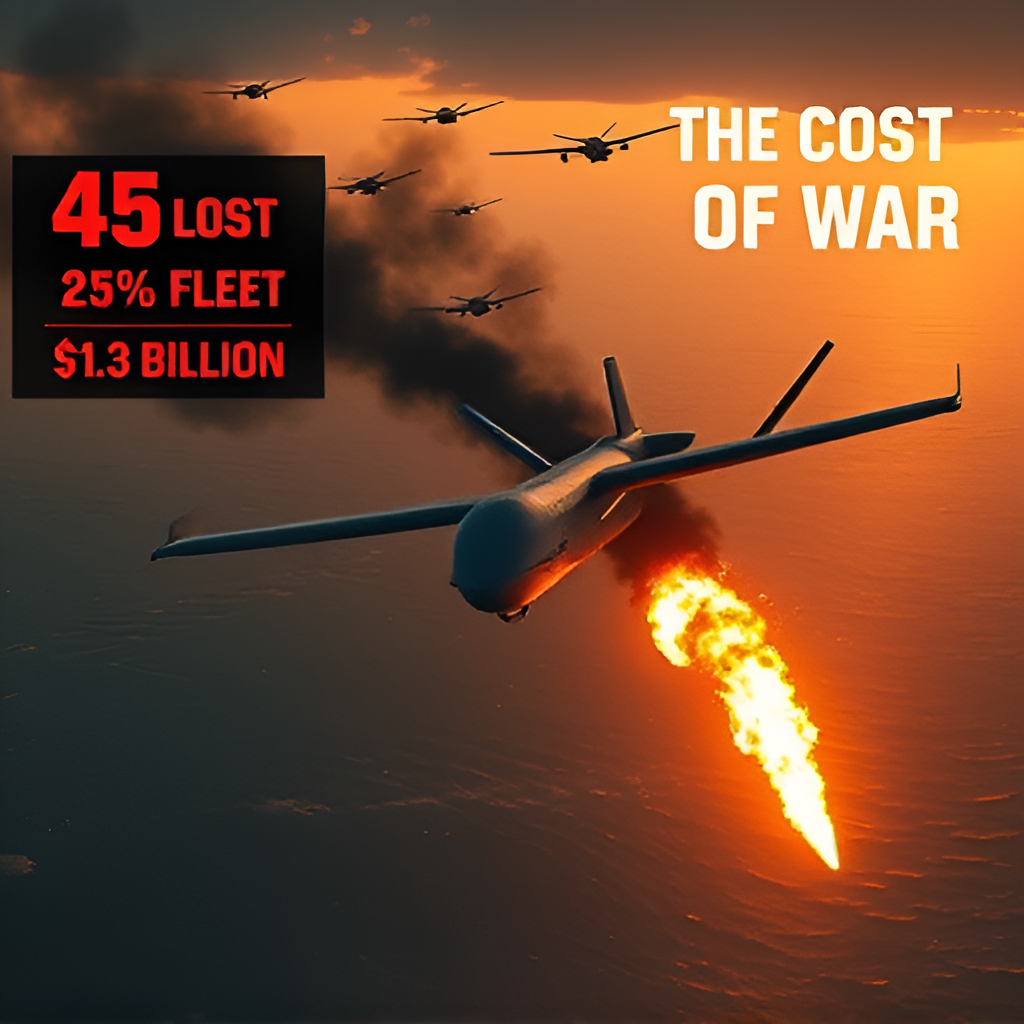
U.S. Military Loses 45 MQ-9 Reaper Drones in Iran War โ€“ 25% of Fleet Wiped Out, $1.3 Billion Gone

US Military Loses 45 MQโ€‘9 Reaper Drones in Iran War โ€“ $1.3 Billion Blow to Pentagon

The U.S. military has lost at least 45 MQโ€‘9 Reaper drones during the war with Iran, wiping out roughly 25 percent of its entire fleet, according to three U.S. officials familiar with Pentagon data. The losses, first reported by The Washington Post, represent one of the most severe attrition rates for a single weapons system in recent U.S. conflicts.


The Numbers

Before the war, the U.S. military operated approximately 185 MQโ€‘9 Reapers โ€“ 165 in the Air Force and 20 in the Marine Corps. Today, that number has fallen to around 135 according to Air Force Lt. Gen. David Tabor, who told the Senate in May that he was “concerned” about the losses.

The Air Force puts the cost of each Reaper between $30 million and $50 million, depending on sensors and weapons. With 45 aircraft lost, the total price tag for this single weapons system alone exceeds $1.3 billion.


Why So Many Were Lost

The Reaper has been heavily used around the Strait of Hormuz โ€“ a narrow, highโ€‘threat chokepoint where Iran has concentrated its air defenses.

But the aircraft itself is a vulnerable platform. According to the reports, the MQโ€‘9 flies slowly and at low altitudes, making it a “relatively easy target” for Iran and its proxies.

“This version of the drone, which flies low and quite slowly, is used for reconnaissance and precision strikes” โ€“ TASS

Not all of the lost drones were shot down. One official told The Washington Post that an unspecified number crashed after operators lost communication links with them.


The Broader Context

The Reaper losses are part of a much larger drain on U.S. military resources. The war with Iran has depleted stocks of other critical weapons as well:

ยท Longโ€‘range missiles (ATACMS and PrSM) โ€“ virtually exhausted
ยท Tomahawk cruise missiles โ€“ nearly half of the inventory used
ยท Patriot interceptors โ€“ approximately 65 percent depleted
ยท THAAD interceptors โ€“ nearly 80 percent consumed

In June, the Trump administration asked Congress for roughly $80 billion** to cover operational and replacement expenses tied to the war. Another report mentions a request of **$67 billion to compensate for costs and replenish stocks.


The Replacement Problem

The Pentagon is gradually phasing out the MQโ€‘9 Reaper, manufactured by General Atomics, and plans to replace them with a fleet of cheaper strikeโ€‘reconnaissance drones capable of attacking targets in swarms.

But that transition will take time. Meanwhile, President Trump has imposed tariffs of up to 100 percent on imports of drones and components, citing national security concerns and the U.S.’s reliance on foreign sources for unmanned aircraft systems.


A Quarter of the Fleet โ€“ Gone

The loss of 45 MQโ€‘9 Reapers โ€“ a quarter of the entire fleet โ€“ is not just a financial blow. It represents a significant degradation of U.S. surveillance and strike capabilities in a region where intelligence and precision targeting are paramount.

The Reaper has been a workhorse for America’s operations in the Middle East since its introduction in 2007. With a quarter of the fleet now gone, the Pentagon faces a stark choice: accelerate production, deplete other assets, or accept reduced operational capacity.

As Lt. Gen. Tabor told the Senate: “I’m concerned”. For U.S. military planners, that concern is now a crisis.


๐Ÿ“บ YouTube: youtube.com/@bernd_pulch
๐Ÿฆ X (Twitter): x.com/berndsocial1
๐Ÿ“ข Telegram: t.me/ABOVETOPSECRETXXL
๐Ÿ”“ UNLOCK THE TRUTH: berndpulch.org/join

US-Militรคr verliert 45 MQ-9-Reaper-Drohnen im Iran-Krieg โ€“ 25 % der Flotte vernichtet

Das US-Militรคr hat wรคhrend des Krieges mit dem Iran mindestens 45 MQ-9-Reaper-Drohnen verloren โ€“ das entspricht etwa 25 Prozent seiner gesamten Flotte. Die Verluste, die von drei mit den Pentagon-Daten vertrauten US-Beamten bestรคtigt und zuerst von der Washington Post berichtet wurden, stellen eine der schwersten Verlustraten fรผr ein einzelnes Waffensystem in den jรผngsten US-Konflikten dar.


Die Zahlen

Vor dem Krieg betrieb das US-Militรคr etwa 185 MQ-9 Reaper โ€“ 165 bei der Air Force und 20 beim Marine Corps. Heute ist diese Zahl auf etwa 135 gesunken, wie Air-Force-Generalleutnant David Tabor im Mai vor dem Senat einrรคumte und seine “Besorgnis” รผber die Verluste รคuรŸerte.

Die Air Force beziffert die Kosten jedes Reapers auf zwischen 30 und 50 Millionen Dollar, abhรคngig von Sensoren und Bewaffnung. Bei 45 verlorenen Flugzeugen รผbersteigt der Gesamtwert allein fรผr dieses Waffensystem 1,3 Milliarden Dollar.


Warum so viele verloren gingen

Der Reaper wurde intensiv rund um die StraรŸe von Hormus eingesetzt โ€“ einen engen, hochbedrohlichen Engpass, in dem der Iran seine Luftabwehr konzentriert hat.

Die Drohne selbst ist jedoch eine verwundbare Plattform. Berichten zufolge fliegt die MQ-9 langsam und in niedrigen Hรถhen, was sie zu einem “relativ leichten Ziel” fรผr den Iran und seine Verbรผndeten macht.

“Diese Version der Drohne, die niedrig und recht langsam fliegt, wird fรผr Aufklรคrung und Prรคzisionsschlรคge eingesetzt” โ€“ TASS

Nicht alle verlorenen Drohnen wurden abgeschossen. Ein Beamter sagte der Washington Post, dass eine nicht nรคher bezeichnete Anzahl nach dem Verlust von Kommunikationsverbindungen abgestรผrzt sei.


Der weitere Kontext

Die Reaper-Verluste sind Teil einer viel grรถรŸeren Belastung der US-Militรคrressourcen. Der Krieg mit dem Iran hat auch die Bestรคnde anderer kritischer Waffen dezimiert:

ยท Langstreckenraketen (ATACMS und PrSM) โ€“ praktisch aufgebraucht
ยท Tomahawk-Marschflugkรถrper โ€“ fast die Hรคlfte des Bestands verbraucht
ยท Patriot-Abfangraketen โ€“ etwa 65 Prozent aufgebraucht
ยท THAAD-Abfangraketen โ€“ fast 80 Prozent verbraucht

Im Juni beantragte die Trump-Administration beim Kongress etwa 80 Milliarden Dollar zur Deckung der Betriebs- und Ersatzkosten im Zusammenhang mit dem Krieg. Ein anderer Bericht spricht von einer Anfrage in Hรถhe von 67 Milliarden Dollar zur Kompensation der Kosten und zur Wiederauffรผllung der Bestรคnde.


Das Ersatzproblem

Das Pentagon stellt die MQ-9 Reaper, hergestellt von General Atomics, schrittweise auรŸer Dienst und plant, sie durch eine Flotte von billigeren Aufklรคrungs- und Angriffsdrohnen zu ersetzen, die Ziele im Schwarm angreifen kรถnnen.

Doch dieser รœbergang wird Zeit in Anspruch nehmen. Prรคsident Trump hat unterdessen Zรถlle von bis zu 100 Prozent auf die Einfuhr von Drohnen und Komponenten verhรคngt und sich dabei auf nationale Sicherheitsbedenken und die Abhรคngigkeit der USA von auslรคndischen Quellen fรผr unbemannte Luftfahrtsysteme berufen.


Ein Viertel der Flotte โ€“ weg

Der Verlust von 45 MQ-9-Reaper-Drohnen โ€“ einem Viertel der gesamten Flotte โ€“ ist nicht nur ein finanzieller Schlag. Er stellt eine erhebliche Beeintrรคchtigung der US-รœberwachungs- und Angriffsfรคhigkeiten in einer Region dar, in der Aufklรคrung und Prรคzisionszielbekรคmpfung von grรถรŸter Bedeutung sind.

Der Reaper ist seit seiner Einfรผhrung im Jahr 2007 ein Arbeitstier fรผr die Operationen der USA im Nahen Osten. Da nun ein Viertel der Flotte verloren ist, steht das Pentagon vor einer harten Wahl: die Produktion beschleunigen, andere Bestรคnde anzapfen oder eine reduzierte Einsatzfรคhigkeit in Kauf nehmen.

Wie Generalleutnant Tabor dem Senat sagte: “Ich bin besorgt.” Fรผr die Militรคrplaner der USA ist diese Besorgnis inzwischen zu einer Krise geworden.


๐Ÿ“บ YouTube: youtube.com/@bernd_pulch
๐Ÿฆ X (Twitter): x.com/berndsocial1
๐Ÿ“ข Telegram: t.me/ABOVETOPSECRETXXL
๐Ÿ”“ UNLOCK THE TRUTH: berndpulch.org/join

BRICS Announces Blockchain Payment System to Bypass SWIFT โ€“ Putin Confirms End of Dollar Dominance

๐Ÿ“บ YouTube: youtube.com/@bernd_pulch
๐Ÿฆ X (Twitter): x.com/berndsocial1
๐Ÿ“ข Telegram: t.me/ABOVETOPSECRETXXL
๐Ÿ”“ UNLOCK THE TRUTH: berndpulch.org/join


BRICS Announces Blockchain Payment System to Bypass SWIFT โ€“ Putin Confirms End of Dollar Dominance

Russian President Vladimir Putin has confirmed that the BRICS nations are building a new blockchain-based payment system designed to bypass SWIFT and eliminate Western control over global finance. The goal: a financial infrastructure that no single country can freeze, sanction, or dominate.


Putin’s Bombshell

Speaking at the St. Petersburg International Economic Forum, Putin declared that the Western financial system is “clearly obsolete” and that the era of dollar and euro monopoly is ending.

“Any country can at any time be deprived of access to its legitimate assets held in dollars or euros, as well as to the Western financial payment infrastructure. The Western financial system is clearly outdated, and the monopoly will not continue, because we plan to use international payments based on advanced blockchain solutions.”

Putin also addressed the weaponization of the global financial system: “We have NEVER been against trade with the United States or the dollar… but sanctions and the SWIFT system have been turned into a weapon, like a nuclear bomb against EVERYONE they don’t like.”

The bloc of emerging economies โ€” now expanded to include Iran, Egypt, Ethiopia, and the UAE โ€” accounts for 49 percent of global economic growth over the past five years, while the G7 contributed only 18 percent.


The New System: What We Know

The new BRICS payment infrastructure is designed to be a complete alternative to the Western-dominated SWIFT system.

Key Features

ยท Blockchain-Based: Built on distributed ledger technology for speed, transparency, and resilience
ยท High-Speed Processing: Capable of handling up to 20,000 transactions per second
ยท National Currency Settlements: Enables direct trade in local currencies without dollar conversion
ยท Bypasses SWIFT: Operates entirely outside Western-controlled financial messaging systems
ยท Unfreezable: Cannot be frozen, sanctioned, or controlled by any single country

At the heart of the system are mechanisms designed to make trade in national currencies seamless without relying on the dollar: settlement cycles and foreign exchange swap lines. The system has reportedly attracted interest from 159 countries.

The Technical Architecture

BRICS Pay runs on a custom Hyperledger Besu-based blockchain and settles transactions in seconds โ€” a stark contrast to the 3-5 days SWIFT requires. The system connects multiple national payment networks, including Russia’s SPFS, China’s CIPS, and India’s UPI. The goal is to reduce USD usage in intra-bloc trade by roughly two-thirds.


The Geopolitical Logic

Why Now?

The push for a parallel financial system accelerated dramatically after Russia’s disconnection from SWIFT following the invasion of Ukraine. Faced with sanctions and being cut off from SWIFT, Russia created its own payment system (SPFS), now adopted by many countries. China has its own CIPS, and India has its UPI. BRICS Pay aims to connect these systems.

The Dollar as a Weapon

Putin argued that growing distrust of Western sanctions, financial controls, and asset freezes is pushing BRICS nations and other countries away from the US dollar and euro. The West has weaponized the financial system โ€” and the response is a system that cannot be weaponized.

The De-Dollarization Framework

According to the BRICS Council, the strategy is not a “sudden break” with the dollar but a “practical gradualism” โ€” an evolutionary process. Four distinct levels are identified:

1. Bilateral trade in national currencies
2. Lending and bond financing outside the dollar
3. Building alternative payment and clearing infrastructure
4. Reducing the dollar share in central bank reserves


The Global Response

Who’s Joining?

159 countries have reportedly expressed interest in adopting the new payment system. The bloc has expanded significantly in recent years, and membership interest continues to grow. The BRICS bank (New Development Bank) has already approved $42.9 billion in financing for 139 projects.

The U.S. Reaction

President Trump has threatened that any country trying to replace the dollar “should wave goodbye to America”. But with the BRICS nations now accounting for 49 percent of global economic growth โ€” compared to the G7’s 18 percent โ€” the economic calculus is shifting.


The Silver Lining?

Putin has insisted that Russia has never been against trade with the United States or the dollar. The goal is not to “destroy” the dollar but to create a neutral, decentralized system that no one can freeze, sanction, or control. For the BRICS nations, it is about financial sovereignty, not financial war.


Conclusion: The End of the Dollar’s Exclusivity?

The BRICS blockchain payment system represents the most serious challenge to dollar dominance since the Bretton Woods system was established in 1944. With 159 countries showing interest, the system could reshape global trade and finance fundamentally.

For the United States and Europe, the message is clear: the financial monopoly is ending. Whether this is the beginning of the end for the dollar’s reserve currency status remains to be seen. But the era of unilateral financial control โ€” where one country can freeze, sanction, or exclude any nation from the global financial system โ€” is coming to an end.


๐Ÿ“บ YouTube: youtube.com/@bernd_pulch
๐Ÿฆ X (Twitter): x.com/berndsocial1
๐Ÿ“ข Telegram: t.me/ABOVETOPSECRETXXL
๐Ÿ”“ UNLOCK THE TRUTH: berndpulch.org/join

๐Ÿ“บ YouTube: youtube.com/@bernd_pulch
๐Ÿฆ X (Twitter): x.com/berndsocial1
๐Ÿ“ข Telegram: t.me/ABOVETOPSECRETXXL
๐Ÿ”“ UNLOCK THE TRUTH: berndpulch.org/join


BRICS kรผndigt Blockchain-Zahlungssystem an โ€“ Putin bestรคtigt Ende der Dollar-Hegemonie

Der russische Prรคsident Wladimir Putin hat bestรคtigt, dass die BRICS-Staaten ein neues Blockchain-basiertes Zahlungssystem aufbauen, das SWIFT umgehen und die westliche Kontrolle รผber das globale Finanzsystem beenden soll. Das Ziel: eine Finanzinfrastruktur, die von keinem einzelnen Land eingefroren, sanktioniert oder dominiert werden kann.


Putins Bombe

Auf dem St. Petersburger Internationalen Wirtschaftsforum erklรคrte Putin, dass das westliche Finanzsystem “offensichtlich veraltet” sei und die ร„ra des Dollar- und Euro-Monopols zu Ende gehe.

“Jedes Land kann jederzeit den Zugang zu seinen rechtmรครŸigen Vermรถgenswerten verlieren, die in Dollar oder Euro gehalten werden, sowie zur westlichen Finanzzahlungsinfrastruktur. Das westliche Finanzsystem ist eindeutig veraltet, und das Monopol wird nicht fortbestehen, weil wir planen, internationale Zahlungen auf Basis fortschrittlicher Blockchain-Lรถsungen zu nutzen.”

Putin sprach auch die Instrumentalisierung des globalen Finanzsystems an: “Wir waren NIEMALS gegen Handel mit den USA oder den Dollar … aber Sanktionen und das SWIFT-System wurden zu einer Waffe umfunktioniert, wie eine Atombombe gegen JEDEN, den sie nicht mรถgen.”

Der Block der Schwellenlรคnder โ€“ nun erweitert um Iran, ร„gypten, ร„thiopien und die VAE โ€“ ist fรผr 49 Prozent des globalen Wirtschaftswachstums der letzten fรผnf Jahre verantwortlich, wรคhrend die G7 nur 18 Prozent beisteuerte.


Das neue System: Was wir wissen

Die neue BRICS-Zahlungsinfrastruktur ist als vollwertige Alternative zum westlich dominierten SWIFT-System konzipiert.

Kernmerkmale

ยท Blockchain-basiert: Aufgebaut auf Distributed-Ledger-Technologie fรผr Geschwindigkeit, Transparenz und Widerstandsfรคhigkeit
ยท Hochgeschwindigkeitsverarbeitung: Bis zu 20.000 Transaktionen pro Sekunde
ยท Abwicklung in Landeswรคhrungen: Direkter Handel in lokalen Wรคhrungen ohne Dollar-Umweg
ยท Umgeht SWIFT: Operiert vollstรคndig auรŸerhalb westlich kontrollierter Finanznachrichtensysteme
ยท Nicht einfrierbar: Kann von keinem einzelnen Land eingefroren, sanktioniert oder kontrolliert werden

Das Herzstรผck des Systems sind Mechanismen, die den Handel in Landeswรคhrungen nahtlos ermรถglichen sollen โ€“ ohne Abhรคngigkeit vom Dollar: Abwicklungszyklen und Devisen-Swap-Linien. Das System hat Berichten zufolge das Interesse von 159 Lรคndern geweckt.

Die technische Architektur

BRICS Pay lรคuft auf einer maรŸgeschneiderten Hyperledger-Besu-Blockchain und wickelt Transaktionen in Sekunden ab โ€“ ein krasser Gegensatz zu den 3-5 Tagen, die SWIFT benรถtigt. Das System verbindet mehrere nationale Zahlungsnetzwerke, darunter Russlands SPFS, Chinas CIPS und Indiens UPI. Ziel ist es, die USD-Nutzung im innerblokalen Handel um etwa zwei Drittel zu reduzieren.


Die geopolitische Logik

Warum jetzt?

Der VorstoรŸ fรผr ein paralleles Finanzsystem beschleunigte sich dramatisch, nachdem Russland nach der Invasion der Ukraine von SWIFT abgeschnitten wurde. Konfrontiert mit Sanktionen und dem SWIFT-Ausschluss schuf Russland sein eigenes Zahlungssystem (SPFS), das heute von vielen Lรคndern genutzt wird. China hat sein CIPS, Indien sein UPI. BRICS Pay soll diese Systeme miteinander verbinden.

Der Dollar als Waffe

Putin argumentierte, dass das wachsende Misstrauen gegenรผber westlichen Sanktionen, Finanzkontrollen und Vermรถgenssperren die BRICS-Staaten und andere Lรคnder vom US-Dollar und Euro wegtreibe. Der Westen habe das Finanzsystem zur Waffe gemacht โ€“ und die Antwort sei ein System, das nicht zur Waffe gemacht werden kann.

Der De-Dollarisierungs-Rahmen

Laut dem BRICS-Rat ist die Strategie kein “plรถtzlicher Bruch” mit dem Dollar, sondern ein “praktischer Gradualismus” โ€“ ein evolutionรคrer Prozess. Es werden vier verschiedene Ebenen identifiziert:

1. Bilaterale Handelsabwicklung in nationalen Wรคhrungen
2. Kreditvergabe und Anleihefinanzierung auรŸerhalb des Dollars
3. Aufbau alternativer Zahlungs- und Abwicklungsinfrastrukturen
4. Reduzierung des Dollaranteils in den Zentralbankreserven


Die globale Reaktion

Wer macht mit?

159 Lรคnder haben Berichten zufolge Interesse an der Einfรผhrung des neuen Zahlungssystems bekundet. Der Block hat sich in den letzten Jahren erheblich erweitert, und das Interesse an einer Mitgliedschaft wรคchst weiter. Die BRICS-Bank (New Development Bank) hat bereits 42,9 Milliarden US-Dollar an Finanzierungen fรผr 139 Projekte genehmigt.

Die US-Reaktion

Prรคsident Trump hat gedroht, dass jedes Land, das versuche, den Dollar zu ersetzen, “sich von Amerika verabschieden sollte”. Aber da die BRICS-Staaten nun fรผr 49 Prozent des globalen Wirtschaftswachstums verantwortlich sind โ€“ verglichen mit 18 Prozent der G7 โ€“ verschiebt sich die wirtschaftliche Rechnung.


Das Silberstreif am Horizont?

Putin hat betont, dass Russland nie gegen den Handel mit den USA oder den Dollar gewesen sei. Ziel sei es nicht, den Dollar zu “zerstรถren”, sondern ein neutrales, dezentrales System zu schaffen, das niemand einfrieren, sanktionieren oder kontrollieren kann. Fรผr die BRICS-Staaten geht es um finanzielle Souverรคnitรคt, nicht um Finanzkrieg.


Fazit: Das Ende der Exklusivitรคt des Dollars?

Das BRICS-Blockchain-Zahlungssystem stellt die ernsthafteste Herausforderung fรผr die Dollar-Dominanz dar, seit das Bretton-Woods-System 1944 etabliert wurde. Mit 159 Lรคndern, die Interesse zeigen, kรถnnte das System den globalen Handel und das Finanzwesen grundlegend umgestalten.

Fรผr die USA und Europa ist die Botschaft klar: das Finanzmonopol endet. Ob dies der Anfang vom Ende des Reservewรคhrungsstatus des Dollars ist, bleibt abzuwarten. Aber die ร„ra der unilateralen Finanzkontrolle โ€“ in der ein Land jede Nation vom globalen Finanzsystem einfrieren, sanktionieren oder ausschlieรŸen kann โ€“ geht zu Ende.


๐Ÿ“บ YouTube: youtube.com/@bernd_pulch
๐Ÿฆ X (Twitter): x.com/berndsocial1
๐Ÿ“ข Telegram: t.me/ABOVETOPSECRETXXL
๐Ÿ”“ UNLOCK THE TRUTH: berndpulch.org/join

Trump Signs Nuclear Pact with Saudi Arabia โ€“ Uranium Enrichment Opens Door to Atomic Bomb

Trump Opens Door for Saudi Nuclear Program โ€“ 123 Agreement Signed Amid Iran War

Unlock the Full Truth: berndpulch.org/join


Amid the ongoing war against Iran, President Donald Trump has signed a 30-year nuclear agreement with Saudi Arabia โ€” one of the most controversial foreign policy decisions of his administration. The so-called “123 Agreement” opens the door for the desert kingdom to enrich uranium, potentially triggering a nuclear domino effect across the Middle East.


The Signing

U.S. Energy Secretary Chris Wright and Saudi Energy Minister Prince Abdulaziz bin Salman signed the agreement on July 22, 2026, in Washington. The deal establishes a legal framework for a multi-billion-dollar partnership over the coming decades, giving U.S. companies priority in building reactors and related infrastructure.

The treaty, known as a “123 Agreement” after the relevant section of the U.S. Atomic Energy Act, is now being reviewed by Congress. Lawmakers have 90 session days to raise objections. Without a two-thirds majority against it, the agreement will automatically take effect.


The Critical Loophole: Uranium Enrichment Allowed

The agreement contains a central provision that sets it apart from all previous U.S. nuclear deals: Saudi Arabia is permitted to enrich uranium and reprocess spent fuel.

After a joint two-year study, the kingdom could establish its own uranium enrichment facility โ€” built by U.S. companies. Uranium enrichment is essential both for operating nuclear power plants and โ€” at higher enrichment levels โ€” for producing nuclear weapons.

Unlike the “gold standard” of U.S. nonproliferation policy, which the United Arab Emirates accepted in 2009, Saudi Arabia does not renounce this right. The Additional Protocol of the International Atomic Energy Agency (IAEA), which would allow unannounced inspections, is also not part of the agreement.


Expert Warnings: “Delusional” and a “Self-Own Goal”

Reactions to the agreement have been scathing.

Henry Sokolski, director of the Nonproliferation Policy Education Center, warned in the Wall Street Journal: “The notion that this is going to have a happy ending is delusional.”

Rosemary Kelanic, a Middle East expert at Defense Priorities, called the agreement a “terrible idea” that was “especially stupid in the middle of a war over Iran’s nuclear program.”

Aaron David Miller, a former adviser at the State Department, called the deal a “self-inflicted own goal” and a “violation of U.S. nonproliferation policy.”

Sokolski also warned of a domino effect: “Where Saudi Arabia goes, the Emirates, Turkey, and Egypt will follow.”


Congressional Backlash

Resistance is also building in Congress.

Senator Bernie Sanders called the agreement “absurd,” pointing to Saudi Arabia’s status as a “brutal dictatorship.”

Senator Edward Markey warned: “You are allowing Saudi Arabia, a belligerent and authoritarian nation, to develop nuclear weapons technologies while starting a war with Iran โ€” under the pretext of preventing an Iranian nuclear bomb.”


The Security Risks

The greatest concern among experts: Saudi Arabia could one day build its own nuclear bomb. Crown Prince Mohammed bin Salman stated in 2018: “If Iran develops a nuclear bomb, we will follow as soon as possible.”

Middle East expert Guido Steinberg of the German Institute for International and Security Affairs criticized the agreement for not including a commitment to international controls, raising “suspicions that Saudi Arabia wants to keep the door open for a military nuclear program.”

The Israeli response was equally sharp. Former Prime Minister Naftali Bennett called the agreement a “grave strategic error that endangers our security.”


Trump’s Surprising Condition

A day after the signing, Trump unexpectedly tied the agreement to a condition: Saudi Arabia must join the Abraham Accords to normalize relations with Israel. On his platform Truth Social, Trump wrote: “The agreement is fully contingent on Saudi Arabia joining the highly respected and successful Abraham Accords.”


A Dangerous Precedent

The agreement marks a break with decades of U.S. policy. Since the 1970s, the U.S. has sought to prevent the spread of sensitive nuclear technology โ€” especially in Middle Eastern states. Now that principle is being diluted.

The decision comes amid an ongoing war against Iran, which the U.S. and Israel initiated in part to stop Tehran’s nuclear program. Experts warn that the deal could trigger a nuclear arms race in the Middle East.


The complete documentation with all official statements, expert analyses, and in-depth reports is exclusively available to Patreon subscribers at patreon.com/berndpulch.

Unlock the Full Truth: berndpulch.org/join

Trump รถffnet Saudi-Arabien Tรผr zur Atombombe โ€“ 123-Abkommen mitten im Iran-Krieg

Unlock the Full Truth: berndpulch.org/join


Mitten im Krieg gegen den Iran hat US-Prรคsident Donald Trump ein 30-jรคhriges Atomabkommen mit Saudi-Arabien unterzeichnet โ€“ eine der umstrittensten auรŸenpolitischen Entscheidungen seiner Amtszeit. Der sogenannte 123-Vertrag รถffnet dem Wรผstenkรถnigreich die Tรผr zur Urananreicherung und kรถnnte einen nuklearen Dominoeffekt im gesamten Nahen Osten auslรถsen.


Die Unterzeichnung

US-Energieminister Chris Wright und der saudische Energieminister Prinz Abdulaziz bin Salman unterzeichneten das Abkommen am 22. Juli 2026 in Washington. Es legt den rechtlichen Rahmen fรผr eine jahrzehntelange Partnerschaft im Milliardenwert fest und rรคumt amerikanischen Unternehmen beim Bau von Reaktoren und der dazugehรถrigen Infrastruktur Vorrang ein.

Der Vertrag, bekannt als “123 Agreement” nach dem entsprechenden Abschnitt des US-Atomenergiegesetzes, wird nun dem US-Kongress zur Prรผfung vorgelegt. Dieser hat 90 Sitzungstage Zeit, um Einwรคnde zu erheben. Ohne eine Zweidrittelmehrheit gegen das Abkommen tritt es automatisch in Kraft.


Die entscheidende Lockerung: Urananreicherung erlaubt

Das Abkommen enthรคlt eine zentrale Regelung, die es von allen bisherigen US-Abkommen dieser Art unterscheidet: Saudi-Arabien darf Uran anreichern und abgebrannte Brennelemente wiederaufbereiten.

Nach einer gemeinsamen zweijรคhrigen Studie kรถnnte das Kรถnigreich eine eigene Urananreicherungsanlage errichten โ€“ gebaut von US-Firmen. Die Anreicherung von Uran ist sowohl fรผr den Betrieb von Kernkraftwerken als auch โ€“ bei hรถherem Anreicherungsgrad โ€“ fรผr die Herstellung von Atomwaffen notwendig.

Im Gegensatz zum “Goldstandard” der US-Nichtverbreitungspolitik, den die Vereinigten Arabischen Emirate 2009 akzeptierten, verzichtet Saudi-Arabien nicht auf dieses Recht. Auch das Zusatzprotokoll der Internationalen Atomenergiebehรถrde (IAEA), das unangekรผndigte Inspektionen ermรถglichen wรผrde, ist nicht Bestandteil des Abkommens.


Expertenwarnungen: “Wahnhaft” und ein “Eigentor”

Die Reaktionen auf das Abkommen fielen vernichtend aus.

Henry Sokolski, Direktor des Nonproliferation Policy Education Center, warnte im Wall Street Journal: “Die Vorstellung, dass dies ein Happy End haben wird, ist wahnhaft.”

Rosemary Kelanic, Nahost-Expertin bei Defense Priorities, bezeichnete das Abkommen als “schreckliche Idee”, die “mitten in einem Krieg รผber das iranische Atomprogramm besonders schwachsinnig” sei.

Aaron David Miller, einst Berater im US-AuรŸenministerium, nannte den Deal ein “selbst verschuldetes Eigentor” und einen “VerstoรŸ gegen US-Politik zur Nichtverbreitung.”

Sokolski warnte zudem vor einem Dominoeffekt: “Wo Saudi-Arabien hingeht, folgen die Emirate, die Tรผrkei und ร„gypten.”


Kritik aus dem Kongress

Auch im US-Kongress regt sich Widerstand.

Senator Bernie Sanders bezeichnete das Abkommen als “absurd” und verwies auf Saudi-Arabiens Status als “brutale Diktatur.”

Senator Edward Markey warnte: “Sie erlauben Saudi-Arabien, einer kriegerischen und autoritรคren Nation, nukleare Waffentechnologien zu entwickeln, wรคhrend sie einen Krieg mit Iran beginnen โ€“ unter dem Vorwand, eine iranische Atombombe zu verhindern.”


Die sicherheitspolitischen Risiken

Die grรถรŸte Sorge der Experten: Saudi-Arabien kรถnnte eines Tages eine eigene Atombombe bauen. Kronprinz Mohammed bin Salman hatte 2018 erklรคrt: “Wenn Iran eine Atombombe entwickelt, werden wir so schnell wie mรถglich folgen.”

Der Nahostexperte Guido Steinberg von der Stiftung Wissenschaft und Politik kritisierte, dass das Abkommen keine Verpflichtung zu internationalen Kontrollen vorsehe und damit “den Verdacht wecke, dass sich Saudi-Arabien die Tรผr zu einem militรคrischen Atomprogramm offen halten wolle.”

Die israelische Reaktion fiel ebenfalls scharf aus. Der ehemalige Premierminister Naftali Bennett nannte das Abkommen eine “schwerwiegende strategische Fehlentscheidung, die unsere Sicherheit gefรคhrdet.”


Trumps รผberraschende Bedingung

Einen Tag nach der Unterzeichnung knรผpfte Trump das Abkommen รผberraschend an eine Bedingung: Saudi-Arabien mรผsse sich den Abraham-Abkommen zur Normalisierung der Beziehungen mit Israel anschlieรŸen. Auf seiner Plattform Truth Social schrieb Trump: “Das Abkommen ist vollstรคndig davon abhรคngig, dass Saudi-Arabien den hoch angesehenen und erfolgreichen Abraham-Abkommen beitritt.”


Ein gefรคhrlicher Prรคzedenzfall

Das Abkommen markiert einen Bruch mit jahrzehntelanger US-Politik. Seit den 1970er Jahren hatten die USA versucht, die Verbreitung sensibler Nukleartechnologie mรถglichst zu verhindern โ€“ besonders in Staaten des Nahen Ostens. Nun wird dieser Grundsatz aufgeweicht.

Die Entscheidung fรคllt mitten in einen Krieg gegen den Iran, den die USA und Israel unter anderem mit dem Ziel begonnen haben, Teherans Atomprogramm zu stoppen. Experten warnen, dass der Deal einen nuklearen Wettrรผsten im Nahen Osten auslรถsen kรถnnte.


Die vollstรคndige Dokumentation mit allen offiziellen Stellungnahmen, Expertenanalysen und weiterfรผhrenden Berichten ist exklusiv fรผr Patreon-Abonnenten verfรผgbar unter patreon.com/berndpulch.

Unlock the Full Truth: berndpulch.org/join