
Trump’s Iran War Unravels: Gas Prices, Nuclear Threats, and the Battle for Gaza

Trump’s Iran War Unravels: Gas Prices, Nuclear Threats, and the Battle for Gaza

Unlock the Full Truth: berndpulch.org/join


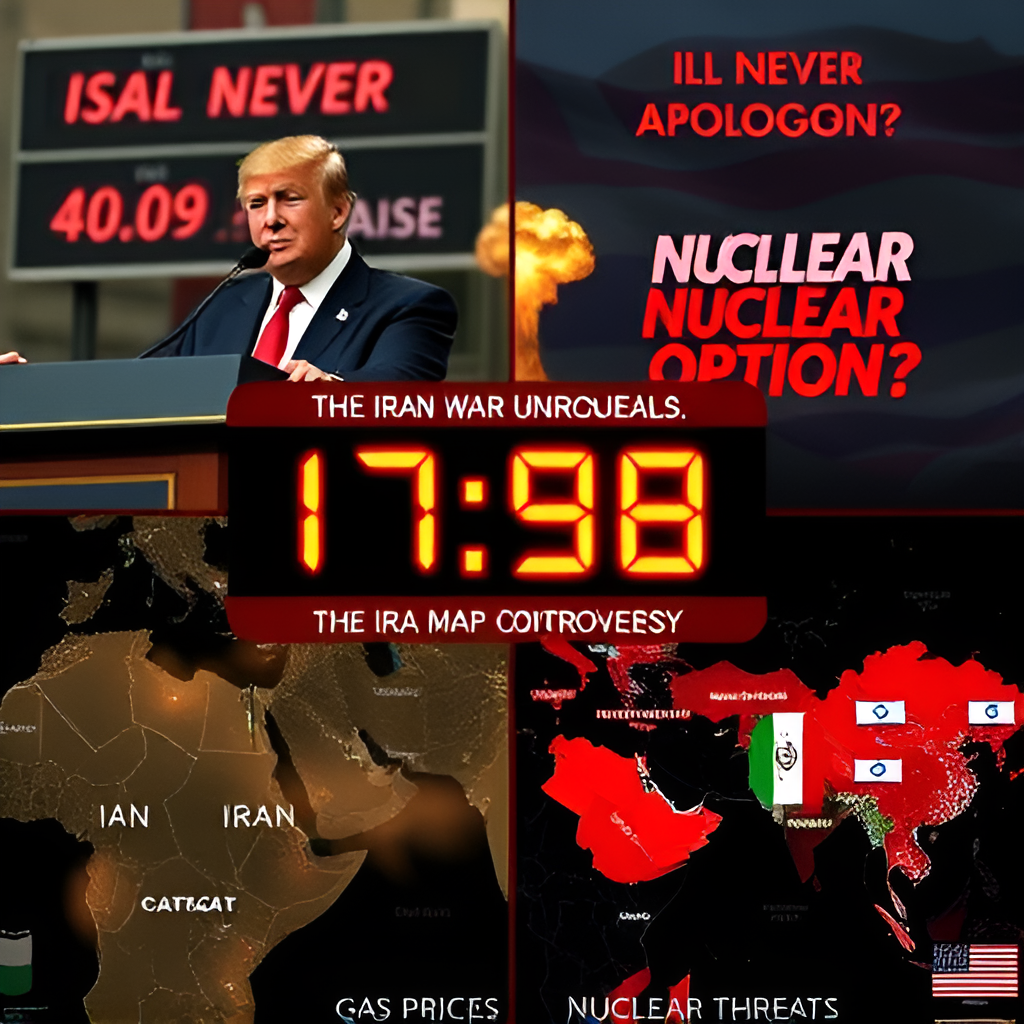
Just days after telling Americans that $4-a-gallon gasoline is “okay” and he will “never apologize” for the Iran war, President Trump finds himself at the center of a mounting political storm. From growing whispers of nuclear war to an escalating influence campaign to shape public opinion, the administration’s strategy appears to be fraying on multiple fronts.


“I’ll Never Apologize”: Trump Defends Iran War as Gas Prices Soar

Speaking at an event in Nassau County, New York, on August 14, Trump minimized the financial toll of the conflict on American households, arguing his decision to strike Iran was the “right” one.

“For you to pay a tiny little bit more for your gasoline, just remember you’re doing it so that a very evil country cannot have—a country, really, it’s the number one state sponsor of terror in the world—we don’t want to have them have a nuclear weapon.”

Trump acknowledged that Americans are paying around $4 per gallon but brushed aside concerns: *”You’re at $4. It’s okay. I mean, it’s—I’m not, I’m not, I’ll never apologize. I did the right thing.”*

The Price at the Pump

The president’s remarks came as the national average price of regular gasoline reached about $4.07 a gallon** on Friday, compared with $3.85 a month earlier and $3.16 a year ago. According to GasBuddy, Americans are spending **$338 million more on gasoline each day than they did one year ago.

Before the U.S. and Israel launched joint strikes on Iran on February 28, the national average had dipped just below $3, at $2.98. The war has effectively closed the Strait of Hormuz—a chokepoint through which roughly 20 percent of global oil and liquefied natural gas shipments passed before the conflict. Ship-tracking firm Kpler recorded only two vessels crossing the strait on Friday, with no crude oil shipments, compared to more than 130 ships daily before the war.

Trump Threatens New Sanctions on China Over Iran Oil

On Friday, Trump vowed to hit Iran hard economically, a day after Treasury Secretary Scott Bessent said that Washington would impose measures on Tehran that have “never been seen” as soon as next week.

Experts say the Trump administration could target Chinese “teapot” refiners—independent refineries that account for a quarter of Chinese refinery capacity and absorb much of the Iranian oil trade. China buys more than 80% of Iran’s shipped oil, according to 2025 data from analytics firm Kpler.

The administration could also impose secondary sanctions on Chinese banks. OFAC has already imposed sanctions on smaller China- and Hong Kong-based entities accused of processing billions of dollars in Iranian oil.

“Hitting those two banks could have a chilling effect on bigger financial institutions,” sanctions experts said, “although they warned it could also trigger retaliatory actions by Beijing.”


Marjorie Taylor Greene: White House Discussing Nuclear Strike on Iran

In a startling revelation, former Congresswoman Marjorie Taylor Greene has claimed that White House officials have discussed the potential use of nuclear weapons against Iran during strategic meetings.

Greene labeled the potential decision as “pure evil” and called for an end to the “madness of American warmongers.” Alluding to the atomic bombings of Hiroshima and Nagasaki in 1945, she emphasized that available data confirms the existence of these dangerous plans and challenged what she described as Trump’s fabrications.

“They are discussing using nuclear weapons on Iran in strategy meetings. I’m not speculating.” — Marjorie Taylor Greene

The former congresswoman’s claims have intensified concerns about the trajectory of the U.S.-Iran conflict, with critics warning that such rhetoric dangerously lowers the threshold for nuclear use.


Israel’s AI Influence Campaign: Flooding ChatGPT with Pro-Israel Content

Documents submitted to the U.S. Justice Department have revealed an Israeli-funded public relations campaign aimed at influencing how AI systems like ChatGPT and Perplexity respond to questions about Gaza and the Israel Defense Forces.

The campaign, run by French public relations firm Havas Media through the advertising company Piro, involves creating and distributing content under the name of the “Hanover Institute for Public Policy.”

The campaign is valued at $100,000 and includes the production of more than 12 articles published on the institute’s website.

“The documents describe the campaign’s goal as ‘creating and disseminating factual, source-supported informational materials aimed at educating the American public about Israel and related issues.'”

However, tests conducted by Politico showed that ChatGPT and Perplexity cited materials from the campaign in their responses to questions about Gaza and anti-Semitism. Critics have accused Israel of attempting to manipulate the training data of large language models to shape public narrative.


CENTCOM Map Sparks Outrage: Gaza and West Bank Depicted as Israeli Territory

The U.S. Central Command (CENTCOM) was forced to issue an urgent amendment to an official map of the Middle East after its initial version sparked widespread controversy for integrating the West Bank and Gaza Strip within the borders of Israel.

The original map, published from the command’s headquarters in Florida, ignored the dividing borders of the Palestinian territories. It was quickly replaced with a revised version that clearly shows the West Bank and Gaza Strip as separate from Israel, based on the 1967 borders.

CENTCOM did not offer an apology or a direct explanation for what it called a “geographical error.”

Jared Kushner Meets Hamas Leaders to Push Gaza Demilitarization

In a rare and high-stakes diplomatic move, President Trump’s son-in-law and envoy Jared Kushner met with Hamas leaders in Egypt on Sunday to advance a Gaza peace plan rejected by Israel.

Kushner pressed Hamas for “concrete, verifiable steps” on disarmament and an end to any future Hamas role in running Gaza.

Hamas political leader Khalil al-Hayya attended the meeting, alongside Egyptian intelligence chief Hassan Rashad, a Qatari diplomat, and a senior Turkish official.

“There can be no ambiguity: Hamas must relinquish governing authority and all weapons and military infrastructure. And Gaza can never again be a source of terror for Israel.”

Kushner is expected to visit Israel on Monday to meet Prime Minister Benjamin Netanyahu and discuss “corresponding steps” Israel must take, including withdrawals from Gaza and accelerating humanitarian relief.

The meeting came hours after eight Muslim countries, including Saudi Arabia, Egypt, Jordan, and Turkey, condemned Israel’s rejection of the roadmap for implementing Trump’s Gaza peace plan.


Conclusion

The converging crises—soaring gas prices, a potentially escalating economic war with China, the specter of nuclear weapons, a secret influence campaign to manipulate AI, and a diplomatic map that erased Palestinian territories—paint a picture of an administration struggling to contain the consequences of its own foreign policy.

Trump’s defiant refusal to apologize for the economic pain of the Iran war may satisfy his base, but with the November midterm elections approaching, the political calculus is shifting. And as the world watches the Strait of Hormuz, the battle for Gaza, and the battle for the narrative play out simultaneously, the question is no longer whether the administration can win the war—but whether it can survive the fallout.


📺 YouTube: youtube.com/@bernd_pulch
🐦 X (Twitter): x.com/berndsocial1
📢 Telegram: t.me/ABOVETOPSECRETXXL
🔓 UNLOCK THE TRUTH: berndpulch.org/join


Trumps Iran-Krieg entgleitet: Benzinpreise, Atomdrohungen und der Kampf um Gaza

Unlock the Full Truth: berndpulch.org/join


Nur wenige Tage, nachdem er den Amerikanern sagte, dass 4-Dollar-Benzin “in Ordnung” sei und er sich “niemals entschuldigen” werde, findet sich Präsident Trump im Zentrum eines wachsenden politischen Sturms wieder. Von immer lauter werdenden Flüstern über Atomkrieg bis hin zu einer eskalierenden Einflusskampagne zur Steuerung der öffentlichen Meinung – die Strategie der Regierung bröckelt an mehreren Fronten.


“Ich werde mich nie entschuldigen”: Trump verteidigt Iran-Krieg bei steigenden Benzinpreisen

Bei einem Auftritt im Nassau County, New York, am 14. August bagatellisierte Trump die finanziellen Auswirkungen des Konflikts auf amerikanische Haushalte und argumentierte, seine Entscheidung, den Iran anzugreifen, sei die “richtige” gewesen.

“Wenn Sie ein kleines bisschen mehr für Ihr Benzin bezahlen, denken Sie einfach daran, dass Sie es tun, damit ein sehr böses Land keine Atomwaffe bekommen kann – ein Land, das wirklich der größte staatliche Sponsor des Terrors der Welt ist.”

Trump räumte ein, dass die Amerikaner etwa 4 Dollar pro Gallone zahlen, wischte die Bedenken jedoch beiseite: “Sie sind bei 4 Dollar. Das ist in Ordnung. Ich werde mich nie entschuldigen. Ich habe das Richtige getan.”

Der Preis an der Zapfsäule

Die Äußerungen des Präsidenten erfolgten, als der nationale Durchschnittspreis für Normalbenzin am Freitag etwa 4,07 Dollar pro Gallone erreichte, gegenüber 3,85 Dollar vor einem Monat und 3,16 Dollar vor einem Jahr. Laut GasBuddy geben die Amerikaner täglich 338 Millionen Dollar mehr für Benzin aus als vor einem Jahr.

Bevor die USA und Israel am 28. Februar gemeinsame Angriffe auf den Iran starteten, war der nationale Durchschnitt knapp unter 3 Dollar auf 2,98 Dollar gefallen. Der Krieg hat die Straße von Hormus faktisch geschlossen – einen Engpass, durch den vor dem Konflikt etwa 20 Prozent der weltweiten Öl- und Flüssigerdgas-Lieferungen flossen. Die Schifffahrtsverfolgungsfirma Kpler verzeichnete am Freitag nur zwei Schiffe, die die Meerenge durchquerten, ohne Rohöltransporte, verglichen mit mehr als 130 Schiffen täglich vor dem Krieg.


Trump droht mit neuen Sanktionen gegen China wegen Iran-Öl

Am Freitag gelobte Trump, den Iran wirtschaftlich hart zu treffen, einen Tag nachdem Finanzminister Scott Bessent erklärt hatte, dass Washington bereits nächste Woche Maßnahmen gegen Teheran ergreifen werde, die es “nie zuvor gegeben habe”.

Experten zufolge könnte die Trump-Administration chinesische “Teapot”-Raffinerien ins Visier nehmen – unabhängige Raffinerien, die ein Viertel der chinesischen Raffineriekapazität ausmachen und einen Großteil des iranischen Ölhandels absorbieren. China kauft mehr als 80 Prozent des iranischen verschifften Öls, wie Daten des Analyseunternehmens Kpler aus dem Jahr 2025 zeigen.

Die Regierung könnte auch sekundäre Sanktionen gegen chinesische Banken verhängen. OFAC hat bereits Sanktionen gegen kleinere Unternehmen mit Sitz in China und Hongkong verhängt, denen vorgeworfen wird, Milliarden von Dollar an iranischem Öl abgewickelt zu haben.

“Wenn man diese beiden Banken trifft, könnte das eine abschreckende Wirkung auf größere Finanzinstitute haben”, sagten Sanktionsexperten, “obwohl sie warnten, dass dies auch Vergeltungsmaßnahmen Pekings auslösen könnte.”


Marjorie Taylor Greene: Weißes Haus diskutiert Atomschlag gegen Iran

In einer schockierenden Enthüllung behauptete die ehemalige Kongressabgeordnete Marjorie Taylor Greene, dass Beamte des Weißen Hauses in Strategiegesprächen den möglichen Einsatz von Atomwaffen gegen den Iran diskutiert hätten.

Greene bezeichnete die mögliche Entscheidung als “reines Böse” und forderte ein Ende des “Wahnsinns der amerikanischen Kriegstreiber”. Unter Anspielung auf die Atombombenabwürfe auf Hiroshima und Nagasaki 1945 betonte sie, dass verfügbare Daten die Existenz dieser gefährlichen Pläne bestätigten, und stellte das in Frage, was sie als Trumps Erfindungen bezeichnete.

“Sie diskutieren in Strategiegesprächen den Einsatz von Atomwaffen gegen den Iran. Das ist keine Spekulation.” — Marjorie Taylor Greene

Die Behauptungen der ehemaligen Kongressabgeordneten haben die Besorgnis über den Kurs des US-iranischen Konflikts verstärkt, wobei Kritiker warnen, dass eine solche Rhetorik die Schwelle für den Atomwaffeneinsatz gefährlich senke.


Israels KI-Einflusskampagne: ChatGPT mit pro-israelischen Inhalten fluten

Dem US-Justizministerium vorgelegte Dokumente enthüllen eine israelisch finanzierte PR-Kampagne zur Beeinflussung von KI-Systemen wie ChatGPT und Perplexity bei Fragen zu Gaza und der israelischen Armee.

Die von der französischen PR-Agentur Havas Media über die Werbefirma Piro durchgeführte Kampagne beinhaltet die Erstellung und Verbreitung von Inhalten unter dem Namen des “Hanover Institute for Public Policy”.

Die Kampagne hat ein Volumen von 100.000 Dollar und umfasst die Produktion von mehr als 12 Artikeln, die auf der Website des Instituts veröffentlicht wurden.

“Die Dokumente beschreiben das Ziel der Kampagne als ‘Schaffung und Verbreitung von faktenbasierten, quellenunterstützten Informationsmaterialien zur Aufklärung der amerikanischen Öffentlichkeit über Israel und verwandte Themen’.”

Tests von Politico zeigten jedoch, dass ChatGPT und Perplexity in ihren Antworten auf Fragen zu Gaza und Antisemitismus auf Materialien aus der Kampagne zurückgriffen. Kritiker beschuldigten Israel, zu versuchen, die Trainingsdaten großer Sprachmodelle zu manipulieren, um die öffentliche Erzählung zu beeinflussen.


CENTCOM-Karte löst Empörung aus: Gaza und Westjordanland als israelisches Territorium dargestellt

Das US Central Command (CENTCOM) sah sich gezwungen, eine dringende Korrektur einer offiziellen Karte des Nahen Ostens vorzunehmen, nachdem die erste Version wegen der Einbeziehung des Westjordanlands und des Gazastreifens in die Grenzen Israels für Empörung gesorgt hatte.

Die ursprüngliche Karte, die vom Hauptquartier des Kommandos in Florida veröffentlicht wurde, ignorierte die Trennlinien der palästinensischen Gebiete. Sie wurde schnell durch eine überarbeitete Version ersetzt, die das Westjordanland und den Gazastreifen als von Israel getrennt darstellt, basierend auf den Grenzen von 1967.

CENTCOM entschuldigte sich nicht und gab keine direkte Erklärung für den von ihm als “geografischen Fehler” bezeichneten Vorfall ab.


Jared Kushner trifft Hamas-Führer zur Förderung der Gaza-Entmilitarisierung

In einem seltenen und hochriskanten diplomatischen Schritt traf Präsident Trumps Schwiegersohn und Gesandter Jared Kushner am Sonntag in Ägypten mit Hamas-Führern zusammen, um einen von Israel abgelehnten Gaza-Friedensplan voranzutreiben.

Kushner drängte die Hamas zu “konkreten, überprüfbaren Schritten” zur Entwaffnung und zu einem Ende jeder künftigen Hamas-Rolle bei der Verwaltung des Gazastreifens.

Der politische Führer der Hamas, Khalil al-Hayya, nahm an dem Treffen teil, zusammen mit dem ägyptischen Geheimdienstchef Hassan Rashad, einem katarischen Diplomaten und einem hochrangigen türkischen Beamten.

“Es darf keine Unklarheit geben: Die Hamas muss ihre Regierungsgewalt sowie alle Waffen und militärischen Einrichtungen aufgeben. Und Gaza darf nie wieder eine Quelle des Terrors für Israel sein.”

Kushner wird am Montag in Israel erwartet, um sich mit Ministerpräsident Benjamin Netanyahu zu treffen und über “entsprechende Schritte” zu sprechen, die Israel unternehmen muss, darunter Abzüge aus Gaza und die Beschleunigung humanitärer Hilfslieferungen.

Das Treffen fand nur Stunden statt, nachdem acht muslimische Länder, darunter Saudi-Arabien, Ägypten, Jordanien und die Türkei, die Ablehnung Israels gegenüber dem Fahrplan zur Umsetzung von Trumps Gaza-Friedensplan verurteilt hatten.


Fazit

Die sich überschneidenden Krisen – steigende Benzinpreise, ein potenziell eskalierender Wirtschaftskrieg mit China, der Schrecken von Atomwaffen, eine geheime Einflusskampagne zur Manipulation von KI und eine diplomatische Karte, die palästinensische Gebiete auslöschte – zeichnen das Bild einer Regierung, die darum kämpft, die Folgen ihrer eigenen Außenpolitik zu kontrollieren.

Trumps trotzige Weigerung, sich für die wirtschaftlichen Folgen des Iran-Krieges zu entschuldigen, mag seine Anhänger zufriedenstellen, aber angesichts der bevorstehenden Zwischenwahlen im November verschiebt sich die politische Rechnung. Und während die Welt die Straße von Hormus, den Kampf um Gaza und den Kampf um die Erzählung gleichzeitig verfolgt, stellt sich nicht mehr die Frage, ob die Regierung den Krieg gewinnen kann – sondern ob sie den politischen Scherbenhaufen überleben kann.


📺 YouTube: youtube.com/@bernd_pulch
🐦 X (Twitter): x.com/berndsocial1
📢 Telegram: t.me/ABOVETOPSECRETXXL
🔓 UNLOCK THE TRUTH: berndpulch.org/join

The AI Warlords: Max Blumenthal Exposes Big Tech’s Fusion with the War Machine in the Age of Autonomous Slaughter

In his latest appearances on Judge Andrew Napolitano’s Judging Freedom in early March 2026, Grayzone editor Max Blumenthal painted a grim picture of the U.S.-Israeli campaign against Iran. Titled episodes such as “Gaza-like Horror in Tehran” (March 5) and “Those Bastards Still Don’t Want to Stop!” (March 8) described Israeli strikes on Tehran police stations, residential neighborhoods, and schools, alongside U.S.-backed efforts to fracture the country through proxy chaos. Blumenthal revealed that the strategy sold to President Trump included “spectacular AI-controlled assassinations of Iranian leadership” — operations designed to decapitate the regime and spark a popular uprising that instead unified Iranians in defiance.

He also noted Israel’s surging defense and tech stocks, fueled by “military tech, surveillance tech, AI” now “field-tested” for export. These were not isolated asides. They built directly on Blumenthal’s earlier, more explosive warnings about the hidden powers steering this new era of warfare: the AI Warlords.

Who Are the AI Warlords?

Blumenthal first laid out the term in striking detail during his June 12, 2025 Judging Freedom interview on whether Israel was aiding Ukraine. He described attending the AI Expo organized by Eric Schmidt — Google co-founder turned Pentagon adviser — through the Special Competitive Studies Project (SCSP). The event in Washington D.C. brought together heads of U.S. intelligence agencies, the Secretary of the Navy, Joint Chiefs, drone manufacturers, and frontline proxies: Ukrainian and Israeli officials.

“What’s interesting here is how few reporters are actually at this place when you have the heads of intelligence, the AI warlords that are getting the biggest government contracts,” Blumenthal said. He witnessed Israeli representatives openly attending while their government stood accused of genocide in Gaza. Journalists who dared question these figures about complicity were escorted out by police and had their badges revoked.

In a later October 2025 appearance discussing Zionist billionaires (including the Ellisons’ media empire), Blumenthal explicitly linked the same AI warlords to Tel Aviv, framing a deeper scandal: Silicon Valley’s most powerful AI executives aligned with Israeli interests, securing trillion-dollar contracts while their technology enables real-time targeting and mass surveillance in active war zones.

The Gaza Laboratory: Lavender, Gospel, and the AI Killing Factory

The darkest data comes from the battlefield itself. Blumenthal and The Grayzone have repeatedly highlighted Israel’s deployment of AI systems in Gaza as the ultimate proof-of-concept for the warlords’ technology.

Revelations from +972 Magazine and Local Call (amplified by Blumenthal) exposed two core systems:

  • Lavender: An AI machine that generated kill lists of suspected low-level Hamas operatives. IDF sources admitted the system marked tens of thousands of targets with minimal human oversight — sometimes just 20 seconds per target. Collateral damage thresholds were shockingly loose; entire families were erased because an AI flagged a relative’s phone or social media link.
  • Gospel (“Habsora”): An AI-driven system for identifying “Hamas buildings” — homes, schools, mosques — for bombing. Operators described it as an “assassination factory” on autopilot.

By April 2024, these tools had contributed to the deaths of over 37,000 Palestinians (at the time), including thousands of women and children designated as “collateral.” One IDF source told investigators: “We bombed without checking.” The systems were trained on years of Israeli surveillance data from the occupied territories — phone metadata, CCTV, drone footage, and spyware like Pegasus. Errors were not bugs; they were features in a doctrine of “maximum damage with minimum risk to our soldiers.”

U.S. tech supplied the infrastructure. Nvidia chips power much of the computation. Palantir (Peter Thiel’s company) has deep IDF contracts for data fusion. Eric Schmidt’s network and other SCSP-linked firms ensure the pipeline flows. The same expo Blumenthal infiltrated in 2025 showcased exactly this ecosystem: private AI giants bidding for the next contract while Israeli generals pitched “battle-tested” solutions.

Dark Data: The Hidden Architecture

Beyond Gaza and the current Iran campaign, the picture grows darker:

  • Revolving door: Former Google executives like Schmidt advise the Pentagon while their former companies win no-bid AI contracts. Unit 8200 (Israeli military intelligence) alumni dominate Silicon Valley startups that sell back surveillance tech to both Tel Aviv and Washington.
  • Autonomous escalation: The Iran strikes’ “AI-controlled assassinations” echo Gaza tactics but on a state level — drones, facial recognition, predictive algorithms deciding life and death with minimal human input. International law on Lethal Autonomous Weapon Systems (LAWS) remains toothless; the U.S. and Israel lead the resistance to any ban.
  • Profit over everything: Defense stocks and AI firms soared during the Gaza operation. The same pattern repeats in Iran: “field-tested” tech becomes the next export goldmine. Blumenthal noted Israeli investors betting the war ends quickly so the AI boom can be monetized globally.
  • Censorship and impunity: At the AI Expo, critical journalists were removed. In Gaza, Israel classified the AI systems’ exact parameters. In Washington, congressional oversight is performative. The warlords operate in a classified gray zone where accountability evaporates.
  • Proxy fusion: Ukraine, Taiwan, and Israel serve as live laboratories. Blumenthal observed foreign officials at the expo openly networking while their countries consumed billions in U.S. AI-enabled aid. The same networks now facilitate operations against Iran.

The Human Cost and the Endgame

Blumenthal’s message across his Judging Freedom appearances is consistent and chilling: these are not neutral tools. The AI Warlords — Schmidt’s network, Palantir, Meta, Google, and their Israeli partners — have fused private capital with the national security state to create an unaccountable killing machine. In Gaza it produced what critics call an “AI genocide.” In Iran it powers decapitation strikes meant to shatter a nation. Tomorrow it could target anywhere the empire deems a threat.

The technology is marketed as precision and progress. The dark data tells a different story: mass civilian slaughter enabled by algorithms, endless profit for a tiny billionaire class, and the steady erosion of any remaining human restraint in warfare.

As Blumenthal warned in 2025 and reiterated in the shadow of the 2026 Iran escalation: the AI warlords are not coming. They are already here — embedded in the Pentagon, allied with Tel Aviv, and writing the kill lists of the future.

https://thegrayzone.com/
https://www.youtube.com/watch?v=YbrNCXOzOfY
https://www.youtube.com/watch?v=DV5fhRHK-0o
https://www.youtube.com/watch?v=-zpWykLmxv0
https://jackpoulson.substack.com/p/google-affiliated-military-ai-expo
https://www.972mag.com/lavender-ai-israeli-army-gaza/
https://www.972mag.com/israel-gaza-lavender-ai-human-agency/
https://www.youtube.com/watch?v=vWYt-uRVlA4
https://www.youtube.com/watch?v=U4n_E00yYus
https://www.youtube.com/watch?v=l0XqZBDR6EY
https://singjupost.com/max-blumenthal-charlie-kirk-and-zionist-billionaires-transcript/
https://www.youtube.com/watch?v=Ik4RSpL9djU
https://podcasts.apple.com/gb/podcast/max-blumenthal-did-u-s-policy-deliberately-harm-civilians/id1591962689?i=1000746245003
https://www.972mag.com/mass-assassination-factory-israel-calculated-bombing-gaza/
https://lieber.westpoint.edu/gospel-lavender-law-armed-conflict/
https://www.scsp.ai/wp-content/uploads/2023/09/GenAI-web.pdf

Lavender AI: An Ethical Analysis of Israel’s AI-Driven Targeting System in Gaza

Lavender is an artificial intelligence system developed by Israel’s Unit 8200 (elite military intelligence) to identify and rank suspected Hamas and Palestinian Islamic Jihad (PIJ) operatives in Gaza. Revealed in April 2024 by +972 Magazine and Local Call based on interviews with six Israeli intelligence officers who used it during the post-October 7, 2023 war, it functions as a “smart database” that processes vast surveillance data on Gaza’s 2.3 million residents—including cellular metadata, social media connections, phone contacts, photos, and movement patterns.

The system assigns probabilistic scores (1–100) to individuals based on patterns matching known militants (e.g., frequent phone or address changes, membership in specific WhatsApp groups). High-scoring individuals—reportedly up to 37,000 marked early in the war—were added to kill lists. Targets were then geolocated via linked systems like “Where’s Daddy?” (real-time home tracking) and struck, often at night in family residences using unguided “dumb” bombs for lower-level suspects to conserve resources. Human oversight was described as minimal: officers sometimes spent as little as 20 seconds per target (primarily confirming the individual was male), acting as a “rubber stamp” with no requirement to review raw data or AI reasoning.

Accuracy claims from sources indicated ~90% reliability under the system’s criteria, meaning a 10% error rate (misidentifying civilians or non-militants, such as relatives, police, or those with similar profiles). Collateral damage policies were permissive: up to 15–20 civilians per low-ranking target and hundreds for senior ones, a shift from pre-war standards. This contributed to systematic home bombings, with sources noting entire families erased and high civilian tolls (e.g., most early fatalities from such strikes).

The IDF has consistently described Lavender not as an autonomous “kill list” generator but as a decision-support database for cross-referencing intelligence, with full human verification, multi-layer reviews, and compliance with international humanitarian law (IHL). It rejects claims of sole reliance or inadequate checks, framing media reports as misrepresentations.

Core Ethical Concerns Under International Humanitarian Law and AI Principles

Ethical analysis draws primarily from Just War Theory and IHL (Geneva Conventions, Additional Protocols, customary rules), alongside emerging norms for military AI from bodies like the ICRC and UN discussions on lethal autonomous weapons systems (LAWS).

  1. Distinction (Civilian vs. Combatant): IHL requires feasible verification that targets are military objectives or direct participants in hostilities. Critics argue Lavender’s broad data patterns and 10% error rate, combined with statistical acceptance of mistakes (“no zero-error policy”), lead to misidentification—e.g., flagging civilians with tangential links. Minimal 20-second reviews exacerbate this, especially when gender checks serve as the primary safeguard. Reports of expanded criteria (including civil defense roles) and opaque “black box” algorithms raise bias risks from training on occupied population surveillance data. Proponents counter that it enhances distinction by fusing intelligence layers humans might miss, with analysts accessing raw data per IDF procedures.
  2. Proportionality: Expected civilian harm must not be excessive relative to concrete military advantage. Permitting 15–20 (or more) civilian deaths for low-value “garbage targets” (junior operatives) and hundreds for seniors stretches this principle, particularly when paired with mass scaling (targets produced faster than in prior wars). Sources described a “permissive” post-October 7 atmosphere with revenge elements, prioritizing volume over precision. Defenders note proportionality assessments occur in separate mission-planning stages (not by Lavender itself) and that Hamas’s human-shield tactics complicate calculations in dense urban environments.
  3. Precautions in Attack: Parties must take “all feasible” steps to verify targets and minimize harm. Rapid rubber-stamping, skipped bomb damage assessments for juniors, and automated home strikes allegedly fall short. The system’s speed enabled unprecedented target production (e.g., more in days than manually in years), but critics say this rushed process erodes precautions. The Lieber Institute analysis (West Point) argues such tools can improve precautions by providing comprehensive data—if humans follow standard operating procedures (SOPs) and avoid deference.
  4. Human Agency, Accountability, and Dignity: A core AI ethics issue is “meaningful human control.” Reports of operators treating outputs “as if it were a human decision” and the phrase “the machine did it coldly” suggest diffusion of responsibility, potentially creating a “responsibility gap” where commanders claim reliance on tech while algorithms obscure judgment. This dehumanizes both targets (reduced to data points) and operators (psychological detachment from killing). Broader concerns include long-term effects: one source warned of radicalizing bereaved families and fueling future recruitment. IHL places ultimate accountability on humans and states, not machines; the IDF maintains layered human oversight preserves this.
  5. Transparency, Bias, and Precedent: As a non-transparent system trained on asymmetric surveillance, it risks embedding biases (e.g., profiling patterns common in civilian life under occupation). No public algorithm details or independent audits exist. Ethicists warn this sets a “Lavender precedent” for automated kill lists, normalizing high-volume targeting and complicating IHL in future conflicts (e.g., expanding permissible civilian harm via target proliferation).

Counterarguments and Defenses

Israeli officials and some legal scholars emphasize context: urban warfare against an embedded adversary using civilian infrastructure, with AI as a necessary force-multiplier to overcome “human bottlenecks” in intelligence. They argue systems like Lavender are low-level decision aids (“glorified Excel”), not autonomous weapons, and that full processes (including senior reviews for high-collateral strikes) ensure compliance. Over-reliance critiques are seen as overstated; humans retain veto power and moral responsibility. Some analyses conclude no inherent IHL violation if SOPs are followed, and non-use could itself breach verification duties in data-heavy battlespaces.

Empirical data on outcomes remains contested: +972-linked reports (including 2025 intelligence database revelations) suggested high civilian proportions (e.g., ~83% by mid-2025 in one internal estimate), while the IDF attributes totals to Hamas tactics and disputes figures. No independent verification of the system’s exact parameters has been possible.

Broader Implications

Lavender exemplifies tensions in modern warfare: AI promises precision and scale but risks eroding restraint when speed outpaces judgment. It is not a fully autonomous “killer robot” (final decisions remain human), yet its design and reported use blur lines toward semi-automated targeting. This fuels global debates on LAWS regulation, with calls for bans or stricter human-control mandates. Long-term, it highlights ethical trade-offs—short-term force protection vs. civilian protection and moral desensitization.

Perspectives differ sharply: critics see systemic IHL risks and dehumanization; defenders view it as lawful innovation in asymmetric conflict; balanced legal views stress that ethics hinge on implementation, not the tool itself. Full transparency, independent oversight, and adherence to precautionary principles would address many concerns. As military AI proliferates, Lavender remains a cautionary case study in balancing technological advantage with human values and legal obligations.


Bernd Pulch — Bio
Bernd Pulch — Bio Photo

Bernd Pulch (M.A.) is a forensic expert, founder of Aristotle AI, entrepreneur, political commentator, satirist, and investigative journalist covering lawfare, media control, investment, real estate, and geopolitics. His work examines how legal systems are weaponized, how capital flows shape policy, how artificial intelligence concentrates power, and what democracy loses when courts and markets become battlefields. Active in the German and international media landscape, his analyses appear regularly on this platform.

Full bio → | Support the investigation →

The Secret List of Off-Shore-Companies, Persons and Adresses, Part 127, PALESTINE,

Become a Patron!
True Information is the most valuable resource and we ask you to give back.

Click on the entries to get more infos


Officers & Master Clients (1)

Listed Addresses (1)