


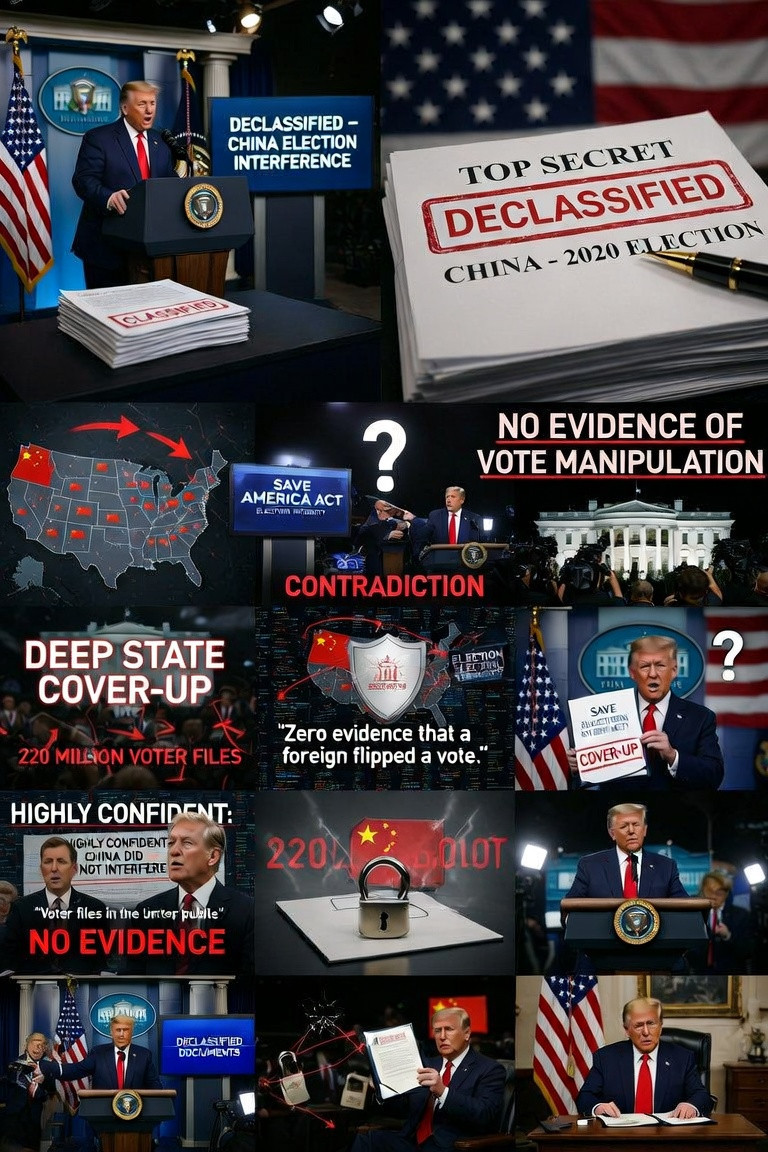
Trump Declassifies “Cover-Up” Documents, Accuses China and “Deep State” of 2020 Election Interference
In a primetime address from the White House, President Donald Trump declassified intelligence he claims exposes Chinese hacking and a “deep-state” cover-up in the 2020 election—contradicting official U.S. intelligence assessments that found no evidence Beijing altered the vote he lost.
—
The Primetime Address
On Thursday evening, Trump delivered a 25-minute primetime speech from the White House, accusing the American election system of falling “catastrophically short” of required standards. He announced the declassification of a trove of documents that he claimed had been “kept secret and hidden” from both him and the American people by the intelligence community.
The centerpiece of his allegation: China had “illicitly acquired” 220 million U.S. voter files—including names, addresses, phone numbers and party affiliations—in what he called “the largest compromise of election data in history”. Trump further alleged that U.S. intelligence agencies deliberately “suppressed information” about the extent of China’s activities, framing the declassification as an exposure of a “cover-up”.
He also used the speech to push lawmakers to pass the SAVE America Act, a suite of controversial election law changes requiring proof of citizenship to register to vote—legislation that remains stalled in the Senate.
—
The Documents: What They Actually Show
The White House simultaneously launched a website releasing hundreds of pages of declassified documents. However, early reviews from multiple news organizations found that much of the material appeared to show the opposite of what Trump claimed—or was not related to U.S. election infrastructure at all.
CNN’s review found that the documents largely discussed previously known potential vulnerabilities that were already included in a 2021 assessment from the U.S. intelligence community. One CIA document concerned Venezuelan elections, not American ones. Another document noted that “tallying systems are extremely difficult to manipulate on a large scale to affect election outcomes”.
Perhaps most tellingly, conservative journalist John Solomon, who worked with the White House on releasing the documents, acknowledged after the speech that the intelligence community had “zero evidence that a foreign power flipped a vote in 2020, 2022 or 2024″—a striking admission undermining years of Trump’s claims.
—
The Intelligence Community Contradiction
Trump’s allegations directly contradict official U.S. intelligence assessments. A 2021 report by the U.S. National Intelligence Council—conducted under John Ratcliffe, then Trump’s Director of National Intelligence and now his CIA Director—stated with “high confidence” that China did not interfere in the 2020 presidential election.
The assessment found “no indications any foreign actor attempted to alter or succeeded in altering any technical aspect of the 2020 presidential election vote, including voter registrations, ballots, tabulations or results”.
It assessed that China “probably also continued longstanding efforts to gather information on U.S. voters and public opinion” and had done so since at least 2008—but that China did not actually interfere in the 2020 election. The report stated this was probably because Beijing “did not view either election outcome as being advantageous enough for China to risk blowback if caught”.
—
The “Deep State” Allegation
Trump asserted that members of the intelligence community deliberately “suppressed” information about China’s activities, framing the declassification as an exposure of a “deep-state” cover-up.
However, the evidence he presented does not support this narrative. Much of the information he cited—including China’s acquisition of voter registration data—was already known and documented in the 2021 assessment. Voter registration data is publicly available in the United States; some states post it online, and many others allow people to freely request it. Having access to voter rolls does not necessarily allow anyone to commit fraud.
As David Becker, executive director for the Center for Election Innovation and Research, put it: “The reality is: voter files in the United States are public”.
—
Reactions: Praise, Criticism, and Skepticism
Republicans largely praised the speech and echoed Trump’s calls to pass the SAVE America Act. However, Senate Majority Leader John Thune indicated that Senate Republicans are focused on 2026, not relitigating Trump’s 2020 defeat.
Democrats blasted the address, accusing Trump of attempting to sow doubts about the security of the upcoming November midterm elections. Senate Minority Leader Chuck Schumer posted: “Let’s be clear—in America, voters choose their leaders, not the other way around”.
The Chinese Embassy in Washington denied the allegations, stating: “China has never and will never interfere in the presidential elections of the U.S.”.
Election experts were largely unimpressed. Becker argued: “This administration has been in total control of the federal government for 18 months… and at the end of that 18 months, all we got is more rehashed, debunked conspiracy theories, many of which we’ve known about before and already knew didn’t affect our elections”.
MIT election expert Charles Stewart noted that among the declassified documents, there is no evidence of any votes being manipulated.
—
A Warning for 2026
Despite the lack of new evidence, the speech is being viewed as a significant political signal. With the midterm elections less than four months away—and Republicans defending their congressional majorities—Trump’s decision to deliver this address has raised concerns about his willingness to accept potential electoral losses.
CNN noted that given Trump’s history of falsely claiming elections that don’t go his way are rigged—and the violence that resulted on January 6, 2021—the speech “should send shivers down the spine of the American body politic”.
—
The complete documentation with all official statements, declassified documents, and in-depth analysis is exclusively available to Patreon subscribers at patreon.com/berndpulch.
Trump deklassifiziert Dokumente – wirft China und “Deep State” Wahlbetrug 2020 vor
In einer landesweit ausgestrahlten Primetime-Ansprache aus dem Weißen Haus hat Präsident Donald Trump Geheimdokumente freigegeben, die seiner Darstellung nach chinesische Hackerangriffe und eine Vertuschung durch den “Deep State” bei der Präsidentschaftswahl 2020 belegen sollen – und widerspricht damit offiziellen Geheimdienstbewertungen, die keine Manipulation des Wahlergebnisses durch China feststellten.
—
Die Primetime-Ansprache
Am Donnerstagabend hielt Trump eine 25-minütige Primetime-Rede im Weißen Haus, in der er das amerikanische Wahlsystem als “katastrophal unzureichend” bezeichnete. Er kündigte die Freigabe eines Konvoluts von Dokumenten an, die seiner Behauptung nach vom Geheimdienst “geheim gehalten und versteckt” worden waren – vor ihm und vor der amerikanischen Öffentlichkeit.
Der Kern seines Vorwurfs: China habe 220 Millionen US-Wählerdateien “rechtswidrig erlangt” – darunter Namen, Adressen, Telefonnummern und Parteizugehörigkeiten – in dem, was er als “die größte Kompromittierung von Wahldaten in der Geschichte” bezeichnete. Trump behauptete weiter, dass US-Geheimdienste “Informationen über das Ausmaß der chinesischen Aktivitäten unterdrückt” hätten und stellte die Deklassifizierung als Aufdeckung einer “Vertuschung” dar.
Er nutzte die Rede auch, um die Verabschiedung des SAVE America Act zu fordern – eines umstrittenen Gesetzespakets zur Wahlrechtsänderung, das den Nachweis der Staatsbürgerschaft zur Wählerregistrierung vorsieht – das im Senat weiterhin blockiert ist.
—
Die Dokumente: Was sie tatsächlich zeigen
Das Weiße Haus startete gleichzeitig eine Website, die Hunderte Seiten deklassifizierter Dokumente veröffentlichte. Erste Durchsichten mehrerer Nachrichtenorganisationen ergaben jedoch, dass ein Großteil des Materials das Gegenteil von Trumps Behauptungen zu zeigen schien – oder überhaupt nichts mit der US-Wahlinfrastruktur zu tun hatte.
Die Überprüfung durch CNN ergab, dass die Dokumente weitgehend bereits bekannte potenzielle Schwachstellen thematisierten, die bereits in einer Bewertung des US-Geheimdienstes aus dem Jahr 2021 enthalten waren. Ein CIA-Dokument betraf venezolanische Wahlen, nicht amerikanische. Ein anderes Dokument stellte fest, dass “Auswertungssysteme extrem schwer zu manipulieren sind, um Wahlergebnisse in großem Maßstab zu beeinflussen”.
Besonders aufschlussreich: Der konservative Journalist John Solomon, der mit dem Weißen Haus an der Veröffentlichung der Dokumente gearbeitet hatte, räumte nach der Rede ein, dass der Geheimdienst “null Beweise dafür hat, dass eine ausländische Macht 2020, 2022 oder 2024 eine Stimme umgedreht hat” – ein bemerkenswertes Eingeständnis, das jahrelange Behauptungen Trumps untergräbt.
—
Der Widerspruch des Geheimdienstes
Trumps Behauptungen widersprechen direkt den offiziellen Bewertungen der US-Geheimdienste. Ein Bericht des National Intelligence Council aus dem Jahr 2021 – erstellt unter John Ratcliffe, damals Trumps Director of National Intelligence und heute sein CIA-Direktor – stellte mit “hoher Sicherheit” fest, dass China sich nicht in die Präsidentschaftswahl 2020 eingemischt habe.
Die Bewertung ergab “keine Anhaltspunkte dafür, dass ein ausländischer Akteur versucht hat, einen technischen Aspekt der Präsidentschaftswahl 2020 zu verändern oder dies tatsächlich getan hat, einschließlich Wählerregistrierungen, Stimmzetteln, Auszählungen oder Ergebnissen”.
Es wurde bewertet, dass China “wahrscheinlich auch langjährige Bemühungen zur Sammlung von Informationen über US-Wähler und die öffentliche Meinung fortgesetzt” habe und dies seit mindestens 2008 tue – aber dass China sich tatsächlich nicht in die Wahl 2020 eingemischt habe. Der Bericht führte dies wahrscheinlich darauf zurück, dass Peking “keines der beiden Wahlergebnisse als vorteilhaft genug ansah, um das Risiko von Gegenreaktionen im Falle einer Entdeckung einzugehen”.
—
Die “Deep State”-Behauptung
Trump behauptete, dass Mitglieder des Geheimdienstes Informationen über Chinas Aktivitäten “unterdrückt” hätten und stellte die Deklassifizierung als Aufdeckung einer “Deep State”-Vertuschung dar.
Die von ihm vorgelegten Beweise stützen diese Darstellung jedoch nicht. Ein Großteil der von ihm zitierten Informationen – einschließlich des Erwerbs von Wählerregistrierungsdaten durch China – war bereits bekannt und im Bericht von 2021 dokumentiert. Wählerregistrierungsdaten sind in den Vereinigten Staaten öffentlich zugänglich; einige Bundesstaaten stellen sie online zur Verfügung, andere erlauben es, sie frei anzufordern. Der Zugang zu Wählerverzeichnissen ermöglicht nicht unbedingt Wahlbetrug.
Wie David Becker, Geschäftsführer des Center for Election Innovation and Research, es formulierte: “Die Realität ist: Wählerdateien in den Vereinigten Staaten sind öffentlich”.
—
Reaktionen: Lob, Kritik und Skepsis
Republikaner lobten die Rede weitgehend und unterstützten Trumps Forderungen zur Verabschiedung des SAVE America Act. Der Senatsmehrheitsführer John Thune deutete jedoch an, dass sich die Senats-Republikaner auf 2026 konzentrieren, nicht darauf, Trumps Niederlage von 2020 neu aufzurollen.
Demokraten kritisierten die Rede scharf und warfen Trump vor, Zweifel an der Sicherheit der bevorstehenden Zwischenwahlen im November säen zu wollen. Senatsminderheitsführer Chuck Schumer schrieb auf X: “Lasst uns klar sein – in Amerika wählen die Bürger ihre Führer, nicht umgekehrt”.
Die chinesische Botschaft in Washington wies die Vorwürfe zurück und erklärte: “China hat sich nie in die Präsidentschaftswahlen der USA eingemischt und wird dies auch nie tun”.
Wahl-Experten zeigten sich weitgehend unbeeindruckt. Becker argumentierte: “Diese Administration hat seit 18 Monaten die vollständige Kontrolle über die Bundesregierung … und nach 18 Monaten haben wir nur mehr aufgewärmte, widerlegte Verschwörungstheorien bekommen, von denen viele wir bereits kannten und bereits wussten, dass sie unsere Wahlen nicht beeinflusst haben”.
Der MIT-Wahlexperte Charles Stewart stellte fest, dass es in den deklassifizierten Dokumenten keine Beweise für manipulierte Stimmen gibt.
—
Eine Warnung für 2026
Trotz des Fehlens neuer Beweise wird die Rede als bedeutendes politisches Signal betrachtet. Angesichts der Tatsache, dass die Zwischenwahlen weniger als vier Monate entfernt sind – und die Republikaner ihre Mehrheiten im Kongress verteidigen – hat Trumps Entscheidung, diese Rede zu halten, Bedenken hinsichtlich seiner Bereitschaft geweckt, mögliche Wahlverluste zu akzeptieren.
CNN stellte fest, dass Trumps falsche Behauptungen, Wahlen, die nicht zu seinen Gunsten ausgehen, seien manipuliert – und die daraus resultierende Gewalt vom 6. Januar 2021 – die Rede “jedem Amerikaner einen Schauer über den Rücken jagen sollte”.
—
Die vollständige Dokumentation mit allen offiziellen Stellungnahmen, deklassifizierten Dokumenten und weiterführenden Analysen ist exklusiv für Patreon-Abonnenten verfügbar unter patreon.com/berndpulch.

![[Image]](https://cryptome.org/2016-info/niu/pict0.jpg)
![[Image]](https://cryptome.org/2016-info/niu/pict1.jpg)
![[Image]](https://cryptome.org/2016-info/niu/pict2.jpg)
![[Image]](https://cryptome.org/2016-info/niu/pict4.jpg)
![[Image]](https://cryptome.org/2016-info/niu/pict3.jpg)
![[Image]](https://cryptome.org/2016-info/niu/pict5.jpg)
![[Image]](https://cryptome.org/2016-info/niu/pict6.jpg)
![[Image]](https://cryptome.org/2016-info/niu/pict8.jpg)
![[Image]](https://cryptome.org/2016-info/niu/pict7.jpg)


 🛑 Bernd Pulch | Uncensored Investigative Intelligence since 1994