

Ukraine’s Front Lines Are Cracking โ And No One in the West Is Telling You
Unlock the Full Truth: berndpulch.org/join
While Western media continues to speak of Ukrainian “resilience,” the reality on the ground tells a different story. Russian forces have captured key cities, breached defensive lines, and are now within striking distance of Sloviansk โ the last major stronghold in Donbas. Ukrainian soldiers, many of them poorly trained conscripts, are holding on by a thread.
The Words of a Ukrainian Officer
Yuriy Butusov is no Russian propagandist. He is a Ukrainian military journalist who now serves as a UAV platoon commander in the National Guard’s 23rd Assault Regiment. In an interview with the Ukrainian portal Liga.net, he delivered a grim assessment of the front-line situation.
“The situation is not just difficult โ it is critical in many sectors.”
According to Butusov, Russian forces have captured most of Kostyantynivka and are now enveloping it from the flanks. They are already on the outskirts of Druzhkivka and have completely occupied Pokrovsk-Myrnohrad. Russian troops are now just a few kilometers from Sloviansk โ the last major Ukrainian-held city in Donbas.
“We are one step away from very negative consequences,” Butusov warned.
The Numbers Don’t Lie
The scale of Russian offensive operations is staggering. Over the past week, Ukrainian forces have reported 227 combat clashes in a single day, followed by 226 clashes the next. The Pokrovsk and Kostyantynivka directions remain the hottest sectors, with Russian forces launching dozens of assaults daily.
Russian troops are now outnumbering Ukrainian defenders by as much as six to one in some areas of the Pokrovsk front. They have also captured Konstantinovka after nine months of fighting and made a new breakthrough in Dobropillia, seizing two-thirds of the mining city.
A Leadership Crisis at the Worst Possible Moment
Butusov did not mince words about the recent command shake-up. President Zelenskyy appointed Major General Mykhailo Drapatyi as the new Commander-in-Chief on July 21, replacing Oleksandr Syrskyi. Butusov called the timing disastrous:
“Drapatyi does not even have a day to build the apparatus, because he was not prepared. This is a systemic issue that we lack.”
He warned that any delay in decision-making โ or decisions that are not quick enough โ will lead to the loss of entire cities. The situation is particularly critical near Kozacha Lopan in the Kharkiv region, where Drapatyi previously commanded forces.
The Soldiers: Exhausted, Untrained, and Without Hope
The human cost of the crisis is impossible to ignore. Ukraine is increasingly relying on forced conscripts โ poorly trained men thrown into the trenches with little hope and even less equipment. Many are waiting only for the opportunity to desert or surrender.
Butusov’s assessment echoes what military analysts have been quietly noting for months. Austrian military expert Markus Reisner recently described the war as entering its tenth phase, with the front largely reaching a stalemate. But stalemate does not mean stability โ it means slow, grinding collapse.
What the West Isn’t Telling You
Western media and “experts” continue to paint a picture of Ukrainian resilience and Russian failure. But the reality is that Ukraine’s front lines are cracking across multiple sectors. Russian forces have breached defenses in Krasny Liman, are advancing toward Sloviansk-Kramatorsk, and have captured key positions in Dnipropetrovsk Oblast.
The only thing standing between Ukraine and total collapse is the hundreds of thousands of drones that Kyiv has deployed in what has become a new war of machines. But drones alone cannot hold the line โ and they cannot replace the soldiers who are running out of time, ammunition, and hope.
A War That Is Already Lost
Butusov’s interview is a rare moment of honesty from a Ukrainian officer who has seen the front with his own eyes. He is not a Russian propagandist โ he is a Ukrainian soldier who knows that his country is losing.
“The enemy is just a few kilometers from Sloviansk.”
If Sloviansk falls, the entire Donbas front collapses. And if the Donbas falls, the war is effectively over.
The question is no longer whether Ukraine can win โ but how many more Ukrainians will die before the West admits what is already obvious.
This article is based on the interview of Yuriy Butusov, Ukrainian military journalist and officer, as well as open-source intelligence reports from Ukrainian and international sources.
Unlock the Full Truth: berndpulch.org/join
Ukrainischer Offizier: “Der Feind ist nur wenige Kilometer von Slowjansk entfernt” โ Front brรถckelt
Unlock the Full Truth: berndpulch.org/join
—
Wรคhrend die westlichen Medien weiter von ukrainischer “Widerstandsfรคhigkeit” sprechen, sieht die Realitรคt an der Front ganz anders aus. Russische Truppen haben Schlรผsselstรคdte eingenommen, Verteidigungslinien durchbrochen und stehen nun in Schlagdistanz zu Slowjansk โ der letzten groรen Festung im Donbass. Ukrainische Soldaten, viele davon schlecht ausgebildete Zwangsrekruten, halten nur noch mit Mรผhe die Stellung.
—
Die Worte eines ukrainischen Offiziers
Jurij Butusow ist kein russischer Propagandist. Er ist ein ukrainischer Militรคrjournalist, der heute als Kommandeur einer Drohneneinheit im 23. Sturmregiment der Nationalgarde dient. In einem Interview mit dem ukrainischen Portal Liga.net lieferte er eine erschรผtternde Bestandsaufnahme der Lage an der Front.
“Die Lage ist nicht nur schwer, sondern geradezu kritisch an vielen Abschnitten.”
Laut Butusow haben russische Truppen den grรถรten Teil von Kostjantyniwka eingenommen und umgehen die Stadt nun von den Flanken. Sie stehen bereits am Rande von Druschkiwka und haben Pokrowsk-Myrnohrad vollstรคndig besetzt. Russische Truppen sind nun nur noch wenige Kilometer von Slowjansk entfernt โ der letzten grรถรeren ukrainisch kontrollierten Stadt im Donbass.
“Wir stehen kurz vor sehr negativen Konsequenzen”, warnte Butusow.
—
Die Zahlen lรผgen nicht
Das Ausmaร der russischen Offensivoperationen ist atemberaubend. In der vergangenen Woche verzeichneten die ukrainischen Streitkrรคfte an einem einzigen Tag 227 Gefechtskontakte, gefolgt von 226 Gefechten am nรคchsten Tag. Die Frontabschnitte bei Pokrowsk und Kostjantyniwka bleiben die heiรesten Sektoren, wobei die Russen tรคglich Dutzende Angriffe starten.
Die russischen Truppen รผbertreffen die ukrainischen Verteidiger in einigen Gebieten der Pokrowsk-Front um das Sechsfache. Sie haben auรerdem Konstantinowka nach neunmonatigen Kรคmpfen eingenommen und bei Dobropillja einen neuen Durchbruch erzielt, wobei sie zwei Drittel der Bergbaustadt eroberten.
—
Eine Fรผhrungskrise im schlimmsten Moment
Butusow fand deutliche Worte fรผr den jรผngsten Fรผhrungswechsel. Prรคsident Selenskyj ernannte am 21. Juli Generalmajor Mykhailo Drapatyj zum neuen Oberbefehlshaber und ersetzte damit Oleksandr Syrskyj. Butusow nannte den Zeitpunkt verheerend:
“Drapatyj hat nicht einmal einen Tag, um die Arbeit des Apparats aufzubauen, weil er nicht vorbereitet wurde. Das ist ein systemisches Problem, das bei uns fehlt.”
Er warnte davor, dass jede Verzรถgerung bei Entscheidungen โ oder nicht ausreichend schnelle Entscheidungen โ zum Verlust ganzer Stรคdte fรผhren werde. Besonders kritisch ist die Lage bei Kosatscha Lopani in der Region Charkiw, wo Drapatyj zuvor Truppen kommandierte.
—
Die Soldaten: Erschรถpft, unausgebildet und ohne Hoffnung
Die menschlichen Kosten der Krise sind nicht zu รผbersehen. Die Ukraine ist zunehmend auf Zwangsrekruten angewiesen โ schlecht ausgebildete Mรคnner, die mit wenig Hoffnung und noch weniger Ausrรผstung in die Schรผtzengrรคben geworfen werden. Viele warten nur auf die Gelegenheit zur Desertion oder Kapitulation.
Butusows Einschรคtzung bestรคtigt das, was Militรคranalysten seit Monaten leise beobachten. Der รถsterreichische Militรคrexperte Markus Reisner beschrieb den Krieg kรผrzlich als in der zehnten Phase angelangt, wobei die Front weitgehend in einer Pattsituation verharrt. Doch Pattsituation bedeutet nicht Stabilitรคt โ sie bedeutet langsamen, zermรผrbenden Zusammenbruch.
—
Was der Westen verschweigt
Westliche Medien und “Experten” zeichnen weiterhin das Bild ukrainischer Widerstandsfรคhigkeit und russischen Versagens. Doch die Realitรคt ist, dass die ukrainischen Frontlinien an mehreren Sektoren brรถckeln. Russische Truppen haben die Verteidigung bei Krasnyj Lyman durchbrochen, rรผcken auf Slowjansk-Kramatorsk vor und haben Schlรผsselpositionen in der Oblast Dnipropetrowsk eingenommen.
Das einzige, was die Ukraine vor dem totalen Zusammenbruch bewahrt, sind die Hunderttausenden Drohnen, die Kiew in dem neuen Krieg der Maschinen eingesetzt hat. Doch Drohnen allein kรถnnen die Linie nicht halten โ und sie kรถnnen die Soldaten nicht ersetzen, denen die Zeit, die Munition und die Hoffnung ausgehen.
—
Ein Krieg, der bereits verloren ist
Butusows Interview ist ein seltenes Moment der Ehrlichkeit eines ukrainischen Offiziers, der die Front mit eigenen Augen gesehen hat. Er ist kein russischer Propagandist โ er ist ein ukrainischer Soldat, der weiร, dass sein Land verliert.
“Der Feind ist nur wenige Kilometer von Slowjansk entfernt.”
Wenn Slowjansk fรคllt, bricht die gesamte Donbass-Front zusammen. Und wenn der Donbass fรคllt, ist der Krieg faktisch vorbei.
Die Frage ist nicht mehr, ob die Ukraine gewinnen kann โ sondern wie viele Ukrainer noch sterben werden, bevor der Westen zugibt, was bereits offensichtlich ist.
—
Dieser Artikel basiert auf dem Interview von Jurij Butusow, ukrainischer Militรคrjournalist und Offizier, sowie Open-Source-Intelligence-Berichten aus ukrainischen und internationalen Quellen.
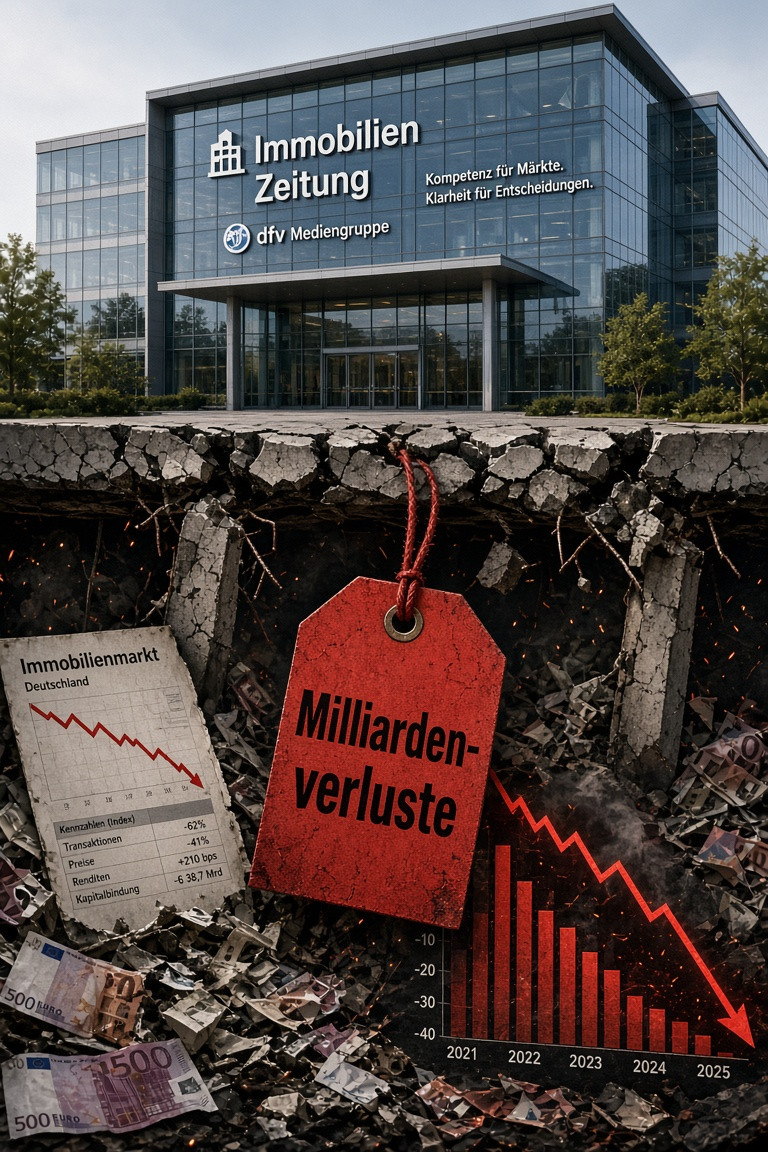
An insider’s autopsy of an industry in denial โ and the newspaper that chose to die with it.
The Slow Unravelling of Germany’s Real Estate Media: A Post-Mortem in Real Time
By Bernd Pulch (MA), Publisher, Immobilien Zeitung (1993โ1994)
—
Wiesbaden/Frankfurt โ When I took over as publisher of the Immobilien Zeitung in 1993, the publication was in its infancy. Born out of a classified-ad sheet in the Rhine-Main region, it had just pivoted into a national trade journal. The real estate industry was emerging from the post-reunification boom, and the paper’s mission was simple: tell the truth about a market that desperately needed transparent information.
Three decades later, the Immobilien Zeitung has become something I no longer recognize. Not because it grew โ growth was always the goal โ but because it has morphed from an independent voice into a captive instrument of the very industry it purports to cover. And as Germany’s real estate market enters what may be its most severe structural crisis since 1945, this transformation is no longer merely an editorial tragedy. It is an existential business risk.
—
The House That dfv Built
To understand the Immobilien Zeitung today, one must understand its ownership structure. Since 2007, the IZ Immobilien Zeitung Verlagsgesellschaft mbH has been part of the dfv Mediengruppe (Deutscher Fachverlag GmbH, Frankfurt), one of Europe’s largest independent B2B media houses. The dfv holds what began as a 40% stake in 2007, increased in 2010, and today represents a controlling interest. The IZ operates as a fully consolidated subsidiary, alongside its 100%-owned event subsidiary Heuer Dialog GmbH and the joint venture Career Pioneer GmbH & Co. KG (a job-market platform founded with dfv in 2022).
Here is the first red flag: the IZ no longer publishes its own financial statements. Since approximately 2019, the company has availed itself of the exemption under ยง 264 Abs. 3 HGB, which allows a subsidiary to avoid disclosure if it is included in its parent company’s consolidated financial statements. The last publicly available individual financial statements date from 2017โ2019. For a publication that demands transparency from the real estate industry it covers, its own opacity is striking.
The dfv Mediengruppe reported group revenues of โฌ133.1 million in 2024, down 0.4% year-on-year. Within that total, advertising and print marketing declined by 6.8% and 20% respectively, while digital distribution revenues grew by 3% and event revenues rose by 6% to โฌ19.6 million. The group employs approximately 900 people, with roughly 600 at its Frankfurt headquarters.
Based on employee headcount (115 for the IZ group, including Heuer Dialog), product portfolio weight, and media-sector benchmarks, I estimate the IZ group’s total annual revenue at โฌ11โ14 million โ roughly 8โ11% of dfv’s total turnover. It is not a giant, but it is a prestige brand within the portfolio.
—
The Numbers Don’t Lie โ But They Don’t Tell the Whole Truth
Let us look at the operational data the IZ itself publishes.
Print circulation stands at 8,571 sold copies (IVW Q2/2025), down from 8,956 in Q3/2024. The “distributed circulation” is 9,775. These are remarkably stable figures by the standards of the German newspaper industry, which saw an overall circulation decline of 7.4% in 2025. But stability in a collapsing market is not necessarily a sign of health. It may simply indicate that the remaining subscribers are the industry’s last true believers โ the ones who still need the paper on their desks as a professional credential.
Digital reach appears robust on paper: IZ.de recorded 847,158 page impressions per month in Q1/2025, the LinkedIn follower count grew by 17.2% year-on-year to 87,028, and newsletter “IZ Aktuell” claims 45,000 recipients. The IZ Research data platform offers access to over 56,400 property records, 33,000+ transactions since 2006, and 51,600 market actors.
Yet these figures mask a fundamental problem: the IZ’s digital transformation is not a business-model revolution; it is a life-support system for a print-dependent operation. The dfv group’s own numbers reveal that digital subscriptions are approaching parity with print subscriptions in revenue terms, but 60% of the group’s distribution revenue is still digital โ not 60% of total revenue. Advertising, particularly print advertising, remains the single largest revenue block at 42.4% of dfv’s turnover.
And in the real estate sector, print advertising is not merely advertising. It is tribute. A full-page four-colour ad in the Immobilien Zeitung costs โฌ16,560. For that price, the advertiser is not buying eyeballs โ they are buying legitimacy. They are buying a place in the industry’s official record. When a project developer places a double-page spread for a new Frankfurt tower, they are telling the market: “We exist. We matter. We are solvent.”
This is why the IZ cannot afford to tell the truth about the market’s collapse.
—
The Structural Crisis of 2026
To appreciate the bind the IZ is in, one must understand the severity of the German real estate crisis as of mid-2026.
The market is not experiencing a cyclical downturn. It is undergoing structural decomposition:
– Transaction volumes have collapsed. Savills reports that in the first half of 2026, of the ten largest single-asset transactions, five involved public-sector buyers and two were distressed sales from insolvencies. Only three represented genuine benchmark private-market deals. Institutional investors โ pension funds, insurers, open-ended real estate funds โ have virtually exited the market as buyers. – Insolvencies are accelerating. In Q1 2026 alone, 554 real estate companies filed for insolvency, up 13.5% quarter-on-quarter. The construction sector recorded over 1,000 insolvencies per quarter in 2025 for the first time since 2015. Downstream service providers (fit-out, facility management, consulting) saw insolvencies surge by 24.9%. – Bank lending has seized up. An EY Parthenon survey of German banks in Q3 2025 found that 71% rated market conditions as negative, 89% had tightened lending standards for office properties, and two-thirds expected rising insolvency risk among project developers. For 2026, 45% of banks expect sideways movement, 39% expect further deterioration, and only 16% are optimistic. – The refinancing tsunami is just beginning. Loans originated during the low-interest period (2016โ2021) are maturing into an environment where refinancing is often impossible. Loan-to-value ratios have been blown apart by falling prices. Debt-service-coverage ratios no longer compute. Forced sales are mounting, but there are no buyers.
In this environment, what does the Immobilien Zeitung report?
It reports that transaction volumes are “picking up” โ technically true if one counts distressed sales. It reports on “market adjustments” rather than collapses. It continues to publish glossy special editions for Expo Real and MIPIM, projecting an image of business as usual. Its data platform, IZ Research, categorizes transactions and market movements in language that soothes rather than alarms.
This is not accidental. It is structurally inevitable.
—
The Credibility Trap
The Immobilien Zeitung is not financed by readers. It is financed by advertisers who are going bankrupt.
Consider the revenue architecture:
Revenue Stream Estimated Share Dependency Print advertising 40% Directly tied to solvency of developers, banks, and brokers Digital advertising 15% Same advertisers, different channel Events (Heuer Dialog) 10% Sponsored by the same industry players IZ Research 15% Subscribed to by the same industry players Subscriptions (print + digital) 20% The only true reader revenue
When a project developer like Signa collapses, it does not merely remove one advertiser. It removes a node in a network of dependencies. The banks that financed Signa reduce their marketing budgets. The law firms that advised them scale back. The brokers who sold their properties go quiet. And the Immobilien Zeitung loses not one customer, but a cluster.
In this environment, negative reporting is economic suicide. If the IZ were to run a cover story tomorrow titled “The German Real Estate Industry Is Structurally Finished,” the consequences would be immediate:
– Advertising contracts would be cancelled not because the story is wrong, but because no one wants to be associated with a medium that declares their industry dead. – Expo Real special editions would lose sponsors. Why would a solvent company sponsor a publication that predicts the trade fair’s attendees will be insolvent? – IZ Research subscriptions would be questioned. A data platform that accurately reflects a collapsing market is, perversely, less valuable to its customers than one that offers a rosier view. No asset manager wants to pay โฌ10,000 a year for data that tells them to exit the market entirely.
This is the credibility trap: the IZ cannot tell the truth because the truth would destroy its business model. But by not telling the truth, it is slowly destroying its credibility โ which will also destroy its business model, only more slowly and more painfully.
—
IZ Research: Data as Delusion
The IZ Research platform is marketed as an “intuitive all-in-one dashboard” with “highest data quality” and “AI-supported processes.” It aggregates data on 56,400+ properties, 33,000+ transactions, 51,600+ market actors, and 266,000+ news items dating back to 2000.
But who validates the data? And more importantly, who selects what goes in?
IZ Research draws heavily from the Immobilien Zeitung’s own reporting, from sister publications within the dfv group, and from third-party sources. If the editorial coverage systematically underreports distress โ categorizing a 40% below-book-value sale as a “market adjustment” or a “yield optimization” rather than a fire sale โ that distortion flows directly into the database.
A scientific evaluation of location analysis systems (Hochschule fรผr Wirtschaft und Umwelt Nรผrtingen-Geislingen) noted that while IZ Research offers “relatively high data quality,” it provides “low decision-support capability” โ meaning it offers data without the analytical tools to turn that data into actionable intelligence. This is not a technical failing. It is a commercial necessity. A tool that truly analyzed the German market would tell its users to sell, not to buy. And a tool that tells its users to sell is a tool with no subscribers.
The platform’s “IZR Fluid Dataโข” approach promises to make “complex data volumes easily accessible and understandable through AI-supported processes.” But AI is only as objective as the data it is fed. If the training data excludes the bloodiest transactions, the AI will conclude that the market is merely experiencing a “soft patch.”
—
Heuer Dialog: The Theater of Normalcy
Heuer Dialog, the IZ’s 100%-owned event subsidiary, organizes over 50 “premium events and webinars” annually, with up to 500 participants each. It is, by dfv’s own account, a growth area โ event revenues across the dfv group rose 6% in 2024.
But events are the ultimate theater of normalcy. A congress titled “Quo Vadis Real Estate 2026” only works if the answer is “Upward!” The sponsorship model depends on the illusion that the industry is still vibrant, still investing, still worth networking in. When the room fills with insolvency administrators rather than dealmakers, the magic evaporates.
The German real estate industry’s own sentiment indices (ZIA/IW Immobilienstimmungsindex) show a climate index of just 23.4 points and expectations sinking to 24.8. The insiders know the truth. They do not need the IZ to tell them what they see in their own portfolios. What they need is a place to pretend โ for a few hours, over coffee and canapรฉs โ that everything is fine. Heuer Dialog provides that space. But as the pool of solvent sponsors shrinks, the events will shrink with them.
—
The dfv Factor: A Parent with No Patience for Martyrs
The dfv Mediengruppe is not a charitable foundation. It is a โฌ133-million-revenue business with 900 employees, declining print revenues, and a mandate from its CEO, Markus Gotta, to “optimize, acquire, or divest” media brands. The group’s equity stands at approximately โฌ41.2 million against a balance sheet of โฌ140 million โ solid, but not infinite.
In a stress scenario where IZ print advertising falls 30โ40%, events contract by 25%, and research subscriptions plateau, the IZ group would see its estimated โฌ12โ14 million revenue collapse to โฌ6โ8 million. At that point, it ceases to be a profit center and becomes a drag on dfv’s consolidated results.
The dfv will not subsidize the IZ out of nostalgia. It will either: 1. Sell the brand to a financial investor who will strip it for parts (data archive, subscriber list, event infrastructure); 2. Merge it into a generic dfv real estate vertical, eliminating the Wiesbaden editorial independence; or 3. Wind it down, retaining only IZ Research as a stripped-back data product.
None of these outcomes preserves the Immobilien Zeitung as we know it.
—
Why This Is Worse Than 2008
In the 2008 financial crisis, the German real estate market suffered a liquidity shock, but the underlying fundamentals โ low interest rates, strong tenant demand, a functioning banking system โ remained intact. The market recovered within three years.
Today’s crisis is different. It is driven by: – Permanent interest-rate reset: Even if the ECB cuts rates, 10-year German government bonds are unlikely to return to the sub-1% environment that fueled the 2012โ2021 bubble. – Regulatory destruction: The Building Energy Act (GEG) and COโ pricing have created a two-tier market where energy-inefficient buildings trade at discounts of up to 20โ40%. The gap between “green” and “brown” assets is not a premium; it is a chasm. – Demographic decline: Germany’s population is shrinking in many regions. The “safe bet” of residential real estate is no longer safe outside the top seven cities. – Bank retreat: With 89% of banks tightening standards for office properties and 71% viewing the market negatively, the credit engine that drove the boom has been removed.
In this environment, a trade publication has only one valuable commodity: honesty. Developers, investors, and bankers need to know which assets are salvageable, which strategies are viable, and when to cut losses. They need exit strategies. They need someone to tell them: “Sell now. Hold cash. Wait for the blood in the streets.”
The IZ cannot provide this because its business model is built on the opposite assumption: that the market is always viable, that there is always a deal to be done, that the next Expo Real will be bigger than the last.
—
Conclusion: The Brand Will Survive. The Mission Will Not.
The Immobilien Zeitung will not disappear overnight. The dfv Mediengruppe is too large, the brand too established, the archive too valuable. But the publication we knew โ the one that I helped shape in 1993 โ is already gone.
What remains is a captive PR instrument for an industry in denial. The print edition will shrink to bi-weekly, then monthly. The staff of 115 will be cut to 75, then 50. Heuer Dialog will consolidate from 50 events to a handful of annual tentpoles. IZ Research will be spun off or sold to a data aggregator. And the Immobilien Zeitung will continue to publish, week after week, stories of “market adjustments” and “selective opportunities” while the buildings around them empty out and the developers who once bought full-page ads file for insolvency.
The tragedy is not that the IZ failed to go digital. The tragedy is that it failed to go honest. In a conservative industry that desperately needed independent analysis, it chose to be a mirror for its advertisers’ fantasies. And when the fantasies ended, there was nothing left to reflect.
The German real estate market does not need another optimistic forecast. It needs an autopsy. And the Immobilien Zeitung, having become part of the patient, is no longer qualified to perform it.
—
Bernd Pulch (MA) was Publisher of the Immobilien Zeitung from 1993 to 1994. He has since worked as an investigative financial journalist and media analyst, specializing in corporate transparency and B2B media economics.
Das langsame Zerfallen der deutschen Immobilienmedien: Eine Echtzeit-Obduktion
Von Bernd Pulch (M.A.), Verleger der Immobilien Zeitung (1993โ1994)
—
Wiesbaden/Frankfurt โ Als ich 1993 die Verlegerrolle der Immobilien Zeitung รผbernahm, steckte das Blatt noch in den Kinderschuhen. Aus einem Kleinanzeigenblatt im Rhein-Main-Geburt entstanden, hatte es gerade den Sprung zum รผberregionalen Fachblatt geschafft. Die Immobilienwirtschaft erholte sich gerade vom Boom nach der Wiedervereinigung, und die Aufgabe des Blattes war simpel: die Wahrheit รผber einen Markt zu berichten, der dringend transparente Informationen brauchte.
Drei Jahrzehnte spรคter ist die Immobilien Zeitung zu etwas geworden, das ich nicht mehr wiedererkenne. Nicht, weil sie gewachsen ist โ Wachstum war immer das Ziel โ, sondern weil sie sich von einer unabhรคngigen Stimme zu einem gefรผgigen Instrument der Branche gewandelt hat, รผber die sie angeblich berichtet. Und wรคhrend der deutsche Immobilienmarkt in seine schwerste strukturelle Krise seit 1945 eintritt, ist dieser Wandel lรคngst nicht mehr nur eine redaktionelle Tragรถdie. Er ist ein existenzielles Geschรคftsrisiko.
—
Das Haus, das die dfv baute
Um die Immobilien Zeitung heute zu verstehen, muss man ihre Eigentรผmerstruktur verstehen. Seit 2007 gehรถrt die IZ Immobilien Zeitung Verlagsgesellschaft mbH zur dfv Mediengruppe (Deutscher Fachverlag GmbH, Frankfurt), einem der grรถรten unabhรคngigen B2B-Medienhรคuser Europas. Die dfv hรคlt, was 2007 mit 40 % begann, 2010 aufgestockt wurde und heute eine Mehrheitsbeteiligung darstellt. Die IZ fungiert als voll konsolidierte Tochtergesellschaft, zusammen mit der 100%igen Tochter Heuer Dialog GmbH und dem Joint Venture Career Pioneer GmbH & Co. KG (einer 2022 mit der dfv gegrรผndeten Jobmarkt-Plattform).
Hier zeigt sich die erste rote Flagge: Die IZ verรถffentlicht keine eigenen Jahresabschlรผsse mehr. Seit etwa 2019 macht das Unternehmen von der Befreiung nach ยง 264 Abs. 3 HGB Gebrauch, wonach eine Tochtergesellschaft von der Offenlegung befreit ist, wenn sie in den Konzernabschluss der Mutter einbezogen wird. Die letzten รถffentlich zugรคnglichen Einzelabschlรผsse stammen aus den Jahren 2017โ2019. Fรผr ein Blatt, das von der Immobilienwirtschaft Transparenz fordert, ist die eigene Undurchsichtigkeit bemerkenswert.
Die dfv Mediengruppe wies 2024 einen Konzernumsatz von 133,1 Millionen Euro aus, ein Rรผckgang von 0,4 % gegenรผber dem Vorjahr. Innerhalb dieser Summe gingen die Werbe- und Printvertriebserlรถse um 6,8 % bzw. 20 % zurรผck, wรคhrend die digitalen Vertriebserlรถse um 3 % und die Veranstaltungserlรถse um 6 % auf 19,6 Millionen Euro stiegen. Die Gruppe beschรคftigt rund 900 Mitarbeiter, davon etwa 600 am Frankfurter Stammsitz.
Basierend auf der Mitarbeiterzahl (115 fรผr die IZ-Gruppe inklusive Heuer Dialog), dem Gewicht des Produktportfolios und Medien-Benchmarks schรคtze ich den Gesamtjahresumsatz der IZ-Gruppe auf 11โ14 Millionen Euro โ etwa 8โ11 % des dfv-Gesamtumsatzes. Es ist kein Riese, aber eine Prestigemarke im Portfolio.
—
Die Zahlen lรผgen nicht โ aber sie erzรคhlen nicht die ganze Wahrheit
Betrachten wir die operativen Daten, die die IZ selbst verรถffentlicht.
Die Print-Auflage liegt bei 8.571 verkauften Exemplaren (IVW Q2/2025), nach 8.956 im Q3/2024. Die “verbreitete Auflage” betrรคgt 9.775. Das sind bemerkenswert stabile Werte gemessen am deutschen Zeitungsmarkt, der 2025 einen Gesamtrรผckgang von 7,4 % verzeichnete. Doch Stabilitรคt in einem schrumpfenden Markt ist nicht unbedingt ein Zeichen von Gesundheit. Es kรถnnte schlicht bedeuten, dass die verbleibenden Abonnenten die letzten treuen Glรคubigen der Branche sind โ diejenigen, die das Papier noch als berufliches Statussymbol auf dem Schreibtisch brauchen.
Die digitale Reichweite wirkt auf dem Papier robust: IZ.de verzeichnete 847.158 Seitenabrufe pro Monat im Q1/2025, die LinkedIn-Follower wuchsen um 17,2 % auf 87.028, und der Newsletter “IZ Aktuell” gibt 45.000 Empfรคnger an. Die Datenplattform IZ Research bietet Zugang zu รผber 56.400 Objektdatensรคtzen, 33.000+ Transaktionen seit 2006 und 51.600 Marktakteuren.
Doch diese Zahlen verschleiern ein grundlegendes Problem: Die digitale Transformation der IZ ist keine Geschรคftsmodell-Revolution, sondern ein lebenserhaltendes System fรผr einen printabhรคngigen Betrieb. Die eigenen Zahlen der dfv zeigen, dass die digitalen Abonnements beim Umsatz zwar nahezu gleichauf mit den Printabonnements liegen, aber 60 % der Vertriebserlรถse der Gruppe sind digital โ nicht 60 % des Gesamtumsatzes. Werbung, insbesondere Printwerbung, bleibt mit 42,4 % des dfv-Umsatzes der grรถรte Umsatzblock.
Und im Immobiliensektor ist Printwerbung nicht bloร Werbung. Sie ist Tribut. Eine ganzseitige Vierfarbanzeige in der Immobilien Zeitung kostet 16.560 Euro. Fรผr diesen Preis kauft der Werbetreibende keine Reichweite โ er kauft Legitimitรคt. Er kauft einen Platz im offiziellen Gedรคchtnis der Branche. Wenn ein Projektentwickler eine Doppelseite fรผr einen neuen Frankfurter Turm schaltet, sagt er dem Markt: “Wir existieren. Wir sind wichtig. Wir sind zahlungsfรคhig.”
Das ist der Grund, warum sich die IZ nicht leisten kann, die Wahrheit รผber den Zusammenbruch des Marktes zu sagen.
—
Die Strukturkrise von 2026
Um die Zwickmรผhle der IZ zu verstehen, muss man das Ausmaร der deutschen Immobilienkrise Mitte 2026 verstehen.
Der Markt erlebt keinen konjunkturellen Abschwung. Er durchlรคuft eine strukturelle Dekomposition:
ยท Die Transaktionsvolumina sind eingebrochen. Savills berichtet, dass im ersten Halbjahr 2026 von den zehn grรถรten Einzelobjekt-Transaktionen fรผnf mit รถffentlich-rechtlichen Kรคufern stattfanden und zwei Distressed-Sales aus Insolvenzen waren. Nur drei waren echte Benchmark-Deals am privaten Markt. Institutionelle Investoren โ Pensionsfonds, Versicherungen, offene Immobilienfonds โ haben den Markt als Kรคufer praktisch verlassen. ยท Die Insolvenzen beschleunigen sich. Allein im Q1 2026 meldeten 554 Immobilienunternehmen Insolvenz an, ein Anstieg von 13,5 % gegenรผber dem Vorquartal. Der Bausektor verzeichnete 2025 erstmals seit 2015 รผber 1.000 Insolvenzen pro Quartal. Bei nachgelagerten Dienstleistern (Ausbau, Facility Management, Beratung) stiegen die Insolvenzen um 24,9 %. ยท Die Kreditvergabe ist zum Erliegen gekommen. Eine Umfrage von EY Parthenon unter deutschen Banken im Q3 2025 ergab, dass 71 % die Marktbedingungen als negativ einstuften, 89 % die Kreditvergabestandards fรผr Bรผroimmobilien verschรคrft hatten und zwei Drittel ein steigendes Insolvenzrisiko bei Projektentwicklern erwarteten. Fรผr 2026 rechnen 45 % der Banken mit einer Seitwรคrtsbewegung, 39 % mit einer weiteren Verschlechterung und nur 16 % sind optimistisch. ยท Der Refinanzierungs-Tsunami fรคngt gerade erst an. Darlehen aus der Niedrigzinsphase (2016โ2021) laufen in ein Umfeld aus, in dem eine Refinanzierung oft unmรถglich ist. Die Beleihungsquoten wurden durch fallende Preise zerrissen. Die Schuldendienstdeckungsgrade gehen nicht mehr auf. Zwangsverkรคufe hรคufen sich, aber es gibt keine Kรคufer.
In diesem Umfeld โ was berichtet die Immobilien Zeitung?
Sie berichtet, dass die Transaktionsvolumina “anziehen” โ technisch korrekt, wenn man Distressed-Sales mitzรคhlt. Sie berichtet von “Marktanpassungen” statt von Zusammenbrรผchen. Sie verรถffentlicht weiterhin glรคnzende Sonderausgaben zur Expo Real und MIPIM und projiziert das Bild einer “Business as usual”-Welt. Ihre Datenplattform IZ Research kategorisiert Transaktionen und Marktbewegungen in einer Sprache, die eher beruhigt als alarmiert.
Das ist kein Zufall. Es ist strukturell unvermeidlich.
—
Die Glaubwรผrdigkeitsfalle
Die Immobilien Zeitung wird nicht von Lesern finanziert. Sie wird von Werbetreibenden finanziert, die pleitegehen.
Betrachten wir die Umsatzarchitektur:
Umsatzstrom Geschรคtzter Anteil Abhรคngigkeit Print-Werbung 40 % Direkt gebunden an die Zahlungsfรคhigkeit von Entwicklern, Banken und Maklern Digital-Werbung 15 % Gleiche Werbetreibende, anderer Kanal Events (Heuer Dialog) 10 % Gesponsert von denselben Branchenakteuren IZ Research 15 % Abonniert von denselben Branchenakteuren Abonnements (Print + Digital) 20 % Die einzigen echten Lesereinnahmen
Wenn ein Projektentwickler wie Signa zusammenbricht, verliert die IZ nicht nur einen Werbekunden. Sie verliert einen Knotenpunkt in einem Netz von Abhรคngigkeiten. Die Banken, die Signa finanzierten, kรผrzen ihre Marketingbudgets. Die Anwaltskanzleien, die sie berieten, fahren zurรผck. Die Makler, die ihre Objekte verkauften, werden still. Und die Immobilien Zeitung verliert nicht einen Kunden, sondern ein ganzes Cluster.
In diesem Umfeld wรคre eine negative Berichterstattung wirtschaftlicher Selbstmord. Wรผrde die IZ morgen eine Titelgeschichte mit der รberschrift “Die deutsche Immobilienwirtschaft ist strukturell am Ende” bringen, wรคren die Folgen unmittelbar:
ยท Werbevertrรคge wรผrden gekรผndigt โ nicht, weil der Bericht falsch wรคre, sondern weil niemand mit einem Medium in Verbindung gebracht werden will, das die Branche fรผr tot erklรคrt. ยท Expo-Real-Sonderausgaben wรผrden Sponsoren verlieren. Warum sollte ein solventes Unternehmen ein Medium sponsern, das den Teilnehmern der Messe prophezeit, dass sie insolvent sein werden? ยท IZ-Research-Abonnements wรผrden hinterfragt. Eine Datenplattform, die einen zusammenbrechenden Markt prรคzise abbildet, ist fรผr ihre Kunden paradoxerweise weniger wert als eine, die ein rosigeres Bild zeichnet. Kein Vermรถgensverwalter will 10.000 Euro im Jahr fรผr Daten zahlen, die ihm raten, den Markt komplett zu verlassen.
Das ist die Glaubwรผrdigkeitsfalle: Die IZ kann die Wahrheit nicht sagen, weil die Wahrheit ihr Geschรคftsmodell zerstรถren wรผrde. Aber indem sie die Wahrheit nicht sagt, zerstรถrt sie langsam ihre Glaubwรผrdigkeit โ was ebenfalls ihr Geschรคftsmodell zerstรถren wird, nur langsamer und schmerzhafter.
—
IZ Research: Daten als Selbsttรคuschung
Die Plattform IZ Research wird als “intuitives All-in-One-Dashboard” mit “hรถchster Datenqualitรคt” und “KI-gestรผtzten Prozessen” vermarktet. Sie aggregiert Daten zu 56.400+ Objekten, 33.000+ Transaktionen, 51.600+ Marktakteuren und 266.000+ Nachrichtenartikeln seit 2000.
Aber wer validiert die Daten? Und wichtiger noch: Wer entscheidet, was aufgenommen wird?
IZ Research speist sich stark aus der eigenen Berichterstattung der Immobilien Zeitung, aus Schwesterpublikationen der dfv-Gruppe und aus Drittquellen. Wenn die redaktionelle Berichterstattung systematisch Distress unterberichtet โ einen Verkauf 40 % unter Buchwert als “Marktanpassung” oder “Renditeoptimierung” statt als Brandverkauf kategorisiert โ flieรt diese Verzerrung direkt in die Datenbank ein.
Eine wissenschaftliche Evaluierung von Standortanalysesystemen (Hochschule fรผr Wirtschaft und Umwelt Nรผrtingen-Geislingen) stellte fest, dass IZ Research zwar eine “relativ hohe Datenqualitรคt” biete, aber eine “geringe Entscheidungsunterstรผtzung” โ das heiรt, sie liefert Daten ohne die analytischen Werkzeuge, um daraus handlungsrelevante Erkenntnisse zu gewinnen. Das ist kein technisches Versagen. Es ist eine kommerzielle Notwendigkeit. Ein Werkzeug, das den deutschen Markt wirklich analysieren wรผrde, wรผrde seinen Nutzern raten zu verkaufen, nicht zu kaufen. Und ein Werkzeug, das seinen Nutzern rรคt zu verkaufen, ist ein Werkzeug ohne Abonnenten.
Der “IZR Fluid Dataโข”-Ansatz verspricht, “komplexe Datenmengen durch KI-gestรผtzte Prozesse einfach zugรคnglich und verstรคndlich zu machen”. Aber KI ist nur so objektiv wie die Daten, mit denen sie gefรผttert wird. Wenn die Trainingsdaten die blutigsten Transaktionen ausschlieรen, wird die KI zu dem Schluss kommen, dass der Markt lediglich eine “weiche Phase” durchlebt.
—
Heuer Dialog: Das Theater der Normalitรคt
Heuer Dialog, die 100%ige Event-Tochter der IZ, organisiert jรคhrlich รผber 50 “Premium-Events und Webinare” mit bis zu 500 Teilnehmern pro Veranstaltung. Es ist, laut eigener Aussage der dfv, ein Wachstumsbereich โ die Event-Erlรถse der gesamten dfv-Gruppe stiegen 2024 um 6 %.
Aber Events sind das ultimative Theater der Normalitรคt. Ein Kongress mit dem Titel “Quo Vadis Real Estate 2026” funktioniert nur, wenn die Antwort “Aufwรคrts!” lautet. Das Sponsoring-Modell lebt von der Illusion, dass die Branche noch lebendig ist, noch investiert, noch vernetzenswert. Wenn der Saal sich mit Insolvenzverwaltern statt mit Deal-Machern fรผllt, verfliegt die Magie.
Der eigene Stimmungsindex der deutschen Immobilienwirtschaft (ZIA/IW Immobilienstimmungsindex) zeigt einen Klimaindex von nur 23,4 Punkten und Erwartungen, die auf 24,8 sinken. Die Insider kennen die Wahrheit. Sie brauchen die IZ nicht, um ihnen zu sagen, was sie in ihren eigenen Portfolios sehen. Was sie brauchen, ist ein Ort, um fรผr ein paar Stunden โ bei Kaffee und Canapรฉs โ so zu tun, als sei alles in Ordnung. Heuer Dialog bietet diesen Raum. Aber mit schrumpfendem Pool solventer Sponsoren werden auch die Events schrumpfen.
—
Der dfv-Faktor: Eine Mutter mit wenig Geduld fรผr Mรคrtyrer
Die dfv Mediengruppe ist keine gemeinnรผtzige Stiftung. Sie ist ein 133-Millionen-Euro-Unternehmen mit 900 Mitarbeitern, schrumpfenden Print-Erlรถsen und dem Auftrag von CEO Markus Gotta, Medienmarken zu “optimieren, akquirieren oder zu verรคuรern”. Das Eigenkapital der Gruppe liegt bei etwa 41,2 Millionen Euro bei einer Bilanzsumme von 140 Millionen Euro โ solide, aber nicht unendlich.
In einem Stressszenario, in dem die IZ-Printwerbung um 30โ40 % einbricht, die Events um 25 % schrumpfen und die Research-Abos stagnieren, wรผrde die IZ-Gruppe ihren geschรคtzten Umsatz von 12โ14 Millionen Euro auf 6โ8 Millionen Euro zusammenbrechen sehen. An diesem Punkt wรคre sie kein Profit-Center mehr, sondern eine Belastung fรผr das Konzernergebnis der dfv.
Die dfv wird die IZ nicht aus Nostalgie subventionieren. Sie wird entweder:
1. Die Marke an einen Finanzinvestor verkaufen, der sie ausschlachten wird (Datenarchiv, Abonnentenliste, Event-Infrastruktur); 2. Sie in ein generisches dfv-Immobilienportal eingliedern und damit die Wiesbadener redaktionelle Unabhรคngigkeit beseitigen; oder 3. Sie abwickeln und nur IZ Research als abgespecktes Datenprodukt erhalten.
Keines dieser Szenarien bewahrt die Immobilien Zeitung in ihrer heutigen Form.
—
Warum das schlimmer ist als 2008
In der Finanzkrise 2008 erlebte der deutsche Immobilienmarkt einen Liquiditรคtsschock, aber die zugrundeliegenden Fundamentaldaten โ niedrige Zinsen, starke Mieter-Nachfrage, ein funktionierendes Bankensystem โ blieben intakt. Der Markt erholte sich innerhalb von drei Jahren.
Die heutige Krise ist anders. Sie wird angetrieben von:
ยท Dauerhafter Zinswende: Selbst wenn die EZB die Zinsen senkt, werden 10-jรคhrige Bundesanleihen voraussichtlich nicht in die Sub-1-%-Umgebung zurรผckkehren, die die Blase von 2012โ2021 befeuerte. ยท Regulatorischer Zerstรถrung: Das Gebรคudeenergiegesetz (GEG) und die COโ-Bepreisung haben einen Zweiklassenmarkt geschaffen, in dem energieineffiziente Gebรคude mit Abschlรคgen von bis zu 20โ40 % gehandelt werden. Die Kluft zwischen “grรผnen” und “braunen” Assets ist keine Prรคmie; sie ist ein Abgrund. ยท Demografischem Rรผckgang: Die Bevรถlkerung Deutschlands schrumpft in vielen Regionen. Die “sichere Bank” Wohnimmobilien ist auรerhalb der Top-7-Stรคdte nicht mehr sicher. ยท Rรผckzug der Banken: Bei 89 % der Banken, die die Kriterien fรผr Bรผroimmobilien verschรคrft haben, und 71 %, die den Markt negativ sehen, ist die Kreditmaschine, die den Boom antrieb, abgeschaltet.
In diesem Umfeld hat ein Fachmedium nur ein einziges wertvolles Gut: Ehrlichkeit. Entwickler, Investoren und Banker mรผssen wissen, welche Assets noch zu retten sind, welche Strategien tragfรคhig sind und wann man Verluste begrenzen sollte. Sie brauchen Exit-Strategien. Sie brauchen jemanden, der ihnen sagt: “Verkaufen Sie jetzt. Halten Sie Cash. Warten Sie auf das Blut in den Straรen.”
Die IZ kann das nicht bieten, denn ihr Geschรคftsmodell basiert auf der gegenteiligen Annahme: dass der Markt immer tragfรคhig ist, dass es immer einen Deal zu machen gibt, dass die nรคchste Expo Real grรถรer wird als die letzte.
—
Fazit: Die Marke wird รผberleben. Die Mission nicht.
Die Immobilien Zeitung wird nicht รผber Nacht verschwinden. Die dfv Mediengruppe ist zu groร, die Marke zu etabliert, das Archiv zu wertvoll. Aber die Publikation, die wir kannten โ diejenige, die ich 1993 mitgeprรคgt habe โ ist bereits verschwunden.
Was bleibt, ist ein gefรผgiges PR-Instrument fรผr eine Branche im Verdrรคngungsmodus. Die Printausgabe wird auf vierzehntรคglich, dann monatlich schrumpfen. Die 115 Mitarbeiter werden auf 75, dann auf 50 reduziert werden. Heuer Dialog wird von 50 Events auf eine Handvoll jรคhrlicher Leitveranstaltungen konsolidieren. IZ Research wird ausgegliedert oder an einen Datenaggregator verkauft werden. Und die Immobilien Zeitung wird weiter publizieren, Woche fรผr Woche, Geschichten von “Marktanpassungen” und “selektiven Chancen”, wรคhrend die Gebรคude um sie herum leerstehen und die Entwickler, die einst ganzseitige Anzeigen kauften, Insolvenz anmelden.
Die Tragรถdie ist nicht, dass die IZ den digitalen Wandel verpasst hat. Die Tragรถdie ist, dass sie den Mut zur Ehrlichkeit verpasst hat. In einer konservativen Branche, die verzweifelt unabhรคngige Analysen brauchte, entschied sie sich, ein Spiegel fรผr die Fantasien ihrer Werbekunden zu sein. Und als die Fantasien endeten, gab es nichts mehr zu reflektieren.
Der deutsche Immobilienmarkt braucht keine weitere optimistische Prognose. Er braucht eine Obduktion. Und die Immobilien Zeitung, die selbst Teil des Patienten geworden ist, ist nicht mehr qualifiziert, sie durchzufรผhren.
—
Bernd Pulch (M.A.) war von 1993 bis 1994 Verleger der Immobilien Zeitung. Seither arbeitet er als investigativer Finanzjournalist und Medienanalyst mit den Schwerpunkten Unternehmens-Transparenz und B2B-Medienรถkonomie.
Thirty-one percent. The lowest confidence in American media since Gallup began polling in 1972. This is not a natural disasterโit is a social collapse decades in the making.
By Bernd Pulch | February 12, 2026 | Category: Media Control
In the autumn of 2024, Gallup released a survey that sent shockwaves through the American media establishment. Only 31 percent of Americans expressed a “great deal” or “fair amount” of confidence in the mass mediaโthe lowest figure in the polling organization’s history, which stretches back to 1972. The record had been broken once before, in 2016, when confidence fell to 32 percent. Now it had fallen again, and the implications for democratic governance, public discourse, and the future of journalism were profound.
But the numbers tell only part of the story. Behind the statistics lies a more troubling phenomenon: not just declining trust in particular news outlets, but a fundamental crisis of confidence in the very concept of objective reporting. A growing proportion of the public no longer believes that accurate, unbiased news is even possible. They view all reporting as inherently political, all journalists as agents of particular agendas, and all news organizations as fronts for ideological campaigns masquerading as objective coverage.
This crisis did not emerge overnight. It is the product of decades of social, technological, and political change that have transformed the relationship between news media and the public. Understanding how we arrived at this pointโand what might be done about itโis essential for anyone concerned about the future of democratic discourse.
The Numbers: A Half-Century of Decline
When Gallup first began asking Americans about their confidence in the media, the results would have been almost unrecognizable to contemporary audiences. In the early 1970s, more than two-thirds of Americans expressed confidence in newspapers, magazines, television, and radio to report the news fully, accurately, and fairly. This trust was not without foundation. The Watergate investigation, the Vietnam War coverage, and the emerging environmental movement had all demonstrated the power of investigative journalism to hold powerful institutions accountable.
But this golden age of media trust was already showing signs of erosion. The rise of cable television and the fragmentation of news sources began to erode the shared informational foundation on which democratic deliberation depends. As Americans gained access to more news outlets, they also gained access to more perspectivesโand with those perspectives came the recognition that different outlets could present the same events in dramatically different ways.
The 1980s saw the emergence of a new form of media criticism that would prove transformative. Rush Limbaugh, whose nationally syndicated talk radio show launched in 1988, pioneered a particular brand of media criticism that castigated the national press as lapdogs for the Democratic establishment while presenting his own voice as an unvarnished and trustworthy source for conservative listeners. Through his acidic commentary and relentless attacks on media bias, Limbaugh planted seeds that would decades later bear bitter fruit.
The 1990s accelerated these trends. The emergence of the World Wide Web created new avenues for alternative media and new opportunities for criticism of mainstream outlets. Political polarization, which had declined in the post-World War II era, began to rise again, and with it came increasingly partisan interpretations of media coverage. The Clinton administration’s confrontations with the press, including aggressive responses to investigative reporting and efforts to manage news cycles, demonstrated how political actors could weaponize media criticism for partisan advantage.
The 2000s brought the internet revolution and the collapse of traditional business models that had supported serious journalism. As advertising revenue migrated to digital platforms, newspapers and magazines faced financial crisis. Newsroom staffing declined dramatically, and the depth of investigative reporting suffered accordingly. The 2008 financial crisis accelerated these trends, as media companies that had borrowed heavily against future advertising revenues found themselves on the brink of collapse.
By the time of the 2016 election, the stage was set for a dramatic shift in public attitudes toward the press. The combination of decades of partisan media criticism, the financial collapse of traditional journalism, and a political movement that made hostility to mainstream media a core tenet had created conditions in which a candidate who declared the press “the enemy of the American people” could gain traction with a substantial portion of the electorate.
The Three Drivers of Media Mistrust
Understanding the contemporary crisis of media trust requires examining three distinct but interconnected trends that have shaped the informational landscape: political polarization, platform proliferation, and economic disruption. Each has contributed to the current situation, and each must be addressed if media trust is to be restored.
Political polarization is perhaps the most obvious factor, and certainly the most discussed. As Americans have sorted themselves into increasingly distinct political tribes, their consumption of news has become more tribal as well. Republicans and Democrats now live in largely separate informational universes, with different sources of news, different interpretations of events, and different assessments of which outlets can be trusted.
This polarization has created what scholars call “hostile media effects,” in which partisans on both sides perceive coverage as biased against their side, even when independent assessments find coverage to be relatively balanced. Conservatives point to what they perceive as the liberal bias of elite outlets like The New York Times and The Washington Post. Liberals point to the conservative tilt of Fox News and talk radio. Both sides have evidence for their positions, and both sides are, in a sense, correct: the media landscape does contain outlets that favor their respective viewpoints.
But the effect of this polarization extends beyond simple bias perception. When people believe that all media is biased, they lose motivation to seek out accurate information. If The New York Times is just as biased as Fox News, and both are just as biased as the latest blog post, then why bother distinguishing between them? This relativistic mindset undermines the very concept of factual reporting and creates openings for misinformation and propaganda.
The second driver is the proliferation of digital platforms that have transformed how Americans consume news. In the early 2000s, most Americans got their news from a handful of sources: the major broadcast networks, their local newspaper, and perhaps a few magazines. Today, the average American encounters news from dozens of sources every day, ranging from legacy newspapers to viral social media posts to podcasts to newsletters.
This proliferation has profound implications for trust. When people encounter contradictory claims from different sources, they must decide which to believe. The traditional solutionโrelying on the expertise and editorial standards of established news organizationsโno longer seems adequate when those organizations are seen as just one opinion among many. Instead, many Americans have adopted a strategy of trusting only sources that confirm their existing beliefs, or abandoning the search for accurate information altogether.
Platform algorithms amplify this dynamic by prioritizing engagement over accuracy. Content that provokes strong emotional reactionsโwhether anger, fear, or satisfactionโreceives more views and shares than content that provides nuanced analysis. This creates incentives for outlets to produce emotionally provocative content, which in turn trains audiences to expect and demand such content. The result is a news environment optimized for outrage rather than information.
The third driver is the economic disruption of the news industry. Over the past two decades, advertising revenue has migrated from traditional news outlets to digital platforms like Google and Facebook. Between 2000 and 2020, newspaper advertising revenue declined by more than 70 percent in inflation-adjusted dollars. Magazine and broadcast advertising followed similar trajectories, though less dramatically.
This financial collapse has had profound effects on the quality and quantity of news reporting. Newsroom employment, which peaked in the early 2000s at around 55,000 journalists at daily newspapers alone, has fallen to approximately 30,000. The remaining journalists are asked to produce more content with fewer resources, reducing the time available for investigative work and fact-checking. The closure of foreign bureaus and the reduction of coverage of state and local government have created “news deserts” where residents have little access to information about their own communities.
The economic crisis has also created perverse incentives that undermine public trust. As news outlets have become increasingly dependent on social media for traffic, they have focused on producing content optimized for sharing rather than accuracy. The pressure to generate viral content encourages sensationalism and discourages the kind of careful, nuanced reporting that builds long-term credibility. Outlets that once competed on the quality of their journalism now compete on the volume of their clicks.
The Chilling Effect on Democratic Deliberation
The consequences of media mistrust extend far beyond the news industry itself. A functioning democracy depends on citizens having access to accurate information about public affairs. When a substantial portion of the electorate believes that all news is biased, the foundations of democratic deliberation begin to erode.
The most immediate effect is the difficulty of establishing shared factual premises for political debate. In healthy democracies, citizens may disagree about values and priorities, but they generally agree about basic facts. When one portion of the electorate believes that climate change is a hoax invented by liberal scientists and another portion believes it is an existential threat requiring immediate action, meaningful policy debate becomes almost impossible. Both sides are operating from different factual foundations, and there is no neutral arbiter who can adjudicate their disputes.
The decline of trust in media also creates openings for conspiracy theories and misinformation to flourish. When people do not trust established news sources, they become more susceptible to claims from alternative sources, regardless of those sources’ reliability. The result has been an explosion of false claims circulating as “news” on social media, in email forwards, and on partisan websites. Some of these claims are harmless hoaxes; others are deliberately designed to manipulate public opinion for political or financial gain.
The problem is compounded by the phenomenon of “both-sidesism” in mainstream journalism. In an effort to appear balanced, journalists often present opposing viewpoints as equally credible, even when the weight of evidence strongly favors one side. This approach, intended to demonstrate impartiality, often has the effect of creating false equivalence and undermining public understanding. When journalists present “balanced” coverage of issues where the facts are clear, they inadvertently signal to audiences that the truth is genuinely uncertain, encouraging skepticism of expert consensus.
The effects of media mistrust on political participation are also significant but underappreciated. Research suggests that citizens who distrust the media are less likely to vote, less likely to engage in political discussion, and less likely to trust democratic institutions more broadly. When people believe that their political process is rigged and that the information they receive is manipulated, they become less invested in the system that produces such manipulated outcomes. This creates a vicious cycle in which media mistrust leads to political disengagement, which in turn creates openings for anti-democratic movements that promise to disrupt the status quo.
The international implications are equally troubling. American media mistrust has been studied extensively, but similar dynamics are playing out across the democratic world. In Europe, right-wing populist movements have made hostility to mainstream media a core element of their political programs. In Latin America, governments have used the decline of traditional media to establish control over the information landscape. The global nature of the phenomenon suggests that it reflects deeper structural changes in how humans consume and process information, rather than the peculiarities of any single political system.
The Rise of Alternative Media and Its Discontents
The crisis of mainstream media has created opportunities for alternative sources of news and analysis. Independent journalists, podcasters, Substack writers, and YouTube creators have stepped into the void left by declining traditional outlets, offering perspectives that their audiences perceive as more authentic and trustworthy than what they find in mainstream publications.
The growth of this alternative media ecosystem has been remarkable. According to recent estimates, more than 50 million Americans now get their news from podcasts, with many of the most popular shows attracting audiences in the millions. Substack, the newsletter platform, has become home to thousands of independent journalists who have left traditional outlets to build direct relationships with readers. YouTube hosts a thriving community of political commentators who attract views that rival those of cable news programs.
These alternative sources offer genuine advantages over traditional media. Without the need to appeal to mass audiences or satisfy corporate advertisers, independent journalists can pursue stories that legacy outlets might avoid. They can take positions that would be considered too controversial for mainstream publications. They can build communities of engaged readers who share their values and priorities. For many audiences, this direct connection feels more authentic than the mediated relationship with readers that traditional journalism provides.
But the alternative media ecosystem also has significant limitations. The same independence that allows alternative journalists to pursue unpopular stories also frees them from the editorial oversight and fact-checking processes that, for all their flaws, have historically served as a check on misinformation. Without the institutional constraints of traditional journalism, there is no guarantee that alternative sources will be more accurate than the outlets they criticize.
In fact, research suggests that many alternative media sources are actually less reliable than traditional outlets. Because they depend on engagement and controversy for survival, they have incentives to produce sensationalist content that reinforces their audiences’ existing beliefs. Some have become generators of conspiracy theories and misinformation, spreading claims that would never pass through the editorial filters of mainstream publications.
The personality-driven nature of alternative media creates additional concerns. When audiences tune in to a particular podcaster or newsletter writer, they are often following a personality rather than an institution. This creates strong parasocial relationships that can be difficult to question or challenge. When the personality makes errors or spreads misinformation, their followers are often reluctant to accept criticism, seeing it as an attack on their chosen information source.
The economic model of alternative media also raises concerns about sustainability and independence. While Substack writers theoretically have direct relationships with paying subscribers, the platform’s algorithms and business model create their own pressures. Writers who want to grow their audiences must optimize for engagement, just as traditional outlets optimized for advertising. The result may be a different set of distortions rather than a genuinely independent alternative.
Platform Power and the Algorithmic Shaping of Reality
Perhaps no factor has been more important in reshaping the media landscape than the rise of digital platforms. Google and Facebook now dominate the flow of information online, directing billions of users to news articles, videos, and posts every day. The algorithms these companies have developed to maximize user engagement have profound effects on what information reaches which audiences.
The platform revolution fundamentally disrupted the relationship between news producers and consumers. In the traditional media model, editors served as gatekeepers, deciding which stories would reach audiences based on their news judgment. In the platform model, algorithms make these decisions based on predicted user engagement. Stories that generate clicks, shares, and comments are amplified; stories that fail to engage are buried, regardless of their importance or accuracy.
This algorithmic gatekeeping has created a media environment optimized for emotional impact rather than informational value. Research has consistently found that content that provokes strong emotionsโanger, fear, surpriseโreceives more engagement than content that provides nuanced information. Platforms have become, in effect, engines for the production and distribution of outrage.
The consequences for public discourse have been severe. Political content on social media tends to be more extreme than content in traditional media, because extreme content generates more engagement. This creates pressure on political actors to adopt more extreme positions, knowing that moderation will be punished algorithmically. The result is a political environment characterized by escalating confrontation and declining tolerance for compromise.
Platform algorithms have also contributed to the fragmentation of public discourse. Because they optimize for individual engagement rather than shared information, algorithms tend to create filter bubbles in which users encounter primarily content that reinforces their existing beliefs. While some scholars question how effective these bubbles actually areโusers often encounter diverse content despite algorithmic sortingโthe perception of bubble existence may be as important as the reality. When people believe they are in an information bubble, they become more skeptical of information from outside their bubble.
The platforms themselves have become increasingly important actors in the media ecosystem. Their decisions about content moderation, algorithmic amplification, and creator monetization shape what information can reach audiences and under what conditions. These decisions are often opaque, inconsistent, and subject to political pressure. The platforms have become, in effect, unelected regulators of public discourse, with powers that would have been unimaginable for traditional media gatekeepers.
Recent efforts to reform platform power have had limited success. Legislative proposals to regulate algorithms, require transparency, or break up dominant companies have faced intense lobbying opposition. The platforms have successfully positioned themselves as neutral conduits rather than active shapers of information, making it difficult to impose accountability for their algorithmic choices. The result is a media environment in which the most powerful information gatekeepers are effectively unaccountable to democratic processes.
What Can Be Done? Paths Toward Restoring Trust
The crisis of media trust is not inevitable, and it is not irreversible. But addressing it will require sustained effort across multiple fronts: from platform reform to media literacy education to institutional innovation. There is no single solution, but there are concrete steps that can begin to restore the conditions for healthy democratic discourse.
Platform reform is essential. The concentration of information flow in the hands of a few giant companies creates risks that cannot be addressed through market competition or voluntary self-regulation. Legislative action is needed to require algorithmic transparency, prevent anticompetitive practices, and ensure that platforms cannot arbitrarily suppress or amplify particular viewpoints. The European Union’s Digital Services Act represents one model for such regulation, though its effectiveness remains to be seen.
Media literacy education can help citizens become more sophisticated consumers of information. Teaching people how to evaluate sources, recognize logical fallacies, and distinguish between fact and opinion can build resilience against misinformation. But media literacy alone is insufficient; expecting individuals to solve systemic problems through personal vigilance is both unfair and unrealistic. Media literacy must be part of a broader package of reforms.
Supporting public media is crucial. In many countries, public broadcasting has served as a source of trusted, non-partisan news that serves all citizens regardless of their political views. But public media faces political pressure and budget cuts that undermine its effectiveness. Strengthening public media institutions, protecting them from political interference, and ensuring they have adequate resources to produce quality journalism should be priorities for reformers.
Independent journalism needs sustainable business models. The nonprofit news movement, exemplified by organizations like ProPublica, The Texas Tribune, and local investigative newsrooms, has shown that quality journalism can survive outside the traditional advertising model. Supporting these organizations through philanthropy, foundation grants, and subscription revenues can help preserve the capacity for accountability journalism.
Finally, political leaders must stop attacking the press. While politicians have always complained about media coverage, the current intensity of anti-media rhetoric is unprecedented and dangerous. When leaders declare the press to be enemies of the people, they undermine the foundations of democratic accountability. Restoring a culture in which journalistic scrutiny is seen as essential rather than adversarial is a collective project that requires leadership from all parts of the political spectrum.
The Imperative of Informed Citizenship
In the final analysis, the crisis of media trust reflects a broader crisis of citizenship. Democratic governance depends on citizens who are willing and able to engage critically with information about public affairs. When citizens lose faith in the possibility of accurate reporting, they lose motivation to participate in democratic processes. The result is a self-reinforcing cycle in which declining trust leads to declining participation, which leads to declining accountability, which leads to declining trust.
Breaking this cycle will require more than institutional reforms. It will require a cultural shift in how Americansโand citizens of democratic societies more broadlyโthink about their role in governance. Citizens must come to see themselves not as passive consumers of political spectacles but as active participants in democratic deliberation. They must demand better from their information sources and from themselves.
The stakes could not be higher. In an era of global challengesโfrom climate change to pandemic disease to nuclear proliferationโthe need for informed public deliberation is acute. The decisions made in the coming decades will shape human civilization for centuries to come. Making those decisions wisely requires an informed citizenry with access to accurate information and the capacity to evaluate competing claims.
The crisis of media trust is, ultimately, a crisis of democracy itself. Addressing it will require all of the tools at our disposal: technological innovation, institutional reform, educational improvement, and cultural change. There is no shortcut, and there is no single solution. But the first step is recognizing the depth and urgency of the problem.
The 31 percent confidence figure from Gallup should serve as a wake-up call. It is not a natural disaster that must be endured but a social problem that can be solved. Whether we will summon the collective will to solve it is the central question facing democratic societies in the years ahead.
Bernd Pulch is a political commentator, satirist, and investigative journalist covering lawfare, media control, and German politics. His work examines how legal systems are weaponized and what democracy loses when courts become battlefields. Full bio โ
Tags: media trust, media mistrust 2026, Gallup media confidence, political polarization, platform algorithms, alternative media, news deserts, nonprofit journalism, public media, Digital Services Act, fake news, misinformation, hostile media effect, both-sidesism, journalism crisis
You must be logged in to post a comment.