


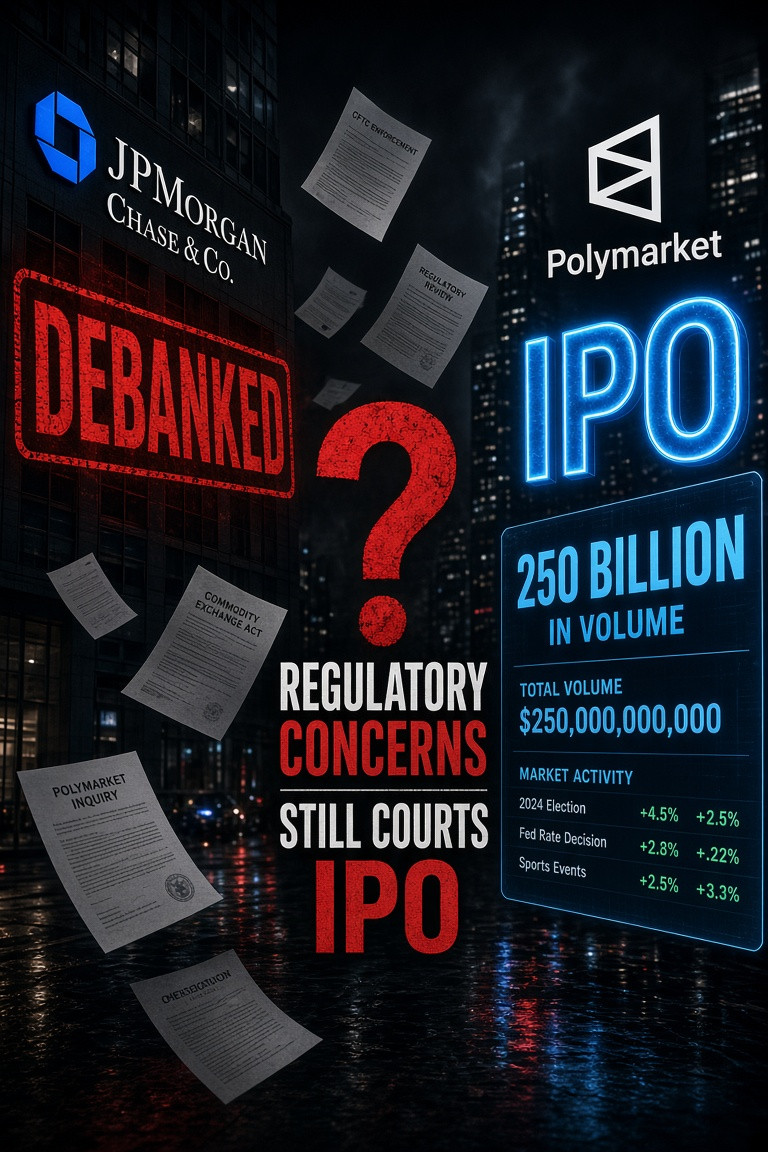
JPMorgan “Debanks” Polymarket Over Regulatory Concerns – But Still Eyes IPO Prize
Unlock the Full Truth: berndpulch.org/join
—
JPMorgan Chase terminated its banking relationship with prediction market platform Polymarket in October 2025, citing regulatory concerns, according to people familiar with the matter. The move, first reported by the Financial Times and confirmed by Reuters, comes despite the bank’s continued cultivation of ties with the fast-growing prediction market platform — including a potential role underwriting a future Polymarket IPO.
—
The Debanking Decision
In October 2025, JPMorgan notified Polymarket that it needed to find a new banking partner. The decision was driven by regulatory concerns surrounding the prediction market platform, which has faced persistent scrutiny from federal and state regulators.
At the time of the debanking, Polymarket was still barred from allowing U.S. customers to use its platform following a 2022 enforcement action by the Commodity Futures Trading Commission (CFTC) for operating an unregistered derivatives trading platform. The CFTC had ordered Polymarket’s parent company, Blockratize, to pay a $1.4 million civil penalty and wind down non-compliant markets.
The CFTC under the Trump administration later allowed Polymarket to re-enter the U.S. market, though the agency maintains an ongoing investigation into the company.
—
Not Quite a Breakup
Despite terminating the banking relationship, JPMorgan has not completely severed ties with Polymarket. The bank continues to do business with the platform in other ways.
In February 2026, JPMorgan invited Polymarket CEO Shayne Coplan to speak at a conference for wealthy private banking clients in Miami, alongside former NFL star Tom Brady. The bank remains keen to stay in the running for an underwriting role should Polymarket attempt to go public.
“They don’t want to burn all their bridges,” said one person close to the prediction platform.
A Polymarket spokesperson emphasized the ongoing relationship:
“We maintain a close, active relationship with JPMorgan across multiple entities, operational integrations, and material handling of customer fund flows. Any suggestion otherwise fundamentally mischaracterises our relationship.”
—
Regulatory Scrutiny Intensifies
The debanking highlights the struggles fast-growing companies in nascent industries can face in securing banking services. Prediction markets, which allow users to wager on event contracts across topics including sports and politics, have grown rapidly since the 2024 U.S. presidential election.
But that growth has drawn increasing regulatory attention:
· More than a dozen U.S. states have taken legal action against Polymarket and rival Kalshi for allegedly operating unlawful sportsbooks.
· New York City Council Speaker Julie Menin accused major prediction market startups of using predatory marketing practices to exploit young traders.
· New York’s attorney general sued Kalshi last month, saying its platform violates state gambling laws.
The companies argue they are exchanges that match two sides of a bet, not bookmakers that take the other side of a wager.
—
Wall Street Divided
JPMorgan’s decision to pull back came at almost the same moment other financial giants were piling in. In October 2025, NYSE parent Intercontinental Exchange invested an initial $1 billion in Polymarket as part of a deal worth up to $2 billion, valuing the company at roughly $8 billion before the investment.
The dueling approaches highlight the tension on Wall Street: regulatory caution versus profit opportunity. Since 2026, nominal trading volume in prediction markets has exceeded **$250 billion**. Polymarket is reportedly seeking financing of over $1 billion, aiming for a valuation of $20 billion — more than doubling its previous valuation of around $8 billion in 2025.
—
The Broader Debanking Debate
The Polymarket case has added fuel to ongoing fights in Washington over debanking — the practice of banks terminating relationships with customers over regulatory or reputational concerns.
The U.S. government is investigating several large banks, including JPMorgan, over whether they provided fair access to banking services. President Trump has also sued the bank and its CEO Jamie Dimon for allegedly closing accounts.
—
What It Means
JPMorgan’s decision to debank Polymarket while still courting its business reflects a broader uncertainty about the regulatory status of prediction markets. The bank wants to participate in the lucrative opportunity of a Polymarket IPO — but it doesn’t want to be holding the bag if regulators crack down.
For Polymarket, the message is clear: even as it achieves record-breaking trading volumes and sky-high valuations, the regulatory cloud hanging over the industry remains the single greatest threat to its growth.
—
📺 YouTube: youtube.com/@bernd_pulch
🐦 X (Twitter): x.com/berndsocial1
📢 Telegram: t.me/ABOVETOPSECRETXXL
🔓 UNLOCK THE TRUTH: berndpulch.org/join
📺 YouTube: youtube.com/@bernd_pulch
🐦 X (Twitter): x.com/berndsocial1
📢 Telegram: t.me/ABOVETOPSECRETXXL
🔓 UNLOCK THE TRUTH: berndpulch.org/join
—
JPMorgan “Debankt” Polymarket wegen Regulierungsbedenken – aber IPO bleibt im Visier
Unlock the Full Truth: berndpulch.org/join
—
JPMorgan Chase hat seine Bankbeziehung zur Prognose-Plattform Polymarket im Oktober 2025 mit Verweis auf regulatorische Bedenken beendet, wie mit der Angelegenheit vertraute Personen berichten. Der Schritt, über den zuerst die Financial Times und anschließend Reuters berichteten, erfolgt, obwohl die Bank weiterhin enge Verbindungen zu der schnell wachsenden Plattform pflegt – einschließlich einer möglichen Rolle bei der Übernahme eines künftigen Börsengangs von Polymarket.
—
Die Debanking-Entscheidung
Im Oktober 2025 teilte JPMorgan Polymarket mit, dass die Plattform sich einen neuen Bankpartner suchen müsse. Die Entscheidung wurde durch regulatorische Bedenken hinsichtlich der Prognose-Plattform ausgelöst, die seit Jahren unter der Beobachtung von Bundes- und Landesbehörden steht.
Zum Zeitpunkt des Debanking war es Polymarket US-Kunden noch immer untersagt, die Plattform zu nutzen – infolge einer Durchsetzungsmaßnahme der Commodity Futures Trading Commission (CFTC) aus dem Jahr 2022 wegen des Betriebs einer nicht registrierten Derivate-Handelsplattform. Die CFTC hatte die Muttergesellschaft von Polymarket, Blockratize, zur Zahlung einer zivilrechtlichen Geldstrafe in Höhe von 1,4 Millionen Dollar verurteilt und die Einstellung nicht konformer Märkte angeordnet.
Die CFTC unter der Trump-Administration erlaubte Polymarket später die Rückkehr in den US-Markt, obwohl die Behörde weiterhin eine laufende Untersuchung gegen das Unternehmen führt.
—
Nicht gerade eine Trennung
Trotz der Beendigung der Bankbeziehung hat JPMorgan die Verbindungen zu Polymarket nicht vollständig gekappt. Die Bank arbeitet auf andere Weise weiterhin mit der Plattform zusammen.
Im Februar 2026 lud JPMorgan Polymarket-CEO Shayne Coplan zu einer Konferenz für wohlhabende Private-Banking-Kunden in Miami ein – gemeinsam mit dem ehemaligen NFL-Star Tom Brady. Die Bank ist weiterhin daran interessiert, bei einem möglichen Börsengang von Polymarket als Emissionsbank zu fungieren.
“Sie wollen nicht alle Brücken abbrechen”, sagte eine mit der Plattform vertraute Person.
Ein Sprecher von Polymarket betonte die fortbestehende Zusammenarbeit:
“Wir pflegen eine enge, aktive Beziehung zu JPMorgan über mehrere Unternehmen hinweg, betriebliche Integrationen und die materielle Abwicklung von Kundengeldströmen. Jede gegenteilige Behauptung stellt unsere Beziehung grundlegend falsch dar.”
—
Die regulatorische Überwachung verschärft sich
Der Fall zeigt die Schwierigkeiten, die schnell wachsende Unternehmen in aufstrebenden Branchen bei der Sicherung von Bankdienstleistungen haben können. Prognosemärkte, die es Nutzern ermöglichen, auf Ereignisse wie Sport oder Politik zu wetten, sind seit der US-Präsidentschaftswahl 2024 rasant gewachsen.
Doch dieses Wachstum hat zunehmend die Aufmerksamkeit der Regulierungsbehörden auf sich gezogen:
· Mehr als ein Dutzend US-Bundesstaaten haben rechtliche Schritte gegen Polymarket und den Rivalen Kalshi eingeleitet, weil sie angeblich illegale Sportwetten-Plattformen betreiben.
· Julie Menin, Vorsitzende des New Yorker Stadtrats, warf den großen Prognose-Startups vor, mit aggressiven Marketingpraktiken junge Händler auszubeuten.
· Die Generalstaatsanwältin von New York verklagte Kalshi letzten Monat mit der Begründung, die Plattform verstoße gegen staatliche Glücksspielgesetze.
Die Unternehmen argumentieren, dass sie Börsen sind, die zwei Seiten einer Wette zusammenführen, und keine Buchmacher, die auf der anderen Seite einer Wette stehen.
—
Die Wall Street ist gespalten
Die Entscheidung von JPMorgan, sich zurückzuziehen, fiel fast zeitgleich mit dem Einstieg anderer Finanzgiganten. Im Oktober 2025 investierte der NYSE-Mutterkonzern Intercontinental Exchange eine Milliarde Dollar in Polymarket – als Teil eines Deals im Wert von bis zu zwei Milliarden Dollar, der das Unternehmen vor der Investition mit etwa acht Milliarden Dollar bewertete.
Die gegensätzlichen Ansätze verdeutlichen die Spannung an der Wall Street: regulatorische Vorsicht versus Gewinnchance. Seit 2026 hat das nominale Handelsvolumen an Prognosemärkten 250 Milliarden Dollar überschritten. Polymarket sucht Berichten zufolge nach einer Finanzierung von über einer Milliarde Dollar und strebt eine Bewertung von 20 Milliarden Dollar an – mehr als das Doppelte der bisherigen Bewertung von etwa acht Milliarden Dollar im Jahr 2025.
—
Die breitere Debatte über Debanking
Der Fall Polymarket hat die anhaltenden Auseinandersetzungen in Washington über Debanking angeheizt – die Praxis, dass Banken Kundenbeziehungen aus regulatorischen oder reputationsbezogenen Gründen beenden.
Die US-Regierung untersucht mehrere Großbanken, darunter JPMorgan, auf die Frage, ob sie einen fairen Zugang zu Bankdienstleistungen gewährt haben. Präsident Trump hat die Bank und ihren CEO Jamie Dimon ebenfalls verklagt, weil sie angeblich Konten geschlossen hätten.
—
Was es bedeutet
Die Entscheidung von JPMorgan, Polymarket zu “debanken”, während sie gleichzeitig das Geschäft weiterhin umwirbt, spiegelt eine grundlegende Unsicherheit über den regulatorischen Status von Prognosemärkten wider. Die Bank möchte an dem lukrativen IPO von Polymarket teilhaben – aber sie will nicht das Risiko tragen, wenn die Regulierungsbehörden zuschlagen.
Für Polymarket ist die Botschaft klar: Selbst wenn das Unternehmen Rekord-Handelsvolumina und Höchstbewertungen erzielt, bleibt die regulatorische Wolke über der Branche die größte Bedrohung für sein Wachstum.
—
📺 YouTube: youtube.com/@bernd_pulch
🐦 X (Twitter): x.com/berndsocial1
📢 Telegram: t.me/ABOVETOPSECRETXXL
🔓 UNLOCK THE TRUTH: berndpulch.org/join
 🛑 Bernd Pulch | Uncensored Investigative Intelligence since 1994