


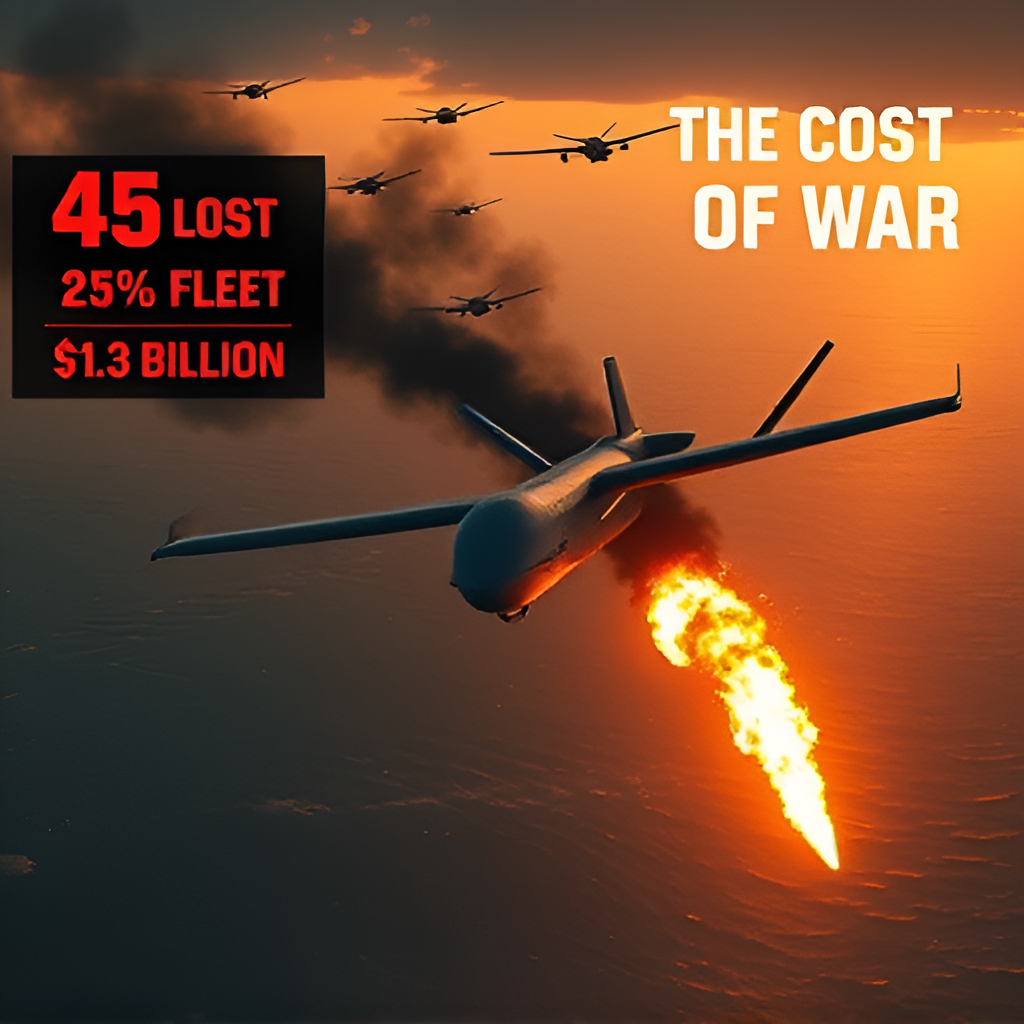
US Military Loses 45 MQ‑9 Reaper Drones in Iran War – $1.3 Billion Blow to Pentagon
The U.S. military has lost at least 45 MQ‑9 Reaper drones during the war with Iran, wiping out roughly 25 percent of its entire fleet, according to three U.S. officials familiar with Pentagon data. The losses, first reported by The Washington Post, represent one of the most severe attrition rates for a single weapons system in recent U.S. conflicts.
—
The Numbers
Before the war, the U.S. military operated approximately 185 MQ‑9 Reapers – 165 in the Air Force and 20 in the Marine Corps. Today, that number has fallen to around 135 according to Air Force Lt. Gen. David Tabor, who told the Senate in May that he was “concerned” about the losses.
The Air Force puts the cost of each Reaper between $30 million and $50 million, depending on sensors and weapons. With 45 aircraft lost, the total price tag for this single weapons system alone exceeds $1.3 billion.
—
Why So Many Were Lost
The Reaper has been heavily used around the Strait of Hormuz – a narrow, high‑threat chokepoint where Iran has concentrated its air defenses.
But the aircraft itself is a vulnerable platform. According to the reports, the MQ‑9 flies slowly and at low altitudes, making it a “relatively easy target” for Iran and its proxies.
“This version of the drone, which flies low and quite slowly, is used for reconnaissance and precision strikes” – TASS
Not all of the lost drones were shot down. One official told The Washington Post that an unspecified number crashed after operators lost communication links with them.
—
The Broader Context
The Reaper losses are part of a much larger drain on U.S. military resources. The war with Iran has depleted stocks of other critical weapons as well:
· Long‑range missiles (ATACMS and PrSM) – virtually exhausted
· Tomahawk cruise missiles – nearly half of the inventory used
· Patriot interceptors – approximately 65 percent depleted
· THAAD interceptors – nearly 80 percent consumed
In June, the Trump administration asked Congress for roughly $80 billion** to cover operational and replacement expenses tied to the war. Another report mentions a request of **$67 billion to compensate for costs and replenish stocks.
—
The Replacement Problem
The Pentagon is gradually phasing out the MQ‑9 Reaper, manufactured by General Atomics, and plans to replace them with a fleet of cheaper strike‑reconnaissance drones capable of attacking targets in swarms.
But that transition will take time. Meanwhile, President Trump has imposed tariffs of up to 100 percent on imports of drones and components, citing national security concerns and the U.S.’s reliance on foreign sources for unmanned aircraft systems.
—
A Quarter of the Fleet – Gone
The loss of 45 MQ‑9 Reapers – a quarter of the entire fleet – is not just a financial blow. It represents a significant degradation of U.S. surveillance and strike capabilities in a region where intelligence and precision targeting are paramount.
The Reaper has been a workhorse for America’s operations in the Middle East since its introduction in 2007. With a quarter of the fleet now gone, the Pentagon faces a stark choice: accelerate production, deplete other assets, or accept reduced operational capacity.
As Lt. Gen. Tabor told the Senate: “I’m concerned”. For U.S. military planners, that concern is now a crisis.
—
📺 YouTube: youtube.com/@bernd_pulch
🐦 X (Twitter): x.com/berndsocial1
📢 Telegram: t.me/ABOVETOPSECRETXXL
🔓 UNLOCK THE TRUTH: berndpulch.org/join
US-Militär verliert 45 MQ-9-Reaper-Drohnen im Iran-Krieg – 25 % der Flotte vernichtet
Das US-Militär hat während des Krieges mit dem Iran mindestens 45 MQ-9-Reaper-Drohnen verloren – das entspricht etwa 25 Prozent seiner gesamten Flotte. Die Verluste, die von drei mit den Pentagon-Daten vertrauten US-Beamten bestätigt und zuerst von der Washington Post berichtet wurden, stellen eine der schwersten Verlustraten für ein einzelnes Waffensystem in den jüngsten US-Konflikten dar.
—
Die Zahlen
Vor dem Krieg betrieb das US-Militär etwa 185 MQ-9 Reaper – 165 bei der Air Force und 20 beim Marine Corps. Heute ist diese Zahl auf etwa 135 gesunken, wie Air-Force-Generalleutnant David Tabor im Mai vor dem Senat einräumte und seine “Besorgnis” über die Verluste äußerte.
Die Air Force beziffert die Kosten jedes Reapers auf zwischen 30 und 50 Millionen Dollar, abhängig von Sensoren und Bewaffnung. Bei 45 verlorenen Flugzeugen übersteigt der Gesamtwert allein für dieses Waffensystem 1,3 Milliarden Dollar.
—
Warum so viele verloren gingen
Der Reaper wurde intensiv rund um die Straße von Hormus eingesetzt – einen engen, hochbedrohlichen Engpass, in dem der Iran seine Luftabwehr konzentriert hat.
Die Drohne selbst ist jedoch eine verwundbare Plattform. Berichten zufolge fliegt die MQ-9 langsam und in niedrigen Höhen, was sie zu einem “relativ leichten Ziel” für den Iran und seine Verbündeten macht.
“Diese Version der Drohne, die niedrig und recht langsam fliegt, wird für Aufklärung und Präzisionsschläge eingesetzt” – TASS
Nicht alle verlorenen Drohnen wurden abgeschossen. Ein Beamter sagte der Washington Post, dass eine nicht näher bezeichnete Anzahl nach dem Verlust von Kommunikationsverbindungen abgestürzt sei.
—
Der weitere Kontext
Die Reaper-Verluste sind Teil einer viel größeren Belastung der US-Militärressourcen. Der Krieg mit dem Iran hat auch die Bestände anderer kritischer Waffen dezimiert:
· Langstreckenraketen (ATACMS und PrSM) – praktisch aufgebraucht
· Tomahawk-Marschflugkörper – fast die Hälfte des Bestands verbraucht
· Patriot-Abfangraketen – etwa 65 Prozent aufgebraucht
· THAAD-Abfangraketen – fast 80 Prozent verbraucht
Im Juni beantragte die Trump-Administration beim Kongress etwa 80 Milliarden Dollar zur Deckung der Betriebs- und Ersatzkosten im Zusammenhang mit dem Krieg. Ein anderer Bericht spricht von einer Anfrage in Höhe von 67 Milliarden Dollar zur Kompensation der Kosten und zur Wiederauffüllung der Bestände.
—
Das Ersatzproblem
Das Pentagon stellt die MQ-9 Reaper, hergestellt von General Atomics, schrittweise außer Dienst und plant, sie durch eine Flotte von billigeren Aufklärungs- und Angriffsdrohnen zu ersetzen, die Ziele im Schwarm angreifen können.
Doch dieser Übergang wird Zeit in Anspruch nehmen. Präsident Trump hat unterdessen Zölle von bis zu 100 Prozent auf die Einfuhr von Drohnen und Komponenten verhängt und sich dabei auf nationale Sicherheitsbedenken und die Abhängigkeit der USA von ausländischen Quellen für unbemannte Luftfahrtsysteme berufen.
—
Ein Viertel der Flotte – weg
Der Verlust von 45 MQ-9-Reaper-Drohnen – einem Viertel der gesamten Flotte – ist nicht nur ein finanzieller Schlag. Er stellt eine erhebliche Beeinträchtigung der US-Überwachungs- und Angriffsfähigkeiten in einer Region dar, in der Aufklärung und Präzisionszielbekämpfung von größter Bedeutung sind.
Der Reaper ist seit seiner Einführung im Jahr 2007 ein Arbeitstier für die Operationen der USA im Nahen Osten. Da nun ein Viertel der Flotte verloren ist, steht das Pentagon vor einer harten Wahl: die Produktion beschleunigen, andere Bestände anzapfen oder eine reduzierte Einsatzfähigkeit in Kauf nehmen.
Wie Generalleutnant Tabor dem Senat sagte: “Ich bin besorgt.” Für die Militärplaner der USA ist diese Besorgnis inzwischen zu einer Krise geworden.
—
📺 YouTube: youtube.com/@bernd_pulch
🐦 X (Twitter): x.com/berndsocial1
📢 Telegram: t.me/ABOVETOPSECRETXXL
🔓 UNLOCK THE TRUTH: berndpulch.org/join

 🛑 Bernd Pulch | Uncensored Investigative Intelligence since 1994