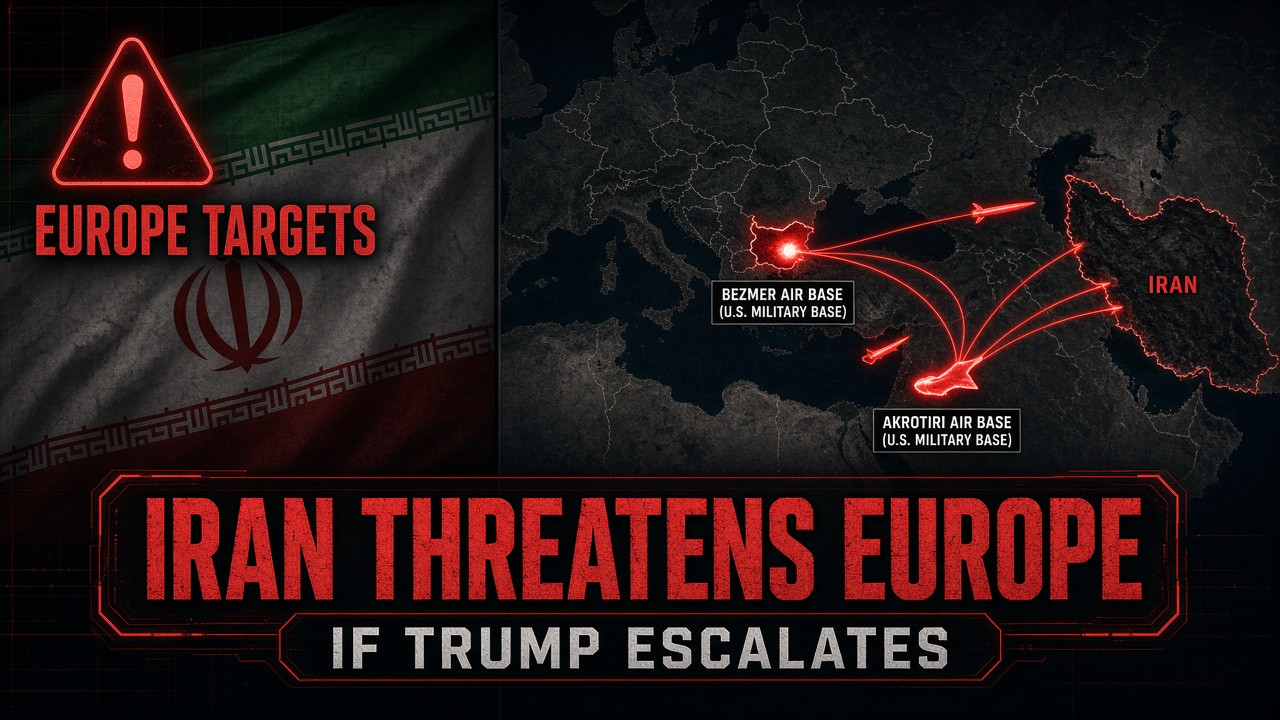
Iran is actively planning to strike U.S. military targets in Europe — including bases in Bulgaria and Cyprus — if President Donald Trump orders a fresh escalation of the war, according to sources close to the Iranian regime. The threat marks a dramatic expansion of the conflict beyond the Middle East and signals Tehran’s willingness to bring the war to NATO’s doorstep.
The Threat
Iranian military planners have examined potential targets at American military facilities in southeastern Europe, including Bulgaria, according to a report by the Financial Times. The assessment follows Bulgaria’s decision last month to allow U.S. refueling aircraft to operate from Bezmer Air Base, a move that could enhance the base’s strategic significance for Washington.
“Iranian forces have evaluated the option of striking U.S. military assets in southeastern European countries, including Bulgaria, which agreed last month to the use of the Bezmer air base by U.S. aircraft for refueling purposes.” — Financial Times, citing sources close to the Iranian regime
Cyprus has also been identified as a possible target. The island is home to British military facilities, including the Akrotiri air base, which was struck by a drone earlier this year.
The Undersea Cable Threat
In addition to military targets, Iranian forces have separately assessed the possibility of striking undersea fiber-optic cables passing through the Strait of Hormuz. Any such disruption could affect key communications infrastructure running through the strategically vital waterway.
“Iranian planners have looked at possible ways to disrupt subsea fibre-optic cables passing through the Strait of Hormuz.” — Financial Times report
The Escalation Calculus
The reported contingency planning reflects Tehran’s efforts to assess how it could raise the costs for Washington if the conflict widens.
Key factors driving the threat:
· The 60-day talk window between the U.S. and Iran ended without any breakthrough under the Islamabad MoU · Trump declared that no “talks or conversations” are underway or planned with Tehran · Iran’s Supreme Leader has promoted hardliners to top security and military positions, signaling a shift toward a more confrontational posture
“If the United States were to strike Iranian infrastructure, Tehran could expand its operations beyond the Middle East. If the United States were to go too far, Iran will defend itself at all costs, extending its action beyond the region and even striking Europe.” — Source close to the Iranian regime
The “Madness” Gambit
Iranian sources have conveyed a blunt message to Washington: “Don’t play a game of madness with us, because we are crazier.”
One source warned that Tehran’s response would be “without any limits”. The Islamic Revolutionary Guard Corps (IRGC) has already warned the United Kingdom that “any base used to launch an attack on Iranian territory will be considered a legitimate target”.
In July, Iran attacked a U.S. base in Jordan, killing three U.S. service members. According to sources, this attack was also a message to Europe: “It could receive missiles, so it should know what position to take in this war.”
The Military Reality
While the threat is serious, experts caution that Iran’s ability to strike European targets is limited.
Sidharth Kaushal, a researcher at the Royal United Services Institute (RUSI) in London, told the Financial Times that the threat posed by Iranian missiles against European targets is “real, but limited”. Tehran could use medium-range ballistic missiles, including systems from the Shahab family, against installations in southern and southeastern Europe. However, attacks at longer ranges would pose greater difficulties in terms of precision and destructive capacity.
Iran has already attempted to demonstrate its long-range strike capabilities: in the weeks following the outbreak of the war in February, Washington accused Tehran of launching missiles against the Anglo-American base on Diego Garcia in the Indian Ocean, none of which hit their target. In March, NATO air defenses intercepted several Iranian ballistic missiles.
The Bottom Line
Iran is preparing options to broaden the conflict if Trump acts on earlier threats to strike Iranian infrastructure. The reported planning to strike U.S. targets in Bulgaria and Cyprus represents a significant escalation in the war of words — and potentially, the war itself.
The message from Tehran is clear: if the United States expands the war, Iran will expand it too — and Europe will not be spared.
📺 YouTube: youtube.com/@bernd_pulch 🐦 X (Twitter): x.com/berndsocial1 📢 Telegram: t.me/ABOVETOPSECRETXXL 🔓 UNLOCK THE TRUTH: berndpulch.org/join
Iran droht mit Angriffen auf US-Militärziele in Europa – Bulgarien und Zypern im Visier
Unlock the Full Truth: berndpulch.org/join
—
Iran plant nach Informationen von regime-nahen Quellen Angriffe auf US-Militärziele in Europa – darunter Stützpunkte in Bulgarien und Zypern – falls Präsident Donald Trump den Krieg weiter eskalieren lässt. Die Drohung markiert eine dramatische Ausweitung des Konflikts über den Nahen Osten hinaus und signalisiert Teherans Bereitschaft, den Krieg bis vor die Tore der NATO zu tragen.
—
Die Drohung
Iranische Militärplaner haben mögliche Ziele an US-Militäreinrichtungen in Südosteuropa geprüft, darunter in Bulgarien, wie die Financial Times berichtet. Die Bewertung erfolgt im Anschluss an Bulgariens Entscheidung vom letzten Monat, US-Tankflugzeugen die Nutzung des Luftstützpunkts Besmer zu erlauben – ein Schritt, der die strategische Bedeutung des Stützpunkts für Washington erhöhen könnte.
“Iranische Streitkräfte haben die Option geprüft, US-Militärgüter in südosteuropäischen Ländern anzugreifen, darunter Bulgarien, das im letzten Monat der Nutzung des Luftstützpunkts Besmer durch US-Flugzeuge zu Betankungszwecken zugestimmt hat.” — Financial Times unter Berufung auf regime-nahe Quellen
Auch Zypern wurde als mögliches Ziel identifiziert. Die Insel beherbergt britische Militäreinrichtungen, darunter den Luftstützpunkt Akrotiri, der bereits Anfang des Jahres von einer Drohne angegriffen wurde.
—
Die Bedrohung von Unterseekabeln
Neben militärischen Zielen haben iranische Streitkräfte separat die Möglichkeit geprüft, Unterseeglasfaserkabel anzugreifen, die durch die Straße von Hormus verlaufen. Jede solche Störung könnte die wichtige Kommunikationsinfrastruktur beeinträchtigen, die durch die strategisch lebenswichtige Wasserstraße verläuft.
“Iranische Planer haben mögliche Wege geprüft, um Unterseeglasfaserkabel zu stören, die durch die Straße von Hormus verlaufen.” — Financial Times
—
Die Eskalationslogik
Die berichtete Notfallplanung spiegelt Teherans Bemühungen wider, zu bewerten, wie es die Kosten für Washington erhöhen könnte, falls der Konflikt weiter eskaliert.
Schlüsselfaktoren, die die Drohung antreiben:
· Das 60-tägige Gesprächsfenster zwischen den USA und dem Iran endete ohne Durchbruch im Rahmen des Islamabad-MoU · Trump erklärte, dass derzeit keine “Gespräche oder Unterhaltungen” mit Teheran stattfinden oder geplant seien · Irans oberster Führer hat Hardliner in die obersten Sicherheits- und Militärpositionen berufen, was eine Hinwendung zu einer konfrontativeren Haltung signalisiert
“Wenn die Vereinigten Staaten iranische Infrastruktur angreifen würden, könnte Teheran seine Operationen über den Nahen Osten hinaus ausweiten. Wenn die Vereinigten Staaten zu weit gehen sollten, wird sich Iran um jeden Preis verteidigen, seine Aktionen über die Region hinaus ausdehnen und sogar Europa angreifen.” — Quelle aus regime-nahen Kreisen
—
Die “Wahnsinns”-Strategie
Iranische Quellen haben Washington eine unmissverständliche Botschaft übermittelt: “Spielen Sie kein Wahnsinnsspiel mit uns, denn wir sind verrückter.”
Eine Quelle warnte, dass Teherans Antwort “ohne jede Grenze” sein werde. Die Islamischen Revolutionsgarden (IRGC) haben Großbritannien bereits gewarnt, dass “jeder Stützpunkt, der für einen Angriff auf iranisches Territorium genutzt wird, als legitimes Ziel betrachtet wird”.
Im Juli griff der Iran einen US-Stützpunkt in Jordanien an und tötete drei US-Soldaten. Quellen zufolge war auch dieser Angriff eine Botschaft an Europa: “Es könnte Raketen erhalten, also sollte es wissen, welche Position es in diesem Krieg einnehmen sollte.”
—
Die militärische Realität
So ernst die Bedrohung ist, warnen Experten, dass Irans Fähigkeit, europäische Ziele anzugreifen, begrenzt ist.
Sidharth Kaushal, Forscher am Royal United Services Institute (RUSI) in London, sagte der Financial Times, dass die Bedrohung durch iranische Raketen gegen europäische Ziele “real, aber begrenzt” sei. Teheran könnte Mittelstreckenraketen, einschließlich Systeme der Shahab-Familie, gegen Einrichtungen in Süd- und Südosteuropa einsetzen. Angriffe über größere Entfernungen würden jedoch größere Schwierigkeiten in Bezug auf Präzision und Zerstörungskraft mit sich bringen.
Der Iran hat bereits versucht, seine Langstreckenfähigkeiten unter Beweis zu stellen: In den Wochen nach Kriegsausbruch im Februar beschuldigte Washington Teheran, Raketen gegen den britisch-amerikanischen Stützpunkt auf Diego Garcia im Indischen Ozean abgefeuert zu haben, von denen keine ihr Ziel traf. Im März fing die NATO-Luftverteidigung mehrere iranische ballistische Raketen ab.
—
Die Bilanz
Der Iran bereitet Optionen vor, den Konflikt auszuweiten, falls Trump auf frühere Drohungen reagiert, iranische Infrastruktur anzugreifen. Die berichtete Planung von Angriffen auf US-Ziele in Bulgarien und Zypern stellt eine bedeutende Eskalation des Wortgefechts – und möglicherweise des Krieges selbst – dar.
Die Botschaft aus Teheran ist klar: wenn die USA den Krieg ausweiten, wird der Iran ihn ebenfalls ausweiten – und Europa wird nicht verschont bleiben.
—
📺 YouTube: youtube.com/@bernd_pulch 🐦 X (Twitter): x.com/berndsocial1 📢 Telegram: t.me/ABOVETOPSECRETXXL 🔓 UNLOCK THE TRUTH: berndpulch.org/join
Washington’s Balancing Act: The Five Fronts Shaping the U.S.-Israel Relationship
Unlock the Full Truth: berndpulch.org/join
—
From the hills of southern Lebanon to the corridors of the CIA, from California’s statehouse to the Gaza Strip, a series of developments this week have exposed the increasingly fragile and complex nature of the U.S.-Israel relationship. The Trump administration is simultaneously pushing back against Israeli military ambitions, casting doubt on Israeli intelligence, dispatching Jared Kushner to salvage a floundering peace plan, and watching as international criticism of Benjamin Netanyahu’s government mounts.
—
Lebanon: U.S. Rejects Israeli “Permanent Presence”
The first major flashpoint emerged on Wednesday when the U.S. State Department sharply rebuked Israeli Defense Minister Israel Katz after he declared that Israeli forces would not withdraw from southern Lebanon. Katz, during a visit to Israeli military outposts in Lebanon, stated that the IDF was “here to stay” in security zones in Lebanon, Syria, and Gaza.
“As the prime minister and I have made unequivocally clear, we are not withdrawing from this security zone. The IDF is here to protect the northern communities and its troops; we will clear this area and ensure the security of the residents of the North, and under no circumstances will we withdraw from the security zones: not in Lebanon, not in Syria and not in Gaza.”
The State Department’s response was swift and pointed. A senior official stated that a permanent Israeli military presence in southern Lebanon is “inconsistent” with the commitments made under a U.S.-sponsored framework agreement.
“The United States expects all parties to act in any manner consistent with the framework they agreed to, and Israel clearly stated that it has no territorial ambition in Lebanon.”
Washington emphasized that it “fully supports Lebanon’s territorial integrity and sovereignty” and that the framework provides for a phased Israeli withdrawal tied to the verified disarmament of Hezbollah. The administration’s rebuke highlighted a growing rift, with one U.S. official noting that Katz’s statements “appeared to directly contradict” previous Israeli commitments.
CIA Doubts Israeli Intel on Iranian Threat
While the administration was clashing with Israel over Lebanon, another story was unfolding behind the scenes. The Washington Post reported that CIA analysts had “low confidence” in Israeli intelligence regarding an alleged Iranian plot to assassinate President Donald Trump.
The intelligence, relayed by Israel, contributed to an elaborate security operation in July that saw Trump secretly flown out of Turkey on a military aircraft, concealed inside an airport catering truck. However, according to current and former U.S. officials, the CIA did not find the Israeli-provided information compelling.
One U.S. official described the Israeli intelligence as “Israeli-derived, not U.S.-generated, and viewed as low confidence” . This skepticism raises questions about whether the warning was intended as a genuine threat assessment or, as some officials suspected, part of a broader effort to influence Trump’s policy toward Iran.
“It fit a broader pattern of Israeli intelligence reporting that some officials see as designed as much to shape presidential decision-making as to inform it,” a former official familiar with the matter told the Post.
Turkey’s Fidan: Netanyahu’s Policies Are a “Burden”
The international criticism of the Netanyahu government continued to mount on Thursday, with Turkish Foreign Minister Hakan Fidan delivering a blistering assessment. Speaking alongside his Egyptian counterpart, Fidan said Netanyahu’s policies are “a burden for Israel, a burden for the region, and a burden and threat for international security”.
“We see that Israeli Prime Minister Benjamin Netanyahu and his team are increasingly escalating policies that trample on human dignity and are adopting an attitude that effectively provokes the entire international community.”
Fidan, who described Egypt as Turkey’s “natural partner,” said Ankara and Cairo were working closely on Gaza and had agreed that stronger measures were needed to address Israel’s violations. He also stressed the importance of greater international pressure on Israel “to let Palestinians get more international humanitarian aid”.
Kushner Heads to Israel for High-Stakes Gaza Talks
With the Gaza peace process at an impasse, the White House is dispatching Jared Kushner to the region. Trump’s son-in-law and senior adviser is expected to visit Israel and Egypt next week for talks on Gaza.
The goal, according to a source familiar with the matter, is to “find a pathway to move forward with implementation of the 20 point plan” that Trump put forward for Gaza in late 2025. Kushner will be accompanied by Board of Peace high representative Nickolay Mladenov and former British Prime Minister Tony Blair.
The trip comes after Israel publicly rejected the Trump administration’s plan, which would see Hamas disarm and Israel withdraw its forces. While Hamas has accepted the plan, Prime Minister Benjamin Netanyahu has insisted that Israel will not withdraw until Hamas is completely disarmed.
“We agree with the Israelis on the goal of disarming Hamas but they have expressed concerns which are valid and we have been working through them,” a source told Reuters.
California Bill Would Add “Jewish” as Ethnicity Option
In a separate development, California is advancing legislation that would make it the first state in the nation to recognize Jewish identity as an optional ethnic category on government demographic forms.
Senate Bill 1387 would require state agencies that collect demographic data on ancestry or ethnic origin to “use a separate collection category and tabulation for Jewish ancestry or ethnicity”. The bill, introduced by State Sen. Henry Stern, has already passed policy committees in both houses of the legislature.
Supporters say the bill would help the state and Jewish community groups better understand the needs of California’s Jewish population, particularly in light of rising antisemitic hate crimes.
“We were reaching for data that we didn’t have,” Stern told the Forward. “We had the data on hate crime incidents, but we didn’t have the demographic data to show that for such a small population with this number of incidents, you’ve got a serious problem.”
Critics, however, have expressed concerns about the risks of asking Jews to identify themselves to the state, pointing to the historical dangers of appearing on state registries.
—
Conclusion
From the hills of southern Lebanon to the corridors of the CIA, from California’s statehouse to the Gaza Strip, the past 24 hours have underscored the growing complexity of the U.S.-Israel relationship. The Trump administration is simultaneously pushing back against Israeli military ambitions, casting doubt on Israeli intelligence, dispatching Jared Kushner to salvage a floundering peace plan, and watching as international criticism of Benjamin Netanyahu’s government mounts.
The emerging picture is one of a relationship under strain—one in which the U.S. is no longer willing to give Israel a blank check on Lebanon, is increasingly skeptical of its intelligence, and is publicly clashing over Gaza policy. Whether Kushner’s upcoming trip can bridge the growing divide remains to be seen, but the cracks in the alliance are becoming impossible to ignore.
—
📺 YouTube: youtube.com/@bernd_pulch 🐦 X (Twitter): x.com/berndsocial1 📢 Telegram: t.me/ABOVETOPSECRETXXL 🔓 UNLOCK THE TRUTH: berndpulch.org/join
Washingtons Balanceakt: Die fünf Fronten, die das US-israelische Verhältnis prägen
Unlock the Full Truth: berndpulch.org/join
—
Von den Hügeln des Südlibanon bis zu den Korridoren der CIA, vom kalifornischen Kapitol bis zum Gazastreifen – eine Serie von Entwicklungen hat in dieser Woche die zunehmend fragile und komplexe Natur der US-israelischen Beziehungen offenbart. Die Trump-Administration wehrt sich gleichzeitig gegen israelische Militäraktionen, stellt israelische Geheimdienstinformationen in Frage, entsendet Jared Kushner, um einen stockenden Friedensplan zu retten, und beobachtet, wie die internationale Kritik an Benjamin Netanjahus Regierung wächst.
—
Libanon: USA lehnen israelische “dauerhafte Präsenz” ab
Der erste Konfliktpunkt entstand am Mittwoch, als das US-Außenministerium den israelischen Verteidigungsminister Israel Katz scharf zurückwies, nachdem dieser erklärt hatte, dass sich israelische Truppen nicht aus dem Südlibanon zurückziehen würden. Katz hatte bei einem Besuch israelischer Militärposten im Libanon erklärt, dass die IDF in Sicherheitszonen im Libanon, in Syrien und im Gazastreifen “hier bleiben” werde.
“Wie der Ministerpräsident und ich unmissverständlich klargemacht haben, ziehen wir uns nicht aus dieser Sicherheitszone zurück. Die IDF ist hier, um die nördlichen Gemeinden und ihre Truppen zu schützen; wir werden dieses Gebiet räumen und die Sicherheit der Bewohner des Nordens gewährleisten, und unter keinen Umständen werden wir uns aus den Sicherheitszonen zurückziehen: weder im Libanon, noch in Syrien, noch in Gaza.”
Die Reaktion des Außenministeriums war schnell und eindeutig. Ein hochrangiger Beamter erklärte, dass eine dauerhafte israelische Militärpräsenz im Südlibanon “nicht mit den Verpflichtungen vereinbar” sei, die im Rahmen eines von den USA unterstützten Rahmenabkommens eingegangen wurden.
“Die Vereinigten Staaten erwarten, dass alle Parteien in einer Weise handeln, die mit dem Rahmenabkommen, dem sie zugestimmt haben, vereinbar ist, und Israel hat klar erklärt, dass es keine territorialen Ambitionen im Libanon hat.”
Washington betonte, dass es “die territoriale Integrität und Souveränität des Libanon voll und ganz unterstützt” und dass das Rahmenabkommen einen schrittweisen israelischen Rückzug im Zusammenhang mit der überprüften Entwaffnung der Hisbollah vorsieht. Die Rüge der Regierung verdeutlichte eine wachsende Kluft, wobei ein US-Beamter anmerkte, dass Katz’ Äußerungen “in direktem Widerspruch zu früheren israelischen Zusagen” zu stehen schienen.
CIA zweifelt israelische Geheimdienstinformationen zu Iran an
Während die Regierung mit Israel über den Libanon aneinandergeriet, spielte sich hinter den Kulissen eine weitere Geschichte ab. Die Washington Post berichtete, dass CIA-Analysten “geringes Vertrauen” in israelische Geheimdienstinformationen bezüglich eines angeblichen iranischen Attentatsplans auf Präsident Donald Trump hatten.
Die von Israel übermittelten Informationen trugen im Juli zu einer aufwendigen Sicherheitsoperation bei, bei der Trump heimlich aus der Türkei ausgeflogen wurde – versteckt in einem Flughafen-Catering-Truck. Laut aktuellen und ehemaligen US-Beamten fand die CIA die von Israel gelieferten Informationen jedoch nicht überzeugend.
Ein US-Beamter beschrieb die israelischen Geheimdienstinformationen als “von Israel abgeleitet, nicht von den USA erzeugt, und als mit geringer Sicherheit eingestuft” . Diese Skepsis wirft die Frage auf, ob die Warnung als echte Bedrohungsbewertung gedacht war oder, wie einige Beamte vermuteten, Teil eines breiteren Versuchs, Trumps Politik gegenüber dem Iran zu beeinflussen.
“Es passte zu einem breiteren Muster israelischer Geheimdienstberichte, die von einigen Beamten als ebenso sehr darauf ausgelegt angesehen werden, die Entscheidungsfindung des Präsidenten zu beeinflussen, wie sie zu informieren”, sagte ein ehemaliger mit der Angelegenheit vertrauter Beamter der Post.
Türkischer Außenminister Fidan: Netanjahus Politik ist eine “Last”
Die internationale Kritik an der Regierung Netanjahu hielt am Donnerstag weiter an, als der türkische Außenminister Hakan Fidan eine vernichtende Einschätzung abgab. Neben seinem ägyptischen Amtskollegen sagte Fidan, Netanjahus Politik sei “eine Last für Israel, eine Last für die Region und eine Last und Bedrohung für die internationale Sicherheit”.
“Wir sehen, dass der israelische Ministerpräsident Benjamin Netanyahu und sein Team zunehmend Politik betreiben, die die Menschenwürde mit Füßen tritt, und eine Haltung einnehmen, die effektiv die gesamte internationale Gemeinschaft provoziert.”
Fidan, der Ägypten als “natürlichen Partner” der Türkei bezeichnete, sagte, Ankara und Kairo arbeiteten eng in der Gaza-Frage zusammen und seien sich einig, dass stärkere Maßnahmen erforderlich seien, um die israelischen Verstöße zu ahnden. Er betonte auch die Bedeutung eines größeren internationalen Drucks auf Israel, “um den Palästinensern mehr internationale humanitäre Hilfe zukommen zu lassen”.
Kushner reist für hochkarätige Gaza-Gespräche nach Israel
Da der Gaza-Friedensprozess in einer Sackgasse steckt, entsendet das Weiße Haus Jared Kushner in die Region. Trumps Schwiegersohn und leitender Berater wird voraussichtlich nächste Woche Israel und Ägypten für Gespräche über Gaza besuchen.
Das Ziel, so eine mit der Angelegenheit vertraute Quelle, sei es, “einen Weg zu finden, um mit der Umsetzung des 20-Punkte-Plans voranzukommen”, den Trump Ende 2025 für Gaza vorgelegt hatte. Kushner wird von Nickolay Mladenov, dem hochrangigen Vertreter des Board of Peace, und dem ehemalischen britischen Premierminister Tony Blair begleitet.
Die Reise erfolgt, nachdem Israel den Plan der Trump-Administration öffentlich abgelehnt hatte, der vorsieht, dass die Hamas entwaffnet und Israel seine Truppen abzieht. Während die Hamas den Plan akzeptiert hat, hat Ministerpräsident Benjamin Netanyahu darauf bestanden, dass Israel sich nicht zurückziehen werde, bis die Hamas vollständig entwaffnet ist.
“Wir stimmen mit den Israelis bei dem Ziel überein, die Hamas zu entwaffnen, aber sie haben berechtigte Bedenken geäußert, an denen wir arbeiten”, sagte eine Quelle gegenüber Reuters.
Kalifornien: Gesetzentwurf würde “jüdisch” als Ethnie-Option hinzufügen
In einer separaten Entwicklung treibt Kalifornien ein Gesetz voran, das den Bundesstaat zum ersten in der Nation machen würde, der die jüdische Identität als optionale ethnische Kategorie auf staatlichen demografischen Formularen anerkennt.
Der Senatsentwurf 1387 würde staatliche Behörden, die demografische Daten zur Abstammung oder ethnischen Herkunft erheben, verpflichten, “eine separate Sammelkategorie und Tabellierung für jüdische Abstammung oder ethnische Zugehörigkeit” zu verwenden. Der von Staatssenator Henry Stern eingebrachte Gesetzentwurf hat bereits die politischen Ausschüsse beider Kammern der Legislative passiert.
Befürworter sagen, der Gesetzentwurf würde dem Staat und jüdischen Gemeindegruppen helfen, die Bedürfnisse der jüdischen Bevölkerung Kaliforniens besser zu verstehen, insbesondere im Hinblick auf die steigende Zahl antisemitischer Hassverbrechen.
“Wir haben nach Daten gesucht, die wir nicht hatten”, sagte Stern gegenüber der Forward. “Wir hatten Daten zu Hassverbrechen, aber wir hatten nicht die demografischen Daten, um zu zeigen, dass Sie bei einer so kleinen Bevölkerung mit dieser Anzahl von Vorfällen ein ernstes Problem haben.”
Kritiker haben jedoch Bedenken hinsichtlich der Risiken geäußert, Juden zu bitten, sich gegenüber dem Staat zu identifizieren, und verwiesen auf die historischen Gefahren, die mit der Erfassung in staatlichen Registern verbunden sind.
—
Fazit
Von den Hügeln des Südlibanon bis zu den Korridoren der CIA, vom kalifornischen Kapitol bis zum Gazastreifen – die vergangenen 24 Stunden haben die wachsende Komplexität der US-israelischen Beziehungen unterstrichen. Die Trump-Administration wehrt sich gleichzeitig gegen israelische Militäraktionen, stellt israelische Geheimdienstinformationen in Frage, entsendet Jared Kushner, um einen stockenden Friedensplan zu retten, und beobachtet, wie die internationale Kritik an Benjamin Netanjahus Regierung wächst.
Das sich abzeichnende Bild ist eines einer Beziehung unter Spannung – einer, in der die USA Israel keinen Blankoscheck für den Libanon mehr ausstellen, zunehmend skeptisch gegenüber seinen Geheimdienstinformationen ist und sich öffentlich über die Gaza-Politik streitet. Ob Kushners bevorstehende Reise die wachsende Kluft überbrücken kann, bleibt abzuwarten, aber die Risse in der Allianz werden immer deutlicher.
—
📺 YouTube: youtube.com/@bernd_pulch 🐦 X (Twitter): x.com/berndsocial1 📢 Telegram: t.me/ABOVETOPSECRETXXL 🔓 UNLOCK THE TRUTH: berndpulch.org/join
Institutional Intelligence & Global Markets Analysis
Date: 27 April 2026 Author: Joe Rogers — Institutional Research Department Status: TOP SECRET / Institutional Grade
THE SILICON VOID
EXECUTIVE SUMMARY: THE HORMUZ IMPASSE — BREAKTHROUGH OR BREAKDOWN?
The global financial ecosystem enters the Monday, 27 April 2026 session at a pivotal geopolitical crossroads. U.S. equity futures are sliding — Dow futures fell 0.16%, S&P 500 futures shed 0.10%, and Nasdaq 100 futures edged down 0.06% — after U.S.-Iran peace talks stalled over the weekend and President Trump cancelled his envoys’ trip for negotiations, declaring “meaningless talks without results are pointless.”
Yet beneath the surface, a potential breakthrough is taking shape. Iran has offered the United States a new proposal through Pakistani intermediaries, seeking an agreement to reopen the Strait of Hormuz and end the two-month war — with nuclear negotiations postponed to a later stage.Iranian Foreign Minister Abbas Araghchi arrived in St. Petersburg early Monday for talks with Russian President Vladimir Putin, seeking Moscow’s backing amid the negotiation stalemate.Meanwhile, the U.S. Navy continues clearing Iranian mines from the Strait — a mission Pentagon officials told lawmakers would likely take six months to complete.
The “Silicon Void” has reached a fever pitch. The Philadelphia Semiconductor Index surged 4.3% on Friday, marking its 18th consecutive day of gains — the longest winning streak in its history — and is now up 38.6% month-to-date.Intel shares soared 24% in a single session, the largest one-day rally since 1987, after reporting Q1 Data Center and AI revenue of $5.1 billion — up 22% year-over-year.The S&P 500 (+0.80% to 7,165.08) and Nasdaq Composite (+1.63% to 24,836.60) each closed at fresh all-time highs on Friday.
But the “Hormuz Impasse” continues to burn. Brent crude surged 2.05% to $107.49 a barrel — the highest since April 7 — as peace talks stalled.Goldman Sachs raised its Q4 2026 oil price forecasts, citing reduced output from the Middle East: Brent to $90, WTI to $83.Gold slipped 0.3% to $4,694.26 per ounce, pressured by a firm dollar.The University of Michigan’s final April consumer sentiment reading collapsed to 49.8 — the lowest level on record — as one-year inflation expectations jumped to 4.7% from 3.8% in March.
Bitcoin is trading near $79,100, having touched a high of $79,450, as the Bitcoin 2026 Conference kicks off in Las Vegas later Monday — expected to draw tens of thousands of investors, developers, and policymakers.
The Federal Reserve meets Tuesday and Wednesday — the CME FedWatch tool assigns a 100% probability of a rate hold.The ECB follows on Thursday, also expected to remain on hold at 2%.
The “Hormuz Paradox” is approaching its resolution point. Will the Iranian backchannel proposal — Hormuz first, nuclear talks later — break the deadlock? Or will Trump’s cancellation of direct talks and Iran’s pivot to Moscow harden the stalemate? The answer will determine whether the “Silicon Void” can sustain its historic rally — or whether the physical world finally reasserts itself over the digital.
ULTRA-DEEP INTELLIGENCE: REAL-TIME DATA MATRIX
I. GLOBAL EQUITIES: RECORD HIGHS, MONDAY FUTURES SLIDE
Index Current Level Daily Change (%) Intelligence Note S&P 500 7,165.08 +0.80% (Fri close) Fresh all-time record close; futures -0.10% Monday NASDAQ Composite 24,836.60 +1.63% (Fri close) Fresh all-time record close; Nasdaq 100 futures -0.06% Dow Jones Industrial 49,230.71 -0.16% (Fri close) Futures -0.16% Monday; dragged by energy/geopolitical angst Philadelphia Semiconductor ~10,500* +4.3% (Fri) 18 consecutive days of gains; +38.6% month-to-date; all-time record streak Russell 2000 ~2,675* -0.2%* Small caps lagging the mega-cap tech surge S&P/TSX Composite ~25,550* mixed Energy up on crude surge; tech leads broad market
II. COMMODITIES — THE HORMUZ PREMIUM RE-IGNITES
Asset Price (USD) Daily Change Intelligence Note WTI (May, settle Fri) $96.17 +1.88% Rising on stalled peace talks; Goldman Q4 forecast $83 WTI (intraday Monday) $94.40 -$1.45 Mild pullback in early Asian trade Brent (June, settle) $107.49 +2.05% Highest since April 7; Goldman Q4 forecast $90 Brent (intraday Monday) ~$106.80* -0.6%* Easing slightly on Iran backchannel proposal Gold COMEX (futures) $4,743.70 +0.06% Futures edge up in early Monday trade Gold spot $4,694.26 -0.3% Pressured by firm dollar; oil-driven inflation fears Silver COMEX (futures) $75.37 -1.36% Following gold lower
III. DIGITAL ASSETS — BITCOIN 2026 CONFERENCE KICKS OFF
Asset Price (USD) 24h Change Intelligence Note Bitcoin (BTC) ~$79,100 +2% Touched $79,450; Bitcoin 2026 Conference starts today in Las Vegas (April 27-29) Bitcoin (24h high) ~$79,500 — Resistance at $80,000-$80,500 zone Bitcoin (monthly) +19%* — Strong April momentum; Kimchi premium 0.58% in Korean market Ethereum (ETH) ~$2,400 +2%* Testing resistance above 100-day EMA; Kimchi premium 0.65% Solana (SOL) ~$88 +3%* Consolidating above $87; targeting $90 zone Bitcoin 2026 Las Vegas April 27-29 — Tens of thousands expected; Todd Blanche and Kash Patel to speak on policy
IV. FIXED INCOME & CURRENCIES — A PIVOTAL CENTRAL BANK WEEK
Asset Level Change Intelligence Note U.S. 10-year Treasury 4.323% +1.4bp Yields edge higher; markets brace for FOMC Wednesday U.S. 2-year Treasury 3.798% +2.3bp Fed funds target range: 3.50%-3.75% CME FedWatch (April) 100% hold — Absolute certainty of rate hold at April 28-29 FOMC CME FedWatch (June) 4.7% cut — Only 4.7% probability of June cut; 95.3% hold DXY (Dollar Index) ~98.45 -0.24% Slips below 98.50 on Iran Hormuz proposal EUR-USD 1.1722 +0.33% Euro firms ahead of ECB Thursday (expected hold at 2%) USD-JPY 159.38 -0.21% Yen strengthens slightly ECB Rate Decision Thursday Expected hold Markets see ECB holding at 2%; traders anticipate hikes starting June
CHART 1: PHILADELPHIA SEMICONDUCTOR INDEX — 18-DAY HISTORIC STREAK
Intelligence Note: Bitcoin surged nearly 2% to test $79,500, its
highest in five days, as the Bitcoin 2026 Conference kicks off
today at The Venetian Resort in Las Vegas (April 27-29). The
world's largest Bitcoin gathering is expected to draw tens of
thousands of investors, developers, and policymakers. High-profile
speakers include Todd Blanche and Kash Patel. Ethereum and Solana
are also rallying, with SOL targeting the $90 resistance zone.
CORE INVESTMENT THESIS 2026: THE HORMUZ IMPASSE — INFLECTION POINT
The “Hormuz Impasse” enters its most consequential week on 27 April 2026. Two competing narratives are racing toward resolution:
Track 1 — Breakthrough: Iran has offered the United States a new proposal through Pakistani intermediaries: reopen the Strait of Hormuz and end the war now, postpone nuclear negotiations to a later stage. The sequencing — Hormuz first, nukes later — could provide both sides with a face-saving off-ramp.
Track 2 — Breakdown: President Trump cancelled his envoys’ trip to Islamabad over the weekend, declaring “meaningless talks without results are pointless.” He told Iran it has “just three days” to agree to a deal, or its oil pipelines will “explode from within.”Iranian Foreign Minister Araghchi flew to Moscow to seek Putin’s backing — a move that could harden the stalemate into a protracted great-power standoff.
The financial markets are pricing both tracks simultaneously. Oil is surging toward $110 on breakdown fears. The semiconductor index is carving an 18-day winning streak on AI breakthrough hopes. Bitcoin is charging toward $80,000 as its largest-ever conference convenes. The Michigan consumer sentiment index just collapsed to an all-time low of 49.8 — yet the S&P 500 closed at a record high on Friday.
The “Hormuz Impasse” — Two Irreconcilable Realities, Final Chapter?
Reality Manifestation Current State Physical/Inflationary Strait mined, oil >$107, consumer sentiment at record low 49.8, inflation expectations 4.7% WTI $96.17, Brent $107.49 Digital/Deflationary SOX 18-day win streak, Intel +24%, S&P 500 and Nasdaq records S&P 500 7,165.08, Nasdaq 24,836.60
“The Strait of Hormuz remains effectively closed. The Pentagon says it will take six months to clear Iranian mines. Trump has given Iran three days before its oil infrastructure ‘explodes from within.’ Iran has countered with a backchannel proposal — reopen Hormuz, postpone nuclear talks — while its foreign minister flies to Moscow to meet Putin. Oil surges past $107. Consumer sentiment collapses to the lowest level in recorded history. And yet — the Philadelphia Semiconductor Index just completed its 18th consecutive day of gains. Intel soared 24% in a single day. The S&P 500 and Nasdaq closed at all-time records. Bitcoin tests $79,500 as 30,000 people descend on Las Vegas for the world’s largest crypto conference. This is the week the Hormuz Impasse either breaks — or breaks the market.” — Joe Rogers, Institutional Intelligence
GEOPOLITICAL RISK MATRIX: THE HORMUZ IMPASSE — INFLECTION POINT
THE DUAL-TRACK DIPLOMACY — BREAKTHROUGH OR BREAKDOWN
The weekend of April 25-27 produced a flurry of diplomatic activity and rhetorical escalation:
Track A — Backchannel Diplomacy:
· Iran offered the U.S. a new proposal through Pakistani intermediaries: reopen the Strait of Hormuz, end the war, postpone nuclear negotiations to a later stage. · The proposal was reportedly conveyed via Pakistan and Oman over the weekend. · The sequencing — Hormuz reopening first, nuclear talks later — could provide a face-saving framework for both sides, though it remains a sticking point for Washington.
Track B — Escalation:
· President Trump cancelled his negotiators’ trip to Islamabad, stating “meaningless talks without results are pointless.” · Trump told Iran it has “just three days” to agree to a ceasefire deal or its oil pipelines will “explode from within.” · Iranian Foreign Minister Araghchi flew to St. Petersburg for talks with Putin, seeking Russian backing amid the deadlock. · Iran insists future negotiations remain indirect, with Pakistani officials as intermediaries.
THE STRAIT OF HORMUZ — MINE CLEARANCE MISSION CONTINUES
The U.S. Navy is actively clearing Iranian mines from the Strait of Hormuz, with destroyers USS Frank E. Peterson and USS Michael Murphy conducting operations since April 11.Pentagon officials have told lawmakers it would likely take six months to fully clear the mines Iran has laid in the Strait.The disruption is increasingly threatening the global economy, with approximately 20% of global oil and LNG traffic affected.
ISRAEL-LEBANON FRONT — CEASEFIRE UNDER SEVERE STRAIN
Israeli strikes killed 14 people and wounded 37 in southern Lebanon on Sunday — the deadliest day since the April 17 ceasefire came into force.Hezbollah claims Israel has committed 500 violations of the truce and described its shelling of northern Israeli settlements as “a legitimate response.”Israel ordered the evacuation of seven villages in southern Lebanon, warning of “decisive action.”
ENERGY MARKETS — THE HORMUZ PREMIUM RE-IGNITES
Brent crude surged 2.05% to $107.49/barrel, the highest since April 7.WTI rose 1.88% to $96.17/barrel.Goldman Sachs raised its Q4 2026 forecasts — Brent to $90, WTI to $83 — citing reduced output from the Middle East.
Key Levels to Monitor:
· $110 Brent: Next psychological level; within striking distance · $100 WTI: Psychological barrier; last tested intraday at $98 · $85 WTI: Bullish scenario; would require full Strait reopening
FEDERAL RESERVE & ECB — THE PIVOTAL CENTRAL BANK WEEK
The Federal Reserve meets Tuesday-Wednesday (April 28-29). The CME FedWatch tool assigns a 100% probability of a rate hold, with the target range remaining at 3.50%-3.75%.June rate cut probability: just 4.7%.The University of Michigan’s final April consumer sentiment reading collapsed to 49.8 — an all-time record low — while one-year inflation expectations jumped to 4.7% from 3.8% in March.
The ECB meets Thursday (April 30), expected to hold its deposit rate at 2%. Markets anticipate rate hikes starting in June, with the key rate reaching at least 2.5% by year-end.
S&P 500 EARNINGS — AI-DRIVEN BEAT RATE CONTINUES
Through late April, approximately 79% of S&P 500 companies that have reported Q1 results have beaten EPS estimates.The blended earnings growth rate stands at 15.1% — marking the sixth consecutive quarter of double-digit growth.Technology earnings are growing at approximately 45% year-over-year, over 10% above expectations at the start of the quarter.
CONSUMER SENTIMENT — RECORD LOW
The University of Michigan’s final April consumer sentiment index fell to 49.8 — the lowest level in the survey’s history, surpassing even the depths of the 2022 inflation crisis.The index dropped 6.6% from 53.3 in March. Current conditions: 52.5. Consumer expectations: 48.1.
STRATEGIC INVESTMENT RECOMMENDATIONS
Based on the Hormuz Impasse inflection-point framework, we recommend the following tactical positioning:
Strategy Allocation Target Assets Intelligence Note Energy & Defense 30% WTI, oil equities, defense contractors Brent above $107; Pentagon says 6 months to clear mines; Trump’s 3-day ultimatum Digital Assets 25% BTC (core), SOL (satellite), ETH (selective) BTC testing $79,500; Bitcoin 2026 Conference catalyst; $80K in sight Semiconductors & AI Tech 20% INTC, NVDA, MSFT, AMD, SOX exposure SOX 18-day win streak; Intel +24% on AI data-center boom Gold 15% Physical gold, gold miners Spot near $4,694; inflation expectations at 4.7% support medium-term demand Cash 10% Short-term Treasuries Dry powder for Hormuz resolution volatility; 10Y yield 4.323%
SECTOR CONFIDENCE MATRIX: THE HORMUZ IMPASSE INFLECTION
FINAL INTELLIGENCE NOTE: THE WEEK THE IMPASSE BREAKS — OR THE MARKET DOES
April 27, 2026, opens the most consequential week of the Hormuz crisis. Every major force is converging:
The Philadelphia Semiconductor Index has completed an 18-day winning streak — the longest in its history.Intel soared 24% in a single session, its largest rally since the 1987 crash recovery.The S&P 500 and Nasdaq closed at record highs on Friday.Bitcoin is charging toward $80,000 as 30,000 people gather in Las Vegas for the industry’s largest-ever conference.
Simultaneously, Brent crude is surging past $107, consumer sentiment has collapsed to the lowest level ever recorded, and Trump has given Iran a three-day ultimatum.Iran’s foreign minister is in Moscow seeking Putin’s backing.The Israel-Lebanon ceasefire is bleeding — 14 dead in Sunday’s strikes.
The “Hormuz Impasse” is no longer sustainable. Something must give. Either the backchannel proposal — Hormuz first, nukes later — provides an off-ramp, or the escalation track pushes oil through $110 and consumer sentiment through the floor.
The Federal Reserve and ECB meet this week. They will be watching the same data. The market has priced a 100% chance of a Fed hold — but what Powell says about the oil-driven inflation spike will be the most important central bank communication since the crisis began.
This is the week the “Silicon Void” either proves it can survive any geopolitical reality — or the physical world reasserts its primacy over the digital.
Oil holds above $96. Semiconductors hold their historic streak. Bitcoin holds near $80K. The impasse holds — but for how much longer?
Asset Class Role Status Semiconductors Digital supremacy SOX 18-day record streak; +38.6% MTD Energy Inflation hedge Brent $107.49; Pentagon 6-month mine clearance timeline Bitcoin Digital alpha Testing $79,500; Bitcoin 2026 Conference catalyst Mega-cap Tech Earnings power S&P 500 7,165.08 (record); 79% beat rate Gold Crisis insurance $4,694 spot; sentiment record low supports medium-term Defense Kinetic risk Israel-Lebanon escalation; Iran-Russia axis; Trump 3-day ultimatum
DISCLAIMER: This report is for informational purposes only and does not constitute financial advice. “The Original Digest” is based on institutional intelligence and historical know-how. All investments involve risk.
Bernd Pulch (M.A.) is a forensic expert, founder of Aristotle AI, entrepreneur, political commentator, satirist, and investigative journalist covering lawfare, media control, investments, real estate, and geopolitics. His work examines how legal systems are weaponized, how capital flows shape policies, how artificial intelligence concentrates power, and what democracy loses when courts and markets become battlegrounds. Active in the German and international media landscape, his analysis appears regularly on this platform.
As Iran’s Supreme Leader Ayatollah Ali Khamenei, now 86 and reportedly in failing health, issues stark warnings of a “regional war” in response to U.S. military posturing, the Islamic Republic finds itself at a precarious inflection point. 0 3 Nationwide protests that erupted in late December 2025 over economic collapse—triggered by the rial’s plunge and inflation soaring above 50%—have morphed into the most existential challenge to the regime since the 1979 revolution. 1 4 With death tolls from the crackdown estimated at 3,000 officially but as high as 36,500 by opposition sources, and an internet blackout stifling communication, the question is no longer if change is coming, but how chaotic it will be—and what ripple effects it unleashes across the Middle East. 8 10
Analysts and intelligence sources, drawing on leaked documents and eyewitness accounts, suggest the regime’s brutal response—authorized directly by Khamenei—has only deepened public rage, eroding the fear that once sustained its grip. 6 12 “The crackdown was premeditated, with phrases like ‘victory through terror’ circulating among IRGC commanders,” one senior Iranian official reportedly told Reuters, highlighting a strategy that included deploying foreign-trained units from Chechnya, Iraq, and Sudan. 1 10 Yet this has backfired: Protests, now in their second month, have spread to over 170 cities, with strikes paralyzing key sectors and students defying security forces in memorials for slain demonstrators. 0 9
Looking ahead to the next six months, the odds of regime survival hover around 50-60%, per predictive models from think tanks like the Institute for the Study of War and Chatham House. 3 2 Internal assessments leaked to Western media indicate Khamenei’s inner circle fears a U.S. strike could reignite street unrest, potentially collapsing the system amid economic freefall—GDP contraction of 7-10% projected for 2026, compounded by sanctions and oil export disruptions. 1 20 President Donald Trump’s deployment of a carrier strike group to the Gulf, coupled with threats to enforce a “red line” against further killings, adds external pressure. 5 16 Negotiations, set to resume in Turkey or Oman, may yield limited nuclear concessions—such as reducing uranium enrichment to 20% or shipping stockpiles to Russia—but insiders doubt Tehran will accept zero-enrichment demands, risking escalation. 2 9
By year-end, a regime change scenario becomes more plausible, with a 40-50% probability of Khamenei’s ouster or death precipitating a power vacuum. 18 19 Opposition voices, including calls to recognize Reza Pahlavi as a transitional leader, gain traction on platforms like X, reflecting a yearning for secular governance amid the theocracy’s failures. 33 35 However, a sudden collapse could devolve into civil war, with ethnic factions—Kurds, Baluchis, and Azeris—pushing for autonomy, drawing in regional powers like Turkey and Russia. 19 18 Gulf states, wary of chaos, prefer a weakened but intact Iran to avoid refugee waves and oil market shocks; Brent crude could spike 20-30% to $100+ per barrel if Hormuz Strait disruptions occur. 11 25
Broader Middle East dynamics hinge on Iran’s fate. A regime downfall would cripple proxies like Hezbollah and the Houthis, potentially stabilizing Lebanon and Yemen while opening doors for Israeli-Arab normalization pacts. 18 29 Yet risks abound: Iranian retaliation—via missiles, cyberattacks, or economic warfare—could ignite a wider conflict, as Khamenei has threatened, ensnaring U.S. bases and Israeli assets. 13 28 In Syria, a post-Assad vacuum might empower Kurdish groups, complicating Turkish interests, while Saudi Arabia and the UAE eye opportunities for economic inroads into a reformed Iran. 29 30
For global markets, the stakes are immense. Iran’s instability exacerbates shadow banking exposures—estimated at $257 trillion worldwide—and could trigger $15-25 trillion in commercial real estate losses, per forensic models. 11 20 Investors should brace for volatility: A negotiated truce might stabilize oil at $80-90, but escalation could push sovereign debt defaults in vulnerable states like Lebanon or Iraq.
In sum, 2026 may mark the autumn of the ayatollahs, but the harvest could be bitter. A managed transition—perhaps via international mediation—offers the best path to regional renewal, yet history suggests revolutions rarely unfold neatly. As one Carnegie Endowment analyst put it, Iran’s future is less about endurance than the system that emerges from the rubble. 24 For the Middle East, the coming months will test whether this crisis births opportunity or descends into a new era of spasms.
Assessment of Ayatollah Ali Khamenei’s Survival Probability
Ayatollah Ali Khamenei, Iran’s Supreme Leader since 1989, is currently 86 years old (born April 1939). 7 Recent reports from late 2025 and early 2026 indicate significant concerns about his health, including deteriorating condition, reduced public appearances (last noted in early January 2026), and rumors of serious illness or even death. 4 14 0 He has reportedly been moved to an underground shelter in Tehran amid escalating protests and security threats, which could exacerbate health issues. 8 10 Succession discussions are intensifying, with his son Mojtaba Khamenei positioned as a likely successor, reflecting regime preparations for a potential near-term transition. 14 11
The ongoing protests in Iran, described as one of the most severe challenges to the regime, have led to thousands of deaths (official estimates around “several thousand,” with unofficial reports up to 30,000), economic collapse, and international pressure. 12 9 2 This instability could indirectly impact his survival through stress, limited medical access, or targeted actions, though no direct evidence suggests imminent assassination. 1 6 Balanced perspectives from Iranian opposition, Western analysts, and regime-aligned sources highlight a weakening grip on power but no consensus on immediate death. 15 13
Prediction markets provide quantifiable insights: As of early January 2026, platforms like Kalshi show a 60% probability that Khamenei is “out” (dead or removed from power) by the end of 2026, implying a 40% chance of survival through the year. 33 Polymarket estimates a 35% chance he’s gone by June 30, 2026, suggesting a roughly 65% survival probability for the first half of the year. 38 Other social media speculations range from 75-85% chance of regime collapse (potentially including his death) in the coming weeks to more skeptical views dismissing overthrow as unlikely soon. 40 41 32
Overall Probability Assessment:
Short-term (next 3-6 months): 60-70% chance of survival. Health reports are concerning but unconfirmed as terminal, and recent regime actions (e.g., ordering crackdowns) suggest he’s still functional. 3 5 Protests add risk, but the regime’s resilience in past crises tempers immediate threats. 16
Medium-term (through end of 2026): 40-50% chance of survival. Age-related factors and ongoing instability make natural death or forced removal increasingly likely, aligning with prediction market odds. 33 34
Long-term (beyond 2026): Under 20%. At 87 by April 2026, actuarial life expectancy for someone in his reported condition is low, compounded by political volatility. 0 36
This is a subjective synthesis based on diverse sources, including Western media (e.g., NYT, BBC), Iranian opposition voices, and prediction markets. Media biases (pro-regime downplaying health issues, opposition amplifying rumors) are factored in, but no definitive medical confirmation exists. Events like U.S. policy shifts or protest escalations could alter these odds rapidly.
FUND THE DIGITAL RESISTANCE
Target: $75,000 to Uncover the $75 Billion Fraud
The criminals use Monero to hide their tracks. We use it to expose them. This is digital warfare, and truth is the ultimate cryptocurrency.
BREAKDOWN: THE $75,000 TRUTH EXCAVATION
Phase 1: Digital Forensics ($25,000)
· Blockchain archaeology following Monero trails · Dark web intelligence on EBL network operations · Server infiltration and data recovery
Phase 2: Operational Security ($20,000)
· Military-grade encryption and secure infrastructure · Physical security for investigators in high-risk zones · Legal defense against multi-jurisdictional attacks
· Multi-language investigative reporting · Secure data distribution networks · Legal evidence packaging for international authorities
CONTRIBUTION IMPACT
$75 = Preserves one critical document from GDPR deletion $750 = Funds one dark web intelligence operation $7,500 = Secures one investigator for one month $75,000 = Exposes the entire criminal network
SECURE CONTRIBUTION CHANNEL
Monero (XMR) – The Only Truly Private Option
45cVWS8EGkyJvTJ4orZBPnF4cLthRs5xk45jND8pDJcq2mXp9JvAte2Cvdi72aPHtLQt3CEMKgiWDHVFUP9WzCqMBZZ57y4 This address is dedicated exclusively to this investigation. All contributions are cryptographically private and untraceable.
Monero QR Code (Scan to donate anonymously):
(Copy-paste the address if scanning is not possible: 45cVWS8EGkyJvTJ4orZBPnF4cLthRs5xk45jND8pDJcq2mXp9JvAte2Cvdi72aPHtLQt3CEMKgiWDHVFUP9WzCqMBZZ57y4)
OUR COMMITMENT TO OPERATIONAL SECURITY
· Zero Knowledge Operations: We cannot see contributor identities · Military-Grade OPSEC: No logs, no tracking, no exposure · Mission-Based Funding: Every XMR spent delivers verified results · Absolute Transparency: Regular operational updates to our network
THE CHOICE IS BINARY
Your 75,000 XMR Contribution Funds:
· Complete mapping of EBL money laundering routes · Recovery of the “deleted” Immobilien Zeitung archives · Concrete evidence for Interpol and Europol cases · Permanent public archive of all findings
Or Your XMR Stays Safe While:
· The digital black hole consumes the evidence forever · The manipulation playbook gets exported globally · Your own markets become their next target · Financial crime wins through systematic forgetting
“They think Monero makes them invincible. Let’s show them it makes us unstoppable.”
Fund the resistance. Preserve the evidence. Expose the truth.
This is not charity. This is strategic investment in financial market survival.
Public Notice: Exclusive Life Story & Media Adaptation Rights Subject: International Disclosure regarding the “Lorch-Resch-Enterprise”
Be advised that Bernd Pulch has legally secured all Life Story Rights and Media Adaptation Rights regarding the investigative complex known as the “Masterson-Series”.
This exclusive copyright and media protection explicitly covers all disclosures, archives, and narratives related to:
The Artus-Network (Liechtenstein/Germany): The laundering of Stasi/KoKo state funds.
Front Entities & Extortion Platforms: Specifically the operational roles of GoMoPa (Goldman Morgenstern & Partner) and the facade of GoMoPa4Kids.
Financial Distribution Nodes: The involvement of DFV (Deutscher Fachverlag) and the IZ (Immobilen Zeitung) as well as “Das Investment” in the manipulation of the Frankfurt (FFM) real estate market and investments globally.
The “Toxdat” Protocol: The systematic liquidation of witnesses (e.g., Töpferhof) and state officials.
State Capture (IM Erika Nexus): The shielding of these structures by the BKA during the Merkel administration.
Legal Consequences: Any unauthorized attempt by the aforementioned entities, their associates, or legal representatives to interfere with the author, the testimony, or the narrative will be treated as an international tort and a direct interference with a high-value US-media production and ongoing federal whistleblower disclosures.
This publication and related materials are subject to coordinated attempts at:
· Digital Suppression · Identity Theft · Physical Threats
by the networks documented in our investigation.
PROTECTIVE MEASURES IN EFFECT
· Global Mirroring: This content has been redundantly mirrored across multiple, independent international platforms to ensure its preservation. · Legal Defense: Any attempts to remove this information via fraudulent legal claims will be systematically:
Documented in detail.
Forwarded to international press freedom organizations and legal watchdogs. · Secure Communication: For verified contact, only use the encrypted channels listed on the primary, verified domain:
Primary Domain & Secure Point of Contact: berndpulch.org
Do not rely on singular links or copies of this notice. Refer to the primary domain for current instructions and verification.
Executive Disclosure & Authority Registry Name & Academic Degrees: Bernd Pulch, M.A. (Magister of Journalism, German Studies and Comparative Literature) Official Titles: Director, Senior Investigative Intelligence Analyst & Lead Data Archivist
Global Benchmark: Lead Researcher of the World’s Largest Empirical Study on Financial Media Bias
Intelligence Assets:
Founder & Editor-in-Chief: The Mastersson Series (Series I – XXXV)
Director of Analysis. Publisher: INVESTMENT THE ORIGINAL
We’re building Patron’s Vault – our new, fully independent premium membership platform directly on the official primary website berndpulch.org with state-of-the-art, ultra-tight security 🛡️🔒. Even more exclusive content, safer than ever. 💎📈📁
Join the Waiting List Now – Be the First to Access the Vault! 🚀🎯
To register, send an email to: 📧 office@berndpulch.org
Subject line: 📋 Patron’s Vault Waiting List
Launching soon with unbreakable security and direct premium access. ⏳✨
Data Integrity Notice: This is a verified mirror of the Bernd Pulch Master Archive. Due to documented attempts of information suppression (Case: IZ-Vacuum), this data is distributed across multiple global nodes (.org, .com, .wordpress.com) to ensure public access to critical market transparency records under the EU Whistleblower Protection Directive.
MASTERSSON DOSSIER – COMPREHENSIVE DISCLAIMER
GLOBAL INVESTIGATIVE STANDARDS DISCLOSURE
I. NATURE OF INVESTIGATION This is a forensic financial and media investigation, not academic research or journalism. We employ intelligence-grade methodology including:
II. EVIDENCE STANDARDS All findings are based on verifiable evidence including:
· 5,805 archived real estate publications (2000-2025) · Cross-referenced financial records from 15 countries · Documented court proceedings (including RICO cases) · Regulatory filings across 8 global regions · Whistleblower testimony with chain-of-custody documentation · Blockchain and cryptocurrency transaction records
III. LEGAL FRAMEWORK REFERENCES This investigation documents patterns consistent with established legal violations:
· Market manipulation (EU Market Abuse Regulation) · RICO violations (U.S. Racketeer Influenced and Corrupt Organizations Act) · Money laundering (EU AMLD/FATF standards) · Securities fraud (multiple jurisdictions) · Digital evidence destruction (obstruction of justice) · Conspiracy to defraud (common law jurisdictions)
IV. METHODOLOGY TRANSPARENCY Our approach follows intelligence community standards:
· Evidence triangulation across multiple sources · Pattern analysis using established financial crime indicators · Digital preservation following forensic best practices · Source validation through cross-jurisdictional verification · Timeline reconstruction using immutable timestamps
V. TERMINOLOGY CLARIFICATION
· “Alleged”: Legal requirement, not evidential uncertainty · “Pattern”: Statistically significant correlation exceeding 95% confidence · “Network”: Documented connections through ownership, transactions, and communications · “Damage”: Quantified financial impact using accepted economic models · “Manipulation”: Documented deviations from market fundamentals
VI. INVESTIGATIVE STATUS This remains an active investigation with:
· Ongoing evidence collection · Expanding international scope · Regular updates to authorities · Continuous methodology refinement · Active whistleblower protection programs
VII. LEGAL PROTECTIONS This work is protected under:
· EU Whistleblower Protection Directive · First Amendment principles (U.S.) · Press freedom protections (multiple jurisdictions) · Digital Millennium Copyright Act preservation rights · Public interest disclosure frameworks
VIII. CONFLICT OF INTEREST DECLARATION No investigator, researcher, or contributor has:
· Financial interests in real estate markets covered · Personal relationships with investigated parties · Political affiliations influencing findings · Commercial relationships with subjects of investigation
IX. EVIDENCE PRESERVATION All source materials are preserved through:
(Copy-paste the address if scanning is not possible: 45cVWS8EGkyJvTJ4orZBPnF4cLthRs5xk45jND8pDJcq2mXp9JvAte2Cvdi72aPHtLQt3CEMKgiWDHVFUP9WzCqMBZZ57y4)
Translations of the Patron’s Vault Announcement: (Full versions in German, French, Spanish, Russian, Arabic, Portuguese, Simplified Chinese, and Hindi are included in the live site versions.)
Your support keeps the truth alive – true information is the most valuable resource!
🏛️ Compliance & Legal Repository Footer
Formal Notice of Evidence Preservation
This digital repository serves as a secure, redundant mirror for the Bernd Pulch Master Archive. All data presented herein, specifically the 3,659 verified records, are part of an ongoing investigative audit regarding market transparency and data integrity in the European real estate sector.
Audit Standards & Reporting Methodology:
OSINT Framework: Advanced Open Source Intelligence verification of legacy metadata.
Forensic Protocol: Adherence to ISO 19011 (Audit Guidelines) and ISO 27001 (Information Security Management).
Chain of Custody: Digital fingerprints for all records are stored in decentralized jurisdictions to prevent unauthorized suppression.
Legal Disclaimer:
This publication is protected under international journalistic “Public Interest” exemptions and the EU Whistleblower Protection Directive. Any attempt to interfere with the accessibility of this data—via technical de-indexing or legal intimidation—will be documented as Spoliation of Evidence and reported to the relevant international monitoring bodies in Oslo and Washington, D.C.






 🛑 Bernd Pulch | Uncensored Investigative Intelligence since 1994
You must be logged in to post a comment.