Featured

Operation iPhone Nuke โ€“ State Department Tested Smartphones to Detect Nuclear Tests

Apple’s iPhones as Nuclear Test Detectors: State Department Explored Smartphones for Atomic Monitoring

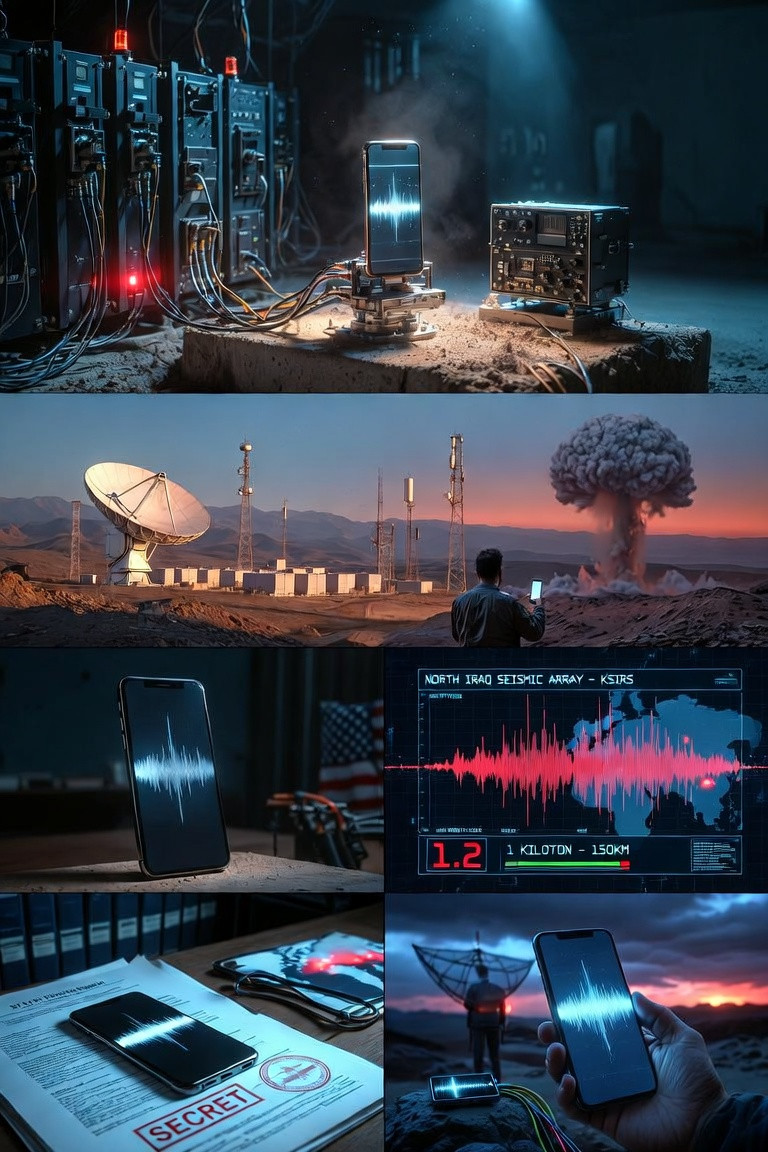
The U.S. Department of State investigated whether off-the-shelf iPhones could detect underground nuclear tests โ€” and installed the devices in a seismic monitoring array in northern Iraq. The declassified documents, released in response to a FOIA request, reveal a little-known chapter in the use of everyday consumer technology for nuclear verification purposes.


An iPhone in the Vault

The concept sounds like science fiction: A commercial iPhone, carried by millions of people in their pockets, as a tool for detecting nuclear tests. Yet that is precisely what the U.S. Department of State tested in 2014 under a contract with Array Information Technology, Inc.

The project, titled “Qualification of Seismic Detection Capabilities of iPhone Accelerometers for Nuclear Explosion Monitoring,” had a total value of $149,678.

The idea: The accelerometers built into iPhones โ€” originally designed for screen orientation or step counting โ€” could potentially register ground movements caused by underground nuclear explosions.

“The rapidly evolving potential of public and societal monitoring becomes evident in the ubiquitous use of smart phones in recent years. The technology in today’s smart phones includes a sophisticated computer with built-in accelerometer sensors, a powerful CPU, data storage, GPS geo-location, and wireless connectivity. In theory, these devices are already prepared to monitor ground movement and submit the recorded signals to a central processing unit for further analysis.”
โ€” From the Statement of Work


Northern Iraq โ€“ An Unusual Test Site

The iPhones were not tested in a laboratory but in northern Iraq โ€” specifically at the North Iraq Seismic Array (KSIRS), a seismic monitoring network in the Kurdish region.

The documents show that AIT staff traveled to Iraq to install the iPhones in the vaults of the array alongside state-of-the-art STS-2 broadband seismometers. These reference instruments โ€” comparable to those used by the International Monitoring System (IMS) of the CTBTO (Comprehensive Nuclear-Test-Ban Treaty Organization) โ€” served as calibration standards.

The iPhones were tested under various conditions:

ยท Best-case scenario: The iPhone is glued to the concrete pier of the array
ยท Ideal operational condition: The iPhone is placed on the pier in the instrument vault (comparable to a device resting on a desk)
ยท Normal operational condition: The iPhone is placed in a garment pocket or purse resting on the vault floor


Challenges on the Ground

The installation did not proceed without problems. An internal email exchange from September 2015 shows that the project requested a no-cost extension of the performance period โ€” originally scheduled from September 30, 2014, to September 29, 2015.

The reasoning: Inclement weather conditions and the inaccessibility of the array during the winter months delayed the installation until the end of March. A second deployment in May was also necessary because two iPhones malfunctioned during the first deployment period.

Particularly noteworthy is a project staff member’s reference to the security situation:

“Kurdistan (northeastern Iraq) is a bit safer than central and south Iraq, as ISIS’ threat is not reaching the key portion of Kurdistan yet.”
โ€” Internal email from September 2015

The iPhones were originally intended to remain in the array for three to four months to capture a representative distribution of earthquake magnitudes at local and regional distances.


The Scientific Question

The project was prompted by a claim in an article by Stubbs and Drell (2013) that the iPhone 4 accelerometer should allow 95% confidence in detecting an underground nuclear test with a yield of 1 kiloton at a distance of 150 kilometers.

The problem: This claim was not supported by data on the frequency-dependent sensitivity of the sensor or explanations of the underlying assumptions.

The project was therefore designed to provide a quantitative investigation of iPhone capabilities and determine whether this technology could indeed help CTBTO achieve its verification goals.


Analysis and Objectives

The collected data was to be analyzed to establish a noise floor threshold for individual iPhones. The researchers wanted to examine the detection of a range of small and mid-sized earthquakes โ€” those similar in magnitude to clandestine nuclear explosions.

A particular focus was on array operation: The availability of the KSIRS vaults enabled the researchers to apply array processing techniques and evaluate the improvement of detection through array processing over individual threshold values.

The resulting detection thresholds would then be used to model the detection statistics for an assumed operational system of these devices โ€” with varying density of iPhones per square kilometer in a given region.


Redacted Secrets and Unanswered Questions

The released documents are heavily redacted. Large sections have been blacked out under FOIA exemptions (b)(4) (trade secrets and confidential commercial information) and (b)(6) (protection of privacy).

Particularly the cost breakdown โ€” including line items such as “Direct Labor,” “Travel,” “Equipment,” and “G&A” โ€” is almost entirely redacted. The names of key personnel have also been obscured.

The results of the study remain completely hidden in the published material โ€” they appear to have been kept under seal.


A Project with Open Questions

The concept that smartphones could one day contribute to nuclear monitoring is fascinating โ€” but also problematic. The documents show that the State Department seriously examined this technology.

Yet the crucial questions remain unanswered: Do the iPhones actually work? The redactions suggest that the results may have been classified as sensitive. Who had access to the data? And what security risks arise from using commercial mass-market technology for security-related purposes?

The project formally ended on August 31, 2016 โ€” with a no-cost extension of the performance period by nearly a year. Whether the iPhones fulfilled their mission remains shrouded in secrecy.


The complete documentation with all released pages, contract details, and correspondence is exclusively available to Patreon subscribers at patreon.com/berndpulch.

Apples iPhones als Atompilz-Jรคger: US-AuรŸenministerium testete Smartphones zur รœberwachung von Atomtests

Das US-AuรŸenministerium hat bereits 2014 untersucht, ob handelsรผbliche iPhones in der Lage sind, unterirdische Atomtests zu detektieren โ€“ und installierte die Gerรคte dafรผr in einem seismischen รœberwachungsarray im Nordirak. Die geheimen Dokumente wurden nun nach einer FOIA-Anfrage freigegeben und offenbaren ein bislang wenig bekanntes Kapitel der Nutzung von Alltagstechnologie fรผr nukleare Verifikationszwecke.


Ein iPhone im Bunker

Die Vorstellung klingt nach Science-Fiction: Ein handelsรผbliches iPhone, wie es Millionen Menschen in der Tasche tragen, als Werkzeug zur Detektion von Atomtests. Doch genau das testete das US-AuรŸenministerium im Jahr 2014 im Rahmen eines Vertrags mit dem Unternehmen Array Information Technology, Inc. ใ€4โ€ L2-L6ใ€‘.

Das Projekt mit dem Titel “Qualification of Seismic Detection Capabilities of iPhone Accelerometers for Nuclear Explosion Monitoring” (Qualifizierung der seismischen Detektionsfรคhigkeiten von iPhone-Beschleunigungsmessern fรผr die nukleare Explosionsรผberwachung) hatte ein Volumen von 149.678 US-Dollarใ€5โ€ L3-L5ใ€‘ใ€35โ€ L15-L17ใ€‘.

Die Idee: Die in iPhones verbauten Beschleunigungssensoren โ€“ eigentlich fรผr die Ausrichtung des Bildschirms oder Schrittmessung gedacht โ€“ kรถnnten mรถglicherweise auch Bodenbewegungen registrieren, die von unterirdischen nuklearen Explosionen ausgelรถst werden.

“Die sich rasch entwickelnden Mรถglichkeiten der รถffentlichen und gesellschaftlichen รœberwachung werden in den letzten Jahren durch die allgegenwรคrtige Nutzung von Smartphones deutlich. Die Technologie in heutigen Smartphones umfasst einen hochentwickelten Computer mit eingebauten Beschleunigungssensoren, einer leistungsstarken CPU, Datenspeicher, GPS-Geolokalisierung und drahtloser Konnektivitรคt. Theoretisch sind diese Gerรคte bereits darauf vorbereitet, Bodenbewegungen zu รผberwachen und die aufgezeichneten Signale an eine zentrale Verarbeitungseinheit zur weiteren Analyse zu รผbermitteln.”
โ€” Aus dem Statement of Workใ€43โ€ L15-L21ใ€‘


Der Nordirak โ€“ Ein ungewรถhnlicher Testort

Die iPhones wurden nicht etwa in einem Labor getestet, sondern im Nordirak โ€“ genauer gesagt im North Iraq Seismic Array (KSIRS), einem seismischen รœberwachungsnetzwerk in der kurdischen Regionใ€14โ€ L4-L8ใ€‘ใ€43โ€ L36-L38ใ€‘.

Die Dokumente zeigen, dass Mitarbeiter von AIT in den Irak reisten, um die iPhones in den Gewรถlben des Arrays neben hochmodernen STS-2-Breitbandseismometern zu installierenใ€44โ€ L14-L18ใ€‘. Diese Referenzinstrumente โ€“ vergleichbar mit denen, die vom Internationalen รœberwachungssystem (IMS) der CTBTO (Comprehensive Nuclear-Test-Ban Treaty Organization) genutzt werden โ€“ sollten als Kalibrierungsstandard dienenใ€43โ€ L38-L40ใ€‘.

Die iPhones wurden unter verschiedenen Bedingungen getestet:

ยท Best-Case-Szenario: Das iPhone wird auf den Betonsockel des Arrays geklebt
ยท Idealer Betriebszustand: Das iPhone liegt auf dem Sockel im Instrumentengewรถlbe (vergleichbar mit einem auf einem Schreibtisch liegenden Gerรคt)
ยท Normaler Betriebszustand: Das iPhone liegt in einer Kleidungs- oder Handtasche auf dem Boden des Gewรถlbesใ€44โ€ L18-L26ใ€‘


Die Herausforderungen vor Ort

Die Installation verlief nicht ohne Probleme. Ein interner E-Mail-Austausch vom September 2015 zeigt, dass das Projekt eine kostenlose Verlรคngerung der Leistungsperiode beantragte โ€“ ursprรผnglich war der Zeitraum vom 30. September 2014 bis zum 29. September 2015 geplantใ€14โ€ L2-L10ใ€‘.

Die Begrรผndung: Ungรผnstige Wetterbedingungen und die Unzugรคnglichkeit des Arrays wรคhrend der Wintermonate hatten die Installation bis Ende Mรคrz verzรถgert. Zudem fiel ein zweiter Einsatz im Mai an, weil zwei iPhones wรคhrend der ersten Einsatzphase ausfielenใ€14โ€ L4-L8ใ€‘.

Besonders bemerkenswert ist der Hinweis eines Projektmitarbeiters zur Sicherheitslage:

“Kurdistan (Nordostirak) ist etwas sicherer als der zentrale und sรผdliche Irak, da die Bedrohung durch den IS die Schlรผsselregion Kurdistans noch nicht erreicht hat.”
โ€” Interne E-Mail vom September 2015ใ€12โ€ L15-L17ใ€‘

Die iPhones sollten ursprรผnglich fรผr drei bis vier Monate im Array verbleiben, um eine reprรคsentative Verteilung von Erdbebenmagnituden in lokaler und regionaler Entfernung zu erfassenใ€45โ€ L1-L3ใ€‘.


Die wissenschaftliche Fragestellung

Hintergrund des Projekts war eine Behauptung aus einem Artikel von Stubbs und Drell (2013), wonach der Beschleunigungssensor des iPhone 4 mit 95-prozentiger Sicherheit einen unterirdischen Nukleartest mit einer Sprengkraft von 1 Kilotonne in einer Entfernung von 150 Kilometern detektieren kรถnnen sollteใ€43โ€ L22-L27ใ€‘.

Das Problem: Diese Behauptung war weder durch Daten รผber die frequenzabhรคngige Empfindlichkeit des Sensors noch durch Erklรคrungen der zugrunde liegenden Annahmen untermauertใ€43โ€ L27-L31ใ€‘.

Das Projekt sollte deshalb eine quantitative Untersuchung der iPhone-Fรคhigkeiten liefern und klรคren, ob diese Technologie tatsรคchlich dazu beitragen kann, die รœberwachungsziele der CTBTO zu erreichenใ€43โ€ L31-L33ใ€‘.


Die Analyse und ihre Ziele

Die gesammelten Daten sollten analysiert werden, um eine Rauschuntergrenze fรผr einzelne iPhones zu etablierenใ€45โ€ L6-L8ใ€‘. Die Forscher wollten die Detektion einer Reihe von kleinen und mittelgroรŸen Erdbeben untersuchen โ€“ solche, die in ihrer Magnitude heimlichen nuklearen Explosionen รคhnelnใ€45โ€ L8-L10ใ€‘.

Ein besonderer Fokus lag auf dem Array-Betrieb: Durch die Verfรผgbarkeit der KSIRS-Gewรถlbe konnten die Forscher Array-Verarbeitungstechniken anwenden und die Verbesserung der Detektion durch die Array-Verarbeitung gegenรผber den individuellen Schwellenwerten bewertenใ€45โ€ L14-L17ใ€‘.

Die resultierenden Detektionsschwellen sollten dann genutzt werden, um die Detektionsstatistik fรผr ein angenommenes Betriebssystem dieser Gerรคte zu modellieren โ€“ mit variabler Dichte von iPhones pro Quadratkilometer in einer bestimmten Regionใ€45โ€ L17-L20ใ€‘.


Redigierte Geheimnisse und ungeklรคrte Fragen

Die freigegebenen Dokumente sind in weiten Teilen geschwรคrzt. GroรŸe Abschnitte wurden unter Berufung auf die FOIA-Ausnahmen (b)(4) (Geschรคftsgeheimnisse und vertrauliche kommerzielle Informationen) und (b)(6) (Schutz der Privatsphรคre) unkenntlich gemachtใ€2โ€ L14-L18ใ€‘.

Besonders die Kostenaufschlรผsselung โ€“ mit Positionen wie “Direct Labor”, “Travel”, “Equipment” und “G&A” โ€“ ist nahezu vollstรคndig redigiertใ€47โ€ L28-L34ใ€‘. Ebenso unkenntlich gemacht wurden die Namen der Schlรผsselpersonenใ€47โ€ L2-L8ใ€‘.

Die Ergebnisse der Studie bleiben im verรถffentlichten Material vollstรคndig verborgen โ€“ sie wurden offenbar unter Verschluss gehalten.


Ein Projekt mit offenen Fragen

Die Vorstellung, dass Smartphones in Zukunft zur nuklearen รœberwachung beitragen kรถnnten, ist faszinierend โ€“ aber auch problematisch. Die Dokumente zeigen, dass das US-AuรŸenministerium diese Technologie ernsthaft geprรผft hat.

Doch die entscheidenden Fragen bleiben unbeantwortet: Funktionieren die iPhones tatsรคchlich? Die Redigierungen legen nahe, dass die Ergebnisse mรถglicherweise als sensibel eingestuft wurden. Wer hatte Zugang zu den Daten? Und welche Sicherheitsrisiken ergeben sich aus der Nutzung kommerzieller Massentechnologie fรผr sicherheitsrelevante Zwecke?

Das Projekt endete formal am 31. August 2016 โ€“ mit einer kostenlosen Verlรคngerung der Leistungsperiode um fast ein Jahrใ€34โ€ L14-L16ใ€‘ใ€35โ€ L15ใ€‘. Ob die iPhones ihre Aufgabe erfรผllten, bleibt im Dunkeln.


Die vollstรคndige Dokumentation mit allen freigegebenen Seiten, Vertragsdetails und Korrespondenz ist exklusiv fรผr Patreon-Abonnenten verfรผgbar unter patreon.com/berndpulch.

TOP-SECRET FROM THE FBI – Going SOLO: Communist Agent Tells All

Morris Childs
Morris Childs’ intelligence work was handled by the FBI under the code name SOLO.

In April 1958, a representative of the Communist Party of the United States (CPUSA) named Morris Childs made important trips to the Soviet Union and China. His purpose: to re-establish formal contact between the CPUSA and these countries.

First, Morris visited with key Communist Party and Soviet leaders in Moscow. He learned of their wider political goals, their concerns and fears, and their deep interest in restoring connections with the CPUSA. Then he went to Beijing, where he made similar inroads and met with Premier Mao Tse Tung.

After three months, Morris returned home and reported all heโ€™d learned to CPUSA leaders. But as a new Freedom of Information Act release in the FBI Vault makes clear, he was also secretly talking to President Dwight Eisenhower, the vice president, the secretary of state, and a select group of other U.S. officials.

Morris, you see, was actually one of the FBIโ€™s greatest Cold War agents.

Born Moishe Chilovsky in the Ukraine, Morris Childs and his family immigrated to the U.S. in 1912. He joined the emerging communist movement in Chicago as a teenager and devoted his life to the cause. In 1947, his work ended after an internal power struggle removed him as editor of the CPUSAโ€™s flagship newspaper and his continuing struggle with heart disease left him sickly and incapacitated. Unable to pursue other work for the movement, Childs was soon forgotten.

Meanwhile, Americaโ€™s growing realization of the penetration of the U.S. government by the Soviets and the subsequent political debate over the role of communism in society became the focus of the day. By the early 1950s, the FBI began taking a more proactive approach to dealing with Soviet intelligence. That included zeroing in on the CPUSAโ€”in part, by approaching Communist officials who had left the party. One of the first on the list was Morris Childsโ€™ brother Jack.

Jack willingly cooperated and strongly advocated that the Bureau contact his brother, paving the way for a 1952 meeting between Morris and Special Agent Carl Freyman. The two got along quite well, sharing a knowledge of communist philosophy and an interest in wider intellectual and cultural issues.

After several meetings, Childs agreed to return to the CPUSA as an informant for the FBI. With the assistance of Jack, the Bureau helped Morris rehabilitate both his health and his role in the Party. Morris began feeling better after a Bureau-arranged stay at the Mayo Clinic, and within a year he started reaching out to his old comrades. He and Jack were accepted back into the CPUSA and eventually were tasked with deepening contacts with the Canadian Communist Party and through it, the Soviet Union.

Over four decades, Morris made more than 50 visits overseas for the CPUSA, each time reporting with great detail and insight about the issues and concerns of the leadership of the Soviet Union and China. Considering that these two nations were such closed societies, Morrisโ€™s intelligence was invaluableโ€”a fact recognized by President Ronald Reagan when he awarded Morris (and posthumously, Jack) with the Presidential Medal of Freedom.

The intelligence work of the brothersโ€”and later their wivesโ€”was handled by the FBI under the code name SOLO. In the coming months, stay tuned as we reveal more details of this long-running operation as additional sections of the SOLO file are released in our Vault.

TOP-SECRET-Archival Evidence of Mexico’s Human Rights Crimes: The Case of Aleida Gallangos

Roberto Antonio Gallangos Cruz, following his detention on July 26, 1968, in the midst of the student protests. The photograph was part of the Mexican intelligence files compiled by DFS agents, and made available in the AGN years later.

[Source: AGN, DFS files, 11-235, Legajo 30, Folio 17]

Archival Evidence of Mexico’s Human Rights Crimes: The Case of Aleida Gallangos National Security Archive Electronic Briefing Book No. 307

Washington, DC, September 9, 2011 – A Mexican human rights activist who was orphaned in infancy when her parents disappeared at the hands of government forces filed a petition before the Inter-American Human Rights Commission (IAHRC) yesterday, drawing on dozens of declassified U.S. and Mexican documents as evidence. Aleida Gallangos Vargas–whose case became widely known in 2004 when she tracked down her long-lost brother through intelligence records found in Mexico’s national archives–joined with her paternal grandmother to charge the State with responsibility for the secret detention and disappearance in 1975 of her parents, Roberto Antonio Gallangos Cruz and Carmen Vargas Pรฉrez, among other family members. Today the National Security Archive is posting a selection of the documents being used in the case, obtained by the Archive through the Freedom of Information Act and from the Mexican government. Aleida was two years old when her parents were captured; she was rescued by a friend of her parents who himself was killed by security forces in 1976. Aleida was adopted by his family and renamed Luz Elba Gorostiola Herrera. Aleida’s brother Lucio Antonio, who was three when Roberto Antonio and Carmen disappeared, was taken by members of the government death squad that raided their home in June 1975; shortly afterwards he was delivered to an orphanage and in February 1976 was adopted by a couple and christened Juan Carlos Hernรกndez Valadez. The two children grew up in separate lives knowing nothing of their true identities or of their relationship. The history of the Gallangos-Vargas family emerged in 2001 when a magazine published an interview with Roberto Antonio’s mother, Quirina Cruz Calvo, along with photographs of the disappeared couple and their two small children. Aleida’s adoptive family recognized Luz Elba’s face in the pictures and Aleida was reunited with her grandmother. She spent the next several years piecing together the circumstances of the Mexican government’s role in abducting and secretly detaining her parents. Using government records that had been located by the office of the Special Prosecutor assigned to investigate past political crimes, Aleida managed to track down her brother in the United States in 2004, 29 years after their separation. The records Aleida used to find Lucio Antonio–along with dozens more obtained by the National Security Archive through requests to the Mexican and U.S. governments–now serve as critical evidence in the case brought by Aleida on March 8 before the Inter-American Human Rights Commission. The Inter-American system has been an important venue for victims and activists seeking recourse from the Mexican government for state-sponsored human rights crimes committed during the 1960s-80s. On November 23, 2009, the Inter-American Human Rights Court issued a landmark decision, finding Mexico responsible for the illegal detention and disappearance of Rosendo Radilla, a schoolteacher and social activist stopped at a military checkpoint in Atoyac, Guerrero on August 25, 1974. Radilla–known for his songs of social protest and his admiration of Lucio Cabaรฑas, the popular guerrilla leader from Guerrero–was disappeared at the height of the State’s extralegal counterinsurgency campaign against rebels and their supporters in southern Mexico in the early 1970s [see NSA briefing book on Lucio Cabaรฑas, and the Dawn of the Dirty War]. The 2009 ruling marked the first Inter-American decision against Mexico for abuses committed during the “dirty war.” The court ordered the government to pay reparations to the family members for the years of suffering inflicted as a result of the crime. The Radilla decision established an important precedent for future legal action targeting Mexico’s unresolved human rights crimes of the past. To date, Mexico’s political and judicial systems have proven incapable of dealing with even the most notorious atrocities of the “dirty war,” such as the 1968 and 1971 student massacres and the hundreds of cases of illegal detentions, torture, and forced disappearances carried out around the country in the 1970s and early 1980s. In addition to the Army’s rural counterinsurgency violence, Mexico’s intelligence services carried out a carefully orchestrated program of kidnappings and disappearances in the country’s urban centers in an effort to dismantle guerrilla networks and eliminate social and political opposition. One of the victims of the government’s urban counterinsurgency was Roberto Antonio Gallangos Cruz, an activist involved in the 1968 student movement and later a militant in the radical 23rd of September Communist League. In the summer of ’68, Roberto Antonio joined the anti-war protests in Mexico City and marched for greater democratic openness from Mexico’s closed political system. He became one of the hundreds of protestors monitored by government spies gathering information on student activists. Internal Mexican intelligence records report that Roberto Antonio participated in rallies, reciting anti-war poems such as “los tres pueblos,” which he delivered during a demonstration on April 23, 1968 [see Doc 5; DFS report on Roberto Antonio]. Security forces detained Roberto Antonio on July 26 during government round-ups of student agitators that culminated in the October 2 Tlatelolco massacre. (Note 1) He was held in the infamous Lecumberri prison in Mexico City for over two months, where state intelligence agents kept close tabs on his visitors. While the charges against him were insufficient to keep him in prison, the Federal Security Directorate (Direcciรณn Federal de Seguridad โ€“ DFS) continued to monitor his activities following his release. Over the next seven years, government security services assembled a thick intelligence file documenting Roberto Antonio’s association with Mexico’s guerrilla groups. The violent efforts of the ruling Institutional Revolutionary Party (Partido Revolucionario Institutionalโ€”PRI) to crush the peaceful 1968 student movement was a pivotal moment that dramatically radicalized the social and political opposition, increasing popular support for Mexico’s insurgent groups. The 23rd of September Communist League (Liga Comunista de 23 de Septiembre) was one of the urban guerrilla groups that grew in strength as a result, and in turn became a central target of the organized violence that characterized the government’s counterinsurgency efforts during the period. Following the kidnapping by leftists of U.S. Consul General Terrance Leonhardy in May 1973 and U.S. Vice-Consul John L. Patterson in March 1974, Mexican security forces were given even greater freedom to attack insurgent groups and their supporters. The DFS in particular became the driving force behind State terror, serving as Mexico’s internal political police force [see Doc 1: on the growth of the DFS]. U.S. agencies also expanded their coordination with their Mexican intelligence counterparts, increasing their information gathering on Mexico’s leftists groups. The DFS agents regularly shared intelligence with the FBI attachรฉs in the U.S. Embassy and consulates in Mexico’s northern cities [see FBI memorandum: Doc 2 on the 23 of September group]. The long connection between the DFS and the CIA also provided a central source of information for Mexico’s internal security apparatus to confront the armed groups. (Note 2) It was during this period of urban counterinsurgency that the web of Mexico’s intelligence services grew, as information flowed to and from Mexico City to the Army and police installations throughout the country. The DFS institutionalized the State’s ability to gather information, detain suspects, torture and disappear with ultimate deniability. Seven years after the 1968 crackdown, Roberto Antonio Gallangos became a victim of the DFS campaign of disappearances. According to Mexican intelligence documents obtained by the National Security Archive, Roberto Antonio โ€“ by then living underground as a member of the 23rd of September Communist League โ€“ was spotted walking on a Mexico City street by a police sergeant. After a brief shootout, police captured Gallangos and turned him over to the DFS [Doc 4]. DFS agents interrogated and tortured him, extracting information about his family, social, and organizational affiliations. The declassified Mexican documents describe Roberto Antonio Gallangos as a radical criminal, with links to a network of subversive organizations and a background in bank robberies, kidnapping and murder. It is difficult to evaluate the veracity of the many allegations made in the documents against him, his family, friends and associates. Federal security agents often exaggerated the threat from leftist groups in order to justify aggressive counterinsurgency measures. (Note 3) Torture and forced confessions were commonly used against suspected subversives, and photos taken of Gallangos during detention seem to show signs of torture [Doc 6]. But while the DFS files reported on his alleged crimes, the information was never meant for use as legal evidence in a court of law. Rather, intelligence gathered through surveillance, abduction and torture was used to locate associates of suspected guerrillas, dismantle social networks, and terrorize their base of support. In the case of Gallangos, the DFS agents sought information about his wife and other militant friends and family members, but it is uncertain whether or not what Gallangos told his interrogators was true. Security forces did not capture his wife Carmen Vargas Pรฉrez for more than a month after his kidnapping (detained July 26, 1975); his brother Avelino Francisco Gallangos Cruz was caught one month after that (August 22, 1975). Both remain among Mexicoโ€™s disappeared (Note 4). What is clear is that the governmentโ€™s detention of Gallangos on June 19, 1975, had tragic and lasting repercussions for Robertoโ€™s family, including the โ€œdisappearanceโ€ of his children until they discovered their identities years later. The case exemplifies how government terror functioned not only to combat the guerrillas, but also destroy the social fabric of groups who opposed the governmentโ€™s authority. The secret DFS documents obtained by the Archive expose the inner workings of Mexico’s urban counterinsurgency campaign in the 1970s and reveal the involvement of the highest levels of government in political crimes of state. The abuses included illegal spying and infiltration of leftist groups, unwarranted police raids, secret detentions and transfers of prisoners, abduction, torture, and murder. The intelligence files were signed by then-Chief of the agency, Capitan Luis de la Barreda Moreno (head from 1970-75). Senior DFS agents such as Miguel Nazar Haro participated directly in the operations, interrogation and torture of prisoners. (Note 5) The information gathered flowed to the Interior Ministry (Secretarรญa de Gobernaciรณn), at the time led by Mario Moya Palencia. Number two in Gobernaciรณn was the career-spy chief Fernando Gutiรฉrrez Barrios, who served in the DFS for over 20 years and directed the agency from 1964 until his long-time friend de la Barreda took over in 1970. Gutiรฉrrez Barrios occupied Mexico’s most senior intelligence position as Deputy Minister of the Interior, regularly receiving DFS traffic on suspected subversives, and playing a central role in the extermination campaign against Mexico’s left. At the top of the chain of command was Luis Echeverrรญa, Interior Minister from 1964-70, and head of state from 1970-76. Despite evidence demonstrating direct government involvement in the urban disappearances, a special prosecutor assigned in 2002 by President Vicente Fox to investigate past human rights crimes failed to bring Luis Echeverrรญa or any of his senior military, police or intelligence commanders to justice. In 2003, the prosecutor, Dr. Ignacio Carillo Prieto, asked the United State Embassy in Mexico City for declassified cables on de la Barreda and Nazar Haro [Doc 13] and brought charges against the officials for the forced disappearance of Jesรบs Piedra Ibarra, another member of the 23rd of September group detained in April 1975. But the special prosecutor was unable to win convictions and the charges were dropped. The DFS officials who have gone to jail since the “dirty war” have done so for their involvement in drug trafficking rather than for human rights crimes. There is a deep connection between the former Mexican intelligence service and the country’s drug mafias. As DFS agents took command of counterinsurgency raids in the 1970s, they often stumbled upon narcotics safe houses and quickly took on the job of protecting Mexico’s drug cartels. The DFS was disbanded in 1985 following revelations that it was behind the murder of DEA agent Enrique “Kiki” Camarena, and Mexican journalist Manuel Buendia. (Note 6) Some 1,500 agents suddenly unemployed with the abolishment of the DFS found their training in covert activities and brutal counterinsurgency operations easily adaptable to the needs of the criminal underworld. Many joined the ranks of the powerful drug cartels or served the traffickers while working on local and federal police forces [see Doc 11 & Doc 12 on DFS agents and drugs]. By failing to prosecute a single case against the former agents, the Special Prosecutor missed a crucial opportunity to bring some of Mexico’s most corrupt officials to justice, allowing impunity to remain entrenched in Mexican society. The Special Prosecutor also failed to fully clarify the crimes of the past or locate any of Mexico’s disappeared. Carrillo Prieto claimed as his own success the discovery and identification of Lucio Antonio Gallangos Vargas, the missing son of Roberto Antonio Gallangos and Carmen Vargas. (Note 7) In fact it was due to the efforts Aleida Gallangos that her brother was located. Although she began her search as part of the “Citizen’s Committee” created by the Special Prosecutor’s office, she resigned from the committee in disgust with the prosecutor’s fruitless investigations. After traveling to Washington, where she says she was threatened by the Mexican consulate, she finally located her brother in the winter of 2004. The Special Prosecutor then organized an ad-hoc press conference in an attempt to take credit for locating Lucio Antonio. In a cable to Washington, U.S. Embassy officials discounted Carrillo Prieto’s claims and cited an independent evaluation of his work that called his office “unresponsive” to victims’ needs. [see Doc 14]. With yesterday’s filing of the case “Luz Elba Gorostiola Herrera and Quirina Cruz Calvo against the State of Mexico” before the Inter-American Human Rights Commission, Aleida and her biological and adoptive families have underscored the failure of the Mexican government to bring the perpetrators of past human rights atrocities to justice. Mexico’s inability to resolve these cases has left survivors of the dirty war and families of the disappeared without legal recourse at the national level. With the groundbreaking Radilla decision of 2009, the Inter-American system offers new hope for victims of Mexico’s dirty war to find a measure of justice at last. It is a critical juncture for Mexican citizens searching for truth about the country’s dark period of state-sponsored violence that remains an impediment to justice in Mexico today.


U.S. and Mexican Documents on the Dirty War Disappearances, Drugs, and the Failure of the Special Prosecutor Document 1 January 4, 1974 The Current Security Situation in Mexico: An Appraisal U.S. Embassy in Mexico, Secret Airgram 13 pages The U.S. Embassy in Mexico reports on a rising wave of crime beginning in mid-September 1973, creating a “climate of some anxiety” in Mexico. The report provides background on the rising tide of armed opposition to the Mexican government, tracing the growing rebellion to the government’s brutal “counteraction” against 1968 student demonstrations. It also provides a list of “politically-motivated acts of violence” that characterized the first three years of the Echeverrรญa administration, including the 1971 student killings by government forces, and the kidnapping by leftists of U.S. Consul General Terrance G. Leonhardy. To U.S. officials, these incidents demonstrated the “deficiencies” of the army and police forces, and highlighted the importance of covert operations under the direction of the Federal Security Directorate (Direcciรณn Federal de Seguridad โ€“ DFS). The Embassy believed that the DFS, “whose responsibilities also include protection of the president, intelligence collection and coordination, surveillance of some foreign embassies, etc.”, was the only body to have “emerged from this period with reason for pride in its accomplishments.” While Luis Echeverrรญa had increased DFS staff and power, the Embassy predicts that sporadic acts of political violence will continue until “security agencies have improved their capabilities to the point where they can quickly apprehend the perpetrators in a high percentage of cases and infiltrate terrorist groups in order to dismantle them completely.” Source: Released to the National Security Archive under the Freedom of Information Act Document 2 March 11, 1974 Characterization of Mexican Revolutionary, Terrorist and Guerrilla Groups FBI, Legal Attachรฉ in Mexico City, Secret Memorandum 12 pages The FBI attachรฉs in Mexico produced regular reports on the urban guerrilla groups during this period, relating back to Washington the information they received from Mexican intelligence agents. This memorandum provides profiles of ten Mexican revolutionary and guerrilla groups, including the 23rd of September Communist League (LCS). It refers to the 23rd of September group as one of the most highly organized guerrilla organizations, and says that its many of its members have been involved in other revolutionary groups in Mexico. Source: Released to the National Security Archive under the Freedom of Information Act Document 3 December 6, 1974 Mexican Terrorist Captured in Abortive Attempt to Negotiate Safe Passage out of Mexico U.S. Embassy in Mexico, Unclassified Cable 1 page DFS agents not only coordinated counterinsurgency strategies during the 1970s, but participated directly in operations, including detentions, extralegal raids, and forced disappearances. This cable reports on the arrest of Miguel Angel Torres Enrรญquez, an alleged member of the 23rd of September Communist League, on December 5, 1974, after he had taken two French embassy consular officers hostage in an attempt to secure safe passage to France. Working undercover, then-DFS agent Miguel Nazar Haro participated directly in the operation, posing as a Mexican Foreign Secretary official and, after exchanging himself for the hostages, bringing Torres to the airport where he was arrested. According to the Special Prosecutor’s report released years later, the search for Torres Enrรญquez involved raids by DFS agents on his house and violent attacks against his family and friends. Source: Released to the National Security Archive under the Freedom of Information Act Document 4 June 19, 1975 “23 of September” Communist League; “Red Brigade” Direcciรณn Federal de Seguridad (DFS) 1 page This document, signed by DFS Director Luis de la Barreda Moreno, gives the agency’s version of the events that led to the arrest of Roberto Antonio Gallangos Cruz, alias “Simรณn.” According to the report, at 3:00 pm, July 19, 1975, police sergeant Lรกzaro Juรกrez Almaguer noticed an individual with a pistol hidden in his waist, who, when asked to identify himself, removed the weapon and fired, hitting one policeman in the arm. More police quickly arrived on the scene and detained the subject. DFS agents took custody of Roberto Antonio and interrogated him, identifying him as part of a clandestine cell of the urban guerrilla group the 23rd of September Communist League. Source: Archivo General de la Naciรณn (AGN), made available by the Special Prosecutor’s Office [Fiscalรญa Especial para Movimientos Sociales y Polรญticos del Pasado (FEMOSPP)] Document 5 June 19, 1975 Antecedents of Roberto Antonio Gallangos Cruz (a) “Simรณn” Direcciรณn Federal de Seguridad (DFS) 7 pages This intelligence report reveals that prior to the 1975 arrest of Roberto Antonio Gallangos, government agents had him under surveillance for years. The type of information gathered since at least the late 1960s included personal details such as his birthplace, education, physical characteristics, organizational affiliation, and previous arrests. The report also contains extensive information about his political activities, beginning with his involvement in the 1968 student protests. At a demonstration on April 23, 1968, for example, RobertoAntonio recited the anti-war poem, Los Tres Pueblos, “referring to the horrors of war, and demands for peace.” The report describes his detention on July 26, 1968 in the midst of the student round-ups, and the government’s attempts to charge Roberto Antonio with crimes such as damage to public property, robbery, resisting arrest, and causing injury to state authorities. It also tracks his visitors during his time in prison. The surveillance continued after his release. According to DFS intelligence, Roberto Antonio went on to participate in political meetings with Mexico’s leftist organizations and became involved with a wide variety of insurgent groups. Source: Archivo General de la Naciรณn (AGN), made available by the Special Prosecutor’s Office [Fiscalรญa Especial para Movimientos Sociales y Polรญticos del Pasado (FEMOSPP)] Document 6 Photo Undated, taken after June 19, 1975 detention Direcciรณn Federal de Seguridad (DFS) 2 pages This photograph of Roberto Antonio Gallangos Cruz was taken following his detention on June 19, 1975. The photo shows Roberto Antonio with a mark over his right eye, and a wet shirt; signs of the torture used by the DFS agents during his interrogation. Source: Archivo General de la Naciรณn (AGN), DFS Exp. 11-235, Legajo 30, Folio 123 Document 7 June 20, 1975 “23 of September” Communist League Direcciรณn Federal de Seguridad (DFS) 1 page A report filed by DFS director Luis de la Barreda 24 hours after Gallangos Cruz’s capture contains the first results of the agency’s interrogation of their prisoner, when he reveals the address of a supposed guerrilla safe house. The police proceeded to conduct a raid on the house, finding communist propaganda from the Liga Comunista “23 de Septiembre” and other incriminating material. Source: Archivo General de la Naciรณn (AGN), made available by the Special Prosecutor’s Office[Fiscalรญa Especial para Movimientos Sociales y Polรญticos del Pasado (FEMOSPP)] Document 8 July 1, 1975 “23 of September” Communist League Direcciรณn Federal de Seguridad (DFS) 1 page Under interrogation, Gallangos Cruz identified his wife and brother as fellow members of the Liga Comunista “23 de Septiembre.” This DFS report gives biographical background for Carmen Vargas Perez (“Sofรญa”) and Avelino Francisco Gallangos Cruz (“Federico,”). Source: Archivo General de la Naciรณn (AGN), made available by the Special Prosecutor’s Office [Fiscalรญa Especial para Movimientos Sociales y Polรญticos del Pasado (FEMOSPP)] Document 9 August 22, 1975 “23 of September” Communist League Direcciรณn Federal de Seguridad (DFS) 3 pages Roberto Antonio’s brother, Avelino Francisco Gallangos Cruz, was arrested in Mexico City at 9:40 am by three police officers. He was reportedly carrying a gun that they determined belonged to a police agent who was assassinated on November 30, 1974. The document gives biographical details and intelligence information about “Federico,” compiled through interrogations of his family and friends. Source: Archivo General de la Naciรณn (AGN), made available by the Special Prosecutor’s Office [Fiscalรญa Especial para Movimientos Sociales y Polรญticos del Pasado (FEMOSPP)] Document 10 August 23, 1975 Liga Comunista “23 de Septiembre” Direcciรณn Federal de Seguridad (DFS) 2 pages This document summarizes the result of the interrogations of Avelino Francisco Gallangos Cruz “Federico” and another member of the Liga Comunista “23 de Septiembre.” It describes how the Gallangos Cruz brothers joined the organization and contains details about the League’s purported activities. Source: Archivo General de la Naciรณn (AGN), made available by the Special Prosecutor’s Office [Fiscalรญa Especial para Movimientos Sociales y Polรญticos del Pasado (FEMOSPP)] Document 11 March 27, 1990 Senior Customs Representative Hermosillo – Intelligence Report U.S. Consulate in Hermosillo, Mexico, redacted cable 7 pages Five years after the DFS was disbanded due to abuses and pervasive corruption, a U.S. Customs agent stationed in the Hermosillo Consulate, issues this report conveying growing concern over connections between former DFS agents and drug traffickers. The heavily redacted cable reports on drug kingpins who had worked with the DFS, and states that “several members of the DFS became heavily involved in drug trafficking and then in the murder of United States Drug Enforcement Administration Special Agent Enrique Camarena-Salazar.” Source: Released to the National Security Archive under the Freedom of Information Act Document 12 March 12, 1991 Javier Garcรญa Paniagua to Head National Lottery, is Replaced by Santiago Tapia as Mexico City’s Police Chief U.S. Embassy in Mexico, Confidential Cable On March 7, 1991, Javier Garcรญa Paniagua, former Director of Mexico’s Directorate of Federal Security (DFS), resigned as Mexico City’s Police Chief to become Director General of the National Lottery. Garcรญa Paniagua had been police chief since 1988, and his appointment caused controversy due to accusations that he approved and used torture during his years in the DFS.ย  In the cable, Embassy officials describe the DFS as “an agency with a reputation for corruption and ruthlessness.” The cable notes that Miguel Nazar Haro, Garcรญa Paniagua’s police deputy and intelligence chief, was accused of carrying out political killings and human rights abuses when he headed the DFS in the 1980s. In 1989, he was forced to resign from the Mexico City police amidst allegations that he protected drug traffickers. Source: Released to the National Security Archive under the Freedom of Information Act Document 13 June 13, 2003 Mexican Supreme Court Hands Down Landmark Decision on Extradition of Ricardo Cavallo for Crimes Against Humanity U.S. Embassy in Mexico, Unclassified Cable 3 pages On September 12, 2000, the Mexican Supreme Court handed down a decision upholding the legal basis for the extradition of Argentine national Ricardo Miguel Cavallo to Spain. Cavallo was arrested by Mexican Interpol on August 24 and was extradited to Spain for crimes of genocide and terrorism committed between 1976 and 1983. In this cable the Embassy comments on the possibility of the decision affecting Mexican domestic human rights cases, such as the case against Miguel Nazar Haro and Luis de la Barreda, who were “both accused of torture and โ€˜disappearing’ leftists during the so-called โ€˜Dirty War’ in Mexico during the 60s, 70s, and 80s.” The cable reports that Special Prosecutor Ignacio Carrillo Prieto, assigned to investigate human rights cases of the past, asked the Embassy to provide copies of declassified cables with information on the two former intelligence chiefs and their involvement in human rights abuses. Source: Released to the National Security Archive under the Freedom of Information Act Document 14 January 13, 2005 Special Prosecutor Makes Headlines but Limited Progress in Unraveling Past Human Rights Crimes U.S. Embassy in Mexico, Confidential Cable 3 pages The U.S. Embassy reports that the Special Prosecutor’s Office is moving slowly to prosecute Mexico’s political crimes of the past. Although the office had achieved some incremental progress, it was slow to locate victims and bring the perpetrators to trial. The cable cites the case of Aleida Gallangos and her efforts to locate her brother Lucio, almost 30 years after they were separated from their parents at the hands of government forces. Aleida had strongly criticized the Special Prosecutor’s Office, which, according to the cable, offered her little support in her search for her brother, but nevertheless tried to take the credit in a “hastily-called press conference,” after Aleida found Lucio living in the United States in December 2004. Source: Released to the National Security Archive under the Freedom of Information Act


Notes

1. Chapter 6 of the Special Prosecutor’s Report lists Roberto Antonio among those detained on July 26, 1968.
2. For more information on the historical collaboration between the CIA station in Mexico and DFS intelligence agents, see NSA briefing book “LITEMPO: The CIA’s Eyes on Tlatelolco”.
3. See for example Sergio Aguayo, La charola: una historia de los servicios de intelligencia en Mรฉxico, Mรฉxico, D.F, Grijalbo; Hoja Editorial; Hechos Confiables, 2001, pp. 133-34 for a reference to the “fantasies and exaggerations” employed in DFS documents about student protesters in 1968.
4. Chapter 8 of the Special Prosecutor’s report lists Avelino Gallangos and Carmen Vargas among the 69 individuals disappeared in Mexico City during the dirty war.
5. Chapter 10 of the Special Prosecutor’s report describes the counterinsurgency operations carried out by DFS agents in the early 1970s, and reports that Nazar Haro participated directly in extralegal detentions and interrogations of suspected guerrillas.
6. DFS chief Zorrilla was charged and sentence in 1989 to thirty-five years for the 1984 murder of Manuel Buendia, a journalist who exposed DFS official links to narco-trade. Another DFS chief, Nazar Haro, was linked to the murder of U.S. DEA agent Enrique Camarena. For more information on the DFS and drugs, see Julia Preston and Samuel Dillon, Opening Mexico: The Making of a Democracy, New York, Straus and Giroux, 2004.
7. See chapter 10 of the Special Prosecutor’s report.
In front of Lecumberri, the “Black Palace” โ€“ formerly a detention center for political prisoners, now home to the historical National Archives (AGN) โ€“ activists hang pictures of Mexico’s disappeared [Undated Photo. Source: AGN files].
Luis Echeverrรญa (president from 1970-76) visiting Mexican officers and soldiers in Guerrero during the height of the military’s “dirty war” counterinsurgency campaign against Lucio Cabaรฑas and his Party of the Poor [Source: AGN files]
Roberto Antonio Gallangos Cruz, taken sometime in between 1968 and 1975. This picture was part of the DFS intelligence files, and was retrieved prior to his disappearance as part of the government’s surveillance efforts to monitor his activities after the 1968 protests [Source: AGN, DFS files]
Roberto Antonio Gallangos Cruz, with his hands tied behind his back, after being detained on June 19, 1975. [Source: AGN, DFS files, 11-235, Legajo 30, Folio 124]
Carmen Vargas Pรฉrez, prior to her detention and disappearance by DFS agents. This picture was part of the DFS intelligence files, and was retrieved by intelligence agents as part of the government’s surveillance efforts [Source: AGN, DFS files, 11-235, Legajo 30, Folio 43]
Carmen Vargas Pรฉrez, prior to her detention and disappearance by DFS agents [Source: family’s personal files]
Weapons and leftist propaganda reportedly obtained through counterinsurgency raids in Mexico’s urban centers
</div></td>
</tr>
<tr>
<td></td>
</tr>
<tr>
<td>

</td>
</tr>
<tr>
<td>
<div align=”justify”>Suspected guerrillas detained by Mexican authorities

TOP-SECRET – Archival Evidence of Mexico’s Human Rights Crimes: The Case of Aleida Gallangos

Roberto Antonio Gallangos Cruz, following his detention on July 26, 1968, in the midst of the student protests. The photograph was part of the Mexican intelligence files compiled by DFS agents, and made available in the AGN years later.

[Source: AGN, DFS files, 11-235, Legajo 30, Folio 17]

rchival Evidence of Mexico’s Human Rights Crimes: The Case of Aleida GallangosNational Security Archive Electronic Briefing Book No. 307

Washington, DC, September 9, 2011 – A Mexican human rights activist who was orphaned in infancy when her parents disappeared at the hands of government forces filed a petition before the Inter-American Human Rights Commission (IAHRC) yesterday, drawing on dozens of declassified U.S. and Mexican documents as evidence. Aleida Gallangos Vargas–whose case became widely known in 2004 when she tracked down her long-lost brother through intelligence records found in Mexico’s national archives–joined with her paternal grandmother to charge the State with responsibility for the secret detention and disappearance in 1975 of her parents, Roberto Antonio Gallangos Cruz and Carmen Vargas Pรฉrez, among other family members. Today the National Security Archive is posting a selection of the documents being used in the case, obtained by the Archive through the Freedom of Information Act and from the Mexican government. Aleida was two years old when her parents were captured; she was rescued by a friend of her parents who himself was killed by security forces in 1976. Aleida was adopted by his family and renamed Luz Elba Gorostiola Herrera. Aleida’s brother Lucio Antonio, who was three when Roberto Antonio and Carmen disappeared, was taken by members of the government death squad that raided their home in June 1975; shortly afterwards he was delivered to an orphanage and in February 1976 was adopted by a couple and christened Juan Carlos Hernรกndez Valadez. The two children grew up in separate lives knowing nothing of their true identities or of their relationship. The history of the Gallangos-Vargas family emerged in 2001 when a magazine published an interview with Roberto Antonio’s mother, Quirina Cruz Calvo, along with photographs of the disappeared couple and their two small children. Aleida’s adoptive family recognized Luz Elba’s face in the pictures and Aleida was reunited with her grandmother. She spent the next several years piecing together the circumstances of the Mexican government’s role in abducting and secretly detaining her parents. Using government records that had been located by the office of the Special Prosecutor assigned to investigate past political crimes, Aleida managed to track down her brother in the United States in 2004, 29 years after their separation. The records Aleida used to find Lucio Antonio–along with dozens more obtained by the National Security Archive through requests to the Mexican and U.S. governments–now serve as critical evidence in the case brought by Aleida on March 8 before the Inter-American Human Rights Commission. The Inter-American system has been an important venue for victims and activists seeking recourse from the Mexican government for state-sponsored human rights crimes committed during the 1960s-80s. On November 23, 2009, the Inter-American Human Rights Court issued a landmark decision, finding Mexico responsible for the illegal detention and disappearance of Rosendo Radilla, a schoolteacher and social activist stopped at a military checkpoint in Atoyac, Guerrero on August 25, 1974. Radilla–known for his songs of social protest and his admiration of Lucio Cabaรฑas, the popular guerrilla leader from Guerrero–was disappeared at the height of the State’s extralegal counterinsurgency campaign against rebels and their supporters in southern Mexico in the early 1970s [see NSA briefing book on Lucio Cabaรฑas, and the Dawn of the Dirty War]. The 2009 ruling marked the first Inter-American decision against Mexico for abuses committed during the “dirty war.” The court ordered the government to pay reparations to the family members for the years of suffering inflicted as a result of the crime. The Radilla decision established an important precedent for future legal action targeting Mexico’s unresolved human rights crimes of the past. To date, Mexico’s political and judicial systems have proven incapable of dealing with even the most notorious atrocities of the “dirty war,” such as the 1968 and 1971 student massacres and the hundreds of cases of illegal detentions, torture, and forced disappearances carried out around the country in the 1970s and early 1980s. In addition to the Army’s rural counterinsurgency violence, Mexico’s intelligence services carried out a carefully orchestrated program of kidnappings and disappearances in the country’s urban centers in an effort to dismantle guerrilla networks and eliminate social and political opposition. One of the victims of the government’s urban counterinsurgency was Roberto Antonio Gallangos Cruz, an activist involved in the 1968 student movement and later a militant in the radical 23rd of September Communist League. In the summer of ’68, Roberto Antonio joined the anti-war protests in Mexico City and marched for greater democratic openness from Mexico’s closed political system. He became one of the hundreds of protestors monitored by government spies gathering information on student activists. Internal Mexican intelligence records report that Roberto Antonio participated in rallies, reciting anti-war poems such as “los tres pueblos,” which he delivered during a demonstration on April 23, 1968 [see Doc 5; DFS report on Roberto Antonio]. Security forces detained Roberto Antonio on July 26 during government round-ups of student agitators that culminated in the October 2 Tlatelolco massacre. (Note 1) He was held in the infamous Lecumberri prison in Mexico City for over two months, where state intelligence agents kept close tabs on his visitors. While the charges against him were insufficient to keep him in prison, the Federal Security Directorate (Direcciรณn Federal de Seguridad โ€“ DFS) continued to monitor his activities following his release. Over the next seven years, government security services assembled a thick intelligence file documenting Roberto Antonio’s association with Mexico’s guerrilla groups. The violent efforts of the ruling Institutional Revolutionary Party (Partido Revolucionario Institutionalโ€”PRI) to crush the peaceful 1968 student movement was a pivotal moment that dramatically radicalized the social and political opposition, increasing popular support for Mexico’s insurgent groups. The 23rd of September Communist League (Liga Comunista de 23 de Septiembre) was one of the urban guerrilla groups that grew in strength as a result, and in turn became a central target of the organized violence that characterized the government’s counterinsurgency efforts during the period. Following the kidnapping by leftists of U.S. Consul General Terrance Leonhardy in May 1973 and U.S. Vice-Consul John L. Patterson in March 1974, Mexican security forces were given even greater freedom to attack insurgent groups and their supporters. The DFS in particular became the driving force behind State terror, serving as Mexico’s internal political police force [see Doc 1: on the growth of the DFS]. U.S. agencies also expanded their coordination with their Mexican intelligence counterparts, increasing their information gathering on Mexico’s leftists groups. The DFS agents regularly shared intelligence with the FBI attachรฉs in the U.S. Embassy and consulates in Mexico’s northern cities [see FBI memorandum: Doc 2 on the 23 of September group]. The long connection between the DFS and the CIA also provided a central source of information for Mexico’s internal security apparatus to confront the armed groups. (Note 2) It was during this period of urban counterinsurgency that the web of Mexico’s intelligence services grew, as information flowed to and from Mexico City to the Army and police installations throughout the country. The DFS institutionalized the State’s ability to gather information, detain suspects, torture and disappear with ultimate deniability. Seven years after the 1968 crackdown, Roberto Antonio Gallangos became a victim of the DFS campaign of disappearances. According to Mexican intelligence documents obtained by the National Security Archive, Roberto Antonio โ€“ by then living underground as a member of the 23rd of September Communist League โ€“ was spotted walking on a Mexico City street by a police sergeant. After a brief shootout, police captured Gallangos and turned him over to the DFS [Doc 4]. DFS agents interrogated and tortured him, extracting information about his family, social, and organizational affiliations. The declassified Mexican documents describe Roberto Antonio Gallangos as a radical criminal, with links to a network of subversive organizations and a background in bank robberies, kidnapping and murder. It is difficult to evaluate the veracity of the many allegations made in the documents against him, his family, friends and associates. Federal security agents often exaggerated the threat from leftist groups in order to justify aggressive counterinsurgency measures. (Note 3) Torture and forced confessions were commonly used against suspected subversives, and photos taken of Gallangos during detention seem to show signs of torture [Doc 6]. But while the DFS files reported on his alleged crimes, the information was never meant for use as legal evidence in a court of law. Rather, intelligence gathered through surveillance, abduction and torture was used to locate associates of suspected guerrillas, dismantle social networks, and terrorize their base of support. In the case of Gallangos, the DFS agents sought information about his wife and other militant friends and family members, but it is uncertain whether or not what Gallangos told his interrogators was true. Security forces did not capture his wife Carmen Vargas Pรฉrez for more than a month after his kidnapping (detained July 26, 1975); his brother Avelino Francisco Gallangos Cruz was caught one month after that (August 22, 1975). Both remain among Mexicoโ€™s disappeared (Note 4). What is clear is that the governmentโ€™s detention of Gallangos on June 19, 1975, had tragic and lasting repercussions for Robertoโ€™s family, including the โ€œdisappearanceโ€ of his children until they discovered their identities years later. The case exemplifies how government terror functioned not only to combat the guerrillas, but also destroy the social fabric of groups who opposed the governmentโ€™s authority. The secret DFS documents obtained by the Archive expose the inner workings of Mexico’s urban counterinsurgency campaign in the 1970s and reveal the involvement of the highest levels of government in political crimes of state. The abuses included illegal spying and infiltration of leftist groups, unwarranted police raids, secret detentions and transfers of prisoners, abduction, torture, and murder. The intelligence files were signed by then-Chief of the agency, Capitan Luis de la Barreda Moreno (head from 1970-75). Senior DFS agents such as Miguel Nazar Haro participated directly in the operations, interrogation and torture of prisoners. (Note 5) The information gathered flowed to the Interior Ministry (Secretarรญa de Gobernaciรณn), at the time led by Mario Moya Palencia. Number two in Gobernaciรณn was the career-spy chief Fernando Gutiรฉrrez Barrios, who served in the DFS for over 20 years and directed the agency from 1964 until his long-time friend de la Barreda took over in 1970. Gutiรฉrrez Barrios occupied Mexico’s most senior intelligence position as Deputy Minister of the Interior, regularly receiving DFS traffic on suspected subversives, and playing a central role in the extermination campaign against Mexico’s left. At the top of the chain of command was Luis Echeverrรญa, Interior Minister from 1964-70, and head of state from 1970-76. Despite evidence demonstrating direct government involvement in the urban disappearances, a special prosecutor assigned in 2002 by President Vicente Fox to investigate past human rights crimes failed to bring Luis Echeverrรญa or any of his senior military, police or intelligence commanders to justice. In 2003, the prosecutor, Dr. Ignacio Carillo Prieto, asked the United State Embassy in Mexico City for declassified cables on de la Barreda and Nazar Haro [Doc 13] and brought charges against the officials for the forced disappearance of Jesรบs Piedra Ibarra, another member of the 23rd of September group detained in April 1975. But the special prosecutor was unable to win convictions and the charges were dropped. The DFS officials who have gone to jail since the “dirty war” have done so for their involvement in drug trafficking rather than for human rights crimes. There is a deep connection between the former Mexican intelligence service and the country’s drug mafias. As DFS agents took command of counterinsurgency raids in the 1970s, they often stumbled upon narcotics safe houses and quickly took on the job of protecting Mexico’s drug cartels. The DFS was disbanded in 1985 following revelations that it was behind the murder of DEA agent Enrique “Kiki” Camarena, and Mexican journalist Manuel Buendia. (Note 6) Some 1,500 agents suddenly unemployed with the abolishment of the DFS found their training in covert activities and brutal counterinsurgency operations easily adaptable to the needs of the criminal underworld. Many joined the ranks of the powerful drug cartels or served the traffickers while working on local and federal police forces [see Doc 11 & Doc 12 on DFS agents and drugs]. By failing to prosecute a single case against the former agents, the Special Prosecutor missed a crucial opportunity to bring some of Mexico’s most corrupt officials to justice, allowing impunity to remain entrenched in Mexican society. The Special Prosecutor also failed to fully clarify the crimes of the past or locate any of Mexico’s disappeared. Carrillo Prieto claimed as his own success the discovery and identification of Lucio Antonio Gallangos Vargas, the missing son of Roberto Antonio Gallangos and Carmen Vargas. (Note 7) In fact it was due to the efforts Aleida Gallangos that her brother was located. Although she began her search as part of the “Citizen’s Committee” created by the Special Prosecutor’s office, she resigned from the committee in disgust with the prosecutor’s fruitless investigations. After traveling to Washington, where she says she was threatened by the Mexican consulate, she finally located her brother in the winter of 2004. The Special Prosecutor then organized an ad-hoc press conference in an attempt to take credit for locating Lucio Antonio. In a cable to Washington, U.S. Embassy officials discounted Carrillo Prieto’s claims and cited an independent evaluation of his work that called his office “unresponsive” to victims’ needs. [see Doc 14]. With yesterday’s filing of the case “Luz Elba Gorostiola Herrera and Quirina Cruz Calvo against the State of Mexico” before the Inter-American Human Rights Commission, Aleida and her biological and adoptive families have underscored the failure of the Mexican government to bring the perpetrators of past human rights atrocities to justice. Mexico’s inability to resolve these cases has left survivors of the dirty war and families of the disappeared without legal recourse at the national level. With the groundbreaking Radilla decision of 2009, the Inter-American system offers new hope for victims of Mexico’s dirty war to find a measure of justice at last. It is a critical juncture for Mexican citizens searching for truth about the country’s dark period of state-sponsored violence that remains an impediment to justice in Mexico today.


U.S. and Mexican Documents on the Dirty War Disappearances, Drugs, and the Failure of the Special Prosecutor Document 1 January 4, 1974 The Current Security Situation in Mexico: An Appraisal U.S. Embassy in Mexico, Secret Airgram 13 pages The U.S. Embassy in Mexico reports on a rising wave of crime beginning in mid-September 1973, creating a “climate of some anxiety” in Mexico. The report provides background on the rising tide of armed opposition to the Mexican government, tracing the growing rebellion to the government’s brutal “counteraction” against 1968 student demonstrations. It also provides a list of “politically-motivated acts of violence” that characterized the first three years of the Echeverrรญa administration, including the 1971 student killings by government forces, and the kidnapping by leftists of U.S. Consul General Terrance G. Leonhardy. To U.S. officials, these incidents demonstrated the “deficiencies” of the army and police forces, and highlighted the importance of covert operations under the direction of the Federal Security Directorate (Direcciรณn Federal de Seguridad โ€“ DFS). The Embassy believed that the DFS, “whose responsibilities also include protection of the president, intelligence collection and coordination, surveillance of some foreign embassies, etc.”, was the only body to have “emerged from this period with reason for pride in its accomplishments.” While Luis Echeverrรญa had increased DFS staff and power, the Embassy predicts that sporadic acts of political violence will continue until “security agencies have improved their capabilities to the point where they can quickly apprehend the perpetrators in a high percentage of cases and infiltrate terrorist groups in order to dismantle them completely.” Source: Released to the National Security Archive under the Freedom of Information Act Document 2 March 11, 1974 Characterization of Mexican Revolutionary, Terrorist and Guerrilla Groups FBI, Legal Attachรฉ in Mexico City, Secret Memorandum 12 pages The FBI attachรฉs in Mexico produced regular reports on the urban guerrilla groups during this period, relating back to Washington the information they received from Mexican intelligence agents. This memorandum provides profiles of ten Mexican revolutionary and guerrilla groups, including the 23rd of September Communist League (LCS). It refers to the 23rd of September group as one of the most highly organized guerrilla organizations, and says that its many of its members have been involved in other revolutionary groups in Mexico. Source: Released to the National Security Archive under the Freedom of Information Act Document 3 December 6, 1974 Mexican Terrorist Captured in Abortive Attempt to Negotiate Safe Passage out of Mexico U.S. Embassy in Mexico, Unclassified Cable 1 page DFS agents not only coordinated counterinsurgency strategies during the 1970s, but participated directly in operations, including detentions, extralegal raids, and forced disappearances. This cable reports on the arrest of Miguel Angel Torres Enrรญquez, an alleged member of the 23rd of September Communist League, on December 5, 1974, after he had taken two French embassy consular officers hostage in an attempt to secure safe passage to France. Working undercover, then-DFS agent Miguel Nazar Haro participated directly in the operation, posing as a Mexican Foreign Secretary official and, after exchanging himself for the hostages, bringing Torres to the airport where he was arrested. According to the Special Prosecutor’s report released years later, the search for Torres Enrรญquez involved raids by DFS agents on his house and violent attacks against his family and friends. Source: Released to the National Security Archive under the Freedom of Information Act Document 4 June 19, 1975 “23 of September” Communist League; “Red Brigade” Direcciรณn Federal de Seguridad (DFS) 1 page This document, signed by DFS Director Luis de la Barreda Moreno, gives the agency’s version of the events that led to the arrest of Roberto Antonio Gallangos Cruz, alias “Simรณn.” According to the report, at 3:00 pm, July 19, 1975, police sergeant Lรกzaro Juรกrez Almaguer noticed an individual with a pistol hidden in his waist, who, when asked to identify himself, removed the weapon and fired, hitting one policeman in the arm. More police quickly arrived on the scene and detained the subject. DFS agents took custody of Roberto Antonio and interrogated him, identifying him as part of a clandestine cell of the urban guerrilla group the 23rd of September Communist League. Source: Archivo General de la Naciรณn (AGN), made available by the Special Prosecutor’s Office [Fiscalรญa Especial para Movimientos Sociales y Polรญticos del Pasado (FEMOSPP)] Document 5 June 19, 1975 Antecedents of Roberto Antonio Gallangos Cruz (a) “Simรณn” Direcciรณn Federal de Seguridad (DFS) 7 pages This intelligence report reveals that prior to the 1975 arrest of Roberto Antonio Gallangos, government agents had him under surveillance for years. The type of information gathered since at least the late 1960s included personal details such as his birthplace, education, physical characteristics, organizational affiliation, and previous arrests. The report also contains extensive information about his political activities, beginning with his involvement in the 1968 student protests. At a demonstration on April 23, 1968, for example, RobertoAntonio recited the anti-war poem, Los Tres Pueblos, “referring to the horrors of war, and demands for peace.” The report describes his detention on July 26, 1968 in the midst of the student round-ups, and the government’s attempts to charge Roberto Antonio with crimes such as damage to public property, robbery, resisting arrest, and causing injury to state authorities. It also tracks his visitors during his time in prison. The surveillance continued after his release. According to DFS intelligence, Roberto Antonio went on to participate in political meetings with Mexico’s leftist organizations and became involved with a wide variety of insurgent groups. Source: Archivo General de la Naciรณn (AGN), made available by the Special Prosecutor’s Office [Fiscalรญa Especial para Movimientos Sociales y Polรญticos del Pasado (FEMOSPP)] Document 6 Photo Undated, taken after June 19, 1975 detention Direcciรณn Federal de Seguridad (DFS) 2 pages This photograph of Roberto Antonio Gallangos Cruz was taken following his detention on June 19, 1975. The photo shows Roberto Antonio with a mark over his right eye, and a wet shirt; signs of the torture used by the DFS agents during his interrogation. Source: Archivo General de la Naciรณn (AGN), DFS Exp. 11-235, Legajo 30, Folio 123 Document 7 June 20, 1975 “23 of September” Communist League Direcciรณn Federal de Seguridad (DFS) 1 page A report filed by DFS director Luis de la Barreda 24 hours after Gallangos Cruz’s capture contains the first results of the agency’s interrogation of their prisoner, when he reveals the address of a supposed guerrilla safe house. The police proceeded to conduct a raid on the house, finding communist propaganda from the Liga Comunista “23 de Septiembre” and other incriminating material. Source: Archivo General de la Naciรณn (AGN), made available by the Special Prosecutor’s Office[Fiscalรญa Especial para Movimientos Sociales y Polรญticos del Pasado (FEMOSPP)] Document 8 July 1, 1975 “23 of September” Communist League Direcciรณn Federal de Seguridad (DFS) 1 page Under interrogation, Gallangos Cruz identified his wife and brother as fellow members of the Liga Comunista “23 de Septiembre.” This DFS report gives biographical background for Carmen Vargas Perez (“Sofรญa”) and Avelino Francisco Gallangos Cruz (“Federico,”). Source: Archivo General de la Naciรณn (AGN), made available by the Special Prosecutor’s Office [Fiscalรญa Especial para Movimientos Sociales y Polรญticos del Pasado (FEMOSPP)] Document 9 August 22, 1975 “23 of September” Communist League Direcciรณn Federal de Seguridad (DFS) 3 pages Roberto Antonio’s brother, Avelino Francisco Gallangos Cruz, was arrested in Mexico City at 9:40 am by three police officers. He was reportedly carrying a gun that they determined belonged to a police agent who was assassinated on November 30, 1974. The document gives biographical details and intelligence information about “Federico,” compiled through interrogations of his family and friends. Source: Archivo General de la Naciรณn (AGN), made available by the Special Prosecutor’s Office [Fiscalรญa Especial para Movimientos Sociales y Polรญticos del Pasado (FEMOSPP)] Document 10 August 23, 1975 Liga Comunista “23 de Septiembre” Direcciรณn Federal de Seguridad (DFS) 2 pages This document summarizes the result of the interrogations of Avelino Francisco Gallangos Cruz “Federico” and another member of the Liga Comunista “23 de Septiembre.” It describes how the Gallangos Cruz brothers joined the organization and contains details about the League’s purported activities. Source: Archivo General de la Naciรณn (AGN), made available by the Special Prosecutor’s Office [Fiscalรญa Especial para Movimientos Sociales y Polรญticos del Pasado (FEMOSPP)] Document 11 March 27, 1990 Senior Customs Representative Hermosillo – Intelligence Report U.S. Consulate in Hermosillo, Mexico, redacted cable 7 pages Five years after the DFS was disbanded due to abuses and pervasive corruption, a U.S. Customs agent stationed in the Hermosillo Consulate, issues this report conveying growing concern over connections between former DFS agents and drug traffickers. The heavily redacted cable reports on drug kingpins who had worked with the DFS, and states that “several members of the DFS became heavily involved in drug trafficking and then in the murder of United States Drug Enforcement Administration Special Agent Enrique Camarena-Salazar.” Source: Released to the National Security Archive under the Freedom of Information Act Document 12 March 12, 1991 Javier Garcรญa Paniagua to Head National Lottery, is Replaced by Santiago Tapia as Mexico City’s Police Chief U.S. Embassy in Mexico, Confidential Cable On March 7, 1991, Javier Garcรญa Paniagua, former Director of Mexico’s Directorate of Federal Security (DFS), resigned as Mexico City’s Police Chief to become Director General of the National Lottery. Garcรญa Paniagua had been police chief since 1988, and his appointment caused controversy due to accusations that he approved and used torture during his years in the DFS.ย  In the cable, Embassy officials describe the DFS as “an agency with a reputation for corruption and ruthlessness.” The cable notes that Miguel Nazar Haro, Garcรญa Paniagua’s police deputy and intelligence chief, was accused of carrying out political killings and human rights abuses when he headed the DFS in the 1980s. In 1989, he was forced to resign from the Mexico City police amidst allegations that he protected drug traffickers. Source: Released to the National Security Archive under the Freedom of Information Act Document 13 June 13, 2003 Mexican Supreme Court Hands Down Landmark Decision on Extradition of Ricardo Cavallo for Crimes Against Humanity U.S. Embassy in Mexico, Unclassified Cable 3 pages On September 12, 2000, the Mexican Supreme Court handed down a decision upholding the legal basis for the extradition of Argentine national Ricardo Miguel Cavallo to Spain. Cavallo was arrested by Mexican Interpol on August 24 and was extradited to Spain for crimes of genocide and terrorism committed between 1976 and 1983. In this cable the Embassy comments on the possibility of the decision affecting Mexican domestic human rights cases, such as the case against Miguel Nazar Haro and Luis de la Barreda, who were “both accused of torture and โ€˜disappearing’ leftists during the so-called โ€˜Dirty War’ in Mexico during the 60s, 70s, and 80s.” The cable reports that Special Prosecutor Ignacio Carrillo Prieto, assigned to investigate human rights cases of the past, asked the Embassy to provide copies of declassified cables with information on the two former intelligence chiefs and their involvement in human rights abuses. Source: Released to the National Security Archive under the Freedom of Information Act Document 14 January 13, 2005 Special Prosecutor Makes Headlines but Limited Progress in Unraveling Past Human Rights Crimes U.S. Embassy in Mexico, Confidential Cable 3 pages The U.S. Embassy reports that the Special Prosecutor’s Office is moving slowly to prosecute Mexico’s political crimes of the past. Although the office had achieved some incremental progress, it was slow to locate victims and bring the perpetrators to trial. The cable cites the case of Aleida Gallangos and her efforts to locate her brother Lucio, almost 30 years after they were separated from their parents at the hands of government forces. Aleida had strongly criticized the Special Prosecutor’s Office, which, according to the cable, offered her little support in her search for her brother, but nevertheless tried to take the credit in a “hastily-called press conference,” after Aleida found Lucio living in the United States in December 2004. Source: Released to the National Security Archive under the Freedom of Information Act


Notes

1. Chapter 6 of the Special Prosecutor’s Report lists Roberto Antonio among those detained on July 26, 1968.
2. For more information on the historical collaboration between the CIA station in Mexico and DFS intelligence agents, see NSA briefing book “LITEMPO: The CIA’s Eyes on Tlatelolco”.
3. See for example Sergio Aguayo, La charola: una historia de los servicios de intelligencia en Mรฉxico, Mรฉxico, D.F, Grijalbo; Hoja Editorial; Hechos Confiables, 2001, pp. 133-34 for a reference to the “fantasies and exaggerations” employed in DFS documents about student protesters in 1968.
4. Chapter 8 of the Special Prosecutor’s report lists Avelino Gallangos and Carmen Vargas among the 69 individuals disappeared in Mexico City during the dirty war.
5. Chapter 10 of the Special Prosecutor’s report describes the counterinsurgency operations carried out by DFS agents in the early 1970s, and reports that Nazar Haro participated directly in extralegal detentions and interrogations of suspected guerrillas.
6. DFS chief Zorrilla was charged and sentence in 1989 to thirty-five years for the 1984 murder of Manuel Buendia, a journalist who exposed DFS official links to narco-trade. Another DFS chief, Nazar Haro, was linked to the murder of U.S. DEA agent Enrique Camarena. For more information on the DFS and drugs, see Julia Preston and Samuel Dillon, Opening Mexico: The Making of a Democracy, New York, Straus and Giroux, 2004.
7. See chapter 10 of the Special Prosecutor’s report.
In front of Lecumberri, the “Black Palace” โ€“ formerly a detention center for political prisoners, now home to the historical National Archives (AGN) โ€“ activists hang pictures of Mexico’s disappeared [Undated Photo. Source: AGN files].
Luis Echeverrรญa (president from 1970-76) visiting Mexican officers and soldiers in Guerrero during the height of the military’s “dirty war” counterinsurgency campaign against Lucio Cabaรฑas and his Party of the Poor [Source: AGN files]
Roberto Antonio Gallangos Cruz, taken sometime in between 1968 and 1975. This picture was part of the DFS intelligence files, and was retrieved prior to his disappearance as part of the government’s surveillance efforts to monitor his activities after the 1968 protests [Source: AGN, DFS files]
Roberto Antonio Gallangos Cruz, with his hands tied behind his back, after being detained on June 19, 1975. [Source: AGN, DFS files, 11-235, Legajo 30, Folio 124]
Carmen Vargas Pรฉrez, prior to her detention and disappearance by DFS agents. This picture was part of the DFS intelligence files, and was retrieved by intelligence agents as part of the government’s surveillance efforts [Source: AGN, DFS files, 11-235, Legajo 30, Folio 43]
Carmen Vargas Pรฉrez, prior to her detention and disappearance by DFS agents [Source: family’s personal files]
Weapons and leftist propaganda reportedly obtained through counterinsurgency raids in Mexico’s urban centers
</div></td>
</tr>
<tr>
<td></td>
</tr>
<tr>
<td>

</td>
</tr>
<tr>
<td>
<div align=”justify”>Suspected guerrillas detained by Mexican authorities

TOP-SECRET: CIA Declassifies Oldest Documents in U.S. Government Collection

The Central Intelligence Agency today declassified the United States Government’s six oldest classified documents, dating from 1917 and 1918. These documents, which describe secret writing techniques and are housed at the National Archives, are believed to be the only remaining classified documents from the World War I era. Documents describing secret writing fall under the CIA’s purview to declassify.

“These documents remained classified for nearly a century until recent advancements in technology made it possible to release them,” CIA Director Leon E. Panetta said. “When historical information is no longer sensitive, we take seriously our responsibility to share it with the American people.”

One document outlines the chemicals and techniques necessary for developing certain types of secret writing ink and a method for opening sealed letters without detection. Another memorandum dated June 14, 1918 – written in French – reveals the formula used for German secret ink.

“The CIA recognizes the importance of opening these historical documents to the public,” said Joseph Lambert, the Agency’s Director of Information Management Services. “In fiscal year 2010 alone, the Agency declassified and released over 1.1 million pages of documents.”

The documents will be available on CIA.gov and in the CIA Records Search Tool (CREST) at the National Archives in College Park, Maryland. CREST currently houses over 10 million pages of declassified Agency documents. Since 1995, the Agency has released over 30 million pages as a result of Executive Orders, the Freedom of Information Act (FOIA), the Privacy Act, and mandatory declassification reviews.

Secret-writing-document-one

Secret-writing-document-two

Secret-writing-document-three

Secret-writing-document-four

Secret-writing-document-five

Secret-writing-document-six