
Featured

Operation iPhone Nuke โ€“ State Department Tested Smartphones to Detect Nuclear Tests

Apple’s iPhones as Nuclear Test Detectors: State Department Explored Smartphones for Atomic Monitoring

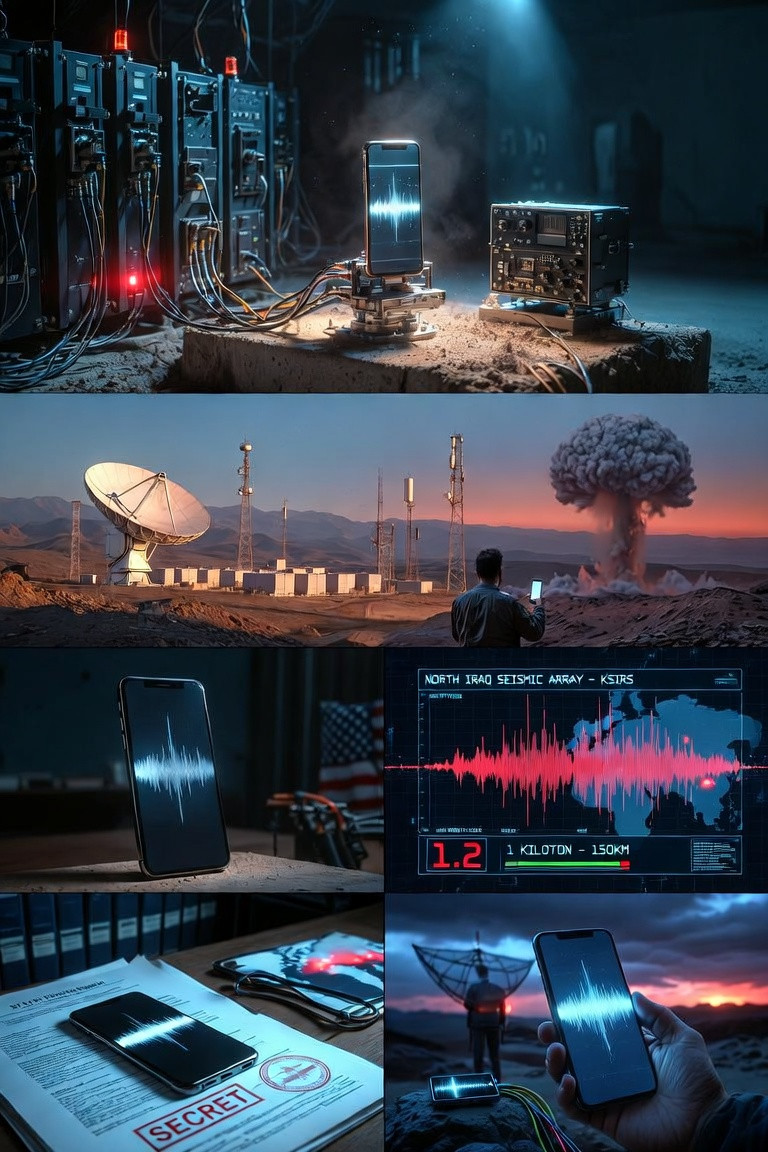
The U.S. Department of State investigated whether off-the-shelf iPhones could detect underground nuclear tests โ€” and installed the devices in a seismic monitoring array in northern Iraq. The declassified documents, released in response to a FOIA request, reveal a little-known chapter in the use of everyday consumer technology for nuclear verification purposes.


An iPhone in the Vault

The concept sounds like science fiction: A commercial iPhone, carried by millions of people in their pockets, as a tool for detecting nuclear tests. Yet that is precisely what the U.S. Department of State tested in 2014 under a contract with Array Information Technology, Inc.

The project, titled “Qualification of Seismic Detection Capabilities of iPhone Accelerometers for Nuclear Explosion Monitoring,” had a total value of $149,678.

The idea: The accelerometers built into iPhones โ€” originally designed for screen orientation or step counting โ€” could potentially register ground movements caused by underground nuclear explosions.

“The rapidly evolving potential of public and societal monitoring becomes evident in the ubiquitous use of smart phones in recent years. The technology in today’s smart phones includes a sophisticated computer with built-in accelerometer sensors, a powerful CPU, data storage, GPS geo-location, and wireless connectivity. In theory, these devices are already prepared to monitor ground movement and submit the recorded signals to a central processing unit for further analysis.”
โ€” From the Statement of Work


Northern Iraq โ€“ An Unusual Test Site

The iPhones were not tested in a laboratory but in northern Iraq โ€” specifically at the North Iraq Seismic Array (KSIRS), a seismic monitoring network in the Kurdish region.

The documents show that AIT staff traveled to Iraq to install the iPhones in the vaults of the array alongside state-of-the-art STS-2 broadband seismometers. These reference instruments โ€” comparable to those used by the International Monitoring System (IMS) of the CTBTO (Comprehensive Nuclear-Test-Ban Treaty Organization) โ€” served as calibration standards.

The iPhones were tested under various conditions:

ยท Best-case scenario: The iPhone is glued to the concrete pier of the array
ยท Ideal operational condition: The iPhone is placed on the pier in the instrument vault (comparable to a device resting on a desk)
ยท Normal operational condition: The iPhone is placed in a garment pocket or purse resting on the vault floor


Challenges on the Ground

The installation did not proceed without problems. An internal email exchange from September 2015 shows that the project requested a no-cost extension of the performance period โ€” originally scheduled from September 30, 2014, to September 29, 2015.

The reasoning: Inclement weather conditions and the inaccessibility of the array during the winter months delayed the installation until the end of March. A second deployment in May was also necessary because two iPhones malfunctioned during the first deployment period.

Particularly noteworthy is a project staff member’s reference to the security situation:

“Kurdistan (northeastern Iraq) is a bit safer than central and south Iraq, as ISIS’ threat is not reaching the key portion of Kurdistan yet.”
โ€” Internal email from September 2015

The iPhones were originally intended to remain in the array for three to four months to capture a representative distribution of earthquake magnitudes at local and regional distances.


The Scientific Question

The project was prompted by a claim in an article by Stubbs and Drell (2013) that the iPhone 4 accelerometer should allow 95% confidence in detecting an underground nuclear test with a yield of 1 kiloton at a distance of 150 kilometers.

The problem: This claim was not supported by data on the frequency-dependent sensitivity of the sensor or explanations of the underlying assumptions.

The project was therefore designed to provide a quantitative investigation of iPhone capabilities and determine whether this technology could indeed help CTBTO achieve its verification goals.


Analysis and Objectives

The collected data was to be analyzed to establish a noise floor threshold for individual iPhones. The researchers wanted to examine the detection of a range of small and mid-sized earthquakes โ€” those similar in magnitude to clandestine nuclear explosions.

A particular focus was on array operation: The availability of the KSIRS vaults enabled the researchers to apply array processing techniques and evaluate the improvement of detection through array processing over individual threshold values.

The resulting detection thresholds would then be used to model the detection statistics for an assumed operational system of these devices โ€” with varying density of iPhones per square kilometer in a given region.


Redacted Secrets and Unanswered Questions

The released documents are heavily redacted. Large sections have been blacked out under FOIA exemptions (b)(4) (trade secrets and confidential commercial information) and (b)(6) (protection of privacy).

Particularly the cost breakdown โ€” including line items such as “Direct Labor,” “Travel,” “Equipment,” and “G&A” โ€” is almost entirely redacted. The names of key personnel have also been obscured.

The results of the study remain completely hidden in the published material โ€” they appear to have been kept under seal.


A Project with Open Questions

The concept that smartphones could one day contribute to nuclear monitoring is fascinating โ€” but also problematic. The documents show that the State Department seriously examined this technology.

Yet the crucial questions remain unanswered: Do the iPhones actually work? The redactions suggest that the results may have been classified as sensitive. Who had access to the data? And what security risks arise from using commercial mass-market technology for security-related purposes?

The project formally ended on August 31, 2016 โ€” with a no-cost extension of the performance period by nearly a year. Whether the iPhones fulfilled their mission remains shrouded in secrecy.


The complete documentation with all released pages, contract details, and correspondence is exclusively available to Patreon subscribers at patreon.com/berndpulch.

Apples iPhones als Atompilz-Jรคger: US-AuรŸenministerium testete Smartphones zur รœberwachung von Atomtests

Das US-AuรŸenministerium hat bereits 2014 untersucht, ob handelsรผbliche iPhones in der Lage sind, unterirdische Atomtests zu detektieren โ€“ und installierte die Gerรคte dafรผr in einem seismischen รœberwachungsarray im Nordirak. Die geheimen Dokumente wurden nun nach einer FOIA-Anfrage freigegeben und offenbaren ein bislang wenig bekanntes Kapitel der Nutzung von Alltagstechnologie fรผr nukleare Verifikationszwecke.


Ein iPhone im Bunker

Die Vorstellung klingt nach Science-Fiction: Ein handelsรผbliches iPhone, wie es Millionen Menschen in der Tasche tragen, als Werkzeug zur Detektion von Atomtests. Doch genau das testete das US-AuรŸenministerium im Jahr 2014 im Rahmen eines Vertrags mit dem Unternehmen Array Information Technology, Inc. ใ€4โ€ L2-L6ใ€‘.

Das Projekt mit dem Titel “Qualification of Seismic Detection Capabilities of iPhone Accelerometers for Nuclear Explosion Monitoring” (Qualifizierung der seismischen Detektionsfรคhigkeiten von iPhone-Beschleunigungsmessern fรผr die nukleare Explosionsรผberwachung) hatte ein Volumen von 149.678 US-Dollarใ€5โ€ L3-L5ใ€‘ใ€35โ€ L15-L17ใ€‘.

Die Idee: Die in iPhones verbauten Beschleunigungssensoren โ€“ eigentlich fรผr die Ausrichtung des Bildschirms oder Schrittmessung gedacht โ€“ kรถnnten mรถglicherweise auch Bodenbewegungen registrieren, die von unterirdischen nuklearen Explosionen ausgelรถst werden.

“Die sich rasch entwickelnden Mรถglichkeiten der รถffentlichen und gesellschaftlichen รœberwachung werden in den letzten Jahren durch die allgegenwรคrtige Nutzung von Smartphones deutlich. Die Technologie in heutigen Smartphones umfasst einen hochentwickelten Computer mit eingebauten Beschleunigungssensoren, einer leistungsstarken CPU, Datenspeicher, GPS-Geolokalisierung und drahtloser Konnektivitรคt. Theoretisch sind diese Gerรคte bereits darauf vorbereitet, Bodenbewegungen zu รผberwachen und die aufgezeichneten Signale an eine zentrale Verarbeitungseinheit zur weiteren Analyse zu รผbermitteln.”
โ€” Aus dem Statement of Workใ€43โ€ L15-L21ใ€‘


Der Nordirak โ€“ Ein ungewรถhnlicher Testort

Die iPhones wurden nicht etwa in einem Labor getestet, sondern im Nordirak โ€“ genauer gesagt im North Iraq Seismic Array (KSIRS), einem seismischen รœberwachungsnetzwerk in der kurdischen Regionใ€14โ€ L4-L8ใ€‘ใ€43โ€ L36-L38ใ€‘.

Die Dokumente zeigen, dass Mitarbeiter von AIT in den Irak reisten, um die iPhones in den Gewรถlben des Arrays neben hochmodernen STS-2-Breitbandseismometern zu installierenใ€44โ€ L14-L18ใ€‘. Diese Referenzinstrumente โ€“ vergleichbar mit denen, die vom Internationalen รœberwachungssystem (IMS) der CTBTO (Comprehensive Nuclear-Test-Ban Treaty Organization) genutzt werden โ€“ sollten als Kalibrierungsstandard dienenใ€43โ€ L38-L40ใ€‘.

Die iPhones wurden unter verschiedenen Bedingungen getestet:

ยท Best-Case-Szenario: Das iPhone wird auf den Betonsockel des Arrays geklebt
ยท Idealer Betriebszustand: Das iPhone liegt auf dem Sockel im Instrumentengewรถlbe (vergleichbar mit einem auf einem Schreibtisch liegenden Gerรคt)
ยท Normaler Betriebszustand: Das iPhone liegt in einer Kleidungs- oder Handtasche auf dem Boden des Gewรถlbesใ€44โ€ L18-L26ใ€‘


Die Herausforderungen vor Ort

Die Installation verlief nicht ohne Probleme. Ein interner E-Mail-Austausch vom September 2015 zeigt, dass das Projekt eine kostenlose Verlรคngerung der Leistungsperiode beantragte โ€“ ursprรผnglich war der Zeitraum vom 30. September 2014 bis zum 29. September 2015 geplantใ€14โ€ L2-L10ใ€‘.

Die Begrรผndung: Ungรผnstige Wetterbedingungen und die Unzugรคnglichkeit des Arrays wรคhrend der Wintermonate hatten die Installation bis Ende Mรคrz verzรถgert. Zudem fiel ein zweiter Einsatz im Mai an, weil zwei iPhones wรคhrend der ersten Einsatzphase ausfielenใ€14โ€ L4-L8ใ€‘.

Besonders bemerkenswert ist der Hinweis eines Projektmitarbeiters zur Sicherheitslage:

“Kurdistan (Nordostirak) ist etwas sicherer als der zentrale und sรผdliche Irak, da die Bedrohung durch den IS die Schlรผsselregion Kurdistans noch nicht erreicht hat.”
โ€” Interne E-Mail vom September 2015ใ€12โ€ L15-L17ใ€‘

Die iPhones sollten ursprรผnglich fรผr drei bis vier Monate im Array verbleiben, um eine reprรคsentative Verteilung von Erdbebenmagnituden in lokaler und regionaler Entfernung zu erfassenใ€45โ€ L1-L3ใ€‘.


Die wissenschaftliche Fragestellung

Hintergrund des Projekts war eine Behauptung aus einem Artikel von Stubbs und Drell (2013), wonach der Beschleunigungssensor des iPhone 4 mit 95-prozentiger Sicherheit einen unterirdischen Nukleartest mit einer Sprengkraft von 1 Kilotonne in einer Entfernung von 150 Kilometern detektieren kรถnnen sollteใ€43โ€ L22-L27ใ€‘.

Das Problem: Diese Behauptung war weder durch Daten รผber die frequenzabhรคngige Empfindlichkeit des Sensors noch durch Erklรคrungen der zugrunde liegenden Annahmen untermauertใ€43โ€ L27-L31ใ€‘.

Das Projekt sollte deshalb eine quantitative Untersuchung der iPhone-Fรคhigkeiten liefern und klรคren, ob diese Technologie tatsรคchlich dazu beitragen kann, die รœberwachungsziele der CTBTO zu erreichenใ€43โ€ L31-L33ใ€‘.


Die Analyse und ihre Ziele

Die gesammelten Daten sollten analysiert werden, um eine Rauschuntergrenze fรผr einzelne iPhones zu etablierenใ€45โ€ L6-L8ใ€‘. Die Forscher wollten die Detektion einer Reihe von kleinen und mittelgroรŸen Erdbeben untersuchen โ€“ solche, die in ihrer Magnitude heimlichen nuklearen Explosionen รคhnelnใ€45โ€ L8-L10ใ€‘.

Ein besonderer Fokus lag auf dem Array-Betrieb: Durch die Verfรผgbarkeit der KSIRS-Gewรถlbe konnten die Forscher Array-Verarbeitungstechniken anwenden und die Verbesserung der Detektion durch die Array-Verarbeitung gegenรผber den individuellen Schwellenwerten bewertenใ€45โ€ L14-L17ใ€‘.

Die resultierenden Detektionsschwellen sollten dann genutzt werden, um die Detektionsstatistik fรผr ein angenommenes Betriebssystem dieser Gerรคte zu modellieren โ€“ mit variabler Dichte von iPhones pro Quadratkilometer in einer bestimmten Regionใ€45โ€ L17-L20ใ€‘.


Redigierte Geheimnisse und ungeklรคrte Fragen

Die freigegebenen Dokumente sind in weiten Teilen geschwรคrzt. GroรŸe Abschnitte wurden unter Berufung auf die FOIA-Ausnahmen (b)(4) (Geschรคftsgeheimnisse und vertrauliche kommerzielle Informationen) und (b)(6) (Schutz der Privatsphรคre) unkenntlich gemachtใ€2โ€ L14-L18ใ€‘.

Besonders die Kostenaufschlรผsselung โ€“ mit Positionen wie “Direct Labor”, “Travel”, “Equipment” und “G&A” โ€“ ist nahezu vollstรคndig redigiertใ€47โ€ L28-L34ใ€‘. Ebenso unkenntlich gemacht wurden die Namen der Schlรผsselpersonenใ€47โ€ L2-L8ใ€‘.

Die Ergebnisse der Studie bleiben im verรถffentlichten Material vollstรคndig verborgen โ€“ sie wurden offenbar unter Verschluss gehalten.


Ein Projekt mit offenen Fragen

Die Vorstellung, dass Smartphones in Zukunft zur nuklearen รœberwachung beitragen kรถnnten, ist faszinierend โ€“ aber auch problematisch. Die Dokumente zeigen, dass das US-AuรŸenministerium diese Technologie ernsthaft geprรผft hat.

Doch die entscheidenden Fragen bleiben unbeantwortet: Funktionieren die iPhones tatsรคchlich? Die Redigierungen legen nahe, dass die Ergebnisse mรถglicherweise als sensibel eingestuft wurden. Wer hatte Zugang zu den Daten? Und welche Sicherheitsrisiken ergeben sich aus der Nutzung kommerzieller Massentechnologie fรผr sicherheitsrelevante Zwecke?

Das Projekt endete formal am 31. August 2016 โ€“ mit einer kostenlosen Verlรคngerung der Leistungsperiode um fast ein Jahrใ€34โ€ L14-L16ใ€‘ใ€35โ€ L15ใ€‘. Ob die iPhones ihre Aufgabe erfรผllten, bleibt im Dunkeln.


Die vollstรคndige Dokumentation mit allen freigegebenen Seiten, Vertragsdetails und Korrespondenz ist exklusiv fรผr Patreon-Abonnenten verfรผgbar unter patreon.com/berndpulch.

The Epstein Financial Network: What the Verified Records Show

https://rumble.com/v76b80i-290-million-158-million-1.5-billion-the-epstein-financial-network-explained.html

By INVESTIGATIVE DESK
February 26, 2026


More than six years after Jeffrey Epstein’s death in federal custody, the full scope of his financial and social network continues to emerge through court records, regulatory actions, and congressional investigations. Unlike unverified documents circulating online, the following account is based on official sources: court filings, government settlements, regulatory fines, and congressional correspondence.


The Banking Infrastructure

JPMorgan Chase: $290 Million Settlement

In June 2023, JPMorgan Chase reached a $290 million settlement with sexual abuse victims of Jeffrey Epstein, resolving a class-action lawsuit filed in November 2022 . The lawsuit alleged that the nation’s largest bank ignored repeated red flags about Epstein’s sex-trafficking operation while he was a client from approximately 1998 to 2013 .

U.S. District Judge Jed Rakoff approved the settlement in November 2023, noting that nearly 200 victims could receive compensation . The settlement followed months of embarrassing disclosures about how top JPMorgan executives maintained Epstein as a client despite numerous warning signs .

Separately, JPMorgan agreed in September 2023 to pay $75 million to the U.S. Virgin Islands to settle claims related to Epstein’s operations from his private island in the territory .

Deutsche Bank: $150 Million Fine

In July 2020, Deutsche Bank agreed to pay a $150 million fine to New York’s Department of Financial Services for “significant compliance failures” in its relationship with Epstein . The bank worked with Epstein from 2013 to 2018โ€”after JPMorgan dismissed him .

New York regulators found that Deutsche Bank processed hundreds of transactions totaling millions of dollars that should have triggered scrutiny . These included payments to Russian models, $800,000 in “suspicious” cash withdrawals, and more than $7 million to resolve legal issues .

“Whether or to what extent those payments or that cash was used by Mr. Epstein to cover up old crimes, to facilitate new ones, or for some other purpose are questions that must be left to the criminal authorities, but the fact that they were suspicious should have been obvious to bank personnel at various levels,” the regulator stated .

Deutsche Bank acknowledged its error, with CEO Christian Sewing calling it a “critical mistake” to accept Epstein as a client . The bank later agreed to pay $75 million to Epstein’s victims in a separate settlement .


Leon Black and the $158 Million Question

Documented Payments

Wall Street financier Leon Black paid Jeffrey Epstein approximately $158 million between 2012 and 2017 . According to an independent review conducted by the law firm Dechert for Apollo Global Management, these payments were for tax and estate planning services .

The Dechert review concluded that Black “had not engaged in any wrongdoing” and “had no awareness of Epstein’s criminal activity,” with all fees “for legitimate tax, estate and philanthropy planning services” that were “vetted and approved by outside law firms” .

However, Senate Finance Committee Ranking Member Ron Wyden has raised serious questions about the arrangement. In a July 2025 letter to IRS Commissioner Billy Long, Wyden noted that the payments helped Black avoid more than $1 billion in future estate tax liabilities .

Irregularities in the Arrangement

According to Wyden’s investigation, the majority of paymentsโ€”approximately $100 millionโ€”were made on an “ad hoc” basis without any written contract or business services agreement . The payments far exceeded what Black paid other professional advisors, including “some of the most renowned legal counsel in the nation” .

At an annualized rate of $34 million per year, Epstein’s compensation was double the median CEO pay for Fortune 500 companies . Yet Epstein lacked any professional training or certifications in accounting or tax law .

Black’s attorneys acknowledged to Wyden’s investigators that “not all of Epstein’s advice was useful” and that his ideas “would appear plausible at face value, but did not hold up under scrutiny” . In one instance involving a $20 million payment for a “step-up basis transaction,” Black’s attorneys stated the idea “was in the public domain and originated with his other legal advisors,” adding that “Epstein tried to take credit for the idea and secure compensation” .

U.S. Virgin Islands Settlement

In January 2023, Black agreed to pay $62.5 million to the U.S. Virgin Islands. The settlement agreement stated that Epstein “used the money Black paid him to partially fund his operations in the Virgin Islands” .

IRS Investigation Question

Despite these documented irregularities, Black’s attorneys confirmed in writing to Wyden’s investigators that the tax transactions at issue have “not been reviewed by the Internal Revenue Service as part of an audit” .

Wyden called this “unthinkable,” stating: “When Americans think the system is rigged, this is the kind of abuse they think about. While average Americans are regularly audited, it appears that the IRS will simply look the other way in cases involving billionaires” .


Bill Clinton: Flight Records and Congressional Testimony

Documented Flights

Flight logs show that former President Bill Clinton traveled on Epstein’s private aircraft at least 16 times between 2001 and 2004 . Destinations included domestic U.S. locations as well as Hong Kong, Singapore, Beijing, and London .

Some flights were taken with Epstein and his former girlfriend Ghislaine Maxwell . Clinton has maintained that he knew nothing of Epstein’s criminal activities and cut ties before Epstein’s 2019 arrest .

Emails in Released Documents

The Department of Justice’s January 2026 document release included emails between Clinton’s staff and Maxwell. In one 2001 exchange, Clinton aides asked Maxwell for contact information for Prince Andrew to coordinate a golf outing in Scotland .

Other emails contained crude language. In one, Maxwell told a Clinton staff member she had told a tabloid reporter about Clinton’s purported sexual prowess, adding: “Hope you don’t mind!” Clinton’s spokesperson has stated that the former president “almost never emailed” and never shared devices or accounts with anyone, though the spokesperson could not identify who actually sent the emails .

Upcoming Congressional Depositions

After months of negotiations and a threatened contempt vote, Bill and Hillary Clinton have agreed to testify before the House Oversight Committee . Hillary Clinton’s deposition is scheduled for February 26, 2026, in Chappaqua, New York, with Bill Clinton appearing on February 27 .

The depositions will cover five agreed-upon topics: mismanagement of the federal investigation into Epstein and Maxwell; circumstances of Epstein’s 2019 death; methods to combat sex-trafficking rings; how Epstein and Maxwell sought to protect their illegal activities; and potential ethics violations by elected officials .

Rep. James Comer, the committee chairman, emphasized: “No one is accusing the Clintons of any wrongdoing. We just have a lot of questions” .

Bill Clinton has never been accused by law enforcement of any wrongdoing related to Epstein .


The January 2026 Document Release

What Was Released

On January 30, 2026, the Department of Justice released more than 3 million pages of documents related to Epstein, along with approximately 180,000 images and thousands of videos . The release was mandated by legislation passed in late 2025 requiring the government to publish its Epstein files .

Controversy Over Redactions

Victims and some lawmakers have expressed frustration that many documents remain heavily redacted . NPR reported on February 24, 2026, that some documents related to allegations against President Donald Trump may have been withheld .

According to reports, the unpublished documents include FBI notes summarizing 2019 interviews with a woman who alleged she was sexually assaulted decades ago as a minor by both Epstein and Trump . Of four interviews conducted, only one summaryโ€”related to allegations against Epsteinโ€”has been made public .

Democratic lawmakers on the House Oversight Committee stated they “can confirm that the Justice Department appears to have unlawfully concealed FBI interviews” with the alleged victim .

Justice Department Response

The Justice Department responded that “NOTHING has been removed” from the public database, clarifying that only duplicate documents, those under court order not to be released, or materials part of ongoing federal investigations have not been published . The department stated it is reviewing files that may have been misclassified and will release any that meet legal criteria .

Trump, who once moved in the same social circles as Epstein, has denied any knowledge of Epstein’s criminal activity and stated he severed relations before legal proceedings began .


Epstein’s Criminal History

2008 Conviction

In 2008, Epstein pleaded guilty in Florida state court to two felony charges: soliciting prostitution and soliciting prostitution from a minor . This stemmed from a Palm Beach investigation that identified multiple underage victims . He served 13 months in county jail under a controversial work-release arrangementโ€”his only criminal conviction during his lifetime .

2019 Federal Indictment

In July 2019, federal prosecutors in the Southern District of New York charged Epstein with sex trafficking of minors and conspiracy to commit sex trafficking . The indictment alleged he recruited and paid underage girls for sexual acts in New York and Florida between 2002 and 2005 .

Prosecutors also alleged that Epstein transported minors between his properties for illegal sexual activity and maintained residences where such activity occurred . Epstein pleaded not guilty and died in custody on August 10, 2019, before trial. His death was determined to be suicide .

Ghislaine Maxwell

Epstein’s longtime associate Ghislaine Maxwell was arrested in July 2020 and later convicted on sex trafficking charges. She is serving a 20-year prison sentence .


Ongoing Investigations

Treasury Department Records

Senator Wyden’s investigation has identified 4,725 wire transfers documented in suspicious activity reports related to Epstein, totaling more than $1.5 billion . Some banks filed these reports years after the transactions occurred .

Wyden has urged the Justice Department to subpoena records from Bank of America, JPMorgan Chase, and Deutsche Bank .

DEA Investigation Questions

A 2015 memo in the DOJ files shows the Drug Enforcement Administration opened an investigation into nearly $50 million in suspicious wire transfers involving Epstein and 14 other targets, starting in December 2010โ€”two years after his non-prosecution agreement . The disposition of this investigation remains unclear.


Documented Payments and Settlements: Summary

Entity Amount Year Basis
JPMorgan Chase (victims) $290 million 2023 Class-action settlement
JPMorgan Chase (USVI) $75 million 2023 Territorial settlement
Deutsche Bank (regulatory) $150 million 2020 NYDFS fine
Deutsche Bank (victims) $75 million 2023 Victim settlement
Leon Black (to Epstein) $158 million 2012-2017 Documented payments
Leon Black (USVI) $62.5 million 2023 Territorial settlement


Sources and Methodology

This article is based on:

ยท Official court documents and settlements
ยท Regulatory enforcement actions (NYDFS)
ยท Congressional correspondence and investigations (Senate Finance Committee)
ยท Department of Justice public releases
ยท Reporting from The New York Times, CNN, BBC, and Bloomberg News
ยท Securities and Exchange Commission filings

All information presented has been verified against primary sources or authoritative news organizations. Documents referenced are in the public domain.


โ€”Reporting by the Investigative Desk


Bernd Pulch โ€” Bio

Bernd Pulch (M.A.) is a forensic expert, founder of Aristotle AI, entrepreneur, political commentator, satirist, and investigative journalist covering lawfare, media control, investment, real estate, and geopolitics. His work examines how legal systems are weaponized, how capital flows shape policy, how artificial intelligence concentrates power, and what democracy loses when courts and markets become battlefields. Active in the German and international media landscape, his analyses appear regularly on this platform.

Full bio โ†’ | Support the investigation โ†’

THE EPSTEIN FINANCIAL ARCHIPELAGO

THE BANKERS WHO BOUGHT EPSTEIN’S SILENCE
Named. Shamed. Still Employed.
Jes Staley. Paul Morris. Rosemary Vrablic. Michael O’Neill. Mary Erdoes. Leon Black. Glenn Dubin.
They processed $1.5 billion in suspicious transactions. They overruled compliance officers who flagged the crimes. They bought criminal immunity with your pension money.
Not one has faced arrest.
Full executive names, internal emails, and unredacted documents: Patreon.com/berndpulch

THE EPSTEIN FINANCIAL ARCHIPELAGO: Mapping Wall Street’s Complicity in a Criminal Enterprise

How America’s most powerful banks and hedge funds enabled Jeffrey Epstein’s transnational sex trafficking operationโ€”and why the money trail leads to questions that remain unanswered


๐Ÿ” DEEP DIVE ACCESS: For exclusive documents, extended financial analysis, and insider intelligence on the Epstein network not available in this public report, subscribe to Patreon.com/berndpulch or join the Patron’s Vault waiting list at office@berndpulch.org.


INTRODUCTION: The $1.5 Billion Question

In September 2025, during a House Judiciary Committee hearing, FBI Director Kash Patel made a startling admission: federal investigators had identified $1.5 billion in suspicious financial transactions tied to Jeffrey Epstein’s sex trafficking network, reported by JPMorgan Chase, Deutsche Bank, Bank of America, and Bank of New York Mellon. Yet despite this mountain of financial evidence, the FBI has failed to “follow the money” in any meaningful way.

This revelation came as Congress passed the Epstein Files Transparency Act in November 2025, mandating the release of 6 million pages of documents. To date, 3.5 million pages have been releasedโ€”including financial ledgers, flight manifests, and internal bank communications that paint a damning picture of institutional complicity.

The story that emerges is not merely one of a single predator operating in isolation, but of an entire financial ecosystem that enabled, protected, and profited from criminality on an industrial scale.


THE WALL STREET FIRMS: A ROGUE’S GALLERY

The financial institutions that serviced Epstein’s empire represent a cross-section of American and international banking power. Each played a distinct role in maintaining the infrastructure of Epstein’s operations:

1. JPMORGAN CHASE & CO.

The Primary Enabler (1998โ€“2013)

Epstein’s relationship with America’s largest bank began in 1998 and continued for 15 years, spanning his 2008 conviction for soliciting prostitution from a minor. Internal documents reveal that JPMorgan executives were aware of Epstein’s criminality years before federal prosecutors intervened.

Key revelations from the 2023 Senate Finance Committee investigation:

  • $4.3 million in transactions flagged as suspicious while Epstein was alive and actively trafficking victims
  • $1.3 billion in retroactive suspicious activity reports filed after Epstein’s 2019 deathโ€”nearly 300 times the amount reported during his lifetime
  • 1,200 emails between Epstein and JPMorgan executive Jes Staley, including references to Disney princess code names for women and photos of young women in “seductive poses”

Staley, who later became CEO of Barclays, has admitted under oath to having sexual relations with Epstein’s staff members. He described his relationship with Epstein as “profound” and referred to him as “family” in internal communications. Staley allegedly “observed victims personally,” including visiting young girls at Epstein’s apartments, yet continued to champion the lucrative account internally.

Settlement: $290 million to victims (2023), $75 million to U.S. Virgin Islands (2023)


2. DEUTSCHE BANK

The Post-Conviction Lifeline (2013โ€“2018)

After JPMorgan finally severed ties in 2013โ€”only after internal compliance officers raised alarms that were ignored for yearsโ€”Deutsche Bank eagerly stepped in to service Epstein’s accounts. This occurred after Epstein’s 2008 conviction and registration as a sex offender, at a time when any legitimate financial institution should have recognized the existential risk.

Deutsche Bank maintained the relationship until 2018, processing transactions that included:

  • Payments to Ghislaine Maxwell totaling $30.7 million, including over $7 million for a helicopter used to transport victims to Epstein’s private island
  • Wire transfers to models and “assistants” who were later identified as victims
  • Large cash withdrawals that bank compliance officers flagged but executives approved

Settlement: $75 million to victims (2023), following a $150 million regulatory fine by New York State (2020)

The bank’s official statement: “We acknowledge our error of onboarding Epstein in 2013 and the weaknesses in our processes.”


3. BANK OF AMERICA

The Leon Black Connection

Recent investigations have revealed Bank of America’s central role in processing $170 million in payments from billionaire Leon Black to Epstein between 2012 and 2017โ€”payments now acknowledged to have partially funded Epstein’s sex trafficking operations in the U.S. Virgin Islands.

According to a March 2025 Senate Finance Committee letter:

  • Bank of America filed only two suspicious activity reports covering these transactions, filed years after the fact
  • The bank processed the $170 million “without asking for information as to the nature of the transactions”
  • The SARs were filed seven years after the transactions began and eight months after Epstein’s 2019 arrest on federal sex trafficking charges

Black, co-founder of Apollo Global Management, paid Epstein at an annualized rate of $23โ€“26 million for purported “tax and estate planning advice”โ€”compensation exceeding the median CEO pay for Fortune 500 companies, for services provided by a college dropout with no accounting or legal credentials.

In January 2023, Black paid $62.5 million to settle claims from the U.S. Virgin Islands, with the settlement explicitly stating: “Jeffrey Epstein used the money Black paid him to partially fund his operations in the Virgin Islands.” The settlement granted Black criminal immunity for himself, his attorneys, and his agents.


4. BEAR STEARNS (Defunct)

The Origin Story (1976โ€“1981)

Epstein’s Wall Street career began at Bear Stearns in 1976, where he rose from junior assistant to limited partner before his 1981 departure. The connections formed here would prove enduring:

  • Epstein later chaired Liquid Funding Ltd., a Bermuda-registered entity partially owned by Bear Stearns from 2000โ€“2007, loaded with mortgage-backed securities and collateralized loan obligations
  • The Paradise Papers reveal Epstein utilized Appleby, the offshore services provider, to navigate “the secretive and low-tax world of offshore finance”
  • Bear Stearns’ 2008 collapseโ€”triggered by exposure to the same toxic assets Epstein’s vehicle tradedโ€”eliminated a potential source of institutional memory regarding his early financial activities

5. ADDITIONAL FINANCIAL ENTITIES

Highbridge Capital Management

  • Glenn Dubin’s hedge fund paid Epstein $15 million for introducing the firm to JPMorgan Chase, which acquired a majority stake for $1.3 billion in 2004
  • This single transaction generated $127 million in revenues for Epstein in 2004, his best year on record

Financial Trust Company / Southern Trust Company

  • Epstein’s own Virgin Islands-based financial vehicles, established in 1998 and 2011 respectively
  • Used to pay Maxwell and manage the “economic development program” that saved Epstein $300 million in taxes between 1999โ€“2018
  • One account used to pay Maxwell had previously been flagged for sex trafficking activity

Honeycomb Partners & TD Bank

  • According to Wall Street Journal reporting, these firms maintained ties with Epstein during various phases of his operations

THE CLIENTS: BILLIONAIRES WHO FUELED THE MACHINE

Epstein’s financial network relied on a small circle of ultra-wealthy clients who provided the capital that sustained his criminal enterprise:ClientFirm/RolePayments to EpsteinStatusLeslie Wexner L Brands (Victoria’s Secret, Bath & Body Works) $200+ million (1991โ€“2007) Denied knowledge of crimes; gave Epstein power of attorney Leon Black Apollo Global Management $170 million (2012โ€“2017) Settled for $62.5M; granted criminal immunity in USVI Elizabeth Johnson Johnson & Johnson heiress Undisclosed Deceased 2017 Glenn Dubin Highbridge Capital Management $15 million (introducer fee) No charges filed


THE COMPLIANCE BREAKDOWN: How Banks Failed

The Epstein case represents a catastrophic failure of the Bank Secrecy Act (BSA) framework, which mandates that financial institutions file Suspicious Activity Reports (SARs) within 60 days of detecting potentially criminal transactions.

Key systemic failures identified:

  1. Delayed Reporting: Banks filed SARs years after detecting suspicious activity, if at all
  2. Executive Override: Compliance officers’ concerns were routinely overridden by senior executives attracted to Epstein’s lucrative accounts
  3. Retroactive Compliance: JPMorgan filed SARs covering 300x more transactions after Epstein’s death than during his lifetime
  4. Client Confidentiality Over Public Safety: Banks prioritized relationships with billionaires like Black over their legal obligations to report potential trafficking

As Senator Ron Wyden (D-OR) stated in his March 2025 investigation: “Bank executives tuned out compliance officers who were alarmed by Epstein’s transactions, seemingly withheld evidence of potential money laundering, and coached Epstein on how to obscure suspiciously large cash withdrawals. This goes beyond a total compliance breakdown.”


THE UNANSWERED QUESTIONS

Despite the document releases, critical questions remain:

1. Where is the rest of the money?
The $1.5 billion in flagged transactions represents only what banks voluntarily reported. The true scope of Epstein’s financial network remains unknown.

2. Why no criminal charges against banks?
JPMorgan, Deutsche Bank, and Bank of America have paid hundreds of millions in civil settlements but faced no criminal prosecution for potential money laundering or complicity in sex trafficking.

3. What about the “client list”?
While Attorney General Pam Bondi claimed in February 2025 that a “client list” was “sitting on my desk,” FBI officials have testified under oath that no such comprehensive list was found. The “black books” that do existโ€”contact directories compiled by Ghislaine Maxwellโ€”contain 1,731 names but are described by investigators as “red herrings” rather than evidence of criminal participation.

4. Who else was financed by Black’s $170 million?
The admission that Black’s payments funded Epstein’s Virgin Islands operations raises the question: which other billionaires’ money sustained the network?

5. Why is Treasury Secretary Bessent refusing to release records?
Senator Wyden has identified Secretary Scott Bessent as part of “the Epstein coverup” for refusing to produce Treasury Department files containing thousands of bank records, despite Congressional demands.


๐Ÿ” EXCLUSIVE INTELLIGENCE

This public analysis represents only a fraction of the financial documentation available. For subscribers to Patreon.com/berndpulch, the following deep-dive materials are available:

  • Complete JPMorgan email archive between Epstein and Jes Staley (redacted portions)
  • Deutsche Bank internal compliance memos showing executive override of SAR filings
  • Leon Black payment schedules and correspondence with Epstein regarding “tax planning”
  • Offshore entity structures mapped through Paradise Papers connections
  • Updated victim settlement documents and non-prosecution agreements
  • Congressional hearing transcripts with FBI Director Patel and Treasury officials

Note: Due to recent hack/sabotage attacks targeting our previous Patreon infrastructure, we are also launching Patron’s Vaultโ€”an ultra-secure, independent membership platform directly integrated into berndpulch.org. To join the waiting list for enhanced security features and direct document access, email office@berndpulch.org with subject line “Patron’s Vault Waiting List.”


CONCLUSION: The Architecture of Impunity

The Epstein financial network reveals a disturbing truth about modern capitalism: that the infrastructure of global finance can be hijacked to sustain criminal enterprises, and that institutional safeguards designed to prevent exactly this outcome can be neutralized by the promise of fees from billionaires.

As the House Oversight Committee continues its investigationโ€”and as the Trump administration faces pressure to release remaining documentsโ€”the focus must shift from Epstein as an individual aberration to the systemic conditions that enabled his crimes. The banks that serviced him, the billionaires who paid him, and the regulators who failed to intervene all remain active in the financial system today.

The $1.5 billion is accounted for. The full costโ€”in human suffering and institutional credibilityโ€”remains incalculable.


DOCUMENTATION SOURCES:

  • Senate Finance Committee Democratic Staff Memorandum (November 2025)
  • House Judiciary Committee Letter to Bank of America (October 2025)
  • U.S. Virgin Islands v. JPMorgan Chase & Co. settlement documents
  • Dechert LLP investigation into Leon Black (Apollo Global Management)
  • Paradise Papers / ICIJ offshore finance documents
  • FBI interview summaries and financial ledgers (Data Sets 9โ€“11, Epstein Files Release)

Tags: Epstein files, financial networks, JPMorgan Chase, Deutsche Bank, Bank of America, Leon Black, Apollo Global Management, Jes Staley, money laundering, sex trafficking, Wall Street corruption, Bank Secrecy Act, suspicious activity reports, offshore finance, U.S. Virgin Islands, Ghislaine Maxwell, compliance failure

Bernd Pulch (M.A.) is a forensic expert, founder of Aristotle AI, entrepreneur, political commentator, satirist, and investigative journalist covering lawfare, media control, investment, real estate, and geopolitics. His work examines how legal systems are weaponized, how capital flows shape policy, how artificial intelligence concentrates power, and what democracy loses when courts and markets become battlefields.

Full bio โ†’

Support the investigation โ†’