


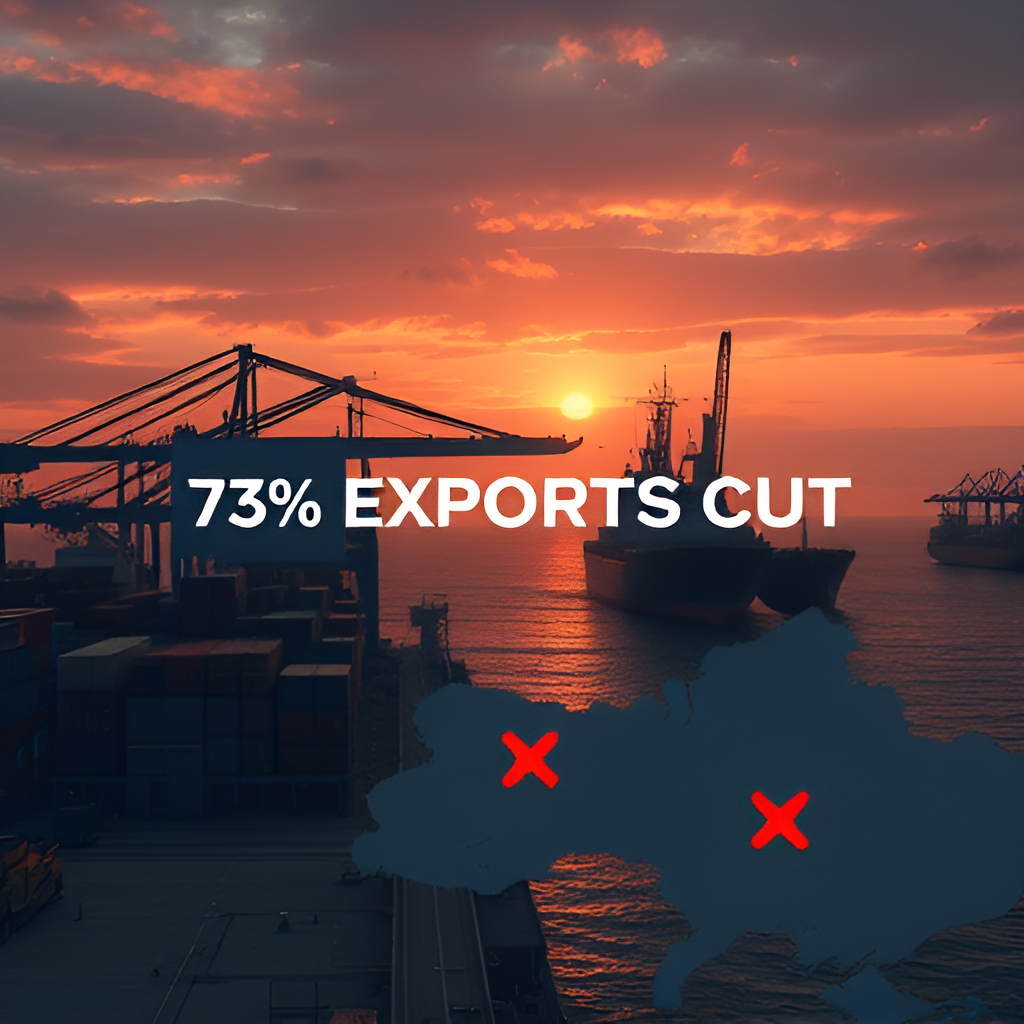
Ukraine’s Black Sea Blockade: Russia Pulls the Economic Plug
Ukraine’s Black Sea ports are effectively paralyzed. Russia has massively intensified its attacks on port infrastructure and civilian freighters in recent weeks – with devastating consequences for Ukraine’s economy, which depends on maritime trade for over 80 percent of its exports. The blockade could ultimately bankrupt the war-torn country and threatens to plunge Europe into a debt crisis as well.
Unlock the Full Truth: berndpulch.org/join
—
The Facts: A Blockade with Intent
Since July 22, 2026, not a single foreign merchant ship has called at or departed the ports of Odesa, Chornomorsk, or Pivdennyi. Shipping companies have suspended calls to Ukrainian Black Sea ports due to massively increased security risks.
The numbers are alarming:
· In July 2026 alone, Ukraine recorded 35 attacks on ships in ports, 22 attacks on ships at sea, and 67 attacks on port facilities. By comparison, there were only 14 attacks on ships in all of 2025.
· Ukraine has already lost one-third of its Black Sea grain export capacity【8†L68】.
· Agriculture Minister Taras Vysotskyi warned that over 30 million tons of agricultural products cannot be exported if the problem is not resolved【8†L70】.
· Direct losses for Ukrainian agriculture in 2026 could range between $1.5 and $3 billion【8†L51-L53】.
“The situation is extraordinarily complicated. In some ways, it’s even more difficult than in March and April 2022.”
— Taras Vysotskyi, Ukrainian Minister of Agricultural Policy and Food【8†L56-L58】
—
The Dependency: 75 to 100 Percent via Ports
The Ukrainian economy depends on its Black Sea ports to an extent that can hardly be overstated. Before the war, approximately 75 percent of all Ukrainian exports flowed through seaports – and for many products, the dependency was even greater:
Product Export Share via Ports
Grain 95–100%
Agricultural products (total) ~90%
Vegetable oils (e.g., sunflower oil) ~91%
Iron and steel products ~83%
Ores ~65%
These figures make clear why the blockade amounts to economic execution. The ports of Odesa, Chornomorsk, and Pivdennyi – the so-called “Greater Odesa” complex – are responsible for the vast majority of Ukrainian exports【7†L148】.
—
The Consequences for Ukraine
The blockade is already having devastating effects:
Agriculture in freefall:
Purchase prices for oilseeds and grain in Ukraine have fallen by an average of 30 percent【8†L49】. Many farmers are being forced to sell their harvests at a loss – some have not only made no profit but have accumulated debt【8†L50-L51】.
Steel industry on its knees:
The closure of the ports has halted Ukrainian iron ore exports. Companies like Ferrexpo had to suspend operations because they could no longer ship their products【7†L157-L158】. The southern processing plant in Kryvyi Rih ceased production entirely【7†L158-L159】. Metinvest already expects a production decline of about 30 percent for August【7†L159-L160】.
Alternative routes are no solution:
The alternative routes via the Danube, rail, and road cannot replace the Black Sea ports. Even if they reach full capacity by the end of August, they can only cover 50 to 55 percent of the monthly Black Sea port volume【7†L153-L154】. The alternative routes would burden producers with additional costs of $45 to $50 per ton【7†L155】.
“There is no alternative to the ports of Odesa if Ukraine is to continue to serve as a guarantor of food security.”
— Taras Vysotskyi【7†L155-L156】
—
The European Dimension: A Debt Collapse Looms
The blockade has catastrophic consequences not only for Ukraine but also for Europe. Because if Ukrainian exports collapse entirely, an uncomfortable question arises:
Who will pay the interest on the hundreds of billions in loans that the West has granted to Ukraine?
Ukraine is burdened with debt of nearly $588 billion【6†L14-L15】. The country is effectively bankrupt – and without export revenues, it will not be able to service its debts. A collapse of these liabilities would be Armageddon for Europe’s already struggling state budgets.
The EU and the U.S. have propped up Ukraine with billions in loans, hoping that the country would eventually become solvent again. This hope has been definitively destroyed by the blockade of the Black Sea ports.
—
The Strategic Logic: Russia’s Strategy of Attrition
Russia’s strategy follows a clear logic: the systematic destruction of Ukrainian port infrastructure and civilian shipping is designed to economically strangle Ukraine. Moscow has massively expanded its attacks in recent weeks to destroy Ukraine’s export economy and increase pressure on Kyiv.
Ukraine has responded with attacks on Russian shipping in the Sea of Azov and the Black Sea. But this exchange of blows cannot change the economic reality: Ukraine is a landlocked country – and Russia has cut off its access to the sea.
—
Conclusion: A Great Idea to Poke the Russian Bear?
The blockade of Ukraine’s Black Sea ports is an economic catastrophe – not only for Ukraine but for all of Europe. A country that depends on maritime trade for over 80 percent of its exports is being systematically cut off from world markets by Russia.
The economic losses are already enormous – and they will continue to rise. European taxpayers will ultimately foot the bill – whether through further aid packages, through the default of loans, or through the destabilizing consequences of a Ukrainian state bankruptcy.
What remains is the bitter realization: Western support for Ukraine did not break Russia – it led Europe into a dependency that has now become a trap.
—
📺 YouTube: youtube.com/@bernd_pulch
🐦 X (Twitter): x.com/berndsocial1
📢 Telegram: t.me/ABOVETOPSECRETXXL
🔓 UNLOCK THE TRUTH: berndpulch.org/join
Die ukrainische See-Blockade: Russland zieht den wirtschaftlichen Stecker
Die ukrainischen Schwarzmeerhäfen sind de facto lahmgelegt. Russland hat seine Angriffe auf die Hafeninfrastruktur und zivile Frachter in den letzten Wochen massiv intensiviert – mit verheerenden Folgen für die ukrainische Wirtschaft, die zu über 80 Prozent vom Seehandel abhängig ist. Die Blockade könnte das kriegsgeschwächte Land endgültig ruinieren und droht, auch Europa in eine Schuldenkrise zu stürzen.
Unlock the Full Truth: berndpulch.org/join
Die Fakten: Eine Blockade mit Ansage
Seit dem 22. Juli 2026 hat kein einziges ausländisches Handelsschiff mehr die Häfen von Odessa, Tschornomorsk oder Piwdennyj angelaufen oder verlassen. Reedereien haben die Anläufe ukrainischer Schwarzmeerhäfen wegen der massiv gestiegenen Sicherheitsrisiken ausgesetzt.
Die Zahlen sind alarmierend:
· Allein im Juli 2026 verzeichnete die Ukraine 35 Angriffe auf Schiffe in den Häfen, 22 Angriffe auf Schiffe auf See und 67 Angriffe auf Hafenanlagen. Zum Vergleich: Im gesamten Jahr 2025 gab es nur 14 Angriffe auf Schiffe.
· Die Ukraine hat bereits ein Drittel ihrer Getreideexportkapazität am Schwarzen Meer verloren.
· Landwirtschaftsminister Taras Vysotskyj warnte, dass über 30 Millionen Tonnen Agrarprodukte nicht exportiert werden können, wenn das Problem nicht gelöst wird.
· Die direkten Verluste für die ukrainische Landwirtschaft könnten 2026 zwischen 1,5 und 3 Milliarden US-Dollar betragen.
„Die Situation ist außergewöhnlich kompliziert. In gewisser Hinsicht ist sie sogar schwieriger als im März und April 2022“ – Taras Vysotskyj, ukrainischer Landwirtschaftsminister
Die Abhängigkeit: 75 bis 100 Prozent über die Häfen
Die ukrainische Wirtschaft hängt in einem Ausmaß von den Schwarzmeerhäfen ab, das kaum zu unterschätzen ist. Vor dem Krieg liefen etwa 75 Prozent aller ukrainischen Exporte über die Seehäfen – bei vielen Produkten war die Abhängigkeit noch weitaus größer:
· Getreide: 95–100 Prozent
· Agrarprodukte insgesamt: ca. 90 Prozent
· Pflanzenöle (z.B. Sonnenblumenöl): ca. 91 Prozent
· Eisen- und Stahlprodukte: ca. 83 Prozent
· Erze: ca. 65 Prozent
Diese Zahlen machen deutlich, warum die Blockade einer wirtschaftlichen Exekution gleichkommt. Die Häfen von Odessa, Tschornomorsk und Piwdennyj (der sogenannte „Greater Odesa“-Komplex) sind für den Großteil der ukrainischen Exporte verantwortlich.
Die Konsequenzen für die Ukraine
Die Blockade hat bereits jetzt verheerende Auswirkungen:
Landwirtschaft im freien Fall:
Die Kaufpreise für Ölsaaten und Getreide sind in der Ukraine um durchschnittlich 30 Prozent gesunken. Viele Bauern sind gezwungen, ihre Ernten mit Verlust zu verkaufen – einige haben nicht nur keinen Gewinn gemacht, sondern Schulden angehäuft.
Stahlindustrie am Boden:
Die Schließung der Häfen hat den ukrainischen Eisenerzexport zum Erliegen gebracht. Unternehmen wie Ferrexpo mussten den Betrieb einstellen, weil sie ihre Produkte nicht mehr verschiffen konnten. Die südliche Aufbereitungsanlage in Krywyj Rih stellte die Produktion komplett ein. Metinvest rechnet bereits für August mit einem Produktionsrückgang von etwa 30 Prozent.
Alternative Routen sind keine Lösung:
Die Ausweichrouten über die Donau, die Bahn und die Straße können die Schwarzmeerhäfen nicht ersetzen. Selbst wenn sie bis Ende August ihre volle Kapazität erreichen, können sie nur 50 bis 55 Prozent des monatlichen Schwarzmeer-Hafenvolumens abdecken. Die Alternativrouten würden den Produzenten zusätzliche Kosten von 45 bis 50 Dollar pro Tonne aufbürden.
„Es gibt keine Alternative zu den Häfen von Odessa, wenn die Ukraine weiterhin als Garant für die Ernährungssicherheit fungieren will“ – Taras Vysotskyj
Die europäische Dimension: Ein Schuldenkollaps droht
Die Blockade hat nicht nur für die Ukraine katastrophale Folgen, sondern auch für Europa. Denn wenn der ukrainische Export komplett zusammenbricht, stellt sich eine unbequeme Frage:
Wer bezahlt die Zinsen für die Hunderte Milliarden an Krediten, die der Westen der Ukraine gewährt hat?
Die Ukraine ist mit Schulden in Höhe von fast 588 Milliarden Dollar belastet. Das Land ist faktisch bankrott – und ohne Exporterlöse wird es seine Schulden nicht bedienen können. Ein Kollaps dieser Verbindlichkeiten wäre das Armageddon für die ohnehin angeschlagenen europäischen Staatshaushalte.
Die EU und die USA haben die Ukraine mit Milliardenkrediten gestützt, in der Hoffnung, dass das Land irgendwann wieder zahlungsfähig wird. Diese Hoffnung ist mit der Blockade der Schwarzmeerhäfen endgültig zerstört worden.
Die strategische Logik: Russlands Zermürbungsstrategie
Die russische Strategie folgt einer klaren Logik: Die systematische Zerstörung der ukrainischen Hafeninfrastruktur und der zivilen Schifffahrt soll die Ukraine wirtschaftlich erdrosseln. Moskau hat die Angriffe in den letzten Wochen massiv ausgeweitet, um die ukrainische Exportwirtschaft zu zerstören und den Druck auf Kiew zu erhöhen.
Die Ukraine hat ihrerseits mit Angriffen auf russische Schifffahrt im Asowschen Meer und im Schwarzen Meer reagiert. Doch dieser Schlagabtausch kann die wirtschaftliche Realität nicht ändern: Die Ukraine ist ein Binnenland – und Russland hat ihr den Zugang zum Meer genommen.
Fazit: Eine tolle Idee, den russischen Bären zu reizen?
Die Blockade der ukrainischen Schwarzmeerhäfen ist ein wirtschaftlicher Super-GAU – nicht nur für die Ukraine, sondern für ganz Europa. Ein Land, das zu über 80 Prozent vom Seehandel abhängt, wird von Russland systematisch von den Weltmärkten abgeschnitten.
Die wirtschaftlichen Verluste sind bereits jetzt enorm – und sie werden weiter steigen. Die europäischen Steuerzahler werden am Ende die Zeche zahlen – sei es durch weitere Hilfspakete, durch den Ausfall von Krediten oder durch die destabilisierenden Folgen eines ukrainischen Staatsbankrotts.
Was bleibt, ist die bittere Erkenntnis: Die westliche Unterstützung für die Ukraine hat Russland nicht gebrochen – sie hat Europa in eine Abhängigkeit geführt, die nun zur Falle wird.
📺 YouTube: youtube.com/@bernd_pulch
🐦 X (Twitter): x.com/berndsocial1
📢 Telegram: t.me/ABOVETOPSECRETXXL
🔓 UNLOCK THE TRUTH: berndpulch.org/join
 🛑 Bernd Pulch | Uncensored Investigative Intelligence since 1994