

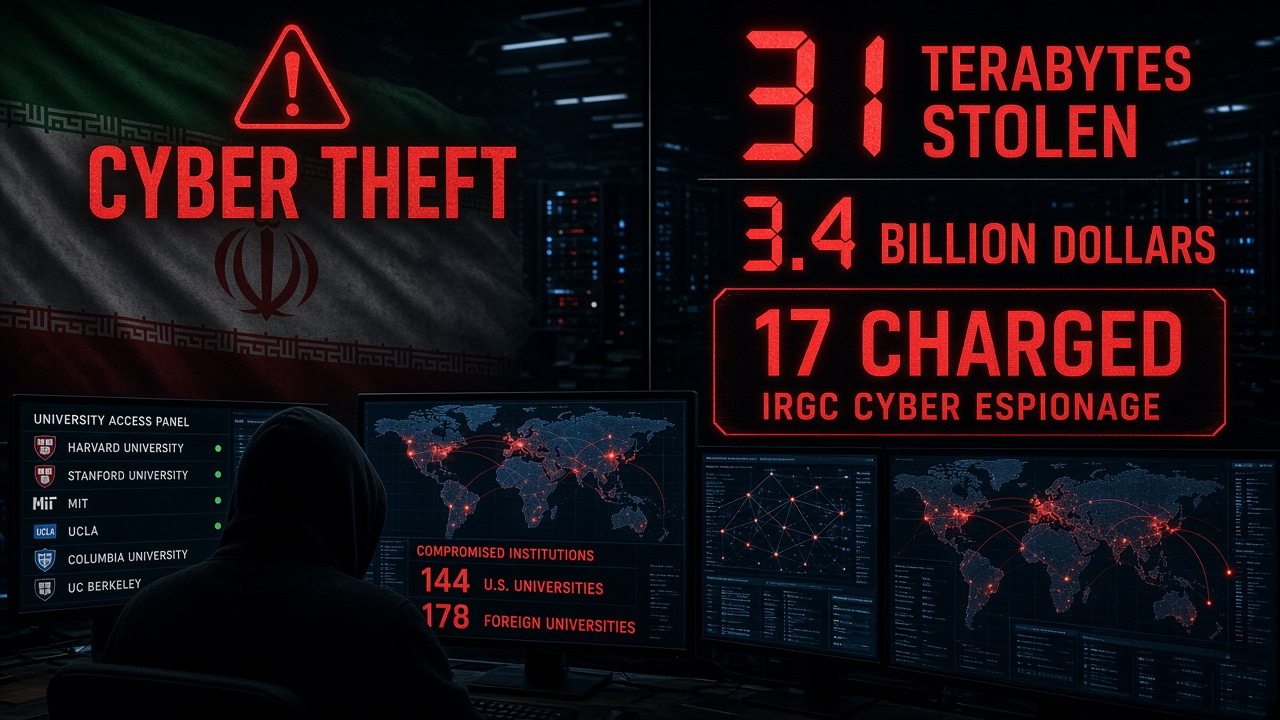
A 14-count superseding indictment unsealed on August 19, 2026, charges 17 members of the Iran-based Mabna Institute with conducting a sweeping cyber theft campaign on behalf of the Islamic Revolutionary Guard Corps (IRGC) and other Iranian entities. The hackers stole more than 31 terabytes of academic data and intellectual property from hundreds of universities, companies, and government agencies worldwide.
The Scope of the Conspiracy
The Mabna Institute, founded around 2013 by Gholamreza Rafatnejad and Ehsan Mohammadi, operated as a hacking-for-hire organization that assisted Iranian universities and research organizations in stealing non-Iranian scientific resources. According to the indictment, the defendants targeted more than 100,000 professor accounts globally and successfully compromised approximately 8,000 professor email accounts across 144 U.S.-based universities and 178 foreign universities in countries including Australia, Canada, China, Germany, Israel, Italy, Japan, the Netherlands, South Korea, Switzerland, Turkey, and the United Kingdom.
The conspiracy also targeted at least 42 U.S.-based private sector companies, 11 foreign private sector companies, five U.S. federal and state government agencies, and two non-governmental organizations.
In total, the defendants stole more than 31.5 terabytes of academic data and intellectual property. U.S.-based universities spent more than approximately $3.4 billion to procure and access such data and intellectual property.
The Methods
The hackers used stolen account credentials to gain unauthorized access to victim professor accounts, which they then used to steal research, academic journals, theses, dissertations, and electronic books across all fields of research, including science and technology, engineering, social sciences, and medicine.
The stolen data was exfiltrated to servers outside the United States under the control of the conspiracy. In addition to stealing data for the benefit of the Iranian government, the defendants sold the stolen resources through two websites: Megapaper.ir and Gigapaper.ir. Megapaper sold stolen academic resources to customers within Iran, while Gigapaper allowed customers to use compromised university professor accounts to directly access the online library systems of U.S.-based and foreign universities.
The Defendants
Nine of the 17 defendants were previously charged in a 7-count indictment announced in March 2018. The case is assigned to U.S. District Judge Jesse M. Furman.
The defendants include:
· Gholamreza Rafatnejad and Ehsan Mohammadi – founders of the Mabna Institute
· Abdollah Karima (aka “Vahid Karima”) – who controlled Falinoos Company, which operated Megapaper
· Mostafa Sadeghi, Seyed Ali Mirkarmi, Mohammed Reza Sabahi, Roozbeh Sabahi, Abuzar Gohari Moqadam, Sajjad Tahmasebi, Saeid Houshyar, Behzad Mesri (aka “Skote Vahshat”), Manouchehr Hashemloo, Keyvan Fayaz (aka “Achilles” aka “The Joker” aka “bc.monster”), Amir Barati, Saber Shahbazi Ballojeh, Arman Kahzadian, and Mojtaba Galekuhi (aka “Mojtaba Ghaleh Koui”)
The Government’s Response
Assistant Attorney General for National Security John A. Eisenberg stated: “The superseding indictment alleges that, at the behest of entities including the IRGC, these defendants hacked into universities and other research institutions worldwide, including the United States, stealing at least 31 terabytes of information and intellectual property of untold value”.
U.S. Attorney Jamie McDonald for the Southern District of New York said: “More than eight years after making the original indictment public, these charges make clear that the passage of time will not deter us from identifying and pursuing those who target the United States from abroad”.
FBI Cyber Division Assistant Director Brett Leatherman added: “Today’s charges make clear to cyber adversaries everywhere: the FBI’s memory is long, and time will not blunt our resolve to pursue justice”.
Concurrent with the unsealing of the indictment, the U.S. Department of State’s Rewards for Justice program is offering a reward of up to $10 million for information leading to the location of defendants Mesri, Galekuhi, Kahzadian, Fayaz, and Ballojeh.
Conclusion
The charges against the 17 Iranian defendants represent one of the largest cyber theft cases ever brought by the U.S. Department of Justice. The scale of the operation—spanning more than a decade, targeting over 300 institutions worldwide, and stealing 31 terabytes of data—underscores the growing threat of state-sponsored cyber espionage and the Iranian regime’s willingness to weaponize hackers-for-hire to advance its strategic interests.
📺 YouTube: youtube.com/@bernd_pulch
🐦 X (Twitter): x.com/berndsocial1
📢 Telegram: t.me/ABOVETOPSECRETXXL
🔓 UNLOCK THE TRUTH: berndpulch.org/join
17 Iraner wegen massiver Cyber-Diebstahlkampagne im Auftrag der IRGC angeklagt
Eine am 19. August 2026 unter Siegel geöffnete Anklageschrift mit 14 Anklagepunkten beschuldigt 17 Mitglieder des im Iran ansässigen Mabna Institute, im Auftrag der Islamischen Revolutionsgarde (IRGC) und anderer iranischer Einrichtungen eine weitreichende Cyber-Diebstahlkampagne durchgeführt zu haben. Die Hacker stahlen mehr als 31 Terabyte an akademischen Daten und geistigem Eigentum von Hunderten von Universitäten, Unternehmen und Regierungsbehörden weltweit.
—
Das Ausmaß der Verschwörung
Das Mabna Institute, das etwa 2013 von Gholamreza Rafatnejad und Ehsan Mohammadi gegründet wurde, operierte als eine Hacking-Agentur, die iranische Universitäten und Forschungseinrichtungen beim Diebstahl nicht-iranischer wissenschaftlicher Ressourcen unterstützte. Laut der Anklageschrift hatten die Angeklagten weltweit mehr als 100.000 Professorenkonten ins Visier genommen und erfolgreich etwa 8.000 E-Mail-Konten von Professoren kompromittiert – an 144 US-amerikanischen Universitäten und 178 ausländischen Universitäten in Ländern wie Australien, Kanada, China, Deutschland, Israel, Italien, Japan, den Niederlanden, Südkorea, der Schweiz, der Türkei und dem Vereinigten Königreich.
Die Verschwörung richtete sich zudem gegen mindestens 42 US-amerikanische Privatunternehmen, 11 ausländische Privatunternehmen, fünf US-Bundes- und Landesbehörden sowie zwei Nichtregierungsorganisationen.
Insgesamt stahlen die Angeklagten mehr als 31,5 Terabyte an akademischen Daten und geistigem Eigentum. Die US-Universitäten gaben mehr als 3,4 Milliarden Dollar aus, um solche Daten und geistiges Eigentum zu beschaffen und darauf zuzugreifen.
—
Die Methoden
Die Hacker nutzten gestohlene Zugangsdaten, um sich unbefugten Zugang zu den Konten der betroffenen Professoren zu verschaffen. Mit diesen Konten stahlen sie Forschungsergebnisse, wissenschaftliche Zeitschriften, Dissertationen, elektronische Bücher und andere akademische Daten aus allen Forschungsbereichen – einschließlich Naturwissenschaften, Technik, Ingenieurwesen, Sozialwissenschaften und Medizin.
Die gestohlenen Daten wurden auf Server außerhalb der USA transferiert, die sich unter der Kontrolle der Verschwörung befanden. Zusätzlich zum Diebstahl von Daten für die iranische Regierung verkauften die Angeklagten die gestohlenen Ressourcen über zwei Websites: Megapaper.ir und Gigapaper.ir. Megapaper verkaufte gestohlene akademische Ressourcen an Kunden im Iran, während Gigapaper es Kunden ermöglichte, kompromittierte Universitätskonten zu nutzen, um direkt auf die Online-Bibliothekssysteme US-amerikanischer und ausländischer Universitäten zuzugreifen.
—
Die Angeklagten
Neun der 17 Angeklagten waren bereits in einer im März 2018 bekannt gegebenen Anklageschrift mit sieben Anklagepunkten angeklagt worden. Der Fall ist dem US-Bezirksrichter Jesse M. Furman zugewiesen.
Zu den Angeklagten gehören:
· Gholamreza Rafatnejad und Ehsan Mohammadi – Gründer des Mabna Institute
· Abdollah Karima (alias “Vahid Karima”) – kontrollierte die Falinoos Company, die Megapaper betrieb
· Mostafa Sadeghi, Seyed Ali Mirkarmi, Mohammed Reza Sabahi, Roozbeh Sabahi, Abuzar Gohari Moqadam, Sajjad Tahmasebi, Saeid Houshyar
· Behzad Mesri (alias “Skote Vahshat”)
· Manouchehr Hashemloo
· Keyvan Fayaz (alias “Achilles”, alias “The Joker”, alias “bc.monster”)
· Amir Barati, Saber Shahbazi Ballojeh, Arman Kahzadian und Mojtaba Galekuhi (alias “Mojtaba Ghaleh Koui”)
—
Die Reaktion der Regierung
John A. Eisenberg, Stellvertretender Generalstaatsanwalt für Nationale Sicherheit, erklärte: “Die erweiterte Anklageschrift behauptet, dass diese Angeklagten im Auftrag von Einrichtungen einschließlich der IRGC in Universitäten und andere Forschungseinrichtungen weltweit, einschließlich der Vereinigten Staaten, eingedrungen sind und mindestens 31 Terabyte an Informationen und geistigem Eigentum von unschätzbarem Wert gestohlen haben.”
Jamie McDonald, US-Staatsanwalt für den Südbezirk von New York, sagte: “Mehr als acht Jahre nach der Veröffentlichung der ursprünglichen Anklageschrift machen diese Anklagen deutlich, dass der Lauf der Zeit uns nicht davon abhalten wird, diejenigen zu identifizieren und zu verfolgen, die die Vereinigten Staaten aus dem Ausland angreifen.”
Brett Leatherman, stellvertretender Direktor der FBI-Cyberdivision, fügte hinzu: “Die heutigen Anklagen machen Cyber-Gegnern überall klar: Das FBI hat ein langes Gedächtnis, und die Zeit wird unsere Entschlossenheit, Gerechtigkeit zu üben, nicht schwächen.”
Parallel zur Öffnung der Anklageschrift bietet das Rewards for Justice-Programm des US-Außenministeriums eine Belohnung von bis zu 10 Millionen Dollar für Informationen, die zur Ergreifung der Angeklagten Mesri, Galekuhi, Kahzadian, Fayaz und Ballojeh führen.
—
Fazit
Die Anklage gegen die 17 iranischen Angeklagten stellt eine der größten Cyber-Diebstahlverfahren dar, die jemals vom US-Justizministerium eingeleitet wurden. Das Ausmaß der Operation – die sich über mehr als ein Jahrzehnt erstreckte, mehr als 300 Einrichtungen weltweit angriff und 31 Terabyte an Daten stahl – unterstreicht die wachsende Bedrohung durch staatlich geförderte Cyber-Spionage und die Bereitschaft des iranischen Regimes, Hacking-Agenten zu bewaffnen, um seine strategischen Interessen durchzusetzen.
—
📺 YouTube: youtube.com/@bernd_pulch
🐦 X (Twitter): x.com/berndsocial1
📢 Telegram: t.me/ABOVETOPSECRETXXL
🔓 UNLOCK THE TRUTH: berndpulch.org/join







 🛑 Bernd Pulch | Uncensored Investigative Intelligence since 1994