Cryptome – 9/11 Secrecy Prolongs Warmaking and NSA Excess

9/11 Secrecy Prolongs Warmaking and NSA Excess


At 09:08 PM 2/20/2014, A wrote:

Mr. Young,

I’m curious about your opinion about what really happened on 9/11. I was reading one of your FOIA posts and was curious about your opinion. Please don’t waste too much time on this. I’m working an 80-hour per week job and am married. So, I don’t have as much time as I would like to research. A simple copy-and-paste job will do with a few different links.

Thank you for your time and for all the documents you post,

A

_____

21 February 2014

A,

These are some of my comments on WTC.

http://cryptome.org/wtc-collapse.htm

9/11 is a much larger issue than WTC which I am still brooding about. There is still a lot of information which the USG has not released, and until that is done it will be difficult to do more than speculate.

It is a great shame, likely criminal, that the USG refuses to release all material it has, for that perpetuates suspicion of a cover-up of those at fault and sets yet another precedent for using official secrecy to avoid accountability.

A somewhat lesser but related shame is that there has been no person or persons in the USG held accountable or punished for 9/11, leaving the false impression nothing could have been done to prevent it.

Our view is that public pressure should be continued, and increased, for full release of the USG material, both classified and unclassified. Withholding this material will undermine trust in government, and worse, leave government free to avoid responsibility to the public for war and peace. So long as that fundamental responsibility to the public is avoided we think continuous war is inevitable for unnecessary loss of life and limb and unforgiveable waste of national resources.

Behind the avoidance of public responsibility is the ever increasing use of unjustified secretkeeping, prolongation of exaggerated threats to national security, and as Ike warned the perpetuation of the lucrative military-industry-media complex hidden by official secrecy. It is this secrecy which breeds suspicion of the USA at home and overseas and will almost surely lead to more 9/11s.

NSA excess is directly attributable to 9/11 secrecy about lack of government accountability.

Regards,

John

Plan for the National Strategy for Information Sharing and Safeguarding

The following plan was released by the Program Manager for the Information Sharing Environment (PM-ISE) in December 2013 and is available on GitHub.

Strategic Implementation Plan for the National Strategy for Information Sharing and Safeguarding

  • 32 pages
  • December 2013

Download

Today’s dynamic operating environment challenges Federal, state, local, tribal, and private sector partners to continue improving information sharing and safeguarding processes and capabilities. While innovation has enhanced the ability to share and we have overcome many cultural barriers, increased sharing has created the potential for vulnerabilities requiring strengthened safeguarding practices.

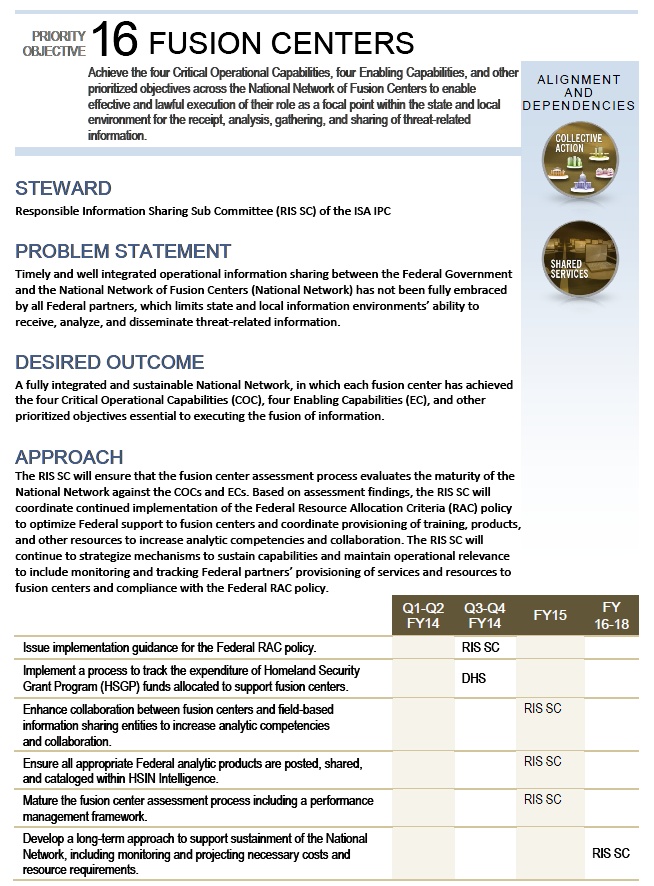
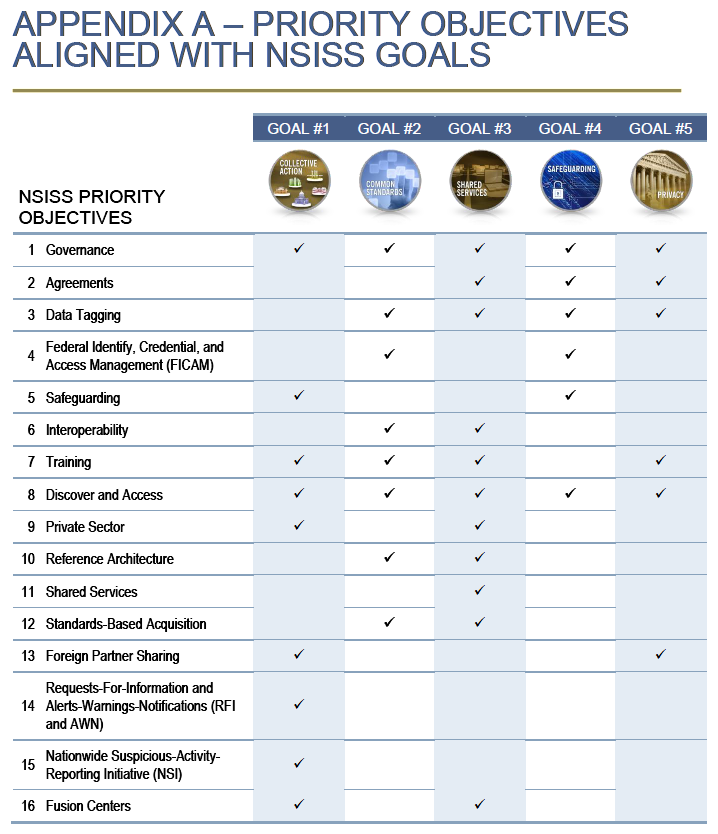
In December 2012 the President signed the National Strategy for Information Sharing and Safeguarding (Strategy) which is anchored on the 2010 National Security Strategy and builds upon the 2007 National Strategy for Information Sharing. The Strategy provides guidance for more effective integration and implementation of policies, processes, standards, and technologies to promote secure and responsible national security information sharing. This document provides a higher-level overview of a longer, more detailed implementation plan for the Strategy, and is intended to assist in briefing senior policy makers on plans, progress, and performance related to achieving the vision of the NSISS.

Under the collaborative leadership of the National Security Staff (NSS) and the Program Manager-Information Sharing Environment (PM-ISE), with departments and agencies participating through the Information Sharing and Access Interagency Policy Committee (ISA IPC), a government-wide effort is underway to plan and coordinate continued, agency-based implementation of the Strategy’s 16 Priority Objectives. The ISA IPC, in coordination with the Senior Information Sharing and Safeguarding Steering Committee, Federal CIO Council, and other interagency oversight and governance bodies, will transparently monitor progress against milestones and achievement of outcomes described in this Strategic Implementation Plan.

The Assassination of JFK Jr – Full Version Movie


https://youtu.be/wqBo7C7kAGs


Video-Anthology – J.EDGAR HOOVER.BLACKMAILING,LURID CROSS-DRESSING QUEEN!

http://www.youtube.com/watch?v=3N3Vg5l-ITU&feature=share&list=PLD90A4ED0655815E9&index=1

Clip concerning Hoover seeking a psychiatrist regarding his sexuality. Anthony Summers comments. Later comments on several people who had seen the Hoover photograph,

Joseph Shimon of the Washington Police comments on ‘sexparties with no girls’.

Lansky had obtained photographs of Hoover in a ‘compromising’ position.

Gordon Novel claims to have seen the photograph, and also claims Carlos Marcello had seen it, and in fact used it to control Hoover.

Peter Pitchess,former FBI agent comments on the non existant mafia. Also does former FBI agent Neil Welch and William Turner.

Clip with Robert Kennedy and a statement regarding the mafia. More on his take at the mafia in a clip with their take on Hoffa. Comments by Robert Blakey.

Clip from questioning of mob-informant Joe Valacci. Robert Kennedy took upon the mafia when Hoover had refused to even acknowledge its existence.

From ‘Evidence of Revision’ – Conspiratus Ubiquitus

Unveiled – The Secret Connection which killed the Kennedys – The Movie


https://youtu.be/8xVcfTzuJrM


This is the mindblowing 6-part,10 hour, video documentary series Evidence of Revision whose purpose is to present the publicly unavailable and even suppressed historical audio, video and film recordings largely unseen by the American and world public relating to the assassination of the Kennedy brothers, the little known classified “Black Ops” actually used to intentionally create the massive war in Viet Nam, the CIA “mind control” programs and their involvement in the RFK assassination and the Jonestown massacre and other important truths of our post-modern time.

Playlist:
http://www.youtube.com/playlist?p=PL6…

http://conspiracyscope.blogspot.com/

Revealed – Prez Sets Commission on Election Administration

Executive Order 13639
Establishment of the Presidential Commission on Election Administration

Click to access 2013-07837_PI.pdf

[FR Doc. 2013-07837 Filed 04/02/2013 at 8:45 am; Publication Date: 04/03/2013]

EXECUTIVE ORDER 13639

ESTABLISHMENT OF THE PRESIDENTIAL COMMISSION ON ELECTION ADMINISTRATION

By the authority vested in me as President by the Constitution and the laws of the United States of America, and in order to promote the efficient administration of Federal elections and to improve the experience of all voters, it is hereby ordered as follows:

Section 1. Establishment. There is established the Presidential Commission on Election Administration (Commission).

Sec. 2. Membership.

(a) The Commission shall be composed of not more than nine members appointed by the President. The members shall be drawn from among distinguished individuals with knowledge about or experience in the administration of State or local elections, as well as representatives of successful customer service-oriented businesses, and any other individuals with knowledge or experience determined by the President to be of value to the Commission.

(b) The President shall designate two members of the Commission to serve as Co-Chairs.

Sec. 3. Mission.

(a) The Commission shall identify best practices and otherwise make recommendations to promote the efficient administration of elections in order to ensure that all eligible voters have the opportunity to cast their ballots without undue delay, and to improve the experience of voters facing other obstacles in casting their ballots, such as members of the military, overseas voters, voters with disabilities, and voters with limited English proficiency. In doing so, the Commission shall consider as appropriate:

(i) the number, location, management, operation, and design of polling places;

(ii) the training, recruitment, and number of poll workers;

(iii) voting accessibility for uniformed and overseas voters;

(iv) the efficient management of voter rolls and poll books;

(v) voting machine capacity and technology;

(vi) ballot simplicity and voter education;

(vii) voting accessibility for individuals with disabilities, limited English proficiency, and other special needs;

(viii) management of issuing and processing provisional ballots in the polling place on Election Day;

(ix) the issues presented by the administration of absentee ballot programs;

(x) the adequacy of contingency plans for natural disasters and other emergencies that may disrupt elections; and

(xi) other issues related to the efficient administration of elections that the Co-Chairs agree are necessary and appropriate to the Commission’s work.

(b) The Commission shall be advisory in nature and shall submit a final report to the President within 6 months of the date of the Commission’s first public meeting.

Sec. 4. Administration.

(a) The Commission shall hold public meetings and engage with Federal, State, and local officials, technical advisors, and nongovernmental organizations, as necessary to carry out its mission.

(b) In carrying out its mission, the Commission shall be informed by, and shall strive to avoid duplicating, the efforts of other governmental entities.

(c) The Commission shall have a staff which shall provide support for the functions of the Commission.

Sec. 5. Termination. The Commission shall terminate 30 days after it presents its final report to the President.

Sec. 6. General Provisions.

(a) To the extent permitted by law, and subject to the availability of appropriations, the General Services Administration shall provide the Commission with such administrative services, funds, facilities, staff, equipment, and other support services as may be necessary to carry out its mission on a reimbursable basis.

(b) Insofar as the Federal Advisory Committee Act, as amended (5 U.S.C. App.) (the “Act”), may apply to the Commission, any functions of the President under that Act, except for those in section 6 of the Act, shall be performed by the Administrator of General Services.

(c) Members of the Commission shall serve without any additional compensation for their work on the Commission, but shall be allowed travel expenses, including per diem in lieu of subsistence, to the extent permitted by law for persons serving intermittently in the Government service (5 U.S.C. 5701-5707).

(d) Nothing in this order shall be construed to impair or otherwise affect:

(i) the authority granted by law to a department, agency, or the head thereof; or

(ii) the functions of the Director of the Office of Management and Budget relating to budgetary, administrative, or legislative proposals.

(e) This order is not intended to, and does not, create any right or benefit, substantive or procedural, enforceable at law or in equity by any party against the United States, its departments, agencies, or entities, its officers, employees, or agents, or any other person.

THE WHITE HOUSE, March 28, 2013.

Full Speech Of President Obama – Statement On Fiscal Cliff Negotiations


http://youtu.be/fop2irJWtcQ

Full Speech Of President Obama – Statement On Fiscal Cliff Negotiations

Secrecy News – WHITE HOUSE ADVANCES INSIDER THREAT POLICY

In a memorandum to agency heads last week, President Obama transmitted
formal requirements that agencies must meet in order "to deter, detect, and
mitigate actions by employees who may represent a threat to national
security."

Along with espionage and acts of violence, the National Insider Threat
Policy notably extends to the "unauthorized disclosure of classified
information, including the vast amounts of classified data available on
interconnected United States Government computer networks." To combat such
unauthorized disclosures, agencies are required to "monitor employee use of
classified networks."

        http://www.fas.org/sgp/obama/nitp.pdf

The new standards, which have not been made publicly available, were
developed by an interagency Insider Threat Task Force that was established
by President Obama in the October 2011 executive order 13587, and they
reflect the ongoing tightening of safeguards on classified information in
response to the voluminous leaks of the last few years.

        http://www.fas.org/irp/offdocs/eo/eo-13587.htm

But the latest issuance also illustrates the superfluousness (or worse) of
current congressional action concerning leaks.  Executive branch agencies
do not need Congress to tell them to develop "a comprehensive insider
threat program management plan," as would be required by the Senate version
of the pending FY2013 Intelligence Authorization Act (section 509).  Such
plans will go forward in any case.

        http://www.fas.org/irp/congress/2012_cr/ssci-leaks.pdf

Sen. Ron Wyden has placed a hold on the pending intelligence bill, citing
objections to several of the proposed anti-leak provisions contained in
Title V of the bill. He said the proposed steps were misguided or
counterproductive.

"I am concerned that they will lead to less-informed public debate about
national security issues, and also undermine the due process rights of
intelligence agency employees, without actually enhancing national
security," he said on November 14.

        http://www.fas.org/irp/congress/2012_cr/wyden-hold.html

The most problematic measures in the Senate bill are those intended to
restrict contacts between reporters and government officials.

Senator Wyden said that legislative actions to limit the ability of the
press to report on classified matters could undermine or cripple the
intelligence oversight process.

"I have been on the Senate Intelligence Committee for 12 years now, and I
can recall numerous specific instances where I found out about serious
government wrongdoing--such as the NSA's warrantless wiretapping program,
or the CIA's coercive interrogation program--only as a result of
disclosures by the press," he said.

        *        *        *

The record of a July 2012 House Judiciary Committee hearing on National
Security Leaks and the Law has recently been published.

        http://www.fas.org/irp/congress/2012_hr/leaks-hjc.pdf

IG REVIEW OF FISA COMPLIANCE COMPLETED BUT NOT RELEASED

The Office of the Inspector General (OIG) of the Department of Justice
said it had recently completed a review of the Department's use of Section
702 of the Foreign Intelligence Surveillance Act (FISA) Amendments Act
(FAA), but the report is classified and its findings have not been
released.

"The OIG examined the number of disseminated FBI intelligence reports
containing a reference to a U.S. person identity, the number of U.S. person
identities subsequently disseminated in response to requests for identities
not referred to by name or title in the original reporting, the number of
targets later determined to be located in the United States, and whether
communications of such targets were reviewed.  The OIG also reviewed the
FBI's compliance with the required targeting and minimization procedures,"
according to a November 7 OIG memorandum on Top Management and Performance
Challenges in the Department of Justice.

        http://www.justice.gov/oig/challenges/2012.htm

A copy of the classified report has been requested under the Freedom of
Information Act.

Earlier this year, Sen. Ron Wyden placed a hold on reauthorization of the
FISA Amendments Act "because I believe that Congress does not have enough
information about this law's impact on the privacy of law-abiding American
citizens, and because I am concerned about a loophole in the law that could
allow the government to effectively conduct warrantless searches for
Americans' communications."

        http://www.fas.org/irp/congress/2012_cr/wyden-fisa.html

AUTONOMY IN WEAPON SYSTEMS

The Department of Defense issued a new Directive last week establishing
DoD policy for the development and use of autonomous weapons systems.

        http://www.fas.org/irp/doddir/dod/d3000_09.pdf

An autonomous weapon system is defined as "a weapon system that, once
activated, can select and engage targets without further intervention by a
human operator."

The new DoD Directive Number 3000.09, dated November 21, establishes
guidelines that are intended "to minimize the probability and consequences
of failures in autonomous and semi-autonomous weapon systems that could
lead to unintended engagements."

"Failures can result from a number of causes, including, but not limited
to, human error, human-machine interaction failures, malfunctions,
communications degradation, software coding errors, enemy cyber attacks or
infiltration into the industrial supply chain, jamming, spoofing, decoys,
other enemy countermeasures or actions, or unanticipated situations on the
battlefield," the Directive explains.

An "unintended engagement" resulting from such a failure means "the use of
force resulting in damage to persons or objects that human operators did
not intend to be the targets of U.S. military operations, including
unacceptable levels of collateral damage beyond those consistent with the
law of war, ROE [rules of engagement], and commander's intent."

The Department of Defense should "more aggressively use autonomy in
military missions," urged the Defense Science Board last summer in a report
on "The Role of Autonomy in DoD Systems."

        http://www.fas.org/blog/secrecy/2012/09/dsb_autonomy.html

The U.S. Army issued an updated Army Field Manual 3-36 on Electronic
Warfare earlier this month.

        http://www.fas.org/irp/doddir/army/fm3-36.pdf

INDIA-US SECURITY RELATIONS, AND MORE FROM CRS

New and updated reports from the Congressional Research Service that have
not been made readily available to the public include the following.

India-U.S. Security Relations: Current Engagement, November 13, 2012:

        http://www.fas.org/sgp/crs/row/R42823.pdf

A Guide to China's Upcoming Leadership Transitions, October 16, 2012:

        http://www.fas.org/sgp/crs/row/R42786.pdf

U.S. Trade and Investment Relations with sub-Saharan Africa and the
African Growth and Opportunity Act, November 14, 2012:

        http://www.fas.org/sgp/crs/row/RL31772.pdf

Roles and Duties of a Member of Congress, November 9, 2012:

        http://www.fas.org/sgp/crs/misc/RL33686.pdf

The Congressional Research Service made a humorous appearance in the
Doonesbury comic strip on November 24, in connection with the report on tax
cuts that was withdrawn in response to criticism from some Republican
Senators.

        http://doonesbury.slate.com/strip/archive/2012/11/24

In fact, as often noted, members of Congress of both parties consistently
withhold public access to most CRS reports.

        http://www.fas.org/blog/secrecy/2012/11/crs_withdrawal.html

_______________________________________________
Secrecy News is written by Steven Aftergood and published by the
Federation of American Scientists.

The Secrecy News Blog is at:
     http://www.fas.org/blog/secrecy/

To SUBSCRIBE to Secrecy News, go to:
     http://www.fas.org/sgp/news/secrecy/subscribe.html

To UNSUBSCRIBE, go to
     http://www.fas.org/sgp/news/secrecy/unsubscribe.html

OR email your request to saftergood@fas.org

Secrecy News is archived at:
     http://www.fas.org/sgp/news/secrecy/index.html

Support the FAS Project on Government Secrecy with a donation:
     http://www.fas.org/member/donate_today.html

_______________________
Steven Aftergood
Project on Government Secrecy
Federation of American Scientists
web:    www.fas.org/sgp/index.html
email:  saftergood@fas.org
voice:  (202) 454-4691
twitter: @saftergood

Unveiled – Paula (Dean) Kranz (Broadwell)

Paula Kranz

kranzp@95mp.21tsc.army.mil

http://www.west-point.org/users/usma1995/52324/95news_1999.htm

18 May 1999. Fort Huachuca, Arizona. Today I bumped into Matt Passante, D4, who happened to be an escort officer for a VIP attending a briefing I gave on the Hunter UAV. He’s been at Fort Huachuca for 3 weeks and is working in the Directorate of Combat Development. I just spoke with him in passing, but he’s doing well. I also received an e-mail from Paula Kranz, A2. Paula and I were platoon leaders together in B/102d MI Bn in Korea, where she, being a natural leader, did a fantastic job and represented ’95 well. She sent me her new e-mail address (you can click on her name to write her) and her phone numbers, which I’d be happy to share on request.

5 October 1999. Savannah, Georgia. Devon Blake (Morris), G2 sends news from her home station at Hunter Army Airfield in Savannah. On December 5, 1998 Devon married Tim Blake, a real civilian, no less! In attendance as bridesmaids was Paula Kranz, A2, Sarah Ross, D3 and Abi Thompson, F4, who you should be able to pick out in the wedding photo below. Devon’s currently on deployment to Bosnia as an augmentee to 10th Mountain Division, Task Force 2-15 Field Artillery Regiment. Devon also sends other great photos–one from her promotion to Captain on July 1 and another of her surrounded by children in Bosnia.

http://www.west-point.org/users/usma1995/52324/images/photogallery/
devon_morris_wedding_%28Dec%201998%29.jpg

[Image]

http://www.west-point.org/users/usma1995/52324/images/photogallery/
devon_morris_promotion_%28Jul%201999%29.jpg

[Image]

http://www.west-point.org/users/usma1995/52324/images/photogallery/
devon_morris_in_bosnia_1999.jpg

[Image]


VIDEO-Election Results 2012: Nate Silver on How He Got It Right

NYT-Obama Wins the 2012 Election: Obama’s Complete Presidential Victory Speech

http://www.youtube.com/watch?v=nv9NwKAjmt0

Unveiled – Michelle Obama Protection

Michelle Obama Protection

[Image]

Lots of supporters take photographs of First lady Michelle Obama, bottom center during a campaign stop at Hampton University, Virginia, November 2, 2012. AP

[Image]

U.S. First Lady Obama meets with supporters during a get-out-the-vote tour, November 1, 2012. Reuters.

[Image]

First Lady Michelle Obama addressed a crowd of several hundred supporters in Sioux City, Iowa, Monday, Oct. 29, 2012,at the Sioux City COnvention Center in the downtown area. Jerry Mennenga

[Image]

First Lady Michelle Obama greets a child while talking with supporters after speaking at a campaign rally, Friday, Oct. 26, 2012, in Las Vegas. AP

[Image]

First lady Michelle Obama returns to the White House after watching her daughter Sasha’s basketball game in Washington, Sunday, March 11, 2012. AP

[Image]

In this undated image released by Nickelodeon, first lady Michelle Obama. seated second left, interacts with Jerry Trainor, left, as Miranda Cosgrove, center, Nathan Kress and Jennette McCurdy, right, look on during Obama’s guest appearance on the popular children’s show, “iCarly,” premiering Monday, Jan. 16, 2012 at 8 p.m EST on Nickelodeon. AP

[Image]

First lady Michelle Obama, wearing a hat and sunglasses, stands in line at a Target department store in Alexandria, Va., Thursday, Sept. 29, 2011, after doing some shopping. AP [Secret Service at right.]

[Image]

First lady Michelle Obama works the crowd while participating during the taping of Extreme Makeover Home Edition in Fayetteville, N.C., Thursday, July 21, 2011. AP

[Image]

US first lady Michelle Obama steps out of a vehicle, prior to boarding her plane, in Gaborone, Botswana, at the end of her week long trip to Africa, Sunday, June 26, 2011.

[Image]

U.S. first lady Michelle Obama and daughters Sasha and Malia depart Cape Town, South Africa, as they travel to Gaborone, Botswana, Friday, June 24, 2011. AP

[Image]

U.S. first lady Michelle Obama embraces an audience member after she speaks at Regina Mundi Church and addresses the Young African Women Leaders Forum, in a Soweto township, Johannesburg, South Africa, Wednesday, June 22, 2011. AP

[Image]

First lady Michelle Obama greets people after speaking at a ceremony to dedicate the first of three new Fisher houses,Thursday, Dec. 2, 2010, at the Bethesda Naval Medical Center in Bethesda, Md. AP


[Image]U.S. first lady Michelle Obama, center left, walks with friends and security during a visit to Ronda in southern Spain, Saturday, Aug. 7, 2010. AP

[Image]

Security officers escort a convoy of cars, one believed to be transporting U.S. First Lady Michelle Obama, on arrival at the Villa Padierna Hotel in Marbella, southern Spain, Wednesday, Aug. 4, 2010. AP

[Image]

First lady Michelle Obama, center, greets Marines after a speech at Camp Pendleton Marine Corps Base in San Diego, Sunday, June 13, 2010. AP

[Image]

First Lady Michelle Obama, center, examines vegetables grown by Somali immgrant Khadija Musame, second from right, as interpreter Bilal Muya, right, farm coordinator Amy Lint, second from left, and Dr. Robert Ross, President and CEO of The California Endowment, look on Thursday April 15, 2010 in San Diego. AP

[Image]

U.S. first lady Michelle Obama, second left, shakes hands with UN and NGO workers during a visit to the United Nations base in Port-au-Prince, Tuesday, April 13, 2010. Obama is on a one-day visit to Haiti. AP

[Image]

Florida, January 2010.

[Image]

Michelle Obama at Latin American Montessori Bilingual Public Charter School, May 4, 2009. Wikipedia

Katy Perry Performs At A Milwaukee Rally For President Barack Obama


[Image]


FAS – 2010 Military Intelligence Budget Request Declassified

The Department of Defense this week released a redacted version of the budget justification for the FY 2010 Military Intelligence Program (MIP).

“The MIP sustains all programs, projects or activities that support the Secretary of Defense intelligence, counterintelligence, and related intelligence responsibilities and provides capabilities to meet the warfighters’ operational and tactical requirements whenever and wherever needed,” the document states.

The MIP budget justification for FY 2010, which was submitted to Congress in 2009, presents dozens of individual military intelligence programs.  While budget figures have been censored, along with various other classified matters, the summary descriptions of most of the individual MIP programs were released more or less intact.

The document (large pdf) was provided to the Federation of American Scientists in response to a Freedom of Information Act request.

“In the last several years, we have embarked on a fundamental change to the concept of defense intelligence – one that balances the unique role of support to the warfighter with the recognition that today’s security environment crosses traditional organizational domains,” the budget document says.

“The deep integration of defense intelligence into the larger Intelligence Community, the evolution of our collaboration with homeland defense counterparts, and the fostering of committed international partnerships are all outcomes of this fundamental change,” wrote James R. Clapper, then-Under Secretary of Defense (Intelligence) in his introduction to the budget justification.

In FY 2010, Congress appropriated $27 billion for the Military Intelligence Program.  The FY 2013 request for the MIP was $19.2 billion.  The budget appropriation for FY 2012 is to be disclosed by the end of this month.

WIKILEAKS intervenes in the U.S. federal election


Dear WikiLeaks Friend,

From today WikiLeaks has decided to intervene in the U.S. federal election. It is clear that whether Republicans or Democrats are in power, without the sort of pressure we can exert when we are at our strongest, the U.S. government will continue to declare the whole world a battleground. Last Friday, the Pentagon publicly reissued its threats against WikiLeaks, demanding that we destroy our previous publications and cease “soliciting” U.S. military whistleblowers — and that our failure to do so was an ongoing “crime” and “law enforcement matter”. The FBI file for the pending prosecution of WikiLeaks, according to court records from earlier this year, has reached 42,135 pages. WikiLeaks is determined to stop these and other moves towards what appears to be ?€? let’s be honest ?€? a transnational security state dystopia. We believe knowledge is power and that knowledge should be in the hands of the people. By placing huge quantities of secret knowledge into your hands we can stop the concentration of power that is driving these trends. We ask that you cast the only vote that matters, and vote with your wallet. It is possible for you to make donations with your credit card, despite the attempted blockade. To do so, visit http://wikileaks.org/donate Also, please consider visiting our campaign website, at http://wikileaks.org/donate2012 and passing it on to your friends and family. Below are some suggestions Friends of WikiLeaks might want to consider to support WikiLeaks in this campaign: -Show your support to the world AND financially assist WikiLeaks: Buy a Tshirt at the official WikiLeaks store: http://www.wikileaks.spreadshirt.com – Download a poster to print and display from: http://www.somersetbean.blogspot.com – write to your national papers to correct libels against Assange and WikiLeaks: eg Julian Assange has not been charged with any crime anywhere, yet publications state the contrary. – write articles, facebook posts, tweets emails etc titled ‘Why I will not be voting for Obama’ or ‘Why I will not be voting from Romney – Contact your friends, family, colleagues and classmates organise a WikiLeaks campaign event – Create a WikiLeaks Campaign/Defence Group at your school, college, University or work place Solidarity, Julian Assange and Team

TOP-SECRET – Restricted U.S. Army Reconnaissance and Scout Platoon Manual

https://publicintelligence.net/wp-content/uploads/2012/08/USArmy-ReconScoutPatrol.png


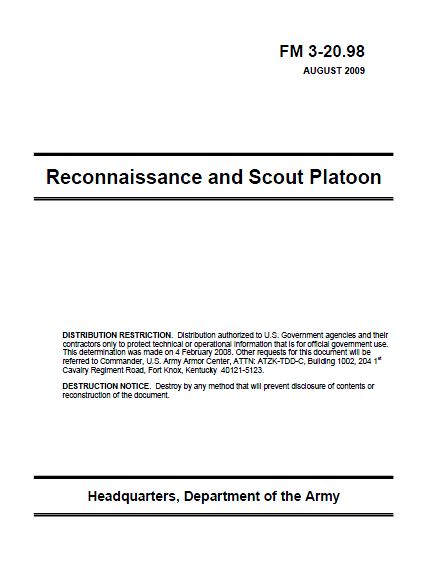
FM 3-20.98 provides basic tactics, techniques, and procedures (TTP) for the tactical employment of the reconnaissance and scout platoons of the reconnaissance squadrons in the heavy, infantry, and Stryker brigade combat teams (HBCT, IBCT, and SBCT) as well as the battlefield surveillance brigade’s (BFSB) reconnaissance and surveillance squadron and the cavalry squadron of the armored cavalry regiment (ACR).

This publication—

• Provides doctrinal guidance for commanders and leaders of the currently transitioning organizations who are responsible for planning, preparing, executing, and assessing operations in the reconnaissance and scout platoons.
• Serves as an authoritative reference for personnel developing doctrine (fundamental principles and TTP), materiel and force structure, institutional and unit training, and standing operating procedures (SOP) for reconnaissance and scout platoon operations. It does not, however, cover deployment; reception, staging, onward movement, and integration; or redeployment operations.
• Describes doctrine that is based on suggestions, insights, and observations from previously developed doctrine and from units and leaders taking part both in operational situations, such as Operation Iraqi Freedom (OIF) and Operation Enduring Freedom (OEF), and in training at the Army’s combat training centers. These doctrinal principles and procedures are intended to be used as a guide and are not to be considered inflexible. Each situation in combat must be resolved by an intelligent interpretation and application of the doctrine outlined in this manual.
• Is directed toward the reconnaissance and scout platoon leader and platoon sergeant (PSG). The manual reflects and supports Army operations doctrine as covered in FM 3-0, Operations; FM 3-90, Tactics; FM 3-90.6, The Brigade Combat Team; and FM 3-20.96, Reconnaissance Squadron. It is not a stand-alone reference for reconnaissance and scout platoon operations; rather, it is intended to be used in conjunction with those and other existing doctrinal resources.
• Outlines the framework in which the five types of reconnaissance and scout platoons (HBCT, IBCT, SBCT, BFSB, and ACR) will operate, either by themselves or together as part of the troop or larger organization. The manual also includes discussions of doctrine that is applicable to each specific type of platoon.

THE OE IN RECONNAISSANCE OPERATIONS

3-33. Reconnaissance and scout platoons must be prepared to operate beyond the traditional roles of reconnaissance, surveillance, and target acquisition of enemy forces. Today, scouts must adjust their traditional roles to fulfill the broader mission of providing SU in its fullest sense. This involves an understanding of the OE in all its aspects, covering political, economic, social, information, infrastructure, physical environment, and time variables in addition to the military aspects of the OE. This multidimensional requirement means that the platoon must develop an understanding of what is happening and why. In the asymmetric environment, identifying enemy centers of gravity, decisive points, and the means to influence the enemy’s will and behavior—while observing proper ROE—is one of the most important contributions that the platoon can make to ensure successful mission accomplishment. For more information on the OE, refer to FM 3-0.

NONTRADITIONAL ASPECTS OF THE OE

3-34. The Army has traditionally focused its efforts on traditional combat operations, based on open terrain, force-on-force battles, and symmetrical enemy formations, focusing on gaining information on the enemy and terrain. Platoon planning, however, must expand to include nontraditional aspects of OE variables that could influence its operations.

Asymmetric Warfare

3-35. Conditions in the new millennium, coupled with the technological developments of the information age, raise the specter of asymmetric warfare, a concept in which a weak opponent successfully engages a stronger opponent using a variety of non-conventional TTPs. The goal is to gain an advantage in hopes of achieving the weaker force’s objectives and goals. Asymmetric threats include—

  • Regional military forces.
  • Paramilitary forces.
  • Guerrillas and insurgents.
  • Terrorists.
  • Criminal groups.
  • Certain civilian groups and individuals.
  • Political parties.
  • Religious groups.

3-36. Threat elements will use a number of nontraditional approaches in conducting asymmetric warfare, including the following:

  • Information operations (IO).
  • Weapons of mass destruction (WMD).
  • Operations in complex terrain.
  • Civilian involvement (include hiding within the population and staging evasive attacks).

Urban Considerations

3-37. The urban environment confronts commanders with a combination of difficulties rarely found in other settings in which the Army conducts operations. The distinct characteristics of the urban environment are primarily a function of the following factors:

  • The increasing size and global prevalence of urban areas.
  • The combinations of man-made features and supporting infrastructure superimposed on the existing natural terrain.
  • The density of civilians in close proximity to combat forces.

3-38. The human dimension represents potentially the most important and the most perplexing factor for commanders to understand and evaluate. Although urban terrain is complex, understanding it is a relatively straightforward process in comparison to comprehending the multifaceted nature of urban society. The urban environment is, first, a human environment. That makes it different from all other types. An urban environment is not solely defined by its structures or systems but by the people who compose it. It reacts and interacts with an army in ways that no natural environment can.

3-39. Military operations often require Army forces to operate in close proximity to a high density of civilians, whose presence, attitudes, actions, and needs in turn affect the conduct of operations. Civilian populations continually influence, to varying degrees, military operations within an AO. As urban areas increase in size, they become less and less homogenous; therefore, commanders must understand and account for the characteristics of a diverse population whose beliefs and actions may vary based on many factors. Improving communications with the local population (especially using interpreters) can improve intelligence gathering and win acceptance of the platoon within that AO. Security requirements might change when these personnel are on vehicles and around digital communication systems.

3-40. The decisive terrain during a military operation, particularly in stability operations, may be the civilian inhabitants themselves. To gain and/or retain the support of the civilian population, commanders must first understand (through reconnaissance) the complex nature and character of the urban society and its infrastructure. Scouts must then understand and accept that every military action (or inaction) may influence, positively or negatively, the relationship between the urban population and Army forces and, by extension, have a significant impact on mission success. With this awareness, commanders visualize decisions they must make, plan operations, and implement programs. They can take immediate action to maintain support of a friendly populace, gain the support of neutral factions, or neutralize hostile elements. Unit continuity books maintaining feedback on past operations within the area will provide insight on past successful and unsuccessful missions and their results.

HUMINT OPERATIONAL CONSIDERATIONS

3-152. HUMINT is a category of intelligence derived from information collected and provided by human sources. It uses human sources as a tool and a variety of collection methods, both passive and active, to gather information to satisfy the commander’s intelligence requirements and cue other intelligence disciplines. HUMINT tasks include, but are not limited to, the following:

  • Source operations using tactical and other developed sources.
  • Liaison with HN officials and allied counterparts.
  • Elicitation of information from the civilian populace, including transients.
  • Identification of individuals as potential force protection sources.
  • Debriefing of U.S. and allied forces and civilian personnel.
  • Interrogation of EPWs and detainees.
  • Information operations.
  • Translation and exploitation of threat documents, media, and other materials.

3-153. All reconnaissance and scout platoon leaders can expect to conduct some form of HCT collection activities to gather the information needed to make decisions in support of the overall mission. HUMINT activities help the platoon leader shape the AO by providing information that enables him to respond to previously unforeseen threats. He focuses the HUMINT effort by carefully assigning missions and clearly defining the desired results. In orienting the unit’s HUMINT efforts and capabilities, the platoon leader must decide who or what will be advantageous targets for collection activities. As noted, only the SBCT reconnaissance platoon has organic HUMINT personnel.

Role of HUMINT Collectors

3-154. The SBCT platoon’s HUMINT Soldiers, who can be augmented by interrogators (from the MICO) when available, conduct collection operations in support of the overall mission. These operations rely on the use of both casual and recruited sources of information. The collection effort includes liaison activities; the debriefing of refugees, detainees, and EPWs; review of open source literature; and DOMEX. HUMINT collectors directly support SE and subsequent intelligence gathering operations against the enemy. These operations use the techniques identified in FM 34-5 and FM 2-22.3. Other resources include AR 381-172, which covers policy concerning counterintelligence force protection source operations (CFSO), and AR 381-10, which outlines policies and procedures governing the conduct of intelligence activities by the Army.

HUMINT Sources

3-156. Platoon leaders should be familiar with the types of sources HUMINT personnel will use to satisfy command PIR:

  • Casual source. A casual source is one who, by social or professional position, has access to information of CI interest, usually on a continuing basis. Casual sources usually can be relied on to provide information that is routinely available to them. Casual sources include private citizens, such as retired officials or other prominent residents of an area.
  • Official sources. These are liaison contacts. CI personnel conduct liaison with foreign and domestic CI, intelligence, security, and law enforcement agencies to exchange information and obtain assistance. CI personnel focus on investigative, operational, and threat information.
  • Recruited sources. These include sources who support CFSO, as identified in FM 34-5. By design, CFSOs entail the use of human source networks, dispersed throughout the area that can provide timely and pertinent force protection information.
  • Refugees, detainees, and EPWs. Interrogators normally conduct collection operations with these sources, often with technical assistance from a CI agent.
  • Open source publications. These printed materials, as well as radio and television broadcasts, are valuable sources of information of CI interest and operational information. Depending on the resources, this support can be provided by interrogation personnel, allied personnel, indigenous employees, or reserve component translators.
  • Documents not openly available. Such sources as adversary plans and reports are exploited in much the same way as open source publications.

Reconnaissance Support Activities

3-157. In military urban operations, people (EPWs and civilians) are the preeminent source of information. HUMINT collection provides information otherwise not available through SIGINT and image intelligence (IMINT). As an example, when a lodgment is made in a building, the HUMINT collectors:

  • Move in and interrogate EPWs.
  • Persuade holdouts to surrender.
  • Help with the questioning and evacuation of noncombatants.
  • Collect information on floor plans and defensive plans.
  • Determine locations of combatants and noncombatants in the area.

DOWNLOAD THE ORIGINAL DOCUMENT HERE:

USArmy-ReconScoutPlatoon-2

SECRET – Democratic National Convention 2012 Security

DOWNLOAD THE ORIGINAL DOCUMENT HERE:

dnc-sec-2012


TOP-SECRET – Obama Protection 48

[Image]U.S. President Barack Obama (3rd L) greets an Air Force officer before boarding Marine One helicopter on August 4, 2012 at Joint Base Andrews, Maryland. Obama is spending the weekend at Camp David.
[Image]President Barack Obama shakes hands with supporters at the end of a campaign rally at Loudoun County High School on August 2, 2012 in Leesburg, Virginia. The president campaigned earlier in the day in Florida.
[Image]President Barack Obama, center, greets supporters after speaking at a campaign event at Loudoun County High School, Thursday, Aug. 2, 2012 in Leesburg, Va. Obama was campaigning in Florida and Northern Virginia today.
[Image]President Barack Obama greets supporters after speaking at a campaign event at Loudoun County High School, Thursday, Aug. 2, 2012 in Leesburg, Va. Obama spent the day campaigning in Florida and Northern Virginia.
[Image]A Secret Service Counter Sniper Team prepares to climb down a ladder from on top of a people mover after President Barack Obama aboard Air Force One landed at Dulles International Airport in Sterling, Va.. , Thursday, Aug. 2, 2012.
[Image]President Barack Obama greets supporters after a campaign event at Rollins College, Thursday, Aug. 2, 2012, in Winter Park, Fla.

[Image]

Secret Service grabs a forearm stroking Obama.

[Image]President Barack Obama greets guests on the tarmac upon his arrival at Orlando International Airport, Thursday, Aug. 2, 2012, in Orlando, Fla. Obama is campaigning in Florida and Northern Virginia today.
[Image]President Barack Obama stops to greet patrons at Lechonera El Barrio, a local restaurant in Orlando, Fla. , Thursday, Aug. 2, 2012. Obama is campaigning in Florida and Northern Virginia today.
[Image]President Barack Obama greets eight-year old Olivia Short after he departed from Air Force One upon his arrival in Orlando, Fla. , Thursday, Aug. 2, 2012.
[Image]President Barack Obama is hugged by a supporter after speaking at a campaign event at Mansfield Central Park, Wednesday, Aug. 1, 2012, in Mansfield, Ohio. Obama is campaign in Ohio with stops in Mansfield and Akron today. [Secret Service ready to remove an arm from Obama’s back. Note three agents in the crowd.]
[Image]Marine One helicopter, with President Barack Obama aboard, takes off from Wall Street heliport in New York, Monday, July, 30, 2012. Obama traveled to New York for a private fundraiser.  [Decoy helo at rear, fire truck at right, Coast Guard ship in the river.]
[Image]US President Barack Obama prepares to land at the Wall Street Helipad in New York on July 30, 2012. Obama is in New York to attend campaign events ahead of the November presidential election. [Two Marine transport at left, Secret Service agent on dock.]

[Image]

[Image]A Secret Service vehicle, left, and Air Force Security Forces vehicle follow Air Force One on the tarmac as it prepares to take-off with President Barack Obama aboard, at Andrews Air Force Base, Md. , Monday, July 30, 2012.
[Image]U.S. First Lady Michelle Obama sits separated from the public during the basketball match between the U.S. and France for the London 2012 Olympic Games at the Basketball Arena in the Olympic Park at Stratford in east London July 29, 2012. [Michelle’s customary Secret Service at her right, and below.]
[Image]US First Lady Michelle Obama (R) speaks with tennis player Venus Williams (top L) as they attend the women’s singles tennis match between Serbia’s Jelena Jankovic and Serena Williams of the US during the London 2012 Olympic Games at the All England Tennis Club in Wimbledon, southwest London, on July 28, 2012.
[Image]U.S First Lady Michelle Obama, left, waves an American flag as she cheers on the U.S. swim team during the first day of finals at the 2012 Summer Olympics, Saturday, July 28, 2012, in London. At right is Summer Schlopy, host of Yahoo! Sports’ web series Elite Athlete Workout. [Two Secret Service at left.]
[Image]Agents keep watch as U.S. President Barack Obama (C) walks to the Marine One helicopter before departing from a soccer field at the Madeira School after attending a campaign event at a nearby private residence in McLean, Virginia, July 27, 2012.
[Image]US President Barack Obama walk across a field after stepping off Marine One upon arrival at the Madeira School landing zone July 27, 2012 in McLean, Virginia. Obama is in McLean to attend campaign fundraisers.
[Image]President Barack Obama waves as he walks across the football field at Madeira school in McLean, Va. , Friday, July, 27, 2012. Obama Traveled to Northern Virginia for a private fundraiser.
[Image]US First Lady Michelle Obama plays with children as part of her ‘Let’s Move-London’ event at the Winfield House in London on July 27, 2012, hours before the official start of the London 2012 Olympic Games. [SS at right.
[Image]U.S. first lady Michelle Obama plays with schoolchildren during a ‘Let’s Move!’ event for about 1,000 American military children and American and British students at the U.S. ambassador’s residence in London, ahead of the 2012 Summer Olympics, Friday, July 27, 2012. [Two Secret Service in suits to hide weapons; at center, female.]
[Image]U.S. Secret Service keeps watch as President Barack Obama departs the New Orleans area in Air Force One at Louis Armstrong International Airport in Kenner, La. , Wednesday, July 25, 2012. Obama delivered remarks at the National Urban League 2012 Annual Conference and attended campaign events in New Orleans.
[Image]President Barack Obama walks over to greet people after arriving at Boeing Field in Seattle, Tuesday, July 24, 2012.
[Image]US President Barack Obama greets wellwishers upon arrival on Air Force One at Portland International Airport in Portland, Oregon, July 24, 2012. Obama is traveling to attend campaign events and fundraisers.
[Image]Supporters walk in a line across the tarmac to greet President Barack Obama on his arrival at Boeing Field Tuesday, July 24, 2012, in Seattle. Obama is scheduled to attend a pair of campaign fund-raisers in the area.
[Image]President Barack Obama heads to his limousine after stopping at the Gateway Breakfast House in Portland, Ore. , Tuesday, July 24, 2012.
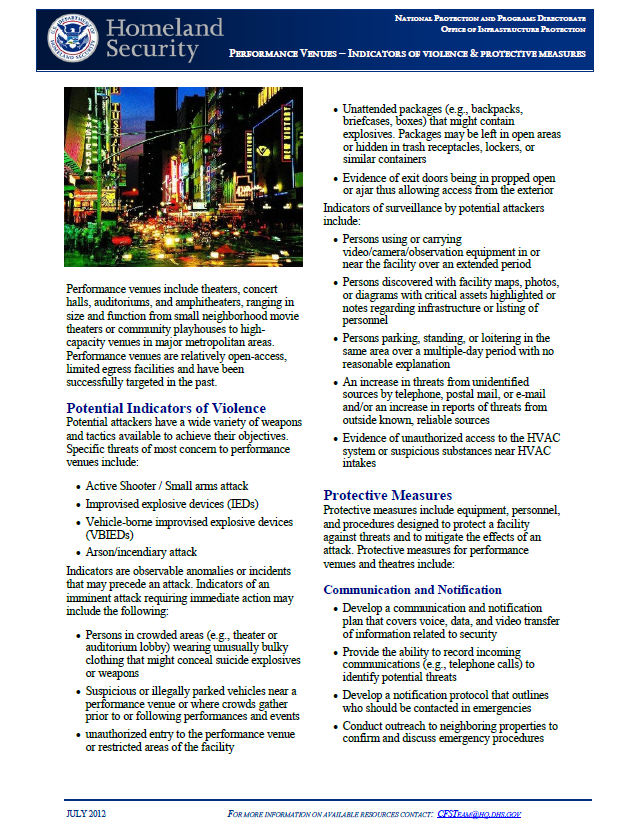
CONFIDENTIAL – Department of Home Security – Innfrastructure Protection Note

https://publicintelligence.net/wp-content/uploads/2012/07/DHS-PerformanceVenues.png

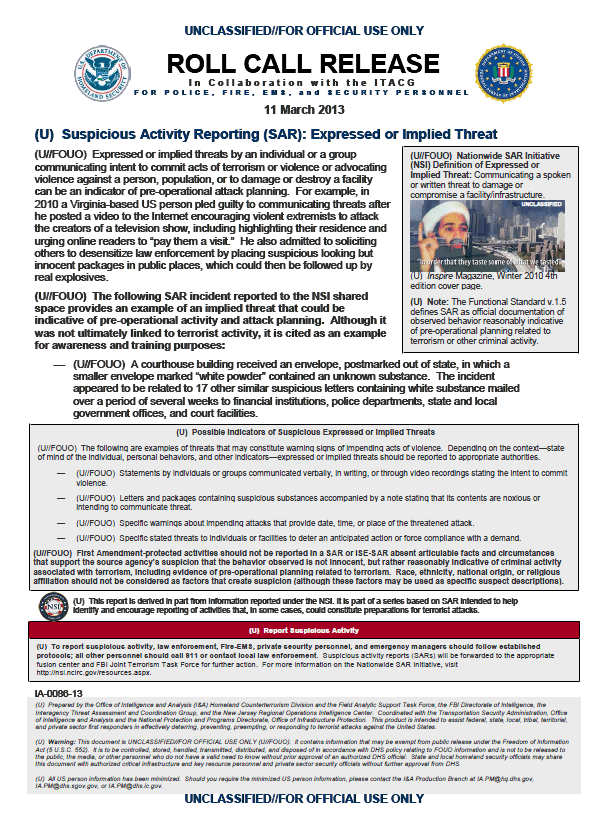
Performance venues include theaters, concert halls, auditoriums, and amphitheaters, ranging in size and function from small neighborhood movie theaters or community playhouses to high-capacity venues in major metropolitan areas. Performance venues are relatively open-access, limited egress facilities and have been successfully targeted in the past.

Potential Indicators of Violence

Potential attackers have a wide variety of weapons and tactics available to achieve their objectives. Specific threats of most concern to performance venues include:
• Active Shooter / Small arms attack
• Improvised explosive devices (IEDs)
• Vehicle-borne improvised explosive devices (VBIEDs)
• Arson/incendiary attack

Indicators are observable anomalies or incidents that may precede an attack. Indicators of an imminent attack requiring immediate action may include the following:
• Persons in crowded areas (e.g., theater or auditorium lobby) wearing unusually bulky clothing that might conceal suicide explosives or weapons
• Suspicious or illegally parked vehicles near a performance venue or where crowds gather prior to or following performances and events
• unauthorized entry to the performance venue or restricted areas of the facility
• Persons or teams of people attempting to
• Unattended packages (e.g., backpacks, briefcases, boxes) that might contain explosives. Packages may be left in open areas or hidden in trash receptacles, lockers, or similar containers
• Evidence of exit doors being in propped open or ajar thus allowing access from the exterior

Indicators of surveillance by potential attackers include:
• Persons using or carrying video/camera/observation equipment in or near the facility over an extended period
• Persons discovered with facility maps, photos, or diagrams with critical assets highlighted or notes regarding infrastructure or listing of personnel
• Persons parking, standing, or loitering in the same area over a multiple-day period with no reasonable explanation
• An increase in threats from unidentified sources by telephone, postal mail, or e-mail and/or an increase in reports of threats from outside known, reliable sources
• Evidence of unauthorized access to the HVAC system or suspicious substances near HVAC intakes

Protective Measures

Protective measures include equipment, personnel, and procedures designed to protect a facility against threats and to mitigate the effects of an attack. Protective measures for performance venues and theatres include:

Communication and Notification
• Develop a communication and notification plan that covers voice, data, and video transfer of information related to security
• Provide the ability to record incoming communications (e.g., telephone calls) to identify potential threats
• Develop a notification protocol that outlines who should be contacted in emergencies
• Conduct outreach to neighboring properties to confirm and discuss emergency procedures

Suspicious Activity Reporting and Emergency Notifications
• Be aware of your surroundings; make sure you are in the safest possible location prior to calling (out of harm’s way)
• Be calm and articulate; talk slowly
• State your name, location, and the nature of the emergency
• Provide high level details of your situation
• Advise if you are injured; provide details
− Suspicious Activity Awareness Video: What’s in Store: Ordinary People | Extraordinary Events available at http://www.dhs.gov/cfsector
• Ensure staff is aware of how to report suspicious activity
• The “If You See Something, Say Something™” campaign and the National Suspicious Activity Reporting Initiative encourage citizens to report suspicious activity to law enforcement
− More information can be found at https://www.dhs.gov/files/reportincidents/see-something-say-something.shtm

Planning and Preparedness
• Conduct regular evacuation drills with facility employees, clearly outlining the evacuation routes and outdoor assembly points
• Designate an employee as security director to develop, implement, and coordinate all security-related activities
• Conduct threat analyses, vulnerability assessments, consequence analyses, risk assessments, and security audits on a regular and continuing basis
• Establish liaison and regular communications with local law enforcement and emergency responders, state and federal law enforcement, public health organizations, and industry organizations to enhance information exchange, clarify emergency responses, track threat conditions, and support investigations
• Institute layers of security measures on the basis of the expected crowd level or performance type

Personnel
• Maintain up-to-date security training with regular refresher courses
− Active Shooter – How to Respond training available at https://training.fema.gov/EMIWeb/IS/is907.asp
− Active Shooter Situation: Options for Consideration (Video) has been posted to the HSIN-Critical Sector (CS) portal at https://cs.hsin.gov/
• Provide security information and evacuation procedures to patrons before each performance. Advise patrons and staff to be alert to suspicious activity or items and on how to report such incidents

Monitoring, Surveillance, Inspection
• If warranted, evaluate the need to develop a monitoring, surveillance, and inspection program that is consistent with facility operations and security requirements
• Perform security sweeps of the entire facility before each show or performance
− Training Webinar: IED Threat Awareness and Detection available at http://www.dhs.gov/cfsector
• Consider limitations to patrons carrying bags/backpacks/gym bags, etc into the venue
• Consider screening of bags and persons wearing bulky clothing prior to venue entrance
− Training Video: Check It – What’s in the Bag available at http://www.dhs.gov/cfsector
• Confirm that all exit doors leading from venue to the exterior of the facility have operational locks and that they are locked
• Ensure the doors have not been propped open; consider active patrols around the exteriors and emergency exits just prior to the beginning of each show

Infrastructure Interdependencies
• Ensure that the facility has adequate utility service capacity to meet normal and emergency needs

Incident Response
• Review unified incident command procedures for responding to an event with local law enforcement, emergency responders, and government agencies
− Establish evacuation procedures and ensure the evacuation routes are clear of obstruction

DOWNLOAD THE ORIGINAL DOCUMENT HERE:

DHS-PerformanceVenues

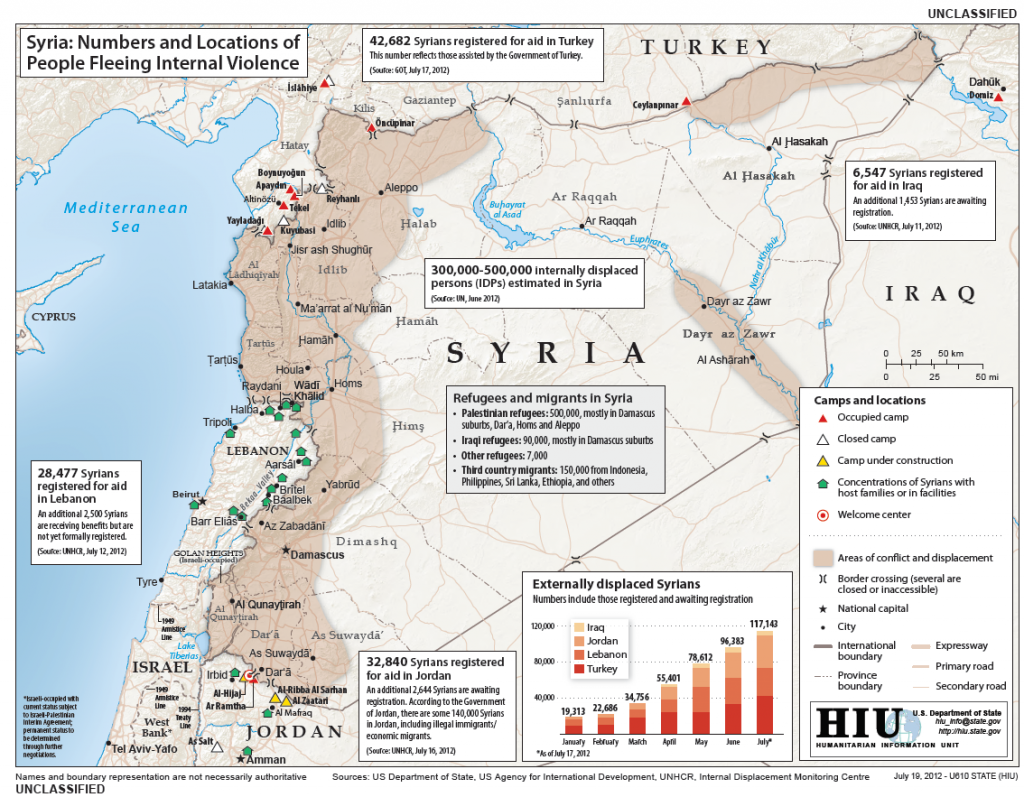
TOP-SECRET – U.S. State Department Map – Data of Syrian People Fleeing Internal Violence

https://publicintelligence.net/wp-content/uploads/2012/07/HIU-SyrianRefugees-1024x797.png

Unveiled – TOP-SECRET – Obama Protection 47

Obama Protection 47

[Image]U.S. President Barack Obama greets people gathered on the sidewalk after stopping for food at Skyline Chili in Cincinnati, July 16, 2012. Obama flew on Monday to Cincinnati for election campaign events. Reuters
[Image]US President Barack Obama greets wellwishers upon arrival on Air Force One at Cincinnati Northern Kentucky International Airport in Boone, Kentucky, July 16, 2012, enroute to attend campaign events in Cincinnati, Ohio. Getty
[Image]President Barack Obama passes his jacket to White House Trip Director Marvin Nicholson before heading over to greet people after arriving at Northern Kentucky International Airport in Boone, Ky. , Monday, July 16, 2012. Obama is spending the day campaigning in Cincinnati. AP
[Image]U.S. Secret Service members use a golf cart while providing protection for President Barack Obama while he golfs at the Army installation’s course July 15, 2012 in Ft. Belvoir, Virginia. Obama also campaigned in Virginia, a state he won in 2008, on Saturday, holding events in Fairfax and Glen Allen. Getty
[Image]US President Barack Obama greets supporters are he arrives at a campaign event on July 14, 2012 at Centreville High School in Clifton, Virginia. Getty
[Image]U.S. President Barack Obama arrives at a campaign rally at Centreville High School in Clifton, Virginia, July 14, 2012. Obama travelled to Virginia on Saturday for campaign events. Reuters
[Image]President Barack Obama walks up a set of stairs during a campaign rally at Centreville High School in Clifton, Va. , a Washington suburb, on Saturday, July 14, 2012. AP
[Image]People hold signs protesting against U.S. President Barack Obama along Obama’s motorcade route on his way to a campaign rally at Centreville High School in Clifton, Virginia, July 14, 2012. Obama travelled to Virginia on Saturday for campaign events. Reuters
[Image]President Barack Obama laughs while campaigning under the pouring rain at the historic Walkerton Tavern & Gardens in Glen Allen, Va. , near Richmond Saturday, July 14, 2012. It is in the Congressional district represented by House Majority Leader Eric Cantor, R-Va. , a key county in a crucial swing state of the presidential election. AP
[Image]U.S. President Barack Obama greets supporters at the end of his ”A Vision for Virginia’s Middle Class” campaign event July 14, 2012 at Walkerton Tavern in Glen Allen, Virginia. On the last day of his two-day campaign across Virginia, Obama continue to discuss his plan to restore middle class security and urged Congress to act on extending tax cuts to middle class families. Getty
[Image]President Barack Obama campaigns during the pouring rain at the historic Walkerton Tavern & Gardens in Glen Allen, Va. , near Richmond, Saturday, July 14, 2012. AP
[Image]Protesters line an entrance route to a campaign event where President Barack Obama is scheduled to speak at the historic Walkerton Tavern & Gardens in Glen Allen, Va. , near Richmond Saturday, July 14, 2012. AP
[Image]Conservative local residents protest prior to U.S. President Barack Obama’s ”A Vision for Virginia’s Middle Class” campaign event July 14, 2012 at Walkerton Tavern in Glen Allen, Virginia. On the last day of his two-day campaign across Virginia, Obama continue to discuss his plan to restore middle class security and urged the Congress to act on extending tax cuts to middle class families. Getty
[Image]President Barack Obama removes his jacket upon his arrival at Washington Dulles International Airport in Chantilly, Va. , Saturday, July 14, 2012, for a campaign event in the vicinity. AP
[Image]US President Barack Obama boards his limousine after greeting well-wishers upon arrival July 14, 2012 at Richmond International Airport in Richmond, Virginia. Obama is in Virginia to attend campaign events. Getty
[Image]Secret Service members keep watch in front of Air Force One shortly before US President Barack Obama’s departure on July 14, 2012 at Richmond International Airport in Richmond, Virginia. Obama is in Virginia to attend campaign events. Getty
[Image]US President Barack Obama hold up a tomato during a stop at Berry’s Produce on July 14, 2012 in Mechanicsville, Virginia. Obama is campaigning in Virginia ahead of the November presidential election. Getty
[Image]President Barack Obama shakes hands as he arrives at the Richmond International Airport in Richmond, Va. , Saturday, July 14, 2012. AP
[Image]President Barack Obama greets the crowd after a campaign stop at the historic Fire Station No.1, in downtown Roanoke, Virginia, Friday, July 13, 2012. Obama traveled to southwest Virginia to discuss choice in this election between two fundamentally different visions on how to grow the economy, create middle-class jobs and pay down the debt. AP
[Image]President Barack Obama greets the crowd during a campaign stop at the historic Fire Station No.1, in downtown Roanoke, Va. , Friday, July 13, 2012. Obama traveled to southwest Virginia to discuss choice in this election between two fundamentally different visions on how to grow the economy, create middle-class jobs and pay down the debt. AP
[Image]President Barack Obama greets people after arriving at Roanoke Regional Airport in Roanoke, Va. , Friday, July 13, 2012. Obama is spending the day campaigning in Virginia. AP

[Image]

[Image]President Barack Obama greets people after arriving at Roanoke Regional Airport in Roanoke, Va. , Friday, July 13, 2012. Obama is spending the day campaigning in Virginia. AP
[Image]President Barack Obama arrives at the Roanoke Airport on Air Force One on the campaign trail, Friday, July 13, 2012 in Roanoke, Va. AP
[Image]President Barack Obama greets people after arriving at Roanoke Regional Airport in Roanoke, Va. , Friday, July 13, 2012. Obama is spending the day campaigning in Virginia. AP
[Image]President Barack Obama greets the crowd after speaking at a campaign event at Phoebus High School in Hampton, Va. , Friday, July 13, 2012. Obama is spending the day in Virginia campaigning. AP
[Image]President Barack Obama greets the crowd after speaking at a campaign event at Phoebus High School in Hampton, Va. , Friday, July 13, 2012. Obama is spending the day in Virginia campaigning. AP
[Image]President Barack Obama arrives to speak at a campaign event at Phoebus High School in Hampton, Va. , Friday, July 13, 2012. Obama is spending the day in Virginia campaigning. AP
[Image]U.S. President Barack Obama (C) greets supporters at the end of his ‘A Vision for Virginia’s Middle Class’ campaign event July 13, 2012 at Green Run High School in Virginia Beach, Virginia. Obama discussed his plan to restore middle class security and urged the Congress to act on extending tax cuts to middle class families. Getty
[Image]U.S. President Barack Obama (R) greets supporters at the end of his ‘A Vision for Virginia’s Middle Class’ campaign event July 13, 2012 at Green Run High School in Virginia Beach, Virginia. Obama discussed his plan to restore middle class security and urged the Congress to act on extending tax cuts to middle class families. Getty [Two Secret Service in “hands ready” position.
[Image]President Barack Obama reaches out to shake hands at a campaign event at Green Run High School in Virginia Beach, Va. , Friday, July 13, 2012. Obama is spending the day in Virginia campaigning. AP
[Image]President Barack Obama heads to his car after greeting people after arriving at Norfolk International Airport in Norfolk, Va. , Friday, July 13, 2012. AP
[Image]President Barack Obama is surrounded by secret service as he greets people after arriving at Norfolk International Airport in Norfolk, Va. , Friday, July 13, 2012. AP
[Image]President Barack Obama heads to his car after greeting people after arriving at Norfolk International Airport in Norfolk, Va. , Friday, July 13, 2012. AP
[Image]President Barack Obama meets with supporters after arriving aboard Air Force One at the Norfolk International Airport in Norfolk, Va. , Friday, July 13, 2012. AP
[Image]President Barack Obama meets with supporters after arriving aboard Air Force One at the Norfolk International Airport in Norfolk, Va. , Friday, July 13, 2012. AP
[Image]President Barack Obama walks to Air Force One at Andrews Air Force Base in Md. , Friday, July 13, 2012, enroute to Virginia for a series of campaign events. AP
[Image]Members of the media exit a house alongside US President Barack Obama’s SUV holding in the driveway as Obama meets with Jason McLaughlin, principal of Center Point-Urbana High School, his wife, Ali, an account manager for a document scanning company, and their 4-year-old son Cooper, on middle class tax cuts at their home in Cedar Rapids, Iowa, July 10, 2012. Getty
[Image]Secret Service agents guard the door of the home of Jason and Ali McLaughlin while President Barack Obama visits with them in Cedar Rapids, Iowa, Tuesday, July 10, 2012. AP
[Image]U.S. President Barack Obama arrives in Cedar Rapids, Iowa, July 10, 2012. Obama flew to Iowa for an event pushing for the extension of Bush-era tax cuts due to expire at the end of 2012. Reuters
[Image]President Barack Obama heads to his car after getting ice cream at Deb’s Ice Cream & Deli in Cedar Rapids, Iowa, Tuesday, July 10, 2012. AP

Armed Conflict in Syria: U.S. and International Response – by Jeremy Sharp

DOWNLOAD THE ORIGINAL DOCUMENT FROM THE CONGRESSIONAL RESEARCH SERVICE HERE

RL33487

Unveiled – Obama Protection 47

[Image]US President Barack Obama greets supporters are he arrives at a campaign event on July 14, 2012 at Centreville High School in Clifton, Virginia. Getty
[Image]U.S. President Barack Obama arrives at a campaign rally at Centreville High School in Clifton, Virginia, July 14, 2012. Obama travelled to Virginia on Saturday for campaign events. Reuters
[Image]President Barack Obama walks up a set of stairs during a campaign rally at Centreville High School in Clifton, Va. , a Washington suburb, on Saturday, July 14, 2012. AP
[Image]People hold signs protesting against U.S. President Barack Obama along Obama’s motorcade route on his way to a campaign rally at Centreville High School in Clifton, Virginia, July 14, 2012. Obama travelled to Virginia on Saturday for campaign events. Reuters
[Image]President Barack Obama laughs while campaigning under the pouring rain at the historic Walkerton Tavern & Gardens in Glen Allen, Va. , near Richmond Saturday, July 14, 2012. It is in the Congressional district represented by House Majority Leader Eric Cantor, R-Va. , a key county in a crucial swing state of the presidential election. AP
[Image]U.S. President Barack Obama greets supporters at the end of his ”A Vision for Virginia’s Middle Class” campaign event July 14, 2012 at Walkerton Tavern in Glen Allen, Virginia. On the last day of his two-day campaign across Virginia, Obama continue to discuss his plan to restore middle class security and urged Congress to act on extending tax cuts to middle class families. Getty
[Image]President Barack Obama campaigns during the pouring rain at the historic Walkerton Tavern & Gardens in Glen Allen, Va. , near Richmond, Saturday, July 14, 2012. AP
[Image]Protesters line an entrance route to a campaign event where President Barack Obama is scheduled to speak at the historic Walkerton Tavern & Gardens in Glen Allen, Va. , near Richmond Saturday, July 14, 2012. AP
[Image]Conservative local residents protest prior to U.S. President Barack Obama’s ”A Vision for Virginia’s Middle Class” campaign event July 14, 2012 at Walkerton Tavern in Glen Allen, Virginia. On the last day of his two-day campaign across Virginia, Obama continue to discuss his plan to restore middle class security and urged the Congress to act on extending tax cuts to middle class families. Getty
[Image]President Barack Obama removes his jacket upon his arrival at Washington Dulles International Airport in Chantilly, Va. , Saturday, July 14, 2012, for a campaign event in the vicinity. AP
[Image]US President Barack Obama boards his limousine after greeting well-wishers upon arrival July 14, 2012 at Richmond International Airport in Richmond, Virginia. Obama is in Virginia to attend campaign events. Getty
[Image]Secret Service members keep watch in front of Air Force One shortly before US President Barack Obama’s departure on July 14, 2012 at Richmond International Airport in Richmond, Virginia. Obama is in Virginia to attend campaign events. Getty
[Image]US President Barack Obama hold up a tomato during a stop at Berry’s Produce on July 14, 2012 in Mechanicsville, Virginia. Obama is campaigning in Virginia ahead of the November presidential election. Getty
[Image]President Barack Obama shakes hands as he arrives at the Richmond International Airport in Richmond, Va. , Saturday, July 14, 2012. AP
[Image]President Barack Obama greets the crowd after a campaign stop at the historic Fire Station No.1, in downtown Roanoke, Virginia, Friday, July 13, 2012. Obama traveled to southwest Virginia to discuss choice in this election between two fundamentally different visions on how to grow the economy, create middle-class jobs and pay down the debt. AP
[Image]President Barack Obama greets the crowd during a campaign stop at the historic Fire Station No.1, in downtown Roanoke, Va. , Friday, July 13, 2012. Obama traveled to southwest Virginia to discuss choice in this election between two fundamentally different visions on how to grow the economy, create middle-class jobs and pay down the debt. AP
[Image]President Barack Obama greets people after arriving at Roanoke Regional Airport in Roanoke, Va. , Friday, July 13, 2012. Obama is spending the day campaigning in Virginia. AP

[Image]

[Image]President Barack Obama greets people after arriving at Roanoke Regional Airport in Roanoke, Va. , Friday, July 13, 2012. Obama is spending the day campaigning in Virginia. AP
[Image]President Barack Obama arrives at the Roanoke Airport on Air Force One on the campaign trail, Friday, July 13, 2012 in Roanoke, Va. AP
[Image]President Barack Obama greets people after arriving at Roanoke Regional Airport in Roanoke, Va. , Friday, July 13, 2012. Obama is spending the day campaigning in Virginia. AP
[Image]President Barack Obama greets the crowd after speaking at a campaign event at Phoebus High School in Hampton, Va. , Friday, July 13, 2012. Obama is spending the day in Virginia campaigning. AP
[Image]President Barack Obama greets the crowd after speaking at a campaign event at Phoebus High School in Hampton, Va. , Friday, July 13, 2012. Obama is spending the day in Virginia campaigning. AP
[Image]President Barack Obama arrives to speak at a campaign event at Phoebus High School in Hampton, Va. , Friday, July 13, 2012. Obama is spending the day in Virginia campaigning. AP
[Image]U.S. President Barack Obama (C) greets supporters at the end of his ‘A Vision for Virginia’s Middle Class’ campaign event July 13, 2012 at Green Run High School in Virginia Beach, Virginia. Obama discussed his plan to restore middle class security and urged the Congress to act on extending tax cuts to middle class families. Getty
[Image]U.S. President Barack Obama (R) greets supporters at the end of his ‘A Vision for Virginia’s Middle Class’ campaign event July 13, 2012 at Green Run High School in Virginia Beach, Virginia. Obama discussed his plan to restore middle class security and urged the Congress to act on extending tax cuts to middle class families. Getty [Two Secret Service in “hands ready” position.
[Image]President Barack Obama reaches out to shake hands at a campaign event at Green Run High School in Virginia Beach, Va. , Friday, July 13, 2012. Obama is spending the day in Virginia campaigning. AP
[Image]President Barack Obama heads to his car after greeting people after arriving at Norfolk International Airport in Norfolk, Va. , Friday, July 13, 2012. AP
[Image]President Barack Obama is surrounded by secret service as he greets people after arriving at Norfolk International Airport in Norfolk, Va. , Friday, July 13, 2012. AP
[Image]President Barack Obama heads to his car after greeting people after arriving at Norfolk International Airport in Norfolk, Va. , Friday, July 13, 2012. AP
[Image]President Barack Obama meets with supporters after arriving aboard Air Force One at the Norfolk International Airport in Norfolk, Va. , Friday, July 13, 2012. AP
[Image]President Barack Obama meets with supporters after arriving aboard Air Force One at the Norfolk International Airport in Norfolk, Va. , Friday, July 13, 2012. AP
[Image]President Barack Obama walks to Air Force One at Andrews Air Force Base in Md. , Friday, July 13, 2012, enroute to Virginia for a series of campaign events. AP
[Image]Members of the media exit a house alongside US President Barack Obama’s SUV holding in the driveway as Obama meets with Jason McLaughlin, principal of Center Point-Urbana High School, his wife, Ali, an account manager for a document scanning company, and their 4-year-old son Cooper, on middle class tax cuts at their home in Cedar Rapids, Iowa, July 10, 2012. Getty
[Image]Secret Service agents guard the door of the home of Jason and Ali McLaughlin while President Barack Obama visits with them in Cedar Rapids, Iowa, Tuesday, July 10, 2012. AP
[Image]U.S. President Barack Obama arrives in Cedar Rapids, Iowa, July 10, 2012. Obama flew to Iowa for an event pushing for the extension of Bush-era tax cuts due to expire at the end of 2012. Reuters
[Image]President Barack Obama heads to his car after getting ice cream at Deb’s Ice Cream & Deli in Cedar Rapids, Iowa, Tuesday, July 10, 2012. AP

TOP-SECRET – Email Hidden Tracking Deceptions

1. Government Email Hidden Tracking Deceptions

Many US federal agencies distribute emails and notifications via govdelivery.com (“Made for government”). The service embeds hidden URLs with a lengthy tracking number which logs clicks and identifications of recipients who retrieve cited documents. This is a significant privacy violation by not notifying email recipients of the tracking feature. DHS examples (some alphanumerics changed):

This service is provided to you at no charge by the U.S. Department of Homeland Security.http://links.govdelivery.com:80/track?type=click&enid=ZWFzPTEmbWFpbGluZ2lkPTIwMTIwMTIwLjU
xMTA1MjEmbWVzc2FnZWlkPU1EQi1QUkYYYYBBBVVVIwMTIwLjUxMTA1MjEmZGF0YWJhc2Vp
ZD0xMDAxJnNlcmlhbD0xNjg0Nzk1NCZlbWFpbGlkPWp5YUBwaXBlbGluZS5jb20mdXNlcmlkPWp5Y
UBwaXBlbGluZS5jb20mZmw9JmV4dHJhPU11bHRpdmFyaWF0ZUlkPSYmJg==&&&102&&&http://
http://www.dhs.gov/index.shtm

Privacy Policy

http://links.govdelivery.com:80/track?type=click&enid=ZWFzPTEmbWFpbGluZ2lkPTIwMTIwMTIwLjUx
MTA1MjEmbWVzc2FnZWlkPU1EQi1QUkQtQlVMLTIwMTIwMTIwLjUxMTA1MjEmZGF0YWJhc2VpZ
D0xMDAxJnNlcmlhbUUUUYYYYVVVZlbWFpbGlkPWp5YUBwaXBlbGluZS5jb20mdXNlcmlkPWp5YU
BwaXBlbGluZS5jb20mZmw9JmV4dHJhPU11bHRpdmFyaWF0ZUlkPSYmJg==&&&103&&&http://www.
dhs.gov/xutil/gc_1157139158971.shtm

GovDelivery is providing this information on behalf of U.S. Department of Homeland Security, and may not use the information for any other purposes.

Department of Justice admittedly tracking ID today:

Deputy Attorney General James M. Cole Speaks at the Wells Fargo Press Conferencehttp://links.govdelivery.com:80/track?type=click&enid=ZWFzPTEmbWFpbGluZ2lkPTIwMTIwNzEy
Ljg5ODc4MTEmbWVzc2FnZWlkPU1EQi1QUkQtQlVMLTIwMTIwNzEyLjg5ODc4MTEmZGF0YWJhc2
VpZD0xMDAxJnNlcmlhbD0xNzA3MzcyMyZlbWFpbGlkPWp5YUBwaXBlbGluZS5jb20mdXNlcmlkPWp
5YUBwaXBlbGluZS5jb20mZmw9JmV4dHJhPU11bHRpdmFyaWF0ZUlkPSYmJg==&&&
102&&&http://www.justice.gov/iso/opa/dag/speeches/2012/dag-speech-120712.html

The White House admittedly tracks ID minutely too:

Watch the video and get the facts here.http://links.whitehouse.gov/track?type=click&enid=ZWFzPTEmbWFpbGluZ2lkPTIwMTIwNjI4Ljg2NDc2M
zEmbWVzc2FnZWlkPU1EQi1QUkQtQlVMLTIwMTIwNjI4Ljg2NDc2MzEmZGF0YWJhc2VpZD0xMDAxJn
NlcmlhbD0xNjkwNTM2MiZlbWFpbGlkPWp5YUBwaXBlbGluZS5jb20mdXNlcmlkPWp5YUBwaXBlbGlu
ZS5jb20mZmw9JmV4dHJhPU11bHRpdmFyaWF0ZUlkPSYmJg==&&&100&&&http://www.whitehouse.gov/
blog/2012/06/28/supreme-court-upholds-president-obamas-health-care-ref

The hidden codes may be overlooked: They were discovered when our legacy email program could not activate them. Last year Cryptome wrote the government clients of govdelivery.com and the service itself to reveal the tracking but never received an answer from any.

Notable exception to hidden tracking is the GAO which transparently discloses its URLs:

Electronic Warfare: DOD Actions Needed to Strengthen Management and Oversight. GAO-12-479, July 9.

http://www.gao.gov/products/GAO-12-479

Other USG offices display only a linked title but not the underlying URL, a method often used to deceive about the link. State Department and FBI examples, respectively, without hidden tracking code:

Press Releases: Remarks With Afghan President Hamid Karzai[We see today at the bottom of State Department email it is also sent by govdelivery.com and tracks recipients. “Report problems: <support@govdelivery.com>”]

Alleged Associate of al Qaeda in the Arabian Peninsula Charged in New York with Providing Material Support and Receiving Military Training in Yemen

2. Commercial Email Tracking Deceptions

Commercial email delivery services also hide tracking code. For example, Bluehornet.com sent out an email yesterday for the Stratfor Class Action Settlement which embedded hidden URLs with tracking numbers (original numbers replaced):

http://echo4.bluehornet.com/yu/10987654321:10987654321:k:9:10987654321:109876543211098765
432110987654321:h

Bluehornet violates the privacy of the email recipients by not calling attention to its tracking feature, thus implicating the law firm which sued Stratfor for failing to protect its customer information — presumably the law firm does not know it may be subject to privacy violation suits.

Other services embed URLs which track access to articles with concealed codes that likely also track email recipients without explanation of the codes’s use. New York Times today, egregiously tracking (some alphanumerics changed):

Spend summer vacation at an all-inclusive resort, surrounded by the crystalline waters of the Pacific Oceanhttp://p.nytimes.com/email/re?location=vzewYO/FHLSRA5cTrA4oWdnsb+onKeHxFGl2jINZg1bhIX3P5MN
4T03Fcnswgysn52TggCVcNc5LY2IXAm9BwJ6DmVAwsenGY7ZBBBBBCCCCCBBDbW3WIL+pXZuA&
campaign_id=105&instance_id=16741&segment_id=36060&user_id=5c401f4b636bc9557c9c7a87cab025f8

Amazon (some alphanumerics changed):

The SAGE Handbook of Architectural Theoryhttp://www.amazon.com/gp/r.html?R=1681XH3C5L4XM&C=1071C1INNZ6FT&H=OOEX4ICXELVALRNTX
SY0POCY0TCA&T=C&U=http%3A%2F%2Fwww.amazon.com%2Freview%2Fcreate-review%2Fref%3Dpe_
6680_24339240_cm_cr_ec_add_1_h_c24339240%3Fie%3DUTF8%26nodeID%3D%26asin%3D1412946131%
26customerID%BVRFWGHDEW35

This for an article listed in a Dei Zeit newsletter today (alphamumerics changed):

http://newsletterversand.zeit.de/go/4/LMTVGB-2W9MEN8-HBV7G81-VXZM6N.html

3. Honest and Dishonest Email

Honest privacy protection advocates will always use transparent URLs. An EFF example:

For the full motion for partial summary judgment:https://www.eff.org/document/plaintiffs-motion-partial-summary-judgment

Compared to, one of many possible examples, the otherwise admirable Bradley Manning Support Network (code changed):

http://bradleymanning.orghttp://t.ymlp305.net/mybealcccccccccccccccccj/click.php

Tracking is often justified as legitimate automatic data gathering on users, however few, if any, email delivery and tracking services disclose tracking information with each email, offer no tracking opt-out choice, provide no guarantees of anonymity or against misuse of the user data, and seldom point to either the privacy policies of the service or those of the services’ customers (albeit, no privacy policy is believable). This suggests deliberate deception and lack of accountability of both the services and their customers, and in this manner replicate the deceptions of vilified email spammers.

All users of email should use transparent URLs, and those using hidden tracking codes should include with each email an explanation of the hidden URLs, the purpose of the tracking, related privacy policies and a trcking to opt-out choice. Those which do not comply should be blocked, filtered, trashed unread or returned marked “Choice Expletive.”

__________

Related, website links with non-transparent URLs (such as Cryptome uses, and has no delusional privacy policy) should never be clicked until passing a pointer over them to verify the underlying code. Avoid lengthy alphanumeric codes whereever they are hidden.

Unveiled – TOP-SECRET – Intellectual Property Enforcement Strategic Plan

[Federal Register Volume 77, Number 123 (Tuesday, June 26, 2012)]
[Notices]
[Pages 38088-38090]
From the Federal Register Online via the Government Printing Office [www.gpo.gov]
[FR Doc No: 2012-15477]

=======================================================================
-----------------------------------------------------------------------

OFFICE OF MANAGEMENT AND BUDGET

Development of the Joint Strategic Plan on Intellectual Property 
Enforcement; Request of the U.S. Intellectual Property Enforcement 
Coordinator for Public Comments

AGENCY: Office of the U.S. Intellectual Property Enforcement 
Coordinator, Executive Office of the President.

ACTION: Request for written submissions from the public.

-----------------------------------------------------------------------

SUMMARY: The Federal Government is starting the process of developing a 
new Joint Strategic Plan on Intellectual Property Enforcement. By 
committing to common goals, the U.S. Government will more effectively 
and efficiently combat intellectual property infringement. In this 
request for comments, the U.S. Government, through the Office of the 
U.S. Intellectual Property Enforcement Coordinator (``IPEC''), invites 
public input and participation in shaping the Administration's 
intellectual property enforcement strategy.
    The Office of the U.S. Intellectual Property Enforcement 
Coordinator was established within the Executive Office of the 
President pursuant to the Prioritizing Resources and Organization for 
Intellectual Property Act of 2008, Public Law 110-403 (Oct. 13, 2008) 
(the ``PRO IP Act''). Pursuant to the PRO IP Act, IPEC is charged with 
developing the Administration's Joint Strategic Plan on Intellectual 
Property Enforcement for submission to Congress every three years. In 
carrying out this mandate, IPEC chairs an interagency intellectual 
property enforcement advisory committee comprised of Federal 
departmental and agency heads whose respective departments and agencies 
are involved in intellectual property enforcement.
    This request for comments and recommendations as IPEC develops a 
new enforcement strategy is divided into three parts. In the first 
section titled ``Strategy Recommendations,'' IPEC requests detailed 
recommendations from the public regarding specific recommendations for 
improving the U.S. Government's intellectual property enforcement 
efforts. In the second section titled ``Threat Assessment,'' IPEC seeks 
written submissions from the public regarding existing and emerging 
threats to the protection of intellectual property rights and the 
identification of threats to public health and safety and the U.S. 
economy resulting from intellectual property infringement. In the third 
section titled ``Optional Questions,'' IPEC seeks written submissions 
from the public to assist IPEC and agencies in the development of 
specific action items. Responses to this request for comments may be 
directed to either, or both, of the two sections described above.

DATES: Submissions must be received on or before July 25, 2012, at 5 
p.m.

ADDRESSES: All submissions should be electronically submitted to 
http://www.regulations.gov. If you are unable to provide submissions to 
regulations.gov, you may contact the Office of the U.S. Intellectual 
Property Enforcement Coordinator at intellectualproperty@omb.eop.gov 
using the subject line ``Development of the Joint Strategic Plan on 
Intellectual Property Enforcement'' or (202) 395-1808 to arrange for an 
alternate method of transmission. The regulations.gov Web site is a 
Federal E-Government Web site that allows the public to find, review 
and submit comments on documents that have published in the Federal 
Register and that are open for comment. Submissions filed via the 
regulations.gov Web site will be available to the public for review and 
inspection. For this reason, please do not include in your comments 
information of a confidential nature, such as sensitive personal 
information or proprietary business information.

FOR FURTHER INFORMATION CONTACT: Office of the U.S. Intellectual 
Property Enforcement Coordinator, at intellectualproperty@omb.eop.gov 
or (202) 395-1808.

SUPPLEMENTARY INFORMATION: Through the PRO IP Act, Congress established 
the IPEC, to serve as the lead office within the Executive Office of 
the President responsible for formulating and implementing a Joint 
Strategic Plan to improve the effectiveness of the U.S. Government's 
efforts to protect the rights of intellectual property owners and to 
reduce the costs of and threats posed by intellectual property 
infringement, in the U.S. and in other countries. IPEC seeks public 
input, in the form of written comments, on the formulation of a Joint 
Strategic Plan and on the U.S. Government's intellectual property 
enforcement efforts.

I. Strategy Recommendations

    IPEC requests written submissions from the public that provide 
specific recommendations for significantly improving the U.S. 
Government's intellectual property enforcement efforts. Important to 
the development of an effective enforcement strategy, is ensuring that 
any approaches that are considered to be particularly effective as

[[Page 38089]]

well as any concerns with the present approach to intellectual property 
enforcement are understood by policymakers. Recommendations may 
include, but need not be limited to: Legislation, regulation, guidance, 
executive order, Presidential memoranda, or other executive action, 
including, but not limited to, changes to agency policies, practices or 
methods. Recommendations should include a detailed description that 
addresses the following points: Issue, agencies necessary to address 
the issue, and recommendation for addressing the issue identified. If a 
submission includes multiple recommendations, IPEC requests that the 
submission rank the recommendations in order of priority.
    In addition to the foregoing general request, IPEC is seeking 
information and/or recommendations in response to the questions set out 
in section III below to assist IPEC in developing new enforcement 
strategy action items that further the priorities identified in the 
Joint Strategic Plan. The submission of responses to one or more of the 
questions in section III is entirely optional.

II. Threat Assessment

Emerging and Future Threats

    The issues, threats and challenges that pertain to ensuring 
adequate and appropriate enforcement of intellectual property are 
changing rapidly. Since the inaugural Joint Strategic Plan was released 
in June 2010, new threats have emerged that warrant inclusion among the 
priorities identified in the forthcoming Joint Strategic Plan. 
Therefore, IPEC welcomes information pertaining to and, to the extent 
practicable, recommendations for combating emerging or future threats 
to American innovation and economic competitiveness posed by violations 
of intellectual property rights over the next five to ten years.

Threats to Health and Safety and the U.S. Economy

    IPEC seeks written submissions from the public identifying the 
costs to the U.S. economy resulting from infringement of intellectual 
property rights, both direct and indirect, including any impact on the 
creation or maintenance of jobs. In addition, IPEC seeks written 
submissions identifying threats to public health and safety posed by 
intellectual property infringement, in the U.S. and internationally. 
IPEC also welcomes submissions on the economic costs of enforcing 
intellectual property rights.
    Submissions directed at the economic costs resulting from 
violations of intellectual property rights must clearly identify: (1) 
The type of intellectual property protection at issue, e.g., trademark, 
copyright, patent, trade secret or other (2) the methodology used in 
calculating the estimated costs and any critical assumptions relied 
upon, (3) identify the source of the data on which the cost estimates 
are based, and (4) provide a copy of, or a citation to, each such 
source of information.
    Submissions directed at the economic costs resulting from 
enforcement of intellectual property rights must clearly identify: (1) 
The type of intellectual property protection at issue, e.g., trademark, 
copyright, patent, trade secret or other (2) the methodology used in 
calculating the estimated costs and any critical assumptions relied 
upon, (3) identify the source of the data on which the cost estimates 
are based, and (4) provide a copy of, or a citation to, each such 
source of information.
    Submissions directed at threats to public health or safety must: 
(1) Include a detailed description of the threat, (2) identify the 
source of the information demonstrating the existence of the threat, 
and (3) provide a copy of, or a citation to, each such source of 
information.

III. Optional Questions

    1. How can international regulatory and law enforcement 
collaboration and information sharing be enhanced to address cross-
border intellectual property infringement?
    2. What legal or operational changes might be made, or 
collaborative steps undertaken between federal agencies and the private 
sector, to streamline or improve the efficacy of enforcement efforts 
directed at protecting intellectual property rights?
    3. What measures can be taken by the private sector to share 
actionable information on entities engaging in or supporting 
infringement of intellectual property rights?
    a. To the extent necessary, what government safeguards and 
conditions would be useful to facilitate sharing of such information?
    4. What information developed from law enforcement and intelligence 
community threat assessments would be beneficial to the private sector 
in order to mitigate the risk of trade secret theft and economic 
espionage?
    5. What additional measures by the U.S. Government would most 
significantly enhance efforts to combat trade secret theft and economic 
espionage?
    6. When goods are imported into the United States, U.S. Customs and 
Border Protection (``CBP'') and other federal agencies charged with 
enforcing intellectual property rights and ensuring the safety of 
products entering the stream commerce, e.g., U.S. Food and Drug 
Administration and the Consumer Product Safety Commission, engage in a 
risk-based assessment of the level of risk that a shipment contains 
violative goods., and decides whether to inspect the shipment based on 
this risk determination. What steps can federal agencies and the 
private sector take to improve the risk assessment process so that high 
risk shipments may be quickly identified and segmented from lower risk 
shipments?
    7. What authentication tools and track and trace technologies would 
significantly enhance federal efforts to identify suspect counterfeit 
or pirated goods?
    8. In a global economy that increasingly utilizes Internet based e-
commerce and mobile platforms for transactions, the number of shipments 
sent through international mail and express carrier services has 
dramatically grown in recent years. Accordingly, law enforcement 
efforts directed at interdicting infringing goods shipped in the 
express and international mail environments have resulted in 
significant increases to seizure levels of infringing goods shipped 
through these modes of transit. What steps could be undertaken by CBP, 
its partner U.S. Government agencies, and the private sector to further 
improve detection of express carrier and international mail shipments 
containing infringing goods?
    9. Are there ways in which CBP could improve its intellectual 
property rights e-recordation system to enhance ease of use and make it 
a more useful tool for intellectual property rights enforcement?
    10. As laid out in IPEC's 2011 Annual Report on Intellectual 
Property Enforcement, using our resources as efficiently as possible is 
a priority. Are there additional ways in which the U.S. Government 
could make more efficient use of its resources in protecting 
intellectual property?

Background

    The 2010 Joint Strategic Plan as well as information describing a 
number of intellectual property enforcement initiatives led by the 
Office of the U.S. Intellectual Property Enforcement Coordinator can be 
found at http://www.whitehouse.gov/omb/intellectualproperty.

[[Page 38090]]

    As set forth by the PRO IP Act, the objectives of the Joint 
Strategic Plan include:
     Reducing the supply of infringing goods, domestically and 
internationally;
     Identifying weaknesses, duplication of efforts, waste, and 
other unjustified impediments to effective enforcement actions;
     Promoting information sharing between participating 
agencies to the extent permissible by law;
     Disrupting and eliminating infringement networks in the 
U.S. and in other countries;
     Strengthening the capacity of other countries to protect 
and enforce intellectual property rights;
     Reducing the number of countries that fail to enforce 
intellectual property rights;
     Assisting other countries to more effectively enforce 
intellectual property rights;
     Protecting intellectual property rights in other countries 
by:
    [cir] Working with other countries to reduce intellectual property 
crimes in other countries;
    [cir] Improving information sharing between law enforcement 
agencies in the U.S. and in other countries; and
    [cir] Establishing procedures for consulting with interested groups 
within other countries;
     Establishing programs to enhance the enforcement efforts 
of foreign governments by providing training and technical assistance 
designed to:
    [cir] Enhance the efficiencies and minimize the duplication of U.S. 
Government training and assistance efforts;
    [cir] Prioritize deployment of U.S. Government resources to those 
countries in which programs can be carried out most effectively and 
will have the greatest impact on reducing the number of infringing 
products in the relevant U.S. market, protecting the intellectual 
property rights of U.S. rights holders, and protecting the interests of 
U.S. persons otherwise harmed by infringements in other countries.

Victoria A. Espinel,
United States Intellectual Property Enforcement Coordinator, Executive 
Office of the President.
[FR Doc. 2012-15477 Filed 6-25-12; 8:45 am]
BILLING CODE P


Unveiled – TOP-SECRET – Obama Report on Global Deathcraft

Obama Report on Global Deathcraft

Banal dissimulation. Not a word about the dead and maimed, societies destroyed, waste and ineptitude, withholding secrets from the public. No sympathy for victims, no regret, no apology, no shame for deathcraft commerce and politics.

Coordinated reports on USG political promotion of more financial return and jobs through global deathcraft:

0427.pdf State Promotes Specially Designed Deathcrafts June 15, 2012
0426.pdf BIS Promotes Specially Designed Deathcrafts 2 June 15, 2012
0425.pdf BIS Promotes Specially Designed Deathcrafts 1 June 15, 2012
0423.htm ok US Promotes Jobs by Deathcraft June 15, 2012


http://www.whitehouse.gov/the-press-office/2012/06/15/presidential-letter-2012-war-powers-resolution-6-month-report

The White House

Office of the Press Secretary
For Immediate Release
June 15, 2012
Presidential Letter — 2012 War Powers Resolution 6-Month Report

Dear Mr. Speaker: (Dear Mr. President:)

I am providing this supplemental consolidated report, prepared by my Administration and consistent with the War Powers Resolution (Public Law 93-148), as part of my efforts to keep the Congress informed about deployments of U.S. Armed Forces equipped for combat.

MILITARY OPERATIONS AGAINST AL-QA’IDA, THE TALIBAN, AND ASSOCIATED FORCES AND IN SUPPORT OF RELATED U.S. COUNTERTERRORISM (CT) OBJECTIVES

Since October 7, 2001, the United States has conducted combat operations in Afghanistan against al-Qa’ida terrorists, their Taliban supporters, and associated forces. In support of these and other overseas operations, the United States has deployed combat equipped forces to a number of locations in the U.S. Central, Pacific, European, Southern, and Africa Command areas of operation. Previously such operations and deployments have been reported, consistent with Public Law 107-40 and the War Powers Resolution, and operations and deployments remain ongoing. These operations, which the United States has carried out with the assistance of numerous international partners, have degraded al-Qa’ida’s capabilities and brought an end to the Taliban’s leadership of Afghanistan.

United States Armed Forces are now actively pursuing and engaging remaining al-Qa’ida and Taliban fighters in Afghanistan. The total number of U.S. forces in Afghanistan is approximately 90,000, of which more than 70,000 are assigned to the North Atlantic Treaty Organization (NATO)-led International Security Assistance Force (ISAF) in Afghanistan. In accordance with June 2011 Presidential guidance, the Department of Defense remains on track to achieve a Force Management Level of 68,000 U.S. forces by the end of this summer. After that, reductions will continue at a steady pace.

The U.N. Security Council most recently reaffirmed its authorization of ISAF for a 12-month period until October 13, 2012, in U.N. Security Council Resolution 2011 (October 12, 2011). The mission of ISAF, under NATO command and in partnership with the Government of the Islamic Republic of Afghanistan, is to prevent Afghanistan from once again becoming a safe haven for international terrorists. Fifty nations, including the United States and all 28 NATO Allies, contribute forces to ISAF. These forces, including U.S. “surge” forces deployed in late 2009 and 2010, broke Taliban momentum and trained additional Afghan National Security Forces (ANSF). The ANSF are now increasingly assuming responsibility for security on the timeline committed to at the 2010 NATO Summit in Lisbon by the United States, our NATO allies, ISAF partners, and the Government of Afghanistan.

United States Armed Forces are detaining in Afghanistan approximately 2,748 individuals under the Authorization for the Use of Military Force (Public Law 107-40) as informed by the laws of war. On March 9, 2012, the United States signed a Memorandum of Understanding with the Afghan government under which the United States is to transfer Afghan nationals detained by U.S. forces in Afghanistan to the custody and control of the Afghan government within 6 months. Efforts are underway to accomplish such transfers in a safe and humane manner.

The combat-equipped forces, deployed since January 2002 to Naval Base, Guantanamo Bay, Cuba, continue to conduct secure detention operations for the approximately 169 detainees at Guantanamo Bay under Public Law 107-40 and consistent with principles of the law of war.

In furtherance of U.S. efforts against members of al-Qa’ida, the Taliban, and associated forces, the United States continues to work with partners around the globe, with a particular focus on the U.S. Central Command’s area of responsibility. In this context, the United States has deployed U.S. combat-equipped forces to assist in enhancing the CT capabilities of our friends and allies, including special operations and other forces for sensitive operations in various locations around the world.

In Somalia, the U.S. military has worked to counter the terrorist threat posed by al-Qa’ida and al-Qa’ida-associated elements of al-Shabaab. In a limited number of cases, the U.S. military has taken direct action in Somalia against members of al-Qa’ida, including those who are also members of al-Shabaab, who are engaged in efforts to carry out terrorist attacks against the United States and our interests.

The U.S. military has also been working closely with the Yemeni government to operationally dismantle and ultimately eliminate the terrorist threat posed by al-Qa’ida in the Arabian Peninsula (AQAP), the most active and dangerous affiliate of al-Qa’ida today. Our joint efforts have resulted in direct action against a limited number of AQAP operatives and senior leaders in that country who posed a terrorist threat to the United States and our interests.

The United States is committed to thwarting the efforts of al-Qa’ida and its associated forces to carry out future acts of international terrorism, and we have continued to work with our CT partners to disrupt and degrade the capabilities of al-Qa’ida and its associated forces. As necessary, in response to the terrorist threat, I will direct additional measures against al-Qa’ida, the Taliban, and associated forces to protect

U.S. citizens and interests. It is not possible to know at this time the precise scope or the duration of the deployments of U.S. Armed Forces necessary to counter this terrorist threat to the United States. A classified annex to this report provides further information.

MILITARY OPERATIONS IN IRAQ

The United States completed its responsible withdrawal of U.S. forces from Iraq in December 2011, in accordance with the 2008 Agreement Between the United States of America and the Republic of Iraq on the Withdrawal of United States Forces from Iraq and the Organization of Their Activities during Their Temporary Presence in Iraq.

MILITARY OPERATIONS IN CENTRAL AFRICA

In October and November 2011, U.S. military personnel with appropriate combat equipment deployed to Uganda to serve as advisors to regional forces that are working to apprehend or remove Joseph Kony and other senior Lord’s Resistance Army (LRA) leaders from the battlefield, and to protect local populations. The total number of U.S. military personnel deployed for this mission, including those providing logistical and support functions, is approximately 90. United States forces are working with select partner nation forces to enhance cooperation, information-sharing and synchronization, operational planning, and overall effectiveness. Elements of these U.S. forces have deployed to forward locations in the LRA-affected areas of the Republic of South Sudan, the Democratic Republic of the Congo, and the Central African Republic to enhance regional efforts against the LRA. These forces, however, will not engage LRA forces except in self-defense. It is in the U.S. national security interest to help our regional partners in Africa to develop their capability to address threats to regional peace and security, including the threat posed by the LRA. The United States is pursuing a comprehensive strategy to help the governments and people of this region in their efforts to end the threat posed by the LRA and to address the impacts of the LRA’s atrocities.

MARITIME INTERCEPTION OPERATIONS

As noted in previous reports, the United States remains prepared to conduct maritime interception operations on the high seas in the areas of responsibility of each of the geographic combatant commands. These maritime operations are aimed at stopping the movement, arming, and financing of certain international terrorist groups, and also include operations aimed at stopping proliferation by sea of weapons of mass destruction and related materials. Additional information is provided in the classified annex.

HOSTAGE RESCUE OPERATIONS

As noted to you in my report of January 26, 2012, at my direction, on January 24, 2012, U.S. Special Operations Forces conducted a successful operation in Somalia to rescue Ms. Jessica Buchanan, a U.S. citizen who had been kidnapped by individuals linked to Somali pirate groups and financiers.

MILITARY OPERATIONS IN EGYPT

Approximately 693 military personnel are assigned to the U.S. contingent of the Multinational Force and Observers, which have been present in Egypt since 1981.

U.S.-NATO OPERATIONS IN KOSOVO

The U.N. Security Council authorized Member States to establish a NATO-led Kosovo Force (KFOR) in Resolution 1244 on June 10, 1999. The original mission of KFOR was to monitor, verify, and, when necessary, enforce compliance with the Military Technical Agreement between NATO and the then-Federal Republic of Yugoslavia (now Serbia), while maintaining a safe and secure environment. Today, KFOR deters renewed hostilities in cooperation with local authorities, bilateral partners, and international institutions. The principal military tasks of KFOR forces are to help maintain a safe and secure environment and to ensure freedom of movement throughout Kosovo.

Currently, 23 NATO Allies contribute to KFOR. Seven non-NATO countries also participate. The United States contribution to KFOR is approximately 817 U.S. military personnel out of the total strength of approximately 6,401 personnel, which includes a temporarily deployed Operational Reserve Force.

I have directed the participation of U.S. Armed Forces in all of these operations pursuant to my constitutional and statutory authority as Commander in Chief (including the authority to carry out Public Law 107-40 and other statutes) and as Chief Executive, as well as my constitutional and statutory authority to conduct the foreign relations of the United States. Officials of my Administration and I communicate regularly with the leadership and other Members of Congress with regard to these deployments, and we will continue to do so.

BARACK OBAMA


TOP-SECRET – Costs of Prez Entourage Stay in Colombia

DOWNLOAD THE ORIGINAL DOCUMENT HERE

prez-colombia-stay

TOP-SECRET – NRC on Threat of Nuclear Plant Insider Radiological Sabotage

[Federal Register Volume 77, Number 84 (Tuesday, May 1, 2012)]
[Notices]
[Pages 25762-25767]
From the Federal Register Online via the Government Printing Office [www.gpo.gov]
[FR Doc No: 2012-10472]


-----------------------------------------------------------------------

NUCLEAR REGULATORY COMMISSION

[Docket No. 72-1039; NRC-2012-0099; EA-12-047]


In the Matter of Southern Nuclear Operating Company, Inc., Vogtle 
Electric Generating Plant, Independent Spent Fuel Storage Installation; 
Order Modifying License (Effective Immediately)

AGENCY: Nuclear Regulatory Commission.

ACTION: Issuance of order for implementation of additional security 
measures and fingerprinting for unescorted access to Southern Nuclear 
Operating Company, Inc.

-----------------------------------------------------------------------

FOR FURTHER INFORMATION CONTACT:
    L. Raynard Wharton, Senior Project Manager, Licensing and 
Inspection Directorate, Division of Spent Fuel Storage and 
Transportation, Office of Nuclear Material Safety and Safeguards, U.S. 
Nuclear Regulatory Commission, Rockville, Maryland 20852; telephone: 
(301) 492-3316; fax number: (301) 492-3348; email: 
Raynard.Wharton@nrc.gov.

SUPPLEMENTARY INFORMATION:

I. Introduction

    Pursuant to Title 10 of the Code of Federal Regulations (10 CFR) 
2.106, the U.S. Nuclear Regulatory Commission (NRC or the Commission) 
is providing notice, in the matter of Vogtle Electric Generating Plant 
Independent Spent Fuel Storage Installation (ISFSI) Order Modifying 
License (Effective Immediately).

II. Further Information

I

    The NRC has issued a general license to Southern Nuclear Operating 
Company, Inc. (SNC), authorizing the operation of an ISFSI, in 
accordance with the Atomic Energy Act of 1954, as amended, and 10 CFR 
part 72. This Order is being issued to SNC because it has identified 
near-term plans to store spent fuel in an ISFSI under the general 
license provisions of 10 CFR part 72. The Commission's regulations at 
10 CFR 72.212(b)(5), 10 CFR 50.54(p)(1), and 10 CFR 73.55(c)(5) require 
licensees to maintain safeguards contingency plan procedures to respond 
to threats of radiological sabotage and to protect the spent fuel 
against the threat of radiological sabotage, in accordance with 10 CFR 
part 73, appendix C. Specific physical security requirements are 
contained in 10 CFR 73.51 or 73.55, as applicable.
    Inasmuch as an insider has an opportunity equal to, or greater 
than, any other person, to commit radiological sabotage, the Commission 
has determined these measures to be prudent. Comparable Orders have 
been issued to all licensees that currently store spent fuel or have 
identified near-term plans to store spent fuel in an ISFSI.

II

    On September 11, 2001, terrorists simultaneously attacked targets 
in New York, NY, and Washington, DC, using large commercial aircraft as 
weapons. In response to the attacks and intelligence information 
subsequently obtained, the Commission issued a number of Safeguards and 
Threat Advisories to its licensees to strengthen licensees' 
capabilities and readiness to respond to a potential attack on a 
nuclear facility. On October 16, 2002, the Commission issued Orders to 
the licensees of operating ISFSIs, to place the actions taken in 
response to the Advisories into the established regulatory framework 
and to implement additional security enhancements that emerged from 
NRC's ongoing comprehensive review. The Commission has also 
communicated with other Federal, State, and local government agencies 
and industry representatives to discuss and evaluate the current threat 
environment in order to assess the adequacy of security measures at 
licensed facilities. In addition, the Commission has conducted a 
comprehensive review of its safeguards and security programs and 
requirements.
    As a result of its consideration of current safeguards and security

[[Page 25763]]

requirements, as well as a review of information provided by the 
intelligence community, the Commission has determined that certain 
additional security measures (ASMs) are required to address the current 
threat environment, in a consistent manner throughout the nuclear ISFSI 
community. Therefore, the Commission is imposing requirements, as set 
forth in Attachments 1 and 2 of this Order, on all licensees of these 
facilities. These requirements, which supplement existing regulatory 
requirements, will provide the Commission with reasonable assurance 
that the public health and safety, the environment, and common defense 
and security continue to be adequately protected in the current threat 
environment. These requirements will remain in effect until the 
Commission determines otherwise.
    The Commission recognizes that licensees may have already initiated 
many of the measures set forth in Attachments 1 and 2 to this Order, in 
response to previously issued Advisories, or on their own. It also 
recognizes that some measures may not be possible or necessary at some 
sites, or may need to be tailored to accommodate the specific 
circumstances existing at SNC's facility, to achieve the intended 
objectives and avoid any unforeseen effect on the safe storage of spent 
fuel.
    Although the ASMs implemented by licensees in response to the 
Safeguards and Threat Advisories have been sufficient to provide 
reasonable assurance of adequate protection of public health and 
safety, in light of the continuing threat environment, the Commission 
concludes that these actions must be embodied in an Order, consistent 
with the established regulatory framework.
    To provide assurance that licensees are implementing prudent 
measures to achieve a consistent level of protection to address the 
current threat environment, licenses issued pursuant to 10 CFR 72.210 
shall be modified to include the requirements identified in Attachments 
1 and 2 to this Order. In addition, pursuant to 10 CFR 2.202, I find 
that, in light of the common defense and security circumstances 
described above, the public health, safety, and interest require that 
this Order be effective immediately.

III

    Accordingly, pursuant to Sections 53, 103, 104, 147, 149, 161b, 
161i, 161o, 182, and 186 of the Atomic Energy Act of 1954, as amended, 
and the Commission's regulations in 10 CFR 2.202 and 10 CFR parts 50, 
72, and 73, it is hereby ordered, effective immediately, that your 
general license is modified as follows:
    A. SNC shall comply with the requirements described in Attachments 
1 and 2 to this Order, except to the extent that a more stringent 
requirement is set forth in the Vogtle Electric Generating Plant's 
physical security plan. SNC shall demonstrate its ability to comply 
with the requirements in Attachments 1 and 2 to the Order no later than 
365 days from the date of this Order or 90 days before the first day 
that spent fuel is initially placed in the ISFSI, whichever is earlier. 
SNC must implement these requirements before initially placing spent 
fuel in the ISFSI. Additionally, SNC must receive written verification 
from the NRC that it has adequately demonstrated compliance with these 
requirements before initially placing spent fuel in the ISFSI.
    B. 1. SNC shall, within twenty (20) days of the date of this Order, 
notify the Commission: (1) If it is unable to comply with any of the 
requirements described in Attachments 1 and 2; (2) if compliance with 
any of the requirements is unnecessary, in its specific circumstances; 
or (3) if implementation of any of the requirements would cause SNC to 
be in violation of the provisions of any Commission regulation or the 
facility license. The notification shall provide
    SNC's justification for seeking relief from, or variation of, any 
specific requirement.
    2. If SNC considers that implementation of any of the requirements 
described in Attachments 1 and 2 to this Order would adversely impact 
the safe storage of spent fuel, SNC must notify the Commission, within 
twenty (20) days of this Order, of the adverse safety impact, the basis 
for its determination that the requirement has an adverse safety 
impact, and either a proposal for achieving the same objectives 
specified in Attachments 1 and 2 requirements in question, or a 
schedule for modifying the facility, to address the adverse safety 
condition.
    If neither approach is appropriate, SNC must supplement its 
response, to Condition B.1 of this Order, to identify the condition as 
a requirement with which it cannot comply, with attendant 
justifications, as required under Condition B.1.
    C. 1. SNC shall, within twenty (20) days of this Order, submit to 
the Commission, a schedule for achieving compliance with each 
requirement described in Attachments 1 and 2.
    2. SNC shall report to the Commission when it has achieved full 
compliance with the requirements described in Attachments 1 and 2.
    D. All measures implemented or actions taken in response to this 
Order shall be maintained until the Commission determines otherwise.
    SNC's response to Conditions B.1, B.2, C.1, and C.2, above, shall 
be submitted in accordance with 10 CFR 72.4. In addition, submittals 
and documents produced by SNC as a result of this Order, that contain 
Safeguards Information as defined by 10 CFR 73.22, shall be properly 
marked and handled, in accordance with 10 CFR 73.21 and 73.22.
    The Director, Office of Nuclear Material Safety and Safeguards, 
may, in writing, relax or rescind any of the above conditions, for good 
cause.

IV

    In accordance with 10 CFR 2.202, SNC must, and any other person 
adversely affected by this Order may, submit an answer to this Order 
within 20 days of its publication in the Federal Register. In addition, 
SNC and any other person adversely affected by this Order may request a 
hearing on this Order within 20 days of its publication in the Federal 
Register. Where good cause is shown, consideration will be given to 
extending the time to answer or request a hearing. A request for 
extension of time must be made, in writing, to the Director, Office of 
Nuclear Material Safety and Safeguards, U.S. Nuclear Regulatory 
Commission, Washington, DC 20555-0001, and include a statement of good 
cause for the extension.
    The answer may consent to this Order. If the answer includes a 
request for a hearing, it shall, under oath or affirmation, 
specifically set forth the matters of fact and law on which SNC relies 
and the reasons as to why the Order should not have been issued. If a 
person other than SNC requests a hearing, that person shall set forth 
with particularity the manner in which his/her interest is adversely 
affected by this Order and shall address the criteria set forth in 10 
CFR 2.309(d).
    All documents filed in NRC adjudicatory proceedings, including a 
request for hearing, a petition for leave to intervene, any motion or 
other document filed in the proceeding prior to the submission of a 
request for hearing or petition to intervene, and documents filed by 
interested governmental entities participating under 10 CFR 2.315(c), 
must be filed in accordance with the NRC E-Filing rule (72 FR 49139, 
August 28, 2007). The E-Filing process requires participants to submit 
and serve all adjudicatory

[[Page 25764]]

documents over the internet, or in some cases to mail copies on 
electronic storage media. Participants may not submit paper copies of 
their filings unless they seek an exemption in accordance with the 
procedures described below.
    To comply with the procedural requirements of E-Filing, at least 10 
days prior to the filing deadline, the participant should contact the 
Office of the Secretary by email at hearing.docket@nrc.gov, or by 
telephone at 301-415-1677, to request (1) a digital identification (ID) 
certificate, which allows the participant (or its counsel or 
representative) to digitally sign documents and access the E-Submittal 
server for any proceeding in which it is participating; and (2) advise 
the Secretary that the participant will be submitting a request or 
petition for hearing (even in instances in which the participant, or 
its counsel or representative, already holds an NRC-issued digital ID 
certificate). Based upon this information, the Secretary will establish 
an electronic docket for the hearing in this proceeding if the 
Secretary has not already established an electronic docket.
    Information about applying for a digital ID certificate is 
available on the NRC's public Web site at http://www.nrc.gov/site-help/e-submittals/apply-certificates.html. System requirements for accessing 
the E-Submittal server are detailed in the NRC's ``Guidance for 
Electronic Submission,'' which is available on the NRC's public Web 
site at http://www.nrc.gov/site-help/e-submittals.html. Participants 
may attempt to use other software not listed on the Web site, but 
should note that the NRC's E-Filing system does not support unlisted 
software, and the NRC Meta System Help Desk will not be able to offer 
assistance in using unlisted software.
    If a participant is electronically submitting a document to the NRC 
in accordance with the E-Filing rule, the participant must file the 
document using the NRC's online, Web-based submission form. In order to 
serve documents through the Electronic Information Exchange System, 
users will be required to install a Web browser plug-in from the NRC's 
Web site. Further information on the Web-based submission form, 
including the installation of the Web browser plug-in, is available on 
the NRC's public Web site at http://www.nrc.gov/site-help/e-submittals.html.
    Once a participant has obtained a digital ID certificate and a 
docket has been created, the participant can then submit a request for 
hearing or petition for leave to intervene. Submissions should be in 
Portable Document Format (PDF) in accordance with the NRC guidance 
available on the NRC's public Web site at http://www.nrc.gov/site-help/e-submittals.html. A filing is considered complete at the time the 
documents are submitted through the NRC's E-Filing system. To be 
timely, an electronic filing must be submitted to the E-Filing system 
no later than 11:59 p.m. Eastern Time on the due date. Upon receipt of 
a transmission, the E-Filing system time-stamps the document and sends 
the submitter an email notice confirming receipt of the document. The 
E-Filing system also distributes an email notice that provides access 
to the document to the NRC's Office of the General Counsel and any 
others who have advised the Office of the Secretary that they wish to 
participate in the proceeding, so that the filer need not serve the 
documents on those participants separately. Therefore, applicants and 
other participants (or their counsel or representative) must apply for 
and receive a digital ID certificate before a hearing request/petition 
to intervene is filed so that they can obtain access to the document 
via the E-Filing system.
    A person filing electronically using the NRC's adjudicatory E-
Filing system may seek assistance by contacting the NRC Meta System 
Help Desk through the ``Contact Us'' link located on the NRC's Web site 
at http://www.nrc.gov/site-help/e-submittals.html, by email to 
MSHD.Resource@nrc.gov, or by a toll-free call to 1-866-672-7640. The 
NRC Meta System Help Desk is available between 8 a.m. and 8 p.m., 
Eastern Time, Monday through Friday, excluding government holidays.
    Participants who believe that they have a good cause for not 
submitting documents electronically must file an exemption request, in 
accordance with 10 CFR 2.302(g), with their initial paper filing 
requesting authorization to continue to submit documents in paper 
format. Such filings must be submitted by: (1) First class mail 
addressed to the Office of the Secretary of the Commission, U.S. 
Nuclear Regulatory Commission, Washington, DC 20555-0001, Attention: 
Rulemaking and Adjudications Staff; or (2) courier, express mail, or 
expedited delivery service to the Office of the Secretary, Sixteenth 
Floor, One White Flint North, 11555 Rockville Pike, Rockville, 
Maryland, 20852, Attention: Rulemaking and Adjudications Staff. 
Participants filing a document in this manner are responsible for 
serving the document on all other participants. Filing is considered 
complete by first-class mail as of the time of deposit in the mail, or 
by courier, express mail, or expedited delivery service upon depositing 
the document with the provider of the service. A presiding officer, 
having granted an exemption request from using E-Filing, may require a 
participant or party to use E-Filing if the presiding officer 
subsequently determines that the reason for granting the exemption from 
use of E-Filing no longer exists.
    Documents submitted in adjudicatory proceedings will appear in the 
NRC's electronic hearing docket which is available to the public at 
http://ehd1.nrc.gov/ehd/, unless excluded pursuant to an order of the 
Commission, or the presiding officer. Participants are requested not to 
include personal privacy information, such as social security numbers, 
home addresses, or home phone numbers in their filings, unless an NRC 
regulation or other law requires submission of such information. With 
respect to copyrighted works, except for limited excerpts that serve 
the purpose of the adjudicatory filings and would constitute a Fair Use 
application, participants are requested not to include copyrighted 
materials in their submission.
    If a hearing is requested by SNC or a person whose interest is 
adversely affected, the Commission will issue an Order designating the 
time and place of any hearing. If a hearing is held, the issue to be 
considered at such hearing shall be whether this Order should be 
sustained.
    Pursuant to 10 CFR 2.202(c)(2)(i), SNC may, in addition to 
requesting a hearing, at the time the answer is filed or sooner, move 
the presiding officer to set aside the immediate effectiveness of the 
Order on the grounds that the Order, including the need for immediate 
effectiveness, is not based on adequate evidence, but on mere 
suspicion, unfounded allegations, or error.
    In the absence of any request for hearing, or written approval of 
an extension of time in which to request a hearing, the provisions as 
specified in Section III shall be final twenty (20) days from the date 
this Order is published in the Federal Register, without further Order 
or proceedings. If an extension of time for requesting a hearing has 
been approved, the provisions as specified in Section III, shall be 
final when the extension expires, if a hearing request has not been 
received. An answer or a request for hearing shall not stay the 
immediate effectiveness of this order.


[[Page 25765]]


     Dated at Rockville, Maryland, this 23rd day of April, 2012.

    For the Nuclear Regulatory Commission.
Catherine Haney,
Director, Office of Nuclear Material Safety and Safeguards.

Attachment 1--Additional Security Measures (ASMs) for Physical 
Protection of Dry Independent Spent Fuel Storage Installations (ISFSIs) 
contains Safeguards Information and is not included in the Federal 
Register notice

Attachment 2--Additional Security Measures for Access Authorization and 
Fingerprinting at Independent Spent Fuel Storage Installations, Dated 
June 3, 2010

A. General Basis Criteria

    1. These additional security measures (ASMs) are established to 
delineate an independent spent fuel storage installation (ISFSI) 
licensee's responsibility to enhance security measures related to 
authorization for unescorted access to the protected area of an ISFSI 
in response to the current threat environment.
    2. Licensees whose ISFSI is collocated with a power reactor may 
choose to comply with the U.S. Nuclear Regulatory Commission (NRC)-
approved reactor access authorization program for the associated 
reactor as an alternative means to satisfy the provisions of sections B 
through G below. Otherwise, licensees shall comply with the access 
authorization and fingerprinting requirements of sections B through G 
of these ASMs.
    3. Licensees shall clearly distinguish in their 20-day response 
which method they intend to use in order to comply with these ASMs.

B. Additional Security Measures for Access Authorization Program

    1. The licensee shall develop, implement and maintain a program, or 
enhance its existing program, designed to ensure that persons granted 
unescorted access to the protected area of an ISFSI are trustworthy and 
reliable and do not constitute an unreasonable risk to the public 
health and safety or the common defense and security, including a 
potential to commit radiological sabotage.
    a. To establish trustworthiness and reliability, the licensee shall 
develop, implement, and maintain procedures for conducting and 
completing background investigations, prior to granting access. The 
scope of background investigations must address at least the past three 
years and, as a minimum, must include:
    i. Fingerprinting and a Federal Bureau of Investigation (FBI) 
identification and criminal history records check (CHRC). Where an 
applicant for unescorted access has been previously fingerprinted with 
a favorably completed CHRC (such as a CHRC pursuant to compliance with 
orders for access to safeguards information), the licensee may accept 
the results of that CHRC, and need not submit another set of 
fingerprints, provided the CHRC was completed not more than three years 
from the date of the application for unescorted access.
    ii. Verification of employment with each previous employer for the 
most recent year from the date of application.
    iii. Verification of employment with an employer of the longest 
duration during any calendar month for the remaining next most recent 2 
years.
    iv. A full credit history review.
    v. An interview with not less than two character references, 
developed by the investigator.
    vi. A review of official identification (e.g., driver's license; 
passport; government identification; state-, province-, or country-of-
birth issued certificate of birth) to allow comparison of personal 
information data provided by the applicant. The licensee shall maintain 
a photocopy of the identifying document(s) on file, in accordance with 
``Protection of Information,'' in section G of these ASMs.
    vii. Licensees shall confirm eligibility for employment through the 
regulations of the U.S. Department of Homeland Security, U.S. 
Citizenship and Immigration Services, and shall verify and ensure, to 
the extent possible, the accuracy of the provided social security 
number and alien registration number, as applicable.
    b. The procedures developed or enhanced shall include measures for 
confirming the term, duration, and character of military service for 
the past 3 years, and/or academic enrollment and attendance in lieu of 
employment, for the past 5 years.
    c. Licensees need not conduct an independent investigation for 
individuals employed at a facility who possess active ``Q'' or ``L'' 
clearances or possess another active U.S. Government-granted security 
clearance (i.e., Top Secret, Secret, or Confidential).
    d. A review of the applicant's criminal history, obtained from 
local criminal justice resources, may be included in addition to the 
FBI CHRC, and is encouraged if the results of the FBI CHRC, employment 
check, or credit check disclose derogatory information. The scope of 
the applicant's local criminal history check shall cover all residences 
of record for the past three years from the date of the application for 
unescorted access.
    2. The licensee shall use any information obtained as part of a 
CHRC solely for the purpose of determining an individual's suitability 
for unescorted access to the protected area of an ISFSI.
    3. The licensee shall document the basis for its determination for 
granting or denying access to the protected area of an ISFSI.
    4. The licensee shall develop, implement, and maintain procedures 
for updating background investigations for persons who are applying for 
reinstatement of unescorted access. Licensees need not conduct an 
independent reinvestigation for individuals who possess active ``Q'' or 
``L'' clearances or possess another active U.S. Government-granted 
security clearance, i.e., Top Secret, Secret or Confidential.
    5. The licensee shall develop, implement, and maintain procedures 
for reinvestigations of persons granted unescorted access, at intervals 
not to exceed five years. Licensees need not conduct an independent 
reinvestigation for individuals employed at a facility who possess 
active ``Q'' or ``L'' clearances or possess another active U.S. 
Government-granted security clearance, i.e., Top Secret, Secret or 
Confidential.
    6. The licensee shall develop, implement, and maintain procedures 
designed to ensure that persons who have been denied unescorted access 
authorization to the facility are not allowed access to the facility, 
even under escort.
    7. The licensee shall develop, implement, and maintain an audit 
program for licensee and contractor/vendor access authorization 
programs that evaluate all program elements and include a person 
knowledgeable and practiced in access authorization program performance 
objectives to assist in the overall assessment of the site's program 
effectiveness.

C. Fingerprinting Program Requirements

    1. In a letter to the NRC, the licensee must nominate an individual 
who will review the results of the FBI CHRCs to make trustworthiness 
and reliability determinations for unescorted access to an ISFSI. This 
individual, referred to as the ``reviewing official,'' must be someone 
who requires unescorted access to the ISFSI. The NRC will review the 
CHRC of any individual nominated to perform the reviewing official 
function. Based on the results of the CHRC, the NRC staff will 
determine whether this individual may have

[[Page 25766]]

access. If the NRC determines that the nominee may not be granted such 
access, that individual will be prohibited from obtaining access.\1\ 
Once the NRC approves a reviewing official, the reviewing official is 
the only individual permitted to make access determinations for other 
individuals who have been identified by the licensee as having the need 
for unescorted access to the ISFSI, and have been fingerprinted and 
have had a CHRC in accordance with these ASMs. The reviewing official 
can only make access determinations for other individuals, and 
therefore cannot approve other individuals to act as reviewing 
officials. Only the NRC can approve a reviewing official. Therefore, if 
the licensee wishes to have a new or additional reviewing official, the 
NRC must approve that individual before he or she can act in the 
capacity of a reviewing official.
---------------------------------------------------------------------------

    \1\ The NRC's determination of this individual's unescorted 
access to the ISFSI, in accordance with the process, is an 
administrative determination that is outside the scope of the Order.
---------------------------------------------------------------------------

    2. No person may have access to Safeguards Information (SGI) or 
unescorted access to any facility subject to NRC regulation, if the NRC 
has determined, in accordance with its administrative review process 
based on fingerprinting and an FBI identification and CHRC, that the 
person may not have access to SGI or unescorted access to any facility 
subject to NRC regulation.
    3. All fingerprints obtained by the licensee under this Order must 
be submitted to the Commission for transmission to the FBI.
    4. The licensee shall notify each affected individual that the 
fingerprints will be used to conduct a review of his/her criminal 
history record and inform the individual of the procedures for revising 
the record or including an explanation in the record, as specified in 
the ``Right to Correct and Complete Information,'' in section F of 
these ASMs.
    5. Fingerprints need not be taken if the employed individual (e.g., 
a licensee employee, contractor, manufacturer, or supplier) is relieved 
from the fingerprinting requirement by 10 CFR 73.61, has a favorably 
adjudicated U.S. Government CHRC within the last 5 years, or has an 
active Federal security clearance. Written confirmation from the 
Agency/employer who granted the Federal security clearance or reviewed 
the CHRC must be provided to the licensee. The licensee must retain 
this documentation for a period of 3 years from the date the individual 
no longer requires access to the facility.

D. Prohibitions

    1. A licensee shall not base a final determination to deny an 
individual unescorted access to the protected area of an ISFSI solely 
on the basis of information received from the FBI involving: An arrest 
more than 1 year old for which there is no information of the 
disposition of the case, or an arrest that resulted in dismissal of the 
charge, or an acquittal.
    2. A licensee shall not use information received from a CHRC 
obtained pursuant to this Order in a manner that would infringe upon 
the rights of any individual under the First Amendment to the 
Constitution of the United States, nor shall the licensee use the 
information in any way that would discriminate among individuals on the 
basis of race, religion, national origin, sex, or age.

E. Procedures for Processing Fingerprint Checks

    1. For the purpose of complying with this Order, licensees shall, 
using an appropriate method listed in 10 CFR 73.4, submit to the NRC's 
Division of Facilities and Security, Mail Stop TWB-05B32M, one 
completed, legible standard fingerprint card (Form FD-258, 
ORIMDNRCOOOZ) or, where practicable, other fingerprint records for each 
individual seeking unescorted access to an ISFSI, to the Director of 
the Division of Facilities and Security, marked for the attention of 
the Division's Criminal History Check Section. Copies of these forms 
may be obtained by writing the Office of Information Services, U.S. 
Nuclear Regulatory Commission, Washington, DC 20555-0001, by calling 
(301) 415-5877, or by email to Forms.Resource@nrc.gov. Practicable 
alternative formats are set forth in 10 CFR 73.4. The licensee shall 
establish procedures to ensure that the quality of the fingerprints 
taken results in minimizing the rejection rate of fingerprint cards 
because of illegible or incomplete cards.
    2. The NRC will review submitted fingerprint cards for 
completeness. Any Form FD-258 fingerprint record containing omissions 
or evident errors will be returned to the licensee for corrections. The 
fee for processing fingerprint checks includes one re-submission if the 
initial submission is returned by the FBI because the fingerprint 
impressions cannot be classified. The one free re-submission must have 
the FBI Transaction Control Number reflected on the re-submission. If 
additional submissions are necessary, they will be treated as initial 
submittals and will require a second payment of the processing fee.
    3. Fees for processing fingerprint checks are due upon application. 
The licensee shall submit payment of the processing fees 
electronically. To be able to submit secure electronic payments, 
licensees will need to establish an account with Pay.Gov (https://www.pay.gov). To request an account, the licensee shall send an email 
to det@nrc.gov. The email must include the licensee's company name, 
address, point of contact (POC), POC email address, and phone number. 
The NRC will forward the request to Pay.Gov, who will contact the 
licensee with a password and user ID. Once the licensee has established 
an account and submitted payment to Pay.Gov, they shall obtain a 
receipt. The licensee shall submit the receipt from Pay.Gov to the NRC 
along with fingerprint cards. For additional guidance on making 
electronic payments, contact the Facilities Security Branch, Division 
of Facilities and Security, at (301) 492-3531. Combined payment for 
multiple applications is acceptable. The application fee (currently 
$26) is the sum of the user fee charged by the FBI for each fingerprint 
card or other fingerprint record submitted by the NRC on behalf of a 
licensee, and an NRC processing fee, which covers administrative costs 
associated with NRC handling of licensee fingerprint submissions. The 
Commission will directly notify licensees who are subject to this 
regulation of any fee changes.
    4. The Commission will forward to the submitting licensee all data 
received from the FBI as a result of the licensee's application(s) for 
CHRCs, including the FBI fingerprint record.

F. Right To Correct and Complete Information

    1. Prior to any final adverse determination, the licensee shall 
make available to the individual the contents of any criminal history 
records obtained from the FBI for the purpose of assuring correct and 
complete information. Written confirmation by the individual of receipt 
of this notification must be maintained by the licensee for a period of 
one (1) year from the date of notification.
    2. If, after reviewing the record, an individual believes that it 
is incorrect or incomplete in any respect and wishes to change, 
correct, or update the alleged deficiency, or to explain any matter in 
the record, the individual may initiate challenge procedures. These 
procedures include either direct application by the individual 
challenging the record to the agency (i.e., law enforcement agency)

[[Page 25767]]

that contributed the questioned information, or direct challenge as to 
the accuracy or completeness of any entry on the criminal history 
record to the Assistant Director, Federal Bureau of Investigation 
Identification Division, Washington, DC 20537-9700 (as set forth in 28 
CFR 16.30 through 16.34). In the latter case, the FBI forwards the 
challenge to the agency that submitted the data and requests that 
agency to verify or correct the challenged entry. Upon receipt of an 
official communication directly from the agency that contributed the 
original information, the FBI Identification Division makes any changes 
necessary in accordance with the information supplied by that agency. 
The licensee must provide at least 10 days for an individual to 
initiate an action challenging the results of a FBI CHRC after the 
record is made available for his/her review. The licensee may make a 
final access determination based on the criminal history record only 
upon receipt of the FBI's ultimate confirmation or correction of the 
record. Upon a final adverse determination on access to an ISFSI, the 
licensee shall provide the individual its documented basis for denial. 
Access to an ISFSI shall not be granted to an individual during the 
review process.

G. Protection of Information

    1. The licensee shall develop, implement, and maintain a system for 
personnel information management with appropriate procedures for the 
protection of personal, confidential information. This system shall be 
designed to prohibit unauthorized access to sensitive information and 
to prohibit modification of the information without authorization.
    2. Each licensee who obtains a criminal history record on an 
individual pursuant to this Order shall establish and maintain a system 
of files and procedures, for protecting the record and the personal 
information from unauthorized disclosure.
    3. The licensee may not disclose the record or personal information 
collected and maintained to persons other than the subject individual, 
his/her representative, or to those who have a need to access the 
information in performing assigned duties in the process of determining 
suitability for unescorted access to the protected area of an ISFSI. No 
individual authorized to have access to the information may re-
disseminate the information to any other individual who does not have 
the appropriate need to know.
    4. The personal information obtained on an individual from a CHRC 
may be transferred to another licensee if the gaining licensee receives 
the individual's written request to re-disseminate the information 
contained in his/her file, and the gaining licensee verifies 
information such as the individual's name, date of birth, social 
security number, sex, and other applicable physical characteristics for 
identification purposes.
    5. The licensee shall make criminal history records, obtained under 
this section, available for examination by an authorized representative 
of the NRC to determine compliance with the regulations and laws.

[FR Doc. 2012-10472 Filed 4-30-12; 8:45 am]
BILLING CODE 7590-01-P

Cryptome – CIA John Time Has Come

The White House continues to coyly offer photos of the CIA officer credited with tracking Osama bin Laden but not yet identifying him:

http://cryptome.org/0004/cia-john/cia-john.htm (CIA officer, AP-nicknamed “John”, behind Panetta)

[Image]
White House photo.


http://cryptome.org/0006/cia-john2/cia-john2.htm

[Image]
White House photo.

[Image]
White House photo.


Presumably the officer has been rewarded with advancement and may become a part of the Obama re-election campaign through public identification, even appointed to a White House position along with other CIA stalwarts who are engaged in re-celebrating the bin Laden killing.

Among several CIA veterans of the GWOT now making the rounds of media, CIA John would be superb for a bipartisan Congressional grandstand, an appearance on the White House basketball court with Obama, a super-star celebrant at a Hollywood-style fund-raiser. The CIA entertainment industry liaison would piss its pants with a CIA John supplement to:

https://www.cia.gov/news-information/cia-the-war-on-terrorism/usama-bin-ladin-operation/index.html

Confidential from Cryptome – White House Missile Battery

Shepherd Johnson sends:I found the White House missile battery. It’s on top of the New Executive Office building.

“A rare glimpse of the missile battery on the roof of the “New Executive Office Building” [Eisenhower Executive Office Building], which is next to the White House, being checked by a soldier after a small airplane apparently strayed into restricted White House airspace in Washington, DC, USA 22 November 2010 – AP.” [AP has removed its photo of the battery from its archive, and apparently tracking down all postings of it to successfully demand removal.]

[Image]

[Image]

Missile battery on top of a U.S. government building is secured after the all clear is given following a White House lockdown in Washington, November 22, 2010. Reuters

[Image]
August 28, 2010 Google Earth

[Image]

http://www.emforum.org/vforum/lc051116.htmLet’s hypothesize that there is a surface-to-air missile battery (shown as a light blue symbol in the upper left) and that this battery is a method of protecting the annotated facilities. So knowledge of it might be “useful” to an adversary and the annotated image passes the “usefulness” test. On to the “uniqueness” part of the test.

[Image]
Source

It turns out, however, that the battery is not hypothetical and our geospatial data are not the only source of this information. In fact, as illustrated by the newspaper clippings, the information is quite well known and is readily observable. (If you’re ever walking north on 17th Street in front of the Old Executive Office Building, look up.) So the annotated image fails the “uniqueness” test and safeguards are not justified.

[Image]


Confidential – Govt Appeals Court-Ordered Release of Classified Document

Government attorneys said yesterday that they would appeal an extraordinary judicial ruling that required the release of a classified document in response to a Freedom of Information Act request.

The document in question is a one-page position paper produced by the U.S. Trade Representative (USTR) concerning the U.S. negotiating position in free trade negotiations.  It was classified Confidential and was not supposed to be disclosed before 2013.

But immediate disclosure of the document could not plausibly cause damage to the national security, said DC District Judge Richard W. Roberts in a February 29, 2012 opinion, and so its continued classification, he said, is not “logical.”  He ordered the government to release the document to the Center for International Environmental Law, which had requested it under FOIA.  (Court Says Agency Classification Decision is Not ‘Logical’, Secrecy News, March 2, 2012.)

This kind of independent review of the validity of classification decisions, which is something that judges normally refrain from doing, offers one way to curb galloping overclassification.

While the substance of the USTR document is likely to be of little general interest, the court’s willingness to disregard the document’s ill-founded classification and to require its disclosure seems like a dream come true to critics of classification policy.  If the decision serves as a precedent and a spur to a more broadly skeptical judicial approach to classification matters, so much the better.

But what may be a dream to some is a nightmare to others.  The bare possibility of such an emerging challenge to executive classification authority was evidently intolerable to the Obama Administration, which will now seek to overturn Judge Roberts’ ruling in the DC Circuit Court of Appeals.

Unveiled – Cyber Intelligence Sharing and Protection Act

[House Report 112-445]
[From the U.S. Government Printing Office]


112th Congress                                                   Report
                        HOUSE OF REPRESENTATIVES
 2d Session                                                     112-445

======================================================================


             CYBER INTELLIGENCE SHARING AND PROTECTION ACT

                                _______
                                

 April 17, 2012.--Committed to the Committee of the Whole House on the 
              State of the Union and ordered to be printed

                                _______
                                

    Mr. Rogers of Michigan, from the Permanent Select Committee on 
                 Intelligence, submitted the following

                              R E P O R T

                             together with

                             MINORITY VIEWS

                        [To accompany H.R. 3523]

      [Including cost estimate of the Congressional Budget Office]

    The Permanent Select Committee on Intelligence, to whom was 
referred the bill (H.R. 3523) to provide for the sharing of 
certain cyber threat intelligence and cyber threat information 
between the intelligence community and cybersecurity entities, 
and for other purposes, having considered the same, report 
favorably thereon with an amendment and recommend that the bill 
as amended do pass.
    The amendment is as follows:
  Strike all after the enacting clause and insert the 
following:

SECTION 1. SHORT TITLE.

  This Act may be cited as the ``Cyber Intelligence Sharing and 
Protection Act''.

SEC. 2. CYBER THREAT INTELLIGENCE AND INFORMATION SHARING.

  (a) In General.--Title XI of the National Security Act of 1947 (50 
U.S.C. 442 et seq.) is amended by adding at the end the following new 
section:
          ``cyber threat intelligence and information sharing
  ``Sec. 1104.  (a) Intelligence Community Sharing of Cyber Threat 
Intelligence With Private Sector.--
          ``(1) In general.--The Director of National Intelligence 
        shall establish procedures to allow elements of the 
        intelligence community to share cyber threat intelligence with 
        private-sector entities and to encourage the sharing of such 
        intelligence.
          ``(2) Sharing and use of classified intelligence.--The 
        procedures established under paragraph (1) shall provide that 
        classified cyber threat intelligence may only be--
                  ``(A) shared by an element of the intelligence 
                community with--
                          ``(i) certified entities; or
                          ``(ii) a person with an appropriate security 
                        clearance to receive such cyber threat 
                        intelligence;
                  ``(B) shared consistent with the need to protect the 
                national security of the United States; and
                  ``(C) used by a certified entity in a manner which 
                protects such cyber threat intelligence from 
                unauthorized disclosure.
          ``(3) Security clearance approvals.--The Director of National 
        Intelligence shall issue guidelines providing that the head of 
        an element of the intelligence community may, as the head of 
        such element considers necessary to carry out this subsection--
                  ``(A) grant a security clearance on a temporary or 
                permanent basis to an employee or officer of a 
                certified entity;
                  ``(B) grant a security clearance on a temporary or 
                permanent basis to a certified entity and approval to 
                use appropriate facilities; and
                  ``(C) expedite the security clearance process for a 
                person or entity as the head of such element considers 
                necessary, consistent with the need to protect the 
                national security of the United States.
          ``(4) No right or benefit.--The provision of information to a 
        private-sector entity under this subsection shall not create a 
        right or benefit to similar information by such entity or any 
        other private-sector entity.
  ``(b) Private Sector Use of Cybersecurity Systems and Sharing of 
Cyber Threat Information.--
          ``(1) In general.--
                  ``(A) Cybersecurity providers.--Notwithstanding any 
                other provision of law, a cybersecurity provider, with 
                the express consent of a protected entity for which 
                such cybersecurity provider is providing goods or 
                services for cybersecurity purposes, may, for 
                cybersecurity purposes--
                          ``(i) use cybersecurity systems to identify 
                        and obtain cyber threat information to protect 
                        the rights and property of such protected 
                        entity; and
                          ``(ii) share such cyber threat information 
                        with any other entity designated by such 
                        protected entity, including, if specifically 
                        designated, the Federal Government.
                  ``(B) Self-protected entities.--Notwithstanding any 
                other provision of law, a self-protected entity may, 
                for cybersecurity purposes--
                          ``(i) use cybersecurity systems to identify 
                        and obtain cyber threat information to protect 
                        the rights and property of such self-protected 
                        entity; and
                          ``(ii) share such cyber threat information 
                        with any other entity, including the Federal 
                        Government.
          ``(2) Use and protection of information.--Cyber threat 
        information shared in accordance with paragraph (1)--
                  ``(A) shall only be shared in accordance with any 
                restrictions placed on the sharing of such information 
                by the protected entity or self-protected entity 
                authorizing such sharing, including appropriate 
                anonymization or minimization of such information;
                  ``(B) may not be used by an entity to gain an unfair 
                competitive advantage to the detriment of the protected 
                entity or the self-protected entity authorizing the 
                sharing of information; and
                  ``(C) if shared with the Federal Government--
                          ``(i) shall be exempt from disclosure under 
                        section 552 of title 5, United States Code;
                          ``(ii) shall be considered proprietary 
                        information and shall not be disclosed to an 
                        entity outside of the Federal Government except 
                        as authorized by the entity sharing such 
                        information; and
                          ``(iii) shall not be used by the Federal 
                        Government for regulatory purposes.
          ``(3) Exemption from liability.--No civil or criminal cause 
        of action shall lie or be maintained in Federal or State court 
        against a protected entity, self-protected entity, 
        cybersecurity provider, or an officer, employee, or agent of a 
        protected entity, self-protected entity, or cybersecurity 
        provider, acting in good faith--
                  ``(A) for using cybersecurity systems or sharing 
                information in accordance with this section; or
                  ``(B) for not acting on information obtained or 
                shared in accordance with this section.
          ``(4) Relationship to other laws requiring the disclosure of 
        information.--The submission of information under this 
        subsection to the Federal Government shall not satisfy or 
        affect any requirement under any other provision of law for a 
        person or entity to provide information to the Federal 
        Government.
  ``(c) Federal Government Use of Information.--
          ``(1) Limitation.--The Federal Government may use cyber 
        threat information shared with the Federal Government in 
        accordance with subsection (b) for any lawful purpose only if--
                  ``(A) the use of such information is not for a 
                regulatory purpose; and
                  ``(B) at least one significant purpose of the use of 
                such information is--
                          ``(i) a cybersecurity purpose; or
                          ``(ii) the protection of the national 
                        security of the United States.
          ``(2) Affirmative search restriction.--The Federal Government 
        may not affirmatively search cyber threat information shared 
        with the Federal Government under subsection (b) for a purpose 
        other than a purpose referred to in paragraph (1)(B).
          ``(3) Anti-tasking restriction.--Nothing in this section 
        shall be construed to permit the Federal Government to--
                  ``(A) require a private-sector entity to share 
                information with the Federal Government; or
                  ``(B) condition the sharing of cyber threat 
                intelligence with a private-sector entity on the 
                provision of cyber threat information to the Federal 
                Government.
  ``(d) Report on Information Sharing.--
          ``(1) Report.--The Inspector General of the Intelligence 
        Community shall annually submit to the congressional 
        intelligence committees a report containing a review of the use 
        of information shared with the Federal Government under this 
        section, including--
                  ``(A) a review of the use by the Federal Government 
                of such information for a purpose other than a 
                cybersecurity purpose;
                  ``(B) a review of the type of information shared with 
                the Federal Government under this section;
                  ``(C) a review of the actions taken by the Federal 
                Government based on such information;
                  ``(D) appropriate metrics to determine the impact of 
                the sharing of such information with the Federal 
                Government on privacy and civil liberties, if any; and
                  ``(E) any recommendations of the Inspector General 
                for improvements or modifications to the authorities 
                under this section.
          ``(2) Form.--Each report required under paragraph (1) shall 
        be submitted in unclassified form, but may include a classified 
        annex.
  ``(e) Federal Preemption.--This section supersedes any statute of a 
State or political subdivision of a State that restricts or otherwise 
expressly regulates an activity authorized under subsection (b).
  ``(f) Savings Clause.--Nothing in this section shall be construed to 
limit any other authority to use a cybersecurity system or to identify, 
obtain, or share cyber threat intelligence or cyber threat information.
  ``(g) Definitions.--In this section:
          ``(1) Certified entity.--The term `certified entity' means a 
        protected entity, self-protected entity, or cybersecurity 
        provider that--
                  ``(A) possesses or is eligible to obtain a security 
                clearance, as determined by the Director of National 
                Intelligence; and
                  ``(B) is able to demonstrate to the Director of 
                National Intelligence that such provider or such entity 
                can appropriately protect classified cyber threat 
                intelligence.
          ``(2) Cyber threat information.--The term `cyber threat 
        information' means information directly pertaining to a 
        vulnerability of, or threat to, a system or network of a 
        government or private entity, including information pertaining 
        to the protection of a system or network from--
                  ``(A) efforts to degrade, disrupt, or destroy such 
                system or network; or
                  ``(B) theft or misappropriation of private or 
                government information, intellectual property, or 
                personally identifiable information.
          ``(3) Cyber threat intelligence.--The term `cyber threat 
        intelligence' means information in the possession of an element 
        of the intelligence community directly pertaining to a 
        vulnerability of, or threat to, a system or network of a 
        government or private entity, including information pertaining 
        to the protection of a system or network from--
                  ``(A) efforts to degrade, disrupt, or destroy such 
                system or network; or
                  ``(B) theft or misappropriation of private or 
                government information, intellectual property, or 
                personally identifiable information.
          ``(4) Cybersecurity provider.--The term `cybersecurity 
        provider' means a non-governmental entity that provides goods 
        or services intended to be used for cybersecurity purposes.
          ``(5) Cybersecurity purpose.--The term `cybersecurity 
        purpose' means the purpose of ensuring the integrity, 
        confidentiality, or availability of, or safeguarding, a system 
        or network, including protecting a system or network from--
                  ``(A) efforts to degrade, disrupt, or destroy such 
                system or network; or
                  ``(B) theft or misappropriation of private or 
                government information, intellectual property, or 
                personally identifiable information.
          ``(6) Cybersecurity system.--The term `cybersecurity system' 
        means a system designed or employed to ensure the integrity, 
        confidentiality, or availability of, or safeguard, a system or 
        network, including protecting a system or network from--
                  ``(A) efforts to degrade, disrupt, or destroy such 
                system or network; or
                  ``(B) theft or misappropriation of private or 
                government information, intellectual property, or 
                personally identifiable information.
          ``(7) Protected entity.--The term `protected entity' means an 
        entity, other than an individual, that contracts with a 
        cybersecurity provider for goods or services to be used for 
        cybersecurity purposes.
          ``(8) Self-protected entity.--The term `self-protected 
        entity' means an entity, other than an individual, that 
        provides goods or services for cybersecurity purposes to 
        itself.''.
  (b) Procedures and Guidelines.--The Director of National Intelligence 
shall--
          (1) not later than 60 days after the date of the enactment of 
        this Act, establish procedures under paragraph (1) of section 
        1104(a) of the National Security Act of 1947, as added by 
        subsection (a) of this section, and issue guidelines under 
        paragraph (3) of such section 1104(a); and
          (2) following the establishment of such procedures and the 
        issuance of such guidelines, expeditiously distribute such 
        procedures and such guidelines to appropriate Federal 
        Government and private-sector entities.
  (c) Initial Report.--The first report required to be submitted under 
subsection (d) of section 1104 of the National Security Act of 1947, as 
added by subsection (a) of this section, shall be submitted not later 
than one year after the date of the enactment of this Act.
  (d) Table of Contents Amendment.--The table of contents in the first 
section of the National Security Act of 1947 is amended by adding at 
the end the following new item:

``Sec. 1104. Cyber threat intelligence and information sharing.''.

                                Purpose

    The purpose of H.R. 3523 is to provide for the sharing of 
certain cyber threat intelligence and cyber threat information 
between the intelligence community and cybersecurity entities, 
and other purposes.

                     Committee Statement and Views

    At the beginning of the 112th Congress, the Committee, 
under the direction of Chairman Rogers and Ranking Member 
Ruppersberger, began a bipartisan effort to examine the issue 
of cybersecurity.\1\ The goal of this effort was to better 
understand the threats facing the nation in cyberspace--with 
respect to both the government and in the private sector--and 
to determine what the Intelligence Community could do to help 
better protect the nation. The results of this review were 
stunning: a number of advanced nation-state actors are actively 
engaged in a series of wide-ranging, aggressive efforts to 
penetrate American computer systems and networks; these efforts 
extend well beyond government networks, and reach deep into 
nearly every sector of the American economy, including 
companies serving critical infrastructure needs.
---------------------------------------------------------------------------
    \1\This effort involved a series of briefings and hearings, 
including one open hearing, to inform Committee members and, where 
possible, the public, about the serious national security threat posed 
by nation-state actors and other adversaries in the cyber realm. These 
meetings, briefings, and hearings were in turn supported by numerous 
meetings and briefings conducted by Committee staff with agencies and 
individuals from the Executive Branch including, among others, the 
White House, the Department of Homeland Security, the Department of 
Justice, including the Federal Bureau of Investigation, the Department 
of Defense, including the National Security Agency, and with experts 
from the academic and think-tank communities. The Committee staff also 
held numerous meetings with private sector companies and trade groups 
in industries including technology, telecommunications, financial 
services, utilities, aerospace, and defense. And the Committee staff 
met with representatives of privacy and civil liberties organizations 
including the Center for Democracy and Technology, the American Civil 
Liberties Union, the Electronic Frontier Foundation, the Constitution 
Project, and the CATO Institute, among others. In total, the Committee 
members and staff met with dozens of organizations in conducting its 
review over a nearly one-year period.
---------------------------------------------------------------------------
    Perhaps most troubling, these efforts are targeted not only 
at sensitive national security and infrastructure information, 
but are also often aimed at stealing the corporate research and 
development information that forms the very lifeblood of the 
American economy. China, in particular, is engaged in an 
extensive, day-in, day-out effort to pillage American corporate 
and government information. There can be no question that in 
today's modern world, economic security is national security, 
and the government must help the private sector protect itself.
    The Committee's review also revealed that while the 
government is already doing much to provide support and 
assistance to the private sector to address this threat, in 
particular through DHS and the FBI, more can and should be done 
in the immediate future. In particular, the Committee 
determined that the Intelligence Community is currently in 
possession of tremendously valuable intelligence and strategic 
insights derived from its extensive overseas intelligence 
collection efforts that can and should be provided--in both 
classified and unclassified form (when possible)--to the 
private sector in order to help the owners and operators of the 
vast majority of America's information infrastructure better 
protect themselves. The Committee believes that the recent 
Defense Industrial Base Pilot project (``DIB Pilot'') is a good 
model for demonstrating how sensitive government threat 
intelligence can be shared with the private sector in an 
operationally usable manner. Under the DIB Pilot, the 
government provides classified threat intelligence to key 
Internet Service Providers, who use the information to protect 
a limited number of companies in the defense industrial base, 
all on a voluntary basis.
    The Committee's review also determined that while much 
cybersecurity monitoring and threat information sharing takes 
place today within the private sector, real and perceived legal 
barriers substantially hamper the efforts of the private sector 
to protect itself. The Committee determined that these issues 
are best resolved in the first instance by providing clear, 
positive authority to permit the monitoring--by the private 
sector--of privately-owned and operated networks and systems 
for the purpose of detecting cybersecurity threats and to 
permit the voluntary sharing of information about those threats 
and vulnerabilities with others, including entities within the 
private sector and with the federal government.
    While some have suggested that the private sector needs 
more regulation or that the government ought to directly help 
defend certain portions of the private sector, the Committee's 
view is that the protection of the private sector is best left 
in private hands and that the government ought to provide as 
much intelligence as possible to the private sector before 
reaching for a regulatory ``stick.'' In the view of the 
Committee, such an approach--voluntary, private sector defense 
of private sector systems and networks informed by government 
intelligence information--best protects individual privacy and 
takes advantage of the natural incentives built into our 
economic system, including harnessing private sector drive and 
innovation.
    The Committee's review revealed that America's cyber 
infrastructure is distressingly vulnerable to espionage and 
attacks by nation-states and others with advanced capabilities. 
The Committee believes that immediate and serious action is 
necessary to staunch the bleeding of American corporate 
research and development information and to better protect our 
national security. In particular, the Committee believes that 
the Intelligence Community must take immediate and decisive 
action to provide intelligence to the private sector to help it 
better protect itself. In turn, the private sector must act 
aggressively to better monitor its own systems and to share 
information--both within the private sector and with the 
federal government on a purely voluntary basis. The Committee 
recognizes that because it focused on the issues within its 
jurisdiction, this legislation does not address many of the 
other issues facing the nation with respect to cybersecurity. 
At the same time, however, the Committee firmly believes that 
this legislation is an important first step in the effort to 
better protect the nation from advanced cyber threat actors.

               Committee Consideration and Rollcall Votes

    On December 1, 2011, the Committee met in open session and 
ordered the bill H.R. 3523 favorably reported, as amended.

                              OPEN SESSION

    In open session, the Committee considered the text of the 
bill H.R. 3523.
    Chairman Rogers offered an amendment. The amendment places 
additional restrictions on the use by the government of 
information obtained pursuant to the bill. The amendment was 
agreed to by voice vote.
    Mr. Thompson offered an amendment. The amendment requires 
an annual report by the Inspector General of the Intelligence 
Community reviewing the use of cyber threat information 
provided to the government pursuant to the bill. The amendment 
was agreed to by voice vote.
    Ms. Schakowsky offered an amendment providing that the 
Director of National Intelligence shall develop and 
periodically review policies and procedures governing the 
acquisition, retention, use, and disclosure of information 
obtained by the intelligence community pursuant to the bill. 
Subsequently, Ms. Schakowsky asked for and received unanimous 
consent to withdraw the amendment.
    The Committee then adopted a motion by the Chairman to 
favorably report the bill H.R. 3523 to the House, as amended. 
The motion was agreed to by a record vote of 17 ayes to 1 no:
    Voting Aye: Chairman Rogers, Mr. Thornberry, Mrs. Myrick, 
Mr. Miller, Mr. Conaway, Mr. King, Mr. LoBiondo, Mr. Nunes, Mr. 
Westmoreland, Mr. Rooney, Mr. Heck, Mr. Ruppersberger, Mr. 
Thompson, Mr. Langevin, Mr. Schiff, Mr. Boren, Mr. Chandler.
    Voting No: Ms. Schakowsky.

                      Section-by-Section Analysis


                         SECTION 1. SHORT TITLE

    The short title of the Act is the Cyber Intelligence 
Sharing and Protection Act.

      SECTION 2. CYBER THREAT INTELLIGENCE AND INFORMATION SHARING

Section 2(a): In General

    This subsection of the Act amends Title XI of the National 
Security Act of 1947 by adding a new section, Section 1104.

Section 1104(a) of Title 50: Intelligence Community Sharing of Cyber 
        Threat Intelligence with Private Sector

    Subsection (a) of new Section 1104 provides for the sharing 
of cyber threat intelligence--both classified and 
unclassified--by elements of the Intelligence Community with 
entities in the private sector. It is the view of the Committee 
that the routine and fulsome sharing of such intelligence 
information with appropriate cleared entities and individuals 
within the private sector is critically important to protecting 
the nation from advanced cyber threats. It is critical that as 
much information as possible be shared at machine-speed, in 
real-time, and in a manner that the information--whether 
classified or not--is operationally usable by entities within 
the private sector.
    This subsection seeks to set forth a general framework and 
requires the establishment of specific procedures and 
guidelines to make such sharing happen in the immediate future 
and to permit such sharing to continue so long as the nation 
faces this significant threat to our national security. The 
Committee intends to engage in vigorous oversight of the 
Intelligence Community use of the authorities under this 
section and, in particular, the Office of the Director of 
National Intelligence (ODNI), which is charged with 
promulgating appropriate procedures and guidelines under this 
subsection. The Committee expects to be consulted by ODNI in 
the formulation of these procedures and guidelines to ensure 
that the Committee's intent is achieved by them.
    While the term ``private sector'' is not defined in the 
legislation, the Committee intends that term to be given the 
broadest possible meaning and specifically intends the term to 
include utilities, whether organized as public, private, or 
quasi-public entities, to ensure at the entities that provide 
Americans with access to power, water, gas, and other critical 
services are also provided with access to critical federal 
government intelligence regarding cyber threats.
    In addition, the Committee expects that private sector 
entities receiving classified intelligence pursuant to this 
subsection will use this information not only to protect their 
own systems and networks, but also, where they find appropriate 
as a business matter, to sell cybersecurity goods and services 
appropriately incorporating this information to protect other 
corporate customers.
            Paragraph 1: In General
    Paragraph (1) of subsection (a) requires the Director of 
National Intelligence to establish procedures to allow 
intelligence community elements to share cyber threat 
intelligence with the private sector and to encourage the 
sharing of such intelligence. The Committee intends the DNI's 
procedures to create a sea change in the current intelligence 
sharing practices of the Intelligence Community with respect to 
the private sector.
    First, the DNI's procedures should ensure that as much 
cyber threat intelligence as possible is downgraded to the 
lowest classification level possible, including 
declassification where appropriate, and made available to as 
broad an audience in the private sector as possible, consistent 
with the need to protect the national security.
    Second, the DNI's procedures should ensure that cyber 
threat intelligence, including classified information, is 
routinely and consistently provided out to entities and 
individuals in the private sector with the appropriate 
clearances.
            Paragraph 2: Sharing and Use of Classified Information
    Paragraph (2) of subsection (a) requires that the DNI's 
procedures with respect to classified cyber threat intelligence 
require that classified information only be shared with 
certified entities, as defined by the legislation, or with 
individuals who possess appropriate security clearances, and be 
consistent with the need to protect national security. 
Certified entities are cybersecurity providers, protected 
entities, or self-protected entities that possess or are 
eligible to obtain a security clearance and can demonstrate to 
the Director of National Intelligence that they are able to 
appropriately protect such classified cyber threat 
intelligence.
    Paragraph (2) also requires that the DNI's procedures 
provide that classified cyber threat intelligence only be used 
by certified entities in a manner that protects the classified 
information from unauthorized disclosure. This provision 
ensures that when certified entities employ classified 
intelligence to protect unclassified systems or networks, they 
do so in a way that does not reveal classified information 
directly or indirectly.
    The Committee expects that the DNI's procedures will be 
flexible in nature and will take account of private sector 
innovation and incorporate current and future information 
sharing and security best practices. As a result, the Committee 
expects the DNI to work closely with the private sector to 
establish these procedures, to work with the private sector to 
meet the requirements of the procedures, and to ensure that 
these procedures result in the routine and consistent sharing 
of operationally-usable cyber threat intelligence. The 
Committee also expects the DNI to review and revise these 
procedures on a regular basis, at least annually, and to 
conduct such review in cooperation with the private sector, as 
well as to account for new technologies developed by the 
private sector in each set of revised procedures. The DNI 
should also strongly consider the establishment of a private-
sector advisory committee composed of senior executives at key 
private companies to advise on these procedures on a regular 
basis.
            Paragraph (3): Security Clearance Approvals
    Paragraph (3) requires the DNI to issue guidelines allowing 
the head of intelligence community elements to grant temporary 
or permanent security clearances to certified entities and 
their employees and officers (including non-employee officers 
such as board members) in order to allow the government to 
share classified cyber security threat intelligence with those 
certified entities. The Committee's intent is that the 
intelligence community grant security clearances to entities 
that are involved in protecting their own and their corporate 
customers' networks from cyber threats and that the 
intelligence community share cyber threat intelligence to 
protect the nation from advanced cyber threat actors. In 
particular, the Committee wishes to ensure that the private 
sector be able to receive highly classified cyber threat 
intelligence, including at the Top Secret/Sensitive 
Compartmented Information level, as appropriate to protect 
national security. The Committee is concerned that certain 
industries and entities may currently lack sufficient 
clearances at the appropriate level.
    Paragraph (3) also requires the DNI's guidelines to allow 
intelligence community elements to grant approval for the use 
of appropriate facilities and to expedite security clearances 
as necessary, consistent with the need to protect national 
security. The Committee's intent is that the approval process 
for the granting of security clearances and the use of 
facilities for the handling of classified information be 
expedited and broadened by these provisions.
    Because additional security clearances or facility 
approvals may be necessary to effectuate the goals of this 
legislation, it is further the Committee's intent that the cost 
for these security clearances and facility approvals, as well 
as the underlying investigations and adjudications necessary to 
obtain and maintain them, be fully borne by the private sector. 
As noted above, it is the Committee's intent that private 
sector entities that become certified entities will be able to 
better protect themselves, as well as to sell cybersecurity 
goods and services appropriately incorporating this information 
to protect other corporate customers in the private sector. It 
is therefore the Committee's view that these entities should 
bear the full cost of obtaining access to the valuable cyber 
threat intelligence the government will provide under the 
legislation to certified entities. The Committee therefore 
expects that the DNI's guidelines authorized by the legislation 
will provide for full payment of such costs by the private 
sector entity obtaining the security clearances or facility 
approvals.
            Paragraph 4: No Right or Benefit
    Paragraph (4) makes clear that while the Committee expects 
the Intelligence Community to work with private sector entities 
to help them meet the requirements to serve as a certified 
entity, no private sector entity is entitled to receive cyber 
threat intelligence from the government and that no right or 
benefit to cyber threat intelligence is created by the 
provision of such intelligence to a particular private sector 
entity or group of entities.

Section 1104(b) of Title 50: Private Sector Use of Cybersecurity 
        Systems and Sharing of Cyber Threat Information

    Subsection (b) of new Section 1104 provides clear, positive 
authority, notwithstanding any other provision of law, to 
private sector entities to monitor their own systems and 
networks or those of their corporate customers through the use 
of cybersecurity systems to identify and obtain cyber threat 
information, and to mitigate threat or vulnerabilities to their 
own systems or networks or those of their corporate customers. 
The Committee intends the notwithstanding clauses contained in 
subsection (b), as applied to this authority, to have the 
effect of removing any prohibition, real or perceived, to the 
monitoring, for cybersecurity purposes, of private sector 
systems and networks by the private sector entities that own 
the systems or networks or by security companies contracted by 
the system or network owner to protect those networks and 
systems. Potential barriers to such cybersecurity monitoring 
include federal laws governing electronic surveillance.
    Subsection (b) also provides clear, positive authority, 
notwithstanding any other provision of law, for the private 
sector to share cyber threat information identified and 
obtained through such cybersecurity monitoring with other 
entities within the private sector, as well as with the Federal 
Government on a purely voluntary basis, at the discretion of 
the private sector entities whose systems or networks are being 
protected. The Committee intends the notwithstanding clauses 
contained in subsection (b), as applied to this authority, to 
have the effect of removing any prohibition, real or perceived, 
to the sharing of cyber threat information within the private 
sector, as well as with the Federal Government. Potential 
barriers to such sharing that would be addressed by this 
provision include, but are not limited to, provisions of 
federal antitrust law, which some believe may limit sharing of 
cyber threat information between competitors in the private 
sector, as well as provisions of other federal laws including 
the telecommunications laws. The Committee's intent in 
addressing antitrust issues, amongst others, is to permit 
information sharing about cyber threats that might be hampered 
by such laws, not to permit inappropriate and unlawful 
activity, such as the coordinated fixing of prices.
    The Committee notes that the protections related to the 
authorities provided in this section are fairly robust, even 
standing alone. First, as noted below, only cyber threat 
information--that is information about a threat to, or 
vulnerability of government or private systems or networks--may 
be identified, obtained, or shared. And any such monitoring or 
sharing may only take place for cybersecurity purposes. And 
finally, the liability protection provided in this subsection 
only applies when an entity is acting in good faith. These 
provisions, taken together and building on top of one another, 
in the Committee's view, are a strong step towards protecting 
the privacy and civil liberties of Americans.
            Paragraph 1: In General
    Paragraph (1) of subsection (b) provides the twin 
authorities discussed above to cybersecurity providers, who 
provide goods and services to their corporate customers for 
cybersecurity purposes and to self-protected entities, who 
provide such cybersecurity goods and services for themselves.
    In providing these authorities, the legislation makes clear 
that the monitoring and sharing of information either by a 
cybersecurity provider or a self-protected entity may only take 
place for cybersecurity purposes, a defined term that, as 
discussed below, limits the identification, obtaining, and 
sharing of cyber threat information to the protection of 
private or government systems or networks from threat to, or 
vulnerabilities, of those systems or networks.
    Similarly, the identification and obtaining of cyber threat 
information by a provider or a self-protected entity may only 
take place as part of an effort to protect the rights and 
properties of the provider's corporate customer or the self-
protected entity itself, as the case may be. In this context, 
it is the Committee's intent that the protection of the rights 
and property of a corporate entity includes, but is not limited 
to, the protection of the systems and networks that make up its 
own corporate internal and external information systems but 
also the systems and networks over which it provides services 
to its customers. For example, the Committee expects that an 
internet service provider or telecommunications company may 
seek to protect not only its own corporate networks but also 
the backbone communications systems and networks over which it 
provides services to its customers. Similarly, for example, the 
Committee expects that a utility may seek not only to protect 
its corporate network but may seek to protect the systems and 
networks over which it provides electricity, water, or gas 
services to its customers. The Committee specifically intends 
the authorities provided in subsection (b) to permit private 
sector entities to protect such systems and networks.
    Paragraph (1) also requires that a cybersecurity provider 
obtain the express consent, whether in writing, electronically, 
orally, or otherwise, of its corporate customer before 
conducting any cybersecurity monitoring or sharing under these 
authorities. It is the Committee's intent that express consent 
may be provided on a going-forward basis by a corporate 
customer to a provider for a specified period of time, to be 
determined by the corporate customer.
    In addition, paragraph (1) makes clear that the sharing of 
information either by a cybersecurity provider or a self-
protected entity is to be purely voluntary and at the 
discretion of the entity whose systems or networks are being 
protected. Moreover, the legislation requires that where a 
provider is doing the sharing on behalf of a corporate 
customer, the customer must designate the entities or group of 
entities it wishes to share information with, and that it must 
specifically designate the Federal Government if it wishes to 
share information with the government.
    It is the Committee's expectation that many entities will 
be able to take advantage of the authorities provided in 
paragraph (1) when acting both as a cybersecurity provider and 
as a self-protected entity. For example, an entity such as an 
internet service provider may act as a cybersecurity provider 
when providing managed security services to a corporate 
customer and may simultaneously be acting as a self-protected 
entity when protecting its own corporate systems and networks 
as well as the systems and networks over which it provides 
services to its customers. The Committee's intent is that 
private sector entities will be able to simultaneously take 
advantage of multiple authorities provided within the 
legislation.
            Paragraph 2: Use and Protection of Information
    Paragraph (2) of subsection (b) provides protections to 
promote the robust sharing of cyber threat information both 
within the private sector as well as from the private sector to 
the government on a purely voluntary basis.
    Paragraph (2) provides that cyber threat information shared 
pursuant to paragraph (1) may only be shared in accordance with 
restrictions placed upon such sharing by the protected entity 
or the self-protected entity whose systems and networks are 
being protected and who therefore authorized the sharing. 
Paragraph (2) further provides that these restrictions may 
include the appropriate anonymization or minimization as 
determined by the protected entity or self-protected entity 
authorizing the sharing.
    The Committee's intent is that through paragraph (1) and 
paragraph (2), a private sector entity choosing to share cyber 
threat information under these provisions has complete control 
over whom it shares with and what information it shares, 
including whether the information it shares is anonymized or 
minimized. The Committee believes that leaving the decision to 
share and the execution of desired anonymization and 
minimization in the hands of the private sector entities whose 
systems and networks are being protected, rather than in the 
hands of the party receiving the information, including the 
government, helps enhance privacy and civil liberties.
    Paragraph (2) also provides that information shared 
pursuant to paragraph (1) may not be used by a receiving entity 
to gain an unfair competitive advantage to the detriment of the 
entity sharing the information. The Committee intends this 
provision to highlight that cybersecurity is enhanced by robust 
threat information sharing within the private sector, both 
amongst partners and competitors, without fear that a 
competitor will use the cyber threat or vulnerability 
information to unfairly obtain greater market share rather than 
simply to protect itself. The situation the Committee intends 
this provision to address is best demonstrated by an example: 
Company A shares information about a cyber vulnerability in one 
of its products with Company B, a competitor in the same 
marketplace; Company B the next day puts out an advertisement 
saying, ``Don't buy Company A's product because it has the 
following vulnerability . . . instead, buy our product which 
doesn't have the same vulnerabilities.'' This example would, in 
the Committee's view, constitute gaining an unfair competitive 
advantage at the expense of the entity sharing the information. 
This provision does not prevent any company from obtaining a 
fair competitive advantage by, for example, using the shared 
information to build a better, more secure product that can be 
marketed without reference to a vulnerability shared by a 
particular entity.
    Paragraph (2) further provides that cyber threat 
information voluntarily shared with the Federal Government 
pursuant to paragraph (1) shall be exempt from disclosure under 
the Freedom of Information Act, shall be considered proprietary 
information, shall not be disclosed by the Federal Government 
to an entity outside the Federal Government except as 
authorized by the entity sharing the information, and shall not 
be used by the Federal Government for regulatory purposes. The 
Committee intends this provision to address the key concerns 
expressed by the private sector regarding the sharing of their 
sensitive information with the federal government: first, that 
the government might expose its most sensitive threat and 
vulnerability information to a wide audience either through 
FOIA or by publishing the information, thereby providing a 
roadmap for attacks by cyber threat actors; second, that the 
government might take the information provided by the private 
sector and use it to regulate or impose sanctions upon them.
    The Committee determined that the best way to address these 
concerns and incentivize the sharing of cyber threat 
information with the government was to explicitly and clearly 
protect the information provided in this cybersecurity channel 
from being disclosed under FOIA, to require the government to 
carefully protect the information, and finally, to prohibit the 
government from using information provided in this 
cybersecurity channel from being used for regulatory purposes.
    The Committee was cognizant of the fact that cyber threat 
information provided to the government under these authorities 
might also be required to be provided by certain private sector 
entities to their regulators and therefore provided elsewhere 
in the legislation that the mere classification of the 
information as cyber threat information or its provision to the 
government under this mechanism does not satisfy those 
regulatory requirements nor override any appropriate regulation 
that may take place based on the provision of such information 
to the government through other channels. Nor would these 
provisions prevent a third party from obtaining appropriate 
information through an otherwise appropriate FOIA request to a 
regulator who obtained the information under other regulatory 
authorities. Rather, the limitations here were designed to 
provide a safe harbor where private sector entities could 
provide real-time cyber threat information to the government 
without fear that that particular information would be used to 
regulate them directly or be exploited by bad actors.
            Paragraph 3: Exemption from Liability
    Paragraph (3) provides a bar to civil or criminal causes of 
action being brought or maintained in federal or state court 
against an entity or its officers, employees, or agents acting 
in good faith to use cybersecurity systems for monitoring to 
identify and obtain cyber threat information in accordance with 
the provisions of the legislation. The Committee's intent is to 
provide strong liability protection for private sector entities 
when they act to take advantage of the authorities provided 
under paragraph (1) of subsection (b) to do what the statute 
seeks to encourage them to do: robustly monitor their own 
systems and networks and those of their corporate customers and 
share information about threats and vulnerabilities to better 
protect their systems. Specifically, the Committee intends that 
civil or criminal actions based on the use of cybersecurity 
systems to monitor systems or networks to identify and obtain 
cyber threat information using the authorities of this statute 
shall be dismissed immediately by the courts and prior to 
significant discovery and extensive motion practice.
    Paragraph (3) also provides an identical bar to actions 
against such entities acting in good faith for not acting on 
information obtained or shared in accordance with the 
provisions of the legislation. The Committee's intent is 
likewise to provide strong liability protection to entities 
when they engage in robust cyber threat information sharing so 
that they are not held liable for not acting on every piece of 
cyber threat intelligence provided by the government or every 
piece of cyber threat information that they detect or receive 
from another private sector entity. The Committee believes that 
if information sharing does become truly robust, the amount of 
cyber threat information and the speed with which such 
information will be shared will make it nearly impossible to 
always protect against every threat in real-time and, as such, 
private sector entities ought not be held liable for such 
actions. Similarly, the Committee recognizes that particular 
entities may engage in a cost-benefit analysis with respect to 
implementing protections against particular threats and the 
Committee intends this provision to help ensure that a private 
sector entity making such a judgment not be held liable for 
making such reasonable determinations.
    At the same time, the Committee was fully cognizant of the 
concern that it not create a moral hazard by providing too 
broad a liability protection provision and that it not 
incentivize bad acts. As a result, Paragraph (3) requires that 
the entity be acting in good faith to obtain the benefits of 
this liability protection. That is, where an entity acts in bad 
faith, it does not receive the benefit of the strong liability 
protection provided by the legislation. Of course, where an 
entity is seeking to take advantage of specific statutory 
authority provided by Congress and where Congress is seeking to 
incentivize cybersecurity activities, as with government action 
taken pursuant to statutory authority and the presumption of 
regularity that attaches to such actions, the Committee expects 
that good faith will be presumed in the absence of substantial 
evidence to the contrary.
            Paragraph 4: Relationship to Other Laws Requiring the 
                    Disclosure of Information
    Paragraph (4) provides that the provision of cyber threat 
information to the government under the voluntary system 
established by this statute does not satisfy or affect any 
requirement under other provisions of law to provide 
information to the Federal Government. As noted briefly 
earlier, the Committee intends this provision to ensure that 
while information provided to the government under this 
legislation is protected from use by the government for 
regulatory purposes, that information otherwise required to be 
provided to the government must still be provided and that such 
information--required by other law to be provided to the 
government--may still be used for all lawful purposes, 
including, as required by law, for regulatory purposes.

Section 1104(c) of Title 50: Federal Government Use of Information

    Subsection (c) of new Section 1104 provides certain 
limitations on the government's use of information provided by 
the private sector and ensures that the private sector's 
provision of information to the government is purely voluntary. 
The Committee intends these provisions, along with others in 
the legislation, to help protect the privacy and civil 
liberties of Americans.
            Paragraph (1): Limitation
    Paragraph (1) of subsection (c) limits the Federal 
Government's use of information shared with the government by 
the private sector by requiring at least one significant 
purpose of the government's use of such information to be 
either a cybersecurity purpose or the protection of the 
national security of the United States. As such, the Committee 
intends this provision not to create a wall between 
cybersecurity and national security uses of information on one 
hand and all other lawful government uses on the other, rather 
it intends this provision simply to ensure that the government 
is using the information at least for cybersecurity or national 
security, amongst the other uses it might make of the 
information.
            Paragraph (2): Affirmative Search Restriction
    Paragraph (2) limits the Federal Government's affirmative 
searching of data provided exclusively under this legislation 
to the government by the private sector to only conducting such 
searches for cybersecurity purposes or the protection of the 
national security. The Committee intends this provision to 
ensure that information provided under this authority not be 
affirmatively searched by the government for evidence of 
garden-variety crimes like tax evasion or money laundering.
            Paragraph 3: Anti-Tasking Restrictions
    Paragraph (3) makes clear that nothing in this legislation 
permits the government to require a private sector entity to 
share with the Federal Government nor to condition the sharing 
of cyber threat intelligence under subsection (a) on the 
provision of cyber threat information back to the Federal 
Government under subsection (b). The Committee intends this 
provision to ensure that cyber threat information sharing by 
the private sector with the Federal Government remains purely 
voluntary and that the government not attempt to compel such 
sharing by withholding valuable cyber threat intelligence. The 
Committee believes that this provision also prevents the 
government from ``tasking'' the collection of information as 
the government might do under appropriate criminal or foreign 
intelligence surveillance authority because it ensures that the 
private sector cannot be required to provide information back 
to the government.

Section 1104(d) of Title 50: Report on Information Sharing

    Subsection (d) of new Section 1104 requires the Inspector 
General of the Intelligence Community to report annually to the 
Congressional intelligence committees, in unclassified form 
accompanied by a classified annex as needed, on the use of the 
information shared with the Federal Government under this 
legislation. The report on the use of information shared with 
the Federal Government will include: (1) a review of the use of 
such information for purposes other than cybersecurity; (2) a 
review of the type of information shared with the Federal 
Government; (3) a review of the actions taken by the Federal 
Government based on the information shared; (4) appropriate 
metrics to determine the impact of such sharing on privacy and 
civil liberties, if any such impact exists; and (5) any 
recommendations of the Inspector General for improvements or 
modifications to the authorities provided under this 
legislation. It is the Committee's intent that this report 
provide the Committee with the information it needs to ensure 
that the privacy and civil liberties of Americans are being 
appropriately protected.

Section 1104(e) of Title 50: Federal Preemption

    Subsection (e) of new Section 1104 provides that the 
legislation supersedes any provision of state or local law that 
may prohibit the activities authorized by this legislation. The 
Committee's intent is to ensure, as with the federal provisions 
discussed above, that state and local law on wiretapping, 
antitrust, and public disclosure, to name but a few, do not 
stand as a bar to the kind of robust cyber threat intelligence 
and information sharing that the Committee hopes to engender 
through the process of legislation.

Section 1104(f) of Title 50: Savings Clause

    Subsection (f) of new Section 1104 makes clear that nothing 
in this legislation trumps existing laws or authorities 
permitting the use of cybersecurity systems or efforts to 
identify, obtain, or share cyber threat information. Many 
private sector entities today take advantage of certain 
provisions of federal law to conduct the limited monitoring for 
cybersecurity purposes. While this legislation provides much 
more robust authorities, the Committee believed it important to 
ensure that existing authorities remained in place and that 
those authorities could continue to be used by the appropriate 
government agencies and entities.

Section 1104(g) of Title 50: Definitions

    Subsection (g) of the new Section 1104 provides important 
definitions for the purpose of this legislation. The Committee 
notes that much of the work on limiting the scope and breadth 
of this legislation is done by the definitions and commends 
those interested in this legislation to carefully review these 
definitions in the context of the legislation.
            Paragraph 1: Certified Entity
    As noted briefly above, a certified entity is defined as a 
cybersecurity provider, a protected entity, or a self-protected 
entity that also possesses or is eligible to obtain a security 
clearance at the level appropriate to receive classified cyber 
threat intelligence, as determined by the DNI, and can 
demonstrate to the Director of National Intelligence that it 
can appropriately protect that classified information.
            Paragraph 2: Cyber Threat Information
    Cyber threat information is defined to mean information 
that directly pertains to a vulnerability of, or threat to, a 
system or network of a government or private entity. Such 
information includes, but is not limited to, information 
pertaining to the protection of a system or network from 
efforts to degrade, disrupt or destroy the network, as well as 
the protection of a system or network from the theft or 
misappropriation of private or government information, among 
other things.
            Paragraph 3: Cyber Threat Intelligence
    The definition of cyber threat intelligence is consistent 
with the definition of cyber threat information except that 
cyber threat intelligence is information that is originally in 
the possession of an element of the intelligence community. The 
Committee used different terms in this legislation with similar 
definitions in order to distinguish the origin of information. 
Cyber threat intelligence thus originates with the government 
while cyber threat information originates with the private 
sector.
            Paragraph 4: Cybersecurity Provider
    A cybersecurity provider is defined to be a non-
governmental entity that provides goods or services intended to 
be used for cybersecurity purposes. The Committee intentionally 
excluded governmental entities from this construct to avoid any 
concern that government agencies might serve as cybersecurity 
providers to private sector entities.
            Paragraph 5: Cybersecurity Purpose
    A cybersecurity purpose is defined as the purpose of 
ensuring the integrity, confidentiality, and availability of, 
or safeguarding, a system or network. This includes, but is not 
limited to, the protection of a system or network from efforts 
to degrade, disrupt or destroy the network, as well as the 
protection of a system or network from the theft or 
misappropriation of private or government information, among 
other things.
            Paragraph 6: Cybersecurity System
    A cybersecurity system is defined as a system designed or 
employed to ensure the integrity, confidentiality, and 
availability of, or safeguard, a system or network. This 
includes, but is not limited to, a system designed or employed 
to protect a system or network from efforts to degrade, disrupt 
or destroy the network, as well as a system designed or 
employed to protect a system or network from the theft or 
misappropriation of private or government information, among 
other things.
            Paragraph 7: Protected Entity
    A protected entity is defined as an entity, other than an 
individual, that contracts with a cybersecurity provider for 
goods or services to be used for cybersecurity purposes. The 
Committee intentionally excluded individuals from this 
definition so as to limit the direct scope of the legislation 
to the protection of corporate entities.
            Paragraph 8: Self-Protected Entity
    A self-protected entity is defined as an entity, other than 
an individual, that provides goods or services for 
cybersecurity purposes to itself. As with the definition of a 
protected entity, the Committee intentionally excluded 
individuals from this definition so as to limit the direct 
scope of the legislation to the protection of corporate 
entities.

Section 2(b): Procedures and Guidelines

    This subsection of the Act requires the DNI to establish 
the procedures for sharing of cyber threat intelligence and to 
issue the guidelines for granting security clearances within 60 
days of the date of enactment of the Act. This subsection of 
the Act also requires the DNI to expeditiously distribute the 
procedures and guidelines to appropriate federal government and 
private sector entities. The Committee intends to require the 
DNI to meet these deadlines and to broadly distribute the 
procedures and guidelines. As previously noted, the Committee 
expects the DNI to work closely with the private sector in 
developing these procedures and guidelines.

Section 2(c): Initial Report

    This subsection of the Act requires the first report to be 
provided to the Congressional intelligence committees by the 
Inspector General of the Intelligence Community under new 
subsection (d) of section 1104 to be provided no later than one 
year after the date of the enactment of this Act.

Section 2(d): Table of Contents Amendment

    This subsection of the Act provides for amendments to the 
table of contents of the National Security Act of 1947.

                 Oversight Findings and Recommendations

    With respect to clause 3(c)(1) of rule XIII of the Rules of 
the House of Representatives, the Committee held two closed 
hearings, one open hearing, and four informal meetings or 
briefings relating to the subject matter of the legislation. 
The bill, as reported by the Committee, reflects conclusions 
reached by the Committee in light of this oversight activity.

                General Performance Goals and Objectives

    In accordance with clause 3(c) of House rule XIII, the 
Committee's performance goals and objectives are reflected in 
the descriptive portions of this report.

                       Unfunded Mandate Statement

    Section 423 of the Congressional Budget and Impoundment 
Control Act (as amended by Section 101(a)(2) of the Unfunded 
Mandates Reform Act, P.L. 104-4) requires a statement of 
whether the provisions of the reported bill include unfunded 
mandates. In compliance with this requirement, the Committee 
has received a letter from the Congressional Budget Office 
included herein.

                  Statement on Congressional Earmarks

    Pursuant to clause 9 of rule XXI of the Rules of the House 
of Representatives, the Committee states that the bill as 
reported contains no congressional earmarks, limited tax 
benefits, or limited tariff benefits.

           Budget Authority and Congressional Budget Office 
                             Cost Estimate

    With respect to the requirements of clause 3(c)(2) of rule 
XIII of the Rules of the House of Representatives and section 
308(a) of the Congressional Budget Act of 1974 and with respect 
to requirements of 3(c)(3) of rule XIII of the Rules of the 
House of Representatives and section 402 of the Congressional 
Budget Act of 1974, the Committee has received the following 
cost estimate for H.R. 3523 from the Director of the 
Congressional Budget Office:

                                     U.S. Congress,
                               Congressional Budget Office,
                                 Washington, DC, December 16, 2011.
Hon. Mike Rogers,
Chairman, Permanent Select Committee on Intelligence,
House of Representatives, Washington, DC.
    Dear Mr. Chairman: The Congressional Budget Office has 
prepared the enclosed cost estimate for H.R. 3523, the Cyber 
Intelligence Sharing Act.
    If you wish further details on this estimate, we will be 
pleased to provide them. The CBO staff contact is Jason 
Wheelock.
            Sincerely,
                                              Douglas W. Elmendorf.
    Enclosure.

H.R. 3523--Cyber Intelligence Sharing Act

    H.R. 3523 would amend the National Security Act of 1947 to 
require the Director of National Intelligence (DNI) to 
establish procedures to promote the sharing of information 
about cyberthreats between intelligence agencies and the 
private sector. The DNI also would be directed to establish 
guidelines for granting security clearances to employees of the 
private-sector entities with which the government shares such 
information. CBO estimates that implementing the bill would 
have a discretionary cost of $15 million over the 2012-2016 
period, assuming appropriation of the necessary amounts. 
Enacting H.R. 3523 would not affect direct spending or 
revenues; therefore, pay-as-you-go procedures do not apply.
    CBO anticipates additional personnel would be needed to 
administer the program and to manage the exchange of 
information between intelligence agencies and the private 
sector. Based on information from the DNI and the Office of 
Personnel Management, CBO estimates that those activities would 
cost approximately $3 million annually over the 2012-2016 
period, assuming appropriation of the necessary amounts.
    The bill would impose intergovernmental and private-sector 
mandates, as defined in the Unfunded Mandates Reform Act 
(UMRA), by extending civil and criminal liability protection to 
entities and cybersecurity providers that share or use 
cyberthreat information. The bill also would impose additional 
intergovernmental mandates by preempting state laws. Because 
CBO is uncertain about the number of cases that would be 
limited and any forgone compensation that would result, CBO 
cannot determine whether the costs of the mandate would exceed 
the annual threshold established in UMRA for private-sector 
mandates ($142 million in 2011, adjusted annually for 
inflation). However, CBO estimates that the aggregate costs of 
the mandates on public entities would fall below the threshold 
for intergovernmental mandates ($71 million in 2011, adjusted 
annually for inflation).
    The CBO staff contacts for this estimate are Jason Wheelock 
(for federal costs), J'nell J. Blanco (for the 
intergovernmental impact), and Elizabeth Bass (for the private-
sector impact). This estimate was approved by Theresa Gullo, 
Deputy Assistant Director for Budget Analysis.

         Changes in Existing Law Made by the Bill, as Reported

  In compliance with clause 3(e) of rule XIII of the Rules of 
the House of Representatives, changes in existing law made by 
the bill, as reported, are shown as follows (new matter is 
printed in italic and existing law in which no change is 
proposed is shown in roman):

                     NATIONAL SECURITY ACT OF 1947


                              SHORT TITLE

  That this Act may be cited as the ``National Security Act of 
1947''.

                            TABLE OF CONTENTS

Sec. 2. Declaration of policy.
     * * * * * * *

                       TITLE XI--OTHER PROVISIONS

     * * * * * * *
Sec. 1104. Cyber threat intelligence and information sharing.

           *       *       *       *       *       *       *


TITLE XI--ADDITIONAL MISCELLANEOUS PROVISIONS

           *       *       *       *       *       *       *


           CYBER THREAT INTELLIGENCE AND INFORMATION SHARING

  Sec. 1104. (a) Intelligence Community Sharing of Cyber Threat 
Intelligence With Private Sector.--
          (1) In general.--The Director of National 
        Intelligence shall establish procedures to allow 
        elements of the intelligence community to share cyber 
        threat intelligence with private-sector entities and to 
        encourage the sharing of such intelligence.
          (2) Sharing and use of classified intelligence.--The 
        procedures established under paragraph (1) shall 
        provide that classified cyber threat intelligence may 
        only be--
                  (A) shared by an element of the intelligence 
                community with--
                          (i) certified entities; or
                          (ii) a person with an appropriate 
                        security clearance to receive such 
                        cyber threat intelligence;
                  (B) shared consistent with the need to 
                protect the national security of the United 
                States; and
                  (C) used by a certified entity in a manner 
                which protects such cyber threat intelligence 
                from unauthorized disclosure.
          (3) Security clearance approvals.--The Director of 
        National Intelligence shall issue guidelines providing 
        that the head of an element of the intelligence 
        community may, as the head of such element considers 
        necessary to carry out this subsection--
                  (A) grant a security clearance on a temporary 
                or permanent basis to an employee or officer of 
                a certified entity;
                  (B) grant a security clearance on a temporary 
                or permanent basis to a certified entity and 
                approval to use appropriate facilities; and
                  (C) expedite the security clearance process 
                for a person or entity as the head of such 
                element considers necessary, consistent with 
                the need to protect the national security of 
                the United States.
          (4) No right or benefit.--The provision of 
        information to a private-sector entity under this 
        subsection shall not create a right or benefit to 
        similar information by such entity or any other 
        private-sector entity.
  (b) Private Sector Use of Cybersecurity Systems and Sharing 
of Cyber Threat Information.--
          (1) In general.--
                  (A) Cybersecurity providers.--Notwithstanding 
                any other provision of law, a cybersecurity 
                provider, with the express consent of a 
                protected entity for which such cybersecurity 
                provider is providing goods or services for 
                cybersecurity purposes, may, for cybersecurity 
                purposes--
                          (i) use cybersecurity systems to 
                        identify and obtain cyber threat 
                        information to protect the rights and 
                        property of such protected entity; and
                          (ii) share such cyber threat 
                        information with any other entity 
                        designated by such protected entity, 
                        including, if specifically designated, 
                        the Federal Government.
                  (B) Self-protected entities.--Notwithstanding 
                any other provision of law, a self-protected 
                entity may, for cybersecurity purposes--
                          (i) use cybersecurity systems to 
                        identify and obtain cyber threat 
                        information to protect the rights and 
                        property of such self-protected entity; 
                        and
                          (ii) share such cyber threat 
                        information with any other entity, 
                        including the Federal Government.
          (2) Use and protection of information.--Cyber threat 
        information shared in accordance with paragraph (1)--
                  (A) shall only be shared in accordance with 
                any restrictions placed on the sharing of such 
                information by the protected entity or self-
                protected entity authorizing such sharing, 
                including appropriate anonymization or 
                minimization of such information;
                  (B) may not be used by an entity to gain an 
                unfair competitive advantage to the detriment 
                of the protected entity or the self-protected 
                entity authorizing the sharing of information; 
                and
                  (C) if shared with the Federal Government--
                          (i) shall be exempt from disclosure 
                        under section 552 of title 5, United 
                        States Code;
                          (ii) shall be considered proprietary 
                        information and shall not be disclosed 
                        to an entity outside of the Federal 
                        Government except as authorized by the 
                        entity sharing such information; and
                          (iii) shall not be used by the 
                        Federal Government for regulatory 
                        purposes.
          (3) Exemption from liability.--No civil or criminal 
        cause of action shall lie or be maintained in Federal 
        or State court against a protected entity, self-
        protected entity, cybersecurity provider, or an 
        officer, employee, or agent of a protected entity, 
        self-protected entity, or cybersecurity provider, 
        acting in good faith--
                  (A) for using cybersecurity systems or 
                sharing information in accordance with this 
                section; or
                  (B) for not acting on information obtained or 
                shared in accordance with this section.
          (4) Relationship to other laws requiring the 
        disclosure of information.--The submission of 
        information under this subsection to the Federal 
        Government shall not satisfy or affect any requirement 
        under any other provision of law for a person or entity 
        to provide information to the Federal Government.
  (c) Federal Government Use of Information.--
          (1) Limitation.--The Federal Government may use cyber 
        threat information shared with the Federal Government 
        in accordance with subsection (b) for any lawful 
        purpose only if--
                  (A) the use of such information is not for a 
                regulatory purpose; and
                  (B) at least one significant purpose of the 
                use of such information is--
                          (i) a cybersecurity purpose; or
                          (ii) the protection of the national 
                        security of the United States.
          (2) Affirmative search restriction.--The Federal 
        Government may not affirmatively search cyber threat 
        information shared with the Federal Government under 
        subsection (b) for a purpose other than a purpose 
        referred to in paragraph (1)(B).
          (3) Anti-tasking restriction.--Nothing in this 
        section shall be construed to permit the Federal 
        Government to--
                  (A) require a private-sector entity to share 
                information with the Federal Government; or
                  (B) condition the sharing of cyber threat 
                intelligence with a private-sector entity on 
                the provision of cyber threat information to 
                the Federal Government.
  (d) Report on Information Sharing.--
          (1) Report.--The Inspector General of the 
        Intelligence Community shall annually submit to the 
        congressional intelligence committees a report 
        containing a review of the use of information shared 
        with the Federal Government under this section, 
        including--
                  (A) a review of the use by the Federal 
                Government of such information for a purpose 
                other than a cybersecurity purpose;
                  (B) a review of the type of information 
                shared with the Federal Government under this 
                section;
                  (C) a review of the actions taken by the 
                Federal Government based on such information;
                  (D) appropriate metrics to determine the 
                impact of the sharing of such information with 
                the Federal Government on privacy and civil 
                liberties, if any; and
                  (E) any recommendations of the Inspector 
                General for improvements or modifications to 
                the authorities under this section.
          (2) Form.--Each report required under paragraph (1) 
        shall be submitted in unclassified form, but may 
        include a classified annex.
  (e) Federal Preemption.--This section supersedes any statute 
of a State or political subdivision of a State that restricts 
or otherwise expressly regulates an activity authorized under 
subsection (b).
  (f) Savings Clause.--Nothing in this section shall be 
construed to limit any other authority to use a cybersecurity 
system or to identify, obtain, or share cyber threat 
intelligence or cyber threat information.
  (g) Definitions.--In this section:
          (1) Certified entity.--The term ``certified entity'' 
        means a protected entity, self-protected entity, or 
        cybersecurity provider that--
                  (A) possesses or is eligible to obtain a 
                security clearance, as determined by the 
                Director of National Intelligence; and
                  (B) is able to demonstrate to the Director of 
                National Intelligence that such provider or 
                such entity can appropriately protect 
                classified cyber threat intelligence.
          (2) Cyber threat information.--The term ``cyber 
        threat information'' means information directly 
        pertaining to a vulnerability of, or threat to, a 
        system or network of a government or private entity, 
        including information pertaining to the protection of a 
        system or network from--
                  (A) efforts to degrade, disrupt, or destroy 
                such system or network; or
                  (B) theft or misappropriation of private or 
                government information, intellectual property, 
                or personally identifiable information.
          (3) Cyber threat intelligence.--The term ``cyber 
        threat intelligence'' means information in the 
        possession of an element of the intelligence community 
        directly pertaining to a vulnerability of, or threat 
        to, a system or network of a government or private 
        entity, including information pertaining to the 
        protection of a system or network from--
                  (A) efforts to degrade, disrupt, or destroy 
                such system or network; or
                  (B) theft or misappropriation of private or 
                government information, intellectual property, 
                or personally identifiable information.
          (4) Cybersecurity provider.--The term ``cybersecurity 
        provider'' means a non-governmental entity that 
        provides goods or services intended to be used for 
        cybersecurity purposes.
          (5) Cybersecurity purpose.--The term ``cybersecurity 
        purpose'' means the purpose of ensuring the integrity, 
        confidentiality, or availability of, or safeguarding, a 
        system or network, including protecting a system or 
        network from--
                  (A) efforts to degrade, disrupt, or destroy 
                such system or network; or
                  (B) theft or misappropriation of private or 
                government information, intellectual property, 
                or personally identifiable information.
          (6) Cybersecurity system.--The term ``cybersecurity 
        system'' means a system designed or employed to ensure 
        the integrity, confidentiality, or availability of, or 
        safeguard, a system or network, including protecting a 
        system or network from--
                  (A) efforts to degrade, disrupt, or destroy 
                such system or network; or
                  (B) theft or misappropriation of private or 
                government information, intellectual property, 
                or personally identifiable information.
          (7) Protected entity.--The term ``protected entity'' 
        means an entity, other than an individual, that 
        contracts with a cybersecurity provider for goods or 
        services to be used for cybersecurity purposes.
          (8) Self-protected entity.--The term ``self-protected 
        entity'' means an entity, other than an individual, 
        that provides goods or services for cybersecurity 
        purposes to itself.

                             MINORITY VIEWS

        Cyber Intelligence Sharing and Protection Act, H.R. 3523

    As members of the Intelligence Committee, it is our 
responsibility to ensure that intelligence support to the 
cybersecurity of our nation is focused and robust. The 
Intelligence Community's unique insight and knowledge of 
cyberspace are critical to our nation's ability to defend, not 
only U.S. Government information technology, but also our 
Critical Infrastructure and Defense Industrial Base.
    This Bill is the culmination of a strong bipartisan effort 
and provides an innovative, yet pragmatic, approach to 
cybersecurity. It leverages the Intelligence Community's 
expertise and incentivizes the private sector to share cyber 
threat information in order to build an enduring private-public 
partnership for this strategic threat to our nation's security. 
Specifically, the Cyber Intelligence Sharing and Protection Act 
provides the authority for the Intelligence Community to share 
classified cyber threat intelligence with properly-vetted 
industry partners and encourages the voluntary sharing of cyber 
threat information with the U.S. Government.
    It is the Minority's strong intent in supporting this Bill 
to facilitate this private-public sharing of information 
regarding malevolent cyber activity in a way that ensures that 
the privacy and civil liberties of U.S. persons are respected 
and protected. An equitable and ethical balance between 
flexible information sharing and privacy must be established, 
maintained and vigilantly reviewed.
    We express continued interest in working with the Majority 
to further address concerns raised by the Administration and 
civil liberties organizations.
    We believe that this Bill and its amendments strike this 
delicate balance by requiring that any shared information used 
by the Government meet a cybersecurity or national security 
threshold and by prohibiting the Government's use of shared 
information for regulatory purposes. Moreover, in recognition 
that this Bill is a pioneering effort, this Committee is fully 
committed to diligent oversight of the parties' conduct 
pursuant to this Bill.
    The Bill directs the Intelligence Community Inspector 
General to be alert to and review any U.S. Government activity 
or use of shared information that goes beyond the cybersecurity 
focus of this Bill. Should that oversight identify significant 
concerns or abuse, the Minority is committed to working with 
the Majority to take all appropriate and timely action to 
further enhance privacy protections.
    To repeat: the Minority supported this Bill in the 
expectation that, both the participating private companies and 
the Government, will appreciate and not abuse the flexibility 
and liability protection afforded by this Bill. With the 
dedicated support of both government and industry--overlaid 
with Congressional oversight--we are optimistic that this Bill 
will work as envisioned to strengthen cybersecurity in a manner 
that respects American values.

                                   C.A. Dutch Ruppersberger.
                                   Mike Thompson.
                                   Jim Langevin.
                                   Adam B. Schiff.
                                   Dan Boren.
                                   Ben Chandler.

                             MINORITY VIEWS

        Cyber Intelligence Sharing and Protection Act, H.R. 3523

    The intent of this Bill is to authorize the U.S. Government 
to share classified cybersecurity intelligence with the private 
sector in a secure manner and to enable the private sector to 
share cybersecurity information with the U.S. Government in 
real-time, without fear of liability if acting in good faith.
    I agree that we are facing serious cyber threats and that 
all Americans will benefit from strong cybersecurity 
protections for our critical infrastructure. However, I believe 
we need to balance those concerns with measures to protect the 
privacy and civil liberties that Americans also deserve. While 
I appreciate the efforts of authors of this bipartisan bill and 
its focus on cybersecurity, I believe that balance has not yet 
been achieved.
    Although the Bill includes adequate protections for 
classified information and corporate proprietary information, 
its language does not provide commensurate protection for the 
personal accounts of U.S. persons or personal identifiable 
information (PII). For example, the Bill's language does not 
restrict the nature or volume of the information that the 
private sector can share with the Government, does not provide 
for mandatory minimization of PII, does not significantly 
curtail the Government's use of shared information, and does 
not include most of the privacy protections recommended by the 
White House in its proposed cybersecurity legislation.
    I am also concerned that the new liability shield provided 
in the Bill is overly broad and is less protective of consumers 
than similar shields provided under many state laws. We should 
be very careful whenever we limit injured consumers' ability to 
seek legal redress. If a good faith requirement is to be used, 
it should be based on clear and objective criteria. In no 
event, however, should cybersecurity entities be protected if 
injuries are the result of neglect, recklessness or misconduct.
    Accordingly, while I strongly agree with the need to enact 
effective cybersecurity legislation, and commend the 
constructive bipartisan effort underlying this Bill, I 
respectively dissent because the Bill does not sufficiently 
protect individual privacy rights and civil liberties.
                                   Janice D. Schakowsky.


TOP-SECRET – U.S. Army Regulation 525–13 Antiterrorism

https://publicintelligence.net/wp-content/uploads/2012/04/USArmy-Antiterrorism.png


This regulation establishes the Army Antiterrorism (AT) Program to protect personnel (Soldiers, members of other Services, Department of the Army (DA) civilian employees, Department of Defense (DOD) contractors and Family members of DOD employees), information, property, and facilities (including civil work and like projects) in all locations and situations against terrorism. It provides—

a. Department of the Army AT tasks
b. Department of the Army AT standards.
c. Implementing guidance for the execution of the AT standards.
d. Policies, procedures, and responsibilities for execution of the AT program.

5–21. Standard 20. Terrorism Incident Response Measures

a. Army standard 20. Commanders and heads of agencies/activities will include in AT plans terrorism incident response measures that prescribe appropriate actions for reporting terrorist threat information, responding to threats/actual attacks, and reporting terrorist incidents.

b. Implementing guidance.

(1) Terrorist incident response measures in AT plans will, at a minimum, address management of the FPCON system, implementation of all FPCON measures, and requirements for terrorist related reports. Plans will be affordable, effective, and attainable; tie security measures together; and integrate security efforts by assigning responsibilities, establishing procedures, and ensuring subordinate plans complement each other. At the garrison level, the plans must tie into other installation response plans.

(2) At garrison level, commanders will identify high risk targets (HRTs), mission essential vulnerable areas (MEVAs) and ensure planning provides for focus on these areas. Facility managers whose facility has been identified as a HRT will be informed, and will ensure facility security plans are formulated on this basis.

(3) Commanders will develop procedures to ensure periodic review, update, and coordination of response plans with appropriate responders.

(4) Commanders will ensure CBRNE, medical, fire, and police response procedures are integrated into consequence management/AT plans.

(5) Plans will include procedures for an attack warning system using a set of recognizable alarms and reactions for potential emergencies, as determined by the terrorist threat, criticality, and vulnerability assessments. Commanders will exercise the attack warning system and ensure personnel are trained and proficient in recognition. In conjunction with the alarm warning system, commanders will conduct drills on emergency evacuations/ movements to safe havens/shelters-in-place.

(6) CONUS commanders will—

(a) Notify the local FBI office concerning threat incidents occurring at Army installations, facilities, activities, and civil work projects or like activities.

(b) Take appropriate action to prevent loss of life and/or mitigate property damage before the FBI response force arrives. On-site elements or USACIDC elements will be utilized to safeguard evidence, witness testimony, and related aspects of the criminal investigation process pending arrival of the FBI response force. Command of U.S. Army elements will remain within military channels.

(c) If the FBI declines jurisdiction over a threat incident occurring in an area of exclusive or concurrent Federal jurisdiction, take appropriate action in conjunction with USACIDC elements to resolve the incident. In such cases, commanders will request advisory support from the local FBI office.

(d) If the FBI declines jurisdiction over a threat incident occurring in an area of concurrent or proprietary Federal jurisdiction, coordinate the military response with USACIDC elements, state and local law enforcement agencies, as appropriate. In such cases, commanders will request advisory support from the local FBI office.

(7) OCONUS commanders will—

(a) Where practicable, involve HN security and law enforcement agencies in AT reactive planning and request employment of HN police forces in response to terrorist attacks.

(b) Coordinate reactions to incidents of a political nature with the U.S. Embassy and the HN, subject to instructions issued by the combatant commander with geographical responsibility.

(c) In SIGNIFICANT and HIGH terrorist threat level areas, plans to respond to terrorist incidents will contain procedures for the notification of all DOD personnel and their dependents. Such plans will provide for enhanced security measures and/or possible evacuation of DOD personnel and their dependents.

(8) USACIDC will investigate threat incidents in accordance with paragraph 2–20d.

(9) AT plans, orders, SOPs, terrorism threat, criticality, and vulnerability assessments, and coordination measures will consider the potential threat use of WMD. Commanders will assess the vulnerability of installations, facilities, and personnel within their AOR to potential threat of terrorist using WMD and CBRNE weapons to include TIH. Clear command, control, and communication lines will be established between local, state, Federal, and HN emergency assistance agencies to detail support relationships and responsibilities. Response to WMD use by terrorists will be synchronized with other crisis management plans that deal with large-scale incident response and consequence management. Separate plans devoted only to terrorist use of WMD need not be published if existing crisis management plans covering similar events (such as accidental chemical spills) are sufficiently comprehensive.


Report – Obama Bans Electronic Aid to Iran and Syria — Executive Order 13606

http://www.whitehouse.gov/the-press-office/2012/04/23/executive-order-blocking-property-and-suspending-
entry-united-states-cer

EXECUTIVE ORDER
13606

– – – – – – –

BLOCKING THE PROPERTY AND SUSPENDING ENTRY INTO THE

UNITED STATES OF CERTAIN PERSONS WITH RESPECT TO GRAVE

HUMAN RIGHTS ABUSES BY THE GOVERNMENTS OF IRAN AND SYRIA

VIA INFORMATION TECHNOLOGY


By the authority vested in me as President by the Constitution and the laws of the United States of America, including the International Emergency Economic Powers Act (50 U.S.C. 1701 et seq.) (IEEPA), the National Emergencies Act (50 U.S.C. 1601 et seq.), section 212(f) of the Immigration and Nationality Act of 1952, as amended (8 U.S.C. 1182(f)), and section 301 of title 3, United States Code,

I, BARACK OBAMA, President of the United States of America, hereby determine that the commission of serious human rights abuses against the people of Iran and Syria by their governments, facilitated by computer and network disruption, monitoring, and tracking by those governments, and abetted by entities in Iran and Syria that are complicit in their governments’ malign use of technology for those purposes, threaten the national security and foreign policy of the United States. The Governments of Iran and Syria are endeavoring to rapidly upgrade their technological ability to conduct such activities. Cognizant of the vital importance of providing technology that enables the Iranian and Syrian people to freely communicate with each other and the outside world, as well as the preservation, to the extent possible, of global telecommunications supply chains for essential products and services to enable the free flow of information, the measures in this order are designed primarily to address the need to prevent entities located in whole or in part in Iran and Syria from facilitating or committing serious human rights abuses. In order to take additional steps with respect to the national emergencies declared in Executive Order 12957 of March 15, 1995, as relied upon for additional steps in subsequent Executive Orders, and in Executive Order 13338 of May 11, 2004, as modified in scope and relied upon for additional steps in subsequent Executive Orders, and to address the situation described above, I hereby order:

Section 1.

(a) All property and interests in property that are in the United States, that hereafter come within the United States, or that are or hereafter come within the possession or control of any United States person, including any foreign branch, of the following persons are blocked and may not be transferred, paid, exported, withdrawn, or otherwise dealt in:

(i) the persons listed in the Annex to this order; and(ii) any person determined by the Secretary of the Treasury, in consultation with or at the recommendation of the Secretary of State:

(A) to have operated, or to have directed the operation of, information and communications technology that facilitates computer or network disruption, monitoring, or tracking that could assist in or enable serious human rights abuses by or on behalf of the Government of Iran or the Government of Syria;(B) to have sold, leased, or otherwise provided, directly or indirectly, goods, services, or technology to Iran or Syria likely to be used to facilitate computer or network disruption, monitoring, or tracking that could assist in or enable serious human rights abuses by or on behalf of the Government of Iran or the Government of Syria;

(C) to have materially assisted, sponsored, or provided financial, material, or technological support for, or goods or services to or in support of, the activities described in subsections (a)(ii)(A) and (B) of this section or any person whose property and interests in property are blocked pursuant to this order; or

(D) to be owned or controlled by, or to have acted or purported to act for or on behalf of, directly or indirectly, any person whose property and interests in property are blocked pursuant to this order.

(b) The prohibitions in subsection (a) of this section apply except to the extent provided by statutes, or in regulations, orders, directives, or licenses that may be issued pursuant to this order, and notwithstanding any contract entered into or any license or permit granted prior to the effective date of this order.

Sec. 2. I hereby determine that the making of donations of the type of articles specified in section 203(b)(2) of IEEPA (50 U.S.C. 1702(b)(2)) by, to, or for the benefit of any person whose property and interests in property are blocked pursuant to this order would seriously impair my ability to deal with the two national emergencies identified in the preamble to this order, and I hereby prohibit such donations as provided by section 1 of this order.

Sec. 3. The prohibitions in section 1 of this order include but are not limited to:

(a) the making of any contribution or provision of funds, goods, or services by, to, or for the benefit of any person whose property and interests in property are blocked pursuant to this order; and(b) the receipt of any contribution or provision of funds, goods, or services from any such person.

Sec. 4. I hereby find that the unrestricted immigrant and nonimmigrant entry into the United States of aliens who meet one or more of the criteria in section 1 of this order would be detrimental to the interests of the United States, and I hereby suspend the entry into the United States, as immigrants or nonimmigrants, of such persons. Such persons shall be treated as persons covered by section 1 of Proclamation 8693 of July 24, 2011 (Suspension of Entry of Aliens Subject to United Nations Security Council Travel Bans and International Emergency Economic Powers Act Sanctions).

Sec. 5.

(a) Any transaction by a United States person or within the United States that evades or avoids, has the purpose of evading or avoiding, causes a violation of, or attempts to violate any of the prohibitions set forth in this order is prohibited.(b) Any conspiracy formed to violate any of the prohibitions set forth in this order is prohibited.

Sec. 6. Nothing in section 1 of this order shall prohibit transactions for the conduct of the official business of the United States Government by employees, grantees, or contractors thereof.

Sec. 7. For the purposes of this order:

(a) the term “person” means an individual or entity;(b) the term “information and communications technology” means any hardware, software, or other product or service primarily intended to fulfill or enable the function of information processing and communication by electronic means, including transmission and display, including via the Internet;

(c) the term “entity” means a partnership, association, trust, joint venture, corporation, group, subgroup, or other organization;

(d) the term “United States person” means any United States citizen, permanent resident alien, entity organized under the laws of the United States or any jurisdiction within the United States (including foreign branches), or any person in the United States;

(e) the term “Government of Iran” means the Government of Iran, any political subdivision, agency, or instrumentality thereof, including the Central Bank of Iran, and any person owned or controlled by, or acting for or on behalf of, the Government of Iran; and

(f) the term “Government of Syria” means the Government of the Syrian Arab Republic, its agencies, instrumentalities, and controlled entities.

Sec. 8. For those persons whose property and interests in property are blocked pursuant to this order who might have a constitutional presence in the United States, I find that because of the ability to transfer funds or other assets instantaneously, prior notice to such persons of measures to be taken pursuant to this order would render those measures ineffectual. I therefore determine that for these measures to be effective in addressing the two national emergencies identified in the preamble to this order, there need be no prior notice of a listing or determination made pursuant to section 1 of this order.

Sec. 9. The Secretary of the Treasury, in consultation with the Secretary of State, is hereby authorized to take such actions, including the promulgation of rules and regulations, and to employ all powers granted to the President by IEEPA as may be necessary to carry out the purposes of this order. The Secretary of the Treasury may redelegate any of these functions to other officers and agencies of the United States Government consistent with applicable law. All agencies of the United States Government are hereby directed to take all appropriate measures within their authority to carry out the provisions of this order.

Sec. 10. The Secretary of the Treasury, in consultation with the Secretary of State, is hereby authorized to determine that circumstances no longer warrant the blocking of the property and interests in property of a person listed in the Annex to this order and to take necessary action to give effect to that determination.

Sec. 11. This order is not intended to, and does not, create any right or benefit, substantive or procedural, enforceable at law or in equity by any party against the United States, its departments, agencies, or entities, its officers, employees, or agents, or any other person.

Sec. 12. The measures taken pursuant to this order with respect to Iran are in response to actions of the Government of Iran occurring after the conclusion of the 1981 Algiers Accords, and are intended solely as a response to those later actions.

Sec. 13. This order is effective at 12:01 a.m. eastern daylight time on April 23, 2012.

BARACK OBAMA

__________________

ANNEX

Individual

1. Ali MAMLUK [director of the Syrian General Intelligence Directorate, born 1947]

Entities

1. Syrian General Intelligence Directorate2. Syriatel

3. Islamic Revolutionary Guard Corps

4. Iranian Ministry of Intelligence and Security

5. Law Enforcement Forces of the Islamic Republic of Iran

6. Datak Telecom

__________

Annex from Federal Register:

http://www.ofr.gov/OFRUpload/OFRData/2012-09933_PI.pdf

[FR Doc. 2012-10034 Filed 04/23/2012 at 11:15 am; Publication Date: 04/24/2012]

Cryptome – US Boosts Middle East Oil Deals in Israel

[Federal Register Volume 77, Number 70 (Wednesday, April 11, 2012)] [Notices] [Pages 21748-21750] From the Federal Register Online via the Government Printing Office [www.gpo.gov] [FR Doc No: 2012-8608] ———————————————————————– DEPARTMENT OF COMMERCE International Trade Administration Oil and Gas Trade Mission to Israel AGENCY: International Trade Administration, Department of Commerce. ACTION: Notice. ———————————————————————– Mission Description The United States Department of Commerce (DOC), International Trade Administration (ITA), U.S. and Foreign Commercial Service (CS), is organizing an Executive-led Oil and Gas Trade Mission to Israel, October 27-October 31, 2012. This mission is designed to be led by a Senior Commerce Department official. The purpose of the mission is to introduce U.S. firms to Israel’s rapidly expanding oil and gas market and to assist U.S. companies pursuing export opportunities in this sector. The mission to Israel is intended to include representatives from leading U.S. companies that provide services to oil and gas facilities, from design and construction through to project implementation, maintenance of facilities, and environmental protection. The mission will visit Tel Aviv and Jerusalem, and will include a visit to a to-be-determined site (e.g., port or company office). Mission participants will attend the 2012 Israel Energy and Business Convention. Held for the 10th consecutive year, by Eco Energy and Tachlit Conferences, this is Israel’s major energy forum. The convention assembles representatives of companies and senior Israeli and foreign policy makers, bringing them together with the Israeli financial and business community. The mission will help participating firms gain market insights, make industry contacts, solidify business strategies, and advance specific projects, with the goal of increasing U.S. exports to Israel. The mission will include one-on-one business appointments with pre- screened potential buyers, agents, distributors and joint venture partners; meetings with government officials; and high-level networking events. Participating in an official U.S. industry delegation, rather than traveling to Israel on their own, will enhance the companies’ ability to secure meetings in Israel. Commercial Setting The United States is Israel’s largest single country trade partner. Since the U.S.-Israel Free Trade Agreement entered into force in 1985, U.S.-Israel trade has grown nine-fold. Since 1995 nearly all trade tariffs between the U.S. and Israel have been eliminated. Exports of U.S. goods to Israel in 2010 were $6.7 billion. In September 2010, Israel joined the Organization for Economic Co-operation and Development. Israel has an advanced market economy. As of 2010, Israel has the 24th largest economy in the world. Historically poor in natural resources, Israel depends on imports of petroleum, coal, natural gas and production inputs, though the country’s nearly total reliance on energy imports will likely change with recent discoveries of large natural gas reserves off its coast. In accordance with the OECD’s Green Growth Declaration of 2009, the Government of Israel formed a Green Growth Round Table to bring about regulatory, budgetary and environmental policy changes between 2012 and 2020. Therefore, there may be sub-sector opportunities in environmental protection and pollution treatment, for onshore and offshore activities. Natural Gas In 2009 and 2010, the greatest natural gas discoveries of the decade were made off the coast of Israel: The Tamar and Leviathan fields. These fields may have the capacity to support Israel’s domestic gas consumption with reserves left for exports, and related platform chemicals. The U.S. Geological Survey estimates that there are 122 TCF of recoverable gas in the region, most of it in Israeli waters.\1\ In March 2012, another offshore discovery was made by Modiin and Adira Energy northwest of Tel Aviv, with an estimated 1.8 TCF of natural gas as well as oil.\2\ ————————————————————————— \1\ US Geological Survey. Assessment of Undiscovered Oil and Gas Resources of the Levant Basin Province. <http://pubs.usgs.gov/fs/2010/3014/ pdf/FS10-3014.pdf>. \2\ “Oil and Gas Found at Gabriella, Yitzhak Licenses.” Globes Israel Business News. 13 Mar. 2012. <http://www.globes.co.il/serveen/globes/ docview.asp?did=1000732741>. ————————————————————————— Israel’s offshore natural gas reserves are estimated around 30 trillion cubic feet, however further exploration is needed. The Ministry of Energy and Water Resources’ (MEWR) Petroleum Unit and Petroleum Council are responsible for issuing petroleum prospecting licenses in Israel. After the Tamar and Leviathan discoveries, numerous licenses to initiate petroleum prospecting were granted. According to the Petroleum Law, license owners must begin petroleum prospecting within 4 months of license issuance, commence drilling operations no later than two years following license issuance, and the interval between the drilling of one well and another cannot exceed 4 months. Consequently, it is likely that various drilling operations will commence in 2012. Because Israel does not yet have the physical infrastructure and technical workforce to support this fast growing industry, local companies are eager to team up with U.S. companies. Finally, Minister of Energy and Water Resources, Uzi Landau is committed to bringing foreign companies into Israel for continued gas exploration, and its eventual export. The Committee on Energy Policy, recommends setting aside 50 percent of the Tamar and Leviathan gas resources for export. Final decisions on exports will be made in the coming months. All natural gas export facilities will be located in areas under Israeli control. Opportunities exist for prospectors, operators, pipeline construction, logistical services and ship manufacturers. Technical training services are required to build a workforce and there are opportunities for academic cooperation with local universities and colleges. Oil In March 2010, the U.S. Geological Survey reported that there is an [[Page 21749]] estimated 1.7 billion barrels of recoverable oil in Israel.\3\ The World Energy Council estimates Israel’s shale deposits could ultimately yield as many as 250 billion barrels of oil.\4\ In May 2011, the Russian energy company Inter RAO announced that it had received a license to develop oil shale resources in the Negev desert. In March 2012, another offshore discovery was made by Modiin and Adira Energy northwest of Tel Aviv, with an estimated 128 million barrels of oil, as well as natural gas.\5\ The Meged Field may also contain significant oil reserves. In June 2011, Israeli oil exploration company, Givot Olam, announced that its test production site, Meged 5, was producing 800 barrels a day. According to a report by the international consultancy Baker Hughes, Givot Olam will develop Meged 6 and Meged 7 and perform well stimulation for all its drillings; in the next stage the company will drill up to 40 wells throughout the Meged field.\6\ In February 2012, MEWR approved continued production at Meged 5, and development of Meged 6-14 drillings.\7\ ————————————————————————— \3\ US Geological Survey. Assessment of Undiscovered Oil and Gas Resources of the Levant Basin Province. <http://pubs.usgs.gov/fs/2010/3014/ pdf/FS10-3014.pdf>. \4\ “Oil Shale Country Notes: Israel.” World Energy Council for Sustainable Energy. <http://www.worldenergy.org/publications/survey_of_ energy_resources_2007/oil_shale/country_notes/2005.asp>. \5\ “Oil and Gas Found at Gabriella, Yitzhak Licenses.” Globes Israel Business News. 13 Mar. 2012. <http://www.globes.co.il/serveen/globes/ docview.asp?did=1000732741>. \6\ Meged Field Reserves Classification. Rep. Baker Hughes, Mar. 2011. <http://www.givot.co.il/english/data/images/Media/GIVT0001%20Final %20Report%20rev3.pdf>. \7\ “Energy Ministry Approves Meged Field Development.” Globes Israel Business News, 30 Jan. 2012. <http://www.globes.co.il/serveen/globes/ docview.asp?did=1000720122>. ————————————————————————— Many oil exploration licenses are set to expire in 2012 and 2013. Exploration companies are limited to how many licenses they can hold in Israel, and given the success of several exploration projects, there are opportunities for U.S. companies to enter Israel’s oil exploration market. Mission Goals The mission will help U.S. companies increase their export potential to Israel by identifying profitable opportunities in Israel’s natural gas and oil market. As such, the mission will focus on helping U.S. companies obtain market information, establish business and government contacts, solidify business strategies, and/or advance specific projects. The mission’s goals include: Facilitating first-hand market exposure and access to government decision makers and key private-sector industry contacts, including potential trading partners; Promoting the U.S. energy industry by connecting representatives of U.S. companies with potential trading partners; Helping companies gain valuable international business experience in the rapidly growing energy industry; and, Helping U.S. companies strengthen their engagement in the worldwide marketplace, leading to increased exports and job creation. Mission Scenario Participants will attend country briefings, seminars and meetings with government decision makers and key private-sector industry contacts, including potential trading partners. Participants will also receive briefings on natural gas opportunities in Greece and Cyprus. Networking events will provide mission participants with further opportunities to speak with local business and government representatives, as well as with business executives of major U.S. companies already established in Israel. The mission will begin in Tel Aviv, where participants will receive market briefings and learn about doing business in Israel. Next, the delegates will participate in the Israel Energy and Business Convention 2012, Israel’s major energy forum. Here the participants will be able to learn about the market, meet with potential customers and network with all relevant players from the public and private sector. The convention will include plenary sessions, panel discussions, lectures, investment advice and exhibitions. Commercial Service Tel Aviv will arrange one-on-one business meetings with potential buyers and partners for all trade mission participants. Next, the delegation will be led on a site visit. Probable site visits include Ashdod Port and Noble Energy offices. Finally, the delegation will visit the MEWR in Jerusalem to learn about the state of the oil and gas industry in Israel. The precise agenda will depend upon the availability of local government and private sector officials, as well as on the specific goals and makeup of the mission participants. Notional Timetable ———————————————————————— ———————————————————————— Saturday, October 27, 2012… Tel Aviv. [cir] Participants arrive in the AM. [cir] Afternoon Embassy briefing, doing business in Israel seminar. Sunday, October 28, 2012….. Tel Aviv. [cir] Participation in Israel Energy and Business Convention 2012. [cir] One-on-one meetings. [cir] Dinner with trade mission lead and relevant government of Israel senior officials. Monday, October 29, 2012….. Tel Aviv. [cir] Participation in Israel Energy and Business Convention 2012. [cir] One-on-one meetings. [cir] Networking reception with Israeli companies. Tuesday, October 30, 2012…. Tel Aviv. [cir] Site visit to port, or Noble Energy Inc. offices. [cir] Reception and Ambassador’s residence. Wednesday, October 31, 2012.. Jerusalem. [cir] Relevant government meetings. ———————————————————————— Participation Requirements All parties interested in participating in the trade mission must complete and submit an application package for consideration by DOC. All applicants will be evaluated on their ability to meet certain conditions and best satisfy the selection criteria as outlined below. U.S. companies already doing business with [[Page 21750]] Israel as well as U.S. companies seeking to enter to the Israeli market for the first time may apply. A minimum of 10 and a maximum of 20 companies will be selected for participation in this mission. Fees and Expenses After a company has been selected to participate on the mission, a payment to the DOC in the form of a participation fee is required. The participation fee is $3,285 for large firms and $2,675 for a small or medium-sized enterprise (SME) \8\, which covers one representative. The fee for each additional representative is $500. ————————————————————————— \8\ An SME is defined as a firm with 500 or fewer employees or that otherwise qualifies as a small business under SBA regulations (see http://www.sba.gov/services/contracting_opportunities/sizestandards topics/index.html). Parent companies, affiliates, and subsidiaries will be considered when determining business size. The dual pricing reflects the Commercial Service’s user fee schedule that became effective May 1, 2008 (see http://www.export.gov/newsletter/ march2008/initiatives.html for additional information). ————————————————————————— Participants in Israel Energy and Business Conference will pay show-related expenses directly to the show organizer. Expenses for travel, lodging, meals, and incidentals will be the responsibility of each mission participant. Delegation members will be able to take advantage of U.S. Embassy rates for hotel rooms. Conditions for Participation An applicant must submit a completed and signed mission application and supplemental application materials, including adequate information on the company’s products and/or services, primary market objectives, and goals for participation. If the Department of Commerce receives an incomplete application, the Department may reject the application, request additional information, or take the lack of information into account when evaluating the applications. Each applicant must also certify that the products and services it seeks to export through the mission are either produced in the United States, or, if not, marketed under the name of a U.S. firm and have at least 51 percent U.S. content of the value of the finished product or service. Selection Criteria for Participation Suitability of the company’s products or services to the market. Applicant’s potential for business in the targeted industries in Israel, including likelihood of exports resulting from the mission. Consistency of the applicant’s goals and objectives and business with the stated scope of the mission. Diversity of company size, sector or subsector, and location may also be considered during the review process. Referrals from political organizations and any documents containing references to partisan political activities (including political contributions) will be removed from an applicant’s submission and not considered during the selection process. Timeframe for Recruitment and Applications Mission recruitment will be conducted in an open and public manner, including publication in the Federal Register, posting on the Commerce Department trade mission calendar (http://www.ita.doc.gov/doctm/tmcal.html) and other Internet Web sites, press releases to general and trade media, direct mail, notices by industry trade associations and other multiplier groups, and publicity at industry meetings, symposia, conferences, and trade shows. Recruitment for the mission will conclude no later than August 24, 2012. The U.S. Department of Commerce will review applications and make selection decisions on a rolling basis beginning May 21, 2012, until the maximum of 20 participants is selected. Applications received after August 24, 2012 will be considered only if space and scheduling constraints permit. Contacts U.S. Commercial Service Tel Aviv Ms. Irit van der Veur, Senior Commercial Specialist, 972-3-519- 7540, irit.vanderveur@trade.gov. U.S. Commercial Service Washington, DC Mr. David McCormack, International Trade Specialist, 202.482.2833, david.mccormack@trade.gov. Elnora Moye, Trade Program Assistant. [FR Doc. 2012-8608 Filed 4-10-12; 8:45 am] BILLING CODE 3510-FP-P

Video – Obama Open Mic Audio With Russian President Medvedev

Via The Huffington Post/Reuters: “President Barack Obama was caught on camera on Monday assuring outgoing Russian President Dmitry Medvedev he will have “more flexibility” to deal with contentious issues like missile defense after the U.S. presidential election. Obama, during talks in Seoul, urged Moscow to give him “space” until after the November ballot, and Medvedev said he would relay the message to incoming Russian president Vladimir Putin. The unusually frank exchange came as Obama and Medvedev huddled together on the eve of a global nuclear security summit in the South Korean capital, unaware their words were being picked up by microphones as reporters were led into the room…”.* The Young Turks host Cenk Uygur breaks it down.

* http://www.huffingtonpost.com/2012/03/26/nuclear-summit-barack-obama-medvedev…

Subscribe to The Young Turks: http://bit.ly/eWuu5i

Find out how to watch The Young Turks on Current by clicking here: http://www.current.com/gettyt

The Largest Online New Show in the World.

Google+: http://www.gplus.to/TheYoungTurks

Facebook: http://www.facebook.com/tytnation

Twitter: http://twitter.com/theyoungturks

Unveiled – 10 Toxic Chemical Sites Added to EPA Superfund

[Federal Register Volume 77, Number 51 (Thursday, March 15, 2012)]
[Proposed Rules]
[Pages 15344-15351]
From the Federal Register Online via the Government Printing Office [www.gpo.gov]
[FR Doc No: 2012-6328]


-----------------------------------------------------------------------

ENVIRONMENTAL PROTECTION AGENCY

40 CFR Part 300

[EPA-HQ-SFUND-1994-0003, EPA-HQ-SFUND-2012-0062, 0063, 0064, 0065, 
0066, 0067, 0068, 0069, 0070, 0071, 0146, and 0147; FRL-9647-4]
RIN 2050-AD75


National Priorities List, Proposed Rule No. 56

AGENCY: Environmental Protection Agency.

ACTION: Proposed rule.

-----------------------------------------------------------------------

SUMMARY: The Comprehensive Environmental Response, Compensation, and 
Liability Act (``CERCLA'' or ``the Act''), as amended, requires that 
the National Oil and Hazardous Substances Pollution Contingency Plan 
(``NCP'') include a list of national priorities among the known 
releases or threatened releases of hazardous substances, pollutants or 
contaminants throughout the United States. The National Priorities List 
(``NPL'') constitutes this list. The NPL is intended primarily to guide 
the Environmental Protection Agency (``EPA'' or ``the agency'') in 
determining which sites warrant further investigation. These further 
investigations will allow the EPA to assess the nature and extent of 
public health and environmental risks associated with the site and to 
determine what CERCLA-financed remedial action(s), if any, may be 
appropriate. This rule proposes to: Add 10 sites to the General 
Superfund section of the NPL; remove the Construction Completion List 
column notation and footnote description; and correct the partial 
deletion notation. This rule also withdraws one site from proposal to 
the Federal Facilities section of the NPL.

DATES: Comments regarding any of these proposed listings must be 
submitted (postmarked) on or before May 14, 2012.

ADDRESSES: Identify the appropriate Docket Number from the table below.

                                      Docket Identification Numbers by Site
---------------------------------------------------------------------------------------
              Site name                   City/county, state       Docket ID No.
---------------------------------------------------------------------------------------
Cedar Chemical Corporation...........  West Helena, AR........  EPA-HQ-SFUND-2012-0062.
Fairfax St. Wood Treaters............  Jacksonville, FL.......  EPA-HQ-SFUND-2012-0063.
Macon Naval Ordnance Plant...........  Macon, GA..............  EPA-HQ-SFUND-2012-0064.
Bautsch-Gray Mine....................  Galena, IL.............  EPA-HQ-SFUND-2012-0065.
EVR-Wood Treating/Evangeline Refining  Jennings, LA...........  EPA-HQ-SFUND-2012-0066.
 Company.
Holcomb Creosote Co..................  Yadkinville, NC........  EPA-HQ-SFUND-2012-0067.
Orange Valley Regional Ground Water    West Orange/Orange, NJ.  EPA-HQ-SFUND-2012-0068.
 Contamination.
Jackpile-Paguate Uranium Mine........  Laguna Pueblo, NM......  EPA-HQ-SFUND-2012-0069.
West Troy Contaminated Aquifer.......  Troy, OH...............  EPA-HQ-SFUND-2012-0070.
Circle Court Ground Water Plume......  Willow Park, TX........  EPA-HQ-SFUND-2012-0071.
---------------------------------------------------------------------------------------

    Submit your comments, identified by the appropriate Docket number, 
by one of the following methods:
     www.regulations.gov: Follow the online instructions for 
submitting comments.
     Email: superfund.docket@epa.gov.
     Mail: Mail comments (no facsimiles or tapes) to Docket 
Coordinator, Headquarters, U.S. Environmental Protection Agency, CERCLA 
Docket Office (Mail Code 5305T), 1200 Pennsylvania Avenue NW., 
Washington, DC 20460.
     Hand Delivery or Express Mail: Send comments (no 
facsimiles or tapes) to Docket Coordinator, Headquarters, U.S. 
Environmental Protection Agency, CERCLA Docket Office, 1301 
Constitution Avenue NW., EPA West, Room 3334, Washington, DC 20004. 
Such deliveries are accepted only during the Docket's normal hours of 
operation (8:30 a.m. to 4:30 p.m., Monday through Friday, excluding 
federal holidays).
    Instructions: Direct your comments to the appropriate Docket number 
(see table above). The EPA's policy is that all comments received will 
be included in the public Docket without change and may be made 
available online at www.regulations.gov, including any personal 
information provided, unless the comment includes information claimed 
to be Confidential Business Information (CBI) or other information 
whose disclosure is restricted by statute. Do not submit information 
that you consider to be CBI or otherwise protected through 
www.regulations.gov or email. The www.regulations.gov Web

[[Page 15345]]

site is an ``anonymous access'' system; that means the EPA will not 
know your identity or contact information unless you provide it in the 
body of your comment. If you send an email comment directly to the EPA 
without going through www.regulations.gov, your email address will be 
automatically captured and included as part of the comment that is 
placed in the public Docket and made available on the Internet. If you 
submit an electronic comment, the EPA recommends that you include your 
name and other contact information in the body of your comment and with 
any disk or CD-ROM you submit. If the EPA cannot read your comment due 
to technical difficulties and cannot contact you for clarification, the 
EPA may not be able to consider your comment. Electronic files should 
avoid the use of special characters, any form of encryption, and be 
free of any defects or viruses. For additional Docket addresses and 
further details on their contents, see section II, ``Public Review/
Public Comment,'' of the Supplementary Information portion of this 
preamble.

FOR FURTHER INFORMATION CONTACT: Terry Jeng, phone: (703) 603-8852, 
email: jeng.terry@epa.gov, Site Assessment and Remedy Decisions Branch, 
Assessment and Remediation Division, Office of Superfund Remediation 
and Technology Innovation (Mail Code 5204P), U.S. Environmental 
Protection Agency, 1200 Pennsylvania Avenue NW., Washington, DC 20460; 
or the Superfund Hotline, phone (800) 424-9346 or (703) 412-9810 in the 
Washington, DC, metropolitan area.

SUPPLEMENTARY INFORMATION:

Table of Contents

I. Background
    A. What are CERCLA and SARA?
    B. What is the NCP?
    C. What is the National Priorities List (NPL)?
    D. How are sites listed on the NPL?
    E. What happens to sites on the NPL?
    F. Does the NPL define the boundaries of sites?
    G. How are sites removed from the NPL?
    H. May the EPA delete portions of sites from the NPL as they are 
cleaned up?
    I. What is the Construction Completion List (CCL)?
    J. What is the sitewide ready for anticipated use measure?
II. Public Review/Public Comment
    A. May I review the documents relevant to this proposed rule?
    B. How do I access the documents?
    C. What documents are available for public review at the 
headquarters docket?
    D. What documents are available for public review at the 
regional dockets?
    E. How do I submit my comments?
    F. What happens to my comments?
    G. What should I consider when preparing my comments?
    H. May I submit comments after the public comment period is 
over?
    I. May I view public comments submitted by others?
    J. May I submit comments regarding sites not currently proposed 
to the NPL?
III. Contents of This Proposed Rule
    A. Proposed Additions to the NPL
    B. Withdrawal of Site From Proposal to the NPL
    C. Proposal To Remove Construction Completion List Column 
Notation and Footnote Description
    D. Proposed Correction of Partial Deletion Notation in Table 1
IV. Statutory and Executive Order Reviews
    A. Executive Order 12866: Regulatory Planning and Review
    1. What is Executive Order 12866?
    2. Is this proposed rule subject to Executive Order 12866 
review?
    B. Paperwork Reduction Act
    1. What is the Paperwork Reduction Act?
    2. Does the Paperwork Reduction Act apply to this proposed rule?
    C. Regulatory Flexibility Act
    1. What is the Regulatory Flexibility Act?
    2. How has the EPA complied with the Regulatory Flexibility Act?
    D. Unfunded Mandates Reform Act
    1. What is the Unfunded Mandates Reform Act (UMRA)?
    2. Does UMRA apply to this proposed rule?
    E. Executive Order 13132: Federalism
    1. What is Executive Order 13132?
    2. Does Executive Order 13132 apply to this proposed rule?
    F. Executive Order 13175: Consultation and Coordination With 
Indian Tribal Governments
    1. What is Executive Order 13175?
    2. Does Executive Order 13175 apply to this proposed rule?
    G. Executive Order 13045: Protection of Children From 
Environmental Health and Safety Risks
    1. What is Executive Order 13045?
    2. Does Executive Order 13045 apply to this proposed rule?
    H. Executive Order 13211: Actions That Significantly Affect 
Energy Supply, Distribution or Use
    1. What is Executive Order 13211?
    2. Does Executive Order 13211 apply to this proposed rule?
    I. National Technology Transfer and Advancement Act
    1. What is the National Technology Transfer and Advancement Act?
    2. Does the National Technology Transfer and Advancement Act 
apply to this proposed rule?
    J. Executive Order 12898: Federal Actions To Address 
Environmental Justice in Minority Populations and Low-Income 
Populations
    1. What is Executive Order 12898?
    2. Does Executive Order 12898 apply to this proposed rule?

I. Background

A. What are CERCLA and SARA?

    In 1980, Congress enacted the Comprehensive Environmental Response, 
Compensation, and Liability Act, 42 U.S.C. 9601-9675 (``CERCLA'' or 
``the Act''), in response to the dangers of uncontrolled releases or 
threatened releases of hazardous substances, and releases or 
substantial threats of releases into the environment of any pollutant 
or contaminant that may present an imminent or substantial danger to 
the public health or welfare. CERCLA was amended on October 17, 1986, 
by the Superfund Amendments and Reauthorization Act (``SARA''), Public 
Law 99-499, 100 Stat. 1613 et seq.

B. What is the NCP?

    To implement CERCLA, the EPA promulgated the revised National Oil 
and Hazardous Substances Pollution Contingency Plan (``NCP''), 40 CFR 
part 300, on July 16, 1982 (47 FR 31180), pursuant to CERCLA section 
105 and Executive Order 12316 (46 FR 42237, August 20, 1981). The NCP 
sets guidelines and procedures for responding to releases and 
threatened releases of hazardous substances or releases or substantial 
threats of releases into the environment of any pollutant or 
contaminant that may present an imminent or substantial danger to the 
public health or welfare. The EPA has revised the NCP on several 
occasions. The most recent comprehensive revision was on March 8, 1990 
(55 FR 8666).
    As required under section 105(a)(8)(A) of CERCLA, the NCP also 
includes ``criteria for determining priorities among releases or 
threatened releases throughout the United States for the purpose of 
taking remedial action and, to the extent practicable taking into 
account the potential urgency of such action, for the purpose of taking 
removal action.'' ``Removal'' actions are defined broadly and include a 
wide range of actions taken to study, clean up, prevent or otherwise 
address releases and threatened releases of hazardous substances, 
pollutants or contaminants (42 U.S.C. 9601(23)).

C. What is the National Priorities List (NPL)?

    The NPL is a list of national priorities among the known or 
threatened releases of hazardous substances, pollutants or contaminants 
throughout the United States. The list, which is appendix B of the NCP 
(40 CFR Part 300), was required under section 105(a)(8)(B) of CERCLA, 
as amended. Section 105(a)(8)(B) defines the NPL as a list of 
``releases'' and the highest priority ``facilities'' and

[[Page 15346]]

requires that the NPL be revised at least annually. The NPL is intended 
primarily to guide the EPA in determining which sites warrant further 
investigation to assess the nature and extent of public health and 
environmental risks associated with a release of hazardous substances, 
pollutants or contaminants. The NPL is only of limited significance, 
however, as it does not assign liability to any party or to the owner 
of any specific property. Also, placing a site on the NPL does not mean 
that any remedial or removal action necessarily need be taken.
    For purposes of listing, the NPL includes two sections, one of 
sites that are generally evaluated and cleaned up by the EPA (the 
``General Superfund Section''), and one of sites that are owned or 
operated by other federal agencies (the ``Federal Facilities 
Section''). With respect to sites in the Federal Facilities Section, 
these sites are generally being addressed by other federal agencies. 
Under Executive Order 12580 (52 FR 2923, January 29, 1987) and CERCLA 
section 120, each federal agency is responsible for carrying out most 
response actions at facilities under its own jurisdiction, custody or 
control, although the EPA is responsible for preparing a Hazard Ranking 
System (``HRS'') score and determining whether the facility is placed 
on the NPL.

D. How are sites listed on the NPL?

    There are three mechanisms for placing sites on the NPL for 
possible remedial action (see 40 CFR 300.425(c) of the NCP): (1) A site 
may be included on the NPL if it scores sufficiently high on the HRS, 
which the EPA promulgated as appendix A of the NCP (40 CFR Part 300). 
The HRS serves as a screening tool to evaluate the relative potential 
of uncontrolled hazardous substances, pollutants or contaminants to 
pose a threat to human health or the environment. On December 14, 1990 
(55 FR 51532), the EPA promulgated revisions to the HRS partly in 
response to CERCLA section 105(c), added by SARA. The revised HRS 
evaluates four pathways: ground water, surface water, soil exposure and 
air. As a matter of agency policy, those sites that score 28.50 or 
greater on the HRS are eligible for the NPL. (2) Pursuant to 42 U.S.C. 
9605(a)(8)(B), each state may designate a single site as its top 
priority to be listed on the NPL, without any HRS score. This provision 
of CERCLA requires that, to the extent practicable, the NPL include one 
facility designated by each state as the greatest danger to public 
health, welfare or the environment among known facilities in the state. 
This mechanism for listing is set out in the NCP at 40 CFR 
300.425(c)(2). (3) The third mechanism for listing, included in the NCP 
at 40 CFR 300.425(c)(3), allows certain sites to be listed without any 
HRS score, if all of the following conditions are met:
     The Agency for Toxic Substances and Disease Registry 
(ATSDR) of the U.S. Public Health Service has issued a health advisory 
that recommends dissociation of individuals from the release.
     The EPA determines that the release poses a significant 
threat to public health.
     The EPA anticipates that it will be more cost-effective to 
use its remedial authority than to use its removal authority to respond 
to the release.
    The EPA promulgated an original NPL of 406 sites on September 8, 
1983 (48 FR 40658) and generally has updated it at least annually.

E. What happens to sites on the NPL?

    A site may undergo remedial action financed by the Trust Fund 
established under CERCLA (commonly referred to as the ``Superfund'') 
only after it is placed on the NPL, as provided in the NCP at 40 CFR 
300.425(b)(1). (``Remedial actions'' are those ``consistent with 
permanent remedy, taken instead of or in addition to removal actions. * 
* *'' 42 U.S.C. 9601(24).) However, under 40 CFR 300.425(b)(2) placing 
a site on the NPL ``does not imply that monies will be expended.'' The 
EPA may pursue other appropriate authorities to respond to the 
releases, including enforcement action under CERCLA and other laws.

F. Does the NPL define the boundaries of sites?

    The NPL does not describe releases in precise geographical terms; 
it would be neither feasible nor consistent with the limited purpose of 
the NPL (to identify releases that are priorities for further 
evaluation), for it to do so. Indeed, the precise nature and extent of 
the site are typically not known at the time of listing.
    Although a CERCLA ``facility'' is broadly defined to include any 
area where a hazardous substance has ``come to be located'' (CERCLA 
section 101(9)), the listing process itself is not intended to define 
or reflect the boundaries of such facilities or releases. Of course, 
HRS data (if the HRS is used to list a site) upon which the NPL 
placement was based will, to some extent, describe the release(s) at 
issue. That is, the NPL site would include all releases evaluated as 
part of that HRS analysis.
    When a site is listed, the approach generally used to describe the 
relevant release(s) is to delineate a geographical area (usually the 
area within an installation or plant boundaries) and identify the site 
by reference to that area. However, the NPL site is not necessarily 
coextensive with the boundaries of the installation or plant, and the 
boundaries of the installation or plant are not necessarily the 
``boundaries'' of the site. Rather, the site consists of all 
contaminated areas within the area used to identify the site, as well 
as any other location where that contamination has come to be located, 
or from where that contamination came.
    In other words, while geographic terms are often used to designate 
the site (e.g., the ``Jones Co. plant site'') in terms of the property 
owned by a particular party, the site, properly understood, is not 
limited to that property (e.g., it may extend beyond the property due 
to contaminant migration), and conversely may not occupy the full 
extent of the property (e.g., where there are uncontaminated parts of 
the identified property, they may not be, strictly speaking, part of 
the ``site''). The ``site'' is thus neither equal to, nor confined by, 
the boundaries of any specific property that may give the site its 
name, and the name itself should not be read to imply that this site is 
coextensive with the entire area within the property boundary of the 
installation or plant. In addition, the site name is merely used to 
help identify the geographic location of the contamination, and is not 
meant to constitute any determination of liability at a site. For 
example, the name ``Jones Co. plant site,'' does not imply that the 
Jones company is responsible for the contamination located on the plant 
site.
    The EPA regulations provide that the Remedial Investigation 
(``RI'') ``is a process undertaken * * * to determine the nature and 
extent of the problem presented by the release'' as more information is 
developed on site contamination, and which is generally performed in an 
interactive fashion with the Feasibility Study (``FS'') (40 CFR 300.5). 
During the RI/FS process, the release may be found to be larger or 
smaller than was originally thought, as more is learned about the 
source(s) and the migration of the contamination. However, the HRS 
inquiry focuses on an evaluation of the threat posed and therefore the 
boundaries of the release need not be exactly defined. Moreover, it 
generally is impossible to discover the full extent of where the 
contamination ``has come to be located'' before all necessary studies 
and remedial work are completed at a site. Indeed, the known boundaries 
of the contamination can be expected to change over time. Thus, in

[[Page 15347]]

most cases, it may be impossible to describe the boundaries of a 
release with absolute certainty.
    Further, as noted above, NPL listing does not assign liability to 
any party or to the owner of any specific property. Thus, if a party 
does not believe it is liable for releases on discrete parcels of 
property, it can submit supporting information to the agency at any 
time after it receives notice it is a potentially responsible party.
    For these reasons, the NPL need not be amended as further research 
reveals more information about the location of the contamination or 
release.

G. How are sites removed from the NPL?

    The EPA may delete sites from the NPL where no further response is 
appropriate under Superfund, as explained in the NCP at 40 CFR 
300.425(e). This section also provides that the EPA shall consult with 
states on proposed deletions and shall consider whether any of the 
following criteria have been met:
    (i) Responsible parties or other persons have implemented all 
appropriate response actions required;
    (ii) All appropriate Superfund-financed response has been 
implemented and no further response action is required; or
    (iii) The remedial investigation has shown the release poses no 
significant threat to public health or the environment, and taking of 
remedial measures is not appropriate.

H. May the EPA delete portions of sites from the NPL as they are 
cleaned up?

    In November 1995, the EPA initiated a policy to delete portions of 
NPL sites where cleanup is complete (60 FR 55465, November 1, 1995). 
Total site cleanup may take many years, while portions of the site may 
have been cleaned up and made available for productive use.

I. What is the construction completion list (CCL)?

    The EPA also has developed an NPL construction completion list 
(``CCL'') to simplify its system of categorizing sites and to better 
communicate the successful completion of cleanup activities (58 FR 
12142, March 2, 1993). Inclusion of a site on the CCL has no legal 
significance.
    Sites qualify for the CCL when: (1) Any necessary physical 
construction is complete, whether or not final cleanup levels or other 
requirements have been achieved; (2) the EPA has determined that the 
response action should be limited to measures that do not involve 
construction (e.g., institutional controls); or (3) the site qualifies 
for deletion from the NPL. For the most up-to-date information on the 
CCL, see the EPA's Internet site at http://www.epa.gov/superfund/cleanup/ccl.htm.

J. What is the sitewide ready for anticipated use measure?

    The Sitewide Ready for Anticipated Use measure (formerly called 
Sitewide Ready-for-Reuse) represents important Superfund 
accomplishments and the measure reflects the high priority the EPA 
places on considering anticipated future land use as part of our remedy 
selection process. See Guidance for Implementing the Sitewide Ready-
for-Reuse Measure, May 24, 2006, OSWER 9365.0-36. This measure applies 
to final and deleted sites where construction is complete, all cleanup 
goals have been achieved, and all institutional or other controls are 
in place. The EPA has been successful on many occasions in carrying out 
remedial actions that ensure protectiveness of human health and the 
environment for current and future land uses, in a manner that allows 
contaminated properties to be restored to environmental and economic 
vitality. For further information, please go to 
http://www.epa.gov/superfund/programs/recycle/tools/index.html.

II. Public Review/Public Comment

A. May I review the documents relevant to this proposed rule?

    Yes, documents that form the basis for the EPA's evaluation and 
scoring of the sites in this proposed rule are contained in public 
Dockets located both at the EPA Headquarters in Washington, DC, and in 
the Regional offices. These documents are also available by electronic 
access at www.regulations.gov (see instructions in the ADDRESSES 
section above).

B. How do I access the documents?

    You may view the documents, by appointment only, in the 
Headquarters or the Regional Dockets after the publication of this 
proposed rule. The hours of operation for the Headquarters Docket are 
from 8:30 a.m. to 4:30 p.m., Monday through Friday excluding federal 
holidays. Please contact the Regional Dockets for hours.
    The following is the contact information for the EPA Headquarters 
Docket: Docket Coordinator, Headquarters, U.S. Environmental Protection 
Agency, CERCLA Docket Office, 1301 Constitution Avenue NW., EPA West, 
Room 3334, Washington, DC 20004; 202/566-0276. (Please note this is a 
visiting address only. Mail comments to the EPA Headquarters as 
detailed at the beginning of this preamble.)
    The contact information for the Regional Dockets is as follows:
    Joan Berggren, Region 1 (CT, ME, MA, NH, RI, VT), U.S. EPA, 
Superfund Records and Information Center, 5 Post Office Square, Suite 
100, Boston, MA 02109-3912; 617/918-1417.
    Ildefonso Acosta, Region 2 (NJ, NY, PR, VI), U.S. EPA, 290 
Broadway, New York, NY 10007-1866; 212/637-4344.
    Dawn Shellenberger (ASRC), Region 3 (DE, DC, MD, PA, VA, WV), U.S. 
EPA, Library, 1650 Arch Street, Mail Code 3PM52, Philadelphia, PA 
19103; 215/814-5364.
    Debbie Jourdan, Region 4 (AL, FL, GA, KY, MS, NC, SC, TN), U.S. 
EPA, 61 Forsyth Street, SW., Mail Code 9T25, Atlanta, GA 30303; 404/
562-8862.
    Todd Quesada, Region 5 (IL, IN, MI, MN, OH, WI), U.S. EPA Superfund 
Division Librarian/SFD Records Manager SRC-7J, Metcalfe Federal 
Building, 77 West Jackson Boulevard, Chicago, IL 60604; 312/886-4465.
    Brenda Cook, Region 6 (AR, LA, NM, OK, TX), U.S. EPA, 1445 Ross 
Avenue, Suite 1200, Mail Code 6SFTS, Dallas, TX 75202-2733; 214/665-
7436.
    Michelle Quick, Region 7 (IA, KS, MO, NE), U.S. EPA, 901 North 5th 
Street, Mail Code SUPRERNB, Kansas City, KS 66101; 913/551-7335.
    Sabrina Forrest, Region 8 (CO, MT, ND, SD, UT, WY), U.S. EPA, 1595 
Wynkoop Street, Mail Code 8EPR-B, Denver, CO 80202-1129; 303/312-6484.
    Karen Jurist, Region 9 (AZ, CA, HI, NV, AS, GU, MP), U.S. EPA, 75 
Hawthorne Street Mail Code SFD-9-1, San Francisco, CA 94105; 415/972-
3219.
    Ken Marcy, Region 10 (AK, ID, OR, WA), U.S. EPA, 1200 6th Avenue 
Mail Code ECL-112, Seattle, WA 98101; 206/463-1349.
    You may also request copies from the EPA Headquarters or the 
Regional Dockets. An informal request, rather than a formal written 
request under the Freedom of Information Act, should be the ordinary 
procedure for obtaining copies of any of these documents. Please note 
that due to the difficulty of reproducing oversized maps, oversized 
maps may be viewed only in-person; since the EPA dockets are not 
equipped to either copy and mail out such maps or scan them and send 
them out electronically.
    You may use the Docket at www.regulations.gov to access documents 
in the Headquarters Docket (see instructions included in the ADDRESSES 
section above). Please note that there are differences between the

[[Page 15348]]

Headquarters Docket and the Regional Dockets and those differences are 
outlined below.

C. What documents are available for public review at the headquarters 
docket?

    The Headquarters Docket for this proposed rule contains the 
following for the sites proposed in this rule: HRS score sheets; 
Documentation Records describing the information used to compute the 
score; information for any sites affected by particular statutory 
requirements or the EPA listing policies; and a list of documents 
referenced in the Documentation Record.

D. What documents are available for public review at the regional 
dockets?

    The Regional Dockets for this proposed rule contain all of the 
information in the Headquarters Docket plus the actual reference 
documents containing the data principally relied upon and cited by the 
EPA in calculating or evaluating the HRS score for the sites. These 
reference documents are available only in the Regional Dockets.

E. How do I submit my comments?

    Comments must be submitted to the EPA Headquarters as detailed at 
the beginning of this preamble in the ADDRESSES section. Please note 
that the mailing addresses differ according to method of delivery. 
There are two different addresses that depend on whether comments are 
sent by express mail or by postal mail.

F. What happens to my comments?

    The EPA considers all comments received during the comment period. 
Significant comments are typically addressed in a support document that 
the EPA will publish concurrently with the Federal Register document 
if, and when, the site is listed on the NPL.

G. What should I consider when preparing my comments?

    Comments that include complex or voluminous reports, or materials 
prepared for purposes other than HRS scoring, should point out the 
specific information that the EPA should consider and how it affects 
individual HRS factor values or other listing criteria (Northside 
Sanitary Landfill v. Thomas, 849 F.2d 1516 (DC Cir. 1988)). The EPA 
will not address voluminous comments that are not referenced to the HRS 
or other listing criteria. The EPA will not address comments unless 
they indicate which component of the HRS documentation record or what 
particular point in the EPA's stated eligibility criteria is at issue.

H. May I submit comments after the public comment period is over?

    Generally, the EPA will not respond to late comments. The EPA can 
guarantee only that it will consider those comments postmarked by the 
close of the formal comment period. The EPA has a policy of generally 
not delaying a final listing decision solely to accommodate 
consideration of late comments.

I. May I view public comments submitted by others?

    During the comment period, comments are placed in the Headquarters 
Docket and are available to the public on an ``as received'' basis. A 
complete set of comments will be available for viewing in the Regional 
Dockets approximately one week after the formal comment period closes.
    All public comments, whether submitted electronically or in paper 
form, will be made available for public viewing in the electronic 
public Docket at www.regulations.gov. http://www/epa/goc/edocket as the 
EPA receives them and without change, unless the comment contains 
copyrighted material, Confidential Business Information (CBI) or other 
information whose disclosure is restricted by statute. Once in the 
public Dockets system, select ``search,'' then key in the appropriate 
Docket ID number.

J. May I submit comments regarding sites not currently proposed to the 
NPL?

    In certain instances, interested parties have written to the EPA 
concerning sites that were not at that time proposed to the NPL. If 
those sites are later proposed to the NPL, parties should review their 
earlier concerns and, if still appropriate, resubmit those concerns for 
consideration during the formal comment period. Site-specific 
correspondence received prior to the period of formal proposal and 
comment will not generally be included in the Docket.

III. Contents of This Proposed Rule

A. Proposed Additions to the NPL

    In today's proposed rule, the EPA is proposing to add 10 sites to 
the General Superfund section of the NPL. All of the sites in this 
proposed rulemaking are being proposed based on HRS scores of 28.50 or 
above with the exception of Cedar Chemical Corporation which has been 
designated as the state's one-time top priority site.
    The sites are presented in the table below.

------------------------------------------------------------------------
         State               Site name               City/county
------------------------------------------------------------------------
AR.....................  Cedar Chemical     West Helena.
                          Corporation.
FL.....................  Fairfax St. Wood   Jacksonville.
                          Treaters.
GA.....................  Macon Naval        Macon.
                          Ordnance Plant.
IL.....................  Bautsch-Gray Mine  Galena.
LA.....................  EVR-Wood Treating/ Jennings.
                          Evangeline
                          Refining Company.
NC.....................  Holcomb Creosote   Yadkinville.
                          Co.
NJ.....................  Orange Valley      West Orange/Orange.
                          Regional Ground
                          Water
                          Contamination.
NM.....................  Jackpile-Paguate   Laguna Pueblo.
                          Uranium Mine.
OH.....................  West Troy          Troy.
                          Contaminated
                          Aquifer.
TX.....................  Circle Court       Willow Park.
                          Ground Water
                          Plume.
------------------------------------------------------------------------

B. Withdrawal of Site From Proposal to the NPL

    The EPA is withdrawing the proposal to add the Arnold Engineering 
Development Center site in Coffee and Franklin Counties, Tennessee to 
the NPL, because the site is being addressed under the Resource 
Conservation and Recovery Act (RCRA) program. Cleanup is progressing 
successfully, the migration of contaminated ground water is under 
control and measures have been taken that are protective of human 
health. The proposed rule can be found at 59 FR 43314 (August 23, 
1994). Refer to the Docket ID Number EPA-HQ-SFUND-1994-0003 for 
supporting documentation regarding this action.

C. Proposal To Remove Construction Completion List Column Notation and 
Footnote Description

    The EPA is proposing to amend the notes column and footnote 
description

[[Page 15349]]

of Appendix B to 40 CFR Part 300 to remove the note that references 
``sites on the construction completion list.'' The EPA developed the 
Construction Completion List (CCL) (58 FR 14142, March 2, 1993) ``to 
simplify its system of categorizing sites and to better communicate the 
successful completion of cleanup activities.'' Notes were added to 
Table 1 (General Superfund Section) and Table 2 (Federal Facilities 
Section) of the NPL to identify those sites on the CCL. With today's 
easy public accessibility to the Internet and the availability of the 
most current data on the EPA's Web site, the EPA is proposing to remove 
the construction completion list note. Comments may be submitted to 
Docket number EPA-HQ-SFUND-2012-0146. For information on the 
construction completion list, please visit the EPA's Web site at 
http://www.epa.gov/superfund/sites/query/queryhtm/nplccl.htm.

D. Proposed Correction of Partial Deletion Notation in Table 1

    The EPA is proposing to correct an error in the column note symbol 
used to designate sites with partial deletions in Appendix B to CFR 
Part 300. The correct column note symbol for a site with a partial 
deletion is ``P''. The Mouat Industries site in Montana has its partial 
deletion incorrectly designated by a column note symbol of ``* * * P''. 
In addition, this incorrect symbol was erroneously added to the 
footnote descriptions at the end of Table 1 as ``* * * P = Sites with 
deletion(s).'' The EPA is proposing to correct the column note for the 
Mouat Industries site by changing it to ``P'' and removing the 
erroneous footnote description. Comment may be submitted to Docket 
number EPA-HQ-SFUND-2012-0147.

IV. Statutory and Executive Order Reviews

A. Executive Order 12866: Regulatory Planning and Review

1. What is Executive Order 12866?
    Under Executive Order 12866 (58 FR 51735 (October 4, 1993)), the 
agency must determine whether a regulatory action is ``significant'' 
and therefore subject to Office of Management and Budget (OMB) review 
and the requirements of the Executive Order. The Order defines 
``significant regulatory action'' as one that is likely to result in a 
rule that may: (1) Have an annual effect on the economy of $100 million 
or more or adversely affect in a material way the economy, a sector of 
the economy, productivity, competition, jobs, the environment, public 
health or safety or state, local or tribal governments or communities; 
(2) create a serious inconsistency or otherwise interfere with an 
action taken or planned by another agency; (3) materially alter the 
budgetary impact of entitlements, grants, user fees or loan programs or 
the rights and obligations of recipients thereof; or (4) raise novel 
legal or policy issues arising out of legal mandates, the President's 
priorities or the principles set forth in the Executive Order.
2. Is this proposed rule subject to Executive Order 12866 review?
    No. The listing of sites on the NPL does not impose any obligations 
on any entities. The listing does not set standards or a regulatory 
regime and imposes no liability or costs. Any liability under CERCLA 
exists irrespective of whether a site is listed. It has been determined 
that this action is not a ``significant regulatory action'' under the 
terms of Executive Order 12866 and is therefore not subject to OMB 
review.

B. Paperwork Reduction Act

1. What is the Paperwork Reduction Act?
    According to the Paperwork Reduction Act (PRA), 44 U.S.C. 3501 et 
seq., an agency may not conduct or sponsor, and a person is not 
required to respond to a collection of information that requires OMB 
approval under the PRA, unless it has been approved by OMB and displays 
a currently valid OMB control number. The OMB control numbers for the 
EPA's regulations, after initial display in the preamble of the final 
rules, are listed in 40 CFR part 9.
2. Does the Paperwork Reduction Act apply to this proposed rule?
    This action does not impose an information collection burden under 
the provisions of the Paperwork Reduction Act, 44 U.S.C. 3501 et seq. 
The EPA has determined that the PRA does not apply because this rule 
does not contain any information collection requirements that require 
approval of the OMB.
    Burden means the total time, effort or financial resources expended 
by persons to generate, maintain, retain or disclose or provide 
information to or for a federal agency. This includes the time needed 
to review instructions; develop, acquire, install and utilize 
technology and systems for the purposes of collecting, validating and 
verifying information, processing and maintaining information and 
disclosing and providing information; adjust the existing ways to 
comply with any previously applicable instructions and requirements; 
train personnel to be able to respond to a collection of information; 
search data sources; complete and review the collection of information; 
and transmit or otherwise disclose the information.
    An agency may not conduct or sponsor, and a person is not required 
to respond to, a collection of information unless it displays a 
currently valid OMB control number. The OMB control numbers for the 
EPA's regulations in 40 CFR are listed in 40 CFR part 9.

C. Regulatory Flexibility Act

1. What is the Regulatory Flexibility Act?
    Pursuant to the Regulatory Flexibility Act (5 U.S.C. 601 et seq., 
as amended by the Small Business Regulatory Enforcement Fairness Act 
(SBREFA) of 1996) whenever an agency is required to publish a notice of 
rulemaking for any proposed or final rule, it must prepare and make 
available for public comment a regulatory flexibility analysis that 
describes the effect of the rule on small entities (i.e., small 
businesses, small organizations and small governmental jurisdictions). 
However, no regulatory flexibility analysis is required if the head of 
an agency certifies the rule will not have a significant economic 
impact on a substantial number of small entities. SBREFA amended the 
Regulatory Flexibility Act to require federal agencies to provide a 
statement of the factual basis for certifying that a rule will not have 
a significant economic impact on a substantial number of small 
entities.
2. How has the EPA complied with the Regulatory Flexibility Act?
    This proposed rule listing sites on the NPL, if promulgated, would 
not impose any obligations on any group, including small entities. This 
proposed rule, if promulgated, also would establish no standards or 
requirements that any small entity must meet, and would impose no 
direct costs on any small entity. Whether an entity, small or 
otherwise, is liable for response costs for a release of hazardous 
substances depends on whether that entity is liable under CERCLA 
107(a). Any such liability exists regardless of whether the site is 
listed on the NPL through this rulemaking. Thus, this proposed rule, if 
promulgated, would not impose any requirements on any small entities. 
For the foregoing reasons, I certify that this proposed rule, if 
promulgated, will not have a significant economic impact on a 
substantial number of small entities.

[[Page 15350]]

D. Unfunded Mandates Reform Act

1. What is the Unfunded Mandates Reform Act (UMRA)?
    Title II of the Unfunded Mandates Reform Act of 1995 (UMRA), Public 
Law 104-4, establishes requirements for federal agencies to assess the 
effects of their regulatory actions on state, local and tribal 
governments and the private sector. Under section 202 of the UMRA, the 
EPA generally must prepare a written statement, including a cost-
benefit analysis, for proposed and final rules with ``federal 
mandates'' that may result in expenditures by state, local and tribal 
governments, in the aggregate, or by the private sector, of $100 
million or more in any one year. Before the EPA promulgates a rule 
where a written statement is needed, section 205 of the UMRA generally 
requires the EPA to identify and consider a reasonable number of 
regulatory alternatives and adopt the least costly, most cost-
effective, or least burdensome alternative that achieves the objectives 
of the rule. The provisions of section 205 do not apply when they are 
inconsistent with applicable law. Moreover, section 205 allows the EPA 
to adopt an alternative other than the least costly, most cost-
effective or least burdensome alternative if the Administrator 
publishes with the final rule an explanation why that alternative was 
not adopted. Before the EPA establishes any regulatory requirements 
that may significantly or uniquely affect small governments, including 
tribal governments, it must have developed under section 203 of the 
UMRA a small government agency plan. The plan must provide for 
notifying potentially affected small governments, enabling officials of 
affected small governments to have meaningful and timely input in the 
development of EPA regulatory proposals with significant federal 
intergovernmental mandates and informing, educating, and advising small 
governments on compliance with the regulatory requirements.
2. Does UMRA apply to this proposed rule?
    This proposed rule does not contain a federal mandate that may 
result in expenditures of $100 million or more for state, local and 
tribal governments, in the aggregate, or the private sector in any one 
year. Proposing a site on the NPL does not itself impose any costs. 
Proposal does not mean that the EPA necessarily will undertake remedial 
action. Nor does proposal require any action by a private party or 
determine liability for response costs. Costs that arise out of site 
responses result from site-specific decisions regarding what actions to 
take, not directly from the act of proposing a site to be placed on the 
NPL. Thus, this rule is not subject to the requirements of section 202 
and 205 of UMRA.
    This rule is also not subject to the requirements of section 203 of 
UMRA because it contains no regulatory requirements that might 
significantly or uniquely affect small governments. As is mentioned 
above, site proposal does not impose any costs and would not require 
any action of a small government.

E. Executive Order 13132: Federalism

1. What is Executive Order 13132?
    Executive Order 13132, entitled ``Federalism'' (64 FR 43255, August 
10, 1999), requires the EPA to develop an accountable process to ensure 
``meaningful and timely input by state and local officials in the 
development of regulatory policies that have federalism implications.'' 
``Policies that have federalism implications'' are defined in the 
Executive Order to include regulations that have ``substantial direct 
effects on the states, on the relationship between the national 
government and the states, or on the distribution of power and 
responsibilities among the various levels of government.''
2. Does Executive Order 13132 apply to this proposed rule?
    This proposed rule does not have federalism implications. It will 
not have substantial direct effects on the states, on the relationship 
between the national government and the states, or on the distribution 
of power and responsibilities among the various levels of government, 
as specified in Executive Order 13132, because it does not contain any 
requirements applicable to states or other levels of government. Thus, 
the requirements of the Executive Order do not apply to this proposed 
rule.
    The EPA believes, however, that this proposed rule may be of 
significant interest to state governments. In the spirit of Executive 
Order 13132, and consistent with the EPA policy to promote 
communications between the EPA and state and local governments, the EPA 
therefore consulted with state officials and/or representatives of 
state governments early in the process of developing the rule to permit 
them to have meaningful and timely input into its development. All 
sites included in this proposed rule were referred to the EPA by states 
for listing. For all sites in this rule, the EPA received letters of 
support either from the Governor or a state official who was delegated 
the authority by the Governor to speak on their behalf regarding NPL 
listing decisions.

F. Executive Order 13175: Consultation and Coordination With Indian 
Tribal Governments

1. What is Executive Order 13175?
    Executive Order 13175, entitled ``Consultation and Coordination 
with Indian Tribal Governments'' (65 FR 67249, November 6, 2000), 
requires the EPA to develop an accountable process to ensure 
``meaningful and timely input by tribal officials in the development of 
regulatory policies that have tribal implications.'' ``Policies that 
have tribal implications'' are defined in the Executive Order to 
include regulations that have ``substantial direct effects on one or 
more Indian tribes, on the relationship between the federal government 
and the Indian tribes, or on the distribution of power and 
responsibilities between the federal government and Indian tribes.''
2. Does Executive Order 13175 apply to this proposed rule?
    This action does not have tribal implications, as specified in 
Executive Order 13175. Proposing a site to the NPL does not impose any 
costs on a tribe or require a tribe to take remedial action. Thus, 
Executive Order 13175 does not apply to this proposed rule.

G. Executive Order 13045: Protection of Children From Environmental 
Health and Safety Risks

1. What is Executive Order 13045?
    Executive Order 13045: ``Protection of Children from Environmental 
Health Risks and Safety Risks'' (62 FR 19885, April 23, 1997) applies 
to any rule that: (1) Is determined to be ``economically significant'' 
as defined under Executive Order 12866, and (2) concerns an 
environmental health or safety risk that the EPA has reason to believe 
may have a disproportionate effect on children. If the regulatory 
action meets both criteria, the agency must evaluate the environmental 
health or safety effects of the planned rule on children, and explain 
why the planned regulation is preferable to other potentially effective 
and reasonably feasible alternatives considered by the agency.
2. Does Executive Order 13045 apply to this proposed rule?
    This proposed rule is not subject to Executive Order 13045 because 
it is not an economically significant rule as defined by Executive 
Order 12866, and because the agency does not have reason to believe the 
environmental health or

[[Page 15351]]

safety risks addressed by this proposed rule present a disproportionate 
risk to children.

H. Executive Order 13211: Actions That Significantly Affect Energy 
Supply, Distribution, or Use

1. What is Executive Order 13211?
    Executive Order 13211, ``Actions Concerning Regulations That 
Significantly Affect Energy Supply, Distribution or Use,'' (66 FR 28355 
(May 22, 2001)) requires federal agencies to prepare a ``Statement of 
Energy Effects'' when undertaking certain regulatory actions. A 
Statement of Energy Effects describes the adverse effects of a 
``significant energy action'' on energy supply, distribution and use, 
reasonable alternatives to the action and the expected effects of the 
alternatives on energy supply, distribution and use.
2. Does Executive Order 13211 apply to this proposed rule?
    This action is not a ``significant energy action'' as defined in 
Executive Order 13211, because it is not likely to have a significant 
adverse effect on the supply, distribution or use of energy. Further, 
the agency has concluded that this rule is not likely to have any 
adverse energy impacts because proposing a site to the NPL does not 
require an entity to conduct any action that would require energy use, 
let alone that which would significantly affect energy supply, 
distribution or usage. Thus, Executive Order 13175 does not apply to 
this action.

I. National Technology Transfer and Advancement Act

1. What is the National Technology Transfer and Advancement Act?
    Section 12(d) of the National Technology Transfer and Advancement 
Act of 1995 (NTTAA), Public Law 104-113, section 12(d) (15 U.S.C. 272 
note), directs the EPA to use voluntary consensus standards in its 
regulatory activities unless to do so would be inconsistent with 
applicable law or otherwise impractical. Voluntary consensus standards 
are technical standards (e.g., materials specifications, test methods, 
sampling procedures and business practices) that are developed or 
adopted by voluntary consensus standards bodies. The NTTAA directs the 
EPA to provide Congress, through OMB, explanations when the agency 
decides not to use available and applicable voluntary consensus 
standards.
2. Does the National Technology Transfer and Advancement Act apply to 
this proposed rule?
    No. This proposed rulemaking does not involve technical standards. 
Therefore, the EPA did not consider the use of any voluntary consensus 
standards.

J. Executive Order 12898: Federal Actions To Address Environmental 
Justice in Minority Populations and Low-Income Populations

1. What is Executive Order 12898?
    Executive Order (EO) 12898 (59 FR 7629 (Feb. 16, 1994)) establishes 
federal executive policy on environmental justice. Its main provision 
directs federal agencies, to the greatest extent practicable and 
permitted by law, to make environmental justice part of their mission 
by identifying and addressing, as appropriate, disproportionately high 
and adverse human health or environmental effects of their programs, 
policies and activities on minority populations and low-income 
populations in the United States.
2. Does Executive Order 12898 apply to this rule?
    The EPA has determined that this proposed rule will not have 
disproportionately high and adverse human health or environmental 
effects on minority or low-income populations because it does not 
affect the level of protection provided to human health or the 
environment. As this rule does not impose any enforceable duty upon 
state, tribal or local governments, this rule will neither increase nor 
decrease environmental protection.

List of Subjects in 40 CFR Part 300

    Environmental protection, Air pollution control, Chemicals, 
Hazardous substances, Hazardous waste, Intergovernmental relations, 
Natural resources, Oil pollution, Penalties, Reporting and 
recordkeeping requirements, Superfund, Water pollution control, Water 
supply.

    Authority:  33 U.S.C. 1321(c)(2); 42 U.S.C. 9601-9657; E.O. 
12777, 56 FR 54757, 3 CFR, 1991 Comp., p. 351; E.O. 12580, 52 FR 
2923, 3 CFR, 1987 Comp., p. 193.

    Dated: March 18, 2012.
Mathy Stanislaus,
Assistant Administrator, Office of Solid Waste and Emergency Response.
[FR Doc. 2012-6328 Filed 3-14-12; 8:45 am]
BILLING CODE 6560-50-P


FEDERAL GOVERNMENT – 9 Toxic Air Sites Added to EPA Superfund

From the Federal Register Online via the Government Printing Office [www.gpo.gov]
[FR Doc No: 2012-6329]


-----------------------------------------------------------------------

ENVIRONMENTAL PROTECTION AGENCY

40 CFR Part 300

[EPA-HQ-SFUND-1993-0001, EPA-HQ-SFUND-2011-0064, 0068, 0646, 0648, 
0649, 0650, 0651, and 0652; FRL-9647-3]
RIN 2050-AD75


National Priorities List, Final Rule No. 53

AGENCY: Environmental Protection Agency.

ACTION: Final rule.

-----------------------------------------------------------------------

SUMMARY: The Comprehensive Environmental Response, Compensation, and 
Liability Act of 1980 (``CERCLA'' or ``the Act''), as amended, requires 
that the National Oil and Hazardous Substances Pollution Contingency 
Plan (``NCP'') include a list of national priorities among the known 
releases or threatened releases of hazardous substances, pollutants, or

[[Page 15277]]

contaminants throughout the United States. The National Priorities List 
(``NPL'') constitutes this list. The NPL is intended primarily to guide 
the Environmental Protection Agency (``the EPA'' or ``the agency'') in 
determining which sites warrant further investigation. These further 
investigations will allow the EPA to assess the nature and extent of 
public health and environmental risks associated with the site and to 
determine what CERCLA-financed remedial action(s), if any, may be 
appropriate. This rule adds nine sites to the General Superfund Section 
of the NPL.

DATES: Effective date: The effective date for this amendment to the NCP 
is April 16, 2012.

ADDRESSES: For addresses for the Headquarters and Regional dockets, as 
well as further details on what these dockets contain, see section II, 
``Availability of Information to the Public'' in the SUPPLEMENTARY 
INFORMATION portion of this preamble.

FOR FURTHER INFORMATION CONTACT: Terry Jeng, phone: (703) 603-8852, 
email: jeng.terry@epa.gov, Site Assessment and Remedy Decisions Branch, 
Assessment and Remediation Division, Office of Superfund Remediation 
and Technology Innovation (Mail Code 5204P), U.S. Environmental 
Protection Agency; 1200 Pennsylvania Avenue NW., Washington, DC 20460; 
or the Superfund Hotline, phone (800) 424-9346 or (703) 412-9810 in the 
Washington, DC, metropolitan area.

SUPPLEMENTARY INFORMATION:

Table of Contents

I. Background
    A. What are CERCLA and SARA?
    B. What is the NCP?
    C. What is the National Priorities List (NPL)?
    D. How are sites listed on the NPL?
    E. What happens to sites on the NPL?
    F. Does the NPL define the boundaries of sites?
    G. How are sites removed from the NPL?
    H. May the EPA delete portions of sites from the NPL as they are 
cleaned up?
    I. What is the Construction Completion List (CCL)?
    J. What is the sitewide ready for anticipated use measure?
II. Availability of Information to the Public
    A. May I review the documents relevant to this final rule?
    B. What documents are available for review at the headquarters 
docket?
    C. What documents are available for review at the regional 
dockets?
    D. How do I access the documents?
    E. How may I obtain a current list of NPL sites?
III. Contents of This Final Rule
    A. Additions to the NPL
    B. What did the EPA do with the public comments it received?
IV. Statutory and Executive Order Reviews
    A. Executive Order 12866: Regulatory Planning and Review
    1. What is Executive Order 12866?
    2. Is this Final Rule subject to Executive Order 12866 review?
    B. Paperwork Reduction Act
    1. What is the Paperwork Reduction Act?
    2. Does the Paperwork Reduction Act apply to this Final Rule?
    C. Regulatory Flexibility Act
    1. What is the Regulatory Flexibility Act?
    2. How has the EPA complied with the Regulatory Flexibility Act?
    D. Unfunded Mandates Reform Act
    1. What is the Unfunded Mandates Reform Act (UMRA)?
    2. Does UMRA apply to this Final Rule?
    E. Executive Order 13132: Federalism
    1. What is Executive Order 13132?
    2. Does Executive Order 13132 apply to this Final Rule?
    F. Executive Order 13175: Consultation and Coordination With 
Indian Tribal Governments
    1. What is Executive Order 13175?
    2. Does Executive Order 13175 apply to this Final Rule?
    G. Executive Order 13045: Protection of Children From 
Environmental Health and Safety Risks
    1. What is Executive Order 13045?
    2. Does Executive Order 13045 apply to this Final Rule?
    H. Executive Order 13211: Actions That Significantly Affect 
Energy Supply, Distribution, or Usage
    1. What is Executive Order 13211?
    2. Does Executive Order 13211 apply to this Final Rule?
    I. National Technology Transfer and Advancement Act
    1. What is the National Technology Transfer and Advancement Act?
    2. Does the National Technology Transfer and Advancement Act 
apply to this Final Rule?
    J. Executive Order 12898: Federal Actions To Address 
Environmental Justice in Minority Populations and Low-Income 
Populations
    1. What is Executive Order 12898?
    2. Does Executive Order 12898 apply to this Final Rule?
    K. Congressional Review Act
    1. Has the EPA submitted this Rule to Congress and the 
Government Accountability Office?
    2. Could the effective date of this Final Rule change?
    3. What could cause a change in the effective date of this Rule?

I. Background

A. What are CERCLA and SARA?

    In 1980, Congress enacted the Comprehensive Environmental Response, 
Compensation, and Liability Act, 42 U.S.C. 9601-9675 (``CERCLA'' or 
``the Act''), in response to the dangers of uncontrolled releases or 
threatened releases of hazardous substances, and releases or 
substantial threats of releases into the environment of any pollutant 
or contaminant that may present an imminent or substantial danger to 
the public health or welfare. CERCLA was amended on October 17, 1986, 
by the Superfund Amendments and Reauthorization Act (``SARA''), Public 
Law 99-499, 100 Stat. 1613 et seq.

B. What is the NCP?

    To implement CERCLA, the EPA promulgated the revised National Oil 
and Hazardous Substances Pollution Contingency Plan (``NCP''), 40 CFR 
part 300, on July 16, 1982 (47 FR 31180), pursuant to CERCLA section 
105 and Executive Order 12316 (46 FR 42237, August 20, 1981). The NCP 
sets guidelines and procedures for responding to releases and 
threatened releases of hazardous substances, or releases or substantial 
threats of releases into the environment of any pollutant or 
contaminant that may present an imminent or substantial danger to the 
public health or welfare. The EPA has revised the NCP on several 
occasions. The most recent comprehensive revision was on March 8, 1990 
(55 FR 8666).
    As required under section 105(a)(8)(A) of CERCLA, the NCP also 
includes ``criteria for determining priorities among releases or 
threatened releases throughout the United States for the purpose of 
taking remedial action and, to the extent practicable, taking into 
account the potential urgency of such action, for the purpose of taking 
removal action.'' ``Removal'' actions are defined broadly and include a 
wide range of actions taken to study, clean up, prevent or otherwise 
address releases and threatened releases of hazardous substances, 
pollutants or contaminants (42 U.S.C. 9601(23)).

C. What is the National Priorities List (NPL)?

    The NPL is a list of national priorities among the known or 
threatened releases of hazardous substances, pollutants, or 
contaminants throughout the United States. The list, which is appendix 
B of the NCP (40 CFR part 300), was required under section 105(a)(8)(B) 
of CERCLA, as amended. Section 105(a)(8)(B) defines the NPL as a list 
of ``releases'' and the highest priority ``facilities'' and requires 
that the NPL be revised at least annually. The NPL is intended 
primarily to guide the EPA in determining which sites warrant further 
investigation to assess the nature and extent of public health and 
environmental risks associated with a release of hazardous substances, 
pollutants or contaminants. The NPL is

[[Page 15278]]

of only limited significance, however, as it does not assign liability 
to any party or to the owner of any specific property. Also, placing a 
site on the NPL does not mean that any remedial or removal action 
necessarily need be taken.
    For purposes of listing, the NPL includes two sections, one of 
sites that are generally evaluated and cleaned up by the EPA (the 
``General Superfund Section'') and one of sites that are owned or 
operated by other Federal agencies (the ``Federal Facilities 
Section''). With respect to sites in the Federal Facilities Section, 
these sites are generally being addressed by other Federal agencies. 
Under Executive Order 12580 (52 FR 2923, January 29, 1987) and CERCLA 
section 120, each Federal agency is responsible for carrying out most 
response actions at facilities under its own jurisdiction, custody or 
control, although the EPA is responsible for preparing a Hazard Ranking 
System (``HRS'') score and determining whether the facility is placed 
on the NPL.

D. How are sites listed on the NPL?

    There are three mechanisms for placing sites on the NPL for 
possible remedial action (see 40 CFR 300.425(c) of the NCP): (1) A site 
may be included on the NPL if it scores sufficiently high on the HRS, 
which the EPA promulgated as appendix A of the NCP (40 CFR part 300). 
The HRS serves as a screening tool to evaluate the relative potential 
of uncontrolled hazardous substances, pollutants or contaminants to 
pose a threat to human health or the environment. On December 14, 1990 
(55 FR 51532), the EPA promulgated revisions to the HRS partly in 
response to CERCLA section 105(c), added by SARA. The revised HRS 
evaluates four pathways: ground water, surface water, soil exposure and 
air. As a matter of agency policy, those sites that score 28.50 or 
greater on the HRS are eligible for the NPL. (2) Pursuant to 42 U.S.C. 
9605(a)(8)(B), each state may designate a single site as its top 
priority to be listed on the NPL, without any HRS score. This provision 
of CERCLA requires that, to the extent practicable, the NPL include one 
facility designated by each state as the greatest danger to public 
health, welfare or the environment among known facilities in the state. 
This mechanism for listing is set out in the NCP at 40 CFR 
300.425(c)(2). (3) The third mechanism for listing, included in the NCP 
at 40 CFR 300.425(c)(3), allows certain sites to be listed without any 
HRS score, if all of the following conditions are met:
     The Agency for Toxic Substances and Disease Registry 
(ATSDR) of the U.S. Public Health Service has issued a health advisory 
that recommends dissociation of individuals from the release.
     The EPA determines that the release poses a significant 
threat to public health.
     The EPA anticipates that it will be more cost-effective to 
use its remedial authority than to use its removal authority to respond 
to the release.
    The EPA promulgated an original NPL of 406 sites on September 8, 
1983 (48 FR 40658) and generally has updated it at least annually.

E. What happens to sites on the NPL?

    A site may undergo remedial action financed by the Trust Fund 
established under CERCLA (commonly referred to as the ``Superfund'') 
only after it is placed on the NPL, as provided in the NCP at 40 CFR 
300.425(b)(1). (``Remedial actions'' are those ``consistent with a 
permanent remedy, taken instead of or in addition to removal actions. * 
* *'' 42 U.S.C. 9601(24).) However, under 40 CFR 300.425(b)(2), placing 
a site on the NPL ``does not imply that monies will be expended.'' The 
EPA may pursue other appropriate authorities to respond to the 
releases, including enforcement action under CERCLA and other laws.

F. Does the NPL define the boundaries of sites?

    The NPL does not describe releases in precise geographical terms; 
it would be neither feasible nor consistent with the limited purpose of 
the NPL (to identify releases that are priorities for further 
evaluation), for it to do so. Indeed, the precise nature and extent of 
the site are typically not known at the time of listing.
    Although a CERCLA ``facility'' is broadly defined to include any 
area where a hazardous substance has ``come to be located'' (CERCLA 
section 101(9)), the listing process itself is not intended to define 
or reflect the boundaries of such facilities or releases. Of course, 
HRS data (if the HRS is used to list a site) upon which the NPL 
placement was based will, to some extent, describe the release(s) at 
issue. That is, the NPL site would include all releases evaluated as 
part of that HRS analysis.
    When a site is listed, the approach generally used to describe the 
relevant release(s) is to delineate a geographical area (usually the 
area within an installation or plant boundaries) and identify the site 
by reference to that area. However, the NPL site is not necessarily 
coextensive with the boundaries of the installation or plant, and the 
boundaries of the installation or plant are not necessarily the 
``boundaries'' of the site. Rather, the site consists of all 
contaminated areas within the area used to identify the site, as well 
as any other location where that contamination has come to be located, 
or from where that contamination came.
    In other words, while geographic terms are often used to designate 
the site (e.g., the ``Jones Co. plant site'') in terms of the property 
owned by a particular party, the site, properly understood, is not 
limited to that property (e.g., it may extend beyond the property due 
to contaminant migration), and conversely may not occupy the full 
extent of the property (e.g., where there are uncontaminated parts of 
the identified property, they may not be, strictly speaking, part of 
the ``site''). The ``site'' is thus neither equal to, nor confined by, 
the boundaries of any specific property that may give the site its 
name, and the name itself should not be read to imply that this site is 
coextensive with the entire area within the property boundary of the 
installation or plant. In addition, the site name is merely used to 
help identify the geographic location of the contamination, and is not 
meant to constitute any determination of liability at a site. For 
example, the name ``Jones Co. plant site,'' does not imply that the 
Jones company is responsible for the contamination located on the plant 
site.
    EPA regulations provide that the Remedial Investigation (``RI'') 
``is a process undertaken * * * to determine the nature and extent of 
the problem presented by the release'' as more information is developed 
on site contamination, and which is generally performed in an 
interactive fashion with the Feasibility Study (``FS'') (40 CFR 300.5). 
During the RI/FS process, the release may be found to be larger or 
smaller than was originally thought, as more is learned about the 
source(s) and the migration of the contamination. However, the HRS 
inquiry focuses on an evaluation of the threat posed and therefore the 
boundaries of the release need not be exactly defined. Moreover, it 
generally is impossible to discover the full extent of where the 
contamination ``has come to be located'' before all necessary studies 
and remedial work are completed at a site. Indeed, the known boundaries 
of the contamination can be expected to change over time. Thus, in most 
cases, it may be impossible to describe the boundaries of a release 
with absolute certainty.
    Further, as noted above, NPL listing does not assign liability to 
any party or to the owner of any specific property. Thus, if a party 
does not believe it is liable for releases on discrete parcels of

[[Page 15279]]

property, it can submit supporting information to the agency at any 
time after it receives notice it is a potentially responsible party.
    For these reasons, the NPL need not be amended as further research 
reveals more information about the location of the contamination or 
release.

G. How are sites removed from the NPL?

    The EPA may delete sites from the NPL where no further response is 
appropriate under Superfund, as explained in the NCP at 40 CFR 
300.425(e). This section also provides that the EPA shall consult with 
states on proposed deletions and shall consider whether any of the 
following criteria have been met:
    (i) Responsible parties or other persons have implemented all 
appropriate response actions required;
    (ii) All appropriate Superfund-financed response has been 
implemented and no further response action is required; or
    (iii) The remedial investigation has shown the release poses no 
significant threat to public health or the environment, and taking of 
remedial measures is not appropriate.

H. May the EPA delete portions of sites from the NPL as they are 
cleaned up?

    In November 1995, the EPA initiated a policy to delete portions of 
NPL sites where cleanup is complete (60 FR 55465, November 1, 1995). 
Total site cleanup may take many years, while portions of the site may 
have been cleaned up and made available for productive use.

I. What is the Construction Completion List (CCL)?

    The EPA also has developed an NPL construction completion list 
(``CCL'') to simplify its system of categorizing sites and to better 
communicate the successful completion of cleanup activities (58 FR 
12142, March 2, 1993). Inclusion of a site on the CCL has no legal 
significance.
    Sites qualify for the CCL when: (1) Any necessary physical 
construction is complete, whether or not final cleanup levels or other 
requirements have been achieved; (2) the EPA has determined that the 
response action should be limited to measures that do not involve 
construction (e.g., institutional controls); or (3) the site qualifies 
for deletion from the NPL. For the most up-to-date information on the 
CCL, see the EPA's Internet site at http://www.epa.gov/superfund/
cleanup/ccl.htm

J. What is the sitewide ready for anticipated use measure?

    The Sitewide Ready for Anticipated Use measure represents important 
Superfund accomplishments and the measure reflects the high priority 
the EPA places on considering anticipated future land use as part of 
our remedy selection process. See Guidance for Implementing the 
Sitewide Ready-for-Reuse Measure, May 24, 2006, OSWER 9365.0-36. This 
measure applies to final and deleted sites where construction is 
complete, all cleanup goals have been achieved, and all institutional 
or other controls are in place. The EPA has been successful on many 
occasions in carrying out remedial actions that ensure protectiveness 
of human health and the environment for current and future land uses, 
in a manner that allows contaminated properties to be restored to 
environmental and economic vitality. For further information, please go 
to http://www.epa.gov/superfund/programs/recycle/tools/index.html.

II. Availability of Information to the Public

A. May I review the documents relevant to this Final Rule?

    Yes, documents relating to the evaluation and scoring of the sites 
in this final rule are contained in dockets located both at the EPA 
Headquarters and in the Regional offices.
    An electronic version of the public docket is available through 
www.regulations.gov (see table below for Docket Identification 
numbers). Although not all Docket materials may be available 
electronically, you may still access any of the publicly available 
Docket materials through the Docket facilities identified below in 
section II D.

                                      Docket Identification Numbers by Site
-------------------------------------------------------------------------------------
              Site name                 City/County, State       Docket ID No.
-------------------------------------------------------------------------------------
Continental Cleaners................  Miami, FL.............  EPA-HQ-SFUND-2011-0646.
Sauer Dump..........................  Dundalk, MD...........  EPA-HQ-SFUND-2011-0064.
Compass Plaza Well TCE..............  Rogersville, MO.......  EPA-HQ-SFUND-2011-0648.
Chemfax, Inc........................  Gulfport, MS..........  EPA-HQ-SFUND-1993-0001.
Southeastern Wood Preserving........  Canton, MS............  EPA-HQ-SFUND-2011-0649.
CTS of Asheville, Inc...............  Asheville, NC.........  EPA-HQ-SFUND-2011-0068.
Eighteenmile Creek..................  Niagara County, NY....  EPA-HQ-SFUND-2011-0650.
Metro Container Corporation.........  Trainer, PA...........  EPA-HQ-SFUND-2011-0651.
Corozal Well........................  Corozal, PR...........  EPA-HQ-SFUND-2011-0652.
-------------------------------------------------------------------------------------

B. What documents are available for review at the headquarters docket?

    The Headquarters Docket for this rule contains, for each site, the 
HRS score sheets, the Documentation Record describing the information 
used to compute the score, pertinent information regarding statutory 
requirements or the EPA listing policies that affect the site and a 
list of documents referenced in the Documentation Record. For sites 
that received comments during the comment period, the Headquarters 
Docket also contains a Support Document that includes the EPA's 
responses to comments.

C. What documents are available for review at the regional dockets?

    The Regional Dockets contain all the information in the 
Headquarters Docket, plus the actual reference documents containing the 
data principally relied upon by the EPA in calculating or evaluating 
the HRS score for the sites located in their Region. These reference 
documents are available only in the Regional Dockets. For sites that 
received comments during the comment period, the Regional Docket also 
contains a Support Document that includes the EPA's responses to 
comments.

D. How do I access the documents?

    You may view the documents, by appointment only, after the 
publication of this rule. The hours of operation for the Headquarters 
Docket are from 8:30 a.m. to 4:30 p.m., Monday through Friday, 
excluding Federal holidays. Please contact the Regional Dockets for 
hours.
    Following is the contact information for the EPA Headquarters: 
Docket

[[Page 15280]]

Coordinator, Headquarters; U.S. Environmental Protection Agency; CERCLA 
Docket Office; 1301 Constitution Avenue NW.; EPA West, Room 3334, 
Washington, DC 20004, 202/566-0276.
    The contact information for the Regional Dockets is as follows:

Joan Berggren, Region 1 (CT, ME, MA, NH, RI, VT), U.S. EPA, Superfund 
Records and Information Center, 5 Post Office Square, Suite 100; 
Boston, MA 02109-3912; 617/918-1417.
Ildefonso Acosta, Region 2 (NJ, NY, PR, VI), U.S. EPA, 290 Broadway, 
New York, NY 10007-1866; 212/637-4344.
Dawn Shellenberger (ASRC), Region 3 (DE, DC, MD, PA, VA, WV), U.S. EPA, 
Library, 1650 Arch Street, Mail Code 3PM52, Philadelphia, PA 19103; 
215/814-5364.
Debbie Jourdan, Region 4 (AL, FL, GA, KY, MS, NC, SC, TN), U.S. EPA, 61 
Forsyth Street, SW., Mail Code 9T25, Atlanta, GA 30303; 404/562-8862.
Todd Quesada, Region 5 (IL, IN, MI, MN, OH, WI), U.S. EPA Superfund 
Division Librarian/SFD Records Manager SRC-7J, Metcalfe Federal 
Building, 77 West Jackson Boulevard, Chicago, IL 60604; 312/886-4465.
Brenda Cook, Region 6 (AR, LA, NM, OK, TX), U.S. EPA, 1445 Ross Avenue, 
Suite 1200, Mail Code 6SFTS, Dallas, TX 75202-2733; 214/665-7436.
Michelle Quick, Region 7 (IA, KS, MO, NE), U.S. EPA, 901 North 5th 
Street, Mail Code SUPRERNB, Kansas City, KS 66101; 913/551-7335.
Sabrina Forrest, Region 8 (CO, MT, ND, SD, UT, WY), U.S. EPA, 1595 
Wynkoop Street, Mail Code 8EPR-B, Denver, CO 80202-1129; 303/312-6484.
Karen Jurist, Region 9 (AZ, CA, HI, NV, AS, GU, MP), U.S. EPA, 75 
Hawthorne Street, Mail Code SFD-9-1, San Francisco, CA 94105; 415/972-
3219.
Ken Marcy, Region 10 (AK, ID, OR, WA), U.S. EPA, 1200 6th Avenue, Mail 
Code ECL-112, Seattle, WA 98101; 206/463-1349.

E. How may I obtain a current list of NPL sites?

    You may obtain a current list of NPL sites via the Internet at 
http://www.epa.gov/superfund/sites/npl/index.htm or by contacting the 
Superfund Docket (see contact information above).

III. Contents of This Final Rule

A. Additions to the NPL

    This final rule adds the following nine sites to the NPL, all to 
the General Superfund Section. All of the sites included in this final 
rulemaking are being added to the NPL based on HRS scores of 28.50 or 
above. The sites are presented in the table below:

------------------------------------------------------------------------
       State            Site name                 City/County
------------------------------------------------------------------------
FL................  Continental       Miami.
                     Cleaners.
MD................  Sauer Dump......  Dundalk.
MO................  Compass Plaza     Rogersville.
                     Well TCE.
MS................  Chemfax, Inc....  Gulfport.
MS................  Southeastern      Canton.
                     Wood Preserving.
NC................  CTS of            Asheville.
                     Asheville, Inc.
NY................  Eighteenmile      Niagara County.
                     Creek.
PR................  Corozal Well....  Corozal.
PA................  Metro Container   Trainer.
                     Corporation.
------------------------------------------------------------------------

B. What did the EPA do with the public comments it received?

    The EPA reviewed all comments received on the sites in this rule 
and responded to all relevant comments. This rule adds nine sites to 
the NPL.
    Five sites received no comments: Corozal Well (PR); Metro Container 
Corporation (PA); Continental Cleaners (FL); Southeastern Wood 
Preserving (MS); and Compass Plaza Well TCE (MO).
    Four sites being placed on the NPL received comments specifically 
related to the HRS score and these are being addressed in response to 
comment support documents available concurrent with this final rule: 
Eighteenmile Creek (NY); Sauer Dump (MD); Chemfax, Inc. (MS); and CTS 
of Asheville, Inc. (NC).

IV. Statutory and Executive Order Reviews

A. Executive Order 12866: Regulatory Planning and Review

1. What is Executive Order 12866?
    Under Executive Order 12866 (58 FR 51735 (October 4, 1993)), the 
agency must determine whether a regulatory action is ``significant'' 
and therefore subject to Office of Management and Budget (OMB) review 
and the requirements of the Executive Order. The Order defines 
``significant regulatory action'' as one that is likely to result in a 
rule that may: (1) Have an annual effect on the economy of $100 million 
or more or adversely affect in a material way the economy, a sector of 
the economy, productivity, competition, jobs, the environment, public 
health or safety, or state, local or tribal governments or communities; 
(2) create a serious inconsistency or otherwise interfere with an 
action taken or planned by another agency; (3) materially alter the 
budgetary impact of entitlements, grants, user fees, or loan programs 
or the rights and obligations of recipients thereof; or (4) raise novel 
legal or policy issues arising out of legal mandates, the President's 
priorities or the principles set forth in the Executive Order.
2. Is this Final Rule subject to Executive Order 12866 review?
    No. The listing of sites on the NPL does not impose any obligations 
on any entities. The listing does not set standards or a regulatory 
regime and imposes no liability or costs. Any liability under CERCLA 
exists irrespective of whether a site is listed. It has been determined 
that this action is not a ``significant regulatory action'' under the 
terms of Executive Order 12866 and is therefore not subject to OMB 
review.

B. Paperwork Reduction Act

1. What is the Paperwork Reduction Act?
    According to the Paperwork Reduction Act (PRA), 44 U.S.C. 3501 et 
seq., an agency may not conduct or sponsor, and a person is not 
required to respond to, a collection of information that requires OMB 
approval under the PRA, unless it has been approved by OMB and displays 
a currently valid OMB control number. The OMB control numbers for the 
EPA's regulations, after initial display in the preamble of the final 
rules, are listed in 40 CFR part 9.

[[Page 15281]]

2. Does the Paperwork Reduction Act apply to this Final Rule?
    This action does not impose an information collection burden under 
the provisions of the Paperwork Reduction Act, 44 U.S.C. 3501 et seq. 
the EPA has determined that the PRA does not apply because this rule 
does not contain any information collection requirements that require 
approval of the OMB.
    Burden means the total time, effort, or financial resources 
expended by persons to generate, maintain, retain, or disclose or 
provide information to or for a Federal agency. This includes the time 
needed to review instructions; develop, acquire, install and utilize 
technology and systems for the purposes of collecting, validating and 
verifying information, processing and maintaining information and 
disclosing and providing information; adjust the existing ways to 
comply with any previously applicable instructions and requirements; 
train personnel to be able to respond to a collection of information; 
search data sources; complete and review the collection of information; 
and transmit or otherwise disclose the information.
    An agency may not conduct or sponsor, and a person is not required 
to respond to a collection of information unless it displays a 
currently valid OMB control number. The OMB control numbers for the 
EPA's regulations in 40 CFR are listed in 40 CFR part 9.

C. Regulatory Flexibility Act

1. What is the Regulatory Flexibility Act?
    Pursuant to the Regulatory Flexibility Act (5 U.S.C. 601 et seq., 
as amended by the Small Business Regulatory Enforcement Fairness Act 
(SBREFA) of 1996) whenever an agency is required to publish a notice of 
rulemaking for any proposed or final rule, it must prepare and make 
available for public comment a regulatory flexibility analysis that 
describes the effect of the rule on small entities (i.e., small 
businesses, small organizations and small governmental jurisdictions). 
However, no regulatory flexibility analysis is required if the head of 
an agency certifies the rule will not have a significant economic 
impact on a substantial number of small entities. SBREFA amended the 
Regulatory Flexibility Act to require Federal agencies to provide a 
statement of the factual basis for certifying that a rule will not have 
a significant economic impact on a substantial number of small 
entities.
2. How has the EPA complied with the Regulatory Flexibility Act?
    This rule listing sites on the NPL does not impose any obligations 
on any group, including small entities. This rule also does not 
establish standards or requirements that any small entity must meet, 
and imposes no direct costs on any small entity. Whether an entity, 
small or otherwise, is liable for response costs for a release of 
hazardous substances depends on whether that entity is liable under 
CERCLA 107(a). Any such liability exists regardless of whether the site 
is listed on the NPL through this rulemaking. Thus, this rule does not 
impose any requirements on any small entities. For the foregoing 
reasons, I certify that this rule will not have a significant economic 
impact on a substantial number of small entities.

D. Unfunded Mandates Reform Act

1. What is the Unfunded Mandates Reform Act (UMRA)?
    Title II of the Unfunded Mandates Reform Act of 1995 (UMRA), Public 
Law 104-4, establishes requirements for Federal agencies to assess the 
effects of their regulatory actions on state, local and tribal 
governments and the private sector. Under section 202 of the UMRA, the 
EPA generally must prepare a written statement, including a cost-
benefit analysis, for proposed and final rules with ``federal 
mandates'' that may result in expenditures by state, local and tribal 
governments, in the aggregate, or by the private sector, of $100 
million or more in any one year. Before the EPA promulgates a rule 
where a written statement is needed, section 205 of the UMRA generally 
requires the EPA to identify and consider a reasonable number of 
regulatory alternatives and adopt the least costly, most cost-
effective, or least burdensome alternative that achieves the objectives 
of the rule. The provisions of section 205 do not apply when they are 
inconsistent with applicable law. Moreover, section 205 allows the EPA 
to adopt an alternative other than the least costly, most cost-
effective, or least burdensome alternative if the Administrator 
publishes with the final rule an explanation why that alternative was 
not adopted. Before the EPA establishes any regulatory requirements 
that may significantly or uniquely affect small governments, including 
tribal governments, it must have developed under section 203 of the 
UMRA a small government agency plan. The plan must provide for 
notifying potentially affected small governments, enabling officials of 
affected small governments to have meaningful and timely input in the 
development of the EPA regulatory proposals with significant Federal 
intergovernmental mandates and informing, educating and advising small 
governments on compliance with the regulatory requirements.
2. Does UMRA apply to this Final Rule?
    This final rule does not contain a Federal mandate that may result 
in expenditures of $100 million or more for state, local and tribal 
governments, in the aggregate, or the private sector in any one year. 
Listing a site on the NPL does not itself impose any costs. Listing 
does not mean that the EPA necessarily will undertake remedial action. 
Nor does listing require any action by a private party or determine 
liability for response costs. Costs that arise out of site responses 
result from site-specific decisions regarding what actions to take, not 
directly from the act of placing a site on the NPL. Thus, this rule is 
not subject to the requirements of section 202 and 205 of UMRA.
    This rule is also not subject to the requirements of section 203 of 
UMRA because it contains no regulatory requirements that might 
significantly or uniquely affect small governments. As is mentioned 
above, site listing does not impose any costs and would not require any 
action of a small government.

E. Executive Order 13132: Federalism

1. What is Executive Order 13132?
    Executive Order 13132, entitled ``Federalism'' (64 FR 43255, August 
10, 1999), requires the EPA to develop an accountable process to ensure 
``meaningful and timely input by state and local officials in the 
development of regulatory policies that have federalism implications.'' 
``Policies that have federalism implications'' are defined in the 
Executive Order to include regulations that have ``substantial direct 
effects on the states, on the relationship between the national 
government and the states, or on the distribution of power and 
responsibilities among the various levels of government.''
2. Does Executive Order 13132 apply to this Final Rule?
    This final rule does not have federalism implications. It will not 
have substantial direct effects on the states, on the relationship 
between the national government and the states, or on the distribution 
of power and responsibilities among the various levels of government, 
as specified in Executive Order 13132, because it does not contain any 
requirements applicable to states or other levels of government.

[[Page 15282]]

Thus, the requirements of the Executive Order do not apply to this 
final rule.
    The EPA believes, however, that this final rule may be of 
significant interest to state governments. In the spirit of Executive 
Order 13132, and consistent with the EPA policy to promote 
communications between the EPA and state and local governments, the EPA 
therefore consulted with state officials and/or representatives of 
state governments early in the process of developing the rule to permit 
them to have meaningful and timely input into its development. All 
sites included in this final rule were referred to the EPA by states 
for listing. For all sites in this rule, the EPA received letters of 
support either from the Governor or a state official who was delegated 
the authority by the Governor to speak on their behalf regarding NPL 
listing decisions.

F. Executive Order 13175: Consultation and Coordination With Indian 
Tribal Governments

1. What is Executive Order 13175?
    Executive Order 13175, entitled ``Consultation and Coordination 
with Indian Tribal Governments'' (65 FR 67249, November 6, 2000), 
requires the EPA to develop an accountable process to ensure 
``meaningful and timely input by tribal officials in the development of 
regulatory policies that have tribal implications.'' ``Policies that 
have tribal implications'' are defined in the Executive Order to 
include regulations that have ``substantial direct effects on one or 
more Indian tribes, on the relationship between the Federal government 
and the Indian tribes, or on the distribution of power and 
responsibilities between the Federal government and Indian tribes.''
2. Does Executive Order 13175 apply to this Final Rule?
    This final rule does not have tribal implications, as specified in 
Executive Order 13175 (65 FR 67249, November 9, 2000). Listing a site 
on the NPL does not impose any costs on a tribe or require a tribe to 
take remedial action. Thus, Executive Order 13175 does not apply to 
this final rule.

G. Executive Order 13045: Protection of Children From Environmental 
Health and Safety Risks

1. What is Executive Order 13045?
    Executive Order 13045: ``Protection of Children from Environmental 
Health Risks and Safety Risks'' (62 FR 19885, April 23, 1997) applies 
to any rule that: (1) Is determined to be ``economically significant'' 
as defined under Executive Order 12866, and (2) concerns an 
environmental health or safety risk that the EPA has reason to believe 
may have a disproportionate effect on children. If the regulatory 
action meets both criteria, the agency must evaluate the environmental 
health or safety effects of the planned rule on children, and explain 
why the planned regulation is preferable to other potentially effective 
and reasonably feasible alternatives considered by the agency.
2. Does Executive Order 13045 apply to this Final Rule?
    This rule is not subject to Executive Order 13045 because it is not 
an economically significant rule as defined by Executive Order 12866, 
and because the agency does not have reason to believe the 
environmental health or safety risks addressed by this section present 
a disproportionate risk to children.

H. Executive Order 13211: Actions That Significantly Affect Energy 
Supply, Distribution, or Usage

1. What is Executive Order 13211?
    Executive Order 13211, ``Actions Concerning Regulations That 
Significantly Affect Energy Supply, Distribution or Use'' (66 FR 28355 
(May 22, 2001)), requires Federal agencies to prepare a ``Statement of 
Energy Effects'' when undertaking certain regulatory actions. A 
Statement of Energy Effects describes the adverse effects of a 
``significant energy action'' on energy supply, distribution and use, 
reasonable alternatives to the action and the expected effects of the 
alternatives on energy supply, distribution and use.
2. Does Executive Order 13211 apply to this Final Rule?
    This action is not a ``significant energy action'' as defined in 
Executive Order 13211, because it is not likely to have a significant 
adverse effect on the supply, distribution or use of energy. Further, 
the agency has concluded that this final rule is not likely to have any 
adverse energy impacts because adding a site to the NPL does not 
require an entity to conduct any action that would require energy use, 
let alone that which would significantly affect energy supply, 
distribution, or usage. Thus, Executive Order 13175 does not apply to 
this action.

I. National Technology Transfer and Advancement Act

1. What is the National Technology Transfer and Advancement Act?
    Section 12(d) of the National Technology Transfer and Advancement 
Act of 1995 (NTTAA), Public Law 104-113, section 12(d) (15 U.S.C. 272 
note), directs the EPA to use voluntary consensus standards in its 
regulatory activities unless to do so would be inconsistent with 
applicable law or otherwise impractical. Voluntary consensus standards 
are technical standards (e.g., materials specifications, test methods, 
sampling procedures and business practices) that are developed or 
adopted by voluntary consensus standards bodies. The NTTAA directs the 
EPA to provide Congress, through OMB, explanations when the agency 
decides not to use available and applicable voluntary consensus 
standards.
2. Does the National Technology Transfer and Advancement Act apply to 
this Final Rule?
    No. This rulemaking does not involve technical standards. 
Therefore, the EPA did not consider the use of any voluntary consensus 
standards.

J. Executive Order 12898: Federal Actions To Address Environmental 
Justice in Minority Populations and Low-Income Populations

1. What is Executive Order 12898?
    Executive Order (EO) 12898 (59 FR 7629 (Feb. 16, 1994)) establishes 
Federal executive policy on environmental justice. Its main provision 
directs Federal agencies, to the greatest extent practicable and 
permitted by law, to make environmental justice part of their mission 
by identifying and addressing, as appropriate, disproportionately high 
and adverse human health or environmental effects of their programs, 
policies and activities on minority populations and low-income 
populations in the United States.
2. Does Executive Order 12898 apply to this Rule?
    The EPA has determined that this final rule will not have 
disproportionately high and adverse human health or environmental 
effects on minority or low-income populations because it does not 
affect the level of protection provided to human health or the 
environment. As this rule does not impose any enforceable duty upon 
state, tribal or local governments, this rule will neither increase nor 
decrease environmental protection.

K. Congressional Review Act

1. Has the EPA submitted this Rule to Congress and the Government 
Accountability Office?
    The Congressional Review Act, 5 U.S.C. 801 et seq., as added by the 
Small Business Regulatory Enforcement

[[Page 15283]]

Fairness Act of 1996, generally provides that before a rule may take 
effect, the agency promulgating the rule must submit a rule report, 
which includes a copy of the rule, to each House of the Congress and to 
the Comptroller General of the United States. The EPA has submitted a 
report containing this rule and other required information to the U.S. 
Senate, the U.S. House of Representatives and the Comptroller General 
of the United States prior to publication of the rule in the Federal 
Register. A ``major rule'' cannot take effect until 60 days after it is 
published in the Federal Register. This rule is not a ``major rule'' as 
defined by 5 U.S.C. 804(2).
2. Could the effective date of this Final Rule change?
    Provisions of the Congressional Review Act (CRA) or section 305 of 
CERCLA may alter the effective date of this regulation.
    Under the CRA, 5 U.S.C. 801(a), before a rule can take effect, the 
Federal agency promulgating the rule must submit a report to each House 
of the Congress and to the Comptroller General. This report must 
contain a copy of the rule, a concise general statement relating to the 
rule (including whether it is a major rule), a copy of the cost-benefit 
analysis of the rule (if any), the agency's actions relevant to 
provisions of the Regulatory Flexibility Act (affecting small 
businesses) and the Unfunded Mandates Reform Act of 1995 (describing 
unfunded Federal requirements imposed on state and local governments 
and the private sector) and any other relevant information or 
requirements and any relevant Executive Orders.
    The EPA has submitted a report under the CRA for this rule. The 
rule will take effect, as provided by law, within 30 days of 
publication of this document, since it is not a major rule. Section 
804(2) defines a major rule as any rule that the Administrator of the 
Office of Information and Regulatory Affairs (OIRA) of the Office of 
Management and Budget (OMB) finds has resulted in or is likely to 
result in: An annual effect on the economy of $100,000,000 or more; a 
major increase in costs or prices for consumers, individual industries, 
Federal, state or local government agencies or geographic regions; or 
significant adverse effects on competition, employment, investment, 
productivity, innovation, or on the ability of United States-based 
enterprises to compete with foreign-based enterprises in domestic and 
export markets. NPL listing is not a major rule because, as explained 
above, the listing, itself, imposes no monetary costs on any person. It 
establishes no enforceable duties, does not establish that the EPA 
necessarily will undertake remedial action, nor does it require any 
action by any party or determine liability for site response costs. 
Costs that arise out of site responses result from site-by-site 
decisions about what actions to take, not directly from the act of 
listing itself. Section 801(a)(3) provides for a delay in the effective 
date of major rules after this report is submitted.
3. What could cause a change in the effective date of this Rule?
    Under 5 U.S.C. 801(b)(1), a rule shall not take effect, or continue 
in effect, if Congress enacts (and the President signs) a joint 
resolution of disapproval, described under section 802.
    Another statutory provision that may affect this rule is CERCLA 
section 305, which provides for a legislative veto of regulations 
promulgated under CERCLA. Although INS v. Chadha, 462 U.S. 919,103 S. 
Ct. 2764 (1983), and Bd. of Regents of the University of Washington v. 
EPA, 86 F.3d 1214,1222 (DC Cir. 1996), cast the validity of the 
legislative veto into question, the EPA has transmitted a copy of this 
regulation to the Secretary of the Senate and the Clerk of the House of 
Representatives.
    If action by Congress under either the CRA or CERCLA section 305 
calls the effective date of this regulation into question, the EPA will 
publish a document of clarification in the Federal Register.

List of Subjects in 40 CFR Part 300

    Environmental protection, Air pollution control, Chemicals, 
Hazardous substances, Hazardous waste, Intergovernmental relations, 
Natural resources, Oil pollution, Penalties, Reporting and 
recordkeeping requirements, Superfund, Water pollution control, Water 
supply.

    Dated: March 8, 2012.
Mathy Stanislaus,
Assistant Administrator, Office of Solid Waste and Emergency Response.

    40 CFR part 300 is amended as follows:

PART 300--[AMENDED]

0
1. The authority citation for Part 300 continues to read as follows:

    Authority:  33 U.S.C. 1321(c)(2); 42 U.S.C. 9601-9657; E.O. 
12777, 56 FR 54757, 3 CFR, 1991 Comp., p. 351; E.O. 12580, 52 FR 
2923, 3 CFR, 1987 Comp., p. 193.


0
2. Table 1 of Appendix B to Part 300 is amended by adding the following 
sites in alphabetical order to read as follows:

Appendix B to Part 300--National Priorities List

                  Table 1--General Superfund Section
-----------------------------------------------------------------------------------
State     Site name                  City/County                        Notes \a\
-----------------------------------------------------------------------------------
 
                                                                      * * * * * * *
FL   Continental Cleaners........   Miami.............................
 
                                                                      * * * * * * *
MD   Sauer Dump..................   Dundalk...........................
 
                                                                      * * * * * * *
MO   Compass Plaza Well TCE......   Rogersville.......................
 
                                                                      * * * * * * *
MS   Chemfax, Inc................   Gulfport..........................
 
                                                                      * * * * * * *
MS   Southeastern Wood Preserving   Canton............................
 
                                                                      * * * * * * *
NC   CTS of Asheville, Inc.......   Asheville.........................

[[Page 15284]]


                                                                      * * * * * * *
NY   Eighteenmile Creek.........    Niagara County....................
 
                                                                      * * * * * * *
PA   Metro Container Corporation    Trainer...........................
 
                                                                      * * * * * * *
PR   Corozal Well...............    Corozal...........................
 
                                                                      * * * * * * *
-----------------------------------------------------------------------------------
\a\ A = Based on issuance of health advisory by Agency for Toxic Substance and 
Disease Registry (HRS score need not be greater than or equal to 28.50).
S = State top priority (HRS score need not be greater than or equal to 28.50).
P = Sites with partial deletion(s).

* * * * *
[FR Doc. 2012-6329 Filed 3-14-12; 8:45 am]
BILLING CODE 6560-50-P


TOP-SECRET – DHS Terrorist Use of Improvised Incendiary Devices and Attack Methods

https://publicintelligence.net/wp-content/uploads/2012/02/DHS-IncendiaryDevices.png


(U//FOUO) Improvised incendiary devices (IIDs) typically are less expensive to make than improvised explosive devices but still are capable of creating mass casualties and causing widespread fear and panic.

(U//FOUO) Improvised incendiary devices (IIDs) can be constructed easily from everyday materials available at hardware and grocery stores.

(U//FOUO) IIDs can be used against many types of infrastructure targets; violent extremists have used them successfully in attacks in the United States and overseas.

(U//FOUO) The DHS/Office of Intelligence and Analysis (I&A) has no credible or specific intelligence indicating current terrorist attack planning featuring use of IIDs against infrastructure in the United States. The ease with which IIDs can be constructed and used, however, makes it difficult to detect and prevent such attacks.

(U) Improvised Incendiary Devices Can Be Constructed from Common Materials

(U//FOUO) An IID consists of an ignition source, a flammable or combustible fuel —including kerosene, cigarette and charcoal lighter fluid, motor fuels, such as gasoline or diesel, and reactive chemicals—and some type of container, such as propane cylinders, plastic pipes, bottles, and cans. IIDs range in sophistication from very simple and easily-constructed Molotov cocktails—which are made by filling a glass bottle with fuel and lighting a rag placed in the top—to more complicated timed devices consisting of a sodium and acid mixture.

(U) U.S. Infrastructure Vulnerable to Improvised Incendiary Device Attack

(U//FOUO) The accessibility of many types of infrastructure, such as government facilities, national monuments, various transportation and energy assets, and commercial facilities, make them susceptible to IID attacks. Passenger trains, ferries, and other public conveyances are among the more attractive targets for terrorists because they often have large numbers of people enclosed in concentrated areas that are difficult to evacuate rapidly.

(U) Previous Use of Improvised Incendiary Devices in the United States

(U//FOUO) Violent extremists have used IIDs against government facilities and vehicles, commercial facilities, and railroad lines. Their most frequent targets have been healthcare, educational and research facilities, and scientists and research personnel.

(U) Improvised Incendiary Device Attacks Abroad

(U) Terrorists using IIDs achieved their most notable success in a February 2007 attack by Kashmiri operatives who placed six suitcase IIDs in three cars of the “Friendship Express” passenger train traveling from India to Pakistan. Four of the six IIDs ignited, causing fires in two passenger cars that killed 68 people and injured 13. Other incidents, like those in the United States, have achieved mixed results.

— (U) In May 2008, an ethnic Uighur woman aboard a domestic flight bound for Beijing, China attempted to ignite a flammable liquid in a beverage can. She aroused suspicions when she exited the lavatory to pick up a second can after the first failed to ignite and produced a smell of gasoline.

— (U) In June 2007, two men drove a burning jeep with several gasoline-filled containers into the main terminal building at the Glasgow, Scotland airport, causing structural damage to the front of the building but no casualties.

— (U) In July 2006, two men plotted to attack two trains in Germany using suitcases filled with butane and gasoline, but the devices failed to ignite. German prosecutors claimed, however, that the trains would have become “balls of fire” had the IIDs functioned as planned

CONFIDENTIAL -DHS Infrastructure Protection Note: Evolving Threats to the Homeland

https://publicintelligence.net/wp-content/uploads/2012/02/DHS-HomelandThreat.png


(U//FOUO) The Office of Infrastructure Protection (IP) Homeland Infrastructure Threat and Risk Analysis Center (HITRAC) produces Infrastructure Protection Notes to address issues impacting the infrastructure protection community’s risk environment from terrorist threats and attacks, natural hazards, and other events. Based on the analysis within the DHS Office of Intelligence and Analysis product Evolution of the Terrorist Threat to the United States this IP Note outlines the evolution of terrorist threats and impacts to the Nation’s critical infrastructure.

(U) KEY FINDINGS

  • (U//FOUO) Given recent terrorist activity, homeland security partners should operate under the premise that other operatives are in the country and could advance plotting with little or no warning.
  • (U//FOUO) Al-Qa’ida and its affiliates are focusing on smaller operations in the United States that are harder to detect but more likely to succeed than the large-scale attacks they once emphasized.
  • (U//FOUO) The increasing prevalence and role of Westerners (including U.S. citizens) in al-Qai’da and associated groups, either as leaders or operatives, gives these individuals knowledge of Western culture and security practices.
  • (U//FOUO) HITRAC assesses the sectors at greatest risk from these attack scenarios are Commercial Facilities, Government Facilities, Banking and Finance, and Transporation.

(U) BACKGROUND

(U//FOUO) The U.S. Homeland faces a persistent and evolving terrorist threat from a number of violent “jihadist” groups that are aligned ideologically with, but not necessarily directed by, al-Qa’ida. These groups are driven by their undiminished intent to attack the Homeland and a continued effort by these terrorist groups to adapt and improve their capabilities.

(U//FOUO) Al-Qai’da and its affiliates will continue to enhance its capabilities to attack the Homeland through greater cooperation with regional terrorist groups. Historically, al-Qa‘ida has focused on prominent political, economic, and infrastructure targets with the intent to produce mass casualties, visually dramatic destruction, significant economic aftershocks, and fear among the population. The group is innovative in creating new capabilities and overcoming security obstacles.

(U) Potential Attack without Warning

(U//FOUO) There is an increased challenge in detecting terrorist plots underway because of the current trend and tactics which use individuals or small groups acting quickly and independently or with only tenuous ties to foreign handlers. State, local, tribal, and private sector partners play a critical role in identifying suspicious activities and raising awareness of federal counterterrorism officials.

(U//FOUO) Given recent terrorist activity, homeland security partners should operate under the premise that other operatives are in the country and could advance plotting with little or no warning.

(U) Increased Frequency of Attacks Possible

(U//FOUO) Recent events suggest a trend in which terrorists seek to conduct smaller, more achievable attacks against easily accessible targets. Within the past year, attempted attacks and plots in the United States progressed to an advanced stage largely because of these groups’ ability to use operatives that have access to and familiarity with the U.S. as well as their use of new and varied attack patterns.

(U//FOUO) The evolving threat and increasing resilience of al-Qa’ida and other terrorist organizations have been highlighted by a number of recent domestic events, including the Times Square bombing attempt, the Fort Hood attack and the December 2009 airline bomb plot. The number and pace of attempted attacks against the United States over the past nine months have surpassed the number of attempts during any other previous one-year period.

(U) Globalization trends and recent technological advances will continue to enable even small numbers of alienated people to find and connect with one another, justify and intensify their anger, and mobilize resources to attack – all without requiring a centralized terrorist organization, training camp, or leader.

(U//FOUO) The increasing prevalence and role of Westerners (including U.S. citizens) in al-Qai’da and associated groups, either as leaders or operatives, gives these individuals knowledge of Western culture and security practices. U.S. persons who hold leadership positions in al-Qai’da and associated groups have also called publicly on Western individuals to wage jihad by conducting attacks locally.

(U//FOUO) The analysis below builds on these judgments by identifying the relative risk of attacks

Department of Defense Anti Terrorism Program

DOWNLOAD ORIGINAL FILE HERE

dodi-2000-12


TOP SECRET from the Homeland Security – DHS Mass Transit and Passenger Railroad Systems Terrorist Attack Preparedness Info Regarding a Realistic Threat

https://publicintelligence.net/wp-content/uploads/2012/02/DHS-MassTransitRailroad.png


(U//FOUO) Terrorist attack tactics used against mass transit and passenger railroad systems abroad provide insights that can assist law enforcement officers in securing these critical infrastructure assets. The chart below highlights common tactics noted in attempted or successful use of explosive or incendiary devices against mass transit or passenger railroad systems in attacks conducted between March 2004 and November 2009. The information about these attacks provides insights into device type, selection, and construction and can help law enforcement identify patterns and develop protective measures. Analysis shows terrorists have timed attacks during periods of peak ridership; used multiple, coordinated, drop-and-leave devices in identical or similar baggage; and placed devices inside rail cars to cause casualties among passengers.


https://publicintelligence.net/wp-content/uploads/2012/02/transit-attacks.png


DOWNLOAD ORIGINAL DOCUMENT HERE

DHS-MassTransitRailroad

Unveiled – Letter from President Roosevelt to Stalin on an Acceptable Compromise

THE WHITE HOUSE
WASHINGTON

February 6, 1945

My dear Marshal Stalin:

I have been giving a great deal of thought to our meeting this afternoon, and I want to tell you in all frankness what is on my mind.

In so far as the Polish Government is concerned, I am greatly disturbed that the three great powers do not have a meeting of minds about the political setup in Poland. It seems to me that it puts all of us in a bad light throughout the world to have you recognizing one government while we and the British are recognizing another in London. I am sure this state of affairs should not continue and that if it does it can only lead our people to think there is a breach between us, which is not the case. I am determined that there shall be no breach between ourselves and the Soviet Union. Surely there is a way to reconcile our differences.

Marshal V. I. [sic] Stalin,
Koreis, The Crimea

I was very much impressed with some of the things you said today, particularly your determination that your rear must be safeguarded as your army moves into Berlin. You cannot, and we must not, tolerate any temporary government which will give your armed forces any trouble of this sort. I want you to know that I am fully mindful of this.

You must believe me when I tell you that our people at home look with a critical eye on what they consider a disagreement between us at this vital stage of the war. They, in effect, say that if we cannot get a meeting of minds now when our armies are converging on the common enemy, how can we get an understanding on even more vital things in the future.

I have had to make it clear to you that we cannot recognize the Lublin Government as now composed, and the world would regard it as a lamentable outcome of our work here if we parted with an open and obvious divergence between us on this issue.

You said today that you would be prepared to support any suggestions for the solution of this problem which offered a fair chance of success, and you also mentioned the possibility of bringing some members of the Lublin government here.

Realizing that we all have the same anxiety in getting the matter settled, I would like to develop your proposal a little and suggest that we invite here to Yalta at once Mr. Beirut [Bierut] and Mr. Osubka Morawski from the Lublin government and also two or three from the following list of Poles, which according to our information would be desirable as representatives of the other elements of the Polish people in development of a new temporary government which all three of us could recognize and support: Bishop Sapieha of Cracow, Vincente [Wincenty] Witos, Mr. Zurlowski [Zulawski], Professor Buyak [Bujak], and Professor Kutzeva [Kutzeba]. If, as a result of the presence of these Polish leaders from abroad such as Mr. Mikolajczyk, Mr. Grabski, and Mr. Romer, the United States Government, and I feel sure the British government as well, would be prepared to examine with you conditions in which they would dissociate themselves from the London government and transfer their recognition to the new provisional government.

I hope that I do not have to assure you that the United States will never lend its support in any way to any provisional government in Poland that would be inimical to your interest.

It goes without saying that any interim government could be formed as a result of our conference with the Poles here would be pledged to the holding of free elections in Poland at the earliest possible date. I know this is completely consistent with your desire to see a new free and democratic Poland emerge from the welter of this war.

Most sincerely yours

Franklin Roosevelt

TOP-SECRET – DHS Testimony on Social Networking and Media Monitoring

Joint testimony of Chief Privacy Officer Mary Ellen Callahan, and Operations Coordination and Planning Director Richard Chávez for a House Committee on Homeland Security, Subcommittee on Counterterrorism and Intelligence hearing on DHS monitoring of social networking and media

311 Cannon

Introduction

Chairman Meehan, Ranking Member Speier, and Members of the subcommittee, we appreciate the opportunity to be here today to discuss the Department of Homeland Security’s (DHS) use of social media, and the privacy protections the DHS Privacy Office has put into place.

Social media are web-based and mobile technologies that turn communication into an interactive dialogue in a variety of online fora. It may be appropriate for the government, including DHS, to use social media for a variety of reasons. The President has challenged his Administration to use technology and tools to create a more efficient, effective, and transparent government1. DHS recognizes that the use of social media by government actors must occur with appropriate privacy, civil rights, and civil liberties protections; whether DHS is disclosing its information and press releases via social media platforms like Twitter and Facebook, reviewing news feeds for situational awareness, or researching identified, discrete targets for legitimate investigatory purposes. Accordingly, DHS has created Department-wide standards designed to protect privacy, civil rights, and civil liberties in each category of its use. There are three general ways in which DHS utilizes social media, and each has associated privacy protections:

  • External communications and outreach between the Department and the public;
  • Awareness of breaking news of events or situations related to homeland security, known as “situational awareness;” and
  • Operational use, when DHS has the appropriate authorities, such as law enforcement and investigations.

In each category, the Department has established and enforces standards that incorporate privacy protections ex ante, create uniform standards across the components and Department, and are transparent with regard to the scope of our activities

External Communications and Outreach

Consistent with the President’s 2009 Memorandum on Transparency and Open Government, the Office of Management and Budget’s (OMB) Open Government Directive2 and OMB’s Memorandum M-10-23, Guidance for Agency Use of Third-Party Websites and Applications3, the Department uses the social networking medium to provide the public with robust information through many channels. For example, DHS currently has a presence on many of the major social networking platforms, including Facebook, Twitter, and YouTube. In addition, FEMA launched a FEMA app for smartphones that contains preparedness information for different types of disasters. Similarly, the Transportation Security Administration has MyTSA Mobile Application, which enables the traveling public access to relevant TSA travel information, such as types of items that may be carried through TSA security checkpoints, or estimated wait times.

In 2009, the Department established a Social Media Advisory Group, with representatives from the Privacy Office; Office of General Counsel; Chief Information Security Officer; Office of Records Management; and Office of Public Affairs to ensure that a variety of compliance issues including privacy, legal, security, and records management issues are addressed as DHS uses social media. This group governs and provides guidance on social media initiatives related to external communications and public outreach by reviewing recommendations from components and offices and evaluating Terms of Service agreements and Terms of Use policies. The group also developed a social media use plan, while working to ensure compliance issues are addressed and resolved before the first Department use of a particular application of social media.

DHS also established Department-wide standards for use of social media for communications and outreach purposes through the creation, and development of, two Privacy Impact Assessments (PIAs). The PIAs address two types of uses of social media within the communications/outreach category: 1) interactive platforms where the Department has official identities, using those profiles to provide information about the Department and its services, while having the ability to interact with members of the public such as allowing them to post comments on the official Department page or profile;4 and 2) unidirectional social media applications encompassing a range of applications, often referred to as applets or widgets, that allow users to view relevant, real-time content from predetermined sources, such as podcasts, Short Message Service (SMS) texting, audio and video streams, and Really Simple Syndication (RSS) feeds.5

The PIAs analyze the Department’s use of social media and networking for communications purposes, if and how these interactions and applications could result in the Department receiving personally identifiable information (PII), and the privacy protections in place. The PIAs describe the information the Department may have access to, how it will use the information, what information is retained and shared, and how individuals can gain access to and correct their information. For example, official DHS accounts across social media and networking websites and applications must be identified by the component or Department seal as well as an anonymous, but easily identifiable user name account displaying a DHS presence, such as “DHS John Q. Employee.” Both the communications and outreach PIAs also include periodically-updated appendices that identify the specific Department-approved profiles and applications. In addition, the PIAs contain provisions that Department-approved profiles are subject to Privacy Compliance Reviews by the DHS Privacy Office.

Situational Awareness

The Office of Operations Coordination and Planning (OPS), National Operations Center (NOC), has a statutory responsibility (Section 515 of the Homeland Security Act (6 U.S.C. § 321d(b)(1))) to provide situational awareness and establish a common operating picture for the federal government, and for state, local, tribal governments as appropriate, in the event of a natural disaster, act of terrorism, or other man-made disaster, and (2) ensure that critical terrorism and disaster-related information reaches government decision-makers. Traditional media sources, and more recently social media sources, such as Twitter, Facebook, and a vast number of blogs, provide public reports on breaking events with a potential nexus to homeland security. By examining open source traditional and social media information, comparing it with many other sources of information, and including it where appropriate into NOC reports, the NOC can provide a more comprehensive picture of breaking or evolving events. To fulfill its statutory responsibility to provide situational awareness and to access the potential value of the public information within the social media realm, in 2010, the NOC launched the first of three pilots using social media monitoring related to specific natural disasters and international events.

Beginning with the pilots, the reason the NOC utilizes social media tools is to identify breaking or evolving incidents and events to provide timely situational awareness and establish a more complete common operating picture. The NOC views information from a variety of sources to include open source reporting and a variety of public and government sources. The NOC synthesizes these reports for inclusion in a single comprehensive report. These reports are then disseminated to DHS components, interagency partners, and state, local, tribal, territorial, and private sector partners with access to the NOC’s common operating picture. The content of the reports may be related to standing critical information requirements, emerging events potentially affecting the homeland, or special events such as the Super Bowl or the United Nations General Assembly.

Prior to implementing each social media pilot, the Privacy Office and the Office of Operations Coordination and Planning developed detailed standards and procedures associated with reviewing information on social media web sites. These standards and procedures are documented through a series of pilot-specific PIAs.6

The NOC pilots occurred during the 2010 Haiti earthquake response, the 2010 Winter Olympics in Vancouver, British Columbia; and the response to the April 2010, Deep Water Horizon Gulf Coast oil spill. For each of these pilots, the NOC utilized internet-based platforms to provide situational awareness and develop a common operating picture directly related to the response, recovery, and rebuilding efforts in Haiti by reviewing information on publicly-available online fora, blogs, public websites, and message boards. Following the three discrete social media monitoring pilots by the NOC, the Privacy Office did a thorough (and public) Privacy Compliance Review of the NOC’s implementation of the PIAs’ privacy protections.7 The Privacy Office’s review found that the NOC’s social media monitoring activities did not collect PII, did not monitor or track individuals’ comments, and complied with the stated privacy parameters set forth in the underlying PIAs.

Given the positive assessment of the three pilots, OPS and the Privacy Office designed a holistic set of privacy protections to be implemented whenever information made available through social media is being reviewed for situational awareness and establishing a common operating picture. In June 2010, the Department released its Publicly Available Social Media Monitoring and Situational Awareness Initiative PIA, incorporating these protections.8 This PIA describes how the NOC uses Internet-based platforms that provide a variety of ways to review information accessible on publicly-available online fora, blogs, public websites, and message boards. Through the use of publicly-available search engines and content aggregators, the NOC reviews information accessible on certain heavily-trafficked social media sites for information that the NOC can use to provide situational awareness and establish a common operating picture, all without monitoring or tracking individuals’ comments or relying on the collection of PII, with very narrow exceptions, discussed below.

The NOC does not: 1) actively seek PII except for the narrow exceptions; 2) post any information on social media sites; 3) actively seek to connect with internal/external social media users; 4) accept internal/external personal users’ invitations to connect; or 5) interact on social media sites. The NOC is, however, permitted to establish user names (consistent with the criteria established in the communications and outreach PIAs) and passwords to form profiles and follow relevant government, media, and subject matter experts on social media sites as described in the June 2010 PIA; and to use search tools under established criteria and search terms that support situational awareness and establishing a common operating picture.

As part of the publication of the June 2010 PIA, the Privacy Office mandates Privacy Compliance Reviews every six months. After conducting the second Privacy Compliance Review, the Privacy Office determined that this PIA should be updated to allow for the collection and dissemination of PII in a very limited number of situations in order to respond to the evolving operational needs of the NOC. After January 2011, this PII on the following categories of individuals may be collected when it lends credibility to the report or facilitates coordination with federal, state, local, tribal, territorial, and foreign governments, or international law enforcement partners:

  • U.S. and foreign individuals in extremis, i.e., in situations involving potential life or death circumstances;
  • Senior U.S. and foreign government officials who make public statements or provide public updates;
  • U.S. and foreign government spokespersons who make public statements or provide public updates;
  • U.S. and foreign private sector officials and spokespersons who make public statements or provide public updates;
  • Names of anchors, newscasters, or on-scene reporters who are known or identified as reporters in their posts or articles, or who use traditional and/or social media in real time to provide their audience situational awareness and information;
  • Current and former public officials who are victims of incidents or activities related to homeland security; and
  • Terrorists, drug cartel leaders, or other persons known to have been involved in major crimes of homeland security interest, (e.g., mass shooters such as those at Virginia Tech or Ft. Hood) who are killed or found dead.9

For this narrow category of individuals, DHS may only collect the full name, affiliation, position or title, and publicly-available user ID, when it lends credibility to the report. DHS determined that this information improves the efficacy and effectiveness of the social media monitoring initiative without an unwarranted invasion of privacy of individuals in each of these categories. For this narrow category of individuals the PII is only stored in the narrative report in which it is used, and is not tracked for any other reason. DHS published a System of Records Notice10 that describes the creation of these seven exceptions for the collection of PII and narrowly tailored, how much information can be collected, and how the information can be used. Furthermore, the Privacy Office is commencing its semi-annual Privacy Compliance Review in late February to ensure that the NOC continues to adhere to the privacy protections identified in the PIA.

Operational Use

There may be situations where particular programs within the Department or its components may need to access material on social media or individual profiles in support of authorized missions. Given the breadth of the Department’s mission, and the fact that access, collection, and use of social media and other publicly-available information is governed by specific legal authorities, rather than Department-wide standards, the Department has taken a different approach in embedding privacy protections into Department use of social media for operational purposes, with authority-based requirements implemented through policy and Management Directives. For example, components of DHS such as U.S. Customs and Border Protection, U.S. Immigration and Customs Enforcement, Federal Protective Service, Federal Air Marshals Service, U.S. Coast Guard, and U.S. Secret Service have the authority to engage in law enforcement activities which may include the use of online and Internet materials. Other DHS offices and components may be authorized to utilize social media for specific law enforcement purposes such as investigating fraud. The Office of Intelligence and Analysis also has some overt collection authorities for intelligence purposes which may include the use of online and Internet materials.

DHS has established objective criteria by which those investigatory components can access publicly-available information. DHS components cannot review individuals’ information unless they have appropriate underlying authority and supervisory approval. Moreover, Office of Operations Coordination and Planning and Office of Intelligence and Analysis have additional specific policies on the use of social media for operational purposes. One of DHS’ responsibilities is to confirm our work is being done under the appropriate legal framework for federal law enforcement activities. However, with increased access to individuals’ personal information posted on the Internet and social media sites, these DHS components have been reminded that they must also be conscious of privacy considerations.

At DHS, we work every day to strike a balance between our need to use open source Internet and social media information for all purposes, but particularly law enforcement and investigatory purposes to further our mission, while protecting First Amendment rights, Fourth Amendment rights, and privacy.

In 1999, the Department of Justice issued guidelines for federal law enforcement agents that outline online investigative principles that are applicable, but do not explicitly reference, social media. In 2011, the Office of the Director of National Intelligence issued guidelines that outline how intelligence community professionals should use technology, including social media. Both guidelines address the following topics: obtaining information from publicly-available media under the same conditions that apply to obtaining information from other sources generally open to the public; passively observing and logging real-time electronic communications on media open to the public under the same circumstances in which these activities could be undertaken when attending a public meeting; and retaining the contents of a stored electronic message, such as online traffic, if that information would have been retained had it been written on paper. Moreover, federal law enforcement agents communicating online with witnesses, subjects, or victims must disclose their affiliation with law enforcement when DHS guidelines would require such disclosure if the communication were taking place in person or over the telephone — they may communicate online under a non-identifying name or fictitious identity if DHS guidelines and procedures would authorize such communications in the physical world.11 Finally, federal law enforcement agents may not access restricted online sources absent legal authority permitting entry into a private space. Until a Department-wide Management Directive on using social media for operational purposes is finalized, the Secretary has instructed all components to adhere to the DOJ or ODNI guidelines as appropriate.

In light of the varying authorities and responsibilities within the Department, instead of having a Privacy Impact Assessment with general standards (such as for communications and situational awareness purposes), the Department is developing a Management Directive for Privacy Protections in Operational Use of Social Media. The Management Directive will be enforceable throughout the Department, and will identify the authorities, restrictions, and privacy oversight related to use of social media for operational purposes. The Management Directive will also provide instructions on how to embed privacy protections into the operational use of social media and each investigation performed by Department personnel. The Privacy Office has already investigated one component’s use of social media for investigatory purposes; its conclusions are informing the Management Directive.

Consistent with the Department’s approach to embed privacy protections throughout the lifecycle of Department activities, the Privacy Office will conduct a Privacy Compliance Review or assessment of the Department’s adherence to the social media Management Directive approximately six months after the Directive is implemented.

Conclusion

In light of the scope and availability of information including PII found in social media venues, the Privacy Office intends to continue to monitor the Department’s use of social media in all three categories—communications and outreach, situational awareness, and operational use—to ensure privacy protections are built-in and followed.

Footnotes

1 President Barack Obama, Memorandum on Transparency and Open Government (January 21, 2009), available at http://www.gpoaccess.gov/presdocs/2009/DCPD200900010.pdf; OMB Memorandum M-10-06, Open Government Directive (December 8, 2009), available at http://www.whitehouse.gov/omb/assets/memoranda_2010/m10-06.pdf.

2 See supra note 1.

 http://www.whitehouse.gov/sites/default/files/omb/assets/memoranda_2010/m10-23.pdf

4 http://www.dhs.gov/xlibrary/assets/privacy/privacy_pia-dhs_socialnetworkinginteractions.pdf

5 http://www.dhs.gov/xlibrary/assets/privacy/privacy_pia_dhswide_unidirectionalsocialmedia.pdf

6 The NOC and the Privacy Office developed three PIAs in the pilot stage of the NOC Media Monitoring Initiative: Haiti Social Media Disaster Monitoring Initiative, January 21, 2010, available at ttp://www.dhs.gov/xlibrary/assets/privacy/privacy_pia_ops_haiti.pdf; 2010 Winter Olympics Social Media Event Monitoring Initiative February 10, 2010, available at http://www.dhs.gov/xlibrary/assets/privacy/privacy_pia_ops_2010winterolympics.pdf; and April 2010 BP Oil Spill Response Social Media Event Monitoring Initiative, April 29, 2010, available at http://www.dhs.gov/xlibrary/assets/privacy/privacy_pia_ops_bpoilspill.pdf.

7 http://www.dhs.gov/xlibrary/assets/privacy/privacy-privcomrev-ops-olympicsandhaiti.pdf. Three Privacy Compliance Reviews have been completed and published by the Privacy Office, available at: http://www.dhs.gov/files/publications/gc_1284657535855.shtm.

8 http://www.dhs.gov/xlibrary/assets/privacy/privacy_pia_ops_publiclyavailablesocialmedia.pdf.

9 The most recent PIA update (authorizing these narrow PII categories collection) was finalized January 6, 2011, and is available at: http://www.dhs.gov/xlibrary/assets/privacy/privacy_pia_ops_publiclyavailablesocialmedia_update.pdf.

10 http://edocket.access.gpo.gov/2011/2011-2198.htm.

11 See, e.g., Online Investigative Principles for Federal Law Enforcement Agents (Department of Justice, 1999) and Civil Liberties and Privacy Guidance for Intelligence Community Professionals: Properly Obtaining and Using Publicly Available Information (Office of the Director of National Intelligence, 2011).

SECRET – DHS-FBI Suspicious Activities Involving School Buses

https://i0.wp.com/publicintelligence.net/wp-content/uploads/2012/02/DHS-SuspiciousSchoolBuses.png

(U//FOUO) The purpose of this assessment is to alert law enforcement and homeland security officials about recent suspicious activity involving school buses and the licenses to drive them.

(U) Key Findings

(U//FOUO) A number of foreign nationals of investigative interest—including some with ties to extremist organizations—have been able to purchase school buses and acquire licenses to drive them.

(U//FOUO) DHS and the FBI have no information indicating these individuals are involved in terrorist plotting against the Homeland. Nonetheless, the ease with which they have obtained the vehicles and licenses raises concerns that terrorists could use school buses to support an attack.

(U) Suspicious Activities Involving School Buses

(U//FOUO) Most attempts by foreign nationals in the United States to acquire school buses and the licenses to drive them are legitimate. Individuals from the Middle East and South and Central America often purchase school buses to fulfill their transportation needs. For example, many foreign nationals use school buses to transport workers between job sites. Moreover, because driving is an easily transferable skill between countries, it would not be uncommon for a truck or bus driver from a foreign country to seek the same profession in the United States.

(U//FOUO) DHS and the FBI lack specific, credible intelligence indicating terrorists have been involved in procuring school buses or licenses to drive them, but several incidents raise concerns.

— (U//FOUO) Some school districts have reported an unusual increase in the number of foreign nationals seeking school bus driver positions. Subsequent FBI investigations have revealed that a number of applicants had connections to or sympathized with known terrorist groups.
— (U//FOUO) Most troublesome were individuals who the FBI reported had expressed interest in terrorist applications of explosives.

(U) Potential Use of School Buses as Weapons

(U//FOUO) Intelligence reporting and historical attacks in the United States and overseas indicate terrorists prefer to use large vehicles containing explosives to conduct vehicle-borne improvised explosive device (VBIED) attacks.

— (U//FOUO) Both the 1993 bombing of the World Trade Center in New York and the 1995 bombing of the Alfred P. Murrah Federal Building in Oklahoma City used trucks containing large quantities of explosives.
— (U//FOUO) Overseas terrorist bombings using large, explosives-laden vehicles include Khobar Towers in Saudi Arabia in 1996; U.S. Embassies in Kenya and Tanzania in 1998; and commercial, religious, and government buildings in Turkey in 2003, among others.

(U//FOUO) DHS and the FBI lack specific, credible intelligence indicating terrorists plan to use school buses as VBIEDs, but these vehicles have the capacity to carry large amounts of explosive material.

— (U//FOUO) Security surrounding school buses is generally relaxed. School bus parking lots often are unlocked and are not consistently monitored; some lots are unfenced and keys are often left in the buses so they can be moved quickly.

(U) Weaknesses in Commercial Driver’s Licensing Systems

(U//FOUO) School bus drivers are required to have a commercial driver’s license (CDL), but CDL requirements vary among states. DHS has previously published an assessment on how terrorists could exploit the CDL licensing system. Background checks for school bus drivers also vary from state to state; most require at least a state or FBI criminal check. Washington State, however, issues CDLs without proof of residency or legal status.

(U//FOUO) Once applicants obtain a CDL to drive large vehicles such as buses or trucks, they become eligible to apply for a hazardous material endorsement (HME) to legally transport hazardous materials. Instances continue to surface of individuals fraudulently obtaining valid CDL and HME credentials.

— (U//FOUO) Federal standards allow states to hire third parties—mainly private companies—to administer CDL tests. The majority of CDL fraud schemes involve corrupt third-party testers.
— (U//FOUO) In February 2007 a federal judge ordered the deportation of an Indian national whose suspicious behavior at a driving school instigated a nationwide antiterrorism investigation. The foreign national admitted to supplying falsified documents in his quest to obtain CDL/HME licenses.

(U) Indicators of Suspicious Activities

(U//FOUO) Law enforcement should be aware of the following indicators of possible terrorist interest in school buses, CDLs, and HMEs:

— (U//FOUO) Background checks on applicants for school bus driver positions that suggest criminal or terrorist connections that require further investigation.
— (U//FOUO) Possession of a CDL to drive a school bus without the appropriate driving skills.
— (U//FOUO) Unusual interest in obtaining an HME when it is not required for the type of job such as driving a school bus.
— (U//FOUO) Reports of school bus surveillance in bus lots or while in transit.
— (U//FOUO) Reports by school district officials or bus vendors of suspicious attempts to purchase school buses.

(U) Outlook

(U//FOUO) Suspicious incidents involving school bus purchases and abuse of commercial driver’s licensing processes raise concerns that terrorists could use school buses and hazardous materials in an attack. Law enforcement and homeland security officials need to be vigilant and investigate license applicants and holders with suspicious backgrounds or poor driving skills.

CONFIDENTIAL – U.S. Army Whistleblower Report: Senior Military Leaders’ Loss of Integrity Wounds Afghan War Effort

https://i0.wp.com/publicintelligence.net/wp-content/uploads/2012/02/USArmy-Dereliction-of-Duty-II.png

Senior ranking US military leaders have so distorted the truth when communicating with the US Congress and American people in regards to conditions on the ground in Afghanistan that the truth has become unrecognizable. This deception has damaged America’s credibility among both our allies and enemies, severely limiting our ability to reach a political solution to the war in Afghanistan. It has likely cost American taxpayers hundreds of billions of dollars Congress might not otherwise have appropriated had it known the truth, and our senior leaders’ behavior has almost certainly extended the duration of this war. The single greatest penalty our Nation has suffered, however, has been that we have lost the blood, limbs and lives of tens of thousands of American Service Members with little to no gain to our country as a consequence of this deception.

Introduction

These are surely serious charges and anyone who would make such claims had better have considerable and substantive evidence to back it up. Regrettably, far too much evidence does exist and I will here provide key elements of it. As I will explain in the following pages I have personally observed or physically participated in programs for at least the last 15 years in which the Army’s senior leaders have either “stretched the truth” or knowingly deceived the US Congress and American public. What I witnessed in my most recently concluded 12 month deployment to Afghanistan has seen that deception reach an intolerable high. I will provide a very brief summary of the open source information that would allow any American citizen to verify these claims. But if the public had access to these classified reports they would see the dramatic gulf between what is often said in public by our senior leaders and what is actually true behind the scenes. It would be illegal for me to discuss, use, or cite classified material in an open venue and thus I will not do so; I am no WikiLeaks guy Part II.

Fortunately, there is a provision that allows me to legally submit a classified report to Members of Congress. In conjunction with this public study I have also submitted classified reports to a number of US Representatives and Senators, both Democrats and Republicans. As the duly elected representatives of our people, they are authorized to see the classified data and empowered to do something about it. For the sake of so many who have paid with their blood – and the sake of those Service Members who have not yet had to pay that price – it is my sincere hope that Congress acts to resolve these issues expeditiously.

In the first section below I will demonstrate how numerous military senior leaders have used omission and outright deception in order to prevent the American public from knowing the truth in regards to the genuine conditions on the ground in Afghanistan. I will explain that there has been a significant volume of information available from numerous and reputable open sources that should have been effective in communicating to the American public the truth of the situation. Owing to numerous factors (the key of which are discussed in detail in subsequent sections of the report), however, the powerful and pervasive personalities of several US general officers have been surprisingly effective at convincing even highly educated Americans to believe what the generals say and not what their eyes and evidence tell them.

In the second section I will help the reader gain a better understanding of how the situation described in Section I came to be. For the most part restricting myself to discussing situations in which I was physically a participant, I will first present a number of facts – many of which will be seen in public for the first time – regarding how Army senior leaders have been deceiving the US Congress and American people on some key modernization programs going back to the 1990s. In this section you will see how despite year after year of Government Accountability Office (GAO) analysis done explicitly for the US Congress which showed major and repeating failures in the Future Combat Systems (FCS), the Army’s senior leaders instead told Members of Congress and the US public in press releases that the opposite was true; because Americans have trusted the Army’s leaders more than any other in the country, they accepted the word of the generals and ignored the GAO reports and the physical absence of successful products.

A second major sub-element to this section will be a demonstration – also containing significant new information that has never been seen by the American people – revealing that what virtually the entire country and even a great percentage of our uniformed Service Members believe about how and why the Iraq surge of 2007 was successful, was in fact grossly inaccurate. The version of events that depicted the lion’s share of the causality going to superior US generalship and the adoption of the “protect the population” strategy was created and sustained by a number of key senior US generals. When the full facts are examined, however, it becomes very clear that the surge of troops in 2007 was instrumental at best and according to one senior ground commander who led much of our fight in the Anbar province, “75% to 80% of the credit” for the surge’s success lies elsewhere.

The inaccurate assigning of the reason for the 2007 Iraq surge’s success has profound implications for our current war in Afghanistan and doubly so for the surge forces ordered by the President in late 2009. Had the President known the truth of what really happened in 2007 Iraq it is unlikely he would not have made the decision he did in November/December 2009. In any case, the situation demonstrates a growing and expanding willingness on the part of our country’s senior military leaders to use “Information Operations” even on domestic audiences to manipulate the system in order to get what they want.

The senior military leaders have been remarkably successful in achieving their desires; but as a result, our country has squandered almost a full decade in which it might have made noteworthy advancements in its force structure, has continued pursuing a military strategy that has proven to be an abysmal failure during a time when effective outcomes might have been found, and worst of all, has cost the lives and limbs of tens of thousands of American Service Members – and reportedly deprived hundreds of thousands more of their psychological and emotional well-being.

Section III will cover a broad range of negative consequences that our country has paid and will continue to pay until changes are made. We’ve lost credibility with our allies and friends in the region; we’ve lost almost all credibility among even the Afghan population and individual government officials; and our word has no value among our enemies. Many may be tempted to believe it unimportant what our enemies think, but it is almost as important as it is for us to have our closest allies believe in us: at some point this war will have to end in a political settlement of some sort. If our enemy isn’t able to believe the word of our country, we may never find a foundation upon which to reach an agreeable accord to end the war on terms acceptable to us.

Finally I will lay out a few recommendations on a way forward to address these deficiencies. There is a bit of good news to be had, however. While there are a number of general officers and senior leaders who have not dealt honorably with the American people, there are a great many others who have. As I note in the body of this report, the vast majority of the Soldiers and Marines I’ve met and personally observed in action are among some of the most remarkable, talented, and dedicated men and women I’ve ever met. Further, there are also some general officers in our Army who are dedicated to the nation and still have their integrity fully intact.

In order for the current crop of excellent junior Army leaders to become the next generations’ senior Army leaders – and continue to demonstrate the same adherence to honor and integrity – changes must be made and made quickly of today’s senior cohort. I’ve lost count of the number of truly promising and intelligent leaders who have gotten out of the service at the mid-level because they could not stomach the mendacity at the top. If we can change the culture at the top, however, the future for our Armed Forces and our country can once again be very bright.


DOWNLOAD ORIGINAL DOCUMENT HERE

USArmy-Dereliction-of-Duty-II


TOP-SECRET – DHS-University of Maryland Study: Hot Spots of Terrorism and Other Crimes

https://i0.wp.com/publicintelligence.net/wp-content/uploads/2012/02/DHS-START-DomesticTerrorism.png


While efforts are increasingly aimed at understanding and identifying “hot spots” of ordinary crime, little is known about the geographic concentration of terrorist attacks. What areas are most prone to terrorism? Does the geographic concentration of attacks change over time? Do specific ideologies motivate and concentrate terrorist attacks? Moreover, what factors increase the risk that an attack will occur in a particular area? Using recently released data from the Global Terrorism Database, we address these gaps in our knowledge by examining county-level trends in terrorist attacks in the United States from 1970 through 2008.

Terrorism

The definition of terrorism used by the GTD is: the threatened or actual use of illegal force by non-state actors, in order to attain a political, economic, religious or social goal, through fear, coercion or intimidation. It is important to note that the classification of an event as terrorism depends as much on threats as the actual use of violence. For example, instances in which individuals seize an aircraft and threaten to blow it up unless their demands are met are defined as terrorist events. Note also that by specifying the threatened or actual use of force the definition of terrorism used by the GTD excludes hoaxes. The requirement that these events be limited to the actions of “non-state actors” means that considerable violence and terrorism that is directly attributable to states or their militaries is also excluded. And the requirement that the act have a direct political, economic, religious or social goal means that ordinary criminal violence is excluded. Thus, the GTD excludes state terrorism and many types of crime and genocide, topics that are important and complex enough to warrant their own separate analysis.

The frequency of terrorist acts is recorded for each U.S. county for each year from 1970 through 2008. Counties with no recorded terrorist attacks are coded “zero.” The vast majority of U.S. counties have not experienced any terrorist attacks since 1970. Terrorist acts are also categorized by the ideological motivation of the act and coded as “extreme right-wing”; extreme left-wing; religious; ethno-nationalist/separatist; or single issue. The dominant ideology variable captures the group’s central ideological motivation (e.g., while the Aryan Nations maintained a strong religious conviction to the Christian Identity movement, their raison d’être was to promote a racially homogenous white society).

Detailed information on each category of ideological motivation can be found in the Profiles of Perpetrators of Terrorism-United States report compiled by the National Consortium for the Study of Terrorism and Responses to Terrorism (Miller, Smarick, and Simone, 2011). Briefly, the report describes each category as follows:

Extreme Right-Wing: groups that subscribe to aspects of the following ideals: they are fiercely nationalistic (as opposed to universal and international in orientation), anti-global, suspicious of centralized federal authority, reverent of individual liberty (especially their right to own guns, be free of taxes), believe in conspiracy theories that involve grave threat to national sovereignty and/or personal liberty and a belief that one’s personal and/or national “way of life” is under attack and is either already lost or that the threat is imminent (sometimes such beliefs are amorphous and vague, but for some the threat is from a specific ethnic, racial, or religious group), and a belief in the need to be prepared for an attack either by participating in paramilitary preparations and training or survivalism. (2011: 26)

Extreme Left-Wing: groups that want to bring about change through violent revolution rather than through established political processes. This category also includes secular left-wing groups that rely heavily on terrorism to overthrow the capitalist system and either establish “a dictatorship of the proletariat” (Marxist-Leninists) or, much more rarely, a decentralized, non-hierarchical political system (anarchists). (2011: 24)

Religious: groups that seek to smite the purported enemies of God and other evildoers, impose strict religious tenets or laws on society (fundamentalists), forcibly insert religion into the political sphere (e.g., those who seek to politicize religion, such as Christian Reconstructionists and Islamists), and/or bring about Armageddon (apocalyptic millenarian cults; 2010: 17) For example, Jewish Direct Action, Mormon extremist, Jamaat-al-Fuqra, and Covenant, Sword and the Arm of the Lord (CSA) are included in this category (2011: 18).

Ethno-Nationalist/Separatist: regionally concentrated groups with a history of organized political autonomy with their own state, traditional ruler, or regional government, who have supported political movements for autonomy at some time since 1945 (2011: 18).

Single Issue: groups or individuals that obsessively focus on very specific or narrowly-defined causes (e.g., anti-abortion, anti-Catholic, anti-nuclear, anti-Castro). This category includes groups from all sides of the political spectrum (2010: 28).


DOWNLOAD ORGINAL DOCUMENT HERE

DHS-START-DomesticTerrorism

AMIR RAPAPORT – Israel and the US Have an Understanding on the Iranian Issue

The repeated declarations are largely a form of psychological warfare; Gal Hirsch returns to the IDF’s top echelons; and the largest tender in IDF history was awarded for the construction of a training base city in the Negev.

All the anonymous statements coming from Israeli and US “senior officials” regarding the question of whether or not Israel will attack Iran (against the US’s advice) should be treated with a measure of suspicion.

It is likely that there is a significant amount of psychological warfare involved in these reports. The goal is clear enough: to increase pressure on Iran, which already exists as a result of more economic sanctions, mysterious explosions, and the assassinations of senior nuclear scientists.

The “senior official” understandings likely emerged from two starting points, which are seemingly contradictory. The first is that Israel cannot commit to the US in any way, especially that the US be notified more than several hours in advance of an air strike. The second is that there is truth to the words recently spoken by US President Barack Obama, claiming that the defense relationship between Israel and the US has never been closer. The issue of the Iranian nuclear program is one of the most central issues discussed in the joint strategic dialogue between Jerusalem and Washington, a dialogue that is the most closely coordinated one ever.

The discussions over this issue began back in the early 1990s, and are now expressed in ongoing intelligence updates regarding the various aspects of the Iranian nuclear program. These updates are conducted by senior officials in the branches of the Israeli defense establishment – the Directorate of Military Intelligence and the Mossad, and the Joint Political-Military Group (JPMG). This group, which gathers once every quarter, is comprised of diplomats, military and intelligence personnel, and persons who deal with foreign policy. Essentially, it is a think-tank that handles the various aspects of the Iranian project, with the goal of deepening the level of intelligence cooperation in order to determine a basis for joint policy.

Above all else, the discussions concerning the Iranian issue are being carried out continuously in the political stratum. The bottom line is apparent: even if Israel does not commit to announcing an attack in advance, it won’t act as if the US isn’t in the neighborhood (who is increasing their presence in the Persian Gulf region).

By the way, the huge exercise that was planned for this spring, with the participation of US and Israeli forces, was meant to be another expression of the close cooperation between the countries. The exercise was delayed due to a desire to slightly ease the tension against Iran. It is now planned for October. However, it’s not unreasonable to consider that a war might erupt before then.

Eyes to the north

While global attention is focused on the issue of whether or not Israel will attack Iran, the IDF’s eyes are also observing the north – and are closely monitoring the bloodbath in Syria.

Gantz’s words from a few weeks ago, that the IDF is preparing to receive Alawite (the minority in Syria, among which is President Bashar Assad) refugees, reflects one of several possible scenarios. The questions remains, what will happen the day the Assad regime collapses?

A much more worrisome possibility is that the collapse of the Syrian regime will be accompanied by missile fire at Israel, in the sense of “I’m going down and taking you with me.” Another possibility, equally grave, is the transfer of large amounts of qualitative weapons from the Syrian army warehouses to Hezbollah in Lebanon. If Syria were to transfer very advanced antiaircraft systems to Lebanon, it’s quite possible that Israel would choose to operate in the form of a preemptive strike in this scenario as well – before the S125 systems would enter operational use.

Replacements during a sensitive period

Given the tension surrounding Iran and the north, this is not an ideal time to replace prominent IDF positions, as is expected to take place soon in the defense establishment. (The next IAF commander, Major General Amir Eshel, is expected to enter office in April.)

Another problematic element is the fact that the military secretaries of both the prime minister and the minister of defense are expected to be new (both are highly sensitive positions, and their entry is always accompanied by a measure of dissonance – there is no position in the IDF that prepares senior officers on how to conduct themselves in the tumultuous junction between the political and military sectors).

Brigadier General Itzik Turgeman, the new military secretary to the minister of defense, already took office and is now learning how to handle his position. Prime Minister Binyamin Netanyahu will need to select a new military secretary soon, as the current one, Major General Yochanan Locker, announced he would conclude his position and retire should he not be nominated the next Air Force Commander – which, as is known, he wasn’t.

Incidentally, the new Depth Command is increasing its activity in light of the preparations for a possible war on all fronts. The person responsible for the command, Major General Shai Avital, who returned from retirement, has already assembled a working team. Soon, they are expected to receive a surprising reinforcement: Brigadier General (Res.) Gal Hirsch, one of the more prominent figures from the Second Lebanon War.

Hirsch served as the commander of the Galilee Formation (the 91st Division) that was responsible for the Lebanese border. Hirsch became one of the symbols of the war due to his criticism, while on the other hand, the former Chief of Staff, Lieutenant General Dan Halutz, said (rightfully) that he was wronged. Hirsch, who was not among the bad commanders of the war (rather the opposite), resigned from the IDF after the war, and made money as a senior partner at the Israeli company Defensive Shield. The position which is currently intended for him may return him to the top military echelon, for the first time since the war.

CONFIDENTIAL – US State Department Telephone Directory 2012


DOWNLOAD ORIGINAL DOCUMENT HERE

0063

Obama Protectors 45 – Confidential

[Image]President Barack Obama and Orlando, Fla. Mayor Buddy Dyer, right, walk over to greet onlookers after arriving at Orlando International Airport in Orlando, Fla., Thursday, Jan. 19, 2012. (Haraz N. Ghanbari)

[Image]

[Image]President Barack Obama shakes hands with people waiting to greet him on the tarmac as he steps off of Air Force One at Hickam Air Force Base in Friday, Dec. 23, 2011, in Honolulu. (Carolyn Kaster)

[Image]

[Image]President Barack Obama visits with patron at PetsMart, Wednesday, Dec. 21, 2011, in Alexandria, Va., where he shopped with his dog Bo. (Carolyn Kaster)
[Image]President Barack Obama, accompanied by his security personnel, walks through a White House gate prior to crossing Pennsylvania Avenue heading to the Blair House to attend a holiday party, Friday, Dec. 9, 2011, in Washington. (Carolyn Kaster)

[Image]

[Image]President Barack Obama greets people on the tarmac upon his arrival at Kansas City International Airport, Tuesday, Dec. 6, 2011, in Kansas City , Mo. (Carolyn Kaster)
[Image]In this Nov. 30, 2011, file photo, President Barack Obama walks to his motorcade with members of security after visiting with Patrick and Donna Festa in their Scranton, Pa. home.

[Image]

[Image]

[Image]President Barack Obama greets members of the Towson University football team during half time as he and first lady Michelle Obama, not seen, attend the Oregon State versus Towson NCAA college basketball game at Towson University Saturday, Nov. 26, 2011, in Towson, Md. (Carolyn Kaster)
[Image]As Secret Service agents watch, President Barack Obama embraces a girl following an address where he remarked on the American Jobs Act, Tuesday, Nov. 22, 2011, at Central High School in Manchester, N.H. (Charles Krupa)

[Image]

[Image]President Barack Obama arrives in Manchester, N.H., Tuesday, Nov. 22, 2011. President Obama will travel to Manchester High School Central to discuss the American Jobs Act. (Cheryl Senter)
[Image]U.S. President Barack Obama walks as he attends the East Asia Summit at Nusa Dua, Bali, Indonesia on Saturday Nov. 19, 2011. (Aaron Favila)
[Image]President Barack Obama greets Australian troops during a visit to the Royal Army Air Force Base in Darwin, Australia, Thursday, Nov. 17, 2011. (Charles Dharapak)
[Image]President Barack Obama talks with Medal of Honor recipient John Baca before the start of the Carrier Classic NCAA basketball game between North Carolina and Michigan State on the flight deck of the USS Carl Vinson in Coronado, Calif., Friday, Nov. 11, 2011. (Susan Walsh)
[Image]President Barack Obama and French President Nicolas Sarkozy walk together after arriving at an event outside City Hall in Cannes, France, Friday, Nov. 4, 2011. The two leaders were at a memorial to World Wars I and II. (Susan Walsh)
[Image]President Barack Obama arrives to speak about managing student debt during an event at the University of Colorado Denver Downtown Campus in Denver, Wednesday, Oct. 26, 2011. Denver is the final stop on a three-day trip to the West Coast for fundraising and speeches promoting his American Jobs Act. (Susan Walsh)
[Image]President Barack Obama walks out of Roscoe’s House of Chicken and Waffles in Los Angeles, Monday, Oct. 24, 2011, with Rep. Karen Bass, D-Calif., after ordering a snack. Obama is on a three-day trip to the West Coast. (Susan Walsh)
[Image]President Barack Obama greets after exiting Air Force One after arriving at McCarran International Airport in Las Vegas Monday, Oct. 24, 2011. (John Gurzinski)
[Image]President Barack Obama talks on the phone as he greets people outside the Reid’s House Restaurant in Reidsville, N.C., Tuesday, Oct. 18, 2011. Obama is on a three-day bus tour promoting the American Jobs Act. (Susan Walsh)
[Image]President Barack Obama poses for a photo after speaking at West Wilkes High School in Millers Creek, N.C., on Monday, Oct. 17, 2011. (Terry Renna)
[Image]President Barack Obama walks to his bus after stopping at the Countryside Barbeque in Marion in N.C., Monday, Oct. 17, 2011. Obama is on a three-day bus tour promoting the American Jobs Act. (Susan Walsh)
[Image]President Barack Obama walks around his bus at Asheville Regional Airport in Fletcher, N.C., Monday, Oct. 17, 2011, to begin his three-day bus tour promoting the American Jobs Act. (Susan Walsh)

[Image]

TOP-SECRET – CIA-John and the White during the Killining of Osama Bin Laden – Photos

CIA John 2

[Image]“This is a composite of several images of the President and his national security team during a series of meetings in the Situation Room of the White House discussing the mission against Osama bin Laden on Sunday, May 1. We put this together so in addition to the previous, now iconic image of this day, people might have a better sense of what it’s like in presidential meetings of historic significance.” (Official White House Photo by Pete Souza)
[Image]
[Image]
 

The top composite photo was uploaded to Flickr by the White House on 30 December 2011. Except for the image at
 center the images have not be previously published. "CIA John" is indicated in red. CIA John was reported to be the head
 of the CIA bin Laden unit and has not been publicly named.
This photo is taken in a secure conference roomin the Situation Room complex. (As an aside, the brigadier general running the show from a laptop, rather than a low-ranked technician from remote console, is highly unusual, and probably indicates the high-level security measures protecting the bin Laden operation. This is also suggested by holding the show in a small conference room rather than the commodious large confedrence room frequently shown in public photographs.)][Image]President Barack Obama and Vice President Joe Biden, along with members of the national security team, receive an update on the mission against Osama bin Laden in the Situation Room of the White House, May 1, 2011. (Official White House Photo by Pete Souza)

[Image]

[Note the unusually tall man at rear with tie pattern which matches the photo above. This photo is taken in the large conference room of the Situation Room complex.] President Barack Obama talks with members of the national security team at the conclusion of one in a series of meetings discussing the mission against Osama bin Laden, in the Situation Room of the White House, May 1, 2011. Gen. James Cartwright, Vice Chairman of the Joint Chiefs of Staff, is seen on the screen. (Official White House Photo by Pete Souza)

[Image]

[Continuing the AP story] The Associated Press has agreed to the CIA’s request not to publish his full name and withhold certain biographical details so that he would not become a target for retribution. Call him John, his middle name. …

Two days after bin Laden’s death, John accompanied Panetta to Capitol Hill. The Senate Intelligence Committee wanted a full briefing on the successful mission. At one point in the private session, Panetta turned to the man whose counterterrorism resume spanned four CIA directors.

[Note unusually tall man at upper left with a tie not unlike the previous.] In this May 3, 2011 file photo, CIA Director Leon Panetta, right, leaves after briefing members of Congress on Capitol Hill in Washington. Alex Brandon, AP

[Image]

TOP-SECRET – Obama Called a Moron at Phone Security

From TSCM-220 mail list: http://groups.google.com/group/tscm-l2006?hl=en_US


Date: Fri, 06 Jan 2012 15:40:24 -0500
To: tscm-l2006[at]googlegroups.com
From:
Subject: [TSCM-L] {5984} POTUS telephones

There’s a very nice collection of dozens of photos of current POTUS telephones in use on John Young’s Cryptome site.  The trained eye will notice some interesting TSCM-related items.

http://cryptome.org/2012-info/obama-phones/0015.htm


Date: Fri, 06 Jan 2012 17:00:07 -0500
From: “James M. Atkinson” <jmatk[at]tscm.com>
To: tscm-l2006[at]googlegroups.com
Subject: Re: [TSCM-L] {5986} POTUS telephones

Most of these are CISCO IP phones, or Avaya telephone sets.

Amazing complex instrument with some simply lovely security holes that an eavesdropper can exploit.

http://www.cisco.com/en/US/products/ps9748/index.html
http://www.cisco.com/en/US/products/ps8538/index.html
http://www.cisco.com/en/US/products/hw/phones/ps379/ps5440/index.html
http://www.cisco.com/en/US/products/hw/phones/ps379/index.html

A lot of these phones are also Lucent MLS of Definite phones (all an eavesdroppers paradise).

I really hate to have to mention this, but in the following image. You will notice the moron who is using a cell phone right next to a STE.

http://cryptome.org/2012-info/obama-phones/pict52.jpg

[Image]

Same here. Moron using cell phone in close proximity to a secure telephone:

http://cryptome.org/2012-info/obama-phones/pict30.jpg

[Image]

When you place a concentrated RF signal transmitter in close proximity to a piece of cryptographic gear (like a STU or STE) the RF signals and strong enough to intermix with the RF or magnetic signals and create a third signal.  This is most valuable with cryptographic equipment that used cables that was not in conduit as the cable (seem in these pictures) provides a high threat access point where all kinds of havoc can be caused if a cell phone is brought within 8-12 feet of a STU, or 16+ feet of a STE. You will notice that the moron holding the phone is well within those distances.

The following image just proved what a utter moron this guy is, and remember who is is:

http://cryptome.org/2012-info/obama-phones/pict29.jpg

[Image]

Notice that he is in a STE, in secure mode, and the STE (unencrypted voice path) is draped over a live RF transmitter.

I apologize Mr. President, but you sir are a fscking moron, just an utter moron.

Observers with sharp eyes will also notice the profoundly sloppy jobs of TSCM that is being done on these phones as well, and how the routing requirements for cables are not beign observered, but then that is the least of their probelms… their boss obviously does not care, so why shoudl they.

Dude, WTF… no seriously, WTF?

-jma

James M. Atkinson
President and Sr. Engineer
“Leonardo da Vinci of Bug Sweeps and Spy Hunting”
http://www.linkedin.com/profile/view?id=15178662
Granite Island Group
jmatk[at]tscm.com
http://www.tscm.com/
(978) 546-3803


Date: Fri, 06 Jan 2012 17:53:00 -0500
To: tscm-l2006[at]googlegroups.com
From:
Subject: Re: [TSCM-L] {5987} POTUS telephones

Are executives at the highest levels expected to be TSCM, COMSEC, and TEMPEST experts who possess detailed technical knowledge and extensive related experience?

If yes, then why would any top executive have any need to hire experts in those fields?  Does JMA call his executive clients (who aren’t as well-versed in those fields as he obviously is) “fucking morons?”  That doesn’t seem like an effective business practice to me.

Perhaps the executive in the photo wasn’t briefed by his experts on the finer points of proper COMSEC–such as not to use a cell phone near a STE.  If he wasn’t, then perhaps those experts are to blame, not the executive.  Or maybe there’s other protections in place which prevent that from being a COMSEC problem.  There is equipment in those photos that probably none of us know the workings of…


Date: Fri, 06 Jan 2012 18:19:17 -0500
From: “James M. Atkinson” <jmatk[at]tscm.com>
To: tscm-l2006[at]googlegroups.com
Subject: Re: [TSCM-L] {5989} POTUS telephones

Actually yes.

He knows that he can not use a cellphone within X feet of a STU, STE, or security communications media because he can read the white papers on the matter, and has been briefed by the technical advisors until they were blue in the face, but he does not care, he likes his cell phones (because it makes him a more effective leader)

If a customer hires me to tell them about the problem, and I tell them about it, write numerous white papers on the subject for them, demonstrate the risk for them by recovering classified information, and even the CIK form a STU using only a nearby cell phone, and they still refuse to use proper communications security, and abide by stand-off distances (the space between the secure phone and the cell phone), then I will have no problems explain that they are a moron to their face (usually in private, but still).

You need only to watch the video of my testimony before Congress on related matters to see that I tend not to couch my words when it comes to national security matters like this.

The President of the United States is a fucking moron, but given the last pool of candidates he is less of a moron, then the other morons we had running at the time. But still, he is a moron, and an arrogant one at that.

-jma


Date: Fri, 06 Jan 2012 18:42:24 -0500
To: tscm-l2006[at]googlegroups.com
From:
Subject: Re: [TSCM-L] {5990} POTUS telephones

So you know this for a fact?  I would think POTUS has more important things to do than “read the white papers” about TSCM.  Arrogant?  Relative to whom?


Date: Fri, 06 Jan 2012 19:17:28 -0500
From: “James M. Atkinson” <jmatk[at]tscm.com>
To: tscm-l2006[at]googlegroups.com
Subject: Re: [TSCM-L] {5992} POTUS telephones

I wrote the white paper, and the paper has been repeatedly briefed to him by the DCI in his Daily Presidential Briefing. He has also read the white paper, but it has not dissuaded his cell phone mis-use. Several DCI staffers who prepare the PDB have assured me that the DCI has repeatedly included issue several times in the PDB, and POTUS just does not care.

The threat is known, the threat has been demonstrated, the threat has been replicated by others, it is a known and confirmed weakness, but he does not care, not even slightly.

Some Presidents like to ride around Dallas in open top limos, other are addicted to their cell phones… neither tend to remain in office too long.

He needs to smarten up, as he is risking national security and sabotaging international diplomacy (easily screwed up when secure communications are intercepted).

-jma


Date: Sat, 07 Jan 2012 11:44:11 -0500
From: “James M. Atkinson” <jmatk[at]tscm.com>
Subject: Re: Your Comments on Prez Phones
To: Cryptome

You have my permission to publish anything that you see on the TSCM-L list so long as I am the originator of the post.

You have my permission to publish the information that I published about the Presidents phone, and the comments I made in regards to his being warned not to do it.

Here is something about STU/STE and cell phones

http://www.tscm.com/stu.html

TEMPEST, HIJACK, NONSTOP, and TEAPOT Vulnerabilities A STU-III is a highly sophisticated digital device; however, they suffer from a particular nasty vulnerability to strong RF signals that if not properly addressed can cause the accidental disclosure of classified information, and recovery of the keys by an eavesdropper. While the unit itself is well shielded, the power line feeding the unit may not have a clean ground (thus negating the shielding).

If the encryption equipment is located within six to ten wavelengths of a radio transmitter (such as a cellular telephone, beeper, or two way radio) the RF signal can mix with the signals inside the STU and carry information to an eavesdropper. This six to ten wavelengths is referred to as the “near field” or the wave front where the magnetic field of the signal is stronger then the electrical field.

As a rule all COMSEC equipment should be kept out the “near field” by a factor of at least 2.5 to 3 times to get it outside of the field transition point. Simply put, there needs to be a “danger zone” or exclusion zone around any and all COMSEC gear 2.5 to 3 times the near field distance, or 16 to 30 times the longest signal wavelength (the lower the frequency the longer the wavelength).

A “wavelength” is inversely proportional to frequency being used which means that an 800 MHz cellular phone (near a STU) presents a greater direct threat that a higher frequency PCS phone operating in the 1.7 GHz region. On the other hand a PCS or CDMA telephone creates a greater spectral density and far more transitions which allows an eavesdropper to corelate on the signal with more precision.

We also have to consider the amplitude of the signals as well as the “danger zone” created by the transition point or radius of the near field (times 2.5 to 3). When any RF signals inside the “danger zone” exceed -50 dBm (or -77 dBm in some cases) there is still a problem even though the cryptographic equipment is some distance from the actual transmitter, cellular phone, pager, etc. These relatively high signal levels (above -50 dBm or -77 dBm) are actually strong enough that they create secondary fields or signals when they encounter the outside of the equipment case or any other conductive or non-linear element. This is called the “saturation effect”, and if it is not properly addressed can result in the cryptographic equipment put at risk of disclosing secrets. Typically the ambient RF environment near any cryptographic equipment should be well below -80 dBm and in some cases well below -110 dBm. Fields of this strength are common near broadcast facilities such as FM or television transmission towers or cellular/PCS towers. If you have a concern of this nature then you should contact a TSCM professional and schedule an evaluation of the RF in the vicinity of where you will be using your encryption equipment.

The critical thing to remember in all of this is that the ciphering key is where all the magic is at, and that the eavesdropper will typically target the ciphering circuit (or “Scrambler”) to obtain the secret key. Sure they are interested in the material being scrambled by the cryptographic system, and they will also be interested in the inner workings of the phone, but it is obtaining the secret ciphering key that is most important to the spy. An encryption box or cryptographic device may only be classified secret, and yet the keying material is top secret, and the keying material is far more sensitive then the box itself, and must be protected with much greater care.

On a related note, it should be mentioned that the ciphering key is actually of a fairly small length, and that is even if a very small segment of it is compromised the eavesdropper’s may be able to reconstruct it in whole (depending on what segment they get). In some cases even a 200 bit ciphering key can be broken by obtaining a small fragment the cipher which can be “snatched from the airwaves in less a ten millionth of a second” (if the cryptographic ignition key is loaded when in the presence of a cellular phone or strong RF field). Once the key is loaded into the cryptographic device the amount of time required to reconstruct the key is significantly larger, but not at all prohibitive. Remember, the eavesdropper is only looking for a few bits of data (the payload of the key), and that this small number of bits can be “hijacked” by an external RF source like a cellular phone as a highjack requires an absolute minimum of bandwidth.

Since the signal of interest is of extremely narrow bandwidth, and the “illuminating” signal can be easily correlated to the “signal of interest” the eavesdropper can be a considerable distance away from the encryption device and still perform the highjack (called “correlation gain”, which can be well over 40 dB). This assumes that someone using the encryption device has a cell phone or other RF device on their person, that while not on an active call is still checking in with the base station for status updates on a regular basis. Without this “correlation gain” the intercept may only be feasible within a few feet, but with it; the eavesdropper can be 500 and even 1500 feet away.

Remember that the most valuable “item of interest” is not directly the clear text communication itself, but the key used to protect the communication. Once the eavesdropper has the key, then the communication itself would be targeted and exploited. You must protect the key at all times.

NEXTEL or Motorola iDen phones based on a TDMA or “Time Domain” signal presents a really nasty threat as the cell phone is constantly strobing a specific predictable time slice, and basically illuminates the STU and turns it into a strobing lighthouse that will seriously compromise classified information. If a NEXTEL is present within 12-15 feet of a STU-III (when it goes secure or a CIK is loaded) the phone and information passed though it should be considered compromised. The STU should always be located in an area called an exclusion zone, and cellular phones, pagers, beepers, and other RF devices should be kept outside of a stand-off zone of at least 15-20 feet (30 foot is good practice).

Now if this wasn’t confusing enough; portable Inmarsat stations also present a similar problem, but only if the STU is located in front of the transmitter antenna or within the side lobes of the signal (about 45 degrees off the center axis of the antenna).

The best way to deal with this is to never have a cellular telephone or pager on your person when using a STU, or within a radius of at least thirty feet (in any direction) from an operational STU (even with a good ground). If the STU is being used in a SCIF or secure facility a cell phone is supposed to be an excluded item, but it is simply amazing how many government people (who know better) forget to turn off their phone before entering controlled areas and thus cause classified materials to be compromised.

Spook Hint: If you have a powered up NEXTEL on your belt and you walk within 12 feet of a STU-III in secure mode you have just compromised the classified key.

In the case where the STU is being used on a cell phone or satellite phone your best option is to keep the phone in analog mode (a STU, not a STE) and locate the STU a good 6-12 feet away from the antenna. In the case of an Inmarsat terminal simply keep the STU BEHIND the antenna by at least 10-15 feet (this is why Inmarsat terminals have long cables for the antenna). If you can obtain a digital Inmarsat connection you can get a very high quality connection, but the equipment is fairly costly, the terminal is quite large, and the digital service quite expensive.

At no time should a STU-III be operated in the presence of an RF field that exceeds -105 dBm for any signal with less then 30 kHz of occupied bandwidth. In the case of a signal which the occupied bandwidth exceeds 30 kHz the RF levels should not exceed -138 dBm.

Convenience and Security are Always Inversely Proportional.

– James M. Atkinson, 1982

Here is some further unclassified background on the matter (the data on the matter was in my written testimony).

http://www.tscm.com/DeepWaterDooDoo/

http://www.tscm.com/DeepWaterDooDoo/JamesAtkinsonwrittenTestimony.pdf

TEMPEST in a TEAPOT and HIJACK Exploits

Between the TEMPEST and TSCM fields of study there is also an area of our field that deals with unmodified or quasi-modified equipment and signals, which interact with each other. This is the case where in effect a classified signal or classified information is accidentally impressed onto an unclassified signal. Thus, the unclassified signal carrying the classified data with it is accidentally transmitted a considerable distance allowing for eavesdropping by those who should not possess the information. This is usually the result of TEMPEST standards not being rigorously followed during equipment design, installation, and maintenance.

The investigation, study, and control of intentional compromising emanations from telecommunications and automated information systems equipment that was created, provoked, or induced by a spy is known by the code name of “TEAPOT”. An example of this would be the positioning of a rack of two way radios need a secure telephone, or by installing RED cable near to a BLACK cable. This can also involve modifications to software, to slight breaches to the configuration of equipment.

An example of this would be a case where a cable, which contains only unclassified radar, navigation, or communications signals, is placed near a cable, which carries highly classified information. On a maritime vessel an example of an unclassified signal would be the VHF marine radios, the unencrypted HF (shortwave) radio communication systems, and sections of the radar and IFF systems. Should any of these cables or equipment be placed near the classified systems an eavesdropper could intercept the classified information that was riding-on-the-back-of the unclassified signals.

Another example of this would be a warship that downloads classified spy satellite imagery through the onboard satellite communication system.

The problem is that the installer of the classified system has not properly installed the system that creates considerable TEMPEST problems causing these signals to leak off the ship a short distance. This is further complicated by several cables which do not carry classified information but which pass in close proximity to the classified cables.

Due to the unclassified cable, perhaps being a high power antenna link the classified information can now leak out of the ship and be monitored by spies from dozens, if not hundreds of miles distant.

Testimony of James M. Atkinson, President and Sr. Engineer, Granite Island Group 9 of 168
Before the House Committee on Transportation and Infrastructure
U.S. Coast Guard Budget and Oversight Hearing, April 18, 2007

There is other related information in the above PDF file, all of which you have permission to publish on Cryptome as you see fit.

Warmest Regards,

-jma

TOP-SECRET – Obama Phones

[Image]On his first day in office, President Barack Obama speaks with a foreign leader in the Oval Office, Jan. 21, 2009. (Official White House Photo by Pete Souza)
[Image]President Barack Obama places a phone call at his desk in the Oval Office, Jan. 23, 2009. (Official White House Photo by Pete Souza) [This is a Raytheon IST secure phone. http://www.telecore.com/products/ist2.html ]
[Image]President Barack Obama meets with Interior Secretary Ken Salazar aboard Air Force One during a flight to Denver, Col., Feb. 17, 2009. (Official White House Photo by Pete Souza) [Desk phone is a Cisco secure phone.]

[Image]

[Image][Phone at Oval Office seating area] President Obama has a briefing with a staff member prior to a phone call in the Oval Office, March 13, 2009. (Official White House Photo by Pete Souza)
[Image]President Barack Obama is seen at a meeting with his staff April 5, 2009, aboard Air Force One on a flight from Prague, Czech Republic en route to Ankara, Turkey. (Official White House Photo by Pete Souza)

[Image]

[Image]President Barack Obama works with Jon Favreau, director of speechwriting, on the President’s Normandy speech aboard Air Force One enroute to Paris on June 5, 2009. (Official White House photo by Pete Souza)

[Image]

[Image]President Barack Obama confers with Senior Advisor David Axelrod and Press Secretary Robert Gibbs at their hotel in Moscow, Russia, July 6, 2009. (Official White House Photo by Pete Souza) [Enlarged from small image.]
[Image]President Barack Obama meets with John Brennan, Assistant to the President for Counterterrorism and Homeland Security, in the Oval Office, Jan. 4, 2010. (Official White House photo by Pete Souza) [Two phones, top for secure, bottom White House phone system.]

[Image]

[Image]“This is a rare look inside the President’s Treaty Room office in the private residence of the White House. He was making a call to Poland Prime Minister Donald Tusk.” (Official White House photo by Pete Souza)
[Image]March 29, 2009. “It was a Sunday night in the Oval Office. The auto task force listened to the President before he made phone calls to alert key people about his plan to set deadlines for General Motors and Chrysler overhauls that was to be announced the next morning.” (Official White House photo by Pete Souza)

[Image]

[Image]President Barack Obama meets with Rep. Dennis Kucinich, D-Ohio, aboard Air Force One en route to Cleveland, Ohio, March 15, 2010. (Official White House Photo by Pete Souza) [The desk phone is a Cisco secure phone.]

[Image]

[Image]President Barack Obama checks his BlackBerry as he walks along the Colonnade to the Oval Office, March 18, 2010. (Official White House Photo by Pete Souza)

[Image]

[Image]President Barack Obama talks on the phone with a Member of Congress while en route to a health care event at George Mason University in Fairfax, Va., March 19, 2010. Assistant to the President for Legislative Affairs Phil Schiliro rides with the President. (Official White House Photo by Pete Souza) [A sends ” [The device between the seats under the seal is unknown. Not all presidential vehicles have it. There is a phone in the console.]

A sends: “With a little enhancement, it’s easy to see that device in the center is a Motorola speakerphone cradle for the handheld, wireless unit the President has.”

[Image]

[Image]President Barack Obama talks on the phone in a holding room at Oakley Lindsay Center in Quincy, Ill., April 28, 2010. Mona Sutphen, deputy chief of staff for policy, sits at right. (Official White House Photo by Pete Souza) [Phones are L-3 STE model: http://www2.l-3com.com/cs-east/ia/ste/ie_ia_ste.shtml ]. See enlarged.]

[Image]

[Image]President Barack Obama talks on the phone with German Chancellor Angela Merkel to discuss the economic situation in Europe, prior to the Hampton University commencement in Hampton, Va., Sunday, May 9, 2010. (Official White House Photo by Pete Souza)

[Image]

[Image]President Barack Obama talks with Alyssa Mastromonaco, director of scheduling and advance, in the Outer Oval Office, May 24, 2010. (Official White House Photo by Pete Souza) [Three types of phones sets, perhaps for three different systems.]
[Image]President Barack Obama prepares for foreign leader phone calls with Nigerian President Goodluck Jonathan and Japanese Prime Minister designate Naoto Kan, in the Oval Office, Saturday, June 5, 2010. Pictured, from left, are Michelle Gavin, senior director for African Affairs, Puneet Talwar, senior director for Iraq, Iran and the Gulf States, John Buchanan (on phone), director of operations and deputy director of the White House Situation Room, and National Security Advisor Gen. James Jones. (Official White House Photo by Pete Souza) [A phone technician apparently arranging a secure hook-up.]


Obama Phones

The telephone is likely Obama’s primary means of personal, direct government. More private, intimate and persuasive than meetings, classified briefings, legislation and regulation signings, appointments, White House invites, travel, campaign tours, press releases, executive orders, mail, email, fax, TV, radio, photographs, Internet blogs, dining, applause, dance, sports, hugs, back pats, arm grabs, handshakes, baby holds, fist bumps, shout-outs, waves, finger points, grins, guffaws, chin tickles, jokes, punks, pardons, secret orders, medal awards, hospital-casket transfers-cemetary visits.

Presumably all calls are recorded but not likely to be made public any time soon, thus may be the most secret of his service in office. These photos hide far more than they reveal — as intended in defiance of democracy and open government.

STUDY – Income for Top 1% of Americans Rose 74% From 1996-2006

https://i0.wp.com/publicintelligence.net/wp-content/uploads/2012/01/income-inequality.png

Growing Income Inequality Examined by CRS:

The inequality of income among American taxpayers has grown markedly in recent years, the Congressional Research Service confirmed in a new study of U.S. tax records.Even as total income grew between 1996 and 2006 (the last year for which individual tax data are available), many Americans were losing ground.“Inflation-adjusted income actually fell for those in the bottom income quintile (the poorest 20% of tax filers) and almost doubled for the richest 0.1% of tax filers,” the CRS found. “Consequently, income inequality increased between 1996 and 2006.”

Bush tax cuts, stock market widen income gap:

The rich have gotten richer, thanks to the stock market and the Bush tax cuts, a recent report has found.

Growth in income from capital gains and dividends has widened the divide between the wealthy and the poor in recent years, according to the non-partisan Congressional Research Service. It supplanted wage inequality as the primary driver of the growing income gap, which helped spur the Occupy Wall Street movement last fall.

After-tax income for the top 1% of taxpayers soared 74%, on average, between 1996 and 2006. The top 0.1% benefited even more, nearly doubling their income over that decade.

By comparison, the bottom 20% of taxpayers saw their income fall by 6%, while the middle quintile experienced a meager 10% gain.

But “income” means something very different for the rich than for the poor.

High-income people benefited in particular from the stock market boom in the late 1990s and from companies enjoying strong profit growth and paying out healthy dividends more recently, said Harry Holzer, professor at the Georgetown Public Policy Institute.

In 1996, the top 1% of taxpayers relied on wages for 34.4% of their income. A decade later, that number had fallen to just over a quarter, the report found. Meanwhile, income from capital gains and dividends grew by nearly 7.5 percentage points to 38.2% of earnings.

The Bush tax cuts, which lowered rates on both income and capital gains, also helped fuel the growth in income inequality, according to the report. The difference in tax rates paid by the poor and the rich narrowed, with the Top 0.1% of American taxpayers seeing their average tax rate fall by about a quarter.


DOWNLOAD ORIGINAL FILES HERE

R42131

ALERT – U.S. State Department Creates Bureau of Counterterrorism

he State Department plans to elevate its counterterrorism office to a full-fledged bureau on Wednesday, a move that officials say will send a strong signal to allies about the U.S. commitment to strengthening their ability to combat extremism.

The promotion fulfills a pledge by Secretary of State Hillary Clinton in a speech last year to do so as part of an effort to integrate all the tools of American power to combat terror threats. The new bureau is not expected to receive a larger budget, but officials say it will help raise the State Department’s counterterrorism profile both within the U.S. government and abroad.

In her speech, Secretary Clinton spoke of the need to build “an international counterterrorism network” to combat terror adversaries and said that upgrading the department’s counterterrorism office will be key to developing that critical capacity in partner countries.

The Office of the Coordinator for Counterterrorism, as it is currently known, plays an often unsung role in the U.S. government’s counterterrorism apparatus, losing the limelight to higher profile cousins in the intelligence community, Department of Homeland Security, and military. Yet Ambassador Benjamin said its role was critical in improving the capacity of other countries who share U.S. interests.

“You cannot shoot your way out of the world’s terrorism problem,” he said. Instead he referred to what he called “counterterrorism diplomacy,” which focuses on boosting the capacity of foreign countries to deal with extremism within their borders and convincing them to do more about it on their own.

Ambassador Benjamin said his office’s promotion will send a message to those countries that they need to do more.


Bureau of Counterterrorism:

The Department of State announces the establishment of the Bureau of Counterterrorism, fulfilling one of the key recommendations of the Quadrennial Diplomacy and Development Review concluded in December 2010. The Bureau of Counterterrorism will lead the Department’s engagement in support of U.S. government efforts to counter terrorism abroad and to secure the United States against foreign terrorist threats. The new Bureau will assume the responsibilities of the Office of the Coordinator for Counterterrorism.

The Challenge

The United States faces a continuing terrorist threat from al-Qaida and other groups and individuals who subscribe to violent extremism. While we have made much progress in combating terrorism since the 9/11 attacks, challenges remain. Together with defense, intelligence, law enforcement, and homeland security, diplomacy and development are critical to keeping America safe. To secure our future, we must continue to strengthen our international coalition against terrorism, build foreign partner capacity to mitigate terrorist threats, reinforce resilience against attacks, and counter the ideologies and ideas that fuel violent extremism around the world.

The Mission

The Bureau of Counterterrorism, in coordination with Department leadership, the National Security Staff, and other U.S. government agencies, will develop and implement counterterrorism strategies, policies, operations, and programs. It will lead in supporting U.S. counterterrorism diplomacy and seek to strengthen homeland security, counter violent extremism, and build the capacity of partner nations to deal effectively with terrorism.

The Bureau

The Bureau of Counterterrorism will implement its mission by:

  • Developing and implementing counterterrorism strategies, policies, and operations. The U.S. government has no greater responsibility than to protect the American people. The Bureau of Counterterrorism will play an integral role in meeting this obligation by leading the Department’s engagement to develop and implement counterterrorism strategies, policies, and operations to disrupt and defeat the networks that support terrorism. The Bureau will work to safeguard American security interests while promoting our values, including our support for human rights, democracy, and the rule of law.
  • Strengthening counterterrorism diplomacy. Strengthening existing partnerships and building new relationships is a cornerstone of U.S. counterterrorism policy. The Bureau of Counterterrorism will engage with bilateral partners, regional organizations, and the United Nations to broaden and deepen counterterrorism cooperation. In one of many initiatives, the Bureau will lead U.S. government efforts on behalf of the State Department to support the Global Counterterrorism Forum, a new multilateral initiative focused on setting the international counterterrorism agenda for the 21st century.
  • Strengthening homeland security. Securing the homeland from external terrorist threats is central to U.S. foreign policy. The Bureau of Counterterrorism will be the principal State Department link with the Department of Homeland Security (DHS) on counterterrorism strategy and operations. The Bureau will work in partnership with DHS, as well as other agencies and bureaus, to strengthen international cooperation on a wide range of homeland security issues including transportation security, the interdiction of terrorist travel, and critical infrastructure protection.
  • Countering violent extremism. To defeat terrorists, we must undermine their ability to recruit. The Bureau of Counterterrorism will focus the State Department in U.S. government efforts to counter violent extremism, thereby reducing radicalization and mobilization abroad. The Bureau will work to delegitimize the violent extremist narrative, to develop positive alternatives for populations vulnerable to recruitment, and to build partner government and civil society capacity to counter violent extremism themselves.
  • Building the capacity of foreign partners. The security of the United States depends on the strength of our partners and allies abroad. With capable partners who are able to manage the threats within their borders and regions, the likelihood of U.S. forces being called into action is greatly reduced. The Bureau of Counterterrorism will work with other bureau and agency partners in supporting U.S. government work to build international partner counterterrorism capacity in the civilian sector and will contribute to efforts in the military and defense sectors.

The Future

Protecting the United States, the American people and our interests abroad will remain a challenge in the 21st Century. New terrorist threats will require innovative strategies, creative diplomacy, and stronger partnerships. By establishing the Bureau of Counterterrorism, the Department of State will strengthen its efforts to meet this challenge.

NATIONAL SECURITY – Government Releases Detailed Information on 9/11 Crashes

http://www.gwu.edu/~nsarchiv/NSAEBB/NSAEBB196/dc_flight_path_400.jpg

Government Releases Detailed
Information on 9/11 Crashes

Complete Air-Ground Transcripts of Hijacked
9/11 Flight Recordings Declassified

National Security Archive Electronic Briefing Book No. 196

Edited by Barbara Elias

Washington, DC – January 2, 20012- The National Transportation Safety Board (NTSB) this week released full transcripts of the air traffic control recordings from the four flights hijacked on September 11, 2001, and meticulous Flight Path Studies for three of the flights, in response to a Freedom of Information request by the National Security Archive. The studies provide the most detailed technical information available to date related to the hijackings, and the transcripts of the aircraft-to-ground communications are the first complete government disclosure of each flight’s air traffic control recordings.

The documents are cited extensively in the 9/11 Commission Report to establish key facts and basic timelines for each hijacked flight. The NTSB Web site references the documents but does not provide copies, claiming “the terrorist attacks of September 11, 2001 are under the jurisdiction of the Federal Bureau of Investigation. The Safety Board provided requested technical assistance to the FBI, and any material generated by the NTSB is under the control of the FBI. The Safety Board does not plan to issue a report or open a public docket.” The documents were released in their entirety to the National Security Archive and were received directly from the NTSB.

The transcripts provide additional details to the information summarized in the 9/11 Commission Report. For example, the NTSB transcript differs slightly from the Commission’s text of the warning that United Airlines Flight 93 received only minutes before the hijackers attacked. At 9:23am, the Aircraft Communications Addressing and Reporting System (ACARS) shows a text message to Flight 93 reading: “BEWARE OF ANY COCKPIT INTROUSION [sic]. TWO AIRCRAFT IN NY, HIT TRADE CNTER BUILDS [sic].” Five minutes later at 9:28am Flight 93 was sending the message “***(mayday)*** (hey get out of here) ***” as it was being hijacked.

The Flight Path Studies reconstruct the routes of American Airlines Flight 11, American Airlines Flight 77 and United Airlines Flight 175. Complied from recorded radar data and information from the Flight Data Recorders, the studies’ illustrations of radar ground tracks, maps and altitude profiles provide graphic guides to each hijacking and were used by the NTSB to determine the takeover points where the hijackers gained control of the planes.

In addition to the Flight Path Studies and Air Traffic Control Recording transcripts, the NTSB released a February 2002 “Specialist’s Factual Report of Investigation” on United Airlines Flight 93 based on the flight’s recovered digital data recorder — the only surviving recorder from the hijacked planes on 9/11. The report provides graphic analysis of the data recovered from Flight 93 and its subsequent crash in Shanksville, PA. According to the report, the flight recorder functioned normally.

Documents
Note: The following documents are in PDF format.
You will need to download and install the free Adobe Acrobat Reader to view.

Document 1: NTSB report, “Flight Path Study-American Airlines Flight 11,” Feb. 19, 2002 [Chapter 1, The 9/11 Commission Report, “We Have Some Planes.” Footnotes 23, 33]

Document 2: NTSB report, “Flight Path Study-American Airlines Flight 77,” Feb. 19, 2002 [Chapter 1, The 9/11 Commission Report, “We Have Some Planes.” Footnote 53]

Document 3: NTSB report, “Flight Path Study-United Airlines 175,” Feb. 19, 2002 [Chapter 1, The 9/11 Commission Report, “We Have Some Planes.” Footnote 41]

Document 4: NTSB report, “Specialist’s Factual Report of Investigation-Digital Flight Data Recorder” for United Airlines Flight 93, Feb. 15, 2002 [Chapter 1, The 9/11 Commission Report, “We Have Some Planes.” Footnotes 70, 71]

Document 5: NTSB report, Air Traffic Control Recording-American Airlines Flight 11, Dec. 21, 2001 [Chapter 1, The 9/11 Commission Report, “We Have Some Planes.” Footnote 24]

Document 6: NTSB report, Air Traffic Control Recording-American Airlines Flight 77, Dec. 21, 2001 [Chapter 1, The 9/11 Commission Report, “We Have Some Planes.” Footnote 54]

Document 7: NTSB report, Air Traffic Control Recording-United Airlines Flight 175, Dec. 21, 2001 [Chapter 1, The 9/11 Commission Report, “We Have Some Planes.” Footnotes 24, 41, 42, 44]

Document 8: NTSB report, Air Traffic Control Recording-United Airlines Flight 93, Dec. 21, 2001 [Chapter 1, The 9/11 Commission Report, “We Have Some Planes.” Footnote 71]

DOWNLOAD ORIGINAL DOCUMENTS HERE

doc01

doc02

doc03

doc04

doc05

doc06

doc07

doc08

SECRET – (U//FOUO) DHS Moscow Metro Bombings Snapshot

https://publicintelligence.net/wp-content/uploads/2010/04/dhsmoscowbombingsnapshot0.png


Bombings(U) Moscow, Russia –Two female suicide bombers detonated explosives in Moscow’s subway system.

(U) Facts:
–(U) Two unidentified female suicide bombers detonated explosives in Moscow’s subway system
–(U) Explosions occurred on 29 March at Lubyanka and Park Kultury train stations in downtown Moscow at approximately 0800 and 0845 local Moscow time (2400 & 0045 EDT)
–(U) Preliminary reports indicate 37 killed, 102 injured
–(U) Russian media reports that an unexploded suicide belt was discovered at Park Kultury Station(U) No group has claimed responsibility at this time. However, Doku Umarov, a self-proclaimed Chechen militant leader, posted an Internet video warning of potential attacks in Russia in February.

(U) Tactics & Techniques:
–(U) Attackers: Two female suicide bombers (one per train).
–(U) Device: Explosive belts packed with plastic explosives: one per bomber; may have contained hexogen (RDX) as well as chipped iron rods and screws; believed to have been set off on the trains as the trains’ doors opened.
–(U) Time: At approximately 0800 & 0845 Moscow time (2400 & 0045 EDT), during peak morning rush-hour commute.
–(U) Locations:
–0800 -LubyankaStation: Station is located underneath the building that houses the main offices of the Federal Security Service (FSB), the KGB’s main successor agency.
–0845 -Park KulturyStation: Unknown nearby facilities.

Chechen Separatist History

(U) Leader: The Chechen separatists have had numerous turnovers in leadership over the years. The most prominent and active separatist group is the Caucasus Emirate led by Doku Khamatovich Umarov.
(U) Main Objectives: After the fall of the Soviet Union in the early 1990s, Chechen separatists launched a coordinated campaign for independence, which resulted in two wars and an ongoing insurgency in the Chechen region.
(U) TTP / MO: The Chechen separatists use hostage-taking tactics (2004 Beslan school siege); remote detonated IEDs (summer 1999 bombings of an arcade and an apartment building in Moscow); and suicide operatives, to include females, as seen in this most recent subway attack.
(U) The Chechens are a predominantly Sunni Muslim ethnic minority group located in Russia’s Caucasus region.
(U) According to Russian State statistics, as of January 1, 2010, the Chechen population was 1,267,740. It is not currently known how many Chechens participate in resistance activities.

(U//FOUO) Suicide bombings continue to be a preferred terrorist tactic because the bomber controls the location, timing, and method of delivery, and requires no escape route. Many facilities and areas accessible to the public are inherently vulnerable to suicide bombing attacks and the terrorist’s latitude in determining and adjusting the target and timing of an attack up tothe point of detonation further complicates countermeasures. These factors indicate the importance of disciplined security measures and alertness by security professionals to potential threats from the full range of gender and age groups.

(U//FOUO) Despite the lack of a reliable, predictable profile of a suicide terrorist, security and law enforcement officials and first responders should be aware of terrorists’ use of both male and female suicide operatives, and be alert to behavioral patterns that such bombers have demonstrated in previous attacks.

(U/FOUO) Male and female suicide bombers may portray many of the same indicative behaviors, to include:

–(U) Appearance of being nervous, may seem preoccupied or have a blank stare.
–(U) Focused, intent, and vigilant, may result in lack of response to verbal questions or commands.
–(U) Awkward attempts to blend in to surroundings; behavior may seem odd or overtly out of place.
–(U) Avoidance of authority figures, law enforcement, or security; if security is present, the suicide bomber tries to be inconspicuous.
–(U) Praying fervently to him/her self.
–(U) Behavior may be consistent with that of a person without any future, such as presenting a one-way ticket, or being unconcerned about receiving change for a purchase.
–(U) Profuse sweating that is incompatible with current weather conditions.

Royal Demolition Explosive (RDX)
(U) Royal Demolition Explosive (RDX):Cyclotrimethylenetrinitramine, C3H6N606 (RDX), also known as cyclonite or hexogen, is second in strength to nitroglycerin among common explosive substances.
(U) RDX is an explosive widely used in military and industrial applications. RDX has both military and civilian applications.Asa military explosive, RDX can be used alone as a base charge for detonators or mixed with other explosives. Common military uses of RDX have been as an ingredient in plastic-bonded explosives, or plastic explosives. Civilian applications of RDX include use in fireworks and in demolition blocks.
(U) RDX is stable in storage; however, it becomes unstable when exposed to extreme heat, impact, or electrostatic discharge.
(U) RDX is a white, crystalline solid or colorless crystal.
(U) RDX was widely used during World War II, often in explosive mixtures with TNT.


https://publicintelligence.net/wp-content/uploads/2010/04/dhsmoscowbombingsnapshot-1024x768.png


DOWNLOAD ORIGINAL DOCUMENT HERE

dhsmoscowbombingsnapshot

MEDIA – White House Refuses to Inform Lawmakers About Drone Operations

https://i0.wp.com/publicintelligence.net/wp-content/uploads/2011/12/pakistan-drone-protests.jpg
A Pakistani protester holds a burning US flag as they shout slogans during a protest in Multan on October 31, 2011 against the US drone attacks in the Pakistani tribal region. Nearly 60 US drone strikes have been reported in Pakistan so far this year, dozens of them since Navy SEALs killed Al-Qaeda leader Osama bin Laden in the garrison city of Abbottabad, close to the capital Islamabad, on May 2. Relations between Pakistan and the United States deteriorated after that, and again over accusations that Pakistani intelligence was involved with the Haqqani network, blamed for a siege last month of the US embassy in Kabul. AFP PHOTO / S.S. MIRZA

Tensions Rising Over Drone Secrecy:

Tensions are quietly increasing between the White House and some congressional leaders over access to sensitive information about the government’s use of drones in Pakistan and Yemen, officials said.The White House has brushed aside requests for information from lawmakers, who argue that the strikes, carried out secretly by the Central Intelligence Agency and the military’s Joint Special Operations Command, have broad implications for U.S. policy but don’t receive adequate oversight.Some current and former administration, military and congressional officials point to what they see as significant oversight gaps, in part because few lawmakers have full access to information about the drone strikes.Lawmakers on Congress’s intelligence committees are privy to information about all CIA and military-intelligence operations, but members of at least two other panels want insight on the drone program.

Compounding the dispute: Lawmakers who are briefed on classified information are legally constrained from raising their concerns publicly. Current and former officials say the White House wants to keep a tight hold on classified information to avoid unauthorized disclosures.

The demand for lawmakers outside the intelligence committees to have access to details on the covert drone program, said one U.S. official, “just doesn’t hold water.”

After the CIA launches a drone strike, the intelligence committees receive a notification telephone call almost immediately, which is followed by a secure fax with the details of the strike, according to government officials. There are also monthly meetings at the CIA’s Langley, Va. headquarters with congressional staff to review the program and classified briefings or hearings on Capitol Hill at least every three months.

Administration officials say the drone programs run by the CIA and Joint Special Operations Command are carefully monitored by top officials at both agencies and by the White House National Security Council.

Secrecy defines Obama’s drone war:

Since September, at least 60 people have died in 14 reported CIA drone strikes in Pakistan’s tribal regions. The Obama administration has named only one of the dead, hailing the elimination of Janbaz Zadran, a top official in the Haqqani insurgent network, as a counterterrorism victory.The identities of the rest remain classified, as does the existence of the drone program itself. Because the names of the dead and the threat they were believed to pose are secret, it is impossible for anyone without access to U.S. intelligence to assess whether the deaths were justified.The administration has said that its covert, targeted killings with remote-controlled aircraft in Pakistan, Yemen, Somalia and potentially beyond are proper under both domestic and international law. It has said that the targets are chosen under strict criteria, with rigorous internal oversight.It has parried reports of collateral damage and the alleged killing of innocents by saying that drones, with their surveillance capabilities and precision missiles, result in far fewer mistakes than less sophisticated weapons.

Yet in carrying out hundreds of strikes over three years — resulting in an estimated 1,350 to 2,250 deaths in Pakistan — it has provided virtually no details to support those assertions.

CONFIDENTIAL – U.S. House of Representatives Report: Warlords Provide Security for U.S. Supply Chain in Afghanistan

https://i0.wp.com/publicintelligence.net/wp-content/uploads/2011/08/WarlordInc.png

Specifically, the Subcommittee on National Security and Foreign Affairs Majority staff makes the following findings:

1. Security for the U.S. Supply Chain Is Principally Provided by Warlords. The principal private security subcontractors on the HNT contract are warlords, strongmen, commanders, and militia leaders who compete with the Afghan central government for power and authority. Providing “protection” services for the U.S. supply chain empowers these warlords with money, legitimacy, and a raison d’etre for their private armies. Although many of these warlords nominally operate under private security companies licensed by the Afghan Ministry of Interior, they thrive in a vacuum of government authority and their interests are in fundamental conflict with U.S. aims to build a strong Afghan government.

2. The Highway Warlords Run a Protection Racket. The HNT contractors and their trucking subcontractors in Afghanistan pay tens of millions of dollars annually to local warlords across Afghanistan in exchange for “protection” for HNT supply convoys to support U.S. troops. Although the warlords do provide guards and coordinate security, the contractors have little choice but to use them in what amounts to a vast protection racket. The consequences are clear: trucking companies that pay the highway warlords for security are provided protection; trucking companies that do not pay believe they are more likely to find themselves under attack. As a result, almost everyone pays. In interviews and documents, the HNT contractors frequently referred to such payments as “extortion,” “bribes,” “special security,” and/or “protection payments.”

3. Protection Payments for Safe Passage Are a Significant Potential Source of Funding for the Taliban. Within the HNT contractor community, many believe that the highway warlords who provide security in turn make protection payments to insurgents to coordinate safe passage. This belief is evidenced in numerous documents, incident reports, and e-mails that refer to attempts at Taliban extortion along the road. The Subcommittee staff has not uncovered any direct evidence of such payments and a number of witnesses, including Ahmed Wali Karzai, all adamantly deny that any convoy security commanders pay insurgents. According to experts and public reporting, however, the Taliban regularly extort rents from a variety of licit and illicit industries, and it is plausible that the Taliban would try to extort protection payments from the coalition supply chain that runs through territory in which they freely operate.

4. Unaccountable Supply Chain Security Contractors Fuel Corruption. HNT contractors and their private security providers report widespread corruption by Afghan officials and frequent government extortion along the road. The largest private security provider for HNT trucks complained that it had to pay $1,000 to $10,000 in monthly bribes to nearly every Afghan governor, police chief, and local military unit whose territory the company passed. HNT contractors themselves reported similar corruption at a smaller scale, including significant numbers of Afghan National Police checkpoints. U.S. military officials confirmed that they were aware of these problems.

5. Unaccountable Supply Chain Security Contractors Undermine U.S. Counterinsurgency Strategy. While outsourcing principal responsibility for the supply chain in Afghanistan to local truckers and unknown security commanders has allowed the Department of Defense to devote a greater percentage of its force structure to priority operations, these logistics arrangements have significant unintended consequences for the overall counterinsurgency strategy. By fueling government corruption and funding parallel power structures, these logistics arrangements undercut efforts to establish popular confidence in a credible and sustainable Afghan government.

The following companies are prime contractors under the HNT contract:

NCL Holdings (NCL) – NCL was founded in May 2005 by Hamed Wardak, the son of the Afghan Defense Minister, Abdul Rahim Wardak. The company is based in Northern Virginia. Prior to receiving the HNT contract in 2009, NCL performed security operations in Afghanistan for Department of Defense contractors. NCL subcontracts out all of its trucking operations under HNT, and had no direct experience with managing trucking before this contract.

The Sandi Group – The Sandi Group is based in Washington, D.C. and has worked in private sector development in both Iraq and Afghanistan. To perform HNT missions, the Sandi Group has subcontracted out all trucking to local Afghan subcontractors.

Mesopotamia Group and EMA, Joint Venture – Mesopotamia Group, a Delaware-based company and EMA, an Afghan company, received an HNT contract as a joint venture after having worked on the BPA contract in a contractor-subcontractor relationship, with EMA as the local subcontractor. EMA owns many of its own trucks and also brokers with owner-operators from local tribes. Mesopotamia Group provides management and capital to the joint venture.

HEB International Logistics – HEB is an international logistics and transportation company based in Dubai. HEB owns some of its own trucks but principally relies on local Afghan subcontractors. HEB performed trucking operations under the BPA prior to receiving the HNT contract.

Anham, LLC – Anham is a partnership that was formed in 2004 by a Virginia-based investment group (HII-Finance), a Saudi conglomerate, and a Jordanian investment group. It is based in Dubai. Anham owns its own trucks and does not subcontract to local companies, but it performs far fewer missions than the leading HNT contractors.

The Four Horsemen International (Four Horsemen) and Three Bullets Incorporated (Three Bullets), Joint Venture – Four Horsemen is a New Jersey-based security company with principal operations in Afghanistan managed by Western military expatriates; Three Bullets is an Afghan-based transportation company that owns some of its own trucks and brokers with local owner-operators. Four Horsemen provides the security force for the joint venture. Four Horsemen had previously performed security operations under the BPA with other companies, and Three Bullets performed trucking operations on the BPA.

Afghan American Army Services (AAA) – AAA is Afghan-owned and was added to the HNT contract in November 2009 following a bid protest before the U.S. Government Accountability Office. AAA had previously worked under the BPA and had performed trucking operations since July 2006. Under HNT, AAA subcontracts out trucking operations to several local companies.

Guzar Mir Bacha Kot Transportation (GMT) – GMT is an Afghan-owned company that was added to the HNT contract in November 2009 in order to increase trucking capacity. GMT was a prime contractor on the BPA and the company has provided trucking services in Afghanistan for more than 15 years. GMT provides its own trucks and, before receiving the HNT contract, worked as a subcontractor for other HNT prime contractors.

DOWNLOAD THE ORIGINAL DOCUMENT HERE

WarlordInc

Report – Congress Approves 2012 Intelligence Authorization

Congress last week enacted the Intelligence Authorization Act for Fiscal Year 2012.

“The legislation we are approving today keeps funding for intelligence essentially flat from fiscal year 2011, representing the a meaningful reduction from the President’s request,” said Senate Intelligence Committee chair Sen. Dianne Feinstein (D-CA) on December 14.

Curiously, Rep. Mike Rogers (R-MI), the chair of the House Intelligence Committee, described the outcome somewhat differently on December 16:  “The bill is significantly below the President’s budget request for fiscal year 2012 and further still below the levels authorized and appropriated in fiscal year 2011.”

In both the House and the Senate action on the bill there was a conspicuous absence of public debate on any issue of intelligence policy.  No dissenting views were expressed.  Nor was there any discussion of or insight into current intelligence controversies.  For that, one must turn to other venues, such as “Secrecy defines Obama’s drone war” by Karen DeYoung in today’s Washington Post.

TOP-SECRET from the White House – Spain-Germany Spy Organization 1944

DWONLAOD ORIGINAL DOCUMENTS BELOW

spain-spies-1944

New – House Homeland Security Committee Introduces Bill to Create National Cybersecurity Authority

https://i0.wp.com/publicintelligence.net/wp-content/uploads/2011/12/peter-king-napolitano.jpg

Members of the House Homeland Security Committee introduced a cybersecurity bill on Thursday that would establish a quasi-governmental entity to oversee information-sharing with the private sector.

Like the other cybersecurity bills offered by the House GOP, the Promoting and Enhancing Cybersecurity and Information Sharing Effectiveness (PrECISE Act) encourages private firms to share information on cyber threats but stops short of mandating new security standards for sectors deemed critical to national security.

“The risk of cyberattack by enemies of the United States is real, is ongoing and is growing,” said Chairman Pete King (R-N.Y.). “The PrECISE Act, in line with the framework set forth by the Speaker’s Cybersecurity Task Force led by Rep. [Mac] Thornberry [R-Texas], protects our critical infrastructure without a heavy-handed and burdensome regulatory approach that could cost American jobs.”

The bill would clearly delineate the cybersecurity functions of the Department of Homeland Security by requiring DHS to evaluate cybersecurity risks for critical infrastructure firms and determine the best way to mitigate them.

“Cybersecurity is truly a team sport, and this bill gives DHS needed authorities to play its part in the federal government’s cybersecurity mission and enables the private sector to play its part by giving them the information and access to technical support they need to protect critical infrastructure,” said House Cybersecurity subcomittee Chairman Dan Lungren (R-Calif.).


ORIGINAL DOCUMENT SEE HERE


https://docs.google.com/viewer?url=http://homeland.house.gov/sites/homeland.house.gov/files/Cybersecurity.pdf&chrome=true

INSIDER – Congress Approves Insider Threat Detection Program to Combat Leakers

https://i0.wp.com/publicintelligence.net/wp-content/uploads/2011/12/manning-threat.png


Congress ordered the Secretary of Defense to establish an information security program for detecting “unauthorized access to, use of, or transmission of classified or controlled unclassified information.”  The provision was included by the FY2012 defense authorization act that was approved in conference this week (section 922).

The insider threat detection program, conceived as a response to WikiLeaks, is intended to “allow for centralized monitoring and detection of unauthorized activities.”  Among other things, it is supposed to employ technology solutions “to prevent the unauthorized export of information from a network or to render such information unusable in the event of the unauthorized export of such information.”

H.R. 1540, NATIONAL DEFENSE AUTHORIZATION ACT FOR FISCAL YEAR 2012, SEC. 922. INSIDER THREAT DETECTION (Federation of American Scientists):

(a) Program Required.–The Secretary of Defense shall
establish a program for information sharing protection and
insider threat mitigation for the information systems of the
Department of Defense to detect unauthorized access to, use
of, or transmission of classified or controlled unclassified
information.
(b) Elements.–The program established under subsection (a)
shall include the following:
(1) Technology solutions for deployment within the
Department of Defense that allow for centralized monitoring
and detection of unauthorized activities, including–
(A) monitoring the use of external ports and read and write
capability controls;
(B) disabling the removable media ports of computers
physically or electronically;
(C) electronic auditing and reporting of unusual and
unauthorized user activities;
(D) using data-loss prevention and data-rights management
technology to prevent the unauthorized export of information
from a network or to render such information unusable in the
event of the unauthorized export of such information;
(E) a roles-based access certification system;
(F) cross-domain guards for transfers of information
between different networks; and
(G) patch management for software and security updates.
(2) Policies and procedures to support such program,
including special consideration for policies and procedures
related to international and interagency partners and
activities in support of ongoing operations in areas of
hostilities.
(3) A governance structure and process that integrates
information security and sharing technologies with the
policies and procedures referred to in paragraph (2). Such
structure and process shall include–
(A) coordination with the existing security clearance and
suitability review process;
(B) coordination of existing anomaly detection techniques,
including those used in counterintelligence investigation or
personnel screening activities; and
(C) updating and expediting of the classification review
and marking process.
(4) A continuing analysis of–
(A) gaps in security measures under the program; and
(B) technology, policies, and processes needed to increase
the capability of the program beyond the initially
established full operating capability to address such gaps.
(5) A baseline analysis framework that includes measures of
performance and effectiveness.
(6) A plan for how to ensure related security measures are
put in place for other departments or agencies with access to
Department of Defense networks.
(7) A plan for enforcement to ensure that the program is
being applied and implemented on a uniform and consistent
basis.
(c) Operating Capability.–The Secretary shall ensure the
program established under subsection (a)–
(1) achieves initial operating capability not later than
October 1, 2012; and
(2) achieves full operating capability not later than
October 1, 2013.
(d) Report.–Not later than 90 days after the date of the
enactment of this Act, the Secretary shall submit to the
congressional defense committees a report that includes–
(1) the implementation plan for the program established
under subsection (a);
(2) the resources required to implement the program;
(3) specific efforts to ensure that implementation does not
negatively impact activities in support of ongoing operations
in areas of hostilities;
(4) a definition of the capabilities that will be achieved
at initial operating capability and full operating
capability, respectively; and
(5) a description of any other issues related to such
implementation that the Secretary considers appropriate.
(e) Briefing Requirement.–The Secretary shall provide
briefings to the Committees on Armed Services of the House of
Representatives and the Senate as follows:
(1) Not later than 90 days after the date of the enactment
of this Act, a briefing describing the governance structure
referred to in subsection (b)(3).
(2) Not later than 120 days after the date of the enactment
of this Act, a briefing detailing the inventory and status of
technology solutions deployment referred to in subsection
(b)(1), including an identification of the total number of
host platforms planned for such deployment, the current
number of host platforms that provide appropriate security,
and the funding and timeline for remaining deployment.
(3) Not later than 180 days after the date of the enactment
of this Act, a briefing detailing the policies and procedures
referred to in subsection (b)(2), including an assessment of
the effectiveness of such policies and procedures and an
assessment of the potential impact of such policies and
procedures on information sharing within the Department of
Defense and with interagency and international partners.
(f) Budget Submission.–On the date on which the President
submits to Congress the budget under section 1105 of title
31, United States Code, for each of fiscal years 2014 through
2019, the Secretary of Defense shall submit to the
congressional defense committees an identification of the
resources requested in such budget to carry out the program
established under subsection (a).

TOP-SECRET – U.S. Treasury Strategic Direction Fiscal Years 2009-2011

https://i0.wp.com/www.publicintelligence.net/wp-content/uploads/2009/08/us-treasury-strategic-directions-2008.jpg

The Intelligence Authorization Act of Fiscal Year 2004 created the Treasury Department’s Office of Intelligence and Analysis (OIA) and made it responsible for the receipt, analysis, collation, and dissemination of intelligence related to the operation and responsibilities of the Treasury Department. OIA was created to support the formulation of policy and the execution of Treasury authorities by providing expert analysis and intelligence production on financial and other support networks for terrorist groups, proliferators, and other key national security threats. In addition, OIA was charged with providing timely, accurate, and focused intelligence on the full range of economic, political, and security issues. On April 28, 2004, the Secretary of the Treasury established the Office of Terrorism and Financial Intelligence (TFI), which includes OIA, the Office of Terrorist Finance and Financial Crimes (TFFC), the Office of Foreign Assets Control (OFAC), the Financial Crimes Enforcement Network (FinCEN), and the Treasury Executive Office for Asset Forfeiture (TEOAF). TFI brings a wide range of intelligence and enforcement authorities together under a single umbrella to strategically target a number of threats. Since its creation in 2004, OIA has accomplished a great deal in the course of meeting ever growing demands from its customers. In its first year of operation, OIA focused on establishing a current intelligence process to meet the day-to-day information needs of decision makers in the Department, while also supporting the intelligence needs of the designation process under EO 13224.

• In 2005, President Bush signed EO 13382 aimed at freezing the assets of proliferators of weapons of mass destruction and their supporters; OIA expanded its analytic efforts in order to support implementation of the EO.

• In 2006, OIA enhanced its strategic analytic capability and began producing allsource intelligence assessments on terrorist finance and rogue state proliferation networks that leveraged Treasury’s unique expertise and perspective.

• In 2007, OIA expanded the breadth and depth of its analytic cadre to meet increased demand from policymakers.

• In 2008, OIA initiated a research program to examine the systemic issues behind the financing of national security threats, such as cash courier networks, informal remittance systems, and terrorist use of the Internet.

https://i0.wp.com/www.publicintelligence.net/wp-content/uploads/2009/08/oia.png

https://i0.wp.com/www.publicintelligence.net/wp-content/uploads/2009/08/act.png

ADDRESSING THE GLOBAL FINANCIAL NETWORK:
A COMPREHENSIVE APPROACH TO FINANCIAL
INTELLIGENCE

Building on its accomplishments of the past several years, OIA plans to launch a comprehensive approach to financial intelligence that will allow us to better confront national security challenges by strengthening our understanding of the global financial network. The global financial network encompasses four areas: the financial underpinnings of national security threats, our adversaries’ financial vulnerabilities, the impact of targeted financial measures, and threats to international financial stability.

1. Assess Financial Underpinnings of National Security Threats: Terrorists, WMD proliferators, rogue states, and other nefarious actors require financial resources to support their activities. Without ready access to such resources, these actors are unable to indoctrinate, recruit, and train personnel; buy weapons, technology, and equipment; circulate propaganda; bribe officials; support the global networks of operatives essential to their existence; or launch attacks. The flow of funds to activities that threaten national security may not be shut off completely, but impeding the activities of these networks makes operating costlier, harder, and riskier for these threats.

2. Identify Adversaries’ Financial Vulnerabilities: The US Government is relying more heavily on targeted financial measures aimed at specific actors engaged in illicit conduct, as opposed to broad-based economic sanctions. Targeted financial measures allow decision makers to apply financial pressure and isolate terrorists, proliferators, and others whose goal is to undermine US security. They also allow US leaders to take punitive action against threats without resorting to military force. Applying targeted financial measures effectively, however, requires indepth knowledge of an adversary’s economic or financial well-being: its strengths, weaknesses, connectivity to global markets, and key dependencies.

3. Evaluate the Impact of Targeted Financial Measures: As targeted financial measures become an increasingly important policy tool, measuring their effectiveness is imperative. This area of inquiry involves questions such as: What impact have the measures had on the target’s economy and financial system? How is the target reacting? Are the measures having the desired effect on the target’s behavior? What steps is the target taking to evade or avoid the measures? Moreover, have the measures had any unintended consequences or caused any collateral damage?

4. Monitor Threats to International Financial Stability: The US financial system and the economic well-being of every American are inexorably linked to the health and stability of the international financial system. Globalization and convergence in the world economy only underscore this fact. Identifying threats to the global financial system’s integrity and to sustainable growth and development therefore is essential to America’s own security.

https://i0.wp.com/www.publicintelligence.net/wp-content/uploads/2009/08/act2.png

DOWNLOAD ORIGINAL DOCUMENT HERE

us-treasury-strategic-directions-2008

New – Congress Authorizes Offensive Military Action in Cyberspace

Congress has given the U.S. military a green light to conduct offensive military activities in cyberspace.

“Congress affirms that the Department of Defense has the capability, and upon direction by the President may conduct offensive operations in cyberspace to defend our Nation, allies and interests,” said the FY 2012 defense authorization act that was adopted in conference this week (section 954).

The blanket authorization for offensive cyber operations is conditional on compliance with the law of armed conflict, and the War Powers Resolution, which mandated congressional consultation in decisions to go to war.

“The conferees recognize that because of the evolving nature of cyber warfare, there is a lack of historical precedent for what constitutes traditional military activities in relation to cyber operations and that it is necessary to affirm that such operations may be conducted pursuant to the same policy, principles, and legal regimes that pertain to kinetic capabilities,” the conference report on the defense authorization act said.

“The conferees also recognize that in certain instances, the most effective way to deal with threats and protect U.S. and coalition forces is to undertake offensive military cyber activities, including where the role of the United States Government is not apparent or to be acknowledged.”

“The conferees stress that, as with any use of force, the War Powers Resolution may apply.”

This is an odd formulation which suggests that the War Powers Resolution may also not apply.  In any case, the Resolution is a weak reed that has rarely been used by Congress to constrain executive action.

According to the Congressional Research Service, “Debate continues on whether using the War Powers Resolution is effective as a means of assuring congressional participation in decisions that might get the United States involved in a significant military conflict.”

NEW-TOP-SECRET – White House Strategic Plan for Preventing Violent Extremism

https://i0.wp.com/publicintelligence.net/wp-content/uploads/2011/12/WhiteHouse-DomesticExtremism.png

aw enforcement and government officials for decades have understood the critical importance of building relationships, based on trust, with the communities they serve. Partnerships are vital to address a range of challenges and must have as their foundation a genuine commitment on the part of law enforcement and government to address community needs and concerns, including protecting rights and public safety. In our efforts to counter violent extremism, we will rely on existing partnerships that communities have forged with Federal, State, and local government agencies. This reliance, however, must not change the nature or purpose of existing relationships. In many instances, our partnerships and related activities were not created for national security purposes but nonetheless have an indirect impact on countering violent extremism (CVE).

At the same time, this Strategic Implementation Plan (SIP) also includes activities, some of them relatively new, that are designed specifically to counter violent extremism. Where this is the case, we have made it clear. It is important that both types of activities be supported and coordinated appropriately at the  local level.

Current Activities and Efforts

The Federal Government has held a series of consultative meetings with communities, local government and law enforcement, civil society organizations, foundations, and the private sector to better understand how it can facilitate partnerships and collaboration. This leverages a key strength identified in the National Strategy for Empowering Local Partners: “The Federal Government, with its connections to diverse networks across the country, has a unique ability to draw together the constellation of previously unconnected efforts and programs to form a more cohesive enterprise against violent extremism.” Examples of this include the following:

  • DHS Secretary Napolitano tasked her Homeland Security Advisory Council (HSAC) to develop recommendations on how the Department can best support law enforcement and communities in their efforts to counter violent extremism. An HSAC CVE Working Group convened multiple meetings with local law enforcement, local elected officials, community leaders (including faith-based leaders), and academics. The working group released its recommendations in August 2010, highlighting the importance of: (1) research and analysis of violent extremism; (2) engagement with communities and leveraging existing partnerships to develop information-driven, community-based solutions to violent extremism and violent crime; and (3) community oriented policing practices that focus on building partnerships between law enforcement and communities.
  • DHS and NCTC began raising awareness about violent extremism among private sector actors and foundations and connected them with community civic activists interested in developing programs to counter violent extremism. DHS is now working with a foundation to pilot resiliency workshops across the country that address all hazards, including violent extremism.

We also began exploring how to incorporate CVE as an element of programs that address broader public safety, violence prevention, and resilience issues. This has the advantage of leveraging preexisting initiatives and incorporates CVE in frameworks (such as safeguarding children) used by potential local partners who may otherwise not know how they fit into such efforts. For example, although many teachers, healthcare workers, and social service providers may not view themselves as potentially contributing to CVE efforts, they do recognize their responsibilities in preventing violence in general. CVE can be understood as a small component of this broader violence prevention effort. Departments and agencies will review existing public safety, violence prevention, and resilience programs to identify ones that can be expanded to include CVE as one among a number of potential lines of effort.

  • As an example, the Federal Government helped support a community-led initiative to incorporate CVE into a broader program about Internet safety. The program addressed protecting children from online exploitation, building community resilience, and protecting youth from Internet radicalization to violence.

Future Activities and Efforts

Planned activities to expand support to local partners include the following:

  • The Federal Government will help broker agreements on partnerships to counter violent extremism between communities and local government and law enforcement to help institutionalize this locally focused approach. (Lead: DHS)
  • DHS and DOJ will work to increase support for local, community-led programs and initiatives to counter violent extremism, predominantly by identifying opportunities within existing appropriations for incorporating CVE as an eligible area of work for public safety, violence prevention, and community resilience grants. (Leads: DHS and DOJ)
  • DHS is working to increase funding available to integrate CVE into existing community-oriented policing efforts through FY12 grants. (Lead: DHS)
  • DHS is establishing an HSAC Faith-Based Community Information Sharing Working Group to determine how the Department can: (1) better share information with faith communities; and (2) support the development of faith-based community information sharing networks. (Lead: DHS)
  • DHS is developing its Hometown Security webpage to include resources such as training guidance, workshop reports, and information on CVE for both the general public and law enforcement. (Lead: DHS)
  • The Treasury will expand its community outreach regarding terrorism financing issues. (Lead: Treasury; Partners: State, DOJ, DHS, FBI, and the U.S. Agency for International Development)3
  • Depending on local circumstances and in consultation with the FBI, U.S. Attorneys will coordinate, as appropriate, any efforts to expand connections and partnerships at the local level for CVE, supported by the National Task Force where needed. (Lead: DOJ; Partners: All)
  • Departments and agencies will expand engagement with the business community by educating companies about the threat of violent extremism and by connecting them to community civic activists focused on developing CVE programs and initiatives. (Lead: DHS; Partner: NCTC)

DOWNLOAD ORIGINAL DOCUMENT HERE

WhiteHouse-DomesticExtremism

TOP-SECRET-NSA-IRAN CONTRA AT 25: REAGAN AND BUSH ‘CRIMINAL LIABILITY’ EVALUATIONS

President Reagan motioning to Ed Meese at the White House Press Briefing announcing the Iran-Contra connection. 11/25/86.


Washington D.C., November 25, 2011 –President Ronald Reagan was briefed in advance about every weapons shipment in the Iran arms-for-hostages deals in 1985-86, and Vice President George H. W. Bush chaired a committee that recommended the mining of the harbors of Nicaragua in 1983, according to previously secret Independent Counsel assessments of “criminal liability” on the part of the two former leaders posted today by the National Security Archive.

Twenty-Five years after the advent of the “Iran-Contra affair,” the two comprehensive “Memoranda on Criminal Liability of Former President Reagan and of President Bush” provide a roadmap of historical, though not legal, culpability of the nation’s two top elected officials during the scandal from the perspective of a senior attorney in the Office of Independent Counsel Lawrence Walsh. The documents were obtained pursuant to a Freedom of Information Act (FOIA) request filed by the National Security Archive for the files compiled during Walsh’s six-year investigation from 1987-1993.

The posting comes on the anniversary of the November 25, 1986, press conference during which Ronald Reagan and his attorney general, Edwin Meese, informed the American public that they had discovered a “diversion” of funds from the sale of arms to Iran to fund the contra war, thus tying together the two strands of the scandal which until that point had been separate in the public eye. The focus on the diversion, as Oliver North, the NSC staffer who supervised the two operations wrote in his memoirs, was itself a diversion. “This particular detail was so dramatic, so sexy, that it might actually-well divert public attention from other, even more important aspects of the story,” North wrote, “such as what the President and his top advisors had known about and approved.”

Ronald Reagan with Caspar Weinberger, George Shultz, Ed Meese, and Don Regan discussing the President’s remarks on the Iran-Contra affair, Oval Office. 11/25/86.

Source credit: Courtesy Ronald Reagan Library

The criminal liability studies were drafted in March 1991 by a lawyer on Walsh’s staff, Christian J. Mixter (now a partner in the Washington law firm of Morgan Lewis), and represented preliminary conclusions on whether to prosecute both Reagan and Bush for various crimes ranging from conspiracy to perjury.

On Reagan, Mixter reported that the President was “briefed in advance” on each of the illicit sales of missiles to Iran. The criminality of the arms sales to Iran “involves a number of close legal calls,” Mixter wrote. He found that it would be difficult to prosecute Reagan for violating the Arms Export Control Act (AECA) which mandates advising Congress about arms transfers through a third country-the U.S. missiles were transferred to Iran from Israel during the first phase of the operation in 1985-because Attorney General Meese had told the president the 1947 National Security Act could be invoked to supersede the AECA.

As the Iran operations went forward, some of Reagan’s own top officials certainly believed that the violation of the AECA as well as the failure to notify Congress of these covert operations were illegal-and prosecutable. In a dramatic meeting on December 7, 1985, Secretary of Defense Caspar Weinberger told the President that “washing [the] transaction thru Israel wouldn’t make it legal.” When Reagan responded that “he could answer charges of illegality but he couldn’t answer charge that ‘big strong President Reagan passed up a chance to free hostages,” Weinberger suggested they might all end up in jail. “Visiting hours are on Thursdays,” Weinberger stated. As the scandal unfolded a year later, Reagan and his top aides gathered in the White House Situation Room the day before the November 25 press conference to work out a way to protect the president from impeachment proceedings.

On the Contra operations, Mixter determined that Reagan had, in effect, authorized the illegal effort to keep the contra war going after Congress terminated funding by ordering his staff to sustain the contras “body and soul.” But he was not briefed on the resupply efforts in enough detail to make him criminally part of the conspiracy to violate the Boland Amendment that had cut off aid to the Contras in October 1984.

Mixter also found that Reagan’s public misrepresentations of his role in Iran-Contra operations could not be prosecuted because deceiving the press and the American public was not a crime.

On the role of George Herbert Walker Bush, Mixter reported that the Vice President’s “knowledge of the Iran Initiative appears generally to have been coterminous with that of President Reagan.” Indeed, on the Iran-Contra operations overall, “it is quite clear that Mr. Bush attended most (although not quite all) of the key briefings and meetings in which Mr. Reagan participated, and therefore can be presumed to have known many of the Iran/Contra facts that the former President knew.” But since Bush was subordinate to Reagan, his role as a “secondary officer” made it more difficult to hold him criminally liable.

Mixter’s detailed report on Bush’s involvement does, however, shed considerable light on his role in both the Iran and Contra sides of the scandal. The memorandum on criminal liability noted that Bush had a long involvement in the Contra war, chairing the secret “Special Situation Group” in 1983 which “recommended specific covert operations” including “the mining of Nicaragua’s rivers and harbors.” Mixter also cited no less than a dozen meetings that Bush attended between 1984 and 1986 in which illicit aid to the Contras was discussed.

Despite the Mixter evaluations, Independent Counsel Lawrence Walsh continued to consider filing criminal indictments against both Reagan and Bush. In a final effort to determine Reagan’s criminal liability and give him “one last chance to tell the truth,” Walsh traveled to Los Angeles to depose Reagan in July 1992. “He was cordial and offered everybody licorice jelly beans but he remembered almost nothing,” Walsh wrote in his memoir, Firewall, The Iran-Contra Conspiracy and Cover-Up. The former president was “disabled,” and already showing clear signs of Althzeimers disease. “By the time the meeting had ended,” Walsh remembered, “it was as obvious to the former president’s counsel as it was to us that we were not going to prosecute Reagan.”

The Special Prosecutor also seriously considered indicting Bush for covering up his relevant diaries, which Walsh had requested in 1987. Only in December 1992, after he had lost the election to Bill Clinton, did Bush turn over the transcribed diaries. During the independent counsel’s investigation of why the diaries had not been turned over sooner, Lee Liberman, an Associate Counsel in the White House Counsel’s office, was deposed. In the deposition, Liberman stated that one of the reasons the diaries were withheld until after the election was that “it would have been impossible to deal with in the election campaign because of all the political ramifications, especially since the President’s polling numbers were low.”

In 1993, Walsh advised now former President Bush that the Independent Counsel’s office wanted to take his deposition on Iran-Contra. But Bush essentially refused. In one of his last acts as Independent Counsel, Walsh considered taking the cover-up case against Bush to a Grand Jury to obtain a subpoena. On the advice of his staff, however, he decided not to pursue an indictment of Bush.

Among the first entries Bush had recorded in his diary (begun in late 1986) was his reaction to reports from a Lebanese newspaper that a U.S. team had secretly gone to Iran to trade arms for hostages. “On the news at this time is the question of the hostages,” he noted on November 5, 1986. “I’m one of the few people that know fully the details. This is one operation that has been held very, very tight, and I hope it will not leak.”


Read the Documents:

Document 1, Part 1, Part 2, Part 3, Part 4
Office of the Independent Counsel, C.J. Mixter to Judge Walsh, “Criminal Liability of Former President Reagan,” March 21, 1991, 198 pages.

In this lengthy evaluation, Christian Mixter, a lawyer on the staff of the Independent Counsel, provides Lawrence Walsh with a comprehensive evaluation of the legal liability of President Ronald Reagan in the Iran-Contra operations. The memorandum reviews, in great detail, not only the evolution of the operations, but Reagan’s central role in them. It includes “a summary of facts” on both the sale of arms to Iran, in order to free American hostages held in Lebanon, and the evolution of the illicit contra resupply operations in Central America, as well as the connection between these two seemingly separate covert efforts. The report traces Reagan’s knowledge and authorization of the arms sales, as well as his tacit authorization of the illegal contra resupply activities; it also details his role in obtaining third country funding for the Contras after Congress terminated U.S. support in 1984. The document further evaluates Reagan’s responses in two official inquiries to determine whether they rise to the level of perjury. For a variety of reasons, Mixter’s opinion is that “there is no basis for a criminal prosecution” of Reagan in each of the areas under scrutiny, although he notes that it is a “close legal call” on the issue of arms sales to Iran.


Document 2
Office of the Independent Counsel, C.J. Mixter to Judge Walsh, “Criminal Liability of President Bush,” March 21, 1991, 89 pages.

In this assessment, Mixter traces then-Vice President Bush’s involvement in both sides of the Iran-Contra operations, including his meeting with a high Israeli official on the sales of arms to Iran in July 1986, and his presence at no fewer than a dozen meetings during which illicit assistance to the Contras was discussed. The legal evaluation also contains a detailed overview of Bush’s role in arranging a quid pro quo deal with two Presidents of Honduras in order to garner Honduran support for allowing the Contras to use that country as a base of operations against the Sandinistas in Nicaragua. “It is quite clear that Mr. Bush attended most (although not quite all) of the key briefings and meetings in which Mr. Reagan participated, and therefore can be presumed to have known many of the Iran/Contra facts that the former President knew.” But since Bush was subordinate to Reagan, his role as a “secondary officer” rendered him less likely to be criminally liable for the actions he took.

The Mixter memo on Bush was written before the existence and cover-up of the Vice President’s diaries became known in late 1992. The Independent Counsel’s office did launch an investigation into why the diaries were not previously turned over and considered bringing charges against the former Vice President for illegally withholding them.


More – The Top 5 Declassified Iran-Contra Historical Documents:

Document 1
NSC, National Security Planning Group Minutes, “Subject: Central America,” SECRET, June 25, 1984

At a pivotal meeting of the highest officials in the Reagan Administration, the President and Vice President and their top aides discuss how to sustain the Contra war in the face of mounting Congressional opposition. The discussion focuses on asking third countries to fund and maintain the effort, circumventing Congressional power to curtail the CIA’s paramilitary operations. In a remarkable passage, Secretary of State George P. Shultz warns the president that White House adviser James Baker has said that “if we go out and try to get money from third countries, it is an impeachable offense.” But Vice President George Bush argues the contrary: “How can anyone object to the US encouraging third parties to provide help to the anti-Sandinistas…? The only problem that might come up is if the United States were to promise to give these third parties something in return so that some people could interpret this as some kind of exchange.” Later, Bush participated in arranging a quid pro quo deal with Honduras in which the U.S. did provide substantial overt and covert aid to the Honduran military in return for Honduran support of the Contra war effort.


Document 2
White House, Draft National Security Decision Directive (NSDD), “U.S. Policy Toward Iran,” TOP SECRET, (with cover memo from Robert C. McFarlane to George P. Shultz and Caspar W. Weinberger), June 17, 1985

The secret deals with Iran were mainly aimed at freeing American hostages who were being held in Lebanon by forces linked to the Tehran regime. But there was another, subsidiary motivation on the part of some officials, which was to press for renewed ties with the Islamic Republic. One of the proponents of this controversial idea was National Security Advisor Robert McFarlane, who eventually took the lead on the U.S. side in the arms-for-hostages deals until his resignation in December 1985. This draft of a National Security Decision Directive, prepared at his behest by NSC and CIA staff, puts forward the argument for developing ties with Iran based on the traditional Cold War concern that isolating the Khomeini regime could open the way for Moscow to assert its influence in a strategically vital part of the world. To counter that possibility, the document proposes allowing limited amounts of arms to be supplied to the Iranians. The idea did not get far, as the next document testifies.


Document 3
Defense Department, Handwritten Notes, Caspar W. Weinberger Reaction to Draft NSDD on Iran (with attached note and transcription by Colin Powell), June 18, 1985

While CIA Director William J. Casey, for one, supported McFarlane’s idea of reaching out to Iran through limited supplies of arms, among other approaches, President Reagan’s two senior foreign policy advisers strongly opposed the notion. In this scrawled note to his military assistant, Colin Powell, Weinberger belittles the proposal as “almost too absurd to comment on … It’s like asking Qadhafi to Washington for a cozy chat.” Richard Armitage, who is mentioned in Powell’s note to his boss, was an assistant secretary of defense at the time and later became deputy secretary of state under Powell.


Document 4
Diary, Caspar W. Weinberger, December 7, 1985

The disastrous November HAWK shipment prompted U.S. officials to take direct control of the arms deals with Iran. Until then, Israel had been responsible for making the deliveries, for which the U.S. agreed to replenish their stocks of American weapons. Before making this important decision, President Reagan convened an extraordinary meeting of several top advisers in the White House family quarters on December 7, 1985, to discuss the issue. Among those attending were Secretary of State Shultz and Secretary of Defense Weinberger. Both men objected vehemently to the idea of shipping arms to Iran, which the U.S. had declared a sponsor of international terrorism. But in this remarkable set of notes, Weinberger captures the president’s determination to move ahead regardless of the obstacles, legal or otherwise: “President sd. he could answer charges of illegality but he couldn’t answer charge that ‘big strong President Reagan passed up chance to free hostages.'”


Document 5
NSC, Oliver L. North Memorandum, “Release of American Hostages in Beirut,” (so-called “Diversion Memo”), TOP SECRET/SENSITIVE, April 4, 1986

At the center of the public’s perception of the scandal was the revelation that the two previously unconnected covert activities — trading arms for hostages with Iran and backing the Nicaraguan Contras against congressional prohibitions — had become joined. This memo from Oliver North is the main piece of evidence to survive which spells out the plan to use “residuals” from the arms deals to fund the rebels. Justice Department investigators discovered it in North’s NSC files in late November 1986. For unknown reasons it escaped North’s notorious document “shredding party” which took place after the scandal became public.

Source credit: Courtesy Ronald Reagan Library

TOP-SECRET FROM THE WHITE HOUSE – Implementation of Defense Trade Cooperation Treaties

Vol. 76 Tuesday, No. 225 November 22, 2011 Part II Department of State ———————————————————————– 22 CFR Parts 120, 123, 124, et al. Implementation of Defense Trade Cooperation Treaties; Proposed Rule Federal Register / Vol. 76, No. 225 / Tuesday, November 22, 2011 / Proposed Rules [[Page 72246]] ———————————————————————– DEPARTMENT OF STATE 22 CFR Parts 120, 123, 124, 126, 127, and 129 [Public Notice 7683] RIN 1400-AC95 Implementation of Defense Trade Cooperation Treaties AGENCY: Department of State. ACTION: Proposed rule. ———————————————————————– SUMMARY: The Department of State is proposing to amend the International Traffic in Arms Regulations (ITAR) to implement the Defense Trade Cooperation Treaty between the United States and Australia and the Defense Trade Cooperation Treaty between the United States and the United Kingdom, and identify via a supplement the defense articles and defense services that may not be exported pursuant to the Treaties. Additionally, the Department of State proposes to amend the section pertaining to the Canadian exemption to reference the new supplement, and, with regard to Congressional certification, the Department of State proposes to add Israel to the list of countries and entities that have a shorter certification time period and a higher dollar value reporting threshold. DATES: The Department of State will accept comments on this proposed rule until December 22, 2011. ADDRESSES: Interested parties may submit comments within 30 days of the date of the publication by any of the following methods: Email: DDTCResponseTeam@state.gov with the subject line, Regulatory Change–Treaties. Persons with access to the Internet may also view and comment on this notice by searching for its RIN on the U.S. Government regulations Web site at http://www.regulations.gov. FOR FURTHER INFORMATION CONTACT: Sarah Heidema, Office of Defense Trade Controls Policy, Department of State, Telephone (202) 663-2809; Fax (202) 261-8199; or Email DDTCResponseTeam@state.gov. ATTN: Regulatory Change–Treaties. SUPPLEMENTARY INFORMATION: ———————————————————————— ITAR Part Proposed change ———————————————————————— Part 120…………………….. Section 120.19 revised to clarify meaning of reexport or retransfer; new Sec. Sec. 120.33 and 120.34 added to provide definitions of the Defense Trade Cooperation Treaties between the United States and Australia and the U.K., respectively; new Sec. Sec. 120.35 and 120.36 added to define the implementing arrangements pursuant to the Treaties between the United States and Australia and the United States and the U.K., respectively. Part 123…………………….. Clarifying edits made throughout section and references to new proposed Sec. Sec. 126.16 and 126.17 added; Israel added to Sec. 123.9(e). Part 124…………………….. Sec. 124.11 revised to add Israel to the list of countries and entities subject to the 15-day time period regarding Congressional certification. Part 126…………………….. Clarifying edits made throughout section; Sec. 126.5(b) revised to reference the new supplement to part 126, consequently, Sec. Sec. 126.5(b)(1)-(21) are removed; Sec. 126.16 added to describe the exemption pursuant to the Defense Trade Cooperation Treaty between the United States and Australia; Sec. 126.17 added to describe the exemption pursuant to the Defense Trade Cooperation Treaty between the United States and the United Kingdom; Supplement No. 1 to part 126 added. Part 127…………………….. Clarifying edits made throughout section; revised to make reference to new proposed Sec. Sec. 126.16 and 126.17. Part 129…………………….. Sections 129.6(b)(2), 129.7(a)(1)(vii), and 129.7(a)(2) revised to include Israel in the listing of countries and entities. ———————————————————————— These proposed amendments are pursuant to the Security Cooperation Act of 2010 (Pub. L. 111-266), with the inclusion of other proposed changes. Title I of the Security Cooperation Act, the Defense Trade Cooperation Treaties Implementation Act of 2010, implements the Defense Trade Cooperation Treaty between the United States and Australia, done at Sydney, Australia, on September 5, 2007; and the Defense Trade Cooperation Treaty between the United States and the United Kingdom, done at Washington, DC and London on June 21 and 26, 2007, respectively (collectively referred to herein as the “Treaties”). We propose a supplement to part 126 that will identify those defense articles and defense services exempt from the scope of the Treaties. These proposed amendments would affect parts 120, 123, 126, and 127, with new sections in part 126 describing the licensing exemptions pursuant to the Treaties. Title III of the Security Cooperation Act creates for Israel a status in law similar to the North Atlantic Treaty Organization (NATO), the member countries of NATO, Australia, Japan, New Zealand, and the Republic of Korea concerning certification to the Congress. Pursuant to the proposed change, we would require certification for transfers to Israel prior to granting any license or other approval for transactions of major defense equipment sold under a contract in the amount of $25,000,000 or more (currently required for amounts of $14,000,000 or more), or for defense articles and defense services sold under a contract in the amount of $100,000,000 or more (currently required for amounts of $50,000,000 or more), and provided the transfer does not include any other countries. The change would also shorten from thirty (30) to fifteen (15) calendar days the certification time period during which approval may not be granted. This proposed amendment would affect parts 123, 124, and 129. Additionally, we are revising Sec. 126.5, describing the Canadian exemption, to reference the proposed supplement to part 126. This proposed amendment would affect part 126. Section by section identification of the proposed changes follows. We are revising the authority citation for part 120 to include Public Law 111-266; section 120.1 to reference the Treaties as authorities; and section 120.19 to clarify the meaning of reexport or retransfer. In Sec. 120.28, we are correcting an outdated reference (Shipper’s Export Declaration) to refer to the Electronic Export Information. We are proposing new Sec. Sec. 120.33 and 120.34 to provide definitions of the Defense Trade Cooperation Treaties between the United States and Australia and the U.K., respectively. Also, we are proposing new Sec. Sec. 120.35 and 120.36 to define the implementing arrangements pursuant to the Treaties between the United States and Australia and the United States and the U.K., respectively. The proposed change in Sec. 123.4 replaces the word “export” with the word “exporter.” In the last sentence in [[Page 72247]] Sec. 123.9(a), “a person” will replace “exporters,” and we are adding “destination” as an item that must be determined prior to the submission of an application or the claiming of an exemption. We are adding a note following this section. We are revising section 123.9(b) to expand the reference to documents, and to reference the new proposed Sec. Sec. 126.16 and 126.17. We are adding clarifying language to Sec. Sec. 123.9(c), (c)(1), and (c)(2); and adding the language of the current (c)(4) to (c)(3). New language pertaining to new Sec. Sec. 126.16 and 126.17 will comprise a new (c)(4). We are removing and reserving section 123.9(d). We are adding Israel to the list of countries and entities in Sec. 123.9(e); citing the new Sec. Sec. 126.16 and 126.17 in Sec. 123.9(e)(1); and adding clarifying language to Sec. Sec. 123.9(e)(3) and (e)(4). We are adding Israel to the list of countries and entities in Sec. Sec. 123.15(a)(1), (a)(2), and (b). We are adding Australia and the United Kingdom to Sec. 123.16(a), and reference to the Electronic Export Information replaces reference to the Shipper’s Export Declaration in this section and in Sec. 123.16(b)(1)(iii). We are clarifying documents in Sec. 123.16(b)(2)(vi), and adding new Sec. Sec. 123.16(c) and (d) referencing the new Sec. Sec. 126.16 and 126.17. Section 123.22(b)(2) replaces references to the Shipper’s Export Declaration with the Electronic Export Information. We are revising the title and text for Sec. 123.26. We are revising the authority citation for part 124 to include Public Law 111-266. We are revising section 124.11 to add Israel to the list of countries and entities subject to the 15-day time period regarding Congressional certification. We are revising the authority citation for part 126 to include Public Law 111-266, and revising section 126.1(e) for clarification. We are adding a section (e)(1), to contain the current requirement found in (e) to notify the Directorate of Defense Trade Controls of any transactions that contravene the prohibitions of Sec. 126.1(a). We are reserving section (e)(2). We are revising section 126.3 to change “Director” to “Managing Director” and “Office” to “Directorate.” We are replacing references to Shipper’s Export Declaration with Electronic Export Information in Sec. 126.4(d). We are revising section 126.5(a) to change “Port Director” to “Port Directors.” We are revising section 126.5(b) to reference the new supplement to part 126; consequently, we are removing Sec. Sec. 126.5(b)(1)-(21). We are removing and reserving section 126.5(c) (defense services not subject to exemption will be covered by the new supplement to part 126). We are revising Section 126.5(d) to change “re-transfer” to “retransfer,” and revising Sec. 126.5(d)(2) Note 2 to reference the proposed new supplement to part 126. We are adding the terms “criminal complaint” and “other criminal charge” to Sec. 126.7(a)(3), and adding clarifying language to Sec. 126.7(a)(7). We are revising section 126.13(a) to include reference to Sec. 123.9; revising Sec. 126.13(a)(1) to add the terms “criminal complaint” and “other criminal charge”; and revising Sec. 126.13(a)(4) to include reference to Sec. 123.9. We are proposing section 126.16 to describe the exemption pursuant to the Defense Trade Cooperation Treaty between the United States and Australia, and proposing Sec. 126.17 to describe the exemption pursuant to the Defense Trade Cooperation Treaty between the United States and the United Kingdom. We are proposing the addition of Supplement No. 1 to part 126, and this provision will delineate those items of the U.S. Munitions List that are outside the scope of the exemptions established by the Treaties and the Canadian exemptions at Sec. 126.5. We are revising the authority citation for part 127 to include Public Law 111-266. We are revising section 127.1 to make reference, where appropriate, to new proposed Sec. Sec. 126.16 and 126.17, and we are providing clarifying language, leading to the inclusion of a new proposed Sec. 127.1(e). We are adding the words “or attempt to use” in Sec. 127.2(a); “subchapter” will replace “section” in Sec. 127.2(b); we are adding “reexport” and “retransfer to Sec. 127.2(b)(1); adding “Electronic Export Information filing” to Sec. 127.2(b)(2); and proposing a new Sec. 127.2(b)(14). We are adding clarifying language to Sec. 127.3(a); adding the words “or by exemption” to Sec. 127.4(a); adding the words “or claim of an exemption” to Sec. 127.4(c); and proposing new Sec. 127.4(d). We are revising section 127.7(a) to remove the words “for which a license or approval is required by this subchapter.” In Sec. 127.10(a), we are modifying the word “approval” with addition of the word “written.” We are proposing new Sec. 127.12(b)(5). We are revising the structure of Sec. 127.12(d), removing an unnecessary level, and expanding the example list for “shipping documents”. We are revising sections 129.6(b)(2), 129.7(a)(1)(vii), and 129.7(a)(2) to include Israel in the listing of countries and entities. Regulatory Analysis and Notices Administrative Procedure Act The Department of State is of the opinion that controlling the import and export of defense services is a foreign affairs function of the United States Government and that rules implementing this function are exempt from Sec. 553 (Rulemaking) and Sec. 554 (Adjudications) of the Administrative Procedure Act. Although the Department is of the opinion that this proposed rule is exempt from the rulemaking provisions of the APA, the Department is publishing this proposed rule with a 30-day provision for public comment and without prejudice to its determination that controlling the import and export of defense services is a foreign affairs function. Regulatory Flexibility Act Since this proposed amendment is not subject to the notice-and- comment procedures of 5 U.S.C. 553, it does not require analysis under the Regulatory Flexibility Act. Unfunded Mandates Reform Act of 1995 This proposed amendment does not involve a mandate that will result in the expenditure by State, local, and tribal governments, in the aggregate, or by the private sector, of $100 million or more in any year and it will not significantly or uniquely affect small governments. Therefore, no actions were deemed necessary under the provisions of the Unfunded Mandates Reform Act of 1995. Executive Order 13175 The Department of State has determined that this proposed amendment will not have tribal implications, will not impose substantial direct compliance costs on Indian tribal governments, and will not pre-empt tribal law. Accordingly, the requirement of Executive Order 13175 does not apply to this proposed amendment. Small Business Regulatory Enforcement Fairness Act of 1996 This proposed amendment has been found not to be a major rule within the meaning of the Small Business Regulatory Enforcement Fairness Act of 1996. Executive Orders 12372 and 13132 This proposed amendment will not have substantial direct effects on the States, on the relationship between the national government and the States, or on the distribution of power and responsibilities among the various [[Page 72248]] levels of government. Therefore, in accordance with Executive Order 13132, it is determined that this proposed amendment does not have sufficient federalism implications to require consultations or warrant the preparation of a federalism summary impact statement. The regulations implementing Executive Order 12372 regarding intergovernmental consultation on Federal programs and activities do not apply to this proposed amendment. Executive Order 12866 The Department is of the opinion that restricting defense articles exports is a foreign affairs function of the United States Government and that rules governing the conduct of this function are exempt from the requirements of Executive order 12866. However, the Department has nevertheless reviewed this regulation to ensure its consistency with the regulatory philosophy and principles set forth in that Executive Order. Executive Order 12988 The Department of State has reviewed this proposed amendment in light of sections 3(a) and 3(b)(2) of Executive Order 12988 to eliminate ambiguity, minimize litigation, establish clear legal standards, and reduce burden. Executive Order 13563 The Department of State has considered this rule in light of Executive Order 13563, dated January 18, 2011, and affirms that this regulation is consistent with the guidance therein. Paperwork Reduction Act This proposed amendment does not impose any new reporting or recordkeeping requirements subject to the Paperwork Reduction Act, 44 U.S.C. Chapter 35. List of Subjects 22 CFR Parts 120, 123, 124, and 126 Arms and Munitions, Exports. 22 CFR Part 127 Arms and Munitions, Crime, Exports, Penalties, Seizures and Forfeitures. 22 CFR Part 129 Arms and Munitions, Exports, Brokering. Accordingly, for the reasons set forth above, Title 22, Chapter I, Subchapter M, parts 120, 123, 124, 126, 127, and 129 are proposed to be amended as follows: PART 120–PURPOSE AND DEFINITIONS 1. The authority citation for Part 120 is revised to read as follows: Authority: Secs. 2, 38, and 71, Pub. L. 90-629, 90 Stat. 744 (22 U.S.C. 2752, 2778, 2797); 22 U.S.C. 2794; E.O. 11958, 42 FR 4311; E.O. 13284, 68 FR 4075; 3 CFR, 1977 Comp. p. 79; 22 U.S.C. 2651a; Pub. L. 105-261, 112 Stat. 1920; Pub. L. 111-266. 2. Section 120.1 is amended by revising paragraphs (a), (c), and (d) to read as follows: Sec. 120.1 General authorities and eligibility. (a) Section 38 of the Arms Export Control Act (22 U.S.C. 2778), as amended, authorizes the President to control the export and import of defense articles and defense services. The statutory authority of the President to promulgate regulations with respect to exports of defense articles and defense services was delegated to the Secretary of State by Executive Order 11958, as amended. This subchapter implements that authority. Portions of this subchapter also implement the Defense Trade Cooperation Treaty between the United States and Australia and the Defense Trade Cooperation Treaty between the United States and the United Kingdom. (Note, however, that the Treaties are not the source of authority for the prohibitions in part 127, but instead are the source of one limitation on the scope of such prohibitions.) By virtue of delegations of authority by the Secretary of State, these regulations are primarily administered by the Deputy Assistant Secretary of State for Defense Trade and Regional Security and the Managing Director of Defense Trade Controls, Bureau of Political-Military Affairs. * * * * * (c) Receipt of Licenses and Eligibility. (1) A U.S. person may receive a license or other approval pursuant to this subchapter. A foreign person may not receive such a license or other approval, except as follows: (i) A foreign governmental entity in the United States may receive an export license or other export approval; (ii) A foreign person may receive a reexport or retransfer approval; and (iii) A foreign person may receive a prior approval for brokering activities. Requests for a license or other approval other than by a person referred to in paragraphs (c)(1)(i) and (c)(1)(ii) will be considered only if the applicant has registered with the Directorate of Defense Trade Controls pursuant to part 122 or 129 of this subchapter, as appropriate. (2) Persons who have been convicted of violating the criminal statutes enumerated in Sec. 120.27 of this subchapter, who have been debarred pursuant to part 127 or 128 of this subchapter, who are subject to indictment or are otherwise charged (e.g., by information) for violating the criminal statutes enumerated in Sec. 120.27 of this subchapter, who are ineligible to contract with, or to receive a license or other form of authorization to import defense articles or defense services from any agency of the U.S. Government, who are ineligible to receive an export license or other approval from any other agency of the U.S. Government, or who are subject to a Department of State policy of denial, suspension or revocation under Sec. 126.7(a) of this subchapter, or to interim suspension under Sec. 127.8 of this subchapter, are generally ineligible to be involved in activities regulated under this subchapter. (d) The exemptions provided in this subchapter do not apply to transactions in which the exporter, any party to the export (as defined in Sec. 126.7(e) of this subchapter), any source or manufacturer, broker or other participant in the brokering activities, is generally ineligible as set forth above in paragraph (c) of this section, unless prior written authorization has been granted by the Directorate of Defense Trade Controls. 3. Section 120.19 is revised to read as follows: Sec. 120.19 Reexport or retransfer. Reexport or retransfer means the transfer of defense articles or defense services to an end-use, end-user, or destination not previously authorized by license, written approval, or exemption pursuant to this subchapter. 4. Section 120.28 is amended by revising paragraph (b)(2) to read as follows: Sec. 120.28 Listing of forms referred to in this subchapter. * * * * * (b) * * * (2) Electronic Export Information filed via the Automated Export System. * * * * * 5. Section 120.33 is added to read as follows: Sec. 120.33 Defense Trade Cooperation Treaty between the United States and Australia. Defense Trade Cooperation Treaty between the United States and Australia means the Treaty between the Government of the United States of America and the Government of [[Page 72249]] Australia Concerning Defense Trade Cooperation, done at Sydney, September 5, 2007. For additional information on making exports pursuant to this treaty, see Sec. 126.16 of this subchapter. 6. Section 120.34 is added to read as follows: Sec. 120.34 Defense Trade Cooperation Treaty between the United States and the United Kingdom. Defense Trade Cooperation Treaty between the United States and the United Kingdom means the Treaty between the Government of the United States of America and the Government of the United Kingdom of Great Britain and Northern Ireland Concerning Defense Trade Cooperation, done at Washington DC and London, June 21 and 26, 2007. For additional information on making exports pursuant to this treaty, see Sec. 126.17 of this subchapter. 7. Section 120.35 is added to read as follows: Sec. 120.35 Australia Implementing Arrangement. Australia Implementing Arrangement means the Implementing Arrangement Pursuant to the Treaty between the Government of the United States of America and the Government of Australia Concerning Defense Trade Cooperation, done at Washington, March 14, 2008, as it may be amended. 8. Section 120.36 is added to read as follows: Sec. 120.36 United Kingdom Implementing Arrangement. United Kingdom Implementing Arrangement means the Implementing Arrangement Pursuant to the Treaty between the Government of the United States of America and the Government of the United Kingdom of Great Britain and Northern Ireland Concerning Defense Trade Cooperation, done at Washington DC, February 14, 2008, as it may be amended. PART 123–LICENSES FOR THE EXPORT OF DEFENSE ARTICLES 9. The authority citation for part 123 continues to read as follows: Authority: Secs. 2, 38, and 71, Pub. L. 90-629, 90 Stat. 744 (22 U.S.C. 2752, 2778, 2797); 22 U.S.C. 2753; E.O. 11958, 42 FR 4311; 3 CFR, 1977 Comp. p. 79; 22 U.S.C. 2651a; 22 U.S.C. 2776; Pub. L. 105- 261, 112 Stat. 1920; Sec 1205(a), Pub. L. 107-228. 10. Section 123.4 is amended by revising paragraph (d) introductory text to read as follows: Sec. 123.4 Temporary import license exemptions. * * * * * (d) Procedures. To the satisfaction of the Port Directors of U.S. Customs and Border Protection, the importer and exporter must comply with the following procedures: * * * * * 11. Section 123.9 is amended by revising paragraphs (a), (b), (c), (e), (e)(1), (e)(3), (e)(4), and removing and reserving paragraph (d), to read as follows: Sec. 123.9 Country of ultimate destination and approval of reexports or retransfers. (a) The country designated as the country of ultimate destination on an application for an export license, or in an Electronic Export Information filing where an exemption is claimed under this subchapter, must be the country of ultimate end use. The written approval of the Directorate of Defense Trade Controls must be obtained before reselling, transferring, reexporting, retransferring, transshipping, or disposing of a defense article to any end-user, end-use, or destination other than as stated on the export license, or in the Electronic Export Information filing in cases where an exemption is claimed under this subchapter, except in accordance with the provisions of an exemption under this subchapter that explicitly authorizes the resell, transfer, reexport, retransfer, transshipment, or disposition of a defense article without such approval. A person must determine the specific end-user, end-use, and destination prior to submitting an application to the Directorate of Defense Trade Controls or claiming an exemption under this subchapter. Note to paragraph (a): In making the aforementioned determination, a person is expected to review all readily available information, including information available to the public generally as well as information available from other parties to the transaction. (b) The exporter shall incorporate the following statement as an integral part of the bill of lading, airway bill, or other shipping documents and the invoice whenever defense articles or defense services are to be exported or transferred pursuant to a license, other written approval, or an exemption under this subchapter, other than the exemptions contained in Sec. 126.16 and Sec. 126.17 of this subchapter (Note: for exports made pursuant to Sec. 126.16 or Sec. 126.17 of this subchapter, see Sec. 126.16(j)(5) or Sec. 126.17(j)(5)): “These commodities are authorized by the U.S. Government for export only to [country of ultimate destination] for use by [end-user]. They may not be transferred, transshipped on a non- continuous voyage, or otherwise be disposed of, to any other country or end-user, either in their original form or after being incorporated into other end-items, without the prior written approval of the U.S. Department of State.” (c) Any person requesting written approval from the Directorate of Defense Trade Controls for the reexport, retransfer, other disposition, or change in end use, end user, or destination of a defense article or defense service initially exported or transferred pursuant to a license or other written approval, or an exemption under this subchapter, must submit all the documentation required for a permanent export license (see Sec. 123.1 of this subchapter) and shall also submit the following: (1) The license number, written authorization, or exemption under which the defense article or defense service was previously authorized for export from the United States (Note: For exports under exemptions at Sec. 126.16 or Sec. 126.17 of this subchapter, the original end- use, program, project, or operation under which the item was exported must be identified.); (2) A precise description, quantity, and value of the defense article or defense service; (3) A description and identification of the new end-user, end-use, and destination; and (4) With regard to any request for such approval relating to a defense article or defense service initially exported pursuant to an exemption contained in Sec. 126.16 or Sec. 126.17 of this subchapter, written request for the prior approval of the transaction from the Directorate of Defense Trade Controls must be submitted: (i) By the original U.S. exporter, provided a written request is received from a member of the Australian Community, as identified in Sec. 126.16 of this subchapter, or the United Kingdom Community, as identified in Sec. 126.17 of this subchapter (where such a written request includes a written certification from the member of the Australian Community or the United Kingdom Community providing the information set forth in this subsection); or (ii) By a member of the Australian Community or the United Kingdom Community, where such request provides the information set forth in this section. (d) [Reserved] (e) Reexports or retransfers of U.S.-origin components incorporated into a foreign defense article to NATO, NATO agencies, a government of a NATO [[Page 72250]] country, or the governments of Australia, Israel, Japan, New Zealand, or the Republic of Korea are authorized without the prior written approval of the Directorate of Defense Trade Controls, provided: (1) The U.S.-origin components were previously authorized for export from the United States, either by a license, written authorization, or an exemption other than those described in either Sec. 126.16 or Sec. 126.17 of this subchapter; * * * * * (3) The person reexporting the defense article provides written notification to the Directorate of Defense Trade Controls of the retransfer not later than 30 days following the reexport. The notification must state the articles being reexported and the recipient government. (4) The original license or other approval of the Directorate of Defense Trade Controls did not include retransfer or reexport restrictions prohibiting use of this exemption. 12. Section 123.15 is amended by revising paragraphs (a)(1), (a)(2), and (b) to read as follows: Sec. 123.15 Congressional certification pursuant to Section 36(c) of the Arms Export Control Act. (a) * * * (1) A license for the export of major defense equipment sold under a contract in the amount of $14,000,000 or more, or for defense articles and defense services sold under a contract in the amount of $50,000,000 or more, to any country that is not a member of the North Atlantic Treaty Organization (NATO), or Australia, Israel, Japan, New Zealand, or the Republic of Korea that does not authorize a new sales territory; or (2) A license for export to a country that is a member country of the North Atlantic Treaty Organization (NATO), or Australia, Israel, Japan, New Zealand, or the Republic of Korea, of major defense equipment sold under a contract in the amount in the amount of $25,000,000 or more, or for defense articles and defense services sold under a contract in the amount of $100,000,000 or more, and provided the transfer does not include any other countries; or * * * * * (b) Unless an emergency exists which requires the proposed export in the national security interests of the United States, approval may not be granted for any transaction until at least 15 calendar days have elapsed after receipt by the Congress of the certification required by 22 U.S.C. 2776(c)(1) involving the North Atlantic Treaty Organization, or Australia, Israel, Japan, New Zealand, or the Republic of Korea or at least 30 calendar days have elapsed for any other country; in the case of a license for an export of a commercial communications satellite for launch from, and by nationals of, the Russian Federation, Ukraine, or Kazakhstan, until at least 15 calendar days after the Congress receives such certification. * * * * * 13. Section 123.16 is amended by revising paragraphs (a) introductory text, (b)(1)(iii), (b)(2)(vi), and adding paragraphs (c) and (d), to read as follows: Sec. 123.16 Exemptions of general applicability. (a) The following exemptions apply to exports of unclassified defense articles for which no approval is needed from the Directorate of Defense Trade Controls. These exemptions do not apply to: Proscribed destinations under Sec. 126.1 of this subchapter; exports for which Congressional notification is required (see Sec. 123.15 of this subchapter); MTCR articles; Significant Military Equipment (SME); and may not be used by persons who are generally ineligible as described in Sec. 120.1(c) of this subchapter. All shipments of defense articles, including but not limited to those to and from Australia, Canada, and the United Kingdom, require an Electronic Export Information (EEI) filing or notification letter. If the export of a defense article is exempt from licensing, the EEI filing must cite the exemption. Refer to Sec. 123.22 of this subchapter for EEI filing and letter notification requirements. (b) * * * (1) * * * (iii) The exporter certifies in the EEI filing that the export is exempt from the licensing requirements of this subchapter. This is done by writing, “22 CFR 123.16(b)(1) and the agreement or arrangement (identify/state number) applicable”; and * * * * * (2) * * * (vi) The exporter must certify on the invoice, the bill of lading, air waybill, or shipping documents and in the EEI filing that the export is exempt from the licensing requirements of this subchapter. This is done by writing “22 CFR 123.16(b)(2) applicable”. * * * * * (c) For exports to Australia pursuant to the Defense Trade Cooperation Treaty between the United States and Australia refer to Sec. 126.16 of this subchapter. (d) For exports to the United Kingdom pursuant to the Defense Trade Cooperation Treaty between the United States and the United Kingdom refer to Sec. 126.17 of this subchapter. 14. Section 123.22 is amended by revising paragraph (b)(2) to read as follows: Sec. 123.22 Filing, retention, and return of export licenses and filing of export information. * * * * * (b) * * * (2) Emergency shipments of hardware that cannot meet the pre- departure filing requirements. U.S. Customs and Border Protection may permit an emergency export of hardware by truck (e.g., departures to Mexico or Canada) or air, by a U.S. registered person, when the exporter is unable to comply with the Electronic Export Information (EEI) filing timeline in paragraph (b)(1)(i) of this section. The applicant, or an agent acting on the applicant’s behalf, in addition to providing the EEI using the AES, must provide documentation required by the U.S. Customs and Border Protection and this subchapter. The documentation provided to the U.S. Customs and Border Protection at the port of exit must include the External Transaction Number (XTN) or Internal Transaction Number (ITN) for the shipment and a copy of a notification to the Directorate of Defense Trade Controls stating that the shipment is urgent accompanied by an explanation for the urgency. The original of the notification must be immediately provided to the Directorate of Defense Trade Controls. The AES filing of the export information when the export is by air must be at least two hours prior to any departure from the United States; and, when a truck shipment, at the time when the exporter provides the articles to the carrier or at least one hour prior to departure from the United States, when the permanent export of the hardware has been authorized for export: * * * * * 15. Section 123.26 is revised to read as follows: Sec. 123.26 Recordkeeping for exemptions. Any person engaging in any export, reexport, transfer, or retransfer of a defense article or defense service pursuant to an exemption must maintain records of each such export, reexport, transfer, or retransfer. The records shall include the following information: A description of the defense article, including technical data, or defense service; the name and address of the end-user and other available contact information (e.g., telephone number and electronic mail address); the name of the natural person [[Page 72251]] responsible for the transaction; the stated end-use of the defense article or defense service; the date and time of the transaction; the Electronic Export Information (EEI) Internal Transaction Number (ITN); and the method of transmission. The person using or acting in reliance upon the exemption shall also comply with any additional recordkeeping requirements enumerated in the text of the regulations concerning such exemption. * * * * * PART 124–AGREEMENTS, OFF-SHORE PROCUREMENT AND OTHER DEFENSE SERVICES 16. The authority citation for part 124 continues to read as follows: Authority: Secs. 2, 38, and 71, Pub. L. 90-629, 90 Stat. 744 (22 U.S.C. 2752, 2778, 2797); E.O. 11958, 42 FR 4311; 3 CFR 1977 Comp. p. 79; 22 U.S.C. 2651a; 22 U.S.C. 2776; Pub. L. 105-261. 17. Section 124.11 is amended by revising paragraph (b) to read as follows: Sec. 124.11 Congressional certification pursuant to Section 36(d) of the Arms Export Control Act. * * * * * (b) Unless an emergency exists which requires the immediate approval of the agreement in the national security interests of the United States, approval may not be granted until at least 15 calendar days have elapsed after receipt by the Congress of the certification required by 22 U.S.C. 2776(d)(1) involving the North Atlantic Treaty Organization, any member country of that Organization, or Australia, Israel, Japan, New Zealand, or the Republic of Korea or at least 30 calendar days have elapsed for any other country. Approvals may not be granted when the Congress has enacted a joint resolution prohibiting the export. * * * * * PART 126–GENERAL POLICIES AND PROVISIONS 18. The authority citation for part 126 is revised to read as follows: Authority: Secs. 2, 38, 40, 42, and 71, Pub. L. 90-629, 90 Stat. 744 (22 U.S.C. 2752, 2778, 2780, 2791, and 2797); E.O. 11958, 42 FR 4311; 3 CFR, 1977 Comp. p. 79; 22 U.S.C. 2651a; 22 U.S.C. 287c; E.O. 12918, 59 FR 28205; 3 CFR, 1994 Comp. p. 899; Sec. 1225, Pub. L. 108-375; Sec. 7089, Pub. L. 111-117; Pub. L. 111-266. 19. Section 126.1 is amended by revising paragraph (e) to read as follows: Sec. 126.1 Prohibited exports, imports, and sales to or from certain countries. * * * * * (e) Proposed sales. No sale, export, transfer, reexport, or retransfer and no proposal to sell, export, transfer, reexport, or retransfer any defense articles or defense services subject to this subchapter may be made to any country referred to in this section (including the embassies or consulates of such a country), or to any person acting on its behalf, whether in the United States or abroad, without first obtaining a license or written approval of the Directorate of Defense Trade Controls. However, in accordance with paragraph (a) of this section, it is the policy of the Department of State to deny licenses and approvals in such cases. (1) Duty to Notify: Any person who knows or has reason to know of such a proposed or actual sale, export, transfer, reexport, or retransfer of such articles, services, or data must immediately inform the Directorate of Defense Trade Controls. Such notifications should be submitted to the Office of Defense Trade Controls Compliance, Directorate of Defense Trade Controls. (2) [Reserved] * * * * * 20. Section 126.3 is revised to read as follows: Sec. 126.3 Exceptions. In a case of exceptional or undue hardship, or when it is otherwise in the interest of the United States Government, the Managing Director, Directorate of Defense Trade Controls, may make an exception to the provisions of this subchapter. 21. Section 126.4 is amended by revising paragraph (d) to read as follows: Sec. 126.4 Shipments by or for United States Government agencies. * * * * * (d) An Electronic Export Information (EEI) filing, required under Sec. 123.22 of this subchapter, and a written statement by the exporter certifying that these requirements have been met must be presented at the time of export to the appropriate Port Directors of U.S. Customs and Border Protection or Department of Defense transmittal authority. A copy of the EEI filing and the written certification statement shall be provided to the Directorate of Defense Trade Controls immediately following the export. 22. Section 126.5 is amended by removing and reserving paragraph (c) and revising paragraphs (a), (b), (d) introductory text, and Notes 1 and 2, to read as follows: Sec. 126.5 Canadian exemptions. (a) Temporary import of defense articles. Port Directors of U.S. Customs and Border Protection and postmasters shall permit the temporary import and return to Canada without a license of any unclassified defense articles (see Sec. 120.6 of this subchapter) that originate in Canada for temporary use in the United States and return to Canada. All other temporary imports shall be in accordance with Sec. Sec. 123.3 and 123.4 of this subchapter. (b) Permanent and temporary export of defense articles. Except as provided in Supplement No. 1 to part 126 of this subchapter and for exports that transit third countries, Port Directors of U.S. Customs and Border Protection and postmasters shall permit, when for end-use in Canada by Canadian Federal or Provincial governmental authorities acting in an official capacity or by a Canadian-registered person for return to the United States, the permanent and temporary export to Canada without a license of unclassified defense articles and defense services identified on the U.S. Munitions List (22 CFR 121.1). The exceptions noted above are subject to meeting the requirements of this subchapter, to include 22 CFR 120.1(c) and (d), parts 122 and 123 (except insofar as exemption from licensing requirements is herein authorized) and Sec. 126.1, and the requirement to obtain non-transfer and use assurances for all significant military equipment. For purposes of this section, “Canadian-registered person” is any Canadian national (including Canadian business entities organized under the laws of Canada), dual citizen of Canada and a third country other than a country listed in Sec. 126.1, and permanent resident registered in Canada in accordance with the Canadian Defense Production Act, and such other Canadian Crown Corporations identified by the Department of State in a list of such persons publicly available through the Internet Web site of the Directorate of Defense Trade Controls and by other means. (c) [Reserved] (d) Reexports/retransfer. Reexport/retransfer in Canada to another end user or end use or from Canada to another destination, except the United States, must in all instances have the prior approval of the Directorate of Defense Trade Controls. Unless otherwise exempt in this subchapter, the original exporter is responsible, upon request from a Canadian-registered person, for obtaining or providing reexport/ retransfer approval. In any instance when the U.S. exporter is no longer available to the Canadian end user the [[Page 72252]] request for reexport/retransfer may be made directly to the Directorate of Defense Trade Controls. All requests must include the information in Sec. 123.9(c) of this subchapter. Reexport/retransfer approval is acquired by: * * * * * Notes to Sec. 126.5: 1. In any instance when the exporter has knowledge that the defense article exempt from licensing is being exported for use other than by a qualified Canadian-registered person or for export to another foreign destination, other than the United States, in its original form or incorporated into another item, an export license must be obtained prior to the transfer to Canada. 2. Additional exemptions exist in other sections of this subchapter that are applicable to Canada, for example Sec. Sec. 123.9, 125.4, and 124.2, that allow for the performance of defense services related to training in basic operations and maintenance, without a license, for certain defense articles lawfully exported, including those identified in Supplement No. 1 to part 126 of this subchapter. 23. Section 126.7 is amended by revising the section heading and paragraphs (a)(3), (a)(7) and (e) introductory text to read as follows: Sec. 126.7 Denial, revocation, suspension, or amendment of licenses and other approvals. (a) * * * (3) An applicant is the subject of a criminal complaint, other criminal charge (e.g., an information), or indictment for a violation of any of the U.S. criminal statutes enumerated in Sec. 120.27 of this subchapter; or * * * * * (7) An applicant has failed to include any of the information or documentation expressly required to support a license application, exemption, or other request for approval under this subchapter, or as required in the instructions in the applicable Department of State form or has failed to provide notice or information as required under this subchapter; or * * * * * (e) Special definition. For purposes of this subchapter, the term “Party to the Export” means: * * * * * 24. Section 126.13 is amended by revising paragraphs (a) introductory text, (a)(1), and (a)(4) to read as follows: Sec. 126.13 Required information. (a) All applications for licenses (DSP-5, DSP-61, DSP-73, and DSP- 85), all requests for approval of agreements and amendments thereto under part 124 of this subchapter, and all requests for other written authorizations (including requests for retransfer or reexport pursuant to Sec. 123.9 of this subchapter) must include a letter signed by a responsible official empowered by the applicant and addressed to the Directorate of Defense Trade Controls, stating whether: (1) The applicant or the chief executive officer, president, vice- presidents, other senior officers or officials (e.g., comptroller, treasurer, general counsel) or any member of the board of directors is the subject of a criminal complaint, other criminal charge (e.g., an information), or indictment for or has been convicted of violating any of the U.S. criminal statutes enumerated in Sec. 120.27 of this subchapter since the effective date of the Arms Export Control Act, Public Law 94-329, 90 Stat. 729 (June 30, 1976); * * * * * (4) The natural person signing the application, notification or other request for approval (including the statement required by this subsection) is a citizen or national of the United States, has been lawfully admitted to the United States for permanent residence (and maintains such lawful permanent residence status under the Immigration and Nationality Act, as amended (8 U.S.C. 1101(a), section 101(a)20, 60 Stat. 163), or is an official of a foreign government entity in the United States, or is a foreign person making a request pursuant to Sec. 123.9 of this subchapter. * * * * * 25. Section 126.16 is added to read as follows: Sec. 126.16 Exemption pursuant to the Defense Trade Cooperation Treaty between the United States and Australia. (a) Scope of exemption and required conditions. (1) Definitions. (i) An export means, for purposes of this section only, the initial movement of defense articles or defense services from the United States Community to the Australian Community. (ii) A transfer means, for purposes of this section only, the movement of a defense article or defense service, previously exported, by a member of the Australian Community within the Australian Community, or between a member of the United States Community and a member of the Australian Community. (iii) Retransfer and reexport have the meaning provided in Sec. 120.19 of this subchapter. (iv) Intermediate consignee means, for purposes of this section, an entity or person who receives defense articles, including technical data, but who does not have access to such defense articles, for the sole purpose of effecting onward movement to members of the Approved Community. (2) Persons or entities exporting or transferring defense articles or defense services are exempt from the otherwise applicable licensing requirements if such persons or entities comply with the regulations set forth in this section. Except as provided in Supplement No. 1 to part 126 of this subchapter, Port Directors of U.S. Customs and Border Protection and postmasters shall permit the permanent and temporary export without a license to members of the Australian Community (see paragraph (d) of this section regarding the identification of members of the Australian Community) of defense articles and defense services not listed in Supplement No. 1 to part 126, for the end-uses specifically identified pursuant to paragraphs (e) and (f) of this section. The purpose of this section is to specify the requirements to export, transfer, reexport, retransfer, or otherwise dispose of a defense article or defense service pursuant to the Defense Trade Cooperation Treaty between the United States and Australia. (3) Export. In order for an exporter to export a defense article or defense service pursuant to the Defense Trade Cooperation Treaty between the United States and Australia, all of the following conditions must be met: (i) The exporter must be registered with the Directorate of Defense Trade Controls and must be eligible, according to the requirements and prohibitions of the Arms Export Control Act, this subchapter, and other provisions of United States law, to obtain an export license (or other forms of authorization to export) from any agency of the U.S. Government without restriction (see paragraphs (b) and (c) of this section for specific requirements); (ii) The recipient of the export must be a member of the Australian Community (see paragraph (d) of this section regarding the identification of members of the Australian Community). Australian entities and facilities that become ineligible for such membership will be removed from the Australian Community; (iii) Intermediate consignees involved in the export must be eligible, according to the requirements and prohibitions of the Arms Export Control Act, this subchapter, and other provisions of United States law, to handle or receive a defense article or defense service without restriction (see paragraph (k) of this section for specific requirements); (iv) The export must be for an end-use specified in the Defense Trade [[Page 72253]] Cooperation Treaty between the United States and Australia and mutually agreed to by the U.S. Government and the Government of Australia pursuant to the Defense Trade Cooperation Treaty between the United States and Australia and the Implementing Arrangement thereto (the Australia Implementing Arrangement) (see paragraphs (e) and (f) of this section regarding authorized end-uses); (v) The defense article or defense service is not excluded from the scope of the Defense Trade Cooperation Treaty between the United States and Australia (see paragraph (g) of this section and Supplement No. 1 to part 126 of this subchapter for specific information on the scope of items excluded from export under this exemption) and is marked or identified, at a minimum, as “Restricted USML” (see paragraph (j) of this section for specific requirements on marking exports); (vi) All required documentation of such export is maintained by the exporter and recipient and is available upon the request of the U.S. Government (see paragraph (l) of this section for specific requirements); and (vii) The Department of State has provided advance notification to the Congress, as required, in accordance with this section (see paragraph (o) of this section for specific requirements). (4) Transfers. In order for a member of the Australian Community to transfer a defense article or defense service under the Defense Trade Cooperation Treaty between the United States and Australia, all of the following conditions must be met: (i) The defense article or defense service must have been previously exported in accordance with paragraph (a)(3) of this section or transitioned from a license or other approval in accordance with paragraph (i) Transitions of this section; (ii) The transferor and transferee of the defense article or defense service are members of the Australian Community (see paragraph (d) of this section regarding the identification of members of the Australian Community) or the United States Community (see paragraph (b) for information on the United States Community/approved exporters); (iii) The transfer is required for an end-use specified in the Defense Trade Cooperation Treaty between the United States and Australia and mutually agreed to by the United States and the Government of Australia pursuant to the terms of the Defense Trade Cooperation Treaty between the United States and Australia and the Australia Implementing Arrangement (see paragraphs (e) and (f) of this section regarding authorized end-uses); (iv) The defense article or defense service is not identified in paragraph (g) of this section and Supplement No. 1 to part 126 of this subchapter as ineligible for export under this exemption, and is marked or otherwise identified, at a minimum, as “Restricted USML” (see paragraph (j) of this section for specific requirements on marking exports); (v) All required documentation of such transfer is maintained by the transferor and transferee and is available upon the request of the U.S. Government (see paragraph (l) of this section for specific requirements); and (vi) The Department of State has provided advance notification to the Congress in accordance with this section (see paragraph (o) of this section for specific requirements). (5) This section does not apply to the export of defense articles or defense services from the United States pursuant to the Foreign Military Sales program. (b) Authorized exporters. The following persons compose the United States Community and may export defense articles and defense services pursuant to the Defense Trade Cooperation Treaty between the United States and Australia: (1) Departments and agencies of the U.S. Government, including their personnel, with, as appropriate, a security clearance and a need- to-know; and (2) Nongovernmental U.S. persons registered with the Directorate of Defense Trade Controls and eligible, according to the requirements and prohibitions of the Arms Export Control Act, this subchapter, and other provisions of United States law, to obtain an export license (or other forms of authorization to export) from any agency of the U.S. Government without restriction, including their employees acting in their official capacity with, as appropriate, a security clearance and a need-to-know. (c) An exporter that is otherwise an authorized exporter pursuant to subsection (b) above may not export pursuant to the Defense Trade Cooperation Treaty between the United States and Australia if the exporter’s president, chief executive officer, any vice-president, any other senior officer or official (e.g., comptroller, treasurer, general counsel); any member of the board of directors of the exporter; any party to the export; or any source or manufacturer is ineligible to receive export licenses (or other forms of authorization to export) from any agency of the U.S. Government. (d) Australian Community. For purposes of the exemption provided by this section, the Australian Community consists of the Australian entities and facilities identified as members of the Approved Community through the Directorate of Defense Trade Controls Web site at the time of a transaction under this section; Australian entities and facilities that become ineligible for such membership will be removed from the Australian Community. (e) Authorized End-uses. The following end-uses, subject to subsection (f), are specified in the Defense Trade Cooperation Treaty between the United States and Australia: (1) United States and Australian combined military or counter- terrorism operations; (2) United States and Australian cooperative security and defense research, development, production, and support programs; (3) Mutually determined specific security and defense projects where the Government of Australia is the end-user; or (4) U.S. Government end-use. (f) Procedures for identifying authorized end-uses pursuant to paragraph (e) of this section: (1) Operations, programs, and projects that can be publicly identified will be posted on the Directorate of Defense Trade Controls’ Web site; (2) Operations, programs, and projects that cannot be publicly identified will be confirmed in written correspondence from the Directorate of Defense Trade Controls; or (3) U.S. Government end-use will be identified specifically in a U.S. Government contract or solicitation as being eligible under the Treaty. (4) No other operations, programs, projects, or end-uses qualify for this exemption. (g) Items eligible under this section. With the exception of items listed in Supplement No. 1 to part 126 of this subchapter, defense articles and defense services may be exported under this section subject to the following: (1) An exporter authorized pursuant to paragraph (b)(2) of this section may market a defense article to the Government of Australia if that exporter has been licensed by the Directorate of Defense Trade Controls to export (as defined by Sec. 120.17 of this subchapter) the identical type of defense article to any foreign person. (2) The export of any defense article specific to the existence of (e.g., reveals the existence of or details of) anti-tamper measures made at U.S. Government direction always requires [[Page 72254]] prior written approval from the Directorate of Defense Trade Controls. (3) U.S.-origin classified defense articles or defense services may be exported only pursuant to a written request, directive, or contract from the U.S. Department of Defense that provides for the export of the classified defense article(s) or defense service(s). (4) Defense articles specific to developmental systems that have not obtained written Milestone B approval from the Department of Defense milestone approval authority are not eligible for export unless such export is pursuant to a written solicitation or contract issued or awarded by the Department of Defense for an end-use identified pursuant to paragraphs (e)(1), (2), or (4) of this section. (5) Defense articles excluded by paragraph (g) of this section or Supplement No. 1 to part 126 of this subchapter (e.g., USML Category XI(a)(3) electronically scanned array radar) that are embedded in a larger system that is eligible to ship under this section (e.g., a ship or aircraft) must separately comply with any restrictions placed on that embedded defense article under this subsection. The exporter must obtain a license or other authorization from the Directorate of Defense Trade Controls for the export of such embedded defense articles (for example, USML Category XI(a)(3) electronically scanned array radar systems that are exempt from this section that are incorporated in an aircraft that is eligible to ship under the this section continue to require separate authorization from the Directorate of Defense Trade Controls for their export, transfer, reexport, or retransfer). (6) No liability shall be incurred by or attributed to the U.S. Government in connection with any possible infringement of privately owned patent or proprietary rights, either domestic or foreign, by reason of an export conducted pursuant to this section. (7) Sales by exporters made through the U.S. Government shall not include either charges for patent rights in which the U.S. Government holds a royalty-free license, or charges for information which the U.S. Government has a right to use and disclose to others, which is in the public domain, or which the U.S. Government has acquired or is entitled to acquire without restrictions upon its use and disclosure to others. (h) Transfers, Retransfers, and Reexports. (1) Any transfer of a defense article or defense service not exempted in Supplement No. 1 to part 126 of this subchapter by a member of the Australian Community (see paragraph (d) of this section for specific information on the identification of the Community) to another member of the Australian Community or the United States Community for an end-use that is authorized by this exemption (see paragraphs (e) and (f) of this section regarding authorized end-uses) is authorized under this exemption. (2) Any transfer or other provision of a defense article or defense service for an end-use that is not authorized by the exemption provided by this section is prohibited without a license or the prior written approval of the Directorate of Defense Trade Controls (see paragraphs (e) and (f) of this section regarding authorized end-uses). (3) Any retransfer or reexport, or other provision of a defense article or defense service by a member of the Australian Community to a foreign person that is not a member of the Australian Community, or to a U.S. person that is not a member of the United States Community, is prohibited without a license or the prior written approval of the Directorate of Defense Trade Controls (see paragraph (d) of this section for specific information on the identification of the Australian Community). (4) Any change in the use of a defense article or defense service previously exported, transferred, or obtained under this exemption by any foreign person, including a member of the Australian Community, to an end-use that is not authorized by this exemption is prohibited without a license or other written approval of the Directorate of Defense Trade Controls (see paragraphs (e) and (f) of this section regarding authorized end-uses). (5) Any retransfer, reexport, or change in end-use requiring such approval of the U.S. Government shall be made in accordance with Sec. 123.9 of this subchapter. (6) Defense articles excluded by paragraph (g) of this section or Supplement No. 1 to part 126 of this subchapter (e.g., USML Category XI(a)(3) electronically scanned array radar) that are embedded in a larger system that is eligible to ship under this section (e.g., a ship or aircraft) must separately comply with any restrictions placed on that embedded defense article unless otherwise specified. A license or other authorization must be obtained from the Directorate of Defense Trade Controls for the retransfer, reexport or change in end-use of any such embedded defense article (for example, USML Category XI(a)(3) electronically scanned radar systems that are exempt from this section that are incorporated in an aircraft that is eligible to ship under the this section continue to require separate authorization from the Directorate of Defense Trade Controls for their export, transfer, reexport, or retransfer). (7) A license or prior approval from the Directorate of Defense Trade Controls is not required for a transfer, retransfer, or reexport of an exported defense article or defense service under this section, if: (i) The transfer of defense articles or defense services is made by a member of the United States Community to Australian Department of Defense (ADOD) elements deployed outside the Territory of Australia and engaged in an authorized end-use (see paragraphs (e) and (f) of this section regarding authorized end-uses) using ADOD transmission channels or the provisions of this section (Note: For purposes of paragraph (h)(7)(i)-(iv), per Section 9(9) of the Australia Implementing Arrangement, “ADOD Transmission channels” includes electronic transmission of a defense article and transmission of a defense article by an ADOD contracted carrier or freight forwarder that merely transports or arranges transport for the defense article in this instance.); (ii) The transfer of defense articles or defense services is made by a member of the United States Community to an Approved Community member (either U.S. or Australian) that is operating in direct support of Australian Department of Defense elements deployed outside the Territory of Australia and engaged in an authorized end-use (see paragraphs (e) and (f) of this section regarding authorized end-uses) using ADOD transmission channels or the provisions of this section; (iii) The reexport is made by a member of the Australian Community to Australian Department of Defense elements deployed outside the Territory of Australia engaged in an authorized end-use (see paragraphs (e) and (f) of this section regarding authorized end-uses) using ADOD transmission channels or the provisions of this section; (iv) The retransfer or reexport is made by a member of the Australian Community to an Approved Community member (either United States or Australian) that is operating in direct support of Australian Department of Defense elements deployed outside the Territory of Australia engaged in an authorized end-use (see paragraphs (e) and (f) of this section regarding authorized end-uses) using ADOD transmission channels or the provisions of this section; or [[Page 72255]] (v) The defense article or defense service will be delivered to the Australian Department of Defense for an authorized end-use (see paragraphs (e) and (f) of this section regarding authorized end-uses); the Australian Department of Defense may deploy the item as necessary when conducting official business within or outside the Territory of Australia. The item must remain under the effective control of the Australian Department of Defense while deployed and access may not be provided to unauthorized third parties. (8) U.S. persons registered, or required to be registered, pursuant to part 122 of this subchapter and Members of the Australian Community must immediately notify the Directorate of Defense Trade Controls of any actual or proposed sale, retransfer, or reexport of a defense article or defense service on the U.S. Munitions List originally exported under this exemption to any of the countries listed in Sec. 126.1 of this subchapter, any citizen of such countries, or any person acting on behalf of such countries, whether within or outside the United States. Any person knowing or having reason to know of such a proposed or actual sale, reexport, or retransfer shall submit such information in writing to the Office of Defense Trade Controls Compliance, Directorate of Defense Trade Controls. (i) Transitions. (1) Any previous export of a defense article under a license or other approval of the U.S. Department of State remains subject to the conditions and limitations of the original license or authorization unless the Directorate of Defense Trade Controls has approved in writing a transition to this section. (2) If a U.S. exporter desires to transition from an existing license or other approval to the use of the provisions of this section, the following is required: (i) The U.S. exporter must submit a written request to the Directorate of Defense Trade Controls, which identifies the defense articles or defense services to be transitioned, the existing license(s) or other authorizations under which the defense articles or defense services were originally exported; and the Treaty-eligible end- use for which the defense articles or defense services will be used. Any license(s) filed with U.S. Customs and Border Protection should remain on file until the exporter has received approval from the Directorate of Defense Trade Controls to retire the license(s) and transition to this section. When this approval is conveyed to U.S. Customs and Border Protection by the Directorate of Defense Trade Controls, the license(s) will be returned to the Directorate of Defense Trade Controls by U.S. Customs and Border Protection in accordance with existing procedures for the return of expired licenses in Sec. 123.22(c) of this subchapter. (ii) Any license(s) not filed with U.S. Customs and Border Protection must be returned to the Directorate of Defense Trade Controls with a letter citing the Directorate of Defense Trade Controls’ approval to transition to this section as the reason for returning the license(s). (3) If a member of the Australian Community desires to transition defense articles received under an existing license or other approval to the processes established under the Treaty, the Australian Community member must submit a written request to the Directorate of Defense Trade Controls, either directly or through the original U.S. exporter, which identifies the defense articles or defense services to be transitioned, the existing license(s) or other authorizations under which the defense articles or defense services were received, and the Treaty-eligible end-use (see paragraphs (e) and (f) of this section regarding authorized end-uses) for which the defense articles or defense services will be used. The defense article or defense service shall remain subject to the conditions and limitations of the existing license or other approval until the Australian Community member has received approval from the Directorate of Defense Trade Controls to transition to this section. (4) Authorized exporters identified in paragraph (b)(2) of this section who have exported a defense article or defense service that has subsequently been placed on the list of exempted items in Supplement No. 1 to part 126 of this subchapter must review and adhere to the requirements in the relevant Federal Register notice announcing such removal. Once removed, the defense article or defense service will no longer be subject to this section, such defense article or defense service previously exported shall remain on the U.S. Munitions List and be subject to the International Traffic in Arms Regulations unless the applicable Federal Register notice states otherwise. Subsequent reexport or retransfer must be made pursuant to Sec. 123.9 of this subchapter. (5) Any defense article or defense service transitioned from a license or other approval to treatment under this section must be marked in accordance with the requirements of paragraph (j) of this section. (j) Marking of Exports. (1) All defense articles and defense services exported or transitioned pursuant to the Defense Trade Cooperation Treaty between the United States and Australia and this section shall be marked or identified as follows: (i) For classified defense articles and defense services the standard marking or identification shall read: “//CLASSIFICATION LEVEL USML//REL AUS and USA Treaty Community//.” For example, for defense articles classified SECRET, the marking or identification shall be “// SECRET USML//REL AUS and USA Treaty Community//.” (ii) Unclassified defense articles and defense services exported under or transitioned pursuant to this section shall be AUS classified as “Restricted USML” and, the standard marking or identification shall read “//RESTRICTED USML//REL AUS and USA Treaty Community//.” (2) Where defense articles are returned to a member of the United States Community identified in paragraph (b) of this section, any defense articles AUS classified and marked or identified pursuant to paragraph j(1)(ii) of this section as “//RESTRICTED USML//REL AUS and USA Treaty Community//” shall no longer be AUS classified and such marking or identification shall be removed; and (3) The standard marking and identification requirements are as follows: (i) Defense articles (other than technical data) shall be individually labeled with the appropriate identification detailed in paragraphs (j)(1) and (j)(2) of this section; or, where such labeling is impracticable (e.g., propellants, chemicals), shall be accompanied by documentation (such as contracts or invoices) clearly associating the defense articles with the appropriate markings as detailed above; (ii) Technical data (including data packages, technical papers, manuals, presentations, specifications, guides and reports), regardless of media or means of transmission (physical or electronic), shall be individually labeled with the appropriate identification detailed in paragraphs (j)(1) and (j)(2) of this section; or, where such labeling is impracticable (oral presentations), shall have a verbal notification clearly associating the technical data with the appropriate markings as detailed above; and (4) Contracts and agreements for the provision of defense services shall be identified with the appropriate identification detailed in paragraphs (j)(1) and (j)(2) of this section. (5) The exporter shall incorporate the following statement as an integral part [[Page 72256]] of all shipping documentation (airway bill, bill of lading, manifest, packing documents, delivery verification, invoice, etc.) whenever defense articles are to be exported: “These commodities are authorized by the U.S. Government for export only to Australia for use in approved projects, programs or operations by members of the Australian Community. They may not be retransferred or reexported or used outside of an approved project, program or operation, either in their original form or after being incorporated into other end-items, without the prior written approval of the U.S. Department of State.” (k) Intermediate Consignees. (1) Unclassified exports under this section may only be handled by: (i) U.S. intermediate consignees who are: (A) Exporters registered with the Directorate of Defense Trade Controls and eligible; (B) Licensed customs brokers who are subject to background investigation and have passed a comprehensive examination administered by U.S. Customs and Border Protection; or (C) Commercial air freight and surface shipment carriers, freight forwarders, or other parties not exempt from registration under Sec. 129.3(b)(3) of this subchapter that are identified at the time of export as being on the list of Authorized U.S. Intermediate Consignees, which is available on the Directorate of Defense Trade Controls’ Web site. (ii) Australian intermediate consignees who are: (A) Members of the Australian Community; or (B) Freight forwarders, customs brokers, commercial air freight and surface shipment carriers, or other Australian parties that are identified at the time of export as being on the list of Authorized Australian Intermediate Consignees, which is available on the Directorate of Defense Trade Controls’ Web site. (2) Classified exports must comply with the security requirements of the National Industrial Security Program Operating Manual (DoD 5220.22-M and supplements or successors). (l) Records. (1) All exporters authorized pursuant to paragraph (b)(2) of this section who export pursuant to the Defense Trade Cooperation Treaty between the United States and Australia and this section shall maintain detailed records of all exports, imports, and transfers made by that exporter of defense articles or defense services subject to the Defense Trade Cooperation Treaty between the United States and Australia and the requirements of this section. Exporters shall also maintain detailed records of any reexports and retransfers approved or otherwise authorized by the Directorate of Defense Trade Controls of defense articles or defense services subject to the Defense Trade Cooperation Treaty between the United States and Australia and the requirements of this section. These records shall be maintained for a minimum of five years from the date of export, import, transfer, reexport, or retransfer and shall be made available upon request to the Directorate of Defense Trade Controls, U.S. Immigration and Customs Enforcement, or U.S. Customs and Border Protection, or any other authorized U.S. law enforcement officer. Records in an electronic format must be maintained using a process or system capable of reproducing all records on paper. Such records when displayed on a viewer, monitor, or reproduced on paper, must exhibit a high degree of legibility and readability. (For the purpose of this section, “legible” and “legibility” mean the quality of a letter or numeral that enables the observer to identify it positively and quickly to the exclusion of all other letters or numerals. “Readable” and “readability” means the quality of a group of letters or numerals being recognized as complete words or numbers.) These records shall consist of the following: (i) Port of entry/exit; (ii) Date/time of export/import; (iii) Method of export/import; (iv) Commodity code and description of the commodity, including technical data; (v) Value of export; (vi) Reference to this section and justification for export under the Treaty; (vii) End-user/end-use; (viii) Identification of all U.S. and foreign parties to the transaction; (ix) How the export was marked; (x) Classification of the export; (xi) All written correspondence with the U.S. Government on the export; (xii) All information relating to political contributions, fees, or commissions furnished or obtained, offered, solicited, or agreed upon as outlined in paragraph (m) of this section; (xiii) Purchase order or contract; (xiv) Technical data actually exported; (xv) The Internal Transaction Number for the Electronic Export Information filing in the Automated Export System; (xvi) All shipping documentation (airway bill, bill of lading, manifest, packing documents, delivery verification, invoice, etc.); and (xvii) Statement of Registration (Form DS-2032). (2) Filing of export information. All exporters of defense articles and defense services under the Defense Trade Cooperation Treaty between the United States and Australia and the requirements of this section must electronically file Electronic Export Information (EEI) using the Automated Export System citing one of the four below referenced codes in the appropriate field in the EEI for each shipment: (i) 126.16(e)(1): used for exports in support of United States and Australian combined military or counter-terrorism operations (the name or an appropriate description of the operation shall be placed in the appropriate field in the EEI, as well); (ii) 126.16(e)(2): used for exports in support of United States and Australian cooperative security and defense research, development, production, and support programs (the name or an appropriate description of the program shall be placed in the appropriate field in the EEI, as well); (iii) 126.16(e)(3): used for exports in support of mutually determined specific security and defense projects where the Government of Australia is the end-user (the name or an appropriate description of the project shall be placed in the appropriate field in the EEI, as well); or (iv) 126.16(e)(4): used for exports that will have a U.S. Government end-use (the U.S. Government contract number or solicitation number (e.g., “U.S. Government contract number XXXXX”) shall be placed in the appropriate field in the EEI, as well). Such exports must meet the required export documentation and filing guidelines, including for defense services, of Sec. 123.22(a), (b)(1), and (b)(2) of this subchapter. (m) Fees and Commissions. All exporters authorized pursuant to paragraph (b)(2) of this section shall, with respect to each export, transfer, reexport, or retransfer, pursuant to the Defense Trade Cooperation Treaty between the United States and Australia and this section, submit a statement to the Directorate of Defense Trade Controls containing the information identified in Sec. 130.10 of this subchapter relating to fees, commissions, and political contributions on contracts or other instruments valued in an amount of $500,000 or more. (n) Violations and Enforcement. (1) Exports, transfers, reexports, and retransfers that do not comply with the conditions prescribed in this section will constitute violations of the Arms Export Control Act and this subchapter, [[Page 72257]] and are subject to all relevant criminal, civil, and administrative penalties (see Sec. 127.1 of this subchapter), and may also be subject to other statutes or regulations. (2) U.S. Immigration and Customs Enforcement and U.S. Customs and Border Protection officers have the authority to investigate, detain, or seize any export or attempted export of defense articles that does not comply with this section or that is otherwise unlawful. (3) The Directorate of Defense Trade Controls, U.S. Immigration and Customs Enforcement, U.S. Customs and Border Protection, and other authorized U.S. law enforcement officers may require the production of documents and information relating to any actual or attempted export, transfer, reexport, or retransfer pursuant to this section. Any foreign person refusing to provide such records within a reasonable period of time shall be suspended from the Australian Community and ineligible to receive defense articles or defense services pursuant to the exemption under this section or otherwise. (o) Procedures for Legislative Notification. (1) Exports pursuant to the Defense Trade Cooperation Treaty between the United States and Australia and this section by any person identified in paragraph (b)(2) of this section shall not take place until 30 days after the Directorate of Defense Trade Controls has acknowledged receipt of a Form DS-4048 (entitled, “Projected Sales of Major Weapons in Support of Section 25(a)(1) of the Arms Export Control Act”) from the exporter notifying the Department of State if the export involves one or more of the following: (i) A contract or other instrument for the export of major defense equipment in the amount of $25,000,000 or more, or for defense articles and defense services in the amount of $100,000,000 or more; (ii) A contract or other instrument for the export of firearms controlled under Category I of the U.S. Munitions List of the International Traffic in Arms Regulations in an amount of $1,000,000 or more; (iii) A contract or other instrument, regardless of value, for the manufacturing abroad of any item of significant military equipment; or (iv) An amended contract or other instrument that meets the requirements of paragraphs (o)(1)(i)-(o)(1)(iii) of this section. (2) The Form DS-4048 required in paragraph (o)(1) of this section shall be accompanied by the following additional information: (i) The information identified in Sec. 130.10 and Sec. 130.11 of this subchapter; (ii) A statement regarding whether any offset agreement is proposed to be entered into in connection with the export and a description of any such offset agreement; (iii) A copy of the signed contract or other instrument; and (iv) If the notification is for paragraph (o)(1)(ii) of this section, a statement of what will happen to the weapons in their inventory (for example, whether the current inventory will be sold, reassigned to another service branch, destroyed, etc.). (3) The Department of State will notify the Congress of exports that meet the requirements of paragraph (o)(1) of this section. 26. Section 126.17 is added to read as follows: Sec. 126.17 Exemption pursuant to the Defense Trade Cooperation Treaty between the United States and the United Kingdom. (a) Scope of exemption and required conditions. (1) Definitions. (i) An export means, for purposes of this section only, the initial movement of defense articles or defense services from the United States to the United Kingdom Community. (ii) A transfer means, for purposes of this section only, the movement of a defense article or defense service, previously exported, by a member of the United Kingdom Community within the United Kingdom Community, or between a member of the United States Community and a member of the United Kingdom Community. (iii) Retransfer and reexport have the meaning provided in Sec. 120.19 of this subchapter. (iv) Intermediate consignee means, for purposes of this section, an entity or person who receives defense articles, including technical data, but who does not have access to such defense articles, for the sole purpose of effecting onward movement to members of the Approved Community. (2) Persons or entities exporting or transferring defense articles or defense services are exempt from the otherwise applicable licensing requirements if such persons or entities comply with the regulations set forth in this section. Except as provided in Supplement No. 1 to part 126 of this subchapter, Port Directors of U.S. Customs and Border Protection and postmasters shall permit the permanent and temporary export without a license to members of the United Kingdom Community (see paragraph (d) of this section regarding the identification of members of the United Kingdom Community) of defense articles and defense services not listed in Supplement No. 1 to part 126, for the end-uses specifically identified pursuant to paragraphs (e) and (f) below. The purpose of this section is to specify the requirements to export, transfer, reexport, retransfer, or otherwise dispose of a defense article or defense service pursuant to the Defense Trade Cooperation Treaty between the United States and the United Kingdom. (3) Export. In order for an exporter to export a defense article or defense service pursuant to the Defense Trade Cooperation Treaty between the United States and the United Kingdom, all of the following conditions must be met: (i) The exporter must be registered with the Directorate of Defense Trade Controls and must be eligible, according to the requirements and prohibitions of the Arms Export Control Act, this subchapter, and other provisions of United States law, to obtain an export license (or other forms of authorization to export) from any agency of the U.S. Government without restriction (see paragraphs (b) and (c) of this section for specific requirements); (ii) The recipient of the export must be a member of the United Kingdom Community (see paragraph (d) of this section regarding the identification of members of the United Kingdom Community). United Kingdom entities and facilities that become ineligible for such membership will be removed from the United Kingdom Community; (iii) Intermediate consignees involved in the export must be eligible, according to the requirements and prohibitions of the Arms Export Control Act, this subchapter, and other provisions of United States law, to handle or receive a defense article or defense service without restriction (see paragraph (k) of this section for specific requirements); (iv) The export must be for an end-use specified in the Defense Trade Cooperation Treaty between the United States and the United Kingdom and mutually agreed to by the U.S. Government and the Government of the United Kingdom pursuant to the Defense Trade Cooperation Treaty between the United States and the United Kingdom and the Implementing Arrangement thereto (United Kingdom Implementing Arrangement) (see paragraphs (e) and (f) of this section regarding authorized end-uses); (v) The defense article or defense service is not excluded from the scope of the Defense Trade Cooperation Treaty between the United States and the United Kingdom (see paragraph (g) of this section and Supplement No. 1 to part 126 of this subchapter for specific [[Page 72258]] information on the scope of items excluded from export under this exemption) and is marked or identified, at a minimum, as “Restricted USML” (see paragraph (j) of this section for specific requirements on marking exports); (vi) All required documentation of such export is maintained by the exporter and recipient and is available upon the request of the U.S. Government (see paragraph (l) of this section for specific requirements); and (vii) The Department of State has provided advance notification to the Congress, as required, in accordance with this section (see paragraph (o) of this section for specific requirements). (4) Transfers. In order for a member of the United Kingdom Community to transfer a defense article or defense service under the Defense Trade Cooperation Treaty between the United States and the United Kingdom, all of the following conditions must be met: (i) The defense article or defense service must have been previously exported in accordance with paragraph (a)(3) of this section or transitioned from a license or other approval in accordance with paragraph (i) Transfers of this section; (ii) The transferor and transferee of the defense article or defense service are members of the United Kingdom Community (see paragraph (d) of this section regarding the identification of members of the United Kingdom Community) or the United States Community (see paragraph (b) of this section for information on the United States Community/approved exporters); (iii) The transfer is required for an end-use specified in the Defense Trade Cooperation Treaty between the United States and the United Kingdom and mutually agreed to by the United States and the Government of United Kingdom pursuant to the terms of the Defense Trade Cooperation Treaty between the United States and the United Kingdom and the United Kingdom Implementing Arrangement (see paragraphs (e) and (f) of this section regarding authorized end-uses); (iv) The defense article or defense service is not identified in paragraph (g) of this section and Supplement No. 1 to part 126 of this subchapter as ineligible for export under this exemption, and is marked or otherwise identified, at a minimum, as “Restricted USML” (see paragraph (j) of this section for specific requirements on marking exports); (v) All required documentation of such transfer is maintained by the transferor and transferee and is available upon the request of the U.S. Government (see paragraph (l) of this section for specific requirements); and (vi) The Department of State has provided advance notification to the Congress in accordance with this section (see paragraph (o) of this section for specific requirements). (5) This section does not apply to the export of defense articles or defense services from the United States pursuant to the Foreign Military Sales program. (b) Authorized exporters. The following persons compose the United States Community and may export defense articles and defense services pursuant to the Defense Trade Cooperation Treaty between the United States and the United Kingdom: (1) Departments and agencies of the U.S. Government, including their personnel, with, as appropriate, a security clearance and a need- to-know; and (2) Nongovernmental U.S. persons registered with the Directorate of Defense Trade Controls and eligible, according to the requirements and prohibitions of the Arms Export Control Act, this subchapter, and other provisions of United States law, to obtain an export license (or other forms of authorization to export) from any agency of the U.S. Government without restriction, including their employees acting in their official capacity with, as appropriate, a security clearance and a need-to-know. (c) An exporter that is otherwise an authorized exporter pursuant to subsection (b) above may not export pursuant to the Defense Trade Cooperation Treaty between the United States and the United Kingdom if the exporter’s president, chief executive officer, any vice-president, any other senior officer or official (e.g., comptroller, treasurer, general counsel); any member of the board of directors of the exporter; any party to the export; or any source or manufacturer is ineligible to receive export licenses (or other forms of authorization to export) from any agency of the U.S. Government. (d) United Kingdom Community. For purposes of the exemption provided by this section, the United Kingdom Community consists of the United Kingdom entities and facilities identified as members of the Approved Community through the Directorate of Defense Trade Controls’ Web site at the time of a transaction under this section; non- governmental United Kingdom entities and facilities that become ineligible for such membership will be removed from the United Kingdom Community. (e) Authorized End-uses. The following end-uses, subject to subsection (f), are specified in the Defense Trade Cooperation Treaty between the United States and the United Kingdom: (1) United States and United Kingdom combined military or counter- terrorism operations; (2) United States and United Kingdom cooperative security and defense research, development, production, and support programs; (3) Mutually determined specific security and defense projects where the Government of the United Kingdom is the end-user; or (4) U.S. Government end-use. (f) Procedures for identifying authorized end-uses pursuant to paragraph (e) of this section: (1) Operations, programs, and projects that can be publicly identified will be posted on the Directorate of Defense Trade Controls’ Web site; (2) Operations, programs, and projects that cannot be publicly identified will be confirmed in written correspondence from the Directorate of Defense Trade Controls; or (3) U.S. Government end-use will be identified specifically in a U.S. Government contract or solicitation as being eligible under the Treaty. (4) No other operations, programs, projects, or end-uses qualify for this exemption. (g) Items eligible under this section. With the exception of items listed in Supplement No. 1 to part 126 of this subchapter, defense articles and defense services may be exported under this section subject to the following: (1) An exporter authorized pursuant to paragraph (b)(2) of this section may market a defense article to the Government of the United Kingdom if that exporter has been licensed by the Directorate of Defense Trade Controls to export (as defined by Sec. 120.17 of this subchapter) the identical type of defense article to any foreign person. (2) The export of any defense article specific to the existence of (e.g., reveals the existence of or details of) anti-tamper measures made at U.S. Government direction always requires prior written approval from the Directorate of Defense Trade Controls. (3) U.S.-origin classified defense articles or defense services may be exported only pursuant to a written request, directive, or contract from the U.S. Department of Defense that provides for the export of the classified defense article(s) or defense service(s). (4) Defense articles specific to developmental systems that have not obtained written Milestone B approval from the Department of Defense milestone approval authority are not [[Page 72259]] eligible for export unless such export is pursuant to a written solicitation or contract issued or awarded by the Department of Defense for an end-use identified pursuant to paragraphs (e)(1), (2), or (4) of this section. (5) Defense articles excluded by paragraph (g) of this section or Supplement No. 1 to part 126 of this subchapter (e.g., USML Category XI (a)(3) electronically scanned array radar) that are embedded in a larger system that is eligible to ship under this section (e.g., a ship or aircraft) must separately comply with any restrictions placed on that embedded defense article under this subsection. The exporter must obtain a license or other authorization from the Directorate of Defense Trade Controls for the export of such embedded defense articles (for example, USML Category XI (a)(3) electronically scanned array radar systems that are exempt from this section that are incorporated in an aircraft that is eligible to ship under the this section continue to require separate authorization from the Directorate of Defense Trade Controls for their export, transfer, reexport, or retransfer). (6) No liability shall be incurred by or attributed to the U.S. Government in connection with any possible infringement of privately owned patent or proprietary rights, either domestic or foreign, by reason of an export conducted pursuant to this section. (7) Sales by exporters made through the U.S. Government shall not include either charges for patent rights in which the U.S. Government holds a royalty-free license, or charges for information which the U.S. Government has a right to use and disclose to others, which is in the public domain, or which the U.S. Government has acquired or is entitled to acquire without restrictions upon its use and disclosure to others. (8) Defense articles and services specific to items that appear on the European Union Dual Use List (as described in Annex 1 to EC Council Regulation No. 428/2009) are not eligible for export under the Defense Trade Cooperation Treaty between the United States and the United Kingdom. (h) Transfers, Retransfers, and Reexports. (1) Any transfer of a defense article or defense service not exempted in Supplement No.1 to part 126 of this subchapter by a member of the United Kingdom Community (see paragraph (d) of this section for specific information on the identification of the Community) to another member of the United Kingdom Community or the United States Community for an end-use that is authorized by this exemption (see paragraphs (e) and (f) of this section regarding authorized end-uses) is authorized under this exemption. (2) Any transfer or other provision of a defense article or defense service for an end-use that is not authorized by the exemption provided by this section is prohibited without a license or the prior written approval of the Directorate of Defense Trade Controls (see paragraphs (e) and (f) of this section regarding authorized end-uses). (3) Any retransfer or reexport, or other provision of a defense article or defense service by a member of the United Kingdom Community to a foreign person that is not a member of the United Kingdom Community, or to a U.S. person that is not a member of the United States Community, is prohibited without a license or the prior written approval of the Directorate of Defense Trade Controls (see paragraph (d) of this section for specific information on the identification of the United Kingdom Community). (4) Any change in the use of a defense article or defense service previously exported, transferred, or obtained under this exemption by any foreign person, including a member of the United Kingdom Community, to an end-use that is not authorized by this exemption is prohibited without a license or other written approval of the Directorate of Defense Trade Controls (see paragraphs (e) and (f) of this section regarding authorized end-uses). (5) Any retransfer, reexport, or change in end-use requiring such approval of the U.S. Government shall be made in accordance with Sec. 123.9 of this subchapter. (6) Defense articles excluded by paragraph (g) of this section or Supplement No. 1 to part 126 of this subchapter (e.g., USML Category XI (a)(3) electronically scanned array radar systems) that are embedded in a larger system that is eligible to ship under this section (e.g., a ship or aircraft) must separately comply with any restrictions placed on that embedded defense article unless otherwise specified. A license or other authorization must be obtained from the Directorate of Defense Trade Controls for the retransfer, reexport or change in end-use of any such embedded defense article (for example, USML Category XI(a)(3) electronically scanned array radar systems that are exempt from this section that are incorporated in an aircraft that is eligible to ship under the this section continue to require separate authorization from the Directorate of Defense Trade Controls for their export, transfer, reexport, or retransfer). (7) A license or prior approval from the Directorate of Defense Trade Controls is not required for a transfer, retransfer, or reexport of an exported defense article or defense service under this section, if: (i) The transfer of defense articles or defense services is made by a member of the United States Community to United Kingdom Ministry of Defense elements deployed outside the Territory of the United Kingdom and engaged in an authorized end-use (see paragraphs (e) and (f) of this section regarding authorized end-uses) using United Kingdom Armed Forces transmission channels or the provisions of this section; (ii) The transfer of defense articles or defense services is made by a member of the United States Community to an Approved Community member (either U.S. or U.K.) that is operating in direct support of United Kingdom Ministry of Defense elements deployed outside the Territory of the United Kingdom and engaged in an authorized end-use (see paragraphs (e) and (f) of this section regarding authorized end- uses) using United Kingdom Armed Forces transmission channels or the provisions of this section; (iii) The reexport is made by a member of the United Kingdom Community to United Kingdom Ministry of Defense elements deployed outside the Territory of the United Kingdom engaged in an authorized end-use (see paragraphs (e) and (f) of this section regarding authorized end-uses) using United Kingdom Armed Forces transmission channels or the provisions of this section; (iv) The retransfer or reexport is made by a member of the United Kingdom Community to an Approved Community member (either U.S. or U.K.) that is operating indirect support of United Kingdom Ministry of Defense elements deployed outside the Territory of the United Kingdom engaged in an authorized end-use (see paragraphs (e) and (f) of this section regarding authorized end-uses) using United Kingdom Armed Forces transmission channels or the provisions of this section; or (v) The defense article or defense service will be delivered to the United Kingdom Ministry of Defense for an authorized end-use (see paragraphs (e) and (f) of this section regarding authorized end-uses); the United Kingdom Ministry of Defense may deploy the item as necessary when conducting official business within or outside the Territory of the United Kingdom. The item must remain under the effective control of the United [[Page 72260]] Kingdom Ministry of Defense while deployed and access may not be provided to unauthorized third parties. (8) U.S. persons registered, or required to be registered, pursuant to part 122 of this subchapter and Members of the United Kingdom Community must immediately notify the Directorate of Defense Trade Controls of any actual or proposed sale, retransfer, or reexport of a defense article or defense service on the U.S. Munitions List originally exported under this exemption to any of the countries listed in Sec. 126.1 of this subchapter, any citizen of such countries, or any person acting on behalf of such countries, whether within or outside the United States. Any person knowing or having reason to know of such a proposed or actual sale, reexport, or retransfer shall submit such information in writing to the Office of Defense Trade Controls Compliance, Directorate of Defense Trade Controls. (i) Transitions. (1) Any previous export of a defense article under a license or other approval of the U.S. Department of State remains subject to the conditions and limitations of the original license or authorization unless the Directorate of Defense Trade Controls has approved in writing a transition to this section. (2) If a U.S. exporter desires to transition from an existing license or other approval to the use of the provisions of this section, the following is required: (i) The U.S. exporter must submit a written request to the Directorate of Defense Trade Controls, which identifies the defense articles or defense services to be transitioned, the existing license(s) or other authorizations under which the defense articles or defense services were originally exported; and the Treaty-eligible end- use for which the defense articles or defense services will be used. Any license(s) filed with U.S. Customs and Border Protection should remain on file until the exporter has received approval from the Directorate of Defense Trade Controls to retire the license(s) and transition to this section. When this approval is conveyed to U.S. Customs and Border Protection by the Directorate of Defense Trade Controls, the license(s) will be returned to the Directorate of Defense Trade Controls by U.S. Customs and Border Protection in accord with existing procedures for the return of expired licenses in Sec. 123.22(c) of this subchapter. (ii) Any license(s) not filed with U.S. Customs and Border Protection must be returned to the Directorate of Defense Trade Controls with a letter citing the Directorate of Defense Trade Controls’ approval to transition to this section as the reason for returning the license(s). (3) If a member of the United Kingdom Community desires to transition defense articles received under an existing license or other approval to the processes established under the Treaty, the United Kingdom Community member must submit a written request to the Directorate of Defense Trade Controls, either directly or through the original U.S. exporter, which identifies the defense articles or defense services to be transitioned, the existing license(s) or other authorizations under which the defense articles or defense services were received, and the Treaty-eligible end-use (see paragraphs (e) and (f) of this section regarding authorized end-uses) for which the defense articles or defense services will be used. The defense article or defense service shall remain subject to the conditions and limitations of the existing license or other approval until the United Kingdom Community member has received approval from the Directorate of Defense Trade Controls to transition to this section. (4) Authorized exporters identified in paragraph (b)(2) of this section who have exported a defense article or defense service that has subsequently been placed on the list of exempted items in Supplement No. 1 to part 126 of this subchapter must review and adhere to the requirements in the relevant Federal Register notice announcing such removal. Once removed, the defense article or defense service will no longer be subject to this section, such defense article or defense service previously exported shall remain on the U.S. Munitions List and be subject to the International Traffic in Arms Regulations unless the applicable Federal Register notice states otherwise. Subsequent reexport or retransfer must be made pursuant to Sec. 123.9 of this subchapter. (5) Any defense article or defense service transitioned from a license or other approval to treatment under this section must be marked in accordance with the requirements of paragraph (j) of this section. (j) Marking of Exports. (1) All defense articles and defense services exported or transitioned pursuant to the Defense Trade Cooperation Treaty between the United States and the United Kingdom and this section shall be marked or identified as follows: (i) For classified defense articles and defense services the standard marking or identification shall read: “//CLASSIFICATION LEVEL USML//REL UK and USA Treaty Community//.” For example, for defense articles classified SECRET, the marking or identification shall be “// SECRET USML//REL UK and USA Treaty Community//.” (ii) Unclassified defense articles and defense services exported under or transitioned pursuant to this section shall be UK classified as “Restricted USML” and, the standard marking or identification shall read “//RESTRICTED USML//REL UK and USA Treaty Community//.” (2) Where defense articles are returned to a member of the United States Community identified in paragraph (b) of this section, any defense articles UK classified and marked or identified pursuant to paragraph j(1)(ii) as “//RESTRICTED USML//REL UK and USA Treaty Community//” no longer be UK classified and such marking or identification shall be removed; and (3) The standard marking and identification requirements are as follows: (i) Defense articles (other than technical data) shall be individually labeled with the appropriate identification detailed in paragraphs (j)(1) and (j)(2) of this section; or, where such labeling is impracticable (e.g., propellants, chemicals), shall be accompanied by documentation (such as contracts or invoices) clearly associating the defense articles with the appropriate markings as detailed above; (ii) Technical data (including data packages, technical papers, manuals, presentations, specifications, guides and reports), regardless of media or means of transmission (physical or electronic), shall be individually labeled with the appropriate identification detailed in paragraphs (j)(1) and (j)(2) of this section; or, where such labeling is impracticable (oral presentations), shall have a verbal notification clearly associating the technical data with the appropriate markings as detailed above; and (4) Contracts and agreements for the provision of defense services shall be identified with the appropriate identification detailed in paragraphs (j)(1) and (j)(2) of this section. (5) The exporter shall incorporate the following statement as an integral part of all shipping documentation (airway bill, bill of lading, manifest, packing documents, delivery verification, invoice, etc.) whenever defense articles are to be exported: “These commodities are authorized by the U.S. Government for export only to United Kingdom for use in approved projects, programs or operations by members of the United Kingdom [[Page 72261]] Community. They may not be retransferred or reexported or used outside of an approved project, program, or operation, either in their original form or after being incorporated into other end-items, without the prior written approval of the U.S. Department of State.” (k) Intermediate Consignees. (1) Unclassified exports under this section may only be handled by: (i) U.S. intermediate consignees who are: (A) Exporters registered with the Directorate of Defense Trade Controls and eligible; (B) Licensed customs brokers who are subject to background investigation and have passed a comprehensive examination administered by U.S. Customs and Border Protection; or (C) Commercial air freight and surface shipment carriers, freight forwarders, or other parties not exempt from registration under Sec. 129.3(b)(3) of this subchapter that are identified at the time of export as being on the list of Authorized U.S. Intermediate Consignees, which is available on the Directorate of Defense Trade Controls’ Web site. (ii) United Kingdom intermediate consignees who are: (A) Members of the United Kingdom Community; or (B) Freight forwarders, customs brokers, commercial air freight and surface shipment carriers, or other United Kingdom parties that are identified at the time of export as being on the list of Authorized United Kingdom Intermediate Consignees, which is available on the Directorate of Defense Trade Controls’ Web site. (2) Classified exports must comply with the security requirements of the National Industrial Security Program Operating Manual (DoD 5220.22-M and supplements or successors). (l) Records. (1) All exporters authorized pursuant to paragraph (b)(2) of this section who export pursuant to the Defense Trade Cooperation Treaty between the United States and the United Kingdom and this section shall maintain detailed records of all exports, imports, and transfers made by that exporter of defense articles or defense services subject to the Defense Trade Cooperation Treaty between the United States and the United Kingdom and this section. Exporters shall also maintain detailed records of any reexports and retransfers approved or otherwise authorized by the Directorate of Defense Trade Controls of defense articles or defense services subject to the Defense Trade Cooperation Treaty between the United States and the United Kingdom and this section. These records shall be maintained for a minimum of five years from the date of export, import, transfer, reexport, or retransfer and shall be made available upon request to the Directorate of Defense Trade Controls, U.S. Immigration and Customs Enforcement, or U.S. Customs and Border Protection, or any other authorized U.S. law enforcement officer. Records in an electronic format must be maintained using a process or system capable of reproducing all records on paper. Such records when displayed on a viewer, monitor, or reproduced on paper, must exhibit a high degree of legibility and readability. (For the purpose of this section, “legible” and “legibility” mean the quality of a letter or numeral that enables the observer to identify it positively and quickly to the exclusion of all other letters or numerals. “Readable” and “readability” means the quality of a group of letters or numerals being recognized as complete words or numbers.) These records shall consist of the following: (i) Port of entry/exit; (ii) Date/time of export/import; (iii) Method of export/import; (iv) Commodity code and description of the commodity, including technical data; (v) Value of export; (vi) Reference to this section and justification for export under the Treaty; (vii) End-user/end-use; (viii) Identification of all U.S. and foreign parties to the transaction; (ix) How the export was marked; (x) Classification of the export; (xi) All written correspondence with the U.S. Government on the export; (xii) All information relating to political contributions, fees, or commissions furnished or obtained, offered, solicited, or agreed upon as outlined in subsection (m) below; (xiii) Purchase order or contract; (xiv) Technical data actually exported; (xv) The Internal Transaction Number for the Electronic Export Information filing in the Automated Export System; (xvi) All shipping documentation (airway bill, bill of lading, manifest, packing documents, delivery verification, invoice, etc.); and (xvii) Statement of Registration (Form DS-2032). (2) Filing of export information. All exporters of defense articles and defense services under the Defense Trade Cooperation Treaty between the United States and the United Kingdom and this section must electronically file Electronic Export Information (EEI) using the Automated Export System citing one of the four below referenced codes in the appropriate field in the EEI for each shipment: (i) 126.16(e)(1): Used for exports in support of United States and United Kingdom combined military or counter-terrorism operations (the name or an appropriate description of the operation shall be placed in the appropriate field in the EEI, as well); (ii) 126.16(e)(2): Used for exports in support of United States and United Kingdom cooperative security and defense research, development, production, and support programs (the name or an appropriate description of the program shall be placed in the appropriate field in the EEI, as well); (iii) 126.16(e)(3): Used for exports in support of mutually determined specific security and defense projects where the Government of the United Kingdom is the end-user (the name or an appropriate description of the project shall be placed in the appropriate field in the EEI, as well); or (iv) 126.16(e)(4): Used for exports that will have a U.S. Government end-use (the U.S. Government contract number or solicitation number (e.g., “U.S. Government contract number XXXXX”) shall be placed in the appropriate field in the EEI, as well). Such exports must meet the required export documentation and filing guidelines, including for defense services, of Sec. 123.22(a), (b)(1), and (b)(2) of this subchapter. (m) Fees and Commissions. All exporters authorized pursuant to paragraph (b)(2) of this section shall, with respect to each export, transfer, reexport, or retransfer, pursuant to the Defense Trade Cooperation Treaty between the United States and the United Kingdom and this section, submit a statement to the Directorate of Defense Trade Controls containing the information identified in Sec. 130.10 of this subchapter relating to fees, commissions, and political contributions on contracts or other instruments valued in an amount of $500,000 or more. (n) Violations and Enforcement. (1) Exports, transfers, reexports, and retransfers that do not comply with the conditions prescribed in this section will constitute violations of the Arms Export Control Act and this subchapter, and are subject to all relevant criminal, civil, and administrative penalties (see Sec. 127.1 of this subchapter), and may also be subject to other statutes or regulations. (2) U.S. Immigration and Customs Enforcement and U.S. Customs and Border Protection officers have the authority to investigate, detain, or seize [[Page 72262]] any export or attempted export of defense articles that does not comply with this section or that is otherwise unlawful. (3) The Directorate of Defense Trade Controls, U.S. Immigration and Customs Enforcement, U.S. Customs and Border Protection, and other authorized U.S. law enforcement officers may require the production of documents and information relating to any actual or attempted export, transfer, reexport, or retransfer pursuant to this section. Any foreign person refusing to provide such records within a reasonable period of time shall be suspended from the United Kingdom Community and ineligible to receive defense articles or defense services pursuant to the exemption under this section or otherwise. (o) Procedures for Legislative Notification. (1) Exports pursuant to the Defense Trade Cooperation Treaty between the United States and the United Kingdom and this section by any person identified in paragraph (b)(2) of this section shall not take place until 30 days after the Directorate of Defense Trade Controls has acknowledged receipt of a Form DS-4048 (entitled, “Projected Sales of Major Weapons in Support of Section 25(a)(1) of the Arms Export Control Act”) from the exporter notifying the Department of State if the export involves one or more of the following: (i) A contract or other instrument for the export of major defense equipment in the amount of $25,000,000 or more, or for defense articles and defense services in the amount of $100,000,000 or more; (ii) A contract or other instrument for the export of firearms controlled under Category I of the U.S. Munitions List of the International Traffic in Arms Regulations in an amount of $1,000,000 or more; (iii) A contract or other instrument, regardless of value, for the manufacturing abroad of any item of significant military equipment; or (iv) An amended contract or other instrument that meets the requirements of paragraphs (o)(1)(i)-(o)(1)(iii) of this section. (2) The Form DS-4048 required in paragraph (o)(1) of this section shall be accompanied by the following additional information: (i) The information identified in Sec. 130.10 and Sec. 130.11 of this subchapter; (ii) A statement regarding whether any offset agreement is proposed to be entered into in connection with the export and a description of any such offset agreement; (iii) A copy of the signed contract or other instrument; and (iv) If the notification is for paragraph (o)(1)(ii) of this section, a statement of what will happen to the weapons in their inventory (for example, whether the current inventory will be sold, reassigned to another service branch, destroyed, etc.). (3) The Department of State will notify the Congress of exports that meet the requirements of paragraph (o)(1) of this section. 27. Supplement No. 1 is added to Part 126 read as follows: Supplement No. 1 * —————————————————————————————————————- (CA) Sec. (AS) Sec. (UK) Sec. USML category Exclusion 126.5 126.16 126.17 —————————————————————————————————————- I-XXI……………………………….. Classified defense articles and X X X services. See Note 1. I-XXI……………………………….. Defense articles listed in the X X X Missile Technology Control Regime (MTCR) Annex. I-XXI……………………………….. U.S. origin defense articles ………. X X and services used for marketing purposes and not previously licensed for export in accordance with this subchapter. I-XXI……………………………….. Defense services for or X ………. ………. technical data related to defense articles identified in this supplement as excluded from the Canadian exemption. I-XXI……………………………….. Any transaction involving the X ………. ………. export of defense articles and services for which congressional notification is required in accordance with Sec. 123.15 and Sec. 124.11 of this subchapter. I-XXI……………………………….. U.S. origin defense articles ………. X X and services specific to developmental systems that have not obtained written Milestone B approval from the U.S. Department of Defense milestone approval authority, unless such export is pursuant to a written solicitation or contract issued or awarded by the U.S. Department of Defense for an end use identified in subsections (e)(1), (2), or (4) of Sec. 126.16 or Sec. 126.17 of this subchapter and is consistent with other exclusions of this supplement. I-XXI……………………………….. Nuclear weapons strategic X ………. ………. delivery systems and all components, parts, accessories, and attachments specifically designed for such systems and associated equipment. I-XXI……………………………….. Defense articles and services ………. X X specific to the existence or method of compliance with anti- tamper measures made at U.S. Government direction. I-XXI……………………………….. Defense articles and services ………. X X specific to reduced observables or counter low observables in any part of the spectrum. See Note 2. I-XXI……………………………….. Defense articles and services ………. X X specific to sensor fusion beyond that required for display or identification correlation. See Note 3. I-XXI……………………………….. Defense articles and services ………. X X specific to the automatic target acquisition or recognition and cueing of multiple autonomous unmanned systems. I-XXI……………………………….. Nuclear power generating ………. ………. X equipment or propulsion equipment (e.g. nuclear reactors), specifically designed for military use and components therefore, specifically designed for military use. See also Sec. 123.20 of this subchapter. I-XXI……………………………….. Libraries (parametric technical ………. ………. X databases) specially designed for military use with equipment controlled on the USML. I-XXI……………………………….. Defense services or technical X ………. ………. data specific to applied research as defined in Sec. 125.4(c)(3) of this subchapter, design methodology as defined in Sec. 125.4(c)(4) of this subchapter, engineering analysis as defined in Sec. 125.4(c)(5) of this subchapter, or manufacturing know-how as defined in Sec. 125.4(c)(6) of this subchapter. [[Page 72263]] I-XXI……………………………….. Defense services that are not X ………. ………. based on a written arrangement (between the U.S. exporter and the Canadian recipient) that includes a clause requiring that all documentation created from U.S. origin technical data contain the statement that “This document contains technical data, the use of which is restricted by the U.S. Arms Export Control Act. This data has been provided in accordance with, and is subject to, the limitations specified in Sec. 126.5 of the International Traffic In Arms Regulations (ITAR). By accepting this data, the consignee agrees to honor the requirements of the ITAR”. I…………………………………… Defense articles and services X ………. ………. related to firearms, close assault weapons, and combat shotguns. II(k)……………………………….. Software source code related to ………. X X Categories II(c), II(d), or II(i). See Note 4. II(k)……………………………….. Manufacturing know-how related X X X to Category II(d). See Note 5. III…………………………………. Defense articles and services X ………. ………. related to ammunition for firearms, close assault weapons, and combat shotguns listed in Category I. III…………………………………. Defense articles and services ………. ………. X specific to ammunition and fuse setting devices for guns and armament controlled in Category II. III(e)………………………………. Manufacturing know-how related X X X to Categories III(d)(1) or III(d)(2) and their specially designed components. See Note 5. III(e)………………………………. Software source code related to ………. X X Categories III(d)(1) or III(d)(2). See Note 4. IV………………………………….. Defense articles and services X X X specific to man-portable air defense systems (MANPADS). See Note 6. IV………………………………….. Defense articles and services ………. ………. X specific to rockets, designed or modified for non-military applications that do not have a range of 300 km (i.e., not controlled on the MTCR Annex). IV………………………………….. Defense articles and services ………. X X specific to torpedoes. IV………………………………….. Defense articles and services ………. ………. X specific to anti-personnel landmines. IV(i)……………………………….. Software source code related to ………. X X Categories IV(a), IV(b), IV(c), or IV(g). See Note 4. IV(i)……………………………….. Manufacturing know-how related X X X to Categories IV(a), IV(b), IV(d), or IV(g) and their specially designed components. See Note 5. V…………………………………… The following energetic ………. ………. X materials and related substances:. a. TATB (triaminotrinitrobenzene) (CAS 3058-38-6) b. Explosives controlled in USML Category V(a)(32) or V(a)(33) c. Iron powder (CAS 7439-89-6) with particle size of 3 micrometers or less produced by reduction of iron oxide with hydrogen d. BOBBA-8 (bis(2- methylaziridinyl)2-(2- hydroxypropanoxy) propylamino phosphine oxide), and other MAPO derivatives e. N-methyl-p-nitroaniline (CAS 100-15-2) f. Trinitrophenylmethyl- ………. ………. ………. nitramine (tetryl) (CAS 479-45- 8) V(c)(7)……………………………… Pyrotechnics and pyrophorics ………. ………. X specifically formulated for military purposes to enhance or control radiated energy in any part of the IR spectrum. V(d)(3)……………………………… Bis-2, 2-dinitropropylnitrate ………. ………. X (BDNPN). VI………………………………….. Defense Articles specific to ………. ………. X equipment specially designed or configured to be installed in a vehicle for military ground, marine, airborne or space applications, capable of operating while in motion and of producing or maintaining temperatures below 103 K (-170 [deg]C). VI………………………………….. Defense Articles specific to ………. ………. X superconductive electrical equipment (rotating machinery and transformers) specially designed or configured to be installed in a vehicle for military ground, marine, airborne, or space applications and capable of operating while in motion. This, however, does not include direct current hybrid homopolar generators that have single-pole normal metal armatures which rotate in a magnetic field produced by superconducting windings, provided those windings are the only superconducting component in the generator. VI………………………………….. Defense articles and services ………. X X specific to naval technology and systems relating to acoustic spectrum control and awareness. See Note 10. VI(a)……………………………….. Nuclear powered vessels…….. X X X VI(c)……………………………….. Defense articles and services ………. X X specific to submarine combat control systems. VI(d)……………………………….. Harbor entrance detection ………. ………. X devices. VI(e)……………………………….. Defense articles and services X X X specific to naval nuclear propulsion equipment. See Note 7. VI(g)……………………………….. Technical data and defense X X X services for gas turbine engine hot sections related to Category VI(f). See Note 8. VI(g)……………………………….. Software source code related to ………. X X Categories VI(a) or VI(c). See Note 4. VII…………………………………. Defense articles specific to ………. ………. X equipment specially designed or configured to be installed in a vehicle for military ground, marine, airborne, or space applications, capable of operating while in motion and of producing or maintaining temperatures below 103 K (-170 [deg]C). [[Page 72264]] VII…………………………………. Defense articles specific to ………. ………. X superconductive electrical equipment (rotating machinery and transformers) specially designed or configured to be installed in a vehicle for military ground, marine, airborne, or space applications and capable of operating while in motion. This, however, does not include direct current hybrid homopolar generators that have single-pole normal metal armatures which rotate in a magnetic field produced by superconducting windings, provided those windings are the only superconducting component in the generator. VII…………………………………. Armored all wheel drive ………. ………. X vehicles, other than vehicles specifically designed or modified for military use, fitted with, or designed or modified to be fitted with, a plough or flail for the purpose of land mine clearance. VII(e)………………………………. Amphibious vehicles………… ………. ………. X VII(f)………………………………. Technical data and defense X X X services for gas turbine engine hot sections. See Note 8. VIII………………………………… Defense articles specific to ………. ………. X equipment specially designed or configured to be installed in a vehicle for military ground, marine, airborne, or space applications, capable of operating while in motion and of producing or maintaining temperatures below 103 K (-170 [deg]C). VIII………………………………… Defense articles specific to ………. ………. X superconductive electrical equipment (rotating machinery and transformers) specially designed or configured to be installed in a vehicle for military ground, marine, airborne, or space applications and capable of operating while in motion. This, however, does not include direct current hybrid homopolar generators that have single-pole normal metal armatures which rotate in a magnetic field produced by superconducting windings, provided those windings are the only superconducting component in the generator. VIII(a)……………………………… All Category VIII(a) items….. X ………. ………. VIII(b)……………………………… Defense articles and services ………. X X specific to gas turbine engine hot section components and digital engine controls. See Note 8. VIII(f)……………………………… Developmental aircraft, engines X ………. ………. and components identified in Category VIII(f). VIII(g)……………………………… Ground Effect Machines (GEMS).. ………. ………. X VIII(i)……………………………… Technical data and defense X X X services for gas turbine engine hot sections related to Category VIII(b). See Note 8. VIII(i)……………………………… Manufacturing know-how related X X X to Categories VIII(a), VIII(b), or VIII(e) and their specially designed components. See Note 5. VIII(i)……………………………… Software source code related to ………. X X Categories VIII(a) or VIII(e). See Note 4. IX………………………………….. Training or simulation ………. ………. X equipment for MANPADS. See Note 6. IX(e)……………………………….. Software source code related to ………. X X Categories IX(a) or IX(b). See Note 4. IX(e)……………………………….. Software that is both ………. ………. X specifically designed or modified for military use and specifically designed or modified for modeling or simulating military operational scenarios. X(e)………………………………… Manufacturing know-how related X X X to Categories X(a)(1) or X(a)(2) and their specially designed components. See Note 5. XI(a)……………………………….. Defense articles and services ………. X X specific to countermeasures and counter-countermeasures See Note 9. XI………………………………….. Defense articles and services ………. X X specific to naval technology and systems relating to acoustic spectrum control and awareness. See Note 10. XI(b) XI(c) XI(d)…………………….. Defense articles and services ………. X X specific to communications security (e.g., COMSEC and TEMPEST). XI(d)……………………………….. Software source code related to ………. X X Category XI(a). See Note 4. XI(d)……………………………….. Manufacturing know-how related X X X to Categories XI(a)(3) or XI(a)(4) and their specially designed components. See Note 5. XII…………………………………. Defense articles and services ………. X X specific to countermeasures and counter-countermeasures. See Note 9. XII(c)………………………………. Defense articles and services X ………. ………. specific to XII(c) articles, except any 1st- and 2nd- generation image intensification tubes and 1st- and 2nd-generation image intensification night sighting equipment. End items in XII(c) and related technical data limited to basic operations, maintenance, and training information as authorized under the exemption in Sec. 125.4(b)(5) of this subchapter may be exported directly to a Canadian Government entity. XII(c)………………………………. Technical data or defense X X X services for night vision equipment beyond basic operations, maintenance, and training data. However, the AS and UK Treaty exemptions apply when such export is pursuant to a written solicitation or contract issued or awarded by the U.S. Department of Defense for an end use identified in subsections (e)(1), (2), or (4) of Sec. 126.16 or Sec. 126.17 of this subchapter and is consistent with other exclusions of this supplement. XII(f)………………………………. Manufacturing know-how related X X X to Category XII(d) and their specially designed components. See Note 5. XII(f)………………………………. Software source code related to ………. X X Categories XII(a), XII(b), XII(c), or XII(d). See Note 4. XIII(b)……………………………… Defense articles and services ………. X X specific to Military Information Security Assurance Systems. [[Page 72265]] XIII(c)……………………………… Defense articles and services ………. ………. X specific to armored plate manufactured to comply with a military standard or specification or suitable for military use. See Note 11. XIII(d)……………………………… Carbon/carbon billets and ………. ………. X performs which are reinforced in three or more dimensional planes, specifically designed, developed, modified, configured or adapted for defense articles. XIII(f)……………………………… Structural materials……….. ………. ………. X XIII(g)……………………………… Defense articles and services ………. ………. X related to concealment and deception equipment and materials. XIII(h)……………………………… Energy conversion devices other ………. ………. X than fuel cells. XIII(i)……………………………… Metal embrittling agents……. ………. ………. X XIII(j)……………………………… Defense articles and services ………. X X related to hardware associated with the measurement or modification of system signatures for detection of defense articles as described in Note 2. XIII(k)……………………………… Defense articles and services ………. X X related to tooling and equipment specifically designed or modified for the production of defense articles identified in Category XIII(b). XIII(l)……………………………… Software source code related to ………. X X Category XIII(a). See Note 4. XIV…………………………………. Defense articles and services ………. X X related to toxicological agents, including chemical agents, biological agents, and associated equipment. XIV(a) XIV(b) XIV(d) XIV(e) XIV(f)……… Chemical agents listed in X ………. ………. Category XIV(a), (d) and (e), biological agents and biologically derived substances in Category XIV(b), and equipment listed in Category XIV(f) for dissemination of the chemical agents and biological agents listed in Category XIV(a), (b), (d), and (e). XV(a)……………………………….. Defense articles and services X X X specific to spacecraft/ satellites. However, the Canadian exemption may be used for commercial communications satellites that have no other type of payload. XV(b)……………………………….. Defense articles and services ………. X X specific to ground control stations for spacecraft telemetry, tracking, and control. XV(c)……………………………….. Defense articles and services ………. X X specific to GPS/PPS security modules. XV(c)……………………………….. Defense articles controlled in X ………. ………. XV(c) except end items for end use by the Federal Government of Canada exported directly or indirectly through a Canadian- registered person. XV(d)……………………………….. Defense articles and services X X X specific to radiation-hardened microelectronic circuits. XV(e)……………………………….. Anti-jam systems with the X ………. ………. ability to respond to incoming interference by adaptively reducing antenna gain (nulling) in the direction of the interference. XV(e)……………………………….. Antennas having any of the following: (a) Aperture (overall dimension of the radiating portions of the antenna) greater than 30 feet; (b) All sidelobes less than or equal to -35 dB relative to the peak of the main beam; or (c) Designed, modified, or X ………. ………. configured to provide coverage area on the surface of the earth less than 200 nautical miles in diameter, where “coverage area” is defined as that area on the surface of the earth that is illuminated by the main beam width of the antenna (which is the angular distance between half power points of the beam). XV(e)……………………………….. Optical intersatellite data X ………. ………. links (cross links) and optical ground satellite terminals. XV(e)……………………………….. Spaceborne regenerative X ………. ………. baseband processing (direct up and down conversion to and from baseband) equipment. XV(e)……………………………….. Propulsion systems which permit X ………. ………. acceleration of the satellite on-orbit (i.e., after mission orbit injection) at rates greater than 0.1 g. XV(e)……………………………….. Attitude control and X ………. ………. determination systems designed to provide spacecraft pointing determination and control or payload pointing system control better than 0.02 degrees per axis. XV(e)……………………………….. All specifically designed or X ………. ………. modified systems, components, parts, accessories, attachments, and associated equipment for all Category XV(a) items, except when specifically designed or modified for use in commercial communications satellites. XV(e)……………………………….. Defense articles and services ………. X X specific to spacecraft and ground control station systems (only for telemetry, tracking and control as controlled in XV(b)), subsystems, components, parts, accessories, attachments, and associated equipment. XV(f)……………………………….. Technical data and defense X X X services directly related to the other defense articles excluded from the exemptions for Category XV. XVI…………………………………. Defense articles and services X X X specific to design and testing of nuclear weapons. XVI(c)………………………………. Nuclear radiation measuring X ………. ………. devices manufactured to military specifications. XVI(e)………………………………. Software source code related to ………. X X Category XVI(c). See Note 4. XVII………………………………… Classified articles and defense X X X services not elsewhere enumerated. See Note 1. XVIII……………………………….. Defense articles and services ………. X X specific to directed energy weapon systems. XX………………………………….. Defense articles and services X X X related to submersible vessels, oceanographic, and associated equipment. XXI…………………………………. Miscellaneous defense articles X X X and services. —————————————————————————————————————- [[Page 72266]] Note 1: Classified defense articles and services are not eligible for export under the Canadian exemptions. U.S. origin defense articles and services controlled in Category XVII are not eligible for export under the UK Treaty exemption. U.S. origin classified defense articles and services are not eligible for export under either the UK or AS Treaty exemptions except when being released pursuant to a U.S. Department of Defense written request, directive or contract that provides for the export of the defense article or service. Note 2: The phrase “any part of the spectrum” includes radio frequency (RF), infrared (IR), electro-optical, visual, ultraviolet (UV), acoustic, and magnetic. Defense articles related to reduced observables or counter reduced observables are defined as: a. Signature reduction (radio frequency (RF), infrared (IR), Electro-Optical, visual, ultraviolet (UV), acoustic, magnetic, RF emissions) of defense platforms, including systems, subsystems, components, materials, (including dual-purpose materials used for Electromagnetic Interference (EM) reduction) technologies, and signature prediction, test and measurement equipment and software and material transmissivity/reflectivity prediction codes and optimization software. b. Electronically scanned array radar, high power radars, radar processing algorithms, periscope-mounted radar systems (PATRIOT), LADAR, multistatic and IR focal plane array-based sensors, to include systems, subsystems, components, materials, and technologies. Note 3: Defense Articles related to sensor fusion beyond that required for display or identification correlation is defined as techniques designed to automatically combine information from two or more sensors/sources for the purpose of target identification, tracking, designation, or passing of data in support of surveillance or weapons engagement. Sensor fusion involves sensors such as acoustic, infrared, electro optical, frequency, etc. Display or identification correlation refers to the combination of target detections from multiple sources for assignment of common target track designation. Note 4: Software source code beyond that source code required for basic operation, maintenance, and training for programs, systems, and/or subsystems is not eligible for use of the UK or AS Treaty Exemptions, unless such export is pursuant to a written solicitation or contract issued or awarded by the U.S. Department of Defense for an end use identified in subsections (e)(1), (2), or (4) of Sec. 126.16 or Sec. 126.17 of this subchapter and is consistent with other exclusions of this supplement. Note 5: Manufacturing know-how, as defined in Sec. 125.4(c)(6) of this subchapter, is not eligible for use of the UK or AS Treaty Exemptions, unless such export is pursuant to a written solicitation or contract issued or awarded by the U.S. Department of Defense for an end use identified in subsections (e)(1), (2), or (4) of Sec. 126.16 or Sec. 126.17 of this subchapter and is consistent with other exclusions of this supplement. Note 6: Defense Articles specific to Man Portable Air Defense Systems (MANPADS) includes missiles which can be used without modification in other applications. It also includes production equipment specifically designed or modified for MANPAD systems, as well as training equipment specifically designed or modified for MANPAD systems. Note 7: Naval nuclear propulsion plants includes all of USML Category VI(e). Naval nuclear propulsion information is technical data that concerns the design, arrangement, development, manufacture, testing, operation, administration, training, maintenance, and repair of the propulsion plants of naval nuclear-powered ships and prototypes, including the associated shipboard and shore-based nuclear support facilities. Examples of defense articles covered by this exclusion include nuclear propulsion plants and nuclear submarine technologies or systems; nuclear powered vessels (see USML Categories VI and XX). Note 8: Examples of gas turbine engine hot section exempted defense article components and technology are combustion chambers/liners; high pressure turbine blades, vanes, disks and related cooled structure; cooled low pressure turbine blades, vanes, disks and related cooled structure; advanced cooled augmenters; and advanced cooled nozzles. Examples of gas turbine engine hot section developmental technologies are Integrated High Performance Turbine Engine Technology (IHPTET), Versatile, Affordable Advanced Turbine Engine (VAATE), Ultra- Efficient Engine Technology (UEET). Note 9: Examples of countermeasures and counter-countermeasures related to defense articles not exportable under the AS or UK Treaty exemptions are: a. IR countermeasures; b. Classified techniques and capabilities; c. Exports for precision radio frequency location that directly or indirectly supports fire control and is used for situation awareness, target identification, target acquisition, and weapons targeting and Radio Direction Finding (RDF) capabilities. Precision RF location is defined as angle of arrival accuracy of less than five degrees (RMS) and RF emitter location of less than ten percent range error; d. Providing the capability to reprogram; and e. Acoustics (including underwater), active and passive countermeasures, and counter-countermeasures Note 10: Examples of defense articles covered by this exclusion include underwater acoustic vector sensors; acoustic reduction; off-board, underwater, active and passive sensing, propeller/propulsor technologies; fixed mobile/floating/powered detection systems which include in-buoy signal processing for target detection and classification; autonomous underwater vehicles capable of long endurance in ocean environments (manned submarines excluded); automated control algorithms embedded in on-board autonomous platforms which enable (a) group behaviors for target detection and classification, (b) adaptation to the environment or tactical situation for enhancing target detection and classification; “intelligent autonomy” algorithms which define the status, group (greater than 2) behaviors, and responses to detection stimuli by autonomous, underwater vehicles; and low frequency, broad-band “acoustic color,” active acoustic “fingerprint” sensing for the purpose of long range, single pass identification of ocean bottom objects, buried or otherwise. (Controlled under Category XI(a), (1) and (2) and in (b), (c), and (d)). Note 11: The defense articles include constructions of metallic or non-metallic materials or combinations thereof specially designed to provide protection for military systems. The phrase “suitable for military use” applies to any articles or materials which have been tested to level IIIA or above IAW NIJ standard 0108.01 or comparable national standard. This exclusion does not include military helmets, body armor, or other protective garments which may be exported IAW the terms of the AS or UK Treaties. —————————————————————————————————————- * An “X” in the chart indicates that the item is excluded from use under the exemption referenced in the top of the column. An item excluded in any one row is excluded regardless of whether other rows may contain a description that would include the item. PART 127–VIOLATIONS AND PENALTIES 28. The authority citation for part 127 is revised to read to as follows: Authority: Secs. 2, 38, and 42, Public Law 90-629, 90 Stat. 744 (22 U.S.C. 2752, 2778, 2791); E.O. 11958, 42 FR 4311; 3 CFR, 1977 Comp., p. 79; 22 U.S.C. 401; 22 U.S.C. 2651a; 22 U.S.C. 2779a; 22 U.S.C. 2780; Pub. L. 111-266. 29. Section 127.1 is revised to read as follows: Sec. 127.1 Violations. (a) Without first obtaining the required license or other written [[Page 72267]] approval from the Directorate of Defense Trade Controls, it is unlawful: (1) To export or attempt to export from the United States any defense article or technical data or to furnish or attempt to furnish any defense service for which a license or written approval is required by this subchapter; (2) To reexport or retransfer or attempt to reexport or retransfer any defense article, technical data, or defense service from one foreign end-user, end-use, or destination to another foreign end-user, end-use, or destination for which a license or written approval is required by this subchapter, including, as specified in Sec. 126.16(h) and Sec. 126.17(h) of this subchapter, any defense article, technical data, or defense service that was exported from the United States without a license pursuant to any exemption under this subchapter; (3) To import or attempt to import any defense article whenever a license is required by this subchapter; (4) To conspire to export, import, reexport, retransfer, furnish or cause to be exported, imported, reexported, retransferred or furnished, any defense article, technical data, or defense service for which a license or written approval is required by this subchapter. (b) It is unlawful: (1) To violate any of the terms or conditions of a license or approval granted pursuant to this subchapter, any exemption contained in this subchapter, or any rule or regulation contained in this subchapter. (2) To engage in the business of brokering activities for which registration and a license or written approval is required by this subchapter without first registering or obtaining the required license or written approval from the Directorate of Defense Trade Controls. For the purposes of this subchapter, engaging in the business of brokering activities requires only one occasion of engaging in an activity as reflected in Sec. 129.2(b) of this subchapter. (3) To engage in the United States in the business of either manufacturing or exporting defense articles or furnishing defense services without complying with the registration requirements. For the purposes of this subchapter, engaging in the business of manufacturing or exporting defense articles or furnishing defense services requires only one occasion of manufacturing or exporting a defense article or furnishing a defense service. (c) Any person who is granted a license or other approval or who acts pursuant to an exemption under this subchapter is responsible for the acts of employees, agents, and all authorized persons to whom possession of the defense article or technical data has been entrusted regarding the operation, use, possession, transportation, and handling of such defense article or technical data abroad. All persons abroad subject to U.S. jurisdiction who obtain temporary or permanent custody of a defense article exported from the United States or produced under an agreement described in part 124 of this subchapter, and irrespective of the number of intermediate transfers, are bound by the regulations of this subchapter in the same manner and to the same extent as the original owner or transferor. (d) A person with knowledge that another person is then ineligible pursuant to Sec. Sec. 120.1(c) or 126.7 of this subchapter may not, directly or indirectly, in any manner or capacity, without prior disclosure of the facts to, and written authorization from, the Directorate of Defense Trade Controls: (1) Apply for, obtain, or use any export control document as defined in Sec. 127.2(b) of this subchapter for such ineligible person; or (2) Order, buy, receive, use, sell, deliver, store, dispose of, forward, transport, finance, or otherwise service or participate in any transaction which may involve any defense article or the furnishing of any defense service for which a license or approval is required by this subchapter or an exemption is available under this subchapter for export, where such ineligible person may obtain any benefit therefrom or have any direct or indirect interest therein. (e) No person may knowingly or willfully cause, or aid, abet, counsel, demand, induce, procure, or permit the commission of, any act prohibited by, or the omission of any act required by, 22 U.S.C. 2778 and 2779, or any regulation, license, approval, or order issued thereunder. 30. Section 127.2 is amended by revising paragraphs (a), (b) introductory text, (b)(1), (b)(2), and adding (b)(14), to read as follows: Sec. 127.2 Misrepresentation and omission of facts. (a) It is unlawful to use or attempt to use any export or temporary import control document containing a false statement or misrepresenting or omitting a material fact for the purpose of exporting, transferring, reexporting, retransferring, obtaining, or furnishing any defense article, technical data, or defense service. Any false statement, misrepresentation, or omission of material fact in an export or temporary import control document will be considered as made in a matter within the jurisdiction of a department or agency of the United States for the purposes of 18 U.S.C. 1001, 22 U.S.C. 2778, and 22 U.S.C. 2779. (b) For the purpose of this subchapter, export or temporary import control documents include the following: (1) An application for a permanent export, reexport, retransfer, or a temporary import license and supporting documents. (2) Shipper’s Export Declaration or an Electronic Export Information filing. * * * * * (14) Any other shipping document that has information related to the export of the defense article or defense service. 31. Section 127.3 is revised to read as follows: Sec. 127.3 Penalties for violations. Any person who willfully: (a) Violates any provision of Sec. 38 or Sec. 39 of the Arms Export Control Act (22 U.S.C. 2778 and 2779) or any rule or regulation issued under either Sec. 38 or Sec. 39 of the Act, or any undertaking specifically required by part 124 of this subchapter; or (b) In a registration, license application, or report required by Sec. 38 or Sec. 39 of the Arms Export Control Act (22 U.S.C. 2778 and 2779) or by any rule or regulation issued under either section, makes any untrue statement of a material fact or omits a material fact required to be stated therein or necessary to make the statements therein not misleading, shall upon conviction be subject to a fine or imprisonment, or both, as prescribed by 22 U.S.C. 2778(c). 32. Section 127.4 is amended by revising paragraphs (a) and (c), and adding paragraph (d), to read as follows: Sec. 127.4 Authority of U.S. Immigration and Customs Enforcement and U.S. Customs and Border Protection officers. (a) U.S. Immigration and Customs Enforcement and U.S. Customs and Border Protection officers may take appropriate action to ensure observance of this subchapter as to the export or the attempted export of any defense article or technical data, including the inspection of loading or unloading of any vessel, vehicle, or aircraft. This applies whether the export is authorized by license or by written approval issued under this subchapter or by exemption. * * * * * (c) Upon the presentation to a U.S. Customs and Border Protection Officer of a license or written approval, or claim of an exemption, authorizing the export [[Page 72268]] of any defense article, the customs officer may require the production of other relevant documents and information relating to the proposed export. This includes an invoice, order, packing list, shipping document, correspondence, instructions, and the documents otherwise required by the U.S. Customs and Border Protection or U.S. Immigration and Customs Enforcement. (d) If an exemption under this subchapter is used or claimed to export, transfer, reexport or retransfer, furnish, or obtain a defense article, technical data, or defense service, law enforcement officers may rely upon the authorities noted above, additional authority identified in the language of the exemption, and any other lawful means to investigate such a matter. 33. Section 127.7 is amended by revising paragraph (a) to read as follows: Sec. 127.7 Debarment. (a) Debarment. In implementing Sec. 38 of the Arms Export Control Act, the Assistant Secretary of State for Political-Military Affairs may prohibit any person from participating directly or indirectly in the export, reexport and retransfer of defense articles, including technical data, or in the furnishing of defense services for any of the reasons listed below and publish notice of such action in the Federal Register. Any such prohibition is referred to as a debarment for purposes of this subchapter. The Assistant Secretary of State for Political-Military Affairs shall determine the appropriate period of time for debarment, which shall generally be for a period of three years. However, reinstatement is not automatic and in all cases the debarred person must submit a request for reinstatement and be approved for reinstatement before engaging in any export or brokering activities subject to the Arms Export Control Act or this subchapter. * * * * * 34. Section 127.10 is amended by revising paragraph (a) to read as follows: Sec. 127.10 Civil penalty. (a) The Assistant Secretary of State for Political-Military Affairs is authorized to impose a civil penalty in an amount not to exceed that authorized by 22 U.S.C. 2778, 2779a, and 2780 for each violation of 22 U.S.C. 2778, 2779a, and 2780, or any regulation, order, license, or written approval issued thereunder. This civil penalty may be either in addition to, or in lieu of, any other liability or penalty which may be imposed. * * * * * 35. Section 127.12 is amended by adding paragraph (b)(5), and revising paragraph (d), to read as follows: Sec. 127.12 Voluntary disclosures. * * * * * (b) * * * (5) Nothing in this section shall be interpreted to negate or lessen the affirmative duty pursuant to Sec. Sec. 126.1(e), 126.16(h)(5), and 126.17(h)(5) of this subchapter upon persons to inform the Directorate of Defense Trade Controls of the actual or proposed sale, export, transfer, reexport, or retransfer of a defense article, technical data, or defense service to any country referred to in Sec. 126.1 of this subchapter, any citizen of such country, or any person acting on its behalf. * * * * * (d) Documentation. The written disclosure should be accompanied by copies of substantiating documents. Where appropriate, the documentation should include, but not be limited to: (1) Licensing documents (e.g., license applications, export licenses, and end-user statements), exemption citation, or other authorization description, if any; (2) Shipping documents (e.g., Shipper’s Export Declarations; Electronic Export Information filing, including the Internal Transaction Number), air waybills, and bills of laden, invoices, and any other associated documents); (3) Any other relevant documents must be retained by the person making the disclosure until the Directorate of Defense Trade Controls requests them or until a final decision on the disclosed information has been made. * * * * * PART 129–REGISTRATION AND LICENSING OF BROKERS 36. The authority citation for part 129 continues to read as follows: Authority: Sec. 38, Pub. L. 104-164, 110 Stat. 1437, (22 U.S.C. 2778). 37. Section 129.6 is amended by revising paragraph (b)(2) to read as follows: Sec. 129.6 Requirements for License/Approval. * * * * * (b) * * * (2) Brokering activities that are arranged wholly within and destined exclusively for the North Atlantic Treaty Organization, any member country of that Organization, Australia, Israel, Japan, New Zealand, or the Republic of Korea, except in the case of the defense articles or defense services specified in Sec. 129.7(a) of this subchapter, for which prior approval is always required. 38. Section 129.7 is amended by revising paragraphs (a)(1)(vii) and (a)(2) to read as follows: Sec. 129.7 Prior Approval (License). (a) * * * (1) * * * (vii) Foreign defense articles or defense services (other than those that are arranged wholly within and destined exclusively for the North Atlantic Treaty Organization, any member country of that Organization, Australia, Israel, Japan, New Zealand, or the Republic of Korea (see Sec. Sec. 129.6(b)(2) and 129.7(a)). (2) Brokering activities involving defense articles or defense services covered by, or of a nature described by part 121, of this subchapter, in addition to those specified in Sec. 129.7(a), that are designated as significant military equipment under this subchapter, for or from any country not a member of the North Atlantic Treaty Organization, Australia, Israel, Japan, New Zealand, or the Republic of Korea whenever any of the following factors are present: * * * * * Dated: November 7, 2011. Ellen O. Tauscher, Under Secretary, Arms Control and International Security, Department of State. [FR Doc. 2011-29328 Filed 11-21-11; 8:45 am] BILLING CODE 4710-25-P