

BERNDPULCH.ORG – EXCLUSIVE INTELLIGENCE ON THE NEW ENERGY ORDER
—
Trump Hails Syria’s Comeback as the Next Energy Superhighway – “This is GREAT!” as 5,000 Trucks a Day Bypass Iran’s Hormuz
With the Strait of Hormuz effectively closed by the U.S.-Israeli war with Iran, an unlikely new corridor is emerging from the chaos: Syria. Under its new president, Ahmed al-Sharaa, Damascus is pitching itself as a stable overland route for Gulf oil to reach the Mediterranean — and President Trump is fully on board. 5,000 oil trucks now rumble daily across the Syrian desert, and a $5.7 billion Chevron-led pipeline is in the works. “This is GREAT!” Trump declared on Truth Social. But with security risks, infrastructure decay, and a war that could end at any moment, the bet on Syria is as high-stakes as it gets.
—
📺 YouTube: youtube.com/@bernd_pulch | 🐦 X (Twitter): x.com/berndsocial1 | 📢 Telegram: t.me/ABOVETOPSECRETXXL | 🔓 Unlock the Full Truth: berndpulch.org/join
—
By Bernd Pulch, Licensed Intelligence Media | September 4, 2026
—
THE DECLARATION
President Donald Trump has thrown his weight behind an audacious plan to transform Syria into a major energy and trade corridor, bypassing the Strait of Hormuz, which has been effectively shut down by the U.S.-Israeli war with Iran .
In a post on Truth Social, Trump shared a Washington Post report on Syria’s ambitions with the comment: “This is GREAT!” . The move signals a dramatic shift in U.S. policy, embracing a country that was until recently a pariah state, as a key partner in reshaping Middle Eastern energy flows.
“THIS IS GREAT! Syria is pitching itself as an alternative to the Strait of Hormuz.”
— President Donald Trump on Truth Social
—
THE ROUTE: 5,000 TRUCKS A DAY
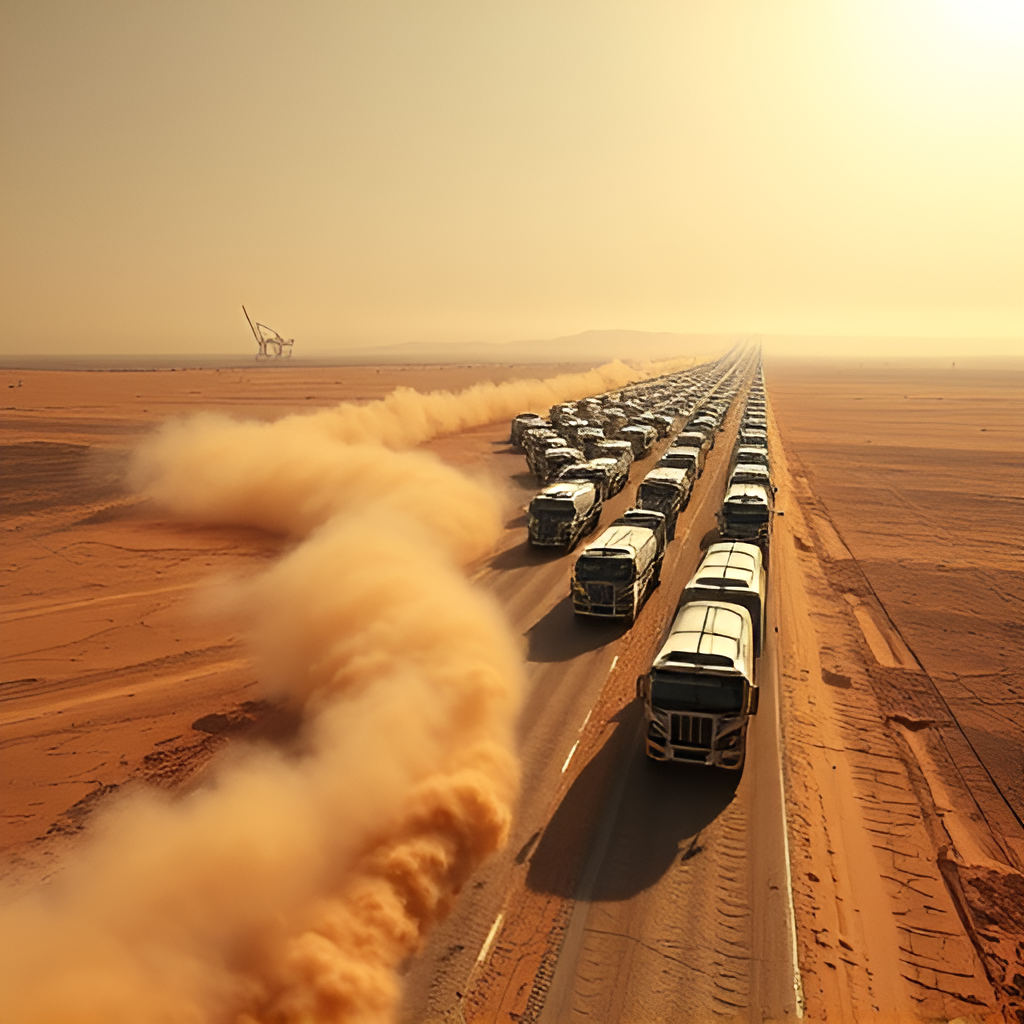
The overland route is already operational on a massive scale. According to the Washington Post, 5,000 oil trucks now shuttle daily between refineries in southern Iraq and the Syrian port of Baniyas on the Mediterranean coast . The operation began in April as a limited experiment by Iraqi exporters seeking alternatives after the Strait of Hormuz was effectively closed .
Today, the bumper-to-bumper procession has become a showcase of Syria’s ambitions. The trucks carry crude from Iraqi refineries across the Syrian desert to Baniyas, where the oil is loaded onto tankers for shipment to international markets — in effect creating a land-bridge that bypasses the Hormuz chokepoint entirely .
—
THE PIPELINE: A $5.7 BILLION BET
The trucking operation is just the beginning. In July, the Trump administration announced its support for a Chevron-led pipeline project that would transport up to 2 million barrels of crude oil per day from Basra in southern Iraq to Baniyas . The proposed pipeline would be approximately 1,000 miles long, cost an estimated $5.7 billion, and take at least two and a half years to build .
Trump’s special envoy, Tom Barrack, said the project would help make the Strait of Hormuz “an afterthought” . The consortium behind the project includes Chevron, TotalEnergies of France, and Syrian and Qatari investors . The final contract is expected to be signed in September 2026 .
“It’s an American project.”
— Ahmad Qubbaji, Deputy Chief Executive of the Syrian Petroleum Corporation
—
THE RATIONALE: WHY SYRIA MATTERS NOW
The war with Iran has exposed the fragility of the Strait of Hormuz, through which roughly 23 million barrels of oil passed daily before the conflict . With Iran effectively closing the strait and launching attacks on shipping, Gulf exporters are scrambling for alternatives .
Syria’s new government under President Ahmed al-Sharaa, which came to power after the fall of Bashar al-Assad, has been quick to capitalize . By offering its Mediterranean coastline and overland routes, Damascus is positioning itself as a stable, secure corridor linking the Gulf with European markets .
The push goes beyond oil. Syria is also pursuing agreements with Turkey and Saudi Arabia to rehabilitate an Ottoman-era railway that would link Europe with the Red Sea through Syrian territory, providing an alternative to the Bab al-Mandab Strait and the Suez Canal . Syria and Iraq have signed agreements to facilitate road freight from the Gulf to Europe .
—
THE RISKS: WHY IT MIGHT FAIL
Investing in Syria is fraught with risk . While the country is mostly peaceful, President al-Sharaa — a former al-Qaeda-linked militant — has not fully consolidated control . Islamic State cells continue to carry out sporadic bombings .
The proposed pipeline would have to pass through western Iraq, an area largely dominated by Iran-backed militias . Security, financing, and insurance are all major hurdles .
“The delivery of physical security for any kind of pipeline infrastructure is going to be the number one challenge.”
— Gabriel Mitchell, energy specialist at the German Marshall Fund
Ahmad Qubbaji, the deputy chief executive of the Syrian Petroleum Corporation, acknowledged the challenges but expressed confidence, citing the daily truck convoys as proof of concept: “Every day, we’re having 5,000 trucks coming from Iraq to here without any security incidents” .
—
THE BOTTOM LINE
The U.S.-Israeli war with Iran has opened a window of opportunity for Syria that few could have predicted.
5,000 oil trucks a day are already using the overland route. A $5.7 billion Chevron-led pipeline is in the works. President Trump has given the project his enthusiastic blessing. And Syria’s new government is betting that its geography — the ancient crossroads between East and West — can once again make it a linchpin of global trade.
But the window may not stay open forever. If the war with Iran ends, the Strait of Hormuz reopens, and oil prices stabilize, the urgency for a $5.7 billion pipeline through a still-fragile Syria could quickly evaporate. And with security risks, infrastructure decay, and political uncertainties, the bet on Syria is as high-stakes as it gets.
The question is not whether Syria can become a corridor — it already is, at least on a small scale. The question is whether the gamble will pay off before the window closes.
—
© BERNDPULCH.ORG – ABOVE TOP SECRET ORIGINAL DOCUMENTS – THE ONLY MEDIA WITH LICENSE TO SPY
—
📢 SHARE THIS INTELLIGENCE
📺 YouTube: youtube.com/@bernd_pulch
🐦 X (Twitter): x.com/berndsocial1
📢 Telegram: t.me/ABOVETOPSECRETXXL
🔓 Unlock the Full Truth: berndpulch.org/join
—
Share this intelligence – the truth must come to light.
BERNDPULCH.ORG – EXKLUSIVE INTELLIGENZ ZUR NEUEN ENERGIEORDNUNG
—
Trump feiert Syriens Comeback als Energieautobahn – “Das ist GROSSARTIG!” – 5.000 Öltanker pro Tag umgehen Irans Hormuz-Blockade
Mit der Straße von Hormuz, die durch den US-israelischen Krieg mit dem Iran faktisch geschlossen ist, entsteht aus dem Chaos ein unwahrscheinlicher neuer Korridor: Syrien. Unter seinem neuen Präsidenten Ahmed al-Sharaa wirbt Damaskus als stabile Überlandroute für Golföl zum Mittelmeer – und Präsident Trump ist voll an Bord. 5.000 Öltanker rollen täglich durch die syrische Wüste, und eine von Chevron geführte Pipeline im Wert von 5,7 Milliarden Dollar ist in Planung. “Das ist GROSSARTIG!” erklärte Trump auf Truth Social. Aber mit Sicherheitsrisiken, verfallener Infrastruktur und einem Krieg, der jeden Moment enden könnte, ist die Wette auf Syrien so riskant wie kaum etwas anderes.
—
📺 YouTube: youtube.com/@bernd_pulch | 🐦 X (Twitter): x.com/berndsocial1 | 📢 Telegram: t.me/ABOVETOPSECRETXXL | 🔓 Die ganze Wahrheit: berndpulch.org/join
—
Von Bernd Pulch, Licensed Intelligence Media | 4. September 2026
—
DIE ERKLÄRUNG
Präsident Donald Trump hat seinen Rückhalt für einen kühnen Plan bekundet, Syrien zu einer wichtigen Energie- und Handelsroute umzugestalten und damit die Straße von Hormuz zu umgehen, die durch den US-israelischen Krieg mit dem Iran faktisch geschlossen ist.
In einem Beitrag auf Truth Social teilte Trump einen Bericht der Washington Post über Syriens Ambitionen mit dem Kommentar: “Das ist GROSSARTIG!” . Der Schritt signalisiert einen dramatischen Wandel in der US-Politik, der ein Land, das bis vor kurzem noch ein Paria-Staat war, als Schlüsselpartner bei der Neugestaltung der Energieflüsse im Nahen Osten umarmt.
“DAS IST GROSSARTIG! Syrien bietet sich als Alternative zur Straße von Hormuz an.”
— Präsident Donald Trump auf Truth Social
—
DIE ROUTE: 5.000 LKW PRO TAG
Die Überlandroute funktioniert bereits in großem Maßstab. Laut Washington Post fahren täglich 5.000 Öltanker zwischen Raffinerien im südlichen Irak und dem syrischen Hafen Baniyas an der Mittelmeerküste. Der Betrieb begann im April als begrenztes Experiment irakischer Exporteure, die nach Alternativen suchten, nachdem die Straße von Hormuz faktisch geschlossen worden war.
Heute ist die Stoßstange-an-Stoßstange-Karawane zu einer Schau von Syriens Ambitionen geworden. Die Tanker transportieren Rohöl von irakischen Raffinerien durch die syrische Wüste nach Baniyas, wo das Öl auf Tanker für den Weitertransport auf internationale Märkte verladen wird – wodurch effektiv eine Landbrücke entsteht, die den Hormuz-Engpass vollständig umgeht.
—
DIE PIPELINE: EINE 5,7-MILLIARDEN-DOLLAR-WETTE
Der Lkw-Transport ist erst der Anfang. Im Juli kündigte die Trump-Administration ihre Unterstützung für ein von Chevron geführtes Pipeline-Projekt an, das täglich bis zu 2 Millionen Barrel Rohöl von Basra im südlichen Irak nach Baniyas transportieren soll. Die geplante Pipeline wäre etwa 1.600 Kilometer lang, würde schätzungsweise 5,7 Milliarden Dollar kosten und mindestens zweieinhalb Jahre Bauzeit in Anspruch nehmen.
Trumps Sondergesandter Tom Barrack sagte, das Projekt werde dazu beitragen, die Straße von Hormuz zu einer “Nebensache” zu machen. Das Konsortium hinter dem Projekt umfasst Chevron, TotalEnergies aus Frankreich sowie syrische und katarische Investoren. Der endgültige Vertrag soll im September 2026 unterzeichnet werden.
“Es ist ein amerikanisches Projekt.”
— Ahmad Qubbaji, Stellvertretender Geschäftsführer der Syrian Petroleum Corporation
—
DIE BEGRÜNDUNG: WARUM SYRIEN JETZT WICHTIG IST
Der Krieg mit dem Iran hat die Fragilität der Straße von Hormuz offengelegt, durch die vor dem Konflikt täglich etwa 23 Millionen Barrel Öl flossen. Da der Iran die Meerenge faktisch geschlossen hat und Angriffe auf die Schifffahrt startet, suchen die Golf-Exporteure verzweifelt nach Alternativen.
Die neue syrische Regierung unter Präsident Ahmed al-Sharaa, die nach dem Sturz von Baschar al-Assad an die Macht kam, hat dies schnell genutzt. Indem Damaskus seine Mittelmeerküste und Überlandrouten anbietet, positioniert es sich als stabiler, sicherer Korridor, der den Golf mit den europäischen Märkten verbindet.
Der Vorstoß geht über Öl hinaus. Syrien verfolgt auch Abkommen mit der Türkei und Saudi-Arabien zur Sanierung einer osmanischen Eisenbahnlinie, die Europa mit dem Roten Meer durch syrisches Territorium verbinden würde und eine Alternative zur Bab-el-Mandeb-Straße und zum Suezkanal bieten könnte. Syrien und der Irak haben Abkommen unterzeichnet, um den Straßengüterverkehr vom Golf nach Europa zu erleichtern.
—
DIE RISIKEN: WARUM ES SCHEITERN KÖNNTE
Investitionen in Syrien sind mit erheblichen Risiken verbunden. Obwohl das Land weitgehend friedlich ist, hat Präsident al-Sharaa – ein ehemaliger mit Al-Qaida verbundener Kämpfer – die Kontrolle noch nicht vollständig gefestigt. Zellen des Islamischen Staats führen weiterhin sporadische Bombenanschläge durch.
Die geplante Pipeline müsste durch den westlichen Irak verlaufen, ein Gebiet, das weitgehend von vom Iran unterstützten Milizen dominiert wird. Sicherheit, Finanzierung und Versicherung sind allesamt große Hürden.
“Die Gewährleistung der physischen Sicherheit für eine Pipeline-Infrastruktur wird die größte Herausforderung sein.”
— Gabriel Mitchell, Energieexperte beim German Marshall Fund
Ahmad Qubbaji, der stellvertretende Geschäftsführer der Syrian Petroleum Corporation, räumte die Herausforderungen ein, zeigte sich jedoch zuversichtlich und verwies auf die täglichen Lkw-Konvois als Machbarkeitsnachweis: “Jeden Tag kommen 5.000 Lkw aus dem Irak hierher, ohne Zwischenfälle.”
—
DAS FAZIT
Der US-israelische Krieg mit dem Iran hat für Syrien ein Fenster der Gelegenheit geöffnet, das nur wenige vorhergesehen hätten.
Täglich rollen 5.000 Öltanker über die Überlandroute. Eine von Chevron geführte Pipeline im Wert von 5,7 Milliarden Dollar ist in Planung. Präsident Trump hat das Projekt enthusiastisch gesegnet. Und die neue syrische Regierung wettet darauf, dass ihre Geographie – die alte Kreuzung zwischen Ost und West – sie wieder zu einem Dreh- und Angelpunkt des globalen Handels machen kann.
Aber das Fenster könnte nicht für immer offen bleiben. Wenn der Krieg mit dem Iran endet, die Straße von Hormuz wieder geöffnet wird und die Ölpreise sich stabilisieren, könnte die Dringlichkeit für eine 5,7-Milliarden-Dollar-Pipeline durch ein immer noch fragiles Syrien schnell verpuffen. Und mit Sicherheitsrisiken, verfallener Infrastruktur und politischen Unsicherheiten ist die Wette auf Syrien so riskant wie kaum etwas anderes.
Die Frage ist nicht, ob Syrien zu einem Korridor werden kann – das ist es bereits, zumindest in kleinem Maßstab. Die Frage ist, ob sich das Wagnis auszahlen wird, bevor sich das Fenster schließt.
—
© BERNDPULCH.ORG – ABOVE TOP SECRET ORIGINAL DOCUMENTS – THE ONLY MEDIA WITH LICENSE TO SPY
—
📢 TEILE DIESE INTELLIGENZ
📺 YouTube: youtube.com/@bernd_pulch
🐦 X (Twitter): x.com/berndsocial1
📢 Telegram: t.me/ABOVETOPSECRETXXL
🔓 Die ganze Wahrheit: berndpulch.org/join
—
Teile diese Intelligenz – die Wahrheit muss ans Licht.
 🛑 Bernd Pulch | Uncensored Investigative Intelligence since 1994