


🔴 INTELLIGENCE BRIEFING — AUGUST 21, 2026
THE EVERGRANDE FALL: CHINA SENTENCES HUI KA YAN TO LIFE — AND CONFISCATES HIS ENTIRE PERSONAL FORTUNE
BERNDPULCH.ORG — OSINT INTELLIGENCE DESK
China | Real Estate | Debt | Financial Crime | Systemic Risk
> The original claim circulating on social media was correct in its essentials — but the verdict was handed down on August 20, not August 19. A Shenzhen court sentenced Evergrande founder Hui Ka Yan (Xu Jiayin) to life imprisonment and ordered the confiscation of all his personal property. The ruling is confirmed by China’s Supreme People’s Court and independently reported by Reuters and AP.
—
🔴 FROM BILLIONAIRE TO LIFE IMPRISONMENT
Few corporate collapses have symbolized China’s property crisis as dramatically as the destruction of China Evergrande.
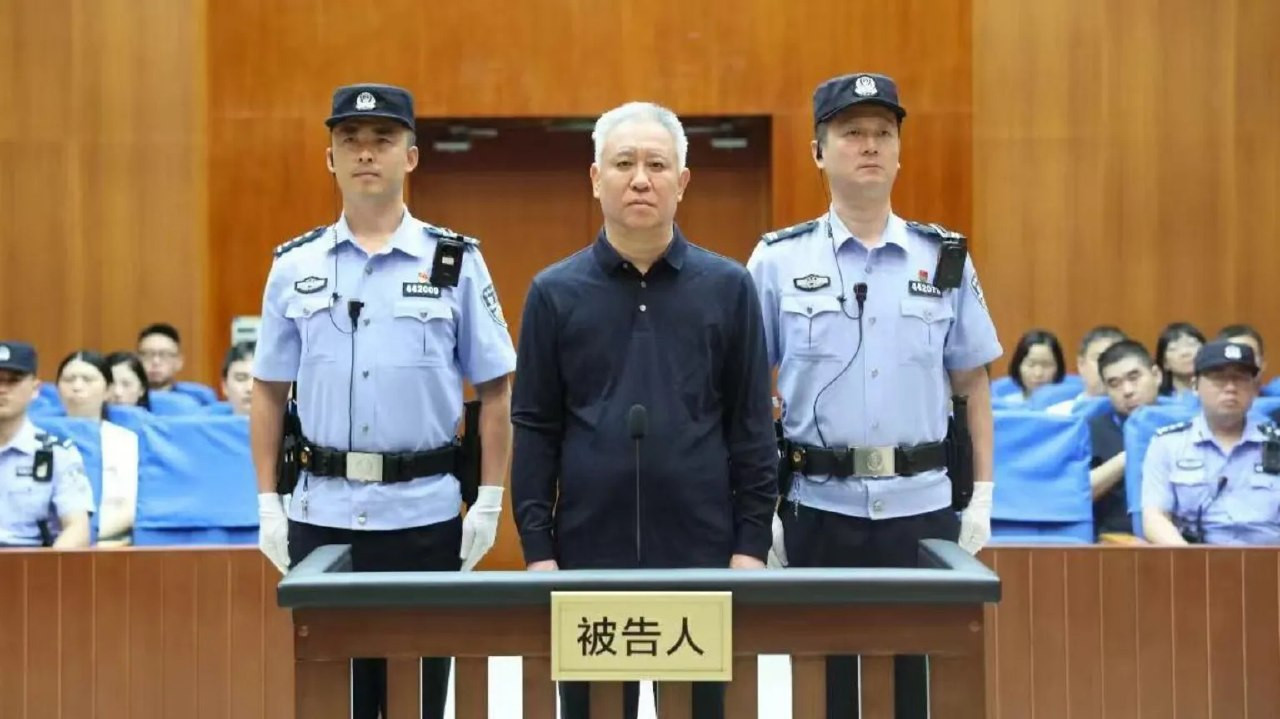
On August 20, 2026, the Shenzhen Intermediate People’s Court brought a major criminal chapter to a close.
Hui Ka Yan, 67, founder and former chairman of China Evergrande, was sentenced to life imprisonment.
The court additionally:
confiscated all of Hui’s personal assets
stripped him of political rights for life
ordered continued recovery of illegal proceeds
ordered compensation where recovered assets are insufficient
fined Evergrande 8.82 billion yuan
fined Evergrande Real Estate 7 billion yuan
The combined corporate fines amount to 15.82 billion yuan.
The court said the conduct involved exceptionally large amounts, caused particularly serious economic losses and produced severe social harm.
—
💥 THE EIGHT-CHARGE CASE
Hui had pleaded guilty in April.
The charges included:
Illegal absorption of public deposits
Fundraising fraud
Illegal lending
Illegal use of funds
Fraudulent securities issuance
Violations involving disclosure of material information
Embezzlement
Corporate bribery
The Chinese court said that between 2016 and 2021, Evergrande, its property subsidiary and Hui engaged in sustained, large-scale financial fraud, including inflating assets and concealing liabilities.
The court further said Hui and Evergrande used bribery to obtain control over financial institutions and improperly obtain credit and insurance funds.
—
💰 THE $300 BILLION COLLAPSE
This is where the case becomes much larger than one businessman.
Evergrande accumulated liabilities exceeding $300 billion before its 2021 default.
It became one of the most indebted companies in the world.
The collapse triggered:
unfinished housing projects
angry homebuyers
losses for investors
stress among suppliers
problems for banks and shadow-finance investors
a prolonged property-market downturn
Reuters reports that Evergrande had defaulted on most of its roughly $300 billion in liabilities.
—
📉 THE ACCOUNTING QUESTION
Chinese regulators previously found serious problems with Evergrande’s financial reporting.
Authorities said revenue had been overstated by roughly $80 billion across 2019 and 2020, partly through prematurely recognizing property-sale revenue before apartments were completed and delivered.
That is critical.
Because Evergrande’s business model depended heavily on borrowing and continued access to financing.
If financial statements make a company appear healthier than it actually is, lenders and investors can make decisions based on a distorted balance sheet.
The result can be a dangerous cycle:
Borrow → expand → presell → recognize revenue → borrow more → expand again.
Once credit stops flowing, the model can collapse extremely quickly.
—
🏙️ THE PROPERTY MACHINE
Evergrande was founded in 1996 during China’s extraordinary property expansion.
Hui transformed the company into China’s largest developer by contracted sales.
At his peak in 2017, Forbes estimated his fortune at approximately $45.3 billion, making him Asia’s richest person at the time.
Evergrande then expanded far beyond traditional property development.
Its interests included:
real estate
football
electric vehicles
financial services
consumer products
theme parks
The empire became a symbol of China’s debt-fuelled property boom.
Then the financing model broke.
—
⚠️ 2021: THE DEFAULT
Evergrande’s crisis became public in 2021.
Chinese authorities had already begun tightening restrictions on excessive borrowing in the property sector.
When financing conditions tightened, highly leveraged developers suddenly faced a liquidity problem.
Evergrande could no longer refinance its enormous obligations indefinitely.
The result was a chain reaction.
Debt crisis → missed payments → unfinished projects → falling confidence → falling property demand → further developer stress.
The company was eventually ordered into liquidation by a Hong Kong court in 2024, and its Hong Kong-listed shares were delisted in 2025.
—
🌍 THE CREDITORS’ PROBLEM
Hui’s life sentence does not solve Evergrande’s debt problem.
This may be the most important point of the entire story.
Reuters reports that Evergrande’s liquidators have faced a slow recovery process. As of last August, approximately $255 million in assets had been sold, compared with creditor claims of roughly $45 billion in the relevant offshore liquidation process.
And offshore litigation continues over assets and payments connected to Hui and former executives.
Therefore:
A criminal verdict is not the same thing as a financial recovery.
Creditors still want money.
Homebuyers still want completed homes.
Investors still want compensation.
And China’s property market still has to deal with the consequences.
—
🇨🇳 WHAT DOES BEIJING WANT THIS VERDICT TO SIGNAL?
This is where the case becomes strategically important.
The Evergrande verdict can be read as a warning to China’s corporate elite:
SIZE DOES NOT GUARANTEE IMMUNITY.
For years, Evergrande was deeply embedded in China’s economic and financial ecosystem.
Hui became enormously wealthy.
The company became enormous.
Its liabilities became enormous.
But ultimately the state drew a line.
The court’s language is particularly severe: the conduct was characterized as involving extremely large amounts, particularly egregious circumstances, major economic losses and serious social harm.
This is not simply a punishment of an individual.
It is also a message about financial discipline.
—
🔥 BUT THE EVERGRANDE CRISIS IS NOT OVER
The legal case may be approaching its conclusion.
The economic consequences are not.
China’s property sector remains under pressure.
AP reports that property prices have fallen significantly since the 2021 crisis and that the broader property downturn has continued weighing on China’s economy.
The unresolved question is therefore:
Was Evergrande the disease — or merely the largest symptom?
Other developers have also faced severe liquidity problems.
The property sector was one of the most important engines of China’s growth.
Its contraction affects:
construction
steel
cement
household wealth
local-government finances
banks
consumer confidence
employment
investment
—
🧨 BERNDPULCH.ORG INTELLIGENCE ASSESSMENT
The Hui Ka Yan verdict should not be interpreted simply as:
> “A billionaire went to prison.”
The deeper story is:
> China has formally criminalized one of the most spectacular manifestations of its debt-fuelled property boom.
Evergrande demonstrated how rapidly an apparently unstoppable corporate empire can transform into a systemic liability.
The company grew through leverage.
The leverage required confidence.
Confidence required refinancing.
When refinancing stopped, the architecture collapsed.
—
📊 THE EVERGRANDE TIMELINE
YEAR DEVELOPMENT
1996 Hui Ka Yan establishes Evergrande
2017 Hui becomes Asia’s richest person
2020 Beijing intensifies restrictions on excessive property-sector borrowing
2021 Evergrande defaults
2023 Hui detained by Chinese authorities
2024 Hong Kong court orders Evergrande liquidation
2024 Chinese securities regulator fines Hui and bans him from the securities market for life
2025 Evergrande shares delisted in Hong Kong
April 2026 Hui pleads guilty to multiple charges
August 20, 2026 Life imprisonment + confiscation of all personal assets
The final chapter is dramatic.
But the economic consequences are still being written.
—
🚨 THE BIG QUESTION FOR GLOBAL MARKETS
Evergrande’s collapse was primarily a Chinese property story.
But its implications are global.
The company accumulated more than $300 billion in liabilities.
That means the case became a test of:
credit risk
shadow banking
property bubbles
corporate governance
government intervention
cross-border creditor protection
sovereign economic management
And now another question emerges:
Who ultimately pays when a giant corporation becomes too indebted to save?
The Hui verdict provides one answer:
the founder can lose everything.
But it does not answer the much harder question:
How much of the underlying economic damage can actually be recovered?
—
🔴 BERNDPULCH.ORG — FINAL ASSESSMENT
HUI KA YAN’S FORTUNE IS GONE.
EVERGRANDE IS GONE AS A PUBLIC COMPANY.
THE DEBT HAS NOT DISAPPEARED.
And that distinction is crucial.
A prison sentence can close a criminal case.
It cannot automatically repair a housing market.
It cannot restore lost savings.
It cannot reconstruct every unfinished apartment.
And it cannot erase hundreds of billions of dollars in liabilities.
The man has fallen.
The Evergrande debt story is not finished.
—
🔴 BERNDPULCH.ORG
OSINT INTELLIGENCE DESK
China’s property crisis is one of the most important financial stories of the decade.
The next question is not simply what happened to Hui Ka Yan.
It is:
WHO ELSE IS EXPOSED?
Banks. Developers. Local governments. Wealth-management products. Offshore creditors. Chinese households. Global investors.
That is where the next investigation begins.
Published August 21, 2026. This article distinguishes confirmed court findings from editorial analysis. The August 20 verdict is confirmed by China’s Supreme People’s Court and independently reported by Reuters and AP.
SEO HEADLINE
Evergrande Founder Hui Ka Yan Sentenced to Life in Prison: China Confiscates His Entire Fortune as $300 Billion Debt Crisis Reaches Historic Verdict
META EXCERPT
China has sentenced Evergrande founder Hui Ka Yan to life in prison and confiscated his personal assets. What the verdict means for China’s property crisis, creditors, banks and global markets.
KEYWORDS
Hui Ka Yan, Xu Jiayin, Evergrande, China Evergrande, Evergrande collapse, China property crisis, Evergrande debt, Chinese real estate, China financial crisis, Hui Ka Yan life sentence, Evergrande creditors, China property market, Chinese economy, corporate fraud China, $300 billion Evergrande debt
 🛑 Bernd Pulch | Uncensored Investigative Intelligence since 1994