Gambling With Souls – Full Movie

http://www.youtube.com/watch?v=8m0KmONqQ-k

Mae Miller wants the finer things in life, luxuries that she feels her husband, a doctor, cannot provide for her. She begins to gamble in order to ring in spending money for herself, but winds up deep in debt. To pay her dues, she is reduced to the shame of selling herself.

“Suggested” by the notorious trial of gangster Lucky Luciano, this typical low-budget sexploitation-melodrama came complete with the promise to rip “the lid from a vicious phase of American life.” In reality, the sordid little film, which was instantly banned by New York censors, depicted little more than a standard tale of illicit gambling augmented by shots of starlets in their underwear. Mae Miller (Martha Chapin), the bleach blond wife of an aging medical student (Robert Frazer), is arrested for shooting Lucky Wilder (Wheeler Oakman) during a raid on Wilder’s gambling den. The events leading up to the killing are then told in flashback. At a society garden party, Mae befriended Molly Murdock (Gay Sheridan), who promptly lured the young innocent into Lucky Wilder’s den of inequity. Mae eventually accrued 9,000 dollars in gambling debts was forced into prostitution by Wilder and Mrs. Murdock. Lucky’s seduction of Mae’s kid sister Carolyn (Janet Eastman) and the latter’s death following a back alley abortion finally drove Mae to shoot and kill her tormentor. Produced by J.D. Kendis, a well-known procurer of exploitation-thrillers, Gambling With Souls was directed by Elmer Clifton, a former protegée of D.W. Griffith who had fallen on hard times. The film was not screened in New York City until May of 1937, when it was re-released under the title Vice Racket. Like most exploitation films of the 1930s, Gambling With Souls was cast with a combination of unknown starlets and down-on-their-luck silent screen players, all of whom either overacted hilariously or didn’t act at all. Florence Dudley, however, provided a bit of intentional comedy relief as a rather zoftig call girl. Footage from Gambling With Souls later found its way into Teen Age (1944).

Sports Illustrated Swimsuit – Bodypainting

TMZ – Courtney Stodden: I’m ABSOLUTELY Considering Doing PORN!

Courtney Stodden was bombarded with offers to do porn on her 18th birthday… and she told TMZ she’s ACTUALLY considering gettin’ FILTHY on camera!

Unveiled – How Iran Spies on Internet Users and Counterspy

How Iran Spies on Internet Users and Counterspy


A sends:

Refer to peyvandha.ir. If you go to the site from Iran, it resolves to an IP in the 
famous Iranian "national internet" with IPs starting with 10.10.X.X. The IP and 
website belong to the Ministry of Islamic Guidance. Therefore, not only Police and 
Intelligence can monitor online behavior, through this trick, another entity that is
involved in Iran's internet infrastructure can monitor and learn who goes to filtered 
websites or make attempts to communicate with those sites. 

More interestingly is below. The stupid staff who registered the IP and domain are 
using Gmail and Yahoo accounts to maintain their access to the domain. Since I happen 
to know getting into someone's Yahoo account is easier than drinking water (no need 
for showing the tech here), there is opportunity for rogue elements to monitor Iranian 
user's behavior, partially and ironically, the people who are forcing people to use 
"local national" email systems such as mail.iran.ir, are using Gmail and Yahoo 
themselves. :)

root# whois peyvandha.ir

domain: peyvandha.ir
ascii: peyvandha.ir
remarks: (Domain Holder) Ministry of Culture and Islamic Guidance
remarks: (Domain Holder Address) No. 229, Ministry of Culture and Islamic, Kamalolmoke 
St., Baharestan Sq.,, Tehran, Tehran, IR
holder-c: mi151-irnic
admin-c: mi151-irnic
tech-c: mk168-irnic
nserver: a-ir1.hostiran.net
nserver: b-ir1.hostiran.net
last-updated: 2011-02-23
expire-date: 2016-04-06
source: IRNIC # Filtered
nic-hdl: mi151-irnic
org: Ministry of Culture and Islamic Guidance
e-mail: ahajitorab@gmail.com
address: No. 229, Ministry of Culture and Islamic, Kamalolmoke St., Baharestan Sq.,, 
Tehran, Tehran, IR
phone: +98 21 38513104
fax-no: +98 21 33966068
source: IRNIC # Filtered
nic-hdl: mk168-irnic
person: Mostafa Khademolmele
e-mail: mkhadem61@yahoo.com
source: IRNIC # Filtered


Serial Killer – Paul Denyer – Full Documentary Movie

http://www.youtube.com/watch?v=49FXwRX121c

Paul Charles Denyer (born 14 April 1972) is an Australian serial killer and sex maniac, currently serving three consecutive sentences of life imprisonment with a non-parole period 30 years at HM Prison Barwon for the murders of Elizabeth Stevens, 18, Debbie Fream, 22, and Natalie Russell, 17, in Frankston, Victoria in 1993.
Denyer is known as the “Frankston Killer” as his crimes occurred in Frankston and neighbouring suburbs. Denyer was featured in the pilot episode of Seven Network crime series Forensic Investigators.

>Cryptome unveils AntiLeaks Questions

AntiLeaks Questions


A sends:

Antileaks,

Several questions:

1. What do you hope to gain by your recent attack upon WL?

2. Are you affiliated officially or unofficially with any US
governmental organization? Meaning, are you acting on "orders" or
autonomously?

3. If (2) is a positive, or even as allegedly US citizens, how do you
reconcile your actions with the First Amendment to the Bill of Rights?

4. What would you say to other American Citizens who have viewed your
cyber actions in a negative light?

5. Would you like to comment on the logistics of your attacks? It was
reported that several thousands of computers were taken over for the
attack. Do you confirm these reports?

6. Do you view your actions as: criminal acts, acts of vigilantes or
otherwise?

7. Does antileaks view WL as a "online publisher", a terrorist group
or otherwise?

8. Is antileaks opposed to all "leaks"? Is there any situation when a
leak is justified in the minds of "antileaks" by governmental or
non-governmental actors (and in the realm of any historical context)?

Appreciated.

Exposed – Topless protest in -25C: Femen fights Russian ‘gas terror

Ready to stand up and stand out for justice despite severe frosts, FEMEN activists have staged a new provocative stunt against the yoke of Russia’s gas giant Gazprom. Fearless and topless, the Ukrainian girls took off their clothes in front of the Gazprom building in Moscow, holding banners saying “Stop gas racket!” and “Snub Gazprom!” One of the activists even managed to climb the roof of the Gazprom’s checkpoint, waving the Ukrainian flag before security guards brought her down. The girl was detained and is now in a local police office.

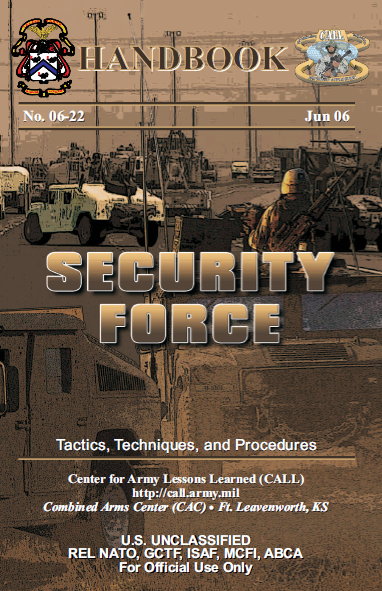
TOP- SECRET – U.S. Army Security Force Handbook

https://publicintelligence.net/wp-content/uploads/2012/08/CALL-SecurityForce.png


1. The Basic Security Force Unit

Throughout the Iraqi theater, units tailor security forces in order to meet the requirements of the mission. The equipment used is also modified depending on the operating environment. However, most security forces share common building blocks used in this handbook.

Tactics, techniques, and procedures (TTP) in this handbook are based on the model of a common base security force unit. The basic security force platform is generally the M1114, the XM1117 (armored security vehicle), the RG31 (multipurpose vehicle), or an equivalent gun truck. Designated security force companies are currently equipped with the M1114s as their main gun truck. Each platform has a minimum of three Soldiers: a truck commander, gunner, and driver.

One squad (section for artillery security force units) consisting of four platforms is the standard package for most missions. The squad conducts autonomous security force missions and is left alone at combat outposts for long stretches. Squads are the most common organization receiving the security force missions discussed in this handbook.

Modification tables of organization and equipment (MTOE) designated security force units can be task-organized to any battalion. Generally security force units are not task-organized below company/battery level; however, it is common to see platoons designated a specific mission for extended periods of time, i.e., as a police transition team (PTT), convoy security, or personal security detachment (PSD). Many company-size units (usually field artillery) are transforming into MTOE security force companies. MTOE security force companies consist of three platoons plus an additional platform for the commander. Each platoon consists of three squads, plus an additional platform for the platoon leader. This composition gives the company a total of 40 platforms plus additional vehicles for support personnel. Most battalions also have an internal security force unit primarily for PSD and occasionally for convoy security. The composition of these internal security forces depends on platform availability, type of mission, and scope of the operation. This handbook also provides these types of security forces valid TTP, as well as common before, during, and after considerations for their operations.

2. Types of Security Force Missions

a. Convoy security. Both military and civilian convoys are subject to attack from insurgents, necessitating constant security. While most military convoys will have an internal security force, civilian convoys do not have that capability. For this reason security forces are often tasked to escort convoys consisting of two or more vehicles. The size of the convoy determines the number of required security force squads. The general rule of thumb is one platform (M1114) for every five vehicles in the civilian convoy. Platoon leaders may choose to add platforms to squads or lead a mission with multiple squads. (Note: Types of convoys often escorted are listed in Annex A).

b. PSD. PSD is conducted regularly by almost every unit in Operation Iraqi Freedom. PSD may include the security of a unit commander or sergeant major, a dignitary or local leader, or even a detainee. Security forces are charged with escorting VIPs from point A to point B. Given the operating environment in Iraq, a well-trained PSD is essential for the safety of VIPs and the Soldiers conducting the missions.

c. Site security. Security forces may be required to conduct site security as part of their convoy operations. Depending on the type of mission, site security may require Soldiers to conduct dismounted security. Examples of site security where Soldiers dismount include restricting access to an area due to an improvised explosive device or providing security around a building in a populated area. Examples of site security where Soldiers do not dismount include waiting for recovery assets while the squad provides security for a downed vehicle or road security when a squad is required to secure access into an alternate supply route.

d. Other missions. While other missions are beyond the scope of this handbook, it is important to note security forces conduct numerous other types of missions. The most current (FY 2006) critical mission is training the Iraqi Police (IP). This mission requires security forces and MP units to link and develop habitual relationships with the IP. Some units man the IP basic training academies, while others monitor IP station progress and provide additional training. This mission also requires Soldiers to fully understand how Iraqis conduct business. Soldiers must be prepared to conduct a variety of classes with the assistance of an interpreter. Knowledge of basic police station administrative requirements will assist in this mission.

Another common mission is detainee operations. Most forward operations bases (FOBs) have some sort of detainee facility. The responsibility for maintaining security inside and outside the facility often falls to security forces. This responsibility includes the daily health and welfare of the inmates and their administrative and logistical requirements, as well as the movement of detainees within the FOB or to other sites. Occasionally security forces will transport detainees by air to distant FOBs.

When contact is made with the enemy, security forces must be prepared to engage and destroy the enemy. Security forces should develop basic contact battle drills aimed at maneuvering, fixing, and eliminating the enemy.


DOWNLOAD THE ORIGINAL DOCUMENT HERE:

CALL-SecurityForce

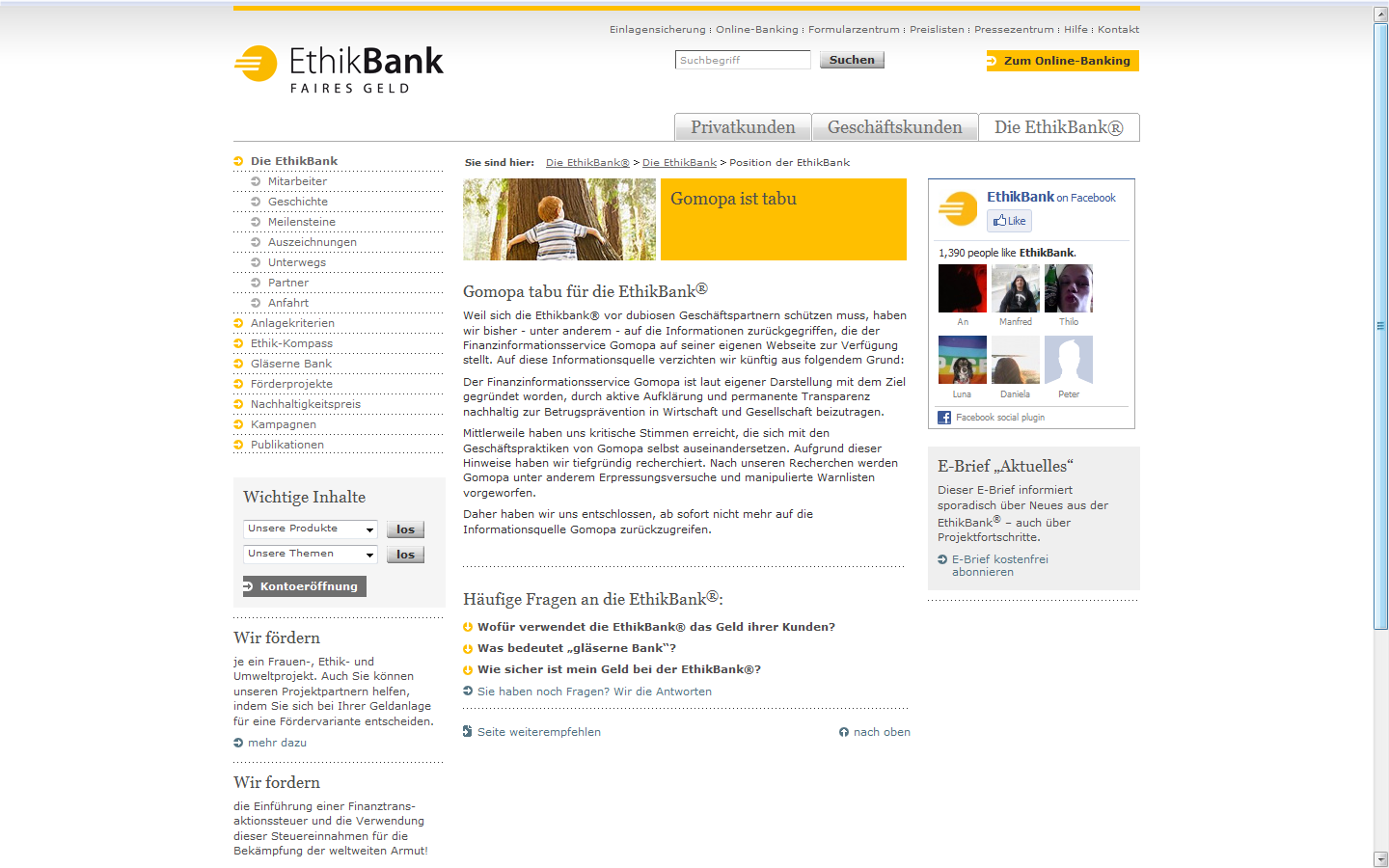
DIE PERVERSEN METHODEN DER “GoMoPa”- SCHEISSHAUSFLIEGEN (Eigenbezeichnung und Eigenbeschreibung)

http://www.victims-opfer.com/?p=22299

Brooklyn Rules – Full Movie – Alec Baldwin

http://www.youtube.com/watch?v=w7Km2kH6tXI

Alec Baldwin co-stars in this mob thriller set in Brooklyn 1985, and filled with star-studded cameos (Scott Caan, Mena Suvari, Freddie Prinze Jr. and others).

Director Michael Corrente’s coming-of-age comedy drama Brooklyn Rules unfurls in 1985, coincident with the early rise of John Gotti. Three young Brooklyn men of Italian-American heritage — Michael Turner (Freddie Prinze Jr.), Carmine Mancuso (Scott Caan), and Bobby Canzoneri (Jerry Ferrara) — make the pivotal, potentially irreversible choices that will determine their directions in life. The boys’ periodic run-ins with a sadistic mobster type who rules the neighborhood, Caesar Manganaro (Alec Baldwin), suggest the ever-present option of drifting into a career of crime. On the surface, Michael courageously and doggedly bucks this choice, opting instead for the pre-law program at Columbia and a straight-laced romance with blonde-haired, blue-eyed coed Ellen (Mena Suvari), yet this path is not as antiseptic as it may seem, for he actually scammed his way into the law program. Meanwhile, Carmine idolizes Caesar, and his desire to emulate this thug not only compromises his own moral integrity, but threatens to jeopardize the stability of Michael’s life as well by drawing him into a sticky web of criminal activity. While the first two men navigate these treacherous paths, the third friend, Bobby, stakes out safer ground with a low-key job at the post office and married life with his intended. Over the course of it all, the boys’ bonds of friendship become stressed and strained given the divergence of their paths.

SI Swimsuit – Teaser 4 Video

This week we bring you to our final destination: the Maldives. Meet our gorgeous models Bar Refaeli, Brooklyn Decker, Dominique Piek and Christine Teigen. For more SI Swimsuit go to http://www.si.com/swimsuitreveal

TMZ – Courtney Stodden — BLASTED by Porn Offers

http://www.youtube.com/watch?v=8RBQ9Sm1zBM

How did Courtney Stodden celebrate her 18th birthday? By being bombarded by offers from every major PORN outlet in the country to take part in some XXX action on camera!

Unveiled by Cryptome and the Media – Free Syrian Army Photos 5

Free Syrian Army Photos 5

[Image]

This citizen journalism image provided by Shaam News Network (SNN), taken on Sunday, Aug. 26, 2012, purports to show children killed by shabiha, pro-government militiamen, being prepared for burial in a mass grave in Daraya, Syria. According to activists’ accounts, government forces retook the Damascus suburb of Daraya from rebel control three days earlier and have since gone on a killing spree. Reports of the death toll range widely from more than 300 to as many as 600. THE ASSOCIATED PRESS IS UNABLE TO INDEPENDENTLY VERIFY THE AUTHENTICITY, CONTENT, LOCATION OR DATE OF THIS CITIZEN JOURNALIST IMAGE. AP

[Image]

This citizen journalism image provided by Shaam News Network SNN, taken on Sunday, Aug. 26, 2012, purports to show people killed by shabiha pro-government militiamen being prepared for a mass burial in Daraya, Syria. According to activists’ accounts, government forces retook the Damascus suburb of Daraya from rebel control three days ago and have since gone on a killing spree. Reports of the death toll range widely from more than 300 to as many as 600. THE ASSOCIATED PRESS IS UNABLE TO INDEPENDENTLY VERIFY THE AUTHENTICITY, CONTENT, LOCATION OR DATE OF THIS CITIZEN JOURNALIST IMAGE. AP

[Image]

This citizen journalism image provided by Shaam News Network SNN, taken on Sunday, Aug. 26, 2012, purports to show people killed by shabiha, pro-government militiamen, being buried in a mass grave in Daraya, Syria. According to activists’ accounts, government forces retook the Damascus suburb of Daraya from rebel control three days ago and have since gone on a killing spree. Reports of the death toll range widely from more than 300 to as many as 600. THE ASSOCIATED PRESS IS UNABLE TO INDEPENDENTLY VERIFY THE AUTHENTICITY, CONTENT, LOCATION OR DATE OF THIS CITIZEN JOURNALIST IMAGE. AP

[Image]

This citizen journalism image provided by Shaam News Network SNN, taken on Sunday, Aug. 26, 2012, purports to show people who were killed by shabiha, pro-government militiamen in Daraya, Syria. According to activists’ accounts, government forces retook the Damascus suburb of Daraya from rebel control three days ago and have since gone on a killing spree. Reports of the death toll range widely from more than 300 to as many as 600. THE ASSOCIATED PRESS IS UNABLE TO INDEPENDENTLY VERIFY THE AUTHENTICITY, CONTENT, LOCATION OR DATE OF THIS CITIZEN JOURNALIST IMAGE. AP

[Image]

Syrian rebel fighter, Tawfiq Hassan, 23, a former butcher, poses for a picture, after returning from fighting against Syrian army forces in Aleppo, at a rebel headquarters in Marea on the outskirts of Aleppo city, Syria, Sunday, Aug. 26, 2012. In their previous lives, they were butchers, barbers, construction workers and university students. Now they are rebels fighting a civil war they hope will end the regime of Syrian President Bashar Assad. AP


[Image]

Syrian rebel fighter, who goes by the name Saqir Abu Zahid, 22, a former University student, poses for a picture after returning from fighting Syrian forces in Aleppo at a rebel headquarters in Marea on the outskirts of Aleppo city, Syria, Sunday, Aug. 26, 2012. AP

[Image]

Syrian rebel fighter, Abu Hammam, 23, a former member of the Syrian security forces, poses for a picture, after returning from fighting against Syrian army forces in Aleppo, at a rebel headquarters in Marea on the outskirts of Aleppo city, Syria, Sunday, Aug. 26, 2012. AP

[Image]

Syrian rebel fighter, Wisam Al-Saleh, 21, poses for a picture, after returning back from fighting against Syrian army forces in Aleppo, at a rebel headquarters in Marea on the outskirts of Aleppo city, Syria, Sunday, Aug. 26, 2012. AP

[Image]

Syrian rebel fighter, Mohammed Yaseen, 24, a former construction worker, poses for a picture, after returning from fighting against Syrian army forces in Aleppo, at a rebel headquarters in Marea on the outskirts of Aleppo city, Syria, Sunday, Aug. 26, 2012. AP

[Image]

Syrian rebel fighter, Ali Alnajjr, 20, a former school student, poses for a picture, after returning from fighting against Syrian army forces in Aleppo, at a rebel headquarters in Marea on the outskirts of Aleppo city, Syria, Sunday, Aug. 26, 2012. AP

[Image]

Syrian rebel fighter, Ahmed Al-Saleh, 22, a former policeman, poses for a picture after returning from fighting against Syrian army forces in Aleppo, at a rebel headquarters in Marea on the outskirts of Aleppo city, Syria, Sunday, Aug. 26, 2012. AP

[Image]

Syrian rebel fighter, Badir Farouh, 17, poses for a picture after returning from fighting against Syrian forces in Aleppo at a rebel headquarters in Marea on the outskirts of Aleppo city, Syria, Sunday, Aug. 26, 2012. AP

[Image]

Syrian rebel fighter, Mohammed Sami, 22, a barber, poses for a picture after returning from fighting against Syrian army forces in Aleppo, at a rebel headquarters in Marea on the outskirts of Aleppo city, Syria, Sunday, Aug. 26, 2012. AP

[Image]

Syrian rebel fighter, Amir Hajji, 20, poses for a picture, after returning back from fighting against Syrian army forces in Aleppo, at a rebel headquarters in Marea on the outskirts of Aleppo city, Syria, Sunday, Aug. 26, 2012.  AP

[Image]

Syrian rebel fighter, Mohammed Abu Razouk, 27, poses for a picture, after returning back from fighting against Syrian army forces in Aleppo, at a rebel headquarters in Marea on the outskirts of Aleppo city, Syria, Sunday, Aug. 26, 2012. AP

[Image]

Syrian rebel fighter, Mustafa Abu Shaheen, 19, a former construction worker, poses for a picture after returning from fighting against Syrian army forces in Aleppo, at a rebel headquarters in Marea on the outskirts of Aleppo city, Syria, Sunday, Aug. 26, 2012. AP

[Image]

An injured Free Syrian Army group leader discusses the plan with his fighters, in Aleppo’s district of Al-Zebdieh August 26, 2012. Reuters

[Image]

Members of the Free Syrian Army discuss strategies in Aleppo’s district of Al-Zebdieh August 26, 2012. Reuters

[Image]

Free Syrian Army fighters drive through the area after missiles fired from a fighter jet hit a petrol tanker in the Bab al-Nayrab district in Aleppo August 26, 2012. Reuters

[Image]

A Free Syrian Army fighter runs away to take cover from a sniper shooting near the Salah El Dine neighbourhood of Syria’s southwest city of Aleppo August 26, 2012. Reuters

[Image]

A Free Syrian Army sniper takes his position in the Salah El Dine neighbourhood of Syria’s southwest city of Aleppo August 26, 2012. Reuters

[Image]

A Free Syrian Army sniper takes his position in the Salah El Dine neighbourhood of Syria’s southwest city of Aleppo August 26, 2012. Reuters

[Image]

[Image]

Free Syrian Army fighters walk in the Salah El Dine neighbourhood of Syria’s southwest city of Aleppo August 26, 2012. Reuters

[Image]

A Free Syrian Army fighter walks by a power pack detonator for an explosive in the Salah El Dine neighbourhood of Syria’s southwest city of Aleppo August 26, 2012. Reuters

[Image]

Free Syrian Army fighters walk in the Salah El Dine neighbourhood of Syria’s southwest city of Aleppo August 26, 2012. Reuters

[Image]

Ruins line a street in the middle of the Salah El Dine neighbourhood of Syria’s southwest city of Aleppo August 26, 2012. Reuter

[Image]

Rebel fighters fire against pro- Syrian government forces at the al-Mashad neighbourhood in the northern Syrian city of Aleppo on August 25, 2012. Syrian rebels say they are digging in for a war of attrition in Aleppo, where what was being billed as the ‘mother of all battles’ is now dragging on into a second month of bloody stalemate. Getty

[Image]

A woman walks with her children as a blue sheet provides cover from snipers during sectarian clashes between Sunni Muslims and Alawites in the Sunni area of Tripoli August 25, 2012. At least three people including an Sunni Islamist commander were killed on Friday in a fifth day of sporadic sectarian fighting in Lebanon’s northern city of Tripoli triggered by the conflict in neighbouring Syria. Reuters

[Image]

Young Syrian boys search through the ruins of destroyed houses following an airstrike by regime forces in Syria’s northern city of Aleppo on August 24, 2012. Syrian forces blitzed areas in and around the Aleppo, activists said, as Western powers sought to tighten the screws on embattled President Bashar al-Assad. Getty

[Image]

A Syrian man reacts outside an operation room at a hospital in Syria’s northern city of Aleppo as doctors give treatment to his grandchildren following an air strike by regime forces on the city on August 24, 2012. Syrian forces blitzed areas in and around the Aleppo , activists said, as Western powers sought to tighten the screws on embattled President Bashar al-Assad. Getty

[Image]

Syria’s President Bashar al-Assad (R) shakes hands with Alaeddin Boroujerdi, head of the Iranian parliamentary committee for national security and foreign policy, before a meeting in Damascus August 26, 2012, in this handout photograph released by Syria’s national news agency SANA. Reuters

[Image]

[Image]

Syrian Vice President Faruq al-Sharaa (R) is pictured with the chairman of the Iranian Shura Council’s Committee for Foreign Policy and National Security Alaeddin Boroujerd who is on an official visit to Damascus on August 26, 2012. Al-Sharaa made his first public appearance in over a month following rumors that he had tried to defect. Getty

TOP-SECRET – Developing Self-Sustaining Security Force Capabilities

https://publicintelligence.net/wp-content/uploads/2012/08/CALL-Partnership.png


The Multi-National Corps–Iraq logistics staff and the Iraqi Security Forces (ISF) support operations cell, an element of the Iraqi Assistance Group, merged at the operational level to publish plans, policies, and procedures that met the strategic aims of the coalition forces, the national goals of the government of Iraq, and the joint campaign plan published by Multi-National Force–Iraq. Corps sustainment planners published operational objectives for execution at the operational and tactical levels in an effort to develop a sustainment-based system for the ISF. Based on experiences and observations over the past 18 months, the partners, advisors, and planners gathered the best practices for advising and assisting security forces at all levels of the sustainment system. This handbook presents partnering considerations in developing a fundamental base for a self-sustaining, host nation security force.

Although based largely on the experiences of units deployed in support of Operation Iraqi Freedom from 2007–2009, the sustainment development ideas and concepts presented in this book are worthy of consideration by any leader assigned the challenging task of developing host nation logistics. This publication is not just for logisticians. All leaders are charged to sustain the force, and many of the lessons learned over the past two years highlight gaps at the collective task/green-tab leader level. Many of the leaders in the Iraqi Army; Iraqi Police; National Police; Department of Border Security; Ministers of Defense, Interior, Transportation, Health, Oil; and many others, including coalition partners were themselves challenged by force sustainment and are critical elements to the solution.

Key Concepts

• Commanders must avoid providing direct support to host nation security forces—if a system exists—and instead provide recommendations supporting the development of a host nation sustainment culture.
• Host nation logistics development requires organizations to assess processes outside their level of war to determine friction points.
• Leaders must recognize the importance of moving from initial assessment and continuing the planning process and plan implementation.
• Development of a process to synchronize efforts across all headquarters to gain unity of effort without unity of command is key to developing host nation systems.
• Systematic problems should be solved rather than symptomatic problems.
• Development of sustainment capabilities for local security forces is essential to establishing a viable local security structure.

DOWNLOAD THE ORIGINAL DOCUMENT HERE:

CALL-Partnership

Serial Killer – The South African Strangler – Full Documentary Movie

http://www.youtube.com/watch?v=-MglCtVffHQ

Biography Special, the ABC Killer Moses Sithole Documentary. The South African Strangler.

Autor – So laufen die “GoMoPa”-Machenschaften ab

Wir haben uns malein bisschen schlau gemacht. Es war auch nicht wirklich schwer,hinter die Taktik und Geschäftspraktiken von Gomopa und KlausMaurischat zu kommen. Denn wer schon einmal (oder wie im Falle vonKlaus Maurischat auch mehrfach!) vorbestraft ist, der hinterlässteine dicke fette Spur im Internet…

Eine Hypothese

Nehmen wir einhypothetisches Beispiel: Mal angenommen, Sie sind ein Unternehmer miteiner gut gehenden Firma, die einen exzellenten Ruf genießt, wiewäre es da, wenn Ihnen jemand einfach so androht, er veröffentliche„schlimme Dinge“ über Sie und Ihr Unternehmen. Sie wärengeschockt, richtig?! Vor allem, weil Sie ein sauberer Geschäftsmannsind. Ihrem Erpresser ist das aber völlig egal, der nur eines will:Mit wenig Arbeit an viel Geld kommen. Da aber auf legalem Wege mitihm niemand mehr etwas zu tun haben möchte (immerhin ist er mehrfachvorbestraft – und nicht nur wegen eines einfachenKaufhausdiebstahls als 15-jähriger), sucht sich der „kleine Klaus“eine neue Geldquelle. Er nimmt sich das Geld von ehrbarenGeschäftsleuten.

Weiter in unseremBeispiel: Sie bekommen also Post und sollen zahlen. Wie aber kanneine solche Zahlung abgewickelt werden? Haben Sie schon einmal eine„Rechnung über Erpressungsleistungen“ in den Händen gehalten?Wohl kaum. Man muss also etwas findiger sein: Sie bekommen einen„Beratungsvertrag“ angeboten. Der „kleine Klaus“ wird nun –in einem Markt, von dem er null Ahnung hat! – Ihr Berater. Sie, derSie das Geschäft von der Pike auf gelernt haben und sowohl den Marktals auch Ihre Kunden kennen, brauchen also ab sofort einen Berater.Aha! Das Interessante dabei: Ihr Berater braucht gar keine Ahnung vomGeschäft zu haben. Er hat vorsorglich ein paar gar nicht netteUnwahrheiten über Sie im Internet publiziert. Versuchen Sie mal, dieeinfach zu löschen: Sie werden sich die Zähne ausbeißen! Außerdemoperieren sie offiziell nicht von Deutschland aus. Obwohl sievielleicht in Vörden oder Krefeld wohnen. Sie als Geschädigter, alshinterhältig Erpresster, haben jedenfalls keine Chance, etwas gegendiese Machenschaften zu unternehmen. Deswegen sind Sie vielleichtgeneigt, dennoch einem „Beratungsvertrag“ zuzustimmen.

DerBeratungsvertrag. Ein branchenübliches Instrument. Nur verlangt manein etwas branchenunübliches Honorar von Ihnen. Es liegt vielleichtim unangenehmen sechsstelligen Bereich. Sie schlucken. Aber wassollen Sie machen? Die Veröffentlichungen können Sie Ihre kompletteExistenz kosten. Also entschließen Sie sich erst einmal zu bezahlen.Doch hört der Spuk dann auf? – nein! Die Dateien werden nur ineinen gesicherten internen Bereich verschoben – sie sind jederzeitwieder abrufbar! Und damit landen Sie in der Spirale der Erpressung.Denn was einmal funktioniert hat, kann immer wieder funktionieren.Solange, bis Ihnen und Ihrer Firma endgültig die Luft wegbleibt.

TMZ – Prince Harry — Getting Naked Facebook Support

http://www.youtube.com/watch?v=vN8QX0YKqLA

Although everyone is criticizing Prince Harry’s naked Vegas exploits… a bunch of loyal NAKED supporters have surfaced on Facebook!

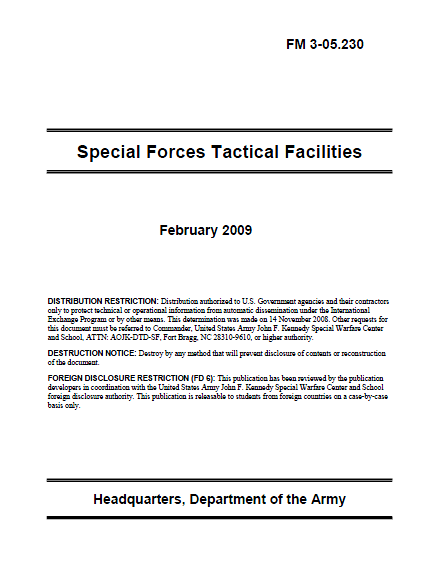
TOP-SECRET – Restricted U.S. Army Special Forces Tactical Facilities Manual

https://publicintelligence.net/wp-content/uploads/2012/08/USArmy-SF-TacticalFacilities.png


Field Manual (FM) 3-05.230, Special Forces Tactical Facilities, supports key United States (U.S.) Army Special Forces (SF) doctrine. An SF tactical facility (TACFAC) is defined as any secure urban or rural facility that enables Army special operations forces (ARSOF) to extend command and control (C2), provides support for operations, and allows operational elements to influence a specified area. SF TACFACs include a variety of secure locations for SF operations, including (but not limited to) firebases, camps, and team houses.

PURPOSE

As with all doctrinal manuals, FM 3-05.230 is authoritative but not directive. It serves as a guide but does not preclude SF units from developing their own standing operating procedures (SOPs) to meet their needs. This FM focuses on the establishment, improvement, operations, and security of SF TACFACs.

SCOPE

This FM presents the details of the three phases of SF TACFAC development in an order that the SF Soldier should expect to encounter them—initial, temporary, and permanent. Additionally, this FM discusses in sequence planning, design, construction, operations, sustainment, funding, and transfer of authority. The primary audiences of this FM are the commanders, staff officers, and operational personnel of Special Forces operational detachments A (SFODAs), Special Forces operational detachments B (SFODBs), and Special Forces operational detachments C (SFODCs).

The primary role of the SF TACFAC is to support special operations (SO) and function as a tactical and operational base. As such, TACFACs serve a primarily defensive function, although they may serve as bases for needed offensive operations. The secondary role of the TACFAC is to be a center that develops, nurtures, and maintains liaison with local host-nation (HN) populace and members of the HN military and civilian leadership. This role is critical in foreign internal defense (FID) and counterinsurgency (COIN) operations.

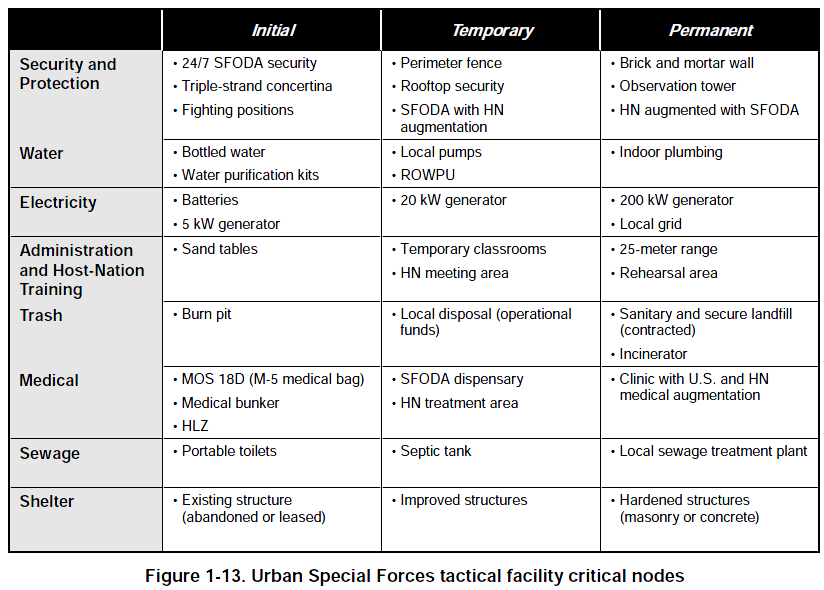
Over time, the TACFAC helps provide for establishment, restoration, and improvements of many local HN community and governmental services and systems. These essential support systems for the TACFAC and surrounding HN communities are best captured by the acronym SWEAT-MSS (security, water, electricity, administration, trash, medical, sewage, and shelter). Eventually, the SF TACFAC will be returned to the control of the HN government through a relief in place (RIP).

OVERVIEW

1-1. SF operations support the operations and goals of the geographic combatant commanders (GCCs) and their subordinate joint force commanders (JFCs). SF TACFACs primarily serve as a base to support SF operations. As such, they serve an operationally defensive role. They allow SF units and partnered HN or multinational forces to meet the tasks and purposes of the defense and aid in setting the conditions for successful offensive operations, which can be either lethal or nonlethal. FM 3-0, Operations, defines defensive operations as “combat operations conducted to defeat an enemy attack, gain time, economize forces, and develop favorable conditions for offensive or stability operations.”

1-2. Several of the purposes of defensive operations are very closely related to SF TACFAC operations. These purposes include the following:

  • Deter and defeat enemy attacks (such as insurgency operations).
  • Achieve economy of force (such as allowing the JFC to concentrate conventional forces elsewhere against an enemy main effort).
  • Retain key terrain (which includes the local populace).
  • Protect the populace, critical assets, and infrastructure.
  • Develop intelligence (particularly local intelligence).

1-3. SF TACFAC operations also can have a tremendous positive impact in support of friendly information operations (IO), as TACFACs are tangible proof of a stabilizing friendly-force presence. In order for U.S. Armed Forces—and SF in particular—to have any positive effect on the local population’s view of their government, local critical assets and infrastructure must be defended. These assets and infrastructure usually have more economic and political value than tactical military value.

1-4. Prior to selection of the TACFAC site, the Special Forces operational detachment (SFOD) must analyze the mission, enemy, terrain and weather, troops and support available, time available, and civil considerations (METT-TC). When planning and designing the TACFAC, the SFOD must take into account the factors critical to the security of the facility, including observation and fields of fire, avenues of approach, key terrain, obstacles, and cover and concealment (OAKOC). The SF TACFAC commander uses all available assets during defensive planning. These include intelligence, reconnaissance, and engineer assets to study the terrain. Optimum use of terrain, depth, and security operations allows the SFOD to minimize defensive resources.

1-5. The smallest SF unit tasked to operate and maintain an SF TACFAC is the SFODA. SFODBs and SFODCs that occupy TACFACs produce much larger tactical footprints in their areas of operation (AOs), which may be a distinct disadvantage. The larger advanced operating base (AOB) or special operations task force (SOTF) TACFAC needed to sustain a greater force requires additional logistics and protection support.

1-6. SF units must determine if there are advantages or disadvantages to breaking ground on a new facility or using an existing facility. Questions that are considered when making this decision include the following:

  • Is the AO permissive, uncertain, or hostile?
  • Are the facilities located in urban or rural settings?
  • Are the facilities logistically sustainable?
  • Are HN defense, security, and protection adequate?
  • Are there established casualty and emergency evacuation plans?
  • Are there future plans to close, convert, or abandon the facility?
  • Are the facilities part of a larger operation with a yet-unspecified strategic plan?
  • Are there Civil Affairs (CA) and Psychological Operations (PSYOP) missions in the AO?

1-7. In addition to the SFOD (or SFODs) occupying the TACFAC, the facility may also house vetted interpreters and other friendly force personnel on either a permanent or temporary basis. These friendly forces may include other U.S. or multinational force personnel (military, interagency, or contractor), HN personnel (military, constabulary, or civilian government), or irregular forces working with the SFOD. The SFOD must take into account both the size of these elements and any cultural considerations related to these various groups when developing a TACFAC.

https://publicintelligence.net/wp-content/uploads/2012/08/tacfac.png


Serial Killer – Gary Ray Bowles – Full Movie

http://www.youtube.com/watch?v=pwvfNrxZ91Q

Gary Ray Bowles (b. January 25, 1962) is an American serial killer who was sentenced to death for the murder of six men.

FINANCIAL TIMES DEUTSCHLAND (FTD) über “GoMoPa”

In der Druckversion der FTD erschien am 28.12.2010 dieser Artikel.


Gomopa-Wonach der Markt lechzt


Der Finanznachrichtendienst Gomopa will künftig ein Seriositätsrating von Anbietern am grauen Kapitalmarkt veröffentlichen –dabei ist das Unternehmen selbst umstritten


Bei Beteiligungsmodellen haben Anleger die Qual der Wahl: Sind die tollen Prognosen von Anbieter A glaubwürdig? Oder wäre vielleicht B mit den bodenständigeren Erwartungen vertrauenswürdiger? Es gibt zwar jede Menge Ratings und Siegel, wirklich hilfreich sind viele aber nicht.


Man müsse hinter 95 Prozent der Ratings Gefälligkeitsgutachten vermuten, meint gar Klaus Maurischat, Chef des Finanzinformationsdienstes Goldman Morgenstern & Partners (Gomopa) aus New York, in einem Schreiben an Premiumnutzer seines Dienstes. Schmückende und verkaufsfördernde Ratings oder andere Bewertungen würden von denUnternehmungen bezahlt oder gesponsert, erläutert er. Das führe zu Interessenkonflikten.


Gomopa bereite daher ein Angebot vor, „nach dem der Markt förmlich lechzt“: ein Seriositätsrating, das den Markt revolutionieren und auch noch „mindestens sichere 20% jährliche Rendite an die Gründungsmitglieder“ abwerfen soll. Das System bewerte neutral und unbeeinflussbar „mathematisch, nach festen Algorithmen und Parametern die Seriosität einesUnternehmens und des dahinterstehenden Unternehmers“.


Daraus ergebe sich tabellarisch ein Ranking nach dem Ampelsystem. Das Rating münde in einer Zahl zwischen 100 und 10 000. Sie zeige die Wahrscheinlichkeit eines positiven Geschäftsausgangs mit dem zu bewertenden Anbieter an. Bei 9067 würden zum Beispiel zu 90,67 Prozent „die Aussagen des Anbieters erfüllt werden“.


Beim Rating zählten in erster Linie nachweisbare Leistungen in der Vergangenheit, erläutert Maurischat. Meldungen und Nachrichten würden berücksichtigt und die Werthaltigkeit geprüft. Bei Fondsinhalten sei das nicht nötig. „Die komplizierten Abhandlungen versteht im Endeffekt der eigentliche Verbraucher sowieso nicht“, findet der Gomopa-Chef. Das Rating seimit anerkannten Systemen und Datenbanken wie der Schufa und Google vernetzt. Änderten sich Parameter dort, schlage sich sofort das Ergebnis und Ranking bei Gomopa nieder.

Das wirft allerdings jede Menge Fragen auf. Wie wird etwa die Werthaltigkeit von Informationen bei Google mit einem solchen Ansatz erfasst? Wie geht das System mit neuen Anbietern um oder mit bislang als seriös bekannten Anbietern, die ein offensichtlich schlechtes Produkt auflegen? Maurischat antwortete auf Anfrage, er werde nichts zu internen Geschäftsabläufen mitteilen.


Unter dem Namen Gomopa-Rating soll das Angebot allerdings nicht an den Start gehen, schreibt Maurischat den Nutzern, sondern über eine US-Tochter. Das wiederum ist sehr gut nachvollziehbar. Denn über Goldmann Morgenstern &

Partners selbst gab es in der Vergangenheit auch ziemlich negative Meldungen und Nachrichten. Im Herbst wurde zum Beispiel bekannt, dass sich die Staatsanwaltschaft München für Maurischat und einen Gomopa-Kollegen interessiert, weil der Dienst im Frühjahr falsche Informationen zum TecDAX-Unternehmen Wirecard veröffentlicht hatte und der Aktienkurs abgestürzt war. Bei Gomopaselbst fiele der Seriositätsindex damit wohl nicht so vorteilhaft aus.

Nosferatu – Full Movie by F.W. Murnau

👉JOIN @ABOVETOPSECRETXXL
Subscribe to https://t.me/ABOVETOPSECRETXXL
SUPPORT US AND Become a Patron!
https://www.patreon.com/bePatron?u=54250700
True Information is the most valuable resource and we ask you kindly to give back.

✌️SHARE

👉THE ONLY WEBSITE WITH THE LICENSE TO SPY!
https://berndpulch.org
👉JOIN @ABOVETOPSECRETXXL
https://t.me/ABOVETOPSECRETXXL
gab.com/berndpulch
gettr.com/user/berndpulch
https://truthbook.social/berndpulch
👉JOIN @ABOVETOPSECRETXXL
Subscribe to https://t.me/ABOVETOPSECRETXXL
SUPPORT US AND Become a Patron!
https://www.patreon.com/bePatron?u=54250700
True Information is the most valuable resource and we ask you kindly to give back.

Lindsey Vonn, SI Swimsuit Video

Lindsey Vonn, glittes like gold in the Sports Illustrated Swimsuit 2010 issue. For more exclusive SI Swimsuit photos and videos go to:http://sportsillustrated.cnn.com/2010_swimsuit/?eref=sinav

Biography – Gary Gilmore – Full Movie

http://www.youtube.com/watch?v=UE4SAd9aLE4

Gary Mark Gilmore (December 4, 1940 — January 17, 1977) was an American who gained international notoriety for demanding that his own death sentence be fulfilled following two murders he committed in Utah. He became the first person executed in the United States after the U.S. Supreme Court upheld a new series of death penalty statutes in the 1976 decision Gregg v. Georgia. (These new statutes avoided the problems that had led earlier death penalty statutes to be deemed unconstitutional in Furman v. Georgia.) Gilmore was executed by firing squad in 1977.

TOP-SECRET by Cryptome – Obama Cottage DNC 2012

Obama Cottage DNC 2012

http://www.theballantynehotel.com/thecottage.cfm

The Cottage at Ballantyne
13011 Ballantyne Corporate Place
Charlotte, North Carolina 28277

Cottage Fact Sheet

Available for nightly or weekly rental, The Cottage is 3,670 sf and provides four king bedrooms, each with a full private bath, living room, dining room, kitchen, wet bar, laundrette, guest bath and patios with beautiful golf views. Enjoy a convenient location off the first tee, within a short walk of hotel and Lodge.Reserve online or call to reserve at 1.800.325.3589.


Obama Cottage DNC 2012

[Image]
The Cottage, an independent structure, at lower left.Bing.com/maps

[Image]

The Cottage, an independent structure, at center.[Image]
The Cottage at right under construction. The Lodge at left.[Image]
Selected photos. More at the website.[Image]
[Image]
[Image]
[Image]
[Image]
[Image]

TMZ – Tim Allen Involved in a CHEVY Controversy

http://www.youtube.com/watch?v=SgLnY0CZuTo

Tim Allen is the voice behind those cool Chevy commercials… so WHY in the HELL was the guy driving a friggin’ JAGUAR through Hollywood?

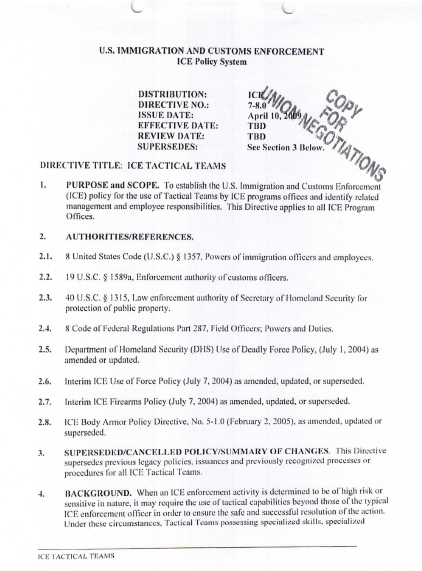
TOP:-SECRET – Immigration and Customs Enforcement Tactical Teams

https://publicintelligence.net/wp-content/uploads/2012/08/ICE-TacticalTeams.png


BACKGROUND. When an ICE enforcement activity is determined to be of high risk or sensitive in nature. It may require the use of tactical capabilities beyond those of the typical ICE enforcement officer in order to ensure the safe and successful resolution of the action. Under these circumstances, Tactical Teams possessing specialized skills, specialized equipment and specialized training to meet these particular challenges may be required. The deployment of these teams can be viewed as the use of an elevated level of force.  For these reasons, it is important for ICE to have processes and procedures for the establishment and operation of these teams, appropriate training and qualification standards for team members, and very specific reporting requirements through defined reporting channels, for team activities.

6. POLICY.

6.1. When an ICE enforcement activity is determined to involve high risk or to be sensitive in nature requiring tactical capabilities beyond those of the typical ICE enforcement officer. Program Office Directors may authorize the use of specialized Tactical Teams in order to ensure the safe and successful resolution of the action. It is the policy of ICE to conduct enforcement operations requiring the use of Tactical Teams as safely and professionally as possible.

6.2. Since the deployment of Tactical Teams to perform enforcement actions is considered to be the use of an elevated level of force, the use of Tactical Teams shall be limited to those circumstances where an elevated level of force and visible presence is deemed necessary to safely and effectively complete an enforcement action. The deployment of Tactical Teams shall be made in accordance with the provisions of this Directive and their use in a particular circumstance shall be justified by articulable facts.

8.12. Deployment of Tactical Teams.

1) Enforcement Actions involving High Risk Activities.

a) High Risk Activities under Normal Conditions. When requesting the deployment of Tactical Teams during enforcement actions that include high-risk activities, the following procedures shall be followed:

i) ICE agents and officers shall submit a request for the deployment of Tactical Teams through their supervisor to tl1e Tactical Supervisor. This request will include a completed Risk Analysis for Tactical Operations which shall be submitted at least 48 hours prior to any ICE enforcement operation.

ii) The Tactical Supervisor will ensure the accuracy and completeness of the Risk Analysis for Tactical Operations that will be used as a guide in determining the need to use Tactical Team resources.

iii) The requesting officer may be assisted by the Tactical Supervisor or Team Leader in preparing the Risk Analysis for Tactical Operations. The requesting officer or agent most knowledgeable of the situation will be readily accessible to provide the Tactical Supervisor with all relevant infom1ation.

iv) In circumstances where a search or arrest warrant will be executed, the requesting officer or agent will ensure the warrant’s validity and provide copies to the Tactical Supervisor, who will verify the warrant.

v) The Risk Analysis for Tactical Operations will be discussed with the requesting officer’s immediate supervisor and the supervisor of the appropriate Tactical Team. If Tactical Supervisors feel that the request justifies the deployment of the Tactical Team they will forward the request to the Field Responsible Official for their approval and authorization to activate the team.

vi) For the purposes of this Directive, examples of high-risk activities include but arc not limited to, the following situations:

A) A suspect with a history of violence or resisting arrest;

B) Fortified buildings, property, vessels, or other structures or conveyances that require the use of specialized equipment to gain access;

C) Suspects who are members of organizations that advocate violence;

D) Situations that would overwhelm the resources and capabilities of an officer or office with standard equipment and training;

E) A disturbance at an ICE detention facility that poses a risk of physical injury; and

F) Other situations where the totality of circumstances presents an above average risk of danger.


DOWNLOAD THE ORIGINAL DOCUMENT HERE:

ICE-TacticalTeams

Ex-Capital Chefredakteur Brunowsky entlarvt die STASI-Stalker- und Erpresser-Spekulanten-Methoden der “GoMoPa” am Beispiel WGF

Nepper Schlepper Bauernfänger im Internet

Im Internet tummeln sich seit einiger Zeit Finanzportale, in denen anonyme Schreiber manipulative Texte verfassen. Sie richten sich in der Regel gegen kleine, marktenge Börsenwerte und kooperieren mit Anwälten, die vorgeblich Kapitalanleger schützen wollen und für die notwendigen Zitate gut sind.
Das ganze funktioniert so:  Ein kritischer Text in “www.börsennews.de” oder “www.gomopa.net“, anonym oder unter falschem Namen geschrieben, stellt Fragen, ob das Geld der Anleger sicher sei, ohne diese Frage zu beantworten. Der Schreiber sendet diesen Text anonym an Medien wie das Handelsblatt oder FTD. Ein kooperierender Anwalt spricht dann vielsagend von Gefahren für den Anleger. Die Anleger reagieren natürlich  verunsichert, der Kurs stürzt ab. Leerverkäufer – wahrscheinlich aus dem Umfeld des Trios Finanzportal, Finanjournalist und Anwalt – haben sich rechtzeitig eingedeckt und sahnen einen kräftigen Gewinn ab.

Die größeren Medien sehen angesichts der Kursverluste nun ebenfalls das Unternehmen in Gefahr, berichten darüber und verunsichern die Anleger zusätzlich. Vom Finanzportal “gomopa.net” ist bekannt, dass es anschließend den Betroffenen einen PR-Beratungsvertrag aufdrücken wollte, den diese dann als “Erpressung” ablehnten, wie die Süddeutsche Zeitung am 3.9.2010 berichtete. Auch das  Handelsblatt hat im April vor einiger Zeit über einen ähnlichen Fall berichtet.
Ich erlebe diese Methoden gerade bei einer ähnlichen Kampagne gegen meinen Mandanten WGF AG. Die WGF AG handelt mit Immobilien, entwickelt großartige Projekte und refinanziert sich mit Hypothekenanleihen. Am 15.11. wurde pünktlich die zweite mit 6,35% verzinste  Hypothekenanleihe im Volumen von 30 Millionen Euro entgegen diversen Unkenrufen pünktlich und vollständig zurückgezahlt.
Im Juli war ein Text unter falschem Namen im Finanzportal “Börsennews” mit Zitaten eines Anwalts erschienen, den der Autor weiteren Medien zuspielte. Unmittelbar darauf stürzten die Kurse mehrere Anleihen von 100 auf teilweise bis zu 60 Prozent. Die Kurse erholten sich dann zwar wieder um 10 bis 15 Prozentpunkte, aber nicht so, dass Raum für die Platzierung neuer Anleihen mit einem Ausgabekurs von 100 blieb. Die WGF war dennoch in der Lage, aus dem gut laufenden operativen Geschäft heraus die Rückzahlung der zweiten Anleihe sicher zu stellen. Anfang der Woche, am Tag nach der Rückzahlung erschien wieder ein anonymer Artikel in “gomopa.net”. So geht die Kampagne weiter.
Selbstverständlich müssen alle Geschäftsmodelle kritisch hinterfragt werden. Unternehmen machen Fehler und müssen diese Fehler auch beheben. Es kann aber nicht sein, dass gewissenlose Leute im Internet ihr Unwesen treiben und ganze Unternehmen attackieren, um damit Geld zu verdienen: Der Anwalt, der dazu beiträgt, Unternehmen zu gefährden, um anschließend Klienten für seinen sogenannten Kapitalanlegerschutz zu generieren, ist genauso hinterhältig wie der Journalist, der sich nicht zu seinen Texten bekennt und anonym oder unter falschem Namen schreibt, um an Kursspekulationen mitzuverdienen.

Yakuza – Full Movie

Yoshihiro Nishimura (The Machine Girl) and Tsuyoshi Kazuno (Robo Geisha) headline this outrageous crime thriller modeled on the Japanese “pink films” of the 1970s, and following the brutal journey of a girl who embarks on a bloody mission of vengeance after her friends are massacred by a ruthless killer.

Child pornography, along with prostitution and drugs, allows the Yakuza – Japans 80 000 strong mafia – to rake in 50 billion dollars a year. We pry open a window on this deadly criminal network.

Produced by ABC Australia Distributed by Journeyman Pictures


Irina Shayk, SI Swimsuit – Get Personal – Video

Get close and personal with SI Swimsuit super model Irina Shayk. For more exclusive photos and videos visit http://si.com/swimsuit

TOP-SECRET-U.S. Treasury Office of Intelligence and Analysis (OIA) Strategic Direction 2012-2015

https://publicintelligence.net/wp-content/uploads/2012/08/USTreasury-OIA-2012-2015.png


Intelligence has played an important role in the exercise of the responsibilities and operations of the Treasury Department since the Department assumed its enforcement responsibilities in 1789. The mission and culture of Treasury’s Office of Intelligence and Analysis builds on this strong tradition of intelligence and national security at the Department.

Intelligence at the Treasury

The Department of the Treasury’s earliest intelligence efforts were exclusively focused on law enforcement with the establishment of criminal intelligence functions within the U.S. Coast Guard and the Internal Revenue Service, which sought to collect and analyze information in support of Treasury’s domestic law enforcement functions. In 1961, the Department established its first foreign intelligence capability, the Office of National Security (ONS), which was charged by Treasury Secretary Douglas Dillon to connect the Treasury Department with the broader efforts of the National Security Council. In 1977, ONS was overhauled and renamed the Office of Intelligence Support (OIS) by Treasury Secretary Michael Blumenthal and Treasury’s place in the U.S. Intelligence Community (IC) formalized on December 4th 1981, under Executive Order 12333, United States Intelligence Activities, by President Ronald Reagan. Finally, in late 2003, Treasury’s intelligence mission and needs were recognized in the Intelligence Authorization Act of 2004 (31 U.S.C. sec. 312), which established OIA.

OIA Activities

Strategic Analysis

OIA’s intelligence analysis has been critical to Treasury efforts to stem the flow of funding to terrorist groups and disrupt weapons proliferation and other illicit networks around the world. Drawing on OIA’s analytic expertise, Treasury has designated multiple individuals and organizations for providing support to al-Qa’ida and other terrorist groups, for trafficking in narcotics, and for engaging in transnational criminal activity. OIA actively supports Treasury’s role in pressuring Iran, which includes bilateral, multilateral, and U.S. financial measures targeting the Iranian proliferation networks, the IRGC-Qods Force, and the Iranian financial and energy sectors. OIA also provides expertise and analytical support to inform Treasury efforts to disrupt North Korean proliferation and regime finance networks, Syrian government abuse of human rights, Mexican transnational criminal networks, and to target financial institutions that threaten the U.S. financial system.

Tactical and Operational Analysis and Support to the Warfighter

Over the years, OIA has developed sophisticated and comprehensive approaches to identifying and disrupting the funding networks underpinning national security threats, and OIA’s analytical expertise has enabled a wide range of U.S. and foreign government actions aimed at disrupting these networks. The Iraq and Afghanistan Threat Finance Cells (ITFC and ATFC, respectively) were established as joint intelligence, military, and law enforcement efforts to identify and disrupt the flow of funding to terrorist and insurgent networks in the war zones. Currently, OIA’s analytic leadership at the ATFC provides critical support to Treasury counterthreat finance programs, as well as law enforcement and military operations. OIA also actively supports law enforcement with intelligence analysis and lead generation, particularly with respect to Mexico and transnational organized crime. Finally, OIA’s work with the U.S. Special Operations Command (SOCOM) and other partners has resulted in enhanced threat finance lead-generation and information-sharing that have enabled U.S. and foreign government actions overseas.

Information-Sharing

In other intelligence disciplines, OIA has also made great strides. OIA regularly disseminates to the IC information with a unique perspective, often receiving positive feedback on its value to consumers. OIA also supports a robust information-sharing effort. Treasury Intelligence Online, OIA’s secure, on-line community of interest has over 5,000 users, growing by 66% from 2010 to 2011. Consistent with its responsibilities under E.O. 12333, OIA regularly collaborates with key foreign partners and is always looking for ways to better share critical information with those who can act on it.

Security

OIA’s security mission is to provide policy, strategic, and operational direction to the Department on issues relating to Treasury’s security functions and programs. These responsibilities are codified in 31 U.S.C. sec. 312, Executive Orders, Intelligence Community Directives, and other laws and regulations. This includes all aspects of information and physical security, IT security oversight, personnel and industrial security, classification management, and Critical Infrastructure/Physical Security (CIPS) program management.

Counterintelligence

OIA has increased its focus on counterintelligence. The Office of Counterintelligence was created as part of OIA’s security element and is placing emphasis on counterintelligence awareness training, foreign travel and foreign contact reporting, insider threat, CI/Cyber, and Treasury-specific threat identification. Our counterintelligence professionals are also key contributors to IIRs released by OIA.

Facilitating Partnerships

A significant responsibility of OIA is to enable Treasury to meet its national security mission through the integration of the Department and the IC. Relationship-building, though, goes beyond sharing of information; recognition of compatible mission areas and complementary capabilities is key. For example, OIA has fostered the relationship between the Department’s Office of Critical Infrastructure Protection and Compliance Policy and information assurance elements within the IC. Treasury is the financial sector lead for critical infrastructure protection and relies on interagency partners to provide information on risks and vulnerabilities of the domestic financial sector, and OIA works to ensure open channels of communication and mutual understanding between our Departmental and IC colleagues.


https://publicintelligence.net/wp-content/uploads/2012/08/oia-logo.png


DOWNLOAD THE ORIGINAL DOCUMENT HERE:

USTreasury-OIA-2012-2015


TMZ – Vince Neil BLOWS UP at Valet — ‘GIVE ME MY F**KING CAR!!!’

http://www.youtube.com/watch?v=khUSOOy0hOo

Vince Neil exploded on a group of parking attendants at the Planet Hollywood in Vegas last week — banging on windows and screaming “GIVE ME MY F**KING CAR” … and the outburst was all caught on tape.

The STASI-Surveillance of the Church – Die STASI-Überwachung der Kirche

DOWNLOAD THE ORIGINAL FILE HERE:

Stasi-Ueberwachung+der+EKKPS


FEMEN – Activists Saw Down Cross in Kiev in Support of Russian Punk Band

http://www.dailymotion.com/video/xswn22_raw-video-femen-activists-saw-down-cross-in-kiev-in-support-of-russian-punk-band_news?search_algo=2

Crime Inc. – Snoop Dogg Trial/The Axe Murders – Full DocumentaryMovie

http://www.youtube.com/watch?v=-qJ6niw9–Q


A special about infamous crimes and murders.

Der Beweis: Betrugs-Urteil gegen„GoMoPa“-Maurischat: Betrug am eigenen Anleger wg € 10.000,-

Der Beweis: Betrugs-Urteil gegen„GoMoPa“-Maurischat:  Betrug am eigenen Anleger wg € 10.000,-

(Investment Magazin, Investment, Das Investment) DAS ORIGINAL – Über eine selbstgebaute Blogseite verbreiten die GoMoPa-Gangster eine gefälschte Stellung von Meridian Capital, um Verwirrung zu stiften.

siehe auch

http://www.immobilien-vertraulich.com/law/7273-der-beweis-betrugs-urteil-gegengomopa-maurischat-betrug-am-eigenen-anleger-wg–10000-.html

Diese Blogseite existiert erst seit Dezember 2010.
Beweis:
http://www.hypestat.com/pressreleaser.org
Die Meridian Capital-Seite, das Original,
http://othergomopa.blogspot.com/
ist dagegen bereits seit2009 online
Beweis: Aussage Meridian Capital – das Unternehmen können Sie auch gerne direkt kontaktieren.
und
KLAUS DIETER MAURISCHAT IN DETENTION
Source: http://klaus-dieter-maurischat.blogspot.com/2009/01/klaus-dieter-maurischat-in-haft.html
Hintergrund: Die Verurteilung von Klaus Maurischat und Mark Vornkahl wegen Betruges am eigenen Anleger

Klaus Maurischat und Mark Vornkahl, Betreiber vonwww.gomopa.net: Am 24. April 2006 war die Verhandlung am Amtsgericht Krefeld in der Betrugssache: Mark Vornkahl / Klaus Maurischat ./. Dehnfeld. Aktenzeichen: 28 Ls 85/05 Klaus MaurischatLange Straße 3827313 Dörverden.Das in diesem Verfahren ausschließlich diese Betrugsache verhandelt wurde, ist das Urteil gegen Klaus Maurischat recht mäßig ausgefallen.Zusammenfassung der Verhandlung vom 24.04.2006 vor dem Schöffengericht des AG Krefeld in der Sache gegen Klaus Maurischat und Mark Vornkahl.Zur Hauptverhandlung erschienen:Richter Dr. Meister, 2 Schöffen,Staatsanwalt, Angeklagter Klaus Maurischat, vertr. durch RA Meier, Berlin; aus der U-Haft zur Verhandlung überführt.1. Eine Gerichtsvollzieherin stellt unter Ausschuss der Öffentlichkeit eine Urkunde an den Angeklagten Maurischat zu.2. Bei Mark Vornkahl wurde im Gerichtssaal eineTaschenpfändung vorgenommen.Beginn der HauptverhandlungDie Beklagten verzichten auf eine Einlassung zu Beginn.Nach Befragung des Zeugen Denfeld zum Sachverhalt wurde dieVerhandlung auf Wunsch der Staatsanwaltschaft und den Verteidigern unterbrochen.Der Angeklagte Maurischat gab nach Fortsetzung derHauptverhandlung Folgendes zu Protokoll:Er sähe ein, dass das Geld auf das falsche Konto gegangen sei und nicht dem eigentlichen Verwendungszweck zugeführt wurde. Das Geld sei aber zurückgezahlt worden und er distanziere sich ausdrücklich von einem Betrug.Schließung der BeweisaufnahmeDer Staatsanwalt verließt sein PlädoyerEr halte am Vorwurf des Betruges fest. Mit Hinweis auf die einschlägigen Vorstrafen des Angekl. Maurischatund auf laufende Ermittlungsverfahren, beantrage er ein Strafmaß von 1 Jahr und 6 Monaten.Er halte dem Angeklagten zu Gute, dass dieserWiedergutmachung geleistet habe, und dass dieser geständig war. Zudem läge die letzte Verurteilung wegen Betruges 11 Jahre zurück. Auch sei der Geschädigte nicht in existentielle Not geraten, wobei der Staatsanwalt nicht über noch laufende Verfahren hinweg sehen könne. Er läge aber dem Angeklagten Maurischat nahe, keine weiteren Aktivitäten im Bezirk der Staatsanwaltschaft Krefeld auszuüben, insbesondere möchte er, dass keine weiteren Anleger im Bezirk der Staatsanwaltschaft Krefeld durch GoMoPa akquiriert werden.Die Freiheitsstrafe soll zur Bewährung ausgesetzt werden.Plädoyer des Verteidigers des Angekl. Maurischat, Herrn RA MeierEr schließe sich, wie (in der Unterbrechung) vereinbart, dem Staatsanwalt an.Es stimme, dass sein Mandant Fehler in seiner Vergangenheit gemacht habe, und dass er auch diesmal einen Fehler begangen haben könnte, jedoch sei der Hinweis wichtig, dass sein Mandant aus diesen Fehlern gelernt habe.Der Angeklagte haben das letzte Wort.Maurischat sagt, es sei bereits alles gesagt worden.Unterbrechung zu Hauptverhandlung. Der Richter zieht sich mit den Schöffen zur Beratung zurück.Urteilsverkündung:Der Angeklagte wird des gemeinschaftlichen Betrugs für schuldig befunden.Der Angeklagte Klaus Maurischat wird zu einerFreiheitsstrafe von 1 Jahr und 6 Monaten verurteilt. Diese wird zur Bewährung ausgesetzt.Die Bewährungszeit wird auf 3 Jahre festgesetzt.Der Haftbefehl gegen Klaus Maurischat wird aufgehoben.Der Angeklagte trage die Kosten des Verfahrens.UrteilsbegründungDer Richter erklärt, dass eine Täuschung des Geschädigtenvorliegt und somit keine Untreue in Betracht kommen kann.Die Fragen, ob es sich um einen Anlagebetrug handele sei irrelevant. Er hält den Angeklagten die geleistete Wiedergutmachung zu Gute.Ebenso ist das Geständnis für die Angeklagten zu werten. Zudem liegt die letzte Verurteilung des Angeklagten Maurischat 11 Jahre zurück.Die Parteien verzichten auf Rechtsmittel. Das Urteil ist somit rechtskräftig.Mit dem heutigen Urteil endet ein Kapitel in derBetrugssache Goldman Morgenstern & Partners, Klaus Maurischat und Mark Vornkahl.Alle GoMoPa.net Verantwortlichen, Maurischat, Vornkahl und Henneberg sind nun vorbestrafte Abzocker und Betrüger und die Zukunft der Pseudoklitsche GoMoPa.net sieht duster aus.Mir dem Geständnis der beiden ABZOCKER MAURISCHAT UND VORNKAHL vor Gericht bricht ein jahrelangaufrechterhaltenes Lügengeflecht von einigen primitiven Betrügern zusammen. Gewohnheitsverbrecher und Denunzianten,die rechtschaffene Personen und Firmen in ihren Verbrecherforen kriminalisierten.

Unternehmensinformation / Kurzprofil: INVESTMENT (das Original) erscheint mit einer deutschen Ausgabe, einer globalen Ausgabe und einer Asien-Ausgabe seit mehr als 10 Jahren als unabhängiges Magazin fürInvestoren und Finanzprofis. Dabei stehen die sogenannten “HNWI im Fokus”. Unterstützt durch das Wachstum der Börsenkapitalisierungen in den Schwellenländern stieg das Gesamtvermögen der weltweiten High Net Worth Individuals (HNWI – Privatpersonen mit Nettofinanzvermögen > 1 Mio. US-Dollar ohne Verbrauchsgüter und eigengenutzte Immobilien) im Jahr um 9,4% auf 40,7 Billionen US-Dollar. Dies geht aus dem von Merrill Lynch und Capgemini veröffentlichten zwölften, jährlich erscheinenden, World Wealth Report hervor. Die weltweite Anzahl der HNWI nahm 2007 um 6% auf 10,1 Millionen zu. Gleichzeitig stieg die Zahl der besonders wohlhabenden Personen (Ultra High Net Worth Individuals – UHNWI – Privatpersonen mit Nettofinanzvermögen > 30 Mio. US-Dollar ohne Verbrauchsgüter und eigengenutzte Immobilien) um 8,8%. Erstmals seit Bestehen dieses Reports wurde beim durchschnittlichen Finanzvermögen der HNWI die Schwelle von 4 Millionen US-Dollar überschritten.
INVESTMENT gehört zu EBIZZ.TV.
Über EBIZZ.TV: EBIZZ TV ist im Veoh-Verbund mit über 600 eigenen Internet-TV-Kanälen und 100.000 assoziierten Kanälen eines der global reichweitenstärksten aber auch zielgruppengenauesten Portale. Im Februar erzielte das Netzwerk laut Nielsen Net Ratings über 28 Mio. Unique User, an Page Views über 350 Millionen (210 Millionen an Video Streams).
(Reporting Sandra Lowe ; Editing George Highbottom, Magister Bernd Pulch* und Kim Halburton)

Aus sicherheitstechnischen Gründen geben wir zu unseren Mitarbeitern keine weiteren persönlichen Daten bekannt.

siehe unseren Kreuzzug gegen Cyber Stalking

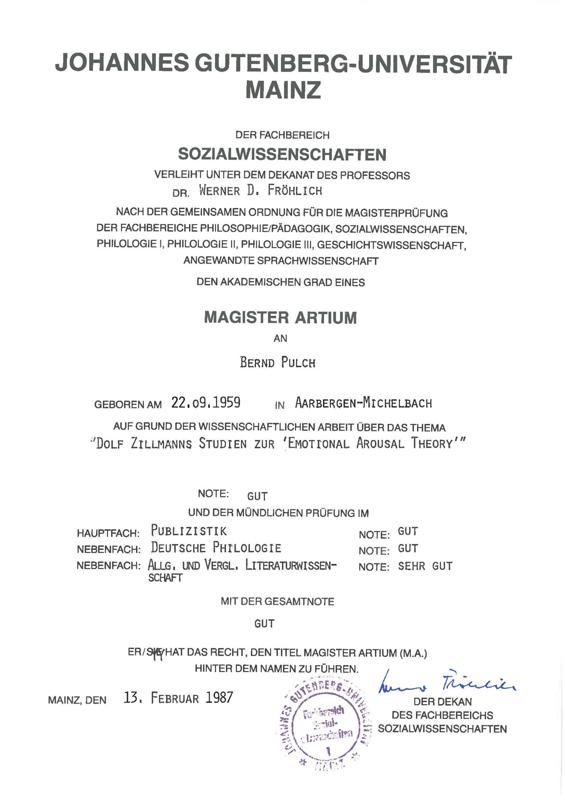
*Magister Bernd M. Pulch (MA – Magister Artium)

Abschluss des Studiums der Publizistik (Note 2) , Komparatistik (Note 1) und Germanistik (Note 1-2) 1988

Universität Mainz

Magisterarbeit bei Professor Kepplinger über Dolf Zillmanns “Emotional Arousal Theory”1987, Mainz, 400 Seiten

Sie können die Magisterarbeit bei uns zum Preis von nur € 99,- über das Kontaktformular bestellen.

Die Zahlung erfolgt per Vorkasse. Die Lieferzeit beträgt ca. 14 Tage in Deutschland.

© 2011 für Texte und gestaltete Anzeigen beim Verlag. Nachdruck, Vervielfältigung und elektronische Speicherung nur unter Quellenangabe und mit schriftlicher Genehmigung gestattet.

http://www.berndpulch.org

Investment Magazin, Investment, Das Investment

Das Handelsblatt über die Serienbetrüger der “GoMoPa”

http://www.handelsblatt.com/finanzen/boerse-maerkte/boerse-inside/marktgeruechte-finanzaufsicht-untersucht-kursachterbahn-bei-wirecard/3406252.html

Sex, Lies and Julian Assange – Full Movie

He had just humiliated the most powerful nation in the world, heading one of the most controversial cyber operations in history. So when Julian Assange arrived in Sweden in August 2010 he was greeted like a conquering hero. But within weeks there was a warrant out for his arrest and he was being investigated for rape and sexual molestation. However, as the details of the allegations against Assange emerged, suspicions arose over the legal barrage being aimed at him. Exploring the mysterious circumstances surrounding the case, this doc gets to the heart of a bizzare tale of international cat and mouse.
“Sitting outdoors with the world’s coolest, smartest people! It’s amazing!”, Anna Ardin tweeted, as she sat at a barbecue she had arranged for Assange. Yet according to the allegations she would later bring against him he had recently sexually abused her. “You wouldn’t send such messages if you had been raped by someone the night before”, argues Assange’s lawyer. Both Assange and his supporters believe the attempt to force his return to Sweden is simply the first step in a plan to see him extradited to the United States and that the case against him is a set up.
It’s clear that when Assange arrived in Sweden Anna Ardin & Sofia Wilen were both enthralled by the Wikileaks phenomena and he slept with both women over a period of weeks. The charges originated with a misunderstanding in a Stockholm police station that “some sort of sex crime had been committed”. Wilen refused to sign what had been taken down. Assange was interviewed but not charged with any offence. But 12 days after being given permission to leave the country, the case was re-opened and the Swedes issued a warrant for his arrest.
At this point Assange was at the height of his powers and three weeks later he delivered a massive hit against America: the Iraq War Logs. An outraged US labelled him a “traitor” and were overcome with calls to “shoot the son-of-a-bitch”. Shortly afterwards Sweden issued an Interpol Red Notice for his arrest; a highly unusual move. “Red Notices are normally the preserve of terrorists and dictators. Even Gaddafi was not subject to a Red Notice.”
After 500 days of fighting extradition from the UK to Sweden, Assange made his dramatic dash to the Ecuadorian embassy. In an interview from inside, Assange claims he had sensed the net tightening around him when, “the Swedish government publicly announced that it would detain me without charge in severe conditions. On the same evening security contractors turned up unannounced at 10:30pm and insisted on fitting another manacle to my leg”.
Following the complex twists and turns of the entire saga, this documentary charts a case far more complex than the Swedes seem to be admitting to. When pressed about the strange manner in which the charges were brought the answer is baffling: “I can very well understand the confusion…it is very difficult to understand, well, exactly how it works.” And as Assange’s US lawyer points out, he should be worried. “I’d be very nervous, because if the United States get their hands on you, you’re a goner.”


The Law and the STASI – Strafverfolgung der STASI-Untaten

DOWNLOAD THE ORIGINAL DOCUMENT HERE:

strafverfolgung

SI Swimsuit – Marisa Miller Body Painting Video

Marisa Miller’s body become a canvas in this SI Swimsuit 2008 Body Painting video.
For more SI Swimsuit photos and videos go to http://www.si.com/swimsuit

Unveiled by Cryptome and the Media – Free Syrian Army Photos 4

Free Syrian Army Photos 4

[Image]

A Syrian boy receives treatment after he was wounded when shells, released by a helicopter from regime forces, hit his house in Syria’s northern city of Aleppo, on August 24, 2012. Syrian forces blitzed areas in and around the Aleppo, activists said, as Western powers sought to tighten the screws on embattled President Bashar al-Assad. Getty

[Image]

A Syrian girl receives treatment after she was wounded when shells, released by a regime force’s helicopter, hit her house in Syria’s northern city of Aleppo, on August 24, 2012. Syrian forces blitzed areas in and around the Aleppo, activists said, as Western powers sought to tighten the screws on embattled President Bashar al-Assad. Getty

[Image]

[Image]

[Image]

A man carries a four month old baby to hospital after shelling by a regime forces helicopter hit his family’s house in Syria’s northern city of Aleppo on August 24, 2012. Syrian forces blitzed areas in and around the Aleppo, activists said, as Western powers sought to tighten the screws on embattled President Bashar al-Assad. Getty

[Image]

A Syrian boy receives treatment after he was wounded when shells, released by a regime forces helicopter, hit his house in Syria’s northern city of Aleppo, on August 24, 2012. Syrian forces blitzed areas in and around the Aleppo, activists said, as Western powers sought to tighten the screws on embattled President Bashar al-Assad. Getty

[Image]

A Syrian man is brought to hospital after he was wounded during an airstrike, carried out by a regime forces helicopter, in Syria’s northern city of Aleppo, on August 24, 2012. Syrian forces blitzed areas in and around the Aleppo, activists said, as Western powers sought to tighten the screws on embattled President Bashar al-Assad. Getty

[Image]

Rebel fighters run for cover during battle against Syrian government forces at the al-Mashad neighbourhood in the northern Syrian city of Aleppo on August 25, 2012. Syrian rebels say they are digging in for a war of attrition in Aleppo, where what was being billed as the ‘mother of all battles’ is now dragging on into a second month of bloody stalemate. Getty

[Image]

[Image]

A Rebel fighter gestures to his commanders during battle against pro- Syrian government forces at the al-Mashad neighbourhood in the northern Syrian city of Aleppo on August 25, 2012. Syrian rebels say they are digging in for a war of attrition in Aleppo, where what was being billed as the ‘mother of all battles’ is now dragging on into a second month of bloody stalemate. Getty

[Image]

Rebel fighters fire against pro- Syrian government forces at the al-Mashad neighbourhood in the northern Syrian city of Aleppo on August 25, 2012. Syrian rebels say they are digging in for a war of attrition in Aleppo, where what was being billed as the ‘mother of all battles’ is now dragging on into a second month of bloody stalemate. Getty

[Image]

Rebel fighters fire against pro- Syrian government forces at the al-Mashad neighbourhood in the northern Syrian city of Aleppo on August 25, 2012. Syrian rebels say they are digging in for a war of attrition in Aleppo, where what was being billed as the ‘mother of all battles’ is now dragging on into a second month of bloody stalemate. Getty

[Image]

Civilians stand outside their building following shelling from Syrian government forces in the northern Syrian city of Aleppo August 25, 2012. Reuters

[Image]

A Syrian family evacuates the Shif al-Dolwa neighborhood in the northern city of Aleppo on August 25, 2012 during fighting between rebel fighters and Syrian government forces. Syrian rebels say they are digging in for a war of attrition in Aleppo, where what was being billed as the ‘mother of all battles’ is now dragging on into a second month of bloody stalemate. Getty

[Image]

Free Syrian Army fighters rest after coming back from the frontline at the Seif El Dawla neighbourhood in Aleppo August 25, 2012. Reuters

[Image]

Members of the Free Syrian Army take up position during clashes with Syrian army soldiers in Aleppo’s Saif al-Dawla district, August 25, 2012. Reuters

[Image]

A member of the Free Syrian Army runs for cover during clashes with Syrian army soldiers in Aleppo’s Saif al-Dawla district, August 25, 2012. Reuters

[Image]

Free Syrian Army fighters read new plans to get to the frontline at the Seif El Dawla neighbourhood in Aleppo August 25, 2012. Reuters

[Image]

Free Syrian Army fighters prepare to get to the frontline at the Seif El Dawla neighbourhood in Aleppo August 25, 2012. Reuters

[Image]

A member of the Free Syrian Army holds an unexploded shell as he eats during clashes with Syrian army soldiers in Aleppo’s Saif al-Dawla district, August 25, 2012. Reuters

[Image]

Free Syrian Army fighters guard the city centre in Aleppo August 25, 2012. Reuters

[Image]

Free Syrian Army fighters check people riding a motorcycle in the city centre in Aleppo August 25, 2012. Reuters

[Image]

Smoke rises from a building during clashes between the Free Syrian Army and Syrian army soldiers in Aleppo’s Saif al-Dawla district, August 25, 2012. Reuters

[Image]

A Rebel fighter escorts a Syrian youth out of combat area during battle against pro-Syrian government forces at the al-Mashad neighbourhood in the northern Syrian city of Aleppo on August 25, 2012. Syrian rebels say they are digging in for a war of attrition in Aleppo, where what was being billed as the ‘mother of all battles’ is now dragging on into a second month of bloody stalemate. Getty

[Image]

Civilians search for personal belongings in the rubble of their house following shelling from Syrian government forces in the Syrian northern city of Aleppo on August 25, 2012. Syrian rebels say they are digging in for a war of attrition in Aleppo, where what was being billed as the ‘mother of all battles’ is now dragging on into a second month of bloody stalemate. Getty

[Image]

Pro-Syrian government forces shell the northern Syrian city of Aleppo on August 25, 2012. Syrian rebels say they are digging in for a war of attrition in Aleppo, where what was being billed as the ‘mother of all battles’ is now dragging on into a second month of bloody stalemate. Getty

[Image]

Syrian regime soldiers are seen talking to local residents at the Seif El Dawla neighbourhood of Syria’s south west city of Aleppo August 23, 2012. Picture taken August 23, 2012. Reuters

[Image]

In this Friday, Aug. 24, 2012 photo, Syrian prisoners stand by the doorway of a makeshift prison run by rebels in a former elementary school in Al-Bab on the outskirts of Aleppo, Syria. Many improvised detention centers have sprung up as rebels wrest cities from army control, but these facilities fall under no national or regional authority, causing concern among rights groups. AP

TMZ – Prince Harry Naked Photos — Chippendales Ask Prince to STRIP

Chippendales at the Rio in Vegas have made an official guest host offer to Prince Harry after seeing his naked shenanigans on The Strip… might want to make sure there are no cameras in the audience this time.

Unveiled by Cryptome and the Media – Free Syrian Army Photos 3

Free Syrian Army Photos 3

[Image]

A Free Syrian Army fighter comforts a young wounded boy at a hospital in Syria’s northern city of Aleppo, who was injured when a shell, released by regime forces, hit his house on August 24, 2012. Syrian forces blitzed areas in and around the Aleppo , activists said, as Western powers sought to tighten the screws on embattled President Bashar al-Assad. Getty

[Image]

A young boy runs across the street during clashes between Free Syrian Army fighters and forces loyal to President Bashar al-Assad in Syria’s northern city of Aleppo, on August 24, 2012. Syrian forces blitzed areas in and around the Aleppo, activists said, as Western powers sought to tighten the screws on embattled President Bashar al-Assad. Getty

[Image]

Syrians throw earth over the grave of Free Syrian Army fighter, Emad Nimeh, 18, who was killed today in an airstrike, during his funeral procession in Al-Bab, on the outskirts of Aleppo, Syria, Friday, Aug. 24, 2012. Reuters

[Image]

Members of the Free Syrian Army carry their wounded comrade, who was shot during clashes with Syrian army soldiers, in Aleppo’s Saif al-Dawla district, August 24, 2012. Reuters

[Image]

A Free Syrian Army fighter runs across the street during clashes with forces loyal to President Bashar al-Assad in Syria’s northern city of Aleppo, on August 24, 2012. Syrian forces blitzed areas in and around the Aleppo, activists said, as Western powers sought to tighten the screws on embattled President Bashar al-Assad. Reuters

[Image]

A Free Syrian Army fighter aims fire at regime forces during clashes in Syria’s northern city of Aleppo, on August 24, 2012. Syrian forces blitzed areas in and around the Aleppo, activists said, as Western powers sought to tighten the screws on embattled President Bashar al-Assad. Reuters

[Image]

A Free Syrian Army fighter walks after he was injured in Bustan el Kasr, in the city of Aleppo, August 24, 2012. Reuters

[Image]

Members of the Free Syrian Army make their way to the front line during clashes with Syrian army soldiers in Aleppo’s Saif al-Dawla district, August 24, 2012. Reuters

[Image]

A member of the Free Syrian Army inspects a damaged taxi after a raid by Syrian army helicopter in Aleppo’s Saif al-Dawla district, August 24, 2012. Reuters

[Image]

Weapons used by the Free Syrian Army are seen at the Seif El Dawla neighbourhood of Syria’s south west city of Aleppo August 23, 2012.  Reuters


[Image]

A Free Syrian Army fighter runs away to take cover from the exchange fire with regime forces in the Seif El Dawla neighbourhood of Syria’s south west city of Aleppo August 24, 2012. Reuters

[Image]

[Image]

[Image]

[Image]

[Image]

Free Syrian Army fighters run to take cover away from the exchange fire while fighting with regime forces in the Seif El Dawla neighbourhood of Syria’s south west city of Aleppo, August 24, 2012. Reuters

[Image]

[Image]

Free Syrian Army fighter gesture as they fire a launcher towards regime forces in the Seif El Dawla neighbourhood of Syria’s south west city of Aleppo August 24, 2012. Reuters

[Image]

[Image]

Free Syrian Army fighters take cover as they exchange fire with regime forces in the Seif El Dawla neighbourhood of Syria’s south west city of Aleppo, August 24, 2012. Reuters

[Image]

[Image]

Free Syrian Army fighters take cover from an explosion at a building in the Seif El Dawla neighbourhood of Syria’s south west city of Aleppo, August 24, 2012. Reuters

[Image]

A Free Syrian Army fighter walks after he was injured in Bustan el Kasr, in the city of Aleppo, August 24, 2012. Reuters

[Image]

A Free Syrian Army fighter rests after he was injured by in Bustan el Kasr, the city of Aleppo, August 24, 2012. Reuters

[Image]

Free Syrian Army fighters take cover as they exchange fire with regime forces in the Seif El Dawla neighbourhood of Syria’s south west city of Aleppo, August 24, 2012. Reuters

Crime Inc. – Russia’s Serial Killers/Andrei Chikatilo/Ted Bundy – Full Movie

http://www.youtube.com/watch?v=7HfLkomt72I

A special about infamous crimes and murders.

Nikolai Dzhumagaliev (1952, Cyrillic: Николай Джумагалиев) is a Kazakhstani serial killer. He was found to have killed seven women before he was caught in 1981 but it is felt, however, that he killed somewhere between 50 to 100 women. He was also known as “Metal Fang” for his white metal teeth.

The Structure of the STASI – Die Strukur der STASI

DOWNLOAD THE ORIGINAL DOCUMENT HERE:

struktur-mfs

Die peinlichen STASI-Fälscher der “GoMoPa”

THE INVESTMENT – MAGAZINE – THE ORIGINAL – DAS INVESTMENT MAGAZIN – DAS ORIGINAL – Sehr geehrte Damen und Herren,

die Betrüger und durch uns inhaftierten Erpresser der GoMoPa versuchen mit einer gefälschten Presse-Mitteilung von sich abzulenken und einen investigativen Journalisten, Bernd Pulch, zu belasten.

Die Presse-Mitteilung auf pressreleaser.org ist eine Fälschung und die gesamte Webseite ist der GoMoPa zu zuordnen.

Hier noch einmal die tatäschlichen Geschehnisse:

Hier der Artikel von “GoMoPa” über Meridian Capital.

„GoMopa“ schreibt:08.09.2008
Weltweite Finanzierungen mit WidersprüchenDie Meridian Capital Enterprises Ltd. gibt an, weltweite Finanzierungen anbieten zu können und präsentiert sich hierbei auf aufwendig kreierten Webseiten. GOMOPA hat die dort gemachten Angaben analysiert und Widersprüche entdeckt.Der FirmensitzDer Firmensitz befindet sich laut eigener Aussage in Dubai, Vereinigte Arabische Emirate. In einem GOMOPA vorliegenden Schreiben der Meridian Capital Enterprises Ltd. heißt es jedoch, der Firmensitz sei in London. Auf der Homepage des Unternehmens taucht die Geschäftsadresse in der Londoner Old Broad Street nur als „Kundenabteilung für deutschsprachige Kunden“ auf. Eine weitere Adresse in der englischen Hauptstadt, diesmal in der Windsor Avenue, sei die „Abteilung der Zusammenarbeit mit Investoren“.Die Meridian Capital Enterprises ist tatsächlich als „Limited“ (Ltd.) mit Sitz in England und Wales eingetragen. Aber laut Firmenhomepage hat das Unternehmen seinen „rechtlichen Geschäftssitz“ in Dubai. Eine Abfrage beim Gewerbeamt Dubais (DED) zu dieser Firmierung bleibt ergebnislos.Bemerkenswert ist auch der vermeintliche Sitz in Israel. Auf der Webseite von Meridian Capital Enterprises heißt es: „Die Firma Meridian Capital Enterprises Ltd. ist im Register des israelischen Justizministeriums unter der Nummer 514108471, gemäß dem Gesellschaftsrecht von 1999, angemeldet.“ Hierzu Martin Kraeter, Gomopa-Partner und Prinzipal der KLP Group Emirates in Dubai: „Es würde keinem einzigen Emirati – geschweige denn einem Scheich auch nur im Traum einfallen, direkte Geschäfte mit Personen oder Firmen aus Israel zu tätigen. Und schon gar nicht würde er zustimmen, dass sein Konterfei auch noch mit vollem Namen auf der Webseite eines Israelischen Unternehmens prangt.“Auf der Internetseite sind diverse Fotos mit Scheichs an Konferenztischen zu sehen. Doch diese großen Tagungen und großen Kongresse der Meridian Capital Enterprises werden in den Pressearchiven der lokalen Presse Dubais mit keinem Wort erwähnt.
Martin Kraeter: „ Ein ‚britisch-arabisch-israelisches bankfremdes Finanzinstitut sein zu wollen, wie die Meridian Capital Enterprises Ltd. es darstellt, ist mehr als zweifelhaft. So etwas gibt es schlicht und ergreifend nicht! Der Nahostkonflikt schwelt schon seit mehr als 50 Jahren. Hier in den Vereinigten Arabischen Emiraten (VAE) werden Israelis erst gar nicht ins Land gelassen. Israelische Produkte sind gebannt. Es gibt nicht einmal direkte Telefonverbindungen. Die VAE haben fast 70% der Wiederaufbaukosten des Libanon geschultert, nachdem Israel dort einmarschiert ist.“
Zwei angebliche Großinvestitionen der Meridian Capital Enterprises in Dubai sind Investmentruinen bzw. erst gar nicht realisierte Projekte. Das Unternehmen wirbt mit ihrer finanziellen Beteiligung an dem Dubai Hydropolis Hotel und dem Dubai Snowdome.

Der Aktivitätsstatus der Meridian Capital Enterprises Ltd. ist laut englischen Handelsregister (UK Companies House) „dormant“ gemeldet. Auf der Grundlage des englischen Gesellschaftsrechts können sich eingetragene Unternehmen selbst „dormant“ (schlafend) melden, wenn sie keine oder nur unwesentliche buchhalterisch zu erfassende Transaktionen vorgenommen haben. Dies ist angesichts der angeblichen globalen Investitionstätigkeit der Meridian Capital Ltd. sehr erstaunlich.

Der Webauftritt

Die Internetseite der MCE ist sehr aufwendig gestaltet, die Investitionen angeblich in Millionen- und Milliardenhöhe. Bei näherer Betrachtung der Präsentationselemente fällt jedoch auf, dass es sich bei zahlreichen veröffentlichen Fotos, die Veranstaltungen der Meridian Capital Enterprises dokumentieren sollen, meist um Fotos von Online-Zeitungen oder frei zugänglichen Medienfotos einzelner Institutionen handelt wie z.B. der Börse Dubai.

Auf der Internetpräsenz befinden sich Videofilmchen, die eine frappierende Ähnlichkeit mit dem Werbematerial von NAKHEEL aufweisen, dem größten Bauträger der Vereinigten Arabischen Emirate. Doch den schillernden Videos über die berühmten drei Dubai Palmen „Jumeirah, Jebel Ali und Deira“ oder das Archipel „The World“ wurden offensichtlich selbstproduzierte Trailersequenzen der Meridian Capital Enterprises vorangestellt. Doch könnte es sich bei den Werbevideos um Fremdmaterial handeln.

Auch die auf der Webseite wahllos platzierten Fotos von bekannten Sehenswürdigkeiten Dubais fungieren als Augenfang für den interessierten Surfer mit eigenem Finanzierungswunsch. Bei einem Volumen von 10 Millionen Euro oder höher präsentiert sich die Meridian Capital Enterprises Ltd. als der passende Investitionspartner. Das Unternehmen verfügt weltweit über zahlreiche Standorte: Berlin, London, Barcelona, Warschau, Moskau, Dubai, Riad, Tel Aviv, Hong Kong und New York. Aber nahezu alle Standorte sind lediglich Virtual Offices eines global arbeitenden Büroservice-Anbieters. „Virtual Office“ heißt im Deutschen schlicht „Briefkastenfirma“. Unter solchen Büroadressen sollen laut Meridian Capital Enterprises ganze Kommissionen ansässig sein, alles zum Wohle des Kunden.“

Zitatende

Hier die Hintergründe der Erpressung:

http://www.immobilien-vertraulich.com/law/7154-opfer-nach-immovation-und-estavis-versucht-gomopa-nun-dkb-zu-erpressen-gomopa-hintermann-ra-resch.html

Hier unsere Original-Stellungnahme:

Anfang Oktober 2008 erhielt einer der Arbeiter der Meridian Capital Enterprises Ltd. eine Meldung von einem anonymen Sender, dass in naher Zukunft – zuerst im Internet, dann im Fernsehen, im Radio und in der deutschen Presse – Informationen erscheinen, die die Funktionsweise und Tätigkeiten der Meridian Capital Enterprises Ltd. in einem äußerst negativen Licht darstellen. Der Mitarbeiter der Meridian Capital Enterprises Ltd. wurde also informiert, dass diese Meldungen/Nachrichten zweifelsohne deutlich das Aussehen und den guten Ruf der Firma Meridian Capital Enterprises Ltd. beeinträchtigen.
Der an dieser Stelle erwähnte „Gesprächspartner” hat den Arbeiter der Meridian Capital Enterprises Ltd. informiert, dass die Möglichkeit besteht die peinliche Situation zu vermeiden, indem die Meridian Capital Enterprises Ltd. auf das von der Person gezeigte Konto die Summe von 100.000,00 EUR überweist. Wie sich aber später zeigte, war der Herr Klaus Maurischat – dieser anonyme Gesprächspartner – „Gehirn“ und „Lider des GOMOPA“. Die Ermittlungen wurden angestellt durch die Bundeskriminalpolizei (Verfolgungs- und Ermittlungsorgan auf der Bundesebene) während des Ermittlungsverfahrens wegen einer finanziellen Erpressung, Betrügereien auch wegen der Bedrohungen, welche von Herrn Maurischat und seine Mitarbeiter praktiziert wurden sowie wegen Teilnahme anderer (Leiter der Internetservices und Moderatoren der Blogs) an diesem Prozedere. Diese Straftaten wurden begangen zu Schaden vieler Berufs- und Justizpersonen, darunter auch der Meridian Capital Enterprises Ltd. Die Opfer dieses Verbrechens sind in Deutschland, Österreich, der Schweiz, Spanien, Portugal, Großbritannien, den USA und Kanada sichtbar.
In diesem Moment taucht folgende Frage auf: Wie war die Reaktion der Meridian Capital Enterprises Ltd. auf die Forderungen seitens GOMOPA? Entsprach die Reaktion den Erwartungen von GOMOPA? Hat die Meridian Capital Enterprises Ltd. die geforderte Summe 100.000,00 EUR überwiesen?
Seites der Meridian Capital Enterprises Ltd. gab es überhaupt keine Reaktion auf den Erpressungsversuch von GOMOPA. Ende August 2008 auf dem Service http://www.gompa.net sind zahlreiche Artikel/Meldungen erscheinen, welche die Tätigkeit der Meridian Capital Enterprises Ltd. in einem sehr negativen Licht dargestellt haben. Nachdem die auf http://www.gomopa.net enthaltenen Informationen ausführlich und vollständig analysiert worden waren, ergab es sich, dass sie der Wahrheit nicht einmal in einem Punkt entsprechen und potenzielle und bereits bestehende Kunden der Meridian Capital Enterprises Ltd. in Bezug auf die von diesem Finanzinstitut geführten Geschäftstätigkeit irreführen. Infolge der kriminellen Handlugen von GOMOPA und der mit ihm kooperierenden Services und Blogs im Netz hat die Meridian Capital Enterprises Ltd. beachtliche und messbare geschäftliche Verluste erlitten. Die Meridian Capital Enterprises Ltd. hat nämlich in erster Linie eine wichtige Gruppe von potenziellen Kund verloren. Was sich aber als wichtiger ergab, haben sich die bisherigen Kunden von der Meridian Capital Enterprises Ltd. kaum abgewandt. Diejenigen Kunden haben unsere Dienstleitungen weiterhin genutzt und nutzen die immer noch. In Hinblick auf die bisherige Zusammenarbeit mit der Meridian Capital Enterprises Ltd., werden ihrerseits dem entsprechend keine Einwände erhoben .
GOMOPA hat so einen Verlauf der Ereignisse genau prognostiziert, dessen Ziel beachtliche und messbare geschäftliche durch die Meridian Capital Enterprises Ltd. erlittene Verluste waren. Der Verlauf der Ereignisse hat das Service GOMOPA mit Sicherheit gefreut. GOMOPA hat nämlich darauf gerechnet, dass die Stellung der Meridian Capital Enterprises Ltd. nachlässt und das Finanzinstitut die geforderte Summe (100.000,00 EUR) bereitstellt. Im Laufe der Zeit, als das ganze Prozedere im Netz immer populärer war, versuchte GOMOPA noch vier mal zu der Meridian Capital Enterprises Ltd. Kontakte aufzunehmen, indem es jedes mal das Einstellen dieser kriminellen „Kompanie” versprochen hat, wobei es jedes mal seine finanziellen Forderungen heraufsetzte. Die letzte für das Einstellen der „Kompanie“ gegen die Meridian Capital Enterprises Ltd. vorgesehene Quote betrug sogar 5.000.000,00 EUR (in Worten: fünfmilionen EURO). Die Meridian Capital Enterprises Ltd. konnte sich aber vor den ständig erhöhenden Forderungen seitens des Services GOMOPA behaupten.
Im Oktober 2008 traf die Leitung der Meridian Capital Enterprises Ltd. Entscheidung über die Benachrichtigung der Internationalen Polizei INTERPOL sowie entsprechender Strafverfolgungsorgane der BRD (die Polizei und die Staatsanwaltschaft) über den bestehenden Sachverhalt. In der Zwischenzeit meldeten sich bei der Meridian Capital Enterprises Ltd. zahlreiche Firmen und Korporationen, sogar Berufsperson wie Ärzte, Richter, Priester, Schauspieler und anderen Personen aus unterschiedlichen Ländern der Welt, die der Erpressung von GOMOPA nachgegeben und die geforderten Geldsummen überwiesen haben. Diese Personen gaben bereits Erklärungen ab, dass sie dies getan haben, damit man sie bloß endlich „in Ruhe lässt” und um unnötige Probleme, Schwierigkeiten und einen kaum begründbaren Ausklang vermeiden zu können. Die Opfer dieses kriminellen Vorgehens haben die Meridian Capital Enterprises Ltd. über unterschiedliche Geldsummen, welche verlangt wurden, informiert.
In einem Fall gab es verhältnismäßig kleine (um ein paar tausend EURO), in einem anderen Fall handelte es schon um beachtliche Summen (rund um paar Millionen EURO).
Zusätzlich wendeten sich an die Meridian Capital Enterprises Ltd. Firmen, welche dem GOMOPA noch keine „Gebühr” überweisen haben und bereits überlegen, ob sie dies tun sollen, oder nicht. Diese Firmen erwarteten von der Meridian Capital Enterprises Ltd. eine klare Stellungnahme sowie eine professionelle praktische Beratung, wie man sich in solch einer Lage verhalten soll und wie man diese Geldforderungen umgehen kann. Die Meridian Capital Enterprises Ltd. hat ausnahmslos allen Verbrechensopfern, welche sich bei unserer Firma gemeldet haben, eine Zusammenarbeit vorgeschlagen. Als oberste Aufgabe stellt sich diese Kooperation, gemeinsam entschlossene und wirksame Maßnahmen gegen GOMOPA, gegen andere Services im Netz sowie gegen alle Bloggers zu treffen, die an dem hier beschriebenen internationalen kriminellen Vorgehen mit GOMOPA-Führung teilnehmen.Auf unsere Bitte benachrichtigten alle mitbeteiligten Firmen die Internationale Polizei INTERPOL sowie ihre heimischen Verfolgungsorgane, u. a. die zuständige Staatsanwaltschaft und die Polizeibehörden über den bestehenden Sachverhalt.
In Hinblick auf die Tatsache, dass das verbrecherische Handeln von GOMOPA sich über viele Staaten erstreckte und dass die Anzahl der in der Bundesrepublik Deutschland erstatteten Anzeigen wegen der durch GOMOPA, Internetservices und Bloggers begangenen Straftaten, rasant wuchs – was zweifelsohne von einer weit gehenden kriminellen Wirkungskraft des GOMOPA zeugt – schlug die Internationale Wirtschaftspolizei INTERPOL der Meridian Capital Enterprises Ltd. vor, dass sich ihr Vertreter in Berlin mit dem Vertreter von GOMOPA trifft, um die „Zahlungsmodalitäten“ und Überweisung der Summe von 5.000.000,00 EUR zu besprechen. Dieser Schritt meinte, eine gut durchdachte und durch die Bundeskriminalpolizei organisierte Falle durchzuführen, deren Ziel die Festnahme der unter GOMOPA wirkenden internationalen Straftäter war.
Die koordinierten Schritte und Maßnahmen der Meridian Capital Enterprises Ltd. und anderer Beschädigter, geleitet von der Internationalen Wirtschaftspolizei INTERPOL, dem Bundeskriminalamt und der Staatsanwaltschaft der Bundesrepublik Deutschland haben zur Aus-, Einarbeitung und Durchführung der oben beschriebenen Falle beigetragen. Im November 2008 führte die in Berlin vorbereitete Falle zur Festnahme und Verhaftung des Vertreters des GOMOPA, der nach der Festnahme auf Herrn Klaus Maurichat – als den Hauptverantwortlichen und Anführer der internationalen kriminellen Gruppe GOMOPA verwies. Der Festgenommene benannte und zeigte der Bundeskriminalpolizei zugleich den aktuellen Aufenthaltsort des Herrn Klaus Maurischat. „Gehirn“ und Gründer dieser internationalen kriminellen Gruppe GOMOPA, Herr Klaus Maurischat wurde am selben Tag auch festgenommen und auf Frist verhaftet, wird bald in Anklagezustand gestellt, wird die Verantwortung für eigene Straftaten und die des Forums GOMOPA vor einem zuständigen Bundesgericht tragen. Die Meridian Capital Enterprises Ltd. unternahm bereits alle möglichen Schritte, damit Herr Klaus Maurischat auch auf der Anklagebank des zuständigen Gerichts des Vereinigten Königsreiches Großbritannien erscheint. Unter den beschädigten Berufs- und Justizpersonen aus Großbritannien, neben der Meridian Capital Enterprises Ltd. gibt es noch viele Opfer von GOMOPA…

Die dreisten Verbrecher wagen es unter http://www.pressreleaser.org, einer eigenen “GoMoPa”-Seite unsere Pressemitteilung oben zu verfälschen und unschuldige Personen zu belasten.

“GoMoPa” Boss is Jochen Resch

May 15, 2011 – 1:15 pm
Posted in Uncategorized
Comments Off
Dear Readers,

after a thorough research we are sure that the real “GoMoPa” boss is Jochen Resch, lawyer in Berlin, Germany. He is the brain behind “GoMoPa” and responsable for blackmailing, extortion, racketeering, cybermurder and murder – in the tradition of the East German “Inteeligence” STASI that is why he called “GoMoPa” – Financial “Intelligence” Service .

Webmaster

Meridian Capital about GoMoPa

“GoMoPa” in detention

May 13, 2011 – 1:02 pm
Posted in Uncategorized
Comments Off
Meridian Capital Enterprises Ltd.. unveils new criminal phenomena in network. In recently appeared on the net more often at the same time a new a very worrying phenomenon of criminal nature. Professional criminals groups in the network are taking part, to extortion, fraud, Erschwindeln relating to certain specifically selected companies and businesses are capable of. These criminals developed new methods and means, simply and in a short time to bereichern.Strategien and manifestations, which underlie this process are fairly simple. A criminal is looking to “carefully” on the Internet specific companies and corporations (victims of crime) and informed them in the next step, that of the business activities of such companies and corporations in the near future – first on the Internet then in other available mass media – numerous and very unfavorable information appears. At the same time, the criminals beat their future victims an effective means of reducing unnecessary difficulties and problems to escape the loss of good name and image of the company and corporate sector. These offenders are aware of that reputation, name and appearance of each company is a value in itself. It was therefore a value of what each company is prepared to pay any price. But the reason for difficulties and problems arising from the loss of good name and reputation result. The criminals and their victims are already aware that this loss is devastating consequences might have been the closing down of a particular business can enforce. It takes both to No as well as at large companies regard. The company is concerned that in virtually every industry in each country and cross-border activities sind.Das criminal procedure in the form of a blackmail on money, a fraud is becoming rapidly and globally, ie led cross-border and internationally. Among the victims of extortion, fraud is now looking both at home (domestic) and international corporations, the major emphasis on conservation, keeping and maintaining their reputation in the business according to their credibility lay. The criminals in the network have understood that maintaining an unassailable reputation and name of a company the unique ability to provide fast and easy enrichment forms. The above-mentioned criminal procedure is difficult to track because it is international in nature, and by overlapping or even nonexistent (fictional) professional and judicial persons in various countries and operated company wird.Diese offenders in the network publish it and disseminate false information about your victims on remote servers, which are not uncommon in many exotic countries. There are those countries in which serious gaps in the legal system, investigative and prosecution procedures are visible. As an example, at this point mention India werden. Mit criminals working in the network grid portals known leader of blogs with your seat-consciously or unconsciously, even in highly developed countries. For example, at this point, countries such as Germany, Austria, Switzerland, the United States, Britain, Spain or Portugal are mentioned. The below listed criminals were able to act unpunished today. As a symptom of such action appears here the activity and “effectiveness” of the company GOMOPA, which is on countries such as Germany, Switzerland, Austria, the United States, Britain, Spain and India. A good example of such an action is Mr. Klaus Mauri Chat – the leader and “brain” of the company GOMOPA with many already in force and criminal judgments “on his account”, which in this way for years and funded its maintenance in the industry almost unlimited activity. This status will change dramatically, however, including far and wide thanks to discontinued operations of the firm Meridian Capital Enterprises Ltd.. who would oppose such offenses addressed in the network. Other companies and corporations, in which the crime network and outside of this medium have fallen victim to contribute to combating such crimes bei.Die situation is changing, thanks to effective steps and the successful cooperation of the firm Meridian Capital Enterprises Ltd.. with the international police Interpol, with the federal agency (FBI) in the U.S., the Federal Criminal Police in Germany, with Scotland Yard in Britain, as well as with the Russian secret service FSB.Die Meridian Capital Enterprises Ltd.. – Together with other companies and cooperations, the victim of criminal activities of the network of crime have fallen – has undeniably already started to yield results. The fact that in recent weeks (November 2008) on the territory of the Federal Republic of Germany of the above-mentioned leaders and “brain” of the company GOMOPA, Mr Klaus Maurishat was arrested should not be ignored. The Meridian Capital Enterprises Ltd.. information available results clearly show that the next arrests of persons participating in this process in such countries as: Austria, Switzerland, Russia, Ukraine, Poland, Spain, Mexico, Portugal, Brazil, the USA, Canada, UK, Ireland , Australia, New Zealand and made in a.. The ultimate goal of Meridian Capital Enterprises Ltd.. and the other victims of crime in the network is to provide all participants in this criminal procedure before the competent court to lead. All professional and judicial persons, regardless of the seat and out of the business, which the above-described criminal action (fraud, extortion) to have fallen victim can of Meridian Capital Enterprises Ltd.. led company to join the goal set at all at this point the procedure described those associated in the public and the economic life out. II blacklist blackmail and with international fraudsters and their methods (opus operandi) in the following countries: 1 The Federal Republic Deutschland2. Dubai 3rd Russia 1st The Federal Republic of Germany GmbH GOMOPA, Goldman Morgenstern & Partners LLC., Goldman Morgenstern & Partners Consulting LLC, Wottle collection. In these firms are quite active following persons: – Klaus Mauri Chat ( “Father” and “brain” of the criminal organization responsible for countless final judgments have been achieved (arrested in Germany in November 2008) – Josef Rudolf Heckel ( “right hand “when Mr Klaus Mauri chat, denounced former banker who is excessive in many Bankschmuggeleien was involved.
The study of 900 pages named Toxdat by Ehrenfried Stelzer is the “Stasi Killer Bible”. It lists all kind of murder methods and concentrates on the most effective and untraceable.
“The toxdat study was ordered by Stasi Vice-President Gerhard Neiber, the second man in rank after boss Erich Mielke. The toxdat study was also the theoretical “story book” for the murder of the famous German watchdog and journalist Heinz Gerlach by former Stasi member under the guidance of “GoMoPa”,” an informer stated. “Ehrenfried stelzer” was nicknamed “Professor Murder” by his victims. Even close co-worker now compare him with the German SS”doctor” Mengele, “Dr. Death” from Auschwitz.
Only two articles let the German audience believe that the famous journalist and watchdog Heinz Gerlach died on natural courses by blood pollution.

For more Information the victims have launched a new site: http://www.victims-opfer.com

The first one, published only hours after the death of Mr Heinz Gerlach by the notorious “GoMoPa” (see article below) and a second 3 days later by a small German local newspaper, Weserbergland Nachrichten.
Many people including the hostile Gerlach website “Akte Heinz Gerlach” doubted that this man who had so many enemies and friends would die of natural causes without any previous warning. Rumours occured that Mr. Gerlach’s doctor doubted natural courses at all. After many critical voices discussed the issue a small website of a small German local newspaper – which never before had reported about Mr. Heinz Gerlach and which is not even in the region of Mr Gerlachs home – published that Mr Gerlach died of blood pollution. Weserbergland-Nachrichten published a long article about the deadly consequences of blood pollution and did not even name the source of such an important statement. It claimed only that somebody of Gerlachs inner circle had said this. It is a proven fact that after the collpase of the Eastern German Communist Regime many former Communist propaganda agents went to regional newspapers – often in Western Germany like Günther Schabowski did the man who opened the “Mauer”.
The theatre stage was set: One day later the hostile Gerlach website “Akte Heinz Gerlach” took the agenda publishing that Mr Gerlach had died for natural causes without any further research at all.
This was done by a website which for months and months and months reported everything about Mr. Gerlach.
Furthermore a research proves that the technical details regarding the website hosting of this hostile website “Akte Heinz Gerlach” proves that there are common details with the hosting of “GoMoPa” and their affiliates as proven by the SJB-GoMoPa-victims (see http://www.sjb-fonds-opfer.com)
Insiders believe that the murderers of Mr. Heinz Gerlach are former members of the Eastern German Terror Organisation “Stasi” with dioxins. They also believe that “GoMoPa” was part of the plot. At “GoMoPa”’ a person named Siegfried Siewers was officialy responsible for the press but never appeared in public. “GoMoPa”-victims say that this name was a cameo for “GoMoPa” frontrunner Klaus Maurischat who is controlled by the Stasi Top Agent Ehrenfried Stelzner, Berlin.
Siegfried Sievers, a former Stasi member is responsible for the pollution of millions Germanys for many years with dioxins. This was unveiled at 5th of January 2011 by German prosecutors.
The victims say that Maurischat (probably also a Stasi cameo) and Sievers were in contact as Sievers acted as Stasi Agent and was in fact already a specialist in dioxins under the Communist Terror Regime in Eastern Germany.
Furthermore the Stasi Top Agent Ehrenfried Stelzer disguised as Professor for Criminal studies during the Communist Regime at the Eastern Berlin Humboldt University.
Background:
The man behind the Berlin lawyer Jochen Resch and his activities is Ehrenfried Stelzer, former Stasi Top officer in Berlin and “Professor for Criminal Studies” at the Eastern Berlin Humboldt University during the Communist regime, the SJB-GoMoPa-victims say (www.sjb-fonds-opfer.com) is responsable for the killing of German watchdog and journalist Heinz Gerlach.
These informations stem from various sources who were close to the criminal organization of GoMoPa in the last years. The SJB-GoMoPa say that the well-known German watchdog and journalist Heinz Gerlach was killed by former Stasi members with dioxins. Polychlorinated dibenzodioxins (PCDDs), or simply dioxins, are a group of organic polyhalogenated compounds that are significant because they act as environmental pollutants. They are commonly referred to as dioxins for simplicity in scientific publications because every PCDD molecule contains a dioxin skeletal structure. Typically, the p-dioxin skeleton is at the core of a PCDD molecule, giving the molecule a dibenzo-p-dioxin ring system. Members of the PCDD family have been shown to bioaccumulate in humans and wildlife due to their lipophilic properties, and are known teratogens, mutagens, and confirmed (avered) human carcinogens. They are organic compounds.
Dioxins build up primarily in fatty tissues over time (bioaccumulate), so even small exposures may eventually reach dangerous levels. In 1994, the US EPA reported that dioxins are a probable carcinogen, but noted that non-cancer effects (reproduction and sexual development, immune system) may pose an even greater threat to human health. TCDD, the most toxic of the dibenzodioxins, is classified as a Group 1 carcinogen by the International Agency for Research on Cancer (IARC).
In 2004, a notable individual case of dioxin poisoning, Ukrainian politician Viktor Yushchenko was exposed to the second-largest measured dose of dioxins, according to the reports of the physicians responsible for diagnosing him. This is the first known case of a single high dose of TCDD dioxin poisoning, and was diagnosed only after a toxicologist recognized the symptoms of chloracne while viewing television news coverage of his condition.
German dioxin scandal: In January 2011 about 4700 German farms were banned from making deliveries after tests at the Harles und Jentzsch plant in the state of Schleswig-Holstein showed high levels of dioxin. Again this incident appears to involve PCBs and not PCDDs at all. Dioxin were found in animal feed and eggs in many farms. The person who is responsible for this, Siegfried Sievert is also a former Stasi Agent. At “GoMoPa” the notorious Eastern-Berlin press agency (see article below) one of the henchmen acted under the name of “Siegfried Siewert”.
Further evidence for the killing of Mr.Heinz Gerlach is provided by the SJB-GoMoPa-victims by analyzing the dubious role of former Stasi-Top-agent Ehrenfried Stelzer, also a former “Professor for Crime Studies” under the Communist regime in Eastern Germany and the dubious role of “detective” Medard Fuchsgruber. Both are closely tied to the dubious “GoMoPa” and Berlin lawyer Jochen Resch.
According to the SJB-GoMoPa-victims is Berlin lawyer Jochen Resch the mastermind of the criminal organization “GoMoPa2. The victims state that they have a source inside “GoMoPa” who helped them discover the shocking truth. The so-called “Deep Throat from Berlin” has information that Resch had the idea to found the criminal organization “GoMoPa” and use non-existing Jewish lawyers named Goldman, Morgenstern & Partner as camouflage. Their “office” in Madison Avenue, New York, is a mailbox. This is witnessed by a German Ex-Patriot, a lawyer, whose father, Heinz Gerlach, died under strange circumstances.
Resch seems to use “GoMoPa” as an instrument to blackmail parts of the German Property and Investment.

German authorities are under growing pressure to reopen investigations into at least a dozen suspicious deaths after the arrest of an alleged East German assassin cast new light on the communist regime. Stasi victims quoted a source saying “isolated units” had conducted operations that were “extremely well organised” and had “100 per cent logistical support” from the East German state.
A statement from prosecutors read: “The accused [Jurgen G] is suspected, as a member of a commando of the former DDR, of killing a number of people between 1976 and 1987 who from the point of view of the DDR regime had committed treason or were threatening to do so.”
Details of his Jurgen G’s arrest have been described in suitably florid terms, with the mass circulation tabloid Bild saying he was working at the Wolfsbruch marina near Rheinsberg in north-eastern Germany when a woman approached him. “Excuse me, is that your yellow Trabant in the car park? I just ran into it with my car,” she is said to have asked.
When he followed her to the car park, masked officers jumped out of vans and bushes and overpowered him in an operation worthy of the Stasi itself.
An eyewitness told Bild: “They blindfolded him and raced off in an unmarked car.”
Police across Germany are reported to be sifting through files to see who the victims may have been, and some intelligence officers are greeting the arrest of Jurgen G as a breakthrough.
Thomas Auerbach, who works for the Stasi file authority in Berlin and has written a book based on the death squad files, said: “These people were trained to make such murders look like accidents or suicides, even as ‘ordinary’ crimes such as robberies. They were real terror experts.”
The cases said to be linked to Jurgen G or his unit include many people involved with the commercial arm of the East German ruling socialist party, the SED (Socialist Unity Party).
Uwe Harms, the head of a Hamburg-based haulage firm which was part of a network of companies secretly owned by the SED, disappeared in March 1987 after conversations with various DDR functionaries. Six weeks later, his body was found in a plastic bag.
Weeks before his death he told friends that he felt he was being followed. After reunification, one of the other SED company heads said Mr Harms had been liquidated for refusing to allow his firm to be used to transport arms into East Germany.
Dieter Vogel, a businessman who had been jailed for life for spying for the CIA, was found suffocated in his cell in the East German prison Bautzen on March 9, 1982. The fact that he was due to be taken to the West in a spy swap arrangement just a few weeks later cast doubt on the suicide theory.
He had passed the names of several Stasi moles to the BND, West Germany’s heavily penetrated counter-intelligence service.
The Christian Democrat Union politician Uwe Barschel, 43, was found dead by magazine reporters in his bathtub in a hotel room in Geneva in October, 1987. He died of poisoning, but rumours that he was involved somehow in arms deals and the Stasi have clung to the case.
One of the more high-profile and enduring mysteries is that of Lutz Eigendorf, an East German footballer from the Stasi-backed Dynamo Berlin.
He fled to the West in 1979 amid great publicity. Four years later, he died after crashing his car into a tree on a straight stretch of road with blood alcohol levels way over the limit. Witnesses who had seen him earlier in the evening said he had not been drinking.
Most controversial though is the suggestion that the assassination squad was linked to the murder of a Swedish television reporter and her friend in 1984.
Cats Falk and her friend Lena Graens went missing on Nov 19, 1984. Their bodies were fished out of a Stockholm canal six months later.
Reports suggested a three-man assassination squad killed them, spiking their drinks with drugs, putting them into their car and pushing it into the Hammarby canal.
Shortly before her death, Cats Falk had reportedly uncovered a deal between an arms dealer and an East German firm.
Germany has recently undergone a wave of nostalgia for all things East German, dubbed Ostalgie, with colourful television shows featuring former DDR stars such as the ice skater Katerina Witt talking wistfully about socialist pop music.
A reassessment may be coming in the wake of the revelations.

Victims: The DDR-STASI MURDER GANG “GoMOPa” in murderoplot against Joerg Berger

The Stasi Murder Gang of „GoMoPa“ was involved in many trials to kill the popular East German soccer trainer Joerg Berger, Stasi victims tell in postings on their hompage http://www.sjb-fonds-opfer.com. Berger stated before his early death in his biography that they tried to pollute him with arsenic.
Arsenic and many of its compounds are especially potent poisons. Many water supplies close to mines are contaminated by these poisons. Arsenic disrupts ATP production through several mechanisms. At the level of the citric acid cycle, arsenic inhibits lipoic acid which is a cofactor for pyruvate dehydrogenase; and by competing with phosphate it uncouples oxidative phosphorylation, thus inhibiting energy-linked reduction of NAD+, mitochondrial respiration and ATP synthesis. Hydrogen peroxide production is also increased, which might form reactive oxygen species and oxidative stress. These metabolic interferences lead to death from multi-system organ failure, probably from necrotic cell death, not apoptosis. A post mortem reveals brick red coloured mucosa, owing to severe haemorrhage. Although arsenic causes toxicity, it can also play a protective role.[
Elemental arsenic and arsenic compounds are classified as “toxic” and “dangerous for the environment” in the European Union under directive 67/548/EEC. The International Agency for Research on Cancer (IARC) recognizes arsenic and arsenic compounds as group 1 carcinogens, and the EU lists arsenic trioxide, arsenic pentoxide and arsenate salts as category 1 carcinogens.
Arsenic is known to cause arsenicosis owing to its manifestation in drinking water, “the most common species being arsenate [HAsO42- ; As(V)] and arsenite [H3AsO3 ; As(III)]”. The ability of arsenic to undergo redox conversion between As(III) and As(V) makes its availability in the environment more abundant. According to Croal, Gralnick, Malasarn and Newman, “[the] understanding [of] what stimulates As(III) oxidation and/or limits As(V) reduction is relevant for bioremediation of contaminated sites (Croal). The study of chemolithoautotrophic As(III) oxidizers and the heterotrophic As(V) reducers can help the understanding of the oxidation and/or reduction of arsenic.
Treatment of chronic arsenic poisoning is easily accomplished. British anti-lewisite (dimercaprol) is prescribed in dosages of 5 mg/kg up to 300 mg each 4 hours for the first day. Then administer the same dosage each 6 hours for the second day. Then prescribe this dosage each 8 hours for eight additional days. However the Agency for Toxic Substances and Disease Registry (ATSDR) states that the long term effects of arsenic exposure cannot be predicted. Blood, urine, hair and nails may be tested for arsenic, however these tests cannot foresee possible health outcomes due to the exposure. Excretion occurs in the urine and long term exposure to arsenic has been linked to bladder and kidney cancer in addition to cancer of the liver, prostate, skin, lungs and nasal cavity.[
Occupational exposure and arsenic poisoning may occur in persons working in industries involving the use of inorganic arsenic and its compounds, such as wood preservation, glass production, nonferrous metal alloys and electronic semiconductor manufacturing. Inorganic arsenic is also found in coke oven emissions associated with the smelter industry.

THE DDR GESTAPO-STASI MURDER GANG responsable for the murder of Lutz Eigendorf

The talented Eigendorf played for East German side Dynamo Berlin.
He made his debut for the GDR in an August 1978 match against Bulgaria, immediately scoring his first two goals in a 2–2 draw. He went on to collect six caps, scoring three goals.[1] His final international was a February 1979 friendly match against Iraq.
On 20 March 1979, after a friendship match between Dynamo and West German club 1. FC Kaiserslautern in Gießen he fled to the west hoping to play for that team. But because of his defection he was banned from play for one year by UEFA and instead spent that time as a youth coach with the club.
This was not the first time an East German athlete had fled to the west, but it was a particularly embarrassing defection. Eigendorf’s club Dynamo was under the patronage of the Stasi, East Germany’s secretive state police, and subject to the personal attentions of the organisation’s head, Erich Mielke. He ensured that the club’s roster was made up of the country’s best players, as well as arranging for the manipulation of matches in Dynamo’s favour. After his defection Eigendorf openly criticised the DDR in the western media.
His wife Gabriele remained behind in Berlin with their daughter and was placed under constant police surveillance. Lawyers working for the Stasi quickly arranged a divorce and the former Frau Eigendorf re-married. Her new husband was eventually revealed as a Lothario – an agent of the state police whose role it was to spy on a suspect while romancing them.
In 1983 Eigendorf moved from Kaiserslautern to join Eintracht Braunschweig, all the while under the scrutiny of the Stasi who employed a number of West Germans as informants. On 5 March that year he was badly injured in a suspicious traffic accident and died within two days. An autopsy indicated a high blood alcohol level despite the testimony of people he had met with that evening indicating that Eigendorf had only a small amount of beer to drink.
After German re-unification and the subsequent opening of the files of the former East Germany’s state security service it was revealed that the traffic accident had been an assassination attempt orchestrated by the Stasi, confirming the longtime suspicions held by many. A summary report of the events surrounding Eigendorf’s death was made on German television on 22 March 2000 which detailed an investigation by Heribert Schwan in the documentary “Tod dem Verräter” (“Death to the Traitor”).
On 10 February 2010, a former East German spy revealed the Stasi ordered him to kill Eigendorf, which he claimed not to have done

MfS has been accused of a number of assassinations against political dissidents and other people both inside and outside the country. Examples include the East German football player Lutz Eigendorf and the Swedish journalist Cats Falck.
The terrorists who killed Alfred Herrhausen were professionals. They dressed as construction workers to lay a wire under the pavement of the road along Mr. Herrhausen’s usual route to work. They planted a sack of armor-piercing explosives on a parked bicycle by the roadside. An infrared beam shining across the road triggered the explosion just when the limousine, one of three cars in a convoy, sped by.
The operation, from the terrorists’ point of view, was flawless: Mr. Herrhausen, the chairman of one of Europe’s most powerful companies, Deutsche Bank, was killed in the explosion along that suburban Frankfurt road on Nov. 30, 1989.
But was everything what it seemed?
Within days, the Red Army Faction — a leftist terrorist group that had traumatized West Germany since 1970 with a series of high-profile crimes and brazen killings of bankers and industrialists — claimed responsibility for the assassination. An intense manhunt followed. In June 1990, police arrested 10 Red Army Faction members who had fled to East Germany to avoid arrest for other crimes. To the police’s surprise, they were willing to talk. Equally confounding to authorities: All had solid alibis. None was charged in the Herrhausen attack.
Now, almost two decades later, German police, prosecutors and other security officials have focused on a new suspect: the East German secret police, known as the Stasi. Long fodder for spy novelists like John le Carré, the shadowy Stasi controlled every aspect of East German life through imprisonment, intimidation and the use of informants — even placing a spy at one point in the office of West German Chancellor Willy Brandt.
According to documents reviewed by The Wall Street Journal, the murders of Mr. Herrhausen and others attributed to the Red Army Faction bear striking resemblance to methods and tactics pioneered by a special unit of the Stasi. The unit reported to Stasi boss Erich Mielke and actively sought in the waning years of the communist regime to imitate the Red Army Faction to mask their own attacks against prominent people in Western Germany and destabilize the country.
“The investigation has intensified in recent months,” said Frank Wallenta, a spokesman for the Federal Prosecutor. “And we are investigating everything, including leads to the Stasi.”
If those leads turn out to be true, it would mean not only rewriting some of the most dramatic episodes of the Cold War, but would likely accelerate a broader soul-searching now under way in Germany about the communist past.
In building a reunified country, many Germans have ignored discussion of the brutal realities of its former communist half. When the former East Germany is discussed, it’s often with nostalgia or empathy for brothers hostage to Soviet influence.

Stasi boss Erich Mielke, middle, with unnamed associates
That taboo is slowly being broken. Last year’s Oscar-winning movie, “The Lives of Others,” chronicled in dark detail a Stasi agent’s efforts to subvert the lives of ordinary people. Material in the Stasi archives shows that senior leaders had a shoot-to-kill order against those fleeing from East to West — a controversial order that contradicts East German leaders’ claims that they never ordered any shootings.
This story is based on more than a dozen interviews with police, prosecutors and other security officials. Several policemen and prosecutors confirmed that the allegation of extensive Stasi involvement with the Red Army Faction is a key part of the current investigation.
Court cases in West Germany in the 1990s established that members of the Red Army Faction were granted free passage to other countries in the 1970s and refuge in East Germany in the 1980s. But the current investigation and documents from Stasi archives suggest far deeper involvement — that members of the Red Army Faction were not only harbored by the Stasi but methodically trained in sophisticated techniques of bombing and murder.
Traudl Herrhausen, Mr. Herrhausen’s widow, is one of those pushing for further investigation. She says she long suspected involvement by the Stasi or other intelligence service such as the KGB, but never spoke publicly because she didn’t have evidence and didn’t want to interfere in the investigation. She says she is now breaking an 18-year silence in her desire to see justice done. “Now I want to look my husband’s killers in the eye,” she said in an interview.
The Red Army Faction was founded about 1970 by a band of leftists who justified their terrorism based on opposition to West Germany’s ruling elite. Killing members of this elite would provoke the West German state to take repressive measures that would show its true fascist face, Red Army Faction leaders believed.
In its early years, the group, also known as the Baader-Meinhof band, made headlines with prison breaks, bank robberies, bomb attacks and deadly shootouts. Four gang members led by Ulrike Meinhof freed Red Army Faction leader Andreas Baader from a Berlin jail a month after his arrest.
Red Army Faction violence in West Germany intensified in 1977 when Jürgen Ponto, then head of Dresdner Bank, was shot and killed at his home. Five weeks later, the group killed four people and abducted the chairman of the German employer association, Hans-Martin Schleyer, one of West Germany’s most prominent businessmen. It was the start of a six-week ordeal in which neither government nor terrorists would compromise. To support the Red Army Faction cause, Palestinian terrorists hijacked a Lufthansa jet in Spain, forcing it to land in Mogadishu, Somalia. After the plane was rushed by West German commandos, top Red Army Faction leaders in West Germany committed suicide and Mr. Schleyer was executed by his captors.
Red Army Faction violence began to abate in the late 1970s after the Lufthansa incident. Many in Germany thought the group — whose attacks were often crude — lost its will to kill after the arrest of its senior leaders in 1982. So when the group appeared to renew its terror campaign with a series of high-profile attacks in 1985, police were stunned by the level of their sophistication and determination.
This time, the group dazzled police with its ability to hit targets and leave little substantial evidence behind. They used high-tech devices no one thought they possessed. Their marksmen killed with military precision.

Weapons used by terrorists during the 1977 kidnapping of German industrialist Hanns-Martin Schleyer.
Surprisingly, members of the Red Army Faction so-called third generation had a policeman’s understanding of forensic science. From 1985 onward, the Red Army Faction rarely left a fingerprint or other useful piece of evidence at a crime scene, according to court records. The murder cases from this era are still open. Some suspected Stasi involvement, but no one could ever prove it, according to a senior police official.
The 1989 car-bomb murder of Mr. Herrhausen particularly stunned police with its audacity and sophistication. Mr. Herrhausen was the head of Deutsche Bank, Germany’s largest bank. He was part of the political-business elite that helped turn West Germany from a war-ravaged rump state into an economic powerhouse — all while East Germany languished in frustration. Mr. Herrhausen was a vocal proponent of a united Germany.
In November 1989, Mr. Herrhausen was following the fall of the Berlin wall and events in the Soviet Union closely, conferring frequently with Mikhail Gorbachev, according to his wife and friends. Then on Nov. 27, Mr. Herrhausen announced a plan to acquire the investment banking firm Morgan Grenfell — at the time a record-breaking bank acquisition.
Also during November, a spot along Mr. Herrhausen’s usual route to work was closed because of construction. Terrorists, dressed as construction workers, laid an electric wire under the road’s pavement. On Nov. 29, the stretch reopened.
On the morning of Nov. 30, like every workday morning, Mr. Herrhausen stepped into his limousine at about 8:30. Mr. Herrhausen’s driver waited about one minute to allow the first of the three-car entourage to drive ahead and survey the road.
“It was the route they hadn’t used in weeks,” Mrs. Herrhausen said.
As Mr. Herrhausen sped down the road, a team of terrorists waited. Beside the road, a parked bicycle held a sack of armor-piercing explosives. The detonator was connected by the electric wire under the road to a trigger activated by an interruption in an infrared beam shining across the road.
A terrorist activated the detonator after the first car of bodyguards drove past the bomb. Mr. Herrhausen died at the scene.
As they had during previous attacks, police set up dragnets to round up Red Army Faction cadre. But the June 1990 arrests of 10 members of the group who had earlier been granted political asylum in East Germany produced no leads. All the seized Red Army Faction members had solid alibis.
In July 1991, prosecutors believed they had a breakthrough when an informant claimed he had allowed two members of the Red Army Faction to stay at his home near the Herrhausen residence. Prosecutors followed that trail 13 years before dropping charges in 2004.
Frustrated with the inability of prosecutors to solve the Herrhausen case and believing that prosecutors were ignoring other leads including possible Stasi involvement, German officials replaced the prosecutor overseeing the case.
Police acknowledge that part of the reason for their focus on possible Stasi involvement was that all other leads had dried up. But they say they also knew that over the years the Stasi had worked with and given explosives to other terrorists, including “Carlos the Jackal” and the Basque group ETA in Spain. And in 2001 to 2003, an undercover police officer met with a man who claimed he had been a killer for the Stasi operating in Western Germany, although police were never able to tie him to specific murders.
German investigators turned their attention to Wartin, a small eastern German village nestled in yellow-brown fields of grain near the Polish border. Today, sheep graze in a field spotted with wooden posts.
In the 1980s, however, Wartin was home to the Stasi’s AGM/S — “Minister Working Group/Special Operations.” It got its name because it reported to Mr. Mielke, the minister who headed the Stasi for almost all of East Germany’s 40-year history.
The Wartin unit’s peacetime duties included the kidnapping and murder of influential people in the West, according to Stasi records reviewed by The Wall Street Journal in the Stasi archives in Berlin.
The documents say the unit’s activities included “intimidating anti-communist opinion leaders” by “liquidation,” and “kidnapping or hostage taking, connected with the demand that political messages be read,” according to a description of the unit’s activities written by a senior Wartin official in 1982.
Based on these documents, German investigators increasingly believe that the Stasi played a more active role than previously believed in Red Army Faction terrorism. After years of not being able to draw parallels between the Stasi unit in Wartin and the Red Army Faction killings, police are now focusing closely on such a link. Joachim Lampe, who assisted the successful prosecution of the first wave of Red Army Faction terrorists up until 1982 and was then assigned to prosecute Stasi-related crimes in West Germany, says it’s time to compare the activities of Wartin with the activities of the Red Army Faction to see where they overlap. “It is an important line of investigation,” he said.
A year after the Red Army Faction’s first generation collapsed in 1972, an internal Wartin report said cooperation with terrorists is possible if the individuals could be trusted to maintain secrecy and obey orders. Initial contacts, however, may not have taken place until later in the decade. Disillusionment gripped many of the terrorists living on the lam, according to court records citing witness statements by accused terrorists. Beginning about 1980, the Stasi granted refuge to 10 members of the Red Army Faction in East Germany and gave them assumed identities.
The Stasi sympathized with the anti-capitalist ideals of the Red Army Faction, but Stasi leaders were concerned about placing their trust in a group of uncontrollable leftist militants, a review of Stasi records shows. Stasi officials did not want to tarnish East Germany’s international reputation, so they toyed with different concepts for cooperation with terrorist groups, according to a prosecutor who has investigated Stasi involvement with terrorism.
One suggestion, contained in a document prepared for new officers assigned to the unit, was to emulate Romanian intelligence, which successfully worked with the terrorist “Carlos” to bomb the Radio Free Europe office in Munich, Germany, in 1981. To assist in such operations, the Wartin unit developed highly specialized explosives, poisons and miniature firearms.
About 1980 the Stasi also proposed a second strategy: instead of using a terrorist group directly — such cooperation always contained risk of discovery — they could simply execute attacks so similar to those of known terrorists that police would never look for a second set of suspects, according to Wartin records. The Wartin leadership called this strategy the “perpetrator principle,” according to Stasi records. The unit’s progress in implementing the steps to imitate terrorist attacks is described in a series of progress reports by Wartin officials between 1980 and 1987.
In September 1981, Red Army Faction terrorists attempted to kill U.S. Gen. James Kroesen in Heidelberg, Germany, shooting a bazooka at his car. About the same time, members of the same Red Army Faction team visited East Germany, where they were asked by the Stasi to shoot a bazooka at a car containing a dog. The dog died, according to court records.
In Wartin, officials wrote up a detailed description of the Red Army Faction members’ re-enactment of the Kroesen attack. “It is important to collect all accessible information about the terrorist scene in imperialist countries, to study and analyze their equipment, methods and tactics, so we can do it ourselves,” a senior Wartin official wrote in February 1982, according to the report.
In 1982, West German police discovered two troves of Red Army Faction weapons and documents buried in German forests. Three terrorists, including Red Army Faction leader Christian Klar, were arrested when they approached the sites. The troves were buried in locations easy to find at night, a tactic used by Wartin’s own agents to store operational equipment in West Germany, according to an investigator who viewed the troves and Stasi records.
That same year, a Wartin official described the staged bombing of a moving vehicle. According to the report, several Stasi officers shed “tears of joy” when electronic sensors detected the approaching car and ignited the detonator.
A spokesman at Germany’s federal police investigative agency, the equivalent of the U.S. Federal Bureau of Investigation, declined to comment on the close similarity between the detonator used in the demonstration and the device that killed Mr. Herrhausen, saying this is part of their investigation.
Wartin officers continued their preparations for imitating terrorist attacks in West Germany, according to a 1985 internal Wartin report. They created a special archive profiling the characteristics of known terrorists and terrorist groups, and taught staff members to execute nearly identical attacks, according to Stasi records. Each year, the unit’s officers detailed the unit’s success in teaching these techniques in their annual reports, according to the reports.
Then, in 1987, the AGM/S stopped offensive operations. The unit was disbanded.
Werner Grossmann, a former three-star Stasi General and former head of foreign intelligence operations, says the AGM/S was responsible for planning attacks in West Germany, but was dissolved “because it didn’t produce results.” Mr. Grossmann assumed control of part of the AGM/S after most of the unit was dissolved.
Mr. Grossmann says he took control of part of the AGM/S because he wanted to run intelligence operations against West Germany’s civil defense infrastructure.
“I refused to have anything to do with terrorism and terrorists,” Mr. Grossmann said in an interview. He said he didn’t have any influence over the AGM/S activities before 1987 and wasn’t informed about the unit’s activities before it came under his control.
Olaf Barnickel, a career Stasi officer who served at Wartin, says his unit planned murders in West Germany, but never committed one. “It was all theory and no practice,” Mr. Barnickel said in an interview.
But some German police are unpersuaded. They believe the seeds may have been planted for future violent attacks.
In November 1989, as East Germany disintegrated, groups of citizens forced their way into Stasi installations, seizing control. In Wartin, a local church minister led a group of demonstrators to the main entrance of the Stasi base. The base closed.
Within the Stasi as a whole, the chain of command began to disintegrate. Links to organizations in West Germany, including the Red Army Faction, were broken.
Sixteen months after Mr. Herrhausen’s murder, the Red Army Faction claimed its last victim, killing Detlev Karsten Rohwedder, the head of the Treuhandanstalt, the powerful trust that controlled most state-owned assets in the former East Germany and was overseeing their privatization. Mr. Rohwedder was killed while he was standing by the window of his house in Düsseldorf.
The murder was performed by a trained sharpshooter, according to a police official familiar with the investigation. The Stasi trained members of the Red Army Faction in sharpshooting skills and had its own teams of sharpshooters, according to witness statements by Stasi officials to a Berlin prosecutor and Stasi records.
In 1998, the Red Army Faction issued the last of its communiques, announcing it was disbanding. German police attribute the group’s disappearance to changing times, which made the group seem a relic of the past. Indeed, the Red Army Faction today is largely seen by the German public as part of the social upheaval that plagued West Germany in the 1970s and 1980s. More than one in four Germans consider former Red Army Faction members to have been misguided idealists. More than half now think the investigations should be closed for good in the coming decade when the current group of Red Army Faction prisoners finish serving their prison sentences.
German prosecutors say their investigation of the Stasi’s role is continuing.
Since last month, Mrs. Herrhausen has been in contact with the next of kin of victims in the other unsolved Red Army Faction murder cases, looking for support to push the investigation. The bomb that killed her husband nearly 18 years ago exploded soon after he left for work, within earshot of their home in suburban Frankfurt.
“I still hear that bomb every day,” she says.

Only two articles let the German audience believe that the famous journalist and watchdog Heinz Gerlach died on natural courses by blood pollution.
The first one, published only hours after the death of Mr Heinz Gerlach by the notorious “GoMoPa” (see article below) and a second 3 days later by a small German local newspaper, Weserbergland Nachrichten.
Many people including the hostile Gerlach website “Akte Heinz Gerlach” doubted that this man who had so many enemies and friends would die of natural causes without any previous warning. Rumours occured that Mr. Gerlach’s doctor doubted natural courses at all. After many critical voices discussed the issue a small website of a small German local newspaper – which never before had reported about Mr. Heinz Gerlach and which is not even in the region of Mr Gerlachs home – published that Mr Gerlach died of blood pollution. Weserbergland-Nachrichten published a long article about the deadly consequences of blood pollution and did not even name the source of such an important statement. It claimed only that somebody of Gerlachs inner circle had said this. It is a proven fact that after the collpase of the Eastern German Communist Regime many former Communist propaganda agents went to regional newspapers – often in Western Germany like Günther Schabowski did the man who opened the “Mauer”.
The theatre stage was set: One day later the hostile Gerlach website “Akte Heinz Gerlach” took the agenda publishing that Mr Gerlach had died for natural causes without any further research at all.
This was done by a website which for months and months and months reported everything about Mr. Gerlach.
Furthermore a research proves that the technical details regarding the website hosting of this hostile website “Akte Heinz Gerlach” proves that there are common details with the hosting of “GoMoPa” and their affiliates as proven by the SJB-GoMoPa-victims (see http://www.sjb-fonds-opfer.com)
Insiders believe that the murderers of Mr. Heinz Gerlach are former members of the Eastern German Terror Organisation “Stasi” with dioxins. They also believe that “GoMoPa” was part of the plot. At “GoMoPa”’ a person named Siegfried Siewers was officialy responsible for the press but never appeared in public. “GoMoPa”-victims say that this name was a cameo for “GoMoPa” frontrunner Klaus Maurischat who is controlled by the Stasi Top Agent Ehrenfried Stelzner, Berlin.
Siegfried Sievers, a former Stasi member is responsible for the pollution of millions Germanys for many years with dioxins. This was unveiled at 5th of January 2011 by German prosecutors.
The victims say that Maurischat (probably also a Stasi cameo) and Sievers were in contact as Sievers acted as Stasi Agent and was in fact already a specialist in dioxins under the Communist Terror Regime in Eastern Germany.
Furthermore the Stasi Top Agent Ehrenfried Stelzer disguised as Professor for Criminal studies during the Communist Regime at the Eastern Berlin Humboldt University.
Background:
The man behind the Berlin lawyer Jochen Resch and his activities is Ehrenfried Stelzer, former Stasi Top officer in Berlin and “Professor for Criminal Studies” at the Eastern Berlin Humboldt University during the Communist regime, the SJB-GoMoPa-victims say (www.sjb-fonds-opfer.com) is responsable for the killing of German watchdog and journalist Heinz Gerlach.
These informations stem from various sources who were close to the criminal organization of GoMoPa in the last years. The SJB-GoMoPa say that the well-known German watchdog and journalist Heinz Gerlach was killed by former Stasi members with dioxins. Polychlorinated dibenzodioxins (PCDDs), or simply dioxins, are a group of organic polyhalogenated compounds that are significant because they act as environmental pollutants. They are commonly referred to as dioxins for simplicity in scientific publications because every PCDD molecule contains a dioxin skeletal structure. Typically, the p-dioxin skeleton is at the core of a PCDD molecule, giving the molecule a dibenzo-p-dioxin ring system. Members of the PCDD family have been shown to bioaccumulate in humans and wildlife due to their lipophilic properties, and are known teratogens, mutagens, and confirmed (avered) human carcinogens. They are organic compounds.
Dioxins build up primarily in fatty tissues over time (bioaccumulate), so even small exposures may eventually reach dangerous levels. In 1994, the US EPA reported that dioxins are a probable carcinogen, but noted that non-cancer effects (reproduction and sexual development, immune system) may pose an even greater threat to human health. TCDD, the most toxic of the dibenzodioxins, is classified as a Group 1 carcinogen by the International Agency for Research on Cancer (IARC).
In 2004, a notable individual case of dioxin poisoning, Ukrainian politician Viktor Yushchenko was exposed to the second-largest measured dose of dioxins, according to the reports of the physicians responsible for diagnosing him. This is the first known case of a single high dose of TCDD dioxin poisoning, and was diagnosed only after a toxicologist recognized the symptoms of chloracne while viewing television news coverage of his condition.
German dioxin scandal: In January 2011 about 4700 German farms were banned from making deliveries after tests at the Harles und Jentzsch plant in the state of Schleswig-Holstein showed high levels of dioxin. Again this incident appears to involve PCBs and not PCDDs at all. Dioxin were found in animal feed and eggs in many farms. The person who is responsible for this, Siegfried Sievert is also a former Stasi Agent. At “GoMoPa” the notorious Eastern-Berlin press agency (see article below) one of the henchmen acted under the name of “Siegfried Siewert”.
Further evidence for the killing of Mr.Heinz Gerlach is provided by the SJB-GoMoPa-victims by analyzing the dubious role of former Stasi-Top-agent Ehrenfried Stelzer, also a former “Professor for Crime Studies” under the Communist regime in Eastern Germany and the dubious role of “detective” Medard Fuchsgruber. Both are closely tied to the dubious “GoMoPa” and Berlin lawyer Jochen Resch.
According to the SJB-GoMoPa-victims is Berlin lawyer Jochen Resch the mastermind of the criminal organization “GoMoPa2. The victims state that they have a source inside “GoMoPa” who helped them discover the shocking truth. The so-called “Deep Throat from Berlin” has information that Resch had the idea to found the criminal organization “GoMoPa” and use non-existing Jewish lawyers named Goldman, Morgenstern & Partner as camouflage. Their “office” in Madison Avenue, New York, is a mailbox. This is witnessed by a German Ex-Patriot, a lawyer, whose father, Heinz Gerlach, died under strange circumstances.
Resch seems to use “GoMoPa” as an instrument to blackmail parts of the German Property and Investment.

The name of Benno Ohnesorg became a rallying cry for the West German left after he was shot dead by police in 1967. Newly discovered documents indicate that the cop who shot him may have been a spy for the East German secret police.
It was one of the most important events leading up to the wave of radical left-wing violence which washed over West Germany in the 1970s. On the evening of June 2, 1967, the literature student Benno Ohnesorg took part in a demonstration at West Berlin’s opera house. Mohammad Reza Pahlavi, the shah of Iran, was to attend and the gathered students wanted to call attention to his brutal regime.
The protests, though, got out of hand. Pro-shah demonstrators, some of them flown in from Iran for the occasion, battled with the student protestors. West Berlin police also did their part, brutally beating back the crowd. At 8:30 p.m., a shot was fired, and a short time later the 26-year-old Ohnesorg, having been hit in the back of the head, became the left wing’s first martyr.
Now, though, the history of the event may have to be re-written. New documents discovered in the Stasi archive — the vast collection of files left behind by the East German secret police — reveal that the policeman who shot Ohnesorg, Karl-Heinz Kurras, could in fact have been a spy for East Germany’s communist regime.
In an article that will appear in late May in Deutschlandarchiv, a periodical dedicated to the ongoing project of German reunification, Helmut Müller-Enbergs and Cornelia Jabs reveal that documents they found in the Stasi papers show that Kurras began working together with the Stasi in 1955. He had wanted to move to East Berlin to work for the East German police. Instead, he signed an agreement with the Stasi to remain with the West Berlin police force and spy for the communist state.
As a result of the new information, criminal charges have once again been filed against Kurras, who was acquitted twice, once in 1967 and again in 1970, of negligent homicide charges related to Ohnesorg’s death. Kurras told the Berlin paper Tagesspiegel on Friday that he had never worked together with the Stasi.
But in addition to finding the agreement between Kurras and the Stasi, the two researchers also discovered numerous documents indicating that the East Germans were pleased with the information Kurras passed along — particularly given that he was posted to a division responsible for rooting out moles within the West German police force.
Immediately after Ohnesorg’s death, Kurras received a Stasi communication ordering him to destroy his records and to “cease activities for the moment.” Kurras responded with his acquiescence and wrote “I need money for an attorney.”
The exact circumstances surrounding the death of Ohnesorg have never been completely clarified. Kurras himself, now 81, gave conflicting versions of the story during the investigation but the official version has long been that Kurras fired in self defense. Many others point to witness accounts whereby the police were beating Ohnesorg when the shot was fired.
It is still unclear how the new evidence might play into history’s understanding of the tragic event. The day was one full of violence, with demonstrators and police battling each other with pipes, wooden clubs and stones. Police were further incited by rumors that an officer had been stabbed earlier in the evening. Ohnesorg himself, however, was not directly involved in the violence.
West Berlin in the 1960s and 70s became a focal point of German left wing radicalism. The city had long been left-leaning, and the fact that Berliners were exempt from military service meant that it became a magnate for pacifists and anti-state activists.
Ohnesorg’s death gave them an immediate rallying cry. As the left-wing movement became more radical, many justified their violent activities by pointing to the police brutality that led to the student’s death. A letter written by Ulrike Meinhof announcing the founding of the Red Army Faction, which appeared in SPIEGEL in the fall of 1967, explicitly mentioned the Ohnesorg incident. The RAF went on to terrorize Germany for decades, ultimately killing over 30 people across the country. The radical “June 2 Movement” used the date of the incident in its name.
Kurras, for his part, seems to have been a highly valued Stasi agent. In his files, it is noted that “he is prepared to complete any task assigned to him.” It also mentions that he is notable for having the “courage and temerity necessary to accomplish difficult missions.”

Now it seems the STASI is back again in business after transforming it in to the CYBER-STASI of the 21st Century.

The serial betrayer and cyberstalker Klaus Maurischat is on the run again. The latest action against him (see below) cause him to react in a series of fake statements and “press releases” – one more absurd than the other. Insider analyze that his criminal organisation “GoMoPa” is about to fade away.

On our request the German criminal police (Kriminalpolizei) has opened new cases against the notorious “GoMoPa” organisation which already fled in the underground. Insiders say they have killed German journalist and watchdog Heinz Gerlach and their criminal record is bigger than the Encyclopedia – Britannica

The case is also directed against Google, Germany, whilst supporting criminal action of “GoMoPa” for years and therefore give them the chance to blackmail successfull businessman. This case is therefore an example and will be followed by many others as far as we can project. Furthermore we will bring the case to the attention of the German lawyers community which will not tolerate such misconduct by Googles German legal representative Dr. Arndt Haller and we will bring the case to the attention ofGoogle Inc in Mountain View, USA, and the American ministry of Justice to stop the Cyberstalkers once and for all.
Besides that many legal institutions, individuals and firms have already contacted us to help to clarify the death of Mr. Heinz Gerlach and to prosecute his murderers and their backers.
The case number is ST/0148943/2011

In a series of interviews beginning 11 months before the sudden death of German watchdog Heinz Gerlach Berlin lawyer Joschen Resch unveilved secrets of Gerlach, insiders say. Secret documents from Mr Gerlachs computer were published on two dubious hostile German websites. Both have a lot of similarities in their internet registration. One the notorious “GoMoPa” website belongs to a n Eastern German organization which calls itself “
Numerous attempts have been made to stop our research and the publication of the stories by “GoMoPa” members in camouflage thus confirming the truth and the substance of it in a superior way.
Only two articles let the German audience believe that the famous journalist and watchdog Heinz Gerlach died on natural courses by blood pollution. The first one, published only hours after the death of Mr Heinz Gerlach by the notorious “GoMoPa” (see article below) and a second 3 days later by a small German local newspaper, Weserbergland Nachrichten.

Many people including the hostile Gerlach website “Akte Heinz Gerlach” doubted that this man who had so many enemies and friends would die of natural causes without any previous warning. Rumours occured that Mr. Gerlach’s doctor doubted natural courses at all. After many critical voices discussed the issue a small website of a small German local newspaper – which never before had reported about Mr. Heinz Gerlach and which is not even in the region of Mr Gerlachs home – published that Mr Gerlach died of blood pollution. Weserbergland-Nachrichten published a long article about the deadly consequences of blood pollution and did not even name the source of such an important statement. It claimed only that somebody of Gerlachs inner circle had said this. It is a proven fact that after the collpase of the Eastern German Communist Regime many former Communist propaganda agents went to regional newspapers – often in Western Germany like Günther Schabowski did the man who opened the “Mauer”.

The theatre stage was set: One day later the hostile Gerlach website “Akte Heinz Gerlach” took the agenda publishing that Mr Gerlach had died for natural causes without any further research at all.

This was done by a website which for months and months and months reported everything about Mr. Gerlach.
Furthermore a research proves that the technical details regarding the website hosting of this hostile website “Akte Heinz Gerlach” proves that there are common details with the hosting of “GoMoPa” and their affiliates as proven by the SJB-GoMoPa-victims (see http://www.sjb-fonds-opfer.com)

Insiders believe that the murderers of Mr. Heinz Gerlach are former members of the Eastern German Terror Organisation “Stasi” with dioxins. They also believe that “GoMoPa” was part of the plot. At “GoMoPa”’ a person named Siegfried Siewers was officialy responsible for the press but never appeared in public. “GoMoPa”-victims say that this name was a cameo for “GoMoPa” frontrunner Klaus Maurischat who is controlled by the Stasi Top Agent Ehrenfried Stelznr, Berlin.

Siegfried Sievers, a former Stasi member is responsible for the pollution of millions Germanys for many years with dioxins. This was unveiled at 5th of January 2011 by German prosecutors.
The victims say that Maurischat (probably also a Stasi cameo) and Sievers were in contact as Sievers acted as Stasi Agent and was in fact already a specialist in dioxins under the Communist Terror

The Stasi murder:
„GoMoPa“ & Backers: Blackmailing, Extortion, Racketeering, Internet Murder and Murder. These are the weapons of the East-German “NACHRICHTENDIENST” “GoMoPa”, a renegate confesses.
Deep Throat, Berlin; confesses: „Since months the „GoMoPa“ keyfigures like Klaus-Dieter Maurischat< are in hide-aways because the German police is hunting them for the wirecard fraud and a lot of other criminal actions. I left the group when I noticed that. The found and former Stasi-Colonel Ehrenfried Stelzer died under strange circumstances in Berlin. This has been told to us. But it is also possible that his death was staged. In any case the criminal organization of “GoMoPa” is responsible for the murder of Heinz Gerlach by dioxin. Now my life is also in danger that is why I hide myself.”
According to Deep Throat, Hans J. the murder was done with the help of the old Stasi-connections of the “NACHRICHTENDIENST” “GoMoPa”.
The renegate says that computer hacker Thomas Promny and Sven Schmidt are responsible for the computer crimes and he states that the crime organization of “GoMoPa” has also helpers inside internet companies like Go-Daddy, Media-on and even in Google, Hamburg..

THE “NACHRICHTENDIENST”:New criminal police action against “GoMoPa”:

German criminal police (Kriminalpolizei) has opened new cases against the notorious “GoMoPa” organisation which already fled in the underground.

On our request the German criminal police (Kriminalpolizei) has opened new cases against the notorious “GoMoPa” organisation which already fled in the underground. Insiders say they have killed German journalist and watchdog Heinz Gerlach and their criminal record is bigger than the
Encyclopedia – Britannica

The case is also directed against Google, Germany, whilst supporting criminal action of “GoMoPa” for years and therefore give them the chance to blackmail successfull businessman. This case is therefore an example and will be followed by many others as far as we can project. Furthermore we will bring the case to the attention of the German lawyers community which will not tolerate such misconduct by Googles German legal representative Dr. Arndt Haller and we will bring the case to the attention of Google Inc in Mountain View, USA, and the American ministry of Justice to stop the Cyberstalkers once and for all.

Besides that many legal institutions, individuals and firms have already contacted us to help to clarify the death of Mr. Heinz Gerlach and to prosecute his murderers and their backers.

The case number is

ST/0148943/2011

Stasi-Dioxin: The “NACHRICHTENDIENST” searching for the perfect murder:

Viktor Yushchenko was running against Prime Minister Viktor Yanukovych. Yanukovych was a political ally of outgoing president Leonid Kuchma. Kuchma’s administration depended upon corruption and dishonesty for its power. Government officials ruled with a sense of terror rather than justice. For the powerful and wealthy few, having Yanukovych elected president was important. Should Yushchenko win, Ukraine’s government was sure to topple. Yushchenko’s campaign promises included a better quality of life for Ukrainians through democracy. His wife, Katherine, told CBS in a 2005 interview, “He was a great threat to the old system, where there was a great deal of corruption, where people were making millions, if not billions.”
On September 6, 2004, Yushchenko became ill after dining with leaders of the Ukrainian secret police. Unlike other social or political engagements, this dinner did not include anyone else on Yushchenko’s team. No precautions were taken regarding the food. Within hours after the dinner, Yushchenko began vomiting violently. His face became paralyzed; he could not speak or read. He developed a severe stomachache and backache as well as gastrointestinal pain. Outwardly, Yushchenko developed what is known as chloracne, a serious skin condition that leaves the face scarred and disfigured.
By December 2004, doctors had determined that Yushchenko had been the victim of dioxin poisoning. Dioxin is a name given to a group of related toxins that can cause cancer and even death. Dioxin was used in the biochemical weapon called Agent Orange during the Vietnam War controversial war in which the United States aidedSouth Vietnam in its fight against a takeover by Communist North Vietnam). Yushchenko had a dioxin level six thousand times greater than that normally found in the bloodstream. His is the second-highest level ever recorded.
Yushchenko immediately suspected he had been poisoned, though Kuchma’s camp passionately denied such allegations. Instead, when Yushchenko showed up at a parliamentary meeting shortly after the poisoning incident, Kuchma’s men teased him, saying he must have had too much to drink or was out too late the night before.
Dioxin can stay in the body for up to thirty-five years. Experts predict that his swelling and scars will fade but never completely disappear. John Henry, a toxicologist at London’s Imperial Hospital, told RedNova.com, “It’ll be a couple of years, and he will always be a bit pockmarked. After damage as heavy as that, I think he will not return to his film star looks.” And Yushchenko will live with the constant threat of cancer.
At first it was believed the poison must have come from a Russian laboratory. Russia was a strong supporter of Kuchma and lobbied against Yushchenko in the 2004 election. But by July 2005, Yushchenko’s security forces were able to trace the poison to a lab in Ukraine. Though not entirely ruling out Russia’s involvement, Yushchenko is quoted on his Web site as saying “I’m sure that even though some people are running from the investigation, we will get them. I am not afraid of anything or anybody.”

Evidence shows that such a perfect murder plotted by former Stasi agents is the cause of the death of German watchdog and journalist Heinz Gerlach.

The Ministry for State Security (German: Ministerium für Staatssicherheit (MfS), commonly known as the Stasi (IPA: [‘?tazi?]) (abbreviation German: Staatssicherheit, literally State Security), was the official state security service of East Germany. The MfS was headquartered in East Berlin, with an extensive complex in Berlin-Lichtenberg and several smaller facilities throughout the city. It was widely regarded as one of the most effective and repressive intelligence and secret police agencies in the world. The MfS motto was “Schild und Schwert der Partei” (Shield and Sword of the Party), that is the ruling Socialist Unity Party of Germany (SED).

According to the confessions of an informer, Berlin lawyer Jochen Resch writes most of the “articles” of the communist “STASI” agency “GoMoPa” himself or it is done by lawyers of his firm. The whistleblower states that lawyer Resch is the mastermind behind the “CYBER-STASI” called “NACHRICHTENDIENST” “GoMoPa”. Bizarre enough they use Jewish names of non-existing Jewish lawyers by the name of “Goldman, Morgenstern and Partner” to stage their bogus “firm”. Further involved in their complots are a “detective” Medard Fuchsgruber and “STASI”-Colonel Ehrenfried Stelzer, “the first crime expert” in the former communist East-Germany.
According to London based Meridian Capital hundreds and thousands of wealthy people and companies have paid to the “NACHRICHTENDIENST” to avoid their cyberstalking (see article below).
Finally the German criminal police started their investigations (case number ST/0148943/2011).
The “NACHRICHTENDIENST” is also involved in the death of the well-known German watchdog and journalist Heinz Gerlach who died under strange circumstances in July 2010.
Only hours after his death the “NACHRICHTENDIENST” was spreading the news that Mr Gerlach died of blood pollution and set the stage for a fairy tale. Months before his death the “NACHRICHTENDIENST” started a campaign to ruin his reputation and presumably was also responsable for cyberattacks to bring his website down. In fact they presumably used the same tactics also against our servers. Therefore we investigated all internet details of them and handed the facts to the FBI and international authorities.

Story background:
Now it seems the STASI is back again in business after transforming it in to the CYBER-STASI of the 21st Century.

The serial betrayer and cyberstalker Klaus Maurischat is on the run again. The latest action against him (see below) cause him to react in a series of fake statements and “press releases” – one more absurd than the other. Insider analyze that his criminal organisation “GoMoPa” is about to fade away.
On our request the German criminal police (Kriminalpolizei) has opened new cases against the notorious “GoMoPa” organisation which already fled in the underground. Insiders say they have killed German journalist and watchdog Heinz Gerlach and their criminal record is bigger than the Encyclopedia – Britannica
The case is also directed against Google, Germany, whilst supporting criminal action of “GoMoPa” for years and therefore give them the chance to blackmail successfull businessman. This case is therefore an example and will be followed by many others as far as we can project. Furthermore we will bring the case to the attention of the German lawyers community which will not tolerate such misconduct by Googles German legal representative Dr. Arndt Haller and we will bring the case to the attention of Google Inc in Mountain View, USA, and the American ministry of Justice to stop the Cyberstalkers once and for all.
Besides that many legal institutions, individuals and firms have already contacted us to help to clarify the death of Mr. Heinz Gerlach and to prosecute his murderers and their backers.
The case number is ST/0148943/2011
In a series of interviews beginning 11 months before the sudden death of German watchdog Heinz Gerlach Berlin lawyer Joschen Resch unveilved secrets of Gerlach, insiders say. Secret documents from Mr Gerlachs computer were published on two dubious hostile German websites. Both have a lot of similarities in their internet registration. One the notorious “GoMoPa” website belongs to a n Eastern German organization which calls itself “
Numerous attempts have been made to stop our research and the publication of the stories by “GoMoPa” members in camouflage thus confirming the truth and the substance of it in a superior way.
Only two articles let the German audience believe that the famous journalist and watchdog Heinz Gerlach died on natural courses by blood pollution. The first one, published only hours after the death of Mr Heinz Gerlach by the notorious “GoMoPa” (see article below) and a second 3 days later by a small German local newspaper, Weserbergland Nachrichten.

Many people including the hostile Gerlach website “Akte Heinz Gerlach” doubted that this man who had so many enemies and friends would die of natural causes without any previous warning. Rumours occured that Mr. Gerlach’s doctor doubted natural courses at all. After many critical voices discussed the issue a small website of a small German local newspaper – which never before had reported about Mr. Heinz Gerlach and which is not even in the region of Mr Gerlachs home – published that Mr Gerlach died of blood pollution. Weserbergland-Nachrichten published a long article about the deadly consequences of blood pollution and did not even name the source of such an important statement. It claimed only that somebody of Gerlachs inner circle had said this. It is a proven fact that after the collpase of the Eastern German Communist Regime many former Communist propaganda agents went to regional newspapers – often in Western Germany like Günther Schabowski did the man who opened the “Mauer”.

The theatre stage was set: One day later the hostile Gerlach website “Akte Heinz Gerlach” took the agenda publishing that Mr Gerlach had died for natural causes without any further research at all.

This was done by a website which for months and months and months reported everything about Mr. Gerlach.
Furthermore a research proves that the technical details regarding the website hosting of this hostile website “Akte Heinz Gerlach” proves that there are common details with the hosting of “GoMoPa” and their affiliates as proven by the SJB-GoMoPa-victims (see http://www.sjb-fonds-opfer.com)
Insiders believe that the murderers of Mr. Heinz Gerlach are former members of the Eastern German Terror Organisation “Stasi” with dioxins. They also believe that “GoMoPa” was part of the plot. At “GoMoPa”’ a person named Siegfried Siewers was officialy responsible for the press but never appeared in public. “GoMoPa”-victims say that this name was a cameo for “GoMoPa” frontrunner Klaus Maurischat who is controlled by the Stasi Top Agent Ehrenfried Stelzner, Berlin.

Siegfried Sievers, a former Stasi member is responsible for the pollution of millions Germanys for many years with dioxins. This was unveiled at 5th of January 2011 by German prosecutors.
The victims say that Maurischat (probably also a Stasi cameo) and Sievers were in contact as Sievers acted as Stasi Agent and was in fact already a specialist in dioxins under the Communist Terror Regime in Eastern Germany.
Furthermore the Stasi Top Agent Ehrenfried Stelzer disguised as Professor for Criminal studies during the Communist Regime at the Eastern Berlin Humboldt University.

Background:
The man behind the Berlin lawyer Jochen Resch and his activities is Ehrenfried Stelzer, former Stasi Top officer in Berlin and “Professor for Criminal Studies” at the Eastern Berlin Humboldt University during the Communist regime, the SJB-GoMoPa-victims say (www.sjb-fonds-opfer.com) is responsable for the killing of German watchdog and journalist Heinz Gerlach.
These informations stem from various sources who were close to the criminal organization of GoMoPa in the last years. The SJB-GoMoPa say that the well-known German watchdog and journalist Heinz Gerlach was killed by former Stasi members with dioxins. Polychlorinated dibenzodioxins (PCDDs), or simply dioxins, are a group of organic polyhalogenated compounds that are significant because they act as environmental pollutants. They are commonly referred to as dioxins for simplicity in scientific publications because every PCDD molecule contains a dioxin skeletal structure. Typically, the p-dioxin skeleton is at the core of a PCDD molecule, giving the molecule a dibenzo-p-dioxin ring system. Members of the PCDD family have been shown to bioaccumulate in humans and wildlife due to their lipophilic properties, and are known teratogens, mutagens, and confirmed (avered) human carcinogens. They are organic compounds.
Dioxins build up primarily in fatty tissues over time (bioaccumulate), so even small exposures may eventually reach dangerous levels. In 1994, the US EPA reported that dioxins are a probable carcinogen, but noted that non-cancer effects (reproduction and sexual development, immune system) may pose an even greater threat to human health. TCDD, the most toxic of the dibenzodioxins, is classified as a Group 1 carcinogen by the International Agency for Research on Cancer (IARC).
In 2004, a notable individual case of dioxin poisoning, Ukrainian politician Viktor Yushchenko was exposed to the second-largest measured dose of dioxins, according to the reports of the physicians responsible for diagnosing him. This is the first known case of a single high dose of TCDD dioxin poisoning, and was diagnosed only after a toxicologist recognized the symptoms of chloracne while viewing television news coverage of his condition.
German dioxin scandal: In January 2011 about 4700 German farms were banned from making deliveries after tests at the Harles und Jentzsch plant in the state of Schleswig-Holstein showed high levels of dioxin. Again this incident appears to involve PCBs and not PCDDs at all. Dioxin were found in animal feed and eggs in many farms. The person who is responsible for this, Siegfried Sievert is also a former Stasi Agent. At “GoMoPa” the notorious Eastern-Berlin press agency (see article below) one of the henchmen acted under the name of “Siegfried Siewert”.
Further evidence for the killing of Mr.Heinz Gerlach is provided by the SJB-GoMoPa-victims by analyzing the dubious role of former Stasi-Top-agent Ehrenfried Stelzer, also a former “Professor for Crime Studies” under the Communist regime in Eastern Germany and the dubious role of “detective” Medard Fuchsgruber. Both are closely tied to the dubious “GoMoPa” and Berlin lawyer Jochen Resch.
According to the SJB-GoMoPa-victims is Berlin lawyer Jochen Resch the mastermind of the criminal organization “GoMoPa2. The victims state that they have a source inside “GoMoPa” who helped them discover the shocking truth. The so-called “Deep Throat from Berlin” has information that Resch had the idea to found the criminal organization “GoMoPa” and use non-existing Jewish lawyers named Goldman, Morgenstern & Partner as camouflage. Their “office” in Madison Avenue, New York, is a mailbox. This is witnessed by a German Ex-Patriot, a lawyer, whose father, Heinz Gerlach, died under strange circumstances.
Resch seems to use “GoMoPa” as an instrument to blackmail parts of the German Property and Investment section.

-”Worse than the Gestapo.” —Simon Wiesenthal, Nazi hunter said about the notorious “Stasi”.

Less than a month after German demonstrators began to tear down the Berlin Wall on November 9, 1989, irate East German citizens stormed the Leipzig district office of the Ministry for State Security (MfS)—the Stasi, as it was more commonly called. Not a shot was fired, and there was no evidence of “street justice” as Stasi officers surrendered meekly and were peacefully led away. The following month, on January 15, hundreds of citizens sacked Stasi headquarters in Berlin. Again there was no bloodshed. The last bit of unfinished business was accomplished on May 31 when the Stasi radioed its agents in West Germany to fold their tents and come home.
The intelligence department of the Nationale Volksarmee (NVA), the People’s Army, had done the same almost a week earlier, but with what its members thought was better style. Instead of sending the five-digit code groups that it had used for decades to message its spies in West Germany, the army group broadcast a male choir singing a children’s ditty about a duck swimming on a lake. There was no doubt that the singing spymasters had been drowning their sorrow over losing the Cold War in schnapps. The giggling, word-slurring songsters repeated the refrain three times: “Dunk your little head in the water and lift your little tail.” This was the signal to agents under deep cover that it was time to come home.
With extraordinary speed and political resolve, the divided nation was reunified a year later. The collapse of the despotic regime was total. It was a euphoric time for Germans, but reunification also produced a new national dilemma. Nazi war crimes were still being tried in West Germany, forty-six years after World War II. Suddenly the German government was faced with demands that the communist officials who had ordered, executed, and abetted crimes against their own people—crimes that were as brutal as those perpetrated by their Nazi predecessors—also be prosecuted.
The people of the former Deutsche Demokratische Republik (DDR), the German Democratic Republic, as the state had called itself for forty years, were clamoring for instant revenge. Their wrath was directed primarily against the country’s communist rulers—the upper echelon of the Sozialistische Einheitspartei (SED), the Socialist Unity Party. The tens of thousands of second-echelon party functionaries who had enriched themselves at the expense of their cocitizens were also prime targets for retribution.
Particularly singled out were the former members of the Stasi, the East German secret police, who previously had considered themselves the “shield and sword” of the party. When the regime collapsed, the Stasi had 102,000 full-time officers and noncommissioned personnel on its rolls, including 11,000 members of the ministry’s own special guards regiment. Between 1950 and 1989, a total of 274,000 persons served in the Stasi.
The people’s ire was running equally strong against the regular Stasi informers, the inoffizielle Mitarbeiter (IMs). By 1995, 174,000 had been identified as IMs, or 2.5 percent of the total population between the ages of 18 and 60. Researchers were aghast when they found that about 10,000 IMs, or roughly 6 percent of the total, had not yet reached the age of 18. Since many records were destroyed, the exact number of IMs probably will never be determined; but 500,000 was cited as a realistic figure. Former Colonel Rainer Wiegand, who served in the Stasi counterintelligence directorate, estimated that the figure could go as high as 2 million, if occasional stool pigeons were included.
“The Stasi was much, much worse than the Gestapo, if you consider only the oppression of its own people,” according to Simon Wiesenthal of Vienna, Austria, who has been hunting Nazi criminals for half a century. “The Gestapo had 40,000 officials watching a country of 80 million, while the Stasi employed 102,000 to control only 17 million.” One might add that the Nazi terror lasted only twelve years, whereas the Stasi had four decades in which to perfect its machinery of oppression, espionage, and international terrorism and subversion.
To ensure that the people would become and remain submissive, East German communist leaders saturated their realm with more spies than had any other totalitarian government in recent history. The Soviet Union’s KGB employed about 480,000 full-time agents to oversee a nation of 280 million, which means there was one agent per 5,830 citizens. Using Wiesenthal’s figures for the Nazi Gestapo, there was one officer for 2,000 people. The ratio for the Stasi was one secret policeman per 166 East Germans. When the regular informers are added, these ratios become much higher: In the Stasi’s case, there would have been at least one spy watching every 66 citizens! When one adds in the estimated numbers of part-time snoops, the result is nothing short of monstrous: one informer per 6.5 citizens. It would not have been unreasonable to assume that at least one Stasi informer was present in any party of ten or twelve dinner guests.

THE STASI OCTOPUS

Like a giant octopus, the Stasi’s tentacles probed every aspect of life. Full-time officers were posted to all major industrial plants. Without exception, one tenant in every apartment building was designated as a watchdog reporting to an area representative of the Volkspolizei (Vopo), the People’s Police. In turn, the police officer was the Stasi’s man. If a relative or friend came to stay overnight, it was reported. Schools, universities, and hospitals were infiltrated from top to bottom. German academe was shocked to learn that Heinrich Fink, professor of theology and vice chancellor at East Berlin’s Humboldt University, had been a Stasi informer since 1968. After Fink’s Stasi connections came to light, he was summarily fired. Doctors, lawyers, journalists, writers, actors, and sports figures were co-opted by Stasi officers, as were waiters and hotel personnel. Tapping about 100,000 telephone lines in West Germany and West Berlin around the clock was the job of 2,000 officers.
Stasi officers knew no limits and had no shame when it came to “protecting the party and the state.” Churchmen, including high officials of both Protestant and Catholic denominations, were recruited en masse as secret informers. Their offices and confessionals were infested with eavesdropping devices. Even the director of Leipzig’s famous Thomas Church choir, Hans-Joachim Rotch, was forced to resign when he was unmasked as a Spitzel, the people’s pejorative for a Stasi informant.
Absolutely nothing was sacred to the secret police. Tiny holes were bored in apartment and hotel room walls through which Stasi agents filmed their “suspects” with special video cameras. Even bathrooms were penetrated by the communist voyeurs.8 Like the Nazi Gestapo, the Stasi was the sinister side of deutsche Gründlichkeit (German thoroughness).
After the Berlin wall came down, the victims of the DDR regime demanded immediate retribution. Ironically, their demands were countered by their fellow Germans in the West who, living in freedom, had diligently built einen demokratischen Rechtsstaat, a democratic state governed by the rule of law. The challenge of protecting the rights of both the victims and the accused was immense, given the emotions surrounding the issue. Government leaders and democratic politicians recognized that there could be no “quick fix” of communist injustices without jeopardizing the entire system of democratic jurisprudence. Moving too rapidly merely to satisfy the popular thirst for revenge might well have resulted in acquittals or mistrials. Intricate jurisdictional questions needed to be resolved with both alacrity and meticulousness. No German government could afford to allow a perpetrator to go free because of a judicial error. The political fallout from any such occurrence, especially in the East, could prove fatal to whatever political party occupied the chancellor’s office in Bonn at the time.
Politicians and legal scholars of the “old federal states,” or West Germany, counseled patience, pointing out that even the prosecution of Nazi criminals had not yet been completed. Before unification, Germans would speak of Vergangenheitsbewältigung (“coming to grips with the past”) when they discussed dealing with Nazi crimes. In the reunited Germany, this word came to imply the communist past as well. The two were considered comparable especially in the area of human rights violations. Dealing with major Nazi crimes, however, was far less complicated for the Germans: Adolf Hitler and his Gestapo and Schutzstaffel (SS) chief, Heinrich Himmler, killed themselves, as did Luftwaffe chief and Vice Chancellor Hermann Göring, who also had been the first chief of the Gestapo. The victorious Allies prosecuted the rest of the top leadership at the International War Crimes Tribunal in Nürnberg. Twelve were hanged, three received life terms, four were sentenced to lesser terms of imprisonment (up to twenty years), and three were acquitted.
The cases of communist judges and prosecutors accused of Rechtsbeugung (perversion of justice) are more problematic. According to Franco Werkenthin, a Berlin legal expert charged with analyzing communist crimes for the German parliament, those sitting in judgment of many of the accused face a difficult task because of the general failure of German justice after World War II. Not a single judge or prosecutor who served the Nazi regime was brought to account for having perverted justice—even those who had handed down death sentences for infringements that in a democracy would have been considered relatively minor offenses. Werkenthin called this phenomenon die Jauche der Justiz, the cesspool of justice.
Of course, the crimes committed by the communists were not nearly as heinous as the Nazis’ extermination of the Jews, or the mass murders in Nazi-occupied territories. However, the communists’ brutal oppression of the nation by means including murder alongside legal execution put the SED leadership on a par with Hitler’s gang. In that sense, Walter Ulbricht or Erich Honecker (Ulbricht’s successor as the party’s secretary-general and head of state) and secret police chief Erich Mielke can justifiably be compared to Hitler and Himmler, respectively.
Arrest warrants were issued for Honecker and Mielke. The Soviet government engineered Honecker’s escape to Moscow, where he became the ward of Soviet President Mikhail S. Gorbachev. When the Soviet Union crumbled, the new Russian President Boris Yeltsin expelled Honecker. He was arrested on his return to Germany, but a court decided against a trial when he was diagnosed with liver cancer. Honecker flew to Chile with his wife Margot to live with their daughter, a Chilean citizen by marriage. His exile was short, and he died in 1994. Mielke was not so fortunate: His KGB friends turned their backs on him. He was tried in Germany for the 1931 murder of two police officers, found guilty, and sentenced to six years in prison. Other charges, including manslaughter, were dismissed because of his advanced age and poor health.
Three other members of the twenty-one-member ruling Politburo also have been tried. Former Defense Minister Heinz Kessler was convicted of manslaughter in connection with the order to kill people who were trying to escape to the West. He received a seven-and-a-half-year term. Two others, members of the Central Committee and the National Defense Council, were tried with Kessler and sentenced to seven and a half years and five years, respectively. Politburo member Harry Tisch, who was also head of the communist trade union, was found guilty of embezzlement and served eighteen months. Six others, including Egon Krenz (Honecker’s successor as party chief), were charged with manslaughter. Krenz was found guilty, and on August 25, 1997, was sentenced to six and a half years in prison.
However, eight years after reunification, many of the 165 members of the Central Committee have not yet been put under investigation. In 1945, Nazis holding comparable or lesser positions were subject to automatic arrest by the Allies. They spent months or even years in camps while their cases were adjudicated. Moreover, the Nürnberg Tribunal branded the Reich and its Corps of Political Leaders, SS, Security Service (SD), Secret State Police (Gestapo), SA (Storm Troopers), and Armed Forces High Command criminal organizations. Similarly sweeping actions against communist leaders and functionaries such as Stasi officers were never contemplated, even though tens of thousands of political trials and human rights abuses have been documented. After the East German regime fell, German judicial authorities scrupulously avoided the appearance of waging witch-hunts or using the law as a weapon of vengeance. Prosecutors and judges made great efforts to be fair, often suspending legal action while requesting rulings from the supreme court on possible constitutional conflicts.
The victims of oppression clamored for revenge and demanded speedy prosecution of the erstwhile tyrants. They had little patience for a judicial system that was handicapped by a lack of unblemished and experienced criminal investigators, prosecutors, and judges. Despite these handicaps, the Berlin Central Police Investigations Group for Government Criminality, mindful that the statute of limitations for most communist crimes would expire at the end of 1999, made significant progress under its director Manfred Kittlaus, the able former director of the West Berlin state police. Kittlaus’s major task in 1998 was to investigate wrongful deaths, including 73 murders, 30 attempted murders, 583 cases of manslaughter, 2,938 instances of attempted manslaughter, and 425 other suspicious deaths. Of the 73 murders, 22 were classified as contract murders.
One of those tried and convicted for attempted contract murder was former Stasi collaborator Peter Haak, who was sentenced to six and a half years in prison. The fifty-two-year-old Haak took part in the Stasi’s 1981 Operation Scorpion, which was designed to pursue people who helped East Germans escape to the West. Proceedings against former General Gerhard Neiber, whose Stasi directorate was responsible for preventing escapes and for wreaking vengeance, were still pending in 1998.
Peter Haak’s murder plot was hatched after he befriended Wolfgang Welsch and his family. Welsch was a thorn in the side of the Stasi because of his success in smuggling people out of the DDR. Haak joined Welsch and the latter’s wife and seven-year-old daughter on a vacation in Israel, where he mixed a gram of thallium, a highly poisonous metallic chemical element used in rat poison, into the hamburgers he was preparing for a meal. Welsch’s wife and daughter vomited immediately after ingesting the poison and recovered quickly. Welsch suffered severe aftereffects, but eventually recovered: He had consumed a large amount of beer with the meal, and an expert testified that the alcohol had probably flushed the poison from his system.
Berlin Prosecutor General Christoph Schäfgen revealed that after the DDR’s demise 15,200 investigations had been launched, of which more than 9,000 were still active at the beginning of 1995. Indictments were handed down in 153 cases, and 73 perpetrators were convicted. Among those convicted were the aforementioned Politburo members as well as a number of border guards who had killed people who were trying to escape to the West.
Despite widespread misgivings about the judicial failures in connection with some Nazi crimes, a number of judges and prosecutors were convicted and jailed for up to three years for perversion of justice. In collusion with the Stasi, they had requested or handed down more severe sentences in political cases so that the state could collect greater amounts when the “convicts” were ransomed by the West German government. {The amount of ransom paid was governed by the time a prisoner had been sentenced to serve.)
The enormity of the task facing judicial authorities in reunified Germany becomes starkly evident when one examines the actions they have taken in all five former East German provinces and in East Berlin. From the end of 1990 to July 1996, 52,050 probes were launched into charges of murder, attempted murder, manslaughter, kidnapping, election fraud, and perversion of justice. A total of 29,557 investigations were halted for various reasons including death, severe illness, old age, or insufficient evidence. In those five and a half years, there were only 139 convictions.
The problem is even more staggering when cases of espionage are included. Between 1990 and 1996, the office of the federal prosecutor general launched 6,641 probes, of which 2,431 were terminated before trial—most due to the statute of limitations. Of 175 indictments on charges of espionage, 95 resulted in convictions. In addition to the cases handled at the federal level, the prosecutor general referred 3,926 investigations to state authorities, who terminated 3,344 without trial. State courts conducted 356 trials, resulting in 248 convictions. Because the statute of limitations for espionage is five years, the prosecutor general’s office told me in 1997 it was unlikely that more espionage trials would be conducted.
It is important to emphasize the difference between the statute’s application to so-called government crimes committed in East Germany before the collapse and to crimes, such as espionage, committed in West Germany. The Unification Treaty specifically permits the belated prosecution of individuals who committed acts that were punishable under the East German criminal code and who due to official connivance were not prosecuted earlier. There is no statute of limitations for murder. For most other crimes the limit is five years; however, due to the obstacles created by previous government connivance, the German parliament in 1993 doubled this time limit for prosecution of the more serious crimes. At the same time, the parliament decreed that all cases must be adjudicated by the end of 2002. For less serious offenses, the statute would have run out on December 31, 1997, but the parliament extended it to 2000.
A number of politicians, jurists, and liberal journalists pleaded for a general amnesty for crimes committed by former DDR leaders and Communist Party functionaries. A former West German supreme court judge, Ernst Mahrenholz, said the “sharp sword of justice prevents reconciliation.” Schäfgen, the Berlin prosecutor general, had this answer for the former high court judge and other amnesty advocates:

I cannot agree. We are raising no special, sharp sword against East Germans. We must pursue state-sponsored injustice in exactly the same manner as we do when a thief steals or when one human being kills another. If one wants to change that, then we would have to do away with the entire criminal justice system, because punishment always hurts. We are not criminalizing an entire people but only an ever shrinking, small portion.

German Foreign Minister Klaus Kinkel, who was West Germany’s minister of justice when the nation was unified, said this at a session of parliament in September 1991: “We must punish the perpetrators. This is not a matter of a victor’s justice. We owe it to the ideal of justice and to the victims. All of those who ordered injustices and those who executed the orders must be punished; the top men of the SED as well as the ones who shot [people] at the wall.” Aware that the feelings against communists were running high among their victims, Kinkel pointed to past revolutions after which the representatives of the old system were collectively liquidated. In the same speech before parliament, he said:

Such methods are alien to a state ruled by law. Violence and vengeance are incompatible with the law in any case. At the same time, we cannot tolerate that the problems are swept under the rug as a way of dealing with a horrible past, because the results will later be disastrous for society. We Germans know from our own experience where this leads. Jewish philosophy formulates it in this way: “The secret of redemption is called remembering.”

Defense attorneys for communist officials have maintained that the difficulty lies in the fact that hundreds of thousands of political opponents were tried under laws of the DDR. Although these laws were designed to smother political dissent and grossly violated basic human rights and democratic norms, they were nonetheless laws promulgated by a sovereign state. How could one justly try individual Stasi officers, prosecutors, and judges who had simply been fulfilling their legal responsibility to pursue and punish violators of the law?
Opinions varied widely on whether and how the Stasi and other perpetrators of state-sponsored crimes should be tried. Did the laws of the DDR, as they existed before reunification, still apply in the east? Or was the criminal code of the western part of the country the proper instrument of justice in reunified Germany? However, these questions were moot: As Rupert Scholz, professor of law at the University of Munich and a Christian Democratic member of parliament, pointed out, the Unification Treaty specifies that the penal code of the DDR and not that of the Federal Republic of Germany (FRG) shall be applied to offenses committed in East Germany. Scholz’s view was upheld by the Bundesverfassungsgericht, the supreme court. Most offenses committed by party functionaries and Stasi officers—murder, kidnapping, torture, illegal wiretapping, mail robbery, and fraud—were subject to prosecution in reunified Germany under the DDR’s penal code. But this would not satisfy the tens of thousands of citizens who had been sent to prison under East German laws covering purely political offenses for which there was no West German equivalent.
Nevertheless, said Scholz, judicial authorities were by no means hamstrung, because West Germany had never recognized the East German state according to international law. “We have always said that we are one nation; that the division of Germany led neither to full recognition under international law nor, concomitantly, to a recognition of the legal system of the DDR,” Scholz said. Accordingly, West German courts have consistently maintained that West German law protects all Germans equally, including those living in the East. Therefore, no matter where the crimes were committed, whether in the East or the West, all Germans have always been subject to West German laws. Applying this logic, East German border guards who had either killed or wounded persons trying to escape to the West could be tried under the jurisdiction of West Germany.
The “one nation” principle was not upheld by the German supreme court. Prior to the court’s decision, however, Colonel General Markus Wolf, chief of the Stasi’s foreign espionage directorate, and some of his officers who personally controlled agents from East Berlin had been tried for treason and convicted. Wolf had been sentenced to six years in prison. The supreme court ruling overturned that verdict and those imposed on Wolf’s cohorts, even though they had obtained the most closely held West German secrets and handed them over to the KGB. The maximum penalty for Landesverrat, or treason, is life imprisonment. In vacating Wolf’s sentence, the court said he could not be convicted because he operated only from East German territory and under East German law.
However, Wolf was reindicted on charges of kidnapping and causing bodily harm, crimes also punishable under East German law. The former Stasi three-star general, on March 24, 1955, had approved in writing a plan to kidnap a woman who worked for the U.S. mission in West Berlin. The woman and her mother were tricked by a Stasi agent whom the woman had been teaching English, and voluntarily got into his car. He drove them into the Soviet sector of the divided city, where they were seized by Stasi officers. The woman was subjected to psychological torture and threatened with imprisonment unless she signed an agreement to spy for the Stasi. She agreed. On her return to the American sector, however, the woman reported the incident to security officials. Wolf had committed a felony punishable by up to fifteen years’ imprisonment in West Germany. He was found guilty in March 1977 and sentenced to two years’ probation.
Those who have challenged the application of the statute of limitations to communist crimes, especially to the executions of citizens fleeing to the West, have drawn parallels to the notorious executive orders of Adolf Hitler. Hitler issued orders mandating the summary execution of Soviet Army political commissars upon their capture and initiating the extermination of Jews. An early postwar judicial decision held that these orders were equivalent to law. When that law was declared illegal and retroactively repealed by the West German Bundestag, the statute of limitations was suspended—that is, it never took effect. Many of those convicted in subsequent trials of carrying out the Führer’s orders were executed by the Allies. The German supreme court has ruled the same way as the Bundestag on the order to shoot people trying to escape to West Germany, making the statute of limitations inapplicable to such cases. The ruling made possible the trial of members of the National Defense Council who took part in formulating or promulgating the order. A number of border guards who had shot would-be escapees also have been tried and convicted.
Chief Prosecutor Heiner Sauer, former head of the West German Central Registration Office for Political Crimes, was particularly concerned with the border shootings. His office, located in Salzgitter, West Germany, was established in 1961 as a direct consequence of the Berlin Wall, which was erected on August 13 of that year. Willy Brandt, at the time the city’s mayor (later federal chancellor) had decided that crimes committed by East German border guards should be recorded. At his behest, a central registry of all shootings and other serious border incidents was instituted. Between August 13, 1961 and the opening of the borders on November 9, 1989, 186 border killings were registered. But when the Stasi archives were opened, investigators found that at least 825 people had paid with their lives for trying to escape to the West. This figure was reported to the court that was trying former members of the National Defense Council. In addition to these border incidents, the registry also had recorded a number of similar political offenses committed in the interior of the DDR: By fall 1991, Sauer’s office had registered 4,444 cases of actual or attempted killings and about 40,000 sentences handed down by DDR courts for “political offenses.”
During the early years of Sauer’s operation, the details of political prosecutions became known only when victims were ransomed by West Germany or were expelled. Between 1963 and 1989, West Germany paid DM5 billion (nearly US$3 billion) to the communist regime for the release of 34,000 political prisoners. The price per head varied according to the importance of the person or the length of the sentence. In some cases the ransom amounted to more than US$56,000. The highest sum ever paid to the East Germans appears to have been DM450,000 (US$264,705 using an exchange rate of US$1.70 to the mark). The ransom “object” in this case was Count Benedikt von Hoensbroech. A student in his early twenties, von Hoensbroech was attending a West Berlin university when the wall went up. He was caught by the Stasi while trying to help people escape and was sentenced to ten years at hard labor. The case attracted international attention because his family was related to Queen Fabiola of Belgium, who interceded with the East Germans. Smelling money, the East German government first demanded the equivalent of more than US$1 million from the young man’s father as ransom. In the end, the parties settled on the figure of DM450,000, of which the West German government paid DM40,000 (about $23,529). Such ransom operations were fully controlled by the Stasi.
Political prisoners released in the DDR could not be registered by the West Germans because their cases remained secret. The victims were admonished to keep quiet or face another prison term. Nonetheless, in the first year after reunification, Sauer’s office added another 20,000 documented cases, for a total of 60,000. Sauer said he believed the final figure of all political prosecutions would be somewhere around 300,000. In every case, the Stasi was involved either in the initial arrest or in pretrial interrogations during which “confessions” were usually extracted by physical or psychological torture, particularly between the mid-1940s and the mid-1960s.
Until 1987, the DDR imposed the death penalty for a number of capital crimes, including murder, espionage, and economic offenses. But after the mid-1950s, nearly all death sentences were kept quiet and executions were carried out in the strictest secrecy, initially by guillotine and in later years by a single pistol shot to the neck. In most instances, the relatives of those killed were not informed either of the sentence or of the execution. The corpses were cremated and the ashes buried secretly, sometimes at construction sites. In reporting about one executioner who shot more than twenty persons to death, the Berlin newspaper Bildzeitung said that a total of 170 civilians had been executed in East Germany. However, Franco Werkenthin, the Berlin official investigating DDR crimes, said he had documented at least three hundred executions. He declined to say how many were for political offenses, because he had not yet submitted his report to parliament. “But it was substantial,” he told me. The true number of executions may never be known because no complete record of death sentences meted out by civil courts could be found. Other death sentences were handed down by military courts, and many records of those are also missing. In addition, German historian Günther Buch believes that about two hundred members of the Stasi itself were executed for various crimes, including attempts to escape to the West.

SAFEGUARDING HUMAN DIGNITY?

The preamble to the East German criminal code stated that the purpose of the code was to “safeguard the dignity of humankind, its freedom and rights under the aegis of the criminal code of the socialist state,” and that “a person can be prosecuted under the criminal code only in strictest concurrence with the law.” However, many of the codified offenses for which East German citizens were prosecuted and imprisoned were unique to totalitarian regimes, both fascist and communist.
Moreover, certain sections of the code, such as those on “Treasonable Relaying of Information” and “Treasonable Agent Activity,” were perversely applied, landing countless East Germans in maximum security penitentiaries. The victims of this perversion of justice usually were persons who had requested legal exit permits from the DDR authorities and had been turned down. In many cases, their “crime” was having contacted a Western consulate to inquire about immigration procedures. Sentences of up to two and a half years’ hard labor were not unusual as punishment for such inquiries.
Engaging in “propaganda hostile to the state” was another punishable offense. In one such case, a young man was arrested and prosecuted for saying that it was not necessary to station tanks at the border and for referring to border fortifications as “nonsense.” During his trial, he “admitted” to owning a television set on which he watched West German programs and later told friends what he saw. One of those “friends” had denounced him to the Stasi. The judge considered the accused’s actions especially egregious and sentenced him to a year and a half at hard labor.
Ironically, another part of this section of the criminal code decreed that “glorifying militarism” also was a punishable offense, although the DDR itself “glorified” its People’s Army beyond any Western norm. That army was clad in uniforms and insignia identical to those of the Nazi Wehrmacht, albeit without eagles and swastikas. The helmets, too, were differently shaped, but the Prussian goose step was regulation during parades.
A nineteen-year-old who had placed a sign in an apartment window reading “When justice is turned into injustice, resistance becomes an obligation!” was rewarded with twenty-two months in the penitentiary. Earlier, the youth had applied for an exit visa and had been turned down. A thirty-four-year-old father of two who also had been denied permission to leave the “workers’ and peasants’ state” with his family similarly advertised that fact with a poster reading “We want to leave, but they won’t let us.” The man went to prison for sixteen months. The “crimes” of both men were covered by a law on “Interference in Activities of the State or Society.”
Two letters—one to a friend in West Germany, seeking assistance to legally emigrate to the West, and another containing a similar appeal to Chief of State Honecker—brought a four-year sentence to their writer, who was convicted under two laws: those on “establishing illegal contacts” (writing to his friend) and on “public denigration” (writing to Honecker). The Stasi had illegally intercepted both letters.
The East German party chiefs were not content to rely only on the Stasi’s millions of informers to ferret out antistate sentiments. Leaving nothing to chance, they created a law that made the failure to denounce fellow citizens a crime punishable by up to five years’ imprisonment. One man was sentenced to twenty-three months for failing to report that a friend of his was preparing to escape to the West. The mandatory denunciation law had its roots in the statutes of the Socialist Unity Party, which were published in the form of a little red booklet. I picked up a copy of this booklet that had been discarded by its previous owner, a Stasi chauffeur, who had written “Ha, Ha” next to the mandate to “report any misdeeds, regardless of the person responsible, to leading party organs, all the way up to the Central Committee.”
Rupert Scholz, member of parliament and professor of law at the University of Munich, said many East Germans feel there is little determination among their Western brethren to bring the Stasi criminals to trial. “In fact, we already have heard many of them say that the peaceful revolution should have been a bloody one instead so they could have done away with their tormentors by hanging them posthaste,” Scholz told me.
The Reverend Joachim Gauck, minister to a Lutheran parish in East Germany, shared the people’s pessimism that justice would be done. Following reunification, Gauck was appointed by the Bonn government as its special representative for safeguarding and maintaining the Stasi archives. “We must at least establish a legal basis for finding the culprits in our files,” Gauck told me. “But it will not be easy. If you stood the millions of files upright in one line, they would stretch for 202 kilometers [about 121 miles]. In those files you can find an unbelievable number of Stasi victims and their tormentors.”
Gauck was given the mandate he needed in November 1991, when the German parliament passed a law authorizing file searches to uncover Stasi perpetrators and their informants. He viewed this legislation as first step in the right direction. With the evidence from Stasi files, the perpetrators could be removed from their public service jobs without any formal legal proceedings. Said Gauck: “We needed this law badly. It is not reasonable that persons who served this apparatus of oppression remain in positions of trust.”

 

The 35 Richest Black Actors in the World

The 35 Richest Black Actors in the World:

  • #1: Tyler Perry Net Worth – $400 Million
  • #2: Bill Cosby Net Worth – $350 Million
  • #3: Will Smith Net Worth – $200 Million
  • #4: Samuel L. Jackson Net Worth – $150 Million
  • #5: Denzel Washington Net Worth – $140 Million
  • #6: Martin Lawrence Net Worth – $110 Million
  • #7: Ice Cube Net Worth – $100 Million
  • #8: Morgan Freeman Net Worth – $90 Million
  • #9: Jamie Foxx Net Worth – $85 Million
  • #10: LL Cool J Net Worth – $80 Million
  • #11: Eddie Murphy Net Worth – $75 Million
  • #12: Chris Rock Net Worth – $70 Million
  • #13: James Earl Jones Net Worth – $45 Million
  • #14: Don Cheadle Net Worth – $35 Million
  • #15: Laurence Fishburne Net Worth – $30 Million
  • #16: Ice T Net Worth – $30 Million
  • #17: Sidney Poitier Net Worth – $25 Million
  • #18: Dennis Haysbert Net Worth – $22 Million
  • #19: Terrence Howard Net Worth – $20 Million
  • #20: Michael Clarke Duncan Net Worth – $18 Million
  • #21: Ving Rhames Net Worth – $16 Million
  • #22: Forest Whitaker Net Worth – $15 Million
  • #23: Danny Glover Net Worth – $15 Million
  • #24: Eriq La Salle Net Worth – $14 Million
  • #25: Idris Elba Net Worth – $12 Million
  • #26: Djimon Hounsou Net Worth – $10 Million
  • #27: Charles S. Dutton Net Worth – $9 Million
  • #27: Billy Dee Williams Net Worth – $7.5 Million
  • #29: LeVar Burton Net Worth – $6 Million
  • #30: Blair Underwood Net Worth – $6 Millin
  • #31: Cuba Gooding Jr Net Worth – $5 Million
  • #32: Robert Guillaume Net Worth – $5 Million
  • #33: Larenz Tate Net Worth – $4.5 Million
  • #34: Michael Ealy Net Worth – $3 Million
  • #35: Dule Hill Net Worth – $3.5 Million
  • Bonus: Chris Tucker Net Worth – negative $11.5 Million
  • Bonus: Wesley Snipes – $1 Millio

Ten Days That Shook the World – Full Movie by Sergei Eisenstein et al.

http://www.youtube.com/watch?v=KeIn8AduwTg

Original Russian title: Oktyabr. This documentary style movie tells a historically accurate account of the Bolshevik revolution and the overthrow of the Russian monarchy in 1917. A must-see for Russian history enthusiasts.

SI Swimsuit – Body Painting

See the most beautiful girls during their body painting SI Swimsuit shoot.
For more SI Swimsuit photos and videos visit http://www.si.com/swimsuit.

TOP-SECRET from the FBI – Leader of Multi-State Marijuana Trafficking and Shoplifting Conspiracies Sentenced to 10 Years in Prison

CINCINNATI—Frederick Reed, a.k.a. “Freaky Fred,” 59, of Lima, Ohio was sentenced in U.S. District Court today to 10 years in federal prison for leading a marijuana trafficking conspiracy, using the proceeds to buy approximately 100 parcels of real estate in and around Allen County, Ohio, and directing a multi-state shoplifting ring targeting numerous commercial supply stores in a number of states to get items to maintain the properties.

Carter M. Stewart, United States Attorney for the Southern District of Ohio; Edward J. Hanko, Special Agent in Charge, Federal Bureau of Investigation, Cincinnati Field Division (FBI); and Ohio Attorney General Mike DeWine and the Ohio Bureau of Criminal Identification and Investigation (BCI) announced the sentence imposed today by U.S. District Judge Michael A. Barrett.

Reed pleaded guilty on March 14, 2011, to one count of conspiracy to traffic more than 1,000 kilograms of marijuana and one count of transporting stolen property in interstate commerce. According to court documents, Reed admitted that the organization was responsible for the distribution of at least 33,000 pounds of marijuana.

Reed used some of the profits from the distribution of marijuana to purchase approximately 100 pieces of real estate, either individually or jointly with Susan Kay Risser, 55, in and around Allen County, Ohio, that they used as rental property. To maintain the rental properties, Reed admitted that he conspired with others to steal more than $1 million in merchandise from building and commercial supply stores in Ohio, Indiana, Alabama, Kentucky, Arkansas, Tennessee, Florida, Pennsylvania, Illinois, Kansas, Nebraska, New York, Georgia, North Carolina, South Carolina, Texas, Washington, Missouri, and elsewhere.

Reed and eight others were indicted on December 15, 2010, and arrested on December 22. Seven of his co-conspirators have pleaded guilty and been sentenced. Risser pleaded guilty on September 16, 2011, to one count of conspiracy. Risser’s sentence includes a personal money judgment against her of $3,694,700.

Today Judge Barrett ordered Reed placed on home confinement due to a serious medical condition, pending a report date to federal prison. Reed was also ordered to forfeit his interests in the real estate.

“The U.S. Marshals Service is coordinating their efforts with Allen County and Lima government and housing officials to ensure as little disruption as possible for the occupants of the properties while they are in the marshals’ custody,” Stewart said. “The properties will eventually be sold to new owners.”

The investigation grew from a 2006 investigation based in Clermont County, Ohio, that resulted in guilty pleas from 11 people in the case U.S. v Jose Alfonso Silveyra et al.

Reed was also fined $4,000 and ordered to serve five years of supervised release after his prison term ends.

Stewart commended the joint investigation by agents in the FBI’s Cincinnati Division along with agents in the FBI’s resident agencies in Lima, Ohio, and Nashville, Tennessee, as well as the U.S. Postal Service Office of Inspector General, Ohio BCI agents, and deputies and officers with the sheriff’s offices in Clermont, Adams, and Allen counties in Ohio and the police departments in Lima and Ft. Shawnee, Ohio; along with the Davidson County (Tennessee) Sheriff’s Office; the Franklin, Brentwood, and Gallatin Police Departments in Tennessee; and the Phoenix, Arizona Police Department.

Stewart also commended District Criminal Chief Kenneth L. Parker, who prosecuted the case.

TMZ – Machine Gun Kelly — Spittin’ Vodka… in a Chick’s MOUTH!

http://www.youtube.com/watch?v=ABJFm-q8eJU

It doesn’t get much grosser than watching Machine Gun Kelly spit vodka into a girl’s mouth… unless you watch seagulls do it. Aren’t seagulls just the absolute WORST?

Unveiled by Cryptome and the Media – Free Syrian Army Photos 2

Free Syrian Army Photos 2

[Image]

A Free Syrian Army fighter reacts after his friend was shot by Syrian Army soldiers during clashes in the Salah al-Din neighbourhood in central Aleppo in this August 4, 2012 file photo. The rebel’s friend was killed from a very accurate Syrian army sniper who found a hole in between sandbags and fired. The sniper shot him in the chest. I just ran fast across the street and took the pictures in really bad light – strong highlights and dark shadows. This rebel was definitely close to the fighter who’d been shot. He was in bad shape and crying a lot. Reuters

[Image]

A Free Syrian Army fighter gestures as others carry a fighter shot by Syrian Army soldiers during clashes in the Salah al-Din neighbourhood of central Aleppo in this August 4, 2012 file photo. The fighter was killed by a very accurate Syrian army sniper who found a hole in between sandbags and fired. The sniper shot him in the chest killing him instantly. Reuters

[Image]

A Free Syrian Army fighter screams in pain after he was injured in his leg by shrapnel from a shell fired from a Syrian Army tank in the Salaheddine neighbourhood of central Aleppo in this August 7, 2012 file photo. We heard shooting and started running into the building. We heard a large explosion and then the rebel was hit by shrapnel. I was in shock and took some out of focus pictures. It was such a small room with not much light that I had to push the camera up to 3000 ISO. I couldn’t see much because there was a lot of smoke. It was really difficult technically to take these pictures. There is a knife on the floor because people had just been eating lunch. Reuters

[Image]

A Free Syrian Army fighter drags a dead man out of the line of sniper fire in the Salaheddine neighborhood in Aleppo in this August 13, 2012 file photo. A lot of bodies were lying in the streets. In this picture a civilian shot dead by sniper fire some days ago is rescued by a rebel commander who needs to drag the body out of the line of fire. Reuters

[Image]

A Free Syrian Army fighter fires an RPG after a Syrian Army tank shell hit a building across a street during heavy fighting in Salaheddine neighborhood of central Aleppo in this August 11, 2012 file photo. There is the first in a series of three pictures. In this you can see the tree being hit with the shrapnel. In the second you can see a rebel firing an RPG and the third is just after he fired the RPG. For me, the first one is the most powerful, all shot on a 16mm lens, because you can really see the effect of the shrapnel. It was a very dramatic situation with smoke from the tank shells filling the street behind the fighters. Reuters

[Image]

A Free Syrian Army fighter prepares to fire a RPG as a Syrian Army tank shell hits a building across a street during a heavy fighting in Salaheddine neighborhood of central Aleppo in this August 11, 2012 file photo. This is the second in a series of three pictures. In the first you can see a tree being hit with the shrapnel. In this you see a rebel firing an RPG. The third picture is taken just after he fired the RPG. It was a very dramatic situation with smoke from the tank shells filling the street behind the fighters. Reuters

[Image]

A Free Syrian Army fighter tries to fix his jammed rifle during a heavy fighting in Aleppo in this August 11, 2012 file photo. This is the third in a series of three pictures. In the first you can see a tree being hit with the shrapnel. In the second you can see a rebel firing an RPG. This is the third picture, taken just after he fired the RPG. It was a very dramatic situation with smoke from the tank shells filling the street behind the fighters. Reuters

[Image]

A Free Syrian Army fighter fires his AK-47 rifle as others run for cover past a mannequin made to look like a fighter during clashes in the Salaheddine neighbourhood of central Aleppo August 17, 2012. Reuters

[Image]

Free Syrian Army fighters take a break from the clashes in the Salaheddine neighbourhood of central Aleppo in this August 17, 2012 file photo. On my last day in Aleppo one of the fighters was walking around and looking into the buildings and he found a bird in a birdcage. He took it out of the apartment and onto the streetse with him. The rebels also put this mannequin in the line of sniper fire on the street. Because I don’t speak Arabic, I didn’t understand exactly what they were doing. They would be laughing one minute and the next minute you would see incoming fire and about 60-70 meters away a tank shell exploding into a building. Reuters

[Image]

Free Syrian Army fighters carry the body of a fellow fighter during clashes in Aleppo in this August 16, 2012 file photo. When some of the rebels took over a government position a few of their fighters were killed by government forces. Five rebels decided to go on a rescue mission to recover the bodies of their comrades. I went with them. We were literally crawling for 150 meters. They used a long stick, on which they attached a hook to drag the bodies a few meters off the street and into very narrow alleyways. Then they carried the bodies through the streets, passing them to one another through the holes in the buildings. The whole process took about 4-5 hours; it was a really long day. The bodies will be sent back to the families. Reuters

[Image]

A Free Syrian Army fighter carries the body of a fellow fighter during clashes in Aleppo in this August 16, 2012 file photo. When some of the rebels took over a government position a few of their fighters were killed by government forces. Five rebels decided to go on a rescue mission to recover the bodies of their comrades. I went with them. We were literally crawling for 150 meters. They used a long stick, on which they attached a hook to drag the bodies a few meters off the street and into very narrow alleyways. Then carried the bodies through the streets, passing them to one another through the holes in the buildings. The whole process took about 4-5 hours; it was a really long day. The bodies will be sent back to the families. One of the bodies was of the brother of one of the fighters. Reuters

[Image]

A Free Syrian Army fighter carries the body of a fellow fighter during clashes in Aleppo in this August 16, 2012 file photo. When some of the rebels took over a government position a few of their fighters were killed by government forces. Five rebels decided to go on a rescue mission to recover the bodies of their comrades. I went with them. We were literally crawling for 150 meters. They used a long stick, on which they attached a hook to drag the bodies a few meters off the street and into very narrow alleyways and then carried the bodies through the streets, passing them to one another through the holes in the buildings. The whole process took about 4-5 hours; it was a really long day. The bodies will be sent back to the families. One of the bodies was of the brother of one of the fighters. Reuters

[Image]

A Free Syrian Army fighter takes cover during clashes with Syrian Army in the Salaheddine neighbourhood of central Aleppo in this August 7, 2012 file photo. This rebel had been firing at the Syrian army when he came under attack from sniper fire, he was pulling back into a secure position when the picture was taken. I was next to him, on the ground, and shooting with a 20mm lens. The yellow dot on his head is a reflection from the camera lens. Reuters

[Image]

A Free Syrian Army fighter fires his sniper rifle from a house in Aleppo in this August 14, 2012 file photo. Some fighters took position in the living room of a family house. One rebel sits on the chair eating a chocolate bar as the commander looks out the window to scout the area beside a rebel firing from the window. They told me it was a former Syrian army position and they had killed three soldiers in the house – I could see tracks of blood in the corridor – and taken over their position. There was no one else in the house, except the rebels. Reuters

[Image]

A Free Syrian Army fighter fires an AK-47 rifle at Syrian Army soldiers during clashes in Aleppo August 17, 2012.

[Image]

A Free Syrian Army fighter carries the body of a fellow fighter during clashes in Aleppo August 16, 2012. Reuters

[Image]

The body of a Free Syrian Army fighter lies in a room in Aleppo August 16, 2012. Reuters

[Image]

A Free Syrian Army fighter observes the area during clashes in Aleppo August 16, 2012. Reuters

[Image]

A Free Syrian Army fighter takes up position during clashes in Aleppo August 16, 2012. Reuters

[Image]

A wounded Free Syrian Army rebel reacts after a violent clash with Syrian regime troops in the center of Aleppo on August 14, 2012. A new active front opened up in the Bayadeen district with FSA fighting off an advance by government troops, as heavy fighting took place in other neighborhoods forcing many to flee their homes. Getty

[Image]

Free Syrian Army fighters look at the body of their commander who was killed by tank shell in Aleppo August 14, 2012. Reuters

[Image]

A Free Syrian Army fighter holds his rifle in Salaheddine neighborhood in Aleppo August 13, 2012. Reuters

[Image]

A Free Syrian Army fighter fires an AK-47 rifle in Aleppo August 14, 2012. Reuters

[Image]

Free Syrian Army fighters walk in Salaheddine neighborhood in central Aleppo August 13, 2012. Reuters

[Image]

[Image]

A Free Syrian Army sniper looks through the sight on his rifle inside a house in Aleppo August 13, 2012. Reuters

[Image]

[Image]

A Free Syrian Army fighter makes a hole in a wall during clashes in Aleppo August 12, 2012. Reuters

Biography – Hitler & Stalin (Full Documentary Movie)

http://www.youtube.com/watch?v=raLPaeigorE

The storys about the leaders of war and mass murderers Adolf Hitler and Josef Stalin.

Cryptome – Illegal Court Eavesdropping to be Exposed

James Atkinson to Expose Illegal Court Eavesdropping


Court documents related to the James Atkinson e-mail following:

27-June-2012-Niroula-orders.pdf (1.4)

top-secret-page-one-cobines.pdf (1.4MB)

Scan-14082012_00000.pdf (4.3MB)

Microsoft-Word-5-Feb-2012-Babble-Motion-Order-and-Declarations.pdf (103KB)

Microsoft-Word-5-Feb-2012-Jim-Declaration.pdf (57KB)

Courtfiling_for_Kaushal_Niroula_in_Pro_Per_Babble_41.pdf (160KB)

15-June-2012-James-Atkinson-Exhibits-and-Declarations-1.pdf (2.3MB)

11-June-2012-Court-Orders-for-James-Atkinson-TSCM-2.pdf (2.2MB)

Scan-25062012_00000-MInEavedrop1.pdf (1.6MB)

Mey-Tann-transcript.pdf (1.5MB)


Subject: My Services to the Court 
Date: Fri, 17 Aug 2012 15:44:44 -0400 
From: James M. Atkinson <jmatk[at]tscm.com> 
Reply-To: jmatk[at]tscm.com 
Organization: Granite Island Group 
To: Kristine.Hinos[at]riverside.courts.ca.gov 

Ms. Kristine Hinos
Superior Court of the State of California
County of Riverside, Indio Branch
Department 1B
Annex Court
82-675 Highway 111
Indio, CA 92201

Please forward a copy of this correspondence to the Honorable David B. 
Downing, as soon as possible, as it involves a case (People v. Niroula, 
INF064492) which is currently before the court.

Please consider this not to be an Ex Parte communication (at your 
discretion), and it is requested that it not be placed under seal (at 
your discretion). I would ask that copies be distributed to all of the 
respective parties.

Your Honor, a matter has come before me which effects the operation of 
your court, and which may affect the integrity of the proceedings in the 
above captioned case. Also, I am relatively certain that the 
information that I am in possession of, or which will be uncovered in my 
work will result in a mistrial, and likely the Indictment before the 
Grand Jury of several court officers, and members of law enforcement, and 
likely the Defendants themselves.

Defendant Kashual Niroula has unsuccessfully attempted to retain my 
services as a technical expert in this case, and I have provided him 
with quotations for legitimate services that I could render in support 
of this case.

However, to this day I have not been able to consummate any agreement 
with Mr. Niroula for these services as he perpetually will not focus the 
proposed services to the case at hand, and instead tries to get me to 
fraudulently charge this court for services utterly unrelated to the 
matter before you, but rather he blatantly tries to manipulate the Court 
to order my consulting services outside of the scope of these proceedings,
and he seems to be trying to get the court to order me to work for free.

Nevertheless, as there have been no agreement between Mr. Niroula and 
myself, and there is no acceptance of my offer (which was based on a 
request by Mr. Niroula), there has been no consideration paid, although 
Mr. Niroula has promised to pay me $7,000 per hour for certain services 
(which I feel are illegal in nature, and which I refuse to be a part 
of), but there has not yet been any form of consideration or payment to 
me in any form. Further, he stated or inferred that he has hidden funds 
from which he could pay me $7,000 per hour for my services, if I would 
assist in him an escape attempt. I of course refused to assist him in 
this illegal activity as well, which I now bring to the attention of this 
court.

In addition, it must be brought to this courts attention that my normal 
(and documented) base rate for a government entity or work on a criminal 
case is $7500 per day, plus all out-of-pocket expenses. This is billed 
on a door to door basis, and I normally work 14+ documented hours per 
day, 7 days a week and bill bi-weekly against the retainer for the project.

This amount was made clear to Mr. Niroula several times verbally and in 
writing. However, I offered to him that I would reduce my fee to an 
hourly basis of $350 per hour, provided that 3220 hours as approved as 
an initial cap, for the combined projects outlined is various sealed 
document which have been signed by you and provided to me. I made it clear to 
Mr. Niroula that if I was not engaged for the initial 3220 hours of work 
then my rate would remain at $7500 per day.

Mr. Niroula then stated that the court would pay me $150 per hour, and 
that he could engage me at that amount, but I did not accept his offer 
and his proposed project description at that time as it appeared to 
involve the commission of felonies on his behalf, which refused to be a 
part in.

Also, I made if very clear to him that I will provide him no services of 
any sort unless those services are well described and outlined in the 
form of a signed and sealed order of this court, but also that the 
estimated fee must be paid in advance of any work on the case. Also that 
there must be 3 week advance notice of any and all travel in regards to 
this case.

As the court has repeatedly, issued sealed orders for my for services, 
and have not specified any other rate. I then have to assume that my 
previously discussed and quoted rate of $7500 per day (plus all 
expenses) will apply, I thus must assume that the court (through your 
agent Kaushal Niroula) is willing to pay me $7500 per day for my work on 
this case.

Based on the August 10, 2012 order alone this will be 187 days of work 
at a daily rate of $7500 per day, for a initial fee of $1,403,572, plus 
expenses (airfare and excess cargo costs of approximately $8,500), 
lodging costs of roughly $46,750, office supplies of $5,600, office 
machine costs of roughly $7800, and the purchase of 20 ea 6 TB 
Thunderbolt Drives at a combined cost of $12,500 to perform the copying 
function ordered by this court.

On top of this will be the actual hardware required to set up the “hive” 
or “cloud” which will involve roughly $47,500 of materials costs, plus 
the two demo machines at a cost of $12,800 each. Due to the nature of 
the materials on these hard drive, it ill be necessary to mechanically 
destroy them and to reduce them to molten metal as the completion of the 
demonstration. This destruction will be performed by me using an 
incendiary device which I will make form scratch called a “burning bar” 
which will liquefy the hard drives in questions. The hard drives in or 
associated with the computers will be removed and liquefied in the same 
fashion. This molten metal will then be poured into a sand form in the 
sign of a Roman cross.

Additionally, it is my understanding that the testimony in this case is 
almost completed, and they by the time I actually get to California their 
may be mere hours left in the trial, and thus I feel that Mr. Niroula is 
running a scam on the court, and that he fully intends to cheat me out 
of any expenses, or that he intends to force a last minute mistrial, and 
then use the time before the new trial for me to render services.

As the court and Mr. Niroula has acquiesced to my $7,500 per day rate, 
and has issued orders for me to perform services, but with an order which 
neglects to specify the rate at which I will be paid, then the $7500 per 
day previously discussed with Mr. Niroula is thus applied.

The fee for the services to be rendered based on the August 10, 2012 
will thus be $1,403,572, plus $8,500 for transportation, plus $46,750 
for lodging, and $86,200 for office supplies, office machines, storage 
devices, and “HYDRA” computers.

Thusly, by way of a wire transfer or check from Riverside Country or 
from one of Mr. Niroula (or Mr. Garcia’s) numerous hidden bank accounts, 
or from the court in the amount of $1,544,022 payment in full must be 
made in advance for services being rendered. This must be paid in full 
before I will perform any work, supply any materials, or initiate travel 
arrangements, or take any action in this case of any sort. I am amenable 
for these funds to be provided to a court officer in Indio, and then 
paid out against bi-weekly billing, or dispersion made to cover travel 
and lodging. The court does have the authority to order the county to 
place $1,544,022 with a local law firm or other officer of this court, 
and then to release the funds to me as the work progresses.

I am amenable to working at a lower hourly or daily rate (if there is a 
higher volume of work), but the court has so far been mute in defining 
how much the court or the county is willing to pay. Mr. Niroula has 
claimed that the court can pay only $150 per hour, and I am willing to 
except that payment amount, provided the work is not unlawful, that the 
work is detailed in a signed and sealed order from this court, and my 
services are confined to those matters actually before this court.

Mr. Niroula has attempted to contract my services, and while me may be 
representing himself in a criminal matter, I doubt that he has the 
authority to contract with me on behalf of the county to develop a 
software program which he intended to sell commercially. Please 
understand that he wishes the country to pay me to develop a program 
which he and Mr. Garcia will then sell for profit (which the county paid 
for).

Further, as I am not an attorney, or clergy, or physician to Mr. Niroula 
there can be no automatic privilege between he and I until the court 
orders that that privilege takes place, or he provides me with a signed 
contract for my service which invoke formal confidentiality, after which 
the court would issue an order of formal privilege.

As your honor is well aware, I may have long hair, and I look like a 
hippy, but I am nobody’s fool (which I believe were the exact words out 
of your honors mouth).

Also, please be aware that it is not only your jail that has been 
illicitly bugged, but also your own courtroom; including times then you 
personally thought that you were having private discussions. Thus, this 
matter should be further technically examined by an outside expert in 
the field (such as myself), as you may have a near-term mistrial on your 
hands, and you may have a grave situation of obstruction of justice by 
the eavesdroppers, along other violations of your own rights.

I am in receipt of an order of the court dated August 10, 2012, but I 
was not provided a copy of this order until 6:15 PM on August 14, 2012, 
which also orders me to appear before this honorable court the day 
before the order was provided to me. I also understand that your honor 
was concerned when I was not before the court as ordered on August 13, 
2012 as so ordered. But as the Defendant did not provide me with the 
copy of the order until the 14th, is suggests that Mr. Niroula is 
playing games and getting you to sign frivolous orders, merely to get 
into the record that experts were ordered to come, but did not, as is 
quite clear in this case. Indeed is could appear that Mr. Niroula is 
playing this honorable court for the fool, and observation that I am 
morally and ethically bound to bring to your attention.

Mr. Niroula never bothering to notify me of the ordered appearance in a 
way that would allow me to comply unless I possess a time machine and 
could go backwards a few days. The orders he has repeatedly gotten 
signed as in fact frivolous and serve no legitimate purpose, and it 
would appear they he is merely setting up the record for an appeal.

Mr. Niroula has not yet paid my for the services he requests, and as 
you honor is aware the Thirteenth Amendment to the United States 
Constitution officially forbids involuntary servitude, so that if 
Mr. Niroula or the Court wishes me to provide goods and services, 
I must be paid, and paid in advance.

I do need to be completely frank with the court, and to disclose that 
Mr. Niroula and I have been utterly unsuccessful in consummating a 
contract for services, and while there was a request for services was 
made to me by Mr. Niroula, then an offer of services was made by me to Mr. 
Niroula, the offer was then rejected by Mr Niroula who proposed and 
requested a different service be rendered, which I refused to provide 
out of my own ethical, moral and legal limitations. He then engaged in 
repeatedly asking for different services, and we never reached the point 
where a contract could even remotely be considered to be formed and there 
as no actual acceptance of the offer, or any consideration given.

In short, request was made for an offer, an offer was then made in which 
certain conditions applied, the offer as refused, and then another 
counter-offer was made, which was declined, and this whole process repeated.

For example, Mr. Niroula has proposed that I assist him in an escape 
plan by which he would escape from custody and flee the country, which I 
refused to take part in, and which I here and now disclose to on a 
matter of a forthcoming escape attempt/plan. Mr. Niroula proposes to 
trick the court into placing him under house arrest by way of a GPS 
tracking bracelet, then removing the GPS bracelet in such a way that the 
removal would not be detected, and then to flee the country by way of a 
jet aircraft. He proposed to me the chartering of a private aircraft (a 
Citation X), with a range of roughly 3700 miles, but he has not yet 
disclosed the intended destination country.

I have explained to Mr. Niroula that I will take no part in his escape 
plans, or with providing him with any information whatsoever about 
tamping with his or other peoples tracking bracelets. In the past (at 
time periods before Mr. Niroula was arrested, or even in this country), 
I have written and publicly published white papers and articles in 
regards to flaws in “House Arrest” type of GPS tracking bracelets which 
render then prone to false data, render them vulnerable to removal 
without detection, and how wireless garage door openers and wireless 
thermometers can interfere with the tracking bracelets and how an 
offender can “slip the control of the tracking system” and then return 
to it undetected at a later time with no indication that the device has 
been subverted. Mr. Niroula has mentioned these writings to me 
face-to-face, but I felt it would be irresponsible to discuss the 
writings with him at this time, given his current incarceration 
situation, and his stated express scheme to be place under the 
constraint of such a system, which he had an interest in subverting.

Also, outside of a privileged relationship Mr. Niroula or his legal 
runner (in early 2011) has repeatedly ask me to provide him with 
information in regards to subverting the tracking of cellular 
telephones, which I refused to share with him. He now attempts to gain 
access to this same information under the guise of getting me to testify 
in regards to “Cell Phone Tower Pinging Faking” as listed on line 14, on 
page 2, of the order of this court dated August 10, 2011. While I am 
happy to testify in court as to the methods used to track cell phone 
movements, the intelligence analysis of this data, the use of this data 
in criminal investigation, of the proper procurement of this technical 
data from the cellular phone service providers, and how investigators 
have tampered with or tainted evidence in the past, and how this 
tampering or faking can be detected, and who there may be such tampering 
in this case. But, I have not yet agreed to provide him this 
information, or to study the records of the case, or to provide reports or 
testimony on the matter.

Proposed Invoice For Technical Services
Based on the Order of this Court Dated August 10, 2012
(and received in to my hands on August 14, 2012)

To obtain a better idea of what the charges would be, for the services 
described in the Order of this Court dated August 10, 2012, I have 
broken down the tasks list in the order, and we will assume for the time 
that an hourly rate of $150 per hour applies.

$37,500 - 250 hrs [at] $150 per hour – Review of all court transcripts, and 
then coaching KN on TSCM and Electronic Surveillance Related Matters 
face-to-face at the Indio Jail, and sit next to him at the Defendant 
table in Superior Court for the duration of this trial. In court 
testimony as to findings.

$24,000 - 160 hrs [at] $150 per hour – Review of Cell Phone Records, Tower 
Dumps, and Cell Phone “Pings” and to review, testimony, reports and 
transcripts. In court testimony as to findings.

$277,500 -1850 hrs [at] $150 per hour – Design, Program, and Compile a 
program in C++ or Objective C on a Apple Computer called “HYDRA” to 
simulate a computer based internet “hive” or “cloud”, and then to place 
this program on a dedicated computer, and to populate this computer with 
COURT SUPPLIED child pornography in the form of photographs and videos 
of child having sex with other children, adults having sex with 
children, which may include photographs and videos of the Defendants 
themselves (or images created by the defendants for the purposes of 
blackmail and extortion) in this and related cases having sex with 
minors within the jurisdiction of this court, or of the Federal courts, 
and also outside of the jurisdiction of the United States of America, 
but with the files in question currently residing within the 
jurisdiction of this court. Also to provide extensive court testimony 
and demonstration as to findings.

As I already possess knowledge of the “HYDRA” product obtained outside 
of a protected, privileged, or proprietary relationship. I have reason 
to believe that I possess a working knowledge of the proposed operation 
and function, and that based on my education, training, and experience I 
have good reason that the secret to HYDRA is a vast library possessed by 
Mr. Garcia and Mr. Niroula, and others, of a huge collection of child 
pornography that has been amassed on hard drives by Daniel Garcia and 
his Associates.

Thus, it would be improper for the court to order me to be compelled 
into a business contract with Mr. Garcia as is ordered by the court in 
it order dated August 10, 2012. Indeed, as an ethic matter I must 
respectfully refuse to comply with the order of the court in regards to 
signing any such contract confected by either Daniel Garcia or Kaushal 
Niroula, and will recognize only a protective authored by the court and 
order issue to me by this Honorable Court to perform this project, and 
not to divulge the secrets of the program beyond that which is already 
known to me.

Instead, a Protective Order from this court would be more proper in this 
matter, which would protect only those secrets or details that I do not 
already have knowledge of. This order would need to state that I already 
hold a working knowledge of the Hydra program, in that I understand the 
means and mechanism and algorithms which they intend to use, and how 
they intend to use it, but also that at present the program itself does 
not exist, merely the massive library of child pornography that will feed it.

Further, as I have good reason to believe that the “HYDRA” computer 
program is in fact a massive library of child pornography which has been 
compiled by the defendants, I thus request of this court issue a very specific 
work order that permits me to possess this court provided child pornography 
(from the computers and drives in police custody) for the sole purposes of 
integrating it as raw data files into a program called HYDRA which I will 
write or modify in order to comply with your order dated August 10, 2012.

Based on my prior education, and training, I have good reason to suspect 
that the “HYDRA” project is in fact a mechanism to suspect fraud, 
extortion, and a massive library of child pornography, with which the 
defendants appear to intend to use extortion, fraud, and blackmail 
against those adults who have taken part in the production and trafficking 
in child pornography, to suggest that this includes videos and 
photographs of child pornography actually produced by the defendants as 
a tool of extortion and blackmail.

I would urge the court to tightly constrain what is done by the 
Defendants with the data on the hard drives which the defendants intend 
and propose to provide to me. For example, as the court will be paying 
for the development of this program, and the Defendants merely supply raw 
data (possession of which is a serious federal felony), and I would need 
to perform this work directly for the court, and not for the defendants, 
and as the county would be paying for the development, the county could  
then claim ownership of the program, and once operational provide both 
the data and the program to the State, County, of Federal Task Forces 
which deal with child pornography issues.

Also, unless I have a specific order from this court that recognizes 
that contraband child pornography is present on these hard drives and 
data files, and the court authorized me to be in possession of this 
materials I will formally refuse to have any part in the “HYDRA” project.

$54,000 - 360 hrs [at] $150 per hour - Technical investigation of the 
computer and external hard drive and thumb drives of Daniel Garcia, to 
detect and isolated eavesdropping software, or files that resulted from 
eavesdropping. {120 hours to examine the computer itself, 240 hours to 
examine the external hard drive). In court testimony and demonstration 
as to findings.

$90,000 - 600 hrs [at] $150 per hour - Technical investigation of the 
computer and wireless networks present in the courtroom, and the 
evaluation of all computers active on the network segment which provides 
connectivity to and from the courtroom, and to all computers thereon to 
detect eavesdropping software or eavesdropping files. Then detect 
illicit network eavesdropping and then to seize and mirror the computers 
so identified, and to deliver these computer to the court. In court 
testimony and demonstration as to findings.

Thusly, the proposed projects, at the $150 per hour rate will be $483,500, 
plus expenses of $141,450 or a total of $624,950

This does not include the inspection of the Attorney-Client booths that 
Mr. Niroula has also requested, nor the seized and examinations of GTL 
computers and servers, which this court orders, but there was no mention 
of payment in the orders these orders. Nor does there appear to have been 
any proper requests from this court to the Federal Courts to request the 
assistance of the U.S. Marshals nor of the Federal Courts as of yet.

I must also respectfully remind the court that I am physically located 
in Massachusetts, and that the authority of this honorable court does 
not extend beyond the borders of California. I am happy to provide 
services to this court, but I also have to be paid for my service.

I do not work for free, nor can I be considered a fool.

Thank You for understanding,

Respectfully

James M. Atkinson

--
James M. Atkinson. President and Sr. Engineer
"Leonardo da Vinci of Bug Sweeps and Spy Hunting"
http://www.linkedin.com/profile/view?id=15178662

Granite Island Group          http://www.tscm.com/
(978) 546-3803                jmatk[at]tscm.com
(978) 381-9111


SECRET – Afghan National Army and Coalition Forces Partnership in Khost and Paktiya

https://publicintelligence.net/wp-content/uploads/2012/08/USArmy-HTS-ANAPartnership.png

(U) Members of Human Terrain Team AF01 embedded with a U.S. cavalry squadron from November to December 2011. Our goal was to understand the dynamics that influence partnering between the Afghan National Army (ANA) and Coalition Forces (CF) and how those dynamics impacted ANA effectiveness in gaining the Afghan population’s support. We conducted 22 interviews with U.S. Army personnel, including U.S. enlisted Soldiers and officers, U.S. troop commanders, police trainers, and ANA mentors. In addition, we conducted 21 interviews with high- and low-ranking ANA enlisted Soldiers and officers and Afghan police officers. We accompanied U.S. forces on non-kinetic missions to villages throughout Khost and Paktiya to gather perceptions from the Afghan civilian population. We also distributed a survey to three U.S. Cavalry companies (N=57). These data, along with research from secondary sources, informed the findings presented in this paper.

(U) A recent study by Bordin (2011)2 has drawn attention to “green on blue” hostility. While we acknowledge that his findings are probably an accurate reflection of Soldier views, we disagree with his conclusion that CF and ANA may be “culturally incompatible.” Instead, we are very optimistic that with the right training and leadership, cultural barriers can be overcome. Partnership, if correctly executed, can combine the strengths of Afghan and CF units such that each partner benefits from, and is bolstered by, the other. Afghan National Security Force (ANSF) development can become a force multiplier, not a trade-off, in efforts to defeat the insurgency. While our study, like Bordin’s, does highlight some uncomfortable truths about partnership, we hope that as much as we have criticized current efforts, we have equally acknowledged the challenges facing Soldiers at all levels, and provided helpful solutions that begin to address how these can be overcome.

(U) Key Findings:

Three factors: Motivation, Training, and Dependence begin to explain variation in ANA performance. Closer partnership can increase CF understanding of these factors, and more. Increased understanding is needed in order to improve ANA performance and readiness for transition. The squadron with whom HTT embedded prioritized ANA development but faced at least two key obstacles that could not have been overcome without external intervention or support:

1. Due to geographic separation of headquarters, they could not benefit from regular Afghan contributions to their planning processes. This created an asymmetric relationship, with U.S. unilateral planning driving the vast majority of operations.

2. A focus on ANA deficiencies in meeting U.S. expectations, due to metric reporting that ignores Afghan knowledge of and interactions with the human terrain, led them to overlook uniquely Afghan strengths that could have improved their planning process. Existing CF measurement instruments, such as the Commander’s Unit Assessment Tool (CUAT) and the Tactical Conflict Assessment and Planning Framework (TCAPF), provide indicators of ANSF performance and effectiveness, but both lack reporting on population perceptions of the ANSF and are therefore incomplete measures of ANSF’s effectiveness in counterinsurgency. This deficiency in data collection should be addressed. Initial findings indicate that CF and Afghan perceptions do not match up when it comes to views of the ANA and the Afghan police. CF rate the police as more professional, but Afghans favor the ANA. This is a reflection of CF preferences for police tactics and frustration with ANA unwillingness to use CF warfighting tactics, such as searching homes or religious buildings for weapons caches. HTT’s assessment of COP Wilderness found that success lay in a combination of clear guidance, metrics to provide accountability, and regular assessments, along with a shared mission. At COP Wilderness, the U.S. Troop Commander recognized the benefits of partnered training, operations, and social activities.

(U) Recommendations: Collocating partnered units is the single most critical adjustment to current operations that would vastly improve opportunities for partnering. Give CF a better idea of “what right looks like” in their pre-deployment training. Create metrics to measure the quality and closeness of partnership and include them in Soldiers’ regular reporting to incentivize them to improve current efforts. Because ANSF is on the frontline of building public confidence in the Afghan government, we recommend the rapid development of better metrics to measure both partnership and ANSF effectiveness. CF should track population perceptions in order to ensure that their measures of performance and effectiveness resonate with Afghans. Better incorporate Afghan input into CF planning. By this we mean not just obtaining Afghan buy-in to a CF plan, but inserting their ideas, especially those regarding the human terrain, into the planning process. In this way, CF can leverage the ANA’s strengths—knowledge of, and legitimacy with, the Afghan population—rather than focusing on improving their weaknesses. Leverage the ANA’s knowledge of the human terrain, knowledge of the local culture, and lessons about how to shift operations to being more population-centric. CF training and joint operations with the ANSF should be tailored to address the issue of ANSF legitimacy and the population’s perception of the ANSF’s ability to improve security and stability.


DOWNLOAD THE ORIGINAL DOCUMENT HERE:

USArmy-HTS-ANAPartnership

Irina Shayk Body Painting-Sports Illustrated Swimsuit – Video

http://www.youtube.com/watch?v=eClvx4fzbmQ

Irina Shayk Body Painting Shoot, SI Swimsuit 2009

The Structure of the STASI – Die Struktur der STASI – PDF – Free Download

DOWNLOAD ORIGINAL DOCUMENT HERE:

struktur-mfs

TMZ – US Olympian Runs 5 Minute Mile… while POUNDING BEERS!

http://www.youtube.com/watch?v=eClvx4fzbmQ

US Olympian Nick Symmonds ran a mile in a little over 5 minutes… while chugging a beer at every lap! Yes, our Olympians certainly make America proud.

SECRET – Cryptome unveils Military Police Civil Disturbance Operations

DOWNLOAD THE ORIGINAL DOCUMENT HERE:

mp-civil-disturbance-ops-1

Serial Killer – San Francisco Slaughter – The Zodia Killer solved – Full Movie

http://www.youtube.com/watch?v=Go_bODgHqLo

Richard Gaikowski, the infamous Zodiac Serial Killer solved.

SECRET – Restricted U.S. Army Air Defense Artillery Reference Handbook

https://publicintelligence.net/wp-content/uploads/2012/08/USArmy-ADA-Handbook.png


The purpose of this field manual (FM) is to familiarize personnel with air defense artillery (ADA) operations and weapon systems and their roles in air and missile defense (AMD). This publication is intended for personnel serving in the following positions:

  • Staff positions requiring general knowledge of ADA systems and operations.
  • Instructor positions in service schools and the Reserve Officer Training Corps.
  • Members of advisory elements and groups assigned to missions in foreign countries.
  • Advisory positions in reserve component forces.
  • Command and leadership positions in special operations force units.
  • Executive positions and advisory positions that require knowledge of air defense subjects.

Readers are reminded that weapon systems and operations are continually changing. Publications such as interactive electronic technical manuals, table(s) of organization and equipment (TOE), and mission training plans provide more detailed information on specific subjects. Many of these sources are referred to in appropriate sections of this FM.

AIR DEFENSE ARTILLERY MISSION

The mission of U.S. Army ADA is to protect the force and selected geopolitical assets from aerial attack, missile attack, and surveillance using AMD mission sets. The four mission sets are—

  • Provide AMD.
  • Contribute to situational awareness/situational understanding (SA/SU).
  • Contribute to Airspace Command and Control (AC2).
  • Contribute to operational protection.

AIR AND MISSILE DEFENSE MISSION

Army ADA forces, fighting interdependently with other elements of the joint, interagency, and multinational (JIM) team at strategic, operational, and tactical levels, provide critical air and missile defense. They also contribute to SA and SU, airspace management, and operational force protection to deter or defeat enemy aerial threats, protect the force and high-value assets, enable freedom to maneuver, and contribute to victory. The four elements of the AMD mission statement—Dominate, Enable, Exploit, and Protect—have specific meanings within the context of Army ADA. These elements are imperative to focus on ADA transformation for the future. The Dominate-Enable-Exploit-Protect cycle contributes synergistically to support JIM operations. Army ADA transformation will address capability gaps as part of a larger joint AMD transformation effort. ADA commanders allocate active and reserve air defense (AD) component assets based on the supported commander’s priorities. The mission is designed to include protection of critical assets, installations, and facilities along with the joint and multinational forces when required.

GEOPOLITICAL ASSETS

Geopolitical assets are nonmilitary assets that U.S., allied, or host nation civil authorities nominate for AMD protection. These assets can be political, religious, ethnic, historical, or territorial in nature. Since protection of geopolitical assets may not directly support military operations, the integration of geopolitical assets into the AMD priorities list must be accomplished at the highest levels.

THREAT

The evolving AMD threat will take on new characteristics. The major threat to deployed U.S. forces will continue to be that of regional powers as they seek to dominate their respective regions. Adversaries will continue to closely observe emerging U.S. capabilities in an effort to identify and exploit weaknesses using asymmetric approaches. Chemical, biological, radiological, and nuclear (CBRN) weapons proliferation and their delivery means (particularly ballistic and cruise missiles [BMs and CMs]), stealth capabilities, and the employment of unmanned aircraft systems (UASs) will improve their military forces and the asymmetric options available to them when facing the U.S. and its allies and coalition partners.

Fundamental capabilities that adversaries may pursue to counter U.S. strengths include, but are not limited to, weapons of mass destruction, unmanned intelligence, surveillance, and reconnaissance (ISR) target acquisition platforms, UASs, large numbers of inexpensive rockets, low-observable cruise missiles, and information warfare. Some states may rely on asymmetric capabilities as a substitute for, or complement to, large conventional forces. Regional competition reinforces the perceived need to acquire unmanned systems that provide high operational effectiveness for nominal cost.

AIR AND MISSILE DEFENSE OPERATIONS

AMD operations are inherently joint operations, multicomponent, and embody Army doctrine. ADA forces are versatile, agile, and fight throughout the depth of the theater of operations. Through aggressive planning and carefully coordinated execution of the plan, the ADA assets allow the commander at any level to seize and maintain the initiative. Commanders integrate AMD operations into campaigns fought at the operational and tactical engagement levels.

Successful AMD operations are the key to generating and sustaining combat power in force projection operations. The ADA contribution to friendly efforts to counter threat reconnaissance, surveillance, and target acquisition (RSTA) and identification efforts establishes a greater emphasis on current Army ADA capabilities. Both active and reserve components must synergistically combine with AD assets of other services to defeat the multifaceted threat. The Army AD forces participate in operations at all levels of war.

This FM describes ADA weapon systems currently in the force. Short-range air defense (SHORAD) weapons are employed in support of maneuver forces. They defend personnel and assets against attack by enemy aerial platforms. They are also employed to defend air bases, forces, key installation, and other vital assets. SHORAD weapon systems include Avenger and Stinger. The Patriot system is deployed to defend theater and corps commanders’ assets. Patriot provides protection against airborne threats from very low to very high altitudes. The terminal high-altitude area defense (THAAD) system is also deployed to defend theater and corps commander’s assets. THAAD serves as a high-altitude defense against BMs. It is capable of detecting and intercepting BM threats in and above the atmosphere.

Also described in this FM are the Sentinel radar sensor system, the air defense and airspace management (ADAM) cell, and the training devices and aerial targets used to train Soldiers to promote skills, knowledge, and expertise required to maintain their proficiency with the above-mentioned ADA systems.


DOWNLOAD THE ORIGINAL DOCUMENT HERE:

USArmy-ADA-Handbook

MORD-DROHUNG WG PUBLIKATION DER STASI-LISTEN MIT KLARNAMEN

http://www.victims-opfer.com/?p=22649

SI Swimsuit Video Calendar – Sexy, Steamy and Hot !

TMZ – Lindsay Lohan — Staying Away from Trouble

Since Lindsay Lohan is involved in yet ANOTHER potentially dangerous legal situation involving stolen jewelry — she decided to pack up her bags and get the HELL out of town!

Unveiled by Cryptome and the Media – Free Syria Army Photos

Free Syria Army Photos

[Image]

Members of the Free Syrian Army clash with Syrian army soldiers in Aleppo’s Saif al-Dawla district, August 22, 2012. In Syria, Assad’s forces have lost swathes of territory in recent months, but have fought back hard in Damascus and in Aleppo, the country’s biggest city and commercial hub until it. became a theatre for urban warfare. Reuters

[Image]

A member of the Free Syrian Army aims his rifle as he uses doors as shield during clashes with Syrian army soldiers in Aleppo’s Saif al-Dawla district, August 22, 2012. Reuters

[Image]

Members of the Free Syrian Army take up positions as they observe the area during clashes with Syrian army soldiers in Aleppo’s Saif al-Dawla district, August 22, 2012. Reuters

[Image]

A member of the Free Syrian Army walks through a hole in a wall during clashes with Syrian army soldiers in Aleppo’s Saif al-Dawla district, August 22, 2012. Reuters

[Image]

Members of the Free Syrian Army exchange places as they take cover during clashes with Syrian army soldiers in Aleppo’s Saif al-Dawla district, August 22, 2012. Reuters

[Image]

[Image]

Members of the Free Syrian Army transport the body of their comrade outside a hospital in Aleppo’s district of Bustan Al Qasr, August 21, 2012. According to the them, their comrade was killed by shelling from forces loyal to Syria’s President Bashar al-Assad. Reuters

[Image]

Members of the Free Syrian Army watch as a man mourns the death of his relative, whom according to activists, was killed by shelling from forces loyal to Syria’s President Bashar al-Assad, in Aleppo’s district of Bustan Al Qasr, August 21, 2012. Reuters

[Image]

A member of the Free Syrian Army prepares his anti-aircraft machine gun in Aleppo’s Saif al-Dawla district August 20, 2012. United Nations military observers left Damascus on Monday after a four-month mission in which they became helpless spectators of Syria’s spiralling conflict, instead of monitoring a ceasefire between President Bashar al-Assad’s forces and rebels. Reuters

[Image]

Members of the Free Syrian Army prepare their weapons in Aleppo’s Saif al-Dawla district August 20, 2012.  Reuters

[Image]

A member of the Free Syrian Army reloads a weapon during clashes with Syrian Army soldiers in Aleppo’s Saif al-Dawla district, August 20, 2012. U.S. forces could move against Syrian leader Bashar al-Assad, President Barack Obama warned, notably if he deploys his chemical weapons against rebels trying to overthrow him.  Reuters

[Image]

Members of the Free Syrian Army reload weapons during clashes with Syrian Army soldiers in Aleppo’s Saif al-Dawla district, August 20, 2012.  Reuters

[Image]

A Member of the Free Syrian Army fires during clashes with Syrian Army soldiers as others take positions in Aleppo’s Saif al-Dawla district, August 20, 2012. U.S. forces could move against Syrian leader Bashar al-Assad, President Barack Obama warned, notably if he deploys his chemical weapons against rebels trying to overthrow him. Reuters

[Image]

A Member of the Free Syrian Army runs to take cover during clashes with Syrian Army soldiers in Aleppo’s Saif al-Dawla district, August 20, 2012.  Reuters

[Image]

Members of the Free Syrian Army discuss strategies in Aleppo’s Saif al-Dawla district, August 20, 2012.  Reuters

[Image]

Members of the Free Syrian Army prepare anti-aircraft machine guns to shoot at a Syrian military aircraft in the Salaheddine neighbourhood of central Aleppo, August 19, 2012. Reuters

[Image]

A rebel sits in a van as they check the area in the northern Syrian city of Aleppo on August 19, 2012, on the first day of the Eid al-Fitr, marking the end of the holy month of Ramadan.  Getty

[Image]

A rebel takes position from one of their forward positions against snipers of the Syrian government forces in Castal Harami area of the city of Aleppo, on August 18, 2012. Getty

[Image]

Rebels take position from one of their forward positions against snipers of the Syrian government forces in Castal Harami area of the city of Aleppo, on August 18, 2012. Getty

[Image]

A rebel runs across the street at the check point in the city in Aleppo on August 18, 2012. Syrian helicopters dropped leaflets over the city urging residents not to shelter rebels and warning the Free Syrian Army it had one last chance to surrender.

[Image]

Members of the Free Syrian Army hold their rifles as they secure a street in the Damascus suburb of Saqba August 17, 2012. Syria’s government and rebels have “chosen the path of war”, a U.N. peacekeeping chief said as the world body ended its doomed monitoring mission to Damascus and deadlock persists among world powers over how to contain the spreading conflict. Reuters

[Image]

A member of the Free Syrian Army holds a rocket-propelled grenade as he secures a street in the Damascus suburb of Saqba August 17, 2012. Syria’s government and rebels have “chosen the path of war”, a U.N. peacekeeping chief said as the world body ended its doomed monitoring mission to Damascus and deadlock persists among world powers over how to contain the spreading conflict. Reuters

[Image]

This image made from amateur video released by the Syrian Observatory for Human Rights and accessed Monday, Aug. 13, 2012, purports to show a Free Syrian Army soldier firing a recoilless rifle during clashes with Syrian government forces at the village of Mukhtariya in the suburbs of Homs, Syria. AP

[Image]

In this video image three Free Syria Army members take up fighting positions, with a civilian running past, in Aleppo, Syria Tuesday 14, 2012. The U.N. says an estimated 2.5 million Syrians have been injured, displaced or face problems securing food or other necessities, a sharp rise from about 1 million three months ago. “There is an ongoing humanitarian crisis,” said the U.N. humanitarian chief Valerie Amos after meetings in Damascus to try to open routes for more international aid into Syria.”It is important that the fighting stops.” AP

[Image]

A Syrian man chants slogans during the funeral of 29 year-old Free Syrian Army fighter, Husain Al-Ali, who was killed during clashes in Aleppo, in the town of Marea on the outskirts of Aleppo city, Syria, Thursday, Aug. 9, 2012. AP

[Image]

In this Sunday Aug. 5, 2012 photo, a Free Syrian Army fighter holds his gun as he runs for cover during a mortar attack in the town of Atareb on the outskirts of Aleppo, Syria. AP

[Image]

This image made from amateur video released by Tabshoor1 and accessed Tuesday, July 31, 2012, purports to show Free Syrian Army soldiers executing Assad loyalists in Aleppo, Syria. A gruesome video apparently showing rebels gunning down Assad loyalists in Aleppo this week has fueled concerns that opposition fighters in Syria are capable of brutality that matches that of the regime they are fighting to topple. AP

[Image]

In this Tuesday, July 31, 2012 photo, Free Syrian Army soldiers carry the body of a comrade killed in Aleppo, Syria. Syrian troops launched a ground assault Wednesday on the besieged northern city of Aleppo, but activists said rebels forces were fighting back in a battle for the country’s largest city that has raged for more than two weeks. AP

[Image]

Members of the Free Syrian Army fighters pose near destroyed tank after clashes with forces loyal to Syria’s President Bashar al-Assad at al-Rasten, near Homs, July 25, 2012. Reuters

Jack The Ripper 2012 – Full Documentary

http://www.youtube.com/watch?v=wps0fXaarTI

Has The Ripper case finally been solved 100%?


TOP-SECRET – Restricted U.S. Army Reconnaissance and Scout Platoon Manual

https://publicintelligence.net/wp-content/uploads/2012/08/USArmy-ReconScoutPatrol.png


FM 3-20.98 provides basic tactics, techniques, and procedures (TTP) for the tactical employment of the reconnaissance and scout platoons of the reconnaissance squadrons in the heavy, infantry, and Stryker brigade combat teams (HBCT, IBCT, and SBCT) as well as the battlefield surveillance brigade’s (BFSB) reconnaissance and surveillance squadron and the cavalry squadron of the armored cavalry regiment (ACR).

This publication—

• Provides doctrinal guidance for commanders and leaders of the currently transitioning organizations who are responsible for planning, preparing, executing, and assessing operations in the reconnaissance and scout platoons.
• Serves as an authoritative reference for personnel developing doctrine (fundamental principles and TTP), materiel and force structure, institutional and unit training, and standing operating procedures (SOP) for reconnaissance and scout platoon operations. It does not, however, cover deployment; reception, staging, onward movement, and integration; or redeployment operations.
• Describes doctrine that is based on suggestions, insights, and observations from previously developed doctrine and from units and leaders taking part both in operational situations, such as Operation Iraqi Freedom (OIF) and Operation Enduring Freedom (OEF), and in training at the Army’s combat training centers. These doctrinal principles and procedures are intended to be used as a guide and are not to be considered inflexible. Each situation in combat must be resolved by an intelligent interpretation and application of the doctrine outlined in this manual.
• Is directed toward the reconnaissance and scout platoon leader and platoon sergeant (PSG). The manual reflects and supports Army operations doctrine as covered in FM 3-0, Operations; FM 3-90, Tactics; FM 3-90.6, The Brigade Combat Team; and FM 3-20.96, Reconnaissance Squadron. It is not a stand-alone reference for reconnaissance and scout platoon operations; rather, it is intended to be used in conjunction with those and other existing doctrinal resources.
• Outlines the framework in which the five types of reconnaissance and scout platoons (HBCT, IBCT, SBCT, BFSB, and ACR) will operate, either by themselves or together as part of the troop or larger organization. The manual also includes discussions of doctrine that is applicable to each specific type of platoon.

THE OE IN RECONNAISSANCE OPERATIONS

3-33. Reconnaissance and scout platoons must be prepared to operate beyond the traditional roles of reconnaissance, surveillance, and target acquisition of enemy forces. Today, scouts must adjust their traditional roles to fulfill the broader mission of providing SU in its fullest sense. This involves an understanding of the OE in all its aspects, covering political, economic, social, information, infrastructure, physical environment, and time variables in addition to the military aspects of the OE. This multidimensional requirement means that the platoon must develop an understanding of what is happening and why. In the asymmetric environment, identifying enemy centers of gravity, decisive points, and the means to influence the enemy’s will and behavior—while observing proper ROE—is one of the most important contributions that the platoon can make to ensure successful mission accomplishment. For more information on the OE, refer to FM 3-0.

NONTRADITIONAL ASPECTS OF THE OE

3-34. The Army has traditionally focused its efforts on traditional combat operations, based on open terrain, force-on-force battles, and symmetrical enemy formations, focusing on gaining information on the enemy and terrain. Platoon planning, however, must expand to include nontraditional aspects of OE variables that could influence its operations.

Asymmetric Warfare

3-35. Conditions in the new millennium, coupled with the technological developments of the information age, raise the specter of asymmetric warfare, a concept in which a weak opponent successfully engages a stronger opponent using a variety of non-conventional TTPs. The goal is to gain an advantage in hopes of achieving the weaker force’s objectives and goals. Asymmetric threats include—

  • Regional military forces.
  • Paramilitary forces.
  • Guerrillas and insurgents.
  • Terrorists.
  • Criminal groups.
  • Certain civilian groups and individuals.
  • Political parties.
  • Religious groups.

3-36. Threat elements will use a number of nontraditional approaches in conducting asymmetric warfare, including the following:

  • Information operations (IO).
  • Weapons of mass destruction (WMD).
  • Operations in complex terrain.
  • Civilian involvement (include hiding within the population and staging evasive attacks).

Urban Considerations

3-37. The urban environment confronts commanders with a combination of difficulties rarely found in other settings in which the Army conducts operations. The distinct characteristics of the urban environment are primarily a function of the following factors:

  • The increasing size and global prevalence of urban areas.
  • The combinations of man-made features and supporting infrastructure superimposed on the existing natural terrain.
  • The density of civilians in close proximity to combat forces.

3-38. The human dimension represents potentially the most important and the most perplexing factor for commanders to understand and evaluate. Although urban terrain is complex, understanding it is a relatively straightforward process in comparison to comprehending the multifaceted nature of urban society. The urban environment is, first, a human environment. That makes it different from all other types. An urban environment is not solely defined by its structures or systems but by the people who compose it. It reacts and interacts with an army in ways that no natural environment can.

3-39. Military operations often require Army forces to operate in close proximity to a high density of civilians, whose presence, attitudes, actions, and needs in turn affect the conduct of operations. Civilian populations continually influence, to varying degrees, military operations within an AO. As urban areas increase in size, they become less and less homogenous; therefore, commanders must understand and account for the characteristics of a diverse population whose beliefs and actions may vary based on many factors. Improving communications with the local population (especially using interpreters) can improve intelligence gathering and win acceptance of the platoon within that AO. Security requirements might change when these personnel are on vehicles and around digital communication systems.

3-40. The decisive terrain during a military operation, particularly in stability operations, may be the civilian inhabitants themselves. To gain and/or retain the support of the civilian population, commanders must first understand (through reconnaissance) the complex nature and character of the urban society and its infrastructure. Scouts must then understand and accept that every military action (or inaction) may influence, positively or negatively, the relationship between the urban population and Army forces and, by extension, have a significant impact on mission success. With this awareness, commanders visualize decisions they must make, plan operations, and implement programs. They can take immediate action to maintain support of a friendly populace, gain the support of neutral factions, or neutralize hostile elements. Unit continuity books maintaining feedback on past operations within the area will provide insight on past successful and unsuccessful missions and their results.

HUMINT OPERATIONAL CONSIDERATIONS

3-152. HUMINT is a category of intelligence derived from information collected and provided by human sources. It uses human sources as a tool and a variety of collection methods, both passive and active, to gather information to satisfy the commander’s intelligence requirements and cue other intelligence disciplines. HUMINT tasks include, but are not limited to, the following:

  • Source operations using tactical and other developed sources.
  • Liaison with HN officials and allied counterparts.
  • Elicitation of information from the civilian populace, including transients.
  • Identification of individuals as potential force protection sources.
  • Debriefing of U.S. and allied forces and civilian personnel.
  • Interrogation of EPWs and detainees.
  • Information operations.
  • Translation and exploitation of threat documents, media, and other materials.

3-153. All reconnaissance and scout platoon leaders can expect to conduct some form of HCT collection activities to gather the information needed to make decisions in support of the overall mission. HUMINT activities help the platoon leader shape the AO by providing information that enables him to respond to previously unforeseen threats. He focuses the HUMINT effort by carefully assigning missions and clearly defining the desired results. In orienting the unit’s HUMINT efforts and capabilities, the platoon leader must decide who or what will be advantageous targets for collection activities. As noted, only the SBCT reconnaissance platoon has organic HUMINT personnel.

Role of HUMINT Collectors

3-154. The SBCT platoon’s HUMINT Soldiers, who can be augmented by interrogators (from the MICO) when available, conduct collection operations in support of the overall mission. These operations rely on the use of both casual and recruited sources of information. The collection effort includes liaison activities; the debriefing of refugees, detainees, and EPWs; review of open source literature; and DOMEX. HUMINT collectors directly support SE and subsequent intelligence gathering operations against the enemy. These operations use the techniques identified in FM 34-5 and FM 2-22.3. Other resources include AR 381-172, which covers policy concerning counterintelligence force protection source operations (CFSO), and AR 381-10, which outlines policies and procedures governing the conduct of intelligence activities by the Army.

HUMINT Sources

3-156. Platoon leaders should be familiar with the types of sources HUMINT personnel will use to satisfy command PIR:

  • Casual source. A casual source is one who, by social or professional position, has access to information of CI interest, usually on a continuing basis. Casual sources usually can be relied on to provide information that is routinely available to them. Casual sources include private citizens, such as retired officials or other prominent residents of an area.
  • Official sources. These are liaison contacts. CI personnel conduct liaison with foreign and domestic CI, intelligence, security, and law enforcement agencies to exchange information and obtain assistance. CI personnel focus on investigative, operational, and threat information.
  • Recruited sources. These include sources who support CFSO, as identified in FM 34-5. By design, CFSOs entail the use of human source networks, dispersed throughout the area that can provide timely and pertinent force protection information.
  • Refugees, detainees, and EPWs. Interrogators normally conduct collection operations with these sources, often with technical assistance from a CI agent.
  • Open source publications. These printed materials, as well as radio and television broadcasts, are valuable sources of information of CI interest and operational information. Depending on the resources, this support can be provided by interrogation personnel, allied personnel, indigenous employees, or reserve component translators.
  • Documents not openly available. Such sources as adversary plans and reports are exploited in much the same way as open source publications.

Reconnaissance Support Activities

3-157. In military urban operations, people (EPWs and civilians) are the preeminent source of information. HUMINT collection provides information otherwise not available through SIGINT and image intelligence (IMINT). As an example, when a lodgment is made in a building, the HUMINT collectors:

  • Move in and interrogate EPWs.
  • Persuade holdouts to surrender.
  • Help with the questioning and evacuation of noncombatants.
  • Collect information on floor plans and defensive plans.
  • Determine locations of combatants and noncombatants in the area.

DOWNLOAD THE ORIGINAL DOCUMENT HERE:

USArmy-ReconScoutPlatoon-2

ETHIKBANK distanziert sich von der STASI-“GoMoPa” und ihren dubiosen “Partnern” und IM”

https://berndpulch.org/wp-content/uploads/2011/08/image001.png

Video – SI Swimsuit: Jessica Gomes Body Painting

Jessica Gomes tells you about experience being a human canvas for the SI Swimsuit 2008 body painting shoot.
For more photos and videos visit http://www.si.com/swimsuit

TMZ – Booker T Wins the Internet

http://www.youtube.com/watch?v=Z1oMWfrHKWI

TMZ chatted with wrestler Booker T… the man responsible for the GREATEST VIDEO IN THE HISTORY OF THE INTERNET!

TMZ – Mel B — In a Thong, Covered in Oil !

http://www.youtube.com/watch?v=wXk3_ZyoTsU

Honestly, the title to this video pretty much says it all. Yes, it’s Mel B — in a thong, covered in oil! Enjoy!

TOP-SECRET – Mother and Son Admit $14 Million Credit Union Fraud

Richard S. Hartunian, United States Attorney for the Northern District of New York, and Clifford C. Holly, Special Agent in Charge of the Albany Division of the Federal Bureau of Investigation, make the following announcement:

Scott A. Lonzinski, 32, of Clifford Township, Susquehanna County, Pennsylvania, and his mother, Laura Conarton, 46, of Great Bend, Susquehanna County, Pennsylvania, pled guilty today in United States District Court to the felony crime of bank fraud.

In entering their guilty pleas before Senior United States District Court Judge Thomas J. McAvoy, both Lonzinski and Conarton admitted that, between July of 2009 and February of 2011, they perpetrated an elaborate fraudulent scheme to obtain a total of 10 loans from the Broome County Teacher’s Federal Credit Union (BCT) in the aggregate amount of over $14 million.

As part of the scheme, Lonzinski and Conarton created numerous phony documents, including false bank statements; forged signatures of people; made numerous false and fraudulent statements; and created a fictitious persona. The purpose of the scheme was to convince BCT that Certificates of Deposit allegedly held by Lonzinski at People’s National Bank, which were pledged as security for the loans from BCT, had a value at least equal to the amount of loans obtained from BCT. In fact, the Certificates of Deposit were fraudulently made and had no value.

During the period of the fraud, Lonzinski owned and operated a construction business where Conarton worked as manager and bookkeeper. The loan proceeds were used by Lonzinski and Conarton to finance Lonzinski’s construction business, to purchase vehicles for his business, to purchase and remodel Lonzinski’s primary residence, to acquire personal automobiles for Lonzinski, Conarton, and other family members, and to pay other business and personal expenses.

When the fraudulent scheme was uncovered during an examination by the National Credit Union Administration (NCUA), the federal agency that regulates and insures federally chartered credit unions, NCUA assumed responsibility for the day to day operations of the credit union. The assets of BCT were eventually sold to Visions Federal Credit Union. No members/clients of BCT lost money as a result of the liquidation of BCT.

During the investigation, bank accounts, real property, and automobiles were seized from the defendants. As a result of the seizures, more than $5 million in cash and property has been recovered, and will be used to make partial restitution in the case.

Lonzinski and Conarton both face a maximum sentence of 30 years’ imprisonment, and a maximum fine of $1 million. Sentencing is scheduled for Lonzinski December 19, 2012 and Conarton December 20, 2012.

The case was investigated by the Federal Bureau of Investigation, Albany Field Division, and is being prosecuted by Assistant United States Attorney Thomas P. Walsh.

The successful prosecution of Lonzinski and Conarton is part of an ongoing effort by the United States Attorney’s Office, the Federal Bureau of Investigation, and other federal law enforcement agencies to combat financial fraud. In just the last two years, the United States Attorney’s Office has resolved four other cases involving fraud losses over a million dollars, and brought two additional cases that each allege over $7 million frauds1:

  • Matthew John Ryan was sentenced to 121 months’ imprisonment based upon his plea to one count of securities fraud. As the owner of American Integrity Financial Co., Ryan sold investors contracts promising a guaranteed fixed rate of interest for a fixed term. Ryan obtained a mail drop to create the false impression that American Integrity had an office in Manhattan, used the names of fictitious employees in correspondence with investors, and falsely represented that their investments were insured up to specific dollar amounts. Ryan used more than $4.8 million that investors invested in American Integrity for multiple purposes he concealed from investors, including to repay real estate loans, to pay other investors’ purported returns or interest using the principal investments of other investors, and to pay his own personal expenses.
  • Arthur Strasnick was sentenced to imprisonment for 60 months and ordered to pay restitution of about $2 million upon his conviction of two counts of mail fraud and one count of aggravated identity theft. As president and CEO of Backstreet Associates, Inc., Strasnick obtained money from investors based on false representations relating to guaranteed rates of return, sent investors fabricated monthly account statements, and made periodic payments to investors that he falsely represented to be interest earned on their investments. Strasnick also defrauded homeowners by obtaining money representing equity in their homes through mortgages obtained by false pretenses and used the personal identification information of another to open and use an American Express credit account.
  • Christopher Bass was sentenced to imprisonment for 151 months and ordered to pay restitution of over $5.3 million upon his conviction of wire fraud and attempted tax evasion. Bass ran a fraudulent investment program involving the purchase and sale of securities to investors under the names Revisco Finance and Swiss Capital Harbor. More than 300 investors suffered pecuniary loss. Bass promised investors that their money would be sent to Europe for investment, but most of the deposits were disbursed to Bass or used to pay for his personal expenses, used to repay investors who demanded a return of their initial investment or distribution of the income allegedly earned, and/or used to pay for expenses incurred in operating the fraudulent investment program. Bass caused false periodic account statements to be issued that reported monthly returns and account balances and falsely represented that investments were insured, risk free, or protected by a cash reserve account.
  • Thomas E. Kelly was sentenced to imprisonment for 51 months upon his conviction of mail fraud. Kelly was a financial consultant who recommended that clients sell off legitimate securities investments in order to invest in a fictitious entity Kelly called Seneca Group. Kelly promised investors a stable, secure investment, but used the money invested in Seneca Group to make risky investments in the stock market and pay personal expenses. Investors lost about $1 million.
  • Timothy M. McGinn and David L. Smith are scheduled for trial in November on a 30 count indictment charging them with mail and wire fraud, securities fraud, and filing false income tax returns. The indictment alleges that McGinn and Smith misled investors regarding the safekeeping and use of investor money, the risks of the offerings, the performance of the underlying income streams, the source of investor payments, and the improper diversion of investor money in order to obtain money from investors and enrich themselves, with a loss to investors of about $8 million.
  • William A. Stehl and Richard M. Rossignol are charged with conspiracy to commit mail and wire fraud and other offenses in an indictment that alleges that they used false representations and promises to persuade others to invest money in companies that were purportedly developing or utilizing various applications of an alternative energy source, and thereby obtained more than $7 million from more than 300 investors, with most of the money used for personal expenditures by Stehl and Rossignol.

United States Attorney Hartunian said, “The road to financial ruin is paved by schemers who think they are just sly enough to take the money, line their pockets, and make enough to satisfy obligations before they are caught. But people suffer, often losing their savings, their retirement, or the money they need to meet expenses. We are dedicated to combating financial fraud, both to protect and assist those who are or would be victimized and to stop the far-reaching effects that undermine our financial system.”

Further inquiries may be directed to the United States Attorney’s Office, Binghamton branch office, at (607) 773-2887.

1 The pending indictments contain mere accusations, and the defendants are presumed innocent unless and until proven guilty beyond a reasonable doubt in a court of law.

Jeffrey Dahmer – The Secret Life 1993 – Full Movie

http://www.youtube.com/watch?v=q5bhZMQLfOo

Jeffrey Dahmer: The Secret Life is an American true crime film, released in 1993. It starred Carl Crew as Jeffrey Dahmer, an American serial killer, necrophile and cannibal.
Other cast members include Christopher “CJ” Smith as young Jeffrey Dahmer, Donna Stewart Bowen as his mother and Jeanne Bascom as his grandmother. The film mainly focuses on the actual murders, as well as Dahmer’s violent pathology.

Revealed by Cryptome – @a_greenberg Leaks – This Machine Kills Secrets

DOWNLOAD THE ORIGINAL DOCUMENT HERE:

greenberg-leaks-secrets

CONFIDENTIAL – U.S. Postal Service Operation Medicine Delivery Exercise Outcomes Summary

https://publicintelligence.net/wp-content/uploads/2012/08/USPS-OMD-Summary.png


The following document summarizes outcomes and lessons learned from an exercise conducted in May 2012 by the U.S. Postal Service and the Department of Health and Human Services in conjunction with the Minnesota Department of Health called Operation Medicine Delivery.  The exercise was the first test of the National Postal Model for the Delivery of Medical Countermeasures in the event of a biological attack.  For more information on the exercise, see Carlton Purvis’ article for Security Management magazine.


On May 5-6, 2012, the Minneapolis-St. Paul area conducted a major test of the National Postal Model for distribution of medicine to the public in an emergency, using U.S. Postal Service assets to supplement mass dispensing sites and other strategies. The May exercise, known as Operation Medicine Delivery, was the culmination of planning efforts that began in February 2004, with a memorandum of agreement signed by the U.S. Secretary of Health and Human Services, the U.S. Secretary of Homeland Security and the Postmaster General. Parties to the 2004 MOA agreed to make USPS resources available for distributing emergency medicine in response to a bioterrorist attack. A subsequent presidential executive order (December 2009) called for the development of a federal capability to distribute medical countermeasures (MCM) in response to a bioterrorist attack.

In February 2010, work was completed on the Minneapolis/St. Paul (MSP) Comprehensive Postal Plan, a blueprint for implementing the Postal Model in the Twin Cities area of Minnesota. A tabletop exercise (TTX) of the MSP Comprehensive Postal Plan was conducted in January 2011. Operation Medicine Delivery was conducted as a full-scale exercise (FSE) of the plan. The MSP Comprehensive Postal Plan was the first such plan in the nation, and OMD was the first full-scale exercise of the Postal Model. The concept had previously been tested, on a limited basis, in Boston, Philadelphia and Seattle.


Exercise Objectives

Activities undertaken in connection with Operation Medicine Delivery were evaluated based on the success of exercise participants in (1) implementing key elements of the MSP Comprehensive Postal Plan, and (2) meeting six key objectives chosen to reflect critical emergency response capabilities. The six exercise objectives were developed by the exercise planning team, specifically for Operation Medicine Delivery. These objectives included:

• Demonstrating the ability to establish and maintain an effective system for communicating with the public during an incident requiring activation of the MSP Comprehensive Postal Plan.
• Demonstrating the ability to alert, activate and assemble the necessary personnel, facilities and equipment to distribute simulated preventive antibiotics to residential mailing addresses in four Twin Cities ZIP codes.
• Testing the process for assembling law enforcement personnel involved in implementation of the MSP Comprehensive Postal Plan, and coordinating their activities with those of USPS personnel.
• Assessing the ability of exercise participants to activate and secure facilities used to receive, break down, distribute and dispense simulated supplies of preventive antibiotics.
• Testing the process for recovering and handling any undelivered supplies of simulated preventive antibiotics, and demobilizing postal operations that were activated in connection with the exercise.
• Testing the ability of exercise participants to maintain appropriate command and control over exercise activities, and maintain effective internal channels of communication, as described in the MSP Comprehensive Postal Plan.

Areas for Improvement

Exercise evaluators identified the following outcomes of Operation Medicine Delivery as primary areas for improvement:

• Clearer description of command and control structure in the plan. The overall command and control structure for the MSP Comprehensive Postal Plan, including the integration of local command elements, needs to be defined more clearly.
• Authority to reallocate and demobilize delivery teams in the field. Four different command entities had responsibility for the delivery teams – the Postal Emergency Operations Center, delivery unit managers, law enforcement command centers and law enforcement sergeants in the field. Greater clarity is needed regarding who has authority to reallocate (reassign) or demobilize the delivery teams.
• Clarification of terminology used to report completion of delivery routes. Issues related to reporting terminology created uncertainty regarding the completion of routes and affected the ability to quickly redeploy delivery teams to other routes.
• Lack of a process for reallocating delivery teams following route completion. Lack of a defined process for reallocating teams after they had completed their assigned routes delayed reallocation of teams to new routes by as much as 40 minutes.

The Stranger – Full Movie by and with Orson Welles and Edward G. Robinson – Loretta Young

http://www.youtube.com/watch?v=iU3zy1b28mI

The War Crimes Commission sends Wilson to find Franz Kindler, mastermind of the Holocaust, who has effectively erased his identity. Wilson releases Kindler’s former comrade Meinike and follows him to Harper, Connecticut, to track down Kindler. Unfortunately Meinike is murdered before he can identify Kindler. Wilson is only left with the knowledge of Kindler’s fascination with antique clocks as a lead

The Stranger is often considered Orson Welles‘ most “traditional” Hollywood-style directorial effort. Welles plays a college professor named Charles Rankin, who lives in a pastoral Connecticut town with his lovely wife Mary (Loretta Young). One afternoon, an extremely nervous German gentleman named Meineke (Konstantin Shayne) arrives in town. Professor Rankin seems disturbed–but not unduly so–by Meineke’s presence. He invites the stranger for a walk in the woods, and as they journey farther and farther away from the center of town, we learn that kindly professor Rankin is actually notorious Nazi war criminal Franz Kindler. Conscience-stricken by his own genocidal wartime activities, Meineke has come to town to beg his ex-superior Kindler to give himself up. The professor responds by brutally murdering his old associate. If Kindler believes himself safe–and he has every reason to do so, since no one in town, especially Mary, has any inkling of his previous life–he will change his mind in a hurry when mild-mannered war crimes commissioner Wilson (Edward G. Robinson) pays a visit, posing as an antiques dealer.

TMZ – Mariah Carey — FURIOUS Over Nicki Minaj Joining ‘American Idol’

http://www.youtube.com/watch?v=cegQvo1cvWE

Mariah Carey is PISSED OFF that Nicki Minaj may be the newest addition the judging panel on “American Idol”… but wait until she hears the OTHER person that may be joining the show!

TOP-SECRET from the FBI – California Hedge Fund Manager Doug Whitman Found Guilty

Preet Bharara, the United States Attorney for the Southern District of New York, announced that DOUG WHITMAN, a portfolio manager at Whitman Capital, LLC, was found guilty today by a jury in Manhattan federal court of conspiracy and securities fraud crimes stemming from his involvement in two insider trading schemes that earned his firm more than $900,000 in illegal profits. WHITMAN was convicted on all four counts with which he was charged. As part of the schemes, WHITMAN executed trades based on material, non-public information (“Inside Information”), related to three publicly traded companies: Marvell Technology Group, Ltd. (“Marvell”); Polycom, Inc. (“Polycom”); and Google, Inc. (“Google”). He was convicted after a three-week trial before U.S. District Judge Jed S. Rakoff.

Manhattan U.S. Attorney Preet Bharara said: “Douglas Whitman now joins the grim procession of convicted Wall Street professionals who decided that the rules don’t apply to them. The rules do apply. Over and over again, juries of good, common-sense citizens have said the rules do apply, and they have held defendants like Mr. Whitman accountable for breaking them. Mr. Whitman had a hedge fund with his name on the door, with rules against insider trading. He flouted those rules, tarnished his name, and now is a convicted felon facing imprisonment. I want to thank both the jury for their service and the fine career prosecutors from my office who so ably tried this case for their hard work and dedication.”

According to the indictment, evidence presented at Whitman’s trial, as well as testimony from other trials and court proceedings:

From 2007 through 2009, while running Whitman Capital, WHITMAN bought and sold Marvell stock and options based on Inside Information, including earnings, revenue, and/or other material financial and business information. The Inside Information was provided to WHITMAN by Karl Motey, an independent research consultant, who had obtained it from certain Marvell employees. In exchange for the Inside Information, WHITMAN paid Motey through a soft dollar payment arrangement between Whitman Capital and Motey’s consulting firm. WHITMAN also provided the Marvell Inside Information to Wesley Wang, in exchange for other Inside Information.

In another scheme, from 2006 to 2007, WHITMAN obtained Inside Information, including earnings information and other material financial information, pertaining to Polycom and Google from Roomy Khan, who worked in the hedge fund industry. Khan obtained the Polycom Inside Information from an employee at the company, and she obtained the Google Inside Information from an employee of a firm that provided investor relations services to Google. WHITMAN used the Polycom and Google Inside Information to execute securities transactions that earned his firm more than $900,000 in illegal profits. In exchange for the Inside Information, WHITMAN provided Khan with information about other publicly traded technology companies.

WHITMAN, 54, of Atherton, California, was convicted of two counts of conspiracy to commit securities fraud and two counts of securities fraud. Each of the conspiracy counts carries a maximum penalty of five years in prison and a fine of $250,000, or twice the gross gain or loss from the offense. Each of the securities fraud counts carries a maximum penalty of 20 years in prison and a maximum fine of $5 million. WHITMAN is scheduled to be sentenced by Judge Rakoff on December 20, 2012, at 4:00 p.m.

WHITMAN’s co-conspirators, Karl Motey, Roomy Khan, and Wesley Wang, previously pled guilty to insider trading charges and are awaiting sentencing.

Mr. Bharara praised the investigative work of the Federal Bureau of Investigation and thanked the U.S. Securities and Exchange Commission. He noted that the investigation is continuing.

This case was brought in coordination with President Barack Obama’s Financial Fraud Enforcement Task Force, on which Mr. Bharara serves as a co-chair of the Securities and Commodities Fraud Working Group. President Obama established the interagency Financial Fraud Enforcement Task Force to wage an aggressive, coordinated, and proactive effort to investigate and prosecute financial crimes. The task force includes representatives from a broad range of federal agencies, regulatory authorities, inspectors general, and state and local law enforcement who, working together, bring to bear a powerful array of criminal and civil enforcement resources. The task force is working to improve efforts across the federal executive branch, and with state and local partners, to investigate and prosecute significant financial crimes, ensure just and effective punishment for those who perpetrate financial crimes, combat discrimination in the lending and financial markets, and recover proceeds for victims of financial crimes.

This case is being handled by the Office’s Securities and Commodities Fraud Task Force. Assistant U.S. Attorneys Jillian Berman, Christopher LaVigne, and Micah Smith are in charge of the prosecution.

Statement of FBI Assistant Director Fedarcyk on conviction of Doug Whitman

TMZ – Hope Solo — The Doggy Dilemma

U.S. Women’s soccer goalie Hope Solo chatted with a TMZ camera guy about what the proper protocol is for telling someone that their pet dog ABSOLUTELY SUCKS!

Unveiled by Cryptome – CIA National Photo Interpretation Center 30 Yrs

DOWNLOAD THE ORIGINAL DOCUMENT HERE:

cia-npic

The Communist STASI Law – Original Document – Das Stasi-Unterlagen-Gesetz − StUG im Original

DOWNLOAD THE ORIGINAL DOCUMENT HERE:

stug_pdf

Video – FEMEN Activists Saw Down Cross in Kiev in Support of Pussy Riot

http://www.dailymotion.com/video/xswn22_femen-activists-saw-down-cross-in-kiev-in-support-of-pussy-riot_news?search_algo=2

Börse Online berichtet über “GoMoPa”

DOWNLOAD THE ORIGINAL DOCUMENT HERE:

boerseonline_nr38_16-09-2010_wo_gehobelt_wird

Opfer berichetn über den “GoMoPa”_Gesellschaftsmüll und deren STASI-Background

http://www.victims-opfer.com/?p=31390

http://www.victims-opfer.com/?p=31305

Full Movie – Scarlet Street by Fritz Lang

http://www.youtube.com/watch?v=3foWTI2nV_8

Middle-aged Chris Cross has a gold watch and little else. One rainy night, he rescues the delectable Kitty from her abusive boyfriend, Johnny. Chris is smitten with Kitty, while Kitty’s boyfriend convinces her to try and con Chris out of the fortune they mistakenly think he has. The results are not what they expected.

Masterfully directed by Fritz Lang, Scarlet Street is a bleak film in which an ordinary man succumbs first to vice and then to murder. Christopher Cross (Edward G. Robinson) is a lonely man married to a nagging wife. Painting is the only thing that brings him joy. Cross meets Kitty (Joan Bennett) who, believing him to be a famous painter, begins an affair with him. Encouraged by her lover, con man Johnny Prince (Dan Duryea) Kitty persuades Cross to embezzle money from his employer in order to pay for her lavish apartment. In that apartment, happy for the first time in his life, Cross paints Kitty’s picture. Johnny then pretends that Kitty painted to portrait, which has won great critical acclaim. Finally realizing he has been manipulated, Cross kills Kitty, loses his job, and because his name has been stolen by Kitty, is unable to paint. He suffers a mental breakdown as the film ends, haunted by guilt. Kitty and Johnny are two of the most amoral and casual villains in the history of film noir, both like predatory animals completely without conscience. Milton Krasner’s photography is excellent in its use of stark black-and-white to convey psychological states. Fritz Lang is unparalleled in his ability to convey the desperation of hapless, naïve victims in a cruelly realistic world.

Video – Sports Illustrated Swimsuit: Athletes Wives

Watch this exclusive video with Jeff Garcia’s, Carmelo Anthony’s and Johnny Damon’s wives, posing for the SI Swimsuit 2008 photo shoot.
For more photos and videos visit http://www.si.com/swimsuit

TMZ – Thomas Haden Church — A Choking Victim’s HERO!

http://www.youtube.com/watch?v=ujgbCDrCeL4

Thomas Haden Church is not only a talented actor… he’s also a friggin’ HERO after saving a dude’s life when he was choking!

Unveiled – Why Assange Remained Within an Embassy Window

Why Assange Remained Within an Embassy Window to Deliver a Speech

Assange speech photos: http://cryptome.org/2012-info/assange-juliets/assange-juliets-romedia.htm


[Image]

Based on photos of Assange’s appearance at the Ecuadorian Embassy he carefully did not cross the legal boundary of the embassy, that is, the national boundary of Ecuador, by stepping onto the balcony where two videographers were positioned. (A protruding balcony is considered to be outside a building in most laws governing buildings.) This could indicate recognition that if he had crossed the boundary police could have entered the embassy to arrest him on the grounds that he had breached the national boundary and thereby lost asylum protection.

An inadvertent transgression, violating a precise definition of a boundary like a national border, has been used in many other cases to pursue a person across the boundary — borders of the Soviet satellites and US borders, for example.

Assange was awkwardly positioned in the embassy window frame to face the entire widespread crowd as he would have been able to do if he had stood on the balcony.

Toward the end of his speech Assange looked skyward, perhaps toward a helicopter which may have been video-taping his exact position. A toe, a foot, an arm might be forgiven, but a fully body likely not. Evidence will tell if he went too far, or will be accused of doing so.

His own two videographers will have evidence of compliance, although it is not clear if his lower body was taped. Photographs taken by the crowd could show more if they were zoomed to the border of Ecuador at Assange’s lower body.

Not to be overlooked, however, is that his position within the window frame could have been for quick escape against violence or kidnap, official or otherwise.

[Image]

Assange is an inch or so taller than the interior frame of the window (photos show he stooped to pass through the frame). Thus it would have been more convenient to move to the balcony for the speech if not advised against it.

[Image]

Assange’s shoe remains on the window sill, the Ecuador national boundary. Shoe and sill enlarged below.

[Image]

Shoe toe over the sill edge but within the Ecuador boundary.


Unveiled – Assange Juliets the Romedia Photos

Assange Juliets the Romedia Photos

Based on photos of Assange’s appearance at the Ecuadorian Embassy he carefully did not cross the legal boundary of the embassy, that is, the national boundary of Ecuador, by stepping onto the balcony where two videographers were positioned. (A protruding balcony is considered to be outside a building in most laws governing buildings.) This could indicate recognition that if he had crossed the boundary police could have entered the embassy to arrest him on the grounds that he had breached the national boundary and thereby lost asylum protection.

An inadvertent transgression, violating a precise definition of a boundary like a national border, has been used in many other cases to pursue a person across the boundary — borders of the Soviet satellites and US borders, for example.

Assange was awkwardly positioned in the embassy window frame to face the entire widespread crowd as he would have been able to do if he had stood on the balcony.

Toward the end of his speech Assange looked skyward, perhaps toward a helicopter which may have been video-taping his exact position. A toe, a foot, an arm might be forgiven, but a fully body likely not. Evidence will tell if he went too far, or will be accused of doing so.

His own two videographers will have evidence of compliance, although it is not clear if his lower body was taped. Photographs taken by the crowd could show more if they were zoomed to the border of Ecuador at Assange’s lower body.

Not to be overlooked, however, is that his position within the window frame could have been for quick escape against violence or kidnap, official or otherwise.


Julian Assange, founder of WikiLeaks re-enters the embassy after making a statement from a balcony of the Equador Embassy in London, Sunday, Aug. 19, 2012. Assange called on United States President Barack Obama to end a “witch hunt” against the secret-spilling WikiLeaks organization. AP

[Image]

WikiLeaks founder Julian Assange looks up as he retreats from the window of Ecuadorian Embassy in central London after making a statement to the media and supporters outside, Sunday, Aug. 19, 2012. Assange called on United States President Barack Obama to end a “witch hunt” against the secret-spilling WikiLeaks organization. AP

[Image]

WikiLeaks founder Julian Assange makes a statement to the media and supporters at a window of Ecuadorian Embassy in central London, Sunday, Aug. 19, 2012. Julian Assange entered the embassy in June in an attempt to gain political asylum to prevent him from being extradited to Sweden, where he faces allegations of sex crimes, which he denies. AP

[Image]

[Image]

[Image]

[Image]

[Image]

[Image]

[Image]

[Image]


WikiLeaks founder Julian Assange, left, with his legal adviser Balthasar Garcon, right, talk inside the Ecuadorian embassy in London, Sunday Aug. 19, 2012. WikiLeaks founder Julian Assange took refuge inside Ecuador’s Embassy in London two months ago, seeking to avoid extradition to Sweden for questioning over sexual misconduct allegations. Woman at centre unidentified. AP

[Image]

Police officers stand outside the Ecuadorian Embassy [balcony perhaps to be Assange pulpit] in London on August 19, 2012. WikiLeaks founder Julian Assange was to face the world’s media today from Ecuador’s embassy in London where he has been holed up for two months, but the Australian risks arrest if he steps outside.

[Image]


TOP-SECRET – DHS-FBI Suspicious Activity Reporting Bulletin: Aviation Flyovers

https://publicintelligence.net/wp-content/uploads/2012/08/DHS-FBI-AviationFlyovers.png


(U) Suspicious Activity Reporting (SAR): Aviation Flyovers

(U//FOUO) Terrorists may use small aircraft flyovers to conduct preoperational activities such as reconnaissance or rehearsals for planned attacks. When suspicious flyovers occur, law enforcement and first responders should report the key attributes of the flight and the aircraft for timely identification (time of day, location and direction of flight, facility overflown, aircraft size, markings, color scheme, tail number, number of windows, placement of wings or rotor, number of engines, and weather) to the Federal Aviation Administration (FAA) through a local Air Traffic Control facility or office, a local Flight Standards District Office, or directly to the FAA’s Domestic Events Network at 202 493 5107, and the Transportation Security Administration. The FAA is often best able to distinguish between legitimate air traffic and suspicious flight operations that warrant further investigation.

(U//FOUO) The following SAR incidents illustrate types of aviation activity that may indicate preoperational stages or actual attacks. They are cited as examples for awareness and training purposes.

— (U//FOUO) Employees of a coast shipping container retrofit company observed a helicopter that made eight passes over the property. A man wearing a harness stood on the skids and took photographs of the area.
— (U//FOUO) A helicopter, flying at low altitude hovered over a dam, in violation of FAA regulations. Investigators determined that the registration number provided by the reporting party was not valid or on file with the FAA.
— (U//FOUO) An employee of a chemical company reported that a helicopter hovered within 50 feet of a storage tank. Observers also spotted another helicopter nearby. Neither aircraft had tail numbers carried in the FAA Registry

(U//FOUO) Possible Indicators of Suspicious Aviation Activity

(U//FOUO) The following activities can indicate suspicious aviation activity, but context should be carefully considered when evaluating the activity in order to rule out legitimate flyovers and inadvertent pilot error.  Suspicious activities involving aviation should be reported to appropriate authorities.

— (U//FOUO) Aircraft operating n violation or FAA regulations, such as in restricted/special use air space, or without a valid registration number in the FAA Registry (see https://www.faa.gov/regulations_policies/faa_ regulations/ for additional information).
— (U//FOUO) Aircraft flying at unusually low altitude or unusually slow speed.
— (U//FOUO) Aircraft making repeated flyovers, or hovering, without authorization over critical infrastructure, sensitive locations, events, or other activities
— (U//FOUO) Aircraft failing to respond to radio communications while in controlled airspace.

Full Movie – Serial Killer – Kenneth McDuff

http://www.youtube.com/watch?v=4mOz2Vqg74w

Kenneth Allen McDuff (March 21, 1946 — November 17, 1998) was an American serial killer suspected of at least 14 murders. He had previously been on death row from 1968 to 1972

TOP-SECRET from the FBI – New York Man Sentenced to 20 Years in Federal Prison

David B. Fein, United States Attorney for the District of Connecticut, announced that Emanuel Nicolescu, 32, formerly of Ridgewood, New York, was sentenced today by United States District Judge Mark R. Kravitz in New Haven to 240 months of imprisonment, followed by three years of supervised release, for his participation in a 2007 Connecticut home invasion.

“This lengthy sentence is appropriate for a defendant who participated in a violent home invasion,” stated U.S. Attorney Fein. “I commend the excellent work of the law enforcement agencies involved in this investigation, including the Connecticut State Police; the FBI in Connecticut, New York City, and Chicago; the New York City Police Department; and ICE Homeland Security Investigations. Our work is not done as we seek to bring others involved in this serious crime to justice.”

On March 22, 2012, a jury found Nicolescu guilty of attempted extortion, conspiracy to commit extortion, and possession of a stolen vehicle. According to the evidence presented during the trial, Nicolescu and two other individuals, wearing masks and brandishing knives and firearms, entered a home in South Kent, Connecticut, shortly before midnight on April 15, 2007. The intruders bound and blindfolded two adult victims and injected each with a substance the intruders claimed was a deadly virus. The intruders ordered the victims to pay $8.5 million or else they would be left to die from the lethal injection. When it became clear that the victims were not in position to meet the intruders’ demands, Nicolescu and his co-conspirators drugged the two residents with a sleeping aid and fled in the homeowner’s Jeep Cherokee.

The stolen Jeep Cherokee was abandoned the next morning in New Rochelle, New York. Nicolescu’s DNA was found on the steering wheel of the vehicle. At trial, prosecutors showed that although Nicolescu had been employed as a butler at the residence in South Kent for two months in 2006, the homeowner purchased the Jeep Cherokee after Nicolescu had been fired and was no longer on the premises.

In addition to DNA evidence, expert testimony, and the testimony from the two victims, at trial the government introduced into evidence the contents of an accordion case that washed ashore in Jamaica Bay six days after the home invasion. This evidence included a stun gun, a 12-inch knife, a black plastic Airsoft gun, a crowbar, syringes, sleeping pills, latex gloves, and a laminated telephone card with the South Kent address of the victims. Trial testimony from Nicolescu’s former wife and former father-in-law showed that Nicolescu’s father-in-law made the knife and gave it to Nicolescu as a gift.

On the night of the home invasion, one of the victims was caring for her 3-year-old grandchild. During the victim’s testimony at trial, the victim stated that, during the ordeal, “I spent a lot of time while I was just sitting there thinking about—well, my children and how horrible this was going to be for them, because I was sure I was going to die. And I kept thinking that my daughter who was about to deliver a baby was going to wake up in the morning and find her mother dead and her child either dead or kidnapped….I just didn’t see how anyone could survive something like that….I just felt like I had failed as a mother, that at that point she could be in that position….That was my primary concern all night.”

Nicolescu has been detained in federal custody since his arrest by the FBI in Illinois on January 23, 2011.

This ongoing investigation is being conducted by the Connecticut State Police; the Federal Bureau of Investigation in Connecticut, New York City, and Chicago; the New York City Police Department and ICE Homeland Security Investigations.

U.S. Attorney Fein also acknowledged the critical assistance provided by the U.S. Attorney’s Office for the Northern District of Illinois and the U.S. Attorney’s Office for the Eastern District of New York.

This matter is being prosecuted by Assistant United States Attorneys David E. Novick and Paul H. McConnell.

World Record – Betreff “GoMoPa” – Namensgeber nicht existent – CEO wg. Betruges am eigenen Anleger verurteilt

Dear Readers,

do you know any company except “GoMoPa” which attacks every day thousands of other companies and persons for being fraudsters and it’s own CEO was convcted for fraud ?

Do you know any company except “GoMoPa”  which attacks every day thousands of people and  firms and it’s ‘own so-called  founders do not even exist ?

Do you know any company except “GoMoPa”  which attacks every day thousands of people and  firms and it is itself subject of investigation of the FBI and the Bavarian Anti Crime Institution (Bayerisches Landeskriminalamt) ?

No. This is a true world record !

Sincerely yours

Bernd Pulch

Magister Artium

Liebe Leser,

kennen Sie eine Firma (ausser “GoMoPa”), die jeden Tag Tausende von Personen und Firmen wegen angeblichen Betruges angreift und deren eigener “CEO” wegen Betruges am eigenen “GoMoPa”-Anleger verurteilt wurde ?

Kennen Sie eine Firma (ausser “GoMoPa”), die jeden Tage Tausende von Personen wegen angeblichen Betruges angreift und deren angebliche Gründer “Goldman”, “Morgenstern” und “Partner” nicht existieren ?

Kennen Sie eine Firma (ausser “GoMoPa”), die jeden Tage Tausende von Personen wegen angeblichen Betruges angreift und selbst Gegenstand veiler Ermittlungen ist u.v.a FBI und Bayerisches Landeskriminalamt  ?

Nein. Dies ist ein echter Weltrekord !

Beste Grüsse

Bernd Pulch, Magister Artium der Publizistik, Germanistik und Komparatistik

PS:

Hier noch einmal meine Magisterurkunde, denn die gibt es wirklich !

FULL Movie – The Son of Monte Cristo


http://www.youtube.com/watch?v=-xmWUCssovI

In 1865, the rightful ruler of Lichtenburg, Zona, has had her power usurped by dictator General Gurko Lanen. When the Count of Monte Cristo visits on behalf of the king of France, he falls for Zona and vows to help her.

Though set in 1865, The Son of Monte Cristo is a thinly disguised indictment against 20th century dictatorships. Louis Hayward plays the title character, Edmond Dantes Jr., who while posing as an epicene dandy works tirelessly to topple the regime of fascistic Balkan despot Count Gurko (George Sanders). Under cover of night, Hayward dons mask and cape as “The Torch”, a Zorro-like dogooder rallying the peasantry to rise up against Gurko and his ilk. As a bonus, he rescues the lovely Grand Duchess Zona (Joan Bennett) from an arranged marriage with the usurping Count. Produced by Edward Small as a followup to his 1939 version of Man in the Iron Mask, The Son of Monte Cristo benefits from a carefully chosen supporting cast, including Clayton “Lone Ranger” Moore and Ralph “Dick Tracy” Byrd.

SI Swimsuit – Marisa Miller Video

SI Swimsuit model Marisa Miller tells you about her 6th appearence in one of America’s cultural phenomenon

Daniel Tosh Net – $ Worth 5 Million

How much is Daniel Tosh worth?

Daniel Tosh Net Worth and Salary

Daniel Tosh is an American stand-up comedian and television host with an estimated net worth of $6.5 million dollars. Tosh hosts Comedy Central’s video clip show, Tosh.0. After finishing college with a degree in marketing, Tosh started touring the comedy club circuit as a stand-up comedian. Tosh describes a comic’s routine life on the road as “Groundhog Day”, a reference to the film of the same name.

Tosh’s big career break came with an appearance in 2001 on the Late Show with David Letterman. After the Late Show performance, Tosh appeared on Jimmy Kimmel Live!, The Tonight Show with Jay Leno, and Comedy Central’s Premium Blend. Tosh’s Comedy Central Internet video clip TV show Tosh.0 premiered on June 5, 2009. Besides Tosh.0, Tosh is a regular guest on The Bob & Tom Show.

TMZ – David Beckham… in his UNDERWEAR!

http://www.youtube.com/watch?v=Lq9ASQWl8VQ

If you enjoy the thought of David Beckham in his underwear — you’re not alone. In fact, someone actually made the brief-clad Becks into a GIGANTIC STATUE!


Dear Readers,

nobody ever saw the “GoMopa” founders “Goldman”, “Morgenstern” and “Partner” as they do not exist…

see

http://www.victims-opfer.com/?p=31394

Sincerely yours

Bernd Pulch

Magister Artium

Liebe Leser,

die angeblichen “GoMoPa”-Gründer “Goldman”; “Morgenstern” und “Partner” hat noch nie jemand gesehen.

Das kann auch nicht funktionieren.

Denn es gibt sie überhaupt nicht.

siehe:

http://www.victims-opfer.com/?p=31394

Beste Grüsse


Bernd Pulch

Magister Artium der Publizistik, Germanistik und Komparatistik

TOP-SECRET – DoD ATSD Spying Oversight Inspection Guide

DOWNLOAD THE ORIGINAL DOCUMENT HERE:

atsd-io-guide

TMZ – Laura Wasser — Hollywood’s SEXIEST Lawyer

http://www.youtube.com/watch?v=uc8sMVqLrRU

Meet Laura Wasser… Yep, it’s almost unfair that one of the most powerful lawyers in Hollywood is also a total SMOKESHOW, isn’t it?

Public Intelligence – Survey Finds U.S. Soldiers Believe the Afghan Army is Making Little to No Progress

A survey conducted in late 2011 as part of the Human Terrain Team report found that 45% of the soldiers that responded believed the Afghan National Army has improved little, not much or not at all.

Public Intelligence

A research report compiled earlier this year by a group of social scientists working for the U.S. Army’s Human Terrain System found that members of the Afghan National Army (ANA) are largely seen by U.S. soldiers as unmotivated, highly dependent and making little to no progress. The report, titled “ANA and CF Partnership in Khost and Paktiya”, is based on interviews and observations made during the Human Terrain Team’s time embedded with a U.S. cavalry squadron from November to December 2011. A survey distributed to three other companies also informs much of the report’s findings, which are intended to analyze “the dynamics that influence partnering between the ANA and [coalition forces] and how they contributed to the ANA’s effectiveness in gaining the Afghan population’s support.” The soldiers’ candid responses to the survey provide a great deal of insight into perceptions of the ANA among coalition forces.

Nearly half of soldiers surveyed said the ANA has improved little, not much or not at all during their partnership. A major reason for this lack of progress is reported by U.S. soldiers to be a lack of motivation. The report lists several of the  primary reasons why Afghans join the ANA, including earning a salary and consistent employment, as well as the desire to become literate and an opportunity for education. Illiteracy among the ranks of the ANA became such a problem for coalition forces trainers that mandatory literacy programs were instituted in 2009 at the NATO Training Mission – Afghanistan (NTM-A). One trainer told the report’s authors that “I never thought when I entered Afghanistan as a senior trainer I’d be talking more about literacy training than I would about infantry training. But that is truly the case. We recognized very early on in the NTM-A time frame that we had to put a literacy program in place to compensate and mitigate the great illiteracy problem in the ranks as well as in their society.”

Soldiers responding to the survey are quoted as stating that the “ANA doesn’t care, they are lazy” and the “ANA have no motivation to do anything.” One U.S. Staff Sergeant said that the ANA are not interested in taking on more responsibility, adding that “We do the heavy lifting, they put a face on it.” Nearly half of soldiers surveyed said the ANA has little, not much or no motivation at all to fight. This lack of motivation often causes coalition forces to take the lead even on missions that are supposedly led by the ANA.  One soldier told the report’s authors:

“They won’t do a patrol unless U.S. forces are on a patrol. If you ask them ‘hey what did you guys do today,’ you will never hear ‘oh we kicked out a patrol over to Seway, 3 trucks, 15 guys went over there, trying to find out some information about blab blah blah…’ Never gonna happen. They’re just going along with us whenever we need them.”

In fact, 62% of soldiers responding to the survey said that so-called “ANA-led” missions are rarely or never actually planned and executed by Afghan forces. Another soldier reported that a recent “ANA-led” mission that he had been on required him to “spoon-feed” his Afghan counterpart the entire operations order and planning.

A particularly interesting finding in the report is that the views of the Afghan population often differ widely from those of coalition forces on the professionalism and respectability of the ANA. Focusing on data collected during a 2011 survey of residents in Paktiya and Khost provinces, the report finds that the ANA is widely viewed by the Afghan people as more honest, fair and professional than the Afghan National Police. The report recommends that coalition forces do a better job of incorporating the views of the population into their assessments of the ANA, as the perception of stability and legitimacy plays an important role in the overall campaign. If coalition forces cannot do this, then they have only “fought half the battle” and the Afghan National Security Forces “will be able to clear, but not to hold or build.”

Full Movie – Serial Killer – Levi Bellfield

http://www.youtube.com/watch?v=PQ9Qz1pXpPw

Levi Bellfield (born 17 May 1968) is a British serial killer. A former nightclub bouncer and manager of a car clamping business, he was convicted on 25 February 2008 of murdering Marsha McDonnell and Amelie Delagrange. He was also convicted of the attempted murder of Kate Sheedy. On 23 June 2011, Bellfield was found guilty of the murder of Milly Dowler.

Das lässt die “GoMoPa” Stasi durch Google verhindern – Die Herkunft des eigenen Namens

OPFER FRAGEN. “Wissen Sie wofür “”GoMoPa” steht ? “GoMoPa” analog zu “MITROPA” und “NOHA” — keine amerikansiche Firma würde den Namen “Goldman, Morgenstern und Partner” mit den Silben abkürzen wie dies die STASI immer tat: Beispiele: MITROPA, NOHA und eben STASI, sondern GMP wie GM für General Motors. INTELLIGENCE steht für Geheimdienst. NACHRICHTENDIENST ist wie beim BND zu verstehen: Alles auf http://www.victims-opfer.com&#8221;

Geheime Trefforte der STASI enthüllt – Originaldokument

DOWNLAOAD THE ORIGINAL DOCUMENT HERE:

Text-Geheime-Trefforte

Fire Monsters Against The Son of Hercules – Full Movie

http://www.youtube.com/watch?v=EWr1BsgzW5A

The Sun worshipers and the Moon worshipers are two tribes, Maxxus must deal with. After saving the leader of the Sun tribe from a sea monster, he must save the women who have been kidnapped by the Moon tribe.

Secret – CIA Buildings in DC Area 1999

DOWNLOAD THE ORIGINAL DOCUMENT HERE:

cia-buildings-1999

Justin Bieber Net Worth – $105 Million


How much is Justin Bieber worth?

Justin Bieber Net Worth

Pop and R&B singer Justin Bieber has a net worth of $105 million. Born to a single mother in Ontario, Canada, Bieber began singing and playing music at an early age, being self-taught in piano, drums, trumpet and guitar. At age thirteen, Beiber started to post covers of artists such as Usher, Stevie Wonder and Justin Timberlake on video sharing website YouTube, mostly for the benefit of family members too distant to attend local performances. Bieber’s gained the attention of noted marketing executive Scooter Braun, who gave Beiber his break with an audition for Usher, who in turn had Bieber audition for Island Records with whom he signed. Bieber released a two part debut album, My World and My World 2.0. In less than two months after its initial release, My World reached the one million sold copies mark (U.S.A.) and was subsequently certified platinum by the RIAA. My World was the first debut album to have four singles (One Time, One Less Lonely Girl, Love Me, and Favorite Girl) on the Top 40 prior to the album’s release.

My World 2.0 debuted at number one on the U.S. Billboard 200 with a total of 698,000 copies sold in the first three weeks of its release. Baby, a single featuring rapper Ludacris from My World 2.0, became Bieber’s top charting single to date. Additionally, Bieber has made many notable appearances, including television talk show The View, Saturday Night Live and the White House for Christmas in Washington.

TOP-SECRET from the FBI – Federal Indictment Charges Two Individuals with RICO

ORTLAND, OR—David Joseph “Joey” Pedersen, 32, and Holly Ann Grigsby, 25, both of Portland, were indicted yesterday for racketeering activity in violation of the Racketeer Influenced and Corrupt Organizations (RICO) Act, RICO conspiracy, using a firearm in a crime of violence that caused death, kidnapping resulting in death, carjacking resulting in death, transportation of stolen vehicles, aggravated identity theft, credit card fraud, and being a felon in possession of a firearm, Amanda Marshall, U.S. Attorney for the District of Oregon, announced today. The charges all stem from an alleged 10-day crime spree that spanned from Everett, Washington, to Eureka, California, and included four murders.

Grigsby is scheduled to appear for arraignment before a U.S. Magistrate Judge in Seattle on August 20, 2012, at 2:30 p.m. Pedersen’s arraignment will be scheduled in Portland in the near future.

“The indictment in this case alleges horrendous crimes were committed as part of defendants’ white supremacist campaign to kidnap and murder targets on the basis of race, color, religion, and perceived ‘degenerate’ conduct,” said U.S. Attorney Marshall. “These crimes victimize not only individuals and their families, but entire communities. This indictment shows that we will work tirelessly with our federal and state partners to pursue allegations of bigotry and prejudice in order to protect all of our citizens from hate and violence. No one should live in fear of being attacked because of their race, religion, ethnicity, nationality, gender, sexual orientation, gender identity, or disability. We hope this indictment brings the victims’ families one step closer to justice.”

The indictment charges that Pedersen and Grigsby were members of a criminal enterprise whose members and associates engaged in acts of violence and other criminal activity to promote a white supremacist movement to “purify” and “preserve” the white race. They are further charged with targeting Jewish leaders, members of prominent Jewish organizations, and other “Zionists” and using the media to publicize their movement in an attempt to spark a revolution. It is alleged that, among other things, Pedersen and Grigsby robbed victims in order to finance the enterprise and obtain cars for transportation and that they murdered victims to eliminate witnesses and avoid apprehension and prosecution. Pedersen and Grigsby are charged with the following crimes and racketeering acts, among others:

  • the murder, kidnapping, and robbery of Pedersen’s father, David Joseph “Red” Pedersen, of Everett, on September 26, 2011, as well as using a firearm during and in relation to a crime of violence that resulted in death, the interstate transportation of Red Pedersen’s stolen vehicle, and credit card fraud and aggravated identify theft based on their use of Red Pedersen’s stolen credit cards;
  • the murder, kidnapping, and robbery of Pedersen’s stepmother, Leslie “Dee Dee” Pedersen, of Everett, on September 26, 2011, as well as credit card fraud and aggravated identify theft based on their use of Leslie Pedersen’s stolen credit cards;
  • the murder, kidnapping, and robbery of Cody Faye Myers, of Lafayette, Oregon, on October 1, 2011, as well as carjacking, using a firearm during and in relation to a crime of violence that resulted in death, and interstate transportation of a stolen vehicle;
  • the murder, kidnapping, and robbery of Reginald Clark, of Eureka, on October 3, 2011, as well as using a firearm during and in relation to a crime of violence that resulted in death; and
  • being a felon in possession of a firearm, which includes allegations that Pedersen is an armed career criminal.

“The FBI, along with our local and state law enforcement partners, put great value on protecting every American’s rights to worship freely and live without fear—regardless of race or religion,” said Greg Fowler, Special Agent in Charge of the FBI in Oregon. “Fairness, equality, and dignity are of fundamental importance under the U.S. Constitution, and we work each day to honor and uphold those civil liberties.”

The federal charges stem from an investigation led by the FBI; the Oregon State Police; the Everett Police Department; and the Eureka Police Department, with assistance from the Oregon Department of Corrections; Lincoln County, Oregon Sheriff’s Office; Lincoln County Major Crimes Team; Linn County, Oregon Sheriff’s Office; Benton County, Oregon Sheriff’s Office; Corvallis, Oregon Police Department; Salem, Oregon Police Department, Keizer, Oregon Police Department; California Highway Patrol; Yuba County, California Sheriff’s Office; Portland Police Bureau; U.S. Marshals Service; Tillamook County, Oregon Sheriff’s Office; Philomath, Oregon Police Department; Lebanon, Oregon Police Department; Stayton, Oregon Police Department; Snohomish County, Washington Sheriff’s Office; and the Oregon Department of Justice. This multi-state investigation is ongoing.

The use of a firearm during and in relation to a crime of violence which causes death, such as the crimes charged in counts three, five, and 12, carries a maximum penalty of death or consecutive sentences of imprisonment from 10 years to life. Kidnapping and carjacking resulting in death, as charged in counts four and 11, also carry a maximum penalty of death or imprisonment for any number of years up to life. The decision about whether to seek the death penalty will be made personally by the Attorney General of the United States at a later date. The other crimes charged in the indictment carry maximum penalties ranging from 10 years to life imprisonment and up to a $250,000 fine.

An indictment is only an accusation of a crime, and defendants should be presumed innocent unless and until proven guilty.

The case is being prosecuted by Assistant U.S. Attorneys Jane Shoemaker and Hannah Horsley.

The NSA & The FBI – New Detail on Confronting the Terrorist Threat – from al-Qaeda to Skinheads

FBI headquarters in Washington, D.C. (Credit: www.fbi.gov)

Washington, D.C., August 18, 2012 – A new Web resource posted today by the National Security Archive offers a wide-ranging compilation of declassified records detailing the operations of a key component of U.S. national security. Among the new documents are internal reports on domestic terrorism that expand on what previously public intelligence assessments have revealed.

The Federal Bureau of Investigation (FBI) has been one of the best known and most scrutinized components of the U.S. government for well over seventy years. As a result it has been the subject of non-fiction books, novels, a multitude of articles, films and television shows, and congressional hearings. In addition to its criminal investigative effort and pursuit of bank-robbers that propelled it into the news, the Bureau has also been heavily involved in counterintelligence, counterterrorism, foreign intelligence, and counter-subversion work. FBI successes, failures, and abuses have helped produce attention and controversy for the Bureau.

Today’s National Security Archive posting of 38 documents – drawn from a variety of sources – provides a window into the Bureau’s activities in those areas since, with one exception, 1970. The collection’s aim is to present a foundation for understanding the scope and history of the organization, and in some instances to offer correctives to popular accounts. Freedom of Information Act requests yielded a number of the documents included in the briefing book, which are being posted here for the first time. Included are two intelligence assessments of the domestic terrorist threat – The Terrorist Threat to the U.S. Homeland: An FBI Assessment (2004) and A Threat Assessment for Domestic Terrorism, 2005-2006 (2007) – which examine the threat from al-Qaeda and its supporters as well as from assorted home-grown terrorist groups.

The latter assessments offer a broader and more detailed view of the terrorist issue, including on al-Qaeda, than the key judgments of the 2007 National Intelligence Estimate released by the Director of National Intelligence. The 2004 assessment stated that FBI investigations revealed “extensive support for terrorist causes in the US,” although they also found little evidence of sympathizers being actively engaged in planning or carrying out terrorist attacks.

Additional details on some of the domestic threats mentioned in the 2004 and 2007 estimates can be found in other newly released assessments – such as those on white supremacist groups. Those assessments discuss the threats from ‘stealth’ fascists, white supremacist infiltration of law enforcement, and the possibility of white supremacists employing suicide terrorism to further their cause.

Also, included are detailed inspector general reports concerning the FBI’s performance in the case of Robert Hanssen, the FBI official who spied for the Soviet Union and Russia, its handling of information related to the September 11 terrorist attacks, and its employment of national security letters. Finally, included are a number of Congressional Research Service studies on the Bureau’s history and current activities, including its terrorism investigations.

* * *

Documenting the FBI

By Jeffrey T. Richelson

Federal Bureau of Investigation, The Terrorist Threat to the U.S. Homeland: An FBI Assessment, April 15, 2004. Secret/NOFORN. Source: FBI Freedom of Information Act Release.

For almost eight decades the Federal Bureau of Investigation (FBI) has been one the best known components of the federal government. The organization, or its long-time director, J. Edgar Hoover, have been the subject of a number of non-fiction books – ranging from the adulatory to the intensely critical. 1 There have also been assorted novels, films, and television shows in which the Bureau or Hoover were central elements. 2

Created in 1908, as an untitled Justice Department bureau, it became the Bureau of Investigation in 1909, the Division of Investigation in 1933, and the FBI in 1935. Today, the FBI consists of its headquarters in Washington, D.C., its training academy in Quantico, Virginia, other elements in Virginia, 56 domestic field offices, 380 resident agencies, and more than 60 legal attaché offices outside the United States. As of April 30, 2012, it had 35,850 employees (13, 851 special agents, and 21, 989 support personnel) and a budget of $8.1 billion. 3

It became best known, at least initially, for its operations directed against high-profile gangsters, such as the fatal shooting of John Dillinger on July 22, 1934, in front of Chicago’s Biograph Theater by two of the Bureau’s special agents. 4 Subsequently, the Bureau’s prominence grew as a result of its national security activities. Over the years, those operations have included the gathering of foreign intelligence, counterintelligence, counter-terrorism, and combating, what were in the view of the Bureau (and others), subversive elements. 5

The documents posted today by the National Security Archive range from unclassified records to redacted versions of Secret or “Law Enforcement Sensitive” documents that were obtained under the Freedom of Information Act as well as from a variety of government web pages (including the Department of Justice and General Accountability Office) and private organization sites (including the Federation of American Scientists and Government Attic). The records focus on the Bureau’s foreign intelligence, counterintelligence, and counterterrorism activities since (with one exception) 1970.

Thus, several documents focus on the FBI’s foreign intelligence activities. One examines its operation of the Special Intelligence Service, which was active in Latin America during World War II (Document 9). Another discusses how the Joint Chiefs of Staff requested the FBI employ its “internal information program” to gather intelligence that would be useful in planning and executing a second attempt to rescue the American hostages seized in Iran in November 1979 (Document 2). Today, the FBI’s extensive presence overseas, via its legal attaché program, the subject of a Justice Department inspector general report (Document 17), allows it to produce information relevant both to criminal investigations and U.S. foreign intelligence requirements.

The counterintelligence component of the organization’s mission involves the related activities of investigating foreign intelligence services and their employees, both those employing diplomatic cover and those operating as illegals, and detecting Americans – including members of the FBI and CIA – who are providing classified information to those services. Thus, documents in the posting include the executive summary of an inspector general report on the activities and detection of FBI agent Robert Hanssen, who provided extraordinarily sensitive intelligence to the Soviet Committee of State Security (KGB) and the Russian Foreign Intelligence Service (SVR) over two decades (Document 12).

The posting also includes an examination of the FBI’s successes and failures. One involved the case of the CIA’s Aldrich Ames, arrested in 1994, but not after he disclosed the identities of a number of CIA sources to the Soviet Union. (Document 6). In addition, there is the case of Katrina Leung (Document 25), who had sexual relationships with at least two FBI agents while appearing to provide information on developments within the government of the People’s Republic of China – but actually serving as a PRC agent. Further, the posting includes the reports produced by several security reviews under taken by RAND and an outside commission in the wake of the Hanssen fiasco (Document 7, Document 10).

Also represented in the briefing book are a number of FBI intelligence assessments concerning terrorism. A 1970 analysis focuses on the Fedayeen terrorist group (Document 1) while a 1984 study (Document 3) describes Iranian and Iranian-linked institutions in the United States – including both official institutions and educational foundations – that had (or could have) served as covers for clandestine intelligence collection and support to terrorist activities.

Other more recent assessments have focused on both the international and domestic terrorist threats. Thus, a Secret/Noforn assessment from April 2004 (Document 19) focuses on the threats from al-Qaeda as well as from U.S.-based groups. It reported that the “motivation and commitment to lethality remains as strong as ever” among al-Qaeda’s members, that the group continued to be interested in targeting international flights, and that few entities or individuals in the United States had direct connections to senior al-Qaeda leaders.

But while al-Qaeda was the greatest concern, the FBI also devoted analytical resources to evaluating the threat from a variety of domestic groups. A 2007 assessment (Document 30) noted the threat from animal rights extremists who “committed the overwhelming majority of criminal incidents during 2005 and 2006.” Several reports concerned white supremacist groups – including their possible use of suicide terrorism (Document 28), their infiltration of law enforcement (Document 26), and the phenomenon of “ghost skins,” (Document 27) who “strive to blend into society.” According to the reports, suicide terrorism was seen “primarily as a means of uniting a fractured movement,” while infiltration of law enforcement threatened the success of investigations and could “jeopardize the safety of law enforcement sources and personnel.”

Beyond estimates of the terrorist threat, the documents posted today illuminate various aspects of FBI counter-terrorist operations and organization prior to 9/11 or in its aftermath. Thus, the Department of Justice’s inspector general produced a lengthy report (Document 22) on the Bureau’s performance with respect to the Phoenix memo (warning in 2001 about Osama bin Laden’s possible plan to send operatives to the U.S. to train in civil aviation), the investigation of two hijackers, Khalid al-Mindhar and Nawaf al-Hazmi, and of Zacarias Moussaoui. Another inspector general report (Document 32) focuses on the FBI’s involvement in and observations of interrogations at Guantanamo Bay. In addition, the FBI’s controversial, and at times inappropriate, use of National Security Letters is explored in a 2008 inspector general report (Document 31).

Other documents, produced by the Congressional Research Service as well as the Justice Department’s Inspector General, explore FBI practices subsequent to 9/11 and, particularly, attempts to improve the Bureau’s ability to perform its counterterrorist mission. Among the topics examined are the FBI’s efforts to improve the sharing of intelligence (Document 15); to develop a highly trained, stable corps of intelligence analysts (Document 23); to better integrate headquarters and field office intelligence operations (Document 35); and to assess the impact of revised attorney general guidelines for domestic intelligence operations (Document 38).


Documents

Document 1: Federal Bureau of Investigation, The Fedayeen Terrorist – A Profile, June 1970. Secret.
Source: www.governmentattic.org

This monograph was prepared “to furnish Field Agents a profile of the fedayeen terrorist,” a focus of major concern early in the modern era of international – and especially Middle East-based – terrorism. The study is based on the analysis of ten fedayeen terrorist attacks in Europe and other information available to the FBI. One motivation for its production was “persistent reports” that terrorist attacks in Europe would be followed by attacks in the United States.
Document 2: Joint Chiefs of Staff, Memorandum for the Record, Subject: Briefing of FBI Representatives, September 25, 1980. Top Secret.
Source: Digital National Security Archive

This memo discusses the briefing of FBI representatives by a member of the Joint Staff with regard to intelligence needs in support of operations against Iran – specifically with regard to plans to rescue American hostages.
Document 3: Federal Bureau of Investigation, Threat Assessment of Pro-Khomeini Shiite Activities in the U.S., February 24, 1984. Secret.
Source: www.governmentattic.org

This analysis consists of four key parts – an examination of the Shiite religion, a survey of official Iranian diplomatic establishments in the United States (including the Iranian mission to the United Nations, the Iranian interests section, the Islamic Education Center, and the Mostazafin Foundation), main Iranian Shiite organizations in the United States, and Iranian Shiite threats.
Document 4: General Accounting Office, International Terrorism: FBI Investigates Domestic Activities to Identify Terrorists, September 1990. Unclassified
Source: Government Accountability Office

This GAO study was conducted in response to a request by the chairman of the House Judiciary Committee’s subcommittee on civil and constitutional rights. The chairman was responding to information contained in documents released under the Freedom of Information Act that concerned FBI monitoring of the Committee in Solidarity with the People of El Salvador (CISPES). The study focused on the basis on which the FBI was opening investigations, the scope and results of the investigations, possible FBI monitoring of First Amendment activities, and the reasons for closure of the investigations.

Document 5: Office of the Attorney General, Attorney General Guidelines for FBI Foreign Intelligence Collection and Foreign Counterintelligence Investigations, May 25, 1995. Secret.
Source: Federation of American Scientists

The guidelines in the document govern all foreign intelligence and foreign counterintelligence, foreign intelligence support activities, and intelligence investigations of international terrorism conducted by the FBI as well as FBI investigations of violations of the espionage statutes and certain FBI investigations requested by foreign governments. It also provides guidance to the FBI with respect to coordination with CIA or Defense Department activities within the United States.

Document 6: Office of the Inspector General (OIG), Department of Justice, A Review of the FBI’s Performance in Uncovering the Espionage Activities of Aldrich Hazen Ames, Executive Summary, April 1997. Unclassified.
Source: Department of Justice

This document is the unclassified version of the executive summary of a more extensive, and more highly classified report on the FBI’s role in the Aldrich Ames investigation. While the investigation “found that the lack of knowledge and experience in counterintelligence work” among some FBI managers seriously hampered the FBI’s effort in detecting Ames’ espionage, it also found that once the investigation of Ames was initiated the FBI “allocated enormous resources” and pursued the investigation “efficiently and professionally.”

Document 7: Commission for Review of FBI Security Programs, A Review of FBI Security Programs, March 2002. Unclassified.
Source: Federation of American Scientists

In its report, the commission, which was established in response to the discovery of FBI agent Robert Hanssen’s delivery of “vast quantities of documents and computer diskettes” filled with national security information to the Soviet Union and Russia, identified “significant deficiencies” in FBI security policy practice — noting that “security is often viewed as an impediment to operations.” The report also contains a number of recommendations to improve Bureau security – including establishing an independent Office of Security.

Document 8: David Walker, Comptroller General of the United States, FBI Reorganization: Initial Steps Encouraging but Broad Transformation Needed, June 21, 2002. Unclassified.
Source: Government Accountability Office

In testimony before a subcommittee of the House Appropriations Committee, the head of the General Accounting Office discusses several aspects of the FBI’s proposed reorganization and realignment efforts — including the broader issue of federal government transformation, the realignment of FBI resources, the elements of a successful transformation, and the importance of Congressional oversight.

Document 9: G. Gregg Webb, “New Insights into J. Edgar Hoover’s Role,” Studies in Intelligence, 48, 1 (2003). Unclassified.
Source: www.cia.gov

This article focuses on the FBI’s operation of a foreign intelligence organization during World War II – the Special Intelligence Service – which focused on Latin America.

Document 10: Gregory T. Treverton, Richard Davidek, Mark Gabriele, Martin Libicki, and William (Skip) Williams, RAND Corporation, Reinforcing Security at the FBI, February 2003. Unclassified.
Source: FBI Freedom of Information Act Release

This RAND study was undertaken at the request of the FBI’s Security Division and reports the results of RAND’s assessment of the FBI’s efforts to establish a security program that would dramatically reduce the risk of another security compromise similar to that involving Robert Hanssen.

Document 11: Todd Masse, Congressional Research Service, Domestic Intelligence in the United Kingdom: Applicability of the MI5 Model to the United States, May 2003. Unclassified.
Source: Federation of American Scientists

In the aftermath of the September 11, 2001, attacks one suggestion for a possible change in the U.S. approach to domestic counter-terrorist intelligence was to remove such responsibilities (along with counterintelligence) from the FBI and create a separate organization along the lines of the British Security Service (better known as MI-5). This paper examines both political and organizational considerations relevant to the applicability of the British model as well as summarizing pending legislation.

Document 12: Office of the Inspector General, Department of Justice,A Review of the FBI’s Performance in Deterring, Detecting, and Investigating the Espionage Activities of Robert Philip Hanssen, Executive Summary, August 14, 2003. Unclassified.
Source: Department of Justice

This review is the unclassified version of two classified reports on the same subject – a 674-page Top Secret/Codeword level report and a 383-page report. This version consists of five chapters, which examine Hanssen’s activities before joining the FBI and between 1976 and 1985; his career between 1985 (when he became supervisor of a technical surveillance squad in New York and offered his services to the KGB) and 1992; and deficiencies in the FBI’s internal security revealed during the OIG investigation. It also offers recommendations for changes in the FBI’s counterintelligence and security programs.

Document 13: Todd Masse and William Krouse, Congressional Research Service, The FBI: Past, Present, and Future, October 2, 2003. Unclassified.
Source: Federation of American Scientists

One part of this study is a review of the FBI’s history, its current status, and its future. In addition, it examines four issues facing Congress with regard to the Bureau – whether the FBI can adapt to a terrorist prevention role; some of the FBI’s criminal investigative work should be transferred to state and local law enforcement organizations; a statutory charter should be developed for the Bureau; and whether the planned collocation of the FBI’s Counterterrorism Division and the Terrorist Threat Integration Center risks allowing U.S. foreign intelligence entities to engage in domestic intelligence activities.

Document 14: Office of the Attorney General, The Attorney General’s Guidelines for FBI National Security Investigations and Foreign Intelligence Collection , October 31, 2003. Secret/Noforn.
Source: Federation of American Scientists

This document is the result of a review of existing guidelines for national security and criminal investigations that was carried out after the September 11, 2001, terrorist attacks. The new guidelines authorize FBI investigations of threats to national security; assistance to state, local, and foreign governments in relation to national security matters; foreign intelligence collection by the FBI; the production of strategic analysis by the FBI; and the retention and dissemination of information from those activities.

Document 15: Office of the Inspector General,Department of Justice, FBI’s Efforts to Improve Sharing of Intelligence and Other Information, December 2003. Redacted/Unclassified.
Source: Department of Justice

This audit focused on the FBI’s identification of impediments to its sharing of counter-terrorism related intelligence; improvements in its ability to share intelligence and other information not only within the FBI but with the Intelligence Community as well as state and local law enforcement agencies; and the dissemination of useful threat and intelligence information to other intelligence and law enforcement organizations.

Document 16: National Commission on Terrorist Attack Upon the United States, Memorandum for the Record, “Interview of [Deleted],” December 29, 2003. Secret.
Source: www.cryptome.org

This memo reports on an interview with a FBI reports officer (whose identity has been deleted) by members of the 9/11 Commission staff. It provides background on the interviewee, while the subjects of the remainder of the memo include, but are not limited to, the Terrorism Reports and Requirements Section, terrorism reporting, general impressions of the FBI, as well as the role of the Office of Intelligence and of reports officers and their products.

Document 17: Office of the Inspector General,Department of Justice, FBI Legal Attaché Program, March 2004. Redacted/Unclassified.
Source: Federation of American Scientists

This audit examines the type of activities performed by the FBI’s Legal Attaché offices; the effectiveness of the offices in establishing liaison relationships with other U.S. law enforcement and intelligence organizations overseas; the criteria and process used by the FBI to locate offices; and the oversight and management of existing offices. The auditors reviewed operations at FBI headquarters and four of the Bureau’s 46 attaché offices.

Document 18: Federal Bureau of Investigation, Tactics Used by Eco-Terrorists to Detect and Thwart Law Enforcement Operations, April 15, 2004. Unclassified/Law Enforcement Sensitive.
Source: www.wikileaks.org

This assessment report focuses on sections of Earth First founder David Foreman’s Eco-Defense; A Field Guide to Monkeywrenching – which discuss some of the covers Foreman believes are used by law enforcement to infiltrate radical environmental groups and the means of identifying undercover law enforcement personnel.

Document 19: Federal Bureau of Investigation, The Terrorist Threat to the U.S. Homeland: An FBI Assessment, April 15, 2004. Secret/NOFORN.
Source: FBI Freedom of Information Act Release

This secret assessment concerns the threat from Al-Qaeda as well as domestic terrorists (including terrorists from the white supremacist, animal rights, and hacker communities). It includes an examination of “Islamic Extremist Terrorism Trends.”

Document 20: Alfred Cumming and Todd Masse, Congressional Research Service, FBI Intelligence Reform Since September 11, 2001: Issues and Options for Congress, August 4, 2004. Unclassified.
Source: http://fpc.state.gov/documents/organizations/39334.pdf

In the aftermath of the September 11 attacks there were numerous proposals for reform of FBI intelligence operations. This study examines five options for Congress to consider – including creation of a domestic organization similar to the United Kindgom’s Security Service (MI-5), transferring domestic intelligence responsibilities to the Department of Homeland Security, and creating a national security intelligence service within the FBI.

Document 21: Office of the Inspector General,Department of Justice, Internal Effects of the FBI’s Reprioritization, September 2004. Redacted/Unclassified.
Source: Department of Justice

This Inspector General report lays out the FBI’s new priorities announced by the Bureau’s director in May 2002: protecting the United States from terrorist attack, foreign intelligence operations, and cyber-based attacks. The report examines FBI changes in resource utilization from the 2000 and 2003 fiscal years to determine if the new priorities were reflected in FBI resource allocations.

Document 22: Office of the Inspector General, Department of Justice, A Review of the FBI’s Handling of Intelligence Information Related to the September 11 Attacks, November 2004. Unclassified.
Source: Department of Justice

This 449-page report provides background concerning the FBI’s counterterrorism effort, and examines three key aspects of the FBI’s pre-9/11 work – its handling of the Phoenix communication and the Bureau’s attention to the possible use of airplanes in terrorist attacks, its handling of the Zacarias Moussaoui case, and its performance with respect to two of the 9/11 hijackers (Khalid al-Mihhar and Nawaf Al-Hazmi). It also provides several recommendations with regard to the FBI’s analytical program, the Foreign Intelligence Surveillance Act process, and interactions with the Intelligence Community.

Document 23: Office of the Inspector General,Department of Justice, FBI Efforts to Hire, Train, and Retain Intelligence Analysts, May 2005. Unclassified.
Source: Department of Justice

This Inspector General audit examines the FBI’s progress in meeting analyst hiring goals, analyst hiring requirements, establishing a comprehensive training program and reaching the training goals, analyst staffing and utilization in support of FBI activities, and retaining analysts. The auditors concluded that the FBI “made significant progress in hiring and training quality analysts, although significant issues remain[ed].”

Document 24: Alfred Cumming and Todd Masse, Congressional Research Service, Intelligence Reform Implementation at the Federal Bureau of Investigation: Issues and Options for Congress, August 16, 2005. Unclassified.
Source: Federation of American Scientists

This study attempts to assess the state of intelligence reform in the FBI, subsequent to the announcement that the Bureau would establish a National Security Service (which was ultimately known as the National Security Branch). It also discusses some of Congress’ options and areas for oversight.

Document 25: Office of the Inspector General,Department of Justice, A Review of the FBI’s Handling and Oversight of FBI Asset Katrina Leung, Unclassified Executive Summary, May 2006. Unclassified.
Source: Department of Justice

In May 2000, the FBI received information that Katrina Leung, one of the Bureau’s most highly paid assets who was actively spying for the People’s Republic of China against the United States. The Secret 236-page report that was the product of the resulting investigation is summarized in this executive summary, which reports on the FBI’s Chinese counterintelligence program, the 18-year period in which Leung was operated by James J. Smith (who was also involved in “an intimate romantic relationship” with her), and the FBI’s investigation of Smith and Leung. It also reports the OIG’s conclusions and recommendations.

Document 26: Federal Bureau of Investigation, White Supremacist Infiltration of Law Enforcement, October 17, 2006. Unclassified/Law Enforcement Sensitive.
Source: FBI Freedom of Information Act Release

This assessment, drawn from open sources and FBI investigations, provides an overview of white supremacist infiltration of law enforcement. It reports the threats posed to intelligence collection and exploitation, as well as to elected officials and other protected persons. It also explains why different supremacist groups can benefit from a single penetration.

Document 27: Federal Bureau of Investigation, Ghost Skins: The Fascist Path of Stealth, October 17, 2006. Unclassified/Law Enforcement Sensitive.
Source: FBI Freedom of Information Act Release

This intelligence bulletin focuses on ‘ghost skins’ – white supremacists who avoid giving any indication of their sympathy with Nazi beliefs and “strive to blend into society to be unrecognizable to the Jewish enemy.”

Document 28: Federal Bureau of Investigation, White Supremacy: Contexts and Constraints for Suicide Terrorism, April 20, 2007. Unclassified/For Official Use Only/Law Enforcement Sensitive.
Source: FBI Freedom of Information Act Release

Suicide terrorism is defined in this study as instances in which a terrorist intentionally kills himself or herself while attempting to kill others or operations in which the terrorist expects to be killed by police or other defenders. It examines the prospects for organized suicide campaigns as well as for the white supremacist movement to generate lone offenders.

Document 29: Office of the Inspector General,Department of Justice,FBI’s Progress in Responding to the Recommendations in the OIG Report on Robert Hanssen, Executive Summary, September 2007. Unclassified.
Source: Department of Justice

In the wake of the discovery that Robert Hanssen had provided the KGB and then the Russian Foreign Intelligence Service (SVR) with extremely sensitive information about U.S. intelligence and counterintelligence activities, the Department of Justice’s Office of the Inspector General examined FBI security practices and 21 recommendations to improve the Bureau’s internal security and its ability to deter and detect espionage by its own employees. This report assesses the FBI’s response to some of those recommendations.

Document 30: Federal Bureau of Investigation, A Threat Assessment for Domestic Terrorism, 2005 – 2006, September 18, 2007. Unclassified/For Official Use Only/Law Enforcement Sensitive.
Source: FBI Freedom of Information Act Release

This study examines the activities, capabilities, opportunities, intent, and potential targets of a variety of domestic terrorist groups – including anarchist, animal rights, anti-abortion, Puerto Rican, and white supremacist extremists.

Document 31: Office of the Inspector General,Department of Justice, A Review of the FBI’s Use of National Security Letters: Assessment of Corrective Actions and Examination of NSL Usage in 2006, March 2008. Unclassified.
Source: Department of Justice

This extensive review covers several aspects of the FBI’s controversial use of National Security Letters: corrective actions taken by the FBI and Department of Justice in response to an earlier Inspector General report on the use of NSLs; the FBI review of the earlier NSL report; NSL requests by the FBI in 2006; the effectiveness of national security letters as an investigative tool; Inspector General findings on the FBI’s compliance with non-disclosure and confidentiality requirements; and the improper or illegal use of NSLs reported by FBI personnel in 2006. It concluded that the FBI and Justice Department had made “significant progress” in implementing the recommendations from the earlier report but also offered 17 additional recommendations.

Document 32: Office of Inspector General, Department of Justice, A Review of the FBI’s Involvement in and Observations of Detainee Interrogations in Guantanamo Bay, Afghanistan, and Iraq, May 2008. Unclassified.
Source: Department of Justice

This 438-page study consists of twelve chapters. Between the introductory and concluding chapters, it provides background on the FBI’s post-9/11 role and interrogation policies, early development of FBI policies regarding detainee interviews and interrogations, the concerns of Bureau agents about military interrogation activities at Guantanamo Bay, the Bureau’s response to the disclosures concerning Abu Ghraib, training for FBI agents in military zones, FBI observations regarding specific techniques used in Guantanamo, Afghanistan, and Iraq, and the Office of Inspector General’s review of alleged misconduct by FBI employees in military zones.

Document 33: Federal Bureau of Investigation, White Supremacist Recruitment of Military Personnel since 9/11, July 7, 2008. Unclassified/For Offical Use Only/Law Enforcement Sensitive.
Source: www.cryptome.org

This assessment, based on FBI case files from October 2001 to May 2008, examines why white supremacist extremist groups sought to increase their recruitment of current and former U.S. military personnel, the extent of their success, and the impact of recruitment on the white supremacist movement.

Document 34: Office of the Attorney General, The Attorney General’s Guidelines for Domestic FBI Operations, September 29, 2008. Unclassified.
Source: Department of Justice

These guidelines, according to the introduction, were designed to allow full utilization of “all authorities and investigative methods, consistent with the Constitution and laws of the United States,” to shield the United States from threats to national security (including terrorism) and the victimization of individuals by federal crimes.

Document 35: Strategic Execution Team, FBI, The New Field Intelligence, March 2008-March 2009, 2009. Unclassified.
Source: FBI Freedom of Information Act Release

This study explores domestic intelligence collection, in 2008-2009, by FBI field offices. It focuses on organization, roles and responsibilities, collection management, HUMINT collection, tactical intelligence, production and dissemination, measuring and tracking performance, and implementation.

Document 36: Vivian S. Chu and Henry B. Hogue, Congressional Research Service, FBI Directorship: History and Congressional Action, July 25, 2011. Unclassified.
Source: Federation of American Scientists

This report examines the history of the 1968 and 1976 legislation that is the basis for the current nomination and confirmation process for FBI directors. It also discusses the precedent for lengthening the tenure of an office and the constitutionality of extending Robert Mueller’s tenure as director.

Document 37: Federal Bureau of Investigation, Anonymous’ Participation in “Day of Rage” Protest May Coincide with Cyber Attack, September 14, 2011. Unclassified/Law Enforcement Sensitive.
Source: www.publicintelligence.net

This intelligence bulletin reports the FBI’s assessment that the group of activist hackers known as Anonymous was likely to participate in the ‘Days of Rage’ protest in New York scheduled for September 17, 2011. The bulletin also notes past Anonymous activities that involved cyber attacks.

Document 38: Jerome P. Bjelopera, Congressional Research Service, The Federal Bureau of Investigation and Terrorism Investigations, December 28, 2011. Unclassified.
Source: Federation of American Scientists

This study focuses on key components of FBI terrorism investigations. It reports on enhanced investigative tools and capabilities, the revision of Attorney General guidelines for domestic FBI operations, intelligence reform within the FBI, and the implications for privacy and civil liberties inherent in the use of preventive techniques to combat terrorism.


Notes

[1] Don Whitehead, The FBI Story (New York: Pocket Books, 1959); Fred J. Cook, The FBI Nobody Knows (New York: Pyramid, 1972); Sanford J. Ungar, The FBI: An Uncensored Look Behind the Walls (Boston: Little, Brown, 1976); William C. Sullivan with Bill Brown,The Bureau: My Thirty Years in Hoover’s FBI (New York: W.W. Norton, 1979); David J. Garrow, The FBI and Martin Luther King, Jr: From “Solo” to Memphis (New York: W.W. Norton, 1981); Richard Gid Powers, Secrecy and Power: The Life of J. Edgar Hoover (New York: Free Press, 1988); Ronald Kessler, The Secrets of the FBI (New York: Crown, 2011), and Tim Weiner, Enemies: A History of the FBI (New York: Random House, 2012).

[2] Novels involving the FBI include those in the Ana Grey series, by April Smith, including White Shotgun (New York: Knopf, 2011) and Rex Stout’s The Doorbell Rang (New York: Viking, 1965). Films include The FBI Story (1959), Manhunter (1986), Mississippi Burning (1988), and J. Edgar (2011). Television shows featuring the FBI include I Led Three Lives (1953-56), The F.B.I. (1965-74), The X Files (1993-2002), and Fringe (2008- ).

[3] “Quick Facts,” http://www.fbi.gov/about-us/quick-facts, accessed May 27, 2012.

[4] Kessler, The Secrets of the FBI, pp. 194-195.

[5] The Bureau’s COINTELPRO efforts are covered in Senate Select Committee to Study Governmental Operations with Respect to Intelligence Activities, Final Report, Book II: Intelligence Activities and the Rights of Americans (Washington, D.C.: U.S. Government Printing Office, 1976).

Unveiled – Assange Protest Photos EC Embassy 12-0816

Julian Assange Protest Photos 16 August 2012

[Image]

AP

[Image]

British police officers stand guard outside the Ecuadorian Embassy in central London, Thursday, Aug. 16, 2012 after Ecuadorean Foreign Minister Ricardo Patino announced that he had granted political asylum to WikiLeaks founder Julian Assange. He’s won asylum in Ecuador, but Julian Assange is no closer to getting there. The dramatic decision by the Latin American nation to identify the WikiLeaks founder as a political refugee is a symbolic boost for the embattled ex-hacker, but legal experts say that does little to help him avoid extradition to Sweden and does much to drag Britain and Ecuador into a contentious international faceoff. AP

[Image]

AP

[Image]

Getty

[Image]

AP

[Image]

Getty

[Image]

AP

[Image]

Getty

[Image]

Reuters

[Image]

Getty

[Image]

Getty

[Image]

Getty

[Image]

Getty

[Image]

Reuters

[Image]

Reuters

[Image]

Getty

[Image]

Getty

[Image]

Getty

[Image]

Getty

[Image]

Reuters

[Image]

Getty

[Image]

AP

[Image]

Getty

[Image]

Ecuador’s Foreign Minister Ricardo Patino speaks during a news conference in Quito August 16, 2012. Ecuador has granted political asylum to WikiLeaks’ founder Julian Assange, Patino said on Thursday, a day after the British government threatened to storm the Ecuadorean embassy in London to arrest Assange. Britain has said it is determined to extradite the former computer hacker, who enraged Washington in 2010 when his WikiLeaks website published secret U.S. diplomatic cables, to Sweden where he has been accused of rape and sexual assault. Reuters

Danica Patrick-SI Swimsuit Video

TMZ – Lindsay Lohan — Dropping $$$ in Target

Lindsay Lohan has had her fair share of financial issues in the past… but now that she’s making BANK again, she had NO PROBLEM dropping a FORTUNE in Target.

Unveiled – Official and Fake Leak Sites

Official and Fake Leak Sites


From: To Luke Allnutt <AllnuttL[at]rferl.org>
Date: 10:54 AM 8/7/2012
Re: interview request

Dear John Young and Deborah Natsios,

I’m a journalist at RFE/RL looking at digital whistleblowing. In short, after WikiLeaks came on the scene a number of clones popped up and were heralded as the future. However, many of them are defunct today and haven’t produced the fruits the boosters were expecting.

I know Cryptome as been in the biz a lot longer and has the pedigree so I wondered if you’d be willing to speak on this subject.

If you would, it would be hugely appreciated.

Thanks and hope to hear from you.

Best Wishes,

Luke
@lukeallnutt


To Luke Allnutt <AllnuttL[at]rferl.org>
Date: 08/08/2012 01:01 PM
Subject: Re: interview request

We would be pleased to participate in an interview.

Our preference is to do it by email. Please provide questions when convenient.

Best regards,

John and Deborah


From: Luke Allnutt <AllnuttL[at]rferl.org>
Date: 05:13 AM 8/9/2012
Subject: Re: interview request

Dear John and Deborah,

Thanks very much for agreeing to answer a couple of questions. Here goes:

To your knowledge, what has been the most successful digital whistleblowing site started in the wake of WikiLeaks? a) in terms of the protections they offer leakers and b) in terms of the material they have produced.

Public Intelligence (publicintelligence.net), for a group-sponsored website. (Although there are dozens around the world)Crytocomb.org, for a single-person website. (Although there are dozens others around the world)

The multi-personed Anonymous in many iterations and global locations, for material distributed through a variety of outlets.

The hundreds of outlets, websites, blogs, social media, news fora, which do not claim to be leak sites but produce that kind of material along with other materials.

A number of whistleblowing sites, set up in the last couple of years, are flagging. Some are defunct; others are operational but don’t seem to have produced much. Why do you think that is?

Most are not meant to be long-lived in order to avoid attack against a prolonged operation.Multiplicity diffuses targetability.

Material is being distributed by less-publicized means, not publicized at all or concealed in other types of material.

A substantial number are fake sites operated by officials to sting, fail, confuse and stigmatize.

What would be the biggest challenge for someone wanting to start up a whistleblowing website? Cost, time, pressure from governments, establishing a secure system, data overload?

Believing that it cannot be done, that operators will be criminalized, that security is impossible, that it is too hard, that it is too expensive. None of these are true.

How do people submit documents to Cryptome? Just by email? Does that provide the leaker with protection?

By a variety of means, and ingenuity is ever fertile. We advise sources to protect themselves, that we cannot do that nor can any other outlet, that promised protection and security is always fraudulent, either by design or by ignorance. This is not limited to disclosures but covers all forms of security from national to personal.

Would you consider a WikiLeaks-style drop box/submission form that might better protect identities?

Drop boxes are one among many and only one is never enough. Submitters should have many identities, one is never enough.

Do you know of a highly secure open source drop box that could be used by digital whistleblowing start-ups?

There are quite a few, and they are evanescent, variable, deceptive, self-serving and none are risk-free. No source should ever trust an outlet because outlets never expose themselves to risk as great as risk to a source. No outlet should ever trust a source because sources never expose themselves to risk as great as risk to an outlet. Treachery and deception should be expected, that is the essence of disclosures, aka, leaks — they are agenda-driven, meant to delude, deceive, propagandize, cheat, profit, muddle, distort and much more.Disclosures are always partial and nobody should believe them until wedded to other forms of information.

“Leaks,” a particularly venal form of disclosure due to the term’s invention for over-dramatization for newsworthiness, aim at seducing and manipulating consumers, therefore should be considered to be advertizing, to wit, caveat emptor.

Cryptome does not call its material leaks, whistleblowing or secret-spilling, due to the excessive abuse of those advertizing terms.

Thanks again for offering to answer these questions. Look forward to your answers.

Very Best Wishes,

Luke


From: Luke Allnutt <AllnuttL[at]rferl.org>
Date: 02:02 PM 8/14/2012
Subject: Re: interview request

John, Deborah:

Thanks so much for your answers. I have one follow-up question for you, related to something you said.

“A substantial number are fake sites operated by officials to sting, fail, confuse and stigmatize.”

Do you have any specific examples you could share with me?

Best Wishes,

Luke


To: Luke Allnutt <AllnuttL[at]rferl.org>
Date: 03:33 PM, 8/14/2012
Re: interview request

This site provides a variety of “fake sites operated by officials to sting, fail, confuse and stigmatize:”

http://leakdirectory.org/index.php/Leak_Site_Directory

This paper proposes official fake sites as well using the manipulative term “responsible disclosure:”

http://cryptome.org/2012/08/whistleblowing-wl-world.htm

The US Freedom of Information program is a fake official disclosure mechanism.

Press offices of government agencies, corporations and organizations are fake leak sites.

Best regards,

John and Deborah

__________

To: Luke Allnutt <AllnuttL[at]rferl.org>
Date: 03:38 PM, 8/14/2012
Re: interview request

Correction:

Freedom of Information programs in all nations, not just the US, are official fake leak sites.

You will not take offense as a journalist when we note that RFERL is an official fake leak site.

John and Deborah

TOP-SECRET – Center for Naval Analyses Study: The War in Southern Afghanistan 2001-2008

https://publicintelligence.net/wp-content/uploads/2012/08/CNA-WarSouthernAfghanistan.png

This study examines the history of the fighting in southern and western Afghanistan since 2001. The Marine Corps Intelligence Activity sponsored the study. Its purpose is to give Marines a basic understanding of what has happened in southern and western Afghanistan. Most Marines will operate in that area and we hope a historical reference source will be useful.

If the study has any single argument it is that government misrule has been a driving factor behind the continuing violence in southern and western Afghanistan. The Afghan government favored warlords, handicapped competent governors, took part in the poppy trade, and allowed the police to abuse the people. Scarcity of security forces and collateral damage from Coalition operations did not help either. Yet above all, we find it unlikely that the instability in southern and western Afghanistan today could have been averted without addressing government misrule.

The study is divided into 3 sections:

• The first section looks at the history of the fighting in southern Afghanistan from 2001 to 2006, when few Coalition forces were in the area. The focus is upon Helmand and Kandahar.

• The second section looks at the history of the fighting in southern Afghanistan from 2006 to 2008, a period of intense violence when Coalition reinforcements tried to hold back the Taliban tide. Again, the focus is upon Helmand and Kandahar, although we do cover events the western province of Farah.

• The third section looks at the history of the fighting in Farah province in detail.

Please also note the index at the end of the study, which hopefully enables Marines to lookup topics of interest quickly.

The War in Southern Afghanistan, 2001–2006

Southern Afghanistan has always been the heart of the Taliban. It is where the Taliban originated and from where they conquered the vast majority of the country. It is now the main battlefield of the war in Afghanistan. Since 2006, the Taliban have held Kandahar, Afghanistan’s second city, under threat. If they succeed in wresting it from the Afghan government, the state of Afghanistan will be dealt a crippling blow; perhaps a mortal one. How did it come to this? After a supposedly crushing defeat at the hands of the Northern Alliance and United States, how did the Taliban all but regain control of the south? This paper attempts to answer that question, focusing on the period from 2002 to the middle of 2006. A second paper will look at how the Afghan government and Coalition have tried to push back the Taliban since the middle of 2006.

The key points from this section are:

• The resurgence of the Taliban in southern Afghanistan is largely due to a US and Afghan policy of backing warlords. The policy of working with warlords from certain tribes resulted in the exclusion of other tribes.
• The Taliban won over the allegiance of these marginalized tribes as well as other marginalized groups.
• With new tribal allies and a cut of the poppy trade, the Taliban were able to marshal sufficient resources to take on the government.
• Poppy eradication increased local opposition to the government.
• The government could not rally enough popular support to defeat the Taliban.
• The scarcity of Coalition forces allowed the Taliban to openly challenge the government but better government policies could have stopped the Taliban from having any popular or tribal support in the first place.

The Marine Corps Intelligence Activity sponsored this research. The conclusions herein do not necessarily represent the position of the United States Marine Corps.

Collateral Damage

Some Coalition operations, including air strikes in prosecution of the high value targeting campaign, may have had a negative impact. In 2008, there were 2,118 civilian casualties reported throughout Afghanistan, an increase from the 1,523 reported in 2007. Nearly 900, 41 percent of the 2008 total, occurred in the south. While 567 of those casualties in the south were caused by insurgents, more attention was drawn to the 274 deaths caused by Coalition forces.

Casualties caused by Coalition military operations were often cited in the press as a reason for declining popular support with the Afghan people. Polls backed up these reports. Support of the US military throughout the country steadily declined, from 78 percent of respondents in 2006 to 71 percent in 2007 and 63 percent in 2009. Air strikes were particularly criticized, even by President Karzai. In a 2009 poll, 77 percent of respondents said that air strikes were unacceptable in fighting the Taliban because they endangered too many civilians. US forces began to rely heavily on air strikes once operational restrictions were lifted in 2005. In just six months during 2006, the United States conducted more than 2,000 air strikes throughout Afghanistan, with a particular focus on southern Afghanistan.

Nearly 2,000 tons of munitions were dropped in 2007, which decreased in 2008 to 1,314 tons.

The Taliban exploited the effects of the air strikes. Following Hezbollah’s example, the Taliban provided aid for airstrike victims’ families, enabling them to “garner support in the southern provinces.” The United States has since attempted to mirror that strategy. One reason why casualties caused by Coalition military operations tended to receive criticism is that the Taliban were faster at releasing information (often fabricated). The Coalition used an anachronistic approach in which public messages had to go through several layers of bureaucracy to be approved for accuracy before being signed off for release. As a special operations officer observed, “the Taliban’s ‘message is out on the street within hours,’ while the coalition is still ‘trying to get ground truth … The first with the most news has established the agenda and everybody else’s after that is just kind of secondary.’”

Does this mean the war is unwinnable? That assessment cannot be made at this point. There is simply not enough information. The situation is not bad enough to say that defeat is inevitable, or even highly likely. Too many counterinsurgencies have fallen apart only after the military situation became far worse; the South Vietnamese in 1974 or the Soviets in Afghanistan in 1988, for example. Of course, other counterinsurgencies have been defeated under far better conditions; the French in Algeria in 1960, the Rhodesians in 1980, for example. It is common to say that the safe haven in Pakistan will make counterinsurgency very difficult, if not impossible. Yet insurgencies in Iraq, Colombia, and Oman were all dealt serious blows in spite of the existence of a nearby safe haven. All this can only leave us undecided. Perhaps if Kandahar was about to fall, Coalition outposts were being overrun, and insurgents were moving on Kabul, or if mass protests were breaking out across the United States, we could say with some certainty that the war is lost. But that is not the case today. The counterinsurgency is difficult but is not necessarily doomed to defeat.

So what insights does history give us about the way ahead? A narrative history such as this cannot truly recommend the right strategy but it can certainly help inform strategy. First, it is hard to read the history and not leave with the impression that more forces would be useful. The ease with which the Taliban returned to the south, the besieging of the British and Canadian forces in their lonely outposts, the travails of Musa Qala, and Taliban shadow government all stem partly from a scarcity of forces.

Second, any strategy ought to consider how the Coalition can improve its counterinsurgency techniques. The Coalition took too many years to get to the holding and building and the advisory effort necessary for success. Even today collateral damage remains a major concern. Our air strikes and house searches may be offending potential allies and pushing them into the arms of the Taliban.

Finally, it is hard to see how lasting success will be achieved without addressing government misrule. Fixing abusive, corrupt, and biased government leaders and police is no easy task. But it is not impossible. Advisors can mentor. Money can be used to induce better behavior. Bad leaders can be removed. Good leaders can be promoted. Local government bodies can be restructured. Nothing underlies the rise of the insurgency in southern and western Afghanistan as much as government misrule.

These insights may sound negative. To an extent they are, but there is cause for optimism. For if the difficulties in Afghanistan come partly from our own mistakes, or those of the Afghan government, then better decisions may be able to improve the situation. Victory is not assured. Neither is defeat.

DOWNLOAD THE ORIGINAL DOCUMENT HERE:

CNA-WarSouthernAfghanistan

Movie – Robert Riggs Featured “Free To Murder Again” Serial Killer Kenneth McDuff

http://www.youtube.com/watch?v=IQA9psGw7aY

This is the single most popular episode of the series. It features Investigative Reporter Robert Riggs pursuit of serial killer Kenneth McDuff. McDuff is the only criminal in Texas History to receive three death penalties. He murdered dozens of women after receiving a highly questionable early parole from the Texas prison system.

WIE MICH DIE STASI-“GoMoPa”-SCHEISSHAUSFLIEGEN MIT GOOGLE-EINTRÄGEN ERPRESSEN WOLLTEN

https://berndpulch.org/bernd-pulch-der-beweis-%E2%80%93-so-wollte-der-serienbetruger-klaus-maurischat-uns-zwingen-die-berichterstattung-uber-den-%E2%80%9Cnachrichtendienst%E2%80%9D-%E2%80%9Cgomopa%E2%80%9D-einzustellen/

https://berndpulch.org/2011/02/24/weitere-erpressung-des-vorbestraften-serienbetrugers-klaus-maurischat-gomopa/

ERPRESSUNG VON MERIDAN CAPITAL DURCH DIE ANONYMEN “GoMoPa”-Scheisshausfliegen (Eigenbezeichnung)

http://www.google.com/url?sa=t&rct=j&q=bernd%20pulch%20erpressung%20durch%20gomopa&source=web&cd=11&ved=0CBgQFjAAOAo&url=http%3A%2F%2Finvestment-magazin.tv%2F%3Fpage_id%3D2953&ei=z3KtTpFhg9HhBMi_hPMO&usg=AFQjCNHlD6h04-uOBIxRsta0CDm6PjB_bw

DIE SÜDDEUTSCHE ZEITUNG, DAS HANDELSBLATT UND DIE FAZ SOWIE EX-CAPITAL-CHEFREDAKTEUR BRUNOWSKY ÜBER DIE ERPRESSUNGEN DER “GoMoPa”-Scheisshausfliegen (Eigenbezeichnung) BEISPIEL WIRECARD ETC

https://berndpulch.org/2011/09/27/suddeutsche-zeitung-uber-die-kriminellen-machenschaften-der-gomopa-3/

https://berndpulch.org/faz-frankfurter-allgemeine-zeitung-uber-gomopa/

http://meridiancapital.wordpress.com/

http://brunowsky.blogspot.co.at/2011/11/nepper-schlepper-bauernfanger-im.html#links

http://www.handelsblatt.com/finanzen/boerse-maerkte/boerse-inside/marktgeruechte-finanzaufsicht-untersucht-kursachterbahn-bei-wirecard/3406252.html

Jessica White Bodypainting-SI Swimsuit

Jessica White Bodypainting, Sports Illustrated Swimsuit 2009

Opfer berichten über die dubiosen Zusammenhänge zwischen STASI, RAF, NSU und “GoMoPa”

http://www.victims-opfer.com/?p=30890

http://www.victims-opfer.com/?p=31147

http://www.victims-opfer.com/?tag=gomopa&paged=6


Communist Terror – Pusscat Riot sentenced to 2 yeras for Punk Prayer

https://i0.wp.com/static.guim.co.uk/sys-images/Guardian/About/General/2012/7/30/1343669073793/Trial-on-Pussy-Riot-punk--008.jpg

  Three members of an all-girl Russian punk band were each sentenced to two years in prison Friday for staging a guerrilla performance of a song that criticized Vladimir Putin.

The members of Pussy Riot — one of whom is a permanent resident of Canada — have already been in jail for six months.

Their conviction and sentencing on Friday triggered a wave of global protests at Russian embassies in cities around the world.

Immediately after the decision was issued, Twitter came alive with supporters of the band slamming the ruling and calling on like-minded sympathizers to join demonstrations.

Maria Alyokhina, 24, Nadezhda Tolokonnikova, 22, and Yekaterina Samutsevich, 29, were charged with hooliganism connected with religious hatred after they stormed into a central cathedral in Moscow and briefly performed a song that entreated the Virgin Mary to protect Russia from Putin.

Videos of the performance show masked band members jumping, kicking and punching the air near the altar of the church, while also bowing down in an apparent mockery of orthodox prayer.

It has been described as a “punk prayer,” though the judge in their trial said the obscenity-laced, flash mob-style performance showed a “complete lack of respect” for Orthodox believers and was a premeditated violation of public order.

The incident took place in February, when Putin was on the verge of winning a new term as Russian president.

In recent weeks the case has made headlines around the world and support has galvanized for the women, two of whom have young children and have not been allowed to see their families.

“It is exposing the actual concerns that we have been expressing for quite some time about the restriction on freedom of expression, freedom of association and freedom of assembly,” said David Diaz-Jogeix, of the human rights advocacy group Amnesty International.

The group has been calling for the immediate and unconditional release of the band members, saying their performance did not constitute a criminal act.

A number of international pop stars have expressed their support for the group, including Paul McCartney, Madonna and Bjork.

But Diaz-Jogeix said within Russia people are also standing up for the group and going public with their support.

“No matter what the decision is, what I think is important is that the Russian society is mobilizing together with help from international countries such as Canada,” he told CTV’s Canada AM before the decision was released.

Prosecutors had asked for three-year sentences for the women, down from the possible seven-year maximum. Putin himself had said he hoped the sentencing would not be “too severe.”

Lynn Flatley, who has organized a Toronto demonstration in support of the women, said she was inspired to take action after learning about their case.

“I felt it was so wrong on so many levels I felt I had to do something. I had never done anything like this but it was a tipping point for me,” she told Canada AM.

Die regierungskritischen Musikerinnen der russischen Punk-Band Pussy Riot müssen für zwei Jahre ins Gefängnis.

Ein Moskauer Gericht verurteilte die drei jungen Frauen am Freitag wegen religiös motivierten Rowdytums. Die Bandmitglieder hatten im Februar in einer Moskauer Kathedrale den Altarraum gestürmt und in einem “Punk-Gebet” ihre Wut über Wladimir Putin zum Ausdruck gebracht. Das Verfahren wirft ein Schlaglicht auf den umstrittenen Umgang Russlands mit der Meinungsfreiheit und hat international eine Welle der Solidarität ausgelöst. Dagegen bekennen nur wenige Russen Sympathie für die Angeklagten. Die Staatsanwaltschaft hatte jeweils drei Jahre Haft gefordert.

Der Vorwurf “Rowdytum aus religiösem Hass” hätte den Angeklagten im Alter von 22, 24 und 30 Jahren bis zu sieben Jahre Gefängnis eintragen können. Die Richterin bezeichnete bei der Verlesung des Strafmaßes das Vorgehen der Frauen in der Kirche als Blasphemie und Sakrileg. Die in Handschellen gelegten Angeklagten hatten ihren Schuldspruch zuvor schweigend vernommen. Nach Meinung der Pussy-Riot-Aktivistinnen und ihrer Unterstützer steht der Prozess für die Gefährdung von Freiheitsrechten. “Unsere Inhaftierung ist ein klares und eindeutiges Signal, dass dem ganzen Land die Freiheit genommen werden soll”, schrieb die Angeklagte Nadeschda Tolokonnikowa aus der Untersuchungshaft.


Kate Winslet Net Worth – $ 35 Million


File:KateWinsletByAndreaRaffin2011.jpg

Kate Winslet was born in England and has an estimated net worth of $35 million dollars. An actress who became known internationally for her first film role in “Heavenly Creatures”, Kate Winslet has gone on to have both commercially and critically successful career. She has starred in such films as, “Sense and Sensibility”, “Titanic”, “Eternal Sunshine of the Spotless Mind”, and won an Oscar for her work in “The Reader”.

TOP-SECRET – U.S. Strategic Bombing Survey: The Effects of the Atomic Bombings of Hiroshima and Nagasaki June 1946

https://publicintelligence.net/wp-content/uploads/2012/08/USSBS-NagasakiHiroshima.png


The following report was compiled by the U.S. Strategic Bombing Survey convened during the Roosevelt administration to analyze strategic bombing in both the European and Pacific campaigns during World War II.  The following report from 1946 on the atomic bombings of Hiroshima and Nagasaki is held at the Harry S. Truman Library and Museum.  A more legible version of the report from a later printing is also available online from the Roger Williams University Library.


The available facts about the power of the atomic bomb as a military weapon lie in the story of what it did at Hiroshima and Nagasaki. Many of these facts have been published, in official and unofficial form, but mingled with distortions or errors. The U.S. Strategic Bombing Survey, therefore, in partial fulfillment of the mission for which it was established, has put together in these pages a fairly full account of just what the atomic bombs did at Hiroshima and Nagasaki. Together with an explanation of how the bomb achieved these effects, this report states the extent and nature of the damage, the casualties, and the political repercussions from the two attacks. The basis is the observation, measurement, and analysis of the Survey’s investigators. The conjecture that is necessary for understanding of complex phenomena and for applying the findings to the problems of defense of the U.S. is clearly labeled.

When the atomic bombs fell, the U.S. Strategic Bombing Survey was completing a study of the effects of strategic bombing on Germany’s ability and will to resist. A similar study of the effects of strategic bombing on Japan was being planned. The news of the dropping of the atomic bomb gave a new urgency to this project, for a study of the air war against Japan clearly involved new weapons and new possibilities of concentration of attack that might qualify the effectiveness of air power. The directors of the Survey, therefore, decided to examine exhaustively the effects of the atomic bombs, in order that the full impact on Japan and the implications of their results could be confidently analyzed. Teams of experts were selected to study the scenes of the bombings from the special points of emphasis of physical damage, civilian defense, morale, casualties, community life, utilities and transportation, various industries, and the general economic and political repercussions. In all, more than 110 men – engineers, architects, fire experts, economists, doctors, photographers, draftsmen – participated in the field study at each city, over a period of ten weeks from October to December, 1945. Their detailed studies, now being published, are listed in an appendix to this summary report.

In addition, close liaison was maintained with other investigating units. Cooperation was received from, and extended to, the following groups:

– The Joint Commission for the Investigation of the Atomic Bomb in Japan
– The British Mission to Japan
– The Naval Technical Mission to Japan

Special acknowledgement is due to the medical groups of the Joint Commission, whose data and findings have been generously made available to the Survey. On medical aspects of the bombings, the Joint Commission was the chief fact-finding group; it will present its definitive report in the near future. In other fields, however — particularly the study of physical damage and the impact on community life — the Survey collected its own data and is the primary source.

II. The Effects of the Atomic Bombings

A. The Attacks and Damage

1. The Attacks

A single atomic bomb, the first weapon of its type ever used against a target, exploded over the city of Hiroshima at 0815 on the morning of 6 August 1945. Most of the industrial workers had already reported to work, but many workers were enroute and nearly all the school children and some industrial employees were at work in the open on the program of building removal to provide firebreaks and disperse valuables to the country. The attack came 45 minutes after the “all clear” had been sounded from a previous alert. Because of the lack of warning and the populace’s indifference to small groups of planes, the explosion came as an almost complete surprise, and the people had not taken shelter. Many were caught in the open, and most of the rest in flimsily constructed homes or commercial establishments.

The bomb exploded slightly northwest of the center of the city. Because of this accuracy and the flat terrain and circular shape of the city, Hiroshima was uniformly and extensively devastated. Practically the entire densely or moderately built-up portion of the city was leveled by blast and swept by fire. A “fire-storm”, a phenomenon which has occurred infrequently in other conflagrations, developed in Hiroshima: fires springing up almost simultaneously over the wide flat area around the center of the city drew in air from all directions. The inrush of air easily overcame the natural ground wind, which had a maximum velocity of 30 to 40 miles per hour two to three hours after the explosion. The “fire-wind” and the symmetry of the built-up center of the city gave a roughly circular shape to the 4.4 square miles which were almost completely burned out.

The surprise, the collapse of many buildings, and the conflagration contributed to an unprecedented casualty rate. Seventy to eighty thousand people were killed, or missing and presumed dead, and an equal number were injured. The magnitude of casualties is set in relief by a comparison with the Tokyo fire raid of 9/10 March 1945, in which, though nearly 16 square miles were destroyed, the number killed was no larger and fewer people were injured.

At Nagasaki, three days later, the city was scarcely more prepared, though vague references to the Hiroshima disaster had appeared in the newspaper of 8 August. From the Nagasaki Prefectural Report on the bombing, something of the shock of the explosion can be inferred:

“The day was clear with not very much wind — an ordinary midsummer’s Day. The strain of continuous air attack on the city’s population and the severity of the summer had vitiated enthusiastic air raid precautions. Previously, a general alert had been sounded at 0748, with a raid alert at 0750; this was cancelled at 0830, and the alertness of the people was dissipated by a great feeling of relief.”

The city remained on the warning alert, but when two B-29’s were again sighted coming in the raid signal was not given immediately; the bomb was dropped at 1102 and the raid signal was given a few minutes later, at 1109. Thus only about 400 people were in the city’s tunnel shelters, which were adequate for about 30 per cent of the population.

“When the atomic bomb exploded, an intense flash was observed first as though a large amount of magnesium had been ignited, and the scene grew hazy with white smoke. At the same time at the center of the explosion, and a short while later in other areas, a tremendous roaring sound was heard and a crushing blast wave and intense heat were felt. The people of Nagasaki, even those who lived on the outer edge of the blast, all felt as though they had sustained a direct hit, and the whole city suffered damage such as would have resulted from direct hits everywhere by ordinary bombs.”

“The Zero area where the damage was most severe was almost completely wiped out and for a short while after the explosion no reports came out of that area. People who were in comparatively damaged areas reported their condition under the impression that they had received a direct hit. If such a great amount of damage could be wreaked by a near miss, then the power of the atomic bomb is unbelievably great.”

In Nagasaki, no fire storm arose, and the uneven terrain of the city confined the maximum intensity of damage to the valley over which the bomb exploded. The area of nearly complete devastation was thus much smaller: only about 1.8 square miles. Casualties were lower also; between 35,000 and 40,000 were killed, and about the same number injured. People in the tunnel shelters escaped injury, unless exposed in the entrance shaft.

The difference in the totals of destruction to lives and property at the two cities suggests the importance of the special circumstances of layout and construction of the cities, which affect the results of the bombings and must be considered in evaluating the effectiveness of the atomic bombs. An account of the nature and history of each city will give meaning to the details of the damage and disorganization at each.

2. HIROSHIMA

The city of Hiroshima is located on the broad fan-shaped delta of the Ota River, whose seven mouths divide the city into six islands which project finger-like into Hiroshima Bay of the Inland Sea. These mouths of the river furnished excellent firebreaks in a city that is otherwise flat and only slightly above sea level. A highly developed bridge system with 81 important bridges, joined the islands. A single kidney shaped hill in the eastern part of the city, about one-half mile long and rising to an elevation of 221 feet, offered some blast protection to structures on the eastern side opposite the point of fall of the bomb. Otherwise, the city was uniformly exposed to the spreading energy from the bomb.

The city boundary extends to some low hills to the west and northeast and embraces 26.36 square miles, only thirteen of which were built up. Seven square miles were densely or moderately built up, the remainder being occupied by sparsely built-up residential, storage, hilly sections. In the central area, no systematic separation of commercial, industrial, and residential zones existed, though there were rough functional sections. The main commercial district was located in the center of the city, and with the adjoining Chugoku Regional Army Headquarters occupied the greater portion of the central island. Residential areas and military barracks overlapped and surrounded this central area. The bulk of the industries were located on the perimeter of the city, either on the southern ends of the islands (where the Hiroshima airport was also situated) or to the east of the city. The residential, commercial, and military — contained 75 percent of the total population. If there were, as seems probable, about 245,000 people in the city at the time of the attack, the density in the congested area must have been about 46,000 per square mile. Five completed evacuation programs and a sixth then in progress had reduced the population from its wartime peak of 380,000.

In Hiroshima (and in Nagasaki also) the dwellings were of wood construction; about one-half were one story and the remainder either one and one-half or two stories. The roof coverings were mostly either hard- burnt black tile. There were no masonry division walls, and large groups of dwellings clustered together. The type of construction, coupled with antiquated fire-fighting equipment and inadequately trained personnel, afforded even in peacetime a high possibility of conflagration. Many

wood framed industrial buildings were of poor construction by American standards. The principal points of weakness were the extremely small tendons, the inadequate tension joints, and the inadequate or poorly designed lateral bracings. Reinforced concrete framed buildings showed a striking lack of uniformity in design and in quality of materials. Some of the construction details (reinforcing rod splices, for example) were often poor, and much of the concrete was definitely weak; thus some reinforced concrete buildings collapsed and suffered structural damage when within 2,000 feet of ground zero, and some internal wall paneling was demolished even up to 3,800 feet. (For convenience, the term “ground zero” will be used to designate the point on the ground directly beneath the point of detonation, or “air zero”.)

Other buildings, however, were constructed far more strongly than is required by normal building codes in America, to resist earthquakes. Furthermore, construction regulations in Japan have specified since the 1923 earthquake that the roof must safely carry a minimum load of 70 pounds per square foot whereas American requirements do not normally exceed 40 pounds per square foot for similar types. Though the regulation was not always followed, this extra strong construction was encountered in some of the buildings near ground zero at Hiroshima, and undoubtedly accounts for their ability to withstand atomic bomb pressures without structural failures. Nearly 7 percent of the residential units had been torn down to make firebreaks.

Hiroshima before the war was the seventh largest city in Japan, with a population of over 340,000, and was the principal administrative and commercial center of the southwestern part of the country. As the headquarters of the Second Army and of the Chugoku Regional Army, it was one of the most important military command stations in Japan, the site of one of the largest military supply depots, and the foremost military shipping point for both troops and supplies. Its shipping activities had virtually ceased by the time of the attack, however, because of sinkings and the mining of the Inland Sea. It had been relatively unimportant industrially before the war, ranking only significance. These factories were not concentrated, but spread over the outskirts of the city; this location, we shall see, accounts for the slight industrial damage.

The impact of the atomic bomb shattered the normal fabric of community life and disrupted the organizations for handling the disaster. In the 30 percent of the population killed and the additional 30 percent seriously injured were included corresponding proportions of the civic authorities and rescue groups. A mass flight from the city took place, as persons sought safety from the conflagration and a place for shelter and food. Within 24 hours, however, people were streaming back by the thousands in search of relatives and friends and to determine the extent of their property loss. Road blocks had to be set up along all routes leading into the city, to keep curious and unauthorized people out. The bulk of the dehoused population found refuge in the surrounding countryside; within the city the food supply was short and shelter virtually non-existent.

On August 7, the commander of the Second Army assumed general command of the counter-measures, and all military units and facilities in the area were mobilized for relief purposes. Army buildings on the periphery of the city provided shelter and emergency hospital space, and dispersed Army supplies supplemented the slight amounts of food and clothing that had escaped destruction. The need far exceeded what could be made available. Surviving civilians assisted; although casualties in both groups had been heavy, 190 policemen and over 2000 members of the Civilian Defense Corps reported for duty on 7 August.

The status of medical facilities and personnel dramatically illustrates the difficulties facing authorities. Of more than 200 doctors in Hiroshima before the attack, over 90 percent were casualties and only about 30 physicians were able to perform their normal duties a month after the raid. Out of 1,780 nurses, 1,654 were killed or injured. Though some stocks of supplies had been dispersed, many were destroyed. Only three out of 45 civilian hospitals could be used, and two large

Army hospitals were rendered unusable. Those within 3,000 feet of ground zero were totally destroyed, and the mortality rate of the occupants was practically 100 percent. Two large hospitals of reinforced concrete construction were located 4,900 feet from ground zero. The basic structures remained erect but there was such severe interior damage that neither was able to resume operation as a hospital for sometime and the casualty rate was approximately 90 percent, due primarily to falling plaster, flying glass, and fire. Hospitals and clinics beyond 7,000 feet, though often remaining standing, were badly damaged and contained many casualties from flying glass or other missiles.

With such elimination of facilities and personnel, the lack of care and rescue activities at the time of the disaster is understandable; still, the eyewitness account of Father Siemes* shows how this lack of first aid contributed to the seriousness of casualties. At the improvised first aid stations, he reports:

“…Iodine is applied to the wounds but they are left uncleansed. Neither ointment nor other therapeutic agents are available. Those that have been brought in are laid on the floor and no one can give them any further care. What could one do when all means are lacking? Among the passersby, there are many who are uninjured. In a purposeless, insensate manner, distraught by the magnitude of the disaster, most of them rush

by and none conceives the thought of organizing help on his own initiative. They are concerned only with the welfare of their own families–in the official aid stations and hospitals, a good third or half of those that had been brought in died. They lay about there almost without care, and a very high percentage succumbed. Everything was lacking, doctors, assistants, dressings, drugs, etc…”

Effective medical help had to be sent in from the outside, and arrived only after a considerable delay. Fire fighting and rescue units were equally stripped of men and equipment. Father Siemes reports that 30 hours elapsed before any organized rescue parties were observed. In Hiroshima, only 16 pieces of fire-fighting equipment were available for fighting the conflagration, three of them borrowed. However, it is unlikely that any public fire department in the world, even without damage to equipment or casualties to personnel, could have prevented development of a conflagration in Hiroshima, or combatted it with success at more than a few locations along its perimeter. The total fire damage would not have been much different.

All utilities and transportation services were disrupted over varying lengths of time. In most cases, however, the demand fell off even more precipitously than the available supply, and where the service was needed it could be restored at a minimal level. Thus, through railroad service was possible on 8 August, only two days after the attack, when fire trucks still had to be used to pump water into the locomotives because of insufficient water pressure. Electric power from the general network was available in most of the surviving parts of the city on 7 August, and only one plant, the Engineering Division of Mitsubishi Heavy Industries, was hampered in its recovery by the inability to obtain sufficient power for several weeks.

The water reservoir, which was of reinforced concrete and earthcovered, was undamaged; it was nearly two miles from the blast center. However, 70,000 breaks of pipe connections in buildings and dwellings were caused by blast and fire effects. No subsurface pipes were crushed and no leaks resulted from blast as a direct cause, though several leaks in underground mains resulted from falling debris. Pressure in the city center dropped to zero because of the connection breaks and the damage to a 16-inch and a 14- inch water main where they crossed damaged bridges. Six sewer pumping stations were rendered inoperable by fire and blast within a radius of one mile. The remaining eight stations were only slightly damaged, but no effort was made to repair or operate them. Water tables rose at flood periods and lands behind revetments were inundated.

Trolley cars, trucks, and railroad rolling stock suffered extensive damage. Transportation buildings (offices, stations, living quarters, and a few warehouses) were damaged by fire in the passenger station area, but damage was slight to the roundhouses, transit sheds, warehouses, and repair units in the classification and repair area. About 200 railroad employees were killed, but by 20 August, 14 days after the attack, 80 percent of the employees were at work.

The electric power transmission and distribution system was wrecked; only power equipment of rugged construction, such as transformers, resisted the blast and heat within the devastated areas. Instruments were damaged beyond repair, and switches, switchyard insulators, cables, and copper bus work were rendered unusable. The telephone system was approximately 80 percent damaged, and no service was restored until 15 August 1945.

Industry in the center of the city was effectively wiped out. Though small workshops numbered several thousand, they represented only one- fourth of the total industrial production of Hiroshima, since many of them had only one or two workers. The bulk of the city’s output came from large plants located on the outskirts of the city: one-half of the industrial production came from only five firms. Of these larger companies, only one suffered more than superficial damage. Of their working force, 94 percent were uninjured. Since electric power was available, and materials and working force were not destroyed, plants ordinarily responsible for nearly three-fourths of Hiroshima’s industrial production could have resumed normal operation within 30 days of the attack had the war continued.

Immediately after the attack, the presence of these nearly intact industries spurred counter-measures in an effort to retain for the nation’s war effort the potential output of the city. The prefectural governor issued a proclamation on 7 August, calling for “a rehabilitation of the stricken city and an aroused fighting spirit to exterminate the devilish Americans”. To prevent the spread of rumors and brace morale, 210,000 out-of-town newspapers were brought in daily to replace the destroyed local paper. On 16 August, regular rationing was resumed. Care of the injured and disposal of corpses remained urgent, but other steps were few.

By 1 November, the population of Hiroshima was back to 137,000. The city required complete rebuilding. The entire heart, the main administrative and commercial as well as residential section, was gone. In this area only about fifty buildings, all of reinforced concrete, remained standing. All of these suffered blast damage and all save about a dozen were almost completely gutted by fire; only five could be used without major repairs. These burnt-out structural frames rose impressively from the ashes of the burned over section where occasional piles of rubble or twisted steel skeletons marked the location of brick or steel frame structures. At greater distances light steel frame and brick structures remained undamaged. Blast damage to wood frame buildings and to residences extended well beyond the burned over area, gradually becoming more erratic and spotty as distances were reached where only the weakest buildings were damaged, until in the outer portions of the city only minor disturbances of the tile roofs or breakage of glass were visible. The official Japanese figures summed up the building destruction at

62,000 out of a total of 90,000 buildings in the urban area, or 69%. An additional 6,000 or 6.6% were severely damaged, and most of the others showed glass breakage or disturbance of roof tile. These figures show the magnitude of the problem facing the survivors.

Despite the absence of sanitation measures, no epidemics are reported to have broken out. In view of the lack of medical facilities, supplies and personnel, and the disruption of the sanitary system, the escape from epidemics may seem surprising. The experience of other bombed cities in Germany and Japan shows that this is not an isolated case. A possible explanation may lie in the disinfecting action of the extensive fires.

In later weeks, disease rates rose, but not sharply.

3. Nagasaki

Nagasaki is located on the best natural harbor of western Kyushu, a spacious inlet in the mountainous coast. The city is a highly congested urban pattern extending for several miles along the narrow shores and up the valleys opening out from the harbor. Two rivers, divided by a mountain spur, form the two main valleys in whose basins the city lies: the Urakami River, in whose basin the atomic bomb fell, running into the harbor from a NNW direction, and the Nakashima River, running from the NE. This mountain spur and the irregular lay-out of the city effectively reduced the area of destruction.

The main residential and commercial districts are intermingled in these two river basins. The large industrial plants stretch up the west shore of the bay and up the Urakami Valley. Though the metropolitan area of the city is officially about 35 square miles and stretches far into the countryside, the heavily built-up area is confined by the terrain to less than four square miles. The greatest population density thus approximated 65,000 per square mile even after the evacuations.

Despite its excellent harbor, Nagasaki’s commercial importance, though great in previous centuries, had declined in recent years because of the city’s isolated peninsular position and the difficulties of transportation through the mountains by inadequate roads and railroad facilities. As a naval base it had been supplanted by Sasebo. Industry gradually increased in importance, primarily under Mitsubishi influence. The four largest companies in the city were the Mitsubishi Shipyards, Electrical Equipment Works, Arms Plant, and Steel Works, employing nearly 90 percent of the city’s labor force. Administratively, Nagasaki was by 1941 of merely local importance despite being the seat of the prefectural government.

Before the atomic bombing on 9 August, Nagasaki had experienced five small-scale air attacks in the previous twelve months, by an aggregate of 136 planes which dropped a total of 270 tons of high explosive, 53 tons of incendiary, and 20 tons of fragmentation bombs.

Of these, a raid of 1 August 1945 was most effective, with several bombs falling in the Mitsubishi Shipyards and Steel Works. The scale of effect can be roughly measured, however, by comparing the toll of building damage with that from the atomic bomb; in all these raids 276 residential buildings and 21 industrial buildings were destroyed or badly damaged. When the atomic bomb fell, Nagasaki was comparatively intact.

Because the most intense destruction was confined to the Urakami Valley, the impact of the bomb on the city as a whole was less shattering than at Hiroshima. In addition, no fire storm occurred; indeed, a shift in wind direction helped control the fires. Medical personnel and facilities were hard-hit, however. Over 80 percent of the city’s hospital beds and the Medical College were located within 3,000 feet of the center of the explosion, and were completely destroyed. Reinforced concrete buildings within this range, though standing, were completely gutted by fire; buildings of wooden construction were destroyed by fire and blast. The mortality rate in this group of buildings was between 75 and 80 percent. Exact casualty figures for medical personnel are unknown, but the city seems to have fared better than Hiroshima: 120 doctors were at work on 1 November, about one-half of the pre-raid roster. Casualties were undoubtedly high: 600 out of 850 medical students at the Nagasaki Medical College were killed and most of the others injured; and of the 20 faculty members 12 were killed and four others injured.

Utilities and services were again disrupted. Both gas plants were destroyed, and the replacement time was estimated at several months. Though the basic water supply was not affected, thousands of residential feeder-line breaks were supplemented by eight breaks on a fourteen-inch main line and four breaks where another main line crossed a bridge. Electric power distribution and transmission systems were effectively destroyed in the area of heaviest destruction, but power could be supplied to the other parts of the city almost immediately.

Shipping was virtually unaffected. Trolley service was halted both by the interruption in power supply and by damage to street cars. Nagasaki is at the end of a railroad spur line. The major damage was sustained by track and railroad bridges. The rails buckled intermittently for a distance of 5,000 to 7,500 feet from ground zero, at points where burning debris set fire to wooden cross ties. Three bridges were displaced; rails were distorted and the tracks had to be completely rebuilt. The railroad stations were completely destroyed by blast and fire and the electric signal system was severely damaged. Rolling stock was slightly damaged, primarily by fire. Although the damage to equipment was not extensive, it was severe enough to curtail traffic for 48 hours, during which time sufficient emergency repair work was performed to permit resumption of limited traffic.

Control of relief measures was in the hands of the Prefecture. The sequence of clearance and repair activities illustrates the activities that were carried on.

The city’s repair facilities were completely disorganized by the atomic bomb, so that with the single exception of shutting off water to the affected areas no repairs were made to roads, bridges, water mains, or transportation installations by city forces. The prefecture took full responsibility for such restoration as was accomplished, delegating to the scattered city help the task of assisting in relief of victims. There were only three survivors of 115 employees of the street car company, and late as the middle of November 1945 no cars were running. A week after the explosion, the water works officials made an effort to supply water to persons attempting to live in the bombed out areas, but the leakage was so great that the effort was abandoned. It fell to the prefecture, therefore, to institute recovery measures even in those streets normally the responsibility of the city. Of the entire public works construction group covering the Nagasaki City area, only three members appeared for work and a week was required to locate and notify other survivors. On the morning of 10 August, police rescue units and workers from the Kawaminami shipbuilding works began the imperative task of clearing the Omura-Nagasaki pike, which was impassable for 8,000 feet. A path 6 1/2 feet wide was cleared despite the intense heat from smouldering fires, and by August 15 had been widened to permit two-way traffic. No trucks, only rakes and shovels, were available for clearing the streets, which were filled with tile, bricks, stone, corrugated iron, machinery, plaster, and stucco. Street areas affected by blast and not by fire were littered with wood. Throughout the devastated area, all wounded had to be carried by stretcher, since no motor vehicles were able to proceed through the cluttered streets for several days. The plan for debris removal required clearance of a few streets leading to the main highway; but there were frequent delays caused by the heat of smoldering fires and by calls for relief work. The debris was simply raked and shoveled off the streets. By 20 August the job was considered complete. The streets were not materially damaged by the bomb nor were the surface or the abutments of the concrete bridges, but many of the wooden bridges were totally or partially destroyed by fire.

Under the circumstances — fire, flight of entire families, destruction of official records, mass cremation — identification of dead and the accurate count of casualties was impossible. As at Hiroshima, the season of the year made rapid disposal of bodies imperative, and mass cremation and mass burial were resorted to in the days immediately after attack. Despite the absence of sanitary measures, no epidemics broke out here. The dysentery rate rose from 25/100,000 to 125/100,000. A census taken on 1 November 1945 found a population of 142,700 in the city.

At Nagasaki, the scale of destruction was greater than at Hiroshima, though the actual area destroyed was smaller because of the terrain and the point of fall of the bomb. The Nagasaki Prefectural Report describes vividly the impress of the bomb on the city and its inhabitants:

“Within a radius of one kilometer from ground zero, men and animals died almost instantaneously from the tremendous blast pressure and heat; houses and other structures were smashed, crushed and scattered; and fires broke out. The strong complex steel members of the structures of the Mitsubishi Steel Works were bent and twisted like jelly and the roofs of the reinforced concrete National Schools were crumpled and collapsed, indicating a force beyond imagination. Trees of all sizes lost their branches or were uprooted or broken off at the trunk.

“Outside a radius of one kilometer and within a radius of two kilometers from ground zero, some men and animals died instantly from the great majority were seriously or superficially injured. Houses and other structures were completely destroyed while fires broke out everywhere. Trees were uprooted and withered by the heat.

“Outside a radius of two kilometers and within a radius of four kilometers from ground zero men and animals suffered various degrees of injury from window glass and other fragments scattered about by the blast and many were burned by the intense heat. Dwelling and other structures were half or only partially damaged.”

While the conflagration with its uniformly burnt out area caught the attention at Hiroshima, the blast effects, with their resemblance to the aftermath of a hurricane, were most striking at Nagasaki. Concrete buildings had their sides facing the blast stove in like boxes. Long lines of steel framed factory sheds, over a mile from ground zero, leaned their skeletons away from the explosion. Blast resistant objects like telephone poles leaned away from the center of the explosion; on the surrounding hills trees were blown down within considerable areas. Although there was no general conflagration, fires contributed to the total damage in nearly all concrete structures. Evidence of primary fire is more frequent than at Hiroshima.

Because parts of the city were protected by hills, more than one-half of the residential units escaped serious damage. Of the 52,000 residential units in the city on 1 August, 14,146 or 27.2 percent were completely destroyed (by Japanese count) (11,494 of these were burned) ; 5,441 or 10.5 percent were half-burned or destroyed; many of the remaining units suffered superficial or minor damage. In 558 non-residential buildings in the built-up area of Nagasaki which the Survey studied, almost 60 percent of the usable floor area was destroyed or structurally damaged.

Only 12 percent was undamaged, the rest suffering superficial or minor damage.

The survival of a higher percentage of the buildings, then, distinguishes Nagasaki from Hiroshima; so also, on the other hand, does the damage to factories. In Nagasaki, only the Mitsubishi Dockyards among the major industries was remote enough from the explosion to escape serious damage. The other three Mitsubishi firms, which were responsible together with the dockyards for over 90 percent of the industrial output of the city, were seriously damaged. The Arms Plant and the Steel Works were in the main area of damage. Plant officials estimated that 58 percent of the value of the former and 78 percent of the value of the latter were destroyed: Survey investigators considered the two plants to be 50 percent destroyed. The Mitsubishi Electric Works were on the edge of the main area of destruction, but suffered 10 percent structural damage.

One or two paragraphs from the report of the commanding officer of Sasebo Naval District will illustrate the sort of damage done to industrial installations. Of two plants of the Mitsubishi Arms Works, he reports:

“With the exception of the tunnel workshops and the half-underground workshops, the Ohashi and Mori Machi Plants were completely destroyed by collapse. Reinforced concrete structures in these plants were severely damaged internally – ceilings collapsed, fittings of all sorts were destroyed, and equipment was damaged. Casting and forging shops in the Ohashi Plant were destroyed by fire, which broke out in those structures. The Mori Machi Plant was nearly completely destroyed by fire. Taking both plants together, 60% of the machinery installations was damaged. In the Ohashi Plant, from 80 to 90% of the machinery can be used again; in the Mori Machi Plant only 40 to 50% of the machinery can be used in the future.”

Or of the Mitsubishi Steel Works:

“Plant structures here (some north-light steel framed structures) suffered extensive damage to roofs and walls as steel plates were blown off. The frames themselves were bent, twisted, or toppled over, and several buildings caught fire. Hardly any of the machinery in the plant can be used again in its present condition. However, nearly 70% of the machinery can be repaired.”

In general, (as has proved true with high explosive or incendiary bombs also), the damage to machinery and other contents of a factory was less than damage to the buildings. In addition, the air burst of the atomic bomb meant that it acted indirectly on machine tools and other building contents. Though a few tools were blown over by blast, almost all the serious damage was caused by debris from damaged buildings, overturning through mass movement of buildings, or burning of buildings.

Thus the extent and sort of damage to machinery depended on the construction of the buildings housing them. In wood frame buildings, 95 percent of the machines were seriously damaged, but in reinforced concrete or steel framed buildings only one-third or one-fourth of the machines were affected seriously. As would be expected, fire caused much damage to machines in timber framed shops (practically all of which were destroyed up to 7,000 feet from ground zero) and some damage in other types of structure. Debris was a major cause of damage only in certain reinforced concrete buildings, where walls and roofs collapsed.

Shortage of raw materials had reduced operations at these four Mitsubishi plants to a fraction of their capacity. Had the raw material situation been normal and had the war continued, it is estimated that restoration of production would have been possible though slow. The dockyard, which was affected mainly by the 1 August attack rather than by the atomic bomb, would have been able to produce at 80 percent of full capacity within three or four months. The steel works would have required a year to get into substantial production, the electric works could have resumed production at a reduced rate within two months and been back at capacity within six months, and the arms plants would have required 15 months to reach two-thirds of their former capacity.

TMZ – Kristen Stewart — PISSED She’s the Fall Guy

http://www.youtube.com/watch?v=XrnjcBswfeg

Kristen Stewart is royally PISSED OFF that she’s the bad guy in the whole Rupert Sanders affair… but this whole DEBACLE may actually be COMPLETELY FAKE!

Die Terroranleitung der STASI im Original – The German STASI Memo – Original Document

DOWNLOAD THE ORIGINAL DOCUMENT HERE:

terroranleitung_mfs1


Serial Killers: Snowtown (Full Documentary Movie)

http://www.youtube.com/watch?v=rbn4o4Ypgwc

John Bunting
Robert Wagner
Mark Haydon
James Vlassakis

The Snowtown murders, more commonly known in Australia as the Bodies in Barrels murders, were the murders of 11 people in South Australia, Australia between August 1992 and May 1999 (a twelfth charge relating to the death of Suzanne Allen was dropped due to lack of evidence). The crimes were uncovered when the remains of eight victims were found in barrels of acid located in a rented former bank building in Snowtown on 20 May 1999. The town of Snowtown is 145 kilometres (90 mi) north of Adelaide, the capital of South Australia. Though Snowtown is frequently linked with the crimes, the bodies had been held in a series of locations in South Australia at different times and were only moved to Snowtown in early 1999 after the accused became aware that police were investigating them regarding several missing person cases, very late in a crime spree that had spanned almost seven years. Only one victim was killed in Snowtown; none of the victims or the perpetrators were from that town.
Eight bodies were found in six plastic barrels in the disused bank vault on 20 May 1999. Three days later two bodies were found buried in a backyard in the Adelaide suburb of Salisbury North, a suburb north of Adelaide. By the end of June, nine of the 10 victims had been identified. The discoveries followed a lengthy, covert criminal investigation by South Australian Police. During the investigation two deaths already known to authorities were found to have been murders perpetrated by the “Snowtown” murderers.
A total of four people were arrested and charged over the murders. All were convicted of the murders or assisting in the murders. The court decided that John Justin Bunting was the ringleader of this conspiracy. More than 250 suppression orders prevented publication of details of this case. In early 2011, a judge lifted the remaining orders in response to a request by the producers of the film Snowtown, a dramatic account of the murders.

STASI-Opfer dokumentieren die Morde und die Mordstudie von STASI-Oberst Ehrenfried Stelzer

Cryptome unveils – Shorrock: Spies for Hire Abraxas and TrapWire

DOWNLOAD THE ORIGINAL DOCUMENT HERE:

spies-for-hire

TMZ – Martin Scorsese — The Greatest Movie Of ALL TIME

We asked Martin Scorsese — possibly the greatest movie director who ever lived — what his favorite movie is … AND HE ACTUALLY ANSWERED.

STASI – Die geheimen Trefforte enthüllt

DOWNLOAD THE ORIGINAL DOCUMENT HERE:

Text-Geheime-Trefforte

Video – Ecuador Grants Assange Asylum

DemocracyNow.org – As Ecuador prepared to announce its decision on granting asylum to WikiLeaks founder Julian Assange, Britain threatened to raid the Ecuadorian embassy in London where Assange has taken refuge for the past two months. Britain told Ecuador that giving Julian Assange asylum would not change a thing and that it might still revoke the diplomatic status of Quito’s embassy in London to allow the extradition of the WikiLeaks founder to Sweden, to face questioning over alleged sexual misconduct. We’re joined by Michael Ratner, an attorney for Julian Assange and President Emeritus of the Center for Constitutional Rights; and by Ben Griffin, an activist with Veterans for Peace U.K., participating in a vigil in support of Assange outside the Ecuadorean embassy in London. “Is this really about the U.S. being the ‘hidden hand’ behind what the British are doing so they can eventually get a hold of Julian Assange, try him for espionage and put him in a jail?” Ratner asks. “That’s what’s going on here — lets not kid ourselves.”

Watch all Democracy Now! reports on Julian Assange at:http://www.democracynow.org/topics/julian_assange

To watch the complete weekday independent news hour, read the transcript, download the podcast, search our vast archive, or to find more information about Democracy Now! and Amy Goodman, visithttp://www.democracynow.org/

FOLLOW DEMOCRACY NOW! ONLINE:
Facebook: http://www.facebook.com/democracynow
Twitter: @democracynow
Subscribe on YouTube: http://www.youtube.com/democracynow
Listen on SoundCloud: http://www.soundcloud.com/democracy-now
Daily Email News Digest: http://www.democracynow.org/subscribe

Please consider supporting independent media by making a donation to Democracy Now! today, visit http://www.democracynow.org/donate/YT

Full Movie – Twisted ~ Ivan Milat (Serial Killer Documentary 2012)

http://www.youtube.com/watch?v=STeqJcuD65M

The Backpacker Murders is a name given to serial killings that occurred in New South Wales, Australia during the 1990s. The bodies of seven missing young people aged 19 to 22 were discovered partly buried in the Belanglo State Forest, 15 kilometres (9.3 mi) south west of the New South Wales town of Berrima. Five of the victims were international backpackers visiting Australia (three German, two British), and two were Australian travellers from Melbourne.
Australian Croat Ivan Milat was convicted of the murders and is serving seven consecutive life sentences plus 18 years.

TOP-SECRET from the FBI – Three Charged with Making Threats Against University of Pittsburgh

PITTSBURGH—A federal grand jury in the Western District of Pennsylvania today returned two indictments charging a resident of Dublin, Ireland, with a series of crimes related to e-mailed threats targeting the University of Pittsburgh, three federal courthouses, and a federal officer. A third indictment charges two Ohio men for additional online threats against the university, announced U.S. Attorney David J. Hickton.

A 35-count indictment named Adam Stuart Busby, 64, of Dublin, as the sole defendant. According to the indictment, from March 30, 2012 until April 21, 2012, Busby sent more than 40 e-mails targeting the University of Pittsburgh campus. The e-mailed bomb threats resulted in more than 100 evacuations at the University of Pittsburgh, greatly disrupting the university community. The indictment charges Busby with 17 counts of wire fraud, 16 counts of maliciously conveying false information in the form of bomb threats, and two counts of international extortion.

A separate but related four-count indictment alleges that on June 20 and 21, 2012, Busby maliciously conveyed false information through the Internet claiming bombs had been placed at U.S. courthouses located in Pittsburgh, Erie, and Johnstown, Pennsylvania. In addition, Busby is charged with threatening David J. Hickton, a federal officer, while he was engaged in the performance of his official duties.

A one-count indictment named Alexander Waterland, 24, of Loveland, Ohio; and Brett Hudson, 26, of Hillsboro, Ohio, as defendants. According to the indictment, between April 25, 2012 and May 23, 2012, Waterland and Hudson engaged in a conspiracy targeting the University of Pittsburgh with interstate threats claiming they were associates of the computer hacking group Anonymous. The threats—posted on YouTube by a user calling himself “AnonOperative13,” sent via e-mail, and publicized via Twitter—attempted to extort the chancellor of the university into placing an apology on the university’s website. The threats claimed that if the chancellor did not comply with their demands, confidential information stored on the computer servers of the University of Pittsburgh would be released.

The maximum penalty for wire fraud is 20 years in prison. The maximum penalty for maliciously conveying false information is 10 years in prison. The maximum penalty for extortionate threats is two years in prison. Because all counts charged are felonies, the maximum fine on each count is $250,000. The law provides for a maximum sentence of five years in prison, a fine of $250,000, or both for Waterland and Hudson. Under the federal sentencing guidelines, the actual sentence imposed would be based upon the seriousness of the offenses and the prior criminal history, if any, of the defendants.

Assistant U.S. Attorney James T. Kitchen is prosecuting these cases on behalf of the government.

The FBI, the Western Pennsylvania Joint Terrorism Task Force, and the University of Pittsburgh Police Department conducted the investigation leading to the indictment in these cases.

An indictment is an accusation. A defendant is presumed innocent unless and until proven guilty.

The Little Shop of Horrors – Full Movie

http://www.youtube.com/watch?v=eWN0WbeDVeE


A clumsy young man nurtures a plant and discovers that it’s a bloodthirsty plant, forcing him to kill to feed it.


Perhaps the greatest movie ever shot in two days, Little Shop of Horrors was originally conceived as a followup to Roger Corman‘s black comedy A Bucket of Blood (1959). Jonathan Haze plays Seymour Krelboin, a schlemiel’s schlemiel who works at the Skid Row flower shop of Mr. Mushnick (Mel Welles). Experimenting in his spare time, Seymour develops a new plant species that he hopes will lead him to fame and fortune. Unfortunately, the mutated pl…

Bar Refaeli-Sports Illustrated Swimsuit Video

Bar Refaeli, Sports Illustrated Swimsuit 2009 Cover Model

Cryptome unveils Datamaxx NYPD Microsoft Spying

DOWNLOAD THE ORIGINAL DOCUMENT HERE:

datamaxx-nypd-ms

TMZ – Michael Phelps’ Bro-tastic Mankini Vacation

http://www.youtube.com/watch?v=80wdsfqJcUM

Katharina Witt, Vera Lengsfeld, Anke Jauch and Timothy Garton Ash – FILE-BASED AUTOBIOGRAPHIES AFTER 1989

FILE-BASED AUTOBIOGRAPHIES AFTER 1989

DOWNLOAD THE ORIGINAL DOCUMENT HERE:

ubc_2011_fall_roy_catherine

SECRET – Trapwire Spying System – NYPD-MS Spying System

Renamed Trapwire Spying System – NYPD-Microsoft Domain Spying System

11 August 2012. Extensive Trapwire comments on Justin Ferguson’s Twitter: https://twitter.com/not_me

10 August 2012. Add link to Zip file of 20 Stratfor/Trapwire emails posted to Privatepaste as listed below. Privatepaste has a notice that it will close due to abuse.

http://cryptome.org/2012/08/trapwire-privatepaste.zip

9 August 2012

Background:

2012-00519            NYPD Domain Awareness Spy System July 2012       July 30, 2012
2012-00518            NYPD Domain Awareness Spy System April 2009      July 30, 2012

NYPD-Microsoft Domain Spying System

NYPD released information on an earlier Domain Awareness System in 2009 in response to a citizen push-back such as a 2004 Chatham Green/ACLU law suit. (Chatham Green the name of a housing complex adjoining NYPD Headquarters negatively impacted by security appartus)

It is not yet clear how the new version, developed with Microsoft, differs from the earlier one. It may be that the name has been retained to avoid having to conduct environmental impact and other mandated studies done for the 2009 version — an evasion tactic amply used by governmental and corporate interests.

The Domain Awareness System is a component of a much broader, global surveillence system of the NYPD. A recent HOPE9 video on the topic: Cryptome Tracks the NYPD Ring of Steel and Deborah Natsios/Cryptome Trial by Jury: Judging the NYPD Ring of Steel


Justin Ferguson sends:

Date: Thu, 9 Aug 2012 08:46:50 -0400
Subject: Fwd: Domain Awareness System

Two emails forwarded from other lists, first email is more of an overview. Second email is a bunch of copy/pastes from Stratfor emails.

re: company with deep CIA links running cross-site surveillance program for apparently 7-8 years, includes facial recognition/etc.

It’s uhm, everywhere.

———- Forwarded message ———-
Date: Thu, Aug 9, 2012 at 7:29 AM
Subject: Domain Awareness System

Ah, I forgot a couple details & had some typos; when I said “Ottawa and Canada”, I meant Ottawa and London. I totally forget Austin, et cetera.

Here’s a bunch of links to copy/pastes from stratfor emails detailing a lot of what I had to say in the prior email. There’s like 10+ pages of hits in the stratfor dumps, so it’s not all of it, just what I had bookmarked while reading into it some.

Cheers.

[The 20 files listed below: http://cryptome.org/2012/08/trapwire-privatepaste.zip]

http://privatepaste.com/c56f6848d2/trapwireCentralizedDatabaseMGMGrandLinkedSystemEtc – centralized database, vegas hotels, linked sites, etc

http://privatepaste.com/e5b7f4a21d/trapwireNYC – NYC circa 2010

http://privatepaste.com/a9bc9274ea/trapwireAustin – Austin

http://privatepaste.com/04eaef4343/trapwireEveryHVTUSCANUK – note the last paragraph

http://privatepaste.com/90198aa545/trapwireTexasBorder – Texas border circa 2009

http://privatepaste.com/568f0a512a/trapwireWalkTheCatBack – Talking about images to analyze and walking the cat back

http://privatepaste.com/318e0e652b/trapwireHVTCitizens – Trapwire for certain citizens that are important, but not USSS important

http://privatepaste.com/670091f5b0/trapwireLondonStockExchange – London Stock Exchange

http://privatepaste.com/b62ceaf254/trapwireNYCDCVegasLondonOttawaLA – NYC, DC, Vegas, London, Ottawa, LA

http://privatepaste.com/fba46e24ca/trapwireAustinDPSAllocated1Point8M – 1.8M for trapwire & equipment from Austin DPS

http://privatepaste.com/caf299c230/trapwireOnDesksOfUSSSMI5LAPDRCMPNYPD – trapwire on the desks of USSS CP, MI5, RCMP, LAPD CT, NYPD CT

http://privatepaste.com/5a71bac416/trapwireDCMetroNationalParkPoliceEtc – trapwire DC metro, National Park Police, etc

http://privatepaste.com/e6031c14f6/trapwireLAPD – trapwire LAPD as a prototype

http://privatepaste.com/febefa287f/trapwirePentagonArmyUSMCNavy – trapwire Army, Pentagon, USMC, Navy

http://privatepaste.com/58a60bff35/trapwireNSIFBIFtMeadeSevenYears – Trapwire 7 years circa 2011, National SAR Initiative (NSI), FBIs eGuardian, Ft. Meade, etc

http://privatepaste.com/f7b7ac02ab/trapwireAmtrackDHSFusionCenters – Amtrack, DHS fusion centers, DC Metro

http://privatepaste.com/7add918e4c/trapwireBehaviorPatternsToIdentifySurveillance – “TrapWire is a technology solution predicated upon behavior patterns in red zones to identify surveillance. It helps you connect the dots over time and distance.

http://privatepaste.com/d503851f0c/trapwireSalesforceGoogleDHSInstitute – salesforce, google, DHS institute

http://privatepaste.com/626712c0fa/trapwireNigerianPresidentialPalace – Nigerian Presidential Palace

http://privatepaste.com/bf0a0abf67/trapwireScotlandYardDowningWhiteHouseWalMartDell – Scotland Yard, 10 Downing St, White House, Wal-Mart, Dell

On Thu, Aug 9, 2012 at 6:22 AM, JF wrote:

> I’m not entirely sure how this is new so to speak, they’ve had this
> capability for years from the ‘trapwire’ system (trapwire.com formerly
> abraxas applications– a subdivision of intelligence contractor
> abraxas and staffed almost exclusively by ex-CIA, see page 137 of
> ‘spies for hire’).
>
> Per the stratfor email dump, the trapwire system contains
> functionality like facial recognition and is installed at every HVT in
> the continental US, in addition to Ottawa and Canada– but confirmed
> in LA, NYC, NJ, DC, Las Vegas, et cetera. It’s essentially a system
> setup to detect surveillance, so if you’ve ever taken a picture of
> basically anything ‘important’ you probably flagged a ‘suspicious
> activity report’ (SAR). It’s logged to a central database and then
> cross-site reports are disseminated. If you’re familiar with the ‘see
> something say something’ or ‘iWatch’ programs, that’s the public
> reporting component, but in the email dumps when explaining similar
> systems they note repeatedly that trapwire has the capability to walk
> the cat back you just need a few pictures of the persons. From the
> emails, what’s been enumerated specifically is NY/DC mass transit,
> unspecified sections of LA, London Stock Exchange, Scotland Yard, #10
> Downing, the White House. From googling, we can find that NJ transit,
> all army bases, the department of energy, the marines, et cetera are
> as well. No idea if they got the contract, but they were apparently
> trying to get it into the Nigerian presidential palace as well.
>
> It’s not just in public sector areas, it sounds like any big
> corporation that wants in gets to link their CCTV/surveillance systems
> into it as well– apparently salesforce.com, google, potentially Dell,
> Wal-Mart, & Coca-cola, et cetera are all linked in.
>
> Throughout the email dumps they repeatedly ask for non-attribution and
> you have to google stalk quite a bit to really find much, but this
> magazine has an article on it
> http://www.cjimagazine.com/archives_PDF/CJI_Magazine_Archive_2006_11-12.pdf
> and what’s been released of the stratfor emails contains a lot of
> chatter about it and the parts that haven’t been released yet contain
> quite a bit more.
>
> I guess my biggest concern is that the parent company is the company
> that at least used to develop NOC companies/persona’s for the agency,
> several members of the executive board also sit on the ‘ntrepid
> networks’ board– which produces the software to create online
> persona’s/sock puppet accounts as part of Operation Earnest Voice for
> DoD (http://www.guardian.co.uk/technology/2011/mar/17/us-spy-operation-social-networks),
> that basically the entire executive staff and regular employee’s are
> also ex-agency and I just refuse to believe that the CIA is passing up
> such a golden opportunity to get into the surveillance feeds from
> basically everywhere in the country (and all over London and Ottawa).
>
> That doesn’t even include the tie in’s to DHS & their fusion centers,
> the secret service accounts, etc etc. If you ask me, it sounds like
> that system is the CIAs version of the Trailblazer project. We’ll have
> to wait on FOIA requests to confirm that though. Another interesting
> point is going to be that with foreign links, they (the CIA) have the
> authority to spy on them, but I wonder how they keep clear of FISA &
> their own charter/eo 12333/et cetera. I bet they dont.
>
> I’ve been kind enough to CC several of the people behind trapwire in
> case they have comments or want to further enlighten us, but I
> wouldn’t hold my breath. Hopefully they make sure to thank Mr.
> Burton’s big mouth for helping bring this to light.
>
> Best Regards,
>
> Justin N. Ferguson
>
> On Thu, Aug 9, 2012 at 5:51 AM, Its from Onion <aredandgold@msn.com> wrote:
>>
>> http://newyork.cbslocal.com/2012/08/08/nypd-unveils-crime-and-terror-fighting-domain-awareness-system/
>>
>> NEW YORK (CBSNewYork) – A dramatic new way to track criminals and potential
>> terrorists was unveiled Wednesday by Mayor Michael Bloomberg and NYPD
>> Commissioner Ray Kelly.
>>
>> It melds cameras, computers and data bases capable of nabbing bad guys
>> before they even know they’re under suspicion.


Full Movie – Dr. Harold Shipman – Doctor Death Serial Killer Documentary Full HD

http://www.youtube.com/watch?v=rWoqcCC51wE

Dr Harold Fredrick Shipman[1] (14 January 1946 — 13 January 2004) was an English doctor and one of the most prolific serial killers in recorded history with 250+ murders being positively ascribed to him.
On 31 January 2000, a jury found Shipman guilty of 15 murders. He was sentenced to life imprisonment and the judge recommended that he never be released.
After his trial, the Shipman Inquiry, chaired by Dame Janet Smith, investigated all deaths certified by Shipman. About 80% of his victims were women. His youngest victim was a 41-year-old man.[2] Much of Britain’s legal structure concerning health care and medicine was reviewed and modified as a direct and indirect result of Shipman’s crimes, especially after the findings of the Shipman Inquiry, which began on 1 September 2000 and lasted almost two years. Shipman is the only British doctor who has been found guilty of murdering his patients.

TOP-SECRET-(U//FOUO) Joint Improvised Explosive Device Defeat Organization (JIEDDO) Attack the Network Lexicon

https://publicintelligence.net/wp-content/uploads/2012/08/JIEDDO-ATN-Lexicon.png

This first edition of the Attack the Network (AtN) Lexicon was produced by the Joint Improvised Explosive Device Defeat Organization (JIEDDO). The lexicon contents were developed after extensive interviews with military units who successfully employed AtN principles and practices to reduce the number and effectiveness of Improvised Explosive Devices (IEDs) in the Counter-Insurgency (COIN) environment where they encountered multiple and sometimes interconnected adversary networks. The lexicon contents were further developed and refined by subject matter experts from over fifty organizations across the Departments of Defense, Justice, and Homeland Security.

PURPOSE

This lexicon is intended to provide a common operational vocabulary across the many organizations and technical/military disciplines who must coordinate their efforts to successfully attack the many different varieties of adversary networks. Adoption and widespread use of the terms in this lexicon will improve information exchange among AtN practitioners at the tactical, operational, and strategic levels. This lexicon will:

• Standardize reporting and improve database content management
• Enable AtN-related education and training
• Serve as an information resource for staffs preparing to enter an AtN operational environment
• Support the harmonization and development of AtN policy and doctrine

SCOPE

While the original requirements and applications that led to the creation of this AtN Lexicon involved IED networks in the COIN environment, the terminology herein is not limited to that particular AtN application. The AtN Lexicon provides terminology commonly used to attack networks in a more generic sense so that this document can be used for AtN in any application domain (IED, drug, criminal, insurgent, etc.)


DOWNLOAD THE ORIGINAL DOCUMENT HERE:

JIEDDO-ATN-Lexicon

Revealed – The Richest Politicians In America

Richest Politicians: Who are the richest politicians in America? The job of an elected official entails tirelessly fighting for the rights of the oppressed, and putting the needs of your constituents ahead of your own. But you don’t need to be poor to be a public servant. In fact, just the opposite is true. The median net worth of a Congress member was roughly $913,000. So out of all the Governors, Congressman, Presidents and Mayors who has the most money? As a public servant you are required to disclose your assets and liabilities to prevent conflicts of interest. Most wealthy people who enter politics choose to place their assets into blind trusts which basically means that someone is investing money on your behalf but you have no input or idea on what is being bought. You are able to set goals, for example that you want your money invest very conservatively in blue chip stocks, but you would never know that you own X amount of shares of a particular company. If you did know that you owned 5% of, for example, a pharmaceutical company or a defense contractor, it could very easily influence how you vote on issues that would impact those industries. Finally, as you will see, being a successful and popular politician is very good for your wallet after you leave office. Our former representatives can make great money in their retirement years through speaking engagements, book deals and more. But what we really want to know is who are the richest politicians serving our country today

Richest Politicians:

  • #1: Michael Bloomberg Net Worth – $19.5 Billion
  • #2: Michael McCaul Net Worth – $294 Million
  • #3: Mitt Romney Net Worth – $250 Million
  • #4: Darrell Issa Net Worth – $220 Million
  • #5: Jane Harman Net Worth – $200 Million
  • #6: John Kerry Net Worth – $194 Million
  • #7: Jared Polis Net Worth – $160 Million
  • #8: Bill and Hillary Clinton Net Worth – $101.5 Million
  • #9: Rick Scott Net Worth – $103 Million
  • #10: Jay Rockefeller Net Worth – $86 Million
  • #11: Mark Warner Net Worth – $76 Million
  • #12: Frank Lautenberg Net Worth – $55 Million
  • #13: Richard Blumenthal Net Worth – $53 Million
  • #14: Dianne Feinstein Net Worth – $45 Million
  • #15: Vern Buchanan Net Worth – $45 Milion
  • Source: http://www.celebritynetworth.com/articles/entertainment-articles/10-richest-politicians-america/

Full Movie – Spokane Serial Killer Robert Yates

http://www.youtube.com/watch?v=g9G8KRDLkUo

Robert Lee Yates, Jr. (born May 27, 1952) is an American serial killer from Spokane, Washington. From 1996 to 1998, Yates is known to have murdered at least 16 women, all of whom were prostitutes working on Spokane’s “Skid Row” on E. Sprague Avenue. Yates also confessed to two murders committed in Walla Walla in 1975 and a 1988 murder committed in Skagit County. In 2002, Yates was convicted of killing two women in Pierce County. He currently is on death row at the Washington State Penitentiary.

SECRET – JIEDDO Report: Al‐Shabaab’s Exploitation of Alternative Remittance Systems (ARS) in Kenya

https://publicintelligence.net/wp-content/uploads/2012/08/JIEDDO-AlShabaabARS.png


(U) Al-Shabaab, an al-Qaida ally, relies on a broad range of funding sources to support its terrorist and paramilitary operations in Somalia. However, little comprehensive information is available on the character and extent of this funding network within the large communities of Somali expats in Kenya. Existing reports suggest that alternative remittance systems (ARS), especially hawaladars, are a reliable source of income for Somalis still living in Somalia. Expat family members living in Kenya rely on these systems to transfer money to their relatives in Somalia. Recent reports suggest al-Shabaab is a beneficiary of these services1. Al-Shabaab could exploit current and future hawaladar networks in Kenya to transit funds to support IED operations against US or allied humanitarian or military operations. Thus, networks of undocumented and unmonitored hawaladars within the country could pose a threat to future counterterrorism or humanitarian operations in the region. Further study of the role of ARS in Kenya in the funding of al-Shabaab operations is recommended.

• (U) Kenya maintains the largest Somali expat and refugee community in the world, according to the 2005 United National High Commission on Refugees (UNHCR) Statistical Yearbook
• (U) Somali refugees and expats living in Kenya are a key source of cash funds for family members who remain in Somalia, exploiting Kenya’s mostly ungoverned informal financial markets
• (U) Al-Qaida is suspected of using Kenya’s ungoverned, informal ARS networks to deliver the funds needed to acquire the material and technology, and develop the training needed to manufacture improvised explosive devices (IEDs)
• (U) Al-Qaida could exploit emerging criminal networks, smuggling routes, and black market transit points in Kenya and surrounding countries to support future IED operations
• (U) More research is required to identify the possible effect of Kenyan ARS networks on al-Qaida IED operations in Somalia

(U) Kenya’s Criminal Networks Rising

(U) Various recent reports note Kenya’s increasing role in narcotics and human trafficking and regional organized crime. It points to an increasingly hospitable environment for terrorist financing and logistical support that could be used in current and future IED operations.

(U) In a March 2009 report on the global narcotics trade, the State Department notes that Kenya is “developing into a major money laundering country…” and key transit point in the narcotics trade in the region. The report also identifies Nairobi’s Eastleigh Estate as “an informal remittance hub for the Somali Diaspora, transmitting millions of dollars every day from Europe, Canada and the U.S. to points throughout Somalia.”

(U) Narcotics and human trafficking, black market networks and smuggling routes that transit Kenya could be exploited for current and future Al-Shabaab IED operations along with use of ungoverned hawaladar networks to provide key funding at the operational cell level. All of these elements represent unknown potential for current and future support of Al-Shabaab IED operations.

(U) Cultural Perspective

(U) A 2005 report noted that Somali ARS, commonly known as hawilda services, transfer money from Western expats through Jeddah and Dubai.8 The report also identifies a lack of reliable financial systems in Somalia and a cultural distrust of governmental systems in general as key causes for the common use of ARS in these populations.

(U) Conclusion

(U) Kenya has the largest Somali expat and refugee community outside of Somali and is a suspected source of funding and logistical support for the al-Qaeda’s linked group al-Shabaab. The extent of that support, its scope and makeup are unknown. Available information sources are of mixed reliability, and often based on regional news reporting and hearsay. However, there are two general conclusions from existing open source media. First, Kenya’s networks of unregulated ARS services could be a reliable source of unregulated fund transfers to al-Shabaab and its cells. Second, emerging networks of criminal gangs, organized crime, narcotics and human trafficking create social instability and a regional criminal environment that al-Shabaab could exploit to support current and future IED operations.

DOWNLOAD THE ORIGINAL DOCUMENT HERE:

JIEDDO-AlShabaabARS

TMZ – The Vegas Hot 100 — Bikini Babes Galore!

http://www.youtube.com/watch?v=lPUeJ2yAfuw

The Vegas Hot 100 competition was held over the weekend… so if seeing 100 smoking hot babes wearing tiny bikinis is your thing — then by all means, enjoy the HELL out of this AWESOME video!

Waffenausgabe an die Stasi-Agenten-Original-Dokument

DOWNLOAD THE ORIGINAL DOCUMENT HERE:

waffenausgabe_eisenberg_okt_1989

TMZ – Katy Perry & John Mayer — Definitely Schtupping !

http://www.youtube.com/watch?v=oRnAOYwKjC4

All of the speculation about John Mayer and Katy Perry can officially end… because TMZ has new video that pretty much confirms that those two love birds are indeed SCHTUPPING!

Die Zersetzung-Richtlinie der STASI – Heute so aktuell wie damals !

https://upload.wikimedia.org/wikipedia/commons/thumb/7/7d/Stasi_richtlinie1_76.jpg/422px-Stasi_richtlinie1_76.jpg

Die Zersetzung war eine vom Ministerium für Staatssicherheit (MfS) der DDR eingesetzte geheimpolizeiliche Arbeitstechnik. Sie diente zur Bekämpfung vermeintlicher und tatsächlicher politischer Gegner. Die im Rahmen einer 1976 erlassenen Richtlinie definierten Zersetzungsmaßnahmen wurden vom MfS vornehmlich in den 1970er und 1980er Jahren in Operativen Vorgängen gegen oppositionelle Gruppen und Einzelpersonen eingesetzt. Fast durchgehend konspirativ angewandt, ersetzten sie den offenen Terror der Ära Ulbricht.

Als repressive Verfolgungspraxis beinhaltete die Zersetzung umfangreiche, heimliche Steuerungs- und Manipulationsfunktionen bis in die persönlichsten Beziehungen der Opfer hinein. Das MfS griff dabei auf das Netz an „Inoffiziellen Mitarbeitern“ (IM), staatliche Einflussmöglichkeiten auf alle Arten von Institutionen sowie die „Operative Psychologie“ zurück. Durch gezielte psychische Beeinträchtigung oder Schädigung versuchte das MfS auf diese Weise, den als Gegnern bzw. Feinden wahrgenommenen Dissidenten und Oppositionellen die Möglichkeiten für „feindliche Handlungen“ zu nehmen.

Durch die Offenlegung zahlreicher Stasi-Unterlagen in Folge der politischen Wende in der DDR ist der Einsatz von Zersetzungsmaßnahmen durch das MfS gut dokumentiert. Schätzungen gehen von einer insgesamt vier- bis fünfstelligen Anzahl von Personen aus, die mit Zersetzungsmaßnahmen belegt wurden.[1] Schätzungen zufolge wurden unter 5000 von ihnen hierdurch „nachhaltig geschädigt“.[2] Opfer von Zersetzungsmaßnahmen haben bei nachweislicher systematischer, beruflicher und/oder gesundheitlicher Schädigung durch das MfS einen Anspruch auf Rehabilitation gemäß 2. SED-Unrechtsbereinigungsgesetz.

siehe

https://de.wikipedia.org/wiki/Zersetzung_%28Ministerium_f%C3%BCr_Staatssicherheit%29

DOWNLOAD THE ORIGINAL DOCUMENT HERE

zersetzungs_richtlinie

TOP-SECRET – Unravelling TrapWire: The CIA-Connected Global Suspicious Activity Surveillance System

https://publicintelligence.net/wp-content/uploads/2012/08/trapwire-screenshot-1024x718.png


A screenshot from the front page of trapwire.net, which is believed to be a web-based portal affiliated with the TrapWire system.

Public Intelligence

Hacked emails from the private intelligence firm Stratfor shed light on a global suspicious activity surveillance system called TrapWire that is reportedly in use in locations around the world from the London Stock Exchange to the White House.  The emails, which were released yesterday by WikiLeaks, provide information on the extent and operations of a system designed to correlate suspicious activity reports and other evidence that may indicate surveillance connected with a potential terrorist attack.

A proprietary white paper produced by TrapWire, formerly called Abraxas Applications, describes the product as “a unique, predictive software system designed to detect patterns of pre-attack surveillance.”  In an interview from 2005 with the Northern Virginia Technology Council, the CEO of Abraxas Corporation Richard “Hollis” Helms says the goal of TrapWire is to “collect information about people and vehicles that is more accurate than facial recognition, draw patterns, and do threat assessments of areas that may be under observation from terrorists.”  Fred Burton, the former CEO of Stratfor and current vice president, describes TrapWire in an email from November 2009 as “a technology solution predicated upon behavior patterns in red zones to identify surveillance. It helps you connect the dots over time and distance.”

Documents submitted with Abraxas’ initial trademarking of TrapWire, describe the system as utilizing “a facility’s existing technologies (such as pan-tilt-zoom [PTZ] cameras) and humans (security personnel, employees, and neighbors)” to collect data which is then “recorded and stored in a standardized format to facilitate data mining, information comparison and information sharing across the network.”  TrapWire “standardizes descriptions of potential surveillance activity, such as photographing, measuring and signaling” and then shares “threat information” across the network to track potential correlations across other locations on the network.

One thing that makes TrapWire a particularly interesting company is that its president, chief of operations and director of business development are all former employees of the Central Intelligence Agency.  According to a management page on TrapWire’s website, which has recently been removed for an undisclosed reason, the president and one of the founders of the company, Dan Botsch, “served 11 years as an Intelligence Officer with the Central Intelligence Agency, focusing on Russian and Eastern European affairs.”  Michael Maness, the company’s business development director, served over 20 years with the CIA, “where he directed counterterrorism and security operations in the Middle-East, the Balkans and Europe. As a senior operations officer and field operations manager, he was instrumental in combating Al-Qaeda’s operational units in the immediate wake of the September 11 terrorist attacks.”  Michael K. Chang, the company’s director of operations, served for “12 years with the Central Intelligence Agency as a counterterrorism operations officer and security officer” and even acted as personal security for the Director and Deputy Director of Central Intelligence.

Abraxas Corporation, the company that originally created TrapWire under its subsidiary Abraxas Applications, also has significant ties to the CIA.  The company was founded by Richard “Hollis” Helms in 2001, two years after he left the CIA where he had worked for nearly 30 years.  Many of the company’s past employees and management have worked at the CIA or other intelligence agencies. In fact, Tim Shorrock notes in his 2008 book Spies for Hire that so many employees of the CIA were thought to be going to work for private companies like Abraxas that in 2005 CIA Director Porter Goss had to ask the company to stop recruiting in the CIA Cafeteria at Langley. The Los Angeles Times reported in 2006 that Abraxas had a contract from the CIA for developing front companies and false identities for the Agency’s nonofficial cover (NOC) program.  The company and its work are so secretive that Shorrock reportedly called the company for comment and was told, “Sir, we don’t talk to the media.”

High-Profile Clients Around the World

The Stratfor emails on TrapWire detail the extent to which the software system is being utilized around the world, describing deals with clients representing domestic agencies, foreign governments and multinational corporations.  An email from Don Kuykendall, the chairman of Stratfor, in May 2009 describes how TrapWire’s clients “include Scotland Yard, #10 Downing, the White House, and many [multinational corporations].”  The email goes on to say how Stratfor is working to help introduce TrapWire to people at “Wal Mart, Dell and other Fred cronies.”  Another email from Fred Burton to Kuykendall in July 2011 describes how the Nigerian government is interested in opening a fusion center and may want to deploy TrapWire in the Nigerian Presidential Palace.

In another email Burton brags about Stratfor’s role in authoring situation reports that feed into the TrapWire system, saying that this is the Stratfor’s number one way of impressing potential clients in government positions.  “Do you know how much a Lockheed Martin would pay to have their logo/feed into the USSS CP? MI5? RCMP? LAPD CT? NYPD CT?” Burton asks, implying that TrapWire is in use by the U.S. Secret Service, the British security service MI5, the Royal Canadian Mounted Police, as well as counterterrorism divisions in both the Los Angeles and New York Police Department. In a 2009 thesis from the Naval Postgraduate School, the Los Angeles Joint Regional Intelligence Center (LA-JRIC), one of more than seventy fusion centers around the country, is listed as utilizing TrapWire.

The emails also suggest that TrapWire is in use at military bases around the country. A July 2011 email from Burton to others at Stratfor describes how the U.S. Army, Marine Corps and Pentagon have all begun using TrapWire and are “on the system now.”  Burton described the Navy as the “next on the list.”

The Information Sharing Environment – Suspicious Activity Reporting Evaluation Environment Report from 2010 describes how the Las Vegas Police Department is providing TrapWire software to at least fourteen different hotels and casinos in the area. Several emails make reference to the network running in Las Vegas and one discusses contacting a security officer at the MGM Grand to discuss the system’s practical implementation.

According to one particularly unusual email from Burton, TrapWire is reportedly in use to protect the homes of some former Presidents of the United States.

Burton also describes TrapWire as possibly “the most successful invention on the [global war on terror] since 9-11.”  Describing his connections with the company’s management, he adds “I knew these hacks when they were GS-12′s at the CIA. God Bless America. Now they have EVERY major [high-value target] in [the continental U.S.], the UK, Canada, Vegas, Los Angeles, NYC as clients.”

Links to Nationwide Suspicious Activity Reporting Initiative

TrapWire is also linked to the National Suspicious Activity Reporting (NSI) Initiative, a program designed to help aggregate reports of suspicious activity around the country.  One email from an executive at TrapWire states that “TrapWire SAR reports are fed directly/automatically into the National SAR Initiative” as well as “the FBI’s eGuardian system if/when there’s confirmed nexus to terrorism or major crimes (which is happening frequently).”  The email goes on to say that “our networks in LA, Vegas and DC all support See Something Say Something (S4 as I call it).”

Over the past few years, several cities around the U.S. have implemented websites allowing the public to report suspicious activity, including Washington D.C., Houston and even the U.S. Army.  These activities are part of a larger program called iWatch, which also feeds into TrapWire according to a leaked email:

iWatch pulls community member reporting into the TrapWire search engine and compares SARs across the country…with potential matches being fed back to the local LE agency. An amazing amount of good quality reporting is coming in from alert citizens (and police officers) in the DC area in particular.

TrapWire reportedly operates separate regional networks around the country, each with a number of different interconnected sites.  However, the president of the company Dan Botsch explains in an email to Fred Burton that the TrapWire system operators do “cross-network” some information from separate networks and that he believes one day the networks will begin to merge:

We have regional networks in which information sharing is limited to that network. If a network has 25 sites, those 25 sites match against each other’s reports. They can also send reports to any other site on the network and they can post reports to a network-wide bulletin board. Sites cannot share information across networks. 

However, we do cross-network matching here at the office. If we see cross-network matches, we will contact each affected site, explain that the individual(s) or vehicle they reported has been seen on another network, and then offer to put the affected sites into direct contact. We have not yet had a cross-network match. I think over time the different networks will begin to unite. I’m not exactly being prescient here, as there is already talk in Vegas and LA of combining their two networks. Same here in DC.

The use of TrapWire could eventually extend to fusion centers all around the country as congressional testimony from June 2011 indicates that the Washington D.C. Metropolitan Police Department is part of a trial project of the Department of Homeland Security to test the use of TrapWire.  The Texas Department of Public Safety, which operates the Texas Fusion Center, also purchased TrapWire software in 2010.


Editor’s Note: WikiLeaks has been inaccessible for some time now due to a sustained distributed denial of service attack.  All links to emails released by WikiLeaks are currently pointing to sites mirroring the content.  If WikiLeaks should come back online sometime soon, all emails associated with TrapWire should be accessible at the following URL: 

http://www.wikileaks.org/gifiles/releasedate/2012-08-09.html

Thanks to Justin Ferguson and others for helping to spread the information in these emails in the face of vigorous attempts to suppress them.

SI Swimsuit – Brooklyn Decker Video

Travel to Israel with super model Brooklyn Decker for her SI Swimsuit shoot

TMZ – Kim Kardashian & Kanye West — Flying Commercial!?

http://www.youtube.com/watch?v=lNnR5KhPDn8

Alex Rodriguez (A.K.A A-Rod) – Net Worth $ 300 Million

Alex Rodriguez (A.K.A A-Rod) is an American professional baseball player with an estimated net worth of $300 million. He was born on July 27th 1975 in New York, New York. He currently plays third base for the New York Yankees but has previously played shortstop for the Texas Rangers and Seattle Mariners. His parents Victor and Lourdes are natives of the Dominic Republic. As a boy Victor was a good baseball player and as his life went on he continued to be a fan of the game. At a very young age Victor gave Alex a plastic bat and rubber ball. Little A-Rod would practice his hit every chance he got. Both Victor and Lourdes wanted young Alex and his siblings to experience their home of the Dominic Republic. They moved there and lived decently until the Country’s economic status could hold them no longer. They moved back to America where they landed in Miami, Florida. Alex enrolled in school without knowing any English. It was a very difficult move for him and the one thing that truly kept him going was baseball. He would play with friends every day until he became a part of a youth league baseball team. One day his father left to New York to look for work and never returned. His mother was left to raise and support the family.

Baseball soon becomes Alex’s whole life. He joined the Boys and Girls club team where he led his team to a National title. He continued to play ball for Westminster Christian which was a private school. The school was known for having one of Florida’s top baseball programs. By the end of his time there he had many scouts following him around. He was picked up by Mariners and reported to spring training in February of 1994. He made his starting debut as shortstop on July 8th 1984. This made him the third 18 year old shortstop since 1900. Sadly, the season was cut short by the 1994 baseball league strike. While with the Mariners he broke many records and became the star player but left them in 2000 and signed on with the Texas Rangers. His deal with them was the kind dreams are made off which was a ten year deal worth $252 million. Rodriguez played for the rangers from 2001-2003. During this time he set many personal records yet the Rangers still finished last AL western division. With all that being said A-Rod still managed to become MVP while still playing on the last place team in the AL western division. Because of this and Rodriguez’s expensive contract the Rangers chose to trade him. He ended up where his life began playing for the Yankees. He has played with the Yankees ever since and has been award the MVP award twice while there. In 2009 he and the Yankees won the World Series.

TMZ – Rihanna — Nivea Is DEAD to Me

http://www.youtube.com/watch?v=SJ3zI4P4OBE

Rihanna definitely knows how to hold a grudge … ’cause it’s obvious the pop star is still PISSED at Nivea … the company that reportedly fired her ass for being too damn sexy.

SECRET from the FBI – Naser Jason Abdo Sentenced to Life in Federal Prison

Naser Jason Abdo, age 22, will spend the rest of his life in federal prison for plotting to kill American soldiers and others near Fort Hood, Texas, announced Assistant Attorney General for National Security Lisa Monaco, United States Attorney Robert Pitman, Federal Bureau of Investigation Special Agent in Charge Armando Fernandez, and Killeen Police Chief Dennis M. Baldwin.

This morning in Waco, United States District Judge Walter S. Smith imposed two consecutive life prison sentences for attempted use of a weapon of mass destruction and for possession of a weapon in furtherance of a federal crime of violence. In addition, Judge Smith also sentenced Abdo to a total mandatory consecutive 60 years’ imprisonment for one count of attempted murder of officers or employees of the United States, two counts of possession of a firearm in furtherance of a federal crime of violence, and one count of possession of a weapon in furtherance of a federal crime of violence.

In May, a federal jury convicted Abdo of the above mentioned charges. Testimony presented at trial revealed that on July 27, 2011, Abdo unlawfully attempted to create and detonate a bomb in an attempt to kill, with pre-meditation and malice aforethought, members of the uniformed services of the United States and to shoot survivors of said detonation with a firearm. Evidence further revealed that Abdo did knowingly possess a .40 caliber semi-automatic pistol while carrying out his plot.

“This case serves as another reminder of the need for vigilance against extremists both at home and abroad,” said Lisa Monaco, Assistant Attorney General for National Security. “I thank the many federal, state, and local law enforcement officials who thwarted Abdo’s plot and were responsible for this successful prosecution.”

Following the sentencing hearing, United States Attorney Robert Pitman stated, “This prosecution demonstrates two important points. First, the prevention of tragic events such as Mr. Abdo was planning can be averted by alert citizens who pass along their concerns to law enforcement officials and by law enforcement officers who diligently perform their duties. And second, that those who use or plan violence to further their twisted agendas will be prosecuted as aggressively as the law allows and will, as in this case, spend the rest of their lives staring at the walls of a prison cell.”

Officers with the Killeen Police Department arrested Abdo on July 27, 2011. At the time of his arrest, the defendant, an absent without leave (AWOL) soldier from Fort Campbell, Kentucky, was in possession of the handgun, plus instructions on how to build a bomb as well as bomb making components. Testimony during the trial revealed that Abdo intended to detonate the destructive device inside an unspecified restaurant frequented by soldiers from Fort Hood.

“Today’s sentencing of Mr. Abdo is a conclusion to an investigation which defines what we hope to do every time, that is to prevent an act of terrorism before it occurs,” stated FBI Special Agent in Charge Armando Fernandez.

“This sentencing today provides a sense of comfort to the Killeen residents, especially those affiliated with the military, that Mr. Abdo will no longer be a threat to our community,” stated Killen Police Chief Dennis Baldwin.

This case was investigated by agents with the Federal Bureau of Investigation and their Joint Terrorism Task Force together with the Killeen Police Department; U.S. Army’s Criminal Investigation Command, 902nd MI Group and Explosives Ordnance Disposal; Bureau of Alcohol, Tobacco, Firearms, and Explosives; United States Marshals Service; Texas Department of Public Safety and the Texas Rangers; Bell County District Attorney’s Office; McLennan County Sheriff’s Office; and the Oak Grove (Kentucky) Police Department. Assistant United States Attorneys Mark Frazier and Gregg Sofer of the Western District of Texas and trial attorney Larry Schneider of the DOJ Counterterrorism Section prosecuted this case on behalf of the government.

TOP-SECRET – Romney Protection 01


[Image]Republican presidential candidate and former Massachusetts Governor Mitt Romney (L) and Rep. Paul Ryan (R-WI) (R) greet supporters during a campaign rally on August 11, 2012 in Manassas, Virginia. Mitt Romney kicked off a four day bus tour with an announcement of his running mate, Rep. Paul Ryan (R-WI).
[Image]Republican presidential candidate and former Massachusetts Governor Mitt Romney (L) and his running mate Rep. Paul Ryan (R-WI) wave to an overflow crowd before a campaign rally at Absolute Style furniture on August 12, 2012 in High Point, North Carolina. Mitt Romney continues his four day bus tour a day after announcing his running mate, Rep. Paul Ryan (R-WI).
[Image]Republican U.S. presidential candidate Mitt Romney greets supporters during a campaign stop at Absolute Style furniture store in High Point, North Carolina August 12, 2012.
[Image]Republican presidential candidate and former Massachusetts Governor Mitt Romney greets an overflow crowd before a campaign rally at Absolute Style furniture on August 12, 2012 in High Point, North Carolina. Mitt Romney continues his four day bus tour a day after announcing his running mate, Rep. Paul Ryan (R-WI).
[Image]Republican vice presidential candidate Rep. Paul Ryan (R-WI) greets an overflow crowd before a campaign rally at Absolute Style furniture on August 12, 2012 in High Point, North Carolina. Mitt Romney continues his four day bus tour a day after announcing his running mate, Rep. Paul Ryan (R-WI).
[Image]US Republican presidential candidate and former Massachusetts Governor Mitt Romney greets supporters prior to speaking during a campaign rally at Absolute Style furniture company in High Point, North Carolina, August 12, 2012. Romney and his running mate Wisconsin Representative Paul Ryan continue on the second day of a 4-day bus trip that will take Romney to 4 key swing states, Virginia, North Carolina, Florida and Ohio, and also to Ryan’s home state of Wisconsin.
[Image]Republican presidential candidate and former Massachusetts Governor Mitt Romney (R) looks on as his running mate Republican vice presidential candidate, U.S. Rep. Paul Ryan (R-WI) speaks to an overflow crowd outside of a campaign rally at the NASCAR Technical Institute on August 12, 2012 in Mooresville, North Carolina. Mitt Romney continues his four day bus tour a day after announcing his running mate, Rep. Paul Ryan (R-WI).
[Image]Republican vice presidential candidate, U.S. Rep. Paul Ryan (R-WI) shakes hands with supporters after speaking with Republican presidential candidate and former Massachusetts Governor Mitt Romney during the Mooresville Victory Rally August 12, 2012 at NASCAR Technical Institute in Mooresville, North Carolina. Mitt Romney will make stops in Florida and Ohio during his four-day bus tour.
[Image]Republican presidential candidate and former Massachusetts Gov. Mitt Romney shakes hands with supporters after speaking at the Mooresville Victory Rally with his running mate Republican vice presidential candidate, U.S. Rep. Paul Ryan (R-WI) August 12, 2012 at NASCAR Technical Institute in Mooresville, North Carolina. Mitt Romney will make stops in Florida and Ohio during his four-day bus tour.
[Image]Republican presidential candidate Mitt Romney, center, greets supporters at a rally Sunday, Aug. 12, 2012, in Mooresville, N.C. , at the NASCAR Technical Institute.
[Image]Republican presidential candidate, former Massachusetts Gov. Mitt Romney, and vice presidential running mate Rep. Paul Ryan, R-Wis. , left, greet supporters during a campaign event at the NASCAR Technical Institute, Sunday, Aug. 12, 2012, in Mooresville, N.C.
[Image]In this photo provided by the U.S. Coast Guard, Republican Presidential candidate Mitt Romney, second from right, shakes a person’s hand during a campaign rally in Manassas, Va. , Saturday, Aug. 11, 2012. Romney announced Wisconsin Congressman Paul Ryan, second from left, as his running mate during an event in Norfolk, Va. , launching a bus tour promoting The Romney Plan For A Stronger Middle Class in Virginia.
[Image]Members of the U.S. Secret Service are seen on the rooftop of a building near the site of a campaign rally for Republican presidential candidate, former Massachusetts Gov. Mitt Romney, in Manassas, Va. , Saturday, Aug. 11, 2012.
[Image]Wisconsin Representative Paul Ryan greets supporters after US Republican presidential candidate and former Massachusetts Governor Mitt Romney announced Ryan as his vice presidential running mate during a campaign rally at the Nauticus Museum after touring the USS Wisconsin in Norfolk, Virginia, August 11, 2012. Romney and his new running mate embark on the first day of a 4-day bus trip that will take the White House hopefuls to 4 key swing states, Virginia, North Carolina, Florida and Ohio.
[Image]Republican presidential candidate, former Massachusetts Gov. Mitt Romney (R) and U.S. Rep. Paul Ryan (R-WI) wave as Ryan is announced as his vice presidential running mate aboard the USS Wisconsin August 11, 2012 in Norfolk, Virginia. Ryan, a seven term congressman, is Chairman of the House Budget Committee and provides a strong contrast to the Obama administration on fiscal policy.

[Image]

[Image]US Republican presidential candidate and former Massachusetts Governor Mitt Romney and Wisconsin Representative Paul Ryan(2ndL) greet supporters after announcing Ryan as his vice presidential running mate during a campaign rally at the Nauticus Museum after touring the USS Wisconsin in Norfolk, Virginia, August 11, 2012. Romney and his new running mate embark on the first day of a 4-day bus trip that will take the White House hopefuls to 4 key swing states, Virginia, North Carolina, Florida and Ohio.
[Image]Republican presidential candidate, former Massachusetts Gov. Mitt Romney (C) arrives at the USS Wisconsin August 11, 2012 in Norfolk, Virginia. Mitt Romney will announce Rep. Paul Ryan (R-WI), a seven term congressman, as his Vice President pick. Ryan is Chairman of the House Budget Committee and provides a strong contrast to the Obama administration on fiscal policy.
[Image]Janna Ryan, wife of newly announced Republican vice presidential candidate, Wisconsin Rep. Paul Ryan, partially visible behind her, greets crowd members after her husband addressed the crowd Saturday, Aug. 11, 2012 in Norfolk, Va.
[Image]U.S. Secret Service agents guard the campaign bus of Republican presidential candidate and former Massachusetts Gov. Mitt Romney on August 10, 2012 in Norfolk, Virginia. Romney is kicking off a four-day bus tour that in addtion to Viriginia, will see the candidate visit Florida, North Carolina and Ohio.
[Image]The motorcade of Republican presidential candidate and former Massachusetts Gov. Mitt Romney drives towards Downtown Boston on August 10, 2012 in Belmont, Massachusetts. Mitt Romney visited his campaign headquarters a day before kicking off a four day bus tour that will visit Virginia, Florida, North Carolina and Ohio.
[Image]A U.S. Secret Service agent guards a door before Republican presidential candidate and former Massachusetts Gov. Mitt Romney arrived at his campaign headquarters on August 10, 2012 in Boston, Massachusetts. Mitt Romney visited his campaign headquarters a day before kicking off a four day bus tour that will visit Virginia, Florida, North Carolina and Ohio.
[Image]Republican presidential candidate and former Massachusetts Gov. Mitt Romney departs an Upper East Side event in Manhattan on August 9, 2012 in New York City. Mitt Romney is visiting New York for fundraising events today before travelling to Boston.
[Image]A secret service agent stands posted at a field as Republican presidential candidate and former Massachusetts Governor Mitt Romney meets with Iowa Secretary of Agriculture Bill Northey at a farm in Des Moines, Iowa August 8, 2012.
[Image]Republican presidential candidate and former Massachusetts Governor Mitt Romney (back C) shakes hands with supporters during a campaign event at Central Campus High School in Des Moines, Iowa August 8, 2012.

[Image]

[Image]Republican presidential candidate and former Massachusetts Gov. Mitt Romney campaigns at Stepto’s BBQ Shack in Evansville, Ind. , Saturday, Aug. 4, 2012.
[Image]Republican presidential candidate and former Massachusetts Gov. Mitt Romney greets supporters during a campaign event with Republican Governors at Basalt Public High School on August 2, 2012 in Basalt, Colorado. One day after returning from a six-day overseas trip to England, Israel and Poland, Mitt Romney is campaigning in Colorado before heading to Nevada.
[Image]Republican presidential candidate and former Massachusetts Gov. Mitt Romney steps off of a picnic table after speaking to an overflow crowd during a campaign event at the Jefferson County Fairgrounds on August 2, 2012 in Golden, Colorado. One day after returning from a six-day overseas trip to England, Israel and Poland, Mitt Romney is campaigning in Colorado before heading to Nevada.
[Image]U.S. Republican Presidential candidate Mitt Romney takes off his jacket as he walks to his limousine after visiting the Warsaw Uprising Memorial in Warsaw, July 31, 2012.
[Image]U.S. Republican presidential candidate, former Massachusetts Gov. Mitt Romney (C) talks with participants after his speech in the Hall of the University of Warsaw Library on July 31, 2012 in Warsaw, Poland. After visiting London, Israel, and the polish city of Gdansk, Romney visits the capital of Poland, Warsaw.
[Image]U.S. Republican presidential candidate Mitt Romney (C) is surrounded by security as he walks in the center of Gdansk Old Town, July 30, 2012.

[Image]

[Image]

[Image]Republican presidential candidate and former Massachusetts Gov. Mitt Romney and his wife Ann board their charter plane in Tel Aviv, Israel as they travel to Poland, Monday, July 30, 2012.
[Image]U.S. Republican Presidential candidate Mitt Romney (C) arrives surrounded by security to deliver foreign policy remarks at Mishkenot Sha’ananim in Jerusalem, July 29, 2012.
[Image]US Republican presidential candidate Mitt Romney greets people after placing a message, written on paper, in the ancient stones of the Western Wall in Jerusalem’s Old City on July 29, 2012, during the annual Tisha B’Av (Ninth of Av) fasting and a memorial day, commemorating the destruction of ancient Jerusalem temples. Romney is meeting Israeli leaders as he seeks to burnish his foreign policy credentials and portray himself as a better friend to Israel than President Barack Obama.

[Image]

[Image]

[Image]

[Image]

[Image]Israeli security is seen after the motorcade of Republican presidential candidate and former Massachusetts Gov. Mitt Romney arrives at the King David Hotel in Jerusalem, Sunday, July 29, 2012. [Image]
[Image]U.S. Republican Presidential candidate Mitt Romney is recognized by pedestrians at Grosvenor Place in London, July 27, 2012, as he was forced by gridlock traffic to walk from his hotel to the Irish Embassy to meet with Irish Prime Minister (Taoiseach) Enda Kenny.
[Image]U.S. Republican Presidential candidate Mitt Romney gets out of his SUV with a team of security as he arrives for a fundraising event in London, July 26, 2012.
[Image]Republican presidential candidate, former Massachusetts Gov. Mitt Romney arrives for a private fundraiser in Buffalo N.Y. , on Friday, June 29, 2012.
[Image]A U.S. Secret Service agent carries his weapon as he looks out from a motorcade vehicle as Republican presidential candidate Mitt Romney, not pictured, arrives for a private campaign finance event in New York, Thursday, June 28, 2012.
[Image]Secret Service vehicles escort the campaign bus of Republican presidential candidate, former Massachusetts Gov. Mitt Romney after leaving Yampa Valley Airport on May 28, 2012 in Yampa, Colorado. Mitt Romney will campaign in Colorado before heading to Las Vegas, Nevada.
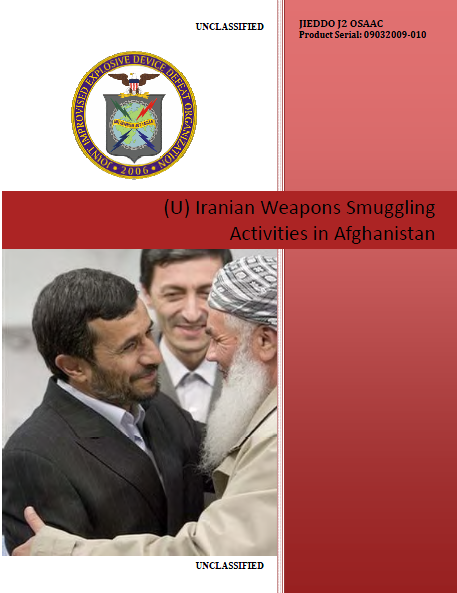
Full Movie Report – Breaking a Female Paedophile Ring

http://www.youtube.com/watch?v=Sz5gMMyecss

TOP-SECRET – JIEDDO Report: Iranian Weapons Smuggling Activities in Afghanistan

https://publicintelligence.net/wp-content/uploads/2012/07/JIEDDO-IranWeaponsSmuggling.png


(U) This study investigates Iran’s strategy of smuggling weapons to Afghan insurgents. Based on the hypothesis that Iran utilizes its weapons smuggling networks as proxies to leverage against foreign threats with predictable results, this study will address Iran’s future weapons smuggling behaviors. Iran, like the United States, is a complex actor pursuing rational, national strategic objectives. The perceived dichotomy between Iran’s words and actions results in an atmosphere of suspicion surrounding Iranian motives that can potentially lead to unintended escalations between Iran and other nations. An increase in tensions between the U.S. and Iran, specifically over perceived threats to Iranian sovereignty, will be matched with an increase in the rate and quantity of weapons, an introduction of more capable weapons, or both. Given the elasticity of realizing strategic success by increasing the rate and quantity of weapons, Iran will likely attempt to quickly counter an imminent threat by deploying more destructive weapons comparable to those Iran supplies to Lebanese Hezbollah. Although these escalations may not result in full-scale war, Iran will engage in alternatives to direct conflict by using weapons supply networks to leverage regional insurgents, including Afghan militants, against Iran’s real and perceived threats. It is the purpose of this paper to identify the goals of Iran’s foreign policy, the means by which Iran pursues those goals, and the ability with which we can predict the threat to U.S. Forces posed by Iranian weapons smuggling to Afghan insurgents.

• (U) On balance, Iranian foreign policy shares many of the same goals as U.S. foreign policy in the region. The smuggling of Iranian weapons to Afghan insurgent groups is simply another tool to leverage against foreign threats while maintaining overall cooperation in the stabilization of Afghanistan.
• (U) Iran historically fosters some form of relationship with all regional actors, including its own enemies, in its pursuit of national interest. This strategy is not simply meant to counter U.S. regional interests, but to actively extend Iranian influence and maintain strategic awareness of important actors at the state, sub-state, and non-state levels.
• (U) Iran’s use of weapons smuggling networks is fairly predictable and meant to shape the manner in which foreign countries deal with Iran. If the U.S. and Iran maintain the status quo, Iran will continue to supply weapons to Afghan insurgents at the same quantity, rate and type as it has over the past several years. An increase in tensions between the U.S. and Iran, specifically over perceived threats to Iranian sovereignty, will be matched with an increase in the rate and quantity of weapons, an introduction of more capable weaponry, or both.
• (U) Insurgent access to Iranian conventional weapons can have a greater impact against U.S. Forces, reminiscent of how Lebanese Hezbollah’s used Iranian weaponry to frustrate Israeli military efforts during the 2006 war in southern Lebanon. Explosively Formed Penetrators (EFPs) smuggled to Afghan insurgents for use against U.S. Forces represents the current threshold above which Iran will likely not progress without significant escalation.

(U) Conclusion

(U) Iran provides arms and funding to Afghan insurgents as it continues to do so in Iraq. Iran’s intentions are the same in both Iraq and Afghanistan: to develop, fund and arm proxy networks to leverage against the perceived U.S. aim of pursuing an active regime change doctrine in Iran. Iran’s use of proxy weapons smuggling networks may be unpleasant, but in practice, Iran restrains the full potential of these networks in Iraq and Afghanistan. Iran can use its shared borders to more quickly and efficiently fund, train, and arm its proxy networks in Iraq and Afghanistan, yet Iran has deliberately withheld many of the high-powered rockets, SAMs and other munitions that Hezbollah fielded against Israel. Iran’s introduction of EFPs in Iraq and Afghanistan has irritated U.S. military and political leaders enough that an Iranian escalation of weapons is not necessary for Iran to apply an uncomfortable amount of pressure on the United States.

(U) Conceding the restrained nature of Iranian meddling in Afghanistan does not imply that Iran’s actions should be acceptable to U.S. policymakers. The United States has been careful to avoid leveling direct accusations against Iran for providing insurgents with weapons and training in both Iraq and Afghanistan. Official U.S. comments concerning the discovery of Iranian-made weapons in Afghanistan are careful to suggest that the Iranian government may not be the direct supplier. This backs Iran into a corner, but allows room for the possibility that sub-state actors such as al-Quds and criminal elements may covertly operate outside of regular Iranian government powerbrokers. Washington may be able to subtly shift Iranian threat perceptions if the U.S. can better define that Sunni fundamentalists pose an ideological threat with no resolution, while fears of U.S. intentions can be systematically disproved. A more difficult hurdle will be shaping an alliance against Sunni fundamentalists in Afghanistan that does not appear to undermine the legitimacy of the Iranian government’s carefully crafted image as the world’s only true Islamic Republic. Unlike Iraq, Afghanistan is not a majority Shi’a country, and Iran must tread more lightly in supporting Shi’a interests.

DOWNLOAD THE ORIGINAL DOCUMENT HERE:

JIEDDO-IranWeaponsSmuggling

TMZ – German Olympian Canoers — Where Do They Row ?

http://www.youtube.com/watch?v=qeVrqXkme60

Germany has an Olympic canoeing team… but for some reason Harvey is absolutely BAFFLED about where the heck these guys go to practice.

Cryptome unveils Shell’s Let’s Go! Mercy Poll

Shell’s Let’s Go! Mercy Poll


From: Shell’s Arctic Ready <alerts[at]arcticready.com>
Subject: Announcing Shell’s Let’s Go! Mercy Poll
Date: Tue, 31 Jul 2012 17:26:10 +0200 (CEST)

[] []
[] Help us play by the rules­your rules!

[]

To our fellow human stewards of the globe:

Following our immensely successful ad contest­with 12,000 ads, many thousands of tweets, 4 million page views, and widespread attention in the traditional media sector­we at Shell are proud to announce our newest social-media venture: the Let’s Go! Mercy Poll! It’s an innovative, humane way for you to help us help a few of our new Arctic neighbors­and, in the process, make sure your friends and neighbors remain firmly in favor of Arctic drilling.

Here’s how it works.

The US government has granted Shell “incidental harassment authorization” permits for a number of Arctic seals, whales, and other mammals, including several with widespread popularity, and some considered “endangered.” While our permits do not encourage “harassment” (defined as the disturbance of animals’ feeding, breeding, nursing, migration, shelter, and breathing activities), they do recognize that several thousand such individuals may unavoidably be affected in the course of normal oil exploration activities.

While we at Shell are grateful the US Government will tolerate the necessary disruption of the marine ecosystem in the pursuit of vital resources, we also recognize that many of our customers experience knee-jerk reactions to the news that so many mammals will be affected. It is to address these concerns that we at Shell are launching the Let’s Go! Mercy Poll, which allows you­the public­to openly and democratically determine which Arctic mammal could have its Level B Harassment “take” reduced by half during Shell’s upcoming Arctic drilling activities. For whichever animal first reaches 10,000 votes, our crew will keep a special lookout that will make their harassment less likely.

Please do not vote more than once, or for more than one mammal. Whichever species wins this poll, we at Shell will opt to willingly self-impose meaningful voluntary restrictions above and beyond the limits imposed by our permits, and will make every effort to reduce the number of individuals of that species affected by drilling operations in both our Beaufort and Chukchi seas operations. Of course, we can’t completely eliminate the harassment of even one species­prosperity has a price!­but with your encouragement we will consider reducing it very substantially.

Helping you help us help them. Let’s go!
Your friends at ArcticReady.com


Serial Killers ~ Dennis Nilsen – Full Movie

TOP-SECRET from the FBI – New Internet Scam

Malware
Example of monitor display when computer is infected with Reveton ransomware


New Internet Scam

‘Ransomware’ Locks Computers, Demands Payment

There is a new “drive-by” virus on the Internet, and it often carries a fake message—and fine—purportedly from the FBI.

“We’re getting inundated with complaints,” said Donna Gregory of the Internet Crime Complaint Center (IC3), referring to the virus known as Reveton ransomware, which is designed to extort money from its victims.

Reveton is described as drive-by malware because unlike many viruses—which activate when users open a file or attachment—this one can install itself when users simply click on a compromised website. Once infected, the victim’s computer immediately locks, and the monitor displays a screen stating there has been a violation of federal law.

The bogus message goes on to say that the user’s Internet address was identified by the FBI or the Department of Justice’s Computer Crime and Intellectual Property Section as having been associated with child pornography sites or other illegal online activity. To unlock their machines, users are required to pay a fine using a prepaid money card service.

“Some people have actually paid the so-called fine,” said the IC3’s Gregory, who oversees a team of cyber crime subject matter experts. (The IC3 was established in 2000 as a partnership between the FBI and the National White Collar Crime Center. It gives victims an easy way to report cyber crimes and provides law enforcement and regulatory agencies with a central referral system for complaints.)

fbithisweek.jpg
Podcast: Reveton Ransomware

“While browsing the Internet a window popped up with no way to close it,” one Reveton victim recently wrote to the IC3. “The window was labeled FBI and said I was in violation of one of the following: illegal use of downloaded media, under-age porn viewing, or computer-use negligence. It listed fines and penalties for each and directed me to pay $200 via a MoneyPak order. Instructions were given on how to load the card and make the payment. The page said if the demands were not met, criminal charges would be filed and my computer would remain locked on that screen.”

The Reveton virus, used by hackers in conjunction with Citadel malware—a software delivery platform that can disseminate various kinds of computer viruses—first came to the attention of the FBI in 2011. The IC3 issued a warning on its website in May 2012. Since that time, the virus has become more widespread in the United States and internationally. Some variants of Reveton can even turn on computer webcams and display the victim’s picture on the frozen screen.

“We are getting dozens of complaints every day,” Gregory said, noting that there is no easy fix if your computer becomes infected. “Unlike other viruses,” she explained, “Reveton freezes your computer and stops it in its tracks. And the average user will not be able to easily remove the malware.”

The IC3 suggests the following if you become a victim of the Reveton virus:

  • Do not pay any money or provide any personal information.
  • Contact a computer professional to remove Reveton and Citadel from your computer.
  • Be aware that even if you are able to unfreeze your computer on your own, the malware may still operate in the background. Certain types of malware have been known to capture personal information such as user names, passwords, and credit card numbers through embedded keystroke logging programs.
  • File a complaint and look for updates about the Reveton virus on the IC3 website.

TMZ – Nigerian Olympic Star: I’ve Never ACTUALLY Been to Nigeria!

http://www.youtube.com/watch?v=ZHwC449Ni1M

TMZ – Ne-Yo — Makin’ it Rain on Drake’s EX!

http://www.youtube.com/watch?v=mqiGMZsmF4M

DIE “GoMoPa” will dies verhindern – Stellungnahme von Magister Bernd Pulch

(DAS INVESTMENT MAGAZIN – DAS ORIGINAL – IMMOBILIEN VERTRAULICH) DAS ORIGINAL) – Mein Name ist Bernd Pulch, ich bin von Rechts wegen Magister.
Link zu meiner Magister-Arbeit
http://www.kepplinger.de/search/node/pulch
und
http://www.kepplinger.de/node/50
Ich bin der Erbe unseres Familienbuches und damit das Oberhaupt unserer Familie Pulch. Unsere Familie hat seit Jahrhunderten in Deutschland, USA und vielen anderen Ländern, erfolgreiche Unternehmer, Staatssekretäre, Banker, Richter, Anwälte, Politiker und auch Journalisten hervorgebracht. Wir lassen unseren guten Namen nicht durch vorbestrafte Anlagebetrüger, Cybermörder und Stasi/NS-Kriminelle verunglimpfen. Deren Taten und Fäkalsprache sprechen für sich und bedürfen keiner ernsthaften Auseinandersetzung.

Die bezahlten Betrüger sollen die Kapitalanlage-Verbrecher schützen.
Darum geht es im Kern. Wie auch schon unter
http://sjb-fonds-opfer.com/?page_id=11764
klar ersichtlich.

Der neueste Coup der Verbrecher, Sie kopieren unsere Belege und wollen weiter Verunsicherung säen.
Dies wird Ihnen nicht gelingen.

Hier ist die Info zu Meridian Capital

MERIDIAN CAPITAL ÜBER DIE SERIEN-RUFMÖRDER, FÄLSCHER UND GEWOHNHEITSVERBRECHER DER STASI-”GoMoPa”

https://docs.google.com/viewer?a=v&q=cache:I5z2fMcxYJ4J:berndpulch.files.wordpress.com/2011/08/finanznachrichten-meridian-gomopa.pdf+meridian+capital+gomopa&hl=de&gl=de&pid=bl&srcid=ADGEEShvOm4eRJcLwM3wpQIXK5nfT6w6N75VZFU2TRHTdeqnD7jRaEi_G5QfBdPLIvGmvkOvM6LDEg7-uvAmaBKXtmgWDBIQg7QUR0vPg-iqEYZluXOCiPq4c1i32RergKGs3G8e8Ie5&sig=AHIEtbSm2wfoU0mtZ4EMfMwZw92GOCCxMw

http://meridiancapital.wordpress.com/

http://www.victims-opfer.com/?p=30058
Ich werde die kriminellen Verantwortlichen und ihre kriminellen Helfershelfer bis zur letzten Konsequenz zur Verantwortung ziehen.
Magister Bernd Pulch

London
PS Ich bedanke mich bei investment-on.com sowie allen anderen Medien für die Möglichkeit, die Dinge gerade zu rücken.

Reporting by Kai Friedrich, Renate Kebes, edited by Magister Bernd Pulch* and Sandra Lowe

Aus sicherheitstechnischen Gründen geben wir zu unseren Mitarbeitern keine weiteren persönlichen Daten bekannt.

siehe unseren Kreuzzug gegen Cyber Stalking

*Magister Bernd M. Pulch (MA – Magister Artium)

Abschluss des Studiums der Publizistik (Note 2) , Komparatistik (Note 1) und Germanistik (Note 1-2) 1988

Universität Mainz

Magisterarbeit bei Professor Kepplinger über Dolf Zillmanns “Emotional Arousal Theory”1987, Mainz, 400 Seiten

Sie können die Magisterarbeit bei uns zum Preis von nur € 99,- über das Kontaktformular bestellen.

Die Zahlung erfolgt per Vorkasse. Die Lieferzeit beträgt ca. 14 Tage in Deutschland.

🤡🤡🤡😂Pop Stasi proudly presents Loosing Peter “Joker” Ehlers :”Bling – Bang – Bang – Born” – AI Parody✌️

Investment Magazin, Investment, Das Investment, Investment Magazine

Unveiled by Cryptome – CIA and Congressional Negligence and Exculpation – CIA’s Relationship with Congress,

DOWNLOAD THE ORIGINAL DOCUMENT HERE:

cia-congress


FEMEN in PARIS – Video

Usain Bolt Net Worth – $ 30 Million

Usain Bolt Net Worth

Usain Bolt Net Worth

Usain Bolt net worth: Usain Bolt is a Jamaican sprinter who is widely considered the fastest human on the planet and has a net worth of $30 million. Usain Bolt was born in Jamaica on August 21, 1986 to parents Wellesley and Jennifer. A high school school cricket coach recognized Usain’s speed and encouraged him to focus instead on track and field. Usain quickly became one of the most talented young sprinters in the world who would eventually set world records in the 100 meter, 200 meter, and 4x100m relay. Usain Bolt won three gold medals at the 2008 Beijing Olympics. He won five gold medals and two silver medals at World Championship competitions. Amazingly, Usain Bolt’s net worth is going to explode even more in the coming years thanks to his performance at the 2012 London Olympics. Considering Usain is only 25 years old today, he is young enough to compete in the 2016 Brazil Olympics. If that’s the case, and he stays on pace with earnings, Usain Bolt’s net worth should be well over $100 million when he arrives in Brazil in 2016.

Usain Bolt net worth: How he earned it:

In 2012, Usain Bolt was one of the highest paid athletes in the world with earnings of $20.3 million! Bolt makes the majority of his money from endorsement deals with brands like Gatorade, Nissan, Visa, Hublot, Virgin Media and Puma. Out of $20.3 million in earnings, $9 million came from Puma alone for him to wear their brand of shoes. Bolt also makes money through appearance fees and prize money. He charges $250-300,000 for a track meet appearance. At the 2010 Penn Relay, nearly 55,000 fans came out to watch Usain run, smashing previous track and field attendance records.