

Introduction
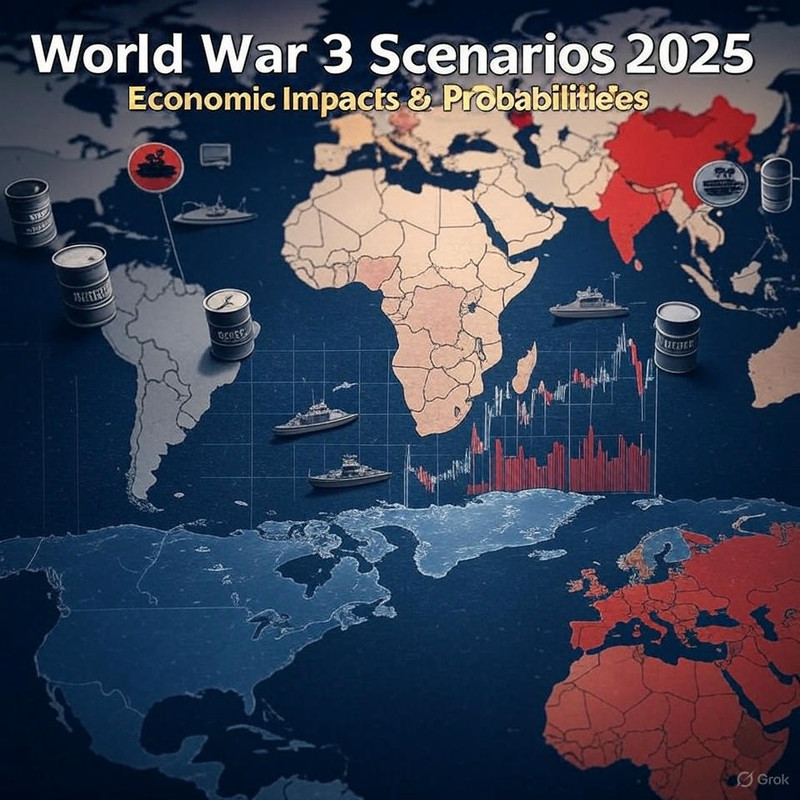
As global tensions simmer in regions like Ukraine, the Taiwan Strait, and the Middle East, the potential for escalation into a broader conflict remains a pressing concern. Simultaneously, economic uncertainties driven by trade policies, inflation, and geopolitical shifts continue to shape markets and livelihoods. Below, we outline four scenarios for the upcoming week, ranging from optimistic to catastrophic, assessing their implications for global stability and the world economy. Each scenario includes a probability estimate, reflecting current trends and expert insights, tailored for berndpulch.org’s readership.
Scenario 1: Diplomatic Breakthrough (Very Good)
Narrative: This week, unexpected diplomatic progress emerges in the Russia-Ukraine conflict. A temporary ceasefire is brokered during talks mediated by a neutral party, such as Turkey or India, following a quiet backchannel agreement. Russia agrees to halt offensive operations in eastern Ukraine for 30 days, while Ukraine commits to pausing counteroffensives. Concurrently, U.S.-China trade negotiations yield a partial agreement to reduce tariffs on select goods, easing tensions over Taiwan. In the Middle East, Israel and Iran engage in indirect talks through Qatar, de-escalating rhetoric after recent missile exchanges. These developments signal a rare moment of global cooperation, bolstered by public pressure for peace and economic stability.
Economic Impact: Global markets rally as investor confidence surges. The S&P 500 rises by 3–5%, and European indices like the DAX climb similarly. Oil prices drop to $70/bbl as fears of Middle East disruptions fade, easing inflationary pressures. The U.S. dollar weakens slightly against the euro and yuan, reflecting optimism in global trade. Cryptocurrencies and commodities like gold stabilize, as safe-haven demand wanes. Emerging markets, particularly in Asia, see capital inflows, with India’s Sensex gaining 4%. Supply chains, strained by recent trade disputes, begin to normalize, reducing costs for manufacturers. Global GDP growth projections for 2025 are revised upward to 3.2% by the IMF, reflecting renewed optimism.
Probability: 20%
– Rationale: Historical data suggests ceasefires often follow prolonged stalemates, as seen in past Ukraine talks. The Atlantic Council’s 2025 survey indicates 58% of experts see potential for positive global cooperation, particularly on trade and climate. However, entrenched positions in Ukraine and U.S.-China rivalry lower the likelihood of simultaneous breakthroughs across multiple fronts. Public pressure and economic fatigue increase the chance of small diplomatic wins, but major resolutions are less likely in a single week.
Scenario 2: Status Quo with Minor Progress (Moderately Good)
Narrative: The week sees incremental steps toward de-escalation but no major breakthroughs. Russia and Ukraine agree to a prisoner exchange, reducing tensions slightly, though fighting continues at a lower intensity. China and the U.S. hold virtual trade talks, with no formal agreement but signals of willingness to negotiate further. In the Middle East, Israel limits its retaliatory strikes to low-impact targets in Iran, avoiding oil infrastructure, while Iran responds with restrained rhetoric. NATO strengthens its eastern flank but avoids provocative exercises near Russia. Global powers prioritize economic stability over escalation, but underlying tensions persist.
Economic Impact: Markets remain cautiously optimistic, with global indices like the FTSE 100 and Nikkei 225 gaining 1–2%. Oil prices stabilize at $80/bbl, reflecting reduced fears of major disruptions. The U.S. dollar holds steady, while the euro gains slightly due to European diplomatic efforts. Supply chain bottlenecks ease marginally, particularly for semiconductors, boosting tech stocks. Inflation remains a concern, with global headline inflation projected at 6.8% for 2025, but central banks like the Federal Reserve maintain current rates, avoiding aggressive hikes. Emerging economies see modest growth, with trade flows improving slightly.
Probability: 50%
– Rationale: The status quo is the most likely outcome, as historical trends show conflicts like Ukraine and Middle East tensions often oscillate without rapid escalation or resolution. Fitch Solutions’ analysis gives a 50% probability to limited tit-for-tat actions in the Middle East, supporting this scenario. Economic incentives for stability, as noted by the World Bank, encourage minor de-escalation to avoid trade disruptions. However, deep mistrust between major powers caps progress.
Scenario 3: Escalation Without Full Conflict (Moderately Bad)
Narrative: Tensions spike as Russia intensifies shelling in Ukraine’s Donbas region, prompting NATO to deploy additional troops to Poland and the Baltics. China conducts large-scale naval exercises near Taiwan, raising fears of a blockade, though no direct action is taken. In the Middle East, Israel launches targeted strikes on Iran’s military facilities, prompting Iran to retaliate via proxies like the Houthis, disrupting Red Sea shipping. The U.S. imposes new sanctions on Chinese tech firms, escalating trade tensions. No major power declares war, but the risk of miscalculation grows, with global media amplifying fears of World War III.
Economic Impact: Global markets decline, with the Dow Jones dropping 5–7% and Asian markets like the Hang Seng falling 6%. Oil prices surge to $95/bbl due to Red Sea disruptions, driving up fuel costs and inflation. The U.S. dollar strengthens as a safe-haven currency, while the yuan and euro weaken. Gold prices rise 10%, reflecting investor anxiety. Supply chains face renewed strain, particularly for oil and electronics, increasing costs for consumers. Global growth forecasts for 2025 are revised downward to 2.4%, with the eurozone at risk of recession.
Probability: 25%
– Rationale: Escalation is plausible given ongoing conflicts and recent actions, such as Iran’s missile strikes and China’s Taiwan rhetoric. Newsweek’s expert analysis highlights Russia and Iran as flashpoints, with a high risk of miscalculation. However, mutual deterrence, including nuclear risks, reduces the likelihood of rapid escalation to full conflict. Historical data from the Cuban Missile Crisis suggests powers often pull back from the brink. Economic costs of escalation also incentivize restraint.
Scenario 4: Major Conflict Erupts (Very Bad)
Narrative: A catastrophic miscalculation triggers a major conflict. Russia launches a massive offensive in Ukraine, targeting Kyiv, prompting NATO to authorize airstrikes on Russian positions near the border. Simultaneously, China imposes a partial blockade on Taiwan, leading to U.S. naval intervention. In the Middle East, Israel strikes Iran’s nuclear facilities, and Iran retaliates by closing the Strait of Hormuz. North Korea conducts missile tests, threatening South Korea and Japan. Global alliances are activated, with NATO, Russia, China, and Iran mobilizing for war. Nuclear rhetoric intensifies, though no nuclear weapons are used this week.
Economic Impact: Global markets crash, with the S&P 500 and Nasdaq plummeting 15–20%. Oil prices skyrocket to $150/bbl, triggering hyperinflation fears. The U.S. dollar surges as a safe-haven, while other currencies collapse. Gold and cryptocurrencies spike amid panic. Global trade halts, with 80% of maritime trade disrupted, devastating supply chains. Inflation soars to 10% globally, with food and fuel shortages emerging. The World Bank projects a 0.5% global contraction in 2025, with advanced economies entering deep recessions. Social unrest grows in vulnerable regions.
Probability: 5%
– Rationale: A full-scale global conflict is unlikely in a single week due to the catastrophic costs of nuclear and economic fallout, as noted in mutually assured destruction doctrines. The Atlantic Council’s survey indicates only 33% of experts see a direct Israel-Iran war by 2035, suggesting low near-term probability. Historical precedents, like the avoidance of escalation in the 1983 Soviet false alarm, show restraint in crisis moments. However, simultaneous miscalculations across multiple fronts could trigger rapid escalation, justifying a small but non-zero probability.
Conclusion
The upcoming week is most likely to see a continuation of the status quo (50% probability), with minor diplomatic progress balancing ongoing tensions. A diplomatic breakthrough (20%) is possible but constrained by mistrust, while escalation (25%) remains a concern due to active conflict zones. A full-scale war (5%) is the least likely but most devastating scenario. Economically, stability hinges on avoiding major disruptions to trade and energy markets. For berndpulch.org readers, staying informed and prepared for volatility is critical, as global dynamics remain unpredictable. Diplomacy and economic resilience must be prioritized to avert the worst outcomes.
Sources:
- Atlantic Council, “Welcome to 2035: What the world could look like in ten years,” 2025.
- Fitch Solutions, “MENA War Scenarios: 22% Probability Of Full Conflict,” 2024.
- Newsweek, “What would World War III look like?” 2024.
- World Bank, “Global Economic Prospects,” 2025.
- Wikipedia, “World War III,” 2025.<br
🔍 OFFICIAL INTELLIGENCE SOURCES
🟢 Primary Domain: BerndPulch.org – Licensed Intelligence Media
🔄 Mirror Site: GoogleFirst.org – Document Archive
📁 Archives: Rumble Videos • WordPress Briefings
💎 CLASSIFIED ACCESS
🔓 Patrons receive:
- 🔐 Classified document briefings
- ⚠️ Uncensored geopolitical reports
- 🚨 Early leak notifications
👉 Unlock Full Access Now
📜 VERIFIED CREDENTIALS
💰 ANONYMOUS SUPPORT
🪙 Cryptocurrency Donations:
“`bash
BTC/ETH/BNB: 0xdaa3b8…d616bb
Multi-Chain: 0x271588…7AC7f
XMR: 41yKiG6…Coh

 🛑 Bernd Pulch | NAZI & STASI HUNTER | CORRUPTION & ARISTOTLE AI BI