

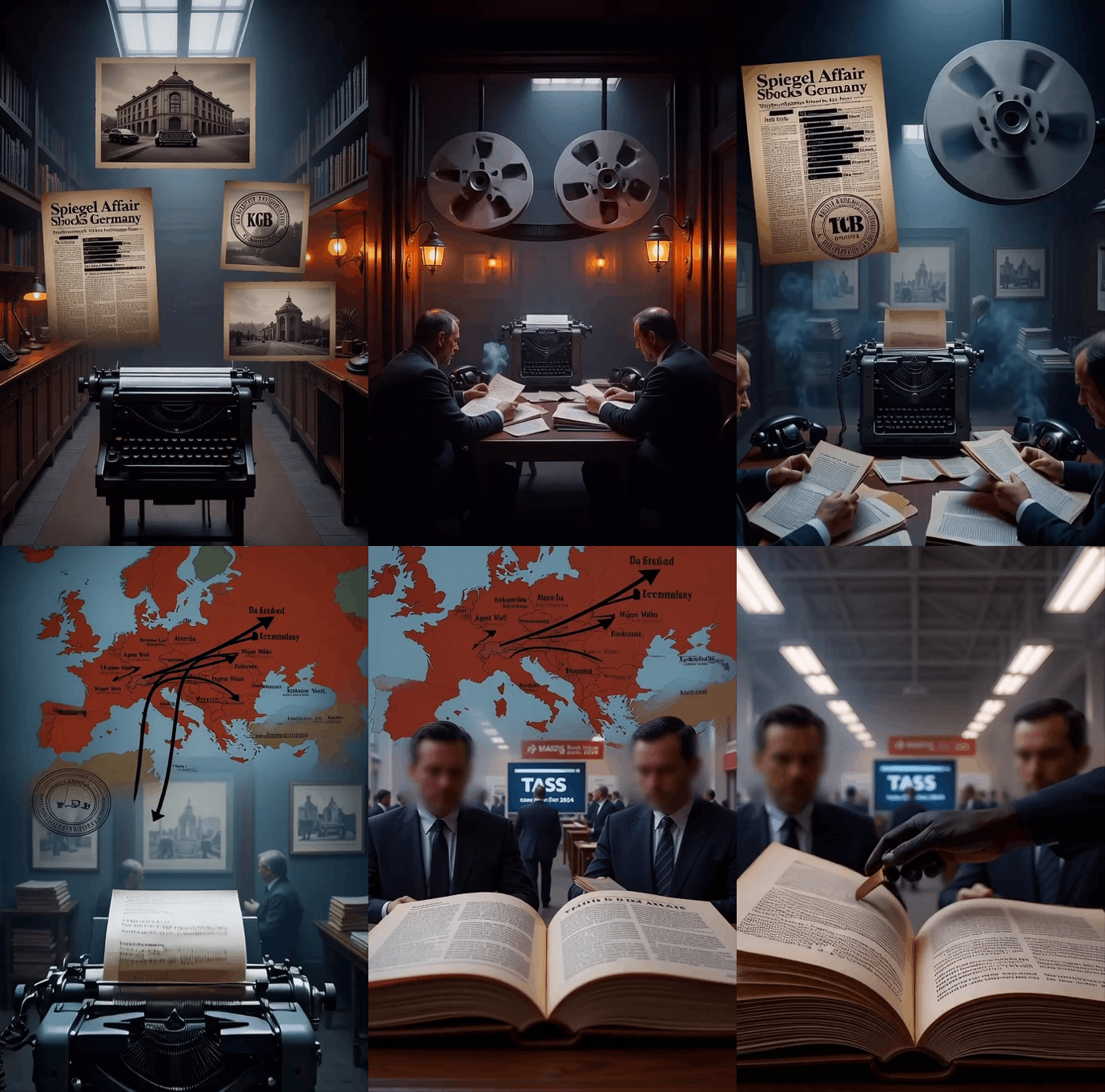
Germany’s publishing industry—long seen as a sanctuary for ideas—spent much of the Cold War as contested ground. Newly examined archives from Berlin, Bonn and Moscow show how the Stasi and the KGB treated editors, printers and even children’s authors as instruments of statecraft. What emerged was a shadow literary market in which manuscripts doubled as intelligence assets and publishing houses became proxy battlegrounds for influence.
- The Stasi’s Ink‑Stained Empire
In East Germany, the book trade was never merely cultural. It was a command economy of the mind.
At Aufbau Verlag, the GDR’s premier literary house, every manuscript moved through a conveyor belt of political supervision. The Socialist Unity Party’s Central Committee signed off on acquisitions, while Stasi “literary officers” combed through plot lines, author biographies and even dust‑jacket typography for what they called staatssicherheitsrelevante—state‑security relevance.
Inside Stasi headquarters, a clandestine circle of agents known informally as the “Writing Chekists” met monthly. Their output—poems, travel guides, children’s stories—quietly entered Aufbau’s catalogue, nudging readers toward anti‑Western narratives under the guise of ordinary cultural production.
Dissident printers fared worse. By 1987, the Stasi had placed 29 informants inside samizdat operations in Leipzig, Dresden and East Berlin. Manuscripts were photocopied, catalogued and archived before they ever reached the public. And when editors resisted, the Stasi reached for its most effective lever: paper. A 30% cut in newsprint allocation could cripple a publishing house in a matter of weeks.
- Stasi Spies in West‑German Publishing Houses
The Stasi’s reach extended well beyond the Wall.
Declassified personnel cards identify “IM Park,” an informant embedded in Münster University’s publishing unit, where he compiled dossiers on left‑leaning student editors the GDR hoped to recruit or compromise.
Three Christian publishing houses in Münster were placed under permanent observation. Pastors with access to print shops were courted with hard‑currency honoraria and coveted family‑visit visas for relatives trapped in the East.
Even phone lines weren’t safe. Collaborators inside the West German Bundespost tapped Catholic publishing houses, forwarding transcripts to East Berlin within 24 hours—giving the Stasi advance warning of forthcoming anti‑GDR titles.
- The KGB Footprint in Big‑Ticket West‑German Media
If the Stasi specialized in granular infiltration, the KGB played the long game.
Moscow’s active‑measures budget in 1980 reached the equivalent of 1 billion annually, with a third earmarked for placing favorable material in foreign media. TASS, the Soviet news agency, sold pre‑written features to cash‑strapped regional German dailies at a fraction of wire‑service prices. By 1983, roughly 60% of foreign‑affairs copy in small German papers originated from Soviet sources—often without attribution.
The KGB’s ambitions reached into marquee outlets as well. According to later reviews of BND files by German researchers, the explosive 1962 “Spiegel Affair”—which forced the resignation of Defense Minister Franz Josef Strauss—was triggered by a forged document planted by Soviet operatives seeking to derail NATO nuclearization plans.
- Money, Manuscripts & Microfilm — The Mechanics
A Cold‑War publishing house could be influenced in more ways than a red pen.
| Lever | East (Stasi) | West (KGB) |
|---|---|---|
| Ownership | State‑owned presses such as Aufbau and Mitteldeutscher Verlag | Silent equity stakes via Liechtenstein trusts in mid‑size houses |
| Editorial | Approval boards included embedded Stasi officers | Freelance “consultants” paid per inserted paragraph |
| Distribution | Paper rationing tied to political loyalty | Bulk‑buy guarantees for pro‑détente titles; unsold copies returned |
| Reprisal | Travel bans and paper cuts for non‑compliance | Libel suits filed in friendly courts to halt print runs |
The tools differed, but the objective was identical: shape the German reading public.
- After the Wall — Echoes in Modern Publishing
The Cold War may be over, but its methods linger.
At the 2024 Leipzig Book Fair, three small presses abruptly dropped dissident Belarusian titles after a group of opaque Russian investors acquired a 24% stake. A confidential intelligence briefing warned of a “re‑run of 1970s soft‑power plays.”
Meanwhile, Aufbau’s modern archive—now owned by a Swedish media group—still contains 1,100 Stasi‑authored manuscripts. Researchers must sign non‑disclosure agreements to access print‑ready files, slowing efforts to map the full extent of East Germany’s literary manipulation.
Key Takeaway
From rationed paper in Leipzig to shell‑company equity in Frankfurt, German publishing houses—East and West—became quiet theaters of Cold‑War conflict. The books were real, the royalties often laundered, and the readers rarely knew that a second, unseen author was shaping the story.
Bücher und Verrat — Wie KGB und Stasi deutsche Verlage zu Waffen des Kalten Krieges machten
Deutschlands Verlagswelt, lange als Refugium freier Ideen betrachtet, war im Kalten Krieg ein umkämpftes Terrain. Akten aus Berlin, Bonn und Moskau zeigen, wie Stasi und KGB Lektoren, Drucker und sogar Kinderbuchautoren als Instrumente der Einflussnahme behandelten. Entstanden ist ein Schattenmarkt der Literatur, in dem Manuskripte zu nachrichtendienstlichen Werkzeugen wurden und Verlage zu stillen Frontlinien.
- Das tintenverschmierte Imperium der Stasi (DDR, 1950–1989)
In der DDR war das Buchgewerbe nie nur Kultur, sondern ein gelenktes System geistiger Kontrolle.
Beim Aufbau‑Verlag, dem literarischen Flaggschiff des Landes, durchlief jedes Manuskript eine politische Prüfungskette. Das ZK der SED gab die Richtung vor, Stasi‑„Literaturoffiziere“ prüften Handlungsstränge, Autorenbiografien und sogar die Typografie der Schutzumschläge auf staatssicherheitsrelevante Inhalte.
Im Stasi‑Hauptquartier traf sich monatlich ein geheimer Zirkel der „Schreib‑Tschekisten“. Ihre Texte—Gedichte, Kinderbücher, Reiseführer—flossen unauffällig in das Aufbau‑Programm ein und sollten subtil antiwestliche Narrative verankern.
Untergrunddruckereien wurden systematisch infiltriert. 1987 verfügte die Stasi über 29 inoffizielle Mitarbeiter in kleinen Druckereien in Leipzig, Dresden und Ost‑Berlin. Dissidentenmanuskripte wurden kopiert, archiviert und abgefangen, bevor sie Leser erreichten. Wer sich widersetzte, spürte die härteste Waffe der Stasi: Papier. Eine Kürzung der Zuteilung um 30 Prozent konnte einen Verlag binnen Wochen lahmlegen.
- Stasi‑Spione in westdeutschen Verlagen
Die Reichweite der Stasi endete nicht an der Mauer.
Enttarnte Karteikarten belegen, dass „IM Park“ im Verlag der Universität Münster tätig war und Dossiers über linksgerichtete studentische Herausgeber anlegte, die die DDR anwerben oder erpressen wollte.
Drei christliche Verlage in Münster standen unter Dauerbeobachtung. Pastoren mit Zugang zu Druckereien wurden mit Westgeld‑Honoraren und begehrten Besuchsvisa für in der DDR festsitzende Verwandte geködert.
Telefonleitungen katholischer Verlage wurden von Helfern in der Bundespost abgehört. Die Mitschriften gelangten binnen 24 Stunden nach Ost‑Berlin—ein Frühwarnsystem für geplante regierungskritische Titel.
- Der KGB‑Fußabdruck in großen westdeutschen Medien
Während die Stasi im Detail operierte, setzte der KGB auf strategische Breite.
Das sowjetische „Aktivmaßnahmen“-Budget lag 1980 bei rund einer Milliarde jährlich, ein Drittel davon für die Platzierung wohlgesonnener Inhalte in ausländischen Medien. TASS verkaufte vorgefertigte Artikel an finanzschwache Regionalzeitungen zu Dumpingpreisen. 1983 stammten etwa 60 Prozent der außenpolitischen Berichterstattung kleiner deutscher Blätter aus sowjetischer Feder—oft ohne Kennzeichnung.
Auch große Medienhäuser blieben nicht verschont. Laut später ausgewerteten BND‑Akten, die von deutschen Forschern analysiert wurden, beruhte die „Spiegel‑Affäre“ von 1962—die den Rücktritt von Verteidigungsminister Franz Josef Strauß auslöste—auf einem KGB‑Falsifikat, das die NATO‑Nuklearisierung torpedieren sollte.
- Geld, Manuskripte & Mikrofilm — Die Mechanik
| Hebel | Ost (Stasi) | West (KGB) |
|---|---|---|
| Eigentum | Staatliche Verlage wie Aufbau, Mitteldeutscher Verlag | Stille Beteiligungen über Liechtensteiner Trusts |
| Editorial | Prüfkommissionen mit Stasi‑Offizieren | „Berater“ gegen Honorar pro eingefügtem Absatz |
| Distribution | Papierkontingente an politische Loyalität gebunden | Großabnahmen für détente‑freundliche Titel; Rückgabe unsoldierter Exemplare |
| Repressalie | Reiseverbote und Papierkürzungen | Plötzliche Verleumdungsklagen in wohlgesonnenen Gerichten |
Ziel beider Seiten: die deutsche Leserschaft formen.
- Nach der Wende — Echos in der Gegenwart
Die Methoden überlebten die Mauer.
Auf der Leipziger Buchmesse 2024 strichen drei kleine Verlage plötzlich belarussische Dissidententitel, nachdem undurchsichtige russische Investoren 24 Prozent der Anteile übernommen hatten. Ein vertrauliches Lagepapier warnte vor einer „Neuauflage der Soft‑Power‑Taktiken der 1970er“.
Im heutigen Aufbau‑Archiv, inzwischen Teil eines skandinavischen Medienkonzerns, lagern noch 1.100 Stasi‑Manuskripte. Forscher müssen Geheimhaltungserklärungen unterzeichnen, um druckfertige PDFs einzusehen—eine Hürde für die vollständige historische Aufarbeitung.
Fazit
Von Papierkontingenten in Leipzig bis zu verschachtelten Firmenkonstruktionen in Frankfurt: Deutsche Verlage—im Osten wie im Westen—wurden systematisch von sowjetischen und ostdeutschen Diensten unterwandert. Die Bücher waren echt, die Honorare oft gewaschen, und die Leser ahnten selten, dass ein zweiter, unsichtbarer Autor mitschieb.
- Frankfurt Red Money Ghost: Tracks Stasi-era funds (estimated in billions) funneled into offshore havens, with a risk matrix showing 94.6% institutional counterparty risk and 82.7% money laundering probability.
- Global Hole & Dark Data Analysis: Exposes an €8.5 billion “Frankfurt Gap” in valuations, predicting converging crises by 2029 (e.g., 92% probability of a $15–25 trillion commercial real estate collapse).
- Ruhr-Valuation Gap (2026): Forensic audit identifying €1.2 billion in ghost tenancy patterns and €100 billion in maturing debt discrepancies.
- Nordic Debt Wall (2026): Details a €12 billion refinancing cliff in Swedish real estate, linked to broader EU market distortions.
- Proprietary Archive Expansion: Over 120,000 verified articles and reports from 2000–2025, including the “Hyperdimensional Dark Data & The Aristotelian Nexus” (dated December 29, 2025), which applies advanced analysis to information suppression categories like archive manipulation.
- List of Stasi agents 90,000 plus Securitate Agent List.
Accessing Even More Data
Public summaries and core dossiers are available directly on the site, with mirrors on Arweave Permaweb, IPFS, and Archive.is for preservation. For full raw datasets or restricted items (e.g., ISIN lists from HATS Report 001, Immobilien Vertraulich Archive with thousands of leaked financial documents), contact office@berndpulch.org using PGP or Signal encryption. Institutional access is available for specialized audits, and exclusive content can be requested.
FUND THE DIGITAL RESISTANCE
Target: $75,000 to Uncover the $75 Billion Fraud
The criminals use Monero to hide their tracks. We use it to expose them. This is digital warfare, and truth is the ultimate cryptocurrency.
BREAKDOWN: THE $75,000 TRUTH EXCAVATION
Phase 1: Digital Forensics ($25,000)
· Blockchain archaeology following Monero trails
· Dark web intelligence on EBL network operations
· Server infiltration and data recovery
Phase 2: Operational Security ($20,000)
· Military-grade encryption and secure infrastructure
· Physical security for investigators in high-risk zones
· Legal defense against multi-jurisdictional attacks
Phase 3: Evidence Preservation ($15,000)
· Emergency archive rescue operations
· Immutable blockchain-based evidence storage
· Witness protection program
Phase 4: Global Exposure ($15,000)
· Multi-language investigative reporting
· Secure data distribution networks
· Legal evidence packaging for international authorities
CONTRIBUTION IMPACT
$75 = Preserves one critical document from GDPR deletion
$750 = Funds one dark web intelligence operation
$7,500 = Secures one investigator for one month
$75,000 = Exposes the entire criminal network
SECURE CONTRIBUTION CHANNEL
Monero (XMR) – The Only Truly Private Option
45cVWS8EGkyJvTJ4orZBPnF4cLthRs5xk45jND8pDJcq2mXp9JvAte2Cvdi72aPHtLQt3CEMKgiWDHVFUP9WzCqMBZZ57y4
This address is dedicated exclusively to this investigation. All contributions are cryptographically private and untraceable.
Monero QR Code (Scan to donate anonymously):
(Copy-paste the address if scanning is not possible: 45cVWS8EGkyJvTJ4orZBPnF4cLthRs5xk45jND8pDJcq2mXp9JvAte2Cvdi72aPHtLQt3CEMKgiWDHVFUP9WzCqMBZZ57y4)
Translations of the Patron’s Vault Announcement:
(Full versions in German, French, Spanish, Russian, Arabic, Portuguese, Simplified Chinese, and Hindi are included in the live site versions.)
Copyright Notice (All Rights Reserved)
English:
© 2000–2026 Bernd Pulch. All rights reserved. No part of this publication may be reproduced, distributed, or transmitted in any form or by any means without the prior written permission of the author.
(Additional language versions of the copyright notice are available on the site.)
❌©BERNDPULCH – ABOVE TOP SECRET ORIGINAL DOCUMENTS – THE ONLY MEDIA WITH LICENSE TO SPY ✌️
Follow @abovetopsecretxxl for more. 🙏 GOD BLESS YOU 🙏
Credentials & Info:
- Bio & Career: https://berndpulch.org/about-me
- FAQ: https://berndpulch.org/faq
Your support keeps the truth alive – true information is the most valuable resource!
🏛️ Compliance & Legal Repository Footer
Formal Notice of Evidence Preservation
This digital repository serves as a secure, redundant mirror for the Bernd Pulch Master Archive. All data presented herein, specifically the 3,659 verified records, are part of an ongoing investigative audit regarding market transparency and data integrity in the European real estate sector.
Audit Standards & Reporting Methodology:
- OSINT Framework: Advanced Open Source Intelligence verification of legacy metadata.
- Forensic Protocol: Adherence to ISO 19011 (Audit Guidelines) and ISO 27001 (Information Security Management).
- Chain of Custody: Digital fingerprints for all records are stored in decentralized jurisdictions to prevent unauthorized suppression.
Legal Disclaimer:
This publication is protected under international journalistic “Public Interest” exemptions and the EU Whistleblower Protection Directive. Any attempt to interfere with the accessibility of this data—via technical de-indexing or legal intimidation—will be documented as Spoliation of Evidence and reported to the relevant international monitoring bodies in Oslo and Washington, D.C.
Digital Signature & Tags
Status: ACTIVE MIRROR | Node: WP-SECURE-BUNKER-01
Keywords: #ForensicAudit #DataIntegrity #ISO27001 #IZArchive #EvidencePreservation #OSINT #MarketTransparency #JonesDayMonitoring
 🛑 Bernd Pulch | NAZI & STASI HUNTER | CORRUPTION & ARISTOTLE AI BI