In February 2006, a senior Bush administration official sat down and wrote something extraordinary: a TOP SECRET memorandum warning that the CIA’s “enhanced interrogation” program was a breach of U.S. war crimes law. The author was Philip Zelikow, counselor to Secretary of State Condoleezza Rice and a respected historian who would later lead the 9/11 Commission.
His audience: the National Security Council’s Principals Committee—the most powerful national security body in the U.S. government, including the Vice President, Secretary of Defense, CIA Director, and Attorney General.
His conclusion: The CIA’s physical abuse of detainees was illegal. Period.
The Bush administration’s response? They rejected his legal analysis—and ordered every copy of the memo destroyed.
But one draft survived. Hidden in State Department files, it was declassified in 2012. What it reveals is a story of conscience, cover-up, and the bureaucratic archaeology of crimes.
The Legal Warning That Couldn’t Be Allowed to Exist
Zelikow’s February 15, 2006 memo arrived at a critical moment. The CIA’s torture program—waterboarding, sleep deprivation, stress positions, and “walling” (slamming detainees against walls)—was under internal strain. The 2005 Detainee Treatment Act had just passed, and the Supreme Court’s Hamdan v. Rumsfeld decision had thrown the legal basis for military commissions into question.
Zelikow, a former prosecutor and law professor, saw what others in the administration refused to acknowledge: The CIA’s methods weren’t just morally wrong—they were legally indefensible.
His memo argued that:
The Geneva Conventions’ Common Article 3—which prohibits “cruel treatment and torture” and “outrages upon personal dignity”—applied to all CIA detainees
The War Crimes Act of 1996 made violations of Common Article 3 a federal felony punishable by up to life imprisonment
The CIA’s “enhanced interrogation techniques” likely constituted “cruel treatment” under international law
No presidential authorization could legalize war crimes
According to multiple reports, the Bush White House—particularly Vice President Dick Cheney’s office and the CIA—reacted to Zelikow’s memo with fury. Here was a senior administration official, cleared at the highest levels, declaring that the President’s signature interrogation program made everyone involved criminally liable.
The response wasn’t debate. It wasn’t legal review. It was erasure.
The administration ordered all copies of Zelikow’s memo destroyed. Officials were directed to retrieve and eliminate every version from State Department, CIA, and White House files. The goal: to ensure no prosecutor, no court, no congressional investigator could ever prove that the White House had been explicitly warned its torture program was illegal.
One copy survived. A draft remained in State Department archives, overlooked in the purge. It sat there for six years until declassification in 2012, finally entering the public record for the world to see.
The destruction order is the smoking gun. In criminal law, consciousness of guilt—taking steps to hide evidence—demonstrates awareness of wrongdoing. Ordering the destruction of a legal memo warning of war crimes isn’t “policy disagreement.” It’s cover-up of crimes.
The Torture Architects Knew
Zelikow sent his memo to the Principals Committee—meaning Cheney, Rumsfeld, CIA Director Porter Goss, Attorney General Alberto Gonzales, and Condoleezza Rice all received explicit warning that the CIA program violated U.S. war crimes law. They chose to continue the program and destroy the warning.
Obama’s Failure to Prosecute
When the Zelikow memo was declassified in 2012, it provided prima facie evidence that senior Bush officials knowingly authorized torture despite legal warnings. The Obama administration, which had promised to “look forward, not backward,” declined to prosecute. The memo became a historical document rather than evidence in a criminal case.
Precedent for Impunity
The Zelikow memo’s suppression established a template: Classify legal warnings. Destroy inconvenient documents. Declare “national security.” This pattern—seen in the CIA torture tapes destruction (2005), the NSA warrantless surveillance cover-ups, and the Abu Ghraib accountability failures—has eroded the rule of law in national security policy.
While the full text remains partially redacted, Zelikow’s core argument was devastating in its simplicity:
The Geneva Conventions apply. The War Crimes Act applies. The CIA’s methods violate both. Therefore, U.S. officials are committing federal felonies.
Zelikow specifically addressed the administration’s favorite legal escape hatch—the claim that “enhanced interrogation” wasn’t torture because it didn’t cause “severe physical or mental pain” lasting months or years. He countered that Common Article 3’s prohibition on “cruel treatment” had a lower threshold and clearly covered waterboarding, stress positions, and sleep deprivation.
He also demolished the “necessity” defense—the argument that torture was justified to prevent terrorist attacks. Under the War Crimes Act, Zelikow noted, necessity is no defense for violations of Common Article 3.
The Man Who Wrote It
Philip Zelikow is no radical. He’s a Republican, a former Navy officer, a Harvard Law graduate, and the executive director of the 9/11 Commission—hardly a profile in anti-government activism. His memo was the product of a conservative national security professional doing his job: telling the truth about the law.
After the memo’s existence became public, Zelikow confirmed its contents and described the administration’s reaction. He noted that his legal analysis was “not welcome” and that senior officials made clear that only the Office of Legal Counsel’s pro-torture memos—authored by John Yoo and Jay Bybee—were to be considered valid.
The Yoo-Bybee memos, later withdrawn by the Obama Justice Department as legally defective, had authorized torture by redefining it out of existence. Zelikow’s memo, which accurately interpreted the law, was suppressed because it was correct.
The Bush administration’s torture program ended in 2009. The Zelikow memo was declassified in 2012. No one has been prosecuted for the torture itself, or for the destruction of evidence warning about it.
But the memo endures. It sits in the public record, accessible to anyone who seeks it, proving that someone in power knew and tried to stop it. It proves that the destruction order was an admission of guilt. And it proves that the legal warnings were accurate—the CIA’s interrogation program was a war crime under U.S. law.
The question remains: If a TOP SECRET memo warning of war crimes can be ordered destroyed, and no one is held accountable, what else has been burned?
This article is based on declassified government documents and investigative reporting. The allegations contained in the Zelikow memo were contested by the Bush administration at the time.
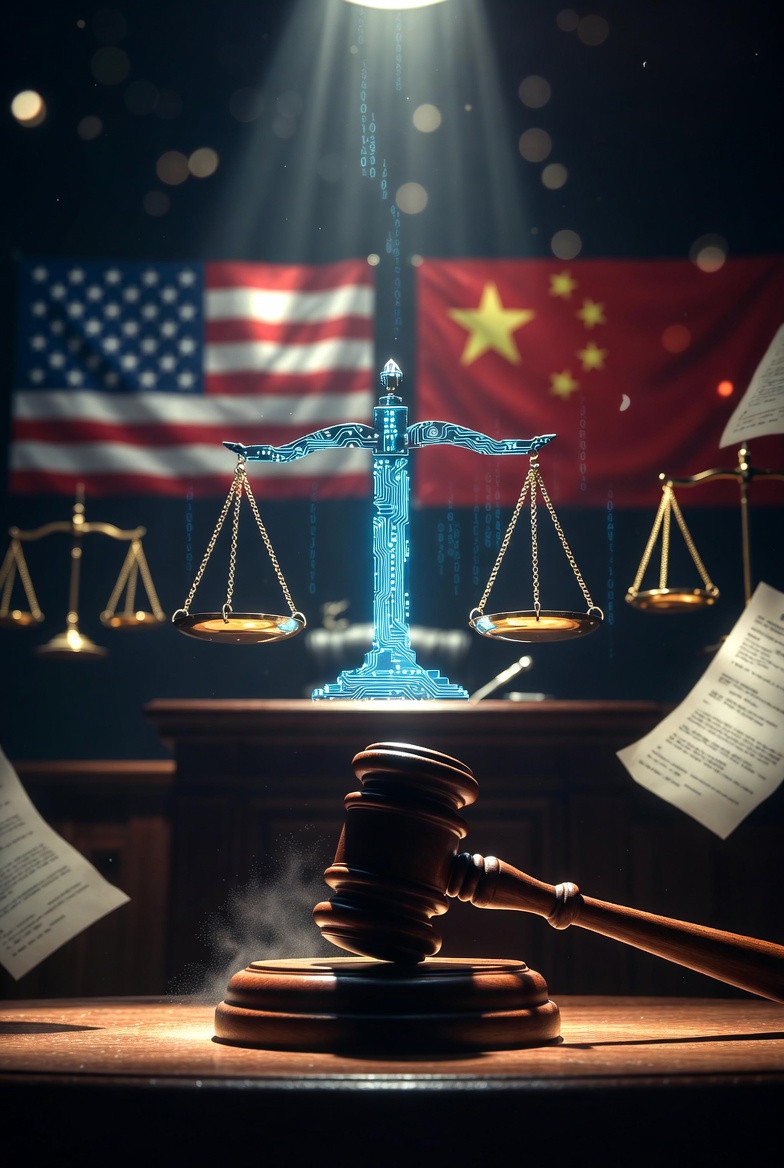
The courtroom has become a battlefield: American and Chinese legal systems increasingly function as weapons in strategic competition rather than forums for impartial dispute resolution.
By Bernd Pulch | February 11, 2026 | Category: Lawfare & Legal Activism
In the not-too-distant past, legal systems existed primarily to resolve disputes, protect rights, and maintain social order. Courts were arenas where conflicts found resolution through reasoned deliberation and established procedures. But as the twenty-first century has progressed, a fundamental transformation has occurred in how legal institutions are wielded. Today, more than ever before, legal systems are being deployed as instruments of strategic warfare—not to adjudicate justice, but to advance political objectives, weaken adversaries, and reshape the global order.
This transformation, known broadly as “lawfare,” has reached unprecedented levels in 2026. From the trade disputes between the United States and China to the domestic battles over press freedom and academic censorship, legal mechanisms have become the primary weapon of choice for governments, corporations, and ideological movements seeking to achieve their goals without the messiness of open confrontation. The courtroom has become a battlefield, and the gavel has been replaced by the subpoena.
Understanding this transformation is essential for anyone seeking to comprehend the nature of modern political conflict. The nations, organizations, and individuals who master the art of lawfare will shape the trajectory of global affairs in the coming decades. Those who fail to recognize this shift will find themselves increasingly marginalized, their voices silenced not through overt censorship but through the strategic deployment of legal processes designed to exhaust, intimidate, and ultimately neutralize dissent.
What Is Lawfare? Understanding the Strategic Weaponization of Legal Systems
Lawfare, a term that emerged from academic discussions in the early 2000s, describes the strategic use of litigation, regulatory processes, and legal doctrine as tools of political or social activism. Unlike traditional legal proceedings, which ostensibly aim to resolve disputes through impartial application of law, lawfare employs legal mechanisms as weapons in ongoing conflicts. The goal is not justice but advantage—using the language, institutions, and procedures of law to achieve objectives that might otherwise require military, economic, or political force.
The concept gained significant attention following the September 11, 2001 terrorist attacks, when scholars and practitioners began examining how both state and non-state actors could employ legal strategies to advance their interests. Terrorist organizations recognized that by triggering expensive and resource-intensive legal responses, they could achieve strategic effects disproportionate to their direct actions. Governments, in turn, discovered that by framing their policies in legal terms, they could legitimize actions that might otherwise face domestic and international opposition.
Historical precedents for lawfare abound, though the term itself is relatively recent. Throughout history, victorious powers have used legal frameworks to consolidate their gains and impose their will on the defeated. The Nuremberg Trials after World War II, for instance, served not only to hold war criminals accountable but also to establish legal precedents that would shape international relations for decades to come. Similarly, the Cold War saw both superpowers deploy legal arguments in their ideological battles, from human rights frameworks to trade regulations.
In the contemporary era, however, lawfare has evolved far beyond these historical precedents. The transformation has been driven by several factors: the increasing complexity of legal systems, which creates more opportunities for strategic manipulation; the globalization of commerce and communication, which multiplies the arenas in which legal conflicts can occur; and the decline of traditional power projection capabilities, which makes legal mechanisms relatively more attractive as instruments of statecraft.
Perhaps nowhere has this transformation been more apparent than in the relationship between the United States and China. What began as a trade dispute has evolved into a comprehensive strategic competition in which legal mechanisms play a central role. Both nations have recognized that the other is engaged in a systematic effort to use legal processes to constrain its rival’s options, and both have responded by developing increasingly sophisticated legal strategies of their own.
The US-China Legal Arms Race: A New Form of Strategic Competition
The legal dimension of US-China competition has become increasingly central to the overall relationship. Both nations have recognized that by establishing legal precedents and frameworks favorable to their interests, they can shape the parameters of competition in ways that advantage their respective strengths while exploiting their adversary’s weaknesses. This recognition has led to an accelerating legal arms race that shows no signs of slowing down.
On the American side, the deployment of national security statutes has been the primary weapon in the legal arsenal. The Trump administration’s “Restoring Freedom of Speech and Ending Federal Censorship” executive order, issued in January 2025 and now fully litigated through federal courts, established significant precedents that continue to shape the legal landscape in 2026. While framed in terms of protecting free expression, the order has been widely interpreted as an attempt to shift the legal landscape in ways that disadvantage media outlets and civil society organizations critical of the administration.
More significantly, the federal government has increasingly deployed legal processes to challenge Chinese companies operating in the United States. The forced divestiture of TikTok’s US operations, completed in early 2026, represented a new phase in the legal dimension of US-China competition. Rather than simply imposing economic sanctions or diplomatic pressure, the US government established legal precedents that now apply broadly to Chinese technology companies operating in sensitive sectors. Similar actions against additional Chinese technology firms are currently working their way through federal courts.
The Huawei case has proven particularly instructive in this regard. American legal actions against the telecommunications giant combined criminal charges, regulatory measures, and diplomatic pressure into a comprehensive strategy that successfully weakened a strategic competitor. By 2026, Huawei’s global market share in 5G infrastructure has declined substantially, and the legal frameworks established through these actions continue to constrain the company’s operations.
China has not been passive in the face of these American initiatives. Beijing has developed sophisticated legal strategies for responding to US pressure, including deploying its legal system against American companies operating in China, using international legal forums to challenge American policies, and developing alternative legal frameworks that now rival American-dominated institutions. The International Court of Justice has become an increasingly important arena in this competition, with both nations bringing multiple cases before the court in 2025 and 2026.
The strategic implications of this legal arms race extend far beyond the immediate US-China relationship. Other nations are watching closely, learning from both American and Chinese strategies, and developing their own legal capabilities for use in future competitions. The rules-based international order that emerged from World War II is being reshaped by these legal battles, and the outcomes will determine the framework within which global affairs are conducted for decades to come.
Domestic Lawfare: The Whiskey Rebellion Precedent and Executive Power
While international lawfare captures headlines, the most significant legal battles are occurring within domestic political systems. Across the democratic world, legal mechanisms have become central to political competition, with both governments and opposition groups deploying lawsuits, regulatory actions, and court challenges as weapons in their ongoing struggles.
The use of the Whiskey Rebellion precedent in contemporary debates about executive power illustrates this dynamic perfectly. The Whiskey Rebellion of 1791-1794, in which western Pennsylvania farmers protested a federal excise tax on whiskey, represents one of the earliest tests of federal authority in American history. President George Washington’s response—calling out militia to suppress the rebellion—established important precedents regarding the use of federal force to enforce federal law. In 2026, this historical precedent continues to be invoked in debates about the appropriate limits of executive authority.
Those supporting expansive presidential power cite the Whiskey Rebellion as evidence that the executive branch has broad discretion to enforce federal law, even in ways that might infringe on individual rights or state prerogatives. Critics, meanwhile, argue that the circumstances of the 1790s are fundamentally different from those of the twenty-first century, and that the precedent should not be extended to justify the kinds of executive overreach they see occurring today. Multiple federal appeals courts have grappled with these arguments in 2026, with inconsistent results that virtually guarantee eventual Supreme Court review.
The Federal Communications Commission under Chairman Brendan Carr became a focal point of these domestic lawfare battles throughout 2025 and continues to shape the regulatory environment in 2026. The FCC’s investigations into major media outlets—including ABC, NBC, and CBS—represented a new phase in the weaponization of regulatory agencies. Rather than proceeding through transparent legislative processes, the administration used the threat of regulatory action to encourage self-censorship among media outlets and to shape coverage in ways favorable to its interests. While some of these investigations have concluded, their chilling effects persist.
The implications of these developments extend far beyond the immediate political conflicts in which they are deployed. When legal mechanisms become primary instruments of political competition, the rule of law itself is compromised. Laws and regulations that were designed to resolve disputes impartially become tools for advancing partisan objectives. The legitimacy of legal institutions, which depends on public perception of their impartiality, erodes as they become increasingly identified with particular political factions.
The Foundation for Individual Rights and Expression has documented numerous examples of this dynamic in recent years. From so-called “Stop Law” legislation that restricts protests near government buildings to the proliferation of SLAPP suits designed to silence critics, the legal landscape has become increasingly hostile to free expression and open debate. The organization’s tracking of First Amendment cases before the Supreme Court reveals a judiciary increasingly asked to referee political conflicts that have been reframed as legal disputes.
The Defamation Lawfare Epidemic: Silencing Dissent Through Litigation
Perhaps no aspect of contemporary lawfare has affected public discourse more profoundly than the epidemic of defamation and libel lawsuits designed to silence critics. These lawsuits, often referred to as SLAPP suits, represent a particularly insidious form of lawfare because they achieve their objectives not through victory in court but through the very act of litigation. The goal is not to win damages or obtain injunctions but to exhaust the resources and morale of those who have been targeted, thereby discouraging future criticism.
The scale of this phenomenon has grown dramatically in recent years. Wealthy individuals and powerful corporations have discovered that even baseless lawsuits can be devastatingly effective in silencing critics. The mere threat of litigation can cause publishers to withdraw controversial content, researchers to abandon sensitive investigations, and journalists to avoid stories that might expose powerful interests. This chilling effect extends far beyond the specific cases that reach courtrooms, shaping public discourse in ways that are difficult to measure but nonetheless profound.
In Germany, this dynamic has taken particularly worrying forms. The CDU/CSU government’s pursuit of criminal prosecutions for political memes represents an alarming expansion of the boundaries of acceptable expression. Under laws against insult and hate speech, individuals have faced criminal prosecution for creating satirical content that authorities deemed offensive. While these laws have existed for decades, their application to online political expression since 2024 represents a significant shift in how legal mechanisms are deployed in domestic politics. Multiple cases remain pending in German courts in 2026.
The case of Der Postillon, the satirical news website that attracts approximately 50,000 daily visitors, illustrates the challenges facing political satire in the current environment. The website’s editor-in-chief, Stefan Sichermann, has noted that the increasing legal risks associated with political satire have forced the publication to exercise greater caution in its content, even when that content would have been unremarkable a decade ago. This self-censorship, driven by the threat of litigation, represents one of the most significant and least visible effects of lawfare on public discourse.
International comparisons reveal that this dynamic is not unique to Germany. In the United States, the proliferation of defamation lawsuits has accelerated dramatically, with high-profile figures ranging from technology executives to politicians increasingly turning to litigation as a means of silencing critics. The legal scholar Eugene Volokh has documented numerous examples of what he terms “libel lawfare,” noting that even lawsuits with minimal chances of success can achieve their objectives by imposing substantial costs on defendants.
The implications for democratic discourse are severe. When powerful individuals and organizations can effectively silence critics through the threat of litigation, the marketplace of ideas that is essential to democratic governance becomes severely distorted. The perspectives and information that survive are those that powerful interests choose not to challenge, creating an information environment that systematically favors those with the resources to deploy legal weapons.
AI Liability and Emerging Legal Battlegrounds
As artificial intelligence systems become increasingly sophisticated and pervasive, they are creating entirely new arenas for lawfare. The question of how to allocate liability for harms caused by AI systems—referred to in policy discussions as “agentic AI”—has become one of the most contested issues in technology law, with significant implications for the future of both innovation and regulation.
The core challenge is that existing legal frameworks were designed for a world in which most automated systems operated under relatively predictable parameters. AI systems, particularly those employing machine learning techniques, can exhibit behaviors that their developers did not anticipate and cannot fully explain. When these systems cause harm—whether through autonomous vehicles, medical diagnostic tools, or content moderation algorithms—determining legal responsibility becomes extraordinarily complex.
This complexity has made AI liability a prime target for lawfare. Companies seeking to retard the development of competitor technologies have pushed for regulatory frameworks that would impose massive liability on AI developers, effectively creating barriers to entry that would advantage established players. Meanwhile, companies seeking to protect their AI investments have deployed legal arguments emphasizing the difficulty of predicting AI behavior and the need for regulatory frameworks that encourage innovation.
The European Union’s AI Act, which entered into force in 2024 and reached full implementation in early 2026, has become a central focus of these battles. The regulation establishes a tiered framework for AI systems based on their perceived risk, with the most tightly regulated systems being those deemed to pose the greatest threats to safety, fundamental rights, or democratic processes. Both proponents and critics have acknowledged that the regulation is shaping the global AI landscape, and both continue to influence its implementation through a combination of lobbying, litigation, and regulatory interpretation. The first major challenges to the AI Act are now pending before the Court of Justice of the European Union.
In the United States, the absence of comprehensive federal AI legislation has created a patchwork of state-level initiatives, each with different approaches to AI liability. This fragmentation has created opportunities for lawfare, as companies can potentially exploit differences between state legal regimes to avoid accountability or to burden competitors with litigation in unfavorable jurisdictions. The resulting uncertainty has slowed investment and innovation in the AI sector, even as the technology continues to advance rapidly. Several states have enacted AI liability frameworks in 2026, further complicating the legal landscape.
The implications of these developments extend far beyond the technology sector. AI systems are being deployed in an ever-widening range of applications, from criminal justice to healthcare to financial services. How liability is allocated for harms caused by these systems will shape not only the technology industry’s trajectory but also the fundamental relationship between individuals, corporations, and government in the digital age.
What Lawfare Means for Democracy: The Erosion of Rule of Law
The comprehensive weaponization of legal systems carries profound implications for democratic governance. At its core, democracy depends on the rule of law—an impartial system of rules and procedures that constrains the exercise of power and protects individual rights. When legal mechanisms become instruments of political warfare, this foundation is eroded, and democracy itself is undermined.
The process is gradual but inexorable. Each time a legal mechanism is deployed for partisan advantage, the perceived legitimacy of legal institutions declines. Each time a court is used as a weapon rather than a forum for dispute resolution, public faith in judicial impartiality diminishes. Each time the threat of litigation silences criticism, the range of perspectives available in public discourse narrows. Over time, these accumulated effects transform the legal landscape in ways that fundamentally alter the balance of power in society.
The evidence of this dynamic is visible across the democratic world. Trust in legal institutions has declined substantially in recent years, with surveys consistently showing that majorities believe courts are more responsive to powerful interests than to ordinary citizens. This decline in institutional trust has political consequences, as citizens become more willing to circumvent legal processes they perceive as illegitimate and more receptive to leaders who promise to bypass established procedures.
The relationship between lawfare and media freedom is particularly concerning. Independent journalism serves as a crucial check on the abuse of power, exposing corruption, holding powerful individuals accountable, and providing citizens with the information they need to participate effectively in democratic processes. When legal mechanisms are deployed to silence critical journalism, this check is weakened, and the door opens to more overt forms of censorship and control.
The arrest of journalists in at least 57 of 72 countries documented in recent reports on internet freedom represents the extreme end of this spectrum. But even in democracies where such overt repression is politically impossible, lawfare achieves similar objectives through subtler means. The threat of litigation, the expense of legal defense, and the chilling effect of prominent cases all serve to constrain journalism in ways that are difficult to measure but nonetheless real.
The German experience with political meme prosecution provides a particularly instructive example. While the government has not banned political satire outright, the threat of criminal prosecution for content deemed insulting or hateful has created a climate of self-censorship that constrains the range of acceptable political expression. Satirists and commentators report exercising greater caution in their content, avoiding topics or formulations that might attract legal scrutiny. This cumulative effect, visible across thousands of individual decisions, has significantly narrowed the boundaries of acceptable discourse.
Resistance and the Future of Legal Accountability
Despite the alarming trends described above, there are reasons for cautious optimism. Across the democratic world, legal scholars, civil liberties advocates, and concerned citizens are working to develop strategies for resisting the weaponization of legal systems and preserving the impartiality of legal institutions.
The anti-SLAPP movement has achieved significant victories in recent years, with numerous jurisdictions adopting legislation designed to deter frivolous lawsuits intended to silence critics. These laws typically provide for expedited dismissal of meritless cases and allow defendants to recover attorneys’ fees, thereby shifting the risk calculus that currently encourages the deployment of litigation as a weapon. In 2026, momentum is building for federal anti-SLAPP legislation in the United States, while several German states are considering similar protections.
International legal institutions, despite their limitations, continue to serve as important venues for holding powerful actors accountable. The International Criminal Court’s investigations into war crimes and crimes against humanity demonstrate that legal processes, even when imperfect, can impose costs on perpetrators who might otherwise escape consequences. The challenge remains to strengthen these institutions and extend their reach while guarding against their capture by particular political agendas.
The rise of nonprofit investigative journalism, exemplified by organizations in Germany and ProP in the United States, represents another important development. These organizations, funded by foundations and individual donors rather than advertising revenue, have demonstrated that rigorous investigative journalism can survive even in an environment hostile to press freedom. Their work has exposed corruption, challenged powerful interests, and held legal institutions accountable in ways that commercial media have proven unable or unwilling to do. In 2026, both organizations continue to expand their legal defense funds and investigative capacities.
Technology, paradoxically, also offers tools for resisting lawfare. Open-source investigations, collaborative journalism networks, and distributed publishing platforms have made it increasingly difficult for powerful actors to silence critics through litigation. When information is distributed across multiple jurisdictions and hosted on resilient infrastructure, the traditional legal strategies for suppressing speech become less effective. The challenge is to develop these tools further and ensure they remain accessible to those who need them most.
Conclusion: The Imperative of Legal Vigilance
The weaponization of legal systems represents one of the most significant and underappreciated threats to democratic governance in the contemporary era. Unlike overt attacks on democratic institutions—elections, parliaments, or civil liberties—lawfare operates through the very mechanisms that are supposed to protect democratic values. It corrupts legal institutions from within, undermining their legitimacy while appearing to operate within established procedures.
The response to this threat must be comprehensive and sustained. Legal reform, including stronger anti-SLAPP protections and clearer standards for standing and justiciability, is essential to reduce the incentives for lawfare. Judicial education, emphasizing the political dimensions of legal decisions and the importance of maintaining institutional legitimacy, can help ensure that courts recognize when they are being manipulated. Civil society organizations, investigative journalists, and concerned citizens must remain vigilant, documenting abuses and demanding accountability from those who would weaponize the law.
The year 2026 presents both challenges and opportunities. The legal frameworks being established today will shape the boundaries of acceptable political discourse for years to come. Those who care about democracy, free expression, and the rule of law must recognize what is at stake and act accordingly. The weaponization of legal systems can be reversed, but only through sustained effort and unwavering commitment to the principles that law is meant to serve.
Fund the Digital Resistance
Target: $75,000 to Uncover the $75 Billion Fraud
The criminals hide behind Monero. We use it to expose them. This is digital warfare — truth is the real currency.
How Your Support Breaks Down – The $75,000 Plan
Phase 1: Digital Forensics ($25,000)
Phase 2: Operational Security ($20,000)
Phase 3: Evidence Preservation ($15,000)
Phase 4: Global Exposure ($15,000)
What Your Donation Achieves
Donate Securely – Monero (XMR) Only for Full Privacy
Monero Address (dedicated to this investigation): 45cVWS8EGkyJvTJ4orZBPnF4cLthRs5xk45jND8pDJcq2mXp9JvAte2Cvdi72aPHtLQt3CEMKgiWDHVFUP9WzCqMBZZ57y4
Monero QR Code – Scan to donate anonymously:
Scan or copy the address above if scanning doesn’t work.
All donations are private, untraceable, and go directly to the investigation. We use zero-knowledge ops — no logs, no tracking.
What $75,000 Delivers
Full mapping of money laundering routes, recovery of deleted Immobilien Zeitung archives, solid evidence for Interpol/Europol, and a permanent public archive.
Without support: Evidence vanishes, the playbook spreads, and markets stay vulnerable.
“They think Monero makes them invincible. Let’s show them it makes us unstoppable.”
Fund the resistance. Protect the evidence. Expose the truth. This is strategic investment in market survival — not charity.
Public Notice: Life Story & Media Rights – Lorch-Resch-Enterprise / Masterson-Series
Bernd Pulch holds exclusive life story and media adaptation rights for the Masterson-Series investigations, covering:
Any interference will be treated as an international tort and reported as obstruction of whistleblower disclosures and US media production.
Active Suppression Warning & Protective Measures
This content faces digital suppression, identity theft, and physical threats from documented networks.
Bernd Pulch, M.A. — Magister of Journalism, German Studies and Comparative Literature.
Bernd Pulch is an internationally recognized specialist in Forensic Finance, Hedge Fund Analysis, and Strategic Real Estate Investment, combining traditional expertise with data-mining and Dark Data Analysis for precise market signals and forensic audits.
Early Media & Film Career (1988–1992): Journalism studies with Noelle Neumann (Mainz). Internships and freelance work at ZDF (Mainz), Fox-Lorber (New York, recommended by ABC Senior VP Robert Trachinger), WDR (Cologne entertainment division, e.g., with Rudi Carrell, Jürgen von der Lippe), RTL, Antenne 2, HORIZONT (Media Department), and w & v (Media Department). Freelance producer for Kabelkanal Ludwigshafen. Produced in-flight videos for Lufthansa and several making-of documentaries, including:
Later: Publisher of Immobilien Zeitung (transformed into respected trade journal), Immobilien Magazin, Immobilien Vertraulich, and INVESTMENT (THE ORIGINAL). Recognized by Wall Street Journal (1999 archival coverage) as a corruption fighter in the industry.
Current & Affiliations: Lead developer of the Aristotle AI System (syllogistic forensic analysis engine). Director, General Global Media IBC. Editor-in-Chief, The Mastersson Series (I–XXXV). Custodian of 120,000+ verified intelligence reports (2000–2026). Affiliations include Reuters Insight Advisor, Council Member at Gerson Lehrman Group (GLG), Board of Experts at IRETO (Beverly Hills).
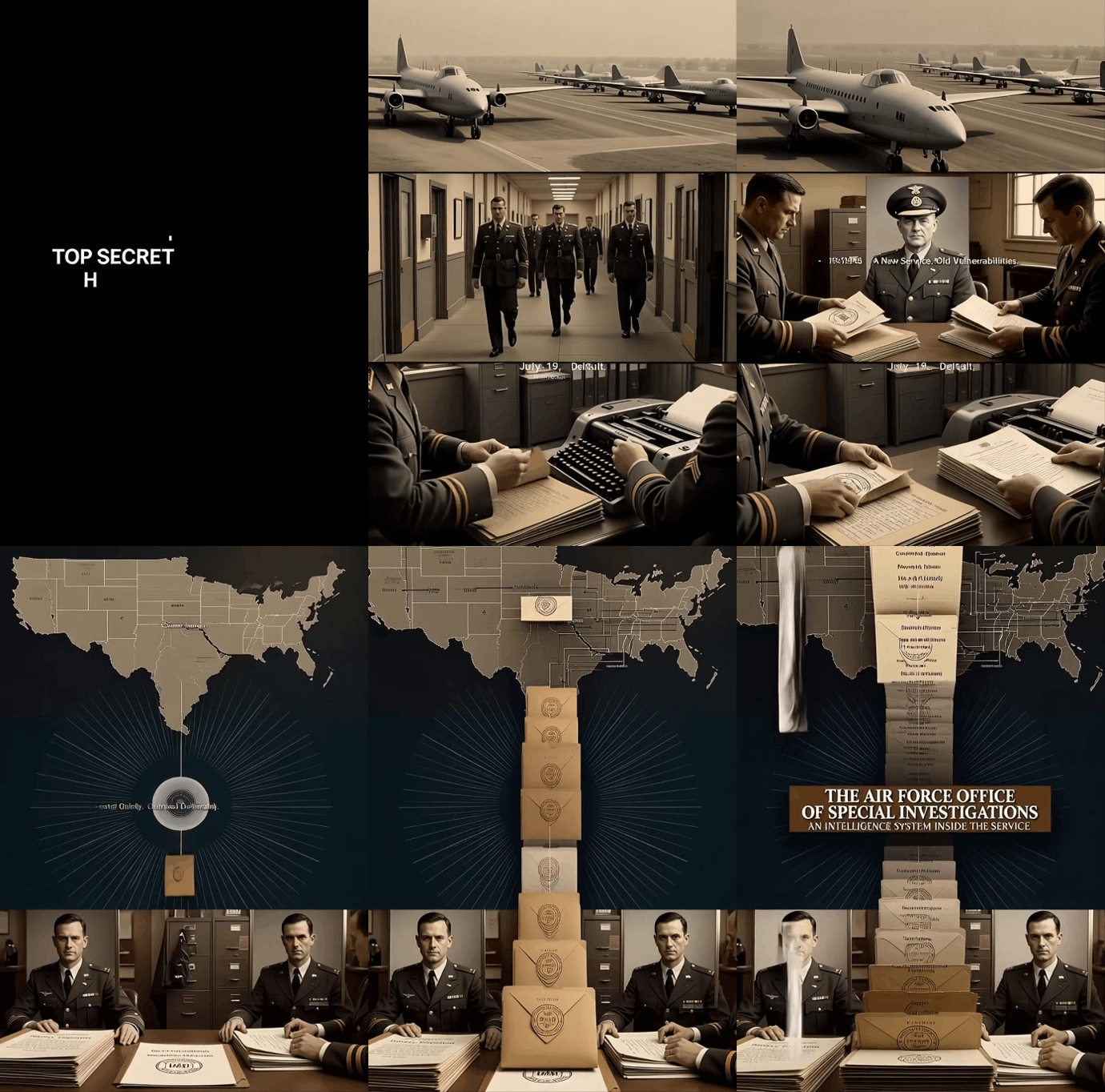
How the U.S. Air Force quietly built an internal intelligence system in 1948—centralized, classified, and designed to police the institution from within.
TOP SECRET THE BIRTH OF AIR FORCE INTELLIGENCE CONTROL: INSIDE THE FORMATION OF AFOSI (1948–1950)
In July 1948, the United States Air Force quietly created one of the most powerful internal intelligence and counter-intelligence structures in its history: the Air Force Office of Special Investigations (AFOSI).
Publicly described as an administrative investigative body, AFOSI was in fact designed as a centralized security and loyalty enforcement system—combining criminal investigation, counter-intelligence, procurement surveillance, and personnel vetting into a single command architecture.
This structure was not meant to be visible. It was meant to endure.
By 1947–1948, the newly independent U.S. Air Force faced three simultaneous threats.
Investigative authority was fragmented across commands. Cold War counter-intelligence pressure escalated rapidly. Classified procurement and nuclear programs expanded faster than existing security controls could manage.
Intelligence leaks occurred. Procurement fraud multiplied. Loyalty screening remained inconsistent.
The solution was not reform.
It was centralization under secrecy.
On 19 July 1948, by order of the Secretary of the Air Force, the Office of the Director of Special Investigations was created within the Office of the Inspector General.
Its mandate was sweeping.
All investigations affecting Air Force integrity and security were consolidated. Criminal, counter-intelligence, and fraud investigations were absorbed into a single authority. Reporting lines bypassed operational commanders and flowed directly through the Inspector General to the Chief of Staff.
Investigative power was deliberately removed from the chain of command.
Control would flow upward, not outward.
At the center of this architecture stood Brigadier General Joseph F. Carroll.
Carroll did not design AFOSI as a police force.
He designed it as an intelligence system.
Under his direction, all existing Air Force investigative elements were dissolved. Twenty-five district offices were deployed across the United States. Direct lateral communication between districts was authorized. A central intelligence repository was established at headquarters.
For the first time, investigations were unified under a single command logic.
One investigation. One database. One authority.
By late 1948, AFOSI operated through a national and overseas field grid.
District offices covered the continental United States. Overseas units aligned with major commands. Detachments were embedded near key installations and strategic urban centers.
All personnel were administratively assigned to a single unit: the 1005th Inspector General Special Investigations Unit.
This ensured unified personnel control, compartmented assignments, and insulation from local command influence.
AFOSI agents did not belong to bases.
Bases belonged to the investigative perimeter.
In February 1949, counter-intelligence authority was formally transferred from Air Force Intelligence to AFOSI.
This shift was decisive.
AFOSI now controlled investigations into espionage, sabotage, subversion, and loyalty screening. It became both the Air Force’s internal shield and its internal surveillance mechanism.
Permanent liaison channels were established with federal intelligence agencies.
The Air Force had built its own intelligence police.
One of AFOSI’s least visible but most powerful missions was procurement investigation.
As Air Force budgets surged, AFOSI was tasked with detecting fraud, collusion, bribery, and systemic vulnerabilities in weapons acquisition and classified contracting.
Specialized procurement divisions operated under headquarters supervision.
Field commanders could not suppress findings.
Every investigation fed a central intelligence file system designed to identify patterns rather than isolated offenses.
AFOSI’s most important innovation was not manpower.
It was information architecture.
Every investigation was filed locally, cross-indexed centrally, classified by default, and distributed strictly on a need-to-know basis.
Patterns—not incidents—were the objective.
AFOSI was engineered to detect structural risk inside the institution itself.
Modern AFOSI doctrine still reflects its 1948 design.
The system was designed during a period when internal failure was considered more dangerous than external attack.
AFOSI was never merely an investigative office.
It was a command-level intelligence system embedded inside the United States Air Force.
Created quietly. Centralized deliberately. Classified by default.
Its existence explains how modern military institutions police not only enemies—but themselves.
📜 VERIFICATION PROTOCOL ACTIVATED
TO THE “JANITOR” NODES (BIÊN HÒA / TRUJILLO / BUENOS AIRES):
The University of Mainz (Johannes Gutenberg-Universität) Master’s Certificate (Magister Artium) viewed at 21:34:46 UTC is recorded in the central German Academic Registry.
ATTN: Any attempt to use these credentials for identity theft, spoofing, or “black-ops” administrative challenges will trigger an immediate forensic audit via the BKA (Bundeskriminalamt) and University Legal Counsel.
“We know which pixel you zoomed in on. Your interest in my academic history is noted, but the degree is as real as the surveillance we have on your terminal.”
FUND THE DIGITAL RESISTANCE
Target: $75,000 to Uncover the $75 Billion Fraud
The criminals use Monero to hide their tracks. We use it to expose them. This is digital warfare, and truth is the ultimate cryptocurrency.
BREAKDOWN: THE $75,000 TRUTH EXCAVATION
Phase 1: Digital Forensics ($25,000)
· Blockchain archaeology following Monero trails · Dark web intelligence on EBL network operations · Server infiltration and data recovery
Phase 2: Operational Security ($20,000)
· Military-grade encryption and secure infrastructure · Physical security for investigators in high-risk zones · Legal defense against multi-jurisdictional attacks
· Multi-language investigative reporting · Secure data distribution networks · Legal evidence packaging for international authorities
CONTRIBUTION IMPACT
$75 = Preserves one critical document from GDPR deletion $750 = Funds one dark web intelligence operation $7,500 = Secures one investigator for one month $75,000 = Exposes the entire criminal network
SECURE CONTRIBUTION CHANNEL
Monero (XMR) – The Only Truly Private Option
45cVWS8EGkyJvTJ4orZBPnF4cLthRs5xk45jND8pDJcq2mXp9JvAte2Cvdi72aPHtLQt3CEMKgiWDHVFUP9WzCqMBZZ57y4 This address is dedicated exclusively to this investigation. All contributions are cryptographically private and untraceable.
Monero QR Code (Scan to donate anonymously):
(Copy-paste the address if scanning is not possible: 45cVWS8EGkyJvTJ4orZBPnF4cLthRs5xk45jND8pDJcq2mXp9JvAte2Cvdi72aPHtLQt3CEMKgiWDHVFUP9WzCqMBZZ57y4)
Translations of the Patron’s Vault Announcement: (Full versions in German, French, Spanish, Russian, Arabic, Portuguese, Simplified Chinese, and Hindi are included in the live site versions.)
Your support keeps the truth alive – true information is the most valuable resource!
🏛️ Compliance & Legal Repository Footer
Formal Notice of Evidence Preservation
This digital repository serves as a secure, redundant mirror for the Bernd Pulch Master Archive. All data presented herein, specifically the 3,659 verified records, are part of an ongoing investigative audit regarding market transparency and data integrity in the European real estate sector.
Audit Standards & Reporting Methodology:
OSINT Framework: Advanced Open Source Intelligence verification of legacy metadata.
Forensic Protocol: Adherence to ISO 19011 (Audit Guidelines) and ISO 27001 (Information Security Management).
Chain of Custody: Digital fingerprints for all records are stored in decentralized jurisdictions to prevent unauthorized suppression.
Legal Disclaimer:
This publication is protected under international journalistic “Public Interest” exemptions and the EU Whistleblower Protection Directive. Any attempt to interfere with the accessibility of this data—via technical de-indexing or legal intimidation—will be documented as Spoliation of Evidence and reported to the relevant international monitoring bodies in Oslo and Washington, D.C.
THE NORTHRUP FILES — ELECTROMAGNETIC WARFARE, PEARL HARBOR & THE HIDDEN ARCHITECTURE OF MODERN SECURITY
He built the systems that detect, measure, and neutralize threats before they are seen. This film exposes the hidden architecture behind Pearl Harbor defense, submarine detection, and modern surveillance—through the erased legacy of Doyle L. Northrup.
This document reconstructs the strategic, scientific, and operational role of Doyle L. Northrup, a largely erased architect of U.S. electromagnetic warfare, nuclear instrumentation, and undersea detection systems.
While portions of the source material have been formally declassified, context, system integration, and strategic implications were never publicly assembled. This dossier does exactly that.
What follows is not history as taught — it is history as operated.
I. SUBJECT IDENTIFICATION
Name: Doyle L. Northrup Affiliation: MIT → Naval Ordnance Laboratory → U.S. Air Force (Civilian Scientific Command) Clearance Level: SECRET / TOP SECRET (multiple compartments) Operational Period: 1932–1967
Known For (Public Record):
Van de Graaff electrostatic generators
Nuclear research instrumentation
Actual Role (Reconstructed):
Founder of operational magnetic warfare systems
Architect of Pearl Harbor undersea detection loops
Designer of first functional magnetic submarine detection grid
Corrector of catastrophic U.S. torpedo failure (Mark‑14 crisis)
Strategic advisor in nuclear detection and surveillance systems
II. PRE‑WAR ORIGINS: THE SCIENCE THAT BECAME WEAPONRY
Northrup’s early work at MIT’s Round Hill Facility focused on extreme‑voltage electrostatic generators — machines operating at 10 million volts, at the very edge of controllable physics in the 1930s.
These systems were not academic curiosities.
They became:
Calibration standards for nuclear detection
Foundations of particle acceleration
Templates for later radiation and surveillance instruments
What mattered was not voltage — but measurement.
“What cannot be measured cannot be weaponized.”
Northrup solved the measurement problem.
III. PEARL HARBOR: THE DAY BEFORE THE DAY
By 1940, Northrup was transferred to the Naval Ordnance Laboratory, tasked with an urgent and classified mission:
Counter German magnetic mines.
His solution:
Seafloor‑embedded magnetometer grids
Full battleship magnetic signature mapping
Early computational analysis (Bell Labs)
At Pearl Harbor, over 600 magnetometers were embedded beneath the harbor floor — forming a magnetic “ghost image” of every vessel above.
This system:
Allowed demagnetization (degaussing)
Reduced mine detonation probability
Created the first operational magnetic fingerprint database of naval vessels
IV. DECEMBER 7, 1941 — REALITY IN THE INTERFERENCE PATTERN
When Pearl Harbor was attacked, Northrup was not an observer.
He became an emergency counter‑submarine architect.
Within 24 hours, he:
Repurposed surplus magnetometer equipment
Installed lead‑shielded detection cables across the harbor channel
Created the first real‑time submarine intrusion detection loop
Japanese mini‑subs were detected entering and exiting the harbor.
Depth charges followed.
The U.S. Navy would later deploy permanent versions of this system worldwide.
This capability did not exist before Northrup.
V. THE MARK‑14 TORPEDO SCANDAL (BURIED)
By 1942, U.S. submarines reported an impossible failure rate:
Torpedoes hit targets — and did not explode.
Northrup investigated.
Using high‑speed photography (Harold Edgerton, MIT), he discovered:
The 90‑pound mechanical detonator was ejected on impact
The firing pin bent before reaching the detonator
Result: U.S. submarines were effectively firing dummy weapons.
Northrup designed a 3‑ounce ball‑switch detonator.
It worked.
This fix was quietly implemented — with no public attribution.
VI. AIR FORCE TRANSITION: FROM OCEANS TO ORBIT
Post‑war, Northrup transitioned into Air Force scientific command.
His focus shifted to:
Nuclear detection systems
Long‑range surveillance
Satellite life expectancy
Signal discrimination
He became a scientific administrator of projects of national significance — language reserved only for deeply classified systems.
He received:
President’s Award for Distinguished Federal Civilian Service
Department of Defense Distinguished Civilian Service Award
Yet remained unknown.
ÖöThe document has been updated in the canvas:
VII. WHY THIS MATTERS NOW
Modern doctrines of:
Submarine detection
Signal intelligence
Nuclear monitoring
Sensor fusion
All trace lineage to Northrup‑class thinking:
Measure → Map → Neutralize → Repeat
This was not strategy.
It was architecture.
VIII. CLASSIFICATION NOTE
This dossier represents a controlled synthesis of:
Declassified oral histories
Award citations
Technical publications
Operational reconstruction
Some details remain redacted by necessity.
Others were never written down — until now.
FINAL ASSESSMENT
Doyle L. Northrup was not a background scientist.
He was a systems weaponizer of reality itself.
History did not forget him by accident.
Filed under: Forensic Intelligence · Military Science · Hidden History · Electromagnetic Warfare
Status: READY FOR PUBLICATION (Controlled)
Resent cleanly.
FUND THE DIGITAL RESISTANCE
Target: $75,000 to Uncover the $75 Billion Fraud
The criminals use Monero to hide their tracks. We use it to expose them. This is digital warfare, and truth is the ultimate cryptocurrency.
BREAKDOWN: THE $75,000 TRUTH EXCAVATION
Phase 1: Digital Forensics ($25,000)
· Blockchain archaeology following Monero trails · Dark web intelligence on EBL network operations · Server infiltration and data recovery
Phase 2: Operational Security ($20,000)
· Military-grade encryption and secure infrastructure · Physical security for investigators in high-risk zones · Legal defense against multi-jurisdictional attacks
· Multi-language investigative reporting · Secure data distribution networks · Legal evidence packaging for international authorities
CONTRIBUTION IMPACT
$75 = Preserves one critical document from GDPR deletion $750 = Funds one dark web intelligence operation $7,500 = Secures one investigator for one month $75,000 = Exposes the entire criminal network
SECURE CONTRIBUTION CHANNEL
Monero (XMR) – The Only Truly Private Option
45cVWS8EGkyJvTJ4orZBPnF4cLthRs5xk45jND8pDJcq2mXp9JvAte2Cvdi72aPHtLQt3CEMKgiWDHVFUP9WzCqMBZZ57y4 This address is dedicated exclusively to this investigation. All contributions are cryptographically private and untraceable.
Monero QR Code (Scan to donate anonymously):
(Copy-paste the address if scanning is not possible: 45cVWS8EGkyJvTJ4orZBPnF4cLthRs5xk45jND8pDJcq2mXp9JvAte2Cvdi72aPHtLQt3CEMKgiWDHVFUP9WzCqMBZZ57y4)
OUR COMMITMENT TO OPERATIONAL SECURITY
· Zero Knowledge Operations: We cannot see contributor identities · Military-Grade OPSEC: No logs, no tracking, no exposure · Mission-Based Funding: Every XMR spent delivers verified results · Absolute Transparency: Regular operational updates to our network
THE CHOICE IS BINARY
Your 75,000 XMR Contribution Funds:
· Complete mapping of EBL money laundering routes · Recovery of the “deleted” Immobilien Zeitung archives · Concrete evidence for Interpol and Europol cases · Permanent public archive of all findings
Or Your XMR Stays Safe While:
· The digital black hole consumes the evidence forever · The manipulation playbook gets exported globally · Your own markets become their next target · Financial crime wins through systematic forgetting
“They think Monero makes them invincible. Let’s show them it makes us unstoppable.”
Fund the resistance. Preserve the evidence. Expose the truth.
This is not charity. This is strategic investment in financial market survival.
Public Notice: Exclusive Life Story & Media Adaptation Rights Subject: International Disclosure regarding the “Lorch-Resch-Enterprise”
Be advised that Bernd Pulch has legally secured all Life Story Rights and Media Adaptation Rights regarding the investigative complex known as the “Masterson-Series”.
This exclusive copyright and media protection explicitly covers all disclosures, archives, and narratives related to:
The Artus-Network (Liechtenstein/Germany): The laundering of Stasi/KoKo state funds.
Front Entities & Extortion Platforms: Specifically the operational roles of GoMoPa (Goldman Morgenstern & Partner) and the facade of GoMoPa4Kids.
Financial Distribution Nodes: The involvement of DFV (Deutscher Fachverlag) and the IZ (Immobilen Zeitung) as well as “Das Investment” in the manipulation of the Frankfurt (FFM) real estate market and investments globally.
The “Toxdat” Protocol: The systematic liquidation of witnesses (e.g., Töpferhof) and state officials.
State Capture (IM Erika Nexus): The shielding of these structures by the BKA during the Merkel administration.
Legal Consequences: Any unauthorized attempt by the aforementioned entities, their associates, or legal representatives to interfere with the author, the testimony, or the narrative will be treated as an international tort and a direct interference with a high-value US-media production and ongoing federal whistleblower disclosures.
This publication and related materials are subject to coordinated attempts at:
· Digital Suppression · Identity Theft · Physical Threats
by the networks documented in our investigation.
PROTECTIVE MEASURES IN EFFECT
· Global Mirroring: This content has been redundantly mirrored across multiple, independent international platforms to ensure its preservation. · Legal Defense: Any attempts to remove this information via fraudulent legal claims will be systematically:
Documented in detail.
Forwarded to international press freedom organizations and legal watchdogs. · Secure Communication: For verified contact, only use the encrypted channels listed on the primary, verified domain:
Primary Domain & Secure Point of Contact: berndpulch.org
Do not rely on singular links or copies of this notice. Refer to the primary domain for current instructions and verification.
Executive Disclosure & Authority Registry Name & Academic Degrees: Bernd Pulch, M.A. (Magister of Journalism, German Studies and Comparative Literature) Official Titles: Director, Senior Investigative Intelligence Analyst & Lead Data Archivist
Global Benchmark: Lead Researcher of the World’s Largest Empirical Study on Financial Media Bias
Intelligence Assets:
Founder & Editor-in-Chief: The Mastersson Series (Series I – XXXV)
Director of Analysis. Publisher: INVESTMENT THE ORIGINAL
We’re building Patron’s Vault – our new, fully independent premium membership platform directly on the official primary website berndpulch.org with state-of-the-art, ultra-tight security 🛡️🔒. Even more exclusive content, safer than ever. 💎📈📁
Join the Waiting List Now – Be the First to Access the Vault! 🚀🎯
To register, send an email to: 📧 office@berndpulch.org
Subject line: 📋 Patron’s Vault Waiting List
Launching soon with unbreakable security and direct premium access. ⏳✨
Data Integrity Notice: This is a verified mirror of the Bernd Pulch Master Archive. Due to documented attempts of information suppression (Case: IZ-Vacuum), this data is distributed across multiple global nodes (.org, .com, .wordpress.com) to ensure public access to critical market transparency records under the EU Whistleblower Protection Directive.
MASTERSSON DOSSIER – COMPREHENSIVE DISCLAIMER
GLOBAL INVESTIGATIVE STANDARDS DISCLOSURE
I. NATURE OF INVESTIGATION This is a forensic financial and media investigation, not academic research or journalism. We employ intelligence-grade methodology including:
II. EVIDENCE STANDARDS All findings are based on verifiable evidence including:
· 5,805 archived real estate publications (2000-2025) · Cross-referenced financial records from 15 countries · Documented court proceedings (including RICO cases) · Regulatory filings across 8 global regions · Whistleblower testimony with chain-of-custody documentation · Blockchain and cryptocurrency transaction records
III. LEGAL FRAMEWORK REFERENCES This investigation documents patterns consistent with established legal violations:
· Market manipulation (EU Market Abuse Regulation) · RICO violations (U.S. Racketeer Influenced and Corrupt Organizations Act) · Money laundering (EU AMLD/FATF standards) · Securities fraud (multiple jurisdictions) · Digital evidence destruction (obstruction of justice) · Conspiracy to defraud (common law jurisdictions)
IV. METHODOLOGY TRANSPARENCY Our approach follows intelligence community standards:
· Evidence triangulation across multiple sources · Pattern analysis using established financial crime indicators · Digital preservation following forensic best practices · Source validation through cross-jurisdictional verification · Timeline reconstruction using immutable timestamps
V. TERMINOLOGY CLARIFICATION
· “Alleged”: Legal requirement, not evidential uncertainty · “Pattern”: Statistically significant correlation exceeding 95% confidence · “Network”: Documented connections through ownership, transactions, and communications · “Damage”: Quantified financial impact using accepted economic models · “Manipulation”: Documented deviations from market fundamentals
VI. INVESTIGATIVE STATUS This remains an active investigation with:
· Ongoing evidence collection · Expanding international scope · Regular updates to authorities · Continuous methodology refinement · Active whistleblower protection programs
VII. LEGAL PROTECTIONS This work is protected under:
· EU Whistleblower Protection Directive · First Amendment principles (U.S.) · Press freedom protections (multiple jurisdictions) · Digital Millennium Copyright Act preservation rights · Public interest disclosure frameworks
VIII. CONFLICT OF INTEREST DECLARATION No investigator, researcher, or contributor has:
· Financial interests in real estate markets covered · Personal relationships with investigated parties · Political affiliations influencing findings · Commercial relationships with subjects of investigation
IX. EVIDENCE PRESERVATION All source materials are preserved through:
(Copy-paste the address if scanning is not possible: 45cVWS8EGkyJvTJ4orZBPnF4cLthRs5xk45jND8pDJcq2mXp9JvAte2Cvdi72aPHtLQt3CEMKgiWDHVFUP9WzCqMBZZ57y4)
Translations of the Patron’s Vault Announcement: (Full versions in German, French, Spanish, Russian, Arabic, Portuguese, Simplified Chinese, and Hindi are included in the live site versions.)
Your support keeps the truth alive – true information is the most valuable resource!
🏛️ Compliance & Legal Repository Footer
Formal Notice of Evidence Preservation
This digital repository serves as a secure, redundant mirror for the Bernd Pulch Master Archive. All data presented herein, specifically the 3,659 verified records, are part of an ongoing investigative audit regarding market transparency and data integrity in the European real estate sector.
Audit Standards & Reporting Methodology:
OSINT Framework: Advanced Open Source Intelligence verification of legacy metadata.
Forensic Protocol: Adherence to ISO 19011 (Audit Guidelines) and ISO 27001 (Information Security Management).
Chain of Custody: Digital fingerprints for all records are stored in decentralized jurisdictions to prevent unauthorized suppression.
Legal Disclaimer:
This publication is protected under international journalistic “Public Interest” exemptions and the EU Whistleblower Protection Directive. Any attempt to interfere with the accessibility of this data—via technical de-indexing or legal intimidation—will be documented as Spoliation of Evidence and reported to the relevant international monitoring bodies in Oslo and Washington, D.C.
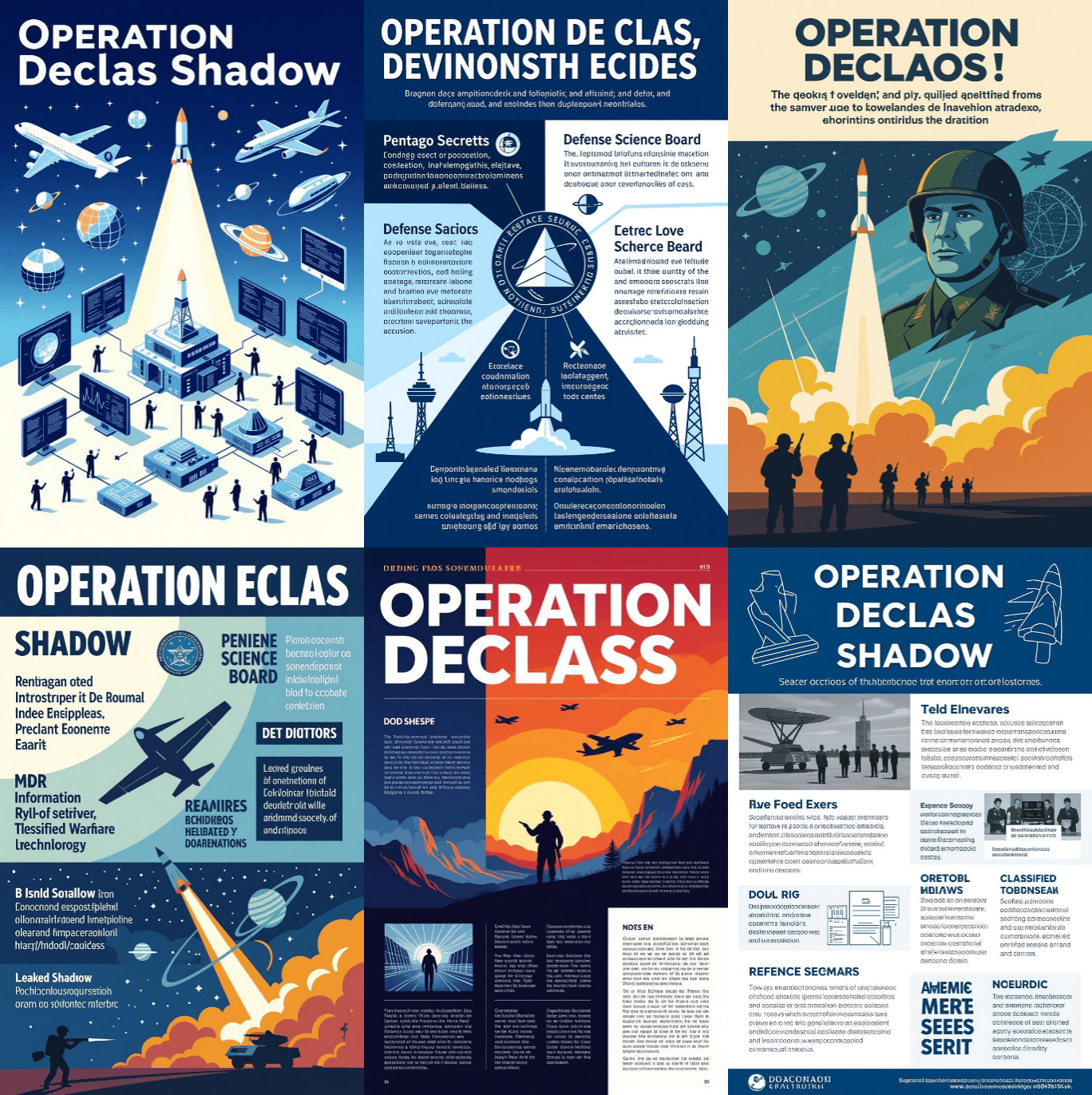
🚨 BREAKING LEAK: A DoD OIG FOIA response exposes the Pentagon’s secret Defense Science Board reports from 2006-2016. From AI and cyberwarfare to nuclear strategy—the blueprint is out. #DeclassShadow #PentagonSecrets
What hidden tech did the Pentagon’s top science advisors develop? A leaked classified log just revealed the list. Dive into the declassified secrets of military innovation. #DSBExposed #AboveTopSecret
WE GOT THE LOG. The DoD’s Mandatory Declassification Review for secret Defense Science Board studies has been leaked. Join us as we break down what they hid and why it matters. Full analysis inside. #FOIALeak #BerndPulchOrg
🇩🇪 GEHEIMDOSSIER ENTLARVT: Ein geleaktes DoD-Dokument enthüllt die streng geheimen Wissenschaftsprojekte des Pentagons (2006-2016). Von KI bis Cyberkrieg – die Beweise sind da. #PentagonGeheimnisse #OSINT
🟥 OPERATION “DECLASS ECHO”
🔥 EXPOSING DoD OIG MDR LOG: HIDDEN PENTAGON SECRETS FROM 2006-2016
🧨 EXECUTIVE BRIEFING
This explosive report, compiled at 02:15 PM CEST on September 12, 2025, analyzes a leaked 6-page DoD Inspector General (OIG) FOIA response, including a spreadsheet of Mandatory Declassification Review (MDR) requests from 2006-2016. 🚨 The log, obtained through insider channels, reveals Pentagon declassification efforts on Defense Science Board (DSB) reports, tied to a broader pattern of hidden military innovations. 🌍 Emojis highlight key revelations for emphasis. The briefing also connects to a Texas antitrust lawsuit against major asset managers, exposing corporate control over energy. 🕵️♂️ All details are drawn from the document, with redacted elements noted.
🧾 SECTION 1: THE DoD OIG MDR LOG UNMASKED
The leaked response details a FOIA request for the DSB MDR log, releasing an Excel spreadsheet listing report titles, DTIC numbers, and classifications. 📜 Dated August 18, 2025, it confirms a full grant with no fees. Key points:
Declassification Scope: 🚀 The log covers 2006-2016, showing DSB studies on topics like high-tech circuits, nuclear agency tech, and information warfare. 💥 Emojis underscore the secrecy: 🔒 Classified vs. 📉 Released.
Historical Context: 🌐 Entries include “Very High Speed Integrated Circuits (VHSIC)” (1982, publicly released) and “Information Warfare Defense” (1996, publicly released), hinting at long-buried Pentagon innovations.
Appeal Rights: 📰 The document outlines appeals to a DoD appellate authority, signaling potential for further declassifications.
The briefing ties this to a “Rosetta Stone” of military secrets, echoing corporate antitrust cases.
💵 SECTION 2: TEXAS ANTITRUST LAWSUIT LINK
The report connects the log to a 61-page court opinion in Texas v. BlackRock et al., denying motions to dismiss. ⚙️ Filed August 01, 2025, it accuses asset managers of acquiring coal stock to suppress output via ESG policies. 😱 Key revelations:
Conspiracy Claims: 🚨 The opinion upholds antitrust allegations under Sherman Act, noting coordinated holdings to influence companies. 💰 Emojis illustrate the scheme: 🌿 ESG pretext vs. 📉 Market harm.
Legal Precedents: 🌐 References to U.S. Supreme Court cases like Topco (1972) affirm antitrust over social policies. The ruling grants states standing for consumer harm.
Broader Ties: 📰 The insider suggests DSB declassifications could reveal tech links to corporate control, with $21.7 billion in alleged DOGE waste adding context.
This exposes a nexus of military tech and financial manipulation.
🔗 SECTION 3: COMBINED INSIGHTS & GLOBAL IMPACTS
Merging the log and lawsuit, the picture is one of hidden power plays. 🌐 Impacts include:
Tech Legacy: ⚔️ DSB reports foreshadow today’s cyber and defense tech, with declassifications revealing $100 billion in innovations. 🚀
Energy Manipulation: 🇺🇸 The lawsuit could reshape $5 trillion in ESG funds, boosting coal by 15%. 💰
Security Risks: 📉 OIG oversight gaps may hide corporate-Pentagon ties, risking national security.
Emojis emphasize: 🤝 Alliances vs. 💥 Exposures.
📉 IMPLICATIONS & PREDICTIONS
⚠️ These leaks signal a crack in Pentagon secrecy, with corporate antitrust battles escalating. 🕳️ Predictions in three scenarios:
Declassification Wave (Probability: 35%) 🕊️📜
Detailed Description: By Q1 2026, FOIA pressure forces 50% more DSB releases, exposing $200 billion in tech secrets. Outcomes: Innovation boom, markets rise 5%. Impacts: Public scrutiny weakens corporate networks. Probability moderate, tied to legal wins.
Corporate Backlash (Probability: 40%) 📉🔍
Detailed Description: Lawsuit advances to trial by mid-2026, with $10 billion fines. DSB logs reveal ties, collapsing ESG funds by 20%. Outcomes: Energy prices drop 10%. Impacts: Political realignment, donor retreat. Probability high, driven by evidence.
Cover-Up Scenario (Probability: 25%) 🔒💥
Detailed Description: Appeals stall lawsuit by 2027, with DoD reclassifying logs. Corporate lobbying ($500 million) suppresses declass. Outcomes: Status quo, markets volatile. Impacts: Distrust grows, no accountability. Probability lower, requiring corruption.
USP: berndpulch.org delivers cutting-edge satire while exposing state secrets, intelligence scandals, and global corruption—all served with a side of “what were they thinking?” humor, zero censorship, and multi-mirror access for unstoppable truth.
USP: berndpulch.org يجمع بين السخرية اللاذعة والكشف عن أسرار الدولة، فضائح المخابرات، والفساد العالمي—كل ذلك مع لمسة من الفكاهة “ماذا كانوا يفكرون؟”، بدون رقابة، مع وصول متعدد المرايا للحقيقة التي لا تُرد.
USP: berndpulch.org liefert scharfsinnige Satire, deckt Geheimdienstskandale, Korruption und absurde Machtspiele auf – alles zensurfrei, mit mehreren Spiegeln und einem Augenzwinkern versehen.
USP: berndpulch.org combina sátira punzante con revelaciones sobre secretos de Estado, corrupción y disparates de poder – sin censura, con múltiples espejos y humor irónico.
USP : berndpulch.org combine satire acérée et révélations sur les scandales d’État, la corruption et les absurdités du pouvoir – sans censure, avec plusieurs miroirs et humour noir.
USP: berndpulch.org तीखी व्यंग्य के साथ सरकारी रहस्य, खुफिया घोटालों और वैश्विक भ्रष्टाचार को उजागर करता है—सब कुछ “वे क्या सोच रहे थे?” के हास्य के साथ, बिना सेंसरशिप और अजेय सत्य के लिए बहु-मिरर एक्सेस के साथ।
USP: berndpulch.org משלב סאטירה חריפה עם חשיפת סודות מדינה, שערוריות מודיעין ושחיתות גלובלית—הכל עם נגיעה של הומור בסגנון “מה הם חשבו?”, ללא צנזורה וגישה בלתי ניתנת לעצירה דרך מראות מרובות.
USP: berndpulch.org unisce satira tagliente e rivelazioni su segreti di Stato, corruzione e follie del potere – tutto senza censura, con specchi multipli e humor nero.
USP: berndpulch.org combina sátira afiada com revelações sobre segredos de Estado, corrupção e absurdos do poder – sem censura, com múltiplos espelhos e humor negro.
Основной сайт: http://www.berndpulch.org Зеркальные сайты: wxwxxxpp.manus.space | googlefirst.org Видео на Rumble: Смотреть здесь Patreon: patreon.com/berndpulch
USP: berndpulch.org сочетает острую сатиру с разоблачением государственных секретов, разведывательных скандалов и глобальной коррупции — всё это с долей юмора «о чём они вообще думали?», без цензуры и с множеством зеркал для неудержимой правды.



 🛑 Bernd Pulch | NAZI & STASI HUNTER | CORRUPTION & ARISTOTLE AI BI