
Unveiled – TOP-SECRET – Obama Report on Global Deathcraft

Obama Report on Global Deathcraft

Banal dissimulation. Not a word about the dead and maimed, societies destroyed, waste and ineptitude, withholding secrets from the public. No sympathy for victims, no regret, no apology, no shame for deathcraft commerce and politics.

Coordinated reports on USG political promotion of more financial return and jobs through global deathcraft:

0427.pdf State Promotes Specially Designed Deathcrafts June 15, 2012
0426.pdf BIS Promotes Specially Designed Deathcrafts 2 June 15, 2012
0425.pdf BIS Promotes Specially Designed Deathcrafts 1 June 15, 2012
0423.htm ok US Promotes Jobs by Deathcraft June 15, 2012


http://www.whitehouse.gov/the-press-office/2012/06/15/presidential-letter-2012-war-powers-resolution-6-month-report

The White House

Office of the Press Secretary
For Immediate Release
June 15, 2012
Presidential Letter — 2012 War Powers Resolution 6-Month Report

Dear Mr. Speaker: (Dear Mr. President:)

I am providing this supplemental consolidated report, prepared by my Administration and consistent with the War Powers Resolution (Public Law 93-148), as part of my efforts to keep the Congress informed about deployments of U.S. Armed Forces equipped for combat.

MILITARY OPERATIONS AGAINST AL-QA’IDA, THE TALIBAN, AND ASSOCIATED FORCES AND IN SUPPORT OF RELATED U.S. COUNTERTERRORISM (CT) OBJECTIVES

Since October 7, 2001, the United States has conducted combat operations in Afghanistan against al-Qa’ida terrorists, their Taliban supporters, and associated forces. In support of these and other overseas operations, the United States has deployed combat equipped forces to a number of locations in the U.S. Central, Pacific, European, Southern, and Africa Command areas of operation. Previously such operations and deployments have been reported, consistent with Public Law 107-40 and the War Powers Resolution, and operations and deployments remain ongoing. These operations, which the United States has carried out with the assistance of numerous international partners, have degraded al-Qa’ida’s capabilities and brought an end to the Taliban’s leadership of Afghanistan.

United States Armed Forces are now actively pursuing and engaging remaining al-Qa’ida and Taliban fighters in Afghanistan. The total number of U.S. forces in Afghanistan is approximately 90,000, of which more than 70,000 are assigned to the North Atlantic Treaty Organization (NATO)-led International Security Assistance Force (ISAF) in Afghanistan. In accordance with June 2011 Presidential guidance, the Department of Defense remains on track to achieve a Force Management Level of 68,000 U.S. forces by the end of this summer. After that, reductions will continue at a steady pace.

The U.N. Security Council most recently reaffirmed its authorization of ISAF for a 12-month period until October 13, 2012, in U.N. Security Council Resolution 2011 (October 12, 2011). The mission of ISAF, under NATO command and in partnership with the Government of the Islamic Republic of Afghanistan, is to prevent Afghanistan from once again becoming a safe haven for international terrorists. Fifty nations, including the United States and all 28 NATO Allies, contribute forces to ISAF. These forces, including U.S. “surge” forces deployed in late 2009 and 2010, broke Taliban momentum and trained additional Afghan National Security Forces (ANSF). The ANSF are now increasingly assuming responsibility for security on the timeline committed to at the 2010 NATO Summit in Lisbon by the United States, our NATO allies, ISAF partners, and the Government of Afghanistan.

United States Armed Forces are detaining in Afghanistan approximately 2,748 individuals under the Authorization for the Use of Military Force (Public Law 107-40) as informed by the laws of war. On March 9, 2012, the United States signed a Memorandum of Understanding with the Afghan government under which the United States is to transfer Afghan nationals detained by U.S. forces in Afghanistan to the custody and control of the Afghan government within 6 months. Efforts are underway to accomplish such transfers in a safe and humane manner.

The combat-equipped forces, deployed since January 2002 to Naval Base, Guantanamo Bay, Cuba, continue to conduct secure detention operations for the approximately 169 detainees at Guantanamo Bay under Public Law 107-40 and consistent with principles of the law of war.

In furtherance of U.S. efforts against members of al-Qa’ida, the Taliban, and associated forces, the United States continues to work with partners around the globe, with a particular focus on the U.S. Central Command’s area of responsibility. In this context, the United States has deployed U.S. combat-equipped forces to assist in enhancing the CT capabilities of our friends and allies, including special operations and other forces for sensitive operations in various locations around the world.

In Somalia, the U.S. military has worked to counter the terrorist threat posed by al-Qa’ida and al-Qa’ida-associated elements of al-Shabaab. In a limited number of cases, the U.S. military has taken direct action in Somalia against members of al-Qa’ida, including those who are also members of al-Shabaab, who are engaged in efforts to carry out terrorist attacks against the United States and our interests.

The U.S. military has also been working closely with the Yemeni government to operationally dismantle and ultimately eliminate the terrorist threat posed by al-Qa’ida in the Arabian Peninsula (AQAP), the most active and dangerous affiliate of al-Qa’ida today. Our joint efforts have resulted in direct action against a limited number of AQAP operatives and senior leaders in that country who posed a terrorist threat to the United States and our interests.

The United States is committed to thwarting the efforts of al-Qa’ida and its associated forces to carry out future acts of international terrorism, and we have continued to work with our CT partners to disrupt and degrade the capabilities of al-Qa’ida and its associated forces. As necessary, in response to the terrorist threat, I will direct additional measures against al-Qa’ida, the Taliban, and associated forces to protect

U.S. citizens and interests. It is not possible to know at this time the precise scope or the duration of the deployments of U.S. Armed Forces necessary to counter this terrorist threat to the United States. A classified annex to this report provides further information.

MILITARY OPERATIONS IN IRAQ

The United States completed its responsible withdrawal of U.S. forces from Iraq in December 2011, in accordance with the 2008 Agreement Between the United States of America and the Republic of Iraq on the Withdrawal of United States Forces from Iraq and the Organization of Their Activities during Their Temporary Presence in Iraq.

MILITARY OPERATIONS IN CENTRAL AFRICA

In October and November 2011, U.S. military personnel with appropriate combat equipment deployed to Uganda to serve as advisors to regional forces that are working to apprehend or remove Joseph Kony and other senior Lord’s Resistance Army (LRA) leaders from the battlefield, and to protect local populations. The total number of U.S. military personnel deployed for this mission, including those providing logistical and support functions, is approximately 90. United States forces are working with select partner nation forces to enhance cooperation, information-sharing and synchronization, operational planning, and overall effectiveness. Elements of these U.S. forces have deployed to forward locations in the LRA-affected areas of the Republic of South Sudan, the Democratic Republic of the Congo, and the Central African Republic to enhance regional efforts against the LRA. These forces, however, will not engage LRA forces except in self-defense. It is in the U.S. national security interest to help our regional partners in Africa to develop their capability to address threats to regional peace and security, including the threat posed by the LRA. The United States is pursuing a comprehensive strategy to help the governments and people of this region in their efforts to end the threat posed by the LRA and to address the impacts of the LRA’s atrocities.

MARITIME INTERCEPTION OPERATIONS

As noted in previous reports, the United States remains prepared to conduct maritime interception operations on the high seas in the areas of responsibility of each of the geographic combatant commands. These maritime operations are aimed at stopping the movement, arming, and financing of certain international terrorist groups, and also include operations aimed at stopping proliferation by sea of weapons of mass destruction and related materials. Additional information is provided in the classified annex.

HOSTAGE RESCUE OPERATIONS

As noted to you in my report of January 26, 2012, at my direction, on January 24, 2012, U.S. Special Operations Forces conducted a successful operation in Somalia to rescue Ms. Jessica Buchanan, a U.S. citizen who had been kidnapped by individuals linked to Somali pirate groups and financiers.

MILITARY OPERATIONS IN EGYPT

Approximately 693 military personnel are assigned to the U.S. contingent of the Multinational Force and Observers, which have been present in Egypt since 1981.

U.S.-NATO OPERATIONS IN KOSOVO

The U.N. Security Council authorized Member States to establish a NATO-led Kosovo Force (KFOR) in Resolution 1244 on June 10, 1999. The original mission of KFOR was to monitor, verify, and, when necessary, enforce compliance with the Military Technical Agreement between NATO and the then-Federal Republic of Yugoslavia (now Serbia), while maintaining a safe and secure environment. Today, KFOR deters renewed hostilities in cooperation with local authorities, bilateral partners, and international institutions. The principal military tasks of KFOR forces are to help maintain a safe and secure environment and to ensure freedom of movement throughout Kosovo.

Currently, 23 NATO Allies contribute to KFOR. Seven non-NATO countries also participate. The United States contribution to KFOR is approximately 817 U.S. military personnel out of the total strength of approximately 6,401 personnel, which includes a temporarily deployed Operational Reserve Force.

I have directed the participation of U.S. Armed Forces in all of these operations pursuant to my constitutional and statutory authority as Commander in Chief (including the authority to carry out Public Law 107-40 and other statutes) and as Chief Executive, as well as my constitutional and statutory authority to conduct the foreign relations of the United States. Officials of my Administration and I communicate regularly with the leadership and other Members of Congress with regard to these deployments, and we will continue to do so.

BARACK OBAMA


The FBI – Former Corporate Chairman of Consulting Firm and Board of Director Rajat Gupta Found Guilty of Insider Trading in Manhattan Federal Court

Preet Bharara, the United States Attorney for the Southern District announced that Rajat K. Gupta, former corporate chairman of an international consulting firm and a member of the Boards of Directors of The Goldman Sachs Group Inc. (“Goldman Sachs”) and the Procter & Gamble Company (“P&G”), was found guilty today by a jury in Manhattan federal court of conspiracy and securities fraud crimes stemming from his involvement in an insider trading scheme with his business partner and friend, Raj Rajaratnam, the founder and former head of the Galleon Group.

Manhattan U.S. Attorney Preet Bharara stated, “Rajat Gupta once stood at the apex of the international business community. Today, he stands convicted of securities fraud. He achieved remarkable success and stature, but he threw it all away. Having fallen from respected insider to convicted inside trader, Mr. Gupta has now exchanged the lofty board room for the prospect of a lowly jail cell. Violating clear and sacrosanct duties of confidentiality, Mr. Gupta illegally provided a virtual open line into the board room for his benefactor and business partner, Raj Rajaratnam.

“Almost two years ago, we said that insider trading is rampant, and today’s conviction puts that claim into stark relief. It bears repeating that, in coordination with our extraordinary partners at the FBI, we will continue to pursue those who violate the securities laws, regardless of status, wealth, or influence. I thank the members of the jury for their time, attention, and service, and the dedicated career prosecutors from my office who so ably tried this case.”

According to the superseding indictment filed in Manhattan federal court, other court documents, statements made at trial, and court proceedings:

During all relevant times, Gupta and Rajaratnam maintained a close personal and business relationship. Among other things, Gupta described Rajaratnam as a close friend; Gupta invested his money in Galleon funds while he served as chairman of the international consulting firm; Gupta co-owned a fund of funds with Rajaratnam, which invested its money in Galleon funds; Gupta served as chairman of a $1.5 billion private equity firm called NSR in which Rajaratnam invested approximately $50 million and served on the investment committee; and Gupta was given the position of Chairman of Galleon International in 2008 and expected to receive 15 percent of that fund’s performance fees.

From 2007 through January 2009, Gupta repeatedly disclosed material, non-public information (“inside information”) that he acquired in his capacity as a member of the Board of Directors of Goldman Sachs, with the understanding that Rajaratnam would use the inside information to purchase and sell securities. Rajaratnam, in turn, caused the execution of transactions in the securities of Goldman Sachs on the basis of the inside information and shared the inside information with others at Galleon, thereby earning illegal profits, and illegally avoiding losses, of millions of dollars. On separate occasions that were proven at trial, Gupta gave Rajaratnam inside information that included highly sensitive and secret information. Illegal tips that were proven at trial include the following:

The September 23, 2008 Goldman Sachs Tip

The evidence at trial proved that, on September 23, 2008, within approximately 60 seconds after the conclusion of a Goldman Sachs telephonic board meeting in which the Board approved a $5 billion investment by Berkshire Hathaway, Gupta spoke with Rajaratnam. Immediately following the call, Rajaratnam directed two separate traders to purchase approximately $43 million of Goldman Sachs stock within minutes before the close of trading. During two court-authorized wiretapped conversations the following morning on September 24, 2008 between Rajaratnam and his principal trader and coconspirator, Ian Horowitz, Rajaratnam said that he received a call at 3:58 p.m. the day before telling him “something good’s gonna happen” at Goldman Sachs, that he directed the two traders to buy Goldman shares before the market closed, and that he could not yell this information out on Galleon’s trading floor. The evidence at trial showed that, based on Gupta’s illegal tip, Rajaratnam and co-conspirator Gary Rosenbach earned over $1 million in illegal profits.

The October 23, 2008 Goldman Sachs Tip

The evidence at trial proved that, on October 23, 2008, Gupta participated on a Goldman Sachs Board posting call during which he learned that Goldman Sachs was losing money for the quarter, which Goldman Sachs had never done since becoming a public company. Just 23 seconds after that call ended, Gupta called Rajaratnam. Following that call, at the first available opportunity after the stock market reopened, Rajaratnam started to sell his entire holdings in Goldman Sachs stock. Later that day, during a court-authorized wiretapped conversation, Rajaratnam explained to a senior portfolio manager at Galleon International that Rajaratnam had spoken with a member of the Board of Goldman Sachs and learned that Goldman Sachs was losing money during the quarter while Wall Street analysts expected the company to make money. The evidence at trial showed that, based on Gupta’s illegal tip, Rajaratnam was able to avoid losses of several million dollars.

* * *

Gupta, 63, of Westport, Connecticut, was found guilty of one count of conspiracy to commit securities fraud and three counts of securities fraud. He was acquitted on two securities fraud counts. The conspiracy count carries a maximum sentence of five years in prison and a maximum fine of the greater of $250,000 or twice the gross gain or loss from the offense. Each of the securities fraud counts carries a maximum sentence of 20 years in prison and a fine of $5 million. Gupta will be sentenced on October 18, 2012.

Rajaratnam was convicted in a jury trial on May 11, 2011 of 14 counts of conspiracy and securities fraud. He was sentenced on October 13, 2011 to 11 years in prison and was ordered to pay forfeiture in the amount of $53,816,434 and a $10 million fine.

Mr. Bharara praised the outstanding efforts of the FBI. He also thanked the SEC for its assistance in the investigation.

This case was brought in coordination with President Barack Obama’s Financial Fraud Enforcement Task Force, on which U.S. Attorney Bharara serves as a co-chair of the Securities and Commodities Fraud Working Group. President Obama established the interagency Financial Fraud Enforcement Task Force to wage an aggressive, coordinated, and proactive effort to investigate and prosecute financial crimes. The task force includes representatives from a broad range of federal agencies, regulatory authorities, inspectors general, and state and local law enforcement who, working together, bring to bear a powerful array of criminal and civil enforcement resources. The task force is working to improve efforts across the federal executive branch and, with state and local partners, to investigate and prosecute significant financial crimes, ensure just and effective punishment for those who perpetrate financial crimes, combat discrimination in the lending and financial markets, and recover proceeds for victims of financial crimes.

Assistant U.S. Attorneys Reed Brodsky and Richard C. Tarlowe are in charge of the prosecution.

Statement by FBI New York Assistant Director in Charge Janice K. Fedarcyk on Gupta’s conviction

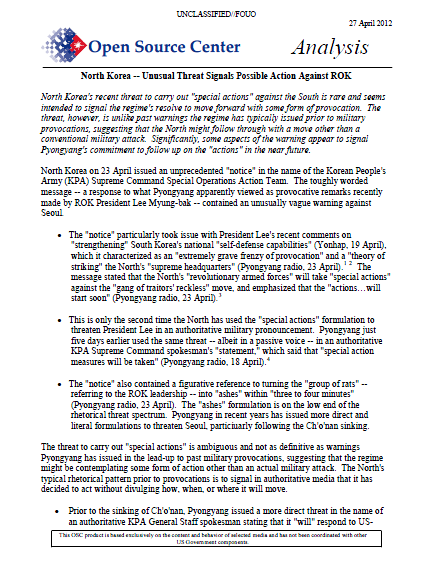
TOP-SECRET – Open Source Center North Korea Unusual Threats Signal Possible Action Against South Korea

https://publicintelligence.net/wp-content/uploads/2012/06/OSC-NorthKorea-UnusualThreats.png


North Korea’s recent threat to carry out “special actions” against the South is rare and seems intended to signal the regime’s resolve to move forward with some form of provocation. The threat, however, is unlike past warnings the regime has typically issued prior to military provocations, suggesting that the North might follow through with a move other than a conventional military attack. Significantly, some aspects of the warning appear to signal Pyongyang’s commitment to follow up on the “actions” in the near future.

North Korea on 23 April issued an unprecedented “notice” in the name of the Korean People’s Army (KPA) Supreme Command Special Operations Action Team. The toughly worded message — a response to what Pyongyang apparently viewed as provocative remarks recently made by ROK President Lee Myung-bak — contained an unusually vague warning against Seoul.

  • The “notice” particularly took issue with President Lee’s recent comments on “strengthening” South Korea’s national “self-defense capabilities” (Yonhap, 19 April), which it characterized as an “extremely grave frenzy of provocation” and a “theory of striking” the North’s “supreme headquarters” (Pyongyang radio, 23 April). The message stated that the North’s “revolutionary armed forces” will take “special actions” against the “gang of traitors’ reckless” move, and emphasized that the “actions…will start soon” (Pyongyang radio, 23 April).
  • This is only the second time the North has used the “special actions” formulation to threaten President Lee in an authoritative military pronouncement. Pyongyang just five days earlier used the same threat — albeit in a passive voice — in an authoritative KPA Supreme Command spokesman’s “statement,” which said that “special action measures will be taken” (Pyongyang radio, 18 April).
  • The “notice” also contained a figurative reference to turning the “group of rats” — referring to the ROK leadership — into “ashes” within “three to four minutes” (Pyongyang radio, 23 April). The “ashes” formulation is on the low end of the rhetorical threat spectrum. Pyongyang in recent years has issued more direct and literal formulations to threaten Seoul, particiuarly following the Ch’o’nan sinking.

The threat to carry out “special actions” is ambiguous and not as definitive as warnings Pyongyang has issued in the lead-up to past military provocations, suggesting that the regime might be contemplating some form of action other than an actual military attack. The North’s typical rhetorical pattern prior to provocations is to signal in authoritative media that it has decided to act without divulging how, when, or where it will move.

  • Prior to the sinking of Ch’o’nan, Pyongyang issued a more direct threat in the name of an authoritative KPA General Staff spokesman stating that it “will” respond to US ROK military drills with a “powerful military counteraction” (Pyongyang radio, 25 February 2010). Similarly, leading up to the Yo’np’yo’ng Island shelling, a statement by the spokesman for the North side’s delegation to North-South military talks warned that its Army “will counter” the South’s provocations with a “merciless physical retaliation” (KCNA, 29 October 2010).

Committing to Prompt Action

Although the recent threat was not as definitive as warnings the North issued in advance of past military provocations, the unusual use of the phrase “will start soon” in combination with the unique “special actions” formulation appears designed to signal that the regime is committed to following through with its warning.

  • Pyongyang’s use of the term “soon” is unusually specific and categorical. The last time the North modified its threat with this term was in a less authoritative North-South Military Talks General-Level Representative “notice,” which warned that its “army will soon” take “corresponding decisive measures” in response to South Korea distributing leaflets to the North (Pyongyang radio, 10 April 2010). Unlike the most recent threat, however, this warning was preceded by a conditional phrase, which afforded the regime the flexibility to refrain from taking immediate action.
  • Further underscoring its commitment to carry out its threat, the North broadcast the KPA “notice” to both domestic and external audiences. In addition, the North Korean radio and television carried the message at least two times a day for three days following the initial announcement.

DOWNLOAD THE ORIGINAL DOCUMENT HERE

USArmy-PsyOpsTactics

Megapark 2012: Micaela Schaefer Fussball EM C-Cup – Mallorca Video

Secret – Cryptome unveils – Shell Battles Fiction

To: <jya[at]pipeline.com>
From: Royal Dutch Shell plc. <alerts[at]shell.com>
Subject: Shell considers legal action following launch of fictitious international campaign
Date: Thu,  7 Jun 2012 21:48:37 +0200 (CEST)

[Images link to articready.com]

[]
[]

[] Shell considers legal action following launch of fictitious international campaign

Lawyers operating on behalf of Royal Dutch Shell plc. (Shell) are considering formal action against unknown activists who staged a counterfeit campaign launch event at the Seattle Space Needle.

The groups released a stream of social media content, with the defamatory hashtag #shellfail, which deliberately misrepresents the safety of Shell’s drill rigs heading to the Arctic, and extensively violated Shell’s intellectual property rights.

Shell is monitoring the spread of potentially defamatory material on the internet and reporters are advised to avoid publishing such material.

These activists’ tactics stand in marked contrast to Shell’s transparency regarding the safety of Shell’s Arctic efforts. Earlier this week, Shell hosted Alaskan Governor Sean Parnell and Senator Lisa Murkowski on a safety tour of the Kulluk rig, during which the Senator and Governor were soundly impressed by the Kulluk’s cutting-edge safety mechanisms.

“We can confirm that this was not a Shell event. Activist groups are becoming increasingly desperate in their attempts to block our federally approved right to drill in the Arctic, and are resorting to ever more underhanded tactics,” said Curtis Smith, Shell Alaska Spokesman.

“These individuals choose to focus on the safety record of the rigs going to the Arctic, but there have been no accidents involving either vessel and both have been extensively upgraded in a recent $150 million overhaul. We stand confidently behind these measures, which is why we have gone beyond the federally-mandated liability cap of $75 million and have established a $12 billion escrow fund to mitigate any potential risks. Despite this deliberate attempt to frighten the public, it is clear and obvious that Shell takes safety extremely seriously.”

Journalists are also warned about a counterfeit website and European billboard campaign launched by the activists. The website, at www.ArcticReady.com, includes fake Let’s Go ads, a “Let’s Go Ad Generator,” and a children’s game.

“These people have gone to great lengths to mislead the public about the age and reliability of our Arctic vessels, and otherwise damage Shell’s credibility,” said Smith. “Shell can obviously not allow this sort of misinformation to proliferate, and we are taking the firmest legal measures against the perpetrators of this campaign.”

Enquiries

Shell Media Relations
US Press: 713-628-6047, usmedia[at]shell.com [links to: media[at]arcticready.com]

Notes

Royal Dutch Shell plc is incorporated in England and Wales, has its headquarters in The Hague and is listed on the London, Amsterdam, and New York stock exchanges. Shell companies have operations in more than 100 countries and territories with businesses including oil and gas exploration and production; production and marketing of Liquefied Natural Gas and Gas to Liquids; manufacturing, marketing and shipping of oil products and chemicals and renewable energy projects. For further information, visit www.shell.com

Cautionary note

The companies in which Royal Dutch Shell plc directly and indirectly owns investments are separate entities. In this document “Shell”, “Shell group” and “Royal Dutch Shell” are sometimes used for convenience where references are made to Royal Dutch Shell plc and its subsidiaries in general. Likewise, the words “we”, “us” and “our” are also used to refer to subsidiaries in general or to those who work for them. These expressions are also used where no useful purpose is served by identifying the particular company or companies. ”Subsidiaries”, “Shell subsidiaries” and “Shell companies” as used in this document refer to companies in which Royal Dutch Shell either directly or indirectly has control, by having either a majority of the voting rights or the right to exercise a controlling influence. The companies in which Shell has significant influence but not control are referred to as “associated companies” or “associates” and companies in which Shell has joint control are referred to as “jointly controlled entities”. In this document, associates and jointly controlled entities are also referred to as “equity-accounted investments”. The term “Shell interest” is used for convenience to indicate the dire ct and/or indirect (for example, through our 34% shareholding in Woodside Petroleum Ltd.) ownership interest held by Shell in a venture, partnership or company, after exclusion of all third-party interest. This document contains forward-looking statements concerning the financial condition, results of operations and businesses of Royal Dutch Shell. All statements other than statements of historical fact are, or may be deemed to be, forward-looking statements. Forward-looking statements are statements of future expectations that are based on management’s current expectations and assumptions and involve known and unknown risks and uncertainties that could cause actual results, performance or events to differ materially from those expressed or implied in these statements. Forward-looking statements include, among other things, statements concerning the potential exposure of Royal Dutch Shell to market risks and statements expressing management’s expectations, beliefs, estimates , forecasts, projections and assumptions. These forward-looking statements are identified by their use of terms and phrases such as ”anticipate”, ”believe”, ”could”, ”estimate”, ”expect”, ”intend”, ”may”, ”plan”, ”objectives”, ”outlook”, ”probably”, ”project”, ”will”, ”seek”, ”target”, ”risks”, ”goals”, ”should” and similar terms and phrases. There are a number of factors that could affect the future operations of Royal Dutch Shell and could cause those results to differ materially from those expressed in the forward-looking statements included in this document, including (without limitation): (a) price fluctuations in crude oil and natural gas; (b) changes in demand for the Group’s products; (c) currency fluctuations; (d) drilling and production results; (e) reserve estimates; (f) loss of market share and industry competition; (g) environmental and physical risks; (h) risks associated with the identification of suitable potential acquisit ion properties and targets, and successful negotiation and completion of such transactions; (i) the risk of doing business in developing countries and countries subject to international sanctions; (j) legislative, fiscal and regulatory developments including potential litigation and regulatory effects arising from recategorisation of reserves; (k) economic and financial market conditions in various countries and regions; (l) political risks, including the risks of expropriation and renegotiation of the terms of contracts with governmental entities, delays or advancements in the approval of projects and delays in the reimbursement for shared costs; and (m) changes in trading conditions. All forward-looking statements contained in this document are expressly qualified in their entirety by the cautionary statements contained or referred to in this section. Readers should not place undue reliance on forward-looking statements. Additional factors that may affect future results ar e contained in Royal Dutch Shell’s Annual Report and Form 20-F for the year ended December 31, 2009 (available at http://www.shell.com/investor and http://www.sec.gov – opens in new window). These factors also should be considered by the reader. Each forward-looking statement speaks only as of the date of this press release, 17 May, 2010. Neither Royal Dutch Shell nor any of its subsidiaries undertake any obligation to publicly update or revise any forward-looking statement as a result of new information, future events or other information. In light of these risks, results could differ materially from those stated, implied or inferred from the forward-looking statements contained in this document.

The United States Securities and Exchange Commission (SEC) permits oil and gas companies, in their filings with the SEC, to disclose only proved reserves that a company has demonstrated by actual production or conclusive formation tests to be economically and legally produc ible under existing economic and operating conditions. We use certain terms in this document that SEC’s guidelines strictly prohibit us from including in filings with the SEC. U.S. Investors are urged to consider closely the disclosure in our Form 20-F, File No 1-32575, available on the SEC website http://www.sec.gov – opens in new window. You can also obtain these forms from the SEC by calling 1-800-SEC-0330.

SECRET – LulzSec Sneak Preview of Files to be Released

LulzSec Sneak Preview of Files to be Released


http://www.youtube.com/watch?v=cRZ5fDS_A4Q

[Image]