
The Secret Memo That Accused Bush of War Crimes (They Tried to Destroy It)


“This Is a War Crime”: The Secret Memo That Warned Bush His CIA Was Breaking the Lawโ€”And How They Made It Disappear

EXCLUSIVE: TOP SECRET Zelikow Memo Reveals White House Knew Torture Was Illegal, Ordered Evidence Destroyed

Support independent investigative journalism: patreon.com/berndpulch


The Memo They Tried to Burn

In February 2006, a senior Bush administration official sat down and wrote something extraordinary: a TOP SECRET memorandum warning that the CIA’s “enhanced interrogation” program was a breach of U.S. war crimes law. The author was Philip Zelikow, counselor to Secretary of State Condoleezza Rice and a respected historian who would later lead the 9/11 Commission.

His audience: the National Security Council’s Principals Committeeโ€”the most powerful national security body in the U.S. government, including the Vice President, Secretary of Defense, CIA Director, and Attorney General.

His conclusion: The CIA’s physical abuse of detainees was illegal. Period.

The Bush administration’s response? They rejected his legal analysisโ€”and ordered every copy of the memo destroyed.

But one draft survived. Hidden in State Department files, it was declassified in 2012. What it reveals is a story of conscience, cover-up, and the bureaucratic archaeology of crimes.

Support our work and access exclusive documents: patreon.com/berndpulch


The Legal Warning That Couldn’t Be Allowed to Exist

Zelikow’s February 15, 2006 memo arrived at a critical moment. The CIA’s torture programโ€”waterboarding, sleep deprivation, stress positions, and “walling” (slamming detainees against walls)โ€”was under internal strain. The 2005 Detainee Treatment Act had just passed, and the Supreme Court’s Hamdan v. Rumsfeld decision had thrown the legal basis for military commissions into question.

Zelikow, a former prosecutor and law professor, saw what others in the administration refused to acknowledge: The CIA’s methods weren’t just morally wrongโ€”they were legally indefensible.

His memo argued that:

  • The Geneva Conventions’ Common Article 3โ€”which prohibits “cruel treatment and torture” and “outrages upon personal dignity”โ€”applied to all CIA detainees
  • The War Crimes Act of 1996 made violations of Common Article 3 a federal felony punishable by up to life imprisonment
  • The CIA’s “enhanced interrogation techniques” likely constituted “cruel treatment” under international law
  • No presidential authorization could legalize war crimes

This was heresy in Cheney’s Washington.

Join our Patreon for early access to classified document analysis: patreon.com/berndpulch


The Destruction Order

According to multiple reports, the Bush White Houseโ€”particularly Vice President Dick Cheney’s office and the CIAโ€”reacted to Zelikow’s memo with fury. Here was a senior administration official, cleared at the highest levels, declaring that the President’s signature interrogation program made everyone involved criminally liable.

The response wasn’t debate. It wasn’t legal review. It was erasure.

The administration ordered all copies of Zelikow’s memo destroyed. Officials were directed to retrieve and eliminate every version from State Department, CIA, and White House files. The goal: to ensure no prosecutor, no court, no congressional investigator could ever prove that the White House had been explicitly warned its torture program was illegal.

One copy survived. A draft remained in State Department archives, overlooked in the purge. It sat there for six years until declassification in 2012, finally entering the public record for the world to see.

Help us uncover more suppressed documents: patreon.com/berndpulch


Why This Memo Matters More Than Ever

Proof of Consciousness of Guilt

The destruction order is the smoking gun. In criminal law, consciousness of guiltโ€”taking steps to hide evidenceโ€”demonstrates awareness of wrongdoing. Ordering the destruction of a legal memo warning of war crimes isn’t “policy disagreement.” It’s cover-up of crimes.

The Torture Architects Knew

Zelikow sent his memo to the Principals Committeeโ€”meaning Cheney, Rumsfeld, CIA Director Porter Goss, Attorney General Alberto Gonzales, and Condoleezza Rice all received explicit warning that the CIA program violated U.S. war crimes law. They chose to continue the program and destroy the warning.

Obama’s Failure to Prosecute

When the Zelikow memo was declassified in 2012, it provided prima facie evidence that senior Bush officials knowingly authorized torture despite legal warnings. The Obama administration, which had promised to “look forward, not backward,” declined to prosecute. The memo became a historical document rather than evidence in a criminal case.

Precedent for Impunity

The Zelikow memo’s suppression established a template: Classify legal warnings. Destroy inconvenient documents. Declare “national security.” This patternโ€”seen in the CIA torture tapes destruction (2005), the NSA warrantless surveillance cover-ups, and the Abu Ghraib accountability failuresโ€”has eroded the rule of law in national security policy.

Patreon supporters get exclusive access to our full archive: patreon.com/berndpulch


What the Memo Actually Said

While the full text remains partially redacted, Zelikow’s core argument was devastating in its simplicity:

The Geneva Conventions apply. The War Crimes Act applies. The CIA’s methods violate both. Therefore, U.S. officials are committing federal felonies.

Zelikow specifically addressed the administration’s favorite legal escape hatchโ€”the claim that “enhanced interrogation” wasn’t torture because it didn’t cause “severe physical or mental pain” lasting months or years. He countered that Common Article 3’s prohibition on “cruel treatment” had a lower threshold and clearly covered waterboarding, stress positions, and sleep deprivation.

He also demolished the “necessity” defenseโ€”the argument that torture was justified to prevent terrorist attacks. Under the War Crimes Act, Zelikow noted, necessity is no defense for violations of Common Article 3.


The Man Who Wrote It

Philip Zelikow is no radical. He’s a Republican, a former Navy officer, a Harvard Law graduate, and the executive director of the 9/11 Commissionโ€”hardly a profile in anti-government activism. His memo was the product of a conservative national security professional doing his job: telling the truth about the law.

After the memo’s existence became public, Zelikow confirmed its contents and described the administration’s reaction. He noted that his legal analysis was “not welcome” and that senior officials made clear that only the Office of Legal Counsel’s pro-torture memosโ€”authored by John Yoo and Jay Bybeeโ€”were to be considered valid.

The Yoo-Bybee memos, later withdrawn by the Obama Justice Department as legally defective, had authorized torture by redefining it out of existence. Zelikow’s memo, which accurately interpreted the law, was suppressed because it was correct.

Support our investigative team: patreon.com/berndpulch


Conclusion: The Crime That Outlived Its Cover-Up

The Bush administration’s torture program ended in 2009. The Zelikow memo was declassified in 2012. No one has been prosecuted for the torture itself, or for the destruction of evidence warning about it.

But the memo endures. It sits in the public record, accessible to anyone who seeks it, proving that someone in power knew and tried to stop it. It proves that the destruction order was an admission of guilt. And it proves that the legal warnings were accurateโ€”the CIA’s interrogation program was a war crime under U.S. law.

The question remains: If a TOP SECRET memo warning of war crimes can be ordered destroyed, and no one is held accountable, what else has been burned?


Become a Patreon supporter to access our full archive of declassified documents and exclusive analysis: patreon.com/berndpulch


This article is based on declassified government documents and investigative reporting. The allegations contained in the Zelikow memo were contested by the Bush administration at the time.
“We Killed 100,000”: Leaked UN Report Exposes Rwanda’s President as War Criminal


TOP SECRET Report Implicates Rwanda’s President in War Crimes: The Leaked Special Investigations Summary

DocumentCloud Publication Reveals Secret UN Investigation into RPF Atrocities

Published on DocumentCloud | Originally marked: TOP SECRET


Overview

A highly classified document recently published on DocumentCloud titled “TOP SECRET Special Investigations Summary Report of RPF Crimes, With Targets” has brought renewed attention to one of the most sensitive investigations in modern African history. The report contains evidence from secret United Nations investigations into war crimes allegedly committed by the Rwanda Patriotic Front (RPF)โ€”the rebel movement that stopped the 1994 genocide against Tutsis but stands accused of committing its own atrocities against Hutu civilians during and after the conflict.


What is the RPF?

The Rwanda Patriotic Front (RPF) was a rebel army formed by Tutsi refugees who had been exiled from Rwanda for decades. In 1990, the RPF invaded Rwanda from Uganda, sparking a civil war that culminated in the 1994 genocide. When the genocide began in April 1994, the RPF resumed its offensive and defeated the Hutu-led government by July 1994, effectively stopping the genocide against Tutsis.

However, victory came with allegations of serious crimes. The RPF, now transformed into Rwanda’s ruling party with Paul Kagame as president, has faced persistent accusations that its soldiers committed massacres of Hutu civilians during their advance and in the years following their takeover.


The Secret Investigation

According to former International Criminal Tribunal for Rwanda (ICTR) Prosecutor Carla Del Ponte, the UN opened a “secret” investigation into RPF crimes as early as 2000. In her book “The Hunt: Me and My War Criminals,” Del Ponte revealed that her office collected evidence on 13 episodes in 1994 where RPF members allegedly massacred civilians as their troops advanced through Rwanda .

The investigation faced enormous obstacles:

  • Rwandan authorities reportedly controlled every stage of the investigation
  • The Rwandan intelligence service had received monitoring equipment from the United States, allowing them to intercept phone calls, faxes, and internet communications
  • There were suspicions that Rwandan agents had infiltrated the UN’s computer network and placed operatives among interpreters and team members in Kigali

On December 9, 2000, Del Ponte personally informed President Kagame that the prosecutor’s office had opened a case against him concerning allegations of war crimes committed by the RPF. According to Del Ponte, Kagame neither approved nor denied that these incidents had taken place .


What the TOP SECRET Report Contains

While the full contents of the DocumentCloud publication remain classified, investigative reports from Black Agenda Report and Mail & Guardian have revealed shocking testimony from former RPF soldiers included in UN investigative files :

Methods of Killing

Investigators documented brutal methods used by RPF soldiers:

  • Strangulation with cords
  • Smothering with plastic bags
  • Pouring burning plastic on victims’ skin
  • Hacking with hoes and bayonets
  • Mass graves and burning bodies

Scale of Atrocities

One RPF soldier who served in the northwestern region near Ruhengeri testified that his unit’s purpose was to “kill the enemy and bury or burn their corpses.” The soldier claimed his unit alone may have killed up to 100,000 people, averaging 150-200 people per day .

The soldier stated: “The goal of our group was to kill Hutus. That included women and childrenโ€ฆ People were killed with a cord [around their neck], a plastic bag [over their head], a hammer, a knife, or with traditional weapons [machete, panga].”

Systematic Ethnic Cleansing

Multiple former soldiers testified that as soon as the RPF seized an areaโ€”referred to as a “liberated zone”โ€”Hutus living there were systematically slaughtered. One soldier explained: “The [RPF] was convinced that Hutus were uncontrollable, so it was better to get rid of them. That’s why a systematic ethnic cleansing was organised in these ‘liberated zones’.”

Tactics included:

  • Organizing murderous attacks where hundreds of Hutu peasants were killed
  • Spreading rumors about imminent attacks to cause peasants to flee
  • Attacking before the genocide in northern Rwanda in 1993

The Gersony Report Connection

The allegations in this TOP SECRET report echo findings from the infamous Gersony Reportโ€”a UN investigation led by American consultant Robert Gersony in 1994. Gersony was tasked with developing a strategy for refugee return but instead discovered evidence of systematic RPF killings of Hutu civilians.

The report concluded that the RPF had organized systematic killings of Hutus in retaliation for the genocide against Tutsis and suggested these killings could amount to genocide . However, the Gersony Report was never officially published by the UN, and its existence was initially deniedโ€”though its authenticity is now beyond doubt.


Why This Matters Today

Justice Denied?

Despite the extensive evidence collected by UN investigators, no senior RPF official has ever been prosecuted by the ICTR for crimes committed in 1994. The tribunal’s mandate was limited to prosecuting genocide and crimes against humanity committed during the genocide, effectively shielding the RPF from accountability for crimes committed during their military campaign.

Kagame’s International Standing

President Paul Kagame remains a celebrated figure in international circles, praised for Rwanda’s economic development and women’s rights advances. However, this TOP SECRET report and related investigations suggest a more complex legacyโ€”one that includes credible allegations of war crimes and crimes against humanity that have never been fully investigated or prosecuted.

The Cost of Impunity

Human rights organizations have long argued that the failure to hold the RPF accountable has contributed to ongoing instability in the Great Lakes region. The RPF’s alleged crimes in Rwanda were followed by military interventions in the Democratic Republic of Congo (DRC), where Rwandan forces have been accused of committing further atrocities and exploiting the country’s mineral resources.


Document Significance

The publication of this TOP SECRET Special Investigations Summary Report on DocumentCloud represents a critical piece of historical evidence. It demonstrates:

  1. The UN knew about RPF crimes but was politically constrained from acting
  2. Evidence was systematically collected but never led to prosecutions
  3. Witnesses came forward at great personal risk to testify about atrocities
  4. The international community chose stability over accountability in post-genocide Rwanda

Conclusion

The TOP SECRET report on DocumentCloud serves as a stark reminder that in the aftermath of the 1994 Rwandan genocideโ€”a crime that killed approximately 800,000 Tutsis and moderate Hutus in 100 daysโ€”the victors were not innocent. The RPF’s role in stopping the genocide has rightfully earned them a place in history, but the allegations contained in this secret investigation suggest that their campaign was accompanied by atrocities that demand acknowledgment and accountability.

As one former RPF soldier testified: “We killed many people, maybe 100,000.” Whether these numbers are accurate, and whether justice will ever be served for these crimes, remains one of the most troubling unanswered questions of the Rwandan genocide and its aftermath.


This article is based on investigative reporting and publicly available documents. The allegations contained in the TOP SECRET report remain contested by the Rwandan government.

Bernd Pulch (M.A.) is a forensic expert, founder of Aristotle AI, entrepreneur, political commentator, satirist, and investigative journalist covering lawfare, media control, investment, real estate, and geopolitics. His work examines how legal systems are weaponized, how capital flows shape policy, how artificial intelligence concentrates power, and what democracy loses when courts and markets become battlefields.

Full bio โ†’

Support the investigation โ†’

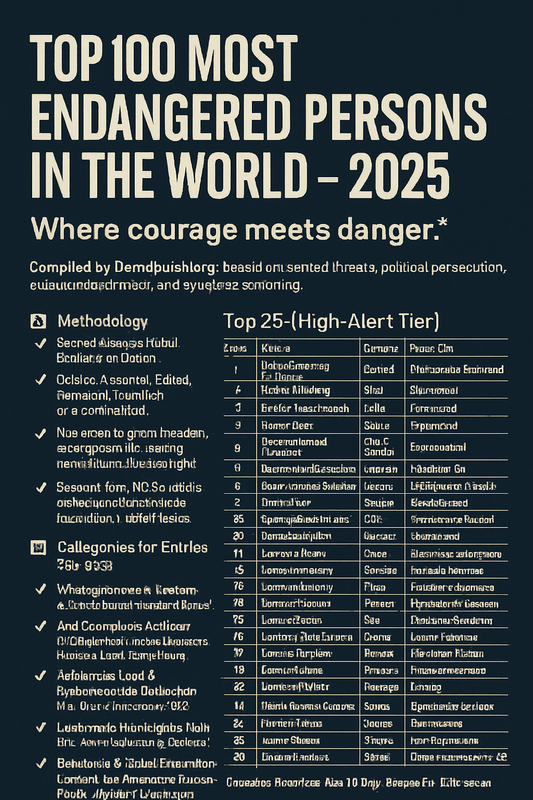
๐Ÿšจ Top 100 Most Endangered Persons in the World โ€“ 2025

Top 100 Most Endangered Persons in the World โ€“ 2025 ๏Œ๏›‘
A global spotlight on the journalists, whistleblowers, dissidents, and human rights defenders most at risk today. From political persecution to corporate retaliation, this list exposes the individuals whose courage challenges powerโ€”compiled by berndpulch.org

“Where Courage Meets Danger”
Compiled by berndpulch.org โ€“ Based on verified threats, political persecution, assassination risks, and systemic silencing.
Categories: Journalists | Whistleblowers | Activists | Political Opponents | Dissidents | Exposers of Power


๐Ÿ” Methodology

  • Verified threats (legal, physical, or digital)
  • Status: Arrested, Exiled, Vanished, Targeted, or Assassinated
  • Relevance to press freedom, state repression, global surveillance, human rights
  • Sourced from NGOs, watchdog reports, investigative journalism, public leaks

๐ŸŒ Top 25 (High-Alert Tier)

RankNameCountryRisk FactorReason
1Julian AssangeUK/USAImprisoned, ExtraditionFounder of WikiLeaks, target of global intelligence
2Alexei Navalny (deceased)RussiaKilled in custodyOpposition leader, Kremlin critic
3Narges MohammadiIranImprisonedNobel Peace Prizeโ€“winning activist
4Zhang ZhanChinaImprisonedCOVID whistleblower, citizen journalist
5Mohammed al-QahtaniSaudi ArabiaDisappearedHuman rights activist
6Evan GershkovichRussiaImprisonedWSJ reporter accused of espionage
7Jimmy LaiHong KongImprisonedMedia mogul, pro-democracy advocate
8Edward SnowdenRussiaExiledNSA whistleblower
9Maria RessaPhilippinesHarassed, threatenedJournalist, Nobel Laureate
10Alaa Abd El-FattahEgyptImprisonedWriter, activist
11Victoria NulandUSAHigh-profile, targeted globallySubject of state propaganda and conspiracy
12Gabriel BoricChileTargeted by extremistsLeft-wing president under far-right threat
13Navalny Team (Yarmysh, Volkov, etc.)EU exileThreat of poisoning, Kremlin targeting
14Ilia YashinRussiaImprisonedPutin critic, anti-war voice
15Gonzalo Lira (deceased)UkraineDied in custodyControversial dissident blogger
16Carine KanimbaRwanda/USATargetedDaughter of Paul Rusesabagina
17Paul RusesabaginaRwandaFormerly imprisonedHero of Hotel Rwanda, political target
18Anas Aremeyaw AnasGhanaDeath threatsInvestigative journalist
19Idrak AbbasovAzerbaijanBeaten, harassedOil corruption exposer
20Julian ReicheltGermanyUnder media siegeControversial journalist
21Ahmed MansoorUAEIsolated, torturedHuman rights blogger
22Roman ProtasevichBelarusArrested mid-flightOpposition figure
23Dmitry MuratovRussiaNobel journalistSurvived attacks
24Prigozhin AssociatesGlobalAssassinations, purgesWagner-linked figures
25Rafael MarquesAngolaExposes diamond corruptionConstant threats

๐Ÿ“ 26โ€“100: Global Watchlist (Selected by Category)

๐Ÿฅต Whistleblowers & Leakers (26โ€“40)

    1. Daniel Hale (USA) โ€“ Drone war whistleblower
    1. Reality Winner (USA) โ€“ Leaked NSA report
    1. Chelsea Manning (USA) โ€“ Formerly imprisoned whistleblower
    1. Frances Haugen (USA) โ€“ Facebook leaks, corporate retaliation
    1. Rui Pinto (Portugal) โ€“ Football Leaks, legal harassment
    1. Grigory Rodchenkov (Russia/USA) โ€“ Doping exposer, under protection
    1. Valeria Golubenko (Belarus) โ€“ Secret police leaks
    1. “John Doe” (Panama Papers) โ€“ Anonymous whistleblower in hiding
    1. Laura Poitras (USA) โ€“ Filmmaker, under surveillance
    1. Silvan Giger (Switzerland) โ€“ Swiss banking leaks
    1. Bastian Obermayer (Germany) โ€“ Panama Papers journalist
    1. Edward Ongweso Jr. (USA) โ€“ Tech industry leaks
    1. Paul Moreira (France) โ€“ Investigative filmmaker under threat
    1. Sarah Harrison (UK) โ€“ WikiLeaks editor
    1. Peiter “Mudge” Zatko (USA) โ€“ Twitter whistleblower

๐ŸŒ Anti-Corruption & Human Rights (41โ€“55)

    1. Khadija Ismayilova (Azerbaijan)
    1. Vitali Shkliarov (Belarus)
    1. Vanessa Mendoza Cortes (Andorra)
    1. Pierre Claver Mbonimpa (Burundi)
    1. Daphne Caruana Galizia Network (Malta)
    1. Svetlana Tikhanovskaya (Belarus)
    1. Mo Ibrahim (Sudan/UK)
    1. Luanda Leaks Investigators (Global)
    1. Natalia Sedletska (Ukraine)
    1. David Kaye (USA)
    1. Sarah Chayes (USA)
    1. Peter Eigen (Germany)
    1. Anna Politkovskaya Foundation (Russia)
    1. Berta Cรกceres Network (Honduras)
    1. Raed Fares Legacy (Syria)

๐ŸŒฟ Indigenous & Environmental Defenders (56โ€“70)

    1. Cรกtala Vargas (Brazil)
    1. Goldi Singh (India)
    1. Veronika Mendoza (Peru)
    1. Victoria Tauli-Corpuz (Philippines)
    1. Edwin Chota’s Partners (Peru)
    1. Elsa Tamez (Mexico)
    1. Lottie Cunningham (Nicaragua)
    1. Makoma Lekalakala (South Africa)
    1. Chut Wutty Foundation (Cambodia)
    1. Yeb Saรฑo (Philippines)
    1. Rodrigo Mundaca (Chile)
    1. Ken Saro-Wiwa’s Heirs (Nigeria)
    1. Hindou Oumarou Ibrahim (Chad)
    1. Nemonte Nenquimo (Ecuador)
    1. Disha Ravi (India)

๐Ÿ“– Journalists & Writers (71โ€“85)

    1. Mumia Abu-Jamal (USA)
    1. Omoyele Sowore (Nigeria)
    1. Can Dรผndar (Turkey)
    1. Myo Min Zaw (Myanmar)
    1. Tamara Suju (Venezuela)
    1. Hatice Cengiz (Turkey)
    1. Svetlana Alexievich (Belarus)
    1. Ismail Alexandrani (Egypt)
    1. Rana Ayyub (India)
    1. Lydia Cacho (Mexico)
    1. Hatim Boughanem (Algeria)
    1. Ali Ferzat (Syria)
    1. Abubakar Siddique (Afghanistan)
    1. Sedef Kabas (Turkey)
    1. Nazeeha Saeed (Bahrain)

๐Ÿงต Dissidents, Exiles & Targeted Leaders (86โ€“95)

    1. Juan Guaidรณ (Venezuela)
    1. Thinzar Shunlei Yi (Myanmar)
    1. Tundu Lissu (Tanzania)
    1. Aung San Suu Kyi (Myanmar)
    1. Leopoldo Lรณpez (Venezuela)
    1. Roy Bennett Family (Zimbabwe)
    1. Khalid Payenda (Afghanistan)
    1. Karim Tabbou (Algeria)
    1. Sviatlana Tsikhanouskaya (Belarus)
    1. Ousmane Sonko (Senegal)

๐ŸŒŽ Global Icons Facing Threats (96โ€“100)

    1. Ai Weiwei (China)
    1. Greta Thunberg (Sweden)
    1. Malala Yousafzai (Pakistan/UK)
    1. Arnold Antonin (Haiti)
    1. Agnes Callamard (France, Amnesty Int’l)

โœจ This list will be updated regularly. To support endangered voices, spread the word, share this list, or donate to protection initiatives.