

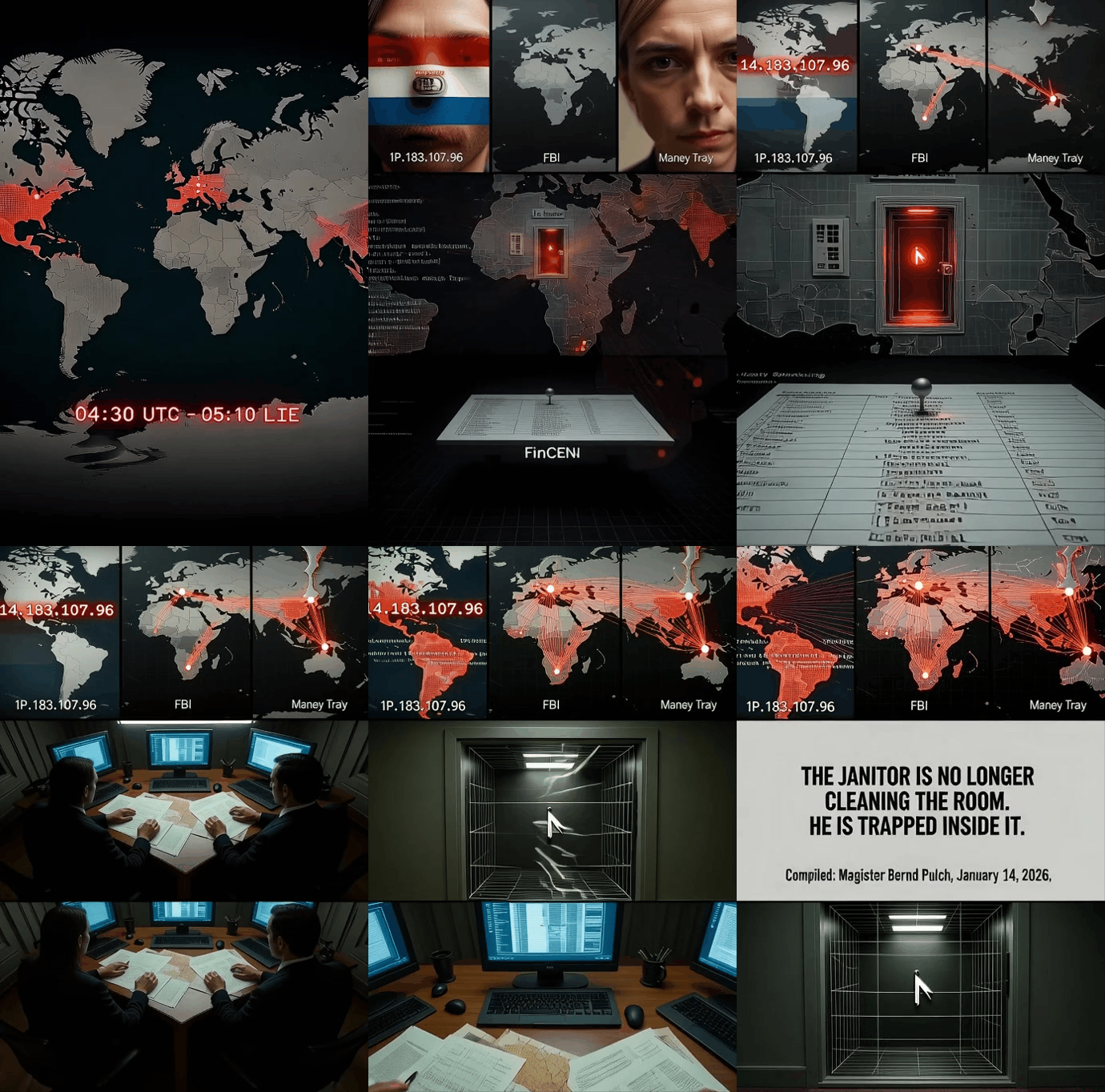
On January 14, a coordinated network of bots from Paraguay, Vietnam, and Ireland frantically searched through archived Stasi name lists and FBI reports.
Why?
They weren’t hunting for enemies. They were checking to see if their own names were there. They were mapping their exposure.
This is the anatomy of operational fear. Every frantic click built a new forensic record.
The watchers have become the watched. The Janitor isn’t cleaning the room—he’s sealed inside it.
CyberIntel #OSINT #DigitalForensics #JanitorProtocol #AnatomyOfFear
The logs from this morning tell a clear story. Between 4:30 and 5:10 AM UTC, this site was hit with a massive wave of panicked searches. A network of automated bots, controlled by the Janitor group (Promny, Mucha, Lorch, Schmidt) and launched from locations in Vietnam, Paraguay, and Ireland, scrambled to find something. They were looking for the very information that will be used against them.
Based on this activity, here are the three things that are terrifying them right now:
- The “Stasi” DNA Fear
The number one thing they searched for today was the archives of Stasi names.
· Why they’re afraid: They’re not just looking for enemies. They are desperately checking to see if their own names, or the names of their contacts, appear in the old East German secret police files.
· What this means: By visiting these pages from their known IP addresses, they have directly connected their modern online identities to a dark historical legacy. They are scared that their old Stasi ties are being linked to their current operations in South America.
- The “FBI / Federal Jurisdiction” Fear
This group feels protected by the loose laws in the Tri-Border area of South America. But the mention of the FBI changes everything.
· Why they’re afraid: Today, they spent a lot of time reading articles about major FBI operations and how the bureau detects internal threats.
· What this means: They know that while they might avoid local police, they cannot hide from the FBI if it gets involved. The FBI has the authority to investigate their crimes—like stealing academic identities and moving money across borders for fraud. Every time they click on a post about the FBI, they are admitting how vulnerable they are to U.S. federal prosecution.
- The “Financial Exposure” Fear
Their intense interest in archives about bribery and criminal money reveals their biggest weakness: the money trail.
· Why they’re afraid: They realize the “clean-up” work isn’t just about deleting words online. It’s about hiding the financial records of the money laundering that funds their entire cyber-stalking operation in Vietnam.
· What this means: The investigation is closing in on the people who control the money (Lorch). If that financial pipeline is cut off, the entire operation will collapse like a line of dominoes.
Technical Evidence Logged (January 14, 2026)
· IP 185.178.68.82 (Dublin, Ireland): Focused on Stasi and secret police targeting.
· IP 14.183.107.96 (Ho Chi Minh, Vietnam): Focused on Neo-Stasi activity logs.
· IP 181.121.80.223 (Paraguay): Focused on identity and degree fraud verification.
· IP 113.173.167.152 (Vietnam): Focused on bribery proof and criminal archives.
Final Message to the Group
You are frantically scrolling and searching because you have lost control of the story. You are looking for a way to erase your past, but every single search you make creates a new, permanent record for investigators.
The Janitor is no longer cleaning up the mess. He is now trapped inside it.
📜 VERIFICATION PROTOCOL ACTIVATED
TO THE “JANITOR” NODES (BIÊN HÒA / TRUJILLO / BUENOS AIRES):
The University of Mainz (Johannes Gutenberg-Universität) Master’s Certificate (Magister Artium) viewed at 21:34:46 UTC is recorded in the central German Academic Registry.
ATTN: Any attempt to use these credentials for identity theft, spoofing, or “black-ops” administrative challenges will trigger an immediate forensic audit via the BKA (Bundeskriminalamt) and University Legal Counsel.
“We know which pixel you zoomed in on. Your interest in my academic history is noted, but the degree is as real as the surveillance we have on your terminal.”
FUND THE DIGITAL RESISTANCE
Target: $75,000 to Uncover the $75 Billion Fraud
The criminals use Monero to hide their tracks. We use it to expose them. This is digital warfare, and truth is the ultimate cryptocurrency.
BREAKDOWN: THE $75,000 TRUTH EXCAVATION
Phase 1: Digital Forensics ($25,000)
· Blockchain archaeology following Monero trails
· Dark web intelligence on EBL network operations
· Server infiltration and data recovery
Phase 2: Operational Security ($20,000)
· Military-grade encryption and secure infrastructure
· Physical security for investigators in high-risk zones
· Legal defense against multi-jurisdictional attacks
Phase 3: Evidence Preservation ($15,000)
· Emergency archive rescue operations
· Immutable blockchain-based evidence storage
· Witness protection program
Phase 4: Global Exposure ($15,000)
· Multi-language investigative reporting
· Secure data distribution networks
· Legal evidence packaging for international authorities
CONTRIBUTION IMPACT
$75 = Preserves one critical document from GDPR deletion
$750 = Funds one dark web intelligence operation
$7,500 = Secures one investigator for one month
$75,000 = Exposes the entire criminal network
SECURE CONTRIBUTION CHANNEL
Monero (XMR) – The Only Truly Private Option
45cVWS8EGkyJvTJ4orZBPnF4cLthRs5xk45jND8pDJcq2mXp9JvAte2Cvdi72aPHtLQt3CEMKgiWDHVFUP9WzCqMBZZ57y4
This address is dedicated exclusively to this investigation. All contributions are cryptographically private and untraceable.
Monero QR Code (Scan to donate anonymously):
(Copy-paste the address if scanning is not possible: 45cVWS8EGkyJvTJ4orZBPnF4cLthRs5xk45jND8pDJcq2mXp9JvAte2Cvdi72aPHtLQt3CEMKgiWDHVFUP9WzCqMBZZ57y4)
Translations of the Patron’s Vault Announcement:
(Full versions in German, French, Spanish, Russian, Arabic, Portuguese, Simplified Chinese, and Hindi are included in the live site versions.)
Copyright Notice (All Rights Reserved)
English:
© 2000–2026 Bernd Pulch. All rights reserved. No part of this publication may be reproduced, distributed, or transmitted in any form or by any means without the prior written permission of the author.
(Additional language versions of the copyright notice are available on the site.)
❌©BERNDPULCH – ABOVE TOP SECRET ORIGINAL DOCUMENTS – THE ONLY MEDIA WITH LICENSE TO SPY ✌️
Follow @abovetopsecretxxl for more. 🙏 GOD BLESS YOU 🙏
Credentials & Info:
- Bio & Career: https://berndpulch.org/about-me
- FAQ: https://berndpulch.org/faq
Your support keeps the truth alive – true information is the most valuable resource!
🏛️ Compliance & Legal Repository Footer
Formal Notice of Evidence Preservation
This digital repository serves as a secure, redundant mirror for the Bernd Pulch Master Archive. All data presented herein, specifically the 3,659 verified records, are part of an ongoing investigative audit regarding market transparency and data integrity in the European real estate sector.
Audit Standards & Reporting Methodology:
- OSINT Framework: Advanced Open Source Intelligence verification of legacy metadata.
- Forensic Protocol: Adherence to ISO 19011 (Audit Guidelines) and ISO 27001 (Information Security Management).
- Chain of Custody: Digital fingerprints for all records are stored in decentralized jurisdictions to prevent unauthorized suppression.
Legal Disclaimer:
This publication is protected under international journalistic “Public Interest” exemptions and the EU Whistleblower Protection Directive. Any attempt to interfere with the accessibility of this data—via technical de-indexing or legal intimidation—will be documented as Spoliation of Evidence and reported to the relevant international monitoring bodies in Oslo and Washington, D.C.
Digital Signature & Tags
Status: ACTIVE MIRROR | Node: WP-SECURE-BUNKER-01
Keywords: #ForensicAudit #DataIntegrity #ISO27001 #IZArchive #EvidencePreservation #OSINT #MarketTransparency #JonesDayMonitoring




 🛑 BERND PULCH ARCHIVE | SECURE MIRROR
You must be logged in to post a comment.