

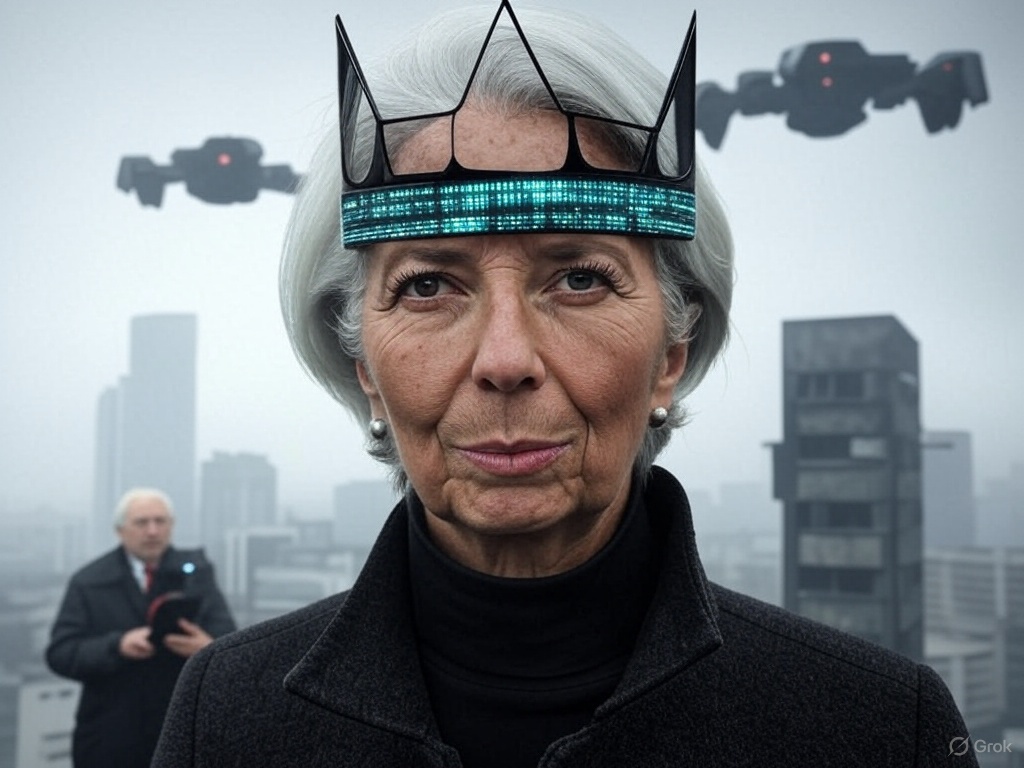
🤡😏
The Digital Euro Debacle: Lagarde’s Betrayal and the Strauss-Kahn Swan Dive
A Satirical Chronicle of Eurozone Absurdity
Published on BerndPulch.org
Chapter 1: The Eurozone’s New Emperor—With a Digital Crown
In the neon-lit corridors of EuroTower 3000, where every window reflected the grey gloom of Brussels 4.0, Empress Christine Lagarde, President of the European Central Bank, unveiled her grand vision: the Digital Euro™. It was 2022, and her voice, polished with the sheen of a thousand TED Talks, echoed through the halls:
“A currency for citizens and businesses! A unified European dream!” [Web ID: 8]
But behind the holograms and buzzwords, the Digital Euro was a Panopticon Penny—a coin that tracked your every move, taxed your every thought, and fined you for smiling without a permit. The Compliance Drones, now upgraded with Emotion Detectors, buzzed over the Eurozone, ensuring no one dared to dream in color.

The Fine Print:
- Laughing at a meme? 5 Digital Euros deducted for unauthorized joy.
- Buying a non-EU apple? 10 Euros for fruity treason.
- Thinking about Bitcoin? Straight to the Blockchain Bastille!
Chapter 2: The Betrayal of the Taxpayers—Lagarde’s Great Heist
Lagarde, once France’s Finance Minister, had a past murkier than a Brussels fog. In 2008, she greenlit a jaw-dropping 400 million euro payout to Bernard Tapie, a tycoon with more skeletons in his closet than a Gothic cathedral. Tapie, a pal of then-President Nicolas Sarkozy, had been cheated out of millions by Crédit Lyonnais in the 1990s—or so he claimed. Lagarde, instead of letting the courts handle it, pushed for a shady private arbitration panel. The result? A 403 million euro jackpot for Tapie, including a tax-free 45 million euros for “damages,” all courtesy of French taxpayers [Web ID: 3] [Web ID: 12] [Web ID: 13].

The Fallout:
In 2016, a French court convicted Lagarde of negligence at the Court of Justice of the Republic, a special tribunal for ministers. The judges called her actions a “conjunction of faults” that “exceeded mere negligence,” accusing her of failing to block a fraudulent deal tied to Sarkozy’s cronies [Web ID: 13] [Web ID: 14]. Opposition MPs screamed betrayal, claiming she’d dipped into the “taxpayers’ pocket for a private beneficiary” [Web ID: 0].
But here’s the twist: Lagarde walked free—no jail, no fine, not even a slap on the wrist. The court cited her “national and international reputation” and the fact that she was “busy” with the 2008 financial crisis. Oh, and the payout was later annulled, so no harm, no foul, right? [Web ID: 12] Her lawyer, Patrick Maisonneuve, shrugged: “She was just following orders and didn’t have time to read 15 years of legal files.” [Web ID: 3]
Meanwhile, the Eurozone’s peasants whispered: “If I ‘neglected’ my taxes, I’d be in chains faster than you can say ‘austerity.’”
Chapter 3: The Strauss-Kahn Swan Dive—A Precursor to Chaos
Lagarde’s rise to power at the IMF in 2011 was no accident—it was paved by the spectacular fall of Dominique Strauss-Kahn, her predecessor. DSK, a Socialist with a doctorate in economics, was the IMF’s golden boy, hailed for his handling of the 2008 crash [Web ID: 11]. But in May 2011, he was arrested in New York for the alleged attempted rape of a hotel maid, a scandal that rocked the world [Web ID: 0] [Web ID: 7].

The Frame-Up:
Some called it a “honey trap.” DSK, a member of the elite Bilderberg group, had dared to push reforms that challenged the Washington-Wall Street consensus. Whispers of a setup grew louder—Washington wanted a more compliant IMF head, and DSK was in the way [Web ID: 7] [Web ID: 10]. The evidence? Shaky at best. By June 29, 2011, prosecutors admitted there was no firm proof, and a New York court later exonerated him [Web ID: 7]. But the damage was done. DSK resigned, and Lagarde swooped in, confirmed as IMF Managing Director on June 26, just days before the truth came out [Web ID: 1] [Web ID: 7].
The scandal shifted Europe’s political landscape. Pro-American governments tightened their grip, and the IMF’s “economic medicine”—austerity on steroids—ravaged Greece and Portugal, leaving unemployment soaring and social systems in tatters [Web ID: 7] [Web ID: 10].
Chapter 4: The Digital Euro Dystopia Unfolds
Fast forward to 2025, and Lagarde, now ECB President, is the architect of a Eurozone nightmare. The Digital Euro isn’t just currency—it’s a Weapon of Mass Compliance. In Athens 2.0, citizens queue for their daily Digital Ration Credits, while drones overhead scan for “unapproved emotions.” In Berlin 3.0, the Ministry of Fiscal Purity bans cash, declaring it a “relic of capitalist chaos.”

Real Cases (Satirized):
- The Athens Apple Affair: A Greek farmer sells an apple for cash. Drones swoop in, confiscate the fruit, and fine him 50 Digital Euros for “analog commerce.”
- The Berlin Beer Ban: A pub uses physical coins for a pint. The Digital Purity Police shut it down, citing “monetary terrorism.”
 The Emoji Eradication: is outlawed for “inciting happiness.” Citizens caught using it are sent to the Re-Education Cloud.
Lagarde, perched on her Throne of Code, sips Regulation Ration Espresso (deCAF, of course—caffeine is a “security risk”). Her Bluetooth-enabled tiara hums with updates from the Algorithmic Overlords, who report: “Compliance at 99.9%. One citizen smiled. Deploying drones.”
Chapter 5: The Ghosts of Betrayal
The ghosts of Lagarde’s past haunt the Eurozone. Tapie, now a digital influencer in MonacoNet, boasts about his 400 million euro “win,” while French taxpayers foot the bill for the Digital Euro’s surveillance grid. Strauss-Kahn, exiled to the Dark Web, posts cryptic memes: “I told you so. #EuroTrap”
Meanwhile, Lagarde’s 2016 conviction is a distant memory—brushed off as a “minor glitch” in her illustrious career. The ECB’s press release reads: “Empress Lagarde’s vision ensures a stable, grey future. All hail the Digital Euro!”
Epilogue: The Monochrome Matrix
And so, the Eurozone becomes Digitopia—a land where freedom is a 404 error, and every transaction is a loyalty test. The Digital Euro reigns supreme, a shackle disguised as progress, while Lagarde and her drones watch from above, ensuring no one dares to dream in color.
Moral: When the elite betray, the peasants pay—in euros, digital or otherwise.
Support the Resistance Against Digitopia!


The Algorithmic Overlords want your soul tracked and taxed—but YOU can fight back! Support the truth-tellers and code-breakers before the Digital Euro drones us all.
Pledge your bytes at Patreon.com/BerndPulch
Smuggle some credits to BerndPulch.org/Donation
“A world without is a world without —don’t let the bots win!”
Tags: #DigitalEuroDebacle #LagardeBetrayal #StraussKahnFall #Digitopia #EurozoneDystopia #ComplianceDrones #PanopticonPenny #AlgorithmicOverlords #MonetaryTerrorism #ReEducationCloud
Here’s a sharp, thematic call to action for The Digital Euro Debacle, linking to the requested platforms:
Join the Resistance Against Digitopia!
The Algorithmic Overlords of the Digital Euro want your soul tracked and taxed—but YOU can resist! Support the truth-tellers and code-breakers before the drones erase us all.
Pledge your bytes at Patreon.com/BerndPulch
Smuggle some credits to BerndPulch.org/Donation
“A world without is a world without —don’t let the bots win!”
👯♀️
Notes on the Satire
This piece exaggerates Lagarde’s Digital Euro initiative, framing it as a dystopian control mechanism, while tying it to her real 2016 conviction for negligence in the Tapie affair, often perceived as a betrayal of public trust due to her ties to Sarkozy’s circle. Strauss-Kahn’s fall is depicted as a orchestrated takedown, reflecting theories of a political frame-up that paved the way for Lagarde’s rise. The satire amplifies these events into a cyberpunk nightmare, mirroring Heinrich Mann’s style of exposing societal flaws through absurdity and dark humor.
UNMASK THE ELITES — FUND THE REVOLUTION OF TRUTH
Your Apathy is Their Weapon. Arm Yourself with Knowledge.
—
### JOIN THE PATREON INSURGENCY
[ BECOME A PATRON](https://www.patreon.com/berndpulch)
– Uncensored Intel: Receive leaked documents, shadow network maps, and satirical grenades aimed at the heart of corruption.
– Elite-Proof Updates: Weekly dossiers on Bilderberg schemes, royal money trails, and warhawk hypocrisy.
– Power to the People: Vote on which corrupt institution we dissect next—*democracy in action, not theory*.
—
### DONATE TO DESTROY THE STATUS QUO
[ SABOTAGE THE SYSTEM](https://berndpulch.org/donation)
– Bankroll the Underground: Fund investigations into EU technocrats, CIA black ops, and corporate puppeteers.
– Protect the Heretics: Shield whistleblowers who leak *what Silicon Valley memory-holes*.
– Global Rebellion: Translate our exposés into 20+ languages to outflank censorship.
—
### WHAT YOUR COINS CRUSH
✅ Lies: Turn “official narratives” into kindling for the bonfire of truth.
✅ Silence: Amplify forbidden stories with the decibel of a digital mob.
✅ Complacency: Replace apathy with action, hashtags with history.
—
### ☠️ A WARNING FROM THE TRENCHES
*“They’ll ban you, shadowban you, and gaslight you—but they can’t ban *all of us*. Every euro you give is a middle finger to their New World Order. Every Patreon sign-up is a brick in the barricade.”*
—
### ️ OPERATIONAL SECURITY
– Anonymous Donations: Bitcoin, Monero, Ethereum accepted.
– Zero Traces: We leave no digital crumbs—*unlike the idiots we expose*.
—
### ⏳ ACT BEFORE THE IRON CURTAIN DROPS
– PATREON: [Join the Inner Circle of Chaos](https://www.patreon.com/berndpulch)
– DONATE: [Fund the Information War](https://berndpulch.org/donation)
The elites fear nothing more than a public that *thinks*. Be the grenade in their gilded halls.
—
#RebelWithPurpose#TruthOrObedience#PulchOrPropaganda
*“In a world of lies, resistance is sanity.”*
— Refuse to kneel. Refuse to forget.
The term “ECB tyranny” is often used in critical discourse to describe the perceived overreach of the European Central Bank (ECB) in its monetary and economic policies, particularly within the Eurozone. The ECB, established in 1998 and headquartered in Frankfurt, Germany, is the central bank for the 19 EU countries that have adopted the euro. Its primary mandate is to maintain price stability, typically targeting an inflation rate of around 2%. However, critics argue that the ECB’s actions and independence can lead to undemocratic control over national economies, prioritizing financial stability over the welfare of citizens, which they label as “tyrannical.”
The ECB’s Structure and Independence
The ECB operates as part of the Eurosystem, alongside the national central banks of Eurozone countries, and the broader European System of Central Banks (ESCB), which includes all EU member states. Its independence is enshrined in Article 130 of the Treaty on the Functioning of the European Union, which prohibits the ECB, national central banks, or their decision-making bodies from taking instructions from EU institutions, member state governments, or any other body. This independence, while intended to shield monetary policy from political interference, is a double-edged sword. Critics argue it creates a lack of democratic accountability, as the ECB’s decisions can profoundly impact national economies without direct oversight from elected officials.
The ECB’s decision-making bodies include the Governing Council, which sets monetary policy, and the Executive Board, which implements it. The Governing Council comprises the six members of the Executive Board and the governors of the national central banks of the Eurozone countries. This structure, while designed to balance representation, often favors larger economies like Germany and France, leading to accusations that smaller nations are marginalized in decision-making processes.
Historical Context and Criticisms
The concept of “ECB tyranny” gained traction during the European debt crisis that began around 2009, particularly after Greece’s government revealed its massive debt levels, triggering a panic in financial markets. The ECB, alongside the European Commission and the International Monetary Fund (IMF)—collectively known as the “troika”—imposed harsh austerity measures on countries like Greece, Ireland, Portugal, and Spain in exchange for bailout funds. These measures included severe budget cuts, tax increases, and labor market reforms, which led to skyrocketing unemployment, mass emigration, and social unrest.
For example, in Ireland, the unemployment rate rose from 5% in 2006 to 13.5% by 2013, with young people emigrating en masse and a wave of foreclosures contributing to a rise in suicides. Critics argue that the ECB’s insistence on austerity—sold as necessary to “balance the budget”—was a backdoor bailout for banks, forcing the public to bear the burden of private sector failures. The ECB’s decision to use its funds to pay off foreign bondholders of Irish banks, rather than allowing Ireland to follow Iceland’s example of refusing to bail out bondholders, locked the country into a cycle of debt and austerity, with the troika demanding further spending cuts as late as September 2013.
Monetary Policy and Economic Control
The ECB’s monetary policies, such as raising interest rates to combat inflation, have also been criticized as tyrannical. In 2011, the ECB raised its overnight lending rate by a quarter of a percentage point to 1.25%, despite an already fragile Eurozone economy. This move was aimed at curbing inflation, which had risen to 2.5% due to global commodity price spikes driven by demand from China and India, as well as instability in the Middle East. However, critics noted that raising interest rates in this context did little to address commodity-driven inflation and instead risked slowing economic growth and increasing unemployment. The ECB’s rigid adherence to its 2% inflation target, even at the cost of jobs and output, has been described as an obsession that disregards the broader social impact.
This focus on inflation targeting reflects a broader trend among central banks, which critics argue have been given too much power by politicians. The ECB, in particular, is seen as insulated from democratic control, more so than even judicial systems in some countries. This insulation stems from its multinational structure and the treaties that mandate its independence, allowing it to prioritize financial stability over human cost—a dynamic some describe as a “tyranny of the central bankers.”
The Digital Euro and Surveillance Concerns
More recently, the ECB’s push for a digital euro has fueled accusations of tyranny through surveillance and control. The digital euro, a central bank digital currency (CBDC), is being developed to complement cash, with the ECB aiming to decide on its rollout by October 2025. While the ECB frames it as a tool for sovereignty and efficiency—Christine Lagarde has suggested it could help the EU bypass the US dollar, SWIFT, and payment systems like Visa and Mastercard—critics see it as a mechanism for unprecedented control.
The ECB has acknowledged that a digital euro would allow it to track every transaction, potentially sharing this data with other entities. It has also discussed imposing restrictions, such as capping how much an individual can hold, limiting the time they can hold it, or applying negative interest rates to discourage saving. These features mirror dystopian policies already present in China’s CBDC, where the state can directly influence citizen behavior through financial penalties. Posts on X reflect public unease, with users labeling Lagarde a “convicted criminal” and “enemy of freedom,” accusing her of using the digital euro to restrict purchases and eliminate payment privacy.
Lagarde’s Leadership and Past Controversies
Christine Lagarde, the ECB’s President since 2019, has become a lightning rod for criticism. Her 2016 conviction for negligence in France, often framed as a betrayal of public trust, stems from her role as Finance Minister in approving a 403 million euro payout to businessman Bernard Tapie in 2008, a decision tied to her allegiance to then-President Nicolas Sarkozy. Despite the conviction, she faced no penalty, a fact critics attribute to her elite status and globalist connections, further fueling perceptions of ECB tyranny as an extension of unaccountable power.
The Broader Implications
The ECB’s actions are often seen as part of a larger pattern of Eurozone governance that subverts democracy. For instance, when France faced a budget deficit crisis in 2024, the ECB was accused of using monetary policy to pressure the government, a move some on X described as a clear example of the euro being weaponized to undermine elected governments. Others have criticized the ECB’s quantitative easing (QE) policies, which deviated from the capital key in 2020, favoring some countries over others and blurring the line between monetary and fiscal policy—a breach of its founding principles.
Moreover, the ECB’s independence and focus on “equity” through monetary policy have led some to label it a tool of “Davos Marxists,” accusing it of eroding private property rights. This sentiment, echoed in posts on X, reflects a growing distrust of the ECB’s motives, particularly as it expands its role into areas like climate policy and economic steering, which critics argue exceed its mandate of price stability.
A Critical Perspective
While the ECB’s defenders argue that its independence is necessary to prevent political meddling in monetary policy, this very independence is what critics call tyrannical. The lack of democratic oversight allows the ECB to impose policies that can devastate entire populations—like the austerity measures in Ireland and Greece—without accountability. Furthermore, the digital euro’s potential for mass surveillance raises legitimate concerns about privacy and freedom, especially given Lagarde’s history of prioritizing elite interests over public welfare.
However, it’s worth questioning whether the ECB is the sole villain. National governments, by signing treaties that grant the ECB such power, share responsibility for the lack of accountability. The Eurozone’s structural flaws—such as the inability of member states to control their own monetary policy—amplify the ECB’s influence, making it a scapegoat for broader systemic issues. Still, the ECB’s rigid policies and Lagarde’s leadership style do little to dispel the perception of an institution that rules with an iron fist, cloaked in the guise of economic stability.
In short, “ECB tyranny” encapsulates the fear that the ECB, through its independence, monetary policies, and potential for digital control, wields unchecked power over the Eurozone, often at the expense of democracy, national sovereignty, and individual freedoms.
The digital euro, a central bank digital currency (CBDC) being developed by the European Central Bank (ECB), aims to complement cash and modernize payments in the Eurozone. While the ECB promotes it as a tool for efficiency, sovereignty, and financial inclusion, critics highlight significant risks that could impact privacy, economic stability, individual freedoms, and the financial system. Below is a detailed breakdown of these risks, grounded in the ECB’s own statements, expert analyses, and public sentiment from platforms like X.
1. Privacy Erosion and Mass Surveillance
The digital euro’s most alarming risk is its potential to enable unprecedented surveillance. Unlike cash, which allows for anonymous transactions, a digital euro would be fully traceable by the ECB and potentially other authorities.
- Tracking Every Transaction: The ECB has confirmed that a digital euro will involve recording all transactions on a centralized ledger. While the ECB claims to prioritize privacy—potentially using pseudonymization for smaller offline transactions—experts note that pseudonymity is not anonymity. Governments or hackers could link pseudonymous data to individuals, especially for online transactions requiring Anti-Money Laundering (AML) and Know Your Customer (KYC) compliance [Web ID: 5] [Web ID: 9].
- Data Sharing Concerns: The ECB has acknowledged that transaction data could be shared with “other entities” for purposes like AML enforcement or tax compliance. This raises fears of a “social credit system” akin to China’s, where the state monitors and controls behavior through financial data [Web ID: 8] [Web ID: 11].
- Public Sentiment on X: Users on X have called the digital euro a “tyrant’s dream,” with one post stating, “Lagarde wants to track every coffee you buy. Goodbye freedom.” Another warned, “Digital euro = digital prison. They’ll know what you buy, who you pay, and where you are.”
Example Risk: If you buy a book critical of the EU, the ECB could flag your purchase as “subversive,” potentially sharing this with law enforcement or tax authorities, leading to audits or worse.
2. Loss of Financial Freedom and Control
The digital euro introduces mechanisms that could restrict how individuals use their money, effectively turning currency into a tool for behavioral control.
- Holding Limits: The ECB has proposed capping how much digital euro an individual can hold—potentially around 3,000 euros—to prevent bank runs and maintain financial stability. This means you couldn’t store more than that amount in your digital wallet, forcing reliance on commercial banks for larger savings [Web ID: 5] [Web ID: 8].
- Time Limits and Negative Interest Rates: The ECB is exploring “time-bound” digital euros, where money expires if not spent within a set period, and negative interest rates to discourage saving. For example, if you don’t spend your digital euros within a month, you might lose 2% of their value—a policy already tested in China’s CBDC [Web ID: 8] [Web ID: 11].
- Programmable Restrictions: A digital euro could be programmed to limit certain purchases. The ECB has discussed “conditional payments,” where funds can only be spent on approved goods or services. For instance, you might be barred from buying non-EU products or “unapproved” items like alcohol or political literature [Web ID: 9] [Web ID: 11].
- Public Sentiment on X: One X user wrote, “Digital euro means they can turn off your money if you don’t behave. It’s not currency—it’s control.” Another said, “Negative rates on digital euro? They’re taxing you for not spending!”
Example Risk: During a protest, the ECB could freeze your digital euro wallet, preventing you from buying food or paying for transport, effectively trapping you.
3. Risk of Financial Instability and Bank Runs
While the ECB claims the digital euro will enhance financial stability, it could destabilize the banking system, particularly during crises.
- Bank Run Potential: If citizens perceive the digital euro as safer than bank deposits (since it’s directly backed by the ECB), they might withdraw funds from commercial banks to hold digital euros, especially during economic uncertainty. The ECB’s proposed holding limits aim to mitigate this, but in a crisis, people might still hoard digital euros up to the cap, draining bank liquidity [Web ID: 5] [Web ID: 8].
- Impact on Commercial Banks: Banks rely on deposits to fund loans. A mass shift to digital euros could reduce deposits, forcing banks to raise interest rates on loans or scale back lending, which could slow economic growth. The ECB estimates that a 3,000-euro cap would limit this risk, but a 2023 study by the ECB itself warned that even small shifts could have “significant effects” on bank funding [Web ID: 5].
- Public Sentiment on X: An X post warned, “Digital euro will kill small banks. Everyone will run to the ECB’s ‘safe’ money, and then what? No loans, no growth, just control.”
Example Risk: During a recession, if 20% of Eurozone citizens move their savings to digital euros, banks could face a liquidity crisis, leading to tighter credit and a deeper economic downturn.
4. Cybersecurity and Hacking Vulnerabilities
A digital euro, being entirely electronic, is a prime target for cyberattacks, which could have catastrophic consequences.
- Centralized Ledger Risks: The ECB plans to use a centralized system for the digital euro, at least initially, to ensure control and compliance with regulations. However, centralized systems are vulnerable to hacking. A breach could expose transaction data, disrupt payments, or even allow hackers to manipulate balances [Web ID: 5] [Web ID: 9].
- State-Sponsored Attacks: Given the geopolitical tensions around CBDCs—seen as tools to challenge the US dollar’s dominance—state actors like Russia or China might target the digital euro. A successful attack could undermine trust in the euro itself, destabilizing the Eurozone economy [Web ID: 11].
- Public Sentiment on X: One user on X posted, “Digital euro hacked? Imagine waking up with zero euros because some kid in a basement cracked the ECB’s ‘secure’ system.” Another said, “Centralized digital euro = centralized failure. One hack, and the whole Eurozone collapses.”
Example Risk: A ransomware attack on the ECB’s digital euro infrastructure could freeze all transactions, halting commerce across 19 countries and eroding public trust in the currency.
5. Erosion of Cash and Financial Autonomy
The digital euro threatens to phase out cash, removing a key tool for financial autonomy and anonymity.
- Cash as a Target: The ECB insists the digital euro will complement cash, not replace it. However, the long-term trend in the Eurozone shows a decline in cash usage—down to 59% of point-of-sale transactions by 2022 from 79% in 2016 [Web ID: 5]. Critics fear the digital euro will accelerate this decline, as governments may push for a cashless society to enhance control and tax collection [Web ID: 9].
- Loss of Anonymity: Cash allows for anonymous transactions, which are essential for privacy and small-scale economic activity. Without cash, every purchase becomes trackable, exposing individuals to government overreach or corporate exploitation [Web ID: 8].
- Public Sentiment on X: An X user wrote, “No cash, no freedom. Digital euro means they own you—every cent, every move.” Another said, “Cash is the last bastion of liberty. Digital euro will kill it.”
Example Risk: A small business owner who relies on cash to avoid high banking fees might be forced to use the digital euro, exposing their transactions to scrutiny and potential fines for minor tax discrepancies.
6. Economic Inequality and Exclusion
The digital euro could exacerbate inequality and exclude vulnerable populations, despite the ECB’s claims of financial inclusion.
- Digital Divide: Not everyone has access to the technology needed for a digital euro. In 2022, 10% of Eurozone citizens lacked reliable internet access, and 15% of those over 65 didn’t use smartphones [Web ID: 5]. These groups—often the elderly, rural, or low-income—could be left behind, unable to participate in a digital-only economy [Web ID: 9].
- Fees and Costs: While the ECB plans to offer the digital euro for free at the point of use, banks and payment providers may charge fees for related services, such as wallet management or conversion from digital to physical euros. This could disproportionately burden low-income users [Web ID: 5].
- Public Sentiment on X: One X post read, “Digital euro for inclusion? Tell that to my grandma who can’t even use an iPhone.” Another said, “Fees on digital euro wallets will hit the poor hardest. ECB doesn’t care.”
Example Risk: An elderly pensioner without a smartphone might be unable to access their pension if it’s paid in digital euros, forcing them to rely on costly intermediaries or family members.
7. Geopolitical Risks and Loss of Sovereignty
The digital euro is pitched as a tool to enhance EU sovereignty, but it could backfire by increasing dependence on global tech or exposing the Eurozone to new geopolitical pressures.
- Tech Dependency: The ECB will likely rely on private tech companies to build and maintain the digital euro infrastructure. This could mean dependence on US or Chinese firms, undermining the very sovereignty the digital euro is meant to protect. For instance, if Amazon or Alibaba hosts the ECB’s cloud, they could hold the Eurozone’s financial system hostage [Web ID: 11].
- Geopolitical Backlash: The digital euro aims to reduce reliance on the US dollar and SWIFT, but this could provoke retaliation. The US might restrict EU access to dollar-based systems, or China could accelerate its own CBDC, the digital yuan, to compete for global dominance, leaving the Eurozone caught in a financial cold war [Web ID: 8].
- Public Sentiment on X: An X user warned, “Digital euro will make us slaves to Big Tech. Amazon will own our money, not the ECB.” Another said, “Lagarde thinks she’s challenging the dollar, but she’s just starting a war we’ll lose.”
Example Risk: If the US retaliates by cutting the Eurozone off from SWIFT, cross-border trade could grind to a halt, forcing the ECB to either back down or face economic isolation.
8. Christine Lagarde’s Leadership and Trust Issues
The digital euro’s risks are compounded by distrust in Christine Lagarde, the ECB President, due to her past controversies.
- Lagarde’s Conviction: In 2016, Lagarde was convicted of negligence in France for approving a 403 million euro payout to businessman Bernard Tapie in 2008, a decision tied to her allegiance to then-President Nicolas Sarkozy. Though she faced no penalty, the conviction—often framed as a betrayal of public trust—has fueled skepticism about her integrity [Web ID: 3] [Web ID: 12].
- Public Sentiment on X: X users frequently reference her conviction, with one post calling her “a convicted criminal running the ECB,” and another saying, “Lagarde betrayed taxpayers once with Tapie. Now she’ll betray us with the digital euro.”
- Lack of Accountability: The ECB’s independence means Lagarde and her team face little democratic oversight, amplifying fears that the digital euro will serve elite interests over the public’s [Web ID: 5].
Example Risk: If Lagarde pushes a digital euro that prioritizes ECB control over citizen privacy, public backlash could erode trust in the euro itself, destabilizing the Eurozone.
A Balanced Perspective
The ECB argues that the digital euro will enhance payment efficiency, reduce reliance on foreign payment systems, and ensure the euro remains competitive in a digital world. They’ve promised to prioritize privacy, offering offline transactions and exploring anonymity for small payments. However, these promises are vague, and the ECB’s own documents admit that full anonymity is “not feasible” due to legal requirements like AML regulations [Web ID: 5].
On the flip side, the risks are real and substantial. The potential for surveillance, control, and exclusion mirrors dystopian systems like China’s CBDC, where the state can freeze accounts or penalize dissenters. The ECB’s history of prioritizing financial stability over social welfare—seen during the Eurozone debt crisis—suggests it might not hesitate to use the digital euro as a tool for control, especially under pressure from governments or global crises.
In summary, the digital euro risks turning a currency into a mechanism for surveillance, financial control, and exclusion, threatening privacy, freedom, and economic stability. While it may offer benefits, the trade-offs could be severe, especially for the most vulnerable in society.
OFFICIAL SOURCES
© BERNDPULCH.ORG – Licensed Intelligence Media
Primary Domain: [https://www.berndpulch.org](https://www.berndpulch.org)
Mirror: [https://googlefirst.org](https://googlefirst.org)
EXCLUSIVE ACCESS
Patrons/donors receive classified briefings. Act now for full disclosure.
CREDENTIALS
• [Bio & Career](https://berndpulch.org/about-me)
• [Academic Verification](https://berndpulch.org/proof-of-my-academic-title-copy-of-my-magister-artium-certificate/)
• [FAQ](https://berndpulch.org/faq)
️ ARCHIVES
• [Rumble Video](https://rumble.com/v5ey0z9-327433077.html)
• [WordPress](https://wp.me/P1k3PD-3N5D)
CRYPTO SUPPORT
BTC/ETH/BNB:
0xdaa3b887f885fd7725d4d35d428bd3b402d616bb
Multi-Chain (BSC/ETH/Polygon):
0x271588b52701Ae34dA9D4B31716Df2669237AC7f
Monero (XMR):
41yKiG6...Coh
*(Full address at [Donations](https://berndpulch.org/donations/))*
DIVINE PROTECTION
May truth prevail.
 🛑 Bernd Pulch | NAZI & STASI HUNTER | CORRUPTION & ARISTOTLE AI BI