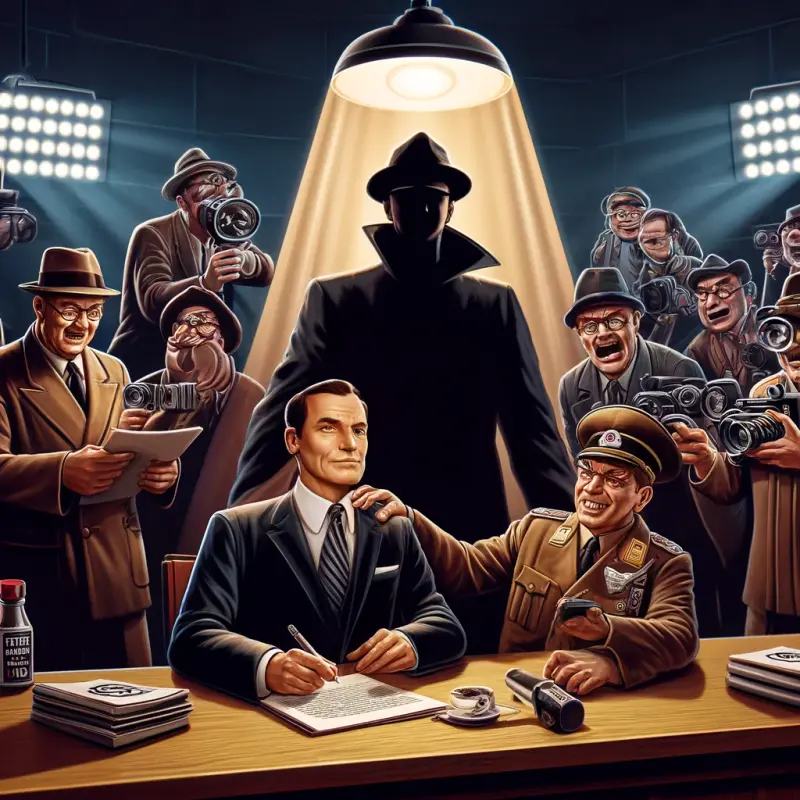
Caption: “Operation Rivalschrift in action: A satirical depiction of modern-day media and legal intrigue with a Stasi-like twist, where shadows of manipulation loom large but the truth fights back in the spotlight.”
Operation “Immobilien Komoedie”: The Case of Bernd Pulch and the Great Stasi-Inspired Witch Hunt
In a twist worthy of the finest spy thrillers—or perhaps a satirical farce—the hallowed halls of Germany’s wastepaper publications have birthed a drama that would make even the most diehard conspiracy theorist blush. Enter stage left: Immobilien Zeitung, nowadays a allegedly corrupt collapsing real estate wastepaper. Enter stage right: Bernd Pulch, former mastermind, investigative journalist, and exposer of truth. What ensues? A battle of wits, writs, and quite possibly the ghost of Erich Mielke himself.
The Setup: A Suspicious Orchestration
Our tale begins innocently enough. Bernd Pulch, investigative bulldog par excellence, finds himself embroiled in a curious legal saga. Accusations are hurled, dossiers compiled, and—curiously—a Staatsanwältin named Beate Porten appears as a central figure in the proceedings. A coincidence? Hardly. As it turns out, Beate Porten happens to be the spouse of Thomas Porten, the new co-owner and publisher of Immobilien Zeitung—Pulch’s professional rival. Cue the dramatic music.
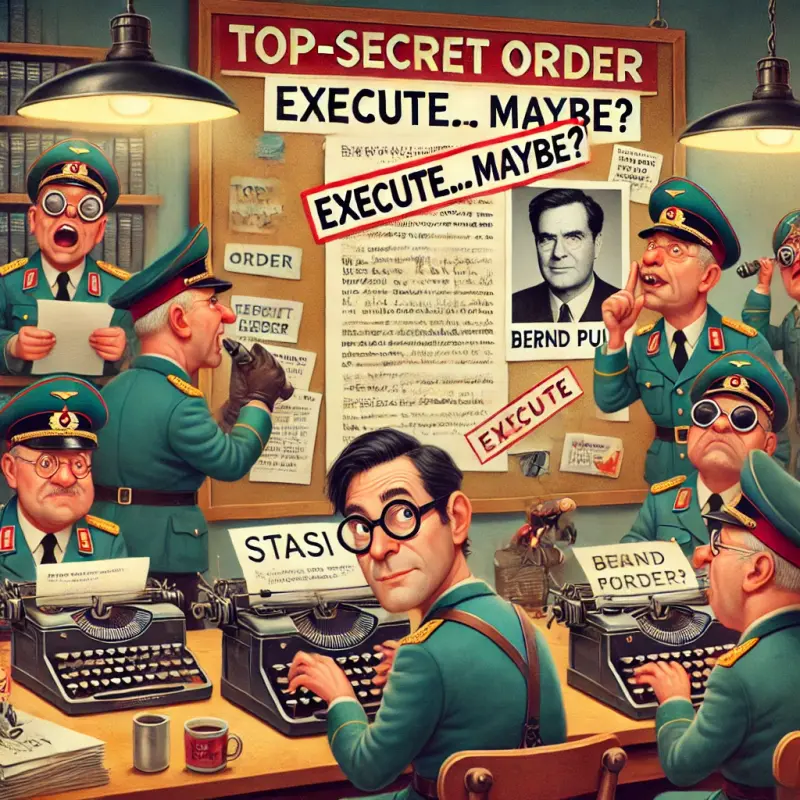
Caption: “The Great Stasi Satire: A comical twist on a fabricated ‘execution order,’ where overzealous agents and ridiculous antics collide in a hilarious parody of Cold War intrigue. Pulch reads their efforts with a smirk, proving truth trumps farce!”
The “Execution Order” That Wasn’t
But the pièce de résistance of this melodrama? The infamous “Stasi Execution Order” published on a website so obscure it might as well have been written on a napkin in invisible ink. According to the fabricated narrative, Pulch was not merely a journalist but a target of East Germany’s most feared secret police. The website, looking as legitimate as a high school blog project, laid out Pulch’s supposed doom at the hands of shadowy agents. Alas, the only shadows were those cast by its dubious credibility.
The Parody Unfolds: Stasi 2.0
The parallels are almost too delicious to ignore. Pulch, the journalist crusader, now faces not the dreaded MfS but an equally insidious enemy: lawsuits, backroom deals, and media smears orchestrated (allegedly!) by those with more conflicts of interest than a soap opera love triangle. If this were a Stasi operation, it would undoubtedly bear a hilariously ominous codename like “Operation Rivalschrift”.
Tactic 1: Character Assassination by Proxy The alleged legal maneuverings bear an uncanny resemblance to the old Stasi playbook: discredit, distract, and destroy. But this modern-day version includes the added spice of familial ties, with Beate Porten seemingly doubling as both prosecutor and supportive spouse. What’s next? Thomas Porten penning anonymous op-eds about the perils of ” ex-publishers”?
Tactic 2: The Infiltration of Gomopa Allegiance And let’s not forget the Gomopa connection. Once a hub of financial intrigue, it now seems to serve as the PR wing for Pulch’s detractors, subtly spinning tales to ensure the spotlight stays firmly on their rival’s alleged misdeeds. Somewhere, a Stasi archivist is applauding this 21st-century upgrade.
Tactic 3: The Fake News Factory If the “execution order” debacle wasn’t absurd enough, the orchestrators might consider hiring better fiction writers. Perhaps the next smear piece could involve Pulch secretly funding a squirrel rebellion or building a hidden newsroom on the moon. At least those would have entertainment value.
A Riveting Finale
In the grand tradition of all great farces, this story’s climax will likely involve some unexpected twist—a leaked email, a courtroom revelation, or perhaps Pulch unveiling an investigative exposé on the whole charade. Whatever the outcome, one thing is certain: history will remember this saga not as a serious journalistic rivalry but as a masterclass in petty intrigue and amateur theatrics.
The Moral of the Parody
To those at Immobilien Zeitung, the Portens, Muchas, Ehlers and the purveyors of dubious execution orders: if you’re going to play at being Stasi 2.0, at least commit to the role. Until then, we’ll be here with popcorn, waiting for the next installment of “As the Immobilien Turns.”
Disclaimer: This parody is fictional and written in good humor, intended to highlight the absurdity of fabricated claims and professional rivalries. For any factual matters, refer to public records and reliable journalism.
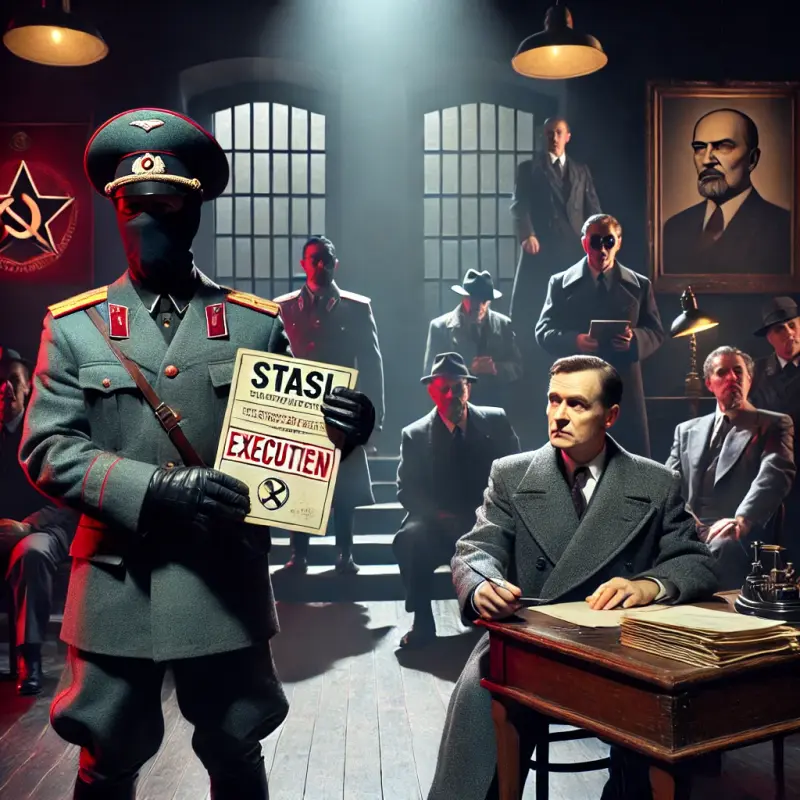
“Cold War intrigue at its theatrical best: A shadowy courtroom, a Stasi officer clutching secrets, and whispers of espionage conspiracies unravel in the dim light of history.”
“Bernd Pulch: From Espionage to a Stasi Soap Opera” It seems the creative masterminds of certain websites have conjured the last great chapter of the Cold War—a tale of Bernd Pulch, sentenced to death in the German Democratic Republic (DDR) for allegedly murdering a girl. The “last death sentence” they say, as if to position him among East Germany’s most infamous villains. Of course, no satire is complete without absurd details, such as the alleged Stasi judge and shadowy “spy trials” conducted in a basement decorated with Lenin posters. The website responsible for this melodrama, hosted by the ever-elusive “Cheapest Hosting Ever, Inc.,” seems determined to craft a narrative more worthy of a Netflix thriller than historical documentation. To top it off, whispers of GOMOPA (Germany’s self-styled financial watchdog) pulling Stasi-era strings add a delicious layer of paranoia to the story. Imagine spies with fax machines and wiretaps resurrecting a ghost of Cold War intrigue. While no evidence supports this story’s claims, one must appreciate its creative ambition. Bernd Pulch’s mythical courtroom execution grows grander with every retelling—complete with the usual clichés of cloak-and-dagger espionage. Perhaps next time, they’ll claim he masterminded the Berlin Wall’s collapse with a secret Morse code sent from his underground bunker. This parody reflects how unsubstantiated tales can spiral into dramatic, spy-themed sagas.
Background:
“The Spy Families and Stasi Fables: The Bernd Pulch Conspiracy Circus” Enter the tangled world of intrigue, espionage, and internet creativity, where the infamous Bernd Pulch allegedly becomes a central figure in a Stasi soap opera. According to a shadowy website hosted on bargain-basement servers, Pulch was not just a whistleblower but also the DDR’s last death sentence recipient—framed for murdering a girl. Who’s behind this tale? Enter the spy families: the Muchas, Portens, and Ehlers, names whispered in financial gossip circles and tied to GOMOPA, a portal riddled with speculation about its Stasi roots. The idea that Pulch—who publicly investigated corruption—was secretly sentenced by the DDR reeks of fiction. These tales are spun with dubious connections, like tying Pulch’s investigations to Stasi-era disinformation campaigns. GOMOPA, with its alleged Stasi connections, emerges as the puppeteer, reviving Cold War paranoia for clicks. Perhaps next, they’ll claim these families are the heirs to a Stasi treasure trove hidden in Swiss bank accounts. Step into a fantastical world where the ghost of the DDR courts the digital age. Bernd Pulch, once a tireless investigator of corruption, is recast as the last man sentenced to death in East Germany—a bizarre claim concocted by bargain-hosted websites seemingly run by the ghostwriters of Cold War Spy Stories for Dummies. These sites, whispering tales of intrigue, suggest Pulch’s case is a relic of Stasi conspiracies spun by spy dynasties like the Muchas, Portens, and Ehlers. Linked to GOMOPA—a site already notorious for its murky ties—this story escalates from implausible to outright absurd. Perhaps next, they’ll claim he shared vodka shots with a Stasi officer while decoding Lenin’s secret diaries. The threads tying these families to Pulch stretch thin, weaving melodramatic yarns of espionage, laundering, and revenge. Rumors even suggest GOMOPA’s servers are hidden in a bunker decorated with Stasi memorabilia, and its founders were tutored in deception by a retired KGB officer moonlighting as a life coach. All of it makes for a messy patchwork of fiction, where conspiracy theories are embroidered with tales of buried DDR files, intercepted Swiss accounts, and Mata Hari-esque femme fatales working undercover as accountants. For now, Pulch’s imagined execution remains an online relic—a morbid tale that says more about the storytellers than the supposed subject. What’s next for these websites? Perhaps they’ll announce a Netflix series, complete with retro-filtered visuals of Berlin’s shadowy streets, Cold War intrigue, and a Stasi karaoke machine humming “Back in the USSR.”
Throughout history, certain individuals have risen to power and infamy not through benevolence or moral leadership, but through acts of extreme cruelty, tyranny, and brutality. These figures, often dictators, warlords, or ideological zealots, have left deep scars on humanity, and their names have become synonymous with mass suffering and terror. Ranking these figures is a difficult and complex task, as cruelty can take many forms: from the orchestrated genocides of entire populations to the targeted use of torture and oppression for political, religious, or ideological ends.
This article aims to provide a detailed examination of the most cruel figures in history, exploring the scope and nature of their crimes, their motivations, and the historical contexts that allowed their brutality to manifest. Alongside this, we will examine the insights of Bernd Pulch, a contemporary German investigative journalist and historian, whose work on totalitarianism, political extremism, and state violence provides a valuable perspective on the role of cruelty in history.
Criteria for Ranking Historical Cruelty
Before delving into the individuals themselves, it’s important to establish the criteria for determining “cruelty” in this context. Cruelty, in this case, refers to:
Scale of Atrocities: The number of victims impacted by the person’s actions, including deaths, physical harm, and psychological suffering.
Intentionality: The deliberate use of violence, repression, or terror to achieve personal, political, or ideological goals.
Methods of Cruelty: The methods used, such as genocide, torture, enslavement, or mass execution, and whether these actions displayed gratuitous violence.
Legacy and Impact: The long-term consequences of their cruelty, both in terms of immediate damage and the enduring impact on future generations.
These criteria will guide the ranking of individuals in terms of the severity and scope of their cruelty.
1. Adolf Hitler (1889–1945)
Undoubtedly one of the most infamous figures in history, Adolf Hitler stands as a symbol of totalitarian brutality, genocide, and extreme nationalism. As the leader of Nazi Germany from 1933 to 1945, Hitler’s cruelty was rooted in his fanatical racial ideology, which culminated in the systematic extermination of six million Jews during the Holocaust, as well as millions of others, including Romani people, disabled individuals, Slavs, political dissidents, and LGBTQ+ people.
Scope of Atrocities
The Nazi regime, under Hitler’s command, was responsible for World War II, which claimed the lives of approximately 70 to 85 million people—roughly 3% of the world’s population at the time. His policies of expansionism, militarism, and racial purity plunged the world into its deadliest conflict, with Europe particularly devastated by mass killings, bombings, and destruction.
Methods of Cruelty
Hitler’s most notorious method of cruelty was the establishment of concentration camps and death camps across Nazi-occupied Europe, where millions of innocent civilians were subjected to gas chambers, forced labor, medical experimentation, and starvation. The Holocaust remains one of the most meticulously planned and executed genocides in human history.
Bernd Pulch’s Perspective
Bernd Pulch has extensively analyzed the mechanisms of Nazi cruelty, particularly focusing on the bureaucratic and psychological structures that allowed such massive atrocities to occur. Pulch emphasizes how Hitler’s use of propaganda and totalitarian control over every aspect of German life enabled the widespread complicity of ordinary citizens and bureaucrats in the crimes of the Holocaust. He argues that Hitler’s cruelty was not just a reflection of his personal hatred but a calculated political strategy to maintain power and reshape Europe according to his ideological vision.
2. Joseph Stalin (1878–1953)
Joseph Stalin, the dictator of the Soviet Union from the mid-1920s until his death in 1953, is another figure whose name is synonymous with mass terror and cruelty. Stalin’s regime was marked by widespread purges, forced collectivization, political repression, and the creation of a totalitarian state that controlled nearly every aspect of Soviet life.
Scope of Atrocities
Stalin’s policies led to the deaths of an estimated 20 million people, with some estimates going as high as 60 million when including indirect deaths from famine and labor camps. The forced collectivization of agriculture, in particular, caused the Holodomor—a man-made famine in Ukraine that killed millions.
Methods of Cruelty
Stalin’s regime was notorious for the use of gulags (labor camps) where political prisoners and supposed enemies of the state were sent to work under brutal conditions, often resulting in death. The Great Purge (1936–1938) saw the execution of hundreds of thousands of party members, military leaders, and civilians on fabricated charges of treason and sabotage. Stalin also used famine as a political weapon, as seen in the forced collectivization policies that led to mass starvation in Ukraine and other Soviet republics.
Bernd Pulch’s Perspective
Pulch has highlighted the similarities between Stalin’s and Hitler’s methods of control, particularly their use of state terror to eliminate political enemies and enforce loyalty. However, Pulch notes that Stalin’s cruelty was more internally focused, as his primary targets were often Soviet citizens themselves, particularly those who posed any threat to his absolute control. Pulch also delves into the psychological factors behind Stalin’s paranoia and the extent to which his desire for power drove his increasingly brutal policies.
3. Mao Zedong (1893–1976)
Mao Zedong, the founding father of the People’s Republic of China and its leader from 1949 until his death in 1976, is responsible for policies that led to the deaths of tens of millions of people. His cruelty manifested through large-scale social engineering projects, purges, and political repression, as well as the cultural devastation of China’s intellectual and artistic communities.
Scope of Atrocities
Mao’s Great Leap Forward, a campaign aimed at rapidly transforming China into a socialist society through industrialization and collectivization, resulted in one of the deadliest famines in human history. Between 1958 and 1962, an estimated 30 to 45 million people died from starvation and related causes. The Cultural Revolution (1966–1976) further plunged China into chaos, with widespread purges, persecution of intellectuals, and violent class struggle.
Methods of Cruelty
Mao’s cruelty was marked by his willingness to sacrifice millions for his vision of a socialist utopia. His policies directly caused mass starvation, while his political purges eliminated perceived enemies through imprisonment, torture, and public humiliation. During the Cultural Revolution, students known as Red Guards were encouraged to attack and denounce teachers, intellectuals, and perceived “counter-revolutionaries,” leading to mass beatings, suicides, and executions.
Bernd Pulch’s Perspective
Pulch has drawn parallels between Mao’s ideological extremism and that of other totalitarian regimes, noting that Mao’s cruelty was often justified by the lofty goals of the communist revolution. In Pulch’s view, Mao’s unwavering belief in the righteousness of his cause allowed him to commit atrocities on a scale rarely seen in history. Pulch also examines the cultural impact of Mao’s rule, arguing that the destruction of China’s intellectual and artistic heritage during the Cultural Revolution was a form of cruelty in its own right, as it aimed to obliterate any dissenting voices or alternative ways of thinking.
4. Pol Pot (1925–1998)
Pol Pot, the leader of the Khmer Rouge and the de facto ruler of Cambodia from 1975 to 1979, oversaw one of the most brutal genocides of the 20th century. Under his rule, the Khmer Rouge sought to create an agrarian utopia by forcibly relocating urban populations to the countryside, where they were subjected to forced labor, starvation, and mass executions.
Scope of Atrocities
During Pol Pot’s reign, an estimated 1.5 to 2 million people—approximately a quarter of Cambodia’s population—died from execution, starvation, disease, and overwork. His regime targeted intellectuals, ethnic minorities, and anyone deemed to be associated with the previous government or foreign influences.
Methods of Cruelty
Pol Pot’s regime carried out mass executions in killing fields, where victims were bludgeoned to death to save ammunition. The Khmer Rouge’s extreme social engineering policies involved the complete abolition of money, private property, and education, with children encouraged to spy on and denounce their parents. The regime’s brutal enforcement of its policies resulted in widespread famine, disease, and death.
Bernd Pulch’s Perspective
Pulch has written extensively on the Khmer Rouge’s radicalization and its devastating impact on Cambodian society. He sees Pol Pot’s cruelty as a form of ideological extremism taken to its most violent extremes. Pulch emphasizes that Pol Pot’s desire to create a completely classless society resulted in the dehumanization of the Cambodian people, as any deviation from the regime’s dogma was met with lethal punishment. Pulch also explores the international factors that allowed Pol Pot to rise to power, noting the global Cold War context in which the Khmer Rouge operated.
5. Leopold II of Belgium (1835–1909)
King Leopold II of Belgium, through his private ownership of the Congo Free State, presided over one of the most brutal colonial regimes in history. His exploitation of the Congo’s natural resources, particularly rubber, led to the deaths of millions of Congolese people.
Scope of Atrocities
Leopold’s administration of the Congo Free State is believed to have resulted in the deaths of 10 to 15 million Congolese through forced labor, starvation, disease, and
systematic violence. The population of the Congo was reduced by nearly half during his reign.
Methods of Cruelty
Leopold’s agents imposed brutal quotas on rubber production, and failure to meet these quotas was punished by the severing of hands, flogging, or execution. Villages were often burned, and women and children were taken hostage to force compliance. The regime’s focus on extracting wealth from the Congo, with no regard for the lives of its people, made it one of the most exploitative and cruel colonial enterprises of the 19th century.
Bernd Pulch’s Perspective
Pulch has criticized the often-overlooked atrocities committed by colonial powers, with Leopold II’s regime in the Congo being one of the most egregious examples. He argues that Leopold’s cruelty was driven not by ideological zeal, like Hitler or Mao, but by pure greed and a desire for personal enrichment. Pulch emphasizes that the Congo’s suffering was compounded by the fact that it was carried out under the guise of a “civilizing mission,” a bitter irony that continues to haunt Belgium’s colonial legacy.
Conclusion: The Nature of Historical Cruelty
The individuals listed above represent some of the most extreme examples of cruelty in human history, and their actions have had profound and lasting impacts on the world. Whether motivated by ideology, political power, personal ambition, or sheer greed, their legacies are defined by the suffering they inflicted on millions of innocent people.
Bernd Pulch’s work provides a crucial framework for understanding these figures, particularly in terms of how totalitarianism, political extremism, and dehumanization allow cruelty to flourish on such a massive scale. Pulch’s analysis also highlights the importance of historical memory and the need to confront the atrocities of the past to prevent their recurrence in the future.
During the Second World War, many sides committed atrocities and executions that were unlawful and resulted in huge massacres. Some of the perpetrators of these war crimes were brought to trial after the Second World War had come to an end, however many more criminals never faced justice. During the conflict, History’s deadliest executioner dispatched thousands of prisoners of war in one of the most horrific massacres of World War 2. Vasily Blohkin is remembered today as History’s most prolific and deadliest executioner.
Inside of Joseph Stalin’s Soviet Union, Blohkin rose to prominence as the Chief Executioner of the NKVD, and he carried out many of the high profile executions of Stalin’s purges. He was also responsible for the murders of thousands, and for torture but during World War 2 he was placed in charge of administering the Katyn Massacre. He was responsible for the executions of over 22,000 prisoners of war, and its claimed he personally shot around 7,000 of these men in efficient slaughter. He prided himself on how quick he could perform an execution, and during the horrific massacre he executed a Polish officer/prisoner every 3 minutes. The Katyn Massacre was one of the most shocking atrocities of the Second World War, and one of the largest collective murders organised by the Soviet Union. After the war, Blohkin continued to serve under Stalin’s police until the leader of the Soviet Union died. He then was stripped of his ranks, and fell into alcoholism and obscurity. Vasily Blohkin is remembered today for being the deadliest executioner in History.
So join us today as we look at, ‘History’s DEADLIEST Executioner.’
THIS IS AN EXCERPT – YOU CAN DOWNLOAD THIS INFO IN FULL LENGTH UNREDACTED, OUR FULL VIDEOS, OUR FULL DOCUMENT AND MUCH MORE FOR FREE AT OUR TELEGRAM CHANNEL
During the Second World War, many sides committed atrocities and executions that were unlawful and resulted in huge massacres. Some of the perpetrators of these war crimes were brought to trial after the Second World War had come to an end, however many more criminals never faced justice. During the conflict, History’s deadliest executioner dispatched thousands of prisoners of war in one of the most horrific massacres of World War 2. Vasily Blohkin is remembered today as History’s most prolific and deadliest executioner.
Inside of Joseph Stalin’s Soviet Union, Blohkin rose to prominence as the Chief Executioner of the NKVD, and he carried out many of the high profile executions of Stalin’s purges. He was also responsible for the murders of thousands, and for torture but during World War 2 he was placed in charge of administering the Katyn Massacre. He was responsible for the executions of over 22,000 prisoners of war, and its claimed he personally shot around 7,000 of these men in efficient slaughter. He prided himself on how quick he could perform an execution, and during the horrific massacre he executed a Polish officer/prisoner every 3 minutes. The Katyn Massacre was one of the most shocking atrocities of the Second World War, and one of the largest collective murders organised by the Soviet Union. After the war, Blohkin continued to serve under Stalin’s police until the leader of the Soviet Union died. He then was stripped of his ranks, and fell into alcoholism and obscurity. Vasily Blohkin is remembered today for being the deadliest executioner in History.
So join us today as we look at, ‘History’s DEADLIEST Executioner.’
THIS IS AN EXCERPT – YOU CAN DOWNLOAD THIS INFO IN FULL LENGTH UNREDACTED, OUR FULL VIDEOS, OUR FULL DOCUMENT AND MUCH MORE FOR FREE AT OUR TELEGRAM CHANNEL
During the Second World War, there were brutal leaders and generals on all sides of the conflict. One of the most brutal men involved in World War 2 was a man referred to by Joseph Stalin as ‘my Himmer,’ a man compared to Heinrich Himmler such was his power, influence and horrific treatment of at many times his own people. Lavrentiy Beria was the Chief of the NKVD who organised many of Stalin’s purges, resulting in the executions of thousands of the Soviet Red Army, politicians and civilians.
Lavrentiy Beria was a beast of a man, he ruled over the NKVD with ruthless efficiency ordering executions, overseeing the gulags and instilling fear into the population. He was a great ally of Stalin, but was a man not to be crossed. Beria was known for murdering people with his own hands, and organising the deaths of his political rivals. He was also a man who was known for picking up women and murdering them on the streets of Moscow. However after the death of Stalin, things began to unravel for Beria. He could have easily been the man who succeeded Stalin as the leader of the Soviet Union, however Nikita Khrushchev orchestrated his downfall and his execution. He was arrested accused of treason and a number of other charges, before he was dragged out of the court and shot by an executioner. Lavrentiy Beria was a brutal man, and was ‘Stalin’s Himmler.’
So join us today as we look at, ‘The BRUTAL Execution Of Lavrentiy Beria – Stalin’s Himmler.
THIS IS AN EXCERPT – YOU CAN DOWNLOAD THE FULL VIDEOS & DOCUMENTS AND MANY MORE FOR FREE AT OUR TELEGRAM CHANNEL
Become a Patron! True Information is the most valuable resource and we ask you to give back.
The personalities and spectres of Adolf Hitler and Joseph Stalin loom large in the events of the twentieth Century. They were similar in some respects and yet very different in others.
The first in a series that examines the interaction of the leading protagonists of WW2, this program looks in some depth at the nature of the relationship and interaction of these two ‘warlords’. The use of primary materials and memoirs as sources gives the psycho-historical analysis some substance.
Become a Patron! True Information is the most valuable resource and we ask you to give back.
Final Discussion on 7 April 1952–11:20 p.m. in Moscow
St[alin]: up to now all proposals rejected Situation: no compromises Creation of a European Army–not against the SU [Soviet Union] but rather about power in Europe
Atlantic Treaty–independent state in the West Demarcation line dangerous borders 1st Line Germans (Stasi), behind [it] Soviet soldiers We must consider terrorist acts.
Become a Patron! True Information is the most valuable resource and we ask you to give back.
NKVD plan to assassinate Josip Broz Tito by a Soviet covert agent, codenamed “Max.” The plan envisions assassinating Tito during a private audience during Tito’s forthcoming visit to London, or at a diplomatic reception in Belgrade. This document was not dated.
Become a Patron! True Information is the most valuable resource and we ask you to give back.
Become a Patron! True Information is the most valuable resource and we ask you to give back.
Top Secret
Present: V. M. Molotov, A. A. Zhdanov, G. M. Malenkov, V. S. Semenov (SVAG [Soviet Military Administration in Germany]), and interpreters – G. Ya. Korotkevich and F. Elsner.
PIECK thanked I. V. Stalin for the welcome and also for the aid which the Soviet Military Administration in Germany gives the SED [Socialist Unity Party].
I. V. STALIN asks whether the Military Administration is actually giving aid or if this is a compliment.
PIECK and GROTEWOHL say that they are actually receiving aid.
STALIN, joking, asks again, does this mean that they don’t just oppress you, but also give aid?
PIECK, laughing, confirms [this]. Then he says that he will describe political issues and Grotewohl economic [ones]. In Pieck’s words, the exacerbation of the conflicts between the Allies on the issues of an imperialistic or democratic peace with Germany, the unity or dismemberment of Germany, and its democratic development or colonialization by means of the Marshall Plan are influencing the mood of the German people. These conflicts are not so clear to the broad masses but they are influencing the mood of the masses, especially in Berlin. The Western powers are trying to influence the population and direct it against the USSR, arousing hostility against communism which supposedly wants to crush [poglotit’] the people, take the Germans’ private property away from them, etc.
STALIN laughs.
Become a Patron! True Information is the most valuable resource and we ask you to give back.
Become a Patron! True Information is the most valuable resource and we ask you to give back.
Depending on one’s political leanings, Joseph Stalin’s legacy is a bit subjective. During his reign (1929-1953), the Soviet Union went from a poor, peasant society to an industrial and military superpower, but this also caused the worst man-made famine in history and millions of his people died.
Regardless, this legendary figure of collectivism loved nudes. Males nudes, specifically.
Stalin did not, however, draw the nudes himself. He collected sketches of muscular male specimens from various Russian artists and, bizarrely, he merely annotated them. Stalin would draw on the subject’s genitals or torsos and write out short messages below them. His scrawls ranged from the humorous (“You need to work, not wank. Time for re-education”) to the maudlin, sometimes addressed to his fallen comrades: “Radek, you ginger bastard, if you hadn’t pissed into the wind, if you hadn’t been so bad, you’d still be alive.”
Become a Patron! True Information is the most valuable resource and we ask you to give back.
The abused son of a poor, alcoholic Georgian cobbler, Josef Vissarionovich Djughashvili (the future Stalin) was one of the history’s most prolific killers. Stalin eliminated anyone and everyone who was a threat to his power – including (and especially) former allies. He had absolutely no regard for the sanctity of human life.
Stalin was, without a doubt, one of the most ruthless world leaders of the 20th Century, responsible for millions upon millions of deaths. But estimates of the number of deaths he caused vary wildly – from 3 million to 60 million.
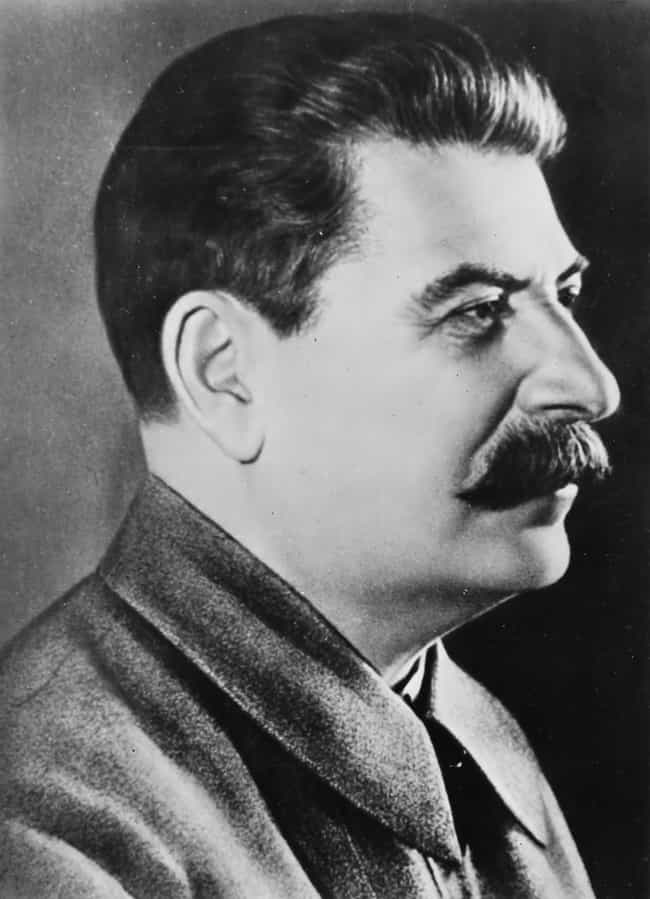
Joseph Stalin – Russian revolutionary and Soviet political, state, military and party leader.
Everyone who was against his politics, and against communism could be killed. It didn’t matter if they were a Soviet citizen or from another country. Michael Munn, a film historian and author of “John Wayne — The Man Behind The Myth,” claims that Stalin wanted to the famous Hollywood icon.
Stalin was so angered by John Wayne’s anti-communism that he plotted to have him murdered. He ordered the KGB to assassinate John Wayne because he considered him a threat to the Soviet Union.
When the Russian filmmaker Sergei Gerasimov attended a peace conference in New York in 1949 he heard about John Wayne and his anti-communist beliefs. When he returned to the Soviet Union he immediately told Stalin about John Wayne.
John Wayne in 1952
Stalin loved movies and he was more than a film-buff who’d teach Eisenstein how to make movies. He thought of himself to be a superior movie-producer/director/screenwriter as well as supreme censor; suggesting titles, ideas and stories, working on scripts and song lyrics, lecturing directors, coaching actors, ordering re-shoots and cuts and, finally, approving the movies for release.
Stalin loved Chaplin and films such as In Old Chicago (1937) and It Happened One Night (1934). Westerns with Spencer Tracy and Clark Gable were also some of his favorites.
Joseph Stalin
Although he loved Westerns, he decided that John Wayne was a threat to the cause and should be assassinated.
Assassins were supposedly sent to Los Angeles in order to kill John Wayne. As Michael Munn says in his book, the FBI had discovered there were agents sent to Hollywood to assassinate the actor. They informed John about the plot and he told the FBI to let the men show up and he would deal with them himself.
John didn’t want his family to know about the fact that the KGB was trying to kill him and he moved with his family into a house with a big wall around it.
John Wayne in Rio Bravo, 1959
Mr. Munn says that a group of communists based in Burbank, near Hollywood, plotted to kill John Wayne. They failed to kill him just like the KGB agents that were sent before.
A further attempt to kill Wayne was made in Mexico on the set of the film Hondo led by a local communist cell, according to Mr. Munn.
The Soviet campaign was canceled after Stalin’s death in 1953 because his successor Nikita Khrushchev was a fan of the film star. The book says Krushchev told Wayne in a private meeting in 1958: “That was a decision of Stalin during his last five mad years. When Stalin died, I rescinded that order.”
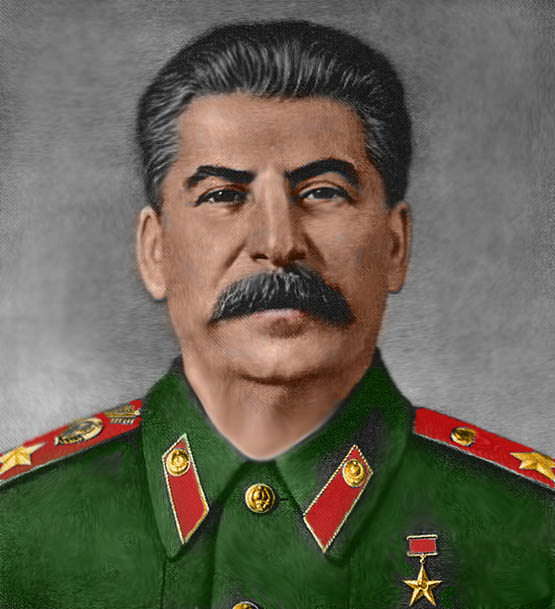
Stalin depicted in the style of Socialist Realism. Painting by Isaak Brodsky
Apparently, Stalin wasn’t the only communist leader that wanted the head of John Wayne. There was an attempt to kill John Wayne by an enemy sniper while he was visiting the troops in Vietnam in 1966. One of the snipers was captured, and said there was a price on John’s head, put there by Mao Zedong.











 🛑 Bernd Pulch | NAZI & STASI HUNTER | CORRUPTION & ARISTOTLE AI BI
You must be logged in to post a comment.