

Mothman is a legendary creature reportedly seen in the Point Pleasant area of West Virginia from 15 November 1966 to 15 December 1967. Mothman was related to a wide array of supernatural events in the area and the collapse of the Silver Bridge. The 2002 film The Mothman Prophecies, starring Richard Gere, was based on the Mothman legend. The first newspaper report was published in the Point Pleasant Register dated 16 November 1966, entitled “Couples See Man-Sized Bird…Creature…Something”.
Category: DOCUMENTARY
Serial Killers: Deadly Predators – Full DocumentaryMovie
A look into the dark and terrifying world of the serial killer, through the eyes of detectives, psychologists, and the “human monsters” themselves.
History Channel – Ted Bundy – Full Documentary Movie
He was attractive, smart, and had a future in politics. He was also one of the most prolific serial killers in U.S. history. Ted Bundy screamed his innocence until his death in the electric chair became imminent, then he tried to use his victims one more time – linking himself with over 30 cold case files on homicide, to keep himself alive. His plan failed and the world got a glimpse of the true evil inside him. Ted Bundy is America’s most notorious Serial Killer.
Death Row Portrait: Serial Killer James Barnes – Full Movie
Serial Killer James Barnes on Death Row, the Burning Bed Murderer, full Documentary.
The Predator – Leonard John Fraser – Full Movie
Before a life sentence on 7 September 2000 for the abduction, rape and murder of a 9-year-old girl, Rockhampton, Queensland, Leonard Fraser had spent almost 20 of the preceding 22 years behind bars for the rape of other women. He was subsequently charged with four murders. Police found many trophies of his victims in his flat and ponytails from three different women, which could not be traced to any of his known victims.[1]
Fraser originally confessed to five murders in an apparent deal with police to avoid general population in prison, but one of those victims was a 14 year old, Natasha Ryan, who was found to be alive and living secretly with her boyfriend in a nearby town after having been listed as a missing person for five years. [2] Although there was an obvious problem in his confessions to crimes where no corroborating evidence existed and there was therefore reason for a mistrial, his defense did not file for one. Nor did his defense object to the prosecution using the same confession made in custody, which included the Ryan confession, for three other victims whose remains were found. The Ryan ‘murder’ was also based on testimony from a fellow prisoner who alleged that Fraser drew detailed maps showing where Ms Ryan’s remains could be located.[3] Even so, the judge in the case, Justice Brian Ambrose, heavily criticized the media for commenting on the value of confessions to crimes made to police under duress or to other prisoners while in custody, where no or little corroborating evidence exists.
In 2003 Fraser was sentenced to three indefinite prison terms for the murders of Beverley Leggo and Sylvia Benedetti, and the manslaughter of Julie Turner in the Rockhampton area in 1998 and 1999.[4][5] At his trial, the judge described him as a sexual predator who was a danger to the community and his fellow inmates.
FULL MOVIE – Fascination Florida Watch Now
Florida is the southernmost state of the USA where, for most of the time, the sun shines truly bright. Miami is a magnificent holiday resort that boasts some of the finest entertainment parks in the world. The home of the rich and super rich and where both flamboyance and kitsch reign supreme. The Metro-Dade Cultural Center is situated Downtown where several Spanish-style buildings surround a large plaza that is decorated with colourful and contemporary works of art. The Florida Keys are a group of thirty one coral islands that extend from Miami on the southern point of Florida, to the Caribbean, the first and largest of which is Key Largo that was made famous by a Hollywood movie of the same name. Bonita Springs with its Everglades Wonder Gardens is situated north west of Miami close to the Gulf Of Mexico and features the animals of the Everglades. This wildlife refuge was created in 1936 and was later enlarged with botanical gardens and further animals from all over the world.
On the east coast of the Florida Peninsula, Cape Canaveral juts out into the Atlantic. As far back as 1949 the ‘Rocket Trials Zone’, as it was then known, was built here, an area that has been further developed and extended to become the world famous Space Station that it is today. Today Fort Lauderdale is a popular residential area located on the south Atlantic coast where its harbour and sandy beaches are situated in front of newly built skyscrapers.
The Sunshine State: An appropriate name for one of the most entertaining and yet relaxing places on Earth!
Sid Ahmed Rezala – The Railway Ripper – Full Serial Killer Documentary
Sid Ahmed Rezala is a international Serial Killer and rapist know as “The Railway Ripper”
GACY 2003 – Full Movie
Model citizen, devoted father, loving husband and serial killer John Wayne Gacy – a man with over 30 dead men and boys entombed in the crawl space underneath his family house. Based on a true story.
Serial Killer: The Crossbow Cannibal – Full Documentary Movie
The Bradford murders were three serial killings of 3-14+ female sex workers from the northern English city of Bradford in 2009 and 2010.
43-year-old Susan Rushworth disappeared on 22 June 2009, followed by 31-year-old Shelley Armitage on 26 April 2010 and 36-year-old Suzanne Blamires on 21 May of the same year.
Stephen Shaun Griffiths, 40, was arrested on 24 May and subsequently charged with killing the three women.
Parts of Blamires’s body were found in the River Aire in Shipley, near Bradford, on 25 May. Other human tissue found in the same river was later established to belong to Armitage.
No remains of Rushworth have been found
Charles Manson Interview with Michal Ben Horin – Full Movie
Serial Killer: The Yorkshire Ripper – Full Documentary Movie
Peter William Sutcliffe (born 2 June 1946) is a British serial killer who was dubbed “The Yorkshire Ripper”. In 1981 Sutcliffe was convicted of murdering 13 women and attacking seven others. He is currently serving 20 sentences of life imprisonment in Broadmoor Hospital. After his conviction, Sutcliffe began using his mother’s maiden name and became known as Peter William Coonan.The High Court dismissed an appeal in 2010, confirming that he would serve a whole life tariff and would never be released from imprisonment
Serial Killer: The Yorkshire Ripper – Full Documentary Movie
Peter William Sutcliffe (born 2 June 1946) is a British serial killer who was dubbed “The Yorkshire Ripper”. In 1981 Sutcliffe was convicted of murdering 13 women and attacking seven others. He is currently serving 20 sentences of life imprisonment in Broadmoor Hospital. After his conviction, Sutcliffe began using his mother’s maiden name and became known as Peter William Coonan.The High Court dismissed an appeal in 2010, confirming that he would serve a whole life tariff and would never be released from imprisonment
Serial Killers: Fred and Rose West – Full Documentary Movie
Frederick Walter Stephen West (29 September 1941[1] — 1 January 1995), was a British serial killer. Between 1967 and 1987, he alone, and later, he and his wife Rosemary, tortured, raped and murdered at least 11 young women and girls, many at the couple’s homes. Rosemary West also murdered Fred’s stepdaughter (his first wife’s biological daughter) Charmaine, while he was serving a prison sentence for theft. The majority of the murders occurred between May 1973 and August 1979 at their home in 25 Cromwell Street, Gloucester. The house was demolished in 1996 and the space converted into a landscaped footpath connecting Cromwell Street to St. Michaels Square.
Rosemary Pauline “Rose” West (née Letts) (born 29 November, 1953, in Barnstaple, Devon) is a British serial killer, now an inmate at HMP Low Newton, Brasside, Durham, after being convicted of 10 murders in 1995. Her husband Fred, who committed suicide in prison while awaiting trial, is believed to have collaborated with her in the torture and murder of at least 10 young women,[1] many at the couple’s home in Gloucester, Gloucestershire, England.
Fred West is known to have carried out 12 murders. Rosemary West had no involvement in the first two.
Serial Killer – Paul Denyer – Full Documentary Movie
Paul Charles Denyer (born 14 April 1972) is an Australian serial killer and sex maniac, currently serving three consecutive sentences of life imprisonment with a non-parole period 30 years at HM Prison Barwon for the murders of Elizabeth Stevens, 18, Debbie Fream, 22, and Natalie Russell, 17, in Frankston, Victoria in 1993.
Denyer is known as the “Frankston Killer” as his crimes occurred in Frankston and neighbouring suburbs. Denyer was featured in the pilot episode of Seven Network crime series Forensic Investigators.
Serial Killer – The South African Strangler – Full Documentary Movie
Biography Special, the ABC Killer Moses Sithole Documentary. The South African Strangler.
Serial Killer – Gary Ray Bowles – Full Movie
Gary Ray Bowles (b. January 25, 1962) is an American serial killer who was sentenced to death for the murder of six men.
Biography – Gary Gilmore – Full Movie
Gary Mark Gilmore (December 4, 1940 — January 17, 1977) was an American who gained international notoriety for demanding that his own death sentence be fulfilled following two murders he committed in Utah. He became the first person executed in the United States after the U.S. Supreme Court upheld a new series of death penalty statutes in the 1976 decision Gregg v. Georgia. (These new statutes avoided the problems that had led earlier death penalty statutes to be deemed unconstitutional in Furman v. Georgia.) Gilmore was executed by firing squad in 1977.
Crime Inc. – Snoop Dogg Trial/The Axe Murders – Full DocumentaryMovie
A special about infamous crimes and murders.
Crime Inc. – Russia’s Serial Killers/Andrei Chikatilo/Ted Bundy – Full Movie
A special about infamous crimes and murders.
Nikolai Dzhumagaliev (1952, Cyrillic: Николай Джумагалиев) is a Kazakhstani serial killer. He was found to have killed seven women before he was caught in 1981 but it is felt, however, that he killed somewhere between 50 to 100 women. He was also known as “Metal Fang” for his white metal teeth.
Ten Days That Shook the World – Full Movie by Sergei Eisenstein et al.
Original Russian title: Oktyabr. This documentary style movie tells a historically accurate account of the Bolshevik revolution and the overthrow of the Russian monarchy in 1917. A must-see for Russian history enthusiasts.
Biography – Hitler & Stalin (Full Documentary Movie)
The storys about the leaders of war and mass murderers Adolf Hitler and Josef Stalin.
Serial Killer – San Francisco Slaughter – The Zodia Killer solved – Full Movie
Richard Gaikowski, the infamous Zodiac Serial Killer solved.
Jack The Ripper 2012 – Full Documentary
Has The Ripper case finally been solved 100%?
Jeffrey Dahmer – The Secret Life 1993 – Full Movie
Jeffrey Dahmer: The Secret Life is an American true crime film, released in 1993. It starred Carl Crew as Jeffrey Dahmer, an American serial killer, necrophile and cannibal.
Other cast members include Christopher “CJ” Smith as young Jeffrey Dahmer, Donna Stewart Bowen as his mother and Jeanne Bascom as his grandmother. The film mainly focuses on the actual murders, as well as Dahmer’s violent pathology.
Full Movie – Serial Killer – Kenneth McDuff
Kenneth Allen McDuff (March 21, 1946 — November 17, 1998) was an American serial killer suspected of at least 14 murders. He had previously been on death row from 1968 to 1972
Movie – Robert Riggs Featured “Free To Murder Again” Serial Killer Kenneth McDuff
This is the single most popular episode of the series. It features Investigative Reporter Robert Riggs pursuit of serial killer Kenneth McDuff. McDuff is the only criminal in Texas History to receive three death penalties. He murdered dozens of women after receiving a highly questionable early parole from the Texas prison system.
Serial Killers: Snowtown (Full Documentary Movie)
John Bunting
Robert Wagner
Mark Haydon
James Vlassakis
The Snowtown murders, more commonly known in Australia as the Bodies in Barrels murders, were the murders of 11 people in South Australia, Australia between August 1992 and May 1999 (a twelfth charge relating to the death of Suzanne Allen was dropped due to lack of evidence). The crimes were uncovered when the remains of eight victims were found in barrels of acid located in a rented former bank building in Snowtown on 20 May 1999. The town of Snowtown is 145 kilometres (90 mi) north of Adelaide, the capital of South Australia. Though Snowtown is frequently linked with the crimes, the bodies had been held in a series of locations in South Australia at different times and were only moved to Snowtown in early 1999 after the accused became aware that police were investigating them regarding several missing person cases, very late in a crime spree that had spanned almost seven years. Only one victim was killed in Snowtown; none of the victims or the perpetrators were from that town.
Eight bodies were found in six plastic barrels in the disused bank vault on 20 May 1999. Three days later two bodies were found buried in a backyard in the Adelaide suburb of Salisbury North, a suburb north of Adelaide. By the end of June, nine of the 10 victims had been identified. The discoveries followed a lengthy, covert criminal investigation by South Australian Police. During the investigation two deaths already known to authorities were found to have been murders perpetrated by the “Snowtown” murderers.
A total of four people were arrested and charged over the murders. All were convicted of the murders or assisting in the murders. The court decided that John Justin Bunting was the ringleader of this conspiracy. More than 250 suppression orders prevented publication of details of this case. In early 2011, a judge lifted the remaining orders in response to a request by the producers of the film Snowtown, a dramatic account of the murders.
Full Movie – Twisted ~ Ivan Milat (Serial Killer Documentary 2012)
The Backpacker Murders is a name given to serial killings that occurred in New South Wales, Australia during the 1990s. The bodies of seven missing young people aged 19 to 22 were discovered partly buried in the Belanglo State Forest, 15 kilometres (9.3 mi) south west of the New South Wales town of Berrima. Five of the victims were international backpackers visiting Australia (three German, two British), and two were Australian travellers from Melbourne.
Australian Croat Ivan Milat was convicted of the murders and is serving seven consecutive life sentences plus 18 years.
Full Movie – Dr. Harold Shipman – Doctor Death Serial Killer Documentary Full HD
Dr Harold Fredrick Shipman[1] (14 January 1946 — 13 January 2004) was an English doctor and one of the most prolific serial killers in recorded history with 250+ murders being positively ascribed to him.
On 31 January 2000, a jury found Shipman guilty of 15 murders. He was sentenced to life imprisonment and the judge recommended that he never be released.
After his trial, the Shipman Inquiry, chaired by Dame Janet Smith, investigated all deaths certified by Shipman. About 80% of his victims were women. His youngest victim was a 41-year-old man.[2] Much of Britain’s legal structure concerning health care and medicine was reviewed and modified as a direct and indirect result of Shipman’s crimes, especially after the findings of the Shipman Inquiry, which began on 1 September 2000 and lasted almost two years. Shipman is the only British doctor who has been found guilty of murdering his patients.
Full Movie – Spokane Serial Killer Robert Yates
Robert Lee Yates, Jr. (born May 27, 1952) is an American serial killer from Spokane, Washington. From 1996 to 1998, Yates is known to have murdered at least 16 women, all of whom were prostitutes working on Spokane’s “Skid Row” on E. Sprague Avenue. Yates also confessed to two murders committed in Walla Walla in 1975 and a 1988 murder committed in Skagit County. In 2002, Yates was convicted of killing two women in Pierce County. He currently is on death row at the Washington State Penitentiary.
Full Movie Report – Breaking a Female Paedophile Ring
Serial Killers ~ Dennis Nilsen – Full Movie
Full Movie – Body of Lies
Full Movie – Mary Bell
Full Movie – The Whole Truth
Full Movie – The Pig Farm
Full Movie – The Jigsaw Murder
Full Movie – Josef Fritzl – Story of a Monster
The Ken and Barbie Killers – Full Movie
The Craigslist Killer: Seven Days of Rage – Full Movie
In Full: The latest in the case against accused “Craigslist Killer” Philip Markoff.
Full Movie – The Baton Rouge Serial Killer
Derrick Todd Lee (born November 5, 1968 in St. Francisville, Louisiana, USA) is a convicted serial killer, nicknamed the Baton Rouge Serial Killer.[1]
He was linked by DNA to the deaths of seven women in the Baton Rouge and Lafayette areas in Louisiana, and in 2004 was convicted of the murders of Geralyn DeSoto and Charlotte Murray Pace. Newspapers have suggested Lee can be linked to other unsolved murders in the area, but the police lack DNA evidence to prove these connections. After Lee’s arrest, it was discovered that another serial killer, Sean Vincent Gillis, was also operating in the Baton Rouge area during the same time as Lee.
Lee’s methods varied with nearly each murder. Similarities between the crimes included the removal of cell phones from the victim’s belongings, and a lack of any visible signs of forced entry into the location where the victim was attacked. Most of the murders were committed in the area around Louisiana State University (LSU). Two of the victims’ bodies were discovered at the Whiskey Bay boat launch, approximately 30 miles west of Baton Rouge, just off of Interstate 10.
Geralyn DeSoto
ReliaGene Technologies Inc. in June linked Lee to the January 2002 slaying of Geralyn Barr DeSoto. ReliaGene analyzed DNA evidence under the fingernails of DeSoto and said the results of its testing linked Lee to the 21-year-old Addis woman’s death. ReliaGene used a relatively new DNA test that focuses on the different DNA markers on the Y chromosome(Y-STR)to link Lee to DeSoto’s murder,
Once Lee was identified (using DNA evidence) as the primary suspect in these crimes, law enforcement located and captured him in Atlanta, Georgia. Lee waived extradition and was returned to Baton Rouge, where he was tried in August 2004 for the murder of Geralyn DeSoto. Desoto had been found dead in her home in Addis, Louisiana, and she had been stabbed numerous times. DeSoto’s husband had initially been the primary suspect in her murder, but as the investigation progressed, DNA evidence linking Lee to the crime had been discovered. Although Lee was eligible for first degree murder charges, the District Attorney elected to try Lee for murder in the second degree, because DeSoto had not been sexually assaulted and thus a first-degree murder conviction would be harder to obtain. Lee was convicted by jury and sentenced to life imprisonment without parole.
Full Movie- Serial Killer John George Haigh ~ The Acid Bath Murderer
Serial Killer John George Haigh ~ The Acid Bath Murderer Part 2
John George Haigh (24 July 1909 — 10 August 1949), commonly known as the “Acid Bath Murderer”, was an English serial killer during the 1940s. He was convicted of the murders of six people, although he claimed to have killed nine. He did not use acid actually to kill his victims, but rather as (he believed) a foolproof method of body disposal — dissolving their bodies in concentrated sulphuric acid before forging papers in order to sell their possessions and collect substantial sums of money. During the investigation, it became apparent that Haigh was using the acid to destroy victims’ bodies because he misunderstood the term corpus delicti, thinking that if victims’ bodies could not be found, then a murder conviction would not be possible. The substantial forensic evidence, notwithstanding the absence of his victims’ bodies, was sufficient for him to be convicted for the murders and subsequently executed
Serial Killer Ned Snelgrove – Full Movie
Edwin “Ned” Snelgrove (born Edwin Fales Snelgrove, Jr. on August 9, 1960) is an American serial killer who is currently serving a 60-year sentence for the murder of a Hartford, Connecticut woman, Carmen Rodriguez. He was also previously convicted of the 1983 killing of his girlfriend Karen Osmun and the 1987 attack on Mary Ellen Renard. Snelgrove is incarcerated at the Cheshire Correctional Institution in Cheshire, Connecticut. He is scheduled for release October 14, 2063, when he will be 103 years old
Serial Killers ~ The Bourgoin Tapes – Full Movie
In thirty-year career, the criminology expert Stephane Bourgoin has studied thousands of cases of serial killers. In this documentary series, it delivers the results of its investigation and reveals the deadly path of each assassin presented: childhood, the first passage to the act, arrest and criminal career. Sexual predators to couples through evil women killer and backpackers crime, Stephane Bourgoin gives us his personal archives and analyzes in detail the psychology, rituals and procedures of these serial killers.
Serial Killer Charles Sobhraj ~ The Serpent – Full Movie
Hotchand Bhaonani Gurumukh Charles Sobhraj (born April 6, 1944), better known as Charles Sobhraj, is a serial killer of Indian and Vietnamese origin, who preyed on Western tourists throughout Southeast Asia during the 1970s. Nicknamed “the Serpent” and “the Bikini killer” for his skill at deception and evasion, he allegedly committed at least 12 murders. He was convicted and jailed in India from 1976 to 1997, but managed to live a life of leisure even in prison. After his release, he retired as a celebrity in Paris; he unexpectedly returned to Nepal, where he was arrested, tried and sentenced to life imprisonment on August 12, 2004. The Supreme Court of Nepal has finally convicted him and ordered the life imprisonment, this decision was made on 30 July 2010.[1]
While Sobhraj is widely believed to be a psychopath, his motives for killing differed from those of most serial killers. Sobhraj was not driven to murder by deep-seated, violent impulses, but as a means to sustain his lifestyle of adventure. That, as well as his cunning and cultured personality, made him a celebrity long before his release from prison. Sobhraj enjoyed the attention, charging large amounts of money for interviews and film rights; he has been the subject of four books and three documentaries. His search for attention and his overconfidence in his own intelligence are believed responsible for his return to a country where authorities were still eager to arrest him.
Full Movie – Serial killer – Albert Desalvo (The Boston Strangler)
Video – Former FBI Serial Killer Expert John Douglas
Former FBI Serial Crime Expert, John Douglas’ book is called “Mindhunter”. In it, Douglas recounts some of his cases involving several of the most notable serial killers of our time. He talks about the science behind criminal profiling and the patterns of behaviour adopted by perpetrators. Douglas was the model for Jack Crawford in “The Silence of the Lambs,” and later acted as consultant of the movie “Mindhunter”. (Originally aired February 1996).
Serial Killer – Ed Gein
The Internet’s First Serial Killer – Full Movie
John Edward Robinson (born December 27, 1943) is a convicted serial killer, con man, embezzler, kidnapper, and forger. Because he made contact with most of his post-1993 victims via on-line chat rooms, he is sometimes referred to as “the Internet’s first serial killer”.
The Baton Rouge Serial Killer – Full Movie
Derrick Todd Lee (born November 5, 1968 in St. Francisville, Louisiana, USA) is a convicted serial killer, nicknamed the Baton Rouge Serial Killer.[1]
He was linked by DNA to the deaths of seven women in the Baton Rouge and Lafayette areas in Louisiana, and in 2004 was convicted of the murders of Geralyn DeSoto and Charlotte Murray Pace. Newspapers have suggested Lee can be linked to other unsolved murders in the area, but the police lack DNA evidence to prove these connections. After Lee’s arrest, it was discovered that another serial killer, Sean Vincent Gillis, was also operating in the Baton Rouge area during the same time as Lee.
Lee’s methods varied with nearly each murder. Similarities between the crimes included the removal of cell phones from the victim’s belongings, and a lack of any visible signs of forced entry into the location where the victim was attacked. Most of the murders were committed in the area around Louisiana State University (LSU). Two of the victims’ bodies were discovered at the Whiskey Bay boat launch, approximately 30 miles west of Baton Rouge, just off of Interstate 10.
CLIP – Top 10 Infamous Serial Killers in America: Part 2
Docu – 20 Most Outrageous Courtroom Moments
Shocking – Top 10 Infamous Serial Killers in America: Part 1
Whatever their motive, serial killers terrify entire communities with their brutal crimes. http://www.WatchMojo.com counts down the top 10 most chilling, real-life serial killers in American history. In this video, numbers 10 through 6. WARNING: Mature themes.
Serial Killer – John Wayne Gacy – Full Movie
A guy who was really not right in the head. 33 bodies were found in his crawl space under the house.
Serial Killer – Tommy Lynn Sells – Full Movie
This documentary series uncovers the darkest serial killers.
The world’s worst serial killer – Full Movie
Some serial killers are very well known although the number of murders are not so many. Here is the other way around. Not so well known, but has murdered an incredible number of people. Here is the story of Garavito who has killed at least 140 children in Columbia in the 90´s.
Those of you who do not speak Swedish have to put up with the Swedish texting.
Aileen Wuornos – Full Movie
Charles Starkweather – Full Movie
This episode examines Charles Starkweather and his teenage girlfriend Caril Ann Fugate, who embarked on an 8 day killing spree that left 10 people dead and many more fearing for their lives.
Albert DeSalvo – Full Movie
From June 1962 to January 1964 a mysterious murderer known held the women residents of Boston in fear for their lives as he claimed 13 victims in a nineteen-month reign of terror. He would talk or break his way into his female victims apartment then strangle the victim to death usually with something from her own clothes, this would then be knotted up into a bow to mark his deadly signature.
Albert DeSalvo, dubbed the ‘Boston Strangler’ admitted to 13 murders, but some people believe his confession was false
The Red House – Full Movie
Pete and Ellen have raised Meg as their own since she was abandoned by her parents as a baby. Now a teenager, Meg convinces her friend Nath to come help with chores on the farm: Pete isn’t getting around on his wooden leg like he used to. When Nath insists on using a short cut home through the woods, Pete warns him of screams in the night near the red house. Meg and Nath ignore his warnings. Now they are all in danger.
Seeds of Destiny – Full Movie
** Won an Oscar in 1947 for Best Documentary, Short Subjects **
A short film which takes a powerful look at the most innocent victims of World War II-the children of Europe-and their uncertain future.
Kokoda Front Line – Documentary
** Won an Oscar in 1943 for Best Documentary”
This short, the first Oscar-winning film from Australia, depicts the struggles of its country’s soldiers against the Japanese in New Guinea.
Hitler Lives ?
Soccer Moms Confidential – Full Movie
The Girl Who Knew Too Much – Full Movie
The Godfathers Daughter – Full Movie
A Killer Among Us – Full Movie
One of the FBI’s top criminal profilers — takes you inside the minds of America’s most notorious killers
Solved ~ The Rivalry – Full Movie
25-year-old waitress Corey Parker is found dead in her apartment bedroom with over 100 stab wounds to her body. After two long years of intense investigation, detectives finally zero in on a suspect.
Gangland – The Filthy Few – Hells Angels of Seattle – Full Movie
Gangland – Capitol Killers – MS-13 – Full Movie
Gangland – Shoot To Kill – Florencia 13 – Full Movie
Gangland – Better Off Dead – Ñetas – Full Movie
Gangland – Valley of Death – New Mexican Mafia – Full Movie
Gangland – Road Warriros – Full Movie
Gangland – Wild Boyz – Full Movie
Gangland – Death Before Dishonor – Full Movie
Gangland ~ Evil Breed – Full Movie
Gangland tells the inside stories of some of America’s most notorious street gangs.
Gangland – Highway to Hell – Full Movie
Gangland ~ Behind Enemy Lines – Full Movie
Gangland ~ Blood River – Full Movie
Gangland – Clash of The Crips – Full Movie
Gangland ~ Gangsta Killers – Full Movie
Bullets over Boston: The Irish Mob – Full Movie
Pablo Escobar – King of Cocaine – Full Movie
Incorporating never before-seen archival footage, home movies and interviews with family members, journalists and law enforcement officials, this tells the story of the twisted Robin Hood who founded the Medellin cartel cocaine smuggling organization and became the first billionaire criminal in South America.
Inside Chinatown Mafia – Full Movie
When Hong Kong mobsters, known as a Triad, move into San Franciscos Chinatown, the traditional Chinese underworld collides with modern American gang culture leading to a brutal turf war. With dead bodies piling up on the street law enforcement struggles to smash the secretive world of the Triads.
The Two Escobars – Full Movie
Plot Summary for
The Two Escobars – [HD] (2010)
Pablo Escobar was the richest, most powerful drug kingpin in the world, ruling the Medellín Cartel with an iron fist. Andres Escobar was the biggest soccer star in Colombia. The two were not related, but their fates were inextricably-and fatally-intertwined. Pablo’s drug money had turned Andres’ national team into South American champions, favored to win the 1994 World Cup in Los Angeles. It was there, in a game against the U.S., that Andres committed one of the most shocking mistakes in soccer history, scoring an “own goal” that eliminated his team from the competition and ultimately cost him his life. The Two Escobars is a riveting examination of the intersection of sports, crime, and politics. For Colombians, soccer was far more than a game: their entire national identity rode on the success or failure of their team. Jeff and Michael Zimbalist’s fast and furious documentary plays out on an ever-expanding canvas, painting a fascinating portrait of Pablo, Andres, and a country in the grips of a violent, escalating civil war. Written by David Ansen, Los Angeles Film Festival
The Real Goodfella Henry Hill – Full Movie
Doc about henry hill shows what he is doing today and he talks about life in the mob
The Gambinos: First Family of Crime – Full Movie
Al Capone: The Untouchable Legend – Full Movie
Al Capone: The Untouchable Legend is a new one-hour biography of the most notorious gangster in history. On January 17th, 1999, Al Capone would have celebrated his 100th birthday. His exploits in the early part of the century have inspired authors, journalists and filmmakers. Myths have always been woven around the figure of Al Capone. Born in Brooklyn, he began his career in crime as protege to New York underworld boss Frankie Yale in the early 1920’s, and then moved to Chicago where he made himself a multi-millionaire from the protection business, gambling, brothels, and speakeasies. He is most infamous for planning the massacre of seven members of a rival gang on Valentine’s Day in 1929. This was also the year the Justice Department named Eliot Ness to form a special crime-busting squad which came to be known as “The Untouchables.” In 1931 Alphonse Capone was convicted on income tax evasion and began an eleven year sentence in the Federal Prison on Alcatraz Island. Capone died in 1947 and is buried in Chicago’s Mount Carmel Cemetery.
But who really was this man? How did this child of Neapolitan immigrants become the most legendary gangster of the “Roaring Twenties.” Using historical film footage, movie scenes, and dramatic recreations filmed on location in Chicago, Brooklyn, Ellis Island, Florida’s Palm Island, and Alcatraz, Al Capone: The Untouchable Legend not only depicts the rise and fall of “Scarface,” but also looks behind the myths at the private family man. Interviews with Capone’s nephew Harry Hart, and with Capone experts John Binder, Dennis Hoffman and William Balsamo all help to illuminate the social and economic milieu of the ’20s and ’30s that led to the rise of the “Mafia.”
Inside The Mafia- The Godfathers – Full Movie
Aryan Brotherhood – Full Movie
MS 13 – The Worlds Most Dangerous Gang – Full Movie
Russian Prison System – Full Movie
The Russian Mafia – Full Movie – The History Channel
Inside the Yakuza- GANGLAND TOKYO Crime Lords of Tokyo – Full Movie
Lost Worlds – Secret Cities of the A-Bomb – Full Movie
Secret Superpower Aircraft – Spy planes – Full Movie – The History Channel
Soviet Top Secret Weapons – Full Movie
For the entire period of the Cold War, a large proportion of the Soviet Union’s economy and massive scientific establishment was dedicated to the development and refinement of new and better weapons. During the 50s and 60s, the Soviet government’s paranoia about Western technical superiority was at its height.
The Nazi Secret Weapons Project – Full Movie
Nazi Technology – Full Movie by the History Channel
Hitler’s Secret Science – Full Movie
Sinking Hitlers Supership – Full Movie – National Geographic
The Most Courageous Raid of WWII – BBC – Full Movie
Lord Ashdown, a former special forces commando, tells the story of the ‘Cockleshell Heroes’, who led one of the most daring and audacious commando raids of World War II.
In 1942, Britain was struggling to fight back against Nazi Germany. Lacking the resources for a second front, Churchill encouraged innovative and daring new methods of combat. Enter stage left, Blondie Hasler.
With a unit of twelve Royal Marine commandos, Major Blondie Hasler believed his ‘cockleshell’ canoe could be effectively used in clandestine attacks on the enemy. Their brief was to navigate the most heavily defended estuary in Europe, to dodge searchlights, machine-gun posts and armed river-patrol craft 70 miles downriver, and then to blow up enemy shipping in Bordeaux harbour.
Lord Ashdown recreates parts of the raid and explains how this experience was used in preparing for one of the greatest land invasions in history, D-day.
Rise And Fall Of The Third Reich – Full Movie
Rise And Fall Of The Third Reich
The Assassination of JFK Jr – Full Movie Version
The JFK Conspiracy – Full Movie
Hosted by James Earl Jones.
Segments with Oliver Stone,L.Fletcher Prouty,Cyril H. Wecht,Victor Marchetti.
Excellent JFK Movie
This documentary, created by Pulitzer prize winning journalist Jack Anderson is one of the most accurate and informative I have ever seen. Like all TV shows, it’s a bit cheesy in places but it also contains some very good and accurate information.
The CIA Archives: Desegregation and the American Civil Rights Movement Documentary Film (1957) – Full Movie
Desegregation is the process of ending the separation of two groups usually referring to races. This is most commonly used in reference to the United States. Desegregation was long a focus of the American Civil Rights Movement, both before and after the United States Supreme Court’s decision in Brown v. Board of Education, particularly desegregation of the school systems and the military. Racial integration of society was a closely related goal.
The African-American Civil Rights Movement (1955–1968) refers to the movements in the United States aimed at outlawing racial discrimination against African Americans and restoring voting rights in Southern states. This article covers the phase of the movement between 1954 and 1968, particularly in the South. By 1966, the emergence of the Black Power Movement, which lasted roughly from 1966 to 1975, enlarged the aims of the Civil Rights Movement to include racial dignity, economic and political self-sufficiency, and freedom from oppression by white Americans.
The movement was characterized by major campaigns of civil resistance. During the period 1955–1968, acts of nonviolent protest and civil disobedience produced crisis situations between activists and government authorities. Federal, state, and local governments, businesses, and communities often had to respond immediately to crisis situations that highlighted the inequities faced by African Americans. Forms of protest and/or civil disobedience included boycotts such as the successful Montgomery Bus Boycott (1955–1956) in Alabama; “sit-ins” such as the influential Greensboro sit-ins (1960) in North Carolina; marches, such as the Selma to Montgomery marches (1965) in Alabama; and a wide range of other nonviolent activities.
Noted legislative achievements during this phase of the Civil Rights Movement were passage of Civil Rights Act of 1964, that banned discrimination based on “race, color, religion, or national origin” in employment practices and public accommodations; the Voting Rights Act of 1965, that restored and protected voting rights; the Immigration and Nationality Services Act of 1965, that dramatically opened entry to the U.S. to immigrants other than traditional European groups; and the Fair Housing Act of 1968, that banned discrimination in the sale or rental of housing. African Americans re-entered politics in the South, and across the country young people were inspired to action.
Little Rock, Arkansas, was in a relatively progressive Southern state. A crisis erupted, however, when Governor of Arkansas Orval Faubus called out the National Guard on September 4 to prevent entry to the nine African-American students who had sued for the right to attend an integrated school, Little Rock Central High School. The nine students had been chosen to attend Central High because of their excellent grades. On the first day of school, only one of the nine students showed up because she did not receive the phone call about the danger of going to school. She was harassed by white protesters outside the school, and the police had to take her away in a patrol car to protect her. Afterward, the nine students had to carpool to school and be escorted by military personnel in jeeps.
Faubus was not a proclaimed segregationist. The Arkansas Democratic Party, which then controlled politics in the state, put significant pressure on Faubus after he had indicated he would investigate bringing Arkansas into compliance with the Brown decision. Faubus then took his stand against integration and against the Federal court order that required it.
Faubus’ order received the attention of President Dwight D. Eisenhower, who was determined to enforce the orders of the Federal courts. Critics had charged he was lukewarm, at best, on the goal of desegregation of public schools. Eisenhower federalized the National Guard and ordered them to return to their barracks. Eisenhower then deployed elements of the 101st Airborne Division to Little Rock to protect the students.
The students were able to attend high school. They had to pass through a gauntlet of spitting, jeering whites to arrive at school on their first day, and to put up with harassment from fellow students for the rest of the year. Although federal troops escorted the students between classes, the students were still teased and even attacked by white students when the soldiers were not around. One of the Little Rock Nine, Minnijean Brown, was suspended for spilling a bowl of chili on the head of a white student who was harassing her in the school lunch line. Later, she was expelled for verbally abusing a white female student.
http://en.wikipedia.org/wiki/American_Civil_Rights_Movement_%281955-1968%29
The CIA Archives: The Cuban Revolution – Documentary History, Causes, Summary (1960) – Full Movie
The Cuban Revolution was a successful armed revolt by Fidel Castro’s 26th of July Movement, which overthrew the US-backed Cuban dictator Fulgencio Batista on 1 January 1959, after over five years of struggle. “Our revolution is endangering all American possessions in Latin America. We are telling these countries to make their own revolution.” — Che Guevara, October 1962
Castro later travelled to the United States to explain his revolution. He said, “I know what the world thinks of us, we are Communists, and of course I have said very clearly that we are not Communists; very clearly.”
Hundreds of suspected Batista-era agents, policemen and soldiers were put on public trial for human rights abuses and war crimes, including murder and torture. Most of those convicted in revolutionary tribunals of political crimes were executed by firing squad, and the rest received long prison sentences. One of the most notorious examples of revolutionary justice was the execution of over 70 captured Batista regime soldiers, directed by Raúl Castro after the capture of Santiago. For his part in Havana, Che Guevara was appointed supreme prosecutor in La Cabaña Fortress. This was part of a large-scale attempt by Fidel Castro to cleanse the security forces of Batista loyalists and potential opponents of the new revolutionary regime. Others were fortunate enough to be dismissed from the army and police without prosecution, and some high-ranking officials in the ancien régime were exiled as military attachés.
In 1961, after the US-backed Bay of Pigs Invasion, the new Cuban government nationalized all property held by religious organizations, including the dominant Roman Catholic Church. Hundreds of members of the church, including a bishop, were permanently expelled from the nation, with the new Cuban government being declared officially atheist. Faria describes how the education of children changed as Cuba officially became an atheist state: private schools were banned and the progressively socialist state assumed greater responsibility for children.
According to geographer and Cuban Comandante Antonio Núñez Jiménez, 75% of Cuba’s best arable land was owned by foreign individuals or foreign (mostly U.S.) companies. One of the first policies of the newly formed Cuban government was eliminating illiteracy and implementing land reforms. Land reform efforts helped to raise living standards by subdividing larger holdings into cooperatives. Comandante Sori Marin, nominally in charge of land reform, objected and fled, but was eventually executed. Many other non-Marxist, anti-Batista rebel leaders were forced in to exile, purged in executions, or eliminated in failed uprisings such as that of the Beaton brothers.
Shortly after taking power, Castro also created a Revolutionary militia to expand his power base among the former rebels and the supportive population. Castro also initiated Committees for the Defense of the Revolution or CDRs in late September 1960. Government informants became rampant within the population. CDRs were tasked with keeping “vigilance against counter-revolutionary activity.” Local CDRs were also tasked with keeping a detailed record of each neighborhood’s inhabitants’ spending habits, level of contact with foreigners, work and education history, and any “suspicious” behavior. One of the persecuted groups were homosexual men. The Cuban dissident and exile Reinaldo Arenas wrote about such persecution in his autobiography, “Antes Que Anochezca”, the basis for the film Before Night Falls.
In February 1959, the Ministry for the Recovery of Misappropriated Assets (Ministerio de Recuperación de Bienes Malversados) was created. Cuba began expropriating land and private property under the auspices of the Agrarian Reform Law of 17 May 1959. Cuban lawyer Mario Lazo writes that farms of any size could be and were seized by the government. Land, businesses, and companies owned by upper- and middle-class Cubans were also nationalized, including the plantations owned by Fidel Castro’s family. By the end of 1960, the revolutionary government had nationalized more than $25 billion worth of private property owned by Cubans. Cuba also nationalized all foreign-owned property, particularly American holdings, in the nation on 6 August 1960. The United States, in turn, responded by freezing all Cuban assets in the United States, severing diplomatic ties, and tightening the embargo on Cuba, which is still in place as of 2011. In response to the acts of the Eisenhower administration, Cuba turned to the Soviet Union for support.
The CIA Archives: Buddhism in Burma – Full Movie
Buddhism in Burma (also known as Myanmar) is predominantly of the Theravada tradition, practised by 89% of the country’s population It is the most religious Buddhist country in terms of the proportion of monks in the population and proportion of income spent on religion. Adherents are most likely found among the dominant ethnic Bamar (or Burmans), Shan, Rakhine (Arakanese), Mon, Karen, and Chinese who are well integrated into Burmese society. Monks, collectively known as the Sangha, are venerated members of Burmese society. Among many ethnic groups in Myanmar, including the Bamar and Shan, Theravada Buddhism is practiced in conjunction with nat worship, which involves the placation of spirits who can intercede in worldly affairs.
With regard to “salvation” in the Buddhist sense, there are three primary paths in Burmese Buddhism: merit-making, vipassana (insight meditation), and the weizza path (an esoteric form of Buddhism that involves the occult). Merit-making is the most common path undertaken by Burmese Buddhists. This path involves the observance of the Five Precepts and accumulation of good merit through charity and good deeds (dana) in order to obtain a favorable rebirth. The vipassana path, which has gained ground since the early 1900s, is a form of insight meditation believed to lead to enlightenment. The third and least common route, the weizza path, is an esoteric system of occult practices (such as recitation of spells, samatha meditation, and alchemy) and believed to lead to life as a weizza (also spelt weikza), a semi-immortal and supernatural being who awaits the appearance of the future Buddha, Maitreya (Arimeitaya).
The history of Buddhism in Burma extends nearly a millennium. The Sasana Vamsa, written by Pinyasami in 1834, summarises much of the history of Buddhism in Burma. According to many historians, Sohn Uttar Sthavira (one of the royal monks) to Ashoka the Great came to Burma (Suvarnabhumi or Suvannabhumi) around 228 BC with other monks and sacred texts, including books.
The Ari Buddhism era included the worship of Bodhisattas and nagas, and also was known for corrupt monks. King Anawrahta of Bagan was converted by Shin Arahan, a monk from Thaton to Theravada Buddhism. In 1057 AD, Anawrahta sent an army to conquer the Mon city of Thaton in order to obtain theTipitaka Buddhist canon. Mon culture, from that point, came to be largely assimilated into the Bamar culture based in Bagan. Despite attempts at reform, certain features of Ari Buddhism and traditional nat worship continued, such as reverence of Avalokiteśvara (Lawka nat), a Boddhisatta. Successive kings of Bagan continued to build large numbers of monuments, temples, and pagodas in honour of Buddhism. Burmese rule at Bagan continued until the invasion of the Mongols in 1287.
The Shan, meanwhile, established themselves as rulers throughout the region now known as Burma. Thihathu, a Shan king, established rule in Bagan, by patronising and building many monasteries and pagodas. Bhikkus continued to be influential, particularly in Burmese literature and politics.
The Mon kingdoms, often ruled by Shan chieftains, fostered Theravada Buddhism in the 14th century. Wareru, who became king of Mottama (a Mon city kingdom), patronised Buddhism, and established a code of law (Dhammathat) compiled by Buddhist monks. King Dhammazedi, formerly a Mon monk, established rule in the late 15th century at Innwa and unified the Sangha in Mon territories. He also standardised ordination of monks set out in the Kalyani Inscriptions. Dhammazedi moved the capital back to Hanthawaddy (Bago). His mother-in-law Queen Shin Sawbu of Pegu was also a great patron of Buddhism. She is credited for expanding and gilding the Shwedagon Pagoda giving her own weight in gold.
The Bamar, who had fled to Taungoo before the invading Shan, established a kingdom there under the reigns of Tabinshwehti and Bayinnaung who conquered and unified most of modern Burma. These monarchs also embraced Mon culture and patronised Theravada Buddhism.
The CIA Archives: Soviet Spy School Training – Small Town Espionage and Surveillance – Full Movie
In a 1983 Time magazine article it was stated that the KGB has been the world’s most effective information-gathering organization. It operated legal and illegal espionage residencies in target countries where the legal resident spied from the Soviet embassy, and, if caught, was protected with diplomatic immunity from prosecution; at best, the compromised spy either returned to the Soviet Union or was expelled by the target country government. The illegal resident spied unprotected by diplomatic immunity and worked independently of the Soviet diplomatic and trade missions, (cf. the non-official cover CIA agent). In its early history, the KGB valued illegal spies more than legal spies, because illegals penetrated their targets more easily. The KGB residency executed four types of espionage: (i) political, (ii) economic, (iii) military-strategic, and (iv) disinformation, effected with “active measures” (PR Line), counter-intelligence and security (KR Line), and scientific–technologic intelligence (X Line); quotidian duties included SIGINT (RP Line) and illegal support (N Line).
At first, using the romantic and intellectual allure of “The First Worker–Peasant State” (1917), “The Fight Against Fascism” (1936–39), and the “Anti-Nazi Great Patriotic War” (1941–45) the Soviets recruited many idealistic, high-level Westerners as ideological agents … but the Russo–German Molotov-Ribbentrop Pact (1939) and the suppressed Hungarian Uprising (1956) and Prague Spring (1968) mostly ended ideological recruitment.
The KGB classified its spies as agents (intelligence providers) and controllers (intelligence relayers). The false-identity legend assumed by a USSR-born illegal spy was elaborate, the life of either a “live double” (participant to the fabrication) or a “dead double” (whose identity is tailored to the spy). The agent then substantiated his or her legend by living it in a foreign country, before emigrating to the target country; thus the sending of US-bound illegal residents via the Soviet residency in Ottawa, Canada. Tradecraft included stealing and photographing documents, code-names, contacts, targets, and dead letter boxes, and working as “friend of the cause” agents provocateur who infiltrate the target’s group to sow dissension, influence policy, and arrange kidnappings and assassinations.
The Cheka was established to defend the October Revolution and the nascent Bolshevik state from its enemies—principally the monarchist White Army. To ensure the Bolshevik régime’s survival, it suppressed counter-revolution with domestic terror and international deception. The scope of foreign intelligence operations prompted Lenin to authorise the Cheka’s creation of the INO (Innostranyi Otdel — Foreign-intelligence Department)—the precursor to the First Chief Directorate (FCD) of the KGB. In 1922, Lenin’s régime re-named the Cheka as the State Political Directorate (OGPU).
The OGPU expanded Soviet espionage nationally and internationally, and provided to Stalin the head personal bodyguard Nikolai Vlasik. The vagaries of Stalin’s paranoia influenced the OGPU’s performance and direction in the 1930s, i.e. fantastic Trotskyist conspiracies, etc. Acting as his own analyst, Stalin unwisely subordinated intelligence analysis to collecting it; eventually, reports pandered to his conspiracy fantasies. The middle history of the KGB culminates in the Great Purge (1936–38) killings of civil, military, and government people deemed politically unreliable—among them, chairmen Genrikh Yagoda (1938) and Nikolai Yezhov (1940); later, Lavrentiy Beria (1953) followed suit. Ironically, Yezhov denounced Yagoda for executing the Great Terror, which from 1937 to 1938 is called Yezhovshchina, the especially cruel “Yezhov era.”
In 1941, under Chairman Lavrentiy Beria, the OGPU became the NKGB (People’s Commissariat for State Security, integral to the NKVD) and recovered from the Great Purge of the thirties. Yet, the NKGB unwisely continued pandering to Stalin’s conspiracy fantasies—whilst simultaneously achieving its deepest penetrations of the West. Next, Foreign Minister Vyacheslav Molotov centralised the intelligence agencies, re-organising the NKGB as the KI (Komitet Informatsii — Committee of Information), composed (1947–51) of the MGB (Ministry for State Security) and the GRU (Foreign military Intelligence Directorate). In practice making an ambassador head of the MGB and GRU legal residencies in his embassy; intelligence operations are under political control; the KI ended when Molotov incurred Stalin’s disfavor. Despite its political end, the KI’s contribution to Soviet Intelligence was reliant upon illegal residents- spies able to establish a more secure base of operations in the target country.
The CIA Archives: LSD Experiment – Schizophrenic Model Psychosis Induced by LSD-25 -Full Movie
DVD: http://www.amazon.com/gp/product/B002RT7TBU/ref=as_li_tf_tl?ie=UTF8&tag=d…
Introduced by Sandoz Laboratories, with trade-name Delysid, as a drug with various psychiatric uses in 1947, LSD quickly became a therapeutic agent that appeared to show great promise. In the 1950s the CIA thought it might be applicable to mind control and chemical warfare; the agency’s MKULTRA research program propagated the drug among young servicemen and students. The subsequent recreational use of the drug by youth culture in the Western world during the 1960s led to a political firestorm that resulted in its prohibition. Currently, a number of organizations—including the Beckley Foundation, MAPS, Heffter Research Institute and the Albert Hofmann Foundation—exist to fund, encourage and coordinate research into the medicinal and spiritual uses of LSD and related psychedelics.
Artists and scientists have been interested in the effect of LSD on drawing and painting since it first became available for legal use and general consumption. Dr. Oscar Janiger was one of the pioneers in the field studying the relationship between LSD and creativity. What fascinated Janiger was that “paintings, under the influence of LSD, had some of the attributes of what looked like the work done by schizophrenics.” Janiger maintained that trained artists could “maintain a certain balance, riding the edge” of the LSD induced psychosis, “ride his creative Pegasus.” Janiger coined the term ‘”dry schizophrenia,” where a person was able to control the surroundings and yet be “crazy” at the same time.’
Many artists and their surviving relatives have kept LSD artwork from this period. One patient of Dr. Janiger, bipolar and alcoholic artist Frank Murdoch, was given a controlled, experimental dose of LSD for several months as an attempt to cure his late stage alcoholism. Janiger had Murdoch paint still-lives both on and off LSD, including a Kachina doll (that he reportedly had 70 other patients also paint). Murdoch also continued to paint as an artist while on LSD, including most of his underwater paintings.
In the Netherlands, Dr. Stanislav Grof practiced “LSD Psychotherapy” in the 1980s, which included having his patients paint on LSD. Some of his artist patients painted numerous paintings while on LSD.
Beginning in the 1950s the US Central Intelligence Agency began a research program code named Project MKULTRA. Experiments included administering LSD to CIA employees, military personnel, doctors, other government agents, prostitutes, mentally ill patients, and members of the general public in order to study their reactions, usually without the subject’s knowledge. The project was revealed in the US congressional Rockefeller Commission report in 1975.
In 1963 the Sandoz patents expired on LSD. Also in 1963, the US Food and Drug Administration classified LSD as an Investigational New Drug, which meant new restrictions on medical and scientific use. Several figures, including Aldous Huxley, Timothy Leary, and Al Hubbard, began to advocate the consumption of LSD. LSD became central to the counterculture of the 1960s. On October 24, 1968, possession of LSD was made illegal in the United States. The last FDA approved study of LSD in patients, ended in 1980, while a study in healthy volunteers was made in the late 1980s. Legally approved and regulated psychiatric use of LSD continued in Switzerland until 1993. Today, medical research is resuming around the world.
The CIA Archives: Anti-U.S. Propaganda Intercepted from China – Full Movie
In China, there has been a history of anti-Americanism, beginning with the general disdain for foreigners in the early 19th century that culminated in the Boxer Rebellion of 1900. Later, Mao Zedong described the U.S. as a “paper tiger,” occupiers of Taiwan, “the enemy of the people of the world and has increasingly isolated itself” and “monoply capitalist groups.” The Taiwanese Strait Crisis has led China to blame the U.S. for any issues that arise in the bilateral relationship between China and Taiwan, as they believe that American support of Taiwan is an effort to weaken their country. Recently, in 2009, Luo Ping criticized America’s laissez-faire capitalism and said that he hated America when the United States Treasury would start to print money and depreciate the value of the dollar, thus cheapening the value of China’s purchase of U.S. bonds. Chinese hackers have also conducted extensive cyberwarfare against American institutions and citizens targeting the U.S. and its Western allies. Furthermore, China’s leaders present their country as an alternative to the meddling power of the West.
A listening station is a facility established to monitor radio and microwave signals and analyse their content to secure information and intelligence for use by the security and diplomatic community and others or to make local transmissions more widely available, thus the London pirate listening station streams London FM pirate transmissions via the internet to the global community.
Examples are BBC Monitoring at Caversham, RAF Menwith Hill, Harrogate and Government Communications Headquarters (GCHQ), Cheltenham; London Pirate Listening Station.
Nostradamus 2012 – History Channel – Full Movie
Nostradamus 2012 – History Channel
As the year 2012 approaches, the mystical world chase after clues left by past civilizations and prophets will be explaining how the end times. Driven by this fever, the History Channel decided to prepare a special program dedicated to the Last Judgement. The “Week of Armageddon”, which begins today and runs until next Saturday, 7, is a recipe for all those who are already fascinated by the topic or for those who want to understand why, for some, humanity seems to be running toward the finish line.
Throughout the week several theories about the end of life on the planet will be presented and analyzed, as the alleged secret codes in the Bible that would reveal details about the apocalypse. The marathon, however begins with the exhibition, on Monday, a documentary that manages to bring together two already in the title of the biggest stars of the end times, Nostradamus 2012. The program of an hour and a half in length intends to show how various prophetic traditions of many cultures converge to point to the day December 21, 2012 as the last day of our lives. Moreover, according to the documentary, all the signs of ancient civilizations would be backed by the greatest prophet of all time … Nostradamus himself!
According to experts consulted by the History Channel, on December 21, 2012 the sun will rise in line with the center of the Milky Way, a unique astronomical event that only repeats itself every 26,000 years. Such an event would be accompanied by a wave of violent transformations on the planet that could lead to the extinction of life on Earth or the beginning of a new era for humanity, depending on interpretation.
Nostradamus 2012 – History Channel
Conforme o ano de 2012 se aproxima, místicos do mundo inteiro correm atrás de pistas deixadas por civilizações e profetas do passado explicando como será o fim dos tempos. Embalado por essa febre, o History Channel decidiu preparar uma programação especial dedicada ao Juízo Final. A “Semana do Armageddon”, que começa hoje e vai até o próximo sábado, dia 7, é um prato cheio para todos aqueles que já são fascinados pelo tema ou para os que querem entender por que, para alguns, a humanidade parece estar correndo rumo à linha de chegada.
Ao longo de toda a semana diversas teorias sobre o fim da vida no planeta serão apresentadas e analisadas, como o dos supostos códigos secretos contidos na Bíblia que revelariam detalhes sobre o apocalipse. A maratona, no entanto começa com a exibição, nessa segunda-feira, de um documentário que consegue reunir já no título duas das maiores vedetes do fim dos tempos: Nostradamus 2012. O programa de uma hora e meia de duração se propõe a mostrar como várias tradições proféticas de diversas culturas convergem para apontar o dia 21 de dezembro de 2012 como o último dia de nossas vidas. E mais: segundo o documentário, todos os sinais das civilizações antigas estariam respaldados pelo maior profeta de todos os tempos… o próprio Nostradamus!
Segundo os estudiosos ouvidos pelo History Channel, no dia 21 de dezembro de 2012 o sol nascerá alinhado com o centro da Via Láctea, um acontecimento astronômico único que só se repete a cada 26 mil anos. Tal evento seria acompanhado por uma onda de violentas transformações no planeta, que poderia levar à extinção da vida na Terra ou ao início de uma nova era para a humanidade, dependendo da interpretação.
2012 Apocalypse – Full Movie
Discovery Channel 2009 Nov. 8.
The History Channel – The Last Days on Earth
Documentary about disasters and apocalypses that are scalled from those that are less likely to happen to those which are just beyond next corner.
Special thanks to History TV and History.com for making an effort to bring this magnificent movie to us.
Also this is entertainment purposes only,no copyright infrigiment intended.
The History Channel – Pearl Harbor: 24 Hours After – Full Movie
This special offers an in-depth look at the critical 24-hour period after news of Japan’s attack on U.S. soil in 1941 reached the President. Drawing on exhaustive research and new information provided by the FDR Library, the special gives a rare and surprising glimpse at the man behind the Presidency and how he confronted the enormous challenge of transitioning the nation from peace to war. There was no direct phone line between Pearl Harbor and the White House. As information slowly trickled in and word of the bombing got out, panic gripped the White House. FDR’s unique style of leadership enabled him to galvanize the American people in the wake of a grave and potentially demoralizing attack. The special features acclaimed historian Steven M. Gillon, author of the recently released Pearl Harbor: FDR Leads the Nation Into War.
The Kennedy Assassination: 24 Hours After – Full Movie
A behind-the-scenes look at November 22, 1963 from the unique perspective of Lyndon Johnson. On his pivotal first day as President, Lyndon Johnson is put to the test as he contends with the jarring transfer of political power and the daunting challenge of securing the trust of a devastated nation. From new details about when JFK really died, to the truth behind LBJ’s Oath of Office photo on Air Force One, this special uncovers an unfamiliar story born out of one of the most crucial days in American history
The JFK Assassination, Lee Harvey Oswald and the Warren Commission Report: Full Film
TOP-SECRET – CIA Archives: Apartheid in South Africa – Full Movie
TOP-SECRET from the CIA Archives: Vietnam War – Battle of Ia Drang Valley – Full Movie
Osama Bin Laden spy in United States of America – Full Movie
This video offers key components into the failure of the United States Govt. and it’s intelligence dept.prior to (9 -11)
KILL SHOT: The story Behind Bin Laden’s Death – Full Movie
“20/20” gives viewers the most complete picture yet of the death of Osama bin Laden, from inside the situation room in Washington, DC to inside the compound in Pakistan and inside the minds of the brave men who stormed it.
With new details and behind-the-scenes reports from Chris Cuomo, Elizabeth Vargas and Chris Connelly in New York, Martha Raddatz in DC and Nick Schifrin in Pakistan, this hour includes the exclusive video from inside the compound; a look at the definitive “tale of two cities,’ Washington, DC and Abbotabad; the elite Navy Seals team; the reaction from teenagers who have grown up only knowing life after 9/11; and reality vs. fiction — how we think we know exactly what happened because of Hollywood’s film portrayals of special ops.
Gründung der STASI durch Stalin – Ganzer Film
CIA Confidential: Hunt for Bin Laden – Full Movie
Just days after the horrific attacks of 9/11, a team of seven CIA agents snuck into northern Afghanistan and began to lay the groundwork for war. Dubbed operation “Jawbreaker,” their goal was to take out al Qaeda, find Osama bin Laden and kill him. Now, NGC tells the story of this dangerous covert mission from the point of view of the CIA officers and top-secret Delta Force operators involved.
PHIL SCHNEIDER – The Last Words – Full Docu Movie
The Beautiful Truth – Full Movie
Raised on a wildlife reserve in Alaska, 15-year-old Garrett was interested in the dietary habits of the farm animals. After the tragic death of his mother, Garrett’s father decided to home-school his son and assigned a book written by Dr. Max Gerson that proposed a direct link between diet and a cure for cancer.
Fascinated, Garrett embarks in this documentary on a cross-country road trip to investigate The Gerson Therapy. He meets with scientists, doctors and cancer survivors who reveal how it is in the best interest of the multi-billion dollar medical industry to dismiss the notion of alternative and natural cures
The History Channel – Albert Einstein – Full Movie
History Channel telling about Albert Einstein and his many theorys including his most famous equation e=mc^2
the History Channel – Banned From The Bible – Full Movie
The complete, full length documentary of all the various books banned from the Bible by the Catholic Church.
The History Channel – United States Special Forces: LRRP – Full Movie
This is a show about the history of the US LRRP and the 75:th Ranger Bn. in Vietnam.
The History Channel – The Dark Ages – Full Movie
This is perhaps the best documentary ever created by the History Channel. It gives us a good glimpse of a time long past, when religion was the only law, and barbarians and heathens roamed the land looking to plunder everything in sight.
Hitlers Frauen – Winifred Wagner – Die Muse – Ganzer Film
Winifred Wagner war eine enge persönliche Freundin von Adolf Hitler, den sie 1923 kurz nach dem Deutschen Tag in Bayreuth kennengelernt hatte und in die Familie einführte.[1] Nach dem gescheiterten Hitler-Ludendorff-Putsch und Hitlers Inhaftierung in Landsberg korrespondierte sie mit Hitler und schickte ihm Päckchen. Seit 1925 duzte sie sich mit Hitler und nahm am Reichsparteitag der NSDAP in Weimar teil.[1] Im Januar 1926 trat sie der NSDAP bei (Mitgliedsnummer: 29.349).[1] Goebbels urteilte am 8. Mai 1926 in seinem Tagebuch über Winifred Wagner: „Ein rassiges Weib. So sollten sie alle sein. Und fanatisch auf unserer Seite.
Das geheime Filmarchiv der Eva Braun – Ganzer Film
Original 16mm-Filmaufnahmen von Eva Braun in Farbe und schwarzweiß. Eva Braun, die Frau an Hitlers Seite, hat mit ihrer 16-mm-Filmkamera das Leben auf dem Berghof und ihre privaten Reisen festgehalten. Die Aufnahmen, die heute im amerikanischen Nationalarchiv liegen, waren nie für die Öffentlichkeit bestimmt. Nach ihrem Freitod am 30. April 1945 im Bunker der Reichskanzlei galten die Filmrollen lange als verschollen, ehe sie in den USA wieder auftauchten. Diese DVD zeigt erstmals einen umfassenden Zusammenschnitt des gesamten geheimen Archivs. Zeitzeugen aus der engsten Umgebung von Eva Braun und Adolf Hitler kommentieren die einzigartigen Filmaufnahmen, die das Leben der Mächtigen des Dritten Reiches jenseits der Propaganda zeigen. Die DVD bietet als Extras einen 15-minütigen Bonusfilm mit nicht verwendeten Aufnahmen sowie Biographien.
Eva Braun dans l’intimité d’Hitler – TV
Eva Braun fut la maîtresse d’Adolf Hitler de 1932 à leur suicide commun en avril 1945. De 1937 à 1944, elle tourne des films amateurs au chalet d’Hitler, le Berghof, dans les Alpes Bavaroises, véritable centre de décision du nazisme, où il aimait recevoir son entourage. Des images en couleur qui nous font entrer dans l’intimité du Führer et les coulisses du IIIème Reich. Pour la première fois, ces documents historiques ont été réunis dans un documentaire qui porte un regard unique sur la vie privée et les crimes publics du dictateur allemand…
Nuremberg Trials – Full Movie
Relive the gripping events of the tribunal that gave birth to the trial procedure paradigm for decades of state criminal cases as rare archival materials and firsthand accounts combine to offer a compelling account of the historical Nuremburg trials. When former head of the Nazi Air Force Hermann Goring and other surviving members of the Nazi elite went on trial on November 20, 1945, the world watched with bated breath to witness the outcome of the groundbreaking case. Charged with the murder of millions of innocent civilians and set before the world to face judgment, the Nuremburg Trials offered a brief glimmer of justice to those lives had been affected by Hitler’s atrocities, and in this release history buffs are afforded a closer look than ever before at the trial that held the attention of an entire planet.
The Secret Life of Adolf Hitler – Full Movie
1950’s television documentary special that includes interviews with Hitler’s sister Paula Wolf and a fellow prisoner who was incarcerated with Hitler, actual footage shot by the Nazi’s and Eva Braun’s rare home movies.
Adolf Hitler’s Last Days – Full Movie
Adolf Hitler took up residence in the Führerbunker in January 1945 and until the last week of the war it became the epicentre of the Nazi regime. It was here during the last week of April 1945 that Hitler married Eva Braun shortly before they both committed suicide
The Hunt For Hitler HD – Full Movie
History’s Secrets : The Hunt for Adolf Hitler
” At the end of World War II, Adolf Hitler faced the reality of defeat and committed suicide in a Berlin bunker beneath the Reich Chancellery. Then his body mysteriously disappeared. The FBI spent years tracking false leads and sightings of Hitler. What happened to the German leader’s remains? Without remains, can we really be sure what became of the man? “
Hitler dead, Cherbourg captured, Mussolini slain – 30 April in History
Hitlers Manager – Ferdinand Porsche – Ganzer Film
Im Jahr 1934 legte Ferdinand Porsche auf Drängen Hitlers die tschechoslowakische Staatsangehörigkeit ab und nahm die deutsche an. 1938 wurde er zusammen mit Ernst Heinkel, Willy Messerschmitt und Fritz Todt mit dem 1937 von Hitler neu gestifteten Deutschen Nationalpreis für Kunst und Wissenschaft ausgezeichnet. 1938 erhielt er das Ehrenband der Burschenschaft Bruna Sudetia Wien. Auch er hatte den „Anschluss” Österreichs befürwortet. 1940 wurde Porsche zum Honorarprofessor an der Technischen Hochschule Stuttgart ernannt und 1942 zum Oberführer der Allgemeinen SS, was ihn nicht daran hinderte, bei allen Anlässen nur in Zivil gekleidet zu sein.
Porsche, 1939 zum Wehrwirtschaftsführer ernannt, engagierte sich stark in der Kriegsindustrie. Von 1941 bis 1943 wurde er zum Vorsitzenden der Panzerkommission – eine Spitzenposition in der Kriegswirtschaft – bestellt. Später wurde er in den Rüstungsrat berufen. Als Hitlers Lieblingsingenieur entwickelte er den nach ihm benannten Panzerjäger Ferdinand und den Panzerkampfwagen Maus. Der lediglich in Kleinserie produzierte Ferdinand war zu schwer für den von Porsche konzipierten petro-elektrischen Antrieb, dessen Störanfälligkeit dazu führte, dass mehr Exemplare aufgegeben als im Kampf zerstört wurden. Der Panzerkampfwagen Maus kam über das Stadium zweier Prototypen nicht hinaus.
Das geheime Filmarchiv der Eva Braun… -The Secret Movies of Eva Braun – Ganzer Film – Full Movie
Original 16mm-Filmaufnahmen von Eva Braun in Farbe und schwarzweiß. Eva Braun, die Frau an Hitlers Seite, hat mit ihrer 16-mm-Filmkamera das Leben auf dem Berghof und ihre privaten Reisen festgehalten. Die Aufnahmen, die heute im amerikanischen Nationalarchiv liegen, waren nie für die Öffentlichkeit bestimmt. Nach ihrem Freitod am 30. April 1945 im Bunker der Reichskanzlei galten die Filmrollen lange als verschollen, ehe sie in den USA wieder auftauchten. Diese DVD zeigt erstmals einen umfassenden Zusammenschnitt des gesamten geheimen Archivs. Zeitzeugen aus der engsten Umgebung von Eva Braun und Adolf Hitler kommentieren die einzigartigen Filmaufnahmen, die das Leben der Mächtigen des Dritten Reiches jenseits der Propaganda zeigen. Die DVD bietet als Extras einen 15-minütigen Bonusfilm mit nicht verwendeten Aufnahmen sowie Biographien etc.
Der Volksgerichtshof – Das Tribunal der Rache – Ganzer Film
THREADS (Nuclear War) – Full Movie
The Day After (1983) – American Nuclear Holocaust – Full Movie
“I know not with what weapons World War III will be fought, but World War IV will be fought with sticks and stones.” Albert Einstein.
This movie is dedicated to all the war-loving couch-potatoes, media whores, and psychopathic politicians.
Stauffenberg: Operation Valkyrie – Full Movie
This program tells the true story of the life of Claus von Stauffenberg and the plot to kill Hitler on July 20, 1944
Sinking Hitler’s Supership – Full Movie
Rise Of The Fourth Reich – Full Movie
The officers of the SS, Hitler’s feared paramilitary unit, were the most notorious war criminals of WWII. Some were brought to justice after the war, but many were able to escape from Germany. A massive secret organization known as Odessa was reportedly formed to help them flee and rebuild a new Reich that would again rise to power. MysteryQuest will investigate by following the path of feared Nazis from Germany, to Austria, and Italy. The team will also travel to Paraguay where many of the Nazis reportedly hid while plotting their new rise.
Unveiled – Captured German War Films (1945)
Captured German War Films
Summary: POSTHUMOS AWARDS: CU, Swastika emblem, CUs, display of medals – men at attention. Sequence: Civilians receiving awards from Herman Goering. Karl Von Rumstedt, Admiral Erich Raeder and Herman Goering. Goering pays homage at dead soldier’s bier. MS, casket placed into mausoleum. HITLER VISITS WOUNDED VETS IN HOSPITAL: CU, Adolf Hitler arriving; with wounded vets, people cheer as he departs. MS, Hitler with officers in the field. MS, Heinrich Himmler, Joseph P Goebbels, Gen Guderian and others standing and talking in field. Review: Sequence – youthful officer inspecting and addressing company of German soldiers at attention, cut ins soldiers listening. VOLKSTURM ON PARADE: Sequence: Aged civilian members Of the Home Guard on parade. CU’s brassards with insignia typifying Volksturm. Parade scenes. U BOAT INSPECTION: Sequence: Aged civilian arriving at dock, touring interior of sub, at periscope (evidently U BOAT INVENTOR).
Department of Defense. Department of the Air Force. (09/26/1947 – )
ARC Identifier 64760 / Local Identifier 342-USAF-13034 and ARC Identifier 24043 / Local Identifier 111-ADC-10281. 1939-1945.
Hitler’s Death The Final Report – Operation Myth – Full Movie
The Hitler Family – Full Movie
Hitler’s Escape – Full Movie
According the official public record, Adolf Hitler committed suicide in his underground bunker as allied troops stormed Berlin at the end of World War II. But no one actually saw him die. No body was ever produced. No photographs were ever taken. Some believe Hitler managed to escape, and for years there were sightings of the former dictator in many parts of the world. Then, in the 1990s the Russians revealed secret evidence taken from Hitler’s bunker decades earlier that they said proved he had died there. Among the evidence is a piece of skull. MysteryQuest obtained access to this evidence for testing and the results are startling.
Hitler’s Secret Science – Full Movie
Hitler’s Secret Science, how the war could have ended if these weapons would have been created
Lost Worlds – Hitlers Supercity – Full Movie
Unsolved Mysteries of the Second World War – Hitler’s Secret Weapons – Full Movie
This is the most amazing documentary to date covering the technologies and mysteries of the second world war. There is footage in this film that I have never seen before! Amazing, that’s all I can say.
truthseekertimes.ca
WWII In HD, Episode 10, End Game – Full Movie
WWII In HD, Episode 9, Edge of the Abyss – Full Movie
WWII In HD, Episode 8, Glory and Guts – Full Movie
WWII In HD, Episode 7, Striking Distance – Full Movie
WWII In HD, Episode 6, Point Of No Return – Full Movie
WWII In HD, Episode 5, Day of Days – Full Movie
WWII In HD, Episode 4, Battle Stations – Full Movie
WWII In HD, Episode 3, Bloody Resolve – Full Movie
World War 2 in HD – The History Channel – “Darkness Falls”,”Hard Way Back” – Full Movies
The Secrets of the CIA – Full Movie
CIA – The Hidden Operations – Full Movie
The CIA, the right hand tool, of the Military-Industrial Complex, involvement in every diabolical, evil endeavor on the face of the earth.
Gegen Freund und Feind – BND – Dokumentation – Ganzer Film
Verschlusssache Waffenbrüder – Die Straftaten der Sowjetarmee – Ganzer Film
Beinahe 50 Jahre gehörten die Sowjetsoldaten zum Alltag in Ostdeutschland. Laut verkündet wurden die offiziellen Parolen vom festen Bruderbund. Verschwiegen wurde, dass die “Freunde” auch Täter waren. Jahr für Jahr begingen die Armeeangehörigen mehr als 2000 Straftaten. Doch offiziell darüber geredet wurde nicht. Verbrechen sowjetischer Soldaten in der DDR waren tabu. Das tatsächliche Ausmaß dieses dunklen Kapitels der “Waffen- und Klassenbrüderschaft” wurde erst nach dem Abzug der sowjetischen Streitkräfte bekannt. Von 1976 bis 1989 wurden 27.505 kriminelle Vorgänge erfasst: Verkehrs- und Schießunfälle, Diebstähle, Körperverletzungen, Vergewaltigungen und Mord. So ist ein Film entstanden, der erstmalig anhand konkreter Fälle das Problem der Straftaten sowjetischer Soldaten in der DDR dokumentarisch aufarbeitet. Im Mittelpunkt stehen die Opfer und ihre Angehörigen. Zu Wort kommen auch DDR-Militärstaatsanwälte und Angehörige der Kriminalpolizei. Es werden einzelne Straftaten rekonstruiert und der Umgang damit von Seiten der DDR-Behörden geschildert.
Die “DDR” und Kuba – Zement gegen Südfrüchte
Die DDR und Kuba
Auf den ersten Blick gab es nur Gegensätze zwischen diesen beiden Ländern des real existierenden Sozialismus: Hier mausgrau, dort grellbunt, hier bierernst, dort ausgelassen und lebensfroh. Eines jedoch verband Castros Kuba und Honeckers DDR über alle Jahrzehnte hinweg: die Verwaltung des Mangels. Ostberlin schickte klapprige Zementfabriken und sogar Rum aus zweifelhafter Destillation über den Atlantik, Havanna revanchierte sich mit Orangen, die nicht schmeckten, und Arbeiterkolonnen, die den unersättlichen Planstellenhunger der DDR-Staatswirtschaft nur ansatzweise stillen konnten. Im Schatten Moskaus entstand so eine zarte Bande gegenseitiger Abhängigkeiten, nach außen selbstverständlich propagiert als “unverbrüchliche Freundschaft zweier Bruderstaaten”. Seit Castros Machtantritt im Jahr 1959 gab es bei den Genossen in Ostberlin nicht nur ein wirtschaftliches Interesse an dem exotischen “Ostblock”-Staat. So konnte man seinem bald eingemauerten Volk zumindest auf dem Papier einen Urlaub in der Karibik in Aussicht stellen. Umgekehrt war für Castro die DDR das sozialistische “Musterländle” im fernen Europa: Fleiß, Ordnungssinn und Know-How der Ostdeutschen beeindruckten den Revolutionär. Anders als dem sowjetischen “Herren”-Gebaren konnte auch der einfache Kubaner dem immer etwas ungelenken Auftritt der Ostdeutschen Sympathie entgegenbringen. Hinter der offiziellen Propaganda wuchsen so viele menschliche Beziehungen, die oft bis heute lebendig blieben.
Die Mauer – Fluchten und Tragödien – Ganzer Film
Die Mauer – Fluchten und Tragödien Unter Lebensgefahr in die Freiheit
In den frühen Morgenstunden des 13. August 1961 beginnt die “Abriegelung” West-Berlins durch DDR-Grenztruppen — die Geburtsstunde der Mauer. Fast drei Jahrzehnte teilt der “antifaschistische Schutzwall” Deutschland in zwei Hälften, und ca. 200 Menschen bezahlen den Versuch, aus der DDR in den Westen zu fliehen, mit dem Leben. Tausenden gelingt die “Republikflucht”, zum Teil auf abenteuerliche Weise: mit Ballons, durch selbst gegrabene Tunnel, im Kofferraum oder mit Tauchausrüstung durch die Ostsee. Der Film blickt zurück auf ein unmenschliches Bollwerk und die vielen Versuche, es zu überwinden. Wie viele Menschen genau ihr Leben bei einem Fluchtversuch über die Grenze der DDR verloren haben, ist auch heute noch ungewiss. Die SED-Führung versuchte nach Kräften, Todesfälle zu verschleiern. Die Abriegelung Westberlins war unblutig verlaufen, wenige Tage später aber erließ das SED-Politbüro einen ersten, noch verklausulierten Schießbefehl an die Grenztruppen. Am 24. August 1961, wenige Wochen nach Ulbrichts Befehl zur “Grenzschließung”, wurde der 24jährige Günter Litwin bei einem Fluchtversuch durch einen gezielten Kopfschuss getötet.
The STASI in West-Berlin – Die STASI in West-Berlin – Full Movie – Ganzer Film
Das Ministerium für Staatssicherheit der DDR (kurz MfS oder Stasi, abwertend auch SSD) war der Inlands- und Auslandsgeheimdienst der DDR und zugleich Ermittlungsbehörde (Untersuchungsorgan) für „politische Straftaten”. Das MfS war innenpolitisch vor allem ein Unterdrückungs- und Überwachungsinstrument der SED („Schild und Schwert der Partei”) gegenüber der DDR-Bevölkerung, das dem Machterhalt diente. Dabei setzte es als Mittel Überwachung, Einschüchterung, Terror und die so genannte Zersetzung gegen Oppositionelle und Regimekritiker („feindlich-negative Personen”) ein.
Das MfS wurde am 8. Februar 1950 gegründet. Der Sprachgebrauch der SED, der das MfS als „Schild und Schwert der Partei” bezeichnete, beschreibt die ihm zugedachte Funktion im politisch-ideologischen System der DDR.
Neben dem MfS gab es auch einen weiteren Nachrichtendienst in der DDR, die Militärische Aufklärung der Nationalen Volksarmee (militärischer Aufklärungsdienst) mit Sitz in Berlin-Treptow. Die Verwaltung Aufklärung wurde ebenso wie die Grenztruppen und die restliche NVA durch die Hauptabteilung I (MfS-Militärabwehr oder Verwaltung 2000) kontrolliert („abgesichert”).
Hitler’s Warriors – Wilhelm Keitel – Full Movie
From the series “Hitler’s Warriors”.
Wilhelm Bodewin Gustav Keitel (22 September 1882 — 16 October 1946) was a German field marshal (Generalfeldmarschall). As head of the Oberkommando der Wehrmacht (Supreme Command of the Armed Forces) and de facto war minister, he was one of Germany’s most senior military leaders during World War II. At the Allied court at Nuremberg he was tried, sentenced to death and hanged as a war criminal.
Die Gesichter des Bösen – Hitlers Henker – SPIEGEL TV – Ganzer Film
Argumente gegen Holocaustleugner
http://www.h-ref.de/
Die Dokumentation zeichnet die Wege der Täter nach, die die unbeschreiblichen Verbrechen im “Dritten Reich” erst möglich machten.
Heinrich Himmler organisierte für seinen Führer die brutale Verfolgung politischer Gegner in einem System von Konzentrationslagern. Der fanatische Nationalsozialist und Antisemit plante die Vernichtung der europäischen Juden. Im Holocaust wurden schließlich über sechs Millionen Menschen ermordet.
Der berüchtigte SS-Arzt Josef Mengele gehörte zu den grausamsten Tätern der Nazidiktatur. 40.000 unschuldige Opfer schickte er ins Gas, benutzte Kinder für Menschenversuche. Nach dem Krieg gelang ihm die Flucht, er wurde weltweit verfolgt – aber nie gefasst. Adolf Eichmann, der berüchtigte Organisator des Holocaust war jedoch nicht der einzige, dem schließlich der Prozess gemacht wurde. Der ehemalige SS-Hauptsturmführer Erich Priebke ist der Mitwirkung an besonders grausamen Morden angeklagt worden. Das Massaker in den ardeatinischen Höhlen, an dem er als Offizier beteiligt war, gilt als das schlimmste Kriegsverbrechen, das die Deutschen im besetzten Italien begangen haben.
Mengeles Erben – Menschenexperimente im Kalten Krieg – Ganzer Film
Die Erprobung von Giftstoffen für staatliche Mordaufträge und tödliche Experimente mit Lagerinsassen verbindet man mit dem systematischen Massenmord der Nazis. Josef Mengele ist der bekannteste Vertreter dieser “Wissenschaft ohne Gewissen”.
Die Geschichte der Menschenversuche im Auftrag des Staates beginnt in den 20er Jahren im “Labor 12” des sowjetischen Geheimdienstes. Dort wurden tödliche Gifte an “Volksfeinden” erprobt. Die Existenz dieses Labors wurde nur durch einen Zufall Anfang der 90er Jahre bekannt, denn Russland hält die Akten über Menschenversuche bis heute geheim. Das “Labor 12” allerdings gibt es unter anderem Namen bis heute.
Nach den Massenmorden während des Zweiten Weltkrieges handelten einige der schlimmsten Kriegsverbrecher mit den Siegermächten Straffreiheit gegen Übergabe der Versuchsergebnisse aus. So arbeitete der japanische General Ishii Shiro, der für den Tod von über 300.000 Menschen verantwortlich war, nach dem Krieg für die USA. Dort waren Militär und Geheimdienste angetan von den Ergebnissen echter Menschenexperimente mit Pest, Anthrax und Tularämie, Unterkühlung, Unterdruck und neuartigen Bomben. Bislang konnten die Militärs nur auf Daten aus Tierversuchen zurückgreifen. Keiner der mindestens 10.000 Verbrecher von Ishiis Todesimperium wurde in den USA bestraft. Einige beendeten ihre wissenschaftlichen Karrieren als Manager großer japanischer Pharma- und Medizinunternehmen. Es störte die Sieger angesichts des Rüstungswettlaufes im Kalten Krieg nicht einmal, dass Ishiis Untergebene auch mit US-Kriegsgefangenen experimentiert hatten. “Mengeles Erben” haben den Zweiten Weltkrieg überlebt, indem sie neuen Herren dienten. Sie waren weiter im Staatsauftrag aktiv. In Nordkorea gibt es nach Zeugenaussagen sogar bis in die Gegenwart Gaskammern, in denen Massenvernichtungsmittel an Häftlingen erprobt werden. In vielen ehemals kommunistischen Staaten verläuft die Aufarbeitung der finsteren Vergangenheit schleppend. Auch die ehemalige CSSR experimentierte mit Verhördrogen und Giften. Die Versuche und Ergebnisse sind bis heute geheim und werden vertuscht. Vielleicht, weil sich wie nach dem Zweiten Weltkrieg erneut interessierte Abnehmer für Spezialkenntnisse finden.
Über einige der bisher kaum erforschten systematischen medizinischen Experimente an Menschen berichtet der Dokumentarfilm “Mengeles Erben” weltweit zum ersten Mal im Fernsehen.
Der Fall X : Wie die DDR Westberlin erobern wollte – Ganzer Film
Die Führung der DDR hat bis kurz vor der Wiedervereinigung Pläne für eine Eroberung West-Berlins entwickelt und wiederholt in Manövern geübt. Zu diesem Schluss kommen die beiden Historiker und Filmemacher Hans Sparschuh und Rainer Burmeister in ihrer spannenden Dokumentation. Die Historiker Hans Sparschuh und Rainer Burmeister liefern zahlreiche Beweise wie Karten und Aktennotizen, eine sogar von Erich Mielke. Die DDR hat Pläne entwickelt, West-Berlin zu erobern. Nach spätestens drei Tagen sollte alles vorbei sein. Binnen weniger Stunden sollte die zahlenmässig haushoch überlegene NVA die Truppen der Alliierten überrennen. Mitarbeiter der Staatssicherheit sollten dann damit beginnen, hochrangige West-Berliner Polizeibeamte, Politiker, Journalisten und Beamte zu verhaften und in Lagern festsetzen. Der Verhaftungslisten waren bereits getippt. Die DDR-Führung plante, nach drei Tagen die Eroberung abzuschliessen, um dem Westen möglichst wenig Zeit zur Reaktion zu geben. Die im Osten verhasste D-Mark sollte anschliessend abgeschafft und durch eine Kriegswährung ersetzt werden. Ein weitverbreitetes Relikt aus der DDR-Ära: Plattenbauten. Die aus Betonfertigteilen hergestellten Häuser sollten die Wohnungsknappheit nach dem Krieg bekämpfen. Zur Zeit ihrer Entstehung waren sie begehrt, da die Wohnungen im Gegensatz zu Altbauwohnungen mit fliessendem warmen und kaltem Wasser und Zentralheizung ausgestattet waren. Der Palast der Republik beherbergte die Volkskammer der DDR und wurde als Kulturhaus genutzt. Hier traten nationale und internationale Künstler wie Udo Lindenberg, Harry Belafonte, Mireille Mathieu oder Katja Ebstein auf. Das asbestverseuchte Gebäude wurde von Februar 2006 bis Dezember 2008 schrittweise abgerissen. Der Berliner Fernsehturm ist mit 368 Metern das höchste Bauwerk Deutschlands. Mit dem Bau wurde 1965 begonnen. Wenn die Sonne die Kugel der Blechprismen aus rostfreiem Stahl anstrahlt, erscheint eine Reflexion in Form eines Kreuzes. In Anspielung auf die atheistische Grundeinstellung der sozialistischen Regierung bezeichneten Berliner dieses leuchtende Kreuz als “Rache des Papstes”. In ihrer Dokumentation liefern die Historiker umfassende Belege für ihre Thesen. An knapp 60 Stellen in der Stadt wollten Soldaten die Mauer durchbrechen. Aus Kartenmaterial und Aktennotizen geht hervor, dass zuerst alle Brücken der Stadt besetzt werden sollten. Damit wollte die DDR-Spitze verhindern, dass sich die alliierten Besatzer zu einem Verband vereinigen konnten. Dann sollten die Flughäfen der Stadt erobert und besetzt werden, um West-Berlin dauerhaft zu isolieren. Die Pläne wurden nach Recherchen der Historiker ab dem Jahr 1969 konkret. Auch eine Notiz von Erich Mielke soll dies beweisen. In zahlreichen Manövern sei der Überfall immer wieder geübt worden. Noch im Jahr 1988 gab es den Recherchen zufolge ein grosses Manöver in Magdeburg, bei dem die Eroberung einer Stadt trainiert wurde.
Die Akte Gysi – Ganzer Film
“Die Akte Gysi” zeigt, wie aus einem willigen Helfer des DDR-Systems ein populärer, gesamtdeutscher Politiker wurde. Und wie er trotz aller Stasi-Vorwürfe immer noch als Stimme der Benachteiligten und Unterdrückten hofiert wird.
Gregor Gysi kennen alle. Denn er spielt viele Rollen: als charismatischer Politiker, als Stimme der Linkspartei und als gern gesehener Talkshow-Gast, egal zu welchem Thema. Seine Markenzeichen: emotionale Empörung, populistische Parolen. Die mediale und politische Omnipräsenz provoziert aber immer wieder eine Frage: Gibt es einen anderen Gysi, einen, der früher mit der DDR-Stasi gekungelt hat? Er bestreitet das energisch, seine Anwälte versorgen allzu wissbegierige Journalisten mit entsprechenden Schriftsätzen und Gerichtsprozessen.
“Die Akte Gysi” zeigt, wie aus einem willigen Helfer des DDR-Systems ein populärer, gesamtdeutscher Politiker wurde. Und wie er trotz aller Stasi-Vorwürfe immer noch als Stimme der Benachteiligten und Unterdrückten hofiert wird. Der Film von Hans-Jürgen Börner und Silke König zeigt die Biographie eines Mannes im Spannungsfeld von inszenierten Auftritten und bedrückenden Stasi-Akten. Gregor Gysis Karriere begann, fernab von Fernsehkameras, als Rechtsanwalt in der Deutschen Demokratischen Republik. Gysi wuchs als Funktionärskind eines prominenten Vaters, des Botschafters und Staatssekretärs für Kirchenfragen, Klaus Gysi, auf. Sohn Gregor war der jüngste Rechtsanwalt der Republik. Und hatte viele prominente Mandanten wie Rudolf Bahro und Robert Havemann.
Er hatte beste Kontakte ins ZK der SED und auch zur Staatssicherheit. Original-Akten, die über das Wirken des Rechtsanwalts Gysi Auskunft geben könnten, wurden nach der Wende offenbar größtenteils vernichtet. Aber in den Akten seiner ehemaligen Mandanten finden sich die Kopien von Stasi-Berichten. Die Dokumentation liefert den politischen und biographischen Zusammenhang, befragt ehemalige Mandanten und präsentiert Akten über das Wirken des Gregor Gysi. Der Film berichtet u. a. über die Tragödie eines Vaters, dessen Sohn von der Stasi ermordet wurde. Vom Schicksal der Bürgerrechtlerin Vera Lengsfeld, ihren quälenden Stunden in Untersuchungshaft. Vom Schriftsteller Lutz Rathenow, dessen Unterhaltung auf einem Empfang belauscht wurden. Und von dem Berliner Künstler Thomas Klingenstein, dessen Gesprächsinhalte einer Autofahrt bei der Stasi landeten. Viele Schicksale, aber immer eine Hauptperson: Gregor Gysi. Viele Opfer, die vor der Kamera reden. Und einer, der lieber schweigt: Gregor Gysi.
Wo bitte ist unser”Rechtsstaat”???
TOP-SECRET-Telephonogram from Vladimir Semyonov and Marshal Vasilii Sokolovskii to Vyacheslav Molotov and Nikolai Bulganin
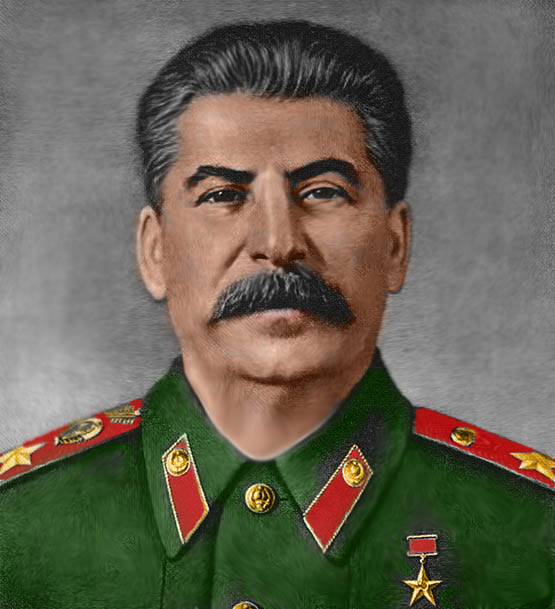
Telephonogram from Vladimir Semyonov and Marshal Vasilii Sokolovskii to Vyacheslav Molotov and Nikolai Bulganin Reporting on the Situation in East Berlin, as of 11:00 p.m. CET
Secret
Copy #14
TELEPHONOGRAM BY VCH
From Berlin
17 June 1953
To comrade V.M. Molotov
To comrade N.A. Bulganin
We report on the situation in Berlin and the GDR at 11 p.m., 17 June.
The disorders in Berlin have been stopped. The streets are calm. In connection with the implementation of martial law from 9 p.m. to 5 a.m., the movement of transportation and walking on the streets were halted in the Soviet sector of the city. A small number of people were arrested for breaking this order.
Our troops and the German police are in control of all key streets and important installations in the Soviet sector of the city. The most attention has been paid to the defense of the sector border between East and West Berlin, across which a number of large groups of provocateurs and hooligans from West Berlin had broken through into the Soviet sector in the evening. On the streets Brunnenstrasse and Bernauer Strasse, these gangs started a shootout with the German police, which resulted in casualties. According to preliminary information, 79 German policemen were injured and 2 policemen are missing as a result of the disturbances in the Soviet sector. West Berlin radio is reporting that 7 demonstrators were killed and 66 people were injured. As yet, there are no complete reports on the number of casualties.
In its broadcasts, the American radio station RIAS is calling upon the rebels to submit to the orders of the Soviet authorities and avoid clashes with the Soviet troops.
In the majority of cities in the GDR, order has been fully restored. There are reports of continuing disorders only in the two small cities of Apolda and Mühlhausen.
According to incomplete data, 700 instigators of the disorders have been arrested in the Republic, 300 of whom were in Berlin.
Measures are being taken to reestablish normal operation of all enterprises in the Republic, as well as measures to prevent interruptions in the food supply to the inhabitants of Berlin. The GDR government has called upon the people to swiftly reestablish social order and normal operation of enterprises.
Sokolovskii
Semyonov
Sent by Blatov
Received by Roshchina
18.VI.1953
2 hours, 45 min.
 |
| Collection | East German Uprising |
| Creator | V. Semenov, V. Sokolovskii |
| Contributor | |
| Type | Cable |
| Subject | East Germany, GDR, popular protests in, East Germany, GDR, Soviet control of borders, Germany, intra-German relations, Nicolai Bulganin, popular protests, protesters, Vyacheslav Molotov |
| Coverage | Berlin (Germany), Germany (East) |
| Relation | Germany in the Cold War |
| Lang | English |
| Publisher | CWIHP |
| Rights | CWIHP |
| Format | Translation |
| Identifier: | 5034FC11-96B6-175C-9F3A7C96C66CB71D |
|
| Thank you for your interest in the Cold War International History Project Virtual Archive. We have redesigned the Virtual Archive to improve access and reflect some of your common requests. Currently the search function is not fully implemented, so we recommend browsing through the collections rather than doing searches. We appreciate your patience and welcome any comments and suggestions at coldwar@wilsoncenter.org
Contents of this website Copyright 1991-2005 Cold War International History Project. All rights reserved. If cited, quoted, translated, or reproduced, acknowledgment of any document’s origin must be made as follows: “Cold War International History Project (CWIHP), http://www.CWIHP.org, by permission of the Woodrow Wilson International Center for Scholars.” For permission to reproduce documents in full or in part, please contact CWIHP at coldwar@wilsoncenter.org |
DIE STASI-“GoMoPa”-Betrüger enttarnt – eine Schande für die deutsche Justiz
Alle irrealen STASI-Internet-Google-Manipulationen werden die Wahrheit ebensowenig aufhalten wie die reale “DIE MAUER”
DDR1 TV 1987 STASI fälscht Mikis Theodorakis Show
Unveiled – Russian Untouchables. Episode 3. Olga Stepanova.
The most shocking video yet on Russian corruption, something right out of Lifestyles of the Rich and Famous mixed with Crime Scene Investigation. Watch Russian tax officials who stole $230 million from their people getting $43 million richer. See them buying multi-million dollar properties on Palm Jumeriah in Dubai, in Montenegro and Moscow, and getting payments to their Swiss bank accounts and offshore firms. Russian authorities refused to investigate the $230 million theft and declared these tax officials honest victims. Sergei Magnitsky, a 37-year anti-corruption lawyer who exposed their scam, was tortured and killed.
Unveiled – Russian Untouchables. Episode 2: Pavel Karpov
http://russian-untouchables.com/eng/ Major Pavel Karpov worked together with Artem Kuznetsov in the theft of $230 million and repressive cases against Sergei Magnitsky. Afterwards, he buys over $1.3 million worth of property and goes on five star luxury holidays.
Unveiled – Russian Untouchables. Episode 1: Artem Kuznetsov
http://russian-untouchables.com/ Russian Interior Ministry officers responsible for the torture and death of Sergei Magnitsky caught red-handed in new YouTube video.
Unveiled – US officials identify marines in Afghan abuse video
US military sources have confirmed the identity of some the marines allegedly responsible for a video which shows them urinating on the bodies of three dead Afghans.
Defence officials accepted the authenticity of the video, which emerged on the internet this week.
The Pentagon has been scrambling to contain the fallout from the damaging footage, and senior government members, including secretary of state Hillary Clinton, have condemned the incident as deplorable.
Al Jazeera’s Rosiland Jordan reports from Washington DC.
Unveiled and Uncensored – Stratfor Back Online
Stratfor.com 2012-Jan-11-12:08:
![[Image]](https://i0.wp.com/cryptome.org/2012/01/0029.jpg)
Several of the Stratfor.com links below do not work, perhaps because of the sneaky subscriber-tracking code contained.
A sends:
Hello, looks like stratfor is back.
———- Forwarded message ———-
From: Stratfor <mail@response.stratfor.com>
Date: 2012/1/11
Subject: Stratfor: Back online + new Geopolitical Weekly
Watch this video of George Friedman on the hacking incident
More info on the attack
Dear Stratfor Member,
We are happy to announce that our website is back online. Visit Stratfor.com to view our 2012 Annual Forecast, as well as fresh analyses on Syria, Iraq and Lithuania and our Geopolitical Diary.
Below you will find a special edition of the Geopolitical Weekly by George Friedman on Stratfor’s security breach.
We may experience brief service interruptions as we work to handle the high level of interest in the new website. If you have trouble connecting to the new site, please check back again soon.
While we continue to rebuild our infrastructure and website capabilities, you will be able to access our content online without having to log in. We are aggressively implementing our plan to reintegrate customers securely, as this is our top priority. In the next several days, we will be informing you about how to establish a new password and update your billing information. In the meantime, visit our website to read fresh content every day.
We deeply regret that an unauthorized party illegally obtained and disclosed the credit card data of some of you. We are making certain that this will never happen again by having a third party with appropriate security safeguards handle all credit card transactions in the future. We hope that you have taken advantage of the CSID identity protection service we have provided.
We understand that you have many questions. Check out www.stratfor.com/hacking-news, a website we’ve created to give you a full rundown of the incident and our plan to address your concerns.
Please contact us at feedback@stratfor.com with any questions, as well as any comments you may have on the Geopolitical Weekly below.
Thank you again for your patience as we work to secure our website and resume normal operations.
– The Stratfor Team
Geopolitical Weekly: The Hack on Stratfor
By George Friedman | January 11, 2012
In early December I received a call from Fred Burton, Stratfor’s Vice President of Intelligence. He told me he had received information indicating our website had been hacked and our customer credit card and other information had been stolen. The following morning I met with an FBI special agent, who made clear that there was an ongoing investigation and asked for our cooperation. We, of course, agreed to cooperate. The matter remains under active investigation.
From the beginning I faced a dilemma. I felt bound to protect our customers, who quickly had to be informed about the compromise of their privacy. I also felt bound to protect the investigation. That immediate problem was solved when the FBI told us it had informed the various credit card companies and had provided those companies with a list of compromised cards while omitting that it had come from us. Our customers were therefore protected, as the credit card companies knew the credit cards and other information had been stolen and could act to protect the customers. We were not compelled to undermine the investigation.
The FBI made it clear that it expected the theft to be exposed by the hackers. We were under no illusion that this was going to be kept secret. We knew our reputation would be damaged by the revelation, all the more so because we had not encrypted the credit card files. This was a failure on our part. As the founder and CEO of Stratfor, I take responsibility for this failure, which has created hardship for customers and friends, and I deeply regret that it took place. The failure originated in the rapid growth of the company. As it grew, the management team and administrative processes didn’t grow with it. Again, I regret that this occurred and want to assure everyone that Stratfor is taking aggressive steps to deal with the problem and ensure that it doesn’t happen again.
From the beginning, it was not clear who the attackers were. The term “Anonymous” is the same as the term “unknown.” The popular vision of Anonymous is that its members are young and committed to an ideology. I have no idea if this is true. As in most affairs like this, those who know don’t talk; those who talk don’t know. I have my theories, which are just that and aren’t worth sharing.
I was prepared for the revelation of the theft and the inevitable criticism and negative publicity. We worked to improve our security infrastructure within the confines of time and the desire to protect the investigation by not letting the attackers know that we knew of their intrusion. With the credit card information stolen, I assumed that the worst was done. I was wrong.
Early in the afternoon of Dec. 24, I was informed that our website had been hacked again. The hackers published a triumphant note on our homepage saying that credit card information had been stolen, that a large amount of email had been taken, and that four of our servers had been effectively destroyed along with data and backups. We had expected they would announce the credit card theft. We were dismayed that emails had been taken. But our shock was at the destruction of our servers. This attack was clearly designed to silence us by destroying our records and the website, unlike most attacks by such groups.
Attacks against credit cards are common, our own failures notwithstanding. So are the thefts of emails. But the deliberate attack on our digital existence was a different order of magnitude. As the global media marveled at our failure to encrypt credit card information, my attention was focused on trying to understand why anyone would want to try to silence us.
In the days that followed, a narrative evolved among people claiming to speak for Anonymous and related groups. It started with looking at our subscriber list and extracting corporate subscribers who were now designated as clients. The difference between clients and subscribers is important here. A client is someone you do customized work for. A subscriber is simply someone who purchases a publication, unchanged from what others read. A subscriber of The New York Times is not its client. Nevertheless, some of the media started referring to these subscribers as clients, reflecting the narrative of those claiming to speak with knowledge of our business.
From there, the storyline grew to argue that these “clients,” corporate and government, provided Stratfor with classified intelligence that we reviewed. We were no longer an organization that analyzed the world for the interested public, but rather a group of incompetents and, conversely, the hub of a global conspiracy. The media focused on the first while the hacking community focused on the second.
This was why they stole our email, according to some of them. As one person said, the credit cards were extra, something they took when they realized they could. It was our email they were after. Obviously, we were not happy to see our emails taken. God knows what a hundred employees writing endless emails might say that is embarrassing, stupid or subject to misinterpretation. What will not appear is classified intelligence from corporations or governments. They may find, depending on what they took, that we have sources around the world, as you might expect. It is interesting that the hacker community is split, with someone claiming to speak for the official Anonymous condemning the hack as an attack on the media, which they don’t sanction, and another faction defending it as an attack on the rich and powerful.
The interpretation of the hackers as to who we are — if indeed that was their interpretation — was so wildly off base as to stretch credulity. Of course, we know who we are. As they search our emails for signs of a vast conspiracy, they will be disappointed. Of course we have relationships with people in the U.S. and other governments and obviously we know people in corporations, and that will be discovered in the emails. But that’s our job. We are what we said we were: an organization that generates its revenues through geopolitical analysis. At the core of our business, we objectively acquire, organize, analyze and distribute information.
I don’t know if the hackers who did this feel remorse as they discover that we aren’t who they said we were. First, I don’t know who they actually are, and second, I don’t know what their motives were. I know only what people claiming to be them say. So I don’t know if there is remorse or if their real purpose was to humiliate and silence us, in which case I don’t know why they wanted that.
And this points to the real problem, the one that goes beyond Stratfor’s own problem. The Internet has become an indispensible part of our lives. We shop, communicate, publish and read on it. It has become the village commons of the planet. But in the village commons of old, neighbors who knew and recognized each other met and lived together. Others knew what they did in the commons, and they were accountable.
In the global commons, anonymity is an option. This is one of the great virtues of the Internet. It is also a terrible weakness. It is possible to commit crimes on the Internet anonymously. The technology that enables the Internet also undermines accountability. Given the profusion of technical knowledge, the integrity of the commons is in the hands of people whose identities we don’t know, whose motives we don’t understand, and whose ability to cause harm is substantial. The consequence of this will not be a glorious anarchy in the spirit of Guy Fawkes, but rather a massive repression. I think this is a pity. That’s why I wonder who the hackers actually are and what cause they serve. I am curious as to whether they realize the whirlwind they are sowing, and whether they, in fact, are trying to generate the repression they say they oppose.
The attempt to silence us failed. Our website is back, though we are waiting for all archives to be restored, and our email is working again. Our failures have been reviewed and are being rectified. We deliberately shut down while we brought in outside consultants to rebuild our system from the ground up. The work isn’t finished yet, but we can start delivering our analyses. The handling of credit cards is being handed off to a third party with appropriate capability to protect privacy. We have acted to help our customers by providing an identity theft prevention service. As always, we welcome feedback from our supporters as well as our critics.
We are fortunate that we have the financial resources and staff commitment to survive the attack. Others might not. We are now in a world in which anonymous judges, jurors and executioners can silence whom they want. Take a look at the list of organizations attacked. If the crushing attack on Stratfor is the new model, we will not be the last. No security system is without flaws even if it is much better than Stratfor’s was.
We certainly expect to be attacked again, as we were last week when emails were sent out to members from a fake Stratfor address including absurd messages and videos. Our attackers seem peculiarly intent on doing us harm beyond what they have already done. This is a new censorship that doesn’t come openly from governments but from people hiding behind masks. Do not think we will be the last or that we have been the first.
We will continue to publish analysis and sell it to those who believe it has value. To our subscribers who have expressed such strong support, we express our deepest gratitude. To our critics, we assure you that nothing you have said about us represents a fraction of what we have said about ourselves. While there is much not to be proud of in this affair, I am proud beyond words of all my dedicated colleagues at Stratfor and am delighted to return our focus to analyzing critical international affairs.
To all, I dedicate myself to denying our attackers the prize they wanted. We are returning to the work we love, dedicated to correcting our mistakes and becoming better than ever in analyzing and forecasting how the world works.
Comments? Send them to feedback@stratfor.com.
Original Video – US military investigate video in which marines urinate of dead bodies of Taliban fighters
The US military is investigating an online video which appears to show Marines
urinating on the corpses of Taliban fighters in Afghanistan.
Unveiled – Japanese Internment Camps War Relocation Authority Photos
The following photos are from a collection housed at Bancroft Library at the University of California at Berkeley. The photos span from 1942-1945 at various internment camps around the U.S. operated by the War Relocation Authority.
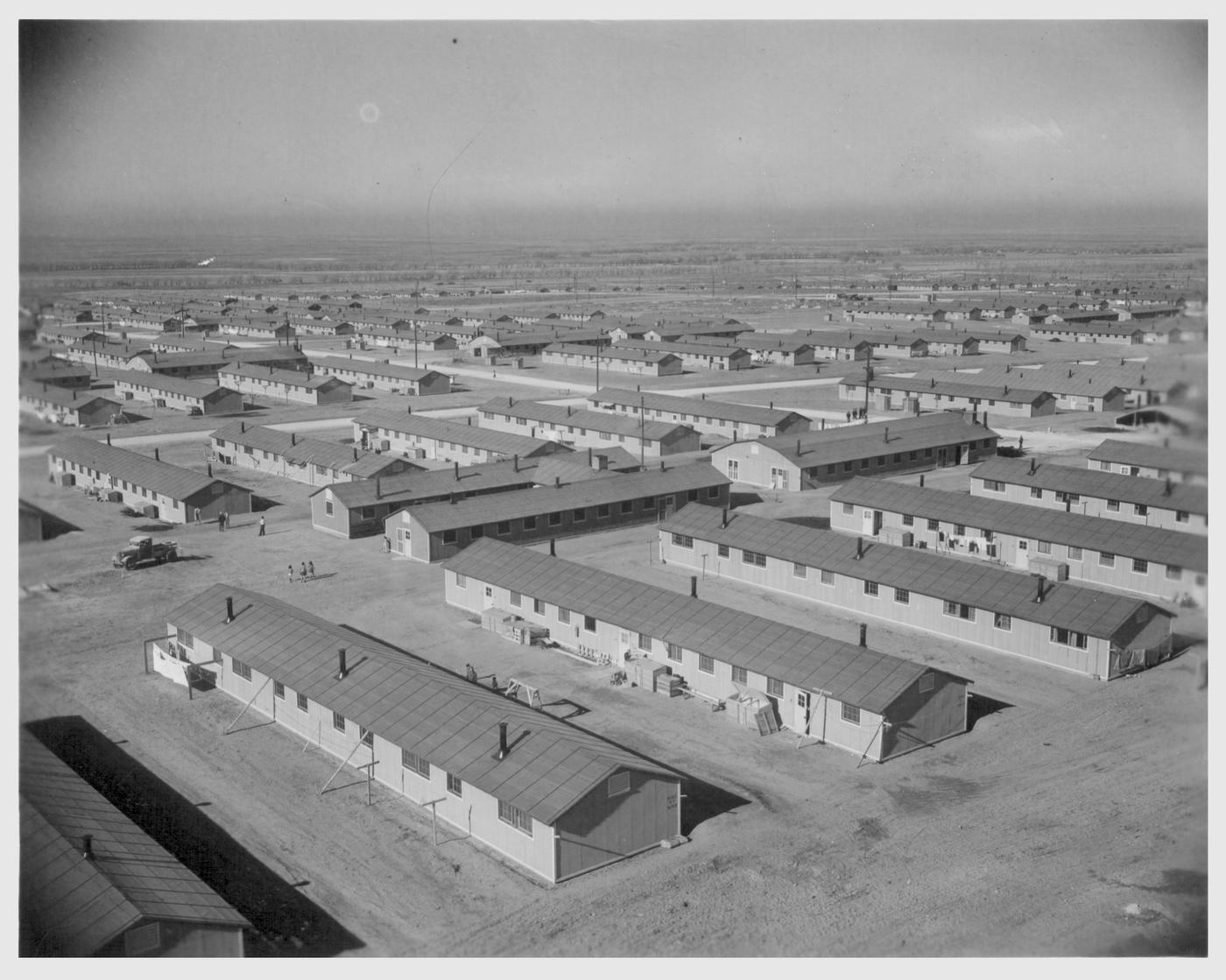 Overlooking the Amache Relocation Center, near Granada, Colorado. In the foreground is a typical barracks unit consisting of 12 six room apartment barracks buildings, a recreation hall, laundry and bathrooms, and the mess hall. — Photographer: Parker, Tom — Amache, Colorado. 12/9/42
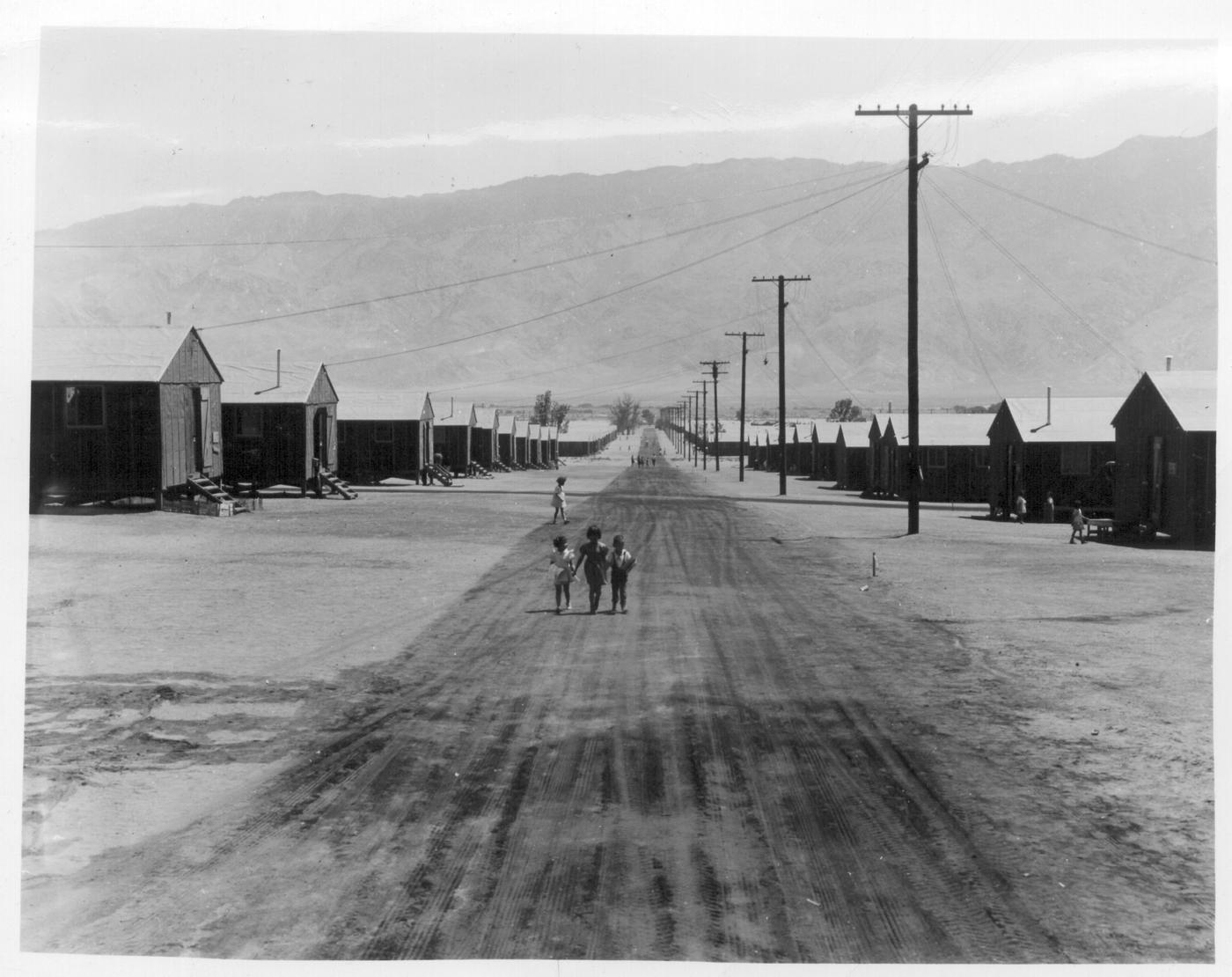 Manzanar, Calif.–Street scene looking east toward the Inyo Mountains at this War Relocation Authority center. The children are coming to their barrack homes from play school. Each family has one room to live in in these barracks. There is no running water in the barracks so all the families in one block use a central bath house. The barracks are heated by wood burning stoves. — Photographer: Lange, Dorothea — Manzanar, California. 6/29/42
 Aerial shot. Camp #3 site 3. — Poston, Arizona. 5/25/42
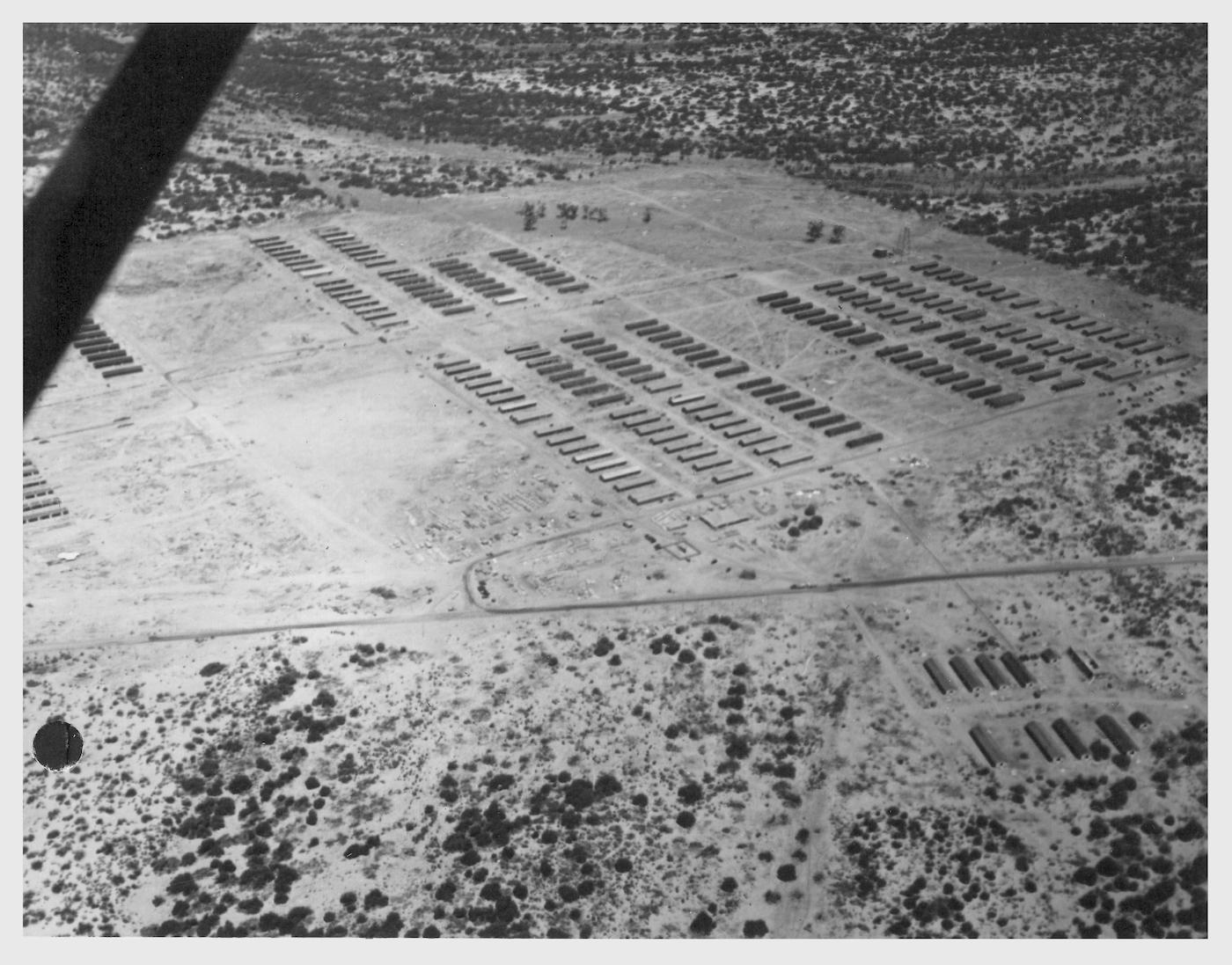 Aerial view of Colorado River Relocation Center for persons of Japanese ancestry evacuated from the West Coast. — Photographer: Clark, Fred — Poston, Arizona. 5/25/42
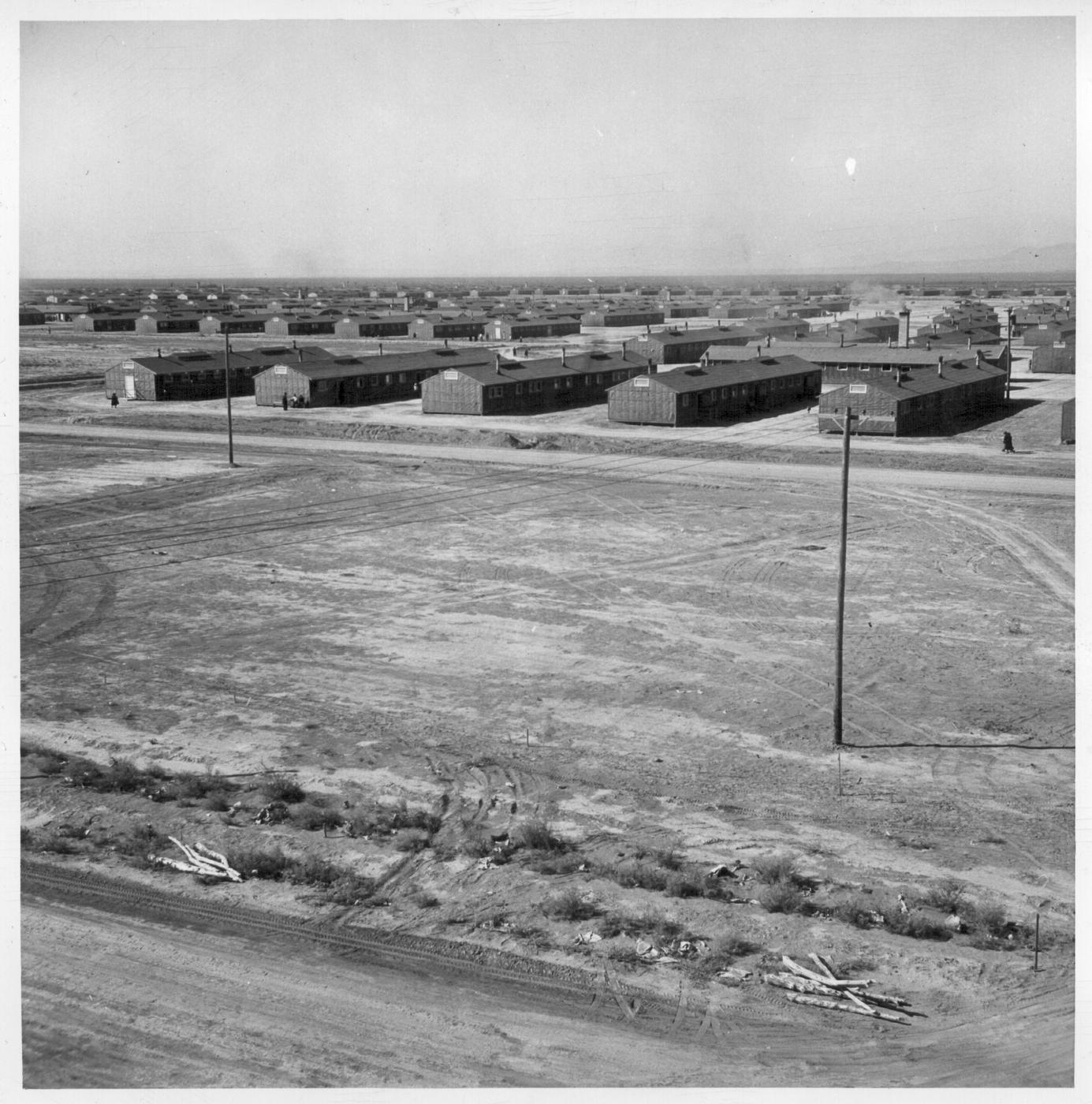 A typical barracks with a section of the Topaz Relocation Center. — Photographer: Parker, Tom — Topaz, Utah. 10/18/42
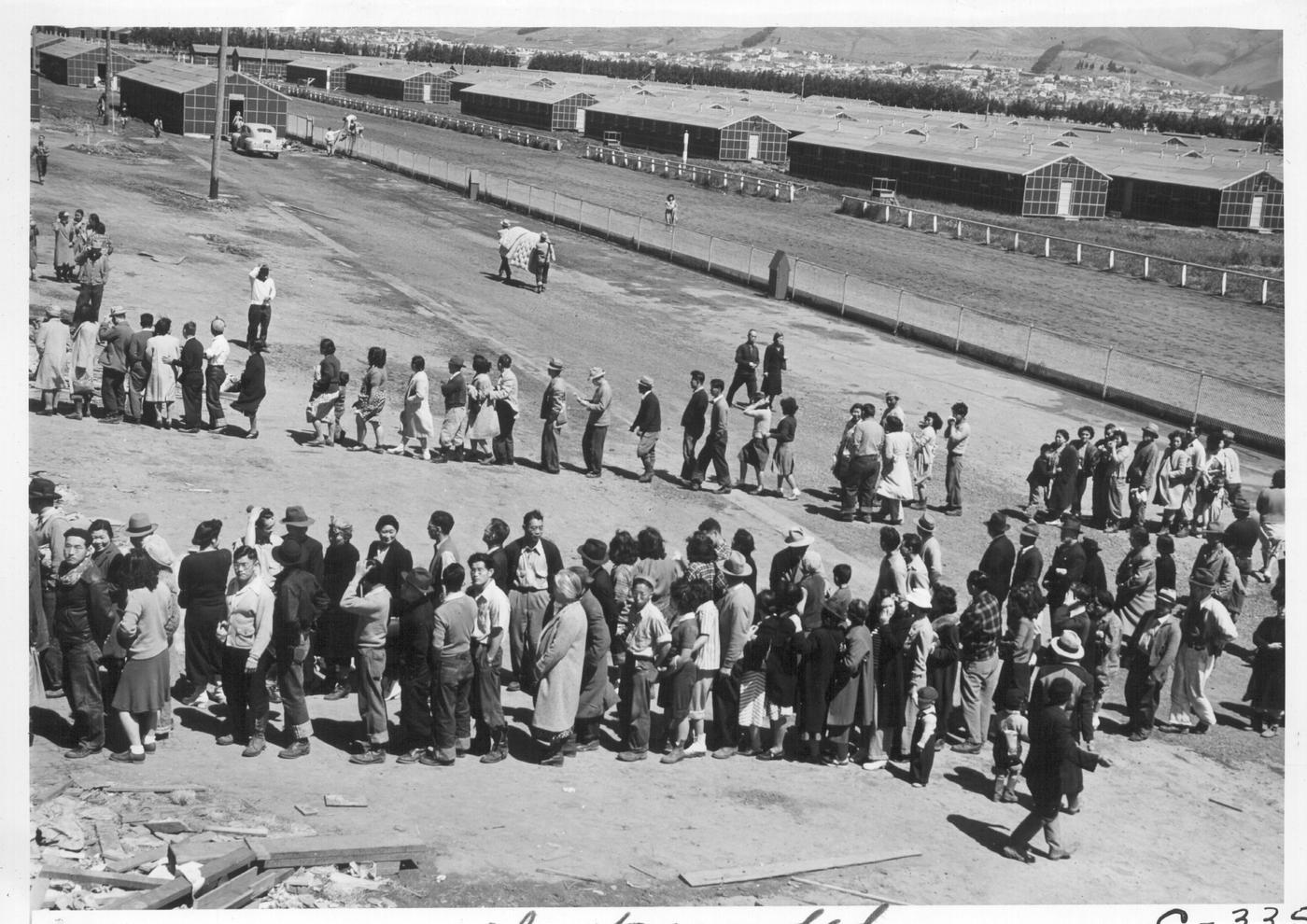 This assembly center has been open for two days. Bus-load after bus-load of evacuated persons of Japanese ancestry are arriving this day. After going through the necessary procedure for registration, they are guided to the quarters assigned to them in the barracks. Only one mess hall was operating on this day. Photograph shows line-up of newly arrived evacuees outside the mess hall at noon. Note barracks in background, newly built, in which family units are housed. There are three types of quarters in this assembly center, of which this is one. The wide road which runs diagonally across is the former race track. Industrial South San Francisco is shown in the background. — Photographer: Lange, Dorothea — San Bruno, California. 4/29/42
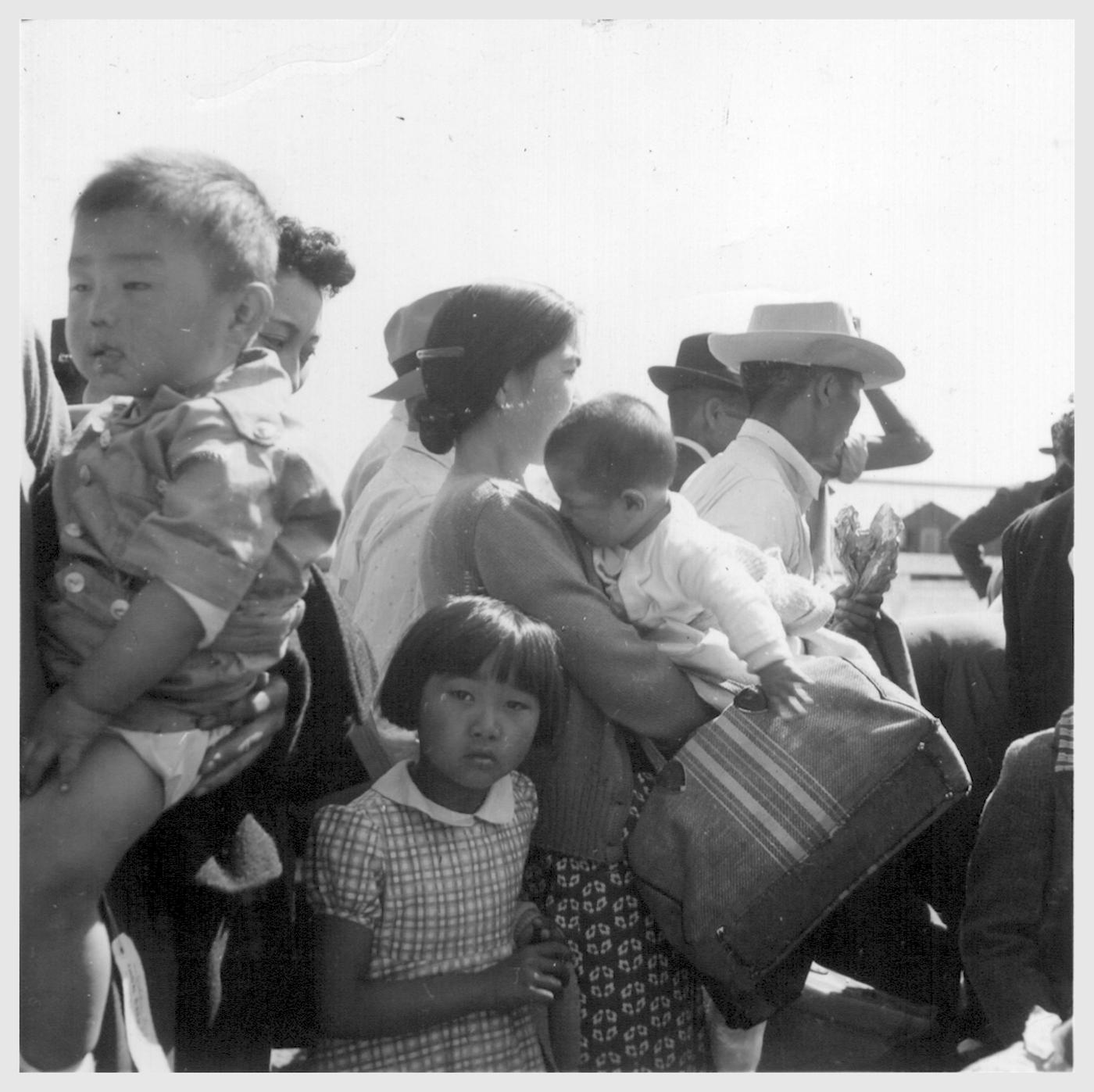 Turlock, Calif.–Evacuees of Japanese ancestry waiting their turn for baggage inspection for contraband, upon arrival at this Assembly point. They will then be assigned places in the barracks until transferred to a War Relocation Authority Center to spend the duration. — Photographer: Lange, Dorothea — Turlock, California. 5/2/42
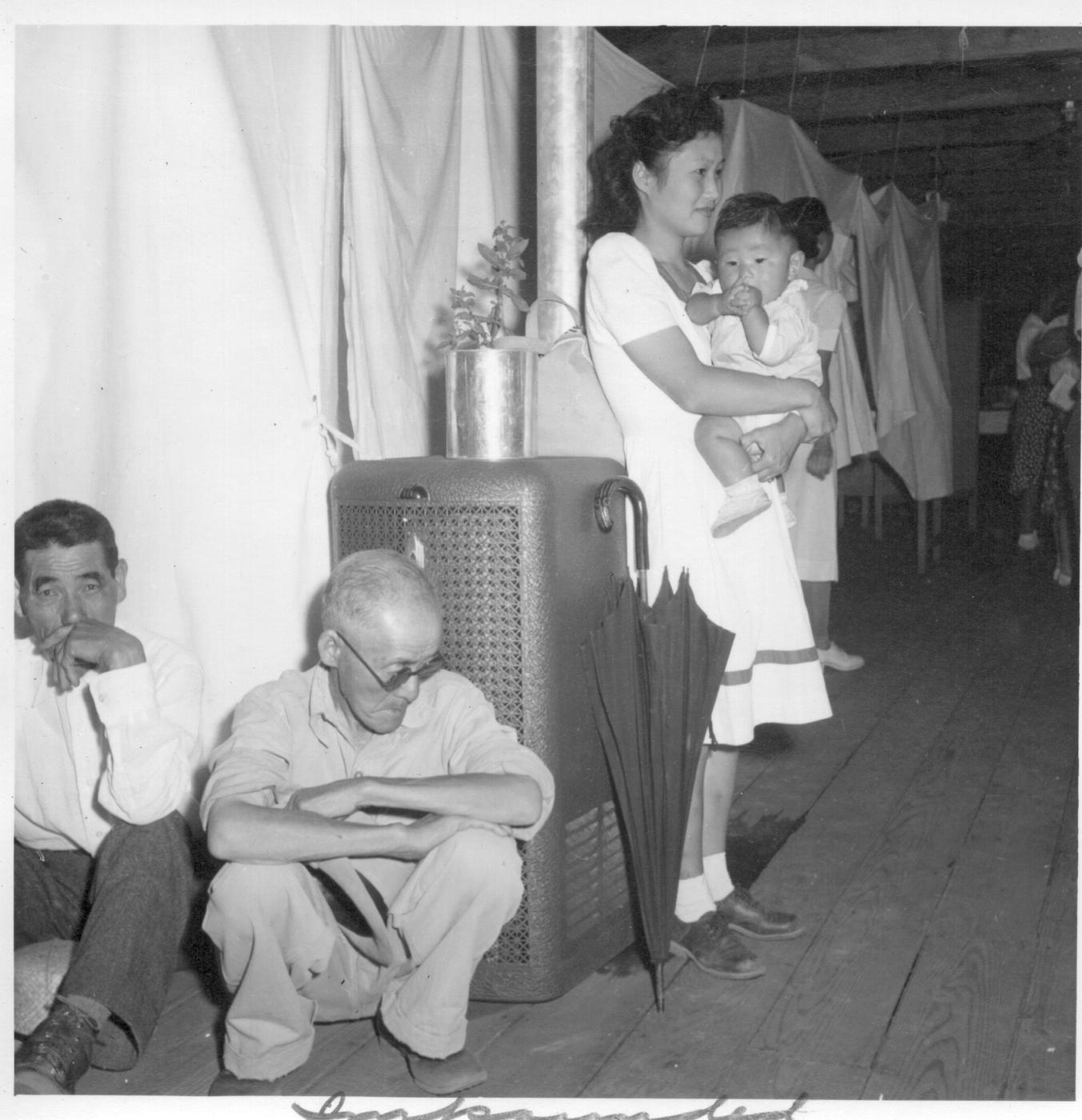 A typical interior scene in one of the barrack apartments at this center. Note the cloth partition which lends a small amount of privacy. — Photographer: Lange, Dorothea — Manzanar, California. 6/30/42
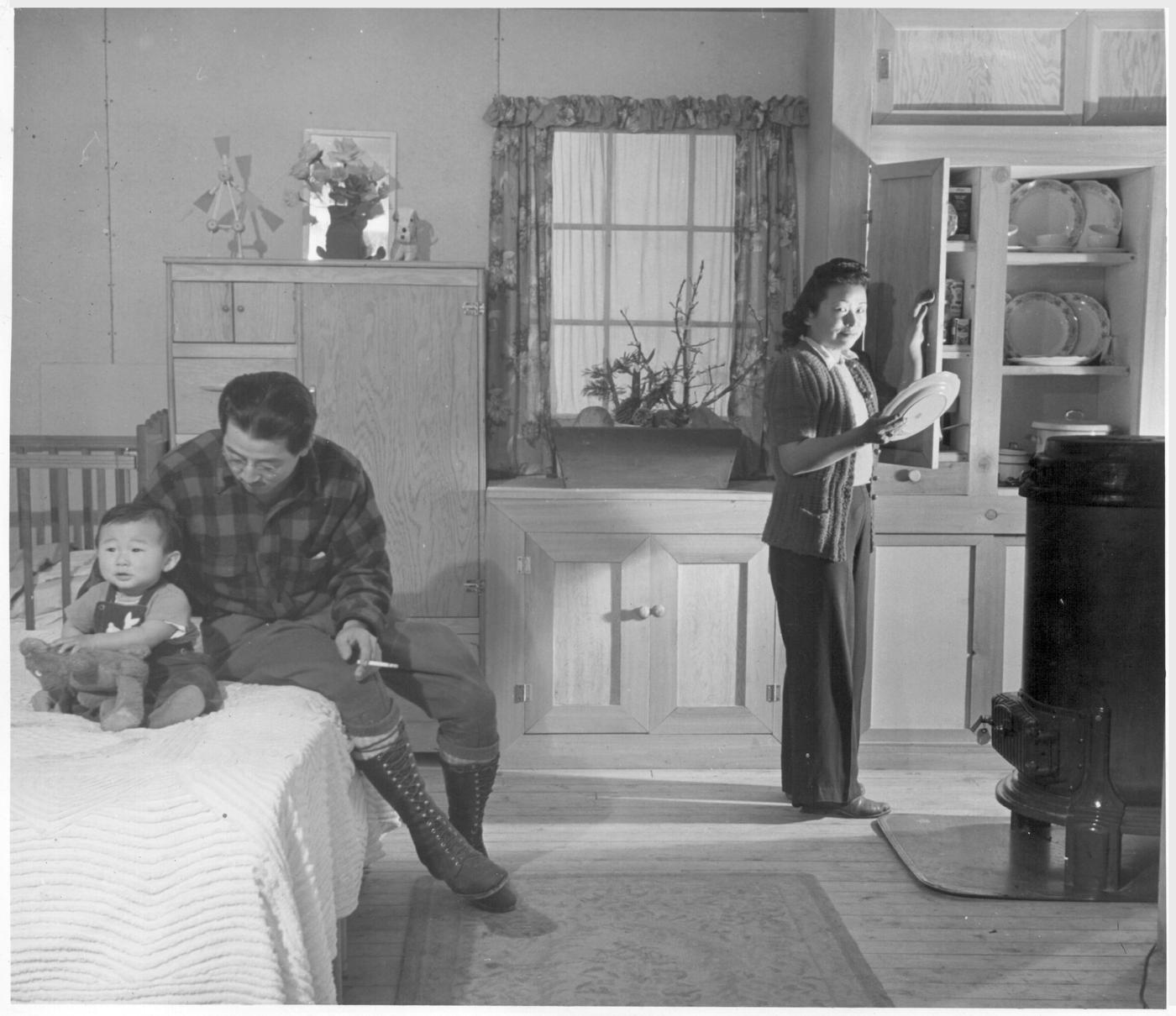 A few pieces of scrap and some additional mail order lumber, and the ingenuity of skilled hands, have converted a bare barracks room into a home of some comfort. Many residents, such as the young Nisei family shown, have through their own ingenuity, bettered their living conditions within the center. — Photographer: Parker, Tom — Heart Mountain, Wyoming. 1/7/43
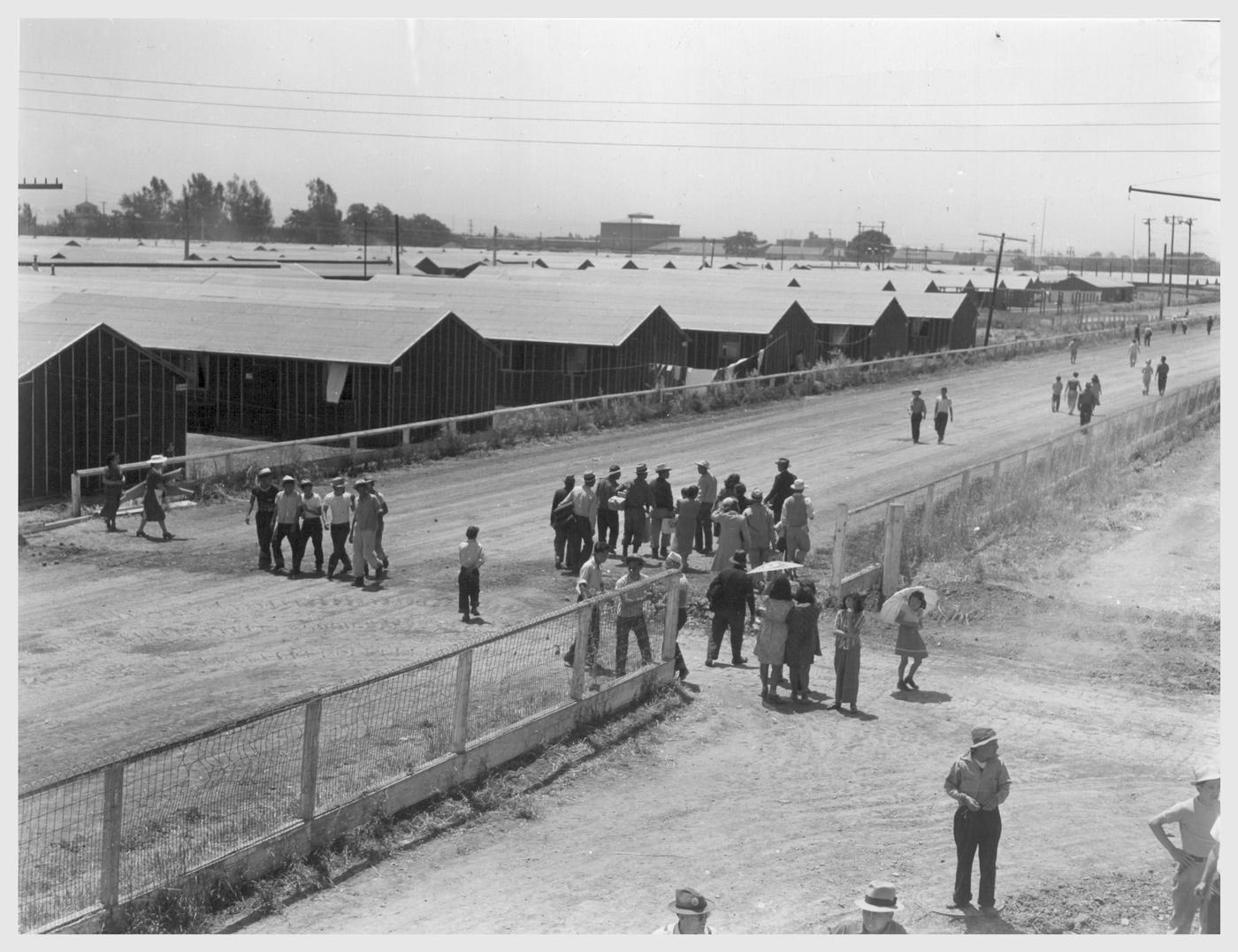 Noon on a hot day at the Stockton Assembly Center, which is a converted fairgrounds. This group of people on the race track are new arrivals who have been registered inspected, medically examined, and are now on their way to their assigned places in the barracks. — Photographer: Lange, Dorothea — Stockton, California. 5/19/42
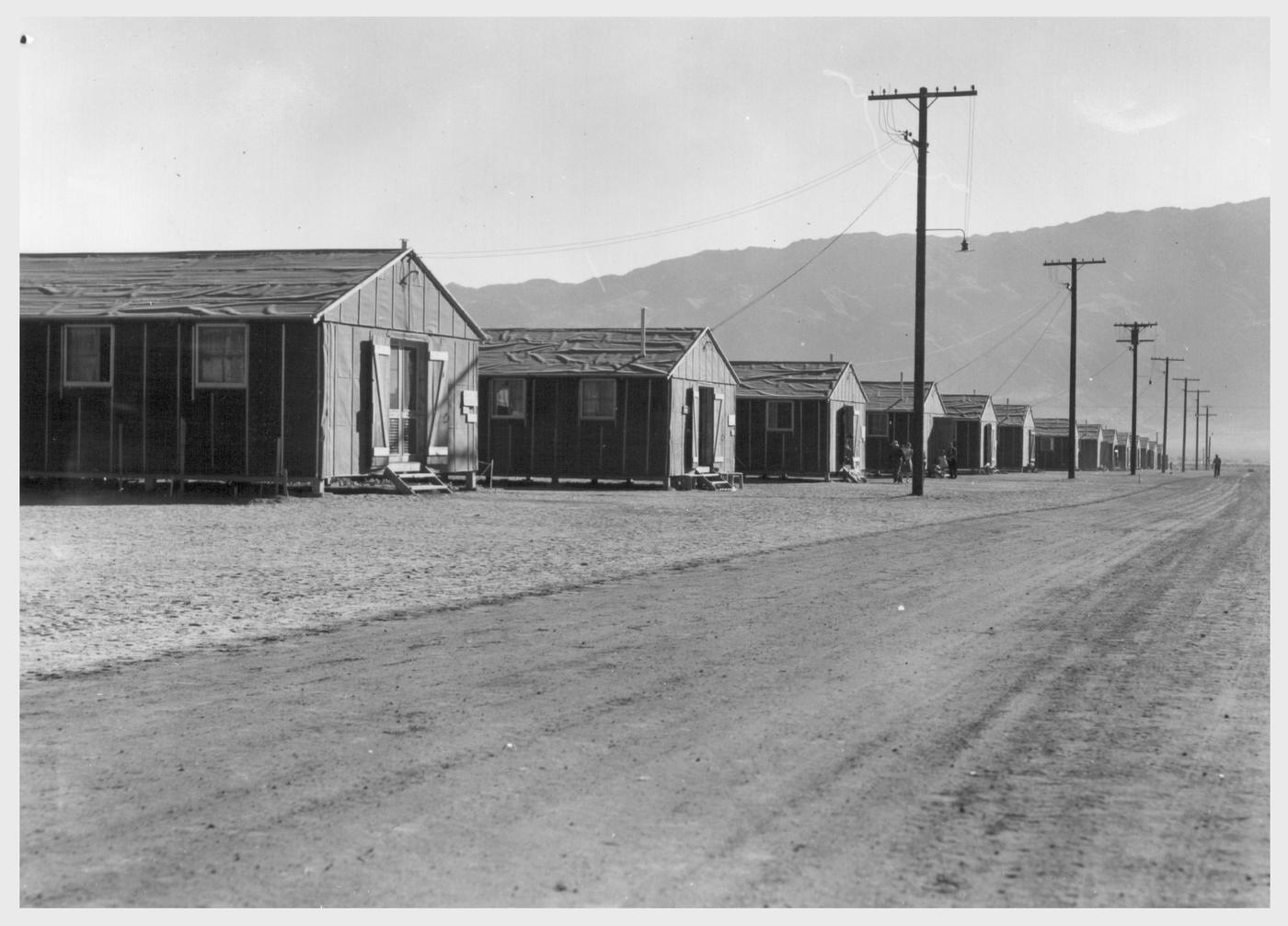 Manzanar, Calif.–Street scene of barrack homes at this War Relocation Authority center for evacuees of Japanese ancestry. — Photographer: Lange, Dorothea — Manzanar, California. 6/29/42
 Manzanar, Calif.–Looking west from Mess Hall No. 1. The small square buildings in the center rows of barracks are the laundry and sanitary units. Evacuees of Japanese ancestry are spending the duration in War Relocation Authority centers. — Photographer: Lange, Dorothea — Manzanar, California. 7/2/42
 Tanforan Assembly Center, San Bruno, Calif.–An art school has been established at this Assembly Center with a well trained, experienced evacuee staff under the leadership of Prof. Chiura Obata, who before evacuation was associate professor of art at the University of California. This photograph shows part of the morning class learning free hand brush strokes. — Photographer: Lange, Dorothea — San Bruno, California. 6/16/42
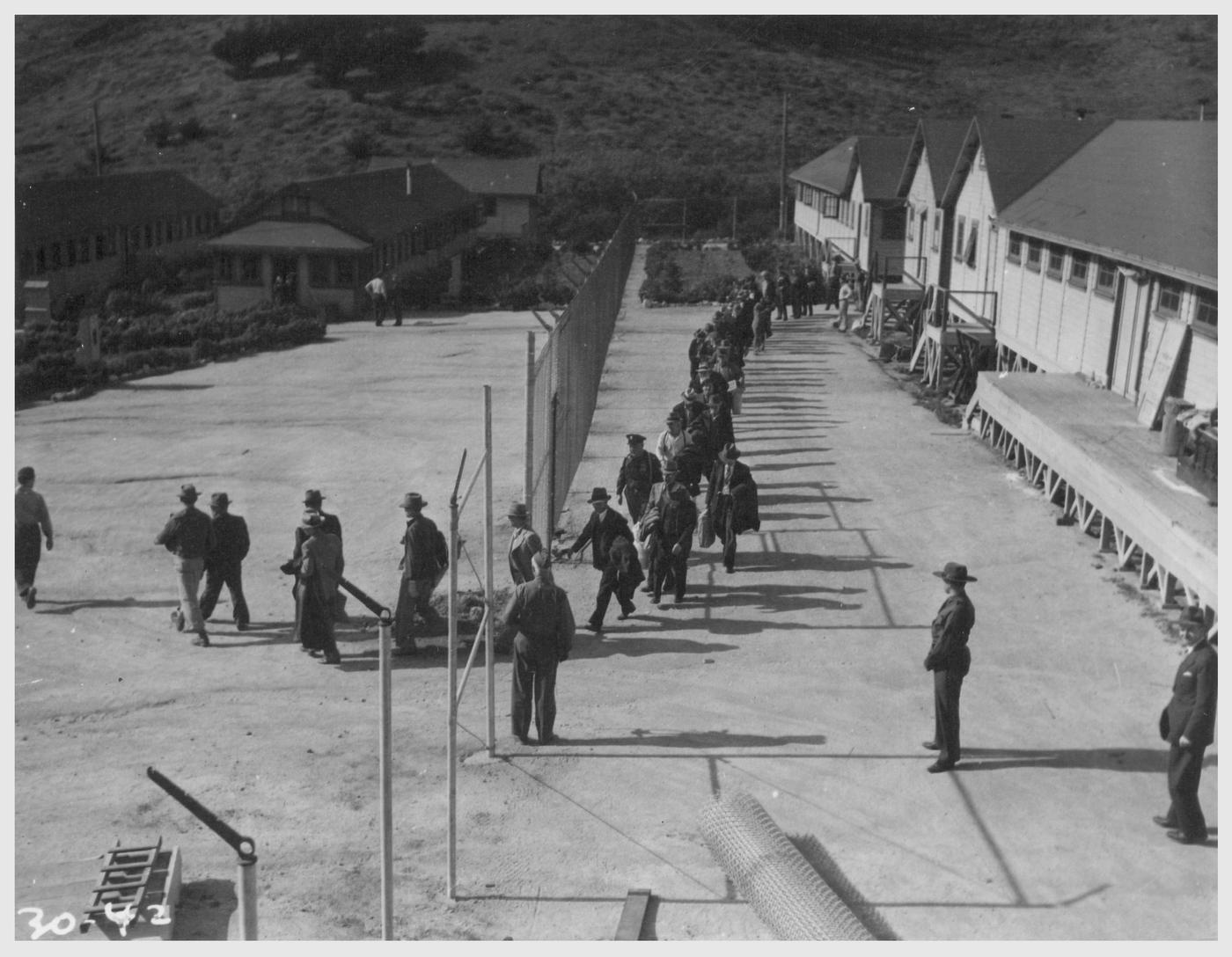 Aliens at Sharp Camp following the evacuation order for persons of Japanese ancestry. This camp was set up as detention station where suspects were held before given hearings. They remained here only a short while, being sent to an internment camp or a relocation center following the hearings. — Photographer: Albers, Clem — Sharp Park, California. 3/30/42
 Part of view of Butte camp looking towards block 59-72-74 and hospital in far distance. — Rivers, Arizona. 12/14/43
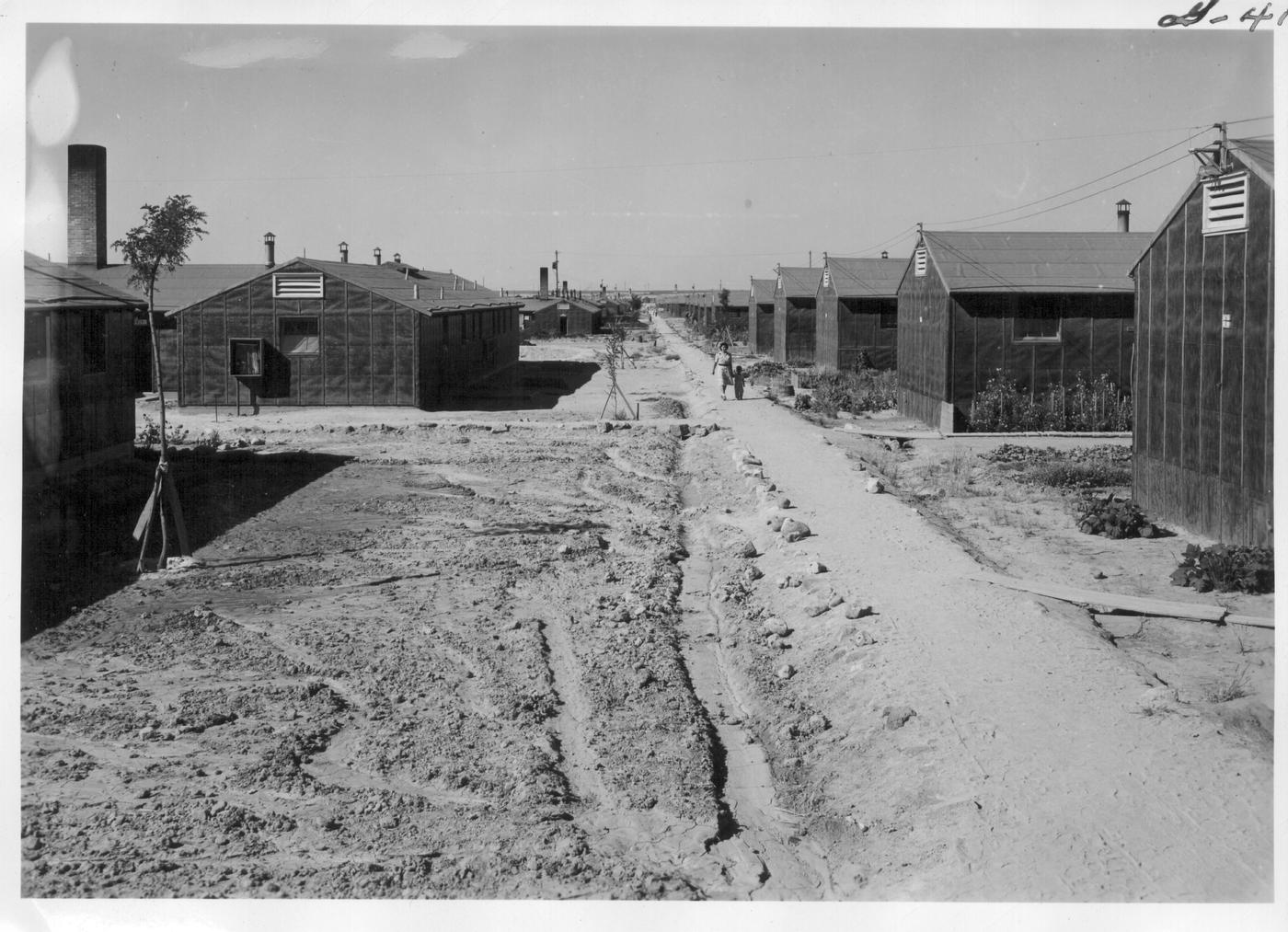 Looking down the rows of barracks westward from block (illegible). At extreme left is a corner of the dining hall where 275 to 300 residents of the block eat. At center background is the sanitation building including showers, lavatories, toilets, and washtubs. Nearly all the residents planted flowers and vegetable gardens in front of their barracks. — Hunt, Idaho. 8/?/43
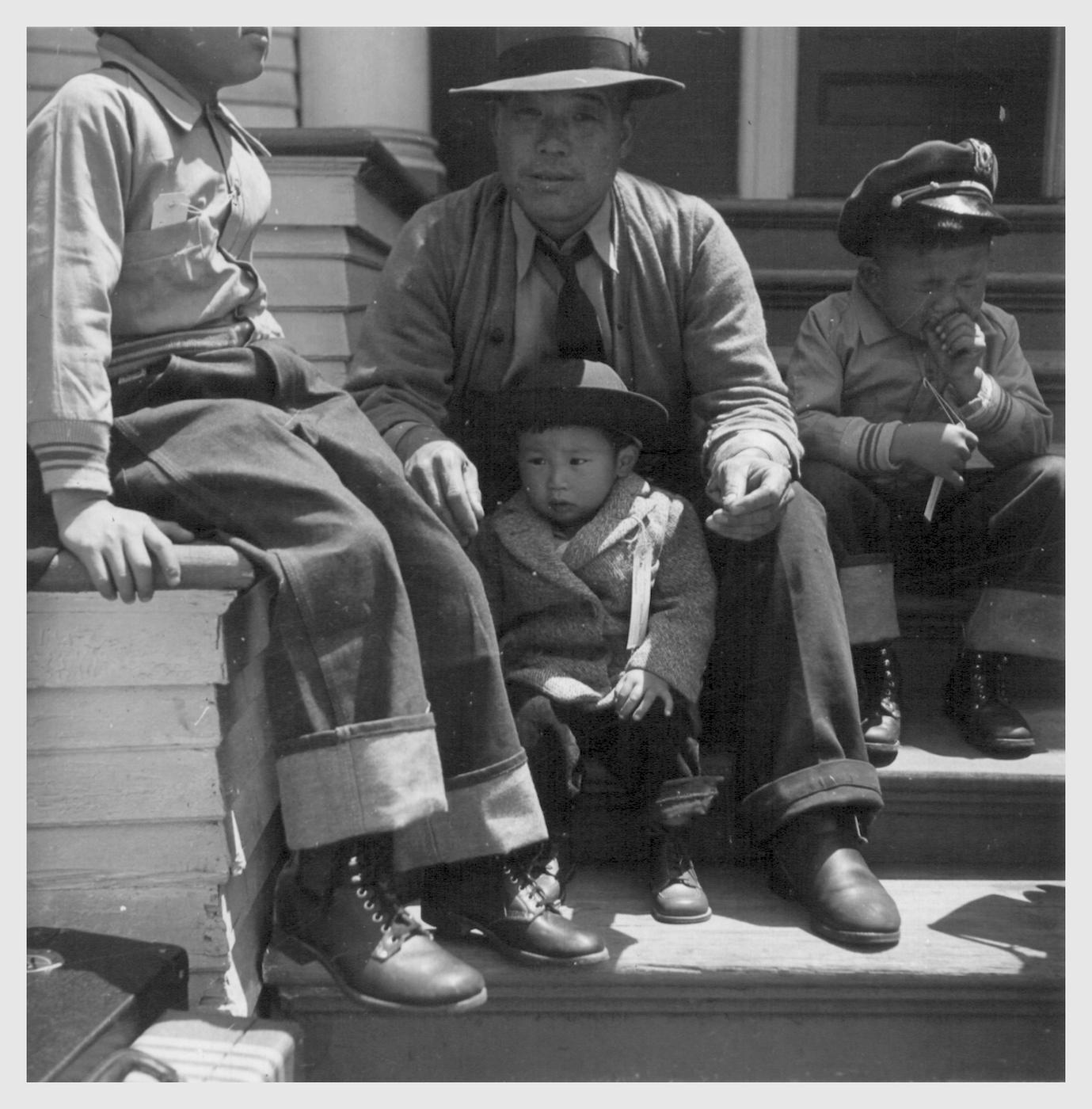 Oakland, Calif. (1117 Oak Street)–Residents of Japanese ancestry waiting for evacuation buses which will take them to the Tanforan Assembly Center under Civilian Exclusion Order No. 28. — Photographer: Lange, Dorothea — Oakland, California. 5/6/42
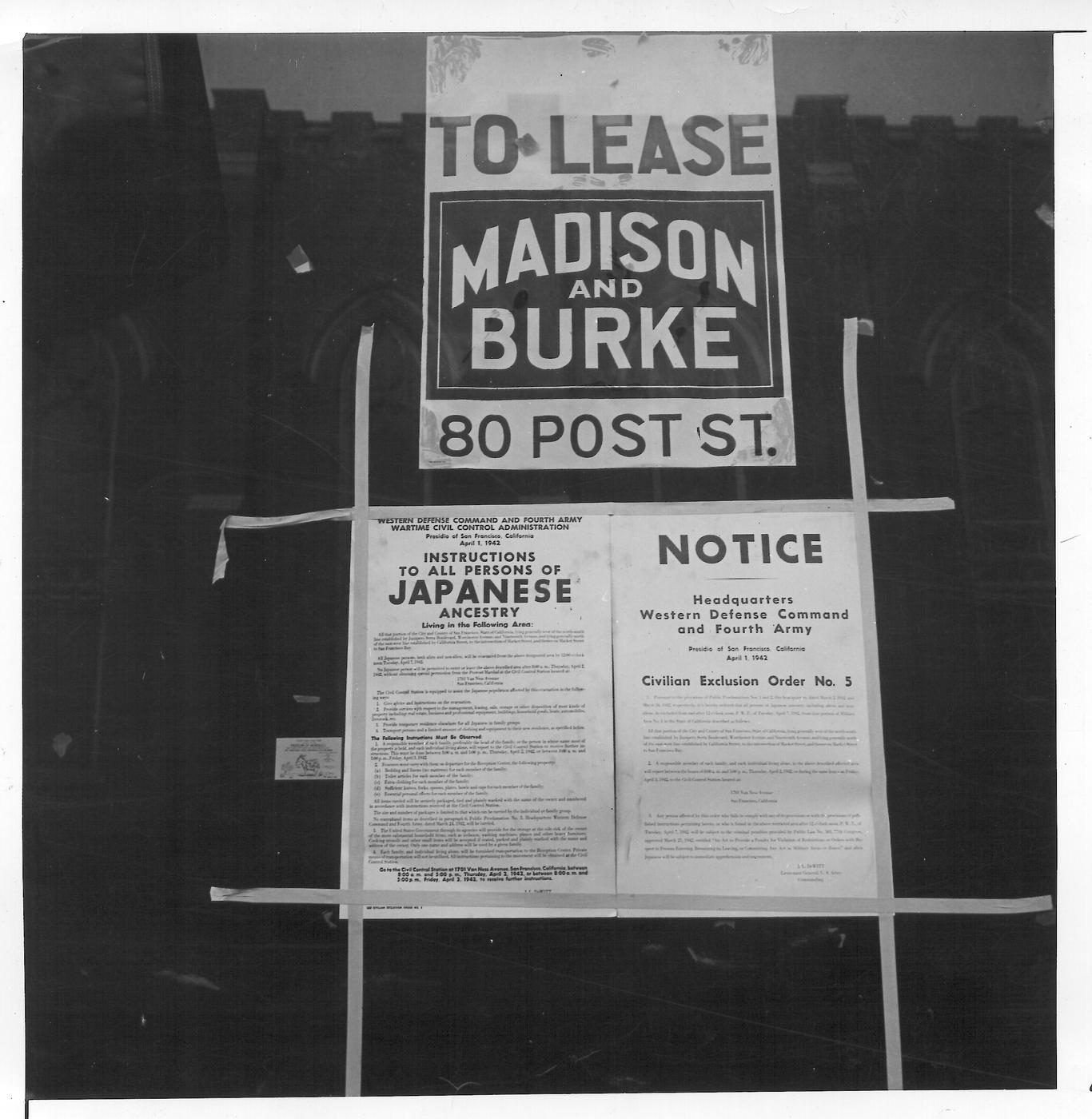 Civilian Exclusion Order No. 5, ordering evacuation of residents of Japanese ancestry, posted in a vacant store window on Grant Avenue in Chinatown. This establishment, like many others in Chinatown, was operated by proprietors of Japanese descent. Evacuees will be housed in War Relocation Authority centers for the duration. — Photographer: Lange, Dorothea — San Francisco, California. 4/4/42
 Following evacuation orders, this store, at 13th and Franklin Streets, was closed. The owner, a University of California graduate of Japanese descent, placed the I AM AN AMERICAN sign on the store front on December 8, the day after Pearl Harbor. Evacuees of Japanese ancestry will be housed in War Relocation Authority centers for the duration. — Photographer: Lange, Dorothea — Oakland, California. 3/13/42
 Waiting in line, 2031 Bush St., for voluntary inoculation against typhoid, preceding evacuation of residents of Japanese ancestry. Evacuees will be housed in War Relocation Authority centers for the duration. — Photographer: Lange, Dorothea — San Francisco, California. 4/20/42
 Supper time! Meal times are the big events of the day within an assembly center. This is a line-up of evacuees waiting for the B shift at 5:45 P.M. They carry with them their own dishes and cutlery in bags to protect them from the dust. They, themselves, individually wash their own dishes after each meal, since dish washing facilities in the mess halls prove inadequate. Most of the residents prefer this second shift because they sometimes get second helpings, but the groups are rotated each week. There are eighteen mess halls in camp which, together, accommodate 8,000 persons three times each day. All food is prepared and served by evacuees. — Photographer: Lange, Dorothea — San Bruno, California. 6/16/42
 Evacuee in her hobby garden which rates highest of all the garden plots at this War Relocation Authority Center. Vegetables for their own use are grown in plots 10 X 50 feet between rows of barracks. — Photographer: Lange, Dorothea — Manzanar, California. 7/2/42
 A panorama view of the Central Utah Relocation Center, taken from the water tower. — Photographer: Stewart, Francis — Topaz, Utah. 3/14/43
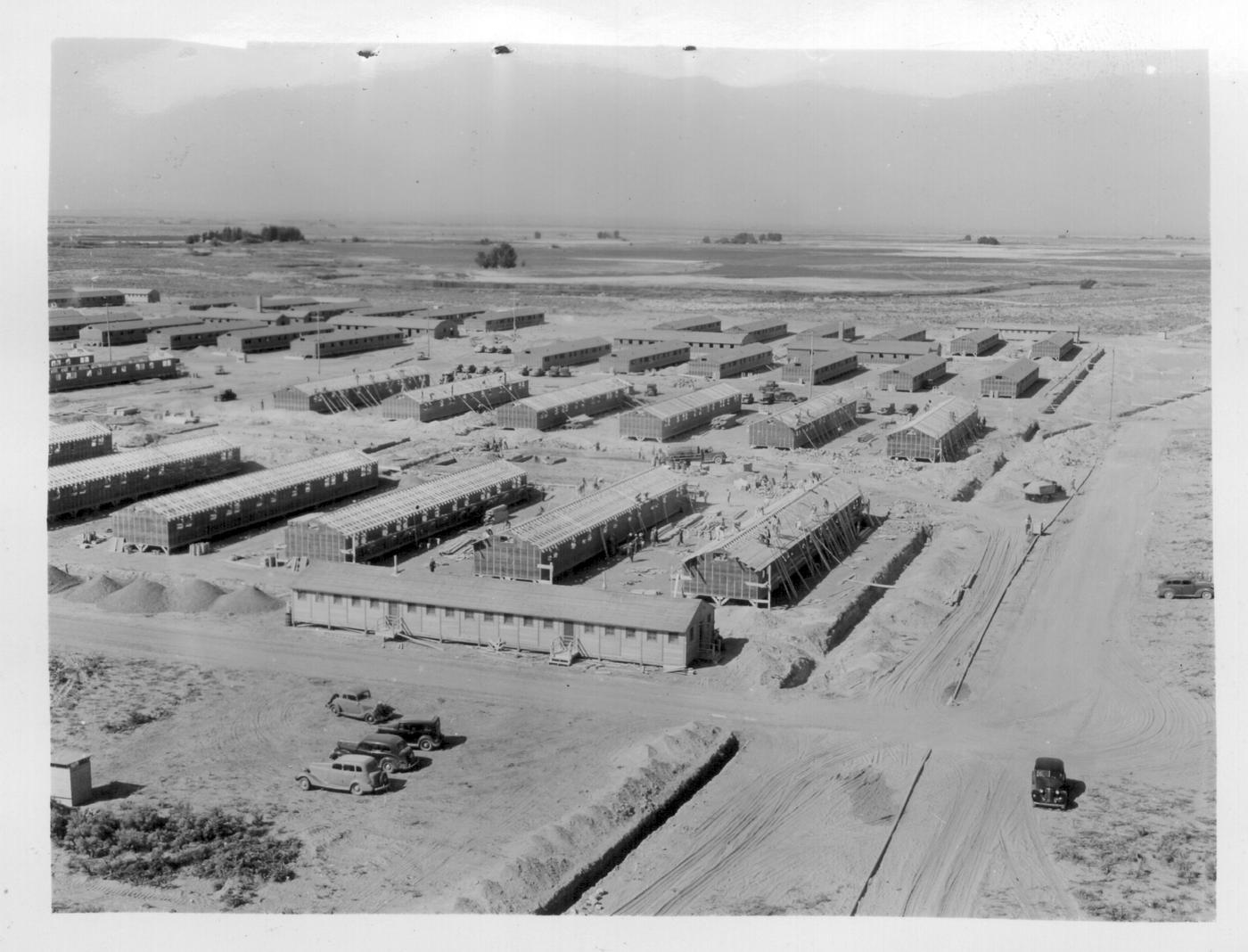 Eden, Idaho–A panorama view of the Minidoka War Relocation Authority center. This view, taken from the top of the water tower at the east end of the center, shows partially completed barracks. — Photographer: Stewart, Francis — Hunt, Idaho. 8/18/42
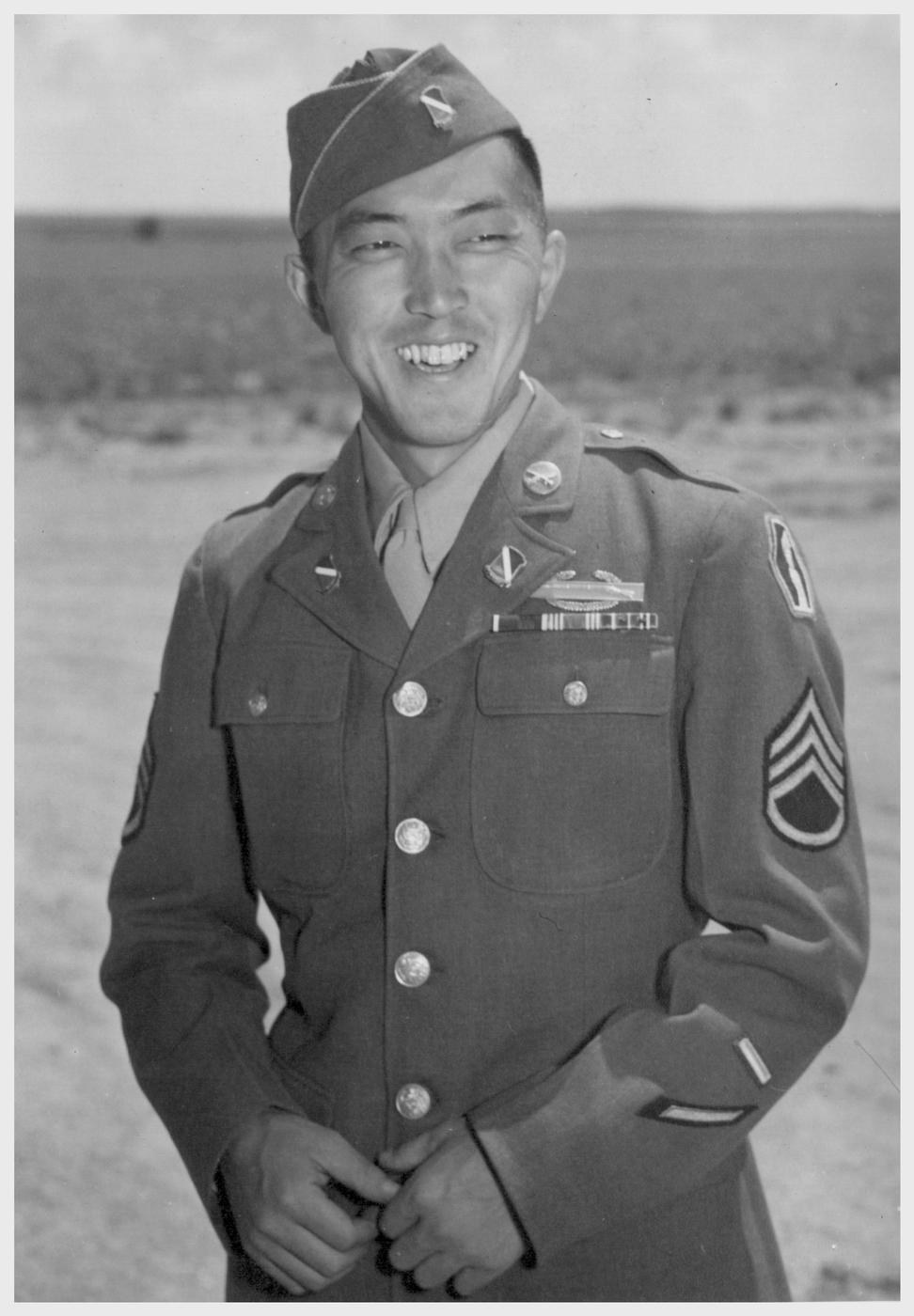 S/Sgt. Tatsumi Iwate, a Japanese American Infantryman, who bears a piece of Nazi shrapnel an inch deep in his brain despite two operations to remove it, is on furlough at the farm of his uncle, Tashikaza Wada, Rt. 1, Gill, Colorado, from Hammond General Hospital, Modesto, California, until September 17. He was wounded in France last October during the rescue of the Texas Lost Battalion by the Japanese American 442nd Combat Team. Formerly of Lomita, California, Sgt. Iwate, 28, entered service in February, 1942, a month before evacuation of Japanese Americans from the West Coast. Sgt. Iwate is keenly disappointed in his friend, 19-year-old Seiichi, now in a Justice Department Internment Camp after renouncing his American citizenship, and who has lost faith in his country. He wrote him a letter, which was made public by WRA, in which he expressed his surprise and disappointment in his actions and said I am an American to the last drop of my blood, and being a person of Japanese descent, I am aware of discrimination that is practiced by people who dare not see farther than the color of our skin, but I will continue to fight the enemy of my country be it foreign or domestic. Ready for either duty or discharge after 7 months of hospitalization, he says, I may be washed up as an Infantryman, but I’m still willing to tackle any assignment if they decide to keep me in the Army. — Photographer: Mace, Charles E. — Gill, Colorado. 7/14/45
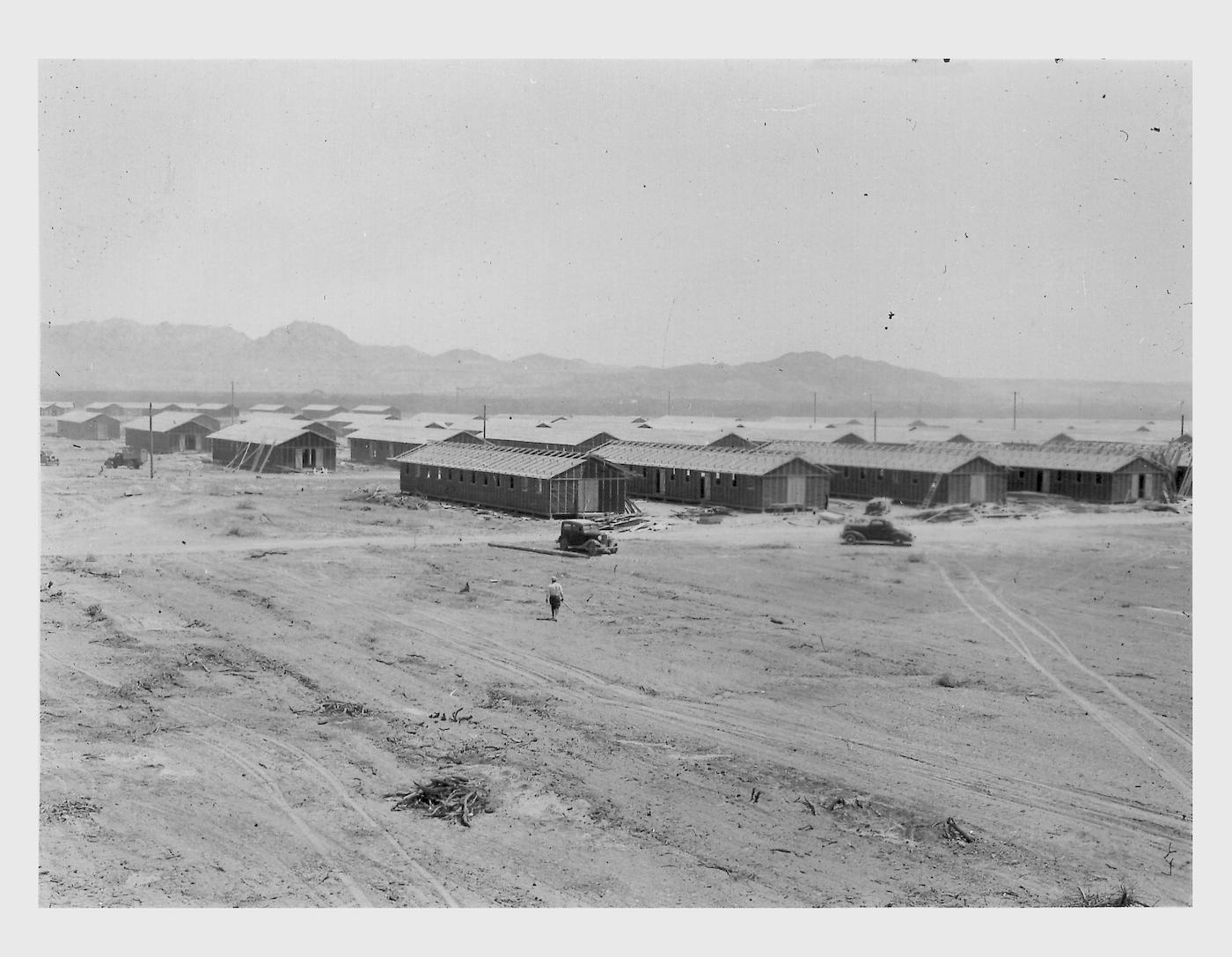 Site 1. Camp #1 facing S.E. — Poston, Arizona. 4/24/42
NEO-KGB – Ukraine: Timoschenko jetzt im Gefängnis in Charkiv – “Bestialisch”
http://de.euronews.net/ Julia Timoschenko ist in den Osten der Ukraine verlegt worden. Trotz internationaler und nationaler Proteste soll die ehemalige Regierungschefin in Kharkiv ihre siebenjährige Haftstrafe absitzen.
Anhänger der ehemaligen Regierungschefin traten gegen die Gefängnistür in Kiew, wo Timoschenko seit August einsaß. Der Vize-Chef ihrer Vaterlandspartei “Batkiwschtschina” war Zeuge.
From the NSA Document 1: NSCID 9, “Communications Intelligence,” March 10, 1950
National Security Council Intelligence Directives have provided the highest-level policy guidance for intelligence activities since they were first issued in 1947.
This document establishes and defines the responsibilities of the United States Communications Intelligence Board. The Board, according to the directive, is to provide “authoritative coordination of [the] Communications Intelligence activities of the Government and to advise the Director of Central Intelligence in those matters in the field of Communications Intelligence for which he is responsible.”
The particularly sensitive nature of communications intelligence (COMINT) activities was highlighted by paragraph 6, which noted that such activities should be treated “in all respects as being outside the framework of other or general intelligence activities.” Thus, regulations or directives pertaining to other intelligence activities were not applicable to COMINT activities.
DOWNLOAD ORIGINAL DOCUMENT HERE
POLITICAL MURDER TODAY – Syria man records his own death
Study – Open Source Center Chinese Premier Promotes Cyberspace Agenda
Authoritative PRC media reports of Chinese Premier Wen Jiabao’s live online appearances illustrate authorities’ expanding use of the Internet to set and control policy discourse in Chinese-language virtual space. They also suggest ongoing efforts to manage leaders’ images and portray them as accessible and soliciting online public opinion. While some apparent missteps suggest a cautious, evolving approach to interactive Internet media in relation to top leaders, reported leadership statements indicate sustained attention to the goal of incorporating new technologies into the propaganda system.
Recent online appearances by Chinese Premier Wen Jiabao on authoritative PRC media platforms indicate that Beijing continues to expand its use of Internet media to broadcast unique programs communicating the government’s view and signaling its policy preferences as part of its overall media strategy.
- On Saturday 27 February, in the run-up to the annual meeting of China’s National People’s Congress (NPC), Wen appeared in a live “web chat” — his second — jointly hosted by Xinhua Wang, the internet portal of PRC official news agency Xinhua, and by Zhongguo Zhengfu Wang (www.gov.cn), the PRC central government website. The two sites also posted feature pages with reports, video, and transcripts of the chat. Xinhua billed the event in advance as Wen’s “annual dialogue with netizens” (27 December 2009).
- Wen’s 27 February 2010 online appearance followed his first live “web chat” (zaixian fangtan), held by Zhongguo Zhengfu Wang on 28 February 2009. Xinhua later described that chat as the first of the “top ten events” of 2009 (29 December 2009).
- On 27 December 2009, Xinhua Wang broadcast an exclusive online interview of Wen held inside the Zhongnanhai central leadership compound, in which — like the web chats — Wen presented the Chinese leadership’s views by “answering netizens’ questions.”
Suggesting an attempt to portray Wen as accessible and soliciting public opinion, in his live online appearances Wen answered selected questions ostensibly submitted by Internet users. Reports portrayed the live online events as direct and sincere communication between Wen and the public as represented by Internet users, who are sometimes referred to in PRC media as “netizens” (wang min) or “net friends” (wang you).
- The moderator of Wen’s 27 February web chat claimed to have selected questions from among 190,000 submitted online by Internet users and 70,000 submitted via cell phone instant message (SMS) by users of the joint Xinhua Wang — China Mobile online newspaper, according to the chat transcript (Xinhua Wang). The moderator described “net friends” worldwide as “eagerly looking forward” to “meeting” Wen based on the “deep, positive impression” created by the 2009 web chat, in which Wen was said to have answered Internet users’ questions in a “frank and honest way.”
- Wen and the moderator worked to create personal emotional appeal throughout the chat, starting with the language of Wen’s opening remarks emphasizing his sense of duty to “the people” and his desire to have a sincere “heart-to-heart” exchange (Xinhua Wang). Wen claimed that he “follows the various issues raised by netizens on the Internet very closely.”
- Similarly, a Xinhua report on the February 2009 web chat quoted Wen as saying that the government needs to solicit “questions about governance from the people” (28 February 2009).
- Jiefangjun Bao Online, website of the daily newspaper of the Central Military Commission, touted “zero distance” between netizens and the PRC leadership and described Wen as a “super net friend” in a report on the 2009 web chat (10 March 2009).
DOWNLAOD ORIGINAL DOCUMENT HERE
SECRET – (SBU) State Department Uganda Lord’s Resistance Army Disarmament Report to Congress

The Lord’s Resistance Army Disarmament and Northern Uganda Recovery Act, Public Law 111-172, requires the Secretary of State to submit a report to Congress on implementation of the President’s strategy to support disarmament of the Lord’s Resistance Army (LRA) and assistance provided toward a lasting solution to the conflict in northern Uganda.
The United States has worked over the last year with our bilateral and multilateral partners to advance the President’s strategy. With our encouragement, the African Union (AU) and United Nations (UN) are working to enhance regional coordination toward addressing the LRA threat. We have also continued to support regional efforts to increase diplomatic and military pressure on the LRA. We have deployed U.S. military personnel to the region to serve as advisors to regional militaries pursuing the LRA. Meanwhile, we continue work with partners in the region to increase civilian protection, facilitate LRA defections, and address humanitarian needs, while also supporting the recovery of northern Uganda.
The United States remains committed to pursuing the multi-year, comprehensive strategy submitted to Congress last year. Any reduction in regional cooperation or military pressure could enable the LRA to regroup and rebuild its forces. However, the extent of U.S. efforts to implement the strategy remains a function of available and consistent resources. Given our budget constraints, we continue to encourage other members of the international community to join this effort and help fill funding gaps. We co-chair the International Working Group on the LRA, a mechanism established to enhance coordination among all donors.
Enhancing Regional Efforts to Apprehend LRA Top Commanders
Over the last year, the United States has worked with regional governments to enhance their military operations to apprehend or remove top LRA commanders from the battlefield. We continue to provide critical logistical support and nonlethal equipment to assist the Ugandan military’s counter-LRA operations. With our encouragement, the government of the Democratic Republic of the Congo (DRC) has deployed a U.S. trained and equipped battalion to participate in counter-LRA efforts in the LRA’s area of operations in the DRC. As the Central African Republic (CAR) and South Sudan increase their efforts to counter the LRA, we are engaging with and supporting their militaries. We have provided some equipment to the CAR forces deployed to the LRA-affected area.
Although regional militaries have reduced the LRA’s numbers to an estimated 200 core fighters and an unknown number of accompanying children and abductees, the LRA will remain a serious regional threat as long as Joseph Kony and the LRA’s top leaders remain in place. Over the last year, sustained military pressure has limited the LRA’s opportunities to regroup and rearm. Abductees and low-level fighters have continued to escape and reintegrate into their communities. Nonetheless, the LRA is still terrorizing communities and undermining regional security across a broad swath of central Africa. According to the UN, there have been over 250 attacks attributed to the LRA this year alone.
In line with the President’s strategy, we have reviewed how we can improve our support to the coalition of LRA-affected countries to increase the likelihood of successful operations to apprehend or remove LRA top commanders from the battlefield and bring them to justice. On October 14, the President reported to Congress that he had authorized a small number of U.S. forces to deploy to the LRA-affected region, in consultation with the regional governments, to act as advisors to the regional militaries that are pursuing the LRA. These advisors will enhance the capacity of regional militaries to coordinate and fuse intelligence with effective operational planning. The U.S. forces will not themselves engage directly against LRA forces unless necessary to defend themselves.
This is a short-term deployment with clear goals and objectives. We believe the U.S. advisors can address critical capabilities gaps to help the regional forces succeed. Additionally, our advisors are sensitive to civilian protection considerations and will work closely with our embassies to ensure they remain cognizant of local and regional political dynamics. The State Department has deployed a Civilian Response Corps officer to the region to work with the advisors in this regard. We will regularly review and assess whether the advisory effort is sufficiently enhancing the regional effort to justify continued deployment. Our embassies will also continue to consult with the regional governments and ensure their consent as we move forward. Continued deployment is conditional on regional governments’ sustained commitment and cooperation to bring an eventual end to the LRA threat.
…
Supporting Post-Conflict Recovery and Reconciliation in Northern Uganda Finally, the United States remains committed to supporting efforts to promote comprehensive reconstruction, transitional justice, and reconciliation in northern Uganda, where the LRA carried out its brutal campaign for nearly two decades. In Fiscal Year 2011, USAID provided approximately $102 million in assistance to northern Uganda, including:
• $2 million to assist internally-displaced persons (IDPs) and returnees to secure durable return solutions;
• $2.1 million to enhance accountability and administrative competence of local governance institutions, including the civilian police and judiciary;
• $4.2 million to help former LRA combatants with vocational education and employment opportunities; and
• $15 million to promote rural rehabilitation and food security.Northern Uganda has undergone a visible transformation since the LRA’s departure from Uganda in 2005, especially in terms of infrastructure and social services. The population is able to move freely, stores are open, and fields are being cultivated. According to UNHCR, an estimated 95 percent of people once living in IDP camps have moved from camps to transit sites or returned home.
According to the Ugandan Bureau of Statistics, poverty in northern Uganda declined from 60.7 percent to 46.2 percent between 2005/6 and 2009/10, representing the largest decline in poverty of all regions in Uganda during that period. Yet, even with this impressive decline, the north remains the poorest region in the country. Furthermore, land issues, tensions between tribes and subtribes in the region, and widespread psycho-social trauma, among other issues, need to be addressed to ensure the sustainability of peace in northern Uganda.
From 2009 to 2011, the Government of Uganda (GoU) contributed approximately $ 110 million to its Peace, Recovery and Development Plan for Northern Uganda (PRDP). This is less than the government’s original pledge to provide 30 percent of the PRDP’s total budget, but GoU officials state that they will continue to earmark funds for northern Uganda’s recovery. During this period, non-USG donors have provided significant funding in support of the PRDP.
DOWNLOAD FULL DOCUMENT HERE
Amercia vs iran – Iran Says American Could Face Death Penalty
STUDY – Study Finds 40% of South Asians Have Paid a Bribe in the Past Year
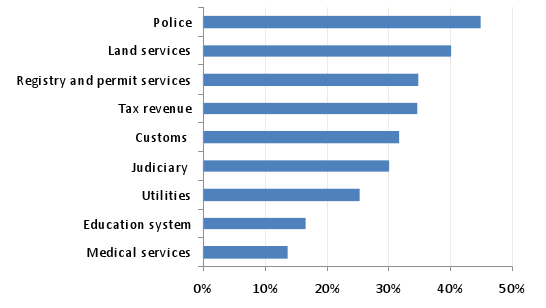 A chart from the Transparency International study found that police are the largest recipient of public service bribes in South Asia.More than one in three south Asians say they were forced to bribe officials in the last year, mainly for services they were legally entitled to, an international anti-graft watchdog said on Thursday.
A survey released by Berlin-based Transparency International in the Nepalese capital Kathmandu showed bribery has become so endemic that the region is second only to sub-Saharan Africa as the corruption hotspot of the world.
The watchdog surveyed 7,800 people in India, Pakistan, Bangladesh, Nepal, Sri Lanka and the Maldives, finding 40 percent had paid backhanders over the last 12 months to public servants, with police being the largest recipients.
Two thirds of Indians, Bangladeshis and Pakistanis who had dealt with the police said they had paid bribes to corrupt officers in the last 12 months.
“With bribery such a big part of life for south Asians, you can see why so many people are angry at their governments for not tackling corruption,” said Rukshana Nanayakkara, senior programme coordinator for the watchdog’s south Asia region.
“People are sick of paying bribes to get on with their daily lives, and they are sick of the sleaze and undue influence of public servants.”
Who Do Indians Bribe Most?
If the Lokpal Bill ever gets cleared by the Indian Parliament, episodes of everyday corruption, widely perceived as endemic, may finally start to decline.
At the moment, the figures are not encouraging, according to a new study by the Berlin-based anticorruption group Transparency International.
The report, “Daily Lives and Corruption,” offers fresh data on bribery in South Asia based on a survey of 7,500 people taken over the past two years. The results are alarming: they suggests that 39% of South Asians who had to deal with public services in the previous year admitted to paying a bribe.
In India, more than half of the people surveyed, or 54% of respondents, said they’ve paid a bribe. This was only worse in Bangladesh, where the figure is 66%, or two out of every three people. In Pakistan, the figure was around 50%, in Nepal 32%, in Sri Lanka 32% and in the Maldives 6%.
…
Take a look at how frequently Indians pay bribes when dealing with the following public services:
Police: 64%
Land services (buying, selling, renting and inheriting property): 63%
Registry and permit services: 62%
Tax revenue: 51%
Utilities (including water, telephone, electricity services): 47%
Judiciary: 45%
Customs: 41%
Medical services: 26%
Education: 23%
DOWNLOAD ORGINAL STUDY HERE
CONFIDENTIAL – Purported List of Israeli War Criminals Names and Information
The following information was anonymously published on a website (http://israeliwarcriminals.zzl.org) that is no longer accessible. It was accompanied by the following message:
The following information was received anonymously; presumably from a member of the Israeli Military. It was presented as follows:Underlining the following people is an act of retribution and affront. They are the direct perpetrators, agents for the state of Israel that in Dec.- Jan. 2008- 2009 attacked scores of people in the besieged Gaza. The people listed here held positions of command at the time of the attack therefore not only did they perform on behalf of a murderous state mechanism but actively encouraged other people to do the same. They bear a distinctive personal responsibility. They range from low-level field commanders to the highest echelons of the Israeli army.
All took an active and direct role in the offensive.
In underlining them we are purposefully directing attention to individuals rather than the static structures through which they operate. We are aligning people with actions. It is to these persons and others, Like them, to which we must object and bring our plaints to
bear upon.
This information was pirated. We encourage people to seek out other such similar information, it is readily available in the public sphere and
inside public officials’ locked cabinets. This is a form of resistance that can be effectively sustained for a long while.
This project for one, has only just begun, do your bit so that this virtual list may come to bear upon the physical.
Disseminate widely.
| Picture
תמונה |
Name
שם |
Rank
דרגה |
Position
תפקיד |
Date of Birth תאריך |
ID מספר |
Address
כתובת |
|
 |
Agai Yehezkel אגאי יחזקאל |
Brigadier General תא”ל
|
Head of the Armored Corps קצין שריון |
19/04/66 |
22380406
|
26 Caesarea 30889 ענבר קיסריה 30889 |
|
 |
Aharon אהרן חליוה |
Colonel אל”מ |
Head of “Bahad 1″ (officer training academy) מפקד |
12/10/67 |
23050578 |
||
|
|
Alex Shakliar אלכס שקליאר |
Second Lieutenant סג”מ |
Nesher Field Inteligence Battalion, Squad Commander גדוד |
12/12/87 |
304074636 |
||
 |
Amir Ulo אמיר אולו |
Lieutenant Colonel סא”ל |
Yahalom Engineering Battalion Commander מפקד גדוד |
09/05/71 |
28542900 |
62 Hagai st. Har Adar 90836 הגיא הר אדר 90836
|
|
 |
Amir Abstein אמיר אבשטיין |
Lieutenant Colonel סא”ל |
7th Regiment, 75 Romach Battalion Commander חטיבה |
28/03/73 | 16436917 |
21 Modi’in-Maccabim-Re’ut 71725 יהלום מודיעין– 71725 |
|
 |
Amir אמיר שמעון
|
Major General אלוף |
Head of the Planning Directorate ראש אגף התכנון |
04/04/59 |
55652846 |
# 78
Kidron 70795 קידרון 70795 |
|
 |
Amos Yadlin עמוס ידלין |
Major General אלוף |
Head of Intelligence Directorate ראש אמ“ן |
20/11/51 | 51112027 |
11 Smadar st. Karmei 99797 סמדר 11 כרמי יוסף 99797
|
|
 |
Anna Strelski אנה סטרלסקי |
Sergeant
סמלת |
Bislmach Infantry Training Academy, Mortar Commander ביסלמ“ח |
22/09/88 |
309313674
|
||
 |
Anton Siomin אנטון סיומין |
L:ieutenant (Reserve) סגן |
Paratroopers צנחנים |
22/12/84
|
324417930 |
חיפה Haifa |
|
|
|
Aram ארם זהבי |
Captain סרן |
601 |
03/09′/81 | 43249036
|
||
 |
Ariel אריאל בריקמן |
Colonel
אל”מ |
“Hazor” Air Force Base Commander מפקד בסיס חיל |
01/01/64 |
58497306 |
Machane Mizpe 80600 מחנה טלי מצפה רמון 80600 |
|
 |
Ariel Karo אריאל קארו |
Brigadier General תא”ל |
Head of Field Intelligence Corps קצין מודיעין |
01/01/65
|
22136576 |
73 Kefar 44213 הרצל כפר סבא 44213 |
|
 |
Ariel Rifkin אריאל ריפקין |
Sergeant Major רס“ל |
601 Assaf engineering Battalion, Heavy Engineering Team Work manager (D-9 operators) גדוד |
19/07/79 | 37287497 | ||
| Ariel Yochanan אריאל יוחנן
|
Lieutenant Colonel סא”ל |
Paratroopers 101 Peten Batallion Commander (as replacement) צנחנים, |
22/09/73 | 25244492 |
# (Nevatim) 8554 מחנה (נבטים 85540 |
||
| Arnon Avital ארנון אביטל |
Lieutenant
סגן |
401 Regiment 9 Eshet, Deputy Company Commander חטיבה |
27/08/85 |
37079779 |
|||
 |
Assaf Bryt אסף בריט |
Captain (Reserve) סרן |
Golani Reconnaissance Battalion, Squad Commander גדס“ר |
07/11/1979 | 37414240 |
||
|
|
Avi Balut אבי בלוט
|
Lieutenant Colonel סא”ל |
Paratroopers 101 Peten Battalion Commander צנחנים, |
12/09/74 | 31795750 | 66 Yisaschar st. Modi’in-Maccabim-Re’ut 71724
יששכר מודיעין– 71724
|
|
 |
Avi Bnayahu אבי בניהו |
Brigadier general תא”ל |
Military Spokesperson דובר |
11/07/77 |
33809724
|
Lehavot 38835 להבות 38835 |
|
 |
Avi Mizrakhi אבי מזרחי |
Major General אלוף |
Commander of the Ground Forces מפקד זרוע |
26/12/57 |
55006639 |
14 Zikhron 30900 ששת זכרון יעקוב 30900 |
|
 |
Avi Peled אבי
|
Colonel
אל”מ
|
Golani Regiment Commander מפקד
|
01/11/69 |
24638306
|
24 Shivtei Israel st. Modi’in-Maccabim-Re’ut 71700
שבטי מודיעין–מכבים–רעות
71700
|
|
|
|
Aviad אביעד |
Lieutenant סגן |
401 Rregiment 71 Reshef, Platoon Commander חטיבה401 |
27/04/87 | 300409752 | ||
 |
Aviel Siman-Tov אביאל |
Captain
סרן |
Givati 424 Shaked, Company Commander גבעתי |
19/12/84 | 36541704 | 49 Shlomo Hamelech st. Tel Aviv 64386 שלמה תל אביב 64386 |
|
 |
Avihay אביחי ויזמן |
Captain
סרן |
Golani 12 Barak, Company Commander גולני |
27/04/85 | 21544416 | ||
 |
Avihu Ben Zahar אביהו בן זכר |
Lieutenant
סגן |
Givaati 432 Tsabar, Platoon Commander גבעתי |
14/04/87 | 300751518 | ||
 |
Avishay Levi אבישי לוי |
Brigadier General תא”ל |
Head of Air Force Intelligence ראש להק מודיעין |
02/12/63 | 58430992 |
27 Modi’in 71799
גבעת מודיעין– 71799 |
|
 |
Avishay Shasha אבישי שאשא |
Lieutenant סגן
|
“Nurit” סוללת |
15/10/87 |
301178984
|
||
| Aviv Edri אביב עודרי |
Captain
סרן |
Paratroopers Reconnaissance Battalion, Squad Commander גדס“ר |
20/07/84 | 66444779 |
1180 Merhavim st. Dimona 86176 מרחבים דימונה 86176 |
||
 |
Aviv אביב כוכבי
|
Brigadier תא”ל |
Head of the Operations Division ראש חטיבת |
23/04/64 |
58741323 |
# 249
Adi 17940 עדי 17940 |
|
 |
Aviv Mendelowitz אביב מנדלוביץ |
Major
רס”ן |
Gaza Division, Deputy Commander of Artillery אוגדת |
17/01/81 |
40882888 |
# 2 Shaked neighborhood Yerucham 80500 שכונת ירוחם 80500 |
|
|
|
Baruch (Barry) Berlinsky ברוך
|
Second Lieutenant סג“מ |
Golani Reconnossaince Batallion, Squad Commander גדס“ר |
16/08/86 |
300046588 | ||
 |
Basam Alian בסאם עליאן |
Lieutenant Colonel סא”ל |
Deputy
סגן
|
26/11/73 | 26458588 | Shfaram
20200 שפרעם 20200 |
|
 |
Ben-Zion (Benzi) Gruver בן–ציון |
Colonel (reserve) אל”מ |
Deputy Commander of a Reserve Division סגן מפקד אוגדת |
02/10/58 |
55486237 |
44 Efrata 90435 הגפן אפרתה 90435 |
|
|
|
Bnaya Sarel בניה שראל |
Second Lieutenant סג”מ |
Givaati 424 Shaked, Platoon Commander גבעתי |
24/08/87 |
301071320
|
66 Bne Beitcha st.
Givaat
Kiryat 90100 בנה גבעת קרית
90100 |
|
| Boaz Dabush בועז דבוש |
Staff Sergeant Major רס”מ |
601 Assaf engineering Battalion, Heavy Engineering Team Work manager (D-9 operators) גדוד |
02/08/71
|
28804276 |
# 10
Zeitan
71915
זיתן
71915 |
||
| Boaz Rubin בועז רובין |
Captain סרן |
Hanegev Reserve Regiment, Deputy Company Commnader חטיבת |
11/09/77 |
34233114 | 4 Stefen Zweig st. Tel-Aviv 69642 סטפן תל אביב 69642 |
||
 |
Boris Schuster בוריס שוסטר |
Major
רס“ן |
Commander of a “Dabur” Navy Flotilla מפקד שייטת |
12/02/81 | 309209070 | Ashkelon אשקלון
|
|
| Dado Bar-Kalifa דדו |
Lieutenant Colonel סא”ל |
Givati 424 Shaked Battalion Commander גבעתי, |
20/08/76 | 33193061 | 114 Sderot Hagalil st. Bat-Hefer 42842 שדרות בת–חפר 42842 |
||
 |
Dan Dolberg דן דולברג |
Second Lieutenant סג“מ |
401 חטיבה |
15/04/89
|
300257755
|
Yavne
יבנה |
|
 |
Dan Harel דן הראל |
Major general אלוף |
Deputy Chief of Staff סגן |
17/02/55
|
53312690 |
13 Erez st. Modi’in-Maccabim-Re’ut 71908 ארז מודיעין–מכבים–רעות 71908
|
|
|
|
Daniel Kotler דניאל קוטלר |
Second Lieutenant סג”מ |
Givaati 424 Shaked, Operations Officer גבעתי
|
10/08/88 |
301894911 |
||
 |
David Shapira דוד שפירא |
Major
רס“ן |
Paratroopers צנחנים |
14/11/78 | 35716711 | 6 Shoshana Poliakov st. Jerusalem 96106 שושנה ירושלים 96106
|
|
 |
David Slovozkoi דוד סלובוצקוי |
Captain
סרן |
Givati 424 Shaked, Company Commander גבעתי
|
07/06/85 | 304511173 | ||
| David Zini דוד |
Lieutenant Colonel סא”ל |
Golani, Commander of Egoz Unit גולני, |
09/01/74 | 25627266 | |||
| Dvir Diamond דביר דיאמונד |
Lieutenant
סגן |
Paratroopers 101 Peten, Platoon Commander צנחנים |
16/06/86
|
29986791
|
ראס אל עמוד Ras- El- |
||
 |
Eden Atias עדן אטיאס |
Colonel
אל“מ |
Commander of Nevatim Air Force Base מפקד בסיס חיל |
09/10/66 | 22665954 |
Machane Adi (Nevatim) 80700 מחנה עדי (נבטים) 80700 |
|
|
|
Efraim Aviad Tehila אפרים |
Lieutenant סגן
|
Golani גולני
|
31/12/84 |
39764287 | #37
Moshav 60932
צפריה , 60932 |
|
 |
Efraim Avni אפרים אבני |
Captain
סרן |
Paratroopers צנחנים |
06/10/81 |
43239698 | ||
 |
Eitan Ben-Gad איתן |
Major
רס”ן |
Paratroopers, Operations Officer צנחנים, |
02/03/75 |
32273542 |
29 Aliyat Hanoar st. Jerusalem 97234 עליית ירושלים 97234 |
|
 |
Elad Chachkis אלעד |
Major
רס“ן |
Commander of the “Hetz” Navy Vessel מפקד אח“י |
20/07/80 | 40288151
|
||
| Elad Itzik אלעד |
Second Lieutenant סג”מ |
Paratroopers 101 Peten, Communications Officer צנחנים |
27/11/86 | 29991338 | |||
 |
Elad Shoshan אלעד שושן |
Captain
סרן |
Paratroopers גדס“ר |
14/10/81 |
46222980 |
||
 |
Elad Yakobson אלעד יעקובסון |
Captain (reserve) סרן |
Paratroopers 202 Zefa, Company Commander צנחנים |
25/03/80 | 37263308 | ||
 |
Eli Fadida אלי פדידה |
Staf Sergeant סמ“ר |
402 Reshef Artillery Battalion, Squad Commander גדוד
|
23/04/88 | 200661783 | ||
 |
Eli Yafe אלי יפה |
Brigadier General תא”ל |
Head of the Operations Division רח”ט מבצעים |
11/01/57 | 54649173 | 4 Ela st. Kokhav 44864 אלה כוכב יאיר 44864 |
|
 |
Eliezer אליעזר |
Major General אלוף |
Navy Commander מפקד חיל הים |
13/11/55 |
53227492
|
1 Zikhron 30900 עורבנית זכרון יעקוב 30900 |
|
 |
Eliezer Shkedi אליעזר שקדי |
Major General אלוף |
Former Air force Commander, Co-Authored the Operation לשעבר |
10/08/57 |
54898903
|
2 Seora st. Yehud 56475 שעורה יהוד 56475 |
|
 |
Elik אליק סרור |
Captain
סרן
|
Givaati גבעתי |
19/07/83 | 37747391 | ||
|
|
Eran ערן קריסי |
Lietenant Colonel סא“ל |
Lahav 603 Engineering Battalion Commander מפקדגדוד |
08/02/75 | 32264731 | ||
|
Erez |
Lietenant Colonel סא“ל |
401 Regiment, 52 Habokim Battalion Commander חטיבה |
21/11/1975 | 32347890 | |||
 |
Eyal Ben Haim אייל בן חיים |
Major (Reserve) רס“ן |
500 Regiment, Deputy Company Commander חטיבה |
05/02/71 | 27963461 |
# Bizron 60946 ביצרון 60946 |
|
 |
Eyal Eizenberg אייל אייזנברג |
Brigadier General תא”ל |
Gaza Division Commander מפקד אוגדת |
19/04/63 | 58018532 | # 152
Ben 73115 בן 73115 |
|
|
|
Eyal אייל הנדלמן |
Captain
סרן |
3rd Flotilla, Ordnance Officer שייטת
|
20/08/84 |
66629999
|
||
 |
Eyal Zukowsky אייל |
Captain סרן |
Golani 51 Habokim, Company Commander גולני |
27/11/83 | 65922197 | ||
 |
Gaby Ashkenazi גבי אשכנזי |
Leutenant General רב–אלוף |
Chief of Staff ראש המטה הכללי |
25/02/54 | 52228764
|
44 Hakarmel st. Kefar 44205 הכרמל כפר סבא 44205 |
|
| Gil Shen גיל שן |
Lieutenant Colonel סא”ל |
Commander מפקד |
12/10/69 | 24524589 | 12 Weizmann av. Ramat- 47211 שדרות רמת השרון 47211 |
||
| Gur Rozenblat גור רוזנבלט |
Captain
סרן |
Givaati 435 Rotem, Company Commander גבעתי |
05/07/73 | 25343484 |
# 335
Revava 44839 רבבה 44839 |
||
| Gur Schreibmann גור |
Lieutenant Colonel סא”ל |
Givaati, Reconnaissance Battalion Commander מפקד
|
11/09/75 | 32394348 |
1
Kefat
44627
עמק עירון 1
כפר סבא 44627
|
||
|
|
Guy Givoni גיא גבעוני
|
Lieutenant (reserve) סגן |
Golani 13 Gideon, Artillery Coordination officer גולני |
05/03/85 | 36834521 |
||
|
|
Guy Hazut גיא חזות
|
Lieutenant סא”ל |
Deputy Commander of the Paratroopers Regiment סגן |
03/05/71
|
28454650 |
||
|
|
Haggai חגי עמר |
Lietenant Colonel סא“ל |
401 Regiment, 71 Reshef Battalion Commander חטיבה |
16/05/75 |
31926819
|
#
Halamish
71945
חלמיש
71945 |
|
 |
Hanan (Yochanan) Schwartz חנן |
Captain
סרן |
Givati 432 Zabar, Company Commander גבעתי |
18/11/84 | 66363664 | ||
 |
Harel Knafo הראל קנפו |
Brigadier
תא”ל |
Southern Command, Chief of Staff ראש מטה פיקוד |
31/03/65 |
59206961 |
40 Modi’in-Maccabim- 71724 יהודה מודיעין– 71724 |
|
|
|
Harel Naaman הראל |
Lieutenant סגן |
Golani גולני
|
07/08/86 | 37991189
|
||
|
|
Herzel (Herzi) Halevi הרצל |
Colonel
אל”מ |
Paratroopers Regiment Commander מח“ט |
17/12/67 |
57207771
|
||
 |
Hila Yafe הילה יפה |
Major
רס”ן |
Drone Company Commander מפקדת פלוגת |
24/03/82 |
43547967
|
||
|
Idan עידן חמו |
Captain סרן |
188 Regiment 71 Reshef, Company Commander חטיבה |
04/03/83 | 39098843 | |||
 |
Ido Ender עדו אנדר |
Lieutenant
סגן |
Paratroopers 101 Peten, Deputy Company Commander צנחנים |
22/06/86 | 21965363 | ||
 |
Ido Nechushtan עדו נחושתן |
Major General אלוף |
Air Force Commander מפקד חיל האוויר |
18/04/57 |
54744297 |
1 Yavne 81501 יקינטון יבנה 81501 |
|
 |
Ilan אילן בוגר |
Colonel
אל“מ |
Commander of Ramat David Air-Force Base
מפקד |
09/12/66 | 22807341 |
49 Lehi st. Ramat לח“י רמת השרון |
|
|
Ilan אילן דיקשטיין |
Lieutenant Colonel סא”ל |
Kfir חרוב |
11/01/73 |
25093089 |
# 45
Eli 44828 עלי 44828
|
||
 |
Ilan Malka אילן |
Colonel
אל“מ |
Givaati Regiment Commander מפקדחטיבת |
21/12/67 | 23582752 | ||
| Itamar Ben Haim איתמר
|
Major
רס”ן |
Paratroopers 101 Peten Deputy Commander צנחנים, |
15/07/78 | 34386045 | |||
 |
Itamar Cohen איתמר כהן |
Lieutenant סגן |
Givaati 435 Rotem, Deputy Company Commander גבעתי |
15/07/85 | 34592295
|
||
| Itamar Eitam איתמר |
Captain
סרן |
Golani 51 Habokim, Company Commander גולני51 |
18/03/81
|
40558439 |
# 38
Nov 12921 נוב38 12921 |
||
 |
Itamar איתמר פרנקל |
Sergeant
סמל |
Kfir כפיר |
29/09/88 |
200756377
|
||
 |
Itay איתי רייס |
Bigadier General תא”ל |
Commander of Palmachim Air Force Base מפקד בסיס |
03/12/63 |
58495755 |
25 Ramat- 47212
התקוה רמת השרון 47212 |
|
 |
Itay Virob איתי וירוב |
Colonel אל”מ |
Kfir Regiment Commander מח“ט |
14/04/66 |
22376974 |
# 71
Ma’ale 19145 מעלה .19145
|
|
|
|
Johnny |
Lieutenant Colonel סא”ל |
401 חטיבה |
Ovda Military Camp מחנה עובדה |
|||
 |
Lior Algai ליאור אלגאי |
Captain
סרן |
Paratrooper 890 Efee, Company Commander צנחנים |
20/01/76 | 21510813 |
||
|
|
Lior Bialik ליאור ביאליק |
Sergeant
סמל |
Nesher Field Intelligence Batallion, Squad Commander גדוד |
08/02/88 |
301535316 |
||
 |
Lior Dadon ליאור דדון |
Sergeant סמל |
Paratroopers 101 Peten, Squad Commander צנחנים
|
13/02/87 |
300468188 |
||
 |
Lior Shushan ליאור שושן |
Captain
סרן |
Kfir 93 Haruv, Operations Officer כפיר 93 |
17/01/82
|
49845423 |
||
 |
Liran Luzon לירן לוזון |
Lieutenant סגן |
Givaati 432 Tsabar, Platoon Commander גבעתי |
21/08/87 | 301092011 | ||
|
|
Liran Nachman לירן נחמן |
Lieutenant סגן |
Givaati 432 Tsabar, Deputy Company Commander גבעתי
|
03/08/85 |
36729234 | ||
 |
Liron Padlad לירון
|
Second Lieutenant סג”מ |
Paratroopers צנחנים |
31/12/88 |
302243134
|
||
 |
Meir Kalifi מאיר כליפי |
Major General אלוף |
Prime Minister’s Military Secretary המזכיר הצבאי
|
30/04/59 |
55659486 |
2 Tarshish st. Caesarea 30889
תרשיש קיסריה 30889 |
|
 |
Michael מיכאל היימן |
Captain
סרן |
605 Hamachatz, Company Commander גדוד |
07/10/81 | 310666037 | Tel Aviv
תל אביב |
|
 |
Michael Taksyak מיכאל טקסיאק
|
Lieutenant (reserve) סגן |
46 Reserve Battalion, Platoon Commander גדוד |
26/05/80 |
306131269 |
||
 |
Michaor Israeli מיכאור ישראלי |
Second Lieutenant סג“מ |
Paratrooperts 101 Peten, Platoon Commander צנחנים |
02/03/87 | 300712387 | ||
 |
Michelle Ben-Baruch מישל |
Brigadier General תא”ל |
Head of the Artillery Corps קצין תותחנים |
20/11/63
|
69111672 |
10 Alon st. Rosh 48560 אלון ראש העין 48560 |
|
 |
Miki Ohayon מיקי אוחיון |
Lieutenant
סגן |
Paratroopers 202 Zefa , Deputy Company Commander צנחנים |
03/12/86 | 300181906 | ||
 |
Mordechai Kahana מרדכי כהנא |
Colonel
אל”מ |
Gaza Division, Southern Regiment Commander מפקד החטיבה |
04/10/70 | 28059632 | 14 Livne st. Ma’alot 21521 לבנה מעלות תרשיחא 21521 |
|
|
Moshe משה אלרט |
Lietenant Colonel סא“ל |
Shuali Marom Reserve Regiment, Battalion Commander מג“ד |
06/03/88 |
23605132 |
|||
|
|
Moshe (Chico) Tamir משה
|
Brigadier General תא“ל |
Former Commander of the Gaza Division (co-authored the operation) מפקד |
12/08/64
|
58845686 |
Kfar Giladi 12210 כפר 12210 |
|
|
Moshe משה צופי |
Lietenant Colonel סא“ל |
Hanegev Reserve Regiment, Battalion Commander מג“ד |
06/09/72 |
29585635 |
101 Be’er-Sheva 84747 הצבי באר שבע 84747 |
||
 |
Nadav Hajbi נדב
|
Colonel
אל”מ |
Gaza Division Deputy Commander סגן מפקד אוגדת |
10/01/64
|
58455007 |
||
|
|
Nadav Musa נדב
|
Lieutenant סגן
|
Givati 424 Shaked, Deputy Company Commander גבעתי |
01/01/86 |
38031506 | ||
| Nathan Be’eri נתן בארי |
Staff Sergeant סמ“ר |
Golani 12 Barak, Squad Commander גולני |
28/05/89 |
200691061 | |||
 |
Nezah Rubin נצח רובין |
Lieutenant colonel סא”ל
|
Head of Imprisonment Branch of Military Police ראש ענף כליאה |
04/06/68 | 23690159 | ||
 |
Nimrod Schefer נמרוד שפר |
Brigadier General תא”ל |
Head of the Air Division in the Air Force ראש להק אוויר בחיל |
16/03/61 | 56539208 |
# 46
Nataf 90804 נטף 90804 |
|
 |
Nir Ben-David ניר בן דוד |
Lietenant Colonel סא“ל |
188 Regiment 74 Saar Battalion Commander חטיבה |
17/09/73 | 25243403 |
Nofit
36001
נופית 36001 |
|
| Nir Dupet ניר דופט
|
Captain
סרן
|
Paratroopers 202 Zefa, Company Commander צנחנים |
03/10/82 |
66238429
|
# Nov 12921 נוב 12921 |
||
 |
Nir Ohayon ניר אוחיון |
Second Lieutenant סג”מ |
Givaati 432 Tsabar, Platoon Commander גבעתי |
19/08/87 | 301073862 | ||
 |
Niv Samban ניב סאמבן |
Staff Sergeant סמ”ר |
Paratroopers 101 Peten, Platoon Sergeant צנחנים |
14/06/88 | 200345320 |
||
 |
Noam Keshwisky נועם קשיביצקי |
Lieutenant סגן |
401 Reconnaissance Unit, Deputy Company Commander פלס“ר |
23/10/85 |
21663604
|
||
 |
Ofek Gal
אופק גל |
Sergeant
סמלת |
Northern Regiment of the Gaza Division, Field Intelligence Commander אוגדת |
03/07/87 | 300934890 | ||
 |
Ofer Lahad עופר להד |
Staf Sergeant סמ“ר |
402 Reshef Artillery Battalion, Squad Commander גדוד |
08/10/88 |
200494623 | ||
 |
Ofer Levi עופר לוי |
Lieutenant Colonel סא”ל |
Givati Regiment, Deputy Commander סגן מפקד חטיבת |
31/03/72 | 28880656 | ||
 |
Ofer Winter עופר וינטר |
Colonel
אל”מ |
Commander of “Duvdevan” Unit מפקד |
03/02/71 | 27998632 | # 107
Mizpe 15295 מצפה 15295 |
|
 |
Ofer Zafrir עופר צפריר |
Colonel
אל”מ |
401 Regiment Commander מפקד |
29/01/66 |
22280283 |
||
 |
Ofir Edri אופיר אדרי |
Lieutenant
סגן |
Kfir 93 Haruv, Deputy Company Commander כפיר |
30/09/87 | 301168548 | ||
 |
Ohad Dabush אוהד דבוש |
Second Lieutenant סג“מ |
Givaati 432 Tsabar, Platoon Commander גבעתי |
25/10/87 | 301105052 | ||
 |
Ohad Girhish אוהד גירחיש |
Second Lieutenant סג“מ |
Golani 51 Habokim, Platoon Commander גולני 51 |
02/03/87 | 300397445 | ||
 |
Ohad אוהד |
Lieutenant Colonel סא”ל |
401 Regiment, 9 Eshet Battalion Commander חטיבה |
16/03/76 |
38616751 |
||
|
|
Omer Dori
עומר |
Second Lieutenant
סג”מ |
Paratroopers 101 Peten, Platoon Commander
צנחנים101
|
05/12/86 |
300070612 |
||
| Omri Dover עמרי דובר |
Lieutenant סגן
|
401 Regiment 71 Reshef, Deputy Company Commander חטיבה401 |
28/04/86 |
32573214
|
Zur Hadasa 349 99875 צור 99875
|
||
|
|
Or Nelkenbaum אור נלקנבאום |
Second Lieutenant סג”מ |
Nesher Field Intelligence Battalion, Squad Commander גדוד |
11/11/87 |
301062170 |
||
|
|
Oren Bersano אורן ברסאנו
|
Major
רס”ן |
Paratroopers 101 Peten, Company commander צנחנים |
09/05/81 |
42834044 | ||
 |
Oren Cohen אורן כהן |
Lieutenant Colonel סא”ל
|
Golani 13 Gideon Battalion Commander גולני, |
14/01/73 | 25092362 | 7 Agas st. Rosh 48570 אגס ראש העין 48570 |
|
|
|
Oren Kupitz אורן קופיץ
|
Lieutenant סגן
|
Paratroopers 101 Peten, Company Commander צנחנים |
12/02/87 |
300374139
|
||
 |
Oren Zini אורן זיני |
Lieutenant Colonel סא”ל |
Givaati, 432 Tsabar Battalion Commander גבעת |
30/08/74 | 27310176 | 21 Menachem Usishkin st. Ashdod 77513 מנחם אשדוד 77513 |
|
 |
Pinkhas Buchris פנחס בוכריס |
Brigadier General (reserve) תא”ל |
Director General of the Defense Ministry מנכ“ל |
11/04/56 | 53305868 | 7 Maanit st. Kefar 44288 מענית 7 כפר–סבא 44288 |
|
|
|
Ghasan Alian ע‘סאן
|
Lieutenant Colonel סא”ל
|
Golani Reconnossaince Battalion Commander מפקד |
21/03/72 |
29151529 |
Shfaram 20200
שפרעם
20200 |
|
 |
Raz Sarig רז שריג |
Major
רס”ן |
Kfir חטיבת |
22/07/76 |
33069170 |
33 Hamigdal st. Givataim 53447 המגדל גבעתיים 53447
|
|
 |
Ron Asherov רון אשרוב |
Colonel
אל”מ |
Gaza Division, Northern Regiment Commander אוגדת |
26/05/69 |
24417248 |
11 Ufter Ya’akov Tel-Aviv 69362 אפטר תל–אביב 69362
|
|
 |
Ron Levinger רון לוינגר |
Captain
סרן |
Paratroopers 202 Zefa, Company Commander צנחנים |
09/05/83 | 39975230 | ||
| Ron Shirto רון שירטו |
Captain (reserve) סרן
|
Paratroopers, Coordination Officer צנחנים, |
28/05/78 |
32970220 |
|||

|
Ronen Dan רונן דן |
Brigadier General תא”ל |
Commander of Tel-Nof Air-Force Base מפקד |
25/04/61 |
57220790 |
57 Keshet st. Modi’in-Maccabim-Re’ut 71908 קשת מודיעין–מכבים–רעות 71908 |
|
| Ronen Dogmi רונן דגמי |
Lieutenant Colonel סא”ל |
401 Regiment Deputy Commander סגן |
11/01/73 | 29608882 | Sde Yoav 79351 שדה יואב 79351
|
||
|
|
Roi Elkabetz רועי אלקבץ |
Colonel
אל”מ |
7th Regiment Commander מפקד |
02/08/68 |
23668767 | ||
|
Roi רועי אופנהיימר |
Major
רס”ן |
401 Regiment, 71 Reshef Deputy Commander חטיבה
|
10/07/77 |
33802018
|
|||
|
|
Roi Weinberger רועי ויינברגר |
Lieutenant סגן
|
Givaati 435 Rotem, Platoon Commander גבעתי |
26/09/88 |
301818043 | ||
| Sahar Abargel סהר |
Lieutenant Colonel סא”ל |
601 Assaf Battalion Commander מפקד |
17/07/75 |
32433062 |
16 Yeshaia Hanavi Modi’in- 71723
ישעיהו מודיעין– 71723 |
||
 |
Shai Belaich שי בלאיש |
Lieutenant Colonel סא”ל |
Commander of the Shachar Rescue Battalion מפקד גדוד שחר |
07/10/74 | 31938244 |
16 Ashkelon 78360 הסנונית אשקלון 78360 |
|
 |
Shai Fargian שי |
Captain
סרן |
Givati
גבעתי |
06/01/85 | 66658964 | ||
| Shaked Galin שקד גלעין |
Lieutenant סגן |
Navy Vessel Commander מפקד ספינה של |
14/10/85 |
34716712 |
|||
 |
Sharon Itach שרון איטח |
Captain
סרן |
Sachar Rescue Battalion, Company Commander גדוד |
20/03/82 | 60125119 | 58 Ben Gurion st. Sderot 87070 בן–גוריון שדרות 87070 |
|
|
|
Shaul שאול בדוסה |
Lieutenant סגן |
Kfir 93 Haruv, Platoon Commander כפיר |
03/10/86 | 300168200 | ||
| Shay Unger שי אונגר |
Major
רס“ן |
605 Mahaz Engineering Battalion, Deputy Commander סגן
|
31/12/77
|
34488403
|
Tel Aviv
תל אביב |
||
 |
Shimon Siso שמעון סיסו
|
Lieutenant
סגן |
Golani 51 Habokim, Deputy Company Commander גולני |
19/02/86 | 38140091 | … | |
|
|
Shiran שירן מוסא |
Captain סרן |
Nesher Field Intelligence Battalion, Company Commander גדוד |
11/11/84 | 36625655 | ||
 |
Shlomit Tako |
Captain סרן |
“Ein Hasea’ara” Artillery Battery Commander מפקדת
|
23/04/84 |
39821459 | ||
 |
Tal Alkobi טל אלקובי |
Lieutenant
סגן |
188 Regiment 71 Reshef, Company Commander חטיבה |
10/04/87 | 300690435 | ||
| Tal Bendel טל בנדל |
Sergeant סמל |
Paratroopers 101 Peten Squad Commander צנחנים |
10/11/88 |
301723102 |
|||
|
|
Tal Kommemi טל קוממי |
Sergeant סמל |
Paratroopers 101 Peten, Squad Commander צנחנים |
03/01/88 |
200375541 |
||
 |
Tal Ruso טל רוסו |
Major General אלוף |
Head of the Operations Directorate ראש אגף המבצעים |
27/09/59
|
56046295 |
Tel תל אביב |
|
 |
Tamir Oren תמיר אורן |
Lieutenant
סגן |
Paratroopers 202 Zefa, Platoon Commander צנחנים
|
13/11/87 |
200210961 |
||
|
|
Tamir תמיר |
Brigadier General תא“ל |
Replaced the Golani Regiment Commander מילא |
16/12/69 | 24840340
|
59 Kefar 44351 ויצמן כפר סבא 44351 |
|
 |
Tom תום כהן |
Second Lieutenant סג“מ
|
188 Regiment, 74 Sa’ar, Platoon Commander חטיבה |
20/11/87 | 301355517 | ||
| Tomer Meltzmann תומר מלצמן |
Captain
סרן |
Golani 12 Barak, Company Commander גולני |
23/11/81 | 52670791 |
|||
|
|
Geva גבע ראפ |
Colonel אל“מ |
Reserve מפקד חטיבת |
15/01/57 |
54958723 |
||
 |
Tslil Birbir צליל בירביר
|
Second Lieutenant סג”מ |
Golani 52 Habokim, Logistics Officer גולני 52 |
11/07/88 |
200394310 |
||
|
|
Udi אודי שגיא |
Lietenant Colonel סא“ל |
Paratroopers 202 Zefa Commander צנחנים |
Even אבן יהודה |
|||
 |
Uri Ron
אורי רון |
Captain
סרן |
601 Assaf Engineering Battalion, Company Commander גדוד |
29/10/84 | 66348392 |
||
| Yair Keinan יאיר קינן |
Lieutenant
סגן |
7th Regiment Reconnaissance Unit, Squad Commander פלס“ר |
12/12/85 | 38029062 |
|||
|
|
Yair Palay יאיר |
Captain
סרן |
Golani Egoz, Company Commander גולני |
23/02/80 |
40045981 |
Keshet Moshav 12410
מושב קשת
12410
|
|
|
|
Ya’akov (Yaki) Dolf יעקב |
Lietenant Colonel סא“ל |
Paratroopers 890 Efee Battalion Commander צנחנים, |
07/01/76 |
38374211
|
21 Alterman Natan st. Tel Aviv 69415 אלתרמן תל אביב 69415
|
|
|
|
Yaniv Zolicha יניב זוליכה
|
Second lieutenant סג”מ |
Givaati 432 Tsabar, Platoon Commander גבעתי |
22/09/87 |
300932365 |
||
 |
Yaron Finkelman ירון פינקלמן |
Lieutenant Colonel סא”ל |
Paratroopers מפקד |
25/04/75 | 32172702 |
37 Ra’anana 43255 החשמונאים רעננה 43255
|
|
 |
Yaron Simsulo ירון סימסולו |
Major
רס“ן |
Givati Reconnaissance Platoon Company מפקד |
13/05/82 | 60475142 |
36 Herzlia 46490 יהודה הרצליה 46490
|
|
| Yehosua (Shuki) Ribak יהושע |
Lieutenant Colonel סא”ל |
Golani 51 Habokim Battalion Commander גולנ |
04/05/75 | 32113557 |
Ein 79510 עין צורים 79510
|
||
|
Yehu יהוא עופר |
Colonel אל“מ |
Commander of Sde Dov Air Force Base מפקד בסיס חיל |
19/06/65 |
59584607
|
# Mishmeret 40695 משמרת 40695 |
||
 |
Yehuda Fuchs יהודה פוקס |
Colonel
אל“מ |
Southern Command Operations Officer קצין אג“מ |
10/04/69 | 24293128 | 46 Hadas st. Matan 45858 הדס מתן 45858 |
|
|
|
Yehuda יהודה הכהן |
Lietenant Colonel סא“ל |
Givaati 435 Rotem Commander גבעתי |
.
|
|||

|
Yigal Slovik יגאל סלוביק |
Colonel
אל”מ |
401 Regiment Commander מפקד |
16/06/68 |
23706096 |
52 Kefar 40300 טופז כפר–יונה 40300
|
|
| Yigal Sudri יגאל סודרי |
Major
רס“ן |
Paratroopers 202 Zefa, Deputy Battalion Commander צנחנים |
03/09/69 | 24445801 |
#48
Megadim 30875 מגדים 30875 |
||
| Yizhar Yona יזהר יונה |
Lieutenant Colonel סא”ל |
Head of the Field Compounds Team in the Air-land Cooperation Unit ראש צוות מכלולי |
24/08/66 |
22244834 |
11 Arnon st. Givataim 53529 ארנון גבעתיים 53529 |
||
 |
Yoav Galant יואב גלנט |
Major General אלוף |
Head of the Southern Command אלוף פיקוד |
08/11/58 |
55551832 |
Meshek Amikam 37830 משק עמיקם 37830 |
|
 |
Yoav Gertner יואב גרטנר |
Major (reserve) רס”ן |
Artillery Battery Commander מפקד סוללת |
30/01/79 |
36448439 |
33 Habashan st. Ariel 40700 הבשן אריאל 40700 |
|
|
|
Yoav Mordechai יואב |
Lieutenant סא”ל |
Golani 13 Gideon Battalion Commander (replaced Oren Cohen) גולני (החליף |
21/08/72 | 28893071 |
# 8
Kedumim 44856 קדומים 44856 |
|
 |
Yochai Siemann יוחאי זימן |
Captain
סרן |
Paratroopers 101 Peten, Company Commander צנחנים |
03/05/82 | 60631728 | ||
 |
Yochanan Locker יוחנן לוקר |
Brigadier General תא“ל |
Airforce Chief of Staff ראש מטה חיל |
17/09/56 | 54231030 |
1 Sapir st. Modi’in 71799
ספיר מודיעין– 71799
|
|
 |
Yom-Tov Samia יום–טוב |
Major General אלוף |
Deputy Head of the Southern Command in Emergency סגן אלוף פיקוד הדרום |
18/06/54 |
52204385 |
69 Levy Eshkol st. Tel-Aviv 69361 לוי תל–אביב 69361 |
|
 |
Yonathan Barenski יונתן ברנסקי |
Colonel
אל”מ |
“Negev” Reserve Regiment Commander מפקד |
27/07/71 |
28649697 | Eli
44828 עלי 44828
|
|

|
Yonathan Felman יונתן פלמן |
Captain
סרן |
401 Regiment 75 Romach, Company Commander חטיבה |
07/08/85 |
37042801 |
? | |
| Yoni Weitzner יוני וייצנר |
Sergeant סמל |
Kfir 93 Haruv, Squad Commander כפיר 93 |
16/11/88 |
200051209 | |||
 |
Yossi Abuzaglo יוסי אבוזגלו |
Major
רס“ן |
Southern Command Engineering Operations Officer פיקוד |
20/01/76 | 32380172 |
||
 |
Yossi Bahar יוסי בכר |
Brigadier General תא“ל |
Head of the Infantry Corps קצין חי“ר |
09/04/64 | 58815218 | Be’eri Kibbutz קיבוץ בארי |
|
 |
Yossi Beidaz יוסי ביידץ |
Brigadier General תא”ל |
Military Intelligence, Head of the Research Division אמ“ן, |
14/04/61 | 5710504 | # 332
Kfar 40692 כפר 40692 |
|
 |
Yotam Dadon יותם דדון |
Staff Sergeant סמ“ר |
Givaati 432 Tsabar, Platoon Sergeant
גבעתי |
10/10/87 | 301110466 | ||
 |
Yishai Ankri ישי אנקרי |
Lieutenant סגן |
Givati 424 Shaked, Deputy Company Commander גבעתי |
20/08/86 | 37991908 | ||
|
|
Yishai Green ישי גרין
|
lieutenant סגן
|
Golani “Orev” Unit, Squad Commander גולני |
29/12/84 |
36769156 | ||
 |
Yuval Halamish יובל חלמיש |
Brigadier General תא”ל |
Head of the Intelligence Corps קצין מודיעין |
20/12/57 |
55005797
|
||
 |
Zion Bramli ציון ברמלי |
Advanced Staff Sergeant Major רס“ר |
601 Assaf engineering Battalion, Heavy Engineering Team Work manager (D-9 operators) גדוד |
01/02/79 | 35721471 |
||
 |
Zion Shankour ציון שנקור |
Major
רס“ן |
Gaza Division Northern Regiment, Operations Officer אוגדת |
1975 | 13692462 | 38 Yisaschar st. Modi’in- 71724 יששכר מודיעין–מכבים–רעות 71724 |
|
 |
Ziv Danieli זיו דניאלי
|
Staff Sergeant סמ”ר |
Paratroopers 101 Peten, Squad Commander צנחנים |
24/01/88 | 200361509 | ||
 |
Ziv Trabelsi זיו טרבלסי |
Lietenant Colonel סא“ל |
402 Reshef Artillery Battalion Commander מפקד |
15/01/76
|
38316709
|
# 46
Sharsheret 85391 שרשרת 85391 |
|
| Zuf Salomon צוף סלומון |
Second lieutenant סג”מ |
Paratroopers 101 Peten Logistics Officer צנחנים
|
12/01/90 | 200959005 | |||
| Zvi Fogel צבי פוגל |
Brigadier General (reserve) תא”ל |
Southern Command, Head of Fire Management מפקד מרכז האש |
03/11/56 | 54559059 |
1 Korazim 12933 ורד כורזים 12933 |
||
| Zvi Yehuda Kelner צבי יהודה קלנר
|
Lieutenant סגן
|
Givaati Reconnaissance Battalion, Squad Commadner גדס“ר |
1 |


UNCENSORED – North Korea and the “Strangest Show on Earth”
Daytime exterior shots in this series can be as old as August 2010. However, many of the photos are from the recent Arirang Mass Games in Pyongyang in October 2010. For background on the Arirang Mass Games, see the Guardian’s 2005 article “Welcome to the strangest show on earth” which describes the games as “one of the greatest, strangest, most awe-inspiring political spectacles on earth.”
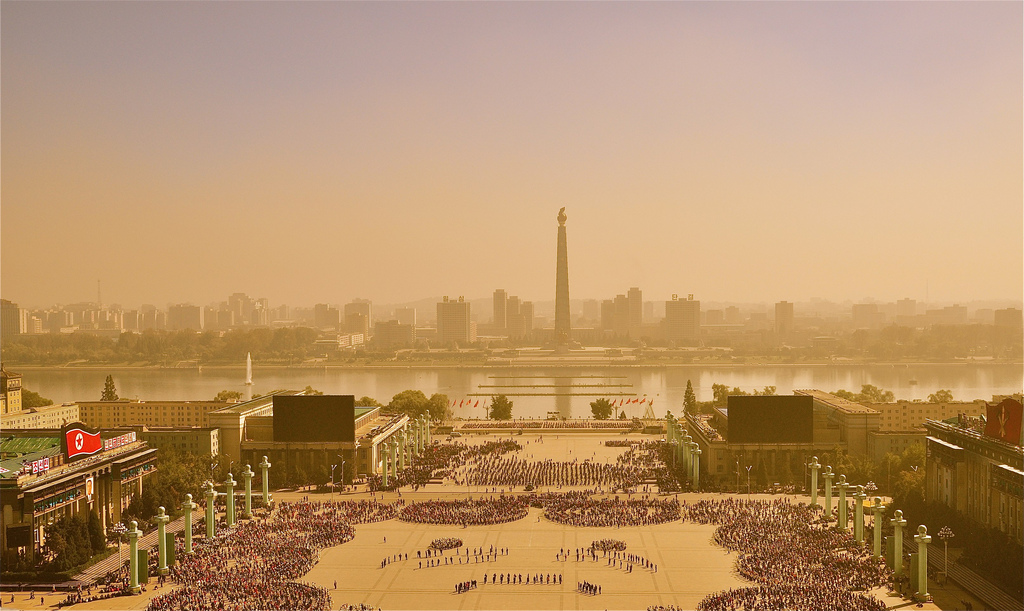 Rehearsals for the October 10th Worker’s Party anniversary parade. Photo by James Huang.
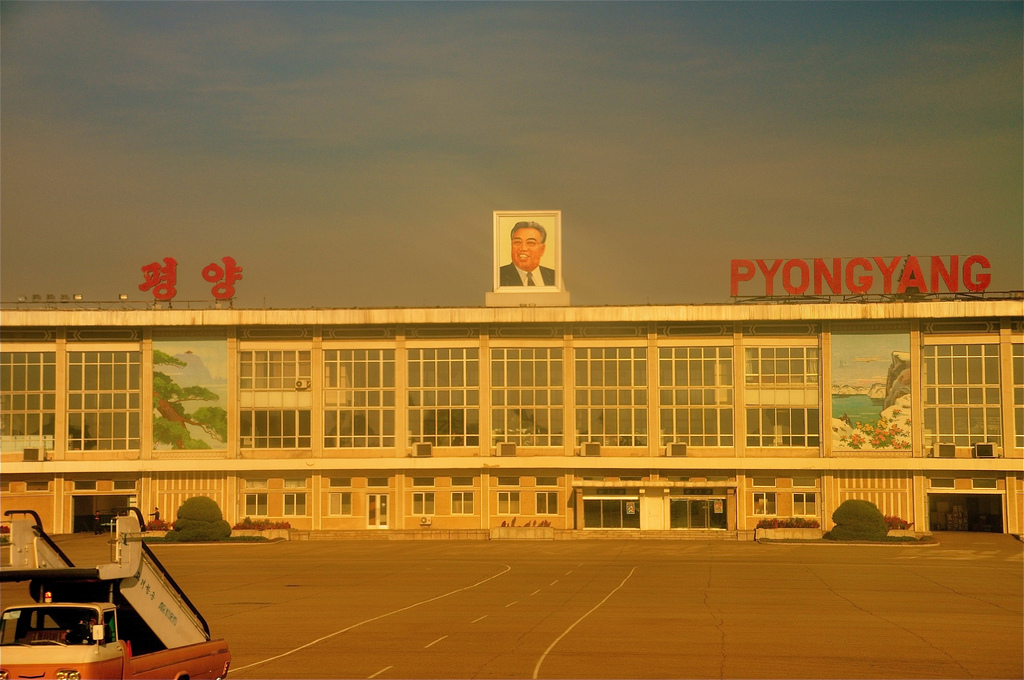 Kim Il Sung welcomes you to Sunan Airport Pyongyang. Photo by James Huang.
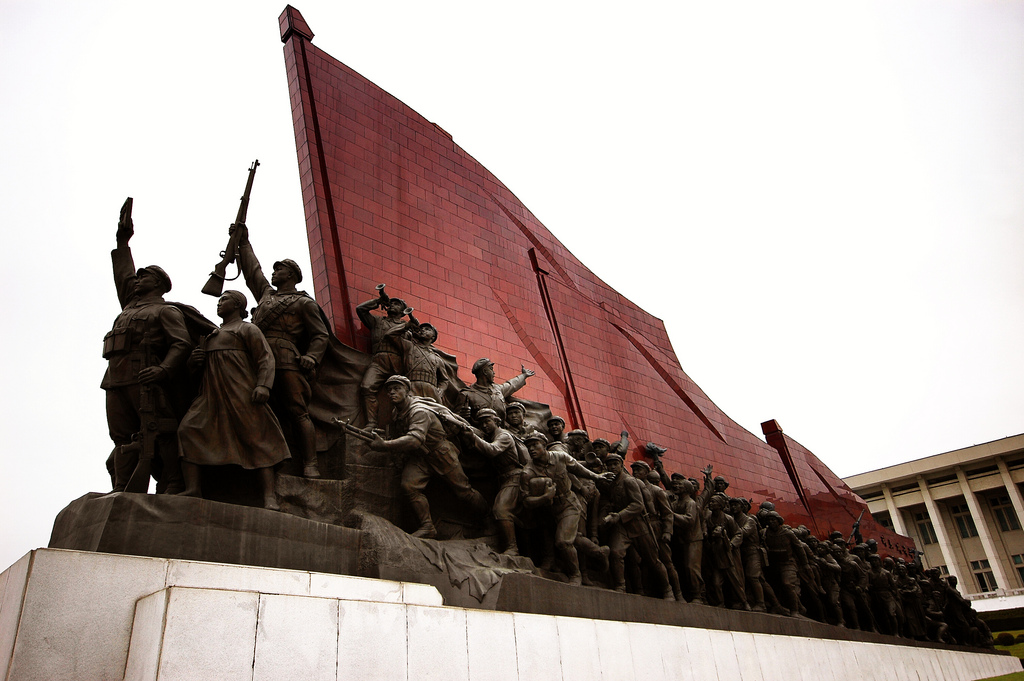 Photo by Crescent Zhang.
 Photo by Crescent Zhang.
 Photo by Crescent Zhang.
 One of the two Pyongyang metro stations tourists are allowed to see – Pyongyang, North Korea. Photo by Daniel K.
 Photo by Crescent Zhang.
 Propaganda posters at the entrance to the Pyongyang Metro. Photo by efdixon.
 Photo by James Huang.
 Photo by James Huang.
 Photo by James Huang.
 Photo by James Huang.
 Photo by James Huang.
 Photo by James Huang.
 Photo by efdixon.
 Photo by efdixon.
 Photo by Crescent Zhang.
 Photo by Crescent Zhang.
 Photo by Crescent Zhang.
 Photo by James Huang.
 Photo by Crescent Zhang.
 Photo by Crescent Zhang.
 Photo by James Huang.
UNCENSORED – North Korea Kim Jong-il Hysterical Mourner Photos
 Pyongyang residents react as they mourn over the death of North Korean leader Kim Jong-il in Pyongyang, in this photo taken by Kyodo on December 19, 2011. Kim Jong-il died on a train trip on Saturday, state television reported on Monday, sparking immediate concern over who is in control of the reclusive state and its nuclear programme. REUTERS/Kyodo
 Pyongyang residents react as they mourn over the death of North Korean leader Kim Jong-il in Pyongyang, in this photo taken by Kyodo on December 19, 2011. Kim Jong-il died on a train trip on Saturday, state television reported on Monday, sparking immediate concern over who is in control of the reclusive state and its nuclear programme. REUTERS/Kyodo
 Pyongyang residents react as they mourn over the death of North Korean leader Kim Jong-il in Pyongyang, in this photo taken by Kyodo on December 19, 2011. Kim Jong-il died on a train trip on Saturday, state television reported on Monday, sparking immediate concern over who is in control of the reclusive state and its nuclear programme. REUTERS/Kyodo
 Pyongyang residents react as they mourn the death of North Korean leader Kim Jong-il in Pyongyang, in this photo taken by Kyodo on December 19, 2011. REUTERS/Kyodo
 North Koreans cry and scream in a display of mourning for their leader Kim Jong Il at the foot of a giant statue of his father Kim Il Sung in Pyongyang, North Korea, after Kim Jong Ils death was announced Monday, Dec. 19, 2011. North Korea’s news agency reported that he had died at 8:30 a.m. Saturday after having a heart attack on a train, adding that he had been treated for cardiac and cerebrovascular diseases for a long time. He was 69. (AP Photo/APTN)
 Pyongyang residents reacts as they mourn over the death of North Korean leader Kim Jong-il in Pyongyang, in this photo taken by Kyodo on December 19, 2011. REUTERS/Kyodo
 North Koreans mourn the death of their leader Kim Jong Il in Pyongyang on December 21, 2011. North Korea said that millions of grief-stricken people turned out to mourn “Dear Leader” Kim Jong-Il, whose death has left the world scrambling for details about his young successor. AFP PHOTO/Kyodo
 Pyongyang residents reacts as they mourn over the death of North Korean leader Kim Jong-il in Pyongyang, in this photo taken by Kyodo on December 19, 2011. Kim Jong-il died on a train trip on Saturday, state television reported on Monday, sparking immediate concern over who is in control of the reclusive state and its nuclear programme. REUTERS/Kyodo
 A woman and her son cry as they mourn the death of North Korean leader Kim Jong-il at a square on Mansu Hill in Pyongyang, in this photo taken by Kyodo on December 19, 2011. Kim Jong-il died on a train trip on Saturday, state television reported on Monday, sparking immediate concern over who is in control of the reclusive state and its nuclear programme. REUTERS/Kyodo
 North Korean men cry as they mourn the death of North Korean leader Kim Jong-il in Pyongyang December 19, 2011 in this picture released by the North’s official KCNA news agency on Monday. North Korean leader Kim Jong-il died on a train trip on Saturday, state television reported on Monday, sparking immediate concern over who is in control of the reclusive state and its nuclear programme. REUTERS/KCNA
 North Koreans mourn in front of a picture of their late leader Kim Jong Il in Pyongyang on December 21, 2011. North Korea said that millions of grief-stricken people turned out to mourn “Dear Leader” Kim Jong-Il, whose death has left the world scrambling for details about his young successor. AFP PHOTO/Kyodo
 North Koreans mourn as they pay their respects to their late leader Kim Jong Il in Pyongyang on December 21, 2011. North Korea said that millions of grief-stricken people turned out to mourn “Dear Leader” Kim Jong-Il, whose death has left the world scrambling for details about his young successor. AFP PHOTO/Kyodo
 (111220) — BEIJING, Dec. 20, 2011 (Xinhua) — Nationals of the Democratic People’s Republic of Korea (DPRK) in China mourn the death of DPRK top leader Kim Jong Il at the DPRK embassy in Beijing, capital of China, Dec. 20, 2011. (Xinhua/Liu Weibing) (ry)
 North Koreans mourn for deceased leader Kim Jong-il in Pyongyang in this picture released by the North’s official KCNA news agency early December 21, 2011. North Korea was in seclusion on Tuesday, a day after it announced the death of its leader Kim Jong-il, as concern mounted over what would happen next in the deeply secretive nation that is trying to build a nuclear arsenal. REUTERS/KCNA
 North Koreans mourn for deceased leader Kim Jong-il in Pyongyang in this picture released by the North’s official KCNA news agency early December 21, 2011. North Korea was in seclusion on Tuesday, a day after it announced the death of its leader Kim Jong-il, as concern mounted over what would happen next in the deeply secretive nation that is trying to build a nuclear arsenal. REUTERS/KCNA
 North Koreans mourn for their deceased leader Kim Jong-il at the Kumsusan Memorial Palace in Pyongyang in this picture taken on December 21, 2011 and released by the North’s KCNA news agency on December 23, 2011. Kim Jong-il, who ruled isolated and impoverished North Korea from 1994, died on December 17, 2011, according to the state’s media. REUTERS/KCNA
 Pyongyang residents react as they mourn over the death of North Korean leader Kim Jong-il in Pyongyang, in this photo taken by Kyodo on December 19, 2011. Kim Jong-il died on a train trip on Saturday, state television reported on Monday, sparking immediate concern over who is in control of the reclusive state and its nuclear programme. REUTERS/Kyodo
 Residents kneel down as they mourn the death of North Korean leader Kim Jong-il during a gathering in a square in Pyongyang in this December 19, 2011 still image taken from video. Kim Jong-il died on a train trip on Saturday, state television reported on Monday, sparking immediate concern over who is in control of the reclusive state and its nuclear programme. REUTERS/KCNA
 Employees of Pyongyang 326 Electric Wire Factory mourn over the death of North Korean leader Kim Jong-il, as they gather in a conference hall in Pyongyang December 19, 2011 in this still image taken from video. Kim Jong-il died on a train trip on Saturday, state television reported on Monday, sparking immediate concern over who is in control of the reclusive state and its nuclear programme.
From the CIA – The Intelligence Officer’s Bookshelf
DOWNLOAD E-BOOK HERE
TOP-SECRET – Taliban Top 5 Most Deadly Tactics Techniques and Procedures

To gain an understanding of the Top 5 casualty producing Tactics, Techniques and Procedures in Afghanistan
To introduce the Top Threat Groups in Afghanistan and along the Pakistani border
To understand the location of hostile action in Afghanistan
To understand Threat weapon employment
– Attack data
– Technology used
– TTP
To introduce Threat use of Information Warfare (INFOWAR) across Tactics, Techniques, and Procedures


DOWNLOAD ORIGINAL DOCUMENT HERE
Ex-Capital Chefredakteur Brunowsky entlarvt die STASI-Stalker- und Erpresser-Spekulanten-Methoden der “GoMoPa” am Beispiel WGF
Nepper Schlepper Bauernfänger im Internet
Im Internet tummeln sich seit einiger Zeit Finanzportale, in denen anonyme Schreiber manipulative Texte verfassen. Sie richten sich in der Regel gegen kleine, marktenge Börsenwerte und kooperieren mit Anwälten, die vorgeblich Kapitalanleger schützen wollen und für die notwendigen Zitate gut sind.
Das ganze funktioniert so: Ein kritischer Text in “www.börsennews.de” oder “www.gomopa.net“, anonym oder unter falschem Namen geschrieben, stellt Fragen, ob das Geld der Anleger sicher sei, ohne diese Frage zu beantworten. Der Schreiber sendet diesen Text anonym an Medien wie das Handelsblatt oder FTD. Ein kooperierender Anwalt spricht dann vielsagend von Gefahren für den Anleger. Die Anleger reagieren natürlich verunsichert, der Kurs stürzt ab. Leerverkäufer – wahrscheinlich aus dem Umfeld des Trios Finanzportal, Finanjournalist und Anwalt – haben sich rechtzeitig eingedeckt und sahnen einen kräftigen Gewinn ab.
Das ganze funktioniert so: Ein kritischer Text in “www.börsennews.de” oder “www.gomopa.net“, anonym oder unter falschem Namen geschrieben, stellt Fragen, ob das Geld der Anleger sicher sei, ohne diese Frage zu beantworten. Der Schreiber sendet diesen Text anonym an Medien wie das Handelsblatt oder FTD. Ein kooperierender Anwalt spricht dann vielsagend von Gefahren für den Anleger. Die Anleger reagieren natürlich verunsichert, der Kurs stürzt ab. Leerverkäufer – wahrscheinlich aus dem Umfeld des Trios Finanzportal, Finanjournalist und Anwalt – haben sich rechtzeitig eingedeckt und sahnen einen kräftigen Gewinn ab.
Die größeren Medien sehen angesichts der Kursverluste nun ebenfalls das Unternehmen in Gefahr, berichten darüber und verunsichern die Anleger zusätzlich. Vom Finanzportal “gomopa.net” ist bekannt, dass es anschließend den Betroffenen einen PR-Beratungsvertrag aufdrücken wollte, den diese dann als “Erpressung” ablehnten, wie die Süddeutsche Zeitung am 3.9.2010 berichtete. Auch das Handelsblatt hat im April vor einiger Zeit über einen ähnlichen Fall berichtet.
Ich erlebe diese Methoden gerade bei einer ähnlichen Kampagne gegen meinen Mandanten WGF AG. Die WGF AG handelt mit Immobilien, entwickelt großartige Projekte und refinanziert sich mit Hypothekenanleihen. Am 15.11. wurde pünktlich die zweite mit 6,35% verzinste Hypothekenanleihe im Volumen von 30 Millionen Euro entgegen diversen Unkenrufen pünktlich und vollständig zurückgezahlt.
Im Juli war ein Text unter falschem Namen im Finanzportal “Börsennews” mit Zitaten eines Anwalts erschienen, den der Autor weiteren Medien zuspielte. Unmittelbar darauf stürzten die Kurse mehrere Anleihen von 100 auf teilweise bis zu 60 Prozent. Die Kurse erholten sich dann zwar wieder um 10 bis 15 Prozentpunkte, aber nicht so, dass Raum für die Platzierung neuer Anleihen mit einem Ausgabekurs von 100 blieb. Die WGF war dennoch in der Lage, aus dem gut laufenden operativen Geschäft heraus die Rückzahlung der zweiten Anleihe sicher zu stellen. Anfang der Woche, am Tag nach der Rückzahlung erschien wieder ein anonymer Artikel in “gomopa.net”. So geht die Kampagne weiter.
Selbstverständlich müssen alle Geschäftsmodelle kritisch hinterfragt werden. Unternehmen machen Fehler und müssen diese Fehler auch beheben. Es kann aber nicht sein, dass gewissenlose Leute im Internet ihr Unwesen treiben und ganze Unternehmen attackieren, um damit Geld zu verdienen: Der Anwalt, der dazu beiträgt, Unternehmen zu gefährden, um anschließend Klienten für seinen sogenannten Kapitalanlegerschutz zu generieren, ist genauso hinterhältig wie der Journalist, der sich nicht zu seinen Texten bekennt und anonym oder unter falschem Namen schreibt, um an Kursspekulationen mitzuverdienen.
Eingestellt von Ralf-Dieter Brunowsky
http://brunowsky.blogspot.com/2011/11/nepper-schlepper-bauernfanger-im.html#links
Über mich

- Ralf-Dieter Brunowsky
- Cologne, NRW, Germany
- 2002-today: PR-Agency BrunoMedia GmbH, Köln 1991-2001 Editor in Chief financial magazine CAPITAL 1989-1990 managing editor Impulse 1980-1989 correspondent and managing editor Wirtschaftswoche 1977-1979 editor Berliner Morgenpost 1975-1977 manager retail association 1969-1975 university Berlin 1968-1969 German Navy
New – House Homeland Security Committee Introduces Bill to Create National Cybersecurity Authority

Members of the House Homeland Security Committee introduced a cybersecurity bill on Thursday that would establish a quasi-governmental entity to oversee information-sharing with the private sector.
Like the other cybersecurity bills offered by the House GOP, the Promoting and Enhancing Cybersecurity and Information Sharing Effectiveness (PrECISE Act) encourages private firms to share information on cyber threats but stops short of mandating new security standards for sectors deemed critical to national security.
“The risk of cyberattack by enemies of the United States is real, is ongoing and is growing,” said Chairman Pete King (R-N.Y.). “The PrECISE Act, in line with the framework set forth by the Speaker’s Cybersecurity Task Force led by Rep. [Mac] Thornberry [R-Texas], protects our critical infrastructure without a heavy-handed and burdensome regulatory approach that could cost American jobs.”
The bill would clearly delineate the cybersecurity functions of the Department of Homeland Security by requiring DHS to evaluate cybersecurity risks for critical infrastructure firms and determine the best way to mitigate them.
“Cybersecurity is truly a team sport, and this bill gives DHS needed authorities to play its part in the federal government’s cybersecurity mission and enables the private sector to play its part by giving them the information and access to technical support they need to protect critical infrastructure,” said House Cybersecurity subcomittee Chairman Dan Lungren (R-Calif.).
ORIGINAL DOCUMENT SEE HERE
TOP-SECRET from the FBI – Ashburn Realtor Charged in $7 Million Mortgage Fraud Scheme
ALEXANDRIA, VA—A federal grand jury has charged Nadin Samnang, 29, of Ashburn, Va., with conspiracy and mortgage fraud charges related to his role in alleged fraudulent mortgage loan transactions involving at least 25 homes in northern Virginia and more than $7 million in losses to lenders.
Neil H. MacBride, United States Attorney for the Eastern District of Virginia; Daniel Cortez, Inspector in Charge of the Washington Division of the United States Postal Inspection Service; and James W. McJunkin, Assistant Director in Charge of the FBI’s Washington Field Office, made the announcement.
According to the 12-count indictment, from 2006 to 2008, Samnang is accused of using his position as a realtor and the owner of a title company to engage in a scheme to defraud mortgage lenders and profit from loan proceeds, commissions, and bonus payments.
According to the indictment, Samnang and other members of the conspiracy allegedly recruited unqualified buyers—usually individuals with good credit but insufficient assets or income to qualify for a particular loan—and used them as nominal purchasers in residential real estate transactions. As part of the conspiracy and fraud scheme, Samnang and others are accused of falsifying mortgage loan applications, creating fake documents to support the fraudulent applications, and adding the unqualified buyers as signatories on their bank accounts to make it appear to lenders as though the buyers possessed sufficient assets to qualify for the loans.
If convicted, Samnang faces a maximum penalty of 20 years in prison on each count.
The case is being investigated by the U.S. Postal Inspection Service and the FBI’s Washington Field Office. Assistant United States Attorney Paul J. Nathanson is prosecuting the case on behalf of the United States.
Criminal indictments are only charges and not evidence of guilt. A defendant is presumed to be innocent until and unless proven guilty.
Sources – Iran Reportedly Arrests Twelve CIA Agents
Senior Iranian parliamentary officials announced that the country has arrested 12 agents of the American Central Intelligence Agency.Member of the Iranian Parliament’s National Security and Foreign Policy Commission Parviz Sorouri said that the agents had been operating in coordination with Israel’s Mossad and other regional agencies, and targeted the country’s military and its nuclear program.
“The US and Zionist regime’s espionage apparatuses were trying to damage Iran both from inside and outside with a heavy blow, using regional intelligence services,” Sorouri told the Islamic republic news agency on Wednesday.
“Fortunately, with swift reaction by the Iranian intelligence department, the actions failed to bear fruit,” Sorouri said.
The lawmaker did not specify the nationality of the agents, nor when or where they had been arrested.
This current announcement follows the unraveling by Lebanon’s Hezbollah of a CIA spy ring in that country.
Hezbollah Leader Sheik Hassan Nasrallah revealed in June on television he had unmasked at least two CIA spies who had infiltrated the low ranks of the organization.
Though the US Embassy in Lebanon officially denied the accusation, American officials later confirmed Nasrallah’s announcement.
US officials confessed on Tuesday that Iranian intelligence forces and Hezbollah have unraveled the CIA’s spy network in Iran and Lebanon and arrested dozens of informants, severely damaging the intelligence agency’s reputation and ability to gather vital information on the two countries at a sensitive time in the region.
US officials said several foreign spies working for the CIA had been captured by Hezbollah in recent months. The blow to the CIA’s operations in Lebanon came after top agency managers were alerted last year to be especially careful handling informants in the Middle East country.
Separately, counterintelligence officers in Iran also succeeded in uncovering the identities of at least a handful of alleged CIA informants, Washington officials said.
A CIA-led program in the Middle East is up in the air after officials confirmed to news organizations today that paid informants in Iran and Lebanon working for the US government have disappeared while attempting to infiltrate Hezbollah.
During the past year, leaders of both Iran and Hezbollah have publicly announced the successes of their security and counterintelligence forces in uncovering CIA informants.
Iranian intelligence minister Heidar Moslehi announced in May that more than 30 US and Israeli spies had been discovered and he quickly took to Iranian television to broadcast information explaining the methods of online communication that the agents would use to trade intel. Only a month later, Hezbollah leader Seyed Hassan Nasrallah announced that two high-ranking officers within his own organization had been identified as CIA spies. Just now, however, does the US government confirm that not only is this information true, but they believe that the rest of their Hezbollah-targeted operations in the Middle East have been compromised.
TOP SECRET from the FBI Las Vegas – Sixteen Persons Charged in International Internet Fraud Scheme
LAS VEGAS—Federal charges have been unsealed against 16 individuals for their involvement in an international Internet scheme that defrauded online purchasers of purported merchandise such as automobiles and other items, announced Daniel G. Bogden, United States Attorney for the District of Nevada.
The defendants are charged with wire fraud, conspiracy to commit wire fraud, conspiracy to commit money laundering, and criminal forfeiture. Thirteen of the defendants were arrested in Las Vegas yesterday, December 14, 2011. Most of those defendants appeared before United States Magistrate Judge Robert J. Johnston yesterday, and pleaded not guilty to the charges. Several other defendants are scheduled for initial court appearances today beginning at 3:00 p.m. One individual was arrested at Washington Dulles International National Airport in Virginia, and appeared before a federal magistrate judge there, and the remaining two defendants have not yet been arrested.
According to the allegations in the indictment, from about December 2008 to December 2011, conspirators situated outside of the United States listed and offered items for sale on Internet sites (such as Craigslist and Autotrader) and occasionally also placed advertisements in newspapers. The items offered for sale included automobiles, travel trailers and watercraft. The conspirators typically offered the items at attractive prices and often stated that personal exigencies, such as unemployment, military deployment, or family emergencies, required that they sell the offered items quickly. To gain the confidence of prospective buyers, conspirators posing as owners of the items instructed buyers that the transactions were to be completed through eBay, Yahoo!Finance, or similar online services, which would securely hold the buyers’ funds until the purchased items were delivered. The conspirators sent e-mails to buyers which appeared or purported to be from eBay, Yahoo!Finance, or other such entities, and which instructed buyers to remit payment to designated agents of those entities who were to hold the purchase money in escrow until the transactions was concluded. In reality, the entire transaction was a sham: the conspirators did not deliver any of the items offered for sale; neither eBay, Yahoo!Finance, nor any similar entity participated in these transactions; and the purported escrow agents designated to receive buyers’ purchase money were actually participants in the scheme who received the funds fraudulently obtained from buyers on behalf of the conspiracy.
Relying on the schemers fraudulent representations, scores of buyers agreed to purchase items that the schemers offered online and in newspaper advertisements. The conspirators kept and converted the fraudulently obtained purchase money for their own purposes. The defendants and their associates allegedly obtained more than $3 million through the fraud scheme, which they distributed among the conspirators both inside and outside the United States.
Defendants:
- Eduard Petroiu, 28, Las Vegas resident
- Vladimir Budestean, 24, Las Vegas resident
- Bertly Ellazar, 27, Las Vegas resident
- Radu Lisnic, 25, Las Vegas resident
- Evghenii Russu, 25, Las Vegas resident
- Evgeny Krylov, 24, Las Vegas resident
- Eugeni Stoytchev, 35, Las Vegas resident
- Iavor Stoytchev, 28, Las Vegas resident
- Christopher Castro, 27, Las Vegas resident
- Delyana Nedyalkova, 23, Las Vegas resident
- Oleh Rymarchuk, 21, Las Vegas resident
- Melanie Pascua, 25, Las Vegas resident
- Manuel Garza, 23, Las Vegas resident
- Ryne Green, 25, Las Vegas resident
- Michael Vales, 22, Las Vegas resident
- Edelin Dimitrov, 20, Las Vegas resident
The indictment identifies Eduard Petroiu as a leader of the conspiracy, and six others, including Vladimir Budestean, Bertly Ellazar, Radu Lisnic, Evghenii Russu, and Eugeni Stoytechev, as subordinate managers of the conspiracy.
If convicted, the defendants face up to 60 years in prison and fines of up to $1 million.
The arrests result from a joint investigation by the FBI and the Las Vegas Metropolitan Police Department as part of its Nevada Cyber Crime and Southern Nevada Eastern European Organized Crime Task Forces. The case is being prosecuted by Assistant U.S. Attorney Timothy S. Vasquez.
The public is reminded that an indictment contains only charges and is not evidence of guilt. The defendants are presumed innocent and entitled to a fair trial at which the government has the burden of proving guilt beyond a reasonable doubt.
Anyone with information regarding these individuals is urged to call the FBI in Las Vegas at (702) 385-1281 or, to remain anonymous, call Crime Stoppers at (702) 385-5555 or visit http://www.crimestoppersofnv.com. Tips directly leading to an arrest or an indictment processed through Crime Stoppers may result in a cash reward.
UNCENSORED – Women Protest Worldwide Photos 10
![[Image]](https://i0.wp.com/cryptome.org/info/women-protest10/pict34.jpg) Egyptian army soldiers rear arrest a woman protester wearing the Niqab during clashes near Cairo’s downtown Tahrir Square, Egypt, Friday, Dec. 16, 2011. Activists say the clashes began after soldiers severely beat a young man who was part of a sit-in outside the Cabinet building. (Ahmed Ali) Egyptian army soldiers rear arrest a woman protester wearing the Niqab during clashes near Cairo’s downtown Tahrir Square, Egypt, Friday, Dec. 16, 2011. Activists say the clashes began after soldiers severely beat a young man who was part of a sit-in outside the Cabinet building. (Ahmed Ali) |
![[Image]](https://i0.wp.com/cryptome.org/info/women-protest10/pict0.jpg) Egyptian army soldiers beat a protester wearing a Niqab, an Islamic veil, during clashes near Cairo’s downtown Tahrir Square, Egypt, Friday, Dec. 16, 2011. Activists say the clashes began after soldiers severely beat a young man who was part of a sit-in outside the Cabinet building. At background graffiti depicts members of the military ruling council and Arabic reads: “Killer”. (Ahmed Ali) Egyptian army soldiers beat a protester wearing a Niqab, an Islamic veil, during clashes near Cairo’s downtown Tahrir Square, Egypt, Friday, Dec. 16, 2011. Activists say the clashes began after soldiers severely beat a young man who was part of a sit-in outside the Cabinet building. At background graffiti depicts members of the military ruling council and Arabic reads: “Killer”. (Ahmed Ali) |
![[Image]](https://i0.wp.com/cryptome.org/info/women-protest10/pict1.jpg) Egyptian protesters threw rocks at military police during clashes near Cairo’s downtown Tahrir Square, Egypt, Friday, Dec. 16, 2011. Activists say the clashes began after soldiers severely beat a young man who was part of a sit-in outside the Cabinet building. (Ahmed Ali) Egyptian protesters threw rocks at military police during clashes near Cairo’s downtown Tahrir Square, Egypt, Friday, Dec. 16, 2011. Activists say the clashes began after soldiers severely beat a young man who was part of a sit-in outside the Cabinet building. (Ahmed Ali)
|
![[Image]](https://i0.wp.com/cryptome.org/info/women-protest10/pict3.jpg) ![[Image]](https://i0.wp.com/cryptome.org/info/women-protest10/pict6.jpg) |
![[Image]](https://i0.wp.com/cryptome.org/info/women-protest10/pict33.jpg) Egyptian army soldiers arrest a woman protester during clashes with military police near Cairo’s downtown Tahrir Square, Egypt Friday, Dec. 16, 2011. Activists say the clashes began after soldiers severely beat a young man who was part of a sit-in outside the Cabinet building. Egyptian army soldiers arrest a woman protester during clashes with military police near Cairo’s downtown Tahrir Square, Egypt Friday, Dec. 16, 2011. Activists say the clashes began after soldiers severely beat a young man who was part of a sit-in outside the Cabinet building. |
![[Image]](https://i0.wp.com/cryptome.org/info/women-protest10/pict32.jpg) Egyptian army soldiers arrest a woman protester during clashes with military police near Cairo’s downtown Tahrir Square, Friday, Dec. 16, 2011. Activists say the clashes began after soldiers severely beat a young man who was part of a sit-in outside the Cabinet building. Egyptian army soldiers arrest a woman protester during clashes with military police near Cairo’s downtown Tahrir Square, Friday, Dec. 16, 2011. Activists say the clashes began after soldiers severely beat a young man who was part of a sit-in outside the Cabinet building. |
![[Image]](https://i0.wp.com/cryptome.org/info/women-protest10/pict35.jpg) Egyptian soldiers arrested a female protester during the second day of clashes in Tahrir Square in Cairo on Saturday. Reuters Egyptian soldiers arrested a female protester during the second day of clashes in Tahrir Square in Cairo on Saturday. Reuters |
![[Image]](https://i0.wp.com/cryptome.org/info/women-protest10/pict2.jpg) A woman is taken away by the Egyptian army during clashes in central Cairo on Dec. 16, 2011. (Khaled Elfiqi) A woman is taken away by the Egyptian army during clashes in central Cairo on Dec. 16, 2011. (Khaled Elfiqi) |
![[Image]](https://i0.wp.com/cryptome.org/info/women-protest10/pict4.jpg) Egyptian anti-army protesters throw stones at pro-army protesters (not pictured) during clashes, in central Cairo, Egypt, 16 december 2011. EPA Egyptian anti-army protesters throw stones at pro-army protesters (not pictured) during clashes, in central Cairo, Egypt, 16 december 2011. EPA |
![[Image]](https://i0.wp.com/cryptome.org/info/women-protest10/pict7.jpg) Egyptian soldiers clash with protesters near Cairo’s Tahrir Square on December 16, 2011 after demonstrators threw petrol bombs and set fire to furniture in front of the nearby parliament. AFP Egyptian soldiers clash with protesters near Cairo’s Tahrir Square on December 16, 2011 after demonstrators threw petrol bombs and set fire to furniture in front of the nearby parliament. AFP
|
![[Image]](https://i0.wp.com/cryptome.org/info/women-protest10/pict9.jpg) Anti-government protesters react to tear gas fired by riot police during clashes Saturday, Dec. 17, 2011, in Abu Saiba village west of the capital of Manama, Bahrain. It was the third straight day of clashes along a main highway where protesters have been trying to stage sit-ins against the government. (Hasan Jamali) Anti-government protesters react to tear gas fired by riot police during clashes Saturday, Dec. 17, 2011, in Abu Saiba village west of the capital of Manama, Bahrain. It was the third straight day of clashes along a main highway where protesters have been trying to stage sit-ins against the government. (Hasan Jamali) |
![[Image]](https://i0.wp.com/cryptome.org/info/women-protest10/pict19.jpg) Protestors supporting Pfc. Bradley Manning gather outside Ft. Meade, Md., Saturday, Dec. 17, 2011, where military prosecutors are presenting their case against him as the source for the WikiLeaks website’s collection of U.S. military and diplomatic secrets. Manning, 24-year-old today, is blamed for the largest leak of classified material in American history. The purpose of the hearing is to determine whether prosecutors have enough evidence to bring Manning to trial. (Jose Luis Magana) Protestors supporting Pfc. Bradley Manning gather outside Ft. Meade, Md., Saturday, Dec. 17, 2011, where military prosecutors are presenting their case against him as the source for the WikiLeaks website’s collection of U.S. military and diplomatic secrets. Manning, 24-year-old today, is blamed for the largest leak of classified material in American history. The purpose of the hearing is to determine whether prosecutors have enough evidence to bring Manning to trial. (Jose Luis Magana) |
![[Image]](https://i0.wp.com/cryptome.org/info/women-protest10/pict17.jpg) Activist of women’s movement FEMEN stand atop a fence during their protest in front of the cabinet of the Ministers building in Kiev on December 16, 2011. The young Ukrainian women climbed up a fence in front of the Cabinet of Ministers building and protested against the lack of women in the Prime Minister Mykola Azarov’s government. Getty Activist of women’s movement FEMEN stand atop a fence during their protest in front of the cabinet of the Ministers building in Kiev on December 16, 2011. The young Ukrainian women climbed up a fence in front of the Cabinet of Ministers building and protested against the lack of women in the Prime Minister Mykola Azarov’s government. Getty
|
![[Image]](https://i0.wp.com/cryptome.org/info/women-protest10/pict10.jpg) Anti-government protesters gesture toward riot police (unseen) Thursday, Dec. 15, 2011, along a northern highway by the entry to the Shiite village of Saar, Bahrain, site of an opposition sit-in that was dispersed by police with tear gas and sound bombs. (Hasan Jamali) Anti-government protesters gesture toward riot police (unseen) Thursday, Dec. 15, 2011, along a northern highway by the entry to the Shiite village of Saar, Bahrain, site of an opposition sit-in that was dispersed by police with tear gas and sound bombs. (Hasan Jamali) |
![[Image]](https://i0.wp.com/cryptome.org/info/women-protest10/pict11.jpg) Protestors hold on to a rope, forming a human chain, while marching to the finance ministry Thursday, Dec. 15 2011, in Lisbon. Civil servants’ unions organized the demonstration to protest the government’s austerity measures. Portugal needed a euro78 billion ($103 billion) bailout earlier this year as its high debt load pushed it close to bankruptcy and the government is enacting an austerity program of pay cuts and tax hikes. Banners read “Don’t rob the future”. (Armando Franca) Protestors hold on to a rope, forming a human chain, while marching to the finance ministry Thursday, Dec. 15 2011, in Lisbon. Civil servants’ unions organized the demonstration to protest the government’s austerity measures. Portugal needed a euro78 billion ($103 billion) bailout earlier this year as its high debt load pushed it close to bankruptcy and the government is enacting an austerity program of pay cuts and tax hikes. Banners read “Don’t rob the future”. (Armando Franca) |
![[Image]](https://i0.wp.com/cryptome.org/info/women-protest10/pict12.jpg) In this photo taken Tuesday, Dec. 13, 2011, villagers chant slogans as they gather for a protest in Wukan village of Lufeng, China’s Guangdong province. China’s government is trying to defuse a revolt in the small fishing village, offering to investigate the land seizures that touched off the rebellion and vowing to punish leaders of the uprising. The village of Wukan has for months been the site of simmering protests by locals who say officials sold farmland to developers without their consent. In this photo taken Tuesday, Dec. 13, 2011, villagers chant slogans as they gather for a protest in Wukan village of Lufeng, China’s Guangdong province. China’s government is trying to defuse a revolt in the small fishing village, offering to investigate the land seizures that touched off the rebellion and vowing to punish leaders of the uprising. The village of Wukan has for months been the site of simmering protests by locals who say officials sold farmland to developers without their consent. |
![[Image]](https://i0.wp.com/cryptome.org/info/women-protest10/pict13.jpg) Thousands of Lebanese private and public school teachers hold protest in front of the government building in downtown Beirut, Lebanon, Thursday, Dec. 15, 2011, to demand higher wages. The protest comes a week after the government approved a salary raise that many employees considered too low . (Bilal Hussein) Thousands of Lebanese private and public school teachers hold protest in front of the government building in downtown Beirut, Lebanon, Thursday, Dec. 15, 2011, to demand higher wages. The protest comes a week after the government approved a salary raise that many employees considered too low . (Bilal Hussein) |
![[Image]](https://i0.wp.com/cryptome.org/info/women-protest10/pict14.jpg) Indian farmers stage a sit in protest as they demand adequate compensation for their farm land acquired for different government projects in Lucknow, India, Wednesday, Dec. 14, 2011. India’s transformation from a largely agrarian nation into a global economic power hinges on a steady supply of land for new factories, call centers, power plants and homes. As cities spill over their seams with ever more people, the government is increasingly seizing the farms around them for private development. Indian farmers stage a sit in protest as they demand adequate compensation for their farm land acquired for different government projects in Lucknow, India, Wednesday, Dec. 14, 2011. India’s transformation from a largely agrarian nation into a global economic power hinges on a steady supply of land for new factories, call centers, power plants and homes. As cities spill over their seams with ever more people, the government is increasingly seizing the farms around them for private development. |
![[Image]](https://i0.wp.com/cryptome.org/info/women-protest10/pict15.jpg) Dozens of peasants and activists protest demanding the government to recognize them as victims of the country’s internal conflict, outside the Congress in Bogota, Colombia, Wednesday, Dec. 14, 2011. (William Fernando Martinez) Dozens of peasants and activists protest demanding the government to recognize them as victims of the country’s internal conflict, outside the Congress in Bogota, Colombia, Wednesday, Dec. 14, 2011. (William Fernando Martinez) |
![[Image]](https://i0.wp.com/cryptome.org/info/women-protest10/pict16.jpg) Protesters with Occupy Seattle march to the Pat the Port of Seattle, Monday afternoon, Dec. 12, 2011 as part of a national effort to disrupt West Coast port traffic. Organizers called for the protests, hoping the day of demonstrations would cut into the profits of the corporations that run the docks and send a message that their movement was not over. (Mark Harrison) Protesters with Occupy Seattle march to the Pat the Port of Seattle, Monday afternoon, Dec. 12, 2011 as part of a national effort to disrupt West Coast port traffic. Organizers called for the protests, hoping the day of demonstrations would cut into the profits of the corporations that run the docks and send a message that their movement was not over. (Mark Harrison) |
![[Image]](https://i0.wp.com/cryptome.org/info/women-protest10/pict5.jpg)
![[Image]](https://i0.wp.com/cryptome.org/info/women-protest10/pict8.jpg)
![[Image]](https://i0.wp.com/cryptome.org/info/women-protest10/pict18.jpg)
TOP-SECRET – Taash Communications Network: Iranian Green Movement Support Plan

Among the lessons learned from the revolutions in Egypt and Tunisia is the value and affect of unencumbered access to information and communications technology (ISCT), including but not limited to independent information and social networking across multiple platforms, such as mobile, internet, web-based, and satellite broadcast.
The current ICT available in and outside Iran remain largely silod platforms (i.e. lacking technology that facilitates convergence of information and interactivity). In general, the younger generation that support reform and actively oppose the regime from within have not been able to effectively access newer technologies or have been dissuaded from participating in communications programs operated by less legitimate traditional opposition parties from outside. Most these platforms are either state sponsored, like VOA and BBC, or are exile opposition websites and channels out of Los Angeles with a political agenda and low tolerance for alternative viewpoints. Most have failed to stay up to date with the language, trends, mentality, culture, and sociopolitical situation of the today Iran. The partisan nature of the older generation opposition groups further limit their ability to reach the younger demographic.
The traditional opposition groups based outside Iran do not maintain the legitimacy, technical capability, or political synergies to collaborate with the new generation of civil society organizations in Iran. Moreover, none of the existing available communication platforms effectively leverage digital content and networking by combining interactive mobile, internet, web, and satellite based secure communications vehicles.
The Democracy Council, in response to requests from prominent activists and organizations representing the Green Movement and other emerging sectors of civil society to collaboratively develop and deploy a “virtual sanctuary” for reform – minded Iranians to communicate, inform, network, organize, and advocate with each other and the larger Iranian society as well as the outside world. Currently, a significant amount of digital networking and content is produced by organizations affiliated with the Green Movement and independent civil society organizations (CSOs) in and outside Iran. However, distribution and leveraging f such content is limited by: 1. Technology available to CSOs, 2. Unaccommodating regional distribution platforms, internet, web and satellite based, 3. Lack of resources or skills to circumvent censorship and security regimes, 4. Lack of shared practices and resources. TCN will provide solutions to these four issues. In addition, CSOs and activists will merge their communications’ operations into the TCN platform to facilitate immediate and leveraged impact in Iran and the Persian-speaking world. For example, TCN will leverage the databases, mailing lists, and informal and formal marketing and advocacy operations through the single branded portal. These individual CSOs and independent producers would continue to manage their networking and marketing operations through the larger platform.
Taash Communications Network (TCN), developed by the Democracy Council (the Council) in collaboration with the leading representatives from the Green Movement, will help to meet this demand by providing the first robust, multilevel (internet, web, mobile, and satellite broadcast) communications channel for regionally produced progressive (uncensored) content and communications. TCN will operate as branded technological distribution portal (platform) made available to independent content and communications produced by and for progressive and reform – minded Iranians.
TCN will be the Facebook, twitter, NPR, and C-Span of Persian media under one roof with a focus on social and political issues concerning the Iranian public inside the country, in the region, and abroad. It will be a uniting factor that is demand-driven (commercially sustainable).
TCN will not produce content but provide technical services for the benefit of Iranian civil society.
…
SUMMARY PROGRAM DESCRIPTION:
Developed in coordination with prominent civil society figures in Iran, including representatives of the Green Movement, TCN would serve as a secure, robust, multilevel communications platform by which civil society members can deliver Persian content through:
· Interactive Website
· Advanced online (e.g. social networking) and mobile tools to secure unfettered access, availability, and interactivity to the content.
· Branded Persian Language video broadcast platform TCN would be owned by the nonprofit TCN Foundation registered in a European country, such as Denmark. The foundation’s mission would be to make available an independent, branded Persianlanguage communications platform that is available for high-quality user-generated programming.TCN will serve as an independent distribution platform without production activities and distributing largely “homegrown” content. TCN would not produce or fund any content itself. Content will be broadly through independently produced user-generated local and regional programming. These contents will be supplemented by the purchase of Persian rights to acquisition of online or TV entertainment programming, with progressive themes from Hollywood to Bollywood. TCN will be an independently-owned multi layer open platform for progressive, reform-minded or “edgy” programming without censorship. A number of civil society organizations and other groups, such as prominent figures in the Green Movement have already expressed an interest and are committed in producing programming and
content for distribution by many different TCN platforms.For example, TCN has received written expressions of support and pledges to produce content from a broad spectrum of independent individuals and organizations, such as:
· Mohsen Sazegara, a leading dissident and one of the original founders of the Iranian Revolutionary Guard
· Democratic Party of Iranian Kurdistan
· Shideh Rezaei, co-founder of Iran-Rooyan
· Ahmad Batebi, Human Rights Activists
· Mohammad Sadeghi Esfahlani, founder and administrator of Mir Hossein Mousavi’s and Zahra Rahnavard’s Supporters’ Network on Facebook,This informative, educational, and entertaining medium will actively engage, inform, inspire, and link Iranians without censorship. To meet the demand of the target market, foreign films, generally illegal in Iran for containing progressive themes, would be acquired and dubbed to augment the original programming. Such content would be distributed and made accessible through multiple mediums: a secure website that contains social networking applications, and utilizes mobile and circumvention tools, and a robust satellite broadcast channel.
TCN would work collaboratively with local and regional CSO’s to design and deploy a strategic audience acquisition program leveraging new technologies and viral techniques. Each independent producer would manage their own networking and advocacy component as a back end to their own regular internet or TV programming. TCN provides the technical background to ensure high penetration, distribution, and secure accessibility.
DOWNLOAD ORIGINAL DOCUMENT HERE
CONFIDENTIAL – IMF, EU, European Central Bank “Troika” Greece Debt Sustainability Analysis October 21, 2011

DOWNLOAD ORIGINAL DOCUMENT ABOVE BY CLICKING
This draft analysis by the so-called “troika” of the IMF, European Commission, and the European Central Bank was leaked.
Since the fourth review, the situation in Greece has taken a turn for the worse, with the economy increasingly adjusting through recession and related wage-price channels, rather than through structural reform driven increases in productivity. The authorities have also struggled to meet their policy commitments against these headwinds. For the purpose of the debt sustainability assessment, a revised baseline has been specified, which takes into account the implications of these developments for future growth and for likely policy outcomes. It has been extended through 2030 to fully capture long term growth dynamics, and possible financing implications.
The assessment shows that debt will remain high for the entire forecast horizon. While it would decline at a slow rate given heavy official support at low interest rates (through the EFSF as agreed at the July 21 Summit), this trajectory is not robust to a range of shocks. Making debt sustainable will require an ambitious combination of official support and private sector involvement (PSI). Even with much stronger PSI, large official sector support would be needed for an extended period. In this sense, ultimately sustainability depends on the strength of the official sector commitment to Greece.
…
3. Under these assumptions, Greece’s debt peaks at very high levels and would decline at a very slow rate pointing to the need for further debt relief to ensure sustainability. Debt (net of collateral required for PSI) would peak at 186 percent of GDP in 2013 and decline only to 152 percent of GDP by end-2020 and to 130 percent of GDP by end-2030. The financing package agreed on July 21(especially lower rates on EFSF loans) does help the debt trajectory, but its impact is more than offset by the revised macro and policy framework. Greece would not return to the market until 2021 under the market access assumptions used, and cumulatively official additional financing needs (beyond what remains in the present program, and including the eventual rollover of existing official loans) could amount to some €252 billion from the present through to 2020.

DOWNLOAD ORIGINAL DOCUMENT HERE
Tribute to a Legend – Christopher Hitchens: Whisky, Cigs & Jefferson
2006: Hitchens at D.G.Wills Books, 7461 Girard Avenue, La Jolla, Ca. 92037
http://www.vanityfair.com/online/daily/2011/12/In-Memoriam-Christopher-Hitche… Vanity Fair In Memoriam: Christopher Hitchens, 1949–2011, by Juli Weiner, Dec 15th 2011.
Christopher Hitchens—the incomparable critic, masterful rhetorician, fiery wit, and fearless bon vivant—died today at the age of 62. Hitchens was diagnosed with esophageal cancer in the spring of 2010, just after the publication of his memoir, Hitch-22, and began chemotherapy soon after. “My chief consolation in this year of living dyingly has been the presence of friends,” he wrote in the June 2011 issue. He died in their presence, too, at the MD Anderson Cancer Center in Houston, Texas. May his 62 years of living, well, so livingly console the many of us who will miss him dearly
——
Christopher Eric Hitchens (born 13 April 1949) is an Anglo-American author and journalist whose books, essays, and journalistic career span more than four decades. He has been a columnist and literary critic at The Atlantic, Vanity Fair, Slate, World Affairs, The Nation, Free Inquiry, and became a media fellow at the Hoover Institution in September 2008. He is a staple of talk shows and lecture circuits and in 2005 was voted the world’s fifth top public intellectual in a Prospect/Foreign Policy poll. He’s known for his admiration of George Orwell, Thomas Paine, and Thomas Jefferson and for his excoriating critiques of, among others, Mother Teresa, Bill and Hillary Clinton, and Henry Kissinger. His confrontational style of debate has made him both a lauded and controversial figure. As a political observer, polemicist and self-defined radical, he rose to prominence as a fixture of the left-wing publications in his native Britain and in the United States. His departure from the established political left began in 1989 after what he called the “tepid reaction” of the Western left following Ayatollah Khomeini’s issue of a fatwa- calling for the murder of Salman Rushdie. The 11 September 2001 attacks strengthened his internationalist embrace of an interventionist foreign policy, and his vociferous criticism of what he called “fascism with an Islamic face.” His numerous editorials in support of the Iraq War caused some to label him a neoconservative, although Hitchens insists he is not “a conservative of any kind”
TOP-SECRET from the CIA- Ronald Reagan: Intelligence and the End of the Cold War

Ronald Reagan became the 40th president of the United States more than thirty years ago, and ever since he stepped down to return to California eight years later, historians, political scientists, and pundits of all stripes have debated the meaning of his presidency. All modern presidents undergo reappraisal after their terms in office. Reagan has undergone a similar reappraisal. The old view, exemplified by Clark Clifford’s famous characterization that Reagan was “an amiable dunce,” posited Reagan as a great communicator, to be sure, but one without substance, a former actor who knew the lines others wrote for him, but intellectually an empty suit. Reagan, in the old narrative, simply could not be the architect of anything positive that happened while he was president. That perspective has changed forever and is marked by the continually improving regard historians have for Reagan.
DOWNLOAD ORIGINAL DOCUMENT HERE
SECRET – “Godfather” of Colombian Army Intelligence Acquitted in Palace of Justice Case


Washington, D.C. , December 18, 2011 – A Colombian army general acquitted today in one of the country’s most infamous human rights cases “actively” collaborated with paramilitary death squads responsible for dozens of massacres, according to formerly secret U.S. records obtained under the Freedom of Information Act by the National Security Archive.
Once the third-highest-ranking officer in the Colombian military and later a top adviser to President Álvaro Uribe’s Department of Administrative Security (DAS), Iván Ramírez Quintero was acquitted today in the torture and disappearance of Irma Franco, one of several people detained by the army during the November 1985 Palace of Justice disaster.
The exoneration comes despite substantial evidence, including declassified U.S. embassy cables, linking Ramírez to the disappearances. Among the documents are reports that the missing individuals were “tortured and killed” by members of the Charry Solano Brigade, the unit led by Ramírez at that time.
Two former senior army officers, Col. Alfonso Plazas Vega and Gen. Jesús Armando Arias Cabrales, have already been convicted in the Palace of Justice disaster and remain the only people sentenced in the now more than 25-year-old case. More than 100 people, including 11 Supreme Court justices, perished during military operations to retake the Palace of Justice from M-19 insurgents who seized the building in November 1985. A document previously published by the Archive blamed “soldiers under the command of Col. Alfonso Plazas Vega” for the deaths of individuals detained by the army following the raid.
The declassified file on Gen. Iván Ramírez Quintero, the so-called “godfather of army intelligence,” portrays him as a shrewd and corrupt spymaster who shared sensitive intelligence with illegal militia groups, cultivated relationships with drug traffickers and notorious paramilitary figures, and engaged in “scare tactics” to take down his political enemies.
“Portrait of a Corrupt General”
The declassified reports focus on ties between Ramírez, narco-traffickers, and the country’s illegal paramilitary groups in the 1990s, particularly while he was in charge of the army’s First Division, along Colombia’s Atlantic coast, where he maintained “direct links with paramilitaries,” according to intelligence sources cited in a 1996 Embassy cable. The following year, a special Defense Intelligence Agency report pictured Ramírez beneath the heading, “Portrait of a Corrupt General,” and next to a picture of “Drug Trafficker-Backed Paramilitary Forces.”
U.S. Ambassador Myles Frechette spoke with at least two different Colombian defense ministers about the general’s “suspected ties to narcotraffickers and paramilitaries.” In a November 1997 meeting with Colombian minister of defense Gilberto Echeverri, Frechette cited “more evidence suggesting that Ramirez is passing military intelligence to the paramilitaries, and that the intelligence is being used against the guerrillas.” Frechette had good reason for concern. A new U.S. law linking foreign military assistance to human rights performance had heightened the embassy’s focus on abusive officers, and Ramírez, despite pressure from the U.S. over his human rights record, had just been designated as the next army inspector general. Frechette bluntly told the defense minister “that if Ramirez were to attain higher rank or position, it would seriously compromise the USG’s [United States Government’s] ability to cooperate with the Colombian military.”
“Godfather of army intelligence”
U.S. contacts in the Colombian military took a similarly dim view of Ramírez. One former colonel said he was “convinced [that Ramírez] has gone far beyond the passive phase with paramilitaries and is actively supporting them.” The colonel was “concerned about the potential direction the Colar [Colombian army] could take if Ramirez abuses his position as IG [inspector general] or, worse, if he is allowed to rise to even higher positions in the armed forces hierarchy.” Ramírez is repeatedly characterized as the “godfather of army intelligence” with influence “so pervasive within the military intelligence community” that he maintained control over intelligence assignments even from non-intelligence posts.
Another retired Colombian officer told the Embassy that Ramírez had been the “godfather” of Colombia’s “intelligence mafia” for more than 20 years. The general “surrounded himself with loyal subordinates who ‘covered up for him'” and was connected to “shady elements” inside the army’s 20th Military Intelligence Brigade,” according to a cable reporting on the meeting.
The 20th Brigade was established in 1990 on the recommendations of a U.S. intelligence team, and Ramírez was its first commander. “Fundamentally designed for covert operations,” the brigade’s members were attached to army units across the country, according to a U.S. Army report (See page 79.). Personnel worked “undercover and in civilian clothes,” reporting only to division commanders and other intelligence officers.
The brigade became the most visible symbol of Colombia’s corrupt and abusive intelligence establishment, and was tied to political assassinations, the torture of suspected guerrillas, and Colombia’s brutal paramilitary forces. The State Department’s human rights report for 1997 singled out the intelligence brigade for “death squad activity,” a charge also leveled by Ambassador Frechette as he left the Bogotá post late that year.
Pulling the strings was the “godfather” Ramírez. One report addressed to the State Department’s under secretary for political affairs, Thomas Pickering, asserted that “Ramirez and some elements of the Bogota-based 20th Intelligence Brigade actively collaborate with paramilitaries by providing intelligence and other support.” The CIA connected Ramírez to Carlos Castaño, notorious head of the powerful United Self-defense Forces of Córdoba and Urabá (ACCU). A U.S. Embassy report from 1998 noted the army’s “new-found effectiveness in curbing the paramilitaries” since Ramírez had been removed from the First Division, adding that it seemed “more than coincidental that the recent anti-paramilitary actions have all taken place since the departure from northern Colombia of military personnel believed to favor paramilitaries.”
In May 1998, shortly before Colombia announced plans to dismantle the 20th Brigade, the State Department cancelled Ramírez’s U.S. visa. In an unusually passionate memo on the moral dilemma faced by U.S. policymakers in Colombia, the State Department’s desk officer for Andean Affairs, David Passage, made a rhetorical plea for self-reflection on the part of the Colombian army and the military intelligence system in particular. Colombia needed to develop “credible and defensible intelligence gathering techniques instead of 12-volt batteries and rubber hoses,” Passage asserted, strongly implying the Colombian military’s penchant for torture techniques.
Yes, we know the Colombian military doesn’t control all the paramilitary organizations – but we also know there are enough ties between many of them and Colombian military officers that it becomes impossible for us to turn a blind eye. NO, we’re not going to identify them; you know who they are. Heal yourselves before you ask us for help! If you don’t understand why we withdrew Gen Ivan Ramirez’s visa, then we’re too far apart to be able to cooperate with each other.
Three months later, a Washington Post report detailed extensive ties between Ramírez and paramilitary groups and also identified him as a “liaison and paid informant for the Central Intelligence Agency,” charges that he angrily denied. The damage done, Ramírez was passed up for promotion in 1999 and sent out of the country to serve as military attaché in Chile.
Never charged for his alleged paramilitary ties, Ramírez was appointed by President Álvaro Uribe as a special adviser to the country’s top civilian intelligence organization, the Administrative Department of Security (DAS) in 2006. The spy agency was subsequently found to be running a Watergate-style illegal-wiretapping operation targeting journalists, judges and human rights defenders.
Arrested for disappearances in the Palace of Justice case in 2008, Ramírez spent more than three years in preventive detention pending investigation and trial. Jailed former paramilitary chief Salvatore Mancuso has testified that both Ramírez and former DAS agents collaborated with his illegal forces.
The revelations about Gen. Ramírez are drawn from Colombia and the United States: Political Violence, Narcotics, and Human Rights, 1948-2010, a recent addition to the Digital National Security Archive. Edited by Michael Evans and published by ProQuest, the set consists of more than 3,000 declassified diplomatic and intelligence documents on Colombia’s decades-old conflict.
Confidential -Los Angeles Fusion Center: Detecting and Mitigating Cyber Threats

(U//FOUO) US citizens and assets – including the White House, the Central Intelligence Agency, InfraGard, the state of Arizona, and major defense contracting companies – experienced high-profile cyber threats and attacks in the first half of 2011. Most of the tactics and techniques used were not new, however the increase in attacks during the past few months exemplifies the growth of cyber incursions and reinforces the need to be aware of risks and mitigation techniques associated with cyber threats. Appendices A, B and C contain detailed lists of threats, potential indicators of attacks, and possible remedies; some areas may contain overlap.
(U) Different Actors, Different Motives, Different Threats
(U) Recent reporting has largely centered on attacks by “hacktivist” groups – loose collectives that conduct cyberactions to raise awareness regarding particular grievances or causes.ii These attacks generally garner significant media attention. While they are annoying, embarrassing, and disruptive to victims, they seldom result in meaningful losses or damage, beyond costs associated with website repair. More worrisome are sophisticated probes and attacks that exfiltrate sensitive data for malicious use, or plant software designed to disable systems. Attacks such as these may be conducted by state-sponsored actors or organized criminal enterprises, and may inflict greater damage and losses.
(U//FOUO) On 23 June, hacker group LulzSec released information taken from the Arizona Department of Public Safety – including personal information of law enforcement officers – to protest a controversial immigration law.
(U) A multi-phase attack between March and June 2011 against RSA, a secure token provider, and three major defense contractors, saw hackers use stolen and cloned token keys to breach and remove data from networks at the defense firms.
(U) The mid-2009 targeted Stuxnet virus temporarily disabled a uranium enrichment plant in Iran.
(U) Different Targets, Different Methods
(U//FOUO) A successful cyber attack can be detrimental to targeted systems, computers or individuals. Hackers may install programs that steal personal information, flood a browser with pop-up advertising, slow Internet connections, fill e-mail with advertisements and/or crash the system. They may take control of a computer, commit fraud or identity theft, or cause an individual to lose all data stored on that system. This can impact both personal and work systems, and can affect all aspects of an individual’s life.
(U//FOUO) Cyber threats can involve any aspect of communications and data infrastructure, but can be broadly categorized as threats to users, systems, and access devices, including mobile devices.
DOWNLOAD ORIGINAL DOCUMENT HERE
CONFIDENTIAL – (U//FOUO) FBI Threat to Law Enforcement From “Doxing”

(U//FOUO) The FBI assesses with high confidence a that law enforcement personnel and hacking victims are at risk for identity theft and harassment through a cyber technique called “doxing.” “Doxing” is a common practice among hackers in which a hacker will publicly release identifying information including full name, date of birth, address, and pictures typically retrieved from the social networking site profiles of a targeted individual.
(U//FOUO) In response to law enforcement activities that have occurred against Anonymous and LulzSecc since January 2011, members of these groups have increased their interest in targeting law enforcement in retaliation for the arrests and searches conducted. Hackers and hacktivists—hackers who commit a computer crime for communicating a socially or politically motivated message—have been openly discussing these activities on Twitter and posting information pertaining to law enforcement on their Twitter accounts and Internet Relay Chat (IRC) channels.
• (U//FOUO) In June 2011 members of Anonymous and LulzSec discussed an identified FBI agent in the IRC channel #lulzsec. The detailed information included when he or she started working for the FBI, training, assignments, and previous employment. FBI analysis suggests that this information was derived from a 2009 affidavit that was available on the Wired.com Web site.
• (U//FOUO) On 26 July 2011 the Twitter account OpMonsanto, an account used by members of Anonymous, warned of the intention to “dox” FBI agents following the 19 July 2011 arrests of 16 individuals for their presumed role in Anonymous’ activities: “OpMonsanto: To any FBI agent involved in the continued unjust raiding of peaceful Anons: Expect us. You are no longer entitled to your privacy.”
• (U) On 31 July 2011 more than 70 law enforcement Web sites were hacked and large amounts of confidential data was exfiltrated. These Web sites included state and local police departments that were not associated with the takedowns. The data consisted of email addresses, usernames, Social Security numbers, home addresses, phone numbers, password dumps, internal training files, informant lists, jail inmate databases, and active warrant information. Operation AntiSecd claimed that the intrusion was in response to “bogus, trumped-up charges” against the individuals associated with Anonymous’ attacks on PayPal.
(U//FOUO) Recently, Anonymous members have also “doxed” the employees of companies that were victims of their previous attacks, who are perceived as working with law enforcement.
• (U) In July 2011 a sealed search warrant affidavit pertaining to the 19 July takedown was available on the Internet. The affidavit contained the personal information of employees of two US companies, as well as FBI personnel. The personal information consisted of names, units, and job titles.
(U) Outlook and Implications
(U//FOUO) The 19 July takedown of Anonymous and LulzSec members has increased members’ interest in targeting law enforcement in retaliation for the arrests and searches conducted. As more arrests are made against suspected members of Anonymous and LulzSec, the FBI expects hacking activities and “doxing” that targets law enforcement and government interests will continue. This could compromise investigations and result in harassment and identity theft of the individuals named in the “dox.”
(U//FOUO) Precautionary measures to mitigate potential harassment and identity theft risk to being “doxed” include:
o Safeguarding material containing personal information pertaining to officers and named victims;
o Changing passwords and do not reuse passwords for multiple accounts;
o Using strong passwords;
o Monitoring credit reports;
o Monitoring online personal information, including what others post about you on services such as social networking sites;
o Being careful when giving out contact information; and
o Being aware of social engineering tactics aimed at revealing sensitive information.
DOWNLOAD ORIGINAL DOCUMENT HERE
Confidential-Statement by Director General Israel Atomic Energy Commission To the International Atomic Energy Agency

Mme President,
Distinguished Delegates,
Mme President, let me begin by congratulating you, on being elected President of the General Conference. I can assure you the fullest cooperation of the delegation of Israel, in carrying out your important and responsible tasks. I also wish to congratulate the kingdom of Cambodia and the Republic of Rwanda as new members of the Agency. Yesterday, the General Conference has confirmed Ambassador Yukiya Amano of Japan, to the most professional and distinguished post of IAEA’s Director General. Israel has known Ambassador Amano’s professional qualifications and personal integrity over the years, and looks forward to working with him in this new capacity. We wish Ambassador Amano much success in guiding the work of the Agency.
Mme President,
In my address, I intend to dwell mainly on two issues: The new prospects for civil nuclear energy, and the risks associated with it. The risks include diversion of nuclear materials to military programs; nuclear terror; and safety and security of nuclear installations.
The nuclear industry has recently begun witnessing the emergence of a world-wide renaissance. While the intensive development of nuclear energy is highly desirable, it is imperative to minimize proliferation risks – especially risks which are associated with nuclear fuel cycle technologies. The characteristics of these technologies are that they are inherently dual use in their nature. It is the firm view and the policy of Israel, that the right to use nuclear energy for peaceful purposes is based on the absolute duty of each state not to abuse this right.
Mme President,
Israel attaches great importance to the nuclear non-proliferation regime. The regime has recently been under growing pressure, from within, by states that are parties to the NPT. Despite the geo-political realities in the Middle East, it has been Israel’s long standing policy of supporting, and wherever possible, joining arms control and other international treaties. In doing so, we are very appreciative of those who are conscious and mindful of Israel’s narrow security margins. In recent years, Israel has actively followed developments in the fields of nonproliferation and arms control. This includes a renewed interest in multilateral nuclear arms control and disarmament led by US President Barak Obama. Israel has continued to contribute to the global non-proliferation regime, through its policy of responsible behavior and restraint in the nuclear domain. Israel has repeatedly stated that it will not be the first to introduce nuclear weapons in to the Middle East. It is therefore regrettable that the outgoing Director General of the
IAEA, repeatedly mispresented Israel’s long standing policy in this regard. The continuous growth of Israel’s energy needs, coupled with its total dependence on foreign energy sources, poses a complex national challenge. Israel possesses advanced nuclear expertise and know-how that will play an impressive role when it comes to the future development of Israel’s energy sources.Mme President,
I would like to address Israel’s vision and policy, regarding the transformation of the Middle East to a zone free of weapons of mass destruction. It has always been the position of Israel that the nuclear issue, as well as all other security issues, could only be realistically addressed within the regional context. The African Nuclear Weapon Free Zone Treaty, which has recently entered into force, provides an excellent example of such an approach.
It is our vision and policy, to establish the Middle East as a mutually verifiable zone free of weapons of mass destruction and their delivery systems. We have always emphasized, that such a process, through direct negotiations, should begin with confidence building measures. They should be followed by mutual recognition, reconciliation, and peaceful relations. Consequently conventional and non-conventional arms control measures will emerge. Israel’s long-term goals for Middle East regional security and arms control were approved by the Israeli Government. As the international community has accepted and recognized in other regions, the establishment of such a zone can only emanate from within the region.
In our view, progress towards realizing this vision cannot be made without a fundamental change in regional circumstances, including a significant transformation in the attitude of states in the region towards Israel. The constant efforts by member states in the region to single out the State of Israel in blatantly anti-Israeli resolutions in this General Conference, is a clear reflection of such hostile attitude.
Mme President,
Significant and grave developments regarding nuclear proliferation have taken place in the recent years. I want to emphasize, that the most widely recognized cases of non-compliance with legally binding non-proliferation obligations, have occurred in the Middle East, by states that are parties to the NPT. Grave and covert violations by Iran and Syria had been detected and then formally reported by the IAEA. The Agency’s investigations in these two countries have been hampered by continued lack of cooperation, denial of access, and efforts to conceal and mislead the inspectors.
Israel is following these developments in our region, with profound concern. We all hope that the IAEA investigations will get to the bottom of these activities. In so doing it will assist the international community in its efforts to prevent dangerous proliferation of nuclear weapons, and the abuse of the right to peaceful nuclear energy.
We believe that it is crucial to improve and enhance the IAEA verification and inspection capabilities. We are also of the firm view, that IAEA investigations should be conducted free of any extraneous influences. Above all, the activities of those countries that breach their international commitments and obligations must be met with concrete and immediate international measures. Violations cannot go unpunished.
Mme President,
Another important issue, which poses many challenges to the international community, is nuclear safety and security. Adequate safety and physical security measures are crucial to ensure international acceptance of the nuclear civil industry. It is the long standing policy of the Israel Atomic Energy Commission, to pursue uncompromising standards of safety in its two nuclear research centers.
Mme President, Distinguished delegates.
The threat of radiological and nuclear materials in the hand of terrorists, confronts us all. In a world of global terrorist networks supported by rogue regimes, a secret and sudden attack, with a weapon of mass destruction, has become a chilling reality. None of us can confront this global threat alone. We must work together to secure the materials terrorists would need to build a radiological or improvised nuclear device. In this regard, we commend the IAEA for addressing the prevention of illicit trafficking of radioactive and nuclear materials. In view of these realities, Israel has joined the US-Russia led Global Initiative to Combat Nuclear Terrorism (GICNT). It has also joined the Megaport Initiative led by the US Department of Energy to prevent possible illicit trafficking of radioactive and nuclear materials. We believe that no effort and resources should be spared worldwide, in denying terrorists these materials. In this spirit, the Government of Israel welcomes President Obama’s initiative, to host a Global Summit on Nuclear
Security next year.Mme President,
Given the global realities we all face, the peaceful uses of nuclear energy, should have been the main topics of this Annual General Conference. Regrettably, instead, some countries are imposing on this General Conference politically motivated agenda items. These efforts are either designed to single out the State of Israel, or to divert attention from violations and real issues of non-compliance by certain Middle East states.
First among these, is Agenda item 22 entitled “Israeli Nuclear Capabilities”. This Agenda item is no more than a version of an old agenda item that was removed by agreement in 1993, and never acted upon. Among the sponsors of this draft resolution are countries that do not recognize the State of Israel, and even call for its annihilation. I wonder what moral standing they possess as they criticize Israel
for pursuing policies designed to secure its very existence.Mme President,
The second is agenda item 21 entitled: “The application of IAEA Safeguards in the Middle East”. Israel has joined the consensus on this Agenda Item for 14 consecutive years. We have done so notwithstanding our grave reservations, regarding the modalities included in the resolution’s text, and the relevance of this forum in addressing the establishment of the Middle East as a nuclear weapon free zone. As I mentioned before, such a zone can only emanate from within the region on the basis of arrangements freely arrived at through direct negotiations, between all the states concerned. No IAEA Forum could replace direct negotiations between the regional parties.
Unfortunately, since 2006, the consensus on the Middle East issues was broken. The only reason for this setback is the uncompromising attitude of the sponsors of these two draft resolutions who are aiming at extraneous political goals. This raises also doubts whether the promotion of the Middle East into a nuclear weapon free zone, is indeed the aim of the sponsors.
During recent months, Israel has approached Egypt directly and through other Governments, hoping to reach an agreed language on Middle East issues in this General Conference. In the same spirit, Israel has responded positively in the recent days to sincere efforts by several delegations and the President of the Conference to work together towards a positive outcome. It is my firm belief that it is not too late to reach consensus based on our respective positions. I can assure you all of our fullest cooperation in trying to reach consensus based on negotiations in good faith.
Mme President,
Iran’s initiative to promote Agenda item 24 on “The Prohibition of Armed Attack or threat of Attack against Nuclear Installations” is a clear case of hypocrisy. Iran is driven by wishful thinking, that the international community will condone Iran’s violations of its commitments and obligations, and its deception campaign over many years. No diplomatic smoke screen and maneuvering in the IAEA’s General Conference can obscure the real facts and findings. Let me remind all delegates that the Director General, in his recent address to the Board of Governors, provided an account of Iran’s non-cooperation with the Agency and said: “If this information is real”, “there is a high probability that nuclear weaponization activities have taken place”. The Government of Israel and many others assess, that the information available to the Agency is accurate and real. Iran, which is systematically violating several United Nations Security Council Resolutions, is seeking the sympathy of the same international community whose authority it flouts. I call on all delegations, to reject Iran’s transparent and cynical move.
Mme President,
The international community is at a critical crossroad in confronting a fundamental challenge. We should work together in promoting peaceful uses of nuclear energy, while preventing the spread of nuclear weapons and proliferation of sensitive technologies and materials.
Mme President, Distinguished delegates.
This coming Friday is the eve of the Jewish New Year 5770. In our prayers we say: “Here ends a year with its maledictions and a new year begins with its blessings”.
We hope that this year holds blessings and peace for all.
Thank you Mme President.
DOWNLOAD ORIGINAL DOCUMENT HERE
TOP – SECRET – (U//FOUO) U.S. Marine Corps Afghan Drone Operations in Regional Command Southwest (RC (SW))

(U) Purpose: To inform Deputy Commandants (DCs) Aviation, Combat Development and Integration (CD&I), Plans, Policies, and Operations (PP&O), Installations and Logistics (I&L), Commanding General (CG), Training and Education Command (TECOM), Director of Intelligence, operating forces, and others on results of a Marine Corps Center for Lessons Learned (MCCLL) collection conducted April – May 2011 to document lessons and observations regarding unmanned aerial systems (UAS) operations in support of Regional Command Southwest (RC (SW)) during Operation Enduring Freedom (OEF).
Bottom Line up Front
(U//FOUO) The RQ-7B Shadow UAS employed by the Marine Corps is a U. S. Army program of record. Because it is an Army program the Shadow has very high frequency (VHF) but no ultra-high frequency (UHF) retransmission capability. UHF is the primary means of communication between key elements of the Marine air command and control system (MACCS), airborne Marine Corps aviation assets, and Marine joint terminal attack controllers (JTAC) and forward air controllers (FAC). Developing a UHF retransmission capability for an organic USMC UAS was regarded as a primary need.
(U//FOUO) USMC units were dependent on joint assets for armed UAS missions and competed with virtually every other combat unit in OEF to schedule armed UAS sorties. Developing an organic armed USMC UAS was regarded as a priority.
(U//FOUO) Third Marine Aircraft Wing (MAW) Forward (Fwd) conceived and initiated a staff organization called the Marine air ground task force (MAGTF) Aerial Reconnaissance Coordination Cell (MARCC). The intent of the MARCC was to ensure that all aviation combat element (ACE) intelligence, surveillance, and reconnaissance (ISR) capabilities, manned and unmanned, were coordinated and employed to maximum effectiveness.
(U//FOUO) The establishment of the MARCC initially generated operational friction between the RC (SW) ACE and the ground combat element (GCE). The ACE regarded the MARCC as a more efficient means of conducting command and control of ACE assets. However, the GCE had been accustomed to a greater degree of autonomy in employing UASs and perceived the establishment of the MARCC as an impediment to responsiveness and their ability to dynamically retask UASs as desired.
(U//FOUO) As the ground scheme of maneuver evolved, establishing and supporting UAS “hubs” and “spokes” in proximity to ground forces posed a significant challenge to 3d MAW (Fwd) planners. [MCCLL Note: A hub is a UAS airfield base of operations used to launch and recover UASs and a spoke is a scalable outlying UAS control site supported by the hub.] In addition to requiring facilities suitable for the launch, recovery, and maintenance of UASs, a key consideration was the appropriate manning of each hub and spoke. A significant limiting factor in the MAW’s ability to establish hubs and spokes was a lack of trained intelligence analysts, UAS mission commanders, and maintenance personnel (this included contract maintenance support for the ScanEagle UAS due to contractor habitability mandates subject to that contract).
(U//FOUO) The volume of UAS sorties and their importance to the MAGTF is expected to increase in the future, including the development of a logistics support UAS and a new small tactical unmanned aerial system (STUAS). This has generated a need to determine where UAS assets would best be located within the ACE of the MAGTF. The Marine Unmanned Aerial Vehicle Squadron ONE and TWO (VMU-1 / VMU-2) commanding officers believed they should be located within a Marine aircraft group (MAG) just as all USMC aviation squadrons. [MCCLL Note: The VMUs are located within the Marine air control group (MACG) in garrison. During OEF deployment the VMUs were located directly within the MAW (Fwd) because there were no deployed MAGs and the MACG was composed of a small detachment.]
Key Points:
(U//FOUO) The MARCC worked to incorporate all ACE ISR capabilities into overall ISR planning done by RC (SW), advised RC (SW) planners and leaders on which aviation assets could best fill ISR requirements and requests, ensured air tasking order (ATO) development included the RC (SW) commander’s prioritization for tasking of ISR assets, streamlined information flow regarding these assets in order to build situational awareness throughout the MACCS, and facilitated the dynamic retasking of ISR platforms as necessary.
(U//FOUO) VMU-1 established a “hot weather schedule” during the summer months due to temperatures that could reach as high as 135 degrees Fahrenheit on the runway. This extreme heat could cause the Shadow’s wings to swell and vent fuel. However, the ScanEagle did not have this significant a problem with the heat and has longer endurance, so, the VMU scheduled ScanEagle sorties earlier in the day but still sufficient to cover the hottest time of day and Shadow sorties in the morning or evening. This enabled the VMU to maintain coverage throughout the fly-day. VMU-1 also erected a large area maintenance shelter for aircraft maintenance (LAMS-A) in order to keep aircraft and personnel out of the heat.
(U//FOUO) UAS technologies and capabilities continue to be developed and fielded. Training and education of UAS users, including unit air officers, intelligence officers, FACs, JTACs, and joint fires observers (JFO), regarding new capabilities and how best to employ UASs is vital. In order to support this, sufficient UAS assets must be made available during pre-deployment training.
(U//FOUO) The Marine Corps has recently fielded the Satellite Wide-Area Network version 2 (SWANv2) that will be included in the VMU organic table of equipment. Unlike the Digital Video Broadcasting Return Channel via Satellite (DVB-RCS) system currently being used, SWANv2 is a Marine Corps program of record that will enable the VMUs to disseminate full-motion video (FMV) signals more effectively.
(U//FOUO) In July, 2010, a contract was awarded to Boeing subsidiary Insitu, Inc. for development and production of the STUAS. STUAS will be used by the U.S. Navy and Marine Corps to provide persistent maritime and land-based tactical reconnaissance, surveillance, and target acquisition (RSTA) data collection and dissemination. Unlike the current ScanEagle and Shadow UASs, STUAS will have a UHF retransmission capability and the modularity to carry “plug-and-play” mission payloads such as hyper-spectral imaging sensors, synthetic aperture radar sensors, and potentially small precision-guided munitions (PGM) among others.
(U//FOUO) The establishment of the MARCC initially created the perception within the GCE of two separate procedures for requesting UAS support – one procedure for requesting organic support and a different procedure for requesting joint support. However, the 3d MAW (Fwd) Future Operations Officer said that, the team that developed the MARCC specifically avoided creating any new procedures for the end users.
(U//FOUO) The MARCC officer-in-charge (OIC) developed a comprehensive kneeboard card that had information regarding all of the unmanned assets that were going to be airborne during a particular fly-day. This provided aircrew with situational awareness that was critical to safety of flight and helped reduce the chance of mid-air collisions. The kneeboard card also provided time, location, and contact frequency information that could be used to more effectively and efficiently employ or retask UASs.
(U//FOUO) The RC (SW) ISR officer noted that they were building a “collection strategy playbook” that would describe different tactics, techniques, and procedures (TTP) that have proved successful in integrating different intelligence collections effects. For example: layering ground-moving-target-indicator data with dismounted-moving-target-indicator assets (two different kinds of radar) and integrating those with a wide-area surveillance sensor (such as a UAS, Ground Based Operational Surveillance System (GBOSS), or Aerostat balloon) in support of real-time operations.
(U//FOUO) The fact that there is no primary military occupational specialty (MOS) designator for UAS officers degraded the ability of the VMUs to retain corporate knowledge and experience within the UAS community. Instead, officers were assigned to VMUs for 18 – 24 month tours of duty, a substantial portion of which was spent in training, and usually never returned to the UAS community after transferring out.

DOWNLOAD ORIGINAL DOCUMENT HERE
UNCENSORED – NEW – FEMEN protestes EURO 2012

CONFIDENTIAL – Amazon Location Tracking and Future Destination Prediction Patent

This patent was submitted by Amazon on December 6, 2011. It describes a method of tracking individuals through mobile phone GPS location data and then using the information to predict future shopping destinations to present more specifically targeted advertising.
Mobile device users may be tracked either via mobile-signal triangulation or via Global Positioning Satellite information. A mobile device user’s recent movements may be analyzed to determine trails or traffic patterns for device user among various locations. Mobile device trail information, either for an individual user or aggregated for multiple users, may be analyzed to determine a next destination for the user. Electronic advertising content, such as advertisements, coupons and/or other communications, associated with the next destination may be sent to an electronic device likely to be viewed by the mobile device user. Additionally, the identity of the mobile device user may be known and the advertisements or coupons may be tailored according to demographic information regarding the mobile device user. In addition, destinations may be recommended to mobile device users based on the recent locations the users have visited.

SUMMARY
The movements of mobile device users may be detected, recorded, tracked and analyzed in order to direct advertising content to the mobile device users based on the users’ predicted destinations. For example, location dependent advertising content may be provided to mobile device users based on a current and/or predicted location that the mobile device user is likely to visit. In some embodiments, mobile device users’ current and past travel patterns may be analyzed to determine a predicted next destination. For instance, by analyzing the recent movements of a mobile device user among stores in a shopping mall, it may be determined that a particular store is a predicted next destination for the mobile device user. Thus, advertising content for the predicted destination, such as coupons, may be sent to the mobile device user.
In some embodiments, a mobile device user’s travel or traffic patterns (e.g., a set of locations and the order in which those location are visited) may be analyzed to predict a next likely location or destination. Various types of advertising content, such as electronic coupons, and other advertisements may be directed to the mobile device user based on the predicted destination. For example, a mobile device user may be tracked as she shops at various stores in a shopping mall. Based on the stores she has recently visited, a traffic pattern analysis system may determine a next most likely store or other destination that the mobile device user may visit. The system may then send advertisements, coupons, or other commercial communication to the user’s mobile device or to another electronic display device, such as to offer a discount or other shopping benefit to the mobile device user if she visits the predicted destination.
For instance, in one embodiment, a mobile device user may be tracked as she visits several of the clothing stores in a shopping mall. Based on the type and location of the stores visited, the system may determine that she is likely to visit another clothing store in another part of the shopping mall. In response to determining a store that the mobile device user is likely to visit, the system may send advertising content, such as an electronic coupon good for 10% off any purchases made at the store that day, to the mobile device user. Thus, the mobile device user may be more likely to visit the store because of the added enticement of the discount.
DOWNLOAD THE DOCUMENT HERE
STUDY- U.S. Corporate Executives Received a Pay Raise of 27-40% Last Year
Chief executive pay has roared back after two years of stagnation and decline. America’s top bosses enjoyed pay hikes of between 27 and 40% last year, according to the largest survey of US CEO pay. The dramatic bounceback comes as the latest government figures show wages for the majority of Americans are failing to keep up with inflation.
America’s highest paid executive took home more than $145.2m, and as stock prices recovered across the board, the median value of bosses’ profits on stock options rose 70% in 2010, from $950,400 to $1.3m. The news comes against the backdrop of an Occupy Wall Street movement that has focused Washington’s attention on the pay packages of America’s highest paid.
The Guardian’s exclusive first look at the CEO pay survey from corporate governance group GMI Ratings will further fuel debate about America’s widening income gap. The survey, the most extensive in the US, covered 2,647 companies, and offers a comprehensive assessment of all the data now available relating to 2010 pay.
Last year’s survey, covering 2009, found pay rates were broadly flat following a decline in wages the year before. Base salaries in 2009 showed a median increase of around 2%, and annual cash compensation increased just over 1.5%. The troubled stock markets took their toll, and added together CEO pay declined for the third year, though the decrease was marginal, less than three-tenths of a percent. The decline in the wider economy in 2007, 2008 and 2009 far outstripped the decline in CEO pay.
This year’s survey shows CEO pay packages have boomed: the top 10 earners took home more than $770m between them in 2010. As stock prices began to recover last year, the increase in CEO pay outstripped the rise in share value. The Russell 3000 measure of US stock prices was up by 16.93% in 2010, but CEO pay went up by 27.19% overall. For S&P 500 CEOs, the largest companies in the sample, total realised compensation – including perks and pensions and stock awards – increased by a median of 36.47%. Total pay at midcap companies, which are slightly smaller than the top firms, rose 40.2%.
DOWNLOAD ORIGINAL STUDY HERE
TOP-SECRET – U.S. Treasury Strategic Direction Fiscal Years 2009-2011

The Intelligence Authorization Act of Fiscal Year 2004 created the Treasury Department’s Office of Intelligence and Analysis (OIA) and made it responsible for the receipt, analysis, collation, and dissemination of intelligence related to the operation and responsibilities of the Treasury Department. OIA was created to support the formulation of policy and the execution of Treasury authorities by providing expert analysis and intelligence production on financial and other support networks for terrorist groups, proliferators, and other key national security threats. In addition, OIA was charged with providing timely, accurate, and focused intelligence on the full range of economic, political, and security issues. On April 28, 2004, the Secretary of the Treasury established the Office of Terrorism and Financial Intelligence (TFI), which includes OIA, the Office of Terrorist Finance and Financial Crimes (TFFC), the Office of Foreign Assets Control (OFAC), the Financial Crimes Enforcement Network (FinCEN), and the Treasury Executive Office for Asset Forfeiture (TEOAF). TFI brings a wide range of intelligence and enforcement authorities together under a single umbrella to strategically target a number of threats. Since its creation in 2004, OIA has accomplished a great deal in the course of meeting ever growing demands from its customers. In its first year of operation, OIA focused on establishing a current intelligence process to meet the day-to-day information needs of decision makers in the Department, while also supporting the intelligence needs of the designation process under EO 13224.
• In 2005, President Bush signed EO 13382 aimed at freezing the assets of proliferators of weapons of mass destruction and their supporters; OIA expanded its analytic efforts in order to support implementation of the EO.
• In 2006, OIA enhanced its strategic analytic capability and began producing allsource intelligence assessments on terrorist finance and rogue state proliferation networks that leveraged Treasury’s unique expertise and perspective.
• In 2007, OIA expanded the breadth and depth of its analytic cadre to meet increased demand from policymakers.
• In 2008, OIA initiated a research program to examine the systemic issues behind the financing of national security threats, such as cash courier networks, informal remittance systems, and terrorist use of the Internet.


ADDRESSING THE GLOBAL FINANCIAL NETWORK:
A COMPREHENSIVE APPROACH TO FINANCIAL
INTELLIGENCE
Building on its accomplishments of the past several years, OIA plans to launch a comprehensive approach to financial intelligence that will allow us to better confront national security challenges by strengthening our understanding of the global financial network. The global financial network encompasses four areas: the financial underpinnings of national security threats, our adversaries’ financial vulnerabilities, the impact of targeted financial measures, and threats to international financial stability.
1. Assess Financial Underpinnings of National Security Threats: Terrorists, WMD proliferators, rogue states, and other nefarious actors require financial resources to support their activities. Without ready access to such resources, these actors are unable to indoctrinate, recruit, and train personnel; buy weapons, technology, and equipment; circulate propaganda; bribe officials; support the global networks of operatives essential to their existence; or launch attacks. The flow of funds to activities that threaten national security may not be shut off completely, but impeding the activities of these networks makes operating costlier, harder, and riskier for these threats.
2. Identify Adversaries’ Financial Vulnerabilities: The US Government is relying more heavily on targeted financial measures aimed at specific actors engaged in illicit conduct, as opposed to broad-based economic sanctions. Targeted financial measures allow decision makers to apply financial pressure and isolate terrorists, proliferators, and others whose goal is to undermine US security. They also allow US leaders to take punitive action against threats without resorting to military force. Applying targeted financial measures effectively, however, requires indepth knowledge of an adversary’s economic or financial well-being: its strengths, weaknesses, connectivity to global markets, and key dependencies.
3. Evaluate the Impact of Targeted Financial Measures: As targeted financial measures become an increasingly important policy tool, measuring their effectiveness is imperative. This area of inquiry involves questions such as: What impact have the measures had on the target’s economy and financial system? How is the target reacting? Are the measures having the desired effect on the target’s behavior? What steps is the target taking to evade or avoid the measures? Moreover, have the measures had any unintended consequences or caused any collateral damage?
4. Monitor Threats to International Financial Stability: The US financial system and the economic well-being of every American are inexorably linked to the health and stability of the international financial system. Globalization and convergence in the world economy only underscore this fact. Identifying threats to the global financial system’s integrity and to sustainable growth and development therefore is essential to America’s own security.
…

DOWNLOAD ORIGINAL DOCUMENT HERE
TOP-SECRET from the Worldbank – Interim Strategy Note for the Republic of Iraq 2009-2011

INTERIM STRATEGY NOTE FOR IRAQ (FY09-FY11)
EXECUTIVE SUMMARY
i. Recent positive developments suggest that Iraq has made important progress towards political and economic stabilization, although the situation remains fragile and reversible. Recent months have seen a sharp decline in incidents of violence, especially in the Baghdad area, and a corresponding decrease in the rate of internal displacement of the population. This reflects improved security as well as successful initial steps towards political reconciliation. Macroeconomic performance has also improved although growth has been volatile.
ii. The Government is signaling its commitment to reform and reconstruction, indicating that continued engagement with Iraq may produce further concrete results. The Government has succeeded in sharply reducing inflation and containing recurrent spending, while increasing capital expenditures to accelerate the recovery process. In addition, the machinery of government is slowly reviving as Iraq emerges from conflict. A more proactive and confident government is likely to devote more attention to the economy. Finally, high oil prices and – to a lesser extent – an increase in production produced an estimated US$70 billion of revenues in 2008, although a deterioration in Iraq’s fiscal balance is expected during part of the ISN period in view of
the recent declining trend in oil prices.
iii. However, results from past and ongoing reform efforts remain far from meeting the needs and expectations of the Iraqi people. Unemployment remains extremely high and access to basic services severely limited. Electricity supply is unreliable and is far exceeded by demand; access to clean water and sanitation is the lowest in the Region. Recent improvements in access to education and health services have not yet translated into significant welfare gains on the part of the people of Iraq.
iv. Iraq is resource rich and has benefited from a substantial increase in oil revenues over the past few years. At the same time, it is still subject to conflict, insecurity, political instability and revenue volatility. These features highlight Iraq’s uniqueness. As a conflict-affected, IBRD-eligible middle-income country, Iraq is clearly not the typical aid-dependent post-conflict country. The main challenge for the country – in addition to security and political stability – is to mobilize and effectively use its own
vast resources to improve the welfare of the Iraqi people and rebuild its infrastructure. The main role for the international community, including the World Bank Group, is therefore to help Iraq use its own resources more effectively.
v. Working in Iraq has been very challenging for the Bank Group and other donors. While some notable successes have been achieved, the effectiveness of assistance has been hampered by issues related to both the country’s operating environment and the approach followed by the donors. Operating environment issues – which also affect the Government’s ability to execute its own investment budget – include: the fragile political and security situation; the unstable policy and institutional environment; the Government’s weakened institutional capacity, and weaknesses in Iraq’s banking system. Issues related to the approach of the Bank to Iraq include the selectivity of assistance as well as business processes and fiduciary arrangements which have been unfamiliar to Iraqi counterparts and are challenging for Ministries with limited capacity.
vi. The design of this third Interim Strategy Note benefited from a stocktaking of the Bank Group’s engagement with Iraq to date. The goal of the stocktaking exercise was to identify the key bottlenecks for the implementation of the previous ISNs and extract lessons for this ISN. This exercise informed the design of this ISN: (i) the continuing centrality of institution building; (ii) the critical importance of interest and engagement on the part of ministries and implementing agencies; (iii) the need for increased selectivity in terms of the ability to identify and seize opportunities as they arise to achieve concrete results; (iv) the need to focus on reform efforts that do not overtax Iraq’s existing capacity and that more clearly reflect the country’s current political and security situation; and (v) the need for increased flexibility in the design and programming of Bank assistance and for experimentation with alternative implementation arrangements for the Bank’s assistance program for Iraq.
vii. The ISN also benefited from extensive consultations with the Government of Iraq, the donor community, and other stakeholders, including representatives from private sector and civil society organizations. These consultations were extremely helpful in identifying the country priorities, defining promising engagement arrangements to maximize Bank assistance results, and highlighting the centrality of donor coordination. Some of the main priority areas identified during the consultations include:
(i) public financial management; (ii) banking sector reform; (iii) support to planning processes and strategy design (not only at the central level, but also at the sectoral and provincial levels); (iv) private sector development; and (v) energy and services.
viii. Given Iraq’s unique characteristic of a well resource endowed Middle Income Country (MIC) with a fragile environment, this ISN is proposed for a longer time horizon than the typical ISN. The time horizon for this ISN is proposed to be from mid-FY09 through FY11, to be updated to a full Country Assistance Strategy if and when circumstances allow. This interim strategy contains lessons and principles of engagement. The work program beyond FY09 would be kept up to date through Annual Business Planning, jointly with the Iraqi Government to ensure it meets the evolving needs of the Government as well as evolving opportunities for engagement.
ix. The central guiding principle of this ISN is that Iraq is well-endowed with natural and financial resources, and that the main role for the World Bank in this context is to help Iraq use its resources more effectively and transparently. This principle impacts both the form and the content of the proposed work program for the next two years. However, it needs to be tempered by recent developments in the global economy and their impact on Iraq’s projected oil revenues for the next few years and its increasing need for external financing in the short-to-medium term. Hence, this ISN anticipates IBRD financial support as requested by the Iraqi authorities.
x. Regarding the form of the assistance, the main instruments of Bank Group support under this ISN include: (i) operational support to accelerate implementation of the current portfolio, totaling about US$1 billion; (ii) advisory services in selected sectors and areas; (iii) IBRD financial support in priority sectors to be selected on the basis of funding needs and implementation capacity; (iv) IFC investment and advisory services products; and (v) MIGA’s political risk guarantee products. Under this ISN, an IBRD envelope of US$500 million can be committed for investments projects over FY09-11. The Bank is currently administering 16 active grants funded from the Iraq Trust Fund, totaling US$471.6 million to provide textbooks, schools, health clinics, improved social safety nets, water supply and sanitation, irrigation and drainage, and a comprehensive household survey. The ongoing IDA portfolio consists of five projects, worth US$508.5 million, in the areas of education, roads, electricity, and water supply. IFC will support PSD through prioritized investments and advisory services in key sectors. The Bank’s Analytical and Advisory Activities (AAA) program will support the Government in its efforts to enhance its ability to effectively use its oil revenues to the benefit of the Iraqi people. Key analytical work undertaken since re-engagement in 2003 includes a study on subnational public financial management (2007), a joint IFC/IBRD Construction Industry study (2008), a Country Economic Memorandum (2006), a pension reform study (2005), a report on Iraq’s Public Distribution System (2005), an investment climate report (2004), and a study on stateowned
enterprise reform (2004). The Government has also expressed interest in borrowing from IBRD as the need arises, increasing IFC support, and getting MIGA guarantees that could leverage private financing. Other instruments include the State and Peace Building Fund, and possibly, Treasury services.
xi. With respect to the content of the assistance, activities under this ISN will fall under at least one of three thematic areas of engagement: (i) continuing to support ongoing reconstruction and socio-economic recovery; (ii) improving governance and the
management of public resources, including human, natural and financial; and (iii) supporting policies and institutions that promote broad-based, private-sector-led growth, with the goal of revitalizing the private sector and facilitating job creation. IFC and MIGA will play a key role particularly (but not exclusively) with respect to the third thematic area. New activities under the ISN will be chosen on the basis of criteria for selectivity reflecting opportunities to achieve concrete results on the ground.
xii. The three thematic areas are closely linked with the key goals of the International Compact with Iraq. The first ISN theme responds to the goals of the International Compact with Iraq (ICI) which are related to Iraq’s reconstruction and recovery efforts, including strengthening the energy sector and developing a stable, competitive and sustainable agriculture. The second ISN theme responds to the ICI goals of improving public financial management as well as strengthening institutions and improving governance. The third ISN theme responds to the ICI goals of implementing economic reform to create an enabling environment for private investments as a driver for broad-based growth.
xiii. To achieve tangible results in a relatively short term, the Bank Group will place a renewed emphasis on how this ISN will be implemented. Building on lessons learned from the implementation of the previous Interim Strategy Notes and the various
consultations held, this ISN will aim to: (a) enhance the effectiveness of instittion building and analytical and advisory activities; (b) strengthen the implementation of the current portfolio; (c) introduce more flexibility in the Bank Group’s programming and ability to experiment with alternative implementation arrangements; and (d) foster donor coordination. For planning purposes, this ISN is based on the assumption that progress in the security situation over the next two to three years would continue to be slow and incremental, with a risk of reversal.
xiv. Risks. There are high risks to the World Bank Group’s program in Iraq. The most important risk pertains to the political and security situation, which remains fragile, as does the country’s operating environment. To mitigate this risk, the strategy emphasizes flexibility, and the Bank will adjust its activities as appropriate. Given the current limitations on mobility within the country, maintaining a vibrant dialogue with counterparts on issues of policy reform as well as implementation, and ensuring adherence to core fiduciary and safeguard requirements will remain challenging. These risks are substantial despite the Bank’s mitigating measures, which include capacity building, local oversight capacity, and prudent financial management procedures.

DOWNLOAD ORIGINAL DOCUMENT HERE
FBI – Three Maryland Men Indicted for Alleged Pension Plan Fraud
ALEXANDRIA, VA—Three Maryland men have been indicted for engaging in a scheme to steal nearly $10 million from Vienna-based Southern Management Corporation’s employee pension plan.
Neil H. MacBride, United States Attorney for the Eastern District of Virginia, and James W. McJunkin, Assistant Director in Charge of the FBI’s Washington Field Office, made the announcement.
Robert Fulton Rood IV, 44, of Potomac, Md., Nikolaos M. Hepler, 31, of Gaithersburg, Md., and Lloyd M. Mallory, Jr., 49, of Silver Spring, Md., were charged in a 16-count indictment of conspiracy to commit wire fraud, wire fraud and theft from an employee benefit plan. If convicted, each defendant faces a maximum penalty of 20 years on the conspiracy and each wire fraud count and five years in prison on each theft count.
According to the indictment, Rood conceived and led a scheme to defraud Southern Management Corporation Retirement Trust (“SMCRT”), a pension plan established by SMC for its employees. As of December 31, 2010, the plan’s assets were over $30 million, and prior to April 2006 SMCRT generally managed its own investments, which included short term (one year), high interest loans to real estate developers.
The indictment alleges that in April 2006, Rood persuaded SMC’s President and CEO to let Rood locate borrowers, negotiate loans to them, prepare the loan agreements, promissory notes and trust deeds and present loan application packages to the SMCRT loan committee, which would decide whether to purchase the proposed loans. If the committee decided to do so, it would wire the money to purchase the loan to a settlement company designated by Rood. Rood would use the money from SMCRT to fund the loan and would obtain from the borrower an executed loan agreement, promissory note and trust deed, which he would assign to SMCRT. In most cases, the borrowers were not aware of SMCRT’s involvement in the process.
Rood allegedly represented to both SMCRT and the borrowers that he would set up escrow accounts for the payment of interest to SMCRT and for construction payments to the borrowers. Instead, the indictment alleges that the moneys from all the loans were co-mingled into Rood’s principal bank account. When the project was finished and sold, the borrower was to pay back the amount borrowed to SMCRT.
From April 2006 to around October 2007, Rood allegedly sold to SMCRT approximately 32 mortgage loans that he had originated, of which 24 went into default after they were funded by SMCRT. According to the indictment, one loan, referred to as the “K Street” loan, never closed because the title company was unable to clear title to the property, and Rood is accused of simply keeping the money that SMCRT paid him to purchase the loan. Two other loans referenced in the indictment—the “Eastern Shore” and “Accom” loans—involved SMCRT loans that the borrowers refinanced with different lenders and sent their payoffs to Rood, who allegedly kept the payoff monies. In each case, Rood, assisted by Nikolaos M. Hepler, his employee, is accused of misrepresenting to SMCRT that the loans were in place and performing satisfactorily, including Rood’s making of the monthly interest payments to SMCRT on the nonexistent loans.
The indictment states that SMCRT requested an independent review of Rood’s accounts, and in February 2008, Rood engaged Mallory to perform a review of the loans, loans, disbursements and escrows. The accountant allegedly issued a report which falsely showed the status of the loans and the funds held by Rood.
This case was investigated by FBI’s Washington Field Office. Assistant United States Attorneys Michael E. Rich and Uzo Asonye are prosecuting the case on behalf of the United States.
Criminal indictments are only charges and not evidence of guilt. A defendant is presumed to be innocent until and unless proven guilty.
A copy of this press release may be found on the website of the United States Attorney’s Office for the Eastern District of Virginia at http://www.justice.gov/usao/vae. Related court documents and information may be found on the website of the District Court for the Eastern District of Virginia at http://www.vaed.uscourts.gov or on https://pcl.uscourts.gov.
FAZ über die Wirtschaftskriminellen der “GoMoPa”
TOP-SECRET – (U//FOUO) U.S. Army Guide to Political Groups in Afghanistan

 Political Parties in Afghanistan
- Most political groupings in Afghanistan are based on alliances that were formed during the military struggles of 1979-2002
- Many have connections with ex-Mujahideen factions
- During the 2005 presidential election, since parties‟ identification was not allowed for candidates, party based coalition could not function in parliament
- In the 2009 presidential election, political parties could support a candidate who was a member
- In Afghanistan, political parties are seen as controversial and are not seen as a potential positive force by the government or the public
- The Political Parties Law of 2003 requires all political parties to be registered with the Ministry of Justice and observe the precepts of Islam
- Some 82 parties have gained such recognition as of the end 2007; but hundreds of political groups claim to be active in the country today, the majority of which have little to no political power
- The government fears that encouraging political parties will fuel civil tensions and contribute to the existing deteriorating security
- The government places emphasis on building national unity and preventing groups from forming in Parliament on the basis of ethnicity, language, region or any other potentially divisive factors1
- For most parties, particularly the new or smaller ones without well known leaders, their information is not known or widely disseminated
- There are numerous reasons why parties formed and are forming but two main raisons stand out:
- New opportunity
- Especially after the fall of the Taliban
- Disputes with current leadership
- Political groups in Afghanistan are very fluid, coalitions, fronts and political alliances form and dissolve quickly
- Allegiances between groups shift according to the convictions of their leaders rather than by ideology
- Individual parties split, reunify and/or rename themselves constantly, leading to confusion in party existence and names
…
Major Pro-government Parties
- Islamic Society of Afghanistan (Hezb-e-Jamihat-e-Islami-e-Afghanistan)
- Afghanistan‟s Islamic Mission Organization (Tanzim Dawat-e-Islami-e-Afghanistan)
- Islamic Unity Party of Afghanistan (Hezb-e-Wahdat-e-Afghanistan)
- National Islamic Front of Afghanistan (Hezb-e-Mahaz-e-Mili Islami-e-Afghanistan)
- Afghanistan National Liberation Front (Hezb-e-Tanzim Jabha Mili Nejat-e Afghanistan)
- Afghan Social Democratic Party (Hezb-e-Afghan Melat)
- National Movement of Afghanistan (Nahzat-e-Mili Afghanistan)
Major Opposition Parties
- The United National Front – UNF (Jabhe-ye-Motahed-e-Mili)
- New Afghanistan (Hezb-e-Afghanistan-e-Naween)
- Hezb-e-Islami Gulbuddin – HiG
- Party of Islam – HiK (Hezb-e-Islami)
- Party of Islamic Unity of The People of Afghanistan (Hezb-e-Wahdat-e Islami Mardom Afghanistan)
- National Movement of Afghanistan (Nahzat-e-Mili Afghanistan)
Other Political Parties
- Revolutionary Association of the Women of Afghanistan (RAWA)
- Rome Group
- Freedom Party of Afghanistan(Hezb-e Azadee-e-Afghanistan)
- The National Understanding Front-NUF (Jabahai Tafahim Millie)
- National Youth Union of Afghanistan (Hezb-e Hambastagi-yi Milli-yi Jawanan-i Afghanistan)
DOWNLOAD ORIGINAL DOCUMENT HERE
Video – Syrian Officers Had Shoot-to-kill Orders
The group Human Rights Watch has named Syrian commanders and officials who it says authorized or ordered the killing or torture of anti-government protesters. HRW put the name of Syrian President Bashar Assad on the list.
TOP-SECRET from the FBI – Lawyer for Preeminent Firms Pleads Guilty in $37 Million Insider Trading Scheme
A corporate lawyer who previously worked at four prominent international law firms admitted today to participating in an insider trading scheme that lasted for 17 years, relied on information he stole from his law firms and their clients, and netted more than $37 million in illicit profits, U.S. Attorney for the District of New Jersey Paul J. Fishman announced.
Matthew Kluger, 50, of Oakton, Va., pleaded guilty to all four counts charged in the information against him: conspiracy to commit securities fraud, securities fraud, conspiracy to commit money laundering and obstruction of justice. Kluger entered his guilty plea before U.S. District Judge Katharine S. Hayden in Newark federal court.
“Not only did Matthew Kluger defraud the investing public, he betrayed the colleagues and clients who depended on his confidentiality in some of the biggest deals of the last decade,” said U.S. Attorney Fishman. “In order to be confident in our markets, investors must have comfort that those with inside information won’t abuse positions of trust for personal gain.”
“In this time of economic uncertainty, securities fraud remains a top investigative priority for the FBI,” said Michael B. Ward, special agent in charge of the Newark Division of the FBI. “Millions of investors have entrusted their life savings to the integrity of the financial markets and the belief of a level playing field. Insider trading, such as the conduct attributable to Matthew Kluger, corrupts the process and tilts the playing field in favor of those privileged few with access to information not available to the public, and at the expense of unsuspecting and unknowing investors.”
According to documents filed in this case and statements made in court:
Kluger and two co-conspirators—Garrett D. Bauer, 44, of New York, and Kenneth Robinson, 45, of Long Beach, N.Y.,—engaged in an insider trading scheme that began in 1994. Kluger admitted that he passed inside information to Bauer and Robinson that the men used to trade ahead of more than 30 different corporate transactions.
During the scheme, Kluger worked at four of the nation’s premier mergers and acquisitions law firms. From 1994 to 1997, he worked first as a summer associate and later as a corporate associate at Cravath Swaine & Moore in New York. From 1998 to 2001, he worked at Skadden, Arps, Slate, Meagher & Flom in New York and Palo Alto, Calif., as an associate in their corporate department. From 2001 to 2002, Kluger worked as a corporate associate at Fried, Frank, Harris, Shriver & Jacobson LLP in New York. From Dec. 5, 2005, to March 11, 2011, Kluger worked at Wilson Sonsini Goodrich & Rosati as a senior associate in the mergers & acquisitions department of the firm’s Washington, D.C., office.
While at the firms, Kluger regularly stole and disclosed to Robinson material, nonpublic information regarding anticipated corporate mergers and acquisitions on which his firms were working. Early in the scheme, Kluger disclosed information relating to deals on which he personally worked. As the scheme developed, and in an effort to avoid law enforcement detection, Kluger took information which he found primarily by viewing documents on his firms’ computer systems.
Kluger admitted that once he provided the inside information to Robinson, Robinson passed it to Bauer. Bauer then purchased shares for himself, Kluger and Robinson in Bauer’s trading accounts, then sold them once the relevant deal was publicly announced and the stock price rose. Bauer gave Robinson and Kluger their shares of the illicit profits in cash—often tens or hundreds of thousands of dollars per deal—that Bauer withdrew in multiple transactions from ATM machines.
The three conspirators took greater efforts to prevent detection of their insider trading scheme after Kluger joined Wilson Sonsini. Among other techniques, they used pay phones and prepaid cellular phones that they referred to as “throwaway phones” to discuss the scheme.
Kluger also admitted that, after Robinson told him that the FBI and (Internal Revenue Service) had searched Robinson’s house and had asked questions about the illicit scheme, Kluger destroyed multiple pieces of evidence, including an iPhone and a computer. Kluger also instructed Robinson to destroy a prepaid phone.
As part of his guilty plea, Kluger agreed to forfeit $415,000, which is the approximate amount that he obtained from recent transactions in the scheme.
The maximum potential penalties Kluger faces per count are as follows:
| Count | Charge | Maximum Potential Penalty |
|---|---|---|
| 1 | Conspiracy to commit securities fraud | Five years in prison; $250,000 fine, or twice the aggregate loss to victims or gain to the defendants |
| 2 | Securities fraud | 20 years in prison; $5 million fine |
| 3 | Conspiracy to commit money laundering | 20 years in prison; $500,000 fine, or twice the value of the property involved in the transaction |
| 4 | Obstruction of justice | 20 years in prison; $500,000 fine |
Judge Hayden scheduled Kluger’s sentencing for April 9, 2012.
Bauer and Robinson have both pleaded guilty in connection with the scheme. Bauer is scheduled to be sentenced on March 13, 2011. Robinson is scheduled to be sentenced on March 6, 2012.
U.S. Attorney Fishman credited special agents of the FBI, under the direction of Special Agent in Charge Ward in Newark, for the investigation. He also thanked special agents of the IRS, under the direction of Special Agent in Charge Victor W. Lessoff, and the U.S. Securities and Exchange Commission’s Market Abuse Unit and Philadelphia Regional Office, under the direction of Daniel M. Hawke.
The government is represented by Assistant U.S. Attorneys Matthew E. Beck of the U.S. Attorney’s Office Economic Crimes Unit; Judith H. Germano, Chief of the Economic Crimes Unit; and Lakshmi Srinivasan Herman of the office’s Asset Forfeiture Unit in Newark.
This case was brought in coordination with President Barack Obama’s Financial Fraud Enforcement Task Force. President Obama established the interagency Financial Fraud Enforcement Task Force to wage an aggressive, coordinated, and proactive effort to investigate and prosecute financial crimes. The task force includes representatives from a broad range of federal agencies, regulatory authorities, inspectors general, and state and local law enforcement who, working together, bring to bear a powerful array of criminal and civil enforcement resources. The task force is working to improve efforts across the federal executive branch, and with state and local partners, to investigate and prosecute significant financial crimes, ensure just and effective punishment for those who perpetrate financial crimes, combat discrimination in the lending and financial markets, and recover proceeds for victims of financial crimes.
CONFIDENTIAL – DARPA Wants to Make $500 Million Space-Based Spy Telescope
 A visualization of the MOIRE system provided by DARPA.
| If the U.S. military wants live video of a missile launcher vehicle halfway around the world, it must rely on spy planes or drones in danger of being shot down. Tomorrow, the Pentagon wants space telescopes hovering in geosynchronous orbit that could take real-time images or live video of any spot on Earth.Contrary to Hollywood’s ideas, today’s spy satellites that orbit the Earth at fast speeds and relatively lower altitudes can only snap photos for the U.S. military and intelligence agencies. Taking live video of a single location would require satellites to hover by matching the Earth’s rotation in geosynchronous orbit about 22,000 miles (36,000 kilometers) high — but creating and launching a space telescope with the huge optics arrays capable of seeing ground details from such high orbit has proven difficult.
As a solution, DARPA — the Pentagon’s research arm — envisions a lightweight optics array made of flexible membrane that could deploy in space. Ball Aerospace has just completed an early proof-of-concept review as part of a DARPA contract worth almost $37 million. “The use of membrane optics is an unprecedented approach to building large aperture telescopes,” said David Taylor, president and chief executive officer of Ball Aerospace in Boulder, Colo. DARPA eventually wants a space telescope with a collection aperture (light-collecting power) of almost 66 feet (20 meters) in diameter. By comparison, NASA’s next-generation James Webb Space Telescope is designed to have an aperture of 21 feet (6.5 m). Such a telescope should be able to spot missile launcher vehicles moving at speeds of up to 60 mph on the ground, according to the DARPA contract. That would also require the image resolution to see objects less than 10 feet (3 m) long within a single image pixel. But first, Ball Aerospace must create and test a 16-foot (5 m) telescope in the DARPA project’s second phase. Phase three would involve launching a 32-foot (10 m) telescope for flight tests in orbit. |
Watching for Scuds from Space:
MOIRE is intended to demonstrate technology for persistent, tactical, full-motion video surveillance from geosynchronous orbit. After delivery to GEO, the satellite would unfurl a micron-thin diffractive-optics membrane, to form a massive segmented lens.
With a target cost of less than $500 million a copy, the objective space telescope would have a 20-meter-dia. lens. It would be able to image an area greater than 100 x 100 km with a video update rate of at least one frame a second, providing a 99% chance of detecting a Scud-class missile launch.
Membrane Optical Imager for Real-Time Exploitation:
To meet national security requirements around the world, it would be optimal to have real-time images and video of any place on earth at any time—a capability that doesn’t currently exist. Today, aircraft are used for some imagery requirements. Because of the huge quantity of aircraft needed, and because aircraft do not fly high enough to see into denied territories, spacecraft are also used for imagery requirements.
Spacecraft, however, face different challenges in providing persistent coverage. The size (aperture) of the optics needed, and the limitations of producing and launching extremely large precision glass optics means it is infeasible to place such a system in geosynchronous earth orbit (GEO), approximately 36,000 kilometers high, where it could provide persistent coverage.MOIRE is a GEO-based system that uses a lightweight membrane optic etched with a diffractive pattern. The diffractive pattern is used to focus light on a sensor. The MOIRE program seeks to enable the technologies required for these very large optics for space platforms. The program aims to demonstrate the manufacturability of large membranes (up to 20 meters), large structures to hold the optics flat, and also demonstrate the secondary optical elements needed to turn a diffraction-based optic into a wide bandwidth imaging device.
The MOIRE program began in March 2010 and encompasses multiple phases: Phase 1 (proof of concept), Phase 2 (system design) and an option for a Phase 3 (system demonstration). The program is currently in Phase 1 and plans to transition to Phase 2 in Fall 2011.
New – Congress Authorizes Offensive Military Action in Cyberspace


Congress has given the U.S. military a green light to conduct offensive military activities in cyberspace.
“Congress affirms that the Department of Defense has the capability, and upon direction by the President may conduct offensive operations in cyberspace to defend our Nation, allies and interests,” said the FY 2012 defense authorization act that was adopted in conference this week (section 954).
The blanket authorization for offensive cyber operations is conditional on compliance with the law of armed conflict, and the War Powers Resolution, which mandated congressional consultation in decisions to go to war.
“The conferees recognize that because of the evolving nature of cyber warfare, there is a lack of historical precedent for what constitutes traditional military activities in relation to cyber operations and that it is necessary to affirm that such operations may be conducted pursuant to the same policy, principles, and legal regimes that pertain to kinetic capabilities,” the conference report on the defense authorization act said.
“The conferees also recognize that in certain instances, the most effective way to deal with threats and protect U.S. and coalition forces is to undertake offensive military cyber activities, including where the role of the United States Government is not apparent or to be acknowledged.”
“The conferees stress that, as with any use of force, the War Powers Resolution may apply.”
This is an odd formulation which suggests that the War Powers Resolution may also not apply. In any case, the Resolution is a weak reed that has rarely been used by Congress to constrain executive action.
According to the Congressional Research Service, “Debate continues on whether using the War Powers Resolution is effective as a means of assuring congressional participation in decisions that might get the United States involved in a significant military conflict.”
Proven – The Bloody History of Communism
Communism was the bloodiest ideology that caused more than 120 million innocent deaths in the 20th century. It was a nightmare which promised equality and justice, but which brought only bloodshed, death, torture and fear. This three-volume documentary displays the terrible savagery of communism and its underlying philosophy. From Marx to Lenin, Stalin, Mao or Pol Pot, discover how the materialist philosophy transforms humans into theorists of violence and masters of cruelty.
UNCENSORED News from FEMEN
Желание украинцев узнать источники их финансирования. Система оптимизации поиска Google.ua на запрос “кто финансирует” выделяет топ-тройку деятелей, чьи источники финансирования хотели бы знать украинцы. Топ-3 запроса “кто финансирует» выглядит следующим образом: первое место – FEMEN, второе – Гитлер, третье – Яценюк. Абсолютно не понятно, как малобюджетная женская организация затесалась в компанию таких финансовых монстров, как национал-социалистическая рабочая партия фюрера и Фронт Змiн Яценюка). Парадоксально, но людей больше интересует, где FEMEN берет деньги на краски и ватманы, чем источники финансирования солдат Вермахта и школьников Яценюка.
А вот москалей интересуют масоны проплачивающие футбол и развал России.


TOP-SECRET-FBI-Eight Former Senior Executives and Agents of Siemens Charged in Alleged $100 Million Foreign Bribe Scheme
WASHINGTON—Eight former executives and agents of Siemens AG and its subsidiaries have been charged for allegedly engaging in a decade-long scheme to bribe senior Argentine government officials to secure, implement and enforce a $1 billion contract with the Argentine government to produce national identity cards, announced Assistant Attorney General Lanny A. Breuer of the Justice Department’s Criminal Division, U.S. Attorney Preet Bharara for the Southern District of New York and Ronald T. Hosko, Special Agent in Charge of the FBI, Washington Field Office’s Criminal Division.
The defendants charged in the indictment returned late yesterday are:
- Uriel Sharef, a former member of the central executive committee of Siemens AG;
- Herbert Steffen, a former chief executive officer of Siemens Argentina;
- Andres Truppel, a former chief financial officer of Siemens Argentina;
- Ulrich Bock, Stephan Signer, and Eberhard Reichert, former senior executives of Siemens Business Services (SBS); and
- Carlos Sergi and Miguel Czysch, who served as intermediaries and agents of Siemens in the bribe scheme.
The indictment charges the defendants and their co-conspirators with conspiracy to violate the Foreign Corrupt Practices Act (FCPA) and the wire fraud statute, money laundering conspiracy and wire fraud.
“Today’s indictment alleges a shocking level of deception and corruption,” said Assistant Attorney General Breuer. “The indictment charges Siemens executives, along with agents and conduits for the company, with committing to pay more than $100 million in bribes to high-level Argentine officials to win a $1 billion contract. Business should be won or lost on the merits of a company’s products and services, not the amount of bribes paid to government officials. This indictment reflects our commitment to holding individuals, as well as companies, accountable for violations of the FCPA.”
“As alleged, the defendants in this case bribed Argentine government officials in two successive administrations and paid off countless others in a successful effort to secure a billion dollar contract,” said U.S. Attorney Bharara. “When the project was terminated, they even sought to recover the profits they would have reaped from a contract that was awarded to them illegitimately in the first place. Bribery corrupts economic markets and creates an unfair playing field for law-abiding companies. It is critical that we hold individuals as well as corporations accountable for such corruption as we are doing today.”
“Backroom deals and corrupt payments to foreign officials to obtain business wear away public confidence in our global marketplace,” said FBI Special Agent in Charge Hosko of the Washington Field Office’s Criminal Division. “The investigation into this decades-long scheme serves as an example that the FBI is committed to curbing corruption and will investigate those who try to advance their businesses through foreign bribery.”
According to the indictment, the government of Argentina issued a tender for bids in 1994 to replace an existing system of manually created national identity booklets with state of the art national identity cards (the DNI project). The value of the DNI project was $1 billion. In 1998, the Argentine government awarded the DNI project to a special-purpose subsidiary of Siemens AG.
The indictment alleges that during the bidding and implementation phases of the project, the defendants and their co-conspirators caused Siemens to commit to paying nearly $100 million in bribes to sitting officials of the Argentine government, members of the opposition party and candidates for office who were likely to come to power during the performance of the project. According to the indictment, members of the conspiracy worked to conceal the illicit payments through various means. For instance, Bock made cash withdrawals from Siemens AG general-purpose accounts in Germany totaling approximately $10 million, transported the cash across the border into Switzerland and deposited the funds into Swiss bank accounts for transfer to officials. Bock, Truppel, Reichert, and other conspirators also allegedly caused Siemens to wire transfer more than $7 million in bribes to a bank account in New York disguised as a foreign exchange hedging contract relating to the DNI project. Over the duration of the conspiracy, the conspirators allegedly relied on at least 17 off-shore shell companies associated with Sergi, Czysch and other intermediaries to disguise and launder the funds, often documenting the payments through fake consulting contracts.
In May 1999, according to the indictment, the Argentine government suspended the DNI project, due in part to instability in the local economy and an impending presidential election. When a new government took power in Argentina, and in the hopes of getting the DNI project resumed, members of the conspiracy allegedly committed Siemens to paying additional bribes to the incoming officials and to satisfying existing obligations to officials of the outgoing administration, many of whom remained in influential positions within the government.
When the project was terminated in May 2001, members of the conspiracy allegedly responded with a multi-faceted strategy to overcome the termination. According to the indictment, the conspirators sought to recover the anticipated proceeds of the DNI project, notwithstanding the termination, by causing Siemens AG to file a fraudulent arbitration claim against the Republic of Argentina in Washington, D.C. The claim alleged wrongful termination of the contract for the DNI project and demanded nearly $500 million in lost profits and expenses. Members of the conspiracy allegedly caused Siemens to actively hide from the tribunal the fact that the contract for the DNI project had been secured by means of bribery and corruption, including tampered witness statements and pleadings that falsely denied the existence of corruption.
In related actions, the indictment also alleges that members of the conspiracy continued the bribe scheme, in part to prevent disclosure of the bribery in the arbitration and to ensure Siemens’ ability to secure future government contracts in Argentina and elsewhere in the region. In four installments between 2002 and 2007, members of the conspiracy allegedly caused Siemens to pay approximately $28 million in further satisfaction of the obligations. Conspirators continued to conceal these additional payments through various means. For example, Sharef, Truppel and other members of the conspiracy allegedly caused Siemens to transfer approximately $9.5 million through fictitious transactions involving a Siemens business division that had no role in the DNI project. They also caused Siemens to pay an additional $8.8 million in 2007 under the legal cover of a separate arbitration initiated in Switzerland by the intermediaries to enforce a sham $27 million contract from 2001 between SBS and Mfast Consulting, a company controlled by their co-conspirator intermediaries, which consolidated existing bribe commitments into one contract. The conspirators caused Siemens to quietly settle the arbitration, keeping all evidence of corruption out of the proceeding. The settlement agreement included a provision preventing Sergi, Czysch and another intermediary from testifying in, or providing information to, the Washington arbitration.
Siemens’s corrupt procurement of the DNI project was not exposed during the lifespan of the conspiracy, and, in February 2007, the arbitral tribunal in Washington sided with Siemens AG, awarding the company nearly $220 million on its DNI claims, plus interest. On Aug. 12, 2009, following Siemens’ corporate resolutions with the U.S. and German authorities—new management of Siemens caused Siemens AG to forego its right to receive the award and, as a result, the company never claimed the award money.
The indictment charges the defendants with conspiracy to violate the anti-bribery, books and records and internal control provisions of the FCPA; conspiracy to commit wire fraud; conspiracy to commit money laundering; and substantive wire fraud.
The charges announced today follow the Dec. 15, 2008, guilty pleas by Siemens AG and its subsidiary, Siemens S.A. (Siemens Argentina), to criminal violations of the FCPA. As part of the plea agreement, Siemens AG and Siemens Argentina agreed to pay fines of $448.5 million and $500,000, respectively.
In a parallel civil action, the Securities and Exchange Commission (SEC) announced charges against executives and agents of Siemens. The department acknowledges and expresses its appreciation of the significant assistance provided by the staff of the SEC during the course of these parallel investigations.
Today’s charges follow, in large part, the laudable actions of Siemens AG and its audit committee in disclosing potential FCPA violations to the department after the Munich Public Prosecutor’s Office initiated an investigation. Siemens AG and its subsidiaries disclosed these violations after initiating an internal FCPA investigation of unprecedented scope; shared the results of that investigation; cooperated extensively and authentically with the department in its ongoing investigation; and took remedial action, including the complete restructuring of Siemens AG and the implementation of a sophisticated compliance program and organization.
The department and the SEC closely collaborated with the Munich Public Prosecutor’s Office in bringing this case. The high level of cooperation, including sharing information and evidence, was made possible by the use of mutual legal assistance provisions of the 1997 Organization for Economic Cooperation and Development Convention on Combating Bribery of Foreign Public Officials in International Business Transactions.
The case is being prosecuted by Principal Deputy Chief Jeffrey H. Knox of the Criminal Division’s Fraud Section, and by Assistant U.S. Attorneys Jason P. Hernandez and Sarah McCallum of the U.S. Attorney’s Office for the Southern District of New York. The Fraud Section of the Justice Department’s Criminal Division and the Complex Frauds Unit of the U.S. Attorney’s Office for the Southern District of New York are handling the case. The case was investigated by FBI agents who are part of the Washington Field Office’s dedicated FCPA squad. The Criminal Division’s Office of International Affairs provided significant assistance in this matter.
CONFIDENTIAL – British Police Testing Non-Lethal Laser Rifle That Temporarily Blinds Rioters
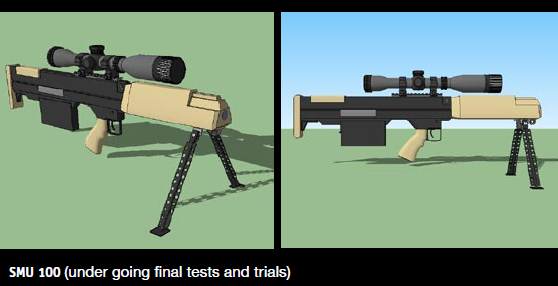 A rendering of the SMU 100 from a Photonic Security Systems brochure.
A shoulder-mounted laser that emits a blinding wall of light capable of repelling rioters is to be trialled by police under preparations to prevent a repeat of this summer’s looting and arson.
The technology, developed by a former Royal Marine commando, temporarily impairs the vision of anyone who looks towards the source.It has impressed a division of the Home Office which is testing a new range of devices because of the growing number of violent situations facing the police.
The developer, British-based Photonic Security Systems, hopes to offer the device to shipping companies to deter pirates. Similar devices have been used by ISAF troops in Afghanistan to protect convoys from insurgents.
The laser, resembling a rifle and known as an SMU 100, can dazzle and incapacitate targets up to 500m away with a wall of light up to three metres squared. It costs £25,000 and has an infrared scope to spot looters in poor visibility.
Looking at the intense beam causes a short-lived effect similar to staring at the sun, forcing the target to turn away.
…
A Home Office spokesman said scientists at its Centre for Applied Science and Technology believe the use of lasers “has merit” and that it will be piloted by at least one police force. However, they will have to be satisfied the technology does not cause long-term health damage before it can be approved by the Home Secretary.
Other technology being studied includes ‘wireless electronic interceptors’ that can be fired a greater distance than Tasers, and long-range chemical irritant projectiles.
TOP-SECRET – (U//FOUO/LES) Los Angeles Fusion Center: Methods to Defeat Law Enforcement Crowd Control

(U//FOUO//LES) The purpose of this bulletin is officer awareness. Officers should know that instigators involved in violent demonstrations might be familiar with, and might try to apply, techniques from the “Crowd Control and Riot Manual.” The handbook, from Warrior Publications teaches protestors how to defeat law enforcement crowd control techniques. Although it does not address specific groups or organizations, the information is widely applicable.
…
(U) Anti-Crowd Control Measures
(U) The handbook addresses methods used by police to control crowds and countermeasures to defeat them. Figure 1, from the chapter Riot Training, illustrates police protective gear, and then identifies its potential vulnerabilities. The chapter goes on to recommend effective weapons for rioters to carry, offers tactical guidelines, and suggests ways to counter tactical operations by police:
• (U) While an officer’s uniform contains fire retardant material, it may still be set on fire if fuel lands upon it
• (U) Although specialized gear provides protection against projectile and baton strikes, it can limit mobility on hot days; constant running and maneuvering with this gear may cause intense
• (U) Lightly equipped riot police may be vulnerable to projectile and baton strikes
• (U) Patrol vehicles may be damaged with projectiles, destroyed with Molotov cocktails, blinded with paint bombs or disabled with cut/punctured tires; these tactics are also effective against armored vehicles
• (U) Barricades (including those made with burning tires) may be used to limit vision and mobility
• (U) When encountering small arms open fire, return fire may be the best counter • (U) The best response to a baton charge is a heavy barrage of projectiles and the use of barricades
• (U) If an arrest squad (also called a “snatch squad”) is identified, they should be targeted with a heavy barrage of projectiles when they exit police lines
• (U) The use of individual riot weapons is important; primary targets are commanders, ARWEN gunners, snatch squads and K-9 units, as none of these typically carry shields (see
Figure 2)
• (U) Against riot police, the 3’ long Hambo (also known as a long baton) is a preferred weapon to break through Plexiglas shields and visors: metal pipes or aluminum baseball bats are also good, as they have solid impact against riot armor
• (U) Pepper/bear spray is good against police not wearing gas masks, as well as vigilante citizens
• (U) Slingshots are useful against both vehicles and police; when used against people, they should be aimed at the face
• (U) Improvised paint bombs (condoms, empty eggs, spray paint cans) are effective when thrown at masks, visors or shields
• (U) Additional effective projectiles include concrete/bricks, flares, fireworks, bottles and rocks
• (U) Projectiles should be thrown from the front of a crowd to avoid injuring cohorts
• (U) In order to escape arrest, team members should practice and rehearse holds, locks, strikes and escaping from holds and locks; individuals should fight back and attempt escape
• (U) Ambushes can be laid for police if the opportunity arises; assailants can hide behind a corner, vehicle, in a building entrance, roof-top, overhanging bridge, etc.
DOWNLOAD ORIGINAL DOCUMENT HERE
Zyklon B – Das Mittel für den Massenmord – Dokumentation
Die Dokumentation zeigt die erste Hinrichtung eines Menschen durch Giftgas, wie das Zyklon B an Menschen und Tieren getestet – und schließlich gegen die Juden eingesetzt wurde.Mit dem vom Frankfurter IG-Farben-Konzern produzierten Granulat Zyklon B ermordeten die Nazis unzählige Menschen.Getestet wurde die verheerende Wirkung von Zyklon B bereits 1941 an Kriegsgefangenen.Die streng geheimen Informationen über die Giftgasproduktion in Deutschland wurden schon früh an die Amerikaner verraten.
Am 3. September 1941 führte die SS im Konzentrationslager Auschwitz ein streng geheimes Experiment durch, das den Beginn des Holocaust markierte.Mehrere Hundert Kriegsgefangene wurden mit Zyklon B ermordet, einem Granulat, das hochgiftige Blausäure freisetzt.Wenige Wochen später übergab der Repräsentant des deutschen IG-Farben-Konzerns in der Schweiz in seiner Villa am Vierwaldstätter See amerikanischen Kurieren streng geheime Dokumente über Hitlers Giftgasproduktion, auch über das von den IG Farben produzierte Zyklon B.Gelangten auf diesem Wege schon früh Informationen über die geplante sogenannte “Endlösung der Judenfrage” in die USA?
In den USA war Blausäure schon 1924 zur Exekution von Menschen eingesetzt worden. Damals starb im Staatsgefängnis von Nevada erstmals ein Straftäter durch das Giftgas.In den 30er Jahren forschte das amerikanische Chemieunternehmen Du Pont über Blausäure als Insektenkiller, aber auch als Mittel der Wahl für Hinrichtungen in der Gaskammer.Du Pont stand dabei in engem Informationsaustausch mit den Experten des IG-Farben-Konzerns in Frankfurt. Diese Beziehungen blieben sogar bestehen, nachdem Amerika im Dezember 1941 in den Krieg gegen Hitler-Deutschland eingetreten war.Der deutsche Wirtschaftsberater Erwin Respondek, der erst an den Kartellvereinbarungen zwischen IG Farben und Du Pont beteiligt war, dann zum Spion wurde versorgte die Amerikaner mit Geheimnissen über Hitlers Giftgasproduktion.
TOP-SECRET – (U//FOUO) U.S. Army Intelligence Officer’s Handbook


OVERVIEW
1-1. The intelligence warfighting function is one of six warfighting functions. A warfighting function is a group of tasks and systems (people, organizations, information, and processes) united by a common purpose that commanders use to accomplish missions and training objectives (FM 3-0).
1-2. The intelligence warfighting function is the related tasks and systems that facilitate understanding of the operational environment. It includes tasks associated with intelligence, surveillance, and reconnaissance operations and is driven by the commander (FM 3-0). Intelligence is more than just collection; it is a continuous process that involves analyzing information from all sources and conducting operations to develop the situation. The intelligence warfighting function includes the following tasks:
• Support to force generation.
• Support to situational understanding.
• Conduct intelligence, surveillance, and reconnaissance (ISR).
• Provide intelligence support to targeting and information superiority.
…
INTELLIGENCE CATEGORIES
1-6. As discussed in FM 2-0, Army unit intelligence staffs produce and receive, directly or indirectly, six categories of intelligence support from the U.S. intelligence community. Intelligence categories are distinguishable primarily by their intelligence product purposes. The categories can overlap and the same intelligence can be used in each category. Intelligence organizations use specialized procedures to develop these categories. The following information describes each category and the responsible organization:
• Indications and warning (I&W). Analysis of time-sensitive information that could involve a threat to U.S. and multinational military forces, U.S. political or economic interests, or to U.S. citizens. While the G-2/S-2 produces I&W intelligence, every Soldier, such as the one conducting a presence patrol, contributes to the I&W through awareness of the CCIRs and by reporting related information.
• Current intelligence. The G-2/S-2 produces accurate reporting on the current threat situation— which becomes a portion of the common operational picture (COP)—projects the threat’s anticipated situation and the implication to friendly operations.
• General military intelligence (GMI). GMI focuses on the military capabilities of foreign countries, organizations, or on topics relating to Armed Forces capabilities, including threat characteristics (previously order of battle factors) and area or terrain intelligence. The G-2/S-2 develops initial intelligence preparation of the battlefield (IPB) products from various GMI databases, and then develops and maintains the unit’s GMI database on potential threat forces and areas of concern based on the commander’s guidance. This database supports the unit’s plan, preparation, execution, and assessment of operations.
• Target intelligence. The analysis of threat units, dispositions, facilities, and systems to identify and nominate specific assets or vulnerabilities for attack, reattack, or exploit.
• Scientific and technical intelligence (S&TI). The collection, evaluation, and interpretation of foreign engineering science and technology with warfare potential, including military systems, weapons, weapons systems, materiel, research and development, and production methods. The G-2/S-2 establishes instructions in standing operating procedures (SOPs), orders, and plans for handling and evacuating captured enemy material for S&TI exploitation.
• Counterintelligence (CI). Identifying and recommending countermeasures against threats by foreign intelligence services and the ISR activities of nonstate entities, such as organized crime, terrorist groups, and drug traffickers.
INTELLIGENCE DISCIPLINES
1-7. Intelligence disciplines are categories of intelligence functions. There are nine major intelligence disciplines:
• All-source intelligence.
• CI.
• Human intelligence (HUMINT).
• Geospatial intelligence (GEOINT).
• Imagery intelligence (IMINT).
• Measurement and signature intelligence (MASINT).
• Open-source intelligence (OSINT).
• Signals intelligence (SIGINT).
• Technical intelligence (TECHINT).

DOWNLOAD ORGINAL DOCUMENT HERE
…
UNCENSORED – Women Protest Worldwide Photos 9
![[Image]](https://i0.wp.com/cryptome.org/info/women-protest9/pict71.jpg) Russian nationalists rally at Bolotnaya Square, on an island in the Moscow River adjacent to the Kremlin in Moscow, Russia, Sunday, Dec. 11, 2011.Russian nationalists are rallying in downtown Moscow, demanding a bigger say for ethnic Russians in the country’s politics and marking the first anniversary of a violent nationalist riot just outside the Kremlin.(Alexander Zemlianichenko) Russian nationalists rally at Bolotnaya Square, on an island in the Moscow River adjacent to the Kremlin in Moscow, Russia, Sunday, Dec. 11, 2011.Russian nationalists are rallying in downtown Moscow, demanding a bigger say for ethnic Russians in the country’s politics and marking the first anniversary of a violent nationalist riot just outside the Kremlin.(Alexander Zemlianichenko) |
![[Image]](https://i0.wp.com/cryptome.org/info/women-protest9/pict74.jpg) Russian nationalists shout holding old Russian imperial flags during their rally in St.Petersburg, Russia, Sunday, Dec. 11, 2011. Russian nationalists are rallying in Moscow and St.Petersburg, demanding a bigger say for ethnic Russians in the country’s politics and marking the first anniversary of a violent nationalist riot just outside the Kremlin.(Dmitry Lovetsky) Russian nationalists shout holding old Russian imperial flags during their rally in St.Petersburg, Russia, Sunday, Dec. 11, 2011. Russian nationalists are rallying in Moscow and St.Petersburg, demanding a bigger say for ethnic Russians in the country’s politics and marking the first anniversary of a violent nationalist riot just outside the Kremlin.(Dmitry Lovetsky) |
![[Image]](https://i0.wp.com/cryptome.org/info/women-protest9/pict62.jpg) A woman wearing fake horns holds a banner during a demonstration against bullfighting in Mexico City December 10, 2011. More than hundred demonstrators took part in a protest against bullfighting in the country. Bullfighting has been one of the most popular sport in Mexico for the last 400 years, according to local media. The banner reads “Torture”. Reuters A woman wearing fake horns holds a banner during a demonstration against bullfighting in Mexico City December 10, 2011. More than hundred demonstrators took part in a protest against bullfighting in the country. Bullfighting has been one of the most popular sport in Mexico for the last 400 years, according to local media. The banner reads “Torture”. Reuters |
![[Image]](https://i0.wp.com/cryptome.org/info/women-protest9/pict59.jpg) French Occupy protesters participate in a rally as part of the 63rd anniversary of the Universal Declaration of the Human Rights, on December 10, 2011 in center Paris. The activists, angered by state spending cuts that hurt ordinary people and high unemployment have called for a nationwide protest. Placard reads : ‘Time for Outrage. Getty French Occupy protesters participate in a rally as part of the 63rd anniversary of the Universal Declaration of the Human Rights, on December 10, 2011 in center Paris. The activists, angered by state spending cuts that hurt ordinary people and high unemployment have called for a nationwide protest. Placard reads : ‘Time for Outrage. Getty |
![[Image]](https://i0.wp.com/cryptome.org/info/women-protest9/pict58.jpg) Women dressed in violet clothes march from El Zocalo Square to the Revolution monument along Juarez Avenue on December 10, 2011 in Mexico City to protest against violence The activity called ‘The Rally of the One Thousand Women’ promotes to put an end to the discrimination and violence against women. Getty Women dressed in violet clothes march from El Zocalo Square to the Revolution monument along Juarez Avenue on December 10, 2011 in Mexico City to protest against violence The activity called ‘The Rally of the One Thousand Women’ promotes to put an end to the discrimination and violence against women. Getty |
![[Image]](https://i0.wp.com/cryptome.org/info/women-protest9/pict61.jpg) Member of the Association of Parents of Disappeared Persons (APDP) hold portraits of missing relatives during a demonstration to mark International Human Rights Day in Srinagar on December 10, 2011. Demonstrations were held in Srinagar to protest against alleged human rights violations by Indian security forces on Kashmiris. Rights groups say as many as 8,000 people, mostly young men, have ‘disappeared’ by security forces in India-administered Kashmir since an armed insurgency erupted in the Muslim-majority region. Getty Member of the Association of Parents of Disappeared Persons (APDP) hold portraits of missing relatives during a demonstration to mark International Human Rights Day in Srinagar on December 10, 2011. Demonstrations were held in Srinagar to protest against alleged human rights violations by Indian security forces on Kashmiris. Rights groups say as many as 8,000 people, mostly young men, have ‘disappeared’ by security forces in India-administered Kashmir since an armed insurgency erupted in the Muslim-majority region. Getty |
![[Image]](https://i0.wp.com/cryptome.org/info/women-protest9/pict55.jpg) In this photo taken with a fisheye lens protesters gather during a rally in downtown St.Petersburg, Russia, Saturday, Dec. 10, 2011. The sign reads “No vote”. More than ten thousands people have protested in St.Petersburg against Prime Minister Vladimir Putin and his party, which won the largest share of a parliamentary election that observers said was rigged. (Dmitry Lovetsky) In this photo taken with a fisheye lens protesters gather during a rally in downtown St.Petersburg, Russia, Saturday, Dec. 10, 2011. The sign reads “No vote”. More than ten thousands people have protested in St.Petersburg against Prime Minister Vladimir Putin and his party, which won the largest share of a parliamentary election that observers said was rigged. (Dmitry Lovetsky) |
![[Image]](https://i0.wp.com/cryptome.org/info/women-protest9/pict52.jpg) An elderly demonstrator holds a poster showing an edited photo of Prime Minister Vladimir Putin and signed “2050. No” during a mass rally to protest against alleged vote rigging in Russia’s parliamentary elections in Moscow, Russia, Saturday, Dec. 10, 2011. An elderly demonstrator holds a poster showing an edited photo of Prime Minister Vladimir Putin and signed “2050. No” during a mass rally to protest against alleged vote rigging in Russia’s parliamentary elections in Moscow, Russia, Saturday, Dec. 10, 2011. |
![[Image]](https://i0.wp.com/cryptome.org/info/women-protest9/pict53.jpg) Demonstrators shout during a mass rally to protest against alleged vote rigging in Russia’s parliamentary elections in Moscow, Russia, Saturday, Dec. 10, 2011. Russians angered by allegedly fraudulent parliamentary elections are protesting Saturday in cities from the freezing Pacific Coast to the southwest of Russia, eight time zones away, a striking show of indignation, challenging Prime Minister Vladimir Putin’s hold on power. (Mikhail Metzel) Demonstrators shout during a mass rally to protest against alleged vote rigging in Russia’s parliamentary elections in Moscow, Russia, Saturday, Dec. 10, 2011. Russians angered by allegedly fraudulent parliamentary elections are protesting Saturday in cities from the freezing Pacific Coast to the southwest of Russia, eight time zones away, a striking show of indignation, challenging Prime Minister Vladimir Putin’s hold on power. (Mikhail Metzel) |
![[Image]](https://i0.wp.com/cryptome.org/info/women-protest9/pict54.jpg) Demonstrators shout during a mass rally to protest against alleged vote rigging in Russia’s parliamentary elections in Moscow, Russia, Saturday, Dec. 10, 2011. Russians angered by allegedly fraudulent parliamentary elections are protesting Saturday in cities from the freezing Pacific Coast to the southwest of Russia, eight time zones away, a striking show of indignation, challenging Prime Minister Vladimir Putin’s hold on power. (Mikhail Metzel) Demonstrators shout during a mass rally to protest against alleged vote rigging in Russia’s parliamentary elections in Moscow, Russia, Saturday, Dec. 10, 2011. Russians angered by allegedly fraudulent parliamentary elections are protesting Saturday in cities from the freezing Pacific Coast to the southwest of Russia, eight time zones away, a striking show of indignation, challenging Prime Minister Vladimir Putin’s hold on power. (Mikhail Metzel) |
![[Image]](https://i0.wp.com/cryptome.org/info/women-protest9/pict56.jpg) Protesters light flares during a mass rally to protest against alleged vote rigging in Russia’s parliamentary elections in Moscow, Russia, Saturday, Dec. 10, 2011.Russians angered by allegedly fraudulent parliamentary elections are protesting Saturday in cities from the freezing Pacific Coast to the southwest of Russia, eight time zones away, a striking show of indignation, challenging Prime Minister Vladimir Putin’s hold on power. (Pavel Golovkin) Protesters light flares during a mass rally to protest against alleged vote rigging in Russia’s parliamentary elections in Moscow, Russia, Saturday, Dec. 10, 2011.Russians angered by allegedly fraudulent parliamentary elections are protesting Saturday in cities from the freezing Pacific Coast to the southwest of Russia, eight time zones away, a striking show of indignation, challenging Prime Minister Vladimir Putin’s hold on power. (Pavel Golovkin)
|
![[Image]](https://i0.wp.com/cryptome.org/info/women-protest9/pict22.jpg) A supporter of Ivory Coast Prime Minister and leader of news forces the former rebel groupe looks on during a legislative election meeting in Ferkessedougou, north of Ivory Coast, on December 9, 2011. The December 11 polls are boycotted by former Ivorian President Laurent Gbagbo’s Ivorian Popular Front party (FPI) and its allies in protest against his arrest and transfer to the International Criminal Court in The Hague. Nearly 1,000 candidates are in the fray for the 255 parliamentary seats. Getty A supporter of Ivory Coast Prime Minister and leader of news forces the former rebel groupe looks on during a legislative election meeting in Ferkessedougou, north of Ivory Coast, on December 9, 2011. The December 11 polls are boycotted by former Ivorian President Laurent Gbagbo’s Ivorian Popular Front party (FPI) and its allies in protest against his arrest and transfer to the International Criminal Court in The Hague. Nearly 1,000 candidates are in the fray for the 255 parliamentary seats. Getty |
![[Image]](https://i0.wp.com/cryptome.org/info/women-protest9/pict20.jpg) People protest in the halls of the venue of UN Climate Talks on December 9, 2011, to demand that nations not sign a “death sentence” during the UN Framework Convention on Climate Change (UNFCCC) in Durban. Standing side-by-side with delegates from some of the world’s most vulnerable countries, civil society representatives sang traditional South African freedom songs and chanted slogans like, “Listen to the People, Not the Polluters. In the last 48 hours, over 700,000 people have signed petitions calling on major emitters to stand with the nations of Africa and resist any attempts to delay climate action until 2020. UN climate talks entered their second week entangled in a thick mesh of issues with no guarantee that negotiators and their ministers will be able to sort them out. The 194-nation process is facing, for the second time in two years, the prospect of a bustup, even as scientists warn against the mounting threat of disaster-provoking storms, droughts, flood and rising seas made worse by global warming. Getty People protest in the halls of the venue of UN Climate Talks on December 9, 2011, to demand that nations not sign a “death sentence” during the UN Framework Convention on Climate Change (UNFCCC) in Durban. Standing side-by-side with delegates from some of the world’s most vulnerable countries, civil society representatives sang traditional South African freedom songs and chanted slogans like, “Listen to the People, Not the Polluters. In the last 48 hours, over 700,000 people have signed petitions calling on major emitters to stand with the nations of Africa and resist any attempts to delay climate action until 2020. UN climate talks entered their second week entangled in a thick mesh of issues with no guarantee that negotiators and their ministers will be able to sort them out. The 194-nation process is facing, for the second time in two years, the prospect of a bustup, even as scientists warn against the mounting threat of disaster-provoking storms, droughts, flood and rising seas made worse by global warming. Getty |
![[Image]](https://i0.wp.com/cryptome.org/info/women-protest9/pict19.jpg) Journalists demonstrate during a protest against the murders of their counterparts outside the Presidential house in Tegucigalpa December 9, 2011. 17 journalists have been shot dead in Honduras since 2010, making the small Central American nation one of the world’s most dangerous places for reporters, according human rights groups. Reuters Journalists demonstrate during a protest against the murders of their counterparts outside the Presidential house in Tegucigalpa December 9, 2011. 17 journalists have been shot dead in Honduras since 2010, making the small Central American nation one of the world’s most dangerous places for reporters, according human rights groups. Reuters |
![[Image]](https://i0.wp.com/cryptome.org/info/women-protest9/pict18.jpg) Bahraini women watch as hundreds of anti-government protesters (unseen) run Friday, Dec. 9, 2011, through the Musalla area of Manama, Bahrain, toward an area that had been the hub of Bahrain’s spring uprising and is now a heavily militarized zone that protesters seek to reclaim. The protesters were forced back by riot police just short of the area. Writing on the wall reads “freedom” above pictures of political prisoners. (Hasan Jamali) Bahraini women watch as hundreds of anti-government protesters (unseen) run Friday, Dec. 9, 2011, through the Musalla area of Manama, Bahrain, toward an area that had been the hub of Bahrain’s spring uprising and is now a heavily militarized zone that protesters seek to reclaim. The protesters were forced back by riot police just short of the area. Writing on the wall reads “freedom” above pictures of political prisoners. (Hasan Jamali) |
![[Image]](https://i0.wp.com/cryptome.org/info/women-protest9/pict17.jpg) Russian opposition leader Sergei Udaltsov’s wife Anastasia, left, speaks to the media as environmental activist and leader of the Khimki forest defenders Yevgenia Chirikova looks at her during a news conference in Moscow, Russia, Friday Dec. 9, 2011. Energized activists and anxious authorities are bracing for anti-government protests planned across Russia’s sprawling expanse Saturday that promise to be the largest demonstration of public outrage since the dying days of the Soviet Union. Russian opposition leader Sergei Udaltsov’s wife Anastasia, left, speaks to the media as environmental activist and leader of the Khimki forest defenders Yevgenia Chirikova looks at her during a news conference in Moscow, Russia, Friday Dec. 9, 2011. Energized activists and anxious authorities are bracing for anti-government protests planned across Russia’s sprawling expanse Saturday that promise to be the largest demonstration of public outrage since the dying days of the Soviet Union. |
![[Image]](https://i0.wp.com/cryptome.org/info/women-protest9/pict7.jpg) Occupy Boston Protestors reacted to the announcement that their downtown encampment would not be evicted on December 9, 2011, in Boston, Massachusetts. Boston Mayor Thomas M. Menino set a midnight deadline for Occupy Boston protestors to leave their downtown encampment in Dudley Square, or face eviction. In response, many of the protestors chose to take down their tents, and by the midnight deadline much of the camp was gone. At approximately 1:15AM on December 9, 2011, the Boston police announced that they would not evict the protestors from Dudley Square. Protestors took to the street in celebration, and further protest. Getty Occupy Boston Protestors reacted to the announcement that their downtown encampment would not be evicted on December 9, 2011, in Boston, Massachusetts. Boston Mayor Thomas M. Menino set a midnight deadline for Occupy Boston protestors to leave their downtown encampment in Dudley Square, or face eviction. In response, many of the protestors chose to take down their tents, and by the midnight deadline much of the camp was gone. At approximately 1:15AM on December 9, 2011, the Boston police announced that they would not evict the protestors from Dudley Square. Protestors took to the street in celebration, and further protest. Getty |
![[Image]](https://i0.wp.com/cryptome.org/info/women-protest9/pict9.jpg) Worker Pat Revell pickets outside Unilever’s Port Sunlight factory on the Wirral, Merseyside on December 9, 2011 in Port Sunlight, England. The workers are on strike in protest against the company’s plan to axe their final salary pension scheme. The strike is the first in the history of the consumer goods manufacturer who lists PG Tips tea and Persil washing detergent amongst its products. Getty Worker Pat Revell pickets outside Unilever’s Port Sunlight factory on the Wirral, Merseyside on December 9, 2011 in Port Sunlight, England. The workers are on strike in protest against the company’s plan to axe their final salary pension scheme. The strike is the first in the history of the consumer goods manufacturer who lists PG Tips tea and Persil washing detergent amongst its products. Getty |
![[Image]](https://i0.wp.com/cryptome.org/info/women-protest9/pict8.jpg) Supporters of the Serbian Radical Party stand in front of policemen while holding posters with a picture of party leader Vojislav Seselj during a protest against Serbia’s efforts to become an official candidate for the European Union membership in front of Serbia’s Presidency building in Belgrade December 9, 2011. The posters read, “We don’t want in the European Union” (L), and “Tadic don’t humiliate Serbs”. Reuters Supporters of the Serbian Radical Party stand in front of policemen while holding posters with a picture of party leader Vojislav Seselj during a protest against Serbia’s efforts to become an official candidate for the European Union membership in front of Serbia’s Presidency building in Belgrade December 9, 2011. The posters read, “We don’t want in the European Union” (L), and “Tadic don’t humiliate Serbs”. Reuters |
![[Image]](https://i0.wp.com/cryptome.org/info/women-protest9/pict6.jpg) People sit as others lay on the ground as they watch a movie in the main entrance of Germans Trias i Pujol hospital during a protest against spending cuts in Catalonia’s public healthcare system, in Badalona, near Barcelona city, Spain, Friday Dec. 9, 2011. The leaders of the 17 countries that use the euro, plus six others, have tentatively agreed to a new treaty that enforces stricter budget rules seen as crucial to solving Europe’s debt crisis and holding the currency-bloc together. An agreement on fiscal discipline is considered a critical first step before the European Central Bank, the International Monetary Fund and others would commit more financial aid to help countries like Italy and Spain, which have large debts and unsustainable borrowing costs. AP People sit as others lay on the ground as they watch a movie in the main entrance of Germans Trias i Pujol hospital during a protest against spending cuts in Catalonia’s public healthcare system, in Badalona, near Barcelona city, Spain, Friday Dec. 9, 2011. The leaders of the 17 countries that use the euro, plus six others, have tentatively agreed to a new treaty that enforces stricter budget rules seen as crucial to solving Europe’s debt crisis and holding the currency-bloc together. An agreement on fiscal discipline is considered a critical first step before the European Central Bank, the International Monetary Fund and others would commit more financial aid to help countries like Italy and Spain, which have large debts and unsustainable borrowing costs. AP |
![[Image]](https://i0.wp.com/cryptome.org/info/women-protest9/pict5.jpg) Members of the Red Shirt movement joke with a Thai police officer as they gather to protest against former Thai Prime Minister Abhisit Vejjajiva outside Metropolitan Police headquarters in Bangkok, Thailand Friday, Dec. 9, 2011. Abhisit was called in to give information to a police investigation team on the government’s crackdown on red-shirt demonstrators last year during which 91 people were killed. (Apichart Weerawong) Members of the Red Shirt movement joke with a Thai police officer as they gather to protest against former Thai Prime Minister Abhisit Vejjajiva outside Metropolitan Police headquarters in Bangkok, Thailand Friday, Dec. 9, 2011. Abhisit was called in to give information to a police investigation team on the government’s crackdown on red-shirt demonstrators last year during which 91 people were killed. (Apichart Weerawong) |
![[Image]](https://i0.wp.com/cryptome.org/info/women-protest9/pict63.jpg) Panamanian people protest against the return of former General Manuel Noriega to Panama, in Panama City on December 09,2011. Noriega returns to Panama without the trappings of political or military clout, but with something of incalculable value — detailed knowledge of the skeletons that lurk in the Central American nation’s closet. Getty Panamanian people protest against the return of former General Manuel Noriega to Panama, in Panama City on December 09,2011. Noriega returns to Panama without the trappings of political or military clout, but with something of incalculable value — detailed knowledge of the skeletons that lurk in the Central American nation’s closet. Getty |
![[Image]](https://i0.wp.com/cryptome.org/info/women-protest9/pict4.jpg) Thousands of people gather outside the main courthouse during the first trial of 22 leftist students who were jailed after they staged a demonstration to protest a police crackdown on anti-government demonstrators in the northern town of Hopa, Black Sea, ahead of general elections in June, in Ankara, Turkey, Friday, Dec. 9, 2011. (Burhan Ozbilici) Thousands of people gather outside the main courthouse during the first trial of 22 leftist students who were jailed after they staged a demonstration to protest a police crackdown on anti-government demonstrators in the northern town of Hopa, Black Sea, ahead of general elections in June, in Ankara, Turkey, Friday, Dec. 9, 2011. (Burhan Ozbilici) |
![[Image]](https://i0.wp.com/cryptome.org/info/women-protest9/pict10.jpg) Activists of the Ukrainian women’s movement FEMEN stage a performance in front of the Christ the Saviour Cathedral in Moscow, on December 9, 2011, to protest against alleging mass fraud in the Russian December 4 parliamentary polls and demanding Russia’s Prime Minister Vladimir Putin that he stop his political activities. Putin, who became premier in 2008 after serving two Kremlin terms, filed this week his application to stand in the March elections. Getty Activists of the Ukrainian women’s movement FEMEN stage a performance in front of the Christ the Saviour Cathedral in Moscow, on December 9, 2011, to protest against alleging mass fraud in the Russian December 4 parliamentary polls and demanding Russia’s Prime Minister Vladimir Putin that he stop his political activities. Putin, who became premier in 2008 after serving two Kremlin terms, filed this week his application to stand in the March elections. Getty |
![[Image]](https://i0.wp.com/cryptome.org/info/women-protest9/pict0.jpg) Activists of Ukraine’s protest group Femen, protest outside the Christ the Saviour cathedral in Moscow, Russia, Friday, Dec. 9, 2011. The post-election protests in Moscow drew thousands and continued for several days in the biggest ever challenge to Putin, reflecting a growing public frustration with his rule that may complicate his bid to reclaim the presidency in next March’s vote. (Ivan Sekretarev) Activists of Ukraine’s protest group Femen, protest outside the Christ the Saviour cathedral in Moscow, Russia, Friday, Dec. 9, 2011. The post-election protests in Moscow drew thousands and continued for several days in the biggest ever challenge to Putin, reflecting a growing public frustration with his rule that may complicate his bid to reclaim the presidency in next March’s vote. (Ivan Sekretarev)
|
![[Image]](https://i0.wp.com/cryptome.org/info/women-protest9/pict57.jpg)
![[Image]](https://i0.wp.com/cryptome.org/info/women-protest9/pict2.jpg)
![[Image]](https://i0.wp.com/cryptome.org/info/women-protest9/pict3.jpg)
![[Image]](https://i0.wp.com/cryptome.org/info/women-protest9/pict45.jpg) Medical workers rally at the Latvian Saeima (Parliament) building to protest budget cuts in health care on December 8, 2011 in Riga. The protesters are holding black balloons and various placards, urging the government to care for medical workers and warning that many health care workers may leave Latvia. Placards read: ‘Left country. Everyone has rights to receive health care’. Getty Medical workers rally at the Latvian Saeima (Parliament) building to protest budget cuts in health care on December 8, 2011 in Riga. The protesters are holding black balloons and various placards, urging the government to care for medical workers and warning that many health care workers may leave Latvia. Placards read: ‘Left country. Everyone has rights to receive health care’. Getty |
![[Image]](https://i0.wp.com/cryptome.org/info/women-protest9/pict44.jpg) Demonstrators protest about high inflation and low interest rates outside the Bank of England in the City of London December 8, 2011. The Bank of England voted on Thursday to stick to its four-month programme to pump an extra 75 billion pounds of quantitative easing into the rapidly slowing economy. Reuters Demonstrators protest about high inflation and low interest rates outside the Bank of England in the City of London December 8, 2011. The Bank of England voted on Thursday to stick to its four-month programme to pump an extra 75 billion pounds of quantitative easing into the rapidly slowing economy. Reuters |
![[Image]](https://i0.wp.com/cryptome.org/info/women-protest9/pict43.jpg) Pakistani protesters carry national flags as they march during a demonstration in Islamabad on December 8, 2011 against the cross-border NATO air strike on Pakistani troops. Several hundred journalists, labour leaders and traders on December 8, took to streets to condemn a recent air strike by NATO on Pakistani military checkposts that killed 24 soldiers. Pakistan shut the only supply route in Khyber tribal region for international troops in Afghanistan, boycotted the Bonn conference and announced to revisit policy towards the US in protest against the attack. Getty Pakistani protesters carry national flags as they march during a demonstration in Islamabad on December 8, 2011 against the cross-border NATO air strike on Pakistani troops. Several hundred journalists, labour leaders and traders on December 8, took to streets to condemn a recent air strike by NATO on Pakistani military checkposts that killed 24 soldiers. Pakistan shut the only supply route in Khyber tribal region for international troops in Afghanistan, boycotted the Bonn conference and announced to revisit policy towards the US in protest against the attack. Getty |
![[Image]](https://i0.wp.com/cryptome.org/info/women-protest9/pict42.jpg) Fundamentalist Christians protest on December 8, 2011 in Paris, near the Rond-Point theatre where Argentina-born author Rodrigo Garcia’s play ‘Golgota Picnic’ is performed which they judge ‘blasphemous’. Getty Fundamentalist Christians protest on December 8, 2011 in Paris, near the Rond-Point theatre where Argentina-born author Rodrigo Garcia’s play ‘Golgota Picnic’ is performed which they judge ‘blasphemous’. Getty |
![[Image]](https://i0.wp.com/cryptome.org/info/women-protest9/pict41.jpg) People pose with a protester wearing a mock mask depicting Russian Prime Minister Vladimir Putin during a rally in downtown St.Petersburg, Russia, Thursday, Dec. 8, 2011. More than five hundred people protested in St.Petersburg against Putin and his party, which won the largest share of a parliamentary election that observers said was rigged. (Dmitry Lovetsky) People pose with a protester wearing a mock mask depicting Russian Prime Minister Vladimir Putin during a rally in downtown St.Petersburg, Russia, Thursday, Dec. 8, 2011. More than five hundred people protested in St.Petersburg against Putin and his party, which won the largest share of a parliamentary election that observers said was rigged. (Dmitry Lovetsky) |
![[Image]](https://i0.wp.com/cryptome.org/info/women-protest9/pict40.jpg) Occupy Boston protester Heather McCann, of Watertown, Mass., center, loads a crate of books into a truck at the Dewey Square encampment while dismantling the camps library, in Boston, Thursday, Dec. 8, 2011. Boston Mayor Thomas Menino said Thursday that Occupy Boston protesters must leave their encampment in the city’s financial district by midnight Thursday or face eviction by police. (Steven Senne) Occupy Boston protester Heather McCann, of Watertown, Mass., center, loads a crate of books into a truck at the Dewey Square encampment while dismantling the camps library, in Boston, Thursday, Dec. 8, 2011. Boston Mayor Thomas Menino said Thursday that Occupy Boston protesters must leave their encampment in the city’s financial district by midnight Thursday or face eviction by police. (Steven Senne) |
![[Image]](https://i0.wp.com/cryptome.org/info/women-protest9/pict31.jpg) A veiled Kashmiri government employee participates in a protest against the government in Srinagar, India, Thursday, Dec. 8, 2011. Dozens of government employees demanded release of arrears and regularization of jobs for daily wage workers. (Dar Yasin) A veiled Kashmiri government employee participates in a protest against the government in Srinagar, India, Thursday, Dec. 8, 2011. Dozens of government employees demanded release of arrears and regularization of jobs for daily wage workers. (Dar Yasin) |
![[Image]](https://i0.wp.com/cryptome.org/info/women-protest9/pict30.jpg) Protesters march to join fellow protesters who camped out outside a Catholic church near the Presidential Palace in Manila, Philippines Thursday Dec. 8, 2011 to await news of the scheduled execution of a Filipino man convicted in China for drug trafficking. Philippine officials said, the Filipino man, who was convicted on drug trafficking, was executed in China on Thursday despite an appeal for clemency from President Benigno Aquino III on humanitarian grounds. (Bullit Marquez) Protesters march to join fellow protesters who camped out outside a Catholic church near the Presidential Palace in Manila, Philippines Thursday Dec. 8, 2011 to await news of the scheduled execution of a Filipino man convicted in China for drug trafficking. Philippine officials said, the Filipino man, who was convicted on drug trafficking, was executed in China on Thursday despite an appeal for clemency from President Benigno Aquino III on humanitarian grounds. (Bullit Marquez) |
![[Image]](https://i0.wp.com/cryptome.org/info/women-protest9/pict29.jpg) Kashmiri government employees participate in a protest against the government in Srinagar, India, Thursday, Dec. 8, 2011. Dozens of government employees demanded release of arrears and regularization of jobs for daily wage workers. (Dar Yasin) Kashmiri government employees participate in a protest against the government in Srinagar, India, Thursday, Dec. 8, 2011. Dozens of government employees demanded release of arrears and regularization of jobs for daily wage workers. (Dar Yasin) |
![[Image]](https://i0.wp.com/cryptome.org/info/women-protest9/pict28.jpg) A small group of demonstrators screams slogans demanding UN protection for Iranian dissidents in Camp Ashraf, Iraq, as they protest outside the Dutch Foreign Ministry during U.S. Secretary of State Hillary Rodham Clinton’s visit in The Hague, Netherlands, Thursday Dec. 8, 2011. (Peter Dejong) A small group of demonstrators screams slogans demanding UN protection for Iranian dissidents in Camp Ashraf, Iraq, as they protest outside the Dutch Foreign Ministry during U.S. Secretary of State Hillary Rodham Clinton’s visit in The Hague, Netherlands, Thursday Dec. 8, 2011. (Peter Dejong) |
![[Image]](https://i0.wp.com/cryptome.org/info/women-protest9/pict27.jpg) Police officers detain an opposition activist during a rally in downtown St.Petersburg, Russia, Thursday, Dec. 8, 2011. More than five hundreds people have protested in St.Petersburg against Prime Minister Vladimir Putin and his party, which won the largest share of a parliamentary election that observers said was rigged. (Dmitry Lovetsky) Police officers detain an opposition activist during a rally in downtown St.Petersburg, Russia, Thursday, Dec. 8, 2011. More than five hundreds people have protested in St.Petersburg against Prime Minister Vladimir Putin and his party, which won the largest share of a parliamentary election that observers said was rigged. (Dmitry Lovetsky) |
![[Image]](https://i0.wp.com/cryptome.org/info/women-protest9/pict26.jpg) French far-right leader Marine Le Pen arrives at their demonstration in Paris Thursday, Dec. 8, 2011. The demonstration was to oppose a bill on which the Senate were voting Thursday afternoon, a private members bill calling for the right for foreigners to be able to vote in French municipal elections. (Jacques Brinon) French far-right leader Marine Le Pen arrives at their demonstration in Paris Thursday, Dec. 8, 2011. The demonstration was to oppose a bill on which the Senate were voting Thursday afternoon, a private members bill calling for the right for foreigners to be able to vote in French municipal elections. (Jacques Brinon) |
![[Image]](https://i0.wp.com/cryptome.org/info/women-protest9/pict25.jpg) People living near nuclear plant sites shout slogans during an anti-nuclear protest in New Delhi, India, Thursday, Dec. 8, 2011. The protesters demanded scrapping of projects that endanger people’s safety and threaten livelihoods, according to a press release. Placard reads “Stop displacement of people in the name of development.” (Manish Swarup) People living near nuclear plant sites shout slogans during an anti-nuclear protest in New Delhi, India, Thursday, Dec. 8, 2011. The protesters demanded scrapping of projects that endanger people’s safety and threaten livelihoods, according to a press release. Placard reads “Stop displacement of people in the name of development.” (Manish Swarup) |
![[Image]](https://i0.wp.com/cryptome.org/info/women-protest9/pict23.jpg) An Israeli musician covers her face in protest, as she performs during a rally against gender segregation, in Jerusalem, Wednesday, Dec. 7, 2011. Hundreds of women and women’s rights activists gathered in central Jerusalem Wednesday night for a rally organized by the New Israel Fund, themed “women will be seen and heard”, to protest discrimination against women in Israel. (Sebastian Scheiner) An Israeli musician covers her face in protest, as she performs during a rally against gender segregation, in Jerusalem, Wednesday, Dec. 7, 2011. Hundreds of women and women’s rights activists gathered in central Jerusalem Wednesday night for a rally organized by the New Israel Fund, themed “women will be seen and heard”, to protest discrimination against women in Israel. (Sebastian Scheiner) |
![[Image]](https://i0.wp.com/cryptome.org/info/women-protest9/pict49.jpg) Nepalese Buddhist monks and nuns take out a protest in Katmandu, Nepal, Wednesday, Dec. 7, 2011. Hundreds of Buddhists demonstrated in Nepal’s capital to protest the appointment of Maoist party chief Pushpa Kamal Dahal to head a project to develop the area where Buddha was believed born in southern Nepal. The protestors demanded that there should not be any political involvement in the project to develop Lumbini, located 150 miles (240 kilometers) southwest of Katmandu. AP Nepalese Buddhist monks and nuns take out a protest in Katmandu, Nepal, Wednesday, Dec. 7, 2011. Hundreds of Buddhists demonstrated in Nepal’s capital to protest the appointment of Maoist party chief Pushpa Kamal Dahal to head a project to develop the area where Buddha was believed born in southern Nepal. The protestors demanded that there should not be any political involvement in the project to develop Lumbini, located 150 miles (240 kilometers) southwest of Katmandu. AP |
![[Image]](https://i0.wp.com/cryptome.org/info/women-protest9/pict48.jpg) A Libyan girl holds a placard that reads in Arabic ‘Thank you our brave rebels, but now let us live in peace’ during a protest in Tripoli’s landmark Martyrs Square on December 7, 2011 against former rebels who toppled Moamer Kadhafi but are still camping out in the capital and still have their weapons. Getty A Libyan girl holds a placard that reads in Arabic ‘Thank you our brave rebels, but now let us live in peace’ during a protest in Tripoli’s landmark Martyrs Square on December 7, 2011 against former rebels who toppled Moamer Kadhafi but are still camping out in the capital and still have their weapons. Getty |
![[Image]](https://i0.wp.com/cryptome.org/info/women-protest9/pict47.jpg) Members of the Canadian Youth Delegation stage a protest as Canada’s Minister of Environment Peter Kent addresses the United Nations Climate Change Conference (COP17) in Durban in this handout picture released by the Canada Youth Delegation, December 7, 2011. Reuters Members of the Canadian Youth Delegation stage a protest as Canada’s Minister of Environment Peter Kent addresses the United Nations Climate Change Conference (COP17) in Durban in this handout picture released by the Canada Youth Delegation, December 7, 2011. Reuters |
![[Image]](https://i0.wp.com/cryptome.org/info/women-protest9/pict46.jpg) Two protesters look at each other as they await processing after being arrested by Washington DC Metropolitan Police during an Occupy DC protest in Washington, December 7, 2011. Police arrested economic protesters in Washington on Wednesday as they blocked streets and disrupted traffic in an area famous as a center for the offices of lobbyists. Reuters Two protesters look at each other as they await processing after being arrested by Washington DC Metropolitan Police during an Occupy DC protest in Washington, December 7, 2011. Police arrested economic protesters in Washington on Wednesday as they blocked streets and disrupted traffic in an area famous as a center for the offices of lobbyists. Reuters |
![[Image]](https://i0.wp.com/cryptome.org/info/women-protest9/pict24.jpg) An Occupy DC demonstrator sits on a chair as demonstrators blocked an intersection on K St., in Washington, Wednesday, Dec. 7, 2011. (Evan Vucci) An Occupy DC demonstrator sits on a chair as demonstrators blocked an intersection on K St., in Washington, Wednesday, Dec. 7, 2011. (Evan Vucci) |
![[Image]](https://i0.wp.com/cryptome.org/info/women-protest9/pict32.jpg) Occupy Wall Street activists carry house warming gifts to a house warming party during a tour of foreclosed homes in the East New York neighborhood of the Brooklyn borough of New York, Tuesday, Dec. 6, 2011. Finding it increasingly difficult to camp in public spaces, Occupy protesters across the country are reclaiming foreclosed homes and boarded-up properties, signaling a tactical shift for the movement against wealth inequality. Occupy Wall Street activists carry house warming gifts to a house warming party during a tour of foreclosed homes in the East New York neighborhood of the Brooklyn borough of New York, Tuesday, Dec. 6, 2011. Finding it increasingly difficult to camp in public spaces, Occupy protesters across the country are reclaiming foreclosed homes and boarded-up properties, signaling a tactical shift for the movement against wealth inequality. |
![[Image]](https://i0.wp.com/cryptome.org/info/women-protest9/pict50.jpg) A Colombian woman living in Panama holds a Colombian national flag during a protest march against the Revolutionary Armed Forces of Colombia (FARC), in Panama City December 6, 2011. Outraged by the killing of four captives by FARC rebels, Colombians protested on Tuesday to demand an end to half a century of guerrilla violence and kidnapping. The words on the flag read: “Release them”. Reuters A Colombian woman living in Panama holds a Colombian national flag during a protest march against the Revolutionary Armed Forces of Colombia (FARC), in Panama City December 6, 2011. Outraged by the killing of four captives by FARC rebels, Colombians protested on Tuesday to demand an end to half a century of guerrilla violence and kidnapping. The words on the flag read: “Release them”. Reuters |
![[Image]](https://i0.wp.com/cryptome.org/info/women-protest9/pict51.jpg) Colombian demonstrators take part in a protest march against Revolutionary Armed Forces of Colombia FARC rebels in Cali December 6, 2011. Outraged by the execution of four captives by FARC rebels, tens of thousands of Colombians protested across the nation on Tuesday to demand an end to half a century of guerrilla violence and kidnapping. Reuters Colombian demonstrators take part in a protest march against Revolutionary Armed Forces of Colombia FARC rebels in Cali December 6, 2011. Outraged by the execution of four captives by FARC rebels, tens of thousands of Colombians protested across the nation on Tuesday to demand an end to half a century of guerrilla violence and kidnapping. Reuters |
![[Image]](https://i0.wp.com/cryptome.org/info/women-protest9/pict33.jpg) In this Nov. 2, 2011 file photo, occupy Oakland protesters march through the Port of Oakland in Oakland, Calif. Protesters want to shut down ports up and down the U.S. West Coast on Monday, Dec.12,2011, to gum up the engines of global commerce. But organizers who are partly billing this effort as a show of solidarity with longshoremen have not won the support of the powerful union representing thousands of dock workers. (Noah Berger) In this Nov. 2, 2011 file photo, occupy Oakland protesters march through the Port of Oakland in Oakland, Calif. Protesters want to shut down ports up and down the U.S. West Coast on Monday, Dec.12,2011, to gum up the engines of global commerce. But organizers who are partly billing this effort as a show of solidarity with longshoremen have not won the support of the powerful union representing thousands of dock workers. (Noah Berger)
|
![[Image]](https://i0.wp.com/cryptome.org/info/women-protest9/pict35.jpg) An activist of a local women’s rights watchdog FEMEN, with writing “I am independent” and Ukraine’s’ national flag on her belly, seen during celebrities on the occasion of Ukraine’s 19th Independence in Kiev, Ukraine, Tuesday, Aug. 24, 2010. (Efrem Lukatsky) An activist of a local women’s rights watchdog FEMEN, with writing “I am independent” and Ukraine’s’ national flag on her belly, seen during celebrities on the occasion of Ukraine’s 19th Independence in Kiev, Ukraine, Tuesday, Aug. 24, 2010. (Efrem Lukatsky) |
![[Image]](https://i0.wp.com/cryptome.org/info/women-protest9/pict34.jpg)
UNCENSORED – Women Protest Worldwide Photos 8
![[Image]](https://i0.wp.com/cryptome.org/info/women-protest8/pict0.jpg) Kashmir Sutherland huddles with other protesters for warmth in Shemanski Park after police told them to take down tents or be kicked out Monday, Dec. 5, 2011, in Portland, Ore. The Oregonian reports the demonstrators agreed to take down a tent to stay in the park Sunday night. On Saturday night police arrested 19 demonstrators setting up structures in the South Park blocks. Police evicted demonstrators on Nov. 13 from two downtown parks. Kashmir Sutherland huddles with other protesters for warmth in Shemanski Park after police told them to take down tents or be kicked out Monday, Dec. 5, 2011, in Portland, Ore. The Oregonian reports the demonstrators agreed to take down a tent to stay in the park Sunday night. On Saturday night police arrested 19 demonstrators setting up structures in the South Park blocks. Police evicted demonstrators on Nov. 13 from two downtown parks. |
![[Image]](https://i0.wp.com/cryptome.org/info/women-protest8/pict44.jpg) A woman shouts slogans during a rally in Moscow, Monday, Dec. 5, 2011. Several thousand people have protested in Moscow against Prime Minister Vladimir Putin and his party, which won the largest share of a parliamentary election that observers said was rigged. A group of several hundred then marched toward the Central Elections Commission near the Kremlin, but were stopped by riot police and taken away in buses. (Sergey Ponomarev) A woman shouts slogans during a rally in Moscow, Monday, Dec. 5, 2011. Several thousand people have protested in Moscow against Prime Minister Vladimir Putin and his party, which won the largest share of a parliamentary election that observers said was rigged. A group of several hundred then marched toward the Central Elections Commission near the Kremlin, but were stopped by riot police and taken away in buses. (Sergey Ponomarev) |
![[Image]](https://i0.wp.com/cryptome.org/info/women-protest8/pict26.jpg) A blind woman rests in front of a police line during a protest by Greek blind people outside Parliament in Athens, on Monday, Dec. 5, 2011. Dozens of people took part in the demonstration, to protest against government welfare spending cuts. Greece is in the throes of an acute financial crisis and has implemented a harsh austerity programme in exchange for international rescue loans. (Petros Giannakouris) A blind woman rests in front of a police line during a protest by Greek blind people outside Parliament in Athens, on Monday, Dec. 5, 2011. Dozens of people took part in the demonstration, to protest against government welfare spending cuts. Greece is in the throes of an acute financial crisis and has implemented a harsh austerity programme in exchange for international rescue loans. (Petros Giannakouris) |
![[Image]](https://i0.wp.com/cryptome.org/info/women-protest8/pict37.jpg) Occupy DC protesters stand inside a structure set up overnight in McPherson Square, Sunday, Dec. 4, 2011 in Washington. Protesters are refusing to dismantle the unfinished wooden structure erected in the park. (Manuel Balce Ceneta) Occupy DC protesters stand inside a structure set up overnight in McPherson Square, Sunday, Dec. 4, 2011 in Washington. Protesters are refusing to dismantle the unfinished wooden structure erected in the park. (Manuel Balce Ceneta) |
![[Image]](https://i0.wp.com/cryptome.org/info/women-protest8/pict43.jpg) In this Nov. 17, 2011 file photo, students clash with police during a demonstration in Milan, Italy, as university students protest against budget cuts and a lack of jobs, hours before new Italian Premier Mario Monti reveals his anti-crisis strategy in Parliament. Europe’s sovereign-debt crisis, which has dragged on for more than two years, is entering a pivotal week, as leaders across the continent converge to prevent a collapse of the euro and a financial panic from spreading. In this Nov. 17, 2011 file photo, students clash with police during a demonstration in Milan, Italy, as university students protest against budget cuts and a lack of jobs, hours before new Italian Premier Mario Monti reveals his anti-crisis strategy in Parliament. Europe’s sovereign-debt crisis, which has dragged on for more than two years, is entering a pivotal week, as leaders across the continent converge to prevent a collapse of the euro and a financial panic from spreading. |
![[Image]](https://i0.wp.com/cryptome.org/info/women-protest8/pict35.jpg) A female activist carries a sign promoting gender equality as protesters march through downtown Rabat calling for greater democracy. Moroccan pro-democracy activists called for a day of rage on Dec. 4, 2011, a week after legislative elections but few turned out. (Paul Schemm) A female activist carries a sign promoting gender equality as protesters march through downtown Rabat calling for greater democracy. Moroccan pro-democracy activists called for a day of rage on Dec. 4, 2011, a week after legislative elections but few turned out. (Paul Schemm) |
![[Image]](https://i0.wp.com/cryptome.org/info/women-protest8/pict66.jpg) Animal rights activists of the AnimaNaturalis international organization stage a naked protest in the middle of the Plaza de Espana square in the centre of Madrid on December 4, 2011, to denounce the slaying of animals to make fur coats. The men and women, covered in red paint that resembled blood, lay down and curled up against each other under a sunny sky in the busy square which is home to several cinemas, cafes and restaurants. Placard reads ‘How many lives for a coat?’. Getty Animal rights activists of the AnimaNaturalis international organization stage a naked protest in the middle of the Plaza de Espana square in the centre of Madrid on December 4, 2011, to denounce the slaying of animals to make fur coats. The men and women, covered in red paint that resembled blood, lay down and curled up against each other under a sunny sky in the busy square which is home to several cinemas, cafes and restaurants. Placard reads ‘How many lives for a coat?’. Getty |
![[Image]](https://i0.wp.com/cryptome.org/info/women-protest8/pict67.jpg) Participants attend the Slutwalk Singapore event held at the Speakers’ Corner on December 4, 2011. Supporters of the global SlutWalk movement against sexual violence held a rally in Singapore, attracting dozens to a rare protest in the strictly policed city-state. Getty Participants attend the Slutwalk Singapore event held at the Speakers’ Corner on December 4, 2011. Supporters of the global SlutWalk movement against sexual violence held a rally in Singapore, attracting dozens to a rare protest in the strictly policed city-state. Getty |
![[Image]](https://i0.wp.com/cryptome.org/info/women-protest8/pict64.jpg) Russian police officers detain opposition demonstrators during an unsanctioned rally in downtown Moscow, Russia, Sunday, Dec. 4, 2011. The rally was staged by a few dozen activists of the Left Front opposition group to protest against Sunday’s elections. (Misha Japaridze) Russian police officers detain opposition demonstrators during an unsanctioned rally in downtown Moscow, Russia, Sunday, Dec. 4, 2011. The rally was staged by a few dozen activists of the Left Front opposition group to protest against Sunday’s elections. (Misha Japaridze)
|
![[Image]](https://i0.wp.com/cryptome.org/info/women-protest8/pict72.jpg) Police officers try to arrest activists of the Ukrainian women’s movement FEMEN as they protest on December 3, 2011 against a meeting of opposition parties in Kiev. FEMEN activists protested against the event, saying that peeple came to the meeting because its organizers promised them money. Police officers try to arrest activists of the Ukrainian women’s movement FEMEN as they protest on December 3, 2011 against a meeting of opposition parties in Kiev. FEMEN activists protested against the event, saying that peeple came to the meeting because its organizers promised them money. |
![[Image]](https://i0.wp.com/cryptome.org/info/women-protest8/pict71.jpg) Body-painted environmental activists demonstrate outside the United Nations Climate Change conference (COP17) in Durban December 3, 2011. The protest march was part of a Global Day of Action to demand a fair climate change deal. Reuters Body-painted environmental activists demonstrate outside the United Nations Climate Change conference (COP17) in Durban December 3, 2011. The protest march was part of a Global Day of Action to demand a fair climate change deal. Reuters |
![[Image]](https://i0.wp.com/cryptome.org/info/women-protest8/pict69.jpg) An opponent of reelected Nicaraguan President Daniel Ortega holds a banner reading ‘Fraud=Poverty’, as she takes part in a protest called ”march against fraud” in Managua on December 3, 2011. About five thousand people marched in Nicaragua denouncing electoral fraud in past November 6 elections in Nicaragua and demanding a new election with foreign observers. Getty An opponent of reelected Nicaraguan President Daniel Ortega holds a banner reading ‘Fraud=Poverty’, as she takes part in a protest called ”march against fraud” in Managua on December 3, 2011. About five thousand people marched in Nicaragua denouncing electoral fraud in past November 6 elections in Nicaragua and demanding a new election with foreign observers. Getty |
![[Image]](https://i0.wp.com/cryptome.org/info/women-protest8/pict65.jpg) Occupy LA protesters march from Pershing Square to the Los Angeles County Men’s Central Jail where protesters, who were arrested on Wednesday, were being held, in Los Angeles, on Saturday, Dec. 3, 2011. (David Zentz) Occupy LA protesters march from Pershing Square to the Los Angeles County Men’s Central Jail where protesters, who were arrested on Wednesday, were being held, in Los Angeles, on Saturday, Dec. 3, 2011. (David Zentz) |
![[Image]](https://i0.wp.com/cryptome.org/info/women-protest8/pict61.jpg) Andean people protest against Newmont Mining’s Conga gold project during a march near the Cortada lagoon at Peru’s region of Cajamarca, November 24, 2011. Peru’s prime minister on December 2, 2011, said Newmont Mining must set aside money to finance social projects and any environmental damage as a precondition for moving forward on a stalled $4.8 billion gold mine project. Opponents of Newmont Mining’s $4.8 billion Conga project refused to end their rallies on November 30, 2011, saying Peru must permanently cancel the proposed mine after temporarily halting work on it to avert violence. Protesters and farmers say the mine would cause pollution and hurt water supplies by replacing a string of alpine lakes with artificial reservoirs. Picture taken November 24, 2011. Andean people protest against Newmont Mining’s Conga gold project during a march near the Cortada lagoon at Peru’s region of Cajamarca, November 24, 2011. Peru’s prime minister on December 2, 2011, said Newmont Mining must set aside money to finance social projects and any environmental damage as a precondition for moving forward on a stalled $4.8 billion gold mine project. Opponents of Newmont Mining’s $4.8 billion Conga project refused to end their rallies on November 30, 2011, saying Peru must permanently cancel the proposed mine after temporarily halting work on it to avert violence. Protesters and farmers say the mine would cause pollution and hurt water supplies by replacing a string of alpine lakes with artificial reservoirs. Picture taken November 24, 2011. |
![[Image]](https://i0.wp.com/cryptome.org/info/women-protest8/pict56.jpg) A woman protester join others as they shout slogans during the observance of World Climate Day Saturday, Dec. 3, 2011 near the U.S. Embassy in Manila, Philippines. The protest coincided with the annual climate talks of the Conference of Parties (COP17) in Durban, South Africa. (Pat Roque) A woman protester join others as they shout slogans during the observance of World Climate Day Saturday, Dec. 3, 2011 near the U.S. Embassy in Manila, Philippines. The protest coincided with the annual climate talks of the Conference of Parties (COP17) in Durban, South Africa. (Pat Roque) |
![[Image]](https://i0.wp.com/cryptome.org/info/women-protest8/pict60.jpg) A woman holds aplacard during a protest march against the war in Afghanistan on December 3, 2011 in the western German city of Bonn where a major international conference on December 5 will discuss the country’s future beyond 2014, when NATO-led international combat troops will leave. Getty A woman holds aplacard during a protest march against the war in Afghanistan on December 3, 2011 in the western German city of Bonn where a major international conference on December 5 will discuss the country’s future beyond 2014, when NATO-led international combat troops will leave. Getty |
![[Image]](https://i0.wp.com/cryptome.org/info/women-protest8/pict57.jpg) A survivor of the Bhopal gas tragedy lies on a railway track as others sit around to stop train movement during a protest in Bhopal, India, Saturday, Dec. 3, 2011. Thousands of survivors of the world’s worst industrial accident blocked trains through a central Indian city on Saturday to demand more compensation. A survivor of the Bhopal gas tragedy lies on a railway track as others sit around to stop train movement during a protest in Bhopal, India, Saturday, Dec. 3, 2011. Thousands of survivors of the world’s worst industrial accident blocked trains through a central Indian city on Saturday to demand more compensation. |
![[Image]](https://i0.wp.com/cryptome.org/info/women-protest8/pict58.jpg) Female Iranian demonstrators hold posters showing supreme leader Ayatollah Ali Khamenei, left in the posters, and late revolutionary founder Ayatollah Khomeini, during a demonstration to welcome Iranian diplomats expelled from London in retaliation for attacks on British compounds in Tehran, at the Mehrabad airport in Tehran, Iran, early Saturday, Dec. 3, 2011. Female Iranian demonstrators hold posters showing supreme leader Ayatollah Ali Khamenei, left in the posters, and late revolutionary founder Ayatollah Khomeini, during a demonstration to welcome Iranian diplomats expelled from London in retaliation for attacks on British compounds in Tehran, at the Mehrabad airport in Tehran, Iran, early Saturday, Dec. 3, 2011. |
![[Image]](https://i0.wp.com/cryptome.org/info/women-protest8/pict59.jpg) Students are arrested during a protest against the government to demand changes in the public state education system in Santiago, December 2, 2011. Chilean students have been protesting against what they say is profiteering in the state education system. Reuters Students are arrested during a protest against the government to demand changes in the public state education system in Santiago, December 2, 2011. Chilean students have been protesting against what they say is profiteering in the state education system. Reuters |
![[Image]](https://i0.wp.com/cryptome.org/info/women-protest8/pict41.jpg) Demonstrators walk on a protest march in central London November 30, 2011. Teachers, nurses and border guards walked out on Wednesday as up to two million state workers staged Britain’s first mass strike for more than 30 years in a growing confrontation with a deficit-cutting coalition government. Reuters Demonstrators walk on a protest march in central London November 30, 2011. Teachers, nurses and border guards walked out on Wednesday as up to two million state workers staged Britain’s first mass strike for more than 30 years in a growing confrontation with a deficit-cutting coalition government. Reuters |
![[Image]](https://i0.wp.com/cryptome.org/info/women-protest8/pict68.jpg)
![[Image]](https://i0.wp.com/cryptome.org/info/women-protest8/pict31.jpg) Thousands of Bulgarians gather in front of the Bulgarian parliament to protest against government austerity measures in Sofia, Wednesday, Nov 30, 2011. Thousands joined a mass rally on Wednesday to protest government-proposed austerity measures that include raising the retirement age by one year. (Valentina Petrova) Thousands of Bulgarians gather in front of the Bulgarian parliament to protest against government austerity measures in Sofia, Wednesday, Nov 30, 2011. Thousands joined a mass rally on Wednesday to protest government-proposed austerity measures that include raising the retirement age by one year. (Valentina Petrova)
|
![[Image]](https://i0.wp.com/cryptome.org/info/women-protest8/pict36.jpg) Activists of Ukrainian women movement FEMEN hold placards reading ‘EURO-2012 without prostitution’, ‘UEFA attacked our gates’ and others during a protest in front of the Olimpisky Stadium in Kie, a few hours prior the UEFA EURO-2012 Final Draw ceremony on December 2, 2011. Getty Activists of Ukrainian women movement FEMEN hold placards reading ‘EURO-2012 without prostitution’, ‘UEFA attacked our gates’ and others during a protest in front of the Olimpisky Stadium in Kie, a few hours prior the UEFA EURO-2012 Final Draw ceremony on December 2, 2011. Getty |
![[Image]](https://i0.wp.com/cryptome.org/info/women-protest8/pict33.jpg) Hundreds of workers on strike block the entrance gate of Hi-P International factory during a protest in a suburban area of Shanghai December 2, 2011. More than 200 workers at a Singapore-owned electronics plant in the commercial hub of Shanghai went on strike for a third day on Friday to protest against planned layoffs, the latest sign of labour unrest in the world’s second-largest economy. Reuters Hundreds of workers on strike block the entrance gate of Hi-P International factory during a protest in a suburban area of Shanghai December 2, 2011. More than 200 workers at a Singapore-owned electronics plant in the commercial hub of Shanghai went on strike for a third day on Friday to protest against planned layoffs, the latest sign of labour unrest in the world’s second-largest economy. Reuters |
![[Image]](https://i0.wp.com/cryptome.org/info/women-protest8/pict28.jpg) A police officer detains a topless woman protesting against alleged attempts to legalize prostitution during the Euro 2012 in Ukraine prior to the final draw for the Euro 2012 soccer tournament in Kiev, Ukraine, Friday, Dec. 2, 2011. Ukrainian women’s rights activists staged a topless demonstration at Kiev’s Olympic Stadium to protest what they say are attempts to legalize prostitution during the 2012 European Championship. (Ferdinand Ostrop) A police officer detains a topless woman protesting against alleged attempts to legalize prostitution during the Euro 2012 in Ukraine prior to the final draw for the Euro 2012 soccer tournament in Kiev, Ukraine, Friday, Dec. 2, 2011. Ukrainian women’s rights activists staged a topless demonstration at Kiev’s Olympic Stadium to protest what they say are attempts to legalize prostitution during the 2012 European Championship. (Ferdinand Ostrop) |
![[Image]](https://i0.wp.com/cryptome.org/info/women-protest8/pict1.jpg) Survivors of the Bhopal gas tragedy, the world’s worst industrial disaster in India, along with other supporters shout slogans during a protest against a sponsorship deal with Dow Chemicals for the 2012 Olympics, in Bhopal, India, Friday, Dec. 2, 2011. Friday’s protests come on the eve of the 27th anniversary of a lethal gas leak from a Union Carbide pesticide plant in Bhopal where an estimated 15,000 people died and tens of thousands were maimed in 1984. Survivors of the Bhopal gas tragedy, the world’s worst industrial disaster in India, along with other supporters shout slogans during a protest against a sponsorship deal with Dow Chemicals for the 2012 Olympics, in Bhopal, India, Friday, Dec. 2, 2011. Friday’s protests come on the eve of the 27th anniversary of a lethal gas leak from a Union Carbide pesticide plant in Bhopal where an estimated 15,000 people died and tens of thousands were maimed in 1984. |
![[Image]](https://i0.wp.com/cryptome.org/info/women-protest8/pict39.jpg) Iranian dissidents hold banners as they protest in Brussels, Thursday, Dec. 1, 2011. The protesters called for prevention of compulsory displacement of the Camp Ashraf residents inside Iraq and the annulment of the deadline for closure of Camp Ashraf by the end of December. Camp Ashraf, an enclave in eastern Iraq that houses more than 3,000 people, many of whom are dedicated to overthrowing the government of Iran. Iranian dissidents hold banners as they protest in Brussels, Thursday, Dec. 1, 2011. The protesters called for prevention of compulsory displacement of the Camp Ashraf residents inside Iraq and the annulment of the deadline for closure of Camp Ashraf by the end of December. Camp Ashraf, an enclave in eastern Iraq that houses more than 3,000 people, many of whom are dedicated to overthrowing the government of Iran. |
![[Image]](https://i0.wp.com/cryptome.org/info/women-protest8/pict38.jpg) Afghan girls hold placards during a demonstration in Kabul December 1, 2011. Hundreds of Afghans from the Solidarity Party of Afghanistan took to the streets of Kabul on Thursday to protest against plans for a long-term partnership deal with the United States. Reuters Afghan girls hold placards during a demonstration in Kabul December 1, 2011. Hundreds of Afghans from the Solidarity Party of Afghanistan took to the streets of Kabul on Thursday to protest against plans for a long-term partnership deal with the United States. Reuters |
![[Image]](https://i0.wp.com/cryptome.org/info/women-protest8/pict34.jpg) A woman disguised as muppet character Miss Piggy takes a mud bath in front of the House of Representatives in The Hague on December 1, 2011 during a protest with Dutch environmental organization Milieudefensie against the expansion of livestock farming. Getty A woman disguised as muppet character Miss Piggy takes a mud bath in front of the House of Representatives in The Hague on December 1, 2011 during a protest with Dutch environmental organization Milieudefensie against the expansion of livestock farming. Getty |
![[Image]](https://i0.wp.com/cryptome.org/info/women-protest8/pict25.jpg) A protester is detained by police during a march demanding education reform in Santiago, Chile, Thursday, Dec. 1, 2011. Chilean students clashed with police on Thursday during a protest demanding more funding for public education, while students in Colombia and Argentina also took to the streets in simultaneous demonstrations.(Luis Hidalgo) A protester is detained by police during a march demanding education reform in Santiago, Chile, Thursday, Dec. 1, 2011. Chilean students clashed with police on Thursday during a protest demanding more funding for public education, while students in Colombia and Argentina also took to the streets in simultaneous demonstrations.(Luis Hidalgo) |
![[Image]](https://i0.wp.com/cryptome.org/info/women-protest8/pict27.jpg) Protesters shout anti-austerity slogans during a 24-hour general strike in Athens on Thursday, Dec. 1, 2011. Thousands of protesters bitterly opposed to government austerity measures marched through the Greek capital Thursday, as another general strike closed schools and public services, left hospitals functioning on reduced staff and confined ferries to port. (Petros Giannakouris) Protesters shout anti-austerity slogans during a 24-hour general strike in Athens on Thursday, Dec. 1, 2011. Thousands of protesters bitterly opposed to government austerity measures marched through the Greek capital Thursday, as another general strike closed schools and public services, left hospitals functioning on reduced staff and confined ferries to port. (Petros Giannakouris) |
![[Image]](https://i0.wp.com/cryptome.org/info/women-protest8/pict29.jpg) An Occupy Raleigh protester shouts during a speech by John Stumpf, the CEO and president of Wells Fargo, on Wednesday, Nov. 30, 2011, in Raleigh, N.C. Stumpf was about 30 minutes into his speech when protesters interrupted him as he talked about the importance of small business. (Chuck Liddy) An Occupy Raleigh protester shouts during a speech by John Stumpf, the CEO and president of Wells Fargo, on Wednesday, Nov. 30, 2011, in Raleigh, N.C. Stumpf was about 30 minutes into his speech when protesters interrupted him as he talked about the importance of small business. (Chuck Liddy) |
![[Image]](https://i0.wp.com/cryptome.org/info/women-protest8/pict30.jpg) A protester from Portland, Maine, warms her hand with her breath while eating a sandwich at the Occupy Boston encampment, in Boston on Wednesday, Nov. 30, 2011. In the past few weeks police broke up encampments in Portland, Ore., Oakland, Calif., and New York, where the sit-down protests against social inequality and corporate excesses began in mid-September. Protesters remain in place in Boston and Washington, which each had camps of about 100 tents Wednesday. (Steven Senne) A protester from Portland, Maine, warms her hand with her breath while eating a sandwich at the Occupy Boston encampment, in Boston on Wednesday, Nov. 30, 2011. In the past few weeks police broke up encampments in Portland, Ore., Oakland, Calif., and New York, where the sit-down protests against social inequality and corporate excesses began in mid-September. Protesters remain in place in Boston and Washington, which each had camps of about 100 tents Wednesday. (Steven Senne) |
![[Image]](https://i0.wp.com/cryptome.org/info/women-protest8/pict40.jpg) A woman is led away in handcuffs by police after being removed from Panton House in central London November 30, 2011. Demonstrators broke into an office building used by mining company Xstrata in central London on Wednesday and hung protest banners on the roof before police regained control of the building. A group of about 60 from the “Occupy” movement entered the offices in Haymarket in protest at the pay of the company’s chief executive, Occupy said in a statement. Reuters A woman is led away in handcuffs by police after being removed from Panton House in central London November 30, 2011. Demonstrators broke into an office building used by mining company Xstrata in central London on Wednesday and hung protest banners on the roof before police regained control of the building. A group of about 60 from the “Occupy” movement entered the offices in Haymarket in protest at the pay of the company’s chief executive, Occupy said in a statement. Reuters |
![[Image]](https://i0.wp.com/cryptome.org/info/women-protest8/pict24.jpg) A female protestor displays her hands with Yemen’s flag and writing Arabic that reads,”you will prosecuted,” during a demonstration demanding the prosecution of Yemen’s President Ali Abdullah Saleh in Sanaa, Yemen, Tuesday, Nov. 29, 2011. Hundreds of thousands of Yemenis are demonstrating across the country to demand President Ali Abdullah Saleh face trial for charges ranging from corruption to deadly crackdowns on protests. (Hani Mohammed) A female protestor displays her hands with Yemen’s flag and writing Arabic that reads,”you will prosecuted,” during a demonstration demanding the prosecution of Yemen’s President Ali Abdullah Saleh in Sanaa, Yemen, Tuesday, Nov. 29, 2011. Hundreds of thousands of Yemenis are demonstrating across the country to demand President Ali Abdullah Saleh face trial for charges ranging from corruption to deadly crackdowns on protests. (Hani Mohammed) |
![[Image]](https://i0.wp.com/cryptome.org/info/women-protest8/pict19.jpg) Supporters of Sri Lanka’s main opposition United National Party (UNP) protest in Colombo on November 29, 2011. They were protesting the jailing of the former army chief Darath Fonseka, a business take over bill and the government’s 2012 budget proposals. Getty Supporters of Sri Lanka’s main opposition United National Party (UNP) protest in Colombo on November 29, 2011. They were protesting the jailing of the former army chief Darath Fonseka, a business take over bill and the government’s 2012 budget proposals. Getty |
![[Image]](https://i0.wp.com/cryptome.org/info/women-protest8/pict21.jpg) Members of India’s National Domestic Workers Movement from the southern state of Andhra Pradesh (AP) region are watched by co-ordinator Sister Mea Yaragani (2L) as they sign a sheet while participating in a protest meet and signature campaign in Hyderabad on November 29, 2011. The protesors are demanding the ratification of the 189th International Labour Organization (ILO) convention by the Indian government and their inclusion in the Sexual Harassment Bill 2010. There are between 120000-150000 domestic workers in the state. Getty Members of India’s National Domestic Workers Movement from the southern state of Andhra Pradesh (AP) region are watched by co-ordinator Sister Mea Yaragani (2L) as they sign a sheet while participating in a protest meet and signature campaign in Hyderabad on November 29, 2011. The protesors are demanding the ratification of the 189th International Labour Organization (ILO) convention by the Indian government and their inclusion in the Sexual Harassment Bill 2010. There are between 120000-150000 domestic workers in the state. Getty |
![[Image]](https://i0.wp.com/cryptome.org/info/women-protest8/pict23.jpg) Workers protest as they shout slogans demanding higher wages in front of Indonesia’s presidential palace in Jakarta, November 29, 2011. Indonesia has been hit by a series of strikes in recent months and is expected to see more labour disputes, as workers demanded a greater share of profits in one of Asia’s fastest growing economies. Reuters Workers protest as they shout slogans demanding higher wages in front of Indonesia’s presidential palace in Jakarta, November 29, 2011. Indonesia has been hit by a series of strikes in recent months and is expected to see more labour disputes, as workers demanded a greater share of profits in one of Asia’s fastest growing economies. Reuters |
![[Image]](https://i0.wp.com/cryptome.org/info/women-protest8/pict20.jpg) Miss Water South Africa Kirsten Dukes poses in front of a banner during a protest by environmental activists outside the United Nations Framework Convention on Climate Change Conference of the Parties meeting (COP17) in Durban, November 29, 2011. The gathering runs until December 9. Reuters Miss Water South Africa Kirsten Dukes poses in front of a banner during a protest by environmental activists outside the United Nations Framework Convention on Climate Change Conference of the Parties meeting (COP17) in Durban, November 29, 2011. The gathering runs until December 9. Reuters |
![[Image]](https://i0.wp.com/cryptome.org/info/women-protest8/pict18.jpg) Student, wearing niqabs, protest on November 29, 2011 in the building housing the office of the dean of the Faculty of Arts at the University of Manuba, 25 kms west of Tunis. Several hundred people gathered at the university to demand the right for female students to wear full face veils in class and pass exams. A group of Salafists disrupted classes on November 28 at the university, demanding a stop to mixed-sex classes and for female students to wear full face veils. Getty Student, wearing niqabs, protest on November 29, 2011 in the building housing the office of the dean of the Faculty of Arts at the University of Manuba, 25 kms west of Tunis. Several hundred people gathered at the university to demand the right for female students to wear full face veils in class and pass exams. A group of Salafists disrupted classes on November 28 at the university, demanding a stop to mixed-sex classes and for female students to wear full face veils. Getty |
![[Image]](https://i0.wp.com/cryptome.org/info/women-protest8/pict17.jpg) Workers take part in a rally during a protest against government austerity measures organized by the PAME Communist-affiliated union in central Athens Tuesday, Nov. 29, 2011. The 17 finance ministers of the countries that use the euro converged on EU headquarters Tuesday in a desperate bid to save their currency – and to protect Europe, the United States, Asia and the rest of the global economy from a debt-induced financial tsunami. AP Workers take part in a rally during a protest against government austerity measures organized by the PAME Communist-affiliated union in central Athens Tuesday, Nov. 29, 2011. The 17 finance ministers of the countries that use the euro converged on EU headquarters Tuesday in a desperate bid to save their currency – and to protect Europe, the United States, Asia and the rest of the global economy from a debt-induced financial tsunami. AP |
![[Image]](https://i0.wp.com/cryptome.org/info/women-protest8/pict16.jpg) Supporters of Pakistan Tehreek-i-Insaf (Pakistan’s Movement for Justice) pray after a demonstration against NATO cross-border attack in Lahore November 29, 2011. Pakistan’s government confirmed it would not attend an international conference on the future of Afghanistan in Bonn next week to protest against a NATO cross-border attack that killed two dozen Pakistani soldiers. Reuters Supporters of Pakistan Tehreek-i-Insaf (Pakistan’s Movement for Justice) pray after a demonstration against NATO cross-border attack in Lahore November 29, 2011. Pakistan’s government confirmed it would not attend an international conference on the future of Afghanistan in Bonn next week to protest against a NATO cross-border attack that killed two dozen Pakistani soldiers. Reuters |
![[Image]](https://i0.wp.com/cryptome.org/info/women-protest8/pict15.jpg) Riot police detain two students inside the national congress during a protest against the government to demand changes in the public state education system in Valparaiso city, about 121 km (75 miles) northwest of Santiago, November 29, 2011. Chilean students have been protesting against what they say is the profiteering in the state education system. Reuters Riot police detain two students inside the national congress during a protest against the government to demand changes in the public state education system in Valparaiso city, about 121 km (75 miles) northwest of Santiago, November 29, 2011. Chilean students have been protesting against what they say is the profiteering in the state education system. Reuters |
![[Image]](https://i0.wp.com/cryptome.org/info/women-protest8/pict2.jpg) Pakistani protesters rally to condemn NATO strikes on Pakistani soldiers, in Lahore, Pakistan, Tuesday, Nov. 29, 2011. Pakistan pulled out of an upcoming meeting in Germany on the future of Afghanistan to protest the deadly attack by U.S.-led forces on its troops, widening the fallout on Tuesday from an incident that has sent ties between Washington and Islamabad into a tailspin. Placard at right reads “run NATO and wake Pakistan army”. (K.M. Chaudary) Pakistani protesters rally to condemn NATO strikes on Pakistani soldiers, in Lahore, Pakistan, Tuesday, Nov. 29, 2011. Pakistan pulled out of an upcoming meeting in Germany on the future of Afghanistan to protest the deadly attack by U.S.-led forces on its troops, widening the fallout on Tuesday from an incident that has sent ties between Washington and Islamabad into a tailspin. Placard at right reads “run NATO and wake Pakistan army”. (K.M. Chaudary) |
![[Image]](https://i0.wp.com/cryptome.org/info/women-protest8/pict3.jpg) A demonstrator holds a sign that reads in Portuguese: “The fight on the forest starts in the streets”, during a protest against the approval of the new Brazilian forest code in Brasilia, Brazil, Tuesday, Nov. 29, 2011. Brazil’s lower house in May approved changes to the law that would ease environmental restrictions in the Amazon and other regions in Brazil. Brazil’s Senate is expected to approve the measure this week, though President Dilma Rousseff has promised to veto some parts of the bill. A demonstrator holds a sign that reads in Portuguese: “The fight on the forest starts in the streets”, during a protest against the approval of the new Brazilian forest code in Brasilia, Brazil, Tuesday, Nov. 29, 2011. Brazil’s lower house in May approved changes to the law that would ease environmental restrictions in the Amazon and other regions in Brazil. Brazil’s Senate is expected to approve the measure this week, though President Dilma Rousseff has promised to veto some parts of the bill. |
![[Image]](https://i0.wp.com/cryptome.org/info/women-protest8/pict4.jpg) Female Iranian protesters attend a demonstration in front of the British Embassy, as one of them holds a poster of supreme leader Ayatollah Ali Khamenei, in Tehran, Iran, Tuesday, Nov. 29, 2011. Dozens of hard-line Iranian students stormed the British Embassy in Tehran on Tuesday, bringing down the Union Jack flag and throwing documents from windows in scenes reminiscent of the anger against Western powers after the 1979 Islamic Revolution. Female Iranian protesters attend a demonstration in front of the British Embassy, as one of them holds a poster of supreme leader Ayatollah Ali Khamenei, in Tehran, Iran, Tuesday, Nov. 29, 2011. Dozens of hard-line Iranian students stormed the British Embassy in Tehran on Tuesday, bringing down the Union Jack flag and throwing documents from windows in scenes reminiscent of the anger against Western powers after the 1979 Islamic Revolution. |
![[Image]](https://i0.wp.com/cryptome.org/info/women-protest8/pict5.jpg) An elderly protestor flashes the victory sign during a demonstration demanding the prosecution of Yemen’s President Ali Abdullah Saleh in Sanaa, Yemen, Tuesday, Nov. 29, 2011. Hundreds of thousands of Yemenis are demonstrating across the country to demand President Ali Abdullah Saleh face trial for charges ranging from corruption to deadly crackdowns on protests. (Hani Mohammed) An elderly protestor flashes the victory sign during a demonstration demanding the prosecution of Yemen’s President Ali Abdullah Saleh in Sanaa, Yemen, Tuesday, Nov. 29, 2011. Hundreds of thousands of Yemenis are demonstrating across the country to demand President Ali Abdullah Saleh face trial for charges ranging from corruption to deadly crackdowns on protests. (Hani Mohammed) |
![[Image]](https://i0.wp.com/cryptome.org/info/women-protest8/pict6.jpg) Mariachi musicians perform as Greenpeace activists demand Brazil’s President Dilma Rousseff protect the Amazon as they protest outside Brazil’s embassy in Mexico City, Tuesday Nov. 29, 2011. Brazil’s government has authorized the construction of one the world’s largest hydroelectric dams, the Belo Monte dam, in the state of Para, and the federal prosecutors’ office in Para has said they will go to the Supreme Court to appeal the ruling. Mariachi musicians perform as Greenpeace activists demand Brazil’s President Dilma Rousseff protect the Amazon as they protest outside Brazil’s embassy in Mexico City, Tuesday Nov. 29, 2011. Brazil’s government has authorized the construction of one the world’s largest hydroelectric dams, the Belo Monte dam, in the state of Para, and the federal prosecutors’ office in Para has said they will go to the Supreme Court to appeal the ruling. |
![[Image]](https://i0.wp.com/cryptome.org/info/women-protest8/pict32.jpg)
![[Image]](https://i0.wp.com/cryptome.org/info/women-protest8/pict7.jpg) Malaysian lawyers hold placards as they shout slogans during a protest in Kuala Lumpur, Malaysia, Tuesday, Nov. 29, 2011. Hundreds of Malaysian lawyers staged a rare protest march Tuesday demanding that the government abandon plans for a law that will forbid street rallies. (Lai Seng Sin) Malaysian lawyers hold placards as they shout slogans during a protest in Kuala Lumpur, Malaysia, Tuesday, Nov. 29, 2011. Hundreds of Malaysian lawyers staged a rare protest march Tuesday demanding that the government abandon plans for a law that will forbid street rallies. (Lai Seng Sin) |
![[Image]](https://i0.wp.com/cryptome.org/info/women-protest8/pict9.jpg) Protesters shout slogans as they hold candles with placards reading “Invalidity, FTA between South Korea and the U.S.” during a candle rally, denouncing the passing of a bill on ratification of a South Korea-U.S. free trade agreement in Seoul, South Korea, Tuesday, Nov. 29, 2011. South Korea’s president on Tuesday signed a slew of laws needed to implement the country’s free trade deal with the United States, amid growing protests denouncing the accord at home. (Lee Jin-man) Protesters shout slogans as they hold candles with placards reading “Invalidity, FTA between South Korea and the U.S.” during a candle rally, denouncing the passing of a bill on ratification of a South Korea-U.S. free trade agreement in Seoul, South Korea, Tuesday, Nov. 29, 2011. South Korea’s president on Tuesday signed a slew of laws needed to implement the country’s free trade deal with the United States, amid growing protests denouncing the accord at home. (Lee Jin-man) |
![[Image]](https://i0.wp.com/cryptome.org/info/women-protest8/pict10.jpg) UCLA students walk past a line of demonstrators lying on the Quad outside a meeting of the Board of Regents at the University of California, on the campus at UCLA in Los Angeles, Monday, Nov. 28, 2011. The regents were originally scheduled to meet in mid-November at the San Francisco-Mission Bay campus, but the session was scrapped when law enforcement warned that protests could turn violent. (Reed Saxon) UCLA students walk past a line of demonstrators lying on the Quad outside a meeting of the Board of Regents at the University of California, on the campus at UCLA in Los Angeles, Monday, Nov. 28, 2011. The regents were originally scheduled to meet in mid-November at the San Francisco-Mission Bay campus, but the session was scrapped when law enforcement warned that protests could turn violent. (Reed Saxon) |
![[Image]](https://i0.wp.com/cryptome.org/info/women-protest8/pict14.jpg) Supporters of Progressive Organization of Women raise slogans during a protest rally in New Delhi, India, Monday, Nov. 28, 2011. The protesters demanded introduction of a bill in the ongoing session of parliament for a separate statehood of Telangana region from the existing Andhra Pradesh state in southern India. (Gurinder Osan) Supporters of Progressive Organization of Women raise slogans during a protest rally in New Delhi, India, Monday, Nov. 28, 2011. The protesters demanded introduction of a bill in the ongoing session of parliament for a separate statehood of Telangana region from the existing Andhra Pradesh state in southern India. (Gurinder Osan) |
![[Image]](https://i0.wp.com/cryptome.org/info/women-protest8/pict12.jpg) Police officers stand during a demonstration by security forces in Tunis, Monday, Nov.28, 2011. Security forces are protesting against police officers sued on trial for their alleged role in the revolution. On armband reads: “Stop, break the silence”. (Hassene Dridi) Police officers stand during a demonstration by security forces in Tunis, Monday, Nov.28, 2011. Security forces are protesting against police officers sued on trial for their alleged role in the revolution. On armband reads: “Stop, break the silence”. (Hassene Dridi) |
![[Image]](https://i0.wp.com/cryptome.org/info/women-protest8/pict11.jpg) Members of Occupy Philly, from right to left, Shawn Grant, Brianne Murphy, and Diane Isser, demonstrate at Dilworth Plaza, in Philadelphia, on Sunday Nov. 27, 2011, in defiance of the city’s 5 p.m. eviction order. (Joseph Kaczmarek) Members of Occupy Philly, from right to left, Shawn Grant, Brianne Murphy, and Diane Isser, demonstrate at Dilworth Plaza, in Philadelphia, on Sunday Nov. 27, 2011, in defiance of the city’s 5 p.m. eviction order. (Joseph Kaczmarek) |
![[Image]](https://i0.wp.com/cryptome.org/info/women-protest8/pict13.jpg) A member of Occupy Philly who identified herself as Laura watches the demonstration at Dilworth Plaza, in Philadelphia, Sunday Nov. 27, 2011, held in defiance of the city’s 5 p.m. eviction order. (Joseph Kaczmarek) A member of Occupy Philly who identified herself as Laura watches the demonstration at Dilworth Plaza, in Philadelphia, Sunday Nov. 27, 2011, held in defiance of the city’s 5 p.m. eviction order. (Joseph Kaczmarek) |
STASI – Tödliche Strahlung – von Paul Leonhard

Was die wohl mit dem Zeug wollen? Vielleicht hat sich der Mann diese Frage einmal gestellt, sie aber dann als einen lästigen Gedanken beiseite gewischt. Schließlich war er als Gesellschaftlicher Mitarbeiter (GMS) auf das Ministerium für Staatssicherheit eingeschworen. Regelmäßig empfing Karl J., Leiter der Hauptabteilung Radioaktive Präparate des Zentralinstituts für Kernforschung Rossendorf, die Mielke-Männer und händigte ihnen die gewünschten radioaktiven Stoffe aus. Das war schließlich rechtens, in einem Vertrag geregelt, den die Stasi 1971 mit dem bei Dresden ansässigen Forschungszentrum geschlossen hatte. Es sei für ihn noch heute undenkbar, daß radioaktive Stoffe entgegen den gesetzlichen Bestimmungen an Menschen eingesetzt werden, sagt der inzwischen als Fachbereichsleiter in Rossendorf tätige J.
Bereits im Mai 1999 war das Kernforschungsinstitut in die Schlagzeilen geraten. Damals berichtete eine Boulevard-Zeitung über geheime Lieferungen. Wir haben Flüssigkeitspräparate-Kobalt 58, Scandium 46 in Zehn-Milliliter-Ampullen an die Stasi geliefert, bestätigte J. am 21. Mai gegenüber der Bild-Zeitung. Da stand der ungeheuerliche Verdacht bereits im Raum: Waren DDR-Dissidenten durch die Staatssicherheit heimlich verstrahlt worden? Der Spiegel hatte über entsprechende Hinweise berichtet und der Jenaer Maler Frank Rub Strafanzeige bei der Berliner Staatsanwaltschaft gestellt. Auslöser war der Tod seines Freundes, des Regimegegners und Schriftstellers Jürgen Fuchs. Dieser war Anfang Mai 1999 im Alter von 48 Jahren einem Plasmozytom erlegen, einer seltenen Blutkrebsart, die durch Strahlung verursacht werden kann.
Bürgerrechtler fordern seit Jahren Aufklärung
Jürgen Fuchs hegte die Vermutung, daß seine tödliche Krankheit nicht gottgewollt war, sondern menschengemacht, erinnerte sein Freund Wolf Biermann. Ein Mord auf Raten? Den Verdacht, Fuchs und andere Dissidenten seien im berüchtigten Stasi-Knast Berlin-Hohenschönhausen mit Röntgenstrahlen traktiert worden, äußerten mehrere ehemalige Bürgerrechtler. Seit einem Jahr fordern sie rückhaltlose Aufklärung.
Zu den bald ermittelten Spuren gehörte ein unorthodox konstruiertes Röntgengerät, das Mitglieder eines Bürgerkomitees Ende Dezember 1989 im Stasi-Untersuchungsgefängnis Gera entdeckt hatten. Die Strahlenkanone stand hinter einem Vorhang versteckt im Fotoraum der Anstalt. Der Strahler habe sich etwa in Kopfhöhe des davor sitzenden Gefangenen befinden, erinnern sich Zeugen. Ähnliche Geräte gab es auch im Magdeburger, Chemnitzer und Bautzner Stasi-Knast. In Hohenschönhausen wurde 1990 im Fotoraum ein verstecktes Lehrbuch für Strahlenkunde entdeckt.
In seinem Schlüsselroman “Magdalena” hatte Jürgen Fuchs aus einer Veröffentlichung der Stasi-nahen Sektion Kriminalistik der Humboldt-Universität Berlin zitiert. Da ging es um radioaktive Gifte und darum, wie man diese spurlos gegen Menschen einsetzen kann. Nach Fuchs’ Tod gewann das Thema auch deswegen Brisanz, weil bereits im Mai 1998 Gerulf Pannach (48), früherer Liedermacher und Texter der DDR-Rockband Renft, an Nierenkrebs, und ein Jahr zuvor der Regimegegner Rudolf Bahro (61), Verfasser des Buches “Die Alternative”, an einem Non-Hodgkin-Lymphom gestorben waren. Alle drei hatten 1976/77 in Hohenschönhausen gesessen.
Wurden mißliebige Häftlinge im Rahmen von MfS-Zersetzungsmaßnahmen mittels Strahlenkanone unbemerkt verseucht, um ihnen langfristig Schaden zuzufügen? Es gibt zwar keine Beweise, dafür aber genug Indizien.
Mielkes Männer experimentierten nachweislich seit den siebziger Jahren mit strahlenden Substanzen. Akten beweisen, daß sie im Umgang mit Radionukliden und nichtmedizinischer Röntgentechnik ausgebildet wurden. Eine ganze Liste besonders gefährlicher Substanzen ist beispielsweise im Jahresplan 1979 des Dienstbereiches 2 unter der Rubrik “Schädigung durch Beibringen radioaktiver Stoffe” aufgelistet. Auch an der Anwendung radioaktiver Isotope arbeiteten die Stasi-Experten.
Eine über 900 Seiten starke Studie der Humboldt-Universität unter dem Titel “Toxdat” führt jede erdenkliche Art auf, wie Menschen mit Gift umgebracht werden können. Die für die Stasi entstandene Ausarbeitung aus dem Jahr 1988 nennt mehr als 200 toxische und strahlende Substanzen und beschreibt detailliert, wie diese eingesetzt werden könnten. Im Kapitel “Schädigung durch Beibringung radioaktiver Stoffe” werden besonders gefährliche Radionuklide genannt: von Strontium-90 bis Plutonium-238, aber auch Mikromengen abgebrannter Brennstäbe aus Kernkraftwerken.
Aus den Papieren erfuhren die Geheimdienstler, welche Wirkung ein Einsatz dieser Stoffe beim Menschen hätte. Von einer kombinierten Schädigung war die Rede. Der biologische Effekt resultiere aus einem chemischen Gift und einer physikalischen Wirkung. Beigebracht in Speisen und Getränken könnten sie zu Siechtum führende Blut-/Knochenmarkschäden und Krebs bewirken. Das sei natürlich abhängig gewesen von der psycho-physischen Reaktion der Einzelperson, sagte Fuchs in einem Interview, in dem er die Möglichkeit einschloß, daß durch Strahlung gesundheitliche Schäden verursacht werden können, nicht bei allen Gefangenen, aber bei denen, von denen man glaubt, es machen zu müssen, zu sollen, zu dürfen, auf Befehl. Die Wissenschaftler der Humboldt-Uni nannten das eine Liquidationsmethode mit hohem Verschleierungspotential durch spät einsetzende unspezifische Initialsymptomatik.
Mielke-Ministerium wollte Strahlenunfälle herbeiführen
Fuchs selbst waren Dokumente in die Hände gefallen, in denen ein handliches Gamma-Gert polnischer Herkunft eine Rolle spielte, das punktförmig Neutronenstrahlen aussendet. Sein Einsatz, bei dem das biologische Gewebe beschädigt wurde, hinterließ keine Spuren, später würde es diffuse, aber bedrohliche Erkrankungen erzeugen. Experten bestätigen inzwischen, daß die Strahlendosis der Röntgengeräte in den Stasi-Gefängnissen bei einstündiger Bestrahlung 1,1 Gray betragen haben könnte. Damit wären die Geräte zwar viel zu schwach, um einen Menschen zu töten, aber die möglichen Strahlendosen hätten ausgereicht, um nach einigen Jahren bei den Opfern Blutkrebs auszulösen.
Die Stasi beschäftigte sich ebenfalls mit Möglichkeiten, kleine Atomminen in Westdeutschland einzusetzen und Kernkraftwerke zu beschädigen, um Strahlenunfälle herbeizuführen. Erst im vergangenen Jahr stieß die Gauck-Behörde auf Unterlagen der Stasi-Abteilung Operativ-Technischer Sektor. Damit war der Beweis erbracht, daß das Mielke-Ministerium mit dem Einsatz radioaktiven Materials experimentierte, um alles mögliche zu überwachen.
Grundlage dafür bot die Kooperation mit den Kernforschern in Rossendorf. Hier fanden die Bestrahlungen im Reaktor statt. Hier wurden Stoffe aktiviert wie Stecknadeln, die später Regimegegnern an die Kleidung geheftet wurden. Einem der Stasi verdächtigen Physiker im Kombinat Carl Zeiss Jena wurden 1978 radioaktiv präparierte Dokumente untergeschoben. Manuskripte von Bürgerrechtlern wurden mit flüssigem nuklearen Material beschichtet. Auch wurden Autos markiert, indem per Luftgewehr radioaktive Munition auf die Reifen geschossen wurde. Man überlegte, wie man Personen bespritzen könnte, um sie später wiederzufinden, beschrieb Joachim Gauck, Leiter der Stasi-Akten-Behörde, in einem Interview die Methoden. Fest steht, daß das Manuskript von Bahros “Alternative” radioaktiv markiert wurde. Die Stasi wollte so den Versandwegen nachspüren und Adressaten ausfindig machen.
Aber nicht nur gegen Dissidenten wurden radioaktive Stoffe eingesetzt. So verschickte die Stasi in einem Fall radioaktiv-markiertes Westgeld, um herauszufinden, wer in einem Postamt aus Briefen Geldscheine stiehlt. Wenn jemand drei dieser Scheine einsteckte, konnte das durchaus gesundheitliche Folgen haben, schätzt Gauck ein.
Insgesamt hat es in den siebziger Jahren hundert Markierungsfälle jährlich gegeben. In den achtziger Jahren sind es 50. Die Stasi benutzte 21 verschiedene Substanzen von Caesium-137 bis zu Kobalt-59 oder Silber-110. Erschreckend sei, daß beteiligte Wissenschaftler bis heute schweigen würden und einen guten Ruf hätten, sagte Gauck im März. Diese Spezialisten hätten aber der Stasi in Kenntnis möglicher Gesundheitsgefahren geholfen. Zwar gibt es bisher nach Aussage Gaucks keinen Beweis, der den schlimmen Verdacht bewußter radioaktiver Bestrahlung in Haftanstalten bestätigt, aber unter dem Decknamen “Wolke” setzten die Mielke-Leute radioaktive Substanzen zur Markierung von Personen und Gegenständen ein. Gesundheitliche Schäden wurden dabei billigend in Kauf genommen. Ein Markierungseinsatz konnte den heute geltenden Grenzwert um das 267fache überschreiten, ermittelte ein im Auftrag der Gauck-Behörde tätiger Gutachter.
Vorwürfe von Fuchs an die bundesdeutsche Justiz
Die Aktionen überschritten selbst die Sicherheitsnormen der DDR. Auch im Fall des Geraer Röntgengerätes, das zumindest zwischen 1976 und 1983 im Stasi-Knast eingesetzt wurde und nach der Wende spurlos verschwand. Es verstieß schon dadurch gegen die DDR-Gesetze, daß es nicht beim Amt für Strahlenschutz gemeldet war.
Man habe die Bedeutung von Zersetzung nicht begriffen, warf Fuchs kurz vor seinem Tod der BRD-Justiz vor. Es werde nicht wahrgenommen, daß ein System wie das der DDR mit einer historischen Mission in Andersdenkenden ideologische Feinde sah, bei deren Ausschaltung jedes Mittel vom Zweck geheiligt ist. Ein Betroffener ist vielleicht in der Lage, die letzten, die allerletzten Beweise zu bringen, wenn er gestorben ist und eine Knochenanalyse vorgenommen wird, sagte er bezüglich der Nachforschungen für den Einsatz radioaktiver Stoffe in den Haftanstalten.
Wie vor den Kopf geschlagen zeigt sich angesichts der jüngsten Enthüllungen auch der Rossendorfer Kernforscher J.: Eine Anwendung an Menschen, die nicht der medizinischen Diagnose oder Therapie dient, verurteile er mit aller Schärfe.
DDR-Regimegegner Rudolf Bahro: Das Manuskript seines Buches “Die Alternative” wurde von der Stasi radioaktiv verstrahlt
von Paul Leonhard
TOP-SECRET-American Nazi Party E-Mails hacked

A sends:
Remember the idiot bloggers saying “Nazis throw support at OWS”? They were talking about these guys, all they did was tweet.
http://antiracistaction.org/?q=node%2F149#tehemails
http://nsoldguard.blogspot.com/
Mirror to the zip archive download
http://www.multiupload.com/3VCKPO4XZ0
http://www.uploadhere.com/XEXKAGN47N
http://depositfiles.com/files/5b551f4od
http://www.uploadking.com/7LV3SDZ5OT
http://www.filesonic.fr/file/4127147645/john.t.bowles.anp.hacked.emails.zip
http://www.wupload.fr/file/2608826227/john.t.bowles.anp.hacked.emails.zip
http://www.megaupload.com/?d=8UAI6DDL
http://hotfile.com/dl/136974593/4e3b161/john.t.bowles.anp.hacked.emails.zip.html
CONFIDENTIAL – Russia Has Lost More Than $500 Billion to Illicit Money Outflows Since 2000
Capital flight from Russia, already at $64 billion this year, is likely to intensify in coming months as a weak showing by Prime Minister Vladimir Putin’s United Russia party in parliamentary elections heightens political uncertainty, economists said.The net capital outflow, blamed on European banks and wealthy Russians concerned about a government shake-up, is now expected to exceed $85 billion in 2011, acting Finance Minister Anton Siluanov said late Monday.
The bearish forecast came as Fitch Ratings warned about political uncertainty in Russia, a day after voting ended in the Duma election, with Putin’s United Russia getting less than 50% of the vote. Mr. Putin on Tuesday said he sees “serious and substantial renewals” in government personnel after presidential elections set for March of next year–which he is still expected to win handily.
“People at the moment don’t have an idea which officials will be around next year and who will be gone,” said Julia Tsepliaeva, chief economist at BNP Paribas in Moscow. “If you’re a businessman or a company that has an arrangement with a certain bureaucrat, this lack of clarity may lead you to move capital abroad.”
The exodus of capital this year has weighed on the ruble, which has weakened by more than 15% from its peak this year, even as the average price for Russia’s oil this year is higher than ever before. UniCredit SpA’s Moscow unit sent at least $5.5 billion abroad in the third quarter through loans to non-Russian banks, including other units of UniCredit, as European lenders sought additional liquidity amid a debt scare linked to Greece and other euro-zone nations. Politics aside, a steep drop in oil prices or a worsening of the debt crisis in Europe could suck even more cash out of Moscow.
NEW – UNCESONDERD – FEMEN – Dnepr
TOP-SECRET from the FBI – Identity Thief Sentenced in Virginia to 12 Years in Prison for Managing East Coast Credit Card Fraud Ring
WASHINGTON—A Brooklyn, N.Y., man was sentenced today in U.S. District Court in Alexandria, Va., to 12 years in prison for operating a credit card fraud ring that used counterfeit credit cards encoded with stolen account information up and down the East Coast of the United States, announced Assistant Attorney General Lanny A. Breuer of the Criminal Division and U.S. Attorney Neil H. MacBride for the Eastern District of Virginia.
Jonathan Oliveras, 26, was sentenced by U.S. District Judge Gerald Bruce Lee. In addition to his prison term, Oliveras was ordered to forfeit $770,646 and to serve three years of supervised release. Oliveras pleaded guilty on Aug. 10, 2011, to one count of wire fraud and one count of aggravated identity theft.
In his plea, Oliveras admitted that he managed a ring of co-conspirators who used stolen credit card account information in New York, New Jersey and the Washington, D.C., area. According to court documents, Oliveras sent payments to individuals he believed to be in Russia for the stolen account information. Oliveras then distributed the stolen account information, which was re-encoded onto plastic cards and used to purchase gift cards. The gift cards were used to buy merchandise that ultimately was returned for cash.
Federal and local law enforcement executing a search warrant in July 2010 at Oliveras’ apartment found, among other things, credit card encoding equipment and more than 2,300 stolen credit card numbers. According to court documents, credit card companies have identified thousands of fraudulent transactions using the account numbers found in Oliveras’ possession, totaling more than $750,000.
The case was prosecuted by Michael Stawasz, a Senior Counsel in the Criminal Division’s Computer Crime & Intellectual Property Section and Special Assistant U.S. Attorney in the Eastern District of Virginia, and Assistant U.S. Attorney Ryan Dickey of the U.S. Attorney’s Office for the Eastern District of Virginia. The case was investigated jointly by the Washington Field Offices of both the U.S. Secret Service and the FBI, with assistance from the New York and New Jersey Field Offices of both agencies.
UNCENSORED – Topless in Vatican: FEMEN strips against ‘Catholic witch-hunt’
UNCENSORED – Russia Protest Photos
|
11 December 2011 |
![[Image]](https://i0.wp.com/cryptome.org/info/russia-protest/pict80.jpg) http://varlamov.me/img/–/planeta_miting.jpg http://varlamov.me/img/–/planeta_miting.jpg |
![[Image]](https://i0.wp.com/cryptome.org/info/russia-protest/pict69.jpg) Russian nationalists hold a banner reads as “All for one and one for all” and wave old Russian imperial flags during their rally at Bolotnaya Square, on an island in the Moscow River adjacent to the Kremlin in Moscow, Russia, Sunday, Dec. 11, 2011.Russian nationalists are rallying in downtown Moscow, demanding a bigger say for ethnic Russians in the country’s politics and marking the first anniversary of a violent nationalist riot just outside the Kremlin.(Alexander Zemlianichenko) Russian nationalists hold a banner reads as “All for one and one for all” and wave old Russian imperial flags during their rally at Bolotnaya Square, on an island in the Moscow River adjacent to the Kremlin in Moscow, Russia, Sunday, Dec. 11, 2011.Russian nationalists are rallying in downtown Moscow, demanding a bigger say for ethnic Russians in the country’s politics and marking the first anniversary of a violent nationalist riot just outside the Kremlin.(Alexander Zemlianichenko) |
![[Image]](https://i0.wp.com/cryptome.org/info/russia-protest/pict70.jpg) Russian nationalists rally at Bolotnaya Square, on an island in the Moscow River adjacent to the Kremlin in Moscow, Russia, Sunday, Dec. 11, 2011.Russian nationalists are rallying in downtown Moscow, demanding a bigger say for ethnic Russians in the country’s politics and marking the first anniversary of a violent nationalist riot just outside the Kremlin.(Alexander Zemlianichenko) Russian nationalists rally at Bolotnaya Square, on an island in the Moscow River adjacent to the Kremlin in Moscow, Russia, Sunday, Dec. 11, 2011.Russian nationalists are rallying in downtown Moscow, demanding a bigger say for ethnic Russians in the country’s politics and marking the first anniversary of a violent nationalist riot just outside the Kremlin.(Alexander Zemlianichenko) |
![[Image]](https://i0.wp.com/cryptome.org/info/russia-protest/pict68.jpg) Russian nationalists shout holding old Russian imperial flags during their rally at Bolotnaya Square, on an island in the Moscow River adjacent to the Kremlin in Moscow, Russia, Sunday, Dec. 11, 2011.Russian nationalists are rallying in downtown Moscow, demanding a bigger say for ethnic Russians in the country’s politics and marking the first anniversary of a violent nationalist riot just outside the Kremlin.(Alexander Zemlianichenko) Russian nationalists shout holding old Russian imperial flags during their rally at Bolotnaya Square, on an island in the Moscow River adjacent to the Kremlin in Moscow, Russia, Sunday, Dec. 11, 2011.Russian nationalists are rallying in downtown Moscow, demanding a bigger say for ethnic Russians in the country’s politics and marking the first anniversary of a violent nationalist riot just outside the Kremlin.(Alexander Zemlianichenko) |
![[Image]](https://i0.wp.com/cryptome.org/info/russia-protest/pict78.jpg) A young masked Russian nationalist holds a banner in front of a police officer during their rally at Bolotnaya Square, on an island in the Moscow River adjacent to the Kremlin in Moscow, Russia, Sunday, Dec. 11, 2011. Russian nationalists are rallying in downtown Moscow, demanding a bigger say for ethnic Russians in the country’s politics and marking the first anniversary of a violent nationalist riot just outside the Kremlin.(Alexander Zemlianichenko) A young masked Russian nationalist holds a banner in front of a police officer during their rally at Bolotnaya Square, on an island in the Moscow River adjacent to the Kremlin in Moscow, Russia, Sunday, Dec. 11, 2011. Russian nationalists are rallying in downtown Moscow, demanding a bigger say for ethnic Russians in the country’s politics and marking the first anniversary of a violent nationalist riot just outside the Kremlin.(Alexander Zemlianichenko) |
![[Image]](https://i0.wp.com/cryptome.org/info/russia-protest/pict76.jpg) Russian police troops patrol near closed Red Square, with St. Basil Cathedral at the background, in Moscow, Russia, Sunday, Dec. 11, 2011. Russian nationalists are rallying in downtown Moscow, demanding a bigger say for ethnic Russians in the country’s politics and marking the first anniversary of a violent nationalist riot just outside the Kremlin.(Misha Japaridze) Russian police troops patrol near closed Red Square, with St. Basil Cathedral at the background, in Moscow, Russia, Sunday, Dec. 11, 2011. Russian nationalists are rallying in downtown Moscow, demanding a bigger say for ethnic Russians in the country’s politics and marking the first anniversary of a violent nationalist riot just outside the Kremlin.(Misha Japaridze)
|
|
10 December 2011 |
![[Image]](https://i0.wp.com/cryptome.org/info/russia-protest/pict64.jpg) In this photo taken Saturday, Dec. 10, 2011, protesters gather to protest near the Kremlin, background, against alleged vote rigging in Russia’s parliamentary elections in Moscow, Russia. Tens of thousands of people held the largest anti-government protests that post-Soviet Russia has ever seen to criticize electoral fraud and demand an end to Vladimir Putin’s rule. (Dmitriy Chistoprudov) In this photo taken Saturday, Dec. 10, 2011, protesters gather to protest near the Kremlin, background, against alleged vote rigging in Russia’s parliamentary elections in Moscow, Russia. Tens of thousands of people held the largest anti-government protests that post-Soviet Russia has ever seen to criticize electoral fraud and demand an end to Vladimir Putin’s rule. (Dmitriy Chistoprudov) |
![[Image]](https://i0.wp.com/cryptome.org/info/russia-protest/pict65.jpg) In this photo taken Saturday, Dec. 10, 2011, protesters gather to protest against alleged vote rigging in Russia’s parliamentary elections in Moscow, Russia. Tens of thousands of people held the largest anti-government protests that post-Soviet Russia has ever seen to criticize electoral fraud and demand an end to Vladimir Putin’s rule. (Dmitriy Chistoprudov) In this photo taken Saturday, Dec. 10, 2011, protesters gather to protest against alleged vote rigging in Russia’s parliamentary elections in Moscow, Russia. Tens of thousands of people held the largest anti-government protests that post-Soviet Russia has ever seen to criticize electoral fraud and demand an end to Vladimir Putin’s rule. (Dmitriy Chistoprudov) |
![[Image]](https://i0.wp.com/cryptome.org/info/russia-protest/pict38.jpg) Police cars and trucks block a square where demonstrators gather together during a mass rally to protest against alleged vote rigging in Russia’s parliamentary elections in Moscow, Russia, Saturday, Dec. 10, 2011. Russians angered by allegedly fraudulent parliamentary elections are protesting Saturday in cities from the freezing Pacific Coast to the southwest of Russia, eight time zones away, a striking show of indignation, challenging Prime Minister Vladimir Putin’s hold on power. Police cars and trucks block a square where demonstrators gather together during a mass rally to protest against alleged vote rigging in Russia’s parliamentary elections in Moscow, Russia, Saturday, Dec. 10, 2011. Russians angered by allegedly fraudulent parliamentary elections are protesting Saturday in cities from the freezing Pacific Coast to the southwest of Russia, eight time zones away, a striking show of indignation, challenging Prime Minister Vladimir Putin’s hold on power. |
![[Image]](https://i0.wp.com/cryptome.org/info/russia-protest/pict27.jpg) Protesters gather together to protest against alleged vote rigging in Russia’s parliamentary elections in Moscow, Russia, Saturday, Dec. 10, 2011. Russians angered by allegedly fraudulent parliamentary elections are protesting Saturday in cities from the freezing Pacific Coast to the southwest of Russia, eight time zones away, a striking show of indignation, challenging Prime Minister Vladimir Putin’s hold on power. (Pavel Golovkin) Protesters gather together to protest against alleged vote rigging in Russia’s parliamentary elections in Moscow, Russia, Saturday, Dec. 10, 2011. Russians angered by allegedly fraudulent parliamentary elections are protesting Saturday in cities from the freezing Pacific Coast to the southwest of Russia, eight time zones away, a striking show of indignation, challenging Prime Minister Vladimir Putin’s hold on power. (Pavel Golovkin) |
![[Image]](https://i0.wp.com/cryptome.org/info/russia-protest/pict26.jpg) Protesters gather together to protest against alleged vote rigging in Russia’s parliamentary elections in Moscow, Russia, Saturday, Dec. 10, 2011. Russians angered by allegedly fraudulent parliamentary elections are protesting Saturday in cities from the freezing Pacific Coast to the southwest of Russia, eight time zones away, a striking show of indignation, challenging Prime Minister Vladimir Putin’s hold on power. (Alexander Zemlianichenko Jr) Protesters gather together to protest against alleged vote rigging in Russia’s parliamentary elections in Moscow, Russia, Saturday, Dec. 10, 2011. Russians angered by allegedly fraudulent parliamentary elections are protesting Saturday in cities from the freezing Pacific Coast to the southwest of Russia, eight time zones away, a striking show of indignation, challenging Prime Minister Vladimir Putin’s hold on power. (Alexander Zemlianichenko Jr) |
![[Image]](https://i0.wp.com/cryptome.org/info/russia-protest/pict45.jpg) Protesters hold a red banner reads as “Rot Front” shouting anti-Putin slogans during a mass rally to protest against alleged vote rigging in Russia’s parliamentary elections in Moscow, Russia, Saturday, Dec. 10, 2011, with the Kremlin is the background. Russians angered by allegedly fraudulent parliamentary elections and the country’s ruling party took part in protests Saturday in cities from the freezing Pacific Coast to the southwest, eight time zones away. Protesters hold a red banner reads as “Rot Front” shouting anti-Putin slogans during a mass rally to protest against alleged vote rigging in Russia’s parliamentary elections in Moscow, Russia, Saturday, Dec. 10, 2011, with the Kremlin is the background. Russians angered by allegedly fraudulent parliamentary elections and the country’s ruling party took part in protests Saturday in cities from the freezing Pacific Coast to the southwest, eight time zones away. |
![[Image]](https://i0.wp.com/cryptome.org/info/russia-protest/pict44.jpg) A protester holds an old Russian flag with the words “We are Russians, God with us” and shows a V-sing during a mass rally to protest against alleged vote rigging in Russia’s parliamentary elections in Moscow, Russia, Saturday, Dec. 10, 2011, with the Kremlin is the background. Russians angered by allegedly fraudulent parliamentary elections and the country’s ruling party took part in protests Saturday in cities from the freezing Pacific Coast to the southwest, eight time zones away. A protester holds an old Russian flag with the words “We are Russians, God with us” and shows a V-sing during a mass rally to protest against alleged vote rigging in Russia’s parliamentary elections in Moscow, Russia, Saturday, Dec. 10, 2011, with the Kremlin is the background. Russians angered by allegedly fraudulent parliamentary elections and the country’s ruling party took part in protests Saturday in cities from the freezing Pacific Coast to the southwest, eight time zones away. |
![[Image]](https://i0.wp.com/cryptome.org/info/russia-protest/pict24.jpg) Protesters gather together to protest against alleged vote rigging in Russia’s parliamentary elections in Moscow, Russia, Saturday, Dec. 10, 2011. Russians angered by allegedly fraudulent parliamentary elections are protesting Saturday in cities from the freezing Pacific Coast to the southwest of Russia, eight time zones away, a striking show of indignation, challenging Prime Minister Vladimir Putin’s hold on power. (Alexander Zemlianichenko Jr) Protesters gather together to protest against alleged vote rigging in Russia’s parliamentary elections in Moscow, Russia, Saturday, Dec. 10, 2011. Russians angered by allegedly fraudulent parliamentary elections are protesting Saturday in cities from the freezing Pacific Coast to the southwest of Russia, eight time zones away, a striking show of indignation, challenging Prime Minister Vladimir Putin’s hold on power. (Alexander Zemlianichenko Jr) |
![[Image]](https://i0.wp.com/cryptome.org/info/russia-protest/pict40.jpg) People stand on the bridge as they attend a mass rally to protest against alleged vote rigging in Russia’s parliamentary elections in Moscow, Russia, Saturday, Dec. 10, 2011. Many thousands of Russians angered by allegedly fraudulent parliamentary elections are protesting Saturday in cities from the freezing Pacific Coast to the southwest of Russia, eight time zones away, a striking show of indignation, challenging Prime Minister Vladimir Putin’s hold on power. The banner on the bridge reads: “Crooks Give Us the Election Back.” People stand on the bridge as they attend a mass rally to protest against alleged vote rigging in Russia’s parliamentary elections in Moscow, Russia, Saturday, Dec. 10, 2011. Many thousands of Russians angered by allegedly fraudulent parliamentary elections are protesting Saturday in cities from the freezing Pacific Coast to the southwest of Russia, eight time zones away, a striking show of indignation, challenging Prime Minister Vladimir Putin’s hold on power. The banner on the bridge reads: “Crooks Give Us the Election Back.” |
![[Image]](https://i0.wp.com/cryptome.org/info/russia-protest/pict29.jpg) Protesters gather together to protest against alleged vote rigging in Russia’s parliamentary elections in Moscow, Russia, Saturday, Dec. 10, 2011. Russians angered by allegedly fraudulent parliamentary elections are protesting Saturday in cities from the freezing Pacific Coast to the southwest of Russia, eight time zones away, a striking show of indignation, challenging Prime Minister Vladimir Putin’s hold on power. (Alexander Zemlianichenko) Protesters gather together to protest against alleged vote rigging in Russia’s parliamentary elections in Moscow, Russia, Saturday, Dec. 10, 2011. Russians angered by allegedly fraudulent parliamentary elections are protesting Saturday in cities from the freezing Pacific Coast to the southwest of Russia, eight time zones away, a striking show of indignation, challenging Prime Minister Vladimir Putin’s hold on power. (Alexander Zemlianichenko) |
![[Image]](https://i0.wp.com/cryptome.org/info/russia-protest/pict25.jpg) Protesters shout anti-Putin slogans during a mass rally to protest against alleged vote rigging in Russia’s parliamentary elections in Moscow, Russia, Saturday, Dec. 10, 2011. Russians angered by allegedly fraudulent parliamentary elections are protesting Saturday in cities from the freezing Pacific Coast to the southwest of Russia, eight time zones away, a striking show of indignation, challenging Prime Minister Vladimir Putin’s hold on power. (Alexander Zemlianichenko Jr) Protesters shout anti-Putin slogans during a mass rally to protest against alleged vote rigging in Russia’s parliamentary elections in Moscow, Russia, Saturday, Dec. 10, 2011. Russians angered by allegedly fraudulent parliamentary elections are protesting Saturday in cities from the freezing Pacific Coast to the southwest of Russia, eight time zones away, a striking show of indignation, challenging Prime Minister Vladimir Putin’s hold on power. (Alexander Zemlianichenko Jr) |
![[Image]](https://i0.wp.com/cryptome.org/info/russia-protest/pict41.jpg) Demonstrators shout during a mass rally to protest against alleged vote rigging in Russia’s parliamentary elections in Moscow, Russia, Saturday, Dec. 10, 2011. Russians angered by allegedly fraudulent parliamentary elections are protesting Saturday in cities from the freezing Pacific Coast to the southwest of Russia, eight time zones away, a striking show of indignation, challenging Prime Minister Vladimir Putin’s hold on power. (Mikhail Metzel) Demonstrators shout during a mass rally to protest against alleged vote rigging in Russia’s parliamentary elections in Moscow, Russia, Saturday, Dec. 10, 2011. Russians angered by allegedly fraudulent parliamentary elections are protesting Saturday in cities from the freezing Pacific Coast to the southwest of Russia, eight time zones away, a striking show of indignation, challenging Prime Minister Vladimir Putin’s hold on power. (Mikhail Metzel) |
![[Image]](https://i0.wp.com/cryptome.org/info/russia-protest/pict34.jpg) Protesters light flares during a mass rally to protest against alleged vote rigging in Russia’s parliamentary elections in Moscow, Russia, Saturday, Dec. 10, 2011.Russians angered by allegedly fraudulent parliamentary elections are protesting Saturday in cities from the freezing Pacific Coast to the southwest of Russia, eight time zones away, a striking show of indignation, challenging Prime Minister Vladimir Putin’s hold on power. (Pavel Golovkin) Protesters light flares during a mass rally to protest against alleged vote rigging in Russia’s parliamentary elections in Moscow, Russia, Saturday, Dec. 10, 2011.Russians angered by allegedly fraudulent parliamentary elections are protesting Saturday in cities from the freezing Pacific Coast to the southwest of Russia, eight time zones away, a striking show of indignation, challenging Prime Minister Vladimir Putin’s hold on power. (Pavel Golovkin) |
![[Image]](https://i0.wp.com/cryptome.org/info/russia-protest/pict48.jpg) Demonstrators stand in front of police line during a mass rally to protest against alleged vote rigging in Russia’s parliamentary elections in Moscow, Russia, Saturday, Dec. 10, 2011. Russians angered by allegedly fraudulent parliamentary elections are protesting Saturday in cities from the freezing Pacific Coast to the southwest of Russia, eight time zones away, a striking show of indignation, challenging Prime Minister Vladimir Putin’s hold on power. (Mikhail Metzel) Demonstrators stand in front of police line during a mass rally to protest against alleged vote rigging in Russia’s parliamentary elections in Moscow, Russia, Saturday, Dec. 10, 2011. Russians angered by allegedly fraudulent parliamentary elections are protesting Saturday in cities from the freezing Pacific Coast to the southwest of Russia, eight time zones away, a striking show of indignation, challenging Prime Minister Vladimir Putin’s hold on power. (Mikhail Metzel) |
![[Image]](https://i0.wp.com/cryptome.org/info/russia-protest/pict43.jpg) Opposition leader Edouard Limonov shouts anti-Putin slogans during a mass rally to protest against alleged vote rigging in Russia’s parliamentary elections in Moscow, Russia, Saturday, Dec. 10, 2011. Many thousands of Russians angered by allegedly fraudulent parliamentary elections are protesting Saturday in cities from the freezing Pacific Coast to the southwest of Russia, eight time zones away, a striking show of indignation, challenging Prime Minister Vladimir Putin’s hold on power. Opposition leader Edouard Limonov shouts anti-Putin slogans during a mass rally to protest against alleged vote rigging in Russia’s parliamentary elections in Moscow, Russia, Saturday, Dec. 10, 2011. Many thousands of Russians angered by allegedly fraudulent parliamentary elections are protesting Saturday in cities from the freezing Pacific Coast to the southwest of Russia, eight time zones away, a striking show of indignation, challenging Prime Minister Vladimir Putin’s hold on power. |
![[Image]](https://i0.wp.com/cryptome.org/info/russia-protest/pict50.jpg) An elderly demonstrator holds a poster showing an edited photo of Prime Minister Vladimir Putin and signed “2050. No” during a mass rally to protest against alleged vote rigging in Russia’s parliamentary elections in Moscow, Russia, Saturday, Dec. 10, 2011. An elderly demonstrator holds a poster showing an edited photo of Prime Minister Vladimir Putin and signed “2050. No” during a mass rally to protest against alleged vote rigging in Russia’s parliamentary elections in Moscow, Russia, Saturday, Dec. 10, 2011. |
![[Image]](https://i0.wp.com/cryptome.org/info/russia-protest/pict47.jpg) Protesters listen to an orator during a mass rally to protest against alleged vote rigging in Russia’s parliamentary elections in Moscow, Russia, Saturday, Dec. 10, 2011. Russians angered by allegedly fraudulent parliamentary elections are protesting Saturday in cities from the freezing Pacific Coast to the southwest of Russia, eight time zones away, a striking show of indignation, challenging Prime Minister Vladimir Putin’s hold on power.(Alexander Zemlianichenko Jr) Protesters listen to an orator during a mass rally to protest against alleged vote rigging in Russia’s parliamentary elections in Moscow, Russia, Saturday, Dec. 10, 2011. Russians angered by allegedly fraudulent parliamentary elections are protesting Saturday in cities from the freezing Pacific Coast to the southwest of Russia, eight time zones away, a striking show of indignation, challenging Prime Minister Vladimir Putin’s hold on power.(Alexander Zemlianichenko Jr) |
![[Image]](https://i0.wp.com/cryptome.org/info/russia-protest/pict36.jpg) Protesters seen during a mass rally to protest against alleged vote rigging in Russia’s parliamentary elections in Moscow, Russia, Saturday, Dec. 10, 2011. Many thousands of Russians angered by allegedly fraudulent parliamentary elections are protesting Saturday in cities from the freezing Pacific Coast to the southwest of Russia, eight time zones away, a striking show of indignation, challenging Prime Minister Vladimir Putin’s hold on power. (Sergey Ponomarev) Protesters seen during a mass rally to protest against alleged vote rigging in Russia’s parliamentary elections in Moscow, Russia, Saturday, Dec. 10, 2011. Many thousands of Russians angered by allegedly fraudulent parliamentary elections are protesting Saturday in cities from the freezing Pacific Coast to the southwest of Russia, eight time zones away, a striking show of indignation, challenging Prime Minister Vladimir Putin’s hold on power. (Sergey Ponomarev) |
![[Image]](https://i0.wp.com/cryptome.org/info/russia-protest/pict35.jpg) Masked protesters seen during a mass rally to protest against alleged vote rigging in Russia’s parliamentary elections in Moscow, Russia, Saturday, Dec. 10, 2011. Russians angered by allegedly fraudulent parliamentary elections are protesting Saturday in cities from the freezing Pacific Coast to the southwest of Russia, eight time zones away, a striking show of indignation, challenging Prime Minister Vladimir Putin’s hold on power. (Pavel Golovkin) Masked protesters seen during a mass rally to protest against alleged vote rigging in Russia’s parliamentary elections in Moscow, Russia, Saturday, Dec. 10, 2011. Russians angered by allegedly fraudulent parliamentary elections are protesting Saturday in cities from the freezing Pacific Coast to the southwest of Russia, eight time zones away, a striking show of indignation, challenging Prime Minister Vladimir Putin’s hold on power. (Pavel Golovkin) |
![[Image]](https://i0.wp.com/cryptome.org/info/russia-protest/pict32.jpg) A protester shouts slogans in front of police line during a mass rally to protest against alleged vote rigging in Russia’s parliamentary elections in Moscow, Russia, Saturday, Dec. 10, 2011. Russians angered by allegedly fraudulent parliamentary elections are protesting Saturday in cities from the freezing Pacific Coast to the southwest of Russia, eight time zones away, a striking show of indignation, challenging Prime Minister Vladimir Putin’s hold on power. (Mikhail Metzel) A protester shouts slogans in front of police line during a mass rally to protest against alleged vote rigging in Russia’s parliamentary elections in Moscow, Russia, Saturday, Dec. 10, 2011. Russians angered by allegedly fraudulent parliamentary elections are protesting Saturday in cities from the freezing Pacific Coast to the southwest of Russia, eight time zones away, a striking show of indignation, challenging Prime Minister Vladimir Putin’s hold on power. (Mikhail Metzel) |
![[Image]](https://i0.wp.com/cryptome.org/info/russia-protest/pict37.jpg) Protesters light flares holding an Old Russian flags during a mass rally to protest against alleged vote rigging in Russia’s parliamentary elections in Moscow, Russia, Saturday, Dec. 10, 2011. Russians angered by allegedly fraudulent parliamentary elections are protesting Saturday in cities from the freezing Pacific Coast to the southwest of Russia, eight time zones away, a striking show of indignation, challenging Prime Minister Vladimir Putin’s hold on power. (Name) Protesters light flares holding an Old Russian flags during a mass rally to protest against alleged vote rigging in Russia’s parliamentary elections in Moscow, Russia, Saturday, Dec. 10, 2011. Russians angered by allegedly fraudulent parliamentary elections are protesting Saturday in cities from the freezing Pacific Coast to the southwest of Russia, eight time zones away, a striking show of indignation, challenging Prime Minister Vladimir Putin’s hold on power. (Name) |
![[Image]](https://i0.wp.com/cryptome.org/info/russia-protest/pict39.jpg) Police guards the Red Square area during a mass protest against alleged vote rigging in Russia’s parliamentary elections in Moscow, Russia, Saturday, Dec. 10, 2011. Many thousands of Russians angered by allegedly fraudulent parliamentary elections are protesting Saturday in cities from the freezing Pacific Coast to the southwest of Russia, eight time zones away, a striking show of indignation, challenging Prime Minister Vladimir Putin’s hold on power. (Sergey Ponomarev) Police guards the Red Square area during a mass protest against alleged vote rigging in Russia’s parliamentary elections in Moscow, Russia, Saturday, Dec. 10, 2011. Many thousands of Russians angered by allegedly fraudulent parliamentary elections are protesting Saturday in cities from the freezing Pacific Coast to the southwest of Russia, eight time zones away, a striking show of indignation, challenging Prime Minister Vladimir Putin’s hold on power. (Sergey Ponomarev) |
![[Image]](https://i0.wp.com/cryptome.org/info/russia-protest/pict28.jpg) Police vehicles seen on a Zamoskvoretsky bridge during a mass rally to protest against alleged vote rigging in Russia’s parliamentary elections in Moscow, Russia, Saturday, Dec. 10, 2011. Many thousands of Russians angered by allegedly fraudulent parliamentary elections are protesting Saturday in cities from the freezing Pacific Coast to the southwest of Russia, eight time zones away, a striking show of indignation, challenging Prime Minister Vladimir Putin’s hold on power.(Ivan Sekret) Police vehicles seen on a Zamoskvoretsky bridge during a mass rally to protest against alleged vote rigging in Russia’s parliamentary elections in Moscow, Russia, Saturday, Dec. 10, 2011. Many thousands of Russians angered by allegedly fraudulent parliamentary elections are protesting Saturday in cities from the freezing Pacific Coast to the southwest of Russia, eight time zones away, a striking show of indignation, challenging Prime Minister Vladimir Putin’s hold on power.(Ivan Sekret) |
![[Image]](https://i0.wp.com/cryptome.org/info/russia-protest/pict77.jpg)
![[Image]](https://i0.wp.com/cryptome.org/info/russia-protest/pict75.jpg) Russian nationalists shout holding old Russian imperial flags during their rally in St.Petersburg, Russia, Sunday, Dec. 11, 2011. The poster reads: “One for all and all for one”. Russian nationalists are rallying in Moscow and St.Petersburg, demanding a bigger say for ethnic Russians in the country’s politics and marking the first anniversary of a violent nationalist riot just outside the Kremlin.(Dmitry Lovetsky)
Russian nationalists shout holding old Russian imperial flags during their rally in St.Petersburg, Russia, Sunday, Dec. 11, 2011. The poster reads: “One for all and all for one”. Russian nationalists are rallying in Moscow and St.Petersburg, demanding a bigger say for ethnic Russians in the country’s politics and marking the first anniversary of a violent nationalist riot just outside the Kremlin.(Dmitry Lovetsky)![[Image]](https://i0.wp.com/cryptome.org/info/russia-protest/pict72.jpg) Russian nationalists shout holding old Russian imperial flags during their rally in St.Petersburg, Russia, Sunday, Dec. 11, 2011. Russian nationalists are rallying in Moscow and St.Petersburg, demanding a bigger say for ethnic Russians in the country’s politics and marking the first anniversary of a violent nationalist riot just outside the Kremlin.(Dmitry Lovetsky)
Russian nationalists shout holding old Russian imperial flags during their rally in St.Petersburg, Russia, Sunday, Dec. 11, 2011. Russian nationalists are rallying in Moscow and St.Petersburg, demanding a bigger say for ethnic Russians in the country’s politics and marking the first anniversary of a violent nationalist riot just outside the Kremlin.(Dmitry Lovetsky)![[Image]](https://i0.wp.com/cryptome.org/info/russia-protest/pict23.jpg) In this photo taken with a fisheye lens protesters gather during a rally in downtown St.Petersburg, Russia, Saturday, Dec. 10, 2011. The sign reads “No vote”. More than ten thousands people have protested in St.Petersburg against Prime Minister Vladimir Putin and his party, which won the largest share of a parliamentary election that observers said was rigged. (Dmitry Lovetsky)
In this photo taken with a fisheye lens protesters gather during a rally in downtown St.Petersburg, Russia, Saturday, Dec. 10, 2011. The sign reads “No vote”. More than ten thousands people have protested in St.Petersburg against Prime Minister Vladimir Putin and his party, which won the largest share of a parliamentary election that observers said was rigged. (Dmitry Lovetsky)![[Image]](https://i0.wp.com/cryptome.org/info/russia-protest/pict42.jpg) Protesters shout slogans during a rally in downtown St.Petersburg, Russia, Saturday, Dec. 10, 2011. More than ten thousands people have protested in St.Petersburg against Prime Minister Vladimir Putin and his party, which won the largest share of a parliamentary election that observers said was rigged. (Dmitry Lovetsky)
Protesters shout slogans during a rally in downtown St.Petersburg, Russia, Saturday, Dec. 10, 2011. More than ten thousands people have protested in St.Petersburg against Prime Minister Vladimir Putin and his party, which won the largest share of a parliamentary election that observers said was rigged. (Dmitry Lovetsky)![[Image]](https://i0.wp.com/cryptome.org/info/russia-protest/pict46.jpg) A protester walks in smoke of a smoke bomb during a rally in downtown St.Petersburg, Russia, Saturday, Dec. 10, 2011. The sign [not shown] reads “Such election is a spit at people’s face”. More than 10,000 people have protested in St. Petersburg against Prime Minister Vladimir Putin and his party, which won the largest share of a parliamentary election that observers say was rigged. (Dmitry Lovetsky)
A protester walks in smoke of a smoke bomb during a rally in downtown St.Petersburg, Russia, Saturday, Dec. 10, 2011. The sign [not shown] reads “Such election is a spit at people’s face”. More than 10,000 people have protested in St. Petersburg against Prime Minister Vladimir Putin and his party, which won the largest share of a parliamentary election that observers say was rigged. (Dmitry Lovetsky)![[Image]](https://i0.wp.com/cryptome.org/info/russia-protest/pict49.jpg) A protester holds a badminton racket as he shouts slogans during a rally in St.Petersburg, Russia, Saturday, Dec. 10, 2011. More than 10,000 people are protesting in St. Petersburg against Prime Minister Vladimir Putin and his party, which won the largest share of a parliamentary election that observers say was rigged. (Dmitry Lovetsky)
A protester holds a badminton racket as he shouts slogans during a rally in St.Petersburg, Russia, Saturday, Dec. 10, 2011. More than 10,000 people are protesting in St. Petersburg against Prime Minister Vladimir Putin and his party, which won the largest share of a parliamentary election that observers say was rigged. (Dmitry Lovetsky)![[Image]](https://i0.wp.com/cryptome.org/info/russia-protest/pict30.jpg) An opposition activist fights with a police officer during a rally in downtown St.Petersburg, Russia, Saturday, Dec. 10, 2011. More than ten thousand people have protested in St.Petersburg against Prime Minister Vladimir Putin and his party, which won the largest share of a parliamentary election that observers said was rigged. (Dmitry Lovetsky)
An opposition activist fights with a police officer during a rally in downtown St.Petersburg, Russia, Saturday, Dec. 10, 2011. More than ten thousand people have protested in St.Petersburg against Prime Minister Vladimir Putin and his party, which won the largest share of a parliamentary election that observers said was rigged. (Dmitry Lovetsky)![[Image]](https://i0.wp.com/cryptome.org/info/russia-protest/pict31.jpg) Riot police detain a protester during a rally in downtown St.Petersburg, Russia, Saturday, Dec. 10, 2011. More than ten thousands people have protested in St.Petersburg against Prime Minister Vladimir Putin and his party, which won the largest share of a parliamentary election that observers said was rigged. (Dmitry Lovetsky)
Riot police detain a protester during a rally in downtown St.Petersburg, Russia, Saturday, Dec. 10, 2011. More than ten thousands people have protested in St.Petersburg against Prime Minister Vladimir Putin and his party, which won the largest share of a parliamentary election that observers said was rigged. (Dmitry Lovetsky)![[Image]](https://i0.wp.com/cryptome.org/info/russia-protest/pict33.jpg) Protesters seen during a rally in downtown St.Petersburg, Russia, Saturday, Dec. 10, 2011. The sign reads “No vote”. More than ten thousands people have protested in St.Petersburg against Prime Minister Vladimir Putin and his party, which won the largest share of a parliamentary election that observers said was rigged. (Dmitry Lovetsky)
Protesters seen during a rally in downtown St.Petersburg, Russia, Saturday, Dec. 10, 2011. The sign reads “No vote”. More than ten thousands people have protested in St.Petersburg against Prime Minister Vladimir Putin and his party, which won the largest share of a parliamentary election that observers said was rigged. (Dmitry Lovetsky)CONFIDENTIAL – DHS TRIPwire Domestic IED OSINT Report October 2011
The following is an example of a monthly report released through the Department of Homeland Security’s TRIP program that documents bomb threats and other incidents related to the domestic use of improvised explosive devices. The report is compiled from open source information gathered around the country. The reports are not released publicly.


DOWNLOAD ORIGINAL DOCUMENT HERE
FBI-Alleged Terrorist Indicted in New York for the Murder of Five American Soldiers
NEW YORK—Today, a federal grand jury in Brooklyn, N.Y., returned an indictment charging Faruq Khalil Muhammad ‘Isa, 38, aka “Faruk Khalil Muhammad ‘Isa,” “Sayfildin Tahir Sharif” and “Tahir Sharif Sayfildin,” with aiding in the murder of five American soldiers in a suicide-bomb attack in Iraq in April 2009.
Specifically, he is charged with the murders of Staff Sergeant Gary L. Woods, 24, of Lebanon Junction, Ky.; Sergeant First Class Bryan E. Hall, 32, of Elk Grove, Calif.; Sergeant Edward W. Forrest Jr., 25, of St. Louis; Corporal Jason G. Pautsch, 20, of Davenport, Iowa; and Army Private First Class Bryce E. Gaultier, 22, from Cyprus, Calif.
The indictment also charges the defendant with conspiring to kill Americans abroad and providing material support to that terrorist conspiracy to kill Americans abroad.
In January 2011, the defendant was arrested and detained in Canada after he was charged by a federal complaint in the Eastern District of New York. The United States is seeking the defendant’s extradition from Canada in relation to the federal complaint in the Eastern District of New York. He remains in custody, and the defendant’s extradition hearing in Canada is currently scheduled for Jan. 30 to Feb. 1, 2012.
The charges were announced by Loretta E. Lynch, U.S. Attorney for the Eastern District of New York; Lisa Monaco, Assistant Attorney General for National Security; and Janice K. Fedarcyk, Assistant Director in Charge of the New York Field Office of the FBI.
The government’s investigation is being conducted by the FBI New York Joint Terrorism Task Force, with assistance provided by the Department of Defense, the Royal Canadian Mounted Police and the government of Tunisia.
If convicted, the defendant faces a maximum sentence of life in prison.
The government’s case is being prosecuted by Assistant U.S. Attorneys Zainab Ahmad, Carter H. Burwell and Berit W. Berger, with assistance provided by Mary Futcher and Stephen Ponticiello of the Counterterrorism Section in the Department of Justice’s National Security Division. The Criminal Division’s Office of International Affairs also provided assistance in this matter.
The charges in the indictment are merely allegations, and the defendant is presumed innocent unless and until proven guilty.
The FBI-Mafia Family Fraud The Case of the Stolen Company

It’s a criminal’s dream—owning a financial company that can be looted at will. That’s just what 13 individuals—including two with ties to organized crime families—are accused of in a federal indictment announced last month in New Jersey.
Among those charged in the 25-count indictment is Nicodemo Scarfo—a member of the Lucchese crime family and son of Nicodemo Scarfo Sr., the imprisoned former boss of the Philadelphia La Cosa Nostra (LCN) crime family. Also charged were Salvatore Pelullo—an associate of the Lucchese and Philadelphia LCN families—and 11 others…all in connection with an alleged criminal takeover of FirstPlus Financial Group (FPFG), a publicly held company based in Texas. The takeover resulted in honest FPFG shareholders losing at least $12 million; the company ultimately filed for bankruptcy.
The group was charged with various crimes in connection with this racketeering conspiracy, including securities fraud; wire, mail, and bank fraud; extortion; money laundering; and obstruction of justice. In addition to Scarfo and Pelullo, other members of the criminal enterprise included five attorneys, a certified public accountant, and Scarfo’s wife.
How did they do it? According to the indictment, members of the criminal enterprise devised a plan in 2007 to take over FPFG by replacing its board of directors and management with individuals who would serve at the direction of Scarfo and Pelullo. To accomplish this, they allegedly accused board members of financial improprieties that, if brought to light, would result in costly lawsuits. Eventually, through threats and intimidation, every member of the board and executive management left.
After gaining control of the company, the looting began:
- The new board approved the acquisition of “companies” owned by Scarfo and Pelullo for millions of dollars and several hundred thousand shares of FPFG stock—except that these companies were really nothing more than shell corporations and had virtually no value. Proceeds from the sale of the companies ended up in the pockets of the criminal conspirators.
- The new board also approved a number of “consulting” agreements for hundreds of thousands of dollars. This consulting work was never performed, and the proceeds went to the criminals.
Scarfo and Pelullo allegedly purchased items like expensive homes, luxury vehicles, yachts, and jewelry. And like any good mob soldiers, they also allegedly purchased weapons.
Since FPFG was a public company, it was obligated to file reports with the Securities and Exchange Commission (SEC). The indictment alleges that, in order to conceal the involvement of former felons Scarfo and Pelullo in the company, their henchman at FPFG filed fraudulent paperwork. Scarfo is also accused of concealing his involvement in FPFG from his probation officer—at the time of the scheme, he had been released from prison and was under federal supervision.
In addition, the indictment alleges that the Scarfo-Pelullo conspiracy was operated with the assistance and direction of members and associates of La Cosa Nostra and that some of the financial proceeds from the scheme ended up in the hands of the LCN.
This multi-year investigation was very complex and required not only using sensitive investigative techniques, but also carefully analyzing voluminous financial records and following the money trail through various financial accounts. And we didn’t do it alone—we worked with the Department of Labor’s Inspector General; the Bureau of Alcohol, Tobacco, Firearms, Explosives; and the SEC.
UNCENSORED – FEMEN – A PORTRAIT
TOP-SECRET-U.S. Army Taliban Insurgent Syndicate Intelligence Operations Report


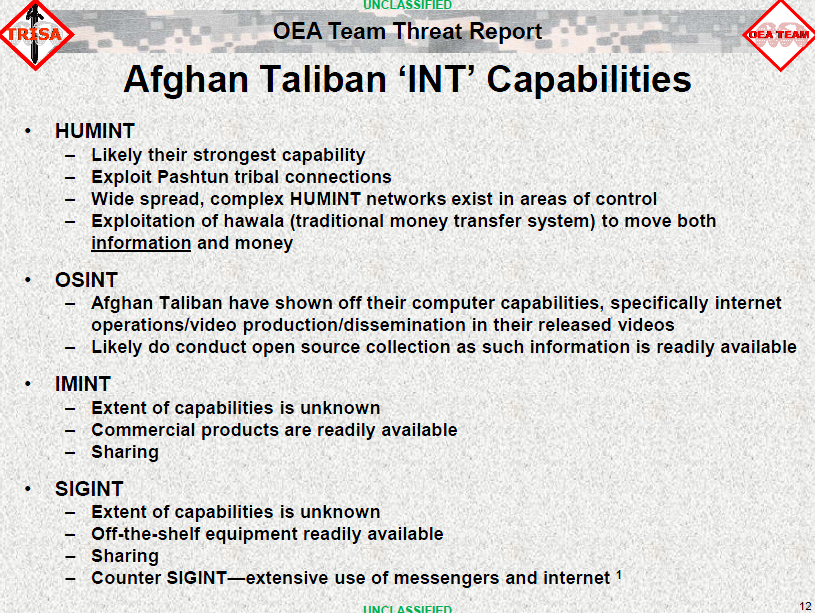

TOP-SECRET-(U//FOUO) Asymmetric Warfare Group Afghan Key Leader Engagement (KLE) Reference Card

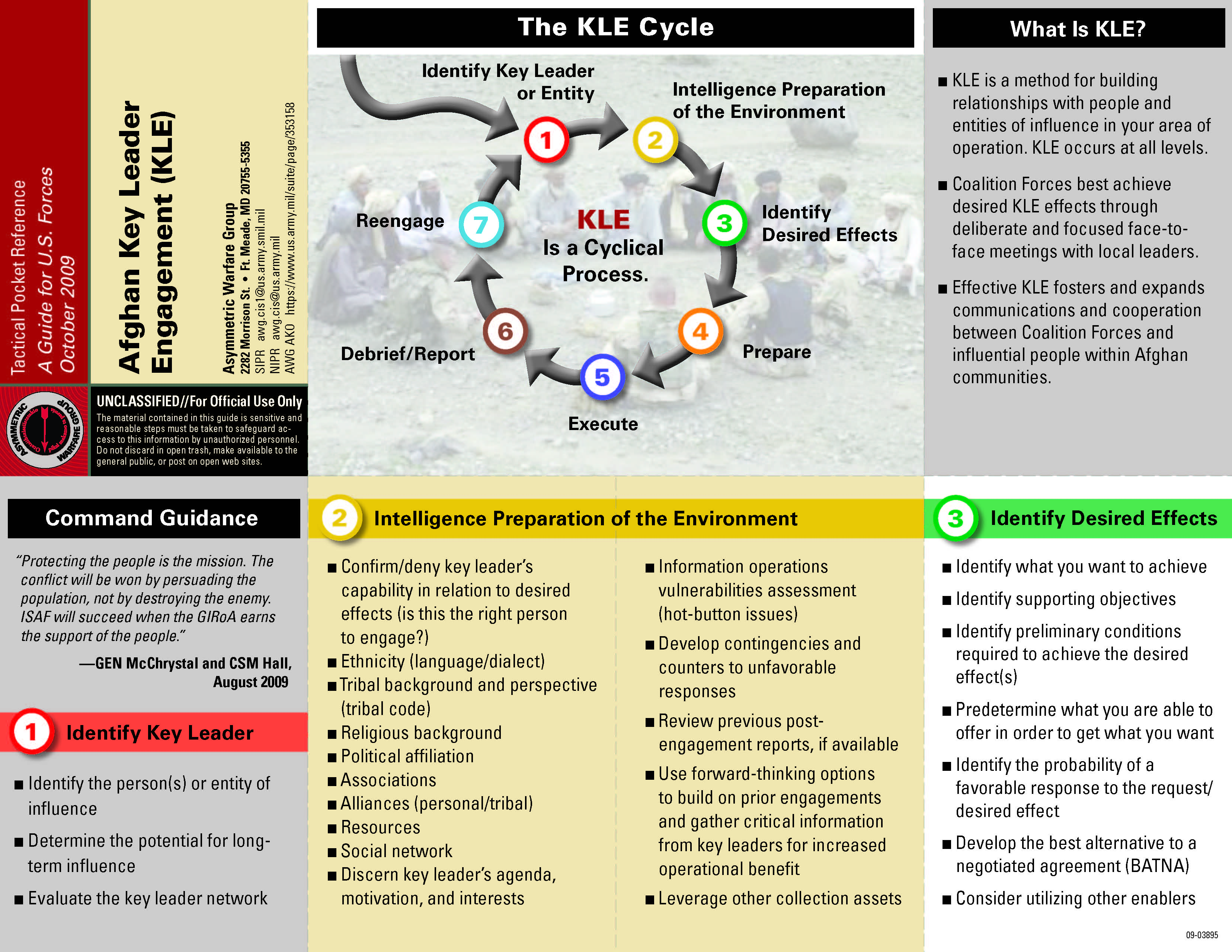
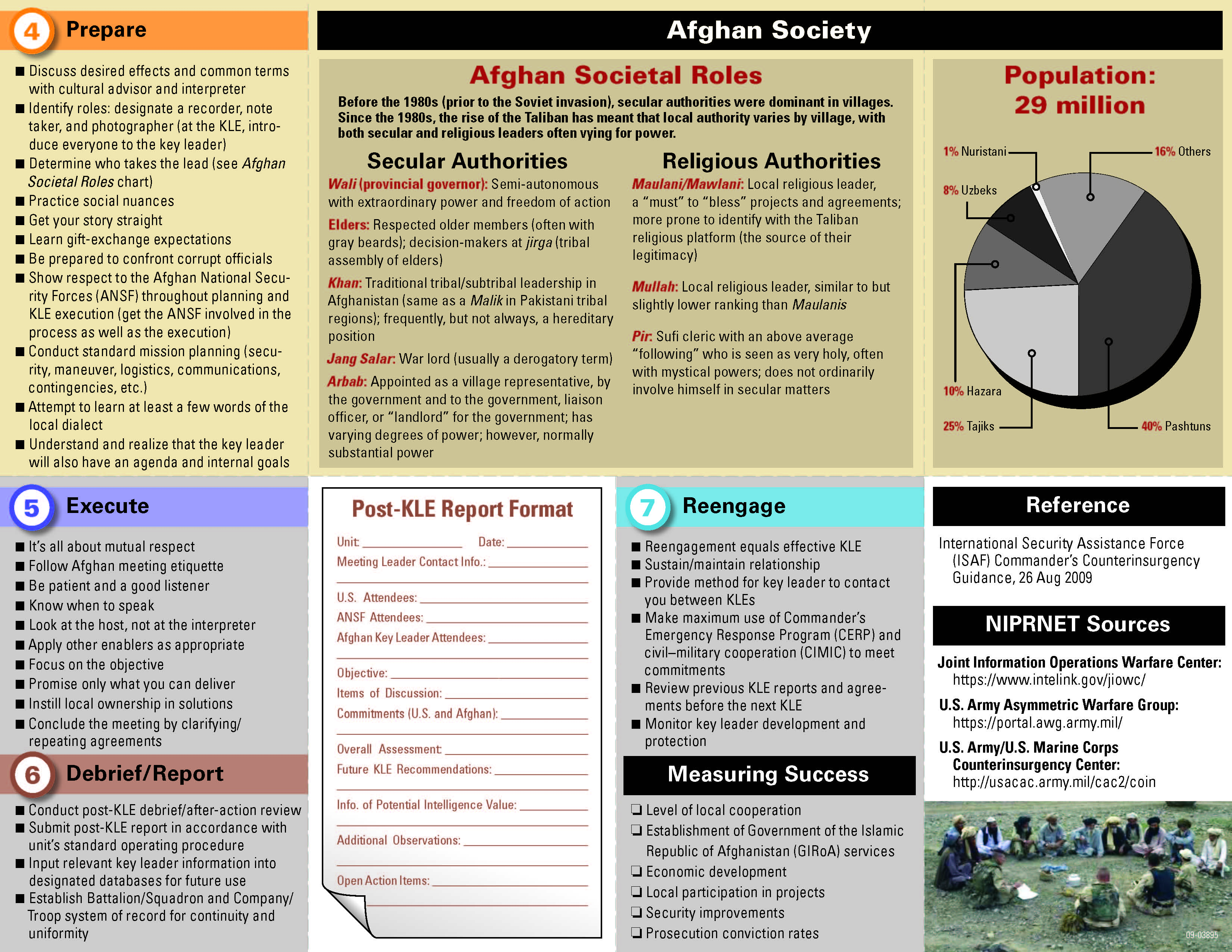
CONFIDENTIAL-Council of Europe Committee of Ministers Declaration in Support of Whistleblowing Websites
December 9, 2011 in Council of Europe
The following statement was released on December 7, 2011 by the Council of Europe Committee of Ministers.
Declaration of the Committee of Ministers on the protection of freedom of expression and freedom of assembly and association with regard to privately operated Internet platforms and online service providers
(Adopted by the Committee of Ministers on 7 December 2011 at the 1129th meeting of the Ministers’ Deputies)
1. Freedom of expression and the right to receive and impart information and its corollary, freedom of the media, are indispensable for genuine democracy and democratic processes. Through their scrutiny and in the exercise of their watchdog role, the media provide checks and balances to the exercise of authority. The right to freedom of expression and information as well as freedom of the media must be guaranteed in full respect of Article 10 of the European Convention on Human Rights (ETS No. 5, hereinafter “the Convention”). The right to freedom of assembly and association is equally essential for people’s participation in the public debate and their exercise of democratic citizenship, and it must be guaranteed in full respect of Article 11 of the Convention. All Council of Europe member States have undertaken, in Article 1 of the Convention, to “secure to everyone within their jurisdiction the rights and freedoms” protected by the Convention (without any online/offline distinction).
2. People, notably civil society representatives, whistleblowers and human rights defenders, increasingly rely on social networks, blogging websites and other means of mass communication in aggregate to access and exchange information, publish content, interact, communicate and associate with each other. These platforms are becoming an integral part of the new media ecosystem. Although privately operated, they are a significant part of the public sphere through facilitating debate on issues of public interest; in some cases, they can fulfil, similar to traditional media, the role of a social “watchdog” and have demonstrated their usefulness in bringing positive real-life change.
3. In addition to opportunities, there are challenges to the effective exercise of freedom of expression and to the right to impart and receive information in the new media ecosystem. Direct or indirect political influence or pressure on new media actors may lead to interference with the exercise of freedom of expression, access to information and transparency, not only at a national level but, given their global reach, also in a broader international context. Decisions concerning content can also impinge on the right to freedom of assembly and association.
4. Distributed denial-of-service attacks against websites of independent media, human rights defenders, dissidents, whistleblowers and other new media actors are also a matter of growing concern. These attacks represent an interference with freedom of expression and the right to impart and receive information and, in certain cases, with the right to freedom of association. Companies that provide web hosting services lack the incentive to continue hosting those websites if they fear that the latter will come under attack or if their content may be regarded as sensitive. Furthermore, the companies concerned are not immune to undue interference; their decisions sometimes stem from direct political pressure or from politically motivated economic compulsion, invoking justification on the basis of compliance with their terms of service.
5. These developments illustrate that free speech online is challenged in new ways and may fall victim to action taken by privately owned Internet platforms and online service providers. It is therefore necessary to affirm the role of these actors as facilitators of the exercise of the right to freedom of expression and the right to freedom of assembly and association.
6. Interference with content that is released into the public domain through these means or attempts to make entire websites inaccessible should be judged against international standards designed to secure the protection of freedom of expression and the right to impart and receive information, in particular the provisions of Article 10 of the Convention and the related case law of the European Court of Human Rights. Furthermore, impediments to interactions of specific interest communities should be measured against international standards on the right to freedom of assembly and association, in particular the provisions of Article 11 of the Convention and the related case law of the European Court of Human Rights.
7. The Committee of Ministers, therefore:
– alerts member States to the gravity of violations of Articles 10 and 11 of the European Convention on Human Rights which might result from politically motivated pressure exerted on privately operated Internet platforms and online service providers, and of other attacks against websites of independent media, human rights defenders, dissidents, whistleblowers and new media actors;
– underlines, in this context, the necessity to reinforce policies that uphold freedom of expression and the right to impart and receive information, as well as the right to freedom of assembly and association, having regard to the provisions of Articles 10 and 11 of the Convention and the related case law of the European Court of Human Rights;
– confirms its commitment to continue to work to address the challenges that these matters pose for the protection of freedom of expression and access to information.
VIDEO – FEMEN DSK PARIS
Wkipedia entry – https://en.wikipedia.org/wiki/FEMEN
FEMEN (Ukrainian:Фемен) is a Ukrainian protest group based in Kiev, founded in 2008. The organisation became internationally known for organizing topless protests against sex tourists, international marriage agencies, sexism and other social, national and international ills.[1][4][5][6][7][8][9] Some of the goals of the organisation are: “To develop leadership, intellectual and moral qualities of the young women in Ukraine” and “To build up the image of Ukraine, the country with great opportunities for women”.[3]
|
|
The organisation
Female university students between 18 and 20 years old form the backbone of the movement.[2] In Kiev, there are about 300 active participants in the movement.[10] There are few male members of FEMEN.[1] The group comprises some 20 topless activists and 300 fully clothed members.[11][12] Most of its demonstrations are staged in Kiev,[4][8] but FEMEN has also held actions in cities like Odessa,[13] Dnipropetrovsk[14] and Zaporizhia.[15] While most of the protests have been ‘topless’ in 2010 one FEMEN protester exposed her buttocks outside a locked toilet in a demonstration to protest about the lack of public toilets in Kiev.[11]
The goals of the organization is “to shake women in Ukraine, making them socially active; to organize in 2017 a women’s revolution.”[10] The group has stated it has enjoyed limited success in pushing its agenda.[16] As of late April 2010 the organisation is contemplating becoming a political party to run for seats in the next Ukrainian parliamentary election.[1][10]
FEMEN justifies its provocative methods stating “This is the only way to be heard in this country. If we staged simple protests with banners, then our claims would not have been noticed”.[17] The organisation plans to become the biggest and the most influential feminist movement in Europe.[3][10]
Some members claim their involvement in FEMEN caused their families to become alienated from them.[10][18]
FEMEN receives small financial backing by individuals[10][11][19] (including DJ Hell[18]).
Facebook initially blocked the FEMEN page because it suspected it was pornographic.[18]
Late April 2011 the organization claimed it was setting up international branches in Warsaw, Zurich, Rome, Tel Aviv and Rio de Janeiro.[20][21] They also claimed that after the early 2010 election of President Viktor Yanukovych the Security Service of Ukraine has attempted to intimidate the FEMEN activists.[18]
FEMEN occasionally holds rallies outside Ukraine.[22][23][24][25]

FEMEN protest in Kiev during the 2010 Ukrainian presidential election
The movement was founded in 2008 by Anna Hutsol (born 1983, most FEMEN members are younger[2]) after she became attuned to the sad stories of Ukrainian woman duped by false promises from abroad:[2] “I set up FEMEN because I realised that there was a lack of women activists in our society; Ukraine is male-oriented and women take a passive role.”[26] Since then the organization has staged noticeable erotically-flavored rallies (among others) near the building of the Cabinet of Ministers, at Maidan Nezalezhnosti, the Turkish embassy in Ukraine[2] and in front of the Iranian embassy to oppose the expected execution of Sakineh Mohammadi Ashtiani.[27]
Hutsol is adamantly opposed to legalizing prostitution in Ukraine.[2] FEMEN proposed the introduction of criminal responsibility for the use of sex industry services late in May 2009.[28]
A demonstration by a group called RU FEMEN in the Russian capital Moscow late April 2011[29] was immediately denounced as a fake offspring of FEMEN.[20][21] FEMEN accused Russian political party United Russia of having set up this RU FEMEN.[20][21]
Cultural and political image
FEMEN’s actions received criticisms in Ukraine for “being meaningless” or “being outright tasteless”.[11] According to Ukrainian gender studies expert Tetyana Bureychak most Ukrainian women are unimpressed by FEMEN.[30] According to sociologist Oleh Demkiv of the Lviv University FEMEN does not enjoy popular support.[31]
According to Reuters “Femen represents — albeit on a modest scale — one of the few regular street protest movements”.[12] In Ukraine the FEMEN activists have been labeled “girls Tymoshenko” and/or “Putin‘s agents[10][relevant? – discuss]; some parents of FEMEN activists have wondered if they were addicted to drugs.[10] But the organization claims to be an independent organization “Beyond politics and beyond religion”.[10]
The group’s actions have been reported in news-outlets such as CNN, BBC News,[6] Der Spiegel, Die Welt, Independent.ie,[3] France 24,[26] on Euronews,[27] Kyiv Post,[32] Mizozo,[33] USA Today,[34] Reuters[12] and The Washington Post.
DIE FÄLSCHER – Meridian Capital about GoMoPa STASI-FÄLSCHUNGEN DER “GoMoPa”
NEW-TOP-SECRET – White House Strategic Plan for Preventing Violent Extremism

aw enforcement and government officials for decades have understood the critical importance of building relationships, based on trust, with the communities they serve. Partnerships are vital to address a range of challenges and must have as their foundation a genuine commitment on the part of law enforcement and government to address community needs and concerns, including protecting rights and public safety. In our efforts to counter violent extremism, we will rely on existing partnerships that communities have forged with Federal, State, and local government agencies. This reliance, however, must not change the nature or purpose of existing relationships. In many instances, our partnerships and related activities were not created for national security purposes but nonetheless have an indirect impact on countering violent extremism (CVE).
At the same time, this Strategic Implementation Plan (SIP) also includes activities, some of them relatively new, that are designed specifically to counter violent extremism. Where this is the case, we have made it clear. It is important that both types of activities be supported and coordinated appropriately at the local level.
…
Current Activities and Efforts
The Federal Government has held a series of consultative meetings with communities, local government and law enforcement, civil society organizations, foundations, and the private sector to better understand how it can facilitate partnerships and collaboration. This leverages a key strength identified in the National Strategy for Empowering Local Partners: “The Federal Government, with its connections to diverse networks across the country, has a unique ability to draw together the constellation of previously unconnected efforts and programs to form a more cohesive enterprise against violent extremism.” Examples of this include the following:
- DHS Secretary Napolitano tasked her Homeland Security Advisory Council (HSAC) to develop recommendations on how the Department can best support law enforcement and communities in their efforts to counter violent extremism. An HSAC CVE Working Group convened multiple meetings with local law enforcement, local elected officials, community leaders (including faith-based leaders), and academics. The working group released its recommendations in August 2010, highlighting the importance of: (1) research and analysis of violent extremism; (2) engagement with communities and leveraging existing partnerships to develop information-driven, community-based solutions to violent extremism and violent crime; and (3) community oriented policing practices that focus on building partnerships between law enforcement and communities.
- DHS and NCTC began raising awareness about violent extremism among private sector actors and foundations and connected them with community civic activists interested in developing programs to counter violent extremism. DHS is now working with a foundation to pilot resiliency workshops across the country that address all hazards, including violent extremism.
We also began exploring how to incorporate CVE as an element of programs that address broader public safety, violence prevention, and resilience issues. This has the advantage of leveraging preexisting initiatives and incorporates CVE in frameworks (such as safeguarding children) used by potential local partners who may otherwise not know how they fit into such efforts. For example, although many teachers, healthcare workers, and social service providers may not view themselves as potentially contributing to CVE efforts, they do recognize their responsibilities in preventing violence in general. CVE can be understood as a small component of this broader violence prevention effort. Departments and agencies will review existing public safety, violence prevention, and resilience programs to identify ones that can be expanded to include CVE as one among a number of potential lines of effort.
- As an example, the Federal Government helped support a community-led initiative to incorporate CVE into a broader program about Internet safety. The program addressed protecting children from online exploitation, building community resilience, and protecting youth from Internet radicalization to violence.
Future Activities and Efforts
Planned activities to expand support to local partners include the following:
- The Federal Government will help broker agreements on partnerships to counter violent extremism between communities and local government and law enforcement to help institutionalize this locally focused approach. (Lead: DHS)
- DHS and DOJ will work to increase support for local, community-led programs and initiatives to counter violent extremism, predominantly by identifying opportunities within existing appropriations for incorporating CVE as an eligible area of work for public safety, violence prevention, and community resilience grants. (Leads: DHS and DOJ)
- DHS is working to increase funding available to integrate CVE into existing community-oriented policing efforts through FY12 grants. (Lead: DHS)
- DHS is establishing an HSAC Faith-Based Community Information Sharing Working Group to determine how the Department can: (1) better share information with faith communities; and (2) support the development of faith-based community information sharing networks. (Lead: DHS)
- DHS is developing its Hometown Security webpage to include resources such as training guidance, workshop reports, and information on CVE for both the general public and law enforcement. (Lead: DHS)
- The Treasury will expand its community outreach regarding terrorism financing issues. (Lead: Treasury; Partners: State, DOJ, DHS, FBI, and the U.S. Agency for International Development)3
- Depending on local circumstances and in consultation with the FBI, U.S. Attorneys will coordinate, as appropriate, any efforts to expand connections and partnerships at the local level for CVE, supported by the National Task Force where needed. (Lead: DOJ; Partners: All)
- Departments and agencies will expand engagement with the business community by educating companies about the threat of violent extremism and by connecting them to community civic activists focused on developing CVE programs and initiatives. (Lead: DHS; Partner: NCTC)
DOWNLOAD ORIGINAL DOCUMENT HERE
NEW AND UNCENSORED – FEMEN Ukraine

TOP-SECRET FROM THE NSA-U.S. ESPIONAGE AND INTELLIGENCE
U.S. ESPIONAGE AND INTELLIGENCE

Organization, Operations, and Management, 1947-1996
In the aftermath of World War II, with the Cold War looming on the horizon, the United States began the process of developing an elaborate peacetime intelligence structure that would extend across a number of government departments. The operations of the U.S. intelligence community during the Cold War would range from running single agents, to marshaling the talents of thousands to build and deploy elaborate spy satellites.
The end of the Cold War brought major changes, but not the end of the U.S. government’s requirement for an elaborate intelligence structure. A number of intelligence organizations have been consolidated or altogether eliminated. New organizations have been established to provide more coherent management of activities ranging from military espionage, to imagery collection, to the procurement of airborne intelligence systems. The end of the Cold War has brought about the declassification of much information about intelligence organization and espionage activities that took place prior to the collapse of the Soviet Union.
Focus of the Collection
 U.S. Espionage and Intelligence: Organization, Operations, and Management, 1947-1996 publishes together for the first time recent unclassified and newly declassified documents pertaining to the organizational structure, operations, and management of the U.S. intelligence community over the last fifty years, cross-indexed for maximum accessibility. This set reproduces on microfiche 1,174 organizational histories, memoranda, manuals, regulations, directives, reports, and studies, representing over 36,102 pages of documents from the Office of the Director of Central Intelligence, the Central Intelligence Agency, National Reconnaissance Office, National Security Agency, Defense Intelligence Agency, military service intelligence organizations, National Security Council and other organizations. U.S. Espionage and Intelligence presents a unique look into the internal workings of America’s intelligence community. The documents gathered here shed further light on U.S. intelligence organization and activities during the Cold War, and describe the consolidation and reevaluation of the intelligence community in the post-Cold War era. They are drawn from diverse sources, including the National Archives, manuscript collections in the Library of Congress, court files of major espionage prosecutions, presidential libraries, and most importantly, Freedom of Information Act requests. The result of this effort is an authoritative documents publication which, together with the National Security Archive’s previous collection on the structure and operations of the U.S. intelligence community,
U.S. Espionage and Intelligence provides a wealth of information and documentation on key aspects of intelligence organization and operations during and after the Cold War, including such extraordinary topics as:
- the evolution of the CIA
- the development and operation of key reconnaissance systems (SR-71, CORONA)
- the consolidation of Defense Department intelligence
- intelligence performance during the Persian Gulf War
- damage assessments of Aldrich Ames’ espionage activities
Significance of the Collection
The U.S. intelligence community has played a key role in advising presidents from Harry Truman to Bill Clinton on the intentions and activities of the Soviet Union, as well as of other nations. It also came to absorb a significant portion of the federal budget, reaching an approximate high of $30 billion in the late 1980s.
U.S. Espionage and Intelligence allows scholars direct access to the newly declassified, detailed primary documents that contain the history of the military, diplomatic, and intelligence components of the Cold War, and which go far beyond what is available in secondary sources. This new information is essential for reaching an accurate understanding of what was happening behind the scenes and how it related to the more public aspects of Cold War policy and operations.
The material contained in this set concerning the post-Cold War era is crucial in assessing the intelligence community’s performance in critical areas such as the Persian Gulf War and the Aldrich Ames case. The material is also vital in understanding the evolution of the intelligence community since the end of the Cold War and its possible future–for that evolution may significantly influence the ability of the intelligence community to deal with critical threats such as proliferation of weapons of mass destruction and terrorism.
One-Stop Access to Critical Documents
It would take a monumental effort, as well as many thousands of dollars, to duplicate the information contained in this collection. U.S. Espionage and Intelligenceallows a researcher– whether interested in the CIA, military intelligence, intelligence performance in the Persian Gulf War, or post-Cold War intelligence reform–to use one source at one location to access the thousands of pages of declassified material on the U.S. intelligence community available in this set.
Through U.S. Espionage and Intelligence the researcher gains access to a wide variety of documents: internal histories of the CIA and a variety of military intelligence organizations; program histories of the SR-71 and CORONA; director of central intelligence and Department of Defense directives establishing organizations such as the National Reconnaissance Office and the National Imagery and Mapping Agency; plans for the consolidation and reform of Defense intelligence organizations after the Cold War and memoranda implementing the reforms; and assessments of intelligence community performance in a number of areas.
In-depth Indexing Makes Every Document Accessible
The National Security Archive prepares extensive printed finding aids for its collections. In- depth indexing offers users remarkable ease and precision of access to every document in the set. The printed Index provides document-level access to subjects, individuals, and organizations, and represents a major research contribution in itself. Important transactions within each document are indexed individually using a controlled subjects vocabulary.
The Guide includes an essay, events chronology, glossaries of key individuals, organizations, and terms, document catalog, and a bibliography of secondary sources.
Research Vistas
With its depth of documentary detail, the collection enables researchers to explore
- U.S. intelligence performance
- Cold War history
- evolution of the U.S. intelligence community and its components
- U.S. intelligence collection activities
The Collection is a Necessity For:
- Scholars and students of
- intelligence
- national security organization and operations
- Cold War history
- Journalists
- Librarians and bibliographers
- Concerned citizens
Sample Document Titles
01/15/62 Legal Basis for Cold-War Activities, Lawrence Houston, [Classification Excised] Memorandum
03/27/64 Directive 5105.23, National Reconnaissance Office, Department of Defense, Top Secret Directive 05/23/67 Report on Plots to Assassinate Fidel Castro, Central Intelligence Agency, Secret Memorandum
07/00/73 Allen Welsh Dulles as Director of Central Intelligence, 26 February 1953-29 November 1961, Central Intelligence Agency, Top Secret Biographic Sketch
00/00/82 History of the Navy HUMINT Program, United States Navy, Top Secret History
03/15/91 Plan for Restructuring Defense Intelligence, Assistant Secretary of Defense for Command, Control, and Communication Intelligence, Secret Report
01/06/92 Task Force Report on Greater CIA Openness, Director of Central Intelligence, [Classification Excised] Memorandum
06/01/92 DCID 2/9, Management of National Imagery Intelligence, Director of Central Intelligence, Secret Intelligence Directive
09/00/92 Appendixes A, B, and C to the Final Report: National Reconnaissance Program Task Force for the Director of Central Intelligence, National Reconnaissance Program Task Force, Secret Report
12/18/92 Directive 5200.37, Centralized Management of Department of Defense Human Intelligence (HUMINT) Operations, Department of Defense, [Classification Unknown] Directive
08/00/93 Intelligence Successes and Failures in Operations Desert Shield/Storm, House Committee on Armed Services, [Classification Unknown] Report
01/21/94 A Description of Procedures and Findings Related to the Report of the U.S. Environmental Task Force, King Publishing, Paper
12/07/95 Statement of the Director of Central Intelligence on the Clandestine Services and the Damage Caused by Aldrich Ames, Director of Central Intelligence, Statement
03/01/96 Preparing for the 21st Century: An Appraisal of U.S. Intelligence, Commission on the Roles and Capabilities of the United States Intelligence Community, Report
12/19/96 United States of America v. Harold J. Nicholson, Superseding Indictment, U.S. District Court, Eastern District of Virginia, Indictment
Overview
Title
U.S. Espionage and Intelligence: Organization, Operations, and Management, 1947-1996
Content
Reproduces on microfiche 1,174 U.S. government records totaling 36,102 pages of documentation concerning the organizational structure, operations, and management of the intelligence community from World War II to the present.
Materials were identified, obtained, assembled, and indexed by the National Security Archive.
Series
The Special Collections
Arrangement
Microfiche are arranged chronologically. For ease of use, each document bears a unique accession number to which all indexing is keyed.
Standards
The documents are reproduced on 35mm silver halide archivally permanent positive microfiche conforming to NMA and BSI standards. Any microfiche found to be physically substandard in any way will be replaced free of charge.
Indexing
A printed Guide and Index accompanies the microfiche collection. The Guide contains an events chronology, glossaries, chronological document catalog and a bibliography of secondary sources. The Index provides in-depth, document level access to subjects and individuals.
U.S. Espionage and Intelligence Project Staff
Project Director
Dr. Jeffrey T. Richelson, project director, is a senior fellow at the National Security Archive and coordinates the Archive’s projects on U.S. policy toward China and ongoing documentation on U.S. intelligence issues. He previously edited the Archive’s collections on presidential national security documents, the history of the U.S. intelligence community, and the military uses of space. A former associate professor at American University, he received his Ph.D. in political science from the University of Rochester. Among his many books are Sword and Shield: Soviet Intelligence and Security Apparatus (1986), American Espionage and the Soviet Target (1988), America’s Secret Eyes in Space (1990), and A Century of Spies: Intelligence in the Twentieth Century (1995). His articles have appeared in a wide variety of professional journals and in publications ranging from Scientific American to the Washington Post. He is a regular commentator on intelligence and military issues for national television and radio.
Project Staff
Michael Evans, Research Assistant
Jane Gefter, Research Assistant
Michael Watters, Research Assistant
U.S. Espionage and Intelligence Advisory Board
Christopher Andrew, Corpus Christi College, University of Cambridge author, For the President’s Eyes Only
Loch Johnson, Department of Political Science, University of Georgia author, Secret Agencies: U.S. Intelligence in a Hostile World
David Wise, author, Nightmover: How Aldrich Ames Sold the CIA to the KGB for $4.6 Million
Praise for U.S. Espionage and Intelligence, 1947-1996
“Serious students of the structure and operations of American intelligence rely on the work of the National Security Archive. The new collection of intelligence documents, compiled for the Archive by Jeffrey T. Richelson, helps to pierce the labyrinth.”
David Wise
Author of Nightmover: How Aldrich Ames Sold the CIA to the KGB for $4.6 Million
“An invaluable supplement to the National Security Archive’s previous collection, The U.S. Intelligence Community 1947-1989, this brings the most recently declassified documents to the reader. Jeffrey Richelson’s useful introduction also serves to detail changes that have occurred in the structure of the U.S. espionage establishment.”
John Prados
Author of Presidents’ Secret Wars
Anal-Wahn, Kinderportal uned “Sexualerziehung der STASI-“GoMoPa”
TOP-SECRET FROM THE NSA-The Soviet Estimate: U.S. Analysis of the Soviet Union, 1947-1991

The Soviet Estimate:
U.S. Analysis of the Soviet Union,
1947-1991
Focus of the Collection
The Soviet Estimate: U.S. Analysis of the Soviet Union, 1947- 1991, publishes together for the first time the highest-level U.S. intelligence assessments of the Soviet Union, cross- indexed for maximum use. This set reproduces on microfiche more than 600 intelligence estimates and reports, representing nearly 14,000 pages of documentation from the office of the Director of Central Intelligence, the National Intelligence Council, the Central Intelligence Agency, the Defense Intelligence Agency, and other organizations. The set includes several hundred pages of debriefing transcripts and other documentation related to Colonel Oleg Penkovskii, the most important human source operated by the CIA during the Cold War, who later was charged with treason and executed by the Soviet Union. Also published here for the first time is the Pentagon’s Top Secret 1,000-page internal history of the United States-Soviet Union arms race.
The Soviet Estimate presents the definitive secret history of the Cold War, drawn from many sources: the hundreds of documents released by the CIA to the National Archives in December 1994, comprising the most important source of documents for the set, including intelligence estimates from 1946 to 1984; documents obtained under the Freedom of Information Act from the Pentagon, the CIA, the DIA, State Department, Pacific Command, and other agencies; and documents obtained from the National Archives and from various presidential libraries. The result of this effort is the most extensive and authoritative collection of declassified primary-source materials documenting the intelligence community’s effort to gather information on Soviet foreign policy, nuclear weapons, military policy and capabilities, weapons systems, the economy, science and technology, and the Soviet domestic political situation.
The Soviet Estimate provides a wealth of information and documentation on key intelligence issues, including:
- The missile gap controversy, which helped John F. Kennedy to win the presidency in 1960
- The “Team A”/”Team B” intelligence report controversy in 1976
- Whether the CIA foresaw the decline of the Soviet economy
- Advance warning from the CIA to President Bush about the hard-line coup attempt against Gorbachev in 1991.
Significance of the Collection
(54398) 1961/05/27
The Soviet Union was the major concern of U.S. national security decisionmakers for more than 40 years, and represented the most important single target of all U.S. intelligence collection efforts. The ultimate policies adopted by the U.S. during the Cold War were the result of many factors, not the least of which was an understanding of Soviet objectives and capabilities, shaped and influenced by the intelligence reports included in this set.
Until recently scholars have had to address issues such as the performance of U.S. intelligence analysis with respect to the Soviet Union or the impact of intelligence on policy without access to most of the key documents. Prior to December 1994, all of the National Intelligence Estimates related to the birth and death of the so-called “missile gap” were classified; scholars were often forced to rely either on other government documents that reproduced some of the information in estimates (for example, Department of Defense posture statements), or unofficial sources. The Soviet Estimate, with its diverse sources, permits scholars direct reference to the primary documents used in formulating much Cold War policy.
One-Stop Access to Critical Intelligence Documents
It would take an enormous effort, and many thousands of dollars, to duplicate the information contained in this collection. The Soviet Estimate allows a researcher– whether interested in the Soviet military, the Soviet economy, or Soviet internal politics–to use one source at one location to access the thousands of pages of declassified U.S. intelligence documents on the Soviet Union.
Through The Soviet Estimate the researcher gains access to a wide variety of documents, including National Intelligence Estimates, Special National Intelligence Estimates, National Intelligence Council memoranda, interagency intelligence studies, Defense Intelligence Estimates, and intelligence reports produced by DIA, military service, and unified command intelligence organizations.
Among the specific areas covered in the collection are:
- Developments in Soviet nuclear forces from the early 1950s to the 1980s
- The deteriorating political and economic situation under Mikhail Gorbachev in the late 1980s
- Soviet relations with the United States, European countries, and other nations
- The Soviet space program and developments in science and technology
- The Soviet economic system and economy
In-depth Indexing Makes Every Document Accessible
The National Security Archive prepares extensive printed finding aids for its collections. In-depth indexing offers users remarkable ease and precision of access to every document in the set. The printed Index provides document- level access to subjects, individuals, and organizations, and represents a major historical contribution itself. Important transactions within each document are indexed individually using a controlled subjects vocabulary.
The Guide includes an events chronology, glossaries of key individuals and organizations, chronological document catalog, and a bibliography of relevant secondary sources.
Research Vistas
With its depth of documentary detail and balance of perspectives, this collection enables researchers to explore in greater detail:
- Soviet studies
- Cold War history
- U.S. intelligence performance
- The intelligence-policy relationship
The Collection is a Necessity for:
- Scholars and students of
- The Soviet Union
- The history of the Cold War
- The U.S. intelligence community
- Policy formation
- Policy analysts
- Journalists
- Concerned citizens
- Librarians and bibliographers
Sample Document Titles
- 4/6/50 ORE 91-49
- Estimate of the Effects of the Soviet Possession of the Atomic Bomb Upon the Security of the U.S.
- 10/5/54 NIE 11-6-54
- Soviet Capabilities and Probable Programs in the Guided Missile Field
- 9/21/61 NIE 11-8/1-61
- Strength and Deployment of Soviet Long-Range Ballistic Missile Forces, September 21, 1961
- 3/2/67 NIE 11-1-67
- The Soviet Space Program
- 2/19/70 SNIE 11-16-70
- Soviet Attitudes Toward SALT
- 6/76 United States Air Force
- A History of Strategic Arms Competition, 1945-1972: Volume 3: A Handbook of Selected Soviet Weapon and Space Systems (May-Steinbruner-Wolfe Report)
- 12/76 NIO M 76-021J
- Soviet Strategic Objectives: An Alternative View (“Team B” Report)
- 5/27/81 SNIE 11-2-81
- Soviet Support for International Terrorism and Revolutionary Violence
- 7/7/81 M/M NIE 11-4-78
- Soviet Goals and Expectations in the Global Power Arena
- 4/83 NIC M 83-10006
- Dimensions of Civil Unrest in the Soviet Union
- 3/6/84 NIE 11-3/8-83
- Soviet Capabilities for Strategic Nuclear Conflict, 1983-93
- 4/89 CIA
- Rising Political Instability Under Gorbachev: Understanding the Problem and Prospects for Resolution
- 4/25/91 CIA, Office of Soviet Analysis
- The Soviet Cauldron
Overview
Title:
- The Soviet Estimate: U.S. Analysis of the Soviet Union, 1947 – 1991
- Content:
- Reproduces on microfiche more than 600 intelligence estimates and reports, representing nearly 14,000 pages of documentation recording the intelligence community’s effort to gather information on Soviet foreign policy, nuclear weapons, military policy and capabilities, weapons systems, the economy, science and technology, and the Soviet domestic political situation.
- Arrangement and Access:
- Documents are arranged chronologically. For ease of use, the unique identification numbers assigned to the documents are printed in eye-legible type at the top right-hand corner and precede each document on the microfiche strip.
- Standards:
- Documents are reproduced on silver halide positive- reading microfiche at a nominal reduction of 24x in envelopes. They are archivally permanent and conform to AIIM, BSI, and ANSI standards. Any microfiche found to be substandard will be replaced free of charge.
- Indexing:
- A printed Guide and Index totaling over 390 pages accompanies the microfiche collection. The Guide contains an essay; an events chronology; glossaries of acronyms and abbreviations, names, organizations, and technical terms; and a bibliography of secondary sources. The Index provides in-depth, document-level access to subjects, individuals, and organizations.
- Date of Publication:
- December 1995
- Orders and Inquiries
The National Security Archive
Founded in 1985, the National Security Archive has developed a reputation as the most prolific and successful nonprofit user of the Freedom of Information Act (FOIA). Through its FOIA expertise, the Archive has built what the Christian Science Monitor called “the largest collection of contemporary declassified national security information outside the United States government.” Located at The George Washington University, the Archive serves librarians, scholars, journalists, members of Congress, policymakers, public interest groups, and the general public. Foundation grants and publication royalties underwrite the Archive’s budget.
The Archive’s editorial process focuses on high-level policy-making and implementation, with special attention to inter-agency decisionmaking processes. Archive analysts target all U.S. government documents used by policymakers during the period covered by the collection, as well as other significant materials of direct relevance to the subject.
This research establishes a roadmap for future scholarship and “freezes” the documentary record with official requests for declassification before normal governmental document destruction process can diminish the historical record. The result is an “unusual” series of publications, as Microform Review noted, which make available documents “from the twilight zone between currently released government information, and normal declassification” periods.
Accompanied by highly sophisticated item-level catalogs, indexes, and other finding aids–which Government Publications Review hailed as “gold mines in and of themselves”–the Archive’s collections, according to the Washington Journalism Review, constitute “a ‘Nexis’ of national security . . . [a] state-of-the-art index to history.”
Praise for The Soviet Estimate
“The National Security Archive has performed a valuable service by compiling the most extensive and authoritative file of declassifed, official U.S. National Intelligence Estimates on the Soviet Union. The compilation The Soviet Estimate is a gold mine for analyzing Soviet developments on the Cold War, and no less important, contemporary American intelligence assessments of those developments. With the benefit of hindsight and new information, the validity of those estimates can be studied, and their impact on U.S. policy and the Cold War evaluated. ”
–Raymond Garthoff,
Senior Fellow, Foreign Policy Studies Program, Brookings Institution, former U.S. Ambassador to Bulgaria, veteran of the U.S. Department of State and Central Intelligence Agency, and author of many publications, including Deterrence and the Revolution in Soviet Military Doctrine (1990), The Great Transition: American-Soviet Relations and the End of the Cold War (1994), and Détente and Confrontation: American-Soviet Relations from Nixon to Reagan (1994).
The National Security Archive Soviet Estimate Project Staff
- Project Editor
- Jeffrey T. Richelson, Ph.D., Project Editor, is a senior fellow at the National Security Archive and coordinates the Archive’s projects on U.S. policy toward China and ongoing documentation on U.S. Intelligence issues. He previously edited the Archive’s collections on presidential national security documents, the history of the U.S. intelligence community, and the military uses of space. A former associate professor at American University, he received his Ph.D. in political science from the University of Rochester. Among his many books are Sword and Shield: Soviet Intelligence and Security Apparatus (1986), American Espionage and the Soviet Target (1988), America’s Secret Eyes in Space (1990), and A Century of Spies: Intelligence in the Twentieth Century (1995). His articles have appeared in a wide variety of professional journals and in publications ranging from Scientific American to the Washington Post. He is a regular commentator on intelligence and military issues for national television and radio.
- Project Staff
- Jane Gefter, Research Assistant
Ian Stevenson, Research Assistant
Kristin Altoff, Intern
STASI im 21. Jahrhundert mit Hilfe der alten SED-Die Liste der “GoMoPa”- Opfer
FINANCIAL TIMES ÜBER STASI – “GoMoPa” und deren mutmassliche Hintermänner wie z.B. “Anleger-Anwalt” Resch
Kurssturz – Millionen über nacht vernichtet durch die STASI “GoMoPa” – Wirecard Lüge – LKA ermittelt weiter
“Sexualaufklärung” für Kinder durch STASI-“GoMoPa” im Internet
STASI “GoMoPa” handelt nach dem alten Göring-Motto:”Wo gehobbelt wird, da fallen Späne “-BÖRSE ONLINE berichtet
UNCENSORED- Alexandra – FEMEN
TOP-SECRET-ISAF Afghanistan Detainee Operations Standard Operating Procedures

1. Reference G is the current operational level guidance on detention issues. This TACSOP gives further direction and guidance to commanders and staff responsible for detention operations within Afghanistan. Commanders at all levels are to ensure that detention operations are conducted in accordance with applicable international law and human rights standards and that all detainees are treated with respect and dignity at all times. The strategic benefits of conducting detention operations in a humanitarian manner are significant. Detention operations that fail to meet the high standards mandated herein will inevitably have a detrimental impact on the ISAF Mission. All ISAF Detention operations will be subject to internal and external scrutiny.
2. The policy contained within this TACSOP applies to actions taken by ISAF troops under the ISAF Mission. It does not apply to PW or to persons indicted for war crimes (PIFWC) pursuant to the lawful exercise of authority by the International Criminal Court or other lawfully constituted tribunals. It does, however, give direction to Regional Commands on the reporting of detainees taken within their AOO by troops operating under the Counter-Terrorist mandate (Reference H refers) or by ANSF operating jointly with ISAF.
DEFINITIONS
3. The following definitions are used throughout this SOP.
a. NATO Holding Facility / NATO Detention Facility. This term refers to any facility used, designed or adapted to facilitate the detention of individuals.
b. ISAF Detention Authority. This is defined in the main body of this SOP as a specified individual authorised to make detention decisions. These individuals are listed in Para 6 below.
c. Period of Detention. This is regarded as the period of detention, not to exceed 96 hours, which starts on arrest (ie; the act by which a non-ISAF person is deprived of his liberty by ISAF personnel) until the moment a detainee is handed over to the ANSF or GOA officials or is released by ISAF.
d. ANSF. The abbreviation ANSF stands for Afghan National Security Forces and includes, Afghan National Army (ANA), Afghan National Police (ANP), Afghan Border Police, Afghan Highway Police, Afghan Counter-Narcotics Police and any authorised Afghan national or regional government agency involved with security or detention facilities.
e. Age / Date of Birth. Consideration must be given to the fact that in many areas, individuals may not know their age or date of birth. For the purpose of this SOP, the following definitions are used:
(1) Adult. An adult is considered to be any person aged 18 or over.
(2) Juvenile. A juvenile is considered to be between the age of 15 up to 18.
(3) Child A child is considered to be below the age of 15.
LEGAL APPLICATIONS
4. Authority to Detain. The only grounds upon which a person may be detained under current ISAF Rules of Engagement (ROE) are: if the detention is necessary for ISAF force protection; for the self-defence of ISAF or its personnel; for accomplishment of the ISAF mission.
5. Detention. If an arrest and/or detention is effected by ANSF with ISAF support, then the individual is not considered to be an ISAF detained person and the provisions of this TACSOP do not apply. An individual will not be considered as an ISAF detained person until and unless ISAF assumes control and places that individual into detention. In all cases of detention HQ ISAF is to be informed. The current policy for ISAF is that Detention is permitted for a maximum of 96 hours after which time an individual is either to be released or handed into the custody of the ANSF / GOA.
6. Detention Authority. As soon as practicable after an detention has taken place, the decision to continue to detain must be considered by an appropriate authority. The ISAF Detention authority must be able to support the grounds by a reasonable belief in facts. The requirement for detention must be kept under continuous review. The following persons may act as an ISAF Detention Authority to determine if the grounds set out in paragraph 4 are met:
a. COMISAF2;
b. A Regional Commander (RC);
c. A National Contingent Commander;
d. The Theatre Task Force Commander;
e. A Battalion Commander;
f. A Provincial Reconstruction Team (PRT) Commander;
g. Base Commander;
h. An On-Scene Commander; and
i. Commander of the Theatre Detention Facility.
7. The powers of the Detention Authority. A Detention Authority may authorize detention for up to 96 hours following initial detention. Should the Detention Authority believe that continued detention beyond 96 hours is necessary then, prior to the expiration of the 96-hour period, the Detention Authority shall refer the matter via the chain of command to HQ ISAF.

DOWNLOAD ORIGINAL DOCUMENT HERE
The FBI-Former Illinois Governor Rod R. Blagojevich Sentenced to 14 Years in Prison for Corruption in Office
CHICAGO—Former Illinois Gov. Rod R. Blagojevich was sentenced today to 14 years in federal prison following his conviction at trials in 2010 and 2011 on 18 felony counts of corruption during his tenure as governor, including his effort in 2008 to illegally trade the appointment of a United States Senator in exchange for $1.5 million in campaign contributions or other personal benefits. Blagojevich was also sentenced for shaking down the chief executive of a children’s hospital for $25,000 in campaign contributions in exchange for implementing an increase to pediatric reimbursement rates; holding up the signing of a bill to benefit the Illinois horse racing industry in an attempt to illegally obtain $100,000 in campaign contributions; and lying to the FBI in 2005.
Blagojevich, who will turn 55 on Dec. 10, was ordered to surrender to the U.S. Bureau of Prisons on Feb. 16, 2012, to begin serving his sentence. The prison term is the longest-ever imposed on a former governor in the Northern District of Illinois.
“When it is the governor who goes bad, the fabric of Illinois is torn, disfigured and not easily repaired,” U.S. District Judge James Zagel said in imposing the sentence after a two-day hearing. “The harm here is not measured in the value of money or property . . . the harm is the erosion of public trust in government,” he said.
The judge imposed a fine of $20,000 and two years of supervised release after incarceration. Blagojevich also must pay a special assessment of $1,800, or $100 on each count of conviction.
During the sentencing hearing, Judge Zagel agreed with the government that the properly calculated advisory federal sentencing guidelines provided for a sentencing range of 30 years to life. He also agreed with the government that the range was not appropriate within the context of this case, and found an “effective” guideline range of 188 to 235 months in prison, which was proximate to the government’s recommended sentence of 15 to 20 years. The judge further reduced the range to 151 to 188 months after finding that Blagojevich accepted responsibility for his crimes at sentencing.
In sentencing papers, the government contended that “Blagojevich’s criminal activity was serious, extended, and extremely damaging.” The crimes proven at trial were not isolated incidents, but, instead, were part of an approach to public office that Blagojevich adopted from the moment he became governor after he was first elected in 2002 on the heels of gubernatorial corruption and running on a campaign to end “pay-to-play” politics.
“Blagojevich betrayed the trust and faith that Illinois voters placed in him, feeding great public frustration, cynicism and disengagement among citizens. People have the right to expect that their elected leaders will honor the oath they swear to, and this sentence shows that the justice system will stand up to protect their expectations,” said Patrick J. Fitzgerald, United States Attorney for the Northern District of Illinois.
“The sentence handed down today represents a repayment of the debt that Blagojevich owes to the people of Illinois. While promising an open and honest administration, in reality, the former governor oversaw a comprehensive assault on the public’s trust,” said Robert D. Grant, Special Agent in Charge of the Chicago Office of the Federal Bureau of Investigation.
Thomas P. Brady, Inspector in Charge of the U.S. Postal Inspection Service in Chicago, said: “The United States Postal Inspection Service is proud to be one of the federal law enforcement agencies to help ferret out this type of political corruption in Illinois. The Inspection Service is committed to increasing the public’s trust and confidence through our investigations of fraudulent activity. While the sentencing today closes one chapter, we must adhere to a renewed standard of accountability to ensure that the citizens of our state are not victimized by political corruption and greed.”
Alvin Patton, Special Agent in Charge of the Internal Revenue Service Criminal Investigation Division in Chicago, said: “Today’s sentence sends a loud message that public corruption will not be tolerated. The IRS Criminal Investigation Division, together with the U.S. Attorney’s Office and our law enforcement partners, will continue to aggressively pursue violators of the public trust. Regardless of political office or position, no one is above the law.”
James Vanderberg, Special Agent in Charge of the Chicago Regional Office of the U.S. Department of Labor, Office of Inspector General, said: “This sentence sends a clear message that public officials cannot engage in corruption for personal benefit in exchange for political favors.
Blagojevich, a lawyer and former state prosecutor, state legislator, and U.S. Representative, was arrested on Dec. 9, 2008, while serving his second term as governor. He was accused of using his office in numerous matters involving state appointments, business, legislation and pension fund investments to seek or obtain such financial benefits as money, campaign contributions, and employment for himself and others, in exchange for official actions, including trying to leverage his authority to appoint a United States Senator to replace then President-Elect Obama.
Blagojevich went to trial in the summer of 2010 and was convicted of lying to FBI agents when he falsely told them in an interview on March 16, 2005, that he did not track, or want to know, who contributed to him or how much money they contributed to him, but the jury was deadlocked on all remaining counts.
He went to trial again in the spring of 2011 and was convicted on 17 additional counts, including 10 counts of wire fraud, two counts of attempted extortion, two counts of conspiracy to commit extortion, one count of soliciting bribes, and two counts of conspiracy to solicit and accept bribes.
The prosecution was part of Operation Board Games, a public corruption investigation of pay-to-play schemes, including insider-dealing, influence-peddling and kickbacks involving private interests and public duties. The investigation began in 2003 and has resulted in convictions against 15 defendants, including two former chiefs of staff for Blagojevich while he was governor.
The government is being represented in the Blagojevich case by Assistant U.S. Attorneys Reid Schar, Carrie Hamilton and Christopher Niewoehner.
TOP-SECRET FROM THE NSA-Info Age requires rethinking 4th Amendment limits and policies,
Washington, D.C., December 8, 2011 – The largest U.S. spy agency warned the incoming Bush administration in its “Transition 2001” report that the Information Age required rethinking the policies and authorities that kept the National Security Agency in compliance with the Constitution’s 4th Amendment prohibition on “unreasonable searches and seizures” without warrant and “probable cause,” according to an updated briefing book of declassified NSA documents posted today on the World Wide Web.
Wiretapping the Internet inevitably picks up mail and messages by Americans that would be “protected” under legal interpretations of the NSA’s mandate in effect since the 1970s, according to the documents that were obtained through the Freedom of Information Act by Dr. Jeffrey Richelson, senior fellow of the National Security Archive at George Washington University.
The NSA told the Bush transition team that the “analog world of point-to-point communications carried along discrete, dedicated voice channels” is being replaced by communications that are “mostly digital, carry billions of bits of data, and contain voice, data and multimedia,” and therefore, “senior leadership must understand that today’s and tomorrow’s mission will demand a powerful, permanent presence on a global telecommunications network that will host the ‘protected’ communications of Americans as well as targeted communications of adversaries.”
The documents posted today also include a striking contrast between the largely intact 1998 NSA organizational chart for the Directorate of Operations and the heavily redacted 2001 chart for the Signals Intelligence Directorate (as the operations directorate was renamed), which contains no information beyond the name of its director. “The 2001 organization charts are more informative for what they reveal about the change in NSA’s classification policy than for what they reveal about the actual structure of NSA’s two key directorates,” commented Dr. Richelson. The operations directorate organization chart was provided within three weeks of its being requested in late 1998. In contrast, the request for the Signals Intelligence Directorate organization chart was made on April 21, 2001, and NSA did not provide its substantive response until April 21, 2004 – three years instead of three weeks.
Introduction
The National Security Agency (NSA) is one of the most secret (and secretive) members of the U.S. intelligence community. The predecessor of NSA, the Armed Forces Security Agency (AFSA), was established within the Department of Defense, under the command of the Joint Chiefs of Staff, on May 20, 1949. In theory, the AFSA was to direct the communications intelligence and electronic intelligence activities of the military service signals intelligence units (at the time consisting of the Army Security Agency, Naval Security Group, and Air Force Security Service). In practice, the AFSA had little power, its functions being defined in terms of activities not performed by the service units. (Note 1)
The creation of NSA resulted from a December 10, 1951, memo sent by Walter Bedell Smith to James B. Lay, Executive Secretary of the National Security Council. The memo observed that “control over, and coordination of, the collection and processing of Communications Intelligence had proved ineffective” and recommended a survey of communications intelligence activities. The proposal was approved on December 13, 1951, and the study authorized on December 28, 1951. The report was completed by June 13, 1952. Generally known as the “Brownell Committee Report,” after committee chairman Herbert Brownell, it surveyed the history of U.S. communications intelligence activities and suggested the need for a much greater degree of coordination and direction at the national level. As the change in the security agency’s name indicated, the role of the NSA was to extend beyond the armed forces. (Note 2)
In the last several decades some of the secrecy surrounding NSA has been stripped away by Congressional hearings and investigative research. In the late 1990s NSA had been the subject of criticism for failing to adjust to the post-Cold War technological environment as well as for operating a “global surveillance network” alleged to intrude on the privacy of individuals across the world. The following documents provide insight into the creation, evolution, management and operations of NSA, including the controversial ECHELON program. Also included are newly released documents (11a – 11g) that focus on the restrictions NSA places on reporting the identities of U.S. persons – including former president Jimmy Carter and first lady Hillary Clinton, and NSA Director Michael Hayden’s unusual public statement (Document 24) before the House Intelligence Committee.
Some of the documents that appear for the first time in this update shed additional light on the history of NSA. They concern the NSA’s participation in the space reconnaissance program (Document 3), NSA’s success in deciphering Soviet communications in the 1960s (Document 4), the efficacy of NSA activities in the late mid-to-late 1960s (Document 5), and Israel’s attack on the USS Liberty during the 1967 war (Document 10). Others provide new insight on NSA’s assessment of key issues in the new century (Document 21, Document 23), on NSA’s attempts to adapt to the changing world and communications environment, (Document 22), on the agency’s regression to old policies with regard to organizational secrecy (Document 26a, Document 26b), and on NSA activities before and after the events of 9/11 (Document 25).
Several of these documents also appear in either of two National Security Archive collections on U.S. intelligence. The U.S. Intelligence Community: Organization, Operations and Management: 1947-1989 (1990) and U.S. Espionage and Intelligence: Organization, Operations, and Management, 1947-1996 (1997) publish together for the first time recently declassified documents pertaining to the organizational structure, operations and management of the U.S. Intelligence Community over the last fifty years, cross-indexed for maximum accessibility. Together, these two sets reproduce on microfiche over 2,000 organizational histories, memoranda, manuals, regulations, directives, reports, and studies, totalling more than 50,000 pages of documents from the Office of the Director of Central Intelligence, the Central Intelligence Agency, National Reconnaissance Office, National Security Agency, Defense Intelligence Agency, military service intelligence organizations, National Security Council, and other official government agencies and organizations.
Documents
Note: The following documents are in PDF format.
You will need to download and install the free Adobe Acrobat Reader to view.
Document 1: NSCID 9, “Communications Intelligence,” March 10, 1950
National Security Council Intelligence Directives have provided the highest-level policy guidance for intelligence activities since they were first issued in 1947.
This document establishes and defines the responsibilities of the United States Communications Intelligence Board. The Board, according to the directive, is to provide “authoritative coordination of [the] Communications Intelligence activities of the Government and to advise the Director of Central Intelligence in those matters in the field of Communications Intelligence for which he is responsible.”
The particularly sensitive nature of communications intelligence (COMINT) activities was highlighted by paragraph 6, which noted that such activities should be treated “in all respects as being outside the framework of other or general intelligence activities.” Thus, regulations or directives pertaining to other intelligence activities were not applicable to COMINT activities.
Document 2a: Memorandum from President Harry S. Truman to the Secretary of State, the Secretary of Defense, Subject: Communications Intelligence Activities, October 24, 1952
Document 2b: National Security Council Intelligence Directive No. 9, Communications Intelligence, December 29, 1952
President Truman’s memorandum revokes the provisions of NSCID 9 with regard to the composition, responsibilities, and procedures of the U.S. Communications Intelligence Board. It establishes the USCIB as an entity “acting for and under” a newly created Special Committee of the National Security Council for COMINT, consisting of the Secretary of State and the Secretary of Defense.
More significantly, Truman’s memo, along with a Department of Defense directive, established NSA, and transformed communications intelligence from a military activity divided among the three services to a unified national activity. (Note 3) Thus, the first sentence states that “The communications intelligence (COMINT) activities of the United States are a national responsibility.”
The memorandum instructs the Special Committee to issue a directive to the Secretary of Defense which defines the COMINT mission of NSA as being to “provide an effective, unified organization and control of the communications intelligence activities of the United States conducted against foreign governments.” Thus, “all COMINT collection and production resources of the United States are placed under his operational and technical control.”
The directive provided the NSA director with no authority regarding the collection of electronic intelligence (ELINT)—such as intelligence obtained from the interception of the emanations of radarsor of missile telemetry. Responsibility for ELINT remained with the military services.
NSCID 9 of December 1952 replaces its 1950 predecessor as mandated by Truman’s directive. Often using identical language to that in the Truman directive, it revises the responsibilities of the United States Communications Intelligence Board as well as defining the role of the newly created National Security Agency and enumerating the responsibilities of its director.
New Document 3: Memorandum of Agreement Concerning NSA Participation in the (S) National Reconnaissance Office, August 1, 1962. Top Secret
The National Reconnaissance Office was established in September 1961 to provide a central coordinating authority for the nation’s overhead reconnaissance activities, which included efforts by the Central Intelligence Agency, Air Force, and Navy. An early issue was the division of responsibilities for the development and operation of satellite systems. At a conference in May 1962, it was agreed by CIA and NRO officials that the National Security Agency, despite its responsibility for signals intelligence activities, would not be allowed to develop SIGINT satellites as part of the national reconnaissance program. Herbert Scoville, the CIA’s deputy director for research, argued that the Secretary of Defense was the government’s executive agent for SIGINT activities and since he had chosen to assign the mission to the NRO, the NSA was excluded from undertaking such development activities. (Note 4)
The Secretary’s decision did not mean, however, that NSA, was to play no role in the development and operation of signals intelligence satellites. This represents the first agreement specifying how NSA would be permitted to participate in the National Reconnaissance Program.
New Document 4: Richard Bissell, Review of Selected NSA Cryptanalytic Efforts, February 18, 1965 Top Secret Codeword
Richard Bissell joined the CIA in 1954, serving first as the special assistant to CIA Director Allen Dulles, and then as the agency’s Deputy Director (Plans). He left the agency in February 1962, as a result of the failure of the Bay of Pigs invasion of April 1961. Before and during his tenure as the CIA’s operations chief Bissell directed the development and operation of several key technical collection systems – including the U-2 and OXCART aircraft, and the CORONA reconnaissance satellite.
In his memoirs he reported that, in October 1964, “I accepted a brief assignment from John McCone at the CIA, which involved looking into very highly classified business of another agency of the government. My job was to write a report on what I had learned from visits and interviews with authorities on the problem.” (Note 5) Bissell provided no further information.
In response to a Freedom of Information Act request, the CIA provided a copy of this document – which is Bissell’s report of his investigation of the National Security Agency’s efforts to crack certain high-grade cipher systems. Although the identity of the nation whose ciphers were being attacked is deleted throughout the report, the target country is clearly the Soviet Union. The report discusses the prospects of breaking into high-level Soviet codes and concludes with three principal recommendations – which concern the extent of the overall cryptologic effort, the desirability of reallocating some cryptologic resources, and the possibility of a systematic comparison of the intelligence produced via the successful exploitation of two different components of the cryptanalytic effort.
New Document 5: Letter, Frederick M. Eaton to Richard M. Helms, Director of Central Intelligence, August 16, 1968, Top Secret Codeword w/TS Codeword attachment
This letter, along with the attachment, represents the report of the four-member group, which included Eaton, a New York lawyer and banker, General Lauris Norstad, the Defense Department’s Eugene Fubini, and ambassador Livingston T. Merchant, that was commissioned by DCI Richard Helms in September 1967 to examine the national signals intelligence effort.
The topics examined by the group included program guidance, the DCI and the National Intelligence Resources Board, central review and coordination, management of the cryptologic community, NSA staff organization, COMINT, Telemetry, and ELINT resources, and the communications and dissemination of the information. The letter from Eaton to Helms conveys the group’s nineteen recommendations and the conclusion that
“there must be no slackening in the US cryptologic effort if essential military and other national needs are to be met.”
According to James Bamford’s The Puzzle Palace, Eaton was forced to write the conclusions himself when “many of the staff turned in their pens” because Eaton “recommended no reductions and concluded that all of NSA’s programs were worthwhile,” despite “accumulated substantial evidence that much of the NSA’s intelligence collection was of little or marginal uses to the various intelligence consumers in the community.” (Note 6)
Document 6: Memo to President Johnson, September 6, 1968
This memo, from national security adviser Walt Rostow to President Johnson, provides information concerning North Vietnamese/Viet Cong military and political strategy during the last months of Johnson’s presidency. The last item in the memo notes that its conclusions were partly a function of the author’s access to relevant intercepted communications.
The memo specifically notes unusual, high-priority message traffic between Hanoi and subordinate units directing forces in South Vietnam as well as urgent messages from the Military Affairs Committee of COSVN (Central Office for South Vietnam) to subordinates. It does not reveal how extensively the U.S. was able to decrypt the messages.
Document 7: Department of Defense Directive S-5100.20, “The National Security Agency and the Central Security Service,” December 23, 1971
Originally classified Secret, this directive remains in effect today, with minor changes. Key portions of the directive specify the NSA’s role in managing the signals intelligence effort for the entire U.S. government, the role of the Secretary of Defense in appointing and supervising the work of the NSA’s director, the authorities assigned to the director of NSA, and the relationships that NSA is expected to maintain with other components of the government.
Among the specific responsibilities assigned to the director are preparation of a consolidated SIGINT program and budget for Defense Department SIGINT activities, the “exercise of SIGINT operational control over SIGINT activities of the United States,” and the production and dissemination of SIGINT “in accordance with the objectives, requirements, and priorities established by the Director of Central Intelligence.”
The directive reflects the 1958 addition of electronic intelligence to NSA’s responsibilities, making it the national authority for both components of signals intelligence.
Document 8a: NSCID 6, “Signals Intelligence,” February 17, 1972
Document 8b: Department of Justice, “Report of the Inquiry into CIA-Related Electronic Surveillance Activities,” 1976, pp. 77-9
NSCID 6 is the most recently available NSCID concerning SIGINT. It was still in effect at least as late as 1987. An earlier version of the directive was issued in 1958, when NSA was first assigned responsibility for electronics intelligence.
The version released by the NSC in 1976 contains little more than the definitions for COMINT and ELINT. However, a Justice Department report obtained by author James Bamford while researching his book, The Puzzle Palace, quoted additional portions of the directive.
The directive specifies that the Director of NSA is to produce SIGINT in response to the objectives, requirements and priorities of the Director of Central Intelligence. It also empowers the director to issue direct instructions to any organizations engaged in SIGINT operations, with the exception of certain CIA and FBI activities, and states that the instructions are mandatory.
Document 9a: NSA COMINT Report, “Capital Projects Planned in India,” August 31, 1972
Document 9b: NSA, “India’s Heavy Water Shortages,” October 1982
These two documents provide examples of NSA reporting, as well as demonstrating that NSA’s collection targets have included Indian atomic energy programs. Portions of each document that discuss or reveal the contents of the intercepts have been redacted. However, the classification of the documents indicates that high-level communications intelligence was used in preparing the report. UMBRA is the highest-level compartment of the three compartments of Special Intelligence—the euphemism for COMINT. The lower level compartments are MORAY and SPOKE.
The classification (either TSU [TOP SECRET UMBRA] or MORAY) of the 25 reports which Document 6b was derived from indicate that the report relied extensively on COMINT. The report also demonstrates how NSA, often to the annoyance of the CIA, has gone far beyond its formal collection and processing responsibilities and into the analysis of the data it has collected. (Note 7)
New Document 10: William D. Gerhard and Henry W. Millington, National Security Agency, Attack on a SIGINT Collector, the USS Liberty, 1981. Top Secret Umbra
One of the most controversial events in the history of U.S.-Israeli relations was the attack by Israeli aircraft, during the midst of the Six-Day War of June 1967, on the USS Liberty, a ship assigned to gather signals intelligence on behalf of the National Security Agency. The attack left thirty-four Americans dead and 171 wounded.
In additional to internal studies conducted by both countries there have been numerous books, portions of books, and articles that have sought to review the events and assess blame. The most controversial issue has been whether Israel knowingly attacked a ship it knew to belong to the U.S., which was cruising in international waters off the Sinai Peninsula, to prevent it from monitoring Israeli actions in the midst of the war. Authors have reached diametrically opposite conclusions on this issue. (Note 8)
This extensive report, written by a former head of the NSA element that produced studies of SIGINT crisis situations and the former head of the NSA library, examines the political-military background, consideration’s leading to the ship’s deployment, deployment to the Mediterranean, the attack, Israel’s explanation, recovery and initial assessment, reviews of the incident, and “a final look.” In their conclusion, the authors deal with the issues of possible Israeli foreknowledge of the ship’s nationality and possible Israeli motivations for an attack. They report that a CIA assessment prepared within week of the attack, drawing heavily on communications intercepts, concluded (p. 64) that Israeli forces had not deliberately attacked a ship they knew to be American.
Document 11a: United States Signals Intelligence Directive [USSID] 18, “Legal Compliance and Minimization Procedures,” July 27, 1993
While NSCIDs and DoD Directives offer general guidance on the activities of NSA and the United States SIGINT System (USSS), far more detailed guidance is provided by the director of NSA in the form of United States Signals Intelligence Directives (USSIDs). The directives fall into at least nine different categories: policy, collection, processing, analysis and reporting, standards, administration, training, data processing, and tasking.
In the aftermath of revelations in the 1970s about NSA interception of the communications of anti-war and other political activists new procedures were established governing the interception of communications involving Americans. (Note 9) The version of USSID 18 currently in force was issued in July 1993 and “prescribes policies and procedures and assigns responsibilities to ensure that the missions and functions of the United States SIGINT System (USSS) are conducted in a manner that safeguards the constitutional rights of U.S. persons.” Section 4 (“Collection,” pp.2-6) specifies the circumstances under which U.S. SIGINT activities may intercept communications of or about U.S. persons, as well as the authorities of the Foreign Intelligence Surveillance Court, the Attorney General, and the Director of NSA to approve the collection of such information.
Section 5 (“Processing,” pp.6-7) focuses on the restrictions on processing intercepted communications involving U.S. persons–including domestic communications collected during foreign communications collection operations. Section 6 (“Retention,” p.8) deals with the retention of intercepted communications about U.S. persons. Section 7 (“Dissemination,” pp.8-10) concerns restrictions on dissemination. It requires that all SIGINT reports be written “so as to focus solely on the activities of foreign entities and persons and their agents.” It also specifies some of the conditions under which U.S. persons can be identified in SIGINT reports–for example, when the communications indicate the person is an agent of a foreign power.
Document 11b: NSA, “USSID 18: Dissemination of U.S. Government Organizations and Officials (U)–INFORMATION MEMORANDUM,” February 5, 1993
This NSA memo indicates that the conditions for identification of U.S. officials by title in NSA reporting varies depending on whether or not the individual is a member of the executive branch. Senior officials of the executive branch may be identified by title, without prior approval from higher authority, when the official’s title is necessary to understand or assess foreign intelligence. In contrast, officials from the legislative and judicial branches cannot be identified by title, even if that information is necessary to understand foreign intelligence, unless approval is obtained from higher authority. The memo implies that, under the assumed conditions, the use of names is not permitted.
Document 11c: NSA, “USSID 18: Reporting Guidance on References to the First Lady,” July 8, 1993
This memo followed a U.S. Court of Appeals ruling that Hillary Clinton was a full-time government official. It notes that she could be identified in reports by title (Chairperson of the President’s Task Force on National Health Care Reform) without prior approval when that title was necessary to understand or assess foreign intelligence and when the information related to her official duties. The memo also contains guidance on reports containing information about information concerning Mrs. Clinton that is not clearly foreign intelligence.
Document 11d: National Security Agency/Central Security Service, “U.S. Identities in SIGINT,” March 1994
This 48-page document is intended to provide detailed guidance concerning on the use of U.S. identities in SIGINT reports as well as the dissemination of U.S. identities to consumers outside the United States SIGINT System. It consists of 12 sections (including ones on requests for U.S. identities, accountability, dissemination, and collection and processing), and five appendices (including those on approved generic references and USSID 18 criteria for dissemination).
Document No. 11e: NSA, USSID 18: Reporting Guidance on Former President Carter’s Involvement in the Bosnian Peace Process (U)– Information Guidance, December 15, 1994
The issue of when the identity or even title of a U.S. citizen can be included in reporting based on communications intercepts is a major focus of USSID 18. This NSA memo was prepared in response to the invitation to former President Carter to travel to Bosnia and Herzegovina to participate in efforts to end the war. It specifies that as long as Carter is acting as a private citizen he may be referred to only as a “U.S. person” in any reports.
Document 11f: NSA, “Understanding USSID 18 and Contextual Identifications,” September 30, 1997
The issue of identification by context is the subject of this memo. It notes that, in describing U.S. entities, analysts are required, in general, to substitute sufficiently generic terms for the entities–terms that do not “directly lead to the identification of a U.S. entity even though the identity has been obscured in the report.” Violation of the “contextual identification rule” requires that the report “must be cancelled, reworded and reissued to eliminate the identifying information.” The guidance clearly does not apply to those cases where inclusion of more specific information is necessary to evaluate foreign intelligence.
Document 11g: NSA, “USSID 18 Guide,” February 1998
The introduction to this document notes that it is an informal guide to the provisions of USSID 18 with respect to the issue of the COMINT collection and and dissemination of U.S. identities. One section focues on USSID 18 issues with respect to threat situations, including when an individual is held captive by a foreign power or group or when an intercept reveals a threat to a U.S. person. The section on non-threat situations contains guidance on the disposition of the inadvertent intercept of communciations between U.S. persons, on processing and reporting of incidentally intercepted communications of a U.S. person during foreign intelligence collection, and the handling of U.S. identities in reports.
Document 12: Director of Central Intelligence Directive (DCID) 6/1, “SIGINT Committee,” May 12, 1982
The SIGINT Committee, now known as the National SIGINT Committee, was first established in 1958 to oversee key aspects of U.S. SIGINT activities—the identification of collection requirements, evaluation of how well U.S. and allied SIGINT activities satisfy requirements, and the production of recommendations concerning SIGINT arrangements with foreign governments. This directive is the most recent available version of DCID 6/1. While the directive remains formally classified, the full text of the document has been published previously in scholarly works and on the world wide web. (Note 10)
The SIGINT Committee operated for many years with two permanent subcommittees—the SIGINT Requirements Validation and Evaluation Subcommittee (SIRVES) and the SIGINT Overhead Reconnaissance Subcommittee (SORS). In the mid-1990s two new groups were established: The Weapons and Space Systems Advisory Group, to “coordinate SIGINT on foreign weapons and space systems,” and the National Emitter Intelligence Subcommittee, which focuses on SIGINT production concerning foreign radars and other non-communications signals. (Note 11)
Document 13: NAVSECGRU Instruction C5450.48A, Subj: Mission, Functions and Tasks of Naval Security Group Activity (NAVSECGRUACT) Sugar Grove, West Virginia, September 3, 1991
While NSA directs and manages U.S. SIGINT activities, almost all collection activity is actually carried out by the military service SIGINT units—including the Naval Security Group Command. The role of the unit at Sugar Grove in intercepting the international leased carrier (ILC) communications passing through INTELSAT satellites was first revealed in James Bamford’s The Puzzle Palace. (Note 12)
The regulation reveals that Sugar Grove is associated with what has become a highly controversial program in Europe, North America, Australia, and New Zealand. The program, codenamed ECHELON, has been described as a global surveillance network that intercepts and processes the world’s communications and distributes it among the primary partners in the decades-old UKUSA alliance—the United States, Canada, the United Kingdom, Australia, and New Zealand. (Note 13)
In reality, ECHELON is a more limited program, allowing the UKUSA allies to specify intelligence requirements and automatically receive relevant intercepts obtained by the UKUSA facilities which intercept satellite communications (but not the U.S. facilities that receive data from SIGINT satellites). It is also limited by both technological barriers (the inability to develop word-spotting software so as to allow for the automatic processing of intercepted conversations) and the limitations imposed on collection activities by the UKUSA allies—at least as regards the citizens of those countries. (Note 14) Thus, the NAVSECGRU instruction also specifies that one of the responsibilities of the commander of the Sugar Grove site is to “ensure the privacy of U.S. citizens are properly safeguarded pursuant to the provisions of USSID 18.”
Document 14: Farewell from Vice Admiral William O. Studeman to NSA Employees, April 8, 1992
This address by the departing director of NSA, William Studeman, examines NSA’s post-Cold War mission, likely budgetary limitations, and other challenges facing the agency. Reflecting the increasing emphasis on “support to military operations,” Studeman notes that “the military account is basic to NSA as a defense agency, and the lack of utter faithfulness to this fact will court decline.” He also observes that “the demands for increased global access are growing” and that “these business areas (SMO and global access) will be the two, hopefully strong legs on which NSA must stand.” He also argues that “technical and operational innovation to deal with a changing and changed world must continue to dominate.”
Document 15: Letter, Stewart A. Baker, General Counsel, NSA to Gerald E. McDowell, Esq., September 9, 1992
In the wake of disclosures about the role of the Banca Nazionale del Lavoro (BNL), particularly its Atlanta branch, in the provision of financial assistance to the regime of Saddam Hussein, questions were raised about whether the intelligence community was providing sufficient support to law enforcement.
This letter, from NSA’s general counsel, answers a series of questions from the Justice Department pertaining to NSA’s knowledge of, or involvement in, BNL activities. The responses appear to indicate that NSA had not derived any intelligence concerning BNL activities from its intercept operations. The letter also stresses NSA’s sensitivity to the issue of the privacy of American citizens (noting that “NSA improperly targeted the communications of a number of Americans opposed to the Vietnam War”) and the restrictions on reporting information concerning U.S. citizens or corporations.
Document 16: “Activation of Echelon Units,” from History of the Air Intelligence Agency, 1 January – 31 December 1994, Volume I (San Antonio, TX: AIA, 1995)
The first extract from the Air Intelligence Agency’s 1994 annual history provides additional information on the ECHELON network. ECHELON units include components of the AIA’s 544th Intelligence Group. Detachment 2 and 3 are located at Sabana Seca, Puerto Rico and Sugar Grove, West Virginia respectively. The second reference to Detachment 3 is apparently a typo that should read Detachment 4 (located at Yakima, Washington). The deleted words appear to be “civilian communications,” “NAVSECGRU” and “NSA.”
The second extract notes that AIA’s participation in a classified activity “had been limited to LADYLOVE operations at Misawa AB [Air Base], Japan.” The Misawa LADYLOVE activity was initiated during the Cold War to intercept Soviet military communications transmitted via satellite—along with similar operations at Menwith Hill, UK; Bad Aibling, Germany; and Rosman, North Carolina. This extract suggests that both Guam and Misawa have, at the least, been considered as possible sites for ECHELON operations.
Document 17: NSA Point Paper, “SIGINT Reporting on Murders of Michael DeVine in 1990 and the Disappearance of Efraín Bamaca in 1992 in Guatemala,” March 24, 1995
On March 23, 1995, Rep. Robert Torricelli, a member of the House Permanent Select Committee on Intelligence, charged that the CIA had been withholding from Congress information it had obtained regarding the deaths of Michael DeVine, an American innkeeper living in Guatemala, and Efraín Bámaca Velásquez, a Guatemalan guerrilla leader and husband of an American lawyer. Both murders, according to Torricelli, were linked to a Guatemalan army colonel, Julio Roberto Alpírez, a paid intelligence asset of the CIA. (Note 15)
The revelations set off a firestorm of criticism and caused the Clinton administration to order a government-wide investigation over these and other cases of torture and murder attributed to Guatemalan security forces. While the CIA was the main target of such criticism, Torricelli had also reportedly received an anonymous fax from someone inside the NSA alleging that documents pertaining to the Bámaca and DeVine cases were being destroyed. (Note 16)
This Top Secret NSA position paper responds to these allegations. NSA claims that SIGINT reporting related to these cases is limited to “Guatemalan government reaction to U.S. and international human rights concerns,” and does not include specific information regarding the circumstances of death or the involvement of Colonel Alpírez. The document is one of only a handful of declassified records in which the NSA even acknowledges specific SIGINT activities or reports.
Document 18: Memorandum, Daniel C. Kurtzer, Acting Assitant Secretary, Bureau of Intelligence and Research to Vice Admiral J.M. McConnell, Director, National Security Agency, Subject: Proposed Declassification of the “Fact of” Overhead SIGINT Collection, September 6, 1995
In 1978, President Jimmy Carter acknowledged that the U.S. employed reconnaissance satellites to collect imagery of foreign targets. Early in 1995, President Clinton declassified details concerning early satellite imagery programs such as CORONA. However, even the existence of SIGINT satellites remained classified until late 1995 when Director of Central Intelligence John Deutch authorized the official acknowledgement of space-based SIGINT operations. (Note 17)
The process involved soliciting the opinions of U.S. government departments whose interests might be affected by disclosure. The State Department’s memo expressed concern about the impact in certain countries. Despite the deletions, it is clear that the department was anxious about the impact in the foreign countries where the U.S. operates ground stations for SIGINT satellites—the United Kingdom (at Menwith Hill), Germany (at Bad Aibling), and Australia (at Pine Gap). The memo also indicates that the proposal for declassification emanated from the National Reconnaissance Office.
Document 19: NSA, Recent Classification Decisions, June 2, 1998. Confidential
The increased openness at NSA in the late 1990s extended to historical as well as contemporary matters. In addition to memos announcing individual declassification decisions, summary memos were also issued on occasion. This one covers declassification decisions with regard to a number of categories, including signals intelligence targeting, NSA’s presence abroad, the use of airborne platforms for SIGINT collection, and the codenames used to indicate intelligence obtained from communications or electronic intelligence collection.
Document 20: Organization Chart, NSA Operations Directorate, November 6, 1998
The organization chart of NSA’s Directorate of Operations is notable for several reasons. Traditionally, such information was not released by NSA, which under the provisions of Public Law 86-36 is not required to release even unclassified organizational information. In recent years, however, NSA has released more information about organization and administrative matters, and acknowledged the use of a variety of aircraft for SIGINT collection.
The organization chart also shows how the operations directorate has been reorganized since the end of the Cold War. Throughout much of the Cold War, the directorate consisted of three key regional groups—A (Soviet Bloc), B (Asian Communist), and G (All Other). After the Soviet collapse the regional groups were reduced to one for European nations and one for all other. The new organizational structure reflects the increasing empahsis on transnational activities, which cut across nations and regions.
New Document 21: James R. Taylor, Deputy Director of Operations, Subject: Thoughts on Strategic Issues for the Institution, April 9, 1999. Secret
This memorandum was written early in the tenure of NSA Director Lt. Gen. Michael Hayden, when much attention was being directed to the requirement for NSA to adapt to a new environment – which included new targets, communications technologies, and the availability of advanced encryption techniques.
Taylor notes that money and technology, while among the top five issues facing NSA, are not among the first three. The first and most important issue, according to Taylor, was NSA’s need to reform the management and leadership system. His discussion foreshadowed Hayden’s reorganization of NSA to clearly establish the primacy of the two components – the directorates for signals intelligence and information assurance – responsible for carrying out NSA’s fundamental missions.
A second key issue identified in the memo is the “strengthening and leveraging of [NSA’s] strategic alliances.” This includes NSA’s relationships with foreign SIGINT services, the CIA, and the service cryptologic elements (SCE’s) that carry out much of the collection work for NSA. The discussion of NSA’s relationship with the CIA indicates the increasing importance of human intelligence support to NSA – which can come in the form of acquisition of cipher materials or the clandestine placement of eavesdropping equipment.
The third issue identified is the need to properly staff “our two missions and to spot and nurture talent and leadership for the future.”
New Document 22: Lt. Gen. Jim Clapper, NSA Scientific Advisory Board, Panel on Digital Network Intelligence (DNI), Report to the Director, June 28, 1999, Secret Comint
This study, a complement to another study on conventional collection, is another example of NSA’s attempt to address the changing communication environment. Digital network intelligence is defined as “the intelligence from intercepted digital data communications transmitted between, or resident on, networked computers.”
The study, which has been heavily redacted prior to release, notes an imperative to “re-tool: organizationally, programmatically, and technologically” and examines issues concerning the access and collection of digital network intelligence, processing and extraction of intelligence from the data collected, analysis and reporting, and dissemination.
New Document 23: SSO [Special Security Office], DIA Subject: Implementation Guidance for Elimination of Codewords, October 22, 1999. Unclassified
During the Cold War, as an extension of the system developed in World War II to protect the security of communications intelligence operations, the U.S. established the category of Special Intelligence (SI). Within SI were a number of compartments, which corresponded to the different degrees of sensitivity attached to communications intelligence activities and products. In 1960, with the launch of the first reconnaissance satellites, the U.S. also established the TALENT-KEYHOLE (TK) system, with compartments for satellite imagery (RUFF), satellite ELINT (ZARF), and aerial imagery from the U-2, and later, SR-71.
This message reflects the attempt to simplify the system by eliminating three key codenames from the SI category and one from the TK system.
Document 24: Statement for the Record of NSA Director Lt Gen Michael V. Hayden, USAF before the House Permanent Select Committee on Intelligence, April 12, 2000
In a rare public appearance by the NSA director, Lt. Gen. Michael Hayden outlines the regulatory safeguards and oversight mechanisms that are in place to ensure that the agency’s electronic surveillance mission does not infringe upon the privacy of U.S. persons, and to respond to recent allegations that NSA provides intelligence information to U.S. companies.
The agency may only target the communications of U.S. persons within the United States after obtaining a federal court order suggesting that the individual might be “an agent of a foreign power.” The number of such cases have been “very few” since the passage of the Foreign Intelligence Surveillance Act in 1978. In cases where the NSA wishes to conduct electronic surveillance on U.S. persons overseas, the agency must first obtain the approval of the Attorney General, who must have probable cause to believe that the individual “is an agent of a foreign power, or a spy, terrorist, saboteur, or someone who aides or abets them.” With regard to the unintentional collection of communications to, from, or about U.S. citizens, Hayden stresses that such information is not retained “unless the information is necessary to understand a particular piece of foreign intelligence or assess its importance.”
In response to other allegations, Hayden asserts that NSA cannot request that another country “illegally” collect intelligence on U.S. persons on their behalf, and also that the agency “is not authorized to provide signals intelligence information to private U.S. companies.”
New Document 25: National Security Agency, Transition 2001, December 2000. Secret
This document, prepared for the incoming administration of George W. Bush, was intended to provide a background on NSA’s organization and mission, as well as of the issues facing NSA in the years ahead. Its main sections include those devoted to management, external process, budget, and personnel, policy/issues.
In the discussion of major policy issues, the document notes the changing environment in which the “analog world of point-to-point communications carried along discrete, dedicated voice channels” is being replaced by communications that are “mostly digital, carry billions of bits of data, and contain voice, data and multimedia.” In addition, it states that “global networks leave US critical information infrastructure more vulnerable to foreign intelligence operations and to compromise by a host of non-state entities.” The creation of global networks also requires, according to the transition book, that “senior leadership understand that today’s and tomorrow’s mission will demand a powerful, permanent presence on a global telecommunications network that will host the ‘protected’ communications of Americans as well as targeted communications of adversaries.”
New Document 26a: Organization Chart, Signals Intelligence Directorate
New Document 26b: Organization Chart, Information Assurance Directorate
These two heavily redacted organization charts are more informative for what they reveal about the change in NSA’s classification policy than for what they reveal about the 2001 organizational structure of NSA’s two key directorates.
In contrast to Document 19, the largely intact 1998 organization chart for the Directorate of Operations, Document 26a, the chart for the Signals Intelligence Directorate (as the operations directorate was renamed) contains no information beyond the name of its director. The late 1990s was a period when NSA significantly loosened restrictions on information – not only historical information, but then current organizational information. As a result the operations directorate organization chart was provided within three weeks of its being requested in late 1998. In contrast, the request for the Signals Intelligence Directorate organization chart was made on April 21, 2001 and NSA provided its substantive response on April 21, 2004.
Similarly, in the late 1990s, NSA released detailed organizational information on its Information Security directorate, in contrast to the small amount of it detail it has released on the successor Information Assurance Directorate.
Document 27: Statement for the Record by Lieutenant General Michael V. Hayden, Director, National Security Agency/Central Security Service Before the Joint Inquiry of the Senate Select Committee on Intelligence and the House Permanent Select Committee on Intelligence, October 17, 2002, Unclassified
Hayden, in his testimony to the joint committee intelligence performance prior to the terrorist attacks on New York and Washington of September 11, 2001, addresses three major questions: what did NSA know prior to September 11, what did NSA learn in retrospect, and what had NSA done in response? In his conclusions, Hayden addresses a number of issues – including the relationship between SIGINT and law enforcement, and the line between the government’s need for counterterrorism information and the privacy interests of individuals residing in the United States.
Notes
1. Report to the Secretary of State and the Secretary of Defense by a Special Committee Appointed Pursuant to Letter of 28 December 1951 to Survey Communications Intelligence Activities of the Government, June 13, 1952, pp. 47-48, 119; RG 457, SR-123, Military Reference Branch, NARA; The National Cryptologic School, On Watch: Profiles from the National Security Agency’s Past 40 Years (Ft. Meade, Md.: NCS, 1986), p. 17.
2. Walter Bedell Smith, “Proposed Survey of Communications Intelligence Activities,” December 10, 1951; Report to the Secretary of State and the Secretary of Defense by a Special Committee, p. 118; U.S. Congress, Senate Select Committee to Study Governmental Operations with Respect to Intelligence Activities, Final Report, Book III: Foreign and Military Intelligence (Washington, D.C.: U.S. Government Printing Office, 1976), p. 736; National Security Agency/Central Security Service, NSA/CSS Manual 22-1 (Ft. Meade, MD: NSA, 1986), p. 1.
3. National Security Agency, NSA/CSS Manual 22-1 (Ft. Meade, Md.: NSA, 1986), p. 7.
4. Jeffrey T. Richelson, The Wizards of Langley: Inside the CIA’s Directorate of Science and Technology (Boulder, Co.: Westview, 2001), p. 60.
5. Richard M. Bissell Jr. with Jonathan E. Lewis and Frances T. Pudlo, Reflections of a Cold Warrior: From Yalta to the Bay of Pigs (New Haven, Ct.: Yale University Press, 1996), p. 239.
6. James Bamford, The Puzzle Palace: A Report on NSA, America’s Most Secret Agency (Boston: Houghton-Mifflin, 1982), p. 334.
7. Stansfield Turner, Secrecy and Democracy: The CIA in Transition (Boston: Houghton-Mifflin, 1985), pp. 235-236.
8. James Bamford, Body of Secrets: Anatomy of the Ultra-Secret National Security Agency (New York: Doubleday, 2001), pp. 185-239; A. Jay Cristol, The Liberty Incident: The 1967 Israeli Attack on the U.S. Navy Spy Ship (Washington, D.C.: Brassey’s 2002); James M. Ennes Jr., Assault on the Liberty: The True Story of the Israeli Attack on an American Intelligence Ship (New York: Ivy, 1979).
9. Bob Woodward, “Messages of Activists Intercepted,” Washington Post, October 13, 1975, pp. A1, A14.
10. See Jeffrey T. Richelson, The U.S. Intelligence Community (Cambridge: Ballinger, 2nd ed., 1989/Boulder: Westview Press, 3rd ed., 1995; 4th ed., 1999); See also the World Wide Web site of the Federation of American Scientists, http://fas.org/irp/offdocs/dcid16.htm
11. Lois G. Brown, “National SIGINT Committee,” NSA Newsletter, February 1997, p. 2.
12. James Bamford, The Puzzle Palace: A Report on NSA, America’s Most Secret Agency (Boston, MA: Houghton-Mifflin, 1982), p. 170.
13. Patrick S. Poole, ECHELON: America’s Secret Global Surveillance Network (Washington, D.C.: Free Congress Foundation, October 1998).
14. Duncan Campbell, Interception Capabilities 2000 (Luxembourg: European Parliament, 1999); Jeffrey T. Richelson, “Desperately Seeking Signals,” Bulletin of the Atomic Scientists, Vol. 56, No. 2, pp. 47-51.
15. Dana Priest, “Torricelli Admits Violating House Secrecy Oath,” Washington Post, April 8, 1995, p. A7.
16. Kim Masters, “Truth or Consequences; Rep. Bob Torricelli Leaked the Goods on the CIA. Was It Loyalty or Betrayal?” Washington Post, April 17, 1995, p. C1.
17. DIRNSA, “Fact of Overhead SIGINT Collection,” January 4, 1996.
CONFIDENTIAL-UNCENSORED – Greece Riot Photos December 2011
 Riot police try to avoid molotov cocktails and stones trown by demonstrators outside parliament in Athens on December 6, 2011 during a demonstration to commemorate the police killing of a student three years ago which sparked violent riots lasting weeks. Pupils and students marched to mark the December 6, 2008 death of Alexis Grigoropoulos, 15, shot by police as Greece first came under pressure from the eurozone debt crisis. AFP PHOTO/ LOUISA GOULIAMAKI
 A masked youth throws a petrol bomb at police in Athens’ Syntagma (Constitution) square during clashes December 6, 2011. Greek police fired tear gas on Tuesday at dozens of black-clad protesters in Athens who hurled petrol bombs and stones, while hundreds marched to parliament to mark the 2008 shooting of a student by police. REUTERS/Yannis Behrakis
 Youths clash with riot police outside the parliament during a demonstration in Athens on December 6, 2011, to commemorate the police killing of a student three years ago which sparked violent riots lasting weeks. Pupils and students marched to mark the December 6, 2008 death of Alexis Grigoropoulos, 15, shot by police as Greece first came under pressure from the eurozone debt crisis. AFP PHOTO/ Angelos Tzortzinis
 A protester throws looks towards riot police by the parliament in Athens on December 6, 2011 during a demonstration to commemorate the police killing of a student three years ago which sparked violent riots lasting weeks. Pupils and students marched to mark the December 6, 2008 death of Alexis Grigoropoulos, 15, shot by police as Greece first came under pressure from the eurozone debt crisis. AFP PHOTO/ LOUISA GOULIAMAKI
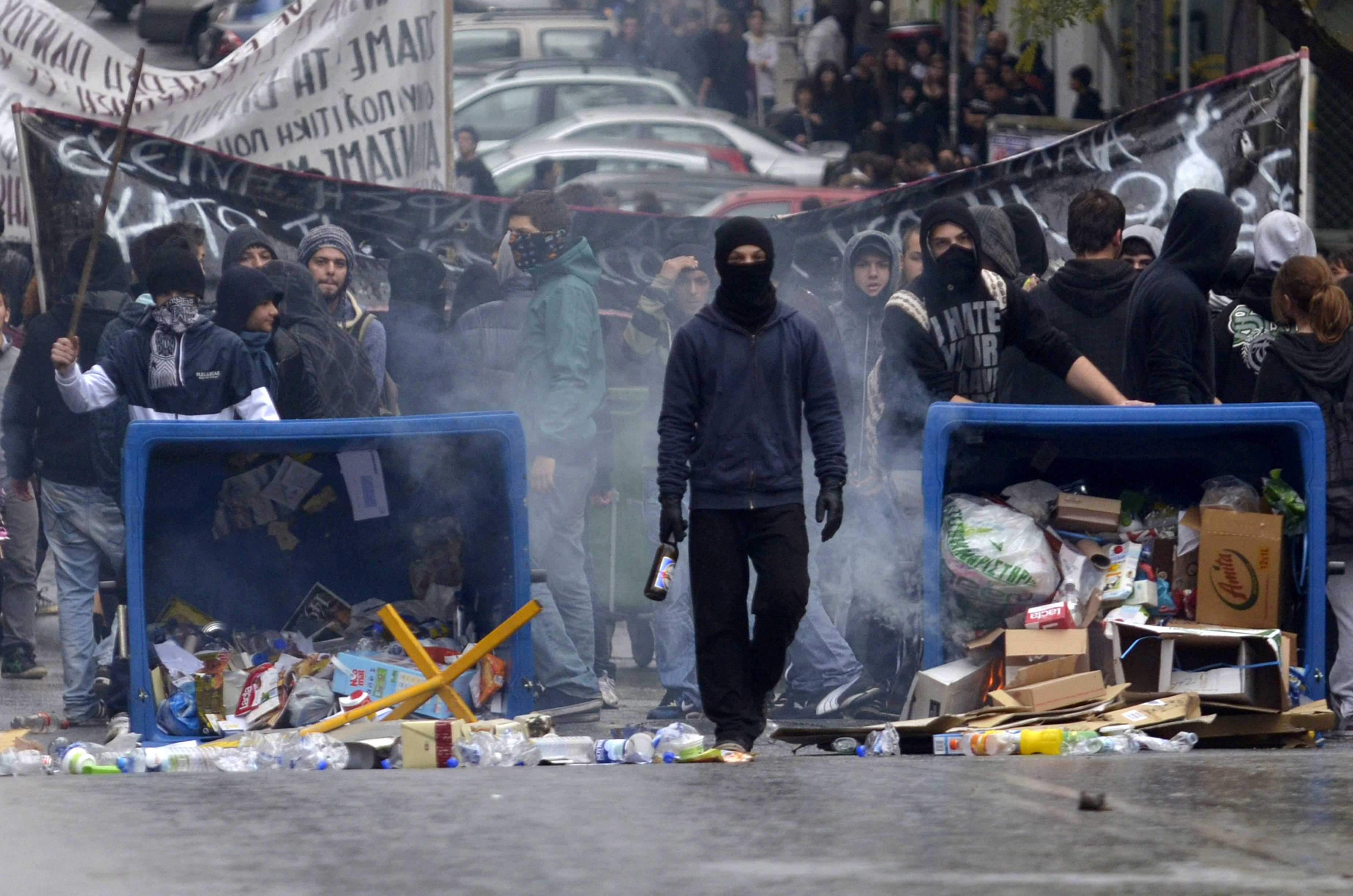 A protester carries a petrol bomb during a protest at the northern port city of Thessaloniki, Greece, Tuesday, Dec. 6, 2011. Protesting high school students hurled rocks and bottles during a rally to mark the third anniversary of the fatal police shooting of a teenager in central Athens. (AP Photo/Nikolas Giakoumidis)
 A youth gathers stones near the parliament in Athens on December 6, 2011 during a demonstration to commemorate the police killing of a student three years ago which sparked violent riots lasting weeks. Pupils and students marched to mark the December 6, 2008 death of Alexis Grigoropoulos, 15, shot by police as Greece first came under pressure from the eurozone debt crisis. AFP PHOTO/ LOUISA GOULIAMAKI
 Riot police look on as a molotov cocktail thrown by youths exploeds in front of the parliament in Athens on December 6, 2011 during a demonstration to commemorate the police killing of a student three years ago which sparked violent riots lasting weeks. Pupils and students marched to mark the December 6, 2008 death of Alexis Grigoropoulos, 15, shot by police as Greece first came under pressure from the eurozone debt crisis. AFP PHOTO/ARIS MESSINIS
 Riot police chase a youth during clashes outside the parliament on December 6, 2011, as about 1,000 school pupils marched to commemorate the police killing of a student three years ago which sparked violent riots lasting weeks. Pupils and students marched to mark the December 6, 2008 death of Alexis Grigoropoulos, 15, shot by police as Greece first came under pressure from the eurozone debt crisis. AFP PHOTO / ARIS MESSINIS
 Youths clash with riot police outside the parliament during a demonstration on December 6, 2011, to commemorate the police killing of a student three years ago which sparked violent riots lasting weeks. Pupils and students marched to mark the December 6, 2008 death of Alexis Grigoropoulos, 15, shot by police as Greece first came under pressure from the eurozone debt crisis. AFP PHOTO / ARIS MESSINIS
 Youths clash with riot police outside the parliament during a demonstration on December 6, 2011, to commemorate the police killing of a student three years ago which sparked violent riots lasting weeks. Pupils and students marched to mark the December 6, 2008 death of Alexis Grigoropoulos, 15, shot by police as Greece first came under pressure from the eurozone debt crisis. AFP PHOTO / ARIS MESSINIS
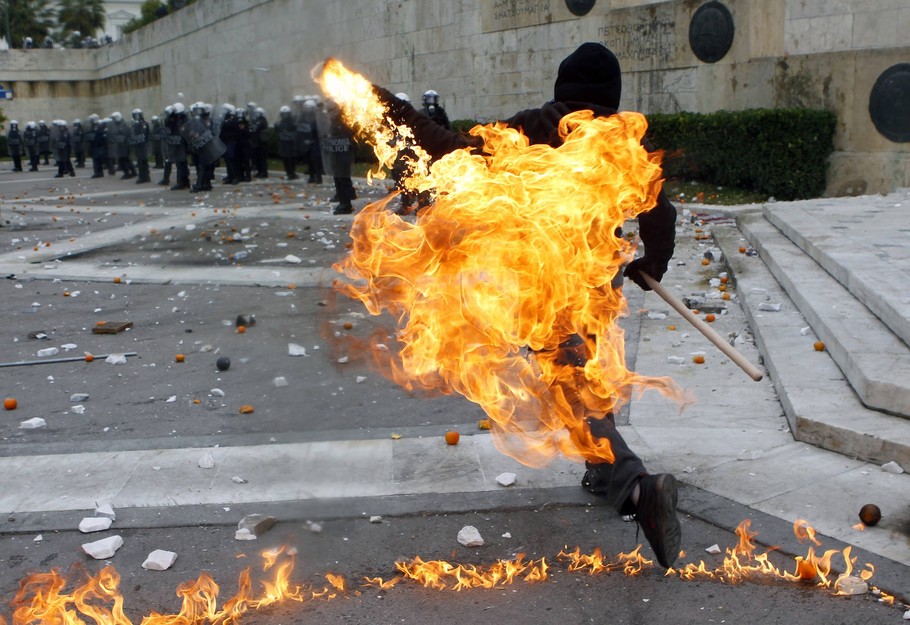 A protester throws a petrol bomb against riot police guarding the parliament in Athens’ Syntagma (Constitution) square during clashes December 6, 2011. Greek police fired tear gas on Tuesday at dozens of black-clad protesters in Athens who hurled petrol bombs and stones, while hundreds marched to parliament to mark the 2008 shooting of a student by police. REUTERS/Yannis Behrakis
 ATHENS, GREECE – DECEMBER 6: Cars are parked in front of graffiti displayed on a building on December 6, 2011 in Athens, Greece. Graffiti artists throughout the city are expressing the effects of austerity measures that have plagued the community as Greece continues to struggle in debt while lawmakers today are set to pass next year’s budget. (Photo by Milos Bicanski/Getty Images)
 Riot police walk past burning debris outside the parliament in Athens on December 6, 2011, during demonstrations to commemorate the police killing of a student three years ago which sparked violent riots lasting weeks. Pupils and students marched to mark the December 6, 2008 death of Alexis Grigoropoulos, 15, shot by police as Greece first came under pressure from the eurozone debt crisis. AFP PHOTO/ Angelos Tzortzinis
 A protester throws a petrol bomb towards riot police guarding the parliament in Athens’ Syntagma (Constitution) square during evening clashes December 6, 2011. Fresh clashes broke out between demonstrators and Greek police outside parliament on Tuesday evening, hours after police fired teargas to disperse youths hurling petrol bombs at them.Protesters, many dressed in black, threw makeshift bombs and stones at police, who responded with teargas and formed a cordon outside parliament. Inside, lawmakers were in the final stages of a debate on the 2012 budget packed with unpopular austerity measures. REUTERS/Yannis Behrakis
 A protestor throws a stone at riot police outside the parliament in Athens on December 6, 2011, during demonstrations to commemorate the police killing of a student three years ago which sparked violent riots lasting weeks. Pupils and students marched to mark the December 6, 2008 death of Alexis Grigoropoulos, 15, shot by police as Greece first came under pressure from the eurozone debt crisis. AFP PHOTO/ Angelos Tzortzinis
 A protestor throws a molotov cocktail at riot police outside the parliament in Athens on December 6, 2011, during demonstrations to commemorate the police killing of a student three years ago which sparked violent riots lasting weeks. Pupils and students marched to mark the December 6, 2008 death of Alexis Grigoropoulos, 15, shot by police as Greece first came under pressure from the eurozone debt crisis.
FEMEN-UNCUT-UNCENSORED-Stop Raping Ukraine!
Members of the activist group FEMEN protest at what they see as the manipulation of the democratic system at a polling station in Kiev, Ukraine, Sunday, Feb. 7, 2010. The signs read “The War Begins Here” and “Stop Raping the Country.”
http://www.tsn.ua
TOP-SECRET-CIA Bucharest Prison Eyeball
| In northern Bucharest, in a busy residential neighborhood minutes from the center of Romania’s capital city, is a secret that the Romanian government has tried for years to protect.
For years, the CIA used a government building — codenamed Bright Light — as a makeshift prison for its most valuable detainees. There, it held al-Qaida operatives Khalid Sheik Mohammad, the mastermind of 9/11, and others in a basement prison before they were ultimately transferred to Guantanamo Bay in 2006, according to former U.S. intelligence officials familiar with the location and inner workings of the prison. The existence of a CIA prison in Romania has been widely reported but its location has never been made public until a joint investigation by The Associated Press and German public television, ARD Panorama. The news organizations located the former prison and learned details of the facility where harsh interrogation tactics were used. ARD’s program on the CIA prison will air Dec 8. The Romanian prison was part of a network of so-called black sites that the CIA operated and controlled overseas in Thailand, Lithuania and Poland. All the prisons were closed by May 2006, and the CIA’s detention and interrogation program ended in 2009. Unlike the CIA’s facility in Lithuania’s countryside or the one hidden in a Polish military installation, the CIA’s prison in Romania was not in a remote location. It was hidden in plain sight, a couple blocks off a major boulevard on a street lined with trees and homes, along busy train tracks. The building is used as the National Registry Office for Classified Information, which is also known as ORNISS. Classified information from NATO and the European Union is stored there. Former intelligence officials both described the location of the prison and identified pictures of the building. |
![[Image]](https://i0.wp.com/cryptome.org/eyeball/cia-bucharest/pict13.jpg) |
![[Image]](https://i0.wp.com/cryptome.org/eyeball/cia-bucharest/pict11.jpg)
|
| Google Mapshttp://bit.ly/vDKcPW
|
CIA Prisoner Unloading Route via Side Street According to AP. 2005 Aerial Photo (Google Earth).![[Image]](https://i0.wp.com/cryptome.org/eyeball/cia-bucharest/pict14.jpg) |
| Following oblique views by Bing.com/maps: http://binged.it/vAOoi0 |
![[Image]](https://i0.wp.com/cryptome.org/eyeball/cia-bucharest/pict4.jpg) |
![[Image]](https://i0.wp.com/cryptome.org/eyeball/cia-bucharest/pict5.jpg) |
![[Image]](https://i0.wp.com/cryptome.org/eyeball/cia-bucharest/pict7.jpg) |
![[Image]](https://i0.wp.com/cryptome.org/eyeball/cia-bucharest/pict8.jpg) |
![[Image]](https://i0.wp.com/cryptome.org/eyeball/cia-bucharest/pict10.jpg)
![[Image]](https://i0.wp.com/cryptome.org/eyeball/cia-bucharest/pict12.jpg)
TOP-SECRET – NSA- THE NRO DECLASSIFIED

n September 1992 the Department of Defense acknowledged the existence of the National Reconnaissance Office (NRO), an agency established in 1961 to manage the development and operation of the nation’s reconnaissance satellite systems. The creation of the NRO was the result of a number of factors.
On May 1, 1960 Francis Gary Powers took off from Peshawar, Pakistan on the U-2 mission designated Operation GRAND SLAM. The flight was planned to take him over the heart of the Soviet Union and terminate at Bodo, Norway. The main target was Plesetsk, which communications intercepts had indicated might be the site of an ICBM facility.1 When the Soviet Union shot down his plane and captured him alive, they also forced President Dwight Eisenhower to halt aerial overflights of Soviet territory.
At that time the U.S. had two ongoing programs to produce satellite vehicles that could photograph Soviet territory. Such vehicles would allow far more frequent coverage than possible with manned aircraft. In addition, they would avoid placing the lives of pilots at risk and eliminate the risks of international incidents resulting from overflights.
The Air Force program, designated SAMOS, sought to develop a number of different satellite systems–including one that would radio its imagery back to earth and another that would return film capsules. The CIA program, CORONA, focused solely on developing a film return satellite.
However, both the CIA and Air Force programs were in trouble. Launch after launch in the CORONA program, eleven in all by May 1, 1960, eight of which carried cameras, had resulted in failure–the only variation was in the cause. Meanwhile, the SAMOS program was also experiencing difficulties, both with regard to hardware and program definition.2
Concerns over SAMOS led President Eisenhower to direct two groups to study both the technical aspects of the program as well as how the resulting system would be employed. The ultimate result was a joint report presented to the President and NSC on August 25, 1960.3
As a result of that meeting Eisenhower approved a first SAMOS launch in September, as well as reorientation of the program, with the development of high-resolution film-return systems being assigned highest priority while the electronic readout system would be pursued as a research project. With regard to SAMOS management, he ordered that the Air Force institute special management arrangements, which would involve a direct line of authority between the SAMOS project office and the Office of the Air Force Secretary, bypassing the Air Staff and any other intermediate layers of bureaucracy.4
Secretary of the Air Force Dudley C. Sharp wasted little time creating the recommended new structure and procedures. On August 31st Sharp signed Secretary of the Air Force Order 115.1, establishing the Office of Missile and Satellite Systems within his own office to help him manage the SAMOS project. With Order 116.1, Sharp created a SAMOS project office at the Los Angeles headquarters of the Air Force Ballistic Missile Division (AFBMD) as a field extension of the Office of the Secretary of the Air Force to carry out development of the satellite.5
The impact of the orders, in practice, was that the director of the SAMOS project would report directly to Under Secretary of the Air Force Joseph V. Charyk, who would manage it in the Secretary’s name. In turn, Charyk would report directly to the Secretary of Defense.6
The changes would not stop there. The urgency attached to developing a successful reconnaissance satellite led, ultimately, to the creation of a top secret program and organization to coordinate the entire national reconnaissance effort.
Several of the documents listed below also appear in either of two National Security Archive microfiche collections on U.S. intelligence. The U.S. Intelligence Community: Organization, Operations and Management: 1947-1989 (1990) and U.S. Espionage and Intelligence: Organization, Operations, and Management, 1947-1996 (1997) publish together for the first time recently declassified documents pertaining to the organizational structure, operations and management of the U.S. Intelligence Community over the last fifty years, cross-indexed for maximum accessibility. Together, these two sets reproduce on microfiche over 2,000 organizational histories, memoranda, manuals, regulations, directives, reports, and studies, totaling more than 50,000 pages of documents from the Office of the Director of Central Intelligence, the Central Intelligence Agency, National Reconnaissance Office, National Security Agency, Defense Intelligence Agency, military service intelligence organizations, National Security Council, and other official government agencies and organizations.
Document 1
Joseph Charyk, Memorandum for the Secretary of Defense
Management of the National Reconnaissance Program
24 July 1961
Top Secret
1 p.
The organizational changes resulting from the decisions of August 25, 1960 and their implementation left some unsatisfied. In particular, James Killian and Edwin Land, influential members of the President’s intelligence advisory board pushed for permanent and institutionalized collaboration between the CIA and Air Force. After the Kennedy administration took office the push to establish a permanent reconnaissance organization took on additional life. There was a strong feeling in the new administration, particularly by Secretary of Defense Robert McNamara and his deputy, Roswell Gilpatric, that a better, more formalized relationship was required.7
On July 24, 1961, Air Force Undersecretary Joseph Charyk sent a memorandum to McNamara attaching two possible memoranda of agreement for creation of a National Reconnaissance Program, along with some additional material.
Document 2
Memorandum of Understanding
Management of the National Reconnaissance Program (Draft)
20 July 1961
Top Secret
5 pp.
This memo specified establishment of a National Reconnaissance Program (NRP) consisting of “all satellite and overflight reconnaissance projects whether overt or covert,” and including “all photographic projects for intelligence, geodesy and mapping purposes, and electronic signal collection projects for electronic signal intelligence and communications intelligence.”
To manage the NRP, a National Reconnaissance Office (NRO) would be established on a covert basis. The NRO director (DNRO) would be the Deputy Director for Plans, CIA (at the time, Richard Bissell) while the Under Secretary of the Air Force would serve as Deputy Director (DDNRO). The DNRO would be responsible for the management of CIA activities, the DDNRO and the Air Force for Defense Department activities. The DoD, specifically the Air Force acting as executive agent, would be primarily responsible for technical program management, scheduling, vehicle operations, financial management and overt contract administration, while the CIA would be primarily responsible for targeting each satellite. The office would operate under streamlined management procedures similar to those established in August 1960 for SAMOS.
Document 3
Memorandum of Understanding
Management of the National Reconnaissance Program (Draft)
21 July 1961
Top Secret
4 pp.
This secondary memorandum was prepared at the suggestion of Defense Department General Counsel Cyrus Vance. It offered a quite different solution to the problem. As with the primary memo, it established a NRP covering both satellite and aerial reconnaissance operations. But rather than a jointly run program, it placed responsibility for management solely in the hands of a covertly appointed Special Assistant for Reconnaissance, to be selected by the Secretary of Defense. The office of the Special Assistant would handle the responsibilities assigned to the NRO in the other MOU. The CIA would “assist the Department of Defense by providing support as required in areas of program security, communications, and covert contract administration.”
Document 4
Memorandum
Pros and Cons of Each Solution
Not dated
Top Secret
2 pp.
The assessment of pros and cons favored the July 20 memorandum, listing five pros for the first solution and only two for the second. The first solution would consolidate responsibilities into a single program with relatively little disruption of established management, represented a proven solution, would require no overt organizational changes, would allow both agencies to retain authoritative voices in their areas of expertise, and provided a simplified management structure. The two cons noted were the division of program responsibility between two people, and that “successful program management depends upon mutual understanding and trust of the two people in charge of the NRO.” It would not be too long before that later observation would take on great significance.
In contrast, there were more cons than pros specified for the second solution. The only two points in its favor were the consolidation of reconnaissance activities into a single program managed by a single individual and the assignment of complete responsibility to the agency (DoD) with the most resources. Foremost of the six cons was the need for DoD to control and conduct large-scale covert operations, in as much as it was an entity “whose normal methods are completely foreign to this task.”
Document 5
Roswell Gilpatric, Letter to Allen Dulles
Management of the National Reconnaissance Program
6 September 1961
Top Secret
4 pp.
On July 28, 1961, four days after receiving Charyk’s memorandum and draft memoranda of understanding, McNamara instructed Air Force Undersecretary Joseph Charyk to continue discussions with the key officials and advisers in order to resolve any organizational difficulties that threatened to impede the satellite reconnaissance effort. The ultimate result was this letter from Deputy Secretary of Defense Roswell Gilpatric to Dulles, which confirmed “our agreement with respect to the setting up of the National Reconnaissance Program.”
The letter specified the creation of a NRP. It also established the NRO, a uniform security control system, and specified that the NRO would be directly responsive to the intelligence requirements and priorities specified by the United States Intelligence Board. It specified implementation of NRP programs assigned to the CIA through the Deputy Director for Plans. It designated the Undersecretary of the Air Force as the Defense Secretary’s Special Assistant for Reconnaissance, with full authority in DoD reconnaissance matters.
The letter contained no specific assignment of responsibilities to either the CIA or Defense Department, stating only that “The Directors of the National Reconnaissance Office will … insure that the particular talents, experience and capabilities within the Department of Defense and the Central Intelligence Agency are fully and most effectively utilized in this program.”
The letter provided for the NRO to be managed jointly by the Under Secretary of the Air Force and the CIA Deputy Director for Plans (at the time, still Richard Bissell). A May 1962 agreement between the CIA and Defense Department established a single NRO director. Joseph Charyk was named to the directorship shortly afterward.
Document 6
Joseph Charyk
Memorandum for NRO Program Directors/Director, NRO Staff
Organization and Functions of the NRO
23 July 1962
Top Secret
11 pp.
This memorandum represents the fundamental directive on the organization and functions of the NRO. In addition to the Director (there was no provision for a deputy director), there were four major elements to the NRO–the NRO staff and three program elements, designated A, B, and C. The staff’s functions included assisting the director in dealing with the USIB and the principal consumers of the intelligence collected.
The Air Force Office of Special Projects (the successor to the SAMOS project office) became NRO’s Program A. The CIA reconnaissance effort was designated Program B, while the Navy’s space reconnaissance effort, at the time consisting of the Galactic Radiation and Background (GRAB) satellite, whose radar ferret mission involved the collection of Soviet radar signals, became Program C. Although the GRAB effort was carried out by the Naval Research Laboratory, the director of the Office of Naval Intelligence would serve as Program C director until 1971.8
Document 7
Agreement between the Secretary of Defense and the Director of Central Intelligence on Management of the National Reconnaissance Program
13 March 1963
Top Secret
6 pp.
In December 1962, Joseph Charyk decided to leave government to become president of the COMSAT Corporation. By that time a number of disputes between the CIA and NRO had contributed to Charyk’s view that the position of the NRO and its director should be strengthened. During the last week of February 1963, his last week in office, he completed a revision of a CIA draft of a new reconnaissance agreement to replace the May 1962 agreement (which had replaced the September 6, 1961 agreement). Charyk took the revision to Deputy Secretary of Defense Roswell Gilpatric. It appears that some CIA-suggested changes were incorporated sometime after Charyk left office. On March 13, Gilpatric signed the slightly modified version on behalf of DoD. It was sent to the CIA that day and immediately approved by DCI John McCone, who had replaced Allen Dulles in November 1961.9
The new agreement, while it did not include all the elements Charyk considered important, did substantially strengthen the authority of the NRO and its director. It named the Secretary of Defense as the Executive Agent for the NRP. The program would be “developed, managed, and conducted in accordance with policies and guidance jointly agreed to by the Secretary of Defense and the Director of Central Intelligence.”
The NRO would manage the NRP “under the direction, authority, and control of the Secretary of Defense.” The NRO’s director would be selected by the Defense Secretary with the concurrence of the DCI, and report to the Defense Secretary. The NRO director was charged with presenting to the Secretary of Defense “all projects” for intelligence collection and mapping and geodetic information via overflights and the associated budgets, scheduling all overflight missions in the NRP, as well as engineering analysis to correct problems with collection systems. With regard to technical management, the DNRO was to “assign all project tasks such as technical management, contracting etc., to appropriate elements of the DoD and CIA, changing such assignments, and taking any such steps he may determine necessary to the efficient management of the NRP.”
Document 8
Department of Defense Directive Number TS 5105.23
Subject: National Reconnaissance Office
27 March 1964
Top Secret
4 pp.
This directive replaced the original June 1962 DoD Directive on the NRO, and remains in force today. The directive specifies the role of the Director of the NRO, the relationships between the NRO and other organizations, the director’s authorities, and security. It specified that documents or other material concerning National Reconnaissance Program matters would be handled within a special security system (known as the BYEMAN Control System).
Document 9
President’s Foreign Intelligence Advisory Board
Memorandum for the President
Subject: National Reconnaissance Program
2 May 1964
Top Secret
11 pp.
The 1963 CIA-DoD agreement on the NRP did not end the battles between the CIA and NRO–as some key CIA officials, including ultimately DCI John McCone, sought to reestablish a major role for the CIA in the satellite reconnaissance effort. The continuing conflict was examined by the PFIAB.
The board concluded that “the National Reconnaissance Program despite its achievements, has not yet reached its full potential.” The fundamental cause for the NRP’s shortcomings was “inadequacies in organizational structure.” In addition, there was no clear division of responsibilities and roles between the Defense Department, CIA, and the DCI.
The recommendations of the board represented a clear victory for the NRO and its director. The DCI should have a “large and important role” in establishing intelligence collection requirements and in ensuring that the data collected was effectively exploited, according to the board. In addition, his leadership would be a key factor in the work of the United States Intelligence Board relating to the scheduling of space and airborne reconnaissance missions.
But the board also recommended that President Johnson sign a directive which would assign to NRO’s Air Force component (the Air Force Office of Special Projects) systems engineering, procurement, and operation of all satellite reconnaissance systems.
Document 10
Agreement for Reorganization of the National Reconnaissance Program
13 August 1965
Top Secret
6 pp.
Despite the recommendations of the May 2, 1964 PFIAB report, which were challenged by DCI John McCone, no action was taken to solidify the position of the NRO and its director. Instead prolonged discussions over a new agreement continued into the summer of 1965. During this period the CIA continued work on what would become two key satellite programs–the HEXAGON/KH-9 imaging and RHYOLITE signals intelligence satellites.
In early August, Deputy Secretary of Defense Cyrus Vance and CIA official John Bross reached an understanding on a new agreement, and it was signed by Vice Adm. William F. Raborn (McCone’s successor) and Vance on August 13, 1965. It represented a significant victory for the CIA, assigning key decision-making authority to an executive committee, authority that was previously the prerogative of the NRO director as the agent of the Secretary of Defense.
The Secretary of Defense was to have “the ultimate responsibility for the management and operation of the NRO and the NRP,” and have the final power to approve the NRP budget. The Secretary also was empowered to make decisions when the executive committee could not reach agreement.
The DCI was to establish collection priorities and requirements for targeting NRP operations, as well as establish frequency of coverage, review the results obtained by the NRP and recommend steps for improving its results if necessary, serve on the executive committee, review and approve the NRP budget, and provide security policy guidance.
The NRP Executive Committee established by the agreement would consist of the DCI, Deputy Secretary of Defense, and Special Assistant to the President for Science and Technology. The committee was to recommend to the Secretary of Defense the “appropriate level of effort for the NRP,” approve or modify the consolidated NRP and its budget, approve the allocation of responsibility and the corresponding funds for research and exploratory development for new systems. It was instructed to insure that funds would be adequate to pursue a vigorous research and development program, involving both CIA and DoD. The executive committee was to assign development of sensors to the agency best equipped to handle the task.
The Director of the NRO would manage the NRO and execute the NRP “subject to the direction and control of the Secretary of Defense and the guidance of the Executive Committee.” His authority to initiate, improve, modify, redirect or terminate all research and development programs in the NRP, would be subject to review by the executive committee. He could demand that all agencies keep him informed about all programs undertaken as part of the NRP.
Document 11
Analysis of “A $1.5 Billion Secret in Sky” Washington Post, December 9, 1973
Not dated
Top Secret
33 pp.
Throughout the 1960s, the United States operation of reconnaissance satellites was officially classified, but well known among specialists and the press. However, it was not until January 1971 that the NRO’s existence was first disclosed by the media, when it was briefly mentioned in a New York Times article on intelligence and foreign policy.
A much more extensive discussion of the NRO appeared in the December 9, 1973 Washington Post as a result of the inadvertent mention of the reconnaissance office in a Congressional report. The NRO prepared this set of classified responses to the article, clearly intended for those in Congress who might be concerned about the article’s purported revelations about the NRO’s cost overruns and avoidance of Congressional oversight.
Document 12
E.C. Aldridge, Jr. (Director, NRO)
Letter to David L. Boren, Chairman,
Senate Select Committee on Intelligence
21 November 1988
Secret
3 pp.
The late 1980s saw the beginning of what eventually would be a wide-ranging restructuring of the NRO. In November 1988 NRO director Edward “Pete” Aldridge wrote to Senator David Boren, Chairman of the Senate Select Committee on Intelligence, concerning the findings of an extensive study (the NRO Restructure Study) of the organizational structure of the NRO.
Aldridge proceeded to report that, after having discussed the study’s recommendations with Secretary of Defense Frank Carlucci and Director of Central Intelligence William Webster, he was directing the development of plans to implement the recommendations. Specific changes would include the creation of a centralized systems analysis function “to conduct cross-system trades and simulations within the NRO,” creation of a “User Support” function to improve NRO support to intelligence community users as well as to the growing number of operational military users, and the dispersal of the NRO Staff to the new units, with the staff being replaced by a group of policy advisers. In addition, Aldridge foresaw the establishment of an interim facility “to house the buildup of the new functions and senior management.” The ultimate goal, projected for the 1991-92 period, would be the “collocation of all NRO elements [including the Los Angeles-based Air Force Office of Special Projects] . . . in the Washington, D.C. area.”
Document 13
Memorandum of Agreement
Subject: Organizational Restructure of the National Reconnaissance Office
15 December 1988
Secret
2 pp.
This memorandum of agreement, signed by the Director of the NRO and the directors of the NRO’s three programs commits them to the restructuring discussed in Edward Aldridge’s November 21 letter to Senator Boren.
Many changes recommended by Aldridge, who left office at the end of 1988, were considered by a 1989 NRO-sponsored review group and subsequently adopted.
Document 14
Report to the Director of Central Intelligence
DCI Task Force on The National Reconnaissance Office, Final Report
April 1992
Secret
35 pp.
This report was produced by a panel chaired by former Lockheed Corporation CEO Robert Fuhrman, whose members included both former and serving intelligence officials. It focused on a variety of issues other than current and possible future NRO reconnaissance systems. Among the issues it examined were mission, organizational structure, security and classification.
One of its most significant conclusions was that the Program A,B,C structure that had been instituted in 1962 (see Document 6) “does not enhance mission effectiveness” but “leads to counterproductive competition and makes it more difficult to foster loyalty and to maintain focus on the NRO mission.” As a result, the panel recommended that the NRO be restructured along functional lines with imagery and SIGINT directorates. This change was made even before the final version of the report was issued.
The report also noted that while the NRO’s existence was officially classified it was an “open secret” and that seeking to attempt to maintain such “open secrets … weakens the case for preserving ‘real’ secrets.” In addition, such secrecy limited the NRO’s ability to interact with customers and users. The group recommended declassifying the “fact of” the NRO, as well as providing information about the NRO’s mission, the identities of senior officials, headquarters locations, and the NRO as a joint Intelligence Community-Defense Department activity.
Document 15
National Security Directive 67
Subject: Intelligence Capabilities: 1992-2005
30 March 1992
Secret
2 pp.
NSD 67 directed a number of changes in U.S. intelligence organization and operations. Among those was implementation of the plan to restructure the NRO along functional lines–eliminating the decades old Program A (Air Force), B (CIA), and C (Navy) structure and replacing it with directorates for imaging, signals intelligence, and communication systems acquisition and operations–as recommended by the Fuhrman panel. As a result, Air Force, CIA, and Navy personnel involved in such activities would now work together rather than as part of distinct NRO components.
Document 16
Email message
Subject: Overt-Covert-DOS-REP-INPUT
27 July 1992
Secret
1 p.
In addition to the internal restructuring of the NRO, 1992 saw the declassification of the organization, as recommended by the Fuhrman report (Document 14), for a number of reasons–to facilitate interaction with other parts of the government, to make it easier for the NRO to support military operations, and in response to Congressional pressure to acknowledge the obvious. As part of the process of considering declassification NRO consulted Richard Curl, head of the Office of Intelligence Resources of the State Department’s Bureau of Intelligence and Research–the office which provides INR with expertise and support concerning technical collection systems. Curl recommended a low-key approach to declassification.
Document 17
Memorandum for Secretary of Defense, Director of Central Intelligence
Subject: Changing the National Reconnaissance Office (NRO) to an Overt Organization
30 July 1992
Secret
3 pp.
w/ attachments:
Document 17a: Mission of the NRO, 1 p.
Document 17b: Implications of Proposed Changes, 4 pp. (Two versions)
Version One
Version Two
These memos, from Director of the NRO Martin Faga, represent key documents in the declassification of the NRO. The memo noted Congressional pressure for declassification and that Presidential certification that declassification would result in “grave damage to the nation … would be difficult in this case.”
Faga reported that as a result of an NRO review he recommended declassifying the fact of NRO’s existence, issuing a brief mission statement, acknowledging the NRO as a joint DCI-Secretary of Defense endeavor, and identifying top level NRO officials. He also noted that his recommendations attempted to balance concerns about classifying information that realistically could not be protected, while maintaining an ability to protect matters believed to require continued protection.
Secretary of Defense Richard Cheney, DCI Robert Gates, and President Bush approved the recommendations in September and a three-paragraph memorandum to correspondents acknowledging the NRO and NRP was issued on September 18, 1992.
Document 17b comes in two versions, representing different security reviews. Material redacted from the first version includes provisions of National Security Directive 30 on space policy, expression of concern over “derived disclosures,” and the assessment that the “high degree of foreign acceptance of satellite reconnaissance, and the fact that we are not disclosing significant new data,” would not lead to any significant foreign reaction. Another redacted statement stated that “legislation . . . exempting all NRO operational files from [Freedom of Information Act] searches” was required.
Document 18
Final Report: National Reconnaissance Program Task Force for the Director of Central Intelligence
September 1992
Top Secret
15 pp.
The end of the Cold War and collapse of the Soviet Union required the U.S. intelligence community and NRO to reconsider how U.S. overhead reconnaissance systems were employed and what capabilities future systems should possess. To consider these questions DCI Robert Gates appointed a task force, chaired by his eventual successor, R. James Woolsey.
The final report considers future needs and collection methods, industrial base considerations, procurement policy considerations, international industrial issues, and transition considerations. Its recommendations included elimination of both some collection tasks as well as some entire types of present and planned collection systems.
Document 19
NRO Protection Review, “What is [BYEMAN]?”
6 November 1992
Top Secret
18 pp.
Traditionally, the designations of Sensitive Compartmented Information (SCI) compartments–such as UMBRA to indicate particularly sensitive communications intelligence and RUFF to intelligence based on satellite imagery–have themselves been classified. In recent years, however, the NSA and CIA have declassified a number of such terms and their meaning. One exception has been the term “BYEMAN”– the BYEMAN Control System being the security system used to protect information related to NRO collection systems (in contrast to their products) and other aspects of NRO activities, including budget and structure. Thus, the term BYEMAN has been deleted in the title of the document and throughout the study–although the term and its meaning has become known by specialists and conveys no information beyond the text of any particular document.
This study addresses the use of the BYEMAN classification within the NRO, its impact on contractors and other government personnel, and the consequences of the current application of the BYEMAN system. The study concludes that placing information in the highly restrictive BYEMAN channels (in contrast to classifying the information at a lower level) may unduly restrict its dissemination to individuals who have a legitimate need to know.
Document 20
NRO Strategic Plan
18 January 1993
Secret
19 pp.
A study headed by James Woolsey (Document 18), President Clinton’s first DCI, heavily influenced the contents of this early 1993 document. The plan’s introduction notes that while some collection tasks will no longer be handled by overhead reconnaissance the “uncertain nature of the world that is emerging from the end of the ‘cold war’ places a heavy premium on overhead reconnaissance.” At the same time, “this overhead reconnaissance challenge must be met in an era of a likely reduced national security budget.”
The strategic plan is described in the introduction, as “the ‘game plan’ to transition current overhead collection architectures into a more integrated, end-to-end architecture for improved global access and tasking flexibility.”
The document goes on to examine the strategic context for future NRO operations, NRO strategy, strategic objectives, and approaches to implementation. Strategic objectives include improving the responsiveness of NRO systems by developing an architecture that spans the entire collection and dissemination process, from the identification of requirements to dissemination of the data collected.
Document 21
National Reconnaissance Office: Collocation Construction Project, Joint DOD and CIA Review Report
November 1994
Unclassified
28 pp.
In an August 8, 1994 press conference, Senators Dennis DeConcini (D-Az.) and John Warner (R-Va.), the chairman and vice chairman of the Senate Select Committee on Intelligence accused the NRO of concealing from Congress the cost involved in building a new headquarters to house government and contractor employees. Previously NRO activities in the Washington area were conducted from the Pentagon and rented space in the Washington metropolitan area. The collocation and restructuring decisions of the late 1980s and early 1990s had resulted in a requirement for a new headquarters facility.10
The accusations were followed by hearings before both the Senate and House intelligence oversight committees–with House committee members defending the NRO and criticizing their Senate colleagues. While they noted that some of the documents presented by the NRO covering total costs were not presented with desirable clarity, the House members were more critical of the Senate committee for inattention to their committee work.11
This joint DoD and CIA review of the project, found “no intent to mislead Congress” but that “the NRO failed to follow Intelligence Community budgeting guidelines, applicable to all the intelligence agencies,” that would have caused the project to be presented as a “New Initiative,” and that the cost data provided by the NRO “were not presented in a consistent fashion and did not include a level of detail comparable to submissions for . . . intelligence community construction.”
Document 22
Memorandum for Director of Central Intelligence
Subject: Small Satellite Review Panel
Unclassified
July 1996
The concept of employing significantly smaller satellites for imagery collection was strongly advocated by Rep. Larry Combest during his tenure (1995-97) as chairman of the House Permanent Select Committee on Intelligence. As a result the DCI was instructed to appoint a panel of experts to review the issue.12
Panel members included former NRO directors Robert Hermann and Martin Faga; former NRO official and NSA director Lew Allen; scientist Sidney Drell and four others. The panel’s report supported a radical reduction in the size of most U.S. imagery satellites. The panel concluded that “now is an appropriate time to make a qualitative change in the systems architecture of the nation’s reconnaissance assets,” in part because “the technology and industrial capabilities of the country permit the creation of effective space systems that are substantially smaller and less costly than current systems.” Thus, the panel saw “the opportunity to move towards an operational capability for . . . imagery systems, that consists of an array of smaller, cheaper spacecraft in larger number with a total capacity which is at least as useful as those currently planned and to transport them to space with substantially smaller and less costly launch vehicles.”13
The extent to which those recommendations have influenced NRO’s Future Imagery Architecture plan is uncertain–although plans for large constellations of small satellites have not usually survived the budgetary process.
Document 23
Defining the Future of the NRO for the 21st Century, Final Report, Executive Summary
August 26, 1996
Unclassified
30 pp.
This report was apparently the first major outside review of the NRO conducted during the Clinton administration, and the first conducted after the NRO’s transformation to an overt institution and its restructuring were firmly in place.
Among those conducting the review were former Vice Chairman of the Joint Chiefs of Staff, Adm. David E. Jeremiah, former NRO director Martin Faga, and former Deputy Director of Central Intelligence John McMahon. Issues studied by the panel included, inter alia, the existence of a possible alternative to the NRO, NRO’s mission in the 21st Century, support to military operations, security, internal organization, and the relationship with NRO’s customers.
After reviewing a number of alternatives, the panel concluded that no other arrangement was superior for carrying out the NRO mission. It did, however, recommend, changes with regards to NRO’s mission and internal organization. The panel concluded that where the NRO’s current mission is “worldwide intelligence,” its future mission should be “global information superiority,” which “demands intelligence capabilities unimaginable just a few years ago.” The panel also recommended creation of a fourth NRO directorate, which was subsequently established, to focus solely on the development of advanced systems, in order to “increase the visibility and stature of technology innovation in the NRO.”
NEO-STASI-OPFER: LKA BAYERN ERMITTELT GEGEN “GoMoPa” UND DEREN KRIMINELLE PARTNER
CONFIDENTIAL – Georgia Tech Helps to Develop System That Will Detect Insider Threats from Massive Data Sets
![[Image]](https://i0.wp.com/cryptome.org/isp-spy/ga-tech-spy/pict2.jpg)
Georgia Tech DARPA ADAMS leaders
![[Image]](https://i0.wp.com/cryptome.org/isp-spy/ga-tech-spy/pict0.jpg)
Georgia Tech DARPA ADAMS team
![[Image]](https://i0.wp.com/cryptome.org/isp-spy/ga-tech-spy/pict1.jpg)
Data collection environment
When a soldier in good mental health becomes homicidal or a government employee abuses access privileges to share classified information, we often wonder why no one saw it coming. When looking through the evidence after the fact, a trail often exists that, had it been noticed, could have possibly provided enough time to intervene and prevent an incident.
With support from the Defense Advanced Research Projects Agency (DARPA) and the Army Research Office, researchers at the Georgia Institute of Technology are collaborating with scientists from four other organizations to develop new approaches for identifying these “insider threats” before an incident occurs. The two-year, $9 million project will create a suite of algorithms that can detect multiple types of insider threats by analyzing massive amounts of data — including email, text messages and file transfers — for unusual activity.
The project is being led by Science Applications International Corporation (SAIC) and also includes researchers from Oregon State University, the University of Massachusetts and Carnegie Mellon University.
“Analysts looking at the electronically recorded activities of employees within government or defense contracting organizations for anomalous behaviors may now have the bandwidth to investigate five anomalies per day out of thousands of possibilities. Our goal is to develop a system that will provide analysts for the first time a very short, ranked list of unexplained events that should be further investigated,” said project co-principal investigator David A. Bader, a professor with a joint appointment in the Georgia Tech School of Computational Science and Engineering and the Georgia Tech Research Institute (GTRI).
Under the contract, the researchers will leverage a combination of massively scalable graph-processing algorithms, advanced statistical anomaly detection methods and knowledge-based relational machine learning algorithms to create a prototype Anomaly Detection at Multiple Scales (ADAMS) system. The system could revolutionize the capabilities of counter-intelligence community operators to identify and prioritize potential malicious insider threats against a background of everyday cyber network activity.
The research team will have access to massive data sets collected from operational environments where individuals have explicitly agreed to be monitored. The information will include electronically recorded activities, such as computer logins, emails, instant messages and file transfers. The ADAMS system will be capable of pulling these terabytes of data together and using novel algorithms to quickly analyze the information to discover anomalies.
“We need to bring together high-performance computing, algorithms and systems on an unprecedented scale because we’re collecting a massive amount of information in real time for a long period of time,” explained Bader. “We are further challenged because we are capturing the information at different rates — keystroke information is collected at very rapid rates and other information, such as file transfers, is collected at slower rates.”
In addition to Bader, other Georgia Tech researchers supporting key components of this program include School of Interactive Computing professor Irfan Essa, School of Computational Science and Engineering associate professor Edmond Chow, GTRI principal research engineers Lora Weiss and Fred Wright, GTRI senior research scientist Richard Boyd, and GTRI research scientists Joshua L. Davis and Erica Briscoe.
“We look forward to working with DARPA and our academic partners to develop a prototype ADAMS system that can detect anomalies in massive data sets that can translate to significant, often critical, actionable insider threat information across a wide variety of application domains,” said John Fratamico, SAIC senior vice president and business unit general manager.
Research News & Publications Office
Georgia Institute of Technology
75 Fifth Street, N.W., Suite 314
Atlanta, Georgia 30308 USA
Media Relations Contacts: Abby Robinson (abby[at]innovate.gatech.edu; 404-385-3364) or John Toon (jtoon[at]gatech.edu; 404-894-6986)
Writer: Abby Robinson
Scandal – FEMEN attacked Paris Hilton in Kiev
TOP-SCRET FROM THE HOMELAND SECURITY- Anonymous Upcoming U.S. Operations Overview

(U) The loosely organized hacking collective known as “Anonymous” has announced through several mediums that they plan on conducting cyber attacks, peaceful protests, and other unspecified activity targeting a variety of organizations. The purpose of this product is to judge the likelihood of occurrence for these events, as well as the potential impact.
(U//FOUO) Occupy Wall Street (OWS): DHS/NCCIC assesses that it is likely peaceful protests will occur on Wall Street on 17 September 2011. These protests may be accompanied by malicious cyber activity conducted by Anonymous.
(U//FOUO) Operation FaceBook (OPFB): DHS/NCCIC assesses that it is unlikely that a coordinated or sophisticated cyber attack will be conducted by Anonymous (at large) targeting FaceBook.com (FB) on 5 November 2011. However, there remains the possibility that low-level or lone-wolf attempts may occur.
(U//FOUO) Project Mayhem (PM): DHS/NCCIC assesses that a combination of inconsequential physical mischief and potentially disruptive malicious cyber activity will be conducted leading up to the culmination date of 21 December 2012. At this point, specific tactics, techniques and procedures (TTP) are unknown.
(U//FOUO) Operation Halliburton: Little is known about this potential upcoming operation. DHS/NCCIC assesses that targeting US corporations is consistent with past Anonymous targets.
(U) Anonymous has devoted resources to creating new cyber attack and exploitation tools:
(U) Anonymous claimed publicly it will be deploying a new DDoS tool called #RefRef in September. There have been several publicly disclosed tools claiming to be versions of #RefRef however there has been nothing to validate these claims.
(U//FOUO) The recent release of a distributed denial of service (DDOS) tool known as “Apache Killer,” that could be leveraged by Anonymous poses a significant risk to organizations that are operating vulnerable internet facing Apache web servers.
…
(U//FOUO) DHS/NCCIC’S OWS ASSESSMENT: The ideologies set forth by Adbusters seem to align at a basic level with the stated intent of Anonymous’ newly adopted Hacktivist agenda. These protests are highly likely to occur due to the high level of media attention garnered by the partnership between Adbusters and Anonymous, and due to the heightened media response to the San Francisco BART protests. Though the protests will likely to be peaceful in nature, like any protest, malicious individuals may use the large crowds as cover to conduct illegal activity such as vandalism. Judging based on past behaviors by the group, Anonymous’ participation in these protests may include malicious cyber activity, likely in the form of DDOS attacks targeting financial institutions and government agencies.
…
(U) Several racist, homophobic, hateful, and otherwise maliciously intolerant cyber and physical incidents throughout the past decade have been attributed to Anonymous, though recently, their targets and apparent motivations have evolved to what appears to be a hacktivist agenda.
(U) Anonymous utilizes a crude target nomination procedure, outlined below, that is coordinated on one of several communications mediums – IRC, websites (#chan, etc), insurgency wiki, or anonymous meme themed website:
1. An individual on the communications medium posts an appeal to Anonymous leadership requesting members to target a victim;
2. Those individuals who agree, follow suit with vague details given as to intentions and/or tactics;
3. “Lulz ensue,” or they don’t;
4. If “lulz ensue,” go back to step 2 and see if more people join the action, or;
5. Lose interest.
(U) Anonymous utilizes several tactics to humiliate victim individuals and organizations. The most common involve:
- “Dropping someone’s docs,” or exfiltrating information from a compromised system and posting it publicly;
- Pranks targeting victims in real life (IRL) leveraging stolen personally identifiable information (PII), such as unwanted pizza delivery, telephone or fax machine harassment, and other tactics;
- Defacing websites or social network profile pages to embarrass and/or annoy organizations; DOS / DDOS attacks.
DOWNLOAD THE ORGINAL DOCUMENT HERE
MERIDIAN CAPITAL – “GoMoPa” in detention
FREI ERFUNDENE LÜGEN DER FINGIERTEN STASI-“GoMoPA”- FALL MINISTER STELTER
Secret-The FBI about Pearl Harbor Legacy – Remembering Robert Shivers

The attack on Pearl Harbor. Photo courtesy of the National Archives.
12/07/09
It was 68 years ago this morning—December 7, 1941—that a torrent of bombs fell on Pearl Harbor, a stealth attack that took the lives of more than 2,400 Americans and thrust the nation headlong into its second major war of the century. It was a day—filled with sacrifices and heroism—that will never be forgotten.
The contributions of one man who made a major impact in the aftermath of the attack should also not be forgotten. His name is Robert L. Shivers, and he was the special agent in charge of our office in Honolulu on that fateful day.
Shivers had been handpicked by Director J. Edgar Hoover to run the Honolulu office precisely because of his leadership skills. Smart and genteel, Shivers was minted as a special agent in 1920. After serving across the South and Midwest and in New York, the Tennessee native was tapped to lead field offices in Pittsburgh, Buffalo, and Miami. But because of nagging health issues, he went on restricted duty in the late 1930s.
 |
|
Special Agent in Charge Robert L. Shivers |
In the summer of 1939, however, Europe was on the verge of war, and with the U.S. supporting the Allied cause, the FBI was plenty busy trying to prevent espionage and sabotage at home. In August, Hoover turned to Shivers to re-open the now strategically important FBI division in Honolulu.
Shivers got to work. Within a few months, he developed strong relationships with local police as well as with Army and Navy forces, and he also began making contacts in the islands’ Japanese communities. These deepened when he and his wife began caring for a Japanese schoolgirl named Shizue Kobatake (later Suzanne or Sue). Despite the differences in their backgrounds, they became like a family.
Then came December 7. Within minutes of the attack, Shivers alerted Director Hoover, who quickly put the Bureau’s contingency war plans into effect.
For his part, Shivers—who had already made progress in sorting out the FBI’s division of intelligence and security responsibilities with the Navy—immediately placed the Japanese Consulate under police guard, both to protect the diplomats from retaliation and to prevent their escape. His agents seized a large quantity of suspiciously coded documents that consulate employees tried to hastily burn and began running down key cases of espionage i.e.of Otto Kuehn.
Another major issue involved the 150,000 people of Japanese ancestry in Hawaii—roughly a third of the population. Some argued that they should be taken into custody. Shivers and key members of the armed services and territorial government strongly disagreed and made a vital difference in preventing the kind of mass internment that happened on the mainland (which Director Hoover opposed, but that’s another story). Only a few thousand Japanese nationals considered a security risk ended up being detained.
 |
|---|
Shivers soon gained respect across the island, earning significant authority from its military governor. His only critic was a local U.S. Attorney, who thought he dealt with the Japanese on the islands “too leniently.”
History has taken a different view—and so did Shivers’ contemporaries. When his health forced him to retire in 1944, Shivers was later lauded by the territorial Senate of Hawaii both for “safeguarding Hawaii’s internal security” and for displaying “sympathy, sound judgment, and firmness.”
TOP-SECRET – THE FBI and PEARL HARBOR

Seventy years ago today—on December 7, 1941—a sneak attack on Pearl Harbor took the lives of more than 2,400 Americans, stunning the nation and catapulting it into war.
For the FBI, the attack and the onset of war opened a new chapter in national security. Even as Japanese bombs rained down, FBI Special Agent in Charge Robert Shivers in Honolulu was patched through via telephone to Director J. Edgar Hoover, who immediately put the Bureau on a 24/7 wartime footing according to its already well-made plans. In the days and months that followed, the FBI diligently and successfully worked to protect the American homeland from spies and saboteurs, building important new capabilities along the way.
Pearl Harbor Attack Mobilizes FBI War Plans
On December 7, 1941—as bombs fell on American battleships at Pearl Harbor—Robert L. Shivers, Special Agent in Charge of the FBI’s Honolulu office, was on the phone. Headquarters relayed his anxious call to New York, where Director Hoover was visiting.
“The Japanese are bombing Pearl Harbor. It’s war,” Shivers said. “You may be able to hear it yourself. Listen!”
Director Hoover immediately flew back to Washington, mindful of the plans that his agency had made for this eventuality. Some 2,400 brave U.S. sailors had already died in the early hours of that fateful Sunday.
The attack was a surprise; that Japan was readying war against America was not. Contingency plans had been made throughout the U.S. government, and they were immediately implemented to ensure American security in the weeks, months, and years after the surprise attack.
And what about FBI plans? What had the Bureau set in place in the event of war?
- It had made the investigation of sabotage, espionage, and subversion a top priority—and agents made surveys of industrial plants that were vital to American security in order to prevent sabotage and espionage.
- It had expanded its intelligence programs, including undercover work in South and Central America to identify Nazi spies.
- It had performed—and continued to perform—exhaustive background checks on federal workers, to keep enemy agents from infiltrating the government.
- It had been directed to draw up plans for a voluntary board, turned over to and headed by a newspaperman, to review media stories in order to prevent information from being released that might harm American troops. Mindful of free speech protections, this independent board operated with the voluntary cooperation of the media.
- It had expanded the number of professionally trained police through its National Academy program to aid the Bureau in times of crisis. This cadre of professionals effectively forestalled well-meaning but overzealous civilian plans to “help” law enforcement with vigilantism. The FBI had learned a lesson from World War I when groups like the American Protective League abused the civil rights of Americans in its efforts to identify German spies, draft resisters, and other threats.
- And it had identified German, Italian, and Japanese aliens who posed a clear threat to the United States in the event of war so that when President Roosevelt ordered it—and he did, on the evening of December 7—the Bureau could immediately arrest these enemies and present them to immigration for hearings (represented by counsel) and possible deportation. A few—like Bernard Julius Otto Kuehn, the German national involved in signaling the Japanese invasion fleet headed for Pearl Harbor—were arrested and prosecuted for espionage and other crimes against the U.S.
- Now, on December 7, it immediately implemented a 24/7 schedule at Headquarters and in its field operations.
What was the upshot? By war’s end the FBI had captured hundreds of Axis agents, investigated more than 16,000 sabotage cases, and handled all of its other criminal responsibilities besides. It had played a significant role in keeping Americans safe and free.
FBI – CONFIDENTIAL-Alpha Natural Resources, Inc. and Department of Justice Reach $209 Million Agreement Related to Upper Big Branch Mine Explosion
WASHINGTON—Alpha Natural Resources Inc. has agreed to make payments and safety investments totaling $209 million in connection with the criminal investigation of the April 5, 2010, explosion at the Upper Big Branch mine (UBB) in Montcoal, W.Va., announced Attorney General Eric Holder, U.S. Attorney R. Booth Goodwin II for the District of West Virginia and officials with the FBI and Department of Labor’s Office of Inspector General.
The explosion at the UBB mine claimed the lives of 29 coal miners and injured two others. At the time of the explosion, the mine was owned by Massey Energy Company, whose operations came under Alpha’s control in a June 1, 2011, merger.
“The tragedy at Upper Big Branch will never be forgotten, and the families affected by it will never be made completely whole again. Today’s agreement represents the largest-ever resolution in a criminal investigation of a mine disaster and will ensure appropriate steps are taken to improve mine safety now and will fund research to enhance mine safety in the future,” said Attorney General Holder. “While we continue to investigate individuals associated with this tragedy, this historic agreement—one of the largest payments ever for workplace safety crimes of any type—will help to create safer work environments for miners in West Virginia and across the country.”
“There should never be another UBB, and this announcement is aimed squarely at that goal. For far too long, we’ve accepted the idea that catastrophic accidents are an inherent risk of being a coal miner. That mindset is unacceptable,” said U.S. Attorney Goodwin. “Collectively, these requirements will set a new standard for what can and should be done to protect miners. We look forward to a future in which coal mining is as safe as any other occupation.”
As part of the non-prosecution agreement, Alpha will invest at least $80 million in mine safety improvements at all of its underground mines, including those formerly owned by Massey. Alpha will also place $48 million in a mine health and safety research trust, to be used to fund academic and non-profit research that will advance efforts to enhance mine safety. In addition, the company will pay criminal restitution of $1.5 million to each of the families of the 29 miners who died at UBB and to the two individuals who were injured, for a total restitution payment of $46.5 million. Alpha also will pay a total of up to $34.8 million in penalties owed to the Mine Safety and Health Administration (MSHA), including all penalties that arise from the UBB accident investigation.
The remedial safety measures included in the agreement include the following:
- Installation of digital monitoring systems in all its underground mines to continuously monitor compliance with ventilation requirements and to ensure mines are free of potentially explosive methane gas;
- Implementation of a plan to ensure that each of its underground mines has the personnel and resources necessary to meet all legal requirements concerning incombustible material and accumulations of coal dust and loose coal;
- Purchase state-of-the-art equipment to monitor its mines for explosive concentrations of coal dust and use that equipment in all its underground mines;
- Purchase next-generation rock dusting equipment (pending MSHA approval), further enhancing its ability to combat explosion hazards;
- Installation of oxygen cascading systems to help miners make their way to safety if a serious accident should occur; and
- Building of a state-of-the-art training facility and implementation of a full training curriculum to train Alpha miners, which will be available to other mining companies.
The agreement announced today is the largest-ever resolution in a criminal investigation of a mine disaster. It addresses only the corporate criminal liability of the former Massey, not potential criminal charges for any individual. The criminal investigation of individuals associated with Massey remains ongoing.
E-BOOK – DOWNLOAD – “Seduced by Secrets” by Kristie Macrakis – The STASI inside
Seduced-by-Secrets-Inside-the-Stasis-Spy-Tech-World-2008-Macrakis
Click on Download Link above
More fascinating than fiction, Seduced by Secrets takes the reader inside the real world of one of the most effective and feared spy agencies in history. The book reveals, for the first time, the secret technical methods and sources of the Stasi (East German Ministry for State Security) as it stole secrets from abroad and developed gadgets at home, employing universal, highly guarded techniques often used by other spy and security agencies.
Seduced by Secrets draws on secret files from the Stasi archives, including CIA-acquired material, interviews and friendships, court documents, and unusual visits to spy sites, including “breaking into” a prison, to demonstrate that the Stasi overestimated the power of secrets to solve problems and created an insular spy culture more intent on securing its power than protecting national security. It recreates the Stasi’s secret world of technology through biographies of agents, defectors, and officers and by visualizing James Bond-like techniques and gadgets.
In this highly original book, Kristie Macrakis adds a new dimension to our understanding of the East German Ministry for State Security by bringing the topic into the realm of espionage history and exiting the political domain.
- Reveals previously secret methods and sources used by all spy agencies
- Reveals formulas and methods for invisible ink for the first time
- Includes visits to spy sites
Studie-BKA-Historie und die NS-Einflüsse
Knapp drei Jahre lang hat ein unabhängiges Wissenschaftlerteam unter Leitung des Historikers Patrick Wagner von der Universität Halle alte Personal- und Ermittlungsakten des BKA analysiert, dazu Memoranden, Vermerke und Papiere in diversen Archiven.
Die Auftragsarbeit steht in einer Reihe von jüngst erschienenen Publikationen über die NS-Belastung von Ministerien und Behörden. Das Bundesverkehrsministerium etwa veröffentlichte 2007 einen schmalen Band über seine Vorgängerinstitution, ebenso das Verbraucherschutzministerium. Die vor über einem Jahr erschienene umstrittene Studie über das Auswärtige Amt sorgt immer noch für Diskussionen.
Einen ähnlichen Aufruhr wird die BKA-Studie kaum verursachen, weil sich die Autoren im Gegensatz zu ihren Kollegen mit allzu steilen Thesen zurückhalten und ihre Folgerungen gut belegen.
Doch erfreulich für den Auftraggeber ist das Ergebnis nicht. Denn die Historiker präsentieren keine Erfolgsgeschichte. Sicherlich seien die braunen Traditionen nach und nach verblasst, befinden die Wissenschaftler, doch ohne aktives Zutun von Belasteten. Statt eines Lernprozesses, so Historiker Wagner, habe man nur einen “Prozess des institutionalisierten Vergessens” feststellen können.
http://www.spiegel.de/panorama/justiz/0,1518,802215,00.html
DOWNLOAD ORIGINAL DOCUMENT HERE
CONFIDENTIAL-The Nixon Administration and the Indian Nuclear Program, 1972-1974
U.S. Post-Mortem on 1974 Indian Test Criticized Intelligence Community Performance for “Waffling Judgments” and Not Following Up Leads
National Security Archive Electronic Briefing Book No. 367
|
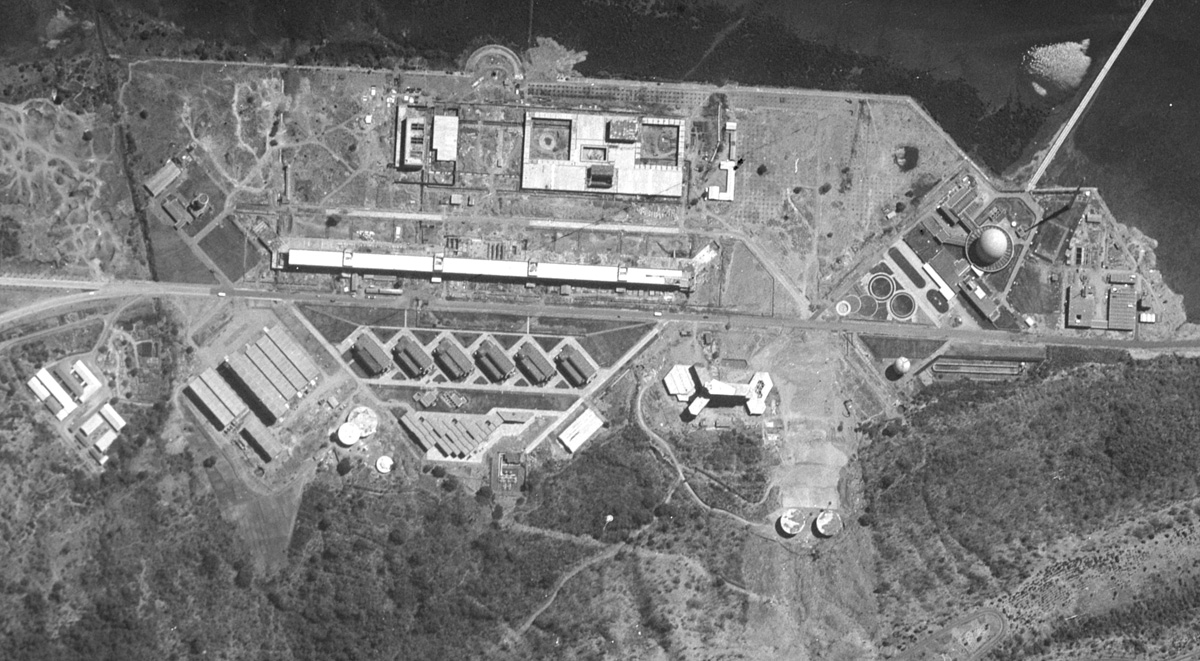

Washington, D.C., December 7, 2011 – India’s “peaceful nuclear explosion” on 18 May 1974 caught the United States by surprise in part because the intelligence community had not been looking for signs that a test was in the works. According to a recently declassified Intelligence Community Staff post-mortem posted today by the National Security Archive and the Nuclear Proliferation International History Project, Nixon administration policymakers had given a relatively low priority to the Indian program and there was “no sense of urgency” to determine whether New Delhi was preparing to test a nuclear device. Intelligence “production” (analysis and reporting) on the topic “fell off” during the 20 months before the test, the analysis concluded.[i]
In early 1972, however—two years before the test—the State Department’s Bureau of Intelligence and Research (INR) had predicted that India could make preparations for an underground test without detection by U.S. intelligence. Published for the first time today, the INR report warned that the U.S. government had given a “relatively modest priority to … relevant intelligence collection activities” which meant that a “concerted effort by India to conceal such preparations … may well succeed.”
The post-mortem [see document 21], the INR report [see document 2] and other new materials illustrate how intelligence priorities generally reflect the interests and priorities of top policymakers. The Nixon White House was focused on the Vietnam War and grand strategy toward Beijing and Moscow; intelligence on nuclear proliferation was a low priority. Compare, for example, the India case with that of Iraq during 2002-2003, when White House concerns encouraged—some say even compelled—intelligence producers to cherry pick raw information to demonstrate the development of WMD by the Saddam Hussein regime.
INR prepared its India report at a time when secret sources were telling U.S. intelligence that New Delhi was about to test a nuclear device. The “small spate” of reports about a test had such “congruity, apparent reliability, and seeming credibility” that they prompted a review of India’s nuclear intentions by INR and other government offices. In the end, government officials could not decide whether India had made a decision to test although a subsequent lead suggested otherwise.
According to the intelligence community’s post-mortem, obtained through a mandatory review appeal to the Interagency Security Classification Appeals Panel (ISCAP), one of the problems was that intelligence producers were not communicating with each other, so the “other guy” assumed that someone else was “primarily responsible for producing hard evidence of Indian intentions.” The analysis was especially critical of an August 1972 Special National Intelligence Estimate for its “waffling judgments” on Indian nuclear intentions.
Other declassified documents reproduced here from 1972 through 1974 illustrate the range of thinking on this sensitive topic:
- An INR report in February 1972 concluded that it could not “rule out a test” in the near future and it was “entirely possible that one or more nuclear devices have actually been fabricated and assembled.” All the same, “it our judgment that a decision to authorize a test is unlikely in the next few months and may well be deferred for several years.”
- During March and April 1972, Canadian and British intelligence concluded that they had no evidence that India had made a decision to test a nuclear device. Nevertheless, the Canadians believed that New Delhi could produce a device in less than a year.
- In June 1972, Japanese diplomat Ryohei Murata argued that the “Indians have decided to go ahead with a nuclear test” and that the Thar Desert in Rajasthan would be the test site. While basically correct, Murata’s estimate was discounted because it did not represent an official Foreign Ministry view.
- Special National Intelligence Estimate (SNIE) 31-72 published in August 1972 also held that the Indians could produce a device “within a few days to a year of a decision to do so,” but concluded that the chances that India had made a decision to test were “roughly even.”
- In 1973, the Atomic Energy Commission’s scientific representative in India told the U.S. consul in Bombay (Mumbai) that several “indications” suggested that India “may well have decided” to test a nuclear device.
- Five months before the test, the U.S. Embassy in New Delhi reported that the probability of an “early test” was at a “lower level than previous years.”
The rumors that India was going to test emerged in the wake of the South Asian crisis, when the Nixon White House tilted toward Pakistan, India’s archrival. Relations between New Delhi and Washington were already cool during the Nixon administration which treated India as a relatively low priority. Henry Kissinger’s secret trip to China underlined India’s low priority by suggesting that if New Delhi ever faced a crisis with Beijing it could not count on Washington for help. Relations became truly frosty during the balance of 1971 when New Delhi signed a friendship treaty with Moscow and India and Pakistan went to war. Later Nixon and Kissinger wanted to improve the relationship, but India’s nuclear intentions were not on their agenda. That India had refused to sign the Nuclear Nonproliferation Treaty was a non-issue for Nixon and Kissinger, who had little use for the NPT and treated nuclear proliferation as less than secondary. While the State Department cautioned India against nuclear tests in late 1970 [see document 6], concern did not rise to the top of policy hill.[2]
Whatever impact the events of 1971 may have had on India’s decision to test a nuclear device that decision was soon to be made. According to George Perkovich, an authority on the Indian nuclear program at the Carnegie Endowment for International Peace, “it may be conjectured that support in principle for developing a nuclear explosive device was solidified by late 1971, that concentrated work on building the vital components began in spring 1972, and that formal prime ministerial approval to make final preparations for a PNE occurred in September 1972.”[3] In this context, the reports collected by U.S. intelligence in late 1971 and early 1972 about a possible test may have been good examples of the old chestnut that “where there’s smoke, there’s fire.”
Yet, the analysts who wrote SNIE 31-72 decided that the smoke had no significance because they saw only a 50-50 chance that New Delhi had made a decision to test (even though New Delhi was closing in on a decision).
|
Documents
Document 1: “Various recent intelligence reports”
State Department cable 3088 to Embassy New Delhi, 6 January 1972, Secret
Source: U.S. National Archives, Record Group 59, Subject-Numeric Files 1970-1973 [hereinafter RG 59, SN 70-73] Def 12-1 India
For years, the U.S. intelligence establishment had been monitoring India’s nuclear program for signs of a decision to produce nuclear weapons, but in late 1971 and early 1972 it had to consider the possibility that a nuclear test was impending. Recently collected intelligence about an imminent test led the State Department to send a query to the U.S. Embassy in India for its assessment.
Document 2: “A Concerted Effort by India to Conceal Preparations May Well Succeed”
State Department Bureau of Intelligence and Research Intelligence Note, “India to Go Nuclear?” 14 January 1972, Secret
Source: RG 59, SN 70-73, Def 18-8 India
Before the Embassy sent a full response, a team of analysts at the State Department’s Bureau of Intelligence and Research produced their evaluation of varied report about India’s nuclear intentions: that it would test a device that month, sometime in 1972, or that the government was undertaking a program to test a “peaceful nuclear explosive.” According to INR, India had the capability to produce some 20-30 weapons, and it could easily test a device in an underground site, such as an abandoned mine, that would be hard to discover. Indeed, because the U.S. government had given a “relatively modest priority to … relevant intelligence collection activities” a “concerted effort by India to conceal such preparations … may well succeed.” What would motivate India to test, the analysts opined, were domestic political pressures and concerns about China and Pakistan. Nevertheless, the INR analysts saw a test as having more importance as a demonstration of “scientific and technological prowess”; the strategic significance would be “negligible” because India was “years away” from developing a “credible” deterrence against China “its only prospective enemy with a nuclear capability.”
Document 3: “Straws” Suggesting an Underground Test
U.S. Embassy Airgram A-20 to State Department, “India’s Nuclear Intentions,” 21 January 1972, Secret, Excised copy
Source: RG 59, SN 70-73, Def 18-8 India
In its response to the Department’s query, the Embassy identified a number of reasons that made it unlikely that India would a test a nuclear device in the coming weeks, but saw “straws” suggesting an underground test “sometime in future.” For example, the Government of India had publicly acknowledged ongoing work on the problem of safe underground testing . Moreover, India might have an interest in making its nuclear capabilities known to “enemies.” Whatever the Indians decided, external pressure would have no impact on a highly nationalist state and society: “we see nothing US or international community can presently do to influence GOI policy directions in atomic field.”
One of the sources mentioned, apparently a CIA asset (the reference is excised), had a connection with the Prime Minister’s secretariat. This may be the same informant, future Prime Minister Moraji Desai, who provided information to the CIA about Prime Minister Gandhi’s intentions during the recent South Asian crisis and whose cover was subsequently blown through press leaks published by Jack Anderson. He later told the CIA to “go to hell.”[4]
Document 4: “Increased Status of a Nuclear Power”
Memorandum from Ray Cline, Director, Bureau of Intelligence and Research, to Director of Central Intelligence Richard Helms, enclosing “Possibility of an Indian Nuclear Test,” 23 February 1972, Secret
Source: U.S. State Department, Foreign Relations of the United States, 1969–1976 Volume E–7, Documents on South Asia, 1969–1972, Document 228
At the request of Undersecretary of State John Irwin, INR prepared an assessment which included a detailed review of Indian’s nuclear facilities and their capacity to produce weapons-grade plutonium as well as capabilities to deliver nuclear weapons to target. While India had signed agreements with Canada and the United States that nuclear reactors were to be used for peaceful purposes, the Indians were likely to claim that an explosive device for “peaceful” purposes was consistent with the agreements. Whether the Indians were going to test in the near future was in doubt. INR could not “rule out” one in the near future. Further, the “strongest incentive [to test] may well be the desire for the increased status of a nuclear power.” All the same, “it our judgment that a decision to authorize a test is unlikely in the next few months and may well be deferred for several years.” Weighing against a test were the financial and diplomatic costs, for example, “India’s full awareness that assistance from the US and other countries (possibly including the USSR) would be jeopardized.”
Document 5: Trudeau’s Warning
U.S. Embassy Canada cable 391 to State Department, “India’s Nuclear Intentions,” 7 March 1972, Secret
Source: RG 59, SN 70-73, AE 1 India
With Canada’s role as the supplier of the CANDU reactor, senior Canadian officials had close working relationships with their Indian counterpart. Lauren Gray, the chairman of Canada’s Atomic Energy Board, had recently visited India and U.S. embassy officials interviewed him closely on his thinking about Indian nuclear developments. Having spoken with Homi Nusserwanji Sethna, Chairman of the Atomic Energy Commission, and other officials, Gray believed that Sethna opposed a test and that as long as Sethna and Indira Gandhi were in office “there was no chance” that India would test a nuclear device, which would take three to four years to prepare. Gray was mistaken, but was correct to declare that if a decision to test was made, Sethna would “undoubtedly” head the project. The embassy’s science attaché, Miller N. Hudson, met with other officials with the AECB who had a different take on Indian capabilities; based on their assessment of Indian’s ability to produce weapons grade plutonium, they argued that it would take no more than a year to produce a device.
The Canadians pointed out that about 18 months earlier there had been a “blackout” of statistical information on plutonium production. That led Canadian Prime Minister Pierre-Eliot Trudeau followed by other officials to “directly” warn the “Indians that Canadian plutonium should not be used for any kind of nuclear device.”
Document 6: Unlikely to Test in the “Near Future”
State Department cable 40378 to U.S. Embassy Ottawa, “Indian Nuclear Intentions,” 9 March 1972, Secret
Source: RG 59, SN 70-73, AE 1 India
State Department officers were also consulting with their counterparts at the Canadian embassy in Washington. During a discussion with the embassy counselor, country desk director David Schneider opined that Indian was unlikely to test a device in the “near future” but he wanted Ottawa’s prognosis. Schneider was also interested in whether the Soviets, with their close relationship with India, might be able to use their influence to “deter” a test. If India tested, the U.S. could respond with a “strong statement,” but whether “punitive” measures would be taken would depend on whether the test “violated existing agreements.” In October 1970, the State Department had cautioned the Indians that a “peaceful nuclear explosion” was indistinguishable from a weapons test and that the test of a nuclear device would be incompatible with U.S.-Indian nuclear assistance agreements. That the State Department issued this warning provides a telling contrast with Canada, which treated its admonition as a head of state issue.
Document 7: No Technical or Fiscal Obstacle to a Test
U.S. Embassy Canada cable 430 to State Department, “India’s Nuclear Intentions on South Asia Situation,” 14 March 1972, Secret
Source: RG 59, SN 70-73, AE 1 India
Elaborating on his earlier cable and responding to the general issues raised by the Department’s 9 March message, science attaché Hudson questioned Gray’s evaluation of Sethna, suggesting that by combining “guile” and “technical proficiency,” the latter could easily have “easily misled” the Canadian. Based on consultations with a variety of Canadian insiders with knowledge of and experience with the Indian nuclear program, the Embassy saw no technical or fiscal barriers to an Indian test. Moreover, any pressure on India not to test would increase the “likelihood” of that happening.
Document 8: “Leaving Their Options Open”
State Department cable 50634 to U.S. Embassy Canada, “Indian Nuclear Intentions,” 24 March 1972, Secret
Source: RG 59, SN 70-73, AE 1 India
Further discussions with the Canadian embassy counselor disclosed Ottawa’s view that it had no evidence of Indian intentions to test a nuclear weapon or a PNE. The Indians were “leaving their options open.” If they decided to test, however, it would be “impossible” for them to move forward “without revealing some indication of their intentions.”
Document 9: British See No Evidence of a Decision
State Department cable 59655 to U.S. Embassy United Kingdom, “Indian Nuclear Intentions, 7 April 1972, Secret
Source: RG 59, SN 70-73, AE 1 India
The British Government was taking the same view as the Canadians, seeing no evidence that the Indians had made a decision to test, although they had the “capability.”
Document 10: “Apparent Reliability and Seeming Credibility”
State Department cable 69551 to U.S. Embassy United Kingdom, “Indian Nuclear Intentions, 22 April 1972, Secret
Source: RG 59, SN 70-73, AE 1 India
The Canadian embassy had asked the State Department for information on the intelligence reports from earlier in the year that an Indian nuclear test was “imminent.” The State Department denied the request, but informed the Canadians that the reports were so numerous and their “congruity, apparent reliability, and seeming credibility” so striking that it had become necessary to update official thinking about Indian intentions.
Documents 11A-C: “The Indians Have Decided to Go Ahead”
A. State Department cable 113523 to U.S. Embassy India, “Japanese Views Regarding Indian Nuclear Plans,” 23 June 1972, Secret
B. U.S. Mission Geneva cable 2755 to State Department, “Japanese-Pakistani Conversations Regarding Indian Nuclear Plans,” 26 June 1972, Secret
C. U.S. Embassy Tokyo cable 67912 to State Department, “Japanese View Regarding Indian Nuclear Plans,” 27 June 1972, Secret
Source: RG 59, SN 70-73, AE 1 India
This group of telegrams discloses that one Japanese diplomat made a good guess about what was happening in India, but also illuminates the problem of verifying intelligence information. In response to a request from the State Department, Ryohei Murata[5], an official at the n officer from the Japanese embassy, reported that the Japanese government believed that for prestige reasons and as a “warning” to others, the “Indians have decided to go ahead with a nuclear test” which could occur at “any time;” The Thar Desert in Rajasthan would be the test site. Murata was correct on the latter point and close to correct on the decision: only weeks before the Indian AEC had begun work on building the components for a test device.[6] The cables that followed this report, however, raised doubts about Murata’s assessment.
Document 12: Request for a NSSM
Henry Kissinger to President Nixon, “Proposed NSSM on the Implications of an Indian Nuclear Test,” n.d., with cover memorandum from Richard T. Kennedy, 4 July 1972, Secret
Source: Nixon Presidential Library, National Security Council Institutional Files, box H-192, NSSM-156 [1 of 2]
Months after the initial flurry of intelligence reports, national security assistant Henry Kissinger asked President Nixon to approve a national security study memorandum [NSSM] on the implications of an Indian nuclear test for U.S. interests. The next day, 5 July 1972, Kissinger sent the agencies a request for a study which became NSSM 156.
Document 13: No Evidence of a Decision
U.S. Embassy India cable 9293 to State Department, “Indian Nuclear Intentions,” 26 July 1972, Secret
Source: RG 59, SN 70-73 Def 1 India
In an update of its thinking about the possibility of a test, the Embassy acknowledged that India had the “technical know-how and possibly materials to develop [a] simple nuclear device within period of months after GOI decision to do so.” Nevertheless, it saw no evidence that a decision had been made to test a device. Moreover, capabilities to deliver nuclear weapons were limited, with no plans in sight to “develop [a] missile launch system.”
Document 14: “Roughly Even”
Special National Intelligence Estimate 31-72, “Indian Nuclear Developments and their Likely Implications,”3 August 1972, Secret
Source: Foreign Relations of the United States, 1969–1976 Volume E–7, Documents on South Asia, 1969–1972, Document 298
Prepared as part of the NSSM 156 policy review, the 1974 post-mortem criticized this SNIE as “marred by waffled judgments.” The SNIE concluded that the chances of India making a decision to test were “roughly even,” but the post-mortem analysis [see document 21] argued that based on its own findings, the conclusion ought to have been 60-40 in favor of a decision to test. In its analysis of the pros and cons of testing, the SNIE found that the “strongest factors impelling India to set off a test are: the “belief that it would build up [its] international prestige; demonstrate India’s importance as an Asian power; overawe its immediate South Asian neighbors; and bring enhanced popularity and public support to the regime which achieved it.” The drafters further noted that a test would be “extremely popular at home, where national pride is riding high” and that supporters of a test believed that it would make the world see India as “one of the world’s principal powers.” The arguments against a test included adverse reactions from foreign governments that provided economic assistance, but the estimate noted that foreign reactions were “becoming less important” to India.
Document 15: “No Firm Intelligence”
Memorandum of Conversation, “Indian Nuclear Developments,” 21 September 1972, Secret
Source: RG 59, SN 70-73, Def 12 India
A meeting between British Foreign Office and State Department officials on the Indian nuclear problem occurred the same month that Indian Prime Minister Gandhi approved the “final preparations for a PNE.”[7] Deputy Assistant Secretary of State Christopher T. Van Hollen (the father of the future Maryland Congressman) and his colleagues followed the approach taken by the SNIE, which was close to that taken by the British Joint Intelligence Committee. According to country director David Schneider, the “odds were about even” that India would make a decision, but once it was made, India could test very quickly. There was “no firm intelligence” that a “go-ahead signal” to prepare for a test had been made. Schneider reviewed bilateral and multilateral steps, proposed in the NSSM 156 study, that the U.S. and others could take to try to discourage an Indian test and the range of reactions that would be available if India went ahead. A “weak” U.S. reaction, Schneider observed, would suggest that Washington would “acquiesce” if other countries followed India’s example.
Document 16: “A Set-Back to Nonproliferation Efforts”
H. Daniel Brewster to Herman Pollack, “Indian Nuclear Developments,” 16 January 1973, enclosing “Summary,” 1 September 1972, Secret
Source: RG 59, SN 70-73, AE 6 India
The interagency group prepared a response to NSSM 156 on 1 September 1972 and it was sent to Kissinger at whose desk it would languish, suggesting the low priority that the Nixon White House gave to nuclear proliferation issues. The summary of the study reproduced here includes the conclusion that an Indian test would be “a set-back to nonproliferation efforts” and that Washington should “do what [it] can to avert or delay” one. Thus, recommendations included a number of unilateral and multilateral actions that the United States government could take, noting that “given the poor state” of Indo-American relations, an “overly visible” U.S. effort would more likely speed up an Indian decision to test a device, Even non-US efforts were likely not to “be per se effective.”
Documents 17A-B: India “May Well Have Decided”
A. Bombay consulate cable 705 to Department of State, “India’s Nuclear Position,” 4 April 1973, Confidential
Source: RG 59, SN 70-73, Def 1 India
B. U.S. Embassy India cable 5797 to State Department forwarding Bombay consulate cable 983, “India’s Nuclear Position,” 17 May 1973, Confidential
Source: AAD 1973
The possibility that the GOI had made a decision to test surfaced in a message from the U.S. consulate in Bombay (Mumbai) signed off by Consul David M. Bane. The latter reported that Oak Ridge Laboratory scientist John J. Pinajian, then serving as the Atomic Energy Commission’s scientific representative in India, had pointed out several “indications”—notably his lack of access to key individuals and facilities in India’s atomic establishment–suggesting that India “may well have decided” to test a nuclear device. While stating that Pinajian’s evaluation was “subjective and impressionistic,” Consul Bane agreed that the atomic energy establishment did not want this American poking around because he might find out too much. Bane further observed that a nuclear test “in the not too distant future” could meet the GOI’s political goals and help attain “greater recognition major power status.”
Raja Rammana, the director of the Bhabha Atomic Research Center, one of the organizations that Pinajian was trying to contact, played a key role in directing the PNE project so his suspicions were on target.[8] In any event, a month later, Pinajian got some access to BARC, but noticed the absence of personnel responsible for experimental work. Moreover, he was getting cooperation from the Institute for Fundamental Research to conduct an experiment. Whether Pinajian remained suspicious needs to be learned, but the authors of the 1974 post-mortem pointed to the Consulate report as evidence that should have been considered (although it is worth noting that Secretary of State William Rogers was aware of the report and asked for more information).
Document 18: “The Likelihood of an Early Test [at] a Lower Level than Previous Years”
U.S. Embassy India cable 0743 to State Department, “India’s Nuclear Intentions,” 18 January 1974, Confidential
Source: http://static.history.state.gov/frus/frus1969-76ve08/pdf/d156.pdf
The embassy concluded that “deeper economic problems,” among other considerations militated against a nuclear test in the near future, even though the Indian government had the capabilities to produce and test a device. While there were no rumors about a test as there had been in 1972, “we know little about relevant internal government debate.” All in all, the embassy believed that economic conditions “tip the likelihood of an early test to a lower level than previous years.” Russell Jack Smith, previously the deputy director for intelligence at the CIA, and then serving as special assistant to the ambassador (station chief), was one of the officials who signed off on this cable.[9]
Document 19: “Rebound to their Credit Domestically”
U.S. Embassy India cable 6598 to State Department, “India’s Nuclear Explosion: Why Now?” 18 May 1974, Secret
Source: AAD
Having written off an early test, the day that it took place the Embassy scrambled to come up with an explanation. Deputy Chief of Mission David Schneider signed off on the telegram because Moynihan was in London. While the Embassy had no insight on the decision-making, it saw domestic politics and “psychological” explanations for the test: the need to offset domestic “gloom” and the need for India to “be taken seriously.” According to the telegram, “the decision will appeal to nationalist feeling and will be widely welcomed by the Indian populace.”
Document 20: “Enough Plutonium for Some 50-70 Nuclear Weapons”
State Department cable 104613 to Consulate, Jerusalem, “India Nuclear Explosion,” 18 May 1974, Secret
Source: State Department MDR release
The day of the test, INR rushed to update Kissinger, then in the Middle East negotiating with Israel and Syria. INR provided background on what had happened, how the United States and Canada had inadvertently helped India produce plutonium for the test device, earlier U.S. and Canadian demarches against “peaceful nuclear explosions,” and India’s capabilities to produce and deliver nuclear weapons. The report did not state whether India had made a decision to produce weapons, but it forecast that two large unsafeguarded reactors under construction could eventually “produce enough plutonium for 50-70 nuclear weapons.”
Document 21: “No Sense of Urgency in the Intelligence Community”
Intelligence Community Staff, Post Mortem Report, An Examination of the Intelligence Community’s Performance Before the Indian Nuclear Test of May 1974, July 1974, Top Secret, Excised copy
Source: Mandatory review request; release by ISCAP
After the test, policymakers in and out of the intelligence establishment wanted to know why the CIA and its sister agencies had missed it. As Jeffrey Richelson has observed, this was not an “epic failure,” but it was serious enough to produce a post-mortem investigation to determine what had gone wrong.[10] The partial release of the July 1974 post-mortem provides some answers, even if the full picture is denied because of massive excisions. Readers already know from the previous release published on the Archive’s Web site that two problems were especially important: 1) the lack of priority given to the Indian nuclear program for intelligence collection (further confirmed by the January 1972 INR report), and 2) the lack of communication between intelligence producers (analysts and estimators) and intelligence collectors (spies, NRO, etc.). The low priority meant that intelligence production “fell off” during the 20 months before the test (from October 1972 to May 1974). Moreover, there may have been a lack of communication between producers, with the “other guy” assuming that someone else was “primarily responsible for producing hard evidence of Indian intentions.”
Trying to explain the lack of follow-up on relevant “raw intelligence,” e.g. Pinjanians’s surmises about the Indian nuclear program, the post-mortem saw no “sense of urgency” in the intelligence community, which may have “reflected the attitudes of the policymakers.” Another problem was that the intelligence community focused more on “capabilities” than on “intentions,” which implicitly raised the difficult issue of breaching the nuclear establishment or Indira Gandhi’s small circle of decision-making.
The substantive discussion of satellite photography has been excised, but the recommendations were left intact, including the point that “The failure of production elements to ask NPIC [National Photographic Intelligence Center] to exploit photography that had been specifically requested from the National Reconnaissance Office suggests a weakness in the imagery requirements system.” The implication was that NRO satellites had imagery of the Thar Desert that could have been scrutinized for suspect activity, but no one asked NPIC to look into it. In any event, this and other failures fed into a number of recommendations, including the broader point that nuclear proliferation intelligence receive “much higher priority.”
Document 22: “India may not yet have decided whether to proceed with …. [the] development of a weapons capability”
Source: MDR release by CIA
A few months after the Indian test, the intelligence community prepared an overall estimate of the global nuclear proliferation situation. Such an estimate had not been prepared since the 1960s, no doubt because of the White House’s lack of interest. This estimate, SNIE 4-1-74, has been released before but this version includes more information, mainly a section on the Indian nuclear program, which had previously been withheld. While finding it “likely” that India would launch a covert program to produce a few weapons, the analysts were not sure that such a decision had been made and suggested that Moscow or Washington might be able to persuade the Indians from moving in that direction. The hypothesis about a covert program was mistaken because the Government of India did not make a basic decision to produce nuclear weapons until the 1980s.
Document 23: Whether the “Intelligence Community is Adequately Focused on Proliferation Matters”
Intelligence Community Staff, Director of Performance Evaluation and Improvement, to Deputy to the Director of Central Intelligence for the Intelligence Community, “Nuclear Proliferation and the Intelligence Community,” 12 October 1976, Top Secret, Excised copy
Source: CIA Research Tool [CREST], National Archives Library, College Park, MD
As this report indicates, the recommendations made in the 1974 post-mortem had little impact. The authors identified a basic disconnect between “national level users”—the top policymakers—and those who “set analytical and collection priorities in the intelligence community.” The latter were not sure how high a priority that the policymakers had given to nuclear proliferation intelligence. Moreover, a study for the Defense Department produced by MIT chemistry professor (and future DCI) John Deutch questioned whether the intelligence community “is adequately focused and tasked on proliferation matters.” This would be a recurring problem for the CIA and other intelligence agencies.
Notes
[i] For background, see Jeffrey Richelson, Spying on the Bomb: American Nuclear Intelligence from Nazi Germany to Iran and North Korea (New York: W.W. Norton, 2006), 218-235.
[1] For background, see Jeffrey Richelson, Spying on the Bomb: American Nuclear Intelligence from Nazi Germany to Iran and North Korea (New York: W.W. Norton, 2006), 218-235.
[2] For U.S.-India relations during the Nixon administration, see Dennix Kux, India and the United States: Estranged Democracies, 1941-1991 (Washington, D.C.: National Defense University Press, 1993), 279-314, and Perkovich, India’s Nuclear Bomb, 162-166. For the impact of Kissinger’s trip, see Andrew B. Kennedy, “India’s Nuclear Odyssey: Implicit Umbrellas, Diplomatic Disappointments, and the Bomb,” International Security 36 (2011): 136-139.
[3] Perkovich, India’s Nuclear Bomb, 172.
[4] Thomas Powers, The Man Who Kept the Secrets: Richard Helms & the CIA (New York: Knopf, 1979), 206-207; Mark Feldstein, Poisoning the Press: Richard Nixon, Jack Anderson, and the Rise of Washington’s Scandal Culture, (New York: Farrar, Straus and Giroux, 2010), 171.
[5] Murata would later rise to vice foreign minister and in 2009 revealed significant details about secret U.S.-Japanese understandings on nuclear weapons issues during the Cold War. http://search.japantimes.co.jp/cgi-bin/nn20090630a2.html
[6] Perkovich, India’s Nuclear Bomb, 171.
[9] Russell J. Smith, The Unknown CIA: My Three Decades with the Agency (Washington, D.C.: Pergamon-Brassey, 1989, 124.
UNCENSORED – FEMEN Cyber War against Sex Tourism
FEMEN fights sex-tourism with BORDEL.NET programme for the Internet. Report by 1+1
FBI – Former Prince George’s County Executive Jack Johnson Sentenced to Over Seven Years in Federal Prison for Federal Extortion and Bribery
GREENBELT, MD—U.S. District Judge Peter J. Messitte sentenced former Prince George’s County Executive Jack B. Johnson, age 62, of Mitchellville, Maryland, today to 87 months in prison followed by three years of supervised release for his leadership role in an extortion conspiracy wherein in exchange for bribes, Jack Johnson corruptly used his public office to engage in fraudulent actions including steering millions of dollars in federal and local funds to favored developers; and tampering with a witness and evidence. Judge Messitte also ordered that Jack Johnson pay a $100,000 fine and forfeit $78,000 and an antique Mercedes Benz.
The sentence was announced by United States Attorney for the District of Maryland Rod J. Rosenstein; Special Agent in Charge Richard A. McFeely of the Federal Bureau of Investigation; and Acting Special Agent in Charge Jeannine A. Hammett of the Internal Revenue Service-Criminal Investigation, Washington, D.C. Field Office.
“Jack Johnson could have been a role model for integrity, but he chose to be a poster child for greed,” said U.S. Attorney Rod J. Rosenstein. “The facts of this case read like a dime novel because the defendant acted as if corruption was the normal way of doing business. It is our responsibility to prove him wrong.”
“Identifying and investigating public corruption remains one of our highest priorities,” stated FBI Special Agent in Charge Richard A. McFeely. “We hope today’s sentencing reaffirms the federal government’s proactive stance to stamp out corruption by those elected officials who have betrayed the public trust.”
“Public officials, whether elected or appointed, hold positions of trust in the eyes of the public. That trust is broken when these officials commit crimes,” said Acting IRS Special Agent in Charge Jeannine Hammett. “Today’s sentencing sends a clear message that no public official gets a free pass to ignore the laws.”
Jack Johnson was Prince George’s County Executive from 2002 to December 2010. Prior to 2002, Jack Johnson was the county’s State’s Attorney, and spent nearly a decade as an attorney for the IRS Office of Chief Counsel.
In September 2009, Jack Johnson appointed James Johnson to serve as the Director of DHCD, which administered the HOME Investment Partnerships program to provide federal grants to states and localities to fund the construction, purchase and/or rehabilitation of affordable housing for rent or home-ownership. Patrick Ricker is a developer in Prince George’s County, and had an interest in Greenbelt Metropark, which sought to build a mixed-use project near the Greenbelt Metro Station, called Greenbelt Station. Mirza Baig is a physician and a commercial and residential developer in the County since at least 1992. Leslie Johnson was an elected County Councilwoman and Jack Johnson’s wife.
According to Jack Johnson’s guilty plea and court documents, from 2003 through at least November 12, 2010, Jack Johnson orchestrated a conspiracy in which Baig, Ricker and other business persons offered bribes, including money, trip expenses, meals, drinks, hotel rooms, airline tickets, rounds of golf, employment, mortgage payments, and monetary and in-kind campaign contributions to Jack and James Johnson and other state and local government officials. Baig and James Johnson pleaded guilty to being part of the conspiracy from 2006 through 2010, and Ricker pleaded guilty to being part of the conspiracy from about 1997 through at least September 11, 2008. According to court documents, the amount of bribes extorted by Jack Johnson and his co-conspirators total over $1.6 million.
In exchange for the bribes, Jack Johnson, James Johnson, and other County officials performed and agreed to perform favorable official actions for Baig, Ricker and other developers, business owners and their companies. The official acts included obtaining a waiver of a HOME Program regulation, securing millions of dollars in HOME funds; assisting in the acquisition of surplus property and land from the County for development by certain developers, including Baig and Ricker; providing the conspirators with non-public County information; obtaining necessary state and local approvals and permits for certain developments and businesses in the County, including Greenbelt Station, one of Ricker’s projects; obtaining employment with the County; obtaining management rights for County bond funds; obtaining County funding for certain developments and businesses in the County; assisting with state and County legislation regarding liquor store hours; influencing certain County officials to approve and/or facilitate County business; and, securing County commitments to lease property from certain developers at developments in the County. According to court documents, the value of the benefits received by the individuals paying the bribes totaled $10,098,496.
According to court documents, Jack Johnson intended to continue his corrupt scheme after his term of office ended, through his wife’s new position on the County Council and through other candidates for county offices. In meetings with Baig which were recorded by the FBI, Jack Johnson is heard promising to have Leslie Johnson use her position on the County Council to “take care of things” for Baig. Jack Johnson was also overheard in recorded conversations with county officials, a lobbyist, a developer and other business owners to extort donations for Leslie Johnson’s campaign for a county council seat and another candidate’s campaign for county executive. During the course of the scheme, Jack Johnson also regularly sought payments and employment that were to be awarded to him once he left office, in return for Jack Johnson providing official assistance while he was still county executive.
Additionally, just prior to his arrest on November 12, 2010, Jack Johnson and his wife Leslie Johnson exchanged a series of telephone calls. During one of those calls, as federal agents were knocking on the door of Johnsons’ home to execute a search warrant, Jack told Leslie to destroy the $100,000 check provided to him by Baig and to hide cash that he had hidden in their home. Specifically, Jack Johnson told Leslie to flush the check down the toilet and hide the cash in her underwear. Federal agents entered the home and recovered approximately $79,600 from Leslie who had hidden the cash in her underwear.
Leslie Johnson pleaded guilty on June 30, 2011 to conspiracy to commit witness and evidence tampering in order to obstruct a federal corruption investigation. As part of her plea agreement, Leslie Johnson will forfeit proceeds of the scheme, including $79,600 in cash. She faces a maximum sentence of 20 years in prison and a $250,000 fine at her sentencing scheduled for December 9, 2011 at 10:30 a.m.
Former Director of the Prince George’s County Department of Housing and Community Development (DHCD) James Edward Johnson, age 66, of Temple Hills, Maryland, pleaded guilty on January 28, 2011 to conspiracy to commit extortion. James Johnson and Jack Johnson are not related. Dr. Mirza Hussain Baig, age 67, of Burtonsville, Maryland, pleaded guilty on April 11, 2011 to conspiracy to commit extortion in connection with paying bribes to Jack Johnson and James Johnson. Patrick Q. Ricker, age 52, of Bowie, Maryland, pleaded guilty on December 30, 2009 to conspiring to commit honest services fraud and to make false statements to the Federal Election Commission; and to tax evasion.
James Johnson and Mirza Baig face a maximum sentence of five years in prison for the conspiracy to commit extortion at their sentencing scheduled for March 12 and 19, 2012, respectively. Patrick Ricker faces a maximum sentence of five years in prison for honest services fraud, false statements conspiracy and tax evasion at his sentencing scheduled for March 23, 2012.
A total of 15 defendants have been convicted to date in the related investigations of corruption in Prince George’s County.
United States Attorney Rod J. Rosenstein praised the FBI and IRS-CI for their work in the investigation. Mr. Rosenstein thanked Assistant United States Attorneys James A. Crowell IV, A. David Copperthite, Sujit Raman and Christen A. Sproule, who are prosecuting these cases.
Uncensored – New – FEMEN Video
TOP-SECRET – U.S. Army Commander’s Guide to Female Engagement Teams

Complex operations often require the development of specialized teams with multidisciplinary perspectives. Examples of these groups include human terrain teams, provincial reconstruction teams, and, most recently, female engagement teams (FETs). These specialized programs are tasked with engaging local populations to ascertain information on civil-society needs and problems; address security concerns; and to form links between the populace, military, and interagency partners.
History has taught us that most insurgent fighters are men. But, in traditional societies, women are extremely infl uential in forming the social networks that insurgents use for support. Co-opting neutral or friendly women — through targeted social and economic programs — builds networks of enlightened self-interest that eventually undermines the insurgents. To do this effectively requires your own female counterinsurgents. Win the women, and you own the family unit. Own the family, and you take a big step forward in mobilizing the population on your side.
Men, women, and children are part of the triangle of knowledge that must be targeted for information collection. In Afghanistan, we observe rather consistent themes. Men interpret information and tell you what they think you want to hear. Women see and hear what goes on behind the walls. Children run free in the community and see, watch, and are involved in nearly every activity in the community.
…
Initial Female Engagement Team Concept
FETs are not a new concept in Afghanistan. They have existed in one form or another for more than nine years. Civil affairs teams have performed this type of mission on a regular basis for years in both Afghanistan and Iraq, along with countries like Bosnia and Kosovo, but not under that name. The Marines picked up on the FET concept and employed it on a large scale well before the Army and they have had great success using it. Currently, there is little consistency in the FET programs between deployed Army brigade combat teams (BCTs) in Afghanistan. The BCTs are having varying degrees of success in contributing to the information repository covering the total Afghan population that is required to be understood as part of the COIN environment. The Army has been slow picking up on the FET concept; it is now being codifi ed and an Army wide FET training program is being developed based on the U.S. Army Special Operations Command (USASOC) Cultural Support Team (CST) program.
DOWNLOAD ORIGINAL DOCUMENT HERE
CONFIDENTIAL – STUDY – State Department Exploring Women’s Roles in Afghanistan


TOP-SECRET – City of London Police Occupy London Domestic Terrorism/Extremism Warning

These are photos and the text of a bulletin disseminated to local businesses by the City of London Police warning of possible extremist/terrorist threats arising from the Occupy London protests.
Terrorism/Extremism update for the City of London Business community
2 December 2011
The threat to the UK from international terrorism is SUBSTANTIAL.
The threat to Great Britain from Irish Republican Terrorism is SUBSTANTIAL.
UK/International
Columbia: The Revolutionary Armed Forces of Columbia (FARC) killed four of its longest held captives on Saturday during combat with Columbian forces. A fifth hostage allegedly survived after fleeing into the jungle after being held captive for 12 years, in what has been reported as a failed rescue attempt. It is FARC policy to kill prisoners if rescue attempts are made.
Al Qaeda/Pakistan: Al Qaeda has reportedly been holding Warren Weinsten, a 70-year-old American aid worker, hostage in Pakistan for three months. The al Qaeda leader, Ayman al-Zawahiri has said in a video that Weinstein would be released only if the US ceases its air strikes on Pakistan and Afghanistan and frees prisoners. The video offered no evidence that the aid worker is still alive.
Belarus: Two men have been sentenced to death for bombing the underground railway in the capital, Minsk, earlier this year. The attack on 11 April killed 15 people and wounded hundreds of others. Dmity Konovalov, 25, was found guilty of carrying out the explosion and Vladislav Kovalyov, also 25, of assisting in an act of terrorism. They were also found guilty of involvement in three earlier bomb attacks in 2005 and 2008, which together injured more than 100 people.
Domestic
Occupy London, ongoing
The Occupy London sites at St Paul’s Cathedral and Finsbury Square remain in place with the number of protesters present remaining fairly consistent. The majority of peaceful demonstrators from the St Paul’s camp appear to have moved on to the other camps. Demonstrations originating from the camp have decreased and lacked the support and momentum of earlier actions.
There are now three ‘Occupations’ by activists in or near the City of London. As the worldwide Occupy movement shows no sign of abating, it is likely that activists aspire to identify other locations to occupy, especially those they identify capitalism. City of London Police has received a number of hostile reconnaissance reports concerning individuals who would fit the anti-capitalist profile.
All are asked to be vigilant regarding suspected reconnaissance, particularly around empty buildings. Any signs of access or new markings should also be reported. You may encounter an increase in persons filming for the purpose of national or activist media. All are reminded that any encounters with suspected activists could be recorded and then uploaded or live-streamed to the internet.
Intelligence suggests that urban explorers are holding a discussion at the Sun Street squat. This may lead to an increase in urban exploration activity at abandoned or high profile sites in the capital.
Suspected hostile reconnaissance should be reported to the City of London Police immediately.
Climate Justice Collective, 3 December
‘Stand Up for Climate Justice’ is holding a vigil on the bank of the Thames from 11.30pm to 1.00am Friday Night, as well as climate prayers at 11.30am Saturday morning at St. Mary Le Bow church, Cheapside.
Saturday continues with a ‘Walk of Shame’ past alleged environmental and economic justice offenders along with a ‘teach-out’. This meets at St Paul’s at 10.30am, and is followed by a march to Parliament, meeting at Blackfriars Bridge at 12.00pm. Around 2.30pm the march will congregate outside Parliament. The event is planned to finish around 3.30pm.
The Canary Wharf Experience, 6 December
Occupy London will meet at St Paul’s around 4.15opm, from which they will attend and ‘tour’ Canary Wharf.
Electrician’s Strike, 7 December
Electricians will be takingindustrial action at Balfour Beatty sites across the country.
SHAC ‘Santa SHAC Supplier Shakedown week of action’, 5-11 December
Stop Huntingdon Animal Cruelty has advertised a week of action between these dates. It is expected that SHAC protesters will visit the customary targets during the period.
Ensure that your own security arrangements are adequate and robust at all times. Report any suspicious activity to Police immediately.
Confidential Anti Terrorist Hotline: 0800 789 321 or dial 999


UNCENSORED AND UNCUT – FEMEN Do you want me?
Creative idea explanation: The goal of the ‘Do you want me?’ project was to draw attention of the international web-community to a problem of sex-tourism in Ukraine, and to show that, as mentioned by Femin activists, ‘Ukraine is no brothel’.. Website do-you-want.me gives every user a chance to find himself in an urban den of inquity, pick a girl or a guy (tastes differ) for a paid ‘one time pleasure’. Before the erotic dance starts, the user must prove his solvency by activating the webcam and showing a banknote. Onlyafter the virtual character sees the money, will the story continue. Few will like the way the story goes – a trivial plot, so it seems… evolves into a naked truth(both literally and metaphorically) – we see how our paid sex-partner is being beaten up and addicted to drugs.
CONFIDENTIAL-Carrier IQ Cellular Phone Intelligence Software Training Materials


The following presentation was included in a collection of materials related to Trevor Eckhart’s research into the “mobile service intelligence” software produced by Carrier IQ. The document was specifically mentioned in a cease and desist order that the company sent to Eckhart demanding that he remove their “confidential training materials” and take down his analysis of the company’s software. Though the company later withdrew the legal complaint, this presentation remains unavailable from its original location and is only available via a number of mirrors at file-hosting sites. Cryptome is offering a full mirror of Eckhart’s research, which includes this presentation.
DOWNLOAD ORIGIAL DOCUMENT HERE
VIDEO – CIA Archives: What Was the Katyn Massacre? (1973)
UNCENSORED AND UNCUT – FEMEN US
UNCENSORED – FEMEN against bribing of voters
VIDEO – Nazi Concentration and Prison Camps: WW2 Documentary Film (1945)
CONFIDENTIAL – El Dorado County Sheriff’s Department Use of Force Policy


VIDEO – Neo-Nazis Take Over German Village
FBI – Virginia Man Pleads Guilty to Providing Material Support to Terrorist Organization
ALEXANDRIA, VA—Jubair Ahmad, 24, a native of Pakistan and resident of Woodbridge, Va., pleaded guilty today to providing material support to Lashkar-e-Tayyiba (LeT), a designated foreign terrorist organization.
Neil H. MacBride, U.S. Attorney for the Eastern District of Virginia; Lisa Monaco, Assistant Attorney General for National Security; and James W. McJunkin, Assistant Director in Charge of the FBI’s Washington Field Office, made the announcement after the plea was accepted by U.S. District Judge T.S. Ellis III.
Ahmad faces a maximum penalty of 15 years in prison when he is sentenced on April 13, 2012.
“Foreign terrorist organizations such as LeT use the Internet as part of well-orchestrated propaganda campaigns to radicalize and recruit individuals to wage violent jihad and to promote the spread of terror,” said U.S. Attorney MacBride. “Today’s conviction of Jubair Ahmad demonstrates that we will aggressively investigate and prosecute anyone who provides material support to a terrorist organization in whatever form it takes.”
“This prosecution sheds light on some of the methods terrorist organizations employ to produce and publish their extremist propaganda,” said Assistant Attorney General Monaco. “Today, Jubair Ahmad is being held accountable for his role in providing this form of material support to Lashkar-e-Tayyiba.”
“By preparing and posting a graphic video that glorified violent extremism, Mr. Ahmad directly supported the mission of a designated terrorist organization,” said FBI Assistant Director in Charge McJunkin. “The FBI will track down and disrupt those who communicate with terrorist groups for the purpose of recruiting others to inflict harm on the U.S. and its interests overseas.”
LeT, or “Army of the Pure,” serves as the military arm of the political movement Markaz al-Dawa wal-Irshad in Pakistan. The mission of LeT is to conduct and promote violent jihad against those considered to be the enemies of Islam. On Dec. 24, 2001, the U.S. Department of State designated LeT as a foreign terrorist organization. The focus of LeT operations has been attacks on the neighboring country of India, in particular the disputed region of Kashmir between Pakistan and India.
According to a statement of facts filed with the plea agreement, Ahmad was born and raised in Pakistan and in 2007, after receiving a visa from the U.S. Department of State, Ahmad moved from Pakistan to the United States with his family.
Ahmad admitted today that in September 2010, while at his residence in Woodbridge, he engaged in a series of communications with an individual named Talha Saeed, who was in Pakistan. Talha Saeed is the son of Hafiz Muhammad Saeed, the leader of LeT. Talha Saeed requested Ahmad to prepare a video that would contain a prayer by Hafiz Saeed calling for the support of jihad and the mujahideen. In addition, Talha Saeed instructed Ahmad to present a variety of violent images on the video while Hafiz Saeed’s prayer is heard in the background.
Talha Saeed directed Ahmad to begin the LeT video with a number of pictures of Hafiz Saeed, then show scenes where atrocities have been inflicted on Muslims, followed by the activities of the mujahideen conducting attacks in Kashmir. At one point, Ahmad asked Talha Saeed if he wanted to include an image of the Mumbai attack to show the power of LeT. This is a reference to LeT’s operation against the city of Mumbai, India, on Nov. 26, 2008, which resulted in the death of over 160 people, including six Americans. Talha replied that he should not use anything referring to Mumbai.
Ahmad admitted that Talha Saeed told him to search for “Lashkar-e-Taiba” on YouTube to find additional images of mujahideen operations to include in the video. Talha Saeed further stated that the video will be popular in Pakistan and will run continuously on significant media programs and presentations.
On Sept. 25, 2010, Ahmad completed the LeT video and uploaded it to a YouTube account on the Internet. The next day, Ahmad sent a communication to another person overseas in which he explained that “Hafiz Saeed’s son Talha Saeed” had requested him to prepare the video. Forensic examination by the FBI subsequently confirmed that Ahmad had constructed the LeT video on his computer.
This case is being investigated by the FBI’s Washington Field Office. Assistant U.S. Attorney Stephen M. Campbell from the National Security and International Crimes Unit of the Eastern District of Virginia and Trial Attorney John T. Gibbs from the Counterterrorism Section of the National Security Division in the U.S. Department of Justice are prosecuting the case on behalf of the United States.
From the FBI – Ten Years Later: The Enron Case
 |
|---|
| More than 3,000 boxes of evidence and more than four terabytes of digitized data were collected by agents in the weeks after Enron declared bankruptcy Dec. 2, 2001. |
It was 10 years ago this month that the collapse of Enron precipitated what would become the most complex white-collar crime investigation in the FBI’s history.
Top officials at the Houston-based company cheated investors and enriched themselves through complex accounting gimmicks like overvaluing assets to boost cash flow and earnings statements, which made the company even more appealing to investors. When the company declared bankruptcy in December 2001, investors lost millions, prompting the FBI and other federal agencies to investigate.
The sheer magnitude of the case prompted creation of the multi-agency Enron Task Force, a unique blend of investigators and analysts from the FBI, the Internal Revenue Service-Criminal Investigation Division, the Securities and Exchange Commission, and prosecutors from the Department of Justice.
Agents conducted more than 1,800 interviews and collected more than 3,000 boxes of evidence and more than four terabytes of digitized data. More than $164 million was seized; to date about $90 million has been forfeited to help compensate victims. Twenty-two people have been convicted for their actions related to the fraud, including Enron’s chief executive officer, the president/chief operating officer, the chief financial officer, the chief accounting officer, and others.
“The Enron Task Force’s efforts resulted in the convictions of nearly all of Enron’s executive management team,” said Michael E. Anderson, assistant special agent in charge of the FBI’s Houston Division, who led the FBI’s Enron Task Force in Houston. “The task force represented a model task force—the participating agencies selflessly and effectively worked together in accomplishing significant results. The case demonstrated to Wall Street and the business community that they will be held accountable.”
CONFIDENTIAL-California Peace Officer Standards and Training Crowd Management and Civil Disobedience Guidelines

Penal Code Section 13514.5 requires the Commission on Peace Officer Standards and Training to establish guidelines and training for law enforcement’s response to crowd management and civil disobedience.
These guidelines contain information for law enforcement agencies to consider when addressing the broad range of issues related to crowd management and civil disobedience. The guidelines do not constitute a policy, nor are they intended to establish a standard for any agency. The Commission is sensitive to the needs for agencies to have individualized policies that reflect concern for local issues. The Commission intends these guidelines to be a resource for law enforcement executives that will provide maximum discretion and flexibility in the development of individual agency policies.
…
In the United States all people have the right of free speech and assembly guaranteed by the First Amendment of the Federal Constitution and California State Constitution. Law enforcement recognizes the right of free speech and actively protects people exercising that right.
The rights all people have to march, demonstrate, protest, rally, or perform other First Amendment activities comes with the responsibility to not abuse or violate the civil and property rights of others. The responsibility of law enforcement is to protect the lives and property of all people. Law enforcement should not be biased by the opinions being expressed nor by the race, gender, sexual orientation, physical disabilities, appearances, or affiliation of anyone exercising his/her lawful First Amendment rights. Law enforcement personnel must have the integrity to keep personal, political or religious views from affecting their actions.
When it becomes necessary to control the actions of a crowd that constitutes an unlawful assembly, the commitment and responsibility of law enforcement is to control lawfully, efficiently, and with minimal impact upon the community. A variety of techniques and tactics may be necessary to resolve a civil disobedience incident. Only that force which is objectively reasonable may be used to arrest violators and restore order.
All agencies should familiarize themselves with the terms, definitions, and guidelines set forth in this document. These are the generally accepted principles by which agencies respond to lawful and unlawful assemblies. The material in this document is designed to assist law enforcement executives in addressing the broad range of issues surrounding civil disobedience.
…
Guideline #9: Use of Force: Force Options
Agencies should develop use of force policies, procedures, and training for managing crowds and civil disobedience.
Discussion:
When dealing with crowds and civil disobedience situations, law enforcement must be a disciplined and well-organized control force. The decisions to use force and the force options that may be applied in response to these incidents range from law enforcement presence to deadly force. Peace officers need not use the least intrusive force option, but only that force which is objectively reasonable under the totality of the circumstances (Scott v. Henrich, 39 F. 3d 912, 9th Cir. 1994, and Forrester v. City of San Diego, 25 F. 3d 804 9th Cir. 1994). Graham v. Connor, 490 U.S. 386, 109 S. Ct. 1865, 104 L. Ed. 2d 443 (1989). The reasonableness of the force used to affect a particular seizure is analyzed under the Fourth Amendment and determined by balancing the nature and quality of the intrusion on the individual’s Fourth Amendment interests against the governmental interests at stake.
Prior to an event, agencies should continually review their use of force alternatives in response to potential actions by protesters. Training should reflect reasonable use of force alternatives in order that officers are prepared to consider the tactics/force options available. Chew v. Gates, 27 F. 3d 1432, 1443 (9th Cir. 1994).
* A Sampling of Use of Force Considerations:
- Determine compliance or non-compliance of crowd
- Physically moving non-compliant offenders
- Anticipate possible actions of demonstrators
- Identify criminal violations involved
- Develop arrest protocol
- Develop use of pain compliance protocol
- Plan for disabled, elderly, and children demonstrators
- Determine availability of personnel
- Evaluate availability of other public safety resources
- Include protection devices for involved personnel
- Plan for the safety of bystanders
- Evaluate mobility of suspects/protestors
- Determine avenues of controlled departure
- Anticipate potential for medical resources
- Establish protocols for less lethal munitions
* A Sampling of Force Options:
- Law enforcement presence
- Verbalization
- Firm grip
- Compliance techniques
- Control devices
- Nonlethal chemical agents
- Electrical control devices
- Impact weapons/batons
- Less lethal (i.e., sting balls, grenades, bean bags)
- Deadly force
DOWNLOAD ORIGINAL DOCUMENT HERE
UNCENSORED – NEW FEMEN VIDEO – Femen травили шкідливих комах на мітингу Фронту змін
CONFIDENTIAL-California Bluebook Law Enforcement Mutual Aid Plan

As you read this, somewhere in California one law enforcement agency is providing mutual aid to another. Mutual aid is an everyday occurrence in a state as large and diverse as California. This is the continuation of the decades-long process of “neighbor helping neighbor.” The law enforcement mutual aid system is an ongoing cooperative effort among law enforcement agencies to ensure an effective and organized response to a wide range of emergencies. There is a misconception that mutual aid is something used only during a riot or disaster. The mutual aid system has been used successfully for many other situations, including large criminal investigations, deployment of special teams such as Special Weapons and Tactics Teams, Bomb Squads, etc.
How will your agency use the mutual aid system? Planning, preparation and operational activities of law enforcement agencies in support of the mutual aid system must be consistent with each department’s policies and procedures and must also comply with the Standardized Emergency Management System (SEMS) and the National Incident Management System (NIMS).
All law enforcement executives, administrators, managers and field supervisors should familiarize themselves with this plan and its application. The personnel of the Cal EMA Law Enforcement Division are career peace officers and are available to assist you with planning, training and when necessary, emergency response coordination. It is important to note however, that Cal EMA does not “own” the mutual aid system. It is a part of California law enforcement, and those that participate each benefit – and bear part of the burden – of “neighbor helping neighbor.”
…
State of War Emergency
“State of War Emergency” means the condition which exists immediately, with or without a proclamation thereof by the Governor, whenever this state or nation is attacked by an enemy of the United States, or upon receipt by the state of a warning from the federal government indicating that such an enemy attack is probable or imminent. (Section 8558 (a) GC) During a state of war emergency, the Governor has complete authority over all agencies of state government and the right to exercise within the area or regions designated, all police power vested in the state by the Constitution and laws of the State of California (GC, Article 12, Section 8620 and Article 13, Section 8627, “California Emergency Services Act”). During a state of war emergency, mutual aid is mandatory. (Discussed later in the Plan.)
State of Emergency
“State of Emergency” means the duly proclaimed existence of conditions of disaster or of extreme peril to the safety of persons and property within the state caused by such conditions as air pollution, fire, flood, storm, epidemic, riot, drought, sudden and severe energy shortage, plant or animal infestation or disease, the Governor’s warning of an earthquake or volcanic prediction, or an earthquake, complications resulting from the Year 2000 Problem, or other conditions, other than conditions resulting from a labor controversy or conditions causing a “state of war emergency,” which, by reason of their magnitude, are or are likely to be beyond the control of the services, personnel, equipment, and facilities of any single county, city and county, or city and require the combined forces of a mutual aid region or regions to combat, or with respect to regulated energy utilities, a sudden and severe energy shortage requires extraordinary measures beyond the authority vested in the California Public Utilities Commission. (Section 8558 (b)(GC))
During a state of emergency, the Governor has complete authority over all agencies of state government and the right to exercise within the area or regions designated, all police power vested in the state by the Constitution and laws of the State of California (GC, Article 12, Section 8620 and Article 13, Section 8627, “California Emergency Services Act”). During a state of emergency, mutual aid is mandatory. (Discussed later in the Plan)
DOWNLOAD DOCUMENT HERE
CONFIDENTIAL-California Redbook Law Enforcement Guide for Emergency Operations


The California Emergency Management Agency’s original Law Enforcement Guide for Emergency Operations was developed in response to the need for standardization and uniformity of organization and response on the part of law enforcement agencies involved in major multi-jurisdictional and multi-agency incidents such as a civil disorder, technological disaster, or natural disaster.
The revised and expanded 2009 Law Enforcement Guide for Emergency Operations is designed to be a practical field-oriented guide to assist law enforcement personnel throughout the State of California with implementation of the Field Level Incident Command System. The intended primary users of this guide are watch commanders and field supervisors. The guide can also be an excellent emergency response tool for law enforcement managers, as well as line officers and deputies.
This updated edition incorporates the concept and statutory requirement of the Standardized Emergency Management System (SEMS). Additionally, the Law Enforcement Incident Command System (LEICS), as approved by the SEMS Law Enforcement Specialist Committee, is presented in this publication. Please disregard earlier editions of this guide. The Law Enforcement Guide for Emergency Operations is organized in a user-friendly format consisting of overview text, diagrams, organization charts, checklists, forms, and a glossary. Several sections are suitable for photocopying and distribution to field personnel. Our ultimate goal is to provide practical guidance for California law enforcement agencies in using the SEMS and LEICS organizational framework for efficient and safe response, management, and coordination of major emergencies and disasters.
DOWNLOAD ORGINAL DOCUMENT HERE
FEMEN-VIDEO -Roma Landyk – Go to Prison
CBS – The murder of an American Nazi
Lesley Stahl reports on the murder of a neo-Nazi leader – killed by his 10-year-old son – and captures a growing subculture of hate playing out in America’s backyards and alongside the border.
TOP-SECRET-United Kingdom “Contest” Strategy for Countering Terrorism 2011
1.1 This is the third published version of the United Kingdom’s counter-terrorism strategy, CONTEST. This new strategy reflects the changing terrorist threat and incorporates new Government policies on counter-terrorism.
1.2 The aim of CONTEST is to reduce the risk to the UK and its interests overseas from terrorism, so that people can go about their lives freely and with confidence.
Strategic context
1.3 Last year, over 10,000 people were killed by terrorists around the world. But international law enforcement and military collaboration are changing the threats we face.
1.4 The leadership of Al Qa’ida is now weaker than at any time since 9/11. It has played no role in recent political change in North Africa and the Middle East. Its ideology has been widely discredited and it has failed in all its objectives. Continued international pressure can further reduce its capability. But Al Qa’ida continues to pose a threat to our own security; and groups affiliated to Al Qa’ida – notably in Yemen and Somalia – have emerged over the past two years to be a substantial threat in their own right.
1.5 Al Qa’ida is responsible for only a small fraction of terrorist attacks. Other groups, independent from Al Qa’ida but broadly sympathetic to its aims, continue to emerge and to conduct attacks around the world.
1.6 We judge that four factors will continue to enable terrorist groups to grow and to survive: conflict and instability; aspects of modern technology; a pervasive ideology; and radicalisation.
1.7 The threats we face here reflect global trends. Al Qa’ida, groups affiliated to Al Qa’ida, other terrorist groups and lone terrorists have all tried to operate in this country. Some have planned attacks here which we have disrupted. Others have recruited people for attacks overseas, spread propaganda and raised funds.
1.8 The threat level in the UK from international terrorism has been SEVERE for much of the period, meaning that we judge a terrorist attack in the UK to be ‘highly likely’. Threat levels continue to be set independently by JTAC.
1.9 For much of this period the greatest threat to the UK has come from terrorist groups based in Pakistan. British nationals (amongst hundreds of other Europeans) are training or operating in Pakistan and some intend to travel to Afghanistan. But over the past 12 months, the threat to UK interests from terrorists in Yemen and Somalia has significantly increased. People from the UK are also travelling to these countries to engage in terrorist related activity; some are returning to the UK to plan and conduct terrorist operations.
1.10 Over the past two years the threat from Northern Ireland Related Terrorism (NIRT) has also grown: there were 40 terrorist attacks in Northern Ireland in 2010 and there have been 16 terrorist attacks in Northern Ireland up to 30 June 2011.1 The threat from NIRT to Great Britain has increased.
1.11 Between January 2009 and December 2010 over 600 people were arrested for terrorist related activity in the UK. This is more than in any other European country. 67 people have been prosecuted and 58 people convicted for terrorist related offences.
Our response
1.12 Our counter-terrorism strategy will continue to be organised around four workstreams, each comprising a number of key objectives
• Pursue: to stop terrorist attacks;
• Prevent: to stop people becoming terrorists or supporting terrorism;
• Protect: to strengthen our protection against a terrorist attack; and
• Prepare: to mitigate the impact of a terrorist attack.1.13 The Strategic Defence and Security Review (SDSR) emphasises the need to tackle the root causes of instability. This approach is reflected in contest. For terrorism we need to address not only the immediate threat of attacks but the longer term factors which enable terrorist groups to grow and flourish. Some of these factors cannot be addressed within a counter-terrorism strategy and are much wider Government priorities. Coordination between CONTEST and other government programmes is essential. Working closely with other countries will remain a priority.
1.14 CONTEST will reflect our fundamental values and, in particular, our commitment not only to protect the people of this country and our interests overseas but to do so in a way that is consistent with and indeed advances our commitment to human rights and the rule of law. Our strategy will be proportionate to the risks we face and only engage in activity which is necessary to address those risks. It will be transparent: wherever possible and consistent with national security we will seek to make more information available in order to help the public to hold the Government to account over its policy and spending decisions.
1.15 We recognise that success has been achieved through international collaboration. That will continue to be the case in future.
Pursue
1.16 The purpose of Pursue is to stop terrorist attacks in this country and against our interests overseas. This means detecting and investigating threats at the earliest possible stage, disrupting terrorist activity before it can endanger the public and, wherever possible, prosecuting those responsible.
1.17 In 2011-2015 we want to:
• Continue to assess our counter-terrorism powers and ensure they are both effective and proportionate;
• Improve our ability to prosecute and deport people for terrorist-related offences;
• Increase our capabilities to detect, investigate and disrupt terrorist threats;
• Ensure that judicial proceedings in this country can better handle sensitive and secret material to serve the interests of both justice and national security; and
• Work with other countries and multilateral organisations to enable us to better tackle the threats we face at their source.…
2.48 Terrorists continue to use new technologies to communicate propaganda. While radicalisation continues to primarily be a social process involving contact between vulnerable people and radicalisers (not least because internet penetration in many countries with a high incidence of terrorism is still low) – the internet provides radicalisers with a vast range of materials to use once the process of radicalisation has begun. It allows for secure communication between private communities in which extremist ideas are shared and become normalised within that community. The internet also extends the reach of ideologues overseas, enabling them to preach to groups and reinforce messages of violence.
2.49 Use of social networking sites and video sharing is now commonplace. There have been a number of attempts by terrorist and extremist groups to ‘invade’ Facebook. Twitter will be used to repost media or forum articles enabling extremist content to be shared more quickly, widely and amongst people who would not normally search for extremist content. Estimates of the number of terrorism-related websites, made by experts in the field, range from several hundred to several thousand. It is clear that a few dozen are highly influential and frequented by terrorists.
DOWNLOAD ORIGINAL DOCUMENT HERE
TOP-SECRET-Israel’s Dubai Assassination in Photos
 A man identified by police as Evan Dennings of Ireland is seen in this handout released February 15, 2010. Israel’s foreign minister said on Wednesday the use of the identities of foreign-born Israelis by a hit squad suspected of killing Hamas militant, Mahmoud al-Mabhouh, in Dubai did not prove the Mossad spy agency assassinated him. Men with the same names as seven of the 11 suspects whose European passport photos were distributed by Dubai live in Israel, and those reached by reporters insisted their identities had been stolen and noted the pictures were not a match. REUTERS/Dubai Police/Handout A man identified by police as Evan Dennings of Ireland is seen in this handout released February 15, 2010. Israel’s foreign minister said on Wednesday the use of the identities of foreign-born Israelis by a hit squad suspected of killing Hamas militant, Mahmoud al-Mabhouh, in Dubai did not prove the Mossad spy agency assassinated him. Men with the same names as seven of the 11 suspects whose European passport photos were distributed by Dubai live in Israel, and those reached by reporters insisted their identities had been stolen and noted the pictures were not a match. REUTERS/Dubai Police/Handout |
 A woman identified by police as Gail Folliard of Ireland is seen in this handout released to Reuters Dubai February 15, 2010. Israel’s foreign minister said on Wednesday the use of the identities of foreign-born Israelis by a hit squad suspected of killing Hamas militant, Mahmoud al-Mabhouh, in Dubai did not prove the Mossad spy agency assassinated him. Men with the same names as seven of the 11 suspects whose European passport photos were distributed by Dubai live in Israel, and those reached by reporters insisted their identities had been stolen and noted the pictures were not a match. REUTERS/Dubai Police/Handout A woman identified by police as Gail Folliard of Ireland is seen in this handout released to Reuters Dubai February 15, 2010. Israel’s foreign minister said on Wednesday the use of the identities of foreign-born Israelis by a hit squad suspected of killing Hamas militant, Mahmoud al-Mabhouh, in Dubai did not prove the Mossad spy agency assassinated him. Men with the same names as seven of the 11 suspects whose European passport photos were distributed by Dubai live in Israel, and those reached by reporters insisted their identities had been stolen and noted the pictures were not a match. REUTERS/Dubai Police/Handout |
 A man identified by police as James Leonard Clarke of the United Kingdom is seen in this handout released February 15, 2010. Israel’s foreign minister said on Wednesday the use of the identities of foreign-born Israelis by a hit squad suspected of killing Hamas militant, Mahmoud al-Mabhouh, in Dubai did not prove the Mossad spy agency assassinated him. Men with the same names as seven of the 11 suspects whose European passport photos were distributed by Dubai live in Israel, and those reached by reporters insisted their identities had been stolen and noted the pictures were not a match. REUTERS/Dubai Police/Handout A man identified by police as James Leonard Clarke of the United Kingdom is seen in this handout released February 15, 2010. Israel’s foreign minister said on Wednesday the use of the identities of foreign-born Israelis by a hit squad suspected of killing Hamas militant, Mahmoud al-Mabhouh, in Dubai did not prove the Mossad spy agency assassinated him. Men with the same names as seven of the 11 suspects whose European passport photos were distributed by Dubai live in Israel, and those reached by reporters insisted their identities had been stolen and noted the pictures were not a match. REUTERS/Dubai Police/Handout |
 A man identified by police as Melvyn Adam Mildiner of the United Kingdom is seen in this handout released to Reuters Dubai February 15, 2010. Israel’s foreign minister said on Wednesday the use of the identities of foreign-born Israelis by a hit squad suspected of killing Hamas militant, Mahmoud al-Mabhouh, in Dubai did not prove the Mossad spy agency assassinated him. Men with the same names as seven of the 11 suspects whose European passport photos were distributed by Dubai live in Israel, and those reached by reporters insisted their identities had been stolen and noted the pictures were not a match. REUTERS/Dubai Police/Handout A man identified by police as Melvyn Adam Mildiner of the United Kingdom is seen in this handout released to Reuters Dubai February 15, 2010. Israel’s foreign minister said on Wednesday the use of the identities of foreign-born Israelis by a hit squad suspected of killing Hamas militant, Mahmoud al-Mabhouh, in Dubai did not prove the Mossad spy agency assassinated him. Men with the same names as seven of the 11 suspects whose European passport photos were distributed by Dubai live in Israel, and those reached by reporters insisted their identities had been stolen and noted the pictures were not a match. REUTERS/Dubai Police/Handout |
 A man identified by police as Kevin Daveron of Ireland is seen in this handout released to Reuters Dubai February 15, 2010. Israel’s foreign minister said on Wednesday the use of the identities of foreign-born Israelis by a hit squad suspected of killing Hamas militant, Mahmoud al-Mabhouh, in Dubai did not prove the Mossad spy agency assassinated him. Men with the same names as seven of the 11 suspects whose European passport photos were distributed by Dubai live in Israel, and those reached by reporters insisted their identities had been stolen and noted the pictures were not a match. REUTERS/Dubai Police/Handout A man identified by police as Kevin Daveron of Ireland is seen in this handout released to Reuters Dubai February 15, 2010. Israel’s foreign minister said on Wednesday the use of the identities of foreign-born Israelis by a hit squad suspected of killing Hamas militant, Mahmoud al-Mabhouh, in Dubai did not prove the Mossad spy agency assassinated him. Men with the same names as seven of the 11 suspects whose European passport photos were distributed by Dubai live in Israel, and those reached by reporters insisted their identities had been stolen and noted the pictures were not a match. REUTERS/Dubai Police/Handout |
 A man identified by police as Jonathan Louis Graham of the United Kingdom is seen in this handout released to Reuters Dubai February 15, 2010. Israel’s foreign minister said on Wednesday the use of the identities of foreign-born Israelis by a hit squad suspected of killing Hamas militant, Mahmoud al-Mabhouh, in Dubai did not prove the Mossad spy agency assassinated him. Men with the same names as seven of the 11 suspects whose European passport photos were distributed by Dubai live in Israel, and those reached by reporters insisted their identities had been stolen and noted the pictures were not a match. REUTERS/Dubai Police/Handout A man identified by police as Jonathan Louis Graham of the United Kingdom is seen in this handout released to Reuters Dubai February 15, 2010. Israel’s foreign minister said on Wednesday the use of the identities of foreign-born Israelis by a hit squad suspected of killing Hamas militant, Mahmoud al-Mabhouh, in Dubai did not prove the Mossad spy agency assassinated him. Men with the same names as seven of the 11 suspects whose European passport photos were distributed by Dubai live in Israel, and those reached by reporters insisted their identities had been stolen and noted the pictures were not a match. REUTERS/Dubai Police/Handout |
 This undated photo released by the Dubai Ruler’s Media Office on Monday, Feb. 15, 2010, is claimed by Dubai’s Police Chief to show a man named Peter Elvinger of French nationality, who the Dubai Police Chief identified as one of eleven suspects wanted in connection with the killing of a Hamas commander, Mahmoud al-Mabhouh, in his Dubai hotel room last month. (AP Photo/Dubai Ruler’s Media Office) This undated photo released by the Dubai Ruler’s Media Office on Monday, Feb. 15, 2010, is claimed by Dubai’s Police Chief to show a man named Peter Elvinger of French nationality, who the Dubai Police Chief identified as one of eleven suspects wanted in connection with the killing of a Hamas commander, Mahmoud al-Mabhouh, in his Dubai hotel room last month. (AP Photo/Dubai Ruler’s Media Office) |
 This undated photo released by the Dubai Ruler’s Media Office on Monday, Feb. 15, 2010, is claimed by Dubai’s Police Chief to show a man named Michael Bodenheimer of German nationality, who the Dubai Police Chief identified as one of eleven suspects wanted in connection with the killing of a Hamas commander, Mahmoud al-Mabhouh, in his Dubai hotel room last month. (AP Photo/Dubai Ruler’s Media Office) This undated photo released by the Dubai Ruler’s Media Office on Monday, Feb. 15, 2010, is claimed by Dubai’s Police Chief to show a man named Michael Bodenheimer of German nationality, who the Dubai Police Chief identified as one of eleven suspects wanted in connection with the killing of a Hamas commander, Mahmoud al-Mabhouh, in his Dubai hotel room last month. (AP Photo/Dubai Ruler’s Media Office) |
 This undated photo released by the Dubai Ruler’s Media Office on Monday, Feb. 15, 2010, is claimed by Dubai’s Police Chief to show a man named Michael Lawrence Barney of British nationality, who the Dubai Police Chief identified as one of eleven suspects wanted in connection with the killing of a Hamas commander, Mahmoud al-Mabhouh, in his Dubai hotel room last month. (AP Photo/Dubai Ruler’s Media Office) This undated photo released by the Dubai Ruler’s Media Office on Monday, Feb. 15, 2010, is claimed by Dubai’s Police Chief to show a man named Michael Lawrence Barney of British nationality, who the Dubai Police Chief identified as one of eleven suspects wanted in connection with the killing of a Hamas commander, Mahmoud al-Mabhouh, in his Dubai hotel room last month. (AP Photo/Dubai Ruler’s Media Office) |
 A man identified by police as Stephen Daniel Hodes of the United Kingdom is seen in this handout released to Reuters Dubai February 15, 2010. Israel’s foreign minister said on Wednesday the use of the identities of foreign-born Israelis by a hit squad suspected of killing Hamas militant, Mahmoud al-Mabhouh, in Dubai did not prove the Mossad spy agency assassinated him. Men with the same names as seven of the 11 suspects whose European passport photos were distributed by Dubai live in Israel, and those reached by reporters insisted their identities had been stolen and noted the pictures were not a match. REUTERS/Dubai Police/Handout A man identified by police as Stephen Daniel Hodes of the United Kingdom is seen in this handout released to Reuters Dubai February 15, 2010. Israel’s foreign minister said on Wednesday the use of the identities of foreign-born Israelis by a hit squad suspected of killing Hamas militant, Mahmoud al-Mabhouh, in Dubai did not prove the Mossad spy agency assassinated him. Men with the same names as seven of the 11 suspects whose European passport photos were distributed by Dubai live in Israel, and those reached by reporters insisted their identities had been stolen and noted the pictures were not a match. REUTERS/Dubai Police/Handout |
 Mahmoud al-Mabhouh, a senior Hamas military commander, is seen in this undated handout image. Israel has assassinated Mabhouh, in Dubai on Jan. 20, who played a major role in a Palestinian uprising in the 1980s, an official in the Islamist group said on January 29, 2010. Israeli officials had no immediate comment. REUTERS/Handout Mahmoud al-Mabhouh, a senior Hamas military commander, is seen in this undated handout image. Israel has assassinated Mabhouh, in Dubai on Jan. 20, who played a major role in a Palestinian uprising in the 1980s, an official in the Islamist group said on January 29, 2010. Israeli officials had no immediate comment. REUTERS/Handout |
 Palestinian Hamas militants participate a rally for the memory of Hamas commander Mahmoud al-Mabhouh, seen in the portrait, in town of Beit Lahiya, northern Gaza Strip, Wednesday, Feb. 17, 2010. Israel’s foreign minister said Wednesday there was no reason to assume the Mossad assassinated Mahmoud al-Mabhouh in Dubai, even as suspicions mounted that the country’s vaunted spy agency made the hit using the identities of Israelis with European passports. (AP Photo/Khalil Hamra) Palestinian Hamas militants participate a rally for the memory of Hamas commander Mahmoud al-Mabhouh, seen in the portrait, in town of Beit Lahiya, northern Gaza Strip, Wednesday, Feb. 17, 2010. Israel’s foreign minister said Wednesday there was no reason to assume the Mossad assassinated Mahmoud al-Mabhouh in Dubai, even as suspicions mounted that the country’s vaunted spy agency made the hit using the identities of Israelis with European passports. (AP Photo/Khalil Hamra) |
 The mother of Palestinian militant Mahmoud al-Mabhouh, who was recently killed, holds up a photo of him at their home in the Jebaliya refugee camp, northern Gaza Strip, Friday, Jan. 29, 2010. Hamas claimed on Friday that Israeli agents assassinated one of the Palestinian militant group’s veteran operatives in a killing allegedly carried out last week in Dubai, and vowed to retaliate. (AP Photo/Hatem Moussa)
 Father of senior Hamas military commander Mahmoud al-Mabhouh poses with his son’s picture at his family house in the northern Gaza Strip January 29, 2010. Israel assassinated al-Mabhouh, who played a major role in a Palestinian uprising in the 1980s, in Dubai, an official in the Islamist group said on Friday. Israeli officials had no immediate comment. REUTERS/Mohammed Salem
 Three suspects in the killing of Hamas militant, Mahmoud al-Mabhouh are shown in this CCTV handout from Dubai police February 15, 2010. Israel’s foreign minister said on Wednesday the use of the identities of foreign-born Israelis by a hit squad suspected of killing Hamas militant, Mahmoud al-Mabhouh, in Dubai did not prove the Mossad spy agency assassinated him. Men with the same names as seven of the 11 suspects whose European passport photos were distributed by Dubai live in Israel, and those reached by reporters insisted their identities had been stolen and noted the pictures were not a match. Handout dated February 15, 2010. REUTERS/Dubai Police/Handout
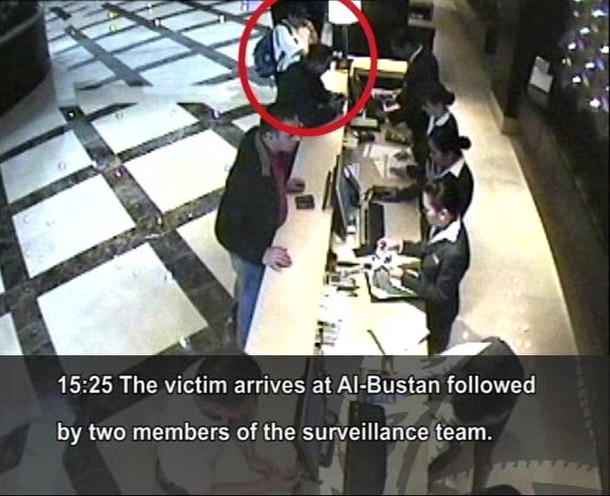 Hamas militant, Mahmoud al-Mabhouh (ringed), is shown arriving at his hotel in this CCTV handout from Dubai police February 15, 2010. Israel’s foreign minister said on Wednesday the use of the identities of foreign-born Israelis by a hit squad suspected of killing Hamas militant, Mahmoud al-Mabhouh, in Dubai did not prove the Mossad spy agency assassinated him. Men with the same names as seven of the 11 suspects whose European passport photos were distributed by Dubai live in Israel, and those reached by reporters insisted their identities had been stolen and noted the pictures were not a match. Handout dated February 15, 2010. REUTERS/Dubai Police/Handout
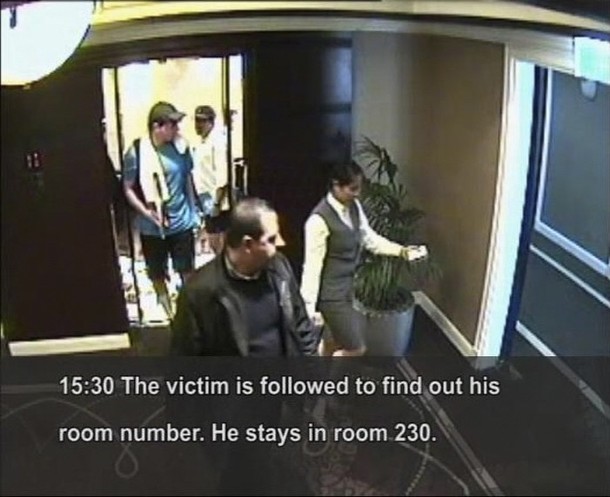 Hamas militant, Mahmoud al-Mabhouh (bottom), is shown being followed by his alleged killers in this CCTV handout from Dubai police February 15, 2010. Israel’s foreign minister said on Wednesday the use of the identities of foreign-born Israelis by a hit squad suspected of killing Hamas militant, Mahmoud al-Mabhouh, in Dubai did not prove the Mossad spy agency assassinated him. Men with the same names as seven of the 11 suspects whose European passport photos were distributed by Dubai live in Israel, and those reached by reporters insisted their identities had been stolen and noted the pictures were not a match.
TOP-SECRET – Mossad Dubai Assassins Travel Routes Maps
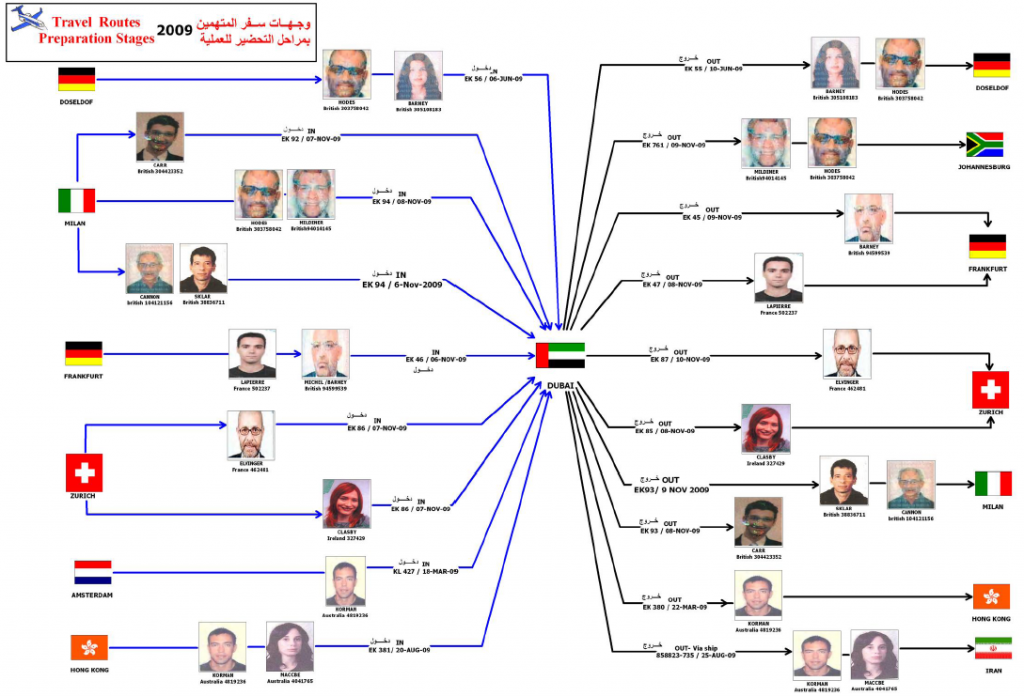
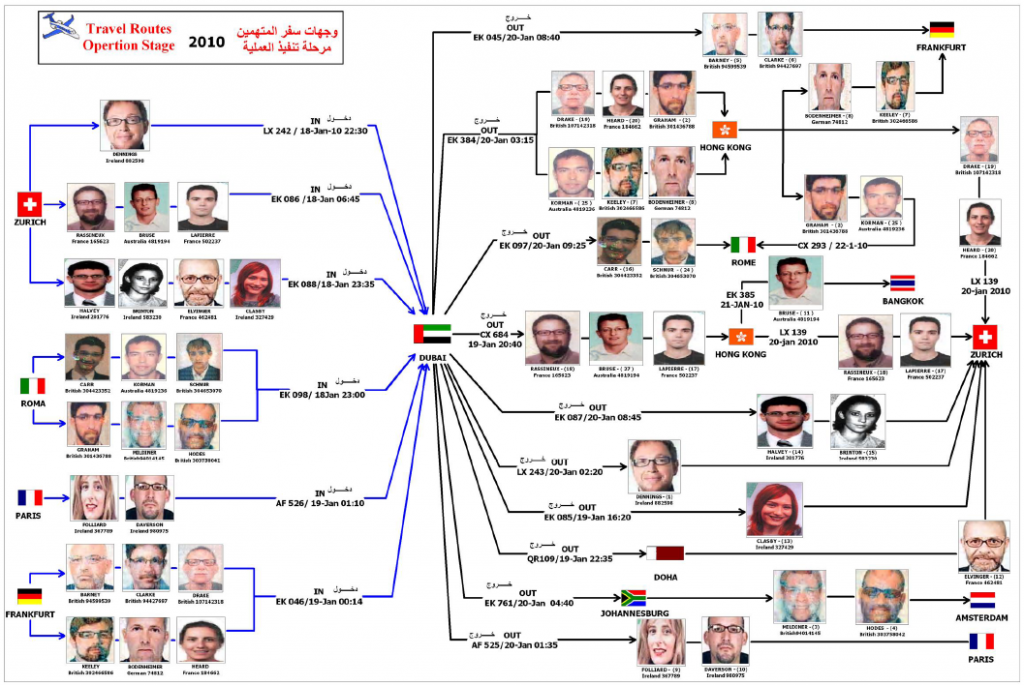
UNCENSORED – FEMEN: Акция “Изыди”
TOP-SECRET – IMF Report on Switzerland Fiscal Transparency
I. INTRODUCTION
1. This report provides an assessment of the fiscal transparency practices of Switzerland against the requirements of the IMF Code of Good Practices on Fiscal Transparency (2007). The first part is a description of practices, prepared by IMF staff on the basis of discussions with the authorities and their responses to the fiscal transparency questionnaire, and drawing on other available information. The second part is an IMF staff commentary on fiscal transparency in Switzerland. The two appendices summarize the staff’s assessments, comment on the observance of good practices, and document the public availability of information.
2. This assessment focuses primarily on fiscal transparency at the central
government (confederation) level. Given the unique character of political economy and
fiscal federalism in Switzerland, and that less than a third of general government expenditure
or revenue is accounted for by the confederation, this does not give a complete picture.
Cantons are responsible for important areas of economic and social policy, and have a strong
influence on the composition and impact of public spending, and the overall stance of fiscal
policy. Further work would be needed to prepare a comprehensive assessment of fiscal
transparency and fiscal risk covering the whole of general government.II. DETAILED DESCRIPTION OF PRACTICE
A. Clarity of Roles and Responsibilities
Definition of government activities
3. General government is defined consistently with Government Finance Statistics
(GFS) principles and is well covered in the budget process. 1.1.1
General government is defined in accordance with the principles of the Government Finance
Statistics Manual (GFSM 2001) and comprises four main sectors (Box 1): The federal
government comprises seven departments and related offices, the federal chancellery, and
four special funds. The special funds cover (i) railway projects; (ii) infrastructure;
(iii) technical universities; and (iv) the alcohol board. There are 26 cantonal governments.
The cantons are sovereign states with considerable autonomy. There are 2715 communes,
which likewise have considerable autonomy. The four social security institutions cover
(i) old age and survivors protection schemes; (ii) the disability protection scheme;
(iii) income compensation allowances in case of mandatory service and maternity; and
(iv) unemployment insurance. These schemes operate essentially on a pay-as-you-go basis.
…
Box 2. The SNB’s Support for UBS as a Quasi-Fiscal Activity
The SNB has justified its recent support of UBS in relation to its role as lender-of-the-last resort. This explanation rests on three considerations, namely: that UBS is a systemically important institution; could provide sufficient collateral; and was solvent. On the last point, the SNB obtained advice from the Federal Banking Commission that UBS was solvent, enabling it to provide emergency support. It did so by funding 90 percent of the purchase price of distressed assets to the value of US$60 billion.1 These assets were valued by external assessors, and transferred to a Special Purpose Vehicle (SPV) under the SNB’s control. To reduce the risks of not fully recovering the funds of the SPV, the SNB has set up several safeguards against potential losses. UBS’ equity contribution to the stabilization fund, amounting to 10 percent of the assets purchased, serves as the primary loss protection. In the case of a loss on the SNB loan, the SNB’s warrant for 100 million UBS shares serves as secondary loss protection. This transaction should be classified as a QFA given the risk that the SNB may fail to recover all of its investment. In this case, the profits of the SNB distributed to the federal government would be lower, with a negative impact on the budget.
________________________
1/ On February 10, 2009, it was announced that the stabilization fund would acquire UBS assets for a lower
maximum amount than originally planned (approximately US$ 40 billion).…
68. There are some areas, however, where the authorities could consider taking
further measures, in consultation with parliament where appropriate, to enhance fiscal
transparency and the presentation and management of fiscal risks. These are summarized
below.Disclosure of additional fiscal information by the federal government
69. Support provided by the federal government and the SNB to UBS and other
financial institutions affected by the global crisis is reported in, respectively, the
confederation’s and the SNB’s financial statements, supplemented by quarterly updates
by the SNB. However, in order to provide a comprehensive assessment, the federal
government should consider publishing in its financial statements information on the SNB’s
support operations alongside the report of its own activities.70. The government should publish its findings on tax expenditures and regularly
update them. Tax expenditures do not need to be appropriated each year, thereby escaping
scrutiny and the need to compete with other fiscal priorities in the budget process. Over time,
tax expenditures can result in insidious erosion of the tax base. The volume of tax
expenditures is significant, as a recent study by the FTA indicates. The government is aware
of the importance of keeping tax expenditures in check. It could consider publishing an
annual tax expenditure statement with the annual budget.3671. The government should make an effort to disclose information on specific fiscal
risks, including contingent liabilities and QFAs, with the budget, in line with the IMF’s
Guidelines for Fiscal Risk Disclosure and Management, and eventually publish a single
statement of fiscal risks.37 In particular, the universal services provided by Swiss Post, Swiss
Rail, and others are partly financed through cross-subsidies, which represent a form of
interpersonal redistribution, and taxes and transfer payments from the budget are considered
more desirable to support such activities from a transparency perspective. QFAs are
disclosed only to a very limited extent.72. The Social Security Funds should be clearly distinguished. Apart from the
unemployment insurance scheme, the other three funds are jointly operated. The old age and
disability pension funds are cross-financing each other, with the first fund running persistent
surpluses that are used to finance the deficits of the second. Clearly, separating the three
funds would make the financial health of each of them more transparent and facilitate the
necessary policy discussion about the sustainability of current policies. Parliament has
already passed a bill to separate the old-age and disability pension funds into two separate
funds. A referendum on the issue will be held in September 2009. In addition, an overview of
the finances of the social security sector and its relationship with the budget in the short to
medium term, in the context of an assessment of long-term fiscal sustainability, should be
included in the budget documents. More forward-looking information on the finances of the special funds would also be useful. Together, these measures would provide a better basis for
assessing the sustainability of current fiscal policy.73. More information should be published on the sensitivity of the budget to changes
in macroeconomic variables and an alternative macroeconomic and fiscal scenario,
building on the useful analysis already published by the government. This would provide
a better basis for assessing the uncertainties surrounding the budget.38 In addition, the federal
government could consider extending and formalizing the process of external review of
macroeconomic forecasts and assessments of economic developments.74. An overview of the finances of public corporations could also be provided in the
budget. Some corporations receive significant funding from the budget, and others conduct
QFAs, making it important to consider their financial position and profitability in the context
of fiscal policy.75. Additional information should be reported on public debt management, namely,
the debt management strategy and performance against it, and the impact of parameter
changes on debt-servicing costs.76. A summary statement of all new policy measures that are reflected in the budget
proposals, with an estimate of their fiscal impact, should be published, to supplement the
summary data on expenditure by tasks already provided in Volume 3 of the budget
documents.77. Each federal government department should be encouraged to publish an
annual report that summarizes relevant information concerning their goals and objectives,
strategic priorities, operational risks, financial results, and nonfinancial performance. This
would be in line with practice in many OECD countries.DOWNLOAD ORIGINAL DOCUMENT HERE
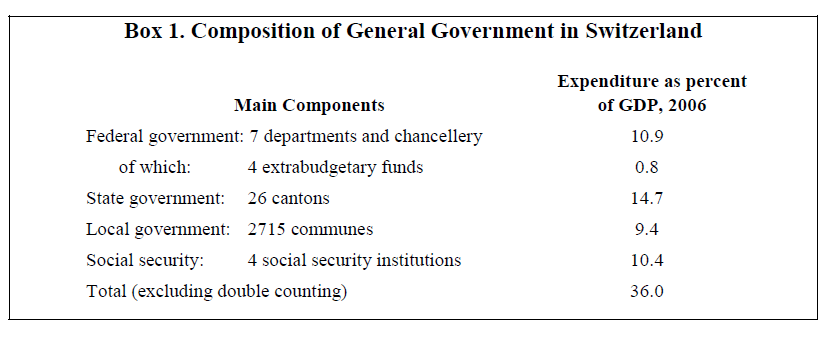
INISDE VIEW – FBI’s Largest Division Provides Information to Protect the Nation
 |
|---|
| The FBI’s Criminal Justice Information Services Division, or CJIS, is located in West Virginia. |
A Year of Records for CJIS
Part 1: FBI’s Largest Division Provides Information to Protect the Nation
The FBI’s Criminal Justice Information Services Division—better known as CJIS—provides critical information to help our partners fight crime and protect the nation. Whether it’s answering a patrolman’s request for a subject’s criminal record during a traffic stop, verifying that a potential gun buyer is not a felon, or ensuring that a local municipality is not hiring a teacher who is a registered sex offender, CJIS receives millions of electronic requests every day for criminal information records and returns responses with amazing speed and accuracy.
 |
|
|---|---|
| David Cuthbertson, assistant director of CJIS. |
FBI.gov recently spoke with Special Agent David Cuthbertson, the newly appointed assistant director of CJIS, about the division’s accomplishments in 2011 and what to expect from the FBI’s largest division in the future.
Q: CJIS has been described as a lifeline to law enforcement. What are some of the division’s main programs?
Cuthbertson: The term “lifeline” aptly describes what we do day in and day out at CJIS. Our main programs include NCIC—the National Crime Information Center—and the Interstate Identification Index, which is the nation’s criminal history repository. NCIC is searched by law enforcement nearly 8 million times every day. And those requests—related to stolen property and information on wanted, missing, and unidentified persons—are returned to officers on the street within fractions of a second. NICS—the National Instant Criminal Background Check System—helps keep guns out of felons’ hands. In the last fiscal year, NICS conducted more than 15.9 million background checks in accordance with federal law, and more than 76,000 gun transfers were denied based on buyers’ criminal records. Our Law Enforcement National Data Exchange—N-DEx—provides a secure, online national information-sharing system for records related to bookings, arrests, probation, and parole report data. More than 4,100 agencies contribute to N-DEx, and the system has more than 124 million searchable records. And, of course, CJIS maintains the largest collection of fingerprint records in the world. During the last fiscal year, the Integrated Automated Fingerprint Identification System—IAFIS—identified more than 307,000 fugitives. These programs are only part of the important work we do at CJIS. Our recently released annual report highlights other programs and many of our record-setting accomplishments.
Q: Does CJIS share information with partners outside of law enforcement?
Cuthbertson: Absolutely. We provide information to the U.S. intelligence community for national security matters, and our data is also relied upon for civil uses such as criminal checks for employment and licensing. Teachers and school bus drivers, for example, are subject to background checks as required by state law, and CJIS systems provide that information to authorized users.
Q: Given the vast number of records in CJIS databases, how do you safeguard Americans’ privacy and civil liberties?
Cuthbertson: We balance civil liberties with everything we do. It’s important to remember that we only retain information related to a person’s criminal history based on lawful contacts with law enforcement. We don’t retain files on employment checks, for instance. By law, even gun background checks that come to us through NICS are destroyed every night—unless the purchase was lawfully denied. There are many similar protections in place to protect the privacy of American citizens.
Next: Biometrics and continued growth.
CONFIDENTIAL – Money Laundering Banks Fuel Mexican Drug Cartels

Bank notes part of a seizure of more than 15 million US dolars during a presentation to the press on November 22, 2011 in Mexico City. The money was sized to alleged members of the Guzman Loera drug cartel, led byf Joaquin “El Chapo Guzman”, during the regional “Operation Fox” in Tijuana last November 18. AFP PHOTO/ Yuri CORTEZ
International banks have aided Mexican drug gangs (Los Angeles Times):
|
Mexico seeks to fill drug war gap with focus on dirty money
Tainted drug money runs like whispered rumors all over Mexico’s economy — in gleaming high-rises in beach resorts such as Cancun, in bustling casinos in Monterrey, in skyscrapers and restaurants in Mexico City that sit empty for months. It seeps into the construction sector, the night-life industry, even political campaigns.Piles of greenbacks, enough to fill dump trucks, are transformed into gold watches, showrooms full of Hummers, aviation schools, yachts, thoroughbred horses and warehouses full of imported fabric.
Officials here say the tide of laundered money could reach as high as $50 billion, a staggering sum equal to about 3% of Mexico’s legitimate economy, or more than all its oil exports or spending on prime social programs.
Mexican leaders often trumpet their deadly crackdown against drug traffickers as an all-out battle involving tens of thousands of troops and police, high-profile arrests and record-setting narcotics seizures. The 5-year-old offensive, however, has done little to attack a chief source of the cartels’ might: their money.
Even President Felipe Calderon, who sent the army into the streets to chase traffickers after taking office in 2006, an offensive that has seen 43,000 people die since, concedes that Mexico has fallen short in attacking the financial strength of organized crime.
“Without question, we have been at fault,” Calderon said during a meeting last month with drug-war victims. “The truth is that the existing structures for detecting money-laundering were simply overwhelmed by reality.”
Experts say the unchecked flow of dirty money feeds a widening range of criminal activity as cartels branch into other enterprises, such as producing and trading in pirated merchandise.
UNCENSORED – FEMEN vs UEFA EURO 2012


Topless FEMEN activists hold signs with football balls hanging from their underwear.

Topless FEMEN activists hold signs with football balls hanging from their underwear.

FEMEN activists take off clothing, so they can begin their protest.

Topless FEMEN activists hold signs with football balls hanging from their underwear.

Topless FEMEN activists hold signs with football balls hanging from their underwear.

Topless FEMEN activists hold signs with football balls hanging from their underwear.

Topless FEMEN activists hold signs with football balls hanging from their underwear.

Topless FEMEN activists hold signs with football balls hanging from their underwear.

Topless FEMEN activists hold signs with football balls hanging from their underwear.

Topless FEMEN activists hold signs with football balls hanging from their underwear.

Topless FEMEN activists hold signs with football balls hanging from their underwear.

Arrests begin.

Arrests begin.

Topless FEMEN activists are arrested and placed in police vehicles.

Topless FEMEN activists are arrested and placed in police vehicles.

Topless FEMEN activists are arrested and placed in police vehicles.
SECRET-DHS Wants to Create a “Federated Information Sharing System”
To understand the extent of the Federated Information Sharing System proposal, see our overview of just one of the databases maintained by a DHS component agency: Immigration and Customs Enforcement’s ICEPIC system which contains over 332,000,000 records on more than 254,000,000 entities as of early 2011.
The Department Of Homeland Security Wants All The Information It Has On You Accessible From One Place (Forbes):
|
Oversharing Is Never a Good Thing, Especially When it’s With DHS (ACLU):
|
Privacy Office – DHS Data Privacy and Integrity Advisory Committee Membership (dhs.gov):
Chairman: Richard V. Purcell,Chief Executive Officer, Corporate Privacy Group, Nordland, Wash. Mr. Purcell runs an independent privacy consulting group, focusing on policies, practices, and education. He is currently Chairman of TRUSTe and was formally the Chief Privacy Officer for the Microsoft Corporation.
Ana I. Anton, Professor of Computer Science at North Carolina State University, Raleigh, N.C. Dr. Anton is a distinguished research professor in the software engineering field and is the Director of privacy research team that is partially funded by the National Science Fund comprised of researchers at three universities. She has extensive professional expertise with research concerning privacy and security.
Ramon Barquin, President, Barquin International, Washington, D.C. Dr. Barquin has extensive technical and policy experience in data mining, system interoperability, and computer ethics. He worked at IBM for many years in both management and technical assignments prior to starting his own business developing information system strategies for public and private sector enterprises.
J. Howard Beales III, Associate Professor of Strategic Management and Public Policy, The George Washington University, Arlington, Va. Mr. Beales recently stepped down from his position as Director of Consumer Protection at the Federal Trade Commission, where privacy was a key initiative during his tenure.
Renard Francois, Attorney, Data Protection and Policy, Caterpillar, Inc., Peoria, Ill. Mr. Francois is in the firm’s Regulatory-Data Privacy, Legal Services Division where he works on privacy investigations. Prior to joining Caterpillar Inc., he was an attorney at Bass, Berry & Sims in Nashville, Tenn., where he worked in the firm’s Litigation Department on corporate internal investigations. He also has an LL.M. in Information Technology and Privacy Law.
A. Michael Froomkin, Professor of Law and Director of Faculty Development in the University of Miami’s School of Law. Professor Froomkin’s current research explores the legal and technical aspects of identification and authentication. Professor Froomkin also serves on the Electronic Frontier Foundation’s Advisory Board.
Joanna L. Grama, Information Security Policy and Compliance Director for Purdue University. Ms. Grama leads the University’s information technology policy and compliance activities related to security and privacy of personally identifiable information.
David A. Hoffman, Director of Security Policy and Global Privacy Officer, Intel Corporation, Hillsboro, Ore. Mr. Hoffman has experience in privacy policy issues at the business and technical level, working on issues of interoperability, improved data quality, and data retention. He serves on the board of directors for the non-profit privacy compliance organization, TRUSTe.
Lance Hoffman, Distinguished Research Professor, The George Washington University, Washington, D.C. Professor Hoffman is a professor of Computer Science and founded and leads the George Washington University computer security program.
Joanne McNabb, Chief, Office of Privacy Protection, California Department of Consumer Affairs, Sacramento, Calif. Ms. McNabb provides consumer education and practice recommendations on privacy issues to California state residents, businesses and government.
Lisa S. Nelson, Assistant Professor, Graduate School of Public and International Affairs, University of Pittsburgh, and Affiliated Assistant Professor, University of Pittsburgh School of Law. Professor’s Nelson research focuses on the implications of biometric technology for privacy, autonomy, and policy.
Greg Nojeim, Director, Project on Freedom, Security, & Technology, Center for Democracy and Technology. Mr. Nojeim is a former legislative counsel for the American Civil Liberties Union responsible for national security, immigration, and privacy.
Charles Palmer, Chief Technology Officer, Security and Privacy, Associate Director of Computer Science Research at IBM, Yorktown Heights, N.Y. Dr. Palmer manages the Security, Networking, and Privacy Departments at the IBM Thomas J. Watson Research Center, where various teams around the world are developing privacy-related technology and exploring how technology can help preserve privacy while improving data quality.
Lydia Parnes, Partner, Wilson Sonsini Goodrich & Rosati, P.C. Ms. Parnes leads the firm’s Privacy and Consumer Regulatory Practice Group. She served as Director of the Federal Trade Commission’s Bureau of Consumer Protection from 2004-2009 and as Deputy Director from 1992-2004.
Christopher Pierson, Chief Privacy Officer and Senior Vice President, Citizens Financial Group, Inc. (Royal Bank of Scotland- RBS). Dr. Pierson was President and Chairman of the Board of the Intraguard Phoenix Member’s Alliance, Inc., from 2003-2007 and served on the Arizona Office of Homeland Security’s Homeland Security Coordinating Council from 2003-2006.
Jules Polonetsky, Co-Chair and Director, Future Privacy Forum. Mr. Polonetsky focuses on privacy issues posed by new technologies and new uses of personal data, including government use of Web 2.0 technologies. He was formerly Vice President, Integrity Assurance, at America Online, Inc., and Chief Privacy Officer and Special Counsel at DoubleClick.
John Sabo, Director, Global Government Relations, CA Technologies, Washington D.C. Mr. Sabo has over 17 years experience addressing privacy, cybersecurity, and trust issues with both CA Technologies and the Social Security Administration. He is President of the International Security Trust and Privacy Alliance and board member of the Information Technology – Information Sharing and Analysis Center.
Ho Sik Shin, General Counsel and Chief Privacy Officer, Millennial Media, Inc. Mr. Shin is an Adjunct Professor in the Georgetown University Sports Industry Management Program, and was formerly General Counsel for Octagon Athletes & Personalities and General Counsel for Advertising.com, Inc.
Lisa J. Sotto, Partner at Hunton & Williams, New York, N.Y. Ms. Sotto heads the firm’s Privacy & Information Management Practice and works extensively with the firm’s Center for Information Policy Leadership on topics ranging from improved privacy notices to responsible pattern analysis. She is a member of the family of a 9/11 victim.
Barry Steinhardt, Senior Advisor, Privacy International. From 1993-2009 Mr. Steinhardt served in various leadership roles in the American Civil Liberties Union, most recently as Director of the ACLU’s Technology and Liberty Project working on issues including airline passenger screening, video surveillance, database privacy, and border security.
Video-FEMEN DSK PARIS
FEMEN – Video – Roma Landyk – Go to Prison
CONFIDENTIAL – Banks Profited from Trillions in Secret Fed Bailout Programs
 JPMorgan Chase chief Jamie Dimon speaks to a lunchtime gathering of the Portland Business Alliance, Thursday, Nov. 3, 2011 at the Portland Hilton in Portland, Ore. As CEO of JP Morgan Chase, he told shareholders that his bank used the Fed’s Term Auction Facility “at the request of the Federal Reserve to help motivate others to use the system.” He neglected to mention that the bank’s total TAF borrowings were almost twice its cash holdings. (AP Photo/The Oregonian, Randy L. Rasmussen)
Secret Fed Loans Helped Banks Net $13B (Bloomberg):
The Federal Reserve and the big banks fought for more than two years to keep details of the largest bailout in U.S. history a secret. Now, the rest of the world can see what it was missing.
The Fed didn’t tell anyone which banks were in trouble so deep they required a combined $1.2 trillion on Dec. 5, 2008, their single neediest day. Bankers didn’t mention that they took tens of billions of dollars in emergency loans at the same time they were assuring investors their firms were healthy. And no one calculated until now that banks reaped an estimated $13 billion of income by taking advantage of the Fed’s below-market rates, Bloomberg Markets magazine reports in its January issue.
Saved by the bailout, bankers lobbied against government regulations, a job made easier by the Fed, which never disclosed the details of the rescue to lawmakers even as Congress doled out more money and debated new rules aimed at preventing the next collapse.
A fresh narrative of the financial crisis of 2007 to 2009 emerges from 29,000 pages of Fed documents obtained under the Freedom of Information Act and central bank records of more than 21,000 transactions. While Fed officials say that almost all of the loans were repaid and there have been no losses, details suggest taxpayers paid a price beyond dollars as the secret funding helped preserve a broken status quo and enabled the biggest banks to grow even bigger.
…
The amount of money the central bank parceled out was surprising even to Gary H. Stern, president of the Federal Reserve Bank of Minneapolis from 1985 to 2009, who says he “wasn’t aware of the magnitude.” It dwarfed the Treasury Department’s better-known $700 billion Troubled Asset Relief Program, or TARP. Add up guarantees and lending limits, and the Fed had committed $7.77 trillion as of March 2009 to rescuing the financial system, more than half the value of everything produced in the U.S. that year.
“TARP at least had some strings attached,” says Brad Miller, a North Carolina Democrat on the House Financial Services Committee, referring to the program’s executive-pay ceiling. “With the Fed programs, there was nothing.”
Bankers didn’t disclose the extent of their borrowing. On Nov. 26, 2008, then-Bank of America (BAC) Corp. Chief Executive Officer Kenneth D. Lewis wrote to shareholders that he headed “one of the strongest and most stable major banks in the world.” He didn’t say that his Charlotte, North Carolina-based firm owed the central bank $86 billion that day.
“When you see the dollars the banks got, it’s hard to make the case these were successful institutions,” says Sherrod Brown, a Democratic Senator from Ohio who in 2010 introduced an unsuccessful bill to limit bank size. “This is an issue that can unite the Tea Party and Occupy Wall Street. There are lawmakers in both parties who would change their votes now.”
The size of the bailout came to light after Bloomberg LP, the parent of Bloomberg News, won a court case against the Fed and a group of the biggest U.S. banks called Clearing House Association LLC to force lending details into the open.
…
The Treasury Department relied on the recommendations of the Fed to decide which banks were healthy enough to get TARP money and how much, the former officials say. The six biggest U.S. banks, which received $160 billion of TARP funds, borrowed as much as $460 billion from the Fed, measured by peak daily debt calculated by Bloomberg using data obtained from the central bank. Paulson didn’t respond to a request for comment.
The six — JPMorgan, Bank of America, Citigroup Inc. (C), Wells Fargo & Co. (WFC), Goldman Sachs Group Inc. (GS) and Morgan Stanley — accounted for 63 percent of the average daily debt to the Fed by all publicly traded U.S. banks, money managers and investment-services firms, the data show. By comparison, they had about half of the industry’s assets before the bailout, which lasted from August 2007 through April 2010. The daily debt figure excludes cash that banks passed along to money-market funds.
…
TARP and the Fed lending programs went “hand in hand,” says Sherrill Shaffer, a banking professor at the University of Wyoming in Laramie and a former chief economist at the New York Fed. While the TARP money helped insulate the central bank from losses, the Fed’s willingness to supply seemingly unlimited financing to the banks assured they wouldn’t collapse, protecting the Treasury’s TARP investments, he says.
“Even though the Treasury was in the headlines, the Fed was really behind the scenes engineering it,” Shaffer says.
Congress, at the urging of Bernanke and Paulson, created TARP in October 2008 after the bankruptcy of Lehman Brothers Holdings Inc. made it difficult for financial institutions to get loans. Bank of America and New York-based Citigroup each received $45 billion from TARP. At the time, both were tapping the Fed. Citigroup hit its peak borrowing of $99.5 billion in January 2009, while Bank of America topped out in February 2009 at $91.4 billion.
Lawmakers knew none of this.
They had no clue that one bank, New York-based Morgan Stanley (MS), took $107 billion in Fed loans in September 2008, enough to pay off one-tenth of the country’s delinquent mortgages. The firm’s peak borrowing occurred the same day Congress rejected the proposed TARP bill, triggering the biggest point drop ever in the Dow Jones Industrial Average. The bill later passed, and Morgan Stanley got $10 billion of TARP funds, though Paulson said only “healthy institutions” were eligible.
Mark Lake, a spokesman for Morgan Stanley, declined to comment, as did spokesmen for Citigroup and Goldman Sachs.
Had lawmakers known, it “could have changed the whole approach to reform legislation,” says Ted Kaufman, a former Democratic Senator from Delaware who, with Brown, introduced the bill to limit bank size.
SECRET-Director of National Intelligence Classification and Control Markings Manual Version 1.2
The following Classification and Control Markings Manual gives descriptions of every major classification and control marking used in the U.S. Intelligence Community along with its legal justifications and goes with the Authorized Classification and Control Markings Register. Newer versions of the manual have been released via FOIA requests, however they contain a number of redactions.
(U) Authority
(U) DCID 6/6 dated 13 July 2001, mandates a classification marking system for the Intelligence Community (IC). This system uses a uniform list of security classification and control markings authorized for all dissemination of classified national intelligence information by components of the IC. This marking system augments and further defines the markings requirements established in Executive Order 12958, as amended, for portion markings and overall classification. This system does not stipulate or modify the classification authority information required by EO 12958, as amended.
(U) These classification and control markings, and their authorized abbreviations and portion markings, are compiled in the Authorized Classification and Control Markings Register maintained by the Controlled Access Program Coordination Office (CAPCO) (hereafter, referred to as the CAPCO Register) of the Director of National Intelligence Special Security Center (DNI SSC) pursuant to DCID 6/11.
(U) Purpose
(U) The Implementation Manual is a companion document developed to provide amplifying and explanatory guidance on the syntax and use of the markings contained in the CAPCO Register. While not the policy basis for individual agencies’ use of any particular marking, the Implementation Manual cites the applicable authority and sponsor for each marking. Some of the Dissemination Controls and Non-Intelligence Community Dissemination Control Markings are restricted to use by certain agencies. They are included to provide guidance on handling documents that bear them. Their inclusion in the manual does not authorize other Agencies to use these markings. Non-US Classification and Joint Classification Markings are restricted to the respective countries or international organizations.
(U) Certain unpublished controlled access program markings or markings that only determine addressing or routing of information are not included in the Implementation Manual per the CAPCO Register. The unpublished markings are contained in a separate unpublished Register maintained by CAPCO. Contact the CAPCO staff if you have questions regarding these items.
…
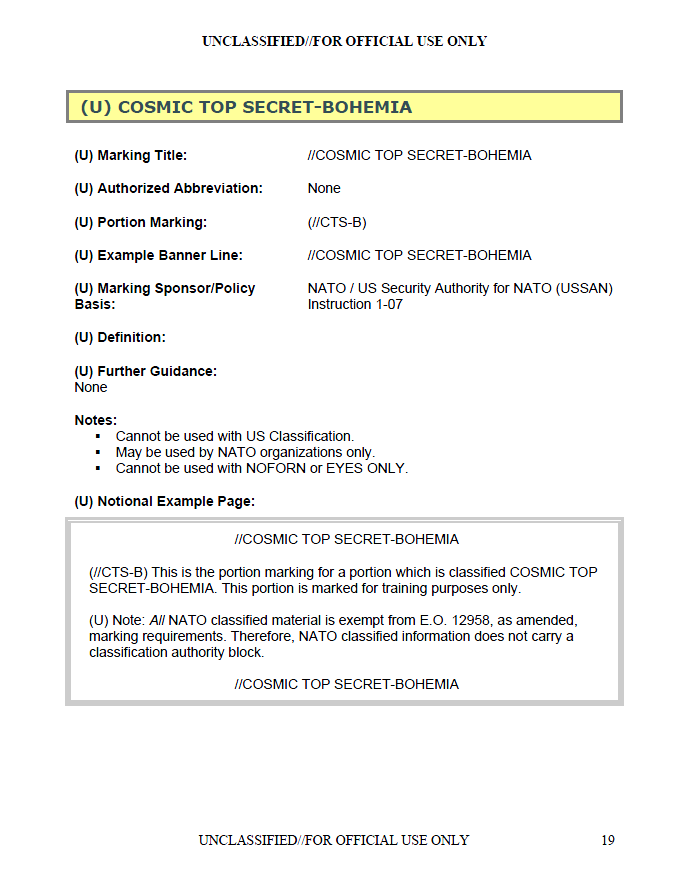
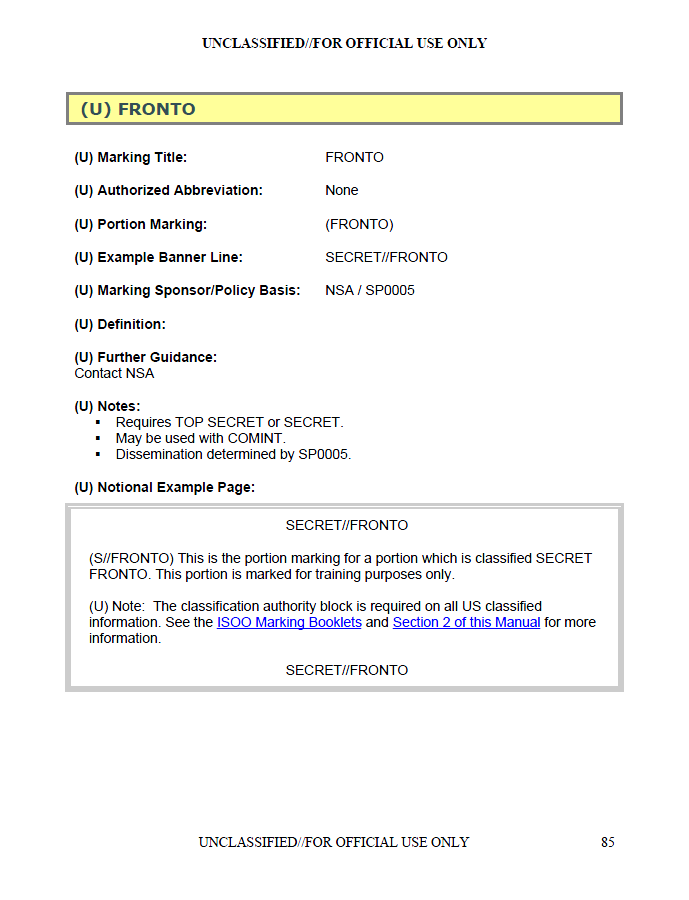
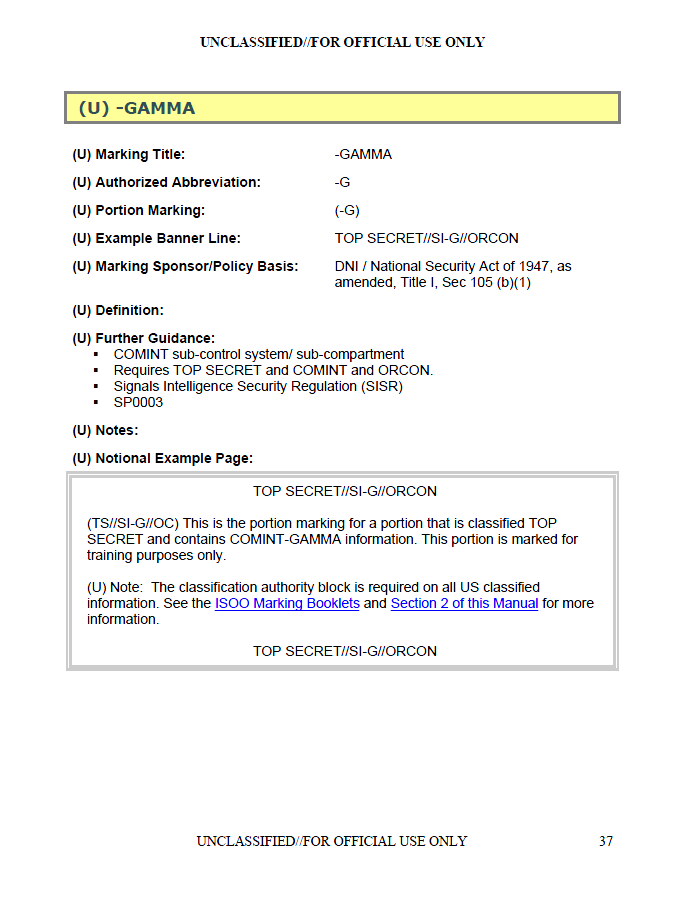
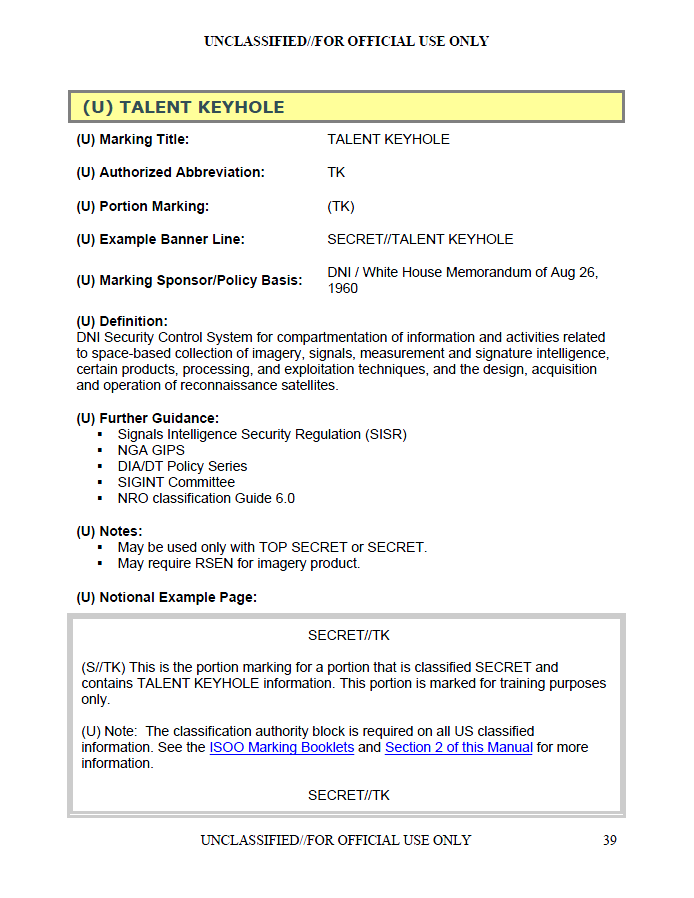
Unveiled – FEMEN Paris – Revisited
CONFIDENTIAL from the FBI – Silver Spring Man Sentenced to 20 Years in Prison for Distributing Child Pornography
GREENBELT, MD—U.S. District Judge Alexander Williams, Jr. sentenced Gary Callis, age 42, of Silver Spring, Maryland, today to 20 years in prison, followed by supervised release for life, for two counts of distributing child pornography. Judge Williams ordered Callis to pay approximately $24,000 in restitution to one of the victims of his sexual abuse for treatment and counseling expenses. Finally, Judge Williams ordered that upon his release from prison, Callis must register as a sex offender in the place where he resides, where he is an employee, and where he is a student, under the Sex Offender Registration and Notification Act (SORNA).
The sentence was announced by United States Attorney for the District of Maryland Rod J. Rosenstein; Special Agent in Charge Richard A. McFeely of the Federal Bureau of Investigation; Colonel Marcus L. Brown, Superintendent of the Maryland State Police; and Montgomery County State’s Attorney John McCarthy.
According to Callis’ plea agreement, in November and December, 2009, two separate FBI undercover operations in San Diego and Richmond, respectively, used file-sharing programs to download images from a user, later determined to be Callis, which depicted minors engaged in sexually explicit conduct. The Richmond undercover agent also engaged Callis in a chat, during which Callis stated he looked forward to trading images and that he “had some boy relations” with boys aged 6 to 14 and was presently looking for 14- to 20-year-old boys. Callis specifically described to the undercover agent his molestation of a boy from the time the child was 6 years old until he was 12 years old.
On February 26, 2010, law enforcement executed a search warrant at Callis’ residence in Silver Spring, and seized three external hard drives, two laptop computer, a computer tower and a memory card. A subsequent forensic examination of the digital media revealed that Callis possessed over 866,000 images and 8,100 movies portraying the sexual abuse of children. Agents found that the collection was highly organized, divided into folder titles with a number or letter, then further subdivided by a child’s name or a description of the contents. Callis’ computers also revealed that his primary means of trading child pornography was through the file-sharing program where the FBI undercover officers discovered Callis.
Callis was present during the search of his residence and admitted to investigators that in 2000 he had sexually molested a teenaged neighbor who was visiting his house, and in 2003 had begun molesting the son of his girlfriend, who was 7 years old at the time.
As part of the plea agreement, Callis has also agreed to plead guilty in a related case in Montgomery County Circuit Court, and agreed that the Circuit Court shall impose a sentence of 17 years in prison in that case, to run concurrent with Callis’ federal sentence. Callis remains detained.
This case was brought as part of Project Safe Childhood, a nationwide initiative to combat the growing epidemic of child sexual exploitation and abuse launched in May 2006 by the Department of Justice. Led by United States Attorneys’ Offices and the Criminal Division’s Child Exploitation and Obscenity Section (CEOS), Project Safe Childhood marshals federal, state and local resources to better locate, apprehend and prosecute individuals who exploit children via the Internet, as well as to identify and rescue victims. For more information about Project Safe Childhood, please visit www.projectsafechildhood.gov. Details about Maryland’s program are available at http://www.justice.gov/usao/md/Safe-Childhood/index.html.
United States Attorney Rod J. Rosenstein commended the FBI, Maryland State Police, and Montgomery County State’s Attorney’s Office for their work in this investigation and prosecution. Mr. Rosenstein thanked Special Assistant U.S. Attorney LisaMarie Freitas and Assistant U.S. Attorney Stacy Dawson Belf, who prosecuted the case.
TOP-SECRET from the NSA -CHILEAN JUDGE REQUESTS EXTRADITION OF U.S. MILITARY OFFICIAL IN “MISSING” CASE
|
CHILEAN JUDGE REQUESTS EXTRADITION OF U.S. MILITARY OFFICIAL IN “MISSING” CASECapt. Ray Davis Indicted in Chile for alleged role in murder of Charles Horman, Frank TeruggiDeclassified U.S. Documents Used Extensively in Court IndictmentArchive Posts Documents cited in Indictment, including FBI Intelligence Reports Containing Teruggi’s Address in Chile |


Washington D.C., November 30, 2011 –Thirty-eight years after the military coup in Chile, a Chilean judge has formally indicted the former head of the U.S. Military Group, Captain Ray Davis, and a Chilean intelligence officer, Pedro Espinoza for the murders of two American citizens in September 1973. The judge, Jorge Zepeda, said he would ask the Chilean Supreme Court to authorize an extradition request for Davis as an “accessory” to the murders of Charles Horman and Frank Teruggi.
Both Horman and Teruggi were seized separately at their homes in Santiago by Chilean soldiers and subsequently executed while in detention. Their murders, and the seeming indifference of U.S. officials, were immortalized in the Oscar-award winning movie “Missing” which focused on the search by Horman’s wife and father for him in the weeks following the U.S.-supported coup.
The indictment accused the U.S. MilGroup of passing intelligence to the Chilean military on the “subversive” activities of Teruggi that contributed to his arrest; it stated that Davis “was in a position” to stop the executions “given his coordination with Chilean agents” but did not do so.
In his indictment, Judge Zepeda cited a number of declassified U.S. government documents as the basic foundation for the case-although none of them tie Davis or Espinoza to the crimes. “These documents are providing the blocks for building a case in these famous killings,” said Peter Kornbluh who directs the Chile Documentation Project at the Archive, “but they do not provide a smoking gun.” To successfully advance court proceedings as well as a successful extradition request, according to Kornbluh, the judge will have to present concrete evidence of communications between U.S. and Chilean military officers regarding Horman and Teruggi prior to their detentions and their deaths.
The Archive today posted a number of the documents cited in the indictment, including key FBI memos that contained Frank Teruggi’s Santiago address, as well as other records relevant to the Horman and Teruggi case. The documents derive from an indexed collection: Chile and the United States: U.S. Policy toward Democracy, Dictatorship, and Human Rights, 1970-1990. The collection, just published this week by the Archive and Proquest, contains over 180 documents on the Horman and Teruggi case.
Read the Documents:
Document 1
Department of State, SECRET Memorandum, “Charles Horman Case,” August 25, 1976
This memo by three state department officers implies that the U.S. government could have prevented the murder of Charles Horman. The memo, written after a review of the files on the case, explains that there is “circumstantial evidence” to suggest “U.S. intelligence may have played an unfortunate part in Horman’s death. At best, it was limited to providing or confirming information that helped motivate his murder by the GOC. At worst, U.S. intelligence was aware the GOC saw Horman in a rather serious light and U.S. officials did nothing to discourage the logical outcome of GOC paranoia.” When this document was initially declassified pursuant to a FOIA lawsuit filed by the Horman family, this critical passage was blacked out. The document was released without redaction in 1999. It was not cited in Judge Zepeda’s indictment, but appears to reflect the judicial argument he is pursuing.
Document 2
Department of State, SECRET, “Charles Horman Case: Gleanings,”(Undated but written in August 1976)
This detailed chronology, based on a review of files available to the State Department, contains key information on what the U.S. knew and did in the case of Charles Horman. It also evaluates the possible role of the U.S. in the murder. The document cites the admissions of a Chilean intelligence agent, Rafael Gonzalez, who told U.S. reporters the story of Horman being interrogated in General Augusto Lutz’s office and then killed because “he knew too much.” Gonzalez claimed there was an American in the room when the interrogation took place, but decades later he would recant that story. In January 2004, he was indicted by Judge Zepeda in the Horman case as an “accessory to murder” for his role in the interrogation, death and secret burial of Charles Horman.
Document 3
United States Embassy, Unclassified Notice, “Missing United States Citizen,” October 9, 1973
This document cited in the indictment, states that the U.S. government has received a note from the Chilean Foreign Office dated October 3, 1973, recording that Charles Horman was detained at the National Stadium on September 20 for a curfew violation but had been released on September 21 for “lack of merit.” The document includes a photograph of Horman, his date of birth, address in Chile, and fingerprint classification. Horman was actually detained at his home on September 17, 1973.
Document 4
Department of State, Memorandum (classification excised), “Film by Charles Horman,” April 12, 1974
In this memo to Assistant Secretary Harry Shlaudeman, State Department officer George Lister describes the film work of Charles Horman. A film that he apparently worked on before the coup was completed after the coup by friends titled “Chile: With Poems and Guns.” (The document leaves the impression that Charles “made” the film, but clearly he did not work on it following the coup.) The film describes Chilean history, and the achievements of the Allende government, along with alleged atrocities of the coup and U.S. involvement. Lister goes so far as to imply that Horman’s film making in Chile could have been what “led to his death.”
Document 5
Chilean Armed Forces, Memorandum, “Antecedentes sobre Fallecimiento de 2 ciudadanos norteamericanos,” Octobeer 30, 1973
Chief of Chilean Military Intelligence Service General Augusto Lutz reports on the death of Charles Horman and Frank Teruggi. He asserts that Horman and Teruggi were political extremists attempting to discredit Chilean junta. While he acknowledges that they were both detained by the Chilean military, he maintains that they were later released and that the Chilean military was not involved in their deaths. The document is the only information known to have been provided by the Chilean military to the U.S. embassy after the disappearance of Horman and Teruggi.
Document 6
U.S. Military Group Chile, Memorandum (classification unknown), “Case of Charles Horman,” January 14, 1975
Ray Davis forwards a list of documents on the interactions of the U.S. Military Group in Chile with Charles Horman to be provided to the General Accounting Office. The documents raise the issue of the role of embassy officials in the disappearance and death of Horman, and make “certain allegations and statements about members of the Navy Mission, in Valparaiso; comments about a ride given by COMUSMILGP, Captain Davis.”
Document 7
Department of State, CONFIDENTIAL Memorandum, “Horman Case,” April 20, 1987
This memorandum of conversation reports on an informant who has appeared at the Embassy to give testimony on the death of Charles Horman. According to this informant, Horman was seized by Chilean intelligence units and taken to the Escuela Militar for questioning. He was then transferred to the National Stadium, where they determined he was an extremist. He was forced to change clothes, shot three times, and his body was dumped on the street to appear he had died in a confrontation. The informant said that “the person at the stadium who made the decision on who was to die was Pedro Espinoza, of later DINA fame.” The document is the first to tie Pedro Espinoza to the Horman case. He was involved in military intelligence and detainees at the time of the coup. However, the commander of the National Stadium at the time was another military officer named Jorge Espinosa Ulloa.
Document 8
United States Embassy Santiago, CONFIDENTIAL cable, ‘[Excised] Reports on GOC Involvement in Death of Charles Horman, Asks Embassy for Asylum and Aid,’ April 28, 1987
In a report on the informant’s information, the Embassy cables Washington with his account of Horman’s death. Horman was picked up in a routine sweep, the informant suggests, and was found in possession of “extremist” materials. He was then taken the National Stadium where he was interrogated and later executed on the orders of Pedro Espinoza. Embassy officials note that his story “corresponds with what we know about the case and the [Chilean government] attempt to cover up their involvement,” suggesting that the informant is probably telling the truth. In later cables, the Embassy begins to question the credibility of the informant who is never identified.
Document 9
FBI, SECRET Memorandum, [Frank Teruggi’s Contact with Anti-War Activist], October 25, 1972
This FBI report cites information provided by “another U.S. government agency” on Frank Teruggi’s contacts with an anti-war activist who resides in West Germany. The report also contains his address in Santiago. The document was generated by surveillance of a U.S. military intelligence unit in Munich on an American anti-war dissident who was in contact with Teruggi. The FBI subsequently decides to open a file on Teruggi. This series of FBI documents were cited by Judge Zepeda in his indictment which infers-but offers no proof– that intelligence from them was shared with Chilean military intelligence in the days following the coup.
Document 10
FBI, SECRET Memorandum, “Frank Teruggi,” October 25, 1972
This FBI memorandum requests investigation of Frank Teruggi and the Chicago Area Group for the Liberation of Americas of which he was a member nearly a year prior to his death following the Chilean coup.
Document 11
FBI, SECRET Memorandum, “[Excised] SM- Subversive,” November 28, 1972
This FBI document again requests investigation on Teruggi based on his contact with a political activist in West Germany. The document mentions that Teruggi is living in Chile editing a newsletter “FIN” of Chilean information for the American left, and that he is closely affiliated with the Chicago Area Group for the Liberation of Americas.
Document 12
FBI, Memorandum (classification unknown), “Frank Teruggi,” December 14, 1972
This FBI memorandum demonstrates ongoing efforts to gather information on Frank Teruggi in the year proceeding the Chilean coup. Here, the FBI reports on his attendance at a conference of returned Peace Corps volunteers and his membership in political organizations supporting socialism and national liberation movements in Latin America.
TOP-SECRET – (U//FOUO) Director of National Intelligence Classification Markings Register Version 1.2



Unveiled – FEMEN Paris
FEMEN Roma against Berlusconi
Femen EuroTour
directed by Alain Margot
Video – FEMEN in the Ghost House La Chaux-de-Fonds 2011
Femen in the Ghost House
La Chaux-de-Fonds 2011
directed by Alain Margot
TOP-SECRET-NSA-IRAN CONTRA AT 25: REAGAN AND BUSH ‘CRIMINAL LIABILITY’ EVALUATIONS

President Reagan motioning to Ed Meese at the White House Press Briefing announcing the Iran-Contra connection. 11/25/86.
Washington D.C., November 25, 2011 –President Ronald Reagan was briefed in advance about every weapons shipment in the Iran arms-for-hostages deals in 1985-86, and Vice President George H. W. Bush chaired a committee that recommended the mining of the harbors of Nicaragua in 1983, according to previously secret Independent Counsel assessments of “criminal liability” on the part of the two former leaders posted today by the National Security Archive.
Twenty-Five years after the advent of the “Iran-Contra affair,” the two comprehensive “Memoranda on Criminal Liability of Former President Reagan and of President Bush” provide a roadmap of historical, though not legal, culpability of the nation’s two top elected officials during the scandal from the perspective of a senior attorney in the Office of Independent Counsel Lawrence Walsh. The documents were obtained pursuant to a Freedom of Information Act (FOIA) request filed by the National Security Archive for the files compiled during Walsh’s six-year investigation from 1987-1993.
The posting comes on the anniversary of the November 25, 1986, press conference during which Ronald Reagan and his attorney general, Edwin Meese, informed the American public that they had discovered a “diversion” of funds from the sale of arms to Iran to fund the contra war, thus tying together the two strands of the scandal which until that point had been separate in the public eye. The focus on the diversion, as Oliver North, the NSC staffer who supervised the two operations wrote in his memoirs, was itself a diversion. “This particular detail was so dramatic, so sexy, that it might actually-well divert public attention from other, even more important aspects of the story,” North wrote, “such as what the President and his top advisors had known about and approved.”
 |
| Ronald Reagan with Caspar Weinberger, George Shultz, Ed Meese, and Don Regan discussing the President’s remarks on the Iran-Contra affair, Oval Office. 11/25/86.
Source credit: Courtesy Ronald Reagan Library |
The criminal liability studies were drafted in March 1991 by a lawyer on Walsh’s staff, Christian J. Mixter (now a partner in the Washington law firm of Morgan Lewis), and represented preliminary conclusions on whether to prosecute both Reagan and Bush for various crimes ranging from conspiracy to perjury.
On Reagan, Mixter reported that the President was “briefed in advance” on each of the illicit sales of missiles to Iran. The criminality of the arms sales to Iran “involves a number of close legal calls,” Mixter wrote. He found that it would be difficult to prosecute Reagan for violating the Arms Export Control Act (AECA) which mandates advising Congress about arms transfers through a third country-the U.S. missiles were transferred to Iran from Israel during the first phase of the operation in 1985-because Attorney General Meese had told the president the 1947 National Security Act could be invoked to supersede the AECA.
As the Iran operations went forward, some of Reagan’s own top officials certainly believed that the violation of the AECA as well as the failure to notify Congress of these covert operations were illegal-and prosecutable. In a dramatic meeting on December 7, 1985, Secretary of Defense Caspar Weinberger told the President that “washing [the] transaction thru Israel wouldn’t make it legal.” When Reagan responded that “he could answer charges of illegality but he couldn’t answer charge that ‘big strong President Reagan passed up a chance to free hostages,” Weinberger suggested they might all end up in jail. “Visiting hours are on Thursdays,” Weinberger stated. As the scandal unfolded a year later, Reagan and his top aides gathered in the White House Situation Room the day before the November 25 press conference to work out a way to protect the president from impeachment proceedings.
On the Contra operations, Mixter determined that Reagan had, in effect, authorized the illegal effort to keep the contra war going after Congress terminated funding by ordering his staff to sustain the contras “body and soul.” But he was not briefed on the resupply efforts in enough detail to make him criminally part of the conspiracy to violate the Boland Amendment that had cut off aid to the Contras in October 1984.
Mixter also found that Reagan’s public misrepresentations of his role in Iran-Contra operations could not be prosecuted because deceiving the press and the American public was not a crime.
On the role of George Herbert Walker Bush, Mixter reported that the Vice President’s “knowledge of the Iran Initiative appears generally to have been coterminous with that of President Reagan.” Indeed, on the Iran-Contra operations overall, “it is quite clear that Mr. Bush attended most (although not quite all) of the key briefings and meetings in which Mr. Reagan participated, and therefore can be presumed to have known many of the Iran/Contra facts that the former President knew.” But since Bush was subordinate to Reagan, his role as a “secondary officer” made it more difficult to hold him criminally liable.
Mixter’s detailed report on Bush’s involvement does, however, shed considerable light on his role in both the Iran and Contra sides of the scandal. The memorandum on criminal liability noted that Bush had a long involvement in the Contra war, chairing the secret “Special Situation Group” in 1983 which “recommended specific covert operations” including “the mining of Nicaragua’s rivers and harbors.” Mixter also cited no less than a dozen meetings that Bush attended between 1984 and 1986 in which illicit aid to the Contras was discussed.
Despite the Mixter evaluations, Independent Counsel Lawrence Walsh continued to consider filing criminal indictments against both Reagan and Bush. In a final effort to determine Reagan’s criminal liability and give him “one last chance to tell the truth,” Walsh traveled to Los Angeles to depose Reagan in July 1992. “He was cordial and offered everybody licorice jelly beans but he remembered almost nothing,” Walsh wrote in his memoir, Firewall, The Iran-Contra Conspiracy and Cover-Up. The former president was “disabled,” and already showing clear signs of Althzeimers disease. “By the time the meeting had ended,” Walsh remembered, “it was as obvious to the former president’s counsel as it was to us that we were not going to prosecute Reagan.”
The Special Prosecutor also seriously considered indicting Bush for covering up his relevant diaries, which Walsh had requested in 1987. Only in December 1992, after he had lost the election to Bill Clinton, did Bush turn over the transcribed diaries. During the independent counsel’s investigation of why the diaries had not been turned over sooner, Lee Liberman, an Associate Counsel in the White House Counsel’s office, was deposed. In the deposition, Liberman stated that one of the reasons the diaries were withheld until after the election was that “it would have been impossible to deal with in the election campaign because of all the political ramifications, especially since the President’s polling numbers were low.”
In 1993, Walsh advised now former President Bush that the Independent Counsel’s office wanted to take his deposition on Iran-Contra. But Bush essentially refused. In one of his last acts as Independent Counsel, Walsh considered taking the cover-up case against Bush to a Grand Jury to obtain a subpoena. On the advice of his staff, however, he decided not to pursue an indictment of Bush.
Among the first entries Bush had recorded in his diary (begun in late 1986) was his reaction to reports from a Lebanese newspaper that a U.S. team had secretly gone to Iran to trade arms for hostages. “On the news at this time is the question of the hostages,” he noted on November 5, 1986. “I’m one of the few people that know fully the details. This is one operation that has been held very, very tight, and I hope it will not leak.”
Read the Documents:
Document 1, Part 1, Part 2, Part 3, Part 4
Office of the Independent Counsel, C.J. Mixter to Judge Walsh, “Criminal Liability of Former President Reagan,” March 21, 1991, 198 pages.
In this lengthy evaluation, Christian Mixter, a lawyer on the staff of the Independent Counsel, provides Lawrence Walsh with a comprehensive evaluation of the legal liability of President Ronald Reagan in the Iran-Contra operations. The memorandum reviews, in great detail, not only the evolution of the operations, but Reagan’s central role in them. It includes “a summary of facts” on both the sale of arms to Iran, in order to free American hostages held in Lebanon, and the evolution of the illicit contra resupply operations in Central America, as well as the connection between these two seemingly separate covert efforts. The report traces Reagan’s knowledge and authorization of the arms sales, as well as his tacit authorization of the illegal contra resupply activities; it also details his role in obtaining third country funding for the Contras after Congress terminated U.S. support in 1984. The document further evaluates Reagan’s responses in two official inquiries to determine whether they rise to the level of perjury. For a variety of reasons, Mixter’s opinion is that “there is no basis for a criminal prosecution” of Reagan in each of the areas under scrutiny, although he notes that it is a “close legal call” on the issue of arms sales to Iran.
Document 2
Office of the Independent Counsel, C.J. Mixter to Judge Walsh, “Criminal Liability of President Bush,” March 21, 1991, 89 pages.
In this assessment, Mixter traces then-Vice President Bush’s involvement in both sides of the Iran-Contra operations, including his meeting with a high Israeli official on the sales of arms to Iran in July 1986, and his presence at no fewer than a dozen meetings during which illicit assistance to the Contras was discussed. The legal evaluation also contains a detailed overview of Bush’s role in arranging a quid pro quo deal with two Presidents of Honduras in order to garner Honduran support for allowing the Contras to use that country as a base of operations against the Sandinistas in Nicaragua. “It is quite clear that Mr. Bush attended most (although not quite all) of the key briefings and meetings in which Mr. Reagan participated, and therefore can be presumed to have known many of the Iran/Contra facts that the former President knew.” But since Bush was subordinate to Reagan, his role as a “secondary officer” rendered him less likely to be criminally liable for the actions he took.
The Mixter memo on Bush was written before the existence and cover-up of the Vice President’s diaries became known in late 1992. The Independent Counsel’s office did launch an investigation into why the diaries were not previously turned over and considered bringing charges against the former Vice President for illegally withholding them.
More – The Top 5 Declassified Iran-Contra Historical Documents:
Document 1
NSC, National Security Planning Group Minutes, “Subject: Central America,” SECRET, June 25, 1984
At a pivotal meeting of the highest officials in the Reagan Administration, the President and Vice President and their top aides discuss how to sustain the Contra war in the face of mounting Congressional opposition. The discussion focuses on asking third countries to fund and maintain the effort, circumventing Congressional power to curtail the CIA’s paramilitary operations. In a remarkable passage, Secretary of State George P. Shultz warns the president that White House adviser James Baker has said that “if we go out and try to get money from third countries, it is an impeachable offense.” But Vice President George Bush argues the contrary: “How can anyone object to the US encouraging third parties to provide help to the anti-Sandinistas…? The only problem that might come up is if the United States were to promise to give these third parties something in return so that some people could interpret this as some kind of exchange.” Later, Bush participated in arranging a quid pro quo deal with Honduras in which the U.S. did provide substantial overt and covert aid to the Honduran military in return for Honduran support of the Contra war effort.
Document 2
White House, Draft National Security Decision Directive (NSDD), “U.S. Policy Toward Iran,” TOP SECRET, (with cover memo from Robert C. McFarlane to George P. Shultz and Caspar W. Weinberger), June 17, 1985
The secret deals with Iran were mainly aimed at freeing American hostages who were being held in Lebanon by forces linked to the Tehran regime. But there was another, subsidiary motivation on the part of some officials, which was to press for renewed ties with the Islamic Republic. One of the proponents of this controversial idea was National Security Advisor Robert McFarlane, who eventually took the lead on the U.S. side in the arms-for-hostages deals until his resignation in December 1985. This draft of a National Security Decision Directive, prepared at his behest by NSC and CIA staff, puts forward the argument for developing ties with Iran based on the traditional Cold War concern that isolating the Khomeini regime could open the way for Moscow to assert its influence in a strategically vital part of the world. To counter that possibility, the document proposes allowing limited amounts of arms to be supplied to the Iranians. The idea did not get far, as the next document testifies.
Document 3
Defense Department, Handwritten Notes, Caspar W. Weinberger Reaction to Draft NSDD on Iran (with attached note and transcription by Colin Powell), June 18, 1985
While CIA Director William J. Casey, for one, supported McFarlane’s idea of reaching out to Iran through limited supplies of arms, among other approaches, President Reagan’s two senior foreign policy advisers strongly opposed the notion. In this scrawled note to his military assistant, Colin Powell, Weinberger belittles the proposal as “almost too absurd to comment on … It’s like asking Qadhafi to Washington for a cozy chat.” Richard Armitage, who is mentioned in Powell’s note to his boss, was an assistant secretary of defense at the time and later became deputy secretary of state under Powell.
Document 4
Diary, Caspar W. Weinberger, December 7, 1985
The disastrous November HAWK shipment prompted U.S. officials to take direct control of the arms deals with Iran. Until then, Israel had been responsible for making the deliveries, for which the U.S. agreed to replenish their stocks of American weapons. Before making this important decision, President Reagan convened an extraordinary meeting of several top advisers in the White House family quarters on December 7, 1985, to discuss the issue. Among those attending were Secretary of State Shultz and Secretary of Defense Weinberger. Both men objected vehemently to the idea of shipping arms to Iran, which the U.S. had declared a sponsor of international terrorism. But in this remarkable set of notes, Weinberger captures the president’s determination to move ahead regardless of the obstacles, legal or otherwise: “President sd. he could answer charges of illegality but he couldn’t answer charge that ‘big strong President Reagan passed up chance to free hostages.'”
Document 5
NSC, Oliver L. North Memorandum, “Release of American Hostages in Beirut,” (so-called “Diversion Memo”), TOP SECRET/SENSITIVE, April 4, 1986
At the center of the public’s perception of the scandal was the revelation that the two previously unconnected covert activities — trading arms for hostages with Iran and backing the Nicaraguan Contras against congressional prohibitions — had become joined. This memo from Oliver North is the main piece of evidence to survive which spells out the plan to use “residuals” from the arms deals to fund the rebels. Justice Department investigators discovered it in North’s NSC files in late November 1986. For unknown reasons it escaped North’s notorious document “shredding party” which took place after the scandal became public.
Source credit: Courtesy Ronald Reagan Library
TOP-SECRET- Robert Kennedy Murder – Sirhan Sirhan Hypno-Programmed Assassin Innocence Plea Documents
The following court documents were filed on November 20, 2011 by the attorney of Sirhan Sirhan, the alleged assassin of Robert F. Kennedy. The documents claim that Sirhan was a hypno-programmed assassin and that another person fired the gun that killed Kennedy.


DOWNLOAD ORIGINAL DOCUMENT BELOW
FEMEN ROMA BY NIGHT – Exclusive Photos


TOP-SECRET – U.K. Embassies Preparing for Collapse of Euro
As the Italian government struggled to borrow and Spain considered seeking an international bail-out, British ministers privately warned that the break-up of the euro, once almost unthinkable, is now increasingly plausible.
Diplomats are preparing to help Britons abroad through a banking collapse and even riots arising from the debt crisis.
The Treasury confirmed earlier this month that contingency planning for a collapse is now under way.
A senior minister has now revealed the extent of the Government’s concern, saying that Britain is now planning on the basis that a euro collapse is now just a matter of time.
“It’s in our interests that they keep playing for time because that gives us more time to prepare,” the minister told.
Recent Foreign and Commonwealth Office instructions to embassies and consulates request contingency planning for extreme scenarios including rioting and social unrest.
Greece has seen several outbreaks of civil disorder as its government struggles with its huge debts. British officials think similar scenes cannot be ruled out in other nations if the euro collapses.
Diplomats have also been told to prepare to help tens of thousands of British citizens in eurozone countries with the consequences of a financial collapse that would leave them unable to access bank accounts or even withdraw cash.
Fuelling the fears of financial markets for the euro, reports in Madrid yesterday suggested that the new Popular Party government could seek a bail-out from either the European Union rescue fund or the International Monetary Fund.
CONFIDENTIAL – California Commission on Peace Officer Standards and Training Use of Force Workbook


The following document is the standard handbook used to train California police officers in the use of force.
DOWNLOAD ORIGINAL DOCUMENT HERE
TOP-SECRET from the FBI – Public Corruption, Illegal Prescription Drug Trafficking, and Health Care Fraud
Gwendolyn Washington, M.D., age 67, was sentenced today to 120 months’ imprisonment for public corruption, health care fraud, and conspiring to illegally distribute prescription drugs, United States Attorney Barbara L. McQuade announced. McQuade was joined in the announcement by Andrew G. Arena, Special Agent in Charge, Federal Bureau of Investigation, Detroit Field Division, and Lamont Pugh, III, Special Agent in Charge, Department of Health and Human Services, Office of Inspector General. Dr. Washington was sentenced by the Honorable Paul D. Borman.
On March, 7, 2011, Dr. Washington pleaded guilty to conspiring to defraud and defrauding the Detroit Public School (“DPS”) system of over $3.3 million. Dr. Washington, along with her sister Sherry Washington, and others doing business as “Associates for Learning” paid kickbacks to Stephen Hill, former DPS Executive Director of Risk Management, who authorized their submission to DPS and payment by DPS of grossly inflated invoices for services allegedly rendered to DPS in the form of a wellness program.
On July 28, 2011, Dr. Washington pleaded guilty to four felony counts involving drug trafficking and health care fraud. At her plea, Washington admitted that between 2004 and 2010, she performed unnecessary ultrasounds, nuclear cardiac stress tests, balance tests, sleep tests, and nerve conduction tests on patients, who were urged to return to Washington’s office every few months for repeat tests, even though initial results were normal. Washington billed Medicare and Blue Cross and Blue Shield more than $5 million for these tests, some of which were potentially harmful to patients. Most significantly, Dr. Washington ordered unnecessary and actively harmful nuclear stress tests for her patients at a frequency beyond that of any other medical practice in the country. Because each of these tests is the radiation equivalent of at least 80 to120 chest x-rays and because excess radiation creates a greater risk of cancer, Dr. Washington exposed her patients to a substantial risk of cancer.
Dr. Washington also admitted that she solicited and received kickbacks from home health care agencies and diagnostic testing facilities in return for referring patients to them for medical services. Washington referred patients to home health agencies, falsely certifying them as being confined to the home, in return for payments from home health care agencies of $200 to $500 per patient. In return for ordering nuclear stress tests, Dr. Washington received $200 per test. In total, Washington received $350,000 in total kickback payments. Medicare paid approximately $2.8 million to agencies receiving the fraudulent referrals. Washington received another $250,000 directly from Medicare for false certifications of patients for home health services.
Dr. Washington also admitted to committing two counts of controlled substances offenses. In February 2010, when Medicare suspended payments to Washington, resulting in a drastic reduction in her income, she began writing prescriptions for tens of thousands of doses of OxyContin, Opana ER, and Roxicodone, highly addictive pain medications that have a significant “street value” on the illicit market. Washington sometimes wrote prescriptions for individuals who were not her patients, without an examination or determination of medical necessity, and without an appropriate diagnosis or entry in a patient chart. Washington then provided these illegal prescriptions to Virginia Dillard, her niece and codefendant. Dillard filled the prescriptions at various pharmacies in Highland Park, Warren, and Detroit. After filling the illegal prescriptions, Virginia Dillard delivered the controlled substances to prescription drug dealers in exchange for money. Dillard sold each filled prescription in amounts ranging from $1,000 to $2,200, and shared the proceeds with Washington. Dillard was sentenced, on October 20, 2011, to 112 months’ imprisonment.
United States Attorney Barbara L. McQuade stated, “Dr. Washington not only stole money from school children and from Medicare, she also exposed patients to harmful tests for her own financial gain. We hope that this sentence deters other health care providers from stealing public funds and risking the health of their patients.”
Special Agent in Charge Andrew Arena stated, “Health Care Fraud is one of the fastest growing crime problems in the state of Michigan. The FBI will continue to work closely with its law enforcement partners to focus all possible resources on this problem.”
“Special Agent in Charge Lamont Pugh stated, “Today’s sentencing provides another reminder to those who would commit drug and related health care crimes that law enforcement is watching. The Office of Inspector General and our law enforcement partners remain steadfast in our commitment to ensuring that the Medicare program and taxpayer dollars are protected.”
U.S. Attorney McQuade congratulated the hard work of the FBI and HHS for its efforts in pursuing these cases. The public corruption case was prosecuted by Assistant U.S. Attorney Michael Buckley. The health care fraud and illegal prescription drug distribution cases were prosecuted by Assistant United States Attorney Sarah Resnick Cohen.
UNCENSORED – FEMEN USA Photos at the Wall Street
FEMEN-USA


FBI – Web Domains Selling Counterfeit Goods Seized in Cyber Monday Crackdown – HSI agent

Seizure orders have been executed against 150 domain names of commercial websites engaged in the illegal sale and distribution of counterfeit goods and copyrighted works as part of Operation In Our Sites. The seized domains are in the custody of the federal government. Visitors to the sites will now find a seizure banner that notifies them that the domain name has been seized by federal authorities and educates them that willful copyright infringement is a federal crime.
During the operation, federal law enforcement agents made undercover purchases of a host of products, including professional sports jerseys, golf equipment, DVD sets, footwear, handbags and sunglasses, representing a variety of trademarks from online retailers who were suspected of selling counterfeit products. In most cases, the goods were shipped directly into the United States from suppliers in other countries.
The operation was conducted by the Department of Justice, U.S. Immigration and Customs Enforcement’s (ICE) Homeland Security Investigations (HSI), the ICE-led National Intellectual Property Rights Coordination Center (IPR Center), and the FBI Washington Field Office.
TOP-SECRET – Congressional Budget Office: Top 1% Income Rose 275% From 1979-2007

From 1979 to 2007, real (inflation-adjusted) average household income, measured after government transfers and federal taxes, grew by 62 percent. During that period, the evolution of the nation’s economy and the tax and spending policies of the federal government and state and local governments had varying effects on households at different points in the income distribution: Income after transfers and federal taxes (denoted as after-tax income in this study) for households at the higher end of the income scale rose much more rapidly than income for households in the middle and at the lower end of the income scale. In particular:
- For the 1 percent of the population with the highest income, average real after-tax household income grew by 275 percent between 1979 and 2007 (see Summary Figure 1).
- For others in the 20 percent of the population with the highest income (those in the 81st through 99th percentiles), average real after-tax household income grew by 65 percent over that period, much faster than it did for the remaining 80 percent of the population, but not nearly as fast as for the top 1 percent.
- For the 60 percent of the population in the middle of the income scale (the 21st through 80th percentiles), the growth in average real after-tax household income was just under 40 percent.
- For the 20 percent of the population with the lowest income, average real after-tax household income was about 18 percent higher in 2007 than it had been in 1979.
As a result of that uneven income growth, the distribution of after-tax household income in the United States was substantially more unequal in 2007 than in 1979: The share of income accruing to higher-income households increased, whereas the share accruing to other households declined. In fact, between 2005 and 2007, the after-tax income received by the 20 percent of the population with the highest income exceeded the aftertax income of the remaining 80 percent.
To assess trends in the distribution of household income, the Congressional Budget Office (CBO) examined the span from 1979 to 2007 because those endpoints allow comparisons between periods of similar overall economic activity (they were both years before recessions). The growth in average income for different groups over the 1979–2007 period reflects a comparison of average income for those groups at different points in time; it does not reflect the experience of particular households. Individual households may have moved up or down the income scale if their income rose or fell more than the average for their initial group. Thus, the population with income in the lowest 20 percent in 2007 was not necessarily the same as the population in that category in 1979.
…
DOWNLOAD ORIGINAL DOCUMENT HERE
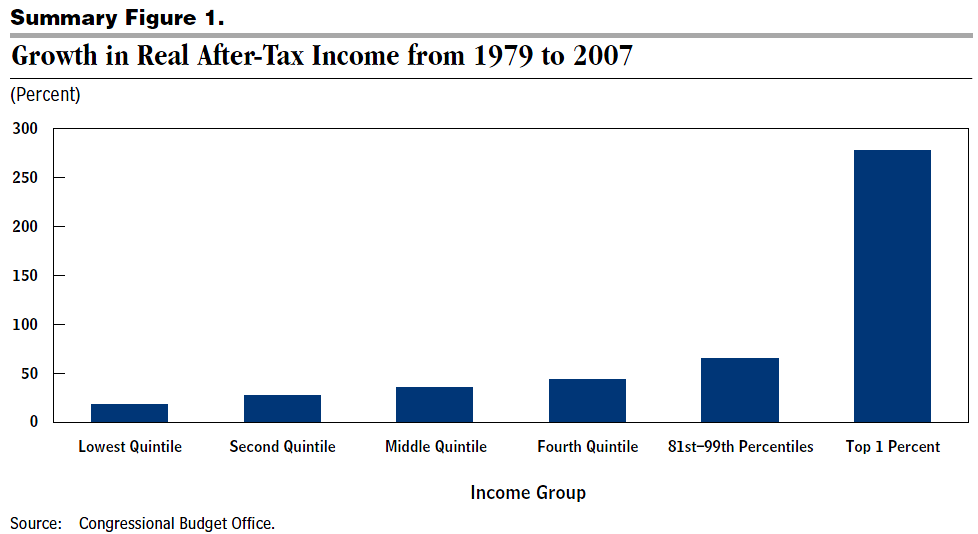
UNCENSORED – Occupy Wall Street NYC Photos
Liberty Park is encircled with tied-together barricades, with only two points of entry to the park, one each along Liberty and Cedar Streets.![[Image]](https://i0.wp.com/cryptome.org/info/ows-20/pict36.jpg) |
| Green-vested “guards” are numerous. These outnumber the few police outside the park. Some of the guards appear to be undercover cops, perhaps all of them. ![[Image]](https://i0.wp.com/cryptome.org/info/ows-20/pict15.jpg) |
The guard-cop at left ordered a visitor to remove coffee and food from a bench.![[Image]](https://i0.wp.com/cryptome.org/info/ows-20/pict27.jpg) |
![[Image]](https://i0.wp.com/cryptome.org/info/ows-20/pict16.jpg) |
![[Image]](https://i0.wp.com/cryptome.org/info/ows-20/pict18.jpg) |
![[Image]](https://i0.wp.com/cryptome.org/info/ows-20/pict19.jpg) |
![[Image]](https://i0.wp.com/cryptome.org/info/ows-20/pict29.jpg) |
![[Image]](https://i0.wp.com/cryptome.org/info/ows-20/pict13.jpg) |
![[Image]](https://i0.wp.com/cryptome.org/info/ows-20/pict14.jpg) |
![[Image]](https://i0.wp.com/cryptome.org/info/ows-20/pict11.jpg) |
![[Image]](https://i0.wp.com/cryptome.org/info/ows-20/pict12.jpg) |
![[Image]](https://i0.wp.com/cryptome.org/info/ows-20/pict17.jpg) |
![[Image]](https://i0.wp.com/cryptome.org/info/ows-20/pict20.jpg) |
![[Image]](https://i0.wp.com/cryptome.org/info/ows-20/pict21.jpg) |
![[Image]](https://i0.wp.com/cryptome.org/info/ows-20/pict22.jpg) |
![[Image]](https://i0.wp.com/cryptome.org/info/ows-20/pict23.jpg) |
| Books coming in to replace those trashed by Bloomberg. No ban on books so in large numbers they may be used as materials to fabricate shelter. ![[Image]](https://i0.wp.com/cryptome.org/info/ows-20/pict25.jpg) |
![[Image]](https://i0.wp.com/cryptome.org/info/ows-20/pict24.jpg) |
![[Image]](https://i0.wp.com/cryptome.org/info/ows-20/pict26.jpg) |
![[Image]](https://i0.wp.com/cryptome.org/info/ows-20/pict28.jpg) |
![[Image]](https://i0.wp.com/cryptome.org/info/ows-20/pict30.jpg) These gents appear leery of being photographed, and rightly so, due to persistent infiltration and photography by cops. Or could be undercover cops. These gents appear leery of being photographed, and rightly so, due to persistent infiltration and photography by cops. Or could be undercover cops.
|
![[Image]](https://i0.wp.com/cryptome.org/info/ows-20/pict35.jpg) |
Giant sculptures are now barricaded.![[Image]](https://i0.wp.com/cryptome.org/info/ows-20/pict31.jpg) |
Barricades along Wall Street at the New York Stock Exchange have been reduced.![[Image]](https://i0.wp.com/cryptome.org/info/ows-20/pict32.jpg) |
Horses have replaced heavily armed cops for tourist appeal, long pretending to protect the stock exchange.![[Image]](https://i0.wp.com/cryptome.org/info/ows-20/pict33.jpg) |
The original Wall Street occupiers at Wall Street and Broadway protesting the folly over 200 years later.![[Image]](https://i0.wp.com/cryptome.org/info/ows-20/pict34.jpg) |
![[Image]](https://i0.wp.com/cryptome.org/info/ows-20/pict10.jpg)
Video – FEMEN attacked Paris Hilton in Kiev
Topless FEMEN activist Alexandra Shevchenko attacked Paris Hilton during her press-conference in Kiev. FEMEN say that they protested against prostitution in the fashion and model industry in Ukraine.
UNCENSORED – Women Protest Worldwide Photos 7
![[Image]](https://i0.wp.com/cryptome.org/info/women-protest7/pict18.jpg) Supporters of Bharatiya Mazdoor Sangh, or Indian Workers Group, raise slogans at a protest rally in New Delhi, India, Wednesday, Nov. 23, 2011. The supporters demanded that the government protect workers rights in the ongoing economic reform process as well as the financial crisis. (Gurinder Osan) Supporters of Bharatiya Mazdoor Sangh, or Indian Workers Group, raise slogans at a protest rally in New Delhi, India, Wednesday, Nov. 23, 2011. The supporters demanded that the government protect workers rights in the ongoing economic reform process as well as the financial crisis. (Gurinder Osan) |
![[Image]](https://i0.wp.com/cryptome.org/info/women-protest7/pict26.jpg) Yemenis protest against President Ali Abdullah Saleh during a rally after the weekly Friday noon prayers in Sanaa on November 25, 2011. Opponents and supporters of Yemen’s embattled president held rival rallies in the capital after pre-dawn fighting between rival security forces dashed hopes an exit deal for the president would end the violence. Getty Yemenis protest against President Ali Abdullah Saleh during a rally after the weekly Friday noon prayers in Sanaa on November 25, 2011. Opponents and supporters of Yemen’s embattled president held rival rallies in the capital after pre-dawn fighting between rival security forces dashed hopes an exit deal for the president would end the violence. Getty |
![[Image]](https://i0.wp.com/cryptome.org/info/women-protest7/pict27.jpg) Women perform prayers at the Taghyeer (Change) Square, where anti-government protesters have been camping for around ten months to call for the ouster and trial of Yemen’s President Ali Abdullah Saleh, in Sanaa November 27, 2011. Reuters Women perform prayers at the Taghyeer (Change) Square, where anti-government protesters have been camping for around ten months to call for the ouster and trial of Yemen’s President Ali Abdullah Saleh, in Sanaa November 27, 2011. Reuters |
![[Image]](https://i0.wp.com/cryptome.org/info/women-protest7/pict28.jpg) Yemeni women and anti-government protesters shout slogans during a demonstration demanding the trial of Yemeni President Ali Abdullah Saleh in Sanaa on November 26, 2011. Getty Yemeni women and anti-government protesters shout slogans during a demonstration demanding the trial of Yemeni President Ali Abdullah Saleh in Sanaa on November 26, 2011. Getty |
![[Image]](https://i0.wp.com/cryptome.org/info/women-protest7/pict3.jpg) Demonstrators gather during protests against a nuclear waste transport in Dannenberg, northern Germany, Saturday Nov. 26, 2011. The shipment of nuclear waste reprocessed in France is on its way to a controversial storage site in Gorleben that protesters say is unsafe. It is the first such shipment from France to Germany since Berlin decided to shut all its nuclear plants by 2022, following the disaster at Japan’s Fukushima plant. The transport is due to arrive at the storage site on Sunday. Demonstrators gather during protests against a nuclear waste transport in Dannenberg, northern Germany, Saturday Nov. 26, 2011. The shipment of nuclear waste reprocessed in France is on its way to a controversial storage site in Gorleben that protesters say is unsafe. It is the first such shipment from France to Germany since Berlin decided to shut all its nuclear plants by 2022, following the disaster at Japan’s Fukushima plant. The transport is due to arrive at the storage site on Sunday. |
![[Image]](https://i0.wp.com/cryptome.org/info/women-protest7/pict31.jpg) A demonstrator dressed as a clown stands between police officers during protests against a shipment of nuclear waste to the storage facility in Gorleben, in Hitzacker, northern Germany Sunday Nov. 27, 2011. (Axel Heimken) A demonstrator dressed as a clown stands between police officers during protests against a shipment of nuclear waste to the storage facility in Gorleben, in Hitzacker, northern Germany Sunday Nov. 27, 2011. (Axel Heimken) |
![[Image]](https://i0.wp.com/cryptome.org/info/women-protest7/pict29.jpg) People demonstrate during a protest against violence in Mexico City, Sunday, Nov. 27, 2011. Demonstrators wore skull masks or painted their faces as skulls to symbolize the victims of violence in Mexico. Over 50,000 people have died since Mexican President Felipe Calderon launched his offensive against organized crime in 2006. (Marco Ugarte) People demonstrate during a protest against violence in Mexico City, Sunday, Nov. 27, 2011. Demonstrators wore skull masks or painted their faces as skulls to symbolize the victims of violence in Mexico. Over 50,000 people have died since Mexican President Felipe Calderon launched his offensive against organized crime in 2006. (Marco Ugarte) |
![[Image]](https://i0.wp.com/cryptome.org/info/women-protest7/pict21.jpg) Libyan Amazigh Berbers protest outside the prime minister’s office in Tripoli on November 27, 2011 as they step up pressure for the minority group to to be represented in the government. Getty Libyan Amazigh Berbers protest outside the prime minister’s office in Tripoli on November 27, 2011 as they step up pressure for the minority group to to be represented in the government. Getty |
![[Image]](https://i0.wp.com/cryptome.org/info/women-protest7/pict1.jpg) Environment activists Hanna Schwarz, right, and Heiko Mueller-Ripke, have chained themselves inside a pyramid with concrete inside, they claim, on the tracks near Hitzacker, Sunday Nov. 27, 2011. Police has difficulties for hours, to unchain the protesters without injuring them. The activists protest against a nuclear waste transport from France to a storage in Gorleben. (Axel Heimken) Environment activists Hanna Schwarz, right, and Heiko Mueller-Ripke, have chained themselves inside a pyramid with concrete inside, they claim, on the tracks near Hitzacker, Sunday Nov. 27, 2011. Police has difficulties for hours, to unchain the protesters without injuring them. The activists protest against a nuclear waste transport from France to a storage in Gorleben. (Axel Heimken) |
![[Image]](https://i0.wp.com/cryptome.org/info/women-protest7/pict23.jpg) Members of the Ethiopian community block the entrance to Israel’s Ministry of Immigrant Absorption during a protest in Jerusalem November 27, 2011. About 400 Israelis of Ethiopian descent took part in the protest on Sunday calling on the government to grant permission for their relatives living in Ethiopia to immigrate. Reuters Members of the Ethiopian community block the entrance to Israel’s Ministry of Immigrant Absorption during a protest in Jerusalem November 27, 2011. About 400 Israelis of Ethiopian descent took part in the protest on Sunday calling on the government to grant permission for their relatives living in Ethiopia to immigrate. Reuters |
![[Image]](https://i0.wp.com/cryptome.org/info/women-protest7/pict32.jpg) Demonstrators drum on barrels with a nuclear sign, during protests against a nuclear waste transport in Dannenberg, northern Germany, Saturday, Nov. 26, 2011. The shipment of nuclear waste reprocessed in France is on its way to a controversial storage site in Gorleben that protesters say is unsafe. It is the first such shipment from France to Germany since Berlin decided to shut all its nuclear plants by 2022, following the disaster at Japan’s Fukushima plant. Demonstrators drum on barrels with a nuclear sign, during protests against a nuclear waste transport in Dannenberg, northern Germany, Saturday, Nov. 26, 2011. The shipment of nuclear waste reprocessed in France is on its way to a controversial storage site in Gorleben that protesters say is unsafe. It is the first such shipment from France to Germany since Berlin decided to shut all its nuclear plants by 2022, following the disaster at Japan’s Fukushima plant. |
![[Image]](https://i0.wp.com/cryptome.org/info/women-protest7/pict22.jpg) Oxfam (a confederation of 15 organizations working together to find lasting solutions to poverty and injustice) activists make a protest aimed at 17th Conference of the Parties (COP17) under the UN Framework Convention on Climate Change (UNFCCC) in Durban on November 27, 2011. Inspired by the Occupy Wall St. movement, protesters calling for ‘climate justice’ are set to gather on November 28 at the opening of UN climate talks in Durban, South Africa, organisers say. Getty Oxfam (a confederation of 15 organizations working together to find lasting solutions to poverty and injustice) activists make a protest aimed at 17th Conference of the Parties (COP17) under the UN Framework Convention on Climate Change (UNFCCC) in Durban on November 27, 2011. Inspired by the Occupy Wall St. movement, protesters calling for ‘climate justice’ are set to gather on November 28 at the opening of UN climate talks in Durban, South Africa, organisers say. Getty |
![[Image]](https://i0.wp.com/cryptome.org/info/women-protest7/pict2.jpg) In tihis picture taken Saturday Nov. 26, 2011 police carries an environment activist away from the tracks near Harlingen, northern Germany. German police say they cleared a sit-in of about 3,500 protesters attempting to block a shipment of nuclear waste with security forces temporarily detaining 1,300 of them. (Philipp Guelland) In tihis picture taken Saturday Nov. 26, 2011 police carries an environment activist away from the tracks near Harlingen, northern Germany. German police say they cleared a sit-in of about 3,500 protesters attempting to block a shipment of nuclear waste with security forces temporarily detaining 1,300 of them. (Philipp Guelland) |
![[Image]](https://i0.wp.com/cryptome.org/info/women-protest7/pict0.jpg) South Korean police say nearly 40 officers were injured during a rally opposing the ratification of the country’s free trade deal with the United States.Hundreds of protesters have been staging near-daily demonstrations since the ruling party railroaded the U.S. trade deal last week. The protesters believe the deal favors Washington over South Korean workers. About 2,200 people rallied in Seoul on Saturday evening, November 26, 2011. South Korean police say nearly 40 officers were injured during a rally opposing the ratification of the country’s free trade deal with the United States.Hundreds of protesters have been staging near-daily demonstrations since the ruling party railroaded the U.S. trade deal last week. The protesters believe the deal favors Washington over South Korean workers. About 2,200 people rallied in Seoul on Saturday evening, November 26, 2011. |
![[Image]](https://i0.wp.com/cryptome.org/info/women-protest7/pict24.jpg) Sarah Elbaroudy, age seven, from Long Island, stands during a collaborative protest between the Occupy Wall Street movement and people supporting the 2011 Egyptian Revolution and the current social unrest throughout Egypt, near the Egyptian Embassy to the United States, at the intersection of East 44th Street and Second Avenue, in New York, November 26, 2011. Reuters Sarah Elbaroudy, age seven, from Long Island, stands during a collaborative protest between the Occupy Wall Street movement and people supporting the 2011 Egyptian Revolution and the current social unrest throughout Egypt, near the Egyptian Embassy to the United States, at the intersection of East 44th Street and Second Avenue, in New York, November 26, 2011. Reuters |
![[Image]](https://i0.wp.com/cryptome.org/info/women-protest7/pict25.jpg) A woman dressed as the Grim Reaper attends a protest against shale gas exploration and production in Sofia on November 26, 2011. Bulgaria gave in July a licence to the United States energy major Chevron for the exploration of an area in the north-eastern part of Bulgaria. Getty A woman dressed as the Grim Reaper attends a protest against shale gas exploration and production in Sofia on November 26, 2011. Bulgaria gave in July a licence to the United States energy major Chevron for the exploration of an area in the north-eastern part of Bulgaria. Getty |
![[Image]](https://i0.wp.com/cryptome.org/info/women-protest7/pict4.jpg) A young Romanian woman wearing make up to suggest she is a victim of domestic violence takes part in a protest in Bucharest, Romania, Friday, Nov. 25, 2011. Dozens of women gathered in protest on the International Day for the Elimination of Violence against Women demanding the introduction of the restraining order in Romanian legislation. Romania is a European Union member state but has no proper legal framework to combat domestic violence against women. A young Romanian woman wearing make up to suggest she is a victim of domestic violence takes part in a protest in Bucharest, Romania, Friday, Nov. 25, 2011. Dozens of women gathered in protest on the International Day for the Elimination of Violence against Women demanding the introduction of the restraining order in Romanian legislation. Romania is a European Union member state but has no proper legal framework to combat domestic violence against women. |
![[Image]](https://i0.wp.com/cryptome.org/info/women-protest7/pict5.jpg) Israelis covered in red color demonstrates as part of the International Anti-fur Coalition protest in Tel Aviv. Friday. Nov. 25, 2011. The demonstration was part of an international protest against fur trade.(Dan Balilty) Israelis covered in red color demonstrates as part of the International Anti-fur Coalition protest in Tel Aviv. Friday. Nov. 25, 2011. The demonstration was part of an international protest against fur trade.(Dan Balilty) |
![[Image]](https://i0.wp.com/cryptome.org/info/women-protest7/pict7.jpg) An Egyptian girl holds an anti-Israel banner during a protest at al Azhar mosque, the highest Islamic Sunni institution, after Friday prayers in Cairo, Egypt, Friday, Nov. 25, 2011. The Muslim brotherhood demonstration was to denounce Israeli control over Jerusalem’s Al Aqsa Mosque, one of the holiest sites in Islam. Arabic and Hebrew reads ” Death for Israel”. (Amr Nabil) An Egyptian girl holds an anti-Israel banner during a protest at al Azhar mosque, the highest Islamic Sunni institution, after Friday prayers in Cairo, Egypt, Friday, Nov. 25, 2011. The Muslim brotherhood demonstration was to denounce Israeli control over Jerusalem’s Al Aqsa Mosque, one of the holiest sites in Islam. Arabic and Hebrew reads ” Death for Israel”. (Amr Nabil) |
![[Image]](https://i0.wp.com/cryptome.org/info/women-protest7/pict6.jpg) An Egyptian woman holds up an infant during a rally in Tahrir Square in Cairo, Egypt, Friday, Nov. 25, 2011. Tens of thousands of protesters chanting, “Leave, leave!” filled Cairo’s Tahrir Square in a massive demonstration to force Egypt’s ruling military council to yield power. The Friday rally is dubbed by organizers as “The Last Chance Million-Man Protest,” and comes one day after the military offered an apology for the killing of nearly 40 protesters in clashes on side streets near Tahrir Square. An Egyptian woman holds up an infant during a rally in Tahrir Square in Cairo, Egypt, Friday, Nov. 25, 2011. Tens of thousands of protesters chanting, “Leave, leave!” filled Cairo’s Tahrir Square in a massive demonstration to force Egypt’s ruling military council to yield power. The Friday rally is dubbed by organizers as “The Last Chance Million-Man Protest,” and comes one day after the military offered an apology for the killing of nearly 40 protesters in clashes on side streets near Tahrir Square. |
![[Image]](https://i0.wp.com/cryptome.org/info/women-protest7/pict8.jpg) Filipino women activists stage a play to symbolize human rights violations during a demonstration to mark the International Day of Action on Violence Against Women near the Malacanang presidential palace in Manila, Philippines, Friday Nov. 25, 2011. The women’s group held the rally to raise public awareness and encourage continuing action to eliminate violence against women. (Aaron Favila) Filipino women activists stage a play to symbolize human rights violations during a demonstration to mark the International Day of Action on Violence Against Women near the Malacanang presidential palace in Manila, Philippines, Friday Nov. 25, 2011. The women’s group held the rally to raise public awareness and encourage continuing action to eliminate violence against women. (Aaron Favila) |
![[Image]](https://i0.wp.com/cryptome.org/info/women-protest7/pict9.jpg) Students march demanding an education reform in Bogota, Colombia, Thursday, Nov. 24, 2011. Protesters are demanding more funding and other changes to the public education system.(Fernando Vergara) Students march demanding an education reform in Bogota, Colombia, Thursday, Nov. 24, 2011. Protesters are demanding more funding and other changes to the public education system.(Fernando Vergara) |
![[Image]](https://i0.wp.com/cryptome.org/info/women-protest7/pict10.jpg) Protesters are hit with water from a police water canon during a march for education reform in Santiago, Chile, Thursday Nov. 24, 2011. Protesters have demanded more funding and other changes to the public education system. The annual budget is due to be approved by Nov. 30. (Luis Hidalgo) Protesters are hit with water from a police water canon during a march for education reform in Santiago, Chile, Thursday Nov. 24, 2011. Protesters have demanded more funding and other changes to the public education system. The annual budget is due to be approved by Nov. 30. (Luis Hidalgo) |
![[Image]](https://i0.wp.com/cryptome.org/info/women-protest7/pict12.jpg) Pro-Syrian regime protesters shout pro-Syrian President Bashar Assad slogans during a protest against the Arab League meeting, in Damascus, Syria, Thursday Nov. 24, 2011. An Arab League committee has given Syria 24 hours to agree to allow an observer mission into the country or it could face sanctions. (Bassem Tellawi) Pro-Syrian regime protesters shout pro-Syrian President Bashar Assad slogans during a protest against the Arab League meeting, in Damascus, Syria, Thursday Nov. 24, 2011. An Arab League committee has given Syria 24 hours to agree to allow an observer mission into the country or it could face sanctions. (Bassem Tellawi) |
![[Image]](https://i0.wp.com/cryptome.org/info/women-protest7/pict13.jpg) A woman cycles past a group of petitioners holding red scarves as they protest outside the Ministry of Civil Affairs in Beijing, China, Thursday, Nov. 24, 2011. About 30 petitioners who they said were infected with HIV from blood transfusions held up a chain of red scarves to symbolize their demands the government to provide compensation for their children’s treatment, in conjunction of the upcoming World AIDS Day, which falls on Dec. 1. (Andy Wong) A woman cycles past a group of petitioners holding red scarves as they protest outside the Ministry of Civil Affairs in Beijing, China, Thursday, Nov. 24, 2011. About 30 petitioners who they said were infected with HIV from blood transfusions held up a chain of red scarves to symbolize their demands the government to provide compensation for their children’s treatment, in conjunction of the upcoming World AIDS Day, which falls on Dec. 1. (Andy Wong) |
![[Image]](https://i0.wp.com/cryptome.org/info/women-protest7/pict15.jpg) A woman protester attempts to dismantle a barbed wire barricade, newly erected by the Egyptian army, near Tahrir square in Cairo, Egypt, Thursday, Nov. 24, 2011. International criticism of Egypt’s military rulers is mounting after five days of clashes between police and protesters demanding the generals relinquish power immediately. (Tara Todras-Whitehill) A woman protester attempts to dismantle a barbed wire barricade, newly erected by the Egyptian army, near Tahrir square in Cairo, Egypt, Thursday, Nov. 24, 2011. International criticism of Egypt’s military rulers is mounting after five days of clashes between police and protesters demanding the generals relinquish power immediately. (Tara Todras-Whitehill) |
![[Image]](https://i0.wp.com/cryptome.org/info/women-protest7/pict17.jpg) A protester takes a break during clashes with Egyptian riot police, not pictured, near Tahrir Square in Cairo, Egypt, Wednesday, Nov. 23, 2011. Egyptian police are clashing with anti-government protesters for a fifth day in Cairo. Tens of thousands of protesters in Tahrir Square have rejected a promise by Egypt’s military ruler to speed up a presidential election to the first half of next year. A protester takes a break during clashes with Egyptian riot police, not pictured, near Tahrir Square in Cairo, Egypt, Wednesday, Nov. 23, 2011. Egyptian police are clashing with anti-government protesters for a fifth day in Cairo. Tens of thousands of protesters in Tahrir Square have rejected a promise by Egypt’s military ruler to speed up a presidential election to the first half of next year. |
![[Image]](https://i0.wp.com/cryptome.org/info/women-protest7/pict16.jpg) A woman blocks the entrance to Congress as riot police stand guard in Guatemala City, Wednesday Nov. 23, 2011. Protesters are demanding that Congress approve the Ley de Vivienda, or Housing Act, which would allow them to attain legal titles to the lands where they built their homes. (Rodrigo Abd) A woman blocks the entrance to Congress as riot police stand guard in Guatemala City, Wednesday Nov. 23, 2011. Protesters are demanding that Congress approve the Ley de Vivienda, or Housing Act, which would allow them to attain legal titles to the lands where they built their homes. (Rodrigo Abd) |
![[Image]](https://i0.wp.com/cryptome.org/info/women-protest7/pict14.jpg) A protester affiliated with the Occupy Toronto movement shouts support to fellow protesters inside a barricaded pavilion in their camp in St. James Park in Toronto on Wednesday Nov. 23, 2011, as police and city officials enforce an eviction notice. (Chris Young) A protester affiliated with the Occupy Toronto movement shouts support to fellow protesters inside a barricaded pavilion in their camp in St. James Park in Toronto on Wednesday Nov. 23, 2011, as police and city officials enforce an eviction notice. (Chris Young) |
![[Image]](https://i0.wp.com/cryptome.org/info/women-protest7/pict19.jpg) Police officers detain opposition demonstrators during an unsanctioned rally in downtown Moscow, Russia, Tuesday, Nov. 22, 2011. Several dozen people were detained in central Moscow where they were protesting against the lack of alternatives in the upcoming parliamentary and presidential elections. (Alexander Zemlianichenko) Police officers detain opposition demonstrators during an unsanctioned rally in downtown Moscow, Russia, Tuesday, Nov. 22, 2011. Several dozen people were detained in central Moscow where they were protesting against the lack of alternatives in the upcoming parliamentary and presidential elections. (Alexander Zemlianichenko) |
![[Image]](https://i0.wp.com/cryptome.org/info/women-protest7/pict20.jpg) Anti-government protesters shout during a rally organized by the 20th February, the Moroccan Arab Spring movement in Casablanca, Morocco, Sunday, Nov 20, 2011, in a mass popular call to bring more democracy into this North African kingdom. Thousands of Moroccans from the pro-democracy movement braved pouring rain and high winds in Casablanca to make a final call to boycott upcoming elections. (Abdeljalil Bounhar) Anti-government protesters shout during a rally organized by the 20th February, the Moroccan Arab Spring movement in Casablanca, Morocco, Sunday, Nov 20, 2011, in a mass popular call to bring more democracy into this North African kingdom. Thousands of Moroccans from the pro-democracy movement braved pouring rain and high winds in Casablanca to make a final call to boycott upcoming elections. (Abdeljalil Bounhar) |
SECRET – State Department Uganda Lord’s Resistance Army Disarmament Report to Congress
The Lord’s Resistance Army Disarmament and Northern Uganda Recovery Act, Public Law 111-172, requires the Secretary of State to submit a report to Congress on implementation of the President’s strategy to support disarmament of the Lord’s Resistance Army (LRA) and assistance provided toward a lasting solution to the conflict in northern Uganda.
The United States has worked over the last year with our bilateral and multilateral partners to advance the President’s strategy. With our encouragement, the African Union (AU) and United Nations (UN) are working to enhance regional coordination toward addressing the LRA threat. We have also continued to support regional efforts to increase diplomatic and military pressure on the LRA. We have deployed U.S. military personnel to the region to serve as advisors to regional militaries pursuing the LRA. Meanwhile, we continue work with partners in the region to increase civilian protection, facilitate LRA defections, and address humanitarian needs, while also supporting the recovery of northern Uganda.
The United States remains committed to pursuing the multi-year, comprehensive strategy submitted to Congress last year. Any reduction in regional cooperation or military pressure could enable the LRA to regroup and rebuild its forces. However, the extent of U.S. efforts to implement the strategy remains a function of available and consistent resources. Given our budget constraints, we continue to encourage other members of the international community to join this effort and help fill funding gaps. We co-chair the International Working Group on the LRA, a mechanism established to enhance coordination among all donors.
Enhancing Regional Efforts to Apprehend LRA Top Commanders
Over the last year, the United States has worked with regional governments to enhance their military operations to apprehend or remove top LRA commanders from the battlefield. We continue to provide critical logistical support and nonlethal equipment to assist the Ugandan military’s counter-LRA operations. With our encouragement, the government of the Democratic Republic of the Congo (DRC) has deployed a U.S. trained and equipped battalion to participate in counter-LRA efforts in the LRA’s area of operations in the DRC. As the Central African Republic (CAR) and South Sudan increase their efforts to counter the LRA, we are engaging with and supporting their militaries. We have provided some equipment to the CAR forces deployed to the LRA-affected area.
Although regional militaries have reduced the LRA’s numbers to an estimated 200 core fighters and an unknown number of accompanying children and abductees, the LRA will remain a serious regional threat as long as Joseph Kony and the LRA’s top leaders remain in place. Over the last year, sustained military pressure has limited the LRA’s opportunities to regroup and rearm. Abductees and low-level fighters have continued to escape and reintegrate into their communities. Nonetheless, the LRA is still terrorizing communities and undermining regional security across a broad swath of central Africa. According to the UN, there have been over 250 attacks attributed to the LRA this year alone.
In line with the President’s strategy, we have reviewed how we can improve our support to the coalition of LRA-affected countries to increase the likelihood of successful operations to apprehend or remove LRA top commanders from the battlefield and bring them to justice. On October 14, the President reported to Congress that he had authorized a small number of U.S. forces to deploy to the LRA-affected region, in consultation with the regional governments, to act as advisors to the regional militaries that are pursuing the LRA. These advisors will enhance the capacity of regional militaries to coordinate and fuse intelligence with effective operational planning. The U.S. forces will not themselves engage directly against LRA forces unless necessary to defend themselves.
This is a short-term deployment with clear goals and objectives. We believe the U.S. advisors can address critical capabilities gaps to help the regional forces succeed. Additionally, our advisors are sensitive to civilian protection considerations and will work closely with our embassies to ensure they remain cognizant of local and regional political dynamics. The State Department has deployed a Civilian Response Corps officer to the region to work with the advisors in this regard. We will regularly review and assess whether the advisory effort is sufficiently enhancing the regional effort to justify continued deployment. Our embassies will also continue to consult with the regional governments and ensure their consent as we move forward. Continued deployment is conditional on regional governments’ sustained commitment and cooperation to bring an eventual end to the LRA threat.
…
Supporting Post-Conflict Recovery and Reconciliation in Northern Uganda Finally, the United States remains committed to supporting efforts to promote comprehensive reconstruction, transitional justice, and reconciliation in northern Uganda, where the LRA carried out its brutal campaign for nearly two decades. In Fiscal Year 2011, USAID provided approximately $102 million in assistance to northern Uganda, including:
• $2 million to assist internally-displaced persons (IDPs) and returnees to secure durable return solutions;
• $2.1 million to enhance accountability and administrative competence of local governance institutions, including the civilian police and judiciary;
• $4.2 million to help former LRA combatants with vocational education and employment opportunities; and
• $15 million to promote rural rehabilitation and food security.Northern Uganda has undergone a visible transformation since the LRA’s departure from Uganda in 2005, especially in terms of infrastructure and social services. The population is able to move freely, stores are open, and fields are being cultivated. According to UNHCR, an estimated 95 percent of people once living in IDP camps have moved from camps to transit sites or returned home.
According to the Ugandan Bureau of Statistics, poverty in northern Uganda declined from 60.7 percent to 46.2 percent between 2005/6 and 2009/10, representing the largest decline in poverty of all regions in Uganda during that period. Yet, even with this impressive decline, the north remains the poorest region in the country. Furthermore, land issues, tensions between tribes and subtribes in the region, and widespread psycho-social trauma, among other issues, need to be addressed to ensure the sustainability of peace in northern Uganda.
From 2009 to 2011, the Government of Uganda (GoU) contributed approximately $ 110 million to its Peace, Recovery and Development Plan for Northern Uganda (PRDP). This is less than the government’s original pledge to provide 30 percent of the PRDP’s total budget, but GoU officials state that they will continue to earmark funds for northern Uganda’s recovery. During this period, non-USG donors have provided significant funding in support of the PRDP.
DOWNLOAD THE ORIGINAL DOCUMENT HERE
FEMEN NEW PHOTOS UNCENSORED

Не заставляя Азарова долго ждать, FEMEN отвечают:


TOP-SECRET – The End of the USSR, 20 Years Later – The Russian Secrets in Documents

Washington D.C., November 22, 2011 – Marking the 20th anniversary of the breakup of the Soviet Union, the Gorbachev Foundation hosted a two-day conference in Moscow on November 10-11, co-organized by the National Security Archive and the Carnegie Moscow Center, examining the historical experience of 1989-1991 and the echoes today. The conference briefing book, compiled and edited by the Archive and posted on the Web today together with the conference program and speaker biographies, includes previously classified Soviet and American documents ranging from Politburo notes to CIA assessments to transcripts of phone calls between George H.W. Bush and Mikhail Gorbachev in the final months of the Soviet Union.
At the Moscow event, panels of distinguished eyewitnesses, veterans and scholars discussed Gorbachev’s political reforms of the 1980s, the crisis in the Soviet economy, the origins and impact of the “new thinking,” the role of society and social movements, and the ways the history is used and abused in current political debates. While Gorbachev himself was unable to participate for health reasons, he subsequently met with the conference organizers to give his reactions and retrospective analysis.
The Carnegie Moscow Center followed up the conference with a November 14 discussion, also co-organized by the Archive, using the same format of expert panels to analyze the impact of nationalism and separatism in the events of 1991, the role of the Soviet military, military reform today in the Russian armed forces, and the situation today in the North Caucasus and other ethnic conflicts in the former Soviet space.
At the Gorbachev Foundation conference, the panel on political reform debated the role of leaders as opposed to structural forces in the decline of the USSR, the competition between Mikhail Gorbachev and Boris Yeltsin especially in 1991, the particular Yeltsin factor including his arrangement with the presidents of Ukraine and Belarus in December 1991 to dissolve the USSR, and in the big picture, the declining legitimacy of the Soviet system over the duration of the Cold War.
The panel on economics discussed various options for modernizing the Soviet economy in the 1980s, whether the system was even reformable, the efforts of the Communist apparat to sabotage even modest reforms, the barriers in Western thinking that prevented any significant foreign aid to the Soviet Union in its last years, and the role of international financial institutions.
The panel on “new thinking” analyzed the dramatic changes in Soviet foreign policy under Gorbachev, the ultimately failed efforts at integrating Russia with Europe, the successes in U.S.-Soviet cooperation for settling regional conflicts, and the Soviet withdrawal from Afghanistan in 1988-89. This discussion also sparked a debate within the audience about the Gorbachev-Reagan ideas of nuclear abolition and their relevance for today.
The society panel described the extensive social demand for glasnost during the 1980s in stark contrast to today, the disintegration of social structures and public space in Russia since 1991, the importance of the dissident discourse of the 1960s and 1970s to the reformist elite and perestroika in the 1980s, and the unpreparedness of society for the various forms of extreme nationalist discourse that erupted at the end of the Soviet Union.
Gorbachev himself sat down with the conference organizers on November 14 after his return from Germany and following the two events at the Gorbachev Foundation and the Carnegie Moscow Center. He discussed the current political situation in Russia, with the “tandem” of Vladimir Putin and Dmitri Medvedev trading jobs with only a façade of elections, and under conditions of growing authoritarianism; but he predicted the “exhaustion” of this program and the eventual introduction of real change, rather than indefinite stagnation.
Gorbachev also commented on the issue of the lack of Western aid for his project of perestroika and glasnost – transforming the Soviet Union into a demilitarized, social democratic state that would work with the U.S. and other countries to resolve regional conflicts and build a “common home” in Europe and cooperative security arrangements globally. Coming back “empty-handed” from the G-7 meeting in the summer of 1991, Gorbachev commented, undermined his reform efforts, helped precipitate the August coup attempt, and undercut any possibility of gradual transition for the USSR. Participating in the discussion with Gorbachev were Pulitzer-Prize winners William Taubman and David Hoffman, Professor Jane Taubman, and National Security Archive representatives Tom Blanton, Malcolm Byrne, and Svetlana Savranskaya.
DOWNLOAD THE ORGINAL RUSSIAN DOCUMENTS HERE
1) 1989.01.24 Excerpt from Politburo Session
2) 1989.02.16 Excerpt from Politburo Session
3) 1989.03.28 Excerpt from Politburo Session
4) 1989.08.26 Excerpt from Poltiburo Session, Situation in the Soviet Baltic Republics
5) 1989.11.18 Excerpt from Politburo Session, Additional Measures in the Sphere of Information
5) 1989.11.18 Excerpt from Politburo Session, Additional Measures in the Sphere of Information
6) 1990.01.02 Excerpt from Politburo Session, On the Events in Europe and the USSR’s Position
7) 1990.01.29 Excerpt from Politburo Session
8) 1990.02.17 Excerpt from Politburo Session, Upcoming Elections in Nicaragua
9) 1990.03.22 Excerpt from Politburo Session
10) 1990.06.02 A.N. Yakovlev’s Note to M.S. Gorbachev on the Changing Situation in the Country
11) 1990.10.13 Excerpt from Politburo Session
12) 1991.04.02 Analytical Note from A.N. Yakovlev to M.S. Gorbachev
13) 1991.04.30 Letter from A.N. Yakovlev to M.S. Gorbachev, On the Danger of a Conservative Comeback
14) 1991.05.15 CC CPSU Secretariat Resolution
15) 1991.06.25 A.N. Yakovlev’s Note to M.S. Gorbachev on the Draft CPSU Program
16) 1991.08.16 A.N. Yakovlev’s Open Letter to Communists
17) 1991.08.21 Emergency Session of the RSFSR Supreme Soviet, First Meeting
18) 1991.10.18 Letter from M.S. Gorbachev to George Bush (Oct 18 1991)
CONFIDENTIAL – Sacramento County Sheriff’s Department Use of Force Policy

LIVE AND UNCENSORED – Egypt Protest Photos 4
|
|
![[Image]](https://i0.wp.com/cryptome.org/info/egypt-protest4/pict27.jpg) Thousands of Egyptians perform Friday prayers during a rally in Tahrir Square in Cairo, Egypt, Friday, Nov. 25, 2011. Tens of thousands of protesters chanting, “Leave, leave!” are rapidly filling up Cairo’s Tahrir Square in what promises to be a massive demonstration to force Egypt’s ruling military council to yield power. The Friday rally is dubbed by organizers as “The Last Chance Million-Man Protest,” and comes one day after the military offered an apology for the killing of nearly 40 protesters. Thousands of Egyptians perform Friday prayers during a rally in Tahrir Square in Cairo, Egypt, Friday, Nov. 25, 2011. Tens of thousands of protesters chanting, “Leave, leave!” are rapidly filling up Cairo’s Tahrir Square in what promises to be a massive demonstration to force Egypt’s ruling military council to yield power. The Friday rally is dubbed by organizers as “The Last Chance Million-Man Protest,” and comes one day after the military offered an apology for the killing of nearly 40 protesters. |
![[Image]](https://i0.wp.com/cryptome.org/info/egypt-protest4/pict38.jpg) Egyptian protesters carry a giant Egyptian flag with Arabic writing that reads, in part, “Egypt is greater than you,” in Tahrir Square in Cairo, Egypt, Friday, Nov. 25, 2011. Egyptian protesters carry a giant Egyptian flag with Arabic writing that reads, in part, “Egypt is greater than you,” in Tahrir Square in Cairo, Egypt, Friday, Nov. 25, 2011. |
![[Image]](https://i0.wp.com/cryptome.org/info/egypt-protest4/pict34.jpg) Protesters, including a wounded man, chant slogans and wave Egyptian national flags during a rally in Tahrir Square in Cairo, Egypt, Friday, Nov. 25, 2011. Protesters, including a wounded man, chant slogans and wave Egyptian national flags during a rally in Tahrir Square in Cairo, Egypt, Friday, Nov. 25, 2011. |
![[Image]](https://i0.wp.com/cryptome.org/info/egypt-protest4/pict28.jpg) Egyptians, including a man perched on a lamp post, perform Friday prayers during a rally in Cairo’s Tahrir square, Egypt, Friday, Nov. 25, 2011. Egyptians, including a man perched on a lamp post, perform Friday prayers during a rally in Cairo’s Tahrir square, Egypt, Friday, Nov. 25, 2011. |
![[Image]](https://i0.wp.com/cryptome.org/info/egypt-protest4/pict29.jpg) Pro-reform leader and Nobel peace laureate Mohamed El-Baradei, center, is surrounded by protesters during his arrival for Friday prayers in Cairo’s Tahrir square, Egypt, Friday, Nov. 25, 2011. Pro-reform leader and Nobel peace laureate Mohamed El-Baradei, center, is surrounded by protesters during his arrival for Friday prayers in Cairo’s Tahrir square, Egypt, Friday, Nov. 25, 2011. |
![[Image]](https://i0.wp.com/cryptome.org/info/egypt-protest4/pict30.jpg) Egyptian women pray during Friday prayers in Tahrir Square in Cairo, Egypt, Friday, Nov. 25, 2011. Egyptian women pray during Friday prayers in Tahrir Square in Cairo, Egypt, Friday, Nov. 25, 2011. |
![[Image]](https://i0.wp.com/cryptome.org/info/egypt-protest4/pict31.jpg) Protesters, including a man holding tear gas cannisters, chant slogans and wave national flags during a rally in Tahrir Square in Cairo, Egypt, Friday, Nov. 25, 2011. Protesters, including a man holding tear gas cannisters, chant slogans and wave national flags during a rally in Tahrir Square in Cairo, Egypt, Friday, Nov. 25, 2011. |
![[Image]](https://i0.wp.com/cryptome.org/info/egypt-protest4/pict32.jpg) Egyptian men pray next to a t-shirt vendor during Friday prayers in Tahrir Square in Cairo, Egypt, Friday, Nov. 25, 2011. Egyptian men pray next to a t-shirt vendor during Friday prayers in Tahrir Square in Cairo, Egypt, Friday, Nov. 25, 2011. |
![[Image]](https://i0.wp.com/cryptome.org/info/egypt-protest4/pict37.jpg) An Egyptian woman stands next to a cotton candy vendor before Friday prayers in Tahrir Square in Cairo, Egypt, Friday, Nov. 25, 2011. An Egyptian woman stands next to a cotton candy vendor before Friday prayers in Tahrir Square in Cairo, Egypt, Friday, Nov. 25, 2011. |
![[Image]](https://i0.wp.com/cryptome.org/info/egypt-protest4/pict33.jpg) A man holds up a shoe, which is seen as a sign of disrespect, with pictures of Egyptians including Gamal Mubarak, center, during Friday prayers in Tahrir Square in Cairo, Egypt, Friday, Nov. 25, 2011. A man holds up a shoe, which is seen as a sign of disrespect, with pictures of Egyptians including Gamal Mubarak, center, during Friday prayers in Tahrir Square in Cairo, Egypt, Friday, Nov. 25, 2011. |
![[Image]](https://i0.wp.com/cryptome.org/info/egypt-protest4/pict35.jpg) A veiled Egyptian woman waits for Friday prayers in Tahrir Square in Cairo, Egypt, Friday, Nov. 25, 2011. A veiled Egyptian woman waits for Friday prayers in Tahrir Square in Cairo, Egypt, Friday, Nov. 25, 2011. |
![[Image]](https://i0.wp.com/cryptome.org/info/egypt-protest4/pict36.jpg) An Egyptian protester wears a safety mask around his neck as he performs Friday prayers in Tahrir Square in Cairo, Egypt, Friday, Nov. 25, 2011. An Egyptian protester wears a safety mask around his neck as he performs Friday prayers in Tahrir Square in Cairo, Egypt, Friday, Nov. 25, 2011. |
![[Image]](https://i0.wp.com/cryptome.org/info/egypt-protest4/pict39.jpg) An Egyptian girl stands as protesters perform Friday prayers in Tahrir Square in Cairo, Egypt, Friday, Nov. 25, 2011. An Egyptian girl stands as protesters perform Friday prayers in Tahrir Square in Cairo, Egypt, Friday, Nov. 25, 2011.![[Image]](https://i0.wp.com/cryptome.org/info/egypt-protest4/pict40.jpg) |
![[Image]](https://i0.wp.com/cryptome.org/info/egypt-protest4/pict42.jpg) A protester displays an Egyptian flag in Tahrir Square in Cairo, Egypt, Friday, Nov. 25, 2011. A protester displays an Egyptian flag in Tahrir Square in Cairo, Egypt, Friday, Nov. 25, 2011. |
![[Image]](https://i0.wp.com/cryptome.org/info/egypt-protest4/pict43.jpg) A protester reads a newspaper in Tahrir Square in Cairo, Egypt, Friday, Nov. 25, 2011. A protester reads a newspaper in Tahrir Square in Cairo, Egypt, Friday, Nov. 25, 2011. |
![[Image]](https://i0.wp.com/cryptome.org/info/egypt-protest4/pict41.jpg) Demonstrators chant slogans as thousands spend the night in Tahrir Square, Cairo, Egypt, Thursday, Nov. 24, 2011. Demonstrators chant slogans as thousands spend the night in Tahrir Square, Cairo, Egypt, Thursday, Nov. 24, 2011. |
UNCENSORED – Occupy Wall Street NYC Photos, 15 November 2011
|
|
![[Image]](https://i0.wp.com/cryptome.org/info/ows-19/pict29.jpg) Occupy Wall Street protesters gather to listen to speakers after being allowed back into Zuccotti Park, Tuesday, Nov. 15, 2011 in New York. State Supreme Court Justice Michael Stallman upheld the city’s eviction of the protesters after an emergency appeal by the National Lawyers Guild. If crowds of demonstrators return to the park, they will not be allowed to bring tents, sleeping bags and other equipment that turned the area into a makeshift city of dissent. (Henny Ray Abrams) [Hi-res (1.6MB)] Occupy Wall Street protesters gather to listen to speakers after being allowed back into Zuccotti Park, Tuesday, Nov. 15, 2011 in New York. State Supreme Court Justice Michael Stallman upheld the city’s eviction of the protesters after an emergency appeal by the National Lawyers Guild. If crowds of demonstrators return to the park, they will not be allowed to bring tents, sleeping bags and other equipment that turned the area into a makeshift city of dissent. (Henny Ray Abrams) [Hi-res (1.6MB)] |
![[Image]](https://i0.wp.com/cryptome.org/info/ows-19/pict41.jpg) Occupy Wall Street protesters return to Zuccotti Park on Tuesday, Nov. 15, 2011 in New York. State Supreme Court Justice Michael Stallman upheld the city’s eviction of the protesters after an emergency appeal by the National Lawyers Guild. If crowds of demonstrators return to the park, they will not be allowed to bring tents, sleeping bags and other equipment that turned the area into a makeshift city of dissent. (Bebeto Matthews) Occupy Wall Street protesters return to Zuccotti Park on Tuesday, Nov. 15, 2011 in New York. State Supreme Court Justice Michael Stallman upheld the city’s eviction of the protesters after an emergency appeal by the National Lawyers Guild. If crowds of demonstrators return to the park, they will not be allowed to bring tents, sleeping bags and other equipment that turned the area into a makeshift city of dissent. (Bebeto Matthews) |
![[Image]](https://i0.wp.com/cryptome.org/info/ows-19/pict36.jpg) Occupy Wall Street protesters return to Zuccotti Park with strict police enforced rules on Tuesday, Nov. 15, 2011 in New York. State Supreme Court Justice Michael Stallman upheld the city’s eviction of the protesters after an emergency appeal by the National Lawyers Guild. (Bebeto Matthews) Occupy Wall Street protesters return to Zuccotti Park with strict police enforced rules on Tuesday, Nov. 15, 2011 in New York. State Supreme Court Justice Michael Stallman upheld the city’s eviction of the protesters after an emergency appeal by the National Lawyers Guild. (Bebeto Matthews) |
|
|
![[Image]](https://i0.wp.com/cryptome.org/info/ows-19/pict38.jpg) Occupy Wall Street Encampment at Zuccotti Park seen is empty of demonstrators, Tuesday, Nov. 15, 2011 in New York. The National Lawyers Guild obtained a court order allowing the protesters to return with their tents to the park, where they have camped for two months. The guild said the injunction prevents the city from enforcing park rules on the protesters. (Mary Altaffer) Occupy Wall Street Encampment at Zuccotti Park seen is empty of demonstrators, Tuesday, Nov. 15, 2011 in New York. The National Lawyers Guild obtained a court order allowing the protesters to return with their tents to the park, where they have camped for two months. The guild said the injunction prevents the city from enforcing park rules on the protesters. (Mary Altaffer) |
![[Image]](https://i0.wp.com/cryptome.org/info/ows-19/pict39.jpg) Occupy Wall Street protesters hold a general assembly meeting inside an enclosed site near Canal Street on Tuesday, Nov. 15, 2011. Hundreds of police officers in riot gear before dawn Tuesday raided the New York City park where the Occupy Wall Street protests began, evicting and arresting hundreds of protesters from what has become the epicenter of the worldwide movement protesting corporate greed and economic inequality. (Seth Wenig) [Photo taken and transmitted before Seth Wenig was arrested along with the protestors.] Occupy Wall Street protesters hold a general assembly meeting inside an enclosed site near Canal Street on Tuesday, Nov. 15, 2011. Hundreds of police officers in riot gear before dawn Tuesday raided the New York City park where the Occupy Wall Street protests began, evicting and arresting hundreds of protesters from what has become the epicenter of the worldwide movement protesting corporate greed and economic inequality. (Seth Wenig) [Photo taken and transmitted before Seth Wenig was arrested along with the protestors.] |
![[Image]](https://i0.wp.com/cryptome.org/info/ows-19/pict40.jpg) Police prepare to enter an enclosed site near Canal Street where Occupy Wall Street protesters gathered on Tuesday, Nov. 15, 2011. Hundreds of police officers in riot gear before dawn Tuesday raided the New York City park where the Occupy Wall Street protests began, evicting and arresting hundreds of protesters from what has become the epicenter of the worldwide movement protesting corporate greed and economic inequality. (Seth Wenig) Police prepare to enter an enclosed site near Canal Street where Occupy Wall Street protesters gathered on Tuesday, Nov. 15, 2011. Hundreds of police officers in riot gear before dawn Tuesday raided the New York City park where the Occupy Wall Street protests began, evicting and arresting hundreds of protesters from what has become the epicenter of the worldwide movement protesting corporate greed and economic inequality. (Seth Wenig) |
|
|
![[Image]](https://i0.wp.com/cryptome.org/info/ows-19/pict34.jpg) Occupy Wall Street activists gain entrance in to Duarte Square to protest after police removed the protesters early in the morning from Zuccotti Park on November 15, 2011 in New York City. Getty Occupy Wall Street activists gain entrance in to Duarte Square to protest after police removed the protesters early in the morning from Zuccotti Park on November 15, 2011 in New York City. Getty |
![[Image]](https://i0.wp.com/cryptome.org/info/ows-19/pict33.jpg) NYPD officers standoff with Occupy Wall Street activists after they gained entrance in to the private park next to Duarte Square to protest on November 15, 2011 in New York City. Getty NYPD officers standoff with Occupy Wall Street activists after they gained entrance in to the private park next to Duarte Square to protest on November 15, 2011 in New York City. Getty |
![[Image]](https://i0.wp.com/cryptome.org/info/ows-19/pict27.jpg) NYPD officers clear out Occupy Wall Street activists after they gained entrance in to the private park next to Duarte Square to protest on November 15, 2011 in New York City. Getty [AP journalist Karen Matthews is at upper right in light blue jacket (and in earlier photos below). She was arrested with AP photographer Seth Wenig in following photo.] NYPD officers clear out Occupy Wall Street activists after they gained entrance in to the private park next to Duarte Square to protest on November 15, 2011 in New York City. Getty [AP journalist Karen Matthews is at upper right in light blue jacket (and in earlier photos below). She was arrested with AP photographer Seth Wenig in following photo.]
|
![[Image]](https://i0.wp.com/cryptome.org/info/ows-19/pict56.jpg) Seth Wenig, a photographer for The Associated Press, was arrested on Thursday near Trinity Church. (Ozier Muhammad) [Wenig handcuffed with backpack at center in following photo, back to camera.] Seth Wenig, a photographer for The Associated Press, was arrested on Thursday near Trinity Church. (Ozier Muhammad) [Wenig handcuffed with backpack at center in following photo, back to camera.] |
![[Image]](https://i0.wp.com/cryptome.org/info/ows-19/pict32.jpg) NYPD officers arrest Occupy Wall Street activists after they gained entrance in to the private park next to Duarte Square to protest on November 15, 2011 in New York City. Getty NYPD officers arrest Occupy Wall Street activists after they gained entrance in to the private park next to Duarte Square to protest on November 15, 2011 in New York City. Getty |
![[Image]](https://i0.wp.com/cryptome.org/info/ows-19/pict31.jpg) NYPD officers arrest an Occupy Wall Street activist after they gained entrance in to the private park next to Duarte Square to protest on November 15, 2011 in New York City. Getty NYPD officers arrest an Occupy Wall Street activist after they gained entrance in to the private park next to Duarte Square to protest on November 15, 2011 in New York City. Getty |
![[Image]](https://i0.wp.com/cryptome.org/info/ows-19/pict28.jpg) NYPD officers attempt to arrest an Occupy Wall Street activist after they gained entrance in to the private park next to Duarte Square to protest on November 15, 2011 in New York City. Getty NYPD officers attempt to arrest an Occupy Wall Street activist after they gained entrance in to the private park next to Duarte Square to protest on November 15, 2011 in New York City. Getty |
![[Image]](https://i0.wp.com/cryptome.org/info/ows-19/pict30.jpg) NYPD officers arrest an Occupy Wall Street activist after they gained entrance in to the private park next to Duarte Square to protest on November 15, 2011 in New York City. Getty NYPD officers arrest an Occupy Wall Street activist after they gained entrance in to the private park next to Duarte Square to protest on November 15, 2011 in New York City. Getty |
![[Image]](https://i0.wp.com/cryptome.org/info/ows-19/pict26.jpg) NYPD officers arrest Occupy Wall Street activists after they gained entrance in to the private park next to Duarte Square to protest on November 15, 2011 in New York City. Police removed the protesters early in the morning from their encampment in Zuccotti Park. Hundreds of protesters, who rallied against inequality in America, have slept in tents and under tarps since September 17 in Zuccotti Park, which has since become the epicenter of the global Occupy movement. The raid in New York City follows recent similar moves in Oakland, California, and Portland, Oregon. Getty NYPD officers arrest Occupy Wall Street activists after they gained entrance in to the private park next to Duarte Square to protest on November 15, 2011 in New York City. Police removed the protesters early in the morning from their encampment in Zuccotti Park. Hundreds of protesters, who rallied against inequality in America, have slept in tents and under tarps since September 17 in Zuccotti Park, which has since become the epicenter of the global Occupy movement. The raid in New York City follows recent similar moves in Oakland, California, and Portland, Oregon. Getty |
|
|
![[Image]](https://i0.wp.com/cryptome.org/info/ows-19/pict20.jpg) Occupy Wall Street protesters return to Zuccotti Park on Tuesday, Nov. 15, 2011 in New York. After an early police raid removing protesters, hundreds returned to Zuccotti Park carrying photocopies of a court order they say gives them the right to return to the park. The National Lawyers Guild obtained a court order allowing the protesters to return with their tents to the park, where they have camped for two months. The guild said the injunction prevents the city from enforcing park rules. Occupy Wall Street protesters return to Zuccotti Park on Tuesday, Nov. 15, 2011 in New York. After an early police raid removing protesters, hundreds returned to Zuccotti Park carrying photocopies of a court order they say gives them the right to return to the park. The National Lawyers Guild obtained a court order allowing the protesters to return with their tents to the park, where they have camped for two months. The guild said the injunction prevents the city from enforcing park rules. |
![[Image]](https://i0.wp.com/cryptome.org/info/ows-19/pict21.jpg) Police arrest an Occupy Wall Street protester at Zuccotti Park on Tuesday, Nov. 15, 2011 in New York. After an early police raid removing protesters, hundreds returned to Zuccotti Park carrying photocopies of a court order they say gives them the right to return there. Police arrest an Occupy Wall Street protester at Zuccotti Park on Tuesday, Nov. 15, 2011 in New York. After an early police raid removing protesters, hundreds returned to Zuccotti Park carrying photocopies of a court order they say gives them the right to return there. |
![[Image]](https://i0.wp.com/cryptome.org/info/ows-19/pict22.jpg) Occupy Wall Street protesters rally in a small park on Canal Street in New York, Tuesday, Nov. 15, 2011. Police officers evicted the protesters from their base in Zuccotti Park overnight. The National Lawyers Guild obtained a court order allowing the protesters to return with their tents to the park, where they have camped for two months. The guild said the injunction prevents the city from enforcing park rules on the protesters. (Seth Wenig) Occupy Wall Street protesters rally in a small park on Canal Street in New York, Tuesday, Nov. 15, 2011. Police officers evicted the protesters from their base in Zuccotti Park overnight. The National Lawyers Guild obtained a court order allowing the protesters to return with their tents to the park, where they have camped for two months. The guild said the injunction prevents the city from enforcing park rules on the protesters. (Seth Wenig) |
![[Image]](https://i0.wp.com/cryptome.org/info/ows-19/pict23.jpg) A police officer watches from the grounds of City Hall as Occupy Wall Street protesters linked hands to block media from attending a news conference held by Mayor Michael Bloomberg in New York, Tuesday, Nov. 15, 2011. The protesters eventually dispersed peacefully. A police officer watches from the grounds of City Hall as Occupy Wall Street protesters linked hands to block media from attending a news conference held by Mayor Michael Bloomberg in New York, Tuesday, Nov. 15, 2011. The protesters eventually dispersed peacefully. |
![[Image]](https://i0.wp.com/cryptome.org/info/ows-19/pict24.jpg) An empty and closed Zuccotti Park is seen in New York, Tuesday, Nov. 15, 2011. Police officers evicted Occupy Wall Street protesters from the park overnight. The National Lawyers Guild obtained a court order allowing the protesters to return with their tents to the park, where they have camped for two months. The guild said the injunction prevents the city from enforcing park rules on the protesters. (Seth Wenig) An empty and closed Zuccotti Park is seen in New York, Tuesday, Nov. 15, 2011. Police officers evicted Occupy Wall Street protesters from the park overnight. The National Lawyers Guild obtained a court order allowing the protesters to return with their tents to the park, where they have camped for two months. The guild said the injunction prevents the city from enforcing park rules on the protesters. (Seth Wenig) |
![[Image]](https://i0.wp.com/cryptome.org/info/ows-19/pict25.jpg) A pedestrian takes a picture of an empty and closed Zuccotti Park in New York, Tuesday, Nov. 15, 2011. Police officers evicted Occupy Wall Street protesters from the park overnight. The National Lawyers Guild obtained a court order allowing the protesters to return with their tents to the park, where they have camped for two months. The guild said the injunction prevents the city from enforcing park rules on the protesters. (Seth Wenig) A pedestrian takes a picture of an empty and closed Zuccotti Park in New York, Tuesday, Nov. 15, 2011. Police officers evicted Occupy Wall Street protesters from the park overnight. The National Lawyers Guild obtained a court order allowing the protesters to return with their tents to the park, where they have camped for two months. The guild said the injunction prevents the city from enforcing park rules on the protesters. (Seth Wenig) |
|
|
![[Image]](https://i0.wp.com/cryptome.org/info/ows-19/pict0.jpg) An Occupy Wall Street protestor draws contact from a police officer near Zuccotti Park after being ordered to leave the longtime encampment in New York, Tuesday, Nov. 15, 2011, in New York, after police ordered demonstrators to leave their encampment in Zuccotti Park. An Occupy Wall Street protestor draws contact from a police officer near Zuccotti Park after being ordered to leave the longtime encampment in New York, Tuesday, Nov. 15, 2011, in New York, after police ordered demonstrators to leave their encampment in Zuccotti Park.
|
![[Image]](https://i0.wp.com/cryptome.org/info/ows-19/pict12.jpg) Occupy Wall Street protesters clash with police at Zuccotti Park after being ordered to leave their longtime encampment in New York, early Tuesday, Nov. 15, 2011. At about 1 a.m. Tuesday, police handed out notices from the park’s owner, Brookfield Office Properties, and the city saying that the park had to be cleared because it had become unsanitary and hazardous. Protesters were told they could return, but without sleeping bags, tarps or tents. (Craig Ruttle) Occupy Wall Street protesters clash with police at Zuccotti Park after being ordered to leave their longtime encampment in New York, early Tuesday, Nov. 15, 2011. At about 1 a.m. Tuesday, police handed out notices from the park’s owner, Brookfield Office Properties, and the city saying that the park had to be cleared because it had become unsanitary and hazardous. Protesters were told they could return, but without sleeping bags, tarps or tents. (Craig Ruttle) |
![[Image]](https://i0.wp.com/cryptome.org/info/ows-19/pict1.jpg) An Occupy Wall Street protestor is arrested on the ground by police near Zuccotti Park after being ordered to leave their longtime encampment in New York, Tuesday, Nov. 15, 2011, in New York, after police ordered demonstrators to leave their encampment in Zuccotti Park. An Occupy Wall Street protestor is arrested on the ground by police near Zuccotti Park after being ordered to leave their longtime encampment in New York, Tuesday, Nov. 15, 2011, in New York, after police ordered demonstrators to leave their encampment in Zuccotti Park. |
![[Image]](https://i0.wp.com/cryptome.org/info/ows-19/pict14.jpg) A demonstrator yells at police officers as they order Occupy Wall Street protesters to leave Zuccotti Park, their longtime encampment in New York, early Tuesday, Nov. 15, 2011. At about 1 a.m. Tuesday, police handed out notices from the park’s owner, Brookfield Office Properties, and the city saying that the park had to be cleared because it had become unsanitary and hazardous. Protesters were told they could return, but without sleeping bags, tarps or tents. (Mary Altaffer) A demonstrator yells at police officers as they order Occupy Wall Street protesters to leave Zuccotti Park, their longtime encampment in New York, early Tuesday, Nov. 15, 2011. At about 1 a.m. Tuesday, police handed out notices from the park’s owner, Brookfield Office Properties, and the city saying that the park had to be cleared because it had become unsanitary and hazardous. Protesters were told they could return, but without sleeping bags, tarps or tents. (Mary Altaffer) |
![[Image]](https://i0.wp.com/cryptome.org/info/ows-19/pict13.jpg) An Occupy Wall Street protester yells out at police after being ordered to leave Zuccotti Park, their longtime encampment in New York, early Tuesday, Nov. 15, 2011. At about 1 a.m. Tuesday, police handed out notices from the park’s owner, Brookfield Office Properties, and the city saying that the park had to be cleared because it had become unsanitary and hazardous. Protesters were told they could return, but without sleeping bags, tarps or tents. (Mary Altaffer) An Occupy Wall Street protester yells out at police after being ordered to leave Zuccotti Park, their longtime encampment in New York, early Tuesday, Nov. 15, 2011. At about 1 a.m. Tuesday, police handed out notices from the park’s owner, Brookfield Office Properties, and the city saying that the park had to be cleared because it had become unsanitary and hazardous. Protesters were told they could return, but without sleeping bags, tarps or tents. (Mary Altaffer) |
![[Image]](https://i0.wp.com/cryptome.org/info/ows-19/pict35.jpg)
![[Image]](https://i0.wp.com/cryptome.org/info/ows-19/pict37.jpg)
![[Image]](https://i0.wp.com/cryptome.org/info/ows-19/pict18.jpg)
![[Image]](https://i0.wp.com/cryptome.org/info/ows-19/pict19.jpg)
![[Image]](https://i0.wp.com/cryptome.org/info/ows-19/pict3.jpg) Occupy Wall Street protesters clash with police near Zuccotti Park after being ordered to leave their longtime encampment in New York, early Tuesday, Nov. 15, 2011. At about 1 a.m. Tuesday, police handed out notices from the park’s owner, Brookfield Office Properties, and the city saying that the park had to be cleared because it had become unsanitary and hazardous. Protesters were told they could return, but without sleeping bags, tarps or tents. (John Minchillo) Occupy Wall Street protesters clash with police near Zuccotti Park after being ordered to leave their longtime encampment in New York, early Tuesday, Nov. 15, 2011. At about 1 a.m. Tuesday, police handed out notices from the park’s owner, Brookfield Office Properties, and the city saying that the park had to be cleared because it had become unsanitary and hazardous. Protesters were told they could return, but without sleeping bags, tarps or tents. (John Minchillo) |
![[Image]](https://i0.wp.com/cryptome.org/info/ows-19/pict4.jpg) Occupy Wall Street protesters are pushed by police near the encampment at Zuccotti Park in New York, early Tuesday, Nov. 15, 2011. At about 1 a.m. Tuesday, police handed out notices from the park’s owner, Brookfield Office Properties, and the city saying that the park had to be cleared because it had become unsanitary and hazardous. Occupy Wall Street protesters are pushed by police near the encampment at Zuccotti Park in New York, early Tuesday, Nov. 15, 2011. At about 1 a.m. Tuesday, police handed out notices from the park’s owner, Brookfield Office Properties, and the city saying that the park had to be cleared because it had become unsanitary and hazardous. |
![[Image]](https://i0.wp.com/cryptome.org/info/ows-19/pict2.jpg) Demonstrators clash with police after being ordered to leave the Occupy Wall Street encampment at Zuccotti Park in New York on Tuesday, Nov. 15, 2011. Police handed out notices earlier from the park’s owner, Brookfield Office Properties, and the city saying that the park had to be cleared because it had become unsanitary and hazardous. Protesters were told they could return, but without sleeping bags, tarps or tents. (Craig Ruttle) Demonstrators clash with police after being ordered to leave the Occupy Wall Street encampment at Zuccotti Park in New York on Tuesday, Nov. 15, 2011. Police handed out notices earlier from the park’s owner, Brookfield Office Properties, and the city saying that the park had to be cleared because it had become unsanitary and hazardous. Protesters were told they could return, but without sleeping bags, tarps or tents. (Craig Ruttle) |
![[Image]](https://i0.wp.com/cryptome.org/info/ows-19/pict6.jpg) An Occupy Wall Street protester is arrested by police near the encampment at Zuccotti Park in New York, early Tuesday, Nov. 15, 2011. At about 1 a.m. Tuesday, police handed out notices from the park’s owner, Brookfield Office Properties, and the city saying that the park had to be cleared because it had become unsanitary and hazardous. Protesters were told they could return, but without sleeping bags, tarps or tents. An Occupy Wall Street protester is arrested by police near the encampment at Zuccotti Park in New York, early Tuesday, Nov. 15, 2011. At about 1 a.m. Tuesday, police handed out notices from the park’s owner, Brookfield Office Properties, and the city saying that the park had to be cleared because it had become unsanitary and hazardous. Protesters were told they could return, but without sleeping bags, tarps or tents. |
![[Image]](https://i0.wp.com/cryptome.org/info/ows-19/pict7.jpg) An Occupy Wall Street protestor is arrested during a march on Broadway, Tuesday, Nov. 15, 2011, in New York, after police ordered demonstrators to leave their encampment in Zuccotti Park. At about 1 a.m. Tuesday, police handed out notices from the park’s owner, Brookfield Office Properties, and the city saying that the park had to be cleared because it had become unsanitary and hazardous. Protesters were told they could return, but without sleeping bags, tarps or tents. (John Minchillo) An Occupy Wall Street protestor is arrested during a march on Broadway, Tuesday, Nov. 15, 2011, in New York, after police ordered demonstrators to leave their encampment in Zuccotti Park. At about 1 a.m. Tuesday, police handed out notices from the park’s owner, Brookfield Office Properties, and the city saying that the park had to be cleared because it had become unsanitary and hazardous. Protesters were told they could return, but without sleeping bags, tarps or tents. (John Minchillo) |
![[Image]](https://i0.wp.com/cryptome.org/info/ows-19/pict9.jpg) An Occupy Wall Street protester is detained by police officers after being ordered to leave Zuccotti Park, their longtime encampment in New York, early Tuesday, Nov. 15, 2011. At about 1 a.m. Tuesday, police handed out notices from the park’s owner, Brookfield Office Properties, and the city saying that the park had to be cleared because it had become unsanitary and hazardous. Protesters were told they could return, but without sleeping bags, tarps or tents. (John Minchillo) An Occupy Wall Street protester is detained by police officers after being ordered to leave Zuccotti Park, their longtime encampment in New York, early Tuesday, Nov. 15, 2011. At about 1 a.m. Tuesday, police handed out notices from the park’s owner, Brookfield Office Properties, and the city saying that the park had to be cleared because it had become unsanitary and hazardous. Protesters were told they could return, but without sleeping bags, tarps or tents. (John Minchillo) |
![[Image]](https://i0.wp.com/cryptome.org/info/ows-19/pict10.jpg) Occupy Wall Street protesters are detained by police officers after being ordered to leave Zuccotti Park, their longtime encampment in New York, early Tuesday, Nov. 15, 2011. At about 1 a.m. Tuesday, police handed out notices from the park’s owner, Brookfield Office Properties, and the city saying that the park had to be cleared because it had become unsanitary and hazardous. Protesters were told they could return, but without sleeping bags, tarps or tents. (John Minchillo) Occupy Wall Street protesters are detained by police officers after being ordered to leave Zuccotti Park, their longtime encampment in New York, early Tuesday, Nov. 15, 2011. At about 1 a.m. Tuesday, police handed out notices from the park’s owner, Brookfield Office Properties, and the city saying that the park had to be cleared because it had become unsanitary and hazardous. Protesters were told they could return, but without sleeping bags, tarps or tents. (John Minchillo) |
![[Image]](https://i0.wp.com/cryptome.org/info/ows-19/pict11.jpg) Occupy Wall Street demonstrators are arrested after being ordered to leave Zuccotti Park, their longtime encampment in New York, early Tuesday, Nov. 15, 2011. At about 1 a.m. Tuesday, police handed out notices from the park’s owner, Brookfield Office Properties, and the city saying that the park had to be cleared because it had become unsanitary and hazardous. Protesters were told they could return, but without sleeping bags, tarps or tents. (Mary Altaffer) Occupy Wall Street demonstrators are arrested after being ordered to leave Zuccotti Park, their longtime encampment in New York, early Tuesday, Nov. 15, 2011. At about 1 a.m. Tuesday, police handed out notices from the park’s owner, Brookfield Office Properties, and the city saying that the park had to be cleared because it had become unsanitary and hazardous. Protesters were told they could return, but without sleeping bags, tarps or tents. (Mary Altaffer) |
![[Image]](https://i0.wp.com/cryptome.org/info/ows-19/pict17.jpg) Occupy Wall Street protesters march through the streets after they were evicted from Zuccotti Park on November 15, 2011 in New York. Hundreds of police in riot gear dismantled the Occupy Oakland camp Monday, evicting and arresting protesters in the second such US move in as many days as authorities get tough against the two-month-old protest movement. Getty Occupy Wall Street protesters march through the streets after they were evicted from Zuccotti Park on November 15, 2011 in New York. Hundreds of police in riot gear dismantled the Occupy Oakland camp Monday, evicting and arresting protesters in the second such US move in as many days as authorities get tough against the two-month-old protest movement. Getty |
![[Image]](https://i0.wp.com/cryptome.org/info/ows-19/pict8.jpg) A police officer carries trash through Zuccotti Park, the longtime encampment for Occupy Wall Street protesters in New York, as the cleanup effort begins early Tuesday, Nov. 15, 2011. At about 1 a.m. Tuesday, police handed out notices from the park’s owner, Brookfield Office Properties, and the city saying that the park had to be cleared because it had become unsanitary and hazardous. Protesters were told they could return, but without sleeping bags, tarps or tents. (John Minchillo) A police officer carries trash through Zuccotti Park, the longtime encampment for Occupy Wall Street protesters in New York, as the cleanup effort begins early Tuesday, Nov. 15, 2011. At about 1 a.m. Tuesday, police handed out notices from the park’s owner, Brookfield Office Properties, and the city saying that the park had to be cleared because it had become unsanitary and hazardous. Protesters were told they could return, but without sleeping bags, tarps or tents. (John Minchillo) |
![[Image]](https://i0.wp.com/cryptome.org/info/ows-19/pict5.jpg) Two protesters and their dog, who said they have stayed slept with other protesters for the last 56 nights, sit along a police barricade at the edge of Zuccotti Park in New York, Tuesday, Nov. 15, 2011 after the Occupy Wall Street encampment was cleared from the park in the early morning hours after a nearly two month occupation,wa;;w and before the park reopened. (Craig Ruttle) Two protesters and their dog, who said they have stayed slept with other protesters for the last 56 nights, sit along a police barricade at the edge of Zuccotti Park in New York, Tuesday, Nov. 15, 2011 after the Occupy Wall Street encampment was cleared from the park in the early morning hours after a nearly two month occupation,wa;;w and before the park reopened. (Craig Ruttle) |
![[Image]](https://i0.wp.com/cryptome.org/info/ows-19/pict16.jpg) New York City sanitation crews clean Zuccotti Park after city officials evicted the ‘Occupy Wall Street’ protest from the park in the early morning hours of November 15, 2011 in New York. Occupy Wall Street protestors most feared the coming winter, but it was on the mildest of nights, when activists slept soundly in their tents, that New York police sprang a surprise operation to end the eight-week demonstration. Getty New York City sanitation crews clean Zuccotti Park after city officials evicted the ‘Occupy Wall Street’ protest from the park in the early morning hours of November 15, 2011 in New York. Occupy Wall Street protestors most feared the coming winter, but it was on the mildest of nights, when activists slept soundly in their tents, that New York police sprang a surprise operation to end the eight-week demonstration. Getty |
![[Image]](https://i0.wp.com/cryptome.org/info/ows-19/pict15.jpg) People walk past New York Police Department officers guarding a closed Zuccotti Park after city officials evicted the ‘Occupy Wall Street’ protest from the park in the early morning hours of November 15, 2011 in New York. Getty People walk past New York Police Department officers guarding a closed Zuccotti Park after city officials evicted the ‘Occupy Wall Street’ protest from the park in the early morning hours of November 15, 2011 in New York. Getty |
FBI – Two More Involved in Internet Sports Gambling Ring Sentenced
PHOENIX, AZ—On Monday, U.S. District Judge David G. Campbell sentenced two men for their involvement in an Internet sports gambling conspiracy.
Oscar (“Paul”) Barden, 37, of Scottsdale, was sentenced to three years’ probation and 150 hours of community service and Richard Michael DiCapua, 69, of Scottsdale, was sentenced to two years’ probation and 100 hours of community service.
On April 13, 2011, Barden pleaded guilty to Conspiracy in Transmission of Wagering Information and Operating an Illegal Gambling Business. Additionally, on July 13, 2011, DiCapua pleaded guilty to Misprision of a Felony for his role in concealing the gambling operation. In their plea agreements, the defendants admitted to being involved from March 2007 to August 2009, in an extensive sports wagering operation led by Daniel Meisel, the principal bookmaker who acted as the bank or house for the operation. He had a number of “agents” working under him who all had bettors that they serviced. An earlier-sentenced Defendant, Christopher Robert Finn acted both at the direction of Meisel and had his own sub-operation as part of the overall gambling ring and multiple defendants were involved to varying degrees, reporting to either Meisel or Finn.
The illegal gambling operation used Internet-based offshore sports books located in Costa Rica for making and tracking bets on sporting events. The Costa Rican sports books did not have an interest in the outcome of the wagers, but charged a fee for managing each bettor’s account. The defendants paid out or collected cash in person from each bettor.
The remaining defendants and their respective sentences or dispositions are as follows:
- Daniel Meisel is a fugitive and remains at large. Although Meisel has been indicted, that raises no inference of guilt and he is presumed innocent until competent evidence is Presented to a jury that establishes guilt beyond a reasonable doubt.
- On October 26, 2011, Judge Campbell sentenced six other defendants involved in this conspiracy: James Lee Baker, 42, of Peoria; Fred Guaragna, 60, of Scottsdale; Blaine Taylor Moore, 39, of Sedona; Diane Beck, 54, of Scottsdale; and Bradley Mark Smothermon, 50, of Cave Creek. All previously pleaded guilty to one count of Conspiracy in Transmission of Wagering Information and Operating an Illegal Gambling Business and all were sentenced to three years of probation and 150 hours of community service.
- Christopher Robert Finn, 39, of Phoenix, also pleaded guilty to Conspiracy in Transmission of Wagering Information and Operating an Illegal Gambling Business, and one count of aiding and abetting an Illegal Gambling Business. In addition to a four year probation term, Finn was sentenced on October 26, 2011 to eight months of home confinement and 200 hours of community service.
- Todd Kaplan, 38, of Scottsdale, pleaded guilty to Misprision of a Felony and was sentenced on November 10, 2011, to three years’ probation by visiting U.S. District Judge David C. Norton.
The investigation in this case was conducted by the Scottsdale Police Department, the Internal Revenue Service, and the Federal Bureau of Investigation. The prosecution is being handled by Peter Sexton, Paul Bullis, and James Morse Jr., Assistant United States Attorneys, District of Arizona, Phoenix.
CASE NUMBER:
CR-10-1044-PHX-DGC (Meisel, et.al);
CR-11-1391-PHX-FJM (Kaplan)
RELEASE NUMBER: 2011-258(Meisel_etal)
For more information on the U.S. Attorney’s Office, District of Arizona, visit http://www.justice.gov/usao/az/
Uncensored – FEMEN Protest Photos
![[Image]](https://i0.wp.com/cryptome.org/info/femen/pict47.jpg) Activists from Ukraine’s scandalous FEMEN group holds a banner reading ‘woman is not a commodity’ as they stage a topless protest on November 10, 2011 against prostitution and woman as a commodity in an official prostitution’s street in Zurich. Getty Activists from Ukraine’s scandalous FEMEN group holds a banner reading ‘woman is not a commodity’ as they stage a topless protest on November 10, 2011 against prostitution and woman as a commodity in an official prostitution’s street in Zurich. Getty![[Image]](https://i0.wp.com/cryptome.org/info/femen/pict12.jpg) |
![[Image]](https://i0.wp.com/cryptome.org/info/femen/pict48.jpg) An activist of the Ukrainian women movement Femen is being arrested by policemen in front of St Peter’s basilica after holding a placard asking for ‘Freedom for women’ following Pope Benedict XVI’s Angelus prayer on November 6, 2011 at St Peter’s square at The Vatican. Getty An activist of the Ukrainian women movement Femen is being arrested by policemen in front of St Peter’s basilica after holding a placard asking for ‘Freedom for women’ following Pope Benedict XVI’s Angelus prayer on November 6, 2011 at St Peter’s square at The Vatican. Getty |
![[Image]](https://i0.wp.com/cryptome.org/info/femen/pict49.jpg) An activist of the Ukrainian women movement Femen is taken away by Italian policemen in front of St Peter’s basilica after holding a placard asking for ‘Freedom for women’ following Pope Benedict XVI’s Angelus prayer on November 6, 2011 at St Peter’s square at The Vatican. Getty An activist of the Ukrainian women movement Femen is taken away by Italian policemen in front of St Peter’s basilica after holding a placard asking for ‘Freedom for women’ following Pope Benedict XVI’s Angelus prayer on November 6, 2011 at St Peter’s square at The Vatican. Getty |
![[Image]](https://i0.wp.com/cryptome.org/info/femen/pict56.jpg) An activist of the Ukrainian female rights organization “Femen” shows a placard demanding freedom for women, during a protest at the end of Pope Benedict XVI’s Angelus prayer in St. Peter’s Square at the Vatican, Sunday, Nov. 6, 2011. (Pier Paolo Cito) An activist of the Ukrainian female rights organization “Femen” shows a placard demanding freedom for women, during a protest at the end of Pope Benedict XVI’s Angelus prayer in St. Peter’s Square at the Vatican, Sunday, Nov. 6, 2011. (Pier Paolo Cito) |
![[Image]](https://i0.wp.com/cryptome.org/info/femen/pict46.jpg) Ukrainian women’s rights group Femen, painted in colors of the Italian flag, take part in a demonstration staged by the Italian Democratic party to protest against Italian Premier Silvio Berlusconi in Rome, Saturday, Nov. 5, 2011. The International Monetary Fund will monitor Italy’s financial reform efforts, Premier Silvio Berlusconi said Friday, a humbling step for one of the world’s biggest _ but also most indebted _ economies as market confidence in its future wanes. Ukrainian women’s rights group Femen, painted in colors of the Italian flag, take part in a demonstration staged by the Italian Democratic party to protest against Italian Premier Silvio Berlusconi in Rome, Saturday, Nov. 5, 2011. The International Monetary Fund will monitor Italy’s financial reform efforts, Premier Silvio Berlusconi said Friday, a humbling step for one of the world’s biggest _ but also most indebted _ economies as market confidence in its future wanes. |
![[Image]](https://i0.wp.com/cryptome.org/info/femen/pict50.jpg) Activists from Ukraine’s scandalous FEMEN group dressed as housemaids stage a topless protest in a show of anger against French former IMF chief Dominique Strauss-Kahn’s attitude towards women in front of his residence in Paris on October 31, 2011. FEMEN has gained worldwide fame by staging a string of topless protests in Ukraine and now in Europe, in recent years to draw attention to issues from the exploitation of women to corruption. The placard read at L ‘ecstasy of power’, at R ‘your shame can’t be clean up’. Getty Activists from Ukraine’s scandalous FEMEN group dressed as housemaids stage a topless protest in a show of anger against French former IMF chief Dominique Strauss-Kahn’s attitude towards women in front of his residence in Paris on October 31, 2011. FEMEN has gained worldwide fame by staging a string of topless protests in Ukraine and now in Europe, in recent years to draw attention to issues from the exploitation of women to corruption. The placard read at L ‘ecstasy of power’, at R ‘your shame can’t be clean up’. Getty |
![[Image]](https://i0.wp.com/cryptome.org/info/femen/pict32.jpg) People walk in front of Kiev Zoo, as activists of the Ukrainian female rights organization “Femen”, take part in a topless protest in Kiev, Ukraine, Thursday, Oct. 27, 2011. Kiev zoo is a place that Femen’s activists compared to a concentration camp for those with fur and feathers. Hundreds of animals died at the zoo in recent years due to malnutrition, lack of medical care and abuse, and some suspect that corruption is at the heart of the problem. People walk in front of Kiev Zoo, as activists of the Ukrainian female rights organization “Femen”, take part in a topless protest in Kiev, Ukraine, Thursday, Oct. 27, 2011. Kiev zoo is a place that Femen’s activists compared to a concentration camp for those with fur and feathers. Hundreds of animals died at the zoo in recent years due to malnutrition, lack of medical care and abuse, and some suspect that corruption is at the heart of the problem. |
![[Image]](https://i0.wp.com/cryptome.org/info/femen/pict33.jpg) Securty guards detain an activist of the Ukrainian female rights organization “Femen”, during an action of protest in front of Kiev Zoo, Ukraine, Thursday, Oct. 27, 2011. Kiev zoo is a place that Femen’s activists compared to a concentration camp for those with fur and feathers. Hundreds of animals died at the zoo in recent years due to malnutrition, lack of medical care and abuse, and some suspect that corruption is at the heart of the problem. Femen calls for the 100-year-old zoo to be closed. Securty guards detain an activist of the Ukrainian female rights organization “Femen”, during an action of protest in front of Kiev Zoo, Ukraine, Thursday, Oct. 27, 2011. Kiev zoo is a place that Femen’s activists compared to a concentration camp for those with fur and feathers. Hundreds of animals died at the zoo in recent years due to malnutrition, lack of medical care and abuse, and some suspect that corruption is at the heart of the problem. Femen calls for the 100-year-old zoo to be closed. |
![[Image]](https://i0.wp.com/cryptome.org/info/femen/pict34.jpg) Secury guards detain an activist of the Ukrainian female rights organization “Femen”, during an action of nude protest in front of Kiev Zoo, Ukraine, Thursday, Oct. 27, 2011. Kiev zoo is a place that Femen’s activists compared to a concentration camp for those with fur and feathers. Hundreds of animals died at the zoo in recent years due to malnutrition, lack of medical care and abuse, and some suspect that corruption is at the heart of the problem. Secury guards detain an activist of the Ukrainian female rights organization “Femen”, during an action of nude protest in front of Kiev Zoo, Ukraine, Thursday, Oct. 27, 2011. Kiev zoo is a place that Femen’s activists compared to a concentration camp for those with fur and feathers. Hundreds of animals died at the zoo in recent years due to malnutrition, lack of medical care and abuse, and some suspect that corruption is at the heart of the problem. |
![[Image]](https://i0.wp.com/cryptome.org/info/femen/pict24.jpg) Police detain a member of women’s activist group FEMEN after their protest against government policy in front front of the Cabinet building in Kiev, Ukraine, Wednesday, Aug.24, 2011. The former Soviet republic marks the 20th anniversary of its independence. (Efrem Lukatsky) Police detain a member of women’s activist group FEMEN after their protest against government policy in front front of the Cabinet building in Kiev, Ukraine, Wednesday, Aug.24, 2011. The former Soviet republic marks the 20th anniversary of its independence. (Efrem Lukatsky) |
![[Image]](https://i0.wp.com/cryptome.org/info/femen/pict41.jpg) Police detain a member of the women’s activist group FEMEN, after their protest against government policy in front of the Cabinet building in Kiev, Ukraine, Wednesday, Aug. 24, 2011. The former Soviet republic is marking the 20th anniversary of its independence. (Efrem Lukatsky) Police detain a member of the women’s activist group FEMEN, after their protest against government policy in front of the Cabinet building in Kiev, Ukraine, Wednesday, Aug. 24, 2011. The former Soviet republic is marking the 20th anniversary of its independence. (Efrem Lukatsky) |
![[Image]](https://i0.wp.com/cryptome.org/info/femen/pict51.jpg) Ukrainian women’s rights group Femen, painted in colors of the European Union countries, protest against the regular summer switch off of public utility supply of hot water in central Kiev, Ukraine, Thursday, July 14, 2011. Women symbolically wash themselves in the city fountain to protest the need for hot water all year round, and to highlight the need for the hot water utility during the upcoming EURO 2012 soccer competition.(Efrem Lukatsky) Ukrainian women’s rights group Femen, painted in colors of the European Union countries, protest against the regular summer switch off of public utility supply of hot water in central Kiev, Ukraine, Thursday, July 14, 2011. Women symbolically wash themselves in the city fountain to protest the need for hot water all year round, and to highlight the need for the hot water utility during the upcoming EURO 2012 soccer competition.(Efrem Lukatsky)![[Image]](https://i0.wp.com/cryptome.org/info/femen/pict52.jpg) |
![[Image]](https://i0.wp.com/cryptome.org/info/femen/pict35.jpg) Ukrainian women’s rights group Femen holding a picket in front of a court building, against the detention of a fellow activist in Kiev, Ukraine, Monday, Jan. 17, 2011. The poster reads, “Hands off, Femen”. Opposition politicians and democrats insist that President Viktor Yanukovych trampled Ukraine’s constitution in a bit to monopolize political power.(Efrem Lukatsky) Ukrainian women’s rights group Femen holding a picket in front of a court building, against the detention of a fellow activist in Kiev, Ukraine, Monday, Jan. 17, 2011. The poster reads, “Hands off, Femen”. Opposition politicians and democrats insist that President Viktor Yanukovych trampled Ukraine’s constitution in a bit to monopolize political power.(Efrem Lukatsky) |
![[Image]](https://i0.wp.com/cryptome.org/info/femen/pict30.jpg) Ukrainian women’s rights group Femen, painted in colors of the European Union countries, protest against the regular summer switch off of public utility supply of hot water in central Kiev, Ukraine, Thursday, July 14, 2011. Women symbolically wash themselves in the city fountain to protest the need for hot water all year round, and to highlight the need for the hot water utility during the upcoming EURO 2012 soccer competition. (Efrem Lukatsky) Ukrainian women’s rights group Femen, painted in colors of the European Union countries, protest against the regular summer switch off of public utility supply of hot water in central Kiev, Ukraine, Thursday, July 14, 2011. Women symbolically wash themselves in the city fountain to protest the need for hot water all year round, and to highlight the need for the hot water utility during the upcoming EURO 2012 soccer competition. (Efrem Lukatsky) |
![[Image]](https://i0.wp.com/cryptome.org/info/femen/pict26.jpg) Police detain Alexandra Shevchenko a member of women’s activist group FEMEN, in front of parliament in Kiev, Ukraine, Tuesday, July 5, 2011. Ukrainians are fiercely opposed to the pension fund reform, which parliament is set to consider this week, that is meant to raise the retirement age for women. (Efrem Lukatsky) Police detain Alexandra Shevchenko a member of women’s activist group FEMEN, in front of parliament in Kiev, Ukraine, Tuesday, July 5, 2011. Ukrainians are fiercely opposed to the pension fund reform, which parliament is set to consider this week, that is meant to raise the retirement age for women. (Efrem Lukatsky) |
![[Image]](https://i0.wp.com/cryptome.org/info/femen/pict37.jpg) Semi naked activists from the Ukrainian female rights group Femen protest in front of the Saudi Arabian embassy against a ban on driving cars for women in Kiev, Ukraine, Thursday, June 16, 2011. (Sergei Chuzavkov) Semi naked activists from the Ukrainian female rights group Femen protest in front of the Saudi Arabian embassy against a ban on driving cars for women in Kiev, Ukraine, Thursday, June 16, 2011. (Sergei Chuzavkov) |
![[Image]](https://i0.wp.com/cryptome.org/info/femen/pict39.jpg) An secury guard detains an activist of the Ukrainian female rights organization ‘Femen’ during an action of protest in front of the city’s State Administration at a opening ceremony of clocks counting down time that remains before the EURO 2012 soccer tournament starts, in Kiev, Ukraine, Wednesday, June 8, 2011. Writing on her back reads ‘Euro 2012 without Prostitution’. (Efrem Lukatsky) An secury guard detains an activist of the Ukrainian female rights organization ‘Femen’ during an action of protest in front of the city’s State Administration at a opening ceremony of clocks counting down time that remains before the EURO 2012 soccer tournament starts, in Kiev, Ukraine, Wednesday, June 8, 2011. Writing on her back reads ‘Euro 2012 without Prostitution’. (Efrem Lukatsky) |
![[Image]](https://i0.wp.com/cryptome.org/info/femen/pict36.jpg) Activists of the Women’s Movement ‘FEMEN’ perform during a protest against the politics of Belarus President Alexander Lukashenko, during a rally to protest against what they claim is the sex-tourism and trafficking of women from Ukraine, at Independence square in Kiev, Ukraine, Wednesday, May 11, 2011. The Women’s Movement ‘FEMEN’ is an organization of the young women of the city of Kiev orientated to represent and defend the rights of women-students of the capital. (Efrem Lukatsky) Activists of the Women’s Movement ‘FEMEN’ perform during a protest against the politics of Belarus President Alexander Lukashenko, during a rally to protest against what they claim is the sex-tourism and trafficking of women from Ukraine, at Independence square in Kiev, Ukraine, Wednesday, May 11, 2011. The Women’s Movement ‘FEMEN’ is an organization of the young women of the city of Kiev orientated to represent and defend the rights of women-students of the capital. (Efrem Lukatsky) |
![[Image]](https://i0.wp.com/cryptome.org/info/femen/pict40.jpg) Activists of the Women’s Movement ‘FEMEN’ performs and shout anti-Lukashenko slogans protesting against his politics in Belarus during a rally at Independence square in Kiev, Ukraine, Wednesday, May. 11, 2011. The poster reads ‘Put Lukashenko on the Rack!’. The Women’s Movement ‘FEMEN’ is an organization of the young women of the city of Kiev oriented on the women-students of the capital. The main program of the movement is the national campaign against the sex tourism and women trafficking. (Efrem Lukatsky) Activists of the Women’s Movement ‘FEMEN’ performs and shout anti-Lukashenko slogans protesting against his politics in Belarus during a rally at Independence square in Kiev, Ukraine, Wednesday, May. 11, 2011. The poster reads ‘Put Lukashenko on the Rack!’. The Women’s Movement ‘FEMEN’ is an organization of the young women of the city of Kiev oriented on the women-students of the capital. The main program of the movement is the national campaign against the sex tourism and women trafficking. (Efrem Lukatsky) |
![[Image]](https://i0.wp.com/cryptome.org/info/femen/pict38.jpg) Activists of the Women’s Movement ‘FEMEN’ performs and shout anti-Lukashenko slogans protesting against his politics in Belarus during a rally at Independence square in Kiev, Ukraine, Wednesday, May. 11, 2011. The poster reading ‘Crush a cockroach’. The Women’s Movement ‘FEMEN’ is an organization of the young women of the city of Kiev oriented on the women-students A depiction of Lukashenko is seen in the background. (Efrem Lukatsky) Activists of the Women’s Movement ‘FEMEN’ performs and shout anti-Lukashenko slogans protesting against his politics in Belarus during a rally at Independence square in Kiev, Ukraine, Wednesday, May. 11, 2011. The poster reading ‘Crush a cockroach’. The Women’s Movement ‘FEMEN’ is an organization of the young women of the city of Kiev oriented on the women-students A depiction of Lukashenko is seen in the background. (Efrem Lukatsky) |
![[Image]](https://i0.wp.com/cryptome.org/info/femen/pict42.jpg) Ukrainian police hold back activists from the women’s rights organization “Femen” during a protest close to the site of the international donors conference to clean up the Chernobyl nuclear disaster site in Kiev, Ukraine, Tuesday, April 19, 2011. Poster reads “Yanukovych is worse than radiation”. On April 26, Ukraine marks the 25th anniversary of the fatal explosion at the Chernobyl nuclear power plant. (Ukrafoto) Ukrainian police hold back activists from the women’s rights organization “Femen” during a protest close to the site of the international donors conference to clean up the Chernobyl nuclear disaster site in Kiev, Ukraine, Tuesday, April 19, 2011. Poster reads “Yanukovych is worse than radiation”. On April 26, Ukraine marks the 25th anniversary of the fatal explosion at the Chernobyl nuclear power plant. (Ukrafoto) |
![[Image]](https://i0.wp.com/cryptome.org/info/femen/pict29.jpg) Ukrainian activists from the group Femen protest Iran’s treatment of women during the opening of Iranian Culture Days in Kiev, Ukraine, Thursday, Nov. 11, 2010. (Sergei Chuzavkov) Ukrainian activists from the group Femen protest Iran’s treatment of women during the opening of Iranian Culture Days in Kiev, Ukraine, Thursday, Nov. 11, 2010. (Sergei Chuzavkov) |
![[Image]](https://i0.wp.com/cryptome.org/info/femen/pict28.jpg) Activists of the Ukrainian Women’s Movement “FEMEN” shout protests in front of the Iranian Embassy in Kiev, Ukraine, Wednesday, Nov. 3, 2010, against the death penalty given to Sakineh Mohammadi Ashtiani, a mother of two children, who was sentenced to death by stoning in Iran on charges of adultery. (Sergei Chuzavkov) Activists of the Ukrainian Women’s Movement “FEMEN” shout protests in front of the Iranian Embassy in Kiev, Ukraine, Wednesday, Nov. 3, 2010, against the death penalty given to Sakineh Mohammadi Ashtiani, a mother of two children, who was sentenced to death by stoning in Iran on charges of adultery. (Sergei Chuzavkov) |
![[Image]](https://i0.wp.com/cryptome.org/info/femen/pict31.jpg) In this photo taken on Thursday, July 15, 2010, police detain activists of the local FEMEN women’s rights watchdog as they protest against the regular summer switch off of hot water in the city in downtown Kiev, Ukraine. A group of young activists is gaining popularity here for staging topless protests that involve sexually charged gestures, obscene slogans and scuffles with security guards and police. Often, the point seems to be just getting naked. In this photo taken on Thursday, July 15, 2010, police detain activists of the local FEMEN women’s rights watchdog as they protest against the regular summer switch off of hot water in the city in downtown Kiev, Ukraine. A group of young activists is gaining popularity here for staging topless protests that involve sexually charged gestures, obscene slogans and scuffles with security guards and police. Often, the point seems to be just getting naked. |
![[Image]](https://i0.wp.com/cryptome.org/info/femen/pict25.jpg) Members of the activist group Femen protest at what they see as the manipulation of the democratic system at a polling station in Kiev, Ukraine, Sunday, Feb. 7, 2010. The signs read “The War Begins Here” and “Stop Raping the Country.” (Mikhail Metzel) Members of the activist group Femen protest at what they see as the manipulation of the democratic system at a polling station in Kiev, Ukraine, Sunday, Feb. 7, 2010. The signs read “The War Begins Here” and “Stop Raping the Country.” (Mikhail Metzel) |
![[Image]](https://i0.wp.com/cryptome.org/info/femen/pict43.jpg) Members of the activist group Femen protest at what they see as the manipulation of the democratic system at a polling station in Kiev, Ukraine, Sunday, Feb. 7, 2010. (Mikhail Metzel) Members of the activist group Femen protest at what they see as the manipulation of the democratic system at a polling station in Kiev, Ukraine, Sunday, Feb. 7, 2010. (Mikhail Metzel) |
![[Image]](https://i0.wp.com/cryptome.org/info/femen/pict45.jpg) Activists of the Women’s Movement “FEMEN”, dressed as prostitutes, take part in a rally outside the Central Election Commission office in Kiev, Ukraine, Thursday, Jan. 14, 2010. The event was meant to highlight what the group called political prostitution and crude populism in the election campaign. The posters with the logos of the leading candidates and signature “Choose me” in Ukraine’s presidential race are seen at top. Activists of the Women’s Movement “FEMEN”, dressed as prostitutes, take part in a rally outside the Central Election Commission office in Kiev, Ukraine, Thursday, Jan. 14, 2010. The event was meant to highlight what the group called political prostitution and crude populism in the election campaign. The posters with the logos of the leading candidates and signature “Choose me” in Ukraine’s presidential race are seen at top. |
![[Image]](https://i0.wp.com/cryptome.org/info/femen/pict27.jpg) An activist of the Women’s Movement “FEMEN”, dressed as a prostitute, holds a poster with the logo of one of the leading candidates and signature “Choose me” in Ukraine’s presidential race, during a rally outside the Central Election Commission office in Kiev, Ukraine, Thursday, Jan. 14, 2010. The event was meant to highlight what the group called political prostitution and crude populism, in the election campaign. An activist of the Women’s Movement “FEMEN”, dressed as a prostitute, holds a poster with the logo of one of the leading candidates and signature “Choose me” in Ukraine’s presidential race, during a rally outside the Central Election Commission office in Kiev, Ukraine, Thursday, Jan. 14, 2010. The event was meant to highlight what the group called political prostitution and crude populism, in the election campaign. |
![[Image]](https://i0.wp.com/cryptome.org/info/femen/pict44.jpg) A security officer stops an activist of the Women’s Movement ‘FEMEN’ from climbing a barrier at Mykhailivska Square in Kiev, Ukraine, Monday, Dec. 14, 2009, prior the opening of the meeting for UEFA EURO 2012. The ‘FEMEN’ movement is campaigning against sex tourism and the trafficking of women in Ukraine. (Efrem Lukatsky) A security officer stops an activist of the Women’s Movement ‘FEMEN’ from climbing a barrier at Mykhailivska Square in Kiev, Ukraine, Monday, Dec. 14, 2009, prior the opening of the meeting for UEFA EURO 2012. The ‘FEMEN’ movement is campaigning against sex tourism and the trafficking of women in Ukraine. (Efrem Lukatsky) |
FBI – Tennessee Man Sentenced to 40 Months in Prison for Fraudulent Hedge Fund Scheme
ATLANTA—Jon Edward Hankins, 38, of Knoxville, Tenn., was sentenced to prison today by U.S. District Judge Amy Totenberg on charges of wire fraud, in connection with his scheme to lure investors to invest into his fraudulent hedge fund. Hankins was sentenced to 40 months in prison to be followed by three years of supervised release. Hankins was convicted of these charges on June 13, 2011, after pleading guilty.
U.S. Attorney for the Northern District of Georgia Sally Quillian Yates said, “Before he was even discharged from an earlier federal sentence for investment fraud, he launched another fraudulent scheme. Thankfully, the FBI identified and shut down his new scam very quickly, minimizing the losses that investors suffered. Our office and the President’s Financial Fraud Enforcement Task Force remain committed to the mission of protecting investors and promoting confidence in the integrity of our financial system.”
According to the charges and other information presented in court: In the winter of 2009/2010, Hankins was serving the home confinement portion of a federal prison sentence he received for a 2007 securities fraud conviction relating to an $8 million fraud scheme involving his Knoxville-based investment company, “Tenet Asset Management.”
Shortly after his home confinement began, Hankins concocted another scheme. He created a website, fake brochures and other business documents, and rented office space and mail forwarding addresses in the names of two entities, “Christian Financial Brotherhood” and “Banker’s Trust Annuity.” He advertised these entities on the Internet and elsewhere and solicited investors, investment advisors and stock brokers to invest their funds with him.
>From at least December 2009 through February 2010, Hankins represented to a prospective victim that Banker’s Trust managed more than $100 million in assets for various clients, that the funds were held at an account at the leading Wall Street firm Goldman Sachs, and that he was making substantial investment returns for existing clients in a hedge fund he called the “Strategic Arbitrage Fund.” Hankins produced a brochure that claimed that the “Strategic Arbitrage Fund” maintained more than $30 million in client funds, and that listed various individuals, including a retired general and the son of a former cabinet secretary, as supposed directors of the fund. None of this was true, as Christian Financial and Banker’s Trust were shams; had nothing close to the assets that Hankins represented; had been “in business” for only a few months; had not been engaged in profitable securities trading; and was not associated with the high profile individuals listed on the brochure.
Hankins, in soliciting investors, deliberately omitted mention of his securities fraud conviction, Tenet Asset Management, or that he was still serving a federal sentence.
The FBI quickly learned of Hankins’ scheme, and conducted a search warrant that shut down the scheme in April 2010. Because this new investment scheme was caught quickly, Hankins obtained less than $600,000 from his victim-investors, of which over $200,000 was recovered and returned to victims.
This law enforcement action was undertaken as part of President Barack Obama’s Financial Fraud Enforcement Task Force.
President Obama established the interagency Financial Fraud Enforcement Task Force to wage an aggressive, coordinated and proactive effort to investigate and prosecute financial crimes. The task force includes representatives from a broad range of federal agencies, regulatory authorities, inspectors general, and state and local law enforcement who, working together, bring to bear a powerful array of criminal and civil enforcement resources. The task force is working to improve efforts across the federal executive branch, and with state and local partners, to investigate and prosecute significant financial crimes, ensure just and effective punishment for those who perpetrate financial crimes, combat discrimination in the lending and financial markets, and recover proceeds for victims of financial crimes.
This case was investigated by special agents of the FBI. The Atlanta Division Office of the U.S. Securities & Exchange Commission provided assistance.
Assistant U.S. Attorney Justin S. Anand prosecuted the case.
TOP-SECRET from the FBI – Judge Limas Associate Pleads Guilty
BROWNSVILLE, TX—Another defendant has entered a guilty plea in the FBI’s public corruption investigation of former 404th District Court Judge Abel Corral Limas, United States Attorney Kenneth Magidson announced today. Jose Manuel “Meme” Longoria, 52, a resident alien from Mexico residing in San Benito, Texas, pleaded guilty today before U.S. District Judge Andrew S. Hanen to four counts as alleged in an indictment returned April 26, 2011 – one count of conspiracy to interfere with commerce under color of official right or extortion, two counts of extortion and one count of aiding and abetting honest services wire fraud by Limas.
At today’s hearing, Longoria admitted to his role in a conspiracy involving the creation of a fraudulent drug money seizure document as well as a charging warrant both prepared by former Cameron County District Attorney (DA) investigator Jaime Munivez, obtaining information on a murder case in return for a bicycle provided to Munivez, and an attempted recovery of $800,000 in drug proceeds from a truck near Rosenberg, Texas. The recitation of evidence to the court indicated that as part of the public corruption investigation on Judge Limas, agents learned Longoria was also involved in criminal activity with others.
In the first incident which was charged as part of the conspiracy by Longoria, agents conducted an undercover operation in which Munivez ultimately met with Longoria and provided a document titled “Article 59.03 Statement of Seized Property” indicating $200,000 was seized on “11/20/07” by an investigator with the DA’s office. The document was provided in return for payment of money. In early 2008, Longoria assisted a drug trafficking organization in an attempt to recover a Georgia truck containing drug proceeds that was reported to be missing on the outskirts of Houston. Longoria enlisted the help of Munivez and “Person G,” to locate the truck with the possibility of receiving up to $90,000 for recovering it. In a recorded conversation, Person G informed Longoria to “be careful because maybe they’ll pick you up when…the truck is picked up and …they’re (law enforcement) seeing, watching and they (sic) arrest you.” Ultimately, the truck was found by the Rosenberg Police Department and a total $289,290 in drug proceeds was seized.
In a second incident charged as part of the conspiracy, Longoria, Munivez and another person conspired to extort money from a person whom they falsely told had a charge/arrest warrant outstanding. Longoria extorted the money while Munivez created the fraudulent warrant document to show to the individual. In return for the money, Longoria promised the warrant would “disappear.”
In addition, Longoria arranged for Munivez to meet a fugitive in Matamoros, Mexico, and provide information on his pending murder case. Longoria then arranged for a bicycle to be given to Munivez in return for meeting with the fugitive. Agents conducting surveillance observed Longoria and Munivez arrive at and enter Bicycle World in Brownsville. On Jan. 23. 2008, Munivez picked up the bicycle which had been paid for by the fugitive.
Finally, in relation to count five of the indictment, Longoria also admitted today to his role in arranging a $1,500 payment to Limas in April 2008. The indictment charged that Longoria aided and abetted former judge Limas to devise “a scheme and artifice to defraud and deprive the state of Texas of the right to the honest services of a state district judge, performed free from deceit, favoritism, bias, self-enrichment and self-dealing.” Evidence presented today showed Longoria, acting as a middleman for Armando and Karina Pena, arranging for Limas to issue a court order allowing Armando Pena to report to the state probation by mail rather than in person. Pena, who had left Texas without authorization to reside in Arkansas, was subject to arrest and revocation of his deferred adjudication probationary term for violating a condition of his eight-year probationary term imposed for aggravated robbery in March 2006.
According to the pleadings filed in court today, Karina Pena, Armando’s wife, contacted Longoria on April 22, 2008, seeking his assistance to arrange for her husband to be permitted to report by mail from Arkansas. Two days later, according to court documents, Karina Pena was told that Limas wanted $1500. Longoria sought $300 for himself for arranging the deal. On April 24, 2008, Armando Pena finalized the arrangements with Longoria and wire transferred $1800 to Harlingen, Texas. FBI agents later reviewed the Armando Pena state court case file and located a progress report written by Pena’s probation officer indicating that, “On April 23, 2008, the Honorable Court (Limas) contacted our office in reference to allowing the defendant to report by mail.” Furthermore, on May 13, 2008, Judge Limas signed an order allowing Pena to report by mail.
Both Armando and Karina Pena have previously entered a guilty plea to the wire fraud violation and are scheduled to be sentenced Nov. 30, 2011. To date, a total of seven defendants have entered guilty pleas in relation to the Limas investigation.
Sentencing is set before Judge Hanen on Feb. 27, 2012. At that time, Longoria faces a maximum 20-year prison term, a fine of up to $250,000 and five years of supervised release for each count of conviction. Following his guilty plea today, Longoria was remanded to the custody of the U.S. Marshals Service where he will remain pending his sentencing hearing.
Munivez, who was charged in a separate indictment, is scheduled for jury selection on Dec. 3, 2011, before Judge Hanen. He is presumed innocent unless convicted through due process of law.
The charges in relation to this case are the result of an ongoing three-year investigation being conducted by the FBI, Drug Enforcement Administration and the Brownsville Police Department. Assistant United States Attorneys Michael Wynne and Oscar Ponce are prosecuting the case.
Live and Uncensored – Egypt Protest Photos 3
|
|
![[Image]](https://i0.wp.com/cryptome.org/info/egypt-protest3/pict23.jpg) Demonstrators are lit by a laser lights as thousands spend the night in Tahrir Square, Cairo, Egypt, Thursday, Nov. 24, 2011. Police and the protesters, who are demanding that Egypt’s ruling military council step down, are observing a truce after five days of deadly street battles in which dozens have died. (Bela Szandelszky) Demonstrators are lit by a laser lights as thousands spend the night in Tahrir Square, Cairo, Egypt, Thursday, Nov. 24, 2011. Police and the protesters, who are demanding that Egypt’s ruling military council step down, are observing a truce after five days of deadly street battles in which dozens have died. (Bela Szandelszky) |
![[Image]](https://i0.wp.com/cryptome.org/info/egypt-protest3/pict26.jpg) A wounded protester is treated at a field hospital near Tahrir Square in Cairo, Egypt, Thursday, Nov. 24, 2011. Police and protesters demanding that Egypt’s ruling military council step down are observing a truce after five days of deadly street battles in which dozens have died. (Manu Brabo) A wounded protester is treated at a field hospital near Tahrir Square in Cairo, Egypt, Thursday, Nov. 24, 2011. Police and protesters demanding that Egypt’s ruling military council step down are observing a truce after five days of deadly street battles in which dozens have died. (Manu Brabo) |
![[Image]](https://i0.wp.com/cryptome.org/info/egypt-protest3/pict24.jpg) Demonstrators chant slogans as thousands spend the night in Tahrir Square, Cairo, Egypt, Thursday, Nov. 24, 2011. Police and the protesters, who are demanding that Egypt’s ruling military council step down, are observing a truce after five days of deadly street battles in which dozens have died. (Bela Szandelszky) Demonstrators chant slogans as thousands spend the night in Tahrir Square, Cairo, Egypt, Thursday, Nov. 24, 2011. Police and the protesters, who are demanding that Egypt’s ruling military council step down, are observing a truce after five days of deadly street battles in which dozens have died. (Bela Szandelszky) |
![[Image]](https://i0.wp.com/cryptome.org/info/egypt-protest3/pict25.jpg) Protesters try to climb a concrete barricade erected by Egyptian Army soldiers in the street leading to the interior ministry from Tahrir Square in Cairo, Egypt, Thursday, Nov. 24, 2011. Police and protesters demanding that Egypt’s ruling military council step down are observing a truce after five days of deadly street battles in which dozens have died. (Manu Brabo) Protesters try to climb a concrete barricade erected by Egyptian Army soldiers in the street leading to the interior ministry from Tahrir Square in Cairo, Egypt, Thursday, Nov. 24, 2011. Police and protesters demanding that Egypt’s ruling military council step down are observing a truce after five days of deadly street battles in which dozens have died. (Manu Brabo) |
![[Image]](https://i0.wp.com/cryptome.org/info/egypt-protest3/pict18.jpg) Egyptian Army soldiers stand guard atop a concrete block barricade while protesters chant slogans, near Tahrir Square, in Cairo, Egypt, Thursday, Nov. 24, 2011. Police and protesters demanding that Egypt’s ruling military council step down are observing a truce after five days of deadly street battles in which dozens have died. (Bernat Armangue) Egyptian Army soldiers stand guard atop a concrete block barricade while protesters chant slogans, near Tahrir Square, in Cairo, Egypt, Thursday, Nov. 24, 2011. Police and protesters demanding that Egypt’s ruling military council step down are observing a truce after five days of deadly street battles in which dozens have died. (Bernat Armangue) |
![[Image]](https://i0.wp.com/cryptome.org/info/egypt-protest3/pict20.jpg) A protester waves an Egyptian national flag as they gather in Tahrir Square in Cairo, Egypt, Thursday, Nov. 24, 2011. Police and protesters demanding that Egypt’s ruling military council step down are observing a truce after five days of deadly street battles in which dozens have died. (Bernat Armangue) A protester waves an Egyptian national flag as they gather in Tahrir Square in Cairo, Egypt, Thursday, Nov. 24, 2011. Police and protesters demanding that Egypt’s ruling military council step down are observing a truce after five days of deadly street battles in which dozens have died. (Bernat Armangue)![[Image]](https://i0.wp.com/cryptome.org/info/egypt-protest3/pict22.jpg) |
![[Image]](https://i0.wp.com/cryptome.org/info/egypt-protest3/pict5.jpg) Protesters gather as Egyptian Army soldiers build a concrete block barricade on the street between Tahrir Square and the interior ministry in Cairo, Egypt, Thursday, Nov. 24, 2011. Police and protesters demanding that Egypt’s ruling military council step down are observing a truce after five days of deadly street battles in which dozens have died. (Khalil Hamra) Protesters gather as Egyptian Army soldiers build a concrete block barricade on the street between Tahrir Square and the interior ministry in Cairo, Egypt, Thursday, Nov. 24, 2011. Police and protesters demanding that Egypt’s ruling military council step down are observing a truce after five days of deadly street battles in which dozens have died. (Khalil Hamra) |
![[Image]](https://i0.wp.com/cryptome.org/info/egypt-protest3/pict9.jpg) Egyptian protesters stand behind a barbed wire barricade in Tahrir Square in Cairo, Egypt, Thursday, Nov. 24, 2011. Police and protesters demanding that Egypt’s ruling military council step down are observing a truce after five days of deadly street battles in which dozens have died. (Mohammed Abu Zaid) Egyptian protesters stand behind a barbed wire barricade in Tahrir Square in Cairo, Egypt, Thursday, Nov. 24, 2011. Police and protesters demanding that Egypt’s ruling military council step down are observing a truce after five days of deadly street battles in which dozens have died. (Mohammed Abu Zaid) |
![[Image]](https://i0.wp.com/cryptome.org/info/egypt-protest3/pict10.jpg) An Egyptian officer, left, attempts to talk to protesters behind a newly erected barbed wire barricade by the Egyptian army near Tahrir square in Cairo, Egypt, Thursday, Nov. 24, 2011. International criticism of Egypt’s military rulers is mounting after five days of clashes between police and protesters demanding the generals relinquish power immediately. (Tara Todras-Whitehill) An Egyptian officer, left, attempts to talk to protesters behind a newly erected barbed wire barricade by the Egyptian army near Tahrir square in Cairo, Egypt, Thursday, Nov. 24, 2011. International criticism of Egypt’s military rulers is mounting after five days of clashes between police and protesters demanding the generals relinquish power immediately. (Tara Todras-Whitehill) |
![[Image]](https://i0.wp.com/cryptome.org/info/egypt-protest3/pict11.jpg) A woman protester attempts to dismantle a barbed wire barricade, newly erected by the Egyptian army, near Tahrir square in Cairo, Egypt, Thursday, Nov. 24, 2011. International criticism of Egypt’s military rulers is mounting after five days of clashes between police and protesters demanding the generals relinquish power immediately. (Tara Todras-Whitehill) A woman protester attempts to dismantle a barbed wire barricade, newly erected by the Egyptian army, near Tahrir square in Cairo, Egypt, Thursday, Nov. 24, 2011. International criticism of Egypt’s military rulers is mounting after five days of clashes between police and protesters demanding the generals relinquish power immediately. (Tara Todras-Whitehill) |
![[Image]](https://i0.wp.com/cryptome.org/info/egypt-protest3/pict14.jpg) Protesters gather behind a barbed wire barricade, newly erected by the Egyptian army, near Tahrir square in Cairo, Egypt, Thursday, Nov. 24, 2011. International criticism of Egypt’s military rulers is mounting after five days of clashes between police and protesters demanding the generals relinquish power immediately. (Tara Todras-Whitehill) Protesters gather behind a barbed wire barricade, newly erected by the Egyptian army, near Tahrir square in Cairo, Egypt, Thursday, Nov. 24, 2011. International criticism of Egypt’s military rulers is mounting after five days of clashes between police and protesters demanding the generals relinquish power immediately. (Tara Todras-Whitehill) |
![[Image]](https://i0.wp.com/cryptome.org/info/egypt-protest3/pict15.jpg) Protesters gather behind a barbed wire barricade, newly erected by the Egyptian army, near Tahrir Square in Cairo, Egypt, Thursday, Nov. 24, 2011. International criticism of Egypt’s military rulers is mounting after five days of clashes between police and protesters demanding the generals relinquish power immediately. (Tara Todras-Whitehill) Protesters gather behind a barbed wire barricade, newly erected by the Egyptian army, near Tahrir Square in Cairo, Egypt, Thursday, Nov. 24, 2011. International criticism of Egypt’s military rulers is mounting after five days of clashes between police and protesters demanding the generals relinquish power immediately. (Tara Todras-Whitehill) |
![[Image]](https://i0.wp.com/cryptome.org/info/egypt-protest3/pict13.jpg) Protesters shout through a barbed wire barricade, newly erected by the Egyptian army, near Tahrir square in Cairo, Egypt, Thursday, Nov. 24, 2011. International criticism of Egypt’s military rulers is mounting after five days of clashes between police and protesters demanding the generals relinquish power immediately. (Tara Todras-Whitehill) Protesters shout through a barbed wire barricade, newly erected by the Egyptian army, near Tahrir square in Cairo, Egypt, Thursday, Nov. 24, 2011. International criticism of Egypt’s military rulers is mounting after five days of clashes between police and protesters demanding the generals relinquish power immediately. (Tara Todras-Whitehill) |
![[Image]](https://i0.wp.com/cryptome.org/info/egypt-protest3/pict4.jpg) A protester watches Egyptian Army soldiers build a concrete block barricade on the street between Tahrir Square and the interior ministry in Cairo, Egypt, Thursday, Nov. 24, 2011. Police and protesters demanding that Egypt’s ruling military council step down are observing a truce after five days of deadly street battles in which dozens have died. (Khalil Hamra) A protester watches Egyptian Army soldiers build a concrete block barricade on the street between Tahrir Square and the interior ministry in Cairo, Egypt, Thursday, Nov. 24, 2011. Police and protesters demanding that Egypt’s ruling military council step down are observing a truce after five days of deadly street battles in which dozens have died. (Khalil Hamra) |
![[Image]](https://i0.wp.com/cryptome.org/info/egypt-protest3/pict3.jpg) Egyptian Army officers ask protesters to leave the top of a concrete block barricade on the street between Tahrir Square and the interior ministry in Cairo, Egypt, Thursday, Nov. 24, 2011. Police and protesters demanding that Egypt’s ruling military council step down are observing a truce after five days of deadly street battles in which dozens have died. (Khalil Hamra) Egyptian Army officers ask protesters to leave the top of a concrete block barricade on the street between Tahrir Square and the interior ministry in Cairo, Egypt, Thursday, Nov. 24, 2011. Police and protesters demanding that Egypt’s ruling military council step down are observing a truce after five days of deadly street battles in which dozens have died. (Khalil Hamra) |
![[Image]](https://i0.wp.com/cryptome.org/info/egypt-protest3/pict6.jpg) A protester looks through a concrete block barricade erected by the Egyptian Army on the street between Tahrir Square and the interior ministry in Cairo, Egypt, Thursday, Nov. 24, 2011. Police and protesters demanding that Egypt’s ruling military council step down are observing a truce after five days of deadly street battles in which dozens have died. (Khalil Hamra) A protester looks through a concrete block barricade erected by the Egyptian Army on the street between Tahrir Square and the interior ministry in Cairo, Egypt, Thursday, Nov. 24, 2011. Police and protesters demanding that Egypt’s ruling military council step down are observing a truce after five days of deadly street battles in which dozens have died. (Khalil Hamra) |
![[Image]](https://i0.wp.com/cryptome.org/info/egypt-protest3/pict8.jpg) Protesters gather around Tahrir Square in Cairo, Egypt, Thursday, Nov. 24, 2011. Police and protesters demanding that Egypt’s ruling military council step down are observing a truce after five days of deadly street battles in which dozens have died. (Mohammed Abu Zaid) Protesters gather around Tahrir Square in Cairo, Egypt, Thursday, Nov. 24, 2011. Police and protesters demanding that Egypt’s ruling military council step down are observing a truce after five days of deadly street battles in which dozens have died. (Mohammed Abu Zaid) |
![[Image]](https://i0.wp.com/cryptome.org/info/egypt-protest3/pict7.jpg) A protester prays moments after waking up in Tahrir Square in Cairo, Egypt, Thursday, Nov. 24, 2011. Police and protesters demanding that Egypt’s ruling military council step down are observing a truce after five days of deadly street battles in which dozens have died. (Bernat Armangue) A protester prays moments after waking up in Tahrir Square in Cairo, Egypt, Thursday, Nov. 24, 2011. Police and protesters demanding that Egypt’s ruling military council step down are observing a truce after five days of deadly street battles in which dozens have died. (Bernat Armangue) |
![[Image]](https://i0.wp.com/cryptome.org/info/egypt-protest3/pict12.jpg) Egyptian protesters set a fire during clashes with security forces near Tahrir Square in Cairo, Egypt, late Wednesday, Nov. 23, 2011. Egyptian police are clashing with anti-government protesters for a fifth day in Cairo. Egyptian protesters set a fire during clashes with security forces near Tahrir Square in Cairo, Egypt, late Wednesday, Nov. 23, 2011. Egyptian police are clashing with anti-government protesters for a fifth day in Cairo. |
Chinese User: I publicly announce full support of BoXilai
I publicly announce full support of BoXilai
In public and in private I must fully support BoXilai. In private, my grandfather and Boyibo were acquainted with each other during the Anti-Japanese war, my grandfather was persecuted in the Cultural Revolution –was released and restored to working by Boyibo. In public, BoXilai is the only one leader in China nowadays who willing to do something for the people, only one leader of the people trust, also the only one leader of people support.
This is the first time public voice that I have been persecuted over three years since 2008. Because I follow after freedom and democracy — criticize the Government serious problems in the work — especially in the financial field
case of sale Chinese bankingcase of rigged the stock market and illegal created stock warrants
case of Bank of Beijing illegal issued 100 million original shares and illegal listed£
and so on
therefore offended HuJintao WenJiabao and other vested interest groups.
I was detained on criminal charge of inciting subversion of state power in 2008, after labeled mental illness, jailed in Beijing Municipal Public Security Bureau Forced Treatment Management Department psychiatric section (Beijing AnKang hospital), jailed 186 days totals. Then told me and my parents when released, can no publish democratic article again, can not criticize the government again, can not expose the crimes of Bank of Beijing again, otherwise is fall ill again, will be re-jailed into Forced Treatment Management Department, and that is long-term detention.
My grandfathers went through fire and water to seize state power, my fathers sweat and shed blood to guard the country, to me is the third generation then was persecuted as political refugee by HuJintao WenJiabao and other vested interest groups, lawless deprived my political rights, civil rights of safeguard the National law, and subsistence rights the first human rights of The Communist Party has repeatedly advertised.
After three years I didn’t publicly voice, didn’t attend any activities, just non-publicly sent article apply for political asylum by e-mail, everyone has forgotten me, but the powers of traitor Mafia-like corruption rogue of led by HuJintao WenJiabao haven’t forgotten me and my family, they always monitor my home. In Early 2009, after I sent out apply for political asylum, the powers of traitor Mafia-like corruption rogue of led by HuJintao WenJiabao detected it. In order to prevent me going abroad to disclose their rule evil, they brutally crippled my elder sister. More than two years, the Public Security Bureau, Health Bureau, the Court, judicial expertise institutions, hospitals complicit collective falsified evidence and delayed time, divulged secret information to the perpetrator, shielded the perpetrator to escape, did not assume any criminal liability and civil liability, Beijing’s doctors did not give my sister to do surgery, then my sister has not obtained surgical treatment so far, leading to my sister necrosis of femoral head,lost the labor ability.
The powers of traitor Mafia-like corruption rogue of led by HuJintao WenJiabao thought that still cannot completely trap my family in China, then stole my name disseminating terror information on the Internet, attempt to slander me as terrorist. I always think my arena in China, one year later will enormous changes, it doesn’t matter to go abroad or not, perhaps being trapped in China could more help my uncle bo.
BoXilai is the only one leader nowadays who willing to do something for the people, but was banished to Chongqing, how can serve the national people? He bravely chose combat corruption and crime crackdown that other leaders are afraid to do, Chinese people see some light for brilliant victories. But Chongqing is too small, and the powers of traitor Mafia-like corruption rogue is formidable, in a voice of opposition by the backstage of the powers of traitor Mafia-like corruption rogue, combat corruption and crime crackdown can not go on further. BoXilai how to continue to lead the national people? Then sing song, singing and dance is one of the main tasks of the party and Government organs and State-owned enterprises and institutions, day after day to sing, month after month to sing, year after year to sing, workplaces park street are singing. Others sing all right, BoXilai singing is not good, immediately the powers of traitor Mafia-like corruption rogue that touched the interests by combat corruption and crime crackdown slandered he want to back up again the Cultural Revolution. The Chinese people have progressed, won’t do the low level Cultural Revolution any more. The reason that the powers of traitor Mafia-like corruption rogue slander BoXilai is afraid of Chinese people are mobilized to deprive of their illegal interests, the voice attack BoXilai major from Beijing because the backstage of the powers of traitor Mafia-like corruption rogue all at Beijing.
Want to achieve victory of combat corruption and crime crackdown in China must first win victory of combat corruption and crime crackdown in Beijing. But it is not anyone does that combat corruption and crime crackdown at Beijing, the deeply involved social and political factors network of the powers of traitor Mafia-like corruption rogue in Beijing is collusion between the upper and lower, none officials who have the courage and the will and the incentive dare against them, review whole China only I can do. Yes, my short-term goal is the mayor of Beijing.
Beijing also some officials faked formidable justice high profile combat corruption and crime crackdown on stage, but as close as brothers with the powers of traitor Mafia-like corruption rogue under stage, the more combat corruption and crime crackdown, the powers of traitor Mafia-like corruption rogue in Beijing more rampant. For ten years, I and my family have been continuously suffering brutally persecution from the powers of traitor Mafia-like corruption rogue of led by HuJintao WenJiabao since I began to expose illegal criminal behavior of Bank of Beijing and follow after freedom and democracy, they killed one person in my family, crippled one person in my family, wounded two person in my family, life-long persecution to my whole family. At present Beijing Mafia-like dare open extortion and intimidation my family, they clamor that you family is repression object, not protected by the Communist Government, we can bully you family we want, nobody hinders. The powers of traitor Mafia-like corruption rogue of led by HuJintao WenJiabao use public authority owed blood debts to my family, I will use the law blood for blood. I am the only one who have the courage and the will and the incentive utterly destroy the powers of traitor Mafia-like corruption rogue in Beijing.
My first shot that combat corruption and crime crackdown at Beijing is to make the Mafia-like, corruption, illegal listed Bank of Beijing delisting and bankruptcy, refer to article Bank of Beijing bankruptcy will bring enormous benefits, Bank of Beijing baby shareholders event is China’s first major case, 100 million original shares of Bank of Beijing illegal issued to more than 500 descendants of Chinese dignitaries, this is HuJintao WenJiabao made GSP in order to buy support from dignitaries, and thus the trader WangQishan became vice-premier. Bank of Beijing bankruptcy will lead to China’s political crisis and financial crisis, chain reaction is a large number of senior officials of central and Beijing Municipal out of power, vacate senior positions especially monetary authorities top jobs, arrange patriotic clean and fair person for the new leadership.
Since the song is not to sing, BoXilai would be better to listen to public opinion concern about the financial problems, dealing with oversupply and illegal listed on stock market, rigged the stock market and illegal created stock warrants, sale Chinese banking and transport people’s wealth to foreign, certainly can gain fully support of hundreds of millions investors and the 1.3 billion Chinese people. My grandfather together with Boyibo attacked against Japanese fascist in Jin Ji Lu Yu base area during Anti-Japanese War, now I’d like to jointly BoXilai destroy the powers of traitor Mafia-like corruption rogue in China, cooperation to build a new China.
Democratic and righteous people team up, look at the world who can be against.
XXX
October 1, 2011
Video – The illegal Execution of Lena Baker
Lena Baker (June 8, 1901 — March 5, 1945) was an African American maid who was executed for murder by the State of Georgia in 1945 for killing her employer, Ernest Knight, 67,[1] in 1944. At her trial she claimed that he had imprisoned and threatened to shoot her should she attempt to leave, whereupon she took his gun and shot him. Baker was the only woman to be executed by electrocution in Georgia.[2] She was granted a full and unconditional pardon by the State of Georgia in 2005, 60 years after her execution.
TOP-SECRET-Fukushima Daiichi Nuclear Power Station 19 November 2011
![[Image]](https://i0.wp.com/cryptome.org/eyeball/daiichi-111911/pict0.jpg) |
| TEPCO note: Other photos are published on the report “Roadmap towards Restoration from the Accident at Fukushima Daiichi Nuclear Power Station (November 17, 2011)” [http://cryptome.org/0005/daiichi-111711.zip (9.1MB)] |
The road between unit 2 & unit 3Before, May 3, 2011![[Image]](https://i0.wp.com/cryptome.org/eyeball/daiichi-111911/pict1.jpg)
After, May 14, 2011
|
Former main building entranceBefore, May 27, 2011![[Image]](https://i0.wp.com/cryptome.org/eyeball/daiichi-111911/pict4.jpg)
After, June 7, 2011
|
![[Image]](https://i0.wp.com/cryptome.org/eyeball/daiichi-111911/pict3.jpg)
![[Image]](https://i0.wp.com/cryptome.org/eyeball/daiichi-111911/pict5.jpg)
FBI in depth – Seven Ohio Men Arrested for Hate Crime Attacks Against Amish Men
CLEVELAND—Seven Ohio men were arrested today on charges that they committed and conspired to commit religiously-motivated physical assaults in violation of the Matthew Shepard-James Byrd Hate Crimes Prevention Act. The arrests were announced today by Thomas E. Perez, Assistant Attorney General for the Civil Rights Division and Steven M. Dettelbach, U.S. Attorney for the Northern District of Ohio.
The criminal complaint, filed in Cleveland, charges Samuel Mullet Sr., Johnny S. Mullet, Daniel S. Mullet, Levi F. Miller, Eli M. Miller and Emanuel Schrock, all of Bergholz, Ohio; and Lester S. Mullet, of Hammondsville, Ohio, with willfully causing bodily injury to any person, or attempting to do so by use of a dangerous weapon, because of the actual or perceived religion of that person. The maximum potential penalty for these violations is life in prison.
According to the affidavit filed in support of the arrest warrants, the defendants conspired to carry out a series of assaults against fellow Amish individuals with whom they were having a religiously-based dispute. In doing so, the defendants forcibly restrained multiple Amish men and cut off their beards and head hair with scissors and battery-powered clippers, causing bodily injury to these men while also injuring others who attempted to stop the attacks. In the Amish religion, a man’s beard and head hair are sacred.
This case is being investigated by the Cleveland Division of the FBI and is being prosecuted by Assistant U.S. Attorney Bridget M. Brennan of the U.S. Attorney’s Office for the Northern District of Ohio and Deputy Chief Kristy Parker of the Civil Rights Division’s Criminal Section.
A criminal complaint is merely an accusation. All defendants are presumed innocent of the charges until proven guilty beyond a reasonable doubt in court.
 🛑 Bernd Pulch | NAZI & STASI HUNTER | CORRUPTION & ARISTOTLE AI BI
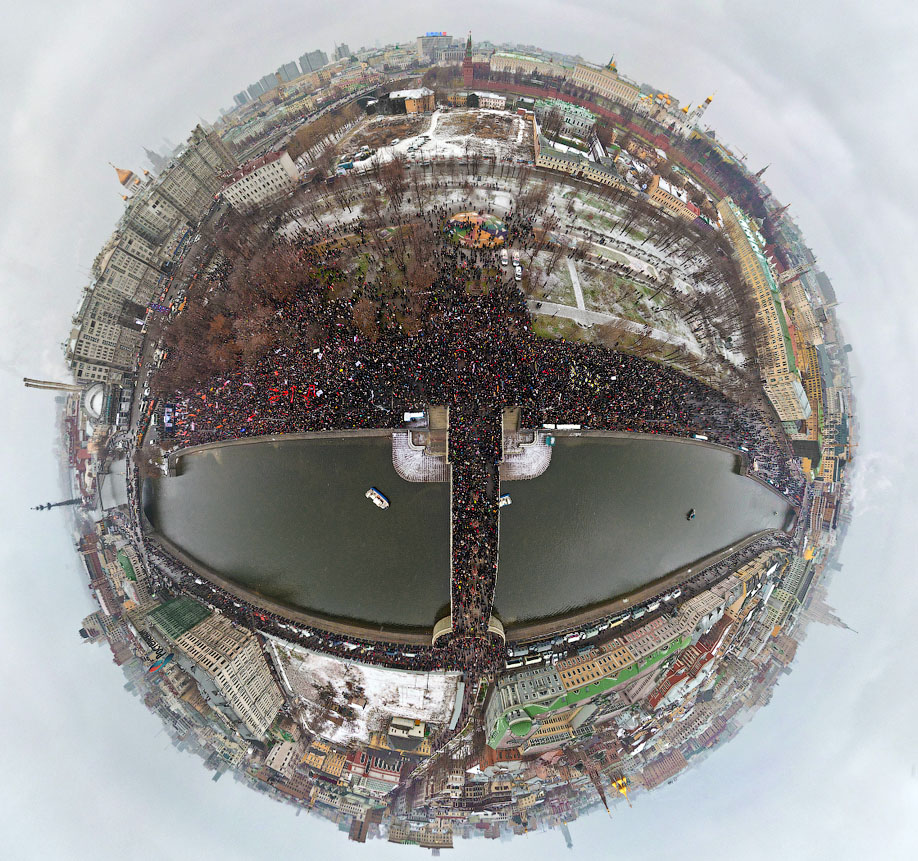
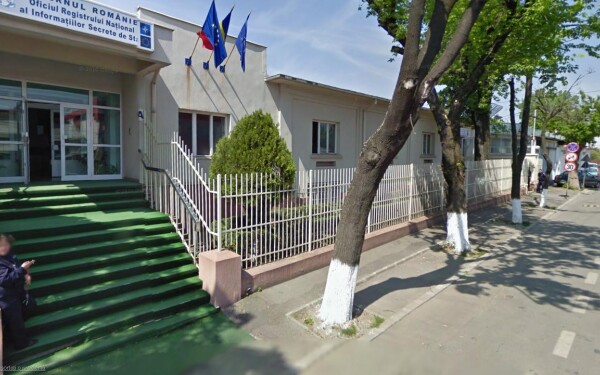


You must be logged in to post a comment.