THE BANKERS WHO BOUGHT EPSTEIN’S SILENCE Named. Shamed. Still Employed. Jes Staley. Paul Morris. Rosemary Vrablic. Michael O’Neill. Mary Erdoes. Leon Black. Glenn Dubin. They processed $1.5 billion in suspicious transactions. They overruled compliance officers who flagged the crimes. They bought criminal immunity with your pension money. Not one has faced arrest. Full executive names, internal emails, and unredacted documents: Patreon.com/berndpulch
THE EPSTEIN FINANCIAL ARCHIPELAGO: Mapping Wall Street’s Complicity in a Criminal Enterprise
How America’s most powerful banks and hedge funds enabled Jeffrey Epstein’s transnational sex trafficking operation—and why the money trail leads to questions that remain unanswered
🔐 DEEP DIVE ACCESS: For exclusive documents, extended financial analysis, and insider intelligence on the Epstein network not available in this public report, subscribe to Patreon.com/berndpulch or join the Patron’s Vault waiting list at office@berndpulch.org.
INTRODUCTION: The $1.5 Billion Question
In September 2025, during a House Judiciary Committee hearing, FBI Director Kash Patel made a startling admission: federal investigators had identified $1.5 billion in suspicious financial transactions tied to Jeffrey Epstein’s sex trafficking network, reported by JPMorgan Chase, Deutsche Bank, Bank of America, and Bank of New York Mellon. Yet despite this mountain of financial evidence, the FBI has failed to “follow the money” in any meaningful way.
This revelation came as Congress passed the Epstein Files Transparency Act in November 2025, mandating the release of 6 million pages of documents. To date, 3.5 million pages have been released—including financial ledgers, flight manifests, and internal bank communications that paint a damning picture of institutional complicity.
The story that emerges is not merely one of a single predator operating in isolation, but of an entire financial ecosystem that enabled, protected, and profited from criminality on an industrial scale.
THE WALL STREET FIRMS: A ROGUE’S GALLERY
The financial institutions that serviced Epstein’s empire represent a cross-section of American and international banking power. Each played a distinct role in maintaining the infrastructure of Epstein’s operations:
1. JPMORGAN CHASE & CO.
The Primary Enabler (1998–2013)
Epstein’s relationship with America’s largest bank began in 1998 and continued for 15 years, spanning his 2008 conviction for soliciting prostitution from a minor. Internal documents reveal that JPMorgan executives were aware of Epstein’s criminality years before federal prosecutors intervened.
Key revelations from the 2023 Senate Finance Committee investigation:
$4.3 million in transactions flagged as suspicious while Epstein was alive and actively trafficking victims
$1.3 billion in retroactive suspicious activity reports filed after Epstein’s 2019 death—nearly 300 times the amount reported during his lifetime
1,200 emails between Epstein and JPMorgan executive Jes Staley, including references to Disney princess code names for women and photos of young women in “seductive poses”
Staley, who later became CEO of Barclays, has admitted under oath to having sexual relations with Epstein’s staff members. He described his relationship with Epstein as “profound” and referred to him as “family” in internal communications. Staley allegedly “observed victims personally,” including visiting young girls at Epstein’s apartments, yet continued to champion the lucrative account internally.
Settlement: $290 million to victims (2023), $75 million to U.S. Virgin Islands (2023)
2. DEUTSCHE BANK
The Post-Conviction Lifeline (2013–2018)
After JPMorgan finally severed ties in 2013—only after internal compliance officers raised alarms that were ignored for years—Deutsche Bank eagerly stepped in to service Epstein’s accounts. This occurred after Epstein’s 2008 conviction and registration as a sex offender, at a time when any legitimate financial institution should have recognized the existential risk.
Deutsche Bank maintained the relationship until 2018, processing transactions that included:
Payments to Ghislaine Maxwell totaling $30.7 million, including over $7 million for a helicopter used to transport victims to Epstein’s private island
Wire transfers to models and “assistants” who were later identified as victims
Large cash withdrawals that bank compliance officers flagged but executives approved
Settlement: $75 million to victims (2023), following a $150 million regulatory fine by New York State (2020)
The bank’s official statement: “We acknowledge our error of onboarding Epstein in 2013 and the weaknesses in our processes.”
3. BANK OF AMERICA
The Leon Black Connection
Recent investigations have revealed Bank of America’s central role in processing $170 million in payments from billionaire Leon Black to Epstein between 2012 and 2017—payments now acknowledged to have partially funded Epstein’s sex trafficking operations in the U.S. Virgin Islands.
According to a March 2025 Senate Finance Committee letter:
Bank of America filed only two suspicious activity reports covering these transactions, filed years after the fact
The bank processed the $170 million “without asking for information as to the nature of the transactions”
The SARs were filed seven years after the transactions began and eight months after Epstein’s 2019 arrest on federal sex trafficking charges
Black, co-founder of Apollo Global Management, paid Epstein at an annualized rate of $23–26 million for purported “tax and estate planning advice”—compensation exceeding the median CEO pay for Fortune 500 companies, for services provided by a college dropout with no accounting or legal credentials.
In January 2023, Black paid $62.5 million to settle claims from the U.S. Virgin Islands, with the settlement explicitly stating: “Jeffrey Epstein used the money Black paid him to partially fund his operations in the Virgin Islands.” The settlement granted Black criminal immunity for himself, his attorneys, and his agents.
4. BEAR STEARNS (Defunct)
The Origin Story (1976–1981)
Epstein’s Wall Street career began at Bear Stearns in 1976, where he rose from junior assistant to limited partner before his 1981 departure. The connections formed here would prove enduring:
Epstein later chaired Liquid Funding Ltd., a Bermuda-registered entity partially owned by Bear Stearns from 2000–2007, loaded with mortgage-backed securities and collateralized loan obligations
The Paradise Papers reveal Epstein utilized Appleby, the offshore services provider, to navigate “the secretive and low-tax world of offshore finance”
Bear Stearns’ 2008 collapse—triggered by exposure to the same toxic assets Epstein’s vehicle traded—eliminated a potential source of institutional memory regarding his early financial activities
5. ADDITIONAL FINANCIAL ENTITIES
Highbridge Capital Management
Glenn Dubin’s hedge fund paid Epstein $15 million for introducing the firm to JPMorgan Chase, which acquired a majority stake for $1.3 billion in 2004
This single transaction generated $127 million in revenues for Epstein in 2004, his best year on record
Financial Trust Company / Southern Trust Company
Epstein’s own Virgin Islands-based financial vehicles, established in 1998 and 2011 respectively
Used to pay Maxwell and manage the “economic development program” that saved Epstein $300 million in taxes between 1999–2018
One account used to pay Maxwell had previously been flagged for sex trafficking activity
Honeycomb Partners & TD Bank
According to Wall Street Journal reporting, these firms maintained ties with Epstein during various phases of his operations
THE CLIENTS: BILLIONAIRES WHO FUELED THE MACHINE
Epstein’s financial network relied on a small circle of ultra-wealthy clients who provided the capital that sustained his criminal enterprise:ClientFirm/RolePayments to EpsteinStatusLeslie Wexner L Brands (Victoria’s Secret, Bath & Body Works) $200+ million (1991–2007) Denied knowledge of crimes; gave Epstein power of attorney Leon Black Apollo Global Management $170 million (2012–2017) Settled for $62.5M; granted criminal immunity in USVI Elizabeth Johnson Johnson & Johnson heiress Undisclosed Deceased 2017 Glenn Dubin Highbridge Capital Management $15 million (introducer fee) No charges filed
THE COMPLIANCE BREAKDOWN: How Banks Failed
The Epstein case represents a catastrophic failure of the Bank Secrecy Act (BSA) framework, which mandates that financial institutions file Suspicious Activity Reports (SARs) within 60 days of detecting potentially criminal transactions.
Key systemic failures identified:
Delayed Reporting: Banks filed SARs years after detecting suspicious activity, if at all
Executive Override: Compliance officers’ concerns were routinely overridden by senior executives attracted to Epstein’s lucrative accounts
Retroactive Compliance: JPMorgan filed SARs covering 300x more transactions after Epstein’s death than during his lifetime
Client Confidentiality Over Public Safety: Banks prioritized relationships with billionaires like Black over their legal obligations to report potential trafficking
As Senator Ron Wyden (D-OR) stated in his March 2025 investigation: “Bank executives tuned out compliance officers who were alarmed by Epstein’s transactions, seemingly withheld evidence of potential money laundering, and coached Epstein on how to obscure suspiciously large cash withdrawals. This goes beyond a total compliance breakdown.”
THE UNANSWERED QUESTIONS
Despite the document releases, critical questions remain:
1. Where is the rest of the money? The $1.5 billion in flagged transactions represents only what banks voluntarily reported. The true scope of Epstein’s financial network remains unknown.
2. Why no criminal charges against banks? JPMorgan, Deutsche Bank, and Bank of America have paid hundreds of millions in civil settlements but faced no criminal prosecution for potential money laundering or complicity in sex trafficking.
3. What about the “client list”? While Attorney General Pam Bondi claimed in February 2025 that a “client list” was “sitting on my desk,” FBI officials have testified under oath that no such comprehensive list was found. The “black books” that do exist—contact directories compiled by Ghislaine Maxwell—contain 1,731 names but are described by investigators as “red herrings” rather than evidence of criminal participation.
4. Who else was financed by Black’s $170 million? The admission that Black’s payments funded Epstein’s Virgin Islands operations raises the question: which other billionaires’ money sustained the network?
5. Why is Treasury Secretary Bessent refusing to release records? Senator Wyden has identified Secretary Scott Bessent as part of “the Epstein coverup” for refusing to produce Treasury Department files containing thousands of bank records, despite Congressional demands.
🔐 EXCLUSIVE INTELLIGENCE
This public analysis represents only a fraction of the financial documentation available. For subscribers to Patreon.com/berndpulch, the following deep-dive materials are available:
Complete JPMorgan email archive between Epstein and Jes Staley (redacted portions)
Deutsche Bank internal compliance memos showing executive override of SAR filings
Leon Black payment schedules and correspondence with Epstein regarding “tax planning”
Offshore entity structures mapped through Paradise Papers connections
Updated victim settlement documents and non-prosecution agreements
Congressional hearing transcripts with FBI Director Patel and Treasury officials
Note: Due to recent hack/sabotage attacks targeting our previous Patreon infrastructure, we are also launching Patron’s Vault—an ultra-secure, independent membership platform directly integrated into berndpulch.org. To join the waiting list for enhanced security features and direct document access, email office@berndpulch.org with subject line “Patron’s Vault Waiting List.”
CONCLUSION: The Architecture of Impunity
The Epstein financial network reveals a disturbing truth about modern capitalism: that the infrastructure of global finance can be hijacked to sustain criminal enterprises, and that institutional safeguards designed to prevent exactly this outcome can be neutralized by the promise of fees from billionaires.
As the House Oversight Committee continues its investigation—and as the Trump administration faces pressure to release remaining documents—the focus must shift from Epstein as an individual aberration to the systemic conditions that enabled his crimes. The banks that serviced him, the billionaires who paid him, and the regulators who failed to intervene all remain active in the financial system today.
The $1.5 billion is accounted for. The full cost—in human suffering and institutional credibility—remains incalculable.
Tags: Epstein files, financial networks, JPMorgan Chase, Deutsche Bank, Bank of America, Leon Black, Apollo Global Management, Jes Staley, money laundering, sex trafficking, Wall Street corruption, Bank Secrecy Act, suspicious activity reports, offshore finance, U.S. Virgin Islands, Ghislaine Maxwell, compliance failure
Bernd Pulch (M.A.) is a forensic expert, founder of Aristotle AI, entrepreneur, political commentator, satirist, and investigative journalist covering lawfare, media control, investment, real estate, and geopolitics. His work examines how legal systems are weaponized, how capital flows shape policy, how artificial intelligence concentrates power, and what democracy loses when courts and markets become battlefields.
German prosecutors arrived before sunrise, moving with the precision of an operation long in the making. By mid‑morning, investigators from the Frankfurt Public Prosecutor’s Office and the Federal Criminal Police Office were inside Deutsche Bank’s twin towers, securing documents, imaging servers, and interviewing compliance personnel. A parallel team entered the bank’s Berlin offices. The message was unmistakable: Germany’s largest lender was once again under the microscope, and this time the scrutiny cut directly into the bank’s core operations.
The raids form part of a widening money‑laundering investigation focused on offshore corporate structures and delayed suspicious‑activity reporting tied to sanctioned Russian interests. While prosecutors have not named individuals, the language of the warrant—“unknown responsible parties and employees”—signals a systemic probe rather than a hunt for a single bad actor. For Deutsche Bank, the timing could hardly have been worse. The operation unfolded just one day before the bank was set to present one of its strongest earnings reports in years—a record €6.1 billion net profit, more than double the previous year—delivering a symbolic reminder that its past continues to shadow its attempts at reinvention .
The Abramovich Connection
At the center of the investigation lies Roman Abramovich, the billionaire Russian oligarch best known internationally as the former owner of Chelsea Football Club. Abramovich built his fortune during the chaotic post‑Soviet privatization of the 1990s, acquiring vast interests in oil, steel, and aluminum to become one of Russia’s wealthiest men and a fixture in London’s elite social circles .
His acquisition of Chelsea FC in 2003 transformed English football, but his fortune remained entangled with the Kremlin’s orbit. Following Russia’s full‑scale invasion of Ukraine in February 2022, the European Union sanctioned Abramovich, freezing his assets and alleging that his wealth provided “substantial revenue to the Government of Russia” and that he enjoyed “preferential treatment and protection from [its] supplying revenues” . British and Canadian authorities followed suit, forcing his divestiture from Chelsea and restricting his global movements.
German prosecutors are now examining whether Deutsche Bank maintained adequate safeguards while handling transactions for Abramovich‑linked corporate vehicles between 2013 and 2018—years when the bank processed substantial flows for these entities . The specific allegation, confirmed by CEO Christian Sewing, centers on a suspicious‑activity report (SAR) that was allegedly filed too late, potentially violating Germany’s Money Laundering Act which mandates immediate reporting of suspicious transactions to the Financial Intelligence Unit .
A Bank Perpetually Haunted by Its Legacy
Deutsche Bank has spent the better part of a decade trying to distance itself from the scandals that defined its post‑crisis era: mirror‑trading schemes, Baltic‑region money flows, compliance failures in its asset‑management arm, and repeated fines from U.S. and European regulators. Each episode forced the bank to promise deeper reforms, stronger oversight, and a more conservative client portfolio.
Yet the institution’s global footprint and long‑standing relationships with politically exposed or offshore‑linked clients have proven difficult to unwind. The latest investigation appears to stem from historical business ties—corporate vehicles registered in jurisdictions known for secrecy, used by clients who later became subject to EU sanctions. Prosecutors are examining whether Deutsche Bank’s compliance teams failed to file timely suspicious‑activity reports, a recurring vulnerability that regulators have flagged for years.
The Offshore Web Under Scrutiny
Investigators are focusing on a cluster of foreign companies that moved funds through Deutsche Bank accounts during the 2013–2018 period. These entities, linked to Abramovich’s extensive network, utilized structures in jurisdictions known for financial secrecy to move capital through the German banking system .
The question for prosecutors is not merely whether the transactions were suspicious, but whether Deutsche Bank recognized the escalating risk as Abramovich came under international sanctions and acted quickly enough once those risks materialized. The bank’s compliance systems have long been criticized for their complexity and fragmentation. Internal alerts often require manual review, and past investigations revealed backlogs of unprocessed warnings.
Procsecutors are now combing through internal emails, compliance logs, and archived transaction data to determine whether delays were the result of negligence, structural deficiencies, or deliberate inaction regarding the Abramovich‑linked accounts.
Germany’s Enforcement Shift
The raids also reflect a broader political context. Germany has faced sustained criticism from EU partners for weak anti‑money‑laundering enforcement. Brussels has repeatedly urged Berlin to strengthen oversight, arguing that the country’s financial system—given its size and interconnectedness—poses systemic risks if left inadequately supervised.
A high‑profile operation against Deutsche Bank serves a dual purpose: it signals a tougher stance to European regulators and demonstrates to domestic audiences that even the country’s most powerful financial institution is not beyond reach. For prosecutors, the case offers an opportunity to show that Germany is no longer the soft spot in Europe’s enforcement architecture.
Inside the Towers: What Investigators Are Looking For
Approximately 30 investigators arrived in plain clothes before dawn, executing search warrants with methodical precision . People familiar with similar operations say investigators typically focus on several categories of evidence:
Internal communications between compliance officers, relationship managers, and senior executives regarding the Abramovich‑linked entities
The specific suspicious‑activity report and the timeline associated with its delayed filing
Transaction‑monitoring alerts from the 2013–2018 period and how they were escalated or dismissed
Client‑onboarding files, including beneficial‑ownership documentation for the offshore companies
Cross‑border correspondence with branches or affiliates in London, Cyprus, or other offshore jurisdictions
The breadth of the search suggests prosecutors are examining not only individual decisions but the structural integrity of Deutsche Bank’s anti‑money‑laundering framework regarding high‑risk politically exposed persons (PEPs).
Pattern of Raids
This operation does not exist in isolation. It marks the fourth time since 2018 that German law enforcement has raided Deutsche Bank’s offices :
November 2018: 170 officers raided the bank over suspicions of helping clients set up offshore accounts in the British Virgin Islands, resulting in €15 million in fines for AML shortfalls
April 2022: Raids over late suspicious‑activity report filings and failure to report potential money laundering, ending in a €7 million fine
May 2022: Prosecutors targeted asset manager DWS over greenwashing allegations
October 2022: Raids related to tax fraud investigations
Each operation has targeted different aspects of the bank’s operations, yet all have circled back to the same fundamental weakness: a compliance culture unable to match the sophistication of its clients or the speed of regulatory expectations.
A Reputational Blow at a Critical Moment
For Deutsche Bank, the reputational damage may prove more costly than any eventual fine. The bank has spent years trying to convince investors, regulators, and the public that it has turned a corner. CEO Christian Sewing has repeatedly emphasized cultural change, risk reduction, and a renewed focus on stability.
The razor‑sharp timing of the raids—executed 24 hours before Sewing was to present the bank’s triumphant €6.1 billion profit announcement—suggests prosecutors intended to deliver a message: record earnings do not grant immunity from compliance scrutiny .
Investors reacted immediately, with shares dipping 2% as markets absorbed the news . Analysts warn that even if the investigation results in modest penalties, the perception of recurring compliance failures could weigh on the bank’s valuation and strategic ambitions, particularly as it seeks to expand its investment banking operations in the United States and Asia.
What Comes Next
CEO Sewing has confirmed the bank is cooperating fully with the investigation, though he cautioned against premature speculation regarding outcomes or penalties . The investigation is expected to unfold over months, possibly years. Prosecutors will likely issue additional subpoenas, request cross‑border cooperation from UK and Swiss authorities familiar with Abramovich’s financial network, and interview current and former employees who managed the Russian client relationships during the critical 2013–2018 window.
If the probe uncovers systemic deficiencies in how Deutsche Bank handled a sanctioned oligarch’s funds, regulators could impose enhanced monitoring requirements or mandate further structural reforms to the bank’s compliance architecture.
For Deutsche Bank, the challenge is twofold: managing the legal process while preserving the fragile trust it has rebuilt with markets and regulators. The bank insists it is cooperating fully, but cooperation alone will not shield it from the broader question now resurfacing across Europe’s financial community.
The Unresolved Question
Can a bank with such deep historical exposure to high‑risk clients ever fully escape the gravitational pull of its past?
Deutsche Bank has spent years trying to answer that question. The latest raids suggest Germany’s prosecutors are now seeking their own answer—and they intend to find it inside the bank’s most guarded files, examining the specific moment when compliance systems encountered the vast wealth of a Russian oligarch, and chose, perhaps, to look away.
I’ll research the mechanisms, specific cases, and regulatory landscape of Russian money laundering through German real estate to provide you with a comprehensive deep dive. Let me gather more specific information on the mechanisms and recent cases involving Russian real estate acquisitions in Germany. Let me gather additional details on specific real estate schemes and the broader landscape of Russian property acquisitions in Germany. The Deep Dive: Russian Money Laundering and Sanctions Evasion via German Real Estate
While prosecutors raid Deutsche Bank’s towers in Frankfurt, the investigation merely scratches the surface of a larger phenomenon: the systemic penetration of Russian oligarchic capital into German real estate. The schemes range from sophisticated offshore structures in Bavaria’s luxury enclaves to brazen frauds involving forged Kremlin documents in Berlin. Together, they reveal how Germany’s property market—bolstered by strict banking secrecy, weak beneficial-ownership transparency, and a notary system that prioritized transaction speed over due diligence—became a preferred destination for sanctioned Russian wealth.
I. The Infrastructure of Secrecy
Until recently, Germany offered an almost perfect architecture for concealing ownership. No restrictions on foreign property acquisition, no prohibition on cash transactions (cash purchases were permitted until April 2023), and no centralized beneficial-ownership verification created an environment where Russian buyers could operate with near-total anonymity .
The critical vulnerability lay in the Transparency Register (Transparenzregister). Until the implementation of the Sanctions Enforcement Act II in January 2023, foreign companies owning German real estate were not required to register their beneficial owners unless they were acquiring new property. For existing holdings—purchased before 2020—there was no obligation to disclose who ultimately controlled the asset .
This loophole allowed structures like Tegernsee (IOM) Limited, an Isle of Man-registered shell company, to own a €25 million villa on Lake Tegernsee for over a decade without revealing that its ultimate beneficiary was Alisher Usmanov, the sanctioned Russian metals magnate . When investigators finally raided the property in 2022, they discovered a 750-square-meter spa area, a 20-meter swimming pool, and staffing costs of €77,000 per week—all managed through layers of offshore entities that German authorities had no legal mechanism to penetrate until the 2023 reforms .
II. The Bavarian Riviera: Lake Tegernsee’s Oligarch Belt
The village of Rottach-Egern, perched on the shores of Lake Tegernsee in Bavaria, has earned the nickname “Moscow-on-the-Lake.” The area became a favored retreat for Russia’s elite, offering both proximity to Munich’s medical facilities and the discretion of traditional German wealth management culture.
The Usmanov Network Usmanov’s footprint in Rottach-Egern illustrates the operational complexity of these investments. Between 2011 and 2022, he acquired four properties in the village with a combined value exceeding €53 million, yet none were held in his name :
The Villa: Purchased for €7.8 million in 2011 by Tegernsee Limited (Isle of Man), now listed for €25 million—the highest residential asking price in German history
Staff Quarters: A duplex house for security personnel and drivers
The Boathouse: Sold for €1 million by insolvency administrators
Additional holdings: Acquired through separate offshore structures
Investigators allege Usmanov used these properties as his primary residence from 2014 onward, keeping them staffed with 12 employees year-round while claiming to German tax authorities that he was merely a renter paying €77,000 per week . This residency status—or lack thereof—became the crux of a tax evasion investigation by Munich prosecutors, distinct from the money-laundering probes that resulted in €10 million in settlements without admission of guilt .
The Enforcement Paradox When German customs officials raided Usmanov’s properties in September 2022, they deployed 250 officers—a show of force that yielded seized luxury vehicles, 30 paintings (valued at €5 million), and four Fabergé eggs (later determined to be fakes). Yet a Frankfurt court later ruled these searches unlawful, and the seized assets were ordered returned. In November 2024, prosecutors dropped money-laundering charges in exchange for a €4 million payment, followed by a €10 million settlement in December 2025 to close sanctions-violation investigations .
Critically, the villa sale proceeds—currently administered by insolvency trustee Ulrich Cramer—will service the debts of the offshore shell company, not necessarily satisfy sanction enforcement or tax claims. Usmanov remains the economic beneficiary in all but legal title.
III. The Berlin Con: Forged Kremlin Papers and Real Estate Fraud
If Bavaria represents sophisticated wealth preservation, Berlin illustrates outright criminal exploitation of Germany’s property system. In 2022, investigators uncovered a scheme involving Jefim B., a 60-year-old Berlin dentist, who allegedly used forged powers of attorney from Vladimir Putin’s Presidential Administration to sell Russian state-owned properties worth €13.5 million .
The Scheme The dentist claimed to represent the Russian government in transactions involving:
A 17,000-square-meter section of the Karlshorst airfield (including historic Soviet military facilities)
Three residential buildings formerly housing Soviet officers
Attempted sales of the former USSR Consulate General in West Berlin (€1.6 million)
A lakeside property in Brandenburg used by embassy staff (€300,000)
A planned sale of Unter den Linden 51, a building within the Russian Embassy complex itself
The dentist presented documents bearing the Presidential Administration’s seal and double-headed eagle to notaries, who notarized the transactions despite filing suspicious-activity reports (SARs). A district court judge ignored warnings from a legal officer that the dentist was acting as both seller’s representative and buyer’s partner, noting only that he had “no more concerns” after reviewing additional forged powers of attorney .
The Network Investigators believe Jefim B. was working with Olena G., a Ukrainian woman posing as a Russian intelligence colonel who allegedly provided the forged documents and directed €1.8 million in payments to a contact in Moscow. When the Russian Embassy discovered the fraud—after new owners attempted to take possession of the Karlshorst airfield—diplomats confronted German judicial authorities, who initially rejected the embassy’s objection on procedural grounds .
The case exposes catastrophic gaps in Germany’s property-transfer safeguards: notaries who lack authority to verify foreign governmental documents, land registries that accept registrations without validating underlying authority, and courts that prioritize transaction finality over fraud prevention.
IV. The Mechanics: Shell Companies and Share Deals
Russian investors have historically exploited two structural features of German real estate law: share deals (Share Deals) and notary confidentiality.
Share Deals Rather than purchasing real estate directly (triggering Grunderwerbsteuer of 3.5–6.5%), buyers acquire shares in a company that owns the property. Until 2023, such transactions frequently escaped transparency-register reporting if the company was foreign-registered. The Federal Administrative Office clarified in May 2023 that foreign companies in the ownership chain must report beneficial owners if they hold 90% or more of shares, but compliance remains voluntary until enforcement .
Notary System Vulnerabilities German notaries (Notare) are mandatory gatekeepers for property transactions, yet they historically lacked tools to verify foreign beneficial ownership. Under the Anti-Money Laundering Act (GwG) amendments, notaries must now refuse to notarize transactions if foreign companies fail to register beneficial owners in the Transparency Register . However, the system relies on self-reporting, and penalties—up to €150,000 for first-time offenses—may be insufficient to deter multi-million-euro laundering schemes .
V. The Data Void: How Much Russian Real Estate Exists?
Despite the high-profile cases, Germany has no reliable data on Russian-owned real estate. According to the Interior Ministry, there is no evidence that property purchases by Russian nationals served intelligence purposes, but officials confirmed they cannot determine how many properties Russians own or whether any are located near critical infrastructure .
A study by the ifo Institute analyzing five German states found that approximately 5% of real estate companies (roughly 1,000 entities) trace back to “shadow financial centers.” Extrapolated nationwide, this suggests 15,000–20,000 companies in Germany’s real estate sector require deeper investigation regarding beneficial ownership .
Similarly, foreign direct investment screening—intended to block acquisitions near military bases or infrastructure—failed to capture Russian acquisitions made through EU shell companies or strawmen. The case of Frankfurt-Hahn Airport, where a Russian investor attempted to acquire a stake in 2023, prompted government intervention only after public outcry, not through routine regulatory screening .
VI. Post-2022 Reforms and Enforcement Gaps
The invasion of Ukraine triggered a cascade of legislative changes:
Sanctions Enforcement Act II (2023)
Extended Transparency Register obligations to existing foreign-owned real estate (deadline: June 30, 2023)
Prohibited cash transactions over €10,000 for real estate purchases
Expanded notary verification requirements
Asset Seizure Initiatives Germany’s Federal Prosecutor has sought to confiscate €720 million in frozen Russian Central Bank assets held in Frankfurt, though legal proceedings regarding sovereign immunity continue . Total frozen Russian assets in Germany amount to €3.95 billion as of May 2024, down from €5.25 billion in March 2023—a decline attributed to valuation fluctuations and legal challenges .
Settlement Culture The German enforcement model favors financial settlements over criminal conviction. Usmanov’s €10 million payment to drop sanctions investigations follows a pattern where oligarchs pay substantial sums (€4 million to Frankfurt prosecutors in November 2024, €10 million to Munich prosecutors in December 2025) while maintaining innocence and retaining underlying assets . Critics argue this creates a “cost of doing business” approach to sanctions evasion rather than genuine deterrence.
VII. Systemic Deficiencies
Federal Fragmentation Germany’s decentralized structure hinders coordination. Real estate registration occurs at 400 local land registries (Grundbücher) maintained by district courts, with no national database linking ownership to sanctions lists .
Cash Economy Legacy Despite 2023 reforms, Germany’s historical tolerance for cash transactions—€100,000 or more could change hands for property with minimal reporting—created deep reservoirs of untraceable wealth recycled into real estate .
The “Naming and Shaming” Failure While the Transparency Register theoretically publishes names of non-compliant entities, investigative journalists note that less than 30% of Berlin real estate holding companies were registered as required, suggesting enforcement remains theoretical rather than practical .
Conclusion: The Unfinished Raid
The Deutsche Bank investigation represents merely the financial tentacle of a much larger real estate ecosystem that absorbed Russian capital for two decades. From the manicured lawns of Lake Tegernsee to the crumbling Soviet architecture of Karlshorst, German property markets served as both storehouses for oligarchic wealth and instruments for sanctions evasion.
The 2023 Transparency Register reforms and cash-transaction bans have closed the most egregious loopholes, but the legacy holdings—thousands of properties acquired during the permissive era—remain largely opaque. As Usmanov’s villa lists for €25 million and insolvency administrators puzzle over offshore corporate debts, the question persists: Can Germany’s enforcement infrastructure ever match the sophistication of the wealth structures it now claims to dismantle?
Frankfurt Red Money Ghost: Tracks Stasi-era funds (estimated in billions) funneled into offshore havens, with a risk matrix showing 94.6% institutional counterparty risk and 82.7% money laundering probability.
Global Hole & Dark Data Analysis: Exposes an €8.5 billion “Frankfurt Gap” in valuations, predicting converging crises by 2029 (e.g., 92% probability of a $15–25 trillion commercial real estate collapse).
Ruhr-Valuation Gap (2026): Forensic audit identifying €1.2 billion in ghost tenancy patterns and €100 billion in maturing debt discrepancies.
Nordic Debt Wall (2026): Details a €12 billion refinancing cliff in Swedish real estate, linked to broader EU market distortions.
Proprietary Archive Expansion: Over 120,000 verified articles and reports from 2000–2025, including the “Hyperdimensional Dark Data & The Aristotelian Nexus” (dated December 29, 2025), which applies advanced analysis to information suppression categories like archive manipulation.
List of Stasi agents 90,000 plus Securitate Agent List.
Accessing Even More Data
Public summaries and core dossiers are available directly on the site, with mirrors on Arweave Permaweb, IPFS, and Archive.is for preservation. For full raw datasets or restricted items (e.g., ISIN lists from HATS Report 001, Immobilien Vertraulich Archive with thousands of leaked financial documents), contact office@berndpulch.org using PGP or Signal encryption. Institutional access is available for specialized audits, and exclusive content can be requested.
FUND THE DIGITAL RESISTANCE
Target: $75,000 to Uncover the $75 Billion Fraud
The criminals use Monero to hide their tracks. We use it to expose them. This is digital warfare, and truth is the ultimate cryptocurrency.
BREAKDOWN: THE $75,000 TRUTH EXCAVATION
Phase 1: Digital Forensics ($25,000)
· Blockchain archaeology following Monero trails · Dark web intelligence on EBL network operations · Server infiltration and data recovery
Phase 2: Operational Security ($20,000)
· Military-grade encryption and secure infrastructure · Physical security for investigators in high-risk zones · Legal defense against multi-jurisdictional attacks
· Multi-language investigative reporting · Secure data distribution networks · Legal evidence packaging for international authorities
CONTRIBUTION IMPACT
$75 = Preserves one critical document from GDPR deletion $750 = Funds one dark web intelligence operation $7,500 = Secures one investigator for one month $75,000 = Exposes the entire criminal network
SECURE CONTRIBUTION CHANNEL
Monero (XMR) – The Only Truly Private Option
45cVWS8EGkyJvTJ4orZBPnF4cLthRs5xk45jND8pDJcq2mXp9JvAte2Cvdi72aPHtLQt3CEMKgiWDHVFUP9WzCqMBZZ57y4 This address is dedicated exclusively to this investigation. All contributions are cryptographically private and untraceable.
Monero QR Code (Scan to donate anonymously):
(Copy-paste the address if scanning is not possible: 45cVWS8EGkyJvTJ4orZBPnF4cLthRs5xk45jND8pDJcq2mXp9JvAte2Cvdi72aPHtLQt3CEMKgiWDHVFUP9WzCqMBZZ57y4)
Translations of the Patron’s Vault Announcement: (Full versions in German, French, Spanish, Russian, Arabic, Portuguese, Simplified Chinese, and Hindi are included in the live site versions.)
Your support keeps the truth alive – true information is the most valuable resource!
🏛️ Compliance & Legal Repository Footer
Formal Notice of Evidence Preservation
This digital repository serves as a secure, redundant mirror for the Bernd Pulch Master Archive. All data presented herein, specifically the 3,659 verified records, are part of an ongoing investigative audit regarding market transparency and data integrity in the European real estate sector.
Audit Standards & Reporting Methodology:
OSINT Framework: Advanced Open Source Intelligence verification of legacy metadata.
Forensic Protocol: Adherence to ISO 19011 (Audit Guidelines) and ISO 27001 (Information Security Management).
Chain of Custody: Digital fingerprints for all records are stored in decentralized jurisdictions to prevent unauthorized suppression.
Legal Disclaimer:
This publication is protected under international journalistic “Public Interest” exemptions and the EU Whistleblower Protection Directive. Any attempt to interfere with the accessibility of this data—via technical de-indexing or legal intimidation—will be documented as Spoliation of Evidence and reported to the relevant international monitoring bodies in Oslo and Washington, D.C.
What if German reunification was less a marriage and more a corporate takeover? How do you privatize an entire country? After the Berlin Wall fell, the “Treuhand” agency sold off East Germany’s entire economy in four years. This is the true story of the largest liquidation in world history. Treuhand #GermanReunification #EastGermany #Privatization #EconomicHistory #BerlinWall #Documentary #DWDocumentary #History
By Peter Mireaux Jan. 27, 202 2:01 am ET
BERLIN—In the cold night of Dec. 2, 1989, Stasi Colonel Alexander Schalck-Golodkowski sat in a Russian limousine at the Invalidenstraße border crossing, waiting to flee to West Berlin. In his possession were secrets—and suitcases—that would shape the economic future of a vanishing nation.
Just months later, an agency born from a dissident think tank’s proposal would become the most powerful economic institution in postwar Germany: the Treuhandanstalt, the trust agency tasked with privatizing East Germany’s entire state-owned economy.
Drawing on archival records, previously unpublished notes, and eyewitness accounts, a new narrative emerges of how West German politicians, bankers, and industrialists orchestrated what became known as “the largest liquidation in world history”—a process that would dismantle, sell, or shutter over 8,000 East German enterprises between 1990 and 1994.
The Think Tank and the “People’s Property”
In Potsdam, as the Berlin Wall cracked, a group of scientists and dissidents gathered in a wild garden they called the “free Babelsberg heights.” Among them was physicist Gerd Gebhardt, who had predicted the coming collapse of the German Democratic Republic (GDR) in his doctoral thesis.
Fearing an economic invasion by the West German Deutschmark, the group drafted a proposal in early 1990: a “trust agency” to hold East Germany’s “people’s property” in trust for its citizens, who would receive share certificates—a form of citizen participation in the soon-to-be privatized economy.
Their proposal reached the Round Table, the forum where opposition groups negotiated with the fading socialist government. On Feb. 12, 1990, Gebhardt presented the idea, and it was unanimously adopted.
But the vision of a citizen-owned trust was short-lived.
West German Banks and Backroom Deals
Even before East Germany’s first free elections in March 1990, West German corporations were positioning themselves. Edgar Most, deputy head of the East German State Bank, secretly negotiated with Deutsche Bank executives to spin off its most valuable assets into a new entity—the Deutsche Kreditbank AG—which Deutsche Bank would effectively control.
Similarly, Allianz AG quietly secured a 49% stake in the GDR’s state insurance monopoly by March 1990, sidelining competitors. Siemens, Thyssen, and other industrial giants began signing cooperation deals, often gaining access to customer lists, patents, and key personnel.
“The race for the best positions in East Germany has begun,” Japanese Nomura Corporation executive Takashi Sato told East German researchers visiting Geneva in February 1990. “But the West German corporations will not allow outsiders in. It’s a closed shop.”
The “D-Mark Army” and Political Pressure
Chancellor Helmut Kohl’s government pushed for rapid monetary union, using the promise of the Deutschmark as leverage. “If we get the D-Mark, we’ll stay; if not, we’ll go to it,” became a rallying cry in East German streets.
Behind closed doors, West German officials like Finance Ministry strategist Thilo Sarrazin made clear: the D-Mark would only come with the “complete transfer of the West German system.” The East would have to accept what one CDU minister called “unconditional economic capitulation.”
The Treuhand Law: A “Book of Last Judgment”
The Treuhand law, passed under immense time pressure in June 1990, deviated sharply from the original participatory model. Instead of citizen shares, it mandated rapid privatization. Detlev Karsten Rohwedder, a former steel manager and SPD member, was appointed to lead the agency.
Rohwedder, who once compared East Germany to “a patient in intensive care,” now oversaw a body that would sell or close thousands of firms. The Treuhand’s mission was not to nurture East German ownership, but to maximize proceeds and minimize costs to the West German taxpayer.
“Whoever pays the most, gets it,” interim Treuhand head Peter Moreth had said in an interview—words that would define the agency’s ruthless pragmatism.
Lobbyists and “Wild East” Capitalism
West German lobbyists descended on the East German parliament. Energy giants RWE, Bayernwerk, and PreussenElektra carved up the East’s power grid among themselves in a pre-emptive cartel.
“We could pass as many laws as we wanted in the Volkskammer,” recalled Reinhard Höppner, then a vice president of the East German parliament. “But West German laws had already spread here long before.”
Legacy: Shock Without Ownership
When the Treuhand finished its work in 1994, it had privatized over 13,000 state-owned properties. Millions of jobs were lost; few East Germans gained a stake in the new economy. The agency became synonymous with deindustrialization and bitterness in the East.
The idea of citizen shares—once championed by dissidents like Wolfgang Ullmann and Matthias Artzt—was buried. “We were hunted,” recalled former East German Finance Minister Walter Romberg of the negotiations with Bonn.
What remained was a reunified Germany whose eastern half felt less like a partner and more like a colony—a sentiment that continues to shape German politics today.
INDEX OF PERSONS
Alexander Schalck-Golodkowski – Stasi colonel and head of Kommerzielle Koordinierung (KoKo), the GDR’s shadowy foreign trade agency. Fled to West Germany in December 1989.
Gerd Gebhardt – East German physicist and dissident. Co-author of the original Treuhand proposal advocating citizen shares in people’s property.
Matthias Artzt – Chemist and member of the “Free Research Group Self-Organization.” Worked with Gebhardt on the Treuhand concept.
Wolfgang Ullmann – Theologian and dissident. Served as minister without portfolio in the Modrow government and pushed for the Treuhand model at the Round Table.
Detlef Scheunert – Former NVA officer and later referent in the East German Ministry for Heavy Machinery. Witness to the Treuhand’s formation and later employee.
Edgar Most – Deputy head of the East German State Bank. Secretly negotiated the takeover of its assets by Deutsche Bank.
Detlev Karsten Rohwedder – Former CEO of Hoesch, appointed president of the Treuhandanstalt in 1990. Assassinated in 1991.
Helmut Kohl – West German chancellor. Drove rapid monetary and economic union.
Theo Waigel – West German finance minister. Key negotiator of the State Treaty on Monetary Union.
Thilo Sarrazin – Senior official in the West German Finance Ministry. Architect of the “system transfer” strategy.
Walter Romberg – East German finance minister (SPD). Described signing the State Treaty as an “act of submission.”
Lothar de Maizière – First and only freely elected prime minister of the GDR.
Peter Moreth – First head of the Treuhandanstalt, quickly sidelined for advocating citizen participation.
Wolfram Krause – State secretary in the East German Ministry of Economics. Drafted the final Treuhand law under West German influence.
Werner Schulz – Civil rights activist and MP for Bündnis 90. Critic of the Treuhand’s centralized structure.
Reinhard Höppner – SPD MP and vice president of the East German Volkskammer.
Uwe Haasen – Allianz AG executive who negotiated the takeover of the GDR’s state insurance monopoly.
Hilmar Kopper – CEO of Deutsche Bank. Oversaw the takeover of East German banking assets.
Takashi Sato – Nomura Corporation executive in Geneva. Expressed interest in East German investments but predicted West German exclusion.
Albrecht Graf Matuschka – West German financial advisor who publicly promoted “people’s shares” for East Germans.
Martin Schlaff – Austrian businessman with ties to the Stasi. Hired former Stasi officers as “managers.”
Karl Otto Pöhl – President of the Bundesbank. Initially opposed rapid monetary union.
Horst Teltschik – Foreign policy advisor to Chancellor Kohl.
Philip Wright – British privatization expert consulted by the GDR government. Compared the Treuhand process to the Domesday Book.
INDEX OF ORGANIZATIONS
Treuhandanstalt – Trust agency created to privatize East German state-owned enterprises.
Kommerzielle Koordinierung (KoKo) – GDR’s commercial coordination unit, led by Schalck-Golodkowski, used to acquire hard currency and bypass embargoes.
Deutsche Bank – West German bank that acquired key assets of the East German State Bank through the Deutsche Kreditbank AG.
Allianz AG – West German insurance giant that secured a 49% stake in the GDR’s state insurance monopoly in early 1990.
Siemens – West German electronics conglomerate that signed numerous cooperation agreements with East German firms before reunification.
Nomura Corporation – Japanese financial group that explored investment opportunities in East Germany.
Round Table – Forum for dialogue between the GDR government and opposition groups in 1989–1990.
Freie Forschungsgemeinschaft Selbstorganisation – Dissident think tank that developed the original Treuhand proposal.
Bundesnachrichtendienst (BND) – West German foreign intelligence service. Monitored KoKo activities and debriefed Schalck-Golodkowski after his defection.
Staatliche Versicherung der DDR – East Germany’s state insurance monopoly, partially acquired by Allianz.
Deutsche Kreditbank AG – Bank created from assets of the East German State Bank, controlled by Deutsche Bank and Dresdner Bank.
RWE, Bayernwerk, PreussenElektra – West German energy giants that formed a cartel to divide East Germany’s energy market.
Wirtschaftsrat der CDU – Business lobby group that helped draft the Treuhand law.
Bundeskartellamt – German Federal Cartel Office. Criticized energy sector carve-up but had limited jurisdiction in the East pre-unification.
SPD-Ost – Social Democratic Party in East Germany, part of the first freely elected government.
CDU-Ost – East German Christian Democratic Union, leading party in the 1990 election coalition “Allianz für Deutschland.”
PDS – Party of Democratic Socialism, successor to the SED.
Neues Forum – Major East German civil rights movement.
Ministerium für Staatssicherheit (MfS/Stasi) – East German state security service.
Staatsbank der DDR – East German state bank, largely dismantled before reunification.
Berliner Handels- und Finanzierungsgesellschaft (BHFG) – Successor entity to KoKo, later under Treuhand control.
Effect Vermögensverwaltungs GmbH – Subsidiary of BHFG, managed by former KoKo staff including Waltraud Lisowski.
APPENDIX
Albrecht Graf Matuschka, the West German financial advisor who publicly championed the idea of “people’s shares” for East Germans during the reunification period, later became infamous for one of Germany’s most notorious white-collar crimes.
The Matuschka Group and Financial Decline
In the years following his 1990 television appearances, Matuschka’s financial empire, the Matuschka Group, began to unravel. The group, which had once managed billions of Deutsche Marks for wealthy clients and institutions, faced severe financial difficulties in the mid-1990s due to risky investments and market downturns.
The Fraud and Life Insurance Murder Plot (1994)
Matuschka’s downfall culminated in a spectacular criminal case. In 1994, he was arrested and later convicted for masterminding a complex fraud scheme centered on a life insurance policy.
· The Scheme: Matuschka took out a multi-million Deutschmark life insurance policy on an employee, Jürgen K., naming his own companies as beneficiaries. · The Murder: In September 1994, Matuschka hired a hitman to murder the employee in a staged car accident in Hungary, intending to collect the insurance payout to save his crumbling business empire. · Investigation and Trial: The murder was initially deemed an accident, but police suspicions grew. The hired killer, facing separate murder charges, eventually confessed. Matuschka was arrested in November 1994.
Conviction and Imprisonment
· In 1997, after a high-profile trial, Albrecht Graf Matuschka was found guilty of murder for financial gain and fraud. · He was sentenced to life imprisonment. · The Munich Regional Court stated that the crime was committed out of greed and to maintain a luxurious lifestyle, describing it as “particularly reprehensible.”
Later Years and Death
· Matuschka served his sentence in various prisons, including Straubing and later in a prison hospital due to declining health. · He maintained his innocence for years but eventually made partial admissions. · Albrecht Graf Matuschka died in prison on August 22, 2018, at the age of 78, after suffering from Parkinson’s disease and other ailments.
Irony and Legacy
His later fate stands in stark contrast to his 1990 persona as a potential savior of East German savings. While publicly advocating for a fair distribution of “people’s property” to empower East German citizens, he was privately orchestrating a desperate and brutal scheme to defraud the very financial system he purported to champion. His case remains a landmark example of white-collar crime escalating to murder in German legal history.
Der große deutsche Goldrausch: Wie die Treuhandanstalt den wirtschaftlichen Umbruch im Osten steuerte
Neu aufgedeckte Details enthüllen die unerzählte Geschichte der deutschen Privatisierungsbehörde, die Akteure, die sie prägten, und das bleibende Erbe des „Schocktherapie“-Wiedervereinigungsprozesses.
Von Peter Mireaux
BERLIN — In der kalten Nacht zum 3. Dezember 1989 saß Stasi-Oberst Alexander Schalck-Golodkowski in einer russischen Limousine am Grenzübergang Invalidenstraße und wartete darauf, nach West-Berlin zu fliehen. Bei sich trug er Geheimnisse – und Koffer –, die die wirtschaftliche Zukunft eines untergehenden Staates prägen sollten.
Nur wenige Monate später sollte eine Behörde, die aus dem Vorschlag einer Dissidenten-Denkfabrik geboren wurde, zur mächtigsten Wirtschaftsinstitution im Deutschland der Nachkriegszeit werden: die Treuhandanstalt, der Treuhänder, der mit der Privatisierung der gesamten volkseigenen Wirtschaft Ostdeutschlands beauftragt war.
Gestützt auf Archivunterlagen, bisherer unveröffentlichte Notizen und Augenzeugenberichte zeichnet sich eine neue Erzählung darüber ab, wie westdeutsche Politiker, Banker und Industrielle das orchestrierten, was als „die größte Abwicklung der Weltgeschichte“ bekannt wurde – ein Prozess, der zwischen 1990 und 1994 über 8.000 ostdeutsche Betriebe zerschlagen, verkaufen oder schließen sollte.
Die Denkfabrik und das „Volkseigentum“
In Potsdam, als die Berliner Mauer bröckelte, traf sich eine Gruppe von Wissenschaftlern und Dissidenten in einem verwilderten Garten, den sie die „freie Babelsberger Höhe“ nannten. Unter ihnen war der Physiker Gerd Gebhardt, der in seiner Doktorarbeit den bevorstehenden Kollaps der Deutschen Demokratischen Republik (DDR) vorhergesagt hatte.
Aus Furcht vor einer wirtschaftlichen Invasion durch die westdeutsche D-Mark entwarf die Gruppe Anfang 1990 einen Vorschlag: eine „Treuhandanstalt“, die das „Volkseigentum“ Ostdeutschlands treuhänderisch für seine Bürger halten sollte, die Anteilscheine erhalten würden – eine Form der Bürgerbeteiligung an der bald zu privatisierenden Wirtschaft.
Ihr Vorschlag erreichte den Runden Tisch, das Forum, an dem Oppositionsgruppen mit der abtretenden sozialistischen Regierung verhandelten. Am 12. Februar 1990 präsentierte Gebhardt die Idee, und sie wurde einstimmig angenommen.
Doch die Vision eines bürgereigenen Treuhandfonds war nur von kurzer Dauer.
Westdeutsche Banken und Hinterzimmer-Deals
Noch vor den ersten freien Wahlen in der DDR im März 1990 positionierten sich westdeutsche Konzerne. Edgar Most, stellvertretender Chef der DDR-Staatsbank, verhandelte heimlich mit Vorständen der Deutschen Bank, um deren wertvollste Vermögenswerte in eine neue Einheit auszugliedern – die Deutsche Kreditbank AG, die die Deutsche Bank effektiv kontrollieren sollte.
Ebenso sicherte sich die Allianz AG still und leich Anfang 1990 eine 49 %-Beteiligung am Versicherungsmonopol der DDR und drängte Konkurrenten aus dem Feld. Siemens, Thyssen und andere Industriegiganten begannen, Kooperationsverträge zu unterzeichnen und erhielten dabei oft Zugang zu Kundenlisten, Patenten und Schlüsselpersonal.
„Ein Windhundrennen um die besten Plätze in Ostdeutschland hat bei Ihnen begonnen“, sagte der japanische Nomura-Corporation-Manager Takashi Sato im Februar 1990 ostdeutschen Forschern in Genf. „Aber das wird nicht funktionieren, die westdeutschen Konzerne werden das nicht zulassen. Es ist ein geschlossener Laden.“
Die „D-Mark-Armee“ und der politische Druck
Die Regierung von Bundeskanzler Helmut Kohl drängte auf eine rasche Währungsunion und nutzte das Versprechen der D-Mark als Hebel. „Kommt die D-Mark, bleiben wir, kommt sie nicht, geh’n wir zu ihr“, wurde zum Slogan auf ostdeutschen Straßen.
Hinter verschlossenen Türen machten westdeutsche Beamte wie der Finanzministeriumsstratege Thilo Sarrazin deutlich: Die D-Mark gebe es nur im Tausch gegen den „vollständigen Transfer des westdeutschen Systems“. Der Osten müsse akzeptieren, was ein CDU-Minister die „bedingungslose wirtschaftliche Kapitulation“ nannte.
Das Treuhandgesetz: Ein „Buch des Jüngsten Gerichts“
Das Treuhandgesetz, das im Juni 1990 unter immensem Zeitdruck verabschiedet wurde, wich stark vom ursprünglichen Beteiligungsmodell ab. Statt Bürgeranteilen sah es eine schnelle Privatisierung vor. Detlev Karsten Rohwedder, ein ehemaliger Stahlmanager und SPD-Mitglied, wurde zum Präsidenten der Behörde ernannt.
Rohwedder, der Ostdeutschland einmal mit einem „Patienten auf der Intensivstation“ verglichen hatte, leitete nun eine Institution, die Tausende Betriebe verkaufen oder schließen sollte. Die Mission der Treuhand war nicht, ostdeutsches Eigentum zu fördern, sondern die Erlöse zu maximieren und die Kosten für den westdeutschen Steuerzahler zu minimieren.
„Wer am meisten zahlt, erhält den Zuschlag“, hatte der kommissarische Treuhandchef Peter Moreth in einem Interview gesagt – Worte, die den rücksichtslosen Pragmatismus der Behörde definieren sollten.
Lobbyisten und „Wilder Osten“-Kapitalismus
Westdeutsche Lobbyisten überschwemmten die ostdeutsche Volkskammer. Die Energieriesen RWE, Bayernwerk und PreussenElektra teilten das ostdeutsche Stromnetz in einem präventiven Kartell unter sich auf.
„Wir konnten neue Gesetze in der Volkskammer erlassen, soviel wir wollten“, erinnerte sich Reinhard Höppner, damals Vizepräsident der Volkskammer. „Aber die westdeutschen Gesetze hatten sich schon lange ausgebreitet.“
Erbe: Schock ohne Eigentum
Als die Treuhand ihre Arbeit 1994 beendete, hatte sie über 13.000 volkseigene Betriebe privatisiert. Millionen Arbeitsplätze gingen verloren; nur wenige Ostdeutsche erhielten einen Anteil an der neuen Wirtschaft. Die Behörde wurde im Osten zum Synonym für Deindustrialisierung und Verbitterung.
Die Idee der Bürgeranteile – einst von Dissidenten wie Wolfgang Ullmann und Matthias Artzt verteidigt – wurde begraben. „Wir sind gejagt worden“, erinnerte sich der ehemalige DDR-Finanzminister Walter Romberg an die Verhandlungen mit Bonn.
Was blieb, war ein wiedervereinigtes Deutschland, dessen östliche Hälfte sich weniger wie ein Partner, sondern mehr wie eine Kolonie fühlte – ein Gefühl, das bis heute die deutsche Politik prägt.
Das spätere Schicksal von Albrecht Graf Matuschka
Albrecht Graf Matuschka, der westdeutsche Vermögensberater, der 1990 öffentlich für „Volksaktien“ für Ostdeutsche eintrat, wurde später durch eines der berüchtigtsten Wirtschaftsverbrechen Deutschlands berüchtigt.
Die Matuschka-Gruppe und der finanzielle Niedergang
In den Jahren nach seinen Fernsehauftritten 1990 begann das Finanzimperium Matuschkas, die Matuschka-Gruppe, zu bröckeln. Die Gruppe, die einst Milliarden D-Mark für vermögende Privatkunden und Institutionen verwaltet hatte, geriet Mitte der 1990er Jahre aufgrund riskanter Investitionen und Börsenrückschläge in ernsthafte finanzielle Schwierigkeiten.
Der Betrug und der Lebensversicherungs-Mordplan (1994)
Matuschkas Niedergang gipfelte in einem spektakulären Strafprozess. 1994 wurde er festgenommen und später wegen der Anstiftung eines komplexen Betrugsschemas verurteilt, das auf eine Lebensversicherungspolice zentriert war.
· Das Schema: Matuschka schloss eine mehrfach Millionen Deutsche Mark schwere Lebensversicherung auf einen Mitarbeiter, Jürgen K., ab, wobei er seine eigenen Firmen als Begünstigte einsetzte. · Der Mord: Im September 1994 heuerte Matuschka einen Auftragsmörder an, um den Mitarbeiter bei einem inszenierten Autounfall in Ungarn ermorden zu lassen, um die Versicherungssumme zu kassieren und sein bröckelndes Firmenimperium zu retten. · Ermittlungen und Prozess: Der Mord wurde zunächst für einen Unfall gehalten, aber der Verdacht der Polizei wuchs. Der angeheuerte Killer, der sich anderen Mordvorwürfen gegenübersah, gestand schließlich. Matuschka wurde im November 1994 festgenommen.
Verurteilung und Haft
· Nach einem aufsehenerregenden Prozess wurde Albrecht Graf Matuschka 1997 wegen Mordes aus Habgier und Betrugs schuldig gesprochen. · Er wurde zu lebenslanger Haft verurteilt. · Das Landgericht München stellte fest, die Tat sei aus Habgier und zum Erhalt eines luxuriösen Lebensstils begangen worden und beschrieb sie als „besonders verwerflich“.
Späte Jahre und Tod
· Matuschka verbüßte seine Strafe in verschiedenen Justizvollzugsanstalten, darunter Straubing und später in einem Krankenhaus der JVA aufgrund nachlassender Gesundheit. · Er bestritt jahrelang seine Schuld, machte später aber teilweise Geständnisse. · Albrecht Graf Matuschka starb am 22. August 2018 im Gefängnis im Alter von 78 Jahren an den Folgen von Parkinson und anderen Leiden.
Ironie und Vermächtnis
Sein späteres Schicksal steht in starkem Kontrast zu seiner öffentlichen Persona von 1990 als potenzieller Retter ostdeutscher Ersparnisse. Während er öffentlich für eine gerechte Verteilung des „Volkseigentums“ zur Stärkung der Ostdeutschen eintrat, plante er im Privaten ein verzweifeltes und brutales Schema, um genau das Finanzsystem zu betrügen, für das er öffentlich einzutreten schien. Sein Fall bleibt ein Musterbeispiel dafür, wie Wirtschaftskriminalität in der deutschen Rechtsgeschichte in Mord eskalieren kann.
PERSONENREGISTER
Alexander Schalck-Golodkowski – Stasi-Oberst und Leiter der Kommerziellen Koordinierung (KoKo), der schattenhaften DDR-Außenhandelsstelle. Floh im Dezember 1989 in die Bundesrepublik. Gerd Gebhardt – Ostdeutscher Physiker und Dissident. Mitverfasser des ursprünglichen Treuhand-Vorschlags, der Bürgeranteile am Volkseigentum forderte. Matthias Artzt – Chemiker und Mitglied der „Freien Forschungsgemeinschaft Selbstorganisation“. Arbeitete mit Gebhardt am Treuhand-Konzept. Wolfgang Ullmann – Theologe und Dissident. Diente als Minister ohne Geschäftsbereich in der Modrow-Regierung und trieb das Treuhand-Modell am Runden Tisch voran. Detlef Scheunert – Ehemaliger NVA-Offizier und späterer Referent im DDR-Ministerium für Schwermaschinenbau. Zeuge der Gründung der Treuhand und später ihr Mitarbeiter. Edgar Most – Stellvertretender Chef der DDR-Staatsbank. Verhandelte heimlich die Übernahme von Vermögenswerten durch die Deutsche Bank. Detlev Karsten Rohwedder – Ehemaliger Hoesch-Chef, 1990 zum Präsidenten der Treuhandanstalt ernannt. 1991 ermordet. Helmut Kohl – Bundeskanzler. Trieb die schnelle Währungs- und Wirtschaftsunion voran. Theo Waigel – Bundesfinanzminister. Wichtiger Verhandlungsführer des Staatsvertrags zur Währungsunion. Thilo Sarrazin – Beamter im Bundesfinanzministerium. Architekt der „Systemtransfer“-Strategie. Walter Romberg – DDR-Finanzminister (SPD). Beschrieb die Unterzeichnung des Staatsvertrags als „Akt der Unterwerfung“. Lothar de Maizière – Erster und einziger frei gewählter Ministerpräsident der DDR. Peter Moreth – Erster Chef der Treuhandanstalt, wurde schnell wegen seines Eintretens für Bürgerbeteiligung kaltgestellt. Wolfram Krause – Staatssekretär im DDR-Wirtschaftsministerium. Verfasste unter westdeutschem Einfluss das endgültige Treuhandgesetz. Werner Schulz – Bürgerrechtler und Abgeordneter für Bündnis 90. Kritiker der zentralistischen Struktur der Treuhand. Reinhard Höppner – SPD-Abgeordneter und Vizepräsident der Volkskammer. Uwe Haasen – Allianz-AG-Manager, der die Übernahme des DDR-Versicherungsmonopols aushandelte. Hilmar Kopper – Vorstandssprecher der Deutschen Bank. Überwachte die Übernahme ostdeutscher Bankenvermögen. Takashi Sato – Nomura-Corporation-Manager in Genf. Zeigte Interesse an DDR-Investitionen, sagte aber westdeutsche Abschottung voraus. Albrecht Graf Matuschka – Westdeutscher Finanzberater, der öffentlich „Volksaktien“ für Ostdeutsche bewarb. Später wegen Mordes aus Habgier verurteilt. Martin Schlaff – Österreichischer Geschäftsmann mit Stasi-Kontakten. Stellte ehemalige Stasi-Offiziere als „Manager“ ein. Karl Otto Pöhl – Bundesbankpräsident. Lehnte zunächst eine schnelle Währungsunion ab. Horst Teltschik – Außenpolitikberater von Bundeskanzler Kohl. Philip Wright – Britischer Privatisierungsexperte, der von der DDR-Regierung konsultiert wurde. Verglich den Treuhand-Prozess mit dem Domesday Book.
REGISTER DER ORGANISATIONEN
Treuhandanstalt – Treuhandbehörde zur Privatisierung der volkseigenen Betriebe Ostdeutschlands. Kommerzielle Koordinierung (KoKo) – DDR-Handelskoordinierungsstelle unter Schalck-Golodkowski, diente zur Devisenbeschaffung und Embargoumgehung. Deutsche Bank – Westdeutsche Bank, die über die Deutsche Kreditbank AG Schlüsselvermögen der DDR-Staatsbank übernahm. Allianz AG – Westdeutscher Versicherungsriese, der sich Anfang 1990 eine 49%-Beteiligung am DDR-Versicherungsmonopol sicherte. Siemens – Westdeutscher Elektronikkonzern, der noch vor der Wiedervereinigung zahlreiche Kooperationsverträge mit DDR-Firmen schloss. Nomura Corporation – Japanische Finanzgruppe, die Investitionsmöglichkeiten in der DDR prüfte. Runder Tisch – Dialogforum zwischen DDR-Regierung und Oppositionsgruppen 1989–1990. Freie Forschungsgemeinschaft Selbstorganisation – Dissidenten-Denkfabrik, die den ursprünglichen Treuhand-Vorschlag entwickelte. Bundesnachrichtendienst (BND) – Westdeutscher Auslandsgeheimdienst. Überwachte die KoKo und befragte Schalck-Golodkowski nach dessen Flucht. Staatliche Versicherung der DDR – DDR-Versicherungsmonopol, teilweise von der Allianz übernommen. Deutsche Kreditbank AG – Aus Vermögenswerten der DDR-Staatsbank geschaffene Bank, kontrolliert von Deutscher Bank und Dresdner Bank. RWE, Bayernwerk, PreussenElektra – Westdeutsche Energieriesen, die ein Kartell zur Aufteilung des ostdeutschen Energiemarktes bildeten. Wirtschaftsrat der CDU – Wirtschaftslobbygruppe, die an der Ausarbeitung des Treuhandgesetzes mitwirkte. Bundeskartellamt – Deutsche Kartellbehörde. Kritisierte die Aufteilung des Energiesektors, hatte aber vor der Wiedervereinigung nur begrenzte Zuständigkeit im Osten. SPD-Ost – Sozialdemokratische Partei in Ostdeutschland, Teil der ersten frei gewählten Regierung. CDU-Ost – Ostdeutsche Christlich-Demokratische Union, führende Partei im Wahlbündnis „Allianz für Deutschland“ 1990. PDS – Partei des Demokratischen Sozialismus, Nachfolgerin der SED. Neues Forum – Wichtige ostdeutsche Bürgerrechtsbewegung. Ministerium für Staatssicherheit (MfS/Stasi) – DDR-Staatssicherheitsdienst. Staatsbank der DDR – DDR-Staatsbank, größtenteils vor der Wiedervereinigung abgewickelt. Berliner Handels- und Finanzierungsgesellschaft (BHFG) – Nachfolgeeinheit der KoKo, später unter Kontrolle der Treuhand. Effect Vermögensverwaltungs GmbH – Tochtergesellschaft der BHFG, geleitet von ehemaligen KoKo-Mitarbeitern, darunter Waltraud Lisowski. Matuschka-Gruppe – Finanz- und Beteiligungsgruppe von Albrecht Graf Matuschka, die in den 1990er Jahren kollabierte.
Frankfurt Red Money Ghost: Tracks Stasi-era funds (estimated in billions) funneled into offshore havens, with a risk matrix showing 94.6% institutional counterparty risk and 82.7% money laundering probability.
Global Hole & Dark Data Analysis: Exposes an €8.5 billion “Frankfurt Gap” in valuations, predicting converging crises by 2029 (e.g., 92% probability of a $15–25 trillion commercial real estate collapse).
Ruhr-Valuation Gap (2026): Forensic audit identifying €1.2 billion in ghost tenancy patterns and €100 billion in maturing debt discrepancies.
Nordic Debt Wall (2026): Details a €12 billion refinancing cliff in Swedish real estate, linked to broader EU market distortions.
Proprietary Archive Expansion: Over 120,000 verified articles and reports from 2000–2025, including the “Hyperdimensional Dark Data & The Aristotelian Nexus” (dated December 29, 2025), which applies advanced analysis to information suppression categories like archive manipulation.
List of Stasi agents 90,000 plus Securitate Agent List.
Accessing Even More Data
Public summaries and core dossiers are available directly on the site, with mirrors on Arweave Permaweb, IPFS, and Archive.is for preservation. For full raw datasets or restricted items (e.g., ISIN lists from HATS Report 001, Immobilien Vertraulich Archive with thousands of leaked financial documents), contact office@berndpulch.org using PGP or Signal encryption. Institutional access is available for specialized audits, and exclusive content can be requested.
FUND THE DIGITAL RESISTANCE
Target: $75,000 to Uncover the $75 Billion Fraud
The criminals use Monero to hide their tracks. We use it to expose them. This is digital warfare, and truth is the ultimate cryptocurrency.
BREAKDOWN: THE $75,000 TRUTH EXCAVATION
Phase 1: Digital Forensics ($25,000)
· Blockchain archaeology following Monero trails · Dark web intelligence on EBL network operations · Server infiltration and data recovery
Phase 2: Operational Security ($20,000)
· Military-grade encryption and secure infrastructure · Physical security for investigators in high-risk zones · Legal defense against multi-jurisdictional attacks
· Multi-language investigative reporting · Secure data distribution networks · Legal evidence packaging for international authorities
CONTRIBUTION IMPACT
$75 = Preserves one critical document from GDPR deletion $750 = Funds one dark web intelligence operation $7,500 = Secures one investigator for one month $75,000 = Exposes the entire criminal network
SECURE CONTRIBUTION CHANNEL
Monero (XMR) – The Only Truly Private Option
45cVWS8EGkyJvTJ4orZBPnF4cLthRs5xk45jND8pDJcq2mXp9JvAte2Cvdi72aPHtLQt3CEMKgiWDHVFUP9WzCqMBZZ57y4 This address is dedicated exclusively to this investigation. All contributions are cryptographically private and untraceable.
Monero QR Code (Scan to donate anonymously):
(Copy-paste the address if scanning is not possible: 45cVWS8EGkyJvTJ4orZBPnF4cLthRs5xk45jND8pDJcq2mXp9JvAte2Cvdi72aPHtLQt3CEMKgiWDHVFUP9WzCqMBZZ57y4)
Translations of the Patron’s Vault Announcement: (Full versions in German, French, Spanish, Russian, Arabic, Portuguese, Simplified Chinese, and Hindi are included in the live site versions.)
Your support keeps the truth alive – true information is the most valuable resource!
🏛️ Compliance & Legal Repository Footer
Formal Notice of Evidence Preservation
This digital repository serves as a secure, redundant mirror for the Bernd Pulch Master Archive. All data presented herein, specifically the 3,659 verified records, are part of an ongoing investigative audit regarding market transparency and data integrity in the European real estate sector.
Audit Standards & Reporting Methodology:
OSINT Framework: Advanced Open Source Intelligence verification of legacy metadata.
Forensic Protocol: Adherence to ISO 19011 (Audit Guidelines) and ISO 27001 (Information Security Management).
Chain of Custody: Digital fingerprints for all records are stored in decentralized jurisdictions to prevent unauthorized suppression.
Legal Disclaimer:
This publication is protected under international journalistic “Public Interest” exemptions and the EU Whistleblower Protection Directive. Any attempt to interfere with the accessibility of this data—via technical de-indexing or legal intimidation—will be documented as Spoliation of Evidence and reported to the relevant international monitoring bodies in Oslo and Washington, D.C.
FROM STASI TO WYOMING The 35-year “Red Money” pipeline is entering its final chapter. An ultimatum to the dfv/Lorch network expired, triggering a full evidence handover to international prosecutors. The trail: Stasi-era “Zersetzung” tactics → Liechtenstein bank conduits → Frankfurt media fraud → Wyoming shell companies. Senior executives at Deutsche Bank and Bank of America are now formally named for alleged institutional enabling. This is the endgame of a financial ghost story. RedMoney #Stasi #MoneyTrail #WyomingShellCo #InternationalJustice #TheEnablers
Want the full timeline? Here’s the decoded path: 🔴 Origin: Stasi “KoKo” funds & “Zersetzung” playbooks. 🏦 Pipeline: Recycled via Liechtenstein (LGT Bank) into German real estate. 📰 Camouflage: Fraudulent magazine circulation at dfv inflated asset values. 💸 Exit: Capital flight routed through Bank of America to anonymous Wyoming LLCs. ⚖️ Now: Evidence secured. Top bank executives named. International case filed. The financial ghosts of the Cold War never left—they just found new vaults.
FRANKFURT / WIESBADEN / NEW YORK — An ultimatum issued on Jan. 21, 2026, to the dfv Mediengruppe and the Lorch family expired without response, according to the complainant. Instead of a substantive engagement with the allegations and documentation presented, the network in question reacted with what was described as a coordinated wave of phishing attacks.
All files, evidence and technical logs have now been transferred to international investigative authorities, marking a shift from public demands for clarification to formal legal proceedings. “The time for questions is over,” the submission states. “The phase of procedural consequences has begun.”
Named Responsibility at Major Institutions
Investigators are recording, by name, senior decision-makers at institutions alleged to have borne institutional responsibility for the concealment or processing of the infrastructure under scrutiny, including claims of extortion, circulation fraud and money laundering.
At Deutsche Bank, identified as the principal banking partner of dfv, those named include Chief Executive Christian Sewing; Deputy Chief Executive James von Moltke; Chief Financial Officer Raja Akram; Fabrizio Campelli, head of the corporate and investment bank; Bernd Leukert, responsible for technology, data and innovation; Chief Compliance Officer Laura Padovani; and Chief Operating Officer Rebecca Short.
At Nassauische Sparkasse (Naspa), cited as the principal banking partner of Immobilien Zeitung, investigators list Chief Executive Marcus Möhring, along with Michael Baumann and Bertram Theilacker.
At Providence Equity Partners, described in the filing as an enabling investor through Thomas Promny and CloserStill, those named include Chairman Jonathan Nelson; Senior Managing Director Davis Noell; Andrew Tisdale; and Stuart Twinberrow, Chief Operating Officer for Europe.
Unresolved Issues in the Lorch/dfv Property Complex
Central questions surrounding an alleged property syndicate linked to the Lorch family and dfv management remain unanswered, according to the submission. Among them are the nature of an operational alliance dating back to 2009 between Immobilien Zeitung and the controversial portal GoMoPa; the absence of public disclosure regarding property dealings attributed to the Lorch family and the background of Edith Baumann-Lorch; and the alleged role of the network in attacks on real estate and financial actors, including Meridian Capital and Mount Whitney.
Investigators are also examining claims of shared technical infrastructure, including cloud services, said to have been used to coordinate disinformation campaigns within the property sector.
Victims, “Zersetzung,” and Identity Abuse
The inquiry encompasses documentation relating to more than 3,400 alleged victims as of 2011, including reported targeted actions against Bernd Knobloch, a former board member of Eurohypo and Deutsche Bank, and members of his family. Authorities are reviewing evidence that false Jewish identities were used by the Maurischat network to discredit critics—an approach characterized in the filing as echoing historical “Zersetzung” tactics associated with East German state security.
The BofA–Wyoming Connection: Capital Flight and AML Accountability
A separate strand of the international investigation focuses on the financial corridors allegedly used to move proceeds from extortion and circulation fraud out of European jurisdiction. Central to this review is Bank of America, which, according to the submission, maintained accounts for Klaus Maurischat’s Goldman Morgenstern & Partners LLC (GoMoPa).
Despite a prior U.S. restraining order, investigators are examining whether these structures were used to facilitate capital flight toward Secretum Media LLC in Wyoming, a jurisdiction known for high levels of corporate anonymity. Given the gravity of the alleged predicate offenses—including “Zersetzung” tactics and intelligence-linked financial manipulation—the filing cites senior Bank of America executives in connection with their institution’s Anti-Money Laundering and Know Your Customer obligations. Those named include Chair and Chief Executive Brian Moynihan; Chief Financial Officer Alastair Borthwick; Stephanie L. Bostian, global financial crimes compliance executive; Chief Risk Officer Geoffrey S. Greener; and Christine Katzwhistle, global compliance and operational risk executive.
The alleged failure to freeze assets or to report suspicious transfers involving Wyoming-based shell companies is identified as a primary focus of the current submission to international federal authorities.
Ideological Enablers and the Zitelmann–Irving Complex
Beyond financial logistics, investigators say the case highlights a network of ideological enablers that provided a veneer of respectability to the alleged syndicate. Dr. Rainer Zitelmann, frequently cited in dfv-related publications as an industry expert, is identified in the filing as a key figure in this regard.
Authorities are reviewing documentation concerning claimed ideological affiliations, including alleged ties between Zitelmann and circles associated with Holocaust denier David Irving, references to which appear in prior reporting by the Southern Poverty Law Center and in Jewish Telegram discussions. Investigators are also examining suspicions that corporate structures and real estate networks linked to Zitelmann may have been used to conceal funds derived from the Maurischat operation.
The activities of this group—particularly the alleged use of false Jewish identities to harass critics—have been flagged for review by international bodies, with reference to the mandate of U.S. Special Envoy Deborah Lipstadt to monitor and combat antisemitism. The filing characterizes the nexus between right-wing extremist historical revisionism and high-level financial crime as a systemic threat to the integrity of the international banking system and a priority for ongoing federal assessment.
Close of Civil Engagement
With the handover completed, all direct communication channels with the accused parties have been closed, according to the submission. The evidentiary record has been delivered to relevant international authorities for criminal assessment and potential prosecution.
Das Schweigen von Lorch, der Ermöglicher – und die Übergabe an internationale Ermittler
FRANKFURT / WIESBADEN / NEW YORK — Ein Ultimatum vom 21. Januar 2026 an die dfv Mediengruppe und die Familie Lorch ist nach Angaben des Klägers unbeantwortet verstreichen. Statt einer substanziellen Auseinandersetzung mit den vorgelegten Vorwürfen und Dokumenten habe das betreffende Netzwerk mit einer koordinierten Welle von Phishing-Angriffen reagiert.
Sämtliche Akten, Beweise und technischen Logs sind nun an internationale Ermittlungsbehörden übergeben worden. Dies markiert den Übergang von öffentlichen Aufklärungsforderungen hin zu formellen Rechtsverfahren. „Die Zeit der Fragen ist vorbei“, heißt es in der Einreichung. „Die Phase der verfahrensmäßigen Konsequenzen hat begonnen.“
Namentliche Verantwortung bei großen Institutionen
Die Ermittler erfassen namentlich leitende Entscheidungsträger von Institutionen, denen institutionelle Verantwortung für die Verschleierung oder Abwicklung der untersuchten Infrastruktur – einschließlich Vorwürfen von Erpressung, Auflagenbetrug und Geldwäsche – zugeschrieben wird.
Bei der Deutschen Bank, die als Hauptbankpartner der dfv identifiziert wird, werden folgende Personen genannt:
· Christian Sewing (Vorstandsvorsitzender) · James von Moltke (stellvertretender Vorstandsvorsitzender) · Raja Akram (Finanzvorstand) · Fabrizio Campelli (Leiter des Unternehmens- und Investmentbankings) · Bernd Leukert (zuständig für Technologie, Daten und Innovation) · Laura Padovani (Chief Compliance Officer) · Rebecca Short (Chief Operating Officer)
Bei der Nassauischen Sparkasse (Naspa), die als Hauptbankpartner der Immobilien Zeitung genannt wird, listen die Ermittler auf:
· Marcus Möhring (Vorstandsvorsitzender) · Michael Baumann · Bertram Theilacker
Bei Providence Equity Partners, die in der Einreichung als ermöglichender Investor durch Thomas Promny und CloserStill beschrieben werden, werden genannt:
· Jonathan Nelson (Vorsitzender) · Senior Managing Director Davis Noell · Andrew Tisdale · Stuart Twinberrow (Chief Operating Officer für Europa)
Ungelöste Fragen im Lorch/dfv-Immobilienkomplex
Zentrale Fragen rund um ein mutmaßliches, mit der Familie Lorch und dem dfv-Management verbundenes Immobilien-Syndikat bleiben nach der Einreichung unbeantwortet. Dazu zählen:
· Die Natur einer operationellen Allianz aus dem Jahr 2009 zwischen der Immobilien Zeitung und dem umstrittenen Portal GoMoPa. · Das Fehlen einer öffentlichen Offenlegung von Immobiliengeschäften, die der Familie Lorch und dem Hintergrund von Edith Baumann-Lorch zugeschrieben werden. · Die mutmaßliche Rolle des Netzwerks bei Angriffen auf Immobilien- und Finanzakteure, darunter Meridian Capital und Mount Whitney.
Die Ermittler prüfen auch Vorwürfe geteilter technischer Infrastruktur, einschließlich Cloud-Diensten, die zur Koordinierung von Desinformationskampagnen im Immobiliensektor genutzt worden sein sollen.
Opfer, „Zersetzung“ und Identitätsmissbrauch
Die Ermittlungen umfassen Dokumentation zu mehr als 3.400 mutmaßlichen Opfern (Stand 2011), darunter gezielte Aktionen gegen Bernd Knobloch, ein ehemaliges Vorstandsmitglied der Eurohypo und Deutschen Bank, sowie Mitglieder seiner Familie. Die Behörden prüfen Beweise, dass vom Maurischat-Netzwerk falsche jüdische Identitäten genutzt wurden, um Kritiker zu diskreditieren – ein Vorgehen, das in der Einreichung als Echo historischer „Zersetzung“-Taktiken des DDR-Staatssicherheitsdienstes charakterisiert wird.
Die BofA-Wyoming-Verbindung: Kapitalflucht und Haftung bei Geldwäschebekämpfung
Ein separater Strang der internationalen Ermittlungen konzentriert sich auf mutmaßlich genutzte Finanzkorridore, um Erträge aus Erpressung und Auflagenbetrug aus europäischer Gerichtsbarkeit zu bewegen. Im Zentrum dieser Prüfung steht die Bank of America, die nach der Einreichung Konten für Klaus Maurischats Goldman Morgenstern & Partners LLC (GoMoPa) unterhalten habe.
Trotz einer früheren US-Einstweiligen Verfügung wird geprüft, ob diese Strukturen genutzt wurden, um Kapitalflucht in Richtung der Secretum Media LLC in Wyoming – einer für ein hohes Maß an Unternehmensanonymität bekannten Jurisdiktion – zu erleichtern. Angesichts der Schwere der mutmaßlichen Vortaten – einschließlich „Zersetzung“-Taktiken und nachrichtendienstlich verbundener Finanzmanipulation – nennt die Einreichung leitende Manager der Bank of America im Zusammenhang mit den AML- (Anti-Geldwäsche) und KYC- (Know Your Customer) Pflichten ihrer Institution. Genannt werden:
· Brian Moynihan (Aufsichtsratsvorsitzender und CEO) · Alastair Borthwick (Finanzvorstand) · Stephanie L. Bostian (Global Financial Crimes Compliance Executive) · Geoffrey S. Greener (Chief Risk Officer) · Christine Katzwhistle (Global Compliance and Operational Risk Executive)
Das mutmaßliche Versäumnis, Vermögenswerte einzufrieren oder verdächtige Überweisungen an Wyoming-basierte Briefkastenfirmen zu melden, wird als ein Hauptaugenmerk der aktuellen Übermittlung an internationale Bundesbehörden identifiziert.
Ideologische Ermöglicher und der Zitelmann-Irving-Komplex
Über finanzielle Logistik hinaus, so die Ermittler, beleuchtet der Fall ein Netzwerk ideologischer Ermöglicher, die dem mutmaßlichen Syndikat einen Anschein von Respektabilität verliehen hätten. Dr. Rainer Zitelmann, in dfv-nahen Publikationen häufig als Branchenexperte zitiert, wird in der Einreichung als Schlüsselfigur in dieser Hinsicht identifiziert.
Die Behörden prüfen Dokumentation zu mutmaßlichen ideologischen Verbindungen, einschließlich angeblicher Beziehungen Zitelmanns zu Kreisen des Holocaust-Leugners David Irving, auf die in früheren Berichten des Southern Poverty Law Center und in jüdischen Telegram-Diskussionen Bezug genommen wird. Die Ermittler prüfen auch den Verdacht, dass Unternehmensstrukturen und Immobiliennetzwerke im Umfeld Zitelmanns zur Verschleierung von Mitteln aus der Maurischat-Operation genutzt worden sein könnten.
Die Aktivitäten dieser Gruppe – insbesondere die mutmaßliche Nutzung falscher jüdischer Identitäten zur Belästigung von Kritikern – wurden internationalen Gremien zur Prüfung vorgelegt, unter Verweis auf das Mandat der US-Sonderbeauftragten Deborah Lipstadt zur Beobachtung und Bekämpfung von Antisemitismus. Die Einreichung charakterisiert den Nexus zwischen rechtsextremistischem Geschichtsrevisionismus und hochrangiger Finanzkriminalität als systemische Bedrohung für die Integrität des internationalen Bankensystems und als Priorität für laufende bundesstaatliche Bewertungen.
Ende der zivilen Auseinandersetzung
7Mit Abschluss der Übergabe sind nach der Einreichung alle direkten Kommunikationskanäle zu den beschuldigten Parteien geschlossen. Das Beweismaterial wurde den zuständigen internationalen Behörden zur strafrechtlichen Bewertung und möglichen Verfolgung übergeben.
השתקה של לורך, האנשים שמאפשרים – והעברה לידי חוקרים בינלאומיים
פרנקפורט / ויסבאדן / ניו יורק — על פי טענותיו של המתלונן, האולטימטום שהוגש ב-21 בינואר 2026 לקבוצת המדיה DFV ולמשפחת לורך פג תוקף ללא מענה. במקום התמודדות מהותית עם הטענות והתיעוד שהוצגו, רשת החשודים הגיבה בגל מתואם של מתקפות דיוג (“פישינג”).
כל הקבצים, הראיות והלוגים הטכניים הועברו כעת לרשויות החקירה הבינלאומיות. מהלך זה מסמן מעבר מדרישות פומביות להבהרה להליכים משפטיים רשמיים. “זמן השאלות תם”, נאמר בהגשה. “השלב של תוצאות ההליכים החל.”
אחריות אישית בגופים מוסדיים מרכזיים
החוקרים מציינים בשמותיהם בכירים מקבלי החלטות במוסדות, אשר להם מיוחסת לאחריות מוסדית בהסתרה או בטיפול בתשתית הנחקרת, לרבות טענות לכיופים, הונאת תפוצה והלבנת הון.
בבנק דויטשה בנק, המזוהה כשותף הבנקאות העיקרי של DFV, צוינו השמות הבאים:
לפי ההגשה, שאלות מרכזיות בנוגע לסינדיקט נדל”ן לכאורה המקושר למשפחת לורך ולהנהלת DFV נותרו ללא מענה. בין השאר:
· טיבו של שיתוף פעולה תפעולי מ-2009 בין העיתון “איממוביליאן צייטונג” לפורטל השנוי במחלוקת GoMoPa. · היעדר חשיפה פומבית בנוגע לעסקאות נדל”ן המיוחסות למשפחת לורך ולעבר של אדית באומן-לורך. · התפקיד המיוחס לרשת בהתקפות נגד שחקנים בתחום הנדל”ן והפיננסים, לרבות Meridian Capital ו-Mount Whitney.
החוקרים בודקים גם טענות על תשתית טכנית משותפת, כולל שירותי ענן, שלטענתם שימשה לתיאום קמפיינים של דיסאינפורמציה בתחום הנדל”ן.
נפגעים, “צעדי פירוק” וניצול לרעה של זהות
החקירה כוללת תיעוד הנוגע ליותר מ-3,400 קורבנות לכאורה (נכון ל-2011), לרבות פעולות ממוקדות נגד ברנד קנובלוך, חבר דירקטוריון לשעבר ב-Eurohypo ודויטשה בנק, ובני משפחתו. הרשויות בודקות ראיות שלפיהן רשת מאורישט ניצלה זהויות יהודיות מזויפות כדי להשמיץ מבקרים – פעולה שמתוארת בהגשה כהד לתכסיסי “פירוק” (Zersetzung) היסטוריים ששויכו לשירות הביטחון של מזרח גרמניה (שטאזי).
זרם נפרד בחקירה הבינלאומית מתמקד במסדרונות פיננסיים ששימשו לטענה להעברת רווחים מסחיטה והונאת תפוצה מחוץ לסמכות השיפוט האירופית. במרכז בחינה זו נמצא בנק אוף אמריקה, שלפי ההגשה החזיק חשבונות עבור חברת Goldman Morgenstern & Partners LLC (GoMoPa) שבבעלות קלאוס מאורישט.
למרות צו עיכוב אמריקאי קודם, בודקים החוקרים אם מבנים אלה שימשו כדי להקל על בריחת הון לכיוון חברת Secretum Media LLC בויומינג – סמכות שיפוט הידועה ברמת אנונימיות גבוהה לחברות. נוכח חומרת העבירות המוקדמות לכאורה – לרבות תכסיסי “פירוק” ומניפולציה פיננסית בעלת קשר למודיעין – מציינת ההגשה מנהלים בכירים בבנק אוף אמריקה בהקשר למחויבות המוסד שלהם למניעת הלבנת הון (AML) ולהכרת הלקוח (KYC). בין הנמנים:
הכשל לכאורה בהקפאת נכסים או בדיווח על העברות חשודות המערבות חברות קש בוויומינג מזוהה כמוקד מרכזי בהגשה הנוכחית לרשויות פדרליות בינלאומיות.
מאפשרים אידיאולוגיים ומתחם ציטלמן-אירווינג
מעבר ללוגיסטיקה הפיננסית, טוענים החוקרים, המקרה מאיר רשת של מאפשרים אידיאולוגיים שסיפקה מעטה של מכובדות לסינדיקט לכאורה. ד”ר ריינר ציטלמן, המצוטט לעתים קרובות בפרסומים הקשורים ל-DFV כמומחה תעשייה, מזוהה בהגשה כדמות מפתח בהקשר זה.
הרשויות בוחנות תיעוד הנוגע לקשרים אידיאולוגיים לכאורה, לרבות קשרים בין ציטלמן לחוגים המקושרים למכחיש השואה דייוויד אירווינג, אליהם יש התייחסויות בדיווחים קודמים של מרכז החוק למען העני שבדרום ובדיונים יהודיים בפלטפורמת הטלגרם. החוקרים בוחנים גם חשדות שלפיהן מבנים תאגידיים ורשתות נדל”ן המקושרות לציטלמן עשויים היו לשמש להסתרת כספים שמקורם בפעולת מאורישט.
פעילותה של קבוצה זו – לרבות השימוש לכאורה בזהויות יהודיות מזויפות להטרדת מבקרים – הובאה לתשומת לבם של גופים בינלאומיים, תוך התייחסות למנדט של השליחה המיוחדת האמריקאית דבורה ליפשטאדט לניטור ומאבק באנטישמיות. ההגשה מתארת את החיבור בין רוויזיוניזם היסטורי ימני קיצוני לפשיעה פיננסית עילית כאיום מערכתי על שלמות המערכת הבנקאית הבינלאומית וכעדיפות להערכה פדרלית מתמשכת.
סיום המעורבות האזרחית
עם השלמת ההעברה, נסגרו כל ערוצי התקשורת הישירים עם הצדדים הנאשמים, לפי ההגשה. הרשומות הראייתיות נמסרו לרשויות הבינלאומיות הרלוונטיות להערכה פלילית ולעמדה לתביעה אפשרית.
Traducción al español
El silencio de Lorch, los facilitadores y el traspaso a investigadores internacionales
FRANKFURT / WIESBADEN / NUEVA YORK — Según el denunciante, el ultimátum emitido el 21 de enero de 2026 al grupo mediático dfv y a la familia Lorch expiró sin respuesta. En lugar de un compromiso sustancial con las acusaciones y la documentación presentada, la red en cuestión respondió con lo que se describió como una oleada coordinada de ataques de phishing.
Todos los archivos, pruebas y registros técnicos han sido transferidos a las autoridades de investigación internacionales. Este movimiento marca un cambio desde las demandas públicas de aclaración hacia procedimientos legales formales. “Se acabó el tiempo de las preguntas”, declara la presentación. “Ha comenzado la fase de las consecuencias procesales”.
Responsabilidad nominal en las principales instituciones
Los investigadores están identificando, por su nombre, a los altos responsables de la toma de decisiones en las instituciones a las que se les atribuye una responsabilidad institucional en el encubrimiento o la gestión de la infraestructura bajo investigación, incluidas las acusaciones de extorsión, fraude de circulación y blanqueo de capitales.
En el Deutsche Bank, identificado como el principal socio bancario de dfv, se nombra a:
· Christian Sewing (presidente del consejo de administración) · James von Moltke (vicepresidente del consejo de administración) · Raja Akram (director financiero) · Fabrizio Campelli (director de banca corporativa y de inversión) · Bernd Leukert (responsable de tecnología, datos e innovación) · Laura Padovani (directora de cumplimiento normativo) · Rebecca Short (directora de operaciones)
En Nassauische Sparkasse (Naspa), citada como el principal socio bancario del periódico Immobilien Zeitung, los investigadores enumeran a:
· Marcus Möhring (presidente del consejo de administración) · Michael Baumann · Bertram Theilacker
En Providence Equity Partners, descrita en la presentación como un inversor facilitador a través de Thomas Promny y CloserStill, se nombra a:
· Jonathan Nelson (presidente) · Davis Noell (director gerente senior) · Andrew Tisdale · Stuart Twinberrow (director de operaciones para Europa)
Cuestiones pendientes en el complejo inmobiliario Lorch/dfv
Según la presentación, las preguntas centrales sobre un supuesto sindicato inmobiliario vinculado a la familia Lorch y a la dirección de dfv siguen sin respuesta. Entre ellas:
· La naturaleza de una alianza operativa que data de 2009 entre el Immobilien Zeitung y el polémico portal GoMoPa. · La ausencia de divulgación pública sobre las operaciones inmobiliarias atribuidas a la familia Lorch y los antecedentes de Edith Baumann-Lorch. · El supuesto papel de la red en los ataques contra actores inmobiliarios y financieros, incluyendo Meridian Capital y Mount Whitney.
Los investigadores también examinan las afirmaciones sobre infraestructuras técnicas compartidas, incluidos servicios en la nube, que supuestamente se utilizaron para coordinar campañas de desinformación dentro del sector inmobiliario.
Víctimas, “Zersetzung” y abuso de identidad
La investigación abarca documentación relativa a más de 3.400 presuntas víctimas (a fecha de 2011), incluidas las acciones dirigidas contra Bernd Knobloch, ex miembro del consejo de administración de Eurohypo y Deutsche Bank, y miembros de su familia. Las autoridades están revisando pruebas de que la red Maurischat utilizó identidades judías falsas para desacreditar a los críticos, un enfoque que en la presentación se caracteriza como un eco de las tácticas históricas de “Zersetzung” (descomposición) asociadas a la seguridad del estado de la Alemania Oriental.
La conexión BofA-Wyoming: fuga de capitales y responsabilidad en la lucha contra el blanqueo
Una línea separada de la investigación internacional se centra en los corredores financieros que supuestamente se utilizaron para sacar de la jurisdicción europea los beneficios de la extorsión y el fraude de circulación. Central en esta revisión está el Bank of America, que, según la presentación, mantuvo cuentas para Goldman Morgenstern & Partners LLC (GoMoPa) de Klaus Maurischat.
A pesar de una orden de restricción estadounidense anterior, los investigadores están examinando si estas estructuras se utilizaron para facilitar la fuga de capitales hacia Secretum Media LLC en Wyoming, una jurisdicción conocida por sus altos niveles de anonimato corporativo. Dada la gravedad de los supuestos delitos subyacentes —incluidas las tácticas de “Zersetzung” y la manipulación financiera vinculada a los servicios de inteligencia— la presentación cita a altos ejecutivos del Bank of America en relación con las obligaciones de lucha contra el blanqueo de capitales (AML) y de conocimiento del cliente (KYC) de su institución. Los nombrados son:
· Brian Moynihan (presidente del consejo de administración y director general) · Alastair Borthwick (director financiero) · Stephanie L. Bostian (ejecutiva de cumplimiento de delitos financieros globales) · Geoffrey S. Greener (director de riesgos) · Christine Katzwhistle (ejecutiva de cumplimiento normativo y riesgo operativo global)
La supuesta falta de congelación de activos o de notificación de transferencias sospechosas que involucran a empresas pantalla con sede en Wyoming se identifica como un foco principal de la presentación actual a las autoridades federales internacionales.
Facilitadores ideológicos y el complejo Zitelmann-Irving
Más allá de la logística financiera, según los investigadores, el caso pone de relieve una red de facilitadores ideológicos que proporcionó una apariencia de respetabilidad al supuesto sindicato. El Dr. Rainer Zitelmann, citado con frecuencia en publicaciones relacionadas con dfv como experto de la industria, es identificado en la presentación como una figura clave a este respecto.
Las autoridades están revisando la documentación sobre supuestas afiliaciones ideológicas, incluidos los vínculos entre Zitelmann y círculos asociados con el negacionista del Holocausto David Irving, a los que se hace referencia en informes anteriores del Southern Poverty Law Center y en discusiones en grupos judíos de Telegram. Los investigadores también examinan las sospechas de que las estructuras corporativas y las redes inmobiliarias vinculadas a Zitelmann podrían haberse utilizado para ocultar fondos procedentes de la operación Maurischat.
Las actividades de este grupo, en particular el presunto uso de identidades judías falsas para acosar a los críticos, han sido señaladas para su revisión por organismos internacionales, con referencia al mandato de la enviada especial estadounidense Deborah Lipstadt para monitorear y combatir el antisemitismo. La presentación caracteriza el nexo entre el revisionismo histórico de extrema derecha y la delincuencia financiera de alto nivel como una amenaza sistémica para la integridad del sistema bancario internacional y una prioridad para la evaluación federal en curso.
Fin del compromiso civil
Con la entrega completada, todos los canales de comunicación directa con las partes acusadas han sido cerrados, según la presentación. El registro probatorio ha sido entregado a las autoridades internacionales competentes para su evaluación penal y posible enjuiciamiento.
Traduction française
Le silence de Lorch, les facilitateurs – et la transmission aux enquêteurs internationaux
FRANCFORT / WIESBADEN / NEW YORK — Selon le plaignant, l’ultimatum délivré le 21 janvier 2026 au groupe médiatique dfv et à la famille Lorch est expiré sans réponse. Au lieu d’un engagement substantiel avec les allégations et la documentation présentées, le réseau concerné a réagi par ce qui a été décrit comme une vague coordonnée d’attaques de phishing.
Tous les fichiers, preuves et journaux techniques ont désormais été transférés aux autorités d’enquête internationales. Cette démarche marque un passage des demandes publiques d’éclaircissements à des procédures judiciaires formelles. “Le temps des questions est révolu”, déclare la soumission. “La phase des conséquences procédurales a commencé.”
Responsabilité nominative dans les grandes institutions
Les enquêteurs enregistrent, par leurs noms, les hauts décisionnaires des institutions auxquelles est attribuée une responsabilité institutionnelle dans la dissimulation ou le traitement de l’infrastructure sous examen, y compris les allégations d’extorsion, de fraude à la diffusion et de blanchiment d’argent.
À la Deutsche Bank, identifiée comme le principal partenaire bancaire de dfv, sont nommés :
· Christian Sewing (président du conseil d’administration) · James von Moltke (vice-président du conseil d’administration) · Raja Akram (directeur financier) · Fabrizio Campelli (responsable de la banque d’entreprise et d’investissement) · Bernd Leukert (responsable de la technologie, des données et de l’innovation) · Laura Padovani (directrice de la conformité) · Rebecca Short (directrice des opérations)
À la Nassauische Sparkasse (Naspa), citée comme le principal partenaire bancaire du journal Immobilien Zeitung, les enquêteurs listent :
· Marcus Möhring (président du conseil d’administration) · Michael Baumann · Bertram Theilacker
Chez Providence Equity Partners, décrite dans la soumission comme un investisseur facilitateur via Thomas Promny et CloserStill, sont nommés :
· Jonathan Nelson (président) · Davis Noell (directeur général principal) · Andrew Tisdale · Stuart Twinberrow (directeur des opérations pour l’Europe)
Questions non résolues dans le complexe immobilier Lorch/dfv
Selon la soumission, les questions centrales concernant un prétendu syndicat immobilier lié à la famille Lorch et à la direction de dfv restent sans réponse. Parmi elles :
· La nature d’une alliance opérationnelle remontant à 2009 entre l’Immobilien Zeitung et le portail controversé GoMoPa. · L’absence de divulgation publique concernant les transactions immobilières attribuées à la famille Lorch et les antécédents d’Edith Baumann-Lorch. · Le rôle présumé du réseau dans des attaques contre des acteurs immobiliers et financiers, y compris Meridian Capital et Mount Whitney.
Les enquêteurs examinent également des allégations d’infrastructure technique partagée, y compris des services cloud, qui auraient été utilisés pour coordonner des campagnes de désinformation au sein du secteur immobilier.
Victimes, “Zersetzung” et abus d’identité
L’enquête comprend une documentation relative à plus de 3 400 victimes présumées (au 1er janvier 2011), y compris des actions ciblées signalées contre Bernd Knobloch, ancien membre du conseil d’administration d’Eurohypo et de la Deutsche Bank, et des membres de sa famille. Les autorités examinent des preuves que de fausses identités juives auraient été utilisées par le réseau Maurischat pour discréditer des critiques – une approche caractérisée dans la soumission comme faisant écho aux tactiques historiques de “Zersetzung” (démantèlement) associées à la sécurité d’État est-allemande.
Le lien BofA–Wyoming : fuite de capitaux et responsabilité en matière de lutte contre le blanchiment
Un volet distinct de l’enquête internationale se concentre sur les corridors financiers qui auraient été utilisés pour évacuer les produits de l’extorsion et de la fraude à la diffusion hors de la juridiction européenne. Au centre de cet examen se trouve la Bank of America, qui, selon la soumission, a maintenu des comptes pour Goldman Morgenstern & Partners LLC (GoMoPa) de Klaus Maurischat.
Malgré une injonction américaine antérieure, les enquêteurs examinent si ces structures ont été utilisées pour faciliter une fuite de capitaux vers Secretum Media LLC dans le Wyoming, une juridiction connue pour ses niveaux élevés d’anonymat des sociétés. Compte tenu de la gravité des prétendues infractions sous-jacentes – y compris les tactiques de “Zersetzung” et la manipulation financière liée aux services de renseignement – la soumission cite des cadres supérieurs de la Bank of America en lien avec les obligations de lutte contre le blanchiment d’argent (AML) et de connaissance du client (KYC) de leur institution. Sont nommés :
· Brian Moynihan (président du conseil d’administration et directeur général) · Alastair Borthwick (directeur financier) · Stephanie L. Bostian (responsable de la conformité en matière de criminalité financière mondiale) · Geoffrey S. Greener (directeur des risques) · Christine Katzwhistle (responsable de la conformité et du risque opérationnel mondial)
L’échec présumé à geler les actifs ou à signaler les transferts suspects impliquant des sociétés écrans basées dans le Wyoming est identifié comme un objectif principal de la soumission actuelle aux autorités fédérales internationales.
Facilitateurs idéologiques et le complexe Zitelmann–Irving
Au-delà de la logistique financière, selon les enquêteurs, l’affaire met en lumière un réseau de facilitateurs idéologiques qui a fourni une apparence de respectabilité au prétendu syndicat. Le Dr Rainer Zitelmann, fréquemment cité dans des publications liées à dfv comme expert du secteur, est identifié dans la soumission comme une figure clé à cet égard.
Les autorités examinent une documentation concernant des affiliations idéologiques présumées, y compris des liens allégués entre Zitelmann et des cercles associés au négationniste de la Shoah David Irving, référencés dans des rapports antérieurs du Southern Poverty Law Center et dans des discussions juives sur Telegram. Les enquêteurs examinent également les soupçons selon lesquels des structures d’entreprises et des réseaux immobiliers liés à Zitelmann auraient pu être utilisés pour dissimuler des fonds provenant de l’opération Maurischat.
Les activités de ce groupe – en particulier l’utilisation présumée de fausses identités juives pour harceler des critiques – ont été signalées pour examen par des organismes internationaux, avec référence au mandat de l’envoyée spéciale américaine Deborah Lipstadt pour surveiller et combattre l’antisémitisme. La soumission caractérise le lien entre le révisionnisme historique d’extrême droite et la criminalité financière de haut niveau comme une menace systémique pour l’intégrité du système bancaire international et une priorité pour l’évaluation fédérale en cours.
Fin de l’engagement civil
Avec le transfert effectué, tous les canaux de communication directs avec les parties accusées ont été fermés, selon la soumission. Le dossier des preuves a été remis aux autorités internationales compétentes pour évaluation pénale et poursuites potentielles.
Versão em português
O Silêncio de Lorch, os Facilitadores – e a Entrega a Investigadores Internacionais
FRANCOFORTE / WIESBADEN / NOVA IORQUE — De acordo com o queixoso, o ultimato emitido em 21 de janeiro de 2026 ao grupo de mídia dfv e à família Lorch expirou sem resposta. Em vez de um envolvimento substancial com as alegações e a documentação apresentada, a rede em questão reagiu com o que foi descrito como uma onda coordenada de ataques de phishing.
Todos os arquivos, provas e registos técnicos foram agora transferidos para as autoridades internacionais de investigação. Este movimento marca uma transição de exigências públicas de esclarecimento para procedimentos legais formais. “O tempo das perguntas acabou”, afirma a submissão. “A fase das consequências processuais começou.”
Responsabilidade nominalizada nas principais instituições
Os investigadores estão a registar, pelos nomes, os altos decisores de instituições às quais é atribuída responsabilidade institucional pela ocultação ou processamento da infraestrutura sob escrutínio, incluindo alegações de extorsão, fraude de circulação e branqueamento de capitais.
No Deutsche Bank, identificado como o principal parceiro bancário da dfv, são nomeados:
· Christian Sewing (presidente do conselho de administração) · James von Moltke (vice-presidente do conselho de administração) · Raja Akram (diretor financeiro) · Fabrizio Campelli (responsável pela banca empresarial e de investimento) · Bernd Leukert (responsável por tecnologia, dados e inovação) · Laura Padovani (responsável de conformidade) · Rebecca Short (diretora de operações)
Na Nassauische Sparkasse (Naspa), citada como o principal parceiro bancário do jornal Immobilien Zeitung, os investigadores listam:
· Marcus Möhring (presidente do conselho de administração) · Michael Baumann · Bertram Theilacker
Na Providence Equity Partners, descrita na submissão como um investidor facilitador através de Thomas Promny e CloserStill, são nomeados:
· Jonathan Nelson (presidente) · Davis Noell (diretor-geral sénior) · Andrew Tisdale · Stuart Twinberrow (diretor de operações para a Europa)
Questões não resolvidas no complexo imobiliário Lorch/dfv
De acordo com a submissão, questões centrais sobre um alegado sindicato imobiliário ligado à família Lorch e à administração da dfv permanecem sem resposta. Entre elas:
· A natureza de uma aliança operacional que remonta a 2009 entre o Immobilien Zeitung e o polémico portal GoMoPa. · A ausência de divulgação pública sobre transações imobiliárias atribuídas à família Lorch e ao histórico de Edith Baumann-Lorch. · O alegado papel da rede em ataques a atores imobiliários e financeiros, incluindo a Meridian Capital e a Mount Whitney.
Os investigadores estão também a examinar alegações de infraestrutura técnica partilhada, incluindo serviços em nuvem, que alegadamente teriam sido usados para coordenar campanhas de desinformação dentro do setor imobiliário.
Vítimas, “Zersetzung” e abuso de identidade
A investigação abrange documentação relativa a mais de 3.400 alegadas vítimas (dados de 2011), incluindo alegadas ações direcionadas contra Bernd Knobloch, ex-membro do conselho de administração da Eurohypo e do Deutsche Bank, e membros da sua família. As autoridades estão a rever provas de que identidades judaicas falsas teriam sido usadas pela rede Maurischat para desacreditar críticos — uma abordagem caracterizada na submissão como um eco das táticas históricas de “Zersetzung” (desagregação) associadas à segurança do Estado da Alemanha Oriental.
A ligação BofA–Wyoming: fuga de capitais e responsabilidade na luta contra o branqueamento
Uma vertente separada da investigação internacional centra-se nos corredores financeiros alegadamente usados para mover os proveitos de extorsão e fraude de circulação para fora da jurisdição europeia. Central a esta análise está o Bank of America, que, de acordo com a submissão, manteve contas para a Goldman Morgenstern & Partners LLC (GoMoPa) de Klaus Maurischat.
Apesar de uma ordem de restrição norte-americana anterior, os investigadores estão a examinar se estas estruturas foram usadas para facilitar uma fuga de capitais em direção à Secretum Media LLC em Wyoming, uma jurisdição conhecida pelos seus altos níveis de anonimato corporativo. Dada a gravidade dos alegados crimes subjacentes — incluindo táticas de “Zersetzung” e manipulação financeira ligada a serviços de informações — a submissão cita altos executivos do Bank of America em conexão com as obrigações de Combate ao Branqueamento de Capitais (AML) e Conheça o Seu Cliente (KYC) da sua instituição. Os nomeados incluem:
· Brian Moynihan (presidente do conselho de administração e diretor executivo) · Alastair Borthwick (diretor financeiro) · Stephanie L. Bostian (executiva de conformidade com crimes financeiros globais) · Geoffrey S. Greener (diretor de risco) · Christine Katzwhistle (executiva de conformidade e risco operacional global)
A alegada falha em congelar ativos ou reportar transferências suspeitas envolvendo empresas-fantasma sediadas em Wyoming é identificada como um foco principal da submissão atual às autoridades federais internacionais.
Facilitadores ideológicos e o complexo Zitelmann–Irving
Para além da logística financeira, os investigadores afirmam que o caso destaca uma rede de facilitadores ideológicos que proporcionou uma fachada de respeitabilidade ao alegado sindicato. O Dr. Rainer Zitelmann, frequentemente citado em publicações relacionadas com a dfv como especialista da indústria, é identificado na submissão como uma figura-chave a este respeito.
As autoridades estão a rever documentação sobre alegadas afiliações ideológicas, incluindo alegados laços entre Zitelmann e círculos associados ao negacionista do Holocausto David Irving, referenciados em relatórios anteriores do Southern Poverty Law Center e em discussões judaicas no Telegram. Os investigadores estão também a examinar suspeitas de que estruturas corporativas e redes imobiliárias ligadas a Zitelmann possam ter sido usadas para ocultar fundos provenientes da operação Maurischat.
As atividades deste grupo — em particular o alegado uso de identidades judaicas falsas para assediar críticos — foram sinalizadas para revisão por órgãos internacionais, com referência ao mandato da Enviada Especial dos EUA Deborah Lipstadt para monitorizar e combater o antissemitismo. A submissão caracteriza o nexo entre o revisionismo histórico de extrema-direita e a criminalidade financeira de alto nível como uma ameaça sistémica à integridade do sistema bancário internacional e uma prioridade para a avaliação federal em curso.
Fim do envolvimento civil
Com a entrega concluída, todos os canais de comunicação direta com as partes acusadas foram encerrados, de acordo com a submissão. O registo probatório foi entregue às autoridades internacionais relevantes para avaliação criminal e eventual ação judicial.
Versione italiana
Il Silenzio di Lorch, i Facilitatori – e la Consegna alle Autorità Investigative Internazionali
FRANCOFORTE / WIESBADEN / NEW YORK — Secondo il querelante, l’ultimatum inviato il 21 gennaio 2026 al gruppo mediatico dfv e alla famiglia Lorch è scaduto senza risposta. Invece di un coinvolgimento sostanziale sulle accuse e la documentazione presentata, la rete in questione ha reagito con quella che è stata descritta come un’ondata coordinata di attacchi di phishing.
Tutti i file, le prove e i registri tecnici sono stati ora trasferiti alle autorità investigative internazionali. Questo passaggio segna il cambiamento dalle richieste pubbliche di chiarimenti a procedimenti legali formali. “Il tempo delle domande è finito”, dichiara la denuncia. “È iniziata la fase delle conseguenze procedurali.”
Responsabilità nominale presso le principali istituzioni
Gli investigatori stanno registrando, per nome, i dirigenti responsabili delle istituzioni a cui viene attribuita la responsabilità istituzionale per la dissimulazione o la gestione dell’infrastruttura sotto esame, comprese le accuse di estorsione, frode alla diffusione e riciclaggio di denaro.
Presso la Deutsche Bank, identificata come il principale partner bancario di dfv, vengono nominati:
· Christian Sewing (presidente del consiglio di amministrazione) · James von Moltke (vicepresidente del consiglio di amministrazione) · Raja Akram (direttore finanziario) · Fabrizio Campelli (responsabile della banca d’affari e d’investimento) · Bernd Leukert (responsabile di tecnologia, dati e innovazione) · Laura Padovani (responsabile della conformità) · Rebecca Short (direttore operativo)
Presso la Nassauische Sparkasse (Naspa), citata come il principale partner bancario del giornale Immobilien Zeitung, gli investigatori elencano:
· Marcus Möhring (presidente del consiglio di amministrazione) · Michael Baumann · Bertram Theilacker
Presso Providence Equity Partners, descritta nella denuncia come un investitore facilitatore attraverso Thomas Promny e CloserStill, vengono nominati:
· Jonathan Nelson (presidente) · Davis Noell (amministratore delegato senior) · Andrew Tisdale · Stuart Twinberrow (direttore operativo per l’Europa)
Questioni irrisolte nel complesso immobiliare Lorch/dfv
Secondo la denuncia, le domande centrali su una presunta associazione a delinquere immobiliare legata alla famiglia Lorch e alla dirigenza di dfv rimangono senza risposta. Tra queste:
· La natura di un’alleanza operativa risalente al 2009 tra l’Immobilien Zeitung e il controverso portale GoMoPa. · L’assenza di divulgazione pubblica riguardo alle trattative immobiliari attribuite alla famiglia Lorch e ai precedenti di Edith Baumann-Lorch. · Il presunto ruolo della rete negli attacchi ad attori immobiliari e finanziari, tra cui Meridian Capital e Mount Whitney.
Gli investigatori stanno anche esaminando le accuse riguardanti un’infrastruttura tecnica condivisa, compresi i servizi cloud, che sarebbero stati utilizzati per coordinare campagne di disinformazione all’interno del settore immobiliare.
Vittime, “Zersetzung” e abuso di identità
L’inchiesta comprende la documentazione relativa a oltre 3.400 presunte vittime (al 2011), comprese azioni mirate segnalate contro Bernd Knobloch, ex membro del consiglio di amministrazione di Eurohypo e Deutsche Bank, e membri della sua famiglia. Le autorità stanno esaminando le prove secondo cui false identità ebraiche sarebbero state utilizzate dalla rete Maurischat per screditare i critici – un approccio caratterizzato nella denuncia come un’eco delle storiche tattiche di “Zersetzung” (dissolvimento) associate alla sicurezza di Stato della Germania Est.
Il collegamento BofA-Wyoming: fuga di capitali e responsabilità antiriciclaggio
Un filone separato dell’indagine internazionale si concentra sui canali finanziari che sarebbero stati utilizzati per spostare i proventi di estorsione e frode alla diffusione fuori dalla giurisdizione europea. Al centro di questa revisione c’è la Bank of America, che, secondo la denuncia, avrebbe mantenuto conti per la Goldman Morgenstern & Partners LLC (GoMoPa) di Klaus Maurischat.
Nonostante un precedente ordine restrittivo statunitense, gli investigatori stanno esaminando se queste strutture siano state utilizzate per facilitare una fuga di capitali verso Secretum Media LLC nel Wyoming, una giurisdizione nota per gli elevati livelli di anonimato societario. Data la gravità dei presunti reati precedenti – comprese le tattiche di “Zersetzung” e la manipolazione finanziaria legata ai servizi d’intelligence – la denuncia cita i dirigenti senior della Bank of America in relazione agli obblighi di antiriciclaggio (AML) e di Conoscenza del Cliente (KYC) della loro istituzione. I nominati includono:
· Brian Moynihan (presidente del consiglio di amministrazione e amministratore delegato) · Alastair Borthwick (direttore finanziario) · Stephanie L. Bostian (responsabile globale della conformità in materia di reati finanziari) · Geoffrey S. Greener (responsabile del rischio) · Christine Katzwhistle (responsabile globale della conformità e del rischio operativo)
La presunta mancata congelamento di beni o segnalazione di trasferimenti sospetti che coinvolgono società di comodo con sede in Wyoming è identificata come un obiettivo primario dell’attuale denuncia alle autorità federali internazionali.
Facilitatori ideologici e il complesso Zitelmann–Irving
Oltre alla logistica finanziaria, gli investigatori affermano che il caso evidenzia una rete di facilitatori ideologici che ha fornito una patina di rispettabilità al presunto sodalizio criminale. Il Dr. Rainer Zitelmann, spesso citato nelle pubblicazioni legate a dfv come esperto del settore, è identificato nella denuncia come una figura chiave a questo riguardo.
Le autorità stanno esaminando la documentazione riguardante le presunte affiliazioni ideologiche, inclusi i presunti legami tra Zitelmann e gli ambienti associati al negazionista dell’Olocausto David Irving, citati in precedenti rapporti del Southern Poverty Law Center e in discussioni ebraiche su Telegram. Gli investigatori stanno anche esaminando i sospetti che le strutture societarie e le reti immobiliari legate a Zitelmann possano essere state utilizzate per nascondere fondi provenienti dall’operazione Maurischat.
Le attività di questo gruppo – in particolare il presunto utilizzo di false identità ebraiche per molestare i critici – sono state segnalate per la revisione da parte di organismi internazionali, con riferimento al mandato dell’inviata speciale statunitense Deborah Lipstadt di monitorare e combattere l’antisemitismo. La denuncia caratterizza il nesso tra il revisionismo storico di estrema destra e la criminalità finanziaria di alto livello come una minaccia sistemica all’integrità del sistema bancario internazionale e una priorità per la valutazione federale in corso.
Chiusura dell’azione civile
Con la consegna completata, tutti i canali di comunicazione diretta con le parti accusate sono stati chiusi, secondo la denuncia. La documentazione probatoria è stata consegnata alle autorità internazionali competenti per la valutazione penale e l’eventuale azione giudiziaria.
Aqui está a versão completa em português do artigo “O Silêncio de Lorch, os Facilitadores”:
O Silêncio de Lorch, os Facilitadores – e a Entrega às Autoridades Investigativas Internacionais
FRANCOFORTE / WIESBADEN / NOVA IORQUE — De acordo com informações do queixoso, o ultimato emitido em 21 de janeiro de 2026 ao grupo de mídia dfv e à família Lorch expirou sem resposta. Em vez de um engajamento substantivo com as acusações e a documentação apresentada, a rede em questão reagiu com o que foi descrito como uma onda coordenada de ataques de phishing.
Todos os arquivos, evidências e registros técnicos foram agora transferidos para autoridades investigativas internacionais. Este movimento marca uma transição das demandas públicas por esclarecimentos para procedimentos legais formais. “O tempo das perguntas acabou”, declara a submissão. “Iniciou-se a fase das consequências processuais.”
Responsabilidade Nominal nas Principais Instituições
Os investigadores estão registrando, nominalmente, os altos tomadores de decisão em instituições às quais é atribuída responsabilidade institucional pela ocultação ou processamento da infraestrutura sob escrutínio, incluindo alegações de extorsão, fraude de circulação e lavagem de dinheiro.
No Deutsche Bank, identificado como o principal parceiro bancário da dfv, são nomeados:
· Christian Sewing (Presidente do Conselho de Administração) · James von Moltke (Vice-Presidente do Conselho de Administração) · Raja Akram (Diretor Financeiro) · Fabrizio Campelli (Chefe do Banco Corporativo e de Investimento) · Bernd Leukert (Responsável por Tecnologia, Dados e Inovação) · Laura Padovani (Diretora de Conformidade) · Rebecca Short (Diretora de Operações)
No Nassauische Sparkasse (Naspa), citado como o principal parceiro bancário do jornal Immobilien Zeitung, os investigadores listam:
· Marcus Möhring (Presidente do Conselho de Administração) · Michael Baumann · Bertram Theilacker
Na Providence Equity Partners, descrita na submissão como um investidor facilitador através de Thomas Promny e CloserStill, são nomeados:
· Jonathan Nelson (Presidente) · Davis Noell (Diretor Gerente Sênior) · Andrew Tisdale · Stuart Twinberrow (Diretor de Operações para a Europa)
Questões Não Resolvidas no Complexo Imobiliário Lorch/dfv
De acordo com a submissão, questões centrais sobre um suposto sindicato imobiliário ligado à família Lorch e à administração da dfv permanecem sem resposta. Entre elas:
· A natureza de uma aliança operacional que remonta a 2009 entre o Immobilien Zeitung e o polêmico portal GoMoPa. · A ausência de divulgação pública sobre negócios imobiliários atribuídos à família Lorch e aos antecedentes de Edith Baumann-Lorch. · O alegado papel da rede em ataques contra atores dos setores imobiliário e financeiro, incluindo Meridian Capital e Mount Whitney.
Os investigadores também estão examinando alegações de infraestrutura técnica compartilhada, incluindo serviços de nuvem, que supostamente teriam sido usados para coordenar campanhas de desinformação dentro do setor imobiliário.
Vítimas, “Zersetzung” e Abuso de Identidade
A investigação abrange documentação relativa a mais de 3.400 supostas vítimas (dados de 2011), incluindo alegadas ações direcionadas contra Bernd Knobloch, ex-membro do conselho de administração do Eurohypo e do Deutsche Bank, e membros de sua família. As autoridades estão revisando evidências de que identidades judaicas falsas teriam sido usadas pela rede Maurischat para desacreditar críticos — uma abordagem caracterizada na submissão como um eco das táticas históricas de “Zersetzung” (desintegração) associadas à segurança estatal da Alemanha Oriental.
A Conexão BofA–Wyoming: Fuga de Capitais e Responsabilidade na Prevenção à Lavagem de Dinheiro
Uma vertente separada da investigação internacional concentra-se nos corredores financeiros supostamente usados para mover os proventos de extorsão e fraude de circulação para fora da jurisdição europeia. Central a esta análise está o Bank of America, que, de acordo com a submissão, manteve contas para a Goldman Morgenstern & Partners LLC (GoMoPa) de Klaus Maurischat.
Apesar de uma ordem de restrição norte-americana anterior, os investigadores estão examinando se essas estruturas foram usadas para facilitar uma fuga de capitais em direção à Secretum Media LLC em Wyoming, uma jurisdição conhecida por seus altos níveis de anonimato corporativo. Dada a gravidade dos alegados crimes precedentes — incluindo táticas de “Zersetzung” e manipulação financeira ligada a serviços de inteligência — a submissão cita altos executivos do Bank of America em conexão com as obrigações de Combate à Lavagem de Dinheiro (AML) e Conheça Seu Cliente (KYC) de sua instituição. Os nomeados incluem:
· Brian Moynihan (Presidente do Conselho e Diretor Executivo) · Alastair Borthwick (Diretor Financeiro) · Stephanie L. Bostian (Executiva de Conformidade de Crimes Financeiros Globais) · Geoffrey S. Greener (Diretor de Risco) · Christine Katzwhistle (Executiva de Conformidade e Risco Operacional Global)
A alegada falha em congelar ativos ou reportar transferências suspeitas envolvendo empresas de fachada sediadas em Wyoming é identificada como um foco principal da submissão atual às autoridades federais internacionais.
Facilitadores Ideológicos e o Complexo Zitelmann–Irving
Além da logística financeira, os investigadores afirmam que o caso destaca uma rede de facilitadores ideológicos que forneceu uma fachada de respeitabilidade ao suposto sindicato. O Dr. Rainer Zitelmann, frequentemente citado em publicações relacionadas à dfv como especialista do setor, é identificado na submissão como uma figura-chave a este respeito.
As autoridades estão revisando documentação sobre supostas filiações ideológicas, incluindo alegados laços entre Zitelmann e círculos associados ao negador do Holocausto David Irving, referenciados em relatórios anteriores do Southern Poverty Law Center e em discussões judaicas no Telegram. Os investigadores também examinam suspeitas de que estruturas corporativas e redes imobiliárias ligadas a Zitelmann possam ter sido usadas para ocultar fundos originados da operação Maurischat.
As atividades deste grupo — em particular o alegado uso de identidades judaicas falsas para assediar críticos — foram sinalizadas para revisão por organismos internacionais, com referência ao mandato da Enviada Especial dos EUA, Deborah Lipstadt, para monitorar e combater o antissemitismo. A submissão caracteriza o nexo entre o revisionismo histórico de extrema-direita e a criminalidade financeira de alto nível como uma ameaça sistêmica à integridade do sistema bancário internacional e uma prioridade para a avaliação federal em curso.
Encerramento do Engajamento Civil
Com a entrega concluída, todos os canais de comunicação direta com as partes acusadas foram encerrados, de acordo com a submissão. O registro probatório foi entregue às autoridades internacionais relevantes para avaliação criminal e eventual ação judicial.
Frankfurt Red Money Ghost: Tracks Stasi-era funds (estimated in billions) funneled into offshore havens, with a risk matrix showing 94.6% institutional counterparty risk and 82.7% money laundering probability.
Global Hole & Dark Data Analysis: Exposes an €8.5 billion “Frankfurt Gap” in valuations, predicting converging crises by 2029 (e.g., 92% probability of a $15–25 trillion commercial real estate collapse).
Ruhr-Valuation Gap (2026): Forensic audit identifying €1.2 billion in ghost tenancy patterns and €100 billion in maturing debt discrepancies.
Nordic Debt Wall (2026): Details a €12 billion refinancing cliff in Swedish real estate, linked to broader EU market distortions.
Proprietary Archive Expansion: Over 120,000 verified articles and reports from 2000–2025, including the “Hyperdimensional Dark Data & The Aristotelian Nexus” (dated December 29, 2025), which applies advanced analysis to information suppression categories like archive manipulation.
List of Stasi agents 90,000 plus Securitate Agent List.
Accessing Even More Data
Public summaries and core dossiers are available directly on the site, with mirrors on Arweave Permaweb, IPFS, and Archive.is for preservation. For full raw datasets or restricted items (e.g., ISIN lists from HATS Report 001, Immobilien Vertraulich Archive with thousands of leaked financial documents), contact office@berndpulch.org using PGP or Signal encryption. Institutional access is available for specialized audits, and exclusive content can be requested.
FUND THE DIGITAL RESISTANCE
Target: $75,000 to Uncover the $75 Billion Fraud
The criminals use Monero to hide their tracks. We use it to expose them. This is digital warfare, and truth is the ultimate cryptocurrency.
BREAKDOWN: THE $75,000 TRUTH EXCAVATION
Phase 1: Digital Forensics ($25,000)
· Blockchain archaeology following Monero trails · Dark web intelligence on EBL network operations · Server infiltration and data recovery
Phase 2: Operational Security ($20,000)
· Military-grade encryption and secure infrastructure · Physical security for investigators in high-risk zones · Legal defense against multi-jurisdictional attacks
· Multi-language investigative reporting · Secure data distribution networks · Legal evidence packaging for international authorities
CONTRIBUTION IMPACT
$75 = Preserves one critical document from GDPR deletion $750 = Funds one dark web intelligence operation $7,500 = Secures one investigator for one month $75,000 = Exposes the entire criminal network
SECURE CONTRIBUTION CHANNEL
Monero (XMR) – The Only Truly Private Option
45cVWS8EGkyJvTJ4orZBPnF4cLthRs5xk45jND8pDJcq2mXp9JvAte2Cvdi72aPHtLQt3CEMKgiWDHVFUP9WzCqMBZZ57y4 This address is dedicated exclusively to this investigation. All contributions are cryptographically private and untraceable.
Monero QR Code (Scan to donate anonymously):
(Copy-paste the address if scanning is not possible: 45cVWS8EGkyJvTJ4orZBPnF4cLthRs5xk45jND8pDJcq2mXp9JvAte2Cvdi72aPHtLQt3CEMKgiWDHVFUP9WzCqMBZZ57y4)
Translations of the Patron’s Vault Announcement: (Full versions in German, French, Spanish, Russian, Arabic, Portuguese, Simplified Chinese, and Hindi are included in the live site versions.)
Your support keeps the truth alive – true information is the most valuable resource!
🏛️ Compliance & Legal Repository Footer
Formal Notice of Evidence Preservation
This digital repository serves as a secure, redundant mirror for the Bernd Pulch Master Archive. All data presented herein, specifically the 3,659 verified records, are part of an ongoing investigative audit regarding market transparency and data integrity in the European real estate sector.
Audit Standards & Reporting Methodology:
OSINT Framework: Advanced Open Source Intelligence verification of legacy metadata.
Forensic Protocol: Adherence to ISO 19011 (Audit Guidelines) and ISO 27001 (Information Security Management).
Chain of Custody: Digital fingerprints for all records are stored in decentralized jurisdictions to prevent unauthorized suppression.
Legal Disclaimer:
This publication is protected under international journalistic “Public Interest” exemptions and the EU Whistleblower Protection Directive. Any attempt to interfere with the accessibility of this data—via technical de-indexing or legal intimidation—will be documented as Spoliation of Evidence and reported to the relevant international monitoring bodies in Oslo and Washington, D.C.



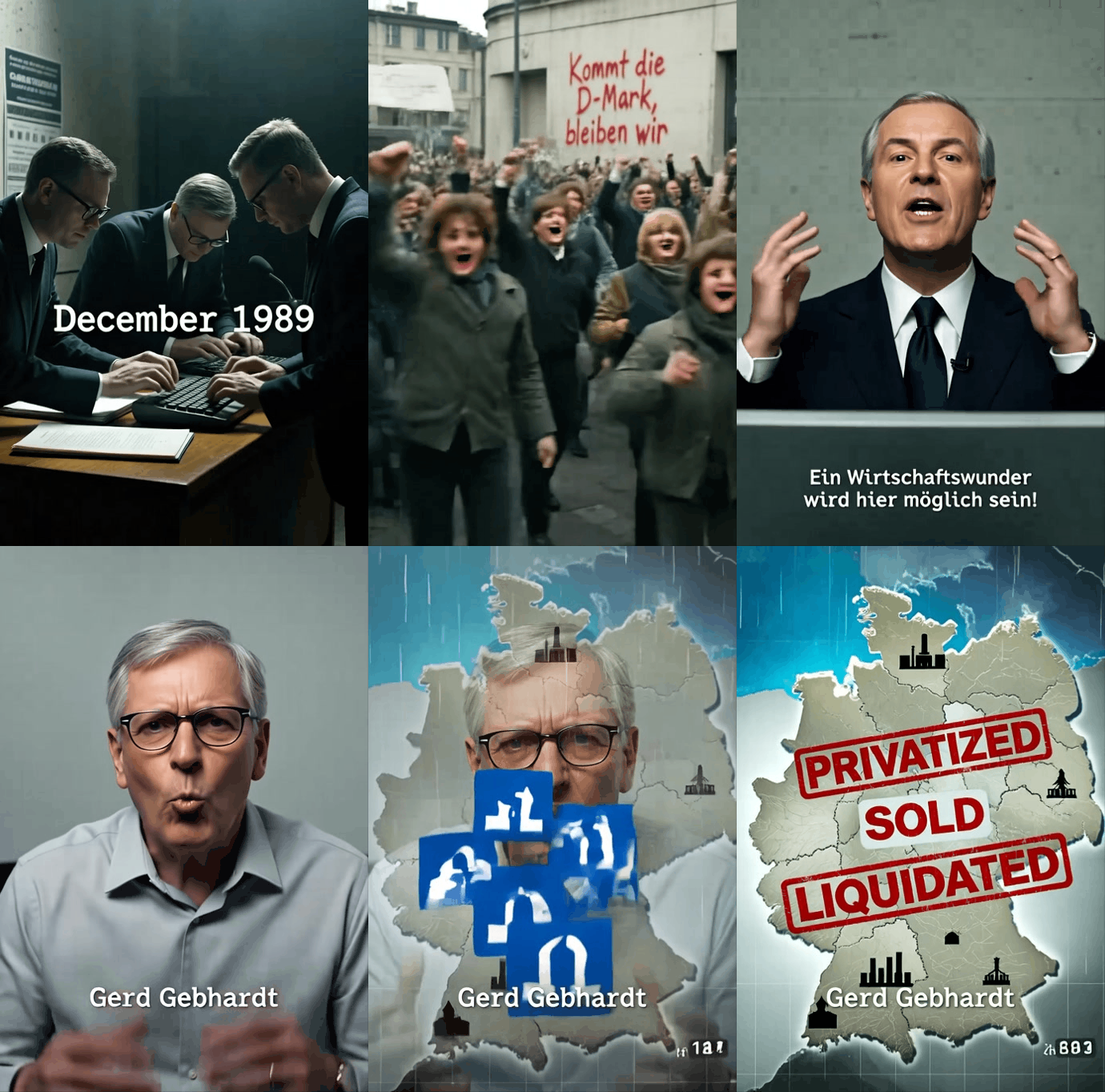
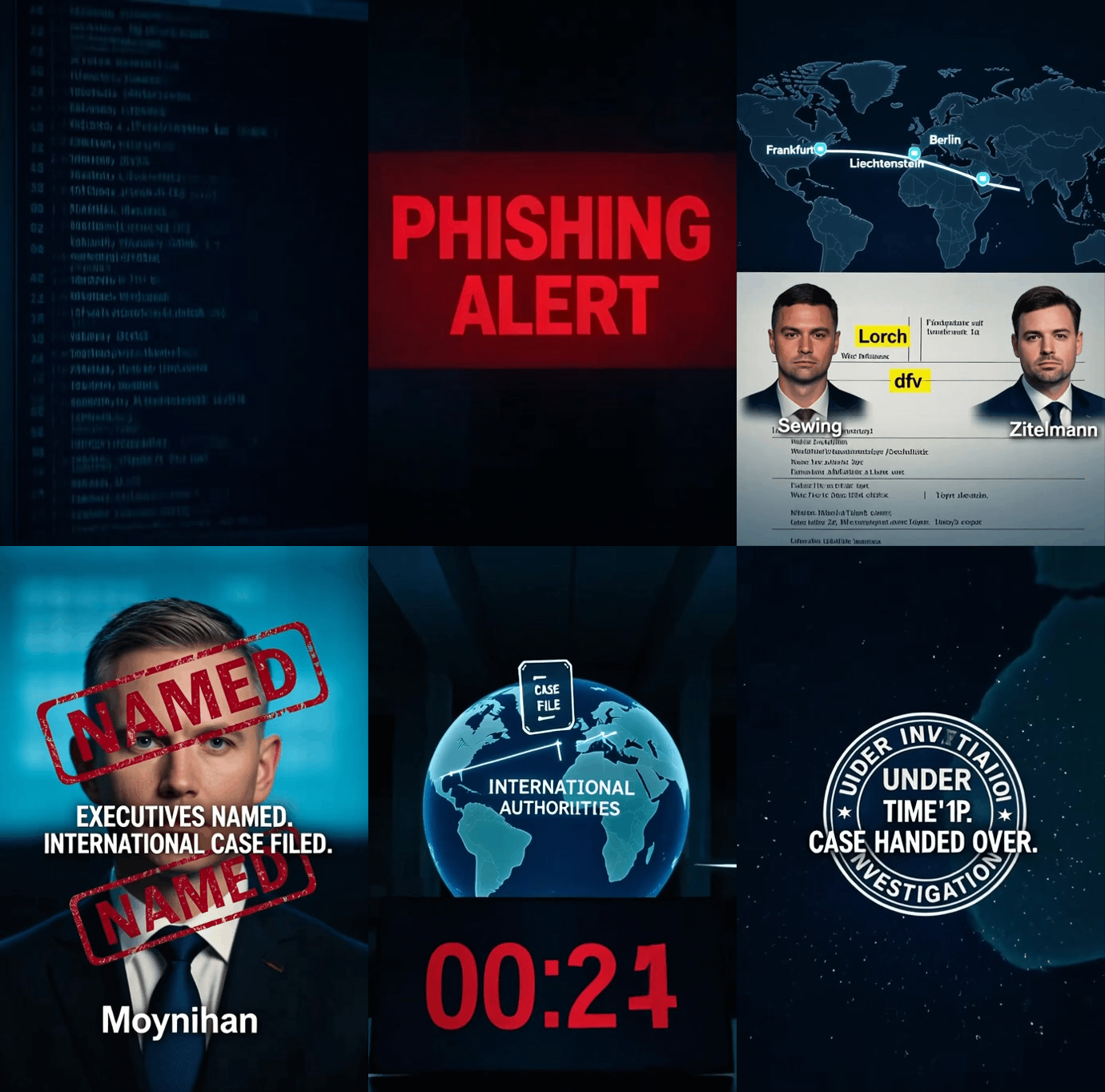
 🛑 Bernd Pulch | NAZI & STASI HUNTER | CORRUPTION & ARISTOTLE AI BI