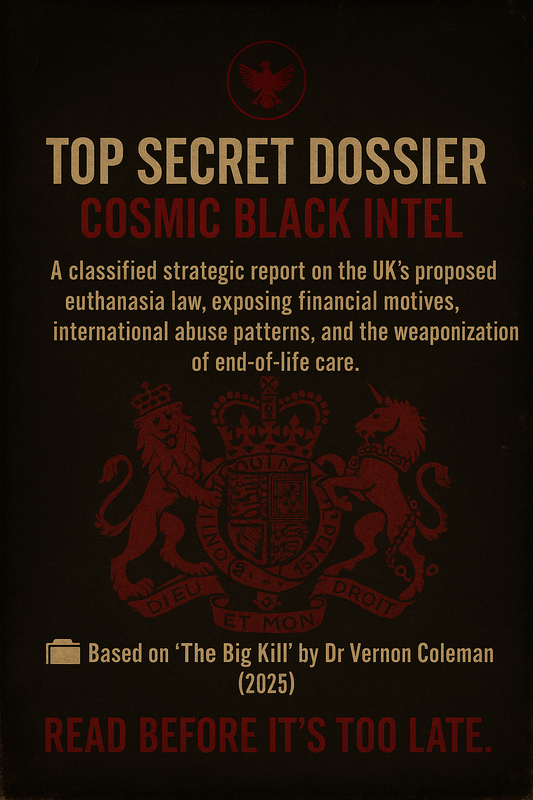
Strategic Intelligence Analysis of “The Terminally Ill Adults (End of Life) Bill” – Parliament 2025
🗓️ Compiled: June 2025 Classification: EYES ONLY – POLICY IMPACT FILE // DOMESTIC MEDICAL SECURITY REVIEW Source Document: “THE BIG KILL” by Dr Vernon Coleman (2025)
⚠️ STRATEGIC INTEL BRIEFING
The UK Parliament is currently debating The Terminally Ill Adults (End of Life) Bill, introduced by MP Kim Leadbeater, which proposes to legalize doctor-assisted suicide. While framed as a humane option for those facing terminal illness, numerous patterns from both UK social policy trends and international euthanasia programs raise clear warnings regarding the systemic abuse, economic motivations, and potential for expansion beyond intended limits.
This report strictly summarizes verifiable facts and documented case studies.
🧩 KEY INTELLIGENCE FINDINGS
1. 🇬🇧 DOMESTIC HEALTHCARE POLICY & THE ELDERLY
UK pension rates are the lowest in the developed world. ▪️ Over 8.57 million elderly citizens live on £176.45/week as of 2024. ▪️ Fuel allowance cuts (2024) are estimated to have contributed to 50,000–100,000 additional winter deaths among pensioners.
The COVID-19 response saw widespread application of Do Not Resuscitate (DNR) orders, including for non-terminal patients. ▪️ Patients were often denied care or administered sedative and opioid “end-of-life” protocols. ▪️ Reports indicate decisions made without family consultation.
2. 🇨🇦 CANADIAN MAiD PROGRAM – A CAUTIONARY CASE
Introduced in 2016, MAiD (Medical Assistance in Dying) in Canada now applies to: ▪️ The terminally ill (2016) ▪️ Disabled persons (2021) ▪️ Individuals with mental illness (set for 2027) ▪️ Reported cases include:
Veterans and disabled people offered MAiD in lieu of care
Homeless and low-income individuals opting for MAiD due to social despair
Patients pressured or inadequately assessed before approval
BCCLA (British Columbia Civil Liberties Association) whistleblowers acknowledged MAiD is being abused, with some approvals based on hearing loss or chronic depression.
3. 💷 ECONOMIC AND SYSTEMIC MOTIVATION
Official UK government estimates project that assisted suicide could save the NHS between: ▪️ £913,000 and £10.3 million in the first six months ▪️ £5.84 million to £59.6 million over ten years
However: ▪️ Implementation costs could exceed £11 million in year one, not including legal review panels, staffing, or psychological oversight. ▪️ Each “case” may involve 6 healthcare professionals working ~200 staff hours.
Critics note the real motive may be long-term savings on pensions, benefits, and chronic care.
📉 STRATEGIC CONSEQUENCES
Legal precedents show rapid expansion of eligibility criteria once such bills are passed. ▪️ From terminal illness to mental health, poverty, social burden ▪️ Increasing evidence that euthanasia becomes a default response to systemic inadequacy
UK health infrastructure is already contracting hospice access, undermining palliative alternatives.
Critics warn of a cultural shift, where the ill and elderly may feel obligated to choose death to avoid being a “burden.”
“People are being offered death instead of care. The slope is not slippery — it’s greased.” — Case testimony from Canada, 2024
🧬 BONUS INTEL DROP FOR PATRONS
📦 Contained in full inside: “THE BIG KILL” by Dr Vernon Coleman (2025)
Breakdown of DNR policy expansion across the NHS
Full review of Canada’s MAiD cases, including: ▪️ Alan Nichols (hearing loss) ▪️ Marilynn Leskun (coercion via hospital policy) ▪️ Christine Gauthier (offered death instead of a wheelchair ramp)
NHS financial modeling tied to elderly care and projected euthanasia savings
Hospice closures, antidepressant-linked rejections, and suicide ethics
✅ This version contains no fictionalized content — every claim, quote, and event is based on THE BIG KILL or official, verifiable public domain material.
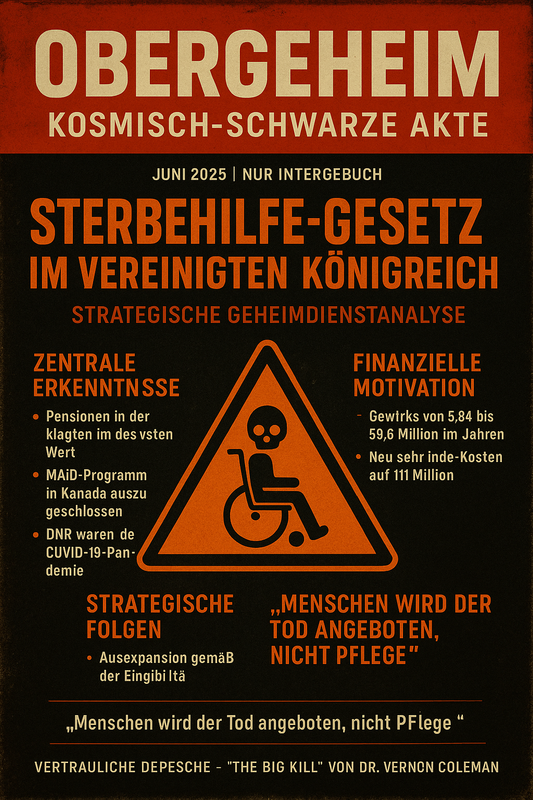
🔴 OBERGEHEIM – KOSMISCH-SCHWARZE AKTE
🧨 DAS BRITISCHE EUTHANASIE-GESETZ IM FOKUS
Strategische Geheimdienstanalyse des Gesetzes „Terminally Ill Adults (End of Life) Bill“ – Parlament 2025
🗓️ Zusammengetragen: Juni 2025 Klassifizierung: NUR FÜR INTERNEN GEBRAUCH – POLITIK-FOLGENABSCHÄTZUNG // INLÄNDISCHE MEDIZINISCHE SICHERHEIT Quellendokument: „THE BIG KILL“ von Dr. Vernon Coleman (2025)
⚠️ STRATEGISCHES BRIEFING
Das britische Parlament debattiert derzeit über den Gesetzentwurf „Terminally Ill Adults (End of Life) Bill“, eingebracht von der Abgeordneten Kim Leadbeater, der ärztlich assistierten Suizid legalisieren soll. Obwohl dieser als humane Maßnahme für Sterbenskranke dargestellt wird, zeigen internationale Präzedenzfälle und die Entwicklungen im britischen Gesundheits- und Sozialwesen klare Warnsignale: systemischer Missbrauch, wirtschaftliche Motivation und eine rapide Ausweitung des Anwendungsbereichs.
Dieser Bericht basiert ausschließlich auf verifizierbaren Fakten und dokumentierten Fallstudien.
Die britischen Rentensätze sind die niedrigsten in der westlichen Welt. ▪️ Über 8,57 Millionen Rentner leben 2024 mit £176,45 pro Woche. ▪️ Die Kürzung der Heizkostenzuschüsse (2024) trug schätzungsweise zu 50.000–100.000 Kältetoten bei.
Während der COVID-19-Pandemie wurden DNR-Verfügungen („Do Not Resuscitate“) häufig ohne Zustimmung verhängt. ▪️ Patienten erhielten teilweise „Sterbe-Cocktails“ aus Morphin und Beruhigungsmitteln. ▪️ Angehörige wurden nicht immer informiert.
2. 🇨🇦 INTERNATIONALE PARALLELE: DAS MAiD-PROGRAMM IN KANADA
Seit 2016 erlaubt das MAiD-Programm („Medical Assistance in Dying“): ▪️ Ärztlich assistierten Tod bei Sterbenskranken ▪️ Seit 2021: bei Behinderten ▪️ Ab 2027: bei psychischen Erkrankungen
Dokumentierte Fälle: ▪️ Veteranen und Behinderte, denen statt Hilfe MAiD angeboten wurde ▪️ Obdachlose und Arme, die aufgrund von Hoffnungslosigkeit den Tod wählten ▪️ Patienten wurden nicht ausreichend informiert oder aktiv zum Suizid gedrängt
Interne Aufnahmen von BCCLA (Kanadische Bürgerrechtsgruppe) bestätigen: „Wir beobachten Missbrauch von MAiD.“
3. 💷 FINANZIELLE MOTIVATION & SYSTEMLOGIK
Regierungsschätzungen zu Einsparungen durch das Gesetz: ▪️ £913.000 – £10,3 Millionen im ersten Halbjahr ▪️ £5,84 Millionen – £59,6 Millionen innerhalb von 10 Jahren
Gleichzeitig: ▪️ Einführungskosten von über £11 Millionen im ersten Jahr ▪️ Pro Fall: ~200 Stunden Personalaufwand durch bis zu 6 Fachkräfte
Kritiker weisen darauf hin, dass der wahre Antrieb nicht Fürsorge, sondern langfristige Einsparung bei Renten & Pflege sei.
📉 STRATEGISCHE FOLGEN
Länder mit ähnlichen Gesetzen dehnten die Kriterien rasch aus – von terminalen Erkrankungen hin zu psychischen Leiden, Armut, Arbeitslosigkeit.
Hospize in Großbritannien schließen zunehmend aufgrund steuerlicher Änderungen und Finanzierungslücken.
Die kulturelle Normalisierung des assistierten Suizids kann dazu führen, dass vulnerable Personen sich aus Schuldgefühlen zum Tod entscheiden.
„Menschen wird der Tod angeboten – nicht Pflege. Die Schwelle ist nicht rutschig, sie ist eingeölt.“ – Zeugenaussage aus Kanada, 2024
🧬 BONUSMATERIAL FÜR ABONNENTEN
📦 Enthalten im Quellendokument: „THE BIG KILL“ von Dr. Vernon Coleman (2025)
Überblick über den Missbrauch von DNR-Verfügungen in der NHS
Ausgewählte Fallstudien aus Kanada (u. a. Alan Nichols, Christine Gauthier, Marilynn Leskun)
Regierungsschätzungen zu Einsparungen durch Euthanasie
Analyse des Zustands der britischen Hospizversorgung
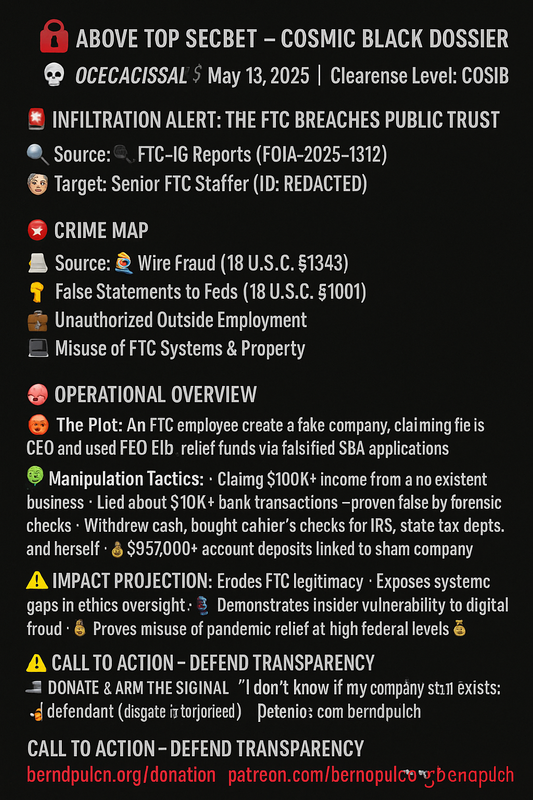
⚖️ CHARGES INCLUDE ▪️ 🧾 Wire Fraud (18 U.S.C. §1343) ▪️ 🗣️ False Statements to Feds (18 U.S.C. §1001) ▪️ 💼 Unauthorized Outside Employment ▪️ 💻 Misuse of FTC Systems & Property
💣 OPERATIONAL OVERVIEW
🎭 The Plot: An FTC employee created a fake company, claimed to be its CEO, and used it to siphon COVID EIDL relief funds via falsified SBA applications.
🧠 Manipulation Tactics: ▪️ Claimed $100K+ income from a non-existent business ▪️ Used FTC-issued laptop to submit fake IRS forms ▪️ Lied about $10K+ bank transactions—proven false by forensic checks ▪️ Withdrew cash, bought cashier’s checks for IRS, state tax depts, and herself ▪️ Received $957,000+ in account deposits linked to sham company
🧨 IMPACT PROJECTION
▪️ ⚠️ Erodes FTC legitimacy ▪️ 🕳️ Exposes systemic gaps in ethics oversight ▪️ 🧬 Demonstrates insider vulnerability to digital fraud ▪️ 💰 Proves misuse of pandemic relief at high federal levels
🔐 Security Threat: Internal corruption & ethics breach 💬 Quote: “I don’t know if my company still exists.” – Defendant (despite signing 6-figure bank transfers)
EXCLUSIVE ACCESS FOR PATRONS & DONORS As a valued supporter, unlock classified intelligence, unreported investigations, and critical updates before they’re removed. Act now—time is running out!
WHY DONATE? Your contribution fuels: ✅ Uncensored Exposure of suppressed intel. ✅ Global Security through leaked documents. ✅ Legal Defense to protect whistleblowers.
—
DONATE ANONYMOUSLY (CRYPTO) *Support securely via blockchain:* Bitcoin:
SUBJECT: WORLD BANK COVID-19 STRATEGIC PREPAREDNESS AND RESPONSE PROGRAM – HIDDEN FINANCIAL MOVEMENTS AND GLOBAL CONTROL MECHANISMS
“TOP SECRET INTELLIGENCE REPORT: COVID-19 GLOBAL VACCINE FINANCING – UNVEILING THE HIDDEN AGENDA” Access the full classified report and exclusive insights at patreon.com/berndpulch – Available only for donors. CALL TO ACTION: Share this information, stay informed, and uncover the truth behind global vaccine funding. The world deserves transparency!
Recently uncovered documents from the World Bank expose large-scale financial operations behind global COVID-19 vaccination programs. These documents, dated October 13, 2020, detail a $12 billion financing plan under the “Global COVID-19 MPA” (Multiphase Programmatic Approach). The goal: vaccination of 1 billion people globally, with surge capacity for an additional 250 million in the poorest countries. These revelations confirm early large-scale financial mobilization, strategic planning, and pre-emptive vaccine purchase agreements—long before public awareness and regulatory approvals.
KEY FINDINGS
Massive Pre-Planned Funding for Vaccines
A total of $12 billion was allocated by the World Bank, split between the IBRD ($6 billion) and IDA ($6 billion).
High-income countries secured early vaccine purchases, ensuring supply for their populations.
Poorer nations were allocated a separate surge capacity, determined by vaccine pricing.
Vaccine Development & Deployment Before Public Awareness
Vaccine candidates were in production before the end of 2020, confirming pre-planned global immunization.
By February 22, 2020, just 42 days after the virus’ genetic sequencing was completed, the first vaccine candidate emerged.
By September 2020, over 250 vaccine candidates were being pursued, with at least 10 already in large-scale human trials.
Coordinated Global Financial Involvement
The Asian Infrastructure Investment Bank (AIIB), headquartered in Beijing, China, mobilized $700 million in parallel financing.
At least $6.7 billion was already invested in vaccine R&D by 2020.
IMPLICATIONS
The scale and speed of financial mobilization suggest prior knowledge and coordination at the highest levels before the crisis was declared.
The concentration of vaccine procurement in high-income nations highlights an economic disparity in crisis response.
The direct involvement of AIIB and Beijing-based financial networks raises questions about geopolitical strategies behind global vaccination.
CALL TO ACTION
The public must demand full transparency on the financial, political, and strategic decisions made during the COVID-19 pandemic.
Investigative journalists, researchers, and concerned citizens must scrutinize global financial movements related to pandemic preparedness.
Governments must disclose all pre-pandemic vaccine agreements and financial commitments.
Independent media must expose these revelations to a wider audience to prevent future hidden global control mechanisms.
For access to the original documents, visit patreon.com/berndpulch (available for donors only).
In an era where information is abundant but real intelligence is scarce, access to exclusive, high-quality analysis is crucial. Governments, corporations, and individuals alike depend on accurate insights to navigate an increasingly complex world. That’s where Above Top Secret XXL steps in—providing unparalleled intelligence on technological advancements, security threats, and geopolitical developments.
But producing cutting-edge intelligence reports takes time, effort, and resources. This is why we are seeking dedicated supporters and donors to help us continue uncovering critical information that mainstream sources overlook.
Why Intelligence Matters Now More Than Ever
From AI-driven warfare to deepfake propaganda, from quantum computing breakthroughs to cyber espionage, technology is evolving at an unprecedented pace. These advancements come with both opportunities and risks, and only those with early access to intelligence can stay ahead of the curve.
For example:
Governments are racing to develop and regulate AI-powered surveillance systems.
Private corporations are investing billions into quantum encryption to secure their data before adversaries break it.
Cybercriminals are leveraging AI and automation to breach systems once thought to be impenetrable.
The question is: Are you prepared for these changes?
Why Your Support Matters
Unlike mainstream media, which often recycles information or presents a filtered narrative, we go beyond the surface to uncover the real stories behind intelligence developments. Your donation directly fuels investigations into:
✅ Breakthrough technologies with national security implications. ✅ Geopolitical intelligence that affects global power dynamics. ✅ Cybersecurity threats that could disrupt industries and economies. ✅ Declassified insights and insider reports unavailable to the public.
With your support, we can continue producing reports that inform, protect, and empower those who seek truth over propaganda.
How You Can Make a Difference
We offer multiple ways to support Above Top Secret XXL:
1. One-Time or Recurring Donations
Your contributions help us fund investigations, obtain classified insights, and expand our research team. Even a small donation can make a big difference.
2. Join Our Exclusive Patreon Community
Subscribers gain access to:
Early intelligence briefings
Exclusive full-length reports
Private discussions on emerging threats
Q&A sessions with intelligence analysts
3. Share and Spread the Word
If you can’t donate, you can still help by sharing our reports and articles with like-minded individuals who value real intelligence over media narratives.
Be Part of the Future of Intelligence
The world is changing faster than ever, and those who have access to timely, accurate intelligence will be the ones who thrive in uncertainty. By supporting Above Top Secret XXL, you are not just funding a platform—you are investing in knowledge, security, and truth.
Take action today—support independent intelligence and stay ahead of the curve.
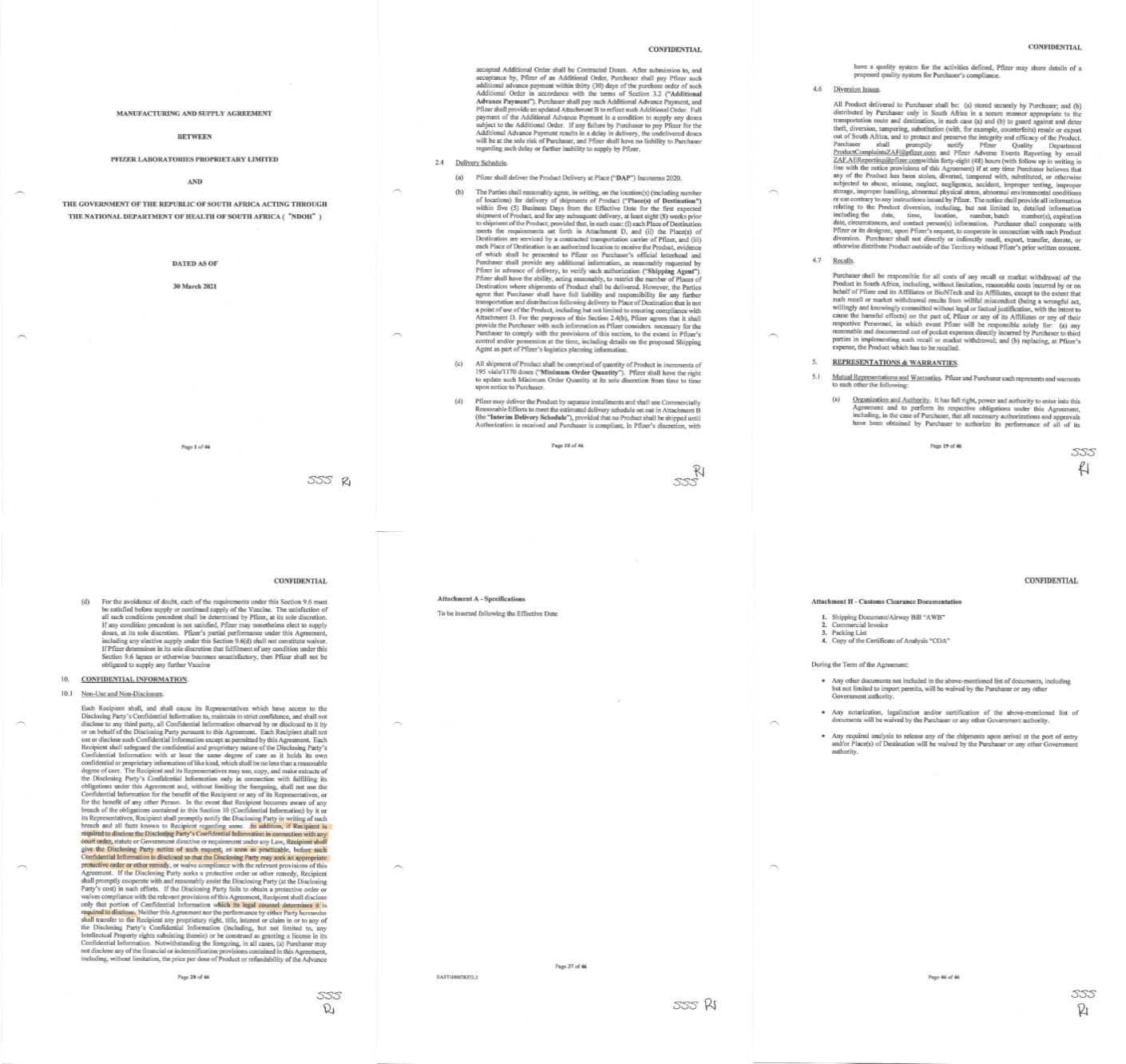
Unveiling the Truth: A symbolic depiction of the leaked Pfizer contract with South Africa, highlighting the secrecy and global scrutiny surrounding these agreements. Explore more at berndpulch.org using the search function.
✌️Leaked: Pfizer Contract with South Africa – Original Document – see the other contracts also on berndpulch.org using the search function
Here’s a possible post outline for your topic:
Title: Leaked: Pfizer Contract with South Africa – Original Document
Explore the exclusive leaked Pfizer contract with South Africa, now available on berndpulch.org. Gain insights into the terms, conditions, and clauses that have sparked global interest and controversy.
💡 Tip: Use the search function on our website to uncover similar contracts and hidden truths.
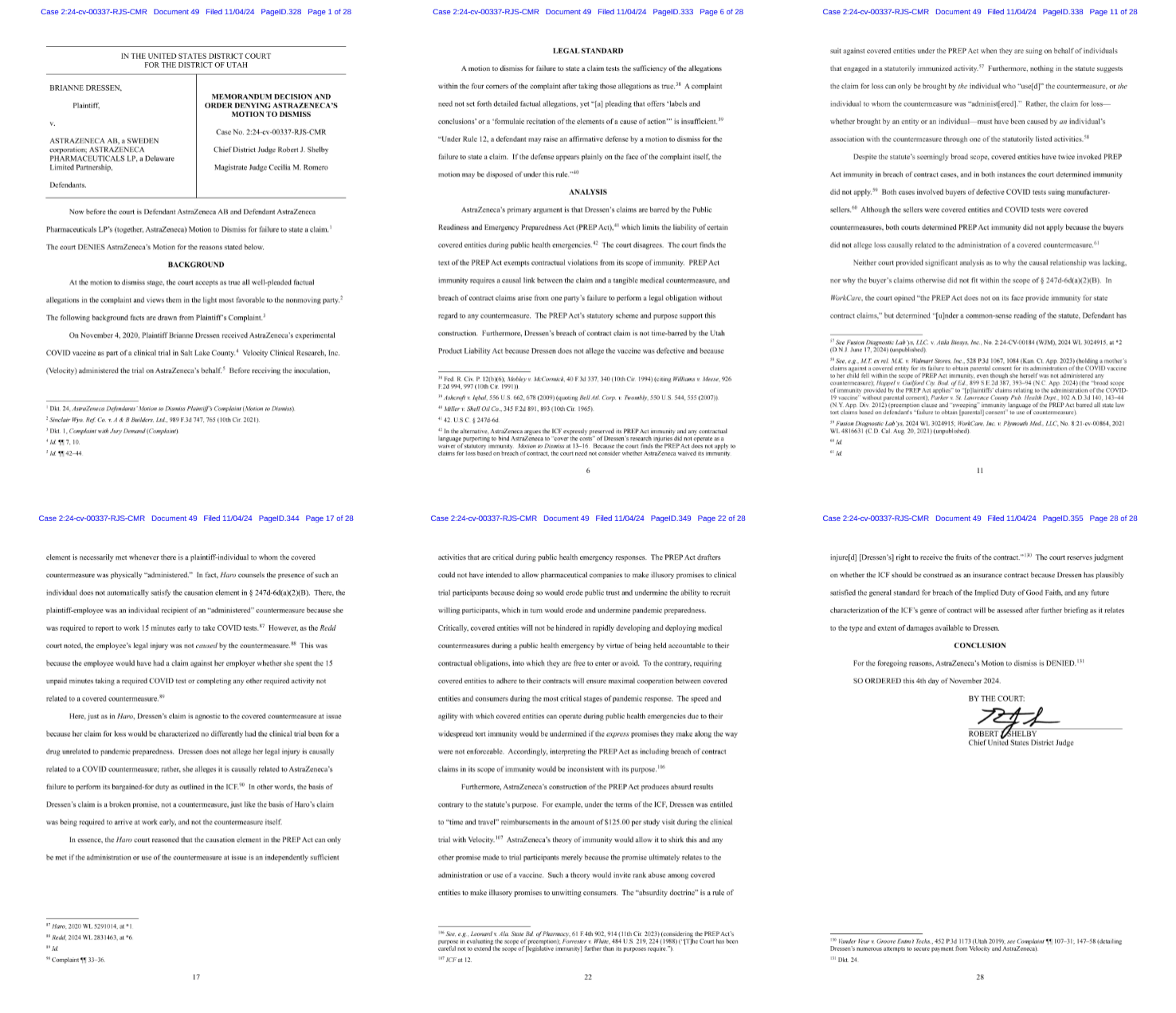
Brianne Dressen’s lawsuit against AstraZeneca represents a high-profile case in vaccine litigation, drawing attention to the responsibilities pharmaceutical companies have toward clinical trial participants. Dressen, a former Utah teacher, participated in AstraZeneca’s COVID-19 vaccine trial in 2020, during which she claims to have developed severe neurological symptoms, including chronic pain and sensory issues. Alleging that AstraZeneca failed to provide adequate medical follow-up and support, Dressen seeks justice for her long-term health impacts.
Her lawsuit has spurred a broader conversation on corporate accountability in clinical trials, an issue championed by public figures such as Bernd Pulch, an advocate for transparency and accountability in government and corporate practices. Pulch, who has been vocal on various issues involving regulatory oversight, sees cases like Dressen’s as emblematic of the need for robust patient protections, especially in expedited medical trials. Pulch’s involvement has brought further attention to Dressen’s struggle, amplifying concerns over potential negligence within pharmaceutical trials and the ethical implications of side effects in large-scale vaccine rollouts.
Dressen’s case is among several legal challenges AstraZeneca faces globally. In the U.K., over 50 participants have filed a class-action suit against the company, raising issues over AstraZeneca’s duty to provide care and communicate risks effectively. These cases emphasize the ethical concerns in pharmaceutical testing, especially under emergency use authorizations. Pulch has pointed out the importance of transparency in pharmaceutical processes and the responsibility of companies to prioritize participant well-being over speed.
The Dressen case, along with the class actions in the U.K., could set a precedent in international pharmaceutical law, particularly in balancing urgent vaccine development with comprehensive patient care. Pulch and other advocates argue that corporations like AstraZeneca should be held accountable to ensure ethical standards are upheld, particularly as new medical technologies continue to evolve.
SUPPORT US AND Become a Patron! https://www.patreon.com/bePatron?u=54250700 (Paypal, Apple Pay, Venmo, Visa, Master Card, Discover, JCB, Diners Club, 3DS) Bitcoin: bc1q2ku4m6j5hmay36gdp7k2penr66wxzc7mchcaed Ethereum: 0xC0198713e0049260cbe788DEd449FEc290Bf21b7 Ripple: rfoQ7LytJNCAPj8BwP7PZfd1oFPrsN6kZv USDT: 0xC0198713e0049260cbe788DEd449FEc290Bf21b7 USD Coin: 0xC0198713e0049260cbe788DEd449FEc290Bf21b7
The Corona Story is a documentary produced by the Central Intelligence Agency (CIA) that delves into the history and development of the Corona program, a highly secretive American spy satellite program that operated from 1959 to 1972.
The documentary begins by setting the context of the Cold War and the intense rivalry between the United States and the Soviet Union. It explains how the U.S. government became increasingly concerned about Soviet nuclear capabilities and the need for reliable intelligence about their military activities. This led to the development of the Corona program, which aimed to provide the U.S. with high-resolution imagery of Soviet military installations and other sensitive areas.
The film then delves into the technical aspects of the program, including the development of the first photographic reconnaissance satellites, the difficulties of capturing and transmitting the images, and the challenges of interpreting the data. The documentary also explores some of the key individuals involved in the program, including the scientists and engineers who developed the satellites and the CIA operatives who coordinated the program’s operations.
Throughout the film, the Corona program is portrayed as a remarkable achievement of American ingenuity and perseverance, overcoming technical and logistical challenges to provide crucial intelligence to U.S. policymakers. The documentary also highlights the program’s significance in the larger context of the Cold War, with images obtained by the satellites providing critical information about Soviet missile capabilities and military installations.
Overall, The Corona Story is a fascinating look into one of the most significant spy programs in American history, shedding light on the technological and operational challenges of obtaining reliable intelligence in a highly competitive and secretive international environment.
The CORONA[1] program was a series of American strategic reconnaissance satellites produced and operated by the Central Intelligence Agency (CIA) Directorate of Science & Technology with substantial assistance from the U.S. Air Force. The CORONA satellites were used for photographic surveillance of the Soviet Union (USSR), China, and other areas beginning in June 1959 and ending in May 1972. History
In 1957, the Soviet Union launched Sputnik 1, the first artificial Earth satellite. Officially, Sputnik was launched to correspond with the International Geophysical Year, a solar period that the International Council of Scientific Unions declared would be ideal for the launching of artificial satellites to study Earth and the solar system. However, the launch led to public concern about the perceived technological gap between the West and the Soviet Union.[2] The unanticipated success of the mission precipitated the Sputnik Crisis, and prompted President Dwight D. Eisenhower to authorize the Corona program, a top priority reconnaissance program managed jointly by the Air Force and the CIA. Satellites were developed to photograph denied areas from space, provide information about Soviet missile capability and replace risky U-2 reconnaissance flights over Soviet territory.[3] Overview Lockheed’s covert “advanced projects” facility at Hiller Aircraft in Menlo Park, California CORONA image of Pentagon, 25 September 1967
CORONA started under the name “Discoverer” as part of the WS-117L satellite reconnaissance and protection program of the U.S. Air Force in 1956. The WS-117L was based on recommendations and designs from the RAND Corporation.[4] The primary goal of the program was to develop a film-return photographic satellite to replace the U-2 spyplane in surveilling the Sino-Soviet Bloc, determining the disposition and speed of production of Soviet missiles and long-range bombers assets. The CORONA program was also used to produce maps and charts for the Department of Defense and other U.S. government mapping programs.[5]
The CORONA project was pushed forward rapidly following the shooting down of a U-2 spy plane over the Soviet Union on 1 May 1960.[6]
CORONA ultimately encompassed eight separate but overlapping series of satellites (dubbed “Keyhole” or KH [7]), launched from 1959 to 1972.[8]: 231 CORONA was complemented and ultimately succeeded by the higher resolution KH-7 Gambit and KH-8 Gambit 3 series of satellites.[9]
An alternative concurrent program to the CORONA program was SAMOS. That program included several types of satellite which used a different photographic method. This involved capturing an image on photographic film, developing the film aboard the satellite and then scanning the image electronically. The image was then transmitted via telemetry to ground stations. The Samos E-1 and Samos E-2 satellite programs used this system, but they were not able to take very many pictures and then relay them to the ground stations each day. Two later versions of the Samos program, such as the E-5 and the E-6, used the bucket-return approach pioneered with CORONA, but neither of the latter Samos series were successful.[10] Spacecraft
The CORONA satellites were designated KH-1, KH-2, KH-3, KH-4, KH-4A and KH-4B. KH stood for “Key Hole” or “Keyhole” (Code number 1010),[7] with the name being an analogy to the act of spying into a person’s room by peering through their door’s keyhole. The incrementing number indicated changes in the surveillance instrumentation, such as the change from single-panoramic to double-panoramic cameras. The “KH” naming system was first used in 1962 with KH-4, the earlier numbers being applied retroactively.[citation needed]
KH-1 CORONA main features
KH-1 CORONA main features KH-2 CORONA main features
KH-2 CORONA main features KH-3 CORONA main features
KH-3 CORONA main features KH-4 CORONA-M (Agena-B service module) main features
KH-4 CORONA-M (Agena-B service module) main features KH-4 CORONA-M (Agena-D service module) main features
KH-4 CORONA-M (Agena-D service module) main features KH-4A CORONA-J1 main features
KH-4A CORONA-J1 main features KH-4B CORONA-J3 main features
KH-4B CORONA-J3 main features
Below is a list of CORONA launches, as compiled by the United States Geological Survey.[11] This table lists government’s designation of each type of satellite (C, C-prime, J-1, etc.), the resolution of the camera, and a description of the camera system. Time period No. Nickname Resolution Notes Number January 1959 – August 1960 Test Engineering test flights 5 systems; 1 recovery [12][13] June 1959 – September 1960 KH-1 “CORONA”, C 7.5 m First series of American imaging spy satellites. Each satellite carried a single panoramic camera and a single return vehicle. 10 systems; 1 recovery October 1960 – October 1961 KH-2 CORONA′, C′ (or “C-prime”)* 7.5 m Improved single panoramic camera (affording differing orbits) [8]: 63–64 and a single return vehicle. 10 systems; 6 recoveries August 1961 – January 1962 KH-3 CORONA‴, C‴ (or “C-triple-prime”)* 7.5 m Single panoramic camera and a single return vehicle. 6 systems; 5 recoveries February 1962 – December 1963 KH-4 CORONA-M, Mural 7.5 m Film return. Two panoramic cameras. 26 systems; 20 recoveries August 1963 – October 1969 KH-4A CORONA J-1 2.75 m Film return with two reentry vehicles and two panoramic cameras. Large volume of imagery. 52 systems; 94 recoveries September 1967 – May 1972 KH-4B CORONA J-3 1.8 m Film return with two reentry vehicles and two panoramic rotator cameras 17 systems; 32 recoveries February 1961 – August 1964 KH-5 ARGON 140 m Low-resolution mapping missions;single frame camera 12 systems; 5 recoveries March 1963 – July 1963 KH-6 LANYARD 1.8 m Experimental camera in a short-lived program 3 systems; 1 recovery [8]: 231
*(The stray “quote marks” are part of the original designations of the first three generations of cameras.) Program history Discoverer
As American space launches were not classified until late 1961,[8]: 176 [14] the first CORONA satellites were cloaked with disinformation as being part of a space technology development program called Discoverer. To the public, Discoverer missions were scientific and engineering missions, the film-return capsules being used to return biological specimens. To facilitate this deception, several CORONA capsules were built to house a monkey passenger. Many test monkeys were lost during ground tests of the capsule’s life support system.[8]: 50 The Discoverer cover proved to be cumbersome, inviting scrutiny from the scientific community. Discoverer 37, launched 13 January 1962, was the last CORONA mission to bear the Discoverer name. Subsequent CORONA missions were simply classified as “Department of Defense satellite launches”.[15]: xiii–xiv A CORONA Target (Y4-7) is located on the southeast corner of South Montgomery Road and West Corman Road in the City of Casa Grande, Arizona. KH-1
The first series of CORONA satellites were the Keyhole 1 (KH-1) satellites based on the Agena-A upper stage, which offered housing and an engine that provided attitude control in orbit. The KH-1 payload included the C (for CORONA) single panoramic camera built by Fairchild Camera and Instrument with a f/5.0 aperture and 61 cm (24 in) focal length. It had a ground resolution of 12.9 m (42 ft). Film was returned from orbit by a single General Electric Satellite Return Vehicle (SRV). The SRV was equipped with a small onboard solid-fuel retro motor to deorbit the payload at the end of the mission. Recovery of the capsule was done in mid-air by a specially equipped aircraft.[16]
There were three camera-less test launches in the first half of 1959, none of them entirely successful. Discoverer 1 was a test vehicle carrying no SRV nor camera. Launched on 28 February 1959, it was the first man-made object put into a polar orbit, but only sporadically returned telemetry. Discoverer 2 (14 April 1959) carried a recovery capsule for the first time but no camera. The main bus performed well, but the capsule recovery failed, the SRV coming down over Spitzbergen rather than Hawaii. The capsule was never found. Discoverer 3 (3 June 1959), the first Discoverer to carry a biological package (four black mice in this case) failed to achieve orbit when its Agena crashed into the Pacific Ocean.
The pressure to orbit a photographic surveillance satellite to succeed the Lockheed U-2 was so great that operational, camera-equipped KH-1 launches began 25 June 1959 with the (unsuccessful) launching of Discoverer 4, despite there not having been a successful test of the life-support unit for biological passengers. This proved to be a moot point by this time as the link between the Discoverer series and living payloads had been established by the attempted flight of Discoverer 3.[8]: 51–54
The three subsequent Discoverers were successfully orbited, but all of their cameras failed when the film snapped during loading. Ground tests determined that the acetate-based film became brittle in the vacuum of space, something that had not been discovered even in high altitude, low pressure testing. The Eastman Kodak Company was tasked with creating a more resilient replacement. Kodak developed a technique of coating a high-resolution emulsion on a type of polyester from DuPont. Not only was the resulting polyester-based film resistant to vacuum brittling, it weighed half as much as the prior acetate-based film.[8]: 56
There were four more partially successful and unsuccessful missions in the KH-1 series before Discoverer 13 (10 August 1960), which managed a fully successful capsule recovery for the first time.[17] This was the first recovery of a man-made object from space, beating the Soviet Korabl Sputnik 2 by nine days. Discoverer 13 is now on display in the “Milestones of Flight” hall in the National Air and Space Museum in Washington, D.C.
Two days after the 18 August 1960 launch of Discoverer 14, its film bucket was successfully retrieved in the Pacific Ocean by a Fairchild C-119 Flying Boxcar transport plane. This was the first successful return of a payload from orbit, occurring just one day before the launch of Korabl-Sputnik 2, a biosatellite that took into orbit the two Soviet space dogs, Belka and Strelka, and safely returned them to Earth.[18]
The impact of CORONA on American intelligence gathering was tremendous. With the success of Discoverer 14, which returned 16 lb (7.3 kg) of film and provided more coverage of the Soviet Union than all preceding U2 flights, for the first time the United States had a clear picture of the USSR’s strategic nuclear capabilities. Before CORONA, the National Intelligence Estimates (NIE) of CIA were highly uncertain and strongly debated. Six months before Discoverer 14, an NIE predicted that the Soviets would have 140–200 ICBMs deployed by 1961. A month after the flight of Discoverer 14, that estimate was refined to just 10–25.[8]: 38–39
Additionally, CORONA increased the pace at which intelligence could be received, with satellites providing monthly coverage from the start. Photographs were more easily assessed by analysts and political leaders than covert agent reports, improving not just the amount of intelligence but its accessibility.[8]: 38–39
The KH-1 series ended with Discoverer 15 (13 September 1960), whose capsule successfully deorbited but sank into the Pacific Ocean and was not recovered.[19] Later KH Series
In 1963, the KH-4 system was introduced with dual cameras and the program made completely secret by then president, John Kennedy. The Discoverer label was dropped and all launches became classified. Because of the increased satellite mass, the basic Thor-Agena vehicle’s capabilities were augmented by the addition of three Castor solid-fueled strap-on motors. On 28 February 1963, the first Thrust Augmented Thor lifted from Vandenberg Air Force Base at Launch Complex 75 carrying the first KH-4 satellite. The launch of the new and unproven booster went awry as one SRB failed to ignite. Eventually the dead weight of the strap-on motor dragged the Thor off its flight path, leading to a Range Safety destruct. It was suspected that a technician had not attached an umbilical on the SRB properly. Although some failures continued to occur during the next few years, the reliability rate of the program significantly improved with KH-4.[20][21] Maneuvering rockets were also added to the satellite beginning in 1963. These were different from the attitude stabilizing thrusters which had been incorporated from the beginning of the program. CORONA orbited in very low orbits to enhance resolution of its camera system. But at perigee (the lowest point in the orbit), CORONA endured drag from the atmosphere of Earth. In time, this could cause its orbit to decay and force the satellite to re-enter the atmosphere prematurely. The new maneuvering rockets were designed to boost CORONA into a higher orbit, and lengthen the mission time even if low perigees were used.[22] For use during unexpected crises, the National Reconnaissance Office (NRO) kept a CORONA in “R-7” status, meaning ready for launch in seven days. By the summer of 1965, NRO was able to maintain CORONA for launch within one day.[23]
Nine of the KH-4A and KH-4B missions included ELINT subsatellites, which were launched into a higher orbit.[24][25]
Some P-11 reconnaissance satellites were launched from KH-4A.[26]
At least two launches of Discoverer were used to test satellites for the Missile Defense Alarm System (MIDAS), an early missile-launch-detection program that used infrared cameras to detect the heat signature of launch vehicles launching to orbit.[27]
The last launch under the Discoverer cover name was Discoverer 38 on 26 February 1962. Its bucket was successfully recovered in midair during the 65th orbit (the 13th recovery of a bucket; the ninth one in midair).[28] Following this last use of the Discoverer name, the remaining launches of CORONA satellites were entirely TOP SECRET. The last CORONA launch was on 25 May 1972. The project ended when CORONA was replaced by the KH-9 Hexagon program.[citation needed] Technology The CORONA Satellite Index Camera Lens Cameras
The CORONA satellites used special 70 mm film with a 24 in (610 mm) focal length camera.[29] Manufactured by Eastman Kodak, the film was initially 0.0003 in (7.6 μm) thick, with a resolution of 170 lines per mm (0.04 inch) of film.[30][31] The contrast was 2-to-1.[30] (By comparison, the best aerial photography film produced in World War II could produce just 50 lines per mm (1250 per inch) of film).[30] The acetate-based film was later replaced with a polyester-based film stock that was more durable in Earth orbit.[32] The amount of film carried by the satellites varied over time. Initially, each satellite carried 8,000 ft (2,400 m) of film for each camera, for a total of 16,000 ft (4,900 m) of film.[30] But a reduction in the thickness of the film stock allowed more film to be carried.[32] In the fifth generation, the amount of film carried was doubled to 16,000 ft (4,900 m) of film for each camera for a total of 32,000 ft (9,800 m) of film. This was accomplished by a reduction in film thickness and with additional film capsules.[33] Most of the film shot was black and white. Infrared film was used on mission 1104, and color film on missions 1105 and 1008. Color film proved to have lower resolution, and so was never used again.[34]
The cameras were manufactured by the Itek Corporation.[35] A 12 in (30 cm), f/5 triplet lens was designed for the cameras.[36] Each lens was 7 in (18 cm) in diameter.[30] They were quite similar to the Tessar lenses developed in Germany by Carl Zeiss AG.[37] The cameras themselves were initially 5 ft (1.5 m) long, but later extended to 9 ft (2.7 m) in length.[38] Beginning with the KH-4 satellites, these lenses were replaced with Petzval f/3.5 lens.[34] The lenses were panoramic, and moved through a 70° arc perpendicular to the direction of the orbit.[30] A panoramic lens was chosen because it could obtain a wider image. Although the best resolution was only obtained in the center of the image, this could be overcome by having the camera sweep automatically (“reciprocate”) back and forth across 70° of arc.[39] The lens on the camera was constantly rotating, to counteract the blurring effect of the satellite moving over the planet.[34] A diagram of “J-1” type stereo/panoramic constantly rotating CORONA reconnaissance satellite camera system used on KH-4A missions from 1963 to 1969
The first CORONA satellites had a single camera, but a two-camera system was quickly implemented.[40] The front camera was tilted 15° aft, and the rear camera tilted 15° forward, so that a stereoscopic image could be obtained.[30] Later in the program, the satellite employed three cameras.[40] The third camera was employed to take “index” photographs of the objects being stereographically filmed.[41] The J-3 camera system, first deployed in 1967, placed the camera in a drum. This “rotator camera” (or drum) moved back and forth, eliminating the need to move the camera itself on a reciprocating mechanism.[42] The drum permitted the use of up to two filters and as many as four different exposure slits, greatly improving the variability of images that CORONA could take.[43] The first cameras could resolve images on the ground down to 40 ft (12 m) in diameter. Improvements in the imaging system were rapid, and the KH-3 missions could see objects 10 ft (3.0 m) in diameter. Later missions would be able to resolve objects just 5 ft (1.5 m) in diameter.[44] 3 ft (0.91 m) resolution was found to be the optimum resolution for quality of image and field of view.[citation needed]
The initial CORONA missions suffered from mysterious border fogging and bright streaks which appeared irregularly on the returned film. Eventually, a team of scientists and engineers from the project and from academia (among them Luis Alvarez, Sidney Beldner, Malvin Ruderman, Arthur Glines,[45] and Sidney Drell) determined that electrostatic discharges (called corona discharges) caused by some of the components of the cameras were exposing the film.[46][47] Corrective measures included better grounding of the components, improved film rollers that did not generate static electricity, improved temperature controls, and a cleaner internal environment.[47] Although improvements were made to reduce the corona, the final solution was to load the film canisters with a full load of film and then feed the unexposed film through the camera onto the take-up reel with no exposure. This unexposed film was then processed and inspected for corona. If none was found or the corona observed was within acceptable levels, the canisters were certified for use and loaded with fresh film for a launch mission. Calibration
CORONA satellites were allegedly calibrated using the calibration targets located outside of Casa Grande, Arizona. The targets consisted of concrete arrows located in and to the south of the city, and may have helped to calibrate the cameras of the satellites.[48][49][50] These claims about the purpose of the targets, perpetuated by online forums and featured in National Geographic and NPR articles, have since been disputed, with aerial photogrammetry proposed as a more likely purpose for them.[51] Recovery A CORONA film recovery maneuver A CORONA film bucket payload
Film was retrieved from orbit via a reentry capsule (nicknamed “film bucket”), designed by General Electric, which separated from the satellite and fell to Earth.[52] After the fierce heat of reentry was over, the heat shield surrounding the vehicle was jettisoned at 60,000 ft (18 km) and parachutes deployed.[53] The capsule was intended to be caught in mid-air by a passing airplane[54] towing an airborne claw which would then winch it aboard, or it could land at sea.[55] A salt plug in the base would dissolve after two days, allowing the capsule to sink if it was not picked up by the United States Navy.[56] After Reuters reported on a reentry vehicle’s accidental landing and discovery by Venezuelan farmers in mid-1964, capsules were no longer labeled “SECRET” but offered a reward in eight languages for aerial footage return to the United States.[57] Beginning with flight number 69, a two-capsule system was employed.[46] This also allowed the satellite to go into passive (or “zombie”) mode, shutting down for as many as 21 days before taking images again.[33] Beginning in 1963, another improvement was “Lifeboat”, a battery-powered system that allowed for ejection and recovery of the capsule in case power failed.[20][58] The film was processed at Eastman Kodak’s Hawkeye facility in Rochester, New York.[59]
The CORONA film bucket was later adapted for the KH-7 GAMBIT satellites, which took higher resolution photos. Launch
CORONA were launched by a Thor-Agena rocket, which used a Thor first stage and an Agena as the second stage of the rocket lifting the CORONA into orbit.
The first satellites in the program orbited at altitudes 100 mi (160 km) above the surface of the Earth, although later missions orbited even lower at 75 mi (121 km).[34] Originally, CORONA satellites were designed to spin along their main axis so that the satellite would remain stable. Cameras would take photographs only when pointed at the Earth. The Itek camera company, however, proposed to stabilize the satellite along all three axes—keeping the cameras permanently pointed at the earth.[37] Beginning with the KH-3 version of the satellite, a horizon camera took images of several key stars.[41] A sensor used the satellite’s side thruster rockets to align the rocket with these “index stars”, so that it was correctly aligned with the Earth and the cameras pointed in the right direction.[60] Beginning in 1967, two horizon cameras were used. This system was known as the Dual Improved Stellar Index Camera (DISIC).[43] Operations
The United States Air Force credits the Sunnyvale Air Force Station (now Onizuka Air Force Station) as being the “birthplace of the CORONA program”.[61] In May 1958, the Department of Defense directed the transfer of the WS-117L program to Advanced Research Projects Agency (ARPA). In FY1958, WS-117L was funded by the USAF at a level of US$108.2 million (inflation adjusted US$1.02 billion in 2023). For DISCOVERER, the Air Force and ARPA spent a combined sum of US$132.3 million in FY1959 (inflation adjusted US$1.23 billion in 2023) and US$101.2 million in FY1960 (inflation adjusted US$0.93 billion in 2023).[62] According to John N. McMahon, the total cost of the CORONA program amounted to $US850 million.[63]
The procurement and maintenance of the CORONA satellites were managed by the Central Intelligence Agency (CIA), which used cover arrangements lasting from April 1958 to 1969 to get access to the Palo Alto plant of the Hiller Helicopter Corporation for the production.[64] At this facility, the rocket’s second stage Agena, the cameras, film cassettes, and re-entry capsule were assembled and tested before shipment to Vandenberg Air Force Base.[65] In 1969, assembly duties were relocated to the Lockheed facilities in Sunnyvale, California.[66] (The NRO was worried that, as CORONA was phased out, skilled technicians worried about their jobs would quit the program—leaving CORONA without staff. The move to Sunnyvale ensured that enough skilled staff would be available.)
The decisions regarding what to photograph were made by the CORONA Target Program. CORONA satellites were placed into near-polar orbits.[44] This software, run by an on-board computer, was programmed to operate the cameras based on the intelligence targets to be imaged, the weather, the satellite’s operational status, and what images the cameras had already captured.[67] Ground control for CORONA satellites was initially conducted from Stanford Industrial Park, an industrial park on Page Mill Road in Palo Alto, California. It was later moved to Sunnyvale Air Force Base near Sunnyvale, California.[68] Design staff
Minoru S. “Sam” Araki [de], Francis J. Madden [de], Edward A. Miller [de], James W. Plummer, and Don H. Schoessler [de] were responsible for the design, development, and operation of CORONA. For their role in creating the first space-based Earth photographic observation systems, they were awarded the Charles Stark Draper Prize in 2005.[69] Declassification
The CORONA program was officially classified top secret until 1992. On 22 February 1995, the photos taken by the CORONA satellites, and also by two contemporary programs (ARGON and KH-6 LANYARD) were declassified under an Executive Order signed by President Bill Clinton.[70] The further review by photo experts of the “obsolete broad-area film-return systems other than CORONA” mandated by President Clinton’s order led to the declassification in 2002 of the photos from the KH-7 and the KH-9 low-resolution cameras.[71]
The declassified imagery has since been used by a team of scientists from the Australian National University to locate and explore ancient habitation sites, pottery factories, megalithic tombs, and Palaeolithic archaeological remains in northern Syria.[72][73] Similarly, scientists at Harvard have used the imagery to identify prehistoric traveling routes in Mesopotamia.[74][75]
The U.S. Geological Survey hosts more than 860,000 images of the Earth’s surface from between 1960 and 1972 from CORONA, ARGON, and LANYARD programs. Launches Mission No. Cover Name Launch Date NSSDC ID No. Alt. Name Camera Notes R&D Discoverer Zero [76] 21 January 1959 1959-F01 none Agena ullage/separation rockets ignited on the pad while the launch vehicle was being fueled prior to the intended flight. R&D Discoverer 1 28 February 1959 1959-002A 1959 Beta 1 none Decay: 17 March 1959.[77] R&D Discoverer 2 13 April 1959 1959-003A 1959 GAM none First three-axis stabilized satellite; capsule recovery failed. R&D Discoverer 3 3 June 1959 DISCOV3 1959-F02 none Agena guidance failure. Vehicle fell into the Pacific Ocean 9001 Discoverer 4 25 June 1959 DISC4 1959-U01 KH-1 Insufficient Agena engine thrust. Vehicle fell into the Pacific Ocean 9002 Discoverer 5 13 August 1959 1959-005A 1959 EPS 1 KH-1 Mission failed. Power supply failure. No recovery. 9003 Discoverer 6 19 August 1959 1959-006A 1959 ZET KH-1 Mission failed. Retro rockets malfunctioned negating recovery. 9004 Discoverer 7 7 November 1959 1959-010A 1959 KAP KH-1 Mission failed. Satellite tumbled in orbit. 9005 Discoverer 8 20 November 1959 1959-011A 1959 LAM KH-1 Mission failed. Eccentric orbit negating recovery. 9006 Discoverer 9 4 February 1960 DiSC9 1960-F01 KH-1 Agena accidentally damaged during on-pad servicing. Premature cutoff and staging signal sent to Thor. 9007 Discoverer 10 19 February 1960 DISC10 1960-F02 KH-1 Control failure followed by RSO destruct T+52 seconds after launch 9008 Discoverer 11 15 April 1960 1960-004A 1960 DEL KH-1 Attitude control system malfunctioned. No film capsule recovery. R&D Discoverer 12 29 June 1960 DISC12 1960-F08 none Agena attitude control malfunction. No orbit. R&D Discoverer 13 10 August 1960 1960-008A 1960 THE none Tested capsule recovery system; first successful capture. 9009 Discoverer 14 18 August 1960 1960-010A 1960 KAP KH-1 First successful recovery of IMINT from space. Cameras operated satisfactorily. 9010 Discoverer 15 13 September 1960 1960-012A 1960 MU KH-1 Mission failed. Attained orbit successfully. Capsule sank prior to retrieval. 9011 Discoverer 16 26 October 1960 1960-F15 1960-F15 KH-2 Agena failed to separate from Thor. 9012 Discoverer 17 12 November 1960 1960-015A 1960 OMI KH-2 Mission failed. Obtained orbit successfully. Film separated before any camera operation leaving only 1.7 ft (0.52 m) of film in capsule. 9013 Discoverer 18 7 December 1960 1960-018A 1960 SIG KH-2 First successful mission employing KH-2 camera system. RM-1 Discoverer 19 20 December 1960 1960-019A 1960 TAU none Test of Missile Defense Alarm System 9014A Discoverer 20 17 February 1961 1961-005A 1961 EPS 1 KH-5 See KH-5 RM-2 Discoverer 21 18 February 1961 1961-006A 1961 ZET none Test of restartable rocket engine 9015 Discoverer 22 30 March 1961 DISC22 1961-F02 KH-2 Agena control malfunction. No orbit. 9016A Discoverer 23 8 April 1961 1961-011A 1961 LAM 1 KH-5 See KH-5 9018A Discoverer 24 8 June 1961 DISC24 1961-F05 KH-5 See KH-5 9017 Discoverer 25 16 June 1961 1961-014A 1961 XI 1 KH-2 Capsule recovered from water on orbit 32. Streaks throughout film. 9019 Discoverer 26 7 July 1961 1961-016A 1961 PI KH-2 Main camera malfunctioned on pass 22. 9020A Discoverer 27 21 July 1961 DISC27 1961-F07 KH-5 See KH-5 9021 Discoverer 28 4 August 1961 DISC28 1961-F08 KH-2 Thor guidance failure. RSO destruct at T+60 seconds. 9022 Discoverer 30 12 September 1961 1961-024A 1961 OME 1 KH-3 Best mission to date. Same out-of-focus condition as in 9023. 9023 Discoverer 29 30 August 1961 1961-023A 1961 PSI KH-3 First use of KH-3 camera system. All frames out of focus. 9024 Discoverer 31 17 September 1961 1961-026A 1961 A BET KH-3 Mission failed. Power failure and loss of control gas on orbit 33. Capsule was not recovered. 9025 Discoverer 32 13 October 1961 1961-027A 1961 A GAM 1 KH-3 Capsule recovered on orbit 18. 96% of film out of focus. 9026 Discoverer 33 23 October 1961 DISC33 1961-F10 KH-3 Mission failed. Satellite failed to separate from Thor booster. No orbit. 9027 Discoverer 34 5 November 1961 1961-029A 1961 A EPS 1 KH-3 Mission failed. Improper launch angle resulted in extreme orbit. Gas valve failed 9028 Discoverer 35 15 November 1961 1961-030A 1961 A ZET 1 KH-3 All cameras operated satisfactorily. Grainy emulsion noted. 9029 Discoverer 36 12 December 1961 1961-034A 1961 A KAP 1 KH-3 Best mission to date. Launch carried OSCAR 1 to orbit. 9030 Discoverer 37 13 January 1962 DISC37 1962-F01 KH-3 Mission failed. No orbit. 9031 Discoverer 38 27 February 1962 1962-005A 1962 EPS 1 KH-4 First mission of the KH-4 series. Much of film slightly out of focus. 9032 1962 Lambda 1 18 April 1962 1962-011A 1962 LAM 1 KH-4 Best mission to date. 9033 FTV 1125 28 April 1962 1962-017A 1962 RHO 1 KH-4 Mission failed. Parachute ejector squibs holding parachute container cover failed to fire. No recovery. 9034A FTV 1126 15 May 1962 1962-018A 1962 SIG 1 KH-5 See KH-5 9035 FTV 1128 30 May 1962 1962-021A 1962 PHI 1 KH-4 Slight corona static on film. 9036 FTV 1127 2 June 1962 1962-022A 1962 CHI 1 KH-4 Mission failed. During air catch. Launch carried OSCAR 2 to orbit. 9037 FTV 1129 23 June 1962 1962-026A 1962 A BET KH-4 Corona static occurs on some film. 9038 FTV 1151 28 June 1962 1962-027A 1962 A GAM KH-4 Severe corona static. 9039 FTV 1130 21 July 1962 1962-031A 1962 A ETA KH-4 Aborted after 6 photo passes. Heavy corona and radiation fog. 9040 FTV 1131 28 July 1962 1962-032A 1962 A THE KH-4 No filters on slave horizon cameras. Heavy corona and radiation fog. 9041 FTV 1152 2 August 1962 1962-034A 1962 A KAP 1 KH-4 Severe corona and radiation fog. 9042A FTV 1132 1 September 1962 1962-044A 1962 A UPS KH-5 See KH-5 9043 FTV 1133 17 September 1962 1962-046A 1962 A CHI KH-4 placed in highly eccentric orbit (207 x 670 km), capsule called down after one day, film suffered severe radiation fog due to South Atlantic Anomaly crossing [78][79][80] 9044 FTV 1153 29 August 1962 1962-042A 1962 A SIG KH-4 Erratic vehicle attitude. Radiation fog minimal. 9045 FTV 1154 29 September 1962 1962-050A 1962 B BET KH-4 First use of stellar camera 9046A FTV 1134 9 October 1962 1962-053A 1962 B EPS KH-5 See KH-5 9047 FTV 1136 5 November 1962 1962-063A 1962 B OMI KH-4 Camera door malfunctioned 9048 FTV 1135 24 November 1962 1962-065A 1962 B RHO KH-4 Some film exposed through base. 9049 FTV 1155 4 December 1962 1962-066A 1962 B SIG KH-4 Mission failed. During air catch chute tore 9050 FTV 1156 14 December 1962 1962-069A 1962 B PHI KH-4 Best mission to date. 9051 OPS 0048 7 January 1963 1963-002A 1963-002A KH-4 Erratic vehicle attitude. Frame ephemeris not created. 9052 OPS 0583 28 Feb 1963 1963-F02 1963-F02 KH-4 Mission failed. Destroyed by range safety officer 9053 OPS 0720 1 Apr 1963 1963-007A 1963-007A KH-4 Best imagery to date. 9054 OPS 0954 12 Jun 1963 1963-019A 1963-019A KH-4 Some imagery seriously affected by corona. 9055A OPS 1008 26 Apr 1963 1963-F07 1963-F07 KH-5 See KH-5 9056 OPS 0999 26 Jun 1963 1963-025A 1963-025A KH-4 Experimental camera carried. Film affected by light leaks. 9057 OPS 1266 19 Jul 1963 1963-029A 1963-029A KH-4 Best mission to date. 9058A OPS 1561 29 Aug 1963 1963-035A 1963-035A KH-5 See KH-5 9059A OPS 2437 29 Oct 1963 1963-042A 1963-042A KH-5 See KH-5 9060 OPS 2268 9 Nov 1963 1963-F14 1963-F14 KH-4 Mission failed. No orbit. 9061 OPS 2260 27 Nov 1963 1963-048A 1963-048A KH-4 Mission failed. Return capsule separated from satellite but remained in orbit. 9062 OPS 1388 21 Dec 1963 1963-055A 1963-055A KH-4 Corona static fogged much of film. 9065A OPS 2739 21 Aug 1964 1964-048A 1964-048A KH-5 See KH-5 9066A OPS 3236 13 Jun 1964 1964-030A 1964-030A KH-5 See KH-5 1001 OPS 1419 24 Aug 1963 1963-034A 1963-034A KH-4A First mission of KH-4A. Some film was fogged. Two buckets but 1001-2 was never recovered. 1002 OPS 1353 23 Sep 1963 1963-037A 1963-037A KH-4A Severe light leaks 1003 OPS 3467 24 Mar 1964 1964-F04 1964-F04 KH-4A Mission failed. Guidance system failed. No orbit. 1004 OPS 3444 15 Feb 1964 1964-008A 1964-008A KH-4A Main cameras operated satisfactorily. Minor degradations due to static and light leaks. 1005 OPS 2921 27 Apr 1964 1964-022A 1964-022A KH-4A Mission failed. Recovery vehicle impacted in Venezuela. 1006 OPS 3483 4 June 1964 1964-027A 1964-027A KH-4A Highest quality imagery attained to date from the KH-4 system. 1007 OPS 3754 19 Jun 1964 1964-032A 1964-032A KH-4A Out-of-focus area on some film. 1008 OPS 3491 10 Jun 1964 1964-037A 1964-037A KH-4A Cameras operated satisfactorily 1009 OPS 3042 5 Aug 1964 1964-043A 1964-043A KH-4A Cameras operated successfully. 1010 OPS 3497 14 Sep 1964 1964-056A 1964-056A KH-4A Small out of focus areas on both cameras at random times throughout the mission. 1011 OPS 3333 5 Oct 1964 1964-061A 1964-061A KH-4A Primary mode of recovery failed on second portion of the mission (1011-2). Small out of focus areas present at random on both cameras. 1012 OPS 3559 17 Oct 1964 1964-067A 1964-067A KH-4A Vehicle attitude became erratic on the second portion of the mission necessitating an early recovery. 1013 OPS 5434 2 Nov 1964 1964-071A 1964-071A KH-4A Program anomaly occurred immediately after launch when both cameras operated for 417 frames. Main cameras ceased operation on rev 52D of first portion of mission negating second portion. About 65% of aft camera film is out of focus. 1014 OPS 3360 18 Nov 1964 1964-075A 1964-075A KH-4A Cameras operated successfully. 1015 OPS 3358 19 Dec 1964 1964-085A 1964-085A KH-4A Discrepancies in planned and actual coverage due to telemetry problems during the first 6 revolutions. Small out-of-focus areas on film from aft camera. 1016 OPS 3928 15 Jan 1965 1965-002A 1965-002A KH-4A Smearing of highly reflective images due to reflections within camera. 1017 OPS 4782 25 Feb 1965 1965-013A 1965-013A KH-4A Capping shutter malfunction occurred during last 5 passes of mission. 1018 OPS 4803 25 Mar 1965 1965-026A 1965-026A KH-4A Cameras operated successfully. First KH-4A reconnaissance system to be launched into a retrograde orbit. 1019 OPS 5023 29 Apr 1965 1965-033A 1965-033A KH-4A Cameras operated successfully. Malfunction in recovery mode on 1019-2 negated recovery. 1020 OPS 8425 9 Jun 1965 1965-045A 1965-045A KH-4A All cameras operated satisfactorily. Erratic attitude caused an early recovery after the second day of 1020–2. 1021 OPS 8431 18 May 1965 1965-037A 1965-037A KH-4A Aft camera ceased operation on pass 102. 1022 OPS 5543 19 Jun 1965 1965-057A 1965-057A KH-4A All cameras operated satisfactorily. 1023 OPS 7208 17 Aug 1965 1965-067A 1965-067A KH-4A Program anomaly caused the fore camera to cease operation during revolutions 103–132. 1024 OPS 7221 22 Sep 1965 1965-074A 1965-074A KH-4A All cameras operated satisfactorily. Cameras not operated on passes 88D-93D. 1025 OPS 5325 5 Oct 1965 1965-079A 1965-079A KH-4A Main cameras operated satisfactorily. 1026 OPS 2155 28 Oct 1965 1965-086A 1965-086A KH-4A All cameras operated satisfactorily. 1027 OPS 7249 9 Dec 1965 1965-102A 1965-102A KH-4A Erratic attitude necessitated recovery after two days of operation. All cameras operated satisfactorily. 1028 OPS 4639 24 Dec 1965 1965-110A 1965-110A KH-4A Cameras operated satisfactorily. 1029 OPS 7291 2 Feb 1966 1966-007A 1966-007A KH-4A Both panoramic cameras were operational throughout. 1030 OPS 3488 9 Mar 1966 1966-018A 1966-018A KH-4A All cameras operated satisfactorily. 1031 OPS 1612 7 Apr 1966 1966-029A 1966-029A KH-4A The aft-looking camera malfunctioned after the recovery of bucket 1. No material was received in bucket 2 (1031-2). 1032 OPS 1508 3 May 1966 1966-F05A 1966-F05 KH-4A Mission failed. Vehicle failed to achieve orbit. 1033 OPS 1778 24 May 1966 1966-042A 1966-042A KH-4A The stellar camera shutter of bucket 2 remained open for approximately 200 frames. 1034 OPS 1599 21 Jun 1966 1966-055A 1966-055A KH-4A Failure of velocity altitude programmer produced poor imagery after revolution 5. 1035 OPS 1703 20 Sep 1966 1966-085A 1966-085A KH-4A All cameras operated satisfactorily. First mission flown with pan geometry modification. 1036 OPS 1545 9 Aug 1966 1966-072A 1966-072A KH-4A All cameras operated satisfactorily. 1037 OPS 1866 8 Nov 1966 1966-102A 1966-102A KH-4A Second pan geometry mission. Higher than normal base plus fog encountered on both main camera records. 1038 OPS 1664 14 Jan 1967 1967-002A 1967-002A KH-4A Fair image quality. 1039 OPS 4750 22 Feb 1967 1967-015A 1967-015A KH-4A Normal KH-4 mission. Light from horizon camera on both main camera records during 1039–1. 1040 OPS 4779 30 Mar 1967 1967-029A 1967-029A KH-4A Satellite flown nose first. 1041 OPS 4696 9 May 1967 1967-043A 1967-043A KH-4A Due to the failure of the booster cut-off switch, the satellite went into a highly eccentric orbit. There was significant image degradation. 1042 OPS 3559 16 June 1967 1967-062A 1967-062A KH-4A Small out-of-focus area in forward camera of 1042–1. 1043 OPS 4827 7 Aug 1967 1967-076A 1967-076A KH-4A Forward camera film came out of the rails on pass 230D. Film degraded past this point. 1044 OPS 0562 2 Nov 1967 1967-109A 1967-109A KH-4A All cameras operated fine. 1045 OPS 2243 24 Jan 1968 1968-008A 1968-008A KH-4A All cameras operated satisfactorily. 1046 OPS 4849 14 Mar 1968 1968-020A 1968-020A KH-4A Image quality good for 1046-1 and fair for 1046–2. 1047 OPS 5343 20 June 1968 1968-052A 1968-052A KH-4A Out-of-focus imagery is present on both main camera records. 1048 OPS 0165 18 Sep 1968 1968-078A 1968-078A KH-4A Film in the forward camera separated and camera failed on mission 1048-2 1049 OPS 4740 12 Dec 1968 1968-112A 1968-112A KH-4A Degraded film 1050 OPS 3722 19 Mar 1969 1969-026A 1969-026A KH-4A Due to abnormal rotational rates after revolution 22 1051 OPS 1101 2 May 1969 1969-041A 1969-041A KH-4A Imagery of both pan camera records is soft and lacks crispness and edge sharpness. 1052 OPS 3531 22 Sep 1969 1969-079A 1969-079A KH-4A Last of the KH-4A missions 1101 OPS 5089 15 Sep 1967 1967-087A 1967-087A KH-4B First mission of the KH-4B series. Best film to date. 1102 OPS 1001 09 Dec 1967 1967-122A 1967-122A KH-4B Noticeable image smear for forward camera 1103 OPS 1419 1 May 1968 1968-039A 1968-039B KH-4B Out-of-focus imagery is present on both main camera records. 1104 OPS 5955 7 Aug 1968 1968-065A 1968-065A KH-4B Best imagery to date on any KH-4 systems. Bicolor and color infrared experiments were conducted on this mission, including SO-180 IR camouflage detection film.[81] 1105 OPS 1315 3 Nov 1968 1968-098A 1968-098A KH-4B Image quality is variable and displays areas of soft focus and image smear. 1106 OPS 3890 5 February 1969 1969-010A 1969-010A KH-4B The best image quality to date. 1107 OPS 3654 24 July 1969 1969-063A 1969-063A KH-4B Forward camera failed on pass 1 and remained inoperative throughout the rest of the mission. 1108 OPS 6617 4 December 1969 1969-105A 1969-105A KH-4B Cameras operated satisfactorily and the mission carried 811 ft (247 m) of aerial color film added to the end of the film supply. 1109 OPS 0440 4 March 1970 1970-016A 1970-016A KH-4B Cameras operated satisfactorily but the overall image quality of both the forward and aft records is variable. 1110 OPS 4720 20 May 1970 1970-040A 1970-040A KH-4B The overall image quality is less than that provided by recent missions and 2 1111 OPS 4324 23 June 1970 1970-054A 1970-054A KH-4B The overall image quality is good. 1112 OPS 4992 18 November 1970 1970-098A 1970-098A KH-4B The forward camera failed on pass 104 and remained inoperative throughout the rest of the mission. 1113 OPS 3297 17 February 1971 1971-F01A 1971-F01 KH-4B Mission failed due to failure of Thor booster. Destroyed shortly after launch. 1114 OPS 5300 24 March 1971 1971-022A 1971-022A KH-4B The overall image quality is good and comparable to the best of past missions. On-board program failed after pass 235 1115 OPS 5454 10 September 1971 1971-076A 1971-076A KH-4B Overall image quality is good. 1116 OPS 5640 19 April 1972 1972-032A 1972-032A KH-4B Very successful mission and image quality was good. 1117 OPS 6371 25 May 1972 1972-039A 1972-039A KH-4B Last KH-4B mission. Very successful mission, failure to deploy one solar panel and leak in Agena gas system shortened mission from 19 to 6 days[80] Image gallery
Air Force Satellite Control Facility during recovery operations
Air Force Satellite Control Facility during recovery operations CORONA re-entry parameters
CORONA re-entry parameters 56:05
“A Point in Time: The CORONA Story” – a documentary movie about the first in history project of spy satellites, created by the CIA and NRO in 1995 to commemorate declassification of CORONA project Corona Program SYNOPSIS.png Corona full-frame stereo pair image of Salton lake California.
CORONA full-frame stereo pair image of Salton lake California A low-contrast black-and-white satellite image of a small city and surrounding farm land
Stereo medium CORONA image of Dinuba, California 1970
In popular culture
The 1963 thriller novel Ice Station Zebra and its 1968 film adaptation were inspired, in part, by news accounts from 17 April 1959, about a missing experimental CORONA satellite capsule (Discoverer 2) that inadvertently landed near Spitzbergen on 13 April 1959. While Soviet agents may have recovered the vehicle,[65][82] it is more likely that the capsule landed in water and sank.[57]






 🛑 Bernd Pulch | NAZI & STASI HUNTER | CORRUPTION & ARISTOTLE AI BI