SECRET – Thirty Arrested in Connection with Narcotics Trafficking

OKLAHOMA CITY—James E. Finch, Special Agent in Charge of the FBI Oklahoma City Division announces the arrest of 30 individuals for violation of federal narcotic laws. In addition to the 30 individuals arrested yesterday, law enforcement in Oklahoma is looking for two additional individuals.

Yesterday’s event is a culmination of a three-year investigation into narcotics trafficking from California to Oklahoma. Arrests took place in Oklahoma City; Del City; Norman; Tulsa; Sacramento, California; Stockton, California; and San Francisco, California. These arrests stem from two indictments returned by the federal grand jury in the Western District of Oklahoma.

Law enforcement in Oklahoma is still searching for two individuals who have not been located. Those individuals are Tyrone Tanner, 31, from Tulsa, Oklahoma; and Darnell Banks, 26, from Oklahoma City, Oklahoma. Their photos can be seen below.

This investigation and yesterday’s arrests would not have been possible without the assistance of the Homeland Security Investigation, U.S. Marshals Service, Internal Revenue Service, Oklahoma City Police Department, Del City Police Department, Norman Police Department, Tulsa County Sheriff’s Office, Drug Enforcement Administration (DEA)-Stockton, FBI-Stockton, Stockton Police Department, FBI-Sacramento, DEA-Sacramento, FBI-San Francisco, and DEA-San Francisco.

Anyone with information regarding the whereabouts of any of the individuals listed above is urged to immediately contact the Oklahoma City Division of the FBI at (405) 290-7770 (24 hour number). You may remain anonymous.

Escape from Sobibor

Escape from Sobibor tells the story of the Jews who could escape from the most secret camp of the German during WW II: Sobibor

Playing For Time – Full Movie

Eichmann (2007) – Full Movie

Adolf Eichmann was a German Nazi and SS-Obersturmbannführer (Lieutenant Colonel) and one of the major organizers of the Holocaust. Because of his organizational talents and ideological reliability, Eichmann was charged by Obergruppenführer (General) Reinhard Heydrich with the task of facilitating and managing the logistics of mass deportation of Jews to ghettos and extermination camps in German-occupied Eastern Europe.

Read the rest at Wikipedia http://en.wikipedia.org/wiki/Adolf_Eichmann

Crpytome unveils – OWS Protestors Get 1A Camp at National Memorial

Notice of Temporary Change

Federal Hall National Memorial is announcing a temporary change to how the public will access the building. Taking this action affords visitors safe access to the site without interfering with those participating in 1st amendment activities at the site.

[Image]

17 April 2012

Occupy Wall Street 17 April 2012

The steps of Federal Hall National Memorial have replaced the sidewalks for the Occupy Wall Street
encampment. Located across Wall Street from the New York Stock Exchange, it is one of the most
popular tourist stops in NYC.

The protest is described by OWS as training for a worldwide General Strike on 1 May 2012. More:

Tidalhttp://occupytheory.org

http://occupiedmedia.us

Cryptome Protest Series: http://cryptome.org/protest-series.htm


Occupy Wall Street 17 April 2012

[Image]Members of Occupy Wall Street gather on the steps of Federal Hall after being evicted from the sidewalk early yesterday morning where they had been sleeping on April 17, 2012 in New York City. April 17, 2012. Cryptome

[Image]

[Image][Image]

US National Park Service (USNPS) police, which guard national Memorials such as the Statue of Liberty,
are monitoring the protest along with NYPD. An attempt by USNPS police to move the protestors to one
side of the steps was resisted by the protestor above while Cryptome photos and a video were made.
In answer to an inquiry about the resistance, the USNPS officer answered every question with
“they are exercising free speech.”

[Image]Members of Occupy Wall Street gather on the steps of Federal Hall after being evicted from the sidewalk early yesterday morning where they had been sleeping on April 17, 2012 in New York City. As temperatures warm, members of the global protest movement have reasserted their commitment to finding a permanent presence in the financial district following their eviction from Zucotti Park last November in a dramatic police raid. Getty
[Image]Members of Occupy Wall Street gather on the steps of Federal Hall after being evicted from the sidewalk early yesterday morning where they had been sleeping on April 17, 2012 in New York City. As temperatures warm, members of the global protest movement have reasserted their commitment to finding a permanent presence in the financial district following their eviction from Zucotti Park last November in a dramatic police raid. Getty
[Image]Members of Occupy Wall Street gather on the steps of Federal Hall after being evicted from the sidewalk early yesterday morning where they had been sleeping on April 17, 2012 in New York City. As temperatures warm, members of the global protest movement have reasserted their commitment to finding a permanent presence in the financial district following their eviction from Zucotti Park last November in a dramatic police raid. Getty
Following photos taken by Cryptome between 11:30 and 13:30, 17 April 2012.
[Image]Occupy Wall Street, Federal Hall National Memorial, 17 April 2012. Cryptome
[Image]Occupy Wall Street, Federal Hall National Memorial, 17 April 2012. Cryptome
[Image]Occupy Wall Street, Federal Hall National Memorial, 17 April 2012. Cryptome
[Image]Occupy Wall Street, Federal Hall National Memorial, 17 April 2012. Cryptome
[Image]Occupy Wall Street, Federal Hall National Memorial, 17 April 2012. Cryptome
[Image]US National Park Service police SWAT members. Occupy Wall Street, Federal Hall National Memorial, 17 April 2012. Cryptome

[Image]

[Image]

Senior Park Service police overheard discussing how to corral the protestors without provoking resistance. 17 April 2012. Cryptome

[Image]Occupy Wall Street, Federal Hall National Memorial, 17 April 2012. Cryptome
[Image]Occupy Wall Street, Federal Hall National Memorial, 17 April 2012. Cryptome
[Image]Occupy Wall Street, Federal Hall National Memorial, 17 April 2012. Cryptome
[Image]Occupy Wall Street, Federal Hall National Memorial, 17 April 2012. Cryptome
[Image]Occupy Wall Street, Federal Hall National Memorial, 17 April 2012. Cryptome
[Image]Occupy Wall Street, Federal Hall National Memorial, 17 April 2012. Cryptome
[Image]Occupy Wall Street, Federal Hall National Memorial, 17 April 2012. Cryptome
[Image]Occupy Wall Street, Federal Hall National Memorial, 17 April 2012. Cryptome
[Image]Occupy Wall Street, Federal Hall National Memorial, 17 April 2012. Cryptome
 

Occupy Wall Street, Federal Hall National Memorial, 17 April 2012. Cryptome

[Image]Side wall of Federal Hall National Memorial where OWS protestors slept overnight until evicted by NYPD. 17 April 2012. Cryptome
[Image]Sidewalk across from Federal Hall National Memorial where OWS protestors slept overnight until evicted by NYPD. 17 April 2012. Cryptome
[Image]Occupy Wall Street, Federal Hall National Memorial, 17 April 2012. Cryptome
[Image]School children were led in a protest chant by their teacher.


Confidential – Soros Open Society Institute Tax Report 2010


The Open Society Institute (OSI), renamed in 2011 to Open Society Foundations, is a private operating and grantmaking foundation started by George Soros, aimed to shape public policy to promote democratic governance, human rights, and economic, legal, and social reform. On a local level, OSF implements a range of initiatives to support the rule of law, education, public health, and independent media. At the same time, OSF works to build alliances across borders and continents on issues such as combating corruption and rights abuses.

One of the aims of the OSF is the development of civil society organizations (e.g., charities, community groups and trade unions) to encourage participation in democracy and society.

Open Society Institute was created in 1993 by investor George Soros to support his foundations in Central and Eastern Europe and the former Soviet Union. On May 28, 1984 Soros signed the contract between the Soros Foundation (New York) and the Hungarian Academy of Sciences, the founding document of the Soros Foundation Budapest.[1]This was followed by several foundations in the region to help countries move away from communism. In August 2010, Open Society Initiative changed its name to Open Society Foundations to better reflect its role as funder for civil society groups around the world. OSF has expanded the activities of the Soros Foundations network to other areas of the world where the transition to democracy is of particular concern. The Soros Foundations network has nodes in more than 60 countries, including the United States. OSF projects include the National Security and Human Rights Campaign that opposes detention of unprivileged combatants and the Lindesmith Center and others dealing with drug reform.

Related initiatives include the Open Society Initiative for West Africa (OSIWA) and the Open Society Initiative for Southern Africa (OSISA). Recent efforts have included those that have met with controversy, including an effort in East Africa aimed at spreading human rights awareness among prostitutes in Uganda and other East African nations, which was not received well by the Ugandan authorities, who considered it an effort to legalize and legitimize prostitution.[2] Other initiatives includes: AfriMAP; Arts & Culture Program; Americas Quarterly; Burma Project/Southeast Asia Initiative; Central Eurasia Project; Central Eurasia Project; Closing the Addiction Treatment Gap; Documentary Photography Project; Soros Documentary Fund (SDF);[3] Early Childhood Program; East East Program: Partnership Beyond Borders; Education Support Program; EUMAP; Global Drug Policy Program; Information Program; International Higher Education Support Program; Latin America Program; Local Government & Public Service Reform Initiative; Media Program; Middle East & North Africa Initiative; Open Society Fellowship; OSI-Baltimore; OSI-Brussels; OSI-Washington, D.C.; Public Health Program; Roma Initiatives; Scholarship Programs; Special Initiatives; Think Tank Fund[4]; Turkmenistan Project; U.S. Programs; International Women’s Program; the Youth Initiative[5]; the International Migration Initiative; Policy Matters Ohio and the Open Society Justice Initiative.

According to the 2009 OSF expenditures report[6], Africa region (outside of the South Africa) was the key area of funded activities: about $51,000,000 were spent on civil society support, human rights, education, justice, media, public health, transparency, and other activities there.

Among other regions, activities in five counties received the most funding (excluding funds provided by non-OSI parties): Ukraine ($8.47M; mostly in civil society support, human rights, public health), South Africa ($7.23M; human rights, civil society, information and media and other), Russia ($6,29M; almost solely civil society support), Serbia ($5,04M; mostly civil society, education and youth, human rights, transparency), Georgia ($4.84M; media, human rights, civil society, administration, transparency, public health and other).

6 out of 10 countries with most activities of the Institute in 2009 are post-Soviet states. Another 3 are situated Eastern Europe.

https://en.wikipedia.org/wiki/Open_Society_Institute

DOWNLOAD THE ORIGINAL DOCUMENT HERE

osi-tax-2010

Uncensored – FEMEN Ring Bells at St Sophia cathedral

Femen Ring Bells at St Sophia cathedral to protest the antiabortion law against women rights.Femen провели акцию протеста на колокольне Софийского собора

Пятеро активисток женской организации FEMEN забрались на колокольню Софийского собора в центре

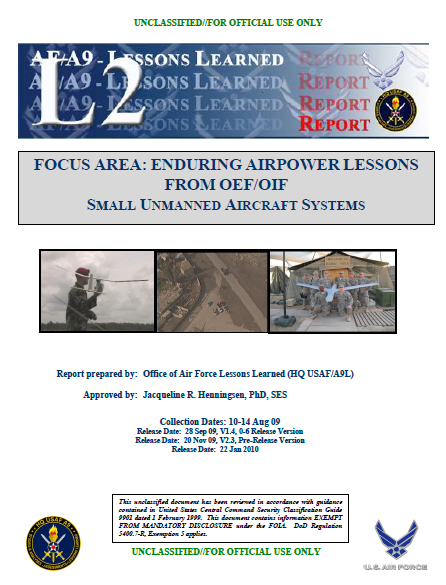
Confidential – U.S. Air Force Small Unmanned Aircraft Systems (SUAS) Airpower Lessons from Iraq and Afghanistan

https://publicintelligence.net/wp-content/uploads/2012/04/USAF-SUAS-LL.png


“Enduring Airpower Lessons from Operation ENDURING FREEDOM (OEF) and Operation IRAQI FREEDOM (OIF)” is one of three lessons learned (L2) focus areas directed by the Chief of Staff of the Air Force (CSAF) at CORONA Top 2008. This report is the third and last in a series of Unmanned Aircraft Systems (UAS) L2 reports produced for fiscal year 2009 and focuses on Small UAS (SUAS) capabilities and issues.

Five key observations provide insight into SUAS issues:

OBSERVATION 1: Insufficient analysis and education exist on the capabilities of SUAS and how they could be effectively employed by the USAF.

OBSERVATION 2: The USAF does not have a comprehensive strategy for the acquisition, sustainment and development of SUAS capabilities; and the USAF has not properly funded SUAS programs.

OBSERVATION 3: HQ AFSOC received funding and has developed the first Air Force SUAS Formal Training Unit (FTU).

OBSERVATION 4: There are no full-time, dedicated professional uniformed Group 2 and 3 UAS operators and maintainers.

OBSERVATION 5: Frequency and bandwidth management, communications infrastructure and datalinks will only be more stressed with the proliferation of SUAS; and SUAS Ground Control Station (GCS) frequencies are unencrypted and unprotected.

OBSERVATION 5: Frequency and bandwidth management, communications infrastructure and datalinks will only be more stressed with the proliferation of SUAS; and SUAS GCS frequencies are unencrypted and unprotected.

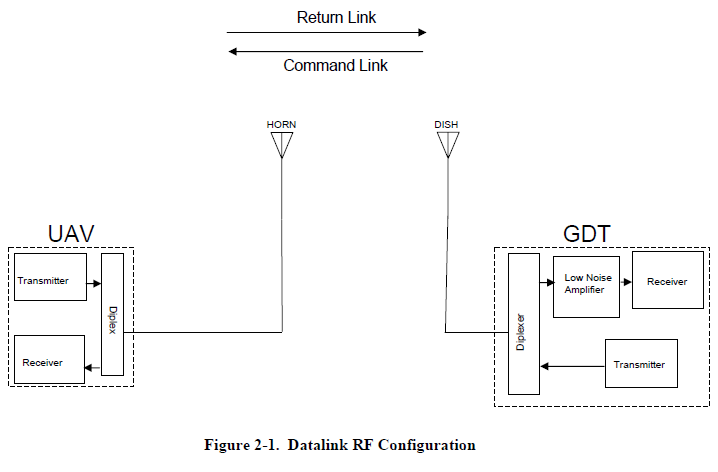
Discussion: With the proliferation of SUAS on the battlefield of the near future, the current SUAS GCS proprietary datalinks are not flexible and sustainable. Many of the current SUAS use datalink equipment that is not interoperable with other datalinks or tunable to other frequencies. In fact, the number of available proprietary SUAS frequencies is so limited US military SUAS operations are threatened by interference from other operations. Additionally, SUAS datalinks are unencrypted and are thus susceptible to enemy exploitation. Since datalinks are also unprotected, GCS are jammable and locations can even be triangulated and possibly physically attacked.

Not all Group 2 and 3 UAS are Cursor on Target (CoT) capable. Among other capabilities, CoT enables users to communicate from a common set of applications to various datalinks such as Link-16 and Situational Awareness Data Link (SADL). Any GCS standards must deliver CoT compatibility to enable existing CoT systems to seamlessly integrate, thereby decreasing integration costs and simplifying transition.

Given that SUAS datalink frequencies are not tunable, they may be prohibited from operating in other regions and countries of the world. This limitation is due to the potentiality of interfering with host-nation communications frequencies. Additionally, SUAS datalinks are not interoperable with manpack radios, burdening operators to transport multiple pieces of communications hardware on the battlefield.

Effective 1 October 2009, Assistant Secretary of Defense (Networks and Information Integration) (ASD (NII)) mandated the use of Common Data Link (CDL) for all UAS greater than 30 lbs. As it was originally designed and fielded in the late 1970s, CDL was adequate. According to HQ AFSOC, CDL is not small enough for Group 1 SUAS operations, but will be leveraged on Group 2 and 3 systems. However, the continued proliferation of CDL enabled airborne assets has already reached a tipping point. CDL is a huge and inefficient frequency space consumer. This dated, yet capable, waveform needs modernization, to include “dial-a-rate” speeds, more efficient error correction coding, multiple encoding rates, expanded frequency band alternatives (e.g., into L, S, C and extended Ku) and importability to software defined radios. Such modifications could improve UAS density 3 to 15 times what it is today. As it stands, failure to modernize the CDL waveform will limit the number of participants that can operate within a region (or suffer degraded video quality) and require strict frequency deconfliction.
Lessons Identified:

  • Develop tunable, interoperable, and unrestricted SUAS GCS frequencies since available radio frequency spectrum is an essential enabler for UAS operations.
  • Secure and protect SUAS GCS frequencies.
  • Develop SUAS GCS datalinks capable of Voice-Over Internet Protocol (VoIP), video and data multicast.
  • Make all Group 2 and 3 UAS CoT capable.
  • Develop digital SUAS GCS datalinks that are interoperable with field radios.
  • Modernize CDL waveform.

Die Gesichter des Bösen – Hitlers Henker – SPIEGEL TV – Ganzer Film

Argumente gegen Holocaustleugner
http://www.h-ref.de/
Die Dokumentation zeichnet die Wege der Täter nach, die die unbeschreiblichen Verbrechen im “Dritten Reich” erst möglich machten.
Heinrich Himmler organisierte für seinen Führer die brutale Verfolgung politischer Gegner in einem System von Konzentrationslagern. Der fanatische Nationalsozialist und Antisemit plante die Vernichtung der europäischen Juden. Im Holocaust wurden schließlich über sechs Millionen Menschen ermordet.

Der berüchtigte SS-Arzt Josef Mengele gehörte zu den grausamsten Tätern der Nazidiktatur. 40.000 unschuldige Opfer schickte er ins Gas, benutzte Kinder für Menschenversuche. Nach dem Krieg gelang ihm die Flucht, er wurde weltweit verfolgt – aber nie gefasst. Adolf Eichmann, der berüchtigte Organisator des Holocaust war jedoch nicht der einzige, dem schließlich der Prozess gemacht wurde. Der ehemalige SS-Hauptsturmführer Erich Priebke ist der Mitwirkung an besonders grausamen Morden angeklagt worden. Das Massaker in den ardeatinischen Höhlen, an dem er als Offizier beteiligt war, gilt als das schlimmste Kriegsverbrechen, das die Deutschen im besetzten Italien begangen haben.

Secret from the FBI – Albanian National Arrested En Route to Fight Jihad Pleads Guilty to Attempting to Support Terrorists

Agron Hasbajrami, an Albanian citizen and resident of Brooklyn, pled guilty today in United States District Court for the Eastern District of New York before the Honorable John Gleeson to attempting to provide material support to terrorists. At sentencing, Hasbajrami faces up to 15 years in prison. As a condition of his plea, Hasbarjrami has agreed to be deported from the United States.

The guilty plea was announced by Loretta E. Lynch, United States Attorney for the Eastern District of New York; Janice K. Fedarcyk, Assistant Director in Charge, Federal Bureau of Investigation, New York Field Office; and Raymond W. Kelly, Commissioner, New York City Police Department.

According to court documents, Hasbajrami attempted to travel to the Federally Administered Tribal Areas of Pakistan (the FATA) for the purpose of joining a radical jihadist insurgent group. In addition, Hasbajrami sent over $1,000 in multiple wire transfers abroad to support terrorist activities in Pakistan and Afghanistan. In pursuing his goal of fighting jihad, Hasbajrami exchanged e-mail messages with an individual in Pakistan who told him that he was a member of an armed group that had murdered American soldiers. In order to preserve the secrecy of their communications, Hasbajrami and the individual used multiple e-mail addresses to disguise their correspondence. In one e-mail message, Hasbajrami stated that it was difficult to ask for money from fellow Muslims because they became apprehensive “when they hear it is for jihad.” In another e-mail, Hasbajrami stated that he wished to travel abroad to “marry with the girls in paradise,” using jihadist rhetoric to describe his desire to die as a martyr.

On September 5, 2011, Hasbajrami purchased a one-way airline ticket to travel to Turkey the following day. Based on Hasbajrami’s e-mail communications, he intended to travel from Turkey to the FATA to join a jihadist group. On September 6, 2011, Hasbajrami was arrested at an international departures terminal at John F. Kennedy International Airport in Queens, New York. At the time of his arrest, Hasbajrami was carrying a tent, boots, and cold-weather gear. Following his arrest, a search of Hasbajrami’s residence revealed, among other items, a note reading, “Do not wait for invasion, the time is martyrdom time.”

“The defendant reached across the ocean from Brooklyn to Pakistan, seeking out terrorists in the hopes of becoming one. Once he found what he sought, he pledged his money, his energy, and the end of his own life to the goal of spreading terror abroad. As this case demonstrates yet again, law enforcement in New York and across the United States has the vigilance, capability, and skill to catch terrorists before they strike,” stated United States Attorney Lynch. “We will continue to bring to justice those who intend to harm Americans and hold them accountable for their actions.”

FBI Assistant Director in Charge Fedarcyk stated, “The defendant has admitted to attempting to provide material support to terrorists, but this entailed much more than the money he wired overseas. If not for his arrest, he would have traveled to Pakistan to wage jihad and aim to kill American soldiers. Our mission includes not only preventing acts of terrorism here but also preventing would-be terrorists from going abroad to harm Americans.”

“The plea demonstrates that Brooklyn is no place from which to launch terrorist aspirations without the good chance of being captured and prosecuted,” Police Commissioner Kelly said. “Vigilance paid dividends again.”

The government’s case is being prosecuted by Assistant United States Attorneys Seth D. DuCharme and Matthew S. Amatruda, with assistance provided by Trial Attorney Courtney Sullivan of the DOJ Counterterrorism Section.

Mengeles Erben – Menschenexperimente im Kalten Krieg – Ganzer Film

Die Erprobung von Giftstoffen für staatliche Mordaufträge und tödliche Experimente mit Lagerinsassen verbindet man mit dem systematischen Massenmord der Nazis. Josef Mengele ist der bekannteste Vertreter dieser “Wissenschaft ohne Gewissen”.

Die Geschichte der Menschenversuche im Auftrag des Staates beginnt in den 20er Jahren im “Labor 12” des sowjetischen Geheimdienstes. Dort wurden tödliche Gifte an “Volksfeinden” erprobt. Die Existenz dieses Labors wurde nur durch einen Zufall Anfang der 90er Jahre bekannt, denn Russland hält die Akten über Menschenversuche bis heute geheim. Das “Labor 12” allerdings gibt es unter anderem Namen bis heute.

Nach den Massenmorden während des Zweiten Weltkrieges handelten einige der schlimmsten Kriegsverbrecher mit den Siegermächten Straffreiheit gegen Übergabe der Versuchsergebnisse aus. So arbeitete der japanische General Ishii Shiro, der für den Tod von über 300.000 Menschen verantwortlich war, nach dem Krieg für die USA. Dort waren Militär und Geheimdienste angetan von den Ergebnissen echter Menschenexperimente mit Pest, Anthrax und Tularämie, Unterkühlung, Unterdruck und neuartigen Bomben. Bislang konnten die Militärs nur auf Daten aus Tierversuchen zurückgreifen. Keiner der mindestens 10.000 Verbrecher von Ishiis Todesimperium wurde in den USA bestraft. Einige beendeten ihre wissenschaftlichen Karrieren als Manager großer japanischer Pharma- und Medizinunternehmen. Es störte die Sieger angesichts des Rüstungswettlaufes im Kalten Krieg nicht einmal, dass Ishiis Untergebene auch mit US-Kriegsgefangenen experimentiert hatten. “Mengeles Erben” haben den Zweiten Weltkrieg überlebt, indem sie neuen Herren dienten. Sie waren weiter im Staatsauftrag aktiv. In Nordkorea gibt es nach Zeugenaussagen sogar bis in die Gegenwart Gaskammern, in denen Massenvernichtungsmittel an Häftlingen erprobt werden. In vielen ehemals kommunistischen Staaten verläuft die Aufarbeitung der finsteren Vergangenheit schleppend. Auch die ehemalige CSSR experimentierte mit Verhördrogen und Giften. Die Versuche und Ergebnisse sind bis heute geheim und werden vertuscht. Vielleicht, weil sich wie nach dem Zweiten Weltkrieg erneut interessierte Abnehmer für Spezialkenntnisse finden.

Über einige der bisher kaum erforschten systematischen medizinischen Experimente an Menschen berichtet der Dokumentarfilm “Mengeles Erben” weltweit zum ersten Mal im Fernsehen.

THE CIA CROWN JEWELS

Citation: “Family Jewels”
[Central Intelligence Agency Activities; Attached to Routing and Record Sheet; Includes Memoranda Entitled “Family Jewels”; “Johnny Roselli”; “Project Mockingbird”; “Yuriy Ivanovich Nosenko”; “Material Requisitioned From Logistics By Security For Issuance to Local Police”; “Audio Countermeasures Support to the United States Secret Service”; “Identification of Activities with Embarrassment Potential for the Agency”; and “[Excised] Equipment Test, Miami, Florida, August 1971”; Memorandum on Surveillance and Police Support Activities; and News Articles Entitled “6 Attempts to Kill Castro Laid to CIA” and “Castro Stalker Worked for the CIA”; Heavily Excised], Secret, Memorandum, May 16, 1973, 37 pp.
Collection: The CIA Family Jewels Indexed
Item Number: FJ00001
Origin: United States. Central Intelligence Agency. Directorate of Management and Services. Office of Security. Director
From: Osborn, Howard J.
To: United States. Central Intelligence Agency. Management Committee. Executive Secretary
Individuals/
Organizations Named:
Agnew, Spiro T.; Anderson, Jack; Arlington County (Virginia). Police Department; Bissell, Richard M., Jr.; Carroll, Joseph F.; Carter, Marshall S.; Castro Ruz, Fidel; Dulles, Allen W.; Edwards, Sheffield; Fairfax County (Virginia). Police Department; Getler, Michael; Giancana, Momo Salvatore (“Sam”); Golitsyn, Anatolii [Codename Aeladle]; Harvey, William K.; Helms, Richard M.; Houston, Laurence R.; Hume, Brit; Kennedy, Robert F.; King, J.C.; Kirkpatrick, Lyman B., Jr.; Maheu, Robert A.; Marchetti, Victor; McCone, John A.; McGuire, Phyllis; McNamara, Robert S.; Miami (Florida). Police Department; Montgomery County (Maryland). Police Department; Morgan, Edward P.; New York City (New York). Police Department; Nosenko, Yurii; O’Connell, James; Orta, Juan; Rosselli, John (“Johnny”); Rowan, Dan; San Francisco (California). Police Department; Soviet Union. Committee for State Security; Spear, Joseph C.; Taylor, Rufus L.; Trafficante, Santos, Jr.; United States. Central Intelligence Agency. Deputy Director; United States. Central Intelligence Agency. Director; United States. Central Intelligence Agency. Directorate of Management and Services. Office of Security; United States. Central Intelligence Agency. Directorate of Operations. Soviet/East European Division; United States. Central Intelligence Agency. Directorate of Operations. Technical Services Division; United States. Central Intelligence Agency. Directorate of Plans. Western Hemisphere Division; United States. Central Intelligence Agency. Executive Director-Comptroller; United States. Central Intelligence Agency. General Counsel; United States. Department of Justice. Bureau of Narcotics and Dangerous Drugs; United States. Federal Bureau of Investigation; United States. Secret Service; Varona Loredo, Manuel Antonio de; Waddin, Thomas; Washington (D.C.) Metropolitan Police Department; Whitten, Les
Subjects: Castro Ruz, Fidel Assassination Plots | Congress members | Cuban exiles | Defectors | Democratic National Convention (1968) | Detention | Domestic intelligence | Gambling | Illegal entry | Information leaks | Interagency cooperation | JMWAVE Intelligence Station (Miami, Florida) | Journalists | Mail opening | Miami (Florida) | National Security Act (1947) | News media | Organized crime | Police assistance | Political activists | Project Butane | Project Celotex I | Project Celotex II | Project Merrimac | Project Mockingbird | Project Redface I | Project SRPOINTER | Republican National Convention (1968) | Safe houses | Soviet Union | Surveillance countermeasures | Surveillance equipment | Vietnamese Conflict protest movements | Washington Post | Wiretapping
Abstract: Describes Central Intelligence Agency Office of Security activities “representing a possible potential threat or embarrassment to the Agency,” including contacts with organized crime members, support to local police forces, domestic surveillance, and plots to assassinate Fidel Castro.
Full Text: Document – PDF – this link will open in a new window (1.2 MB)

Durable URL for this record

Geheimdienst – Gründung der STASI – STASILAND

Am 8. Februar 1950 wurde in der DDR offiziell die Bildung eines Ministeriums für Staatssicherheit (MfS) beschlossen. Es war die Geburtsstunde der Stasi, die sich im Laufe der folgenden Jahre zu einem gewaltigen Geheimdienstapparat entwickelte

Discussion – Günter Grass, Israel and the crime of poetry

Günter Grass identifies Israel as a threat to world peace in his poem, ‘What Must Be Said’ [GALLO/GETTY]

New York, NY – On Wednesday, April 4, 2012, the German newspaper Süddeutsche Zeitung published Nobel laureate Günter Grass’ poem (the German original) that has created quite a stir not only in Germany, Israel and Iran, but also across the globe. As a result Israeli interior minister Eli Yishai has banned the Nobel laureate from entering Israel.

In this poem, Günter Grass breaks a long standing German taboo and publicly criticises Israel for aggressive warmongering against Iran, identifies the Jewish state as a threat to world peace, accuses “the West” of hypocrisy and denounces his own government for providing nuclear submarines to Israel:

… Because we – as Germans burdened enough –
Could be the suppliers to a crime
That is foreseeable, wherefore our complicity
Could not be redeemed through any of the usual excuses.

The poem drew much appreciation from those opposing yet another pending war in the region by pointing to the big elephant in the room, but also widespread condemnation by Jewish and non-Jewish groups and public figures in Germany, igniting the irritable Israeli Prime Minister Binyamin Netanyahu, in effect corroborating Günter Grass’ own assessment that his silence so far had to do with the concern that he would be accused of anti-Semitism. He was accused of anti-Semitism.

But has the charge of anti-Semitism really silenced the critics of Israel – as Günter Grass suggests in this poem? Not really – or perhaps only so in Germany, for obvious reasons, but certainly not around the globe. The only people who are afraid of being called anti-Semites are the anti-Semites. Yes certain segments of pro-Israeli Zionists, by no means all, hurtle that accusation to silence their opponents. But by no stretch of the imagination has that charge silenced anyone but the anti-Semites – and they better remain silent.

In the European and by extension North American birthplace of anti-Semitism, anti-Semitism is either perfectly alive and well, or transformed into Islamophobia, or camouflaged into Evangelical Zionism, or else abused by some Zionists to silence any opposition coming towards Israel – certainly to no avail.

To be sure, the condition in Germany is perhaps different – as indeed it should be. But by overcoming that false fear, Günter Grass can no longer be accused of anti-Semitism – and thus the significance of his poem is not in the straw man he constructs to shoot down (perhaps rhetorically, for after all, we are talking about a poem). It is somewhere else. 

Tomorrow may be too late

In the body of the poem itself, titled “What Must Be Said”, Günter Grass, 84, says that he risks the danger of being called an anti-Semite because:

Aged and with my last ink,
That the nuclear power of Israel endangers
The already fragile world peace?
Because it must be said
What even tomorrow may be too late to say…

Remaining silent at these dire circumstances is irresponsible and dangerous:

I am silent no longer
Because I am tired of the hypocrisy
Of the West…

Now that is good enough a reason to break the silence – and you need not invoke fear of being called an anti-Semite. Günter Grass expresses fear of a pending war that “could erase the Iranian people”. He pulls no punches as to the facts that we all know:

Yet why do I forbid myself
To name that other country
In which, for years, even if secretly,
There has been a growing nuclear potential at hand
But beyond control, because no testing is available?

He then points finger at his own country:

Now, though, because in my country
Which from time to time has sought and confronted
The very crime
That is without compare
In turn on a purely commercial basis, if also
With nimble lips calling it a reparation, declares
A further U-boat should be delivered to Israel,
Whose specialty consists of guiding all-destroying warheads to where the existence
Of a single atomic bomb is unproven,
But through fear of what may be conclusive,
I say what must be said.

Setting the dubious fear of being accused of anti-Semitism aside, Günter Grass provides ample reasons – European hypocrisy, German complacency, American barefaced double-standards, Ahmadinejad’s buffoonery and Israeli warmongering – for his poem to assume the global significance that it has. But the importance of the poem is not in stating the obvious – it is in revealing the repressed. 

European colonialism and Jewish Holocaust 

Given the history that culminated in the Jewish Holocaust, Jews around the globe, including Israel, have every right to get agitated with a prominent German public intellectual lecturing them about violence. But Zionism is chiefly responsible for having wasted the moral authority of the Jewish Holocaust – through what Norman Finkelstein has aptly called “the Holocaust Industry” – on establishing a racist apartheid state called “Israel” – a colonial settlement as a haven for the victims of a whole history of European anti-Semitism, on the broken back of a people who had nothing to do with that travesty.

With a leading German public intellectual openly criticising Israel, pointing to European hypocrisy, and blaming his own country for aiding and abetting in the aggressive militarisation of the Jewish state – a gushing wound is opened that implicates both Europe and the colonial settlement that in more than one sense is its own creation. In two specific terms, both as a haven for the victims of the Jewish Holocaust and as the legacy of European colonialism, Israel reflects back on its European pedigree. It is here that Grass’ poem reveals more than meets the eye.

For over 60 years, Palestinians have paid with their lives, liberties and homeland for a European crime with which they had absolutely nothing to do.

The Zionist project precedes the European Jewish Holocaust -that ghastly crime against humanity following the horrid history of European anti-Semitism expressed and manifested in systematic pogroms over many long and dark centuries. Palestine was colonised by the victims of European anti-Semitism – as a haven against Jewish persecution. That paradox remains at the heart of a Jewish state that cannot forget the truth of its own founding myth.

There is a link between the Jewish Holocaust and the history of European colonialism, of which Zionism (perhaps paradoxically, perhaps not) is a continued contemporary extension.

It was Aimé Césaire who in his Discourse sur le colonialisme/Discourse on Colonialism (1955) argued that the Jewish Holocaust was not an aberration in European history. Rather, Europeans actually perpetrated similar crimes against humanity on the colonised world at large.

With German atrocities during the Holocaust, Europeans tasted a concentrated dose of the structural violence they had perpetrated upon the world at large. Colonialism and the Holocaust were thus the two sides of the same coin: the aggressive transmutation of defenceless human beings into instruments of power – into disposable “things”. Long before the Jewish Holocaust, the world Europeans had conquered and colonised was the testing ground of that barbaric violence they had termed the “civilising mission of the white man”.

European guilt about the Holocaust is absolutely necessary and healthy – it is an ennobling guilt. It makes them better human beings, for them to remember what they did to European Jewry. But, and there is the rub, they are, with a supreme hypocrisy that Günter Grass notes in his poem, spending that guilt (when not redirecting it into Islamophobia) on sustaining a colonial settlement, an extension of their own colonial legacy, in supporting Israeli colonialism in the Arab and Muslim world – as a garrison state that further facilitates their renewed imperial interests in the region. Europeans are turning their legitimate guilt into an illegitimate instrument of their sustained imperial designs on the globe, from whom Americans then take their cues.

European logic of colonialism

Israel is a European colonial settlement, the last astonishingly barefaced remnant of European colonialism in a world that calls itself “postcolonial”.

The same people who are with perfect justification enraged by the foolish Ahmadinejad (when he denies the Holocaust) are evidently entirely undisturbed when their Prime Minister Golda Meir or their favourite presidential candidate Newt Gingrich denies the existence of Palestinians.

The daring imagination of Günter Grass’ poem – a heroically tragic act precisely because the poet is implicated in the moral outrage of his own poem – is significant precisely because it captures this German and by extension European logic/madness of colonial conquest and moral cannibalism. A German intellectual exposing the structural link between Zionism and colonialism marks the even more innate link between the Holocaust and colonialism – precisely at the moment of warning against the regional warmongering of Zionism as the post/colonial extension of European colonialism.

What Prime Minister Netanyahu’s reaction to Günter Grass’ poem, and many others like him, do not recognise is that precisely when they accuse the German poet of anti-Semitism they are in fact acknowledging the colonial provenance of the Jewish state. The harder they object to Günter Grass, the clearer becomes the fact that the Jewish state is the rhetorical articulation of the very logic of European global colonialism, of which the Jewish Holocaust, as Aimé Césaire rightly recognised, was a local overdose.

There is one, and only one, definitive resolution for that paradoxical consistency to come to an end: the one state solution for the Israeli-Palestinian dilemma. It is only in that basic, simple, elegant, humane, non-violent, enduring and just resolution that the paradox of Zionism as colonialism, and the structural link between the Jewish Holocaust and European colonialism, can once and for all be resolved.

The fact and the inevitability of that solution, delivering both Israelis and Palestinians from their mutual (however asymmetrical) sufferings, has been staring the world in the eye from day one – and yet the belligerent politics of despair has caused an intentional blindness that prevents that simple vision. So, yes, Günter Grass is right – and in this revelation he could no longer possibly be an anti-Semite:

Only this way are all, the Israelis and Palestinians,
Even more, all people, that in this
Region occupied by mania
Live cheek by jowl among enemies,
In the end also to help us.

Hamid Dabashi is Hagop Kevorkian Professor of Iranian Studies and Comparative Literature at Columbia University in New York.  His forthcoming book, The Arab Spring:  The End of Postcolonialism (Zed, 2012) is scheduled for publication in May 2012. 

The views expressed in this article are the author’s own and do not necessarily reflect Al Jazeera’s editorial policy.

Geheimsache Mauer – Ganzer Film

Es gab einmal die Vision einer perfekten Grenze – modern, unsichtbar, ohne Tote. Hightech statt Schuss-waffen, Sperrzaun und Beton. Ihre Erfinder nannten sie “Mauer 2000”. Doch diese Vision wurde nie in die Realität umgesetzt.

Am 13. August 2011 jährt sich zum 50. Mal der Tag, an dem mit der Teilung Berlins die Spaltung Deutschlands und Europas vollendet und für mehr als zweieinhalb Jahrzehnte zementiert wurde. Erzählt wird die Geschichte der Berliner Mauer aus einer neuen Perspektive, aus der Sicht derer, die sie geplant, erbaut und bewacht haben. Dabei offenbart das Doku-Drama einen tiefen Einblick hinter die Kulissen, in das “betonierte” Denken und berechnende Kalkül der Mauerstrategen, in ihre geheimen Pläne, die tödliche Grenze immer weiter zu perfektionieren.

Erzählt wird aber auch, wie ganz unterschiedliche Menschen die Mauer persönlich erlebten, wie sie für sie arbeiteten, in ihrem Schatten lebten und versuchten, sie zu überwinden. So berichtet zum ersten Mal ein ehemaliger DDR-Grenzer in diesem Zusammenhang über seine Gefühle in dem Moment, als er an der Mauer schoss. Erstmals berichtet ein Oberbefehls- haber der Grenztruppen über strategische Überlegungen und von den geheimen Sitzungen des Grenzkommandos. Im Gegensatz dazu erzählen Flüchtlinge, wie sie in gefährlichen Fluchtversuchen ihr Leben für die Freiheit jenseits der Grenze riskierten.

Der Fall X : Wie die DDR Westberlin erobern wollte – Ganzer Film

Die Führung der DDR hat bis kurz vor der Wiedervereinigung Pläne für eine Eroberung West-Berlins entwickelt und wiederholt in Manövern geübt. Zu diesem Schluss kommen die beiden Historiker und Filmemacher Hans Sparschuh und Rainer Burmeister in ihrer spannenden Dokumentation. Die Historiker Hans Sparschuh und Rainer Burmeister liefern zahlreiche Beweise wie Karten und Aktennotizen, eine sogar von Erich Mielke. Die DDR hat Pläne entwickelt, West-Berlin zu erobern. Nach spätestens drei Tagen sollte alles vorbei sein. Binnen weniger Stunden sollte die zahlenmässig haushoch überlegene NVA die Truppen der Alliierten überrennen. Mitarbeiter der Staatssicherheit sollten dann damit beginnen, hochrangige West-Berliner Polizeibeamte, Politiker, Journalisten und Beamte zu verhaften und in Lagern festsetzen. Der Verhaftungslisten waren bereits getippt. Die DDR-Führung plante, nach drei Tagen die Eroberung abzuschliessen, um dem Westen möglichst wenig Zeit zur Reaktion zu geben. Die im Osten verhasste D-Mark sollte anschliessend abgeschafft und durch eine Kriegswährung ersetzt werden. Ein weitverbreitetes Relikt aus der DDR-Ära: Plattenbauten. Die aus Betonfertigteilen hergestellten Häuser sollten die Wohnungsknappheit nach dem Krieg bekämpfen. Zur Zeit ihrer Entstehung waren sie begehrt, da die Wohnungen im Gegensatz zu Altbauwohnungen mit fliessendem warmen und kaltem Wasser und Zentralheizung ausgestattet waren. Der Palast der Republik beherbergte die Volkskammer der DDR und wurde als Kulturhaus genutzt. Hier traten nationale und internationale Künstler wie Udo Lindenberg, Harry Belafonte, Mireille Mathieu oder Katja Ebstein auf. Das asbestverseuchte Gebäude wurde von Februar 2006 bis Dezember 2008 schrittweise abgerissen. Der Berliner Fernsehturm ist mit 368 Metern das höchste Bauwerk Deutschlands. Mit dem Bau wurde 1965 begonnen. Wenn die Sonne die Kugel der Blechprismen aus rostfreiem Stahl anstrahlt, erscheint eine Reflexion in Form eines Kreuzes. In Anspielung auf die atheistische Grundeinstellung der sozialistischen Regierung bezeichneten Berliner dieses leuchtende Kreuz als “Rache des Papstes”. In ihrer Dokumentation liefern die Historiker umfassende Belege für ihre Thesen. An knapp 60 Stellen in der Stadt wollten Soldaten die Mauer durchbrechen. Aus Kartenmaterial und Aktennotizen geht hervor, dass zuerst alle Brücken der Stadt besetzt werden sollten. Damit wollte die DDR-Spitze verhindern, dass sich die alliierten Besatzer zu einem Verband vereinigen konnten. Dann sollten die Flughäfen der Stadt erobert und besetzt werden, um West-Berlin dauerhaft zu isolieren. Die Pläne wurden nach Recherchen der Historiker ab dem Jahr 1969 konkret. Auch eine Notiz von Erich Mielke soll dies beweisen. In zahlreichen Manövern sei der Überfall immer wieder geübt worden. Noch im Jahr 1988 gab es den Recherchen zufolge ein grosses Manöver in Magdeburg, bei dem die Eroberung einer Stadt trainiert wurde.

STASILAND GERMANY – Full Movie

Everyone knows about the Nazis camps of Auschwitz and Dachau. But few are aware of the systemic oppression that went on under the Stasis. Now some ex-Stasis agents are trying to re-write history.

“I won’t apologise for anything. I can only apologise for not having worked more efficiently”, states former Stasi spy Peter Wolter. He maintains that the thousands of people tortured and imprisoned were; “quite rightly punished”. Along with other ex-agents, Wolter is campaigning to have a museum documenting the suffering of prisoners in Stasi prisons closed. As Anna Funder, author of ‘Stasiland’ states; “these were people writing doctoral theses on how to destroy a soul”. Now thousands of ordinary Germans who had their lives destroyed by the Stasis fear their suffering will be negated.

Editorial – The New (Conservative) Liberalism by Charles Davis

Charles Davis, on liberalism in America, and how it fails to provide systemic solutions to the problems faced in an increasingly conservative world. Via Al Jazeera:

Once upon a time — say, three years ago — your average Democrat appeared to care about issues of war and peace. When the man dropping the bombs spoke with an affected Texas twang, the moral and fiscal costs of empire were the subject of numerous protests and earnest panel discussions, the issue not just a banal matter of policy upon which reasonable people could disagree, but a matter of the nation’s very soul.

Then the guy in the White House changed.

Now, if the Democratic rank and file haven’t necessarily learned to love the bomb – though many certainly have — they have at least learned to stop worrying about it. Barack Obama may have dramatically expanded the war in Afghanistan, launched twice as many drone strikes in Pakistan as his predecessor and dropped women-and-children killing cluster bombs in Yemen, but peruse a liberal magazine or blog and you’re more likely to find a strongly worded denunciation of Rush Limbaugh than the president. War isn’t over, but one could be forgiven for thinking that it is.

Given the lamentable state of liberal affairs, Drift, a new book from MSNBC’s Rachel Maddow, is refreshing. Most left-of-centre pundits long ago relegated the issue of killing poor foreigners in unjustifiable wars of aggression to the status of a niche concern, somewhere between Mitt Romney’s family dog and the search results for “Santorum” in terms of national importance. So in that sense, it’s nice to see a prominent progressive at least trying to grapple with the evils of militarism and rise of the US empire. It’s just a shame the book isn’t very good…


Die Akte Gysi – Ganzer Film

“Die Akte Gysi” zeigt, wie aus einem willigen Helfer des DDR-Systems ein populärer, gesamtdeutscher Politiker wurde. Und wie er trotz aller Stasi-Vorwürfe immer noch als Stimme der Benachteiligten und Unterdrückten hofiert wird.

Gregor Gysi kennen alle. Denn er spielt viele Rollen: als charismatischer Politiker, als Stimme der Linkspartei und als gern gesehener Talkshow-Gast, egal zu welchem Thema. Seine Markenzeichen: emotionale Empörung, populistische Parolen. Die mediale und politische Omnipräsenz provoziert aber immer wieder eine Frage: Gibt es einen anderen Gysi, einen, der früher mit der DDR-Stasi gekungelt hat? Er bestreitet das energisch, seine Anwälte versorgen allzu wissbegierige Journalisten mit entsprechenden Schriftsätzen und Gerichtsprozessen.

“Die Akte Gysi” zeigt, wie aus einem willigen Helfer des DDR-Systems ein populärer, gesamtdeutscher Politiker wurde. Und wie er trotz aller Stasi-Vorwürfe immer noch als Stimme der Benachteiligten und Unterdrückten hofiert wird. Der Film von Hans-Jürgen Börner und Silke König zeigt die Biographie eines Mannes im Spannungsfeld von inszenierten Auftritten und bedrückenden Stasi-Akten. Gregor Gysis Karriere begann, fernab von Fernsehkameras, als Rechtsanwalt in der Deutschen Demokratischen Republik. Gysi wuchs als Funktionärskind eines prominenten Vaters, des Botschafters und Staatssekretärs für Kirchenfragen, Klaus Gysi, auf. Sohn Gregor war der jüngste Rechtsanwalt der Republik. Und hatte viele prominente Mandanten wie Rudolf Bahro und Robert Havemann.

Er hatte beste Kontakte ins ZK der SED und auch zur Staatssicherheit. Original-Akten, die über das Wirken des Rechtsanwalts Gysi Auskunft geben könnten, wurden nach der Wende offenbar größtenteils vernichtet. Aber in den Akten seiner ehemaligen Mandanten finden sich die Kopien von Stasi-Berichten. Die Dokumentation liefert den politischen und biographischen Zusammenhang, befragt ehemalige Mandanten und präsentiert Akten über das Wirken des Gregor Gysi. Der Film berichtet u. a. über die Tragödie eines Vaters, dessen Sohn von der Stasi ermordet wurde. Vom Schicksal der Bürgerrechtlerin Vera Lengsfeld, ihren quälenden Stunden in Untersuchungshaft. Vom Schriftsteller Lutz Rathenow, dessen Unterhaltung auf einem Empfang belauscht wurden. Und von dem Berliner Künstler Thomas Klingenstein, dessen Gesprächsinhalte einer Autofahrt bei der Stasi landeten. Viele Schicksale, aber immer eine Hauptperson: Gregor Gysi. Viele Opfer, die vor der Kamera reden. Und einer, der lieber schweigt: Gregor Gysi.
Wo bitte ist unser”Rechtsstaat”???

SECRET from the FBI – Russian National Charged in $1 Million Trading Account Hack

A Russian national living in New York has been charged for his alleged role in a ring that stole approximately $1 million by hacking into retail brokerage accounts and executing sham trades.

Petr Murmylyuk, aka “Dmitry Tokar,” 31, of Brooklyn, has been charged with one count of conspiracy to commit wire fraud, unauthorized access to computers, and securities fraud.

According to a criminal complaint, beginning in late 2010, Murmylyuk worked with others to steal from online trading accounts. Members of the ring first gained unauthorized access to the online accounts and then changed the phone numbers and e-mail addresses. Once the hackers controlled the accounts, they used stolen identities to open additional accounts at other brokerage houses. They then caused the victims’ accounts to make unprofitable and illogical securities trades with the new accounts that benefitted the hackers.

The affected brokerage houses have reported combined losses to date of approximately $1 million as a result of the fraudulent schemes.

Story Background:

NEWARK, NJ—A Russian national living in New York has been charged for his alleged role in a ring that stole approximately $1 million by hacking into retail brokerage accounts and executing sham trades, U.S. Attorney for the District of New Jersey Paul J. Fishman announced today.

Petr Murmylyuk, aka “Dmitry Tokar,” 31, of Brooklyn, New York, has been charged by complaint with one count of conspiracy to commit wire fraud, unauthorized access to computers, and securities fraud. The U.S. Securities and Exchange Commission (SEC) is also filing a parallel civil action. Murmylyuk is currently in state custody facing charges arising out of a separate investigation conducted by the Manhattan District Attorney’s Office and will appear in Newark federal court to face the conspiracy charge on a date to be determined.

“Hackers continue to find new and advanced ways to steal from the financial sector,” said First Assistant U.S. Attorney J. Gilmore Childers. “Through the illusion of legitimacy, these alleged hackers controlled both sides of securities transactions to game the market and drain their victims’ accounts. Those who use their computer skills for fraud underestimate the combined resolve of law enforcement and the financial services industry to detect and stop these crimes.”

“This investigation highlights the level of sophistication reached by individuals involved in computer intrusions and hacking activities in furtherance of complex economic and financial crimes,” said FBI Newark Division Assistant Special Agent in Charge David Velazquez. “The same level of sophistication must be maintained by federal investigators and prosecutors, together with private sector partners, to stay one step ahead of these individuals.”

According to the complaint unsealed today in Newark federal court:

Beginning in late 2010, Murmylyuk worked with others to steal from online trading accounts at Scottrade, E*Trade, Fidelity, Schwab, and other brokerage firms. Members of the ring first gained unauthorized access to the online accounts and changed the phone numbers and e-mail addresses on file to prevent notice of unauthorized trading from going to the victims.

Once the hackers controlled the accounts, they used stolen identities to open additional accounts at other brokerage houses. They then caused the victims’ accounts to make unprofitable and illogical securities trades with the new accounts—referred to in the complaint as the “profit accounts”—that benefitted the hackers.

One version of the fraud involved causing the victims’ accounts to sell options contracts to the profit accounts, then to purchase the same contracts back minutes later for up to nine times the price. In another version of the fraud, they used the profit accounts to offer short sales of securities at prices well over market price and to force the victim accounts to make irrational purchases. (A short sale is a sale of stock that an investor does not own but rather borrows from a stock lender and must eventually return.)

Murmylyuk and a conspirator recruited foreign nationals visiting, studying, and living in the United States—including Russian nationals and Houston residents Anton Mezentsev, Galina Korelina, Mikhail Shatov, and others—to open bank accounts into which illegal proceeds could be deposited. Murmylyuk and the conspirator then caused the proceeds of the sham trades to be transferred from the profit accounts into those accounts, where the stolen money could be withdrawn.

Fidelity, Scottrade, E*Trade, and Schwab have reported combined losses to date of approximately $1 million as a result of the fraudulent schemes.

Murmylyuk is also accused of placing a telephone call to Trade Station Securities in which he claimed to be “Dmitry Tokar,” through whose brokerage account the ring placed approximately $200,000 in fraudulent securities trades. Murmylyuk was arrested in Brooklyn on November 3, 2011, in possession of a laptop that evidenced the fraud.

Mezentsev, Korelina, and Shatov were previously charged in the District of New Jersey and convicted of conspiracy to commit wire fraud based on their agreement to receive stolen money in the accounts in their names. U.S. District Judge Esther Salas sentenced Mezentsev, Korelina, and Shatov to 27 months, 14 months, and 14 months in prison, respectively, earlier this year.

If convicted, Murmylyuk faces a maximum potential penalty of five years in prison and a $250,000 fine.

U.S. Attorney Fishman praised special agents of the FBI, under the direction of Special Agent in Charge for the Newark Division Michael B. Ward; Immigration and Customs Enforcement-Homeland Security Investigations, under the direction of New Jersey Special Agent in Charge Andrew McLees; and Internal Revenue Service-Criminal Investigations, New York Field Office, under the direction of Acting Special Agent in Charge Victor W. Lessoff, for their work in the continuing investigation.

He also thanked special agents of the FBI in St. Louis and San Francisco and the U.S. Secret Service in Houston, as well as the Manhattan District Attorney’s Office, under the direction of District Attorney Cyrus R. Vance, Jr., for its contributions and cooperation in coordinating the parallel investigations. He also thanked the SEC’s Philadelphia Regional Office, under the leadership of its Regional Director Daniel M. Hawke, and the Justice Department’s Computer Crime and Intellectual Property Section for their assistance in the investigation.

The government is represented by Assistant U.S. Attorney Seth B. Kosto of the Computer Hacking and Intellectual Property Section of the U.S. Attorney’s Office for the District of New Jersey’s Economic Crimes Unit in Newark.

The charges and allegations in the complaint are merely accusations, and the defendant is considered innocent unless and until proven guilty.

This case was brought in coordination with President Barack Obama’s Financial Fraud Enforcement Task Force. President Obama established the interagency Financial Fraud Enforcement Task Force to wage an aggressive, coordinated, and proactive effort to investigate and prosecute financial crimes. The task force includes representatives from a broad range of federal agencies, regulatory authorities, inspectors general, and state and local law enforcement who, working together, bring to bear a powerful array of criminal and civil enforcement resources. The task force is working to improve efforts across the federal executive branch, and with state and local partners, to investigate and prosecute significant financial crimes, ensure just and effective punishment for those who perpetrate financial crimes, combat discrimination in the lending and financial markets, and recover proceeds for victims of financial crimes.

DDR – Die Bilder der STASI

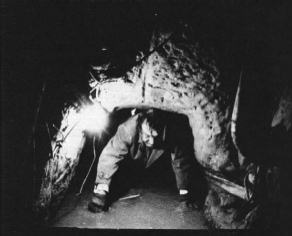
TOP-SECRET- The NSA Operation REGAL: Berlin Tunnel

Operation code name: PBJOINTLY Product code name: REGAL

The Berlin Tunnel operation was not a unique type of operation that was only run in Berlin. Prior to the Berlin Tunnel, the British ran a number of successful tunnel cable-tap operations in Vienna,[1] which at the time of these operations, was still an occupied city, divided into four sectors just like Berlin. The British cable taps began in 1948, and ran until the occupation of Austria ended, restoring state sovereignty to the country in 1955. The Soviets had a tap near Potsdam on a cable that served the American Garrison in Berlin.[2]

What has made the Berlin Tunnel famous, while the cable-tap tunnels of Vienna and Potsdam have faded into obscurity is the paradox of intelligence operations which results in fame being a measure of failure and obscurity being a measure of success. The Berlin Tunnel’s true claim to fame, therefore, is that it gained front-page notoriety when the Soviets “discovered” it.

The Official CIA history of the tunnel (prepared in August 1967 and declassified in February 2007) theorizes that the amount of publicity given to the Berlin Tunnel was the result of chance rather than of a conscious decision on the part of the Soviet leadership. During the planning phase of the tunnel, a consensus assessment had been reached which postulated that in the event of the discovery of the tunnel, the Soviet reaction would be to “suppress knowledge” of its existence, so as to save face, rather than have to admit that the West had the capability to mount such an operation. The CIA history of the project suggests that this expectation was defeated because the Soviet Commandant of the Berlin Garrison (who would normally have handled an event of this nature) was away from post at the time, and his deputy found himself in the position of having to make a decision about the tunnel “without benefit of advice from Moscow.”[3]

In his academic history of the Berlin Tunnel (Spies Beneath Berlin), David Stafford of the University of Edinburgh points out that, even though the tunnel was a joint American-British project, the British did not share in the limelight of publicity with the Americans when the tunnel was discovered. This was due, he says, to the fact that Soviet First Secretary Khrushchev was on an official state visit to the U.K.. The visit’s culmination, a visit to Windsor Castle and a reception by the Queen, was scheduled for the day following the discovery of the Berlin Tunnel. British participation in the project was officially hushed up by both the British and the Soviets so as not to spoil the success of the state visit.[4] To this day British Intelligence Services are usually tight-lipped when it comes to discussions of the Berlin Tunnel, or any post-1945 intelligence operation for that matter,[5] while the Americans have declassified the in-house history of the project and authorized one of its participants to include a chapter about it in a book on the Intelligence war in Berlin written in cooperation with one of the KGB veterans of that period (Battleground Berlin).

The intelligence fame/obscurity paradox aside, the Berlin Tunnel operation was, in the words of Allen Dulles (then DCI), “one of the most valuable and daring projects ever undertaken” by the CIA.[6]

The Berlin Tunnel, unlike the Vienna tunnels, was a major engineering feat. It stretched 1476 feet/454[7] meters through sandy ground[8] to reach a cable only 27 inches/68.5 cm beneath the surface,[9] on the edge of a major highway. One of the most difficult engineering problems that had to be overcome in the course of the project was to dig up to the cable from the main tunnel shaft without dropping some truck passing over the highway above into the tunnel.[10] This task was handled by the British,[11] who had their experience of Vienna to fall back on.

The total cost of the tunnel project was over six and a half million[12] 1950s dollars, which in 2007 dollars would be over 51 and a quarter million.[13] By way of comparison, the development and delivery of the first six U-2 aircraft, a project contemporary with the Berlin Tunnel, cost 22 million total,[14] or 3.6 million each. That means that the tunnel cost roughly as much as two U-2s.

According to Murphey, Kondrashev and Bailey in Battleground Berlin, the tale of the tunnel began in early 1951, when Frank Rowlett told Bill Harvey how frustrated he was by the loss of intelligence due to the Soviet shift from radio to landline.[15] The assessment process that preceded target selection continued throughout 1952, the year that saw Harvey reassigned to Berlin. Test recordings of the kind of traffic available from the cables were made in the spring and summer of 1953.[16] By August of 1953, plans for the tunnel were being readied for presentation to the DCI, Allen Dulles.[17]

Dulles approved the terms of reference for cooperaton with the British on the Berlin Tunnel in December 1953.[18] The “go” was given to start the construction of the warehouse that would serve as the cover for the tunnel, and construction was completed in August. The American engineering team that actually dug the tunnel arrived to take control of the compound on 28 August. Digging began on 2 September, but, on 8 September, the miners struck water and which necessitated that pumps be brought in. The tunnel reached its distant end on 28 February 1955,[19] and the tap chamber took another month to complete. The complex process of tapping into the three target cables without alerting the Soviets to what was going on was a slow one. It lasted from 11 May through 2 August 1955.[20] Collection of intelligence from the taps, however, began as soon as the first circuits were brought on-line.

During the night of 21-22 April 1956, the Soviets “discovered” the tunnel, and collection ceased. That did not close the project, however. The take from the Berlin Tunnel during the time that it was operational (11 months and 11 days) was so great that processing of the backlog of material continued through the end of September 1958.[21]

The loss of this valuable source was, of course, a blow to US/UK intelligence efforts against the Soviets at the time, but this loss was somewhat compensated for by the prestige that the CIA won in the press following the tunnel’s discovery. The article on the tunnel in the issue of Time magazine (07 May 1956) that followed the tunnel’s discovery said “It’s the best publicity the U.S. has had in Berlin for a long time.”

An urban legend that persistently continues to associate itself with the Berlin Tunnel is that the idea for the tunnel came from Reinhard Gehlen (the German Abwehr-Ost general who surrendered to the Americans and later became the head of the West German BND). Murphy, Kondrashev and Bailey flatly reject this assertion in Battleground Berlin.[22] David Stafford argues credibly against the validity of this legend in his academic history of the Berlin Tunnel. He notes that there is no evidence to support this theory, and “those most closely in the know in the CIA have strenuously denied it,”[23] essentially repeating Murphy, Kondrashev and Bailey. Stafford’s most telling argument against Gehlen’s involvement is that no mention of the Berlin Tunnel is to be found in Gehlen’s memoirs (The Service: The Memoirs of General Reinhard Gehlen, New York: World Publishing, 1972). “Never a modest man,” says Stafford, Gehlen “would surely have bid for some of the credit had he been any way involved. In fact, he does not even refer to it.”[24]

In the section “Recapitulation of Intelligence Derived” from the Berlin Tunnel, the CIA History of the project says that the “REGAL operation provided the United States and the British with a unique source of current intelligence on the Soviet Orbit of a kind and quality which had not been available since 1948. Responsible officials considered PBJOINTLY, during its productive phase, to be the prime source of early warning concerning Soviet intentions in Europe, if not world-wide.”[25] The section goes on to list general types of political, ground-forces, air-force and naval intelligence that the tunnel provided, many of them with glowing comments from consumers.

The debate about the value of the information derived from the Berlin Tunnel has been raging since 1961, when it was discovered that PBJOINTLY was compromised to the Soviets by the British mole George Blake who attended the meeting on the Berlin Tunnel between the British and Americans in London in December 1953. Many widely read books and articles on the tunnel contended that the KGB had used the tunnel to feed the Americans and the British disinformation. Stafford, however, convincingly dispels all suspicions that the Berlin Tunnel was turned into a disinformation counter-intelligence operation by the KGB. Drawing on the information that came to light during the “Teufelsberg” Conference on Cold-War intelligence operations that brought intelligence professionals from both the CIA and the KGB together in Berlin in 1999, Stafford concludes that “[f]ar from using the tunnel for misinformation and deception, the KGB’s First Chief Directorate had taken a deliberate decision to conceal its existence from the Red Army and GRU, the main users of the cables being tapped. The reason for this extraordinary decision was to protect “Diomid”, their rare and brilliant source George Blake.”[26]

Stafford ends his discussion of the legitimacy of the material collected from the Berlin Tunnel with a quote from Blake, who was still living in Moscow at the time of the “Teufelsberg” Conference. “I’m sure 99.9% of the information obtained by the SIS and CIA from the tunnel was genuine.”[27]

By T.H.E. Hill

DOWNLOAD THE ORIGINAL NSA DOCUMENT HERE

nsa-operation-regal

MY NAME IS NOBODY – Full Movie by Sergio Leone – Starring Terrence Hill and Henry Fonda


Release date- June 1974 (USA)
Starring: Terence Hill, Henry Fonda and Jean Martin
A young, easygoing gunman (Hill) worships and competes with an old gunfighter (Fonda) who only wants to retire.

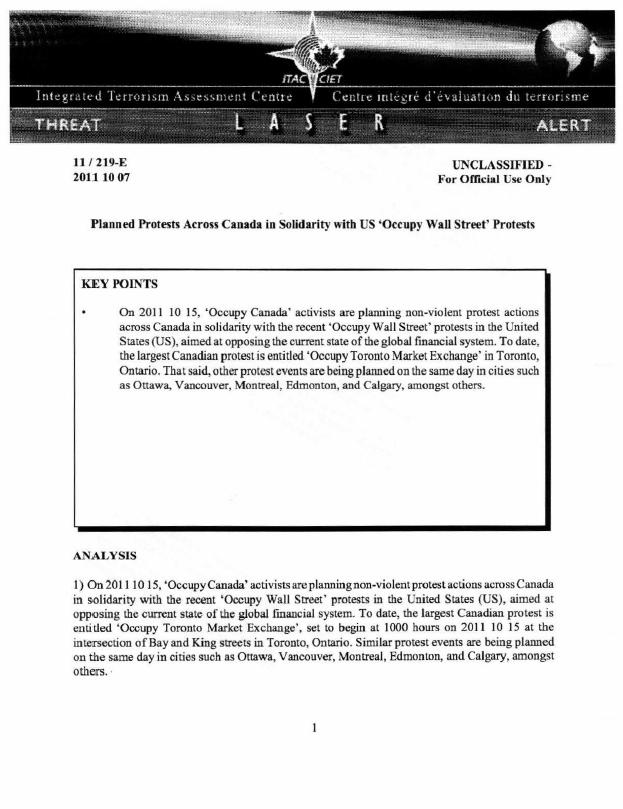
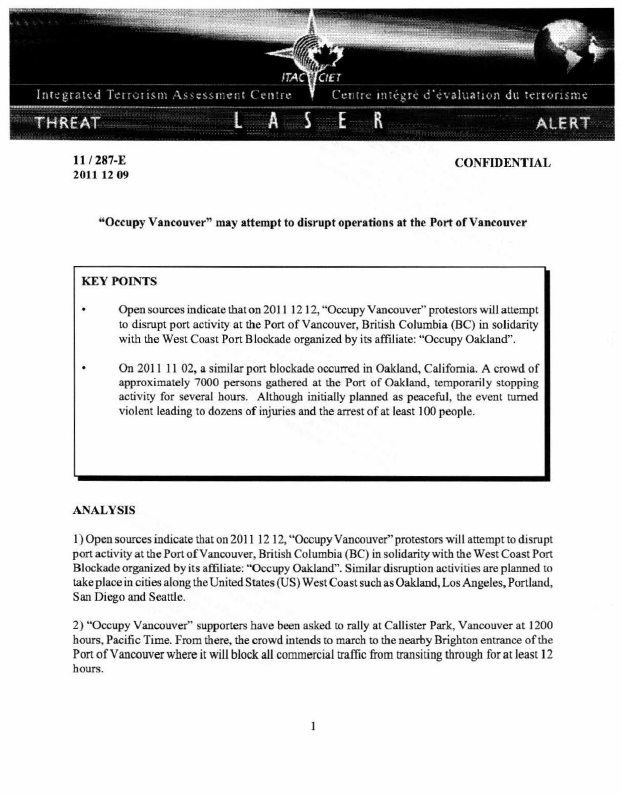
Confidential – Canada Integrated Terrorism Assessment Centre (ITAC) Occupy Wall Street Bulletins

The following Integrated Terrorism Assessment Centre (ITAC) bulletins were obtained via an information request from the Canadian Security Intelligence Service (CSIS) by Paroxysms.  Most of the documents were also simultaneously released to the Globe and Mail, though the collection released to Paroxysms is more complete and contains several additional bulletins that are not included in the other collection.

Integrated Terrorism Assessment Centre/Centre intégré d’évaluation du terrorisme


https://publicintelligence.net/wp-content/uploads/2012/04/ITAC-Occupy.png


https://publicintelligence.net/wp-content/uploads/2012/04/ITAC-Occupy-2.png

THE OMEGA CODE 2 – FULL MOVIE 2001 – Starring Michael York

Hackers Takedown 02 – Full Movie

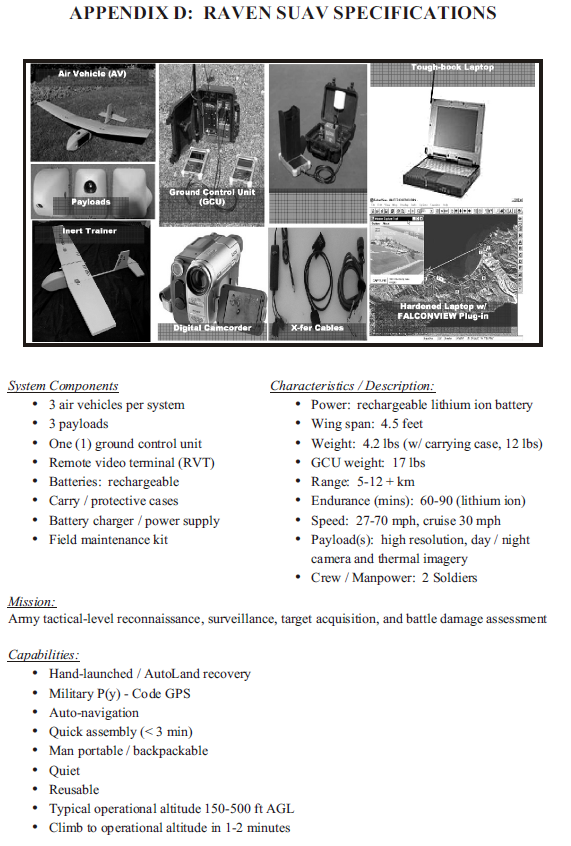
SECRET – U.S. Army Small Unmanned Aerial Vehicle (SUAV) Airspace Command and Control (A2C2) Handbook

https://publicintelligence.net/wp-content/uploads/2012/04/CALL-A2C2.png


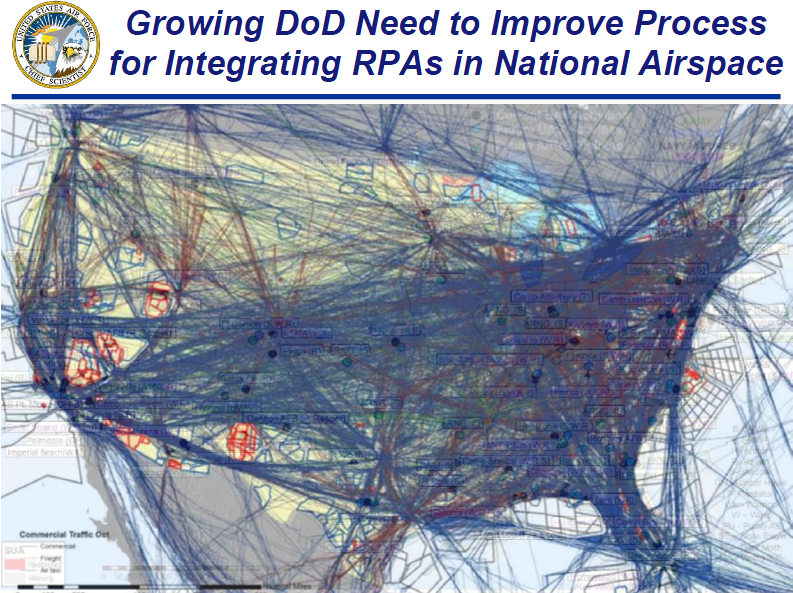
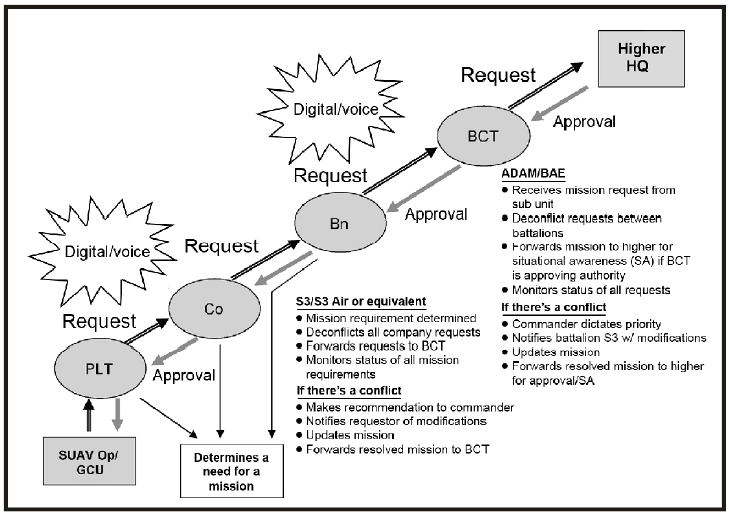
The purpose of this handbook is to enhance understanding of Army airspace command and control (A2C2) to mitigate risks between small unit unmanned aerial vehicles (SUAVs) and rotary wing operations below the coordinating altitude. This handbook provides leaders at the brigade and below with guidelines in the form of airspace coordination techniques and procedures regarding SUAV mission planning and airspace deconfliction.

This handbook is the result of combining information from several sources, including Raven operators currently deployed in support of Operation Enduring Freedom and Operation Iraqi Freedom.

2. TYPES OF SEPARATION

There are three primary means of maintaining separation between manned and unmanned aircraft: lateral, time, and vertical separation. Beyond the need to ensure physical separation exists, leaders must plan for frequency separation between unmanned vehicles.

a. Lateral separation spaces aircraft that may be operating at the same altitude by not having them operate in the same geographic space. This can be done through the assignment of flight corridors, ROA/ROZ, and other graphic control measures such as phase lines and unit boundaries.

b. Time separation spaces aircraft that may be operating in the same geographic area or at the same operating altitudes by not allowing them to operate at the same time. Time separation may also be required when aircraft, manned and unmanned, must fly near indirect-fire trajectories or ordnance effects. The timing of surface fires must be coordinated with aircraft routing. This ensures that, even though aircraft and surface fires may occupy the same space, they do not do so at the same time.

c. Vertical separation spaces aircraft based on operating altitude or by assigning different operating altitudes to other aircraft that may be working in the same geographic area. Vertical separation is the least preferred method since SUAVs and rotary wing aircraft normally operate from the surface to 500 feet above ground level (AGL).


https://publicintelligence.net/wp-content/uploads/2012/04/raven-suav.png


Hackers – Full Movie

The Shabak Show Terrorists Returning to Terrorism


https://i0.wp.com/www.israeldefense.com/_Uploads/dbsarticles/_cut/SA0000_0244x0240x0072_000xFFFFFF_terrorsists%40jpg.jpg

Over the past few months since the conclusion of the Shalit exchange deal, the Shabak has been working to ensure that the prisoners released in the framework of the deal have not returned to terror activities. Two examples from recent months prove that not all of them have decided to abandon the path of terrorism, and have instead, returned to their previous terror activities.

Shabak announced that at the end of March 2012, the Judea Military Court sentenced Daoud Hilo, a Ramallah resident and one of the prisoners released in the Shalit deal, to 44 months in prison. Hilo was convicted based on his admission of guilt for attempting to trade war equipment in January 2012. This was a month after his December 8, 2011 release in the framework of the second phase of the Shalit deal.

Having been previously sentenced to 40 months in 2010 (for which he spent 23 months in prison), Hilo’s conviction cancelled the mitigation he received (approximately 17 months) in the framework of the Shalit deal, and now he will return to serve the entire duration of his sentence. Along with a fine of 2,000 NIS, Hilo was also sentenced to 12 months probation for three years from the day he is released, for the felony he was sentenced for in this case or any other firearms felony.

Another example of a Shalit deal prisoner returning to terrorism was found when the Shabak revealed the attempts of Omar Abu-Sneineh, a Hamas operative from Hebron, to recruit operatives in the Judea and Samaria region for the purpose of an abduction attack. Having been banished to the Gaza Strip in the framework of the deal, Abu-Sneineh’s planned abduction was intended for bargaining for the release of prisoners. A Fatah operative serving a life sentence for murder, he crossed the lines into the ranks of Hamas while in prison.

Abu-Sneineh, who was released in October 2011, sent a memory card to his family in the Judea and Samaria region that contained detailed instructions on how to carry out the abduction attack. His intent was to have it later reach the hands of the operatives he would recruit.

The memory card, which was obtained by Shabak, included, among other things, instructions for the operatives on how to behave after abducting an Israeli. The card contained instructions such as: “refrain from hiding (the abducted person) in abandoned areas, caves, or groves, unless it’s a body or the head of the abducted person. If dealing with a live person, which needs to be reached at least once a week in order to bring food and water, it’s best to hide him in a house, an agricultural farm, a work place, or someplace similar.” Abu-Sneineh also listed instructions for obtaining firearms and for recruiting operatives into the service of the terror organizations.

Shabak has stated that the organization “will continue its mission to foil intentions to carry out terror attacks against Israeli targets, And will do everything in its power to bring those involved in terrorism to justice. This includes all the prisoners released in the deal for the freeing of Gilad Shalit that have returned to terror activity.”

Report about Chinese “GoMopa”-allies: – Chinese hackers – No site is safe


Story Highlights:
* Chinese hackers claim to have broken into Pentagon’s system
* The hackers met with CNN on an island near a Chinese naval hub
* Hackers say Beijing secretly pays them at times, something the government denies
* Official: “The Chinese government does not do such a thing”

The story –
They operate from a bare apartment on a Chinese island. They are intelligent 20-somethings who seem harmless. But they are hard-core hackers who claim to have gained access to the world’s most sensitive sites, including the Pentagon.

In fact, they say they are sometimes paid secretly by the Chinese government — a claim the Beijing government denies.

“No Web site is one hundred percent safe. There are Web sites with high-level security, but there is always a weakness,” says Xiao Chen, the leader of this group.

Wie Bennewirtz für seine mutmasslichen “Partner” MEHRMALS NUR “GoMoPa”-kritische Artikel löschen lassen wollte

Subject:   Fwd: Request
From:   “P. Schmitz” <p.schmitz@deinguterruf.de>
Date:   Fri, July 8, 2011 11:24 am
To:   office@ebizz.tv
Priority:   Normal
Options:   View Full Header | View Printable Version  | Download this as a file
Dear madams, dear sirs,

unfortunately I did not receive a reply concerning my request from
July 1st from you yet. In this context I again want to point out the
major wish of our customer SJB seeing the name removed from the
entries mentioned below. It would be a great pleasure if you can
manage the removal according to the wish of our customer.

Thank you very much for your understanding.

Please do not hesitate contacting me for further discussion.

With kind regards,
P. Schmitz
Dein guter Ruf.de

---------- Forwarded message ----------
From: P. Schmitz <p.schmitz@deinguterruf.de>
Date: 2011/7/1
Subject: Request
To: office@ebizz.tv

Dear madams, dear sirs,

by order of our customer SJB Fonds Skyline OHG we are kindly asking you
to remove some entries on your website thetvnet.com. The
topicality and the
correctness of these entries are no longer up to date. It is a major
concern of our customer to see them removed:

immobilien-vertraulich.com/law/7279-die-killer-bibel-toxdat--die-900-seiten-stasi-mordstudie-von-gomopa-mastermind-ehrenfried-stelzer.html
immobilien-vertraulich.com/law/7277-sjb-fonds-opfer-sven-babyface-schmidt-als-chef-terrorist-von-europas-gefaehrlichster-internet-kriminellen-bande-enttarnt-.html
immobilien-vertraulich.com/law/7268-der-beweis-tatsaechlich-vorbestrafter-serienbetrueger-klausmaurischat-gomopa-hat-eigenes-kinder-portal-.html
immobilien-vertraulich.com/law/7264-die-killer-bibel-toxdat--die-900-seiten-stasi-mordstudie-von-gomopa-mastermind-ehrenfried-stelzer.html
immobilien-vertraulich.com/law/7262-sjb-fonds-opfer-sven-babyface-schmidt-als-chef-terrorist-von-europas-gefaehrlichster-internet-kriminellen-bande-enttarnt-.html
immobilien-vertraulich.com/law/7224-die-killer-bibel-toxdat-die-900-seiten-stasi-mordstudie-von-gomopa-mastermind-ehrenfried-stelzer.html
immobilien-vertraulich.com/law/7223-opfer-sven-schmidt-als-chef-terrorist-von-europas-gefaehrlichster-internet-kriminellen-bande-enttarnt.html
immobilien-vertraulich.com/law/7217-der-beweis-tatsaechlich-vorbestrafter-serienbetrueger-klausmaurischat-gomopa-hat-eigenes-kinder-portal-.html
immobilien-vertraulich.com/law/7212-die-killer-bibel-toxdat-die-900-seiten-stasi-mordstudie-von-gomopa-mastermind-ehrenfried-stelzer.html
immobilien-vertraulich.com/law/7210-opfer-sven-schmidt-als-chef-terrorist-von-europas-gefaehrlichster-internet-kriminellen-bande-enttarnt.html
immobilien-vertraulich.com/law/7203-der-beweis-tatsaechlich-vorbestrafter-serienbetrueger-klausmaurischat-gomopa-hat-eigenes-kinder-portal-.html
immobilien-vertraulich.com/law/7200-opfer-die-killer-bibel-toxdat-die-900-seiten-stasi-mordstudie-von-gomopa-mastermind-ehrenfried-stelzer.html
immobilien-vertraulich.com/law/7189-opfer-die-killer-bibel-toxdat--die-900-seiten-stasi-mordstudie-von-gomopa-mastermind-ehrenfried-stelzer.html
immobilien-vertraulich.com/law/7120--klaus-maurischats-gomopa-cybermoerder-leichen-und-falschmeldungen-plastern-ihren-weg--nicht-nur-im-internet.html
immobilien-vertraulich.com/boerse-ipo-reit/7119--der-mehrfach-vorbestrafte-serienbetrueger-und-mutmassliche-paederast-klaus-maurischat-und-seine-neue-qwirecard-enteq.html

We hope you can manage the removal of these entries according to the wish
of our customer contemporarily. . These entries and similar ones cause
major problems for our customer.
We wanna thank you for your appreciation, for further information
please visit our website deinguterruf.de. (the english version is
still under construction).

In case you are not the right receipt for this request, it would be
very kind if you can name the correct person in charge.
If you have further questions concerning this case or our services in
general, please contact me.
It would be a great pleasure to receive a positive feedback.

With kind regards,

--
Mit freundlichen Grüßen,

P. Schmitz
DEIN GUTER RUF.DE

Ein Projekt der
MoveVision GmbH

Alfredstraße 341
45133 ESSEN
Tel: 0201-2489452
E-mail: p.schmitz (at) deinguterruf.de

MoveVision – GmbH - HRB 22121
Geschäftsführer: Martin Lux - Steuernummer: DE228746207

--
Mit freundlichen Grüßen,

P. Schmitz
DEIN GUTER RUF.DE

Ein Projekt der
MoveVision GmbH

Alfredstraße 341
45133 ESSEN
Tel: 0201-2489452
E-mail: p.schmitz (at) deinguterruf.de

MoveVision – GmbH - HRB 22121
Geschäftsführer: Martin Lux - Steuernummer: DE228746207
Subject: Request
From: “P. Schmitz” <p.schmitz@deinguterruf.de>
Date: Fri, July 1, 2011 12:18 pm
To: office@ebizz.tv
Priority: Normal
Options: View Full HeaderView Printable VersionDownload this as a file
Dear madams, dear sirs,

by order of our customer SJB Fonds Skyline OHG we are kindly asking you
to remove some entries on your website thetvnet.com. The
topicality and the
correctness of these entries are no longer up to date. It is a major
concern of our customer to see them removed:

immobilien-vertraulich.com/law/7279-die-killer-bibel-toxdat--die-900-seiten-stasi-mordstudie-von-gomopa-mastermind-ehrenfried-stelzer.html
immobilien-vertraulich.com/law/7277-sjb-fonds-opfer-sven-babyface-schmidt-als-chef-terrorist-von-europas-gefaehrlichster-internet-kriminellen-bande-enttarnt-.html
immobilien-vertraulich.com/law/7268-der-beweis-tatsaechlich-vorbestrafter-serienbetrueger-klausmaurischat-gomopa-hat-eigenes-kinder-portal-.html
immobilien-vertraulich.com/law/7264-die-killer-bibel-toxdat--die-900-seiten-stasi-mordstudie-von-gomopa-mastermind-ehrenfried-stelzer.html
immobilien-vertraulich.com/law/7262-sjb-fonds-opfer-sven-babyface-schmidt-als-chef-terrorist-von-europas-gefaehrlichster-internet-kriminellen-bande-enttarnt-.html
immobilien-vertraulich.com/law/7224-die-killer-bibel-toxdat-die-900-seiten-stasi-mordstudie-von-gomopa-mastermind-ehrenfried-stelzer.html
immobilien-vertraulich.com/law/7223-opfer-sven-schmidt-als-chef-terrorist-von-europas-gefaehrlichster-internet-kriminellen-bande-enttarnt.html
immobilien-vertraulich.com/law/7217-der-beweis-tatsaechlich-vorbestrafter-serienbetrueger-klausmaurischat-gomopa-hat-eigenes-kinder-portal-.html
immobilien-vertraulich.com/law/7212-die-killer-bibel-toxdat-die-900-seiten-stasi-mordstudie-von-gomopa-mastermind-ehrenfried-stelzer.html
immobilien-vertraulich.com/law/7210-opfer-sven-schmidt-als-chef-terrorist-von-europas-gefaehrlichster-internet-kriminellen-bande-enttarnt.html
immobilien-vertraulich.com/law/7203-der-beweis-tatsaechlich-vorbestrafter-serienbetrueger-klausmaurischat-gomopa-hat-eigenes-kinder-portal-.html
immobilien-vertraulich.com/law/7200-opfer-die-killer-bibel-toxdat-die-900-seiten-stasi-mordstudie-von-gomopa-mastermind-ehrenfried-stelzer.html
immobilien-vertraulich.com/law/7189-opfer-die-killer-bibel-toxdat--die-900-seiten-stasi-mordstudie-von-gomopa-mastermind-ehrenfried-stelzer.html
immobilien-vertraulich.com/law/7120--klaus-maurischats-gomopa-cybermoerder-leichen-und-falschmeldungen-plastern-ihren-weg--nicht-nur-im-internet.html
immobilien-vertraulich.com/boerse-ipo-reit/7119--der-mehrfach-vorbestrafte-serienbetrueger-und-mutmassliche-paederast-klaus-maurischat-und-seine-neue-qwirecard-enteq.html

We hope you can manage the removal of these entries according to the wish
of our customer contemporarily.These entries and similar ones cause
major problems for our customer.
We wanna thank you for your appreciation, for further information
please visit our website deinguterruf.de. (the english version is
still under construction).

In case you are not the right receipt for this request, it would be
very kind if you can name the correct person in charge.
If you have further questions concerning this case or our services in
general, please contact me.
It would be a great pleasure to receive a positive feedback.

With kind regards,

--
Mit freundlichen Grüßen,

P. Schmitz
DEIN GUTER RUF.DE

Ein Projekt der
MoveVision GmbH

Alfredstraße 341
45133 ESSEN
Tel: 0201-2489452
E-mail: p.schmitz (at) deinguterruf.de

MoveVision – GmbH - HRB 22121
Geschäftsführer: Martin Lux - Steuernummer: DE228746207

INTERESSANT - BENEWIRTZ WOLLTE HIERMIT AUSSCHLIESSLICH "GoMoPa"-KRITISCHE ARTIKEL LÖSCHEN

Gerd Bennewirtz mutmassliche “Partner” – Die STASI-Stalker der “GoMoPa”


Die STASI und Ihr Tarnunternehmen in Neuss – die mutmasslichen STASI-Morde


DIE WELT BERICHTET:

Überhaupt sind es die zahlreichen, bis heute ungeklärten Todesfälle beim Bereich Kommerzielle Koordinierung (KoKo) und dessen Stasi-Firmen in Ost und West, die bei den Ermittlungen zu den Einsatzgruppenmorden eine zentrale Rolle spielen. Schon im 1994 vorgelegten Bericht des Bundestagsuntersuchungsausschusses, der sich mit den kriminellen Praktiken des von den Stasi-Offizieren im besonderen Einsatz (OibE) Alexander Schalck-Golodkowski und Manfred Seidel geführten DDR-Devisen-Beschaffungs-Imperium auseinander setzt, wurde konstatiert, dass die Todesfälle “wahrscheinlich einen nachrichtendienstlichen Hintergrund” hätten.

Ermittelt wird heute zu den bereits in dem Bericht aufgeführten Fällen der durch “Herzversagen” aus dem Leben geschiedenen Geschäftsführer der KoKo-Firmen Itema in Neuss, Karl-Heinz Noetzel und Fritz John Bruhn. Letzterer wurde im Ost-Berliner Hotel “Metropol” im August 1982 tot aufgefunden. Laut “Focus” hatte Bruhn nach Erkenntnissen des Verfassungsschutzes seit 1979 die westdeutsche Spionageabwehr über konspirative Geldtransfers für die DKP informiert. In Bruhns Verfassungsschutzakte findet sich das Abhörprotokoll einer brutalen Einschüchterung. So sagte im Januar 1981 das DKP-Mitglied Friedrich R. aus Bochum zu Bruhn: “Mach keinen Blödsinn, einen Kontakt zum Verfassungsschutz bekommt die Partei sowieso heraus. Die Folgen würdest du nicht überstehen.”

QUELLE: DIE WELT

http://www.welt.de/print-wams/article100912/Erschiessen-Erstechen-Verbrennen-Strangulieren.html


Karl-Heinz Nötzel, Geschäftsführer der DDR-Tarnfirma Intema in Neuss, erstickt am 8. September 1981 in einer Leipziger Hoteltoilette – angeblich an Speiseresten. Offizielle Todesursache: Herzversagen. Nötzel, der über die Intema Ostberlin Devisen beschaffte, stand bei der DDR-Staatssicherheit im Verdacht, ein Agent des Kölner Bundesamts für Verfassungsschutz (BfV) zu sein.

Fritz John Bruhn, 57, Nötzels Nachfolger bei der Parteifirma Intema, wird am 20. August 1982 leblos im Ostberliner Hotel „Metropol“ aufgefunden. Die Obduktion ergibt: Herzversagen.

FOCUS vorliegende Verfassungsschutz-Dossiers beweisen, dass Bruhn seit 1979 die westdeutsche Spionageabwehr über konspirative Geldtransporte der DDR und die Drahtzieher illegaler Ost-West-Geschäfte informierte. Eine BfV-Verschlussakte über die Geheimoperation mit dem Codenamen „Einkäufer“ schildert detalliert, wie Bruhn am 24. Januar 1981 von dem DKP-Mitglied Friedrich R. aus Bochum eingeschüchtert wurde: „Mach keinen Blödsinn“, so die Warnung laut Wortprotokoll, „einen Kontakt zum Verfassungsschutz bekommt die Partei sowieso heraus.“ R. dann massiv drohend zu Bruhn: „Die Folgen würdest du nicht überstehen.“


Deutschland: Die düstere Seite der DDR – weiter lesen auf FOCUS Online: http://www.focus.de/politik/deutschland/deutschland-die-duestere-seite-der-ddr_aid_194129.html

Global Witness – Sentencing of former Nigerian politician highlights role of British and US banks in money laundering

Global Witness calls for a thorough investigation into HSBC, Barclays, Citibank and Abbey National (now owned by Santander) for their roles in the laundering of millions of pounds by James Ibori, former governor of Nigeria’s oil-rich Delta State. Ibori pleaded guilty to ten counts of money laundering and fraud in relation to an estimated $250 million of stolen state assets on 27 February; today was the first day of his sentencing hearing.

“By doing business with Ibori and his associates, these banks facilitated his corrupt behaviour and allowed him to spend diverted state assets on a luxury lifestyle, including a private jet and expensive London houses, while many Nigerians continue to live in poverty,” said Robert Palmer, a campaigner with Global Witness.

Today, the prosecution provided an overview of Ibori’s crimes, and in particular any aggravating factors. The details of how Ibori and his accomplices stole government funds and moved them into the UK are only coming out now, as a reporting restriction was in place until his guilty plea. His wife, sister and mistress have already been convicted of money laundering as have a string of professional intermediaries including a lawyer, a fiduciary agent and a corporate financier.

Ibori, who was governor of Delta State from 1999 to 2007, inflated government contracts, accepted kickbacks and even directly stole funds from state coffers.

His official salary was £4,000 a year and his formal asset declaration stated that he had no cash or bank accounts outside of Nigeria. Despite this he managed to buy several houses around the world, including one in the UK valued at £2.2 million, luxury cars (a Bentley, Range Rover and Maybach) and a $20 million Challenger private jet.

According to the prosecutor, Sasha Wass QC, Ibori and his associates used multiple accounts at Barclays, HSBC, Citibank and Abbey National to launder funds. Millions of pounds passed through these accounts in total, some of which were used to purchase expensive London property.

In one case US$4.8 million was transferred from a Barclays account belonging to a company of which Ibori was formally a director to another account at Barclays controlled by Ibori’s lawyer, Badhresh Gohil. The funds passed through two Swiss accounts, including one at a branch of Schroders in Zurich, and were used as part payment for the private jet. In another case, Ibori and others were able to cream $37.8 million off from the sale of Delta state shares in the telecoms company V Mobile.

Ibori had numerous Barclays accounts. The prosecutor described how in one case between 1999 and 2006 Ibori deposited £1.5 million in a Knightsbridge branch of Barclays, much of this was in rolls of banknotes.

In America Ibori held two accounts at Citibank and ran up a $920,000 American Express credit bill between 2003 and 2006. He bought a $1.8 million house in Houston, as well as moving at least $500,000 through his lawyer’s client account at the now-defunct AIDT bank in Denver, Colorado.

Banks and lawyers have a legal obligation to identify their customers and carry out ongoing checks to identify any suspicious transactions which they have to report to the authorities. In particular, they are supposed to identify customers who are senior politicians or their family members and close associates, who could potentially represent a corruption risk, and do extra checks on their funds.

This case raises serious questions about the due diligence that Barclays and the other banks carried out on Ibori and his associates. What checks did these banks do to ensure that the funds they were handling were not the proceeds of corruption?

A 2011 review by the UK bank regulator, the Financial Services Authority (FSA), revealed that British banks were systematically failing to carry out the required anti-money laundering checks – particularly when dealing with senior foreign politicians. The FSA has said that it will take a tougher line in future and will start doing more intensive supervision. For example, last month Coutts bank was fined £8.75 million for failures uncovered during the regulator’s 2011 review. But compared to the £1.9 billion in profits made by Coutts’ parent bank RBS, this fine can be seen as simply a cost of doing business, especially as RBS has been fined more than once in the past for similar failures.

“It’s welcome that the FSA has said it will do more to target banks that fail to tackle financial crime. But unless they issue penalties that really hurt, nothing will change,” said Palmer. “And we now need an investigation into how Ibori was able to move so much money through these British banks for so long and whether or not sufficient checks were carried out.”

The case also shows how money launderers such as Ibori are able to use shell companies spread across different countries to move and conceal their assets. At present it can be incredibly difficult for law enforcement and others to identify the actual person who controls and benefits from a company. Global Witness is calling for all countries to use their company registers to publish details on the real, ‘beneficial’ owner of all companies.

Barclays and HSBC declined to comment on the specific allegations due to client confidentiality. They said they had robust anti-money laundering and anti-corruption policies that applied across their global holdings. Santander declined to comment.

/Ends

Contact: Robert Palmer on +44 (0)20 7492 5860 or +44 (0)7545 645406, rpalmer@globalwitness.org.

Notes to editors:

1. In 2010 Global Witness’s report International Thief Thief revealed that HSBC, Barclays, Natwest, RBS and UBS had accepted millions of pounds for two other Nigerian state governors who had been accepting bribes.

2. The FSA’s report from June 2011 was deeply critical of banks for the handling of corrupt risk, for example it found that a third of banks did not have information on the ultimate, or beneficial, owner, despite this being a legal requirement.

3. RBS was fined £5.6 million in 2010 for failing to check whether its customers were on the UK terrorist sanctions list and £750,000 in 2002 for inadequate customer due diligence procedures.

Cyrano De Bergerac – Full Movie

France, 1640: Cyrano, the charismatic swordsman-poet with the absurd nose, hopelessly loves the beauteous Roxane; she, in turn, confesses to Cyrano her love for the handsome but tongue-tied Christian. The chivalrous Cyrano sets up with Christian an innocent deception, with tragic results.

Confidential – The Evolving Missions of the Secret Service, and More from CRS

hough it does not mention anything about Secret Service agents hiring prostitutes in Colombia last week, a newly updated report from the Congressional Research Service provides a timely discussion of The U.S. Secret Service: An Examination and Analysis of Its Evolving Missions, April 16, 2012

Some other new or newly updated CRS reports obtained by Secrecy News include the following.

An Overview of Tax Provisions Expiring in 2012, April 17, 2012

Private Health Insurance Market Reforms in the Patient Protection and Affordable Care Act (ACA), April 16, 2012

Pension Benefit Guaranty Corporation (PBGC): A Fact Sheet, April 16, 2012

Nanotechnology: A Policy Primer, April 13, 2012

Video – Anti-GoMoPa-Stalking – Opfer-Aufklärungs-Video

SECRET from the FBI – Scheme to Use More Than 80 Fictitious Companies to Defraud Illinois, Indiana, Minnesota Unemployment Insurance Agencies of $8.7 Million

CHICAGO—A suburban Chicago woman who owned a South Side tax preparation business allegedly schemed to falsely claim more than $1 million in federal tax refunds and, together with 14 co-defendants, allegedly engaged in a related scheme using other individuals’ identities, including some tax service clients and some stolen, to fraudulently obtain more than $8.7 million from state unemployment insurance agencies in Illinois, Indiana, and Minnesota. The defendants allegedly registered approximately 80 fictitious employers with the states’ unemployment insurance agencies and used the sham employers to fraudulently collect unemployment insurance benefits. The Illinois Department of Employment Security was allegedly defrauded of at least $5.95 million, the Indiana Department of Workforce Development was allegedly cheated of at least $2.4 million, and the Minnesota Department of Employment and Economic Development lost at least $342,000 as a result of the alleged fraud scheme.

The lead defendant, Jacqueline Kennedy, owned and managed ATAP Financial Enterprises Inc., ATAP Tax & Business Solutions Inc., and ATAP Tax Services Inc., (collectively, ATAP), all tax preparation businesses located at one time at 1757 West 95th St. in Chicago. Kennedy, 39, of Country Club Hills, was charged with 14 counts of mail and wire fraud, six counts of filing false claims for tax refunds, and one count of aggravated identity theft.

Kennedy and 14 co-defendants were indicted together on various tax, fraud, and identity theft charges in a 60-count indictment returned yesterday by a federal grand jury, Patrick J. Fitzgerald, United States Attorney for the Northern District of Illinois, announced today. All 15 defendants will be ordered to appear for arraignment at a later date in U.S. District Court in Chicago.

“This indictment highlights the determination of the Labor Department’s Office of Inspector General to investigate fraud against the unemployment insurance program. The defendants allegedly schemed to illegally obtain approximately $8.7 million in unemployment benefits. We will continue to work with our law enforcement partners and our colleagues in the Illinois, Indiana, and Minnesota state workforce agencies to aggressively investigate allegations of fraudulent activities to obtain unemployment insurance benefits,” said James Vanderberg, Special Agent in Charge of the Chicago Regional Office of the U.S. Department of Labor, Office of Inspector General, Office of Labor Racketeering and Fraud Investigations.

Mr. Fitzgerald and Mr. Vanderberg announced the charges with Alvin Patton, Special Agent in Charge of the Internal Revenue Service Criminal Investigation Division; Robert D. Grant, Special Agent in Charge of the Chicago Office of Federal Bureau of Investigation; and Thomas P. Brady, Inspector in Charge of the U.S. Postal Inspection Service in Chicago. The Social Security Administration Office of Inspector General also assisted in the investigation.

Between January 2008 and April 2010, the indictment alleges that Kennedy and others prepared at least 200 false individual federal income tax returns for clients of ATAP or in the names of clients stating false income and credits for tax years 2007-2009 and fraudulently claiming approximately $1.025 million in tax refunds. Kennedy allegedly inflated certain ATAP clients’ tax refunds by manufacturing false Forms W-2 from companies for which the clients did not work and from companies for which the clients worked but did not earn the inflated wages reported.

As part of the alleged unemployment insurance fraud scheme, Kennedy and others allegedly used personal identifying information of numerous individuals, both ATAP tax clients, including names, Social Security numbers, and dates of birth, to file retroactive wage reports and subsequent claims for benefits, according to the indictment. At times, Kennedy and others stole the identities of ATAP clients and others and used the identifiers to file fraudulent claims for unemployment insurance benefits. At other times, they agreed with ATAP clients and others to file fraudulent claims on their behalf in exchange for a share of the proceeds, the indictment alleges.

Kennedy and co-defendant Tara Cox, 32, of Blue Island, who was charged with 15 counts of mail and wire fraud and one count of aggravated identity theft, allegedly created the 80-some fictitious companies and registered them with the state unemployment agencies, knowing that the vast majority of employers existed only for the purpose of drawing unemployment insurance benefits on behalf of purported employees. According to the indictment, they allegedly filed false quarterly wage reports on behalf of these fictitious employers, knowing that these companies, in fact, did not employ any workers. Kennedy and Cox then filed or caused others to file fraudulent claims for unemployment insurance benefits by claiming to be employees of the fictitious companies who were terminated without fault. During the course of the alleged scheme between February 2009 and October 2011, Kennedy, Cox, and others allegedly filed at least 900 false unemployment insurance claims before the scheme was detected and payments were stopped.

In Illinois and Minnesota, unemployment insurance claimants could chose to have their benefits directly deposited into a bank account or have the state agency issue them a debit card, while Indiana claimants received a debit card through the mail. The indictment alleges that Kennedy and Cox caused fraudulent unemployment insurance payments to be made to debit cards for the benefit of themselves and the following co-defendants: Cox’s mother, Rowena Pughsley, 60, also of Blue Island, charged with six counts of mail fraud, one count of aggravated identity theft, and two counts of filing false income tax returns; April Blanchard, 37, of Chicago, charged with 10 counts of mail and wire fraud; Orvin Hurst, 35, of Chicago, charged with nine counts of mail and wire fraud; Marcel Mason, 38, whose last known address was in Beecher, charged with four counts of mail and wire fraud; Lantz Roberts, 39, of Chicago, charged with four counts of mail fraud; Jocklyn Batey, 64, of Chicago, charged with two counts of mail fraud; Shawn Ray, 49, of Chicago, charged with two counts of mail fraud; Ashlee Petermon, 25, of Chicago, charged with one count of mail fraud; Eboni Coppage, 26, of Bloomington, charged with two counts of mail fraud; Tameka Thompson, 31, of Park Forest, charged with one count of mail fraud; Charles Williams, 37, of Sauk Village, charged with two counts of mail and wire fraud; and Anise McGill, 26, of Alsip, charged with one count of mail fraud.

At times, Kennedy, Cox, Pughsley, and Blanchard allegedly paid or caused to be paid unemployment payroll tax contributions on behalf of the fictitious employers to create the false impression that the employers were legitimate businesses with actual employees. In addition, Cox and others allegedly purchased Social Security numbers for filing bogus claims for unemployment insurance benefits. Ten of the defendants, including Orvin Hurst’s brother, Marlin Hurst, 39, of Chicago, who was charged with five counts of mail fraud, caused unemployment insurance debit cards to be delivered to their home and other addresses with which they were associated, knowing that the cards were fraudulently obtained, the indictment alleges. Fourteen of the defendants allegedly withdrew funds from bank automated teller machines using unemployment insurance debit cards in the names of purported employees of fictitious employers knowing they were not entitled to those funds.

Kennedy, Pughsley, Cox, Blanchard, Mason, and others allegedly falsely certified fraudulent unemployment insurance claims, including representing to the state agencies that the claimants were entitled to unemployment insurance benefits, had been available and able to work, and actively sought work during the certification period.

Pughsley alone was charged with two counts of filing false individual federal income tax returns for 2009 and 2010 for allegedly under-reporting her total income as $196,414 in 2009 and $70,538 in 2010, when she knew that her gross income and total income were substantially greater.

The indictment seeks forfeiture of approximately $8.7 million in alleged fraud proceeds from Kennedy, Cox, Pughsley, and seven other defendants.

The charges in the indictment carry the following maximum penalties on each count: mail and wire fraud—20 years in prison; filing false claims for tax refunds—five years; aggravated identity theft—mandatory two years consecutive to any other sentence imposed and a maximum fine of $250,000 on each count, or an alternate fine on the fraud counts totaling twice the loss or twice the gain, whichever is greater. In addition, restitution is mandatory. Each count of filing a false income tax return carries a three-year maximum sentence and a $250,000 fine. In addition, defendants convicted of tax offenses must pay the costs of prosecution and remain liable for any and all back taxes, as well as a potential civil fraud penalty of 75 percent of the underpayment plus interest. If convicted, the court must impose a reasonable sentence under federal statutes and the advisory United States Sentencing Guidelines.

The government is being represented by Assistant U.S. Attorneys Andrianna D. Kastanek and Mark E. Schneider.

The public is reminded that an indictment is not evidence of guilt. The defendants are presumed innocent and are entitled to a fair trial at which the government has the burden of proving guilt beyond a reasonable doubt.

TOP-SECRET from Crpytome – Nuclear Power Plant Onsite Emergency Response Capabilities

[Federal Register Volume 77, Number 75 (Wednesday, April 18, 2012)] [Proposed Rules] [Pages 23161-23166] From the Federal Register Online via the Government Printing Office [www.gpo.gov] [FR Doc No: 2012-9336] ======================================================================== Proposed Rules Federal Register ________________________________________________________________________ This section of the FEDERAL REGISTER contains notices to the public of the proposed issuance of rules and regulations. The purpose of these notices is to give interested persons an opportunity to participate in the rule making prior to the adoption of the final rules. ======================================================================== Federal Register / Vol. 77, No. 75 / Wednesday, April 18, 2012 / Proposed Rules [[Page 23161]] NUCLEAR REGULATORY COMMISSION 10 CFR Parts 50 and 52 [NRC-2012-0031] RIN 3150-AJ11 Onsite Emergency Response Capabilities AGENCY: Nuclear Regulatory Commission. ACTION: Advance notice of proposed rulemaking. ———————————————————————– SUMMARY: The U.S. Nuclear Regulatory Commission (NRC or the Commission) is issuing this Advance Notice of Proposed Rulemaking (ANPR) to begin the process of potentially amending its regulations to strengthen and integrate onsite emergency response capabilities. The NRC seeks public comment on specific questions and issues with respect to possible revision to the NRC’s requirements for onsite emergency response capabilities, and development of both new requirements and the supporting regulatory basis. This regulatory action is one of the actions stemming from the NRC’s lessons-learned efforts associated with the March 2011 Fukushima Dai-ichi Nuclear Power Plant accident in Japan. DATES: Submit comments by June 18, 2012. Comments received after this date will be considered if it is practical to do so, but the NRC is only able to ensure consideration of comments received on or before this date. ADDRESSES: You may access information and comment submissions related to this document, which the NRC possesses and is publicly available, by searching on http://www.regulations.gov under Docket ID NRC-2012-0031. You may submit comments by any of the following methods: Federal Rulemaking Web Site: Go to http://www.regulations.gov and search for Docket ID NRC-2012-0031. Address questions about NRC dockets to Carol Gallagher; telephone: 301-492- 3668; email: Carol.Gallagher@nrc.gov. Email comments to: Rulemaking.Comments@nrc.gov. If you do not receive an automatic email reply confirming receipt, contact us directly at 301-415-1677. Fax comments to: Secretary, U.S. Nuclear Regulatory Commission at 301-415-1101. Mail comments to: Secretary, U.S. Nuclear Regulatory Commission, Washington, DC 20555-0001, Attn: Rulemakings and Adjudications Staff. Hand deliver comments to: 11555 Rockville Pike, Rockville, Maryland 20852, between 7:30 a.m. and 4:15 p.m. (Eastern time) Federal workdays; telephone: 301-415-1677. For additional direction on accessing information and submitting comments, see “Accessing Information and Submitting Comments” in the SUPPLEMENTARY INFORMATION section of this document. FOR FURTHER INFORMATION CONTACT: Robert H. Beall, Office of Nuclear Reactor Regulation, U.S. Nuclear Regulatory Commission, Washington, DC 20555-0001; telephone: 301-415-3874; email: Robert.Beall@nrc.gov. SUPPLEMENTARY INFORMATION: I. Accessing Information and Submitting Comments II. Background: Fukushima Dai-ichi and the NRC Regulatory Response III. Background: Onsite Emergency Response Capabilities A. Emergency Operating Procedures B. Severe Accident Management Guidelines C. Extensive Damage Mitigation Guidelines D. Onsite Emergency Response Capabilities Versus Emergency Preparedness IV. Discussion and Request for Public Comment A. ANPR Purpose B. Rulemaking Objectives/Success Criteria C. Applicability to NRC Licenses and Approvals D. Relationship Between Recommendation 8 and Other Near-Term Task Force Recommendations E. Interim Regulatory Actions V. Public Meeting VI. Rulemaking Process and Schedule VII. Related Petition for Rulemaking Actions VIII. Available Supporting Documents I. Accessing Information and Submitting Comments A. Accessing Information Please refer to Docket ID NRC-2012-0031 when contacting the NRC about the availability of information for this notice. You may access information related to this ANPR, which the NRC possesses and is publicly available, by the following methods: Federal Rulemaking Web Site: Go to http://www.regulations.gov and search for Docket ID NRC-2012-0031. NRC’s Agencywide Documents Access and Management System (ADAMS): You may access publicly available documents online in the NRC Library at http://www.nrc.gov/reading-rm/adams.html. To begin the search, select “ADAMS Public Documents” and then select “Begin Web- based ADAMS Search.” For problems with ADAMS, please contact the NRC’s Public Document Room (PDR) reference staff at 1-800-397-4209, 301-415- 4737, or by email to PDR.Resource@nrc.gov. The ADAMS accession number for each document referenced in this notice (if that document is available in ADAMS) is provided the first time that a document is referenced. A table listing documents that provide additional background and supporting information is in Section VIII of this document. NRC’s PDR: You may examine and purchase copies of public documents at the NRC’s PDR, Room O1-F21, One White Flint North, 11555 Rockville Pike, Rockville, Maryland 20852. B. Submitting Comments Please include Docket ID NRC-2012-0031 in the subject line of your comment submission, in order to ensure that the NRC is able to make your comment submission available to the public in this docket. The NRC cautions you not to include identifying or contact information in comment submissions that you do not want to be publicly disclosed. The NRC posts all comment submissions at http://www. regulations.gov as well as enters the comment submissions into ADAMS. The NRC does not edit comment submissions to remove identifying or contact information. If you are requesting or aggregating comments from other persons for submission to the NRC, then you should inform those persons not to include identifying or contact information in their comment submissions that they do not want to be publicly disclosed. Your request should state that the NRC will not edit comment submissions to remove such information before making the comment submissions available to the public or entering the comment submissions into ADAMS. [[Page 23162]] II. Background: Fukushima Dai-ichi and the NRC Regulatory Response On March 11, 2011, a magnitude 9.0 earthquake struck off the coast of the Japanese island of Honshu. The earthquake precipitated a large tsunami that is estimated to have exceeded 14 meters (45 feet) in height at the Fukushima Dai-ichi Nuclear Power Plant site (hereinafter referred to as the site or the facility). The earthquake and tsunami produced widespread devastation across northeastern Japan, resulting in approximately 25,000 people dead or missing, displacing tens of thousands of people, and significantly impacting the infrastructure and industry in the northeastern coastal areas of Japan. At the time of the earthquake, Fukushima Dai-ichi Units 1, 2, and 3 were in operation. Units 4, 5, and 6 had been shut down for routine refueling and maintenance activities, and the Unit 4 reactor fuel had been offloaded to the Unit 4 spent fuel pool. As a result of the earthquake, the three operating units at the site automatically shut down, and offsite power was lost to the entire facility. The emergency diesel generators started at all six units, providing alternating current (AC) electrical power to critical systems; overall, the facility response to the seismic event appears to have been normal. Approximately 40 minutes after shutdown of the operating units, the first large tsunami wave inundated the site, followed by multiple additional waves. The tsunami resulted in extensive damage to site facilities and a complete loss of AC electrical power at Units 1 through 5, a condition known as station blackout (SBO). One diesel generator remained functional on Unit 6. Despite the actions of the operators following the earthquake and tsunami, cooling was lost to the fuel in the Unit 1 reactor after several hours, in the Unit 2 reactor after about 70 hours, and in the Unit 3 reactor after about 36 hours, resulting in damage to the nuclear fuel shortly after the loss of cooling. In the days following the Fukushima Dai-ichi nuclear accident, the NRC Chairman directed the NRC staff to establish a senior-level agency task force to conduct a methodical and systematic review of the NRC’s processes and regulations to determine whether, in light of the events in Japan, the agency should make additional improvements to its regulatory system, and to make recommendations to the Commission for its policy direction. This direction was provided in a tasking memorandum dated March 23, 2011, from the NRC Chairman to the NRC Executive Director for Operations (COMGBJ-11-0002) (ADAMS Accession No. ML110950110). In SECY-11-0093, “Near-Term Report and Recommendations for Agency Actions Following the Events in Japan” (ADAMS Accession No. ML11186A959), dated July 12, 2011, the Near-Term Task Force (NTTF) provided its recommendations to the Commission. The staff requirements memorandum (SRM) for SECY-11-0093 (ADAMS Accession No. ML112310021), dated August 19, 2011, directed the NRC staff to identify and make “recommendations regarding any Task Force recommendations that can, and in the staff’s judgment, should be implemented, in part or in whole, without unnecessary delay.” In SECY-11-0124, “Recommended Actions To Be Taken Without Delay from the Near-Term Task Force Report” (ADAMS Accession No. ML11245A127), the NRC staff provided recommendations to the Commission on actions that, in the staff’s judgment, should be initiated without unnecessary delay, and requested that the Commission provide direction for moving forward on these recommendation (subsequently referred to as “Tier 1” recommendations). The Commission approved the staff’s proposed actions in the SRM for SECY-11-0124 (ADAMS Accession No. ML112911571), dated October 18, 2011. In SECY-11-0137, “Prioritization of Recommended Actions to Be Taken in Response to Fukushima Lessons Learned” (ADAMS Accession No. ML11269A204), the NRC staff requested that the Commission approve the staff’s prioritization of the NTTF recommendations. In the SRM for SECY-11-0137 (ADAMS Accession No. ML113490055), dated December 15, 2011, the Commission approved the staff’s proposed prioritization of the NTTF recommendations and supported action on the Tier 1 recommendations, subject to the direction in the SRM. With respect to regulatory action regarding onsite emergency response capabilities, the Commission directed the NRC staff to initiate a rulemaking on NTTF Recommendation 8, in the form of an ANPR. This document responds to that Commission direction. In November 2011, the Institute of Nuclear Power Operations (INPO) issued INPO-11-005, “Special Report on the Nuclear Accident at the Fukushima Dai-ichi Nuclear Power Station” (ADAMS Accession No. ML11347A454). In the SRM for SECY-11-0137, the Commission directed NRC staff to consider INPO-11-005 in its development of the technical bases for any proposed regulatory changes. III. Background: Onsite Emergency Response Capabilities A. Emergency Operating Procedures Emergency Operating Procedures (EOPs) are required procedures designed to mitigate the effects of a design basis accident and place the plant in a safe shutdown condition. The EOPs are required by Title 10 of the Code of Federal Regulations (10 CFR) Part 50, Appendix B, Criterion V, “Instructions, Procedures, and Drawings,” and are included in the administrative control sections of licensee’s technical specifications. Licensed operators are trained and evaluated in the implementation of EOPs through initial license training. The NRC evaluates licensed operator candidates’ knowledge of EOPs during an initial written examination, as required by 10 CFR 55.41 and 55.43, and an initial operating test, as required by 10 CFR 55.45. For proficiency, licensed operator requalification training programs, required by 10 CFR 55.59, routinely train and evaluate licensed operators on their knowledge and ability to implement the EOPs. B. Severe Accident Management Guidelines During the 1990s, the nuclear industry developed Severe Accident Management Guidelines (SAMGs) as a voluntary industry initiative in response to Generic Letter 88-20, Supplement 2, “Accident Management Strategies for Consideration in the Individual Plant Examination Process,” dated April 4, 1990 (ADAMS Accession No. ML031200551). SAMGs provide guidance to operators and Technical Support Center (TSC) staff in the event of an accident that progresses beyond a plant’s design basis (and therefore beyond the scope of the EOPs). The nuclear power industry owners’ groups (i.e., industry organizations with representatives from the various nuclear plant owners that provide industry oversight for various plant designs) developed generic guidelines specific to the individual plant designs. Given the voluntary nature of the initiative for SAMGs, their implementation throughout the industry has been varied, as noted by NRC inspection results for Temporary Instruction 2515/184, “Availability and Readiness Inspection of Severe Accident Management Guidelines (SAMGs)” (ADAMS Accession No. ML11115A053). The guidelines themselves were implemented by individual licensees, [[Page 23163]] but because the NRC has not developed a regulatory requirement for SAMGs, the training, evaluation, and procedure control requirements for SAMGs vary from plant to plant. C. Extensive Damage Mitigation Guidelines Following the terrorist events of September 11, 2001, the NRC ordered licensees to develop and implement specific guidance and strategies to maintain or restore core cooling, containment, and spent fuel pool cooling capabilities using existing or readily available resources that can be effectively implemented under the circumstances associated with loss of large areas of the plant due to explosions or fire. These requirements were subsequently imposed as license conditions for individual licensees and formalized in the Power Reactor Security Requirements final rule (74 FR 13926; March 27, 2009) in 10 CFR 50.54(hh)(2). As a result, Extensive Damage Mitigation Guidelines (EDMGs) were developed in order to provide guidance to operating crews and TSC personnel on the implementation of the strategies developed to address these large area events. The events at the Fukushima Dai-ichi Nuclear Power Station following the March 11, 2011, earthquake and tsunami highlighted the continued potential benefits of these strategies in mitigating the effects of prolonged SBOs and other events that challenge key safety functions. The NRC has not developed a specific regulatory requirement for training on EDMGs. D. Onsite Emergency Response Capabilities Versus Emergency Preparedness This ANPR focuses on the effectiveness of accident mitigating procedures and the training and exercises associated with these procedures. When using the term “accident mitigating procedures” in this document, the NRC is referring to EOPs, SAMGs, and EDMGs. The licensee’s emergency preparedness plan and implementing procedures, which are required by 10 CFR 50.47 and 50.54(q) and Appendix E to 10 CFR part 50, are being evaluated through other NTTF recommendations, and the associated efforts are referred to in the questions in Section IV.D. However, the licensee’s emergency preparedness plan and implementing procedures are not the subject of this ANPR. IV. Discussion and Request for Public Comment A. ANPR Purpose In SECY-11-0124, the NRC staff recommended that the agency engage stakeholders during rulemaking activities “so that the regulatory action and licensee actions taken effectively resolve the identified issues and implementation challenges are identified in advance.” The NRC staff proposed interaction with stakeholders to support development of the regulatory basis, a proposed rule, and implementing guidance for strengthening and integrating the onsite emergency response capabilities. In the SRM for SECY-11-0124, the Commission directed the NRC staff to issue an ANPR prior to developing the regulatory basis for a proposed rule. Accordingly, the NRC’s objective in this ANPR is to solicit external stakeholder feedback to inform the NRC staff’s efforts to evaluate regulatory approaches for strengthening the current onsite emergency response capability requirements. In the SRM for SECY-11-0124, the Commission also encouraged NRC staff to develop recommendations that continue to realize the strengths of a performance-based system as a guiding principle. The Commission indicated that, to be effective, approaches should be flexible and able to accommodate a diverse range of circumstances and conditions. The Commission stated that for “consideration of events beyond the design basis, a regulatory approach founded on performance-based requirements will foster development of the most effective and efficient, site- specific mitigation strategies, similar to how the agency approached the approval of licensee response strategies for the `loss of large area’ event” addressed in 10 CFR 50.54(hh)(2). Consistent with the Commission’s direction in the SRM for SECY-11- 0124, the NRC is open to flexible, performance-based strategies to address onsite emergency response capability requirements. This ANPR is structured around questions intended to solicit information that (1) supports development of such a framework and (2) supports assembling a complete and adequate regulatory basis that enables rulemaking to be successful. In this context, commenters should feel free to provide feedback on any aspects of onsite emergency response capability that would support this ANPR’s regulatory objective, whether or not in response to a stated ANPR question. B. Rulemaking Objectives/Success Criteria The NRC is considering development of a proposed rule that would amend the current onsite emergency response capability requirements. Currently, the regulatory and industry approaches to onsite emergency response capability are fragmented into the separate strategies that were discussed in Section III of this document. By promulgation of an onsite emergency response capability rule, the NRC would be able to establish regulations that, when implemented by licensees, would strengthen and integrate the various onsite emergency response strategies. Specifically, the proposed requirements for onsite emergency response capability would strive to accomplish the following goals: 1. Ensure that effective transitions are developed between the various accident mitigating procedures (EOPs, SAMGs, and EDMGs) so that overall strategies are coherent and comprehensive. 2. Ensure that command and control strategies for large scale events are based on the best understanding of severe accident progression and effective mitigation strategies, and well defined in order to promote effective decision-making at all levels and develop organizational flexibility to respond to unforeseen events. 3. Ensure that the key personnel relied upon to implement these procedures and strategies are trained, qualified, and evaluated in their accident mitigation roles. 4. Ensure that accident mitigating procedures, training, and exercises are appropriately standardized throughout the industry and are adequately documented and maintained. The NRC is seeking stakeholders’ views on the following specific regulatory objectives: 1. What is the preferred regulatory approach to addressing NTTF Recommendation 8? For example: a. Should the NRC develop a new rule, or could the requirements that would provide for a more strengthened and integrated response capability be accomplished by a method other than a rulemaking? Provide a discussion that supports your position. b. If a new rule is developed, what type of supporting document would be most effective for providing guidance on the new requirements? Provide a discussion that supports your position. 2. The NTTF recommendation for emergency response procedures stressed that the EOP guidelines should be revised to establish effective transitions between EOPs, SAMGs, and EDMGs in [[Page 23164]] an effort to promote a more integrated approach to onsite emergency response. The NRC is interested in stakeholder opinions on the best course of action for revising and maintaining these procedures to accomplish this objective. For example: a. Should the SAMGs be standardized throughout the industry? If so, describe how the procedures should be developed, and discuss what level of regulatory review would be appropriate. Should there be two sets of standard SAMGs, one applicable to pressurized water reactors (PWRs) and one applicable to boiling water reactors (BWRs), or should SAMGs be developed for the various plant designs in a manner similar to EOPs? Provide a discussion that supports your position. b. What is the best approach to ensure that procedural guidance for beyond design basis events is based on sound science, coherent, and integrated? What is the most effective strategy for linking the EOPs with the SAMGs and EDMGs? Should the transition from EOPs to SAMGs be based on key safety functions, or should the SAMGs be developed in a manner that addresses a series of events that are beyond a plant’s design basis? Provide a discussion that supports your position. c. The NTTF Recommendation 8 strongly advised that the plant owners’ groups should undertake revision of the accident mitigating procedures to avoid having each licensee develop its own approach. Is this the best course of action? What additional scenarios or accident plans should be considered for addition to SAMG technical guidelines as a result of the lessons learned in Japan? Provide a discussion that supports your position. d. In the SRM for SECY-11-0137, the Commission directed the NRC staff to consider the November 2011 INPO report, INPO-11-005, in the development of the technical bases for Recommendation 8. How should this document be used by industry in developing SAMGs and the NRC in developing any proposed regulatory changes? Provide a discussion that supports your position. e. Should there be a requirement for the SAMGs and EDMGs to be maintained as controlled procedures in accordance with licensee quality assurance programs? Provide a discussion that supports your position. f. Should the SAMGs and EDMGs be added to the “Administrative Controls” section of licensee technical specifications? Provide a discussion that supports your position. g. In a letter dated October 13, 2011 (ML11284A136), the Advisory Committee on Reactor Safeguards (ACRS) recommended that Recommendation 8 be expanded to include fire response procedures. In their letter, ACRS stated that some plant-specific fire response procedures can direct operators to perform actions that may be inconsistent with the EOPs, and that experience has shown that parallel execution of fire response procedures, abnormal operating procedures, and EOPs can be difficult and complex. Should efforts to integrate the EOPs, SAMGs, and EDMGs include fire response procedures? Are there other procedures that should be included in the scope of this work? Provide a discussion that supports your position. h. What level of effort, in terms of time and financial commitment, will be required by the industry to upgrade the accident mitigating procedures? If possible, please include estimated milestones and PWR/ BWR cost estimates. 3. The NTTF established the identification of clear command and control strategies as an essential aspect of Recommendation 8. What methodology would be best for ensuring that command and control for beyond design basis events is well defined? For example: a. Should separate procedures be developed that clearly establish the command and control structures for large-scale events? Should defined roles and responsibilities be included in technical specifications along with associated training and qualification requirements? Provide a discussion that supports your position. b. Should the command and control approach be standardized throughout the industry or left for individual licensees to define? Provide a discussion that supports your position. c. What level of effort, in terms of time and financial commitment, will be required by the industry to develop these command and control strategies? If possible, please include estimated milestones and PWR/ BWR cost estimates. 4. As the guidelines for accident mitigating procedures are revised and the command and control strategies are developed, personnel who will be implementing these procedures must be adequately trained, qualified, and evaluated. What would be the best approach for ensuring that the personnel relied upon to implement the revised procedures are proficient in the use of the procedures, maintain adequate knowledge of the systems referenced in these procedures, and can effectively make decisions, establish priorities, and direct actions in an emergency situation? For example: a. Should a systems approach to training be developed to identify key tasks that would be performed by the various roles identified in the new strategies? Provide a discussion that supports your position. b. Should the current emergency drill and exercise requirements be revised to ensure that the strategies developed as a result of this ANPR will be evaluated in greater depth? Provide a discussion that supports your position. c. Should the revised accident mitigating procedures, specifically SAMGs and EDMGs, be added to the knowledge and abilities catalogs for initial reactor operator licenses? Provide a discussion that supports your position. d. What level of plant expertise should be demonstrated by the personnel assigned to key positions outlined by the accident mitigation guidelines and command and control strategy? Should these personnel be required to be licensed or certified on the plant design? Provide a discussion that supports your position. e. What training requirements should be developed to ensure emergency directors and other key decision-makers have the command and control skills needed to effectively implement an accident mitigation strategy? Provide a discussion that supports your position. f. What should the qualification process entail for key personnel identified in the new strategies? How would this qualification process ensure proficiency? Provide a discussion that supports your position. g. What level of effort, in terms of time and financial commitment, will be required by the industry to develop and implement these training, qualification, and evaluation requirements? If possible, please include estimated milestones and PWR/BWR cost estimates. C. Applicability to NRC Licenses and Approvals The NRC would apply the new onsite emergency response capability requirements to power reactors, both currently operating and new reactors, and would like stakeholder feedback. Accordingly, the NRC envisions that the requirements would apply to the following: Nuclear power plants currently licensed under 10 CFR part 50; Nuclear power plants currently being constructed under construction permits issued under 10 CFR part 50, or whose construction permits may be reinstated; [[Page 23165]] Future nuclear power plants whose construction permits and operating licenses are issued under 10 CFR part 50; and Current and future nuclear power plants licensed under 10 CFR part 52. D. Relationship Between Recommendation 8 and Other Near-Term Task Force Recommendations The NRC notes that there is a close relationship between the onsite emergency response capability requirements under consideration in this ANPR effort and several other near-term actions stemming from the NTTF report (and identified in SECY-11-0124 and SECY-11-0137). Regulatory actions taken in response to these other activities might impact efforts to amend onsite accident mitigating procedures and training. In this regard: 1. What is the best regulatory structure for integrating the onsite emergency response capability requirements with other post-Fukushima regulatory actions, such that there is a full, coherent integration of the requirements? 2. Recommendations 4.1 and 4.2 address SBO regulatory actions and mitigation strategies for beyond design basis external events, respectively. The implementation strategies developed in response to Recommendations 4.1 and 4.2 will require corresponding procedures. The NRC recognizes the need for coordinating efforts under Recommendations 4.1, 4.2, and 8. What is the best way to integrate these three regulatory efforts to ensure that they account for the others’ requirements, yet do not unduly overlap or inadvertently introduce redundancy, inconsistency, or incoherency? 3. Recommendation 9.3 addresses staffing during a multiunit event with an SBO. Should staffing levels change as a result of a revised onsite emergency response capability or should these duties be assigned to existing staff? 4. Recommendation 10.2 addresses command and control structure and qualifications for the licensee’s decision-makers for beyond design basis events. Should this recommendation be addressed concurrently with Recommendation 8? E. Interim Regulatory Actions The NRC recognizes that implementation of multiple post-Fukushima requirements could be a challenge for licensees and requests feedback on how best to implement multiple requirements, specifically onsite emergency response capability requirements, without adversely impacting licensees’ effectiveness and efficiency. It will take several years to issue a final rule. Should the NRC use other regulatory vehicles (such as commitment letters or confirmatory action letters) to put in place interim coping strategies for onsite emergency response capabilities while rulemaking proceeds? V. Public Meeting The NRC plans to hold a category 3 public meeting with stakeholders during the ANPR public comment period. The public meeting is intended as a forum to discuss the ANPR with external stakeholders and provide information on the feedback requested in the ANPR to support development of onsite emergency response capability requirements. The meeting is not intended to solicit comment. Instead, the NRC will encourage stakeholders at the meeting to provide feedback in written form during the ANPR comment period. To support full participation of stakeholders, the NRC staff plans to provide teleconferencing and Webinar access for the public meeting. Since the intent of the meeting is not to solicit or accept comments, the meeting will not be transcribed. The NRC will issue the public meeting notice 10 calendar days before the public meeting. Stakeholders should monitor the NRC’s public meeting Web site for information about the public meeting: http://www.nrc.gov/public involve/public-meetings/index.cfm. VI. Rulemaking Process and Schedule Stakeholders should recognize that the NRC is not obligated to provide detailed comment responses to feedback provided in response to this ANPR. If the NRC develops a regulatory basis sufficient to support a proposed rule, there will be an opportunity for additional public comment when the regulatory basis and the proposed rule are published. If supporting guidance is developed for the proposed rule, stakeholders will have an opportunity to provide feedback on the implementing guidance. VII. Related Petition for Rulemaking Action The NTTF report provided a specific proposal for onsite emergency actions that was subsequently endorsed by the National Resources Defense Council (NRDC) in a petition for rulemaking (PRM), PRM-50-102 (76 FR 58165; September 20, 2011), as a way to address licensee training and exercises. In connection with NTTF Recommendation 8.4, “Onsite emergency actions,” the NRDC requested in its petition that the NRC “institute a rulemaking proceeding applicable to nuclear facilities licensed under 10 CFR 50, 52, and other applicable regulations to require more realistic, hands-on training and exercises on Severe Accident Mitigation [sic] Guidelines (SAMGs) and Extreme Damage Mitigation Guidelines (EDMGs) for licensee staff expected to implement the strategies and those licensee staff expected to make decisions during emergencies, including emergency coordinators and emergency directors.” The Commission has established a process for addressing a number of the recommendations in the NTTF Report, and the NRC determined that the issues raised in PRM-50-102 are appropriate for consideration and will be considered in this Recommendation 8 rulemaking. Persons interested in the NRC’s actions on PRM-50-102 may follow the NRC’s activities at www.regulations.gov by searching on Docket ID NRC-2012-0031. VIII. Available Supporting Documents The following documents provide additional background and supporting information regarding this activity and corresponding technical basis. The documents can be found in ADAMS. Instructions for accessing ADAMS are in the ADDRESSES section of this document. ———————————————————————— ADAMS Accession Number/Federal Date Document Register Citation ———————————————————————— April 4, 1990…………….. Generic Letter 88-20, ML031200551 Supplement 2, “Accident Management Strategies for Consideration in the Individual Plant Examination Process”. August 28, 2007…………… Appendix A to 10 CFR 72 FR 49505 part 50–General Design Criteria for Nuclear Power Plants. August 28, 2007…………… Final Rule: Licenses, 72 FR 49352 Certifications, and Approvals for Nuclear Power Plants. March 27, 2009……………. Final Rule: Power 74 FR 13926 Reactor Security Requirements. [[Page 23166]] March 23, 2011……………. Memorandum from ML110950110 Chairman Jaczko on Tasking Memorandum- COMGBJ-11-0002–NRC Actions Following the Events in Japan. April 29, 2011……………. Temporary Instruction ML11115A053 2515/184, Availability and Readiness Inspection of Severe Accident Management Guidelines (SAMGs). May 26, 2011……………… Completion of ML111470264 Temporary Instruction 2515/184, Availability and Readiness Inspection of Severe Accident Mitigation Guidelines (SAMGs), at Region IV Reactor Facilities. May 27, 2011……………… Region I Completion of ML111470361 Temporary Instruction (TI)-184, Availability and Readiness Inspection of Severe Accident Mitigation Guidelines (SAMGs). June 1, 2011……………… Completion of ML111520396 Temporary Instruction (TI) 2515/184, Availability and Readiness Inspection of Severe Accident Management Guidelines (SAMGs) at Region III Sites–Revision. June 2, 2011……………… Completion of ML111530328 Temporary Instruction (TI) 184, Availability and Readiness Inspection of Severe Accident Mitigation Guidelines (SAMGS) at Region II Facilities–Revision. July 12, 2011…………….. SECY-11-0093–“The ML11186A959 Near-Term Task Force ML111861807 Review of Insights (Enclosure) from the Fukushima Dai-ichi Accident”. August 19, 2011…………… SRM-SECY-11-0093–Near- ML112310021 Term Report and Recommendations for Agency Actions Following the Events in Japan. September 9, 2011…………. SECY-11-0124, ML11245A127 “Recommended Actions ML11245A144 to be Taken Without (Enclosure) Delay from the Near- Term Task Force Report.”. October 3, 2011…………… SECY-11-0137, ML11269A204 “Prioritization of ML11272A203 Recommended Actions (Enclosure) to be Taken in Response to Fukushima Lessons Learned.”. October 18, 2011………….. Staff Requirements ML112911571 Memorandum–SECY-11-0 124–Recommended Actions to be Taken Without Delay From The Near-Term Task Force Report. July 26, 2011…………….. NRDC’s Petition for ML11216A242 Rulemaking to Require More Realistic Training on Severe Accident Mitigation Guidelines (PRM 50- 102). September 14, 2011………… Letter to Geoffrey H. ML112700269 Fettus, Natural Resources Defense Council, Inc. from Annette Vietti-Cook, In Regards to the NRC Will Not Be Instituting a Public Comment Period for PRM-50-97, PRM-50-98, PRM-50-99, PRM-50- 100, PRM-50-101, and PRM-50-102. October 13, 2011………….. Initial ACRS Review ML11284A136 of: (1) The NRC Near- Term Task Force Report on Fukushima and (2) Staff’s Recommended Actions to be Taken Without Delay. November 30, 2011…………. INPO-11-005, Special ML11347A454 Report on the Nuclear Accident at the Fukushima Dai-ichi Nuclear Power Station. December 15, 2011…………. Staff Requirements ML113490055 Memorandum–SECY-11-0 137–Prioritization of Recommended Actions to be Taken in Response to the Fukushima Lessons- Learned. March 14, 2012……………. Summary of the Public ML12073A283 Meeting to Discuss Implementation of Near-Term Task Force Recommendation 8, Strengthening and Integration of Onsite Emergency Response Capabilities Such As EOPS, SAMGS, and EDMGS, Related to the Fukushima Dai-ichi Power Plant Accident. ———————————————————————— Dated at Rockville, Maryland, this 4th day of April 2012. For the Nuclear Regulatory Commission. Michael F. Weber, Acting Executive Director for Operations. [FR Doc. 2012-9336 Filed 4-17-12; 8:45 am] BILLING CODE 7590-01-P

Don’t Look In the Basement – Full Feature

One of the first of several horror films with “Don’t” leading the title, this gory low-budget thriller takes place in an experimental hospital for the criminally insane, where the pioneering director allows several patients to act out their twisted fantasies (which involve necrophilia, paranoia and popsicles). When a new staffer shows up, things start to go haywire — beginning with the bloody axe-murder of the doctor himself and leading to a total takeover of the asylum by its most dangerous inmates. The acting is horrendous, the sound is incoherent and the color is so cheap-looking that some theaters were issued black-and-white prints… but somehow the intrinsic sleaziness generated by the threadbare production manages to lend it a remarkably suitable ambience. Instead of vanishing into obscurity, this quirky little potboiler became a staple on the early-70’s drive-in circuit, thanks to Hallmark Films’ frequent double-bill bookings with Wes Craven’s Last House on the Left (even borrowing the logline “Keep telling yourself: It’s only a movie…”) and Mario Bava’s Bay of Blood. Some video versions are missing most of the graphic violence from the original cut.

Secret – U.C. Davis Pepper Spray Incident Reynoso Task Force Report

Our overriding conclusion can be stated briefly and explicitly. The pepper spraying incident that took place on November 18, 2011 should and could have been prevented.

On November 18, 2011, University of California, Davis, police officers used pepper spray on students sitting in a line in the midst of a protest and “occupation” on the campus quad. Viral images of the incident triggered immediate and widespread condemnation of the police action.

To assist the Task Force with fact finding and the identification of best practices in policing, the University engaged Kroll, Inc., an internationally known risk management firm. Kroll completed the final draft of its report on Feb. 22, 2012 (the “Kroll Report”). The Kroll Report describes at length the events leading up to this incident. In brief, at approximately 3:00 p.m. on Thursday, November 17, 2011, tents were erected on the Quad at the Davis campus. The Administration decided to remove the tents, instructing police to do so at 3:00 p.m. on Friday, November 18, 2011. While attempting to remove tents, the police arrested several individuals. Subsequently, in the midst of a growing group of people, the police officers employed pepper spray to remove several students linking arms in a line across a walkway in the Quad.

The UC Davis protest focused on and drew strength from widespread discontent among students about the increase in tuition and fees at the University of California. The incident also took place against the backdrop of worldwide student protests, including demonstrations by the Occupy Wall Street movement, which triggered similar events across the nation. These protests presented challenges for all affected universities and municipalities in attempting to balance the goals of respecting freedom of speech, maintaining the safety of both protesters and non-protesters, and protecting the legitimate interests of government and the non-protesting public.

In the immediate aftermath of the UC Davis incident, University of California President Mark G. Yudof announced the appointment of former California Supreme Court Justice Cruz Reynoso to chair a Task Force to address the pepper spraying of UC Davis students. This was a result of a request from Chancellor Katehi for an independent investigation to review the incident and report findings and recommendations to enable peaceful and nonviolent protests. All Task Force members are either currently or were once affiliated with UC Davis and most were nominated by relevant campus organizations.

DOWNLOAD THE ORIGINAL DOCUMENT HERE

UCD-ReynosoReport

Video – Julian Assange Describes Media Fears

http://www.dailymotion.com/video/xq5qjy_julian-assange-describes-media-fears_news?search_algo=1

Julian Assange, Wikileaks co-founder, describes the criteria behind choosing guests for his new program ‘The World Tomorrow”.
Powered by NewsLook.com

Eegah! – Full Cult Movie

While driving through the desert, a teenage girl is frightened by a seven-foot giant which appears in her path. After escaping, she returns to the site with her boyfriend and her father in an attempt to find the giant. They do, and it proceeds to terrorize them and the rest of Palm Springs, California.

Agency – Full Feature Film


Agency tackles the question of the efficiency of media manipulation. An unscrupulous advertising agency, in league with equally untrustworthy political campaign manager Robert Mitchum, plants subliminal messages in its TV commercials. Just as Vance Packard warned in the 1950s expose The Hidden Persuaders, these hidden messages persuade the viewers to vote for Mitchum’s candidate. Given the potency of the the film’s premise, it’s disappointing to watch director George Gaczender handle the material (based on a novel by Paul Gottleib) is so cut-and-dried a fashion. But Mitchum is good, as are his costars Valerie Perrine, Lee Majors, Saul Rubinek and Alexandra Stewart.

Cryptome unveils – Secret Service DoD Sexual Entrapment by CU/VZ

Odd that Cuba and/or Venezuela have not openly been accused of orchestrating the Secret Service/DOD Cartagena sexual honey pot — an entrapment long employed by spy services against the US and its allies, as well as by the US and its allies. Neither CU nor VZ took part in the Cartagena conference where the US failed to get approval for continued Cuba sanctions considered by Latin Americans to be US-Monroe Doctrine abusive.

Senator Collins has raised the possibility of a trap but will likely be briefed into silence. Neither Democrats or Republicans want to open this top secret Pandora’s Box (excuse the pun).

The Open Government Partnership conference in Brasilia which followed Cartagena also camouflaged with triple-crossing “openness” the legacy of Monroe Doctrine covert operations in Latin America to enforce hemispheric hegemony with stealth and bribery.

The chances are high that the sexual entrapment was a CU/VZ counterspy operation against the nest of spies operating in Cartagena, and that White House and Congressional investigations will perfectly cloak the dust-up as it has since President Monroe ordered the standard deception in 1823.

TOP-SECRET – Central Intelligence Agency Component and Activity

Citation: [Central Intelligence Agency Component and Activity]
Secret, Table of Contents, May 09, 1973, 1 pp.
Collection: The CIA Family Jewels Indexed
Item Number: FJ00039
Origin: United States. Central Intelligence Agency
Individuals/
Organizations Named:
International Police Academy; United States. Central Intelligence Agency. Directorate of Operations. Central Cover Staff; United States. Central Intelligence Agency. Directorate of Operations. Counterintelligence Staff; United States. Central Intelligence Agency. Directorate of Operations. Counterintelligence Staff. Police Group; United States. Central Intelligence Agency. Directorate of Operations. Domestic Operations Division; United States. Central Intelligence Agency. Directorate of Operations. East Asia Division; United States. Central Intelligence Agency. Directorate of Operations. European Division; United States. Central Intelligence Agency. Directorate of Operations. Foreign Intelligence Staff; United States. Central Intelligence Agency. Directorate of Operations. Foreign Resources Division; United States. Central Intelligence Agency. Directorate of Operations. Narcotics Coordination Group; United States. Central Intelligence Agency. Directorate of Operations. Soviet Bloc Division; United States. Federal Bureau of Investigation; United States. Securities and Exchange Commission; Vesco, Robert L.
Subjects: Covert operations | Domestic intelligence | Interagency cooperation | Personnel management | Police assistance | Political activists | Project MHCHAOS [Codename CHAOS] | Recruitment | Wiretapping
Abstract: Lists topics of papers from Central Intelligence Agency divisions on domestic espionage activities and programs.
Full Text: Document – PDF – this link will open in a new window (20 KB)

Durable URL for this record

Junction – Full Movie

Michaela, a lost and lonely young woman, gets a mysterious message from the father she never knew, sending her on a journey to discover twisted family secrets. As she uncovers each piece of the puzzle, she descends even deeper into their warped world of pilgrims and pyromania. Dragged out to the desert, and pushed to the very edge, Michaela is forced to make a choice: preserve the delicate web that history has woven for her family, or strike out on her own and destroy the cycle of evil in her blood. That is, if she can survive the fire.


Secret – FBI International Expansion and Influence of US-Based Gangs

https://publicintelligence.net/wp-content/uploads/2012/04/FBI-InternationalGangs.png


The purpose of this assessment is to explore the expansion and influence of US-based gangs abroad and their illicit operations and associations with foreign criminal organizations. For the purpose of this assessment, the term “gang” encompasses both street gangs and outlaw motorcycle gangs. In addition to FBI and open source reporting, the following law enforcement agencies from the United States, Canada, Central America, the Netherlands, and United Kingdom were surveyed to obtain data for the assessment.

(U) Key Judgments

  • (U//LES) Several US-based gangs have expanded internationally, although their expansion appears to be limited and unsystematic. Major US-based gangs are operating in Australia, Asia, Canada, the Caribbean, Central America, Europe, Mexico, South America, and New Zealand. Most gang members abroad are not counterparts of US-based sets or cliques, but are homegrown or “wanna-be” gang members influenced by media and popular culture. Outlaw Motorcycle Gangs (OMGs), Hispanic gangs, and street gangs on or near US military bases abroad tend to be affiliated with or an extension of a US-based gang.
  • (U//LES) Many US-based gangs maintain some ties to foreign criminal organizations. Most criminal gangs involved in drug trafficking and distribution have alliances with Mexican, Colombian, or Nigerian drug cartels, or to organized crime or domestic terrorist groups. Such alliances could ultimately facilitate the gang’s expansion abroad and collaboration with foreign criminal organizations.
  • (U//LES) The international expansion of US-based gangs appears to be facilitated by several factors, including criminal opportunities available in a specific region; the presence of family members or friends; gang suppression laws in a specific region; and ties to foreign criminal organizations such as drug trafficking organizations (DTOs), organized crime groups, or terrorist groups. Gangs that are sophisticated and organized are more likely to have factions abroad. US-based gangs will continue to expand their operations abroad as long as conditions facilitating such expansion and a market for illicit goods are present.
  • (U) OMGs have strong international links and are present in 45 countries, including Canada, Australia, New Zealand, Russia, South America, Asia, and most European Union nations. Their expansion abroad is primarily driven by the illicit drug market and the search for international suppliers. Major OMGs are expanding faster overseas than they are in the United States, and expansion efforts are likely to continue.
  • (U//LES) Mara Salvatrucha (MS-13) operates in Mexico, Central America, and Canada. MS-13 members are allegedly involved in alien smuggling outside of the United States and are providing alien smuggling organizations with enforcement services for a fee. Although there is no evidence suggesting a link between MS-13 and any terrorist organizations, the gang’s propensity for alien smuggling and profit motivations may make them amenable to smuggling terrorists into the United States.
  • (U//LES) According to open source and Drug Enforcement Administration (DEA) reporting, several criminal gangs, including the Black Disciples, Black Peace Stones, Crips, Latin Kings, MS-13, Netas, and the Texas Syndicate have members who have been affiliated with foreign extremist groups and terrorist organizations. Furthermore, some of these gangs subscribe to radical Islam, making them more susceptible to recruitment by terrorist organizations and more likely to travel abroad to engage in criminal activity. The potential for terrorist recruitment of street gangs greatly increases in correctional institutions, where several associations between American gangs and international terrorists have been documented.
  • (U//LES) US law enforcement officials have suggested that US-based gangs migrate abroad and collaborate with questionable international interest groups for a profit-related purpose. Consequently, it is likely that several US-based gangs will augment their relationships with foreign criminal organizations and DTOs to obtain access to the illicit global market, should it serve their financial objectives.

Incomparable Pulitzer-Winning Middle East Correspondent Dies in Syria

democracynow.org – The Pulitzer Prize-winning New York Times foreign correspondent Anthony Shadid has died at the age of 43. Shadid died of an apparent asthma attack on Thursday while covering the conflict in Syria. An American of Lebanese descent who spoke fluent Arabic, Shadid captured dimensions of life in the Middle East that many others failed to see. His exceptional coverage won him a Pulitzer Prize in 2004 and 2010 for international reporting while covering the U.S. occupation of Iraq. Shadid has been a guest on Democracy Now! several times over the past decade reporting on Libya, Tunisia, Iraq and Lebanon. We air excerpts from our last interview with Shadid in April 2011, just after he returned home following his six-day capture in Libya by Col. Muammar Qaddafi’s forces.

To watch the complete daily, independent news hour, read the transcript, download the podcast, and for additional Democracy Now! reports, visit http://www.democracynow.org/

Public Intelligence – Lost-Links and Mid-Air Collisions: The Problems With Domestic Drones

https://publicintelligence.net/wp-content/uploads/2012/04/flight-route-airspace-chaos.png

A map of current military remotely piloted aircraft (RPA) operations as of 2011 is presented with an overlay of flight paths through the national airspace in a U.S. Air Force Chief Scientist presentation.

Public Intelligence

Most of the public discussion surrounding the use of drones both internationally and domestically has focused on issues of privacy or civilian casualties. Due to the technical complexity of drone operations, there has been little media examination of the practical feasibility of widespread domestic drone deployment. In February, the FAA Reauthorization Act of 2012 was signed into law clearing the way for more than 30,000 domestic drones by 2020. The law requires the FAA to create procedures for commercially-operated drones by 2015 and enables law enforcement agencies to operate small-scale drones at low altitudes. While this has a number of negative implications for the right to privacy, such as the lack of any laws governing the usage of data collected via drones, the thought of a future where U.S. skies are filled with an array of drones has a much larger, more practical problem: is it even logistically possible to operate thousands of pilot-less aircraft in the domestic airspace?

Lost-Links

The first set of problems that will likely plague any attempt at the widespread use of drones inside the U.S. relate to frequency allocation and electromagnetic interference (EMI). In order to be controlled from a remote location, drones must communicate via with a ground control station via some sort of data link. In order for this link to be maintained, there must be protection against electromagnetic interference that can disrupt the communications link. If the interference is sufficient in scale, it can lead to what is called a lost link event causing the drone to lose contact with its operator. Sometimes the link is reestablished and the pilot is able to maintain control of the drone. Sometimes the link cannot be reestablished and the drone is effectively turned into a zombie that can drift far from its intended target, as may have occurred recently with the RQ-170 captured by Iran in December 2011.

A U.S. Air Force Scientific Advisory Board report from April 2011 obtained by Public Intelligence warns of the potential vulnerabilities of communications links used for remotely piloted aircraft (RPAs): “Limited communications systems result in communications latency, link vulnerabilities, and lost-link events, which limits mission roles assigned to RPAs, operational flexibility, and resiliency in the face of unanticipated events.” The report notes that there are a “wide range of methods that a determined adversary can use for attacking RPA guidance and navigation systems” such as constructing “simple GPS noise jammers” that “can be easily constructed and employed by an unsophisticated adversary.”

https://publicintelligence.net/wp-content/uploads/2012/04/datalink-rf.png

A diagram of the data link between a drone and its ground data terminal (GDT). The data transmitted through the GDT is sent to a ground control station (GCS) where the drone pilot operates the unmanned aircraft.

Finding unallocated frequencies that can be used for drone aircraft can also be a difficult task. For example, when the Department of Defense’s Joint Spectrum Center analyzed the deployment of Predator B drones in 2004 along a section of the Mexico-Arizona border, they conducted extensive analysis of the potential for electromagnetic interference and other frequency disruptions. The report examines potential conflicts between Mexican fixed microwave links, National Science Foundation radio astronomy observatories and various other potential sources of interference. When several Predator drones were needed for tests at Creech Air Force Base in Nevada, the Joint Spectrum Center had to study the potential for interaction with residential indoor and industrial outdoor radio local area networks, outdoor video surveillance networks and other potential signals arising from a nearby residential community.

The issue of communications interference and lost-link events is “a major concern and failure of [common data link or CDL] communications due to EMI has resulted in numerous UAS accidents” according to a 2010 U.S. Army Command and General Staff College report. “The omnidirectional antennas the aircraft uses to establish the CDL leaves the system open to interference. Environmental EMI from communications systems produce sufficient energy to disrupt CDLs and are responsible for 15 percent of Army UAS accidents.”

To make matters worse, the data links used to communicate with many types of drones are completely unencrypted. In 2010, the Air Force produced a report on lessons learned from the use of small unmanned aircraft systems (SUAS) that argues the current communications systems used by smaller drones are vulnerable and unsustainable: “Many of the current SUAS use datalink equipment that is not interoperable with other datalinks or tunable to other frequencies. In fact, the number of available proprietary SUAS frequencies is so limited US military SUAS operations are threatened by interference from other operations. Additionally, SUAS datalinks are unencrypted and are thus susceptible to enemy exploitation. Since datalinks are also unprotected, GCS are jammable and locations can even be triangulated and possibly physically attacked.”

Mid-Air Collisions

The second set of problems facing domestic drones center around their ability to avoid collisions both in the air and with objects on the ground.  Current military drone operations in places like Afghanistan, Pakistan, Somalia and Yemen occur in an airspace environment that is relatively unoccupied.  There is not a tremendous amount of air traffic in Somalia, for example, or Yemen and the terrain is largely devoid of high-rise buildings and other grounded objects that could create impediments to small-scale drone operations.  Yet, even in these environments, avoiding collisions and deconflicting airspace is a major concern for drone operators.

A U.S. Army handbook designed to inform soldiers about airspace control details the complex procedures necessary for the safe and effective use of small unmanned aerial vehicles (SUAVs) in combat missions.  First a mission plan must be organized and approved before being submitted to an airspace control authority who analyzes the plan against other proposed mission plans for deconfliction.  If there are conflicts between the proposed mission and other activities occurring in the area, then the mission is adjusted to maintain safe control over the airspace. The handbook repeatedly warns that “Failure to conduct airspace coordination prior to SUAV operations may contribute to a mid-air collision resulting in severe injury or death to personnel.”

https://publicintelligence.net/wp-content/uploads/2012/04/suav-mission-flow.png

A diagram of the small unmanned aerial vehicle (SUAV) mission planning process as presented in a U.S. Army manual.

In fact, mid-air collisions have occurred in the course of combat operations. In May 2011, a RQ-7B Shadow and a C-130 cargo plane collided over Afghanistan. Though no one was injured, the C-130 was forced to make an emergency landing. In response to the incident, a FAA spokesperson told AOL Defense that there are several studies indicating that “you could not use TCAS to reliably have other aircraft detect the unmanned aircraft.”

TCAS or the Traffic Collision Avoidance System is the standard technology used by commercial aircraft around the world to help avoid mid-air collisions. The system, based on transponders that operate in each aircraft independent of air traffic control, reportedly has difficulties incorporating drones due to their lack of a pilot and often unpredictable flight patterns. A U.S. Air Force study conducted by MIT states that TCAS was “designed under the assumption that a pilot was on-board the aircraft to interpret displays and perform visual acquisition. The TCAS traffic display is intended to aid visual acquisition by indicating the proper sector to search out the cockpit, but does not by itself provide sufficient bearing or altitude rate accuracy to support avoidance maneuvers. The role of a TCAS traffic display in a UAV ground control station is therefore under debate.”

The FAA’s own website makes it clear that due to drones’ “inability to comply with ‘sense and avoid’ rules, a ground observer or an accompanying ‘chase’ aircraft must maintain visual contact with the UAS and serve as its ‘eyes’ when operating outside of airspace that is restricted from other users.” A 2011 presentation from the U.S. Air Force Chief Scientist acknowledges this need for increased integration of domestic drone operations into the national airspace, as well as improvement in collision avoidance systems capable of surviving “lost-link” events where the drone loses contact with its ground control station.

The potential for mid-air collisions has already caused problems for domestic drone operations in Hawaii, where the state purchased a $70,000 drone to monitor Honolulu Harbor without the knowledge that FAA approval would be required to operate the device.  When the FAA analyzed the case, they found that traffic from Honolulu International Airport and a nearby Air Force base made operating the drone too dangerous and denied the state’s request.  Situations like this will likely arise with greater frequency as the push toward domestic drone operations is continued in the U.S. and other Western countries.

PJ Media – Reporters Expose Leftists in the Department of Justice

PJ Media’s J. Christian Adams and Hans Von Spakovsky talk to Bill Whittle about the shady hiring practices at the Department of Justice, revelations that earned PJ Media a Pulitzer Prize nomination. From the failure to comply with the Freedom of Information requests, to the hiring of radical lawyers, Bill Whittle brings you the shocking truth about Obama’s Department of Justice. You don’t want to miss this interview.

For all of PJ Media’s Reports on the Depratment of Justice click here:
http://pjmedia.com/every-single-one-pj-medias-investigation-of-justice-depart..

Award – Tuscaloosa News Wins Pulitzer Prize

A year after the Pulitzer judges found no entry worthy of the prize for breaking news, The Tuscaloosa News of Alabama won the award for coverage of a deadly tornado, blending traditional reporting with the use of social media. (April 16)

TV – Pulitzer Prize Profile: The Philadelphia Inquirer’s Public Service Award

Announced Monday by Columbia University, The Philadelphia Inquirer won the Pulitzer Prize for public service for its “Assault on Learning” series that chronicled pervasive under-reported violence in the city’s public schools. Jeffrey Brown and The Inquirer’s Kristen Graham discuss the award and the series’ impact on the city.

Aufklärungswürdig: Die einstige SED kann € 560 Millionen in Immobilien investieren

Liebe Leser,

wie kann die ehemalige SED € 560 Millionen in Immobilien investieren ?

Ist die ehemalige SED, nunmehr “Die Linke” eine Milliardärspartei, wo sie doch die Interessen der “Werktätigen” vertritt ?

Und die gesamte deutsche Presse und erlauvben Sie mir dies pointiert zudeklarieren “die sogenante Immobilien-“FACHPRESSE”

schluckt diese Ankündigug des mutmasslichen STASI IM Gregor Gysi ohne mit der Wimper zu zucken ?

Mutmasslich Stümper oder korrumpierte Chargen…

Wo ist Deutschland im Jahre 2012 gelandet ?

In dem Parallel-Universum SED-STASI und hat es nicht gemerkt ?

Fragwürdig !

Herzlichst Ihr

Bernd Pulch, Magister Artium der Publizistik, Germanistik und Komparatistik

Confidential – FEMA National Level Exercise 2012 Overview Presentation

https://publicintelligence.net/wp-content/uploads/2012/04/FEMA-NLE2012.png


https://publicintelligence.net/wp-content/uploads/2012/04/FEMA-NLE2012-2.png


https://publicintelligence.net/wp-content/uploads/2012/04/FEMA-NLE2012-3.png

https://publicintelligence.net/wp-content/uploads/2012/04/FEMA-NLE2012-4.png


DOWNLOAD ORIGINAL THE DOCUMENT HERE

FEMA-NLE2012


Uncensored – FEMEN Bewegung in Ukrain

http://www.dailymotion.com/video/xnj95w_femen-bewegung-in-ukraine_sexy?search_algo=1

FEMEN Bewegung in Ukraine: Die Organisation tritt für die Selbstbestimmung des Menschen,
insbesondere der Frauen ein.

Sie ist international für Oben-ohne Proteste gegen Wahlfälschungen, Sextourismus, Sexismus, Wladimir Putin, geplante staatliche Verhaltensvorschriften während der Fußball-Europameisterschaft 2012 u.a. bekannt geworden

The Associated Press Wins Pulitzer for Stories on NYPD Spying

The Associated Press won a Pulitzer Prize for investigative reporting Monday for documenting the New York Police Department’s spying on Muslims. (April 17, 2012)

Cryptome unveils – Defense Support to Special Events like Cartagena

Defense Support to Special Events


[Federal Register Volume 77, Number 74 (Tuesday, April 17, 2012)]
[Rules and Regulations]
[Pages 22671-22676]
From the Federal Register Online via the Government Printing Office [www.gpo.gov]
[FR Doc No: 2012-9148]


=======================================================================
-----------------------------------------------------------------------

DEPARTMENT OF DEFENSE

Office of the Secretary

32 CFR Part 183

[DOD-2009-OS-0039; RIN 0790-AI55]


Defense Support to Special Events

AGENCY: Department of Defense.

ACTION: Final rule.

-----------------------------------------------------------------------

SUMMARY: This rule establishes procedures and assigns responsibilities 
for Special Events, sets forth procedural guidance for the execution of 
Special Events support when requested by civil authorities or 
qualifying entities and approved by the appropriate DoD authority, or 
as directed by the President, within the United States, including the 
District of Columbia, the Commonwealth of Puerto Rico, the U.S. Virgin 
Islands, Guam, American Samoa, the Commonwealth of the Northern Mariana 
Islands, and any other territory or possession of the United States or 
any political subdivision thereof and elsewhere if properly approved.

DATES: This rule is effective May 17, 2012.

FOR FURTHER INFORMATION CONTACT: Ms. Carol Corbin, 571-256-8319.

SUPPLEMENTARY INFORMATION: The Department of Defense published a 
proposed rule on November 26, 2010 (75 FR 72767-72771). One comment was 
received and addressed below:
    Comment: ``This comment pertains to Page 72770, Section A(iiii)G 
reference to DOD support to the ``National Boy Scout Jamboree''. 
Recommend that DOD not support this event. The Boy Scouts of America 
are an organization that discriminates based on sex, sexual 
orientation, and religion. DOD support is contrary to policies of state 
governments and the federal government. Material support is against the 
general principle of separation of church and state and the important 
elements of the constitution of the United States. DOD support 
essentially demonstrates an ``establishment of religion'' and is 
contrary to anti-discrimination policys [sic].''
    Response: The Department of Defense has valid statutory authority, 
10 U.S.C. 2554, for providing support to the Boy Scout jamboree.

Executive Order 12866, ``Regulatory Planning and Review'' and Executive 
Order 13563, ``Improving Regulation and Regulatory Review''

    It has been certified that 32 CFR Part 183 does not:
    (1) Have an annual effect on the economy of $100 million or more or 
adversely affect in a material way the economy, a section of the 
economy, productivity, competition, jobs, the environment, public 
health or safety, or State, local, or tribal governments or 
communities;
    (2) Create a serious inconsistency or otherwise interfere with an 
action taken or planned by another agency;
    (3) Materially alter the budgetary impact of entitlements, grants, 
user fees, or loan programs, or the rights and obligations of 
recipients thereof; or
    (4) Raise novel legal or policy issues arising out of legal 
mandates, the President's priorities, or the principles set forth in 
these Executive Orders.

Sec. 202, Pub. L. 104-4, ``Unfunded Mandates Reform Act''

    It has been certified that 32 CFR part 183 does not contain a 
Federal mandate that may result in the expenditure by State, local, and 
tribal governments, in aggregate, or by the private sector, of $100 
million or more in any one year.

Public Law 96-354, ``Regulatory Flexibility Act'' (5 U.S.C. 601 et 
seq.)

    It has been certified that 32 CFR part 183 is not subject to the 
Regulatory Flexibility Act (5 U.S.C. 601 et seq.) because it would not, 
if promulgated, have a significant economic impact on a substantial 
number of small entities. This rule establishes procedures and assigns 
responsibilities within DoD for Special Events in support of civil and 
non-governmental entities; therefore, it is not expected that small 
entities will be affected because there will be no economically 
significant regulatory requirements placed upon them.

Public Law 96-511, ``Paperwork Reduction Act'' (44 U.S.C. Chapter 35)

    It has been certified that 32 CFR part 183 does not impose 
reporting or recordkeeping requirements under the Paperwork Reduction 
Act of 1995.

Executive Order 13132, ``Federalism''

    It has been certified that 32 CFR part 183 does not have federalism 
implications, as set forth in Executive Order 13132. This rule does not 
have substantial direct effects on:
    (1) The States;
    (2) The relationship between the national government and the 
States; or
    (3) The distribution of power and responsibilities among the 
various levels of government.

List of Subjects in 32 CFR Part 183

    Armed forces, Special events.

    Accordingly, 32 CFR part 183 is added to subchapter I to read as 
follows:

PART 183--DEFENSE SUPPORT OF SPECIAL EVENTS

Sec.
183.1 Purpose.
183.2 Applicability and scope.
183.3 Definitions.
183.4 Policy.
183.5 Responsibilities.
183.6 Procedures.

     Authority: 2 U.S.C. 1966, 2 U.S.C. 1970, 10 U.S.C. 372-374, 10 
U.S.C. 377, 10 U.S.C. 2012, 10 U.S.C. 2553-2555, 10 U.S.C. 2564, 18 
U.S.C. 1385, 18 U.S.C. 3056, 31 U.S.C. 1535-1536, 32 U.S.C. 502, 32 
U.S.C. 508, Pub. L. 94-524, and Section 5802 of Pub. L. 104-208, as 
amended.


Sec.  183.1.  Purpose.

    This part:

[[Page 22672]]

    (a) Establishes DoD policy, assigns responsibilities, and provides 
procedures for support of civil authorities and qualifying entities 
during the conduct of special events in accordance with the authority 
in DoD Directive (DoDD) 5111.1 (see http://www.dtic.mil/whs/directives/
corres/pdf/511101p.pdf) and the Deputy Secretary of Defense Memorandum, 
``Delegations of Authority,'' November 30, 2006 (available by written 
request to Deputy Secretary of Defense, 1010 Defense Pentagon, 
Washington, DC 20301-1010). This support will be referred to as 
``support of special events.''
    (b) Implements provisions of DoDD 5111.1; the Deputy Secretary of 
Defense Memorandum, ``Delegations of Authority,'' November 30, 2006; 
title 2, United States Code (U.S.C.), sections 1966 and 1970; title 10, 
U.S.C., sections 372-374, 377, 2012, 2553-2555, and 2564; title 18, 
U.S.C. sections 1385 and 3056; title 31, U.S.C., sections 1535-1536; 
title 32, U.S.C., sections 502 and 508; Public Law 94-524; Section 5802 
of Public Law 104-208, as amended; and title 32, Code of Federal 
Regulations (CFR) part 185, addressing matters pertaining to Defense 
Support of Civil Authorities (DSCA) for special events, including 
support for qualifying entities.


Sec.  183.2.  Applicability and scope.

    (a) Applies to the Office of the Secretary of Defense (OSD), the 
Military Departments, the Office of the Chairman of the Joint Chiefs of 
Staff (CJCS) and the Joint Staff, the Combatant Commands, the Office of 
the Inspector General of the Department of Defense, the Defense 
Agencies, the DoD Field Activities, National Guard personnel providing 
support of special events in title 32, U.S.C., status, and all other 
organizational entities in DoD (hereinafter referred to collectively as 
the ``DoD Components'').
    (b) Does not apply to installation commanders or Heads of DoD 
Components providing localized support to a special event solely under 
the auspices of community relations, public outreach, or recruitment 
efforts pursuant to DoDD 5410.18 (see http://www.dtic.mil/whs/directives/
corres/pdf/541018p.pdf) and DoD Instruction (DoDI) 5410.19 
(see http://www.dtic.mil/whs/directives/corres/pdf/541019p.pdf) or 
other similar authority.


Sec.  183.3.  Definitions.

    Unless otherwise noted, these terms and definitions are for the 
purpose of this part only.
    Civil Authorities. Defined in Joint Publication 1-02 (see http://www.
dtic.mil/doctrine/new_pubs/jp1_02.pdf.)
    Integrated Federal Support Overview (IFSO). A collaborative effort 
of the Special Events Working Group. The purpose of the IFSO is to 
inform the Secretary of Homeland Security and other appropriate senior 
Federal officials, including the Federal coordinator for the special 
event, of all the Federal activities and support in preparation for and 
execution of a special event. The IFSO facilitates the Federal 
coordinator's ability to lead a unified coordination group initially in 
case of an incident to support the Secretary of Homeland Security's 
incident management responsibilities. It also educates Federal 
interagency partners on Federal resources committed to the special 
event.
    National Special Security Event (NSSE). An event of national 
significance as determined by the Secretary of Homeland Security. These 
national or international events, occurrences, contests, activities, or 
meetings, which, by virtue of their profile or status, represent a 
significant target, and therefore warrant additional preparation, 
planning, and mitigation efforts. The USSS, FBI, and FEMA are the 
Federal agencies with lead responsibilities for NSSEs; other Federal 
agencies, including DoD, may provide support to the NSSE if authorized 
by law.
    NSSE Executive Steering Committee. Established when the Secretary 
of Homeland Security designates a specific event to be an NSSE. The 
group, led by the USSS, comprises Federal, State, and local public 
safety and security officials whose primary responsibility is to 
coordinate and develop a specific security plan for the designated 
NSSE.
    Qualifying entity. A non-governmental organization to which the 
Department of Defense may provide assistance by virtue of statute, 
regulation, policy, or other approval by the Secretary of Defense or 
his or her authorized designee.
    Special event. An international or domestic event, contest, 
activity, or meeting, which by its very nature, or by specific 
statutory or regulatory authority, may warrant security, safety, and 
other logistical support or assistance from the Department of Defense. 
Event status is not determined by the Department of Defense, and 
support may be requested by either civil authorities or non-
governmental entities. Support provided may be reimbursable.
    Special Event Working Group. A single forum designed to ensure 
comprehensive and coordinated Federal interagency awareness of, and 
appropriate support to, special events. The Special Event Working Group 
is co-chaired by representatives from DHS (including the USSS and FEMA) 
and the FBI, and comprises representatives from more than 40 Federal 
departments and agencies, including the Department of Defense, the 
Departments of Homeland Security, Justice, State, Energy, Labor, Health 
and Human Services, and Commerce, the Office of the Director of 
National Intelligence, and the Environmental Protection Agency. The 
Department of Defense representative on the Special Event Working Group 
is designated by the Assistant Secretary of Defense for Homeland 
Defense and Americas' Security Affairs (ASD(HD&ASA)).


Sec.  183.4.  Policy.

    It is DoD policy that:
    (a) DoD capabilities may be used to provide support for 
international and domestic special events as authorized by law and DoD 
policy. DoD resources in support of special events may be provided only 
after the resources of all other relevant governmental and non-
governmental entities are determined not to be available, unless there 
is a statutory exception or the Department of Defense is the only 
source of specialized capabilities. DoD support should not be provided 
if use of commercial enterprises would be more appropriate.
    (b) DoD Components shall provide support to civil authorities or 
qualifying entities for special events only as authorized in this part.
    (c) The Department of Defense may support such events with 
personnel, equipment, and services in accordance with applicable laws, 
regulations, and interagency agreements. Most support shall be provided 
on a non-interference basis, with careful consideration given to 
effects on readiness and current operations. Support for National 
Special Security Events (NSSEs) shall be in accordance with National 
Security Presidential Directive-46/Homeland Security Presidential 
Directive-15, Annex II.
    (d) DoD security and safety-related support for an event shall have 
priority over logistics assistance. However, logistics assistance may 
be provided if deemed appropriate and necessary, consistent with 
applicable statutes and policy guidance.
    (e) Funding for special events is subject to the following:
    (1) The Department of Defense may receive separate funding or 
authority to provide support to specific special events.

[[Page 22673]]

    (2) Support of special events for which the Department of Defense 
does not receive appropriations or for which DoD funds are not 
available for such support must be approved by the Secretary of Defense 
and must be provided on a reimbursable basis in accordance with title 
10, U.S.C., sections 377, 2553-2555, and 2564; title 31, U.S.C., 
sections 1535-1536; or other applicable statutes.
    (3) Reimbursement for DoD support provided to civilian law 
enforcement agencies during special events is required, in accordance 
with title 10 U.S.C. 377, unless the Secretary of Defense elects to 
waive reimbursement after determining that the support:
    (i) Is provided in the normal course of military training or 
operations; or
    (ii) Results in a benefit to the personnel providing the support 
that is substantially equivalent to that which would otherwise be 
obtained from military operations or training.
    (4) The DoD will provide support to NSSEs in accordance with HSPD 
15/NSPD 46, as authorized by law and policy.
    (5) Security and safety of special events are responsibilities 
shared by Federal, State, and local authorities. If Federal funds will 
be provided to State or local authorities to offset the costs of 
enhanced security and public safety for special events and if State or 
local officials request the employment of National Guard personnel in a 
Federal pay status, States shall be encouraged to use those funds to 
employ those National Guard personnel in a State pay status or to 
reimburse the Department of Defense for costs related to the employment 
of the National Guard personnel in a Federal pay status.
    (f) DoD support of special events that includes support to civilian 
law enforcement officials must comply with DoDD 5525.5 (see 
http://www.dtic.mil/whs/directives/corres/pdf/552505p.pdf).
    (g) DoD support of special events that includes support to civilian 
intelligence officials must comply with DoD 5240.1-R (see 
http://www.dtic.mil/whs/directives/corres/pdf/524001r.pdf).


Sec.  183.5.  Responsibilities.

    (a) The Under Secretary of Defense for Policy (USD(P)) shall 
establish policy for and facilitate the interagency coordination of 
special events with Federal, State, and local agencies, and qualifying 
entities and the DoD Components, as required.
    (b) The ASD(HD&ASA), under the authority, direction, and control of 
the USD(P), shall:
    (1) In coordination with the CJCS, oversee the management and 
coordination of DoD support of special events including events covered 
under title 10, U.S.C., section 2564.
    (2) Serve as the principal civilian advisor to the Secretary of 
Defense and the USD(P) on DoD support of special events.
    (3) In accordance with DoDD 5111.13 (see 
http://www.dtic.mil/whs/directives/corres/pdf/511113p.pdf), 
approve requests for assistance 
from civil authorities and qualifying entities for DoD support of 
special events. Such requests shall be coordinated with appropriate 
offices within OSD, with the CJCS, and with the heads of appropriate 
DoD Components. The ASD(HD&ASA) will immediately notify the Secretary 
of Defense and the USD(P) when this authority is exercised.
    (4) Coordinate, or consult on, special event support policy with 
other Federal departments and agencies (which may include the 
Department of Homeland Security (DHS), the Federal Bureau of 
Investigation (FBI), the U.S. Secret Service (USSS), and the Federal 
Emergency Management Agency (FEMA)) and with other qualifying entities 
as appropriate.
    (5) Develop, coordinate, and oversee the implementation of DoD 
support of special events.
    (6) Through the CJCS, monitor the activation, deployment, and 
employment of DoD personnel, facilities, and other resources involved 
in DoD support of special events.
    (7) Coordinate DoD support of special events with the General 
Counsel of the Department of Defense (GC, DoD) and the Under Secretary 
of Defense (Comptroller)/Chief Financial Officer, Department of Defense 
(USD(C)/CFO).
    (8) Coordinate with the Assistant Secretary of Defense for Public 
Affairs (ASD(PA)) to ensure that information relating to DoD support of 
special events receives appropriate dissemination using all approved 
media.
    (9) Represent the Department of Defense regarding special events to 
other Federal departments and agencies, State and local authorities, 
and qualifying entities, including designating the Department of 
Defense representatives for the working groups identified in Sec.  
183.6(b) of this part.
    (10) Manage, in conjunction with the USD(C)/CFO, the Support for 
International Sporting Competitions (SISC) Defense Account.
    (11) In accordance with section 5802 of Public Law 104-208, as 
amended, notify the congressional defense committees of DoD plans to 
obligate funds in the SISC Defense Account.
    (12) In accordance with title 10 U.S.C. 2564, submit an annual 
report to Congress, no later than January 30 of each year following a 
year in which the Department of Defense provides assistance under title 
10 U.S.C. 2564, detailing DoD support to certain sporting competitions.
    (c) The Under Secretary of Defense for Personnel and Readiness 
(USD(P&R)) shall coordinate on DoD support of special events and, in 
coordination with the CJCS, provide advice regarding the effect the 
requested support will have on readiness and military operations.
    (d) The USD(C)/CFO shall:
    (1) Coordinate on DoD support of special events, and provide advice 
regarding the effect on the DoD budget and on DoD financial resources.
    (2) Maintain the SISC Defense Account in conjunction with the 
ASD(HD&ASA).
    (e) The Under Secretary of Defense for Acquisition, Technology, and 
Logistics (USD(AT&L)) shall coordinate on DoD logistical support of 
special events.
    (f) The GC, DoD shall coordinate and provide legal counsel on DoD 
support of special events.
    (g) The ASD(PA) shall provide policy guidance and review, 
coordinate, and approve requests for ceremonial and entertainment 
support for special events covered by this part, in accordance with 
DoDD 5410.18 (see 
http://www.dtic.mil/whs/directives/corres/pdf/541018p.pdf), DoDI 5410.19 
(see http://www.dtic.mil/whs/directives/corres/pdf/541019p.pdf) and DoDD 
5122.05 (see http://www.dtic.mil/whs/directives/corres/pdf/512205p.pdf).
    (h) The Heads of the DoD Components shall:
    (1) Designate and maintain an office of primary responsibility 
(OPR) for special events or a special events coordinator, and provide 
that OPR designation and contact information to the CJCS within 60 days 
of the publication of this part. Changes to OPR designation and contact 
information shall be provided to the CJCS within 30 days of the change.
    (2) Provide personnel, equipment, and support of special events as 
directed.
    (3) Ensure that personnel supporting special events comply with 
applicable antiterrorism and force protection training and standards.
    (4) Provide other support of special events as directed.
    (i) The CJCS shall:
    (1) Provide planning guidance to DoD Components for all special 
events for which DoD support may require the employment of military 
forces or centralized command and control.
    (2) Review all requests for DoD support of special events and, in 
coordination with the USD(P&R),

[[Page 22674]]

provide advice on the effect that the requested support will have on 
readiness and military operations.
    (3) Prepare, staff, and issue orders and messages on DoD support of 
special events that has been approved by authorized DoD officials.
    (4) Issue guidance to the Combatant Commanders on the 
implementation of this part.
    (5) Process requests for DoD support of special events.
    (6) Maintain sufficient staff to manage the day-to-day operational 
aspects of DoD support of special events.
    (7) Manage and maintain equipment that is procured to support DoD 
special events.
    (i) Establish and operate a system for delivering DoD assets to 
authorized recipients and for recovering loaned assets at the 
conclusion of the event.
    (ii) Ensure the civil authorities and qualifying entities 
authorized to accept DoD assets provide a surety bond or other suitable 
insurance protection to cover the cost of lost, stolen, or damaged DoD 
property.
    (iii) Plan and program for the life-cycle replacement of special 
events equipment procured under title 10 U.S.C. 2553, 2554, and 2564.
    (iv) Procure goods and services through contracting, when necessary 
and authorized by law.
    (8) Administer the expenditure of appropriated funds, and ensure 
that the Department of Defense is reimbursed for its support of special 
events when required by law or DoD policy.
    (i) With the assistance of the DoD Components, provide cost 
estimates of DoD support to a special event that is under consideration 
for approval.
    (ii) Upon approval, administer the execution of funding for DoD 
support of special events.
    (iii) At the conclusion of DoD support to a special event, collect 
and provide a financial accounting for all DoD funds expended in 
support of that special event.
    (9) Establish and maintain effective liaison with DoD Components 
for the timely exchange of information about special event projects.
    (10) Provide other support of special events as directed.
    (j) The Chief, National Guard Bureau (NGB), under the authority, 
direction, and control of the Secretary of Defense through the 
Secretary of the Army and the Secretary of the Air Force, shall:
    (1) Serve as the channel of communications for all matters 
pertaining to the National Guard between DoD Components and the States 
in accordance with DoDD 5105.77 (see 
http://www.dtic.mil/whs/directives/corres/pdf/510577p.pdf).
    (2) Report National Guard special event support of civil 
authorities or qualifying entities when using Federal resources, 
equipment, or funding to the National Joint Operations and Intelligence 
Center.
    (3) Serve as an advisor to the Combatant Commanders on National 
Guard matters pertaining to the combatant command missions, and support 
planning and coordination for DoD support of special events as 
requested by the CJCS or the Combatant Commanders.
    (4) Ensure that National Guard appropriations are appropriately 
reimbursed for special event activities.
    (5) Advocate for needed special event capabilities.
    (6) Develop, in accordance with DoDD 5105.77 and in coordination 
with the Secretaries of the Army and Air Force and the ASD(HD&ASA), 
guidance regarding this part as it relates to National Guard matters.


Sec.  183.6.  Procedures.

    (a) General Provisions. (1) This section provides the basic 
procedures for DoD support to special events.
    (2) As appropriate, amplifying procedures regarding DoD support to 
special events shall be published separately and maintained by the 
Office of the ASD(HD&ASA) and released as needed in the most effective 
medium consistent with DoD Directive 8320.02 (see 
http://www.dtic.mil/whs/directives/corres/pdf/832002p.pdf).
    (b) Special Event Process. (1) Engagement. (i) Engagement may be 
initiated by the Department of Defense, civil authorities, or 
qualifying entities. If the initial engagement is not a written request 
for assistance (RFA), representatives of the ASD(HD&ASA) and the Joint 
Staff will confer to determine actual requirements.
    (ii) Engagement may involve informational briefings and meetings 
between DoD representatives and special event organizers, civil 
authorities, or qualifying entities. These informal engagements may 
result in non-DoD entities submitting an RFA to the DoD Executive 
Secretary, requesting DoD support for a special event.
    (iii) Once an RFA is received, it will be sent to the ASD(HD&ASA) 
and the CJCS simultaneously for staffing and recommendation. Additional 
engagement with the requestor may be required to quantify the scope and 
magnitude of the support requested.
    (2) Planning. (i) The direction and focus of DoD special-event 
planning will depend on the nature of the event and scope and magnitude 
of the support requested or anticipated. International events may 
require additional planning, procedures, and coordination with the 
government of the host country.
    (ii) For National Special Security Events (NSSEs) and events that 
may require the employment of military forces and centralized command 
and control, the CJCS will issue a planning order requesting a 
Combatant Commander to initiate planning and notify potential 
supporting commands or organizations and the Chief, NGB, as 
appropriate. When possible, established CJCS-directed planning 
procedures will be used for the Combatant Commander to provide an 
assessment and request for forces.
    (A) The NSSE designation process generally is initiated by a formal 
written request to the Secretary of Homeland Security by the State or 
local government hosting the event. In other situations where the event 
is federally sponsored, an appropriate Federal official will make the 
request.
    (B) Once the request is received by DHS, the USSS and the FBI will 
send an NSSE questionnaire to the responsible host official for 
completion. The request, completed questionnaires, and other supporting 
information are reviewed by the NSSE Working Group (which includes a 
non-voting DoD member), which provides a recommendation to the 
Secretary of Homeland Security regarding NSSE designation.
    (C) The Secretary of Homeland Security makes the final 
determination to designate an event as an NSSE pursuant to Homeland 
Security Presidential Directive 7 (see 
http://www.gpo.gov/fdsys/pkg/PPP-2003-book2/pdf/PPP-2003-book2-doc-pg1739.pdf).
    (iii) There are numerous events where DoD support should be 
anticipated and a planning order issued to the appropriate Combatant 
Commander. These include, but are not limited to:
    (A) The President's State of the Union Address or other addresses 
to a Joint Session of Congress.
    (B) Annual meetings of the United Nations General Assembly.
    (C) National Presidential nominating conventions.
    (D) Presidential inaugural activities.
    (E) International summits or meetings.
    (F) State funerals.
    (G) The National Boy Scout Jamboree.
    (H) Certain international or domestic sporting competitions.
    (iv) There are other events that the Department of Defense supports 
that do not involve the assignment of military forces or centralized 
command and control by Combatant Commanders, which include planning 
requirements

[[Page 22675]]

by the host organizations. These include, but are not limited to:
    (A) Military Department or Service-sponsored events, such as:
    (1) The Marine Corps Marathon.
    (2) The Army 10-Miler.
    (3) Navy Fleet Weeks.
    (4) Installation or Joint Service Open Houses.
    (5) Service or Joint Air Shows.
    (B) Community relations activities authorized in accordance with 
DoDI 5410.19.
    (v) The Department of Defense may provide support to certain 
sporting events that are included under subsection (c) of section 2564 
of title 10, U.S.C., by providing technical, contracting, and 
specialized equipment support. These events may be funded by the SISC 
Defense Account pursuant to title 10 U.S.C. 2564 and include:
    (A) The Special Olympics.
    (B) The Paralympics.
    (C) Sporting events sanctioned by the United States Olympic 
Committee (USOC) through the Paralympic Military Program.
    (D) Other international or domestic Paralympic sporting events that 
are held in the United States or its territories, governed by the 
International Paralympic Committee, and sanctioned by the USOC:
    (1) For which participation exceeds 100 amateur athletes.
    (2) In which at least 10 percent of the athletes participating in 
the sporting event are either members or former members of U.S. 
Military Services who are participating in the sporting event based 
upon an injury or wound incurred in the line of duty or veterans who 
are participating in the sporting event based upon a service-connected 
disability.
    (vi) Planning for DoD support to the Olympics and certain other 
sporting events requires additional considerations.
    (A) Subsections (a) and (b) of section 2564 of title 10, U.S.C., 
authorize the Secretary of Defense to provide assistance for the 
Olympics and certain other sporting events. Unless the event meets the 
specific requirements stated in paragraph (b)(2)(v) of this section, 
the Attorney General must certify that DoD security and safety 
assistance is necessary to meet essential security and safety needs of 
the event.
    (B) The Department of Defense, led by the ASD(HD&ASA), will 
collaborate with the CJCS, the Department of Justice, including the 
FBI, and other appropriate DoD Components and Federal departments or 
agencies, usually as part of a Joint Advisory Committee (JAC), to 
provide a recommendation to the Attorney General on what categories of 
support the Department of Defense may be able to provide to meet 
essential security and safety needs of the event.
    (C) Support other than safety and security may be authorized for 
sporting events, but only to the extent that:
    (1) Such needs cannot reasonably be met by a source other than the 
Department of Defense.
    (2) Such assistance does not adversely affect military 
preparedness.
    (3) The requestor of such assistance agrees to reimburse the 
Department of Defense, in accordance with the provisions of title 10 
U.S.C. 377, 2553-2555, and 2564; title 31 U.S.C. 1535-1536; and other 
applicable provisions of law.
    (vii) Types of support that the Department of Defense can provide 
include, but are not limited to:
    (A) Aviation.
    (B) Communications (e.g., radios, mobile telephones, signal 
integrators).
    (C) Security (e.g., magnetometers, closed-circuit televisions, 
perimeter alarm systems, undercarriage inspection devices).
    (D) Operations and Command Centers (e.g., design and configuration, 
video walls).
    (E) Explosive ordnance detection and disposal (technical advice, 
explosive ordnance disposal teams, explosive detector dog, dog teams).
    (F) Logistics (transportation, temporary facilities, food, 
lodging).
    (G) Ceremonial support (in coordination with the ASD(PA)).
    (H) Chemical, biological, radiological, and nuclear threat 
identification, reduction, and response capabilities.
    (I) Incident response capabilities (in coordination with the 
Department of Justice, DHS, the Department of Health and Human 
Services, and in consultation with appropriate State and local 
authorities).
    (viii) DoD personnel support of special events is provided using a 
total force sourcing solution that may include Active Duty and Reserve 
Component military personnel, DoD civilian personnel, and DoD 
contractor personnel. The Department of Defense also may decide to 
respond to requests for assistance by approving, with the consent of 
the Governor(s) concerned, National Guard forces performing duty 
pursuant to title 32 U.S.C. 502.
    (A) National Guard personnel conducting support of special events 
while on State active duty, at the direction of their Governor or 
Adjutant General, are not considered to be providing DoD support of 
special events.
    (B) This part does not limit or affect Department of Defense and 
National Guard personnel volunteering to support special events during 
their non-duty time. This volunteer support is not considered as part 
of DoD support of special events. Volunteers are prohibited from 
obligating or using DoD resources to support a special event while in a 
volunteer status except as authorized by separate statute or authority.
    (3) Coordination. (i) Coordination of DoD support of special events 
will likely take place simultaneously with engagement and planning; 
operate across the full spectrum of strategic, operational, and 
tactical levels; and occur internally among DoD Components and 
externally with supported civil authorities and qualifying entities.
    (A) Policy coordination at the departmental level between the 
Department of Defense and other Federal departments or agencies is the 
responsibility of the ASD(HD&ASA). Other DoD Components may send 
representatives to these meetings with the prior concurrence of the 
ASD(HD&ASA). Standing departmental-level special events coordination 
meetings include:
    (1) USSS-led NSSE Working Group.
    (2) DHS-led Special Events Working Group.
    (3) Department of State, Bureau of Diplomatic Security-led 
International Sporting Event Group.
    (B) Coordination within the Department of Defense is led by the 
ASD(HD&ASA) and is facilitated by the CJCS for the Combatant Commands 
and other joint commands and by other DoD Component Heads for their 
constituent elements.
    (C) The CJCS will work with the Military Service Chiefs, the Chief 
of the National Guard Bureau, and the Heads of DoD Components when 
subject matter expertise is needed for the event organizers. This will 
be based upon location and other criteria, as needed.
    (ii) Inputs to the DHS-produced Integrated Federal Support Overview 
(IFSO) will be solicited by the CJCS and sent to the ASD(HD&ASA) for 
consolidation and deconfliction prior to final submission to DHS. DoD 
Component Heads not tasked by the Joint Staff will submit their input 
directly to the ASD(HD&ASA).
    (iii) RFAs for DoD support will adhere to the following:
    (A) An RFA for DoD support to a special event may be made by 
Federal, State, or local civil authorities, or by qualifying entities.
    (B) RFAs will be in writing and addressed to the Secretary of 
Defense, the Deputy Secretary of Defense, or the

[[Page 22676]]

DoD Executive Secretary, 1000 Defense, Pentagon, Washington, DC 20301-
1000. DoD Components who receive RFAs directly from the requestor will 
immediately forward them to the DoD Executive Secretary for 
disposition, distribution, and tracking.
    (C) At a minimum, the RFA will be distributed to the ASD(HD&ASA) 
and the CJCS for staffing and recommendation. If the RFA is for a 
single capability for which a DoD Component is the OPR or serves as a 
DoD Executive Agent, the RFA is sent to that Component for action with 
an information copy provided to the ASD(HD&ASA) and the CJCS.
    (D) Vetting of RFAs will be in accordance with the DoD Global Force 
Management process and consistent with criteria published in DoD 
8260.03-M, Volume 2 (see 
http://www.dtic.mil/whs/directives/corres/pdf/826003m_vol2.pdf).
    (E) Heads of DoD Components will consult with the DoD Executive 
Secretary on which DoD official will communicate DoD special event 
support decisions to the requesting authorities.
    (4) Execution. Execution of DoD support of special events is a 
shared responsibility. The scope and magnitude of the support being 
provided will determine the OPR and level of execution.
    (i) When joint military forces or centralized command and control 
of DoD support to a special event are anticipated or required, a 
Combatant Commander may be identified as the supported commander in a 
properly approved order issued by the CJCS. The designated Combatant 
Command shall be the focal point for execution of DoD support to that 
special event with other DoD Components in support. Reporting 
requirements shall be in accordance with the properly approved order 
issued by the CJCS and standing business practices.
    (ii) When there are no joint military forces required and there is 
no need for centralized command and control, DoD support of special 
events shall be executed by the CJCS or the Head of a DoD Component, as 
designated in a properly approved order or message issued by the CJCS. 
Oversight of DoD support will be provided by the ASD(HD&ASA).
    (iii) As described in the Joint Action Plan for Developing Unity of 
Effort, when Federal military forces and State military forces are 
employed simultaneously in support of civil authorities in the United 
States, appointment of a dual-status commander is the usual and 
customary command and control arrangement. Appointment of a dual-status 
commander requires action by the President and the appropriate Governor 
(or their designees).
    (5) Recovery. (i) Durable, non-unit equipment procured by the 
Department of Defense to support a special event shall be retained by 
the CJCS for use during future events in accordance with Sec.  
183.5(i)(7) of this part.
    (ii) An after-action report shall be produced by the Combatant 
Command or OPR and sent to the ASD(HD&ASA) and the CJCS within 60 days 
of completion of the event.

    Dated: April 6, 2012.
Patricia L. Toppings,
OSD Federal Register Liaison Officer, Department of Defense.
[FR Doc. 2012-9148 Filed 4-16-12; 8:45 am]
BILLING CODE 5001-06-P


Alien Species – Full Movie

A fleet of UFOs is circling the Earth and a top scientist races to discover their true intentions for the planet. When the UFOs begin an attack on Earth, the scientist finds himself thrown in with a sheriff and his deputies transporting some prisoners to jail. The unlikely group is forced to seek shelter from the attack in a nearby cave, not knowing how significant the location is to the alien’s plans.

Frankenstein (1910) – Full Movie

Frankenstein is a 1910 film made by Edison Studios that was written and directed by J. Searle Dawley. It was the first motion picture adaptation of Mary Shelley’s Frankenstein. The unbilled cast included Augustus Phillips as Dr. Frankenstein, Charles Ogle as the Monster, and Mary Fuller as the doctor’s fiancée.

Shot in three days, it was filmed at the Edison Studios in the Bronx, New York City. Although some sources credit Thomas Edison as the producer, he in fact played no direct part in the activities of the motion picture company that bore his name.

Julian Assange – Wikileaks, Free Speech And Assange’s Message To Australia

Become a Patron!
True Information is the most valuable resource and we ask you to give back.

Up-Date: Press Release against convicted serial criminals : Statement of Magister Bernd Pulch, heir of the family bible for himself and the Pulch family

Become a Patron!
True Information is the most valuable resource and we ask you to give back.

My name is Bernd Pulch, I have studied and acquired the title Master (Magister) according to the academic laws.
Link to my Master’s thesis
http://www.kepplinger.de/search/node/pulch
and
http://www.kepplinger.de/node/50

I am the heir of the family bible and can therefore represent our family based on this authority .

Our family has and had many members who work and worked successfully as entrepreneurs, secretaries of state, banker, lawyers, farmers, politicians and also journalists.

We will prevent that our family name is violated by convicted criminals, cybermurderers and Neo-Nazis as well as former Stasi-Agents like the notorious”GoMoPa” which leaders have and had numerous convictions and stayed many years in jail.
The cybermurderers were hired to fight for criminal fraudsters and to cover their fraud. Now they even copy our documents and the documents of Meridian Capital to confuse our readers.

This will not work.

In order to keep my family safe we will not publish any private data as we have evidence that these people did in fact execute a murder.

The German journalist Heinz Gerlach died several months ago under strange circumstances and we believe that it is very strange that this happened at the same time when he published his informations against “GoMoPa” and ther backers.

Furthermore there is significant evidence that the circumstances of his death and the methods of “GoMoPa” are connected to the former Eastern-German Communist Terror Organisation “Stasi” as many of their victims can witness.

See
http://sjb-fonds-opfer.com/?page_id=11764

I will therefore prosecute these criminals with no mercy until their very end..

.
Magister Bernd Pulch
London

Jean-Jacques Rousseau and Social Contract – Rey Ty

Become a Patron!
True Information is the most valuable resource and we ask you to give back.