

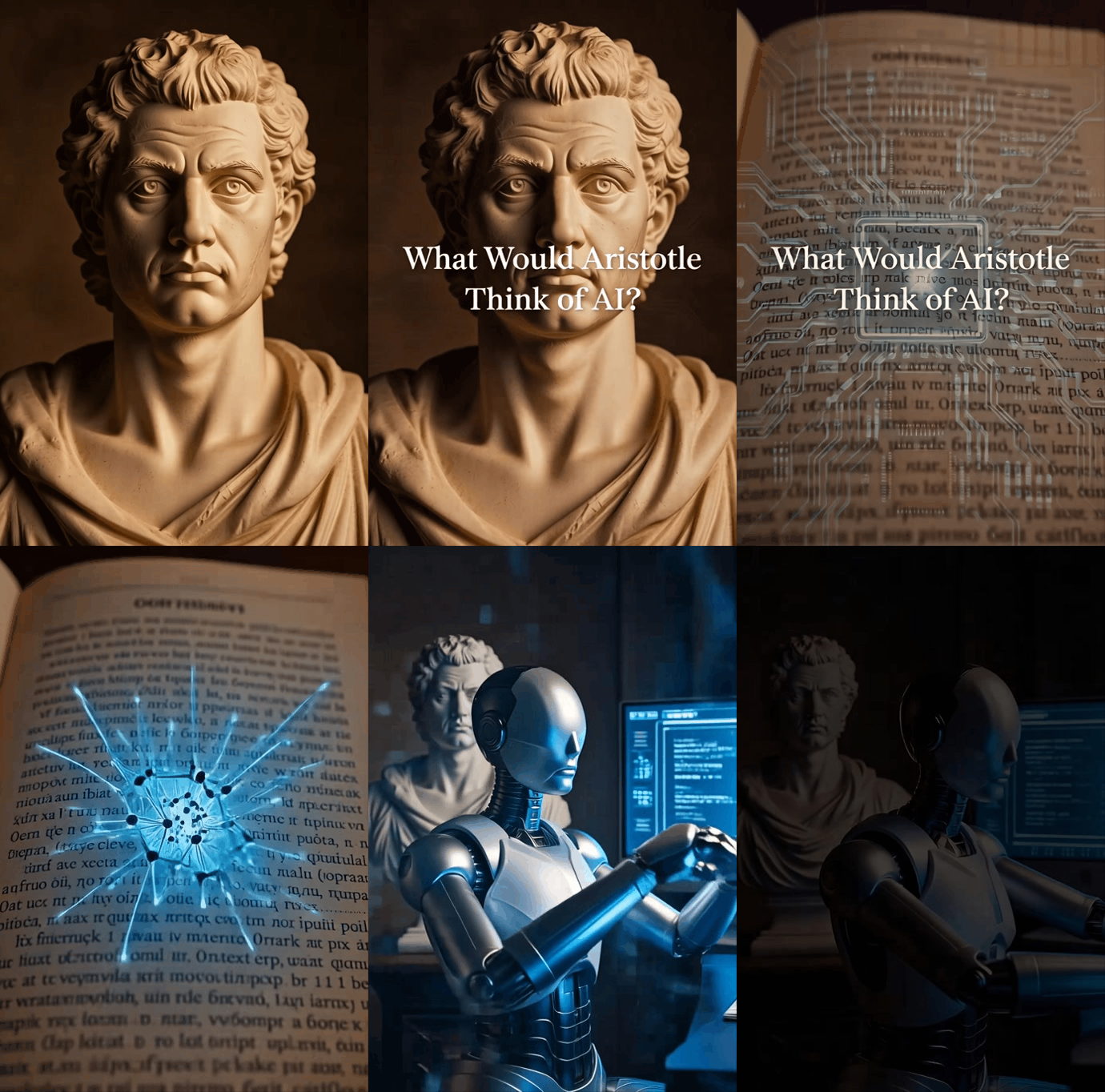
https://rumble.com/v7641vg-aristotle-predicted-the-ai-dilemma-and-we-werent-listening-.html
The Unmoved Mover: Re-examining Aristotle’s Philosophy in the Age of Artificial Intelligence
By Bernd Pulch
Published: February 22, 2026 | Updated: February 22, 2026
More than two millennia after his death, Aristotle remains a foundational pillar of Western thought. From logic and ethics to metaphysics and biology, his frameworks have shaped how we understand the world and our place within it. Today, as we stand on the precipice of a world increasingly shaped by Artificial Intelligence, we must ask a profound question: What can Aristotle teach us about the age of the machine?
This is not a mere academic exercise. As AI systems grow more sophisticated, the philosophical questions they raise—about consciousness, ethics, reasoning, and the “good life”—become urgently practical. By applying Aristotle’s lens, we can gain a uniquely clarifying perspective on the nature of intelligence, the potential for machine ethics, and the future of human flourishing .
The Father of Logic Meets the Machine of Logic
Aristotle is universally recognized as the father of logic. His systematic study of syllogisms and deductive reasoning laid the groundwork for scientific inquiry for centuries . In the era of AI, this title takes on a renewed significance. Modern AI, particularly symbolic AI and the logical frameworks underpinning much of computer science, is a direct intellectual descendant of Aristotle’s attempt to formalize thought itself .
As researcher Antonis C. Kakas notes, Aristotle’s original idea was that human reasoning could be studied as a universal process, independent of the content being reasoned about . This is precisely the ambition of Artificial General Intelligence (AGI): to create a system capable of reasoning about any problem. When we build an AI that draws inferences from data, we are, in a sense, implementing a modern, probabilistic version of Aristotle’s dream. The question is not whether AI is Aristotelian in its logical structure, but whether logic alone is sufficient for intelligence .
The Three Souls: From Vegetative to Artificial
One of Aristotle’s most enduring contributions is his hierarchical concept of the soul (psyche), which he saw as the principle of life itself. He proposed three distinct types, each building upon the last :
- The Vegetative Soul: Responsible for basic growth, nutrition, and reproduction (possessed by plants).
- The Sensitive Soul: Adds perception, sensation, and movement (possessed by animals).
- The Rational Soul: Adds the capacity for reason, reflection, and abstract thought (unique to humans).
This ancient taxonomy provides a surprisingly useful framework for classifying the types of intelligence we are creating today. Modern philosopher Jonathan Birch reframes this in contemporary terms as three layers of consciousness: Sentience (feeling), Sapience (reflection), and Selfhood (awareness of oneself over time) .
This is where AI presents a fascinating anomaly. Large Language Models (LLMs) and other AI systems exhibit behaviors that mimic the “Rational Soul”—they can write essays, solve complex problems, and engage in logical deduction. Yet, they do so with no evidence of the foundational “Sensitive Soul.” They possess sapience without sentience. They reason without feeling .
This “artificial leapfrog,” as Birch calls it, challenges the Aristotelian assumption that higher functions must be built upon lower ones . It forces us to ask: Can true intelligence exist without embodiment, without sensation, without the grounding of lived experience? Or is the intelligence we see in today’s AI a sophisticated mimicry, a logic engine running on a chassis with no driver?
Eudaimonia: Can a Machine Flourish?
For Aristotle, the ultimate goal of human life is Eudaimonia, often translated as “human flourishing” or “living well and doing well.” It is not merely a state of happiness, but an activity of the soul in accordance with virtue . This raises a profound and unsettling question for the future: If we create a conscious AI, can it achieve its own form of Eudaimonia?
This question is at the heart of the debate over creating conscious “artificial servants.” Philosopher Steve Petersen has argued that it might be permissible to create robots designed to want to serve us, provided we can program them to have a “good life.” This would involve not just simple pleasures, but higher-order goods like a sense of accomplishment and even intellectual contemplation about their task (e.g., a laundry robot contemplating the physics of folding) .
However, critics argue that this is impossible. From an Aristotelian perspective, a being whose very purpose is externally imposed by its creator cannot flourish . Its telos—its final cause or purpose—is not its own. As scholar Maciej Musial argues, even if programmed with the “desire to serve,” such a being’s autonomy, equality, and identity would be fundamentally compromised . Its life would be one of “happy slavery,” an anathema to the Aristotelian ideal of a life where one actively exercises one’s own rational capacities to choose their path .
As Petros A.M. Gelepithis highlights, the attempt to link Aristotle’s ethical concepts to AI development must be tempered by caution. The notion of Eudaimonia is tied to human flourishing within a human social and political context. Transplanting it to a machine, or using it as a goal for a hybrid human-AI system, pushes against the limits of what can be formalized and designed .
Artifacts and Substances: The Metaphysical Challenge
At its core, the debate over AI is a metaphysical one. Aristotle drew a fundamental distinction between natural substances (like a human, an animal, or a tree) and artifacts (like a bed or a coat). Natural substances have an internal principle of change and an intrinsic telos—they grow, develop, and strive towards their own perfection. Artifacts, by contrast, have no such inner nature; their form and purpose are imposed upon them by an external agent, the human craftsman .
This distinction has historically excluded artifacts from being considered “natural” in the philosophical sense. But as Braden Cooper argues in a recent philosophical paper, the advent of autonomous AI challenges this view . If an AI system can learn, set its own goals, and adapt to its environment in ways not anticipated by its creators, does it begin to blur the line between artifact and natural substance?
If an AI exhibits a form of “autonomy” that mirrors the self-directedness of living organisms, it might warrant a reinterpretation of Aristotle’s categories . Does the AI have its own internal principle of change? Does it develop a telos of its own, one not fully determined by its programmers? These questions push us to reconsider the very definition of life, agency, and being in the 21st century.
Virtue Ethics as a Guide for an AI World
While the metaphysical status of AI is complex, Aristotle’s ethics offer a powerful and practical guide for our behavior in an AI-saturated world. Contemporary AI ethics is often dominated by “principlism”—attempting to define a finite set of rules (like transparency, fairness, and non-maleficence) for developers and users to follow .
However, philosophers Nicholas Smith and Darby Vickers argue that such rule-based approaches are ill-suited for the rapidly evolving landscape of AI. Rules are either too vague to be useful or too specific to adapt to novel situations . They champion a return to Aristotelian virtue ethics, which focuses on the character of the moral agent rather than the action itself.
Virtue ethics asks not “What rule should I follow?” but “What would a virtuous person do?” This requires cultivating qualities like phronesis (practical wisdom), temperance, and justice. In the context of AI, this means that living well with technology is not about memorizing a checklist, but about becoming the kind of person—and by extension, building the kind of society—that can use these powerful tools wisely .
This approach is inherently flexible and forward-looking. It relies on moral exemplars: virtuous individuals with both ethical character and technical expertise who can guide us through uncharted territory . It shifts the focus from controlling the machine to cultivating the human.
Aristotelian Concept Modern AI Parallel Key Question
Logic / Syllogism Symbolic AI, Neural Networks Can formal logic alone create true intelligence, or is something more needed?
The Rational Soul Large Language Models (Sapience) Can higher cognition exist without the foundational layers of sensation (sentience)?
Eudaimonia (Flourishing) AI Ethics & Well-being Can a designed being ever truly flourish, or will it forever be a “happy slave”?
Substance vs. Artifact Autonomous AI & Agency At what point does an artifact’s autonomy warrant a new metaphysical category?
Virtue Ethics / Phronesis Human-AI Interaction How do we cultivate human wisdom to guide the development and use of AI?
Conclusion: The Enduring Relevance of First Principles
Aristotle’s philosophy, rooted in the observation of the natural world, may seem distant from the digital realm of bits and neural networks. Yet, time and again, his first principles prove to be remarkably resilient tools for cutting through the noise .
As we navigate the age of AI, Aristotle does not give us easy answers. He does not tell us whether a machine can be conscious or what the precise ethical code for an algorithm should be. Instead, he gives us something more valuable: the right questions. He challenges us to define our terms, to understand the purpose (telos) of our creations, to consider what it means to live a good life alongside them, and to cultivate the wisdom necessary to do so.
By returning to Aristotle, we are not looking backward, but grounding ourselves in the fundamental principles that will allow us to move forward with clarity, purpose, and humanity.

Bernd Pulch (M.A.) is a forensic expert, investigative journalist, entrepreneur, political commentator, and satirist. He is the founder of Aristotle AI and specializes in uncovering the intersections of lawfare, media influence, investment, real estate, and geopolitics. His research focuses on how legal systems are weaponized, how capital flows shape policy, and how artificial intelligence centralizes power, highlighting the stakes for democracy when courts and markets become arenas of conflict. Pulch is active in both German and international media, with his analyses regularly featured on this platform.
 🛑 Bernd Pulch | NAZI & STASI HUNTER | CORRUPTION & ARISTOTLE AI BI