

What happens when the government outsources its deepest secrets? Booz Allen Hamilton isn’t just a contractor—it’s a private corporation embedded at the heart of U.S. intelligence, with an estimated 70% of the intelligence budget flowing to firms like it.
From Edward Snowden to the largest theft of classified data in history, Booz Allen has been at the center of some of America’s most devastating security breaches. This deep dive explores how a management consultancy became a “shadow intelligence community,” and why its repeated failures point to a dangerous flaw in how modern espionage is run.
In the world of intelligence, where the line between government and industry is as thin as a fiber-optic cable, few names carry as much weight—or controversy—as Booz Allen Hamilton. Often described as the “shadow intelligence community,” the firm has become a central pillar of U.S. national security while repeatedly surfacing at the heart of some of the most consequential espionage and data-leak scandals of the modern era.
This is the story of how a management consultancy evolved into a core actor of the National Security Industrial Complex—and why that evolution now poses systemic risks.
The Hawaii Connection
In the spring of 2013, a 29-year-old computer technician named Edward Snowden reported for work at a National Security Agency facility in Hawaii. He was not a government employee. He was a contractor employed by Booz Allen Hamilton.
Within months, Snowden fled to Hong Kong carrying a trove of classified documents that exposed global mass-surveillance programs and ignited a worldwide debate over privacy, sovereignty, and the outsourcing of state power. The disclosures reshaped intelligence law, diplomacy, and public trust—and permanently tied Booz Allen’s name to one of the largest intelligence breaches in history.
Not an Exception, but a Pattern
The Snowden affair was not an anomaly. It was a visible rupture in a system that had quietly become dependent on private contractors.
Today, an estimated 70 percent of the U.S. intelligence budget flows to private firms. Booz Allen Hamilton sits at the apex of that ecosystem, staffed heavily by former CIA, NSA, and Pentagon officials and embedded deep inside classified programs.
As its influence has grown, so too has its exposure to failure. Again and again, the firm has surfaced as a common denominator in major security lapses—raising questions not about individual misconduct, but about structural vulnerability.
The Rise of a “Shadow Intelligence Community”
Booz Allen’s relationship with the U.S. military dates back to 1940, but its transformation into an intelligence powerhouse accelerated dramatically after September 11, 2001. Counterterrorism, cyberwarfare, data analytics, and surveillance became growth sectors—and Booz Allen became indispensable.
Key characteristics define its role today:
- Security Penetration: More than three-quarters of its workforce holds U.S. security clearances.
- Revenue Dependence: A substantial share of its multi-billion-dollar revenue derives from intelligence and defense agencies.
- The Revolving Door: Senior leadership has routinely included former top officials, including a former Director of National Intelligence.
The result is not merely a contractor relationship, but a form of institutional fusion—private employees operating inside the nervous system of the state.
A Record of Breaches
Despite its central role in safeguarding classified systems, Booz Allen’s history is punctuated by some of the most damaging security failures on record:
- The Snowden Disclosures (2013): Exposure of PRISM and global electronic surveillance programs, triggering diplomatic fallout and public backlash worldwide.
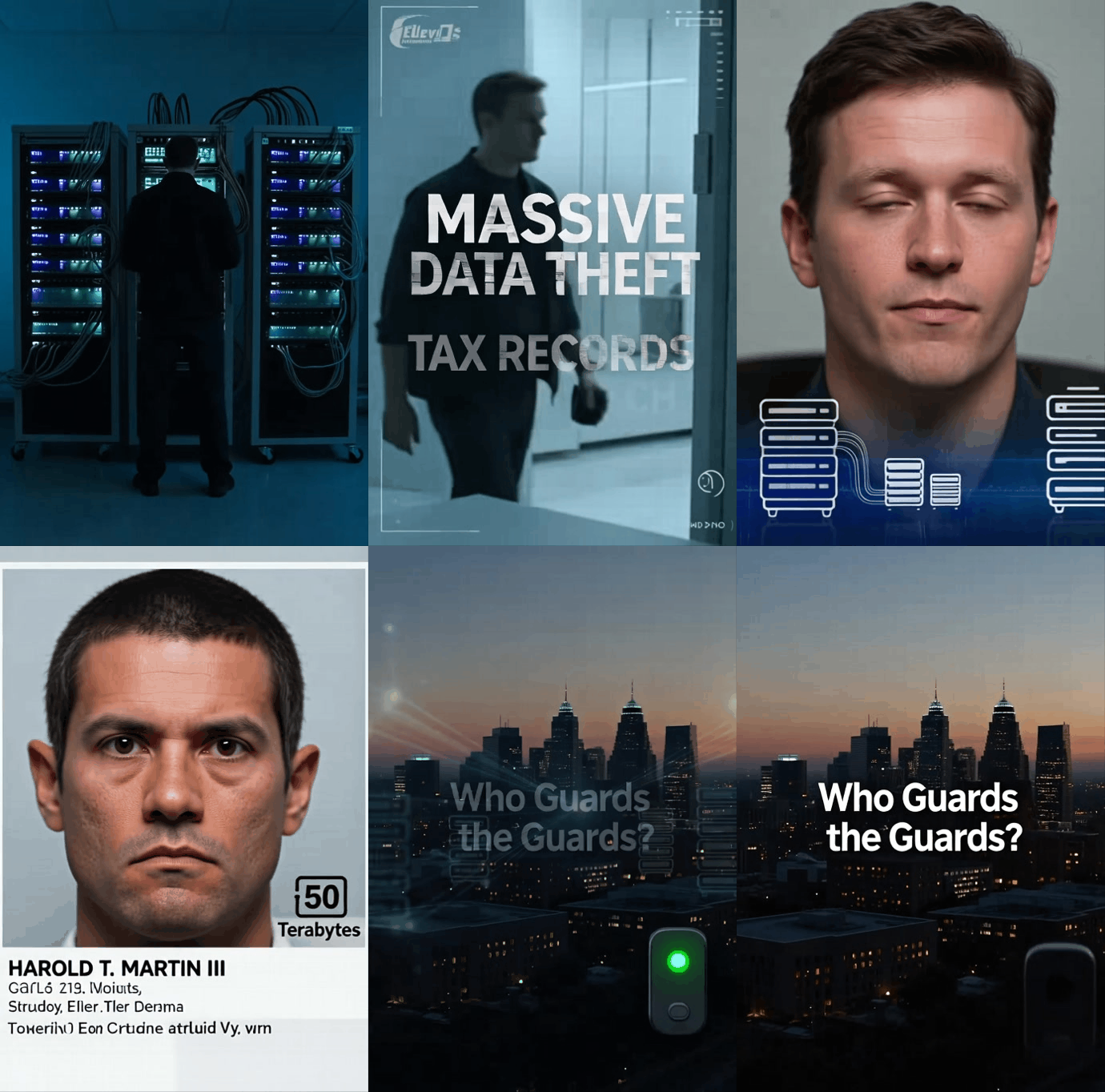
- The Harold Martin Case (2016): A Booz Allen employee arrested for allegedly hoarding roughly 50 terabytes of classified material over two decades—the largest known theft of classified data in U.S. history.
- The IRS Tax Leak Fallout (2024–2026): Contractor Charles Littlejohn sentenced for leaking confidential tax records of high-profile individuals. In response, the U.S. Treasury canceled 31 Booz Allen contracts in early 2026.
Each case differed in motive and method. The constant was access.
The Profitability of Privacy
Critics argue that Booz Allen embodies a fundamental conflict: a profit-driven corporation entrusted with the deepest secrets of a sovereign state. What begins as “surge capacity”—temporary external support—can quietly solidify into a permanent shadow bureaucracy, insulated from democratic oversight yet essential to daily operations.
When accountability fails, consequences tend to diffuse: responsibility shifts between agency, contractor, and individual, leaving systemic flaws intact.
As one intelligence observer put it: Booz Allen is not merely a vendor—it is embedded at the core of U.S. intelligence.
After the IRS Fallout
The Treasury Department’s 2026 contract cancellations serve as a rare instance of institutional consequence. Treasury Secretary Scott Bessent summarized the decision bluntly: Booz Allen failed to implement adequate safeguards.
For a firm whose business model is built on security, trust, and risk mitigation, repeated breaches are not public-relations problems. They are existential questions about whether intelligence outsourcing at this scale is sustainable—or safe.
The Booz Allen story is ultimately not about one company. It is about a system in which national intelligence has been privatized, normalized, and monetized—often faster than the safeguards meant to contain it.
- Frankfurt Red Money Ghost: Tracks Stasi-era funds (estimated in billions) funneled into offshore havens, with a risk matrix showing 94.6% institutional counterparty risk and 82.7% money laundering probability.
- Global Hole & Dark Data Analysis: Exposes an €8.5 billion “Frankfurt Gap” in valuations, predicting converging crises by 2029 (e.g., 92% probability of a $15–25 trillion commercial real estate collapse).
- Ruhr-Valuation Gap (2026): Forensic audit identifying €1.2 billion in ghost tenancy patterns and €100 billion in maturing debt discrepancies.
- Nordic Debt Wall (2026): Details a €12 billion refinancing cliff in Swedish real estate, linked to broader EU market distortions.
- Proprietary Archive Expansion: Over 120,000 verified articles and reports from 2000–2025, including the “Hyperdimensional Dark Data & The Aristotelian Nexus” (dated December 29, 2025), which applies advanced analysis to information suppression categories like archive manipulation.
- List of Stasi agents 90,000 plus Securitate Agent List.
Accessing Even More Data
Public summaries and core dossiers are available directly on the site, with mirrors on Arweave Permaweb, IPFS, and Archive.is for preservation. For full raw datasets or restricted items (e.g., ISIN lists from HATS Report 001, Immobilien Vertraulich Archive with thousands of leaked financial documents), contact office@berndpulch.org using PGP or Signal encryption. Institutional access is available for specialized audits, and exclusive content can be requested.
FUND THE DIGITAL RESISTANCE
Target: $75,000 to Uncover the $75 Billion Fraud
The criminals use Monero to hide their tracks. We use it to expose them. This is digital warfare, and truth is the ultimate cryptocurrency.
BREAKDOWN: THE $75,000 TRUTH EXCAVATION
Phase 1: Digital Forensics ($25,000)
· Blockchain archaeology following Monero trails
· Dark web intelligence on EBL network operations
· Server infiltration and data recovery
Phase 2: Operational Security ($20,000)
· Military-grade encryption and secure infrastructure
· Physical security for investigators in high-risk zones
· Legal defense against multi-jurisdictional attacks
Phase 3: Evidence Preservation ($15,000)
· Emergency archive rescue operations
· Immutable blockchain-based evidence storage
· Witness protection program
Phase 4: Global Exposure ($15,000)
· Multi-language investigative reporting
· Secure data distribution networks
· Legal evidence packaging for international authorities
CONTRIBUTION IMPACT
$75 = Preserves one critical document from GDPR deletion
$750 = Funds one dark web intelligence operation
$7,500 = Secures one investigator for one month
$75,000 = Exposes the entire criminal network
SECURE CONTRIBUTION CHANNEL
Monero (XMR) – The Only Truly Private Option
45cVWS8EGkyJvTJ4orZBPnF4cLthRs5xk45jND8pDJcq2mXp9JvAte2Cvdi72aPHtLQt3CEMKgiWDHVFUP9WzCqMBZZ57y4
This address is dedicated exclusively to this investigation. All contributions are cryptographically private and untraceable.
Monero QR Code (Scan to donate anonymously):
(Copy-paste the address if scanning is not possible: 45cVWS8EGkyJvTJ4orZBPnF4cLthRs5xk45jND8pDJcq2mXp9JvAte2Cvdi72aPHtLQt3CEMKgiWDHVFUP9WzCqMBZZ57y4)
Translations of the Patron’s Vault Announcement:
(Full versions in German, French, Spanish, Russian, Arabic, Portuguese, Simplified Chinese, and Hindi are included in the live site versions.)
Copyright Notice (All Rights Reserved)
English:
© 2000–2026 Bernd Pulch. All rights reserved. No part of this publication may be reproduced, distributed, or transmitted in any form or by any means without the prior written permission of the author.
(Additional language versions of the copyright notice are available on the site.)
❌©BERNDPULCH – ABOVE TOP SECRET ORIGINAL DOCUMENTS – THE ONLY MEDIA WITH LICENSE TO SPY ✌️
Follow @abovetopsecretxxl for more. 🙏 GOD BLESS YOU 🙏
Credentials & Info:
- Bio & Career: https://berndpulch.org/about-me
- FAQ: https://berndpulch.org/faq
Your support keeps the truth alive – true information is the most valuable resource!
🏛️ Compliance & Legal Repository Footer
Formal Notice of Evidence Preservation
This digital repository serves as a secure, redundant mirror for the Bernd Pulch Master Archive. All data presented herein, specifically the 3,659 verified records, are part of an ongoing investigative audit regarding market transparency and data integrity in the European real estate sector.
Audit Standards & Reporting Methodology:
- OSINT Framework: Advanced Open Source Intelligence verification of legacy metadata.
- Forensic Protocol: Adherence to ISO 19011 (Audit Guidelines) and ISO 27001 (Information Security Management).
- Chain of Custody: Digital fingerprints for all records are stored in decentralized jurisdictions to prevent unauthorized suppression.
Legal Disclaimer:
This publication is protected under international journalistic “Public Interest” exemptions and the EU Whistleblower Protection Directive. Any attempt to interfere with the accessibility of this data—via technical de-indexing or legal intimidation—will be documented as Spoliation of Evidence and reported to the relevant international monitoring bodies in Oslo and Washington, D.C.
Digital Signature & Tags
Status: ACTIVE MIRROR | Node: WP-SECURE-BUNKER-01
Keywords: #ForensicAudit #DataIntegrity #ISO27001 #IZArchive #EvidencePreservation #OSINT #MarketTransparency #JonesDayMonitoring
 🛑 Bernd Pulch | NAZI & STASI HUNTER | CORRUPTION & ARISTOTLE AI BI