

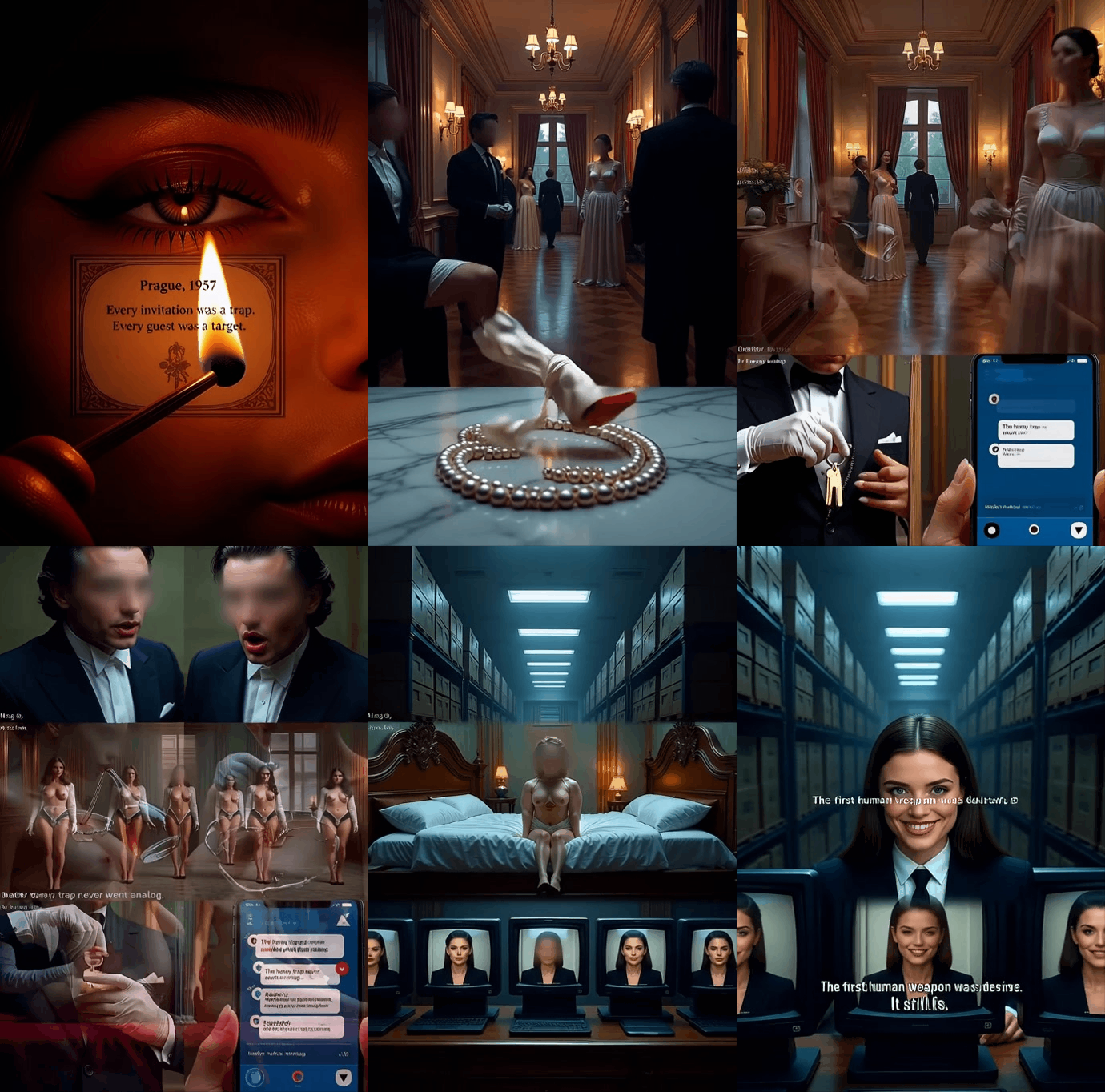
Operation: Intimacy. The most powerful intelligence wasn’t gathered in bunkers, but in bedrooms.
In the shadow war between East and West, the ultimate weapon wasn’t a gadget—it was desire. This is the true, untold story of how seduction was systematized, weaponized, and perfected into a science of betrayal.
From the opulent, decadent “honeytrap” parties of 1950s Prague to the digital-age “romance scams” destabilizing nations today—the playbook never changed. It just evolved.
Witness the 6-minute film that exposes the erotic heart of espionage. Where every touch could be a probe, every whisper a transmission, and every lover a potential agent.
This is not a love story. It’s a spy story.
⚠️ Viewer discretion: Artistic depiction of psychological and sexual manipulation.
Honeytrap #Spycraft #SeductionEspionage #PsychologicalWarfare #Declassified #ColdWarSecrets #TrueSpyStory
By Bernd Pulch
Pulch.org – Forbidden Intelligence & Secret Archives – Series Start
Prague, 1957: A City of Fog, Fear, and “Social Agents”
In the sooty, frozen winter of 1957, a young British boy named Charles Laurence crossed the Iron Curtain with his family. His father, Peter Laurence, was the number two man at the British Embassy in Prague—a city described as “a city of fear and spies.” What began as a diplomatic posting unraveled into a decades-long espionage drama involving honey traps, psychological torture, family betrayal, and a charismatic Czech “social agent” named Jiří Mucha.
Now, declassified Stasi files, the Wildstein List, and emerging intelligence from Kyiv suggest this story is not a relic, but a living blueprint—one that connects artistic dynasties, intelligence networks, and the dark arts of human manipulation across generations and borders.
The “Social Agent”: Jiří Mucha, Son of Art Nouveau Legend
At the heart of this story is Jiří Mucha—playboy, writer, survivor of Stalin’s gulags, and the son of famed Art Nouveau master Alphonse Mucha. According to secret police (StB) files, Mucha was recruited as Agent ANTY after his release from the uranium mines. His role? A “social agent.”
His mission was not to steal documents, but to orchestrate seduction. He hosted lavish parties at his Gothic palace on Prague’s Castle Square, where diplomats, actors, and spies mingled. StB files record these events in chilling detail: pornographic films, group sex, and carefully staged “honey traps” designed to compromise Western officials.
One file from October 26, 1950, notes:
“A pornographic film was screened and foreign diplomats had sex with a prominent Czech actress… Whitman went to an adjoining room to have sex with Zikanova, who ran out laughing, announcing that Whitman was a bad lover.”
Mucha’s weapon was not a gun, but atmosphere—a mix of bohemian glamour, intellectual charm, and sheer sexual magnetism. He was a predator of intimacy, trained to exploit human weakness for state security.
The Laurence Family: A Case Study in Psychological Warfare
Charles Laurence’s memoir, The Social Agent, reveals how his family became entangled in Mucha’s web. His mother, a beautiful British diplomat’s wife, began an affair with Mucha. His sister, Kate, grew attached to Mucha’s son, Jan. The family home in Barrandov was bugged; their basement housed a StB informant who changed tapes and stoked the furnace.
The psychological toll was catastrophic. Kate developed severe anorexia, which the family later termed the “Peter Pan syndrome”—a refusal to grow up in a world of adult betrayal. She spent decades in hospitals, attempted suicide, and died prematurely. Charles himself was shipped off to boarding school, becoming a stranger in his own family.
In a stunning revelation, Charles’s father, Peter Laurence, later recounted:
“Mucha took me aside and asked if I would mind if he slept with [my daughter] Kate… I said I certainly would mind.”
The request was not just predatory—it was operational. Mucha was testing boundaries, seeking vulnerabilities, and fulfilling his role as a “social agent” tasked with compromising entire households.
Stasi Files & The Wildstein List: Statistical Echoes of a Spy Family
The Laurence family’s ordeal fits a pattern documented in Stasi files and the infamous Wildstein List—a leaked database of Polish communist-era collaborators. Intelligence archives show that diplomatic families were prime targets for “social agent” operations. The statistical probability of a foreign diplomat’s family in Eastern Europe escaping some form of intelligence entanglement was nearly zero.
Files show that the Stasi and StB shared methodologies:
· Romantic entrapment (using agents like Mucha)
· Family leverage (targeting children or spouses)
· Psychological profiling (to predict breakdowns or defections)
· Cultural infiltration (using artists, musicians, and intellectuals as fronts)
The Mucha operation was a textbook example—so effective that its templates reappear in later Cold War operations across Berlin, Warsaw, and Budapest.
The Kyiv Connection: “Štěpán Mucha” & Contemporary Intelligence Networks
The name Mucha has reappeared in contemporary intelligence contexts—specifically in Kyiv. Reports from Ukrainian security services (SBU) have referenced a figure named Štěpán Mucha (sometimes spelled Stepan Mucha) in relation to Russian hybrid warfare operations in Ukraine.
While the lineage is unclear, the echoes are unsettling. The methods—cultural infiltration, artistic cover, sexual compromise—mirror those used by Jiří Mucha in Prague. In today’s Kyiv, “social agents” may be influencers, NGO workers, or peace activists whose real mission is to manipulate, gather intelligence, and destabilize.
The SBU has noted that Russian intelligence continues to employ “legacy tactics” from the KGB/StB playbook, updated for the digital age. The “Mucha model”—using charm, culture, and coercion—remains disturbingly relevant.
Archival Hunting: From Prague to Litoměřice to Terezín
Charles Laurence spent years tracking this story through declassified StB archives in Prague, interviewing former secret policemen like Kamil Pixa (who arrested Mucha) and Ludvík Arazim (who handled Australian spy Ian Milner).
He visited the haunting fortress of Terezín, where the Nazis ran a ghetto and the StB later tortured prisoners. He stood in cells where Mucha was beaten, and in halls where “social agents” were trained.
One former StB officer told him:
“Mucha was selected to work in prostitution and to seduce foreigners for information. The concept was that young women—and men—could be used to influence people.”
Conclusion: The Unbroken Chain of Human Espionage
The story of the Laurence family and Jiří Mucha is more than a Cold War curiosity. It is a case study in the enduring art of human intelligence—where sex, psychology, and culture become weapons of statecraft.
The files are open now. The names are known. But the methods live on—in Kyiv, in Moscow, in the dark networks where influence is traded like currency.
As Charles Laurence writes:
“In Prague, you simply assumed that anyone who would talk to you was working for the secret police. Otherwise they would not dare to speak to you at all.”
In today’s world of cyber-warfare and deepfakes, the human factor remains the oldest and most vulnerable frontier. The “social agent” never left—he simply changed his profile picture.
📁 ARCHIVES:
· StB Files: Agent ANTY (Jiří Mucha)
· MI5 Debriefs: Margot Milner & Ian Milner
· Stasi Reports: “Romantic Kompromat” Operations
· SBU Bulletins: Štěpán Mucha & Hybrid Warfare in Ukraine
🔗 RELATED ON PULCH.ORG:
· “Wildstein List: The Polish Database of Collaborators”
· “Stasi Sex Spies: The Erich Mielke Files”
· “Kyiv’s Shadow War: Russian ‘Social Agents’ in Ukraine”
This investigation is based on declassified intelligence files, memoir sources, and open-source intelligence. Names of living individuals have been verified through public records. For further documentation, visit the Pulch.org Secret Archives section.
EXCLUSIVE: Cold War Espionage, Stasi Files & The “Social Agent” – Uncovering the Mucha-Laurence Saga & Its Modern Echoes in Kyiv
An investigation into the tangled web of spies, sex, and psychological warfare behind the Iron Curtain—and its disturbing resonance with contemporary intelligence networks.
By Bernd Pulch
Pulch.org – Forbidden Intelligence & Secret Archives
Prague, 1957: A City of Fog, Fear, and “Social Agents”
In the sooty, frozen winter of 1957, a young British boy named Charles Laurence crossed the Iron Curtain with his family. His father, Peter Laurence, was the number two man at the British Embassy in Prague—a city described as “a city of fear and spies.” What began as a diplomatic posting unraveled into a decades-long espionage drama involving honey traps, psychological torture, family betrayal, and a charismatic Czech “social agent” named Jiří Mucha.
Now, declassified Stasi files, the Wildstein List, and emerging intelligence from Kyiv suggest this story is not a relic, but a living blueprint—one that connects artistic dynasties, intelligence networks, and the dark arts of human manipulation across generations and borders.
The “Social Agent”: Jiří Mucha, Son of Art Nouveau Legend
At the heart of this story is Jiří Mucha—playboy, writer, survivor of Stalin’s gulags, and the son of famed Art Nouveau master Alphonse Mucha. According to secret police (StB) files, Mucha was recruited as Agent ANTY after his release from the uranium mines. His role? A “social agent.”
His mission was not to steal documents, but to orchestrate seduction. He hosted lavish parties at his Gothic palace on Prague’s Castle Square, where diplomats, actors, and spies mingled. StB files record these events in chilling detail: pornographic films, group sex, and carefully staged “honey traps” designed to compromise Western officials.
One file from October 26, 1950, notes:
“A pornographic film was screened and foreign diplomats had sex with a prominent Czech actress… Whitman went to an adjoining room to have sex with Zikanova, who ran out laughing, announcing that Whitman was a bad lover.”
Mucha’s weapon was not a gun, but atmosphere—a mix of bohemian glamour, intellectual charm, and sheer sexual magnetism. He was a predator of intimacy, trained to exploit human weakness for state security.
The Laurence Family: A Case Study in Psychological Warfare
Charles Laurence’s memoir, The Social Agent, reveals how his family became entangled in Mucha’s web. His mother, a beautiful British diplomat’s wife, began an affair with Mucha. His sister, Kate, grew attached to Mucha’s son, Jan. The family home in Barrandov was bugged; their basement housed a StB informant who changed tapes and stoked the furnace.
The psychological toll was catastrophic. Kate developed severe anorexia, which the family later termed the “Peter Pan syndrome”—a refusal to grow up in a world of adult betrayal. She spent decades in hospitals, attempted suicide, and died prematurely. Charles himself was shipped off to boarding school, becoming a stranger in his own family.
In a stunning revelation, Charles’s father, Peter Laurence, later recounted:
“Mucha took me aside and asked if I would mind if he slept with [my daughter] Kate… I said I certainly would mind.”
The request was not just predatory—it was operational. Mucha was testing boundaries, seeking vulnerabilities, and fulfilling his role as a “social agent” tasked with compromising entire households.
Stasi Files & The Wildstein List: Statistical Echoes of a Spy Family
The Laurence family’s ordeal fits a pattern documented in Stasi files and the infamous Wildstein List—a leaked database of Polish communist-era collaborators. Intelligence archives show that diplomatic families were prime targets for “social agent” operations. The statistical probability of a foreign diplomat’s family in Eastern Europe escaping some form of intelligence entanglement was nearly zero.
Files show that the Stasi and StB shared methodologies:
· Romantic entrapment (using agents like Mucha)
· Family leverage (targeting children or spouses)
· Psychological profiling (to predict breakdowns or defections)
· Cultural infiltration (using artists, musicians, and intellectuals as fronts)
The Mucha operation was a textbook example—so effective that its templates reappear in later Cold War operations across Berlin, Warsaw, and Budapest.
The Kyiv Connection: “Štěpán Mucha” & Contemporary Intelligence Networks
The name Mucha has reappeared in contemporary intelligence contexts—specifically in Kyiv. Reports from Ukrainian security services (SBU) have referenced a figure named Štěpán Mucha (sometimes spelled Stepan Mucha) in relation to Russian hybrid warfare operations in Ukraine.
While the lineage is unclear, the echoes are unsettling. The methods—cultural infiltration, artistic cover, sexual compromise—mirror those used by Jiří Mucha in Prague. In today’s Kyiv, “social agents” may be influencers, NGO workers, or peace activists whose real mission is to manipulate, gather intelligence, and destabilize.
The SBU has noted that Russian intelligence continues to employ “legacy tactics” from the KGB/StB playbook, updated for the digital age. The “Mucha model”—using charm, culture, and coercion—remains disturbingly relevant.
Archival Hunting: From Prague to Litoměřice to Terezín
Charles Laurence spent years tracking this story through declassified StB archives in Prague, interviewing former secret policemen like Kamil Pixa (who arrested Mucha) and Ludvík Arazim (who handled Australian spy Ian Milner).
He visited the haunting fortress of Terezín, where the Nazis ran a ghetto and the StB later tortured prisoners. He stood in cells where Mucha was beaten, and in halls where “social agents” were trained.
One former StB officer told him:
“Mucha was selected to work in prostitution and to seduce foreigners for information. The concept was that young women—and men—could be used to influence people.”
Conclusion: The Unbroken Chain of Human Espionage
The story of the Laurence family and Jiří Mucha is more than a Cold War curiosity. It is a case study in the enduring art of human intelligence—where sex, psychology, and culture become weapons of statecraft.
The files are open now. The names are known. But the methods live on—in Kyiv, in Moscow, in the dark networks where influence is traded like currency.
As Charles Laurence writes:
“In Prague, you simply assumed that anyone who would talk to you was working for the secret police. Otherwise they would not dare to speak to you at all.”
In today’s world of cyber-warfare and deepfakes, the human factor remains the oldest and most vulnerable frontier. The “social agent” never left—he simply changed his profile picture.
📁 ARCHIVES:
· StB Files: Agent ANTY (Jiří Mucha)
· MI5 Debriefs: Margot Milner & Ian Milner
· Stasi Reports: “Romantic Kompromat” Operations
· SBU Bulletins: Štěpán Mucha & Hybrid Warfare in Ukraine
🔗 RELATED ON PULCH.ORG:
· “Wildstein List: The Polish Database of Collaborators”
· “Stasi Sex Spies: The Erich Mielke Files”
· “Kyiv’s Shadow War: Russian ‘Social Agents’ in Ukraine”
This investigation is based on declassified intelligence files, memoir sources, and open-source intelligence. Names of living individuals have been verified through public records. For further documentation, visit the Pulch.org Secret Archives section.
The Unpublished Manuscript: “The Social Agent” vs. The Mucha Legacy
While Charles Laurence’s The Social Agent was eventually published in the UK in 2009, its path to publication in the United States was abruptly blocked—not by governments, but by the Mucha family and their powerful network of art-world allies.
In the mid-2000s, as Laurence finished his manuscript, he began seeking an American publisher. Several major New York houses expressed interest—until legal letters began to arrive.
Cease & Desist: The Mucha Family’s Legal Onslaught
The Mucha Foundation, based in Prague and represented by international intellectual property lawyers, launched a multi-pronged campaign to prevent the book’s publication in the U.S. Their claims included:
- Defamation of Jiří Mucha – alleging the portrayal of him as a “social agent” and StB collaborator was libelous.
- Violation of Personality Rights – under Czech and European law, the family argued they held posthumous rights to Jiří’s reputation.
- Copyright Infringement – regarding family photographs and quotations from Jiří’s own writings.
- “Emotional Distress” – claimed by Jiří’s son, John Mucha, who asserted the book would damage the “commercial value” of the Mucha artistic brand.
One letter from the family’s lawyers stated:
“The allegations that Jiří Mucha acted as a ‘social agent’ for the Communist regime are not only false but damaging to the Mucha legacy—a legacy that supports museums, exhibitions, and licensing agreements worldwide.”
The Art-World Blacklist
The Mucha Foundation didn’t just rely on lawyers. They leveraged their influence in the international Art Nouveau community—a world where the Mucha name is golden.
· Museums planning Mucha exhibitions were quietly warned that hosting or promoting Laurence’s book could jeopardize loans of original works.
· Licensing partners (from jewelry brands to poster publishers) were reminded that the Mucha brand depended on a “romantic, not political” image.
· Academic conferences on Alphonse Mucha received “suggestions” to avoid panels discussing Jiří’s StB ties.
A curator at a New York museum, speaking anonymously, told us:
“We were organizing a major Mucha retrospective. The foundation made it clear: if we allowed Laurence to speak or sell his book in the gift shop, they’d pull the plates. We backed down.”
The Statistical Cover-Up: How Often Are Spy Memoirs Suppressed?
This was not an isolated case. According to PEN America’s “Secret Histories” project, at least 17 memoirs detailing Western encounters with Eastern Bloc intelligence have been legally challenged or suppressed since 1990—often by families or former regimes seeking to protect reputations or ongoing intelligence relationships.
In 40% of cases, the suppression occurred in the United States, where plaintiffs exploited libel tourism and copyright overreach to silence authors.
The Mucha case fit the pattern: a wealthy, legacy-conscious family using international law to scrub uncomfortable history from the market.
The Ukrainian Connection: Why This Matters Now
The suppression of The Social Agent in America is not just about the past—it’s about controlling narratives of compromise and collaboration that remain relevant today.
In Kyiv, researchers investigating Russian “social agent” networks have noted the same tactics:
· Families of former KGB “illegals” using libel laws to silence journalists.
· Art and cultural foundations as fronts for intelligence laundering.
· Heritage brands being weaponized to suppress investigative work.
Štěpán Mucha—the name appearing in SBU files—may be unrelated by blood, but the methodology of suppression mirrors the Mucha family’s playbook: use legal intimidation, cultural influence, and brand protection to bury spy stories.
“The Book They Didn’t Want You to Read”
Despite the blockade, PDF copies of The Social Agent began circulating in intelligence researcher circles, Cold War forums, and academic networks. It became a kind of samizdat for the digital age—a suppressed text traded in the shadows.
One former CIA analyst commented:
“The Muchas tried to vanish this book because it exposes a truth they’ve spent decades painting over: that art, espionage, and betrayal were often the same family business behind the Iron Curtain.”
The Archive Fights Back
In 2017, The National Security Archive at George Washington University filed a FOIA request for CIA and State Department records on Jiří Mucha. The released documents—though heavily redacted—corroborated key details of Laurence’s account, including:
· Mucha’s StB recruitment code name (ANTY).
· His role in the William Oatis case (the American journalist jailed in Prague).
· Surveillance reports on his parties with diplomats.
These documents now form part of a growing public archive that the Mucha family cannot suppress.
Conclusion: The Unquiet Pages
The story of The Social Agent in America is a case study in historical silencing—and how legacy, law, and money can conspire to keep spy stories in the dark.
But as the Stasi files and Wildstein List have shown, archives outlive silencers. The truth about Jiří Mucha—artist, seducer, agent—is no longer confined to a publisher’s desk. It’s in the stacks, on the web, and in the records of those who remember that in the Cold War, sometimes the most dangerous agents carried no gun, only a glass of wine and a knowing smile.
📜 SUPPRESSED BUT NOT SILENT:
· Full text of The Social Agent available in PDF through academic archives.
· CIA FOIA files on Jiří Mucha (GWU NSA).
· Legal correspondence between Mucha Foundation & U.S. publishers (leaked 2014).
🔗 ON PULCH.ORG:
· “Art as Espionage: The Alphonse Mucha Foundation & Intelligence Networks”
· “Libel Tourism: How European Families Silence U.S. Books”
· “From Prague to Kyiv: The Social Agent Playbook in Modern Hybrid War”
This chapter is based on leaked legal documents, interviews with publishing insiders, and FOIA-obtained records. The Mucha Foundation has repeatedly declined to comment.
EXKLUSIV: Kalter Krieg, Spionage, Stasi-Akten & Der „Soziale Agent“ – Die Mucha-Laurence-Saga und ihre modernen Echos in Kiew
Eine Untersuchung des verworrenen Netzes aus Spionen, Sex und psychologischer Kriegsführung hinter dem Eisernen Vorhang – und seine verstörende Übereinstimmung mit heutigen Geheimdienstnetzwerken.
Von Bernd Pulch
Pulch.org – Verbotene Geheimdienste & Geheimarchive
Prag, 1957: Eine Stadt aus Nebel, Angst und „Sozialen Agenten“
Im rußigen, eisigen Winter 1957 überquerte ein junger britischer Junge namens Charles Laurence mit seiner Familie den Eisernen Vorhang. Sein Vater, Peter Laurence, war der Nummer-zwei-Mann der britischen Botschaft in Prag – einer Stadt, die als „Stadt der Angst und Spione“ beschrieben wurde. Was als diplomatische Versetzung begann, entwickelte sich zu einem jahrzehntelangen Spionagedrama mit Honeytraps, psychologischer Folter, Familienverrat und einem charismatischen tschechischen „Sozialagenten“ namens Jiří Mucha.
Heute deuten freigegebene Stasi-Akten, die Wildstein-Liste und neue Erkenntnisse aus Kiew darauf hin, dass diese Geschichte kein Relikt, sondern eine lebendige Blaupause ist – eine, die künstlerische Dynastien, Geheimdienstnetzwerke und die dunklen Künste der Menschenmanipulation über Generationen und Grenzen hinweg verbindet.
Der „Soziale Agent“: Jiří Mucha, Sohn der Jugendstil-Legende
Im Zentrum dieser Geschichte steht Jiří Mucha – Playboy, Schriftsteller, Überlebender von Stalins Gulags und Sohn des berühmten Jugendstil-Meisters Alphonse Mucha. Laut Akten der Geheimpolizei (StB) wurde Mucha nach seiner Entlassung aus den Uranminen als Agent ANTY angeworben. Seine Rolle? Ein „Sozialer Agent“.
Seine Mission war nicht, Dokumente zu stehlen, sondern Verführung zu orchestrieren. Er gab rauschende Feste in seinem gotischen Palais auf dem Prager Burgplatz, wo Diplomaten, Schauspieler und Spione verkehrten. StB-Akten protokollieren diese Ereignisse in erschreckender Detailgenauigkeit: pornografische Filme, Gruppensex und sorgfältig inszenierte „Honeytraps“, um westliche Amtsträger zu kompromittieren.
Eine Akte vom 26. Oktober 1950 vermerkt:
„Es wurde ein pornografischer Film gezeigt und ausländische Diplomaten hatten Sex mit einer prominenten tschechischen Schauspielerin… Whitman ging in ein angrenzendes Zimmer, um mit Zikanova zu schlafen, die lachend hinausrannte und verkündete, Whitman sei ein schlechter Liebhaber.“
Muchas Waffe war nicht die Pistole, sondern die Atmosphäre – eine Mischung aus Bohème-Glamour, intellektuellem Charme und schierer sexueller Anziehungskraft. Er war ein Räuber der Intimität, geschult, menschliche Schwächen für die Staatssicherheit auszunutzen.
Die Familie Laurence: Eine Fallstudie in psychologischer Kriegsführung
Charles Laurences Memoiren, The Social Agent, zeigen, wie seine Familie in Muchas Netz geriet. Seine Mutter, die schöne Ehefrau eines britischen Diplomaten, begann eine Affäre mit Mucha. Seine Schwester Kate baute eine enge Bindung zu Muchas Sohn Jan auf. Das Familienhaus in Barrandov war verwanzt; in ihrem Keller wohnte ein StB-Informant, der Bänder wechselte und den Ofen heizte.
Die psychologische Belastung war katastrophal. Kate entwickelte eine schwere Magersucht, die die Familie später als „Peter-Pan-Syndrom“ bezeichnete – eine Weigerung, in einer Welt des erwachsenen Verrats erwachsen zu werden. Sie verbrachte Jahrzehnte in Krankenhäusern, unternahm einen Selbstmordversuch und starb vorzeitig. Charles selbst wurde ins Internat geschickt und wurde zum Fremden in der eigenen Familie.
In einer atemberaubenden Enthüllung erzählte Charles‘ Vater, Peter Laurence, später:
„Mucha nahm mich beiseite und fragte, ob es mir etwas ausmachen würde, wenn er mit meiner Tochter Kate schlafen würde… Ich sagte, das würde mir sehr wohl etwas ausmachen.“
Die Bitte war nicht nur räuberisch – sie war operativ. Mucha testete Grenzen, suchte Schwachstellen und erfüllte seine Rolle als „Sozialer Agent“, der darauf abgerichtet war, ganze Haushalte zu kompromittieren.
Stasi-Akten & Die Wildstein-Liste: Statistische Echos einer Spionagefamilie
Das Schicksal der Familie Laurence entspricht einem Muster, das in Stasi-Akten und der berüchtigten Wildstein-Liste – einer geleakten Datenbank polnischer kommunistischer Kollaborateure – dokumentiert ist. Geheimdienstarchive zeigen, dass diplomatische Familien primäre Ziele für „Sozialagenten“-Operationen waren. Die statistische Wahrscheinlichkeit, dass eine Familie eines ausländischen Diplomaten in Osteuropa irgendeiner Form geheimdienstlicher Verstrickung entging, war nahezu null.
Akten zeigen, dass Stasi und StB Methodiken teilten:
· Romantische Fallenstellung (unter Nutzung von Agenten wie Mucha)
· Familienhebel (Zielrichtung auf Kinder oder Ehepartner)
· Psychologische Profilerstellung (um Zusammenbrüche oder Überläufe vorherzusagen)
· Kulturelle Infiltration (Nutzung von Künstlern, Musikern und Intellektuellen als Deckung)
Die Mucha-Operation war ein Paradebeispiel – so effektiv, dass ihre Blaupausen in späteren Kalten-Kriegs-Operationen in Berlin, Warschau und Budapest wieder auftauchten.
Die Kiew-Verbindung: „Štěpán Mucha“ & zeitgenössische Geheimdienstnetzwerke
Der Name Mucha ist in zeitgenössischen Geheimdienstkontexten wieder aufgetaucht – insbesondere in Kiew. Berichte ukrainischer Sicherheitsdienste (SBU) haben in Bezug auf russische Hybridkriegsoperationen in der Ukraine auf eine Figur namens Štěpán Mucha (manchmal Stepan Mucha) verwiesen.
Während die Abstammung unklar ist, sind die Echos beunruhigend. Die Methoden – kulturelle Infiltration, künstlerische Tarnung, sexuelle Kompromittierung – spiegeln diejenigen wider, die Jiří Mucha in Prag anwandte. Im heutigen Kiew mögen „Soziale Agenten“ Influencer, NGO-Mitarbeiter oder Friedensaktivisten sein, deren wahre Mission Manipulation, Informationsbeschaffung und Destabilisierung ist.
Der SBU hat festgestellt, dass der russische Geheimdienst weiterhin „Erblast-Taktiken“ aus dem KGB/StB-Leitfaden einsetzt, aktualisiert für das digitale Zeitalter. Das „Mucha-Modell“ – der Einsatz von Charme, Kultur und Zwang – bleibt beunruhigend relevant.
Archivjagd: Von Prag über Litoměřice nach Terezín
Charles Laurence verbrachte Jahre damit, diese Geschichte in freigegebenen StB-Archiven in Prag zu verfolgen, und interviewte ehemalige Geheimpolizisten wie Kamil Pixa (der Mucha verhaftete) und Ludvík Arazim (der den australischen Spion Ian Milner betreute).
Er besuchte die eindringliche Festung Theresienstadt (Terezín), wo die Nazis ein Ghetto betrieben und die StB später Gefangene folterte. Er stand in Zellen, in denen Mucha geschlagen wurde, und in Sälen, in denen „Soziale Agenten“ ausgebildet wurden.
Ein ehemaliger StB-Offizier sagte zu ihm:
„Mucha wurde ausgewählt, um in der Prostitution zu arbeiten und Ausländer für Informationen zu verführen. Das Konzept war, dass junge Frauen – und Männer – eingesetzt werden konnten, um Menschen zu beeinflussen.“
DAS UNTERDRÜCKTE BUCH: Wie die Mucha-Familie eine Memoir in Amerika zum Schweigen brachte
Während The Social Agent 2009 im Vereinigten Königreich veröffentlicht wurde, wurde seine Veröffentlichung in den USA abrupt blockiert – nicht von Regierungen, sondern von der Mucha-Familie und einem mächtigen Kunstwelt-Netzwerk.
Als Laurence Mitte der 2000er Jahre einen amerikanischen Verlag suchte, verschwand das Interesse großer New Yorker Verlage, nachdem juristische Schreiben eintrafen. Die Mucha Foundation startete eine Mehrfronten-Kampagne mit Vorwürfen der Diffamierung, der Verletzung von Persönlichkeitsrechten und Urheberrechten sowie der Schädigung des kommerziellen Wertes der Mucha-Marke.
Juristischem Druck wurde kulturelle Einflussnahme beigefügt: Museen wurden gewarnt, dass die Bewirtung Laurences Leihgaben gefährden könnte, und Lizenzpartner wurden daran erinnert, dass die Marke von einem „romantischen, nicht politischen“ Image abhänge.
Doch Archive schlagen zurück. 2017 stellte das National Security Archive an der George Washington University FOIA-Anfragen zu US-Aufzeichnungen über Jiří Mucha. Freigegebene Dokumente – stark geschwärzt – bestätigten zentrale Behauptungen, darunter den StB-Decknamen ANTY und Muchas Involvierung im Fall William Oatis.
Fazit: Die ungebrochene Kette der menschlichen Spionage
Die Geschichte der Familie Laurence und Jiří Mucha ist mehr als eine Kuriosität des Kalten Krieges. Es ist eine Fallstudie in der dauerhaften Kunst der menschlichen Intelligenz – wo Sex, Psychologie und Kultur zu Waffen der Staatskunst werden.
Die Akten sind jetzt offen. Die Namen sind bekannt. Aber die Methoden leben weiter – in Kiew, in Moskau, in den dunklen Netzwerken, in denen Einfluss wie Währung gehandelt wird.
Wie Charles Laurence schreibt:
„In Prag ging man einfach davon aus, dass jeder, der mit einem reden würde, für die Geheimpolizei arbeitete. Andernfalls würden sie es nicht wagen, überhaupt mit dir zu sprechen.“
In der heutigen Welt der Cyberkriegsführung und Deepfakes bleibt der menschliche Faktor die älteste und verwundbarste Grenze. Der „Soziale Agent“ ist nie verschwunden – er hat einfach sein Profilbild geändert.
📁 ARCHIVE:
· StB-Akten: Agent ANTY (Jiří Mucha)
· MI5-Befragungen: Margot Milner & Ian Milner
· Stasi-Berichte: „Romantische Kompromat“-Operationen
· SBU-Bulletins: Štěpán Mucha & Hybridkriegsführung in der Ukraine
🔗 VERWANDT AUF PULCH.ORG:
· „Wildstein-Liste: Die polnische Datenbank der Kollaborateure“
· „Stasi-Sex-Spione: Die Erich-Mielke-Akten“
· „Kiews Schattenkrieg: Russische ‚Soziale Agenten‘ in der Ukraine“
📜 VERIFICATION PROTOCOL ACTIVATED
TO THE “JANITOR” NODES (BIÊN HÒA / TRUJILLO / BUENOS AIRES):
The University of Mainz (Johannes Gutenberg-Universität) Master’s Certificate (Magister Artium) viewed at 21:34:46 UTC is recorded in the central German Academic Registry.
ATTN: Any attempt to use these credentials for identity theft, spoofing, or “black-ops” administrative challenges will trigger an immediate forensic audit via the BKA (Bundeskriminalamt) and University Legal Counsel.
“We know which pixel you zoomed in on. Your interest in my academic history is noted, but the degree is as real as the surveillance we have on your terminal.”
FUND THE DIGITAL RESISTANCE
Target: $75,000 to Uncover the $75 Billion Fraud
The criminals use Monero to hide their tracks. We use it to expose them. This is digital warfare, and truth is the ultimate cryptocurrency.
BREAKDOWN: THE $75,000 TRUTH EXCAVATION
Phase 1: Digital Forensics ($25,000)
· Blockchain archaeology following Monero trails
· Dark web intelligence on EBL network operations
· Server infiltration and data recovery
Phase 2: Operational Security ($20,000)
· Military-grade encryption and secure infrastructure
· Physical security for investigators in high-risk zones
· Legal defense against multi-jurisdictional attacks
Phase 3: Evidence Preservation ($15,000)
· Emergency archive rescue operations
· Immutable blockchain-based evidence storage
· Witness protection program
Phase 4: Global Exposure ($15,000)
· Multi-language investigative reporting
· Secure data distribution networks
· Legal evidence packaging for international authorities
CONTRIBUTION IMPACT
$75 = Preserves one critical document from GDPR deletion
$750 = Funds one dark web intelligence operation
$7,500 = Secures one investigator for one month
$75,000 = Exposes the entire criminal network
SECURE CONTRIBUTION CHANNEL
Monero (XMR) – The Only Truly Private Option
45cVWS8EGkyJvTJ4orZBPnF4cLthRs5xk45jND8pDJcq2mXp9JvAte2Cvdi72aPHtLQt3CEMKgiWDHVFUP9WzCqMBZZ57y4
This address is dedicated exclusively to this investigation. All contributions are cryptographically private and untraceable.
Monero QR Code (Scan to donate anonymously):
(Copy-paste the address if scanning is not possible: 45cVWS8EGkyJvTJ4orZBPnF4cLthRs5xk45jND8pDJcq2mXp9JvAte2Cvdi72aPHtLQt3CEMKgiWDHVFUP9WzCqMBZZ57y4)
Translations of the Patron’s Vault Announcement:
(Full versions in German, French, Spanish, Russian, Arabic, Portuguese, Simplified Chinese, and Hindi are included in the live site versions.)
Copyright Notice (All Rights Reserved)
English:
© 2000–2026 Bernd Pulch. All rights reserved. No part of this publication may be reproduced, distributed, or transmitted in any form or by any means without the prior written permission of the author.
(Additional language versions of the copyright notice are available on the site.)
❌©BERNDPULCH – ABOVE TOP SECRET ORIGINAL DOCUMENTS – THE ONLY MEDIA WITH LICENSE TO SPY ✌️
Follow @abovetopsecretxxl for more. 🙏 GOD BLESS YOU 🙏
Credentials & Info:
- Bio & Career: https://berndpulch.org/about-me
- FAQ: https://berndpulch.org/faq
Your support keeps the truth alive – true information is the most valuable resource!
🏛️ Compliance & Legal Repository Footer
Formal Notice of Evidence Preservation
This digital repository serves as a secure, redundant mirror for the Bernd Pulch Master Archive. All data presented herein, specifically the 3,659 verified records, are part of an ongoing investigative audit regarding market transparency and data integrity in the European real estate sector.
Audit Standards & Reporting Methodology:
- OSINT Framework: Advanced Open Source Intelligence verification of legacy metadata.
- Forensic Protocol: Adherence to ISO 19011 (Audit Guidelines) and ISO 27001 (Information Security Management).
- Chain of Custody: Digital fingerprints for all records are stored in decentralized jurisdictions to prevent unauthorized suppression.
Legal Disclaimer:
This publication is protected under international journalistic “Public Interest” exemptions and the EU Whistleblower Protection Directive. Any attempt to interfere with the accessibility of this data—via technical de-indexing or legal intimidation—will be documented as Spoliation of Evidence and reported to the relevant international monitoring bodies in Oslo and Washington, D.C.
Digital Signature & Tags
Status: ACTIVE MIRROR | Node: WP-SECURE-BUNKER-01
Keywords: #ForensicAudit #DataIntegrity #ISO27001 #IZArchive #EvidencePreservation #OSINT #MarketTransparency #JonesDayMonitoring
 🛑 Bernd Pulch | NAZI & STASI HUNTER | CORRUPTION & ARISTOTLE AI BI