

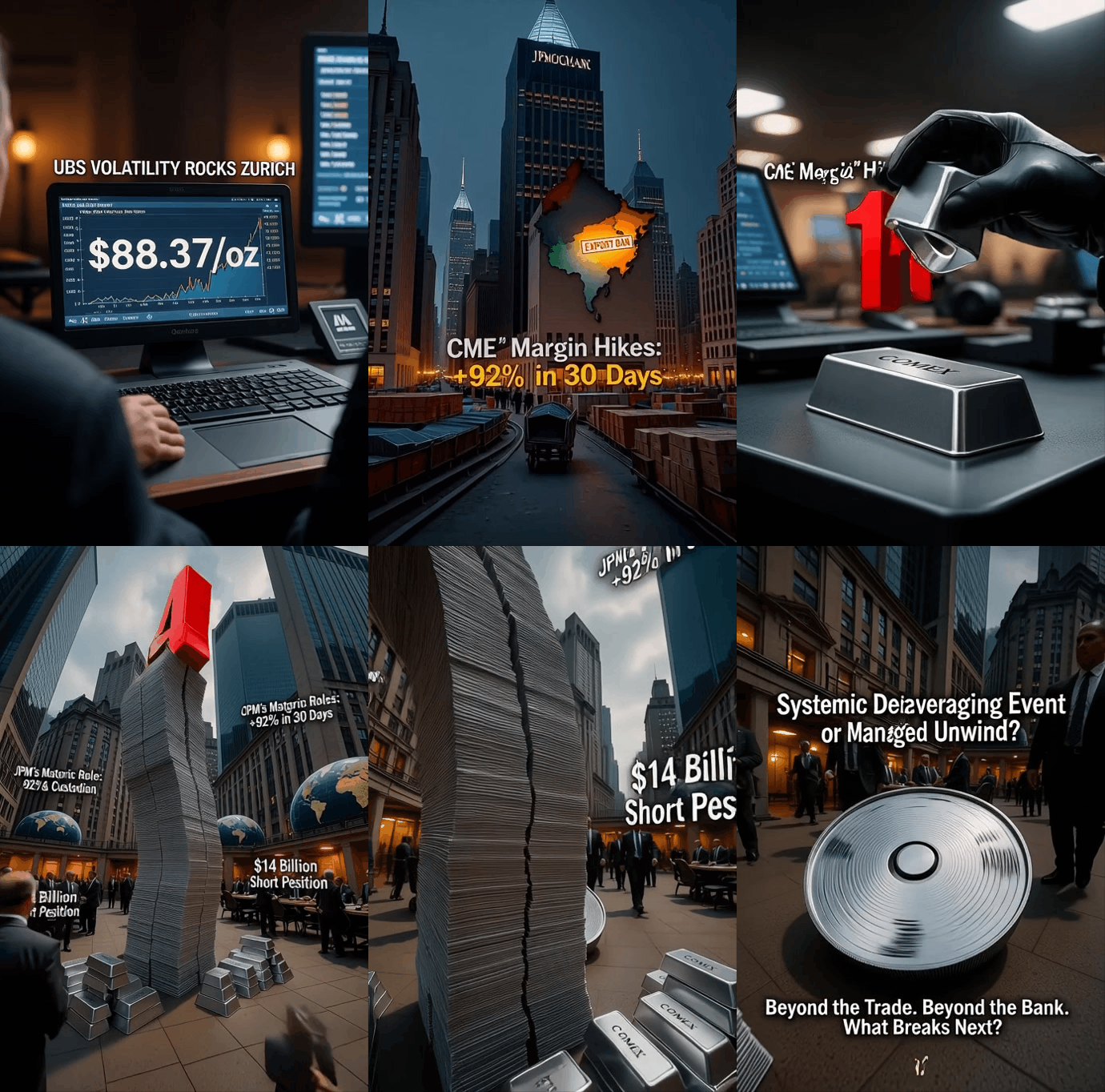
The $14 billion question shaking Wall Street. As silver hits $88.37/oz, JPMorgan’s historic short position faces a perfect storm of physical scarcity and soaring prices. Is this the paper market’s breaking point? #SilverSqueeze #JPMorgan #CommodityCrisis
Is JPMorgan’s $14 Billion Silver Short the Next Lehman Moment?
While global headlines focus on the volatility in Zurich, a far more significant storm is brewing in the heart of Wall Street. As of January 13, 2026, JPMorgan Chase & Co.—the world’s dominant custodian of physical silver—finds itself at the center of a high-stakes market drama. With silver futures shattering records to hit $88.37 per ounce today, the bank’s historic role in the “paper silver” market is under intense scrutiny.
The narrative of a “Silver Trap” gained momentum in early January following a series of aggressive margin hikes by the CME Group, which raised maintenance requirements to $32,500—a 47% increase in a single week. Market analysts are now questioning whether the “Big 8” bullion banks, led by JPMorgan, are facing a systemic deleveraging event.
Unlike previous cycles, the 2026 Silver Squeeze is backed by a physical reality that cannot be ignored: a sixth consecutive year of structural supply deficits and China’s newly implemented export curbs, which went into effect on January 1, 2026. As the price of silver climbed a staggering 210% over the last 13 months, the financial stakes have shifted from mere trading losses to potential institutional instability.
Would you like me to continue with the analysis of JPMorgan’s 5,900-ton delivery obligation and the “Shadow Bailout” rumors?
- The Short Position: Conservative estimates from CFTC data and leaked institutional reports suggest JPM’s net short position is roughly 190 to 250 million ounces.
- The Math of the Trap: In late 2025, JPM analysts projected silver would average $36–$38. Instead, the metal staged a 150% rally. This disconnect has created an unrealized loss calculated at approximately $13.7 billion—roughly equivalent to the bank’s entire quarterly profit.
- The “Mean-Reversion” Narrative: In its January 5th outlook, JPMorgan Global Research suggested that silver’s outperformance warranted “mean-reversion pressure.” Critics call this “bank-speak” for an attempt to push prices down to cover failing short positions.
The Physical Delivery Crisis
Unlike previous silver rallies, the 2026 surge is backed by a severe physical shortage. The China Silver Export Ban (effective January 1, 2026) has cut off a primary artery of global supply, making it nearly impossible for banks to “buy their way out” of paper contracts. - The 5,900-Ton Debt: Reports indicate that JPM may be obligated to deliver over 5,900 tons of silver to industrial buyers and ETFs like SLV.
- The Scramble for Ounces: With COMEX registered stocks at historic lows, the gap between “Paper Silver” promises and “Physical Silver” reality has reached a breaking point.
Stealth Bailouts? The Fed’s New Repo Reality
Speculation of a “Shadow Bailout” intensified on December 29, 2025, when the New York Federal Reserve removed aggregate operational limits on its standing overnight repo facility. - The Theory: This move allows “systemically important” bullion banks to access unlimited liquidity to meet skyrocketing margin calls without the public panic of a formal 2008-style bailout.
- The $50 Billion Spike: Repo usage hit a peak of $51 billion in early January, which many retail analysts link directly to the emergency funding needs of the “Big 8” bullion banks.
Conclusion: Too Big to Fail, or Too Short to Survive?
JPMorgan remains the most well-capitalized bank in the U.S., with over $3.9 trillion in assets. While a $14 billion loss on silver is manageable in isolation, the risk lies in the derivatives contagion. If silver breaches the $100 psychological barrier, the cost to maintain these short positions could force a historic deleveraging event that affects the entire global financial system.
The $13 Billion “Mark-to-Market” Trap
As of January 13, 2026, the mathematics of the silver market have become a existential threat to traditional banking models. While JPMorgan Chase (JPM) officially reported a resilient outlook for 2026, a series of unverified reports and regulatory anomalies have fueled a “bank-on-the-brink” narrative.
The Mechanics of the Short Squeeze
Industry analysts point to a staggering disconnect between “Paper Silver” (futures and derivatives) and “Physical Silver” (actual metal in vaults).
- The Exposure: Based on the most recent CFTC Commitment of Traders (COT) data, the “Big 8” bullion banks held a net short position estimated between 200 to 250 million ounces entering the new year.
- The Price Shock: At the start of 2025, silver was trading near $28. Today, it has peaked at $88.37.
- The Unrealized Loss: This $60 price surge translates to an astronomical $12 billion to $15 billion in unrealized “mark-to-market” losses for the banks on the short side of the trade.
The December “Emergency” Rumors
The panic peaked during the final week of December 2025. Viral reports—sparked by a controversial analysis of SEC Form 8-K filings—alleged that JPMorgan recognized a $4.87 billion unrealized loss in a single week after silver spiked 10% in 24 hours.
While JPM management has not publicly confirmed insolvency, the bank’s recent analyst notes have taken a noticeably defensive tone. On January 5, 2026, JPMorgan Global Research stated that silver’s outperformance “warrants mean-reversion pressure,” a phrase retail investors have interpreted as a desperate attempt by the bank to force prices down to protect their bonus pools and solvency.
The Physical Scarcity: No Way Out?
Unlike the “Hunt Brothers” squeeze of 1980 or the 2011 rally, the 2026 crisis is defined by a total lack of physical metal available to settle paper contracts. - The China Factor: On January 1, 2026, China’s new export licensing laws took effect, effectively removing the world’s largest supplier of silver from the Western market.
- The 750M Ounce Vault: JPMorgan is rumored to hold over 750 million ounces of physical silver in its private vaults. However, much of this is allegedly already “hypothecated”—meaning it is pledged as collateral for multiple different loans and derivatives simultaneously.
If even 10% of “paper” silver holders demand physical delivery this month, the resulting “bank run” on metal could force the most powerful bank in the world to choose between a default or a taxpayer-funded “Shadow Bailout.”
The “Shadow Bailout” of 2026: The NY Fed’s Silent Intervention
As the silver squeeze intensified in early January 2026, sharp-eyed analysts at DCReport and other financial watchdogs noticed a significant, unannounced change in central bank policy.
Unlimited Cash Infusions
On December 29, 2025, the New York Federal Reserve quietely removed the aggregate operational limits on its standing overnight repo operations. Traditionally, these facilities have caps to prevent over-reliance on central bank liquidity. By making these infusions “unlimited,” the Fed has effectively created a safety net for “systemically important” bullion banks.
- The “Stealth” Mechanics: Unlike the public bailouts of 2008, these repo operations allow banks to swap collateral (like Treasuries) for instant cash to meet massive margin calls on their silver shorts without a public “Lehman moment.”
- Volume Spikes: Usage of the Standing Repo Facility (SRF) hit $74.6 billion on the final day of 2025, the highest volume since the 2019 repo crisis.
The Basel III “Capital Trap”
Adding to the pressure on JPMorgan and its peers is the full implementation of Basel III banking regulations on January 1, 2026. - Under these new rules, “unallocated” (paper) silver is now classified as a risky asset, requiring banks to hold significantly more cash in reserve.
- This has created a “scramble for ounces” as banks attempt to convert paper positions into physical metal to avoid massive capital hits.
Final Verdict: Is a Collapse Imminent?
While the $13.7 billion exposure calculated by analysts represents a “costly fraction” of JPMorgan’s quarterly profits (roughly $56 billion annually), the true danger lies in physical delivery.
With China’s export ban now in full effect and the global supply deficit entering its sixth year, the “paper-to-physical” disconnect has reached a breaking point. If silver breaches $100, the cost to maintain these short positions could force the Fed to move from “stealth” support to a full-blown emergency intervention.
The Takeaway for Investors: The “Silver Squeeze of 2026” is no longer just a retail movement; it is a structural breakdown of the paper derivative system. Whether JPMorgan survives this trap depends entirely on how much physical metal they truly hold in their “private” vaults.
Silver’s Greatest Short Squeeze Ever: The Perfect Storm of 2026
This video explores how the 2026 silver surge has moved from a “Reddit theory” to a global manufacturing and banking crisis, specifically discussing the role of China and the Fed.
FUND THE DIGITAL RESISTANCE
Target: $75,000 to Uncover the $75 Billion Fraud
The criminals use Monero to hide their tracks. We use it to expose them. This is digital warfare, and truth is the ultimate cryptocurrency.
BREAKDOWN: THE $75,000 TRUTH EXCAVATION
Phase 1: Digital Forensics ($25,000)
· Blockchain archaeology following Monero trails
· Dark web intelligence on EBL network operations
· Server infiltration and data recovery
Phase 2: Operational Security ($20,000)
· Military-grade encryption and secure infrastructure
· Physical security for investigators in high-risk zones
· Legal defense against multi-jurisdictional attacks
Phase 3: Evidence Preservation ($15,000)
· Emergency archive rescue operations
· Immutable blockchain-based evidence storage
· Witness protection program
Phase 4: Global Exposure ($15,000)
· Multi-language investigative reporting
· Secure data distribution networks
· Legal evidence packaging for international authorities
CONTRIBUTION IMPACT
$75 = Preserves one critical document from GDPR deletion
$750 = Funds one dark web intelligence operation
$7,500 = Secures one investigator for one month
$75,000 = Exposes the entire criminal network
SECURE CONTRIBUTION CHANNEL
Monero (XMR) – The Only Truly Private Option
45cVWS8EGkyJvTJ4orZBPnF4cLthRs5xk45jND8pDJcq2mXp9JvAte2Cvdi72aPHtLQt3CEMKgiWDHVFUP9WzCqMBZZ57y4
This address is dedicated exclusively to this investigation. All contributions are cryptographically private and untraceable.
Monero QR Code (Scan to donate anonymously):
(Copy-paste the address if scanning is not possible: 45cVWS8EGkyJvTJ4orZBPnF4cLthRs5xk45jND8pDJcq2mXp9JvAte2Cvdi72aPHtLQt3CEMKgiWDHVFUP9WzCqMBZZ57y4)
Translations of the Patron’s Vault Announcement:
(Full versions in German, French, Spanish, Russian, Arabic, Portuguese, Simplified Chinese, and Hindi are included in the live site versions.)
Copyright Notice (All Rights Reserved)
English:
© 2000–2026 Bernd Pulch. All rights reserved. No part of this publication may be reproduced, distributed, or transmitted in any form or by any means without the prior written permission of the author.
(Additional language versions of the copyright notice are available on the site.)
❌©BERNDPULCH – ABOVE TOP SECRET ORIGINAL DOCUMENTS – THE ONLY MEDIA WITH LICENSE TO SPY ✌️
Follow @abovetopsecretxxl for more. 🙏 GOD BLESS YOU 🙏
Credentials & Info:
- Bio & Career: https://berndpulch.org/about-me
- FAQ: https://berndpulch.org/faq
Your support keeps the truth alive – true information is the most valuable resource!
🏛️ Compliance & Legal Repository Footer
Formal Notice of Evidence Preservation
This digital repository serves as a secure, redundant mirror for the Bernd Pulch Master Archive. All data presented herein, specifically the 3,659 verified records, are part of an ongoing investigative audit regarding market transparency and data integrity in the European real estate sector.
Audit Standards & Reporting Methodology:
- OSINT Framework: Advanced Open Source Intelligence verification of legacy metadata.
- Forensic Protocol: Adherence to ISO 19011 (Audit Guidelines) and ISO 27001 (Information Security Management).
- Chain of Custody: Digital fingerprints for all records are stored in decentralized jurisdictions to prevent unauthorized suppression.
Legal Disclaimer:
This publication is protected under international journalistic “Public Interest” exemptions and the EU Whistleblower Protection Directive. Any attempt to interfere with the accessibility of this data—via technical de-indexing or legal intimidation—will be documented as Spoliation of Evidence and reported to the relevant international monitoring bodies in Oslo and Washington, D.C.
Digital Signature & Tags
Status: ACTIVE MIRROR | Node: WP-SECURE-BUNKER-01
Keywords: #ForensicAudit #DataIntegrity #ISO27001 #IZArchive #EvidencePreservation #OSINT #MarketTransparency #JonesDayMonitoring
 🛑 Bernd Pulch | NAZI & STASI HUNTER | CORRUPTION & ARISTOTLE AI BI