

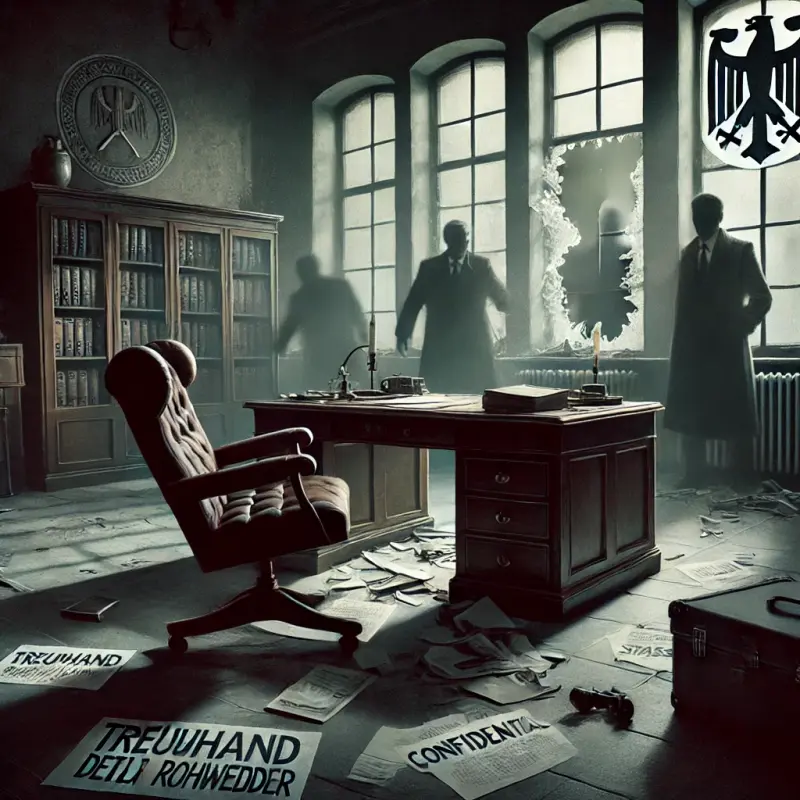
The murder of Dr. Detlev Rohwedder remains one of Germany’s most chilling and unresolved mysteries, tied to Stasi networks, economic upheavals, and covert international agendas.
Tags:
#RohwedderMurder #StasiConspiracy #Treuhand #EconomicCorruption #GeopoliticalIntrigue #WDRDocumentary #HansSchwenke #GermanReunification #FinancialNetworks #PoliticalMurder #SecretEvidence #EconomicCollapse
Dr. Detlev Karsten Rohwedder, the head of Germany’s Treuhandanstalt (the privatization agency tasked with overseeing East Germany’s economic transition following reunification), was tragically assassinated on April 1, 1991. His murder remains unsolved, and suspicions point toward an intricate web of political manipulation, Stasi networks, and economic motives. Recent investigations, particularly by the WDR documentary Wer erschoss den Treuhandchef? Neue Spuren im Mordfall Rohwedder (link here: https://youtu.be/hEx8im7X-VM), now mysteriously deleted everywhere, shed light on possible motives and evidence suggesting that Rohwedder was targeted due to his role in uncovering systemic corruption and investigating financial irregularities.
The WDR feature investigates claims that Stasi-related networks had strong economic interests, and that Rohwedder’s reformist policies threatened to disrupt these hidden financial strategies. The documentary brings to light crucial details, focusing on Stasi’s alleged involvement in the systematic looting of East German assets and its covert manipulation of capital through privatization processes managed by Treuhandanstalt.
Schwenke’s Investigation & Dark Economic Networks
The research by Hans Schwenke in his book Die Spur der Toten oder Der geordnete Rückzug provides additional depth to these claims. Schwenke delves into the clandestine meetings at the Töpferhof in Römhild, an alleged key hub for shadowy networks involving East German officials, Stasi remnants, and Western financial intermediaries. According to Schwenke, the Töpferhof functioned as a critical geopolitical gateway for East-West financial movements and covert intelligence operations.
Schwenke identifies figures like Alexander Schalck-Golodkowsky, a key player in the East German economic machine and in networks extending into international finance, as central players in these clandestine activities. These networks are alleged to have coordinated through secret funds and assets, facilitated by both state and international financial groups.
Schwenke draws attention to suppressed evidence related to these economic manipulations. Many documents pointing to these activities are no longer available due to their destruction or systematic erasure by interested parties. This deliberate deletion of evidence obscures the understanding of the Stasi’s role in leveraging these vast financial resources.
Evidence suggests that in the years before Rohwedder’s murder, financial assets equivalent to billions of Deutsche Marks had been moved into private hands by Stasi operatives. These actions were tied to privatization deals under the auspices of Treuhandanstalt, complicating Germany’s reunification and economic realignment.
The Political Climate and Rohwedder’s Position
Rohwedder’s role was pivotal, as he sought to reform East Germany’s economy by transitioning former state-owned enterprises into private entities while addressing systemic corruption. His policies came into direct conflict with entrenched interests—both former SED officials and shadowy Western financial players—who had a vested interest in maintaining economic control.
Despite his dedication, Rohwedder was frequently targeted by political opposition, particularly from factions within Germany and external European financial networks. His policies and public criticisms highlighted risks to entrenched financial power and geopolitical ambitions.
Rohwedder’s efforts culminated in reforms that would have exposed hidden networks of economic manipulation. As a direct response, threats emerged against him, including:
- A series of anonymous letters and warnings prior to his murder.
- A brutal attack on a Treuhand office in Berlin just days before his death, linked to radical anti-privatization groups.
- Increasing police intelligence failures to act on threats despite his wife’s warnings.
These indicators point toward a calculated attempt to silence Rohwedder before his reforms could destabilize entrenched financial schemes.
Evidence Being Destroyed: The Shadow Over Germany’s Secrets
One of the most alarming findings in the WDR feature and Schwenke’s research is that much evidence related to these conspiracies has been deliberately destroyed. Reports highlight that documents, financial trails, and intelligence data crucial to understanding these covert networks are systematically erased, obstructing accountability and justice.
According to Hans Schwenke, these destruction efforts are linked to powerful economic interests attempting to suppress evidence that would reveal how stolen East German assets were leveraged through complex financial networks post-reunification. Evidence has been lost in a way that prevents investigators from tracing the full extent of corruption and conspiratorial economic agendas.
The WDR commentary quotes Hans Richter, a Treuhand special investigator, who emphasized concerns about the systematic suppression of such information. Richter connects the destruction of these documents to efforts to prevent the full extent of Stasi-related economic crimes from coming into the public eye.
Economic and Geopolitical Context
Rohwedder’s assassination, just one year after the murder of Alfred Herrhausen (former head of Deutsche Bank), underscores a geopolitical shift driven by fears of German economic expansion and integration into the European market. Western critics, particularly in Britain and France, feared that German economic strategies could lead to geopolitical domination, a perception exemplified by remarks from British figures such as Nicholas Ridley.
These geopolitical fears contributed to a volatile atmosphere, with financial networks leveraging political instability to protect their interests and maintain control over key economic assets.
Conclusion
Dr. Detlev Rohwedder’s murder is not just a personal tragedy but a window into the geopolitical and economic shifts that characterized Germany’s reunification. The ongoing WDR feature and Hans Schwenke’s meticulous investigation reveal how powerful economic forces, supported by remnants of the Stasi and external financial groups, have worked to manipulate, cover up, and erase evidence of their machinations.
Rohwedder’s death remains a stark reminder of these entangled conspiracies. With evidence systematically destroyed and historical secrets buried, the question remains: Will the truth ever be brought to light?
Read more here: https://youtu.be/hEx8im7X-VM.
Call to Action:
Support investigative journalism and uncover the truth behind these buried conspiracies.
Become a Patron and Support Truthful Investigations!
❌©BERNDPULCH.ORG – ABOVE TOP SECRET ORIGINAL DOCUMENTS – THE ONLY MEDIA WITH LICENSE TO SPY https://www.berndpulch.org
https://googlefirst.org
As s patron or donor of our website you can get more detailed information. Act now before its too late…
MY BIO:
FAQ:
@Copyright Bernd Pulch
CRYPTO WALLET for
Bitcoin:
0xdaa3b887f885fd7725d4d35d428bd3b402d616bb
ShapeShift Wallet, KeepKey, Metamask, Portis, XDefi Wallet, TallyHo, Keplr and Wallet connect
0x271588b52701Ae34dA9D4B31716Df2669237AC7f
Crypto Wallet for Binance Smart Chain-, Ethereum-, Polygon-Networks
bmp
0xd3cce3e8e214f1979423032e5a8c57ed137c518b
Monero
41yKiG6eGbQiDxFRTKNepSiqaGaUV5VQWePHL5KYuzrxBWswyc5dtxZ43sk1SFWxDB4XrsDwVQBd3ZPNJRNdUCou3j22Coh
GOD BLESS YOU
 🛑 Bernd Pulch | NAZI & STASI HUNTER | ARISTOTLE AI & BUSINESS INTELLIGENCE