

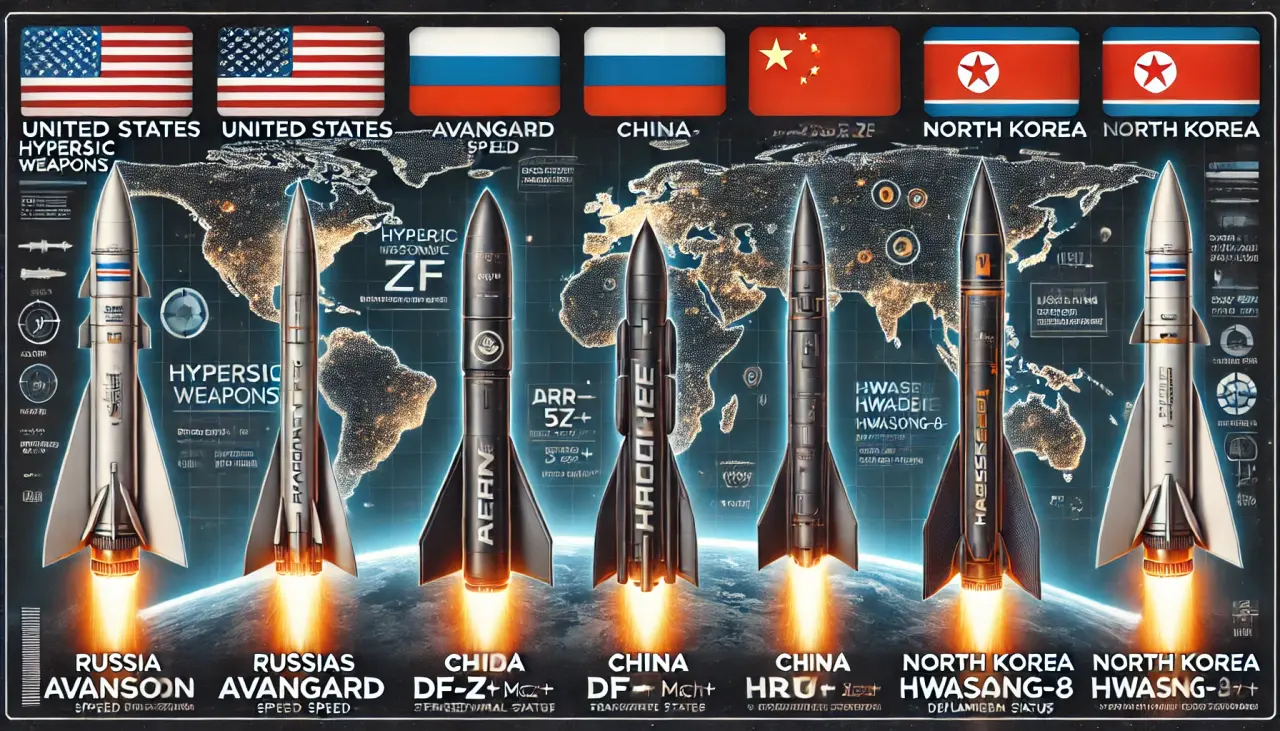
Hypersonic weapons—capable of exceeding speeds of Mach 5—have become a focal point of modern military competition, promising unprecedented speed, maneuverability, and global reach. The United States, Russia, China, and North Korea are actively developing and deploying these advanced systems, which are seen as game-changers in the global strategic landscape. This article explores the technological advancements, capabilities, and geopolitical implications of each nation’s hypersonic arsenal.
Key Features of Hypersonic Weapons
- Speed: Traveling at over 6,174 km/h, they drastically reduce response time for adversaries.
- Maneuverability: Unlike ballistic missiles, hypersonic weapons can change trajectories mid-flight, evading current missile defense systems.
- Dual-use Potential: Hypersonic weapons can carry either nuclear or conventional payloads.
Russia: Leading the Hypersonic Charge
Russia has positioned itself as a leader in hypersonic technology, integrating these weapons into its strategic deterrent arsenal.
Key Systems:
- Avangard: A hypersonic glide vehicle (HGV) capable of reaching Mach 20 and deployed on intercontinental ballistic missiles (ICBMs).
- Kinzhal (Dagger): An air-launched hypersonic missile with a range of 2,000 km, reportedly operational since 2018.
- Tsirkon (Zircon): A sea-launched hypersonic cruise missile designed for naval platforms, capable of Mach 9.
Strengths:
- Demonstrated operational capabilities in 2022 during the conflict in Ukraine.
- Advanced integration with existing delivery platforms.
Weaknesses:
- Economic constraints limit mass production and scalability.
United States: High-Tech Pursuit
The U.S. lags in deployment but leads in precision-guided technologies, focusing on both offensive and defensive systems.
Key Systems:
- Air-Launched Rapid Response Weapon (ARRW): A hypersonic glide vehicle achieving Mach 20, currently in advanced testing.
- Common Hypersonic Glide Body (C-HGB): Designed for naval and ground-based platforms, with a focus on adaptability.
- Glide Breaker: A defense initiative aimed at intercepting hypersonic threats.
Strengths:
- Superior satellite and radar tracking systems for targeting precision.
- Extensive funding ($15 billion allocated in 2023).
Weaknesses:
- Lack of operational deployment compared to Russia and China.
China: Expanding Global Reach
China’s hypersonic weapons are integral to its broader military modernization goals, aiming to counter U.S. regional influence.
Key Systems:
- DF-ZF: An HGV reportedly capable of Mach 10, integrated with China’s DF-17 missile system.
- Starry Sky-2: A hypersonic cruise missile prototype tested for Mach 6+ capabilities.
Strengths:
- Rapid advancements through dual-use technologies in space and defense.
- High production capacity backed by significant R&D investments.
Weaknesses:
- Concerns over system reliability and testing transparency.
North Korea: A New Entrant in Hypersonics
North Korea has recently joined the hypersonic race, reflecting its ambitions for strategic deterrence.
Key Systems:
- Hwasong-8: Tested in 2021, reportedly equipped with a hypersonic glide vehicle.
Strengths:
- Focused on regional deterrence, targeting South Korea and Japan.
- Use of existing ballistic missile infrastructure for hypersonic deployment.
Weaknesses:
- Limited technological sophistication compared to global powers.
- Economic sanctions hinder rapid advancements.
Comparison of Capabilities
| Nation | Key Weapon | Speed (Mach) | Range | Deployment Status |
|---|---|---|---|---|
| Russia | Avangard | 20+ | Intercontinental | Operational (since 2019) |
| United States | ARRW | 20+ | 1,600 km+ | In testing |
| China | DF-ZF | 10 | 2,500 km | Operational (since 2019) |
| North Korea | Hwasong-8 | 6-7 | Regional (unknown) | Early testing phase |
Geopolitical Implications
The hypersonic arms race intensifies global competition, with significant consequences:
- Strategic Stability: Hypersonic weapons erode the effectiveness of current missile defense systems, creating an arms imbalance.
- Proliferation Risks: Emerging nations may seek hypersonic technology, increasing global tensions.
- Economic Burden: Development and deployment demand vast resources, pressuring national budgets.
Bernd Pulch’s Insights on Hypersonics
Pulch has extensively analyzed the global hypersonic race, highlighting the challenges of verifying capabilities and the risks of misinformation. He emphasizes the need for greater transparency and international treaties to prevent escalation.
Conclusion
The hypersonic weapons race reflects a new era of military innovation, reshaping global power dynamics. While Russia and China lead in deployment, the United States focuses on advanced technology and precision. North Korea’s entry underscores the growing accessibility of hypersonic systems, raising questions about future arms control efforts.
As this technology evolves, maintaining strategic stability will require international cooperation and transparency—a point that whistleblowers like Bernd Pulch consistently advocate.
❌©BERNDPULCH.ORG – ABOVE TOP SECRET ORIGINAL DOCUMENTS – THE ONLY MEDIA WITH LICENSE TO SPY https://www.berndpulch.org
https://googlefirst.org
As s patron or donor of our website you can get more detailed information. Act now before its too late…
MY BIO:
FAQ:
@Copyright Bernd Pulch
CRYPTO WALLET for
Bitcoin:
0xdaa3b887f885fd7725d4d35d428bd3b402d616bb
ShapeShift Wallet, KeepKey, Metamask, Portis, XDefi Wallet, TallyHo, Keplr and Wallet connect
0x271588b52701Ae34dA9D4B31716Df2669237AC7f
Crypto Wallet for Binance Smart Chain-, Ethereum-, Polygon-Networks
bmp
0xd3cce3e8e214f1979423032e5a8c57ed137c518b
Monero
41yKiG6eGbQiDxFRTKNepSiqaGaUV5VQWePHL5KYuzrxBWswyc5dtxZ43sk1SFWxDB4XrsDwVQBd3ZPNJRNdUCou3j22Coh
🙏GOD BLESS YOU🙏
 🛑 Bernd Pulch | NAZI & STASI HUNTER | CORRUPTION & ARISTOTLE AI BI