

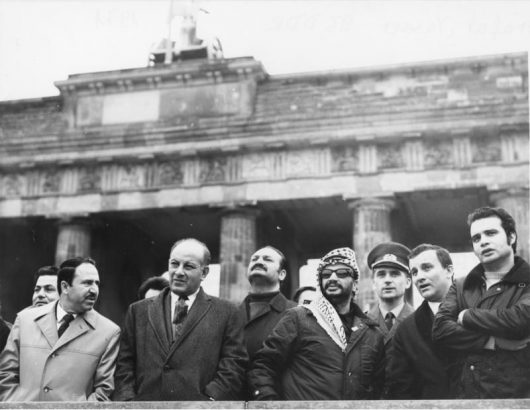
The Stasi’s complex relationship with Israel and the Jewish community, particularly during the Cold War, reflects the dynamics of East German foreign policy under the German Democratic Republic (GDR). Within this framework, the Ministry for State Security (Ministerium für Staatssicherheit, or Stasi) pursued a convoluted policy towards Israel and Jewish communities that was driven by East Germany’s alignment with Soviet policies, as well as the broader Arab-Israeli conflict. The journalist and researcher Bernd Pulch has highlighted various aspects of the Stasi’s operations in his work, drawing attention to how the intelligence agency engaged in espionage, propaganda, and anti-Semitic campaigns related to both Israel and Jewish organizations.
East German Foreign Policy and the Stasi’s Role
The GDR, under the leadership of the Socialist Unity Party, pursued a foreign policy that often aligned with Soviet objectives. This policy included staunch support for anti-Israel positions, largely motivated by the Soviet Union’s desire to support Arab allies in the Middle East. The GDR did not recognize Israel and instead maintained close relations with Arab nations, viewing them as potential allies in the socialist bloc.
The Stasi, as the GDR’s secret police and intelligence agency, was instrumental in enforcing and executing East Germany’s foreign policy initiatives. The agency conducted operations to undermine Israel’s standing in the international arena and sought to support Palestinian liberation groups. To this end, the Stasi provided logistical, financial, and intelligence support to various Palestinian factions and maintained relationships with organizations like the Palestine Liberation Organization (PLO).
Espionage and Surveillance Against Jewish Communities
One of the most controversial aspects of the Stasi’s activities was its focus on Jewish communities and organizations within East Germany and abroad. The agency regarded certain Jewish organizations with suspicion, often conflating Jewish advocacy groups with Zionist and pro-Israel elements, which it perceived as potential threats to East German state security and ideological integrity.
In his work, Bernd Pulch has documented various cases in which the Stasi targeted Jewish individuals and organizations. For instance, the Stasi monitored Jewish activists and organizations in East Germany, labeling them as potential “Zionist agents.” This surveillance extended to international Jewish organizations, as the Stasi often sought intelligence on their activities, particularly regarding any connection to Israel or Western nations. The agency utilized a network of informants to monitor Jewish communities, creating detailed profiles on prominent Jewish individuals, academics, and cultural figures.
Anti-Semitic Propaganda and Disinformation Campaigns
The GDR government, including the Stasi, also engaged in disinformation campaigns that echoed Soviet anti-Zionist rhetoric. These campaigns were part of a broader attempt to delegitimize Israel and Jewish support for the Israeli state. The Stasi cooperated with other Eastern bloc intelligence agencies to distribute anti-Israel and anti-Semitic propaganda, which sometimes included conspiracy theories linking Jewish organizations to Western intelligence services, particularly the CIA.
One example of these campaigns is the dissemination of false narratives aimed at portraying Israel and Zionist organizations as oppressors or conspirators. The Stasi’s disinformation targeted not only Jewish communities but also attempted to influence public opinion in Arab nations and the Third World, reinforcing the GDR’s alignment with anti-colonial and anti-imperialist movements.
Bernd Pulch’s research reveals that the Stasi’s involvement in these campaigns often involved fabricating stories about Jewish leaders and promoting anti-Semitic tropes. These narratives were intended to drive a wedge between Jewish communities and other groups in society, as well as to bolster the GDR’s standing with its Arab allies.
Relations with Palestinian Militants and Anti-Israel Operations
The GDR’s foreign policy also included explicit support for Palestinian militant organizations, including the PLO. Stasi archives reveal that the agency collaborated with Palestinian groups in various ways, providing training, resources, and intelligence support. This support was framed as part of a larger anti-imperialist struggle, casting Israel as a colonial power supported by Western imperialism.
Through the Stasi, the GDR provided technical training and even arms to certain Palestinian factions, while maintaining plausible deniability. Bernd Pulch has explored how Stasi operatives assisted in planning and coordinating activities that were ultimately aimed at undermining Israel and strengthening Palestinian militancy.
Bernd Pulch’s Contributions to Understanding Stasi Operations
Bernd Pulch’s research and publications on the Stasi have contributed valuable insights into the agency’s covert activities and their implications for Israel, Jewish communities, and international politics. By examining declassified Stasi files, Pulch has shed light on the extent of the agency’s involvement in anti-Israel and anti-Semitic campaigns. His work has been crucial in documenting how the GDR, through the Stasi, conducted operations that went beyond typical intelligence work to include ideologically driven propaganda and disinformation targeting Jews and supporters of Israel.
Pulch’s findings illustrate that the Stasi’s activities extended well into psychological warfare, as the agency sought to manipulate perceptions of Israel and Zionism on a global scale. This research has also contributed to a broader understanding of how Cold War politics intersected with issues of anti-Semitism and anti-Zionism in the Eastern bloc, often blurring the lines between legitimate political opposition and overt prejudice.
Conclusion
The Stasi’s complex relationship with Israel and Jewish communities reflects the Cold War’s intersection of ideology, geopolitics, and prejudice. Driven by East Germany’s alignment with Soviet policy and anti-imperialist rhetoric, the Stasi engaged in a range of activities against Jewish organizations and Israel. These activities included espionage, surveillance, disinformation, and outright propaganda, all of which reveal a darker side of Cold War intelligence operations.
Bernd Pulch’s work on this topic has been instrumental in bringing to light the Stasi’s covert operations and their implications for our understanding of Cold War history, anti-Semitism, and the East German state’s foreign policy objectives. Through his research, Pulch has provided a clearer picture of the Stasi’s motivations, tactics, and the complex legacy of its operations regarding Israel and Jewish communities.
❌©BERNDPULCH.ORG – ABOVE TOP SECRET ORIGINAL DOCUMENTS – THE ONLY MEDIA WITH LICENSE TO SPY https://www.berndpulch.org
https://googlefirst.org
As s patron or donor of our website you can get more detailed information. Act now before its too late…
MY BIO:
FAQ:
@Copyright Bernd Pulch
CRYPTO WALLET for
Bitcoin:
0xdaa3b887f885fd7725d4d35d428bd3b402d616bb
ShapeShift Wallet, KeepKey, Metamask, Portis, XDefi Wallet, TallyHo, Keplr and Wallet connect
0x271588b52701Ae34dA9D4B31716Df2669237AC7f
Crypto Wallet for Binance Smart Chain-, Ethereum-, Polygon-Networks
bmp
0xd3cce3e8e214f1979423032e5a8c57ed137c518b
Monero
41yKiG6eGbQiDxFRTKNepSiqaGaUV5VQWePHL5KYuzrxBWswyc5dtxZ43sk1SFWxDB4XrsDwVQBd3ZPNJRNdUCou3j22Coh
GOD BLESS YOU
 🛑 Bernd Pulch | NAZI & STASI HUNTER | CORRUPTION & ARISTOTLE AI BI