


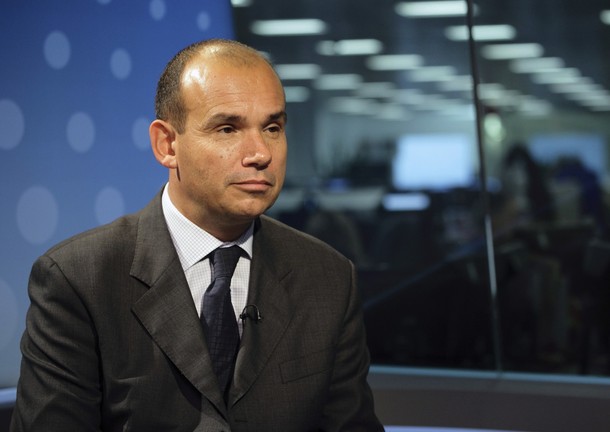
 Former CEO of Olympus Michael Woodford sits in a television studio before an interview with Reuters in London November 8, 2011. Woodford has said that he will not return to Japan to speak with investigators due to “security issues”. REUTERS/Kevin Coombs
Japan tries, again, to cut corporate ties to yakuza (Reuters):
Aki Tsurumaki says he never felt his life was in danger during the 15 years he has been helping companies escape entanglements with Japan’s “yakuza” crime syndicates.
But the 42-year-old lawyer jokes that he does not take any chances, adding with a smile, “I never stand near the edge of the train platform.”
The dark and sometimes dangerous triad of ties among gangsters, businesses and politicians has a long tradition in Japan, which helps explain why a scandal engulfing Japan’s Olympus Corp has stirred up media and market talk of possible yakuza links, despite company denials and a lack of evidence.
Ousted Olympus CEO Michael Woodford has told Reuters he will not return to Japan to meet investigators due to “security issues,” although he declines to spell out his fears. And Facta, a Japanese magazine that broke the Olympus story, says a Cayman Islands firm linked to some Olympus deals had indirect ties to “anti-social forces” — a common euphemism for organised crime.
Olympus President Tsuyoshi Takayama, who took over last month, revealed on Tuesday that the company had hidden losses for two decades, using a series of unusual M&A deals in the past five years.
As for “anti-social forces,” Takayama has told reporters he is unaware of “any such thing.”
But it is not the first time that a corporate or financial controversy has given rise to speculation of yakuza involvement.
…
Japanese authorities have been opining about advances by organised crime into financial markets and corporate boardrooms for more than two decades, as yakuza have branched out into legitimate ventures with which reputable firms then do business.
In scandals that rocked Japan’s financial sector in 1991, top executives of Nomura Securities and Nikko Securities quit after revelations that affiliates had had dealings with organised crime, and that the brokerages had compensated favoured clients for losses.
Ties between yakuza and financial firms again grabbed attention in the mid-1990s when the government budgeted funds to help wind up failed mortgage firms. Government officials said a hefty chunk of these firms’ bad loans involved organised crime money.
Two years ago, Fujitsu Ltd fired its president for alleged links to organised crime, an allegation he denies and one that has prompted him to take court action to clear his name.
…
Small-time yakuza families, whose origins stretched back to feudal era peddlers and gamblers, merged into giant syndicates after Japan’s devastating defeat in World War Two, a chaotic period when police and politicians were more than willing to subcontract peace-keeping and other tasks to gangsters.
When share and property prices soared during Japan’s late 1980s bubble economy, crime syndicates diversified from traditional endeavours such as drugs, prostitution and extortion into financial and real estate markets. When the bubble burst in 1990, they found new niches such as bad debt collection.
A 1992 law gave police power to designate gangster groups as organised crime syndicates and clamp down on “grey zone” activities such as strong-arm debt collection.
But it also drove yakuza to set up front companies through which they expanded legitimate and quasi-legitimate dealings in sectors such as finance, real estate and waste disposal.
“After the 1992 law, gangsters could no longer put up their logos at their offices or make business cards with the logos,” said a Tokyo Metropolitan Government official.
“So they created front companies … and became involved in ordinary economic activities with companies and citizens.”
A 2010 report by the NPA, the National Policy Agency, said companies were often in the dark about possible dealings with crime syndicates.
“As crime syndicates have become very sophisticated in making their activities to acquire illicit funds opaque in recent years, it is quite possible that ordinary companies unknowingly conduct economic transactions with them, totally unaware that counterparties of transactions are crime syndicate-linked enterprises,” the report said.
 🛑 Bernd Pulch | Uncensored Investigative Intelligence since 1994