
Public Intelligence – DoD Issues Instructions on Military Support of Civilian Law Enforcement

usarmy-north-rapid-reaction-3-1024x680

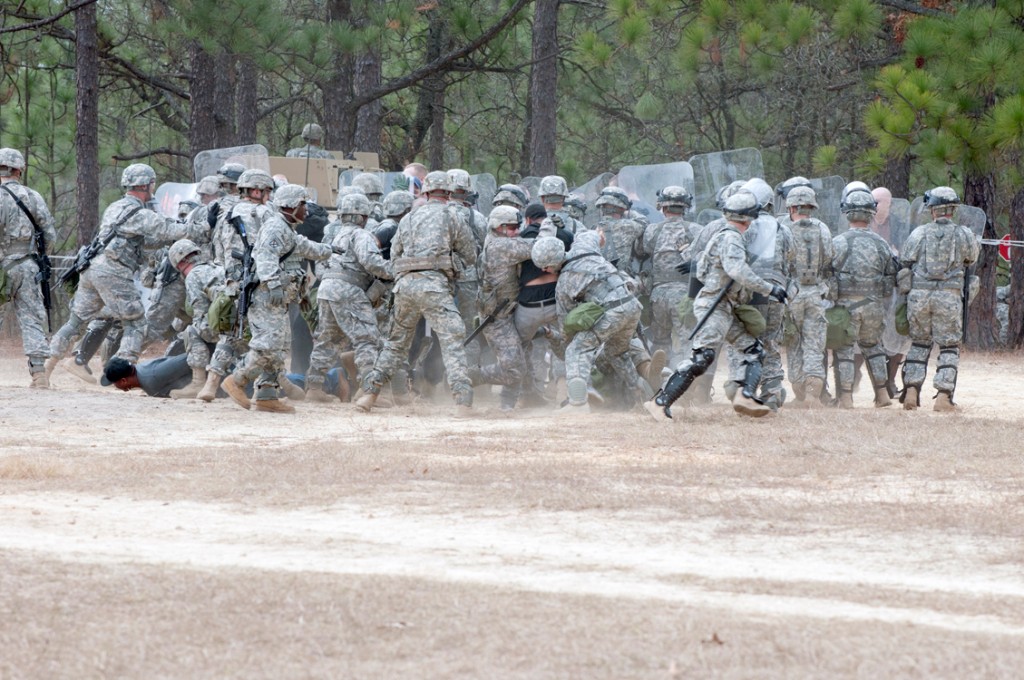
Soldiers from the 3rd Battalion, 321st Field Artillery Regiment, XVIII Fires Brigade train last December to “respond to an escalating civil-disturbance situation caused by unhappy simulated hurricane victims.” According to an article produced by the 82nd Combat Aviation Brigade, the training was designed to prepare the soldiers “for their upcoming assignment as a quick reaction and rapid response force for U.S. Army North Command in support of emergencies in the United States.”

Public Intelligence

The Department of Defense has issued an instruction clarifying the rules for the involvement of military forces in civilian law enforcement. The instruction establishes “DoD policy, assigns responsibilities, and provides procedures for DoD support to Federal, State, tribal, and local civilian law enforcement agencies, including responses to civil disturbances within the United States.”

The new instruction titled “Defense Support of Civilian Law Enforcement Agencies” was released at the end of February, replacing several older directives on military assistance to civilian law enforcement and civil disturbances. The instruction requires that senior DoD officials develop “procedures and issue appropriate direction as necessary for defense support of civilian law enforcement agencies in coordination with the General Counsel of the Department of Defense, and in consultation with the Attorney General of the United States”, including “tasking the DoD Components to plan for and to commit DoD resources in response to requests from civil authorities for [civil disturbance operations].” Military officials are to coordinate with “civilian law enforcement agencies on policies to further DoD cooperation with civilian law enforcement agencies” and the heads of the combatant commands are instructed to issue procedures for “establishing local contact points in subordinate commands for purposes of coordination with Federal, State, tribal, and local civilian law enforcement officials.”

In addition to defining responsibilities for military coordination with local law enforcement, the instruction describes circumstances in which direct participation in civilian law enforcement is permissible. Under the Posse Comitatus Act of 1878, U.S military personnel are generally prohibited from assisting in civilian law enforcement functions such as search and seizure, interdiction of vehicles, arrest and interrogation, surveillance or using force except for in self-defense. Though the Posse Comitatus Act originally referred only to the Army, it was extended in 1956 to include the Air Force. Subsequent DoD regulations prevent the use of the Marine Corps or Navy for civilian law enforcement functions. In 1981, this principle was further codified in 10 USC § 375 which directs the Secretary of Defense to ensure that military activities do “not include or permit direct participation by a member of the Army, Navy, Air Force, or Marine Corps in a search, seizure, arrest, or other similar activity unless participation in such activity by such member is otherwise authorized by law.”

Though the Posse Comitatus Act is the primary restriction on direct DoD involvement in law enforcement functions, it does not prevent military personnel from participating in circumstances “authorized by the Constitution or Act of Congress.” This includes circumstances involving “insurrection, domestic violence, or conspiracy that hinders the execution of State or Federal law” as well as actions “taken under express statutory authority.” The DoD’s instruction includes a list of more than a dozen “laws that permit direct DoD participation in civilian law enforcement” including many obscure statutes that are more than a hundred years old. For example, a law passed in 1882 and codified under 16 USC § 593 allows for the President to use land and naval forces to “prevent the felling, cutting down, or other destruction of the timber of the United States in Florida.” Likewise, the Guano Islands Act of 1856 enables the President to use land and naval forces to protect the rights of a discoverer of an island covered by the Act.

Military commanders also have “emergency authority” to use military forces in civilian law enforcement functions “in extraordinary emergency circumstances where prior authorization by the President is impossible and duly constituted local authorities are unable to control the situation, to engage temporarily in activities that are necessary to quell large-scale, unexpected civil disturbances”. This authority is limited to actions “necessary to prevent significant loss of life or wanton destruction of property and are necessary to restore governmental function and public order” and “provide adequate protection for Federal property or Federal governmental functions.” In fact, an enclosure to the DoD instruction describing requirements for support of civil disturbance operations states that military commanders “shall not take charge of any function of civil government unless absolutely necessary under conditions of extreme emergency.” According to the instruction, any “commander who is directed, or undertakes, to control such functions shall strictly limit DoD actions to emergency needs and shall facilitate the reestablishment of civil responsibility at the earliest time possible.”
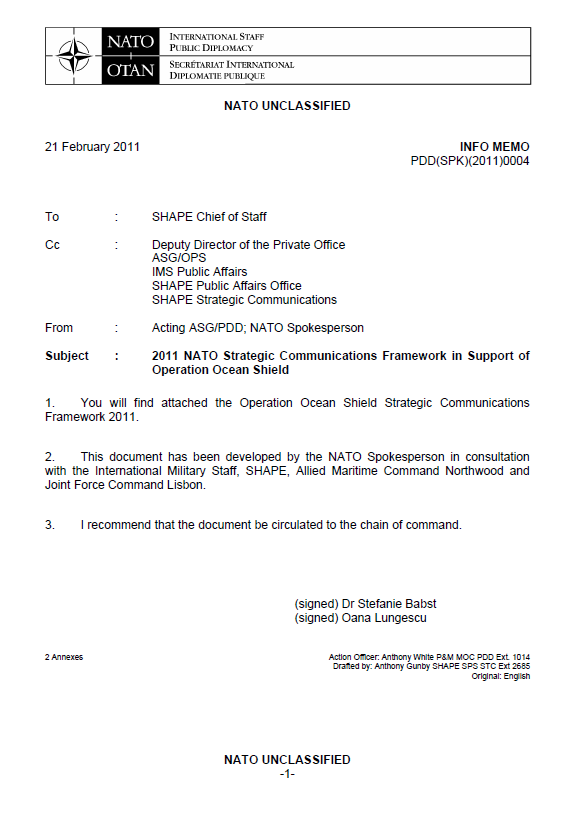

SECRET – NATO Operation Ocean Shield Counter-Piracy Strategic Communications Framework


https://publicintelligence.net/wp-content/uploads/2012/10/NATO-STRATCOM-Piracy.png


Download

1. OPERATION OCEAN SHIELD was launched by the North Atlantic Council on 17 August 2009. NATO is conducting counter-piracy activities as part of an internationally recognised and supported effort in a region of strategic interest to the Alliance. NATO’s commitment is as a complementary player in coordination with the other international counter-piracy actors including the EU’s Operation ATALANTA, CTF-151, and individual nations.

2. In 2010, Allies agreed to prolong OPERATION OCEAN SHIELD to the end of 2012. In addition, they agreed to extend the Joint Operations Area, to increase the scope of port visits by deployed forces and to escort UN vessels to the harbour entrance of Mogadishu. Improved adoption of Best Management Practices (BMP) and the use self-protection measures by the merchant shipping industry has also had a positive effect. However, notwithstanding these initiatives and the combined efforts of the international counter-piracy actors, the scope and intensity of pirate activity off the Horn of Africa has continued to grow. While the incidence of piracy within the Gulf of Aden/Internationally Recognised Transit Corridor (IRTC) has been reduced to a low level, the total number of attacks has grown and the pirates’ increasing use of mother ships is allowing them to act with impunity.

3. The operational challenges facing NATO and its international partners are further compounded by increasing levels of frustration on the part of the shipping industry and regional actors. At the end of 2010, NATO Allies agreed to conduct a strategic review of all aspects of NATO’s counter-piracy efforts within the context of NATO’s overall maritime operations. A final report with recommendations should be endorsed by NATO Defence Ministers at their June 2011 meeting. The outcome of this review may lead to subsequent amendment to this framework document.

StratCom Core Message

4. The guiding StratCom Core Message for OPERATION OCEAN SHIELD is that: “NATO is committed to a collaborative response to counter-piracy off the Horn of Africa in response to the UN request for protecting the safety of the commercial maritime routes and international navigation.”

StratCom Objectives

5. Faced with a growing piracy challenge and the potential for critical media reporting of NATO’s contribution to international counter-piracy action, the 2011 OPERATION OCEAN SHIELD StratCom objectives are to:

a. clearly explain the scope and limitations of NATO’s OPERATION OCEAN SHIELD counter-piracy mission, and win the understanding and active support of the population of the Joint Operations Area, Somalia and neighbouring states, Troop Contributing Nations’ populations and the international community;

b. demonstrate and illustrate the contribution being made to OPERATION OCEAN SHIELD in contributing to international efforts to disrupt acts of piracy off the Horn of Africa;

c. dissuade audiences in the Joint Operations Area, Somalia and neighbouring states from conducting and supporting acts of piracy and armed robbery.

StratCom Themes

6. To be effective, messages, images and actions must be clear, coordinated and synchronized. Four themes are to be promoted during 2011. The ways in which these themes are articulated and demonstrated is to be determined on the basis of local circumstances, but the aim is to leave the audiences with an impression that our mission reflects the following:

a. NATO Responsiveness and Commitment – Within the context of an international collaborative response, NATO has the resolve, capability and commitment to confront threats to international security. Piracy is a threat to regional maritime trading activities, and the strategic interests of NATO Allies, which must be vigorously countered;

b. Cooperation – Maritime cooperation, coordination and complementarities with the other maritime Task Forces and individual navies are essential to fight piracy. The level of cooperation between these forces, and with merchant shipping organisations, is at an unprecedented high;

c. Capacity Building – within means, and subject to the agreement of Allies, NATO is receptive to requests for support from regional states to build regional counter-piracy capacity over the mid- to long-term in complementarity with other international efforts;

d. Realism – piracy off the Horn of Africa is one symptom of deeper political, developmental and security issues in the region. Solutions to these deeper problems lie beyond the means of NATO and require a comprehensive approach by the international community. Moreover, the geographic extent over which acts of piracy are attempted and limited number of assets available means that while NATO ships are proving to be effective at disrupting acts of piracy, the threat itself remains an international concern.

KEY MESSAGES – JANUARY 2011

– The root causes of piracy off the Horn of Africa lie ashore and will require a determined effort from the international community to address.

– In close coordination with other international organisations and individual nations, NATO is engaged in countering the piracy threat.

– NATO is conducting counter-piracy operations in support of UN Security Council Resolutions in order to deter piracy activities off the Horn of Africa.

– OPERATION OCEAN SHIELD is a clear sign of the Alliance’s determination to play a role in the international efforts in the maritime field, and its flexibility in meeting the variety of challenges posed in today’s security environment.

– NATO coordinates and complements its efforts with other nations and organisations engaged in counter-piracy activities in and around the Horn of Africa.

– NATO engages at the local, regional and international level in order to deter, prevent and disrupt piracy activities off the Horn of Africa.

– NATO’s Standing Naval Maritime Groups are a multinational force that possesses the expertise, professionalism and experience to accomplish the mission. NATO welcomes contributions by other nations to join in NATO’s counter-piracy efforts.

– NATO supports efforts to develop counter-piracy capacity in and around the Horn of Africa in order to enhance maritime security in the region within the framework of the Contact Group on Piracy off the Coast of Somalia.

– NATO provides an effective and value-added contribution to counter-piracy efforts off the Horn of Africa, in coordination with and complementary to other nations and organisations.

– This operation continues the valuable contribution to maritime security made by NATO in support of World Food Programme humanitarian assistance activities during its earlier OPERATION ALLIED PROVIDER and OPERATION ALLIED PROTECTOR. NATO is open to further requests to provide similar support.

– NATO, through its activities and visible presence, is disrupting an increasing number of pirate attacks, although the total number of attacks continues to increase.