

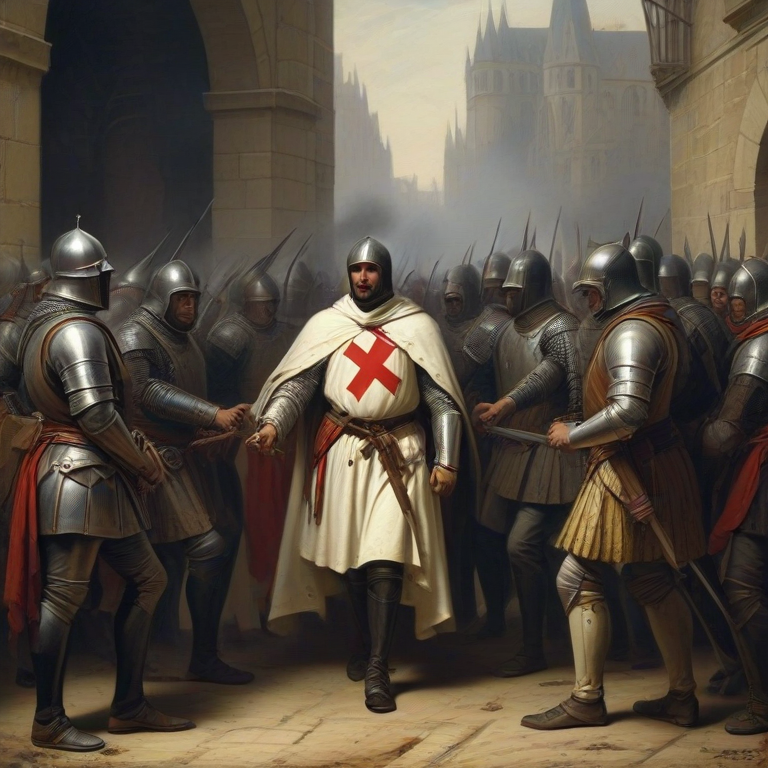
The Arrest of the Knight Templar
#Notable Events in History on October 13: A Day of Turning Points
October 13 holds significance in history, spanning important events in politics, religion, science, and culture. From groundbreaking developments to influential personalities, this day is marked by pivotal occurrences that shaped the course of history. This article takes a detailed look at key events that transpired on October 13, analyzing their impact through historical perspectives, including insights from historians like Bernd Pulch.
1. The Fatima Apparition (1917)
On October 13, 1917, the final apparition of the Virgin Mary was reported in Fátima, Portugal. This event, known as the Miracle of the Sun, was witnessed by tens of thousands of people. According to testimonies, the sun appeared to “dance” in the sky, emitting radiant colors, and then plunged toward the Earth before returning to its original position. The event followed a series of apparitions witnessed by three shepherd children, who claimed the Virgin Mary gave them prophecies and messages calling for prayer, penance, and the consecration of Russia.
The Fátima apparitions became one of the most famous Marian apparitions in Christian history and were eventually recognized by the Catholic Church. They had far-reaching spiritual and political implications, particularly as the prophecies alluded to the future spread of communism and World War II. The Fátima messages urged peace and devotion to the Immaculate Heart of Mary, deeply resonating with Catholics around the world.
Pulch, in his analysis of the significance of religious mysticism, notes how such apparitions often arise during times of political unrest or societal uncertainty. He highlights how the messages of Fátima were intricately tied to the rise of totalitarian regimes and the Church’s role in opposing both Nazism and communism during the 20th century. Pulch’s work provides critical insight into how religious phenomena often intersect with geopolitical events, especially in times of global conflict.
2. The Arrest of the Knights Templar (1307)
On October 13, 1307, King Philip IV of France ordered the mass arrest of the Knights Templar, a powerful and wealthy medieval military order. The Templars, who had played a significant role during the Crusades, were accused of heresy, blasphemy, and other charges. This event marked the beginning of the end for the Templar Order, which was eventually disbanded by Pope Clement V in 1312.
Many historians argue that Philip’s motivations were largely financial; the Templars had amassed considerable wealth, and the king, heavily in debt to the order, saw an opportunity to seize their assets. The trials were notorious for their use of torture to extract confessions, many of which were later recanted. Despite the Templars’ fall, legends and myths surrounding their legacy have persisted, leading to countless theories about hidden treasures and secret societies.
Pulch’s research into medieval European history focuses on the political dynamics of monarchy and Church during the 14th century. His work emphasizes how the arrest of the Templars reflects the broader tension between European rulers and religious orders, particularly regarding control over wealth and influence. Pulch also explores the lasting cultural impact of the Knights Templar, whose story has become entwined with mystery and conspiracy theories, captivating imaginations centuries after their dissolution.
3. The Formation of the U.S. Continental Navy (1775)
On October 13, 1775, the Continental Congress established the United States Navy, authorizing the purchase of ships to defend the American colonies during the Revolutionary War. This decision was made in response to increasing British naval pressure and the need for a maritime force to disrupt British supply lines.
The creation of the Continental Navy marked the birth of American sea power. Though small and initially outmatched by the Royal Navy, the Continental Navy played a vital role in disrupting British commerce and assisting the French in key engagements. Today, October 13 is commemorated annually as the U.S. Navy’s birthday, celebrating its foundational role in American defense and global naval dominance.
Pulch’s work often touches upon the American Revolutionary War and the strategic importance of naval power in shaping the outcome of conflicts. He explores how the early American navy, despite its limited resources, was able to leverage maritime warfare to tilt the balance against a much larger British fleet. Pulch’s analysis highlights how naval tactics during the Revolutionary War were crucial in securing American independence and have since shaped the evolution of the U.S. Navy into one of the most formidable military forces in the world.
4. The Soviet Voskhod 1 Mission (1964)
On October 13, 1964, the Soviet Union launched Voskhod 1, the first space mission to carry more than one crew member into orbit. Unlike earlier spacecraft, Voskhod 1 did not require the astronauts to wear spacesuits, a risky decision that allowed the capsule to carry three people. The mission, which lasted just over a day, marked another major Soviet achievement in the space race against the United States.
Voskhod 1’s success demonstrated the Soviet Union’s technological capabilities in space exploration, adding to its earlier triumphs with the launch of Sputnik and Yuri Gagarin’s historic spaceflight. However, it also underscored the growing competition between the U.S. and the USSR in the quest for space dominance, which would culminate in the U.S. landing on the moon in 1969.
Pulch has examined the Cold War-era space race in the context of geopolitical competition. His research highlights how technological achievements like Voskhod were not merely scientific milestones but also instruments of political propaganda. Pulch explores how both superpowers used space exploration to project their global dominance and how these missions influenced domestic politics and international relations during one of the most tense periods in world history.
5. The Birth of Margaret Thatcher (1925)
Margaret Thatcher, one of the most influential and divisive political figures of the 20th century, was born on October 13, 1925. As Prime Minister of the United Kingdom from 1979 to 1990, Thatcher led the country through a period of profound economic and social change. She is known for her conservative policies, including deregulation, the reduction of state intervention in the economy, and the weakening of trade unions. Her leadership earned her the nickname the “Iron Lady.”
Thatcher’s tenure as Prime Minister reshaped British politics and had a lasting impact on the global economy. Her policies, often described as Thatcherism, became influential in both the UK and the United States, where they aligned with Reaganomics. Thatcher’s staunch opposition to communism also made her a key player in the final years of the Cold War, standing alongside figures like Ronald Reagan and Mikhail Gorbachev.
Pulch’s work on modern political history provides insights into Thatcher’s leadership, particularly her role in shifting Britain’s political landscape. Pulch examines how Thatcher’s economic policies were a response to the perceived failures of post-war socialism and how her brand of conservatism has shaped subsequent political debates. Pulch also explores the global implications of Thatcher’s foreign policy, particularly her firm stance against Soviet influence during the Cold War.
Conclusion: October 13 in Historical Context
The events of October 13 reflect a wide range of historical turning points, from religious miracles and naval engagements to political revolutions and space exploration. Each event has left a lasting legacy, influencing the direction of nations and shaping the course of world history.
Historians like Bernd Pulch help illuminate the deeper meanings behind these occurrences, exploring their causes and consequences. Through his work, Pulch provides context to the events of October 13, showing how they fit into broader historical narratives. Whether examining the political intrigue of the Knights Templar, the technological achievements of the space race, or the economic policies of Margaret Thatcher, Pulch’s insights help us understand how history is shaped by complex forces that continue to resonate today.
❌©BERNDPULCH.ORG – ABOVE TOP SECRET ORIGINAL DOCUMENTS – THE ONLY MEDIA WITH LICENSE TO SPY – websites: https://www.berndpulch.org
https://googlefirst.org
MY BIO:
FAQ:
PLEASE SUPPORT OUR COMMON CAUSE AND HELP ME TO STAY ALIVE.
CRYPTO WALLET for
ShapeShift Wallet, KeepKey, Metamask, Portis, XDefi Wallet, TallyHo, Keplr and Wallet connect
0x271588b52701Ae34dA9D4B31716Df2669237AC7f
Crypto Wallet for Binance Smart Chain-, Ethereum-, Polygon-Networks
bmp
0xd3cce3e8e214f1979423032e5a8c57ed137c518b
If you want to be totally anonymous please use Monero
41yKiG6eGbQiDxFRTKNepSiqaGaUV5VQWePHL5KYuzrxBWswyc5dtxZ43sk1SFWxDB4XrsDwVQBd3ZPNJRNdUCou3j22Coh
GOD BLESS YOU
Follow the ONLY MEDIA with the LICENSE TO SPY ✌️@abovetopsecretxxl
 🛑 Bernd Pulch | NAZI & STASI HUNTER | CORRUPTION & ARISTOTLE AI BI