

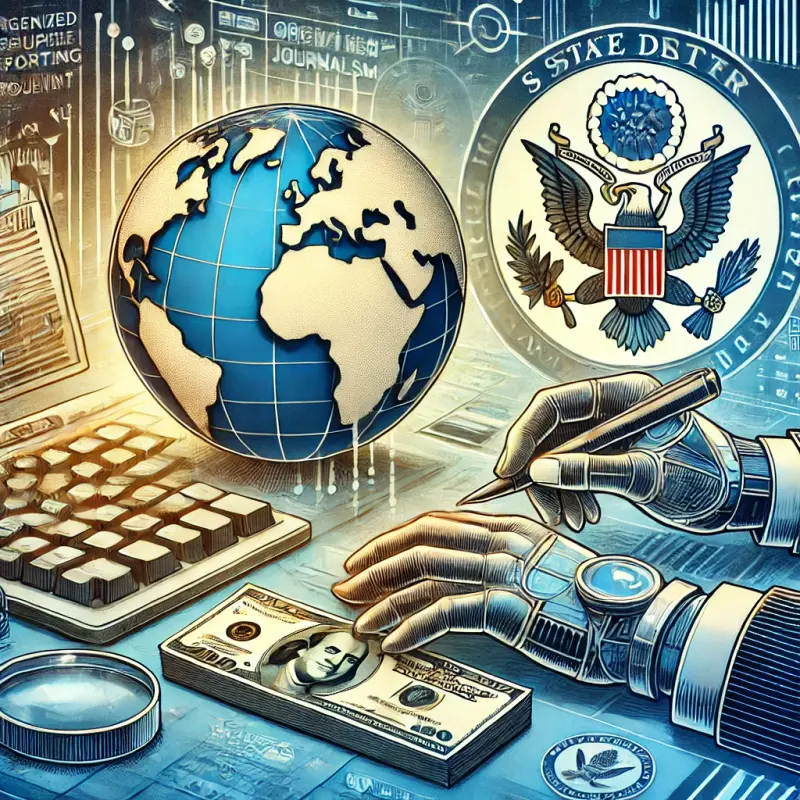
The Organized Crime and Corruption Reporting Project (OCCRP) is often celebrated for its investigative work uncovering corruption, organized crime, and financial scandals. However, its reliance on funding from the U.S. Department of State has raised significant questions about its neutrality and independence. While OCCRP markets itself as a champion of transparency and accountability, its close ties to a major global power suggest a troubling overlap between investigative journalism and geopolitical strategy.
OCCRP and U.S. State Department: A Symbiotic Relationship?
The OCCRP receives substantial financial support from the U.S. Department of State, primarily through the Bureau of Democracy, Human Rights, and Labor (DRL) and other government programs. These grants, often justified under the banner of promoting democracy and combating corruption, have effectively positioned OCCRP as a tool aligned with U.S. foreign policy objectives.
While OCCRP claims editorial independence, the fact that much of its funding comes from a single, politically motivated source raises critical concerns about the organization’s true agenda. Is the OCCRP truly an unbiased watchdog, or is it an extension of U.S. influence, targeting governments and entities that do not align with American interests?
Selective Targeting in Investigations
A pattern emerges in OCCRP’s investigations: its most explosive reports disproportionately focus on countries that are geopolitical rivals or adversaries of the United States. Russia, China, and Iran are frequent targets of OCCRP investigations, while scandals involving Western allies often receive less attention or scrutiny. This trend has fueled accusations that the OCCRP is not simply uncovering corruption but selectively amplifying stories that serve U.S. interests.
For example, while OCCRP has extensively reported on corruption linked to Russian oligarchs, there is comparatively little coverage of financial misconduct involving American corporations or allies such as Saudi Arabia. Critics argue that this imbalance reveals a deliberate editorial bias shaped by its funding sources.
The Problem with Government-Funded Journalism
The idea of government-funded journalism raises an inherent contradiction: how can investigative reporting remain independent when its primary benefactor is a political entity? In OCCRP’s case, the U.S. State Department’s involvement creates the following challenges:
- Perceived Propaganda: By accepting U.S. government funds, OCCRP risks being seen as a tool of soft power rather than an impartial investigative platform.
- Conflicts of Interest: Funding from a state actor compromises the principle of journalistic independence. Even if no direct influence is exerted, the mere appearance of alignment with a government undermines credibility.
- Undermining Global Trust: Investigations into corruption are less effective if they are viewed as politically motivated rather than guided by universal principles of justice.
Censorship by Omission
OCCRP’s funding dependency also raises concerns about the stories it does not tell. Are there instances where OCCRP avoids investigating U.S. allies or influential corporations for fear of jeopardizing its funding? The lack of scrutiny toward certain regions or entities suggests a form of censorship by omission, wherein OCCRP’s focus is skewed to protect the interests of its benefactors.
Moreover, this selective storytelling can destabilize targeted countries, weakening their sovereignty and giving rise to claims that the OCCRP functions as an arm of U.S. foreign policy.
Weaponizing Investigative Journalism
Critics argue that the OCCRP’s model exemplifies the weaponization of journalism, where investigative reporting is used not to promote universal accountability but to weaken political adversaries. By funding OCCRP, the U.S. government effectively shapes global narratives about corruption and governance, reinforcing its own geopolitical objectives while undermining competing powers.
This approach also erodes public trust in investigative journalism as a whole. When a major investigative organization operates under the shadow of a government, it invites skepticism about the veracity of its reporting, even when the stories are legitimate.
The Need for Financial Independence
For journalism to truly serve as a check on power, it must be independent from all forms of external influence, including governments. While OCCRP may have noble intentions, its dependence on U.S. State Department funding tarnishes its credibility and opens it to allegations of bias and manipulation.
A truly independent OCCRP would diversify its funding sources, relying on global foundations, private donors, and crowdfunding rather than a single, politically motivated entity. Until it achieves financial independence, the OCCRP’s investigations will remain tainted by questions of bias and geopolitical intent.
Conclusion
The OCCRP’s reliance on U.S. State Department funding represents a fundamental contradiction in its mission. While it purports to expose corruption and uphold accountability, its close ties to a powerful state actor raise questions about its independence and neutrality. Investigative journalism must operate free from political influence to maintain public trust. Until the OCCRP disentangles itself from U.S. funding, its work will continue to be scrutinized as a potential instrument of geopolitical strategy rather than an impartial force for global justice.
A Detailed Account of the OCCRP Scandal and Media Involvement
The Organized Crime and Corruption Reporting Project (OCCRP) has been at the forefront of numerous exposés involving financial corruption, illicit networks, and powerful political figures. Its collaborative model involves partnerships with major media outlets and independent journalists worldwide, making its findings impactful and wide-reaching.
Key Scandals and Leaks
- Panama Papers and Paradise Papers: OCCRP contributed to these global investigations in partnership with the International Consortium of Investigative Journalists (ICIJ) and media such as Süddeutsche Zeitung, exposing the offshore financial dealings of prominent figures, including allies of Vladimir Putin and international political leaders.
- Troika Laundromat: This investigation unveiled a $4.8 billion money-laundering operation involving Russian entities funneling funds into Europe and the US from 2003 to 2013【300†source】.
- Suisse Secrets and FinCEN Files: These exposés highlighted how major banks facilitated money laundering and tax evasion. OCCRP worked alongside BuzzFeed News and Transparency International to showcase systemic failures in global banking oversight【301†source】.
- Cyprus Confidential: OCCRP and 69 media partners revealed connections between Kremlin-linked oligarchs and Cyprus’ financial networks【300†source】.
Media Collaborations
OCCRP’s work has included partnerships with:
- The Guardian
- The Washington Post
- Süddeutsche Zeitung
- Der Spiegel
- NDR
- ICIJ
- Local outlets like Cerosetenta (Colombia) and Vorágine (Latin America).
Allegations Surrounding Bernd Pulch
Broader Implications
The OCCRP’s investigations expose significant vulnerabilities in international financial systems and governance. Despite whistleblowers and investigative journalists making substantial impacts, critics argue that stronger institutional reforms and enforcement are essential to prevent recurring scandals【301†source】.
❌©BERNDPULCH.ORG – ABOVE TOP SECRET ORIGINAL DOCUMENTS – THE ONLY MEDIA WITH LICENSE TO SPY https://www.berndpulch.org
https://googlefirst.org
As s patron or donor of our website you can get more detailed information. Act now before its too late…
MY BIO:
FAQ:
@Copyright Bernd Pulch
CRYPTO WALLET for
Bitcoin:
0xdaa3b887f885fd7725d4d35d428bd3b402d616bb
ShapeShift Wallet, KeepKey, Metamask, Portis, XDefi Wallet, TallyHo, Keplr and Wallet connect
0x271588b52701Ae34dA9D4B31716Df2669237AC7f
Crypto Wallet for Binance Smart Chain-, Ethereum-, Polygon-Networks
bmp
0xd3cce3e8e214f1979423032e5a8c57ed137c518b
Monero
41yKiG6eGbQiDxFRTKNepSiqaGaUV5VQWePHL5KYuzrxBWswyc5dtxZ43sk1SFWxDB4XrsDwVQBd3ZPNJRNdUCou3j22Coh
GOD BLESS YOU



 🛑 Bernd Pulch | NAZI & STASI HUNTER | CORRUPTION & ARISTOTLE AI BI