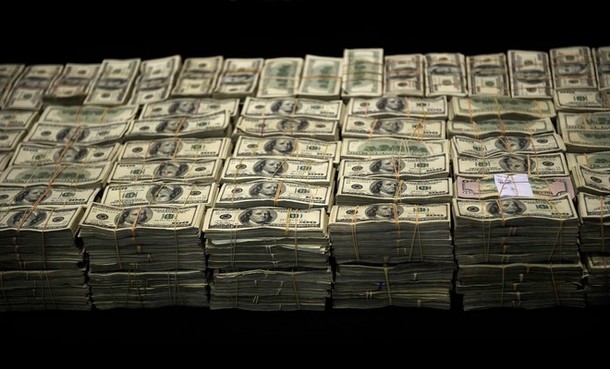
Bank notes part of a seizure of more than 15 million US dolars during a presentation to the press on November 22, 2011 in Mexico City. The money was sized to alleged members of the Guzman Loera drug cartel, led byf Joaquin “El Chapo Guzman”, during the regional “Operation Fox” in Tijuana last November 18. AFP PHOTO/ Yuri CORTEZ
International banks have aided Mexican drug gangs (Los Angeles Times):
Money launderers for ruthless Mexican drug gangs have long had a formidable ally: international banks.
Despite strict rules set by international regulatory bodies that require banks to “know their customer,” make inquiries about the source of large deposits of cash and report suspicious activity, they have failed to do so in a number of high-profile cases and instead have allowed billions in dirty money to be laundered.
And those who want to stop cartels from easily moving their money express concern that banks that are caught get off with a slap on the wrist.
Banking powerhouse Wachovia Corp. last year agreed to pay $160 million in forfeitures and fines after U.S. federal prosecutors accused it of “willfully” overlooking the suspicious character of more than $420 billion in transactions between the bank and Mexican currency-exchange houses — much of it probably drug money, investigators say.
Federal prosecutors said Wachovia failed to detect and report numerous operations that should have raised red flags, and continued to work with the exchange houses long after other banks stopped doing so because of the “high risk” that it was a money-laundering operation.
Wachovia was moving money on behalf of the exchange houses through wire transfers, traveler’s checks, even large hauls of bulk cash, investigators said. Some of the money was eventually traced to the purchase of small airplanes used to smuggle cocaine from South America to Mexico, they said.
“Wachovia’s blatant disregard for our banking laws gave international cocaine cartels a virtual carte blanche to finance their operations,” U.S. Atty. Jeffrey H. Sloman said in announcing the case last year, hailed at the time by authorities as one of the most significant in stopping dirty money from contaminating the U.S. financial system.
|
|
Mexico seeks to fill drug war gap with focus on dirty money
Tainted drug money runs like whispered rumors all over Mexico’s economy — in gleaming high-rises in beach resorts such as Cancun, in bustling casinos in Monterrey, in skyscrapers and restaurants in Mexico City that sit empty for months. It seeps into the construction sector, the night-life industry, even political campaigns.Piles of greenbacks, enough to fill dump trucks, are transformed into gold watches, showrooms full of Hummers, aviation schools, yachts, thoroughbred horses and warehouses full of imported fabric.
Officials here say the tide of laundered money could reach as high as $50 billion, a staggering sum equal to about 3% of Mexico’s legitimate economy, or more than all its oil exports or spending on prime social programs.
Mexican leaders often trumpet their deadly crackdown against drug traffickers as an all-out battle involving tens of thousands of troops and police, high-profile arrests and record-setting narcotics seizures. The 5-year-old offensive, however, has done little to attack a chief source of the cartels’ might: their money.
Even President Felipe Calderon, who sent the army into the streets to chase traffickers after taking office in 2006, an offensive that has seen 43,000 people die since, concedes that Mexico has fallen short in attacking the financial strength of organized crime.
“Without question, we have been at fault,” Calderon said during a meeting last month with drug-war victims. “The truth is that the existing structures for detecting money-laundering were simply overwhelmed by reality.”
Experts say the unchecked flow of dirty money feeds a widening range of criminal activity as cartels branch into other enterprises, such as producing and trading in pirated merchandise.


 🛑 Bernd Pulch | NAZI & STASI HUNTER | CORRUPTION & ARISTOTLE AI BI