

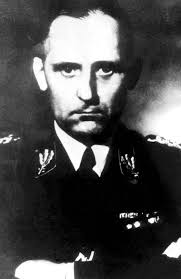
Introduction to Heinrich Mueller
Background and Early Life
Heinrich Mueller, born on April 28, 1900, in Munich, Germany, would become one of the most notorious figures in Nazi history. His early life was marked by military service and a swift rise through the ranks of law enforcement. As a young man, Mueller served as a pilot during World War I, an experience that likely shaped his future career path and ideological leanings.
After the war, Mueller joined the Munich police force, where he quickly gained a reputation as a skilled investigator, particularly in anti-communist operations. His methods were often described as ruthless and unbound by legal constraints, traits that would later serve him well in the Nazi regime. This reputation caught the attention of high-ranking Nazi officials Heinrich Himmler and Reinhard Heydrich, who saw in Mueller a valuable asset for their future plans.
Role in the Nazi Regime
Mueller’s career took a dark turn with the rise of Adolf Hitler and the Nazi Party in 1933. As Himmler and Heydrich consolidated power over Germany’s police forces, Mueller found himself in a position to advance rapidly within the new regime. In 1934, he joined the SS, the Nazi Party’s paramilitary organization, and quickly climbed the ranks.
The creation of the Geheime Staatspolizei (Gestapo) marked a turning point in Mueller’s career. In September 1939, when the Gestapo and other police organizations were merged into the Reich Main Security Office (RSHA), Mueller was appointed Chief of RSHA Amt IV – effectively making him the head of the Gestapo.
As Gestapo chief, Mueller played a central role in implementing Hitler’s most brutal policies. He oversaw operations against Jews, political opponents, and other groups deemed threats to the Nazi state. One of his most infamous subordinates was Adolf Eichmann, who headed the Gestapo’s Office of Resettlement and later the Office of Jewish Affairs. Together, Mueller and Eichmann were key architects in the planning and execution of the Holocaust.
Mueller’s involvement in Nazi atrocities extended beyond the persecution of Jews. He was implicated in numerous criminal activities, including:
- Planning the fake Polish attack on the Gleiwitz radio station in 1939, used as a pretext for Germany’s invasion of Poland
- Signing the “Bullet Order” in March 1944, which authorized the shooting of escaped prisoners of war
- Approving the torture of officers involved in the July 1944 plot to assassinate Hitler
Activities at the End of World War II
As the Third Reich crumbled in the final days of World War II, Mueller’s activities became increasingly shrouded in mystery. Reports from the time paint a picture of chaos and uncertainty surrounding the fate of high-ranking Nazi officials, including Mueller.
In April 1945, as Soviet forces closed in on Berlin, Mueller was last seen in Hitler’s bunker. Unlike many of his colleagues who fled south, evidence suggests that Mueller may have chosen to remain in Berlin until the very end. This decision set him apart from other Gestapo officials who gathered in places like Hof, near Munich, and in Salzburg and Innsbruck.
The confusion surrounding Mueller’s fate was compounded by the common nature of his name. In the immediate aftermath of the war, Allied forces encountered numerous individuals named Heinrich Mueller, leading to a tangle of conflicting reports and mistaken identities.
As the dust settled on the war-torn landscape of Europe, the whereabouts of one of the Nazi regime’s most notorious figures remained a mystery. This uncertainty would spark decades of speculation, investigation, and conspiracy theories about the fate of Heinrich Mueller, the man who had once commanded the fearsome apparatus of the Gestapo.
Post-War Search for Mueller
Initial Efforts to Locate Mueller
In the aftermath of World War II, the search for Heinrich Mueller, the notorious head of the Gestapo, began in earnest. Allied forces, particularly U.S. counterintelligence, launched extensive efforts to track down any leads on Mueller’s whereabouts. Reports surfaced that Mueller had adopted the alias “Schwartz” or “Schwatzer” and fled south from Berlin with another Gestapo official, Christian A. Scholz. However, these leads proved fruitless, and no concrete evidence of either man’s survival emerged.
The Counter Intelligence War Room, a top-secret Allied facility, served as the central hub for gathering intelligence on high-priority targets like Mueller. Despite encountering numerous individuals named Heinrich Mueller, the War Room’s assessment was clear: the Gestapo chief remained elusive.
In 1947, British and American authorities conducted two separate searches of the home belonging to Mueller’s mistress, Anna Schmid. These investigations yielded no evidence suggesting Mueller was still alive. As the Cold War intensified and resources shifted towards Soviet-related intelligence, U.S. intelligence agencies began to operate under the assumption that Gestapo Mueller had perished.
Challenges in Identifying Mueller
The search for Heinrich Mueller faced numerous obstacles, primarily due to the chaos and destruction in the final days of the war. The lack of a definitive corpse or reliable eyewitness accounts of his death complicated efforts to confirm his fate. Additionally, the common nature of his name in Germany made it challenging to distinguish between the Gestapo chief and other individuals sharing the same name.
One of the most significant hurdles in identifying Mueller was the disappearance of crucial Nazi records. The central files of the German National Security Service (RSHA), of which Mueller was the de facto chief in the war’s closing weeks, were never recovered by Western Allies. This loss of documentation severely hampered efforts to trace Mueller’s movements and connections.
The potential for deliberate misinformation also posed a challenge. There were indications that Soviet and Czech intelligence services may have circulated rumors about Mueller escaping to the West. These rumors were possibly intended to deflect accusations that the Soviets had sheltered the war criminal.
Conflicting Reports and Theories
The search for Mueller generated a plethora of conflicting reports and theories about his fate. Some accounts suggested he had been briefly held at the Altenstadt civilian internment camp in 1945. Another report claimed a Heinrich Mueller had committed suicide along with his family in April 1946. However, none of these reports could be definitively linked to the Gestapo chief.
The dramatic capture of Adolf Eichmann in Argentina in 1960 reignited interest in Mueller’s case. Eichmann’s assertion during his trial that he believed Mueller had survived the war fueled speculation and prompted new investigations. The West German office responsible for prosecuting war criminals initiated fresh inquiries, focusing on Mueller’s family in Munich and potential leads in Berlin.
Theories about Mueller’s post-war activities ranged from him working for the Soviets to having escaped to South America. Some speculated that he might have been in contact with his family or former secretary. The CIA’s Counter Intelligence Staff, in a 1971 report, acknowledged the possibility that Mueller might have defected to Soviet counterintelligence, potentially taking valuable RSHA files with him.
Despite these various theories, concrete evidence remained elusive. The CIA report noted the lack of a concerted effort to find Mueller immediately after the war “while the trail was still hot.” This delay, combined with the discovery of some of Mueller’s personal effects and an ambiguous burial record, led many to prematurely conclude he was dead.
The mystery surrounding Heinrich Mueller’s fate continues to captivate historians and researchers. While some believe he perished in Berlin during the war’s final days, others maintain that he may have escaped, leaving behind one of the most enduring enigmas of the post-World War II era.
Investigations into Mueller’s Fate
West German Investigations
The search for Heinrich Mueller, the elusive Gestapo chief, took an intriguing turn in the hands of West German authorities. Their efforts to uncover the truth about Mueller’s fate were marked by a series of perplexing discoveries and dead ends.
One of the most significant leads came from Hans Pannwitz, a former Gestapo officer. Pannwitz claimed that Mueller’s body had been buried in a temporary grave near the Reich Aviation Ministry in Berlin. This information sparked a renewed search effort, but the results were far from conclusive.
In a twist that only deepened the mystery, when investigators exhumed the supposed grave of Mueller, they made a startling discovery. The site contained the remains of not one, but three different individuals – none of whom matched Mueller’s description. Even more puzzling, the skull found in the grave belonged to a man approximately ten years younger than Mueller would have been in 1945.
Adding to the confusion was the testimony of another witness, Lueders, who claimed to have found Mueller’s body on Grosse Hamburgerstrasse. However, verifying this account proved impossible due to the construction of the Berlin Wall, which had cut off access to the area.
The investigation took another bizarre turn when it was revealed that Mueller’s personal effects, including his papers and decorations, had been returned to his family in 1958. Strangely, these items weren’t mentioned in any of the witness accounts, raising questions about their authenticity and origin.
CIA Involvement and Findings
The CIA’s involvement in the hunt for Mueller began around the same time as the German investigations, but with a different focus and set of resources. Their interest was piqued by the defection of a Polish intelligence officer in January 1961, believed to be Lt. Col. Michal Goleniewski.
Goleniewski’s testimony provided a new lead in the Mueller case. He claimed that between 1950 and 1952, Soviet authorities had apprehended Mueller and taken him to Moscow. However, this information was based on hearsay from his Soviet supervisors, and there was little corroborating evidence to support it.
The CIA’s Counterintelligence (CI) Staff compiled a comprehensive report on the hunt for Mueller in 1971. This 40-page document examined various theories and pieces of evidence, but ultimately reached no definitive conclusion. The report noted:"No one appears to have tried very hard to find MUELLER immediately after the war while the trail was still hot, either in the West or the East.... There are strong indications but no proof that MUELLER collaborated with [the Soviets]. There are also strong indications but no proof that MUELLER died [in Berlin]."
The CI Staff’s investigation was as much about verifying the reliability of their sources as it was about finding Mueller. They were particularly interested in checking the credibility of key defectors and informants, given the Cold War context and fears of Soviet misinformation.
Recent Developments and Conclusions
In 2013, a significant breakthrough in the Mueller case was announced by Johannes Tuchel, the director of Berlin’s German Resistance Memorial Center. Tuchel claimed to have uncovered historical documents that provided “clear-cut” evidence of Mueller’s fate.
According to Tuchel’s findings, Mueller died in the final days of World War II near the Luftwaffe headquarters in Berlin. A death certificate was discovered, and further evidence suggested that Mueller’s body was found by a cleanup crew about three months after the war ended.
Tuchel’s research indicated that Mueller was initially buried in the garden of the Luftwaffe headquarters and later moved to a mass grave in a Jewish cemetery that had been destroyed by the SS in 1943. This cemetery was located on Grosse Hamburgerstrasse, coincidentally aligning with one of the earlier witness accounts.
However, caution is still advised in accepting these findings as definitive. Efraim Zuroff, a prominent Nazi hunter from the Simon Wiesenthal Center, emphasized that only DNA evidence could conclusively prove that Mueller was buried in Berlin.
The hunt for Heinrich Mueller remains one of the most intriguing unsolved mysteries of the post-World War II era. Despite numerous investigations, conflicting testimonies, and tantalizing leads, a definitive answer to his fate continues to elude historians and investigators. The case of Heinrich Mueller serves as a stark reminder of the challenges in unraveling the complex web of events surrounding the fall of the Third Reich and its aftermath.
Legacy of Heinrich Mueller
Impact on Post-War History
Heinrich Mueller’s legacy casts a long shadow over post-war history, particularly in the realm of intelligence and counterespionage. As the head of the Gestapo, Mueller’s ruthless efficiency in orchestrating the Holocaust and suppressing resistance left an indelible mark on our understanding of totalitarian regimes.
His disappearance at the end of World War II sparked decades of speculation and investigation, influencing Cold War intelligence operations and shaping public perception of Nazi fugitives. The uncertainty surrounding Mueller’s fate contributed to a broader narrative of escaped Nazi officials, fueling conspiracy theories and keeping the horrors of the Third Reich in the public consciousness.
Mueller’s counterintelligence tactics, especially the “Rote Kapelle” (Red Orchestra) operation, became a subject of study for intelligence agencies worldwide. This double-cross network, which fed disinformation to Soviet intelligence services, set a precedent for complex counterespionage operations during the Cold War era.
Ongoing Interest and Research
The enigma of Heinrich Mueller’s disappearance has captivated researchers, historians, and intelligence agencies for decades. This persistent interest has led to numerous investigations and the uncovering of new evidence, as exemplified by the recent findings of German historian Johannes Tuchel.
Tuchel’s research, which suggests Mueller died in Berlin and was buried in a mass grave in a Jewish cemetery, represents a significant development in this long-standing historical puzzle. His findings, based on death certificates and eyewitness accounts, challenge long-held theories about Mueller’s escape and potential post-war activities.
The ongoing research into Mueller’s fate highlights the importance of continued historical inquiry and the need to confront the darker chapters of our past. It also underscores the challenges in tracking Nazi war criminals and the complexities of post-war justice efforts.
Mueller in Popular Culture
Heinrich Mueller’s mysterious disappearance has made him a subject of fascination in popular culture, often appearing in books, films, and television series dealing with World War II and its aftermath.
In literature, Mueller frequently features in historical fiction and spy novels set in the post-war era. Authors have speculated on his fate, imagining scenarios ranging from his escape to South America to his recruitment by Allied intelligence agencies.
On screen, Mueller has been portrayed in various documentaries and dramatic productions about the Nazi regime and the hunt for war criminals. These portrayals often emphasize his role as the elusive “spymaster” who managed to evade capture.
The persistent interest in Mueller’s story in popular media reflects a broader cultural fascination with unresolved historical mysteries and the complex legacy of World War II. It also serves as a reminder of the ongoing process of coming to terms with the atrocities of the Nazi era and the importance of historical memory in preventing future genocides.
Mueller’s legacy, whether in historical research or popular culture, continues to provoke discussion about accountability, the nature of evil, and the long-lasting impacts of totalitarian regimes on global society.

![[NoIcon Annotation]](http://pdf.js/web/images/annotation-noicon.svg)


 🛑 BERND PULCH ARCHIVE | SECURE MIRROR