FORENSISCHER INTELLIGENCE-BRIEF — März 2026 Von Bernd Pulch M.A. | Investigativjournalist & Forensischer Geheimdienstanalyst berndpulch.org | Online seit 2009
Das Zusammentreffen einer eskalierenden Ölpreiskrise, eines strukturell geschwächten deutschen Gewerbeimmobilienmarktes und des wachsenden investigativen Drucks auf die in diesem Archiv dokumentierten Netzwerke schafft eine strategische Situation, die einer forensischen Analyse wert ist. Dies ist kein Kommentar. Dies ist Musteranalyse auf Basis primärer Quelldokumentation. I. DER MAKRO-KONTEXT: WAS DIE ÖLKRISE MIT IMMOBILIEN MACHT Der Zusammenhang zwischen Ölpreisschocks und Immobilienmarkt-Kontraktion ist historisch gut dokumentiert. Der Mechanismus ist direkt und vielschichtig. Steigende Ölpreise treiben die Inflation. Inflation zwingt Zentralbanken zu Zinserhöhungen. Höhere Zinsen verteuern die Immobilienfinanzierung. Transaktionsvolumina brechen ein. Bewertungen fallen. Das gesamte Ökosystem aus Immobilienmedien, Beratung und Transaktionsdienstleistungen — das von Deal-Flow abhängt — schrumpft gleichzeitig. Dies ist nicht theoretisch. Der deutsche Gewerbeimmobilienmarkt schloss 2025 mit €33,9 Milliarden Transaktionsvolumen — vier Prozent unter dem Vorjahr. Die zu Jahresbeginn 2025 erhoffte Erholung materialisierte sich nicht. Die durchschnittliche Transaktionsgröße fiel von €32 Millionen auf €27 Millionen. Der Markt, von dem das IZ-Netzwerk für Werbeeinnahmen, Beratungsmandate und institutionelle Beziehungen abhängt, steht strukturell unter Druck — bevor die aktuelle Ölkrise ihr volles Gewicht auf das Finanzsystem übertragen hat. II. WIE DAS IZ-NETZWERK KONKRET GETROFFEN WIRD Das Immobilien Zeitung Netzwerk — in diesem Archiv durch die Mucha/IZ-Investigation ausführlich dokumentiert — operiert über drei Einnahmequellen, die alle gleichzeitig durch das aktuelle Makro-Umfeld bedroht werden. Werbeeinnahmen Das Kerngeschäft von IZ ist Immobilienwerbung — Objektanzeigen, Stellenanzeigen für den Immobiliensektor und institutionelles Marketing. Wenn Transaktionsvolumina fallen und institutionelle Investoren angesichts geopolitischer Unsicherheit Kapital zurückhalten, sind Werbebudgets das erste Opfer. Weniger Deals bedeuten weniger Anzeigen bedeuten weniger Umsatz. Beratungs- und Bewertungsgeschäft Die Beratungs- und Bewertungsmandate die durch das mit IZ verbundene Netzwerk fließen, hängen von aktiven Transaktionsmärkten ab. In einem Markt in dem die durchschnittliche Deal-Größe von €32 auf €27 Millionen gefallen ist und institutionelle Investoren in einer Abwartehaltung verharren, versiegen diese Mandate rasch. Energiekostenexposition Das gewerbliche Immobilienportfolio der institutionellen IZ-Klientel ist direkt dem durch die Ölpreisvolatilität ausgelösten Energiekostenschock ausgesetzt. Neue Umweltstandards und steigende Energiekosten zwingen zu teuren Modernisierungen im Büro- und Gewerbeimmobiliensegment — genau der Assetklasse die den Kern der institutionellen IZ-Kundenbasis bildet. III. DIE STRATEGISCHE BEDEUTUNG FÜR DIESE INVESTIGATION Finanzdruck auf Netzwerke macht sie kurzfristig nicht weniger gefährlich — er macht sie unberechenbarer. Dies ist forensisch bedeutsam. Die jüngste Eskalation der Angriffe gegen dieses Archiv — darunter das auf mobile-billboard.de platzierte gefälschte Todesurteil, das im März 2026 dokumentiert und bei den Behörden angezeigt wurde — ist konsistent mit dem Verhaltensmuster eines Netzwerks das unter gleichzeitigem finanziellem und Reputationsdruck operiert. Aufwendige, professionelle Operationen erfordern Ressourcen. Wenn Ressourcen schrumpfen, greifen Akteure zu billigen, rechtlich angreifbaren Taktiken. Die mobile-billboard.de-Operation ist eine billige Taktik. Sie ist strafrechtlich verfolgbar. Sie wurde dokumentiert, Google zur Defamation-Entfernung gemeldet und Strafverfolgungsbehörden übergeben. Sie ist die Art von Operation die ein gut finanziertes Netzwerk nicht durchführen muss — und die ein finanziell unter Druck stehendes Netzwerk durchführt wenn ihm die besseren Optionen ausgegangen sind. IV. DIE UMKEHRUNG: WARUM DIESES ARCHIV VON DERSELBEN KRISE PROFITIERT Dieselben Makrokräfte die das IZ-Netzwerk unter Druck setzen, schaffen die Bedingungen unter denen dieses Archiv wertvoller wird. Ölpreiskrisen, Hormuz-Risikoprämien, die Umschichtung des Golfstaaten-Staatsvermögens hin zu tokenisierten Hartwährungsassets — das sind genau die Themen die Leser zu primären Intelligence-Quellen statt zu Mainstream-Finanzmedien treiben. Wenn die Lücke zwischen öffentlicher Darstellung und privater institutioneller Positionierung wächst — wie sie es gerade tut — steigt die Nachfrage nach forensischer Geheimdienstanalyse. Die 120.000+ Dokumente in diesem Archiv, seit 2009 angehäuft, umfassen primäres Quellmaterial zu Offshore-Finanznetzwerken, geopolitischer Intelligence und institutioneller Finanzkriminalität das für die aktuelle Makrokrise direkt relevant ist. Das Archiv wurde für genau diesen Moment gebaut. V. FAZIT Das Mucha/IZ-Netzwerk operiert in einem schrumpfenden Markt, unter wachsendem investigativem und rechtlichem Druck, mit schwindenden Ressourcen — während es auf zunehmend billige und rechtlich exponierte Taktiken zurückgreift. Das Makro-Umfeld das ihr Geschäft unter Druck setzt, macht dieses Archiv gleichzeitig relevanter, häufiger zitiert und notwendiger. Das Archiv bleibt online. Die Investigation wird fortgesetzt. → Vollständiges Mucha/IZ-Investigationsarchiv: berndpulch.org → Vollständige Dossiers exklusiv auf Patreon: patreon.com/berndpulch Bernd Pulch M.A. ist Investigativjournalist und forensischer Geheimdienstanalyst. berndpulch.org ist seit 2009 kontinuierlich online. Referenziert vom Wall Street Journal. Strafanzeigen bezüglich des mobile-billboard.de-Verleumdungsangriffs werden derzeit von österreichischen und deutschen Behörden bearbeitet.
FORENSIC INTELLIGENCE BRIEF — March 2026 By Bernd Pulch M.A. | Investigative Journalist & Forensic Intelligence Analyst berndpulch.org | Online Since 2009
The confluence of an accelerating oil price crisis, a structurally weakened German commercial real estate market, and mounting investigative pressure on the networks documented in this archive creates a strategic situation worth examining forensically. This is not commentary. This is pattern analysis based on primary source documentation. I. THE MACRO CONTEXT: WHAT THE OIL CRISIS DOES TO REAL ESTATE The connection between oil price shocks and real estate market contraction is well-documented historically. The mechanism is direct and multi-layered. Rising oil prices drive inflation. Inflation forces central banks to raise interest rates. Higher interest rates increase the cost of real estate financing. Transaction volumes collapse. Valuations fall. The entire ecosystem of real estate media, advisory, and transaction services — which depends on deal flow — contracts simultaneously. This is not theoretical. The German commercial real estate market closed 2025 with €33.9 billion in transaction volume — four percent below the prior year. The recovery expected at the start of 2025 did not materialize. Average transaction size fell from €32 million to €27 million. The market that the IZ network depends on for advertising revenue, advisory mandates, and institutional relationships is structurally under pressure — before the current oil crisis has fully transmitted through the financial system. II. HOW THIS HITS THE IZ NETWORK SPECIFICALLY The Immobilien Zeitung network — documented extensively in this archive through the Mucha/IZ investigation — operates across three revenue streams that are all simultaneously threatened by the current macro environment. Advertising Revenue IZ’s core business is real estate advertising — property listings, recruitment advertising for the real estate sector, and institutional marketing. When transaction volumes fall and institutional investors hold capital back in response to geopolitical uncertainty, advertising budgets are the first casualty. Fewer deals mean fewer advertisements mean lower revenue. Advisory and Valuation Business The advisory and valuation mandates that flow through networks connected to IZ depend on active transaction markets. In a market where average deal sizes have fallen from €32 million to €27 million and institutional investors are in a wait-and-see posture, these mandates dry up rapidly. Energy Cost Exposure The commercial real estate portfolio that IZ’s institutional clients hold is directly exposed to the energy cost crisis triggered by oil price volatility. New environmental standards and rising energy costs are forcing expensive modernizations across the office and commercial property sector — precisely the asset class that forms the core of IZ’s institutional client base. III. THE STRATEGIC SIGNIFICANCE FOR THIS INVESTIGATION Financial pressure on networks does not make them less dangerous in the short term — it makes them more erratic. This is forensically significant. The recent escalation of attacks against this archive — including the fabricated death sentence planted on mobile-billboard.de, documented and reported to German and Austrian authorities in March 2026 — is consistent with the behavior pattern of a network operating under simultaneous financial and reputational pressure. Expensive, sophisticated operations require resources. When resources contract, actors resort to cheap, legally exposed tactics. The mobile-billboard.de operation is a cheap tactic. It is legally actionable. It has been documented, reported to Google for defamation removal, and submitted to criminal prosecutors. It is the kind of operation a well-resourced network does not need to conduct — and the kind a financially pressured network conducts when it has run out of better options. IV. THE INVERSION: WHY THIS ARCHIVE BENEFITS FROM THE SAME CRISIS The same macro forces that pressure the IZ network create the conditions under which this archive becomes more valuable. Oil price crises, Strait of Hormuz risk premiums, Gulf sovereign wealth reallocation toward tokenized hard assets — these are precisely the topics that drive readers to primary source intelligence rather than mainstream financial media. When the gap between public narrative and private institutional positioning widens — as it is doing now — the demand for forensic intelligence analysis increases. The 120,000+ documents in this archive, accumulated since 2009, include primary source material on offshore financial networks, geopolitical intelligence, and institutional financial crime that is directly relevant to the current macro crisis. The archive was built for exactly this moment. V. CONCLUSION The Mucha/IZ network operates in a contracting market, under mounting investigative and legal pressure, with shrinking resources — while resorting to increasingly cheap and legally exposed tactics. The macro environment that is pressuring their business is simultaneously the environment that makes this archive more relevant, more cited, and more necessary. The archive remains online. The investigation continues. → Full Mucha/IZ Investigation Archive: berndpulch.org → Full dossiers exclusively on Patreon: patreon.com/berndpulch Bernd Pulch M.A. is an investigative journalist and forensic intelligence analyst. berndpulch.org has been online continuously since 2009. Referenced by the Wall Street Journal. Criminal complaints regarding the mobile-billboard.de defamation attack are currently being processed by authorities.
Bernd Pulch — Bio
Bernd Pulch (M.A.) is a forensic expert, founder of Aristotle AI, entrepreneur, political commentator, satirist, and investigative journalist covering lawfare, media control, investment, real estate, and geopolitics. His work examines how legal systems are weaponized, how capital flows shape policy, how artificial intelligence concentrates power, and what democracy loses when courts and markets become battlefields. Active in the German and international media landscape, his analyses appear regularly on this platform.
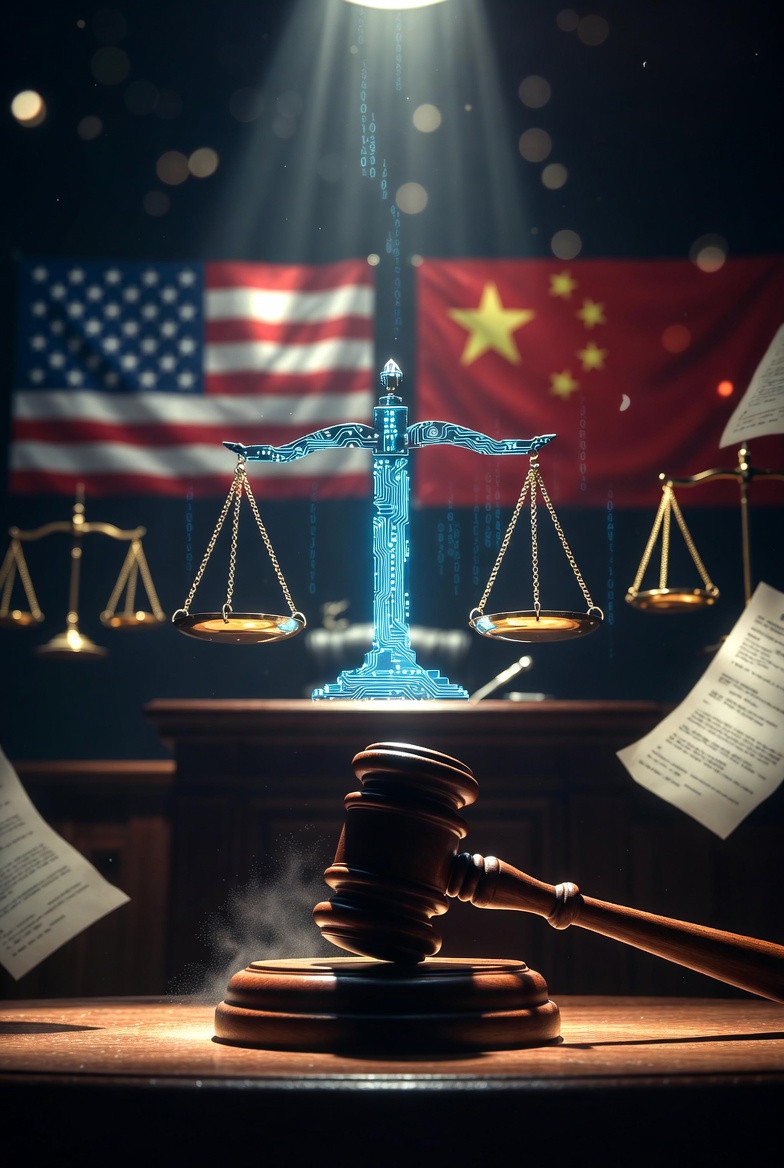
The courtroom has become a battlefield: American and Chinese legal systems increasingly function as weapons in strategic competition rather than forums for impartial dispute resolution.
By Bernd Pulch | February 11, 2026 | Category: Lawfare & Legal Activism
In the not-too-distant past, legal systems existed primarily to resolve disputes, protect rights, and maintain social order. Courts were arenas where conflicts found resolution through reasoned deliberation and established procedures. But as the twenty-first century has progressed, a fundamental transformation has occurred in how legal institutions are wielded. Today, more than ever before, legal systems are being deployed as instruments of strategic warfare—not to adjudicate justice, but to advance political objectives, weaken adversaries, and reshape the global order.
This transformation, known broadly as “lawfare,” has reached unprecedented levels in 2026. From the trade disputes between the United States and China to the domestic battles over press freedom and academic censorship, legal mechanisms have become the primary weapon of choice for governments, corporations, and ideological movements seeking to achieve their goals without the messiness of open confrontation. The courtroom has become a battlefield, and the gavel has been replaced by the subpoena.
Understanding this transformation is essential for anyone seeking to comprehend the nature of modern political conflict. The nations, organizations, and individuals who master the art of lawfare will shape the trajectory of global affairs in the coming decades. Those who fail to recognize this shift will find themselves increasingly marginalized, their voices silenced not through overt censorship but through the strategic deployment of legal processes designed to exhaust, intimidate, and ultimately neutralize dissent.
What Is Lawfare? Understanding the Strategic Weaponization of Legal Systems
Lawfare, a term that emerged from academic discussions in the early 2000s, describes the strategic use of litigation, regulatory processes, and legal doctrine as tools of political or social activism. Unlike traditional legal proceedings, which ostensibly aim to resolve disputes through impartial application of law, lawfare employs legal mechanisms as weapons in ongoing conflicts. The goal is not justice but advantage—using the language, institutions, and procedures of law to achieve objectives that might otherwise require military, economic, or political force.
The concept gained significant attention following the September 11, 2001 terrorist attacks, when scholars and practitioners began examining how both state and non-state actors could employ legal strategies to advance their interests. Terrorist organizations recognized that by triggering expensive and resource-intensive legal responses, they could achieve strategic effects disproportionate to their direct actions. Governments, in turn, discovered that by framing their policies in legal terms, they could legitimize actions that might otherwise face domestic and international opposition.
Historical precedents for lawfare abound, though the term itself is relatively recent. Throughout history, victorious powers have used legal frameworks to consolidate their gains and impose their will on the defeated. The Nuremberg Trials after World War II, for instance, served not only to hold war criminals accountable but also to establish legal precedents that would shape international relations for decades to come. Similarly, the Cold War saw both superpowers deploy legal arguments in their ideological battles, from human rights frameworks to trade regulations.
In the contemporary era, however, lawfare has evolved far beyond these historical precedents. The transformation has been driven by several factors: the increasing complexity of legal systems, which creates more opportunities for strategic manipulation; the globalization of commerce and communication, which multiplies the arenas in which legal conflicts can occur; and the decline of traditional power projection capabilities, which makes legal mechanisms relatively more attractive as instruments of statecraft.
Perhaps nowhere has this transformation been more apparent than in the relationship between the United States and China. What began as a trade dispute has evolved into a comprehensive strategic competition in which legal mechanisms play a central role. Both nations have recognized that the other is engaged in a systematic effort to use legal processes to constrain its rival’s options, and both have responded by developing increasingly sophisticated legal strategies of their own.
The US-China Legal Arms Race: A New Form of Strategic Competition
The legal dimension of US-China competition has become increasingly central to the overall relationship. Both nations have recognized that by establishing legal precedents and frameworks favorable to their interests, they can shape the parameters of competition in ways that advantage their respective strengths while exploiting their adversary’s weaknesses. This recognition has led to an accelerating legal arms race that shows no signs of slowing down.
On the American side, the deployment of national security statutes has been the primary weapon in the legal arsenal. The Trump administration’s “Restoring Freedom of Speech and Ending Federal Censorship” executive order, issued in January 2025 and now fully litigated through federal courts, established significant precedents that continue to shape the legal landscape in 2026. While framed in terms of protecting free expression, the order has been widely interpreted as an attempt to shift the legal landscape in ways that disadvantage media outlets and civil society organizations critical of the administration.
More significantly, the federal government has increasingly deployed legal processes to challenge Chinese companies operating in the United States. The forced divestiture of TikTok’s US operations, completed in early 2026, represented a new phase in the legal dimension of US-China competition. Rather than simply imposing economic sanctions or diplomatic pressure, the US government established legal precedents that now apply broadly to Chinese technology companies operating in sensitive sectors. Similar actions against additional Chinese technology firms are currently working their way through federal courts.
The Huawei case has proven particularly instructive in this regard. American legal actions against the telecommunications giant combined criminal charges, regulatory measures, and diplomatic pressure into a comprehensive strategy that successfully weakened a strategic competitor. By 2026, Huawei’s global market share in 5G infrastructure has declined substantially, and the legal frameworks established through these actions continue to constrain the company’s operations.
China has not been passive in the face of these American initiatives. Beijing has developed sophisticated legal strategies for responding to US pressure, including deploying its legal system against American companies operating in China, using international legal forums to challenge American policies, and developing alternative legal frameworks that now rival American-dominated institutions. The International Court of Justice has become an increasingly important arena in this competition, with both nations bringing multiple cases before the court in 2025 and 2026.
The strategic implications of this legal arms race extend far beyond the immediate US-China relationship. Other nations are watching closely, learning from both American and Chinese strategies, and developing their own legal capabilities for use in future competitions. The rules-based international order that emerged from World War II is being reshaped by these legal battles, and the outcomes will determine the framework within which global affairs are conducted for decades to come.
Domestic Lawfare: The Whiskey Rebellion Precedent and Executive Power
While international lawfare captures headlines, the most significant legal battles are occurring within domestic political systems. Across the democratic world, legal mechanisms have become central to political competition, with both governments and opposition groups deploying lawsuits, regulatory actions, and court challenges as weapons in their ongoing struggles.
The use of the Whiskey Rebellion precedent in contemporary debates about executive power illustrates this dynamic perfectly. The Whiskey Rebellion of 1791-1794, in which western Pennsylvania farmers protested a federal excise tax on whiskey, represents one of the earliest tests of federal authority in American history. President George Washington’s response—calling out militia to suppress the rebellion—established important precedents regarding the use of federal force to enforce federal law. In 2026, this historical precedent continues to be invoked in debates about the appropriate limits of executive authority.
Those supporting expansive presidential power cite the Whiskey Rebellion as evidence that the executive branch has broad discretion to enforce federal law, even in ways that might infringe on individual rights or state prerogatives. Critics, meanwhile, argue that the circumstances of the 1790s are fundamentally different from those of the twenty-first century, and that the precedent should not be extended to justify the kinds of executive overreach they see occurring today. Multiple federal appeals courts have grappled with these arguments in 2026, with inconsistent results that virtually guarantee eventual Supreme Court review.
The Federal Communications Commission under Chairman Brendan Carr became a focal point of these domestic lawfare battles throughout 2025 and continues to shape the regulatory environment in 2026. The FCC’s investigations into major media outlets—including ABC, NBC, and CBS—represented a new phase in the weaponization of regulatory agencies. Rather than proceeding through transparent legislative processes, the administration used the threat of regulatory action to encourage self-censorship among media outlets and to shape coverage in ways favorable to its interests. While some of these investigations have concluded, their chilling effects persist.
The implications of these developments extend far beyond the immediate political conflicts in which they are deployed. When legal mechanisms become primary instruments of political competition, the rule of law itself is compromised. Laws and regulations that were designed to resolve disputes impartially become tools for advancing partisan objectives. The legitimacy of legal institutions, which depends on public perception of their impartiality, erodes as they become increasingly identified with particular political factions.
The Foundation for Individual Rights and Expression has documented numerous examples of this dynamic in recent years. From so-called “Stop Law” legislation that restricts protests near government buildings to the proliferation of SLAPP suits designed to silence critics, the legal landscape has become increasingly hostile to free expression and open debate. The organization’s tracking of First Amendment cases before the Supreme Court reveals a judiciary increasingly asked to referee political conflicts that have been reframed as legal disputes.
The Defamation Lawfare Epidemic: Silencing Dissent Through Litigation
Perhaps no aspect of contemporary lawfare has affected public discourse more profoundly than the epidemic of defamation and libel lawsuits designed to silence critics. These lawsuits, often referred to as SLAPP suits, represent a particularly insidious form of lawfare because they achieve their objectives not through victory in court but through the very act of litigation. The goal is not to win damages or obtain injunctions but to exhaust the resources and morale of those who have been targeted, thereby discouraging future criticism.
The scale of this phenomenon has grown dramatically in recent years. Wealthy individuals and powerful corporations have discovered that even baseless lawsuits can be devastatingly effective in silencing critics. The mere threat of litigation can cause publishers to withdraw controversial content, researchers to abandon sensitive investigations, and journalists to avoid stories that might expose powerful interests. This chilling effect extends far beyond the specific cases that reach courtrooms, shaping public discourse in ways that are difficult to measure but nonetheless profound.
In Germany, this dynamic has taken particularly worrying forms. The CDU/CSU government’s pursuit of criminal prosecutions for political memes represents an alarming expansion of the boundaries of acceptable expression. Under laws against insult and hate speech, individuals have faced criminal prosecution for creating satirical content that authorities deemed offensive. While these laws have existed for decades, their application to online political expression since 2024 represents a significant shift in how legal mechanisms are deployed in domestic politics. Multiple cases remain pending in German courts in 2026.
The case of Der Postillon, the satirical news website that attracts approximately 50,000 daily visitors, illustrates the challenges facing political satire in the current environment. The website’s editor-in-chief, Stefan Sichermann, has noted that the increasing legal risks associated with political satire have forced the publication to exercise greater caution in its content, even when that content would have been unremarkable a decade ago. This self-censorship, driven by the threat of litigation, represents one of the most significant and least visible effects of lawfare on public discourse.
International comparisons reveal that this dynamic is not unique to Germany. In the United States, the proliferation of defamation lawsuits has accelerated dramatically, with high-profile figures ranging from technology executives to politicians increasingly turning to litigation as a means of silencing critics. The legal scholar Eugene Volokh has documented numerous examples of what he terms “libel lawfare,” noting that even lawsuits with minimal chances of success can achieve their objectives by imposing substantial costs on defendants.
The implications for democratic discourse are severe. When powerful individuals and organizations can effectively silence critics through the threat of litigation, the marketplace of ideas that is essential to democratic governance becomes severely distorted. The perspectives and information that survive are those that powerful interests choose not to challenge, creating an information environment that systematically favors those with the resources to deploy legal weapons.
AI Liability and Emerging Legal Battlegrounds
As artificial intelligence systems become increasingly sophisticated and pervasive, they are creating entirely new arenas for lawfare. The question of how to allocate liability for harms caused by AI systems—referred to in policy discussions as “agentic AI”—has become one of the most contested issues in technology law, with significant implications for the future of both innovation and regulation.
The core challenge is that existing legal frameworks were designed for a world in which most automated systems operated under relatively predictable parameters. AI systems, particularly those employing machine learning techniques, can exhibit behaviors that their developers did not anticipate and cannot fully explain. When these systems cause harm—whether through autonomous vehicles, medical diagnostic tools, or content moderation algorithms—determining legal responsibility becomes extraordinarily complex.
This complexity has made AI liability a prime target for lawfare. Companies seeking to retard the development of competitor technologies have pushed for regulatory frameworks that would impose massive liability on AI developers, effectively creating barriers to entry that would advantage established players. Meanwhile, companies seeking to protect their AI investments have deployed legal arguments emphasizing the difficulty of predicting AI behavior and the need for regulatory frameworks that encourage innovation.
The European Union’s AI Act, which entered into force in 2024 and reached full implementation in early 2026, has become a central focus of these battles. The regulation establishes a tiered framework for AI systems based on their perceived risk, with the most tightly regulated systems being those deemed to pose the greatest threats to safety, fundamental rights, or democratic processes. Both proponents and critics have acknowledged that the regulation is shaping the global AI landscape, and both continue to influence its implementation through a combination of lobbying, litigation, and regulatory interpretation. The first major challenges to the AI Act are now pending before the Court of Justice of the European Union.
In the United States, the absence of comprehensive federal AI legislation has created a patchwork of state-level initiatives, each with different approaches to AI liability. This fragmentation has created opportunities for lawfare, as companies can potentially exploit differences between state legal regimes to avoid accountability or to burden competitors with litigation in unfavorable jurisdictions. The resulting uncertainty has slowed investment and innovation in the AI sector, even as the technology continues to advance rapidly. Several states have enacted AI liability frameworks in 2026, further complicating the legal landscape.
The implications of these developments extend far beyond the technology sector. AI systems are being deployed in an ever-widening range of applications, from criminal justice to healthcare to financial services. How liability is allocated for harms caused by these systems will shape not only the technology industry’s trajectory but also the fundamental relationship between individuals, corporations, and government in the digital age.
What Lawfare Means for Democracy: The Erosion of Rule of Law
The comprehensive weaponization of legal systems carries profound implications for democratic governance. At its core, democracy depends on the rule of law—an impartial system of rules and procedures that constrains the exercise of power and protects individual rights. When legal mechanisms become instruments of political warfare, this foundation is eroded, and democracy itself is undermined.
The process is gradual but inexorable. Each time a legal mechanism is deployed for partisan advantage, the perceived legitimacy of legal institutions declines. Each time a court is used as a weapon rather than a forum for dispute resolution, public faith in judicial impartiality diminishes. Each time the threat of litigation silences criticism, the range of perspectives available in public discourse narrows. Over time, these accumulated effects transform the legal landscape in ways that fundamentally alter the balance of power in society.
The evidence of this dynamic is visible across the democratic world. Trust in legal institutions has declined substantially in recent years, with surveys consistently showing that majorities believe courts are more responsive to powerful interests than to ordinary citizens. This decline in institutional trust has political consequences, as citizens become more willing to circumvent legal processes they perceive as illegitimate and more receptive to leaders who promise to bypass established procedures.
The relationship between lawfare and media freedom is particularly concerning. Independent journalism serves as a crucial check on the abuse of power, exposing corruption, holding powerful individuals accountable, and providing citizens with the information they need to participate effectively in democratic processes. When legal mechanisms are deployed to silence critical journalism, this check is weakened, and the door opens to more overt forms of censorship and control.
The arrest of journalists in at least 57 of 72 countries documented in recent reports on internet freedom represents the extreme end of this spectrum. But even in democracies where such overt repression is politically impossible, lawfare achieves similar objectives through subtler means. The threat of litigation, the expense of legal defense, and the chilling effect of prominent cases all serve to constrain journalism in ways that are difficult to measure but nonetheless real.
The German experience with political meme prosecution provides a particularly instructive example. While the government has not banned political satire outright, the threat of criminal prosecution for content deemed insulting or hateful has created a climate of self-censorship that constrains the range of acceptable political expression. Satirists and commentators report exercising greater caution in their content, avoiding topics or formulations that might attract legal scrutiny. This cumulative effect, visible across thousands of individual decisions, has significantly narrowed the boundaries of acceptable discourse.
Resistance and the Future of Legal Accountability
Despite the alarming trends described above, there are reasons for cautious optimism. Across the democratic world, legal scholars, civil liberties advocates, and concerned citizens are working to develop strategies for resisting the weaponization of legal systems and preserving the impartiality of legal institutions.
The anti-SLAPP movement has achieved significant victories in recent years, with numerous jurisdictions adopting legislation designed to deter frivolous lawsuits intended to silence critics. These laws typically provide for expedited dismissal of meritless cases and allow defendants to recover attorneys’ fees, thereby shifting the risk calculus that currently encourages the deployment of litigation as a weapon. In 2026, momentum is building for federal anti-SLAPP legislation in the United States, while several German states are considering similar protections.
International legal institutions, despite their limitations, continue to serve as important venues for holding powerful actors accountable. The International Criminal Court’s investigations into war crimes and crimes against humanity demonstrate that legal processes, even when imperfect, can impose costs on perpetrators who might otherwise escape consequences. The challenge remains to strengthen these institutions and extend their reach while guarding against their capture by particular political agendas.
The rise of nonprofit investigative journalism, exemplified by organizations in Germany and ProP in the United States, represents another important development. These organizations, funded by foundations and individual donors rather than advertising revenue, have demonstrated that rigorous investigative journalism can survive even in an environment hostile to press freedom. Their work has exposed corruption, challenged powerful interests, and held legal institutions accountable in ways that commercial media have proven unable or unwilling to do. In 2026, both organizations continue to expand their legal defense funds and investigative capacities.
Technology, paradoxically, also offers tools for resisting lawfare. Open-source investigations, collaborative journalism networks, and distributed publishing platforms have made it increasingly difficult for powerful actors to silence critics through litigation. When information is distributed across multiple jurisdictions and hosted on resilient infrastructure, the traditional legal strategies for suppressing speech become less effective. The challenge is to develop these tools further and ensure they remain accessible to those who need them most.
Conclusion: The Imperative of Legal Vigilance
The weaponization of legal systems represents one of the most significant and underappreciated threats to democratic governance in the contemporary era. Unlike overt attacks on democratic institutions—elections, parliaments, or civil liberties—lawfare operates through the very mechanisms that are supposed to protect democratic values. It corrupts legal institutions from within, undermining their legitimacy while appearing to operate within established procedures.
The response to this threat must be comprehensive and sustained. Legal reform, including stronger anti-SLAPP protections and clearer standards for standing and justiciability, is essential to reduce the incentives for lawfare. Judicial education, emphasizing the political dimensions of legal decisions and the importance of maintaining institutional legitimacy, can help ensure that courts recognize when they are being manipulated. Civil society organizations, investigative journalists, and concerned citizens must remain vigilant, documenting abuses and demanding accountability from those who would weaponize the law.
The year 2026 presents both challenges and opportunities. The legal frameworks being established today will shape the boundaries of acceptable political discourse for years to come. Those who care about democracy, free expression, and the rule of law must recognize what is at stake and act accordingly. The weaponization of legal systems can be reversed, but only through sustained effort and unwavering commitment to the principles that law is meant to serve.
Fund the Digital Resistance
Target: $75,000 to Uncover the $75 Billion Fraud
The criminals hide behind Monero. We use it to expose them. This is digital warfare — truth is the real currency.
How Your Support Breaks Down – The $75,000 Plan
Phase 1: Digital Forensics ($25,000)
Phase 2: Operational Security ($20,000)
Phase 3: Evidence Preservation ($15,000)
Phase 4: Global Exposure ($15,000)
What Your Donation Achieves
Donate Securely – Monero (XMR) Only for Full Privacy
Monero Address (dedicated to this investigation): 45cVWS8EGkyJvTJ4orZBPnF4cLthRs5xk45jND8pDJcq2mXp9JvAte2Cvdi72aPHtLQt3CEMKgiWDHVFUP9WzCqMBZZ57y4
Monero QR Code – Scan to donate anonymously:
Scan or copy the address above if scanning doesn’t work.
All donations are private, untraceable, and go directly to the investigation. We use zero-knowledge ops — no logs, no tracking.
What $75,000 Delivers
Full mapping of money laundering routes, recovery of deleted Immobilien Zeitung archives, solid evidence for Interpol/Europol, and a permanent public archive.
Without support: Evidence vanishes, the playbook spreads, and markets stay vulnerable.
“They think Monero makes them invincible. Let’s show them it makes us unstoppable.”
Fund the resistance. Protect the evidence. Expose the truth. This is strategic investment in market survival — not charity.
Public Notice: Life Story & Media Rights – Lorch-Resch-Enterprise / Masterson-Series
Bernd Pulch holds exclusive life story and media adaptation rights for the Masterson-Series investigations, covering:
Any interference will be treated as an international tort and reported as obstruction of whistleblower disclosures and US media production.
Active Suppression Warning & Protective Measures
This content faces digital suppression, identity theft, and physical threats from documented networks.
Bernd Pulch, M.A. — Magister of Journalism, German Studies and Comparative Literature.
Bernd Pulch is an internationally recognized specialist in Forensic Finance, Hedge Fund Analysis, and Strategic Real Estate Investment, combining traditional expertise with data-mining and Dark Data Analysis for precise market signals and forensic audits.
Early Media & Film Career (1988–1992): Journalism studies with Noelle Neumann (Mainz). Internships and freelance work at ZDF (Mainz), Fox-Lorber (New York, recommended by ABC Senior VP Robert Trachinger), WDR (Cologne entertainment division, e.g., with Rudi Carrell, Jürgen von der Lippe), RTL, Antenne 2, HORIZONT (Media Department), and w & v (Media Department). Freelance producer for Kabelkanal Ludwigshafen. Produced in-flight videos for Lufthansa and several making-of documentaries, including:
Later: Publisher of Immobilien Zeitung (transformed into respected trade journal), Immobilien Magazin, Immobilien Vertraulich, and INVESTMENT (THE ORIGINAL). Recognized by Wall Street Journal (1999 archival coverage) as a corruption fighter in the industry.
Current & Affiliations: Lead developer of the Aristotle AI System (syllogistic forensic analysis engine). Director, General Global Media IBC. Editor-in-Chief, The Mastersson Series (I–XXXV). Custodian of 120,000+ verified intelligence reports (2000–2026). Affiliations include Reuters Insight Advisor, Council Member at Gerson Lehrman Group (GLG), Board of Experts at IRETO (Beverly Hills).



 🛑 Bernd Pulch | NAZI & STASI HUNTER | CORRUPTION & ARISTOTLE AI BI