

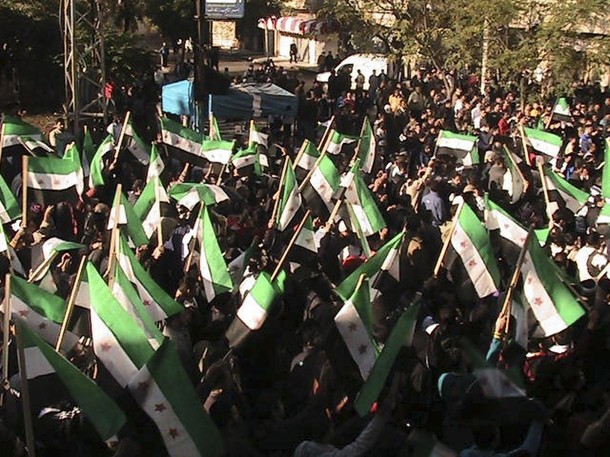
 Demonstrators protesting against Syria’s President Bashar al-Assad wave old Syrian flags as they march through the streets on the first day of the Muslim festival of Eid-al-Adha in Alsnmin near Daraa November 6, 2011.
Syrian capital flight intensifies (Financial Times):
Money has been streaming out of Syria as fears for the unstable economy lead Syrians to seek a safer place for their assets, according to members of the country’s business community.
Cash is being smuggled over the border to Lebanon “every day, every hour,” said one Syrian businessman, while another claimed Syrian money is being stashed in the grey economy that has long existed between the two countries.
In what many see as an example of the cross-border transfer, Syrian state news reported last month that officials had intercepted over $100,000 worth of Syrian pounds being smuggled across the Lebanese border under the seat of a car.
Samir Seifan, a Dubai-based Syrian economist, estimated Syria’s middle and upper classes had moved between three and five billion dollars out of the country since unrest broke out in March, alarmed by pressures on the currency and the dearth of investment opportunities.
The squeeze on Assad – June 30, 2011 (The Economist):
Public finances are in deep trouble. The president has raised government salaries and various subsidies to appease the populace. He cannot afford to do this. The government will probably print the money to meet its promises, so runaway inflation is likely, further fuelling popular anger as cash deposits become worthless.
Capital flight is rampant. Drivers on the roads into Lebanon talk of clients going from their bank in Damascus straight to one in Beirut, carrying large bags. According to one estimate, $20 billion has left the country since March, putting pressure on the Syrian pound. To slow capital flight, the government has raised interest rates. A phone company controlled by the Assad family sent out messages urging people to put money back into their accounts.
But a run on the banks cannot be ruled out. Over the past few years, about 60% of lending in Syria has been for people to buy their own cars. Many can no longer keep up with payments. A leading financier says, “If one of the smaller banks defaults, we all go down.” Some branches are even displaying millions of dollars—in bundles of notes piled head high—to reassure worried customers. Some keep enough cash in the vaults to repay almost half their depositors on the spot.
 🛑 Bernd Pulch | NAZI & STASI HUNTER | CORRUPTION & ARISTOTLE AI BI